
A English
Properties of Haloarenes Questions in English
Class 12 Chemistry · Haloalkanes and Haloarenes · Properties of Haloarenes
423+
Questions
English
Language
100%
With Solutions
Showing 50 of 423 questions in English
101
MediumMCQ
Which chloroderivative of benzene among the following would undergo hydrolysis most readily with aqueous $NaOH$ to furnish the corresponding hydroxy derivative?
A
$1-$chloro$-2,4,6-$trinitrobenzene
B
$1-$chloro$-4-$nitrobenzene
C
$1-$chloro$-4-$(dimethylamino)benzene
D
Chlorobenzene
Solution
(A) The nucleophilic aromatic substitution reaction of chlorobenzene derivatives with aqueous $NaOH$ proceeds via the formation of a Meisenheimer complex,which is stabilized by electron-withdrawing groups (EWGs) at the ortho and para positions.
$1$. The rate of nucleophilic aromatic substitution increases with the number of electron-withdrawing groups (like $-NO_2$) present at the ortho and para positions relative to the chlorine atom.
$2$. $1$-chloro-$2,4,6$-trinitrobenzene has three strong electron-withdrawing $-NO_2$ groups (two at ortho,one at para positions),which significantly stabilize the negative charge in the intermediate transition state,making it the most reactive towards nucleophilic substitution.
$3$. $1$-chloro-$4$-nitrobenzene has only one $-NO_2$ group at the para position,making it less reactive than the trinitro derivative.
$4$. Chlorobenzene and $1$-chloro-$4$-(dimethylamino)benzene (where $-N(CH_3)_2$ is an electron-donating group) are much less reactive.
Therefore,$1$-chloro-$2,4,6$-trinitrobenzene undergoes hydrolysis most readily.
$1$. The rate of nucleophilic aromatic substitution increases with the number of electron-withdrawing groups (like $-NO_2$) present at the ortho and para positions relative to the chlorine atom.
$2$. $1$-chloro-$2,4,6$-trinitrobenzene has three strong electron-withdrawing $-NO_2$ groups (two at ortho,one at para positions),which significantly stabilize the negative charge in the intermediate transition state,making it the most reactive towards nucleophilic substitution.
$3$. $1$-chloro-$4$-nitrobenzene has only one $-NO_2$ group at the para position,making it less reactive than the trinitro derivative.
$4$. Chlorobenzene and $1$-chloro-$4$-(dimethylamino)benzene (where $-N(CH_3)_2$ is an electron-donating group) are much less reactive.
Therefore,$1$-chloro-$2,4,6$-trinitrobenzene undergoes hydrolysis most readily.
0 likes
View Solution102
MediumMCQ
Which of the following reactions does not take place?
A
$2-$bromo$-1-$methoxy$-3-$methylbenzene + $KNH_2$ / liq. $NH_3$ $\rightarrow$
B
tert-butyl chloride + aq. $KOH$ $\rightarrow$
C
tert-butyl chloride + alc. $KOH$ $\rightarrow$
D
chlorobenzene + $NaOH$ $(300^{\circ}C, 200 \ atm)$ $\rightarrow$
Solution
(A) Let's analyze each reaction:
$A$: This is an elimination reaction involving a substituted benzene ring with a strong base $(KNH_2)$. This can proceed via a benzyne intermediate.
$B$: tert-butyl chloride + aq. $KOH$ is a nucleophilic substitution $(S_N1)$ reaction,which readily occurs to form tert-butyl alcohol.
$C$: tert-butyl chloride + alc. $KOH$ is an elimination $(E2)$ reaction,which readily occurs to form isobutylene.
$D$: Chlorobenzene + $NaOH$ $(300^{\circ}C, 200 \ atm)$ is the Dow process,which occurs to form sodium phenoxide.
Wait,re-evaluating $A$: The starting material is $2$-bromo-$1$-methoxy-$3$-methylbenzene. The $KNH_2$ in liquid $NH_3$ is a very strong base. It can abstract a proton from the ortho position to the bromine to form a benzyne intermediate. However,in this specific molecule,the ortho positions are occupied by a $-CH_3$ group and a $-OCH_3$ group. There is no ortho-hydrogen available for the formation of the benzyne intermediate. Therefore,this reaction cannot proceed via the benzyne mechanism.
$A$: This is an elimination reaction involving a substituted benzene ring with a strong base $(KNH_2)$. This can proceed via a benzyne intermediate.
$B$: tert-butyl chloride + aq. $KOH$ is a nucleophilic substitution $(S_N1)$ reaction,which readily occurs to form tert-butyl alcohol.
$C$: tert-butyl chloride + alc. $KOH$ is an elimination $(E2)$ reaction,which readily occurs to form isobutylene.
$D$: Chlorobenzene + $NaOH$ $(300^{\circ}C, 200 \ atm)$ is the Dow process,which occurs to form sodium phenoxide.
Wait,re-evaluating $A$: The starting material is $2$-bromo-$1$-methoxy-$3$-methylbenzene. The $KNH_2$ in liquid $NH_3$ is a very strong base. It can abstract a proton from the ortho position to the bromine to form a benzyne intermediate. However,in this specific molecule,the ortho positions are occupied by a $-CH_3$ group and a $-OCH_3$ group. There is no ortho-hydrogen available for the formation of the benzyne intermediate. Therefore,this reaction cannot proceed via the benzyne mechanism.
0 likes
View Solution103
MediumMCQ
$Benzyne$ intermediate is not observed in :
A
$1-$fluoro$-2-$methoxybenzene
B
$1-$chloro$-2,6-$dimethylbenzene
C
Chlorobenzene
D
Anthranilic acid (o-aminobenzoic acid) derivative
Solution
(B) The formation of a $benzyne$ intermediate requires the presence of an ortho-hydrogen atom relative to the leaving group to allow for the elimination of $HX$ (or similar) to form the triple bond in the ring.
$A$. $1-fluoro-2-methoxybenzene$ has an ortho-hydrogen,so it can form $benzyne$.
$B$. $1-chloro-2,6-dimethylbenzene$ does not have any hydrogen atoms at the ortho positions relative to the chlorine atom (both ortho positions are occupied by methyl groups). Therefore,it cannot undergo elimination to form a $benzyne$ intermediate.
$C$. $Chlorobenzene$ has ortho-hydrogens and can form $benzyne$ under strong basic conditions.
$D$. The $o-aminobenzoic$ acid derivative (anthranilic acid) forms $benzyne$ via diazotization followed by the loss of $N_2$ and $CO_2$.
Thus,$benzyne$ is not observed in $1-chloro-2,6-dimethylbenzene$.
$A$. $1-fluoro-2-methoxybenzene$ has an ortho-hydrogen,so it can form $benzyne$.
$B$. $1-chloro-2,6-dimethylbenzene$ does not have any hydrogen atoms at the ortho positions relative to the chlorine atom (both ortho positions are occupied by methyl groups). Therefore,it cannot undergo elimination to form a $benzyne$ intermediate.
$C$. $Chlorobenzene$ has ortho-hydrogens and can form $benzyne$ under strong basic conditions.
$D$. The $o-aminobenzoic$ acid derivative (anthranilic acid) forms $benzyne$ via diazotization followed by the loss of $N_2$ and $CO_2$.
Thus,$benzyne$ is not observed in $1-chloro-2,6-dimethylbenzene$.
0 likes
View Solution104
DifficultMCQ
For the reaction shown below,identify the major product $A$ and the reaction mechanism $R$:
$m$-bromoanisole $\xrightarrow{NaNH_2} A, R$
$m$-bromoanisole $\xrightarrow{NaNH_2} A, R$
A
$m$-methoxyaniline,elimination-addition
B
$o$-methoxyaniline,elimination-addition
C
$m$-methoxyaniline,cine substitution
D
$p$-methoxyaniline,addition-elimination
Solution
(A) The reaction of $m$-bromoanisole with $NaNH_2$ (a strong base) proceeds via the benzyne mechanism,which is an elimination-addition mechanism.
In this reaction,the base removes the ortho-hydrogen relative to the bromine atom,leading to the formation of a benzyne intermediate.
The methoxy group $(-OCH_3)$ is an electron-donating group by resonance. In the benzyne intermediate,the nucleophilic attack by $NH_2^-$ occurs at the position that leads to the most stable carbanion.
For $m$-bromoanisole,the attack of $NH_2^-$ at the meta-position relative to the $-OCH_3$ group is favored due to the inductive effect of the methoxy group,resulting in $m$-methoxyaniline as the major product.
Therefore,the product $A$ is $m$-methoxyaniline and the mechanism $R$ is elimination-addition.
In this reaction,the base removes the ortho-hydrogen relative to the bromine atom,leading to the formation of a benzyne intermediate.
The methoxy group $(-OCH_3)$ is an electron-donating group by resonance. In the benzyne intermediate,the nucleophilic attack by $NH_2^-$ occurs at the position that leads to the most stable carbanion.
For $m$-bromoanisole,the attack of $NH_2^-$ at the meta-position relative to the $-OCH_3$ group is favored due to the inductive effect of the methoxy group,resulting in $m$-methoxyaniline as the major product.
Therefore,the product $A$ is $m$-methoxyaniline and the mechanism $R$ is elimination-addition.
0 likes
View Solution105
MediumMCQ
The highest yield of $m-$ product is possible by the electrophilic substitution of the following:
A
$C_6H_5CH_3$
B
$C_6H_5CH_2COOC_2H_5$
C
$C_6H_5CH(COOC_2H_5)_2$
D
$C_6H_5C(COOC_2H_5)_3$
Solution
(D) In electrophilic aromatic substitution,the directing effect of a substituent depends on its electronic nature.
Groups that are electron-withdrawing by the inductive effect $(-I)$ and have no lone pairs to donate via resonance are generally meta-directing.
In $C_6H_5C(COOC_2H_5)_3$,the carbon atom attached to the benzene ring is bonded to three electron-withdrawing ester groups $(-COOC_2H_5)$.
This creates a strong electron-withdrawing effect on the ring,making the meta-position relatively more reactive than the ortho and para positions towards electrophilic attack.
As the number of electron-withdrawing groups increases,the meta-directing influence becomes more pronounced,leading to the highest yield of the $m-$ product.
Groups that are electron-withdrawing by the inductive effect $(-I)$ and have no lone pairs to donate via resonance are generally meta-directing.
In $C_6H_5C(COOC_2H_5)_3$,the carbon atom attached to the benzene ring is bonded to three electron-withdrawing ester groups $(-COOC_2H_5)$.
This creates a strong electron-withdrawing effect on the ring,making the meta-position relatively more reactive than the ortho and para positions towards electrophilic attack.
As the number of electron-withdrawing groups increases,the meta-directing influence becomes more pronounced,leading to the highest yield of the $m-$ product.
0 likes
View Solution106
MediumMCQ
Which of the following is the least reactive in the case of bromination?
A
Phenol
B
Aniline
C
Nitrobenzene
D
Anisole
Solution
(C) Bromination is an electrophilic aromatic substitution reaction. The reactivity of the aromatic ring depends on the electron density of the ring.
Groups that donate electrons to the ring (activating groups) increase reactivity,while groups that withdraw electrons from the ring (deactivating groups) decrease reactivity.
$1$. $Phenol$ $(-OH)$,$Aniline$ $(-NH_2)$,and $Anisole$ $(-OCH_3)$ contain electron-donating groups that activate the ring towards electrophilic substitution.
$2$. $Nitrobenzene$ $(-NO_2)$ contains a strong electron-withdrawing group,which significantly decreases the electron density of the benzene ring,making it the least reactive towards electrophilic bromination.
Groups that donate electrons to the ring (activating groups) increase reactivity,while groups that withdraw electrons from the ring (deactivating groups) decrease reactivity.
$1$. $Phenol$ $(-OH)$,$Aniline$ $(-NH_2)$,and $Anisole$ $(-OCH_3)$ contain electron-donating groups that activate the ring towards electrophilic substitution.
$2$. $Nitrobenzene$ $(-NO_2)$ contains a strong electron-withdrawing group,which significantly decreases the electron density of the benzene ring,making it the least reactive towards electrophilic bromination.
0 likes
View Solution107
DifficultMCQ
Which of the following has the maximum boiling point?
A
$1,3,5-$trichlorobenzene
B
$1,2,4-$trichlorobenzene
C
$1,2,3-$trichlorobenzene
D
$1,4-$dichlorobenzene
Solution
(B) The boiling point of isomeric dihalobenzenes and trihalobenzenes depends on their symmetry and dipole moment.
Among the given options,$1,2,4$-trichlorobenzene has the highest boiling point because it is the most polar isomer among the trichlorobenzenes,leading to stronger intermolecular dipole-dipole attractions.
$1,3,5$-trichlorobenzene is highly symmetrical and has a zero net dipole moment,resulting in lower boiling points compared to the $1,2,4$-isomer.
Among the given options,$1,2,4$-trichlorobenzene has the highest boiling point because it is the most polar isomer among the trichlorobenzenes,leading to stronger intermolecular dipole-dipole attractions.
$1,3,5$-trichlorobenzene is highly symmetrical and has a zero net dipole moment,resulting in lower boiling points compared to the $1,2,4$-isomer.
0 likes
View Solution108
MediumMCQ
Which reaction is not named as a Friedel-Crafts reaction?
A
Toluene + Propan$-2-$ol $\xrightarrow{H_2SO_4}$
B
Benzene + Acetyl chloride $\xrightarrow{AlCl_3}$
C
Phthalic anhydride + Benzene $\xrightarrow{AlCl_3}$
D
Phenyl acetate $\xrightarrow{AlCl_3, \Delta}$
Solution
(D) The Friedel-Crafts reaction involves the alkylation or acylation of an aromatic ring using a Lewis acid catalyst (like $AlCl_3$) or a strong acid catalyst.
$A$. Toluene + Propan$-2-$ol $\xrightarrow{H_2SO_4}$ is an example of Friedel-Crafts alkylation.
$B$. Benzene + Acetyl chloride $\xrightarrow{AlCl_3}$ is a classic Friedel-Crafts acylation.
$C$. Phthalic anhydride + Benzene $\xrightarrow{AlCl_3}$ is a Friedel-Crafts acylation reaction.
$D$. Phenyl acetate $\xrightarrow{AlCl_3, \Delta}$ undergoes the Fries rearrangement,which is a specific rearrangement reaction,not a standard Friedel-Crafts alkylation or acylation reaction.
$A$. Toluene + Propan$-2-$ol $\xrightarrow{H_2SO_4}$ is an example of Friedel-Crafts alkylation.
$B$. Benzene + Acetyl chloride $\xrightarrow{AlCl_3}$ is a classic Friedel-Crafts acylation.
$C$. Phthalic anhydride + Benzene $\xrightarrow{AlCl_3}$ is a Friedel-Crafts acylation reaction.
$D$. Phenyl acetate $\xrightarrow{AlCl_3, \Delta}$ undergoes the Fries rearrangement,which is a specific rearrangement reaction,not a standard Friedel-Crafts alkylation or acylation reaction.
0 likes
View Solution109
DifficultMCQ
The decreasing order of reactivity of the following compounds towards $Na^{\oplus} O^{\ominus} Me$ is:
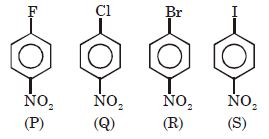
A
$P > Q > R > S$
B
$S > R > Q > P$
C
$Q > P > R > S$
D
$Q > R > S > P$
Solution
(B) The reaction of haloarenes with $Na^{\oplus} O^{\ominus} Me$ (sodium methoxide) is a Nucleophilic Aromatic Substitution $(S_NAr)$ reaction.
In $S_NAr$ reactions,the rate-determining step is the attack of the nucleophile on the aromatic ring to form a Meisenheimer complex.
The presence of an electron-withdrawing group (like $-NO_2$) at the ortho or para position facilitates this attack.
Since all compounds have a $-NO_2$ group at the para position,the rate of reaction depends on the ease of the leaving group departure.
The leaving group ability follows the order: $I^- > Br^- > Cl^- > F^-$.
Therefore,the reactivity order towards nucleophilic substitution is $S (I) > R (Br) > Q (Cl) > P (F)$.
In $S_NAr$ reactions,the rate-determining step is the attack of the nucleophile on the aromatic ring to form a Meisenheimer complex.
The presence of an electron-withdrawing group (like $-NO_2$) at the ortho or para position facilitates this attack.
Since all compounds have a $-NO_2$ group at the para position,the rate of reaction depends on the ease of the leaving group departure.
The leaving group ability follows the order: $I^- > Br^- > Cl^- > F^-$.
Therefore,the reactivity order towards nucleophilic substitution is $S (I) > R (Br) > Q (Cl) > P (F)$.
0 likes
View Solution110
DifficultMCQ
Select the reaction giving the correct major product.
A
Nitrobenzene $\xrightarrow{(i) \ Fe/HCl \ (ii) \ Br_2/H_2O}$ $2,4,6-$tribromoaniline
B
Acetylene $\xrightarrow{(i) \ \text{Red hot Fe tube} \ (ii) \ CH_3Cl/AlCl_3 \ (iii) \ Cl_2/h\nu}$ p-chlorotoluene
C
Phenol $\xrightarrow{(i) \ NaHCO_3 \ (ii) \ CH_3I}$ Anisole
D
Aniline $\xrightarrow{(i) \ NaNO_2+HCl, \ 0-5^{\circ}C \ (ii) \ H_3PO_2}$ Phenol
Solution
(A) Let's analyze each reaction:
$A$: Nitrobenzene is reduced to aniline by $Fe/HCl$. Aniline then reacts with $Br_2/H_2O$ to form $2,4,6-$tribromoaniline. This is a correct reaction.
$B$: Acetylene forms benzene with red hot Fe tube. Friedel-Crafts alkylation with $CH_3Cl/AlCl_3$ gives toluene. Chlorination with $Cl_2/h\nu$ (free radical) would chlorinate the side chain $(CH_2Cl)$,not the ring. Thus,this is incorrect.
$C$: Phenol is not acidic enough to react with $NaHCO_3$ to form phenoxide. $NaOH$ is required. Thus,this is incorrect.
$D$: Aniline reacts with $NaNO_2/HCl$ at $0-5^{\circ}C$ to form benzene diazonium chloride. Treatment with $H_3PO_2$ reduces it to benzene,not phenol. Thus,this is incorrect.
Therefore,the correct reaction is $A$.
$A$: Nitrobenzene is reduced to aniline by $Fe/HCl$. Aniline then reacts with $Br_2/H_2O$ to form $2,4,6-$tribromoaniline. This is a correct reaction.
$B$: Acetylene forms benzene with red hot Fe tube. Friedel-Crafts alkylation with $CH_3Cl/AlCl_3$ gives toluene. Chlorination with $Cl_2/h\nu$ (free radical) would chlorinate the side chain $(CH_2Cl)$,not the ring. Thus,this is incorrect.
$C$: Phenol is not acidic enough to react with $NaHCO_3$ to form phenoxide. $NaOH$ is required. Thus,this is incorrect.
$D$: Aniline reacts with $NaNO_2/HCl$ at $0-5^{\circ}C$ to form benzene diazonium chloride. Treatment with $H_3PO_2$ reduces it to benzene,not phenol. Thus,this is incorrect.
Therefore,the correct reaction is $A$.
0 likes
View Solution111
AdvancedMCQ
Select the reaction that does $NOT$ represent the correct major product.
A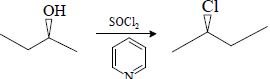
B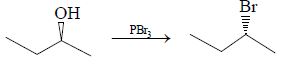
C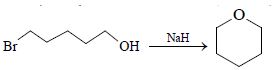
D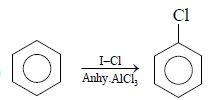
Solution
(D) In option $A$,the reaction of $sec$-butanol with $SOCl_2$ in the presence of pyridine proceeds via an $S_N2$ mechanism,resulting in the inversion of configuration. The product shown is consistent with this.
In option $B$,the reaction of $sec$-butanol with $PBr_3$ proceeds via an $S_N2$ mechanism,resulting in the inversion of configuration. The product shown is consistent with this.
In option $C$,$NaH$ deprotonates the alcohol to form an alkoxide ion,which then performs an intramolecular $S_N2$ attack on the carbon bearing the bromine atom,forming a six-membered cyclic ether (tetrahydro-2H-pyran). This is correct.
In option $D$,the reaction of benzene with $I-Cl$ in the presence of a Lewis acid like $AlCl_3$ is an electrophilic aromatic substitution. Since $I$ is less electronegative than $Cl$,$I^+$ acts as the electrophile. Therefore,the major product is iodobenzene,not chlorobenzene. Thus,this reaction does not represent the correct major product.
In option $B$,the reaction of $sec$-butanol with $PBr_3$ proceeds via an $S_N2$ mechanism,resulting in the inversion of configuration. The product shown is consistent with this.
In option $C$,$NaH$ deprotonates the alcohol to form an alkoxide ion,which then performs an intramolecular $S_N2$ attack on the carbon bearing the bromine atom,forming a six-membered cyclic ether (tetrahydro-2H-pyran). This is correct.
In option $D$,the reaction of benzene with $I-Cl$ in the presence of a Lewis acid like $AlCl_3$ is an electrophilic aromatic substitution. Since $I$ is less electronegative than $Cl$,$I^+$ acts as the electrophile. Therefore,the major product is iodobenzene,not chlorobenzene. Thus,this reaction does not represent the correct major product.
0 likes
View Solution112
DifficultMCQ
In which of the following molecules does electrophilic attack occur at the meta position?
A
$Toluene$ $(C_6H_5CH_3)$
B
$Chlorobenzene$ $(C_6H_5Cl)$
C
$(Trichloromethyl)benzene$ $(C_6H_5CCl_3)$
D
$Ethylbenzene$ $(C_6H_5CH_2CH_3)$
Solution
(C) Electrophilic aromatic substitution occurs at the meta position when the substituent on the benzene ring is a strongly electron-withdrawing group (deactivating group) that does not have lone pairs to donate via resonance.
$1$. $Toluene$ $(-CH_3)$,$Ethylbenzene$ $(-CH_2CH_3)$,and $Chlorobenzene$ $(-Cl)$ are all ortho/para-directing groups. The alkyl groups are activating,and the chlorine atom,despite being deactivating,directs ortho/para due to resonance donation of its lone pair.
$2$. In $(Trichloromethyl)benzene$ $(C_6H_5CCl_3)$,the $-CCl_3$ group is strongly electron-withdrawing due to the inductive effect of the three electronegative chlorine atoms. It lacks lone pairs for resonance donation,making it a meta-directing group.
$1$. $Toluene$ $(-CH_3)$,$Ethylbenzene$ $(-CH_2CH_3)$,and $Chlorobenzene$ $(-Cl)$ are all ortho/para-directing groups. The alkyl groups are activating,and the chlorine atom,despite being deactivating,directs ortho/para due to resonance donation of its lone pair.
$2$. In $(Trichloromethyl)benzene$ $(C_6H_5CCl_3)$,the $-CCl_3$ group is strongly electron-withdrawing due to the inductive effect of the three electronegative chlorine atoms. It lacks lone pairs for resonance donation,making it a meta-directing group.
0 likes
View Solution113
MediumMCQ
Which of the following compounds does not give a tribromo derivative upon reaction with $Br_2/H_2O$?
A
Phenol
B
Aniline
C
Anisole
D
Nitrobenzene
Solution
(D) Compounds like phenol,aniline,and anisole contain strongly activating groups ($-OH$,$-NH_2$,$-OCH_3$) that increase the electron density of the benzene ring,making it highly reactive towards electrophilic substitution. Thus,they readily undergo bromination with $Br_2/H_2O$ to form tribromo derivatives.
Nitrobenzene,on the other hand,contains a strongly deactivating $-NO_2$ group. This group withdraws electrons from the benzene ring,significantly reducing its electron density and making it resistant to electrophilic substitution reactions like bromination. Therefore,it does not form a tribromo derivative.
Nitrobenzene,on the other hand,contains a strongly deactivating $-NO_2$ group. This group withdraws electrons from the benzene ring,significantly reducing its electron density and making it resistant to electrophilic substitution reactions like bromination. Therefore,it does not form a tribromo derivative.
0 likes
View Solution114
MediumMCQ
Which of the following reactions is called the Wurtz-Fittig reaction?
A
$A$ reaction involving the coupling of two aryl halides with sodium in dry ether.
B
$C_6H_5CH_3 + SO_2Cl_2 \xrightarrow{h\nu} C_6H_5CH_2Cl + SO_2 + Cl_2$
C
$C_6H_5X + R-X \xrightarrow{Na, \text{dry ether}} C_6H_5-R + 2NaX$
D
$C_6H_6 + R-Cl \xrightarrow{AlCl_3} C_6H_5-R + HCl$
Solution
(C) The Wurtz-Fittig reaction is a chemical reaction where an aryl halide reacts with an alkyl halide in the presence of sodium metal and dry ether to form an alkylbenzene.
The general equation is: $C_6H_5X + R-X + 2Na \xrightarrow{\text{dry ether}} C_6H_5-R + 2NaX$.
Comparing this with the given options,option $C$ represents the Wurtz-Fittig reaction.
The general equation is: $C_6H_5X + R-X + 2Na \xrightarrow{\text{dry ether}} C_6H_5-R + 2NaX$.
Comparing this with the given options,option $C$ represents the Wurtz-Fittig reaction.
0 likes
View Solution115
MediumMCQ
Which of the following reactions is not correctly represented?
A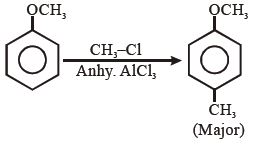
B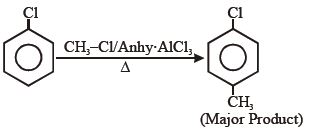
C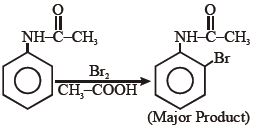
D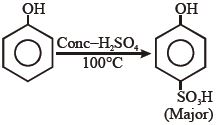
Solution
(C) Let us analyze each reaction:
$A$: Friedel-Crafts alkylation of anisole $(C_6H_5OCH_3)$ with $CH_3Cl/AlCl_3$ gives $p$-methylanisole as the major product due to the ortho/para-directing nature of the $-OCH_3$ group. This is correct.
$B$: Friedel-Crafts alkylation of chlorobenzene with $CH_3Cl/AlCl_3$ gives $p$-chlorotoluene as the major product due to the ortho/para-directing nature of the $-Cl$ group. This is correct.
$C$: Bromination of acetanilide with $Br_2$ in $CH_3COOH$ gives $p$-bromoacetanilide as the major product because the $-NHCOCH_3$ group is strongly ortho/para-directing and the para-position is sterically less hindered. The reaction shown in the option gives the ortho-isomer as the major product,which is incorrect.
$D$: Sulfonation of phenol with concentrated $H_2SO_4$ at $100 \ ^\circ C$ gives $p$-phenolsulfonic acid as the major product. This is correct.
Therefore,the reaction in option $C$ is not correctly represented.
$A$: Friedel-Crafts alkylation of anisole $(C_6H_5OCH_3)$ with $CH_3Cl/AlCl_3$ gives $p$-methylanisole as the major product due to the ortho/para-directing nature of the $-OCH_3$ group. This is correct.
$B$: Friedel-Crafts alkylation of chlorobenzene with $CH_3Cl/AlCl_3$ gives $p$-chlorotoluene as the major product due to the ortho/para-directing nature of the $-Cl$ group. This is correct.
$C$: Bromination of acetanilide with $Br_2$ in $CH_3COOH$ gives $p$-bromoacetanilide as the major product because the $-NHCOCH_3$ group is strongly ortho/para-directing and the para-position is sterically less hindered. The reaction shown in the option gives the ortho-isomer as the major product,which is incorrect.
$D$: Sulfonation of phenol with concentrated $H_2SO_4$ at $100 \ ^\circ C$ gives $p$-phenolsulfonic acid as the major product. This is correct.
Therefore,the reaction in option $C$ is not correctly represented.
0 likes
View Solution116
AdvancedMCQ
Which reaction shows the correct major product?
A
Phenyl benzoate + $NO_2^+$ $\rightarrow$ $p$-nitrophenyl benzoate
B
$CCl_3$-benzene + $NO_2^+$ $\rightarrow$ $o$-nitro-$CCl_3$-benzene
C
$1-$naphthoic acid lactone + $Br_2 + FeBr_3$ $\rightarrow$ $4-$bromo$-1-$naphthoic acid lactone
D
Halobenzene $(X=Cl, Br)$ + $CH_3Cl + AlCl_3$ $\rightarrow$ $m$-methylhalobenzene
Solution
(C) Let's analyze each reaction:
$A$: Phenyl benzoate has an ester group $(-COOPh)$. The $-COO-$ group is electron-withdrawing and deactivating,directing electrophilic substitution to the meta position. The product shown is para,which is incorrect.
$B$: The $-CCl_3$ group is strongly electron-withdrawing due to the $-I$ effect of three chlorine atoms. It is a meta-directing group. The product shown is ortho,which is incorrect.
$C$: $1-$naphthoic acid lactone (coumarin derivative) has an oxygen atom directly attached to the ring,which is ortho/para directing. The electrophilic substitution of $Br^+$ occurs at the para position relative to the oxygen,which is the $4$-position of the naphthalene ring. This is the correct major product.
$D$: Halogens $(-Cl, -Br)$ are ortho/para directing due to resonance. They do not direct to the meta position. The product shown is meta,which is incorrect.
Therefore,the correct reaction is $C$.
$A$: Phenyl benzoate has an ester group $(-COOPh)$. The $-COO-$ group is electron-withdrawing and deactivating,directing electrophilic substitution to the meta position. The product shown is para,which is incorrect.
$B$: The $-CCl_3$ group is strongly electron-withdrawing due to the $-I$ effect of three chlorine atoms. It is a meta-directing group. The product shown is ortho,which is incorrect.
$C$: $1-$naphthoic acid lactone (coumarin derivative) has an oxygen atom directly attached to the ring,which is ortho/para directing. The electrophilic substitution of $Br^+$ occurs at the para position relative to the oxygen,which is the $4$-position of the naphthalene ring. This is the correct major product.
$D$: Halogens $(-Cl, -Br)$ are ortho/para directing due to resonance. They do not direct to the meta position. The product shown is meta,which is incorrect.
Therefore,the correct reaction is $C$.
0 likes
View Solution117
MediumMCQ
What will be the product of the following reaction?
$1$-chloro-$2,4$-dinitrobenzene + $CH_3ONa \xrightarrow{\Delta} \text{Product}$
$1$-chloro-$2,4$-dinitrobenzene + $CH_3ONa \xrightarrow{\Delta} \text{Product}$
A
$1-$chloro$-2-$methoxy$-4-$nitrobenzene
B
$1-$methoxy$-2,4-$dinitrobenzene
C
$1-$chloro$-2-$nitro$-4-$methoxybenzene
D
None of these
Solution
(B) The reaction is a Nucleophilic Aromatic Substitution $(S_NAr)$ reaction.
In $1$-chloro-$2,4$-dinitrobenzene,the chlorine atom is at the $ortho$ position with respect to one $-NO_2$ group and at the $para$ position with respect to the other $-NO_2$ group.
Electron-withdrawing groups (like $-NO_2$) at $ortho$ and $para$ positions activate the ring towards nucleophilic attack by stabilizing the Meisenheimer complex intermediate.
Since both $-NO_2$ groups are at $ortho$ and $para$ positions relative to the chlorine atom,the chlorine atom is highly activated and is replaced by the methoxide ion $(CH_3O^-)$ to form $1$-methoxy-$2,4$-dinitrobenzene.
In $1$-chloro-$2,4$-dinitrobenzene,the chlorine atom is at the $ortho$ position with respect to one $-NO_2$ group and at the $para$ position with respect to the other $-NO_2$ group.
Electron-withdrawing groups (like $-NO_2$) at $ortho$ and $para$ positions activate the ring towards nucleophilic attack by stabilizing the Meisenheimer complex intermediate.
Since both $-NO_2$ groups are at $ortho$ and $para$ positions relative to the chlorine atom,the chlorine atom is highly activated and is replaced by the methoxide ion $(CH_3O^-)$ to form $1$-methoxy-$2,4$-dinitrobenzene.
0 likes
View Solution118
DifficultMCQ
Which of the following compounds undergoes nucleophilic substitution reaction most easily?
A
Chlorobenzene
B
$1-$Chloro$-4-$nitrobenzene
C
$1-$Chloro$-4-$methylbenzene
D
$1-$Chloro$-4-$methoxybenzene
Solution
(B) Nucleophilic aromatic substitution reactions occur more readily when electron-withdrawing groups (EWGs) are present on the benzene ring. These groups stabilize the negatively charged intermediate (Meisenheimer complex) formed during the reaction. The $-NO_2$ group is a strong electron-withdrawing group due to its $-I$ and $-M$ effects,which significantly stabilizes the carbanion intermediate. Therefore,$1$-chloro-$4$-nitrobenzene undergoes nucleophilic substitution most easily.
0 likes
View Solution119
DifficultMCQ
Consider the following reaction:
A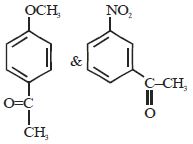
B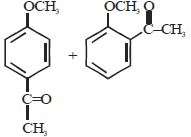
C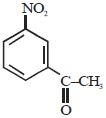
D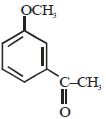
Solution
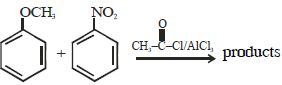
(B) The reaction shown is a Friedel-Crafts acylation of anisole $(methoxybenzene)$ in the presence of nitrobenzene.
Nitrobenzene is a strongly deactivating solvent and does not participate in the reaction.
Anisole contains an $-OCH_3$ group,which is an ortho/para directing group.
Therefore,the electrophilic substitution (acylation) will occur at the ortho and para positions of the anisole ring,yielding a mixture of $2$-methoxyacetophenone and $4$-methoxyacetophenone.
Nitrobenzene is a strongly deactivating solvent and does not participate in the reaction.
Anisole contains an $-OCH_3$ group,which is an ortho/para directing group.
Therefore,the electrophilic substitution (acylation) will occur at the ortho and para positions of the anisole ring,yielding a mixture of $2$-methoxyacetophenone and $4$-methoxyacetophenone.
0 likes
View Solution120
MediumMCQ
Identify the major product of the following reaction: $C_6H_5-NO_2 + CH_3-COCl \xrightarrow{AlCl_3} \text{Major product}$
A
m-nitroacetophenone
B
o-nitroacetophenone
C
p-nitroacetophenone
D
Reaction is not possible
Solution
(D) Friedel-Crafts reactions (alkylation or acylation) do not occur on strongly deactivated aromatic rings.
The nitro group $(-NO_2)$ is a powerful electron-withdrawing group that reduces the electron density of the benzene ring to such an extent that it does not react with the electrophile (acylium ion).
Therefore,nitrobenzene does not undergo Friedel-Crafts acylation.
The nitro group $(-NO_2)$ is a powerful electron-withdrawing group that reduces the electron density of the benzene ring to such an extent that it does not react with the electrophile (acylium ion).
Therefore,nitrobenzene does not undergo Friedel-Crafts acylation.
0 likes
View Solution121
DifficultMCQ
For the given reaction,identify the major product $C$.

A
Chlorobenzene
B
$3-$Nitrophenol
C
$4-$Nitrophenol
D
$3,5-$Dinitrophenol
Solution
(C) The reaction sequence is as follows:
$1$. Benzene reacts with $Cl_2$ in the presence of $FeCl_3$ (electrophilic aromatic substitution) to form chlorobenzene $(A)$.
$2$. Chlorobenzene $(A)$ undergoes nitration with $Conc. HNO_3 + Conc. H_2SO_4$ to form a mixture of $o$-nitrochlorobenzene and $p$-nitrochlorobenzene. The major product is $p$-nitrochlorobenzene $(B)$ due to less steric hindrance.
$3$. $p$-Nitrochlorobenzene $(B)$ undergoes nucleophilic aromatic substitution with $NaOH$ at $443 \ K$ followed by acidification $(H^+)$ to replace the $Cl$ atom with an $-OH$ group,yielding $p$-nitrophenol $(C)$.
$1$. Benzene reacts with $Cl_2$ in the presence of $FeCl_3$ (electrophilic aromatic substitution) to form chlorobenzene $(A)$.
$2$. Chlorobenzene $(A)$ undergoes nitration with $Conc. HNO_3 + Conc. H_2SO_4$ to form a mixture of $o$-nitrochlorobenzene and $p$-nitrochlorobenzene. The major product is $p$-nitrochlorobenzene $(B)$ due to less steric hindrance.
$3$. $p$-Nitrochlorobenzene $(B)$ undergoes nucleophilic aromatic substitution with $NaOH$ at $443 \ K$ followed by acidification $(H^+)$ to replace the $Cl$ atom with an $-OH$ group,yielding $p$-nitrophenol $(C)$.
0 likes
View Solution122
AdvancedMCQ
Predict the major product of the following reaction:
$1$-fluoro-$2$-chloro-$4$-nitrobenzene $\xrightarrow[(ii) H^+]{(i) NaOH}$ Product
$1$-fluoro-$2$-chloro-$4$-nitrobenzene $\xrightarrow[(ii) H^+]{(i) NaOH}$ Product
A
$3-$chloro$-4-$fluoronitrobenzene
B
$2-$chloro$-4-$nitrophenol
C
$2-$chloro$-1-$fluoro$-4-$hydroxybenzene
D
$3-$chloro$-4-$hydroxy-nitrobenzene
Solution
(B) The reaction is a nucleophilic aromatic substitution $(S_NAr)$ reaction.
The substrate is $1$-fluoro-$2$-chloro-$4$-nitrobenzene.
The nitro group $(-NO_2)$ is a strong electron-withdrawing group that activates the ortho and para positions towards nucleophilic attack.
In this molecule,the fluorine atom is at the para position with respect to the $-NO_2$ group,and the chlorine atom is at the meta position with respect to the $-NO_2$ group.
Nucleophilic substitution occurs most readily at the position para to the electron-withdrawing group because the intermediate carbanion (Meisenheimer complex) is stabilized by resonance with the $-NO_2$ group.
Furthermore,fluorine is a better leaving group than chlorine in $S_NAr$ reactions due to its high electronegativity,which stabilizes the transition state of the nucleophilic attack.
Therefore,the $OH^-$ ion attacks the carbon atom attached to the fluorine atom,leading to the displacement of the fluoride ion.
The final product is $2$-chloro-$4$-nitrophenol.
The substrate is $1$-fluoro-$2$-chloro-$4$-nitrobenzene.
The nitro group $(-NO_2)$ is a strong electron-withdrawing group that activates the ortho and para positions towards nucleophilic attack.
In this molecule,the fluorine atom is at the para position with respect to the $-NO_2$ group,and the chlorine atom is at the meta position with respect to the $-NO_2$ group.
Nucleophilic substitution occurs most readily at the position para to the electron-withdrawing group because the intermediate carbanion (Meisenheimer complex) is stabilized by resonance with the $-NO_2$ group.
Furthermore,fluorine is a better leaving group than chlorine in $S_NAr$ reactions due to its high electronegativity,which stabilizes the transition state of the nucleophilic attack.
Therefore,the $OH^-$ ion attacks the carbon atom attached to the fluorine atom,leading to the displacement of the fluoride ion.
The final product is $2$-chloro-$4$-nitrophenol.
0 likes
View Solution123
MediumMCQ
Identify the major product of the following nitration reaction:
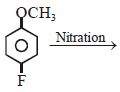
A
$1-$fluoro$-4-$methoxy$-2-$nitrobenzene
B
$1-$fluoro$-2-$methoxy$-4-$nitrobenzene
C
Mixture of $(A)$ and $(B)$
D
None of these
Solution
(A) The starting material is $1$-fluoro-$4$-methoxybenzene. The methoxy group $(-OCH_3)$ is a strongly activating group and is ortho/para-directing,while the fluoro group $(-F)$ is a weakly deactivating group and is also ortho/para-directing.
In this molecule,the $-OCH_3$ group is at position $1$ and the $-F$ group is at position $4$. The positions ortho to the $-OCH_3$ group are positions $2$ and $6$. The positions ortho to the $-F$ group are positions $3$ and $5$.
Due to the stronger activating effect of the $-OCH_3$ group,the electrophilic substitution (nitration) will be directed primarily by the $-OCH_3$ group. The position ortho to $-OCH_3$ (position $2$) is also meta to the $-F$ group. The position ortho to $-F$ (position $3$) is meta to the $-OCH_3$ group.
Since $-OCH_3$ is a much stronger activating group than $-F$,the nitration occurs predominantly at the position ortho to the $-OCH_3$ group. Thus,the major product is $1$-fluoro-$4$-methoxy-$2$-nitrobenzene.
In this molecule,the $-OCH_3$ group is at position $1$ and the $-F$ group is at position $4$. The positions ortho to the $-OCH_3$ group are positions $2$ and $6$. The positions ortho to the $-F$ group are positions $3$ and $5$.
Due to the stronger activating effect of the $-OCH_3$ group,the electrophilic substitution (nitration) will be directed primarily by the $-OCH_3$ group. The position ortho to $-OCH_3$ (position $2$) is also meta to the $-F$ group. The position ortho to $-F$ (position $3$) is meta to the $-OCH_3$ group.
Since $-OCH_3$ is a much stronger activating group than $-F$,the nitration occurs predominantly at the position ortho to the $-OCH_3$ group. Thus,the major product is $1$-fluoro-$4$-methoxy-$2$-nitrobenzene.
0 likes
View Solution124
DifficultMCQ
Consider the reaction of $1-chloro-2-hydroxy-4-nitrobenzene$ with $OH^-$ followed by $H^+$. Based on the above reaction,the major product $P$ would be:
A
$2-$chloro$-4-$nitrophenol
B
$4-$nitro$-2-$chlorophenol
C
Both in equal proportions
D
No reaction
Solution
(D) The starting material is $1-chloro-2-hydroxy-4-nitrobenzene$.
Treatment with $OH^-$ (base) deprotonates the phenolic $-OH$ group to form a phenoxide ion.
However,the reaction conditions provided $(OH^-, \Delta)$ typically refer to Nucleophilic Aromatic Substitution $(S_NAr)$.
In $1-chloro-2-hydroxy-4-nitrobenzene$,the $-OH$ group is ortho to the $-Cl$ group and para to the $-NO_2$ group.
Under basic conditions,the phenoxide ion is formed. The electron-withdrawing $-NO_2$ group activates the ring for nucleophilic substitution.
However,the $-OH$ group is already present. The reaction with $OH^-$ on a chlorobenzene derivative with an ortho-hydroxyl group does not lead to substitution of the $-Cl$ because the phenoxide is a poor leaving group and the $-OH$ is already present.
Actually,this specific substrate is stable under these conditions,or if substitution were to occur,it would be difficult due to the ortho-phenoxide group.
Given the options,the reaction does not proceed to replace the $-Cl$ with $-OH$ because the $-OH$ is already present and the phenoxide is electron-donating. Thus,no reaction occurs.
Treatment with $OH^-$ (base) deprotonates the phenolic $-OH$ group to form a phenoxide ion.
However,the reaction conditions provided $(OH^-, \Delta)$ typically refer to Nucleophilic Aromatic Substitution $(S_NAr)$.
In $1-chloro-2-hydroxy-4-nitrobenzene$,the $-OH$ group is ortho to the $-Cl$ group and para to the $-NO_2$ group.
Under basic conditions,the phenoxide ion is formed. The electron-withdrawing $-NO_2$ group activates the ring for nucleophilic substitution.
However,the $-OH$ group is already present. The reaction with $OH^-$ on a chlorobenzene derivative with an ortho-hydroxyl group does not lead to substitution of the $-Cl$ because the phenoxide is a poor leaving group and the $-OH$ is already present.
Actually,this specific substrate is stable under these conditions,or if substitution were to occur,it would be difficult due to the ortho-phenoxide group.
Given the options,the reaction does not proceed to replace the $-Cl$ with $-OH$ because the $-OH$ is already present and the phenoxide is electron-donating. Thus,no reaction occurs.
0 likes
View Solution125
DifficultMCQ
$CH \equiv CH$ $\xrightarrow{\text{Red Hot Fe tube}} A$ $\xrightarrow[\text{Dark}]{Cl_2 / FeCl_3} B$ $\xrightarrow[\text{Anhy. } AlCl_3]{CH_3 - Cl} C$ (Major)
Product '$C$' is
Product '$C$' is
A
$1,2-$dichlorobenzene
B
$2-$chlorotoluene
C
$3-$chlorotoluene
D
$4-$chlorotoluene
Solution
(D) $1$. The reaction of acetylene $(CH \equiv CH)$ with red hot $Fe$ tube undergoes cyclic polymerization to form benzene $(A)$.
$2$. Benzene $(A)$ reacts with $Cl_2$ in the presence of $FeCl_3$ (Lewis acid) to undergo electrophilic aromatic substitution,forming chlorobenzene $(B)$.
$3$. Chlorobenzene $(B)$ reacts with methyl chloride $(CH_3-Cl)$ in the presence of anhydrous $AlCl_3$ (Friedel-Crafts alkylation). Since the $-Cl$ group is ortho/para directing,the major product is the para-substituted isomer,which is $4-$chlorotoluene $(C)$.
$2$. Benzene $(A)$ reacts with $Cl_2$ in the presence of $FeCl_3$ (Lewis acid) to undergo electrophilic aromatic substitution,forming chlorobenzene $(B)$.
$3$. Chlorobenzene $(B)$ reacts with methyl chloride $(CH_3-Cl)$ in the presence of anhydrous $AlCl_3$ (Friedel-Crafts alkylation). Since the $-Cl$ group is ortho/para directing,the major product is the para-substituted isomer,which is $4-$chlorotoluene $(C)$.
0 likes
View Solution126
DifficultMCQ
The main product of the following reaction will be
$1$-fluoro-$2$-chloro-$4$-nitrobenzene + piperidine $\to$ Product
$1$-fluoro-$2$-chloro-$4$-nitrobenzene + piperidine $\to$ Product
A
$1-$piperidino$-2-$chloro$-4-$nitrobenzene
B
$1-$fluoro$-2-$piperidino$-4-$nitrobenzene
C
$1,2-$di-piperidino$-4-$nitrobenzene
D
$1-$piperidino$-2-$fluoro$-4-$nitrobenzene
Solution
(A) The reaction is a Nucleophilic Aromatic Substitution $(S_NAr)$ reaction.
In $S_NAr$ reactions,the leaving group ability is determined by the electronegativity of the halogen atom because the rate-determining step is the formation of the Meisenheimer complex.
Fluorine $(F)$ is more electronegative than Chlorine $(Cl)$,which makes the carbon atom attached to $F$ more electron-deficient and thus more susceptible to nucleophilic attack.
Therefore,the nucleophile (piperidine) will preferentially displace the fluorine atom rather than the chlorine atom.
The product formed is $1$-piperidino-$2$-chloro-$4$-nitrobenzene.
In $S_NAr$ reactions,the leaving group ability is determined by the electronegativity of the halogen atom because the rate-determining step is the formation of the Meisenheimer complex.
Fluorine $(F)$ is more electronegative than Chlorine $(Cl)$,which makes the carbon atom attached to $F$ more electron-deficient and thus more susceptible to nucleophilic attack.
Therefore,the nucleophile (piperidine) will preferentially displace the fluorine atom rather than the chlorine atom.
The product formed is $1$-piperidino-$2$-chloro-$4$-nitrobenzene.
0 likes
View Solution127
MediumMCQ
Acetanilide $\xrightarrow[{CH_3COOH}]{{Br_2}}$ major product will be
A
$o$-Bromoacetanilide
B
$N$-Bromoacetanilide
C
$p$-Bromoacetanilide
D
$m$-Bromoacetanilide
Solution
(C) The reaction of acetanilide with bromine in the presence of acetic acid $(CH_3COOH)$ is an electrophilic aromatic substitution reaction.
The $-NHCOCH_3$ group is ortho/para-directing due to the lone pair on the nitrogen atom which is involved in resonance with the benzene ring.
Due to steric hindrance at the ortho position,the para-isomer is the major product.
Therefore,the major product formed is $p$-bromoacetanilide.
The $-NHCOCH_3$ group is ortho/para-directing due to the lone pair on the nitrogen atom which is involved in resonance with the benzene ring.
Due to steric hindrance at the ortho position,the para-isomer is the major product.
Therefore,the major product formed is $p$-bromoacetanilide.
0 likes
View Solution128
MediumMCQ
The rate of reaction is maximum if $G$ is:
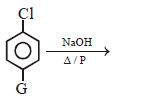
A
$-OCH_3$
B
$-CH_3$
C
$-NO_2$
D
$-H$
Solution
(C) The given reaction is a nucleophilic aromatic substitution reaction $(S_NAr)$.
Nucleophilic substitution on an aromatic ring is facilitated by the presence of strong electron-withdrawing groups (EWGs) at the ortho or para positions.
These groups reduce the electron density of the aromatic ring,making it more susceptible to attack by a nucleophile (like $OH^-$ from $NaOH$).
Among the given options,$-NO_2$ is a strong electron-withdrawing group due to its $-I$ and $-M$ effects.
$-OCH_3$ and $-CH_3$ are electron-donating groups,which decrease the rate of nucleophilic substitution.
Therefore,the rate of reaction is maximum when $G = -NO_2$.
Nucleophilic substitution on an aromatic ring is facilitated by the presence of strong electron-withdrawing groups (EWGs) at the ortho or para positions.
These groups reduce the electron density of the aromatic ring,making it more susceptible to attack by a nucleophile (like $OH^-$ from $NaOH$).
Among the given options,$-NO_2$ is a strong electron-withdrawing group due to its $-I$ and $-M$ effects.
$-OCH_3$ and $-CH_3$ are electron-donating groups,which decrease the rate of nucleophilic substitution.
Therefore,the rate of reaction is maximum when $G = -NO_2$.
0 likes
View Solution129
MediumMCQ
The reaction shown below is known as:
$2C_6H_5Cl + 2Na \xrightarrow{\text{dry ether}} C_6H_5-C_6H_5 + 2NaCl$
$2C_6H_5Cl + 2Na \xrightarrow{\text{dry ether}} C_6H_5-C_6H_5 + 2NaCl$
A
Wurtz reaction
B
Wurtz-Fittig reaction
C
Fittig reaction
D
Kolbe electrolysis
Solution
(C) The given reaction involves the coupling of two aryl halide molecules $(C_6H_5Cl)$ in the presence of sodium metal and dry ether to form diphenyl $(C_6H_5-C_6H_5)$.
This specific reaction,where two aryl halide molecules react with sodium to form a diaryl compound,is known as the Fittig reaction.
Therefore,the correct option is $(C)$.
This specific reaction,where two aryl halide molecules react with sodium to form a diaryl compound,is known as the Fittig reaction.
Therefore,the correct option is $(C)$.
0 likes
View Solution130
DifficultMCQ
Which of the following reactions does not give chlorobenzene as a product?
A
Cyclopentadiene + $CHCl_3, HO^-$
B
Cyclopentadiene + $CHBrCl_2, HO^-$
C
Cyclopentadiene + $CHBr_2Cl, HO^-$
D
Cyclopentadiene + $CHFClBr, HO^-$
Solution
(D) The reaction of cyclopentadiene with a haloform in the presence of a base $(HO^-)$ proceeds via the formation of a dihalocarbene intermediate,which undergoes a $[4+2]$ cycloaddition followed by ring expansion to form a benzene derivative.
$(A)$ Cyclopentadiene + $CHCl_3, HO^-$ $\rightarrow$ Dichlorocarbene $(:CCl_2)$ $\rightarrow$ Chlorobenzene.
$(B)$ Cyclopentadiene + $CHBrCl_2, HO^-$ $\rightarrow$ Bromochlorocarbene $(:CClBr)$ $\rightarrow$ The leaving group ability is $Br^- > Cl^-$. Thus,$Br^-$ leaves,forming chlorobenzene.
$(C)$ Cyclopentadiene + $CHBr_2Cl, HO^-$ $\rightarrow$ Dibromocarbene $(:CBr_2)$ $\rightarrow$ Bromobenzene.
$(D)$ Cyclopentadiene + $CHFClBr, HO^-$ $\rightarrow$ Chlorofluorocarbene $(:CFCl)$ $\rightarrow$ The leaving group ability is $Cl^- > F^-$. Thus,$Cl^-$ leaves,forming fluorobenzene.
Therefore,reaction $(C)$ gives bromobenzene and reaction $(D)$ gives fluorobenzene. However,based on the provided options and the standard mechanism,$(D)$ specifically yields fluorobenzene because $Cl^-$ is a better leaving group than $F^-$,and $(C)$ yields bromobenzene. Given the question asks which does not give chlorobenzene,both $(C)$ and $(D)$ are technically correct. Assuming a single choice,$(D)$ is the most distinct case of forming a different halogenated benzene.
$(A)$ Cyclopentadiene + $CHCl_3, HO^-$ $\rightarrow$ Dichlorocarbene $(:CCl_2)$ $\rightarrow$ Chlorobenzene.
$(B)$ Cyclopentadiene + $CHBrCl_2, HO^-$ $\rightarrow$ Bromochlorocarbene $(:CClBr)$ $\rightarrow$ The leaving group ability is $Br^- > Cl^-$. Thus,$Br^-$ leaves,forming chlorobenzene.
$(C)$ Cyclopentadiene + $CHBr_2Cl, HO^-$ $\rightarrow$ Dibromocarbene $(:CBr_2)$ $\rightarrow$ Bromobenzene.
$(D)$ Cyclopentadiene + $CHFClBr, HO^-$ $\rightarrow$ Chlorofluorocarbene $(:CFCl)$ $\rightarrow$ The leaving group ability is $Cl^- > F^-$. Thus,$Cl^-$ leaves,forming fluorobenzene.
Therefore,reaction $(C)$ gives bromobenzene and reaction $(D)$ gives fluorobenzene. However,based on the provided options and the standard mechanism,$(D)$ specifically yields fluorobenzene because $Cl^-$ is a better leaving group than $F^-$,and $(C)$ yields bromobenzene. Given the question asks which does not give chlorobenzene,both $(C)$ and $(D)$ are technically correct. Assuming a single choice,$(D)$ is the most distinct case of forming a different halogenated benzene.
0 likes
View Solution131
AdvancedMCQ
The major product of the reaction is:
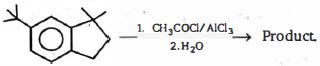
A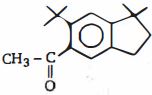
B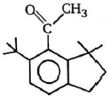
C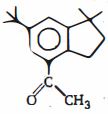
D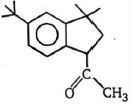
Solution
(C) The reaction is a Friedel-Crafts acylation of a substituted indane derivative.
The substrate has a tert-butyl group and a gem-dimethyl group on the five-membered ring.
The electrophile is the acetyl cation,$CH_3CO^+$,generated from $CH_3COCl$ and $AlCl_3$.
The position of substitution is governed by the directing effects of the existing substituents and steric hindrance.
The tert-butyl group is bulky and directs to the ortho/para positions,but the para position is blocked by the fused ring.
The ortho position relative to the tert-butyl group is sterically hindered.
The position para to the gem-dimethyl group is the most accessible and electronically favored for electrophilic aromatic substitution.
Therefore,the acetyl group attaches to the position para to the gem-dimethyl group,which corresponds to the structure shown in option $C$.
The substrate has a tert-butyl group and a gem-dimethyl group on the five-membered ring.
The electrophile is the acetyl cation,$CH_3CO^+$,generated from $CH_3COCl$ and $AlCl_3$.
The position of substitution is governed by the directing effects of the existing substituents and steric hindrance.
The tert-butyl group is bulky and directs to the ortho/para positions,but the para position is blocked by the fused ring.
The ortho position relative to the tert-butyl group is sterically hindered.
The position para to the gem-dimethyl group is the most accessible and electronically favored for electrophilic aromatic substitution.
Therefore,the acetyl group attaches to the position para to the gem-dimethyl group,which corresponds to the structure shown in option $C$.
0 likes
View Solution132
DifficultMCQ
Product $A$ of the given reaction is
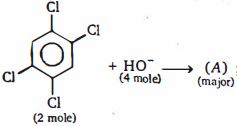
A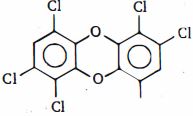
B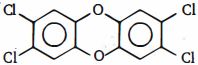
C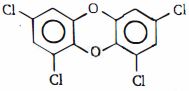
D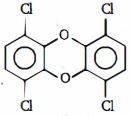
Solution
(C) The reaction involves the nucleophilic aromatic substitution $(S_NAr)$ of $1,2,4,5$-tetrachlorobenzene with hydroxide ions.
Initially,one $OH^-$ ion replaces one $Cl$ atom to form $2,4,5$-trichlorophenol.
Subsequently,another $OH^-$ ion deprotonates the phenol to form a phenoxide ion.
This phenoxide ion then attacks another molecule of $1,2,4,5$-tetrachlorobenzene,leading to the formation of a dibenzo-p-dioxin derivative.
Specifically,the reaction of $2$ moles of $1,2,4,5$-tetrachlorobenzene with $4$ moles of $OH^-$ yields $2,3,7,8$-tetrachlorodibenzo-p-dioxin as the major product $A$.
Initially,one $OH^-$ ion replaces one $Cl$ atom to form $2,4,5$-trichlorophenol.
Subsequently,another $OH^-$ ion deprotonates the phenol to form a phenoxide ion.
This phenoxide ion then attacks another molecule of $1,2,4,5$-tetrachlorobenzene,leading to the formation of a dibenzo-p-dioxin derivative.
Specifically,the reaction of $2$ moles of $1,2,4,5$-tetrachlorobenzene with $4$ moles of $OH^-$ yields $2,3,7,8$-tetrachlorodibenzo-p-dioxin as the major product $A$.
0 likes
View Solution133
MediumMCQ
Rank the following compounds in order of decreasing rate of reaction with alkoxide ion $(CH_3CH_2O^{-})$ in a nucleophilic aromatic substitution reaction:
$1$. $1$-bromo-$2$-nitrobenzene
$2$. $1$-bromo-$3$-nitrobenzene
$3$. $1$-bromo-$2,4$-dinitrobenzene
$4$. $1$-bromo-$3,4$-dinitrobenzene
$1$. $1$-bromo-$2$-nitrobenzene
$2$. $1$-bromo-$3$-nitrobenzene
$3$. $1$-bromo-$2,4$-dinitrobenzene
$4$. $1$-bromo-$3,4$-dinitrobenzene
A
$3 > 4 > 1 > 2$
B
$3 > 4 > 2 > 1$
C
$2 > 1 > 4 > 3$
D
$4 > 3 > 2 > 1$
Solution
(A) Nucleophilic aromatic substitution $(S_NAr)$ is facilitated by electron-withdrawing groups (EWGs) at the ortho and para positions relative to the leaving group $(-Br)$,as they stabilize the Meisenheimer complex intermediate through resonance ($-M$ effect).
$1$. $1$-bromo-$2$-nitrobenzene: One $-NO_2$ group at the ortho position ($-M$ effect).
$2$. $1$-bromo-$3$-nitrobenzene: One $-NO_2$ group at the meta position (only $-I$ effect,no resonance stabilization of the intermediate).
$3$. $1$-bromo-$2,4$-dinitrobenzene: Two $-NO_2$ groups at ortho and para positions (strong $-M$ effect from both).
$4$. $1$-bromo-$3,4$-dinitrobenzene: One $-NO_2$ group at the para position ($-M$ effect) and one at the meta position ($-I$ effect).
Comparing the stabilization:
Compound $3$ has two groups providing resonance stabilization,so it is the fastest.
Compound $4$ has one group providing resonance stabilization (para),so it is faster than $1$.
Compound $1$ has one group providing resonance stabilization (ortho),but it is generally slightly less reactive than para-substituted due to steric hindrance,however,both $1$ and $4$ are faster than $2$.
Actually,comparing $1$ and $4$: $4$ has a para-nitro group (strong $-M$) and a meta-nitro group $(-I)$,while $1$ has an ortho-nitro group $(-M)$. The para-nitro group in $4$ provides better resonance stabilization than the ortho-nitro in $1$. Thus,the order is $3 > 4 > 1 > 2$.
$1$. $1$-bromo-$2$-nitrobenzene: One $-NO_2$ group at the ortho position ($-M$ effect).
$2$. $1$-bromo-$3$-nitrobenzene: One $-NO_2$ group at the meta position (only $-I$ effect,no resonance stabilization of the intermediate).
$3$. $1$-bromo-$2,4$-dinitrobenzene: Two $-NO_2$ groups at ortho and para positions (strong $-M$ effect from both).
$4$. $1$-bromo-$3,4$-dinitrobenzene: One $-NO_2$ group at the para position ($-M$ effect) and one at the meta position ($-I$ effect).
Comparing the stabilization:
Compound $3$ has two groups providing resonance stabilization,so it is the fastest.
Compound $4$ has one group providing resonance stabilization (para),so it is faster than $1$.
Compound $1$ has one group providing resonance stabilization (ortho),but it is generally slightly less reactive than para-substituted due to steric hindrance,however,both $1$ and $4$ are faster than $2$.
Actually,comparing $1$ and $4$: $4$ has a para-nitro group (strong $-M$) and a meta-nitro group $(-I)$,while $1$ has an ortho-nitro group $(-M)$. The para-nitro group in $4$ provides better resonance stabilization than the ortho-nitro in $1$. Thus,the order is $3 > 4 > 1 > 2$.
0 likes
View Solution134
DifficultMCQ
Identify the principal organic product of the following reaction:
$1-bromo-2-fluoro-4-nitrobenzene + NaSCH_3 \rightarrow \text{product}$
$1-bromo-2-fluoro-4-nitrobenzene + NaSCH_3 \rightarrow \text{product}$
A
$1-$bromo$-2-$fluoro$-4-$(methylthio)benzene
B
$2-$fluoro$-4-$nitro$-1-$(methylthio)benzene
C
$1-$bromo$-2-$(methylthio)$-4-$nitrobenzene
D
$2-$(methylthio)$-1-$fluoro$-4-$nitrobenzene
Solution
(D) The reaction is a nucleophilic aromatic substitution $(S_NAr)$.
The nucleophile is $CH_3S^-$.
The substrate is $1-bromo-2-fluoro-4-nitrobenzene$.
The $-NO_2$ group is a strong electron-withdrawing group at the para position relative to the fluorine atom,which activates the ortho and para positions for nucleophilic attack.
Fluorine is a better leaving group than bromine in $S_NAr$ reactions due to its higher electronegativity,which stabilizes the Meisenheimer complex intermediate.
Therefore,the $CH_3S^-$ nucleophile attacks the carbon bearing the fluorine atom,displacing the fluoride ion.
The product is $2-(methylthio)-1-fluoro-4-nitrobenzene$ (or $1-fluoro-2-(methylthio)-4-nitrobenzene$ depending on numbering priority,which corresponds to the structure in option $D$).
The nucleophile is $CH_3S^-$.
The substrate is $1-bromo-2-fluoro-4-nitrobenzene$.
The $-NO_2$ group is a strong electron-withdrawing group at the para position relative to the fluorine atom,which activates the ortho and para positions for nucleophilic attack.
Fluorine is a better leaving group than bromine in $S_NAr$ reactions due to its higher electronegativity,which stabilizes the Meisenheimer complex intermediate.
Therefore,the $CH_3S^-$ nucleophile attacks the carbon bearing the fluorine atom,displacing the fluoride ion.
The product is $2-(methylthio)-1-fluoro-4-nitrobenzene$ (or $1-fluoro-2-(methylthio)-4-nitrobenzene$ depending on numbering priority,which corresponds to the structure in option $D$).
0 likes
View Solution135
DifficultMCQ
What is the correct order of $o/p$ ratio when $E^{+}$ attacks the following systems?
$(A): Ph-F, (B): Ph-Cl, (C): Ph-Br, (D): Ph-I$
$(A): Ph-F, (B): Ph-Cl, (C): Ph-Br, (D): Ph-I$
A
$A < B < C < D$
B
$A = B = C = D$
C
$D < C < B < A$
D
$D < B < A < C$
Solution
(A) In halobenzenes,the halogens are $o, p$-directing.
The $o/p$ ratio increases as the electronegativity of the halogen decreases $(F > Cl > Br > I)$.
The strong $-I$ effect of Fluorine deactivates the ortho position more significantly than the para position due to proximity.
As the $-I$ effect weakens from $F$ to $I$,the relative deactivation of the ortho position decreases,leading to an increase in the $o/p$ ratio.
Thus,the correct order is $A < B < C < D$.
The $o/p$ ratio increases as the electronegativity of the halogen decreases $(F > Cl > Br > I)$.
The strong $-I$ effect of Fluorine deactivates the ortho position more significantly than the para position due to proximity.
As the $-I$ effect weakens from $F$ to $I$,the relative deactivation of the ortho position decreases,leading to an increase in the $o/p$ ratio.
Thus,the correct order is $A < B < C < D$.
0 likes
View Solution136
DifficultMCQ
The product $(A)$ of the reaction is:
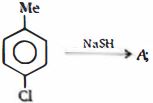
A
$4-$methylbenzenethiol
B
No reaction
C
$4-$chlorophenylmethanethiol
D
$4-$chlorobenzenethiol
Solution
(B) The reactant is $4$-chlorotoluene. The chlorine atom is directly attached to the benzene ring,which gives the $C-Cl$ bond partial double bond character due to resonance. This makes the $C-Cl$ bond very strong and resistant to nucleophilic substitution reactions like $S_N2$. Therefore,the reaction with $NaSH$ will not proceed under normal conditions. Thus,the correct answer is no reaction.
0 likes
View Solution137
DifficultMCQ
The product $(A)$ in the following reaction is:
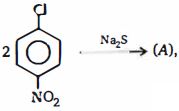
A
$4-$chlorobenzenethiol
B
Bis($4$-nitrophenyl) sulfide
C
$4-$nitrobenzenethiol
D
Bis($3$-nitrophenyl) sulfide
Solution
(B) The reaction involves a nucleophilic aromatic substitution $(S_NAr)$ mechanism.
$2$ moles of $1$-chloro-$4$-nitrobenzene react with $Na_2S$.
The sulfide ion $(S^{2-})$ acts as a nucleophile and attacks the electrophilic carbon attached to the chlorine atom in $1$-chloro-$4$-nitrobenzene,displacing the chloride ion.
This forms a $4$-nitrobenzenethiolate intermediate,which then reacts with another molecule of $1$-chloro-$4$-nitrobenzene to form the final product,Bis($4$-nitrophenyl) sulfide.
$2$ moles of $1$-chloro-$4$-nitrobenzene react with $Na_2S$.
The sulfide ion $(S^{2-})$ acts as a nucleophile and attacks the electrophilic carbon attached to the chlorine atom in $1$-chloro-$4$-nitrobenzene,displacing the chloride ion.
This forms a $4$-nitrobenzenethiolate intermediate,which then reacts with another molecule of $1$-chloro-$4$-nitrobenzene to form the final product,Bis($4$-nitrophenyl) sulfide.
0 likes
View Solution138
MediumMCQ
The reaction shown below is an example of Nucleophilic Aromatic Substitution. Which of the following halides $(-X)$ is most readily replaced?
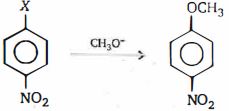
A
$-F$
B
$-Cl$
C
$-Br$
D
$-I$
Solution
(A) In Nucleophilic Aromatic Substitution $(S_NAr)$ reactions,the rate-determining step is the attack of the nucleophile on the aromatic ring to form a Meisenheimer complex.
In this specific mechanism,the electronegativity of the halogen atom plays a crucial role.
Since the fluorine atom is the most electronegative,it exerts the strongest $-I$ (inductive) effect,which significantly stabilizes the transition state (the carbanion intermediate) by withdrawing electron density from the ring.
Therefore,the reactivity order for nucleophilic aromatic substitution is $F > Cl > Br > I$.
Thus,the $-F$ atom is the most readily replaced.
In this specific mechanism,the electronegativity of the halogen atom plays a crucial role.
Since the fluorine atom is the most electronegative,it exerts the strongest $-I$ (inductive) effect,which significantly stabilizes the transition state (the carbanion intermediate) by withdrawing electron density from the ring.
Therefore,the reactivity order for nucleophilic aromatic substitution is $F > Cl > Br > I$.
Thus,the $-F$ atom is the most readily replaced.
0 likes
View Solution139
MediumMCQ
Which of the following substituents on benzene is ortho-para directing in electrophilic substitution and ortho-para directing in nucleophilic substitution?
A
$-NO_2$
B
$-NO$
C
$-SO_3H$
D
$-SO_2Me$
Solution
(B) The nitroso group $(-NO)$ is unique because it can exhibit both $+M$ (mesomeric) and $-M$ effects depending on the nature of the attacking species.
In electrophilic aromatic substitution $(E^+)$,the lone pair on the nitrogen atom can be donated to the ring,stabilizing the intermediate carbocation at ortho and para positions ($+M$ effect).
In nucleophilic aromatic substitution $(Nu^-)$,the nitrogen atom can accept electron density from the ring,stabilizing the intermediate carbanion at ortho and para positions ($-M$ effect).
Therefore,$-NO$ is ortho-para directing in both types of substitutions.
In electrophilic aromatic substitution $(E^+)$,the lone pair on the nitrogen atom can be donated to the ring,stabilizing the intermediate carbocation at ortho and para positions ($+M$ effect).
In nucleophilic aromatic substitution $(Nu^-)$,the nitrogen atom can accept electron density from the ring,stabilizing the intermediate carbanion at ortho and para positions ($-M$ effect).
Therefore,$-NO$ is ortho-para directing in both types of substitutions.
0 likes
View Solution140
MediumMCQ
$Ph-NO_2 + Et-Cl \xrightarrow{AlCl_3} (A)$,Product $(A)$ of the given reaction is
A
$Ph-NH-Et$
B
no-reaction
C
o-ethylnitrobenzene
D
p-ethylnitrobenzene
Solution
(B) The reaction given is a Friedel-Crafts alkylation reaction.
Nitrobenzene $(Ph-NO_2)$ contains a strongly electron-withdrawing $-NO_2$ group.
This group deactivates the benzene ring towards electrophilic aromatic substitution.
Furthermore,the lone pair on the nitrogen atom of the $-NO_2$ group coordinates with the Lewis acid catalyst $AlCl_3$,which further deactivates the ring.
Therefore,nitrobenzene does not undergo Friedel-Crafts alkylation.
Thus,there is no reaction.
Nitrobenzene $(Ph-NO_2)$ contains a strongly electron-withdrawing $-NO_2$ group.
This group deactivates the benzene ring towards electrophilic aromatic substitution.
Furthermore,the lone pair on the nitrogen atom of the $-NO_2$ group coordinates with the Lewis acid catalyst $AlCl_3$,which further deactivates the ring.
Therefore,nitrobenzene does not undergo Friedel-Crafts alkylation.
Thus,there is no reaction.
0 likes
View Solution141
DifficultMCQ
Two benzyne intermediates are likely to be formed equally. Reaction with amide ion can occur in two different directions with each benzyne,giving three possible products. They are formed in a $1 : 2 : 1$ ratio. Asterisk $(*)$ refers to $^{14}C$. Product $(A)$ is:

A
B
C
D
Solution
(A) The reaction of chlorobenzene labeled with $^{14}C$ at the $C-1$ position with $NaNH_2/NH_3$ proceeds via the benzyne mechanism.
$1$. The amide ion $(NH_2^-)$ abstracts an ortho-hydrogen,leading to the formation of two benzyne intermediates: $1,2$-dehydrobenzene (with $^{14}C$ at the $C-1$ position) and $2,3$-dehydrobenzene (with $^{14}C$ at the $C-2$ position).
$2$. Nucleophilic attack by $NH_2^-$ on these intermediates can occur at two positions for each,resulting in three products: ortho-labeled aniline,meta-labeled aniline,and ipso-labeled aniline.
$3$. Based on the statistical probability of the benzyne formation and the subsequent nucleophilic attack,the products are formed in a $1:2:1$ ratio.
$4$. The major product is the one where the amino group is attached to the carbon adjacent to the $^{14}C$ label (ortho position) or the meta position,but specifically,the question asks for the product $(A)$ which corresponds to the ortho-substituted aniline.
$1$. The amide ion $(NH_2^-)$ abstracts an ortho-hydrogen,leading to the formation of two benzyne intermediates: $1,2$-dehydrobenzene (with $^{14}C$ at the $C-1$ position) and $2,3$-dehydrobenzene (with $^{14}C$ at the $C-2$ position).
$2$. Nucleophilic attack by $NH_2^-$ on these intermediates can occur at two positions for each,resulting in three products: ortho-labeled aniline,meta-labeled aniline,and ipso-labeled aniline.
$3$. Based on the statistical probability of the benzyne formation and the subsequent nucleophilic attack,the products are formed in a $1:2:1$ ratio.
$4$. The major product is the one where the amino group is attached to the carbon adjacent to the $^{14}C$ label (ortho position) or the meta position,but specifically,the question asks for the product $(A)$ which corresponds to the ortho-substituted aniline.
0 likes
View Solution142
MediumMCQ
Which one of the following undergoes nucleophilic aromatic substitution at the fastest rate?
A
p-Nitrochlorobenzene
B
p-Dichlorobenzene
C
p-Chlorotoluene
D
p-Chloroanisole
Solution
(A) Nucleophilic aromatic substitution $(S_NAr)$ reactions are facilitated by the presence of electron-withdrawing groups (EWGs) on the benzene ring,especially at ortho and para positions.
These groups stabilize the negatively charged intermediate (Meisenheimer complex) through resonance ($-M$ effect) and induction ($-I$ effect).
The order of electron-withdrawing strength for the substituents at the para position is: $NO_2 > Cl > CH_3 > OCH_3$.
$NO_2$ is a strong electron-withdrawing group ($-M$ and $-I$ effect),which significantly increases the rate of $S_NAr$ reaction.
Therefore,$p$-Nitrochlorobenzene undergoes nucleophilic aromatic substitution at the fastest rate.
These groups stabilize the negatively charged intermediate (Meisenheimer complex) through resonance ($-M$ effect) and induction ($-I$ effect).
The order of electron-withdrawing strength for the substituents at the para position is: $NO_2 > Cl > CH_3 > OCH_3$.
$NO_2$ is a strong electron-withdrawing group ($-M$ and $-I$ effect),which significantly increases the rate of $S_NAr$ reaction.
Therefore,$p$-Nitrochlorobenzene undergoes nucleophilic aromatic substitution at the fastest rate.
0 likes
View Solution143
MediumMCQ
For the reaction shown,the best combination of reactants to obtain $o$-bromonitrobenzene is:
A
$C_6H_5Br + HNO_3, H_2SO_4$
B
$C_6H_5Br + H_2SO_4, \text{ heat}$
C
$C_6H_5NO_2 + Br_2, FeBr_3$
D
$C_6H_5NO_2 + HBr$
Solution
(A) The target product is $o$-bromonitrobenzene.
In $C_6H_5Br$,the $-Br$ group is ortho/para directing due to the $+M$ effect.
Therefore,nitration of bromobenzene using $HNO_3$ and $H_2SO_4$ will yield ortho and para isomers,including the desired $o$-bromonitrobenzene.
In contrast,$-NO_2$ is a meta-directing group,so bromination of nitrobenzene would yield $m$-bromonitrobenzene.
Thus,the correct combination is $C_6H_5Br + HNO_3, H_2SO_4$.
In $C_6H_5Br$,the $-Br$ group is ortho/para directing due to the $+M$ effect.
Therefore,nitration of bromobenzene using $HNO_3$ and $H_2SO_4$ will yield ortho and para isomers,including the desired $o$-bromonitrobenzene.
In contrast,$-NO_2$ is a meta-directing group,so bromination of nitrobenzene would yield $m$-bromonitrobenzene.
Thus,the correct combination is $C_6H_5Br + HNO_3, H_2SO_4$.
0 likes
View Solution144
MediumMCQ
The product $(P)$ will be
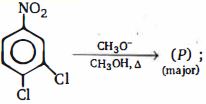
A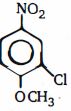
B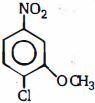
C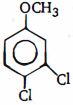
D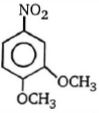
Solution
(C) The reaction is a nucleophilic aromatic substitution $(S_NAr)$ reaction.
The substrate is $3,4$-dichloronitrobenzene.
The $-NO_2$ group is a strong electron-withdrawing group at the para position relative to one chlorine atom and meta to the other.
Nucleophilic substitution occurs preferentially at the position ortho or para to the electron-withdrawing group $(-NO_2)$ because the intermediate Meisenheimer complex is stabilized by resonance.
In $3,4$-dichloronitrobenzene,the chlorine at the $4$-position (para to $-NO_2$) is more activated for substitution than the chlorine at the $3$-position (meta to $-NO_2$).
Therefore,the methoxide ion $(CH_3O^-)$ attacks the $4$-position,displacing the chloride ion to form $3$-chloro-$4$-methoxynitrobenzene.
The substrate is $3,4$-dichloronitrobenzene.
The $-NO_2$ group is a strong electron-withdrawing group at the para position relative to one chlorine atom and meta to the other.
Nucleophilic substitution occurs preferentially at the position ortho or para to the electron-withdrawing group $(-NO_2)$ because the intermediate Meisenheimer complex is stabilized by resonance.
In $3,4$-dichloronitrobenzene,the chlorine at the $4$-position (para to $-NO_2$) is more activated for substitution than the chlorine at the $3$-position (meta to $-NO_2$).
Therefore,the methoxide ion $(CH_3O^-)$ attacks the $4$-position,displacing the chloride ion to form $3$-chloro-$4$-methoxynitrobenzene.
0 likes
View Solution145
MediumMCQ
In the reaction given below,the major product formed is
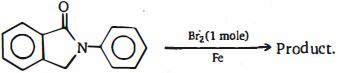
A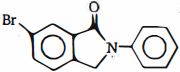
B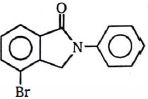
C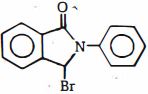
D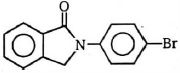
Solution
(D) The reactant is $N$-phenyl-isoindolin$-1-$one. The molecule contains two aromatic rings: one fused to the lactam ring and one attached to the nitrogen atom.
The nitrogen atom is attached to the carbonyl group,which is an electron-withdrawing group $(-C=O)$. This makes the nitrogen atom act as an electron-withdrawing group via resonance $(-N-C=O)$,deactivating the $N$-phenyl ring towards electrophilic aromatic substitution.
Conversely,the benzene ring fused to the isoindolinone system is less deactivated compared to the $N$-phenyl ring,or rather,the $N$-phenyl ring is significantly deactivated due to the electron-withdrawing effect of the amide nitrogen. However,in this specific structure,the $N$-phenyl ring is more susceptible to electrophilic substitution at the para position due to the lone pair on nitrogen,despite the amide conjugation. Comparing the two rings,the $N$-phenyl ring is more activated towards electrophilic substitution than the ring fused to the carbonyl group.
Therefore,electrophilic bromination occurs on the $N$-phenyl ring,primarily at the para position due to steric hindrance at the ortho positions. The major product is the $p$-bromo derivative of the $N$-phenyl group.
The nitrogen atom is attached to the carbonyl group,which is an electron-withdrawing group $(-C=O)$. This makes the nitrogen atom act as an electron-withdrawing group via resonance $(-N-C=O)$,deactivating the $N$-phenyl ring towards electrophilic aromatic substitution.
Conversely,the benzene ring fused to the isoindolinone system is less deactivated compared to the $N$-phenyl ring,or rather,the $N$-phenyl ring is significantly deactivated due to the electron-withdrawing effect of the amide nitrogen. However,in this specific structure,the $N$-phenyl ring is more susceptible to electrophilic substitution at the para position due to the lone pair on nitrogen,despite the amide conjugation. Comparing the two rings,the $N$-phenyl ring is more activated towards electrophilic substitution than the ring fused to the carbonyl group.
Therefore,electrophilic bromination occurs on the $N$-phenyl ring,primarily at the para position due to steric hindrance at the ortho positions. The major product is the $p$-bromo derivative of the $N$-phenyl group.
0 likes
View Solution146
DifficultMCQ
The major product expected from the mono-bromination of phenyl benzoate is
A
Phenyl $2-$bromobenzoate
B
Phenyl $3-$bromobenzoate
C
$4-$Bromophenyl benzoate
D
Phenyl $4-$bromobenzoate
Solution
(C) Phenyl benzoate consists of two aromatic rings: the benzoyl ring (attached to the carbonyl group) and the phenoxy ring (attached to the oxygen atom).
$1$. The benzoyl ring is attached to a $-COOR$ group,which is electron-withdrawing ($-I$ and $-M$ effects),making it deactivating and meta-directing.
$2$. The phenoxy ring is attached to an oxygen atom with lone pairs,which exerts a $+M$ effect,making it activating and ortho/para-directing.
$3$. Electrophilic aromatic substitution (like bromination) occurs more readily on the more activated ring. Therefore,the phenoxy ring is the site of substitution.
$4$. Due to steric hindrance at the ortho position,the para-substituted product is the major product. Thus,the product is $4$-bromophenyl benzoate.
$1$. The benzoyl ring is attached to a $-COOR$ group,which is electron-withdrawing ($-I$ and $-M$ effects),making it deactivating and meta-directing.
$2$. The phenoxy ring is attached to an oxygen atom with lone pairs,which exerts a $+M$ effect,making it activating and ortho/para-directing.
$3$. Electrophilic aromatic substitution (like bromination) occurs more readily on the more activated ring. Therefore,the phenoxy ring is the site of substitution.
$4$. Due to steric hindrance at the ortho position,the para-substituted product is the major product. Thus,the product is $4$-bromophenyl benzoate.
0 likes
View Solution147
MediumMCQ
The decreasing order of reactivity of $meta$-nitro-bromobenzene $(I)$,$2,4,6$-trinitro-bromobenzene $(II)$,$para$-nitro-bromobenzene $(III)$,and $2,4$-dinitro-bromobenzene $(IV)$ towards $HO^-$ ions is:
A
$I > III > IV > II$
B
$II > IV > III > I$
C
$IV > II > III > I$
D
$II > IV > I > III$
Solution
(B) The reaction of aryl halides with $HO^-$ ions follows the Nucleophilic Aromatic Substitution $(S_NAr)$ mechanism.
The rate of $S_NAr$ reaction is directly proportional to the number of electron-withdrawing groups $(-NO_2)$ present on the benzene ring,as they stabilize the Meisenheimer complex intermediate.
The number of $-NO_2$ groups in the given compounds are:
$(I)$ $meta$-nitro-bromobenzene: $1$ $-NO_2$ group.
$(II)$ $2,4,6$-trinitro-bromobenzene: $3$ $-NO_2$ groups.
$(III)$ $para$-nitro-bromobenzene: $1$ $-NO_2$ group.
$(IV)$ $2,4$-dinitro-bromobenzene: $2$ $-NO_2$ groups.
Comparing $(I)$ and $(III)$,the $-NO_2$ group at the $para$ position $(III)$ is more effective at stabilizing the negative charge via resonance than at the $meta$ position $(I)$.
Thus,the order of reactivity is $II$ ($3$ $-NO_2$) > $IV$ ($2$ $-NO_2$) > $III$ ($1$ $-NO_2$ at $para$) > $I$ ($1$ $-NO_2$ at $meta$).
The rate of $S_NAr$ reaction is directly proportional to the number of electron-withdrawing groups $(-NO_2)$ present on the benzene ring,as they stabilize the Meisenheimer complex intermediate.
The number of $-NO_2$ groups in the given compounds are:
$(I)$ $meta$-nitro-bromobenzene: $1$ $-NO_2$ group.
$(II)$ $2,4,6$-trinitro-bromobenzene: $3$ $-NO_2$ groups.
$(III)$ $para$-nitro-bromobenzene: $1$ $-NO_2$ group.
$(IV)$ $2,4$-dinitro-bromobenzene: $2$ $-NO_2$ groups.
Comparing $(I)$ and $(III)$,the $-NO_2$ group at the $para$ position $(III)$ is more effective at stabilizing the negative charge via resonance than at the $meta$ position $(I)$.
Thus,the order of reactivity is $II$ ($3$ $-NO_2$) > $IV$ ($2$ $-NO_2$) > $III$ ($1$ $-NO_2$ at $para$) > $I$ ($1$ $-NO_2$ at $meta$).
0 likes
View Solution148
DifficultMCQ
In the reaction shown below,the $o/p$ ratio will be highest when:
$C_6H_5R + HNO_3 \xrightarrow{H_2SO_4} o-\text{nitro-substituted product} + p-\text{nitro-substituted product}$
$C_6H_5R + HNO_3 \xrightarrow{H_2SO_4} o-\text{nitro-substituted product} + p-\text{nitro-substituted product}$
A
$R=-CH_3$
B
$R=-CH_2-CH_3$
C
$R=-CHMe_2$
D
$R=-CMe_3$
Solution
(A) The $o/p$ ratio refers to the ratio of the ortho-substituted product to the para-substituted product. As the size of the substituent $R$ increases,the steric hindrance at the ortho position increases,which makes the formation of the ortho-product more difficult compared to the para-product.
Therefore,the $o/p$ ratio is highest when the substituent $R$ is the smallest.
Comparing the sizes of the given alkyl groups:
$R=-CH_3$ (smallest)
$R=-CH_2-CH_3$
$R=-CHMe_2$
$R=-CMe_3$ (largest)
Since $-CH_3$ is the smallest group,it offers the least steric hindrance to the incoming electrophile at the ortho position,resulting in the highest $o/p$ ratio.
Therefore,the $o/p$ ratio is highest when the substituent $R$ is the smallest.
Comparing the sizes of the given alkyl groups:
$R=-CH_3$ (smallest)
$R=-CH_2-CH_3$
$R=-CHMe_2$
$R=-CMe_3$ (largest)
Since $-CH_3$ is the smallest group,it offers the least steric hindrance to the incoming electrophile at the ortho position,resulting in the highest $o/p$ ratio.
| $R$ | $\% o-$ | $\% p-$ |
|---|---|---|
| $CH_3$ | $58$ | $37$ |
| $CH_2Me$ | $45$ | $49$ |
| $CHMe_2$ | $30$ | $62$ |
| $CMe_3$ | $16$ | $73$ |
0 likes
View Solution149
AdvancedMCQ
The product $(A)$ of the given reaction is:
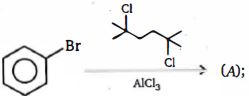
A
B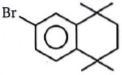
C
D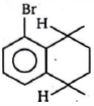
Solution
(B) The reaction involves the treatment of bromobenzene with a dichloroalkane in the presence of $AlCl_3$.
This is an intramolecular Friedel-Crafts alkylation reaction.
The electrophile generated from the alkyl chloride attacks the benzene ring.
Given the structure of the reactant,the cyclization leads to the formation of a tetrahydronaphthalene derivative.
The correct product is $1$-bromo-$5,5$-dimethyl-$5,6,7,8$-tetrahydronaphthalene.
This is an intramolecular Friedel-Crafts alkylation reaction.
The electrophile generated from the alkyl chloride attacks the benzene ring.
Given the structure of the reactant,the cyclization leads to the formation of a tetrahydronaphthalene derivative.
The correct product is $1$-bromo-$5,5$-dimethyl-$5,6,7,8$-tetrahydronaphthalene.
0 likes
View Solution150
MediumMCQ
Identify the position where the nucleophilic attack of $(ArO^{-})$ is most favourable in the given molecule.
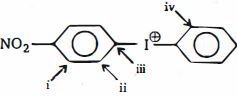
A
$i$
B
$ii$
C
$iii$
D
$iv$
Solution
(C) The nucleophile $(ArO^{-})$ attacks the carbon atom that is most electron-deficient.
In the given molecule,the $-NO_2$ group exerts a strong $-M$ (mesomeric) effect and $-I$ (inductive) effect,which significantly increases the electrophilicity of the ortho and para positions relative to the $-NO_2$ group.
However,position $iii$ is the ipso-carbon attached to the electron-withdrawing $-I^{+}$ group,making it highly susceptible to nucleophilic attack due to the stabilization of the transition state by the electron-withdrawing nature of the substituents.
Therefore,position $iii$ is the most favourable site for the nucleophilic attack.
In the given molecule,the $-NO_2$ group exerts a strong $-M$ (mesomeric) effect and $-I$ (inductive) effect,which significantly increases the electrophilicity of the ortho and para positions relative to the $-NO_2$ group.
However,position $iii$ is the ipso-carbon attached to the electron-withdrawing $-I^{+}$ group,making it highly susceptible to nucleophilic attack due to the stabilization of the transition state by the electron-withdrawing nature of the substituents.
Therefore,position $iii$ is the most favourable site for the nucleophilic attack.
0 likes
View SolutionHaloalkanes and Haloarenes — Properties of Haloarenes · Frequently Asked Questions
1Are these Haloalkanes and Haloarenes questions useful for JEE and NEET?
Yes. All questions in this section are mapped to JEE Main and NEET exam patterns. Previous year questions from JEE Main, NEET, GUJCET and state-level exams are included with full solutions.
2Can I switch to Hindi or Gujarati for these questions?
Yes. Use the language tabs in the hero section or the sidebar to view the same questions and solutions in English, Hindi or Gujarati.
3How do I generate a question paper from this subtopic?
Use the Vedclass Exam Paper Generator — select the chapter and subtopic, set difficulty, and generate Sets A, B, C, D automatically. First 3 chapters of every subject are free.
Vedclass Products
For Students
Vedclass Test Series
Mock tests in real JEE/NEET style with performance analysis. 5-day free trial.
Start Free TrialFor Teachers
Exam Paper Generator
Generate Set A/B/C/D papers from this chapter in 2 minutes. 3 chapters free.
Try FreeFor Institutes
Online Exam Module
Live online exams with unlimited students, 360° analytics & white-label branding.
See DemoFor Teachers & Institutes
Generate a Haloalkanes and Haloarenes Exam Paper in 2 Minutes
Select subtopic & difficulty — Sets A, B, C, D auto-generated with No Repeat logic.
First 3 chapters of every subject are free — no payment required.