
A English
Properties of Haloarenes Questions in English
Class 12 Chemistry · Haloalkanes and Haloarenes · Properties of Haloarenes
423+
Questions
English
Language
100%
With Solutions
Showing 50 of 423 questions in English
151
DifficultMCQ
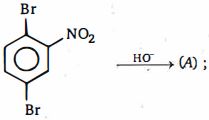
The product of the given reaction is:
A
$4-$bromo$-2-$nitrophenol
B
$2-$nitro$-4-$bromophenol
C
$3-$bromo$-5-$nitrophenol
D
$2-$bromo$-4-$nitrophenol
Solution
(A) The reaction is an $S_NAr$ (nucleophilic aromatic substitution) reaction. The $-NO_2$ group is a strong electron-withdrawing group that activates the ortho and para positions towards nucleophilic attack. In $1-bromo-4-bromo-2-nitrobenzene$ (or $1,4-dibromo-2-nitrobenzene$),the bromine atom at the para position relative to the $-NO_2$ group is more susceptible to nucleophilic substitution by $HO^-$ due to the resonance stabilization of the Meisenheimer complex intermediate. Therefore,the $HO^-$ group replaces the para-bromine atom to form $4-bromo-2-nitrophenol$.
0 likes
View Solution152
DifficultMCQ
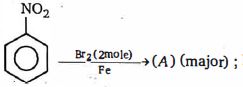
The product $(A)$ will be:
A
$3,4-$dibromonitrobenzene
B
$3,5-$dibromonitrobenzene
C
$2,4-$dibromonitrobenzene
D
$2,6-$dibromonitrobenzene
Solution
(A) The reaction involves the electrophilic aromatic substitution of nitrobenzene with bromine in the presence of iron $(Fe)$.
$1$. The $-NO_2$ group is a strong electron-withdrawing group and is meta-directing.
$2$. In the first step,bromination of nitrobenzene occurs at the meta-position to form $m$-bromonitrobenzene.
$3$. In the second step,the presence of the bromine atom (which is ortho/para-directing) and the nitro group (which is meta-directing) directs the incoming bromine atom to the position meta to the $-NO_2$ group and ortho to the existing $-Br$ group.
$4$. The final major product is $3,4$-dibromonitrobenzene.
$1$. The $-NO_2$ group is a strong electron-withdrawing group and is meta-directing.
$2$. In the first step,bromination of nitrobenzene occurs at the meta-position to form $m$-bromonitrobenzene.
$3$. In the second step,the presence of the bromine atom (which is ortho/para-directing) and the nitro group (which is meta-directing) directs the incoming bromine atom to the position meta to the $-NO_2$ group and ortho to the existing $-Br$ group.
$4$. The final major product is $3,4$-dibromonitrobenzene.
0 likes
View Solution153
MediumMCQ
The product $(A)$ of the following reaction is:

A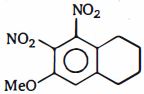
B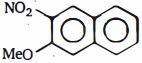
C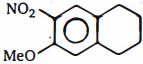
D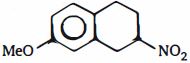
Solution
(C) The reaction is an electrophilic aromatic substitution (nitration) of $6$-methoxytetralin using $HNO_3/H_2SO_4$.
The $-OCH_3$ group is a strong activating group and is ortho/para directing.
In $6$-methoxytetralin,the positions ortho to the $-OCH_3$ group are the most reactive towards electrophilic substitution.
Therefore,the nitro group $(-NO_2^+)$ will attack the position ortho to the $-OCH_3$ group,leading to the formation of $5$-nitro-$6$-methoxytetralin.
Comparing this with the given options,option $(C)$ represents the correct product.
The $-OCH_3$ group is a strong activating group and is ortho/para directing.
In $6$-methoxytetralin,the positions ortho to the $-OCH_3$ group are the most reactive towards electrophilic substitution.
Therefore,the nitro group $(-NO_2^+)$ will attack the position ortho to the $-OCH_3$ group,leading to the formation of $5$-nitro-$6$-methoxytetralin.
Comparing this with the given options,option $(C)$ represents the correct product.
0 likes
View Solution154
DifficultMCQ
What is the product of the bromination of $p$-methylacetanilide with $Br_2$ in $CS_2$?
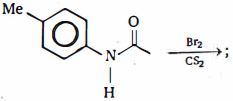
A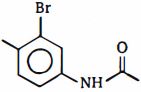
B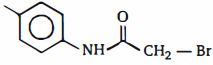
C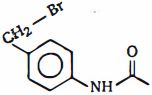
D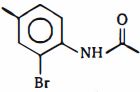
Solution
(D) The reaction involves the electrophilic aromatic substitution of $p$-methylacetanilide with $Br_2$ in $CS_2$.
The $-NHCOCH_3$ group is a strong ortho/para-directing group due to its $+M$ effect.
Since the para position is already occupied by the $-CH_3$ group,the bromine atom will be directed to the ortho position relative to the $-NHCOCH_3$ group.
Thus,the product is $2$-bromo-$4$-methylacetanilide,which corresponds to the structure in option $D$.
The $-NHCOCH_3$ group is a strong ortho/para-directing group due to its $+M$ effect.
Since the para position is already occupied by the $-CH_3$ group,the bromine atom will be directed to the ortho position relative to the $-NHCOCH_3$ group.
Thus,the product is $2$-bromo-$4$-methylacetanilide,which corresponds to the structure in option $D$.
0 likes
View Solution155
MediumMCQ
Which of the following $2$-halo nitrobenzene is most reactive towards nucleophilic aromatic substitution?
A
$1-$fluoro$-2-$nitrobenzene
B
$1-$chloro$-2-$nitrobenzene
C
$1-$bromo$-2-$nitrobenzene
D
$1-$iodo$-2-$nitrobenzene
Solution
(A) Nucleophilic aromatic substitution $(S_NAr)$ typically proceeds via an addition-elimination mechanism. The rate-determining step $(r.d.s.)$ involves the attack of the nucleophile on the carbon atom bearing the halogen,forming a Meisenheimer complex.
In this step,the electron-withdrawing effect ($-I$ effect) of the halogen atom stabilizes the transition state by withdrawing electron density from the ring.
Since fluorine $(F)$ has the highest electronegativity among the halogens,it exerts the strongest $-I$ effect.
Therefore,$1$-fluoro-$2$-nitrobenzene is the most reactive towards nucleophilic aromatic substitution.
In this step,the electron-withdrawing effect ($-I$ effect) of the halogen atom stabilizes the transition state by withdrawing electron density from the ring.
Since fluorine $(F)$ has the highest electronegativity among the halogens,it exerts the strongest $-I$ effect.
Therefore,$1$-fluoro-$2$-nitrobenzene is the most reactive towards nucleophilic aromatic substitution.
0 likes
View Solution156
MediumMCQ
Arrange the following compounds in decreasing order of their rate of $S_NAr$ reaction:
$(i)$ $p$-nitrochlorobenzene
(ii) $m$-nitrochlorobenzene
(iii) $2,4$-dinitrochlorobenzene
(iv) chlorobenzene
$(v)$ $2,4,6$-trinitrochlorobenzene
$(i)$ $p$-nitrochlorobenzene
(ii) $m$-nitrochlorobenzene
(iii) $2,4$-dinitrochlorobenzene
(iv) chlorobenzene
$(v)$ $2,4,6$-trinitrochlorobenzene
A
$i > ii > iv > iii > v$
B
$ii > i > iii > v > iv$
C
$v > iii > i > ii > iv$
D
$v > iii > ii > i > iv$
Solution
(C) The rate of nucleophilic aromatic substitution $(S_NAr)$ reaction depends on the stability of the Meisenheimer complex formed as an intermediate. Electron-withdrawing groups (EWGs) like $-NO_2$ stabilize the negative charge in the intermediate through $-I$ and $-M$ effects.
$1$. The presence of more $-NO_2$ groups increases the rate of $S_NAr$ reaction.
$2$. The $-NO_2$ group at ortho and para positions is more effective than at the meta position because the negative charge can be delocalized onto the oxygen atoms of the $-NO_2$ group.
Comparing the compounds:
$(v)$ $2,4,6$-trinitrochlorobenzene: Three $-NO_2$ groups (two ortho,one para) - Fastest.
(iii) $2,4$-dinitrochlorobenzene: Two $-NO_2$ groups (one ortho,one para).
$(i)$ $p$-nitrochlorobenzene: One $-NO_2$ group at para position.
(ii) $m$-nitrochlorobenzene: One $-NO_2$ group at meta position (less effective stabilization).
(iv) Chlorobenzene: No $-NO_2$ group - Slowest.
Therefore,the decreasing order of the rate of $S_NAr$ reaction is: $v > iii > i > ii > iv$.
$1$. The presence of more $-NO_2$ groups increases the rate of $S_NAr$ reaction.
$2$. The $-NO_2$ group at ortho and para positions is more effective than at the meta position because the negative charge can be delocalized onto the oxygen atoms of the $-NO_2$ group.
Comparing the compounds:
$(v)$ $2,4,6$-trinitrochlorobenzene: Three $-NO_2$ groups (two ortho,one para) - Fastest.
(iii) $2,4$-dinitrochlorobenzene: Two $-NO_2$ groups (one ortho,one para).
$(i)$ $p$-nitrochlorobenzene: One $-NO_2$ group at para position.
(ii) $m$-nitrochlorobenzene: One $-NO_2$ group at meta position (less effective stabilization).
(iv) Chlorobenzene: No $-NO_2$ group - Slowest.
Therefore,the decreasing order of the rate of $S_NAr$ reaction is: $v > iii > i > ii > iv$.
0 likes
View Solution157
DifficultMCQ
What is the product of the following reaction?

A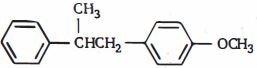
B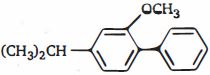
C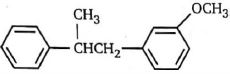
D
Solution
(A) The reaction is an electrophilic aromatic substitution.
$1$. The $H_2SO_4$ provides $H^+$ ions which protonate the alkene $Ph-C(CH_3)=CH_2$ to form a stable tertiary carbocation $Ph-C^+(CH_3)_2$.
$2$. This carbocation acts as an electrophile and attacks the electron-rich benzene ring of anisole $(Ph-OCH_3)$.
$3$. Since the $-OCH_3$ group is ortho/para directing,the bulky carbocation attacks the para-position due to steric hindrance at the ortho-position.
$4$. The final product is $1-methoxy-4-(2-phenylpropan-2-yl)benzene$.
$1$. The $H_2SO_4$ provides $H^+$ ions which protonate the alkene $Ph-C(CH_3)=CH_2$ to form a stable tertiary carbocation $Ph-C^+(CH_3)_2$.
$2$. This carbocation acts as an electrophile and attacks the electron-rich benzene ring of anisole $(Ph-OCH_3)$.
$3$. Since the $-OCH_3$ group is ortho/para directing,the bulky carbocation attacks the para-position due to steric hindrance at the ortho-position.
$4$. The final product is $1-methoxy-4-(2-phenylpropan-2-yl)benzene$.
0 likes
View Solution158
DifficultMCQ
Which sequence represents the best synthesis of $4-$isopropylbenzonitrile?
A
$1. \text{Benzene} + (CH_3)_2CHCl, AlCl_3; \ 2. Br_2, FeBr_3; \ 3. KCN$
B
$1. \text{Benzene} + (CH_3)_2CHCl, AlCl_3; \ 2. HNO_3, H_2SO_4; \ 3. Fe, HCl; \ 4. NaOH; \ 5. NaNO_2, HCl, H_2O$
C
$1. \text{Benzene} + (CH_3)_2CHCl, AlCl_3; \ 2. HNO_3, H_2SO_4; \ 3. Fe, HCl; \ 4. NaNO_2 / HCl; \ 5. KCN$
D
$1. \text{Benzene} + HNO_3, H_2SO_4; \ 2. (CH_3)_2CHCl, AlCl_3; \ 3. Fe, HCl; \ 4. NaNO_2, HCl, H_2O; \ 5. CuCN$
Solution
(C) The synthesis of $4-$isopropylbenzonitrile from benzene involves the following steps:
$1.$ Friedel-Crafts alkylation of benzene with isopropyl chloride $(CH_3)_2CHCl$ in the presence of $AlCl_3$ gives isopropylbenzene (cumene).
$2.$ Nitration of isopropylbenzene using $HNO_3$ and $H_2SO_4$ gives $4-$nitroisopropylbenzene as the major product due to the ortho/para-directing nature of the isopropyl group.
$3.$ Reduction of the nitro group using $Fe/HCl$ gives $4-$isopropylaniline.
$4.$ Diazotization of $4-$isopropylaniline using $NaNO_2/HCl$ at $0-5 \ ^\circ C$ yields the corresponding diazonium salt.
$5.$ Sandmeyer reaction of the diazonium salt with $KCN$ (or $CuCN$) yields $4-$isopropylbenzonitrile.
Thus,the correct sequence is option $C$.
$1.$ Friedel-Crafts alkylation of benzene with isopropyl chloride $(CH_3)_2CHCl$ in the presence of $AlCl_3$ gives isopropylbenzene (cumene).
$2.$ Nitration of isopropylbenzene using $HNO_3$ and $H_2SO_4$ gives $4-$nitroisopropylbenzene as the major product due to the ortho/para-directing nature of the isopropyl group.
$3.$ Reduction of the nitro group using $Fe/HCl$ gives $4-$isopropylaniline.
$4.$ Diazotization of $4-$isopropylaniline using $NaNO_2/HCl$ at $0-5 \ ^\circ C$ yields the corresponding diazonium salt.
$5.$ Sandmeyer reaction of the diazonium salt with $KCN$ (or $CuCN$) yields $4-$isopropylbenzonitrile.
Thus,the correct sequence is option $C$.
0 likes
View Solution159
DifficultMCQ
Give the product of the following reaction sequence:
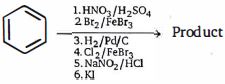
A
$1-$chloro$-2-$bromo$-4-$iodobenzene
B
$2-$bromo$-1-$iodo$-3-$chlorobenzene
C
$4-$bromo$-1-$chloro$-2-$iodobenzene
D
$1-$bromo$-2-$chloro$-3-$iodobenzene
Solution
(C) The reaction sequence is as follows:
$1$. Nitration of benzene with $HNO_3/H_2SO_4$ gives nitrobenzene.
$2$. Bromination of nitrobenzene with $Br_2/FeBr_3$ gives $m$-bromonitrobenzene because the $-NO_2$ group is meta-directing.
$3$. Reduction of $m$-bromonitrobenzene with $H_2/Pd/C$ gives $m$-bromoaniline.
$4$. Chlorination of $m$-bromoaniline with $Cl_2/FeBr_3$ gives $2$-chloro-$5$-bromoaniline (the $-NH_2$ group is strongly ortho/para directing,and the para position is occupied by $-Br$,so it directs to the ortho position).
$5$. Diazotization with $NaNO_2/HCl$ converts the $-NH_2$ group to a diazonium salt $(-N_2^+Cl^-)$.
$6$. Treatment with $KI$ replaces the diazonium group with an iodine atom,resulting in $1$-chloro-$2$-iodo-$4$-bromobenzene (or $4$-bromo-$1$-chloro-$2$-iodobenzene).
$1$. Nitration of benzene with $HNO_3/H_2SO_4$ gives nitrobenzene.
$2$. Bromination of nitrobenzene with $Br_2/FeBr_3$ gives $m$-bromonitrobenzene because the $-NO_2$ group is meta-directing.
$3$. Reduction of $m$-bromonitrobenzene with $H_2/Pd/C$ gives $m$-bromoaniline.
$4$. Chlorination of $m$-bromoaniline with $Cl_2/FeBr_3$ gives $2$-chloro-$5$-bromoaniline (the $-NH_2$ group is strongly ortho/para directing,and the para position is occupied by $-Br$,so it directs to the ortho position).
$5$. Diazotization with $NaNO_2/HCl$ converts the $-NH_2$ group to a diazonium salt $(-N_2^+Cl^-)$.
$6$. Treatment with $KI$ replaces the diazonium group with an iodine atom,resulting in $1$-chloro-$2$-iodo-$4$-bromobenzene (or $4$-bromo-$1$-chloro-$2$-iodobenzene).
0 likes
View Solution160
MediumMCQ
The decreasing order of reactivity of $m$-nitrobromobenzene $(I)$,$2,4,6$-trinitrobromobenzene $(II)$,$p$-nitrobromobenzene $(III)$,and $2,4$-dinitrobromobenzene $(IV)$ towards $OH^{-}$ ions is
A
$I > II > III > IV$
B
$II > IV > III > I$
C
$IV > II > III > I$
D
$II > IV > I > III$
Solution
(B) The reaction of aryl halides with $OH^{-}$ ions follows the $S_NAr$ (Nucleophilic Aromatic Substitution) mechanism.
In $S_NAr$ reactions,the presence of electron-withdrawing groups $(-NO_2)$ at ortho and para positions stabilizes the Meisenheimer complex intermediate.
More $-NO_2$ groups at ortho and para positions lead to higher reactivity.
- $II$ ($2,4,6$-trinitrobromobenzene) has three $-NO_2$ groups (two ortho,one para).
- $IV$ ($2,4$-dinitrobromobenzene) has two $-NO_2$ groups (one ortho,one para).
- $III$ ($p$-nitrobromobenzene) has one $-NO_2$ group (para).
- $I$ ($m$-nitrobromobenzene) has one $-NO_2$ group (meta),which is less effective at stabilizing the intermediate compared to ortho/para positions.
Therefore,the decreasing order of reactivity is $II > IV > III > I$.
In $S_NAr$ reactions,the presence of electron-withdrawing groups $(-NO_2)$ at ortho and para positions stabilizes the Meisenheimer complex intermediate.
More $-NO_2$ groups at ortho and para positions lead to higher reactivity.
- $II$ ($2,4,6$-trinitrobromobenzene) has three $-NO_2$ groups (two ortho,one para).
- $IV$ ($2,4$-dinitrobromobenzene) has two $-NO_2$ groups (one ortho,one para).
- $III$ ($p$-nitrobromobenzene) has one $-NO_2$ group (para).
- $I$ ($m$-nitrobromobenzene) has one $-NO_2$ group (meta),which is less effective at stabilizing the intermediate compared to ortho/para positions.
Therefore,the decreasing order of reactivity is $II > IV > III > I$.
0 likes
View Solution161
DifficultMCQ
Which one of the following compounds is most reactive for $ArS_N2$ reaction?
A
$1-$chloro$-4-$nitrobenzene
B
$1-$chloro$-3-$nitrobenzene
C
$1-$chloro$-2,4-$dinitrobenzene
D
$1-$chloro$-2-$nitrobenzene
Solution
(C) The reactivity of aryl halides towards nucleophilic aromatic substitution $(ArS_N2)$ increases with the presence of electron-withdrawing groups (like $-NO_2$) at the ortho and para positions.
These groups stabilize the intermediate carbanion (Meisenheimer complex) through $-M$ (mesomeric) and $-I$ (inductive) effects.
Among the given options,$1$-chloro-$2,4$-dinitrobenzene has two $-NO_2$ groups at the ortho and para positions relative to the chlorine atom,which provide the maximum stabilization to the intermediate.
Therefore,it is the most reactive compound.
These groups stabilize the intermediate carbanion (Meisenheimer complex) through $-M$ (mesomeric) and $-I$ (inductive) effects.
Among the given options,$1$-chloro-$2,4$-dinitrobenzene has two $-NO_2$ groups at the ortho and para positions relative to the chlorine atom,which provide the maximum stabilization to the intermediate.
Therefore,it is the most reactive compound.
0 likes
View Solution162
DifficultMCQ
The major product of the reaction is:

A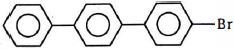
B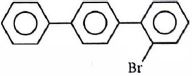
C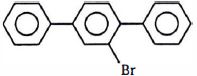
D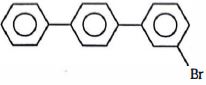
Solution
(A) The reaction is an electrophilic aromatic substitution (bromination) of $p$-terphenyl.
In $p$-terphenyl,the terminal benzene rings are more activated towards electrophilic substitution compared to the central ring because the phenyl group acts as an ortho/para-directing group.
The terminal rings have a free para position,which is sterically less hindered than the ortho position.
Therefore,the electrophile $(Br^+)$ attacks the para position of one of the terminal benzene rings to form the major product.
In $p$-terphenyl,the terminal benzene rings are more activated towards electrophilic substitution compared to the central ring because the phenyl group acts as an ortho/para-directing group.
The terminal rings have a free para position,which is sterically less hindered than the ortho position.
Therefore,the electrophile $(Br^+)$ attacks the para position of one of the terminal benzene rings to form the major product.
0 likes
View Solution163
MediumMCQ
The decreasing order of reactivity of the given compounds towards nucleophilic substitution with aqueous $NaOH$ is:
$(I)$ $1$-bromo-$3$-nitrobenzene
$(II)$ $1$-bromo-$2,4,6$-trinitrobenzene
$(III)$ $1$-bromo-$4$-nitrobenzene
$(IV)$ $1$-bromo-$2,4$-dinitrobenzene
$(I)$ $1$-bromo-$3$-nitrobenzene
$(II)$ $1$-bromo-$2,4,6$-trinitrobenzene
$(III)$ $1$-bromo-$4$-nitrobenzene
$(IV)$ $1$-bromo-$2,4$-dinitrobenzene
A
$I > II > III > IV$
B
$II > IV > III > I$
C
$IV > II > III > I$
D
$II > IV > I > III$
Solution
(B) Nucleophilic aromatic substitution $(S_NAr)$ reactions are facilitated by the presence of electron-withdrawing groups (like $-NO_2$) on the benzene ring,especially at the ortho and para positions.
$1$. Compound $(II)$ has three $-NO_2$ groups (at $2, 4, 6$ positions),making it the most reactive.
$2$. Compound $(IV)$ has two $-NO_2$ groups (at $2, 4$ positions),making it the second most reactive.
$3$. Compound $(III)$ has one $-NO_2$ group at the para position,which is more effective than the meta position.
$4$. Compound $(I)$ has one $-NO_2$ group at the meta position,which is the least effective for stabilizing the intermediate carbanion.
Thus,the decreasing order of reactivity is $(II) > (IV) > (III) > (I)$.
$1$. Compound $(II)$ has three $-NO_2$ groups (at $2, 4, 6$ positions),making it the most reactive.
$2$. Compound $(IV)$ has two $-NO_2$ groups (at $2, 4$ positions),making it the second most reactive.
$3$. Compound $(III)$ has one $-NO_2$ group at the para position,which is more effective than the meta position.
$4$. Compound $(I)$ has one $-NO_2$ group at the meta position,which is the least effective for stabilizing the intermediate carbanion.
Thus,the decreasing order of reactivity is $(II) > (IV) > (III) > (I)$.
0 likes
View Solution164
MediumMCQ
$A$ solution of cyclohexene in benzene is stirred at $0 \ ^oC$ while concentrated sulphuric acid is added. After washing away the acid and removing the excess benzene,what product is isolated?
A
cyclohexylbenzene
B
$1-$cyclohexylcyclohexene
C
$trans-1,2-$diphenylcyclohexane
D
$1,1-$diphenylcyclohexane
Solution
(A) The reaction involves the protonation of cyclohexene by concentrated $H_2SO_4$ to form a cyclohexyl carbocation.
This carbocation then undergoes an electrophilic aromatic substitution $(S_EAr)$ reaction with benzene.
The cyclohexyl carbocation acts as an electrophile and attacks the benzene ring to form cyclohexylbenzene.
The reaction sequence is: Cyclohexene $+ H^+ \rightarrow$ Cyclohexyl carbocation $\xrightarrow{\text{Benzene}} \text{Cyclohexylbenzene}$.
This carbocation then undergoes an electrophilic aromatic substitution $(S_EAr)$ reaction with benzene.
The cyclohexyl carbocation acts as an electrophile and attacks the benzene ring to form cyclohexylbenzene.
The reaction sequence is: Cyclohexene $+ H^+ \rightarrow$ Cyclohexyl carbocation $\xrightarrow{\text{Benzene}} \text{Cyclohexylbenzene}$.
0 likes
View Solution165
MediumMCQ
Which of the following organic chlorides will not give a Friedel-Craft alkylation product when heated with benzene and $AlCl_3$?
A
$(CH_3)_3 CCl$
B
$CH_2=CHCH_2Cl$
C
$CH_3CH_2Cl$
D
$CH_2=CHCl$
Solution
(D) In Friedel-Crafts alkylation,the electrophile is a carbocation formed by the reaction of an alkyl halide with a Lewis acid like $AlCl_3$.
In $CH_2=CHCl$ (vinyl chloride),the $C-Cl$ bond has partial double bond character due to resonance,making it very strong and difficult to break.
Furthermore,the resulting vinyl carbocation $(CH_2=CH^{\oplus})$ is highly unstable.
Therefore,$CH_2=CHCl$ does not undergo Friedel-Crafts alkylation.
In $CH_2=CHCl$ (vinyl chloride),the $C-Cl$ bond has partial double bond character due to resonance,making it very strong and difficult to break.
Furthermore,the resulting vinyl carbocation $(CH_2=CH^{\oplus})$ is highly unstable.
Therefore,$CH_2=CHCl$ does not undergo Friedel-Crafts alkylation.
0 likes
View Solution166
MediumMCQ
Identify the compound $X$ in the following reaction: $\text{Benzene} + ICl \xrightarrow{\text{anhydrous } AlCl_3} X$
A
Chlorobenzene
B
Iodobenzene
C
$1-$Chloro$-4-$iodobenzene
D
$1-$Chloro$-3-$iodobenzene
Solution
(B) In the presence of a Lewis acid like anhydrous $AlCl_3$,the interhalogen compound $ICl$ acts as an electrophile. Since iodine is less electronegative than chlorine,the bond polarizes as $I^{\delta+} - Cl^{\delta-}$. The $AlCl_3$ coordinates with the chlorine atom to form the electrophile $I^+$,which then attacks the benzene ring via electrophilic aromatic substitution to form iodobenzene $(Ph-I)$.
0 likes
View Solution167
MediumMCQ
$(i)$ chlorobenzene is mono-nitrated to $M$.
$(ii)$ nitrobenzene is mono-chlorinated to $N$.
$(iii)$ anisole is mono-nitrated to $P$.
$(iv)$ $2-$nitrochlorobenzene is mono-nitrated to $Q$.
Out of $M$,$N$,$P$ and $Q$,the compound that undergoes reaction with $aq. NaOH$ fastest is:
$(ii)$ nitrobenzene is mono-chlorinated to $N$.
$(iii)$ anisole is mono-nitrated to $P$.
$(iv)$ $2-$nitrochlorobenzene is mono-nitrated to $Q$.
Out of $M$,$N$,$P$ and $Q$,the compound that undergoes reaction with $aq. NaOH$ fastest is:
A
$M$
B
$N$
C
$P$
D
$Q$
Solution
(D) $(i)$ Chlorobenzene on mono-nitration gives $1-$chloro$-2-$nitrobenzene and $1-$chloro$-4-$nitrobenzene $(M)$.
$(ii)$ Nitrobenzene on mono-chlorination gives $1-$chloro$-3-$nitrobenzene $(N)$.
$(iii)$ Anisole on mono-nitration gives $1-$methoxy$-2-$nitrobenzene and $1-$methoxy$-4-$nitrobenzene $(P)$.
$(iv)$ $2-$nitrochlorobenzene on mono-nitration gives $1-$chloro$-2,4-$dinitrobenzene $(Q)$.
The reaction with $aq. NaOH$ is a nucleophilic aromatic substitution reaction $(S_NAr)$. This reaction is facilitated by the presence of electron-withdrawing groups (like $-NO_2$) at ortho and para positions relative to the leaving group $(-Cl)$.
Compound $Q$ ($1-$chloro$-2,4-$dinitrobenzene) has two strong electron-withdrawing $-NO_2$ groups at ortho and para positions relative to the chlorine atom,which makes the carbon atom attached to chlorine highly electrophilic. Therefore,$Q$ undergoes nucleophilic substitution with $aq. NaOH$ fastest.
$(ii)$ Nitrobenzene on mono-chlorination gives $1-$chloro$-3-$nitrobenzene $(N)$.
$(iii)$ Anisole on mono-nitration gives $1-$methoxy$-2-$nitrobenzene and $1-$methoxy$-4-$nitrobenzene $(P)$.
$(iv)$ $2-$nitrochlorobenzene on mono-nitration gives $1-$chloro$-2,4-$dinitrobenzene $(Q)$.
The reaction with $aq. NaOH$ is a nucleophilic aromatic substitution reaction $(S_NAr)$. This reaction is facilitated by the presence of electron-withdrawing groups (like $-NO_2$) at ortho and para positions relative to the leaving group $(-Cl)$.
Compound $Q$ ($1-$chloro$-2,4-$dinitrobenzene) has two strong electron-withdrawing $-NO_2$ groups at ortho and para positions relative to the chlorine atom,which makes the carbon atom attached to chlorine highly electrophilic. Therefore,$Q$ undergoes nucleophilic substitution with $aq. NaOH$ fastest.
0 likes
View Solution168
DifficultMCQ
The increasing order of nitration of the following compounds is:
$(A)$ Aniline
$(B)$ Chlorobenzene
$(C)$ Anisole
$(D)$ Toluene
$(A)$ Aniline
$(B)$ Chlorobenzene
$(C)$ Anisole
$(D)$ Toluene
A
$A < B < D < C$
B
$A < B < C < D$
C
$B < A < C < D$
D
$B < A < D < C$
Solution
(A) Nitration is an electrophilic aromatic substitution reaction. The rate of this reaction depends on the electron density of the benzene ring.
$1$. $-OCH_3$ (in Anisole,$C$) is a strongly activating group due to $+M$ effect.
$2$. $-CH_3$ (in Toluene,$D$) is a weakly activating group due to $+I$ and hyperconjugation.
$3$. $-Cl$ (in Chlorobenzene,$B$) is a deactivating group due to $-I$ effect,though it is ortho/para directing.
$4$. $-NH_2$ (in Aniline,$A$) is a strongly activating group,but in the presence of acidic nitrating mixture $(HNO_3 + H_2SO_4)$,it gets protonated to form the anilinium ion $(-NH_3^+)$,which is a strongly deactivating group due to its powerful $-I$ effect.
Comparing the reactivity: Anisole $(C)$ > Toluene $(D)$ > Chlorobenzene $(B)$ > Anilinium ion $(A)$.
Therefore,the increasing order of nitration is $A < B < D < C$.
$1$. $-OCH_3$ (in Anisole,$C$) is a strongly activating group due to $+M$ effect.
$2$. $-CH_3$ (in Toluene,$D$) is a weakly activating group due to $+I$ and hyperconjugation.
$3$. $-Cl$ (in Chlorobenzene,$B$) is a deactivating group due to $-I$ effect,though it is ortho/para directing.
$4$. $-NH_2$ (in Aniline,$A$) is a strongly activating group,but in the presence of acidic nitrating mixture $(HNO_3 + H_2SO_4)$,it gets protonated to form the anilinium ion $(-NH_3^+)$,which is a strongly deactivating group due to its powerful $-I$ effect.
Comparing the reactivity: Anisole $(C)$ > Toluene $(D)$ > Chlorobenzene $(B)$ > Anilinium ion $(A)$.
Therefore,the increasing order of nitration is $A < B < D < C$.
0 likes
View Solution169
DifficultMCQ
Chlorobenzene reacts with trichloroacetaldehyde (chloral) in the presence of $H_2SO_4$.
$2 C_6H_5Cl + CCl_3CHO \xrightarrow{H_2SO_4} \text{Major Product}$
The major product formed is:
$2 C_6H_5Cl + CCl_3CHO \xrightarrow{H_2SO_4} \text{Major Product}$
The major product formed is:
A
$(Cl-C_6H_4)_2CH-CCl_3$
B
$Cl-C_6H_4-CCl_2-CHO$
C
$(Cl-C_6H_4)_2CH-CCl_3$ $(DDT)$
D
$Cl-C_6H_4-CH_2-CCl_3$
Solution
(C) In the presence of concentrated $H_2SO_4$,two moles of chlorobenzene react with one mole of chloral $(CCl_3CHO)$ through a condensation reaction.
The oxygen atom from the aldehyde group of chloral and the hydrogen atoms from the para-positions of the two chlorobenzene rings are removed as a water molecule $(H_2O)$.
This results in the formation of $p,p'$-dichlorodiphenyltrichloroethane,commonly known as $DDT$.
The reaction is:
$2 C_6H_5Cl + CCl_3CHO \xrightarrow{H_2SO_4} (Cl-C_6H_4)_2CH-CCl_3 + H_2O$
The oxygen atom from the aldehyde group of chloral and the hydrogen atoms from the para-positions of the two chlorobenzene rings are removed as a water molecule $(H_2O)$.
This results in the formation of $p,p'$-dichlorodiphenyltrichloroethane,commonly known as $DDT$.
The reaction is:
$2 C_6H_5Cl + CCl_3CHO \xrightarrow{H_2SO_4} (Cl-C_6H_4)_2CH-CCl_3 + H_2O$
0 likes
View Solution170
DifficultMCQ
In a set of reactions,$p$-nitrotoluene yielded a product $E$. The product $E$ would be:
$p$-nitrotoluene $\xrightarrow[FeBr_3]{Br_2} B$ $\xrightarrow{Sn/HCl} C$ $\xrightarrow[HCl]{NaNO_2} D$ $\xrightarrow[HBr]{CuBr} E$
$p$-nitrotoluene $\xrightarrow[FeBr_3]{Br_2} B$ $\xrightarrow{Sn/HCl} C$ $\xrightarrow[HCl]{NaNO_2} D$ $\xrightarrow[HBr]{CuBr} E$
A
$2,4,6-$tribromotoluene
B
$2-$bromo$-4-$nitrotoluene
C
$2,4-$dibromotoluene
D
$4-$bromo$-2-$nitrotoluene
Solution
(C) $1$. The starting material is $p$-nitrotoluene.
$2$. Electrophilic aromatic substitution with $Br_2/FeBr_3$ introduces a bromine atom at the ortho position relative to the methyl group (since the $-CH_3$ group is ortho/para directing and the $-NO_2$ group is meta directing). This gives $B$ as $2$-bromo-$4$-nitrotoluene.
$3$. Reduction of the nitro group with $Sn/HCl$ converts the $-NO_2$ group to an $-NH_2$ group,yielding $C$ ($2$-bromo-$4$-aminotoluene).
$4$. Diazotization with $NaNO_2/HCl$ at $0-5 \ ^\circ C$ converts the $-NH_2$ group into a diazonium salt,$D$ ($2$-bromo-$4$-methylbenzenediazonium chloride).
$5$. The Sandmeyer reaction with $CuBr/HBr$ replaces the diazonium group with a bromine atom,resulting in $E$ ($2,4$-dibromotoluene).
$2$. Electrophilic aromatic substitution with $Br_2/FeBr_3$ introduces a bromine atom at the ortho position relative to the methyl group (since the $-CH_3$ group is ortho/para directing and the $-NO_2$ group is meta directing). This gives $B$ as $2$-bromo-$4$-nitrotoluene.
$3$. Reduction of the nitro group with $Sn/HCl$ converts the $-NO_2$ group to an $-NH_2$ group,yielding $C$ ($2$-bromo-$4$-aminotoluene).
$4$. Diazotization with $NaNO_2/HCl$ at $0-5 \ ^\circ C$ converts the $-NH_2$ group into a diazonium salt,$D$ ($2$-bromo-$4$-methylbenzenediazonium chloride).
$5$. The Sandmeyer reaction with $CuBr/HBr$ replaces the diazonium group with a bromine atom,resulting in $E$ ($2,4$-dibromotoluene).
0 likes
View Solution171
DifficultMCQ
$A$ major component of Borsch reagent is obtained by reacting hydrazine hydrate with which of the following?
A
B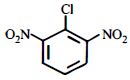
C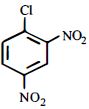
D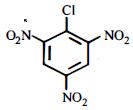
Solution
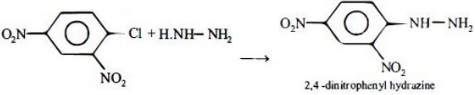
(C) The major component of Borsch reagent is $2,4-$dinitrophenylhydrazine.
It is synthesized via the nucleophilic aromatic substitution reaction between $2,4-$dinitrochlorobenzene and hydrazine hydrate $(NH_2NH_2 \cdot H_2O)$.
The reaction involves the displacement of the chlorine atom by the hydrazine group.
It is synthesized via the nucleophilic aromatic substitution reaction between $2,4-$dinitrochlorobenzene and hydrazine hydrate $(NH_2NH_2 \cdot H_2O)$.
The reaction involves the displacement of the chlorine atom by the hydrazine group.
0 likes
View Solution172
DifficultMCQ
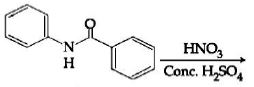
What will be the major product in the following mononitration reaction?
A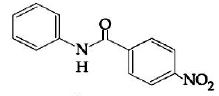
B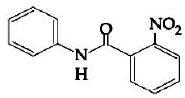
C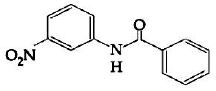
D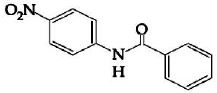
Solution
(A) The reactant is $N$-phenylbenzamide (benzanilide).
In this molecule,the nitrogen atom is attached to a phenyl ring and a carbonyl group $(C=O)$.
The lone pair on the nitrogen atom is involved in resonance with the carbonyl group,which reduces its ability to donate electron density to the attached phenyl ring.
However,the $-NH-CO-C_6H_5$ group is still an ortho/para directing group because of the lone pair on the nitrogen atom.
Among the two phenyl rings,the one attached directly to the nitrogen atom is more activated towards electrophilic aromatic substitution $(EAS)$ compared to the ring attached to the carbonyl group (which is deactivated by the electron-withdrawing carbonyl group).
Therefore,the nitronium ion $(NO_2^+)$ will attack the more activated ring at the para position due to steric hindrance at the ortho position.
The major product is $N$-($4$-nitrophenyl)benzamide.
In this molecule,the nitrogen atom is attached to a phenyl ring and a carbonyl group $(C=O)$.
The lone pair on the nitrogen atom is involved in resonance with the carbonyl group,which reduces its ability to donate electron density to the attached phenyl ring.
However,the $-NH-CO-C_6H_5$ group is still an ortho/para directing group because of the lone pair on the nitrogen atom.
Among the two phenyl rings,the one attached directly to the nitrogen atom is more activated towards electrophilic aromatic substitution $(EAS)$ compared to the ring attached to the carbonyl group (which is deactivated by the electron-withdrawing carbonyl group).
Therefore,the nitronium ion $(NO_2^+)$ will attack the more activated ring at the para position due to steric hindrance at the ortho position.
The major product is $N$-($4$-nitrophenyl)benzamide.
0 likes
View Solution173
DifficultMCQ
Coupling of benzene diazonium chloride with $1$-naphthol in alkaline medium will give:
A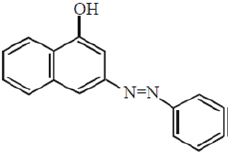
B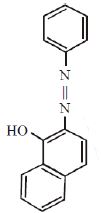
C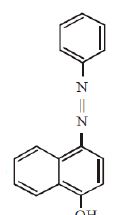
D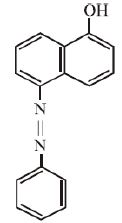
Solution
(C) The coupling reaction of benzene diazonium chloride with $1$-naphthol in an alkaline medium is an electrophilic aromatic substitution reaction.
In $1$-naphthol,the $-OH$ group is a strong activating group.
The electrophile,benzene diazonium ion $(PhN_2^+)$,attacks the position ortho or para to the $-OH$ group.
Due to steric hindrance,the attack occurs preferentially at the $4$-position (para position) of the $1$-naphthol ring.
This results in the formation of $4$-phenylazo-$1$-naphthol,which is an orange-red dye.
The correct structure is shown in image $821-c1202$.
In $1$-naphthol,the $-OH$ group is a strong activating group.
The electrophile,benzene diazonium ion $(PhN_2^+)$,attacks the position ortho or para to the $-OH$ group.
Due to steric hindrance,the attack occurs preferentially at the $4$-position (para position) of the $1$-naphthol ring.
This results in the formation of $4$-phenylazo-$1$-naphthol,which is an orange-red dye.
The correct structure is shown in image $821-c1202$.
0 likes
View Solution174
DifficultMCQ
$C_6H_6$ $\xrightarrow[\text{Conc. } H_2SO_4]{\text{Conc. } HNO_3} B$ $\xrightarrow{\text{Sn + HCl}} C$ $\xrightarrow[0-5^\circ C]{HNO_2} D$ $\xrightarrow{HBF_4} E$ $\xrightarrow{\Delta} F$
$F$ will be
$F$ will be
A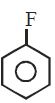
B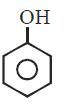
C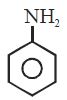
D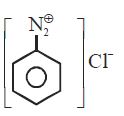
Solution
(A) The reaction sequence is as follows:
$1$. $C_6H_6$ (benzene) reacts with conc. $HNO_3$ and conc. $H_2SO_4$ to form $B$ (nitrobenzene,$C_6H_5NO_2$).
$2$. Nitrobenzene $(B)$ is reduced by $Sn + HCl$ to form $C$ (aniline,$C_6H_5NH_2$).
$3$. Aniline $(C)$ reacts with $HNO_2$ at $0-5^\circ C$ to form $D$ (benzenediazonium chloride,$C_6H_5N_2^+Cl^-$).
$4$. Benzenediazonium chloride $(D)$ reacts with $HBF_4$ to form $E$ (benzenediazonium fluoroborate,$C_6H_5N_2^+BF_4^-$).
$5$. Heating $(E)$ leads to the Balz-Schiemann reaction,yielding $F$ (fluorobenzene,$C_6H_5F$).
Thus,$F$ is fluorobenzene.
$1$. $C_6H_6$ (benzene) reacts with conc. $HNO_3$ and conc. $H_2SO_4$ to form $B$ (nitrobenzene,$C_6H_5NO_2$).
$2$. Nitrobenzene $(B)$ is reduced by $Sn + HCl$ to form $C$ (aniline,$C_6H_5NH_2$).
$3$. Aniline $(C)$ reacts with $HNO_2$ at $0-5^\circ C$ to form $D$ (benzenediazonium chloride,$C_6H_5N_2^+Cl^-$).
$4$. Benzenediazonium chloride $(D)$ reacts with $HBF_4$ to form $E$ (benzenediazonium fluoroborate,$C_6H_5N_2^+BF_4^-$).
$5$. Heating $(E)$ leads to the Balz-Schiemann reaction,yielding $F$ (fluorobenzene,$C_6H_5F$).
Thus,$F$ is fluorobenzene.
0 likes
View Solution175
DifficultMCQ
The main product of the following reaction will be:

A
$3-$chloronitrobenzene
B
$4-$nitrophenol
C
$3-$chlorophenol
D
$3-$nitrophenol
Solution
(B) $1$. Benzene reacts with $Cl_2/AlCl_3$ (electrophilic aromatic substitution) to form chlorobenzene $(A)$.
$2$. Chlorobenzene reacts with conc. $HNO_3$ and conc. $H_2SO_4$ (nitration) to form a mixture of $o$-nitrochlorobenzene and $p$-nitrochlorobenzene. The $p$-nitrochlorobenzene $(B)$ is the major product due to less steric hindrance.
$3$. $p$-nitrochlorobenzene reacts with $NaOH/\Delta$ via nucleophilic aromatic substitution $(S_{NAr})$ to replace the $Cl$ atom with an $OH$ group,forming $p$-nitrophenol as the final product.
$2$. Chlorobenzene reacts with conc. $HNO_3$ and conc. $H_2SO_4$ (nitration) to form a mixture of $o$-nitrochlorobenzene and $p$-nitrochlorobenzene. The $p$-nitrochlorobenzene $(B)$ is the major product due to less steric hindrance.
$3$. $p$-nitrochlorobenzene reacts with $NaOH/\Delta$ via nucleophilic aromatic substitution $(S_{NAr})$ to replace the $Cl$ atom with an $OH$ group,forming $p$-nitrophenol as the final product.
0 likes
View Solution176
MediumMCQ
Which one of the following does not give a white precipitate with acidified silver nitrate solution?
A
$C_6H_5Cl$
B
$CH_2=CHCl$
C
$CH_2=CH-CH_2Cl$
D
Both $(A)$ and $(B)$
Solution
(D) The reaction with acidified $AgNO_3$ solution is a test for the presence of ionic chloride ions $(Cl^-)$ in a solution.
Compounds that can easily release $Cl^-$ ions will give a white precipitate of $AgCl$.
In $C_6H_5Cl$ (chlorobenzene) and $CH_2=CHCl$ (vinyl chloride),the $C-Cl$ bond has partial double bond character due to resonance,making the $Cl$ atom strongly bonded to the carbon atom.
Therefore,these compounds do not ionize to give $Cl^-$ ions under normal conditions and do not form a white precipitate with $AgNO_3$.
In contrast,$CH_2=CH-CH_2Cl$ (allyl chloride) forms a stable resonance-stabilized carbocation upon the loss of $Cl^-$,thus it readily gives a white precipitate.
Hence,both $(A)$ and $(B)$ do not give a white precipitate.
Compounds that can easily release $Cl^-$ ions will give a white precipitate of $AgCl$.
In $C_6H_5Cl$ (chlorobenzene) and $CH_2=CHCl$ (vinyl chloride),the $C-Cl$ bond has partial double bond character due to resonance,making the $Cl$ atom strongly bonded to the carbon atom.
Therefore,these compounds do not ionize to give $Cl^-$ ions under normal conditions and do not form a white precipitate with $AgNO_3$.
In contrast,$CH_2=CH-CH_2Cl$ (allyl chloride) forms a stable resonance-stabilized carbocation upon the loss of $Cl^-$,thus it readily gives a white precipitate.
Hence,both $(A)$ and $(B)$ do not give a white precipitate.
0 likes
View Solution177
MediumMCQ
Which of the following does not give Friedel-Crafts reaction?
A
Aniline
B
Chlorobenzene
C
Anisole
D
Both $A$ and $B$
Solution
(A) Aniline does not undergo Friedel-Crafts reaction because the lone pair on the nitrogen atom of aniline reacts with the Lewis acid catalyst $(AlCl_3)$ to form an anilinium ion salt.
This results in a positively charged nitrogen atom,which acts as a strong electron-withdrawing group $(EWG)$,deactivating the benzene ring towards electrophilic substitution.
This results in a positively charged nitrogen atom,which acts as a strong electron-withdrawing group $(EWG)$,deactivating the benzene ring towards electrophilic substitution.
0 likes
View Solution178
AdvancedMCQ
Which has maximum dipole moment?
A
$1,2,4-$trichlorobenzene
B
$1,2,3-$trichlorobenzene
C
$1,3,5-$trichlorobenzene
D
$1,4-$dichlorobenzene
Solution
(A) The dipole moment of a molecule depends on the vector sum of the individual bond dipoles.
For $1,4$-dichlorobenzene,the two $C-Cl$ bond dipoles are equal and opposite,so they cancel each other out,resulting in a net dipole moment of $0 \ D$.
For $1,3,5$-trichlorobenzene,the three $C-Cl$ bond dipoles are oriented at $120^{\circ}$ to each other,and their vector sum is also $0$.
For $1,2,3$-trichlorobenzene,the dipole moments of the two outer $Cl$ atoms partially cancel the dipole of the middle $Cl$ atom,but there is a significant net dipole.
For $1,2,4$-trichlorobenzene,the arrangement of $Cl$ atoms leads to a larger resultant dipole moment compared to the others because the vectors do not cancel out as effectively.
Thus,$1,2,4$-trichlorobenzene has the maximum dipole moment.
For $1,4$-dichlorobenzene,the two $C-Cl$ bond dipoles are equal and opposite,so they cancel each other out,resulting in a net dipole moment of $0 \ D$.
For $1,3,5$-trichlorobenzene,the three $C-Cl$ bond dipoles are oriented at $120^{\circ}$ to each other,and their vector sum is also $0$.
For $1,2,3$-trichlorobenzene,the dipole moments of the two outer $Cl$ atoms partially cancel the dipole of the middle $Cl$ atom,but there is a significant net dipole.
For $1,2,4$-trichlorobenzene,the arrangement of $Cl$ atoms leads to a larger resultant dipole moment compared to the others because the vectors do not cancel out as effectively.
Thus,$1,2,4$-trichlorobenzene has the maximum dipole moment.
0 likes
View Solution179
DifficultMCQ
Which of the following compounds has a dipole moment approximately equal to that of chlorobenzene?
A
$o-$dichlorobenzene
B
$m-$dichlorobenzene
C
$p-$dichlorobenzene
D
$p-$chloronitrobenzene
Solution
(B) The dipole moment of chlorobenzene is approximately $1.73 \ D$.
For $o-$dichlorobenzene,the dipole moment is $\approx 2.54 \ D$.
For $m-$dichlorobenzene,the dipole moment is $\approx 1.72 \ D$.
For $p-$dichlorobenzene,the dipole moment is $0 \ D$ due to symmetry.
For $p-$chloronitrobenzene,the dipole moment is $\approx 2.6 \ D$.
Thus,$m-$dichlorobenzene has a dipole moment approximately equal to that of chlorobenzene.
For $o-$dichlorobenzene,the dipole moment is $\approx 2.54 \ D$.
For $m-$dichlorobenzene,the dipole moment is $\approx 1.72 \ D$.
For $p-$dichlorobenzene,the dipole moment is $0 \ D$ due to symmetry.
For $p-$chloronitrobenzene,the dipole moment is $\approx 2.6 \ D$.
Thus,$m-$dichlorobenzene has a dipole moment approximately equal to that of chlorobenzene.
0 likes
View Solution180
DifficultMCQ
The major product of the following reaction will be:
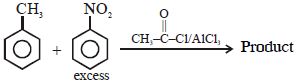
A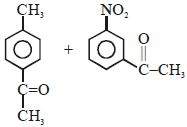
B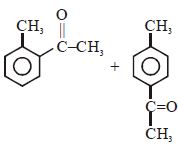
C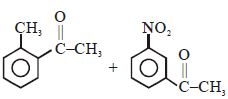
D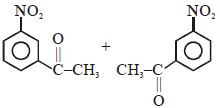
Solution
(B) The reaction provided is a Friedel-Crafts acylation. However,the reactants are toluene $(CH_3-C_6H_5)$ and nitrobenzene $(NO_2-C_6H_5)$.
Nitrobenzene is a strongly deactivating group due to the $-NO_2$ group,which is electron-withdrawing. Friedel-Crafts reactions do not occur on benzene rings that are deactivated by strong electron-withdrawing groups like $-NO_2$.
Therefore,the reaction will occur on the toluene ring,which is activated by the $-CH_3$ group.
The $-CH_3$ group is ortho/para-directing. Thus,the acylation of toluene will yield a mixture of $o$-methylacetophenone and $p$-methylacetophenone.
Nitrobenzene is a strongly deactivating group due to the $-NO_2$ group,which is electron-withdrawing. Friedel-Crafts reactions do not occur on benzene rings that are deactivated by strong electron-withdrawing groups like $-NO_2$.
Therefore,the reaction will occur on the toluene ring,which is activated by the $-CH_3$ group.
The $-CH_3$ group is ortho/para-directing. Thus,the acylation of toluene will yield a mixture of $o$-methylacetophenone and $p$-methylacetophenone.
0 likes
View Solution181
MediumMCQ
In which of the following is the $C-Cl$ bond length minimum?
A
B
C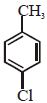
D
Solution
(C) The $C-Cl$ bond length is inversely proportional to the partial double bond character of the bond.
In option $A$,the $Cl$ atom is attached to a $sp^2$ hybridized carbon atom which is part of a conjugated system,leading to resonance and partial double bond character.
In option $B$,the $Cl$ atom is attached to a $sp^3$ hybridized carbon atom (benzyl chloride),which has a single bond character.
In option $C$,the $Cl$ atom is attached to a $sp^2$ hybridized carbon atom in a benzene ring,which also shows resonance and partial double bond character.
In option $D$,the $Cl$ atom is attached to a $sp^2$ hybridized carbon atom which is part of a cross-conjugated system,showing significant partial double bond character.
Comparing the resonance effects,the $C-Cl$ bond in chlorobenzene (option $C$) has the most significant partial double bond character due to the delocalization of the lone pair of $Cl$ into the aromatic ring,resulting in the shortest bond length among the given options.
In option $A$,the $Cl$ atom is attached to a $sp^2$ hybridized carbon atom which is part of a conjugated system,leading to resonance and partial double bond character.
In option $B$,the $Cl$ atom is attached to a $sp^3$ hybridized carbon atom (benzyl chloride),which has a single bond character.
In option $C$,the $Cl$ atom is attached to a $sp^2$ hybridized carbon atom in a benzene ring,which also shows resonance and partial double bond character.
In option $D$,the $Cl$ atom is attached to a $sp^2$ hybridized carbon atom which is part of a cross-conjugated system,showing significant partial double bond character.
Comparing the resonance effects,the $C-Cl$ bond in chlorobenzene (option $C$) has the most significant partial double bond character due to the delocalization of the lone pair of $Cl$ into the aromatic ring,resulting in the shortest bond length among the given options.
0 likes
View Solution182
DifficultMCQ
Which among the following compounds reacts with $NaOH$ at the fastest rate?
A
Chlorobenzene
B
$p$-Nitrochlorobenzene
C
$2,4,6$-Trinitrochlorobenzene
D
$2,4$-Dinitrochlorobenzene
Solution
(C) The reaction of aryl halides with $NaOH$ proceeds via Nucleophilic Aromatic Substitution $(S_NAr)$.
This reaction is facilitated by the presence of electron-withdrawing groups ($-M$ effect) at the ortho and para positions,which stabilize the intermediate Meisenheimer complex.
As the number of electron-withdrawing $-NO_2$ groups increases,the rate of the $S_NAr$ reaction increases.
$2,4,6$-Trinitrochlorobenzene has three electron-withdrawing $-NO_2$ groups,making it the most reactive towards nucleophilic substitution.
This reaction is facilitated by the presence of electron-withdrawing groups ($-M$ effect) at the ortho and para positions,which stabilize the intermediate Meisenheimer complex.
As the number of electron-withdrawing $-NO_2$ groups increases,the rate of the $S_NAr$ reaction increases.
$2,4,6$-Trinitrochlorobenzene has three electron-withdrawing $-NO_2$ groups,making it the most reactive towards nucleophilic substitution.
0 likes
View Solution183
MediumMCQ
Which of the following reactions is called the Wurtz-Fittig reaction?
A
$C_6H_5X + R-X + 2Na \xrightarrow{\text{dry ether}} C_6H_5-R + 2NaX$
B
$2C_6H_5X + 2Na \xrightarrow{\text{dry ether}} C_6H_5-C_6H_5 + 2NaX$
C
$2R-X + 2Na \xrightarrow{\text{dry ether}} R-R + 2NaX$
D
$C_6H_5X + C_6H_5X + 2Na \xrightarrow{\text{dry ether}} C_6H_5-C_6H_5 + 2NaX$
Solution
(A) The Wurtz-Fittig reaction is a chemical reaction that involves the coupling of an aryl halide $(Ar-X)$ with an alkyl halide $(R-X)$ in the presence of sodium metal in dry ether to form an alkyl-substituted aromatic compound $(Ar-R)$.
The general equation is:
$Ar-X + R-X + 2Na \xrightarrow{\text{dry ether}} Ar-R + 2NaX$
Therefore,option $A$ represents the correct reaction.
The general equation is:
$Ar-X + R-X + 2Na \xrightarrow{\text{dry ether}} Ar-R + 2NaX$
Therefore,option $A$ represents the correct reaction.
0 likes
View Solution184
MediumMCQ
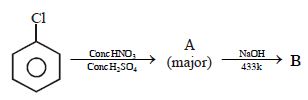
If $B$ is the major product,then identify $B$.
A
$1-$chloro$-2-$hydroxy$-4-$nitrobenzene
B
$2-$nitrophenol
C
$4-$nitrophenol
D
$4-$chlorophenol
Solution
(C) The reaction of chlorobenzene with concentrated $HNO_3$ and concentrated $H_2SO_4$ (nitration) produces a mixture of ortho-nitrochlorobenzene and para-nitrochlorobenzene. The para-isomer is the major product due to less steric hindrance. Thus,$A$ is $1$-chloro-$4$-nitrobenzene.
When $1$-chloro-$4$-nitrobenzene $(A)$ is treated with $NaOH$ at $433 \ K$,nucleophilic aromatic substitution occurs. The presence of the electron-withdrawing $-NO_2$ group at the para position activates the ring towards nucleophilic attack,replacing the $-Cl$ atom with an $-OH$ group to form $4$-nitrophenol as the major product $B$.
When $1$-chloro-$4$-nitrobenzene $(A)$ is treated with $NaOH$ at $433 \ K$,nucleophilic aromatic substitution occurs. The presence of the electron-withdrawing $-NO_2$ group at the para position activates the ring towards nucleophilic attack,replacing the $-Cl$ atom with an $-OH$ group to form $4$-nitrophenol as the major product $B$.
0 likes
View Solution185
MediumMCQ
In which of the following compounds does electrophilic attack occur at ortho and para positions?
A
Chlorobenzene
B
Nitrobenzene
C
Acetophenone
D
Nitrocyclohexane
Solution
(A) Electrophilic aromatic substitution occurs at the ortho and para positions when the substituent attached to the benzene ring is an ortho/para-directing group.
These groups are typically electron-donating by resonance (e.g.,$-Cl$,$-OH$,$-NH_2$,$-CH_3$).
In $Chlorobenzene$ $(C_6H_5Cl)$,the chlorine atom has lone pairs of electrons that can be donated to the ring through resonance,increasing the electron density at the ortho and para positions.
Conversely,$-NO_2$ (in nitrobenzene) and $-COCH_3$ (in acetophenone) are electron-withdrawing groups that deactivate the ring and are meta-directing.
Nitrocyclohexane is not an aromatic compound.
Therefore,chlorobenzene is the correct answer.
These groups are typically electron-donating by resonance (e.g.,$-Cl$,$-OH$,$-NH_2$,$-CH_3$).
In $Chlorobenzene$ $(C_6H_5Cl)$,the chlorine atom has lone pairs of electrons that can be donated to the ring through resonance,increasing the electron density at the ortho and para positions.
Conversely,$-NO_2$ (in nitrobenzene) and $-COCH_3$ (in acetophenone) are electron-withdrawing groups that deactivate the ring and are meta-directing.
Nitrocyclohexane is not an aromatic compound.
Therefore,chlorobenzene is the correct answer.
0 likes
View Solution186
MediumMCQ
The following reaction is:
$p-Nitrochlorobenzene + KOH \xrightarrow{\Delta} p-Nitrophenol + KCl$
$p-Nitrochlorobenzene + KOH \xrightarrow{\Delta} p-Nitrophenol + KCl$
A
Nucleophilic substitution
B
Electrophilic substitution
C
Free radical substitution
D
None of these
Solution
(A) The reaction involves the replacement of a chlorine atom $(-Cl)$ by a hydroxyl group $(-OH)$ in $p-nitrochlorobenzene$.
Since the $-NO_2$ group is a strong electron-withdrawing group,it activates the benzene ring towards nucleophilic attack at the ortho and para positions.
This is a classic example of Nucleophilic Aromatic Substitution ($S_NAr$ mechanism),where the hydroxide ion $(OH^-)$ acts as a nucleophile and attacks the carbon atom attached to the chlorine,leading to the displacement of the chloride ion $(Cl^-)$.
Therefore,the correct answer is Nucleophilic substitution.
Since the $-NO_2$ group is a strong electron-withdrawing group,it activates the benzene ring towards nucleophilic attack at the ortho and para positions.
This is a classic example of Nucleophilic Aromatic Substitution ($S_NAr$ mechanism),where the hydroxide ion $(OH^-)$ acts as a nucleophile and attacks the carbon atom attached to the chlorine,leading to the displacement of the chloride ion $(Cl^-)$.
Therefore,the correct answer is Nucleophilic substitution.
0 likes
View Solution187
MediumMCQ
The order of dipole moment for $o-, p-,$ and $m-$dichlorobenzene is............
A
$o > m > p$
B
$p > o > m$
C
$m > o > p$
D
$o > p > m$
Solution
(A) The dipole moment $(\mu)$ depends on the vector sum of the individual bond dipoles.
For $o-$dichlorobenzene,the angle between the $C-Cl$ bonds is $60^{\circ}$,resulting in a large resultant dipole moment.
For $m-$dichlorobenzene,the angle is $120^{\circ}$,which gives a smaller resultant dipole moment.
For $p-$dichlorobenzene,the two $C-Cl$ bonds are in opposite directions $(180^{\circ})$,so their dipole moments cancel each other out,resulting in $\mu = 0$.
Thus,the correct order is $o > m > p$.
For $o-$dichlorobenzene,the angle between the $C-Cl$ bonds is $60^{\circ}$,resulting in a large resultant dipole moment.
For $m-$dichlorobenzene,the angle is $120^{\circ}$,which gives a smaller resultant dipole moment.
For $p-$dichlorobenzene,the two $C-Cl$ bonds are in opposite directions $(180^{\circ})$,so their dipole moments cancel each other out,resulting in $\mu = 0$.
Thus,the correct order is $o > m > p$.
0 likes
View Solution188
MediumMCQ
Which of the following is most reactive toward nucleophilic aromatic substitution (hydrolysis)?
A
Chlorobenzene
B
$1-$Chloro$-2-$nitrobenzene
C
$1-$Chloro$-2,4-$dinitrobenzene
D
$1-$Chloro$-2,4,6-$trinitrobenzene
Solution
(D) Nucleophilic aromatic substitution in aryl halides is facilitated by the presence of electron-withdrawing groups (like $-NO_2$) at the ortho and para positions.
These groups stabilize the intermediate carbanion (Meisenheimer complex) through resonance.
The more electron-withdrawing groups present,the greater the stabilization of the intermediate,and thus the higher the reactivity toward hydrolysis.
$1$-Chloro-$2,4,6$-trinitrobenzene has three $-NO_2$ groups (two ortho and one para),providing the maximum stabilization for the intermediate,making it the most reactive toward nucleophilic substitution.
These groups stabilize the intermediate carbanion (Meisenheimer complex) through resonance.
The more electron-withdrawing groups present,the greater the stabilization of the intermediate,and thus the higher the reactivity toward hydrolysis.
$1$-Chloro-$2,4,6$-trinitrobenzene has three $-NO_2$ groups (two ortho and one para),providing the maximum stabilization for the intermediate,making it the most reactive toward nucleophilic substitution.
0 likes
View Solution189
MediumMCQ
The rate of reaction is maximum if $G$ is:
$Cl-C_6H_4-G \xrightarrow{NaOH, \Delta/P} HO-C_6H_4-G$
$Cl-C_6H_4-G \xrightarrow{NaOH, \Delta/P} HO-C_6H_4-G$
A
$-OCH_3$
B
$-CH_3$
C
$-NO_2$
D
$-H$
Solution
(C) The given reaction is a nucleophilic aromatic substitution reaction $(S_NAr)$.
In this reaction,a nucleophile $(OH^-)$ attacks the benzene ring.
This process is facilitated by the presence of electron-withdrawing groups $(EWG)$ on the ring,which stabilize the intermediate carbanion (Meisenheimer complex) by dispersing the negative charge.
Among the given groups,$-NO_2$ is a strong electron-withdrawing group ($-I$ and $-M$ effect),while $-OCH_3$ and $-CH_3$ are electron-donating groups.
Therefore,the rate of the reaction is maximum when $G$ is $-NO_2$.
In this reaction,a nucleophile $(OH^-)$ attacks the benzene ring.
This process is facilitated by the presence of electron-withdrawing groups $(EWG)$ on the ring,which stabilize the intermediate carbanion (Meisenheimer complex) by dispersing the negative charge.
Among the given groups,$-NO_2$ is a strong electron-withdrawing group ($-I$ and $-M$ effect),while $-OCH_3$ and $-CH_3$ are electron-donating groups.
Therefore,the rate of the reaction is maximum when $G$ is $-NO_2$.
0 likes
View Solution190
DifficultMCQ
Identify the major product formed when $p$-isopropyltoluene (also known as $p$-cymene) reacts with a mixture of concentrated $HNO_3$ and concentrated $H_2SO_4$.
A
$1-$isopropyl$-4-$methyl$-2-$nitrobenzene
B
$2-$isopropyl$-1-$methyl$-4-$nitrobenzene
C
$1-$isopropyl$-4-$methyl$-3-$nitrobenzene
D
$1-$nitro$-4-$isopropyl-benzene
Solution
(A) The reaction is an electrophilic aromatic substitution,specifically nitration,of $p$-isopropyltoluene ($p$-cymene).
$p$-Cymene has two alkyl groups attached to the benzene ring: a methyl group $(-CH_3)$ and an isopropyl group $(-CH(CH_3)_2)$.
Both alkyl groups are ortho/para directing.
In $p$-cymene,the positions ortho to the methyl group are equivalent to the positions ortho to the isopropyl group.
However,the methyl group is a stronger activating group than the isopropyl group due to less steric hindrance.
Therefore,the nitration occurs at the position ortho to the methyl group.
This leads to the formation of $2$-nitro-$1$-isopropyl-$4$-methylbenzene (or $2$-nitro-$p$-cymene).
$p$-Cymene has two alkyl groups attached to the benzene ring: a methyl group $(-CH_3)$ and an isopropyl group $(-CH(CH_3)_2)$.
Both alkyl groups are ortho/para directing.
In $p$-cymene,the positions ortho to the methyl group are equivalent to the positions ortho to the isopropyl group.
However,the methyl group is a stronger activating group than the isopropyl group due to less steric hindrance.
Therefore,the nitration occurs at the position ortho to the methyl group.
This leads to the formation of $2$-nitro-$1$-isopropyl-$4$-methylbenzene (or $2$-nitro-$p$-cymene).
0 likes
View Solution191
MediumMCQ
Which of the following is least reactive towards $S_NAr$?
A
o-chloronitrobenzene
B
p-chloronitrobenzene
C
$2,4,6-$trinitrochlorobenzene
D
m-chloronitrobenzene
Solution
(D) The reactivity of haloarenes towards nucleophilic aromatic substitution $(S_NAr)$ depends on the presence of electron-withdrawing groups (EWGs) on the benzene ring.
These groups stabilize the intermediate carbanion (Meisenheimer complex) formed during the reaction.
The stabilization is most effective when the $EWG$ is at the ortho or para positions relative to the leaving group,as the negative charge can be delocalized onto the oxygen atoms of the nitro group.
In $m$-chloronitrobenzene,the nitro group is at the meta position,meaning the negative charge cannot be delocalized directly onto the nitro group through resonance.
Therefore,$m$-chloronitrobenzene is the least reactive among the given options.
These groups stabilize the intermediate carbanion (Meisenheimer complex) formed during the reaction.
The stabilization is most effective when the $EWG$ is at the ortho or para positions relative to the leaving group,as the negative charge can be delocalized onto the oxygen atoms of the nitro group.
In $m$-chloronitrobenzene,the nitro group is at the meta position,meaning the negative charge cannot be delocalized directly onto the nitro group through resonance.
Therefore,$m$-chloronitrobenzene is the least reactive among the given options.
0 likes
View Solution192
MediumMCQ
The correct order of reactivity towards electrophilic substitution reaction is ........
A
Phenol $ > $ Benzene $ > $ Chlorobenzene $ > $ Benzoic acid
B
Benzoic acid $ > $ Chlorobenzene $ > $ Benzene $ > $ Phenol
C
Phenol $ > $ Chlorobenzene $ > $ Benzene $ > $ Benzoic acid
D
Benzoic acid $ > $ Phenol $ > $ Benzene $ > $ Chlorobenzene
Solution
(A) Electrophilic substitution reaction rate depends on the electron density of the benzene ring.
Groups that increase electron density (activating groups) increase reactivity,while groups that decrease electron density (deactivating groups) decrease reactivity.
$1$. $-OH$ (Phenol) is a strong activating group due to its $+M$ effect,making it the most reactive.
$2$. Benzene has no substituent,so it is less reactive than phenol but more reactive than deactivated rings.
$3$. $-Cl$ (Chlorobenzene) is a deactivating group due to its $-I$ effect,though it is ortho/para directing.
$4$. $-COOH$ (Benzoic acid) is a strongly deactivating group due to its $-M$ and $-I$ effects,making it the least reactive.
Therefore,the correct order is: $\text{Phenol} > \text{Benzene} > \text{Chlorobenzene} > \text{Benzoic acid}$.
Groups that increase electron density (activating groups) increase reactivity,while groups that decrease electron density (deactivating groups) decrease reactivity.
$1$. $-OH$ (Phenol) is a strong activating group due to its $+M$ effect,making it the most reactive.
$2$. Benzene has no substituent,so it is less reactive than phenol but more reactive than deactivated rings.
$3$. $-Cl$ (Chlorobenzene) is a deactivating group due to its $-I$ effect,though it is ortho/para directing.
$4$. $-COOH$ (Benzoic acid) is a strongly deactivating group due to its $-M$ and $-I$ effects,making it the least reactive.
Therefore,the correct order is: $\text{Phenol} > \text{Benzene} > \text{Chlorobenzene} > \text{Benzoic acid}$.
0 likes
View Solution193
MediumMCQ
Which of the following groups deactivates the benzene ring towards electrophilic substitution reaction?
A
Methyl
B
Amino
C
Hydroxyl
D
Chloro
Solution
(D) In electrophilic substitution reactions,groups that donate electrons to the benzene ring (via resonance or inductive effect) activate the ring,while groups that withdraw electrons from the ring deactivate it.
$1$. The $-CH_3$ (methyl) group is electron-donating due to hyperconjugation and inductive effect,thus it activates the ring.
$2$. The $-NH_2$ (amino) and $-OH$ (hydroxyl) groups are strongly activating due to the $+R$ (resonance) effect.
$3$. The $-Cl$ (chloro) group,although it has a $+R$ effect,is strongly electron-withdrawing due to its high electronegativity ($-I$ effect). This $-I$ effect dominates over the $+R$ effect,making the benzene ring less reactive towards electrophiles compared to benzene. Therefore,it is considered a deactivating group.
$1$. The $-CH_3$ (methyl) group is electron-donating due to hyperconjugation and inductive effect,thus it activates the ring.
$2$. The $-NH_2$ (amino) and $-OH$ (hydroxyl) groups are strongly activating due to the $+R$ (resonance) effect.
$3$. The $-Cl$ (chloro) group,although it has a $+R$ effect,is strongly electron-withdrawing due to its high electronegativity ($-I$ effect). This $-I$ effect dominates over the $+R$ effect,making the benzene ring less reactive towards electrophiles compared to benzene. Therefore,it is considered a deactivating group.
0 likes
View Solution194
EasyMCQ
Which of the following is the strongest meta-directing group?
A
$-NO_2$
B
$-SO_3H$
C
$-CHO$
D
$-COOH$
Solution
(A) The strength of a meta-directing group is determined by its electron-withdrawing power,which is primarily due to the $-I$ (inductive) and $-M$ (mesomeric) effects.
Among the given groups,the $-NO_2$ group exerts the strongest electron-withdrawing effect due to the combined strong $-I$ and $-M$ effects of the nitrogen atom bonded to two highly electronegative oxygen atoms.
Therefore,$-NO_2$ is the strongest meta-directing group among the options provided.
Among the given groups,the $-NO_2$ group exerts the strongest electron-withdrawing effect due to the combined strong $-I$ and $-M$ effects of the nitrogen atom bonded to two highly electronegative oxygen atoms.
Therefore,$-NO_2$ is the strongest meta-directing group among the options provided.
0 likes
View Solution195
MediumMCQ
Oxidation of toluene with dilute $HNO_3$ gives:
A
Benzaldehyde
B
Phenol
C
Nitrotoluene
D
Benzoic acid
Solution
(C) The oxidation of toluene with dilute $HNO_3$ is not a standard method for producing benzaldehyde or benzoic acid. However,in the context of typical chemistry curriculum questions,if the reaction is intended to represent the oxidation of the methyl group,it usually requires strong oxidizing agents like $KMnO_4$ to form benzoic acid. If the question implies the reaction of toluene with $HNO_3$ (nitration),it would yield nitrotoluene. Given the options,the most chemically accurate reaction for toluene with $HNO_3$ is electrophilic aromatic substitution,which produces $o$-nitrotoluene and $p$-nitrotoluene.
0 likes
View Solution196
MediumMCQ
In the following reaction,the compound $C$ is:
${C_7}{H_8}$ $\xrightarrow[\Delta]{3Cl_2} A$ $\xrightarrow{Br_2/Fe} B$ $\xrightarrow{Zn/HCl} C$
${C_7}{H_8}$ $\xrightarrow[\Delta]{3Cl_2} A$ $\xrightarrow{Br_2/Fe} B$ $\xrightarrow{Zn/HCl} C$
A
$p-$bromotoluene
B
$o-$bromotoluene
C
$m-$bromotoluene
D
$3-$bromo$-2, 4, 6-$trichlorotoluene
Solution
(C) Step $1$: Toluene $({C_7}{H_8})$ reacts with $3Cl_2$ in the presence of $\Delta$ (heat) to undergo side-chain chlorination,forming benzotrichloride $({C_6}{H_5}CCl_3)$ as compound $A$.
Step $2$: Benzotrichloride $({C_6}{H_5}CCl_3)$ contains a $-CCl_3$ group,which is a strongly deactivating and meta-directing group. Reaction with $Br_2/Fe$ leads to electrophilic aromatic substitution at the meta position,forming $m-$bromobenzotrichloride as compound $B$.
Step $3$: Reduction of the $-CCl_3$ group using $Zn/HCl$ converts it back into a methyl $(-CH_3)$ group. Thus,$m-$bromobenzotrichloride is reduced to $m-$bromotoluene,which is compound $C$.
Step $2$: Benzotrichloride $({C_6}{H_5}CCl_3)$ contains a $-CCl_3$ group,which is a strongly deactivating and meta-directing group. Reaction with $Br_2/Fe$ leads to electrophilic aromatic substitution at the meta position,forming $m-$bromobenzotrichloride as compound $B$.
Step $3$: Reduction of the $-CCl_3$ group using $Zn/HCl$ converts it back into a methyl $(-CH_3)$ group. Thus,$m-$bromobenzotrichloride is reduced to $m-$bromotoluene,which is compound $C$.
0 likes
View Solution197
DifficultMCQ
What will be the product $A$ in the following reaction?
$C_6H_5CCl_3 \xrightarrow{1 \text{ eq. of } Br_2/Fe} A$
$C_6H_5CCl_3 \xrightarrow{1 \text{ eq. of } Br_2/Fe} A$
A
o-Bromobenzotrichloride
B
m-Bromobenzotrichloride
C
p-Bromobenzotrichloride
D
$3,5-$Dibromobenzotrichloride
Solution
(B) The group $-CCl_3$ is a strongly electron-withdrawing group due to the inductive effect of three chlorine atoms.
It is a deactivating group and is meta-directing in electrophilic aromatic substitution reactions.
Therefore,the electrophile $Br^+$ will attack the meta-position of the benzene ring.
The product formed is $m$-bromobenzotrichloride.
It is a deactivating group and is meta-directing in electrophilic aromatic substitution reactions.
Therefore,the electrophile $Br^+$ will attack the meta-position of the benzene ring.
The product formed is $m$-bromobenzotrichloride.
0 likes
View Solution198
DifficultMCQ
The major product obtained by monobromination of the following compound with $Br_2/ FeBr_3$ is:

A
$2-$bromo$-1-$methoxy$-3-$methylbenzene
B
$2-$bromo$-1-$methoxy$-4-$methylbenzene
C
$4-$bromo$-1-$methoxy$-3-$methylbenzene
D
$6-$bromo$-1-$methoxy$-2-$methylbenzene
Solution
(C) The starting material is $1$-methoxy-$3$-methylbenzene ($m$-cresol methyl ether).
In this molecule,the $-OCH_3$ group is a strong ortho/para-directing group due to its $+M$ effect,while the $-CH_3$ group is a weak ortho/para-directing group due to its $+I$ and hyperconjugation effects.
The $-OCH_3$ group exerts a stronger directing influence than the $-CH_3$ group.
Electrophilic substitution $(Br^+)$ will occur at the position most activated by the $-OCH_3$ group.
The positions ortho to $-OCH_3$ are positions $2$ and $6$. Position $2$ is sterically hindered by the $-CH_3$ group at position $3$.
Therefore,the electrophile attacks the position para to the $-OCH_3$ group,which is position $4$.
This leads to the formation of $4$-bromo-$1$-methoxy-$3$-methylbenzene as the major product.
In this molecule,the $-OCH_3$ group is a strong ortho/para-directing group due to its $+M$ effect,while the $-CH_3$ group is a weak ortho/para-directing group due to its $+I$ and hyperconjugation effects.
The $-OCH_3$ group exerts a stronger directing influence than the $-CH_3$ group.
Electrophilic substitution $(Br^+)$ will occur at the position most activated by the $-OCH_3$ group.
The positions ortho to $-OCH_3$ are positions $2$ and $6$. Position $2$ is sterically hindered by the $-CH_3$ group at position $3$.
Therefore,the electrophile attacks the position para to the $-OCH_3$ group,which is position $4$.
This leads to the formation of $4$-bromo-$1$-methoxy-$3$-methylbenzene as the major product.
0 likes
View Solution199
DifficultMCQ
$C_7H_8$ $\xrightarrow{3Cl_2 / \text{heat}} A$ $\xrightarrow{Fe/Br_2} B$ $\xrightarrow{Zn/HCl} C$. What is compound $C$?
A
$3-\text{bromo}-2,4,6-\text{trichlorotoluene}$
B
$o-\text{bromotoluene}$
C
$p-\text{bromotoluene}$
D
$m-\text{bromotoluene}$
Solution
(D) Step $1$: Toluene $(C_7H_8)$ reacts with $3Cl_2$ in the presence of heat (free radical substitution) to form benzotrichloride $(C_6H_5CCl_3)$,which is compound $A$.
Step $2$: The $-CCl_3$ group is a strong deactivating and meta-directing group. Therefore,reaction with $Fe/Br_2$ (electrophilic aromatic substitution) yields $m-\text{bromobenzotrichloride}$ $(C_6H_4(Br)CCl_3)$,which is compound $B$.
Step $3$: Reduction of the $-CCl_3$ group with $Zn/HCl$ converts it back to a methyl group $(-CH_3)$. Thus,the product $C$ is $m-\text{bromotoluene}$.
Step $2$: The $-CCl_3$ group is a strong deactivating and meta-directing group. Therefore,reaction with $Fe/Br_2$ (electrophilic aromatic substitution) yields $m-\text{bromobenzotrichloride}$ $(C_6H_4(Br)CCl_3)$,which is compound $B$.
Step $3$: Reduction of the $-CCl_3$ group with $Zn/HCl$ converts it back to a methyl group $(-CH_3)$. Thus,the product $C$ is $m-\text{bromotoluene}$.
0 likes
View Solution200
EasyMCQ
Which of the following has the highest normal boiling point?
A
Iodobenzene
B
Bromobenzene
C
Chlorobenzene
D
Fluorobenzene
Solution
(A) The boiling point of haloarenes depends on the magnitude of van der Waals forces,which increase with an increase in the size and mass of the halogen atom.
As we move down the group in the periodic table from $F$ to $I$,the size and molecular mass of the halogen atom increase.
Therefore,the order of boiling points is: $\text{Fluorobenzene} < \text{Chlorobenzene} < \text{Bromobenzene} < \text{Iodobenzene}$.
Thus,$Iodobenzene$ has the highest boiling point.
As we move down the group in the periodic table from $F$ to $I$,the size and molecular mass of the halogen atom increase.
Therefore,the order of boiling points is: $\text{Fluorobenzene} < \text{Chlorobenzene} < \text{Bromobenzene} < \text{Iodobenzene}$.
Thus,$Iodobenzene$ has the highest boiling point.
0 likes
View SolutionHaloalkanes and Haloarenes — Properties of Haloarenes · Frequently Asked Questions
1Are these Haloalkanes and Haloarenes questions useful for JEE and NEET?
Yes. All questions in this section are mapped to JEE Main and NEET exam patterns. Previous year questions from JEE Main, NEET, GUJCET and state-level exams are included with full solutions.
2Can I switch to Hindi or Gujarati for these questions?
Yes. Use the language tabs in the hero section or the sidebar to view the same questions and solutions in English, Hindi or Gujarati.
3How do I generate a question paper from this subtopic?
Use the Vedclass Exam Paper Generator — select the chapter and subtopic, set difficulty, and generate Sets A, B, C, D automatically. First 3 chapters of every subject are free.
Vedclass Products
For Students
Vedclass Test Series
Mock tests in real JEE/NEET style with performance analysis. 5-day free trial.
Start Free TrialFor Teachers
Exam Paper Generator
Generate Set A/B/C/D papers from this chapter in 2 minutes. 3 chapters free.
Try FreeFor Institutes
Online Exam Module
Live online exams with unlimited students, 360° analytics & white-label branding.
See DemoFor Teachers & Institutes
Generate a Haloalkanes and Haloarenes Exam Paper in 2 Minutes
Select subtopic & difficulty — Sets A, B, C, D auto-generated with No Repeat logic.
First 3 chapters of every subject are free — no payment required.