
A English
Properties of Haloarenes Questions in English
Class 12 Chemistry · Haloalkanes and Haloarenes · Properties of Haloarenes
423+
Questions
English
Language
100%
With Solutions
Showing 50 of 423 questions in English
51
DifficultMCQ
Which of the following undergoes hydrolysis most easily?
A
Chlorobenzene
B
$2-$Nitrochlorobenzene
C
$2,4-$Dinitrochlorobenzene
D
$2,4,6-$Trinitrochlorobenzene
Solution
(D) The rate of nucleophilic aromatic substitution in haloarenes increases with the presence of electron-withdrawing groups (like $-NO_2$) at the ortho and para positions. These groups stabilize the carbanion intermediate formed during the reaction. Since $2,4,6$-trinitrochlorobenzene has three electron-withdrawing $-NO_2$ groups,it undergoes hydrolysis most easily.
0 likes
View Solution52
MediumMCQ
Which of the following chlorides is the least reactive towards hydrolysis?
A
$CH_3Cl$
B
$CH_3CH_2Cl$
C
$(CH_3)_3CCl$
D
$CH_2=CH-Cl$
Solution
(D) In $CH_2=CH-Cl$ (vinyl chloride),the $C-Cl$ bond acquires partial double bond character due to resonance.
This makes the $C-Cl$ bond stronger and shorter,making it difficult to break during hydrolysis.
Therefore,$CH_2=CH-Cl$ is the least reactive towards hydrolysis compared to the given alkyl chlorides.
This makes the $C-Cl$ bond stronger and shorter,making it difficult to break during hydrolysis.
Therefore,$CH_2=CH-Cl$ is the least reactive towards hydrolysis compared to the given alkyl chlorides.
0 likes
View Solution53
MediumMCQ
Which compound is formed when chlorobenzene is heated with chloral in the presence of concentrated sulfuric acid?
A
Gammexane
B
$DDT$
C
Freon
D
Hexachloroethane
Solution
(B) The reaction between chloral $(CCl_3CHO)$ and chlorobenzene $(C_6H_5Cl)$ in the presence of concentrated sulfuric acid $(H_2SO_4)$ is a condensation reaction.
Two molecules of chlorobenzene react with one molecule of chloral to form $1,1,1-trichloro-2,2-bis(p-chlorophenyl)ethane$,commonly known as $DDT$.
Two molecules of chlorobenzene react with one molecule of chloral to form $1,1,1-trichloro-2,2-bis(p-chlorophenyl)ethane$,commonly known as $DDT$.
0 likes
View Solution54
EasyMCQ
Which catalyst is used in the Friedel-Crafts reaction?
A
$AlCl_3$
B
Anhydrous $AlCl_3$
C
$FeCl_3$
D
$ZnCl_2$
Solution
(B) The Friedel-Crafts reaction typically uses anhydrous $AlCl_3$ as a Lewis acid catalyst to generate the electrophile.
0 likes
View Solution55
EasyMCQ
Aryl halides are less reactive towards nucleophilic substitution reactions than alkyl halides because of:
A
Formation of less stable carbanion
B
Resonance stabilization
C
Inductive effect
D
$sp^3$ hybridized carbon is attached to the halogen
Solution
(B) Aryl halides are less reactive towards nucleophilic substitution reactions compared to alkyl halides due to the following reasons:
$1$. Resonance effect: In aryl halides,the lone pair of electrons on the halogen atom is in conjugation with the $\pi$-electrons of the benzene ring,resulting in partial double bond character between the carbon and the halogen atom $(C-X)$. This makes the bond stronger and shorter,making it difficult to break.
$2$. Hybridization: The carbon atom attached to the halogen in aryl halides is $sp^2$ hybridized,which is more electronegative than the $sp^3$ hybridized carbon in alkyl halides,holding the electron pair more tightly.
$3$. Instability of phenyl cation: The phenyl cation formed by the self-ionization of aryl halides is not stabilized by resonance.
Among the given options,resonance stabilization of the $C-X$ bond is the primary reason for the reduced reactivity.
$1$. Resonance effect: In aryl halides,the lone pair of electrons on the halogen atom is in conjugation with the $\pi$-electrons of the benzene ring,resulting in partial double bond character between the carbon and the halogen atom $(C-X)$. This makes the bond stronger and shorter,making it difficult to break.
$2$. Hybridization: The carbon atom attached to the halogen in aryl halides is $sp^2$ hybridized,which is more electronegative than the $sp^3$ hybridized carbon in alkyl halides,holding the electron pair more tightly.
$3$. Instability of phenyl cation: The phenyl cation formed by the self-ionization of aryl halides is not stabilized by resonance.
Among the given options,resonance stabilization of the $C-X$ bond is the primary reason for the reduced reactivity.
0 likes
View Solution56
EasyMCQ
Which of the following reagents cannot be used in a Friedel-Crafts reaction?
A
$FeCl_3$
B
$FeBr_3$
C
$AlCl_3$
D
$NaCl$
Solution
(D) The Friedel-Crafts reaction requires a Lewis acid catalyst to generate the electrophile.
$AlCl_3$,$FeCl_3$,and $FeBr_3$ are well-known Lewis acids that can coordinate with the halogen of an alkyl or acyl halide to facilitate the reaction.
$NaCl$ is an ionic salt and does not act as a Lewis acid; therefore,it cannot catalyze the Friedel-Crafts reaction.
$AlCl_3$,$FeCl_3$,and $FeBr_3$ are well-known Lewis acids that can coordinate with the halogen of an alkyl or acyl halide to facilitate the reaction.
$NaCl$ is an ionic salt and does not act as a Lewis acid; therefore,it cannot catalyze the Friedel-Crafts reaction.
0 likes
View Solution57
MediumMCQ
Which of the following groups is an ortho and para directing group?
A
$-COOH$
B
$-CN$
C
$-COCH_3$
D
$-NHCOCH_3$
Solution
(D) Ortho and para directing groups are typically electron-donating groups $(EDG)$ that increase the electron density of the benzene ring through resonance or inductive effects.
$-COOH$,$-CN$,and $-COCH_3$ are electron-withdrawing groups $(EWG)$ and are meta-directing.
$-NHCOCH_3$ (acetanilide group) has a lone pair on the nitrogen atom that can be donated to the benzene ring via resonance,making it an ortho and para directing group.
$-COOH$,$-CN$,and $-COCH_3$ are electron-withdrawing groups $(EWG)$ and are meta-directing.
$-NHCOCH_3$ (acetanilide group) has a lone pair on the nitrogen atom that can be donated to the benzene ring via resonance,making it an ortho and para directing group.
0 likes
View Solution58
EasyMCQ
The function of anhydrous $AlCl_3$ in the Friedel-Crafts reaction is to ........ .
A
absorb water
B
absorb $HCl$
C
generate an electrophile
D
generate a nucleophile
Solution
(C) In the Friedel-Crafts reaction,anhydrous $AlCl_3$ acts as a Lewis acid.
It reacts with the alkyl halide or acyl halide to generate a carbocation or an acylium ion,respectively,which acts as an electrophile.
Therefore,the primary function of $AlCl_3$ is to generate an electrophile.
It reacts with the alkyl halide or acyl halide to generate a carbocation or an acylium ion,respectively,which acts as an electrophile.
Therefore,the primary function of $AlCl_3$ is to generate an electrophile.
0 likes
View Solution59
MediumMCQ
The reaction of toluene with chlorine in the presence of ferric chloride $(FeCl_3)$ gives...... as the product.
A
Benzoyl chloride
B
$m$-Chlorotoluene
C
Benzyl chloride
D
$A$ mixture of $o$- and $p$-chlorotoluene
Solution
(D) The reaction of toluene with chlorine in the presence of a Lewis acid like ferric chloride $(FeCl_3)$ is an electrophilic aromatic substitution reaction (halogenation).
Since the methyl group $(-CH_3)$ present on the benzene ring is an ortho- and para-directing group,the chlorine atom will substitute the hydrogen atoms at the ortho and para positions.
Therefore,the reaction yields a mixture of $o$-chlorotoluene and $p$-chlorotoluene.
Since the methyl group $(-CH_3)$ present on the benzene ring is an ortho- and para-directing group,the chlorine atom will substitute the hydrogen atoms at the ortho and para positions.
Therefore,the reaction yields a mixture of $o$-chlorotoluene and $p$-chlorotoluene.
0 likes
View Solution60
MediumMCQ
Which of the following groups acts as both $-I$ effect and $o, p$-directing group?
A
$-NH_2$
B
$-Cl$
C
$-NO_2$
D
$-C_2H_5$
Solution
(B) Groups that exert a $-I$ effect (electron-withdrawing) but are $o, p$-directing due to the $+M$ or $+R$ effect are typically halogens.
In the case of $-Cl$,the electronegativity causes a $-I$ effect,but the lone pair of electrons on the chlorine atom allows for resonance ($+R$ effect),which increases electron density at the ortho and para positions.
Therefore,$-Cl$ is deactivating but $o, p$-directing.
In the case of $-Cl$,the electronegativity causes a $-I$ effect,but the lone pair of electrons on the chlorine atom allows for resonance ($+R$ effect),which increases electron density at the ortho and para positions.
Therefore,$-Cl$ is deactivating but $o, p$-directing.
0 likes
View Solution61
EasyMCQ
Aryl halides are less reactive towards nucleophilic substitution reactions compared to alkyl halides because of:
A
Formation of less stable carbonium ion
B
Resonance stabilization
C
Longer carbon-halogen bond
D
Inductive effect
Solution
(B) Aryl halides are less reactive towards nucleophilic substitution reactions due to the following reasons:
$1$. Resonance effect: The lone pair of electrons on the halogen atom participates in conjugation with the benzene ring,resulting in partial double bond character in the $C-X$ bond. This makes the bond shorter and stronger,making it difficult to break.
$2$. Difference in hybridization: The carbon atom attached to the halogen in aryl halides is $sp^2$ hybridized,which is more electronegative and holds the electron pair more tightly than the $sp^3$ hybridized carbon in alkyl halides.
$3$. Instability of phenyl cation: The phenyl cation formed by the self-ionization of aryl halides is highly unstable.
Among the given options,resonance stabilization of the $C-X$ bond is the primary reason for the reduced reactivity.
$1$. Resonance effect: The lone pair of electrons on the halogen atom participates in conjugation with the benzene ring,resulting in partial double bond character in the $C-X$ bond. This makes the bond shorter and stronger,making it difficult to break.
$2$. Difference in hybridization: The carbon atom attached to the halogen in aryl halides is $sp^2$ hybridized,which is more electronegative and holds the electron pair more tightly than the $sp^3$ hybridized carbon in alkyl halides.
$3$. Instability of phenyl cation: The phenyl cation formed by the self-ionization of aryl halides is highly unstable.
Among the given options,resonance stabilization of the $C-X$ bond is the primary reason for the reduced reactivity.
0 likes
View Solution62
MediumMCQ
When nitrobenzene is reacted with $Br_2$ in the presence of $FeBr_3$,the major product formed is $m$-bromonitrobenzene. This is because:
A
The electron density at the meta carbon is higher than at the ortho and para positions.
B
The meta position is the most stable site for the initial attack of $Br^+$ to form the intermediate carbocation.
C
The aromaticity is lost when $Br^+$ attacks the ortho,para,or meta positions.
D
The ortho and para positions lose $H^+$ more easily than the meta position to regain aromaticity.
0 likes
View Solution63
MediumMCQ
Chlorination of toluene in the presence of ferric chloride gives........
A
Benzyl chloride
B
$m$-Chlorotoluene
C
Benzal chloride
D
$o$- and $p$-Chlorotoluene
Solution
(D) The reaction of toluene with chlorine in the presence of a Lewis acid catalyst like $FeCl_3$ (ferric chloride) is an electrophilic aromatic substitution reaction.
Since the methyl group $(-CH_3)$ is an ortho/para-directing group,the chlorine atom will substitute the hydrogen at the ortho and para positions of the benzene ring.
Therefore,the major products formed are $o$-chlorotoluene and $p$-chlorotoluene.
Since the methyl group $(-CH_3)$ is an ortho/para-directing group,the chlorine atom will substitute the hydrogen at the ortho and para positions of the benzene ring.
Therefore,the major products formed are $o$-chlorotoluene and $p$-chlorotoluene.
0 likes
View Solution64
MediumMCQ
Which compound is used as an explosive?
A
$2,4,6$-Tribromoaniline
B
$1,3,5$-Trinitrobenzene
C
$2,4,6$-Trinitrotoluene
D
$1,3,5$-Trichlorobenzene
Solution
(C) $2,4,6$-Trinitrotoluene $(TNT)$ is a well-known chemical compound used as an explosive.
It is prepared by the nitration of toluene.
It is prepared by the nitration of toluene.
0 likes
View Solution65
MediumMCQ
What is the product formed when $Cl_2$ reacts with toluene in the presence of $FeCl_3$?
A
Benzoyl chloride
B
Benzyl chloride
C
$o-$ and $p-$ chlorotoluene
D
Chlorotoluene
Solution
(C) The reaction of toluene with $Cl_2$ in the presence of a Lewis acid like $FeCl_3$ is an electrophilic aromatic substitution reaction.
$FeCl_3$ acts as a catalyst to generate the electrophile $Cl^+$.
Since the methyl group $(-CH_3)$ in toluene is an ortho- and para-directing group,the electrophile $Cl^+$ attacks the ortho and para positions of the benzene ring.
Therefore,the major products are $o-$chlorotoluene and $p-$chlorotoluene.
$FeCl_3$ acts as a catalyst to generate the electrophile $Cl^+$.
Since the methyl group $(-CH_3)$ in toluene is an ortho- and para-directing group,the electrophile $Cl^+$ attacks the ortho and para positions of the benzene ring.
Therefore,the major products are $o-$chlorotoluene and $p-$chlorotoluene.
0 likes
View Solution66
MediumMCQ
Which of the following is not used in the Friedel-Crafts reaction?
A
Nitrobenzene
B
Chlorobenzene
C
Benzene
D
Bromobenzene
Solution
(A) The Friedel-Crafts reaction is an electrophilic aromatic substitution reaction.
It requires an electron-rich aromatic ring to react with an electrophile.
Strongly deactivating groups,such as the nitro group $(-NO_2)$,withdraw electron density from the benzene ring,making it too electron-deficient to undergo Friedel-Crafts alkylation or acylation.
Therefore,nitrobenzene does not undergo the Friedel-Crafts reaction.
It requires an electron-rich aromatic ring to react with an electrophile.
Strongly deactivating groups,such as the nitro group $(-NO_2)$,withdraw electron density from the benzene ring,making it too electron-deficient to undergo Friedel-Crafts alkylation or acylation.
Therefore,nitrobenzene does not undergo the Friedel-Crafts reaction.
0 likes
View Solution67
MediumMCQ
The product obtained by the nitration of nitrobenzene is.....
A
$TNT$
B
$1,3$-Dinitrobenzene
C
Picric acid
D
$1,4$-Dinitrobenzene
Solution
(B) The nitration of nitrobenzene is carried out using a mixture of concentrated $HNO_3$ and concentrated $H_2SO_4$ at $373 \ K$.
Since the $-NO_2$ group is a strong electron-withdrawing group and is meta-directing,the incoming nitro group attaches to the meta-position.
Therefore,the major product formed is $1,3$-dinitrobenzene.
Since the $-NO_2$ group is a strong electron-withdrawing group and is meta-directing,the incoming nitro group attaches to the meta-position.
Therefore,the major product formed is $1,3$-dinitrobenzene.
0 likes
View Solution68
EasyMCQ
The presence of a nitro group in the benzene ring makes the benzene ring.........
A
deactivated towards electrophilic substitution.
B
activated towards electrophilic substitution.
C
deactivated towards nucleophilic substitution.
D
activated towards nucleophilic substitution.
0 likes
View Solution69
MediumMCQ
Which of the following compounds undergoes electrophilic substitution slower than benzene?
A
$C_6H_5CH_3$
B
$C_6H_5NO_2$
C
$C_6H_5OH$
D
$C_6H_5NH_2$
Solution
(B) Electrophilic substitution reactions are faster in compounds with electron-donating groups (activating groups) and slower in compounds with electron-withdrawing groups (deactivating groups) compared to benzene.
$C_6H_5CH_3$ (Toluene) has a methyl group,which is electron-donating ($+I$ effect).
$C_6H_5OH$ (Phenol) and $C_6H_5NH_2$ (Aniline) have $-OH$ and $-NH_2$ groups respectively,which are strongly activating due to resonance ($+M$ effect).
$C_6H_5NO_2$ (Nitrobenzene) has a $-NO_2$ group,which is a strong electron-withdrawing group due to its $-I$ and $-M$ effects,making the ring electron-deficient and thus less reactive towards electrophiles than benzene.
$C_6H_5CH_3$ (Toluene) has a methyl group,which is electron-donating ($+I$ effect).
$C_6H_5OH$ (Phenol) and $C_6H_5NH_2$ (Aniline) have $-OH$ and $-NH_2$ groups respectively,which are strongly activating due to resonance ($+M$ effect).
$C_6H_5NO_2$ (Nitrobenzene) has a $-NO_2$ group,which is a strong electron-withdrawing group due to its $-I$ and $-M$ effects,making the ring electron-deficient and thus less reactive towards electrophiles than benzene.
0 likes
View Solution70
MediumMCQ
Arrange the following compounds in decreasing order of their reactivity towards electrophilic substitution $(S_E)$ reaction: $I$. Chlorobenzene,$II$. Benzene,$III$. Anilinium chloride,$IV$. Toluene.
A
$IV > II > I > III$
B
$III > I > II > IV$
C
$I > II > III > IV$
D
$II > IV > I > III$
Solution
(A) The reactivity towards electrophilic substitution $(S_E)$ depends on the electron density of the benzene ring.
Groups that donate electrons (activating groups) increase reactivity,while groups that withdraw electrons (deactivating groups) decrease reactivity.
$IV$. Toluene ($-CH_3$ group) is activating due to $+I$ and hyperconjugation effects.
$II$. Benzene is the reference compound.
$I$. Chlorobenzene ($-Cl$ group) is deactivating due to the strong $-I$ effect,although it is ortho/para directing.
$III$. Anilinium chloride ($-NH_3^+Cl^-$ group) is strongly deactivating due to the powerful $-I$ effect of the positively charged nitrogen.
Thus,the order of reactivity is: $IV$ (Toluene) $> II$ (Benzene) $> I$ (Chlorobenzene) $> III$ (Anilinium chloride).
Groups that donate electrons (activating groups) increase reactivity,while groups that withdraw electrons (deactivating groups) decrease reactivity.
$IV$. Toluene ($-CH_3$ group) is activating due to $+I$ and hyperconjugation effects.
$II$. Benzene is the reference compound.
$I$. Chlorobenzene ($-Cl$ group) is deactivating due to the strong $-I$ effect,although it is ortho/para directing.
$III$. Anilinium chloride ($-NH_3^+Cl^-$ group) is strongly deactivating due to the powerful $-I$ effect of the positively charged nitrogen.
Thus,the order of reactivity is: $IV$ (Toluene) $> II$ (Benzene) $> I$ (Chlorobenzene) $> III$ (Anilinium chloride).
0 likes
View Solution71
EasyMCQ
What is the correct order of reactivity for electrophilic substitution reactions for the following compounds?
A
$C_6H_5Cl < C_6H_5NO_2 < C_6H_5CH_3 < C_6H_5CHO$
B
$C_6H_5NO_2 < C_6H_5CH_3 < C_6H_5Cl < C_6H_5NHCH_3$
C
$C_6H_5Cl < C_6H_5CHO < C_6H_5NO_2 < C_6H_5CH_3$
D
$C_6H_5NO_2 < C_6H_5Cl < C_6H_5CH_3 < C_6H_5NHCH_3$
Solution
(D) The reactivity of benzene derivatives towards electrophilic substitution depends on the electron density of the ring. Electron-donating groups $(EDG)$ increase reactivity,while electron-withdrawing groups $(EWG)$ decrease it.
$1$. $-NHCH_3$ is a strong activating group (strong $+M$ effect).
$2$. $-CH_3$ is a weakly activating group (hyperconjugation and $+I$ effect).
$3$. $-Cl$ is a deactivating group ($-I$ effect dominates over $+M$ effect).
$4$. $-CHO$ and $-NO_2$ are strongly deactivating groups ($-M$ and $-I$ effects).
The order of reactivity is: $-NO_2$ (strongest $EWG$) < $-CHO$ (strong $EWG$) < $-Cl$ (deactivating) < $-CH_3$ (activating) < $-NHCH_3$ (strong activating).
Comparing the given options,option $D$ correctly represents the order: $C_6H_5NO_2 < C_6H_5Cl < C_6H_5CH_3 < C_6H_5NHCH_3$.
$1$. $-NHCH_3$ is a strong activating group (strong $+M$ effect).
$2$. $-CH_3$ is a weakly activating group (hyperconjugation and $+I$ effect).
$3$. $-Cl$ is a deactivating group ($-I$ effect dominates over $+M$ effect).
$4$. $-CHO$ and $-NO_2$ are strongly deactivating groups ($-M$ and $-I$ effects).
The order of reactivity is: $-NO_2$ (strongest $EWG$) < $-CHO$ (strong $EWG$) < $-Cl$ (deactivating) < $-CH_3$ (activating) < $-NHCH_3$ (strong activating).
Comparing the given options,option $D$ correctly represents the order: $C_6H_5NO_2 < C_6H_5Cl < C_6H_5CH_3 < C_6H_5NHCH_3$.
0 likes
View Solution72
MediumMCQ
In a reaction of $C_6H_5Y$,the major product obtained is the $60\%$ isomer. What is the group $Y$?
A
$-COOH$
B
$-NH_2$
C
$-OH$
D
$-Cl$
0 likes
View Solution73
MediumMCQ
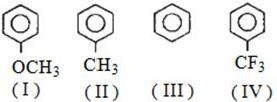
What is the decreasing order of reactivity towards nucleophilic substitution for the following compounds?
A
$III > I > IV > II$
B
$I > II > III > IV$
C
$II > III > I > IV$
D
$IV > III > II > I$
Solution
(D) Nucleophilic aromatic substitution is facilitated by electron-withdrawing groups $(EWG)$ on the benzene ring,which stabilize the intermediate carbanion (Meisenheimer complex).
Conversely,electron-donating groups $(EDG)$ decrease the reactivity towards nucleophilic attack.
Let's analyze the substituents:
$I$: $-OCH_3$ is a strong electron-donating group (via resonance).
$II$: $-CH_3$ is a weak electron-donating group (via hyperconjugation).
$III$: Benzene (no substituent).
$IV$: $-CF_3$ is a strong electron-withdrawing group (via inductive effect).
Therefore,the reactivity order is $IV > III > II > I$.
Conversely,electron-donating groups $(EDG)$ decrease the reactivity towards nucleophilic attack.
Let's analyze the substituents:
$I$: $-OCH_3$ is a strong electron-donating group (via resonance).
$II$: $-CH_3$ is a weak electron-donating group (via hyperconjugation).
$III$: Benzene (no substituent).
$IV$: $-CF_3$ is a strong electron-withdrawing group (via inductive effect).
Therefore,the reactivity order is $IV > III > II > I$.
0 likes
View Solution74
MediumMCQ
Which of the following is an $o-/p-$ directing group?
A
$COOH$
B
$CN$
C
$COCH_3$
D
$NHCOCH_3$
0 likes
View Solution75
MediumMCQ
Which of the following groups exerts a strong deactivating effect on an aromatic ring?
A
$-CH_2Cl$
B
$-OCH_3$
C
$-CH_3$
D
$-CCl_3$
Solution
(D) The $-CCl_3$ group exerts a strong deactivating effect on the aromatic ring due to the strong electron-withdrawing inductive effect ($-I$ effect) of the three chlorine atoms.
This makes the ring electron-deficient and less reactive towards electrophilic substitution.
This makes the ring electron-deficient and less reactive towards electrophilic substitution.
0 likes
View Solution76
MediumMCQ
What is the increasing order of nucleophilic substitution reaction for the following compounds?
$(I)$ $C_6H_5-CH_3$
$(II)$ $C_6H_6$
$(III)$ $C_6H_5-COOH$
$(I)$ $C_6H_5-CH_3$
$(II)$ $C_6H_6$
$(III)$ $C_6H_5-COOH$
A
$III < II < I$
B
$I < II < III$
C
$II < III < I$
D
$I < III < II$
Solution
(B) Nucleophilic substitution reactions are favored by the presence of electron-withdrawing groups $(EWG)$ on the aromatic ring,as they decrease the electron density and stabilize the intermediate carbanion (Meisenheimer complex).
$(I)$ $C_6H_5-CH_3$: The $-CH_3$ group is an electron-donating group $(EDG)$ due to the $+I$ effect and hyperconjugation,which decreases reactivity towards nucleophiles.
$(II)$ $C_6H_6$: Benzene has no substituent.
$(III)$ $C_6H_5-COOH$: The $-COOH$ group is a strong electron-withdrawing group $(EWG)$ due to the $-I$ and $-M$ effects,which significantly increases reactivity towards nucleophiles.
Therefore,the reactivity order is: $I < II < III$.
$(I)$ $C_6H_5-CH_3$: The $-CH_3$ group is an electron-donating group $(EDG)$ due to the $+I$ effect and hyperconjugation,which decreases reactivity towards nucleophiles.
$(II)$ $C_6H_6$: Benzene has no substituent.
$(III)$ $C_6H_5-COOH$: The $-COOH$ group is a strong electron-withdrawing group $(EWG)$ due to the $-I$ and $-M$ effects,which significantly increases reactivity towards nucleophiles.
Therefore,the reactivity order is: $I < II < III$.
0 likes
View Solution77
MediumMCQ
Which of the following is most easily attacked by a nucleophile?
A
$C_6H_5CF_3$
B
$C_6H_5Cl$
C
$C_6H_5NH_3^+$
D
$C_6H_5OH$
Solution
(C) nucleophile is an electron-rich species that attacks an electron-deficient center.
In the given options,the benzene ring is substituted with different groups.
Nucleophilic aromatic substitution $(S_NAr)$ is facilitated by strong electron-withdrawing groups (EWGs) that stabilize the intermediate carbanion (Meisenheimer complex).
Among the options,the $-NH_3^+$ group is a very strong electron-withdrawing group due to its positive charge ($-I$ effect),which significantly increases the electrophilicity of the benzene ring,making it the most susceptible to nucleophilic attack.
In the given options,the benzene ring is substituted with different groups.
Nucleophilic aromatic substitution $(S_NAr)$ is facilitated by strong electron-withdrawing groups (EWGs) that stabilize the intermediate carbanion (Meisenheimer complex).
Among the options,the $-NH_3^+$ group is a very strong electron-withdrawing group due to its positive charge ($-I$ effect),which significantly increases the electrophilicity of the benzene ring,making it the most susceptible to nucleophilic attack.
0 likes
View Solution78
DifficultMCQ
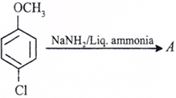
What will be the major product $A$ in the following reaction?
A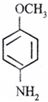
B
C
D
Solution
(C) The reaction of $p$-chloroanisole with $NaNH_2$ in liquid $NH_3$ proceeds via the formation of a benzyne intermediate.
$1$. $NaNH_2$ acts as a strong base and abstracts an ortho-hydrogen from $p$-chloroanisole,followed by the elimination of $Cl^-$ to form a benzyne intermediate (specifically,$3$-methoxybenzyne).
$2$. The nucleophilic attack of $NH_2^-$ on the benzyne intermediate can occur at the meta or ortho positions relative to the $-OCH_3$ group.
$3$. Due to the inductive effect of the $-OCH_3$ group,the meta position is more electrophilic,leading to the formation of $m$-anisidine ($3$-methoxyaniline) as the major product.
$1$. $NaNH_2$ acts as a strong base and abstracts an ortho-hydrogen from $p$-chloroanisole,followed by the elimination of $Cl^-$ to form a benzyne intermediate (specifically,$3$-methoxybenzyne).
$2$. The nucleophilic attack of $NH_2^-$ on the benzyne intermediate can occur at the meta or ortho positions relative to the $-OCH_3$ group.
$3$. Due to the inductive effect of the $-OCH_3$ group,the meta position is more electrophilic,leading to the formation of $m$-anisidine ($3$-methoxyaniline) as the major product.
0 likes
View Solution79
MediumMCQ
Which of the following reactions does not result in the chlorination of benzene?
A
$C_6H_6 + Cl_2 \xrightarrow{FeCl_3}$
B
$C_6H_6 + HOCl \xrightarrow{H^{+}}$
C
$C_6H_6 + ICl \xrightarrow{ZnCl_2}$
D
$C_6H_6 + Cl_2 \xrightarrow{AlCl_3}$
Solution
(B) The chlorination of benzene is an electrophilic aromatic substitution reaction.
$A$,$C$,and $D$ represent standard chlorination reactions using Lewis acid catalysts ($FeCl_3$,$ZnCl_2$,$AlCl_3$) to generate the $Cl^+$ electrophile.
Option $B$ involves $HOCl$ in the presence of $H^+$,which can generate $Cl^+$ and lead to chlorination. However,the provided solution text in the prompt was incorrect as Gattermann-Koch synthesis is used for formylation ($CHO$ group introduction),not chlorination.
Actually,all listed reactions can theoretically lead to chlorination under appropriate conditions. Given the context of standard textbook reactions,all are valid chlorination pathways. If this is a multiple-choice question where one must be excluded,it is likely flawed,but based on standard electrophilic substitution,all are valid.
$A$,$C$,and $D$ represent standard chlorination reactions using Lewis acid catalysts ($FeCl_3$,$ZnCl_2$,$AlCl_3$) to generate the $Cl^+$ electrophile.
Option $B$ involves $HOCl$ in the presence of $H^+$,which can generate $Cl^+$ and lead to chlorination. However,the provided solution text in the prompt was incorrect as Gattermann-Koch synthesis is used for formylation ($CHO$ group introduction),not chlorination.
Actually,all listed reactions can theoretically lead to chlorination under appropriate conditions. Given the context of standard textbook reactions,all are valid chlorination pathways. If this is a multiple-choice question where one must be excluded,it is likely flawed,but based on standard electrophilic substitution,all are valid.
0 likes
View Solution80
MediumMCQ
The $C-Cl$ bond in chlorobenzene as compared with the $C-Cl$ bond in methyl chloride is:
A
Longer and weaker
B
Shorter and weaker
C
Shorter and stronger
D
Longer and stronger
Solution
(C) The correct answer is $C$.
In chlorobenzene,the lone pair of electrons on the chlorine atom participates in resonance with the benzene ring.
This gives the $C-Cl$ bond a partial double bond character.
Due to this partial double bond character,the $C-Cl$ bond in chlorobenzene is shorter and stronger than the $C-Cl$ bond in methyl chloride,which is a pure single bond.
In chlorobenzene,the lone pair of electrons on the chlorine atom participates in resonance with the benzene ring.
This gives the $C-Cl$ bond a partial double bond character.
Due to this partial double bond character,the $C-Cl$ bond in chlorobenzene is shorter and stronger than the $C-Cl$ bond in methyl chloride,which is a pure single bond.
0 likes
View Solution81
DifficultMCQ
Which of the following reactions does not give benzene?
A
$C_6H_5N_2Cl \xrightarrow{\text{Boiling } H_2O} C_6H_5OH + N_2 + HCl$
B
$C_6H_5N_2Cl \xrightarrow{C_2H_5OH, \Delta} C_6H_6 + N_2 + HCl + CH_3CHO$
C
$C_6H_5N_2Cl + H_3PO_2 + H_2O \rightarrow C_6H_6 + N_2 + H_3PO_3 + HCl$
D
All of these
Solution
(A) . $C_6H_5N_2Cl \xrightarrow{\text{Boiling } H_2O} C_6H_5OH + N_2 + HCl$.
This reaction with boiling water produces phenol $(C_6H_5OH)$,not benzene $(C_6H_6)$.
This reaction with boiling water produces phenol $(C_6H_5OH)$,not benzene $(C_6H_6)$.
0 likes
View Solution82
DifficultMCQ
Fittig's reaction produces
A
Alkane
B
Alcohol
C
Diphenyl
D
Diethyl ether
Solution
(C) Fittig's reaction involves the coupling of two aryl halides in the presence of sodium metal and dry ether to form a diaryl compound.
The reaction is represented as: $2C_6H_5Cl + 2Na \xrightarrow{\text{Dry ether}} C_6H_5-C_6H_5 + 2NaCl$.
Thus,the product formed is diphenyl.
The reaction is represented as: $2C_6H_5Cl + 2Na \xrightarrow{\text{Dry ether}} C_6H_5-C_6H_5 + 2NaCl$.
Thus,the product formed is diphenyl.
0 likes
View Solution83
MediumMCQ
Which of the following compounds undergoes nucleophilic substitution reaction most easily?
A
p-Nitrochlorobenzene
B
p-Chlorotoluene
C
p-Chloroanisole
D
Chlorobenzene
Solution
(A) Nucleophilic aromatic substitution reactions are facilitated by the presence of electron-withdrawing groups on the benzene ring.
These groups stabilize the intermediate carbanion (Meisenheimer complex) formed during the reaction.
The $-NO_2$ group is a strong electron-withdrawing group due to its $-I$ and $-M$ effects.
In contrast,$-CH_3$ and $-OCH_3$ groups are electron-donating groups,which destabilize the intermediate carbanion and make the reaction more difficult.
Therefore,$p$-nitrochlorobenzene undergoes nucleophilic substitution most easily.
These groups stabilize the intermediate carbanion (Meisenheimer complex) formed during the reaction.
The $-NO_2$ group is a strong electron-withdrawing group due to its $-I$ and $-M$ effects.
In contrast,$-CH_3$ and $-OCH_3$ groups are electron-donating groups,which destabilize the intermediate carbanion and make the reaction more difficult.
Therefore,$p$-nitrochlorobenzene undergoes nucleophilic substitution most easily.
0 likes
View Solution84
MediumMCQ
Which of the following compounds will not undergo Friedel-Craft's reaction easily?
A
Nitrobenzene
B
Toluene
C
Cumene
D
Xylene
Solution
(A) The Friedel-Crafts reaction is an electrophilic aromatic substitution reaction.
It fails when the benzene ring is deactivated by a strong electron-withdrawing group.
In $Nitrobenzene$ $(C_6H_5NO_2)$,the $-NO_2$ group is a strong deactivating group,which withdraws electron density from the ring,making it less susceptible to electrophilic attack.
Therefore,$Nitrobenzene$ does not undergo Friedel-Crafts reaction easily.
It fails when the benzene ring is deactivated by a strong electron-withdrawing group.
In $Nitrobenzene$ $(C_6H_5NO_2)$,the $-NO_2$ group is a strong deactivating group,which withdraws electron density from the ring,making it less susceptible to electrophilic attack.
Therefore,$Nitrobenzene$ does not undergo Friedel-Crafts reaction easily.
0 likes
View Solution85
MediumMCQ
Identify $A$ and predict the type of reaction.
$3\text{-bromoanisole} \xrightarrow{NaNH_2} A$
$3\text{-bromoanisole} \xrightarrow{NaNH_2} A$
A
$3\text{-aminoanisole}$ and elimination-addition reaction
B
$2\text{-aminoanisole}$ and cine substitution reaction
C
$3\text{-aminoanisole}$ and cine substitution reaction
D
$2\text{-aminoanisole}$ and substitution reaction
Solution
(A) The reaction of $3\text{-bromoanisole}$ with $NaNH_2$ proceeds via the formation of a benzyne intermediate.
$1$. The strong base $NH_2^-$ abstracts the ortho-hydrogen relative to the $Br$ atom,leading to the elimination of $Br^-$ and the formation of a benzyne intermediate.
$2$. The nucleophile $NH_2^-$ can then attack the benzyne intermediate at two different positions.
$3$. Attack at the meta-position (relative to the $OCH_3$ group) leads to a more stable carbanion intermediate because the negative charge is closer to the electron-withdrawing $OCH_3$ group.
$4$. Protonation of this intermediate yields $3\text{-aminoanisole}$ as the major product.
$5$. Since the incoming nucleophile ends up on the same carbon atom where the leaving group was originally present,this is not a cine substitution reaction; it is an elimination-addition reaction.
$1$. The strong base $NH_2^-$ abstracts the ortho-hydrogen relative to the $Br$ atom,leading to the elimination of $Br^-$ and the formation of a benzyne intermediate.
$2$. The nucleophile $NH_2^-$ can then attack the benzyne intermediate at two different positions.
$3$. Attack at the meta-position (relative to the $OCH_3$ group) leads to a more stable carbanion intermediate because the negative charge is closer to the electron-withdrawing $OCH_3$ group.
$4$. Protonation of this intermediate yields $3\text{-aminoanisole}$ as the major product.
$5$. Since the incoming nucleophile ends up on the same carbon atom where the leaving group was originally present,this is not a cine substitution reaction; it is an elimination-addition reaction.
0 likes
View Solution86
MediumMCQ
Trichloroacetaldehyde,$CCl_3CHO$,reacts with chlorobenzene in the presence of sulphuric acid and produces:
A
$DDT$
B
Benzene hexachloride
C
Chloral hydrate
D
$1,1-$dichloro$-2,2-$bis($p-$chlorophenyl)ethane
Solution
(A) The reaction of trichloroacetaldehyde (chloral) with chlorobenzene in the presence of concentrated sulphuric acid $(H_2SO_4)$ is a condensation reaction.
In this reaction,one molecule of chloral reacts with two molecules of chlorobenzene to form $1,1,1-$trichloro$-2,2-$bis($p-$chlorophenyl)ethane,which is commonly known as $DDT$.
The chemical equation is:
$CCl_3CHO + 2C_6H_5Cl \xrightarrow{Conc. H_2SO_4} (ClC_6H_4)_2CHCCl_3 + H_2O$
Thus,the product formed is $DDT$.
In this reaction,one molecule of chloral reacts with two molecules of chlorobenzene to form $1,1,1-$trichloro$-2,2-$bis($p-$chlorophenyl)ethane,which is commonly known as $DDT$.
The chemical equation is:
$CCl_3CHO + 2C_6H_5Cl \xrightarrow{Conc. H_2SO_4} (ClC_6H_4)_2CHCCl_3 + H_2O$
Thus,the product formed is $DDT$.
0 likes
View Solution87
MediumMCQ
Nitrobenzene on reaction with conc. $HNO_3/H_2SO_4$ at $80-100 \ ^oC$ forms which one of the following products?
A
$1, 4-$Dinitrobenzene
B
$1, 2, 4-$Trinitrobenzene
C
$1, 2-$Dinitrobenzene
D
$1, 3-$Dinitrobenzene
Solution
(D) The reaction of nitrobenzene with a mixture of concentrated $HNO_3$ and concentrated $H_2SO_4$ (nitrating mixture) at $80-100 \ ^oC$ is an electrophilic aromatic substitution reaction.
Since the $-NO_2$ group is a strongly deactivating and meta-directing group,the incoming nitro group enters the meta-position.
Therefore,the major product formed is $1, 3-$dinitrobenzene.
Since the $-NO_2$ group is a strongly deactivating and meta-directing group,the incoming nitro group enters the meta-position.
Therefore,the major product formed is $1, 3-$dinitrobenzene.
0 likes
View Solution88
DifficultMCQ
Presence of a nitro group in a benzene ring
A
deactivates the ring towards electrophilic substitution
B
activates the ring towards electrophilic substitution
C
renders the ring basic
D
deactivates the ring towards nucleophilic substitution.
Solution
(A) The nitro group $(-NO_2)$ is a strong electron-withdrawing group due to its $-I$ and $-M$ effects.
It withdraws electron density from the benzene ring,thereby reducing the electron density available for electrophilic attack.
Consequently,it deactivates the benzene ring towards electrophilic substitution reactions.
It withdraws electron density from the benzene ring,thereby reducing the electron density available for electrophilic attack.
Consequently,it deactivates the benzene ring towards electrophilic substitution reactions.
0 likes
View Solution89
MediumMCQ
The reaction of toluene with $Cl_2$ in the presence of $FeCl_3$ gives predominantly
A
$m-$chlorotoluene
B
benzoyl chloride
C
benzyl chloride
D
$o-$ and $p-$chlorotoluene
Solution
(D) The reaction of toluene with $Cl_2$ in the presence of a Lewis acid catalyst like $FeCl_3$ is an electrophilic aromatic substitution reaction (chlorination).
The methyl group $(-CH_3)$ attached to the benzene ring is an electron-donating group due to the inductive effect and hyperconjugation.
This group activates the benzene ring and directs the incoming electrophile $(Cl^+)$ to the ortho $(o-)$ and para $(p-)$ positions.
Therefore,the reaction yields a mixture of $o-$chlorotoluene and $p-$chlorotoluene.
The methyl group $(-CH_3)$ attached to the benzene ring is an electron-donating group due to the inductive effect and hyperconjugation.
This group activates the benzene ring and directs the incoming electrophile $(Cl^+)$ to the ortho $(o-)$ and para $(p-)$ positions.
Therefore,the reaction yields a mixture of $o-$chlorotoluene and $p-$chlorotoluene.
0 likes
View Solution90
DifficultMCQ
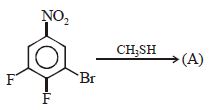
The major product for the above reaction is:
A
$1-$bromo$-3-$fluoro$-5-$(methylthio)$-4-$nitrobenzene
B
$1-$bromo$-3,5-$difluoro$-4-$(methylthio)benzene
C
$1-$bromo$-5-$fluoro$-3-$(methylthio)$-4-$nitrobenzene
D
$1-$bromo$-3-$fluoro$-2-$(methylthio)$-5-$nitrobenzene
Solution
(A) The reaction is an aromatic nucleophilic substitution $(S_N^{Ar})$ reaction.
In the given substrate,the $-NO_2$ group is a strong electron-withdrawing group at the para position relative to the fluorine atoms.
Nucleophilic substitution occurs at the position ortho or para to the electron-withdrawing group.
Here,the fluorine atom at the para position relative to the $-NO_2$ group is the most activated for nucleophilic attack by the nucleophile $CH_3S^-$.
Therefore,the $CH_3S$ group replaces the para-fluorine atom to form the major product.
In the given substrate,the $-NO_2$ group is a strong electron-withdrawing group at the para position relative to the fluorine atoms.
Nucleophilic substitution occurs at the position ortho or para to the electron-withdrawing group.
Here,the fluorine atom at the para position relative to the $-NO_2$ group is the most activated for nucleophilic attack by the nucleophile $CH_3S^-$.
Therefore,the $CH_3S$ group replaces the para-fluorine atom to form the major product.
0 likes
View Solution91
DifficultMCQ
Which of the following is least reactive towards electrophilic substitution?
A
Aniline $(C_6H_5NH_2)$
B
Phenol $(C_6H_5OH)$
C
Chlorobenzene $(C_6H_5Cl)$
D
Toluene $(C_6H_5CH_3)$
Solution
(C) The reactivity towards electrophilic aromatic substitution $(EAS)$ depends on the electron density of the benzene ring. Groups that donate electrons by resonance ($+M$ effect) increase reactivity,while groups that withdraw electrons by induction ($-I$ effect) decrease it.
$1$. Aniline $(-NH_2)$: Strong $+M$ effect,highly activating.
$2$. Phenol $(-OH)$: Strong $+M$ effect,highly activating.
$3$. Toluene $(-CH_3)$: Weak $+I$ and hyperconjugation effect,activating.
$4$. Chlorobenzene $(-Cl)$: Strong $-I$ effect (deactivating) and weak $+M$ effect. The $-I$ effect dominates,making it less reactive than benzene and the other substituted benzenes listed.
Therefore,chlorobenzene is the least reactive towards electrophilic substitution.
$1$. Aniline $(-NH_2)$: Strong $+M$ effect,highly activating.
$2$. Phenol $(-OH)$: Strong $+M$ effect,highly activating.
$3$. Toluene $(-CH_3)$: Weak $+I$ and hyperconjugation effect,activating.
$4$. Chlorobenzene $(-Cl)$: Strong $-I$ effect (deactivating) and weak $+M$ effect. The $-I$ effect dominates,making it less reactive than benzene and the other substituted benzenes listed.
Therefore,chlorobenzene is the least reactive towards electrophilic substitution.
0 likes
View Solution92
DifficultMCQ
$m$-Bromoanisole reacts with $NaNH_2$ in liquid $NH_3$ to give mainly:
A
$m$-methoxyaniline
B
$o$-methoxyaniline
C
$p$-methoxyaniline
D
$o, m$ and $p$-methoxyaniline in equal amounts
Solution
(A) The reaction of $m$-bromoanisole with $NaNH_2$ in liquid $NH_3$ proceeds via the benzyne mechanism.
The methoxy group $(-OCH_3)$ is an electron-donating group by resonance,but it is also electron-withdrawing by the inductive effect.
In the benzyne intermediate formed,the nucleophilic attack of $NH_2^-$ occurs at the position that leads to the most stable carbanion.
The inductive effect of the $-OCH_3$ group makes the ortho position more acidic and the resulting carbanion at the meta position is more stable due to the proximity of the electron-withdrawing oxygen atom.
Consequently,the reaction yields a mixture of $m$-methoxyaniline and $p$-methoxyaniline,with $m$-methoxyaniline being the major product due to the electronic effects of the methoxy group.
The methoxy group $(-OCH_3)$ is an electron-donating group by resonance,but it is also electron-withdrawing by the inductive effect.
In the benzyne intermediate formed,the nucleophilic attack of $NH_2^-$ occurs at the position that leads to the most stable carbanion.
The inductive effect of the $-OCH_3$ group makes the ortho position more acidic and the resulting carbanion at the meta position is more stable due to the proximity of the electron-withdrawing oxygen atom.
Consequently,the reaction yields a mixture of $m$-methoxyaniline and $p$-methoxyaniline,with $m$-methoxyaniline being the major product due to the electronic effects of the methoxy group.
0 likes
View Solution93
AdvancedMCQ
Which is the best synthesis of $1-$methoxy$-2,4-$dinitrobenzene?
A
Benzene $\xrightarrow[FeBr_3]{Br_2}$ Bromobenzene $\xrightarrow[H_2SO_4]{HNO_3}$ $1-$bromo$-4-$nitrobenzene $\xrightarrow[H_2SO_4]{HNO_3}$ $1-$bromo$-2,4-$dinitrobenzene $\xrightarrow[CH_3OH]{NaOCH_3}$ $1-$methoxy$-2,4-$dinitrobenzene
B
Benzene $\xrightarrow[H_2SO_4]{HNO_3}$ Nitrobenzene $\xrightarrow[H_2SO_4]{HNO_3}$ $1,3-$dinitrobenzene $\xrightarrow[FeBr_3]{Br_2}$ $1-$bromo$-2,4-$dinitrobenzene $\xrightarrow[CH_3OH]{NaOCH_3}$ $1-$methoxy$-2,4-$dinitrobenzene
C
Benzene $\xrightarrow[H_2SO_4]{HNO_3}$ Nitrobenzene $\xrightarrow[FeBr_3]{Br_2}$ $1-$bromo$-3-$nitrobenzene $\xrightarrow[H_2SO_4]{HNO_3}$ $1-$bromo$-2,4-$dinitrobenzene $\xrightarrow[CH_3OH]{NaOCH_3}$ $1-$methoxy$-2,4-$dinitrobenzene
D
Benzene $\xrightarrow[H_2SO_4]{HNO_3}$ Nitrobenzene $\xrightarrow[FeBr_3]{Br_2}$ $1-$bromo$-3-$nitrobenzene $\xrightarrow[CH_3OH]{NaOCH_3}$ $1-$methoxy$-3-$nitrobenzene $\xrightarrow[H_2SO_4]{HNO_3}$ $1-$methoxy$-2,4-$dinitrobenzene
Solution
(A) The synthesis of $1-$methoxy$-2,4-$dinitrobenzene requires the introduction of two nitro groups and one methoxy group onto a benzene ring.
$1$. First,benzene undergoes electrophilic aromatic bromination to form bromobenzene.
$2$. Bromobenzene is then nitrated twice. Since the bromine atom is ortho/para directing,the first nitration gives $1-$bromo$-4-$nitrobenzene (major product).
$3$. The second nitration occurs at the ortho position relative to the bromine atom,yielding $1-$bromo$-2,4-$dinitrobenzene.
$4$. Finally,nucleophilic aromatic substitution $(S_NAr)$ with sodium methoxide $(NaOCH_3)$ replaces the bromine atom with a methoxy group,facilitated by the strong electron-withdrawing effect of the two ortho/para nitro groups. This corresponds to option $A$.
$1$. First,benzene undergoes electrophilic aromatic bromination to form bromobenzene.
$2$. Bromobenzene is then nitrated twice. Since the bromine atom is ortho/para directing,the first nitration gives $1-$bromo$-4-$nitrobenzene (major product).
$3$. The second nitration occurs at the ortho position relative to the bromine atom,yielding $1-$bromo$-2,4-$dinitrobenzene.
$4$. Finally,nucleophilic aromatic substitution $(S_NAr)$ with sodium methoxide $(NaOCH_3)$ replaces the bromine atom with a methoxy group,facilitated by the strong electron-withdrawing effect of the two ortho/para nitro groups. This corresponds to option $A$.
0 likes
View Solution94
DifficultMCQ
Replacement of $Cl$ of chlorobenzene to give phenol requires drastic conditions,but chlorine of $2,4-$dinitrochlorobenzene is readily replaced because:
A
$NO_2$ makes the ring electron-rich at ortho and para positions.
B
$NO_2$ withdraws $e^-$ from the meta position.
C
$NO_2$ donates $e^-$ at the meta position.
D
$NO_2$ withdraws $e^-$ from ortho$/$para positions.
Solution
(D) The $-NO_2$ group is a strong electron-withdrawing group due to its $-I$ and $-M$ effects.
In $2,4-$dinitrochlorobenzene,the $-NO_2$ groups are present at the ortho and para positions relative to the chlorine atom.
These groups withdraw electron density from the ring,specifically stabilizing the carbanion intermediate formed during nucleophilic aromatic substitution.
This makes the $C-Cl$ bond more susceptible to nucleophilic attack,thus facilitating the replacement of the chlorine atom under milder conditions.
In $2,4-$dinitrochlorobenzene,the $-NO_2$ groups are present at the ortho and para positions relative to the chlorine atom.
These groups withdraw electron density from the ring,specifically stabilizing the carbanion intermediate formed during nucleophilic aromatic substitution.
This makes the $C-Cl$ bond more susceptible to nucleophilic attack,thus facilitating the replacement of the chlorine atom under milder conditions.
0 likes
View Solution95
DifficultMCQ
Which of the following shows the fastest rate of hydrolysis?
A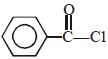
B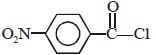
C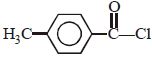
D
$CH_3-CO-OCH_3$
Solution
(B) The rate of nucleophilic acyl substitution (hydrolysis) depends on the electrophilicity of the carbonyl carbon. Electron-withdrawing groups $(EWG)$ increase the electrophilicity of the carbonyl carbon,thereby increasing the rate of hydrolysis. Conversely,electron-donating groups $(EDG)$ decrease the electrophilicity,slowing down the reaction.
Comparing the given compounds:
$A$: Benzoyl chloride (no substituent).
$B$: $p$-Nitrobenzoyl chloride ($-NO_2$ is a strong $EWG$).
$C$: $p$-Methylbenzoyl chloride ($-CH_3$ is an $EDG$).
$D$: Methyl acetate (ester,less reactive than acid chlorides).
Since the $-NO_2$ group in option $B$ is a strong electron-withdrawing group,it significantly increases the electrophilicity of the carbonyl carbon,making it the most reactive towards hydrolysis. Therefore,the correct option is $B$.
Comparing the given compounds:
$A$: Benzoyl chloride (no substituent).
$B$: $p$-Nitrobenzoyl chloride ($-NO_2$ is a strong $EWG$).
$C$: $p$-Methylbenzoyl chloride ($-CH_3$ is an $EDG$).
$D$: Methyl acetate (ester,less reactive than acid chlorides).
Since the $-NO_2$ group in option $B$ is a strong electron-withdrawing group,it significantly increases the electrophilicity of the carbonyl carbon,making it the most reactive towards hydrolysis. Therefore,the correct option is $B$.
0 likes
View Solution96
DifficultMCQ
Identify the suitable reagents for the conversion of benzene to fluorobenzene.
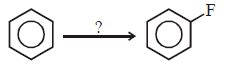
A
$(i) \text{ conc. } H_2SO_4 + HNO_3; (ii) Sn / HCl; (iii) NaNO_2 + HCl / 0-5 ^\circ C; (iv) HBF_4; (v) \Delta$
B
$(i) \text{ conc. } H_2SO_4 + HNO_3; (ii) Sn / HCl; (iii) NaNO_2 + HCl / 0-5 ^\circ C; (iv) HBF_4$
C
Both
D
None of these
Solution
(A) The conversion of benzene to fluorobenzene involves the following steps:
$1$. Nitration of benzene using $conc. H_2SO_4 HNO_3$ to form nitrobenzene.
$2$. Reduction of nitrobenzene using $Sn / HCl$ to form aniline.
$3$. Diazotization of aniline using $NaNO_2 HCl$ at $0-5 ^\circ C$ to form benzene diazonium chloride.
$4$. Balz-Schiemann reaction: Treatment of benzene diazonium chloride with $HBF_4$ followed by heating $(\Delta)$ yields fluorobenzene.
Therefore,the sequence of reagents in option $(A)$ is correct as it includes the necessary heating step for the decomposition of the diazonium fluoroborate salt.
$1$. Nitration of benzene using $conc. H_2SO_4 HNO_3$ to form nitrobenzene.
$2$. Reduction of nitrobenzene using $Sn / HCl$ to form aniline.
$3$. Diazotization of aniline using $NaNO_2 HCl$ at $0-5 ^\circ C$ to form benzene diazonium chloride.
$4$. Balz-Schiemann reaction: Treatment of benzene diazonium chloride with $HBF_4$ followed by heating $(\Delta)$ yields fluorobenzene.
Therefore,the sequence of reagents in option $(A)$ is correct as it includes the necessary heating step for the decomposition of the diazonium fluoroborate salt.
0 likes
View Solution97
DifficultMCQ
Which of the following is the correct order of electrophilic substitution for the given compounds?
$(i)$ Toluene
(ii) Isopropylbenzene
(iii) tert-Butylbenzene
(iv) Ethylbenzene
$(i)$ Toluene
(ii) Isopropylbenzene
(iii) tert-Butylbenzene
(iv) Ethylbenzene
A
$i > iv > ii > iii$
B
$iii > iv > ii > i$
C
$i > iv > ii > iii$
D
$i > ii > iv > iii$
Solution
(A) The reactivity of alkylbenzenes towards electrophilic aromatic substitution depends on the electron-donating effect of the alkyl group,which occurs via the hyperconjugation effect.
Hyperconjugation is directly proportional to the number of $\alpha$-hydrogens present on the carbon atom attached to the benzene ring.
Let us count the $\alpha$-hydrogens for each compound:
$(i)$ Toluene $(C_6H_5-CH_3)$: $3 \ \alpha-H$
(iv) Ethylbenzene $(C_6H_5-CH_2CH_3)$: $2 \ \alpha-H$
(ii) Isopropylbenzene $(C_6H_5-CH(CH_3)_2)$: $1 \ \alpha-H$
(iii) tert-Butylbenzene $(C_6H_5-C(CH_3)_3)$: $0 \ \alpha-H$
Since the reactivity is proportional to the number of $\alpha$-hydrogens,the order is $(i) > (iv) > (ii) > (iii)$.
Hyperconjugation is directly proportional to the number of $\alpha$-hydrogens present on the carbon atom attached to the benzene ring.
Let us count the $\alpha$-hydrogens for each compound:
$(i)$ Toluene $(C_6H_5-CH_3)$: $3 \ \alpha-H$
(iv) Ethylbenzene $(C_6H_5-CH_2CH_3)$: $2 \ \alpha-H$
(ii) Isopropylbenzene $(C_6H_5-CH(CH_3)_2)$: $1 \ \alpha-H$
(iii) tert-Butylbenzene $(C_6H_5-C(CH_3)_3)$: $0 \ \alpha-H$
Since the reactivity is proportional to the number of $\alpha$-hydrogens,the order is $(i) > (iv) > (ii) > (iii)$.
0 likes
View Solution98
MediumMCQ
What are $A$ $\&$ $B$ in the following reaction?
$m-Br-C_6H_4-Cl$ $\xrightarrow{Mg/THF} A$ $\xrightarrow[(ii) \ aq. NH_4Cl]{(i) \ CH_3CHO} B$
$m-Br-C_6H_4-Cl$ $\xrightarrow{Mg/THF} A$ $\xrightarrow[(ii) \ aq. NH_4Cl]{(i) \ CH_3CHO} B$
A
$A$ = $m-Cl-C_6H_4-MgBr$,$B$ = $m-Cl-C_6H_4-CH(OH)CH_3$
B
$A$ = $m-Br-C_6H_4-MgCl$,$B$ = $m-Br-C_6H_4-CH(OH)CH_3$
C
$A$ = $m-Br-C_6H_4-MgCl$,$B$ = $m-MgCl-C_6H_4-CH(OH)CH_3$
D
None of these
Solution
(D) The starting material is $m-bromochlorobenzene$ $(m-Br-C_6H_4-Cl)$.
Step $1$: Reaction with $Mg/THF$ forms a Grignard reagent. Since $Mg$ reacts faster with $Br$ than $Cl$ due to the lower bond dissociation energy of $C-Br$,the product $A$ is $m-chlorophenylmagnesium$ bromide $(m-Cl-C_6H_4-MgBr)$.
Step $2$: The Grignard reagent $A$ reacts with acetaldehyde $(CH_3CHO)$ followed by acidic workup $(aq. NH_4Cl)$ to form a secondary alcohol. The nucleophilic $m-chlorophenyl$ group attacks the carbonyl carbon of $CH_3CHO$,resulting in $m-chlorophenyl-1-ethanol$ $(m-Cl-C_6H_4-CH(OH)CH_3)$ as product $B$.
Comparing this with the given options,none of the provided structures exactly match the correct chemical products $A$ and $B$.
Step $1$: Reaction with $Mg/THF$ forms a Grignard reagent. Since $Mg$ reacts faster with $Br$ than $Cl$ due to the lower bond dissociation energy of $C-Br$,the product $A$ is $m-chlorophenylmagnesium$ bromide $(m-Cl-C_6H_4-MgBr)$.
Step $2$: The Grignard reagent $A$ reacts with acetaldehyde $(CH_3CHO)$ followed by acidic workup $(aq. NH_4Cl)$ to form a secondary alcohol. The nucleophilic $m-chlorophenyl$ group attacks the carbonyl carbon of $CH_3CHO$,resulting in $m-chlorophenyl-1-ethanol$ $(m-Cl-C_6H_4-CH(OH)CH_3)$ as product $B$.
Comparing this with the given options,none of the provided structures exactly match the correct chemical products $A$ and $B$.
0 likes
View Solution99
MediumMCQ
$p-$Nitrotoluene on further nitration gives :
A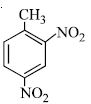
$2,4-$Dinitrotoluene
B
$2,6-$Dinitrotoluene
C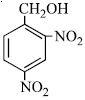
$3,4-$Dinitrotoluene
D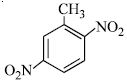
$2,3-$Dinitrotoluene
Solution
(A) On nitration of $p-$nitrotoluene,the $-CH_3$ group is ortho-para directing and the $-NO_2$ group is meta-directing.
Both the groups direct the incoming nitro group to the position ortho to the $-CH_3$ group (which is meta to the $-NO_2$ group).
Thus,$2,4-$dinitrotoluene is formed.
Both the groups direct the incoming nitro group to the position ortho to the $-CH_3$ group (which is meta to the $-NO_2$ group).
Thus,$2,4-$dinitrotoluene is formed.
0 likes
View Solution100
MediumMCQ
In the reaction of $p-$chlorotoluene with $KNH_2$ in liquid $NH_3,$ the major product is :
A
$o-$Toluidine
B
$m-$Toluidine
C
$p-$Toluidine
D
$p-$Chloroaniline
Solution
(B) The reaction of $p-$chlorotoluene with $KNH_2$ in liquid $NH_3$ proceeds via the benzyne mechanism.
$1$. The strong base $NH_2^-$ abstracts an ortho-hydrogen from $p-$chlorotoluene to form a benzyne intermediate.
$2$. The benzyne intermediate is $4-$methylbenzyne.
$3$. The nucleophilic attack by $NH_2^-$ can occur at either the $meta$ or $para$ position relative to the methyl group.
$4$. Attack at the $meta$ position leads to $m-$toluidine,while attack at the $para$ position leads to $p-$toluidine.
$5$. Due to the inductive effect of the methyl group,the $meta$ position is more electrophilic,making $m-$toluidine the major product.
$1$. The strong base $NH_2^-$ abstracts an ortho-hydrogen from $p-$chlorotoluene to form a benzyne intermediate.
$2$. The benzyne intermediate is $4-$methylbenzyne.
$3$. The nucleophilic attack by $NH_2^-$ can occur at either the $meta$ or $para$ position relative to the methyl group.
$4$. Attack at the $meta$ position leads to $m-$toluidine,while attack at the $para$ position leads to $p-$toluidine.
$5$. Due to the inductive effect of the methyl group,the $meta$ position is more electrophilic,making $m-$toluidine the major product.
0 likes
View SolutionHaloalkanes and Haloarenes — Properties of Haloarenes · Frequently Asked Questions
1Are these Haloalkanes and Haloarenes questions useful for JEE and NEET?
Yes. All questions in this section are mapped to JEE Main and NEET exam patterns. Previous year questions from JEE Main, NEET, GUJCET and state-level exams are included with full solutions.
2Can I switch to Hindi or Gujarati for these questions?
Yes. Use the language tabs in the hero section or the sidebar to view the same questions and solutions in English, Hindi or Gujarati.
3How do I generate a question paper from this subtopic?
Use the Vedclass Exam Paper Generator — select the chapter and subtopic, set difficulty, and generate Sets A, B, C, D automatically. First 3 chapters of every subject are free.
Vedclass Products
For Students
Vedclass Test Series
Mock tests in real JEE/NEET style with performance analysis. 5-day free trial.
Start Free TrialFor Teachers
Exam Paper Generator
Generate Set A/B/C/D papers from this chapter in 2 minutes. 3 chapters free.
Try FreeFor Institutes
Online Exam Module
Live online exams with unlimited students, 360° analytics & white-label branding.
See DemoFor Teachers & Institutes
Generate a Haloalkanes and Haloarenes Exam Paper in 2 Minutes
Select subtopic & difficulty — Sets A, B, C, D auto-generated with No Repeat logic.
First 3 chapters of every subject are free — no payment required.