
A English
Properties of Haloarenes Questions in English
Class 12 Chemistry · Haloalkanes and Haloarenes · Properties of Haloarenes
423+
Questions
English
Language
100%
With Solutions
Showing 49 of 423 questions in English
201
DifficultMCQ
Which of the following has the highest melting point?
A
Chlorobenzene
B
$o-$Dichlorobenzene
C
$m-$Dichlorobenzene
D
$p-$Dichlorobenzene
Solution
(D) The melting point of isomeric dihalobenzenes depends on their symmetry.
$p-$Dichlorobenzene is more symmetrical than the $o-$ and $m-$ isomers.
Due to this symmetry,the $p-$isomer fits better into the crystal lattice,leading to stronger intermolecular forces of attraction.
Therefore,$p-$dichlorobenzene has the highest melting point among the given options.
$p-$Dichlorobenzene is more symmetrical than the $o-$ and $m-$ isomers.
Due to this symmetry,the $p-$isomer fits better into the crystal lattice,leading to stronger intermolecular forces of attraction.
Therefore,$p-$dichlorobenzene has the highest melting point among the given options.
0 likes
View Solution202
DifficultMCQ
Arrange the following compounds in increasing order of their dipole moment:
$(I)$ Toluene
$(II)$ $m$-Dichlorobenzene
$(III)$ $o$-Dichlorobenzene
$(IV)$ $p$-Dichlorobenzene
$(I)$ Toluene
$(II)$ $m$-Dichlorobenzene
$(III)$ $o$-Dichlorobenzene
$(IV)$ $p$-Dichlorobenzene
A
$I < IV < II < III$
B
$IV < I < II < III$
C
$IV < I < III < II$
D
$IV < II < I < III$
Solution
(B) The dipole moment $(\mu)$ depends on the polarity of bonds and the geometry of the molecule.
$1$. $p$-Dichlorobenzene $(IV)$: The two $C-Cl$ bond dipoles are equal and opposite, canceling each other out. Thus, $\mu = 0 \ D$.
$2$. Toluene $(I)$: The methyl group is electron-donating, creating a small dipole moment $(\mu \approx 0.4 \ D)$.
$3$. $m$-Dichlorobenzene $(II)$: The angle between the two $C-Cl$ bonds is $120^{\circ}$. The resultant dipole is $\mu = \sqrt{\mu_1^2 + \mu_2^2 + 2\mu_1\mu_2 \cos(120^{\circ})} = \mu_1$ (where $\mu_1$ is the dipole of chlorobenzene, $\approx 1.5 \ D$).
$4$. $o$-Dichlorobenzene $(III)$: The angle between the two $C-Cl$ bonds is $60^{\circ}$. The resultant dipole is $\mu = \sqrt{\mu_1^2 + \mu_2^2 + 2\mu_1\mu_2 \cos(60^{\circ})} \approx 2.5 \ D$.
Comparing these values: $0 (IV) < 0.4 (I) < 1.5 (II) < 2.5 (III)$.
Therefore, the increasing order is $IV < I < II < III$.
$1$. $p$-Dichlorobenzene $(IV)$: The two $C-Cl$ bond dipoles are equal and opposite, canceling each other out. Thus, $\mu = 0 \ D$.
$2$. Toluene $(I)$: The methyl group is electron-donating, creating a small dipole moment $(\mu \approx 0.4 \ D)$.
$3$. $m$-Dichlorobenzene $(II)$: The angle between the two $C-Cl$ bonds is $120^{\circ}$. The resultant dipole is $\mu = \sqrt{\mu_1^2 + \mu_2^2 + 2\mu_1\mu_2 \cos(120^{\circ})} = \mu_1$ (where $\mu_1$ is the dipole of chlorobenzene, $\approx 1.5 \ D$).
$4$. $o$-Dichlorobenzene $(III)$: The angle between the two $C-Cl$ bonds is $60^{\circ}$. The resultant dipole is $\mu = \sqrt{\mu_1^2 + \mu_2^2 + 2\mu_1\mu_2 \cos(60^{\circ})} \approx 2.5 \ D$.
Comparing these values: $0 (IV) < 0.4 (I) < 1.5 (II) < 2.5 (III)$.
Therefore, the increasing order is $IV < I < II < III$.
0 likes
View Solution203
DifficultMCQ
Which of the following compounds is least reactive towards nucleophilic substitution reaction?
A
$(CH_3)_3C-Cl$
B
$CH_2=CH-Cl$
C
$CH_3CH_2Cl$
D
$CH_2=CH-CH_2Cl$
Solution
(B) Vinyl halides $(CH_2=CH-Cl)$ and aryl halides are least reactive towards nucleophilic substitution reactions.
This is due to the partial double bond character between the carbon and the halogen atom caused by resonance,which makes the $C-X$ bond stronger and shorter,making it difficult for the nucleophile to replace the halogen atom.
This is due to the partial double bond character between the carbon and the halogen atom caused by resonance,which makes the $C-X$ bond stronger and shorter,making it difficult for the nucleophile to replace the halogen atom.
0 likes
View Solution204
DifficultMCQ
The alkyl halide that does not give a white precipitate with alcoholic $AgNO_3$ solution is ................. .
A
Ethyl chloride
B
Allyl chloride
C
Isopropyl chloride
D
Vinyl chloride
Solution
(D) Alkyl halides react with alcoholic $AgNO_3$ to form $AgCl$ (white precipitate) if the $C-Cl$ bond is easily broken to form a carbocation.
In $CH_2=CH-Cl$ (vinyl chloride),the $C-Cl$ bond acquires partial double bond character due to resonance.
This makes the $C-Cl$ bond stronger and shorter,preventing the formation of a carbocation.
Therefore,vinyl chloride does not react with alcoholic $AgNO_3$ to give a white precipitate.
In $CH_2=CH-Cl$ (vinyl chloride),the $C-Cl$ bond acquires partial double bond character due to resonance.
This makes the $C-Cl$ bond stronger and shorter,preventing the formation of a carbocation.
Therefore,vinyl chloride does not react with alcoholic $AgNO_3$ to give a white precipitate.
0 likes
View Solution205
MediumMCQ
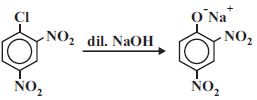
The following transformation proceeds through:
A
Benzyne intermediate
B
Oxirane
C
Electrophilic addition
D
Activated nucleophilic substitution
Solution
(D) The given reaction is the nucleophilic substitution of $1-chloro-2,4-dinitrobenzene$ with dilute $NaOH$.
Since the benzene ring is substituted with strong electron-withdrawing $-NO_2$ groups at the ortho and para positions,the electron density on the ring is significantly reduced.
This makes the carbon atom attached to the chlorine atom highly electrophilic,facilitating the attack of the nucleophile $(OH^-)$.
This mechanism is known as $S_NAr$ (Nucleophilic Aromatic Substitution) or activated nucleophilic substitution,where the intermediate formed is a resonance-stabilized carbanion called a Meisenheimer complex.
Since the benzene ring is substituted with strong electron-withdrawing $-NO_2$ groups at the ortho and para positions,the electron density on the ring is significantly reduced.
This makes the carbon atom attached to the chlorine atom highly electrophilic,facilitating the attack of the nucleophile $(OH^-)$.
This mechanism is known as $S_NAr$ (Nucleophilic Aromatic Substitution) or activated nucleophilic substitution,where the intermediate formed is a resonance-stabilized carbanion called a Meisenheimer complex.
0 likes
View Solution206
DifficultMCQ
The reaction of $o-$methoxychlorobenzene with sodamide $(NaNH_2)$ followed by treatment with ammonia yields ........
A
$p-$methoxyaniline
B
$m-$methoxyaniline
C
Aniline
D
$o-$methoxyaniline
Solution
(B) The reaction of $o-$methoxychlorobenzene with $NaNH_2$ proceeds via the benzyne mechanism.
In $o-$methoxychlorobenzene,the methoxy group $(-OCH_3)$ is an electron-donating group by resonance.
When $NaNH_2$ is added,it abstracts the ortho-hydrogen to form a benzyne intermediate.
The nucleophilic attack by the amide ion $(NH_2^-)$ on the benzyne intermediate is directed by the inductive effect of the methoxy group.
The methoxy group exerts an electron-withdrawing inductive effect ($-I$ effect) at the ortho position,which makes the meta-carbon more electrophilic.
Consequently,the nucleophile attacks the meta-position,leading to the formation of $m-$methoxyaniline as the major product.
In $o-$methoxychlorobenzene,the methoxy group $(-OCH_3)$ is an electron-donating group by resonance.
When $NaNH_2$ is added,it abstracts the ortho-hydrogen to form a benzyne intermediate.
The nucleophilic attack by the amide ion $(NH_2^-)$ on the benzyne intermediate is directed by the inductive effect of the methoxy group.
The methoxy group exerts an electron-withdrawing inductive effect ($-I$ effect) at the ortho position,which makes the meta-carbon more electrophilic.
Consequently,the nucleophile attacks the meta-position,leading to the formation of $m-$methoxyaniline as the major product.
0 likes
View Solution207
DifficultMCQ
Identify $Y$ in the following reaction.

A
$4-$chlorobenzoic acid
B
terephthalic acid
C
benzoic acid
D
$4-$bromobenzoic acid
Solution
(A) The starting material is $1$-bromo-$4$-chlorobenzene.
When treated with $1$ mole of $Mg$ in $THF$,the more reactive $C-Br$ bond undergoes oxidative insertion to form the Grignard reagent,$4$-chlorophenylmagnesium bromide $(X = Cl-C_6H_4-MgBr)$.
The $C-Cl$ bond is less reactive towards $Mg$ than the $C-Br$ bond,so it remains intact.
Subsequent reaction with $CO_2$ followed by acidic workup converts the Grignard reagent into a carboxylic acid group.
Thus,the product $Y$ is $4$-chlorobenzoic acid.
When treated with $1$ mole of $Mg$ in $THF$,the more reactive $C-Br$ bond undergoes oxidative insertion to form the Grignard reagent,$4$-chlorophenylmagnesium bromide $(X = Cl-C_6H_4-MgBr)$.
The $C-Cl$ bond is less reactive towards $Mg$ than the $C-Br$ bond,so it remains intact.
Subsequent reaction with $CO_2$ followed by acidic workup converts the Grignard reagent into a carboxylic acid group.
Thus,the product $Y$ is $4$-chlorobenzoic acid.
0 likes
View Solution208
DifficultMCQ
Identify the product of the following reaction:

A
$4$,$4$'-dimethylbiphenyl
B
$2$,$2$'-dimethylbiphenyl
C
$3-$methylbiphenyl
D
biphenyl
Solution
(A) The given reaction is an example of the Ullmann reaction.
In the Ullmann reaction,an aryl halide (like $p$-iodotoluene) reacts with copper powder upon heating to form a biaryl compound.
Two molecules of $p$-iodotoluene react with $Cu$ to form $4,4'$-dimethylbiphenyl and $CuI_2$ (or $CuI$ depending on stoichiometry).
The reaction is: $2 CH_3-C_6H_4-I + Cu \xrightarrow{\Delta} CH_3-C_6H_4-C_6H_4-CH_3 + CuI_2$.
Thus,the product is $4,4'$-dimethylbiphenyl.
In the Ullmann reaction,an aryl halide (like $p$-iodotoluene) reacts with copper powder upon heating to form a biaryl compound.
Two molecules of $p$-iodotoluene react with $Cu$ to form $4,4'$-dimethylbiphenyl and $CuI_2$ (or $CuI$ depending on stoichiometry).
The reaction is: $2 CH_3-C_6H_4-I + Cu \xrightarrow{\Delta} CH_3-C_6H_4-C_6H_4-CH_3 + CuI_2$.
Thus,the product is $4,4'$-dimethylbiphenyl.
0 likes
View Solution209
DifficultMCQ
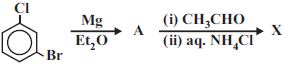
In the following reaction,the compound $(X)$ is ............ .
A
$3-$chlorophenyl methyl ketone
B
$3-$bromophenyl methyl ketone
C
$1-$($3$-chlorophenyl)ethanol
D
$1-$($3$-bromophenyl)ethanol
Solution
(C) The reaction starts with $1$-bromo-$3$-chlorobenzene.
When treated with $Mg$ in dry ether $(Et_2O)$,the more reactive $C-Br$ bond undergoes Grignard reagent formation to yield $3$-chlorophenylmagnesium bromide as intermediate $(A)$.
$(A) = 3-Cl-C_6H_4-MgBr$.
Next,this Grignard reagent reacts with acetaldehyde $(CH_3CHO)$ followed by acidic hydrolysis $(aq. NH_4Cl)$.
The nucleophilic attack of the aryl group on the carbonyl carbon of $CH_3CHO$ forms an alkoxide,which upon protonation yields a secondary alcohol.
The final product $(X)$ is $1-(3-chlorophenyl)ethanol$.
When treated with $Mg$ in dry ether $(Et_2O)$,the more reactive $C-Br$ bond undergoes Grignard reagent formation to yield $3$-chlorophenylmagnesium bromide as intermediate $(A)$.
$(A) = 3-Cl-C_6H_4-MgBr$.
Next,this Grignard reagent reacts with acetaldehyde $(CH_3CHO)$ followed by acidic hydrolysis $(aq. NH_4Cl)$.
The nucleophilic attack of the aryl group on the carbonyl carbon of $CH_3CHO$ forms an alkoxide,which upon protonation yields a secondary alcohol.
The final product $(X)$ is $1-(3-chlorophenyl)ethanol$.
0 likes
View Solution210
DifficultMCQ
Arrange the following compounds in the decreasing order of their reactivity towards $OH^-$: $m$-nitrobromobenzene $(I)$,$2,4,6$-trinitrobromobenzene $(II)$,$p$-nitrobromobenzene $(III)$,and $2,4$-dinitrobromobenzene $(IV)$.
A
$I > II > III > IV$
B
$II > IV > I > III$
C
$II > IV > III > I$
D
$IV > II > III > I$
Solution
(C) The reactivity of haloarenes towards nucleophilic substitution $(OH^-)$ increases with the presence of electron-withdrawing groups $(-NO_2)$ at the ortho and para positions relative to the halogen atom.
$II$: $2,4,6$-trinitrobromobenzene has three $-NO_2$ groups (two ortho,one para).
$IV$: $2,4$-dinitrobromobenzene has two $-NO_2$ groups (one ortho,one para).
$III$: $p$-nitrobromobenzene has one $-NO_2$ group (para).
$I$: $m$-nitrobromobenzene has one $-NO_2$ group (meta),which is less effective at stabilizing the carbanion intermediate compared to ortho/para positions.
Thus,the order of reactivity is $II > IV > III > I$.
$II$: $2,4,6$-trinitrobromobenzene has three $-NO_2$ groups (two ortho,one para).
$IV$: $2,4$-dinitrobromobenzene has two $-NO_2$ groups (one ortho,one para).
$III$: $p$-nitrobromobenzene has one $-NO_2$ group (para).
$I$: $m$-nitrobromobenzene has one $-NO_2$ group (meta),which is less effective at stabilizing the carbanion intermediate compared to ortho/para positions.
Thus,the order of reactivity is $II > IV > III > I$.
0 likes
View Solution211
DifficultMCQ
Heating chlorobenzene with $NaOH$ at $300\,^oC$ under pressure yields ...........
A
Phenol
B
Benzaldehyde
C
Chlorophenol
D
None of these
Solution
(A) The reaction of chlorobenzene with aqueous $NaOH$ at high temperature $(300\,^oC)$ and high pressure is known as the $Dow$ process.
In this reaction,the chlorine atom is replaced by a hydroxyl group to form sodium phenoxide,which upon acidification gives phenol.
The reaction is: $C_6H_5Cl + 2NaOH \xrightarrow{300\,^oC, \text{pressure}} C_6H_5ONa + NaCl + H_2O$.
$C_6H_5ONa + H^+ \rightarrow C_6H_5OH$ (Phenol).
In this reaction,the chlorine atom is replaced by a hydroxyl group to form sodium phenoxide,which upon acidification gives phenol.
The reaction is: $C_6H_5Cl + 2NaOH \xrightarrow{300\,^oC, \text{pressure}} C_6H_5ONa + NaCl + H_2O$.
$C_6H_5ONa + H^+ \rightarrow C_6H_5OH$ (Phenol).
0 likes
View Solution212
DifficultMCQ
When $C_6H_5Cl$ is heated with $NaOH$ at $300 \, ^\circ C$ under pressure,phenol is obtained. However,the yield is low because a side reaction produces ...............
A
$C_6H_5ONa$
B
$C_6H_5OCH_3$
C
$C_6H_5OC_6H_5$
D
None of these
Solution
(C) The reaction of chlorobenzene with $NaOH$ at high temperature and pressure is known as the $Dow$ process.
In this reaction,the primary product is sodium phenoxide $(C_6H_5ONa)$,which upon acidification gives phenol.
However,a side reaction occurs where the formed phenoxide ion reacts with unreacted chlorobenzene via a nucleophilic substitution reaction to form diphenyl ether $(C_6H_5OC_6H_5)$.
This side reaction reduces the overall yield of the desired phenol product.
In this reaction,the primary product is sodium phenoxide $(C_6H_5ONa)$,which upon acidification gives phenol.
However,a side reaction occurs where the formed phenoxide ion reacts with unreacted chlorobenzene via a nucleophilic substitution reaction to form diphenyl ether $(C_6H_5OC_6H_5)$.
This side reaction reduces the overall yield of the desired phenol product.
0 likes
View Solution213
DifficultMCQ
Aryl halides are less reactive than alkyl halides towards nucleophilic substitution reactions due to:
A
Formation of less stable carbonium ion
B
Resonance stabilization
C
Longer carbon-halogen bond
D
Inductive effect
Solution
(B) Aryl halides are less reactive towards nucleophilic substitution reactions compared to alkyl halides primarily due to resonance stabilization.
In aryl halides,the lone pair of electrons on the halogen atom is in conjugation with the $\pi$-electrons of the benzene ring.
This results in the development of partial double bond character in the $C-X$ bond,making it shorter and stronger,which is difficult to break.
Additionally,the $sp^2$ hybridized carbon atom attached to the halogen is more electronegative,further strengthening the bond.
In aryl halides,the lone pair of electrons on the halogen atom is in conjugation with the $\pi$-electrons of the benzene ring.
This results in the development of partial double bond character in the $C-X$ bond,making it shorter and stronger,which is difficult to break.
Additionally,the $sp^2$ hybridized carbon atom attached to the halogen is more electronegative,further strengthening the bond.
0 likes
View Solution214
MediumMCQ
The Ullmann reaction is used for the preparation of .......
A
Diphenyl
B
Iodobenzene
C
Toluene
D
Naphthalene
Solution
(A) The Ullmann reaction is a coupling reaction between two aryl halides in the presence of copper $(Cu)$ powder to form a biaryl compound.
For example,when iodobenzene is heated with copper powder,it yields diphenyl:
$2C_6H_5I + Cu \xrightarrow{\Delta} C_6H_5-C_6H_5 + CuI_2$
Thus,the Ullmann reaction is specifically used for the preparation of diphenyl (a biaryl).
For example,when iodobenzene is heated with copper powder,it yields diphenyl:
$2C_6H_5I + Cu \xrightarrow{\Delta} C_6H_5-C_6H_5 + CuI_2$
Thus,the Ullmann reaction is specifically used for the preparation of diphenyl (a biaryl).
0 likes
View Solution215
DifficultMCQ
Although chlorobenzene does not undergo the Ullmann reaction,the presence of which group at the $o-$ and $p-$ positions of chlorobenzene makes it possible to undergo the Ullmann reaction?
A
$-NO_2$
B
$-NH_2$
C
$-OH$
D
$-SO_3H$
Solution
(A) The Ullmann reaction involves the coupling of aryl halides with copper powder to form biaryls. Chlorobenzene is generally unreactive due to the strong $C-Cl$ bond and the electron-donating nature of the chlorine atom,which reduces the electrophilicity of the carbon atom.
However,the presence of strong electron-withdrawing groups like the nitro group $(-NO_2)$ at the $ortho$ $(o-)$ or $para$ $(p-)$ positions increases the electrophilicity of the carbon atom attached to the chlorine,thereby facilitating the reaction.
Therefore,the presence of the $-NO_2$ group makes the Ullmann reaction possible.
However,the presence of strong electron-withdrawing groups like the nitro group $(-NO_2)$ at the $ortho$ $(o-)$ or $para$ $(p-)$ positions increases the electrophilicity of the carbon atom attached to the chlorine,thereby facilitating the reaction.
Therefore,the presence of the $-NO_2$ group makes the Ullmann reaction possible.
0 likes
View Solution216
DifficultMCQ
Heating chlorobenzene with aqueous $NH_3$ in the presence of $Cu_2Cl_2$ gives ..........
A
Aniline
B
Benzamide
C
$o-$Trichlorobenzene
D
Chloroaminobenzene
Solution
(A) The reaction of chlorobenzene with aqueous ammonia $(NH_3)$ in the presence of cuprous oxide $(Cu_2O)$ or cuprous chloride $(Cu_2Cl_2)$ at high temperature and pressure is a nucleophilic substitution reaction.
This reaction is known as the ammonolysis of aryl halides.
The reaction is: $C_6H_5Cl + 2NH_3 \xrightarrow{Cu_2Cl_2, \Delta, P} C_6H_5NH_2 + NH_4Cl$.
The product formed is aniline $(C_6H_5NH_2)$.
This reaction is known as the ammonolysis of aryl halides.
The reaction is: $C_6H_5Cl + 2NH_3 \xrightarrow{Cu_2Cl_2, \Delta, P} C_6H_5NH_2 + NH_4Cl$.
The product formed is aniline $(C_6H_5NH_2)$.
0 likes
View Solution217
DifficultMCQ
The displacement of $Cl$ from chlorobenzene to obtain phenol requires strong reaction conditions. However,the chlorine in $2, 4-$ dinitrochlorobenzene is easily displaced because ................
A
$NO_2$ makes the ring electron-rich at $o-$ and $p-$ positions
B
$NO_2$ withdraws electrons from the $m-$ position
C
$NO_2$ donates electrons at the $m-$ position
D
$NO_2$ withdraws electrons from $o-$ and $p-$ positions
Solution
(D) The nucleophilic substitution reaction of haloarenes is facilitated by the presence of electron-withdrawing groups like $-NO_2$ at the ortho $(o-)$ and para $(p-)$ positions.
These groups withdraw electron density from the benzene ring through the inductive effect and resonance effect,thereby stabilizing the carbanion intermediate formed during the nucleophilic attack.
Since $2, 4-$ dinitrochlorobenzene has two $-NO_2$ groups at the $o-$ and $p-$ positions,the electron density on the ring is significantly reduced,making the carbon atom attached to chlorine more electrophilic and facilitating the nucleophilic substitution.
These groups withdraw electron density from the benzene ring through the inductive effect and resonance effect,thereby stabilizing the carbanion intermediate formed during the nucleophilic attack.
Since $2, 4-$ dinitrochlorobenzene has two $-NO_2$ groups at the $o-$ and $p-$ positions,the electron density on the ring is significantly reduced,making the carbon atom attached to chlorine more electrophilic and facilitating the nucleophilic substitution.
0 likes
View Solution218
DifficultMCQ
The major product obtained from the reaction of $p-$chlorotoluene with $KNH_2$ in liquid $NH_3$ is ..........
A
$o-$toluidine
B
$m-$toluidine
C
$p-$toluidine
D
$p-$chloroaniline
Solution
(B) The reaction of $p-$chlorotoluene with $KNH_2$ in liquid $NH_3$ proceeds via the $benzyne$ mechanism (elimination-addition reaction).
In $p-$chlorotoluene,the $Cl$ atom is at the $para$ position relative to the $CH_3$ group.
When $KNH_2$ removes a proton from the $ortho$ position relative to the $Cl$ atom,a $benzyne$ intermediate is formed.
Nucleophilic attack by $NH_2^-$ on this $benzyne$ intermediate can occur at either the $ortho$ or $meta$ position relative to the $CH_3$ group.
Due to the inductive effect of the $CH_3$ group,the $meta$ position is more favored for nucleophilic attack,leading to a mixture of $m-$toluidine and $p-$toluidine,with $m-$toluidine being the major product.
In $p-$chlorotoluene,the $Cl$ atom is at the $para$ position relative to the $CH_3$ group.
When $KNH_2$ removes a proton from the $ortho$ position relative to the $Cl$ atom,a $benzyne$ intermediate is formed.
Nucleophilic attack by $NH_2^-$ on this $benzyne$ intermediate can occur at either the $ortho$ or $meta$ position relative to the $CH_3$ group.
Due to the inductive effect of the $CH_3$ group,the $meta$ position is more favored for nucleophilic attack,leading to a mixture of $m-$toluidine and $p-$toluidine,with $m-$toluidine being the major product.
0 likes
View Solution219
MediumMCQ
Which of the following compounds is most reactive towards nucleophilic substitution reaction?
A
p-Nitrochlorobenzene
B
p-Methoxychlorobenzene
C
p-Methylchlorobenzene
D
p-Dichlorobenzene
Solution
(A) Nucleophilic aromatic substitution reactions are facilitated by the presence of electron-withdrawing groups $(EWG)$ on the benzene ring,which stabilize the negatively charged intermediate (Meisenheimer complex).
$1$. The $-NO_2$ group is a strong electron-withdrawing group ($-I$ and $-M$ effect),which significantly stabilizes the intermediate.
$2$. The $-OCH_3$ group is an electron-donating group ($+M$ effect),which destabilizes the intermediate.
$3$. The $-CH_3$ group is an electron-donating group ($+I$ and hyperconjugation),which destabilizes the intermediate.
$4$. The $-Cl$ group is weakly electron-withdrawing ($-I$ effect) but also electron-donating ($+M$ effect),making it less effective than $-NO_2$ at stabilizing the intermediate.
Therefore,$p$-Nitrochlorobenzene is the most reactive towards nucleophilic substitution.
$1$. The $-NO_2$ group is a strong electron-withdrawing group ($-I$ and $-M$ effect),which significantly stabilizes the intermediate.
$2$. The $-OCH_3$ group is an electron-donating group ($+M$ effect),which destabilizes the intermediate.
$3$. The $-CH_3$ group is an electron-donating group ($+I$ and hyperconjugation),which destabilizes the intermediate.
$4$. The $-Cl$ group is weakly electron-withdrawing ($-I$ effect) but also electron-donating ($+M$ effect),making it less effective than $-NO_2$ at stabilizing the intermediate.
Therefore,$p$-Nitrochlorobenzene is the most reactive towards nucleophilic substitution.
0 likes
View Solution220
DifficultMCQ
The strongest ortho-para and strongest meta-directing groups respectively are
A
$-NH_2$ and $-NO_2$
B
$-CONH_2$ and $-NH_2$
C
$-NH_2$ and $-CONH_2$
D
$-OH$ and $-NO_2$
Solution
(A) The directing nature of a group depends on its electronic effect on the benzene ring.
$-NH_2$ is a strong electron-donating group due to the $+M$ effect,making it the strongest ortho-para directing group.
$-NO_2$ is a strong electron-withdrawing group due to the $-M$ and $-I$ effects,making it the strongest meta-directing group.
Therefore,the correct pair is $-NH_2$ and $-NO_2$.
$-NH_2$ is a strong electron-donating group due to the $+M$ effect,making it the strongest ortho-para directing group.
$-NO_2$ is a strong electron-withdrawing group due to the $-M$ and $-I$ effects,making it the strongest meta-directing group.
Therefore,the correct pair is $-NH_2$ and $-NO_2$.
0 likes
View Solution221
DifficultMCQ
Assertion : Friedel-Craft's reaction is used to introduce an alkyl or acyl group in benzene nucleus.
Reason : Benzene is a solvent for the Friedel-Craft's alkylation of bromobenzene.
Reason : Benzene is a solvent for the Friedel-Craft's alkylation of bromobenzene.
A
If both Assertion and Reason are correct and the Reason is a correct explanation of the Assertion.
B
If both Assertion and Reason are correct but Reason is not a correct explanation of the Assertion.
C
If the Assertion is correct but Reason is incorrect.
D
If both the Assertion and Reason are incorrect.
Solution
(C) The assertion is correct because Friedel-Crafts reaction is indeed used to introduce an alkyl or acyl group into the benzene ring.
The reason is incorrect because benzene cannot be used as a solvent for the Friedel-Crafts alkylation of bromobenzene.
Bromobenzene is deactivated towards electrophilic aromatic substitution $(S_E)$ due to the electron-withdrawing inductive effect of the bromine atom.
Benzene is more reactive than bromobenzene towards electrophilic substitution.
Therefore,if benzene were used as a solvent,it would undergo alkylation in preference to bromobenzene,leading to a mixture of products.
The reason is incorrect because benzene cannot be used as a solvent for the Friedel-Crafts alkylation of bromobenzene.
Bromobenzene is deactivated towards electrophilic aromatic substitution $(S_E)$ due to the electron-withdrawing inductive effect of the bromine atom.
Benzene is more reactive than bromobenzene towards electrophilic substitution.
Therefore,if benzene were used as a solvent,it would undergo alkylation in preference to bromobenzene,leading to a mixture of products.
0 likes
View Solution222
DifficultMCQ
Assertion : The presence of nitro group facilitates nucleophilic substitution reactions in aryl halides.
Reason : The intermediate carbanion is stabilized due to the presence of nitro group.
Reason : The intermediate carbanion is stabilized due to the presence of nitro group.
A
If both Assertion and Reason are correct and the Reason is a correct explanation of the Assertion.
B
If both Assertion and Reason are correct but Reason is not a correct explanation of the Assertion.
C
If the Assertion is correct but Reason is incorrect.
D
If both the Assertion and Reason are incorrect.
Solution
(A) The nitro group $(-NO_2)$ is a strong electron-withdrawing group $(-EWG)$.
In nucleophilic aromatic substitution,the rate-determining step is the formation of a resonance-stabilized carbanion intermediate (Meisenheimer complex).
The $-NO_2$ group stabilizes this intermediate carbanion by dispersing the negative charge through resonance and inductive effects.
Therefore,the presence of a nitro group at ortho or para positions significantly facilitates nucleophilic substitution reactions in aryl halides.
Thus,both the Assertion and the Reason are correct,and the Reason is the correct explanation of the Assertion.
In nucleophilic aromatic substitution,the rate-determining step is the formation of a resonance-stabilized carbanion intermediate (Meisenheimer complex).
The $-NO_2$ group stabilizes this intermediate carbanion by dispersing the negative charge through resonance and inductive effects.
Therefore,the presence of a nitro group at ortho or para positions significantly facilitates nucleophilic substitution reactions in aryl halides.
Thus,both the Assertion and the Reason are correct,and the Reason is the correct explanation of the Assertion.
0 likes
View Solution223
AdvancedMCQ
Assertion : Chloral reacts with chlorobenzene to form $DDT$.
Reason : It is an electrophilic substitution reaction.
Reason : It is an electrophilic substitution reaction.
A
If both Assertion and Reason are correct and the Reason is a correct explanation of the Assertion.
B
If both Assertion and Reason are correct but Reason is not a correct explanation of the Assertion.
C
If the Assertion is correct but Reason is incorrect.
D
If both the Assertion and Reason are incorrect.
Solution
(A) The reaction of chloral $(CCl_3CHO)$ with chlorobenzene in the presence of concentrated $H_2SO_4$ produces $DDT$ ($p,p'$-dichlorodiphenyltrichloroethane).
This reaction involves the condensation of two molecules of chlorobenzene with one molecule of chloral,resulting in the elimination of a water molecule.
The mechanism is an electrophilic aromatic substitution where the protonated chloral acts as an electrophile attacking the chlorobenzene ring.
Since both the assertion (that chloral reacts with chlorobenzene to form $DDT$) and the reason (that it is an electrophilic substitution reaction) are correct,and the reason correctly explains the mechanism of the reaction,option $A$ is the correct answer.
This reaction involves the condensation of two molecules of chlorobenzene with one molecule of chloral,resulting in the elimination of a water molecule.
The mechanism is an electrophilic aromatic substitution where the protonated chloral acts as an electrophile attacking the chlorobenzene ring.
Since both the assertion (that chloral reacts with chlorobenzene to form $DDT$) and the reason (that it is an electrophilic substitution reaction) are correct,and the reason correctly explains the mechanism of the reaction,option $A$ is the correct answer.
0 likes
View Solution224
DifficultMCQ
Assertion : $S_{N}2$ reactions always proceed with inversion of configuration.
Reason : $S_{N}2$ reaction of an optically active aryl halide with an aqueous solution of $KOH$ always gives an alcohol with opposite sign of rotation.
Reason : $S_{N}2$ reaction of an optically active aryl halide with an aqueous solution of $KOH$ always gives an alcohol with opposite sign of rotation.
A
If both Assertion and Reason are correct and the Reason is a correct explanation of the Assertion.
B
If both Assertion and Reason are correct but Reason is not a correct explanation of the Assertion.
C
If the Assertion is correct but Reason is incorrect.
D
If both the Assertion and Reason are incorrect.
Solution
(C) The Assertion is true because $S_{N}2$ reactions involve the attack of a nucleophile from the side opposite to the leaving group,leading to the Walden inversion (inversion of configuration).
However,the Reason is false. Aryl halides are extremely unreactive towards nucleophilic substitution reactions under ordinary conditions due to the partial double bond character of the $C-X$ bond caused by resonance. Therefore,they do not undergo $S_{N}2$ reactions with $KOH$ to form alcohols.
However,the Reason is false. Aryl halides are extremely unreactive towards nucleophilic substitution reactions under ordinary conditions due to the partial double bond character of the $C-X$ bond caused by resonance. Therefore,they do not undergo $S_{N}2$ reactions with $KOH$ to form alcohols.
0 likes
View Solution225
AdvancedMCQ
Assertion : $4-$Nitrochlorobenzene undergoes nucleophilic substitution more readily than chlorobenzene.
Reason : Chlorobenzene undergoes nucleophilic substitution by elimination-addition mechanism while $4-$nitrochlorobenzene undergoes nucleophilic substitution by addition-elimination mechanism.
Reason : Chlorobenzene undergoes nucleophilic substitution by elimination-addition mechanism while $4-$nitrochlorobenzene undergoes nucleophilic substitution by addition-elimination mechanism.
A
If both Assertion and Reason are correct and the Reason is a correct explanation of the Assertion.
B
If both Assertion and Reason are correct but Reason is not a correct explanation of the Assertion.
C
If the Assertion is correct but Reason is incorrect.
D
If both the Assertion and Reason are incorrect.
Solution
(A) The Assertion is correct because the presence of an electron-withdrawing $-NO_2$ group at the $para-$position stabilizes the carbanion intermediate formed during nucleophilic aromatic substitution.
The Reason is also correct. Chlorobenzene typically requires harsh conditions and proceeds via an elimination-addition mechanism (benzyne intermediate) due to the lack of electron-withdrawing groups. In contrast,$4-$nitrochlorobenzene undergoes nucleophilic aromatic substitution via an addition-elimination mechanism (Meisenheimer complex) because the $-NO_2$ group strongly activates the ring towards nucleophilic attack.
Since the mechanism described in the Reason explains why $4-$nitrochlorobenzene is more reactive,the Reason is the correct explanation of the Assertion.
The Reason is also correct. Chlorobenzene typically requires harsh conditions and proceeds via an elimination-addition mechanism (benzyne intermediate) due to the lack of electron-withdrawing groups. In contrast,$4-$nitrochlorobenzene undergoes nucleophilic aromatic substitution via an addition-elimination mechanism (Meisenheimer complex) because the $-NO_2$ group strongly activates the ring towards nucleophilic attack.
Since the mechanism described in the Reason explains why $4-$nitrochlorobenzene is more reactive,the Reason is the correct explanation of the Assertion.
0 likes
View Solution226
DifficultMCQ
Assertion : Cyanide $(CN^{-})$ is a strong nucleophile.
Reason : Benzonitrile is prepared by the reaction of chlorobenzene with potassium cyanide.
Reason : Benzonitrile is prepared by the reaction of chlorobenzene with potassium cyanide.
A
If both Assertion and Reason are correct and the Reason is a correct explanation of the Assertion.
B
If both Assertion and Reason are correct but Reason is not a correct explanation of the Assertion.
C
If the Assertion is correct but Reason is incorrect.
D
If both the Assertion and Reason are incorrect.
Solution
(C) The cyanide ion $(CN^{-})$ is indeed a strong nucleophile because the negative charge is present on the carbon atom,which is less electronegative than nitrogen,making it a good electron donor. Thus,the Assertion is correct.
However,chlorobenzene does not undergo nucleophilic substitution with $KCN$ under normal conditions because the $C-Cl$ bond in chlorobenzene acquires partial double bond character due to resonance,making it resistant to nucleophilic attack. Therefore,benzonitrile cannot be prepared by this method. Thus,the Reason is incorrect.
However,chlorobenzene does not undergo nucleophilic substitution with $KCN$ under normal conditions because the $C-Cl$ bond in chlorobenzene acquires partial double bond character due to resonance,making it resistant to nucleophilic attack. Therefore,benzonitrile cannot be prepared by this method. Thus,the Reason is incorrect.
0 likes
View Solution227
MediumMCQ
Assertion : $S_{N}2$ reaction of an optically active aryl halide with an aqueous solution of $KOH$ always gives an alcohol with opposite sign of rotation.
Reason : $S_{N}2$ reactions always proceed with retention of configuration.
Reason : $S_{N}2$ reactions always proceed with retention of configuration.
A
If both Assertion and Reason are correct and the Reason is a correct explanation of the Assertion.
B
If both Assertion and Reason are correct but Reason is not a correct explanation of the Assertion.
C
If the Assertion is correct but Reason is incorrect.
D
If both the Assertion and Reason are incorrect.
Solution
(D) The Assertion is false because aryl halides do not undergo nucleophilic substitution reactions under ordinary conditions. This is due to the resonance effect,which gives the $C-Cl$ bond partial double bond character,making it shorter and stronger,and thus difficult to replace by nucleophiles.
The Reason is also false because $S_{N}2$ reactions proceed with inversion of configuration,not retention.
The Reason is also false because $S_{N}2$ reactions proceed with inversion of configuration,not retention.
0 likes
View Solution228
DifficultMCQ
The major product obtained on the monobromination (with $Br_2/FeBr_3$) of the following compound $A$ is

A
$2-$bromo$-1-$methoxy$-3-$methylbenzene
B
$4-$bromo$-1-$methoxy$-3-$methylbenzene
C
$5-$bromo$-1-$methoxy$-3-$methylbenzene
D
$2-$bromo$-1-$methoxy$-4-$methylbenzene
Solution
(B) The compound $A$ is $3$-methylanisole ($1$-methoxy-$3$-methylbenzene).
In this molecule,the $-OCH_3$ group is a strong ortho/para-directing group,while the $-CH_3$ group is a weakly ortho/para-directing group.
The $-OCH_3$ group dominates the directing effect.
Electrophilic substitution occurs at the positions ortho and para to the $-OCH_3$ group.
The positions ortho to $-OCH_3$ are $2$ and $6$. Position $2$ is sterically hindered by the $-CH_3$ group at position $3$.
The position para to $-OCH_3$ is position $4$.
Substitution at position $4$ is favored due to less steric hindrance compared to position $2$.
Thus,the major product is $4$-bromo-$1$-methoxy-$3$-methylbenzene.
In this molecule,the $-OCH_3$ group is a strong ortho/para-directing group,while the $-CH_3$ group is a weakly ortho/para-directing group.
The $-OCH_3$ group dominates the directing effect.
Electrophilic substitution occurs at the positions ortho and para to the $-OCH_3$ group.
The positions ortho to $-OCH_3$ are $2$ and $6$. Position $2$ is sterically hindered by the $-CH_3$ group at position $3$.
The position para to $-OCH_3$ is position $4$.
Substitution at position $4$ is favored due to less steric hindrance compared to position $2$.
Thus,the major product is $4$-bromo-$1$-methoxy-$3$-methylbenzene.
0 likes
View Solution229
MediumMCQ
Assertion : $p-$nitroacetophenone $(p-O_2N-C_6H_4-COCH_3)$ is prepared by Friedel-Crafts acylation of nitrobenzene.
Reason : Nitrobenzene easily undergoes electrophilic substitution reaction.
Reason : Nitrobenzene easily undergoes electrophilic substitution reaction.
A
If both Assertion and Reason are correct and the Reason is a correct explanation of the Assertion.
B
If both Assertion and Reason are correct but Reason is not a correct explanation of the Assertion.
C
If the Assertion is correct but Reason is incorrect.
D
If both the Assertion and Reason are incorrect.
Solution
(D) Friedel-Crafts reactions (alkylation and acylation) do not occur with nitrobenzene because the strong electron-withdrawing $-NO_2$ group deactivates the benzene ring towards electrophilic attack.
Furthermore,the lone pair on the nitrogen atom of the $-NO_2$ group coordinates with the Lewis acid catalyst (e.g.,$AlCl_3$),which further deactivates the ring.
Therefore,the Assertion is incorrect.
Since nitrobenzene is highly deactivated,it does not easily undergo electrophilic substitution reactions,making the Reason also incorrect.
Furthermore,the lone pair on the nitrogen atom of the $-NO_2$ group coordinates with the Lewis acid catalyst (e.g.,$AlCl_3$),which further deactivates the ring.
Therefore,the Assertion is incorrect.
Since nitrobenzene is highly deactivated,it does not easily undergo electrophilic substitution reactions,making the Reason also incorrect.
0 likes
View Solution230
DifficultMCQ
Assertion : Nitrobenzene is used as a solvent in Friedel-Craft's reaction.
Reason : Fusion of nitrobenzene with solid $KOH$ gives a low yield of a mixture of $o-$ and $p-$ nitrophenols.
Reason : Fusion of nitrobenzene with solid $KOH$ gives a low yield of a mixture of $o-$ and $p-$ nitrophenols.
A
If both Assertion and Reason are correct and the Reason is a correct explanation of the Assertion.
B
If both Assertion and Reason are correct but Reason is not a correct explanation of the Assertion.
C
If the Assertion is correct but Reason is incorrect.
D
If both the Assertion and Reason are incorrect.
Solution
(B) Nitrobenzene is used as a solvent in Friedel-Craft's reaction because it is highly resistant to electrophilic substitution due to the strong electron-withdrawing $-NO_2$ group,which deactivates the benzene ring.
The fusion of nitrobenzene with solid $KOH$ is a known chemical reaction that produces a mixture of $o-$ and $p-$ nitrophenols,although the yield is generally low.
Both statements are factually correct,but the reason does not explain why nitrobenzene is used as a solvent in Friedel-Craft's reaction.
Therefore,the correct option is $B$.
The fusion of nitrobenzene with solid $KOH$ is a known chemical reaction that produces a mixture of $o-$ and $p-$ nitrophenols,although the yield is generally low.
Both statements are factually correct,but the reason does not explain why nitrobenzene is used as a solvent in Friedel-Craft's reaction.
Therefore,the correct option is $B$.
0 likes
View Solution231
DifficultMCQ
Among the following,the reaction that proceeds through an electrophilic substitution is
A
$C_6H_5N_2^+Cl^- \xrightarrow{Cu_2Cl_2} C_6H_5Cl + N_2$
B
$C_6H_6 + Cl_2 \xrightarrow{AlCl_3} C_6H_5Cl + HCl$
C
$C_6H_6 + 3Cl_2 \xrightarrow{UV \text{ light}} C_6H_6Cl_6$
D
$C_6H_5CH_2OH + HCl \xrightarrow{\text{heat}} C_6H_5CH_2Cl + H_2O$
Solution
(B) Electrophilic substitution reaction involves the replacement of a hydrogen atom on an aromatic ring by an electrophile.
In the reaction of benzene with chlorine in the presence of a Lewis acid like anhydrous $AlCl_3$,the electrophile $Cl^+$ is generated,which attacks the benzene ring to form chlorobenzene.
This is a classic example of electrophilic aromatic substitution.
Reaction: $C_6H_6 + Cl_2 \xrightarrow{Anhyd. AlCl_3} C_6H_5Cl + HCl$.
In the reaction of benzene with chlorine in the presence of a Lewis acid like anhydrous $AlCl_3$,the electrophile $Cl^+$ is generated,which attacks the benzene ring to form chlorobenzene.
This is a classic example of electrophilic aromatic substitution.
Reaction: $C_6H_6 + Cl_2 \xrightarrow{Anhyd. AlCl_3} C_6H_5Cl + HCl$.
0 likes
View Solution232
DifficultMCQ
Among the following,the hydrolysis reaction that takes place at the slowest rate is:
A
$C_{6}H_{5}Cl \xrightarrow{aq. NaOH} C_{6}H_{5}OH$
B
$CH_{3}CH_{2}Cl \xrightarrow{aq. NaOH} CH_{3}CH_{2}OH$
C
$CH_{2}=CH-CH_{2}Cl \xrightarrow{aq. NaOH} CH_{2}=CH-CH_{2}OH$
D
$C_{6}H_{5}CH_{2}Cl \xrightarrow{aq. NaOH} C_{6}H_{5}CH_{2}OH$
Solution
(A) The rate of nucleophilic substitution reaction $(NSR)$ depends on the stability of the transition state or the nature of the $C-X$ bond.
$A$. $C_{6}H_{5}Cl$ is an aryl halide. In aryl halides,the $C-Cl$ bond acquires partial double bond character due to resonance,making it very strong and difficult to break. Thus,it undergoes hydrolysis at the slowest rate.
$B$. $CH_{3}CH_{2}Cl$ is a primary alkyl halide,which undergoes $S_{N}2$ reaction.
$C$. $CH_{2}=CH-CH_{2}Cl$ is an allylic halide,which is highly reactive towards $S_{N}1$ or $S_{N}2$ due to resonance stabilization of the carbocation or transition state.
$D$. $C_{6}H_{5}CH_{2}Cl$ is a benzyl chloride,which is highly reactive due to resonance stabilization of the benzyl carbocation.
Therefore,the correct option is $A$.
$A$. $C_{6}H_{5}Cl$ is an aryl halide. In aryl halides,the $C-Cl$ bond acquires partial double bond character due to resonance,making it very strong and difficult to break. Thus,it undergoes hydrolysis at the slowest rate.
$B$. $CH_{3}CH_{2}Cl$ is a primary alkyl halide,which undergoes $S_{N}2$ reaction.
$C$. $CH_{2}=CH-CH_{2}Cl$ is an allylic halide,which is highly reactive towards $S_{N}1$ or $S_{N}2$ due to resonance stabilization of the carbocation or transition state.
$D$. $C_{6}H_{5}CH_{2}Cl$ is a benzyl chloride,which is highly reactive due to resonance stabilization of the benzyl carbocation.
Therefore,the correct option is $A$.
0 likes
View Solution233
AdvancedMCQ
The compound $C_{7}H_{8}$ undergoes the following reactions:
$C_{7}H_{8}$ $\xrightarrow{3Cl_{2} / \Delta} A$ $\xrightarrow{Br_{2} / Fe} B$ $\xrightarrow{Zn / HCl} C$
The product '$C$' is
$C_{7}H_{8}$ $\xrightarrow{3Cl_{2} / \Delta} A$ $\xrightarrow{Br_{2} / Fe} B$ $\xrightarrow{Zn / HCl} C$
The product '$C$' is
A
$m-$bromotoluene
B
$o-$bromotoluene
C
$3-$bromo$-2,4,6-$trichlorotoluene
D
$p-$bromotoluene
Solution
(A) Step $1$: Toluene $(C_{7}H_{8})$ reacts with $3Cl_{2}$ in the presence of heat to undergo side-chain chlorination,forming benzotrichloride $(C_{6}H_{5}CCl_{3})$ as product '$A$'.
Step $2$: The $-CCl_{3}$ group is strongly electron-withdrawing and meta-directing. Therefore,electrophilic substitution with $Br_{2}/Fe$ occurs at the meta position,forming $m-$bromobenzotrichloride as product '$B$'.
Step $3$: Reduction of the $-CCl_{3}$ group with $Zn/HCl$ converts it back into a methyl group $(-CH_{3})$,yielding $m-$bromotoluene as the final product '$C$'.
Thus,the correct option is $A$.
Step $2$: The $-CCl_{3}$ group is strongly electron-withdrawing and meta-directing. Therefore,electrophilic substitution with $Br_{2}/Fe$ occurs at the meta position,forming $m-$bromobenzotrichloride as product '$B$'.
Step $3$: Reduction of the $-CCl_{3}$ group with $Zn/HCl$ converts it back into a methyl group $(-CH_{3})$,yielding $m-$bromotoluene as the final product '$C$'.
Thus,the correct option is $A$.
0 likes
View Solution234
DifficultMCQ
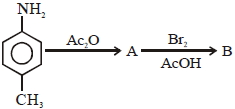
In the following reaction sequence,the major product $B$ is:
A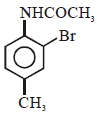
B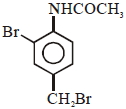
C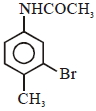
D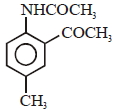
Solution
(A) $1$. The starting material is $p$-toluidine ($4$-methylaniline).
$2$. Reaction with acetic anhydride $(Ac_2O)$ performs acetylation of the amino group to form $N$-($4$-methylphenyl)acetamide (compound $A$).
$3$. The acetamido group $(-NHCOCH_3)$ is an ortho/para directing group. Since the para position is already occupied by the methyl group,electrophilic bromination with $Br_2$ in acetic acid $(AcOH)$ occurs at the ortho position relative to the acetamido group.
$4$. The major product $B$ is $N$-($2$-bromo$-4-$methylphenyl)acetamide.
$2$. Reaction with acetic anhydride $(Ac_2O)$ performs acetylation of the amino group to form $N$-($4$-methylphenyl)acetamide (compound $A$).
$3$. The acetamido group $(-NHCOCH_3)$ is an ortho/para directing group. Since the para position is already occupied by the methyl group,electrophilic bromination with $Br_2$ in acetic acid $(AcOH)$ occurs at the ortho position relative to the acetamido group.
$4$. The major product $B$ is $N$-($2$-bromo$-4-$methylphenyl)acetamide.
0 likes
View Solution235
Difficult
How will you convert benzene into:
$(i)$ $p-nitrobromobenzene$
$(ii)$ $m-nitrochlorobenzene$
$(iii)$ $p-nitrotoluene$
$(iv)$ acetophenone
$(i)$ $p-nitrobromobenzene$
$(ii)$ $m-nitrochlorobenzene$
$(iii)$ $p-nitrotoluene$
$(iv)$ acetophenone
Solution
(N/A) $(i)$ Benzene is first brominated with $Br_2$ in the presence of anhydrous $FeBr_3$ to form bromobenzene. Bromobenzene is then nitrated with a mixture of conc. $HNO_3$ and conc. $H_2SO_4$ at $323-333 \ K$ to give a mixture of $o-$ and $p-nitrobromobenzene$. The $p-isomer$ is separated by fractional distillation.
$(ii)$ Benzene is first nitrated with a mixture of conc. $HNO_3$ and conc. $H_2SO_4$ at $323-333 \ K$ to form nitrobenzene. Nitrobenzene is then chlorinated with $Cl_2$ in the presence of anhydrous $AlCl_3$ to give $m-nitrochlorobenzene$ (since the $-NO_2$ group is meta-directing).
$(iii)$ Benzene is first alkylated with $CH_3Cl$ in the presence of anhydrous $AlCl_3$ to form toluene. Toluene is then nitrated with a mixture of conc. $HNO_3$ and conc. $H_2SO_4$ at $323-333 \ K$ to give a mixture of $o-$ and $p-nitrotoluene$. The $p-isomer$ is separated by fractional distillation.
$(iv)$ Benzene undergoes Friedel-Crafts acylation with acetyl chloride $(CH_3COCl)$ in the presence of anhydrous $AlCl_3$ to form acetophenone.
$(ii)$ Benzene is first nitrated with a mixture of conc. $HNO_3$ and conc. $H_2SO_4$ at $323-333 \ K$ to form nitrobenzene. Nitrobenzene is then chlorinated with $Cl_2$ in the presence of anhydrous $AlCl_3$ to give $m-nitrochlorobenzene$ (since the $-NO_2$ group is meta-directing).
$(iii)$ Benzene is first alkylated with $CH_3Cl$ in the presence of anhydrous $AlCl_3$ to form toluene. Toluene is then nitrated with a mixture of conc. $HNO_3$ and conc. $H_2SO_4$ at $323-333 \ K$ to give a mixture of $o-$ and $p-nitrotoluene$. The $p-isomer$ is separated by fractional distillation.
$(iv)$ Benzene undergoes Friedel-Crafts acylation with acetyl chloride $(CH_3COCl)$ in the presence of anhydrous $AlCl_3$ to form acetophenone.
0 likes
View Solution236
Difficult
Although chlorine is an electron-withdrawing group,it is ortho-para directing in electrophilic aromatic substitution reactions. Why?
Solution
(N/A) Chlorine withdraws electrons through the inductive effect ($-I$ effect) and releases electrons through resonance ($+R$ effect).
Through the inductive effect,chlorine destabilizes the intermediate carbocation formed during the electrophilic substitution.
Through resonance,the halogen tends to stabilize the carbocation,and this effect is more pronounced at the $ortho$- and $para$- positions.
The inductive effect is stronger than the resonance effect,causing net electron withdrawal,which leads to overall deactivation of the benzene ring.
However,the resonance effect opposes the inductive effect specifically for the attack at the $ortho$- and $para$- positions,making the deactivation less significant at these positions compared to the $meta$- position.
Thus,the overall reactivity is controlled by the stronger inductive effect,while the orientation of the incoming electrophile is controlled by the resonance effect.
Through the inductive effect,chlorine destabilizes the intermediate carbocation formed during the electrophilic substitution.
Through resonance,the halogen tends to stabilize the carbocation,and this effect is more pronounced at the $ortho$- and $para$- positions.
The inductive effect is stronger than the resonance effect,causing net electron withdrawal,which leads to overall deactivation of the benzene ring.
However,the resonance effect opposes the inductive effect specifically for the attack at the $ortho$- and $para$- positions,making the deactivation less significant at these positions compared to the $meta$- position.
Thus,the overall reactivity is controlled by the stronger inductive effect,while the orientation of the incoming electrophile is controlled by the resonance effect.
0 likes
View Solution237
Easy
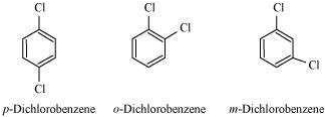
$p-$Dichlorobenzene has a higher $m.p.$ than those of $o-$ and $m-$ isomers. Discuss.
Solution
(N/A) $p-$Dichlorobenzene is more symmetrical than $o-$ and $m-$ isomers.
Due to this symmetry,it fits more closely than $o-$ and $m-$ isomers in the crystal lattice.
Therefore,more energy is required to break the crystal lattice of $p-$dichlorobenzene.
As a result,$p-$Dichlorobenzene has a higher melting point and lower solubility than $o-$ and $m-$ isomers.
Due to this symmetry,it fits more closely than $o-$ and $m-$ isomers in the crystal lattice.
Therefore,more energy is required to break the crystal lattice of $p-$dichlorobenzene.
As a result,$p-$Dichlorobenzene has a higher melting point and lower solubility than $o-$ and $m-$ isomers.
0 likes
View Solution238
Medium
How will you convert $4-$nitrotoluene to $2-$bromobenzoic acid?
Solution
(N/A) The conversion of $4-$nitrotoluene to $2-$bromobenzoic acid can be achieved through the following steps:
$1$. Bromination of $4-$nitrotoluene: $4-$nitrotoluene reacts with $Br_2$ to form $2-$bromo-$4-$nitrotoluene.
$2$. Reduction: The nitro group $(-NO_2)$ is reduced to an amino group $(-NH_2)$ using $Sn/HCl$ to give $2-$bromo-$4-$methylaniline.
$3$. Diazotization: $2-$bromo-$4-$methylaniline is treated with $NaNO_2/HCl$ at $273-278 \ K$ to form the diazonium salt,$2-$bromo-$4-$methylbenzenediazonium chloride.
$4$. Deamination: The diazonium group is removed using $H_3PO_2$ and $H_2O$ to yield $2-$bromotoluene.
$5$. Oxidation: Finally,the methyl group $(-CH_3)$ is oxidized to a carboxylic acid group $(-COOH)$ using $KMnO_4/OH^-$ to obtain $2-$bromobenzoic acid.
$1$. Bromination of $4-$nitrotoluene: $4-$nitrotoluene reacts with $Br_2$ to form $2-$bromo-$4-$nitrotoluene.
$2$. Reduction: The nitro group $(-NO_2)$ is reduced to an amino group $(-NH_2)$ using $Sn/HCl$ to give $2-$bromo-$4-$methylaniline.
$3$. Diazotization: $2-$bromo-$4-$methylaniline is treated with $NaNO_2/HCl$ at $273-278 \ K$ to form the diazonium salt,$2-$bromo-$4-$methylbenzenediazonium chloride.
$4$. Deamination: The diazonium group is removed using $H_3PO_2$ and $H_2O$ to yield $2-$bromotoluene.
$5$. Oxidation: Finally,the methyl group $(-CH_3)$ is oxidized to a carboxylic acid group $(-COOH)$ using $KMnO_4/OH^-$ to obtain $2-$bromobenzoic acid.
0 likes
View Solution239
Medium
What are the reasons for the low reactivity of aryl halides (haloarenes) towards nucleophilic substitution reactions?
Solution
(N/A) The reasons for the low reactivity of aryl halides towards nucleophilic substitution reactions are as follows:
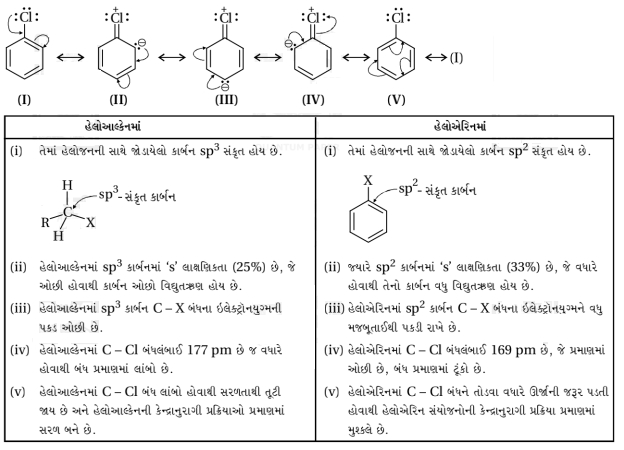
$(a)$ Resonance Effect: In haloarenes, the electron pairs on the halogen atom $(X)$ are in conjugation with the $\pi$-electrons of the ring. Due to resonance, the $C-X$ bond acquires partial double bond character. This makes the cleavage of the $C-X$ bond difficult compared to haloalkanes, where the bond is purely single.
$(b)$ Difference in Hybridization of Carbon Atom in $C-X$ Bond: In haloalkanes, the carbon atom attached to the halogen is $sp^3$ hybridized, whereas in haloarenes, it is $sp^2$ hybridized. The $sp^2$ hybridized carbon has more $s$-character $(33\%)$ compared to $sp^3$ $(25\%)$, making it more electronegative. Consequently, it holds the electron pair of the $C-X$ bond more tightly, resulting in a shorter and stronger bond ($169 \text{ pm}$ in haloarenes vs $177 \text{ pm}$ in haloalkanes), which is harder to break.
$(a)$ Resonance Effect: In haloarenes, the electron pairs on the halogen atom $(X)$ are in conjugation with the $\pi$-electrons of the ring. Due to resonance, the $C-X$ bond acquires partial double bond character. This makes the cleavage of the $C-X$ bond difficult compared to haloalkanes, where the bond is purely single.
$(b)$ Difference in Hybridization of Carbon Atom in $C-X$ Bond: In haloalkanes, the carbon atom attached to the halogen is $sp^3$ hybridized, whereas in haloarenes, it is $sp^2$ hybridized. The $sp^2$ hybridized carbon has more $s$-character $(33\%)$ compared to $sp^3$ $(25\%)$, making it more electronegative. Consequently, it holds the electron pair of the $C-X$ bond more tightly, resulting in a shorter and stronger bond ($169 \text{ pm}$ in haloarenes vs $177 \text{ pm}$ in haloalkanes), which is harder to break.
0 likes
View Solution240
Medium
Write the nucleophilic substitution reactions of $Cl^-$ in $C-Cl$ bond of haloarenes with $OH^-$.
Solution
(N/A) The nucleophilic substitution of haloarenes is difficult due to the partial double bond character of the $C-Cl$ bond. However,it can be facilitated by harsh conditions or by the presence of electron-withdrawing groups $(NO_2)$ at ortho and para positions.
$(i)$ Chlorobenzene to Phenol: Requires $NaOH_{(aq)}$,$623 \ K$,and $300 \ atm$ pressure followed by acidification $(H^+)$.
$(ii)$ $p-$Nitrochlorobenzene to $p-$Nitrophenol: Requires $NaOH$ at $443 \ K$ followed by acidification $(H^+)$.
$(iii)$ $2,4-$Dinitrochlorobenzene to $2,4-$Dinitrophenol: Requires $NaOH$ at $368 \ K$ followed by acidification $(H^+)$.
$(i)$ Chlorobenzene to Phenol: Requires $NaOH_{(aq)}$,$623 \ K$,and $300 \ atm$ pressure followed by acidification $(H^+)$.
$(ii)$ $p-$Nitrochlorobenzene to $p-$Nitrophenol: Requires $NaOH$ at $443 \ K$ followed by acidification $(H^+)$.
$(iii)$ $2,4-$Dinitrochlorobenzene to $2,4-$Dinitrophenol: Requires $NaOH$ at $368 \ K$ followed by acidification $(H^+)$.
0 likes
View Solution241
Difficult
"The presence of an electron-withdrawing group $\left( -NO_2 \right)$ at the ortho and para positions in haloarenes increases the reactivity of haloarenes towards nucleophilic substitution reactions." Prove this with an example.
Solution
(N/A) In haloarenes,the presence of an electron-withdrawing group like $-NO_2$ facilitates the nucleophilic substitution of the $-Cl$ atom by an $-OH$ group. The presence of $-NO_2$ groups at ortho and para positions stabilizes the carbanion intermediate through resonance,thereby increasing the reactivity towards $S_NAr$ reactions.
Example:
$1$. Chlorobenzene $(C_6H_5Cl)$ requires harsh conditions ($623 \ K$ and $300 \ atm$ pressure) for the substitution of $-Cl$ by $-OH$.
$2$. $p$-Nitrochlorobenzene $(p-NO_2C_6H_4Cl)$ requires milder conditions $(443 \ K)$ for the same substitution.
$3$. As the number of $-NO_2$ groups increases at ortho/para positions,the reaction conditions become even milder:
- With two $-NO_2$ groups ($2$,$4$-dinitrochlorobenzene),the reaction occurs at $368 \ K$.
- With three $-NO_2$ groups ($2$,$4$,$6$-trinitrochlorobenzene),the reaction occurs simply by warming with water.
Example:
$1$. Chlorobenzene $(C_6H_5Cl)$ requires harsh conditions ($623 \ K$ and $300 \ atm$ pressure) for the substitution of $-Cl$ by $-OH$.
$2$. $p$-Nitrochlorobenzene $(p-NO_2C_6H_4Cl)$ requires milder conditions $(443 \ K)$ for the same substitution.
$3$. As the number of $-NO_2$ groups increases at ortho/para positions,the reaction conditions become even milder:
- With two $-NO_2$ groups ($2$,$4$-dinitrochlorobenzene),the reaction occurs at $368 \ K$.
- With three $-NO_2$ groups ($2$,$4$,$6$-trinitrochlorobenzene),the reaction occurs simply by warming with water.
0 likes
View Solution242
Medium
Why does the presence of a $-NO_2$ group at the $o,p$-positions increase the reactivity of haloarenes towards nucleophilic substitution reactions?
Solution
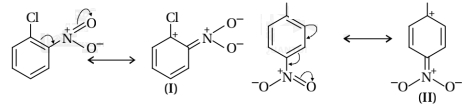
(N/A) The nitro group $(-NO_2)$ is a strong electron-withdrawing group due to its $-I$ and $-M$ (resonance) effects.
When present at the ortho or para positions,the $-NO_2$ group withdraws electron density from the benzene ring through resonance.
This creates a positive charge at the ortho and para positions,as shown in the resonance structures $(I)$ and $(II)$.
As a result,the carbon atom attached to the halogen becomes more electron-deficient (more positive),which facilitates the attack of a nucleophile (like $OH^-$).
Thus,the presence of $-NO_2$ groups at ortho and para positions makes the haloarene more susceptible to nucleophilic substitution.
When present at the ortho or para positions,the $-NO_2$ group withdraws electron density from the benzene ring through resonance.
This creates a positive charge at the ortho and para positions,as shown in the resonance structures $(I)$ and $(II)$.
As a result,the carbon atom attached to the halogen becomes more electron-deficient (more positive),which facilitates the attack of a nucleophile (like $OH^-$).
Thus,the presence of $-NO_2$ groups at ortho and para positions makes the haloarene more susceptible to nucleophilic substitution.
0 likes
View Solution243
Difficult
Explain the mechanism of nucleophilic substitution reaction of ortho and para nitrohaloarenes.
Solution
(N/A) The presence of an electron-withdrawing group $(-NO_2)$ at the ortho or para position of haloarenes (like chlorobenzene) significantly increases the reactivity towards nucleophilic substitution.
This reaction proceeds via an addition-elimination mechanism,often referred to as nucleophilic aromatic substitution $(S_NAr)$.
$1$. In the first slow step,the nucleophile $(OH^-)$ attacks the carbon atom bearing the halogen,forming a resonance-stabilized carbanion intermediate (Meisenheimer complex).
$2$. The negative charge is delocalized onto the oxygen atoms of the $-NO_2$ group,which provides extra stability to the intermediate.
$3$. In the second fast step,the leaving group $(Cl^-)$ is eliminated,restoring the aromaticity of the ring to form the final product (nitrophenol).
This mechanism is facilitated by the $-NO_2$ group,which stabilizes the transition state and the intermediate carbanion through resonance.
This reaction proceeds via an addition-elimination mechanism,often referred to as nucleophilic aromatic substitution $(S_NAr)$.
$1$. In the first slow step,the nucleophile $(OH^-)$ attacks the carbon atom bearing the halogen,forming a resonance-stabilized carbanion intermediate (Meisenheimer complex).
$2$. The negative charge is delocalized onto the oxygen atoms of the $-NO_2$ group,which provides extra stability to the intermediate.
$3$. In the second fast step,the leaving group $(Cl^-)$ is eliminated,restoring the aromaticity of the ring to form the final product (nitrophenol).
This mechanism is facilitated by the $-NO_2$ group,which stabilizes the transition state and the intermediate carbanion through resonance.
0 likes
View Solution244
Medium
Explain the mechanism of nucleophilic substitution reaction of $m$-nitrochlorobenzene at ortho and para positions.
Solution
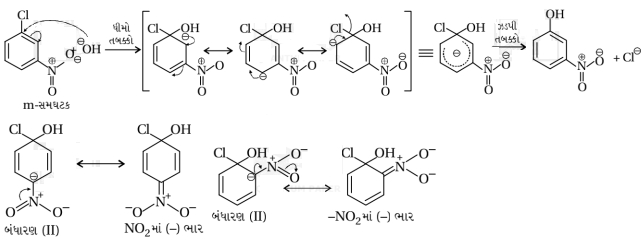
(N/A) The nucleophilic substitution reaction of $m$-nitrochlorobenzene with $HO^-$ follows the addition-elimination mechanism (often referred to as $S_NAr$).
When the $-NO_2$ group is at the ortho or para position,the intermediate carbanion has a special resonance structure $(II)$ where the negative charge is delocalized onto the carbon atom attached to the $-NO_2$ group,allowing the nitro group to stabilize the negative charge through its $-I$ and $-M$ effects.
In the case of $m$-nitrochlorobenzene,none of the resonance structures of the intermediate carbanion place the negative charge on the carbon atom directly attached to the $-NO_2$ group. Therefore,the presence of the $-NO_2$ group at the meta position does not significantly enhance the reactivity of the haloarene towards nucleophilic substitution compared to chlorobenzene.
When the $-NO_2$ group is at the ortho or para position,the intermediate carbanion has a special resonance structure $(II)$ where the negative charge is delocalized onto the carbon atom attached to the $-NO_2$ group,allowing the nitro group to stabilize the negative charge through its $-I$ and $-M$ effects.
In the case of $m$-nitrochlorobenzene,none of the resonance structures of the intermediate carbanion place the negative charge on the carbon atom directly attached to the $-NO_2$ group. Therefore,the presence of the $-NO_2$ group at the meta position does not significantly enhance the reactivity of the haloarene towards nucleophilic substitution compared to chlorobenzene.
0 likes
View Solution245
Difficult
Why do electrophilic substitution reactions in haloarenes occur at ortho and para positions,yet are slower than in benzene? Explain.
Solution
(N/A) Haloarenes undergo electrophilic substitution reactions like halogenation,nitration,sulfonation,and Friedel-Crafts reactions at the ortho and para positions because the halogen atom is an $o,p$-directing group. The resonance structures of halobenzene are shown in the image.
In these structures,the electron density is higher at the ortho and para positions due to the negative charge. Consequently,the electrophile attacks the ortho and para positions of the haloarene. The $-X$ group is $o,p$-directing,and electrophilic substitution occurs at these positions.
However,haloarenes are less reactive than benzene towards electrophilic substitution. The halogen atom $(X)$ exerts an electron-withdrawing inductive effect $(-I)$.
Due to this,the halogen atom pulls electrons from the benzene ring towards itself,resulting in lower electron density in the halobenzene ring compared to benzene. Thus,haloarenes are less reactive than benzene,making their electrophilic substitution reactions slower and requiring more vigorous conditions.
In these structures,the electron density is higher at the ortho and para positions due to the negative charge. Consequently,the electrophile attacks the ortho and para positions of the haloarene. The $-X$ group is $o,p$-directing,and electrophilic substitution occurs at these positions.
However,haloarenes are less reactive than benzene towards electrophilic substitution. The halogen atom $(X)$ exerts an electron-withdrawing inductive effect $(-I)$.
Due to this,the halogen atom pulls electrons from the benzene ring towards itself,resulting in lower electron density in the halobenzene ring compared to benzene. Thus,haloarenes are less reactive than benzene,making their electrophilic substitution reactions slower and requiring more vigorous conditions.
0 likes
View Solution246
Medium
Describe the electrophilic substitution reactions of chlorobenzene.
Solution
(N/A) Chlorobenzene undergoes electrophilic substitution reactions at the $o$- and $p$-positions due to the resonance effect of the chlorine atom,which increases electron density at these positions. The reactions are as follows:
$(i)$ Halogenation (Chlorination): Chlorobenzene reacts with $Cl_2$ in the presence of anhydrous $FeCl_3$ to form $o$-dichlorobenzene and $p$-dichlorobenzene.
$(ii)$ Nitration: Chlorobenzene reacts with concentrated $HNO_3$ and concentrated $H_2SO_4$ to form $1$-chloro-$4$-nitrobenzene (major) and $1$-chloro-$2$-nitrobenzene (minor).
$(iii)$ Sulphonation: Chlorobenzene reacts with concentrated $H_2SO_4$ upon heating to form $4$-chlorobenzenesulphonic acid (major) and $2$-chlorobenzenesulphonic acid (minor).
$(i)$ Halogenation (Chlorination): Chlorobenzene reacts with $Cl_2$ in the presence of anhydrous $FeCl_3$ to form $o$-dichlorobenzene and $p$-dichlorobenzene.
$(ii)$ Nitration: Chlorobenzene reacts with concentrated $HNO_3$ and concentrated $H_2SO_4$ to form $1$-chloro-$4$-nitrobenzene (major) and $1$-chloro-$2$-nitrobenzene (minor).
$(iii)$ Sulphonation: Chlorobenzene reacts with concentrated $H_2SO_4$ upon heating to form $4$-chlorobenzenesulphonic acid (major) and $2$-chlorobenzenesulphonic acid (minor).
0 likes
View Solution247
Medium
Describe the reactions of aryl halides with metals.
Solution
(N/A) The reactions of aryl halides with metals are categorized into three main types: $(a)$ Wurtz-Fittig reaction,$(b)$ Fittig reaction,and $(c)$ Grignard reaction.
$(a)$ Wurtz-Fittig reaction: When a mixture of an alkyl halide and an aryl halide is treated with sodium metal in dry ether,an alkylarene is formed. This is known as the Wurtz-Fittig reaction.
$(b)$ Fittig reaction: Aryl halides react with sodium metal in dry ether to give analogous compounds where two aryl groups are joined together. This is known as the Fittig reaction.
$(c)$ Grignard reaction: Aryl halides react with magnesium metal in the presence of dry ether to form aryl magnesium halides,which are known as Grignard reagents.
$(a)$ Wurtz-Fittig reaction: When a mixture of an alkyl halide and an aryl halide is treated with sodium metal in dry ether,an alkylarene is formed. This is known as the Wurtz-Fittig reaction.
$(b)$ Fittig reaction: Aryl halides react with sodium metal in dry ether to give analogous compounds where two aryl groups are joined together. This is known as the Fittig reaction.
$(c)$ Grignard reaction: Aryl halides react with magnesium metal in the presence of dry ether to form aryl magnesium halides,which are known as Grignard reagents.
0 likes
View Solution248
Medium
How many reactions of aryl halides with metals are there? Explain with examples.
Solution
(N/A) There are three main reactions of aryl halides with metals: $(a)$ Wurtz-Fittig reaction,$(b)$ Fittig reaction,and $(c)$ Grignard reaction.
$(a)$ Wurtz-Fittig reaction: When a mixture of an alkyl halide and an aryl halide is treated with sodium metal in dry ether,an alkylarene is formed. This is known as the Wurtz-Fittig reaction.
Example: $C_6H_5X + RX + 2Na \xrightarrow{\text{dry ether}} C_6H_5R + 2NaX$
$(b)$ Fittig reaction: When aryl halides are treated with sodium metal in dry ether,two aryl groups join together to form diaryl compounds. This is known as the Fittig reaction.
Example: $2C_6H_5X + 2Na \xrightarrow{\text{dry ether}} C_6H_5-C_6H_5 + 2NaX$
$(c)$ Grignard reaction: Aryl halides react with magnesium metal in the presence of dry ether to form aryl magnesium halides (Grignard reagents).
Example: $C_6H_5X + Mg \xrightarrow{\text{dry ether}} C_6H_5MgX$
$(a)$ Wurtz-Fittig reaction: When a mixture of an alkyl halide and an aryl halide is treated with sodium metal in dry ether,an alkylarene is formed. This is known as the Wurtz-Fittig reaction.
Example: $C_6H_5X + RX + 2Na \xrightarrow{\text{dry ether}} C_6H_5R + 2NaX$
$(b)$ Fittig reaction: When aryl halides are treated with sodium metal in dry ether,two aryl groups join together to form diaryl compounds. This is known as the Fittig reaction.
Example: $2C_6H_5X + 2Na \xrightarrow{\text{dry ether}} C_6H_5-C_6H_5 + 2NaX$
$(c)$ Grignard reaction: Aryl halides react with magnesium metal in the presence of dry ether to form aryl magnesium halides (Grignard reagents).
Example: $C_6H_5X + Mg \xrightarrow{\text{dry ether}} C_6H_5MgX$
0 likes
View Solution249
MediumMCQ
Out of $o$- and $p$-dibromobenzene,which one has a higher melting point and why?
A
$o$-dibromobenzene due to higher polarity.
B
$p$-dibromobenzene due to its symmetrical structure.
C
$o$-dibromobenzene due to higher intermolecular forces.
D
$p$-dibromobenzene due to higher molecular weight.
Solution
(B) $p$-dibromobenzene has a higher melting point than its $o$-isomer.
This is due to its symmetrical structure,which allows it to pack more efficiently into a crystal lattice,resulting in stronger intermolecular forces of attraction.
This is due to its symmetrical structure,which allows it to pack more efficiently into a crystal lattice,resulting in stronger intermolecular forces of attraction.
0 likes
View SolutionHaloalkanes and Haloarenes — Properties of Haloarenes · Frequently Asked Questions
1Are these Haloalkanes and Haloarenes questions useful for JEE and NEET?
Yes. All questions in this section are mapped to JEE Main and NEET exam patterns. Previous year questions from JEE Main, NEET, GUJCET and state-level exams are included with full solutions.
2Can I switch to Hindi or Gujarati for these questions?
Yes. Use the language tabs in the hero section or the sidebar to view the same questions and solutions in English, Hindi or Gujarati.
3How do I generate a question paper from this subtopic?
Use the Vedclass Exam Paper Generator — select the chapter and subtopic, set difficulty, and generate Sets A, B, C, D automatically. First 3 chapters of every subject are free.
Vedclass Products
For Students
Vedclass Test Series
Mock tests in real JEE/NEET style with performance analysis. 5-day free trial.
Start Free TrialFor Teachers
Exam Paper Generator
Generate Set A/B/C/D papers from this chapter in 2 minutes. 3 chapters free.
Try FreeFor Institutes
Online Exam Module
Live online exams with unlimited students, 360° analytics & white-label branding.
See DemoFor Teachers & Institutes
Generate a Haloalkanes and Haloarenes Exam Paper in 2 Minutes
Select subtopic & difficulty — Sets A, B, C, D auto-generated with No Repeat logic.
First 3 chapters of every subject are free — no payment required.