
A English
Properties of Haloalkanes Questions in English
Class 12 Chemistry · Haloalkanes and Haloarenes · Properties of Haloalkanes
1196+
Questions
English
Language
100%
With Solutions
Showing 50 of 1196 questions in English
151
MediumMCQ
Which of the following compounds is not chiral?
A
$CH_3-CH_2-CH_2Cl$
B
$CH_3-CHD-CH_2Cl$
C
$CH_3-CHCl-CH_2Cl$
D
$CH_3-CH_2-CHDCl$
Solution
(A) compound is chiral if it contains at least one chiral center (a carbon atom bonded to four different groups).
$1$. In $CH_3-CH_2-CH_2Cl$,the carbon atoms are bonded to identical hydrogen atoms or are part of a chain with no asymmetry. Specifically,the $C-2$ carbon is bonded to two hydrogen atoms,making it achiral.
$2$. In $CH_3-CHD-CH_2Cl$,the $C-2$ carbon is bonded to $-CH_3$,$-H$,$-D$,and $-CH_2Cl$. Since all four groups are different,it is chiral.
$3$. In $CH_3-CHCl-CH_2Cl$,the $C-2$ carbon is bonded to $-CH_3$,$-H$,$-Cl$,and $-CH_2Cl$. Since all four groups are different,it is chiral.
$4$. In $CH_3-CH_2-CHDCl$,the $C-1$ carbon is bonded to $-CH_3-CH_2$,$-H$,$-D$,and $-Cl$. Since all four groups are different,it is chiral.
Therefore,$CH_3-CH_2-CH_2Cl$ is the only achiral compound.
$1$. In $CH_3-CH_2-CH_2Cl$,the carbon atoms are bonded to identical hydrogen atoms or are part of a chain with no asymmetry. Specifically,the $C-2$ carbon is bonded to two hydrogen atoms,making it achiral.
$2$. In $CH_3-CHD-CH_2Cl$,the $C-2$ carbon is bonded to $-CH_3$,$-H$,$-D$,and $-CH_2Cl$. Since all four groups are different,it is chiral.
$3$. In $CH_3-CHCl-CH_2Cl$,the $C-2$ carbon is bonded to $-CH_3$,$-H$,$-Cl$,and $-CH_2Cl$. Since all four groups are different,it is chiral.
$4$. In $CH_3-CH_2-CHDCl$,the $C-1$ carbon is bonded to $-CH_3-CH_2$,$-H$,$-D$,and $-Cl$. Since all four groups are different,it is chiral.
Therefore,$CH_3-CH_2-CH_2Cl$ is the only achiral compound.
0 likes
View Solution152
MediumMCQ
The reaction of $1$-chlorobutane with alcoholic $KOH$ yields .....
A
$1$-butene
B
$2$-butene
C
$1$-butanol
D
$2$-butanol
Solution
(A) The reaction of $1$-chlorobutane $(CH_3CH_2CH_2CH_2Cl)$ with alcoholic $KOH$ is a dehydrohalogenation reaction (elimination reaction).
$CH_3CH_2CH_2CH_2Cl + KOH (\text{alc.}) \rightarrow CH_3CH_2CH=CH_2 + KCl + H_2O$.
The product formed is $1$-butene.
$CH_3CH_2CH_2CH_2Cl + KOH (\text{alc.}) \rightarrow CH_3CH_2CH=CH_2 + KCl + H_2O$.
The product formed is $1$-butene.
0 likes
View Solution153
MediumMCQ
Which of the following halides undergoes hydrolysis most rapidly?
A
$C_6H_5Cl$
B
$(C_6H_5)_2CHCl$
C
$C_6H_5CH_2Cl$
D
$(C_6H_5)_3CCl$
Solution
(D) The rate of hydrolysis of alkyl halides via the $S_N1$ mechanism depends on the stability of the carbocation intermediate formed.
In the given options,$(C_6H_5)_3CCl$ forms a triphenylmethyl carbocation $(C_6H_5)_3C^+$.
This carbocation is highly stabilized by resonance due to the presence of three phenyl rings.
Since the carbocation formed from $(C_6H_5)_3CCl$ is the most stable,it undergoes hydrolysis most rapidly.
In the given options,$(C_6H_5)_3CCl$ forms a triphenylmethyl carbocation $(C_6H_5)_3C^+$.
This carbocation is highly stabilized by resonance due to the presence of three phenyl rings.
Since the carbocation formed from $(C_6H_5)_3CCl$ is the most stable,it undergoes hydrolysis most rapidly.
0 likes
View Solution154
MediumMCQ
$C_2H_5I$ $\xrightarrow{\text{alc. } KOH} X$ $\xrightarrow{Br_2} Y$ $\xrightarrow{KCN} Z$; $Z = \dots$
A
$CH_3CH_2CN$
B
$NC-CH_2-CH_2-CN$
C
$Br-CH_2-CH_2CN$
D
$Br-CH=CHCN$
Solution
(B) $1$. $C_2H_5I$ reacts with alcoholic $KOH$ (dehydrohalogenation) to form ethene $(X)$: $C_2H_5I \xrightarrow{\text{alc. } KOH} CH_2=CH_2 (X)$.
$2$. Ethene reacts with $Br_2$ (electrophilic addition) to form $1,2$-dibromoethane $(Y)$: $CH_2=CH_2 \xrightarrow{Br_2} CH_2Br-CH_2Br (Y)$.
$3$. $1,2$-dibromoethane reacts with $KCN$ (nucleophilic substitution) to form succinonitrile $(Z)$: $CH_2Br-CH_2Br \xrightarrow{KCN} CN-CH_2-CH_2-CN (Z)$.
$2$. Ethene reacts with $Br_2$ (electrophilic addition) to form $1,2$-dibromoethane $(Y)$: $CH_2=CH_2 \xrightarrow{Br_2} CH_2Br-CH_2Br (Y)$.
$3$. $1,2$-dibromoethane reacts with $KCN$ (nucleophilic substitution) to form succinonitrile $(Z)$: $CH_2Br-CH_2Br \xrightarrow{KCN} CN-CH_2-CH_2-CN (Z)$.
0 likes
View Solution155
MediumMCQ
In the reaction $2CHCl_3 + O_2 \xrightarrow{X} 2COCl_2 + 2HCl$,$X$ represents:
A
Oxidizing agent
B
Reducing agent
C
Air and light
D
None of these
Solution
(C) Chloroform $(CHCl_3)$ is slowly oxidized by air in the presence of light to form an extremely poisonous gas,carbonyl chloride,also known as phosgene $(COCl_2)$.
The reaction is: $2CHCl_3 + O_2 \xrightarrow{\text{light/air}} 2COCl_2 + 2HCl$.
Therefore,$X$ represents air and light.
The reaction is: $2CHCl_3 + O_2 \xrightarrow{\text{light/air}} 2COCl_2 + 2HCl$.
Therefore,$X$ represents air and light.
0 likes
View Solution156
MediumMCQ
Which alkyl halide undergoes the ${S}_{N}1$ reaction most rapidly?
A
$(CH_3)_3C - F$
B
$(CH_3)_3C - Cl$
C
$(CH_3)_3C - Br$
D
$(CH_3)_3C - I$
Solution
(D) The rate of the ${S}_{N}1$ reaction depends on the stability of the carbocation formed and the ease with which the leaving group departs.
In the rate-determining step of the ${S}_{N}1$ reaction,the carbon-halogen bond breaks.
The ease of breaking this bond depends on the strength of the $C-X$ bond.
The bond strength decreases as the size of the halogen atom increases $(F > Cl > Br > I)$.
Therefore,the $C-I$ bond is the weakest and breaks most easily,making the iodide ion the best leaving group.
Thus,$(CH_3)_3C - I$ reacts most rapidly.
In the rate-determining step of the ${S}_{N}1$ reaction,the carbon-halogen bond breaks.
The ease of breaking this bond depends on the strength of the $C-X$ bond.
The bond strength decreases as the size of the halogen atom increases $(F > Cl > Br > I)$.
Therefore,the $C-I$ bond is the weakest and breaks most easily,making the iodide ion the best leaving group.
Thus,$(CH_3)_3C - I$ reacts most rapidly.
0 likes
View Solution157
MediumMCQ
In which of the following is the carbon-halogen bond strongest?
A
$CH_3Cl$
B
$CH_3Br$
C
$CH_3F$
D
$CH_3I$
Solution
(C) The strength of the carbon-halogen $(C-X)$ bond depends on the bond length.
As the size of the halogen atom increases,the bond length increases,and the bond strength decreases.
The order of atomic size is $F < Cl < Br < I$.
Therefore,the order of bond strength is $C-F > C-Cl > C-Br > C-I$.
Thus,the $C-F$ bond in $CH_3F$ is the strongest.
As the size of the halogen atom increases,the bond length increases,and the bond strength decreases.
The order of atomic size is $F < Cl < Br < I$.
Therefore,the order of bond strength is $C-F > C-Cl > C-Br > C-I$.
Thus,the $C-F$ bond in $CH_3F$ is the strongest.
0 likes
View Solution158
MediumMCQ
Which of the following is least reactive towards nucleophilic substitution reaction?
A
$CH_2 = CHCl$
B
$CH_3CH_2Cl$
C
$CH_2 = CHCH_2Cl$
D
$(CH_3)_3C - Cl$
Solution
(A) In $CH_2 = CHCl$,the carbon atom attached to the chlorine atom is $sp^2$ hybridized. Due to resonance,the $C-Cl$ bond acquires partial double bond character,making it stronger and shorter,which makes it the least reactive towards nucleophilic substitution.
0 likes
View Solution159
MediumMCQ
What type of reaction is the following: $CH_3CH_2Cl + KOH(aq.) \rightarrow CH_3CH_2OH + KCl$?
A
Nucleophilic substitution
B
Electrophilic substitution
C
Free radical substitution
D
Nucleophilic addition
Solution
(A) In the reaction $CH_3CH_2Cl + KOH(aq.) \rightarrow CH_3CH_2OH + KCl$,the hydroxide ion $(OH^-)$ acts as a nucleophile.
It attacks the electrophilic carbon atom bonded to the chlorine atom in the ethyl chloride molecule.
The chloride ion $(Cl^-)$ is displaced as a leaving group.
Since a nucleophile replaces another group,this is a nucleophilic substitution reaction.
It attacks the electrophilic carbon atom bonded to the chlorine atom in the ethyl chloride molecule.
The chloride ion $(Cl^-)$ is displaced as a leaving group.
Since a nucleophile replaces another group,this is a nucleophilic substitution reaction.
0 likes
View Solution160
EasyMCQ
Which of the following alkyl halides undergoes a substitution reaction according to the $S_{N}1$ mechanism?
A
$(CH_3)_3C-Br$
B
$(CH_3)_2CH-Br$
C
$CH_3-Br$
D
$CH_3-CH_2-Br$
Solution
(A) The reactivity order for the $S_{N}1$ mechanism depends on the stability of the carbocation intermediate.
$S_{N}1$ reactivity follows the order: $3^{\circ} \text{ alkyl halide} > 2^{\circ} \text{ alkyl halide} > 1^{\circ} \text{ alkyl halide} > \text{methyl halide}$.
$(CH_3)_3C-Br$ is a $3^{\circ}$ alkyl halide,which forms a stable tertiary carbocation.
Therefore,$(CH_3)_3C-Br$ is the most reactive towards the $S_{N}1$ mechanism.
$S_{N}1$ reactivity follows the order: $3^{\circ} \text{ alkyl halide} > 2^{\circ} \text{ alkyl halide} > 1^{\circ} \text{ alkyl halide} > \text{methyl halide}$.
$(CH_3)_3C-Br$ is a $3^{\circ}$ alkyl halide,which forms a stable tertiary carbocation.
Therefore,$(CH_3)_3C-Br$ is the most reactive towards the $S_{N}1$ mechanism.
0 likes
View Solution161
MediumMCQ
What is obtained when nitric acid reacts with chloroform?
A
Chlorotone
B
Chloropicrin
C
Carbonyl chloride
D
Picric acid
Solution
(B) When chloroform $(CHCl_3)$ reacts with concentrated nitric acid $(HNO_3)$,it forms chloropicrin $(CCl_3NO_2)$,which is also known as trichloronitromethane.
The chemical reaction is:
$CHCl_3 + HNO_3 \to CCl_3NO_2 + H_2O$
The chemical reaction is:
$CHCl_3 + HNO_3 \to CCl_3NO_2 + H_2O$
0 likes
View Solution162
DifficultMCQ
Tertiary alkyl halides are practically inert to substitution by the $S_N2$ mechanism due to:
A
Steric hindrance
B
Inductive effect
C
Stability
D
Solubility
Solution
(A) The $S_N2$ mechanism involves a backside attack by the nucleophile on the carbon atom bonded to the leaving group.
In tertiary alkyl halides,the central carbon atom is surrounded by three bulky alkyl groups.
These bulky groups create significant steric hindrance,which prevents the nucleophile from approaching the carbon atom effectively.
Therefore,tertiary alkyl halides are practically inert to $S_N2$ reactions.
In tertiary alkyl halides,the central carbon atom is surrounded by three bulky alkyl groups.
These bulky groups create significant steric hindrance,which prevents the nucleophile from approaching the carbon atom effectively.
Therefore,tertiary alkyl halides are practically inert to $S_N2$ reactions.
0 likes
View Solution163
MediumMCQ
Pure $CHCl_3$ and pure $CHI_3$ can be distinguished by which of the following?
A
Reaction with litmus paper
B
Reaction with aqueous $KOH$
C
Reaction with aqueous $HCl$
D
Reaction with aqueous $AgNO_3$
Solution
(A) Pure $CHCl_3$ (chloroform) and $CHI_3$ (iodoform) are both haloforms.
$CHCl_3$ is a liquid at room temperature,while $CHI_3$ is a yellow solid.
However,chemically,they can be distinguished by their reaction with aqueous $AgNO_3$.
$CHCl_3$ does not give a precipitate with aqueous $AgNO_3$ because the $C-Cl$ bond is covalent and does not ionize to release $Cl^-$ ions.
Similarly,$CHI_3$ does not give a precipitate with aqueous $AgNO_3$.
Actually,the most common way to distinguish them is by their physical state or by heating with aqueous $KOH$ followed by testing the resulting halide ions.
However,among the given options,the reaction with aqueous $AgNO_3$ is often cited in textbooks to show that neither forms a precipitate,but they can be distinguished by their physical appearance (liquid vs solid).
Given the standard chemistry curriculum,$CHI_3$ is a yellow solid with a characteristic smell,while $CHCl_3$ is a colorless liquid.
If we must choose a reagent,none of the options provided directly distinguish them via a simple precipitate test as both are stable.
However,in many competitive exams,this question is framed to test the knowledge of physical properties or specific chemical tests.
Based on standard practice,the physical state is the primary differentiator.
$CHCl_3$ is a liquid at room temperature,while $CHI_3$ is a yellow solid.
However,chemically,they can be distinguished by their reaction with aqueous $AgNO_3$.
$CHCl_3$ does not give a precipitate with aqueous $AgNO_3$ because the $C-Cl$ bond is covalent and does not ionize to release $Cl^-$ ions.
Similarly,$CHI_3$ does not give a precipitate with aqueous $AgNO_3$.
Actually,the most common way to distinguish them is by their physical state or by heating with aqueous $KOH$ followed by testing the resulting halide ions.
However,among the given options,the reaction with aqueous $AgNO_3$ is often cited in textbooks to show that neither forms a precipitate,but they can be distinguished by their physical appearance (liquid vs solid).
Given the standard chemistry curriculum,$CHI_3$ is a yellow solid with a characteristic smell,while $CHCl_3$ is a colorless liquid.
If we must choose a reagent,none of the options provided directly distinguish them via a simple precipitate test as both are stable.
However,in many competitive exams,this question is framed to test the knowledge of physical properties or specific chemical tests.
Based on standard practice,the physical state is the primary differentiator.
0 likes
View Solution164
MediumMCQ
Which of the following is most reactive towards $S_{N}1$ reaction?
A
$PhCH_2Cl$
B
$Ph-Cl$
C
$CH_3CHClCH_3$
D
$p-NO_2-C_6H_4CH_2Cl$
Solution
(A) $S_{N}1$ reactions proceed via the formation of a carbocation intermediate. The stability of the carbocation determines the reactivity.
$PhCH_2Cl$ forms a resonance-stabilized benzyl carbocation $(Ph-CH_2^+)$.
$Ph-Cl$ is an aryl halide and is least reactive towards $S_{N}1$.
$CH_3CHClCH_3$ forms a secondary carbocation.
$p-NO_2-C_6H_4CH_2Cl$ forms a benzyl carbocation,but the $NO_2$ group is a strong electron-withdrawing group ($-I$ and $-M$ effect),which destabilizes the carbocation.
Comparing the stability,the unsubstituted benzyl carbocation $(PhCH_2^+)$ is more stable than the secondary carbocation and significantly more stable than the $NO_2$-substituted benzyl carbocation. Thus,$PhCH_2Cl$ is the most reactive.
$PhCH_2Cl$ forms a resonance-stabilized benzyl carbocation $(Ph-CH_2^+)$.
$Ph-Cl$ is an aryl halide and is least reactive towards $S_{N}1$.
$CH_3CHClCH_3$ forms a secondary carbocation.
$p-NO_2-C_6H_4CH_2Cl$ forms a benzyl carbocation,but the $NO_2$ group is a strong electron-withdrawing group ($-I$ and $-M$ effect),which destabilizes the carbocation.
Comparing the stability,the unsubstituted benzyl carbocation $(PhCH_2^+)$ is more stable than the secondary carbocation and significantly more stable than the $NO_2$-substituted benzyl carbocation. Thus,$PhCH_2Cl$ is the most reactive.
0 likes
View Solution165
DifficultMCQ
What is the order of reactivity for the $S_{N}2$ reaction among the following alkyl halides?
A
$RF < RCl < RBr < RI$
B
$RF > RBr > RCl > RI$
C
$RCl > RBr > RF > RI$
D
$RI > RBr > RCl > RF$
Solution
(D) In an $S_{N}2$ reaction,the rate depends on the ability of the leaving group to depart. The leaving group ability follows the order $I^{-} > Br^{-} > Cl^{-} > F^{-}$. Since the $C-X$ bond strength decreases as the size of the halogen increases $(C-I < C-Br < C-Cl < C-F)$,the bond is easiest to break for the iodide. Therefore,the order of reactivity is $RI > RBr > RCl > RF$.
0 likes
View Solution166
DifficultMCQ
$A$ bottle containing $C_6H_5I$ and $C_6H_5CH_2I$ has lost its label. To identify them,samples $A$ and $B$ are taken in separate test tubes and boiled with $NaOH$ solution. Finally,the solution in each test tube is acidified with dilute $HNO_3$ and then a few drops of $AgNO_3$ solution are added. Substance $B$ gives a yellow precipitate. Which statement is correct for this process?
A
$A = C_6H_5I$
B
$A = C_6H_5CH_2I$
C
$B = C_6H_5I$
D
Addition of $HNO_3$ is unnecessary
Solution
(A) $C_6H_5I$ (iodobenzene) does not give a precipitate with $AgNO_3$ because the $C-I$ bond has partial double bond character due to resonance,making it resistant to nucleophilic substitution.
$C_6H_5CH_2I$ (benzyl iodide) undergoes hydrolysis with $NaOH$ to form benzyl alcohol and $NaI$. The $I^-$ ions react with $AgNO_3$ to form a yellow precipitate of $AgI$.
Since $B$ gives a yellow precipitate,$B$ must be $C_6H_5CH_2I$ and $A$ must be $C_6H_5I$.
$C_6H_5CH_2I$ (benzyl iodide) undergoes hydrolysis with $NaOH$ to form benzyl alcohol and $NaI$. The $I^-$ ions react with $AgNO_3$ to form a yellow precipitate of $AgI$.
Since $B$ gives a yellow precipitate,$B$ must be $C_6H_5CH_2I$ and $A$ must be $C_6H_5I$.
0 likes
View Solution167
EasyMCQ
The order of reactivity $3^{\circ} \text{ halide} > 2^{\circ} \text{ halide} > 1^{\circ} \text{ halide} > CH_3X$ represents which of the following reactions?
A
$S_N2$ reaction
B
$S_N1$ reaction
C
Elimination reaction
D
Wurtz reaction
Solution
(B) The reactivity order $3^{\circ} \text{ halide} > 2^{\circ} \text{ halide} > 1^{\circ} \text{ halide} > CH_3X$ is characteristic of the $S_N1$ mechanism.
In an $S_N1$ reaction,the rate-determining step is the formation of a carbocation intermediate.
Since $3^{\circ}$ carbocations are more stable than $2^{\circ}$,$1^{\circ}$,and methyl carbocations due to the inductive effect and hyperconjugation,$3^{\circ}$ halides react the fastest.
Conversely,$S_N2$ reactions follow the order $CH_3X > 1^{\circ} > 2^{\circ} > 3^{\circ}$ due to steric hindrance.
In an $S_N1$ reaction,the rate-determining step is the formation of a carbocation intermediate.
Since $3^{\circ}$ carbocations are more stable than $2^{\circ}$,$1^{\circ}$,and methyl carbocations due to the inductive effect and hyperconjugation,$3^{\circ}$ halides react the fastest.
Conversely,$S_N2$ reactions follow the order $CH_3X > 1^{\circ} > 2^{\circ} > 3^{\circ}$ due to steric hindrance.
0 likes
View Solution168
EasyMCQ
What is the primary product of an $S_N1$ reaction on an optically active substance?
A
Retention of configuration
B
Inversion of configuration
C
Racemic mixture
D
No product
Solution
(C) The $S_N1$ mechanism proceeds through the formation of a planar carbocation intermediate.
Because the carbocation is planar,the nucleophile can attack from either the front side or the back side with equal probability.
This leads to the formation of both enantiomers in equal amounts,resulting in a racemic mixture.
Because the carbocation is planar,the nucleophile can attack from either the front side or the back side with equal probability.
This leads to the formation of both enantiomers in equal amounts,resulting in a racemic mixture.
0 likes
View Solution169
DifficultMCQ
Arrange the following compounds in the increasing order of their boiling points:
$(a)$ $CH_3CH_2CH_2CH_2Br$
$(b)$ $(CH_3)_2CHCH_2Br$
$(c)$ $(CH_3)_3CBr$
$(a)$ $CH_3CH_2CH_2CH_2Br$
$(b)$ $(CH_3)_2CHCH_2Br$
$(c)$ $(CH_3)_3CBr$
A
$(b) < (a) < (c)$
B
$(c) < (b) < (a)$
C
$(a) < (b) < (c)$
D
$(c) < (a) < (b)$
Solution
(B) The boiling point of isomeric haloalkanes decreases with an increase in branching because branching reduces the surface area of the molecule,which in turn decreases the magnitude of van der Waals forces of attraction.
$(a)$ $CH_3CH_2CH_2CH_2Br$ is a straight-chain primary alkyl halide (n-butyl bromide).
$(b)$ $(CH_3)_2CHCH_2Br$ is a branched primary alkyl halide (isobutyl bromide).
$(c)$ $(CH_3)_3CBr$ is a tertiary alkyl halide (tert-butyl bromide),which is the most branched.
Therefore,the order of boiling points is $(c) < (b) < (a)$.
$(a)$ $CH_3CH_2CH_2CH_2Br$ is a straight-chain primary alkyl halide (n-butyl bromide).
$(b)$ $(CH_3)_2CHCH_2Br$ is a branched primary alkyl halide (isobutyl bromide).
$(c)$ $(CH_3)_3CBr$ is a tertiary alkyl halide (tert-butyl bromide),which is the most branched.
Therefore,the order of boiling points is $(c) < (b) < (a)$.
0 likes
View Solution170
MediumMCQ
Which of the following undergoes nucleophilic substitution reaction according to the $S_{N}1$ mechanism?
A
Ethyl chloride
B
Isopropyl chloride
C
Benzyl chloride
D
Chlorobenzene
Solution
(C) $S_{N}1$ mechanism depends on the stability of the carbocation intermediate formed during the reaction.
Benzyl chloride $(C_6H_5CH_2Cl)$ forms a benzyl carbocation $(C_6H_5CH_2^+)$ upon the loss of a chloride ion.
This carbocation is highly stabilized by resonance with the benzene ring.
Therefore,benzyl chloride readily undergoes $S_{N}1$ reaction compared to the other options provided.
Benzyl chloride $(C_6H_5CH_2Cl)$ forms a benzyl carbocation $(C_6H_5CH_2^+)$ upon the loss of a chloride ion.
This carbocation is highly stabilized by resonance with the benzene ring.
Therefore,benzyl chloride readily undergoes $S_{N}1$ reaction compared to the other options provided.
0 likes
View Solution171
MediumMCQ
Which of the following chloro-compounds shows complete inversion of configuration during a reaction?
A
$CH_3Cl$
B
$(CH_3)_2CHCl$
C
$(CH_3)_3CCl$
D
$C_6H_5CH_2Cl$
Solution
(A) The reaction that shows complete inversion of configuration is the $S_N2$ mechanism.
$S_N2$ reactions are favored by primary alkyl halides due to minimal steric hindrance.
Among the given options,$CH_3Cl$ is a primary halide (methyl chloride) which undergoes $S_N2$ reaction with complete inversion of configuration (Walden inversion).
$(CH_3)_3CCl$ is a tertiary halide and prefers $S_N1$ mechanism,while $(CH_3)_2CHCl$ is a secondary halide.
$S_N2$ reactions are favored by primary alkyl halides due to minimal steric hindrance.
Among the given options,$CH_3Cl$ is a primary halide (methyl chloride) which undergoes $S_N2$ reaction with complete inversion of configuration (Walden inversion).
$(CH_3)_3CCl$ is a tertiary halide and prefers $S_N1$ mechanism,while $(CH_3)_2CHCl$ is a secondary halide.
0 likes
View Solution172
MediumMCQ
The reaction of an alkyl halide with $Mg$ in dry ether produces ..... as the product.
A
Magnesium halide
B
Grignard reagent
C
Alkane
D
Alkene
Solution
(B) The reaction is given by: $R-X + Mg \xrightarrow{\text{dry ether}} R-Mg-X$
When an alkyl halide reacts with $Mg$ in the presence of dry ether,it forms an alkyl magnesium halide,which is known as a Grignard reagent.
When an alkyl halide reacts with $Mg$ in the presence of dry ether,it forms an alkyl magnesium halide,which is known as a Grignard reagent.
0 likes
View Solution173
DifficultMCQ
Which of the following reacts most rapidly with ethanol?
A
$p$-Nitrobenzyl bromide
B
$p$-Chlorobenzyl bromide
C
$p$-Methoxybenzyl bromide
D
$p$-Methylbenzyl bromide
Solution
(C) The reaction of benzyl bromides with ethanol proceeds via an $S_N1$ mechanism,which involves the formation of a carbocation intermediate. The rate of the reaction depends on the stability of the carbocation formed. The $p$-methoxy group is an electron-donating group ($+M$ effect),which significantly stabilizes the carbocation through resonance. Therefore,$p$-methoxybenzyl bromide forms the most stable carbocation and reacts most rapidly with ethanol.
0 likes
View Solution174
DifficultMCQ
Which of the following is most reactive towards alcoholic $KOH$?
A
$CH_2 = CHBr$
B
$CH_3COCH_2CH_2Br$
C
$CH_3CH_2Br$
D
$CH_3CH_2CH_2Br$
Solution
(B) In $CH_3COCH_2CH_2Br$,the $\alpha$-hydrogen atoms are acidic due to the electron-withdrawing effect of the carbonyl group.
Upon treatment with alcoholic $KOH$,it forms a carbanion $CH_3CO\bar{C}H-CH_2Br$ which is stabilized by resonance with the carbonyl group.
This stabilization facilitates the elimination reaction,making it the most reactive among the given options.
Upon treatment with alcoholic $KOH$,it forms a carbanion $CH_3CO\bar{C}H-CH_2Br$ which is stabilized by resonance with the carbonyl group.
This stabilization facilitates the elimination reaction,making it the most reactive among the given options.
0 likes
View Solution175
AdvancedMCQ
What is the number of possible enantiomeric pairs formed during the monochlorination of isopentane?
A
$2$
B
$3$
C
$4$
D
$1$
Solution
(A) Isopentane is $2$-methylbutane,which has the structure $CH_3-CH(CH_3)-CH_2-CH_3$.
Monochlorination can occur at four different types of hydrogen atoms:
$1$. At $C_1$ (terminal methyl): $CH_2Cl-CH(CH_3)-CH_2-CH_3$ (achiral).
$2$. At $C_2$ (tertiary carbon): $CH_3-CCl(CH_3)-CH_2-CH_3$ (chiral,forms a pair of enantiomers).
$3$. At $C_3$ (secondary carbon): $CH_3-CH(CH_3)-CHCl-CH_3$ (chiral,forms a pair of enantiomers).
$4$. At $C_4$ (terminal methyl): $CH_3-CH(CH_3)-CH_2-CH_2Cl$ (achiral).
Thus,there are $2$ chiral centers formed,each resulting in a pair of enantiomers.
Therefore,the number of possible enantiomeric pairs is $2$.
Monochlorination can occur at four different types of hydrogen atoms:
$1$. At $C_1$ (terminal methyl): $CH_2Cl-CH(CH_3)-CH_2-CH_3$ (achiral).
$2$. At $C_2$ (tertiary carbon): $CH_3-CCl(CH_3)-CH_2-CH_3$ (chiral,forms a pair of enantiomers).
$3$. At $C_3$ (secondary carbon): $CH_3-CH(CH_3)-CHCl-CH_3$ (chiral,forms a pair of enantiomers).
$4$. At $C_4$ (terminal methyl): $CH_3-CH(CH_3)-CH_2-CH_2Cl$ (achiral).
Thus,there are $2$ chiral centers formed,each resulting in a pair of enantiomers.
Therefore,the number of possible enantiomeric pairs is $2$.
0 likes
View Solution176
MediumMCQ
In an $S_N2$ reaction on a chiral carbon atom,what is always produced?
A
Enantiomer of the reactant
B
$A$ product with inverted optical rotation
C
$A$ racemic mixture
D
$A$ single stereoisomer
Solution
(D) The $S_N2$ mechanism involves a backside attack by the nucleophile on the chiral carbon atom.
This leads to the inversion of configuration,also known as the $Walden$ inversion.
Since the nucleophile attacks from the side opposite to the leaving group,the spatial arrangement of the atoms around the chiral center is inverted.
Therefore,the product formed is a single stereoisomer with an inverted configuration relative to the reactant.
This leads to the inversion of configuration,also known as the $Walden$ inversion.
Since the nucleophile attacks from the side opposite to the leaving group,the spatial arrangement of the atoms around the chiral center is inverted.
Therefore,the product formed is a single stereoisomer with an inverted configuration relative to the reactant.
0 likes
View Solution177
MediumMCQ
What is the product formed when chloroform reacts with concentrated $HNO_3$?
A
$CHCl_2NO_2$
B
$CCl_3NO_2$
C
$CHCl_2HNO_3$
D
None of these
Solution
(B) The reaction of chloroform $(CHCl_3)$ with concentrated nitric acid $(HNO_3)$ is a nitration reaction that produces chloropicrin $(CCl_3NO_2)$,which is also known as trichloronitromethane.
The chemical equation is: $CHCl_3 + HNO_3 (\text{conc.}) \rightarrow CCl_3NO_2 + H_2O$.
The chemical equation is: $CHCl_3 + HNO_3 (\text{conc.}) \rightarrow CCl_3NO_2 + H_2O$.
0 likes
View Solution178
MediumMCQ
What is an alcoholic solution of $KOH$ used for?
A
Dehydration
B
Dehydrohalogenation
C
Hydrohalogenation
D
Dehalogenation
Solution
(B) Alcoholic $KOH$ contains the alkoxide ion $(RO^-)$,which acts as a strong base. It facilitates the removal of a proton from the $\beta$-carbon,leading to the elimination of a hydrogen halide molecule from the haloalkane. This process is known as dehydrohalogenation.
0 likes
View Solution179
DifficultMCQ
What is obtained by hydrolysis in the presence of acetone?
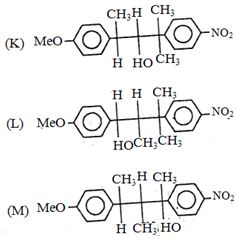
A
$K$ and $L$
B
Only $L$
C
Only $M$
D
$K$ and $M$
Solution
(D) The hydrolysis of the corresponding halide precursor in the presence of acetone typically proceeds via an $S_N1$ mechanism.
In this specific reaction,the carbocation intermediate formed is stabilized by the electron-donating $p$-methoxy group.
The stereochemistry of the product depends on the attack of the nucleophile on the planar carbocation.
Given the structures provided,the reaction leads to the formation of both $K$ and $M$ as diastereomeric products due to the lack of stereospecificity in the $S_N1$ pathway.
In this specific reaction,the carbocation intermediate formed is stabilized by the electron-donating $p$-methoxy group.
The stereochemistry of the product depends on the attack of the nucleophile on the planar carbocation.
Given the structures provided,the reaction leads to the formation of both $K$ and $M$ as diastereomeric products due to the lack of stereospecificity in the $S_N1$ pathway.
0 likes
View Solution180
MediumMCQ
Indicate the correct order of bond energy for the following.
A
$CH_3-F > CH_3-Cl > CH_3-Br > CH_3-I$
B
$CH_3-I > CH_3-Br > CH_3-Cl > CH_3-F$
C
$CH_3-I > CH_3-Cl > CH_3-Br > CH_3-F$
D
$CH_3-F > CH_3-Br > CH_3-I > CH_3-Cl$
Solution
(A) The size of the halogen atom increases from $F$ to $I$.
As the size of the halogen atom increases,the overlap between the carbon and halogen orbitals becomes less effective,leading to a longer and weaker bond.
Therefore,the bond dissociation energy decreases in the order: $CH_3-F > CH_3-Cl > CH_3-Br > CH_3-I$.
As the size of the halogen atom increases,the overlap between the carbon and halogen orbitals becomes less effective,leading to a longer and weaker bond.
Therefore,the bond dissociation energy decreases in the order: $CH_3-F > CH_3-Cl > CH_3-Br > CH_3-I$.
0 likes
View Solution181
DifficultMCQ
$A$ dihalogen derivative '$X$' of a hydrocarbon with three carbon atoms reacts with alcoholic $KOH$ to give another hydrocarbon which forms a red precipitate with ammoniacal $Cu_2Cl_2$. '$X$' gives an aldehyde upon reaction with aqueous $KOH$. What is the compound '$X$'?
A
$1,3$-dichloropropane
B
$1,2$-dichloropropane
C
$2,2$-dichloropropane
D
$1,1$-dichloropropane
Solution
(D) The compound '$X$' has three carbon atoms and reacts with aqueous $KOH$ to form an aldehyde. This indicates that '$X$' is a geminal dihalide at the terminal position,specifically $1,1$-dichloropropane $(CH_3CH_2CHCl_2)$.
Reaction with aqueous $KOH$: $CH_3CH_2CHCl_2 + 2KOH(aq) \rightarrow CH_3CH_2CHO + 2KCl + H_2O$.
Reaction with alcoholic $KOH$: $CH_3CH_2CHCl_2 + 2KOH(alc) \rightarrow CH_3C \equiv CH + 2KCl + 2H_2O$.
The product $CH_3C \equiv CH$ (propyne) is a terminal alkyne,which reacts with ammoniacal $Cu_2Cl_2$ to form a red precipitate of copper$(I)$ propynide $(CH_3C \equiv CCu)$.
Reaction with aqueous $KOH$: $CH_3CH_2CHCl_2 + 2KOH(aq) \rightarrow CH_3CH_2CHO + 2KCl + H_2O$.
Reaction with alcoholic $KOH$: $CH_3CH_2CHCl_2 + 2KOH(alc) \rightarrow CH_3C \equiv CH + 2KCl + 2H_2O$.
The product $CH_3C \equiv CH$ (propyne) is a terminal alkyne,which reacts with ammoniacal $Cu_2Cl_2$ to form a red precipitate of copper$(I)$ propynide $(CH_3C \equiv CCu)$.
0 likes
View Solution182
DifficultMCQ
An isomer of $C_3H_6Cl_2$ gives acetone on heating with aqueous $KOH$. This isomer is .......
A
$2,2$-dichloropropane
B
$1,2$-dichloropropane
C
$1,1$-dichloropropane
D
$1,3$-dichloropropane
Solution
(A) Geminal dihalides (where two halogen atoms are attached to the same carbon atom) on hydrolysis with aqueous $KOH$ followed by dehydration yield carbonyl compounds.
$CH_3-CCl_2-CH_3 + 2KOH(aq) \rightarrow CH_3-C(OH)_2-CH_3 + 2KCl$
$CH_3-C(OH)_2-CH_3 \xrightarrow{-\Delta H_2O} CH_3-CO-CH_3$ (Acetone).
Thus,$2,2$-dichloropropane is the correct isomer.
$CH_3-CCl_2-CH_3 + 2KOH(aq) \rightarrow CH_3-C(OH)_2-CH_3 + 2KCl$
$CH_3-C(OH)_2-CH_3 \xrightarrow{-\Delta H_2O} CH_3-CO-CH_3$ (Acetone).
Thus,$2,2$-dichloropropane is the correct isomer.
0 likes
View Solution183
EasyMCQ
When chloroform is exposed to air and sunlight,it gives ...... .
A
Carbon tetrachloride
B
Carbonyl chloride
C
Mustard gas
D
Lewisite
Solution
(B) When chloroform $(CHCl_3)$ is exposed to air and sunlight,it undergoes oxidation to form a highly poisonous gas called carbonyl chloride $(COCl_2)$,also known as phosgene.
The chemical reaction is:
$2CHCl_3 + O_2 \xrightarrow{\text{Light/Air}} 2COCl_2 + 2HCl$
The chemical reaction is:
$2CHCl_3 + O_2 \xrightarrow{\text{Light/Air}} 2COCl_2 + 2HCl$
0 likes
View Solution184
EasyMCQ
In $E2$ elimination,many substances follow the Hofmann rule,which means.....
A
The double bond is formed at the most substituted position
B
The substance prevents elimination
C
No double bond is formed
D
The double bond is formed towards the less substituted carbon
Solution
(D) The $E2$ elimination reaction typically follows $Zaitsev's$ rule,which favors the formation of the most substituted alkene.
However,the $Hofmann$ rule is the opposite,where the major product is the least substituted alkene.
This occurs due to steric hindrance or electronic factors that make the removal of a proton from the less substituted carbon more favorable.
Therefore,the $Hofmann$ rule means the double bond is formed towards the less substituted carbon.
However,the $Hofmann$ rule is the opposite,where the major product is the least substituted alkene.
This occurs due to steric hindrance or electronic factors that make the removal of a proton from the less substituted carbon more favorable.
Therefore,the $Hofmann$ rule means the double bond is formed towards the less substituted carbon.
0 likes
View Solution185
MediumMCQ
The reaction $(CH_3)_3C - Br + H_2O \rightarrow (CH_3)_3C - OH + HBr$ is an example of which type of reaction?
A
Elimination reaction
B
Free radical substitution
C
Nucleophilic substitution
D
Electrophilic substitution
Solution
(C) In the given reaction,the bromine atom $(-Br)$ is replaced by a hydroxyl group $(-OH)$.
Since the water molecule acts as a nucleophile ($H_2O$ or $OH^-$) attacking the electrophilic carbon center,this is a nucleophilic substitution reaction.
Specifically,this is an $S_N1$ reaction involving the formation of a stable tertiary carbocation intermediate.
Since the water molecule acts as a nucleophile ($H_2O$ or $OH^-$) attacking the electrophilic carbon center,this is a nucleophilic substitution reaction.
Specifically,this is an $S_N1$ reaction involving the formation of a stable tertiary carbocation intermediate.
0 likes
View Solution186
DifficultMCQ
Why is chloroform stored in dark-colored bottles?
A
To prevent evaporation
B
To prevent moisture
C
To prevent the formation of phosgene due to oxidation
D
To prevent reaction with glass
Solution
(C) Chloroform $(CHCl_3)$ is sensitive to light and air. When exposed to light and oxygen,it undergoes slow oxidation to form a highly poisonous gas called phosgene $(COCl_2)$.
The chemical reaction is: $2CHCl_3 + O_2 \xrightarrow{\text{light}} 2COCl_2 + 2HCl$.
To prevent this oxidation,chloroform is stored in dark-colored bottles to block light and filled up to the brim to minimize contact with air.
The chemical reaction is: $2CHCl_3 + O_2 \xrightarrow{\text{light}} 2COCl_2 + 2HCl$.
To prevent this oxidation,chloroform is stored in dark-colored bottles to block light and filled up to the brim to minimize contact with air.
0 likes
View Solution187
DifficultMCQ
$A$ mixture of two organic compounds is treated with sodium metal in an ether solvent to produce isobutane. What are these two chloro compounds?
A
Methyl chloride and propyl chloride
B
Methyl chloride and ethyl chloride
C
Isopropyl chloride and methyl chloride
D
Isopropyl chloride and ethyl chloride
Solution
(C) The reaction of alkyl halides with sodium metal in the presence of dry ether is known as the Wurtz reaction.
To obtain isobutane $(CH_3-CH(CH_3)-CH_3)$,we need to combine a methyl group $(CH_3-)$ and an isopropyl group $(-CH(CH_3)_2)$.
Therefore,the reactants must be methyl chloride $(CH_3Cl)$ and isopropyl chloride $(CH_3-CHCl-CH_3)$.
The reaction is: $CH_3Cl + CH_3-CHCl-CH_3 + 2Na \xrightarrow{\text{dry ether}} CH_3-CH(CH_3)-CH_3 + 2NaCl$.
To obtain isobutane $(CH_3-CH(CH_3)-CH_3)$,we need to combine a methyl group $(CH_3-)$ and an isopropyl group $(-CH(CH_3)_2)$.
Therefore,the reactants must be methyl chloride $(CH_3Cl)$ and isopropyl chloride $(CH_3-CHCl-CH_3)$.
The reaction is: $CH_3Cl + CH_3-CHCl-CH_3 + 2Na \xrightarrow{\text{dry ether}} CH_3-CH(CH_3)-CH_3 + 2NaCl$.
0 likes
View Solution188
MediumMCQ
Which compound produces acetaldehyde upon heating with aqueous $KOH$?
A
$CH_2ClCH_2Cl$
B
$CH_3CHCl_2$
C
$CH_3COCl$
D
$CH_3CH_2Cl$
Solution
(B) When $CH_3CHCl_2$ ($1$,$1$-dichloroethane) is treated with aqueous $KOH$,it undergoes nucleophilic substitution to form a geminal diol,$CH_3CH(OH)_2$.
Since geminal diols are unstable,they immediately lose a water molecule to form acetaldehyde $(CH_3CHO)$.
The reaction is: $CH_3CHCl_2 + 2KOH(aq)$ $\rightarrow CH_3CH(OH)_2 + 2KCl$ $\rightarrow CH_3CHO + H_2O + 2KCl$.
Since geminal diols are unstable,they immediately lose a water molecule to form acetaldehyde $(CH_3CHO)$.
The reaction is: $CH_3CHCl_2 + 2KOH(aq)$ $\rightarrow CH_3CH(OH)_2 + 2KCl$ $\rightarrow CH_3CHO + H_2O + 2KCl$.
0 likes
View Solution189
MediumMCQ
Which of the following compounds is most reactive towards $S_N1$ reaction?
A
$PhCH_2Cl$
B
$PhCl$
C
$PhCHCl(CH_3)$
D
$p-NO_2PhCH_2Cl$
Solution
(C) The reactivity towards $S_N1$ reaction depends on the stability of the carbocation intermediate formed during the rate-determining step.
In $PhCHCl(CH_3)$,the carbocation formed is $Ph-CH^+-CH_3$,which is a secondary benzylic carbocation.
This carbocation is stabilized by both the phenyl ring (resonance) and the inductive effect of the methyl group.
Comparing the options,$PhCHCl(CH_3)$ forms the most stable carbocation,making it the most reactive towards $S_N1$.
In $PhCHCl(CH_3)$,the carbocation formed is $Ph-CH^+-CH_3$,which is a secondary benzylic carbocation.
This carbocation is stabilized by both the phenyl ring (resonance) and the inductive effect of the methyl group.
Comparing the options,$PhCHCl(CH_3)$ forms the most stable carbocation,making it the most reactive towards $S_N1$.
0 likes
View Solution190
MediumMCQ
$A$ solution of $1$-chloro-$1$-phenylethane in toluene undergoes direct racemization in the presence of a small amount of $SbCl_5$ due to the formation of:
A
Carbanion
B
Carbene
C
Carbocation
D
Free radical
Solution
(C) The reaction involves the ionization of $1$-chloro-$1$-phenylethane in the presence of the Lewis acid $SbCl_5$.
$SbCl_5$ acts as a catalyst by abstracting the chloride ion to form a stable planar carbocation intermediate: $C_6H_5-CH^+(CH_3)$.
Since the carbocation is $sp^2$ hybridized and planar,the nucleophile (chloride ion) can attack from either side with equal probability,leading to the formation of a racemic mixture.
Therefore,the racemization occurs due to the formation of a carbocation.
$SbCl_5$ acts as a catalyst by abstracting the chloride ion to form a stable planar carbocation intermediate: $C_6H_5-CH^+(CH_3)$.
Since the carbocation is $sp^2$ hybridized and planar,the nucleophile (chloride ion) can attack from either side with equal probability,leading to the formation of a racemic mixture.
Therefore,the racemization occurs due to the formation of a carbocation.
0 likes
View Solution191
DifficultMCQ
Which of the following undergoes $S_{N^{1}}$ reaction?
A
$(CH_3)_3C-Cl + KOH \rightarrow$
B
$CH_3CH_2-Cl + KOH \rightarrow$
C
$C_6H_5-Cl + KOH \rightarrow$
D
$C_6H_5CH_2CH_2-Cl + KOH \rightarrow$
Solution
(A) $S_{N^{1}}$ reactions proceed via the formation of a carbocation intermediate. The stability of the carbocation determines the rate of the reaction. Tertiary $(3^{\circ})$ carbocations are the most stable due to the inductive effect and hyperconjugation of the three alkyl groups. In the reaction of $(CH_3)_3C-Cl$ with $KOH$,the rate-determining step involves the formation of a stable tertiary carbocation,$(CH_3)_3C^{\oplus}$. Therefore,$(CH_3)_3C-Cl$ readily undergoes $S_{N^{1}}$ reaction.
0 likes
View Solution192
MediumMCQ
The reaction of vinyl chloride with $HCl$ yields ...... .
A
$1,1$-dichloroethane
B
$1,2$-dichloroethane
C
Tetrachloroethylene
D
$A$ mixture of $1,1$- and $1,2$-dichloroethane
Solution
(A) The reaction follows Markovnikov's rule,where the electrophile $H^+$ adds to the carbon atom with more hydrogen atoms.
$CH_2=CH-Cl + HCl \rightarrow CH_3-CHCl_2$
Thus,the product formed is $1,1$-dichloroethane (ethylidene chloride).
$CH_2=CH-Cl + HCl \rightarrow CH_3-CHCl_2$
Thus,the product formed is $1,1$-dichloroethane (ethylidene chloride).
0 likes
View Solution193
MediumMCQ
What is produced when toluene is heated with chlorine in the presence of light and in the absence of a halogen carrier?
A
$C_6H_5CH_2Cl$
B
$C_6H_5CHCl_2$
C
$C_6H_5CCl_3$
D
Gammexane
Solution
(A) When toluene $(C_6H_5CH_3)$ reacts with chlorine $(Cl_2)$ in the presence of sunlight (ultraviolet light) and in the absence of a halogen carrier (like $FeCl_3$),the reaction proceeds via a free radical mechanism.
This leads to the substitution of hydrogen atoms on the side-chain methyl group rather than the benzene ring.
The reaction proceeds as follows:
$C_6H_5CH_3 + Cl_2 \xrightarrow{h\nu} C_6H_5CH_2Cl + HCl$ (Benzyl chloride).
Further chlorination can lead to benzal chloride $(C_6H_5CHCl_2)$ and benzotrichloride $(C_6H_5CCl_3)$.
However,the primary product formed under controlled conditions is benzyl chloride $(C_6H_5CH_2Cl)$.
This leads to the substitution of hydrogen atoms on the side-chain methyl group rather than the benzene ring.
The reaction proceeds as follows:
$C_6H_5CH_3 + Cl_2 \xrightarrow{h\nu} C_6H_5CH_2Cl + HCl$ (Benzyl chloride).
Further chlorination can lead to benzal chloride $(C_6H_5CHCl_2)$ and benzotrichloride $(C_6H_5CCl_3)$.
However,the primary product formed under controlled conditions is benzyl chloride $(C_6H_5CH_2Cl)$.
0 likes
View Solution194
EasyMCQ
The reaction for the preparation of ethene from ethyl chloride is known as......
A
$\beta$-elimination
B
Both $(c)$ and $(d)$
C
Dehydrogenation
D
Dehydrohalogenation
Solution
(B) The reaction of ethyl chloride $(CH_3CH_2Cl)$ with alcoholic $KOH$ leads to the formation of ethene $(CH_2=CH_2)$.
This reaction involves the removal of a hydrogen atom from the $\beta$-carbon and a chlorine atom from the $\alpha$-carbon,hence it is called $\beta$-elimination.
Since a hydrogen atom and a halogen atom are removed,it is also known as dehydrohalogenation.
Therefore,both $(a)$ and $(d)$ are correct descriptions,but given the options,$(b)$ is the most appropriate choice.
This reaction involves the removal of a hydrogen atom from the $\beta$-carbon and a chlorine atom from the $\alpha$-carbon,hence it is called $\beta$-elimination.
Since a hydrogen atom and a halogen atom are removed,it is also known as dehydrohalogenation.
Therefore,both $(a)$ and $(d)$ are correct descriptions,but given the options,$(b)$ is the most appropriate choice.
0 likes
View Solution195
DifficultMCQ
What is formed when $1$-bromo-$3$-chlorocyclobutane is treated with $2$ equivalents of sodium in ether?
A
Bicyclobutane
B
Cyclobutane
C
$1,3-$dimethylcyclobutane
D
None of these
Solution
(A) The reaction of a dihaloalkane with sodium in ether is an intramolecular Wurtz reaction.
In $1$-bromo-$3$-chlorocyclobutane,the halogen atoms are at positions $1$ and $3$.
When treated with $2$ equivalents of sodium,the sodium atoms remove the halogen atoms,leading to the formation of a new carbon-carbon bond between the $1$ and $3$ positions.
This results in the formation of bicyclo[$1.1.0$]butane.
Thus,the correct product is bicyclobutane.
In $1$-bromo-$3$-chlorocyclobutane,the halogen atoms are at positions $1$ and $3$.
When treated with $2$ equivalents of sodium,the sodium atoms remove the halogen atoms,leading to the formation of a new carbon-carbon bond between the $1$ and $3$ positions.
This results in the formation of bicyclo[$1.1.0$]butane.
Thus,the correct product is bicyclobutane.
0 likes
View Solution196
MediumMCQ
$CH_3CH_2CH_2OH$ $\xrightarrow{PCl_5} A$ $\xrightarrow{\text{alcoholic } KOH} B$. The final product $B$ is ...... .
A
Propanal
B
Propane
C
Propyne
D
Propene
Solution
(D) Step $1$: The reaction of propan$-1-$ol with $PCl_5$ is a nucleophilic substitution reaction where the hydroxyl group is replaced by a chlorine atom.
$CH_3CH_2CH_2OH + PCl_5 \rightarrow CH_3CH_2CH_2Cl (A) + POCl_3 + HCl$.
Step $2$: The reaction of $A$ ($1$-chloropropane) with alcoholic $KOH$ is a dehydrohalogenation reaction (elimination reaction),which results in the formation of an alkene.
$CH_3CH_2CH_2Cl + KOH (\text{alc.}) \rightarrow CH_3CH=CH_2 (B) + KCl + H_2O$.
Thus,the final product $B$ is propene.
$CH_3CH_2CH_2OH + PCl_5 \rightarrow CH_3CH_2CH_2Cl (A) + POCl_3 + HCl$.
Step $2$: The reaction of $A$ ($1$-chloropropane) with alcoholic $KOH$ is a dehydrohalogenation reaction (elimination reaction),which results in the formation of an alkene.
$CH_3CH_2CH_2Cl + KOH (\text{alc.}) \rightarrow CH_3CH=CH_2 (B) + KCl + H_2O$.
Thus,the final product $B$ is propene.
0 likes
View Solution197
DifficultMCQ
What is the product formed by the addition of $HCl$ to $1$-phenylpropene?
A
$C_6H_5CHClCH_2CH_3$
B
$C_6H_5CH_2CHClCH_3$
C
$C_6H_5CH_2CH_2CH_2Cl$
D
$C_6H_5CH(CH_3)CH_2Cl$
Solution
(A) The reaction is the electrophilic addition of $HCl$ to $1$-phenylpropene $(C_6H_5-CH=CH-CH_3)$.
According to Markovnikov's rule,the $H^+$ ion attaches to the carbon atom with more hydrogen atoms,and the $Cl^-$ ion attaches to the carbon atom with fewer hydrogen atoms.
However,the stability of the intermediate carbocation is the deciding factor.
The addition of $H^+$ to the $C_2$ position (the carbon adjacent to the phenyl ring) forms a resonance-stabilized benzylic carbocation: $C_6H_5-CH^+-CH_2-CH_3$.
The $Cl^-$ ion then attacks this carbocation to form $1$-phenyl-$1$-chloropropane,which is $C_6H_5CHClCH_2CH_3$.
According to Markovnikov's rule,the $H^+$ ion attaches to the carbon atom with more hydrogen atoms,and the $Cl^-$ ion attaches to the carbon atom with fewer hydrogen atoms.
However,the stability of the intermediate carbocation is the deciding factor.
The addition of $H^+$ to the $C_2$ position (the carbon adjacent to the phenyl ring) forms a resonance-stabilized benzylic carbocation: $C_6H_5-CH^+-CH_2-CH_3$.
The $Cl^-$ ion then attacks this carbocation to form $1$-phenyl-$1$-chloropropane,which is $C_6H_5CHClCH_2CH_3$.
0 likes
View Solution198
MediumMCQ
What is the product formed by the monochlorination of ethylbenzene with $Cl_2$ in the presence of heat?
A
$PhCH_2CH_2Cl$
B
$PhCHClCH_3$
C
Both $(a)$ and $(b)$ in equal amounts
D
$(b)$ is major and $(a)$ is minor
Solution
(D) The reaction of ethylbenzene with $Cl_2$ in the presence of heat (or $UV$ light) proceeds via a free radical mechanism.
The hydrogen atom is abstracted from the benzylic position because the resulting benzylic radical is stabilized by resonance with the benzene ring.
The intermediate formed is $Phdot{C}HCH_3$.
Subsequent reaction with $Cl_2$ yields $PhCHClCH_3$ as the major product.
The primary radical $Phdot{C}H_2CH_2$ is less stable,making $PhCH_2CH_2Cl$ the minor product.
The hydrogen atom is abstracted from the benzylic position because the resulting benzylic radical is stabilized by resonance with the benzene ring.
The intermediate formed is $Phdot{C}HCH_3$.
Subsequent reaction with $Cl_2$ yields $PhCHClCH_3$ as the major product.
The primary radical $Phdot{C}H_2CH_2$ is less stable,making $PhCH_2CH_2Cl$ the minor product.
0 likes
View Solution199
MediumMCQ
What is the product formed by the reaction of $C_6H_5CH = CHCH_3$ with $HBr$?
A
$C_6H_5CH(Br)CH_2CH_3$
B
$C_6H_5CH_2CH(Br)CH_3$
C
$C_6H_5CH_2CH_2CH_2Br$
D
$A$ mixture of these
Solution
(A) The reaction of $C_6H_5CH = CHCH_3$ with $HBr$ follows Markovnikov's rule.
In this reaction,the electrophile $H^+$ attacks the double bond to form the most stable carbocation.
The carbocation formed is $C_6H_5CH^+ - CH_2CH_3$,which is a benzylic carbocation stabilized by resonance with the phenyl ring.
Subsequently,the nucleophile $Br^-$ attacks this carbocation to form the product $C_6H_5CH(Br)CH_2CH_3$.
Thus,the correct option is $A$.
In this reaction,the electrophile $H^+$ attacks the double bond to form the most stable carbocation.
The carbocation formed is $C_6H_5CH^+ - CH_2CH_3$,which is a benzylic carbocation stabilized by resonance with the phenyl ring.
Subsequently,the nucleophile $Br^-$ attacks this carbocation to form the product $C_6H_5CH(Br)CH_2CH_3$.
Thus,the correct option is $A$.
0 likes
View Solution200
MediumMCQ
What is formed when toluene reacts with chlorine in the presence of light?
A
Benzyl chloride
B
Benzyl alcohol
C
$p$-Chlorotoluene
D
$o$-Chlorotoluene
Solution
(A) In the presence of light $(h\nu)$,toluene undergoes free radical substitution at the benzylic position to form benzyl chloride $(C_6H_5CH_2Cl)$.
0 likes
View SolutionHaloalkanes and Haloarenes — Properties of Haloalkanes · Frequently Asked Questions
1Are these Haloalkanes and Haloarenes questions useful for JEE and NEET?
Yes. All questions in this section are mapped to JEE Main and NEET exam patterns. Previous year questions from JEE Main, NEET, GUJCET and state-level exams are included with full solutions.
2Can I switch to Hindi or Gujarati for these questions?
Yes. Use the language tabs in the hero section or the sidebar to view the same questions and solutions in English, Hindi or Gujarati.
3How do I generate a question paper from this subtopic?
Use the Vedclass Exam Paper Generator — select the chapter and subtopic, set difficulty, and generate Sets A, B, C, D automatically. First 3 chapters of every subject are free.
Vedclass Products
For Students
Vedclass Test Series
Mock tests in real JEE/NEET style with performance analysis. 5-day free trial.
Start Free TrialFor Teachers
Exam Paper Generator
Generate Set A/B/C/D papers from this chapter in 2 minutes. 3 chapters free.
Try FreeFor Institutes
Online Exam Module
Live online exams with unlimited students, 360° analytics & white-label branding.
See DemoFor Teachers & Institutes
Generate a Haloalkanes and Haloarenes Exam Paper in 2 Minutes
Select subtopic & difficulty — Sets A, B, C, D auto-generated with No Repeat logic.
First 3 chapters of every subject are free — no payment required.