
A English
Properties of alcohol Questions in English
Class 12 Chemistry · Alcohols, Phenols and Ethers · Properties of alcohol
889+
Questions
English
Language
100%
With Solutions
Showing 50 of 889 questions in English
601
Advanced
Provide the reactions of alcohols and phenols where the $O-H$ bond breaks to form $-OCOR$ (ester) compounds.
Solution
(N/A) Esterification: The reaction of alcohols and phenols with carboxylic acids,acid chlorides,and acid anhydrides to form esters is known as esterification.
$(i)$ Reaction of alcohol/phenol with acid $(R'COOH)$: This is an esterification reaction where the $O-H$ bond breaks.
$(ii)$ Reaction of alcohol/phenol with acid anhydride: In this reaction,the $O-H$ bond of the alcohol or phenol breaks to form $-OCOR'$. This reaction is carried out in the presence of a small amount of concentrated sulfuric acid and is reversible.
$(iii)$ Reaction of alcohol/phenol with acid chloride $(R'COCl)$: In this reaction,the $O-H$ bond breaks to form $-OCOR'$. This reaction is carried out in the presence of a base,pyridine,to neutralize the $HCl$ formed,which shifts the equilibrium to the right (product side).
$(b)$ Acetylation: Acetylation is a type of esterification where the $-OH$ group is converted into $-COCH_3$. It involves the introduction of an acetyl group $(CH_3CO-)$ into alcohols and phenols. Acetylation of salicylic acid produces aspirin,which is a drug with analgesic,anti-inflammatory,and antipyretic properties.
$(i)$ Reaction of alcohol/phenol with acid $(R'COOH)$: This is an esterification reaction where the $O-H$ bond breaks.
$(ii)$ Reaction of alcohol/phenol with acid anhydride: In this reaction,the $O-H$ bond of the alcohol or phenol breaks to form $-OCOR'$. This reaction is carried out in the presence of a small amount of concentrated sulfuric acid and is reversible.
$(iii)$ Reaction of alcohol/phenol with acid chloride $(R'COCl)$: In this reaction,the $O-H$ bond breaks to form $-OCOR'$. This reaction is carried out in the presence of a base,pyridine,to neutralize the $HCl$ formed,which shifts the equilibrium to the right (product side).
$(b)$ Acetylation: Acetylation is a type of esterification where the $-OH$ group is converted into $-COCH_3$. It involves the introduction of an acetyl group $(CH_3CO-)$ into alcohols and phenols. Acetylation of salicylic acid produces aspirin,which is a drug with analgesic,anti-inflammatory,and antipyretic properties.
0 likes
View Solution602
Medium
What is esterification? Explain with examples.
Solution
(N/A) Esterification: The reaction of alcohols and phenols with carboxylic acids,acid chlorides,and acid anhydrides to form esters is known as esterification.
$(i)$ Reaction of alcohols/phenols with carboxylic acids $(R'COOH)$: This reaction involves the cleavage of the $O-H$ bond of the alcohol or phenol.
$(ii)$ Reaction of alcohols/phenols with acid anhydrides: In this reaction,the $O-H$ bond of the alcohol or phenol breaks to form $-OCOR'$. This reaction is carried out in the presence of a small amount of concentrated $H_2SO_4$ and is reversible.
$(iii)$ Reaction of alcohols/phenols with acid chlorides $(R'COCl)$: In this reaction,the $O-H$ bond breaks to form $-OCOR'$. This reaction is carried out in the presence of a base like pyridine to neutralize the $HCl$ produced,which shifts the equilibrium to the right (product side).
$(b)$ Acetylation: Acetylation is a specific type of esterification where the $-OH$ group is converted into $-COCH_3$. It involves the introduction of an acetyl group $(CH_3CO-)$ into alcohols and phenols. Acetylation of salicylic acid produces aspirin,which is a well-known analgesic,anti-inflammatory,and antipyretic drug.
$(i)$ Reaction of alcohols/phenols with carboxylic acids $(R'COOH)$: This reaction involves the cleavage of the $O-H$ bond of the alcohol or phenol.
$(ii)$ Reaction of alcohols/phenols with acid anhydrides: In this reaction,the $O-H$ bond of the alcohol or phenol breaks to form $-OCOR'$. This reaction is carried out in the presence of a small amount of concentrated $H_2SO_4$ and is reversible.
$(iii)$ Reaction of alcohols/phenols with acid chlorides $(R'COCl)$: In this reaction,the $O-H$ bond breaks to form $-OCOR'$. This reaction is carried out in the presence of a base like pyridine to neutralize the $HCl$ produced,which shifts the equilibrium to the right (product side).
$(b)$ Acetylation: Acetylation is a specific type of esterification where the $-OH$ group is converted into $-COCH_3$. It involves the introduction of an acetyl group $(CH_3CO-)$ into alcohols and phenols. Acetylation of salicylic acid produces aspirin,which is a well-known analgesic,anti-inflammatory,and antipyretic drug.
0 likes
View Solution603
Medium
Explain the reactions of alcohol compounds involving the cleavage of the $C-O$ bond.
Solution
(N/A) Reactions involving the cleavage of the $C-O$ bond occur in alcohols. In phenols,the $C-O$ bond cleavage only occurs upon heating with zinc dust.
$(a)$ Reaction of alcohols with $HX$ (hydrogen halides) and Lucas test:
$(i)$ Alcohols react with hydrogen halides $(HX)$ to form alkyl halides.
$R-OH + HX \rightarrow R-X + H_2O$
In this reaction,the $C-O$ bond is broken,a $C-X$ bond is formed,and the $-OH$ group is removed. This reaction proceeds via nucleophilic substitution mechanisms ($S_N1$ and $S_N2$).
The order of reactivity of hydrogen halides $(HX)$ with alcohols is $3^{\circ} > 2^{\circ} > 1^{\circ}$.
$(ii)$ Alkyl bromides are formed by heating alcohols with $48\% \ HBr$.
$(iii)$ Reaction with $HCl$ (Lucas test):
The catalyst $ZnCl_2$ is required for the reaction of primary and secondary alcohols with $HCl$. The Lucas reagent is a mixture of concentrated $HCl$ and $ZnCl_2$. $1^{\circ}, 2^{\circ},$ and $3^{\circ}$ alcohols can be distinguished using the Lucas test.
Alcohols are soluble in the Lucas reagent,but the resulting alkyl halides are immiscible,causing turbidity in the solution.
Tertiary alcohols react immediately with the Lucas reagent to form alkyl halides,causing immediate turbidity and the formation of a separate layer.
Secondary alcohols react slowly with the Lucas reagent,producing turbidity after some time,followed by the formation of a separate layer.
Primary alcohols do not react with the Lucas reagent at room temperature,so no turbidity or separate layer is observed for a long time.
Thus,the reactivity order of alcohols is $3^{\circ} > 2^{\circ} > 1^{\circ}$,allowing for the identification of $3^{\circ}, 2^{\circ},$ and $1^{\circ}$ alcohols using the Lucas test.
$(a)$ Reaction of alcohols with $HX$ (hydrogen halides) and Lucas test:
$(i)$ Alcohols react with hydrogen halides $(HX)$ to form alkyl halides.
$R-OH + HX \rightarrow R-X + H_2O$
In this reaction,the $C-O$ bond is broken,a $C-X$ bond is formed,and the $-OH$ group is removed. This reaction proceeds via nucleophilic substitution mechanisms ($S_N1$ and $S_N2$).
The order of reactivity of hydrogen halides $(HX)$ with alcohols is $3^{\circ} > 2^{\circ} > 1^{\circ}$.
$(ii)$ Alkyl bromides are formed by heating alcohols with $48\% \ HBr$.
$(iii)$ Reaction with $HCl$ (Lucas test):
The catalyst $ZnCl_2$ is required for the reaction of primary and secondary alcohols with $HCl$. The Lucas reagent is a mixture of concentrated $HCl$ and $ZnCl_2$. $1^{\circ}, 2^{\circ},$ and $3^{\circ}$ alcohols can be distinguished using the Lucas test.
Alcohols are soluble in the Lucas reagent,but the resulting alkyl halides are immiscible,causing turbidity in the solution.
Tertiary alcohols react immediately with the Lucas reagent to form alkyl halides,causing immediate turbidity and the formation of a separate layer.
Secondary alcohols react slowly with the Lucas reagent,producing turbidity after some time,followed by the formation of a separate layer.
Primary alcohols do not react with the Lucas reagent at room temperature,so no turbidity or separate layer is observed for a long time.
Thus,the reactivity order of alcohols is $3^{\circ} > 2^{\circ} > 1^{\circ}$,allowing for the identification of $3^{\circ}, 2^{\circ},$ and $1^{\circ}$ alcohols using the Lucas test.
0 likes
View Solution604
Medium
Describe the reactions of alcohols with $(a)$ $HX$ and Lucas test,$(b)$ $PX_3$,and $(c)$ dehydration reactions.
Solution
(N/A) Reactions involving the cleavage of $C-O$ bond in alcohols:
$(a)$ Reaction with $HX$ and Lucas test:
$(i)$ Alcohols react with hydrogen halides $(HX)$ to form alkyl halides: $R-OH + HX \rightarrow R-X + H_2O$.
The reactivity order of $HX$ with alcohols is $3^{\circ} > 2^{\circ} > 1^{\circ}$.
$(ii)$ Lucas test: The reaction of alcohols with concentrated $HCl$ in the presence of anhydrous $ZnCl_2$ is known as the Lucas test.
$3^{\circ}$ alcohols react immediately to form turbidity.
$2^{\circ}$ alcohols form turbidity within $5-10$ minutes.
$1^{\circ}$ alcohols do not react at room temperature.
$(b)$ Reaction with $PX_3$:
Alcohols react with phosphorus trihalides ($PX_3$,where $X = Cl, Br$) to form alkyl halides: $3R-OH + PX_3 \rightarrow 3R-X + H_3PO_3$.
$(c)$ Dehydration reactions:
Alcohols undergo dehydration in the presence of acid catalysts (like conc. $H_2SO_4$ or $H_3PO_4$) to form alkenes.
The ease of dehydration follows the order: $3^{\circ} > 2^{\circ} > 1^{\circ}$.
$(a)$ Reaction with $HX$ and Lucas test:
$(i)$ Alcohols react with hydrogen halides $(HX)$ to form alkyl halides: $R-OH + HX \rightarrow R-X + H_2O$.
The reactivity order of $HX$ with alcohols is $3^{\circ} > 2^{\circ} > 1^{\circ}$.
$(ii)$ Lucas test: The reaction of alcohols with concentrated $HCl$ in the presence of anhydrous $ZnCl_2$ is known as the Lucas test.
$3^{\circ}$ alcohols react immediately to form turbidity.
$2^{\circ}$ alcohols form turbidity within $5-10$ minutes.
$1^{\circ}$ alcohols do not react at room temperature.
$(b)$ Reaction with $PX_3$:
Alcohols react with phosphorus trihalides ($PX_3$,where $X = Cl, Br$) to form alkyl halides: $3R-OH + PX_3 \rightarrow 3R-X + H_3PO_3$.
$(c)$ Dehydration reactions:
Alcohols undergo dehydration in the presence of acid catalysts (like conc. $H_2SO_4$ or $H_3PO_4$) to form alkenes.
The ease of dehydration follows the order: $3^{\circ} > 2^{\circ} > 1^{\circ}$.
0 likes
View Solution605
Medium
Write the mechanism of the acid dehydration of ethanol to yield ethene.
Solution
(N/A) The dehydration of ethanol to ethene proceeds via a $\beta$-elimination mechanism in three steps:
Step-$1$: Protonation of ethanol to form ethyl oxonium ion.
$CH_3CH_2OH + H^+ \rightleftharpoons CH_3CH_2OH_2^+$
Step-$2$: Formation of carbocation. This is the slow,rate-determining step where the $C-O$ bond breaks and water is eliminated.
$CH_3CH_2OH_2^+ \rightleftharpoons CH_3CH_2^+ + H_2O$
Step-$3$: Formation of ethene by elimination of a proton. The carbocation loses a $\beta$-proton to form ethene.
$CH_3CH_2^+ \rightleftharpoons CH_2=CH_2 + H^+$
Step-$1$: Protonation of ethanol to form ethyl oxonium ion.
$CH_3CH_2OH + H^+ \rightleftharpoons CH_3CH_2OH_2^+$
Step-$2$: Formation of carbocation. This is the slow,rate-determining step where the $C-O$ bond breaks and water is eliminated.
$CH_3CH_2OH_2^+ \rightleftharpoons CH_3CH_2^+ + H_2O$
Step-$3$: Formation of ethene by elimination of a proton. The carbocation loses a $\beta$-proton to form ethene.
$CH_3CH_2^+ \rightleftharpoons CH_2=CH_2 + H^+$
0 likes
View Solution606
Difficult
Explain the mechanism of dehydration of alcohols with a suitable example.
Solution
(N/A) $(i)$ Dehydration of alcohols occurs by heating them in the presence of protic acids like concentrated $H_2SO_4$ or $H_3PO_4$ or catalysts like anhydrous $ZnCl_2$ or alumina to form alkenes.
$CH_3CH_2OH \xrightarrow{\text{conc. } H_2SO_4} CH_2=CH_2 + H_2O$
$(ii)$ The dehydration of ethanol proceeds in three steps via a $\beta$-elimination mechanism.
Step-$1$: Protonation of alcohol. The proton $(H^+)$ from the acid attacks the $-OH$ group of the alcohol to form an oxonium ion $(-OH_2^+)$.
Step-$2$: Formation of carbocation. The $C-O$ bond breaks,releasing $H_2O$ and forming a carbocation. This is the slow and rate-determining step.
Step-$3$: Formation of ethene. $A$ $\beta$-proton is eliminated from the carbocation to form ethene. The $H^+$ used in Step-$1$ is released,regenerating the acid catalyst.
$CH_3CH_2OH \xrightarrow{\text{conc. } H_2SO_4} CH_2=CH_2 + H_2O$
$(ii)$ The dehydration of ethanol proceeds in three steps via a $\beta$-elimination mechanism.
Step-$1$: Protonation of alcohol. The proton $(H^+)$ from the acid attacks the $-OH$ group of the alcohol to form an oxonium ion $(-OH_2^+)$.
Step-$2$: Formation of carbocation. The $C-O$ bond breaks,releasing $H_2O$ and forming a carbocation. This is the slow and rate-determining step.
Step-$3$: Formation of ethene. $A$ $\beta$-proton is eliminated from the carbocation to form ethene. The $H^+$ used in Step-$1$ is released,regenerating the acid catalyst.
0 likes
View Solution607
Medium
Write about the oxidation of alcohols.
Solution
(N/A) Oxidation: The oxidation of alcohols involves the breaking of $C-H$ and $O-H$ bonds to form a carbon-oxygen double bond $(C=O)$.
Oxidation/Dehydrogenation: In this process,$C-H$ and $O-H$ bonds are broken and dihydrogen $(H_2)$ is released,which is why this process is called dehydrogenation.
The products of oxidation depend on the oxidizing agents used and the type of alcohol.
$(b)$ Oxidation of primary alcohols: Depending on the oxidizing agent used,$1^{\circ}$ alcohols are oxidized to aldehydes,which are further oxidized to carboxylic acids.
$(i)$ $1^{\circ}$-Alcohol $\rightarrow$ Carboxylic acid: Strong oxidizing agents like potassium permanganate $(KMnO_4)$ are used to obtain carboxylic acids directly from $1^{\circ}$-alcohol compounds.
Oxidation/Dehydrogenation: In this process,$C-H$ and $O-H$ bonds are broken and dihydrogen $(H_2)$ is released,which is why this process is called dehydrogenation.
The products of oxidation depend on the oxidizing agents used and the type of alcohol.
$(b)$ Oxidation of primary alcohols: Depending on the oxidizing agent used,$1^{\circ}$ alcohols are oxidized to aldehydes,which are further oxidized to carboxylic acids.
$(i)$ $1^{\circ}$-Alcohol $\rightarrow$ Carboxylic acid: Strong oxidizing agents like potassium permanganate $(KMnO_4)$ are used to obtain carboxylic acids directly from $1^{\circ}$-alcohol compounds.
0 likes
View Solution608
Difficult
Explain the reactions of alcohols involving the cleavage of $C-H$ and $O-H$ bonds with examples.
Solution
(N/A) Oxidation: The oxidation of alcohols involves the breaking of $O-H$ and $C-H$ bonds,leading to the formation of a carbon-oxygen double bond $(C=O)$.
Dehydrogenation: In this process,$C-H$ and $O-H$ bonds are broken,and dihydrogen $(H_2)$ is released; hence,these are called dehydrogenation reactions.
The products of oxidation depend on the oxidizing agents used and the type of alcohol.
$(b)$ Oxidation of primary alcohols: Depending on the oxidizing agent used,$1^{\circ}$ alcohols are oxidized to aldehydes,which are further oxidized to carboxylic acids.
$(i)$ $1^{\circ}$-Alcohol $\rightarrow$ Carboxylic acid: Strong oxidizing agents like potassium permanganate $(KMnO_4)$ are used to obtain carboxylic acids directly from $1^{\circ}$-alcohols.
Dehydrogenation: In this process,$C-H$ and $O-H$ bonds are broken,and dihydrogen $(H_2)$ is released; hence,these are called dehydrogenation reactions.
The products of oxidation depend on the oxidizing agents used and the type of alcohol.
$(b)$ Oxidation of primary alcohols: Depending on the oxidizing agent used,$1^{\circ}$ alcohols are oxidized to aldehydes,which are further oxidized to carboxylic acids.
$(i)$ $1^{\circ}$-Alcohol $\rightarrow$ Carboxylic acid: Strong oxidizing agents like potassium permanganate $(KMnO_4)$ are used to obtain carboxylic acids directly from $1^{\circ}$-alcohols.
0 likes
View Solution609
Medium
Explain the oxidation of $1^o$,$2^o$,and $3^o$ alcohols with examples.
Solution
(N/A) Oxidation: Oxidation of alcohols involves the breaking of $O-H$ and $C-H$ bonds to form a carbon-oxygen double bond $(C=O)$.
$(b)$ Dehydrogenation: In this process,$C-H$ and $O-H$ bonds break to release dihydrogen $(H_2)$,hence it is called a dehydrogenation reaction.
$(c)$ Oxidation of $1^o$ alcohols: $1^o$ alcohols are oxidized to aldehydes,which are further oxidized to carboxylic acids using strong oxidizing agents like $KMnO_4$.
$(d)$ Oxidation of $2^o$ alcohols: $2^o$ alcohols are oxidized to ketones using oxidizing agents like $CrO_3$.
$(e)$ Oxidation of $3^o$ alcohols: $3^o$ alcohols are resistant to oxidation under normal conditions but undergo dehydration to form alkenes in the presence of hot concentrated $H_2SO_4$ or by heating with copper at $573 K$.
$(b)$ Dehydrogenation: In this process,$C-H$ and $O-H$ bonds break to release dihydrogen $(H_2)$,hence it is called a dehydrogenation reaction.
$(c)$ Oxidation of $1^o$ alcohols: $1^o$ alcohols are oxidized to aldehydes,which are further oxidized to carboxylic acids using strong oxidizing agents like $KMnO_4$.
$(d)$ Oxidation of $2^o$ alcohols: $2^o$ alcohols are oxidized to ketones using oxidizing agents like $CrO_3$.
$(e)$ Oxidation of $3^o$ alcohols: $3^o$ alcohols are resistant to oxidation under normal conditions but undergo dehydration to form alkenes in the presence of hot concentrated $H_2SO_4$ or by heating with copper at $573 K$.
0 likes
View Solution610
Medium
Explain the effects and remedies when an alcoholic consumes denatured alcohol.
Solution
(N/A) Denatured alcohol is ethanol $\left( C _{2} H _{5} OH \right)$ mixed with methanol $\left( CH _{3} OH \right)$.
Effects: When a person consumes denatured alcohol,methanol is oxidized in the body to methanal $\left( HCHO \right)$ and subsequently to methanoic acid $\left( HCOOH \right)$. This process causes severe toxicity,leading to blindness and potentially death.
Remedies: The treatment for methanol poisoning involves the intravenous administration of diluted ethanol. Ethanol acts as a competitive inhibitor for the enzyme responsible for the oxidation of methanol. This allows the body time to excrete the methanol through the kidneys,thereby preventing the formation of toxic methanoic acid and saving the patient.
Effects: When a person consumes denatured alcohol,methanol is oxidized in the body to methanal $\left( HCHO \right)$ and subsequently to methanoic acid $\left( HCOOH \right)$. This process causes severe toxicity,leading to blindness and potentially death.
Remedies: The treatment for methanol poisoning involves the intravenous administration of diluted ethanol. Ethanol acts as a competitive inhibitor for the enzyme responsible for the oxidation of methanol. This allows the body time to excrete the methanol through the kidneys,thereby preventing the formation of toxic methanoic acid and saving the patient.
0 likes
View Solution611
Medium
Explain the side effects of consuming denatured alcohol and its remedies.
Solution
(N/A) Methanol is $CH_3OH$,while ethanol is $C_2H_5OH$. Both undergo biological oxidation to form their corresponding aldehydes $(HCHO, CH_3CHO)$ and subsequently acids $(HCOOH, CH_3COOH)$.
Side Effects: Denatured alcohol is ethanol mixed with methanol. If an addict consumes denatured alcohol,methanol is first converted into methanal and then into methanoic acid. This can lead to blindness and death.
Remedies: $A$ patient suffering from the toxic effects of methanol consumption is treated by intravenous administration of dilute ethanol. The enzyme responsible for the oxidation of aldehyde $(HCHO)$ to acid is inhibited by ethanol,allowing the kidneys time to excrete methanol,thereby saving the patient.
Side Effects: Denatured alcohol is ethanol mixed with methanol. If an addict consumes denatured alcohol,methanol is first converted into methanal and then into methanoic acid. This can lead to blindness and death.
Remedies: $A$ patient suffering from the toxic effects of methanol consumption is treated by intravenous administration of dilute ethanol. The enzyme responsible for the oxidation of aldehyde $(HCHO)$ to acid is inhibited by ethanol,allowing the kidneys time to excrete methanol,thereby saving the patient.
0 likes
View Solution612
Medium
Explain the acidic dehydration of alcohols with an example.
Solution
(N/A) Acidic dehydration of alcohols involves the removal of a water molecule from an alcohol in the presence of an acid catalyst to form an alkene.
General Reaction:
$CH_3-CH_2-OH \xrightarrow[\Delta, 443 \ K]{Conc. \ H_2SO_4} CH_2=CH_2 + H_2O$
Mechanism and Explanation:
$1$. In this reaction,the $-OH$ group is removed from the $\alpha$-carbon,and a hydrogen atom is removed from the $\beta$-carbon.
$2$. This results in the formation of a $\pi$-bond between the $\alpha$ and $\beta$ carbons.
$3$. Because a hydrogen atom is eliminated from the $\beta$-position,this process is also known as a $\beta$-elimination reaction.
$4$. Common dehydrating agents used include concentrated $H_2SO_4$,$H_3PO_4$,or anhydrous $Al_2O_3$ at high temperatures.
General Reaction:
$CH_3-CH_2-OH \xrightarrow[\Delta, 443 \ K]{Conc. \ H_2SO_4} CH_2=CH_2 + H_2O$
Mechanism and Explanation:
$1$. In this reaction,the $-OH$ group is removed from the $\alpha$-carbon,and a hydrogen atom is removed from the $\beta$-carbon.
$2$. This results in the formation of a $\pi$-bond between the $\alpha$ and $\beta$ carbons.
$3$. Because a hydrogen atom is eliminated from the $\beta$-position,this process is also known as a $\beta$-elimination reaction.
$4$. Common dehydrating agents used include concentrated $H_2SO_4$,$H_3PO_4$,or anhydrous $Al_2O_3$ at high temperatures.
0 likes
View Solution613
Medium
Show the $\beta$-elimination reactions for the following alcohols:
$(i)$ Propyl alcohol
$(ii)$ Isopropyl alcohol
$(iii)$ Cyclohexanol
$(iv)$ Tertiary-butyl alcohol.
$(i)$ Propyl alcohol
$(ii)$ Isopropyl alcohol
$(iii)$ Cyclohexanol
$(iv)$ Tertiary-butyl alcohol.
Solution
(N/A) When alcohols are treated with concentrated $H_{2}SO_{4}$,they undergo dehydration to form alkenes,a process known as $\beta$-elimination reaction.
$(i)$ $CH_{3}CH_{2}CH_{2}OH \xrightarrow[\Delta, 443 \ K]{Conc. \ H_{2}SO_{4}} CH_{3}CH=CH_{2} + H_{2}O$ (Propene)
$(ii)$ $CH_{3}CH(OH)CH_{3} \xrightarrow[438-443 \ K]{H_{2}SO_{4}} CH_{3}CH=CH_{2} + H_{2}O$ (Propene)
$(iii)$ $C_{6}H_{11}OH \xrightarrow[373-383 \ K]{H_{2}SO_{4}/H_{3}PO_{4}} C_{6}H_{10} + H_{2}O$ (Cyclohexene)
$(iv)$ $(CH_{3})_{3}COH \xrightarrow[\Delta, 360 \ K]{H_{2}SO_{4}} CH_{3}-C(CH_{3})=CH_{2} + H_{2}O$ ($2$-Methylpropene)
$(i)$ $CH_{3}CH_{2}CH_{2}OH \xrightarrow[\Delta, 443 \ K]{Conc. \ H_{2}SO_{4}} CH_{3}CH=CH_{2} + H_{2}O$ (Propene)
$(ii)$ $CH_{3}CH(OH)CH_{3} \xrightarrow[438-443 \ K]{H_{2}SO_{4}} CH_{3}CH=CH_{2} + H_{2}O$ (Propene)
$(iii)$ $C_{6}H_{11}OH \xrightarrow[373-383 \ K]{H_{2}SO_{4}/H_{3}PO_{4}} C_{6}H_{10} + H_{2}O$ (Cyclohexene)
$(iv)$ $(CH_{3})_{3}COH \xrightarrow[\Delta, 360 \ K]{H_{2}SO_{4}} CH_{3}-C(CH_{3})=CH_{2} + H_{2}O$ ($2$-Methylpropene)
0 likes
View Solution614
Medium
Describe the production,physical properties,physiological effects,and uses of methanol.
Solution
(N/A) Production of methanol: Methanol is known as wood spirit,as it was formerly produced by the destructive distillation of wood. Currently,it is produced by the catalytic hydrogenation of carbon monoxide in the presence of $Cr_2O_3-ZnO$ catalyst at high temperature $(573-673 \ K)$ and high pressure $(200-300 \ atm)$.
$CO + 2H_2 \longrightarrow CH_3OH$
$(b)$ Physical properties: Methanol is a colorless liquid and is highly poisonous in nature. Its boiling point is $337 \ K$.
$(c)$ Physiological effects: Consumption of even small quantities of methanol can cause blindness,and large quantities can lead to death.
$(d)$ Uses: It is used as a solvent in paints and varnishes,and primarily in the manufacture of formaldehyde $(HCHO)$.
$CO + 2H_2 \longrightarrow CH_3OH$
$(b)$ Physical properties: Methanol is a colorless liquid and is highly poisonous in nature. Its boiling point is $337 \ K$.
$(c)$ Physiological effects: Consumption of even small quantities of methanol can cause blindness,and large quantities can lead to death.
$(d)$ Uses: It is used as a solvent in paints and varnishes,and primarily in the manufacture of formaldehyde $(HCHO)$.
0 likes
View Solution615
Medium
Write about the production,physical properties,uses,and denaturation of ethanol.
Solution
(N/A) Production of Ethanol: The production of ethanol is described as follows:
$(i)$ Fermentation of Sugars: This is the oldest method. Sugars from molasses,sugarcane,or fruits like grapes are fermented in the presence of the enzyme invertase to produce glucose and fructose.
$C_{12}H_{22}O_{11} + H_{2}O \xrightarrow{\text{invertase}} C_{6}H_{12}O_{6} + C_{6}H_{12}O_{6}$
Glucose and fructose have the same molecular formula $C_{6}H_{12}O_{6}$ but different structures. The enzyme zymase is obtained from yeast. Fermentation of glucose and fructose by zymase produces ethanol.
$C_{6}H_{12}O_{6} \longrightarrow 2C_{2}H_{5}OH + 2CO_{2}$
$(ii)$ Ethanol from Grapes: When grapes ripen,the quantity of sugar increases,and yeast grows on the surface of the ripe grapes. When the grape sugar and the zymase in the yeast come into contact,fermentation begins. Fermentation occurs under anaerobic conditions (absence of oxygen),releasing ethanol and carbon dioxide.
If the concentration of alcohol produced exceeds $14\%$,the action of zymase is inhibited. If air enters the fermentation mixture,oxygen in the air oxidizes ethanol to ethanoic acid,which spoils the taste of alcoholic beverages.
$(b)$ Physical Properties: Ethanol is a colorless liquid. Its boiling point is $351\,K$.
$(c)$ Uses: It is used as a solvent in the paint industry and for the synthesis of many organic compounds.
$(d)$ Denaturation of Alcohol: Industrial alcohol is made unfit for drinking by adding small amounts of copper sulfate to give it color and pyridine to make it foul-smelling. This process is called denaturation of alcohol.
$(i)$ Fermentation of Sugars: This is the oldest method. Sugars from molasses,sugarcane,or fruits like grapes are fermented in the presence of the enzyme invertase to produce glucose and fructose.
$C_{12}H_{22}O_{11} + H_{2}O \xrightarrow{\text{invertase}} C_{6}H_{12}O_{6} + C_{6}H_{12}O_{6}$
Glucose and fructose have the same molecular formula $C_{6}H_{12}O_{6}$ but different structures. The enzyme zymase is obtained from yeast. Fermentation of glucose and fructose by zymase produces ethanol.
$C_{6}H_{12}O_{6} \longrightarrow 2C_{2}H_{5}OH + 2CO_{2}$
$(ii)$ Ethanol from Grapes: When grapes ripen,the quantity of sugar increases,and yeast grows on the surface of the ripe grapes. When the grape sugar and the zymase in the yeast come into contact,fermentation begins. Fermentation occurs under anaerobic conditions (absence of oxygen),releasing ethanol and carbon dioxide.
If the concentration of alcohol produced exceeds $14\%$,the action of zymase is inhibited. If air enters the fermentation mixture,oxygen in the air oxidizes ethanol to ethanoic acid,which spoils the taste of alcoholic beverages.
$(b)$ Physical Properties: Ethanol is a colorless liquid. Its boiling point is $351\,K$.
$(c)$ Uses: It is used as a solvent in the paint industry and for the synthesis of many organic compounds.
$(d)$ Denaturation of Alcohol: Industrial alcohol is made unfit for drinking by adding small amounts of copper sulfate to give it color and pyridine to make it foul-smelling. This process is called denaturation of alcohol.
0 likes
View Solution616
Medium
Compare the water solubility (miscibility) of ethers and alcohols.
Solution
(N/A) The solubility of ethers in water is comparable to that of alcohols of similar molecular mass.
For example,ethoxyethane and butan-$1$-ol both have the same molecular mass of $74 \ g \ mol^{-1}$ and their solubility in water is quite similar. However,alcohols are generally more soluble than ethers because they can form stronger hydrogen bonds with water molecules.
For example,ethoxyethane and butan-$1$-ol both have the same molecular mass of $74 \ g \ mol^{-1}$ and their solubility in water is quite similar. However,alcohols are generally more soluble than ethers because they can form stronger hydrogen bonds with water molecules.
| Property | Ethoxyethane | Butan-$1$-ol |
|---|---|---|
| Group | Ether | Alcohol |
| Molecular Mass | $74 \ g \ mol^{-1}$ | $74 \ g \ mol^{-1}$ |
| Formula | $C_2H_5-O-C_2H_5$ | $CH_3CH_2CH_2CH_2OH$ |
| Miscibility | $7.5 \ g$ per $100 \ mL$ water | $9 \ g$ per $100 \ mL$ water |
0 likes
View Solution617
Medium
Explain: Ethanol has a higher boiling point than methoxymethane.
Solution
(N/A) Methoxymethane $(CH_3-O-CH_3)$ and ethanol $(C_2H_5OH)$ are isomers with the same molecular formula $C_2H_6O$ and the same molar mass of $46 \ g \ mol^{-1}$. Despite this,their boiling points are different.
In methoxymethane,there is an ether group,and there is no polar $O-H$ bond. Therefore,there is no intermolecular hydrogen bonding in ethers.
In ethanol,the $O-H$ bond is polar,and there is intermolecular hydrogen bonding between different ethanol molecules. Let $C_2H_5 = R$,then the intermolecular $H$-bonding is as shown in the figure.
Due to these intermolecular hydrogen bonding forces,ethanol has a higher boiling point compared to methoxymethane.
In methoxymethane,there is an ether group,and there is no polar $O-H$ bond. Therefore,there is no intermolecular hydrogen bonding in ethers.
In ethanol,the $O-H$ bond is polar,and there is intermolecular hydrogen bonding between different ethanol molecules. Let $C_2H_5 = R$,then the intermolecular $H$-bonding is as shown in the figure.
Due to these intermolecular hydrogen bonding forces,ethanol has a higher boiling point compared to methoxymethane.
0 likes
View Solution618
Difficult
Identify $A, B, C,$ and $D$ in the following reaction sequence:
$CH_3-CH_2-CH(OH)-CH_3$ $\xrightarrow{PBr_3} (A)$ $\xrightarrow{Mg, \text{ether}} (B)$ $\xrightarrow{CH_3CHO} (C)$ $\xrightarrow{H_3O^+} (D)$
$CH_3-CH_2-CH(OH)-CH_3$ $\xrightarrow{PBr_3} (A)$ $\xrightarrow{Mg, \text{ether}} (B)$ $\xrightarrow{CH_3CHO} (C)$ $\xrightarrow{H_3O^+} (D)$
Solution
(N/A) The reaction sequence proceeds as follows:
$1$. $CH_3-CH_2-CH(OH)-CH_3 + PBr_3 \rightarrow CH_3-CH_2-CH(Br)-CH_3 (A)$ (Substitution of $-OH$ with $-Br$)
$2$. $CH_3-CH_2-CH(Br)-CH_3 + Mg \xrightarrow{\text{ether}} CH_3-CH_2-CH(MgBr)-CH_3 (B)$ (Formation of Grignard reagent)
$3$. $CH_3-CH_2-CH(MgBr)-CH_3 + CH_3CHO \rightarrow CH_3-CH_2-CH(CH_3)-CH(OMgBr)-CH_3 (C)$ (Nucleophilic addition to acetaldehyde)
$4$. $CH_3-CH_2-CH(CH_3)-CH(OMgBr)-CH_3 + H_3O^+ \rightarrow CH_3-CH_2-CH(CH_3)-CH(OH)-CH_3 (D)$ (Hydrolysis to form secondary alcohol)
$1$. $CH_3-CH_2-CH(OH)-CH_3 + PBr_3 \rightarrow CH_3-CH_2-CH(Br)-CH_3 (A)$ (Substitution of $-OH$ with $-Br$)
$2$. $CH_3-CH_2-CH(Br)-CH_3 + Mg \xrightarrow{\text{ether}} CH_3-CH_2-CH(MgBr)-CH_3 (B)$ (Formation of Grignard reagent)
$3$. $CH_3-CH_2-CH(MgBr)-CH_3 + CH_3CHO \rightarrow CH_3-CH_2-CH(CH_3)-CH(OMgBr)-CH_3 (C)$ (Nucleophilic addition to acetaldehyde)
$4$. $CH_3-CH_2-CH(CH_3)-CH(OMgBr)-CH_3 + H_3O^+ \rightarrow CH_3-CH_2-CH(CH_3)-CH(OH)-CH_3 (D)$ (Hydrolysis to form secondary alcohol)
0 likes
View Solution619
Medium
Give the structures of $A$,$B$,and $C$ in the following reaction:
$CH_3-CH_2-CH(OH)-CH_3$ $\xrightarrow{Cu, 520 \ K} (A)$ $\xrightarrow{C_2H_5MgBr} (B)$ $\xrightarrow{H_3O^+} (C)$
$CH_3-CH_2-CH(OH)-CH_3$ $\xrightarrow{Cu, 520 \ K} (A)$ $\xrightarrow{C_2H_5MgBr} (B)$ $\xrightarrow{H_3O^+} (C)$
Solution
(A) $1$. The starting material is butan$-2-$ol,a secondary alcohol. Dehydrogenation of secondary alcohols with $Cu$ at $520 \ K$ yields a ketone. Thus,$(A)$ is butan$-2-$one: $CH_3-CH_2-CO-CH_3$.
$2$. The reaction of butan$-2-$one with ethylmagnesium bromide $(C_2H_5MgBr)$ is a Grignard reaction. The nucleophilic ethyl group attacks the carbonyl carbon,forming an intermediate alkoxide: $(B)$ is $CH_3-CH_2-C(OMgBr)(CH_3)-C_2H_5$.
$3$. Acidic hydrolysis of the intermediate $(B)$ with $H_3O^+$ yields the corresponding tertiary alcohol: $(C)$ is $CH_3-CH_2-C(OH)(CH_3)-C_2H_5$ ($3$-methylpentan$-3-$ol).
$2$. The reaction of butan$-2-$one with ethylmagnesium bromide $(C_2H_5MgBr)$ is a Grignard reaction. The nucleophilic ethyl group attacks the carbonyl carbon,forming an intermediate alkoxide: $(B)$ is $CH_3-CH_2-C(OMgBr)(CH_3)-C_2H_5$.
$3$. Acidic hydrolysis of the intermediate $(B)$ with $H_3O^+$ yields the corresponding tertiary alcohol: $(C)$ is $CH_3-CH_2-C(OH)(CH_3)-C_2H_5$ ($3$-methylpentan$-3-$ol).
0 likes
View Solution620
Medium
Write the reactions for the conversion of methanol into ethanol,propan-$2$-ol,and $2$-methylpropan-$2$-ol.
Solution
(N/A) The conversion of methanol $(CH_3OH)$ to higher alcohols involves the formation of aldehydes followed by Grignard reaction:
$1$. Conversion to Ethanol:
$CH_3OH$ $\xrightarrow{Cu, \Delta} HCHO$ $\xrightarrow{CH_3MgBr} CH_3CH_2OMgBr$ $\xrightarrow{H_3O^+} CH_3CH_2OH$
$2$. Conversion to Propan-$2$-ol:
$CH_3CH_2OH$ $\xrightarrow{Cu, \Delta} CH_3CHO$ $\xrightarrow{CH_3MgBr} CH_3CH(OMgBr)CH_3$ $\xrightarrow{H_3O^+} CH_3CH(OH)CH_3$
$3$. Conversion to $2$-methylpropan-$2$-ol:
$CH_3CH(OH)CH_3$ $\xrightarrow{Cu, \Delta} CH_3COCH_3$ $\xrightarrow{CH_3MgBr} (CH_3)_3COMgBr$ $\xrightarrow{H_3O^+} (CH_3)_3COH$
$1$. Conversion to Ethanol:
$CH_3OH$ $\xrightarrow{Cu, \Delta} HCHO$ $\xrightarrow{CH_3MgBr} CH_3CH_2OMgBr$ $\xrightarrow{H_3O^+} CH_3CH_2OH$
$2$. Conversion to Propan-$2$-ol:
$CH_3CH_2OH$ $\xrightarrow{Cu, \Delta} CH_3CHO$ $\xrightarrow{CH_3MgBr} CH_3CH(OMgBr)CH_3$ $\xrightarrow{H_3O^+} CH_3CH(OH)CH_3$
$3$. Conversion to $2$-methylpropan-$2$-ol:
$CH_3CH(OH)CH_3$ $\xrightarrow{Cu, \Delta} CH_3COCH_3$ $\xrightarrow{CH_3MgBr} (CH_3)_3COMgBr$ $\xrightarrow{H_3O^+} (CH_3)_3COH$
0 likes
View Solution621
Medium
What will be $A$,$B$,$C$,and $D$ in the following reaction sequence?
Cyclohexanol $\xrightarrow[H_2SO_4]{CrO_3} A$ $\xrightarrow[(ii) H_3O^+]{(i) CH_3MgI} B$ $\xrightarrow{\Delta, H_2SO_4} C$ $\xrightarrow[(ii) H_2O_2, NaOH]{(i) (BH_3)_2} D$
Cyclohexanol $\xrightarrow[H_2SO_4]{CrO_3} A$ $\xrightarrow[(ii) H_3O^+]{(i) CH_3MgI} B$ $\xrightarrow{\Delta, H_2SO_4} C$ $\xrightarrow[(ii) H_2O_2, NaOH]{(i) (BH_3)_2} D$
Solution
(A) The reaction sequence is as follows:
$1$. Cyclohexanol is oxidized by $CrO_3$ in $H_2SO_4$ (Jones reagent) to form Cyclohexanone $(A)$.
$2$. Cyclohexanone reacts with $CH_3MgI$ followed by acid hydrolysis to form $1-$methylcyclohexanol $(B)$.
$3$. $1-$methylcyclohexanol undergoes acid-catalyzed dehydration with $H_2SO_4$ and heat to form $1-$methylcyclohexene $(C)$.
$4$. $1-$methylcyclohexene undergoes hydroboration-oxidation with $(BH_3)_2$ followed by $H_2O_2/NaOH$ to form $2-$methylcyclohexanol $(D)$.
$1$. Cyclohexanol is oxidized by $CrO_3$ in $H_2SO_4$ (Jones reagent) to form Cyclohexanone $(A)$.
$2$. Cyclohexanone reacts with $CH_3MgI$ followed by acid hydrolysis to form $1-$methylcyclohexanol $(B)$.
$3$. $1-$methylcyclohexanol undergoes acid-catalyzed dehydration with $H_2SO_4$ and heat to form $1-$methylcyclohexene $(C)$.
$4$. $1-$methylcyclohexene undergoes hydroboration-oxidation with $(BH_3)_2$ followed by $H_2O_2/NaOH$ to form $2-$methylcyclohexanol $(D)$.
0 likes
View Solution622
Medium
Explain the dehydration reaction of $2$-methylbutan-$1$-ol with concentrated $H_2SO_4$.
Solution
(N/A) The dehydration of $2$-methylbutan-$1$-ol with concentrated $H_2SO_4$ at $443 \ K$ proceeds via the formation of a carbocation intermediate.
$1$. Protonation of the alcohol: The hydroxyl group is protonated to form a good leaving group $(-OH_2^+)$.
$2$. Formation of carbocation: Loss of water molecule generates a $1^{\circ}$ carbocation.
$3$. Rearrangement: The $1^{\circ}$ carbocation undergoes a $1,2$-hydride shift to form a more stable $3^{\circ}$ carbocation.
$4$. Elimination: Loss of a proton from the $3^{\circ}$ carbocation yields $2$-methylbut-$2$-ene as the major product,following Saytzeff's rule.
$1$. Protonation of the alcohol: The hydroxyl group is protonated to form a good leaving group $(-OH_2^+)$.
$2$. Formation of carbocation: Loss of water molecule generates a $1^{\circ}$ carbocation.
$3$. Rearrangement: The $1^{\circ}$ carbocation undergoes a $1,2$-hydride shift to form a more stable $3^{\circ}$ carbocation.
$4$. Elimination: Loss of a proton from the $3^{\circ}$ carbocation yields $2$-methylbut-$2$-ene as the major product,following Saytzeff's rule.
0 likes
View Solution623
MediumMCQ
Identify the missing reagent/condition in the following reaction:
$CH_3CH_2OH \xrightarrow{?} CH_3CH_2-O-CH_2CH_3$
$CH_3CH_2OH \xrightarrow{?} CH_3CH_2-O-CH_2CH_3$
A
$Conc. H_2SO_4, 413 \ K$
B
$Conc. H_2SO_4, 443 \ K$
C
$H_3PO_4, 300 \ K$
D
$NaOH, 298 \ K$
Solution
(A) The reaction of ethanol with concentrated $H_2SO_4$ at $413 \ K$ leads to the formation of diethyl ether via intermolecular dehydration.
At $443 \ K$,the reaction leads to the formation of ethene.
Therefore,the correct condition is $Conc. H_2SO_4, 413 \ K$.
At $443 \ K$,the reaction leads to the formation of ethene.
Therefore,the correct condition is $Conc. H_2SO_4, 413 \ K$.
0 likes
View Solution624
Medium
Name the factors responsible for the solubility of alcohols in water.
Solution
(N/A) The solubility of alcohols in water is primarily due to the presence of the polar $-OH$ group,which allows alcohols to form intermolecular $H$-bonding with water molecules.
$R-OH \cdots O(H)-H \cdots O(H)-R$
$R-OH \cdots O(H)-H \cdots O(H)-R$
0 likes
View Solution625
MediumMCQ
What is denatured alcohol?
A
Alcohol mixed with water
B
Alcohol mixed with pyridine or copper sulphate
C
Pure ethanol
D
Alcohol mixed with methanol only
Solution
(B) The process of adding substances like pyridine,methanol,or copper sulphate to ethanol to make it unfit for human consumption is known as denaturation. The resulting mixture is called denatured alcohol.
0 likes
View Solution626
Medium
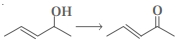
Suggest the reagent for the following conversion:
Solution
(PCC) The conversion involves the oxidation of a secondary allylic alcohol to an $\alpha,\beta$-unsaturated ketone.
Pyridinium chlorochromate $(PCC)$ is a mild oxidizing agent that selectively oxidizes primary alcohols to aldehydes and secondary alcohols to ketones without affecting carbon-carbon double bonds.
Therefore,the required reagent is $PCC$.
Pyridinium chlorochromate $(PCC)$ is a mild oxidizing agent that selectively oxidizes primary alcohols to aldehydes and secondary alcohols to ketones without affecting carbon-carbon double bonds.
Therefore,the required reagent is $PCC$.
0 likes
View Solution627
Medium
Out of $2$-chloroethanol and ethanol,which is more acidic and why?
Solution
(N/A) $2$-chloroethanol is more acidic than ethanol.
This is because the chlorine atom exerts a strong $-I$ effect,which pulls the electron density away from the oxygen atom.
This weakens the $O-H$ bond,facilitating the release of the proton $(H^+)$ and stabilizing the resulting alkoxide ion.
This is because the chlorine atom exerts a strong $-I$ effect,which pulls the electron density away from the oxygen atom.
This weakens the $O-H$ bond,facilitating the release of the proton $(H^+)$ and stabilizing the resulting alkoxide ion.
0 likes
View Solution628
MediumMCQ
Suggest a reagent for the conversion of ethanol to ethanal.
A
Pyridinium chlorochromate $(PCC)$
B
Potassium permanganate $(KMnO_4)$
C
Concentrated sulfuric acid $(H_2SO_4)$
D
Sodium borohydride $(NaBH_4)$
Solution
(A) The conversion of a primary alcohol like ethanol $(CH_3CH_2OH)$ to an aldehyde like ethanal $(CH_3CHO)$ requires a mild oxidizing agent that stops the oxidation at the aldehyde stage without further oxidizing it to a carboxylic acid. Pyridinium chlorochromate $(PCC)$ is the ideal reagent for this transformation.
0 likes
View Solution629
MediumMCQ
Suggest the reagent for conversion of ethanol to ethanoic acid.
A
Alkaline $KMnO_4$
B
Acidified $K_2Cr_2O_7$
C
Both $A$ and $B$
D
None of these
Solution
(C) Acidified $KMnO_4$ or acidified $K_2Cr_2O_7$ acts as a strong oxidizing agent and oxidizes ethanol to ethanoic acid.
$CH_3-CH_2-OH$ $\xrightarrow{[O]} CH_3-CHO$ $\xrightarrow{[O]} CH_3-COOH$
$CH_3-CH_2-OH$ $\xrightarrow{[O]} CH_3-CHO$ $\xrightarrow{[O]} CH_3-COOH$
0 likes
View Solution630
Difficult
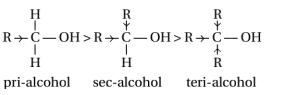
Alcohols react with active metals,e.g.,$Na, K$ etc. to give corresponding alkoxides. Write down the decreasing order of reactivity of sodium metal with primary,secondary and tertiary alcohols.
Solution
(N/A) The order of reactivity of alcohols with sodium metal is:
Primary alcohol $>$ Secondary alcohol $>$ Tertiary alcohol
The $+I$ effect of the alkyl groups increases the electron density on the oxygen atom. As a result,the electropositive hydrogen of the $-OH$ group is more tightly held by the molecule,which makes the release of $H^{+}$ difficult.
The effect is more pronounced if there are more alkyl groups in the molecule. Thus,tertiary alcohol is the least acidic and shows the least reactivity towards sodium metal.
Primary alcohol $>$ Secondary alcohol $>$ Tertiary alcohol
The $+I$ effect of the alkyl groups increases the electron density on the oxygen atom. As a result,the electropositive hydrogen of the $-OH$ group is more tightly held by the molecule,which makes the release of $H^{+}$ difficult.
The effect is more pronounced if there are more alkyl groups in the molecule. Thus,tertiary alcohol is the least acidic and shows the least reactivity towards sodium metal.
0 likes
View Solution631
Medium
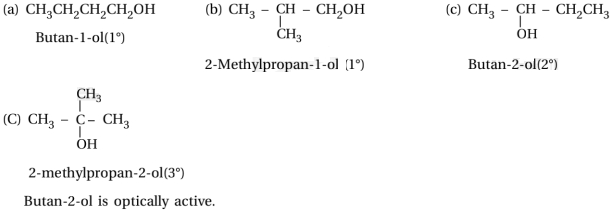
Write the structures of the isomers of alcohols with molecular formula $C_4H_{10}O$. Which of these will exhibit optical activity?
Solution
(N/A) The isomers of alcohols with molecular formula $C_4H_{10}O$ are:
$1.$ $Butan-1-ol$: $CH_3-CH_2-CH_2-CH_2-OH$
$2.$ $Butan-2-ol$: $CH_3-CH_2-CH(OH)-CH_3$
$3.$ $2-Methylpropan-1-ol$: $(CH_3)_2CH-CH_2-OH$
$4.$ $2-Methylpropan-2-ol$: $(CH_3)_3C-OH$
Among these,$Butan-2-ol$ exhibits optical activity because the $C_2$ carbon atom is chiral,as it is attached to four different groups: $-H$,$-OH$,$-CH_3$,and $-C_2H_5$.
$1.$ $Butan-1-ol$: $CH_3-CH_2-CH_2-CH_2-OH$
$2.$ $Butan-2-ol$: $CH_3-CH_2-CH(OH)-CH_3$
$3.$ $2-Methylpropan-1-ol$: $(CH_3)_2CH-CH_2-OH$
$4.$ $2-Methylpropan-2-ol$: $(CH_3)_3C-OH$
Among these,$Butan-2-ol$ exhibits optical activity because the $C_2$ carbon atom is chiral,as it is attached to four different groups: $-H$,$-OH$,$-CH_3$,and $-C_2H_5$.
0 likes
View Solution632
Medium
Why is the reactivity of all three classes of alcohols with concentrated $HCl$ and $ZnCl_2$ (Lucas reagent) different?
Solution
(N/A) The reaction of alcohols with Lucas reagent proceeds via the formation of a carbocation intermediate,which is the rate-determining step.
The stability of carbocations follows the order: $3^{\circ} > 2^{\circ} > 1^{\circ}$.
Tertiary $(3^{\circ})$ alcohols form the most stable carbocation,making the cleavage of the $C-OH$ bond easiest.
Consequently,the reactivity order is $3^{\circ} \text{ alcohol} > 2^{\circ} \text{ alcohol} > 1^{\circ} \text{ alcohol}$.
The stability of carbocations follows the order: $3^{\circ} > 2^{\circ} > 1^{\circ}$.
Tertiary $(3^{\circ})$ alcohols form the most stable carbocation,making the cleavage of the $C-OH$ bond easiest.
Consequently,the reactivity order is $3^{\circ} \text{ alcohol} > 2^{\circ} \text{ alcohol} > 1^{\circ} \text{ alcohol}$.
0 likes
View Solution633
Medium
Explain why are low molecular mass alcohols soluble in water?
Solution
(N/A) In alcohols of low molecular mass,the size of the non-polar alkyl group is small,which exerts less steric hindrance. As a result,intermolecular $H$-bonds with water molecules are easily formed by the hydroxyl group of the alcohol. Hence,alcohols of low molecular mass are readily soluble in water.
0 likes
View Solution634
Difficult
Explain why ethers and alcohols of comparable molecular mass have different boiling points.
Solution
(N/A) Alcohols contain a polar $-OH$ group,which allows for the formation of intermolecular $H$-bonds between alcohol molecules. This association requires more energy to break during vaporization.
In contrast,ethers do not contain a hydrogen atom bonded directly to an oxygen atom,so they cannot form intermolecular $H$-bonds. Their intermolecular forces are primarily dipole-dipole interactions,which are weaker than $H$-bonds.
Therefore,for comparable molecular masses,alcohols have significantly higher boiling points than ethers.
In contrast,ethers do not contain a hydrogen atom bonded directly to an oxygen atom,so they cannot form intermolecular $H$-bonds. Their intermolecular forces are primarily dipole-dipole interactions,which are weaker than $H$-bonds.
Therefore,for comparable molecular masses,alcohols have significantly higher boiling points than ethers.
0 likes
View Solution635
Difficult
Write the main product of the given reactions:
$1$. $(CH_3)_2CHCHBrCH_3 \xrightarrow[ethanol]{KOH, \Delta }$
$2$. $(CH_3)_2CHCH(OH)CH_3 \xrightarrow{H_2SO_4, \Delta }$
$1$. $(CH_3)_2CHCHBrCH_3 \xrightarrow[ethanol]{KOH, \Delta }$
$2$. $(CH_3)_2CHCH(OH)CH_3 \xrightarrow{H_2SO_4, \Delta }$
Solution
(N/A) For reaction $1$,the dehydrohalogenation of $2$-bromo-$3$-methylbutane with alcoholic $KOH$ follows $Saytzeff$ rule. The more substituted alkene,$2$-methyl-$2$-butene,is the major product $(80\%)$,while $3$-methyl-$1$-butene is the minor product $(20\%)$.
For reaction $2$,the acid-catalyzed dehydration of $3$-methylbutan-$2$-ol follows $Saytzeff$ rule. The more substituted alkene,$2$-methyl-$2$-butene,is the major product,while $3$-methyl-$1$-butene is the minor product.
For reaction $2$,the acid-catalyzed dehydration of $3$-methylbutan-$2$-ol follows $Saytzeff$ rule. The more substituted alkene,$2$-methyl-$2$-butene,is the major product,while $3$-methyl-$1$-butene is the minor product.
0 likes
View Solution636
Medium
Identify the main product $X$ in the following reaction:
$\text{Cyclohexanol} + \text{alcoholic } KOH + \Delta \rightarrow X$
$\text{Cyclohexanol} + \text{alcoholic } KOH + \Delta \rightarrow X$
Solution
(D) The reaction of cyclohexanol with alcoholic $KOH$ under heating conditions leads to the dehydration of the alcohol.
This is an elimination reaction where a water molecule $(-H_2O)$ is removed from the cyclohexanol molecule.
The hydroxyl group $(-OH)$ is removed from the carbon atom,and a hydrogen atom is removed from an adjacent carbon atom,resulting in the formation of a double bond.
Thus,the main product $X$ is cyclohexene.
This is an elimination reaction where a water molecule $(-H_2O)$ is removed from the cyclohexanol molecule.
The hydroxyl group $(-OH)$ is removed from the carbon atom,and a hydrogen atom is removed from an adjacent carbon atom,resulting in the formation of a double bond.
Thus,the main product $X$ is cyclohexene.
0 likes
View Solution637
EasyMCQ
Arrange the following substances in the increasing order of their normal boiling points: Ether,Carbon tetrachloride,Ethanol,and Water.
A
Ether < Carbon tetrachloride < Ethanol < Water
B
Water < Ethanol < Carbon tetrachloride < Ether
C
Ether < Ethanol < Carbon tetrachloride < Water
D
Carbon tetrachloride < Ether < Ethanol < Water
Solution
(A) The normal boiling points of the given substances are as follows:
Ether: $308 \ K$
Carbon tetrachloride $(CCl_4)$: $349 \ K$
Ethanol $(C_2H_5OH)$: $351.3 \ K$
Water $(H_2O)$: $373 \ K$
Therefore,the increasing order is: $\text{Ether} < \text{Carbon tetrachloride} < \text{Ethanol} < \text{Water}$.
Ether: $308 \ K$
Carbon tetrachloride $(CCl_4)$: $349 \ K$
Ethanol $(C_2H_5OH)$: $351.3 \ K$
Water $(H_2O)$: $373 \ K$
Therefore,the increasing order is: $\text{Ether} < \text{Carbon tetrachloride} < \text{Ethanol} < \text{Water}$.
0 likes
View Solution638
Difficult
Match the reactants given in Column-$I$ with the products formed in Column-$II$.
| Column-$I$ (Reactants) | Column-$II$ (Products) |
| $A$. $ROH + SOCl_2$ | $i$. $RBr + NaHSO_4 + H_2O$ |
| $B$. $ROH + PCl_5$ | $ii$. $3RX + H_3PO_3$ |
| $C$. $3ROH + PX_3$ | $iii$. $RCl + SO_2 + HCl$ |
| $D$. $ROH + NaBr + H_2SO_4$ | $iv$. $RCl + POCl_3 + HCl$ |
Solution
(A-III, B-IV, C-II, D-I) The reactions are as follows:
$A$. $ROH + SOCl_2 \rightarrow RCl + SO_2 + HCl$ (Darbzens process) $(A \rightarrow iii)$
$B$. $ROH + PCl_5 \rightarrow RCl + POCl_3 + HCl$ $(B \rightarrow iv)$
$C$. $3ROH + PX_3 \rightarrow 3RX + H_3PO_3$ $(C \rightarrow ii)$
$D$. $ROH + NaBr + H_2SO_4 \rightarrow RBr + NaHSO_4 + H_2O$ $(D \rightarrow i)$
Therefore,the correct matching is $A-iii, B-iv, C-ii, D-i$.
$A$. $ROH + SOCl_2 \rightarrow RCl + SO_2 + HCl$ (Darbzens process) $(A \rightarrow iii)$
$B$. $ROH + PCl_5 \rightarrow RCl + POCl_3 + HCl$ $(B \rightarrow iv)$
$C$. $3ROH + PX_3 \rightarrow 3RX + H_3PO_3$ $(C \rightarrow ii)$
$D$. $ROH + NaBr + H_2SO_4 \rightarrow RBr + NaHSO_4 + H_2O$ $(D \rightarrow i)$
Therefore,the correct matching is $A-iii, B-iv, C-ii, D-i$.
0 likes
View Solution639
Medium
Match the reagents in Column-$I$ with the major products obtained from the reaction of $Butan-1-ol$ in Column-$II$.
| Column-$I$ (Reagents) | Column-$II$ (Products) |
| $A$. $HCl + ZnCl_2$ | $i$. $CH_3CH=CHCH_3$ |
| $B$. $HBr$ | $ii$. $CH_3CH_2CH_2CH_2Cl$ |
| $C$. $SOCl_2$ | $iii$. $CH_3CH_2CH_2CH_2Br$ |
| $D$. $H_2SO_4, \Delta$ | $iv$. $CH_3CH_2CH_2CH_2Cl$ |
Solution
(A) $A \rightarrow ii$ (or $iv$),$B \rightarrow iii$,$C \rightarrow iv$ (or $ii$),$D \rightarrow i$.
$1$. $Butan-1-ol$ reacts with $HCl + ZnCl_2$ (Lucas reagent) to form $1-chlorobutane$ $(CH_3CH_2CH_2CH_2Cl)$.
$2$. $Butan-1-ol$ reacts with $HBr$ to form $1-bromobutane$ $(CH_3CH_2CH_2CH_2Br)$.
$3$. $Butan-1-ol$ reacts with $SOCl_2$ (Thionyl chloride) to form $1-chlorobutane$ $(CH_3CH_2CH_2CH_2Cl)$.
$4$. $Butan-1-ol$ reacts with $H_2SO_4$ upon heating (dehydration) to form $but-1-ene$ (which isomerizes to $but-2-ene$,$CH_3CH=CHCH_3$).
$1$. $Butan-1-ol$ reacts with $HCl + ZnCl_2$ (Lucas reagent) to form $1-chlorobutane$ $(CH_3CH_2CH_2CH_2Cl)$.
$2$. $Butan-1-ol$ reacts with $HBr$ to form $1-bromobutane$ $(CH_3CH_2CH_2CH_2Br)$.
$3$. $Butan-1-ol$ reacts with $SOCl_2$ (Thionyl chloride) to form $1-chlorobutane$ $(CH_3CH_2CH_2CH_2Cl)$.
$4$. $Butan-1-ol$ reacts with $H_2SO_4$ upon heating (dehydration) to form $but-1-ene$ (which isomerizes to $but-2-ene$,$CH_3CH=CHCH_3$).
0 likes
View Solution640
Medium
Match the compounds in Column-$I$ with their major dehydration products in Column-$II$.
| Column-$I$ (Compound) | Column-$II$ (Major Product) |
| $A$. $1$-Methylcyclohexanol | $i$. $1$-Methylcyclohexene |
| $B$. Butan-$1$-ol | $ii$. But-$1$-ene |
| $C$. tert-Butyl alcohol | $iii$. Isobutylene |
| $D$. Butan-$2$-ol | $iv$. But-$2$-ene |
Solution
(A-III, B-II, C-I, D-IV) The dehydration of alcohols follows the $E1$ or $E2$ mechanism,typically yielding the most stable alkene (Saytzeff's rule).
$A$. $1$-Methylcyclohexanol dehydrates to form $1$-methylcyclohexene $(iii)$.
$B$. Butan-$1$-ol dehydrates to form but-$1$-ene $(ii)$.
$C$. tert-Butyl alcohol ($2$-methylpropan$-2-$ol) dehydrates to form isobutylene $(i)$.
$D$. Butan-$2$-ol dehydrates to form but-$2$-ene as the major product $(iv)$.
Therefore,the correct matching is: $A-iii, B-ii, C-i, D-iv$.
$A$. $1$-Methylcyclohexanol dehydrates to form $1$-methylcyclohexene $(iii)$.
$B$. Butan-$1$-ol dehydrates to form but-$1$-ene $(ii)$.
$C$. tert-Butyl alcohol ($2$-methylpropan$-2-$ol) dehydrates to form isobutylene $(i)$.
$D$. Butan-$2$-ol dehydrates to form but-$2$-ene as the major product $(iv)$.
Therefore,the correct matching is: $A-iii, B-ii, C-i, D-iv$.
0 likes
View Solution641
DifficultMCQ
The major product $[B]$ in the following reaction is:
$CH_3-CH_2-CH(CH_3)-CH_2-O-CH_2-CH_3$ $\xrightarrow[Heat]{HI} [A] (alcohol)$ $\xrightarrow[\Delta]{H_2SO_4} [B]$
$CH_3-CH_2-CH(CH_3)-CH_2-O-CH_2-CH_3$ $\xrightarrow[Heat]{HI} [A] (alcohol)$ $\xrightarrow[\Delta]{H_2SO_4} [B]$
A
$CH_3-CH_2-C(CH_3)=CH_2$
B
$CH_3-CH_2-CH=CH-CH_3$
C
$CH_2=CH_2$
D
$CH_3-CH=C(CH_3)_2$
Solution
(D) $1$. The reaction of the ether $CH_3-CH_2-CH(CH_3)-CH_2-O-CH_2-CH_3$ with $HI$ proceeds via an $S_N2$ mechanism.
$2$. The iodide ion $(I^-)$ attacks the less sterically hindered carbon atom,which is the ethyl group $(CH_2-CH_3)$,resulting in the formation of $CH_3-CH_2-I$ and the alcohol $[A]$,which is $2-methylbutan-1-ol$ $(CH_3-CH_2-CH(CH_3)-CH_2OH)$.
$3$. The dehydration of $2-methylbutan-1-ol$ with concentrated $H_2SO_4$ at high temperature involves the formation of a carbocation intermediate followed by rearrangement to a more stable carbocation.
$4$. The primary carbocation $CH_3-CH_2-CH(CH_3)-CH_2^+$ rearranges to the more stable tertiary carbocation $CH_3-CH_2-C^+(CH_3)_2$ via a hydride shift.
$5$. Elimination of a proton from this tertiary carbocation yields the most stable alkene,$2-methylbut-2-ene$ $(CH_3-CH=C(CH_3)_2)$,as the major product $[B]$.
$2$. The iodide ion $(I^-)$ attacks the less sterically hindered carbon atom,which is the ethyl group $(CH_2-CH_3)$,resulting in the formation of $CH_3-CH_2-I$ and the alcohol $[A]$,which is $2-methylbutan-1-ol$ $(CH_3-CH_2-CH(CH_3)-CH_2OH)$.
$3$. The dehydration of $2-methylbutan-1-ol$ with concentrated $H_2SO_4$ at high temperature involves the formation of a carbocation intermediate followed by rearrangement to a more stable carbocation.
$4$. The primary carbocation $CH_3-CH_2-CH(CH_3)-CH_2^+$ rearranges to the more stable tertiary carbocation $CH_3-CH_2-C^+(CH_3)_2$ via a hydride shift.
$5$. Elimination of a proton from this tertiary carbocation yields the most stable alkene,$2-methylbut-2-ene$ $(CH_3-CH=C(CH_3)_2)$,as the major product $[B]$.
0 likes
View Solution642
MediumMCQ
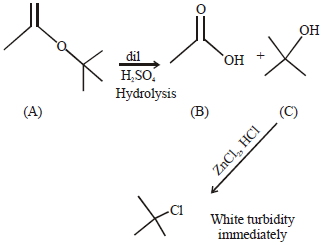
An organic compound $(A)$ (molecular formula $C_{6}H_{12}O_{2}$) was hydrolysed with dil. $H_{2}SO_{4}$ to give a carboxylic acid $(B)$ and an alcohol $(C).$ $C$ gives white turbidity immediately when treated with anhydrous $ZnCl_{2}$ and conc. $HCl$. The organic compound $(A)$ is
A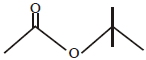
B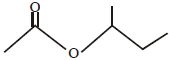
C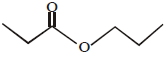
D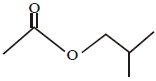
Solution
(A) The organic compound $(A)$ with molecular formula $C_{6}H_{12}O_{2}$ is an ester.
Upon hydrolysis with dil. $H_{2}SO_{4}$,it yields a carboxylic acid $(B)$ and an alcohol $(C)$.
The alcohol $(C)$ gives immediate white turbidity with Lucas reagent (anhydrous $ZnCl_{2}$ and conc. $HCl$),which is a characteristic test for a tertiary alcohol.
Among the given options,the ester that produces a tertiary alcohol (tert-butyl alcohol) upon hydrolysis is tert-butyl acetate.
The structure shown in option $(A)$ corresponds to tert-butyl acetate,which hydrolyzes to form acetic acid and tert-butyl alcohol.
Thus,the correct compound is $(A)$.
Upon hydrolysis with dil. $H_{2}SO_{4}$,it yields a carboxylic acid $(B)$ and an alcohol $(C)$.
The alcohol $(C)$ gives immediate white turbidity with Lucas reagent (anhydrous $ZnCl_{2}$ and conc. $HCl$),which is a characteristic test for a tertiary alcohol.
Among the given options,the ester that produces a tertiary alcohol (tert-butyl alcohol) upon hydrolysis is tert-butyl acetate.
The structure shown in option $(A)$ corresponds to tert-butyl acetate,which hydrolyzes to form acetic acid and tert-butyl alcohol.
Thus,the correct compound is $(A)$.
0 likes
View Solution643
MediumMCQ
$X$ and $Y$ respectively are

A
Cyclohexylmethanol ; $1-$methylcyclohexanol
B
$1-$methylcyclohexanol ; Cyclohexylmethanol
C
Cyclohexylmethanol ; Cyclohexylmethanol
D
$1-$methylcyclohexanol ; $1-$methylcyclohexanol
Solution
(A) The reaction of methylenecyclohexane with $H_3O^+$ proceeds via acid-catalyzed hydration,which follows Markownikoff's rule. The carbocation formed at the tertiary carbon is more stable,leading to the formation of $1$-methylcyclohexanol $(Y)$.
The reaction with $(i) B_2H_6/THF$ and $(ii) H_2O_2/OH^-$ is hydroboration-oxidation,which follows anti-Markownikoff's rule. The hydroxyl group adds to the less substituted carbon,resulting in the formation of cyclohexylmethanol $(X)$.
The reaction with $(i) B_2H_6/THF$ and $(ii) H_2O_2/OH^-$ is hydroboration-oxidation,which follows anti-Markownikoff's rule. The hydroxyl group adds to the less substituted carbon,resulting in the formation of cyclohexylmethanol $(X)$.
0 likes
View Solution644
MediumMCQ
In the reaction sequence $CH_2=CH_2$ $\xrightarrow{HOCl} X$ $\xrightarrow{Y} CH_2(OH)-CH_2(OH)$,$X$ and $Y$ respectively are:
A
$ClCH_2-CH_2OH$ and $NaHCO_3$
B
$CH_3CH_2Cl$ and $NaOH$
C
$CH_3CH_2OH$ and $H_2SO_4$
D
$CH_2ClCH_2OH$ and $heat$
Solution
(A) The reaction sequence is as follows:
$1$. $CH_2=CH_2$ reacts with $HOCl$ (hypochlorous acid) to form ethylene chlorohydrin $(X)$: $CH_2=CH_2 + HOCl \rightarrow CH_2(OH)-CH_2(Cl)$.
$2$. $CH_2(OH)-CH_2(Cl)$ (ethylene chlorohydrin) reacts with a base like $NaHCO_3$ or $NaOH$ to undergo hydrolysis or epoxide formation followed by ring opening to yield ethylene glycol $(CH_2(OH)-CH_2(OH))$.
$3$. Thus,$X$ is $CH_2(OH)-CH_2(Cl)$ and $Y$ is $NaHCO_3$.
$1$. $CH_2=CH_2$ reacts with $HOCl$ (hypochlorous acid) to form ethylene chlorohydrin $(X)$: $CH_2=CH_2 + HOCl \rightarrow CH_2(OH)-CH_2(Cl)$.
$2$. $CH_2(OH)-CH_2(Cl)$ (ethylene chlorohydrin) reacts with a base like $NaHCO_3$ or $NaOH$ to undergo hydrolysis or epoxide formation followed by ring opening to yield ethylene glycol $(CH_2(OH)-CH_2(OH))$.
$3$. Thus,$X$ is $CH_2(OH)-CH_2(Cl)$ and $Y$ is $NaHCO_3$.
0 likes
View Solution645
DifficultMCQ
Reaction of Grignard reagent,$C_{2}H_{5}MgBr$ with $C_{8}H_{8}O$ followed by hydrolysis gives compound $A$ which reacts instantly with Lucas reagent to give compound $B$,$C_{10}H_{13}Cl$. The compound $B$ is
A
$1-$chloro$-1-$phenylbutane
B
$1-$chloro$-2-$phenylbutane
C
$2-$chloro$-2-$phenylbutane
D
$2-$chloro$-3-$phenylbutane
Solution
(C) $1$. The molecular formula of the reactant is $C_{8}H_{8}O$. Given the reaction with $C_{2}H_{5}MgBr$ (Grignard reagent) and subsequent hydrolysis,it is likely an aldehyde or ketone. Acetophenone $(C_{6}H_{5}COCH_{3})$ fits the formula $C_{8}H_{8}O$.
$2$. Reaction: $C_{6}H_{5}COCH_{3} + C_{2}H_{5}MgBr \rightarrow C_{6}H_{5}C(OH)(CH_{3})(C_{2}H_{5})$. This product $A$ is $2$-phenylbutan-$2$-ol.
$3$. Compound $A$ is a tertiary alcohol. Tertiary alcohols react instantly with Lucas reagent $(conc. \ HCl + ZnCl_{2})$ to form alkyl chlorides.
$4$. The reaction of $2$-phenylbutan-$2$-ol with $HCl$ replaces the $-OH$ group with $-Cl$ to form $2$-chloro-$2$-phenylbutane $(C_{10}H_{13}Cl)$.
$5$. Comparing this with the given options,the structure corresponding to $2$-chloro-$2$-phenylbutane is option $C$.
$2$. Reaction: $C_{6}H_{5}COCH_{3} + C_{2}H_{5}MgBr \rightarrow C_{6}H_{5}C(OH)(CH_{3})(C_{2}H_{5})$. This product $A$ is $2$-phenylbutan-$2$-ol.
$3$. Compound $A$ is a tertiary alcohol. Tertiary alcohols react instantly with Lucas reagent $(conc. \ HCl + ZnCl_{2})$ to form alkyl chlorides.
$4$. The reaction of $2$-phenylbutan-$2$-ol with $HCl$ replaces the $-OH$ group with $-Cl$ to form $2$-chloro-$2$-phenylbutane $(C_{10}H_{13}Cl)$.
$5$. Comparing this with the given options,the structure corresponding to $2$-chloro-$2$-phenylbutane is option $C$.
0 likes
View Solution646
MediumMCQ
What is the final product (major) $A$ in the given reaction?
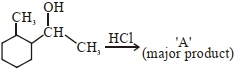
A
$1-$ethyl$-2-$methyl$-1-$chlorocyclohexane
B
$1-$methyl$-2-$ethylidenecyclohexane
C
$1-$methyl$-2-$vinylcyclohexane
D
$1-$chloro$-1-$($2$-methylcyclohexyl)ethane
Solution
(A) The reaction of a secondary alcohol with $HCl$ proceeds via an $S_N1$ mechanism involving the formation of a carbocation intermediate.
$1$. Protonation of the $-OH$ group by $HCl$ converts it into a good leaving group $(-OH_2^+)$.
$2$. Loss of water molecule generates a secondary carbocation at the carbon atom attached to the cyclohexane ring.
$3$. This secondary carbocation undergoes a $1,2$-hydride shift to form a more stable tertiary carbocation at the ring carbon.
$4$. Finally,the nucleophilic chloride ion $(Cl^-)$ attacks the tertiary carbocation to form the major product,$1$-ethyl-$1$-chloro-$2$-methylcyclohexane.
$1$. Protonation of the $-OH$ group by $HCl$ converts it into a good leaving group $(-OH_2^+)$.
$2$. Loss of water molecule generates a secondary carbocation at the carbon atom attached to the cyclohexane ring.
$3$. This secondary carbocation undergoes a $1,2$-hydride shift to form a more stable tertiary carbocation at the ring carbon.
$4$. Finally,the nucleophilic chloride ion $(Cl^-)$ attacks the tertiary carbocation to form the major product,$1$-ethyl-$1$-chloro-$2$-methylcyclohexane.
0 likes
View Solution647
MediumMCQ
Identify $A$ in the given reaction.
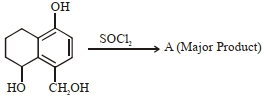
A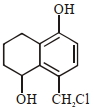
B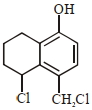
C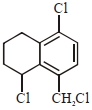
D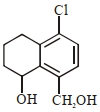
Solution
(B) The reaction involves the treatment of a polyfunctional compound with $SOCl_2$.
$SOCl_2$ (thionyl chloride) is a reagent commonly used to convert alcohols into alkyl chlorides.
In the given substrate,there are three hydroxyl groups:
$1$. $A$ phenolic $-OH$ group.
$2$. $A$ secondary aliphatic $-OH$ group on the saturated ring.
$3$. $A$ primary benzylic $-CH_2OH$ group.
$SOCl_2$ reacts readily with aliphatic alcohols (both primary and secondary) to form alkyl chlorides.
However,it does not typically convert phenolic $-OH$ groups into aryl chlorides under standard conditions.
Therefore,both the secondary $-OH$ and the primary benzylic $-CH_2OH$ groups will be converted into $-Cl$ and $-CH_2Cl$ respectively.
The resulting major product $A$ will have a phenolic $-OH$ group intact,a secondary $-Cl$ group,and a $-CH_2Cl$ group.
This corresponds to the structure shown in option $B$.
$SOCl_2$ (thionyl chloride) is a reagent commonly used to convert alcohols into alkyl chlorides.
In the given substrate,there are three hydroxyl groups:
$1$. $A$ phenolic $-OH$ group.
$2$. $A$ secondary aliphatic $-OH$ group on the saturated ring.
$3$. $A$ primary benzylic $-CH_2OH$ group.
$SOCl_2$ reacts readily with aliphatic alcohols (both primary and secondary) to form alkyl chlorides.
However,it does not typically convert phenolic $-OH$ groups into aryl chlorides under standard conditions.
Therefore,both the secondary $-OH$ and the primary benzylic $-CH_2OH$ groups will be converted into $-Cl$ and $-CH_2Cl$ respectively.
The resulting major product $A$ will have a phenolic $-OH$ group intact,a secondary $-Cl$ group,and a $-CH_2Cl$ group.
This corresponds to the structure shown in option $B$.
0 likes
View Solution648
DifficultMCQ
In the following sequence of reactions,
$C_{3}H_{6}$ $\xrightarrow{H^{+}/H_{2}O} A$ $\xrightarrow[dil. KOH]{KIO} B + C$
The compounds $B$ and $C$ respectively are :
$C_{3}H_{6}$ $\xrightarrow{H^{+}/H_{2}O} A$ $\xrightarrow[dil. KOH]{KIO} B + C$
The compounds $B$ and $C$ respectively are :
A
$CHI_{3}, CH_{3}COOK$
B
$CI_{3}COOK, CH_{3}I$
C
$CH_{3}I, HCOOK$
D
$CHI_{3}, CH_{3}COOK$
Solution
(A) Step $1$: Hydration of propene $(C_{3}H_{6})$ with $H^{+}/H_{2}O$ follows Markovnikov's rule to form propan$-2-$ol $(A)$:
$CH_{3}-CH=CH_{2} + H_{2}O \xrightarrow{H^{+}} CH_{3}-CH(OH)-CH_{3} (A)$
Step $2$: Propan$-2-$ol $(A)$ is a secondary alcohol with a methyl group attached to the carbinol carbon,which undergoes the iodoform reaction with $KIO/dil. KOH$ to form iodoform $(B)$ and potassium acetate $(C)$:
$CH_{3}-CH(OH)-CH_{3} + 4KIO \rightarrow CHI_{3} (B) + CH_{3}COOK (C) + 3KOH + H_{2}O$
Thus,$B$ is $CHI_{3}$ and $C$ is $CH_{3}COOK$.
$CH_{3}-CH=CH_{2} + H_{2}O \xrightarrow{H^{+}} CH_{3}-CH(OH)-CH_{3} (A)$
Step $2$: Propan$-2-$ol $(A)$ is a secondary alcohol with a methyl group attached to the carbinol carbon,which undergoes the iodoform reaction with $KIO/dil. KOH$ to form iodoform $(B)$ and potassium acetate $(C)$:
$CH_{3}-CH(OH)-CH_{3} + 4KIO \rightarrow CHI_{3} (B) + CH_{3}COOK (C) + 3KOH + H_{2}O$
Thus,$B$ is $CHI_{3}$ and $C$ is $CH_{3}COOK$.
0 likes
View Solution649
MediumMCQ
What is the $IUPAC$ name of the organic compound formed in the following chemical reaction?
Acetone $\xrightarrow[(ii) H_2O, H^{+}]{(i) C_2H_5MgBr, \text{dry Ether}}$ Product
Acetone $\xrightarrow[(ii) H_2O, H^{+}]{(i) C_2H_5MgBr, \text{dry Ether}}$ Product
A
$2-$methyl propan$-2-$ol
B
pentan$-2-$ol
C
pentan$-3-$ol
D
$2-$methyl butan$-2-$ol
Solution
(D) The reaction of acetone $(CH_3COCH_3)$ with ethylmagnesium bromide $(C_2H_5MgBr)$ in the presence of dry ether is a nucleophilic addition reaction.
The nucleophilic ethyl group $(C_2H_5^-)$ attacks the electrophilic carbonyl carbon of acetone to form an intermediate magnesium alkoxide.
Subsequent hydrolysis with $H_3O^+$ yields the final alcohol product.
The reaction sequence is:
$CH_3COCH_3 + C_2H_5MgBr \rightarrow CH_3-C(OMgBr)(CH_3)-C_2H_5$
$CH_3-C(OMgBr)(CH_3)-C_2H_5 + H_2O/H^+ \rightarrow CH_3-C(OH)(CH_3)-CH_2CH_3 + Mg(OH)Br$
The structure of the product is $CH_3-C(OH)(CH_3)-CH_2-CH_3$.
Selecting the longest carbon chain containing the $-OH$ group gives a butane chain. Numbering from the end closest to the $-OH$ group,the $-OH$ is at position $2$ and a methyl group is also at position $2$.
Thus,the $IUPAC$ name is $2-$methylbutan$-2-$ol.
The nucleophilic ethyl group $(C_2H_5^-)$ attacks the electrophilic carbonyl carbon of acetone to form an intermediate magnesium alkoxide.
Subsequent hydrolysis with $H_3O^+$ yields the final alcohol product.
The reaction sequence is:
$CH_3COCH_3 + C_2H_5MgBr \rightarrow CH_3-C(OMgBr)(CH_3)-C_2H_5$
$CH_3-C(OMgBr)(CH_3)-C_2H_5 + H_2O/H^+ \rightarrow CH_3-C(OH)(CH_3)-CH_2CH_3 + Mg(OH)Br$
The structure of the product is $CH_3-C(OH)(CH_3)-CH_2-CH_3$.
Selecting the longest carbon chain containing the $-OH$ group gives a butane chain. Numbering from the end closest to the $-OH$ group,the $-OH$ is at position $2$ and a methyl group is also at position $2$.
Thus,the $IUPAC$ name is $2-$methylbutan$-2-$ol.
0 likes
View Solution650
DifficultMCQ
Which one of the following compounds will provide a tertiary alcohol on reaction with excess of $CH_3MgBr$ followed by hydrolysis?
A
$1,4-$Naphthoquinone
B
Phenyl acetate
C
$3-$Hydroxyacetophenone
D
$4-$cyano$-3-$ethynylbenzyl ethyl ether
Solution
(B) The reaction of $CH_3MgBr$ (excess) with phenyl acetate $(C_6H_5OCOCH_3)$ proceeds as follows:
$1$. The first equivalent of $CH_3MgBr$ attacks the carbonyl carbon of the ester,followed by the elimination of the phenoxide ion $(C_6H_5O^-)$ to form acetophenone $(C_6H_5COCH_3)$.
$2$. The second equivalent of $CH_3MgBr$ attacks the carbonyl carbon of acetophenone to form a tertiary alkoxide intermediate.
$3$. Upon hydrolysis,this intermediate yields $2$-phenylpropan-$2$-ol,which is a tertiary alcohol.
Therefore,phenyl acetate is the most appropriate compound to yield a tertiary alcohol as the primary organic product.
$1$. The first equivalent of $CH_3MgBr$ attacks the carbonyl carbon of the ester,followed by the elimination of the phenoxide ion $(C_6H_5O^-)$ to form acetophenone $(C_6H_5COCH_3)$.
$2$. The second equivalent of $CH_3MgBr$ attacks the carbonyl carbon of acetophenone to form a tertiary alkoxide intermediate.
$3$. Upon hydrolysis,this intermediate yields $2$-phenylpropan-$2$-ol,which is a tertiary alcohol.
Therefore,phenyl acetate is the most appropriate compound to yield a tertiary alcohol as the primary organic product.
0 likes
View SolutionAlcohols, Phenols and Ethers — Properties of alcohol · Frequently Asked Questions
1Are these Alcohols, Phenols and Ethers questions useful for JEE and NEET?
Yes. All questions in this section are mapped to JEE Main and NEET exam patterns. Previous year questions from JEE Main, NEET, GUJCET and state-level exams are included with full solutions.
2Can I switch to Hindi or Gujarati for these questions?
Yes. Use the language tabs in the hero section or the sidebar to view the same questions and solutions in English, Hindi or Gujarati.
3How do I generate a question paper from this subtopic?
Use the Vedclass Exam Paper Generator — select the chapter and subtopic, set difficulty, and generate Sets A, B, C, D automatically. First 3 chapters of every subject are free.
Vedclass Products
For Students
Vedclass Test Series
Mock tests in real JEE/NEET style with performance analysis. 5-day free trial.
Start Free TrialFor Teachers
Exam Paper Generator
Generate Set A/B/C/D papers from this chapter in 2 minutes. 3 chapters free.
Try FreeFor Institutes
Online Exam Module
Live online exams with unlimited students, 360° analytics & white-label branding.
See DemoFor Teachers & Institutes
Generate a Alcohols, Phenols and Ethers Exam Paper in 2 Minutes
Select subtopic & difficulty — Sets A, B, C, D auto-generated with No Repeat logic.
First 3 chapters of every subject are free — no payment required.