
A English
Properties of Carboxylic Acids and Their Derivatives Questions in English
Class 12 Chemistry · 8-2.Carboxylic acids and Their derivative · Properties of Carboxylic Acids and Their Derivatives
791+
Questions
English
Language
100%
With Solutions
Showing 44 of 791 questions in English
651
EasyMCQ
Write the structure of the product of the following reaction.
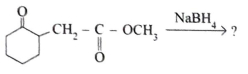
A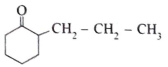
B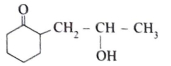
C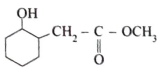
D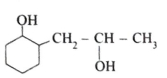
Solution
(C) $NaBH_4$ (Sodium borohydride) is a selective reducing agent that reduces aldehydes and ketones to their corresponding alcohols,but it does not reduce esters under normal conditions.
In the given molecule,there is a ketone group in the cyclohexane ring and an ester group $(-COOCH_3)$.
$NaBH_4$ will selectively reduce the ketone group to a secondary alcohol $(-CH(OH)-)$ while leaving the ester group intact.
Therefore,the product is a molecule with a cyclohexanol ring attached to a $-CH_2-COOCH_3$ group.
This corresponds to the structure shown in option $C$.
In the given molecule,there is a ketone group in the cyclohexane ring and an ester group $(-COOCH_3)$.
$NaBH_4$ will selectively reduce the ketone group to a secondary alcohol $(-CH(OH)-)$ while leaving the ester group intact.
Therefore,the product is a molecule with a cyclohexanol ring attached to a $-CH_2-COOCH_3$ group.
This corresponds to the structure shown in option $C$.
0 likes
View Solution652
EasyMCQ
Which of the following carboxylic acids has the least $pK_{a}$ value?
A
$NO_{2}CH_{2}COOH$
B
$CH_{3}COOH$
C
$HCOOH$
D
$C_{6}H_{5}COOH$
Solution
(A) The $pK_{a}$ value is inversely proportional to the acidity of the carboxylic acid. Stronger acids have lower $pK_{a}$ values.
Acidity is determined by the stability of the conjugate base (carboxylate ion).
Electron-withdrawing groups (EWGs) stabilize the carboxylate ion through the inductive effect ($-I$ effect),thereby increasing acidity.
Comparing the substituents:
$1$. $NO_{2}CH_{2}COOH$: The $-NO_{2}$ group is a strong electron-withdrawing group ($-I$ effect),which significantly stabilizes the carboxylate ion.
$2$. $CH_{3}COOH$: The $-CH_{3}$ group is an electron-donating group ($+I$ effect),which destabilizes the carboxylate ion.
$3$. $HCOOH$: Hydrogen has no inductive effect.
$4$. $C_{6}H_{5}COOH$: The phenyl group is electron-withdrawing by resonance but less effective than the $-NO_{2}$ group in this context.
Therefore,$NO_{2}CH_{2}COOH$ is the strongest acid among the given options and has the lowest $pK_{a}$ value.
Acidity is determined by the stability of the conjugate base (carboxylate ion).
Electron-withdrawing groups (EWGs) stabilize the carboxylate ion through the inductive effect ($-I$ effect),thereby increasing acidity.
Comparing the substituents:
$1$. $NO_{2}CH_{2}COOH$: The $-NO_{2}$ group is a strong electron-withdrawing group ($-I$ effect),which significantly stabilizes the carboxylate ion.
$2$. $CH_{3}COOH$: The $-CH_{3}$ group is an electron-donating group ($+I$ effect),which destabilizes the carboxylate ion.
$3$. $HCOOH$: Hydrogen has no inductive effect.
$4$. $C_{6}H_{5}COOH$: The phenyl group is electron-withdrawing by resonance but less effective than the $-NO_{2}$ group in this context.
Therefore,$NO_{2}CH_{2}COOH$ is the strongest acid among the given options and has the lowest $pK_{a}$ value.
0 likes
View Solution653
EasyMCQ
What is the correct order of acidity of compounds $(I)$,$(II)$,and $(III)$?
$(I)$ $4$-Nitrobenzoic acid
$(II)$ $4$-Methoxybenzoic acid
$(III)$ Benzoic acid
$(I)$ $4$-Nitrobenzoic acid
$(II)$ $4$-Methoxybenzoic acid
$(III)$ Benzoic acid
A
$I > II > III$
B
$I > III > II$
C
$I < II < III$
D
$I < III < II$
Solution
(B) The acidity of benzoic acid derivatives depends on the electronic effects of the substituents attached to the benzene ring.
$1$. The $-NO_2$ group in $(I)$ is a strong electron-withdrawing group ($-I$ and $-M$ effect),which stabilizes the carboxylate anion,increasing acidity.
$2$. The $-OCH_3$ group in $(II)$ is an electron-donating group ($+M$ effect),which destabilizes the carboxylate anion,decreasing acidity.
$3$. Benzoic acid $(III)$ serves as the reference point.
Therefore,the order of acidity is $4$-Nitrobenzoic acid $(I)$ > Benzoic acid $(III)$ > $4$-Methoxybenzoic acid $(II)$.
The correct option is $B$.
$1$. The $-NO_2$ group in $(I)$ is a strong electron-withdrawing group ($-I$ and $-M$ effect),which stabilizes the carboxylate anion,increasing acidity.
$2$. The $-OCH_3$ group in $(II)$ is an electron-donating group ($+M$ effect),which destabilizes the carboxylate anion,decreasing acidity.
$3$. Benzoic acid $(III)$ serves as the reference point.
Therefore,the order of acidity is $4$-Nitrobenzoic acid $(I)$ > Benzoic acid $(III)$ > $4$-Methoxybenzoic acid $(II)$.
The correct option is $B$.
0 likes
View Solution654
EasyMCQ
Which is the incorrect order of increasing acidic strength for the following?
A
$CH_2FCH_2CH_2COOH < CH_3CHFCH_2COOH$
B
$CH_2ClCOOH < CH_2FCOOH$
C
$CH_3COOH < CH_2ClCOOH$
D
$HCOOH < C_6H_5COOH$
Solution
(D) The acidic strength of carboxylic acids depends on the electron-withdrawing effect of substituents. Electron-withdrawing groups $(EWG)$ increase acidity by stabilizing the carboxylate anion,while electron-donating groups decrease it.
$A$. $CH_2FCH_2CH_2COOH < CH_3CHFCH_2COOH$: Correct. The $F$ atom is closer to the $COOH$ group in the second molecule,exerting a stronger $-I$ effect.
$B$. $CH_2ClCOOH < CH_2FCOOH$: Correct. $F$ is more electronegative than $Cl$,so $CH_2FCOOH$ is more acidic.
$C$. $CH_3COOH < CH_2ClCOOH$: Correct. $Cl$ is an $EWG$,making the chloroacetic acid more acidic than acetic acid.
$D$. $HCOOH < C_6H_5COOH$: Incorrect. Formic acid $(HCOOH)$ is more acidic than benzoic acid $(C_6H_5COOH)$ because the phenyl group in benzoic acid is electron-donating by resonance and has a weaker $-I$ effect compared to the hydrogen atom in formic acid. Thus,the correct order is $C_6H_5COOH < HCOOH$.
$A$. $CH_2FCH_2CH_2COOH < CH_3CHFCH_2COOH$: Correct. The $F$ atom is closer to the $COOH$ group in the second molecule,exerting a stronger $-I$ effect.
$B$. $CH_2ClCOOH < CH_2FCOOH$: Correct. $F$ is more electronegative than $Cl$,so $CH_2FCOOH$ is more acidic.
$C$. $CH_3COOH < CH_2ClCOOH$: Correct. $Cl$ is an $EWG$,making the chloroacetic acid more acidic than acetic acid.
$D$. $HCOOH < C_6H_5COOH$: Incorrect. Formic acid $(HCOOH)$ is more acidic than benzoic acid $(C_6H_5COOH)$ because the phenyl group in benzoic acid is electron-donating by resonance and has a weaker $-I$ effect compared to the hydrogen atom in formic acid. Thus,the correct order is $C_6H_5COOH < HCOOH$.
0 likes
View Solution655
EasyMCQ
Which of the following compounds has the maximum acidic strength?
A
$2-$Methoxybenzoic acid
B
Benzoic acid
C
$4-$Methoxybenzoic acid
D
$4-$Nitrobenzoic acid
Solution
(D) is the correct answer.
Acidic strength of benzoic acid derivatives is increased by electron-withdrawing groups $(EWG)$ and decreased by electron-donating groups $(EDG)$.
$4-$Nitrobenzoic acid contains a $-NO_2$ group,which is a strong electron-withdrawing group ($-I$ and $-M$ effect),thereby stabilizing the carboxylate anion and increasing acidity.
$2-$Methoxybenzoic acid and $4-$Methoxybenzoic acid contain a $-OCH_3$ group,which acts as an electron-donating group ($+M$ effect),decreasing the acidic strength compared to benzoic acid.
Therefore,$4-$Nitrobenzoic acid has the maximum acidic strength among the given options.
Acidic strength of benzoic acid derivatives is increased by electron-withdrawing groups $(EWG)$ and decreased by electron-donating groups $(EDG)$.
$4-$Nitrobenzoic acid contains a $-NO_2$ group,which is a strong electron-withdrawing group ($-I$ and $-M$ effect),thereby stabilizing the carboxylate anion and increasing acidity.
$2-$Methoxybenzoic acid and $4-$Methoxybenzoic acid contain a $-OCH_3$ group,which acts as an electron-donating group ($+M$ effect),decreasing the acidic strength compared to benzoic acid.
Therefore,$4-$Nitrobenzoic acid has the maximum acidic strength among the given options.
0 likes
View Solution656
EasyMCQ
$C_6H_5CH_2MgBr$ $\xrightarrow[\text{(ii) } H_3O^{+}]{\text{(i) } CO_2 / \text{Ether}} \text{'X'}$ $\xrightarrow[\Delta]{NaOH + CaO} \text{'Y'}$
What is the final product in this reaction?
What is the final product in this reaction?
A
$C_6H_5CH_2OH$
B
$C_6H_5CH_2CH_3$
C
$C_6H_6$
D
$C_6H_5CH_3$
Solution
(D) Step $1$: Reaction of Grignard reagent with $CO_2$.
$C_6H_5CH_2MgBr + CO_2$ $\rightarrow C_6H_5CH_2COOMgBr$ $\xrightarrow{H_3O^+} C_6H_5CH_2COOH$ (Phenylacetic acid,'$X$').
Step $2$: Decarboxylation of the carboxylic acid.
$C_6H_5CH_2COOH \xrightarrow{NaOH + CaO, \Delta} C_6H_5CH_3$ (Toluene,'$Y$').
The final product '$Y$' is $C_6H_5CH_3$.
$C_6H_5CH_2MgBr + CO_2$ $\rightarrow C_6H_5CH_2COOMgBr$ $\xrightarrow{H_3O^+} C_6H_5CH_2COOH$ (Phenylacetic acid,'$X$').
Step $2$: Decarboxylation of the carboxylic acid.
$C_6H_5CH_2COOH \xrightarrow{NaOH + CaO, \Delta} C_6H_5CH_3$ (Toluene,'$Y$').
The final product '$Y$' is $C_6H_5CH_3$.
0 likes
View Solution657
EasyMCQ
Which of the following acids has the highest $pK_{a}$ value?
A
$C_{6}H_{5}CH_{2}COOH$
B
$O_{2}NCH_{2}COOH$
C
$FCH_{2}COOH$
D
$NCCH_{2}COOH$
Solution
(A) The $pK_{a}$ value is inversely proportional to the acid strength. Stronger acids have lower $pK_{a}$ values,while weaker acids have higher $pK_{a}$ values.
Electron-withdrawing groups (EWGs) increase the acidity of carboxylic acids by stabilizing the carboxylate anion through the inductive effect.
Comparing the substituents attached to the $CH_{2}COOH$ group:
$1$. $C_{6}H_{5}-$ (Phenyl group): Weakly electron-withdrawing or electron-donating by resonance,making it the least acidic among the options.
$2$. $O_{2}N-$ (Nitro group): Strong electron-withdrawing group ($-I$ and $-M$ effect).
$3$. $F-$ (Fluoro group): Strong electron-withdrawing group ($-I$ effect).
$4$. $NC-$ (Cyano group): Strong electron-withdrawing group ($-I$ effect).
Since $C_{6}H_{5}CH_{2}COOH$ has the weakest electron-withdrawing group,it is the least acidic and therefore has the highest $pK_{a}$ value.
Electron-withdrawing groups (EWGs) increase the acidity of carboxylic acids by stabilizing the carboxylate anion through the inductive effect.
Comparing the substituents attached to the $CH_{2}COOH$ group:
$1$. $C_{6}H_{5}-$ (Phenyl group): Weakly electron-withdrawing or electron-donating by resonance,making it the least acidic among the options.
$2$. $O_{2}N-$ (Nitro group): Strong electron-withdrawing group ($-I$ and $-M$ effect).
$3$. $F-$ (Fluoro group): Strong electron-withdrawing group ($-I$ effect).
$4$. $NC-$ (Cyano group): Strong electron-withdrawing group ($-I$ effect).
Since $C_{6}H_{5}CH_{2}COOH$ has the weakest electron-withdrawing group,it is the least acidic and therefore has the highest $pK_{a}$ value.
0 likes
View Solution658
EasyMCQ
$C_6H_5COCl + C_6H_5COONa \xrightarrow{\Delta} \text{ . . . . . . }$.
A
Benzyl benzoate
B
Benzaldehyde
C
Benzyl Alcohol
D
Benzoic anhydride
Solution
(D) The reaction between benzoyl chloride $(C_6H_5COCl)$ and sodium benzoate $(C_6H_5COONa)$ is a nucleophilic acyl substitution reaction.
In this reaction,the carboxylate oxygen of the sodium benzoate acts as a nucleophile and attacks the carbonyl carbon of the benzoyl chloride,displacing the chloride ion.
This results in the formation of benzoic anhydride $((C_6H_5CO)_2O)$ and sodium chloride $(NaCl)$ as a byproduct.
The reaction is represented as: $C_6H_5COCl + C_6H_5COONa \xrightarrow{\Delta} (C_6H_5CO)_2O + NaCl$.
Therefore,the correct option is $D$.
In this reaction,the carboxylate oxygen of the sodium benzoate acts as a nucleophile and attacks the carbonyl carbon of the benzoyl chloride,displacing the chloride ion.
This results in the formation of benzoic anhydride $((C_6H_5CO)_2O)$ and sodium chloride $(NaCl)$ as a byproduct.
The reaction is represented as: $C_6H_5COCl + C_6H_5COONa \xrightarrow{\Delta} (C_6H_5CO)_2O + NaCl$.
Therefore,the correct option is $D$.
0 likes
View Solution659
EasyMCQ
Which of the following orders of acidic strength is incorrect?
A
$CH_3CH_2CH(Cl)COOH > CH_3CH(Cl)CH_2COOH > ClCH_2CH_2CH_2COOH$
B
$O_2N-C_6H_4-COOH > C_6H_5-COOH > H_3C-C_6H_4-COOH$
C
$Cl_3CCOOH > Cl_2CHCOOH > ClCH_2COOH$
D
$HCOOH > CH_3COOH > C_6H_5COOH$
Solution
(D) The acidic strength of carboxylic acids depends on the stability of the carboxylate anion formed after the loss of a proton. Electron-withdrawing groups $(EWG)$ increase acidity,while electron-donating groups $(EDG)$ decrease it.
$A$. The inductive effect of the $-Cl$ atom decreases as its distance from the $-COOH$ group increases. Thus,the order is correct.
$B$. $-NO_2$ is an $EWG$ (increases acidity),and $-CH_3$ is an $EDG$ (decreases acidity) compared to benzoic acid. Thus,the order is correct.
$C$. The number of $-Cl$ atoms increases the electron-withdrawing effect,increasing acidity. Thus,the order is correct.
$D$. Formic acid $(HCOOH)$ is more acidic than acetic acid $(CH_3COOH)$ due to the $+I$ effect of the methyl group. However,benzoic acid $(C_6H_5COOH)$ is more acidic than acetic acid $(CH_3COOH)$ because the phenyl group is electron-withdrawing relative to the methyl group. Therefore,the correct order is $HCOOH > C_6H_5COOH > CH_3COOH$. The given order $HCOOH > CH_3COOH > C_6H_5COOH$ is incorrect.
$A$. The inductive effect of the $-Cl$ atom decreases as its distance from the $-COOH$ group increases. Thus,the order is correct.
$B$. $-NO_2$ is an $EWG$ (increases acidity),and $-CH_3$ is an $EDG$ (decreases acidity) compared to benzoic acid. Thus,the order is correct.
$C$. The number of $-Cl$ atoms increases the electron-withdrawing effect,increasing acidity. Thus,the order is correct.
$D$. Formic acid $(HCOOH)$ is more acidic than acetic acid $(CH_3COOH)$ due to the $+I$ effect of the methyl group. However,benzoic acid $(C_6H_5COOH)$ is more acidic than acetic acid $(CH_3COOH)$ because the phenyl group is electron-withdrawing relative to the methyl group. Therefore,the correct order is $HCOOH > C_6H_5COOH > CH_3COOH$. The given order $HCOOH > CH_3COOH > C_6H_5COOH$ is incorrect.
0 likes
View Solution660
EasyMCQ
Which of the following orders of acidic strength is not correct?
A
$Cl_3C-COOH > Cl_2CH-COOH > ClCH_2-COOH$
B
$CH_3CH_2CH(Cl)COOH > CH_3CH(Cl)CH_2COOH > CH_2(Cl)CH_2CH_2COOH$
C
$HCOOH > CH_3COOH > C_6H_5COOH$
D
$CH_3COOH > CH_3CH_2COOH > (CH_3)_2CHCOOH$
Solution
(C) The acidic strength of carboxylic acids depends on the stability of the conjugate base (carboxylate ion). Electron-withdrawing groups $(EWG)$ increase acidity by stabilizing the negative charge,while electron-donating groups $(EDG)$ decrease acidity.
$A$. $Cl_3C-COOH > Cl_2CH-COOH > ClCH_2-COOH$: Correct,as the number of $EWG$ $(Cl)$ increases,acidity increases.
$B$. $CH_3CH_2CH(Cl)COOH > CH_3CH(Cl)CH_2COOH > CH_2(Cl)CH_2CH_2COOH$: Correct,as the distance of the $EWG$ from the $-COOH$ group increases,the inductive effect decreases,thus acidity decreases.
$C$. $HCOOH > CH_3COOH > C_6H_5COOH$: This order is incorrect. The correct order is $HCOOH > C_6H_5COOH > CH_3COOH$. $C_6H_5COOH$ is more acidic than $CH_3COOH$ because the phenyl group exerts an electron-withdrawing effect through resonance,whereas the methyl group is electron-donating ($+I$ effect).
$D$. $CH_3COOH > CH_3CH_2COOH > (CH_3)_2CHCOOH$: Correct,as the number of alkyl groups $(EDG)$ increases,the $+I$ effect increases,which destabilizes the carboxylate ion and decreases acidity.
$A$. $Cl_3C-COOH > Cl_2CH-COOH > ClCH_2-COOH$: Correct,as the number of $EWG$ $(Cl)$ increases,acidity increases.
$B$. $CH_3CH_2CH(Cl)COOH > CH_3CH(Cl)CH_2COOH > CH_2(Cl)CH_2CH_2COOH$: Correct,as the distance of the $EWG$ from the $-COOH$ group increases,the inductive effect decreases,thus acidity decreases.
$C$. $HCOOH > CH_3COOH > C_6H_5COOH$: This order is incorrect. The correct order is $HCOOH > C_6H_5COOH > CH_3COOH$. $C_6H_5COOH$ is more acidic than $CH_3COOH$ because the phenyl group exerts an electron-withdrawing effect through resonance,whereas the methyl group is electron-donating ($+I$ effect).
$D$. $CH_3COOH > CH_3CH_2COOH > (CH_3)_2CHCOOH$: Correct,as the number of alkyl groups $(EDG)$ increases,the $+I$ effect increases,which destabilizes the carboxylate ion and decreases acidity.
0 likes
View Solution661
EasyMCQ
Which of the following is the correct order of acidic strength?
A
$CH_3COOH > ClCH_2COOH > Cl_2CHCOOH > Cl_3CCOOH$
B
$Cl_3CCOOH > Cl_2CHCOOH > ClCH_2COOH > CH_3COOH$
C
$CH_3COOH > Cl_3CCOOH > Cl_2CHCOOH > ClCH_2COOH$
D
$ClCH_2COOH > Cl_2CHCOOH > Cl_3CCOOH > CH_3COOH$
Solution
(B) The acidic strength of carboxylic acids depends on the stability of the conjugate base (carboxylate ion).
Electron-withdrawing groups (like $Cl$) increase the acidity by stabilizing the negative charge on the carboxylate ion through the inductive effect ($-I$ effect).
As the number of chlorine atoms increases,the $-I$ effect increases,leading to greater stabilization of the carboxylate ion.
Therefore,the order of acidic strength is $Cl_3CCOOH > Cl_2CHCOOH > ClCH_2COOH > CH_3COOH$.
Electron-withdrawing groups (like $Cl$) increase the acidity by stabilizing the negative charge on the carboxylate ion through the inductive effect ($-I$ effect).
As the number of chlorine atoms increases,the $-I$ effect increases,leading to greater stabilization of the carboxylate ion.
Therefore,the order of acidic strength is $Cl_3CCOOH > Cl_2CHCOOH > ClCH_2COOH > CH_3COOH$.
0 likes
View Solution662
EasyMCQ
Which of the following acids is the strongest acid?
A
$4-$Nitrobenzoic acid
B
Benzoic acid
C
$3-$Nitrobenzoic acid
D
$2-$Nitrobenzoic acid
Solution
(D) The acidity of substituted benzoic acids is influenced by the inductive effect $(-I)$ and resonance effect $(-R)$ of the substituents.
$2-$Nitrobenzoic acid is the strongest acid among the given options due to the ortho effect.
The ortho effect is a steric and electronic phenomenon where the presence of a substituent at the ortho position relative to the carboxyl group increases the acidity,regardless of whether the substituent is electron-withdrawing or electron-donating.
Therefore,the correct order of acidity is: $2-$Nitrobenzoic acid $> 3-$Nitrobenzoic acid $> 4-$Nitrobenzoic acid $>$ Benzoic acid.
$2-$Nitrobenzoic acid is the strongest acid among the given options due to the ortho effect.
The ortho effect is a steric and electronic phenomenon where the presence of a substituent at the ortho position relative to the carboxyl group increases the acidity,regardless of whether the substituent is electron-withdrawing or electron-donating.
Therefore,the correct order of acidity is: $2-$Nitrobenzoic acid $> 3-$Nitrobenzoic acid $> 4-$Nitrobenzoic acid $>$ Benzoic acid.
0 likes
View Solution663
EasyMCQ
Which of the following compounds is used as a food preservative?
A
Acetone
B
Benzaldehyde
C
Sodium phenoxide
D
Sodium benzoate
Solution
(D) Sodium benzoate $(C_6H_5COONa)$ is widely used as a food preservative because it inhibits the growth of bacteria,yeast,and mold in acidic conditions.
Therefore,the correct option is $D$.
Therefore,the correct option is $D$.
0 likes
View Solution664
EasyMCQ
Which of the following compounds has the highest $pK_a$ value?
A
Benzoic acid
B
$p$-Nitrobenzoic acid
C
$p$-Methylbenzoic acid
D
$p$-Chlorobenzoic acid
Solution
(C) The $pK_a$ value is inversely proportional to the acidity of the compound. $A$ stronger acid has a lower $pK_a$ value,while a weaker acid has a higher $pK_a$ value.
Acidity depends on the stability of the conjugate base (carboxylate ion). Electron-withdrawing groups $(EWG)$ increase acidity,while electron-donating groups $(EDG)$ decrease acidity.
Comparing the substituents on the benzene ring:
$1$. $-NO_2$ is a strong $EWG$ (increases acidity).
$2$. $-Cl$ is a weak $EWG$ (increases acidity).
$3$. $-H$ is the reference.
$4$. $-CH_3$ is an $EDG$ (decreases acidity).
Since $-CH_3$ is an electron-donating group,it destabilizes the carboxylate ion,making $p$-methylbenzoic acid the weakest acid among the given options.
Therefore,$p$-methylbenzoic acid has the highest $pK_a$ value.
Acidity depends on the stability of the conjugate base (carboxylate ion). Electron-withdrawing groups $(EWG)$ increase acidity,while electron-donating groups $(EDG)$ decrease acidity.
Comparing the substituents on the benzene ring:
$1$. $-NO_2$ is a strong $EWG$ (increases acidity).
$2$. $-Cl$ is a weak $EWG$ (increases acidity).
$3$. $-H$ is the reference.
$4$. $-CH_3$ is an $EDG$ (decreases acidity).
Since $-CH_3$ is an electron-donating group,it destabilizes the carboxylate ion,making $p$-methylbenzoic acid the weakest acid among the given options.
Therefore,$p$-methylbenzoic acid has the highest $pK_a$ value.
0 likes
View Solution665
EasyMCQ
Which of the following compounds has the highest $K_a$ value?
A
$NO_2CH_2COOH$
B
$BrCH_2COOH$
C
$CCl_3COOH$
D
$CH_3COOH$
Solution
(C) The acidity of carboxylic acids is determined by the stability of the conjugate base (carboxylate ion).
Electron-withdrawing groups (EWGs) stabilize the carboxylate ion through the inductive effect ($-I$ effect),thereby increasing the acidity and the $K_a$ value.
Comparing the substituents:
$1$. $NO_2$ group has a strong $-I$ effect.
$2$. $Br$ group has a moderate $-I$ effect.
$3$. $CCl_3$ group has a very strong $-I$ effect due to three highly electronegative chlorine atoms.
$4$. $CH_3$ group is an electron-donating group ($+I$ effect),which decreases acidity.
Among the given options,$CCl_3COOH$ has the strongest electron-withdrawing effect,making it the strongest acid with the highest $K_a$ value.
Electron-withdrawing groups (EWGs) stabilize the carboxylate ion through the inductive effect ($-I$ effect),thereby increasing the acidity and the $K_a$ value.
Comparing the substituents:
$1$. $NO_2$ group has a strong $-I$ effect.
$2$. $Br$ group has a moderate $-I$ effect.
$3$. $CCl_3$ group has a very strong $-I$ effect due to three highly electronegative chlorine atoms.
$4$. $CH_3$ group is an electron-donating group ($+I$ effect),which decreases acidity.
Among the given options,$CCl_3COOH$ has the strongest electron-withdrawing effect,making it the strongest acid with the highest $K_a$ value.
0 likes
View Solution666
EasyMCQ
The reagent which can perform the conversion $CH_{3}COOH \longrightarrow CH_{3}CH_{2}OH$ is
A
$LiAlH_{4} / \text{ether}$
B
$H_{2}, Pt$
C
$NaBH_{4}$
D
$Na \text{ and } C_{2}H_{5}OH$
Solution
(A) $LiAlH_{4} / \text{ether}$ is a strong reducing agent. It is capable of reducing carboxylic acids to primary alcohols.
The reaction is: $CH_{3}COOH \xrightarrow{LiAlH_{4} / \text{ether}} CH_{3}CH_{2}OH$.
The reaction is: $CH_{3}COOH \xrightarrow{LiAlH_{4} / \text{ether}} CH_{3}CH_{2}OH$.
0 likes
View Solution667
EasyMCQ
Lower members of aliphatic carboxylic acids are soluble in water. This is due to
A
Formation of hydrogen bonds with water.
B
Van der-Waals interaction with water molecules.
C
Water is non electrolyte
D
Due to London forces
Solution
(A) Lower members of aliphatic carboxylic acids are soluble in water. This is due to the formation of hydrogen bonds with water molecules.
Carboxylic acids are polar molecules; they tend to be soluble in water,but as the alkyl chain gets longer,their solubility decreases due to the increasing hydrophobic nature of the carbon chain.
Carboxylic acids are polar molecules; they tend to be soluble in water,but as the alkyl chain gets longer,their solubility decreases due to the increasing hydrophobic nature of the carbon chain.
0 likes
View Solution668
MediumMCQ
The distinguishing test between methanoic acid and ethanoic acid is
A
Litmus test
B
Tollen's test
C
Esterification test
D
Sodium bicarbonate test
Solution
(B) Methanoic acid $(HCOOH)$ contains a hydrogen atom attached to the carbonyl carbon,similar to an aldehyde group $(H-C(=O)-)$.
Therefore,like aldehydes,it reduces Tollen's reagent to metallic silver.
Ethanoic acid $(CH_3COOH)$ is a typical carboxylic acid that lacks this specific $H-C(=O)-$ group and does not reduce Tollen's reagent.
Thus,Tollen's test is used to distinguish between them.
Therefore,like aldehydes,it reduces Tollen's reagent to metallic silver.
Ethanoic acid $(CH_3COOH)$ is a typical carboxylic acid that lacks this specific $H-C(=O)-$ group and does not reduce Tollen's reagent.
Thus,Tollen's test is used to distinguish between them.
0 likes
View Solution669
MediumMCQ
Which of the following has the most acidic hydrogen?
A
Propanoic acid
B
Dichloroacetic acid
C
Trichloroacetic acid
D
Chloroacetic acid
Solution
(C) The acidity of carboxylic acids is determined by the stability of the conjugate base (carboxylate ion).
Electron-withdrawing groups ($-I$ effect) stabilize the carboxylate ion by dispersing the negative charge,thereby increasing acidity.
$CH_3CH_2COOH$ (Propanoic acid) has no $-I$ group.
$ClCH_2COOH$ (Chloroacetic acid) has one $-I$ group.
$Cl_2CHCOOH$ (Dichloroacetic acid) has two $-I$ groups.
$Cl_3CCOOH$ (Trichloroacetic acid) has three $-I$ groups.
Since the number of $-I$ groups is highest in Trichloroacetic acid,it is the most acidic.
Electron-withdrawing groups ($-I$ effect) stabilize the carboxylate ion by dispersing the negative charge,thereby increasing acidity.
$CH_3CH_2COOH$ (Propanoic acid) has no $-I$ group.
$ClCH_2COOH$ (Chloroacetic acid) has one $-I$ group.
$Cl_2CHCOOH$ (Dichloroacetic acid) has two $-I$ groups.
$Cl_3CCOOH$ (Trichloroacetic acid) has three $-I$ groups.
Since the number of $-I$ groups is highest in Trichloroacetic acid,it is the most acidic.
0 likes
View Solution670
EasyMCQ
The relative acidic strengths of benzoic acid,$o-$toluic acid and $p-$toluic acid are in the decreasing order:
A
$o-$toluic acid $> p-$toluic acid $>$ benzoic acid
B
$p-$toluic acid $>$ benzoic acid $> o-$toluic acid
C
$o-$toluic acid $>$ benzoic acid $> p-$toluic acid
D
$p-$toluic acid $> o-$toluic acid $>$ benzoic acid
Solution
(C) The acidic strength of substituted benzoic acids is influenced by electronic effects and the ortho effect.
$1$. The $CH_3$ group is an electron-donating group ($+I$ effect),which decreases the acidity of benzoic acid when present at the $meta$ or $para$ positions.
$2$. $p-$toluic acid has a $CH_3$ group at the $para$ position,which destabilizes the carboxylate anion via the $+I$ effect,making it less acidic than benzoic acid.
$3$. $o-$toluic acid experiences the 'ortho effect',which significantly increases its acidity compared to benzoic acid,regardless of the electronic nature of the substituent.
$4$. Therefore,the decreasing order of acidic strength is: $o-$toluic acid $>$ benzoic acid $>$ $p-$toluic acid.
$1$. The $CH_3$ group is an electron-donating group ($+I$ effect),which decreases the acidity of benzoic acid when present at the $meta$ or $para$ positions.
$2$. $p-$toluic acid has a $CH_3$ group at the $para$ position,which destabilizes the carboxylate anion via the $+I$ effect,making it less acidic than benzoic acid.
$3$. $o-$toluic acid experiences the 'ortho effect',which significantly increases its acidity compared to benzoic acid,regardless of the electronic nature of the substituent.
$4$. Therefore,the decreasing order of acidic strength is: $o-$toluic acid $>$ benzoic acid $>$ $p-$toluic acid.
0 likes
View Solution671
MediumMCQ
Ethanoic acid undergoes Hell-Volhard Zelinsky reaction but methanoic acid does not,because of
A
presence of $\alpha-H$ atom in ethanoic acid
B
absence of $\alpha-H$ atom in ethanoic acid
C
higher acidic strength of ethanoic acid than methanoic acid
D
presence of $\alpha-H$ atom in methanoic acid
Solution
(A) The Hell-Volhard Zelinsky $(HVZ)$ reaction is specific to carboxylic acids that contain at least one $\alpha$-hydrogen atom.
Ethanoic acid $(CH_3COOH)$ contains an $\alpha$-carbon atom attached to three $\alpha$-hydrogen atoms,allowing it to undergo the $HVZ$ reaction.
Methanoic acid $(HCOOH)$ does not have an $\alpha$-carbon atom,and consequently,it lacks $\alpha$-hydrogen atoms,which prevents it from undergoing the $HVZ$ reaction.
Ethanoic acid $(CH_3COOH)$ contains an $\alpha$-carbon atom attached to three $\alpha$-hydrogen atoms,allowing it to undergo the $HVZ$ reaction.
Methanoic acid $(HCOOH)$ does not have an $\alpha$-carbon atom,and consequently,it lacks $\alpha$-hydrogen atoms,which prevents it from undergoing the $HVZ$ reaction.
0 likes
View Solution672
MediumMCQ
Propanoic acid undergoes the $HVZ$ reaction to give $2-$chloropropanoic acid. The product obtained is:
A
a weaker acid than propanoic acid
B
stronger than dichloropropanoic acid
C
a stronger acid than propanoic acid
D
as strong as propanoic acid
Solution
(C) The $HVZ$ (Hell-Volhard-Zelinsky) reaction of propanoic acid $(CH_3CH_2COOH)$ with $Cl_2/P$ yields $2-$chloropropanoic acid $(CH_3CHClCOOH)$.
In $2-$chloropropanoic acid,the chlorine atom is an electron-withdrawing group ($-I$ effect).
Electron-withdrawing groups stabilize the carboxylate anion $(RCOO^-)$ by dispersing the negative charge,thereby increasing the acidity of the carboxylic acid.
Therefore,$2-$chloropropanoic acid is a stronger acid than propanoic acid.
In $2-$chloropropanoic acid,the chlorine atom is an electron-withdrawing group ($-I$ effect).
Electron-withdrawing groups stabilize the carboxylate anion $(RCOO^-)$ by dispersing the negative charge,thereby increasing the acidity of the carboxylic acid.
Therefore,$2-$chloropropanoic acid is a stronger acid than propanoic acid.
0 likes
View Solution673
MediumMCQ
When formic acid is heated with conc. $H_{2}SO_{4}$,the gas evolved is
A
Only $CO_{2}$
B
Only $CO$
C
a mixture of $CO$ and $CO_{2}$
D
a mixture of $SO_{2}$ and $CO_{2}$
Solution
(B) Formic acid $(HCOOH)$ undergoes dehydration when heated with concentrated sulfuric acid $(H_{2}SO_{4})$.
$HCOOH \xrightarrow{\text{conc. } H_{2}SO_{4}} CO + H_{2}O$
The concentrated $H_{2}SO_{4}$ acts as a dehydrating agent,removing a water molecule from the formic acid to produce carbon monoxide $(CO)$ gas.
$HCOOH \xrightarrow{\text{conc. } H_{2}SO_{4}} CO + H_{2}O$
The concentrated $H_{2}SO_{4}$ acts as a dehydrating agent,removing a water molecule from the formic acid to produce carbon monoxide $(CO)$ gas.
0 likes
View Solution674
DifficultMCQ
In the following sequence of reactions,the final product $C$ is:
$CH_{3}Br$ $\xrightarrow{KCN} A$ $\xrightarrow{H_{2}O} B$ $\xrightarrow{LiAlH_{4}} C$
$CH_{3}Br$ $\xrightarrow{KCN} A$ $\xrightarrow{H_{2}O} B$ $\xrightarrow{LiAlH_{4}} C$
A
Acetone
B
Methane
C
Acetaldehyde
D
Ethyl Alcohol
Solution
(D) The reaction sequence is as follows:
$1$. $CH_{3}Br + KCN \rightarrow CH_{3}CN + KBr$ (Product $A$ is $CH_{3}CN$)
$2$. $CH_{3}CN + 2H_{2}O \xrightarrow{H^{+}} CH_{3}COOH + NH_{3}$ (Product $B$ is $CH_{3}COOH$)
$3$. $CH_{3}COOH \xrightarrow{LiAlH_{4}} CH_{3}CH_{2}OH$ (Product $C$ is $CH_{3}CH_{2}OH$)
Thus,the final product $C$ is ethyl alcohol.
$1$. $CH_{3}Br + KCN \rightarrow CH_{3}CN + KBr$ (Product $A$ is $CH_{3}CN$)
$2$. $CH_{3}CN + 2H_{2}O \xrightarrow{H^{+}} CH_{3}COOH + NH_{3}$ (Product $B$ is $CH_{3}COOH$)
$3$. $CH_{3}COOH \xrightarrow{LiAlH_{4}} CH_{3}CH_{2}OH$ (Product $C$ is $CH_{3}CH_{2}OH$)
Thus,the final product $C$ is ethyl alcohol.
0 likes
View Solution675
MediumMCQ
Identify $X$ and $Y$ in the following reactions:
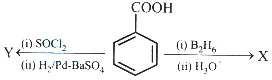
A
Benzyl alcohol,Benzaldehyde
B
Benzyl alcohol,Benzaldehyde
C
Benzaldehyde,Benzaldehyde
D
Toluene,Benzyl alcohol
Solution
(B) $1$. For the formation of $X$: Benzoic acid reacts with $B_2H_6$ followed by hydrolysis $(H_3O^+)$ to undergo reduction,yielding benzyl alcohol $(C_6H_5CH_2OH)$ as $X$.
$2$. For the formation of $Y$: Benzoic acid reacts with $SOCl_2$ to form benzoyl chloride $(C_6H_5COCl)$,which then undergoes Rosenmund reduction using $H_2/Pd-BaSO_4$ to yield benzaldehyde $(C_6H_5CHO)$ as $Y$.
$3$. Therefore,$X$ is benzyl alcohol and $Y$ is benzaldehyde.
$2$. For the formation of $Y$: Benzoic acid reacts with $SOCl_2$ to form benzoyl chloride $(C_6H_5COCl)$,which then undergoes Rosenmund reduction using $H_2/Pd-BaSO_4$ to yield benzaldehyde $(C_6H_5CHO)$ as $Y$.
$3$. Therefore,$X$ is benzyl alcohol and $Y$ is benzaldehyde.
0 likes
View Solution676
MediumMCQ
Identify the reagents $A$ and $B$ in the following reaction: $CH_3 CH_3 \leftrightarrow{(B)} CH_3 COOH \rightarrow{(A)} CH_3 CH_2 OH$
A
$A = LiAlH_4$ and $B = HI / \text{red } P$
B
$A = Ni / \Delta$ and $B = LiAlH_4$
C
$A = Pd / BaSO_4$ and $B = Zn / HCl$
D
$A = HI / \text{red } P$ and $B = LiAlH_4$
Solution
(A) $LiAlH_4$ is a strong reducing agent that reduces carboxylic acid to primary alcohol.
$HI / \text{red } P$ is a strong reducing agent that reduces carboxylic acid to the corresponding alkane.
Therefore,for the reaction $CH_3 COOH \xrightarrow{(A)} CH_3 CH_2 OH$,reagent $A$ is $LiAlH_4$.
For the reaction $CH_3 COOH \xrightarrow{(B)} CH_3 CH_3$,reagent $B$ is $HI / \text{red } P$.
$HI / \text{red } P$ is a strong reducing agent that reduces carboxylic acid to the corresponding alkane.
Therefore,for the reaction $CH_3 COOH \xrightarrow{(A)} CH_3 CH_2 OH$,reagent $A$ is $LiAlH_4$.
For the reaction $CH_3 COOH \xrightarrow{(B)} CH_3 CH_3$,reagent $B$ is $HI / \text{red } P$.
0 likes
View Solution677
MediumMCQ
What are $X$ and $Y$ respectively in the following reaction sequence?
$C_6H_5CH_3$ $\xrightarrow{X} C_6H_5CO_2H$ $\xrightarrow{Y} C_6H_5CH_2OH$
$C_6H_5CH_3$ $\xrightarrow{X} C_6H_5CO_2H$ $\xrightarrow{Y} C_6H_5CH_2OH$
A
$X = PCC$; $Y = (i) \ B_2H_6, (ii) \ H_3O^{+}$
B
$X = (i) \ KMnO_4 / OH^{-}, (ii) \ H_3O^{+}$; $Y = NaBH_4$
C
$X = (i) \ KMnO_4 / OH^{-}, \Delta, (ii) \ H_3O^{+}$; $Y = (i) \ B_2H_6, (ii) \ H_3O^{+}$
D
$X = PCC$; $Y = LAH$
Solution
(C) The conversion of toluene $(C_6H_5CH_3)$ to benzoic acid $(C_6H_5CO_2H)$ requires strong oxidation,which is achieved using alkaline $KMnO_4$ followed by acidic workup $(H_3O^{+})$.
Thus,$X = (i) \ KMnO_4 / OH^{-}, \Delta, (ii) \ H_3O^{+}$.
The reduction of benzoic acid to benzyl alcohol $(C_6H_5CH_2OH)$ is selectively performed by diborane $(B_2H_6)$ followed by acidic workup $(H_3O^{+})$,as $B_2H_6$ does not reduce the aromatic ring.
Thus,$Y = (i) \ B_2H_6, (ii) \ H_3O^{+}$.
Therefore,the correct option is $C$.
Thus,$X = (i) \ KMnO_4 / OH^{-}, \Delta, (ii) \ H_3O^{+}$.
The reduction of benzoic acid to benzyl alcohol $(C_6H_5CH_2OH)$ is selectively performed by diborane $(B_2H_6)$ followed by acidic workup $(H_3O^{+})$,as $B_2H_6$ does not reduce the aromatic ring.
Thus,$Y = (i) \ B_2H_6, (ii) \ H_3O^{+}$.
Therefore,the correct option is $C$.
0 likes
View Solution678
DifficultMCQ
Identify the major product from the following reaction sequence:
$Cyclohexyl-CH_2CH_2OH \xrightarrow[(ii) Cl_2/Red \ P \ (iii) H_2O]{(i) CrO_3, H_2SO_4}$
$Cyclohexyl-CH_2CH_2OH \xrightarrow[(ii) Cl_2/Red \ P \ (iii) H_2O]{(i) CrO_3, H_2SO_4}$
A
Cyclohexylacetic acid
B
Phenylacetic acid
C
$4-Chlorocyclohexylacetic$ acid
D
$2-Chloro-2-cyclohexylacetic$ acid
Solution
(D) The starting material is $2-cyclohexylethanol$.
$(i)$ Treatment with $CrO_3, H_2SO_4$ (Jones reagent) oxidizes the primary alcohol to a carboxylic acid,yielding $cyclohexylacetic$ acid $(C_6H_{11}CH_2COOH)$.
(ii) The reaction with $Cl_2/Red \ P$ is the Hell-Volhard-Zelinsky $(HVZ)$ reaction,which halogenates the $\alpha$-carbon of the carboxylic acid.
(iii) The product formed is $2-chloro-2-cyclohexylacetic$ acid $(C_6H_{11}CHClCOOH)$.
Thus,the correct option is $D$.
$(i)$ Treatment with $CrO_3, H_2SO_4$ (Jones reagent) oxidizes the primary alcohol to a carboxylic acid,yielding $cyclohexylacetic$ acid $(C_6H_{11}CH_2COOH)$.
(ii) The reaction with $Cl_2/Red \ P$ is the Hell-Volhard-Zelinsky $(HVZ)$ reaction,which halogenates the $\alpha$-carbon of the carboxylic acid.
(iii) The product formed is $2-chloro-2-cyclohexylacetic$ acid $(C_6H_{11}CHClCOOH)$.
Thus,the correct option is $D$.
0 likes
View Solution679
DifficultMCQ
Identify the major product from the following reaction sequence: $Cyclopentylmethanol \xrightarrow[(iii) H^+, (iv) Br_2, Red P, (v) H_2O]{(i) PCC, (ii) Tollen's reagent, NaOH} ?$
A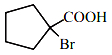
B
C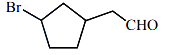
D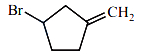
Solution
(A) The reaction sequence proceeds as follows:
$1$. $(i) PCC$: Oxidizes primary alcohol to aldehyde $(Cyclopentylmethanol \rightarrow Cyclopentanecarbaldehyde)$.
$2$. $(ii) Tollen's reagent, NaOH$: Oxidizes the aldehyde to a carboxylic acid $(Cyclopentanecarbaldehyde \rightarrow Cyclopentanecarboxylic acid)$.
$3$. $(iii) H^+$: Protonation step.
$4$. $(iv) Br_2, Red P$: This is the Hell-Volhard-Zelinsky $(HVZ)$ reaction,which alpha-halogenates the carboxylic acid $(Cyclopentanecarboxylic acid \rightarrow 1-Bromocyclopentanecarboxylic acid)$.
$5$. $(v) H_2O$: Workup step.
The final product is $1-bromocyclopentanecarboxylic acid$.
$1$. $(i) PCC$: Oxidizes primary alcohol to aldehyde $(Cyclopentylmethanol \rightarrow Cyclopentanecarbaldehyde)$.
$2$. $(ii) Tollen's reagent, NaOH$: Oxidizes the aldehyde to a carboxylic acid $(Cyclopentanecarbaldehyde \rightarrow Cyclopentanecarboxylic acid)$.
$3$. $(iii) H^+$: Protonation step.
$4$. $(iv) Br_2, Red P$: This is the Hell-Volhard-Zelinsky $(HVZ)$ reaction,which alpha-halogenates the carboxylic acid $(Cyclopentanecarboxylic acid \rightarrow 1-Bromocyclopentanecarboxylic acid)$.
$5$. $(v) H_2O$: Workup step.
The final product is $1-bromocyclopentanecarboxylic acid$.
0 likes
View Solution680
MediumMCQ
The reaction of $RCOOH$ with $R'OH$ takes place in the presence of $H_2SO_4$ to form an ester. The intermediate in the reaction is:
A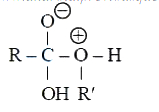
B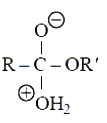
C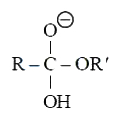
D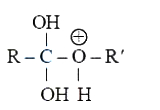
Solution
(A) The esterification reaction (Fischer esterification) proceeds via the nucleophilic acyl substitution mechanism.
$1$. The carbonyl oxygen of the carboxylic acid is protonated by $H_2SO_4$,making the carbonyl carbon more electrophilic.
$2$. The alcohol $(R'OH)$ acts as a nucleophile and attacks the electrophilic carbonyl carbon,forming a tetrahedral intermediate.
$3$. The structure of this tetrahedral intermediate is $R-C(OH)_2-OR'$,where the oxygen atom derived from the alcohol is protonated (bearing a positive charge).
$4$. Comparing the given options with the mechanism,the structure corresponding to the tetrahedral intermediate is represented in option $A$.
$1$. The carbonyl oxygen of the carboxylic acid is protonated by $H_2SO_4$,making the carbonyl carbon more electrophilic.
$2$. The alcohol $(R'OH)$ acts as a nucleophile and attacks the electrophilic carbonyl carbon,forming a tetrahedral intermediate.
$3$. The structure of this tetrahedral intermediate is $R-C(OH)_2-OR'$,where the oxygen atom derived from the alcohol is protonated (bearing a positive charge).
$4$. Comparing the given options with the mechanism,the structure corresponding to the tetrahedral intermediate is represented in option $A$.
0 likes
View Solution681
MediumMCQ
What are $X$ and $Y$ in the following reactions?
a) Benzoic acid $\xrightarrow[Conc. H_2SO_4]{Conc. HNO_3} X$
b) $R-CH_2-COOH \xrightarrow[ii) H_2O]{i) Br_2 / Red \ P} Y$
a) Benzoic acid $\xrightarrow[Conc. H_2SO_4]{Conc. HNO_3} X$
b) $R-CH_2-COOH \xrightarrow[ii) H_2O]{i) Br_2 / Red \ P} Y$
A
$X$ = $3,5-$dinitrobenzoic acid,$Y$ = $R$-CH_2-COBr
B
$X$ = $3,5-$dinitrobenzoic acid,$Y$ = $R$-$CH$(Br)-COBr
C
$X$ = $3-$nitrobenzoic acid,$Y$ = $R$-CH_2-COBr
D
$X$ = $3-$nitrobenzoic acid,$Y$ = $R$-$CH$(Br)-$COOH$
Solution
(D) For reaction $(a)$: Benzoic acid contains a $-COOH$ group,which is a deactivating and meta-directing group. Nitration with $Conc. HNO_3 + Conc. H_2SO_4$ yields $m$-nitrobenzoic acid as the major product. Thus,$X$ is $3$-nitrobenzoic acid.
For reaction $(b)$: This is the Hell-Volhard-Zelinsky $(HVZ)$ reaction. Carboxylic acids having an $\alpha$-hydrogen atom are halogenated at the $\alpha$-position on treatment with $Br_2$ in the presence of small amount of red phosphorus. The product $Y$ is an $\alpha$-bromo carboxylic acid,$R-CH(Br)-COOH$.
For reaction $(b)$: This is the Hell-Volhard-Zelinsky $(HVZ)$ reaction. Carboxylic acids having an $\alpha$-hydrogen atom are halogenated at the $\alpha$-position on treatment with $Br_2$ in the presence of small amount of red phosphorus. The product $Y$ is an $\alpha$-bromo carboxylic acid,$R-CH(Br)-COOH$.
0 likes
View Solution682
MediumMCQ
Identify the reagents $A$ and $B$ respectively in the following reactions: $CH_3COOH$ $\xrightarrow{A} CH_3COCl$ $\xrightarrow{B} CH_3CHO$
A
$SOCl_2, H_2 / Pd-BaSO_4$
B
$H_2 / Pd-BaSO_4, SOCl_2$
C
$SOCl_2, H_2O_2$
D
$SOCl_2, OsO_4$
Solution
(A) The conversion of acetic acid $(CH_3COOH)$ to acetyl chloride $(CH_3COCl)$ is achieved using thionyl chloride $(SOCl_2)$. This is a standard reaction for converting carboxylic acids to acid chlorides.
The conversion of acetyl chloride $(CH_3COCl)$ to acetaldehyde $(CH_3CHO)$ is a Rosenmund reduction,which uses hydrogen gas in the presence of palladium catalyst poisoned with barium sulfate $(H_2 / Pd-BaSO_4)$.
Therefore,reagent $A$ is $SOCl_2$ and reagent $B$ is $H_2 / Pd-BaSO_4$.
The conversion of acetyl chloride $(CH_3COCl)$ to acetaldehyde $(CH_3CHO)$ is a Rosenmund reduction,which uses hydrogen gas in the presence of palladium catalyst poisoned with barium sulfate $(H_2 / Pd-BaSO_4)$.
Therefore,reagent $A$ is $SOCl_2$ and reagent $B$ is $H_2 / Pd-BaSO_4$.
0 likes
View Solution683
MediumMCQ
What is the major product $Y$ in the following reaction sequence?
$C_6H_5CONH_2$ $\xrightarrow[\text{Pyridine } 70^{\circ}C]{C_6H_5SO_2Cl} X$ $\xrightarrow[(ii) Br_2, FeBr_3]{(i) H_3O^+} Y$
$C_6H_5CONH_2$ $\xrightarrow[\text{Pyridine } 70^{\circ}C]{C_6H_5SO_2Cl} X$ $\xrightarrow[(ii) Br_2, FeBr_3]{(i) H_3O^+} Y$
A
$3-$bromobenzoic acid
B
Benzoyl bromide
C
$4-$bromoaniline
D
$4-$bromobenzoic acid
Solution
(A) $1$. The reaction of benzamide $(C_6H_5CONH_2)$ with benzenesulfonyl chloride $(C_6H_5SO_2Cl)$ in the presence of pyridine leads to the dehydration of the amide to form benzonitrile $(C_6H_5CN)$ as intermediate $X$.
$2$. The subsequent hydrolysis of benzonitrile $(C_6H_5CN)$ with $H_3O^+$ yields benzoic acid $(C_6H_5COOH)$.
$3$. The $-COOH$ group is a deactivating and meta-directing group. Therefore,electrophilic aromatic substitution with $Br_2/FeBr_3$ directs the bromine atom to the meta position.
$4$. The final product $Y$ is $3-$bromobenzoic acid.
$2$. The subsequent hydrolysis of benzonitrile $(C_6H_5CN)$ with $H_3O^+$ yields benzoic acid $(C_6H_5COOH)$.
$3$. The $-COOH$ group is a deactivating and meta-directing group. Therefore,electrophilic aromatic substitution with $Br_2/FeBr_3$ directs the bromine atom to the meta position.
$4$. The final product $Y$ is $3-$bromobenzoic acid.
0 likes
View Solution684
MediumMCQ
Arrange the products $I$,$II$,$III$ from the following reactions in decreasing order of their acid strength.
$A) \text{Propylbenzene} \xrightarrow[\text{ (ii) } H_3O^{+}]{\text{ (i) } KMnO_4 / OH^{-}} I$
$B) CH_3COOH \xrightarrow[\text{ (ii) } H_2O]{\text{ (i) } Br_2 / \text{red } P} II$
$C) \text{Bromobenzene}$ $\xrightarrow[\substack{\text{ (ii) } CO_2 / \text{dry ether} \\ \text{ (iii) } H_3O^{+}}]{\text{ (i) } Mg / \text{dry ether}} III$
$A) \text{Propylbenzene} \xrightarrow[\text{ (ii) } H_3O^{+}]{\text{ (i) } KMnO_4 / OH^{-}} I$
$B) CH_3COOH \xrightarrow[\text{ (ii) } H_2O]{\text{ (i) } Br_2 / \text{red } P} II$
$C) \text{Bromobenzene}$ $\xrightarrow[\substack{\text{ (ii) } CO_2 / \text{dry ether} \\ \text{ (iii) } H_3O^{+}}]{\text{ (i) } Mg / \text{dry ether}} III$
A
$III > II > I$
B
$III > I > II$
C
$II > I > III$
D
$I > II > III$
Solution
(C) Step $1$: Identify the products.
Reaction $A$: Oxidation of propylbenzene with $KMnO_4/OH^-$ followed by acid workup gives benzoic acid $(I = C_6H_5COOH)$.
Reaction $B$: Hell-Volhard-Zelinsky reaction of acetic acid gives bromoacetic acid $(II = BrCH_2COOH)$.
Reaction $C$: Grignard reagent formation from bromobenzene followed by reaction with $CO_2$ and acid workup gives benzoic acid $(III = C_6H_5COOH)$.
Note: $I$ and $III$ are both benzoic acid.
Step $2$: Compare acid strength.
$II$ is $BrCH_2COOH$. The electron-withdrawing $-Br$ group increases the acidity of the carboxylic acid compared to benzoic acid.
$I$ and $III$ are both benzoic acid $(C_6H_5COOH)$.
Therefore,the order of acid strength is $II > I = III$.
Given the options,the most appropriate order is $II > I \approx III$.
Reaction $A$: Oxidation of propylbenzene with $KMnO_4/OH^-$ followed by acid workup gives benzoic acid $(I = C_6H_5COOH)$.
Reaction $B$: Hell-Volhard-Zelinsky reaction of acetic acid gives bromoacetic acid $(II = BrCH_2COOH)$.
Reaction $C$: Grignard reagent formation from bromobenzene followed by reaction with $CO_2$ and acid workup gives benzoic acid $(III = C_6H_5COOH)$.
Note: $I$ and $III$ are both benzoic acid.
Step $2$: Compare acid strength.
$II$ is $BrCH_2COOH$. The electron-withdrawing $-Br$ group increases the acidity of the carboxylic acid compared to benzoic acid.
$I$ and $III$ are both benzoic acid $(C_6H_5COOH)$.
Therefore,the order of acid strength is $II > I = III$.
Given the options,the most appropriate order is $II > I \approx III$.
0 likes
View Solution685
MediumMCQ
The most acidic carboxylic acid is
A
$C_6H_5COOH$
B
$C_6H_5CH_2COOH$
C
$HCOOH$
D
$CH_3COOH$
Solution
(C) The acidity of carboxylic acids depends on the stability of the carboxylate anion formed after the loss of a proton. Electron-withdrawing groups increase acidity by stabilizing the negative charge,while electron-donating groups decrease acidity.
$1$. $HCOOH$ (Formic acid): The $H$ atom has no inductive effect.
$2$. $CH_3COOH$ (Acetic acid): The $CH_3$ group is electron-donating ($+I$ effect),which destabilizes the carboxylate anion,making it less acidic than formic acid.
$3$. $C_6H_5COOH$ (Benzoic acid): The phenyl group is electron-withdrawing due to its $sp^2$ hybridized carbon atom ($-I$ effect),making it more acidic than acetic acid.
$4$. $C_6H_5CH_2COOH$ (Phenylacetic acid): The $CH_2$ group separates the phenyl ring from the carboxyl group,reducing the electron-withdrawing effect of the phenyl ring compared to benzoic acid.
Comparing the $pK_a$ values: $HCOOH$ $(pK_a \approx 3.75)$ > $C_6H_5COOH$ $(pK_a \approx 4.20)$ > $C_6H_5CH_2COOH$ $(pK_a \approx 4.31)$ > $CH_3COOH$ $(pK_a \approx 4.76)$.
Therefore,$HCOOH$ is the most acidic among the given options.
$1$. $HCOOH$ (Formic acid): The $H$ atom has no inductive effect.
$2$. $CH_3COOH$ (Acetic acid): The $CH_3$ group is electron-donating ($+I$ effect),which destabilizes the carboxylate anion,making it less acidic than formic acid.
$3$. $C_6H_5COOH$ (Benzoic acid): The phenyl group is electron-withdrawing due to its $sp^2$ hybridized carbon atom ($-I$ effect),making it more acidic than acetic acid.
$4$. $C_6H_5CH_2COOH$ (Phenylacetic acid): The $CH_2$ group separates the phenyl ring from the carboxyl group,reducing the electron-withdrawing effect of the phenyl ring compared to benzoic acid.
Comparing the $pK_a$ values: $HCOOH$ $(pK_a \approx 3.75)$ > $C_6H_5COOH$ $(pK_a \approx 4.20)$ > $C_6H_5CH_2COOH$ $(pK_a \approx 4.31)$ > $CH_3COOH$ $(pK_a \approx 4.76)$.
Therefore,$HCOOH$ is the most acidic among the given options.
0 likes
View Solution686
MediumMCQ
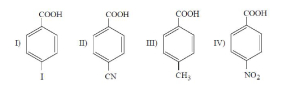
The carboxylic acid with the highest $pK_{a}$ and lowest $pK_{a}$ values among the following are respectively:
A
$I, II$
B
$I, IV$
C
$III, II$
D
$III, IV$
Solution
(D) The acidity of substituted benzoic acids depends on the electronic effects of the substituents. Electron-withdrawing groups $(EWG)$ increase acidity (lower $pK_{a}$),while electron-donating groups $(EDG)$ decrease acidity (higher $pK_{a}$).
$1$. $III$ ($p$-methylbenzoic acid): $-CH_3$ is an $EDG$ ($+I$ and hyperconjugation effect),which decreases acidity. Thus,it has the highest $pK_{a}$.
$2$. $I$ ($p$-iodobenzoic acid): $-I$ is a weak $EWG$ ($-I$ effect),which slightly increases acidity.
$3$. $II$ ($p$-cyanobenzoic acid): $-CN$ is a strong $EWG$ ($-I$ and $-M$ effects),which significantly increases acidity.
$4$. $IV$ ($p$-nitrobenzoic acid): $-NO_2$ is a very strong $EWG$ ($-I$ and $-M$ effects),which increases acidity the most. Thus,it has the lowest $pK_{a}$.
Therefore,the highest $pK_{a}$ is for $III$ and the lowest $pK_{a}$ is for $IV$. The correct option is $D$.
$1$. $III$ ($p$-methylbenzoic acid): $-CH_3$ is an $EDG$ ($+I$ and hyperconjugation effect),which decreases acidity. Thus,it has the highest $pK_{a}$.
$2$. $I$ ($p$-iodobenzoic acid): $-I$ is a weak $EWG$ ($-I$ effect),which slightly increases acidity.
$3$. $II$ ($p$-cyanobenzoic acid): $-CN$ is a strong $EWG$ ($-I$ and $-M$ effects),which significantly increases acidity.
$4$. $IV$ ($p$-nitrobenzoic acid): $-NO_2$ is a very strong $EWG$ ($-I$ and $-M$ effects),which increases acidity the most. Thus,it has the lowest $pK_{a}$.
Therefore,the highest $pK_{a}$ is for $III$ and the lowest $pK_{a}$ is for $IV$. The correct option is $D$.
0 likes
View Solution687
EasyMCQ
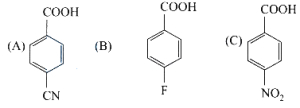
Arrange the following compounds in decreasing order of their acidity:
A
$C > B > A$
B
$C > A > B$
C
$B > C > A$
D
$B > A > C$
Solution
(B) The acidity of substituted benzoic acids is directly proportional to the electron-withdrawing effect ($-I$ and $-M$ effects) of the substituent group.
The substituents present are:
$(A) -CN$ (strong $-I$ and $-M$ effect)
$(B) -F$ (strong $-I$ effect,weak $+M$ effect)
$(C) -NO_2$ (very strong $-I$ and $-M$ effect)
The overall electron-withdrawing power follows the order: $-NO_2 > -CN > -F$.
Therefore,the decreasing order of acidity is $C > A > B$.
The substituents present are:
$(A) -CN$ (strong $-I$ and $-M$ effect)
$(B) -F$ (strong $-I$ effect,weak $+M$ effect)
$(C) -NO_2$ (very strong $-I$ and $-M$ effect)
The overall electron-withdrawing power follows the order: $-NO_2 > -CN > -F$.
Therefore,the decreasing order of acidity is $C > A > B$.
0 likes
View Solution688
MediumMCQ
Identify $X, Y$ and $Z$ in the following reaction sequence:
$C_6H_5CH_2CH_2OH$ $\xrightarrow{X} C_6H_5CH_2COOH$ $\xrightarrow{Y} Z$
$C_6H_5CH_2CH_2OH$ $\xrightarrow{X} C_6H_5CH_2COOH$ $\xrightarrow{Y} Z$
A
$X=$ $PCC$,$Y=$ $NaOH, CaO$,$Z=C_6H_5CH_3$
B
$X=$ $PCC$,$Y=$ $LAH$,$Z=C_6H_5CH_2CH_3$
C
$X=$ Jones reagent,$Y=$ $NaOH, CaO$,$Z=C_6H_5CH_2CH_3$
D
$X=$ Jones reagent,$Y=$ $NaOH, CaO, \Delta$,$Z=C_6H_5CH_3$
Solution
(D) The conversion of a primary alcohol $(C_6H_5CH_2CH_2OH)$ to a carboxylic acid $(C_6H_5CH_2COOH)$ requires a strong oxidizing agent like Jones reagent ($CrO_3/H_2SO_4$ in $H_2O/acetone$). Thus,$X=$ Jones reagent.
The conversion of a carboxylic acid to an alkane with one less carbon atom is achieved by heating with soda lime $(NaOH + CaO)$,a process known as decarboxylation. Thus,$Y=NaOH, CaO, \Delta$ and $Z=C_6H_5CH_3$ (toluene).
Therefore,the correct option is $D$.
The conversion of a carboxylic acid to an alkane with one less carbon atom is achieved by heating with soda lime $(NaOH + CaO)$,a process known as decarboxylation. Thus,$Y=NaOH, CaO, \Delta$ and $Z=C_6H_5CH_3$ (toluene).
Therefore,the correct option is $D$.
0 likes
View Solution689
MediumMCQ
What are $X$ and $Y$ respectively in the following reaction sequence?
Styrene $\xrightarrow[(ii) H_3O^+]{(i) KMnO_4 / KOH} X$ $\xrightarrow{Br_2 / FeBr_3} Y$
Styrene $\xrightarrow[(ii) H_3O^+]{(i) KMnO_4 / KOH} X$ $\xrightarrow{Br_2 / FeBr_3} Y$
A
$X$ = Phenylacetic acid,$Y$ = Phenylacetyl bromide
B
$X$ = Phenylacetic acid,$Y$ = $p$-Bromophenylacetic acid
C
$X$ = Benzoic acid,$Y$ = $m$-Bromobenzoic acid
D
$X$ = Benzoic acid,$Y$ = $o$-Bromobenzoyl bromide
Solution
(C) $1$. The reaction of styrene $(C_6H_5-CH=CH_2)$ with alkaline $KMnO_4$ followed by acidic workup $(H_3O^+)$ is an oxidative cleavage reaction that converts the vinyl group into a carboxylic acid group,yielding benzoic acid $(C_6H_5COOH)$ as product $X$.
$2$. Benzoic acid contains a $-COOH$ group attached to the benzene ring. The $-COOH$ group is a strongly deactivating group and is meta-directing for electrophilic aromatic substitution reactions.
$3$. Therefore,the bromination of benzoic acid $(X)$ using $Br_2 / FeBr_3$ will result in the electrophilic substitution of the bromine atom at the meta-position,yielding $m$-bromobenzoic acid as product $Y$.
$2$. Benzoic acid contains a $-COOH$ group attached to the benzene ring. The $-COOH$ group is a strongly deactivating group and is meta-directing for electrophilic aromatic substitution reactions.
$3$. Therefore,the bromination of benzoic acid $(X)$ using $Br_2 / FeBr_3$ will result in the electrophilic substitution of the bromine atom at the meta-position,yielding $m$-bromobenzoic acid as product $Y$.
0 likes
View Solution690
MediumMCQ
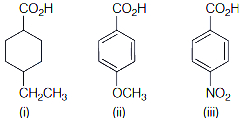
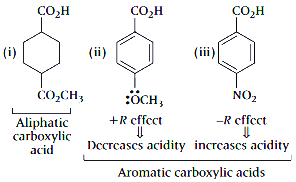
The order of acidic strength of the following acids is:
A
$(iii) > (ii) > (i)$
B
$(ii) > (iii) > (i)$
C
$(iii) > (i) > (ii)$
D
$(ii) > (i) > (iii)$
Solution
(A) The acidic strength depends on the stability of the conjugate base formed after the loss of a proton.
$(i)$ is $4$-ethylcyclohexanecarboxylic acid (aliphatic).
$(ii)$ is $4$-methoxybenzoic acid (aromatic with $+R$ effect of $-OCH_3$ group).
$(iii)$ is $4$-nitrobenzoic acid (aromatic with $-R$ effect of $-NO_2$ group).
$1$. Aromatic carboxylic acids are generally stronger than aliphatic carboxylic acids due to the resonance stabilization of the carboxylate anion by the benzene ring.
$2$. The $-NO_2$ group in $(iii)$ exerts a strong $-R$ (electron-withdrawing) effect,which stabilizes the carboxylate anion and significantly increases acidity.
$3$. The $-OCH_3$ group in $(ii)$ exerts a $+R$ (electron-donating) effect,which destabilizes the carboxylate anion and decreases acidity compared to benzoic acid,but it is still more acidic than the aliphatic acid $(i)$ due to the aromatic ring.
Therefore,the order of acidic strength is $(iii) > (ii) > (i)$.
$(i)$ is $4$-ethylcyclohexanecarboxylic acid (aliphatic).
$(ii)$ is $4$-methoxybenzoic acid (aromatic with $+R$ effect of $-OCH_3$ group).
$(iii)$ is $4$-nitrobenzoic acid (aromatic with $-R$ effect of $-NO_2$ group).
$1$. Aromatic carboxylic acids are generally stronger than aliphatic carboxylic acids due to the resonance stabilization of the carboxylate anion by the benzene ring.
$2$. The $-NO_2$ group in $(iii)$ exerts a strong $-R$ (electron-withdrawing) effect,which stabilizes the carboxylate anion and significantly increases acidity.
$3$. The $-OCH_3$ group in $(ii)$ exerts a $+R$ (electron-donating) effect,which destabilizes the carboxylate anion and decreases acidity compared to benzoic acid,but it is still more acidic than the aliphatic acid $(i)$ due to the aromatic ring.
Therefore,the order of acidic strength is $(iii) > (ii) > (i)$.
0 likes
View Solution691
EasyMCQ
What are $A$ and $B$ in the following reaction sequence?
$CH_3COOH$ $\xrightarrow{A} X$ $\xrightarrow[H^{+}]{Y} \underset{\text{(Analgesic drug)}}{B}$
$CH_3COOH$ $\xrightarrow{A} X$ $\xrightarrow[H^{+}]{Y} \underset{\text{(Analgesic drug)}}{B}$
A
$A = P_2O_5, \Delta; B = \text{2-acetoxybenzoic acid}$
B
$A = P_2O_5, \Delta; B = \text{methyl salicylate}$
C
$A = SOCl_2, \Delta; B = \text{4-acetoxybenzoic acid}$
D
$A = SOCl_2, \Delta; B = \text{4-hydroxybenzoic acid}$
Solution
(A) The reaction sequence is as follows:
$1$. $CH_3COOH$ reacts with $P_2O_5$ under heating $(\Delta)$ to form acetic anhydride $(X)$ via dehydration.
$2$. Acetic anhydride $(X)$ then reacts with salicylic acid $(Y)$ in the presence of an acid catalyst $(H^ )$ to undergo acetylation of the phenolic $-OH$ group.
$3$. This reaction produces $2-\text{acetoxybenzoic acid}$,commonly known as aspirin $(B)$,which acts as an analgesic drug.
Therefore,$A = P_2O_5, \Delta$ and $B = \text{2-acetoxybenzoic acid}$.
$1$. $CH_3COOH$ reacts with $P_2O_5$ under heating $(\Delta)$ to form acetic anhydride $(X)$ via dehydration.
$2$. Acetic anhydride $(X)$ then reacts with salicylic acid $(Y)$ in the presence of an acid catalyst $(H^ )$ to undergo acetylation of the phenolic $-OH$ group.
$3$. This reaction produces $2-\text{acetoxybenzoic acid}$,commonly known as aspirin $(B)$,which acts as an analgesic drug.
Therefore,$A = P_2O_5, \Delta$ and $B = \text{2-acetoxybenzoic acid}$.
0 likes
View Solution692
EasyMCQ
Identify the major product of the given reaction:
$C_6H_5COOH + Br_2 \xrightarrow{FeBr_3} \text{Product}$
$C_6H_5COOH + Br_2 \xrightarrow{FeBr_3} \text{Product}$
A
Benzoyl bromide
B
Bromobenzene
C
$4-$bromo benzoic acid
D
$3-$bromo benzoic acid
Solution
(D) The reaction of benzoic acid $(C_6H_5COOH)$ with $Br_2$ in the presence of a Lewis acid catalyst like $FeBr_3$ is an electrophilic aromatic substitution reaction.
The $-COOH$ group attached to the benzene ring is a strongly deactivating group and is meta-directing.
Therefore,the electrophile $(Br^+)$ will attack the meta-position of the benzene ring,resulting in the formation of $3-$bromo benzoic acid as the major product.
The $-COOH$ group attached to the benzene ring is a strongly deactivating group and is meta-directing.
Therefore,the electrophile $(Br^+)$ will attack the meta-position of the benzene ring,resulting in the formation of $3-$bromo benzoic acid as the major product.
0 likes
View Solution693
MediumMCQ
In the reaction,if $X$ is the reagent and $Y$ is the product,which of the following is not feasible?
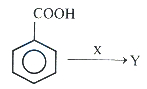
A
$X = \text{Conc. } HNO_3 + \text{Conc. } H_2SO_4$; $Y = 3-\text{Nitrobenzoic acid}$
B
$X = Br_2 / Fe$; $Y = 3-\text{Bromobenzoic acid}$
C
$X = NaOH, CaO$; $Y = \text{Benzene}$
D
$X = CH_3Cl / AlCl_3$; $Y = 3-\text{Methylbenzoic acid}$
Solution
(D) The reaction $X = CH_3Cl / AlCl_3$ is not feasible for benzoic acid because the $-COOH$ group is a strongly deactivating group,which makes the benzene ring unreactive towards electrophilic aromatic substitution. Furthermore,the $-COOH$ group coordinates with the Lewis acid $AlCl_3$ to form a complex,which further deactivates the ring and prevents the Friedel-Crafts alkylation reaction from occurring.
0 likes
View Solution694
EasyMCQ
The preferred reagent for the following conversion is $CH_3CH_2COOH \rightarrow CH_3CH_2COCl$.
A
$HCl$
B
$HOCl$
C
$SOCl_2$
D
$NaOCl$
Solution
(C) The conversion of a carboxylic acid into an acyl chloride is best achieved using thionyl chloride $(SOCl_2)$.
The reaction is given by: $CH_3CH_2COOH + SOCl_2 \rightarrow CH_3CH_2COCl + SO_2 + HCl$.
This method is preferred because the by-products ($SO_2$ and $HCl$) are gases,which escape the reaction mixture,driving the reaction to completion.
The reaction is given by: $CH_3CH_2COOH + SOCl_2 \rightarrow CH_3CH_2COCl + SO_2 + HCl$.
This method is preferred because the by-products ($SO_2$ and $HCl$) are gases,which escape the reaction mixture,driving the reaction to completion.
0 likes
View Solution8-2.Carboxylic acids and Their derivative — Properties of Carboxylic Acids and Their Derivatives · Frequently Asked Questions
1Are these 8-2.Carboxylic acids and Their derivative questions useful for JEE and NEET?
Yes. All questions in this section are mapped to JEE Main and NEET exam patterns. Previous year questions from JEE Main, NEET, GUJCET and state-level exams are included with full solutions.
2Can I switch to Hindi or Gujarati for these questions?
Yes. Use the language tabs in the hero section or the sidebar to view the same questions and solutions in English, Hindi or Gujarati.
3How do I generate a question paper from this subtopic?
Use the Vedclass Exam Paper Generator — select the chapter and subtopic, set difficulty, and generate Sets A, B, C, D automatically. First 3 chapters of every subject are free.
Vedclass Products
For Students
Vedclass Test Series
Mock tests in real JEE/NEET style with performance analysis. 5-day free trial.
Start Free TrialFor Teachers
Exam Paper Generator
Generate Set A/B/C/D papers from this chapter in 2 minutes. 3 chapters free.
Try FreeFor Institutes
Online Exam Module
Live online exams with unlimited students, 360° analytics & white-label branding.
See DemoFor Teachers & Institutes
Generate a 8-2.Carboxylic acids and Their derivative Exam Paper in 2 Minutes
Select subtopic & difficulty — Sets A, B, C, D auto-generated with No Repeat logic.
First 3 chapters of every subject are free — no payment required.