
A English
Properties of Carboxylic Acids and Their Derivatives Questions in English
Class 12 Chemistry · 8-2.Carboxylic acids and Their derivative · Properties of Carboxylic Acids and Their Derivatives
791+
Questions
English
Language
100%
With Solutions
Showing 49 of 791 questions in English
551
MediumMCQ
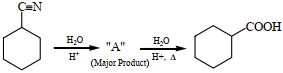
Consider the chemical reaction shown below and identify product $A$.
A
Cyclohexylmethanamine
B
Nitromethylcyclohexane
C
Cyclohexanecarboxamide
D
Cyclohexanecarbaldehyde oxime
Solution
(C) The reaction of a nitrile (cyclohexanecarbonitrile) with water in the presence of an acid $(H^+)$ leads to partial hydrolysis,which produces an amide as the major product $A$.
The reaction is as follows:
$R-CN + H_2O \xrightarrow{H^+} R-CONH_2$ (Partial Hydrolysis)
In this case,the nitrile group attached to the cyclohexane ring is converted to an amide group $(-CONH_2)$.
Therefore,product $A$ is cyclohexanecarboxamide.
The reaction is as follows:
$R-CN + H_2O \xrightarrow{H^+} R-CONH_2$ (Partial Hydrolysis)
In this case,the nitrile group attached to the cyclohexane ring is converted to an amide group $(-CONH_2)$.
Therefore,product $A$ is cyclohexanecarboxamide.
0 likes
View Solution552
MediumMCQ
Compound$(s)$ which will liberate carbon dioxide with sodium bicarbonate solution is/are:
$A = \text{2,4,6-triamino phenol}$
$B = \text{Benzoic acid}$
$C = \text{Picric acid (2,4,6-trinitrophenol)}$
$A = \text{2,4,6-triamino phenol}$
$B = \text{Benzoic acid}$
$C = \text{Picric acid (2,4,6-trinitrophenol)}$
A
$B$ only
B
$C$ only
C
$B$ and $C$ only
D
$A$ and $B$ only
Solution
(C) Sodium bicarbonate $(NaHCO_3)$ is a weak base. It reacts with acids that are stronger than carbonic acid ($H_2CO_3$,$pK_a \approx 6.35$) to liberate $CO_2$ gas.
$1$. $B$ (Benzoic acid,$pK_a \approx 4.2$) is a stronger acid than $H_2CO_3$,so it reacts with $NaHCO_3$ to liberate $CO_2$.
$2$. $C$ (Picric acid,$pK_a \approx 0.38$) is a very strong acid due to the electron-withdrawing effect of three $-NO_2$ groups. It is much stronger than $H_2CO_3$ and thus liberates $CO_2$ with $NaHCO_3$.
$3$. $A$ ($2$,$4$,$6$-triamino phenol) is a very weak acid because the $-NH_2$ groups are electron-donating by resonance,which destabilizes the phenoxide ion. It is weaker than $H_2CO_3$ and does not liberate $CO_2$ with $NaHCO_3$.
Therefore,both $B$ and $C$ will liberate $CO_2$.
$1$. $B$ (Benzoic acid,$pK_a \approx 4.2$) is a stronger acid than $H_2CO_3$,so it reacts with $NaHCO_3$ to liberate $CO_2$.
$2$. $C$ (Picric acid,$pK_a \approx 0.38$) is a very strong acid due to the electron-withdrawing effect of three $-NO_2$ groups. It is much stronger than $H_2CO_3$ and thus liberates $CO_2$ with $NaHCO_3$.
$3$. $A$ ($2$,$4$,$6$-triamino phenol) is a very weak acid because the $-NH_2$ groups are electron-donating by resonance,which destabilizes the phenoxide ion. It is weaker than $H_2CO_3$ and does not liberate $CO_2$ with $NaHCO_3$.
Therefore,both $B$ and $C$ will liberate $CO_2$.
0 likes
View Solution553
EasyMCQ
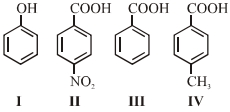
The correct order of acidic character of the following compounds is:
A
$III > II > I > IV$
B
$IV > III > II > I$
C
$I > II > III > IV$
D
$II > III > IV > I$
Solution
(D) The acidic strength depends on the stability of the conjugate base formed after the loss of a proton $(H^+)$.
$1.$ Phenol $(I)$ is much less acidic than carboxylic acids $(II, III, IV)$.
$2.$ Among the carboxylic acids,electron-withdrawing groups $(-NO_2)$ increase acidity,while electron-donating groups $(-CH_3)$ decrease it.
$3.$ Compound $II$ ($p$-nitrobenzoic acid) has a strong $-I$ and $-M$ effect,making it the most acidic.
$4.$ Compound $III$ (benzoic acid) is the reference.
$5.$ Compound $IV$ ($p$-toluic acid) has a $+I$ and $+H$ effect,making it the least acidic among the carboxylic acids.
$6.$ Therefore,the order is $II > III > IV > I$.
$1.$ Phenol $(I)$ is much less acidic than carboxylic acids $(II, III, IV)$.
$2.$ Among the carboxylic acids,electron-withdrawing groups $(-NO_2)$ increase acidity,while electron-donating groups $(-CH_3)$ decrease it.
$3.$ Compound $II$ ($p$-nitrobenzoic acid) has a strong $-I$ and $-M$ effect,making it the most acidic.
$4.$ Compound $III$ (benzoic acid) is the reference.
$5.$ Compound $IV$ ($p$-toluic acid) has a $+I$ and $+H$ effect,making it the least acidic among the carboxylic acids.
$6.$ Therefore,the order is $II > III > IV > I$.
0 likes
View Solution554
MediumMCQ
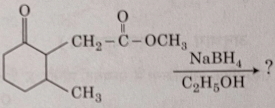
The product formed in the following chemical reaction is :
A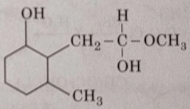
B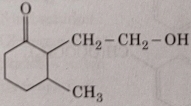
C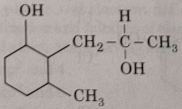
D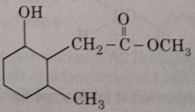
Solution
(D) $NaBH_4$ (Sodium borohydride) is a selective reducing agent that reduces aldehydes and ketones to their corresponding alcohols but does not reduce esters,carboxylic acids,or amides under normal conditions. In the given substrate,there is a ketone group and an ester group $(-COOCH_3)$. Therefore,$NaBH_4$ will selectively reduce the ketone group to a secondary alcohol $(-CHOH)$ while leaving the ester group unaffected. The final product is a cyclohexane ring with an $-OH$ group,a $-CH_2-COOCH_3$ group,and a $-CH_3$ group.
0 likes
View Solution555
DifficultMCQ
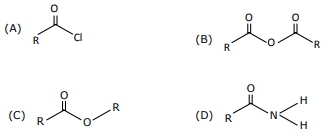
The correct order of their reactivity towards hydrolysis at room temperature is:
A
$A > B > C > D$
B
$D > A > B > C$
C
$A > B > D > C$
D
$D > C > B > A$
Solution
(A) The reactivity of carboxylic acid derivatives towards nucleophilic acyl substitution (like hydrolysis) depends on the leaving group ability. The better the leaving group,the more reactive the compound.
The leaving group abilities are: $Cl^- > RCOO^- > RO^- > NH_2^-$.
Therefore,the order of reactivity towards hydrolysis is:
$A$ (Acyl chloride) > $B$ (Acid anhydride) > $C$ (Ester) > $D$ (Amide).
Thus,the correct order is $A > B > C > D$.
The leaving group abilities are: $Cl^- > RCOO^- > RO^- > NH_2^-$.
Therefore,the order of reactivity towards hydrolysis is:
$A$ (Acyl chloride) > $B$ (Acid anhydride) > $C$ (Ester) > $D$ (Amide).
Thus,the correct order is $A > B > C > D$.
0 likes
View Solution556
DifficultMCQ
Maleic anhydride can be prepared by:

A
Treating $cis$-but-$2$-enedioic acid with alcohol and acid
B
Heating $cis$-but-$2$-enedioic acid
C
Treating $trans$-but-$2$-enedioic acid with alcohol and acid
D
Heating $trans$-but-$2$-enedioic acid
Solution
(B) Maleic anhydride is formed by the dehydration of $cis$-but-$2$-enedioic acid (maleic acid).
When $cis$-but-$2$-enedioic acid is heated,it undergoes intramolecular dehydration to form a cyclic anhydride known as maleic anhydride.
The reaction is as follows:
$cis$-but-$2$-enedioic acid $\xrightarrow{\Delta}$ Maleic anhydride + $H_2O$.
$trans$-but-$2$-enedioic acid (fumaric acid) does not form an anhydride easily upon heating because the carboxylic acid groups are on opposite sides of the double bond,making the formation of a cyclic structure sterically unfavorable.
When $cis$-but-$2$-enedioic acid is heated,it undergoes intramolecular dehydration to form a cyclic anhydride known as maleic anhydride.
The reaction is as follows:
$cis$-but-$2$-enedioic acid $\xrightarrow{\Delta}$ Maleic anhydride + $H_2O$.
$trans$-but-$2$-enedioic acid (fumaric acid) does not form an anhydride easily upon heating because the carboxylic acid groups are on opposite sides of the double bond,making the formation of a cyclic structure sterically unfavorable.
0 likes
View Solution557
MediumMCQ
If the rate of the reaction,$R-CO-Z + Nu^- \rightarrow R-CO-Nu + Z^-$ is fastest,then $Z$ is
A
$Cl$
B
$NH_2$
C
$OC_2H_5$
D
$OCOCH_3$
Solution
(A) The given reaction is a nucleophilic acyl substitution reaction. The rate of this reaction depends on the leaving group ability of $Z^-$. $A$ better leaving group makes the reaction faster. The leaving group ability is inversely proportional to the basicity of the group. Among the given options,$Cl^-$ is the weakest base and thus the best leaving group. Therefore,the reaction is fastest when $Z = Cl$.
0 likes
View Solution558
EasyMCQ
Among the following acids,the strongest acid is
A
$NCCH_2COOH$
B
$O_2NCH_2COOH$
C
$F_3CCOOH$
D
$Cl_3CCOOH$
Solution
(C) The strength of an acid is determined by the stability of its conjugate base. Electron-withdrawing groups $(EWG)$ stabilize the carboxylate anion $(RCOO^-)$ through the inductive effect ($-I$ effect),thereby increasing the acidity of the parent carboxylic acid.
Comparing the substituents:
$1$. $NCCH_2-$: Contains a cyano group $(-CN)$,which has a $-I$ effect.
$2$. $O_2NCH_2-$: Contains a nitro group $(-NO_2)$,which has a strong $-I$ effect.
$3$. $F_3C-$: Contains three fluorine atoms. Fluorine is the most electronegative element,and the $-I$ effect of three fluorine atoms is significantly stronger than that of a single $-NO_2$ or $-CN$ group.
$4$. $Cl_3C-$: Contains three chlorine atoms. Chlorine is less electronegative than fluorine,so the $-I$ effect of $Cl_3C-$ is weaker than that of $F_3C-$.
Since fluorine is the most electronegative,$F_3CCOOH$ exhibits the strongest $-I$ effect,making its conjugate base the most stable and the acid the strongest among the given options.
Comparing the substituents:
$1$. $NCCH_2-$: Contains a cyano group $(-CN)$,which has a $-I$ effect.
$2$. $O_2NCH_2-$: Contains a nitro group $(-NO_2)$,which has a strong $-I$ effect.
$3$. $F_3C-$: Contains three fluorine atoms. Fluorine is the most electronegative element,and the $-I$ effect of three fluorine atoms is significantly stronger than that of a single $-NO_2$ or $-CN$ group.
$4$. $Cl_3C-$: Contains three chlorine atoms. Chlorine is less electronegative than fluorine,so the $-I$ effect of $Cl_3C-$ is weaker than that of $F_3C-$.
Since fluorine is the most electronegative,$F_3CCOOH$ exhibits the strongest $-I$ effect,making its conjugate base the most stable and the acid the strongest among the given options.
0 likes
View Solution559
MediumMCQ
Two statements are given below:
Statement $I:$ The melting point of monocarboxylic acids with an even number of carbon atoms is higher than that of acids with an odd number of carbon atoms immediately below and above it in the series.
Statement $II:$ The solubility of monocarboxylic acids in water decreases with an increase in molar mass.
Choose the most appropriate option.
Statement $I:$ The melting point of monocarboxylic acids with an even number of carbon atoms is higher than that of acids with an odd number of carbon atoms immediately below and above it in the series.
Statement $II:$ The solubility of monocarboxylic acids in water decreases with an increase in molar mass.
Choose the most appropriate option.
A
Both Statement $I$ and Statement $II$ are correct.
B
Both Statement $I$ and Statement $II$ are incorrect.
C
Statement $I$ is correct but Statement $II$ is incorrect.
D
Statement $I$ is incorrect but Statement $II$ is correct.
Solution
(A) $I.$ Monocarboxylic acids with an even number of carbon atoms exhibit better packing efficiency in the crystal lattice,which results in a higher melting point $(M.P.)$ compared to their odd-numbered counterparts.
$II.$ As the molar mass of monocarboxylic acids increases,the size of the hydrophobic alkyl chain increases,which reduces the interaction with water molecules,thereby decreasing solubility.
$II.$ As the molar mass of monocarboxylic acids increases,the size of the hydrophobic alkyl chain increases,which reduces the interaction with water molecules,thereby decreasing solubility.
0 likes
View Solution560
MediumMCQ
The reagent,from the following,which converts benzoic acid to benzaldehyde in one step is
A
$LiAlH_4$
B
$KMnO_4$
C
$MnO$
D
$NaBH_4$
Solution
(C) The conversion of benzoic acid to benzaldehyde in one step can be achieved by heating benzoic acid with formic acid in the presence of manganese oxide $(MnO)$ as a catalyst at high temperatures. The reaction is as follows:
$C_6H_5COOH + HCOOH \xrightarrow{MnO, \Delta} C_6H_5CHO + CO_2 + H_2O$
Thus,$MnO$ is the correct reagent.
$C_6H_5COOH + HCOOH \xrightarrow{MnO, \Delta} C_6H_5CHO + CO_2 + H_2O$
Thus,$MnO$ is the correct reagent.
0 likes
View Solution561
MediumMCQ
Given below are two statements :
Statement $I :$ The esterification of carboxylic acid with an alcohol is a nucleophilic acyl substitution.
Statement $II :$ Electron withdrawing groups in the carboxylic acid will increase the rate of esterification reaction.
Choose the most appropriate option
Statement $I :$ The esterification of carboxylic acid with an alcohol is a nucleophilic acyl substitution.
Statement $II :$ Electron withdrawing groups in the carboxylic acid will increase the rate of esterification reaction.
Choose the most appropriate option
A
Both Statement $I$ and Statement $II$ are correct.
B
Both Statement $I$ and Statement $II$ are incorrect.
C
Statement $I$ is correct but Statement $II$ is incorrect.
D
Statement $I$ is incorrect but Statement $II$ is correct.
Solution
(A) $R-OH + R'-COOH \longrightarrow R'-COOR + H_2O$
This reaction is a nucleophilic acyl substitution reaction where the alcohol acts as a nucleophile.
Electron withdrawing groups $(EWG)$ on the carboxylic acid increase the electrophilicity of the carbonyl carbon by pulling electron density away,which facilitates the attack of the nucleophile,thereby increasing the rate of esterification.
This reaction is a nucleophilic acyl substitution reaction where the alcohol acts as a nucleophile.
Electron withdrawing groups $(EWG)$ on the carboxylic acid increase the electrophilicity of the carbonyl carbon by pulling electron density away,which facilitates the attack of the nucleophile,thereby increasing the rate of esterification.
0 likes
View Solution562
DifficultMCQ
In the following reaction sequence,
$Methylenecyclohexane$ $\xrightarrow[(ii) H_2O_2/NaOH]{(i) B_2H_6} X$ $\xrightarrow{CrO_3/H_2SO_4} Y$
$X$ and $Y$ are:
$Methylenecyclohexane$ $\xrightarrow[(ii) H_2O_2/NaOH]{(i) B_2H_6} X$ $\xrightarrow{CrO_3/H_2SO_4} Y$
$X$ and $Y$ are:
A
$X = \text{cyclohexylmethanol}, Y = \text{cyclohexanecarbaldehyde}$
B
$X = \text{cyclohexylmethanol}, Y = \text{cyclohexanecarboxylic acid}$
C
$X = \text{1-methylcyclohexanol}, Y = \text{cyclohexanecarboxylic acid}$
D
$X = \text{1-methylcyclohexanol}, Y = \text{1-methylcyclohexene}$
Solution
(B) The reaction of $methylenecyclohexane$ with $B_2H_6$ followed by $H_2O_2/NaOH$ is a hydroboration-oxidation reaction,which follows anti-$Markownikoff$ addition of water to the double bond. This results in the formation of a primary alcohol,$cyclohexylmethanol$ $(X)$.
$CrO_3$ in the presence of $H_2SO_4$ is known as Jones reagent,which is a strong oxidizing agent. It oxidizes primary alcohols directly to carboxylic acids. Therefore,$cyclohexylmethanol$ is oxidized to $cyclohexanecarboxylic acid$ $(Y)$.
$CrO_3$ in the presence of $H_2SO_4$ is known as Jones reagent,which is a strong oxidizing agent. It oxidizes primary alcohols directly to carboxylic acids. Therefore,$cyclohexylmethanol$ is oxidized to $cyclohexanecarboxylic acid$ $(Y)$.
0 likes
View Solution563
DifficultMCQ
Ethyl acetate reacts with $NH_2NHCONH_2$ to form
A
$CH_3CONHCONHNH_2$
B
$CH_3CON(NH_2)CONH_2$
C
$CH_3CONHNHCONH_2$
D
$CH_3CH_2NHNHCONH_2$
Solution
(C) The reaction between ethyl acetate $(CH_3COOCH_2CH_3)$ and semicarbazide $(NH_2NHCONH_2)$ is a nucleophilic acyl substitution reaction.
$NH_2NHCONH_2$ acts as a nucleophile and attacks the electrophilic carbonyl carbon of the ethyl acetate.
This leads to the elimination of ethanol $(CH_3CH_2OH)$ and the formation of acetyl semicarbazide $(CH_3CONHNHCONH_2)$.
$NH_2NHCONH_2$ acts as a nucleophile and attacks the electrophilic carbonyl carbon of the ethyl acetate.
This leads to the elimination of ethanol $(CH_3CH_2OH)$ and the formation of acetyl semicarbazide $(CH_3CONHNHCONH_2)$.
0 likes
View Solution564
MediumMCQ
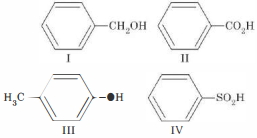
The order of acidity of compounds $I-IV$ is:
A
$I < III < II < IV$
B
$III < I < II < IV$
C
$IV < I < II < III$
D
$II < IV < III < I$
Solution
(A) The acidic strength of a compound is directly proportional to the stability of its conjugate base. More stable the conjugate base,stronger is the acid.
$I$: Benzyl alcohol $(C_6H_5CH_2OH)$ forms a conjugate base where the negative charge is on the oxygen atom and is not resonance-stabilized by the benzene ring.
$II$: Benzoic acid $(C_6H_5COOH)$ forms a carboxylate ion $(C_6H_5COO^-)$ which is resonance-stabilized by two oxygen atoms.
$III$: $p$-Cresol $(CH_3-C_6H_4-OH)$ forms a phenoxide ion which is resonance-stabilized,but the electron-donating $+I$ effect of the $-CH_3$ group destabilizes it compared to benzoic acid.
$IV$: Benzenesulfonic acid $(C_6H_5SO_3H)$ forms a sulfonate ion $(C_6H_5SO_3^-)$ where the negative charge is delocalized over three highly electronegative oxygen atoms,making it the most stable conjugate base.
Comparing the stability of conjugate bases:
$I$ (least stable) $< III < II < IV$ (most stable).
Therefore,the order of acidity is $I < III < II < IV$.
$I$: Benzyl alcohol $(C_6H_5CH_2OH)$ forms a conjugate base where the negative charge is on the oxygen atom and is not resonance-stabilized by the benzene ring.
$II$: Benzoic acid $(C_6H_5COOH)$ forms a carboxylate ion $(C_6H_5COO^-)$ which is resonance-stabilized by two oxygen atoms.
$III$: $p$-Cresol $(CH_3-C_6H_4-OH)$ forms a phenoxide ion which is resonance-stabilized,but the electron-donating $+I$ effect of the $-CH_3$ group destabilizes it compared to benzoic acid.
$IV$: Benzenesulfonic acid $(C_6H_5SO_3H)$ forms a sulfonate ion $(C_6H_5SO_3^-)$ where the negative charge is delocalized over three highly electronegative oxygen atoms,making it the most stable conjugate base.
Comparing the stability of conjugate bases:
$I$ (least stable) $< III < II < IV$ (most stable).
Therefore,the order of acidity is $I < III < II < IV$.
0 likes
View Solution565
DifficultMCQ
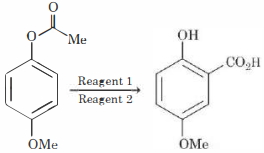
In the following transformation,reagents $1$ and $2$ are:
A
$H_2SO_4$; alk. $KMnO_4$
B
$AlCl_3$; $I_2 / NaOH$
C
$H_3PO_4$; $CHCl_3 / KOH$
D
$KOH$; $CHCl_3 / KOH$
Solution
(B) The correct option is $(B)$.
In the first reaction,$AlCl_3$ acts as a Lewis acid catalyst to facilitate the Fries rearrangement. This reaction involves the migration of the acyl group from the phenolic oxygen to the ortho position of the aryl ring,forming an ortho-hydroxyacetophenone derivative.
In the second reaction,$I_2 / NaOH$ acts as a reagent for the haloform reaction. The methyl ketone group $(-COCH_3)$ attached to the aromatic ring is oxidized to a carboxylic acid group $(-COOH)$ while producing iodoform $(CHI_3)$ as a byproduct.
In the first reaction,$AlCl_3$ acts as a Lewis acid catalyst to facilitate the Fries rearrangement. This reaction involves the migration of the acyl group from the phenolic oxygen to the ortho position of the aryl ring,forming an ortho-hydroxyacetophenone derivative.
In the second reaction,$I_2 / NaOH$ acts as a reagent for the haloform reaction. The methyl ketone group $(-COCH_3)$ attached to the aromatic ring is oxidized to a carboxylic acid group $(-COOH)$ while producing iodoform $(CHI_3)$ as a byproduct.
0 likes
View Solution566
MediumMCQ
The major products obtained in the reaction of oxalic acid with conc. $H_2SO_4$ upon heating are
A
$CO, CO_2, H_2O$
B
$CO, SO_2, H_2O$
C
$H_2S, CO, H_2O$
D
$HCOOH, H_2S, CO$
Solution
(A) The correct answer is $A$.
Oxalic acid $(COOH)_2$ undergoes dehydration when heated with concentrated sulfuric acid $(H_2SO_4)$.
The chemical reaction is as follows:
$(COOH)_2 \xrightarrow[H_2SO_4]{\Delta} CO + CO_2 + H_2O$
Here,concentrated $H_2SO_4$ acts as a dehydrating agent,removing a molecule of water from the oxalic acid,resulting in the formation of carbon monoxide $(CO)$,carbon dioxide $(CO_2)$,and water $(H_2O)$.
Oxalic acid $(COOH)_2$ undergoes dehydration when heated with concentrated sulfuric acid $(H_2SO_4)$.
The chemical reaction is as follows:
$(COOH)_2 \xrightarrow[H_2SO_4]{\Delta} CO + CO_2 + H_2O$
Here,concentrated $H_2SO_4$ acts as a dehydrating agent,removing a molecule of water from the oxalic acid,resulting in the formation of carbon monoxide $(CO)$,carbon dioxide $(CO_2)$,and water $(H_2O)$.
0 likes
View Solution567
MediumMCQ
$A$ sweet-smelling compound formed by reacting acetic acid with ethanol in the presence of hydrochloric acid is
A
$CH_3COOC_2H_5$
B
$C_2H_5COOH$
C
$C_2H_5COOCH_3$
D
$CH_3OH$
Solution
(A) The correct option is $A$.
When acetic acid $(CH_3COOH)$ reacts with ethanol $(C_2H_5OH)$ in the presence of an acid catalyst like hydrochloric acid $(HCl)$,an esterification reaction occurs.
This reaction produces ethyl acetate $(CH_3COOC_2H_5)$,which is a sweet-smelling compound,along with water $(H_2O)$.
The chemical equation is: $CH_3COOH + C_2H_5OH \xrightarrow{HCl} CH_3COOC_2H_5 + H_2O$.
When acetic acid $(CH_3COOH)$ reacts with ethanol $(C_2H_5OH)$ in the presence of an acid catalyst like hydrochloric acid $(HCl)$,an esterification reaction occurs.
This reaction produces ethyl acetate $(CH_3COOC_2H_5)$,which is a sweet-smelling compound,along with water $(H_2O)$.
The chemical equation is: $CH_3COOH + C_2H_5OH \xrightarrow{HCl} CH_3COOC_2H_5 + H_2O$.
0 likes
View Solution568
MediumMCQ
Acetic acid reacts with sodium metal at room temperature to produce
A
$CO_2$
B
$H_2$
C
$H_2O$
D
$CO$
Solution
(B) The correct option is $B$.
When a carboxylic acid reacts with an active metal like sodium,it undergoes a displacement reaction to release hydrogen gas.
The chemical equation for the reaction between acetic acid $(CH_3COOH)$ and sodium metal $(Na)$ is:
$2CH_3COOH + 2Na \longrightarrow 2CH_3COONa + H_2 \uparrow$
When a carboxylic acid reacts with an active metal like sodium,it undergoes a displacement reaction to release hydrogen gas.
The chemical equation for the reaction between acetic acid $(CH_3COOH)$ and sodium metal $(Na)$ is:
$2CH_3COOH + 2Na \longrightarrow 2CH_3COONa + H_2 \uparrow$
0 likes
View Solution569
DifficultMCQ
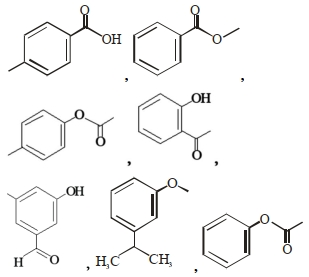
Number of compounds from the following which will not dissolve in cold $NaHCO_3$ and $NaOH$ solutions but will dissolve in hot $NaOH$ solution is $........$.
A
$4$
B
$5$
C
$6$
D
$3$
Solution
(D) The compounds are analyzed for their solubility in cold $NaHCO_3$,cold $NaOH$,and hot $NaOH$:
$1$. $p$-Toluic acid: Dissolves in $NaHCO_3$ and $NaOH$.
$2$. Methyl benzoate: Does not dissolve in cold $NaHCO_3$ or $NaOH$,but undergoes hydrolysis in hot $NaOH$ to form benzoic acid and methanol,thus dissolving.
$3$. $p$-Cresyl acetate: Does not dissolve in cold $NaHCO_3$ or $NaOH$,but undergoes hydrolysis in hot $NaOH$ to form $p$-cresol and acetic acid,thus dissolving.
$4$. $o$-Hydroxyacetophenone: Dissolves in $NaOH$ (phenolic group) but not $NaHCO_3$.
$5$. $3$-Hydroxy$-5-$methylbenzaldehyde: Dissolves in $NaOH$ (phenolic group) but not $NaHCO_3$.
$6$. $1$-Isopropyl$-3-$methoxybenzene: Does not dissolve in any of these.
$7$. Phenyl acetate: Does not dissolve in cold $NaHCO_3$ or $NaOH$,but undergoes hydrolysis in hot $NaOH$ to form phenol and acetic acid,thus dissolving.
Therefore,the compounds that do not dissolve in cold $NaHCO_3$ and $NaOH$ but dissolve in hot $NaOH$ are $2$,$3$,and $7$. The total count is $3$.
$1$. $p$-Toluic acid: Dissolves in $NaHCO_3$ and $NaOH$.
$2$. Methyl benzoate: Does not dissolve in cold $NaHCO_3$ or $NaOH$,but undergoes hydrolysis in hot $NaOH$ to form benzoic acid and methanol,thus dissolving.
$3$. $p$-Cresyl acetate: Does not dissolve in cold $NaHCO_3$ or $NaOH$,but undergoes hydrolysis in hot $NaOH$ to form $p$-cresol and acetic acid,thus dissolving.
$4$. $o$-Hydroxyacetophenone: Dissolves in $NaOH$ (phenolic group) but not $NaHCO_3$.
$5$. $3$-Hydroxy$-5-$methylbenzaldehyde: Dissolves in $NaOH$ (phenolic group) but not $NaHCO_3$.
$6$. $1$-Isopropyl$-3-$methoxybenzene: Does not dissolve in any of these.
$7$. Phenyl acetate: Does not dissolve in cold $NaHCO_3$ or $NaOH$,but undergoes hydrolysis in hot $NaOH$ to form phenol and acetic acid,thus dissolving.
Therefore,the compounds that do not dissolve in cold $NaHCO_3$ and $NaOH$ but dissolve in hot $NaOH$ are $2$,$3$,and $7$. The total count is $3$.
0 likes
View Solution570
MediumMCQ
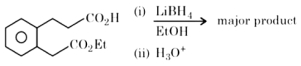
The major product formed in the following reaction is:
A
The structure containing two alcohol groups attached to the benzene ring.
B
The structure containing an alcohol group and an ester group attached to the benzene ring.
C
The structure containing a carboxylic acid group and an alcohol group attached to the benzene ring.
D
The structure containing two carboxylic acid groups attached to the benzene ring.
Solution
(C) $LiBH_4$ is a selective reducing agent that reduces esters to primary alcohols but does not reduce carboxylic acids. In the given molecule,the ester group $(-CO_2Et)$ is reduced to a primary alcohol $(-CH_2OH)$,while the carboxylic acid group $(-CO_2H)$ remains unaffected. Thus,the major product is the one where the ester is converted to an alcohol and the acid remains as it is.
0 likes
View Solution571
MediumMCQ
The descending order of acidity for the following carboxylic acids is:
$A.$ $CH_3COOH$
$B.$ $F_3C-COOH$
$C.$ $ClCH_2-COOH$
$D.$ $FCH_2-COOH$
$E.$ $BrCH_2-COOH$
Choose the correct answer from the options given below:
$A.$ $CH_3COOH$
$B.$ $F_3C-COOH$
$C.$ $ClCH_2-COOH$
$D.$ $FCH_2-COOH$
$E.$ $BrCH_2-COOH$
Choose the correct answer from the options given below:
A
$D > B > A > E > C$
B
$E > D > B > A > C$
C
$B > C > D > E > A$
D
$B > D > C > E > A$
Solution
(D) The acidity of carboxylic acids is determined by the stability of the carboxylate anion formed after the loss of a proton. Electron-withdrawing groups ($-I$ effect) increase acidity by stabilizing the negative charge,while electron-donating groups ($+I$ effect) decrease acidity.
$1$. $B$ $(F_3C-COOH)$: Contains three highly electronegative fluorine atoms,exerting a strong $-I$ effect,making it the most acidic.
$2$. $D$ $(FCH_2-COOH)$: Contains one fluorine atom,which has a stronger $-I$ effect than chlorine or bromine.
$3$. $C$ $(ClCH_2-COOH)$: Contains a chlorine atom,which has a weaker $-I$ effect than fluorine but stronger than bromine.
$4$. $E$ $(BrCH_2-COOH)$: Contains a bromine atom,which has the weakest $-I$ effect among the halogens listed.
$5$. $A$ $(CH_3COOH)$: Contains a methyl group,which exerts a $+I$ effect,destabilizing the carboxylate anion and making it the least acidic.
Thus,the descending order of acidity is $B > D > C > E > A$.
$1$. $B$ $(F_3C-COOH)$: Contains three highly electronegative fluorine atoms,exerting a strong $-I$ effect,making it the most acidic.
$2$. $D$ $(FCH_2-COOH)$: Contains one fluorine atom,which has a stronger $-I$ effect than chlorine or bromine.
$3$. $C$ $(ClCH_2-COOH)$: Contains a chlorine atom,which has a weaker $-I$ effect than fluorine but stronger than bromine.
$4$. $E$ $(BrCH_2-COOH)$: Contains a bromine atom,which has the weakest $-I$ effect among the halogens listed.
$5$. $A$ $(CH_3COOH)$: Contains a methyl group,which exerts a $+I$ effect,destabilizing the carboxylate anion and making it the least acidic.
Thus,the descending order of acidity is $B > D > C > E > A$.
0 likes
View Solution572
MediumMCQ
The major product $P$ formed in the following sequence of reactions is
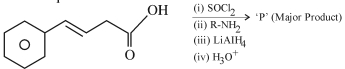
A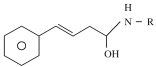
B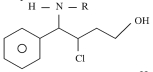
C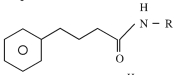
D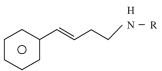
Solution
(D) The reaction sequence is as follows:
$1$. Treatment of the carboxylic acid with $SOCl_2$ converts it into an acid chloride: $Ph-CH=CH-CH_2-COOH \xrightarrow{SOCl_2} Ph-CH=CH-CH_2-COCl$.
$2$. Reaction with $R-NH_2$ (amine) converts the acid chloride into an amide: $Ph-CH=CH-CH_2-COCl \xrightarrow{R-NH_2} Ph-CH=CH-CH_2-CONHR$.
$3$. Reduction with $LiAlH_4$ followed by $H_3O^+$ reduces the amide group $(-CONHR)$ to an amine group $(-CH_2NHR)$: $Ph-CH=CH-CH_2-CONHR \xrightarrow{LiAlH_4, H_3O^+} Ph-CH=CH-CH_2-CH_2NHR$.
Thus,the final product is $Ph-CH=CH-CH_2-CH_2NHR$.
$1$. Treatment of the carboxylic acid with $SOCl_2$ converts it into an acid chloride: $Ph-CH=CH-CH_2-COOH \xrightarrow{SOCl_2} Ph-CH=CH-CH_2-COCl$.
$2$. Reaction with $R-NH_2$ (amine) converts the acid chloride into an amide: $Ph-CH=CH-CH_2-COCl \xrightarrow{R-NH_2} Ph-CH=CH-CH_2-CONHR$.
$3$. Reduction with $LiAlH_4$ followed by $H_3O^+$ reduces the amide group $(-CONHR)$ to an amine group $(-CH_2NHR)$: $Ph-CH=CH-CH_2-CONHR \xrightarrow{LiAlH_4, H_3O^+} Ph-CH=CH-CH_2-CH_2NHR$.
Thus,the final product is $Ph-CH=CH-CH_2-CH_2NHR$.
0 likes
View Solution573
DifficultMCQ
In the reaction given below,identify the major product '$A$':
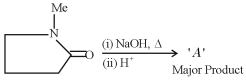
A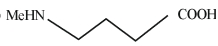
B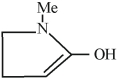
C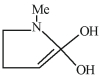
D
Solution
(A) The given reactant is $N$-methylpyrrolidin$-2-$one,which is a cyclic amide (lactam).
Treatment with $NaOH$ and $\Delta$ (heating) causes the hydrolysis of the amide bond.
The hydroxide ion $(OH^-)$ attacks the carbonyl carbon,leading to the ring-opening of the lactam.
This results in the formation of the carboxylate salt of the corresponding amino acid,$CH_3NH(CH_2)_3COO^-Na^+$.
Subsequent acidification with $H^+$ protonates the carboxylate group to form the carboxylic acid,$CH_3NH(CH_2)_3COOH$.
Treatment with $NaOH$ and $\Delta$ (heating) causes the hydrolysis of the amide bond.
The hydroxide ion $(OH^-)$ attacks the carbonyl carbon,leading to the ring-opening of the lactam.
This results in the formation of the carboxylate salt of the corresponding amino acid,$CH_3NH(CH_2)_3COO^-Na^+$.
Subsequent acidification with $H^+$ protonates the carboxylate group to form the carboxylic acid,$CH_3NH(CH_2)_3COOH$.
0 likes
View Solution574
MediumMCQ
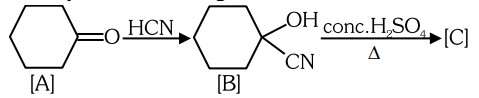
Complete the following reaction:
$[C]$ is $........$
$[C]$ is $........$
A
Cyclohex$-1-$ene$-1-$carboxylic acid
B
Cyclohexanol
C
Cyclohexanecarboxylic acid
D
Cyclohex$-1-$ene$-1-$carbaldehyde
Solution
(A) The reaction sequence is as follows:
$1$. Cyclohexanone $[A]$ reacts with $HCN$ to form a cyanohydrin,which is $1$-hydroxycyclohexanecarbonitrile $[B]$.
$2$. The treatment of $[B]$ with $conc. H_2SO_4$ and heat $(\Delta)$ leads to two simultaneous processes: dehydration of the tertiary alcohol group to form a double bond and hydrolysis of the nitrile group $(-CN)$ to a carboxylic acid group $(-COOH)$.
$3$. The final product $[C]$ is cyclohex-$1$-ene-$1$-carboxylic acid.
$1$. Cyclohexanone $[A]$ reacts with $HCN$ to form a cyanohydrin,which is $1$-hydroxycyclohexanecarbonitrile $[B]$.
$2$. The treatment of $[B]$ with $conc. H_2SO_4$ and heat $(\Delta)$ leads to two simultaneous processes: dehydration of the tertiary alcohol group to form a double bond and hydrolysis of the nitrile group $(-CN)$ to a carboxylic acid group $(-COOH)$.
$3$. The final product $[C]$ is cyclohex-$1$-ene-$1$-carboxylic acid.
0 likes
View Solution575
MediumMCQ
The product $(C)$ in the following sequence of reactions has . . . . . . . . $\pi$ bonds.

A
$2$
B
$3$
C
$8$
D
$4$
Solution
(D) $1$. The starting material is propylbenzene. Oxidation with $KMnO_4-KOH$ followed by acidification $(H_3O^+)$ converts the alkyl side chain into a carboxylic acid group,yielding benzoic acid $(B)$.
$2$. Benzoic acid is then subjected to electrophilic aromatic substitution with $Br_2$ in the presence of $FeBr_3$. Since the $-COOH$ group is meta-directing,the product $(C)$ is $m$-bromobenzoic acid.
$3$. The structure of $m$-bromobenzoic acid contains a benzene ring (which has $3$ $\pi$ bonds) and a carbonyl group ($C=O$,which has $1$ $\pi$ bond).
$4$. Total $\pi$ bonds $= 3 + 1 = 4$.
$2$. Benzoic acid is then subjected to electrophilic aromatic substitution with $Br_2$ in the presence of $FeBr_3$. Since the $-COOH$ group is meta-directing,the product $(C)$ is $m$-bromobenzoic acid.
$3$. The structure of $m$-bromobenzoic acid contains a benzene ring (which has $3$ $\pi$ bonds) and a carbonyl group ($C=O$,which has $1$ $\pi$ bond).
$4$. Total $\pi$ bonds $= 3 + 1 = 4$.
0 likes
View Solution576
MediumMCQ
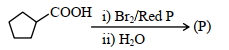
Identify the product $(P)$ in the following reaction:
A
$1-$bromocyclopentanecarboxylic acid
B
cyclopentanecarbonyl bromide
C
$1-$bromocyclopentanecarbaldehyde
D
$2-$bromocyclopentanecarboxylic acid
Solution
(A) The reaction shown is the Hell-Volhard-Zelinsky $(HVZ)$ reaction.
In this reaction,carboxylic acids having an $\alpha$-hydrogen atom are reacted with $Br_2$ or $Cl_2$ in the presence of a small amount of red phosphorus to form $\alpha$-halo carboxylic acids.
The $\alpha$-carbon is the carbon atom directly attached to the carboxyl group.
In cyclopentanecarboxylic acid,the carbon atom of the cyclopentane ring attached to the $-COOH$ group is the $\alpha$-carbon.
Therefore,the bromine atom replaces the hydrogen atom at the $\alpha$-position,resulting in $1$-bromocyclopentanecarboxylic acid.
In this reaction,carboxylic acids having an $\alpha$-hydrogen atom are reacted with $Br_2$ or $Cl_2$ in the presence of a small amount of red phosphorus to form $\alpha$-halo carboxylic acids.
The $\alpha$-carbon is the carbon atom directly attached to the carboxyl group.
In cyclopentanecarboxylic acid,the carbon atom of the cyclopentane ring attached to the $-COOH$ group is the $\alpha$-carbon.
Therefore,the bromine atom replaces the hydrogen atom at the $\alpha$-position,resulting in $1$-bromocyclopentanecarboxylic acid.
0 likes
View Solution577
MediumMCQ
The correct sequence of acidic strength of the following aliphatic acids in their decreasing order is: $CH_3CH_2COOH$,$CH_3COOH$,$CH_3CH_2CH_2COOH$,$HCOOH$
A
$HCOOH > CH_3COOH > CH_3CH_2COOH > CH_3CH_2CH_2COOH$
B
$HCOOH > CH_3CH_2CH_2COOH > CH_3CH_2COOH > CH_3COOH$
C
$CH_3CH_2CH_2COOH > CH_3CH_2COOH > CH_3COOH > HCOOH$
D
$CH_3COOH > CH_3CH_2COOH > CH_3CH_2CH_2COOH > HCOOH$
Solution
(A) The acidic strength of carboxylic acids depends on the electron-donating effect of the alkyl group attached to the $-COOH$ group.
Alkyl groups exhibit a $+I$ (positive inductive) effect,which destabilizes the carboxylate anion and decreases the acidic strength.
As the size of the alkyl group increases,the $+I$ effect increases,thereby decreasing the acidic strength.
$HCOOH$ has no alkyl group,so it is the strongest acid.
Comparing the others: $CH_3COOH$ (methyl group) > $CH_3CH_2COOH$ (ethyl group) > $CH_3CH_2CH_2COOH$ (propyl group).
Therefore,the correct decreasing order is: $HCOOH > CH_3COOH > CH_3CH_2COOH > CH_3CH_2CH_2COOH$.
Alkyl groups exhibit a $+I$ (positive inductive) effect,which destabilizes the carboxylate anion and decreases the acidic strength.
As the size of the alkyl group increases,the $+I$ effect increases,thereby decreasing the acidic strength.
$HCOOH$ has no alkyl group,so it is the strongest acid.
Comparing the others: $CH_3COOH$ (methyl group) > $CH_3CH_2COOH$ (ethyl group) > $CH_3CH_2CH_2COOH$ (propyl group).
Therefore,the correct decreasing order is: $HCOOH > CH_3COOH > CH_3CH_2COOH > CH_3CH_2CH_2COOH$.
0 likes
View Solution578
MediumMCQ
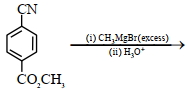
Find the main product of the following reaction:
A
$4-$($1$-hydroxy$-1-$methylethyl)benzonitrile
B
$4-$acetyl$-2-$($1$-hydroxy$-1-$methylethyl)benzene
C
methyl $4-$acetylbenzoate
D
$4-$acetylbenzonitrile
Solution
(A) The starting material is methyl $4-$cyanobenzoate. It contains two functional groups: a nitrile $(-CN)$ group and an ester $(-COOCH_3)$ group. Both groups react with Grignard reagents $(CH_3MgBr)$.
$1$. The ester group reacts with two equivalents of $CH_3MgBr$ to form a tertiary alcohol after acidic workup $(H_3O^+)$. The ester $-COOCH_3$ is converted to $-C(OH)(CH_3)_2$.
$2$. The nitrile group reacts with one equivalent of $CH_3MgBr$ to form an imine intermediate,which upon hydrolysis $(H_3O^+)$ yields a ketone. The $-CN$ group is converted to $-COCH_3$.
Therefore,the final product is $4-$($1$-hydroxy$-1-$methylethyl)acetophenone,which corresponds to the structure shown in option $A$.
$1$. The ester group reacts with two equivalents of $CH_3MgBr$ to form a tertiary alcohol after acidic workup $(H_3O^+)$. The ester $-COOCH_3$ is converted to $-C(OH)(CH_3)_2$.
$2$. The nitrile group reacts with one equivalent of $CH_3MgBr$ to form an imine intermediate,which upon hydrolysis $(H_3O^+)$ yields a ketone. The $-CN$ group is converted to $-COCH_3$.
Therefore,the final product is $4-$($1$-hydroxy$-1-$methylethyl)acetophenone,which corresponds to the structure shown in option $A$.
0 likes
View Solution579
Advanced
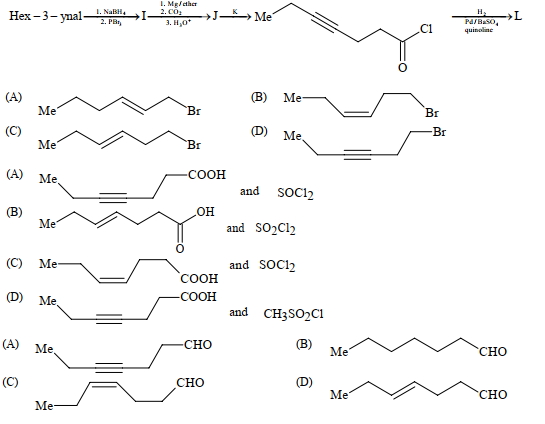
In the following sequence,products $I$,$J$ and $L$ are formed. $K$ represents a reagent.
$1.$ The structure of the product $I$ is
$2.$ The structures of compounds $J$ and $K$ respectively are
$3.$ The structure of product $L$ is
Give the answer for questions $1, 2$ and $3.$
$1.$ The structure of the product $I$ is
$2.$ The structures of compounds $J$ and $K$ respectively are
$3.$ The structure of product $L$ is
Give the answer for questions $1, 2$ and $3.$
Solution
(A) $1.$ $\text{Hex-3-ynal}$ $(CH_3-CH_2-C \equiv C-CH_2-CHO)$ reacts with $NaBH_4$ to reduce the aldehyde to a primary alcohol $(CH_3-CH_2-C \equiv C-CH_2-CH_2OH)$,followed by $PBr_3$ to convert the alcohol to a bromide. Thus,$I$ is $CH_3-CH_2-C \equiv C-CH_2-CH_2Br$,which corresponds to structure $(D)$.
$2.$ The Grignard reagent formation from $I$ followed by reaction with $CO_2$ and acidic workup yields the carboxylic acid $J$ $(CH_3-CH_2-C \equiv C-CH_2-CH_2-COOH)$. The conversion of $J$ to the acid chloride requires $SOCl_2$ $(K)$. Thus,$J$ corresponds to structure $(B)$ and $K$ is $SOCl_2$. The pair $(J, K)$ is $(B, SOCl_2)$,which matches option $(C)$.
$3.$ The final step is the partial hydrogenation of the alkyne to a cis-alkene using Lindlar's catalyst $(H_2, Pd/BaSO_4, \text{quinoline})$. The product $L$ is a cis-alkene with an aldehyde group,which corresponds to structure $(C)$.
Therefore,the correct sequence for $(1, 2, 3)$ is $(D, C, C)$.
$2.$ The Grignard reagent formation from $I$ followed by reaction with $CO_2$ and acidic workup yields the carboxylic acid $J$ $(CH_3-CH_2-C \equiv C-CH_2-CH_2-COOH)$. The conversion of $J$ to the acid chloride requires $SOCl_2$ $(K)$. Thus,$J$ corresponds to structure $(B)$ and $K$ is $SOCl_2$. The pair $(J, K)$ is $(B, SOCl_2)$,which matches option $(C)$.
$3.$ The final step is the partial hydrogenation of the alkyne to a cis-alkene using Lindlar's catalyst $(H_2, Pd/BaSO_4, \text{quinoline})$. The product $L$ is a cis-alkene with an aldehyde group,which corresponds to structure $(C)$.
Therefore,the correct sequence for $(1, 2, 3)$ is $(D, C, C)$.
0 likes
View Solution580
MediumMCQ
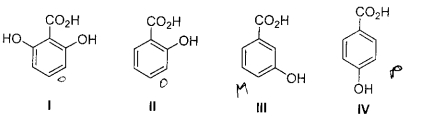
The correct order of acidity for the following compounds is:
A
$I > II > III > IV$
B
$III > I > II > IV$
C
$III > IV > II > I$
D
$I > III > IV > II$
Solution
(A) The acidity of carboxylic acids depends on the stability of the carboxylate anion formed after the loss of a proton.
$1$. $2,6$-Dihydroxybenzoic acid $(I)$ is the most acidic because its carboxylate anion is stabilized by intramolecular hydrogen bonding with two $-OH$ groups,which is more effective than the stabilization in salicylic acid $(II)$ which has only one $-OH$ group.
$2$. Salicylic acid $(II)$ is more acidic than $m$-hydroxybenzoic acid $(III)$ due to the ortho-effect and strong intramolecular hydrogen bonding.
$3$. Between $m$-hydroxybenzoic acid $(III)$ and $p$-hydroxybenzoic acid $(IV)$,the $-OH$ group at the $m$-position exerts only a $-I$ effect (electron-withdrawing),whereas at the $p$-position,it exerts a strong $+R$ effect (electron-donating),which destabilizes the carboxylate anion. Therefore,$III$ is more acidic than $IV$.
Thus,the correct order of acidity is $I > II > III > IV$.
$1$. $2,6$-Dihydroxybenzoic acid $(I)$ is the most acidic because its carboxylate anion is stabilized by intramolecular hydrogen bonding with two $-OH$ groups,which is more effective than the stabilization in salicylic acid $(II)$ which has only one $-OH$ group.
$2$. Salicylic acid $(II)$ is more acidic than $m$-hydroxybenzoic acid $(III)$ due to the ortho-effect and strong intramolecular hydrogen bonding.
$3$. Between $m$-hydroxybenzoic acid $(III)$ and $p$-hydroxybenzoic acid $(IV)$,the $-OH$ group at the $m$-position exerts only a $-I$ effect (electron-withdrawing),whereas at the $p$-position,it exerts a strong $+R$ effect (electron-donating),which destabilizes the carboxylate anion. Therefore,$III$ is more acidic than $IV$.
Thus,the correct order of acidity is $I > II > III > IV$.
0 likes
View Solution581
DifficultMCQ
Among the following compounds,the most acidic is
A
$p$-nitrophenol
B
$p$-hydroxybenzoic acid
C
$o$-hydroxybenzoic acid
D
$p$-toluic acid
Solution
(C) The acidity of carboxylic acids is significantly influenced by substituents on the benzene ring.
$o$-hydroxybenzoic acid (salicylic acid) exhibits the ortho-effect,where the proximity of the hydroxyl group to the carboxyl group stabilizes the conjugate base through intramolecular hydrogen bonding and steric factors,making it more acidic than the other options provided.
$o$-hydroxybenzoic acid (salicylic acid) exhibits the ortho-effect,where the proximity of the hydroxyl group to the carboxyl group stabilizes the conjugate base through intramolecular hydrogen bonding and steric factors,making it more acidic than the other options provided.
0 likes
View Solution582
AdvancedMCQ
The compound that undergoes decarboxylation most readily under mild conditions is:
A
$2-$carboxymethylcyclohexane$-1-$carboxylic acid
B
$2-$oxocyclohexane$-1-$carboxylic acid
C
cyclohexane$-1,2-$dicarboxylic acid
D
$2-$oxocyclohexylacetic acid
Solution
(B) Decarboxylation of $\beta$-keto acids occurs readily because the transition state is stabilized by the formation of an enol intermediate,which is further stabilized by the electron-withdrawing effect of the carbonyl group. Among the given options,$2$-oxocyclohexane-$1$-carboxylic acid (option $B$) is a $\beta$-keto acid. The decarboxylation process involves the formation of a cyclic six-membered transition state,which is highly favorable. The electron-withdrawing $-I$ and $-M$ effects of the ketone carbonyl group stabilize the developing negative charge on the $\alpha$-carbon during the transition state,making it the most reactive compound for decarboxylation under mild conditions.
0 likes
View Solution583
AdvancedMCQ
The major product $H$ in the given reaction sequence is:
$CH_3-CH_2-CO-CH_3$ $\xrightarrow{CN^-} G$ $\xrightarrow{95\% \ H_2SO_4, \Delta} H$
$CH_3-CH_2-CO-CH_3$ $\xrightarrow{CN^-} G$ $\xrightarrow{95\% \ H_2SO_4, \Delta} H$
A
$CH_3-CH=C(CH_3)-COOH$
B
$CH_3-CH=C(CH_3)-CN$
C
$CH_3-CH_2-C(OH)(CH_3)-COOH$
D
$CH_3-CH=C(CH_3)-CONH_2$
Solution
(A) $1$. The reaction of butan$-2-$one $(CH_3-CH_2-CO-CH_3)$ with $CN^-$ (cyanide ion) is a nucleophilic addition reaction,which forms a cyanohydrin intermediate $(G)$: $CH_3-CH_2-C(OH)(CN)-CH_3$.
$2$. Treatment of the cyanohydrin $(G)$ with concentrated $95\% \ H_2SO_4$ and heat leads to two simultaneous processes: hydrolysis of the nitrile $(-CN)$ group to a carboxylic acid $(-COOH)$ group and dehydration of the alcohol $(-OH)$ group to form a double bond.
$3$. The dehydration follows $Saytzeff$ rule,forming the more substituted alkene. The resulting product $H$ is $CH_3-CH=C(CH_3)-COOH$ ($2$-methylbut$-2-$enoic acid).
$2$. Treatment of the cyanohydrin $(G)$ with concentrated $95\% \ H_2SO_4$ and heat leads to two simultaneous processes: hydrolysis of the nitrile $(-CN)$ group to a carboxylic acid $(-COOH)$ group and dehydration of the alcohol $(-OH)$ group to form a double bond.
$3$. The dehydration follows $Saytzeff$ rule,forming the more substituted alkene. The resulting product $H$ is $CH_3-CH=C(CH_3)-COOH$ ($2$-methylbut$-2-$enoic acid).
0 likes
View Solution584
DifficultMCQ
The compounds that produce $CO_2$ with aqueous $NaHCO_3$ solution are:
$A$. Benzoic acid
$B$. Phenol
$C$. $2,4,6$-Trinitrophenol (Picric acid)
$D$. Cyclohexanecarboxylic acid
$E$. $4$-Methoxyphenol
Choose the correct answer from the options given below:
$A$. Benzoic acid
$B$. Phenol
$C$. $2,4,6$-Trinitrophenol (Picric acid)
$D$. Cyclohexanecarboxylic acid
$E$. $4$-Methoxyphenol
Choose the correct answer from the options given below:
A
$A$ and $C$ only
B
$A, B$ and $E$ only
C
$A, C$ and $D$ only
D
$A$ and $B$ only
Solution
(C) Compounds that are stronger acids than carbonic acid $(H_2CO_3)$ react with aqueous $NaHCO_3$ to evolve $CO_2$ gas.
$A$. Benzoic acid $(pK_a \approx 4.2)$ is stronger than $H_2CO_3$ $(pK_a \approx 6.35)$.
$C$. $2,4,6$-Trinitrophenol (Picric acid) $(pK_a \approx 0.38)$ is a very strong acid,much stronger than $H_2CO_3$.
$D$. Cyclohexanecarboxylic acid $(pK_a \approx 4.9)$ is stronger than $H_2CO_3$.
Phenol $(B)$ and $4$-Methoxyphenol $(E)$ are weaker acids than $H_2CO_3$ and do not react with $NaHCO_3$ to evolve $CO_2$.
Therefore,compounds $A, C,$ and $D$ produce $CO_2$ with aqueous $NaHCO_3$ solution.
$A$. Benzoic acid $(pK_a \approx 4.2)$ is stronger than $H_2CO_3$ $(pK_a \approx 6.35)$.
$C$. $2,4,6$-Trinitrophenol (Picric acid) $(pK_a \approx 0.38)$ is a very strong acid,much stronger than $H_2CO_3$.
$D$. Cyclohexanecarboxylic acid $(pK_a \approx 4.9)$ is stronger than $H_2CO_3$.
Phenol $(B)$ and $4$-Methoxyphenol $(E)$ are weaker acids than $H_2CO_3$ and do not react with $NaHCO_3$ to evolve $CO_2$.
Therefore,compounds $A, C,$ and $D$ produce $CO_2$ with aqueous $NaHCO_3$ solution.
0 likes
View Solution585
DifficultMCQ
Consider the following molecules $:$
$(p) \ CH_3-CH_2-COCl$
$(q) \ CH_3-CH_2-CO-O-COCH_3$
$(r) \ CH_3-CH_2-CO-OCH_2-CH_3$
$(s) \ CH_3-CH_2-CONH_2$
The correct order of rate of hydrolysis is $:$
$(p) \ CH_3-CH_2-COCl$
$(q) \ CH_3-CH_2-CO-O-COCH_3$
$(r) \ CH_3-CH_2-CO-OCH_2-CH_3$
$(s) \ CH_3-CH_2-CONH_2$
The correct order of rate of hydrolysis is $:$
A
$r > q > p > s$
B
$q > p > r > s$
C
$p > r > q > s$
D
$p > q > r > s$
Solution
(D) The rate of hydrolysis of carboxylic acid derivatives depends on the leaving group ability of the group attached to the carbonyl carbon.
Better leaving groups make the carbonyl carbon more electrophilic and facilitate the nucleophilic attack by water.
The leaving group ability order is $Cl^- > CH_3COO^- > CH_3CH_2O^- > NH_2^-$.
Therefore,the rate of hydrolysis follows the order $:$
$(p) \ (acid \ chloride) > (q) \ (anhydride) > (r) \ (ester) > (s) \ (amide)$.
Thus,the correct order is $p > q > r > s$.
Better leaving groups make the carbonyl carbon more electrophilic and facilitate the nucleophilic attack by water.
The leaving group ability order is $Cl^- > CH_3COO^- > CH_3CH_2O^- > NH_2^-$.
Therefore,the rate of hydrolysis follows the order $:$
$(p) \ (acid \ chloride) > (q) \ (anhydride) > (r) \ (ester) > (s) \ (amide)$.
Thus,the correct order is $p > q > r > s$.
0 likes
View Solution586
MediumMCQ
The correct order of decreasing acidity of the following aliphatic acids is $:-$
A
$ (CH_3)_3CCOOH > (CH_3)_2CHCOOH > CH_3COOH > HCOOH $
B
$ CH_3COOH > (CH_3)_2CHCOOH > (CH_3)_3CCOOH > HCOOH $
C
$ HCOOH > CH_3COOH > (CH_3)_2CHCOOH > (CH_3)_3CCOOH $
D
$ HCOOH > (CH_3)_3CCOOH > (CH_3)_2CHCOOH > CH_3COOH $
Solution
(C) The acidic strength of carboxylic acids is determined by the stability of the carboxylate anion formed after the loss of a proton. $Electron-donating$ groups ($+I$ effect) destabilize the carboxylate anion by increasing the electron density on the oxygen atom,thereby decreasing the acidic strength. $Electron-withdrawing$ groups ($-I$ effect) stabilize the carboxylate anion,thereby increasing the acidic strength.
The order of $+I$ effect of alkyl groups is: $-(CH_3)_3C > -(CH_3)_2CH > -CH_3 > -H$.
Since the $+I$ effect increases in the order $H < CH_3 < (CH_3)_2CH < (CH_3)_3C$,the acidic strength decreases in the order: $HCOOH > CH_3COOH > (CH_3)_2CHCOOH > (CH_3)_3CCOOH$.
The order of $+I$ effect of alkyl groups is: $-(CH_3)_3C > -(CH_3)_2CH > -CH_3 > -H$.
Since the $+I$ effect increases in the order $H < CH_3 < (CH_3)_2CH < (CH_3)_3C$,the acidic strength decreases in the order: $HCOOH > CH_3COOH > (CH_3)_2CHCOOH > (CH_3)_3CCOOH$.
0 likes
View Solution587
MediumMCQ
Correct order of $pK_{a}$ of given compounds is $:-$
$(P) \ CH_{3}COOH$
$(Q) \ FCH_{2}COOH$
$(R) \ ClCH_{2}COOH$
$(S) \ C_{2}H_{5}COOH$
$(P) \ CH_{3}COOH$
$(Q) \ FCH_{2}COOH$
$(R) \ ClCH_{2}COOH$
$(S) \ C_{2}H_{5}COOH$
A
$S < P < R < Q$
B
$Q < R < P < S$
C
$P < Q < R < S$
D
$S < R < Q < P$
Solution
(B) The $pK_{a}$ value is inversely proportional to the acidic strength of the carboxylic acid.
Acidic strength increases with the presence of electron-withdrawing groups $(EWG)$ and decreases with electron-donating groups $(EDG)$.
Comparing the compounds:
$(S) \ C_{2}H_{5}COOH$ has an ethyl group $(EDG)$,which decreases acidity,making it the weakest acid.
$(P) \ CH_{3}COOH$ has a methyl group $(EDG)$,which is less donating than the ethyl group,making it stronger than $(S)$.
$(Q) \ FCH_{2}COOH$ and $(R) \ ClCH_{2}COOH$ have halogen atoms $(EWG)$. Since $F$ is more electronegative than $Cl$,$(Q)$ is a stronger acid than $(R)$.
Thus,the order of acidic strength is: $(S) < (P) < (R) < (Q)$.
Since $pK_{a} = -\log(K_{a})$,the order of $pK_{a}$ is the reverse of the acidic strength order: $(Q) < (R) < (P) < (S)$.
Acidic strength increases with the presence of electron-withdrawing groups $(EWG)$ and decreases with electron-donating groups $(EDG)$.
Comparing the compounds:
$(S) \ C_{2}H_{5}COOH$ has an ethyl group $(EDG)$,which decreases acidity,making it the weakest acid.
$(P) \ CH_{3}COOH$ has a methyl group $(EDG)$,which is less donating than the ethyl group,making it stronger than $(S)$.
$(Q) \ FCH_{2}COOH$ and $(R) \ ClCH_{2}COOH$ have halogen atoms $(EWG)$. Since $F$ is more electronegative than $Cl$,$(Q)$ is a stronger acid than $(R)$.
Thus,the order of acidic strength is: $(S) < (P) < (R) < (Q)$.
Since $pK_{a} = -\log(K_{a})$,the order of $pK_{a}$ is the reverse of the acidic strength order: $(Q) < (R) < (P) < (S)$.
0 likes
View Solution588
MediumMCQ
Statement-$I$: Most carboxylic acids exist as dimers in vapour phase or in aprotic solvents due to intermolecular hydrogen bonding.
Statement-$II$: Higher carboxylic acids are practically insoluble in water due to the increased hydrophobic interaction of the hydrocarbon part.
Statement-$II$: Higher carboxylic acids are practically insoluble in water due to the increased hydrophobic interaction of the hydrocarbon part.
A
Statement $I$ is correct and Statement $II$ is incorrect
B
Statement $I$ is incorrect and Statement $II$ is correct
C
Both Statement $I$ and Statement $II$ are correct
D
Both Statement $I$ and Statement $II$ are incorrect
Solution
(C) Statement-$I$ is correct: Carboxylic acids form stable dimers in the vapour phase or in aprotic solvents (like benzene) due to intermolecular hydrogen bonding between two carboxylic acid molecules.
Statement-$II$ is correct: As the length of the hydrocarbon chain increases in carboxylic acids,the hydrophobic (water-repelling) nature of the alkyl group dominates,making higher carboxylic acids practically insoluble in water.
Statement-$II$ is correct: As the length of the hydrocarbon chain increases in carboxylic acids,the hydrophobic (water-repelling) nature of the alkyl group dominates,making higher carboxylic acids practically insoluble in water.
0 likes
View Solution589
MediumMCQ
For which carboxylic acid,the $pK_a$ is the lowest :
A
$HC \equiv C - COOH$
B
$CH_3 - CH_2 - COOH$
C
$CH_3 - CH_2 - CH_2 - COOH$
D
$CH_2 = CH - COOH$
Solution
(A) The $pK_a$ value is inversely proportional to the acid strength $(K_a)$.
Stronger acids have lower $pK_a$ values.
Acid strength depends on the stability of the conjugate base (carboxylate ion).
Electron-withdrawing groups $(EWG)$ increase acidity by stabilizing the negative charge on the carboxylate group.
The hybridization of the carbon atom attached to the $-COOH$ group affects acidity: $sp > sp^2 > sp^3$.
$1$. $HC \equiv C - COOH$: The carbon attached to $-COOH$ is $sp$ hybridized,which is highly electronegative and exerts a strong $-I$ effect.
$2$. $CH_2 = CH - COOH$: The carbon is $sp^2$ hybridized,exerting a moderate $-I$ effect.
$3$. $CH_3 - CH_2 - COOH$ and $CH_3 - CH_2 - CH_2 - COOH$: These have alkyl groups which exert a $+I$ effect,decreasing acidity.
Therefore,$HC \equiv C - COOH$ is the strongest acid and has the lowest $pK_a$ value.
Stronger acids have lower $pK_a$ values.
Acid strength depends on the stability of the conjugate base (carboxylate ion).
Electron-withdrawing groups $(EWG)$ increase acidity by stabilizing the negative charge on the carboxylate group.
The hybridization of the carbon atom attached to the $-COOH$ group affects acidity: $sp > sp^2 > sp^3$.
$1$. $HC \equiv C - COOH$: The carbon attached to $-COOH$ is $sp$ hybridized,which is highly electronegative and exerts a strong $-I$ effect.
$2$. $CH_2 = CH - COOH$: The carbon is $sp^2$ hybridized,exerting a moderate $-I$ effect.
$3$. $CH_3 - CH_2 - COOH$ and $CH_3 - CH_2 - CH_2 - COOH$: These have alkyl groups which exert a $+I$ effect,decreasing acidity.
Therefore,$HC \equiv C - COOH$ is the strongest acid and has the lowest $pK_a$ value.
0 likes
View Solution590
MediumMCQ
Identify the products '$X$' and '$Y$' in the following chemical reaction sequence: $C_6H_5CH_2MgBr \xrightarrow[(ii) H_3O^+]{(i) CO_2/ether} 'X' \xrightarrow{NaOH + CaO, \Delta} 'Y'$
A
$X$ = Phenylacetic acid,$Y$ = Toluene
B
$X$ = Benzoic acid,$Y$ = Benzene
C
$X$ = Phenylacetic acid,$Y$ = Benzene
D
$X$ = Benzoic acid,$Y$ = Toluene
Solution
(A) Step $1$: Reaction of Grignard reagent with $CO_2$.
$C_6H_5CH_2MgBr + CO_2 \rightarrow C_6H_5CH_2COOMgBr$.
Upon hydrolysis with $H_3O^+$,it forms phenylacetic acid $(C_6H_5CH_2COOH)$,which is '$X$'.
Step $2$: Decarboxylation of '$X$'.
$C_6H_5CH_2COOH + NaOH + CaO \xrightarrow{\Delta} C_6H_5CH_3 + Na_2CO_3$.
The product '$Y$' is toluene $(C_6H_5CH_3)$.
$C_6H_5CH_2MgBr + CO_2 \rightarrow C_6H_5CH_2COOMgBr$.
Upon hydrolysis with $H_3O^+$,it forms phenylacetic acid $(C_6H_5CH_2COOH)$,which is '$X$'.
Step $2$: Decarboxylation of '$X$'.
$C_6H_5CH_2COOH + NaOH + CaO \xrightarrow{\Delta} C_6H_5CH_3 + Na_2CO_3$.
The product '$Y$' is toluene $(C_6H_5CH_3)$.
0 likes
View Solution591
MediumMCQ
Assertion $: - >C=O$ group is present in both aldehydes and acid derivatives.
Reason $: -$ Aldehydes give nucleophilic addition across $>C=O$ bond but acid derivatives do not exhibit such reactions.
Reason $: -$ Aldehydes give nucleophilic addition across $>C=O$ bond but acid derivatives do not exhibit such reactions.
A
If both Assertion $\&$ Reason are True $\&$ the Reason is a correct explanation of the Assertion.
B
If both Assertion $\&$ Reason are True but Reason is not a correct explanation of the Assertion.
C
If Assertion is True but the Reason is False.
D
If both Assertion $\&$ Reason are False.
Solution
(A) The Assertion is True because both aldehydes $(R-CHO)$ and acid derivatives ($R-CO-Z$,where $Z = -Cl, -OR, -NH_2$) contain the carbonyl group $(>C=O)$.
The Reason is also True. Aldehydes undergo nucleophilic addition reactions because the carbonyl carbon is electrophilic and the addition product is stable.
However,in acid derivatives,the lone pair on the substituent $(Z)$ participates in resonance with the carbonyl group,which reduces the electrophilicity of the carbonyl carbon. Consequently,they undergo nucleophilic acyl substitution rather than simple nucleophilic addition.
Thus,the Reason correctly explains why acid derivatives do not exhibit the same nucleophilic addition reactions as aldehydes.
The Reason is also True. Aldehydes undergo nucleophilic addition reactions because the carbonyl carbon is electrophilic and the addition product is stable.
However,in acid derivatives,the lone pair on the substituent $(Z)$ participates in resonance with the carbonyl group,which reduces the electrophilicity of the carbonyl carbon. Consequently,they undergo nucleophilic acyl substitution rather than simple nucleophilic addition.
Thus,the Reason correctly explains why acid derivatives do not exhibit the same nucleophilic addition reactions as aldehydes.
0 likes
View Solution592
EasyMCQ
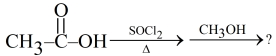
What is the major organic product obtained in the following sequence of reactions?
A
$CH_3COOCH_3$
B
$ClCH_2COOCH_3$
C
$HCOOCH_3$
D
$CH_3COC_2H_5$
Solution
(A) The reaction sequence is as follows:
$1$. $CH_3COOH + SOCl_2 \xrightarrow{\Delta} CH_3COCl + SO_2 + HCl$
In the first step,acetic acid reacts with thionyl chloride $(SOCl_2)$ to form acetyl chloride $(CH_3COCl)$.
$2$. $CH_3COCl + CH_3OH \rightarrow CH_3COOCH_3 + HCl$
In the second step,acetyl chloride reacts with methanol $(CH_3OH)$ to form methyl acetate $(CH_3COOCH_3)$ as the major organic product.
$1$. $CH_3COOH + SOCl_2 \xrightarrow{\Delta} CH_3COCl + SO_2 + HCl$
In the first step,acetic acid reacts with thionyl chloride $(SOCl_2)$ to form acetyl chloride $(CH_3COCl)$.
$2$. $CH_3COCl + CH_3OH \rightarrow CH_3COOCH_3 + HCl$
In the second step,acetyl chloride reacts with methanol $(CH_3OH)$ to form methyl acetate $(CH_3COOCH_3)$ as the major organic product.
0 likes
View Solution593
MediumMCQ
Which of the following is most stable?
A
p-Nitrobenzoate ion
B
p-Cyanobenzoate ion
C
$3,5-$Dinitro$-4-$cyanobenzoate ion
D
p-Methylbenzoate ion
Solution
(C) The stability of a carboxylate ion $(R-COO^-)$ is increased by electron-withdrawing groups $(EWG)$ and decreased by electron-donating groups $(EDG)$ attached to the benzene ring.
$1.$ The $-NO_2$ group is a strong electron-withdrawing group ($-I$ and $-M$ effect).
$2.$ The $-CN$ group is also an electron-withdrawing group ($-I$ and $-M$ effect).
$3.$ The $-CH_3$ group is an electron-donating group ($+I$ and hyperconjugation).
Comparing the options:
- Option $A$ has one $-NO_2$ group.
- Option $B$ has one $-CN$ group.
- Option $C$ has two $-NO_2$ groups and one $-CN$ group,all of which are strong electron-withdrawing groups. This combination significantly disperses the negative charge on the carboxylate group,making it the most stable.
- Option $D$ has a $-CH_3$ group,which destabilizes the carboxylate ion.
Therefore,the ion with the most electron-withdrawing groups is the most stable.
$1.$ The $-NO_2$ group is a strong electron-withdrawing group ($-I$ and $-M$ effect).
$2.$ The $-CN$ group is also an electron-withdrawing group ($-I$ and $-M$ effect).
$3.$ The $-CH_3$ group is an electron-donating group ($+I$ and hyperconjugation).
Comparing the options:
- Option $A$ has one $-NO_2$ group.
- Option $B$ has one $-CN$ group.
- Option $C$ has two $-NO_2$ groups and one $-CN$ group,all of which are strong electron-withdrawing groups. This combination significantly disperses the negative charge on the carboxylate group,making it the most stable.
- Option $D$ has a $-CH_3$ group,which destabilizes the carboxylate ion.
Therefore,the ion with the most electron-withdrawing groups is the most stable.
0 likes
View Solution594
MediumMCQ
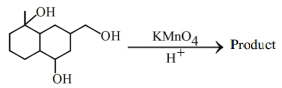
Identify the major product formed when the following compound is treated with acidic $KMnO_4$.
A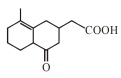
B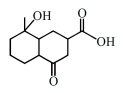
C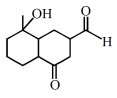
D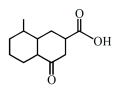
Solution
(C) The starting material is a polyhydroxy compound containing a tertiary alcohol,a secondary alcohol,and a primary alcohol. Acidic $KMnO_4$ is a strong oxidizing agent.
$1$. The primary alcohol group $(-CH_2OH)$ is oxidized to a carboxylic acid $(-COOH)$.
$2$. The secondary alcohol group is oxidized to a ketone $(C=O)$.
$3$. The tertiary alcohol group is generally resistant to oxidation under these conditions.
Therefore,the primary alcohol becomes a carboxylic acid,and the secondary alcohol becomes a ketone,resulting in the final product.
$1$. The primary alcohol group $(-CH_2OH)$ is oxidized to a carboxylic acid $(-COOH)$.
$2$. The secondary alcohol group is oxidized to a ketone $(C=O)$.
$3$. The tertiary alcohol group is generally resistant to oxidation under these conditions.
Therefore,the primary alcohol becomes a carboxylic acid,and the secondary alcohol becomes a ketone,resulting in the final product.
0 likes
View Solution595
MediumMCQ
The reducing agent used in the following reaction is:

A
$NaBH_4$
B
$LiAlH_4$
C
$Pd/H_2$
D
$DIBAL-H$
Solution
(D) The given reaction is the reduction of an ester $(CH_3(CH_2)_9COOC_2H_5)$ to an aldehyde $(CH_3(CH_2)_9CHO)$.
$LiAlH_4$ and $NaBH_4$ are strong reducing agents that typically reduce esters to primary alcohols.
$Pd/H_2$ is a catalyst for hydrogenation,which would reduce the ester to an alcohol or reduce other functional groups if present.
$DIBAL-H$ (Diisobutylaluminium hydride) is a selective reducing agent that reduces esters to aldehydes at low temperatures $(-78 \ ^\circ C)$.
Therefore,the correct reducing agent is $DIBAL-H$.
$LiAlH_4$ and $NaBH_4$ are strong reducing agents that typically reduce esters to primary alcohols.
$Pd/H_2$ is a catalyst for hydrogenation,which would reduce the ester to an alcohol or reduce other functional groups if present.
$DIBAL-H$ (Diisobutylaluminium hydride) is a selective reducing agent that reduces esters to aldehydes at low temperatures $(-78 \ ^\circ C)$.
Therefore,the correct reducing agent is $DIBAL-H$.
0 likes
View Solution596
MediumMCQ
Which among the following has the highest boiling point?
A
Propanone
B
Ethanoic acid
C
Propan-$1$-ol
D
Propanal
Solution
(B) The boiling point of a compound depends on the strength of intermolecular forces.
$1$. $CH_3COCH_3$ (Propanone) and $CH_3CH_2CHO$ (Propanal) exhibit dipole-dipole interactions.
$2$. $CH_3CH_2CH_2OH$ (Propan-$1$-ol) exhibits hydrogen bonding.
$3$. $CH_3COOH$ (Ethanoic acid) exhibits strong intermolecular hydrogen bonding,forming stable dimers in the liquid phase.
Due to the presence of strong hydrogen-bonded dimers,$CH_3COOH$ has the highest boiling point $(118 \ ^\circ C)$ compared to propan-$1$-ol $(97 \ ^\circ C)$,propanone $(56 \ ^\circ C)$,and propanal $(49 \ ^\circ C)$.
$1$. $CH_3COCH_3$ (Propanone) and $CH_3CH_2CHO$ (Propanal) exhibit dipole-dipole interactions.
$2$. $CH_3CH_2CH_2OH$ (Propan-$1$-ol) exhibits hydrogen bonding.
$3$. $CH_3COOH$ (Ethanoic acid) exhibits strong intermolecular hydrogen bonding,forming stable dimers in the liquid phase.
Due to the presence of strong hydrogen-bonded dimers,$CH_3COOH$ has the highest boiling point $(118 \ ^\circ C)$ compared to propan-$1$-ol $(97 \ ^\circ C)$,propanone $(56 \ ^\circ C)$,and propanal $(49 \ ^\circ C)$.
0 likes
View Solution597
MediumMCQ
Identify products $A$ and $B$ in the following reaction:
$R-COOR' \xrightarrow[\text{dry ether}]{LiAlH_4} A + B$
$R-COOR' \xrightarrow[\text{dry ether}]{LiAlH_4} A + B$
A
$A = R-CH_2OH, B = R'-OH$
B
$A = R-OH, B = R'-H$
C
$A = R-COOH, B = R'-OH$
D
$A = R-CH_3, B = R'-COOH$
Solution
(A) $LiAlH_4$ is a strong reducing agent.
It reduces esters $(R-COOR')$ to primary alcohols.
The ester bond is cleaved to form two alcohols: the alcohol derived from the acyl part $(R-CH_2OH)$ and the alcohol derived from the alkoxy part $(R'-OH)$.
Therefore,the reaction is: $R-COOR' \xrightarrow{LiAlH_4} R-CH_2OH + R'-OH$.
Thus,$A = R-CH_2OH$ and $B = R'-OH$.
It reduces esters $(R-COOR')$ to primary alcohols.
The ester bond is cleaved to form two alcohols: the alcohol derived from the acyl part $(R-CH_2OH)$ and the alcohol derived from the alkoxy part $(R'-OH)$.
Therefore,the reaction is: $R-COOR' \xrightarrow{LiAlH_4} R-CH_2OH + R'-OH$.
Thus,$A = R-CH_2OH$ and $B = R'-OH$.
0 likes
View Solution598
EasyMCQ
Which among the following reagents forms alcohol when reacted with $R-COOH$?
A
$P_2O_5$
B
$NaHCO_3$
C
$NH_3$
D
$LiAlH_4$
Solution
(D) Carboxylic acids $(R-COOH)$ are reduced to primary alcohols $(R-CH_2OH)$ using strong reducing agents like lithium aluminum hydride $(LiAlH_4)$.
The reaction is: $R-COOH \xrightarrow[\text{Reduction}]{LiAlH_4} R-CH_2OH$.
The reaction is: $R-COOH \xrightarrow[\text{Reduction}]{LiAlH_4} R-CH_2OH$.
0 likes
View Solution599
MediumMCQ
$Methyl$ propanoate on hydrolysis with dil $NaOH$ forms a salt that on further acidification with conc. $HCl$ forms:
A
$CH_3COOH$
B
$HCOOC_2H_5$
C
$CH_3CH_2COOH$
D
$CH_3COOC_2H_5$
Solution
(C) $Methyl$ propanoate is $CH_3CH_2COOCH_3$.
On alkaline hydrolysis with dil $NaOH$,it undergoes saponification to form sodium propanoate and methanol:
$CH_3CH_2COOCH_3 + NaOH \rightarrow CH_3CH_2COONa + CH_3OH$
Upon acidification with conc. $HCl$,the sodium salt of the carboxylic acid (sodium propanoate) is converted into propanoic acid:
$CH_3CH_2COONa + HCl \rightarrow CH_3CH_2COOH + NaCl$
Thus,the final product is propanoic acid,which corresponds to option $C$.
On alkaline hydrolysis with dil $NaOH$,it undergoes saponification to form sodium propanoate and methanol:
$CH_3CH_2COOCH_3 + NaOH \rightarrow CH_3CH_2COONa + CH_3OH$
Upon acidification with conc. $HCl$,the sodium salt of the carboxylic acid (sodium propanoate) is converted into propanoic acid:
$CH_3CH_2COONa + HCl \rightarrow CH_3CH_2COOH + NaCl$
Thus,the final product is propanoic acid,which corresponds to option $C$.
0 likes
View Solution8-2.Carboxylic acids and Their derivative — Properties of Carboxylic Acids and Their Derivatives · Frequently Asked Questions
1Are these 8-2.Carboxylic acids and Their derivative questions useful for JEE and NEET?
Yes. All questions in this section are mapped to JEE Main and NEET exam patterns. Previous year questions from JEE Main, NEET, GUJCET and state-level exams are included with full solutions.
2Can I switch to Hindi or Gujarati for these questions?
Yes. Use the language tabs in the hero section or the sidebar to view the same questions and solutions in English, Hindi or Gujarati.
3How do I generate a question paper from this subtopic?
Use the Vedclass Exam Paper Generator — select the chapter and subtopic, set difficulty, and generate Sets A, B, C, D automatically. First 3 chapters of every subject are free.
Vedclass Products
For Students
Vedclass Test Series
Mock tests in real JEE/NEET style with performance analysis. 5-day free trial.
Start Free TrialFor Teachers
Exam Paper Generator
Generate Set A/B/C/D papers from this chapter in 2 minutes. 3 chapters free.
Try FreeFor Institutes
Online Exam Module
Live online exams with unlimited students, 360° analytics & white-label branding.
See DemoFor Teachers & Institutes
Generate a 8-2.Carboxylic acids and Their derivative Exam Paper in 2 Minutes
Select subtopic & difficulty — Sets A, B, C, D auto-generated with No Repeat logic.
First 3 chapters of every subject are free — no payment required.