
A English
Preparation of Carboxylic Acids and Their Derivatives Questions in English
Class 12 Chemistry · 8-2.Carboxylic acids and Their derivative · Preparation of Carboxylic Acids and Their Derivatives
150+
Questions
English
Language
100%
With Solutions
Showing 50 of 150 questions in English
1
MediumMCQ
The compound formed as a result of potassium permanganate oxidation of ethylbenzene is
A
Benzoic acid
B
Benzyl alcohol
C
Benzophenone
D
Acetophenone
Solution
(A) The oxidation of alkylbenzenes (like ethylbenzene) with alkaline $KMnO_4$ followed by acidification results in the oxidation of the alkyl side chain to a carboxylic acid group,regardless of the length of the alkyl chain,provided that at least one benzylic hydrogen is present.
In the case of ethylbenzene $(C_6H_5CH_2CH_3)$,the side chain is oxidized to a carboxyl group $(-COOH)$,yielding benzoic acid $(C_6H_5COOH)$.
In the case of ethylbenzene $(C_6H_5CH_2CH_3)$,the side chain is oxidized to a carboxyl group $(-COOH)$,yielding benzoic acid $(C_6H_5COOH)$.
0 likes
View Solution2
MediumMCQ
$A$ methyl group attached to a benzene ring can be oxidized to a carboxyl group by reacting with:
A
$Fe_2O_3$
B
$AgNO_3$
C
$KMnO_4$
D
$Cr_2O_3$
Solution
(C) The oxidation of alkylbenzenes (like toluene) to benzoic acid is a standard reaction in organic chemistry.
When toluene $(C_6H_5CH_3)$ is treated with an alkaline or acidic solution of potassium permanganate $(KMnO_4)$,the methyl group is oxidized to a carboxyl group $(-COOH)$,resulting in the formation of benzoic acid $(C_6H_5COOH)$.
Therefore,the correct reagent is $KMnO_4$.
When toluene $(C_6H_5CH_3)$ is treated with an alkaline or acidic solution of potassium permanganate $(KMnO_4)$,the methyl group is oxidized to a carboxyl group $(-COOH)$,resulting in the formation of benzoic acid $(C_6H_5COOH)$.
Therefore,the correct reagent is $KMnO_4$.
0 likes
View Solution3
MediumMCQ
When toluene is treated with $KMnO_4$,what is produced?
A
Benzene
B
Chlorobenzene
C
Benzaldehyde
D
Benzoic acid
Solution
(D) The oxidation of toluene with alkaline $KMnO_4$ followed by acidification results in the oxidation of the methyl group $(-CH_3)$ attached to the benzene ring into a carboxylic acid group $(-COOH)$.
Thus,toluene is converted into benzoic acid $(C_6H_5COOH)$.
Thus,toluene is converted into benzoic acid $(C_6H_5COOH)$.
0 likes
View Solution4
MediumMCQ
In the presence of light and heat,toluene is chlorinated and then reacts with aqueous $NaOH$ to give:
A
$o-$Cresol
B
$p-$Cresol
C
Mixture of $o-$Cresol and $p-$Cresol
D
Benzoic acid
Solution
(D) When toluene reacts with $Cl_2$ in the presence of light and heat (free radical substitution),it undergoes side-chain chlorination to form benzotrichloride $(C_6H_5CCl_3)$.
When benzotrichloride is treated with aqueous $NaOH$,the $CCl_3$ group is hydrolyzed to a carboxylic acid group,resulting in the formation of benzoic acid $(C_6H_5COOH)$.
When benzotrichloride is treated with aqueous $NaOH$,the $CCl_3$ group is hydrolyzed to a carboxylic acid group,resulting in the formation of benzoic acid $(C_6H_5COOH)$.
0 likes
View Solution5
MediumMCQ
The reaction $CH_3-CH=CH_2 \xrightarrow{(CO + H_2O)/H^{+}} CH_3-CH(COOH)-CH_3$ is known as:
A
$Wurtz$ reaction
B
$Koch$ reaction
C
$Clemmensen$ reduction
D
$Kolbe's$ reaction
Solution
(B) The $Koch$ reaction is the industrial process for the production of carboxylic acids from alkenes using carbon monoxide $(CO)$ and water $(H_2O)$ in the presence of a strong acid catalyst (like $H_2SO_4$ or $H_3PO_4$).
0 likes
View Solution6
MediumMCQ
Toluene can be oxidised to benzoic acid by
A
$KMnO_4$
B
$K_2Cr_2O_7$
C
$H_2SO_4$
D
Both $(a)$ and $(b)$
Solution
(D) Toluene $(C_6H_5CH_3)$ can be oxidized to benzoic acid $(C_6H_5COOH)$ using strong oxidizing agents such as alkaline potassium permanganate $(KMnO_4)$ or acidic potassium dichromate $(K_2Cr_2O_7)$.
Both reagents are capable of oxidizing the alkyl side chain attached to the benzene ring to a carboxylic acid group.
Therefore,the correct option is $(d)$.
Both reagents are capable of oxidizing the alkyl side chain attached to the benzene ring to a carboxylic acid group.
Therefore,the correct option is $(d)$.
0 likes
View Solution7
MediumMCQ
If ethylene,carbon monoxide and water are heated at high temperature,which of the following is formed?
A
$C_4H_8O_2$
B
$C_2H_5COOH$
C
$CH_3COOH$
D
$CH_2 = CH - COOH$
Solution
(B) The reaction of ethylene $(C_2H_4)$ with carbon monoxide $(CO)$ and water $(H_2O)$ at high temperature and pressure is known as the hydrocarboxylation reaction.
The chemical equation is: $C_2H_4 + CO + H_2O \xrightarrow{\text{High temp.}} C_2H_5COOH$.
The product formed is propionic acid $(C_2H_5COOH)$.
The chemical equation is: $C_2H_4 + CO + H_2O \xrightarrow{\text{High temp.}} C_2H_5COOH$.
The product formed is propionic acid $(C_2H_5COOH)$.
0 likes
View Solution8
DifficultMCQ
If we use pyrene $(CCl_4)$ in the Riemer-Tiemann reaction in place of chloroform,the product formed is
A
Salicylaldehyde
B
Phenolphthalein
C
Salicylic acid
D
Cyclohexanol
Solution
(C) When phenol reacts with $CCl_4$ in the presence of aqueous $NaOH$,the reaction is a variation of the Riemer-Tiemann reaction.
Instead of forming an aldehyde group (as with $CHCl_3$),the use of $CCl_4$ results in the introduction of a carboxylic acid group $(-COOH)$ at the ortho position of the phenol.
The reaction is:
$C_6H_5OH + CCl_4 + 4NaOH \rightarrow C_6H_4(OH)(COOH) + 4NaCl + 2H_2O$.
The product formed is Salicylic acid.
Instead of forming an aldehyde group (as with $CHCl_3$),the use of $CCl_4$ results in the introduction of a carboxylic acid group $(-COOH)$ at the ortho position of the phenol.
The reaction is:
$C_6H_5OH + CCl_4 + 4NaOH \rightarrow C_6H_4(OH)(COOH) + 4NaCl + 2H_2O$.
The product formed is Salicylic acid.
0 likes
View Solution9
MediumMCQ
In this reaction,product $X$ is
$CH_3-CH_2-Br$ $\xrightarrow{alc. KCN} CH_3CH_2CN$ $\xrightarrow{HOH} X$
$CH_3-CH_2-Br$ $\xrightarrow{alc. KCN} CH_3CH_2CN$ $\xrightarrow{HOH} X$
A
Acetic acid
B
Propionic acid
C
Butyric acid
D
Formic acid
Solution
(B) The reaction proceeds as follows:
$CH_3CH_2Br + KCN \rightarrow CH_3CH_2CN + KBr$
The intermediate $CH_3CH_2CN$ (propanenitrile) undergoes acid hydrolysis $(HOH/H^+)$ to form a carboxylic acid.
$CH_3CH_2CN + 2H_2O \xrightarrow{H^+} CH_3CH_2COOH + NH_3$
The product $X$ is $CH_3CH_2COOH$,which is propionic acid.
$CH_3CH_2Br + KCN \rightarrow CH_3CH_2CN + KBr$
The intermediate $CH_3CH_2CN$ (propanenitrile) undergoes acid hydrolysis $(HOH/H^+)$ to form a carboxylic acid.
$CH_3CH_2CN + 2H_2O \xrightarrow{H^+} CH_3CH_2COOH + NH_3$
The product $X$ is $CH_3CH_2COOH$,which is propionic acid.
0 likes
View Solution10
MediumMCQ
Glycerol heated with oxalic acid at $110^\circ C$ to form
A
Formic acid
B
Oxalic acid
C
Allyl alcohol
D
Glycerol trioxalate
Solution
(A) When glycerol is heated with oxalic acid at $110^\circ C$,it forms glycerol monooxalate.
This intermediate undergoes decarboxylation to produce glycerol monoformate.
Finally,the hydrolysis of glycerol monoformate yields formic acid $(HCOOH)$ and regenerates glycerol.
This intermediate undergoes decarboxylation to produce glycerol monoformate.
Finally,the hydrolysis of glycerol monoformate yields formic acid $(HCOOH)$ and regenerates glycerol.
0 likes
View Solution11
MediumMCQ
In the presence of air,the fermentation of ethyl alcohol by $Acetobacter$ $aceti$ bacteria forms:
A
$CH_2=CH_2$
B
$C_2H_6$
C
$CH_3CHO$
D
$CH_3COOH$
Solution
(D) The oxidation of ethyl alcohol $(C_2H_5OH)$ in the presence of air and $Acetobacter$ $aceti$ bacteria leads to the formation of acetic acid $(CH_3COOH)$.
$C_2H_5OH + O_2 \xrightarrow{\text{Acetobacter aceti}} CH_3COOH + H_2O$
Therefore,the correct option is $D$.
$C_2H_5OH + O_2 \xrightarrow{\text{Acetobacter aceti}} CH_3COOH + H_2O$
Therefore,the correct option is $D$.
0 likes
View Solution12
EasyMCQ
An aldehyde on oxidation gives:
A
An alcohol
B
An acid
C
$A$ ketone
D
An ether
Solution
(B) Aldehydes $(R-CHO)$ are easily oxidized to carboxylic acids $(R-COOH)$ containing the same number of carbon atoms. This is because the hydrogen atom attached to the carbonyl carbon in an aldehyde can be easily oxidized to a hydroxyl group.
0 likes
View Solution13
MediumMCQ
Hydrolysis of $CH_3CH_2NO_2$ with $85\%$ $H_2SO_4$ gives
A
$CH_3CH_2OH$
B
$C_2H_6$
C
$CH_3CH=NOH$
D
$CH_3COOH$
Solution
(D) The hydrolysis of nitroalkanes with concentrated mineral acids like $85\%$ $H_2SO_4$ is a standard method for the preparation of carboxylic acids.
The reaction proceeds as follows:
$CH_3CH_2NO_2 + H_2O \xrightarrow{H_2SO_4} CH_3COOH + NH_2OH$
Thus,the product obtained is acetic acid $(CH_3COOH)$.
The reaction proceeds as follows:
$CH_3CH_2NO_2 + H_2O \xrightarrow{H_2SO_4} CH_3COOH + NH_2OH$
Thus,the product obtained is acetic acid $(CH_3COOH)$.
0 likes
View Solution14
MediumMCQ
Which of the following is a laboratory method for the preparation of acetyl chloride?
A
$CH_3COOH + SOCl_2 \to CH_3COCl + SO_2 + HCl$
B
$3CH_3COOH + PCl_3 \to 3CH_3COCl + H_3PO_3$
C
$CH_3COONa + PCl_5 \to CH_3COCl + POCl_3 + NaCl$
D
All of these
Solution
(A) In the laboratory,the reaction of $CH_3COOH$ with $SOCl_2$ (thionyl chloride) is preferred for the preparation of acetyl chloride $(CH_3COCl)$.
This is because the by-products,$SO_2$ and $HCl$,are gases that escape easily,leaving behind pure $CH_3COCl$.
The reaction is: $CH_3COOH + SOCl_2 \to CH_3COCl + SO_2 \uparrow + HCl \uparrow$.
This is because the by-products,$SO_2$ and $HCl$,are gases that escape easily,leaving behind pure $CH_3COCl$.
The reaction is: $CH_3COOH + SOCl_2 \to CH_3COCl + SO_2 \uparrow + HCl \uparrow$.
0 likes
View Solution15
MediumMCQ
Acetic acid is obtained when:
A
Methyl alcohol is oxidized with potassium permanganate
B
Calcium acetate is distilled in the presence of calcium formate
C
Acetaldehyde is oxidized with potassium dichromate and sulphuric acid
D
Glycerol is heated with sulphuric acid
Solution
(C) The oxidation of acetaldehyde $(CH_3CHO)$ using potassium dichromate $(K_2Cr_2O_7)$ in the presence of sulphuric acid $(H_2SO_4)$ yields acetic acid $(CH_3COOH)$.
Reaction: $CH_3CHO \xrightarrow{K_2Cr_2O_7 / H_2SO_4} CH_3COOH$
Reaction: $CH_3CHO \xrightarrow{K_2Cr_2O_7 / H_2SO_4} CH_3COOH$
0 likes
View Solution16
MediumMCQ
Acetic acid is manufactured by the fermentation of
A
Ethanol
B
Methanol
C
Ethanal
D
Methanal
Solution
(A) The industrial production of acetic acid via fermentation involves the oxidation of ethanol using bacteria such as $Acetobacter \text{ } aceti$.
$C_2H_5OH + O_2 \xrightarrow{\text{Acetobacter}} CH_3COOH + H_2O$
Therefore,the correct option is $A$.
$C_2H_5OH + O_2 \xrightarrow{\text{Acetobacter}} CH_3COOH + H_2O$
Therefore,the correct option is $A$.
0 likes
View Solution17
MediumMCQ
Which of the following on hydrolysis forms acetic acid?
A
$CH_3CN$
B
$CH_3OH$
C
$C_2H_5OH$
D
$C_2H_5NH_2$
Solution
(A) The hydrolysis of nitriles $(R-CN)$ in the presence of an acid or base catalyst yields carboxylic acids.
$CH_3CN + 2H_2O \xrightarrow{H^+} CH_3COOH + NH_3$
Therefore,$CH_3CN$ (acetonitrile) on hydrolysis forms acetic acid $(CH_3COOH)$.
$CH_3CN + 2H_2O \xrightarrow{H^+} CH_3COOH + NH_3$
Therefore,$CH_3CN$ (acetonitrile) on hydrolysis forms acetic acid $(CH_3COOH)$.
0 likes
View Solution18
MediumMCQ
Which of the following gives benzoic acid on oxidation?
A
Chlorophenol
B
Chlorotoluene
C
Chlorobenzene
D
Benzyl chloride
Solution
(D) Benzyl chloride $(C_6H_5CH_2Cl)$ on oxidation with strong oxidizing agents like acidic $K_2Cr_2O_7$ undergoes oxidation to form benzoic acid $(C_6H_5COOH)$.
The reaction is as follows:
$C_6H_5CH_2Cl + [O] \xrightarrow{K_2Cr_2O_7 / H_2SO_4} C_6H_5COOH + HCl$
Therefore,the correct option is $(D)$.
The reaction is as follows:
$C_6H_5CH_2Cl + [O] \xrightarrow{K_2Cr_2O_7 / H_2SO_4} C_6H_5COOH + HCl$
Therefore,the correct option is $(D)$.
0 likes
View Solution19
MediumMCQ
Formic acid is obtained when
A
Calcium acetate is heated with conc. $H_2SO_4$
B
Calcium formate is heated with calcium acetate
C
Glycerol is heated with oxalic acid at $110^\circ C$
D
Acetaldehyde is oxidised with $K_2Cr_2O_7$ and $H_2SO_4$
Solution
(C) The correct option is $(C)$. When glycerol is heated with oxalic acid at $110^\circ C$,formic acid is produced.
The reaction proceeds via the formation of glycerol monooxalate and glycerol monoformate intermediates.
The overall reaction is:
$C_3H_5(OH)_3 + (COOH)_2 \xrightarrow{110^\circ C} HCOOH + CO_2 + C_3H_5(OH)_3$
The reaction proceeds via the formation of glycerol monooxalate and glycerol monoformate intermediates.
The overall reaction is:
$C_3H_5(OH)_3 + (COOH)_2 \xrightarrow{110^\circ C} HCOOH + CO_2 + C_3H_5(OH)_3$
0 likes
View Solution20
DifficultMCQ
The reaction $CH_3-CH=CH_2 \xrightarrow[H^{+}]{CO + H_2O} CH_3-CH(COOH)-CH_3$ is known as:
A
Wurtz reaction
B
Koch reaction
C
Clemmensen's reduction
D
Kolbe's reaction
Solution
(B) The reaction of an alkene with $CO$ and $H_2O$ in the presence of an acid catalyst (like $H_3PO_4$) at high temperature and pressure to form a carboxylic acid is known as the Koch reaction.
0 likes
View Solution21
DifficultMCQ
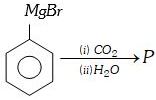
In the given reaction,the product $P$ is:
A
Benzaldehyde
B
Benzoic acid
C
Phenol
D
$C_6H_5-C(=O)-C_6H_5$
Solution
(B) The reaction of a Grignard reagent $(C_6H_5MgBr)$ with carbon dioxide $(CO_2)$ followed by acid hydrolysis $(H_3O^+)$ is a standard method for the preparation of carboxylic acids.
The reaction proceeds as follows:
$C_6H_5MgBr + CO_2 \rightarrow C_6H_5COOMgBr$
$C_6H_5COOMgBr + H_3O^+ \rightarrow C_6H_5COOH + Mg(OH)Br$
Thus,the product $P$ is benzoic acid $(C_6H_5COOH)$.
The reaction proceeds as follows:
$C_6H_5MgBr + CO_2 \rightarrow C_6H_5COOMgBr$
$C_6H_5COOMgBr + H_3O^+ \rightarrow C_6H_5COOH + Mg(OH)Br$
Thus,the product $P$ is benzoic acid $(C_6H_5COOH)$.
0 likes
View Solution22
MediumMCQ
Glacial acetic acid is obtained by
A
Distilling vinegar
B
Crystallizing,separating and melting acetic acid
C
Treating vinegar with dehydrating agent
D
Chemically separating acetic acid
Solution
(B) Acetic acid freezes at $16.6 \ ^oC$,while water freezes at $0 \ ^oC$.
Thus,glacial acetic acid is obtained by cooling acetic acid until it crystallizes,separating the solid crystals from the liquid,and then melting the pure crystals.
Thus,glacial acetic acid is obtained by cooling acetic acid until it crystallizes,separating the solid crystals from the liquid,and then melting the pure crystals.
0 likes
View Solution23
MediumMCQ
The acid formed when propyl magnesium bromide is treated with carbon dioxide is:
A
$C_3H_7COOH$
B
$C_2H_5COOH$
C
Both $(a)$ and $(b)$
D
None of the above
Solution
(A) Propyl magnesium bromide $(C_3H_7MgBr)$ reacts with carbon dioxide $(CO_2)$ to form an intermediate adduct,which upon acidic hydrolysis yields butanoic acid $(C_3H_7COOH)$.
$C_3H_7MgBr + CO_2 \rightarrow C_3H_7COOMgBr$
$C_3H_7COOMgBr + H_3O^{+} \rightarrow C_3H_7COOH + Mg(OH)Br$
$C_3H_7MgBr + CO_2 \rightarrow C_3H_7COOMgBr$
$C_3H_7COOMgBr + H_3O^{+} \rightarrow C_3H_7COOH + Mg(OH)Br$
0 likes
View Solution24
MediumMCQ
$CO_2$ on reaction with ethyl magnesium bromide gives
A
Ethane
B
Propanoic acid
C
Acetic acid
D
None of these
Solution
(B) The reaction of a Grignard reagent $(R-MgX)$ with carbon dioxide $(CO_2)$ followed by acid hydrolysis yields a carboxylic acid with one additional carbon atom.
Ethyl magnesium bromide is $CH_3CH_2MgBr$.
The reaction is:
$CH_3CH_2MgBr + CO_2 \rightarrow CH_3CH_2COOMgBr$
$CH_3CH_2COOMgBr + H_2O/H^+ \rightarrow CH_3CH_2COOH + Mg(OH)Br$
The product formed is propanoic acid $(CH_3CH_2COOH)$.
Ethyl magnesium bromide is $CH_3CH_2MgBr$.
The reaction is:
$CH_3CH_2MgBr + CO_2 \rightarrow CH_3CH_2COOMgBr$
$CH_3CH_2COOMgBr + H_2O/H^+ \rightarrow CH_3CH_2COOH + Mg(OH)Br$
The product formed is propanoic acid $(CH_3CH_2COOH)$.
0 likes
View Solution25
MediumMCQ
The compound $X$ in the reaction is: $X$ $\xrightarrow{CH_3MgI} Y$ $\xrightarrow{\text{hydrolysis}} Mg(OH)I + CH_3COOH$
A
$CH_3CHO$
B
$CO_2$
C
$(CH_3)_2CO$
D
$HCHO$
Solution
(B) $CO_2$ reacts with Grignard reagent to yield carboxylic acids.
$CO_2 + CH_3MgI \rightarrow CH_3COOMgI$
$CH_3COOMgI + H_2O \xrightarrow{H^+} CH_3COOH + Mg(OH)I$
Therefore,the compound $X$ is $CO_2$.
$CO_2 + CH_3MgI \rightarrow CH_3COOMgI$
$CH_3COOMgI + H_2O \xrightarrow{H^+} CH_3COOH + Mg(OH)I$
Therefore,the compound $X$ is $CO_2$.
0 likes
View Solution26
MediumMCQ
$CH_3CONH_2 \xrightarrow{NaNO_2/HCl} X$
A
$CH_3COOH$
B
$CH_3CONH_3Cl^{-}$
C
$CH_3NH_2$
D
$CH_3CHO$
Solution
(A) The reaction of an amide with nitrous acid $(HNO_2)$,generated in situ by $NaNO_2/HCl$,results in the formation of a carboxylic acid,nitrogen gas,and water.
The chemical equation is: $CH_3CONH_2 + HNO_2 \rightarrow CH_3COOH + N_2 + H_2O$.
Therefore,the product $X$ is $CH_3COOH$.
The chemical equation is: $CH_3CONH_2 + HNO_2 \rightarrow CH_3COOH + N_2 + H_2O$.
Therefore,the product $X$ is $CH_3COOH$.
0 likes
View Solution27
MediumMCQ
Acetic acid will be obtained on oxidation of
A
Ethanol
B
Propanal
C
Methanal
D
Glyoxal
Solution
(A) The oxidation of primary alcohols with strong oxidizing agents like $KMnO_4$ or $K_2Cr_2O_7$ yields carboxylic acids with the same number of carbon atoms.
Ethanol $(C_2H_5OH)$ contains two carbon atoms.
Upon oxidation,it forms acetic acid $(CH_3COOH)$,which also contains two carbon atoms.
The reaction is: $C_2H_5OH + 2[O] \xrightarrow{Oxidation} CH_3COOH + H_2O$.
Ethanol $(C_2H_5OH)$ contains two carbon atoms.
Upon oxidation,it forms acetic acid $(CH_3COOH)$,which also contains two carbon atoms.
The reaction is: $C_2H_5OH + 2[O] \xrightarrow{Oxidation} CH_3COOH + H_2O$.
0 likes
View Solution28
MediumMCQ
The end product $B$ in the sequence of reactions: $R - X$ $\xrightarrow{KCN} A$ $\xrightarrow[H_2O]{NaOH} B$ is
A
An alkane
B
$A$ carboxylic acid
C
Sodium salt of carboxylic acid
D
$A$ ketone
Solution
(C) The reaction sequence is as follows:
$1$. $R - X + KCN \rightarrow R - CN + KX$ (Nucleophilic substitution to form an alkyl cyanide $A$).
$2$. $R - CN + NaOH + H_2O \rightarrow R - COONa + NH_3$ (Alkaline hydrolysis of cyanide to form the sodium salt of carboxylic acid $B$).
$1$. $R - X + KCN \rightarrow R - CN + KX$ (Nucleophilic substitution to form an alkyl cyanide $A$).
$2$. $R - CN + NaOH + H_2O \rightarrow R - COONa + NH_3$ (Alkaline hydrolysis of cyanide to form the sodium salt of carboxylic acid $B$).
0 likes
View Solution29
MediumMCQ
The product obtained when acetic acid is treated with phosphorus trichloride is
A
$CH_3COOPCl_3$
B
$CH_3COOCl$
C
$CH_3COCl$
D
$ClCH_2COOH$
Solution
(C) The reaction between acetic acid $(CH_3COOH)$ and phosphorus trichloride $(PCl_3)$ is a standard method for the preparation of acid chlorides.
The balanced chemical equation is:
$3CH_3COOH + PCl_3 \to 3CH_3COCl + H_3PO_3$
Thus,the product obtained is acetyl chloride $(CH_3COCl)$.
The balanced chemical equation is:
$3CH_3COOH + PCl_3 \to 3CH_3COCl + H_3PO_3$
Thus,the product obtained is acetyl chloride $(CH_3COCl)$.
0 likes
View Solution30
MediumMCQ
$R-CH_2-CH_2OH$ can be converted into $R-CH_2-CH_2-COOH$. The correct sequence of the reagents is:
A
$PBr_3, KCN, H_3O^{+}$
B
$PBr_3, KCN, H_2$
C
$HCN, PBr_3, H^{+}$
D
$KCN, H^{+}$
Solution
(A) The conversion of an alcohol to a carboxylic acid with an additional carbon atom involves the following steps:
$1$. Conversion of alcohol to alkyl bromide using $PBr_3$: $R-CH_2-CH_2OH \xrightarrow{PBr_3} R-CH_2-CH_2-Br$
$2$. Nucleophilic substitution with $KCN$ to form a nitrile: $R-CH_2-CH_2-Br \xrightarrow{KCN} R-CH_2-CH_2-CN$
$3$. Acidic hydrolysis of the nitrile to form a carboxylic acid: $R-CH_2-CH_2-CN \xrightarrow{H_3O^{+}} R-CH_2-CH_2-COOH + NH_3$
Therefore,the correct sequence is $PBr_3, KCN, H_3O^{+}$.
$1$. Conversion of alcohol to alkyl bromide using $PBr_3$: $R-CH_2-CH_2OH \xrightarrow{PBr_3} R-CH_2-CH_2-Br$
$2$. Nucleophilic substitution with $KCN$ to form a nitrile: $R-CH_2-CH_2-Br \xrightarrow{KCN} R-CH_2-CH_2-CN$
$3$. Acidic hydrolysis of the nitrile to form a carboxylic acid: $R-CH_2-CH_2-CN \xrightarrow{H_3O^{+}} R-CH_2-CH_2-COOH + NH_3$
Therefore,the correct sequence is $PBr_3, KCN, H_3O^{+}$.
0 likes
View Solution31
MediumMCQ
Benzoyl chloride is prepared from benzoic acid by:
A
$Cl_2, hv$
B
$SO_2Cl_2$
C
$SOCl_2$
D
$Cl_2, H_2O$
Solution
(C) Benzoic acid reacts with thionyl chloride $(SOCl_2)$ to form benzoyl chloride. The reaction is as follows:
$C_6H_5COOH + SOCl_2 \rightarrow C_6H_5COCl + SO_2 + HCl$
This method is preferred because the by-products ($SO_2$ and $HCl$) are gases,which escape,leaving the pure product behind.
$C_6H_5COOH + SOCl_2 \rightarrow C_6H_5COCl + SO_2 + HCl$
This method is preferred because the by-products ($SO_2$ and $HCl$) are gases,which escape,leaving the pure product behind.
0 likes
View Solution32
MediumMCQ
Which of the following acids cannot be prepared by a Grignard reagent?
A
Acetic acid
B
Succinic acid
C
Formic acid
D
All of these
Solution
(C) The reaction of a Grignard reagent $(RMgX)$ with carbon dioxide $(CO_2)$ followed by acid hydrolysis yields a carboxylic acid with one more carbon atom than the original alkyl group $(R)$:
$RMgX + CO_2$ $\rightarrow RCOOMgX$ $\xrightarrow{H_3O^+} RCOOH + Mg(OH)X$
To prepare formic acid $(HCOOH)$,the $R$ group would need to be a hydrogen atom $(H)$. However,a Grignard reagent cannot be formed with a hydrogen atom ($HMgX$ does not exist). Therefore,formic acid cannot be prepared using this method. Acetic acid $(CH_3COOH)$ can be prepared using methylmagnesium bromide $(CH_3MgBr)$,and succinic acid can be prepared using appropriate di-Grignard reagents.
$RMgX + CO_2$ $\rightarrow RCOOMgX$ $\xrightarrow{H_3O^+} RCOOH + Mg(OH)X$
To prepare formic acid $(HCOOH)$,the $R$ group would need to be a hydrogen atom $(H)$. However,a Grignard reagent cannot be formed with a hydrogen atom ($HMgX$ does not exist). Therefore,formic acid cannot be prepared using this method. Acetic acid $(CH_3COOH)$ can be prepared using methylmagnesium bromide $(CH_3MgBr)$,and succinic acid can be prepared using appropriate di-Grignard reagents.
0 likes
View Solution33
MediumMCQ
When alkyl cyanides are hydrolysed to the corresponding carboxylic acids,the gas evolved is:
A
$N_2$
B
$O_2$
C
$NH_3$
D
$CO_2$
Solution
(C) The hydrolysis of alkyl cyanides $(R-CN)$ in the presence of an acid or base catalyst proceeds as follows:
$R-CN + 2H_2O \rightarrow R-COOH + NH_3$
During this reaction,the nitrogen atom of the cyanide group is released as ammonia $(NH_3)$ gas.
$R-CN + 2H_2O \rightarrow R-COOH + NH_3$
During this reaction,the nitrogen atom of the cyanide group is released as ammonia $(NH_3)$ gas.
0 likes
View Solution34
MediumMCQ
When $methyl \ cyanide$ is hydrolysed in the presence of an alkali,the final product is:
A
Acetamide
B
Methane
C
$CO_2 + H_2O$
D
Acetic acid
Solution
(D) The hydrolysis of $methyl \ cyanide$ $(CH_3CN)$ in the presence of an alkali (like $NaOH$) proceeds through the formation of $acetamide$ $(CH_3CONH_2)$ as an intermediate,which further undergoes hydrolysis to form $acetate$ ions. Upon acidification,this yields $acetic \ acid$ $(CH_3COOH)$.
The reaction is:
$CH_3-C \equiv N + 2H_2O \xrightarrow{OH^-} CH_3COOH + NH_3$
The reaction is:
$CH_3-C \equiv N + 2H_2O \xrightarrow{OH^-} CH_3COOH + NH_3$
0 likes
View Solution35
DifficultMCQ
Identify the product $Z$ in the series
$CH_3CN$ $\xrightarrow{Na + C_2H_5OH} X$ $\xrightarrow{HNO_2} Y$ $\xrightarrow[H_2SO_4]{K_2Cr_2O_7} Z$
$CH_3CN$ $\xrightarrow{Na + C_2H_5OH} X$ $\xrightarrow{HNO_2} Y$ $\xrightarrow[H_2SO_4]{K_2Cr_2O_7} Z$
A
$CH_3CHO$
B
$CH_3CONH_2$
C
$CH_3COOH$
D
$CH_3CH_2NHOH$
Solution
(C) $CH_3CN \xrightarrow{Na + C_2H_5OH} CH_3CH_2NH_2$ ($X$ is ethylamine).
$CH_3CH_2NH_2 \xrightarrow{HNO_2} CH_3CH_2OH$ ($Y$ is ethanol).
$CH_3CH_2OH \xrightarrow[H_2SO_4]{K_2Cr_2O_7} CH_3COOH$ ($Z$ is acetic acid).
$CH_3CH_2NH_2 \xrightarrow{HNO_2} CH_3CH_2OH$ ($Y$ is ethanol).
$CH_3CH_2OH \xrightarrow[H_2SO_4]{K_2Cr_2O_7} CH_3COOH$ ($Z$ is acetic acid).
0 likes
View Solution36
MediumMCQ
In the presence of an acid,the hydrolysis of methyl cyanide gives:
A
Acetic acid
B
Methylamine
C
Methyl alcohol
D
Formic acid
Solution
(A) The acid-catalyzed hydrolysis of methyl cyanide $(CH_3CN)$ proceeds as follows:
$CH_3CN + 2H_2O \xrightarrow{H^+} CH_3COOH + NH_3$
Thus,the product formed is acetic acid.
$CH_3CN + 2H_2O \xrightarrow{H^+} CH_3COOH + NH_3$
Thus,the product formed is acetic acid.
0 likes
View Solution37
MediumMCQ
Hydrolysis of acetonitrile in acidic medium produces
A
$CH_3CH_2OH$
B
$CH_3COOH$
C
$CH_3NC$
D
$CH_3COOCH_3$
Solution
(B) The hydrolysis of acetonitrile $(CH_3CN)$ in an acidic medium proceeds as follows:
$CH_3CN + 2H_2O \xrightarrow{H^+} CH_3COOH + NH_4^+$
Thus,the product formed is acetic acid $(CH_3COOH)$.
$CH_3CN + 2H_2O \xrightarrow{H^+} CH_3COOH + NH_4^+$
Thus,the product formed is acetic acid $(CH_3COOH)$.
0 likes
View Solution38
MediumMCQ
$C_6H_5NH_2$ $\xrightarrow{NaNO_2/HCl} X$ $\xrightarrow{Cu_2(CN)_2} Y$ $\xrightarrow{H_2O/H^{+}} Z$
$Z$ is identified as :
$Z$ is identified as :
A
$C_6H_5 - NH - CH_3$
B
$C_6H_5 - COOH$
C
$C_6H_5 - CH_2 - NH_2$
D
$C_6H_5 - CH_2 - COOH$
Solution
(B) $C_6H_5NH_2 \xrightarrow{NaNO_2/HCl, 0-5^{\circ}C} \underset{(X)}{C_6H_5N_2^{+}Cl^{-}}$ (Benzenediazonium chloride)
$\underset{(X)}{C_6H_5N_2^{+}Cl^{-}} \xrightarrow{Cu_2(CN)_2} \underset{(Y)}{C_6H_5CN}$ (Benzonitrile)
$\underset{(Y)}{C_6H_5CN} \xrightarrow{H_2O/H^{+}} \underset{(Z)}{C_6H_5COOH}$ (Benzoic acid)
Thus,the final product $Z$ is $C_6H_5 - COOH$.
$\underset{(X)}{C_6H_5N_2^{+}Cl^{-}} \xrightarrow{Cu_2(CN)_2} \underset{(Y)}{C_6H_5CN}$ (Benzonitrile)
$\underset{(Y)}{C_6H_5CN} \xrightarrow{H_2O/H^{+}} \underset{(Z)}{C_6H_5COOH}$ (Benzoic acid)
Thus,the final product $Z$ is $C_6H_5 - COOH$.
0 likes
View Solution39
MediumMCQ
What is the product obtained by the partial hydrolysis of acetonitrile with cold concentrated $HCl$?
A
Methyl cyanide
B
Acetic anhydride
C
Acetic acid
D
Acetamide
Solution
(D) The partial hydrolysis of nitriles $(R-CN)$ with cold concentrated $HCl$ or $H_2SO_4$ yields amides $(R-CONH_2)$.
For acetonitrile $(CH_3CN)$: $CH_3CN + H_2O \xrightarrow{conc. HCl, \text{cold}} CH_3CONH_2$ (Acetamide).
Complete hydrolysis at higher temperatures would yield acetic acid $(CH_3COOH)$.
For acetonitrile $(CH_3CN)$: $CH_3CN + H_2O \xrightarrow{conc. HCl, \text{cold}} CH_3CONH_2$ (Acetamide).
Complete hydrolysis at higher temperatures would yield acetic acid $(CH_3COOH)$.
0 likes
View Solution40
MediumMCQ
What is obtained by the hydrolysis of methyl cyanide in the presence of an acid?
A
Acetic acid
B
Methyl amine
C
Methyl alcohol
D
Formic acid
Solution
(A) The hydrolysis of methyl cyanide $(CH_3CN)$ in the presence of an acid proceeds as follows:
$CH_3CN + 2H_2O \xrightarrow{H^+} CH_3COOH + NH_3$
Thus,the product obtained is acetic acid $(CH_3COOH)$.
$CH_3CN + 2H_2O \xrightarrow{H^+} CH_3COOH + NH_3$
Thus,the product obtained is acetic acid $(CH_3COOH)$.
0 likes
View Solution41
MediumMCQ
What is the initial product obtained from the hydrolysis of cyanide?
A
Primary amide
B
Isocyanide
C
Isocyanate
D
Carboxylic acid
Solution
(A) The hydrolysis of cyanide $(R-CN)$ proceeds in two steps.
In the first step,partial hydrolysis occurs to form an amide $(R-CONH_2)$.
In the second step,further hydrolysis leads to the formation of a carboxylic acid $(R-COOH)$ and ammonia $(NH_3)$.
The reaction is: $R-CN$ $\xrightarrow{H_2O, H^+} R-CONH_2$ $\xrightarrow{H_2O, H^+} R-COOH + NH_3$.
Thus,the initial product is a primary amide.
In the first step,partial hydrolysis occurs to form an amide $(R-CONH_2)$.
In the second step,further hydrolysis leads to the formation of a carboxylic acid $(R-COOH)$ and ammonia $(NH_3)$.
The reaction is: $R-CN$ $\xrightarrow{H_2O, H^+} R-CONH_2$ $\xrightarrow{H_2O, H^+} R-COOH + NH_3$.
Thus,the initial product is a primary amide.
0 likes
View Solution42
DifficultMCQ
What is the name of the given reaction? $CH_3CH = CH_2 \xrightarrow[(CO + H_2)]{H^+} CH_3 - CH(COOH) - CH_3$
A
Wurtz reaction
B
Koch reaction
C
Clemmensen reaction
D
Kolbe reaction
Solution
(B) The given reaction is known as the Koch reaction (also known as the Koch carbonylation of alkenes). In this process,an alkene reacts with carbon monoxide and water in the presence of an acid catalyst (like $H_3PO_4$ or $H_2SO_4$) to form a carboxylic acid. The reaction is: $CH_3CH=CH_2 + CO + H_2O \xrightarrow{H^+} CH_3-CH(COOH)-CH_3$.
0 likes
View Solution43
MediumMCQ
The oxidation of ethylbenzene with $KMnO_4$ yields which of the following compounds?
A
Benzophenone
B
Acetophenone
C
Benzoic acid
D
Benzyl alcohol
Solution
(C) When alkylbenzenes (like ethylbenzene) are treated with strong oxidizing agents such as alkaline $KMnO_4$ followed by acidic hydrolysis,the alkyl side chain is oxidized to a carboxylic acid group $(-COOH)$ attached to the benzene ring,regardless of the length of the alkyl chain.
Therefore,ethylbenzene $(C_6H_5CH_2CH_3)$ is oxidized to benzoic acid $(C_6H_5COOH)$.
Therefore,ethylbenzene $(C_6H_5CH_2CH_3)$ is oxidized to benzoic acid $(C_6H_5COOH)$.
0 likes
View Solution44
MediumMCQ
What is the name of the reaction: $CH_3-CH=CH_2 \xrightarrow{CO + H_2O, H^+} CH_3-CH(COOH)-CH_3$?
A
Wurtz reaction
B
Koch reaction
C
Clemmensen reduction
D
Kolbe's reaction
Solution
(B) The reaction of an alkene with carbon monoxide $(CO)$ and water $(H_2O)$ in the presence of an acid catalyst $(H^+)$ to form a carboxylic acid is known as the Koch reaction (or hydrocarboxylation).
In this specific case,propene reacts to form isobutyric acid.
In this specific case,propene reacts to form isobutyric acid.
0 likes
View Solution45
DifficultMCQ
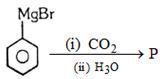
What is the product $P$ in the given reaction?
A
$C_6H_5CHO$
B
$C_6H_5COOH$
C
$C_6H_5OH$
D
$C_6H_5-CO-C_6H_5$
Solution
(B) The reaction of a Grignard reagent $(C_6H_5MgBr)$ with carbon dioxide $(CO_2)$ followed by acid hydrolysis $(H_3O^+)$ is a standard method for the preparation of carboxylic acids.
Step $1$: The nucleophilic phenyl group $(C_6H_5^-)$ from the Grignard reagent attacks the electrophilic carbon atom of $CO_2$ to form a magnesium carboxylate intermediate $(C_6H_5COOMgBr)$.
Step $2$: Subsequent acid hydrolysis $(H_3O^+)$ converts the magnesium carboxylate into benzoic acid $(C_6H_5COOH)$.
Step $1$: The nucleophilic phenyl group $(C_6H_5^-)$ from the Grignard reagent attacks the electrophilic carbon atom of $CO_2$ to form a magnesium carboxylate intermediate $(C_6H_5COOMgBr)$.
Step $2$: Subsequent acid hydrolysis $(H_3O^+)$ converts the magnesium carboxylate into benzoic acid $(C_6H_5COOH)$.
0 likes
View Solution46
EasyMCQ
In the reaction $CH_3CN \xrightarrow{H_3O^+, \text{heat}} CH_3COOH$,what is the change in the hybridization state of the functional carbon atom?
A
$sp^3$ to $sp^2$
B
$sp^2$ to $sp^3$
C
$sp$ to $sp^2$
D
$sp^2$ to $sp$
Solution
(C) In the reactant $CH_3CN$ (acetonitrile),the functional carbon atom is the nitrile carbon $(C \equiv N)$. The hybridization of this carbon is $sp$ because it forms two sigma bonds and two pi bonds.
In the product $CH_3COOH$ (acetic acid),the functional carbon atom is the carboxyl carbon $(C=O)$. The hybridization of this carbon is $sp^2$ because it forms three sigma bonds and one pi bond.
Therefore,the hybridization changes from $sp$ to $sp^2$.
In the product $CH_3COOH$ (acetic acid),the functional carbon atom is the carboxyl carbon $(C=O)$. The hybridization of this carbon is $sp^2$ because it forms three sigma bonds and one pi bond.
Therefore,the hybridization changes from $sp$ to $sp^2$.
0 likes
View Solution47
MediumMCQ
Which of the following sequences of reagents is used to convert $R-CH_2-CH_2-OH$ into $R-CH_2-CH_2-COOH$?
A
$PBr_3, KCN, H_3O^+$
B
$PBr_3, KCN, H_2/Pt$
C
$KCN, H_3O^+$
D
$HCN, PBr_3, H_3O^+$
Solution
(A) The conversion of an alcohol to a carboxylic acid with an additional carbon atom involves the following steps:
$1$. Conversion of alcohol to alkyl bromide using $PBr_3$: $R-CH_2-CH_2-OH \xrightarrow{PBr_3} R-CH_2-CH_2-Br$
$2$. Nucleophilic substitution with $KCN$ to form a nitrile: $R-CH_2-CH_2-Br \xrightarrow{KCN} R-CH_2-CH_2-CN$
$3$. Acidic hydrolysis of the nitrile to a carboxylic acid: $R-CH_2-CH_2-CN \xrightarrow{H_3O^+} R-CH_2-CH_2-COOH$
Thus,the correct sequence is $PBr_3, KCN, H_3O^+$.
$1$. Conversion of alcohol to alkyl bromide using $PBr_3$: $R-CH_2-CH_2-OH \xrightarrow{PBr_3} R-CH_2-CH_2-Br$
$2$. Nucleophilic substitution with $KCN$ to form a nitrile: $R-CH_2-CH_2-Br \xrightarrow{KCN} R-CH_2-CH_2-CN$
$3$. Acidic hydrolysis of the nitrile to a carboxylic acid: $R-CH_2-CH_2-CN \xrightarrow{H_3O^+} R-CH_2-CH_2-COOH$
Thus,the correct sequence is $PBr_3, KCN, H_3O^+$.
0 likes
View Solution48
MediumMCQ
What is obtained when glycerol is heated with oxalic acid at $110\,^{\circ}C$?
A
Ethanol
B
Methanoic acid
C
Ether
D
Acetone
Solution
(B) When glycerol is heated with oxalic acid at $110\,^{\circ}C$,it forms glycerol mono-oxalate,which upon further heating loses $CO_2$ to form glycerol mono-formate. Hydrolysis of glycerol mono-formate yields glycerol and formic acid ($HCOOH$,also known as methanoic acid).
Reaction sequence:
$Glycerol + Oxalic \, acid \xrightarrow{110\,^{\circ}C, -H_2O} Glycerol \, mono-oxalate$
$Glycerol \, mono-oxalate \xrightarrow{\Delta, -CO_2} Glycerol \, mono-formate$
$Glycerol \, mono-formate \xrightarrow{H_2O} Glycerol + HCOOH$ (Methanoic acid)
Reaction sequence:
$Glycerol + Oxalic \, acid \xrightarrow{110\,^{\circ}C, -H_2O} Glycerol \, mono-oxalate$
$Glycerol \, mono-oxalate \xrightarrow{\Delta, -CO_2} Glycerol \, mono-formate$
$Glycerol \, mono-formate \xrightarrow{H_2O} Glycerol + HCOOH$ (Methanoic acid)
0 likes
View Solution49
DifficultMCQ
What will be the final product of the following reaction sequence?
$CH \equiv CH$ $\xrightarrow{CH_3MgBr}$ $\xrightarrow{CO_2/H_3O^+}$ $\xrightarrow{HgSO_4/H_2SO_4}$ $\xrightarrow{Ag_2O, \Delta} ?$
$CH \equiv CH$ $\xrightarrow{CH_3MgBr}$ $\xrightarrow{CO_2/H_3O^+}$ $\xrightarrow{HgSO_4/H_2SO_4}$ $\xrightarrow{Ag_2O, \Delta} ?$
A
$CH_3-CO-COOH$
B
$CH_2(COOH)_2$
C
$CH_3-CO-CHO$
D
$CH_3-CO-CH_2COOH$
Solution
(B) $1$. $CH \equiv CH + CH_3MgBr \rightarrow CH \equiv C-MgBr + CH_4$
$2$. $CH \equiv C-MgBr + CO_2 \xrightarrow{H_3O^+} CH \equiv C-COOH$ (Propiolic acid)
$3$. $CH \equiv C-COOH + H_2O \xrightarrow{HgSO_4/H_2SO_4} [CH_2=C(OH)-COOH] \rightleftharpoons OHC-CH_2-COOH$ (Formylacetic acid)
$4$. $OHC-CH_2-COOH \xrightarrow{Ag_2O, \Delta} HOOC-CH_2-COOH$ (Malonic acid)
Thus,the final product is $CH_2(COOH)_2$.
$2$. $CH \equiv C-MgBr + CO_2 \xrightarrow{H_3O^+} CH \equiv C-COOH$ (Propiolic acid)
$3$. $CH \equiv C-COOH + H_2O \xrightarrow{HgSO_4/H_2SO_4} [CH_2=C(OH)-COOH] \rightleftharpoons OHC-CH_2-COOH$ (Formylacetic acid)
$4$. $OHC-CH_2-COOH \xrightarrow{Ag_2O, \Delta} HOOC-CH_2-COOH$ (Malonic acid)
Thus,the final product is $CH_2(COOH)_2$.
0 likes
View Solution50
MediumMCQ
How is formic acid prepared?
A
By heating calcium acetate with concentrated $H_2SO_4$
B
By heating calcium formate with calcium acetate
C
By heating glycerol with oxalic acid
D
By oxidation of acetaldehyde with $K_2Cr_2O_7$ and $H_2SO_4$
Solution
(C) Formic acid is prepared by heating glycerol with oxalic acid at $110\,^{\circ}C$.
$C_3H_5(OH)_3 + (COOH)_2 \xrightarrow{110\,^{\circ}C} HCOOH + CO_2 + C_3H_5(OH)_3$
In this reaction,glycerol acts as a catalyst and is regenerated at the end of the process.
$C_3H_5(OH)_3 + (COOH)_2 \xrightarrow{110\,^{\circ}C} HCOOH + CO_2 + C_3H_5(OH)_3$
In this reaction,glycerol acts as a catalyst and is regenerated at the end of the process.
0 likes
View Solution8-2.Carboxylic acids and Their derivative — Preparation of Carboxylic Acids and Their Derivatives · Frequently Asked Questions
1Are these 8-2.Carboxylic acids and Their derivative questions useful for JEE and NEET?
Yes. All questions in this section are mapped to JEE Main and NEET exam patterns. Previous year questions from JEE Main, NEET, GUJCET and state-level exams are included with full solutions.
2Can I switch to Hindi or Gujarati for these questions?
Yes. Use the language tabs in the hero section or the sidebar to view the same questions and solutions in English, Hindi or Gujarati.
3How do I generate a question paper from this subtopic?
Use the Vedclass Exam Paper Generator — select the chapter and subtopic, set difficulty, and generate Sets A, B, C, D automatically. First 3 chapters of every subject are free.
Vedclass Products
For Students
Vedclass Test Series
Mock tests in real JEE/NEET style with performance analysis. 5-day free trial.
Start Free TrialFor Teachers
Exam Paper Generator
Generate Set A/B/C/D papers from this chapter in 2 minutes. 3 chapters free.
Try FreeFor Institutes
Online Exam Module
Live online exams with unlimited students, 360° analytics & white-label branding.
See DemoFor Teachers & Institutes
Generate a 8-2.Carboxylic acids and Their derivative Exam Paper in 2 Minutes
Select subtopic & difficulty — Sets A, B, C, D auto-generated with No Repeat logic.
First 3 chapters of every subject are free — no payment required.