
A English
Properties of Carboxylic Acids and Their Derivatives Questions in English
Class 12 Chemistry · 8-2.Carboxylic acids and Their derivative · Properties of Carboxylic Acids and Their Derivatives
791+
Questions
English
Language
100%
With Solutions
Showing 35 of 791 questions in English
751
EasyMCQ
The reaction between acetic acid and ammonia gives
A
$CH_3CONH_2$
B
$CH_3CONHCH_3$
C
$CH_3CN$
D
$CH_3COONH_4$
Solution
(A) The reaction of acetic acid $(CH_3COOH)$ with ammonia $(NH_3)$ initially forms ammonium acetate $(CH_3COONH_4)$.
$CH_3COOH + NH_3 \rightarrow CH_3COONH_4$
Upon heating,ammonium acetate undergoes dehydration to form acetamide $(CH_3CONH_2)$.
$CH_3COONH_4 \xrightarrow{\Delta} CH_3CONH_2 + H_2O$
Therefore,the final product of the reaction is acetamide $(CH_3CONH_2)$.
$CH_3COOH + NH_3 \rightarrow CH_3COONH_4$
Upon heating,ammonium acetate undergoes dehydration to form acetamide $(CH_3CONH_2)$.
$CH_3COONH_4 \xrightarrow{\Delta} CH_3CONH_2 + H_2O$
Therefore,the final product of the reaction is acetamide $(CH_3CONH_2)$.
0 likes
View Solution752
EasyMCQ
$R-CH_2-COOH \xrightarrow[(ii) H_2O]{(i) Cl_2 / \text{Red phosphorus}} R-CH(Cl)-COOH$
The above reaction is known as
The above reaction is known as
A
Friedel-Crafts reaction
B
Kolbe-Schmidt reaction
C
Hell-Volhard-Zelinsky reaction
D
Cannizzaro reaction
Solution
(C) The given reaction involves the halogenation of a carboxylic acid at the $\alpha$-carbon atom using $Cl_2$ or $Br_2$ in the presence of a small amount of red phosphorus,followed by hydrolysis.
This specific reaction is known as the Hell-Volhard-Zelinsky $(HVZ)$ reaction.
It is used to prepare $\alpha$-halo carboxylic acids.
This specific reaction is known as the Hell-Volhard-Zelinsky $(HVZ)$ reaction.
It is used to prepare $\alpha$-halo carboxylic acids.
0 likes
View Solution753
DifficultMCQ
Identify $X, Y$ and $Z$ respectively in the following reaction sequence:
$CH_3COOH$ $\xrightarrow[(ii) \Delta]{(i) NH_3} CH_3CONH_2$ $\xrightarrow[Pyridine / 343 \ K]{(iii) C_6H_5SO_2Cl} X + Y + Z$
$CH_3COOH$ $\xrightarrow[(ii) \Delta]{(i) NH_3} CH_3CONH_2$ $\xrightarrow[Pyridine / 343 \ K]{(iii) C_6H_5SO_2Cl} X + Y + Z$
A
$CH_3CONHSO_2C_6H_5, H_2O, HCl$
B
$CH_3CONHSO_2C_6H_5, H_2O, HCl$
C
$C_6H_5SO_3H, CH_3CN, HCl$
D
$C_6H_5SO_2Cl, CH_3NC, H_2O$
Solution
(A) The reaction sequence is as follows:
$1$. Acetic acid $(CH_3COOH)$ reacts with $NH_3$ followed by heating to form acetamide $(CH_3CONH_2)$.
$2$. Acetamide reacts with benzenesulfonyl chloride $(C_6H_5SO_2Cl)$ in the presence of pyridine to form $N$-acetylbenzenesulfonamide $(CH_3CONHSO_2C_6H_5)$ along with water $(H_2O)$ and hydrogen chloride $(HCl)$.
$3$. The reaction is: $CH_3CONH_2 + C_6H_5SO_2Cl \xrightarrow{Pyridine} CH_3CONHSO_2C_6H_5 + H_2O + HCl$.
$4$. Thus,$X = CH_3CONHSO_2C_6H_5$,$Y = H_2O$,and $Z = HCl$.
$1$. Acetic acid $(CH_3COOH)$ reacts with $NH_3$ followed by heating to form acetamide $(CH_3CONH_2)$.
$2$. Acetamide reacts with benzenesulfonyl chloride $(C_6H_5SO_2Cl)$ in the presence of pyridine to form $N$-acetylbenzenesulfonamide $(CH_3CONHSO_2C_6H_5)$ along with water $(H_2O)$ and hydrogen chloride $(HCl)$.
$3$. The reaction is: $CH_3CONH_2 + C_6H_5SO_2Cl \xrightarrow{Pyridine} CH_3CONHSO_2C_6H_5 + H_2O + HCl$.
$4$. Thus,$X = CH_3CONHSO_2C_6H_5$,$Y = H_2O$,and $Z = HCl$.
0 likes
View Solution754
MediumMCQ
Oxalic acid reacts with concentrated $H_2SO_4$ to give a mixture of two gases. When this mixture is passed through caustic potash,one of the gases is absorbed. What is the product formed by the absorbed gas with caustic potash?
A
$K_2SO_4$
B
$KHCO_3$
C
$K_2CO_3$
D
$KOH$
Solution
(C) The reaction of oxalic acid with concentrated $H_2SO_4$ is as follows:
$(COOH)_2 \xrightarrow{conc. H_2SO_4} CO + CO_2 + H_2O$
The gaseous mixture consists of $CO$ and $CO_2$.
When this mixture is passed through caustic potash $(KOH)$,$CO_2$ (an acidic gas) is absorbed,while $CO$ (a neutral gas) passes through.
The reaction of $CO_2$ with $KOH$ is:
$CO_2 + 2KOH \rightarrow K_2CO_3 + H_2O$
Thus,the product formed is potassium carbonate $(K_2CO_3)$.
$(COOH)_2 \xrightarrow{conc. H_2SO_4} CO + CO_2 + H_2O$
The gaseous mixture consists of $CO$ and $CO_2$.
When this mixture is passed through caustic potash $(KOH)$,$CO_2$ (an acidic gas) is absorbed,while $CO$ (a neutral gas) passes through.
The reaction of $CO_2$ with $KOH$ is:
$CO_2 + 2KOH \rightarrow K_2CO_3 + H_2O$
Thus,the product formed is potassium carbonate $(K_2CO_3)$.
0 likes
View Solution755
MediumMCQ
The reagent used in the preparation of aspirin from salicylic acid is
A
$SOCl_2 / \text{pyridine}$
B
$CH_3COOH / HCl$
C
$(CH_3CO)_2O / \text{Conc. } H_2SO_4$
D
$CH_3Cl / AlCl_3$
Solution
(C) The preparation of aspirin (acetylsalicylic acid) from salicylic acid involves the acetylation of the phenolic $-OH$ group.
This reaction is carried out by reacting salicylic acid with acetic anhydride in the presence of an acid catalyst like concentrated $H_2SO_4$.
The reaction is: $\text{Salicylic acid} + (CH_3CO)_2O \xrightarrow{Conc. H_2SO_4} \text{Aspirin} + CH_3COOH$.
Therefore,the correct reagent is $(CH_3CO)_2O / \text{Conc. } H_2SO_4$.
This reaction is carried out by reacting salicylic acid with acetic anhydride in the presence of an acid catalyst like concentrated $H_2SO_4$.
The reaction is: $\text{Salicylic acid} + (CH_3CO)_2O \xrightarrow{Conc. H_2SO_4} \text{Aspirin} + CH_3COOH$.
Therefore,the correct reagent is $(CH_3CO)_2O / \text{Conc. } H_2SO_4$.
0 likes
View Solution756
MediumMCQ
Dehydration of an organic acid $X$ with concentrated $H_2SO_4$ at $373 \ K$ gives $H_2O$ and gas $Y$. The hybridisation of the carbon in $Y$ and nature of $Y$ are respectively
A
$sp^2$,Neutral
B
$sp$,Neutral
C
$sp^2$,acidic
D
$sp^2$,acidic
Solution
(B) The dehydration of formic acid $(HCOOH)$ with concentrated $H_2SO_4$ at $373 \ K$ produces water $(H_2O)$ and carbon monoxide $(CO)$ gas.
Reaction: $HCOOH \xrightarrow{conc. H_2SO_4, 373 \ K} H_2O + CO$.
In carbon monoxide $(CO)$,the carbon atom is $sp$ hybridized.
Carbon monoxide $(CO)$ is a neutral oxide.
Therefore,the hybridization of carbon in $Y$ $(CO)$ is $sp$ and its nature is neutral.
Reaction: $HCOOH \xrightarrow{conc. H_2SO_4, 373 \ K} H_2O + CO$.
In carbon monoxide $(CO)$,the carbon atom is $sp$ hybridized.
Carbon monoxide $(CO)$ is a neutral oxide.
Therefore,the hybridization of carbon in $Y$ $(CO)$ is $sp$ and its nature is neutral.
0 likes
View Solution757
DifficultMCQ
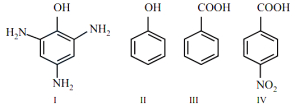
Which of the following set of compounds react with $NaHCO_3$?
A
$I, II, III, IV$
B
$I, II, III$ only
C
$III, IV$ only
D
$I, III, IV$ only
Solution
(C) $NaHCO_3$ is a mild base and only compounds more acidic than carbonic acid $(H_2CO_3)$ can react with it to evolve $CO_2$ gas.
Carboxylic acids are significantly more acidic than phenols and amines.
Compound $(III)$ is benzoic acid and compound $(IV)$ is $p$-nitrobenzoic acid.
Both $(III)$ and $(IV)$ are carboxylic acids and are strong enough to react with $NaHCO_3$.
Compound $(I)$ is an amine-substituted phenol and compound $(II)$ is phenol; both are less acidic than $H_2CO_3$ and do not react with $NaHCO_3$.
Therefore,only $(III)$ and $(IV)$ react with $NaHCO_3$.
Carboxylic acids are significantly more acidic than phenols and amines.
Compound $(III)$ is benzoic acid and compound $(IV)$ is $p$-nitrobenzoic acid.
Both $(III)$ and $(IV)$ are carboxylic acids and are strong enough to react with $NaHCO_3$.
Compound $(I)$ is an amine-substituted phenol and compound $(II)$ is phenol; both are less acidic than $H_2CO_3$ and do not react with $NaHCO_3$.
Therefore,only $(III)$ and $(IV)$ react with $NaHCO_3$.
0 likes
View Solution758
EasyMCQ
The correct order of $pK_{a}$ of the following compounds is:
$I. CCl_3COOH$
$II. CF_3COOH$
$III. NO_2CH_2COOH$
$IV. NCCH_2COOH$
$I. CCl_3COOH$
$II. CF_3COOH$
$III. NO_2CH_2COOH$
$IV. NCCH_2COOH$
A
$(I) < (II) < (III) < (IV)$
B
$(III) < (II) < (I) < (IV)$
C
$(II) < (I) < (IV) < (III)$
D
$(II) < (I) < (III) < (IV)$
Solution
(D) The acidity of carboxylic acids is directly proportional to the stability of their conjugate bases,which is enhanced by electron-withdrawing groups ($-I$ effect).
$pK_a$ is inversely proportional to acidity.
Comparing the compounds:
$II. CF_3COOH$ (Strongest acid due to three highly electronegative $F$ atoms)
$I. CCl_3COOH$ (Strong acid,but $Cl$ is less electronegative than $F$)
$III. NO_2CH_2COOH$ (Stronger acid than $IV$ because $-NO_2$ is a stronger electron-withdrawing group than $-CN$)
$IV. NCCH_2COOH$
Acidity order: $II > I > III > IV$
Since $pK_a = -\log(K_a)$,the order of $pK_a$ is the reverse of the acidity order:
$pK_a$ order: $IV > III > I > II$
This corresponds to $(II) < (I) < (III) < (IV)$.
$pK_a$ is inversely proportional to acidity.
Comparing the compounds:
$II. CF_3COOH$ (Strongest acid due to three highly electronegative $F$ atoms)
$I. CCl_3COOH$ (Strong acid,but $Cl$ is less electronegative than $F$)
$III. NO_2CH_2COOH$ (Stronger acid than $IV$ because $-NO_2$ is a stronger electron-withdrawing group than $-CN$)
$IV. NCCH_2COOH$
Acidity order: $II > I > III > IV$
Since $pK_a = -\log(K_a)$,the order of $pK_a$ is the reverse of the acidity order:
$pK_a$ order: $IV > III > I > II$
This corresponds to $(II) < (I) < (III) < (IV)$.
0 likes
View Solution759
MediumMCQ
Identify the correct decreasing order of acidic strength for the following compounds:
$I$: $p$-Nitrobenzoic acid
$II$: Benzoic acid
$III$: $p$-Methoxybenzoic acid
$I$: $p$-Nitrobenzoic acid
$II$: Benzoic acid
$III$: $p$-Methoxybenzoic acid
A
$III > II > I$
B
$I > II > III$
C
$II > III > I$
D
$I > III > II$
Solution
(B) The acidic strength of substituted benzoic acids depends on the electronic effects of the substituents attached to the benzene ring.
$1$. The $-NO_2$ group is a strong electron-withdrawing group ($-I$ and $-M$ effects),which stabilizes the carboxylate anion,thereby increasing the acidic strength.
$2$. The $-OCH_3$ group is an electron-donating group ($+M$ effect),which destabilizes the carboxylate anion,thereby decreasing the acidic strength.
$3$. Benzoic acid $(II)$ acts as the reference compound.
Therefore,the order of acidic strength is $p$-Nitrobenzoic acid $(I)$ > Benzoic acid $(II)$ > $p$-Methoxybenzoic acid $(III)$.
The correct decreasing order is $I > II > III$.
$1$. The $-NO_2$ group is a strong electron-withdrawing group ($-I$ and $-M$ effects),which stabilizes the carboxylate anion,thereby increasing the acidic strength.
$2$. The $-OCH_3$ group is an electron-donating group ($+M$ effect),which destabilizes the carboxylate anion,thereby decreasing the acidic strength.
$3$. Benzoic acid $(II)$ acts as the reference compound.
Therefore,the order of acidic strength is $p$-Nitrobenzoic acid $(I)$ > Benzoic acid $(II)$ > $p$-Methoxybenzoic acid $(III)$.
The correct decreasing order is $I > II > III$.
0 likes
View Solution760
EasyMCQ
The decreasing order of acidic strength for the following acids is:
$(A)$ $CH_3COOH$
$(B)$ $CH_3CHClCH_2COOH$
$(C)$ $ClCH_2COOH$
$(D)$ $Cl_2CHCOOH$
$(A)$ $CH_3COOH$
$(B)$ $CH_3CHClCH_2COOH$
$(C)$ $ClCH_2COOH$
$(D)$ $Cl_2CHCOOH$
A
$B > C > A > D$
B
$D > C > B > A$
C
$D > B > C > A$
D
$C > D > B > A$
Solution
(B) The acidic strength of carboxylic acids is determined by the stability of the carboxylate anion formed after the loss of a proton.
Electron-Withdrawing Groups $(EWG)$ like $Cl$ stabilize the carboxylate anion through the $-I$ effect,thereby increasing acidic strength.
Electron-Donating Groups $(EDG)$ like $CH_3$ destabilize the anion,decreasing acidic strength.
Analysis of the given acids:
$(A)$ $CH_3COOH$: Contains a $CH_3$ group which shows a $+I$ effect,making it the least acidic.
$(B)$ $CH_3CHClCH_2COOH$: Contains one $Cl$ atom at the $\beta$-position. The $-I$ effect is weaker due to the distance from the $-COOH$ group.
$(C)$ $ClCH_2COOH$: Contains one $Cl$ atom at the $\alpha$-position. The $-I$ effect is stronger than in $(B)$.
$(D)$ $Cl_2CHCOOH$: Contains two $Cl$ atoms at the $\alpha$-position. The cumulative $-I$ effect is the strongest.
Therefore,the decreasing order of acidic strength is: $D > C > B > A$.
Electron-Withdrawing Groups $(EWG)$ like $Cl$ stabilize the carboxylate anion through the $-I$ effect,thereby increasing acidic strength.
Electron-Donating Groups $(EDG)$ like $CH_3$ destabilize the anion,decreasing acidic strength.
Analysis of the given acids:
$(A)$ $CH_3COOH$: Contains a $CH_3$ group which shows a $+I$ effect,making it the least acidic.
$(B)$ $CH_3CHClCH_2COOH$: Contains one $Cl$ atom at the $\beta$-position. The $-I$ effect is weaker due to the distance from the $-COOH$ group.
$(C)$ $ClCH_2COOH$: Contains one $Cl$ atom at the $\alpha$-position. The $-I$ effect is stronger than in $(B)$.
$(D)$ $Cl_2CHCOOH$: Contains two $Cl$ atoms at the $\alpha$-position. The cumulative $-I$ effect is the strongest.
Therefore,the decreasing order of acidic strength is: $D > C > B > A$.
0 likes
View Solution761
MediumMCQ
Identify $A, B$ and $C$ in the following reactions:
$CH_3 Cl$ $\xrightarrow{KCN} A$ $\xrightarrow{H_3 O^{\oplus}} B$ $\xrightarrow{C_2 H_5 OH / H^{+}, \Delta} C$
$CH_3 Cl$ $\xrightarrow{KCN} A$ $\xrightarrow{H_3 O^{\oplus}} B$ $\xrightarrow{C_2 H_5 OH / H^{+}, \Delta} C$
A
$A = CH_3 NC, B = CH_3 NHCH_3, C = CH_3 N(CH_3)C_2 H_5$
B
$A = CH_3 CN, B = CH_3 CONH_2, C = CH_3 CO_2 H$
C
$A = CH_3 CN, B = CH_3 CO_2 H, C = CH_3 CO_2 C_2 H_5$
D
$A = CH_3 CN, B = CH_3 CO_2 H, C = (CH_3 CO)_2 O$
Solution
(C) The reaction sequence is as follows:
$1$. $CH_3 Cl + KCN \rightarrow CH_3 CN (A) + KCl$. Here,$A$ is methyl cyanide (acetonitrile).
$2$. $CH_3 CN + 2H_2 O \xrightarrow{H_3 O^{\oplus}} CH_3 COOH (B) + NH_3$. Here,$B$ is ethanoic acid (acetic acid).
$3$. $CH_3 COOH + C_2 H_5 OH \xrightarrow{H^{+}} CH_3 COOC_2 H_5 (C) + H_2 O$. This is an esterification reaction,where $C$ is ethyl ethanoate (ethyl acetate).
Thus,the correct sequence is $A = CH_3 CN, B = CH_3 CO_2 H, C = CH_3 CO_2 C_2 H_5$.
$1$. $CH_3 Cl + KCN \rightarrow CH_3 CN (A) + KCl$. Here,$A$ is methyl cyanide (acetonitrile).
$2$. $CH_3 CN + 2H_2 O \xrightarrow{H_3 O^{\oplus}} CH_3 COOH (B) + NH_3$. Here,$B$ is ethanoic acid (acetic acid).
$3$. $CH_3 COOH + C_2 H_5 OH \xrightarrow{H^{+}} CH_3 COOC_2 H_5 (C) + H_2 O$. This is an esterification reaction,where $C$ is ethyl ethanoate (ethyl acetate).
Thus,the correct sequence is $A = CH_3 CN, B = CH_3 CO_2 H, C = CH_3 CO_2 C_2 H_5$.
0 likes
View Solution762
EasyMCQ
The strongest acid among the following is
A
acetic acid
B
acrylic acid
C
benzoic acid
D
propionic acid
Solution
(C) The acidity of carboxylic acids depends on the stability of the conjugate base (carboxylate ion) and the inductive effect of the substituent group attached to the $-COOH$ group.
In $CH_3COOH$ (acetic acid) and $CH_3CH_2COOH$ (propionic acid),the alkyl groups exert a $+I$ effect,which destabilizes the conjugate base.
In $CH_2=CH-COOH$ (acrylic acid),the $sp^2$ hybridized carbon exerts a $-I$ effect,making it stronger than aliphatic saturated acids.
In $C_6H_5COOH$ (benzoic acid),the phenyl group is $sp^2$ hybridized and exerts a strong electron-withdrawing effect ($-I$ effect) and resonance stabilization of the carboxylate ion,making it the strongest acid among the given options.
In $CH_3COOH$ (acetic acid) and $CH_3CH_2COOH$ (propionic acid),the alkyl groups exert a $+I$ effect,which destabilizes the conjugate base.
In $CH_2=CH-COOH$ (acrylic acid),the $sp^2$ hybridized carbon exerts a $-I$ effect,making it stronger than aliphatic saturated acids.
In $C_6H_5COOH$ (benzoic acid),the phenyl group is $sp^2$ hybridized and exerts a strong electron-withdrawing effect ($-I$ effect) and resonance stabilization of the carboxylate ion,making it the strongest acid among the given options.
0 likes
View Solution763
MediumMCQ
The $pK_a$ values of four carboxylic acids are given below. Identify the weakest carboxylic acid.
A
$4.89$
B
$1.28$
C
$4.76$
D
$2.56$
Solution
(A) The acidity of a carboxylic acid is inversely proportional to its $pK_a$ value.
$pK_a = -\log(K_a)$.
$A$ higher $pK_a$ value indicates a lower $K_a$ value,which means the acid is weaker.
Comparing the given values: $1.28 < 2.56 < 4.76 < 4.89$.
Since $4.89$ is the highest $pK_a$ value,the carboxylic acid with $pK_a = 4.89$ is the weakest acid.
$pK_a = -\log(K_a)$.
$A$ higher $pK_a$ value indicates a lower $K_a$ value,which means the acid is weaker.
Comparing the given values: $1.28 < 2.56 < 4.76 < 4.89$.
Since $4.89$ is the highest $pK_a$ value,the carboxylic acid with $pK_a = 4.89$ is the weakest acid.
0 likes
View Solution764
EasyMCQ
The $pK_a$ values of four carboxylic acids are $4.76, 4.19, 0.23$ and $3.41$ respectively. The $pK_a$ value of the strongest carboxylic acid among them is
A
$4.19$
B
$3.41$
C
$0.23$
D
$4.76$
Solution
(C) The acidity of a substance is inversely proportional to its $pK_a$ value.
Mathematically,$pK_a = -\log(K_a)$.
$A$ stronger acid has a higher $K_a$ value,which corresponds to a smaller $pK_a$ value.
Comparing the given values: $0.23 < 3.41 < 4.19 < 4.76$.
Therefore,the smallest $pK_a$ value of $0.23$ corresponds to the strongest carboxylic acid.
Mathematically,$pK_a = -\log(K_a)$.
$A$ stronger acid has a higher $K_a$ value,which corresponds to a smaller $pK_a$ value.
Comparing the given values: $0.23 < 3.41 < 4.19 < 4.76$.
Therefore,the smallest $pK_a$ value of $0.23$ corresponds to the strongest carboxylic acid.
0 likes
View Solution765
MediumMCQ
Heating chloroform with aqueous sodium hydroxide solution forms:
A
sodium acetate
B
sodium oxalate
C
sodium formate
D
chloral
Solution
(C) When chloroform $(CHCl_3)$ is heated with an aqueous solution of sodium hydroxide $(NaOH)$,it undergoes hydrolysis.
The reaction is: $CHCl_3 + 4NaOH \rightarrow HCOONa + 3NaCl + 2H_2O$.
The product formed is sodium formate $(HCOONa)$.
The reaction is: $CHCl_3 + 4NaOH \rightarrow HCOONa + 3NaCl + 2H_2O$.
The product formed is sodium formate $(HCOONa)$.
0 likes
View Solution766
MediumMCQ
$X \xrightarrow{PCl_5} C_2 H_5 Cl$
$Y \xrightarrow{PCl_5} CH_3 COCl$
$X$ and $Y$ are:
$Y \xrightarrow{PCl_5} CH_3 COCl$
$X$ and $Y$ are:
A
$C_2 H_5 O C_2 H_5$ and $CH_3 CO_2 H$
B
$C_2 H_5 I$ and $C_2 H_5 CHO$
C
$C_2 H_5 OH$ and $CH_3 CO_2 H$
D
$C_2 H_5 OH$ and $C_2 H_5 CHO$
Solution
(C) The reaction of $PCl_5$ with alcohols $(R-OH)$ yields alkyl chlorides $(R-Cl)$:
$C_2 H_5 OH + PCl_5 \rightarrow C_2 H_5 Cl + POCl_3 + HCl$
Thus,$X$ is $C_2 H_5 OH$.
The reaction of $PCl_5$ with carboxylic acids $(R-COOH)$ yields acid chlorides $(R-COCl)$:
$CH_3 CO_2 H + PCl_5 \rightarrow CH_3 COCl + POCl_3 + HCl$
Thus,$Y$ is $CH_3 CO_2 H$.
Therefore,the correct option is $C$.
$C_2 H_5 OH + PCl_5 \rightarrow C_2 H_5 Cl + POCl_3 + HCl$
Thus,$X$ is $C_2 H_5 OH$.
The reaction of $PCl_5$ with carboxylic acids $(R-COOH)$ yields acid chlorides $(R-COCl)$:
$CH_3 CO_2 H + PCl_5 \rightarrow CH_3 COCl + POCl_3 + HCl$
Thus,$Y$ is $CH_3 CO_2 H$.
Therefore,the correct option is $C$.
0 likes
View Solution767
DifficultMCQ
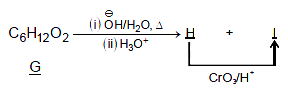
$G$ in the above sequence of reactions is
A
$\left(CH_3\right)_2 CHCOOCH_2 CH_3$
B
$CH_3 CH_2 CH_2 COOCH_2 CH_3$
C
$CH_3 CH_2 COOCH_2 CH_2 CH_3$
D
$CH_3 CH_2 COOCH\left(CH_3\right)_2$
Solution
(C) The reaction sequence involves the alkaline hydrolysis (saponification) of an ester $G$ $(C_6H_{12}O_2)$ to form an alcohol $(H)$ and a carboxylate salt,which upon acidification gives a carboxylic acid $(I)$.
$H$ is then oxidized by $CrO_3/H^+$ to form the same carboxylic acid $(I)$.
This indicates that the alcohol $H$ is a primary alcohol,which oxidizes to a carboxylic acid with the same number of carbon atoms.
Looking at the options,we need an ester that hydrolyzes into a primary alcohol and a carboxylic acid such that the alcohol can be oxidized to the acid.
Option $C$ is $CH_3CH_2COOCH_2CH_2CH_3$ (propyl propionate).
Hydrolysis: $CH_3CH_2COOCH_2CH_2CH_3 + OH^- \rightarrow CH_3CH_2COO^- + CH_3CH_2CH_2OH$.
Acidification: $CH_3CH_2COO^- + H^+ \rightarrow CH_3CH_2COOH$ (propanoic acid).
Oxidation of $H$ $(CH_3CH_2CH_2OH)$: $CH_3CH_2CH_2OH \xrightarrow{CrO_3/H^+} CH_3CH_2COOH$.
Since the acid formed from hydrolysis and the acid formed from oxidation of the alcohol must be the same for the cycle to work as shown,the ester must be $CH_3CH_2COOCH_2CH_2CH_3$.
$H$ is then oxidized by $CrO_3/H^+$ to form the same carboxylic acid $(I)$.
This indicates that the alcohol $H$ is a primary alcohol,which oxidizes to a carboxylic acid with the same number of carbon atoms.
Looking at the options,we need an ester that hydrolyzes into a primary alcohol and a carboxylic acid such that the alcohol can be oxidized to the acid.
Option $C$ is $CH_3CH_2COOCH_2CH_2CH_3$ (propyl propionate).
Hydrolysis: $CH_3CH_2COOCH_2CH_2CH_3 + OH^- \rightarrow CH_3CH_2COO^- + CH_3CH_2CH_2OH$.
Acidification: $CH_3CH_2COO^- + H^+ \rightarrow CH_3CH_2COOH$ (propanoic acid).
Oxidation of $H$ $(CH_3CH_2CH_2OH)$: $CH_3CH_2CH_2OH \xrightarrow{CrO_3/H^+} CH_3CH_2COOH$.
Since the acid formed from hydrolysis and the acid formed from oxidation of the alcohol must be the same for the cycle to work as shown,the ester must be $CH_3CH_2COOCH_2CH_2CH_3$.
0 likes
View Solution768
MediumMCQ
Amongst the following compounds,the one which would not respond to iodoform test is
A
$CH_{3}CH(OH)CH_{2}CH_{3}$
B
$ICH_{2}COCH_{2}CH_{3}$
C
$CH_{3}COOH$
D
$CH_{3}CHO$
Solution
(C) The iodoform test is given by compounds containing the $CH_{3}CO-$ group or the $CH_{3}CH(OH)-$ group.
$CH_{3}CH(OH)CH_{2}CH_{3}$ is a secondary alcohol with a $CH_{3}CH(OH)-$ group,so it responds to the test.
$ICH_{2}COCH_{2}CH_{3}$ contains a ketone group,but it lacks the $CH_{3}CO-$ moiety; however,in the presence of base,it can undergo reactions,but $CH_{3}COOH$ (acetic acid) is a carboxylic acid.
In acetic acid,the most acidic proton is the one attached to the oxygen atom $(COOH)$.
The haloform reaction requires the deprotonation of an $\alpha$-hydrogen atom from a methyl ketone group $(CH_{3}CO-)$.
Since $CH_{3}COOH$ does not contain a methyl ketone group,it does not undergo the iodoform reaction.
$CH_{3}CH(OH)CH_{2}CH_{3}$ is a secondary alcohol with a $CH_{3}CH(OH)-$ group,so it responds to the test.
$ICH_{2}COCH_{2}CH_{3}$ contains a ketone group,but it lacks the $CH_{3}CO-$ moiety; however,in the presence of base,it can undergo reactions,but $CH_{3}COOH$ (acetic acid) is a carboxylic acid.
In acetic acid,the most acidic proton is the one attached to the oxygen atom $(COOH)$.
The haloform reaction requires the deprotonation of an $\alpha$-hydrogen atom from a methyl ketone group $(CH_{3}CO-)$.
Since $CH_{3}COOH$ does not contain a methyl ketone group,it does not undergo the iodoform reaction.
0 likes
View Solution769
DifficultMCQ
The product $P$ in the following reaction is:
$PhCHO + (CH_3CH_2CO)_2O \xrightarrow{CH_3CH_2COONa \text{ (anhydrous)}} P$
$PhCHO + (CH_3CH_2CO)_2O \xrightarrow{CH_3CH_2COONa \text{ (anhydrous)}} P$
A
$Ph-CH=C(CH_3)-COOH$
B
$Ph-CH=C(CH_2CH_3)-COOH$
C
$Ph-CH(OCOCH_2CH_3)_2$
D
$Ph-CH=CH-CH_2-COO-COCH_2CH_3$
Solution
(A) The given reaction is a variation of the Perkin condensation.
In this reaction,an aromatic aldehyde $(PhCHO)$ reacts with an acid anhydride $((CH_3CH_2CO)_2O)$ in the presence of the sodium salt of the corresponding acid $(CH_3CH_2COONa)$.
The $\alpha$-hydrogen of the anhydride is abstracted by the base to form a carbanion,which then attacks the carbonyl carbon of the aldehyde.
Following dehydration and hydrolysis,the final product is an $\alpha,\beta$-unsaturated carboxylic acid.
For the reactants $PhCHO$ and propionic anhydride $((CH_3CH_2CO)_2O)$,the product formed is $Ph-CH=C(CH_3)-COOH$ ($2$-methyl$-3-$phenylprop$-2-$enoic acid).
In this reaction,an aromatic aldehyde $(PhCHO)$ reacts with an acid anhydride $((CH_3CH_2CO)_2O)$ in the presence of the sodium salt of the corresponding acid $(CH_3CH_2COONa)$.
The $\alpha$-hydrogen of the anhydride is abstracted by the base to form a carbanion,which then attacks the carbonyl carbon of the aldehyde.
Following dehydration and hydrolysis,the final product is an $\alpha,\beta$-unsaturated carboxylic acid.
For the reactants $PhCHO$ and propionic anhydride $((CH_3CH_2CO)_2O)$,the product formed is $Ph-CH=C(CH_3)-COOH$ ($2$-methyl$-3-$phenylprop$-2-$enoic acid).
0 likes
View Solution770
MediumMCQ
Arrange the following compounds in order of their increasing acid strength:
$I: HO_2C(CH_2)_4CO_2H$
$II: CH_3CH(COOH)_2$
$III: HOOC-COOH$
$IV: HO_2C(CH_2)_3CO_2H$
$I: HO_2C(CH_2)_4CO_2H$
$II: CH_3CH(COOH)_2$
$III: HOOC-COOH$
$IV: HO_2C(CH_2)_3CO_2H$
A
$I < IV < II < III$
B
$IV < III < II < I$
C
$I < II < III < IV$
D
$II < I < III < IV$
Solution
(A) The acidic strength of dicarboxylic acids depends on the distance between the two carboxyl groups. As the distance between the two $-COOH$ groups decreases,the inductive effect ($-I$ effect) of one carboxyl group on the other increases,which stabilizes the conjugate base and increases the acidity.
Comparing the structures:
$I$: Adipic acid,$HOOC-(CH_2)_4-COOH$ (longest chain between groups)
$IV$: Glutaric acid,$HOOC-(CH_2)_3-COOH$
$II$: Methylmalonic acid,$CH_3-CH(COOH)_2$ (groups are on adjacent carbons)
$III$: Oxalic acid,$HOOC-COOH$ (groups are directly attached)
Ordering by increasing distance between carboxyl groups: $III < II < IV < I$.
Therefore,the order of increasing acid strength is $I < IV < II < III$.
Comparing the structures:
$I$: Adipic acid,$HOOC-(CH_2)_4-COOH$ (longest chain between groups)
$IV$: Glutaric acid,$HOOC-(CH_2)_3-COOH$
$II$: Methylmalonic acid,$CH_3-CH(COOH)_2$ (groups are on adjacent carbons)
$III$: Oxalic acid,$HOOC-COOH$ (groups are directly attached)
Ordering by increasing distance between carboxyl groups: $III < II < IV < I$.
Therefore,the order of increasing acid strength is $I < IV < II < III$.
0 likes
View Solution771
MediumMCQ
What is the correct order of acidity of salicylic acid,$4-$hydroxybenzoic acid,and $2,6-$dihydroxybenzoic acid?
A
$2,6-$dihydroxybenzoic acid > salicylic acid > $4-$hydroxybenzoic acid
B
$2,6-$dihydroxybenzoic acid > $4-$hydroxybenzoic acid > salicylic acid
C
salicylic acid > $2,6-$dihydroxybenzoic acid > $4-$hydroxybenzoic acid
D
salicylic acid > $4-$hydroxybenzoic acid > $2,6-$dihydroxybenzoic acid
Solution
(A) The acidity of these compounds depends on the stability of their conjugate bases.
$2,6-$dihydroxybenzoic acid has two $-OH$ groups at ortho positions relative to the $-COOH$ group. The conjugate base is highly stabilized by strong intramolecular hydrogen bonding between the carboxylate oxygen and both ortho-hydroxyl groups.
Salicylic acid ($2-$hydroxybenzoic acid) has only one ortho $-OH$ group,providing less stabilization than $2,6-$dihydroxybenzoic acid.
$4-$hydroxybenzoic acid lacks ortho-stabilization and the $-OH$ group at the para position exerts an electron-donating effect ($+M$ effect),which destabilizes the carboxylate anion,making it the least acidic.
Therefore,the correct order is: $2,6-$dihydroxybenzoic acid > salicylic acid > $4-$hydroxybenzoic acid.
$2,6-$dihydroxybenzoic acid has two $-OH$ groups at ortho positions relative to the $-COOH$ group. The conjugate base is highly stabilized by strong intramolecular hydrogen bonding between the carboxylate oxygen and both ortho-hydroxyl groups.
Salicylic acid ($2-$hydroxybenzoic acid) has only one ortho $-OH$ group,providing less stabilization than $2,6-$dihydroxybenzoic acid.
$4-$hydroxybenzoic acid lacks ortho-stabilization and the $-OH$ group at the para position exerts an electron-donating effect ($+M$ effect),which destabilizes the carboxylate anion,making it the least acidic.
Therefore,the correct order is: $2,6-$dihydroxybenzoic acid > salicylic acid > $4-$hydroxybenzoic acid.
0 likes
View Solution772
MediumMCQ
The correct order of acid strengths of benzoic acid $(X)$,peroxybenzoic acid $(Y)$ and $p-$nitrobenzoic acid $(Z)$ is
A
$Y > Z > X$
B
$Z > Y > X$
C
$Z > X > Y$
D
$Y > X > Z$
Solution
(C) $p-$nitrobenzoic acid $(Z)$ contains a $-NO_2$ group,which is a strong electron-withdrawing group. This stabilizes the carboxylate anion through both inductive and resonance effects,making it the most acidic.
Benzoic acid $(X)$ is stabilized by resonance of the carboxylate group with the benzene ring.
Peroxybenzoic acid $(Y)$ has the structure $C_6H_5CO_3H$. The $-O-O-$ bond is less stable and the resonance stabilization of the carboxylate anion is less effective compared to benzoic acid due to the presence of the extra oxygen atom,making it less acidic than benzoic acid.
Therefore,the correct order of acid strength is $Z > X > Y$.
Benzoic acid $(X)$ is stabilized by resonance of the carboxylate group with the benzene ring.
Peroxybenzoic acid $(Y)$ has the structure $C_6H_5CO_3H$. The $-O-O-$ bond is less stable and the resonance stabilization of the carboxylate anion is less effective compared to benzoic acid due to the presence of the extra oxygen atom,making it less acidic than benzoic acid.
Therefore,the correct order of acid strength is $Z > X > Y$.
0 likes
View Solution773
EasyMCQ
For the reaction below,the product is $Q$.
The compound $Q$ is
The compound $Q$ is

A
$4-$acetoxybenzoic acid
B
Methyl $4-$hydroxybenzoate
C
$3-$acetyl$-4-$hydroxybenzoic acid
D
$4-$hydroxy$-3-$acetylbenzoic acid
Solution
(A) The reaction of $4$-hydroxybenzoic acid with acetic anhydride in the presence of conc. $H_{2}SO_{4}$ and heat is an acetylation reaction.
The phenolic $-OH$ group acts as a nucleophile and attacks the carbonyl carbon of the acetic anhydride,leading to the formation of an ester group $(-OCOCH_{3})$.
The product $Q$ is $4$-acetoxybenzoic acid,which has the molecular formula $C_{9}H_{8}O_{4}$.
Thus,option $(A)$ is the correct answer.
The phenolic $-OH$ group acts as a nucleophile and attacks the carbonyl carbon of the acetic anhydride,leading to the formation of an ester group $(-OCOCH_{3})$.
The product $Q$ is $4$-acetoxybenzoic acid,which has the molecular formula $C_{9}H_{8}O_{4}$.
Thus,option $(A)$ is the correct answer.
0 likes
View Solution774
EasyMCQ
The compound,which evolves carbon dioxide on treatment with an aqueous solution of sodium bicarbonate at $25^{\circ} C$,is
A
$C_6H_5OH$
B
$CH_3COCl$
C
$CH_3CONH_2$
D
$CH_3COOC_2H_5$
Solution
(B) $CH_3COCl$ (acetyl chloride) is highly reactive and hydrolyzes to form $CH_3COOH$ (acetic acid) even at $25^{\circ} C$.
Acetic acid is a stronger acid than carbonic acid $(H_2CO_3)$,so it reacts with $NaHCO_3$ to evolve $CO_2$ gas.
The reaction is:
$CH_3COCl + H_2O \longrightarrow CH_3COOH + HCl$
$CH_3COOH + NaHCO_3 \longrightarrow CH_3COONa + H_2O + CO_2 \uparrow$
Thus,option $(B)$ is the correct answer.
Acetic acid is a stronger acid than carbonic acid $(H_2CO_3)$,so it reacts with $NaHCO_3$ to evolve $CO_2$ gas.
The reaction is:
$CH_3COCl + H_2O \longrightarrow CH_3COOH + HCl$
$CH_3COOH + NaHCO_3 \longrightarrow CH_3COONa + H_2O + CO_2 \uparrow$
Thus,option $(B)$ is the correct answer.
0 likes
View Solution775
MediumMCQ
The ease of hydrolysis in the compounds $CH_3COCl$ $(I)$,$(CH_3CO)_2O$ $(II)$,$CH_3COOC_2H_5$ $(III)$ and $CH_3CONH_2$ $(IV)$ is of the order:
A
$I > II > III > IV$
B
$IV > III > II > I$
C
$I > II > IV > III$
D
$II > I > IV > III$
Solution
(A) The reactivity of carboxylic acid derivatives towards nucleophilic acyl substitution (such as hydrolysis) depends on the leaving group ability of the substituent attached to the acyl group.
The weaker the base,the better the leaving group.
The order of basicity of the leaving groups is $Cl^{-} < CH_3COO^{-} < C_2H_5O^{-} < NH_2^-$.
Therefore,the order of leaving group ability is $Cl^{-} > CH_3COO^{-} > C_2H_5O^{-} > NH_2^-$.
Thus,the order of ease of hydrolysis is: $CH_3COCl$ $(I) > (CH_3CO)_2O$ $(II) > CH_3COOC_2H_5$ $(III) > CH_3CONH_2$ $(IV)$.
The weaker the base,the better the leaving group.
The order of basicity of the leaving groups is $Cl^{-} < CH_3COO^{-} < C_2H_5O^{-} < NH_2^-$.
Therefore,the order of leaving group ability is $Cl^{-} > CH_3COO^{-} > C_2H_5O^{-} > NH_2^-$.
Thus,the order of ease of hydrolysis is: $CH_3COCl$ $(I) > (CH_3CO)_2O$ $(II) > CH_3COOC_2H_5$ $(III) > CH_3CONH_2$ $(IV)$.
0 likes
View Solution776
MediumMCQ
For the following three esters,the order of rates of alkaline hydrolysis is:
$(I)$ $p-NO_2-C_6H_4-COOCH_3$
$(II)$ $p-CH_3O-C_6H_4-COOCH_3$
$(III)$ $p-CH_3-C_6H_4-COOCH_3$
$(I)$ $p-NO_2-C_6H_4-COOCH_3$
$(II)$ $p-CH_3O-C_6H_4-COOCH_3$
$(III)$ $p-CH_3-C_6H_4-COOCH_3$
A
$I > III > II$
B
$II > III > I$
C
$I > II > III$
D
$III > II > I$
Solution
(A) Alkaline hydrolysis of esters is a nucleophilic acyl substitution reaction. The rate of this reaction depends on the electrophilicity of the carbonyl carbon.
Electron-withdrawing groups $(EWG)$ increase the electrophilicity of the carbonyl carbon,thereby increasing the rate of hydrolysis.
Electron-donating groups $(EDG)$ decrease the electrophilicity of the carbonyl carbon,thereby decreasing the rate of hydrolysis.
Analysis of substituents:
$(I)$ $-NO_2$ group: Strong $-R$ and $-I$ effect (Strong $EWG$).
$(II)$ $-OCH_3$ group: Strong $+R$ and weak $-I$ effect (Strong $EDG$).
$(III)$ $-CH_3$ group: $+I$ effect and hyperconjugation (Weak $EDG$).
Order of electrophilicity: $-NO_2 > -CH_3 > -OCH_3$.
Therefore,the order of rates of alkaline hydrolysis is $I > III > II$.
Electron-withdrawing groups $(EWG)$ increase the electrophilicity of the carbonyl carbon,thereby increasing the rate of hydrolysis.
Electron-donating groups $(EDG)$ decrease the electrophilicity of the carbonyl carbon,thereby decreasing the rate of hydrolysis.
Analysis of substituents:
$(I)$ $-NO_2$ group: Strong $-R$ and $-I$ effect (Strong $EWG$).
$(II)$ $-OCH_3$ group: Strong $+R$ and weak $-I$ effect (Strong $EDG$).
$(III)$ $-CH_3$ group: $+I$ effect and hyperconjugation (Weak $EDG$).
Order of electrophilicity: $-NO_2 > -CH_3 > -OCH_3$.
Therefore,the order of rates of alkaline hydrolysis is $I > III > II$.
0 likes
View Solution777
EasyMCQ
Among the following compounds,the one$(s)$ that give$(s)$ effervescence with aqueous $NaHCO_{3}$ solution is (are):
$I. (CH_{3}CO)_{2}O$
$II. CH_{3}COOH$
$III. PhOH$
$IV. CH_{3}COCHO$
$I. (CH_{3}CO)_{2}O$
$II. CH_{3}COOH$
$III. PhOH$
$IV. CH_{3}COCHO$
A
$I$ and $II$
B
$I$ and $III$
C
Only $II$
D
$I$ and $IV$
Solution
(A) Compounds that are more acidic than carbonic acid $(H_{2}CO_{3})$ react with aqueous $NaHCO_{3}$ to release $CO_{2}$ gas,which causes effervescence.
$I. (CH_{3}CO)_{2}O$ (Acetic anhydride) reacts with $NaHCO_{3}$ to form acetic acid,which then reacts further to release $CO_{2}$.
$II. CH_{3}COOH$ (Acetic acid) is more acidic than $H_{2}CO_{3}$ and readily releases $CO_{2}$.
$III. PhOH$ (Phenol) is less acidic than $H_{2}CO_{3}$ and does not give effervescence.
$IV. CH_{3}COCHO$ (Methylglyoxal) is not acidic enough to react with $NaHCO_{3}$.
Therefore,both $I$ and $II$ give effervescence.
$I. (CH_{3}CO)_{2}O$ (Acetic anhydride) reacts with $NaHCO_{3}$ to form acetic acid,which then reacts further to release $CO_{2}$.
$II. CH_{3}COOH$ (Acetic acid) is more acidic than $H_{2}CO_{3}$ and readily releases $CO_{2}$.
$III. PhOH$ (Phenol) is less acidic than $H_{2}CO_{3}$ and does not give effervescence.
$IV. CH_{3}COCHO$ (Methylglyoxal) is not acidic enough to react with $NaHCO_{3}$.
Therefore,both $I$ and $II$ give effervescence.
0 likes
View Solution778
EasyMCQ
The reaction sequence given below gives product $R$. The structure of the product $R$ is:

A
$Br-(CH_2)_4-CO_2H$
B
$HO_2C-CH(Br)-(CH_2)_3-CO_2Me$
C
$HO_2C-(CH_2)_3-CH(Br)-CO_2Me$
D
$MeO_2C-(CH_2)_4-Br$
Solution
(D) The reaction sequence is as follows:
$1$. The starting material is a mono-methyl ester of a dicarboxylic acid,$HO_2C-(CH_2)_4-CO_2Me$.
$2$. Treatment with $Ag_2O$ converts the carboxylic acid group $(-COOH)$ into its silver salt $(-COO^-Ag^+)$.
$3$. Subsequent treatment with $Br_2$ in $CCl_4$ is the Borodine-Hunsdiecker reaction,which decarboxylates the silver salt and replaces the carboxyl group with a bromine atom.
$4$. The reaction is: $HO_2C-(CH_2)_4-CO_2Me$ $\xrightarrow{Ag_2O} AgO_2C-(CH_2)_4-CO_2Me$ $\xrightarrow{Br_2, CCl_4} Br-(CH_2)_4-CO_2Me$.
$5$. Thus,the product $R$ is $MeO_2C-(CH_2)_4-Br$.
$1$. The starting material is a mono-methyl ester of a dicarboxylic acid,$HO_2C-(CH_2)_4-CO_2Me$.
$2$. Treatment with $Ag_2O$ converts the carboxylic acid group $(-COOH)$ into its silver salt $(-COO^-Ag^+)$.
$3$. Subsequent treatment with $Br_2$ in $CCl_4$ is the Borodine-Hunsdiecker reaction,which decarboxylates the silver salt and replaces the carboxyl group with a bromine atom.
$4$. The reaction is: $HO_2C-(CH_2)_4-CO_2Me$ $\xrightarrow{Ag_2O} AgO_2C-(CH_2)_4-CO_2Me$ $\xrightarrow{Br_2, CCl_4} Br-(CH_2)_4-CO_2Me$.
$5$. Thus,the product $R$ is $MeO_2C-(CH_2)_4-Br$.
0 likes
View Solution779
DifficultMCQ
Compound '$P$' undergoes the following sequence of reactions:
$P$ $\xrightarrow[(ii) \Delta]{(i) NH_3} Q$ $\xrightarrow[(ii) CHCl_3, KOH (alc.), \Delta]{(i) KOH, Br_2} \text{Cyclohexyl isocyanide}$
$P$ $\xrightarrow[(ii) \Delta]{(i) NH_3} Q$ $\xrightarrow[(ii) CHCl_3, KOH (alc.), \Delta]{(i) KOH, Br_2} \text{Cyclohexyl isocyanide}$
A
Cyclohexylacetaldehyde
B
Cyclohexanecarboxylic acid
C
Ethylcyclohexyl ketone
D
Cyclohexanecarboxamide
Solution
(D) $1$. The reaction sequence shows the conversion of compound $P$ to $Q$ using $NH_3$ and $\Delta$,which is characteristic of the formation of an amide from a carboxylic acid.
$2$. The second step involves the Hofmann bromamide degradation reaction $(KOH, Br_2)$ followed by the carbylamine reaction $(CHCl_3, KOH (alc.), \Delta)$.
$3$. The final product is cyclohexyl isocyanide. The carbylamine reaction converts a primary amine $(R-NH_2)$ to an isocyanide $(R-NC)$.
$4$. Therefore,$Q$ must be the primary amine,cyclohexylamine $(C_6H_{11}NH_2)$.
$5$. The conversion of $P$ to $Q$ $(C_6H_{11}NH_2)$ via $NH_3$ and $\Delta$ suggests $P$ is cyclohexanecarboxylic acid $(C_6H_{11}COOH)$,which forms the amide $C_6H_{11}CONH_2$ as an intermediate,which then undergoes Hofmann degradation to form the amine $Q$.
$6$. Thus,the compound $P$ is cyclohexanecarboxylic acid,and the intermediate $Q$ is cyclohexanecarboxamide. However,the question asks for the identity of $Q$ based on the provided options. Looking at the options,$Q$ is cyclohexanecarboxamide.
$2$. The second step involves the Hofmann bromamide degradation reaction $(KOH, Br_2)$ followed by the carbylamine reaction $(CHCl_3, KOH (alc.), \Delta)$.
$3$. The final product is cyclohexyl isocyanide. The carbylamine reaction converts a primary amine $(R-NH_2)$ to an isocyanide $(R-NC)$.
$4$. Therefore,$Q$ must be the primary amine,cyclohexylamine $(C_6H_{11}NH_2)$.
$5$. The conversion of $P$ to $Q$ $(C_6H_{11}NH_2)$ via $NH_3$ and $\Delta$ suggests $P$ is cyclohexanecarboxylic acid $(C_6H_{11}COOH)$,which forms the amide $C_6H_{11}CONH_2$ as an intermediate,which then undergoes Hofmann degradation to form the amine $Q$.
$6$. Thus,the compound $P$ is cyclohexanecarboxylic acid,and the intermediate $Q$ is cyclohexanecarboxamide. However,the question asks for the identity of $Q$ based on the provided options. Looking at the options,$Q$ is cyclohexanecarboxamide.
0 likes
View Solution780
MediumMCQ
For which compound is $pK_a$ the highest?
A
$HCOOH$
B
$CH_3CH_2COOH$
C
$C_6H_5CH_2COOH$
D
$ClCH_2CH_2COOH$
Solution
(B) The $pK_a$ value is inversely proportional to the acidity of a compound. $A$ higher $pK_a$ value indicates lower acidity.
Acidity is determined by the stability of the conjugate base,which is influenced by the inductive effects of the substituents attached to the $-COOH$ group.
Electron-withdrawing groups ($-I$ effect) increase acidity,while electron-donating groups ($+I$ effect) decrease acidity.
Comparing the given compounds:
$1$. $HCOOH$ (Formic acid): No alkyl group attached.
$2$. $CH_3CH_2COOH$ (Propanoic acid): Contains an ethyl group,which is electron-donating ($+I$ effect).
$3$. $C_6H_5CH_2COOH$ (Phenylacetic acid): Contains a phenyl group,which is electron-withdrawing ($-I$ effect).
$4$. $ClCH_2CH_2COOH$ ($3$-Chloropropanoic acid): Contains a chlorine atom,which is strongly electron-withdrawing ($-I$ effect).
Since the ethyl group in $CH_3CH_2COOH$ is electron-donating,it destabilizes the carboxylate anion,making it the least acidic among the options. Therefore,$CH_3CH_2COOH$ has the highest $pK_a$ value.
Acidity is determined by the stability of the conjugate base,which is influenced by the inductive effects of the substituents attached to the $-COOH$ group.
Electron-withdrawing groups ($-I$ effect) increase acidity,while electron-donating groups ($+I$ effect) decrease acidity.
Comparing the given compounds:
$1$. $HCOOH$ (Formic acid): No alkyl group attached.
$2$. $CH_3CH_2COOH$ (Propanoic acid): Contains an ethyl group,which is electron-donating ($+I$ effect).
$3$. $C_6H_5CH_2COOH$ (Phenylacetic acid): Contains a phenyl group,which is electron-withdrawing ($-I$ effect).
$4$. $ClCH_2CH_2COOH$ ($3$-Chloropropanoic acid): Contains a chlorine atom,which is strongly electron-withdrawing ($-I$ effect).
Since the ethyl group in $CH_3CH_2COOH$ is electron-donating,it destabilizes the carboxylate anion,making it the least acidic among the options. Therefore,$CH_3CH_2COOH$ has the highest $pK_a$ value.
0 likes
View Solution781
MediumMCQ
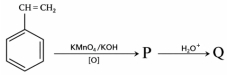
Identify $P$ and $Q$ in the above reaction respectively.
A
Benzoic acid; Potassium benzoate
B
Potassium benzoate; Benzoic acid
C
Benzoic acid; Benzaldehyde
D
Potassium benzoate; Benzaldehyde
Solution
(B) The oxidation of alkyl benzene side chains with $KMnO_4/KOH$ (alkaline potassium permanganate) results in the cleavage of the side chain to form the potassium salt of benzoic acid (potassium benzoate,$P$).
This reaction is a standard method for the oxidation of alkyl groups attached to a benzene ring.
Upon subsequent acidification with $H_3O^+$,the potassium benzoate $(P)$ is converted into benzoic acid $(Q)$.
Therefore,$P$ is potassium benzoate and $Q$ is benzoic acid.
This reaction is a standard method for the oxidation of alkyl groups attached to a benzene ring.
Upon subsequent acidification with $H_3O^+$,the potassium benzoate $(P)$ is converted into benzoic acid $(Q)$.
Therefore,$P$ is potassium benzoate and $Q$ is benzoic acid.
0 likes
View Solution782
DifficultMCQ
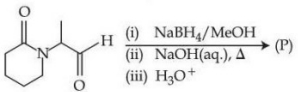
Consider the following reaction. The major product $(P)$ formed is:
A
B
C
D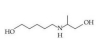
Solution
(A) Step $(i)$: $NaBH_{4}$ in $MeOH$ selectively reduces the aldehyde group $(-CHO)$ to a primary alcohol $(-CH_{2}OH)$. The cyclic amide (lactam) remains unaffected.
Step (ii): $NaOH(aq.), \Delta$ causes the alkaline hydrolysis of the cyclic amide (lactam). The ring opens to form the corresponding amino acid salt (carboxylate).
Step (iii): $H_{3}O^{+}$ protonates the carboxylate to form a carboxylic acid $(-COOH)$ and the amine to form an ammonium salt $(-NH_{2}^{+}-)$.
The final product is a linear amino acid derivative with a primary alcohol group: $HOOC-(CH_{2})_{4}-NH-CH(CH_{3})CH_{2}OH$.
Step (ii): $NaOH(aq.), \Delta$ causes the alkaline hydrolysis of the cyclic amide (lactam). The ring opens to form the corresponding amino acid salt (carboxylate).
Step (iii): $H_{3}O^{+}$ protonates the carboxylate to form a carboxylic acid $(-COOH)$ and the amine to form an ammonium salt $(-NH_{2}^{+}-)$.
The final product is a linear amino acid derivative with a primary alcohol group: $HOOC-(CH_{2})_{4}-NH-CH(CH_{3})CH_{2}OH$.
0 likes
View Solution783
DifficultMCQ
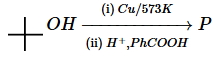
Consider the following sequence of reactions. The major product $P$ is:
A
$4-$ethyl$-2-$bromobenzoic acid
B
$3-$bromo$-4-$ethylbenzoic acid
C
tert-butyl benzoate
D
isobutyl benzoate
Solution
(C) The starting material is $tert$-butyl alcohol (or $2$-methylpropan-$2$-ol).
$1$. Treatment with $Cu/573 \ K$ is a dehydrogenation reaction. However,$tert$-butyl alcohol does not undergo dehydrogenation to form an aldehyde or ketone because it lacks an $\alpha$-hydrogen. Instead,it undergoes dehydration to form isobutylene ($2$-methylpropene).
$2$. The second step involves the reaction of the alkene with benzoic acid $(PhCOOH)$ in the presence of an acid catalyst $(H^+)$. This is an electrophilic addition reaction where the alkene adds to the carboxylic acid to form an ester.
$3$. The reaction of isobutylene with benzoic acid yields $tert$-butyl benzoate as the major product.
Therefore,the correct option is $(C)$.
$1$. Treatment with $Cu/573 \ K$ is a dehydrogenation reaction. However,$tert$-butyl alcohol does not undergo dehydrogenation to form an aldehyde or ketone because it lacks an $\alpha$-hydrogen. Instead,it undergoes dehydration to form isobutylene ($2$-methylpropene).
$2$. The second step involves the reaction of the alkene with benzoic acid $(PhCOOH)$ in the presence of an acid catalyst $(H^+)$. This is an electrophilic addition reaction where the alkene adds to the carboxylic acid to form an ester.
$3$. The reaction of isobutylene with benzoic acid yields $tert$-butyl benzoate as the major product.
Therefore,the correct option is $(C)$.
0 likes
View Solution784
MediumMCQ
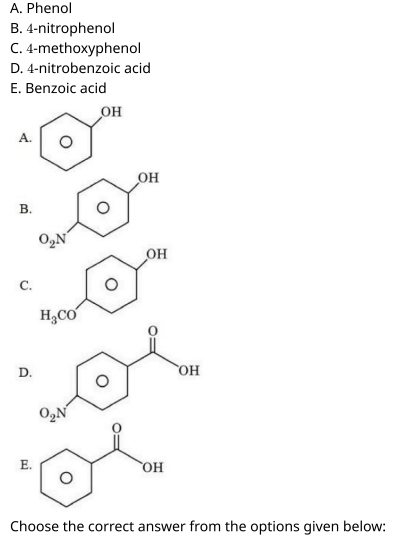
The descending order of acidity among the following compounds is:
A
$B > D > E > A > C$
B
$D > B > E > A > C$
C
$C > A > B > D > E$
D
$D > E > B > A > C$
Solution
(D) Acidity depends on the stability of the conjugate base. Carboxylic acids ($D$ and $E$) are stronger acids than phenols $(A, B, C)$.
Between $4$-nitrobenzoic acid $(D)$ and benzoic acid $(E)$,the $-NO_2$ group (strong electron-withdrawing) makes $D$ stronger.
Among phenols,$4$-nitrophenol $(B)$ is the strongest due to the electron-withdrawing $-NO_2$ group,followed by phenol $(A)$,and $4$-methoxyphenol $(C)$ is the weakest due to the electron-donating $-OCH_3$ group.
Thus,the descending order of acidity is $D > E > B > A > C$.
Between $4$-nitrobenzoic acid $(D)$ and benzoic acid $(E)$,the $-NO_2$ group (strong electron-withdrawing) makes $D$ stronger.
Among phenols,$4$-nitrophenol $(B)$ is the strongest due to the electron-withdrawing $-NO_2$ group,followed by phenol $(A)$,and $4$-methoxyphenol $(C)$ is the weakest due to the electron-donating $-OCH_3$ group.
Thus,the descending order of acidity is $D > E > B > A > C$.
0 likes
View Solution785
DifficultMCQ
Complete the following reaction sequence and identify the major product '$P$'.
$CH_3 - CH_2 - C \equiv N \xrightarrow[(ii) H_3O^+]{(i) OH^-/H_2O/\Delta} \xrightarrow[(iv) H_2O]{(iii) Cl_2/Red P} P$ (Major product)
$CH_3 - CH_2 - C \equiv N \xrightarrow[(ii) H_3O^+]{(i) OH^-/H_2O/\Delta} \xrightarrow[(iv) H_2O]{(iii) Cl_2/Red P} P$ (Major product)
A
$2-$Chloropropanoic acid
B
$3-$Chloropropanoic acid
C
$1-$Chloropropane
D
$2-$Chloropropane
Solution
(A) Step $(i)$ and (ii): The alkaline hydrolysis of propanenitrile followed by acidification yields propanoic acid $(CH_3CH_2COOH)$.
Step (iii) and (iv): The reaction with $Cl_2$ in the presence of Red Phosphorus is the Hell-Volhard-Zelinsky $(HVZ)$ reaction.
This reaction specifically substitutes an $\alpha$-hydrogen atom of the carboxylic acid with a chlorine atom.
Therefore,the product '$P$' is $2-$chloropropanoic acid $(CH_3CHClCOOH)$.
Step (iii) and (iv): The reaction with $Cl_2$ in the presence of Red Phosphorus is the Hell-Volhard-Zelinsky $(HVZ)$ reaction.
This reaction specifically substitutes an $\alpha$-hydrogen atom of the carboxylic acid with a chlorine atom.
Therefore,the product '$P$' is $2-$chloropropanoic acid $(CH_3CHClCOOH)$.
0 likes
View Solution8-2.Carboxylic acids and Their derivative — Properties of Carboxylic Acids and Their Derivatives · Frequently Asked Questions
1Are these 8-2.Carboxylic acids and Their derivative questions useful for JEE and NEET?
Yes. All questions in this section are mapped to JEE Main and NEET exam patterns. Previous year questions from JEE Main, NEET, GUJCET and state-level exams are included with full solutions.
2Can I switch to Hindi or Gujarati for these questions?
Yes. Use the language tabs in the hero section or the sidebar to view the same questions and solutions in English, Hindi or Gujarati.
3How do I generate a question paper from this subtopic?
Use the Vedclass Exam Paper Generator — select the chapter and subtopic, set difficulty, and generate Sets A, B, C, D automatically. First 3 chapters of every subject are free.
Vedclass Products
For Students
Vedclass Test Series
Mock tests in real JEE/NEET style with performance analysis. 5-day free trial.
Start Free TrialFor Teachers
Exam Paper Generator
Generate Set A/B/C/D papers from this chapter in 2 minutes. 3 chapters free.
Try FreeFor Institutes
Online Exam Module
Live online exams with unlimited students, 360° analytics & white-label branding.
See DemoFor Teachers & Institutes
Generate a 8-2.Carboxylic acids and Their derivative Exam Paper in 2 Minutes
Select subtopic & difficulty — Sets A, B, C, D auto-generated with No Repeat logic.
First 3 chapters of every subject are free — no payment required.