
A English
Properties of Carboxylic Acids and Their Derivatives Questions in English
Class 12 Chemistry · 8-2.Carboxylic acids and Their derivative · Properties of Carboxylic Acids and Their Derivatives
791+
Questions
English
Language
100%
With Solutions
Showing 42 of 791 questions in English
701
MediumMCQ
An aryl carboxylic acid on treatment with sodium hydrogen carbonate liberates a gaseous molecule. Identify the gas molecule liberated.
A
$H_2$
B
$CO_2$
C
$CO$
D
$O_2$
Solution
(B) Carboxylic acids react with sodium hydrogen carbonate $(NaHCO_3)$ to produce a salt,water,and carbon dioxide gas. This reaction is a characteristic test for the presence of the carboxyl $(-COOH)$ group in organic compounds.
The chemical equation for the reaction is:
$RCOOH + NaHCO_3 \rightarrow RCOONa + H_2O + CO_2 \uparrow$
Thus,the gas liberated is carbon dioxide $(CO_2)$.
The chemical equation for the reaction is:
$RCOOH + NaHCO_3 \rightarrow RCOONa + H_2O + CO_2 \uparrow$
Thus,the gas liberated is carbon dioxide $(CO_2)$.
0 likes
View Solution702
EasyMCQ
The '$X$' in the following conversion is
$CH_3-CH_2-COOH \xrightarrow{X} CH_3-CH(Br)-COOH$
$CH_3-CH_2-COOH \xrightarrow{X} CH_3-CH(Br)-COOH$
A
$(I). Br_2 / \text{red } P, (II). H_2O$
B
$(I). Br_2 / CCl_4, (II). H_2O$
C
$Br_2 / OH^-$
D
$PBr_3$
Solution
(A) The given reaction is the Hell-Volhard-Zelinsky $(HVZ)$ reaction.
In this reaction,carboxylic acids having an $\alpha$-hydrogen atom are halogenated at the $\alpha$-position on treatment with bromine or chlorine in the presence of a small amount of red phosphorus.
The reaction is followed by hydrolysis to obtain the $\alpha$-halo carboxylic acid.
The reagents used are $(I). Br_2 / \text{red } P$ followed by $(II). H_2O$.
In this reaction,carboxylic acids having an $\alpha$-hydrogen atom are halogenated at the $\alpha$-position on treatment with bromine or chlorine in the presence of a small amount of red phosphorus.
The reaction is followed by hydrolysis to obtain the $\alpha$-halo carboxylic acid.
The reagents used are $(I). Br_2 / \text{red } P$ followed by $(II). H_2O$.
0 likes
View Solution703
MediumMCQ
Toluene on reaction with the reagent $X$ gives $Y$,which dissolves in $NaHCO_3$ and when reacted with $Br_2 / Fe$ gives $Z$. What are $X$ and $Z$?
A
$(i) \ KMnO_4 / OH^-, \Delta \ (ii) \ H_3O^+; \text{p-bromobenzoic acid}$
B
$(i) \ CrO_2Cl_2 \ (ii) \ H_3O^+; \text{p-bromobenzoic acid}$
C
$(i) \ CrO_2Cl_2 \ (ii) \ H_3O^+; \text{m-bromobenzoic acid}$
D
$(i) \ KMnO_4 / OH^-, \Delta \ (ii) \ H_3O^+; \text{m-bromobenzoic acid}$
Solution
(D) $1$. Toluene reacts with $KMnO_4 / OH^-, \Delta$ followed by $H_3O^+$ (reagent $X$) to form benzoic acid $(Y)$.
$2$. Benzoic acid dissolves in $NaHCO_3$ because it is acidic.
$3$. The $-COOH$ group is a meta-directing group in electrophilic aromatic substitution reactions.
$4$. Therefore,reaction of benzoic acid with $Br_2 / Fe$ (electrophilic bromination) yields m-bromobenzoic acid $(Z)$.
$5$. Thus,$X$ is $(i) \ KMnO_4 / OH^-, \Delta \ (ii) \ H_3O^+$ and $Z$ is m-bromobenzoic acid.
$2$. Benzoic acid dissolves in $NaHCO_3$ because it is acidic.
$3$. The $-COOH$ group is a meta-directing group in electrophilic aromatic substitution reactions.
$4$. Therefore,reaction of benzoic acid with $Br_2 / Fe$ (electrophilic bromination) yields m-bromobenzoic acid $(Z)$.
$5$. Thus,$X$ is $(i) \ KMnO_4 / OH^-, \Delta \ (ii) \ H_3O^+$ and $Z$ is m-bromobenzoic acid.
0 likes
View Solution704
MediumMCQ
What are $X$ and $Y$ in the following set of reactions?

A
$X = H_2 / \text{Catalyst} ; Y = (i) \text{DIBAL-H} (ii) H_2O$
B
$X = (i) \text{DIBAL-H} (ii) H_2O ; Y = (i) \text{DIBAL-H} (ii) H_2O$
C
$X = H_2 / \text{Catalyst} ; Y = H_2 / \text{Catalyst}$
D
$X = (i) \text{DIBAL-H} (ii) H_2O ; Y = H_2 / \text{Catalyst}$
Solution
(A) The conversion of ethyl benzoate $(C_6H_5COOC_2H_5)$ to benzyl alcohol $(C_6H_5CH_2OH)$ requires a strong reducing agent like $H_2 / \text{Catalyst}$ or $LiAlH_4$ to reduce the ester group completely to a primary alcohol. Thus,$X = H_2 / \text{Catalyst}$.
The conversion of ethyl benzoate $(C_6H_5COOC_2H_5)$ to benzaldehyde $(C_6H_5CHO)$ is a partial reduction,which is specifically achieved using $DIBAL-H$ (diisobutylaluminium hydride) at low temperature followed by hydrolysis. Thus,$Y = (i) \text{DIBAL-H} (ii) H_2O$.
The conversion of ethyl benzoate $(C_6H_5COOC_2H_5)$ to benzaldehyde $(C_6H_5CHO)$ is a partial reduction,which is specifically achieved using $DIBAL-H$ (diisobutylaluminium hydride) at low temperature followed by hydrolysis. Thus,$Y = (i) \text{DIBAL-H} (ii) H_2O$.
0 likes
View Solution705
MediumMCQ
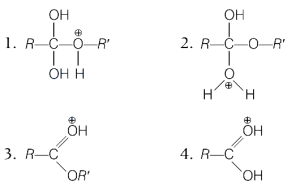
The following species are involved in the formation of an ester from a carboxylic acid in the presence of acid. The correct sequence of formation of these species is
A
$2, 1, 4, 3$
B
$1, 4, 3, 2$
C
$2, 3, 1, 4$
D
$4, 2, 1, 3$
Solution
(D) The mechanism of esterification (Fischer esterification) involves the following steps:
$1$. Protonation of the carbonyl oxygen of the carboxylic acid: The carboxylic acid $(R-COOH)$ reacts with $H^+$ to form a protonated species,which is represented by structure $4$.
$2$. Nucleophilic attack by the alcohol: The alcohol $(R'-OH)$ attacks the electrophilic carbonyl carbon of the protonated carboxylic acid,leading to the formation of the tetrahedral intermediate,which is represented by structure $2$.
$3$. Proton transfer: $A$ proton is transferred from the oxygen of the alcohol group to one of the hydroxyl groups,resulting in the formation of an oxonium ion,represented by structure $1$.
$4$. Elimination of water and deprotonation: The water molecule is eliminated,and the loss of a proton leads to the formation of the protonated ester,which is represented by structure $3$.
Thus,the correct sequence is $4$ $\rightarrow 2$ $\rightarrow 1$ $\rightarrow 3$.
$1$. Protonation of the carbonyl oxygen of the carboxylic acid: The carboxylic acid $(R-COOH)$ reacts with $H^+$ to form a protonated species,which is represented by structure $4$.
$2$. Nucleophilic attack by the alcohol: The alcohol $(R'-OH)$ attacks the electrophilic carbonyl carbon of the protonated carboxylic acid,leading to the formation of the tetrahedral intermediate,which is represented by structure $2$.
$3$. Proton transfer: $A$ proton is transferred from the oxygen of the alcohol group to one of the hydroxyl groups,resulting in the formation of an oxonium ion,represented by structure $1$.
$4$. Elimination of water and deprotonation: The water molecule is eliminated,and the loss of a proton leads to the formation of the protonated ester,which is represented by structure $3$.
Thus,the correct sequence is $4$ $\rightarrow 2$ $\rightarrow 1$ $\rightarrow 3$.
0 likes
View Solution706
EasyMCQ
The increasing order of acidic strength among the following compounds is
$I.$ Benzoic acid
$II.$ $4-$nitrobenzoic acid
$III.$ $3, 4-$dinitrobenzoic acid
$IV.$ $4-$methoxybenzoic acid
$I.$ Benzoic acid
$II.$ $4-$nitrobenzoic acid
$III.$ $3, 4-$dinitrobenzoic acid
$IV.$ $4-$methoxybenzoic acid
A
$I < II < III < IV$
B
$I < IV < II < III$
C
$IV < I < II < III$
D
$IV < I < III < II$
Solution
(C) The acidic strength of substituted benzoic acids depends on the electronic effects of the substituents attached to the benzene ring.
$1.$ Electron-donating groups $(EDG)$ like $-OCH_3$ (methoxy group) decrease the acidity by destabilizing the carboxylate anion. Thus,$4-$methoxybenzoic acid $(IV)$ is the weakest acid.
$2.$ Electron-withdrawing groups $(EWG)$ like $-NO_2$ (nitro group) increase the acidity by stabilizing the carboxylate anion through $-I$ and $-M$ effects.
$3.$ Benzoic acid $(I)$ has no substituent. $4-$nitrobenzoic acid $(II)$ has one $-NO_2$ group,and $3, 4-$dinitrobenzoic acid $(III)$ has two $-NO_2$ groups.
$4.$ Since $III$ has two electron-withdrawing groups,it is more acidic than $II$.
Therefore,the increasing order of acidic strength is: $IV < I < II < III$.
$1.$ Electron-donating groups $(EDG)$ like $-OCH_3$ (methoxy group) decrease the acidity by destabilizing the carboxylate anion. Thus,$4-$methoxybenzoic acid $(IV)$ is the weakest acid.
$2.$ Electron-withdrawing groups $(EWG)$ like $-NO_2$ (nitro group) increase the acidity by stabilizing the carboxylate anion through $-I$ and $-M$ effects.
$3.$ Benzoic acid $(I)$ has no substituent. $4-$nitrobenzoic acid $(II)$ has one $-NO_2$ group,and $3, 4-$dinitrobenzoic acid $(III)$ has two $-NO_2$ groups.
$4.$ Since $III$ has two electron-withdrawing groups,it is more acidic than $II$.
Therefore,the increasing order of acidic strength is: $IV < I < II < III$.
0 likes
View Solution707
DifficultMCQ
What sized ring is formed when two carboxylic acids form a dimeric structure through intermolecular hydrogen bonding? (Consider the hydrogen bond as a bond in the ring structure.)
A
$5-$membered
B
$6-$membered
C
$4-$membered
D
$8-$membered
Solution
(D) Carboxylic acids form dimers in the vapor phase or in non-polar solvents due to intermolecular hydrogen bonding.
In this structure,two carboxylic acid molecules are linked by two hydrogen bonds.
Counting the atoms involved in the ring:
$1$. Carbon atom of the first carboxyl group
$2$. Oxygen atom of the first carboxyl group
$3$. Hydrogen atom involved in the first hydrogen bond
$4$. Oxygen atom of the second carboxyl group
$5$. Carbon atom of the second carboxyl group
$6$. Oxygen atom of the second carboxyl group
$7$. Hydrogen atom involved in the second hydrogen bond
$8$. Oxygen atom of the first carboxyl group
Thus,it forms an $8-$membered ring.
In this structure,two carboxylic acid molecules are linked by two hydrogen bonds.
Counting the atoms involved in the ring:
$1$. Carbon atom of the first carboxyl group
$2$. Oxygen atom of the first carboxyl group
$3$. Hydrogen atom involved in the first hydrogen bond
$4$. Oxygen atom of the second carboxyl group
$5$. Carbon atom of the second carboxyl group
$6$. Oxygen atom of the second carboxyl group
$7$. Hydrogen atom involved in the second hydrogen bond
$8$. Oxygen atom of the first carboxyl group
Thus,it forms an $8-$membered ring.
0 likes
View Solution708
EasyMCQ
Which of the following is used in perfumery?
A
Esters of benzoic acid
B
Ethanoic acid
C
Methanoic acid
D
Sodium benzoate
Solution
(A) Esters are derivatives of carboxylic acid with the general formula $(R-COOR')$.
They are well-known for their pleasant,fruity smells.
Due to these fragrant properties,esters are widely used in the manufacturing of perfumes and flavoring agents.
They are well-known for their pleasant,fruity smells.
Due to these fragrant properties,esters are widely used in the manufacturing of perfumes and flavoring agents.
0 likes
View Solution709
MediumMCQ
Which among the following is used as a food preservative?
A
$C_6H_5CH_2ONa$
B
$C_6H_5COOONa$
C
$C_6H_5COONa$
D
$C_6H_5CH=CHCOONa$
Solution
(C) Sodium benzoate $(C_6H_5COONa)$ is widely used as a food preservative to inhibit the growth of microorganisms in food products.
0 likes
View Solution710
MediumMCQ
In the Kolbe electrolysis of sodium propanoate,the products $X$ and $Y$ are formed at respective electrodes. What are $X$ and $Y$?
A
$X=CH_3-CH_2-CH_2-CH_3$ at Cathode; $Y=H_2$ at Anode
B
$X=CH_3-CH_2-CH_3$ at Cathode; $Y=H_2$ at Anode
C
$X=CH_3-CH_2-CH_2-CH_3$ at Anode; $Y=H_2$ at Cathode
D
$X=CH_3-CH_3$ at Anode; $Y=H_2$ at Cathode
Solution
(C) The overall reaction for the Kolbe electrolysis of sodium propanoate is:
$2 CH_3 CH_2 COO^{-} Na^{+} + 2 H_2 O \xrightarrow{\text{electrolysis}} CH_3 CH_2-CH_2 CH_3 + 2 CO_2 + H_2 + 2 NaOH$
At the anode (oxidation),the propanoate ions undergo decarboxylation to form butane $(X)$:
$2 CH_3 CH_2 COO^{-} \rightarrow CH_3 CH_2-CH_2 CH_3 + 2 CO_2 + 2 e^-$
At the cathode (reduction),water is reduced to form hydrogen gas $(Y)$:
$2 H_2 O + 2 e^- \rightarrow 2 OH^{-} + H_2(Y)$
Thus,$X$ is butane formed at the anode,and $Y$ is hydrogen gas formed at the cathode.
$2 CH_3 CH_2 COO^{-} Na^{+} + 2 H_2 O \xrightarrow{\text{electrolysis}} CH_3 CH_2-CH_2 CH_3 + 2 CO_2 + H_2 + 2 NaOH$
At the anode (oxidation),the propanoate ions undergo decarboxylation to form butane $(X)$:
$2 CH_3 CH_2 COO^{-} \rightarrow CH_3 CH_2-CH_2 CH_3 + 2 CO_2 + 2 e^-$
At the cathode (reduction),water is reduced to form hydrogen gas $(Y)$:
$2 H_2 O + 2 e^- \rightarrow 2 OH^{-} + H_2(Y)$
Thus,$X$ is butane formed at the anode,and $Y$ is hydrogen gas formed at the cathode.
0 likes
View Solution711
EasyMCQ
Arrange the following compounds in increasing order of their $pK_{a}$ values:
$(a)$ $p$-nitrobenzoic acid
$(b)$ $p$-methoxybenzoic acid
$(c)$ $p$-nitrophenol
$(d)$ benzoic acid
$(a)$ $p$-nitrobenzoic acid
$(b)$ $p$-methoxybenzoic acid
$(c)$ $p$-nitrophenol
$(d)$ benzoic acid
A
$C < B < D < A$
B
$B < D < A < C$
C
$A < D < B < C$
D
$C < A < D < B$
Solution
(A) The $pK_{a}$ value is inversely proportional to the acidity of the compound. Stronger acids have lower $pK_{a}$ values.
$1$. $p$-nitrobenzoic acid $(A)$: The $-NO_2$ group is a strong electron-withdrawing group ($-I$ and $-M$ effect),which significantly increases the acidity of the carboxylic acid group.
$2$. Benzoic acid $(D)$: This is the reference compound.
$3$. $p$-methoxybenzoic acid $(B)$: The $-OCH_3$ group is an electron-donating group ($+M$ effect),which decreases the acidity of the carboxylic acid group compared to benzoic acid.
$4$. $p$-nitrophenol $(C)$: Phenols are generally much weaker acids than carboxylic acids. Although the $-NO_2$ group increases the acidity of phenol,it is still significantly less acidic than the carboxylic acids listed above.
Comparing the acidity: $p$-nitrobenzoic acid $(A)$ > benzoic acid $(D)$ > $p$-methoxybenzoic acid $(B)$ > $p$-nitrophenol $(C)$.
Therefore,the increasing order of $pK_{a}$ values is: $C < B < D < A$.
$1$. $p$-nitrobenzoic acid $(A)$: The $-NO_2$ group is a strong electron-withdrawing group ($-I$ and $-M$ effect),which significantly increases the acidity of the carboxylic acid group.
$2$. Benzoic acid $(D)$: This is the reference compound.
$3$. $p$-methoxybenzoic acid $(B)$: The $-OCH_3$ group is an electron-donating group ($+M$ effect),which decreases the acidity of the carboxylic acid group compared to benzoic acid.
$4$. $p$-nitrophenol $(C)$: Phenols are generally much weaker acids than carboxylic acids. Although the $-NO_2$ group increases the acidity of phenol,it is still significantly less acidic than the carboxylic acids listed above.
Comparing the acidity: $p$-nitrobenzoic acid $(A)$ > benzoic acid $(D)$ > $p$-methoxybenzoic acid $(B)$ > $p$-nitrophenol $(C)$.
Therefore,the increasing order of $pK_{a}$ values is: $C < B < D < A$.
0 likes
View Solution712
MediumMCQ
Arrange the following compounds in increasing order of their acidic strength:
$(A)$ $CH_3COOH$
$(B)$ $Ph-CH_2-COOH$
$(C)$ $Br-CH_2-COOH$
$(D)$ $O_2N-CH_2-COOH$
$(A)$ $CH_3COOH$
$(B)$ $Ph-CH_2-COOH$
$(C)$ $Br-CH_2-COOH$
$(D)$ $O_2N-CH_2-COOH$
A
$A < B < C < D$
B
$A < C < B < D$
C
$D < C < B < A$
D
$A < B < D < C$
Solution
(A) The acidic strength of carboxylic acids depends on the stability of the conjugate base (carboxylate ion). Electron-withdrawing groups ($-I$ effect) stabilize the carboxylate ion and increase acidity.
The substituents attached to the $\alpha$-carbon are:
$(A)$ $-H$ (no inductive effect)
$(B)$ $-Ph$ (weak $-I$ effect)
$(C)$ $-Br$ (stronger $-I$ effect)
$(D)$ $-NO_2$ (strongest $-I$ effect)
The order of the $-I$ effect is: $H < Ph < Br < NO_2$.
Therefore,the increasing order of acidic strength is: $A < B < C < D$.
The substituents attached to the $\alpha$-carbon are:
$(A)$ $-H$ (no inductive effect)
$(B)$ $-Ph$ (weak $-I$ effect)
$(C)$ $-Br$ (stronger $-I$ effect)
$(D)$ $-NO_2$ (strongest $-I$ effect)
The order of the $-I$ effect is: $H < Ph < Br < NO_2$.
Therefore,the increasing order of acidic strength is: $A < B < C < D$.
0 likes
View Solution713
EasyMCQ
The correct order of acidic strength among the following is:
A
$FCH_2CO_2H > C_6H_5CO_2H > CH_3CH_2CHClCO_2H > CH_3CO_2H$
B
$C_6H_5CO_2H > CH_3CO_2H > CH_3CH_2CHClCO_2H > FCH_2CO_2H$
C
$CH_3CH_2CHClCO_2H > FCH_2CO_2H > CH_3CO_2H > C_6H_5CO_2H$
D
$FCH_2CO_2H > CH_3CH_2CHClCO_2H > C_6H_5CO_2H > CH_3CO_2H$
Solution
(D) Acidity is directly proportional to the $-I$ effect.
Fluorine $(F)$ has a stronger $-I$ effect than chlorine $(Cl)$.
Therefore,$FCH_2CO_2H$ is more acidic than $CH_3CH_2CHClCO_2H$.
Benzoic acid $(C_6H_5CO_2H)$ is more acidic than acetic acid $(CH_3CO_2H)$ because the phenyl group exerts an $-I$ effect,whereas the methyl group exerts a $+I$ effect.
Comparing these,the correct order of acidic strength is:
$FCH_2CO_2H > CH_3CH_2CHClCO_2H > C_6H_5CO_2H > CH_3CO_2H$.
Fluorine $(F)$ has a stronger $-I$ effect than chlorine $(Cl)$.
Therefore,$FCH_2CO_2H$ is more acidic than $CH_3CH_2CHClCO_2H$.
Benzoic acid $(C_6H_5CO_2H)$ is more acidic than acetic acid $(CH_3CO_2H)$ because the phenyl group exerts an $-I$ effect,whereas the methyl group exerts a $+I$ effect.
Comparing these,the correct order of acidic strength is:
$FCH_2CO_2H > CH_3CH_2CHClCO_2H > C_6H_5CO_2H > CH_3CO_2H$.
0 likes
View Solution714
MediumMCQ
The correct order of increasing acidic strength among the following is:
A
ethanol $ < $ phenol $ < $ chloroacetic acid $ < $ acetic acid
B
ethanol $ < $ phenol $ < $ chloroacetic acid $ < $ acetic acid
C
ethanol $ < $ phenol $ < $ acetic acid $ < $ chloroacetic acid
D
chloroacetic acid $ < $ acetic acid $ < $ phenol $ < $ ethanol
Solution
(C) The correct order of increasing acidic strength is: $\text{ethanol} < \text{phenol} < \text{acetic acid} < \text{chloroacetic acid}$.
$1$. $\text{Ethanol}$ is the least acidic among the given compounds.
$2$. $\text{Phenol}$ is more acidic than $\text{ethanol}$ because the $\text{phenoxide ion}$ formed after deprotonation is stabilized by resonance,whereas the $\text{ethoxide ion}$ is not.
$3$. $\text{Carboxylic acids}$ are more acidic than $\text{phenols}$ because the $\text{carboxylate ion}$ is stabilized by two equivalent resonance structures.
$4$. $\text{Chloroacetic acid}$ $(ClCH_2COOH)$ is more acidic than $\text{acetic acid}$ $(CH_3COOH)$ due to the strong electron-withdrawing inductive effect ($-I$ effect) of the $\text{chlorine}$ atom,which stabilizes the $\text{carboxylate anion}$.
Therefore,the correct option is $(C)$.
$1$. $\text{Ethanol}$ is the least acidic among the given compounds.
$2$. $\text{Phenol}$ is more acidic than $\text{ethanol}$ because the $\text{phenoxide ion}$ formed after deprotonation is stabilized by resonance,whereas the $\text{ethoxide ion}$ is not.
$3$. $\text{Carboxylic acids}$ are more acidic than $\text{phenols}$ because the $\text{carboxylate ion}$ is stabilized by two equivalent resonance structures.
$4$. $\text{Chloroacetic acid}$ $(ClCH_2COOH)$ is more acidic than $\text{acetic acid}$ $(CH_3COOH)$ due to the strong electron-withdrawing inductive effect ($-I$ effect) of the $\text{chlorine}$ atom,which stabilizes the $\text{carboxylate anion}$.
Therefore,the correct option is $(C)$.
0 likes
View Solution715
DifficultMCQ
The correct order of decreasing acid strength of the following acids is:
$(1)$ Trichloroacetic acid
$(2)$ Trifluoroacetic acid
$(3)$ Acetic acid
$(4)$ Formic acid
$(1)$ Trichloroacetic acid
$(2)$ Trifluoroacetic acid
$(3)$ Acetic acid
$(4)$ Formic acid
A
$1 > 2 > 3 > 4$
B
$1 > 3 > 2 > 4$
C
$2 > 1 > 4 > 3$
D
$2 > 4 > 3 > 1$
Solution
(C) The acid strength depends on the stability of the conjugate base formed after the loss of $H^+$ ion.
Electron-withdrawing groups ($-I$ effect) stabilize the carboxylate anion,thereby increasing acidity.
Fluorine $(F)$ has a stronger $-I$ effect than Chlorine $(Cl)$.
Therefore,trifluoroacetic acid $(CF_3COOH)$ is a stronger acid than trichloroacetic acid $(CCl_3COOH)$.
Formic acid $(HCOOH)$ is stronger than acetic acid $(CH_3COOH)$ because the methyl group in acetic acid exerts a $+I$ effect,which destabilizes the carboxylate anion.
The order of decreasing acid strength is: Trifluoroacetic acid $(2)$ $>$ Trichloroacetic acid $(1)$ $>$ Formic acid $(4)$ $>$ Acetic acid $(3)$.
Thus,the correct order is $2 > 1 > 4 > 3$.
Electron-withdrawing groups ($-I$ effect) stabilize the carboxylate anion,thereby increasing acidity.
Fluorine $(F)$ has a stronger $-I$ effect than Chlorine $(Cl)$.
Therefore,trifluoroacetic acid $(CF_3COOH)$ is a stronger acid than trichloroacetic acid $(CCl_3COOH)$.
Formic acid $(HCOOH)$ is stronger than acetic acid $(CH_3COOH)$ because the methyl group in acetic acid exerts a $+I$ effect,which destabilizes the carboxylate anion.
The order of decreasing acid strength is: Trifluoroacetic acid $(2)$ $>$ Trichloroacetic acid $(1)$ $>$ Formic acid $(4)$ $>$ Acetic acid $(3)$.
Thus,the correct order is $2 > 1 > 4 > 3$.
0 likes
View Solution716
EasyMCQ
The order of strengths of the following carboxylic acids is:
$(i)$ $CH_3-CH_2-COOH$
$(ii)$ $CH_3-COOH$
$(iii)$ $C_6H_5-COOH$
$(iv)$ $C_6H_5-CH_2-COOH$
$(i)$ $CH_3-CH_2-COOH$
$(ii)$ $CH_3-COOH$
$(iii)$ $C_6H_5-COOH$
$(iv)$ $C_6H_5-CH_2-COOH$
A
$iii > iv > ii > i$
B
$iv > ii > iii > i$
C
$iii > ii > iv > i$
D
$i > iv > ii > iii$
Solution
(A) The acidity of carboxylic acids depends on the stability of the carboxylate anion formed after the loss of a proton.
$(iii)$ $C_6H_5-COOH$ is the strongest acid because the phenyl group exerts a $-I$ effect and resonance stabilization.
$(iv)$ $C_6H_5-CH_2-COOH$ is stronger than aliphatic acids due to the $-I$ effect of the phenyl group,but weaker than benzoic acid because the phenyl group is separated by a $CH_2$ group.
Between $(ii)$ $CH_3-COOH$ and $(i)$ $CH_3-CH_2-COOH$,the $+I$ effect of the ethyl group in $(i)$ is greater than the methyl group in $(ii)$,making $(i)$ less acidic than $(ii)$.
Therefore,the correct order of acidity is $iii > iv > ii > i$.
$(iii)$ $C_6H_5-COOH$ is the strongest acid because the phenyl group exerts a $-I$ effect and resonance stabilization.
$(iv)$ $C_6H_5-CH_2-COOH$ is stronger than aliphatic acids due to the $-I$ effect of the phenyl group,but weaker than benzoic acid because the phenyl group is separated by a $CH_2$ group.
Between $(ii)$ $CH_3-COOH$ and $(i)$ $CH_3-CH_2-COOH$,the $+I$ effect of the ethyl group in $(i)$ is greater than the methyl group in $(ii)$,making $(i)$ less acidic than $(ii)$.
Therefore,the correct order of acidity is $iii > iv > ii > i$.
0 likes
View Solution717
MediumMCQ
Order of acidity of benzoic acid $(I)$,$4-$methoxybenzoic acid $(II)$,acetic acid $(III)$ and $4-$nitrobenzoic acid $(IV)$ is
A
$IV > I > II > III$
B
$I > II > IV > III$
C
$III > I > II > IV$
D
$II > I > IV > III$
Solution
(A) The acidity of carboxylic acids depends on the stability of the conjugate base formed after the loss of a proton. Electron-withdrawing groups $(EWG)$ stabilize the carboxylate anion,increasing acidity,while electron-donating groups $(EDG)$ destabilize it,decreasing acidity.
$1$. $4-$nitrobenzoic acid $(IV)$: The $-NO_2$ group is a strong $EWG$ ($-I$ and $-M$ effect),which significantly increases acidity.
$2$. Benzoic acid $(I)$: The reference compound.
$3$. $4-$methoxybenzoic acid $(II)$: The $-OCH_3$ group is an $EDG$ ($+M$ effect),which decreases acidity compared to benzoic acid.
$4$. Acetic acid $(III)$: Aliphatic carboxylic acids are generally weaker than aromatic benzoic acids due to the lack of resonance stabilization of the carboxylate anion by the benzene ring.
Therefore,the correct order of acidity is $IV > I > II > III$.
$1$. $4-$nitrobenzoic acid $(IV)$: The $-NO_2$ group is a strong $EWG$ ($-I$ and $-M$ effect),which significantly increases acidity.
$2$. Benzoic acid $(I)$: The reference compound.
$3$. $4-$methoxybenzoic acid $(II)$: The $-OCH_3$ group is an $EDG$ ($+M$ effect),which decreases acidity compared to benzoic acid.
$4$. Acetic acid $(III)$: Aliphatic carboxylic acids are generally weaker than aromatic benzoic acids due to the lack of resonance stabilization of the carboxylate anion by the benzene ring.
Therefore,the correct order of acidity is $IV > I > II > III$.
0 likes
View Solution718
DifficultMCQ
Assertion $(A)$: Carboxylic acids are more acidic than Phenols.
Reason $(R)$: Resonance structures of carboxylate ion are equivalent,while resonance structures of phenoxide ion are not equivalent.
Reason $(R)$: Resonance structures of carboxylate ion are equivalent,while resonance structures of phenoxide ion are not equivalent.
A
Both $(A)$ and $(R)$ are correct and $(R)$ is the correct explanation of $(A)$
B
Both $(A)$ and $(R)$ are correct but $(R)$ is not the correct explanation of $(A)$
C
$(A)$ is correct but $(R)$ is incorrect
D
$(A)$ is incorrect but $(R)$ is correct
Solution
(A) Carboxylic acids are stronger acids than phenols because the carboxylate ion formed after the loss of a proton is more stable than the phenoxide ion.
In the carboxylate ion $(RCOO^-)$,the negative charge is delocalized over two highly electronegative oxygen atoms,resulting in two equivalent resonance structures.
In the phenoxide ion $(C_6H_5O^-)$,the negative charge is delocalized over the aromatic ring,placing the negative charge on the less electronegative carbon atoms in some resonance structures.
Since equivalent resonance structures provide greater stability,the carboxylate ion is more stable,making carboxylic acids more acidic.
In the carboxylate ion $(RCOO^-)$,the negative charge is delocalized over two highly electronegative oxygen atoms,resulting in two equivalent resonance structures.
In the phenoxide ion $(C_6H_5O^-)$,the negative charge is delocalized over the aromatic ring,placing the negative charge on the less electronegative carbon atoms in some resonance structures.
Since equivalent resonance structures provide greater stability,the carboxylate ion is more stable,making carboxylic acids more acidic.
0 likes
View Solution719
EasyMCQ
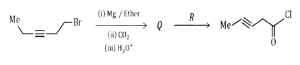
In the following reaction sequence,identify product $Q$ and reagent $R$:
A
$Me-CH_2-C\equiv C-CH_2-COOH$ and $SOCl_2$
B
$Me-CH=CH-CH_2-CH_2-COOH$ and $SO_2Cl_2$
C
$Me-CH_2-CH=CH-CH_2-COOH$ and $SOCl_2$
D
$Me-CH_2-C\equiv C-CH_2-COOH$ and $CH_3SO_2Cl_2$
Solution
(A) The reaction sequence is as follows:
$1$. The alkyl bromide $Me-CH_2-C\equiv C-CH_2-Br$ reacts with $Mg$ in the presence of ether to form a Grignard reagent $(R-MgBr)$.
$2$. The Grignard reagent then reacts with $CO_2$ followed by acidic hydrolysis $(H_3O^+)$ to yield a carboxylic acid,$Q$,which is $Me-CH_2-C\equiv C-CH_2-COOH$.
$3$. The carboxylic acid $Q$ is then converted into an acid chloride by reaction with $SOCl_2$ (reagent $R$).
Thus,$Q$ is $Me-CH_2-C\equiv C-CH_2-COOH$ and $R$ is $SOCl_2$.
$1$. The alkyl bromide $Me-CH_2-C\equiv C-CH_2-Br$ reacts with $Mg$ in the presence of ether to form a Grignard reagent $(R-MgBr)$.
$2$. The Grignard reagent then reacts with $CO_2$ followed by acidic hydrolysis $(H_3O^+)$ to yield a carboxylic acid,$Q$,which is $Me-CH_2-C\equiv C-CH_2-COOH$.
$3$. The carboxylic acid $Q$ is then converted into an acid chloride by reaction with $SOCl_2$ (reagent $R$).
Thus,$Q$ is $Me-CH_2-C\equiv C-CH_2-COOH$ and $R$ is $SOCl_2$.
0 likes
View Solution720
DifficultMCQ
Identify the major product $Y$ from the following reaction:

A
$1-$phenylethanol
B
Benzoic acid
C
$2-$phenylethanol
D
Phenylacetic acid
Solution
(C) The reaction proceeds as follows:
$1$. Benzyl chloride reacts with $Mg$ in dry ether to form benzylmagnesium chloride.
$2$. Benzylmagnesium chloride reacts with $CO_2$ followed by acidic workup $(H_3O^+)$ to produce phenylacetic acid $(X)$: $C_6H_5CH_2Cl$ $\xrightarrow{Mg/dry ether} C_6H_5CH_2MgCl$ $\xrightarrow{CO_2, H_3O^+} C_6H_5CH_2COOH$.
$3$. Phenylacetic acid $(X)$ is then reduced by $LiAlH_4$ in ether followed by acidic workup $(H_3O^+)$ to yield $2-$phenylethanol $(Y)$: $C_6H_5CH_2COOH \xrightarrow{LiAlH_4, H_3O^+} C_6H_5CH_2CH_2OH$.
$1$. Benzyl chloride reacts with $Mg$ in dry ether to form benzylmagnesium chloride.
$2$. Benzylmagnesium chloride reacts with $CO_2$ followed by acidic workup $(H_3O^+)$ to produce phenylacetic acid $(X)$: $C_6H_5CH_2Cl$ $\xrightarrow{Mg/dry ether} C_6H_5CH_2MgCl$ $\xrightarrow{CO_2, H_3O^+} C_6H_5CH_2COOH$.
$3$. Phenylacetic acid $(X)$ is then reduced by $LiAlH_4$ in ether followed by acidic workup $(H_3O^+)$ to yield $2-$phenylethanol $(Y)$: $C_6H_5CH_2COOH \xrightarrow{LiAlH_4, H_3O^+} C_6H_5CH_2CH_2OH$.
0 likes
View Solution721
MediumMCQ
Which one of the following compounds does not give benzoic acid when treated with alkaline $KMnO_4$?
A
Acetophenone
B
$n-$Propyl benzene
C
Styrene
D
$t-$Butyl benzene
Solution
(D) Alkaline $KMnO_4$ is a strong oxidizing agent that oxidizes alkyl side chains attached to a benzene ring to a carboxylic acid group $(-COOH)$,provided that the benzylic carbon has at least one hydrogen atom.
$1$. $n-$Propyl benzene $(C_6H_5-CH_2-CH_2-CH_3)$ has two hydrogens on the benzylic carbon,so it oxidizes to benzoic acid.
$2$. Styrene $(C_6H_5-CH=CH_2)$ has a benzylic hydrogen,so it oxidizes to benzoic acid.
$3$. Acetophenone $(C_6H_5-CO-CH_3)$ contains a carbonyl group at the benzylic position,but the oxidation of the methyl group attached to the carbonyl can lead to benzoic acid under vigorous conditions.
$4$. $t-$Butyl benzene $(C_6H_5-C(CH_3)_3)$ has no hydrogen atom on the benzylic carbon. Therefore,it is resistant to oxidation by alkaline $KMnO_4$ and does not yield benzoic acid.
$1$. $n-$Propyl benzene $(C_6H_5-CH_2-CH_2-CH_3)$ has two hydrogens on the benzylic carbon,so it oxidizes to benzoic acid.
$2$. Styrene $(C_6H_5-CH=CH_2)$ has a benzylic hydrogen,so it oxidizes to benzoic acid.
$3$. Acetophenone $(C_6H_5-CO-CH_3)$ contains a carbonyl group at the benzylic position,but the oxidation of the methyl group attached to the carbonyl can lead to benzoic acid under vigorous conditions.
$4$. $t-$Butyl benzene $(C_6H_5-C(CH_3)_3)$ has no hydrogen atom on the benzylic carbon. Therefore,it is resistant to oxidation by alkaline $KMnO_4$ and does not yield benzoic acid.
0 likes
View Solution722
DifficultMCQ
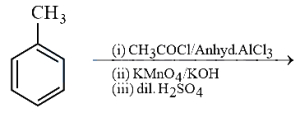
Identify the major product formed in the following reaction sequence:
A
Phthalic acid
B
$4-$Methylacetophenone
C
Benzoic acid
D
Terephthalic acid
Solution
(D) The reaction sequence is as follows:
$1$. The first step is the Friedel-Crafts acylation of toluene with $CH_3COCl$ in the presence of anhydrous $AlCl_3$. Since the $-CH_3$ group is ortho/para directing,and the para position is sterically less hindered,the major product formed is $4-$methylacetophenone.
$2$. The second step involves the oxidation of both the $-CH_3$ group and the $-COCH_3$ group using alkaline $KMnO_4$ followed by acidic workup with dilute $H_2SO_4$. Both alkyl and acyl side chains attached to the benzene ring are oxidized to carboxylic acid groups $(-COOH)$.
$3$. Thus,$4-$methylacetophenone is converted into benzene-$1,4-$dicarboxylic acid,which is commonly known as Terephthalic acid.
$1$. The first step is the Friedel-Crafts acylation of toluene with $CH_3COCl$ in the presence of anhydrous $AlCl_3$. Since the $-CH_3$ group is ortho/para directing,and the para position is sterically less hindered,the major product formed is $4-$methylacetophenone.
$2$. The second step involves the oxidation of both the $-CH_3$ group and the $-COCH_3$ group using alkaline $KMnO_4$ followed by acidic workup with dilute $H_2SO_4$. Both alkyl and acyl side chains attached to the benzene ring are oxidized to carboxylic acid groups $(-COOH)$.
$3$. Thus,$4-$methylacetophenone is converted into benzene-$1,4-$dicarboxylic acid,which is commonly known as Terephthalic acid.
0 likes
View Solution723
MediumMCQ
The reagent that can reduce the carboxylic acid group to the corresponding alcohol is
A
$NaBH_4 / H_3O^{+}$
B
$B_2H_6 / H_3O^{+}$
C
$Zn-Hg / \text{conc. } HCl$
D
$H_2, Pd / C$
Solution
(B) Carboxylic acids are reduced to primary alcohols by lithium aluminium hydride $(LiAlH_4)$ or more selectively with diborane $(B_2H_6)$.
$B_2H_6$ is a specific reagent that reduces the carboxylic acid group to a primary alcohol while leaving other functional groups like esters,nitro,or halo groups unaffected.
$NaBH_4$ is not strong enough to reduce the carboxylic acid group.
$Zn-Hg / \text{conc. } HCl$ is used for Clemmensen reduction,which reduces aldehydes and ketones to alkanes,not carboxylic acids to alcohols.
$H_2, Pd / C$ is generally used for the hydrogenation of alkenes and alkynes and does not reduce carboxylic acids.
$B_2H_6$ is a specific reagent that reduces the carboxylic acid group to a primary alcohol while leaving other functional groups like esters,nitro,or halo groups unaffected.
$NaBH_4$ is not strong enough to reduce the carboxylic acid group.
$Zn-Hg / \text{conc. } HCl$ is used for Clemmensen reduction,which reduces aldehydes and ketones to alkanes,not carboxylic acids to alcohols.
$H_2, Pd / C$ is generally used for the hydrogenation of alkenes and alkynes and does not reduce carboxylic acids.
0 likes
View Solution724
EasyMCQ
Find the suitable product for the following reaction: $R-COOH \underset{(ii) H_2O/H^{\oplus}}{\xrightarrow{(i) B_2H_6}} ?$
A
$R-CHO$
B
$R-CH_2OH$
C
$R-CO_2R$
D
$R-CH_3$
Solution
(B) In the given reaction,carboxylic acid $(R-COOH)$ is treated with diborane $(B_2H_6)$ followed by acidic hydrolysis $(H_2O/H^{\oplus})$.
$B_2H_6$ is a selective reducing agent that reduces carboxylic acids to primary alcohols $(R-CH_2OH)$ without affecting other functional groups like esters or halides.
Therefore,the product is $R-CH_2OH$.
$B_2H_6$ is a selective reducing agent that reduces carboxylic acids to primary alcohols $(R-CH_2OH)$ without affecting other functional groups like esters or halides.
Therefore,the product is $R-CH_2OH$.
0 likes
View Solution725
MediumMCQ
Identify $A$ and $B$ in the following reaction:
$CH_3-CH_3 \stackrel{B}{\longleftarrow} CH_3COOH \stackrel{A}{\longrightarrow} CH_3CH_2OH$
$A \quad B$
$CH_3-CH_3 \stackrel{B}{\longleftarrow} CH_3COOH \stackrel{A}{\longrightarrow} CH_3CH_2OH$
$A \quad B$
A
$HI + \text{red } P \quad LiAlH_4$
B
$Ni / \Delta \quad LiAlH_4$
C
$LiAlH_4 \quad HI + \text{red } P$
D
$Pd-BaSO_4 \quad Zn + HCl$
Solution
(C) Acetic acid on reduction with lithium aluminium hydride $(LiAlH_4)$ gives ethyl alcohol.
$CH_3COOH \xrightarrow{LiAlH_4} CH_3CH_2OH$
Acetic acid on reduction with $HI$ and red $P$ gives ethane.
$CH_3COOH \xrightarrow{\text{Red } P + HI} CH_3-CH_3$
Therefore,reagent $A$ is $LiAlH_4$ and reagent $B$ is $HI + \text{red } P$.
$CH_3COOH \xrightarrow{LiAlH_4} CH_3CH_2OH$
Acetic acid on reduction with $HI$ and red $P$ gives ethane.
$CH_3COOH \xrightarrow{\text{Red } P + HI} CH_3-CH_3$
Therefore,reagent $A$ is $LiAlH_4$ and reagent $B$ is $HI + \text{red } P$.
0 likes
View Solution726
MediumMCQ
In the following reaction,$X$ and $Y$ respectively are:
$C_2H_5OH$ $\xrightarrow{KMnO_4 / H^+} X$ $\xrightarrow{C_2H_5OH / H_2SO_4, \Delta} CH_3COOC_2H_5$
$C_2H_5OH$ $\xrightarrow{KMnO_4 / H^+} X$ $\xrightarrow{C_2H_5OH / H_2SO_4, \Delta} CH_3COOC_2H_5$
A
$CH_3OH, C_2H_5OH$
B
$CH_3CHO, CH_3OH$
C
$CH_2=CH_2, CH_3COOH$
D
$CH_3COOH, C_2H_5OH$
Solution
(D) The reaction sequence is as follows:
$1$. Oxidation of ethanol $(C_2H_5OH)$ with $KMnO_4 / H^+$ yields acetic acid $(CH_3COOH)$ as the final product $X$.
$2$. The reaction of acetic acid $(CH_3COOH)$ with ethanol $(C_2H_5OH)$ in the presence of concentrated $H_2SO_4$ is an esterification reaction,which produces ethyl acetate $(CH_3COOC_2H_5)$.
$3$. Thus,$X = CH_3COOH$ and $Y = C_2H_5OH$.
$1$. Oxidation of ethanol $(C_2H_5OH)$ with $KMnO_4 / H^+$ yields acetic acid $(CH_3COOH)$ as the final product $X$.
$2$. The reaction of acetic acid $(CH_3COOH)$ with ethanol $(C_2H_5OH)$ in the presence of concentrated $H_2SO_4$ is an esterification reaction,which produces ethyl acetate $(CH_3COOC_2H_5)$.
$3$. Thus,$X = CH_3COOH$ and $Y = C_2H_5OH$.
0 likes
View Solution727
MediumMCQ
Which of the following has the lowest $pK_{a}$ value?
A
$p$-nitrophenol
B
Benzoic acid
C
$p$-methoxybenzoic acid
D
$p$-nitrobenzoic acid
Solution
(D) The $pK_{a}$ value is inversely proportional to the acidity of the compound. $A$ lower $pK_{a}$ value indicates a stronger acid.
$1$. $p$-nitrophenol is a phenol,which is significantly less acidic than carboxylic acids.
$2$. Among the carboxylic acids ($B$,$C$,and $D$),the acidity depends on the electronic effects of the substituents on the benzene ring.
- In $p$-methoxybenzoic acid $(C)$,the $-OCH_{3}$ group exerts a $+M$ (mesomeric) effect,which decreases the acidity.
- In benzoic acid $(B)$,there is no substituent.
- In $p$-nitrobenzoic acid $(D)$,the $-NO_{2}$ group exerts a strong $-I$ (inductive) and $-M$ effect,which stabilizes the carboxylate anion and significantly increases the acidity.
Since $p$-nitrobenzoic acid is the strongest acid among the given options,it has the lowest $pK_{a}$ value.
$1$. $p$-nitrophenol is a phenol,which is significantly less acidic than carboxylic acids.
$2$. Among the carboxylic acids ($B$,$C$,and $D$),the acidity depends on the electronic effects of the substituents on the benzene ring.
- In $p$-methoxybenzoic acid $(C)$,the $-OCH_{3}$ group exerts a $+M$ (mesomeric) effect,which decreases the acidity.
- In benzoic acid $(B)$,there is no substituent.
- In $p$-nitrobenzoic acid $(D)$,the $-NO_{2}$ group exerts a strong $-I$ (inductive) and $-M$ effect,which stabilizes the carboxylate anion and significantly increases the acidity.
Since $p$-nitrobenzoic acid is the strongest acid among the given options,it has the lowest $pK_{a}$ value.
0 likes
View Solution728
DifficultMCQ
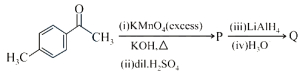
The major products $P$ and $Q$ in the following reaction sequence are
A
$P$ = benzene$-1,4-$dicarboxylic acid,$Q$ = benzene$-1,4-$dimethanol
B
$P$ = $4-$methylbenzoic acid,$Q$ = $4-$methylbenzyl alcohol
C
$P$ = benzene$-1,4-$dicarboxylic acid,$Q$ = benzene$-1,4-$dicarbaldehyde
D
$P$ = benzene$-1,4-$dicarboxylic acid,$Q$ = p-xylene
Solution
(A) The starting material is $4$-methylacetophenone.
$(i)$ Treatment with excess $KMnO_4$ in the presence of $KOH$ and heat causes the oxidation of both the alkyl group $(-CH_3)$ and the acetyl group $(-COCH_3)$ attached to the benzene ring to carboxylate groups $(-COO^-)$.
(ii) Subsequent acidification with $dil. H_2SO_4$ converts the carboxylate groups into carboxylic acid groups $(-COOH)$,yielding terephthalic acid (benzene-$1,4$-dicarboxylic acid) as product $P$.
(iii) $LiAlH_4$ is a strong reducing agent that reduces both carboxylic acid groups to primary alcohol groups $(-CH_2OH)$.
(iv) Final treatment with $H_3O^+$ yields benzene-$1,4$-dimethanol as product $Q$.
$(i)$ Treatment with excess $KMnO_4$ in the presence of $KOH$ and heat causes the oxidation of both the alkyl group $(-CH_3)$ and the acetyl group $(-COCH_3)$ attached to the benzene ring to carboxylate groups $(-COO^-)$.
(ii) Subsequent acidification with $dil. H_2SO_4$ converts the carboxylate groups into carboxylic acid groups $(-COOH)$,yielding terephthalic acid (benzene-$1,4$-dicarboxylic acid) as product $P$.
(iii) $LiAlH_4$ is a strong reducing agent that reduces both carboxylic acid groups to primary alcohol groups $(-CH_2OH)$.
(iv) Final treatment with $H_3O^+$ yields benzene-$1,4$-dimethanol as product $Q$.
0 likes
View Solution729
DifficultMCQ
The major product of the following reaction sequence is:
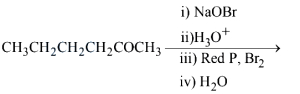
A
$CH_3-CH_2-CH(Br)-COOH$
B
$CH_3-CH_2-CH_2-CH_2-CH(Br)-COOH$
C
$CH_3-CH_2-CH_2-CH(Br)-COOH$
D
$CH_3-CH_2-CH_2-CH(Br)-COBr$
Solution
(C) Step $1$: The reaction of $CH_3CH_2CH_2CH_2COCH_3$ with $NaOBr$ followed by $H_3O^+$ is a haloform reaction. It converts the methyl ketone into a carboxylic acid with one less carbon atom.
$CH_3CH_2CH_2CH_2COCH_3 \xrightarrow{NaOBr, H_3O^+} CH_3CH_2CH_2CH_2COOH + CHBr_3$.
Step $2$: The product $CH_3CH_2CH_2CH_2COOH$ (pentanoic acid) is then treated with $Red \ P$ and $Br_2$,followed by $H_2O$. This is the Hell-Volhard-Zelinsky $(HVZ)$ reaction,which alpha-halogenates the carboxylic acid.
$CH_3CH_2CH_2CH_2COOH \xrightarrow{Red \ P, Br_2} CH_3CH_2CH_2CH(Br)COOH$.
The final product is $2$-bromopentanoic acid,which corresponds to option $C$.
$CH_3CH_2CH_2CH_2COCH_3 \xrightarrow{NaOBr, H_3O^+} CH_3CH_2CH_2CH_2COOH + CHBr_3$.
Step $2$: The product $CH_3CH_2CH_2CH_2COOH$ (pentanoic acid) is then treated with $Red \ P$ and $Br_2$,followed by $H_2O$. This is the Hell-Volhard-Zelinsky $(HVZ)$ reaction,which alpha-halogenates the carboxylic acid.
$CH_3CH_2CH_2CH_2COOH \xrightarrow{Red \ P, Br_2} CH_3CH_2CH_2CH(Br)COOH$.
The final product is $2$-bromopentanoic acid,which corresponds to option $C$.
0 likes
View Solution730
DifficultMCQ
What is the product '$Z$' in the given sequence of reactions?
$\text{Aniline}$ $\xrightarrow[(2) H_2O/\text{warm}]{(1) NaNO_2/HCl, 273-278K} X$ $\xrightarrow[(ii) CO_2, (iii) H^+]{(i) NaOH} Y$ $\xrightarrow{(CH_3CO)_2O} Z$
$\text{Aniline}$ $\xrightarrow[(2) H_2O/\text{warm}]{(1) NaNO_2/HCl, 273-278K} X$ $\xrightarrow[(ii) CO_2, (iii) H^+]{(i) NaOH} Y$ $\xrightarrow{(CH_3CO)_2O} Z$
A
$2-$acetoxyphenylphenol
B
$2-$acetoxybenzoic acid
C
$2-$methoxyphenol
D
$2-$acetylphenol
Solution
(B) $1$. The reaction of aniline with $NaNO_2/HCl$ at $273-278 \ K$ followed by warming with $H_2O$ converts aniline to phenol $(X = C_6H_5OH)$.
$2$. Phenol reacts with $NaOH$ followed by $CO_2$ and $H^+$ (Kolbe-Schmidt reaction) to form salicylic acid $(Y = 2-\text{hydroxybenzoic acid})$.
$3$. Salicylic acid reacts with acetic anhydride $((CH_3CO)_2O)$ to undergo acetylation of the phenolic $-OH$ group,forming aspirin $(Z = 2-\text{acetoxybenzoic acid})$.
$2$. Phenol reacts with $NaOH$ followed by $CO_2$ and $H^+$ (Kolbe-Schmidt reaction) to form salicylic acid $(Y = 2-\text{hydroxybenzoic acid})$.
$3$. Salicylic acid reacts with acetic anhydride $((CH_3CO)_2O)$ to undergo acetylation of the phenolic $-OH$ group,forming aspirin $(Z = 2-\text{acetoxybenzoic acid})$.
0 likes
View Solution731
MediumMCQ
In the following reactions,$P, Q$ and $R$ are
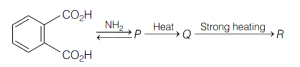
A
$P$: Ammonium phthalate,$Q$: Phthalamide,$R$: Phthalimide
B
$P$: Ammonium phthalate,$Q$: Phthalimide,$R$: Phthalamide
C
$P$: Phthalamide,$Q$: Ammonium phthalate,$R$: Phthalimide
D
$P$: Phthalamide,$Q$: Phthalimide,$R$: Ammonium phthalate
Solution
(A) The reaction of phthalic acid with $NH_3$ gives ammonium phthalate $(P)$.
Heating ammonium phthalate $(P)$ results in the loss of two molecules of water to form phthalamide $(Q)$.
Strong heating of phthalamide $(Q)$ leads to the loss of a molecule of ammonia to form phthalimide $(R)$.
Heating ammonium phthalate $(P)$ results in the loss of two molecules of water to form phthalamide $(Q)$.
Strong heating of phthalamide $(Q)$ leads to the loss of a molecule of ammonia to form phthalimide $(R)$.
0 likes
View Solution732
MediumMCQ
Identify the structure of $Z$ in the following reaction sequence:
$Phthalic \ acid + NH_3 \rightleftharpoons X$ $\xrightarrow{\Delta} Y$ $\xrightarrow{\text{heating}} Z$
$Phthalic \ acid + NH_3 \rightleftharpoons X$ $\xrightarrow{\Delta} Y$ $\xrightarrow{\text{heating}} Z$
A
Aniline
B
Phthalamic acid
C
Phthalonitrile
D
Phthalimide
Solution
(D) The reaction sequence is as follows:
$1$. $Phthalic \ acid + 2NH_3 \rightarrow Ammonium \ phthalate (X)$
$2$. $Ammonium \ phthalate (X) \xrightarrow{\Delta} Phthalamide (Y) + 2H_2O$
$3$. $Phthalamide (Y) \xrightarrow{\text{heating}} Phthalimide (Z) + NH_3$
Thus,$Z$ is Phthalimide.
$1$. $Phthalic \ acid + 2NH_3 \rightarrow Ammonium \ phthalate (X)$
$2$. $Ammonium \ phthalate (X) \xrightarrow{\Delta} Phthalamide (Y) + 2H_2O$
$3$. $Phthalamide (Y) \xrightarrow{\text{heating}} Phthalimide (Z) + NH_3$
Thus,$Z$ is Phthalimide.
0 likes
View Solution733
MediumMCQ
The increasing order of acidic strength of the following in aqueous solution is:
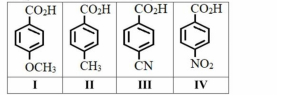
A
$I < II < III < IV$
B
$I < II < IV < III$
C
$II < I < III < IV$
D
$IV < III < II < I$
Solution
(A) The acidic strength of substituted benzoic acids depends on the electronic effects of the substituents attached to the benzene ring.
Electron-withdrawing groups $(EWG)$ increase the acidic strength by stabilizing the carboxylate anion through $-I$ and $-M$ effects.
Electron-donating groups $(EDG)$ decrease the acidic strength by destabilizing the carboxylate anion through $+I$ and $+M$ effects.
The substituents are:
$I$: $-OCH_3$ (Strong $+M$ effect,weak $-I$ effect; overall acts as an $EDG$)
$II$: $-CH_3$ (Weak $+I$ and hyperconjugation effect; acts as an $EDG$)
$III$: $-CN$ (Strong $-I$ and $-M$ effect; acts as an $EWG$)
$IV$: $-NO_2$ (Very strong $-I$ and $-M$ effect; acts as a strong $EWG$)
Comparing the effects:
$-OCH_3$ is a stronger electron donor than $-CH_3$,so $I$ is less acidic than $II$.
$-NO_2$ is a stronger electron withdrawer than $-CN$,so $IV$ is more acidic than $III$.
The overall increasing order of acidic strength is $I < II < III < IV$.
Electron-withdrawing groups $(EWG)$ increase the acidic strength by stabilizing the carboxylate anion through $-I$ and $-M$ effects.
Electron-donating groups $(EDG)$ decrease the acidic strength by destabilizing the carboxylate anion through $+I$ and $+M$ effects.
The substituents are:
$I$: $-OCH_3$ (Strong $+M$ effect,weak $-I$ effect; overall acts as an $EDG$)
$II$: $-CH_3$ (Weak $+I$ and hyperconjugation effect; acts as an $EDG$)
$III$: $-CN$ (Strong $-I$ and $-M$ effect; acts as an $EWG$)
$IV$: $-NO_2$ (Very strong $-I$ and $-M$ effect; acts as a strong $EWG$)
Comparing the effects:
$-OCH_3$ is a stronger electron donor than $-CH_3$,so $I$ is less acidic than $II$.
$-NO_2$ is a stronger electron withdrawer than $-CN$,so $IV$ is more acidic than $III$.
The overall increasing order of acidic strength is $I < II < III < IV$.
0 likes
View Solution734
EasyMCQ
Formic acid on heating with concentrated $H_2SO_4$ at $373 \ K$ gives $X$,a colourless substance and $Y$,a good reducing agent. The number of $\sigma$ and $\pi$ bonds in $X$ and $Y$ are respectively:
A
$X=2,0; Y=1,2$
B
$X=1,2; Y=2,2$
C
$X=2,1; Y=1,1$
D
$X=1,2; Y=3,3$
Solution
(A) The reaction of formic acid $(HCOOH)$ with concentrated $H_2SO_4$ is a dehydration reaction:
$HCOOH \xrightarrow{Conc. H_2SO_4, 373 \ K} H_2O + CO$
Here,$X$ is $H_2O$ (water) and $Y$ is $CO$ (carbon monoxide).
In $H_2O$ $(X)$,there are two $O-H$ single bonds,so it has $2 \sigma$ bonds and $0 \pi$ bonds.
In $CO$ $(Y)$,the structure is $C \equiv O$,which consists of $1 \sigma$ bond and $2 \pi$ bonds.
Therefore,for $X$ $(H_2O)$,the count is $2 \sigma, 0 \pi$ and for $Y$ $(CO)$,the count is $1 \sigma, 2 \pi$.
Thus,the correct option is $A$.
$HCOOH \xrightarrow{Conc. H_2SO_4, 373 \ K} H_2O + CO$
Here,$X$ is $H_2O$ (water) and $Y$ is $CO$ (carbon monoxide).
In $H_2O$ $(X)$,there are two $O-H$ single bonds,so it has $2 \sigma$ bonds and $0 \pi$ bonds.
In $CO$ $(Y)$,the structure is $C \equiv O$,which consists of $1 \sigma$ bond and $2 \pi$ bonds.
Therefore,for $X$ $(H_2O)$,the count is $2 \sigma, 0 \pi$ and for $Y$ $(CO)$,the count is $1 \sigma, 2 \pi$.
Thus,the correct option is $A$.
0 likes
View Solution735
DifficultMCQ
Match the following:
The correct match is:
| Column-$1$ (Acid) | Column-$2$ ($pK_a$ value) |
|---|---|
| $A. CH_3COOH$ | $I. 0.23$ |
| $B. F_3CCOOH$ | $II. 3.41$ |
| $C. \text{Benzoic acid}$ | $III. 4.19$ |
| $D. p\text{-Nitrobenzoic acid}$ | $IV. 4.76$ |
The correct match is:
A
$A-IV, B-I, C-III, D-II$
B
$A-I, B-IV, C-II, D-III$
C
$A-IV, B-I, C-II, D-III$
D
$A-IV, B-III, C-II, D-I$
Solution
$(A)$ The acidity of a carboxylic acid is directly proportional to the acid dissociation constant $(K_a)$ and inversely proportional to the $pK_a$ value, where $pK_a = -\log K_a$.
$1$. $CH_3COOH$ (Acetic acid): Least acidic among the given options, so it has the highest $pK_a$ value of $4.76$. $(A-IV)$
$2$. $\text{Benzoic acid}$: More acidic than acetic acid, so it has a $pK_a$ value of $4.19$. $(C-III)$
$3$. $p\text{-Nitrobenzoic acid}$: The $-NO_2$ group is electron-withdrawing ($-I$ and $-M$ effect), increasing acidity, so it has a $pK_a$ value of $3.41$. $(D-II)$
$4$. $F_3CCOOH$ (Trifluoroacetic acid): The three fluorine atoms exert a strong electron-withdrawing inductive effect, making it the most acidic, with a $pK_a$ value of $0.23$. $(B-I)$
Therefore, the correct match is $A-IV, B-I, C-III, D-II$.
$1$. $CH_3COOH$ (Acetic acid): Least acidic among the given options, so it has the highest $pK_a$ value of $4.76$. $(A-IV)$
$2$. $\text{Benzoic acid}$: More acidic than acetic acid, so it has a $pK_a$ value of $4.19$. $(C-III)$
$3$. $p\text{-Nitrobenzoic acid}$: The $-NO_2$ group is electron-withdrawing ($-I$ and $-M$ effect), increasing acidity, so it has a $pK_a$ value of $3.41$. $(D-II)$
$4$. $F_3CCOOH$ (Trifluoroacetic acid): The three fluorine atoms exert a strong electron-withdrawing inductive effect, making it the most acidic, with a $pK_a$ value of $0.23$. $(B-I)$
Therefore, the correct match is $A-IV, B-I, C-III, D-II$.
0 likes
View Solution736
EasyMCQ
Identify the incorrect statement regarding acetic acid.
A
Acetic acid is obtained when calcium acetate is distilled in the presence of calcium formate.
B
Acetic acid is used in curing meat and fish.
C
Anhydrous acetic acid is known as glacial acetic acid because it forms ice-like solids below $16.6^{\circ}C$.
D
The catalyst used in the conversion of acetic acid to trichloroacetic acid is red phosphorus.
Solution
(A) Statement $A$ is incorrect,whereas all other statements are correct.
When a mixture of calcium acetate and calcium formate is distilled,acetaldehyde $(CH_3CHO)$ is formed,not acetic acid.
Acetic acid is used in food preservation (curing).
Glacial acetic acid freezes at $16.6^{\circ}C$ to form ice-like crystals.
Chlorination of acetic acid in the presence of red phosphorus yields trichloroacetic acid (Hell-Volhard-Zelinsky reaction).
When a mixture of calcium acetate and calcium formate is distilled,acetaldehyde $(CH_3CHO)$ is formed,not acetic acid.
Acetic acid is used in food preservation (curing).
Glacial acetic acid freezes at $16.6^{\circ}C$ to form ice-like crystals.
Chlorination of acetic acid in the presence of red phosphorus yields trichloroacetic acid (Hell-Volhard-Zelinsky reaction).
0 likes
View Solution737
MediumMCQ
The major product formed in the following reaction is
$C_6H_5CH=CH_2$ $\xrightarrow[(ii) H_3O^+]{(i) KMnO_4, KOH, \Delta}$ $\xrightarrow{(iii) Br_2/FeBr_3} \text{Product}$
$C_6H_5CH=CH_2$ $\xrightarrow[(ii) H_3O^+]{(i) KMnO_4, KOH, \Delta}$ $\xrightarrow{(iii) Br_2/FeBr_3} \text{Product}$
A
$p$-bromophenylacetic acid
B
$o$-bromobenzoic acid
C
$m$-bromoacetophenone
D
$m$-bromobenzoic acid
Solution
(D) Step $(i)$ and $(ii)$: The oxidation of styrene $(C_6H_5CH=CH_2)$ with alkaline $KMnO_4$ followed by acidic workup $(H_3O^+)$ results in the formation of benzoic acid $(C_6H_5COOH)$.
Step $(iii)$: Benzoic acid contains a $-COOH$ group,which is a deactivating and meta-directing group. Therefore,electrophilic aromatic substitution with $Br_2/FeBr_3$ will direct the bromine atom to the meta position.
The final product is $m$-bromobenzoic acid.
Step $(iii)$: Benzoic acid contains a $-COOH$ group,which is a deactivating and meta-directing group. Therefore,electrophilic aromatic substitution with $Br_2/FeBr_3$ will direct the bromine atom to the meta position.
The final product is $m$-bromobenzoic acid.
0 likes
View Solution738
MediumMCQ
Identify $A$ and $B$ in the following reaction:
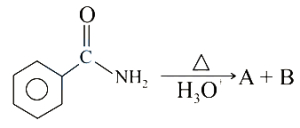
A
$A = C_6H_5CH_2NO_2, B = NH_2OH$
B
$A = C_6H_5COOH, B = NH_3$
C
$A = C_6H_5COOH, B = C_6H_5NO_2$
D
$A = C_6H_5CONH_2, B = NH_3$
Solution
(B) The hydrolysis of an aromatic amide in the presence of a dilute mineral acid and heat yields a carboxylic acid and ammonia.
The reaction is:
$C_6H_5CONH_2 + H_2O \xrightarrow{\Delta, H_3O^+} C_6H_5COOH + NH_3$
Here,the reactant is benzamide.
Product $A$ is benzoic acid $(C_6H_5COOH)$ and product $B$ is ammonia $(NH_3)$.
The reaction is:
$C_6H_5CONH_2 + H_2O \xrightarrow{\Delta, H_3O^+} C_6H_5COOH + NH_3$
Here,the reactant is benzamide.
Product $A$ is benzoic acid $(C_6H_5COOH)$ and product $B$ is ammonia $(NH_3)$.
0 likes
View Solution739
MediumMCQ
Which of the following can undergo Hell-Volhard-Zelinsky reaction?
A
$C_6H_5COOH$
B
$C_6H_5CH_2COOH$
C
$C_6H_5CH_2CHO$
D
$C_6H_5CH_2COCH_3$
Solution
(B) The Hell-Volhard-Zelinsky $(HVZ)$ reaction is a characteristic reaction of carboxylic acids that possess at least one $\alpha$-hydrogen atom.
In this reaction,the $\alpha$-hydrogen is replaced by a halogen atom (usually $Br_2$ or $Cl_2$) in the presence of a small amount of red phosphorus.
Let us analyze the given options:
$(A)$ $C_6H_5COOH$ (Benzoic acid): The carbon atom attached to the $-COOH$ group is part of the benzene ring and has no $\alpha$-hydrogen.
$(B)$ $C_6H_5CH_2COOH$ (Phenylacetic acid): The carbon atom attached to the $-COOH$ group is a $CH_2$ group,which contains two $\alpha$-hydrogen atoms. Thus,it can undergo the $HVZ$ reaction.
$(C)$ $C_6H_5CH_2CHO$ (Phenylacetaldehyde): This is an aldehyde,not a carboxylic acid.
$(D)$ $C_6H_5CH_2COCH_3$ ($1$-Phenylpropan$-2-$one): This is a ketone,not a carboxylic acid.
Therefore,only $C_6H_5CH_2COOH$ satisfies the condition for the $HVZ$ reaction.
In this reaction,the $\alpha$-hydrogen is replaced by a halogen atom (usually $Br_2$ or $Cl_2$) in the presence of a small amount of red phosphorus.
Let us analyze the given options:
$(A)$ $C_6H_5COOH$ (Benzoic acid): The carbon atom attached to the $-COOH$ group is part of the benzene ring and has no $\alpha$-hydrogen.
$(B)$ $C_6H_5CH_2COOH$ (Phenylacetic acid): The carbon atom attached to the $-COOH$ group is a $CH_2$ group,which contains two $\alpha$-hydrogen atoms. Thus,it can undergo the $HVZ$ reaction.
$(C)$ $C_6H_5CH_2CHO$ (Phenylacetaldehyde): This is an aldehyde,not a carboxylic acid.
$(D)$ $C_6H_5CH_2COCH_3$ ($1$-Phenylpropan$-2-$one): This is a ketone,not a carboxylic acid.
Therefore,only $C_6H_5CH_2COOH$ satisfies the condition for the $HVZ$ reaction.
0 likes
View Solution740
DifficultMCQ
Predict $A$ and $B$ in the following reaction sequence:
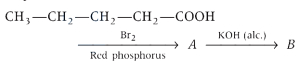
A
$A = CH_3-CH_2-CH_2-CH(Br)-COOH$,$B = CH_3-(CH_2)_2-CH(Br)-COO^-K^+$
B
$A = CH_3-CH_2-CH(Br)-CH_2-COOH$,$B = CH_3-CH_2-CH(Br)-CH=CH-COO^-K^+$
C
$A = CH_3-CH_2-CH_2-CH(Br)-COOH$,$B = CH_3-CH=CH-CH_2-COOH$
D
$A = CH_3-CH_2-CH_2-CH(Br)-COOH$,$B = CH_3-CH_2-CH=CH-COO^-K^+$
Solution
(D) The reaction sequence is as follows:
$1$. The first step is the Hell-Volhard-Zelinsky $(HVZ)$ reaction,where pentanoic acid $(CH_3-CH_2-CH_2-CH_2-COOH)$ reacts with $Br_2$ in the presence of red phosphorus to undergo $\alpha$-halogenation,forming $2$-bromopentanoic acid as product $A$ $(CH_3-CH_2-CH_2-CH(Br)-COOH)$.
$2$. The second step involves treatment with alcoholic $KOH$,which acts as a strong base and promotes $\beta$-elimination of $HBr$ from the $\alpha$-bromo acid. This results in the formation of an $\alpha,\beta$-unsaturated carboxylate salt,specifically potassium pent$-2-$enoate $(CH_3-CH_2-CH=CH-COO^-K^+)$ as product $B$.
$1$. The first step is the Hell-Volhard-Zelinsky $(HVZ)$ reaction,where pentanoic acid $(CH_3-CH_2-CH_2-CH_2-COOH)$ reacts with $Br_2$ in the presence of red phosphorus to undergo $\alpha$-halogenation,forming $2$-bromopentanoic acid as product $A$ $(CH_3-CH_2-CH_2-CH(Br)-COOH)$.
$2$. The second step involves treatment with alcoholic $KOH$,which acts as a strong base and promotes $\beta$-elimination of $HBr$ from the $\alpha$-bromo acid. This results in the formation of an $\alpha,\beta$-unsaturated carboxylate salt,specifically potassium pent$-2-$enoate $(CH_3-CH_2-CH=CH-COO^-K^+)$ as product $B$.
0 likes
View Solution741
MediumMCQ
What are the products $B$ and $C$ in the following reaction sequence?
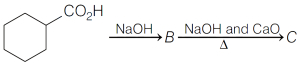
A
$(B) = \text{cyclohexyl sodium}, (C) = \text{cyclohexanol}$
B
$(B) = \text{sodium cyclohexanecarboxylate}, (C) = \text{cyclohexanol}$
C
$(B) = \text{sodium cyclohexanecarboxylate}, (C) = \text{cyclohexane}$
D
$(B) = \text{sodium cyclohexanecarboxylate}, (C) = \text{sodium cyclohexyl}$
Solution
(C) The reaction sequence is as follows:
$1$. Cyclohexanecarboxylic acid reacts with $NaOH$ (a base) to form its sodium salt,$B$,which is sodium cyclohexanecarboxylate $(C_6H_{11}COONa)$.
$2$. The sodium salt $B$ then undergoes decarboxylation when heated with soda lime $(NaOH + CaO)$. This process removes the $-COONa$ group and replaces it with a hydrogen atom,resulting in the formation of cyclohexane $(C_6H_{12})$ as product $C$.
$1$. Cyclohexanecarboxylic acid reacts with $NaOH$ (a base) to form its sodium salt,$B$,which is sodium cyclohexanecarboxylate $(C_6H_{11}COONa)$.
$2$. The sodium salt $B$ then undergoes decarboxylation when heated with soda lime $(NaOH + CaO)$. This process removes the $-COONa$ group and replaces it with a hydrogen atom,resulting in the formation of cyclohexane $(C_6H_{12})$ as product $C$.
0 likes
View Solution742
MediumMCQ
$n$-Propanol on treatment with concentrated $HBr$ gives $P$. The product $P$ on reaction with $KCN$ gave the product $Q$. The product $Q$ on heating with aqueous acidic solution,furnished the product $R$. The product $R$ is
A
Propanoic acid
B
Propanamide
C
Butanoic acid
D
Butanamide
Solution
(C) $n$-Propanol $(CH_3CH_2CH_2OH)$ reacts with concentrated $HBr$ to form $n$-propyl bromide $(CH_3CH_2CH_2Br)$ as product $P$.
$n$-Propyl bromide reacts with $KCN$ via nucleophilic substitution to form butanenitrile $(CH_3CH_2CH_2CN)$ as product $Q$.
Butanenitrile on heating with an aqueous acidic solution undergoes hydrolysis to form butanoic acid $(CH_3CH_2CH_2COOH)$ as product $R$.
$CH_3CH_2CH_2OH$ $\xrightarrow{HBr} CH_3CH_2CH_2Br$ $\xrightarrow{KCN} CH_3CH_2CH_2CN$ $\xrightarrow{H_3O^{+}} CH_3CH_2CH_2COOH$
$n$-Propyl bromide reacts with $KCN$ via nucleophilic substitution to form butanenitrile $(CH_3CH_2CH_2CN)$ as product $Q$.
Butanenitrile on heating with an aqueous acidic solution undergoes hydrolysis to form butanoic acid $(CH_3CH_2CH_2COOH)$ as product $R$.
$CH_3CH_2CH_2OH$ $\xrightarrow{HBr} CH_3CH_2CH_2Br$ $\xrightarrow{KCN} CH_3CH_2CH_2CN$ $\xrightarrow{H_3O^{+}} CH_3CH_2CH_2COOH$
0 likes
View Solution8-2.Carboxylic acids and Their derivative — Properties of Carboxylic Acids and Their Derivatives · Frequently Asked Questions
1Are these 8-2.Carboxylic acids and Their derivative questions useful for JEE and NEET?
Yes. All questions in this section are mapped to JEE Main and NEET exam patterns. Previous year questions from JEE Main, NEET, GUJCET and state-level exams are included with full solutions.
2Can I switch to Hindi or Gujarati for these questions?
Yes. Use the language tabs in the hero section or the sidebar to view the same questions and solutions in English, Hindi or Gujarati.
3How do I generate a question paper from this subtopic?
Use the Vedclass Exam Paper Generator — select the chapter and subtopic, set difficulty, and generate Sets A, B, C, D automatically. First 3 chapters of every subject are free.
Vedclass Products
For Students
Vedclass Test Series
Mock tests in real JEE/NEET style with performance analysis. 5-day free trial.
Start Free TrialFor Teachers
Exam Paper Generator
Generate Set A/B/C/D papers from this chapter in 2 minutes. 3 chapters free.
Try FreeFor Institutes
Online Exam Module
Live online exams with unlimited students, 360° analytics & white-label branding.
See DemoFor Teachers & Institutes
Generate a 8-2.Carboxylic acids and Their derivative Exam Paper in 2 Minutes
Select subtopic & difficulty — Sets A, B, C, D auto-generated with No Repeat logic.
First 3 chapters of every subject are free — no payment required.