
A English
Transcription Questions in English
Class 12 Biology · Molecular Basis of Inheritance · Transcription
277+
Questions
English
Language
100%
With Solutions
Showing 50 of 277 questions in English
151
MediumMCQ
What is the effect of the association of various factors with $RNA$ polymerase?
A
The entire structure of $RNA$ changes.
B
The specificity of $RNA$ polymerase changes.
C
The entire structure of $RNA$ polymerase changes.
D
$RNA$ polymerase cannot bind to $DNA$.
Solution
(B) During the process of transcription in prokaryotes,$RNA$ polymerase is the enzyme responsible for synthesizing $RNA$ from a $DNA$ template.
$RNA$ polymerase by itself is only capable of catalyzing the process of elongation.
It requires specific initiation factors (like the $\sigma$ factor) to initiate the process at the promoter site and termination factors (like the $\rho$ factor) to terminate the process.
These factors associate with the core enzyme of $RNA$ polymerase to alter its specificity,allowing it to recognize specific promoter or terminator sequences on the $DNA$ strand.
$RNA$ polymerase by itself is only capable of catalyzing the process of elongation.
It requires specific initiation factors (like the $\sigma$ factor) to initiate the process at the promoter site and termination factors (like the $\rho$ factor) to terminate the process.
These factors associate with the core enzyme of $RNA$ polymerase to alter its specificity,allowing it to recognize specific promoter or terminator sequences on the $DNA$ strand.
0 likes
View Solution152
DifficultMCQ
In which of the following cells is no additional processing required for $m-RNA$ formation?
A
Animal cell
B
Plant cell
C
Amoeba
D
Blue-green algae
Solution
(D) In eukaryotic cells (such as animal cells,plant cells,and Amoeba),the primary transcript $(hnRNA)$ undergoes processing like splicing,capping,and tailing to form functional $m-RNA$.
However,in prokaryotic cells (such as Blue-green algae or Cyanobacteria),transcription and translation are coupled,and the $m-RNA$ does not require any post-transcriptional processing (splicing) because prokaryotic genes are not split (they lack introns).
Therefore,Blue-green algae is the correct answer.
However,in prokaryotic cells (such as Blue-green algae or Cyanobacteria),transcription and translation are coupled,and the $m-RNA$ does not require any post-transcriptional processing (splicing) because prokaryotic genes are not split (they lack introns).
Therefore,Blue-green algae is the correct answer.
0 likes
View Solution153
MediumMCQ
What happens when the sigma factor $(\sigma)$ binds to the $RNA$ polymerase?
A
Termination of transcription
B
Initiation of transcription
C
Elongation
D
Destruction of polymerase enzymes
Solution
(B) In prokaryotes,the $RNA$ polymerase enzyme consists of a core enzyme and a sigma factor $(\sigma)$.
The core enzyme is responsible for the polymerization of ribonucleotides.
The sigma factor $(\sigma)$ specifically recognizes the promoter site on the $DNA$ template.
When the sigma factor binds to the $RNA$ polymerase,it facilitates the binding of the enzyme to the promoter region,thereby initiating the process of transcription.
Therefore,the sigma factor is essential for the initiation of transcription.
The core enzyme is responsible for the polymerization of ribonucleotides.
The sigma factor $(\sigma)$ specifically recognizes the promoter site on the $DNA$ template.
When the sigma factor binds to the $RNA$ polymerase,it facilitates the binding of the enzyme to the promoter region,thereby initiating the process of transcription.
Therefore,the sigma factor is essential for the initiation of transcription.
0 likes
View Solution154
MediumMCQ
In a eukaryotic cell,how many types of $RNA$ and $RNA$ polymerases are found,respectively?
A
$1, 1$
B
$3, 3$
C
$3, 1$
D
$1, 3$
Solution
(B) In eukaryotic cells,there are three main types of $RNA$ involved in protein synthesis: $mRNA$ (messenger $RNA$),$tRNA$ (transfer $RNA$),and $rRNA$ (ribosomal $RNA$).
Correspondingly,there are three distinct types of $RNA$ polymerases responsible for their transcription:
$1$. $RNA$ polymerase $I$ transcribes $rRNAs$ ($28S, 18S,$ and $5.8S$).
$2$. $RNA$ polymerase $II$ transcribes the precursor of $mRNA$,the heterogeneous nuclear $RNA$ $(hnRNA)$.
$3$. $RNA$ polymerase $III$ transcribes $tRNA$,$5S$ $rRNA$,and $snRNAs$ (small nuclear $RNAs$).
Therefore,there are $3$ types of $RNA$ and $3$ types of $RNA$ polymerases.
Correspondingly,there are three distinct types of $RNA$ polymerases responsible for their transcription:
$1$. $RNA$ polymerase $I$ transcribes $rRNAs$ ($28S, 18S,$ and $5.8S$).
$2$. $RNA$ polymerase $II$ transcribes the precursor of $mRNA$,the heterogeneous nuclear $RNA$ $(hnRNA)$.
$3$. $RNA$ polymerase $III$ transcribes $tRNA$,$5S$ $rRNA$,and $snRNAs$ (small nuclear $RNAs$).
Therefore,there are $3$ types of $RNA$ and $3$ types of $RNA$ polymerases.
0 likes
View Solution155
MediumMCQ
What does $snRNAs$ stand for?
A
$Small\, Nuclear\, RNAs$
B
$Short\, Nuclear\, RNAs$
C
$Sugar\, Nuclear\, RNAs$
D
$Short\, Number\, RNAs$
Solution
(A) $snRNAs$ stands for $Small\, Nuclear\, RNAs$.
These are small $RNA$ molecules found within the nucleus of eukaryotic cells.
They play a crucial role in the processing of pre-messenger $RNA$ $(pre-mRNA)$ into mature $mRNA$ by participating in the splicing process within the spliceosome complex.
These are small $RNA$ molecules found within the nucleus of eukaryotic cells.
They play a crucial role in the processing of pre-messenger $RNA$ $(pre-mRNA)$ into mature $mRNA$ by participating in the splicing process within the spliceosome complex.
0 likes
View Solution156
MediumMCQ
Which enzyme is responsible for the synthesis of $18S$ $rRNA$?
A
$RNA$ polymerase $I$
B
$RNA$ polymerase $II$
C
$RNA$ polymerase $III$
D
$DNA$ polymerase $III$
Solution
(A) In eukaryotes,there are three types of $RNA$ polymerases involved in transcription:
$1$. $RNA$ polymerase $I$ is responsible for the transcription of $rRNA$ ($28S$,$18S$,and $5.8S$).
$2$. $RNA$ polymerase $II$ is responsible for the transcription of precursor of $mRNA$ (heterogeneous nuclear $RNA$ or $hnRNA$).
$3$. $RNA$ polymerase $III$ is responsible for the transcription of $tRNA$,$5S$ $rRNA$,and $snRNA$.
Therefore,$18S$ $rRNA$ is synthesized by $RNA$ polymerase $I$.
$1$. $RNA$ polymerase $I$ is responsible for the transcription of $rRNA$ ($28S$,$18S$,and $5.8S$).
$2$. $RNA$ polymerase $II$ is responsible for the transcription of precursor of $mRNA$ (heterogeneous nuclear $RNA$ or $hnRNA$).
$3$. $RNA$ polymerase $III$ is responsible for the transcription of $tRNA$,$5S$ $rRNA$,and $snRNA$.
Therefore,$18S$ $rRNA$ is synthesized by $RNA$ polymerase $I$.
0 likes
View Solution157
MediumMCQ
Which type of $RNA$ is transcribed by $RNA$ polymerase $III$?
A
$mRNA$
B
$hnRNA$
C
$5S$ $rRNA$
D
$5.8S$ $rRNA$
Solution
(C) In eukaryotes,there are three types of $RNA$ polymerases involved in transcription:
$1$. $RNA$ polymerase $I$ transcribes $rRNA$ ($28S$,$18S$,and $5.8S$).
$2$. $RNA$ polymerase $II$ transcribes the precursor of $mRNA$,which is $hnRNA$ (heterogeneous nuclear $RNA$).
$3$. $RNA$ polymerase $III$ is responsible for the transcription of $tRNA$,$5S$ $rRNA$,and $snRNA$ (small nuclear $RNA$).
Therefore,the correct option is $C$.
$1$. $RNA$ polymerase $I$ transcribes $rRNA$ ($28S$,$18S$,and $5.8S$).
$2$. $RNA$ polymerase $II$ transcribes the precursor of $mRNA$,which is $hnRNA$ (heterogeneous nuclear $RNA$).
$3$. $RNA$ polymerase $III$ is responsible for the transcription of $tRNA$,$5S$ $rRNA$,and $snRNA$ (small nuclear $RNA$).
Therefore,the correct option is $C$.
0 likes
View Solution158
MediumMCQ
$RNA$ polymerase $II$ transcribes which type of $RNA$?
A
$t-RNA$
B
$r-RNA$
C
$Sn-RNA$
D
$hn-RNA$
Solution
(D) In eukaryotes,there are three main types of $RNA$ polymerases involved in transcription:
$1$. $RNA$ polymerase $I$ transcribes $r-RNA$ ($28S, 18S,$ and $5.8S$).
$2$. $RNA$ polymerase $II$ transcribes the precursor of $m-RNA$,which is known as heterogeneous nuclear $RNA$ $(hn-RNA)$.
$3$. $RNA$ polymerase $III$ transcribes $t-RNA$,$5S-rRNA$,and $Sn-RNA$ (small nuclear $RNA$).
$1$. $RNA$ polymerase $I$ transcribes $r-RNA$ ($28S, 18S,$ and $5.8S$).
$2$. $RNA$ polymerase $II$ transcribes the precursor of $m-RNA$,which is known as heterogeneous nuclear $RNA$ $(hn-RNA)$.
$3$. $RNA$ polymerase $III$ transcribes $t-RNA$,$5S-rRNA$,and $Sn-RNA$ (small nuclear $RNA$).
0 likes
View Solution159
MediumMCQ
Choose the correct option for $hnRNA$.
A
Homopolymer nuclear $RNA$
B
Heterogeneous nuclear $RNA$
C
Heteropolymer nucleotide $RNA$
D
Human nuclear $RNA$
Solution
(B) In eukaryotic cells,the primary transcript produced by $RNA$ polymerase $II$ is known as heterogeneous nuclear $RNA$ $(hnRNA)$.
This transcript undergoes processing,including splicing,capping,and tailing,to become mature $mRNA$ (messenger $RNA$).
Therefore,$hnRNA$ stands for heterogeneous nuclear $RNA$.
This transcript undergoes processing,including splicing,capping,and tailing,to become mature $mRNA$ (messenger $RNA$).
Therefore,$hnRNA$ stands for heterogeneous nuclear $RNA$.
0 likes
View Solution160
MediumMCQ
Which specific processes does $hnRNA$ undergo in eukaryotic cells?
A
Capping
B
Splicing
C
Tailing
D
All of the above
Solution
(D) In eukaryotic cells,the primary transcript $hnRNA$ (heterogeneous nuclear $RNA$) is non-functional and undergoes three major post-transcriptional modifications to become functional $mRNA$:
$1$. Capping: $A$ methyl guanosine triphosphate is added to the $5'$ end of $hnRNA$.
$2$. Splicing: The non-coding introns are removed,and the coding exons are joined in a defined order.
$3$. Tailing (Polyadenylation): Adenylate residues are added at the $3'$ end in a template-independent manner.
Therefore,all these processes are essential for the maturation of $hnRNA$.
$1$. Capping: $A$ methyl guanosine triphosphate is added to the $5'$ end of $hnRNA$.
$2$. Splicing: The non-coding introns are removed,and the coding exons are joined in a defined order.
$3$. Tailing (Polyadenylation): Adenylate residues are added at the $3'$ end in a template-independent manner.
Therefore,all these processes are essential for the maturation of $hnRNA$.
0 likes
View Solution161
EasyMCQ
The process of removing introns and joining exons in a defined order from $RNA$ is known as.........
A
Capping
B
Tailing
C
Splicing
D
Autolysis
Solution
(C) In eukaryotic cells,the primary transcript (pre-$mRNA$) contains both coding sequences (exons) and non-coding sequences (introns).
To produce a functional $mRNA$ molecule,the non-coding introns must be removed and the coding exons must be joined together in a specific order.
This process is known as $Splicing$.
$Capping$ involves the addition of a methylguanosine triphosphate to the $5'$ end,while $Tailing$ involves the addition of poly-$A$ residues to the $3'$ end.
To produce a functional $mRNA$ molecule,the non-coding introns must be removed and the coding exons must be joined together in a specific order.
This process is known as $Splicing$.
$Capping$ involves the addition of a methylguanosine triphosphate to the $5'$ end,while $Tailing$ involves the addition of poly-$A$ residues to the $3'$ end.
0 likes
View Solution162
MediumMCQ
What happens during the process of capping in eukaryotic $mRNA$ processing?
A
Methyl guanosine triphosphate is added
B
Ethyl guanosine triphosphate is added
C
Adenylated group is added
D
Uridine monophosphate is added
Solution
(A) Capping is a post-transcriptional modification process in eukaryotic cells.
During this process,an unusual nucleotide,$7$-methylguanosine $(m^7G)$,is added to the $5'$-end of the primary transcript (pre-$mRNA$).
This addition is mediated by the enzyme guanylyltransferase.
The cap protects the $mRNA$ from degradation by exonucleases and assists in ribosome binding during translation.
During this process,an unusual nucleotide,$7$-methylguanosine $(m^7G)$,is added to the $5'$-end of the primary transcript (pre-$mRNA$).
This addition is mediated by the enzyme guanylyltransferase.
The cap protects the $mRNA$ from degradation by exonucleases and assists in ribosome binding during translation.
0 likes
View Solution163
MediumMCQ
What is $hnRNA$ called after it undergoes additional processing?
A
$snRNA$
B
$mRNA$
C
$tRNA$
D
$sRNA$
Solution
(B) In eukaryotes,the primary transcript produced by $RNA$ polymerase $II$ is known as heterogeneous nuclear $RNA$ $(hnRNA)$.
$hnRNA$ undergoes two main processing steps: splicing (removal of introns and joining of exons) and capping/tailing (addition of $5'$ methyl guanosine cap and $3'$ poly-$A$ tail).
After these processing steps,the mature and functional $RNA$ is called messenger $RNA$ $(mRNA)$,which is then transported out of the nucleus for translation.
$hnRNA$ undergoes two main processing steps: splicing (removal of introns and joining of exons) and capping/tailing (addition of $5'$ methyl guanosine cap and $3'$ poly-$A$ tail).
After these processing steps,the mature and functional $RNA$ is called messenger $RNA$ $(mRNA)$,which is then transported out of the nucleus for translation.
0 likes
View Solution164
MediumMCQ
How many adenylate residues are added in the process of tailing?
A
$100-200$
B
$200-300$
C
$300-400$
D
$400-500$
Solution
(B) In eukaryotic cells,the process of post-transcriptional modification involves 'tailing'.
During this process,$200-300$ adenylate residues (poly-$A$ tail) are added at the $3'$-end of the primary transcript (hnRNA) in a template-independent manner.
This polyadenylation helps in the stability of mRNA and its transport from the nucleus to the cytoplasm.
During this process,$200-300$ adenylate residues (poly-$A$ tail) are added at the $3'$-end of the primary transcript (hnRNA) in a template-independent manner.
This polyadenylation helps in the stability of mRNA and its transport from the nucleus to the cytoplasm.
0 likes
View Solution165
MediumMCQ
Match the following columns:
| Column-$I$ | Column-$II$ |
| $(a)$ Splicing | $(1)$ Contains only exons |
| $(b)$ Capping | $(2)$ Addition of adenylate residues |
| $(c)$ Tailing | $(3)$ Removal of introns |
| $(d)$ $mRNA$ | $(4)$ Addition of methyl guanosine triphosphate |
A
$a-3, b-4, c-2, d-1$
B
$a-4, b-2, c-1, d-3$
C
$a-3, b-2, c-1, d-4$
D
$a-3, b-4, c-1, d-2$
Solution
(A) The process of post-transcriptional modification in eukaryotes involves three main steps:
$1$. Splicing: The process of removing non-coding sequences called introns and joining the coding sequences called exons is known as splicing. Thus, $(a-3)$.
$2$. Capping: In this process, an unusual nucleotide, methyl guanosine triphosphate, is added to the $5'$ end of the $hnRNA$. Thus, $(b-4)$.
$3$. Tailing: In this process, adenylate residues (about $200-300$) are added at the $3'$ end in a template-independent manner. Thus, $(c-2)$.
$4$. $mRNA$: After these modifications, the fully processed $hnRNA$ is called $mRNA$, which contains only exons. Thus, $(d-1)$.
Therefore, the correct matching is $a-3, b-4, c-2, d-1$.
$1$. Splicing: The process of removing non-coding sequences called introns and joining the coding sequences called exons is known as splicing. Thus, $(a-3)$.
$2$. Capping: In this process, an unusual nucleotide, methyl guanosine triphosphate, is added to the $5'$ end of the $hnRNA$. Thus, $(b-4)$.
$3$. Tailing: In this process, adenylate residues (about $200-300$) are added at the $3'$ end in a template-independent manner. Thus, $(c-2)$.
$4$. $mRNA$: After these modifications, the fully processed $hnRNA$ is called $mRNA$, which contains only exons. Thus, $(d-1)$.
Therefore, the correct matching is $a-3, b-4, c-2, d-1$.
0 likes
View Solution166
MediumMCQ
Identify $X$ in the given figure.

A
Terminator
B
Template strand
C
$RNA$ polymerase
D
Promoter
Solution
(D) The given figure represents a transcription unit in $DNA$.
In a transcription unit,the promoter is located towards the $5'$ end (upstream) of the structural gene.
It is a $DNA$ sequence that provides binding sites for $RNA$ polymerase and is the presence of a promoter in a transcription unit that also defines the template and coding strands.
In the diagram,$X$ represents the promoter region,which initiates the process of transcription.
In a transcription unit,the promoter is located towards the $5'$ end (upstream) of the structural gene.
It is a $DNA$ sequence that provides binding sites for $RNA$ polymerase and is the presence of a promoter in a transcription unit that also defines the template and coding strands.
In the diagram,$X$ represents the promoter region,which initiates the process of transcription.
0 likes
View Solution167
MediumMCQ
Identify $Y$ in the given figure.
A
Promoter
B
Structural gene
C
Terminator
D
$DNA$ polymerase
Solution
(C) In the process of transcription,a transcription unit in $DNA$ is defined primarily by three regions: a promoter,a structural gene,and a terminator.
$1$. The promoter is located towards the $5'$ end (upstream) of the structural gene.
$2$. The structural gene is the segment of $DNA$ that is transcribed into $RNA$.
$3$. The terminator is located towards the $3'$ end (downstream) of the coding strand.
In the provided diagram,$X$ represents the promoter (at the $5'$ end) and $Y$ represents the terminator (at the $3'$ end).
$1$. The promoter is located towards the $5'$ end (upstream) of the structural gene.
$2$. The structural gene is the segment of $DNA$ that is transcribed into $RNA$.
$3$. The terminator is located towards the $3'$ end (downstream) of the coding strand.
In the provided diagram,$X$ represents the promoter (at the $5'$ end) and $Y$ represents the terminator (at the $3'$ end).
0 likes
View Solution168
MediumMCQ
Identify $Z$ in the given figure.
A
Template strand
B
Coding strand
C
Promoter
D
Terminator
Solution
(C) In the process of transcription,a transcription unit consists of three regions: a promoter,a structural gene,and a terminator.
In the provided diagram,$X$ represents the promoter,which is located at the $5'$ end of the coding strand.
$Y$ represents the terminator,which is located at the $3'$ end of the coding strand.
$Z$ refers to the structural gene,which is the segment of $DNA$ that is transcribed into $RNA$.
In the provided diagram,$X$ represents the promoter,which is located at the $5'$ end of the coding strand.
$Y$ represents the terminator,which is located at the $3'$ end of the coding strand.
$Z$ refers to the structural gene,which is the segment of $DNA$ that is transcribed into $RNA$.
0 likes
View Solution169
MediumMCQ
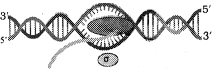
Which stage of the transcription process is shown in the figure below?
A
Elongation
B
Initiation
C
Termination
D
Both $B$ and $C$
Solution
(B) The provided figure shows the transcription process in bacteria.
In the figure, the $RNA$ polymerase enzyme is associated with the $\sigma$ factor.
The $\sigma$ factor is responsible for the initiation of transcription by recognizing the promoter site on the $DNA$ template.
Once the initiation is complete, the $\sigma$ factor dissociates from the $RNA$ polymerase, and the elongation process begins.
Therefore, the presence of the $\sigma$ factor clearly indicates the initiation stage of transcription.
In the figure, the $RNA$ polymerase enzyme is associated with the $\sigma$ factor.
The $\sigma$ factor is responsible for the initiation of transcription by recognizing the promoter site on the $DNA$ template.
Once the initiation is complete, the $\sigma$ factor dissociates from the $RNA$ polymerase, and the elongation process begins.
Therefore, the presence of the $\sigma$ factor clearly indicates the initiation stage of transcription.
0 likes
View Solution170
MediumMCQ
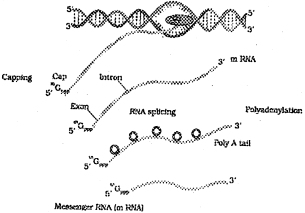
Which process is shown in the figure below?
A
Replication in prokaryotes
B
Transcription in prokaryotes
C
Replication in eukaryotes
D
Transcription in eukaryotes
Solution
(D) The figure illustrates the process of transcription in eukaryotes.
Key features shown include:
$1$. The presence of introns and exons in the primary transcript (pre-mRNA).
$2$. Post-transcriptional modifications such as Capping (addition of methyl guanosine triphosphate at the $5'$ end),$RNA$ splicing (removal of introns and joining of exons),and Polyadenylation (addition of a poly-$A$ tail at the $3'$ end).
These processes are characteristic of eukaryotic gene expression,as prokaryotes do not undergo such complex post-transcriptional processing.
Key features shown include:
$1$. The presence of introns and exons in the primary transcript (pre-mRNA).
$2$. Post-transcriptional modifications such as Capping (addition of methyl guanosine triphosphate at the $5'$ end),$RNA$ splicing (removal of introns and joining of exons),and Polyadenylation (addition of a poly-$A$ tail at the $3'$ end).
These processes are characteristic of eukaryotic gene expression,as prokaryotes do not undergo such complex post-transcriptional processing.
0 likes
View Solution171
EasyMCQ
Where is the $TATA$ box found?
A
$RNA$
B
Promoter
C
Structural gene
D
Terminator
Solution
(B) The $TATA$ box (also known as the $Goldberg-Hogness$ box) is a $DNA$ sequence found in the promoter region of genes in eukaryotes and archaea. It serves as a binding site for transcription factors and $RNA$ polymerase,playing a crucial role in the initiation of transcription.
0 likes
View Solution172
MediumMCQ
Transcription is most similar to which of the following processes?
A
Transposition
B
Translation
C
$DNA$ replication
D
Electrophoresis
Solution
(C) Transcription is the process of copying a segment of $DNA$ into $RNA$.
It is most similar to $DNA$ replication because both processes involve the synthesis of a new nucleic acid strand based on a template strand of $DNA$.
In both cases,the enzyme ($DNA$ polymerase in replication and $RNA$ polymerase in transcription) reads the template strand in the $3' \rightarrow 5'$ direction and synthesizes the new strand in the $5' \rightarrow 3'$ direction,following the principle of complementary base pairing.
It is most similar to $DNA$ replication because both processes involve the synthesis of a new nucleic acid strand based on a template strand of $DNA$.
In both cases,the enzyme ($DNA$ polymerase in replication and $RNA$ polymerase in transcription) reads the template strand in the $3' \rightarrow 5'$ direction and synthesizes the new strand in the $5' \rightarrow 3'$ direction,following the principle of complementary base pairing.
0 likes
View Solution173
MediumMCQ
What do the processes $1$ and $2$ represent in the following sequence?
$TAC \, AAG \, GCG \, AUA \, CGA$
$\downarrow (1)$
$AUG \, UUC \, CGC \, UAU \, GCU$
$\downarrow (2)$
$Met - Phe - Arg - Tyr - Ala$
$TAC \, AAG \, GCG \, AUA \, CGA$
$\downarrow (1)$
$AUG \, UUC \, CGC \, UAU \, GCU$
$\downarrow (2)$
$Met - Phe - Arg - Tyr - Ala$
A
$1-$Transcription,$2-$Translation
B
$1-$Replication,$2-$Translation
C
$1-$Translation,$2-$Transcription
D
$1-$Translation,$2-$Replication
Solution
(A) The given sequence shows the flow of genetic information from $DNA$ to protein.
Step $(1)$: The $DNA$ sequence $(TAC \, AAG \, GCG \, AUA \, CGA)$ is converted into an mRNA sequence $(AUG \, UUC \, CGC \, UAU \, GCU)$. This process of synthesizing mRNA from a $DNA$ template is known as Transcription.
Step $(2)$: The mRNA sequence is then decoded into a polypeptide chain of amino acids $(Met - Phe - Arg - Tyr - Ala)$. This process of protein synthesis from mRNA is known as Translation.
Therefore,process $(1)$ is Transcription and process $(2)$ is Translation.
Step $(1)$: The $DNA$ sequence $(TAC \, AAG \, GCG \, AUA \, CGA)$ is converted into an mRNA sequence $(AUG \, UUC \, CGC \, UAU \, GCU)$. This process of synthesizing mRNA from a $DNA$ template is known as Transcription.
Step $(2)$: The mRNA sequence is then decoded into a polypeptide chain of amino acids $(Met - Phe - Arg - Tyr - Ala)$. This process of protein synthesis from mRNA is known as Translation.
Therefore,process $(1)$ is Transcription and process $(2)$ is Translation.
0 likes
View Solution174
MediumMCQ
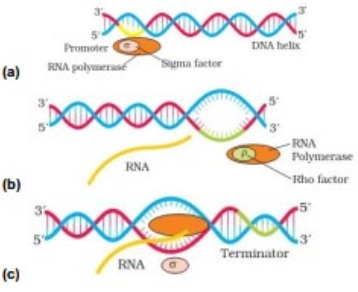
Identify $a, b$ and $c$ in the given process of transcription.
A
$(a)$ Elongation,$(b)$ Termination,$(c)$ Initiation
B
$(a)$ Initiation,$(b)$ Termination,$(c)$ Elongation
C
$(a)$ Initiation,$(b)$ Elongation,$(c)$ Termination
D
$(a)$ Termination,$(b)$ Elongation,$(c)$ Initiation
Solution
(C) The process of transcription in bacteria consists of three stages: Initiation, Elongation, and Termination.
$1$. In image $(a)$, the $RNA$ polymerase binds to the promoter region with the help of the sigma factor $(\sigma)$, which marks the initiation of transcription.
$2$. In image $(c)$, the $RNA$ polymerase moves along the $DNA$ template, facilitating the elongation of the $RNA$ chain.
$3$. In image $(b)$, the Rho factor $(\rho)$ binds to the $RNA$ polymerase at the terminator region, leading to the termination of transcription and the release of the nascent $RNA$.
$1$. In image $(a)$, the $RNA$ polymerase binds to the promoter region with the help of the sigma factor $(\sigma)$, which marks the initiation of transcription.
$2$. In image $(c)$, the $RNA$ polymerase moves along the $DNA$ template, facilitating the elongation of the $RNA$ chain.
$3$. In image $(b)$, the Rho factor $(\rho)$ binds to the $RNA$ polymerase at the terminator region, leading to the termination of transcription and the release of the nascent $RNA$.
0 likes
View Solution175
MediumMCQ
The coding strand of $DNA$ is :
$5'AATTCAAATTAGG3'$
What is the sequence of $mRNA$ ?
$5'AATTCAAATTAGG3'$
What is the sequence of $mRNA$ ?
A
$3'TTAAGTTTAATCC5'$
B
$5'AAUUCAAAUUAGG3'$
C
$3'AAUUCAAAUUAGG5'$
D
$5'TTAAGTTTAATCC3'$
Solution
(B) In the process of transcription,the coding strand of $DNA$ $(5' \to 3')$ has the same sequence as the $mRNA$ transcript,except that $Thymine$ $(T)$ is replaced by $Uracil$ $(U)$ in $RNA$.
Given coding strand: $5'AATTCAAATTAGG3'$.
Replacing $T$ with $U$,the $mRNA$ sequence is $5'AAUUCAAAUUAGG3'$.
Thus,the correct option is $(B)$.
Given coding strand: $5'AATTCAAATTAGG3'$.
Replacing $T$ with $U$,the $mRNA$ sequence is $5'AAUUCAAAUUAGG3'$.
Thus,the correct option is $(B)$.
0 likes
View Solution176
MediumMCQ
Choose the correct statement.
A
Transcription and translation occur in the same compartment for prokaryotes.
B
Monocistronic $RNA$ - more than one structural gene under a single promoter.
C
Introns and exons both code for protein synthesis.
D
In prokaryotes,splicing and tailing occur before translation.
Solution
(A) Prokaryotes are microscopic unicellular organisms that possess the simplest type of cellular organization.
In these cells,there is no nuclear membrane to separate the genetic material from the cytoplasm.
Therefore,the process of transcription (synthesis of $mRNA$ from $DNA$) and translation (synthesis of protein from $mRNA$) occurs in the same compartment,i.e.,the cytoplasm.
In these cells,there is no nuclear membrane to separate the genetic material from the cytoplasm.
Therefore,the process of transcription (synthesis of $mRNA$ from $DNA$) and translation (synthesis of protein from $mRNA$) occurs in the same compartment,i.e.,the cytoplasm.
0 likes
View Solution177
MediumMCQ
$mRNA$ is formed by
A
Translation
B
Transcription
C
Duplication
D
Capping
Solution
(B) The messenger $RNA$ or $mRNA$ is synthesized by the process of transcription. In this process,the genetic information from $DNA$ is copied into $mRNA$.
0 likes
View Solution178
MediumMCQ
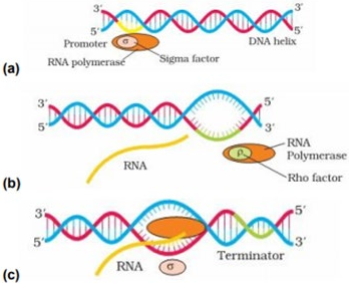
Identify $a, b$ and $c$ based on the provided image of the transcription process.
A
$(a)$ Elongation, $(b)$ Termination, $(c)$ Initiation
B
$(a)$ Initiation, $(b)$ Termination, $(c)$ Elongation
C
$(a)$ Initiation, $(b)$ Elongation, $(c)$ Termination
D
$(a)$ Termination, $(b)$ Elongation, $(c)$ Initiation
Solution
(C) The process of transcription in bacteria occurs in three stages: initiation, elongation, and termination.
$1$. In stage $(a)$, the $RNA$ polymerase enzyme binds to the promoter region with the help of the sigma factor $(\sigma)$, marking the initiation of transcription.
$2$. In stage $(b)$, the $RNA$ polymerase moves along the $DNA$ template, facilitating the elongation of the $RNA$ chain.
$3$. In stage $(c)$, the $RNA$ polymerase reaches the terminator region, where the rho factor $(\rho)$ helps in the termination of transcription and the release of the nascent $RNA$ strand.
$1$. In stage $(a)$, the $RNA$ polymerase enzyme binds to the promoter region with the help of the sigma factor $(\sigma)$, marking the initiation of transcription.
$2$. In stage $(b)$, the $RNA$ polymerase moves along the $DNA$ template, facilitating the elongation of the $RNA$ chain.
$3$. In stage $(c)$, the $RNA$ polymerase reaches the terminator region, where the rho factor $(\rho)$ helps in the termination of transcription and the release of the nascent $RNA$ strand.
0 likes
View Solution179
MediumMCQ
Methyl guanosine triphosphate is added at the $5'$ end of $hn-RNA$ in a process of:
A
tailing
B
splicing
C
capping
D
None of these
Solution
(C) In the process of capping,an unusual nucleotide,$7$-methyl guanosine triphosphate,is added to the $5'$ end of $hn-RNA$.
This modification protects the $RNA$ from degradation by exonucleases and helps in the recognition of the ribosome during translation.
Therefore,the addition of methyl guanosine triphosphate at the $5'$ end is known as capping.
This modification protects the $RNA$ from degradation by exonucleases and helps in the recognition of the ribosome during translation.
Therefore,the addition of methyl guanosine triphosphate at the $5'$ end is known as capping.
0 likes
View Solution180
EasyMCQ
Segments of $mRNA$ removed during splicing are called......
A
introns
B
exons
C
promotor regions
D
integrator regions
Solution
(A) During the process of $RNA$ splicing,the non-coding sequences known as introns are removed from the primary transcript $(hnRNA)$.
The remaining coding sequences,known as exons,are then joined together in a defined order to form mature $mRNA$.
The remaining coding sequences,known as exons,are then joined together in a defined order to form mature $mRNA$.
0 likes
View Solution181
MediumMCQ
In eukaryotes,$mRNA$ is synthesized with the aid of
A
$RNA$ polymerase $III$
B
$RNA$ polymerase $II$
C
$RNA$ polymerase $I$
D
Reverse transcriptase
Solution
(B) In eukaryotes,there are three main types of $RNA$ polymerases involved in transcription:
$1$. $RNA$ polymerase $I$ transcribes $rRNA$ ($28S, 18S,$ and $5.8S$).
$2$. $RNA$ polymerase $II$ transcribes the precursor of $mRNA$,which is known as heterogeneous nuclear $RNA$ $(hnRNA)$.
$3$. $RNA$ polymerase $III$ transcribes $tRNA$,$5S$ $rRNA$,and $snRNA$ (small nuclear $RNA$s).
Since $mRNA$ is synthesized from $hnRNA$ (the product of $RNA$ polymerase $II$),the correct enzyme is $RNA$ polymerase $II$.
$1$. $RNA$ polymerase $I$ transcribes $rRNA$ ($28S, 18S,$ and $5.8S$).
$2$. $RNA$ polymerase $II$ transcribes the precursor of $mRNA$,which is known as heterogeneous nuclear $RNA$ $(hnRNA)$.
$3$. $RNA$ polymerase $III$ transcribes $tRNA$,$5S$ $rRNA$,and $snRNA$ (small nuclear $RNA$s).
Since $mRNA$ is synthesized from $hnRNA$ (the product of $RNA$ polymerase $II$),the correct enzyme is $RNA$ polymerase $II$.
0 likes
View Solution182
MediumMCQ
Identify the incorrect statement.
A
In prokaryotes,the structural gene is polycistronic.
B
In eukaryotes,structural genes have interrupted coding sequences.
C
Eukaryotes have split gene arrangement.
D
Intervening sequences appear in mature $RNA$.
Solution
(D) In eukaryotes,the primary transcript contains both exons (coding sequences) and introns (intervening sequences). During the process of splicing,introns are removed and exons are joined together to form mature $RNA$. Therefore,intervening sequences (introns) do not appear in mature $RNA$.
0 likes
View Solution183
MediumMCQ
Find out the incorrect statement.
A
Uracil is present in $RNA$ at the place of thymine.
B
The complex of $DNA$ and protein in chromosome is called chromatin.
C
Heterochromatin is the most highly condensed form of chromatin.
D
The process involved in the $RNA$ formation on the $DNA$ template is called replication.
Solution
(D) The process of forming $RNA$ from a $DNA$ template is known as transcription,not replication. Replication is the process of $DNA$ synthesis from a $DNA$ template.
0 likes
View Solution184
MediumMCQ
Which of the following statements are correct?
$i. r-RNA$ provides the template for synthesis of proteins.
$ii. t-RNA$ brings amino acids and reads the genetic code.
$iii. RNA$ polymerase binds to promoter and initiates transcription.
$iv. A$ segment of $DNA$ coding for a polypeptide is called an intron.
$i. r-RNA$ provides the template for synthesis of proteins.
$ii. t-RNA$ brings amino acids and reads the genetic code.
$iii. RNA$ polymerase binds to promoter and initiates transcription.
$iv. A$ segment of $DNA$ coding for a polypeptide is called an intron.
A
$(i) \text{ and } (iii)$
B
$(i) \text{ and } (ii)$
C
$(i), (ii) \text{ and } (iii)$
D
$(ii) \text{ and } (iii)$
Solution
(D) $mRNA$ (messenger $RNA$) provides the template for the synthesis of proteins,not $r-RNA$. Therefore,statement $i$ is incorrect.
$t-RNA$ (transfer $RNA$) acts as an adapter molecule that brings specific amino acids to the ribosome and reads the genetic code on the $mRNA$ template. Therefore,statement $ii$ is correct.
$RNA$ polymerase is the enzyme that binds to the promoter region of the $DNA$ to initiate the process of transcription. Therefore,statement $iii$ is correct.
$A$ segment of $DNA$ that codes for a polypeptide is called an exon,while non-coding sequences are called introns. Therefore,statement $iv$ is incorrect.
Thus,statements $ii$ and $iii$ are correct.
$t-RNA$ (transfer $RNA$) acts as an adapter molecule that brings specific amino acids to the ribosome and reads the genetic code on the $mRNA$ template. Therefore,statement $ii$ is correct.
$RNA$ polymerase is the enzyme that binds to the promoter region of the $DNA$ to initiate the process of transcription. Therefore,statement $iii$ is correct.
$A$ segment of $DNA$ that codes for a polypeptide is called an exon,while non-coding sequences are called introns. Therefore,statement $iv$ is incorrect.
Thus,statements $ii$ and $iii$ are correct.
0 likes
View Solution185
MediumMCQ
Which of the following statements about $RNA$ polymerase are correct?
$i. \;RNA\; \text{polymerase } I \text{ transcribes } rRNAs.$
$ii. \;RNA \; \text{polymerase } II \text{ transcribes } snRNAs.$
$iii. \;RNA \; \text{polymerase } III \text{ transcribes } hnRNA.$
$iv. \;RNA \; \text{polymerase } II \text{ transcribes } hnRNAs.$
$i. \;RNA\; \text{polymerase } I \text{ transcribes } rRNAs.$
$ii. \;RNA \; \text{polymerase } II \text{ transcribes } snRNAs.$
$iii. \;RNA \; \text{polymerase } III \text{ transcribes } hnRNA.$
$iv. \;RNA \; \text{polymerase } II \text{ transcribes } hnRNAs.$
A
$(i) \text{ and } (ii)$
B
$(i) \text{ and } (iii)$
C
$(ii) \text{ and } (iii)$
D
$(i) \text{ and } (iv)$
Solution
(D) In eukaryotes, there are three types of $RNA$ polymerases:
$1$. $RNA$ polymerase $I$ transcribes $rRNAs$ $(28S, 18S, \text{ and } 5.8S)$.
$2$. $RNA$ polymerase $II$ transcribes the precursor of $mRNA$, called heterogeneous nuclear $RNA$ $(hnRNA)$.
$3$. $RNA$ polymerase $III$ is responsible for the transcription of $tRNA$, $5sRNA$, and small nuclear $RNAs$ $(snRNAs)$.
Therefore, statements $(i)$ and $(iv)$ are correct.
$1$. $RNA$ polymerase $I$ transcribes $rRNAs$ $(28S, 18S, \text{ and } 5.8S)$.
$2$. $RNA$ polymerase $II$ transcribes the precursor of $mRNA$, called heterogeneous nuclear $RNA$ $(hnRNA)$.
$3$. $RNA$ polymerase $III$ is responsible for the transcription of $tRNA$, $5sRNA$, and small nuclear $RNAs$ $(snRNAs)$.
Therefore, statements $(i)$ and $(iv)$ are correct.
0 likes
View Solution186
EasyMCQ
$RNA$ polymerases used for the transcription of genes require a template.
A
$rRNA$
B
$DNA$
C
$RNA$
D
$mRNA$
Solution
(B) Transcription is the process of copying genetic information from one strand of the $DNA$ into $RNA$.
$RNA$ polymerase is the primary enzyme responsible for this process.
During transcription,$RNA$ polymerase uses a $DNA$ strand as a template to synthesize a complementary $RNA$ molecule.
Therefore,the template required for the transcription of genes is $DNA$.
$RNA$ polymerase is the primary enzyme responsible for this process.
During transcription,$RNA$ polymerase uses a $DNA$ strand as a template to synthesize a complementary $RNA$ molecule.
Therefore,the template required for the transcription of genes is $DNA$.
0 likes
View Solution187
MediumMCQ
During elongation of the polypeptide chain, the sigma factor is
A
functionless
B
retained for specific function
C
released for re-use
D
required during closing of the chain
Solution
(A) The sigma factor $\sigma$ is a subunit of the $RNA$ polymerase holoenzyme. Its primary role is to recognize the promoter site on the $DNA$ template to initiate transcription. Once the transcription process moves from the initiation phase to the elongation phase, the sigma factor dissociates from the $RNA$ polymerase core enzyme. Therefore, during the elongation of the polypeptide chain, the sigma factor is functionless in the context of the elongation complex.
0 likes
View Solution188
MediumMCQ
Transcription:
A
starts at initiator region and ends at stop region.
B
starts at operator region and ends at telomeric end.
C
starts at promoter region and ends at terminator region.
D
starts at $CAAT$ box and ends at $TATA$ box.
Solution
(C) The process of synthesizing $RNA$ from a $DNA$ template is known as transcription.
In a transcription unit,the process begins at the $promoter$ region,which provides the binding site for $RNA$ polymerase.
The process concludes at the $terminator$ region,where the $RNA$ polymerase detaches from the $DNA$ template.
The enzyme primarily responsible for transcribing structural genes in eukaryotes is $RNA$ polymerase-$II$.
In a transcription unit,the process begins at the $promoter$ region,which provides the binding site for $RNA$ polymerase.
The process concludes at the $terminator$ region,where the $RNA$ polymerase detaches from the $DNA$ template.
The enzyme primarily responsible for transcribing structural genes in eukaryotes is $RNA$ polymerase-$II$.
0 likes
View Solution189
MediumMCQ
$A$ geneticist isolates a gene for a specific trait under study; she also isolates the corresponding $mRNA$. Upon comparison,the $mRNA$ is found to contain $1,000$ fewer bases than the $DNA$ sequence. Did the geneticist isolate the wrong $DNA$?
A
Yes,$mRNA$ is made from a $DNA$ template and should be the same length as the gene sequence.
B
Yes,the $mRNA$ should contain more bases than the $DNA$ sequence because bases flanking the gene are also transcribed.
C
No,the final $mRNA$ contains only exons; the introns were removed.
D
No,the $mRNA$ was partially degraded after it was transcribed.
Solution
(C) The $mRNA$ formed after the transcription of a eukaryotic gene is shorter than the $DNA$ sequence because the gene contains non-coding sequences called introns.
During the process of post-transcriptional modification,these introns are removed through a process known as splicing,and the coding sequences called exons are joined together.
Therefore,the mature $mRNA$ is significantly shorter than the original $DNA$ template.
During the process of post-transcriptional modification,these introns are removed through a process known as splicing,and the coding sequences called exons are joined together.
Therefore,the mature $mRNA$ is significantly shorter than the original $DNA$ template.
0 likes
View Solution190
MediumMCQ
$A$ $DNA$ strand with the sequence $AACGTAACG$ is transcribed. What is the sequence of the $mRNA$ molecule synthesized?
A
$AACGTAACG$
B
$UUGCAUUGC$
C
$AACGUAACG$
D
$TTGCATTGC$
Solution
(B) During the process of transcription,the $DNA$ template strand is used to synthesize a complementary $mRNA$ strand.
In $RNA$,uracil $(U)$ replaces thymine $(T)$ found in $DNA$.
The base pairing rules are as follows:
$A$ (Adenine) in $DNA$ pairs with $U$ (Uracil) in $mRNA$.
$T$ (Thymine) in $DNA$ pairs with $A$ (Adenine) in $mRNA$.
$C$ (Cytosine) in $DNA$ pairs with $G$ (Guanine) in $mRNA$.
$G$ (Guanine) in $DNA$ pairs with $C$ (Cytosine) in $mRNA$.
Given the $DNA$ sequence $AACGTAACG$:
$A \rightarrow U$
$A \rightarrow U$
$C \rightarrow G$
$G \rightarrow C$
$T \rightarrow A$
$A \rightarrow U$
$A \rightarrow U$
$C \rightarrow G$
$G \rightarrow C$
Therefore,the resulting $mRNA$ sequence is $UUGCAUUGC$.
In $RNA$,uracil $(U)$ replaces thymine $(T)$ found in $DNA$.
The base pairing rules are as follows:
$A$ (Adenine) in $DNA$ pairs with $U$ (Uracil) in $mRNA$.
$T$ (Thymine) in $DNA$ pairs with $A$ (Adenine) in $mRNA$.
$C$ (Cytosine) in $DNA$ pairs with $G$ (Guanine) in $mRNA$.
$G$ (Guanine) in $DNA$ pairs with $C$ (Cytosine) in $mRNA$.
Given the $DNA$ sequence $AACGTAACG$:
$A \rightarrow U$
$A \rightarrow U$
$C \rightarrow G$
$G \rightarrow C$
$T \rightarrow A$
$A \rightarrow U$
$A \rightarrow U$
$C \rightarrow G$
$G \rightarrow C$
Therefore,the resulting $mRNA$ sequence is $UUGCAUUGC$.
0 likes
View Solution191
MediumMCQ
What sequence on the template strand of $DNA$ corresponds to the first amino acid inserted into a protein?
A
$TAC$
B
$UAC$
C
$UAG$
D
$AUG$
Solution
(A) The process of protein synthesis begins with the initiation codon $AUG$ on the $mRNA$ strand,which codes for the amino acid methionine.
Since the $mRNA$ is synthesized from the template strand of $DNA$ through complementary base pairing,the $DNA$ sequence must be complementary to $AUG$.
In $DNA$,$A$ pairs with $T$ and $U$ (which is $T$ in $DNA$) pairs with $A$,and $G$ pairs with $C$.
Therefore,the $DNA$ template sequence corresponding to $AUG$ is $TAC$.
Since the $mRNA$ is synthesized from the template strand of $DNA$ through complementary base pairing,the $DNA$ sequence must be complementary to $AUG$.
In $DNA$,$A$ pairs with $T$ and $U$ (which is $T$ in $DNA$) pairs with $A$,and $G$ pairs with $C$.
Therefore,the $DNA$ template sequence corresponding to $AUG$ is $TAC$.
0 likes
View Solution192
EasyMCQ
Out of the two strands of $DNA$,one is carrying genetic information for transcription and it is called:
A
Coding strand
B
Non-template strand
C
Sense strand
D
Template strand
Solution
(D) During the process of transcription,only one of the two strands of $DNA$ is copied into $RNA$. This strand,which acts as a template for the synthesis of $RNA$ by $RNA$ polymerase,is known as the template strand. It is also referred to as the antisense strand or the non-coding strand. The other strand,which has the same sequence as the $RNA$ (except for $U$ instead of $T$),is called the coding strand or sense strand.
0 likes
View Solution193
MediumMCQ
When a mature $mRNA$ was hybridized to its gene,certain loops were observed. These loops represent:
A
Introns in $DNA$
B
Introns in $rRNA$
C
Exons in $tRNA$
D
Exons in $DNA$
Solution
(A) In eukaryotic genes,the coding sequences are interrupted by non-coding sequences called introns. During transcription,the entire gene is transcribed into $pre-mRNA$. The introns are removed during splicing to form mature $mRNA$. When mature $mRNA$ is hybridized with its template $DNA$ strand,the $DNA$ regions corresponding to the introns do not find complementary sequences in the $mRNA$ and thus form single-stranded loops. Therefore,these loops represent the introns present in the $DNA$.
0 likes
View Solution194
MediumMCQ
Poly $A$ tail is present in
A
$mRNA$ of bacteria
B
$tRNA$ of eukaryotes
C
Promotor of bacteria
D
$mRNA$ of eukaryotes
Solution
(D) In eukaryotes,the primary transcript (pre-$mRNA$) undergoes post-transcriptional modifications.
One of these modifications is polyadenylation,where a poly-$A$ tail (consisting of $200-300$ adenine residues) is added to the $3'$ end of the $mRNA$ molecule.
This tail protects the $mRNA$ from degradation and assists in its export from the nucleus to the cytoplasm.
Therefore,the poly-$A$ tail is a characteristic feature of eukaryotic $mRNA$.
One of these modifications is polyadenylation,where a poly-$A$ tail (consisting of $200-300$ adenine residues) is added to the $3'$ end of the $mRNA$ molecule.
This tail protects the $mRNA$ from degradation and assists in its export from the nucleus to the cytoplasm.
Therefore,the poly-$A$ tail is a characteristic feature of eukaryotic $mRNA$.
0 likes
View Solution195
EasyMCQ
In eukaryotes,$RNA$ polymerase $III$ catalyses the synthesis of
A
$5S rRNA, tRNA \& SnRNA$
B
$mRNA, HnRNA \& SnRNA$
C
$28S rRNA, 18S rRNA \& 5S rRNA$
D
All types of $rRNA \& tRNA$
Solution
(A) In eukaryotic cells,there are three types of $RNA$ polymerases. $RNA$ polymerase $I$ transcribes $rRNAs$ ($28S, 18S,$ and $5.8S$). $RNA$ polymerase $II$ transcribes the precursor of $mRNA$,which is $hnRNA$. $RNA$ polymerase $III$ is responsible for the transcription of $tRNA$,$5S rRNA$,and $snRNA$ (small nuclear $RNA$).
0 likes
View Solution196
EasyMCQ
In eukaryotes,the $RNA$ polymerase that synthesises $tRNA$ is $RNA$ polymerase . . . . . . and is also responsible for formation of . . . . . . $rRNA$.
A
$II, 5.8 S$
B
$I, 5 S$
C
$III, 5 S$
D
$II, 18 S$
Solution
(C) In eukaryotes,there are three types of $RNA$ polymerases in the nucleus:
$1$. $RNA$ polymerase $I$ transcribes $rRNA$ ($28S, 18S,$ and $5.8S$).
$2$. $RNA$ polymerase $II$ transcribes precursor of $mRNA$,the heterogeneous nuclear $RNA$ $(hnRNA)$.
$3$. $RNA$ polymerase $III$ is responsible for the transcription of $tRNA$,$5S$ $rRNA$,and $snRNA$ (small nuclear $RNA$).
Therefore,$RNA$ polymerase $III$ synthesizes $tRNA$ and $5S$ $rRNA$.
$1$. $RNA$ polymerase $I$ transcribes $rRNA$ ($28S, 18S,$ and $5.8S$).
$2$. $RNA$ polymerase $II$ transcribes precursor of $mRNA$,the heterogeneous nuclear $RNA$ $(hnRNA)$.
$3$. $RNA$ polymerase $III$ is responsible for the transcription of $tRNA$,$5S$ $rRNA$,and $snRNA$ (small nuclear $RNA$).
Therefore,$RNA$ polymerase $III$ synthesizes $tRNA$ and $5S$ $rRNA$.
0 likes
View Solution197
MediumMCQ
What is correct for bacterial transcription?
A
$mRNA$ requires processing to become active
B
Translation can begin when $mRNA$ is fully transcribed
C
Transcription and translation take place in the same compartment
D
$Rho$ factor initiates the process
Solution
(C) In bacteria,transcription and translation occur in the same compartment,which is the cytoplasm. Because there is no nuclear membrane separating the genetic material from the ribosomes,translation can begin even before the $mRNA$ is fully transcribed. This process is known as coupled transcription and translation.
0 likes
View Solution198
MediumMCQ
Which of the following is not required during post-transcriptional processing in eukaryotes?
A
Methyl guanosine triphosphate
B
Ligase
C
$ScRNA$
D
$SnRNA$
Solution
(C) Post-transcriptional processing in eukaryotes involves capping,tailing,and splicing.
$1$. Capping requires Methyl guanosine triphosphate.
$2$. Splicing is mediated by the spliceosome complex,which consists of $SnRNA$ (Small nuclear $RNA$) and proteins.
$3$. Ligase is required for joining the exons after splicing.
$4$. $ScRNA$ (Small cytoplasmic $RNA$) is involved in protein trafficking and secretion,not in the processing of pre-$mRNA$ within the nucleus.
$1$. Capping requires Methyl guanosine triphosphate.
$2$. Splicing is mediated by the spliceosome complex,which consists of $SnRNA$ (Small nuclear $RNA$) and proteins.
$3$. Ligase is required for joining the exons after splicing.
$4$. $ScRNA$ (Small cytoplasmic $RNA$) is involved in protein trafficking and secretion,not in the processing of pre-$mRNA$ within the nucleus.
0 likes
View Solution199
MediumMCQ
If there are $81$ million bases in the $RNA$ of a human cell,calculate the total number of introns present in $cDNA$.
A
$27$ million
B
Zero
C
Equal to ribonucleotides
D
Half the number of ribonucleotides
Solution
(B) The term $cDNA$ stands for complementary $DNA$,which is synthesized from mature $mRNA$ using the enzyme reverse transcriptase.
Mature $mRNA$ has already undergone the process of splicing,during which all non-coding sequences known as introns are removed.
Since $cDNA$ is synthesized from this processed $mRNA$ template,it contains only exons and lacks any introns.
Therefore,the number of introns present in $cDNA$ is $0$.
Mature $mRNA$ has already undergone the process of splicing,during which all non-coding sequences known as introns are removed.
Since $cDNA$ is synthesized from this processed $mRNA$ template,it contains only exons and lacks any introns.
Therefore,the number of introns present in $cDNA$ is $0$.
0 likes
View Solution200
MediumMCQ
Splicing is necessary for preparing a mature transcript and its movement to the cytoplasm. It requires:
A
$scRNA$ and proteins
B
$snRNA$ and proteins
C
$scRNA$ and $snRNA$
D
$scRNA$ only
Solution
(B) Splicing is the process of removing introns and joining exons in a primary transcript (pre-mRNA) to form a mature mRNA.
This process is catalyzed by a large complex called the spliceosome.
The spliceosome is composed of small nuclear ribonucleoproteins $(snRNPs)$.
Each $snRNP$ consists of small nuclear $RNA$ $(snRNA)$ molecules and a specific set of proteins.
Therefore,$snRNA$ and proteins are essential for the splicing process.
This process is catalyzed by a large complex called the spliceosome.
The spliceosome is composed of small nuclear ribonucleoproteins $(snRNPs)$.
Each $snRNP$ consists of small nuclear $RNA$ $(snRNA)$ molecules and a specific set of proteins.
Therefore,$snRNA$ and proteins are essential for the splicing process.
0 likes
View SolutionMolecular Basis of Inheritance — Transcription · Frequently Asked Questions
1Are these Molecular Basis of Inheritance questions useful for JEE and NEET?
Yes. All questions in this section are mapped to JEE Main and NEET exam patterns. Previous year questions from JEE Main, NEET, GUJCET and state-level exams are included with full solutions.
2Can I switch to Hindi or Gujarati for these questions?
Yes. Use the language tabs in the hero section or the sidebar to view the same questions and solutions in English, Hindi or Gujarati.
3How do I generate a question paper from this subtopic?
Use the Vedclass Exam Paper Generator — select the chapter and subtopic, set difficulty, and generate Sets A, B, C, D automatically. First 3 chapters of every subject are free.
Vedclass Products
For Students
Vedclass Test Series
Mock tests in real JEE/NEET style with performance analysis. 5-day free trial.
Start Free TrialFor Teachers
Exam Paper Generator
Generate Set A/B/C/D papers from this chapter in 2 minutes. 3 chapters free.
Try FreeFor Institutes
Online Exam Module
Live online exams with unlimited students, 360° analytics & white-label branding.
See DemoFor Teachers & Institutes
Generate a Molecular Basis of Inheritance Exam Paper in 2 Minutes
Select subtopic & difficulty — Sets A, B, C, D auto-generated with No Repeat logic.
First 3 chapters of every subject are free — no payment required.