
A English
Transcription Questions in English
Class 12 Biology · Molecular Basis of Inheritance · Transcription
277+
Questions
English
Language
100%
With Solutions
Showing 50 of 277 questions in English
101
DifficultMCQ
$AGGTATCGCAT$ is a sequence from the coding strand of a gene. What will be the corresponding sequence of the transcribed $mRNA$?
A
$AGGUAUCGCAU$
B
$UCCAUAGCGUA$
C
$ACCUAUGCGAU$
D
$UGGTUTCGCAT$
Solution
(A) The coding strand of a gene has the same sequence as the $mRNA$ except that $Thymine$ $(T)$ in $DNA$ is replaced by $Uracil$ $(U)$ in $RNA$.
Given coding strand sequence: $AGGTATCGCAT$.
Replacing $T$ with $U$ gives the $mRNA$ sequence: $AGGUAUCGCAU$.
Therefore,the correct option is $A$.
Given coding strand sequence: $AGGTATCGCAT$.
Replacing $T$ with $U$ gives the $mRNA$ sequence: $AGGUAUCGCAU$.
Therefore,the correct option is $A$.
0 likes
View Solution102
EasyMCQ
The $TATA$ box of a eukaryotic promoter lies:
A
about $25$ $bp$ upstream of the transcription start site.
B
about $50$ $bp$ upstream of the transcription start site.
C
about $75$ $bp$ upstream of the transcription start site.
D
about $200$ $bp$ upstream of the transcription start site.
Solution
(A) The $TATA$ box,also known as the $Goldberg-Hogness$ box,is a $DNA$ sequence found in the promoter region of genes in eukaryotes and archaea.
It is typically located approximately $25$ base pairs $(bp)$ upstream of the transcription start site.
This sequence serves as the binding site for transcription factors and $RNA$ polymerase $II$,playing a crucial role in the initiation of transcription.
It is typically located approximately $25$ base pairs $(bp)$ upstream of the transcription start site.
This sequence serves as the binding site for transcription factors and $RNA$ polymerase $II$,playing a crucial role in the initiation of transcription.
0 likes
View Solution103
MediumMCQ
Select the correct option regarding the direction of $RNA$ synthesis and the direction of reading of the template $DNA$ strand:
A
$5'-3'$ and $3'-5'$
B
$3'-5'$ and $5'-3'$
C
$5'-3'$ and $5'-3'$
D
$3'-5'$ and $3'-5'$
Solution
(A) During the process of transcription,$RNA$ polymerase catalyzes the synthesis of $RNA$ in the $5'-3'$ direction.
This means that the new $RNA$ strand is synthesized by adding nucleotides to the $3'$ end.
To achieve this,the $RNA$ polymerase enzyme moves along the template $DNA$ strand in the $3'-5'$ direction.
Therefore,the direction of $RNA$ synthesis is $5'-3'$ and the direction of reading the template $DNA$ strand is $3'-5'$.
This means that the new $RNA$ strand is synthesized by adding nucleotides to the $3'$ end.
To achieve this,the $RNA$ polymerase enzyme moves along the template $DNA$ strand in the $3'-5'$ direction.
Therefore,the direction of $RNA$ synthesis is $5'-3'$ and the direction of reading the template $DNA$ strand is $3'-5'$.
0 likes
View Solution104
DifficultMCQ
What will be the sequence of $mRNA$ produced by the following stretch of $DNA$?
$3' ATGCATGCATGCATG 5'$ $TEMPLATE$ $STRAND$
$5' TACGTACGTACGTAC 3'$ $CODING$ $STRAND$
$3' ATGCATGCATGCATG 5'$ $TEMPLATE$ $STRAND$
$5' TACGTACGTACGTAC 3'$ $CODING$ $STRAND$
A
$3' AUGCAUGCAUGCAUG 5'$
B
$5' UACGUACGUACGUAC 3'$
C
$3' UACGUACGUACGUAC 5'$
D
$5' AUGCAUGCAUGCAUG 3'$
Solution
(D) During the process of transcription,$mRNA$ is synthesized using the template strand of $DNA$ ($3' \rightarrow 5'$ direction) as a reference.
According to the base-pairing rules,$A$ pairs with $U$,$T$ pairs with $A$,$G$ pairs with $C$,and $C$ pairs with $G$.
The template strand is $3' ATGCATGCATGCATG 5'$.
By applying the base-pairing rules,the complementary $mRNA$ sequence is $5' UACGUACGUACGUAC 3'$.
This sequence is identical to the coding strand,except that $Thymine$ $(T)$ is replaced by $Uracil$ $(U)$.
According to the base-pairing rules,$A$ pairs with $U$,$T$ pairs with $A$,$G$ pairs with $C$,and $C$ pairs with $G$.
The template strand is $3' ATGCATGCATGCATG 5'$.
By applying the base-pairing rules,the complementary $mRNA$ sequence is $5' UACGUACGUACGUAC 3'$.
This sequence is identical to the coding strand,except that $Thymine$ $(T)$ is replaced by $Uracil$ $(U)$.
0 likes
View Solution105
DifficultMCQ
Match the following $RNA$ polymerase enzymes with their transcribed products:
Select the correct option from the following:
| $(a) \; RNA$ polymerase $I$ | $(i) \; tRNA$ |
| $(b) \; RNA$ polymerase $II$ | $(ii) \; rRNA$ |
| $(c) \; RNA$ polymerase $III$ | $(iii) \; hnRNA$ |
Select the correct option from the following:
A
$a-i, b-iii, c-ii$
B
$a-i, b-ii, c-iii$
C
$a-ii, b-iii, c-i$
D
$a-iii, b-ii, c-i$
Solution
(C) In eukaryotes, there are three main types of $RNA$ polymerases involved in transcription:
$1$. $RNA$ polymerase $I$ transcribes $rRNA$ ($28S, 18S,$ and $5.8S$).
$2$. $RNA$ polymerase $II$ transcribes the precursor of $mRNA$, which is called heterogeneous nuclear $RNA$ $(hnRNA)$.
$3$. $RNA$ polymerase $III$ is responsible for the transcription of $tRNA$, $5S$ $rRNA$, and $snRNA$ (small nuclear $RNA$).
Matching these:
$(a) \; RNA$ polymerase $I$ $\rightarrow$ $(ii) \; rRNA$
$(b) \; RNA$ polymerase $II$ $\rightarrow$ $(iii) \; hnRNA$
$(c) \; RNA$ polymerase $III$ $\rightarrow$ $(i) \; tRNA$
Thus, the correct matching is $a-ii, b-iii, c-i$.
$1$. $RNA$ polymerase $I$ transcribes $rRNA$ ($28S, 18S,$ and $5.8S$).
$2$. $RNA$ polymerase $II$ transcribes the precursor of $mRNA$, which is called heterogeneous nuclear $RNA$ $(hnRNA)$.
$3$. $RNA$ polymerase $III$ is responsible for the transcription of $tRNA$, $5S$ $rRNA$, and $snRNA$ (small nuclear $RNA$).
Matching these:
$(a) \; RNA$ polymerase $I$ $\rightarrow$ $(ii) \; rRNA$
$(b) \; RNA$ polymerase $II$ $\rightarrow$ $(iii) \; hnRNA$
$(c) \; RNA$ polymerase $III$ $\rightarrow$ $(i) \; tRNA$
Thus, the correct matching is $a-ii, b-iii, c-i$.
0 likes
View Solution106
MediumMCQ
In the process of transcription in Eukaryotes,the $RNA$ polymerase $I$ transcribes
A
$mRNA$ with additional processing,capping and tailing
B
$tRNA, 5S rRNA$ and $snRNAs$
C
$rRNAs$ ($28S, 18S$ and $5.8S$)
D
Precursor of $mRNA$ $(hnRNA)$
Solution
(C) In eukaryotes,there are three types of $RNA$ polymerases involved in transcription:
$1$. $RNA$ polymerase $I$ transcribes $rRNAs$ ($28S, 18S,$ and $5.8S$).
$2$. $RNA$ polymerase $II$ transcribes the precursor of $mRNA$,which is known as heterogeneous nuclear $RNA$ $(hnRNA)$.
$3$. $RNA$ polymerase $III$ is responsible for the transcription of $tRNA$,$5S rRNA$,and $snRNAs$ (small nuclear $RNAs$).
$1$. $RNA$ polymerase $I$ transcribes $rRNAs$ ($28S, 18S,$ and $5.8S$).
$2$. $RNA$ polymerase $II$ transcribes the precursor of $mRNA$,which is known as heterogeneous nuclear $RNA$ $(hnRNA)$.
$3$. $RNA$ polymerase $III$ is responsible for the transcription of $tRNA$,$5S rRNA$,and $snRNAs$ (small nuclear $RNAs$).
0 likes
View Solution107
MediumMCQ
What initiation and termination factors are involved in transcription in Eukaryotes?
A
$\alpha$ and $\sigma,$ respectively
B
$\alpha$ and $\beta,$ respectively
C
$\beta$ and $\gamma,$ respectively
D
$\sigma$ and $\rho,$ respectively
Solution
(D) In prokaryotes,the $RNA$ polymerase enzyme requires a sigma $(\sigma)$ factor for the initiation of transcription and a rho $(\rho)$ factor for the termination of transcription.
However,the question asks about eukaryotes. In eukaryotes,transcription is more complex and involves three different $RNA$ polymerases ($I$,$II$,and $III$) and various transcription factors (TFs) rather than simple sigma or rho factors.
Given the options provided,this question is technically referring to the prokaryotic mechanism of transcription,as these specific factors ($\sigma$ and $\rho$) are not the primary initiation and termination factors in eukaryotes.
Assuming the question intends to identify the factors for prokaryotic transcription,the correct answer is $\sigma$ (initiation) and $\rho$ (termination).
However,the question asks about eukaryotes. In eukaryotes,transcription is more complex and involves three different $RNA$ polymerases ($I$,$II$,and $III$) and various transcription factors (TFs) rather than simple sigma or rho factors.
Given the options provided,this question is technically referring to the prokaryotic mechanism of transcription,as these specific factors ($\sigma$ and $\rho$) are not the primary initiation and termination factors in eukaryotes.
Assuming the question intends to identify the factors for prokaryotic transcription,the correct answer is $\sigma$ (initiation) and $\rho$ (termination).
0 likes
View Solution108
Medium
If the sequence of the coding strand in a transcription unit is written as follows:
$5'-ATGCATGCATGCATGCATGCATGCATGC-3'$. Write down the sequence of $mRNA$.
$5'-ATGCATGCATGCATGCATGCATGCATGC-3'$. Write down the sequence of $mRNA$.
Solution
(N/A) The coding strand of $DNA$ has the same sequence as the $mRNA$ transcript,except that $Thymine$ $(T)$ in $DNA$ is replaced by $Uracil$ $(U)$ in $RNA$.
Given coding strand: $5'-ATGCATGCATGCATGCATGCATGCATGC-3'$.
By replacing $T$ with $U$,the $mRNA$ sequence is:
$5'-AUGCAUGCAUGCAUGCAUGCAUGCAUGC-3'$.
Given coding strand: $5'-ATGCATGCATGCATGCATGCATGCATGC-3'$.
By replacing $T$ with $U$,the $mRNA$ sequence is:
$5'-AUGCAUGCAUGCAUGCAUGCAUGCAUGC-3'$.
0 likes
View Solution109
Easy
Explain (in one or two lines) the function of the following:
$(a)$ Promoter
$(b)$ $tRNA$
$(c)$ Exons
$(a)$ Promoter
$(b)$ $tRNA$
$(c)$ Exons
Solution
(N/A) Promoter: $A$ promoter is a region of $DNA$ that initiates the process of transcription by serving as the binding site for $RNA$ polymerase.
$(b)$ $tRNA$: $tRNA$ (transfer $RNA$) reads the genetic code on $mRNA$ and carries specific amino acids to the ribosome during protein synthesis.
$(c)$ Exons: Exons are the coding sequences of $DNA$ in eukaryotes that are transcribed into $mRNA$ and translated into proteins.
$(b)$ $tRNA$: $tRNA$ (transfer $RNA$) reads the genetic code on $mRNA$ and carries specific amino acids to the ribosome during protein synthesis.
$(c)$ Exons: Exons are the coding sequences of $DNA$ in eukaryotes that are transcribed into $mRNA$ and translated into proteins.
0 likes
View Solution110
Medium
Describe Transcription.
Solution
(N/A) Transcription is the process of copying genetic information from one strand of the $DNA$ into $RNA$.
The process of transcription is governed by the principle of complementarity,except that adenosine now forms a base pair with uracil instead of thymine.
Unlike replication,where the total $DNA$ of an organism is duplicated,in transcription only a segment of $DNA$ and only one of the two strands is copied into $RNA$.
Reasons why both strands are not copied at the same time during transcription:
$(i)$ If both strands were copied,they would code for $RNA$ molecules with different sequences (because complementary does not mean identical). Consequently,two proteins with different amino acid sequences would be produced,making the genetic information transfer machinery much more complicated.
$(ii)$ The two $RNA$ molecules produced simultaneously would be complementary to each other and would bind together to form a double-stranded $RNA$. This would prevent the $RNA$ from being translated into protein.
The process of transcription is governed by the principle of complementarity,except that adenosine now forms a base pair with uracil instead of thymine.
Unlike replication,where the total $DNA$ of an organism is duplicated,in transcription only a segment of $DNA$ and only one of the two strands is copied into $RNA$.
Reasons why both strands are not copied at the same time during transcription:
$(i)$ If both strands were copied,they would code for $RNA$ molecules with different sequences (because complementary does not mean identical). Consequently,two proteins with different amino acid sequences would be produced,making the genetic information transfer machinery much more complicated.
$(ii)$ The two $RNA$ molecules produced simultaneously would be complementary to each other and would bind together to form a double-stranded $RNA$. This would prevent the $RNA$ from being translated into protein.
0 likes
View Solution111
Medium
Write a short note on the transcription unit.
Solution
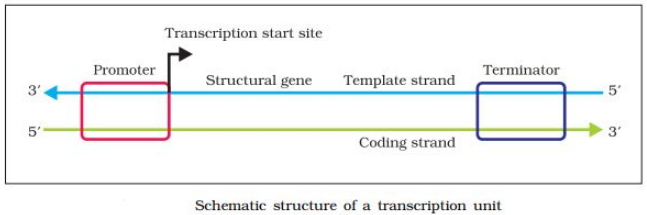
(N/A) transcription unit in $DNA$ is defined primarily by three regions in the $DNA$: $(i)$ $A$ promoter,$(ii)$ The structural gene,and $(iii)$ $A$ terminator.
There is a convention in defining the two strands of the $DNA$ in the structural gene of a transcription unit.
Since the two strands have opposite polarity and the $DNA$-dependent $RNA$ polymerase also catalyzes the polymerization in only one direction,that is $5' \rightarrow 3'$,the strand that has the polarity $3' \rightarrow 5'$ acts as a template and is referred to as the template strand.
The other strand,which has the polarity $5' \rightarrow 3'$ and the same sequence as $RNA$ (except thymine in place of uracil),is displaced during transcription. Strangely,this strand (which does not code for anything) is referred to as the coding strand.
All reference points while defining a transcription unit are made with respect to the coding strand.
$(i)$ $A$ promoter is a $DNA$ sequence that provides a binding site for $RNA$ polymerase. It is located at the $5'$ end (upstream) of the structural gene. The presence of the promoter in a transcription unit defines the template and coding strands. By switching its position with the terminator,the definition of coding and template strands could be reversed.
$(ii)$ The structural gene in a transcription unit is the segment of $DNA$ that is flanked by the promoter and the terminator.
$(iii)$ $A$ terminator is located towards the $3'$ end (downstream) of the coding strand. It usually defines the end of the process of transcription. There are additional regulatory sequences that may be present further upstream or downstream to the promoter.
There is a convention in defining the two strands of the $DNA$ in the structural gene of a transcription unit.
Since the two strands have opposite polarity and the $DNA$-dependent $RNA$ polymerase also catalyzes the polymerization in only one direction,that is $5' \rightarrow 3'$,the strand that has the polarity $3' \rightarrow 5'$ acts as a template and is referred to as the template strand.
The other strand,which has the polarity $5' \rightarrow 3'$ and the same sequence as $RNA$ (except thymine in place of uracil),is displaced during transcription. Strangely,this strand (which does not code for anything) is referred to as the coding strand.
All reference points while defining a transcription unit are made with respect to the coding strand.
$(i)$ $A$ promoter is a $DNA$ sequence that provides a binding site for $RNA$ polymerase. It is located at the $5'$ end (upstream) of the structural gene. The presence of the promoter in a transcription unit defines the template and coding strands. By switching its position with the terminator,the definition of coding and template strands could be reversed.
$(ii)$ The structural gene in a transcription unit is the segment of $DNA$ that is flanked by the promoter and the terminator.
$(iii)$ $A$ terminator is located towards the $3'$ end (downstream) of the coding strand. It usually defines the end of the process of transcription. There are additional regulatory sequences that may be present further upstream or downstream to the promoter.
0 likes
View Solution112
Medium
Describe the process of transcription in prokaryotes (bacteria).
Solution
(N/A) In bacteria, there are three main types of $RNA$: $m-RNA$, $t-RNA$, and $r-RNA$. All three are essential for protein synthesis in the cell.
$m-RNA$ acts as a template, $t-RNA$ brings amino acids and reads the genetic code, and $r-RNA$ plays structural and catalytic roles during translation.
In bacteria, there is only one $DNA$-dependent $RNA$ polymerase that catalyzes the transcription of all types of $RNA$.
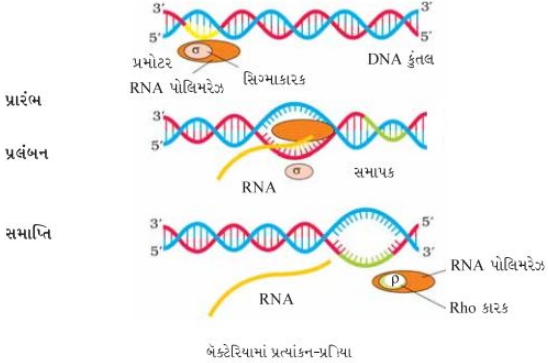
The process of transcription in bacteria occurs in three steps: initiation, elongation, and termination.
$1$. Initiation: $RNA$ polymerase binds to the promoter site on the $DNA$ with the help of the initiation factor $(\sigma)$, which initiates the transcription process.
$2$. Elongation: The $RNA$ polymerase uses nucleoside triphosphates as substrates and polymerizes them according to the template strand. It also facilitates the opening of the $DNA$ helix and continues the elongation of the $RNA$ chain.
$3$. Termination: Once the $RNA$ polymerase reaches the terminator region, the nascent $RNA$ and the $RNA$ polymerase fall off. This is facilitated by the termination factor $(\rho)$.
In bacteria, since $mRNA$ does not require any processing and transcription and translation take place in the same compartment (cytoplasm), translation can begin before the $mRNA$ is fully transcribed.
$m-RNA$ acts as a template, $t-RNA$ brings amino acids and reads the genetic code, and $r-RNA$ plays structural and catalytic roles during translation.
In bacteria, there is only one $DNA$-dependent $RNA$ polymerase that catalyzes the transcription of all types of $RNA$.
The process of transcription in bacteria occurs in three steps: initiation, elongation, and termination.
$1$. Initiation: $RNA$ polymerase binds to the promoter site on the $DNA$ with the help of the initiation factor $(\sigma)$, which initiates the transcription process.
$2$. Elongation: The $RNA$ polymerase uses nucleoside triphosphates as substrates and polymerizes them according to the template strand. It also facilitates the opening of the $DNA$ helix and continues the elongation of the $RNA$ chain.
$3$. Termination: Once the $RNA$ polymerase reaches the terminator region, the nascent $RNA$ and the $RNA$ polymerase fall off. This is facilitated by the termination factor $(\rho)$.
In bacteria, since $mRNA$ does not require any processing and transcription and translation take place in the same compartment (cytoplasm), translation can begin before the $mRNA$ is fully transcribed.
0 likes
View Solution113
Difficult
Describe the process of transcription in eukaryotes.
Solution
(N/A) The process of transcription in eukaryotes is complex and involves the following steps:
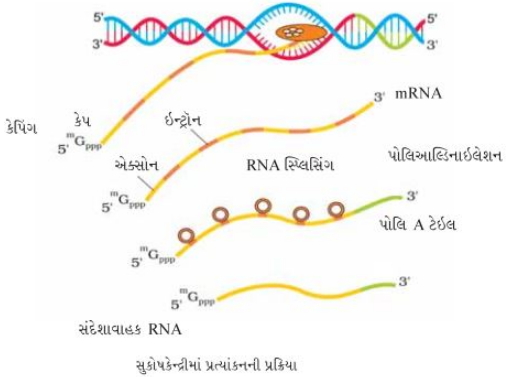
$(i)$ There are three types of $RNA$ polymerases in the nucleus. $RNA$ polymerase $I$ transcribes $r-RNA$ ($28S, 18S$,and $5.8S$). $RNA$ polymerase $III$ is responsible for the transcription of $t-RNA$,$5S$ $r-RNA$,and $sn-RNAs$ (small nuclear $RNAs$). $RNA$ polymerase $II$ transcribes the precursor of $m-RNA$,which is called heterogeneous nuclear $RNA$ $(hn-RNA)$.
(ii) The primary transcript contains both exons and introns and is non-functional. It undergoes a process called splicing,where introns are removed and exons are joined in a defined order. The $hn-RNA$ also undergoes capping and tailing. In capping,an unusual nucleotide,methyl guanosine triphosphate,is added to the $5'$ end of the $hn-RNA$. In tailing,an adenylate residue $(200-300)$ is added at the $3'$ end in a template-independent manner.
(iii) The fully processed $hn-RNA$,now called $m-RNA$,is transported out of the nucleus for translation.
$(i)$ There are three types of $RNA$ polymerases in the nucleus. $RNA$ polymerase $I$ transcribes $r-RNA$ ($28S, 18S$,and $5.8S$). $RNA$ polymerase $III$ is responsible for the transcription of $t-RNA$,$5S$ $r-RNA$,and $sn-RNAs$ (small nuclear $RNAs$). $RNA$ polymerase $II$ transcribes the precursor of $m-RNA$,which is called heterogeneous nuclear $RNA$ $(hn-RNA)$.
(ii) The primary transcript contains both exons and introns and is non-functional. It undergoes a process called splicing,where introns are removed and exons are joined in a defined order. The $hn-RNA$ also undergoes capping and tailing. In capping,an unusual nucleotide,methyl guanosine triphosphate,is added to the $5'$ end of the $hn-RNA$. In tailing,an adenylate residue $(200-300)$ is added at the $3'$ end in a template-independent manner.
(iii) The fully processed $hn-RNA$,now called $m-RNA$,is transported out of the nucleus for translation.
0 likes
View Solution114
Medium
Distinguish between transcription in prokaryotes and eukaryotes.
Solution
(N/A)
| Transcription in Prokaryotes | Transcription in Eukaryotes |
|---|---|
| $1$. Transcription products are functional in $situ$. | $1$. Transcription products must be transported out of the nucleus to the cytoplasm to become functional. |
| $2$. Only a single type of $RNA$ polymerase is involved. | $2$. Three distinct types of $RNA$ polymerases $(I, II, III)$ are involved. |
| $3$. $mRNA$ is polycistronic. | $3$. $mRNA$ is monocistronic. |
| $4$. Splicing is not required as there are no introns. | $4$. Splicing is required to remove introns from the primary transcript. |
0 likes
View Solution115
Medium
Define the following terms: $Cistron$ and $Terminator$.
Solution
(N/A) $Cistron$: It is a segment of $DNA$ that codes for a specific polypeptide chain. In eukaryotes,it is usually monocistronic,while in prokaryotes,it is often polycistronic.
$Terminator$: It is a specific sequence of $DNA$ that signals the end of transcription. When the $RNA$ polymerase enzyme reaches this region,it stops the synthesis of $RNA$ and releases the transcript.
$Terminator$: It is a specific sequence of $DNA$ that signals the end of transcription. When the $RNA$ polymerase enzyme reaches this region,it stops the synthesis of $RNA$ and releases the transcript.
0 likes
View Solution116
Medium
Provide definitions and explanations for the following terms: Exons,Introns,Capping,and Tailing.
Solution
(N/A) Exons: These are coding sequences or expressed sequences that appear in mature or processed $RNA$.
Introns: These are intervening sequences which do not appear in mature or processed $RNA$. They only interrupt the coding sequences of exons.
Capping: In this process,an unusual nucleotide,$7$-methyl guanosine triphosphate,is added to the $5^{\prime}$-end of $hnRNA$.
Tailing: In this process,adenylate residues $(200-300)$ are added at the $3^{\prime}$-end of the transcript in a template-independent manner.
Introns: These are intervening sequences which do not appear in mature or processed $RNA$. They only interrupt the coding sequences of exons.
Capping: In this process,an unusual nucleotide,$7$-methyl guanosine triphosphate,is added to the $5^{\prime}$-end of $hnRNA$.
Tailing: In this process,adenylate residues $(200-300)$ are added at the $3^{\prime}$-end of the transcript in a template-independent manner.
0 likes
View Solution117
Easy
Given below is the sequence of the coding strand of $DNA$ in a transcription unit: $5' - AATGCAGCTATTAGG - 3'$. Write the sequence of $(a)$ its complementary strand and $(b)$ the $mRNA$.
Solution
(N/A) The coding strand is $5' - AATGCAGCTATTAGG - 3'$. The complementary strand (template strand) runs in the $3' - 5'$ direction and is antiparallel to the coding strand. Therefore,the complementary strand sequence is $3' - TTACGTCGATAATCC - 5'$ or $5' - CCTAATAGCTGCATT - 3'$.
$(b)$ The $mRNA$ sequence is identical to the coding strand of $DNA$,except that $Thymine$ $(T)$ is replaced by $Uracil$ $(U)$. Thus,the $mRNA$ sequence is $5' - AAUGCAGCUAUUAGG - 3'$.
$(b)$ The $mRNA$ sequence is identical to the coding strand of $DNA$,except that $Thymine$ $(T)$ is replaced by $Uracil$ $(U)$. Thus,the $mRNA$ sequence is $5' - AAUGCAGCUAUUAGG - 3'$.
0 likes
View Solution118
Medium
Define a cistron. Giving examples,differentiate between monocistronic and polycistronic transcription units.
Solution
(N/A) cistron is defined as a segment of $DNA$ that contains the genetic information coding for a single polypeptide chain or a functional trait.
$1.$ Monocistronic transcription unit: These contain a single structural gene that codes for one polypeptide. This is characteristic of eukaryotes. Example: The structural gene for human insulin or hemoglobin.
$2.$ Polycistronic transcription unit: These contain multiple structural genes under the control of a single promoter and terminator,coding for several polypeptides. This is characteristic of prokaryotes (bacteria). Example: The $lac$ operon in $E. coli$.
In eukaryotes,monocistronic genes are often 'split' or 'interrupted' by non-coding sequences called introns. The coding sequences that appear in the mature $RNA$ are called exons.
$1.$ Monocistronic transcription unit: These contain a single structural gene that codes for one polypeptide. This is characteristic of eukaryotes. Example: The structural gene for human insulin or hemoglobin.
$2.$ Polycistronic transcription unit: These contain multiple structural genes under the control of a single promoter and terminator,coding for several polypeptides. This is characteristic of prokaryotes (bacteria). Example: The $lac$ operon in $E. coli$.
In eukaryotes,monocistronic genes are often 'split' or 'interrupted' by non-coding sequences called introns. The coding sequences that appear in the mature $RNA$ are called exons.
0 likes
View Solution119
Medium
What are the functions of $(i)$ methylated guanosine cap,$(ii)$ poly-$A$ tail in a mature $mRNA$?
Solution
(N/A) The functions of the modifications in a mature $mRNA$ are as follows:
$(i)$ Methylated guanosine cap: It helps in the binding of $mRNA$ to the smaller ribosomal subunit during the initiation of translation and protects the $mRNA$ from degradation by exonucleases.
$(ii)$ Poly-$A$ tail: It provides stability and longevity to the $mRNA$ molecule. There is a positive correlation between the length of the poly-$A$ tail and the lifespan of the $mRNA$ in the cytoplasm.
$(i)$ Methylated guanosine cap: It helps in the binding of $mRNA$ to the smaller ribosomal subunit during the initiation of translation and protects the $mRNA$ from degradation by exonucleases.
$(ii)$ Poly-$A$ tail: It provides stability and longevity to the $mRNA$ molecule. There is a positive correlation between the length of the poly-$A$ tail and the lifespan of the $mRNA$ in the cytoplasm.
0 likes
View Solution120
Medium
Do you think that the alternate splicing of exons may enable a structural gene to code for several isoproteins from one and the same gene? If yes,how? If not,why so?
Solution
(A) Yes,alternate splicing of exons enables a single structural gene to code for multiple isoproteins.
Functional $mRNA$ of structural genes does not always include all of its exons.
This process of alternate splicing is regulated and can be sex-specific,tissue-specific,or developmental stage-specific.
By rearranging or omitting specific exons during the processing of $pre-mRNA$,a single gene can encode for several different isoproteins or proteins of a similar class.
In the absence of such splicing,the organism would require a unique gene for every single protein or isoprotein,which would be genetically inefficient.
Thus,alternative splicing allows for increased protein diversity without requiring a proportional increase in the number of genes.
Functional $mRNA$ of structural genes does not always include all of its exons.
This process of alternate splicing is regulated and can be sex-specific,tissue-specific,or developmental stage-specific.
By rearranging or omitting specific exons during the processing of $pre-mRNA$,a single gene can encode for several different isoproteins or proteins of a similar class.
In the absence of such splicing,the organism would require a unique gene for every single protein or isoprotein,which would be genetically inefficient.
Thus,alternative splicing allows for increased protein diversity without requiring a proportional increase in the number of genes.
0 likes
View Solution121
Difficult
Give an account of post-transcriptional modifications of a eukaryotic $mRNA$.
Solution
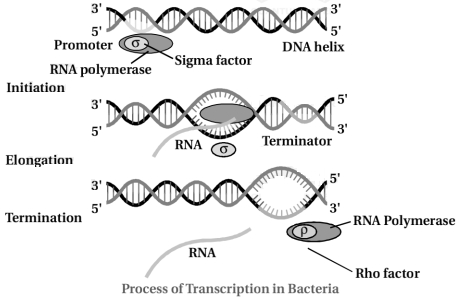
(N/A) The primary transcripts $(hnRNA)$ contain both exons and introns and are non-functional. Hence,they undergo a process called splicing,where introns are removed and exons are joined in a defined order.
Introns are the portions of a gene that are transcribed but not translated.
In prokaryotes,$hnRNA$ is absent,so splicing is not required.
$hnRNA$ undergoes additional processing called capping and tailing.
In capping,an unusual nucleotide (methyl guanosine triphosphate) is added to the $5^{\prime}$-end of $hnRNA$.
In tailing,adenylate residues $(200-300)$ are added at the $3^{\prime}$-end in a template-independent manner.
It is the fully processed $hnRNA$,now called $mRNA$,that is transported out of the nucleus for translation.
Introns are the portions of a gene that are transcribed but not translated.
In prokaryotes,$hnRNA$ is absent,so splicing is not required.
$hnRNA$ undergoes additional processing called capping and tailing.
In capping,an unusual nucleotide (methyl guanosine triphosphate) is added to the $5^{\prime}$-end of $hnRNA$.
In tailing,adenylate residues $(200-300)$ are added at the $3^{\prime}$-end in a template-independent manner.
It is the fully processed $hnRNA$,now called $mRNA$,that is transported out of the nucleus for translation.
0 likes
View Solution122
EasyMCQ
Name the enzyme that facilitates the opening of the $DNA$ helix during transcription.
A
$RNA$ polymerase
B
$DNA$ ligase
C
$DNA$ helicase
D
$DNA$ polymerase
Solution
(A) During the process of transcription,the enzyme $RNA$ polymerase is responsible for both the unwinding of the $DNA$ double helix and the synthesis of the $RNA$ strand. Unlike replication,where $DNA$ helicase is used to unwind the helix,transcription relies on the $RNA$ polymerase holoenzyme to initiate the separation of the $DNA$ strands at the promoter site.
0 likes
View Solution123
MediumMCQ
Identify the enzyme that helps in unwinding the $DNA$ helix during transcription.
A
$DNA$ ligase
B
$DNA$ helicase
C
$DNA$ polymerase
D
$RNA$ polymerase
Solution
(D) During the process of transcription,the enzyme $RNA$ polymerase is responsible for unwinding the $DNA$ helix. Unlike $DNA$ replication,which requires a separate helicase enzyme to unwind the double helix,$RNA$ polymerase possesses the intrinsic ability to unwind the $DNA$ strand as it moves along the template to synthesize $RNA$.
0 likes
View Solution124
Medium
Write an explanatory note on the transcription unit and the gene.
Solution
(N/A) gene is defined as the functional unit of inheritance. Although there is no ambiguity that genes are located on the $DNA$,it is difficult to literally define a gene in terms of a $DNA$ sequence.
The $DNA$ sequence coding for a $tRNA$ or $rRNA$ molecule also defines a gene. However,by defining a $cistron$ as a segment of $DNA$ coding for a polypeptide,the structural gene in a transcription unit can be described as $monocistronic$ (mostly in eukaryotes) or $polycistronic$ (mostly in bacteria or prokaryotes).
In eukaryotes,$monocistronic$ structural genes have interrupted coding sequences; the genes in eukaryotes are split. The coding sequences or expressed sequences are defined as $exons$. $Exons$ are sequences that appear in mature or processed $RNA$. The $exons$ are interrupted by $introns$. $Introns$ or intervening sequences do not appear in mature or processed $RNA$. The split-gene arrangement further complicates the definition of a gene in terms of a $DNA$ segment.
Inheritance of a character is also affected by promoter and regulatory sequences of a structural gene. Hence,sometimes the regulatory sequences are loosely defined as regulatory genes,even though these sequences do not code for any $RNA$ or protein.
The $DNA$ sequence coding for a $tRNA$ or $rRNA$ molecule also defines a gene. However,by defining a $cistron$ as a segment of $DNA$ coding for a polypeptide,the structural gene in a transcription unit can be described as $monocistronic$ (mostly in eukaryotes) or $polycistronic$ (mostly in bacteria or prokaryotes).
In eukaryotes,$monocistronic$ structural genes have interrupted coding sequences; the genes in eukaryotes are split. The coding sequences or expressed sequences are defined as $exons$. $Exons$ are sequences that appear in mature or processed $RNA$. The $exons$ are interrupted by $introns$. $Introns$ or intervening sequences do not appear in mature or processed $RNA$. The split-gene arrangement further complicates the definition of a gene in terms of a $DNA$ segment.
Inheritance of a character is also affected by promoter and regulatory sequences of a structural gene. Hence,sometimes the regulatory sequences are loosely defined as regulatory genes,even though these sequences do not code for any $RNA$ or protein.
0 likes
View Solution125
Medium
Explain different types of $RNA$ and explain the process of transcription.
Solution
(N/A) Three major types of $RNAs$ found in bacteria are:
$(i)$ $mRNA$ (messenger $RNA$): It provides the template for translation.
$(ii)$ $tRNA$ (transfer $RNA$): It brings amino acids and reads the genetic code.
$(iii)$ $rRNA$ (ribosomal $RNA$): It plays structural and catalytic roles during translation.
All three $RNAs$ are needed for the synthesis of a protein in a cell.
There is a single $DNA$-dependent $RNA$ polymerase that catalyzes the transcription of all types of $RNA$ in bacteria.
The process of transcription in bacteria involves three stages:
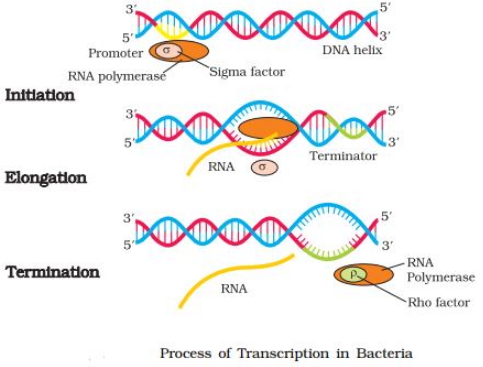
$1$. Initiation: $RNA$ polymerase binds to the promoter region on $DNA$ and initiates transcription. It associates transiently with the initiation factor $(\sigma)$ to start the process.
$2$. Elongation: The $RNA$ polymerase uses nucleoside triphosphates as substrates and polymerizes them in a template-dependent fashion, following the rule of complementarity. It facilitates the opening of the $DNA$ helix and continues elongation.
$3$. Termination: Once the polymerase reaches the terminator region, the nascent $RNA$ falls off, as does the $RNA$ polymerase. It associates with the termination factor $(\rho)$ to terminate the transcription. Association with these factors ($\sigma$ and $\rho$) alters the specificity of the $RNA$ polymerase to either initiate or terminate the process.
$(i)$ $mRNA$ (messenger $RNA$): It provides the template for translation.
$(ii)$ $tRNA$ (transfer $RNA$): It brings amino acids and reads the genetic code.
$(iii)$ $rRNA$ (ribosomal $RNA$): It plays structural and catalytic roles during translation.
All three $RNAs$ are needed for the synthesis of a protein in a cell.
There is a single $DNA$-dependent $RNA$ polymerase that catalyzes the transcription of all types of $RNA$ in bacteria.
The process of transcription in bacteria involves three stages:
$1$. Initiation: $RNA$ polymerase binds to the promoter region on $DNA$ and initiates transcription. It associates transiently with the initiation factor $(\sigma)$ to start the process.
$2$. Elongation: The $RNA$ polymerase uses nucleoside triphosphates as substrates and polymerizes them in a template-dependent fashion, following the rule of complementarity. It facilitates the opening of the $DNA$ helix and continues elongation.
$3$. Termination: Once the polymerase reaches the terminator region, the nascent $RNA$ falls off, as does the $RNA$ polymerase. It associates with the termination factor $(\rho)$ to terminate the transcription. Association with these factors ($\sigma$ and $\rho$) alters the specificity of the $RNA$ polymerase to either initiate or terminate the process.
0 likes
View Solution126
Easy
Give scientific reasons: Both the strands of $DNA$ are not copied during transcription.
Solution
(N/A) If both the strands of $DNA$ were copied during transcription,two different $RNA$ molecules with complementary sequences would be produced.
These two complementary $RNA$ molecules would base-pair with each other to form a double-stranded $RNA$ $(dsRNA)$ molecule.
This $dsRNA$ would prevent the translation process,as ribosomes cannot translate double-stranded structures into polypeptides.
Furthermore,if one segment of $DNA$ were to code for two different polypeptides,the genetic information machinery would become highly complex and ambiguous,leading to conflicting protein synthesis.
These two complementary $RNA$ molecules would base-pair with each other to form a double-stranded $RNA$ $(dsRNA)$ molecule.
This $dsRNA$ would prevent the translation process,as ribosomes cannot translate double-stranded structures into polypeptides.
Furthermore,if one segment of $DNA$ were to code for two different polypeptides,the genetic information machinery would become highly complex and ambiguous,leading to conflicting protein synthesis.
0 likes
View Solution127
Easy
Give scientific reasons: Transcription and translation could be coupled in prokaryotic cell but not in eukaryotic cell.
Solution
(N/A) In prokaryotes,the $mRNA$ synthesized does not require any processing to become active,and both transcription and translation occur in the same cytosol. In contrast,in eukaryotes,the primary transcript contains both exons and introns and is subjected to a process called splicing,where introns are removed and exons are joined in a definite order to form mature $mRNA$. Furthermore,in eukaryotes,transcription occurs in the nucleus,while translation occurs in the cytoplasm,creating a physical separation between the two processes.
0 likes
View Solution128
Easy
Define/Explain: $A$ promoter and the structural gene.
Solution
(N/A) promoter is a $DNA$ sequence that provides a binding site for $RNA$ polymerase. It is located at the $5'$ end of the structural gene.
- The structural gene in a transcription unit is the segment of $DNA$ that codes for a polypeptide or $RNA$ molecule and is flanked by a promoter and a terminator.
- The structural gene in a transcription unit is the segment of $DNA$ that codes for a polypeptide or $RNA$ molecule and is flanked by a promoter and a terminator.
0 likes
View Solution129
MediumMCQ
Transcription is defined as.........
A
$DNA \rightarrow$ (Genetic information) $\rightarrow$ Protein
B
$RNA \rightarrow$ (Genetic information) $\rightarrow$ Protein
C
$RNA \rightarrow$ (Genetic information) $\rightarrow$ $DNA$
D
$DNA \rightarrow$ (Genetic information) $\rightarrow$ $RNA$
Solution
(D) Transcription is the process of copying genetic information from one strand of the $DNA$ into $RNA$.
In this process,only a segment of $DNA$ and only one of the two strands is copied into $RNA$.
Therefore,the flow of genetic information is represented as $DNA \rightarrow$ (Genetic information) $\rightarrow$ $RNA$.
In this process,only a segment of $DNA$ and only one of the two strands is copied into $RNA$.
Therefore,the flow of genetic information is represented as $DNA \rightarrow$ (Genetic information) $\rightarrow$ $RNA$.
0 likes
View Solution130
EasyMCQ
The process of transcription follows which principle?
A
Principle of catalysis
B
Principle of complementarity
C
Chargaff's rule
D
Principle of redundancy
Solution
(B) The process of transcription involves the synthesis of $RNA$ from a $DNA$ template. This process is governed by the principle of complementarity,where the nitrogenous bases of the $RNA$ strand are complementary to the template $DNA$ strand (e.g.,$Adenine$ pairs with $Uracil$,$Cytosine$ pairs with $Guanine$). Therefore,the correct answer is the principle of complementarity.
0 likes
View Solution131
MediumMCQ
Which of the following statements is incorrect for the process of transcription?
A
Both strands of $DNA$ are transcribed into $RNA$.
B
Adenine pairs with Uracil.
C
$RNA$ is synthesized from $DNA$.
D
Only one strand of $DNA$ acts as a template.
Solution
(A) In the process of transcription,only one segment of $DNA$ and only one of the two strands is copied into $RNA$.
If both strands of $DNA$ were to act as templates,they would code for $RNA$ molecules with different sequences,and in turn,if they coded for proteins,the sequence of amino acids in the proteins would be different.
Furthermore,two $RNA$ molecules produced simultaneously would be complementary to each other,hence would form a double-stranded $RNA$.
This would prevent $RNA$ from being translated into protein,which would render the process of transcription futile.
Therefore,the statement that both strands of $DNA$ are transcribed into $RNA$ is incorrect.
If both strands of $DNA$ were to act as templates,they would code for $RNA$ molecules with different sequences,and in turn,if they coded for proteins,the sequence of amino acids in the proteins would be different.
Furthermore,two $RNA$ molecules produced simultaneously would be complementary to each other,hence would form a double-stranded $RNA$.
This would prevent $RNA$ from being translated into protein,which would render the process of transcription futile.
Therefore,the statement that both strands of $DNA$ are transcribed into $RNA$ is incorrect.
0 likes
View Solution132
MediumMCQ
If both strands of $DNA$ were to act as templates during transcription,then:
A
Different sequences of $RNA$ molecules would be synthesized.
B
Two $RNA$ molecules would be produced,which would be complementary to each other.
C
Double-stranded $RNA$ would be formed,which would prevent translation.
D
All of the above.
Solution
(D) If both strands of $DNA$ act as templates during transcription,they would code for two different $RNA$ molecules with different sequences. Since the two $DNA$ strands are complementary to each other,the resulting $RNA$ molecules would also be complementary to each other. These complementary $RNA$ strands would base-pair to form a double-stranded $RNA$ $(dsRNA)$. This $dsRNA$ would prevent the process of translation because it would not be able to bind with the ribosomes required for protein synthesis. Therefore,all the given options are correct.
0 likes
View Solution133
EasyMCQ
Where is the transcription unit found?
A
$RNA$
B
$DNA$
C
Protein
D
Lipid
Solution
(B) The transcription unit is a segment of $DNA$ that is transcribed into an $RNA$ molecule. It consists of three main regions: a promoter,the structural gene,and a terminator. Therefore,the transcription unit is found in $DNA$.
0 likes
View Solution134
MediumMCQ
How many parts does a transcription unit consist of?
A
$1$
B
$2$
C
$3$
D
$4$
Solution
(C) transcription unit in $DNA$ is defined primarily by three regions in the $DNA$:
$1$. $A$ promoter
$2$. The structural gene
$3$. $A$ terminator
Therefore,a transcription unit consists of $3$ parts.
$1$. $A$ promoter
$2$. The structural gene
$3$. $A$ terminator
Therefore,a transcription unit consists of $3$ parts.
0 likes
View Solution135
MediumMCQ
Which of the following is not a part of a transcription unit?
A
Promoter
B
Structural gene
C
Origin of replication
D
Terminator
Solution
(C) transcription unit in $DNA$ is defined primarily by three regions:
$1$. $A$ promoter: The site where $RNA$ polymerase binds to initiate transcription.
$2$. The structural gene: The segment of $DNA$ that is transcribed into $RNA$.
$3$. $A$ terminator: The site that signals the end of the transcription process.
'Origin of replication' $(ori)$ is a specific sequence in $DNA$ where replication begins,which is a feature of $DNA$ replication,not transcription.
$1$. $A$ promoter: The site where $RNA$ polymerase binds to initiate transcription.
$2$. The structural gene: The segment of $DNA$ that is transcribed into $RNA$.
$3$. $A$ terminator: The site that signals the end of the transcription process.
'Origin of replication' $(ori)$ is a specific sequence in $DNA$ where replication begins,which is a feature of $DNA$ replication,not transcription.
0 likes
View Solution136
MediumMCQ
In which direction does $RNA$ polymerase catalyze polymerization?
A
$3' \rightarrow 5'$
B
$5' \rightarrow 3'$
C
$5' \rightarrow 5'$
D
$3' \rightarrow 3'$
Solution
(B) $RNA$ polymerase catalyzes the polymerization of ribonucleotides in the $5' \rightarrow 3'$ direction.
This is because the enzyme adds new nucleotides to the $3'$-$OH$ group of the growing $RNA$ chain.
The template strand of $DNA$ is read by the enzyme in the $3' \rightarrow 5'$ direction,resulting in the synthesis of the $RNA$ strand in the $5' \rightarrow 3'$ direction.
This is because the enzyme adds new nucleotides to the $3'$-$OH$ group of the growing $RNA$ chain.
The template strand of $DNA$ is read by the enzyme in the $3' \rightarrow 5'$ direction,resulting in the synthesis of the $RNA$ strand in the $5' \rightarrow 3'$ direction.
0 likes
View Solution137
MediumMCQ
In a transcription unit,which strands act as the template strand and the coding strand,respectively?
A
$3' \rightarrow 5', 5' \rightarrow 3'$
B
$5' \rightarrow 3', 3' \rightarrow 5'$
C
$3' \rightarrow 3', 5' \rightarrow 5'$
D
$5' \rightarrow 5', 3' \rightarrow 3'$
Solution
(A) In a transcription unit,the $DNA$ double helix consists of two strands with opposite polarity.
One strand,which has the polarity $3' \rightarrow 5'$,acts as the template strand because the $RNA$ polymerase enzyme synthesizes $RNA$ in the $5' \rightarrow 3'$ direction using this strand as a template.
The other strand,which has the polarity $5' \rightarrow 3'$,is called the coding strand (or sense strand) because its sequence is identical to the $RNA$ produced (except for Thymine being replaced by Uracil).
Therefore,the template strand is $3' \rightarrow 5'$ and the coding strand is $5' \rightarrow 3'$.
One strand,which has the polarity $3' \rightarrow 5'$,acts as the template strand because the $RNA$ polymerase enzyme synthesizes $RNA$ in the $5' \rightarrow 3'$ direction using this strand as a template.
The other strand,which has the polarity $5' \rightarrow 3'$,is called the coding strand (or sense strand) because its sequence is identical to the $RNA$ produced (except for Thymine being replaced by Uracil).
Therefore,the template strand is $3' \rightarrow 5'$ and the coding strand is $5' \rightarrow 3'$.
0 likes
View Solution138
MediumMCQ
If the sequence of the coding strand in a transcription unit is $GACTTAGCCA$,what will be the sequence of the $RNA$ formed from this transcription unit?
A
$CTGAATCGGT$
B
$CUGAAUCGGU$
C
$GACTTAGCCA$
D
$GACUUAGCCA$
Solution
(D) In a transcription unit,the coding strand has the same sequence as the $RNA$ molecule,except that $Thymine$ $(T)$ in $DNA$ is replaced by $Uracil$ $(U)$ in $RNA$.
Given the coding strand sequence: $GACTTAGCCA$.
Replacing $T$ with $U$ gives the $RNA$ sequence: $GACUUAGCCA$.
Given the coding strand sequence: $GACTTAGCCA$.
Replacing $T$ with $U$ gives the $RNA$ sequence: $GACUUAGCCA$.
0 likes
View Solution139
EasyMCQ
Where does $RNA$ polymerase bind to $DNA$?
A
Terminator
B
Structural gene
C
Promoter
D
Operator
Solution
(C) In the process of transcription,the $RNA$ polymerase enzyme is responsible for synthesizing $RNA$ from a $DNA$ template.
This enzyme specifically recognizes and binds to a $DNA$ sequence known as the $Promoter$ region.
The $Promoter$ is located upstream of the structural gene and acts as the initiation site for transcription.
Once bound to the $Promoter$,the $RNA$ polymerase initiates the unwinding of the $DNA$ double helix to begin the synthesis of the $RNA$ strand.
This enzyme specifically recognizes and binds to a $DNA$ sequence known as the $Promoter$ region.
The $Promoter$ is located upstream of the structural gene and acts as the initiation site for transcription.
Once bound to the $Promoter$,the $RNA$ polymerase initiates the unwinding of the $DNA$ double helix to begin the synthesis of the $RNA$ strand.
0 likes
View Solution140
MediumMCQ
The regions located upstream of the $5'$ end and downstream of the $3'$ end of a structural gene are respectively known as:
A
Terminator and Promoter
B
Promoter and Terminator
C
Terminator and Regulator
D
Regulator and Promoter
Solution
(B) In a transcription unit,the structural gene is flanked by a promoter and a terminator.
$1$. The promoter is located towards the $5'$ end (upstream) of the structural gene.
$2$. The terminator is located towards the $3'$ end (downstream) of the structural gene.
Therefore,the region upstream of the $5'$ end is the promoter and the region downstream of the $3'$ end is the terminator.
$1$. The promoter is located towards the $5'$ end (upstream) of the structural gene.
$2$. The terminator is located towards the $3'$ end (downstream) of the structural gene.
Therefore,the region upstream of the $5'$ end is the promoter and the region downstream of the $3'$ end is the terminator.
0 likes
View Solution141
MediumMCQ
The determination of the template and coding strands is defined by the presence of which of the following?
A
Promoter
B
Structural gene
C
Operator
D
Terminator
Solution
(A) In the process of transcription,the $DNA$ double helix consists of two strands. One strand acts as the template strand ($3$' to $5$' polarity) and the other as the coding strand ($5$' to $3$' polarity).
The polarity of the template strand is determined by the position of the promoter.
The promoter is a $DNA$ sequence located at the $5$' end (upstream) of the structural gene.
It provides the binding site for $RNA$ polymerase and determines which strand will act as the template for transcription.
The polarity of the template strand is determined by the position of the promoter.
The promoter is a $DNA$ sequence located at the $5$' end (upstream) of the structural gene.
It provides the binding site for $RNA$ polymerase and determines which strand will act as the template for transcription.
0 likes
View Solution142
MediumMCQ
Select the appropriate option for the coding sequence (expressed sequence).
A
Intron
B
Extron
C
Hexamer
D
Exons
Solution
(D) In eukaryotic gene expression,the primary transcript (pre-mRNA) contains both coding and non-coding sequences.
$1$. The coding sequences that are expressed in the final mature mRNA are known as $Exons$.
$2$. The non-coding sequences that are removed during $RNA$ splicing are known as $Introns$.
$3$. Therefore,the term for the expressed sequence is $Exons$.
$1$. The coding sequences that are expressed in the final mature mRNA are known as $Exons$.
$2$. The non-coding sequences that are removed during $RNA$ splicing are known as $Introns$.
$3$. Therefore,the term for the expressed sequence is $Exons$.
0 likes
View Solution143
MediumMCQ
What is absent in mature $RNA$?
A
Interferons
B
Introns
C
Interleukins
D
Exons
Solution
(B) In eukaryotic cells,the primary transcript (pre-$mRNA$) contains both coding sequences called $Exons$ and non-coding sequences called $Introns$.
During the process of post-transcriptional modification,the $Introns$ are removed through a process known as splicing.
The remaining $Exons$ are joined together in a defined order to form the mature $mRNA$.
Therefore,$Introns$ are absent in mature $RNA$.
During the process of post-transcriptional modification,the $Introns$ are removed through a process known as splicing.
The remaining $Exons$ are joined together in a defined order to form the mature $mRNA$.
Therefore,$Introns$ are absent in mature $RNA$.
0 likes
View Solution144
MediumMCQ
Which sequences do not code for $RNA$ or proteins?
A
Promoter
B
Terminator
C
Regulatory sequences
D
All of the above
Solution
(D) In the process of transcription,the gene is defined as the sequence of $DNA$ that codes for $RNA$ or protein molecules.
However,the structural gene is flanked by promoter and terminator sequences.
- The $Promoter$ is a $DNA$ sequence that provides a binding site for $RNA$ polymerase and is not transcribed into $RNA$.
- The $Terminator$ is a $DNA$ sequence that signals the end of transcription and is not part of the final $RNA$ product.
- $Regulatory$ sequences are regions of $DNA$ that control the expression of genes but do not code for $RNA$ or proteins themselves.
Therefore,all these sequences (promoter,terminator,and regulatory sequences) do not code for $RNA$ or proteins.
However,the structural gene is flanked by promoter and terminator sequences.
- The $Promoter$ is a $DNA$ sequence that provides a binding site for $RNA$ polymerase and is not transcribed into $RNA$.
- The $Terminator$ is a $DNA$ sequence that signals the end of transcription and is not part of the final $RNA$ product.
- $Regulatory$ sequences are regions of $DNA$ that control the expression of genes but do not code for $RNA$ or proteins themselves.
Therefore,all these sequences (promoter,terminator,and regulatory sequences) do not code for $RNA$ or proteins.
0 likes
View Solution145
MediumMCQ
Which enzyme is primarily required for the process of transcription?
A
$RNA$-dependent $RNA$ polymerase
B
$RNA$-dependent $DNA$ polymerase
C
$DNA$-dependent $RNA$ polymerase
D
$DNA$-dependent $DNA$ polymerase
Solution
(C) Transcription is the process of copying genetic information from one strand of the $DNA$ into $RNA$.
This process is catalyzed by the enzyme $DNA$-dependent $RNA$ polymerase.
This enzyme uses $DNA$ as a template to synthesize a complementary $RNA$ strand.
Therefore,the correct option is $C$.
This process is catalyzed by the enzyme $DNA$-dependent $RNA$ polymerase.
This enzyme uses $DNA$ as a template to synthesize a complementary $RNA$ strand.
Therefore,the correct option is $C$.
0 likes
View Solution146
EasyMCQ
Which of the following acts as a substrate for $RNA$ polymerase enzymes?
A
Nucleoside
B
Nitrogenous base
C
Nucleoside monophosphate
D
Nucleoside triphosphate
Solution
(D) $RNA$ polymerase is the enzyme responsible for transcription,which is the process of synthesizing $RNA$ from a $DNA$ template.
During the transcription process,the enzyme $RNA$ polymerase uses ribonucleoside triphosphates $(NTPs)$ as substrates.
These $NTPs$ (such as $ATP$,$GTP$,$CTP$,and $UTP$) provide both the building blocks (nucleotides) and the energy required for the polymerization reaction through the hydrolysis of high-energy phosphate bonds.
During the transcription process,the enzyme $RNA$ polymerase uses ribonucleoside triphosphates $(NTPs)$ as substrates.
These $NTPs$ (such as $ATP$,$GTP$,$CTP$,and $UTP$) provide both the building blocks (nucleotides) and the energy required for the polymerization reaction through the hydrolysis of high-energy phosphate bonds.
0 likes
View Solution147
MediumMCQ
What is the primary role of prokaryotic $RNA$ polymerase in the process of transcription?
A
Initiation
B
Elongation
C
Termination
D
All of the above
Solution
(D) In prokaryotes, a single type of $RNA$ polymerase is responsible for the transcription of all types of $RNA$ ($mRNA$, $tRNA$, and $rRNA$).
This enzyme follows the three major steps of transcription:
$1$. Initiation: The $RNA$ polymerase binds to the promoter region with the help of the sigma ($\sigma$) factor.
$2$. Elongation: The enzyme facilitates the polymerization of ribonucleotides to form the $RNA$ chain.
$3$. Termination: The enzyme recognizes the terminator sequence and releases the nascent $RNA$ chain with the help of the rho ($\rho$) factor.
Since the $RNA$ polymerase is involved in all three stages, the correct answer is $D$.
This enzyme follows the three major steps of transcription:
$1$. Initiation: The $RNA$ polymerase binds to the promoter region with the help of the sigma ($\sigma$) factor.
$2$. Elongation: The enzyme facilitates the polymerization of ribonucleotides to form the $RNA$ chain.
$3$. Termination: The enzyme recognizes the terminator sequence and releases the nascent $RNA$ chain with the help of the rho ($\rho$) factor.
Since the $RNA$ polymerase is involved in all three stages, the correct answer is $D$.
0 likes
View Solution148
MediumMCQ
Which of the following is $NOT$ a function of $RNA$ polymerase?
A
Elongation
B
Polymerization of ribonucleotides
C
Polymerization of deoxyribonucleotides
D
Unwinding of $DNA$ helix
Solution
(C) $RNA$ polymerase is the enzyme responsible for the process of transcription in cells.
Its primary functions include:
$1$. Unwinding of the $DNA$ helix to expose the template strand.
$2$. Polymerization of ribonucleotides to synthesize the $RNA$ chain.
$3$. Elongation of the $RNA$ transcript.
Option $C$ states 'Polymerization of deoxyribonucleotides',which is the function of $DNA$ polymerase during $DNA$ replication,not $RNA$ polymerase. Therefore,this is not a function of $RNA$ polymerase.
Its primary functions include:
$1$. Unwinding of the $DNA$ helix to expose the template strand.
$2$. Polymerization of ribonucleotides to synthesize the $RNA$ chain.
$3$. Elongation of the $RNA$ transcript.
Option $C$ states 'Polymerization of deoxyribonucleotides',which is the function of $DNA$ polymerase during $DNA$ replication,not $RNA$ polymerase. Therefore,this is not a function of $RNA$ polymerase.
0 likes
View Solution149
MediumMCQ
At which site does the process of transcription terminate?
A
Terminator
B
Promoter
C
Operator
D
Structural gene
Solution
(A) The process of transcription in prokaryotes and eukaryotes involves three main stages: initiation, elongation, and termination.
$1$. The $Promoter$ is the site where $RNA$ polymerase binds to initiate transcription.
$2$. The $Structural gene$ is the segment of $DNA$ that is transcribed into $RNA$.
$3$. The $Terminator$ is the specific $DNA$ sequence located at the end of the transcription unit where the process of transcription stops or terminates.
Therefore, the correct answer is $Terminator$.
$1$. The $Promoter$ is the site where $RNA$ polymerase binds to initiate transcription.
$2$. The $Structural gene$ is the segment of $DNA$ that is transcribed into $RNA$.
$3$. The $Terminator$ is the specific $DNA$ sequence located at the end of the transcription unit where the process of transcription stops or terminates.
Therefore, the correct answer is $Terminator$.
0 likes
View Solution150
MediumMCQ
Which factor$(s)$ participate in the process of transcription in prokaryotes?
A
Initiation factor
B
Elongation factor
C
Termination factor
D
$A$ and $C$ both
Solution
(D) In prokaryotes, the process of transcription is catalyzed by $DNA$-dependent $RNA$ polymerase.
$1$. Initiation: The $RNA$ polymerase binds to the promoter site with the help of the initiation factor, known as the sigma $(\sigma)$ factor.
$2$. Elongation: The $RNA$ polymerase facilitates the elongation of the $RNA$ chain.
$3$. Termination: Once the polymerase reaches the terminator region, the nascent $RNA$ falls off, which is facilitated by the termination factor, known as the rho $(\rho)$ factor.
Since both the initiation factor $(\sigma)$ and the termination factor $(\rho)$ are essential components of the prokaryotic transcription process, the correct answer is $A$ and $C$ both.
$1$. Initiation: The $RNA$ polymerase binds to the promoter site with the help of the initiation factor, known as the sigma $(\sigma)$ factor.
$2$. Elongation: The $RNA$ polymerase facilitates the elongation of the $RNA$ chain.
$3$. Termination: Once the polymerase reaches the terminator region, the nascent $RNA$ falls off, which is facilitated by the termination factor, known as the rho $(\rho)$ factor.
Since both the initiation factor $(\sigma)$ and the termination factor $(\rho)$ are essential components of the prokaryotic transcription process, the correct answer is $A$ and $C$ both.
0 likes
View SolutionMolecular Basis of Inheritance — Transcription · Frequently Asked Questions
1Are these Molecular Basis of Inheritance questions useful for JEE and NEET?
Yes. All questions in this section are mapped to JEE Main and NEET exam patterns. Previous year questions from JEE Main, NEET, GUJCET and state-level exams are included with full solutions.
2Can I switch to Hindi or Gujarati for these questions?
Yes. Use the language tabs in the hero section or the sidebar to view the same questions and solutions in English, Hindi or Gujarati.
3How do I generate a question paper from this subtopic?
Use the Vedclass Exam Paper Generator — select the chapter and subtopic, set difficulty, and generate Sets A, B, C, D automatically. First 3 chapters of every subject are free.
Vedclass Products
For Students
Vedclass Test Series
Mock tests in real JEE/NEET style with performance analysis. 5-day free trial.
Start Free TrialFor Teachers
Exam Paper Generator
Generate Set A/B/C/D papers from this chapter in 2 minutes. 3 chapters free.
Try FreeFor Institutes
Online Exam Module
Live online exams with unlimited students, 360° analytics & white-label branding.
See DemoFor Teachers & Institutes
Generate a Molecular Basis of Inheritance Exam Paper in 2 Minutes
Select subtopic & difficulty — Sets A, B, C, D auto-generated with No Repeat logic.
First 3 chapters of every subject are free — no payment required.