
A English
Mix Example-Molecular Basis of Inheritance Questions in English
Class 12 Biology · Molecular Basis of Inheritance · Mix Example-Molecular Basis of Inheritance
124+
Questions
English
Language
100%
With Solutions
Showing 50 of 124 questions in English
1
EasyMCQ
Genetic mapping of bacteriophage $\phi X174$ has been done by
A
Pirie and Bawden
B
$F$. Sanger
C
$R$.$L$. Sinsheimer
D
Salk and Sabin
Solution
(B) The genetic mapping and complete genome sequencing of the bacteriophage $\phi X174$ were performed by $F. Sanger$ and his colleagues in $1977$. This was the first $DNA$-based genome to be fully sequenced.
0 likes
View Solution2
EasyMCQ
$A$ mutant micro-organism unable to synthesize a compound required for its growth but able to grow if the compound is provided,is known as
A
Auxotroph
B
Prototroph
C
Autotroph
D
None of these
Solution
(A) An $Auxotroph$ is a mutant strain of a microorganism that has lost the ability to synthesize a specific nutrient required for its growth due to a mutation.
It can only grow on a medium supplemented with that specific nutrient.
In contrast,a $Prototroph$ is a wild-type strain capable of synthesizing all its required nutrients from simple precursors.
Therefore,the correct term for the described organism is $Auxotroph$.
It can only grow on a medium supplemented with that specific nutrient.
In contrast,a $Prototroph$ is a wild-type strain capable of synthesizing all its required nutrients from simple precursors.
Therefore,the correct term for the described organism is $Auxotroph$.
0 likes
View Solution3
MediumMCQ
Which one of the following pairs is not correctly matched?
A
Recombinant $DNA$ - $DNA$ formed by the joining of segments of $DNA$ from different sources
B
Purine Nitrogenous bases - Cytosine,thymine and uracil
C
$ATP$ - The principal energy carrying compound in the cell
D
$RNA$ - $RNA$ molecules found in ribosomes
Solution
(B) The correct answer is $B$.
Cytosine,thymine,and uracil are pyrimidines,which are single-ring nitrogenous bases.
Adenine and guanine are purines,which are double-ring nitrogenous bases.
Therefore,the pair 'Purine Nitrogenous bases - Cytosine,thymine and uracil' is incorrectly matched.
Cytosine,thymine,and uracil are pyrimidines,which are single-ring nitrogenous bases.
Adenine and guanine are purines,which are double-ring nitrogenous bases.
Therefore,the pair 'Purine Nitrogenous bases - Cytosine,thymine and uracil' is incorrectly matched.
0 likes
View Solution4
MediumMCQ
$A$ $DNA$ strand is directly involved in the synthesis of the following,except:
A
Another $DNA$
B
Protein synthesis
C
$tRNA$ molecule
D
$mRNA$ molecule
Solution
(B) The correct answer is $B$. $DNA$ is directly involved in the process of replication (synthesis of another $DNA$ strand) and transcription (synthesis of $RNA$ molecules like $mRNA$,$tRNA$,and $rRNA$). Protein synthesis (translation) is the process where $mRNA$ is translated into a polypeptide chain by ribosomes and $tRNA$. Therefore,$DNA$ is not directly involved in the synthesis of proteins.
0 likes
View Solution5
MediumMCQ
Which of the following organisms has been used for genetic research?
A
Pisum
B
Neurospora
C
$E$. coli
D
All of the above
Solution
(D) Genetic research has utilized various model organisms based on the specific biological questions being addressed.
$1$. $Pisum$ $sativum$ (Garden pea) was used by Gregor Mendel to establish the fundamental laws of inheritance.
$2$. $Neurospora$ $crassa$ (a bread mold) is a classic model organism in genetics,particularly for studying biochemical pathways and gene function due to its haploid life cycle.
$3$. $Escherichia$ $coli$ ($E.$ $coli$) is the most widely used prokaryotic model organism for studying molecular genetics,$DNA$ replication,and gene regulation.
Since all three organisms have historically and currently been significant in genetic research,the correct answer is $D$.
$1$. $Pisum$ $sativum$ (Garden pea) was used by Gregor Mendel to establish the fundamental laws of inheritance.
$2$. $Neurospora$ $crassa$ (a bread mold) is a classic model organism in genetics,particularly for studying biochemical pathways and gene function due to its haploid life cycle.
$3$. $Escherichia$ $coli$ ($E.$ $coli$) is the most widely used prokaryotic model organism for studying molecular genetics,$DNA$ replication,and gene regulation.
Since all three organisms have historically and currently been significant in genetic research,the correct answer is $D$.
0 likes
View Solution6
MediumMCQ
What is the correct chronological sequence of the following events?
$1.$ Formation of the chromosome theory of heredity
$2.$ Experiments which proved that $DNA$ is the hereditary material
$3.$ Mendel's laws of inheritance discovery
Code:
$1.$ Formation of the chromosome theory of heredity
$2.$ Experiments which proved that $DNA$ is the hereditary material
$3.$ Mendel's laws of inheritance discovery
Code:
A
$1, 3$ and $2$
B
$1, 2$ and $3$
C
$3, 1$ and $2$
D
$2, 1$ and $3$
Solution
(C) The chronological order of the events is as follows:
$1.$ Mendel's laws of inheritance were discovered in $1865$ (published in $1866$).
$2.$ The chromosome theory of heredity was proposed by Sutton and Boveri in $1902$.
$3.$ The experiments proving $DNA$ as the hereditary material (Hershey-Chase experiment) were conducted in $1952$.
Therefore,the correct sequence is $3, 1, 2$.
$1.$ Mendel's laws of inheritance were discovered in $1865$ (published in $1866$).
$2.$ The chromosome theory of heredity was proposed by Sutton and Boveri in $1902$.
$3.$ The experiments proving $DNA$ as the hereditary material (Hershey-Chase experiment) were conducted in $1952$.
Therefore,the correct sequence is $3, 1, 2$.
0 likes
View Solution7
MediumMCQ
The point mutations $A$ to $G$,$C$ to $T$,$C$ to $G$,and $T$ to $A$ in $DNA$ are:
A
Transition,transition,transversion,and transversion respectively
B
Transition,transversion,transition,and transversion respectively
C
Transversion,transversion,transition,and transition respectively
D
All four are transition
Solution
(A) In genetics,point mutations are classified based on the chemical nature of the base change:
$1$. Transition: $A$ purine ($A$ or $G$) is replaced by another purine,or a pyrimidine ($C$ or $T$) is replaced by another pyrimidine.
$2$. Transversion: $A$ purine is replaced by a pyrimidine,or a pyrimidine is replaced by a purine.
Analysis of the given mutations:
- $A$ to $G$: Purine to Purine $\rightarrow$ Transition
- $C$ to $T$: Pyrimidine to Pyrimidine $\rightarrow$ Transition
- $C$ to $G$: Pyrimidine to Purine $\rightarrow$ Transversion
- $T$ to $A$: Pyrimidine to Purine $\rightarrow$ Transversion
Therefore,the sequence is Transition,Transition,Transversion,and Transversion.
$1$. Transition: $A$ purine ($A$ or $G$) is replaced by another purine,or a pyrimidine ($C$ or $T$) is replaced by another pyrimidine.
$2$. Transversion: $A$ purine is replaced by a pyrimidine,or a pyrimidine is replaced by a purine.
Analysis of the given mutations:
- $A$ to $G$: Purine to Purine $\rightarrow$ Transition
- $C$ to $T$: Pyrimidine to Pyrimidine $\rightarrow$ Transition
- $C$ to $G$: Pyrimidine to Purine $\rightarrow$ Transversion
- $T$ to $A$: Pyrimidine to Purine $\rightarrow$ Transversion
Therefore,the sequence is Transition,Transition,Transversion,and Transversion.
0 likes
View Solution8
MediumMCQ
$Escherichia \ coli$ is an important material for genetic experiments because
A
It is harmless
B
It is haploid
C
It can be easily cultured
D
Both $(b)$ and $(c)$
Solution
(D) $Escherichia \ coli$ $(E. \ coli)$ is widely used in genetic experiments for several reasons:
$1$. It is a haploid organism,which makes it easier to observe the effects of mutations as there is no dominant allele to mask recessive traits.
$2$. It has a very short generation time and can be easily cultured in a laboratory setting using simple nutrient media.
$3$. Its genome is relatively small and well-mapped,facilitating genetic manipulation and analysis.
Therefore,both $(b)$ and $(c)$ are correct reasons.
$1$. It is a haploid organism,which makes it easier to observe the effects of mutations as there is no dominant allele to mask recessive traits.
$2$. It has a very short generation time and can be easily cultured in a laboratory setting using simple nutrient media.
$3$. Its genome is relatively small and well-mapped,facilitating genetic manipulation and analysis.
Therefore,both $(b)$ and $(c)$ are correct reasons.
0 likes
View Solution9
MediumMCQ
$DNA$ generally acts as a template for the synthesis of:
A
Only protein
B
Only $DNA$
C
Only $RNA$
D
Both $DNA$ and $RNA$
Solution
(D) $DNA$ acts as a template for the synthesis of $DNA$ during the process of replication,where the entire genome is copied.
Additionally,$DNA$ acts as a template for the synthesis of $RNA$ during the process of transcription,where specific segments of $DNA$ are copied into $RNA$ molecules.
Therefore,$DNA$ serves as a template for both $DNA$ and $RNA$ synthesis.
Additionally,$DNA$ acts as a template for the synthesis of $RNA$ during the process of transcription,where specific segments of $DNA$ are copied into $RNA$ molecules.
Therefore,$DNA$ serves as a template for both $DNA$ and $RNA$ synthesis.
0 likes
View Solution10
MediumMCQ
Which one of the following correctly represents the manner of replication of $DNA$?
A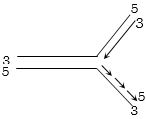
B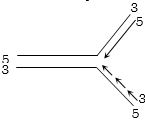
C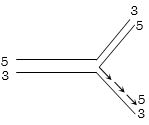
D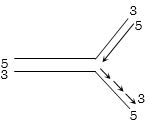
Solution
(D) $DNA$ replication is semi-conservative and proceeds in the $5' \to 3'$ direction on both strands.
Since the two strands of the $DNA$ double helix are antiparallel, one strand (leading strand) is synthesized continuously in the $5' \to 3'$ direction towards the replication fork.
The other strand (lagging strand) is synthesized discontinuously in the $5' \to 3'$ direction away from the replication fork, using $RNA$ primers.
Option $D$ correctly depicts the antiparallel nature of the template strands ($3' \to 5'$ and $5' \to 3'$) and the synthesis of new strands in the $5' \to 3'$ direction.
Since the two strands of the $DNA$ double helix are antiparallel, one strand (leading strand) is synthesized continuously in the $5' \to 3'$ direction towards the replication fork.
The other strand (lagging strand) is synthesized discontinuously in the $5' \to 3'$ direction away from the replication fork, using $RNA$ primers.
Option $D$ correctly depicts the antiparallel nature of the template strands ($3' \to 5'$ and $5' \to 3'$) and the synthesis of new strands in the $5' \to 3'$ direction.
0 likes
View Solution11
MediumMCQ
The clover leaf model of $tRNA$ consists of:
A
Acceptor arm and $T\psi C$ arm
B
Anticodon arm
C
$D$ arm
D
All of the above
Solution
(D) The clover leaf model of $tRNA$ is a secondary structure that includes several key components:
$1$. Acceptor arm: This is the site where the specific amino acid is attached.
$2$. $T\psi C$ arm (or $T$ arm): This arm is involved in binding the $tRNA$ to the ribosome.
$3$. Anticodon arm: This arm contains the anticodon sequence that recognizes and base-pairs with the complementary codon on $mRNA$.
$4$. $D$ arm (or $DHU$ arm): This arm contains the modified base dihydrouridine and is important for the recognition of aminoacyl-$tRNA$ synthetase.
Since all these structures are present in the clover leaf model of $tRNA$, the correct answer is $(d)$.
$1$. Acceptor arm: This is the site where the specific amino acid is attached.
$2$. $T\psi C$ arm (or $T$ arm): This arm is involved in binding the $tRNA$ to the ribosome.
$3$. Anticodon arm: This arm contains the anticodon sequence that recognizes and base-pairs with the complementary codon on $mRNA$.
$4$. $D$ arm (or $DHU$ arm): This arm contains the modified base dihydrouridine and is important for the recognition of aminoacyl-$tRNA$ synthetase.
Since all these structures are present in the clover leaf model of $tRNA$, the correct answer is $(d)$.
0 likes
View Solution12
EasyMCQ
The life span of $mRNA$ in $E. coli$ is:
A
Less than $1$ minute
B
$2$ minutes
C
Five minutes
D
More than $10$ minutes
Solution
(B) In prokaryotes like $E. coli$,the $mRNA$ is highly unstable and has a very short half-life. The average life span of $mRNA$ in $E. coli$ is approximately $2$ minutes. This rapid turnover allows the bacteria to quickly adapt to changing environmental conditions by synthesizing new proteins as needed.
0 likes
View Solution13
MediumMCQ
Chemically,$DNA$ differs from $RNA$ in having:
A
Thymine in place of uracil
B
Single strand
C
Ribose sugar instead of deoxyribose sugar
D
All of the above
Solution
(D) $DNA$ (Deoxyribonucleic acid) and $RNA$ (Ribonucleic acid) differ in several chemical aspects:
$1$. Sugar: $DNA$ contains $2'$-deoxyribose sugar,whereas $RNA$ contains ribose sugar.
$2$. Nitrogenous base: $DNA$ contains thymine $(T)$,while $RNA$ contains uracil $(U)$ in place of thymine.
$3$. Structure: $DNA$ is typically double-stranded,whereas $RNA$ is typically single-stranded.
Therefore,all the given options describe chemical or structural differences between $DNA$ and $RNA$.
$1$. Sugar: $DNA$ contains $2'$-deoxyribose sugar,whereas $RNA$ contains ribose sugar.
$2$. Nitrogenous base: $DNA$ contains thymine $(T)$,while $RNA$ contains uracil $(U)$ in place of thymine.
$3$. Structure: $DNA$ is typically double-stranded,whereas $RNA$ is typically single-stranded.
Therefore,all the given options describe chemical or structural differences between $DNA$ and $RNA$.
0 likes
View Solution14
MediumMCQ
Match the following and select the correct option:
Column $A$ | Column $B$
$(i)$ Oncogenes | $(1)$ Causes $AIDS$
(ii) Single circular $DNA$ | $(2)$ $Lac$-Operon concept
(iii) Splicing | $(3)$ Component of bacterial chromosome
(iv) Jacob and Monod | $(4)$ Processing of $mRNA$ molecules
| $(5)$ When activated cause cancer
Select the correct sequence for $(i), (ii), (iii), (iv)$ respectively.
Column $A$ | Column $B$
$(i)$ Oncogenes | $(1)$ Causes $AIDS$
(ii) Single circular $DNA$ | $(2)$ $Lac$-Operon concept
(iii) Splicing | $(3)$ Component of bacterial chromosome
(iv) Jacob and Monod | $(4)$ Processing of $mRNA$ molecules
| $(5)$ When activated cause cancer
Select the correct sequence for $(i), (ii), (iii), (iv)$ respectively.
A
$(5), (4), (1), (2)$
B
$(5), (3), (4), (1)$
C
$(5), (3), (4), (2)$
D
$(1), (3), (4), (2)$
Solution
(C) The correct matches are as follows:
$(i)$ Oncogenes: These are genes that,when activated or mutated,can cause cancer. Thus,$(i) - (5)$.
(ii) Single circular $DNA$: This is a characteristic feature of the bacterial chromosome. Thus,$(ii) - (3)$.
(iii) Splicing: This is the process of removing introns and joining exons during the processing of $mRNA$ molecules in eukaryotes. Thus,$(iii) - (4)$.
(iv) Jacob and Monod: They proposed the $Lac$-Operon concept to explain gene regulation in bacteria. Thus,$(iv) - (2)$.
Therefore,the correct sequence is $(5), (3), (4), (2)$.
$(i)$ Oncogenes: These are genes that,when activated or mutated,can cause cancer. Thus,$(i) - (5)$.
(ii) Single circular $DNA$: This is a characteristic feature of the bacterial chromosome. Thus,$(ii) - (3)$.
(iii) Splicing: This is the process of removing introns and joining exons during the processing of $mRNA$ molecules in eukaryotes. Thus,$(iii) - (4)$.
(iv) Jacob and Monod: They proposed the $Lac$-Operon concept to explain gene regulation in bacteria. Thus,$(iv) - (2)$.
Therefore,the correct sequence is $(5), (3), (4), (2)$.
0 likes
View Solution15
MediumMCQ
What are informosomes?
A
They are special types of $tRNA$
B
They are more stable forms of eukaryotic $mRNA$
C
They are eukaryotic $rRNA$
D
Both $(b)$ and $(c)$
Solution
(B) Informosomes are complexes consisting of eukaryotic $mRNA$ molecules associated with specific proteins. These complexes are more stable than free $mRNA$ molecules and are involved in the transport and storage of $mRNA$ in the cytoplasm of eukaryotic cells.
0 likes
View Solution16
MediumMCQ
The eukaryotic genome differs from the prokaryotic genome because
A
Repetitive sequences are present in eukaryotes
B
Genes in the former case are organized into operons
C
The $DNA$ is complexed with histones in prokaryotes
D
The $DNA$ is circular and single stranded in prokaryotes
Solution
(A) Eukaryotic genomes are characterized by the presence of large amounts of non-coding $DNA$ and repetitive sequences,which are largely absent or rare in prokaryotic genomes.
Prokaryotic genes are often organized into operons (a cluster of genes under the control of a single promoter),whereas eukaryotic genes are typically monocistronic.
In eukaryotes,$DNA$ is wrapped around histone proteins to form nucleosomes,whereas prokaryotes lack true histones.
Prokaryotic $DNA$ is typically circular and double-stranded,not single-stranded.
Prokaryotic genes are often organized into operons (a cluster of genes under the control of a single promoter),whereas eukaryotic genes are typically monocistronic.
In eukaryotes,$DNA$ is wrapped around histone proteins to form nucleosomes,whereas prokaryotes lack true histones.
Prokaryotic $DNA$ is typically circular and double-stranded,not single-stranded.
0 likes
View Solution17
MediumMCQ
In a given $DNA$ segment $ATGACCAGGACCCCAACA$,the first base gets mutated. The effect of this on coding by this $DNA$ segment will result in
A
Complete change in the type as well as sequence of amino acids
B
Change in the first amino acid only
C
No change in the sequence
D
One amino acid less in the protein
Solution
(A) The genetic code is read in triplets (codons). $A$ mutation in the first base of the $DNA$ segment $ATGACCAGGACCCCAACA$ will alter the first codon ($ATG$ to a different codon). Since the reading frame of the subsequent codons is determined by the sequence of bases,a change in the first base will lead to a change in the first codon,which subsequently alters the entire sequence of amino acids translated from this $DNA$ segment. This is known as a frameshift mutation or a missense mutation depending on the nature of the base change,but in this specific context,it results in a complete change in the type and sequence of amino acids.
0 likes
View Solution18
MediumMCQ
$DNA$ strand is directly involved in the synthesis of all the following except:
A
$tRNA$ molecule
B
$mRNA$ molecule
C
Another $DNA$ strand
D
Protein synthesis
Solution
(D) $DNA$ is not directly involved in protein synthesis.
$DNA$ acts as a template for the synthesis of $mRNA$ (transcription),$tRNA$,and $rRNA$.
$DNA$ also acts as a template for its own replication (synthesis of another $DNA$ strand).
However,$DNA$ does not move to the site of protein synthesis (ribosomes) to directly guide the process.
Instead,it transfers its genetic information to $mRNA$ molecules,which then move to the ribosomes to direct the synthesis of proteins.
$DNA$ acts as a template for the synthesis of $mRNA$ (transcription),$tRNA$,and $rRNA$.
$DNA$ also acts as a template for its own replication (synthesis of another $DNA$ strand).
However,$DNA$ does not move to the site of protein synthesis (ribosomes) to directly guide the process.
Instead,it transfers its genetic information to $mRNA$ molecules,which then move to the ribosomes to direct the synthesis of proteins.
0 likes
View Solution19
MediumMCQ
'Central Dogma' was proposed by
A
Crick
B
Beadle and Tatum
C
Temin and Baltimore
D
Klug
Solution
(A) The concept of 'Central Dogma' was proposed by Francis Crick in $1958$.
It states that the genetic information flows from $DNA \rightarrow RNA \rightarrow \text{Protein}$.
It states that the genetic information flows from $DNA \rightarrow RNA \rightarrow \text{Protein}$.
0 likes
View Solution20
MediumMCQ
After a mutation at a genetic locus,the character of an organism changes due to the change in:
A
Protein synthesis pattern
B
$RNA$ transcription pattern
C
Protein structure
D
$DNA$ replication
Solution
(C) mutation at a genetic locus alters the nucleotide sequence of the $DNA$.
This change is transcribed into an altered $mRNA$ sequence.
The abnormal $mRNA$ sequence leads to the incorporation of different amino acids during translation,resulting in a change in the primary structure of the protein.
Since proteins (enzymes/structural proteins) determine the phenotype of an organism,a change in protein structure leads to a change in the organism's character.
This change is transcribed into an altered $mRNA$ sequence.
The abnormal $mRNA$ sequence leads to the incorporation of different amino acids during translation,resulting in a change in the primary structure of the protein.
Since proteins (enzymes/structural proteins) determine the phenotype of an organism,a change in protein structure leads to a change in the organism's character.
0 likes
View Solution21
MediumMCQ
Who first suggested the idea of circular flow of genetic information?
A
Barry Commoner
B
Nirenberg
C
Matthaei
D
Phil Lader
Solution
(A) The concept of the circular flow of genetic information,which suggests that genetic information can flow from $DNA$ to $RNA$ to protein and potentially back,was first proposed by $Barry$ $Commoner$ in $1968$.
This challenged the strictly linear 'Central Dogma' proposed by $Francis$ $Crick$.
This challenged the strictly linear 'Central Dogma' proposed by $Francis$ $Crick$.
0 likes
View Solution22
EasyMCQ
Jumping genes are found in
A
Eukaryotes
B
Bacteriophage
C
Bacteria
D
Eukaryotes and prokaryotes
Solution
(D) Jumping genes,also known as transposons,are $DNA$ sequences that can move from one location to another within the genome.
These elements are found in both prokaryotes (such as bacteria) and eukaryotes (such as maize,humans,etc.).
They were first discovered by Barbara McClintock in maize $(Zea \ mays)$.
These elements are found in both prokaryotes (such as bacteria) and eukaryotes (such as maize,humans,etc.).
They were first discovered by Barbara McClintock in maize $(Zea \ mays)$.
0 likes
View Solution23
MediumMCQ
What do genes control?
A
Heredity but not protein synthesis
B
Protein synthesis but not heredity
C
Both heredity and protein synthesis
D
Biochemical action of some enzymes
Solution
(C) Genes control protein synthesis by directing the synthesis of specific proteins (polypeptides) through the processes of transcription and translation. Additionally,genes control heredity by acting as the units of inheritance,ensuring the transmission of hereditary traits from one generation to the next via $DNA$ replication and gamete formation. Therefore,genes are responsible for both functions.
0 likes
View Solution24
MediumMCQ
One functional unit of a gene which specifies the synthesis of one polypeptide is known as:
A
Recon
B
Clone
C
Codon
D
Cistron
Solution
(D) $Cistron$ is defined as a segment of $DNA$ that codes for a single polypeptide chain.
It represents the functional unit of inheritance in terms of gene expression.
$Recon$ is the unit of recombination,$Muton$ is the unit of mutation,and $Codon$ is the unit of the genetic code consisting of three nucleotides.
It represents the functional unit of inheritance in terms of gene expression.
$Recon$ is the unit of recombination,$Muton$ is the unit of mutation,and $Codon$ is the unit of the genetic code consisting of three nucleotides.
0 likes
View Solution25
EasyMCQ
Which of the following is an incorrect combination?
A
Landsteiner - Blood group
B
Chargaff and Davidson - $A = T; G = C$
C
Watson and Crick - $DNA$ structure
D
None of the above
Solution
(D) . Karl Landsteiner is credited with the discovery of human blood groups ($ABO$ blood group system).
$B$. Erwin Chargaff proposed the base pairing rules for $DNA$,stating that the amount of Adenine $(A)$ equals Thymine $(T)$ and Guanine $(G)$ equals Cytosine $(C)$. This is known as Chargaff's rule.
$C$. James Watson and Francis Crick proposed the double-helical structure of $DNA$ in $1953$.
Since all the given combinations are scientifically correct,the correct answer is $D$.
$B$. Erwin Chargaff proposed the base pairing rules for $DNA$,stating that the amount of Adenine $(A)$ equals Thymine $(T)$ and Guanine $(G)$ equals Cytosine $(C)$. This is known as Chargaff's rule.
$C$. James Watson and Francis Crick proposed the double-helical structure of $DNA$ in $1953$.
Since all the given combinations are scientifically correct,the correct answer is $D$.
0 likes
View Solution26
MediumMCQ
$DNA$ acts as a template for the synthesis of which of the following?
A
$RNA$
B
$DNA$
C
Both $a$ and $b$
D
Protein
Solution
(C) In biological systems,$DNA$ serves as a template for two primary processes:
$1$. Replication: $DNA$ acts as a template for the synthesis of new $DNA$ strands,ensuring genetic continuity.
$2$. Transcription: $DNA$ acts as a template for the synthesis of $RNA$ molecules (mRNA,tRNA,rRNA).
Therefore,$DNA$ is a template for both $DNA$ and $RNA$ synthesis.
$1$. Replication: $DNA$ acts as a template for the synthesis of new $DNA$ strands,ensuring genetic continuity.
$2$. Transcription: $DNA$ acts as a template for the synthesis of $RNA$ molecules (mRNA,tRNA,rRNA).
Therefore,$DNA$ is a template for both $DNA$ and $RNA$ synthesis.
0 likes
View Solution27
MediumMCQ
In which process does the transfer of genetic information occur from $RNA$ to $DNA$?
A
Replication
B
Transcription
C
Translation
D
Reverse transcription
Solution
(D) The process of transferring genetic information from $RNA$ to $DNA$ is known as $Reverse \text{ } transcription$.
This process is mediated by the enzyme $Reverse \text{ } transcriptase$.
$Replication$ refers to the synthesis of $DNA$ from $DNA$.
$Transcription$ refers to the synthesis of $RNA$ from $DNA$.
$Translation$ refers to the synthesis of proteins from $mRNA$.
This process is mediated by the enzyme $Reverse \text{ } transcriptase$.
$Replication$ refers to the synthesis of $DNA$ from $DNA$.
$Transcription$ refers to the synthesis of $RNA$ from $DNA$.
$Translation$ refers to the synthesis of proteins from $mRNA$.
0 likes
View Solution28
MediumMCQ
Which of the following statements is incorrect?
A
$DNA$ is chemically less reactive than $RNA$.
B
$RNA$ exhibits faster mutation rates compared to $DNA$.
C
Guanylyl transferase enzyme assists in capping during $hn-RNA$ splicing.
D
The sweetness index of saccharin is $10,000$.
Solution
(D) Option $D$ is incorrect. The sweetness index of saccharin is approximately $300$ to $500$ times that of sucrose,not $10,000$.
$DNA$ is chemically less reactive and structurally more stable than $RNA$ due to the absence of the $2'-OH$ group.
$RNA$ is more labile and prone to mutations,making it evolve faster.
Guanylyl transferase is indeed the enzyme responsible for adding the $7-methylguanosine$ cap to the $5'$ end of $hn-RNA$ during processing.
$DNA$ is chemically less reactive and structurally more stable than $RNA$ due to the absence of the $2'-OH$ group.
$RNA$ is more labile and prone to mutations,making it evolve faster.
Guanylyl transferase is indeed the enzyme responsible for adding the $7-methylguanosine$ cap to the $5'$ end of $hn-RNA$ during processing.
0 likes
View Solution29
MediumMCQ
Which of the following does not follow the Central Dogma of molecular biology?
A
Chlamydomonas
B
$HIV$
C
Pea plant
D
Mucor
Solution
(B) The Central Dogma of molecular biology states that genetic information flows from $DNA \rightarrow RNA \rightarrow \text{Protein}$.
$HIV$ (Human Immunodeficiency Virus) is a retrovirus that contains $RNA$ as its genetic material.
Upon infecting a host cell, $HIV$ uses the enzyme reverse transcriptase to synthesize $DNA$ from its $RNA$ template $(RNA \rightarrow DNA)$.
This process of reverse transcription violates the unidirectional flow of information proposed in the standard Central Dogma, making $HIV$ an exception.
$HIV$ (Human Immunodeficiency Virus) is a retrovirus that contains $RNA$ as its genetic material.
Upon infecting a host cell, $HIV$ uses the enzyme reverse transcriptase to synthesize $DNA$ from its $RNA$ template $(RNA \rightarrow DNA)$.
This process of reverse transcription violates the unidirectional flow of information proposed in the standard Central Dogma, making $HIV$ an exception.
0 likes
View Solution30
EasyMCQ
Genes that maintain their position on a chromosome are called....
A
Jumping genes
B
Duplicate genes
C
Lethal genes
D
Supplement genes
Solution
(A) Genes that maintain their position on a chromosome are stable and do not change their location. In contrast,$Jumping$ $genes$ (also known as $Transposons$) are $DNA$ sequences that can change their position within the genome. Since the question asks for genes that maintain their position,the term $Jumping$ $genes$ is the correct category to distinguish from,but in the context of standard genetics terminology,genes that do not move are simply stable genes. However,among the given options,$Jumping$ $genes$ are the ones known for changing positions,and the question implies identifying the phenomenon. If the question implies genes that are $NOT$ jumping,they are stable. Given the options,$Jumping$ $genes$ is the specific term for mobile genetic elements. If the question asks for the name of genes that move,the answer is $Jumping$ $genes$. If the question implies the opposite,there might be a phrasing issue,but $Jumping$ $genes$ is the standard biological term for mobile elements.
0 likes
View Solution31
EasyMCQ
Western blotting is used for the identification of .....
A
$DNA$
B
$RNA$
C
Proteins
D
All of the above
Solution
(C) Western blotting is a laboratory technique used to detect specific protein molecules from among a mixture of proteins.
$1$. Southern blotting is used for the detection of $DNA$.
$2$. Northern blotting is used for the detection of $RNA$.
$3$. Western blotting is used for the detection of proteins.
Therefore,the correct option is $C$.
$1$. Southern blotting is used for the detection of $DNA$.
$2$. Northern blotting is used for the detection of $RNA$.
$3$. Western blotting is used for the detection of proteins.
Therefore,the correct option is $C$.
0 likes
View Solution32
EasyMCQ
The one-gene-one-enzyme relationship was first established in.....
A
Neurospora crassa
B
Salmonella typhimurium
C
Polygenic inheritance
D
Codominance
Solution
(A) The one-gene-one-enzyme hypothesis was proposed by George Beadle and Edward Tatum in $1941$.
They conducted experiments on the bread mold $Neurospora$ $crassa$.
By inducing mutations using $X$-rays, they identified nutritional mutants that could not synthesize specific amino acids or vitamins.
This led to the conclusion that each gene is responsible for the synthesis of a specific enzyme, thus establishing the one-gene-one-enzyme relationship.
They conducted experiments on the bread mold $Neurospora$ $crassa$.
By inducing mutations using $X$-rays, they identified nutritional mutants that could not synthesize specific amino acids or vitamins.
This led to the conclusion that each gene is responsible for the synthesis of a specific enzyme, thus establishing the one-gene-one-enzyme relationship.
0 likes
View Solution33
DifficultMCQ
Read the following four statements ($1$ to $4$):
$1$. In transcription,uracil pairs with adenosine.
$2$. Regulation of $lac$ operon by a repressor is referred to as positive regulation.
$3$. The human genome contains approximately $50,000$ genes.
$4$. Haemophilia is a sex-linked recessive disease.
How many of the above statements are correct?
$1$. In transcription,uracil pairs with adenosine.
$2$. Regulation of $lac$ operon by a repressor is referred to as positive regulation.
$3$. The human genome contains approximately $50,000$ genes.
$4$. Haemophilia is a sex-linked recessive disease.
How many of the above statements are correct?
A
Four
B
One
C
Two
D
Three
Solution
(C) Let us analyze each statement:
$1$. In transcription,$DNA$ is transcribed into $RNA$. Adenine $(A)$ in $DNA$ pairs with Uracil $(U)$ in $RNA$. This statement is correct.
$2$. Regulation of $lac$ operon by a repressor is called negative regulation,not positive regulation. Positive regulation involves activators like $CAP$. This statement is incorrect.
$3$. The human genome is estimated to contain approximately $20,000$ to $25,000$ genes,not $50,000$. This statement is incorrect.
$4$. Haemophilia is a well-known sex-linked recessive disorder caused by a defect in blood clotting factors. This statement is correct.
Thus,statements $1$ and $4$ are correct. The total number of correct statements is $2$.
$1$. In transcription,$DNA$ is transcribed into $RNA$. Adenine $(A)$ in $DNA$ pairs with Uracil $(U)$ in $RNA$. This statement is correct.
$2$. Regulation of $lac$ operon by a repressor is called negative regulation,not positive regulation. Positive regulation involves activators like $CAP$. This statement is incorrect.
$3$. The human genome is estimated to contain approximately $20,000$ to $25,000$ genes,not $50,000$. This statement is incorrect.
$4$. Haemophilia is a well-known sex-linked recessive disorder caused by a defect in blood clotting factors. This statement is correct.
Thus,statements $1$ and $4$ are correct. The total number of correct statements is $2$.
0 likes
View Solution34
EasyMCQ
The smallest unit of genetic material which,when altered,results in a mutation is known as .....
A
Muton
B
Cistron
C
Mutator gene
D
Regulator gene
Solution
(A) The smallest unit of genetic material that can undergo a mutation is called a $Muton$.
$1$. $A$ $Muton$ is defined as the smallest segment of $DNA$ that,when changed,results in a mutation.
$2$. $A$ $Cistron$ is the unit of function (gene).
$3$. $A$ $Recon$ is the smallest unit of genetic material capable of recombination.
Therefore,the correct option is $A$.
$1$. $A$ $Muton$ is defined as the smallest segment of $DNA$ that,when changed,results in a mutation.
$2$. $A$ $Cistron$ is the unit of function (gene).
$3$. $A$ $Recon$ is the smallest unit of genetic material capable of recombination.
Therefore,the correct option is $A$.
0 likes
View Solution35
EasyMCQ
An organism of the wild type that does not require any additional growth supplements for nutrition is called a .....
A
Holotype
B
Auxotroph
C
Prototroph
D
Genotype
Solution
(C) $Prototroph$ is an organism that has the same nutritional requirements as the wild type. It can synthesize all its essential nutrients,such as amino acids and vitamins,from simple inorganic sources. In contrast,an $Auxotroph$ is a mutant organism that has lost the ability to synthesize a specific nutrient and therefore requires that nutrient to be added to its growth medium.
0 likes
View Solution36
MediumMCQ
In Lederberg's replica plating experiment,what should be used to obtain streptomycin-resistant strains?
A
Minimal medium and streptomycin
B
Complete medium and streptomycin
C
Minimal medium only
D
Complete medium only
Solution
(B) Lederberg's replica plating experiment was designed to demonstrate the genetic basis of antibiotic resistance in bacteria.
$1$. Initially,a bacterial colony is grown on a complete medium (master plate).
$2$. $A$ velvet-covered block is used to transfer the pattern of colonies onto a new plate containing a selective medium.
$3$. To isolate streptomycin-resistant strains,the replica plate must contain the antibiotic streptomycin.
$4$. Only those colonies that possess the mutation for streptomycin resistance will survive and grow on the medium containing streptomycin.
$5$. Therefore,a complete medium supplemented with streptomycin is used to identify these resistant strains.
$1$. Initially,a bacterial colony is grown on a complete medium (master plate).
$2$. $A$ velvet-covered block is used to transfer the pattern of colonies onto a new plate containing a selective medium.
$3$. To isolate streptomycin-resistant strains,the replica plate must contain the antibiotic streptomycin.
$4$. Only those colonies that possess the mutation for streptomycin resistance will survive and grow on the medium containing streptomycin.
$5$. Therefore,a complete medium supplemented with streptomycin is used to identify these resistant strains.
0 likes
View Solution37
MediumMCQ
Genetic mutations occur in which of the following?
A
$DNA$
B
$RNA$
C
Chromosomes
D
All of the above
Solution
(D) Genetic mutations are permanent alterations in the $DNA$ sequence that makes up a gene.
Since genes are located on chromosomes,mutations can also occur at the chromosomal level (chromosomal aberrations).
In some viruses,the genetic material is $RNA$,and mutations can occur in $RNA$ as well.
Therefore,genetic mutations can affect $DNA$,$RNA$,and chromosomes.
Since genes are located on chromosomes,mutations can also occur at the chromosomal level (chromosomal aberrations).
In some viruses,the genetic material is $RNA$,and mutations can occur in $RNA$ as well.
Therefore,genetic mutations can affect $DNA$,$RNA$,and chromosomes.
0 likes
View Solution38
EasyMCQ
$A$ genetic mutation that does not result in a phenotypic expression is called a .....
A
Nonsense mutation
B
Silent mutation
C
Missense mutation
D
Frameshift mutation
Solution
(B) $Silent$ $mutation$ is a type of genetic mutation where the change in the nucleotide sequence of the $DNA$ does not alter the amino acid sequence of the resulting protein. This occurs because the genetic code is degenerate, meaning multiple codons can code for the same amino acid. As a result, there is no change in the phenotype of the organism.
0 likes
View Solution39
MediumMCQ
Base substitution caused by base analogs is known as:
A
Transition
B
Transversion
C
Complementary determination
D
None of these
Solution
(A) Base analogs are chemical compounds that are structurally similar to normal nitrogenous bases of $DNA$.
Because of their structural similarity,they can be incorporated into the $DNA$ molecule during replication in place of the normal bases.
For example,$5$-bromouracil ($5$-$BU$) acts as an analog of thymine and can pair with guanine instead of adenine.
This leads to a point mutation where one purine is replaced by another purine or one pyrimidine is replaced by another pyrimidine.
This specific type of base substitution is known as $Transition$.
Because of their structural similarity,they can be incorporated into the $DNA$ molecule during replication in place of the normal bases.
For example,$5$-bromouracil ($5$-$BU$) acts as an analog of thymine and can pair with guanine instead of adenine.
This leads to a point mutation where one purine is replaced by another purine or one pyrimidine is replaced by another pyrimidine.
This specific type of base substitution is known as $Transition$.
0 likes
View Solution40
MediumMCQ
The base sequence of a segment of $DNA$ is $AAG, GAG, GAC, CAA, CCA$. Which of the following sequences represents a frame-shift mutation?
A
$AAG, GAG, GAC, CAA, CCA$
B
$AAG, AGG, ACC, AAC, CAA$
C
$ACG, GAG, GAC, CAG, CCA$
D
$AAG, GCG, GAC, CAG, CCA$
Solution
(B) frame-shift mutation occurs due to the insertion or deletion of one or more nucleotides in a $DNA$ sequence,which alters the reading frame of the genetic code.
Original sequence: $AAG, GAG, GAC, CAA, CCA$ ($15$ bases).
In option $B$: $AAG, AGG, ACC, AAC, CAA$,the reading frame has shifted significantly compared to the original sequence,indicating an insertion or deletion event occurred. Options $C$ and $D$ represent point mutations (substitutions),where only a single base is changed without altering the entire reading frame downstream. Therefore,option $B$ is the correct representation of a frame-shift mutation.
Original sequence: $AAG, GAG, GAC, CAA, CCA$ ($15$ bases).
In option $B$: $AAG, AGG, ACC, AAC, CAA$,the reading frame has shifted significantly compared to the original sequence,indicating an insertion or deletion event occurred. Options $C$ and $D$ represent point mutations (substitutions),where only a single base is changed without altering the entire reading frame downstream. Therefore,option $B$ is the correct representation of a frame-shift mutation.
0 likes
View Solution41
MediumMCQ
Which of the following is used as a screening agent in the replica plating experiment?
A
Vitamin $B_{12}$
B
Cofactors and streptomycin
C
Amino acid lysine
D
Antibiotic streptomycin
Solution
(D) The replica plating experiment,famously conducted by Joshua and Esther Lederberg,was used to demonstrate the genetic basis of antibiotic resistance in bacteria.
In this experiment,a master plate containing bacterial colonies was pressed onto a velvet-covered block and then transferred to new plates containing a medium supplemented with the antibiotic streptomycin.
The streptomycin acts as a screening agent (or selective agent) to identify colonies that possess the genetic mutation for antibiotic resistance.
Only those colonies that have the resistance gene can grow on the streptomycin-supplemented medium,while others are inhibited.
In this experiment,a master plate containing bacterial colonies was pressed onto a velvet-covered block and then transferred to new plates containing a medium supplemented with the antibiotic streptomycin.
The streptomycin acts as a screening agent (or selective agent) to identify colonies that possess the genetic mutation for antibiotic resistance.
Only those colonies that have the resistance gene can grow on the streptomycin-supplemented medium,while others are inhibited.
0 likes
View Solution42
MediumMCQ
$A$ mutant microorganism that is unable to synthesize a compound required for its growth,but is able to grow if the compound is provided,is known as a/an ...... .
A
Auxotroph
B
Prototroph
C
Autotroph
D
None of these
Solution
(A) An $Auxotroph$ is a mutant microorganism that has lost the ability to synthesize a specific nutrient required for its growth due to a mutation in a biosynthetic pathway.
Consequently,it cannot grow on minimal media unless the specific compound it cannot synthesize is added to the medium.
In contrast,a $Prototroph$ is a wild-type organism that can synthesize all its required nutrients from simple inorganic sources.
Therefore,the correct term for such a mutant is an $Auxotroph$.
Consequently,it cannot grow on minimal media unless the specific compound it cannot synthesize is added to the medium.
In contrast,a $Prototroph$ is a wild-type organism that can synthesize all its required nutrients from simple inorganic sources.
Therefore,the correct term for such a mutant is an $Auxotroph$.
0 likes
View Solution43
MediumMCQ
The substitution of one purine $N_2$ base with another purine base or one pyrimidine $N_2$ base with another pyrimidine base is known as:
A
Transition
B
Transversion
C
Translocation
D
Transcription
Solution
(A) In genetics,a point mutation is a change in a single nucleotide base pair.
Transitions are a specific type of point mutation where a purine is replaced by another purine (e.g.,$A \leftrightarrow G$) or a pyrimidine is replaced by another pyrimidine (e.g.,$C \leftrightarrow T$).
Transversions,on the other hand,involve the substitution of a purine for a pyrimidine or vice versa.
Therefore,the correct term for the substitution of a purine with another purine or a pyrimidine with another pyrimidine is Transition.
Transitions are a specific type of point mutation where a purine is replaced by another purine (e.g.,$A \leftrightarrow G$) or a pyrimidine is replaced by another pyrimidine (e.g.,$C \leftrightarrow T$).
Transversions,on the other hand,involve the substitution of a purine for a pyrimidine or vice versa.
Therefore,the correct term for the substitution of a purine with another purine or a pyrimidine with another pyrimidine is Transition.
0 likes
View Solution44
MediumMCQ
Which of the following contains the essential enzymes for protein synthesis?
A
$r-RNA$
B
$DNA$
C
$m-RNA$
D
$t-RNA$
Solution
(A) The correct answer is $A$. Ribosomal $RNA$ $(r-RNA)$ acts as a structural and catalytic component of the ribosome. Specifically,the $23S$ $r-RNA$ in prokaryotes (and $28S$ $r-RNA$ in eukaryotes) functions as a ribozyme,which is an enzyme made of $RNA$ that catalyzes the formation of peptide bonds between amino acids during protein synthesis.
0 likes
View Solution45
MediumMCQ
Statement $P$: $m-RNA$ contains $75$ nucleotides.
Statement $Q$: There are $20$ types of $t-RNA$ in the cytoplasm.
Statement $Q$: There are $20$ types of $t-RNA$ in the cytoplasm.
A
Both statement $P$ and statement $Q$ are incorrect.
B
Both statement $P$ and statement $Q$ are correct.
C
Statement $P$ is incorrect,statement $Q$ is correct.
D
Statement $P$ is correct,statement $Q$ is incorrect.
Solution
(A) Statement $P$ is incorrect because the length of $m-RNA$ is not fixed at $75$ nucleotides; it varies depending on the length of the polypeptide chain it encodes.
Statement $Q$ is incorrect because there are generally $61$ codons that code for amino acids,and there are typically $61$ types of $t-RNA$ molecules (excluding stop codons),not $20$. While there are $20$ types of amino acids,the number of $t-RNA$ types corresponds to the number of sense codons.
Statement $Q$ is incorrect because there are generally $61$ codons that code for amino acids,and there are typically $61$ types of $t-RNA$ molecules (excluding stop codons),not $20$. While there are $20$ types of amino acids,the number of $t-RNA$ types corresponds to the number of sense codons.
0 likes
View Solution46
MediumMCQ
Match the following columns correctly.
| Column $I$ | Column $II$ |
| $(a)$ $m-RNA$ | $(i)$ Found in ribosomes |
| $(b)$ $t-RNA$ | $(ii)$ Carries information from $DNA$ to the cytoplasm for protein synthesis |
| $(c)$ $r-RNA$ | $(iii)$ Contains $75$ nucleotides |
| $(d)$ $RNA$ | $(iv)$ $A$ polynucleotide chain containing ribose sugar and uracil base,existing in three types |
A
$(a-i), (b-ii), (c-iii), (d-iv)$
B
$(a-iv), (b-iii), (c-i), (d-ii)$
C
$(a-ii), (b-iii), (c-i), (d-iv)$
D
$(a-ii), (b-iii), (c-iv), (d-i)$
Solution
(C) The correct matching is as follows:
$(a)$ $m-RNA$ (messenger $RNA$) carries the genetic information from $DNA$ to the cytoplasm to serve as a template for protein synthesis. Thus,$(a-ii)$.
$(b)$ $t-RNA$ (transfer $RNA$) is a small molecule consisting of approximately $75$ to $90$ nucleotides that brings specific amino acids to the ribosome. Thus,$(b-iii)$.
$(c)$ $r-RNA$ (ribosomal $RNA$) is a structural component of ribosomes,the site of protein synthesis. Thus,$(c-i)$.
$(d)$ $RNA$ is a polynucleotide chain that contains ribose sugar and the nitrogenous base uracil instead of thymine,and it exists in three main types $(m-RNA, t-RNA, r-RNA)$. Thus,$(d-iv)$.
Therefore,the correct sequence is $(a-ii), (b-iii), (c-i), (d-iv)$.
$(a)$ $m-RNA$ (messenger $RNA$) carries the genetic information from $DNA$ to the cytoplasm to serve as a template for protein synthesis. Thus,$(a-ii)$.
$(b)$ $t-RNA$ (transfer $RNA$) is a small molecule consisting of approximately $75$ to $90$ nucleotides that brings specific amino acids to the ribosome. Thus,$(b-iii)$.
$(c)$ $r-RNA$ (ribosomal $RNA$) is a structural component of ribosomes,the site of protein synthesis. Thus,$(c-i)$.
$(d)$ $RNA$ is a polynucleotide chain that contains ribose sugar and the nitrogenous base uracil instead of thymine,and it exists in three main types $(m-RNA, t-RNA, r-RNA)$. Thus,$(d-iv)$.
Therefore,the correct sequence is $(a-ii), (b-iii), (c-i), (d-iv)$.
0 likes
View Solution47
MediumMCQ
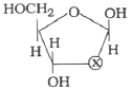
The structural formula of the pentose sugar present in $DNA$ is given. Select the correct group for the position marked '$X$' from the options.
A
B
C
D
Solution
(B) The pentose sugar present in $DNA$ is $2$-deoxyribose.
In a ribose sugar,there is an $-OH$ group at the $2'$ carbon position.
In $2$-deoxyribose,the oxygen atom is removed from the $2'$ position,leaving only a hydrogen atom $(-H)$ at that position.
The structure provided shows the $2'$ carbon position marked as '$X$'.
Since it is $DNA$,the sugar is $2$-deoxyribose,so the '$X$' position must be occupied by a hydrogen atom $(-H)$.
Looking at the options,option $B$ represents the $-H$ and $-H$ configuration at that carbon,which corresponds to the deoxy position.
In a ribose sugar,there is an $-OH$ group at the $2'$ carbon position.
In $2$-deoxyribose,the oxygen atom is removed from the $2'$ position,leaving only a hydrogen atom $(-H)$ at that position.
The structure provided shows the $2'$ carbon position marked as '$X$'.
Since it is $DNA$,the sugar is $2$-deoxyribose,so the '$X$' position must be occupied by a hydrogen atom $(-H)$.
Looking at the options,option $B$ represents the $-H$ and $-H$ configuration at that carbon,which corresponds to the deoxy position.
0 likes
View Solution48
MediumMCQ
Select the correct match for $X$ and $Y$:
| Column $X$ | Column $Y$ |
| $(1)$ $DNA$ | $(P)$ Most abundant |
| $(2)$ $m-RNA$ | $(Q)$ Various types based on anticodons |
| $(3)$ $t-RNA$ | $(R)$ Carries information as genetic code |
| $(4)$ $r-RNA$ | $(S)$ $A$ specific part acts as a template |
A
$(1-S), (2-R), (3-Q), (4-P)$
B
$(1-R), (2-S), (3-Q), (4-P)$
C
$(1-R), (2-S), (3-P), (4-Q)$
D
$(1-S), (2-P), (3-Q), (4-R)$
Solution
(A) The correct matching is as follows:
$(1)$ $DNA$: $A$ specific part of $DNA$ acts as a template for transcription,so $(1-S)$.
$(2)$ $m-RNA$: It carries the genetic information from $DNA$ to the ribosome in the form of codons,so $(2-R)$.
$(3)$ $t-RNA$: It has anticodons that pair with codons on $m-RNA$,and there are different types of $t-RNA$ for different amino acids,so $(3-Q)$.
$(4)$ $r-RNA$: It is the most abundant type of $RNA$ in the cell,constituting about $80\%$ of the total $RNA$,so $(4-P)$.
Therefore,the correct sequence is $(1-S), (2-R), (3-Q), (4-P)$.
$(1)$ $DNA$: $A$ specific part of $DNA$ acts as a template for transcription,so $(1-S)$.
$(2)$ $m-RNA$: It carries the genetic information from $DNA$ to the ribosome in the form of codons,so $(2-R)$.
$(3)$ $t-RNA$: It has anticodons that pair with codons on $m-RNA$,and there are different types of $t-RNA$ for different amino acids,so $(3-Q)$.
$(4)$ $r-RNA$: It is the most abundant type of $RNA$ in the cell,constituting about $80\%$ of the total $RNA$,so $(4-P)$.
Therefore,the correct sequence is $(1-S), (2-R), (3-Q), (4-P)$.
0 likes
View Solution49
MediumMCQ
Select the correct match for $X$ and $Y$:
| Column $X$ | Column $Y$ |
| $(1)$ Chromosome | $(P)$ Genetic code |
| $(2)$ $m-RNA$ | $(Q)$ Gene |
| $(3)$ $t-RNA$ | $(R)$ Ribosome |
| $(4)$ $r-RNA$ | $(S)$ Anticodon |
A
$(1-Q), (2-P), (3-S), (4-R)$
B
$(1-Q), (2-S), (3-P), (4-R)$
C
$(1-S), (2-P), (3-Q), (4-R)$
D
$(1-R), (2-P), (3-S), (4-Q)$
Solution
(A) The correct matches are as follows:
$(1)$ Chromosome contains the genetic material, which is the Gene $(Q)$.
$(2)$ $m-RNA$ (messenger $RNA$) carries the genetic code $(P)$ for protein synthesis.
$(3)$ $t-RNA$ (transfer $RNA$) contains the anticodon $(S)$ that pairs with the codon on $m-RNA$.
$(4)$ $r-RNA$ (ribosomal $RNA$) is a structural component of the Ribosome $(R)$.
Therefore, the correct sequence is $(1-Q), (2-P), (3-S), (4-R)$.
$(1)$ Chromosome contains the genetic material, which is the Gene $(Q)$.
$(2)$ $m-RNA$ (messenger $RNA$) carries the genetic code $(P)$ for protein synthesis.
$(3)$ $t-RNA$ (transfer $RNA$) contains the anticodon $(S)$ that pairs with the codon on $m-RNA$.
$(4)$ $r-RNA$ (ribosomal $RNA$) is a structural component of the Ribosome $(R)$.
Therefore, the correct sequence is $(1-Q), (2-P), (3-S), (4-R)$.
0 likes
View Solution50
MediumMCQ
Which one of the following is wrongly matched?
A
Transcription - Writing information from $DNA$ to $tRNA$.
B
Translation - Using information in $mRNA$ to make protein.
C
Operon - Structural genes,operator and promoter.
D
Both $(a)$ and $(c)$
Solution
(D) The correct answer is $(d)$.
Transcription is the process in living cells in which the genetic information of $DNA$ is transferred to $mRNA$,not $tRNA$,as the first step of gene expression.
An operon consists of structural genes,a promoter,an operator,and a regulator gene. Therefore,the definition in $(c)$ is incomplete as it omits the regulator gene.
Since both $(a)$ and $(c)$ are incorrectly matched,$(d)$ is the correct choice.
Transcription is the process in living cells in which the genetic information of $DNA$ is transferred to $mRNA$,not $tRNA$,as the first step of gene expression.
An operon consists of structural genes,a promoter,an operator,and a regulator gene. Therefore,the definition in $(c)$ is incomplete as it omits the regulator gene.
Since both $(a)$ and $(c)$ are incorrectly matched,$(d)$ is the correct choice.
0 likes
View SolutionMolecular Basis of Inheritance — Mix Example-Molecular Basis of Inheritance · Frequently Asked Questions
1Are these Molecular Basis of Inheritance questions useful for JEE and NEET?
Yes. All questions in this section are mapped to JEE Main and NEET exam patterns. Previous year questions from JEE Main, NEET, GUJCET and state-level exams are included with full solutions.
2Can I switch to Hindi or Gujarati for these questions?
Yes. Use the language tabs in the hero section or the sidebar to view the same questions and solutions in English, Hindi or Gujarati.
3How do I generate a question paper from this subtopic?
Use the Vedclass Exam Paper Generator — select the chapter and subtopic, set difficulty, and generate Sets A, B, C, D automatically. First 3 chapters of every subject are free.
Vedclass Products
For Students
Vedclass Test Series
Mock tests in real JEE/NEET style with performance analysis. 5-day free trial.
Start Free TrialFor Teachers
Exam Paper Generator
Generate Set A/B/C/D papers from this chapter in 2 minutes. 3 chapters free.
Try FreeFor Institutes
Online Exam Module
Live online exams with unlimited students, 360° analytics & white-label branding.
See DemoFor Teachers & Institutes
Generate a Molecular Basis of Inheritance Exam Paper in 2 Minutes
Select subtopic & difficulty — Sets A, B, C, D auto-generated with No Repeat logic.
First 3 chapters of every subject are free — no payment required.