
A English
Transcription Questions in English
Class 12 Biology · Molecular Basis of Inheritance · Transcription
277+
Questions
English
Language
100%
With Solutions
Showing 49 of 277 questions in English
51
EasyMCQ
The main enzyme for transcription is .....
A
$DNA$-dependent $DNA$ polymerase
B
$DNA$-dependent $RNA$ polymerase
C
$RNA$-dependent $RNA$ polymerase
D
$RNA$-dependent $DNA$ polymerase
Solution
(B) Transcription is the process of copying genetic information from one strand of the $DNA$ into $RNA$.
This process is catalyzed by the enzyme $DNA$-dependent $RNA$ polymerase.
It uses a $DNA$ template to synthesize a complementary $RNA$ strand.
Therefore,the correct option is $B$.
This process is catalyzed by the enzyme $DNA$-dependent $RNA$ polymerase.
It uses a $DNA$ template to synthesize a complementary $RNA$ strand.
Therefore,the correct option is $B$.
0 likes
View Solution52
MediumMCQ
Through which process does the nuclear $DNA$ transfer genetic information to $RNA$?
A
Transcription
B
Translation
C
Transformation
D
Transport
Solution
(A) The process of copying genetic information from one strand of the $DNA$ into $RNA$ is termed as $Transcription$.
In this process,only a segment of $DNA$ and only one of the two strands is copied into $RNA$.
$Translation$ is the process of polymerization of amino acids to form a polypeptide based on the sequence of nucleotides in $mRNA$.
In this process,only a segment of $DNA$ and only one of the two strands is copied into $RNA$.
$Translation$ is the process of polymerization of amino acids to form a polypeptide based on the sequence of nucleotides in $mRNA$.
0 likes
View Solution53
EasyMCQ
The enzyme involved in transcription is . . . . . . .
A
$RNA$ polymerase
B
$DNA$ polymerase-$I$
C
$DNA$ polymerase-$II$
D
$DNA$ polymerase-$III$
Solution
(A) Transcription is the process of copying genetic information from one strand of the $DNA$ into $RNA$. The enzyme responsible for this process is $RNA$ polymerase. It catalyzes the polymerization of ribonucleotides in a $5' \rightarrow 3'$ direction using a $DNA$ template. $DNA$ polymerases are primarily involved in $DNA$ replication,not transcription.
0 likes
View Solution54
MediumMCQ
The part of the gene that is transcribed but not translated is known as .....
A
Exon
B
Intron
C
Cistron
D
Codon
Solution
(B) In eukaryotic genes,the coding sequences are known as exons,which are expressed in the final protein product.
Introns are the intervening sequences that are transcribed into $pre-mRNA$ but are removed during the process of $RNA$ splicing.
Therefore,introns are transcribed but not translated into proteins.
Introns are the intervening sequences that are transcribed into $pre-mRNA$ but are removed during the process of $RNA$ splicing.
Therefore,introns are transcribed but not translated into proteins.
0 likes
View Solution55
EasyMCQ
The removal of introns and joining of exons is known as.......
A
Capping
B
Tailing
C
Splicing
D
All of these
Solution
(C) In eukaryotic cells,the primary transcript (pre-mRNA) contains both coding sequences called $exons$ and non-coding sequences called $introns$.
During the process of post-transcriptional modification,the $introns$ are removed and the $exons$ are joined in a defined order.
This process is known as $splicing$.
$Capping$ refers to the addition of a methylguanosine triphosphate at the $5'$ end,and $Tailing$ refers to the addition of poly-$A$ residues at the $3'$ end.
During the process of post-transcriptional modification,the $introns$ are removed and the $exons$ are joined in a defined order.
This process is known as $splicing$.
$Capping$ refers to the addition of a methylguanosine triphosphate at the $5'$ end,and $Tailing$ refers to the addition of poly-$A$ residues at the $3'$ end.
0 likes
View Solution56
MediumMCQ
The $DNA$ strand that does not code for anything is called the ..........
A
Template strand
B
Antisense strand
C
Coding strand
D
Non-coding strand
Solution
(C) In the process of transcription,only one strand of $DNA$ acts as a template for $mRNA$ synthesis.
This strand is known as the template strand or antisense strand.
The other strand,which has the same sequence as the $mRNA$ (except for $U$ instead of $T$),is called the coding strand or sense strand.
The coding strand does not directly code for the $RNA$ molecule during transcription; therefore,it is often referred to as the non-template strand.
This strand is known as the template strand or antisense strand.
The other strand,which has the same sequence as the $mRNA$ (except for $U$ instead of $T$),is called the coding strand or sense strand.
The coding strand does not directly code for the $RNA$ molecule during transcription; therefore,it is often referred to as the non-template strand.
0 likes
View Solution57
MediumMCQ
During transcription,the holoenzyme $RNA$ polymerase binds to the $DNA$ strand. It forms a structure resembling a saddle at a specific site on the $DNA$. This sequence is called .....
A
$CAAT$ box
B
$GGTT$ box
C
$AAAT$ box
D
$TATA$ box
Solution
(D) During the initiation of transcription in eukaryotes,the $RNA$ polymerase holoenzyme recognizes and binds to a specific promoter sequence on the $DNA$ template.
This specific sequence is rich in $Adenine$ and $Thymine$ bases and is known as the $TATA$ box (or $Goldberg-Hogness$ box).
It is located approximately $25$ to $30$ base pairs upstream of the transcription start site.
The binding of $RNA$ polymerase to this site creates a characteristic 'saddle' or 'bubble' structure,which facilitates the unwinding of the $DNA$ double helix to initiate transcription.
This specific sequence is rich in $Adenine$ and $Thymine$ bases and is known as the $TATA$ box (or $Goldberg-Hogness$ box).
It is located approximately $25$ to $30$ base pairs upstream of the transcription start site.
The binding of $RNA$ polymerase to this site creates a characteristic 'saddle' or 'bubble' structure,which facilitates the unwinding of the $DNA$ double helix to initiate transcription.
0 likes
View Solution58
MediumMCQ
During transcription,both strands of $DNA$ are not copied because:
A
If both strands act as a template,they would code for $RNA$ molecules with different sequences.
B
If both $RNA$ molecules are produced simultaneously,they would be complementary to each other and form double-stranded $RNA$.
C
The $RNA$ molecule would code for the same sequence.
D
Both $(a)$ and $(b)$ are correct.
Solution
(D) During transcription,only one segment of $DNA$ is copied into $RNA$.
If both strands of $DNA$ were to act as templates,they would code for $RNA$ molecules with different sequences because the two strands of $DNA$ are complementary to each other,not identical.
Furthermore,if these two different $RNA$ molecules were produced simultaneously,they would be complementary to each other,forming a double-stranded $RNA$ $(dsRNA)$.
This $dsRNA$ would prevent the translation of $RNA$ into proteins,rendering the transcription process futile.
Therefore,both statements $(a)$ and $(b)$ are correct.
If both strands of $DNA$ were to act as templates,they would code for $RNA$ molecules with different sequences because the two strands of $DNA$ are complementary to each other,not identical.
Furthermore,if these two different $RNA$ molecules were produced simultaneously,they would be complementary to each other,forming a double-stranded $RNA$ $(dsRNA)$.
This $dsRNA$ would prevent the translation of $RNA$ into proteins,rendering the transcription process futile.
Therefore,both statements $(a)$ and $(b)$ are correct.
0 likes
View Solution59
MediumMCQ
$A$ gene that contains many exons and at least one intron is called a.....
A
Split gene
B
Operator gene
C
Synthetic gene
D
Epistatic gene
Solution
(A) In eukaryotic organisms,the coding sequences of a gene are interrupted by non-coding sequences.
These coding sequences are known as $exons$,and the non-coding sequences that intervene between them are known as $introns$.
$A$ gene that possesses both $exons$ and $introns$ is referred to as a $split$ $gene$.
This structure is a characteristic feature of eukaryotic genes,where the primary transcript (pre-mRNA) undergoes splicing to remove $introns$ and join $exons$ to form mature $mRNA$.
These coding sequences are known as $exons$,and the non-coding sequences that intervene between them are known as $introns$.
$A$ gene that possesses both $exons$ and $introns$ is referred to as a $split$ $gene$.
This structure is a characteristic feature of eukaryotic genes,where the primary transcript (pre-mRNA) undergoes splicing to remove $introns$ and join $exons$ to form mature $mRNA$.
0 likes
View Solution60
EasyMCQ
......... acts as a template.
A
$A$ polynucleotide chain of $mRNA$
B
$tRNA$
C
One of the two polynucleotide chains of a gene
D
Both polynucleotide chains of a gene
Solution
(C) During the process of transcription,only one segment of $DNA$ and only one of the two strands of $DNA$ acts as a template. This strand is known as the template strand or the antisense strand. The other strand,which does not code for anything,is called the coding strand or the sense strand. Therefore,only one of the two polynucleotide chains of a gene acts as a template.
0 likes
View Solution61
MediumMCQ
Genetic information flows from ......... to ..........
A
$DNA, mRNA$
B
$DNA, tRNA$
C
$mRNA, DNA$
D
$tRNA, mRNA$
Solution
(A) The central dogma of molecular biology states that genetic information flows from $DNA$ to $RNA$ (specifically $mRNA$) and then to protein.
During the process of transcription,the genetic information stored in $DNA$ is copied into $mRNA$.
Therefore,the flow of genetic information is from $DNA$ to $mRNA$.
During the process of transcription,the genetic information stored in $DNA$ is copied into $mRNA$.
Therefore,the flow of genetic information is from $DNA$ to $mRNA$.
0 likes
View Solution62
MediumMCQ
Which structure is responsible for the synthesis of $m-RNA$?
A
$ATP$
B
Nucleus
C
$DNA$
D
$t-RNA$
Solution
(C) The process of synthesizing $m-RNA$ from a $DNA$ template is known as transcription.
In eukaryotic cells,this process occurs within the nucleus,where the enzyme $RNA$ polymerase uses one of the $DNA$ strands as a template to synthesize a complementary $m-RNA$ strand.
Therefore,$DNA$ acts as the template or the structural basis for $m-RNA$ synthesis.
In eukaryotic cells,this process occurs within the nucleus,where the enzyme $RNA$ polymerase uses one of the $DNA$ strands as a template to synthesize a complementary $m-RNA$ strand.
Therefore,$DNA$ acts as the template or the structural basis for $m-RNA$ synthesis.
0 likes
View Solution63
MediumMCQ
Which molecule carries the information for the synthesis of a specific protein from $DNA$?
A
$m-RNA$
B
$t-RNA$
C
$r-RNA$
D
$z-RNA$
Solution
(A) $m-RNA$ (messenger $RNA$) acts as a template for protein synthesis.
It carries the genetic information transcribed from $DNA$ in the form of a sequence of nucleotides.
This sequence is translated into a specific sequence of amino acids to form a protein.
$t-RNA$ (transfer $RNA$) brings amino acids to the ribosome.
$r-RNA$ (ribosomal $RNA$) forms the structural component of ribosomes.
Therefore,the correct option is $A$.
It carries the genetic information transcribed from $DNA$ in the form of a sequence of nucleotides.
This sequence is translated into a specific sequence of amino acids to form a protein.
$t-RNA$ (transfer $RNA$) brings amino acids to the ribosome.
$r-RNA$ (ribosomal $RNA$) forms the structural component of ribosomes.
Therefore,the correct option is $A$.
0 likes
View Solution64
MediumMCQ
How is $m-RNA$ synthesized?
A
$m-RNA$ is synthesized by the genes of a $DNA$ segment.
B
$m-RNA$ is synthesized by $t-RNA$ with the help of $DNA$.
C
$m-RNA$ is synthesized by $t-RNA$.
D
$m-RNA$ is synthesized by $t-RNA$ and $r-RNA$.
Solution
(A) The process of copying genetic information from one strand of the $DNA$ into $RNA$ is termed as transcription.
In this process,the enzyme $RNA$ polymerase catalyzes the polymerization of ribonucleotides based on the template provided by the $DNA$ segment (gene).
Therefore,$m-RNA$ is synthesized from the genetic information present in the $DNA$ segment.
In this process,the enzyme $RNA$ polymerase catalyzes the polymerization of ribonucleotides based on the template provided by the $DNA$ segment (gene).
Therefore,$m-RNA$ is synthesized from the genetic information present in the $DNA$ segment.
0 likes
View Solution65
MediumMCQ
What is a template strand?
A
$A$ polypeptide chain
B
$A$ polynucleotide chain
C
$DNA$ strand acting as a template for transcription
D
$A$ polysaccharide chain
Solution
(C) During the process of transcription,one of the two strands of $DNA$ acts as a template for the synthesis of $RNA$. This specific strand is known as the template strand. It is a polynucleotide chain that provides the sequence of nucleotides for the complementary $RNA$ strand to be synthesized by $RNA$ polymerase. Therefore,the most accurate description in the context of molecular biology is that it is a $DNA$ strand that serves as a template for transcription.
0 likes
View Solution66
MediumMCQ
$A$: All types of $RNA$ are synthesized by $DNA$.
$R$: All three types of $RNA$ are important in protein synthesis.
$R$: All three types of $RNA$ are important in protein synthesis.
A
$A$ and $R$ are both true and $R$ is the correct explanation of $A$.
B
$A$ and $R$ are both true,but $R$ is not the correct explanation of $A$.
C
$A$ is true and $R$ is false.
D
$A$ is false and $R$ is true.
Solution
(B) Assertion $(A)$ is true because $DNA$ acts as a template for the transcription of all three major types of $RNA$ ($mRNA$,$tRNA$,and $rRNA$) in the cell.
Reason $(R)$ is also true because $mRNA$ provides the genetic code,$tRNA$ brings amino acids to the ribosome,and $rRNA$ forms the structural and catalytic components of the ribosome,all of which are essential for protein synthesis.
However,the reason $(R)$ explains the functional importance of $RNA$ types,not the mechanism of their synthesis by $DNA$. Therefore,$R$ is not the correct explanation of $A$.
Reason $(R)$ is also true because $mRNA$ provides the genetic code,$tRNA$ brings amino acids to the ribosome,and $rRNA$ forms the structural and catalytic components of the ribosome,all of which are essential for protein synthesis.
However,the reason $(R)$ explains the functional importance of $RNA$ types,not the mechanism of their synthesis by $DNA$. Therefore,$R$ is not the correct explanation of $A$.
0 likes
View Solution67
MediumMCQ
Spliceosomes are not found in cells of
A
fungi
B
animals
C
bacteria
D
plants
Solution
(C) : Spliceosomes are complexes of small nuclear ribonucleoproteins $(snRNPs)$ that facilitate the removal of introns from pre-$mRNA$ during $RNA$ splicing.
Since bacteria are prokaryotes,their genes do not contain introns.
Consequently,prokaryotic $mRNA$ does not undergo splicing,and therefore,spliceosomes are absent in bacterial cells.
Since bacteria are prokaryotes,their genes do not contain introns.
Consequently,prokaryotic $mRNA$ does not undergo splicing,and therefore,spliceosomes are absent in bacterial cells.
0 likes
View Solution68
MediumMCQ
$DNA$-dependent $RNA$ polymerase catalyses transcription on one strand of the $DNA$ which is called the
A
template strand
B
coding strand
C
alpha strand
D
antistrand
Solution
(A) : The strand of $DNA$ on which $RNA$ polymerase binds to catalyse transcription is called the template strand.
It is also known as the master or antisense strand.
It has the polarity of $3' \rightarrow 5'$.
It is also known as the master or antisense strand.
It has the polarity of $3' \rightarrow 5'$.
0 likes
View Solution69
MediumMCQ
Select the correct option regarding the direction of $RNA$ synthesis and the direction of reading of the template $DNA$ strand.
| Direction of $RNA$ synthesis | Direction of reading of the template $DNA$ |
| $A$. $5'-3'$ | $3'-5'$ |
| $B$. $3'-5'$ | $5'-3'$ |
| $C$. $5'-3'$ | $5'-3'$ |
| $D$. $3'-5'$ | $3'-5'$ |
A
$A$
B
$B$
C
$C$
D
$D$
Solution
(A) During the process of transcription, the enzyme $RNA$ polymerase catalyzes the synthesis of $RNA$ in the $5'$ to $3'$ direction.
The $DNA$ template strand, which is used for complementary base pairing, has a polarity of $3'$ to $5'$.
Therefore, the $RNA$ polymerase reads the template $DNA$ strand in the $3'$ to $5'$ direction to synthesize a new $RNA$ strand in the $5'$ to $3'$ direction.
Thus, option $A$ is the correct choice.
The $DNA$ template strand, which is used for complementary base pairing, has a polarity of $3'$ to $5'$.
Therefore, the $RNA$ polymerase reads the template $DNA$ strand in the $3'$ to $5'$ direction to synthesize a new $RNA$ strand in the $5'$ to $3'$ direction.
Thus, option $A$ is the correct choice.
0 likes
View Solution70
EasyMCQ
Removal of introns and joining of exons in a defined order during transcription is called
A
looping
B
inducing
C
slicing
D
splicing
Solution
(D) The correct answer is $D$.
In eukaryotic cells,the primary transcript (pre-$mRNA$) contains both coding sequences called exons and non-coding sequences called introns.
The process of removing these non-coding introns and joining the coding exons together in a specific order to form a mature $mRNA$ molecule is known as splicing.
This process is essential for the production of functional proteins,as introns do not code for amino acids.
In eukaryotic cells,the primary transcript (pre-$mRNA$) contains both coding sequences called exons and non-coding sequences called introns.
The process of removing these non-coding introns and joining the coding exons together in a specific order to form a mature $mRNA$ molecule is known as splicing.
This process is essential for the production of functional proteins,as introns do not code for amino acids.
0 likes
View Solution71
MediumMCQ
If one strand of $DNA$ has the nitrogenous base sequence as $ATCTG$,what would be the complementary $RNA$ strand sequence?
A
$TTAGU$
B
$UAGAC$
C
$AACTG$
D
$ATCGU$
Solution
(B) In $DNA$,the base pairing rules are $A$ pairs with $T$,and $C$ pairs with $G$.
During the process of transcription,$DNA$ is transcribed into $RNA$.
In $RNA$,the base uracil $(U)$ replaces thymine $(T)$.
Therefore,the complementary $RNA$ sequence for the $DNA$ template strand $ATCTG$ is determined as follows:
$A$ pairs with $U$
$T$ pairs with $A$
$C$ pairs with $G$
$T$ pairs with $A$
$G$ pairs with $C$
Thus,the resulting $RNA$ sequence is $UAGAC$.
During the process of transcription,$DNA$ is transcribed into $RNA$.
In $RNA$,the base uracil $(U)$ replaces thymine $(T)$.
Therefore,the complementary $RNA$ sequence for the $DNA$ template strand $ATCTG$ is determined as follows:
$A$ pairs with $U$
$T$ pairs with $A$
$C$ pairs with $G$
$T$ pairs with $A$
$G$ pairs with $C$
Thus,the resulting $RNA$ sequence is $UAGAC$.
0 likes
View Solution72
MediumMCQ
Which one of the following is not a part of a transcription unit in $DNA$?
A
The inducer
B
$A$ terminator
C
$A$ promoter
D
The structural gene
Solution
(A) The correct answer is $A$.
$A$ transcription unit in $DNA$ is defined primarily by three regions:
$1$. $A$ promoter: The site where $RNA$ polymerase binds to initiate the process of transcription.
$2$. The structural gene: The segment of $DNA$ that codes for an $RNA$ molecule.
$3$. $A$ terminator: The region that signals the termination of the transcription process and the release of the newly synthesized $RNA$ strand.
The inducer is a regulatory molecule (often a small metabolite) that interacts with a repressor protein to regulate gene expression,but it is not a structural component of the transcription unit itself.
$A$ transcription unit in $DNA$ is defined primarily by three regions:
$1$. $A$ promoter: The site where $RNA$ polymerase binds to initiate the process of transcription.
$2$. The structural gene: The segment of $DNA$ that codes for an $RNA$ molecule.
$3$. $A$ terminator: The region that signals the termination of the transcription process and the release of the newly synthesized $RNA$ strand.
The inducer is a regulatory molecule (often a small metabolite) that interacts with a repressor protein to regulate gene expression,but it is not a structural component of the transcription unit itself.
0 likes
View Solution73
MediumMCQ
Removal of $RNA$ polymerase $III$ from nucleoplasm will affect the synthesis of
A
$tRNA$
B
$hnRNA$
C
$mRNA$
D
$rRNA$
Solution
(A) In eukaryotes,there are three main types of $RNA$ polymerases involved in transcription:
$1$. $RNA$ polymerase $I$ is responsible for the synthesis of $rRNA$ ($28S, 18S,$ and $5.8S$).
$2$. $RNA$ polymerase $II$ is responsible for the synthesis of $hnRNA$ (precursor of $mRNA$).
$3$. $RNA$ polymerase $III$ is responsible for the synthesis of $tRNA$,$5S$ $rRNA$,and $snRNA$.
Therefore,the removal of $RNA$ polymerase $III$ will specifically affect the synthesis of $tRNA$.
$1$. $RNA$ polymerase $I$ is responsible for the synthesis of $rRNA$ ($28S, 18S,$ and $5.8S$).
$2$. $RNA$ polymerase $II$ is responsible for the synthesis of $hnRNA$ (precursor of $mRNA$).
$3$. $RNA$ polymerase $III$ is responsible for the synthesis of $tRNA$,$5S$ $rRNA$,and $snRNA$.
Therefore,the removal of $RNA$ polymerase $III$ will specifically affect the synthesis of $tRNA$.
0 likes
View Solution74
MediumMCQ
In eukaryotic cell transcription,$RNA$ splicing and $RNA$ capping take place inside the
A
ribosomes
B
nucleus
C
dictyosomes
D
$ER$
Solution
(B) : Unlike in prokaryotes where transcription and translation take place in the same compartment,in eukaryotes,the primary transcript is first processed in the nucleus and then transported outside of the nucleus.
Since the primary transcripts of eukaryotes contain both expressing genes (exons) and non-expressing genes (introns),they undergo splicing of introns,followed by capping and tailing at the $5'$-end and $3'$-end,respectively.
Since the primary transcripts of eukaryotes contain both expressing genes (exons) and non-expressing genes (introns),they undergo splicing of introns,followed by capping and tailing at the $5'$-end and $3'$-end,respectively.
0 likes
View Solution75
MediumMCQ
Removal of introns and joining the exons in a defined order in a transcription unit is called
A
tailing
B
transformation
C
capping
D
splicing
Solution
(D) : $mRNA$ is not made directly in a eukaryotic cell. It is transcribed as heterogeneous nuclear $RNA$ $(hnRNA)$ in the nucleus. $hnRNA$ contains introns and exons. The introns are removed by $RNA$ splicing,leaving behind the exons,which contain the coding information. The exonic regions of $RNA$ are joined together to produce a single chain $RNA$ required for functioning as a translational template.
0 likes
View Solution76
MediumMCQ
Splicing of $RNA$ means......
A
Introns are removed.
B
Exons are removed.
C
Introns are removed and exons are joined.
D
Introns are joined and exons are removed.
Solution
(C) In eukaryotic cells,the primary transcript (pre-$mRNA$) contains both coding sequences called exons and non-coding sequences called introns.
Splicing is a post-transcriptional modification process where the non-coding introns are removed from the pre-$mRNA$,and the coding exons are joined together in a specific order to form the mature $mRNA$.
Therefore,the correct definition of splicing is that introns are removed and exons are joined.
Splicing is a post-transcriptional modification process where the non-coding introns are removed from the pre-$mRNA$,and the coding exons are joined together in a specific order to form the mature $mRNA$.
Therefore,the correct definition of splicing is that introns are removed and exons are joined.
0 likes
View Solution77
MediumMCQ
Which of the following is responsible for the transcription of $tRNA$ and $snRNAs$?
A
$DNA$ polymerase - $I$
B
$RNA$ polymerase - $II$
C
$RNA$ polymerase - $III$
D
$DNA$ polymerase - $II$
Solution
(C) In eukaryotic cells,there are three main types of $RNA$ polymerases responsible for the transcription of different types of $RNA$ molecules:
$1$. $RNA$ polymerase-$I$ is responsible for the transcription of $rRNAs$ ($28S$,$18S$,and $5.8S$).
$2$. $RNA$ polymerase-$II$ is responsible for the transcription of the precursor of $mRNA$,which is known as heterogeneous nuclear $RNA$ $(hnRNA)$.
$3$. $RNA$ polymerase-$III$ is responsible for the transcription of $tRNA$,$5S$ $rRNA$,and $snRNAs$ (small nuclear $RNAs$).
Therefore,$RNA$ polymerase-$III$ is the enzyme responsible for the transcription of $tRNA$ and $snRNAs$.
$1$. $RNA$ polymerase-$I$ is responsible for the transcription of $rRNAs$ ($28S$,$18S$,and $5.8S$).
$2$. $RNA$ polymerase-$II$ is responsible for the transcription of the precursor of $mRNA$,which is known as heterogeneous nuclear $RNA$ $(hnRNA)$.
$3$. $RNA$ polymerase-$III$ is responsible for the transcription of $tRNA$,$5S$ $rRNA$,and $snRNAs$ (small nuclear $RNAs$).
Therefore,$RNA$ polymerase-$III$ is the enzyme responsible for the transcription of $tRNA$ and $snRNAs$.
0 likes
View Solution78
MediumMCQ
In the process of transcription, the sigma factor is important for:
A
Initiation
B
Elongation
C
Termination
D
All of the above
Solution
(A) In prokaryotic transcription, the $RNA$ polymerase enzyme consists of a core enzyme and a sigma factor $(\sigma)$.
The core enzyme is responsible for the elongation of the $RNA$ chain.
The sigma factor $(\sigma)$ specifically recognizes the promoter region on the $DNA$ template.
By binding to the promoter, the sigma factor facilitates the initiation of transcription.
Once initiation is complete, the sigma factor dissociates from the core enzyme, allowing elongation to proceed.
The core enzyme is responsible for the elongation of the $RNA$ chain.
The sigma factor $(\sigma)$ specifically recognizes the promoter region on the $DNA$ template.
By binding to the promoter, the sigma factor facilitates the initiation of transcription.
Once initiation is complete, the sigma factor dissociates from the core enzyme, allowing elongation to proceed.
0 likes
View Solution79
MediumMCQ
Which of the following is not a region of a transcription unit?
A
Promoter
B
Structural gene
C
Terminator
D
$RNA$ polymerase
Solution
(D) transcription unit in $DNA$ is defined primarily by three regions in the $DNA$ molecule:
$1$. $A$ promoter
$2$. The structural gene
$3$. $A$ terminator
$RNA$ polymerase is an enzyme that catalyzes the process of transcription,but it is not a structural region or a part of the $DNA$ sequence of the transcription unit itself. Therefore,$RNA$ polymerase is the correct answer.
$1$. $A$ promoter
$2$. The structural gene
$3$. $A$ terminator
$RNA$ polymerase is an enzyme that catalyzes the process of transcription,but it is not a structural region or a part of the $DNA$ sequence of the transcription unit itself. Therefore,$RNA$ polymerase is the correct answer.
0 likes
View Solution80
MediumMCQ
Removal of $RNA$ polymerase $I$ from nucleoplasm will affect the synthesis of
A
$r-RNA$
B
$hnRNA$
C
$t-RNA$
D
$m-RNA$
Solution
(A) In eukaryotes,there are three main types of $RNA$ polymerases involved in transcription:
$1$. $RNA$ polymerase $I$ is responsible for the transcription of $r-RNA$ ($28S$,$18S$,and $5.8S$).
$2$. $RNA$ polymerase $II$ is responsible for the transcription of the precursor of $m-RNA$,which is $hnRNA$ (heterogeneous nuclear $RNA$).
$3$. $RNA$ polymerase $III$ is responsible for the transcription of $t-RNA$,$5S$ $r-RNA$,and $snRNA$ (small nuclear $RNA$).
Therefore,the removal of $RNA$ polymerase $I$ will specifically affect the synthesis of $r-RNA$.
$1$. $RNA$ polymerase $I$ is responsible for the transcription of $r-RNA$ ($28S$,$18S$,and $5.8S$).
$2$. $RNA$ polymerase $II$ is responsible for the transcription of the precursor of $m-RNA$,which is $hnRNA$ (heterogeneous nuclear $RNA$).
$3$. $RNA$ polymerase $III$ is responsible for the transcription of $t-RNA$,$5S$ $r-RNA$,and $snRNA$ (small nuclear $RNA$).
Therefore,the removal of $RNA$ polymerase $I$ will specifically affect the synthesis of $r-RNA$.
0 likes
View Solution81
MediumMCQ
In capping,.......... is added to the $5'$ end of $hnRNA$.
A
Methyl guanosine triphosphate
B
Methyl adenosine triphosphate
C
Methyl cytidine triphosphate
D
Methyl uridine triphosphate
Solution
(A) Capping is a post-transcriptional modification process in eukaryotes.
During this process,an unusual nucleotide,$7$-methylguanosine triphosphate $(m^7G)$,is added to the $5'$ end of the $hnRNA$ (heterogeneous nuclear $RNA$).
This cap protects the $mRNA$ from degradation by exonucleases and helps in the initiation of translation by facilitating ribosome binding.
During this process,an unusual nucleotide,$7$-methylguanosine triphosphate $(m^7G)$,is added to the $5'$ end of the $hnRNA$ (heterogeneous nuclear $RNA$).
This cap protects the $mRNA$ from degradation by exonucleases and helps in the initiation of translation by facilitating ribosome binding.
0 likes
View Solution82
MediumMCQ
Which of the following is correct for $m-RNA$ in eukaryotes?
A
Exons appear in mature $RNA$ but introns do not appear in mature $RNA$.
B
Exons and introns do not appear in mature $RNA$.
C
Introns appear but exons do not appear in mature $RNA$.
D
Exons and introns both appear in mature $RNA$.
Solution
(A) In eukaryotes,the primary transcript (pre-$mRNA$) contains both coding sequences called exons and non-coding sequences called introns.
During the process of post-transcriptional modification,specifically splicing,the introns are removed,and the exons are joined together in a defined order.
Therefore,the mature $mRNA$ consists only of exons,which are translated into proteins.
During the process of post-transcriptional modification,specifically splicing,the introns are removed,and the exons are joined together in a defined order.
Therefore,the mature $mRNA$ consists only of exons,which are translated into proteins.
0 likes
View Solution83
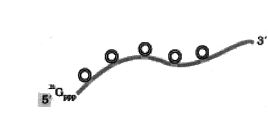
MediumMCQ
Which process is represented in the given figure?
A
Polyadenylation
B
Capping
C
$A$ and $B$ both are true
D
None of the above
Solution
(B) The figure shows the addition of a methyl guanosine triphosphate $(m^7Gppp)$ at the $5'$ end of the $mRNA$ molecule. This process is known as capping. In capping,an unusual nucleotide,methyl guanosine triphosphate,is added to the $5'$ end of the heterogeneous nuclear $RNA$ $(hnRNA)$. Polyadenylation,on the other hand,involves the addition of adenylate residues at the $3'$ end. Therefore,the correct option is $B$.
0 likes
View Solution84
MediumMCQ
Which molecule transfers genetic information from the nucleus to the ribosomes?
A
$hn-RNA$
B
$m-RNA$
C
$t-RNA$
D
$r-RNA$
Solution
(B) The process of protein synthesis involves the transcription of $DNA$ into $m-RNA$ within the nucleus.
$m-RNA$ (messenger $RNA$) acts as a template that carries the genetic code from the $DNA$ in the nucleus to the ribosomes in the cytoplasm.
At the ribosomes,the genetic information is translated into a polypeptide chain.
Therefore,$m-RNA$ is the molecule responsible for transferring genetic information from the nucleus to the ribosomes.
$m-RNA$ (messenger $RNA$) acts as a template that carries the genetic code from the $DNA$ in the nucleus to the ribosomes in the cytoplasm.
At the ribosomes,the genetic information is translated into a polypeptide chain.
Therefore,$m-RNA$ is the molecule responsible for transferring genetic information from the nucleus to the ribosomes.
0 likes
View Solution85
MediumMCQ
Formation of $RNA$ strand on a template $DNA$ is known as:
A
Replication
B
Transcription
C
Protein synthesis
D
Synthesis of primer
Solution
(B) The process of copying genetic information from one strand of the $DNA$ into $RNA$ is termed as $Transcription$.
In this process, only one segment of $DNA$ and only one of the two strands is copied into $RNA$.
$Replication$ refers to the duplication of $DNA$.
$Protein$ $synthesis$ (Translation) is the process where $mRNA$ is used to synthesize a polypeptide chain.
$Synthesis$ of $primer$ is a specific step during $DNA$ replication.
In this process, only one segment of $DNA$ and only one of the two strands is copied into $RNA$.
$Replication$ refers to the duplication of $DNA$.
$Protein$ $synthesis$ (Translation) is the process where $mRNA$ is used to synthesize a polypeptide chain.
$Synthesis$ of $primer$ is a specific step during $DNA$ replication.
0 likes
View Solution86
MediumMCQ
The process of copying genetic information from one strand of $DNA$ into $RNA$ is termed as .....
A
Replication
B
Transcription
C
Translation
D
Translocation
Solution
(B) The process of copying genetic information from one strand of $DNA$ into $RNA$ is known as $Transcription$.
In this process,only a segment of $DNA$ and only one of the two strands is copied into $RNA$.
$Replication$ is the process of duplicating $DNA$.
$Translation$ is the process of polymerizing amino acids to form a polypeptide based on the sequence of $mRNA$.
$Translocation$ refers to the movement of the ribosome along the $mRNA$ during protein synthesis.
In this process,only a segment of $DNA$ and only one of the two strands is copied into $RNA$.
$Replication$ is the process of duplicating $DNA$.
$Translation$ is the process of polymerizing amino acids to form a polypeptide based on the sequence of $mRNA$.
$Translocation$ refers to the movement of the ribosome along the $mRNA$ during protein synthesis.
0 likes
View Solution87
MediumMCQ
If the template strand of $DNA$ is $3'-CTGATAGC-5'$,what will be the sequence of the transcribed $RNA$?
A
$5'-GACUAUCG-3'$
B
$5'-GUCTUTCG-3'$
C
$5'-GATATUG-3'$
D
$5'-UACTATCU-3'$
Solution
(A) During transcription,the $RNA$ polymerase enzyme synthesizes $RNA$ using the template strand of $DNA$ in the $3' \rightarrow 5'$ direction.
According to the principle of complementarity,$Adenine$ $(A)$ pairs with $Uracil$ $(U)$ in $RNA$,$Thymine$ $(T)$ pairs with $Adenine$ $(A)$,$Cytosine$ $(C)$ pairs with $Guanine$ $(G)$,and $Guanine$ $(G)$ pairs with $Cytosine$ $(C)$.
Given template strand: $3'-C-T-G-A-T-A-G-C-5'$.
Complementary $RNA$ sequence: $5'-G-A-C-U-A-U-C-G-3'$.
Therefore,the correct sequence is $5'-GACUAUCG-3'$.
According to the principle of complementarity,$Adenine$ $(A)$ pairs with $Uracil$ $(U)$ in $RNA$,$Thymine$ $(T)$ pairs with $Adenine$ $(A)$,$Cytosine$ $(C)$ pairs with $Guanine$ $(G)$,and $Guanine$ $(G)$ pairs with $Cytosine$ $(C)$.
Given template strand: $3'-C-T-G-A-T-A-G-C-5'$.
Complementary $RNA$ sequence: $5'-G-A-C-U-A-U-C-G-3'$.
Therefore,the correct sequence is $5'-GACUAUCG-3'$.
0 likes
View Solution88
MediumMCQ
If the sequence of nitrogenous bases in $DNA$ is $ATTCGATG$,what will be the sequence of bases in the $mRNA$ transcript?
A
$UAAGCUAC$
B
$AUUCGAUG$
C
$CAUCGAAU$
D
$GUAGCUUA$
Solution
(A) During the process of transcription,$DNA$ acts as a template to synthesize $mRNA$.
According to the principle of complementarity,$Adenine$ $(A)$ pairs with $Uracil$ $(U)$ in $RNA$,$Thymine$ $(T)$ pairs with $Adenine$ $(A)$,$Cytosine$ $(C)$ pairs with $Guanine$ $(G)$,and $Guanine$ $(G)$ pairs with $Cytosine$ $(C)$.
Given $DNA$ template sequence: $A-T-T-C-G-A-T-G$.
Complementary $mRNA$ sequence: $U-A-A-G-C-U-A-C$.
Therefore,the correct sequence is $UAAGCUAC$.
According to the principle of complementarity,$Adenine$ $(A)$ pairs with $Uracil$ $(U)$ in $RNA$,$Thymine$ $(T)$ pairs with $Adenine$ $(A)$,$Cytosine$ $(C)$ pairs with $Guanine$ $(G)$,and $Guanine$ $(G)$ pairs with $Cytosine$ $(C)$.
Given $DNA$ template sequence: $A-T-T-C-G-A-T-G$.
Complementary $mRNA$ sequence: $U-A-A-G-C-U-A-C$.
Therefore,the correct sequence is $UAAGCUAC$.
0 likes
View Solution89
EasyMCQ
In which direction is $m-RNA$ synthesized on a $DNA$ template?
A
$5' \to 3'$
B
$3' \to 5'$
C
Both $A$ and $B$
D
None of these
Solution
(A) During the process of transcription,the enzyme $RNA$ polymerase synthesizes $m-RNA$ by reading the $DNA$ template strand in the $3' \to 5'$ direction.
As a result,the newly synthesized $m-RNA$ strand is always formed in the $5' \to 3'$ direction due to the antiparallel nature of the nucleic acid strands.
As a result,the newly synthesized $m-RNA$ strand is always formed in the $5' \to 3'$ direction due to the antiparallel nature of the nucleic acid strands.
0 likes
View Solution90
MediumMCQ
Which of the following joins the $RNA$ segments together during the splicing of $RNA$?
A
$RNA$ polymerase
B
$RNA$ primase
C
$RNA$ ligase
D
$RNA$ protease
Solution
(C) During the process of $RNA$ splicing, the non-coding sequences known as introns are removed, and the coding sequences known as exons are joined together.
This joining process is facilitated by the enzyme $RNA$ ligase, which catalyzes the formation of phosphodiester bonds between the $3'-OH$ and $5'-phosphate$ ends of the adjacent exon segments.
Therefore, the correct option is $C$.
This joining process is facilitated by the enzyme $RNA$ ligase, which catalyzes the formation of phosphodiester bonds between the $3'-OH$ and $5'-phosphate$ ends of the adjacent exon segments.
Therefore, the correct option is $C$.
0 likes
View Solution91
MediumMCQ
During transcription,the site on $DNA$ where $RNA$ polymerase binds is called .......
A
Receptor
B
Enhancer
C
Promoter
D
Regulator
Solution
(C) During the process of transcription in prokaryotes and eukaryotes,the $RNA$ polymerase enzyme recognizes and binds to a specific sequence on the $DNA$ template strand known as the promoter. The promoter is located towards the $5'$ end (upstream) of the structural gene and provides the binding site for $RNA$ polymerase to initiate transcription.
0 likes
View Solution92
MediumMCQ
During transcription,the nucleotide sequence of a $DNA$ strand is $ATACG$. What will be the nucleotide sequence of the $m-RNA$?
A
$TATGC$
B
$TCTGG$
C
$UAUGC$
D
$UATGG$
Solution
(C) During the process of transcription,$DNA$ acts as a template for the synthesis of $m-RNA$.
According to the base-pairing rules,$Adenine$ $(A)$ pairs with $Uracil$ $(U)$ in $RNA$,and $Thymine$ $(T)$ pairs with $Adenine$ $(A)$.
Given $DNA$ sequence: $ATACG$.
- $A$ pairs with $U$
- $T$ pairs with $A$
- $A$ pairs with $U$
- $C$ pairs with $G$
- $G$ pairs with $C$
Therefore,the resulting $m-RNA$ sequence is $UA UGC$.
According to the base-pairing rules,$Adenine$ $(A)$ pairs with $Uracil$ $(U)$ in $RNA$,and $Thymine$ $(T)$ pairs with $Adenine$ $(A)$.
Given $DNA$ sequence: $ATACG$.
- $A$ pairs with $U$
- $T$ pairs with $A$
- $A$ pairs with $U$
- $C$ pairs with $G$
- $G$ pairs with $C$
Therefore,the resulting $m-RNA$ sequence is $UA UGC$.
0 likes
View Solution93
MediumMCQ
During transcription,the holoenzyme $RNA$ polymerase binds to the $DNA$ strand,and the $DNA$ forms a saddle-like structure at that site. What is this sequence called?
A
$CAAT$ box
B
$GGTT$ box
C
$AAAT$ box
D
$TATA$ box
Solution
(D) During the initiation of transcription in eukaryotes,the $RNA$ polymerase holoenzyme recognizes and binds to a specific promoter sequence located upstream of the gene.
This specific sequence is rich in $Adenine$ and $Thymine$ bases and is known as the $TATA$ box (or $Goldberg-Hogness$ box).
Binding of the $RNA$ polymerase to the $TATA$ box causes the $DNA$ double helix to unwind and bend,creating a characteristic saddle-like structure that facilitates the formation of the transcription initiation complex.
This specific sequence is rich in $Adenine$ and $Thymine$ bases and is known as the $TATA$ box (or $Goldberg-Hogness$ box).
Binding of the $RNA$ polymerase to the $TATA$ box causes the $DNA$ double helix to unwind and bend,creating a characteristic saddle-like structure that facilitates the formation of the transcription initiation complex.
0 likes
View Solution94
MediumMCQ
The molecular basis of cell differentiation depends on the regulation of:
A
$RNA$ polymerase
B
Ribosomes
C
Transcription factors
D
Anticodons
Solution
(C) Cell differentiation is the process by which a less specialized cell becomes a more specialized cell type. This process is primarily controlled by the differential expression of genes. The regulation of gene expression,which determines which genes are turned on or off in a specific cell type,is largely mediated by $Transcription$ $factors$. These proteins bind to specific $DNA$ sequences to regulate the transcription of genetic information from $DNA$ to messenger $RNA$ $(mRNA)$,thereby controlling the protein synthesis profile of the cell.
0 likes
View Solution95
EasyMCQ
What is the process of removing introns and joining exons in a defined order during transcription called?
A
Looping
B
Imusing
C
Slicing
D
Splicing
Solution
(D) In eukaryotic organisms,the primary transcript (pre-mRNA) contains both coding sequences called $Exons$ and non-coding sequences called $Introns$.
During the process of post-transcriptional modification,the $Introns$ are removed and the $Exons$ are joined together in a specific order to form mature $mRNA$.
This process is known as $Splicing$.
During the process of post-transcriptional modification,the $Introns$ are removed and the $Exons$ are joined together in a specific order to form mature $mRNA$.
This process is known as $Splicing$.
0 likes
View Solution96
MediumMCQ
If the sequence of nitrogenous bases on one strand of $DNA$ is $ATCTG$,what will be the sequence on the complementary $RNA$ strand?
A
$UAGAC$
B
$TAGAC$
C
$AACTG$
D
$ATCGU$
Solution
(A) In $DNA$,the nitrogenous bases are Adenine $(A)$,Thymine $(T)$,Cytosine $(C)$,and Guanine $(G)$.
According to the base-pairing rules,$A$ pairs with $T$ and $C$ pairs with $G$.
However,in $RNA$,Thymine $(T)$ is replaced by Uracil $(U)$.
Therefore,when transcribing $DNA$ to $RNA$,the base-pairing rules are:
$A$ pairs with $U$ (instead of $T$),
$T$ pairs with $A$,
$C$ pairs with $G$,
$G$ pairs with $C$.
Given the $DNA$ sequence $ATCTG$:
$A$ pairs with $U$
$T$ pairs with $A$
$C$ pairs with $G$
$T$ pairs with $A$
$G$ pairs with $C$
Thus,the complementary $RNA$ sequence is $UAGAC$.
According to the base-pairing rules,$A$ pairs with $T$ and $C$ pairs with $G$.
However,in $RNA$,Thymine $(T)$ is replaced by Uracil $(U)$.
Therefore,when transcribing $DNA$ to $RNA$,the base-pairing rules are:
$A$ pairs with $U$ (instead of $T$),
$T$ pairs with $A$,
$C$ pairs with $G$,
$G$ pairs with $C$.
Given the $DNA$ sequence $ATCTG$:
$A$ pairs with $U$
$T$ pairs with $A$
$C$ pairs with $G$
$T$ pairs with $A$
$G$ pairs with $C$
Thus,the complementary $RNA$ sequence is $UAGAC$.
0 likes
View Solution97
MediumMCQ
Which of the following is not a part of a transcription unit in $DNA$?
A
Inducer
B
Terminator
C
Promoter
D
Structural genes
Solution
(A) transcription unit in $DNA$ is defined primarily by three regions in the organism:
$1$. $A$ promoter
$2$. The structural gene
$3$. $A$ terminator
An inducer is a molecule that regulates gene expression (often associated with operons like the $lac$ operon) but is not a structural component of the transcription unit itself.
$1$. $A$ promoter
$2$. The structural gene
$3$. $A$ terminator
An inducer is a molecule that regulates gene expression (often associated with operons like the $lac$ operon) but is not a structural component of the transcription unit itself.
0 likes
View Solution98
MediumMCQ
If $RNA$ polymerase $III$ is removed from the nucleoplasm,which of the following will be affected?
A
$t-RNA$
B
$hn-RNA$
C
$m-RNA$
D
$r-RNA$ (specifically $5S$ $r-RNA$)
Solution
(A) In eukaryotes,there are three main types of $RNA$ polymerases involved in transcription:
$1$. $RNA$ polymerase $I$ transcribes $r-RNA$ ($28S, 18S,$ and $5.8S$).
$2$. $RNA$ polymerase $II$ transcribes the precursor of $m-RNA$,called $hn-RNA$ (heterogeneous nuclear $RNA$).
$3$. $RNA$ polymerase $III$ is responsible for the transcription of $t-RNA$,$5S$ $r-RNA$,and $sn-RNA$ (small nuclear $RNA$).
Therefore,removing $RNA$ polymerase $III$ will directly affect the synthesis of $t-RNA$.
$1$. $RNA$ polymerase $I$ transcribes $r-RNA$ ($28S, 18S,$ and $5.8S$).
$2$. $RNA$ polymerase $II$ transcribes the precursor of $m-RNA$,called $hn-RNA$ (heterogeneous nuclear $RNA$).
$3$. $RNA$ polymerase $III$ is responsible for the transcription of $t-RNA$,$5S$ $r-RNA$,and $sn-RNA$ (small nuclear $RNA$).
Therefore,removing $RNA$ polymerase $III$ will directly affect the synthesis of $t-RNA$.
0 likes
View Solution99
EasyMCQ
The $DNA$ strand on which $DNA$-dependent $RNA$ polymerase catalyzes transcription is called:
A
Template strand
B
Coding strand
C
Alpha strand
D
Anti-strand
Solution
(A) During the process of transcription,$DNA$-dependent $RNA$ polymerase catalyzes the polymerization of ribonucleotides in the $5' \rightarrow 3'$ direction.
This enzyme reads the $DNA$ template in the $3' \rightarrow 5'$ direction.
The specific $DNA$ strand that acts as a template for $RNA$ synthesis is known as the template strand.
The other strand,which has the same polarity as the $RNA$ (except $T$ is replaced by $U$),is called the coding strand.
This enzyme reads the $DNA$ template in the $3' \rightarrow 5'$ direction.
The specific $DNA$ strand that acts as a template for $RNA$ synthesis is known as the template strand.
The other strand,which has the same polarity as the $RNA$ (except $T$ is replaced by $U$),is called the coding strand.
0 likes
View SolutionMolecular Basis of Inheritance — Transcription · Frequently Asked Questions
1Are these Molecular Basis of Inheritance questions useful for JEE and NEET?
Yes. All questions in this section are mapped to JEE Main and NEET exam patterns. Previous year questions from JEE Main, NEET, GUJCET and state-level exams are included with full solutions.
2Can I switch to Hindi or Gujarati for these questions?
Yes. Use the language tabs in the hero section or the sidebar to view the same questions and solutions in English, Hindi or Gujarati.
3How do I generate a question paper from this subtopic?
Use the Vedclass Exam Paper Generator — select the chapter and subtopic, set difficulty, and generate Sets A, B, C, D automatically. First 3 chapters of every subject are free.
Vedclass Products
For Students
Vedclass Test Series
Mock tests in real JEE/NEET style with performance analysis. 5-day free trial.
Start Free TrialFor Teachers
Exam Paper Generator
Generate Set A/B/C/D papers from this chapter in 2 minutes. 3 chapters free.
Try FreeFor Institutes
Online Exam Module
Live online exams with unlimited students, 360° analytics & white-label branding.
See DemoFor Teachers & Institutes
Generate a Molecular Basis of Inheritance Exam Paper in 2 Minutes
Select subtopic & difficulty — Sets A, B, C, D auto-generated with No Repeat logic.
First 3 chapters of every subject are free — no payment required.