
A English
Transcription Questions in English
Class 12 Biology · Molecular Basis of Inheritance · Transcription
277+
Questions
English
Language
100%
With Solutions
Showing 50 of 277 questions in English
201
MediumMCQ
Identification and binding of $RNA$ polymerase to the promoter sequence is a function of
A
Rho factor
B
Sigma factor
C
Beta factor
D
Omega factor
Solution
(B) In prokaryotic transcription,the $RNA$ polymerase enzyme consists of a core enzyme (composed of subunits $\alpha_2, \beta, \beta', \omega$) and a sigma $(\sigma)$ factor.
The core enzyme is capable of catalyzing the polymerization of ribonucleotides into $RNA$ but lacks the specificity to initiate transcription at the correct site.
The sigma $(\sigma)$ factor is responsible for the recognition of the promoter sequence on the $DNA$ template.
Once the $RNA$ polymerase holoenzyme (core enzyme + $\sigma$ factor) binds to the promoter,the $\sigma$ factor facilitates the initiation of transcription and is subsequently released.
Therefore,the identification and binding of $RNA$ polymerase to the promoter is the function of the sigma factor.
The core enzyme is capable of catalyzing the polymerization of ribonucleotides into $RNA$ but lacks the specificity to initiate transcription at the correct site.
The sigma $(\sigma)$ factor is responsible for the recognition of the promoter sequence on the $DNA$ template.
Once the $RNA$ polymerase holoenzyme (core enzyme + $\sigma$ factor) binds to the promoter,the $\sigma$ factor facilitates the initiation of transcription and is subsequently released.
Therefore,the identification and binding of $RNA$ polymerase to the promoter is the function of the sigma factor.
0 likes
View Solution202
MediumMCQ
Prokaryotic transcription mechanism requires the involvement of only one polymerase type and:
$(a)$ It occurs in the cytoplasm only.
$(b)$ It is often coupled with translation.
$(c)$ It does not require splicing but capping is essential.
$(a)$ It occurs in the cytoplasm only.
$(b)$ It is often coupled with translation.
$(c)$ It does not require splicing but capping is essential.
A
All are correct.
B
Both $(b)$ and $(c)$ are incorrect.
C
Both $(a)$ and $(c)$ are correct.
D
Only $(c)$ is incorrect.
Solution
(D) In prokaryotes,transcription occurs in the cytoplasm,and because there is no nuclear membrane,it is often coupled with translation. Prokaryotic mRNA does not require splicing,capping,or tailing (polyadenylation). Therefore,statement $(a)$ and $(b)$ are correct,while statement $(c)$ is incorrect because capping is not essential in prokaryotes. Thus,only $(c)$ is incorrect.
0 likes
View Solution203
EasyMCQ
The Pribnow box is a consensus sequence of $6$ bases,forming a binding site for $E. coli$ $RNA$ polymerase at the promoter.
A
$TATAAT$
B
$AGGAGG$
C
$CAAT$
D
$GC$
Solution
(A) The Pribnow box,also known as the $-10$ element,is a specific sequence of nucleotides found in the promoter region of prokaryotic genes,particularly in $E. coli$.
It consists of the consensus sequence $TATAAT$.
This sequence is essential for the binding of the $RNA$ polymerase holoenzyme to initiate transcription.
Therefore,the correct option is $A$.
It consists of the consensus sequence $TATAAT$.
This sequence is essential for the binding of the $RNA$ polymerase holoenzyme to initiate transcription.
Therefore,the correct option is $A$.
0 likes
View Solution204
MediumMCQ
In tailing,adenylate residues are added at the $3'$ end of $mRNA$:
A
With the help of guanylyl transferase
B
In a template-independent manner
C
With the help of methyl transferase
D
Of $hnRNA$ of $E. coli$
Solution
(B) Tailing is a post-transcriptional modification process in eukaryotes. During this process,$200-300$ adenylate residues (poly-$A$ tail) are added to the $3'$ end of the $mRNA$ precursor. This addition occurs in a template-independent manner,catalyzed by the enzyme poly-$A$ polymerase. The poly-$A$ tail helps in the stabilization of $mRNA$ and its transport from the nucleus to the cytoplasm.
0 likes
View Solution205
MediumMCQ
$A$ : $RNA$ polymerase is of three types in eukaryotes for the synthesis of all types of $RNAs$.
$R$ : $RNA$ polymerase consists of six types of polypeptides along with rho factor which is involved in termination of $RNA$ synthesis.
$R$ : $RNA$ polymerase consists of six types of polypeptides along with rho factor which is involved in termination of $RNA$ synthesis.
A
Assertion and Reason both are correct and Reason is the correct explanation of Assertion.
B
Assertion and Reason both are correct but Reason is not the correct explanation of Assertion.
C
Assertion is correct, but Reason is incorrect.
D
Both Assertion and Reason are incorrect.
Solution
(C) In eukaryotes, there are three distinct types of $RNA$ polymerases: $RNA$ polymerase $I$ (transcribes $rRNAs$), $RNA$ polymerase $II$ (transcribes $mRNA$ precursor), and $RNA$ polymerase $III$ (transcribes $tRNA$, $5s$ $rRNA$, and $snRNAs$). Thus, the Assertion is correct.
Regarding the Reason, $RNA$ polymerase in prokaryotes (specifically the holoenzyme) consists of a core enzyme $(\alpha_2 \beta \beta' \omega)$ and a sigma $(\sigma)$ factor. The rho $(\rho)$ factor is a separate protein involved in the termination of transcription in prokaryotes, not a structural component of the $RNA$ polymerase enzyme itself. Therefore, the Reason is incorrect.
Regarding the Reason, $RNA$ polymerase in prokaryotes (specifically the holoenzyme) consists of a core enzyme $(\alpha_2 \beta \beta' \omega)$ and a sigma $(\sigma)$ factor. The rho $(\rho)$ factor is a separate protein involved in the termination of transcription in prokaryotes, not a structural component of the $RNA$ polymerase enzyme itself. Therefore, the Reason is incorrect.
0 likes
View Solution206
MediumMCQ
$A$: Single $DNA$ dependent $DNA$ polymerase catalyses transcription of all types of $RNA$ in all except bacteria.
$R$: Structural genes in bacteria are monocistronic.
$R$: Structural genes in bacteria are monocistronic.
A
Assertion and Reason both are correct and Reason is the correct explanation of Assertion.
B
Assertion and Reason both are correct but Reason is not the correct explanation of Assertion.
C
Assertion is correct,but Reason is incorrect.
D
Both Assertion and Reason are incorrect.
Solution
(D) In eukaryotes,there are three types of $RNA$ polymerases ($RNA$ polymerase $I$,$II$,and $III$) that transcribe different types of $RNA$. In bacteria (prokaryotes),a single $DNA$-dependent $RNA$ polymerase catalyses the transcription of all types of $RNA$ ($mRNA$,$tRNA$,and $rRNA$). Thus,the Assertion is incorrect because eukaryotes use multiple polymerases,not a single one.
Structural genes in bacteria are polycistronic (a single promoter regulates multiple genes),whereas in eukaryotes,they are monocistronic. Thus,the Reason is also incorrect.
Structural genes in bacteria are polycistronic (a single promoter regulates multiple genes),whereas in eukaryotes,they are monocistronic. Thus,the Reason is also incorrect.
0 likes
View Solution207
MediumMCQ
$A$: Sigma factor of $RNA$ polymerase recognizes the start signal region in prokaryotes.
$R$: Promoter region lies at $5'$ end of the coding strand, not the template strand.
$R$: Promoter region lies at $5'$ end of the coding strand, not the template strand.
A
Assertion and Reason both are correct and Reason is the correct explanation of Assertion.
B
Assertion and Reason both are correct but Reason is not the correct explanation of Assertion.
C
Assertion is correct, but Reason is incorrect.
D
Both Assertion and Reason are incorrect.
Solution
(C) $1$. The Assertion is correct: In prokaryotes, the $RNA$ polymerase enzyme consists of a core enzyme and a sigma ($\sigma$) factor. The sigma factor specifically recognizes the promoter site and initiates transcription.
$2$. The Reason is incorrect: The promoter region is defined with respect to the coding strand. It is located at the $5'$ end of the coding strand (upstream), not the template strand. Therefore, the statement in the Reason is scientifically inaccurate.
$2$. The Reason is incorrect: The promoter region is defined with respect to the coding strand. It is located at the $5'$ end of the coding strand (upstream), not the template strand. Therefore, the statement in the Reason is scientifically inaccurate.
0 likes
View Solution208
MediumMCQ
$RNA$ processing is:
A
An event that occurs after $RNA$ is transcribed
B
The rejection of old,worn-out $RNA$
C
An event that occurs before $RNA$ is transcribed
D
Both $(A)$ and $(C)$
Solution
(A) $RNA$ processing (also known as post-transcriptional modification) is a series of events that occur after the transcription of $RNA$ from $DNA$.
In eukaryotic cells,the primary transcript (pre-$mRNA$) undergoes several modifications before it is exported from the nucleus to the cytoplasm for translation.
These modifications include:
$1$. $5'$-capping: Addition of a $7$-methylguanosine cap to the $5'$ end.
$2$. Polyadenylation: Addition of a poly-$A$ tail to the $3'$ end.
$3$. Splicing: Removal of non-coding introns and joining of coding exons.
Therefore,$RNA$ processing is an event that occurs after $RNA$ is transcribed.
In eukaryotic cells,the primary transcript (pre-$mRNA$) undergoes several modifications before it is exported from the nucleus to the cytoplasm for translation.
These modifications include:
$1$. $5'$-capping: Addition of a $7$-methylguanosine cap to the $5'$ end.
$2$. Polyadenylation: Addition of a poly-$A$ tail to the $3'$ end.
$3$. Splicing: Removal of non-coding introns and joining of coding exons.
Therefore,$RNA$ processing is an event that occurs after $RNA$ is transcribed.
0 likes
View Solution209
MediumMCQ
Identify the correct statement.
A
In capping,methyl guanosine triphosphate is added to the $3^{\prime}$ end of $hnRNA$.
B
$RNA$ polymerase binds with Rho factor to terminate the process of transcription in bacteria.
C
The coding strand in a transcription unit is copied to an $mRNA$.
D
Split gene arrangement is characteristic of prokaryotes.
Solution
(B) Option $B$ is correct. In bacteria,the process of transcription is terminated when the $RNA$ polymerase enzyme encounters the $Rho$ factor ($ρ$ factor),which helps in the dissociation of the $RNA$ polymerase from the $DNA$ template.
Option $A$ is incorrect because in capping,methyl guanosine triphosphate is added to the $5^{\prime}$ end of $hnRNA$,not the $3^{\prime}$ end.
Option $C$ is incorrect because the template strand (not the coding strand) is copied to an $mRNA$ during transcription.
Option $D$ is incorrect because split gene arrangement (presence of introns and exons) is a characteristic feature of eukaryotes,not prokaryotes.
Option $A$ is incorrect because in capping,methyl guanosine triphosphate is added to the $5^{\prime}$ end of $hnRNA$,not the $3^{\prime}$ end.
Option $C$ is incorrect because the template strand (not the coding strand) is copied to an $mRNA$ during transcription.
Option $D$ is incorrect because split gene arrangement (presence of introns and exons) is a characteristic feature of eukaryotes,not prokaryotes.
0 likes
View Solution210
MediumMCQ
What is the role of $RNA$ polymerase $III$ in the process of transcription in eukaryotes?
A
Transcribes $rRNAs$ $(28S, 18S$ and $5.8S)$
B
Transcribes $tRNA, 5S$ $rRNA$ and $snRNA$
C
Transcribes precursor of $mRNA$
D
Transcribes only $snRNAs$
Solution
(B) In eukaryotes,there are three types of $RNA$ polymerases involved in transcription:
$1$. $RNA$ polymerase $I$ transcribes $rRNAs$ ($28S, 18S,$ and $5.8S$).
$2$. $RNA$ polymerase $II$ transcribes the precursor of $mRNA$,which is called heterogeneous nuclear $RNA$ $(hnRNA)$.
$3$. $RNA$ polymerase $III$ is responsible for the transcription of $tRNA, 5S$ $rRNA,$ and small nuclear $RNA$ $(snRNA)$.
Therefore,the correct option is $B$.
$1$. $RNA$ polymerase $I$ transcribes $rRNAs$ ($28S, 18S,$ and $5.8S$).
$2$. $RNA$ polymerase $II$ transcribes the precursor of $mRNA$,which is called heterogeneous nuclear $RNA$ $(hnRNA)$.
$3$. $RNA$ polymerase $III$ is responsible for the transcription of $tRNA, 5S$ $rRNA,$ and small nuclear $RNA$ $(snRNA)$.
Therefore,the correct option is $B$.
0 likes
View Solution211
MediumMCQ
Which is the "Only enzyme" that has the "Capability" to catalyse initiation,elongation,and termination in the process of transcription in prokaryotes?
A
$DNA$ dependent $DNA$ polymerase
B
$DNA$ dependent $RNA$ polymerase
C
$DNA$ Ligase
D
$DNase$
Solution
(B) In prokaryotes,the process of transcription is carried out by a single type of enzyme known as $DNA$ dependent $RNA$ polymerase.
This enzyme is responsible for all three stages of transcription:
$1$. Initiation: The enzyme binds to the promoter site on the $DNA$ template with the help of a sigma $(\sigma)$ factor.
$2$. Elongation: The enzyme facilitates the polymerization of ribonucleotides to form the $RNA$ chain.
$3$. Termination: Upon reaching the terminator sequence,the enzyme dissociates from the $DNA$ template with the help of a rho $(\rho)$ factor.
Therefore,$DNA$ dependent $RNA$ polymerase is the only enzyme required for the entire process.
This enzyme is responsible for all three stages of transcription:
$1$. Initiation: The enzyme binds to the promoter site on the $DNA$ template with the help of a sigma $(\sigma)$ factor.
$2$. Elongation: The enzyme facilitates the polymerization of ribonucleotides to form the $RNA$ chain.
$3$. Termination: Upon reaching the terminator sequence,the enzyme dissociates from the $DNA$ template with the help of a rho $(\rho)$ factor.
Therefore,$DNA$ dependent $RNA$ polymerase is the only enzyme required for the entire process.
0 likes
View Solution212
MediumMCQ
Which mineral element is essential for the process of transcription?
A
Iron
B
Phosphorus
C
Sulfur
D
Magnesium
Solution
(D) Magnesium $(Mg^{2+})$ is an essential cofactor for the enzyme $RNA$ polymerase,which is the primary enzyme responsible for the process of transcription. It helps in the stabilization of the enzyme-substrate complex and is crucial for the catalytic activity of $RNA$ polymerase during the synthesis of $RNA$ from a $DNA$ template.
0 likes
View Solution213
MediumMCQ
If the sequence of bases on the coding strand of $DNA$ is $AAGCCTATCAG$,what will be the sequence of bases on the $mRNA$?
A
$UUCGGAUAGUC$
B
$AAGCCUAUCAG$
C
$TTCGGATAGTC$
D
$AAGCCTATCAG$
Solution
(B) The coding strand of $DNA$ has the same sequence as the $mRNA$ transcript,except that $Thymine$ $(T)$ in $DNA$ is replaced by $Uracil$ $(U)$ in $mRNA$.
Given coding strand sequence: $AAGCCTATCAG$.
Replacing $T$ with $U$ gives the $mRNA$ sequence: $AAGCCUAUCAG$.
Given coding strand sequence: $AAGCCTATCAG$.
Replacing $T$ with $U$ gives the $mRNA$ sequence: $AAGCCUAUCAG$.
0 likes
View Solution214
MediumMCQ
The given figure represents a transcription unit. Select the correct option from the following.
Coding strand $\quad\quad$ Promoter
Coding strand $\quad\quad$ Promoter
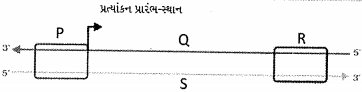
A
$P\quad \quad S$
B
$Q\quad \quad P$
C
$Q\quad \quad R$
D
$S\quad \quad P$
Solution
(D) In a transcription unit,the promoter is located at the $5'$ end of the coding strand (upstream).
In the given diagram,$P$ represents the promoter region located at the $5'$ end of the upper strand.
The upper strand,which runs from $3'$ to $5'$ (relative to the promoter's direction),acts as the template strand.
The lower strand,which runs from $5'$ to $3'$,is the coding strand.
Thus,$S$ represents the coding strand.
Therefore,the coding strand is $S$ and the promoter is $P$.
In the given diagram,$P$ represents the promoter region located at the $5'$ end of the upper strand.
The upper strand,which runs from $3'$ to $5'$ (relative to the promoter's direction),acts as the template strand.
The lower strand,which runs from $5'$ to $3'$,is the coding strand.
Thus,$S$ represents the coding strand.
Therefore,the coding strand is $S$ and the promoter is $P$.
0 likes
View Solution215
EasyMCQ
Capping is a process in which ............. .
A
Adenylation occurs at the $5'$ end.
B
Methyl guanosine triphosphate is added at the $5'$ end.
C
Adenylation occurs at the $3'$ end.
D
Methyl guanosine triphosphate is added at the $3'$ end.
Solution
(B) Capping is a post-transcriptional modification process in eukaryotes.
In this process,an unusual nucleotide,$7$-methyl guanosine triphosphate,is added to the $5'$ end of the heterogeneous nuclear $RNA$ $(hnRNA)$.
This cap protects the $5'$ end of the $mRNA$ from degradation by exonucleases and helps in the initiation of translation by facilitating ribosome binding.
Therefore,the correct option is $B$.
In this process,an unusual nucleotide,$7$-methyl guanosine triphosphate,is added to the $5'$ end of the heterogeneous nuclear $RNA$ $(hnRNA)$.
This cap protects the $5'$ end of the $mRNA$ from degradation by exonucleases and helps in the initiation of translation by facilitating ribosome binding.
Therefore,the correct option is $B$.
0 likes
View Solution216
EasyMCQ
Which enzyme is used for transcription?
A
$DNA$-dependent $DNA$ polymerase
B
$RNA$-dependent $DNA$ polymerase
C
$RNA$-dependent $RNA$ polymerase
D
$DNA$-dependent $RNA$ polymerase
Solution
(D) Transcription is the process of copying genetic information from one strand of the $DNA$ into $RNA$.
This process is catalyzed by the enzyme $DNA$-dependent $RNA$ polymerase.
It uses $DNA$ as a template to synthesize a complementary $RNA$ strand.
Therefore,the correct option is $D$.
This process is catalyzed by the enzyme $DNA$-dependent $RNA$ polymerase.
It uses $DNA$ as a template to synthesize a complementary $RNA$ strand.
Therefore,the correct option is $D$.
0 likes
View Solution217
MediumMCQ
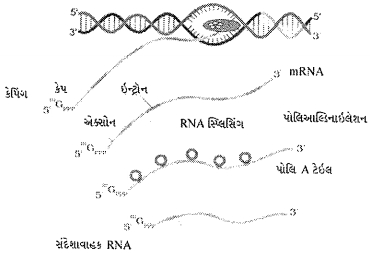
What does the given figure represent?
A
Process of translation in eukaryotes
B
Process of transcription in eukaryotes
C
Process of translation in prokaryotes
D
Process of transcription in prokaryotes
Solution
(B) The provided figure illustrates the process of transcription in eukaryotes,specifically highlighting post-transcriptional modifications.
Key features shown in the diagram include:
$1$. Transcription of $DNA$ into primary transcript (pre-mRNA).
$2$. Capping: Addition of a methyl guanosine triphosphate cap at the $5'$ end.
$3$. Splicing: Removal of introns and joining of exons.
$4$. Tailing (Polyadenylation): Addition of a poly-$A$ tail at the $3'$ end.
These modifications are characteristic of eukaryotic gene expression,as prokaryotes do not undergo such extensive processing of mRNA.
Key features shown in the diagram include:
$1$. Transcription of $DNA$ into primary transcript (pre-mRNA).
$2$. Capping: Addition of a methyl guanosine triphosphate cap at the $5'$ end.
$3$. Splicing: Removal of introns and joining of exons.
$4$. Tailing (Polyadenylation): Addition of a poly-$A$ tail at the $3'$ end.
These modifications are characteristic of eukaryotic gene expression,as prokaryotes do not undergo such extensive processing of mRNA.
0 likes
View Solution218
MediumMCQ
Match the following columns:
| Column-$I$ (Enzyme) | Column-$II$ (Product) |
| $P$. $RNA$ polymerase-$I$ | $I$. $rRNA$ $(18S, 28S, 5.8S)$ |
| $Q$. $RNA$ polymerase-$II$ | $II$. $tRNA, 5S rRNA, snRNAs$ |
| $R$. $RNA$ polymerase-$III$ | $III$. $hnRNA$ |
A
$(P-II), (Q-III), (R-I)$
B
$(P-I), (Q-III), (R-II)$
C
$(P-III), (Q-I), (R-II)$
D
$(P-III), (Q-II), (R-I)$
Solution
(B) In eukaryotes, there are three main types of $RNA$ polymerases involved in transcription:
$1$. $RNA$ polymerase-$I$ is responsible for the transcription of $rRNA$ ($18S, 28S,$ and $5.8S$). Thus, $P-I$.
$2$. $RNA$ polymerase-$II$ transcribes the precursor of $mRNA$, which is called heterogeneous nuclear $RNA$ $(hnRNA)$. Thus, $Q-III$.
$3$. $RNA$ polymerase-$III$ is responsible for the transcription of $tRNA$, $5S rRNA$, and $snRNAs$ (small nuclear $RNAs$). Thus, $R-II$.
Therefore, the correct matching is $(P-I), (Q-III), (R-II)$.
$1$. $RNA$ polymerase-$I$ is responsible for the transcription of $rRNA$ ($18S, 28S,$ and $5.8S$). Thus, $P-I$.
$2$. $RNA$ polymerase-$II$ transcribes the precursor of $mRNA$, which is called heterogeneous nuclear $RNA$ $(hnRNA)$. Thus, $Q-III$.
$3$. $RNA$ polymerase-$III$ is responsible for the transcription of $tRNA$, $5S rRNA$, and $snRNAs$ (small nuclear $RNAs$). Thus, $R-II$.
Therefore, the correct matching is $(P-I), (Q-III), (R-II)$.
0 likes
View Solution219
EasyMCQ
The process of copying genetic information from one strand of $DNA$ into $RNA$ is termed as .....
A
Replication
B
Translation
C
Transcription
D
All of the above
Solution
(C) The process of copying genetic information from one strand of $DNA$ into $RNA$ is known as $Transcription$.
$Replication$ is the process of duplicating $DNA$.
$Translation$ is the process of polymerizing amino acids to form a polypeptide chain based on the sequence of nucleotides in $mRNA$.
Therefore,the correct answer is $Transcription$.
$Replication$ is the process of duplicating $DNA$.
$Translation$ is the process of polymerizing amino acids to form a polypeptide chain based on the sequence of nucleotides in $mRNA$.
Therefore,the correct answer is $Transcription$.
0 likes
View Solution220
MediumMCQ
What is the location of the promoter in a transcription unit?
A
At the $5'$ end of the structural gene (upstream with respect to the coding strand)
B
At the $3'$ end of the structural gene (downstream with respect to the coding strand)
C
At the $5'$ end of the structural gene (downstream with respect to the coding strand)
D
None of these
Solution
(A) In a transcription unit,the promoter is located at the $5'$ end of the structural gene.
It is referred to as being upstream with respect to the coding strand.
The promoter provides the binding site for $RNA$ polymerase and defines the direction of transcription.
It is referred to as being upstream with respect to the coding strand.
The promoter provides the binding site for $RNA$ polymerase and defines the direction of transcription.
0 likes
View Solution221
MediumMCQ
What is the location of the terminator in a transcription unit?
A
Downstream of the $3'$ end of the structural gene (with respect to the coding strand)
B
Downstream of the $5'$ end of the structural gene (with respect to the coding strand)
C
Upstream of the $5'$ end of the structural gene (with respect to the coding strand)
D
None of these
Solution
(A) In a transcription unit,the structural gene is flanked by the promoter and the terminator.
$1$. The promoter is located towards the $5'$ end (upstream) of the structural gene with respect to the coding strand.
$2$. The terminator is located towards the $3'$ end (downstream) of the structural gene with respect to the coding strand.
Therefore,the terminator defines the end of the process of transcription.
$1$. The promoter is located towards the $5'$ end (upstream) of the structural gene with respect to the coding strand.
$2$. The terminator is located towards the $3'$ end (downstream) of the structural gene with respect to the coding strand.
Therefore,the terminator defines the end of the process of transcription.
0 likes
View Solution222
MediumMCQ
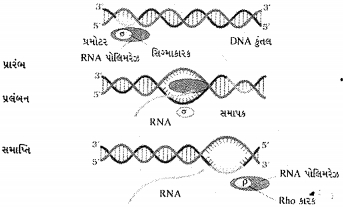
Which process is shown in the given figure?
A
Transcription process in prokaryotes
B
Transcription process in eukaryotes
C
Translation process in prokaryotes
D
Translation process in eukaryotes
Solution
(A) The provided figure illustrates the process of transcription in prokaryotes.
$1$. The process involves three main stages: Initiation, Elongation, and Termination.
$2$. In prokaryotes, the $RNA$ polymerase enzyme binds to the promoter region with the help of the sigma ($\sigma$) factor to initiate transcription.
$3$. During elongation, the $RNA$ polymerase synthesizes the $RNA$ strand.
$4$. Termination occurs when the $RNA$ polymerase encounters a terminator sequence and uses the rho ($\rho$) factor to release the $RNA$ transcript and the enzyme from the $DNA$ template.
$1$. The process involves three main stages: Initiation, Elongation, and Termination.
$2$. In prokaryotes, the $RNA$ polymerase enzyme binds to the promoter region with the help of the sigma ($\sigma$) factor to initiate transcription.
$3$. During elongation, the $RNA$ polymerase synthesizes the $RNA$ strand.
$4$. Termination occurs when the $RNA$ polymerase encounters a terminator sequence and uses the rho ($\rho$) factor to release the $RNA$ transcript and the enzyme from the $DNA$ template.
0 likes
View Solution223
MediumMCQ
Select the incorrect option for transcription in prokaryotes.
A
Three types of $RNA$ polymerases are involved.
B
Splicing and capping processes occur.
C
Polyadenylation occurs.
D
All of the above.
Solution
(D) In prokaryotes,transcription is simpler than in eukaryotes.
$1$. Only a single type of $RNA$ polymerase is involved in the transcription of all types of $RNA$ ($mRNA$,$tRNA$,and $rRNA$) in bacteria.
$2$. Prokaryotic $mRNA$ does not require processing such as splicing (removal of introns),capping (addition of $7$-methylguanosine at the $5'$ end),or polyadenylation (addition of poly-$A$ tail at the $3'$ end).
$3$. These processes are characteristic of eukaryotic transcription.
Therefore,all the given options ($A$,$B$,and $C$) are incorrect regarding prokaryotic transcription,making $D$ the correct choice.
$1$. Only a single type of $RNA$ polymerase is involved in the transcription of all types of $RNA$ ($mRNA$,$tRNA$,and $rRNA$) in bacteria.
$2$. Prokaryotic $mRNA$ does not require processing such as splicing (removal of introns),capping (addition of $7$-methylguanosine at the $5'$ end),or polyadenylation (addition of poly-$A$ tail at the $3'$ end).
$3$. These processes are characteristic of eukaryotic transcription.
Therefore,all the given options ($A$,$B$,and $C$) are incorrect regarding prokaryotic transcription,making $D$ the correct choice.
0 likes
View Solution224
MediumMCQ
In which of the following organisms does transcription and translation occur coupled (simultaneously)?
A
Yeast
B
Amoeba
C
Hibiscus
D
Lactobacillus
Solution
(D) In prokaryotes,transcription and translation are coupled because both processes occur in the same compartment (cytoplasm) and there is no nuclear membrane to separate them.
$Lactobacillus$ is a bacterium (prokaryote),whereas yeast,Amoeba,and Hibiscus are eukaryotes.
In eukaryotes,transcription occurs in the nucleus and translation occurs in the cytoplasm,separated by the nuclear envelope,preventing coupling.
$Lactobacillus$ is a bacterium (prokaryote),whereas yeast,Amoeba,and Hibiscus are eukaryotes.
In eukaryotes,transcription occurs in the nucleus and translation occurs in the cytoplasm,separated by the nuclear envelope,preventing coupling.
0 likes
View Solution225
EasyMCQ
Which $RNA$ is formed after the maturation of $hnRNA$?
A
$rRNA$
B
$SnRNA$
C
$tRNA$
D
$mRNA$
Solution
(D) In eukaryotic cells,the primary transcript produced by $RNA$ polymerase $II$ is known as $hnRNA$ (heterogeneous nuclear $RNA$).
$hnRNA$ contains both coding sequences (exons) and non-coding sequences (introns).
To become functional,$hnRNA$ undergoes a process called post-transcriptional modification or processing.
This process includes splicing (removal of introns and joining of exons),capping (addition of $7$-methylguanosine at the $5'$ end),and tailing (addition of a poly-$A$ tail at the $3'$ end).
After these modifications,the processed $RNA$ is known as mature $mRNA$ (messenger $RNA$),which is then transported to the cytoplasm for translation.
$hnRNA$ contains both coding sequences (exons) and non-coding sequences (introns).
To become functional,$hnRNA$ undergoes a process called post-transcriptional modification or processing.
This process includes splicing (removal of introns and joining of exons),capping (addition of $7$-methylguanosine at the $5'$ end),and tailing (addition of a poly-$A$ tail at the $3'$ end).
After these modifications,the processed $RNA$ is known as mature $mRNA$ (messenger $RNA$),which is then transported to the cytoplasm for translation.
0 likes
View Solution226
EasyMCQ
Which of the following enzymes is responsible for the synthesis of $tRNA$ in eukaryotes?
A
$RNA$ polymerase-$I$
B
$RNA$ polymerase-$II$
C
$RNA$ polymerase-$III$
D
None of the above
Solution
(C) In eukaryotes,there are three distinct types of $RNA$ polymerases involved in transcription:
$1$. $RNA$ polymerase-$I$ is responsible for the transcription of $rRNA$ ($28S, 18S,$ and $5.8S$).
$2$. $RNA$ polymerase-$II$ is responsible for the transcription of the precursor of $mRNA$,known as heterogeneous nuclear $hnRNA$ (heterogeneous nuclear $RNA$).
$3$. $RNA$ polymerase-$III$ is responsible for the transcription of $tRNA$,$5S$ $rRNA$,and $snRNA$ (small nuclear $RNA$).
Therefore,the correct enzyme for $tRNA$ synthesis is $RNA$ polymerase-$III$.
$1$. $RNA$ polymerase-$I$ is responsible for the transcription of $rRNA$ ($28S, 18S,$ and $5.8S$).
$2$. $RNA$ polymerase-$II$ is responsible for the transcription of the precursor of $mRNA$,known as heterogeneous nuclear $hnRNA$ (heterogeneous nuclear $RNA$).
$3$. $RNA$ polymerase-$III$ is responsible for the transcription of $tRNA$,$5S$ $rRNA$,and $snRNA$ (small nuclear $RNA$).
Therefore,the correct enzyme for $tRNA$ synthesis is $RNA$ polymerase-$III$.
0 likes
View Solution227
EasyMCQ
$RNA$ polymerase binds to the .........
A
Promoter
B
Operator
C
Structural gene
D
Regulator gene
Solution
(A) In the process of transcription,the $RNA$ polymerase enzyme is responsible for synthesizing $RNA$ from a $DNA$ template.
This enzyme recognizes and binds to a specific sequence on the $DNA$ called the promoter region to initiate transcription.
The promoter acts as the starting signal for the $RNA$ polymerase to begin the synthesis of the $RNA$ strand.
This enzyme recognizes and binds to a specific sequence on the $DNA$ called the promoter region to initiate transcription.
The promoter acts as the starting signal for the $RNA$ polymerase to begin the synthesis of the $RNA$ strand.
0 likes
View Solution228
EasyMCQ
What is the role of $RNA$ polymerase $III$ in the process of transcription in Eukaryotes?
A
Transcription of only snRNAs
B
Transcription of rRNAs $(28S, 18S$ and $5.8S)$
C
Transcription of tRNA,$5S$ $rRNA$ and $snRNA$
D
Transcription of precursor of $mRNA$
Solution
(C) In eukaryotes,there are three major types of $RNA$ polymerases involved in transcription:
$RNA$ polymerase $I$ transcribes $rRNAs$ ($5.8S, 18S,$ and $28S$).
$RNA$ polymerase $II$ transcribes $hnRNA$ (precursor of $mRNA$).
$RNA$ polymerase $III$ transcribes $tRNAs$,$5S$ $rRNA$,and $snRNA$ (small nuclear $RNA$).
$RNA$ polymerase $I$ transcribes $rRNAs$ ($5.8S, 18S,$ and $28S$).
$RNA$ polymerase $II$ transcribes $hnRNA$ (precursor of $mRNA$).
$RNA$ polymerase $III$ transcribes $tRNAs$,$5S$ $rRNA$,and $snRNA$ (small nuclear $RNA$).
0 likes
View Solution229
MediumMCQ
Which one of the following is the sequence on the corresponding coding strand,if the sequence on the mRNA formed is as follows $5' AUCGAUCGAUCGAUCGAUCGAUCGAUCG 3'$?
A
$3' ATCGATCGATCGATCGATCGATCGATCG 5'$
B
$5' UAGCUAGCUAGCUAGCUAGCUAGCUAGC 3'$
C
$3' UAGCUAGCUAGCUAGCUAGCUAGCUAGC 5'$
D
$5' ATCGATCGATCGATCGATCGATCGATCG 3'$
Solution
(D) In the process of transcription,the coding strand of $DNA$ has the same sequence as the mRNA,except that thymine $(T)$ is present in the $DNA$ instead of uracil $(U)$ in the $RNA$.
Given mRNA sequence: $5' AUCGAUCGAUCGAUCGAUCGAUCGAUCG 3'$
By replacing uracil $(U)$ with thymine $(T)$,we obtain the sequence of the coding strand:
Coding strand sequence: $5' ATCGATCGATCGATCGATCGATCGATCG 3'$
Therefore,the correct option is $D$.
Given mRNA sequence: $5' AUCGAUCGAUCGAUCGAUCGAUCGAUCG 3'$
By replacing uracil $(U)$ with thymine $(T)$,we obtain the sequence of the coding strand:
Coding strand sequence: $5' ATCGATCGATCGATCGATCGATCGATCG 3'$
Therefore,the correct option is $D$.
0 likes
View Solution230
MediumMCQ
$DNA$ transcription unit is defined primarily by three regions in $DNA$ with respect to upstream and downstream ends:
A
Structural gene,Transposons,Operator gene
B
Inducer,Repressor,Structural gene
C
Promoter,Structural gene,Terminator
D
Repressor,Operator gene,Structural gene
Solution
(C) transcription unit of $DNA$ is defined primarily by three regions in the $DNA$:
$(i)$ $A$ promoter
$(ii)$ The structural gene
$(iii)$ $A$ terminator
The promoter is located towards the $5'$-end (upstream) of the structural gene (the reference is made with respect to the polarity of the coding strand).
The terminator is located towards the $3'$-end (downstream) of the coding strand.
$(i)$ $A$ promoter
$(ii)$ The structural gene
$(iii)$ $A$ terminator
The promoter is located towards the $5'$-end (upstream) of the structural gene (the reference is made with respect to the polarity of the coding strand).
The terminator is located towards the $3'$-end (downstream) of the coding strand.
0 likes
View Solution231
MediumMCQ
Which one is the correct product of $DNA$ dependent $RNA$ polymerase for the given template strand?
$3'TACATGGCAAATATCCATTCA5'$
$3'TACATGGCAAATATCCATTCA5'$
A
$5'AUGUAAAGUUUAUAGGUAAGU3'$
B
$5'AUGUACCGUUUAUAGGGAAGU3'$
C
$5'ATGTACCGTTTATAGGTAAGT3'$
D
$5'AUGUACCGUUUAUAGGUAAGU3'$
Solution
(D) The process of transcription involves the synthesis of $RNA$ from a $DNA$ template strand.
The $DNA$ template strand is given as: $3'TACATGGCAAATATCCATTCA5'$.
According to the base-pairing rules for $RNA$ synthesis:
$A$ (Adenine) in $DNA$ pairs with $U$ (Uracil) in $RNA$.
$T$ (Thymine) in $DNA$ pairs with $A$ (Adenine) in $RNA$.
$C$ (Cytosine) in $DNA$ pairs with $G$ (Guanine) in $RNA$.
$G$ (Guanine) in $DNA$ pairs with $C$ (Cytosine) in $RNA$.
Applying these rules to the template $3'TACATGGCAAATATCCATTCA5'$:
$T \rightarrow A$
$A \rightarrow U$
$C \rightarrow G$
$A \rightarrow U$
$T \rightarrow A$
$G \rightarrow C$
$G \rightarrow C$
$C \rightarrow G$
$A \rightarrow U$
$A \rightarrow U$
$A \rightarrow U$
$T \rightarrow A$
$A \rightarrow U$
$T \rightarrow A$
$C \rightarrow G$
$C \rightarrow G$
$A \rightarrow U$
$T \rightarrow A$
$T \rightarrow A$
$C \rightarrow G$
$A \rightarrow U$
Thus,the resulting $mRNA$ sequence in the $5' \rightarrow 3'$ direction is: $5'AUGUACCGUUUAUAGGUAAGU3'$.
The $DNA$ template strand is given as: $3'TACATGGCAAATATCCATTCA5'$.
According to the base-pairing rules for $RNA$ synthesis:
$A$ (Adenine) in $DNA$ pairs with $U$ (Uracil) in $RNA$.
$T$ (Thymine) in $DNA$ pairs with $A$ (Adenine) in $RNA$.
$C$ (Cytosine) in $DNA$ pairs with $G$ (Guanine) in $RNA$.
$G$ (Guanine) in $DNA$ pairs with $C$ (Cytosine) in $RNA$.
Applying these rules to the template $3'TACATGGCAAATATCCATTCA5'$:
$T \rightarrow A$
$A \rightarrow U$
$C \rightarrow G$
$A \rightarrow U$
$T \rightarrow A$
$G \rightarrow C$
$G \rightarrow C$
$C \rightarrow G$
$A \rightarrow U$
$A \rightarrow U$
$A \rightarrow U$
$T \rightarrow A$
$A \rightarrow U$
$T \rightarrow A$
$C \rightarrow G$
$C \rightarrow G$
$A \rightarrow U$
$T \rightarrow A$
$T \rightarrow A$
$C \rightarrow G$
$A \rightarrow U$
Thus,the resulting $mRNA$ sequence in the $5' \rightarrow 3'$ direction is: $5'AUGUACCGUUUAUAGGUAAGU3'$.
0 likes
View Solution232
MediumMCQ
Match List $I$ with List $II$:
Choose the correct answer from the options given below:
| List $I$ | List $II$ |
|---|---|
| $A$. $RNA$ polymerase $III$ | $I$. snRNPs |
| $B$. Termination of transcription | $II$. Promoter |
| $C$. Splicing of exons | $III$. Rho factor |
| $D$. $TATA$ box | $IV$. snRNAs,tRNA |
Choose the correct answer from the options given below:
A
$A-III, B-II, C-IV, D-I$
B
$A-III, B-IV, C-I, D-II$
C
$A-IV, B-III, C-I, D-II$
D
$A-II, B-IV, C-I, D-III$
Solution
(C) The correct matching is as follows:
- $A$. $RNA$ polymerase $III$ is responsible for the transcription of $snRNAs$,$tRNA$,and $5s$ $rRNA$. Thus,$A-IV$.
- $B$. The termination of transcription in prokaryotes is facilitated by the Rho factor. Thus,$B-III$.
- $C$. Splicing of exons involves the removal of introns and joining of exons,a process performed by $snRNPs$ (small nuclear ribonucleoproteins). Thus,$C-I$.
- $D$. The $TATA$ box is a specific $DNA$ sequence found in the promoter region of the transcription unit. Thus,$D-II$.
Therefore,the correct sequence is $A-IV, B-III, C-I, D-II$.
- $A$. $RNA$ polymerase $III$ is responsible for the transcription of $snRNAs$,$tRNA$,and $5s$ $rRNA$. Thus,$A-IV$.
- $B$. The termination of transcription in prokaryotes is facilitated by the Rho factor. Thus,$B-III$.
- $C$. Splicing of exons involves the removal of introns and joining of exons,a process performed by $snRNPs$ (small nuclear ribonucleoproteins). Thus,$C-I$.
- $D$. The $TATA$ box is a specific $DNA$ sequence found in the promoter region of the transcription unit. Thus,$D-II$.
Therefore,the correct sequence is $A-IV, B-III, C-I, D-II$.
0 likes
View Solution233
DifficultMCQ
Which of the following are the post-transcriptional events in an eukaryotic cell?
$A.$ Transport of pre-mRNA to cytoplasm prior to splicing.
$B.$ Removal of introns and joining of exons.
$C.$ Addition of methyl group at $5$' end of hnRNA.
$D.$ Addition of adenine residues at $3$' end of hnRNA.
$E.$ Base pairing of two complementary RNAs.
Choose the correct answer from the options given below:
$A.$ Transport of pre-mRNA to cytoplasm prior to splicing.
$B.$ Removal of introns and joining of exons.
$C.$ Addition of methyl group at $5$' end of hnRNA.
$D.$ Addition of adenine residues at $3$' end of hnRNA.
$E.$ Base pairing of two complementary RNAs.
Choose the correct answer from the options given below:
A
$A, B, C$ only
B
$B, C, D$ only
C
$B, C, E$ only
D
$C, D, E$ only
Solution
(B) In eukaryotic cells,the primary transcript (hnRNA) undergoes several post-transcriptional modifications before it is exported to the cytoplasm as mature mRNA.
$1$. Splicing: The non-coding introns are removed,and the coding exons are joined together $(B)$.
$2$. Capping: $A$ methyl guanosine triphosphate is added to the $5$' end of the hnRNA $(C)$.
$3$. Tailing (Polyadenylation): Adenylate residues are added at the $3$' end of the hnRNA $(D)$.
Transport of pre-mRNA to the cytoplasm occurs only after these processing steps are completed,not prior to splicing ($A$ is incorrect).
Base pairing of complementary RNAs is not a standard post-transcriptional processing event for mRNA maturation ($E$ is incorrect).
Therefore,the correct events are $B, C,$ and $D$.
$1$. Splicing: The non-coding introns are removed,and the coding exons are joined together $(B)$.
$2$. Capping: $A$ methyl guanosine triphosphate is added to the $5$' end of the hnRNA $(C)$.
$3$. Tailing (Polyadenylation): Adenylate residues are added at the $3$' end of the hnRNA $(D)$.
Transport of pre-mRNA to the cytoplasm occurs only after these processing steps are completed,not prior to splicing ($A$ is incorrect).
Base pairing of complementary RNAs is not a standard post-transcriptional processing event for mRNA maturation ($E$ is incorrect).
Therefore,the correct events are $B, C,$ and $D$.
0 likes
View Solution234
EasyMCQ
Which factor is important for termination of transcription?
A
$\alpha$ (alpha)
B
$\sigma$ (sigma)
C
$\rho$ (rho)
D
$\gamma$ (gamma)
Solution
(C) In prokaryotic transcription,the process is carried out by $RNA$ polymerase. The $RNA$ polymerase enzyme consists of a core enzyme and a sigma factor $(\sigma)$. The sigma factor is responsible for the initiation of transcription by recognizing the promoter site. Once the elongation phase is complete,the termination of transcription occurs. This termination is facilitated by the rho factor $(\rho)$. Therefore,the $\rho$ factor is essential for the termination of transcription.
0 likes
View Solution235
EasyMCQ
Assertion: The transcription and translation can be coupled in bacteria.
Reason: In bacteria,since the $\text{mRNA}$ does not require any processing to become active,and also since transcription and translation take place in the same compartment.
Reason: In bacteria,since the $\text{mRNA}$ does not require any processing to become active,and also since transcription and translation take place in the same compartment.
A
Both Assertion and Reason are True and the Reason is a correct explanation of the Assertion.
B
Both Assertion and Reason are True but Reason is not a correct explanation of the Assertion.
C
Assertion is True but the Reason is False.
D
Both Assertion and Reason are False.
Solution
(A) In bacteria,the genetic material is not enclosed within a membrane-bound nucleus; it is present in the cytoplasm.
Because there is no nuclear membrane,the processes of transcription (synthesis of $\text{mRNA}$ from $\text{DNA}$) and translation (synthesis of protein from $\text{mRNA}$) occur in the same cellular compartment.
Furthermore,bacterial $\text{mRNA}$ does not require complex post-transcriptional processing (like splicing,capping,or tailing) to become active.
As a result,translation can begin even before the transcription of the $\text{mRNA}$ molecule is fully completed.
This phenomenon is known as coupled transcription and translation.
Therefore,both the Assertion and the Reason are true,and the Reason correctly explains the Assertion.
Because there is no nuclear membrane,the processes of transcription (synthesis of $\text{mRNA}$ from $\text{DNA}$) and translation (synthesis of protein from $\text{mRNA}$) occur in the same cellular compartment.
Furthermore,bacterial $\text{mRNA}$ does not require complex post-transcriptional processing (like splicing,capping,or tailing) to become active.
As a result,translation can begin even before the transcription of the $\text{mRNA}$ molecule is fully completed.
This phenomenon is known as coupled transcription and translation.
Therefore,both the Assertion and the Reason are true,and the Reason correctly explains the Assertion.
0 likes
View Solution236
EasyMCQ
$RNA$ polymerase-$I$ is not responsible for the synthesis of $-$ (in $\text{s rRNA}$)
A
$5$
B
$28$
C
$5.8$
D
$18$
Solution
(A) In eukaryotes, there are three types of $RNA$ polymerases involved in transcription:
$1$. $RNA$ polymerase-$I$ transcribes $rRNA$ ($28S$, $18S$, and $5.8S$).
$2$. $RNA$ polymerase-$II$ transcribes the precursor of $mRNA$ (heterogeneous nuclear $RNA$ or $hnRNA$).
$3$. $RNA$ polymerase-$III$ is responsible for the transcription of $tRNA$, $5S$ $rRNA$, and $snRNA$.
Therefore, $5S$ $rRNA$ is synthesized by $RNA$ polymerase-$III$, not $RNA$ polymerase-$I$.
$1$. $RNA$ polymerase-$I$ transcribes $rRNA$ ($28S$, $18S$, and $5.8S$).
$2$. $RNA$ polymerase-$II$ transcribes the precursor of $mRNA$ (heterogeneous nuclear $RNA$ or $hnRNA$).
$3$. $RNA$ polymerase-$III$ is responsible for the transcription of $tRNA$, $5S$ $rRNA$, and $snRNA$.
Therefore, $5S$ $rRNA$ is synthesized by $RNA$ polymerase-$III$, not $RNA$ polymerase-$I$.
0 likes
View Solution237
MediumMCQ
Which of the following statements are correct?
$(i)$ From one molecule of $\text{DNA}$,several molecules of $\text{RNA}$ can be formed.
$(ii)$ The $\text{RNA}$ forming part is known as the translational unit.
$(iii)$ The promoter is located at the $5'$ upstream end.
$(iv)$ The promoter and terminator flank the structural gene in a transcription unit.
$(i)$ From one molecule of $\text{DNA}$,several molecules of $\text{RNA}$ can be formed.
$(ii)$ The $\text{RNA}$ forming part is known as the translational unit.
$(iii)$ The promoter is located at the $5'$ upstream end.
$(iv)$ The promoter and terminator flank the structural gene in a transcription unit.
A
$(i), (ii)$
B
$(i), (ii), (iii)$
C
$(i), (iii), (iv)$
D
$(i), (ii), (iii), (iv)$
Solution
(C) Statement $(i)$ is correct: During transcription,multiple $\text{RNA}$ molecules can be synthesized from a single $\text{DNA}$ template.
Statement $(ii)$ is incorrect: The segment of $\text{DNA}$ that is transcribed into $\text{RNA}$ is called a transcription unit,not a translational unit.
Statement $(iii)$ is correct: The promoter is a sequence of $\text{DNA}$ located at the $5'$ end (upstream) of the structural gene,which provides the binding site for $\text{RNA}$ polymerase.
Statement $(iv)$ is correct: $A$ transcription unit consists of a promoter,a structural gene,and a terminator. The promoter and terminator flank the structural gene.
Therefore,statements $(i), (iii),$ and $(iv)$ are correct.
Statement $(ii)$ is incorrect: The segment of $\text{DNA}$ that is transcribed into $\text{RNA}$ is called a transcription unit,not a translational unit.
Statement $(iii)$ is correct: The promoter is a sequence of $\text{DNA}$ located at the $5'$ end (upstream) of the structural gene,which provides the binding site for $\text{RNA}$ polymerase.
Statement $(iv)$ is correct: $A$ transcription unit consists of a promoter,a structural gene,and a terminator. The promoter and terminator flank the structural gene.
Therefore,statements $(i), (iii),$ and $(iv)$ are correct.
0 likes
View Solution238
MediumMCQ
Find out the correct statement about transcription $:-$
A
In transcription,only one strand of $dsDNA$ is copied into $RNA$.
B
In all eukaryotes,a single $DNA$ polymerase is capable of catalysing all the three steps of transcription,which are initiation,elongation,and termination.
C
In all prokaryotes,transcription and translation take place in different compartments.
D
In all eukaryotes,the primary transcript contains exons.
Solution
(A) $1$. In transcription,only one strand of the $dsDNA$ (double-stranded $DNA$) is copied into $RNA$ because if both strands were copied,they would produce two $RNA$ molecules with complementary sequences,which would form a double-stranded $RNA$ and prevent translation.
$2$. Option $B$ is incorrect because eukaryotes use $RNA$ polymerases $(I, II, III)$,not $DNA$ polymerase,for transcription.
$3$. Option $C$ is incorrect because in prokaryotes,there is no nucleus,so transcription and translation occur in the same compartment (cytoplasm).
$4$. Option $D$ is incorrect because the primary transcript in eukaryotes contains both exons and introns (it is a pre-$mRNA$ that undergoes splicing to remove introns).
Therefore,the correct statement is $A$.
$2$. Option $B$ is incorrect because eukaryotes use $RNA$ polymerases $(I, II, III)$,not $DNA$ polymerase,for transcription.
$3$. Option $C$ is incorrect because in prokaryotes,there is no nucleus,so transcription and translation occur in the same compartment (cytoplasm).
$4$. Option $D$ is incorrect because the primary transcript in eukaryotes contains both exons and introns (it is a pre-$mRNA$ that undergoes splicing to remove introns).
Therefore,the correct statement is $A$.
0 likes
View Solution239
MediumMCQ
In a transcription unit,the promoter is located at:
A
$5'$ end upstream of the template strand
B
$3'$ end downstream of the coding strand
C
$5'$ end upstream of the sense strand
D
$5'$ end downstream of the antisense strand
Solution
(C) In a transcription unit,the promoter is a $DNA$ sequence that provides a binding site for $RNA$ polymerase.
It is located towards the $5'$ end (upstream) of the coding strand (also known as the sense strand).
Since the template strand runs in the $3' \rightarrow 5'$ direction,the promoter is situated at the $5'$ end of the coding strand,which corresponds to the upstream region of the transcription start site.
It is located towards the $5'$ end (upstream) of the coding strand (also known as the sense strand).
Since the template strand runs in the $3' \rightarrow 5'$ direction,the promoter is situated at the $5'$ end of the coding strand,which corresponds to the upstream region of the transcription start site.
0 likes
View Solution240
MediumMCQ
Identify the correct statement:
A
In tailing, adenylate residues $(200-300)$ are added at $3'$-end in a template independent manner.
B
The strand which does not code for anything is referred to as the template strand.
C
The split-gene arrangements represent probably an ancient feature of the genome.
D
$RNA$ polymerase binds with the rho factor to terminate the process of transcription in bacteria.
Solution
(C) Option $A$ is incorrect because tailing involves the addition of adenylate residues at the $3'$-end, not the $5'$-end.
Option $B$ is incorrect because the strand that does not code for anything is called the template strand (or antisense strand).
Option $C$ is correct. Split-gene arrangements (presence of introns) are considered an ancient feature of the genome, reflecting the '$RNA$ world' hypothesis.
Option $D$ is incorrect because the sigma factor ($\sigma$) is responsible for the initiation of transcription, while the rho factor ($\rho$) is responsible for termination in bacteria.
Option $B$ is incorrect because the strand that does not code for anything is called the template strand (or antisense strand).
Option $C$ is correct. Split-gene arrangements (presence of introns) are considered an ancient feature of the genome, reflecting the '$RNA$ world' hypothesis.
Option $D$ is incorrect because the sigma factor ($\sigma$) is responsible for the initiation of transcription, while the rho factor ($\rho$) is responsible for termination in bacteria.
0 likes
View Solution241
MediumMCQ
Given below are two statements, one is labelled Assertion $(A)$ and the other is labelled as Reason $(R)$.
Assertion $(A) :$ In eukaryotes, primary transcripts $(hnRNA)$ contain both exons and introns, and introns are non-functional.
Reason $(R) :$ In bacteria, the $mRNA$ does not require any processing, and transcription and translation take place in the same compartment.
In the light of the above statements, choose the most appropriate answer from the options given below $:$
Assertion $(A) :$ In eukaryotes, primary transcripts $(hnRNA)$ contain both exons and introns, and introns are non-functional.
Reason $(R) :$ In bacteria, the $mRNA$ does not require any processing, and transcription and translation take place in the same compartment.
In the light of the above statements, choose the most appropriate answer from the options given below $:$
A
Assertion is not correct but Reason is correct.
B
Both Assertion and Reason are correct and Reason is the correct explanation of Assertion.
C
Assertion is correct but Reason is not correct.
D
Both Assertion and Reason are correct but Reason is not the correct explanation of Assertion.
Solution
(D) Assertion $(A)$ is correct: In eukaryotes, the primary transcript, known as $hnRNA$ (heterogeneous nuclear $RNA$), is non-functional because it contains both coding sequences (exons) and non-coding sequences (introns). It must undergo splicing to remove introns and join exons to become functional $mRNA$.
Reason $(R)$ is correct: In bacteria (prokaryotes), there is no defined nucleus, and transcription and translation occur in the same compartment (cytoplasm). Furthermore, bacterial $mRNA$ does not require complex processing like splicing because it lacks introns.
Conclusion: While both statements are scientifically accurate, the Reason $(R)$ describes the nature of bacterial gene expression and does not explain why eukaryotic $hnRNA$ contains introns. Therefore, Reason is not the correct explanation of Assertion.
Reason $(R)$ is correct: In bacteria (prokaryotes), there is no defined nucleus, and transcription and translation occur in the same compartment (cytoplasm). Furthermore, bacterial $mRNA$ does not require complex processing like splicing because it lacks introns.
Conclusion: While both statements are scientifically accurate, the Reason $(R)$ describes the nature of bacterial gene expression and does not explain why eukaryotic $hnRNA$ contains introns. Therefore, Reason is not the correct explanation of Assertion.
0 likes
View Solution242
MediumMCQ
If the sequence of the coding strand in a $\text{DNA}$ molecule is $\text{5'-ATCGATCGACTG-3'}$,then the sequence of $\text{RNA}$ transcribed from the template strand would be:
A
$\text{5'-ATCGATCGACTG-3'}$
B
$\text{5'-TAGCTAGCTGAC-3'}$
C
$\text{5'-UAGCUAGCUGAC-3'}$
D
$\text{5'-AUCGAUCGACUG-3'}$
Solution
(D) In a $\text{DNA}$ molecule,the coding strand has the same sequence as the $\text{mRNA}$ transcript,except that thymine $(T)$ in $\text{DNA}$ is replaced by uracil $(U)$ in $\text{RNA}$.
Given coding strand: $\text{5'-ATCGATCGACTG-3'}$.
Since the $\text{mRNA}$ is complementary to the template strand and identical to the coding strand (with $U$ instead of $T$),the $\text{mRNA}$ sequence will be $\text{5'-AUCGAUCGACUG-3'}$.
Therefore,the correct option is $D$.
Given coding strand: $\text{5'-ATCGATCGACTG-3'}$.
Since the $\text{mRNA}$ is complementary to the template strand and identical to the coding strand (with $U$ instead of $T$),the $\text{mRNA}$ sequence will be $\text{5'-AUCGAUCGACUG-3'}$.
Therefore,the correct option is $D$.
0 likes
View Solution243
MediumMCQ
Which of the following is used as a substrate by $\text{RNA}$ polymerase and polymerises in a template-dependent fashion?
A
Ribonucleoside triphosphates
B
Deoxyribonucleoside triphosphates
C
Ribonucleoside monophosphates
D
Deoxyribonucleoside monophosphates
Solution
(A) During the process of transcription,$\text{RNA}$ polymerase catalyzes the synthesis of $\text{RNA}$ from a $DNA$ template.
This enzyme utilizes ribonucleoside triphosphates $(\text{NTPs})$ as substrates.
These $\text{NTPs}$ are polymerized in a template-dependent manner,meaning the sequence of the newly synthesized $\text{RNA}$ is complementary to the $DNA$ template strand.
Deoxyribonucleoside triphosphates $(\text{dNTPs})$ are used by $DNA$ polymerase during $DNA$ replication,not by $\text{RNA}$ polymerase during transcription.
This enzyme utilizes ribonucleoside triphosphates $(\text{NTPs})$ as substrates.
These $\text{NTPs}$ are polymerized in a template-dependent manner,meaning the sequence of the newly synthesized $\text{RNA}$ is complementary to the $DNA$ template strand.
Deoxyribonucleoside triphosphates $(\text{dNTPs})$ are used by $DNA$ polymerase during $DNA$ replication,not by $\text{RNA}$ polymerase during transcription.
0 likes
View Solution244
MediumMCQ
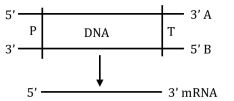
Which of the following statements are correctly related to the given diagram of transcription?
$(a)$ $A$ is the Coding strand
$(b)$ $A$ is the Non-coding strand
$(c)$ $B$ is the Antisense strand
$(d)$ $B$ is the Sense strand
$(a)$ $A$ is the Coding strand
$(b)$ $A$ is the Non-coding strand
$(c)$ $B$ is the Antisense strand
$(d)$ $B$ is the Sense strand
A
$a \& \ b$
B
$a \& \ c$
C
$b \& \ d$
D
$b \& \ c$
Solution
(B) In the process of transcription,the $DNA$ strand with polarity $5' \rightarrow 3'$ is known as the coding strand (or sense strand) because its sequence is identical to the mRNA produced (except for Uracil replacing Thymine).
The $DNA$ strand with polarity $3' \rightarrow 5'$ acts as the template for $RNA$ polymerase and is known as the non-coding strand,template strand,or antisense strand.
Looking at the diagram:
- Strand $A$ has $5' \rightarrow 3'$ polarity,so it is the coding strand (statement $a$ is correct).
- Strand $B$ has $3' \rightarrow 5'$ polarity,so it is the template/antisense strand (statement $c$ is correct).
Therefore,statements $a$ and $c$ are correct.
The $DNA$ strand with polarity $3' \rightarrow 5'$ acts as the template for $RNA$ polymerase and is known as the non-coding strand,template strand,or antisense strand.
Looking at the diagram:
- Strand $A$ has $5' \rightarrow 3'$ polarity,so it is the coding strand (statement $a$ is correct).
- Strand $B$ has $3' \rightarrow 5'$ polarity,so it is the template/antisense strand (statement $c$ is correct).
Therefore,statements $a$ and $c$ are correct.
0 likes
View Solution245
MediumMCQ
Assertion: In $\text{RNA}$ processing occurs in Eukaryotes.
Reason: Eukaryotes have split gene.
Reason: Eukaryotes have split gene.
A
Both Assertion $\&$ Reason are True $\&$ the Reason is a correct explanation of the Assertion.
B
Both Assertion $\&$ Reason are True but Reason is not a correct explanation of the Assertion.
C
Assertion is True but the Reason is False.
D
Both Assertion $\&$ Reason are False.
Solution
(A) In eukaryotes,the primary transcript (pre-mRNA) contains both exons (coding sequences) and introns (non-coding sequences).
This arrangement is known as a split gene.
Because introns do not code for proteins,they must be removed through a process called splicing.
Additionally,the pre-mRNA undergoes capping and tailing to become functional mRNA.
Since the presence of split genes (introns) necessitates the removal of non-coding sequences,$RNA$ processing is essential in eukaryotes.
Therefore,both the assertion and the reason are true,and the reason correctly explains why $RNA$ processing occurs.
This arrangement is known as a split gene.
Because introns do not code for proteins,they must be removed through a process called splicing.
Additionally,the pre-mRNA undergoes capping and tailing to become functional mRNA.
Since the presence of split genes (introns) necessitates the removal of non-coding sequences,$RNA$ processing is essential in eukaryotes.
Therefore,both the assertion and the reason are true,and the reason correctly explains why $RNA$ processing occurs.
0 likes
View Solution246
MediumMCQ
In eukaryotes,$\text{RNA}$ polymerase-$I$ is responsible for the synthesis of:
A
$28\text{S r-RNA}, 18\text{S r-RNA}, 5.8\text{S r-RNA}$
B
hn$\text{RNA}$
C
t$\text{RNA}$
D
$\text{sn-RNA}, 5\text{S r-RNA}$
Solution
(A) In eukaryotes,there are three main types of $\text{RNA}$ polymerases involved in transcription:
$1$. $\text{RNA}$ polymerase-$I$ transcribes $\text{r-RNA}$ ($28\text{S}, 18\text{S},$ and $5.8\text{S}$).
$2$. $\text{RNA}$ polymerase-$II$ transcribes the precursor of $\text{m-RNA}$,called heterogeneous nuclear $\text{RNA}$ $(\text{hn-RNA})$.
$3$. $\text{RNA}$ polymerase-$III$ is responsible for the transcription of $\text{t-RNA}$,$5\text{S r-RNA}$,and $\text{sn-RNA}$ (small nuclear $\text{RNA}$).
Therefore,the correct option is $A$.
$1$. $\text{RNA}$ polymerase-$I$ transcribes $\text{r-RNA}$ ($28\text{S}, 18\text{S},$ and $5.8\text{S}$).
$2$. $\text{RNA}$ polymerase-$II$ transcribes the precursor of $\text{m-RNA}$,called heterogeneous nuclear $\text{RNA}$ $(\text{hn-RNA})$.
$3$. $\text{RNA}$ polymerase-$III$ is responsible for the transcription of $\text{t-RNA}$,$5\text{S r-RNA}$,and $\text{sn-RNA}$ (small nuclear $\text{RNA}$).
Therefore,the correct option is $A$.
0 likes
View Solution247
EasyMCQ
$RNA$ splicing, capping and tailing occurs in . . . . . . of the cell.
A
cytoplasm
B
ribosomes
C
nucleus
D
endoplasmic reticulum
Solution
(C) In eukaryotes, the primary transcript known as $hnRNA$ (heterogeneous nuclear $RNA$) undergoes post-transcriptional modifications such as splicing, capping, and tailing.
These processes occur exclusively within the $nucleus$ before the mature $mRNA$ is transported into the cytoplasm for translation.
These processes occur exclusively within the $nucleus$ before the mature $mRNA$ is transported into the cytoplasm for translation.
0 likes
View Solution248
EasyMCQ
In the processing of $hnRNA$ in eukaryotic cells,the primary transcripts are processed in the following sequence.
A
Splicing,Capping,Tailing
B
Tailing,Capping,Splicing
C
Capping,Splicing,Tailing
D
Capping,Tailing,Splicing
Solution
(C) In eukaryotic cells,the primary transcript $(hnRNA)$ undergoes three major post-transcriptional modifications to become functional $mRNA$:
$1$. $Capping$: $A$ methyl guanosine triphosphate $(m^7G)$ is added to the $5'$-end of the $hnRNA$.
$2$. $Splicing$: The non-coding introns are removed,and the coding exons are joined together in a defined order.
$3$. $Tailing$ $(Polyadenylation)$: Poly-$A$ tails (approx. $200-300$ adenine residues) are added to the $3'$-end of the transcript.
Therefore,the correct sequence is $Capping$,$Splicing$,$Tailing$.
$1$. $Capping$: $A$ methyl guanosine triphosphate $(m^7G)$ is added to the $5'$-end of the $hnRNA$.
$2$. $Splicing$: The non-coding introns are removed,and the coding exons are joined together in a defined order.
$3$. $Tailing$ $(Polyadenylation)$: Poly-$A$ tails (approx. $200-300$ adenine residues) are added to the $3'$-end of the transcript.
Therefore,the correct sequence is $Capping$,$Splicing$,$Tailing$.
0 likes
View Solution249
EasyMCQ
Identify the $INCORRECT$ statement with reference to transcription unit.
A
The promoter gene is located upstream towards the $5'$ end of structural gene.
B
$DNA$ dependent $RNA$ polymerase catalyses polymerisation in $5' \rightarrow 3'$ direction.
C
The transcribed $RNA$ is similar to the antisense strand of $DNA$ except it has Uracil base in place of Thymine.
D
The terminator is located downstream at $3'$ - end of coding strand.
Solution
(C) In a transcription unit,the $DNA$ strand with polarity $3' \rightarrow 5'$ acts as the template strand,and the strand with $5' \rightarrow 3'$ polarity acts as the coding strand.
Option $A$ is correct: The promoter is located at the $5'$ end of the structural gene (upstream).
Option $B$ is correct: $DNA$ dependent $RNA$ polymerase catalyzes polymerization only in the $5' \rightarrow 3'$ direction.
Option $C$ is incorrect: The transcribed $RNA$ is complementary to the template strand (antisense strand) and identical to the coding strand (sense strand),except for the presence of Uracil instead of Thymine. It is not similar to the antisense strand.
Option $D$ is correct: The terminator is located at the $3'$ end of the coding strand (downstream).
Option $A$ is correct: The promoter is located at the $5'$ end of the structural gene (upstream).
Option $B$ is correct: $DNA$ dependent $RNA$ polymerase catalyzes polymerization only in the $5' \rightarrow 3'$ direction.
Option $C$ is incorrect: The transcribed $RNA$ is complementary to the template strand (antisense strand) and identical to the coding strand (sense strand),except for the presence of Uracil instead of Thymine. It is not similar to the antisense strand.
Option $D$ is correct: The terminator is located at the $3'$ end of the coding strand (downstream).
0 likes
View Solution250
EasyMCQ
Match Column-$I$ with Column-$II$ and select the correct answer from the options given below.
| Column-$I$ | Column-$II$ |
|---|---|
| $i$. Cistron | $a$. Addition of methylated $GTP$ to $5'$-end of $hnRNA$. |
| $ii$. Exon | $b$. Non-coding sequences which are removed by splicing. |
| $iii$. Intron | $c$. Segment of $DNA$ coding for a polypeptide. |
| $iv$. Capping | $d$. Coding sequences which appear in processed $mRNA$. |
A
$i-b, ii-c, iii-a, iv-d$
B
$i-d, ii-c, iii-a, iv-b$
C
$i-c, ii-d, iii-a, iv-b$
D
$i-c, ii-d, iii-b, iv-a$
Solution
(D) The correct matches are as follows:
$i$. Cistron: It is a segment of $DNA$ coding for a polypeptide $(c)$.
$ii$. Exon: These are coding sequences that appear in mature or processed $mRNA$ $(d)$.
$iii$. Intron: These are non-coding sequences (intervening sequences) which are removed during the process of splicing $(b)$.
$iv$. Capping: It involves the addition of a methylated guanosine triphosphate $(GTP)$ to the $5'$-end of $hnRNA$ $(a)$.
Therefore,the correct matching is $i-c, ii-d, iii-b, iv-a$.
$i$. Cistron: It is a segment of $DNA$ coding for a polypeptide $(c)$.
$ii$. Exon: These are coding sequences that appear in mature or processed $mRNA$ $(d)$.
$iii$. Intron: These are non-coding sequences (intervening sequences) which are removed during the process of splicing $(b)$.
$iv$. Capping: It involves the addition of a methylated guanosine triphosphate $(GTP)$ to the $5'$-end of $hnRNA$ $(a)$.
Therefore,the correct matching is $i-c, ii-d, iii-b, iv-a$.
0 likes
View SolutionMolecular Basis of Inheritance — Transcription · Frequently Asked Questions
1Are these Molecular Basis of Inheritance questions useful for JEE and NEET?
Yes. All questions in this section are mapped to JEE Main and NEET exam patterns. Previous year questions from JEE Main, NEET, GUJCET and state-level exams are included with full solutions.
2Can I switch to Hindi or Gujarati for these questions?
Yes. Use the language tabs in the hero section or the sidebar to view the same questions and solutions in English, Hindi or Gujarati.
3How do I generate a question paper from this subtopic?
Use the Vedclass Exam Paper Generator — select the chapter and subtopic, set difficulty, and generate Sets A, B, C, D automatically. First 3 chapters of every subject are free.
Vedclass Products
For Students
Vedclass Test Series
Mock tests in real JEE/NEET style with performance analysis. 5-day free trial.
Start Free TrialFor Teachers
Exam Paper Generator
Generate Set A/B/C/D papers from this chapter in 2 minutes. 3 chapters free.
Try FreeFor Institutes
Online Exam Module
Live online exams with unlimited students, 360° analytics & white-label branding.
See DemoFor Teachers & Institutes
Generate a Molecular Basis of Inheritance Exam Paper in 2 Minutes
Select subtopic & difficulty — Sets A, B, C, D auto-generated with No Repeat logic.
First 3 chapters of every subject are free — no payment required.