
A English
DNA Fingerprinting Questions in English
Class 12 Biology · Molecular Basis of Inheritance · DNA Fingerprinting
133+
Questions
English
Language
100%
With Solutions
Showing 50 of 133 questions in English
1
EasyMCQ
In $1980$,$F$. Sanger was awarded the Nobel Prize for the second time,sharing it with Gilbert and Maxam for their work on:
A
Genetic mapping of chromosomes
B
Determining the amino acid sequence of insulin
C
Determining the base sequence of $DNA$ of a virus
D
Determining the structure of $DNA$
Solution
(C) In $1980$,Frederick Sanger,Walter Gilbert,and Allan Maxam were awarded the Nobel Prize in Chemistry for their contributions concerning the determination of base sequences in nucleic acids. Specifically,Sanger developed the dideoxy chain-termination method,while Gilbert and Maxam developed the chemical degradation method. These techniques were primarily used to determine the nucleotide sequence of $DNA$ in viruses,such as the bacteriophage $\phi X174$.
0 likes
View Solution2
EasyMCQ
In the recent past,human chromosomes have been studied by a technique using specific,often fluorescent dyes,known as
A
Dyeing technique
B
Banding technique
C
Ultra dyeing technique
D
Karyotyping technique
Solution
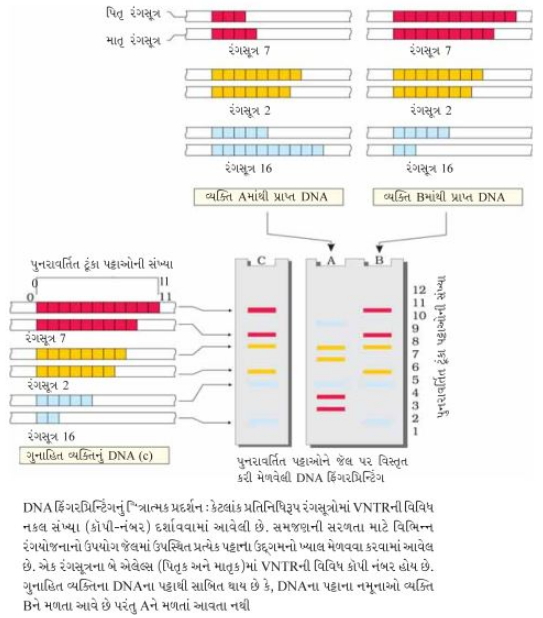
(B) The correct answer is $B$. Casperson $(1970)$ developed a method to stain chromosomes using specific fluorescent dyes. This technique produces distinct light and dark bands along the length of the chromosomes,known as banding patterns. These patterns are highly useful for identifying individual chromosomes and detecting various types of chromosomal aberrations.
0 likes
View Solution3
EasyMCQ
Satellite $DNA$ is present in
A
Nucleus
B
Chloroplast
C
Nucleolus
D
Chromosomes
Solution
(D) Satellite $DNA$ refers to highly repetitive sequences of $DNA$ found in the heterochromatic regions of chromosomes. In cytogenetics,the term 'satellite' also refers to a small chromosomal segment separated from the main body of the chromosome by a secondary constriction. Therefore,satellite $DNA$ is physically located within the chromosomes.
0 likes
View Solution4
MediumMCQ
$DNA$ fingerprinting method is very useful for:
A
$DNA$ tests for identity and relationships
B
Forensic studies
C
Polymorphism
D
All of the above
Solution
(D) $DNA$ fingerprinting is a technique used to identify individuals by their genetic makeup.
$1$. It is used in forensic science to identify criminals by matching $DNA$ samples from crime scenes.
$2$. It is used in paternity and maternity tests to establish biological relationships.
$3$. It relies on the analysis of $DNA$ polymorphism,which refers to variations in $DNA$ sequences among individuals.
Therefore,all the given options are correct applications of $DNA$ fingerprinting.
$1$. It is used in forensic science to identify criminals by matching $DNA$ samples from crime scenes.
$2$. It is used in paternity and maternity tests to establish biological relationships.
$3$. It relies on the analysis of $DNA$ polymorphism,which refers to variations in $DNA$ sequences among individuals.
Therefore,all the given options are correct applications of $DNA$ fingerprinting.
0 likes
View Solution5
MediumMCQ
$DNA$ fingerprinting refers to
A
Techniques used for molecular analysis of different specimens of $DNA$
B
Techniques used for identification of fingerprints of individuals
C
Molecular analysis of profiles of $DNA$ samples
D
Analysis of $DNA$ samples using imprinting devices
Solution
(C) $DNA$ fingerprinting is a laboratory technique used to determine the identity of an individual by analyzing their $DNA$ profile.
It involves identifying specific nucleotide sequences that are unique to each person,often referred to as variable number tandem repeats $(VNTRs)$.
These profiles are compared to identify individuals in forensic investigations,paternity testing,and genetic studies.
Therefore,it is the molecular analysis of profiles of $DNA$ samples.
It involves identifying specific nucleotide sequences that are unique to each person,often referred to as variable number tandem repeats $(VNTRs)$.
These profiles are compared to identify individuals in forensic investigations,paternity testing,and genetic studies.
Therefore,it is the molecular analysis of profiles of $DNA$ samples.
0 likes
View Solution6
MediumMCQ
$DNA$ fingerprinting technique was first developed by:
A
Jeffreys,Wilson and Thien
B
Boysen and Jensen
C
Schleiden and Schwann
D
Edward and Steptoe
Solution
(A) The $DNA$ fingerprinting technique was first developed by Alec Jeffreys in $1984$. He used satellite $DNA$ as a probe that shows very high degree of polymorphism and called it Variable Number Tandem Repeats ($VNTR$s).
0 likes
View Solution7
MediumMCQ
$DNA$ fingerprinting is useful for:
A
Identification and relationship testing
B
Forensic studies
C
Polymorphism analysis
D
All of the above
Solution
(D) $DNA$ fingerprinting is a technique used to identify individuals based on their unique $DNA$ sequences.
$1$. It is widely used in forensic science to identify suspects or victims by matching $DNA$ samples from crime scenes.
$2$. It is used in paternity and maternity testing to establish biological relationships.
$3$. It relies on the analysis of $DNA$ polymorphism,which refers to variations in the $DNA$ sequences among individuals.
Therefore,all the given options are correct applications of $DNA$ fingerprinting.
$1$. It is widely used in forensic science to identify suspects or victims by matching $DNA$ samples from crime scenes.
$2$. It is used in paternity and maternity testing to establish biological relationships.
$3$. It relies on the analysis of $DNA$ polymorphism,which refers to variations in the $DNA$ sequences among individuals.
Therefore,all the given options are correct applications of $DNA$ fingerprinting.
0 likes
View Solution8
MediumMCQ
Select the incorrect statement.
A
$DNA$ obtained from a single cell is sufficient for $DNA$ fingerprinting analysis.
B
$DNA$ fingerprinting is widely used for the determination of population and genetic diversity.
C
$VNTR$ associated with satellite $DNA$ sequences are called microsatellites.
D
Except for monozygotic twins,$DNA$ fingerprints are unique to every individual in a population.
Solution
(C) The incorrect statement is $C$. $VNTR$ (Variable Number Tandem Repeats) are actually associated with minisatellites,not microsatellites. Microsatellites are typically shorter sequences (usually $1-6$ base pairs) that repeat,whereas $VNTR$s are minisatellites with longer repeat units. Option $A$ is correct because $PCR$ (Polymerase Chain Reaction) allows amplification of $DNA$ from a single cell. Option $B$ is correct as $DNA$ fingerprinting is a powerful tool for studying genetic diversity. Option $D$ is correct because $DNA$ sequences are unique to individuals except in the case of identical (monozygotic) twins.
0 likes
View Solution9
MediumMCQ
$DNA$ fingerprinting refers to:
A
$A$ method of identification using fingerprints of an individual.
B
Molecular analysis of profiles of $DNA$ samples.
C
Analysis of $DNA$ samples using imprinting devices.
D
Molecular analysis of different $DNA$ samples.
Solution
(B) $DNA$ fingerprinting is a technique used to identify individuals by their respective $DNA$ profiles. It involves the molecular analysis of $DNA$ samples to detect variations in the nucleotide sequences,specifically focusing on repetitive sequences known as Variable Number Tandem Repeats $(VNTRs)$. By comparing these patterns,scientists can establish identity or biological relationships. Therefore,it is defined as the molecular analysis of profiles of $DNA$ samples.
0 likes
View Solution10
MediumMCQ
Which step is $NOT$ correct in $DNA$ fingerprinting?
A
$DNA$ isolation
B
Digestion of $DNA$ by $DNA$ lipase
C
Separation of $DNA$ by electrophoresis
D
Hybridization using labeled $VNTR$ probes
Solution
(B) The process of $DNA$ fingerprinting involves several steps: $DNA$ isolation,digestion of $DNA$ by restriction endonucleases,separation of $DNA$ fragments by gel electrophoresis,Southern blotting,and hybridization using labeled $VNTR$ probes.
Option $B$ is incorrect because $DNA$ is digested by restriction endonucleases,not by $DNA$ lipase. Lipases are enzymes that break down lipids,not $DNA$.
Option $B$ is incorrect because $DNA$ is digested by restriction endonucleases,not by $DNA$ lipase. Lipases are enzymes that break down lipids,not $DNA$.
0 likes
View Solution11
MediumMCQ
$PCR$ and Restriction Fragment Length Polymorphism $(RFLP)$ techniques are used for:
A
$DNA$ sequencing
B
Genetic fingerprinting
C
Study of enzymes
D
Genetic transformation
Solution
(B) $PCR$ (Polymerase Chain Reaction) and $RFLP$ (Restriction Fragment Length Polymorphism) are fundamental techniques used in $DNA$ fingerprinting.
$PCR$ is used to amplify small amounts of $DNA$ samples to obtain enough material for analysis.
$RFLP$ involves cutting the $DNA$ with restriction enzymes to create fragments of varying lengths,which are then separated by gel electrophoresis to create a unique pattern for an individual.
These techniques together allow for the identification of individuals based on their unique genetic makeup,which is the basis of genetic fingerprinting.
$PCR$ is used to amplify small amounts of $DNA$ samples to obtain enough material for analysis.
$RFLP$ involves cutting the $DNA$ with restriction enzymes to create fragments of varying lengths,which are then separated by gel electrophoresis to create a unique pattern for an individual.
These techniques together allow for the identification of individuals based on their unique genetic makeup,which is the basis of genetic fingerprinting.
0 likes
View Solution12
MediumMCQ
The technique of transferring $DNA$ fragments separated by agarose gel electrophoresis onto a synthetic membrane like nitrocellulose is known as:
A
Northern blotting
B
Southern blotting
C
Western blotting
D
Dot blotting
Solution
(B) The technique of transferring $DNA$ fragments separated by agarose gel electrophoresis onto a synthetic membrane,such as nitrocellulose or nylon,is called Southern blotting.
This process is a crucial step in $DNA$ fingerprinting and $DNA$ analysis.
In contrast,Northern blotting is used for $RNA$ transfer,and Western blotting is used for protein transfer.
This process is a crucial step in $DNA$ fingerprinting and $DNA$ analysis.
In contrast,Northern blotting is used for $RNA$ transfer,and Western blotting is used for protein transfer.
0 likes
View Solution13
MediumMCQ
Which of the following is used in the $DNA$ fingerprinting technique?
A
Restriction enzymes
B
Taq polymerase
C
Oligonucleotide primers
D
All of the above
Solution
(D) $DNA$ fingerprinting involves several steps including isolation of $DNA$,digestion of $DNA$ by restriction endonucleases,separation of $DNA$ fragments by electrophoresis,blotting,hybridization using labeled $VNTR$ probes,and detection by autoradiography.
$1$. Restriction enzymes are used to cut the $DNA$ into specific fragments.
$2$. $Taq$ polymerase is used in the $PCR$ (Polymerase Chain Reaction) step to amplify the $DNA$ samples.
$3$. Oligonucleotide primers are essential for the $PCR$ process to initiate the synthesis of new $DNA$ strands.
Therefore,all the listed components are utilized in the $DNA$ fingerprinting technique.
$1$. Restriction enzymes are used to cut the $DNA$ into specific fragments.
$2$. $Taq$ polymerase is used in the $PCR$ (Polymerase Chain Reaction) step to amplify the $DNA$ samples.
$3$. Oligonucleotide primers are essential for the $PCR$ process to initiate the synthesis of new $DNA$ strands.
Therefore,all the listed components are utilized in the $DNA$ fingerprinting technique.
0 likes
View Solution14
MediumMCQ
Which of the following steps is not involved in $DNA$ fingerprinting?
A
Southern blotting
B
Gel electrophoresis
C
Digestion by restriction enzymes
D
Northern blotting
Solution
(D) $DNA$ fingerprinting involves several steps: isolation of $DNA$,digestion of $DNA$ by restriction endonucleases,separation of $DNA$ fragments by gel electrophoresis,transferring (blotting) of separated $DNA$ fragments to synthetic membranes like nitrocellulose or nylon,and hybridization using labeled $VNTR$ probes.
Southern blotting is the technique used for the transfer of $DNA$ fragments to a membrane.
Northern blotting is a technique used for the detection of specific $RNA$ sequences in a sample,not $DNA$. Therefore,it is not a step in $DNA$ fingerprinting.
Southern blotting is the technique used for the transfer of $DNA$ fragments to a membrane.
Northern blotting is a technique used for the detection of specific $RNA$ sequences in a sample,not $DNA$. Therefore,it is not a step in $DNA$ fingerprinting.
0 likes
View Solution15
MediumMCQ
Which of the following pairs of terms represents the same meaning?
A
Gene pool - Genome
B
Codons - Gene
C
Cistron - Triplet
D
$DNA$ Fingerprinting - $DNA$ Profiling
Solution
(D) $DNA$ Fingerprinting and $DNA$ Profiling are two terms used to describe the same scientific technique.
This technique involves analyzing the unique patterns of $DNA$ sequences in an individual to identify them.
It is widely used in forensic science,paternity testing,and genetic research.
Other options represent different biological concepts: Gene pool refers to the total genetic diversity in a population,while Genome refers to the complete set of genetic material in an organism.
Codons are sequences of three nucleotides that code for specific amino acids,whereas a Gene is a functional unit of heredity.
$A$ Cistron is a section of $DNA$ or $RNA$ that codes for a specific polypeptide,while a Triplet refers to the three-nucleotide sequence (codon) itself.
This technique involves analyzing the unique patterns of $DNA$ sequences in an individual to identify them.
It is widely used in forensic science,paternity testing,and genetic research.
Other options represent different biological concepts: Gene pool refers to the total genetic diversity in a population,while Genome refers to the complete set of genetic material in an organism.
Codons are sequences of three nucleotides that code for specific amino acids,whereas a Gene is a functional unit of heredity.
$A$ Cistron is a section of $DNA$ or $RNA$ that codes for a specific polypeptide,while a Triplet refers to the three-nucleotide sequence (codon) itself.
0 likes
View Solution16
MediumMCQ
Satellite $DNA$ is useful in ...... .
A
Forensic science
B
Genetic engineering
C
Organ transplantation
D
Sex determination
Solution
(A) Satellite $DNA$ consists of highly repetitive sequences of $DNA$ that do not code for proteins.
These sequences show high levels of polymorphism,meaning they vary significantly between individuals.
Because these variations are unique to each individual,satellite $DNA$ is the fundamental basis for $DNA$ fingerprinting.
$DNA$ fingerprinting is extensively used in forensic science for criminal investigations,paternity testing,and identifying individuals.
These sequences show high levels of polymorphism,meaning they vary significantly between individuals.
Because these variations are unique to each individual,satellite $DNA$ is the fundamental basis for $DNA$ fingerprinting.
$DNA$ fingerprinting is extensively used in forensic science for criminal investigations,paternity testing,and identifying individuals.
0 likes
View Solution17
DifficultMCQ
What is the basis of $DNA$ fingerprinting?
A
Relative amount of $DNA$ in ridges and grooves of fingerprints.
B
Satellite $DNA$ as junk $DNA$ due to high degree of polymorphism.
C
Relative ratio of purines and pyrimidines in $DNA$.
D
Relative difference between $DNA$ in blood,skin,and saliva.
Solution
(B) $DNA$ fingerprinting is based on the principle of $DNA$ polymorphism.
$DNA$ polymorphism refers to the variation at the genetic level.
Specifically,it relies on $DNA$ sequences known as Variable Number Tandem Repeats $(VNTRs)$.
These $VNTRs$ are short nucleotide repeats that are highly specific to each individual and show a high degree of polymorphism,which is the basis of $DNA$ fingerprinting.
$DNA$ polymorphism refers to the variation at the genetic level.
Specifically,it relies on $DNA$ sequences known as Variable Number Tandem Repeats $(VNTRs)$.
These $VNTRs$ are short nucleotide repeats that are highly specific to each individual and show a high degree of polymorphism,which is the basis of $DNA$ fingerprinting.
0 likes
View Solution18
MediumMCQ
In density gradient centrifugation,bulk $DNA$ forms a/an ......,while satellite $DNA$ forms a/an ...... .
A
Major peak : Minor peak
B
Minor peak : Major peak
C
Major peak : Major peak
D
Minor peak : Minor peak
Solution
(A) In density gradient centrifugation,the bulk $DNA$ represents the majority of the genome and forms a large peak known as the $Major$ $peak$.
Satellite $DNA$ consists of highly repetitive sequences that differ in density from the bulk $DNA$,thus forming one or more smaller peaks known as $Minor$ $peaks$.
Satellite $DNA$ consists of highly repetitive sequences that differ in density from the bulk $DNA$,thus forming one or more smaller peaks known as $Minor$ $peaks$.
0 likes
View Solution19
MediumMCQ
$DNA$ fingerprinting was discovered by .....
A
Kary Mullis
B
Alec Jeffreys
C
Dr. Paul Berg
D
Francis Collins
Solution
(B) $DNA$ fingerprinting is a technique used to identify individuals based on their unique $DNA$ sequences. It was developed by Sir Alec Jeffreys in $1984$ at the University of Leicester. This technique relies on the analysis of variable number tandem repeats $(VNTRs)$,which are specific sequences of $DNA$ that repeat in different numbers in different individuals.
0 likes
View Solution20
MediumMCQ
$DNA$ probes are used for ..........
A
$DNA$ fingerprinting
B
Detection of pathogenic bacteria
C
Detection of specific genes in medical genetics
D
All of the above
Solution
(D) $DNA$ probes are single-stranded sequences of $DNA$ or $RNA$ that are labeled with a radioactive or fluorescent marker. They are used to detect the presence of complementary nucleotide sequences by hybridization.
$1$. In $DNA$ fingerprinting,probes are used to identify specific variable number tandem repeats $(VNTRs)$.
$2$. In medical diagnostics,they are used to detect pathogenic bacteria or viruses by identifying their unique genetic sequences.
$3$. In medical genetics,they are used to screen for specific genes or mutations associated with genetic disorders.
Therefore,all the given options are correct applications of $DNA$ probes.
$1$. In $DNA$ fingerprinting,probes are used to identify specific variable number tandem repeats $(VNTRs)$.
$2$. In medical diagnostics,they are used to detect pathogenic bacteria or viruses by identifying their unique genetic sequences.
$3$. In medical genetics,they are used to screen for specific genes or mutations associated with genetic disorders.
Therefore,all the given options are correct applications of $DNA$ probes.
0 likes
View Solution21
MediumMCQ
Satellite $DNA$ is important because it
A
does not code for proteins and is same in all members of the population
B
codes for enzymes needed for $DNA$ replication
C
codes for proteins needed in cell cycle
D
shows high degree of polymorphism in population and also the same degree of polymorphism in an individual,which is heritable from parents to children.
Solution
(D) : Satellite $DNA$ is a part of repetitive $DNA$ which consists of long repetitive nucleotide sequences in tandem,forming a separate fraction during density ultracentrifugation.
$DNA$ fingerprinting involves identifying differences in specific regions of $DNA$ sequences known as repetitive $DNA$,where a small stretch of $DNA$ is repeated many times.
These repetitive $DNA$ sequences are separated from bulk genomic $DNA$ as distinct peaks during density gradient centrifugation.
The bulk $DNA$ forms a major peak,while the smaller peaks are referred to as satellite $DNA$.
Depending on base composition ($A:T$ rich or $G:C$ rich),segment length,and the number of repetitive units,satellite $DNA$ is classified into categories such as microsatellites and minisatellites.
These sequences typically do not code for any proteins,yet they constitute a large portion of the human genome.
They exhibit a high degree of polymorphism,which forms the basis of $DNA$ fingerprinting.
Since $DNA$ from every tissue (such as blood,hair follicles,skin,bone,saliva,sperm,etc.) of an individual shows the same degree of polymorphism,it serves as a highly useful identification tool in forensic applications.
$DNA$ fingerprinting involves identifying differences in specific regions of $DNA$ sequences known as repetitive $DNA$,where a small stretch of $DNA$ is repeated many times.
These repetitive $DNA$ sequences are separated from bulk genomic $DNA$ as distinct peaks during density gradient centrifugation.
The bulk $DNA$ forms a major peak,while the smaller peaks are referred to as satellite $DNA$.
Depending on base composition ($A:T$ rich or $G:C$ rich),segment length,and the number of repetitive units,satellite $DNA$ is classified into categories such as microsatellites and minisatellites.
These sequences typically do not code for any proteins,yet they constitute a large portion of the human genome.
They exhibit a high degree of polymorphism,which forms the basis of $DNA$ fingerprinting.
Since $DNA$ from every tissue (such as blood,hair follicles,skin,bone,saliva,sperm,etc.) of an individual shows the same degree of polymorphism,it serves as a highly useful identification tool in forensic applications.
0 likes
View Solution22
MediumMCQ
One of the most frequently used techniques in $DNA$ fingerprinting is
A
$VNTR$
B
$SSCP$
C
$SCAR$
D
$AFLP$
Solution
(A) $DNA$ fingerprinting relies on identifying differences in specific regions of $DNA$ sequence called repetitive $DNA$.
Specifically,the technique focuses on Variable Number Tandem Repeats $(VNTRs)$.
These are short nucleotide repeats that vary in number from person to person,making them highly polymorphic and ideal for individual identification.
Specifically,the technique focuses on Variable Number Tandem Repeats $(VNTRs)$.
These are short nucleotide repeats that vary in number from person to person,making them highly polymorphic and ideal for individual identification.
0 likes
View Solution23
MediumMCQ
What is it that forms the basis of $DNA$ fingerprinting?
A
The relative proportions of purines and pyrimidines in $DNA$
B
The relative difference in the $DNA$ occurrence in blood,skin and saliva.
C
The relative amount of $DNA$ in the ridges and grooves of the fingerprints.
D
Satellite $DNA$ occurring as highly repeated short $DNA$ segments.
Solution
(D) $DNA$ fingerprinting is a technique used to identify nucleotide sequences in specific regions of $DNA$ that are unique to each individual.
The difference of approximately $0.1\%$ or $3 \times 10^6$ base pairs (out of $3 \times 10^9 \ bp$) provides individuality to each human being.
The human genome contains numerous small,non-coding,but inheritable base sequences that are repeated multiple times. These sequences are found near telomeres,centromeres,the $Y$ chromosome,and heterochromatic regions.
Regions containing the same sequence of bases repeated several times are known as repetitive $DNA$. During density gradient centrifugation,this $DNA$ separates as a satellite from the bulk $DNA$,hence it is called satellite $DNA$,where the repetition of bases occurs in tandem.
Satellite $DNAs$ exhibit polymorphism (the occurrence of mutations in a population at high frequency),which serves as the basis for both genetic mapping of the human genome and $DNA$ fingerprinting.
While mutations in genes produce alleles with different expressions,mutations in non-coding repetitive $DNA$ have no immediate impact. These accumulated mutations form the basis of polymorphism.
The difference of approximately $0.1\%$ or $3 \times 10^6$ base pairs (out of $3 \times 10^9 \ bp$) provides individuality to each human being.
The human genome contains numerous small,non-coding,but inheritable base sequences that are repeated multiple times. These sequences are found near telomeres,centromeres,the $Y$ chromosome,and heterochromatic regions.
Regions containing the same sequence of bases repeated several times are known as repetitive $DNA$. During density gradient centrifugation,this $DNA$ separates as a satellite from the bulk $DNA$,hence it is called satellite $DNA$,where the repetition of bases occurs in tandem.
Satellite $DNAs$ exhibit polymorphism (the occurrence of mutations in a population at high frequency),which serves as the basis for both genetic mapping of the human genome and $DNA$ fingerprinting.
While mutations in genes produce alleles with different expressions,mutations in non-coding repetitive $DNA$ have no immediate impact. These accumulated mutations form the basis of polymorphism.
0 likes
View Solution24
MediumMCQ
Satellite $DNA$ is a useful tool for......
A
Organ transplantation
B
Sex determination
C
Forensic science
D
Taxonomy
Solution
(C) Satellite $DNA$ consists of highly repetitive sequences of $DNA$ that do not code for any proteins.
These sequences show high levels of polymorphism,meaning they vary significantly between individuals.
Because these variations are unique to each individual (except in identical twins),satellite $DNA$ is used in $DNA$ fingerprinting.
$DNA$ fingerprinting is a crucial technique in forensic science for identifying criminals,resolving paternity disputes,and establishing biological relationships.
These sequences show high levels of polymorphism,meaning they vary significantly between individuals.
Because these variations are unique to each individual (except in identical twins),satellite $DNA$ is used in $DNA$ fingerprinting.
$DNA$ fingerprinting is a crucial technique in forensic science for identifying criminals,resolving paternity disputes,and establishing biological relationships.
0 likes
View Solution25
DifficultMCQ
Arrange the various steps of $DNA$ fingerprinting technique in the correct order.
$(I)$ Separation of $DNA$ fragment by electrophoresis.
$(II)$ Digestion of $DNA$ by restriction endonucleases.
$(III)$ Hybridization using labeled $VNTR$ probe.
$(IV)$ Isolation of $DNA$.
$(V)$ Detection of hybridized $DNA$ fragments by autoradiography.
$(VI)$ Transferring of separated $DNA$ fragment to synthetic membranes.
$(I)$ Separation of $DNA$ fragment by electrophoresis.
$(II)$ Digestion of $DNA$ by restriction endonucleases.
$(III)$ Hybridization using labeled $VNTR$ probe.
$(IV)$ Isolation of $DNA$.
$(V)$ Detection of hybridized $DNA$ fragments by autoradiography.
$(VI)$ Transferring of separated $DNA$ fragment to synthetic membranes.
A
$IV, II, V, VI, I$
B
$IV, II, I, VI, III, V$
C
$I, II, III, IV, V, VI$
D
$III, V, VI, IV, II, I$
Solution
(B) The correct sequence of steps in $DNA$ fingerprinting is as follows:
$1$. Isolation of $DNA$ $(IV)$.
$2$. Digestion of $DNA$ by restriction endonucleases $(II)$.
$3$. Separation of $DNA$ fragments by electrophoresis $(I)$.
$4$. Transferring (blotting) of separated $DNA$ fragments to synthetic membranes,such as nitrocellulose or nylon $(VI)$.
$5$. Hybridization using labeled $VNTR$ probe $(III)$.
$6$. Detection of hybridized $DNA$ fragments by autoradiography $(V)$.
Thus,the correct order is $IV, II, I, VI, III, V$.
$1$. Isolation of $DNA$ $(IV)$.
$2$. Digestion of $DNA$ by restriction endonucleases $(II)$.
$3$. Separation of $DNA$ fragments by electrophoresis $(I)$.
$4$. Transferring (blotting) of separated $DNA$ fragments to synthetic membranes,such as nitrocellulose or nylon $(VI)$.
$5$. Hybridization using labeled $VNTR$ probe $(III)$.
$6$. Detection of hybridized $DNA$ fragments by autoradiography $(V)$.
Thus,the correct order is $IV, II, I, VI, III, V$.
0 likes
View Solution26
EasyMCQ
Who developed the $DNA$ fingerprinting method?
A
Jacob and Monod
B
Alec Jeffreys
C
Griffith
D
Watson and Crick
Solution
(B) The $DNA$ fingerprinting technique was developed by Sir Alec Jeffreys in $1984$.
It is a laboratory technique used to determine the identity of an individual by analyzing their $DNA$ characteristics.
This method relies on the analysis of variable number tandem repeats $(VNTRs)$,which are specific sequences of $DNA$ that vary from person to person.
It is a laboratory technique used to determine the identity of an individual by analyzing their $DNA$ characteristics.
This method relies on the analysis of variable number tandem repeats $(VNTRs)$,which are specific sequences of $DNA$ that vary from person to person.
0 likes
View Solution27
DifficultMCQ
Which technique is required to study the binding of specific proteins to $DNA$ sequences?
A
Ultracentrifugation
B
Electron microscopy
C
Light microscopy
D
$X$-ray crystallography
Solution
(D) To study the binding of specific proteins to $DNA$ sequences,$X$-ray crystallography is the most appropriate technique.
This method allows researchers to determine the three-dimensional structure of biological molecules,including $DNA$-protein complexes,at the atomic level.
By analyzing the diffraction pattern of $X$-rays passed through a crystallized sample,scientists can map the precise interactions between amino acid residues of the protein and the nucleotide bases of the $DNA$.
This method allows researchers to determine the three-dimensional structure of biological molecules,including $DNA$-protein complexes,at the atomic level.
By analyzing the diffraction pattern of $X$-rays passed through a crystallized sample,scientists can map the precise interactions between amino acid residues of the protein and the nucleotide bases of the $DNA$.
0 likes
View Solution28
MediumMCQ
What is the basis of $DNA$ fingerprinting?
A
Restriction Fragment Length Polymorphism $(RFLP)$
B
Somatic variations between organisms
C
Availability of cloned $DNA$
D
Knowledge of human karyotype
Solution
(A) $DNA$ fingerprinting is a technique used to identify individuals based on their unique genetic makeup.
It primarily relies on $DNA$ polymorphism,specifically $Restriction$ $Fragment$ $Length$ $Polymorphism$ $(RFLP)$.
These variations in the length of $DNA$ fragments,generated by restriction enzymes,occur due to differences in the nucleotide sequences at specific loci in the genome.
Since these patterns are highly individual-specific,they serve as the fundamental basis for $DNA$ profiling.
It primarily relies on $DNA$ polymorphism,specifically $Restriction$ $Fragment$ $Length$ $Polymorphism$ $(RFLP)$.
These variations in the length of $DNA$ fragments,generated by restriction enzymes,occur due to differences in the nucleotide sequences at specific loci in the genome.
Since these patterns are highly individual-specific,they serve as the fundamental basis for $DNA$ profiling.
0 likes
View Solution29
MediumMCQ
What is $DNA$ fingerprinting?
A
Molecular analysis or profiling of $DNA$ samples.
B
Analysis of $DNA$ samples using an imprinting tool.
C
Molecular analysis of different $DNA$ samples using a specific technique.
D
Fingerprints of an individual using a technique.
Solution
(C) $DNA$ fingerprinting is a technique used to identify individuals by their respective $DNA$ profiles.
It involves the molecular analysis of $DNA$ samples to detect variations in the nucleotide sequences.
These variations,known as polymorphisms,are unique to each individual (except in identical twins).
Therefore,it is defined as the molecular analysis of different $DNA$ samples using specific techniques like $VNTR$ analysis.
It involves the molecular analysis of $DNA$ samples to detect variations in the nucleotide sequences.
These variations,known as polymorphisms,are unique to each individual (except in identical twins).
Therefore,it is defined as the molecular analysis of different $DNA$ samples using specific techniques like $VNTR$ analysis.
0 likes
View Solution30
MediumMCQ
Satellite $DNA$ is important because it .........
A
codes for proteins needed in the cell cycle.
B
shows high degree of polymorphism in population and also the same degree of polymorphism in an individual,which is heritable from parents to children.
C
does not code for proteins and is the same in all members of the population.
D
codes for enzymes needed for $DNA$ replication.
Solution
(B) Satellite $DNA$ is a part of repetitive $DNA$ that does not code for any proteins.
It shows a high degree of polymorphism in a population.
Since this polymorphism is heritable from parents to children,it forms the basis of $DNA$ fingerprinting.
Therefore,it is highly useful in forensic science and paternity testing.
It shows a high degree of polymorphism in a population.
Since this polymorphism is heritable from parents to children,it forms the basis of $DNA$ fingerprinting.
Therefore,it is highly useful in forensic science and paternity testing.
0 likes
View Solution31
MediumMCQ
Which of the following is $NOT$ required for the current $DNA$ fingerprinting technique?
A
Zinc finger analysis
B
Restriction enzymes
C
$DNA-DNA$ hybridization
D
Polymerase chain reaction
Solution
(A) $DNA$ fingerprinting involves identifying differences in specific regions of $DNA$ sequence called repetitive $DNA$. The steps involved are:
$1$. Isolation of $DNA$.
$2$. Digestion of $DNA$ by restriction endonucleases.
$3$. Separation of $DNA$ fragments by electrophoresis.
$4$. Transferring (blotting) of separated $DNA$ fragments to synthetic membranes,such as nitrocellulose or nylon.
$5$. Hybridization using labelled $VNTR$ probe.
$6$. Detection of hybridized $DNA$ fragments by autoradiography.
Polymerase chain reaction $(PCR)$ is often used to amplify the $DNA$ sample if the amount of $DNA$ is very small.
Zinc finger analysis is a technique used for studying $DNA$-binding proteins and is not a part of the standard $DNA$ fingerprinting procedure.
$1$. Isolation of $DNA$.
$2$. Digestion of $DNA$ by restriction endonucleases.
$3$. Separation of $DNA$ fragments by electrophoresis.
$4$. Transferring (blotting) of separated $DNA$ fragments to synthetic membranes,such as nitrocellulose or nylon.
$5$. Hybridization using labelled $VNTR$ probe.
$6$. Detection of hybridized $DNA$ fragments by autoradiography.
Polymerase chain reaction $(PCR)$ is often used to amplify the $DNA$ sample if the amount of $DNA$ is very small.
Zinc finger analysis is a technique used for studying $DNA$-binding proteins and is not a part of the standard $DNA$ fingerprinting procedure.
0 likes
View Solution32
MediumMCQ
$PCR$ and Restriction Fragment Length Polymorphism $(RFLP)$ are techniques used for.............
A
Study of enzymes
B
Genetic mutation
C
$DNA$ sequencing
D
$DNA$ fingerprinting
Solution
(D) $PCR$ (Polymerase Chain Reaction) and $RFLP$ (Restriction Fragment Length Polymorphism) are fundamental techniques employed in $DNA$ fingerprinting.
$DNA$ fingerprinting involves identifying differences in specific regions of $DNA$ sequences.
$PCR$ is used to amplify small amounts of $DNA$ samples,while $RFLP$ is used to analyze the variations in the length of $DNA$ fragments produced by restriction enzymes.
These techniques together allow for the identification of individuals based on their unique genetic makeup.
$DNA$ fingerprinting involves identifying differences in specific regions of $DNA$ sequences.
$PCR$ is used to amplify small amounts of $DNA$ samples,while $RFLP$ is used to analyze the variations in the length of $DNA$ fragments produced by restriction enzymes.
These techniques together allow for the identification of individuals based on their unique genetic makeup.
0 likes
View Solution33
MediumMCQ
Assertion : $DNA$ fingerprinting has become a powerful tool to establish paternity and identity of criminals in rape and assault cases.
Reason : Trace evidences such as hairs,saliva,and dried semen are adequate for $DNA$ analysis.
Reason : Trace evidences such as hairs,saliva,and dried semen are adequate for $DNA$ analysis.
A
If both Assertion and Reason are correct and the Reason is a correct explanation of the Assertion.
B
If both Assertion and Reason are correct but Reason is not a correct explanation of the Assertion.
C
If the Assertion is correct but Reason is incorrect.
D
If both the Assertion and Reason are incorrect.
Solution
(A) $DNA$ fingerprinting is a highly sensitive technique that relies on the analysis of repetitive sequences in the genome known as Variable Number Tandem Repeats $(VNTRs)$.
Because these sequences are unique to every individual,they serve as a molecular signature.
Trace biological evidences such as hair follicles,saliva,and dried semen contain sufficient nucleated cells to extract $DNA$ for analysis.
Therefore,the ability to identify individuals from minute biological samples makes $DNA$ fingerprinting a powerful tool for forensic investigations,including paternity testing and criminal identification.
Both the Assertion and the Reason are correct,and the Reason provides the scientific basis for why $DNA$ fingerprinting is effective.
Because these sequences are unique to every individual,they serve as a molecular signature.
Trace biological evidences such as hair follicles,saliva,and dried semen contain sufficient nucleated cells to extract $DNA$ for analysis.
Therefore,the ability to identify individuals from minute biological samples makes $DNA$ fingerprinting a powerful tool for forensic investigations,including paternity testing and criminal identification.
Both the Assertion and the Reason are correct,and the Reason provides the scientific basis for why $DNA$ fingerprinting is effective.
0 likes
View Solution34
Medium
What is $DNA$ fingerprinting? Mention its application.
Solution
(N/A) $DNA$ fingerprinting is a technique used to identify and analyze the variations in various individuals at the level of $DNA$. It is based on the principle of $DNA$ polymorphism.
Applications:
$1$. It is used in forensic science to identify potential crime suspects.
$2$. It is used to establish paternity and resolve family relationship disputes.
$3$. It is used to identify and protect commercial varieties of crops and livestock.
$4$. It is used to study the evolutionary history of organisms and trace linkages between different groups.
Applications:
$1$. It is used in forensic science to identify potential crime suspects.
$2$. It is used to establish paternity and resolve family relationship disputes.
$3$. It is used to identify and protect commercial varieties of crops and livestock.
$4$. It is used to study the evolutionary history of organisms and trace linkages between different groups.
0 likes
View Solution35
Medium
Explain $DNA$ fingerprinting in detail.
Solution
(N/A) The technique of identifying the specific sequence of nucleotides in $DNA$ that is unique to each individual is known as $DNA$ fingerprinting.
To understand the genetic differences between two individuals or populations,one must know the $DNA$ sequence.
$DNA$ fingerprinting is a rapid method for comparing the sequences of two individuals.
In $DNA$ fingerprinting,differences are identified in specific regions of the $DNA$ sequence known as repetitive $DNA$,where a small segment of $DNA$ is repeated many times.
This repetitive $DNA$ is separated from the bulk genomic $DNA$ by density gradient centrifugation. The bulk $DNA$ forms a major peak,while other small peaks are formed,which are called satellite $DNA$.
Based on base composition ($A:T$ or $G:C$ richness),segment length,and the number of repetitive units,they are classified into microsatellites,minisatellites,etc.
These sequences do not code for any proteins but constitute a large portion of the human genome. They exhibit a high degree of polymorphism,which is the basis of $DNA$ fingerprinting.
$DNA$ obtained from any tissue of an individual,such as blood,hair,skin,bones,saliva,or sperm,shows the same type of polymorphism. This is useful as a significant identification tool in forensic applications. This polymorphism is inherited from parents to offspring; therefore,it is an accurate method for resolving paternity disputes.
To understand the genetic differences between two individuals or populations,one must know the $DNA$ sequence.
$DNA$ fingerprinting is a rapid method for comparing the sequences of two individuals.
In $DNA$ fingerprinting,differences are identified in specific regions of the $DNA$ sequence known as repetitive $DNA$,where a small segment of $DNA$ is repeated many times.
This repetitive $DNA$ is separated from the bulk genomic $DNA$ by density gradient centrifugation. The bulk $DNA$ forms a major peak,while other small peaks are formed,which are called satellite $DNA$.
Based on base composition ($A:T$ or $G:C$ richness),segment length,and the number of repetitive units,they are classified into microsatellites,minisatellites,etc.
These sequences do not code for any proteins but constitute a large portion of the human genome. They exhibit a high degree of polymorphism,which is the basis of $DNA$ fingerprinting.
$DNA$ obtained from any tissue of an individual,such as blood,hair,skin,bones,saliva,or sperm,shows the same type of polymorphism. This is useful as a significant identification tool in forensic applications. This polymorphism is inherited from parents to offspring; therefore,it is an accurate method for resolving paternity disputes.
0 likes
View Solution36
Medium
Describe the steps involved in $DNA$ fingerprinting.
Solution
(N/A) $DNA$ fingerprinting involves identifying differences in specific regions in $DNA$ sequence called repetitive $DNA$. The steps are as follows:
$1$. Isolation of $DNA$.
$2$. Digestion of $DNA$ by restriction endonucleases.
$3$. Separation of $DNA$ fragments by electrophoresis.
$4$. Transferring (blotting) of separated $DNA$ fragments to synthetic membranes,such as nitrocellulose or nylon.
$5$. Hybridization using labelled $VNTR$ probe.
$6$. Detection of hybridized $DNA$ fragments by autoradiography.
$DNA$ fingerprinting was developed by Alec Jeffreys. It uses $VNTR$ (Variable Number of Tandem Repeats) as a probe because they show high degree of polymorphism.
$1$. Isolation of $DNA$.
$2$. Digestion of $DNA$ by restriction endonucleases.
$3$. Separation of $DNA$ fragments by electrophoresis.
$4$. Transferring (blotting) of separated $DNA$ fragments to synthetic membranes,such as nitrocellulose or nylon.
$5$. Hybridization using labelled $VNTR$ probe.
$6$. Detection of hybridized $DNA$ fragments by autoradiography.
$DNA$ fingerprinting was developed by Alec Jeffreys. It uses $VNTR$ (Variable Number of Tandem Repeats) as a probe because they show high degree of polymorphism.
0 likes
View Solution37
MediumMCQ
Provide information about $VNTR$.
A
Variable Number Tandem Repeats
B
Very Narrow Tandem Repeats
C
Variable Nucleotide Tandem Repeats
D
Variable Number Total Repeats
Solution
(A) $VNTR$ stands for Variable Number Tandem Repeats,which belongs to a class of satellite $DNA$ known as mini-satellites.
In $VNTR$,a small $DNA$ sequence is arranged tandemly in many copy numbers.
The copy number varies from chromosome to chromosome in an individual,resulting in a high degree of polymorphism.
As a result,the size of $VNTR$ varies in size from $0.1$ to $20$ $kb$.
After hybridization with $VNTR$ probes,the autoradiogram gives many bands of differing sizes.
These bands give a characteristic pattern for an individual's $DNA$ and differ from individual to individual in a population,except in the case of monozygotic twins.
The sensitivity of this technique can be increased by using the Polymerase Chain Reaction $(PCR)$.
Consequently,$DNA$ from a single cell is sufficient to perform $DNA$ fingerprinting analysis.
Beyond forensic applications,it is used for determining population and genetic diversity,and many probes are used to generate $DNA$ fingerprints.
In $VNTR$,a small $DNA$ sequence is arranged tandemly in many copy numbers.
The copy number varies from chromosome to chromosome in an individual,resulting in a high degree of polymorphism.
As a result,the size of $VNTR$ varies in size from $0.1$ to $20$ $kb$.
After hybridization with $VNTR$ probes,the autoradiogram gives many bands of differing sizes.
These bands give a characteristic pattern for an individual's $DNA$ and differ from individual to individual in a population,except in the case of monozygotic twins.
The sensitivity of this technique can be increased by using the Polymerase Chain Reaction $(PCR)$.
Consequently,$DNA$ from a single cell is sufficient to perform $DNA$ fingerprinting analysis.
Beyond forensic applications,it is used for determining population and genetic diversity,and many probes are used to generate $DNA$ fingerprints.
0 likes
View Solution38
Medium
Describe the principles of $DNA$ fingerprinting.
Solution
(N/A) The polymorphism observed in $DNA$ sequences is useful for $DNA$ fingerprinting as well as for preparing genetic maps of the human genome.
Polymorphism (variation at the genetic level) arises due to mutations. $A$ new mutation may arise in an individual either in somatic cells or in the germ cells.
If a germ cell mutation does not seriously impair an individual's ability to have offspring,it can be transmitted to the next generation through sexual reproduction.
If an inheritable mutation is observed in a population at high frequency,it is referred to as $DNA$ polymorphism. In other words,if more than one allele occurs at a locus in a human population with a frequency greater than $0.01$,the allelic sequence variation is called $DNA$ polymorphism.
These variations are more common in non-coding $DNA$ sequences because mutations in these sequences do not have an immediate impact on an individual's reproductive ability.
Consequently,these mutations accumulate generation after generation,resulting in polymorphism. These variations range from single nucleotide changes to large-scale alterations.
Polymorphism (variation at the genetic level) arises due to mutations. $A$ new mutation may arise in an individual either in somatic cells or in the germ cells.
If a germ cell mutation does not seriously impair an individual's ability to have offspring,it can be transmitted to the next generation through sexual reproduction.
If an inheritable mutation is observed in a population at high frequency,it is referred to as $DNA$ polymorphism. In other words,if more than one allele occurs at a locus in a human population with a frequency greater than $0.01$,the allelic sequence variation is called $DNA$ polymorphism.
These variations are more common in non-coding $DNA$ sequences because mutations in these sequences do not have an immediate impact on an individual's reproductive ability.
Consequently,these mutations accumulate generation after generation,resulting in polymorphism. These variations range from single nucleotide changes to large-scale alterations.
0 likes
View Solution39
Medium
Give differences: $VNTR$ and $Probe$.
Solution
(N/A)
| $VNTR$ | $Probe$ |
|---|---|
| $(1)$ It is a class of satellite $DNA$,where a small sequence is arranged tandemly in many copy numbers. | $(1)$ It is a radioactively labelled $VNTR$ sequence used for hybridisation with $DNA$ segments. |
0 likes
View Solution40
Medium
Explain the significance of $DNA$ fingerprinting in the field of forensics.
Solution
(N/A) The knowledge of $DNA$ polymorphism in individuals helps in identifying,treating,and to some extent,preventing thousands of human irregularities.
It is highly useful as an identification tool in forensic applications. Furthermore,since polymorphism is inherited from parents to offspring,$DNA$ fingerprinting is an excellent test to resolve paternity disputes.
$DNA$ obtained from any tissue of an individual,such as blood,hair,bones,saliva,or sperm,shows identical polymorphism. This allows for the accurate identification of criminals.
It is highly useful as an identification tool in forensic applications. Furthermore,since polymorphism is inherited from parents to offspring,$DNA$ fingerprinting is an excellent test to resolve paternity disputes.
$DNA$ obtained from any tissue of an individual,such as blood,hair,bones,saliva,or sperm,shows identical polymorphism. This allows for the accurate identification of criminals.
0 likes
View Solution41
Medium
What is $DNA$ polymorphism? Why is it important to study it?
Solution
(N/A) $DNA$ polymorphism refers to the occurrence of genetic variation at a specific locus in a population,where more than one variant (allele) exists with a frequency greater than $0.01$.
It arises due to mutations that are inheritable.
Studying $DNA$ polymorphism is important because:
$1$. It serves as a powerful tool in forensic science for individual identification.
$2$. Since these variations are inherited from parents to offspring,they form the basis of $DNA$ fingerprinting,which is crucial for paternity testing and resolving legal disputes.
It arises due to mutations that are inheritable.
Studying $DNA$ polymorphism is important because:
$1$. It serves as a powerful tool in forensic science for individual identification.
$2$. Since these variations are inherited from parents to offspring,they form the basis of $DNA$ fingerprinting,which is crucial for paternity testing and resolving legal disputes.
0 likes
View Solution42
MediumMCQ
Would it be appropriate to use $DNA$ probes such as $VNTR$ in $DNA$ fingerprinting of a bacteriophage?
A
Yes,it is highly effective.
B
No,because bacteriophages lack $VNTR$ sequences.
C
Yes,but only for specific strains.
D
No,because $DNA$ fingerprinting is only for eukaryotes.
Solution
(B) Bacteriophages are viruses that infect bacteria and possess very small genomes.
These genomes primarily consist of coding sequences and lack the highly repetitive,non-coding regions known as $VNTRs$ (Variable Number Tandem Repeats).
Since $DNA$ fingerprinting relies on the polymorphism found in $VNTR$ regions,it is not applicable to bacteriophages.
Therefore,it would not be appropriate to use $DNA$ probes such as $VNTR$ for this purpose.
These genomes primarily consist of coding sequences and lack the highly repetitive,non-coding regions known as $VNTRs$ (Variable Number Tandem Repeats).
Since $DNA$ fingerprinting relies on the polymorphism found in $VNTR$ regions,it is not applicable to bacteriophages.
Therefore,it would not be appropriate to use $DNA$ probes such as $VNTR$ for this purpose.
0 likes
View Solution43
MediumMCQ
Comment on the utility of variability in the number of tandem repeats during $DNA$ fingerprinting.
A
It helps in identifying the species.
B
It provides individual-specific patterns due to high polymorphism.
C
It is used to determine the protein structure.
D
It helps in replicating the $DNA$ sequence.
Solution
(B) The variability in the number of tandem repeats,known as $VNTRs$ (Variable Number Tandem Repeats),is the basis of $DNA$ fingerprinting.
These sequences show a high degree of polymorphism,meaning the number of repeats varies significantly from one individual to another.
Because these patterns are unique to each individual (except in identical twins),they serve as a reliable marker for identification in forensic science and paternity testing.
These sequences show a high degree of polymorphism,meaning the number of repeats varies significantly from one individual to another.
Because these patterns are unique to each individual (except in identical twins),they serve as a reliable marker for identification in forensic science and paternity testing.
0 likes
View Solution44
Medium
'There is a paternity dispute for a child'. Which technique can solve the problem? Discuss the principle involved.
Solution
(A) $DNA$ fingerprinting is used to solve paternity disputes. $DNA$ fingerprinting involves identifying differences in specific regions of $DNA$ sequences called repetitive $DNA$,where a small stretch of $DNA$ is repeated many times.
These repetitive $DNA$ sequences are separated from bulk genomic $DNA$ as different peaks during density gradient centrifugation. The bulk $DNA$ forms a major peak,while smaller peaks are referred to as satellite $DNA$. Depending on base composition ($A:T$ rich or $G:C$ rich),length of the segment,and the number of repetitive units,satellite $DNA$ is classified into categories like micro-satellites and mini-satellites. These sequences generally do not code for proteins but constitute a large portion of the human genome.
These sequences show a high degree of polymorphism,which forms the basis of $DNA$ fingerprinting. Since $DNA$ from any tissue (blood,hair follicle,skin,bone,saliva,sperm,etc.) of an individual shows the same degree of polymorphism,it is a powerful identification tool in forensic applications. Furthermore,because these polymorphisms are inheritable from parents to children,$DNA$ fingerprinting is the basis for paternity testing.
The technique was developed by Alec Jeffreys. In India,Lalji Singh is known as the father of $DNA$ fingerprinting. He used a satellite $DNA$ probe showing high polymorphism,known as Variable Number of Tandem Repeats $(VNTR)$.
The technique involves Southern blot hybridization using radiolabeled $VNTR$ as a probe,consisting of the following steps:
$(i)$ Isolation of $DNA$,
$(ii)$ Digestion of $DNA$ by restriction endonucleases,
$(iii)$ Separation of $DNA$ fragments by electrophoresis,
$(iv)$ Transferring (blotting) of separated $DNA$ fragments to synthetic membranes (nitrocellulose or nylon),
$(v)$ Hybridization using a labeled $VNTR$ probe,and
$(vi)$ Detection of hybridized $DNA$ fragments by autoradiography.
These repetitive $DNA$ sequences are separated from bulk genomic $DNA$ as different peaks during density gradient centrifugation. The bulk $DNA$ forms a major peak,while smaller peaks are referred to as satellite $DNA$. Depending on base composition ($A:T$ rich or $G:C$ rich),length of the segment,and the number of repetitive units,satellite $DNA$ is classified into categories like micro-satellites and mini-satellites. These sequences generally do not code for proteins but constitute a large portion of the human genome.
These sequences show a high degree of polymorphism,which forms the basis of $DNA$ fingerprinting. Since $DNA$ from any tissue (blood,hair follicle,skin,bone,saliva,sperm,etc.) of an individual shows the same degree of polymorphism,it is a powerful identification tool in forensic applications. Furthermore,because these polymorphisms are inheritable from parents to children,$DNA$ fingerprinting is the basis for paternity testing.
The technique was developed by Alec Jeffreys. In India,Lalji Singh is known as the father of $DNA$ fingerprinting. He used a satellite $DNA$ probe showing high polymorphism,known as Variable Number of Tandem Repeats $(VNTR)$.
The technique involves Southern blot hybridization using radiolabeled $VNTR$ as a probe,consisting of the following steps:
$(i)$ Isolation of $DNA$,
$(ii)$ Digestion of $DNA$ by restriction endonucleases,
$(iii)$ Separation of $DNA$ fragments by electrophoresis,
$(iv)$ Transferring (blotting) of separated $DNA$ fragments to synthetic membranes (nitrocellulose or nylon),
$(v)$ Hybridization using a labeled $VNTR$ probe,and
$(vi)$ Detection of hybridized $DNA$ fragments by autoradiography.
0 likes
View Solution45
Medium
List the various markers that are used in $DNA$ fingerprinting.
Solution
(N/A) Various $DNA$ marker systems are utilized in $DNA$ fingerprinting to identify genetic variations. These include:
$1$. Restriction Fragment Length Polymorphisms $(RFLPs)$: Based on the variation in the length of $DNA$ fragments produced by restriction enzymes.
$2$. Random Amplified Polymorphic $DNAs$ $(RAPDs)$: Uses short primers to amplify random segments of $DNA$.
$3$. Amplified Fragment Length Polymorphisms $(AFLPs)$: Combines restriction digestion and $PCR$ amplification.
$4$. Simple Sequence Repeats $(SSRs)$: Also known as microsatellites,these are tandem repeats of short $DNA$ sequences.
$5$. Single Nucleotide Polymorphisms $(SNPs)$: Variations at a single position in a $DNA$ sequence among individuals.
$1$. Restriction Fragment Length Polymorphisms $(RFLPs)$: Based on the variation in the length of $DNA$ fragments produced by restriction enzymes.
$2$. Random Amplified Polymorphic $DNAs$ $(RAPDs)$: Uses short primers to amplify random segments of $DNA$.
$3$. Amplified Fragment Length Polymorphisms $(AFLPs)$: Combines restriction digestion and $PCR$ amplification.
$4$. Simple Sequence Repeats $(SSRs)$: Also known as microsatellites,these are tandem repeats of short $DNA$ sequences.
$5$. Single Nucleotide Polymorphisms $(SNPs)$: Variations at a single position in a $DNA$ sequence among individuals.
0 likes
View Solution46
Medium
Write an explanatory note on $DNA$ fingerprinting.
Solution
(N/A) $DNA$ fingerprinting is a quick method to analyze differences in the $DNA$ sequences of two individuals.
It involves the identification of differences in repetitive $DNA$.
Repetitive $DNA$ is a specific region in $DNA$ where a small stretch of $DNA$ is repeated many times.
Through density gradient centrifugation,these repetitive $DNA$ sequences are separated from the bulk genomic $DNA$.
Bulk $DNA$ forms a major peak during centrifugation,and the other small peaks are known as satellite $DNA$.
These sequences do not code for any proteins normally,but they constitute a large portion of the human genome.
Satellite $DNA$ is classified into categories such as microsatellites and minisatellites based on the length of the segment,the number of repetitive units,and the base composition ($A:T$-rich or $G:C$-rich).
Satellite $DNA$ shows a high degree of polymorphism,which forms the basis of $DNA$ fingerprinting.
Polymorphism is the variation in individuals at the genetic level,arising due to mutations.
It plays an important role in evolution and speciation.
In a population,if an inheritable mutation is observed at high frequency,it is referred to as $DNA$ polymorphism.
There are different types of polymorphism,ranging from single nucleotide changes to large-scale changes.
In an individual,$DNA$ from every tissue (e.g.,blood,hair follicle,skin,bone,saliva) shows the same degree of polymorphism.
Thus,it becomes an essential identification tool in forensic applications.
As polymorphisms are inherited from parents to children,it is useful in paternity testing.
Technique of $DNA$ fingerprinting: Alec Jeffreys initially developed $DNA$ fingerprinting,also known as $DNA$ typing or $DNA$ profiling,to find markers for inherited diseases.
He used satellite $DNA$ as a probe that shows a very high degree of polymorphism,called Variable Number of Tandem Repeats $(VNTRs)$.
The technique involves Southern blot hybridization using radiolabeled $VNTR$ as a probe.
The steps are:
$(i)$ $DNA$ isolation: $DNA$ is extracted from cells.
$(ii)$ Amplification: Many copies of the extracted $DNA$ can be made using the Polymerase Chain Reaction $(PCR)$.
$(iii)$ Digestion: Digestion of $DNA$ by restriction endonucleases.
$(iv)$ Separation: Separation of $DNA$ fragments by gel electrophoresis.
$(v)$ Southern Blotting: Transfer of separated $DNA$ fragments to synthetic membranes (like nylon or nitrocellulose).
It involves the identification of differences in repetitive $DNA$.
Repetitive $DNA$ is a specific region in $DNA$ where a small stretch of $DNA$ is repeated many times.
Through density gradient centrifugation,these repetitive $DNA$ sequences are separated from the bulk genomic $DNA$.
Bulk $DNA$ forms a major peak during centrifugation,and the other small peaks are known as satellite $DNA$.
These sequences do not code for any proteins normally,but they constitute a large portion of the human genome.
Satellite $DNA$ is classified into categories such as microsatellites and minisatellites based on the length of the segment,the number of repetitive units,and the base composition ($A:T$-rich or $G:C$-rich).
Satellite $DNA$ shows a high degree of polymorphism,which forms the basis of $DNA$ fingerprinting.
Polymorphism is the variation in individuals at the genetic level,arising due to mutations.
It plays an important role in evolution and speciation.
In a population,if an inheritable mutation is observed at high frequency,it is referred to as $DNA$ polymorphism.
There are different types of polymorphism,ranging from single nucleotide changes to large-scale changes.
In an individual,$DNA$ from every tissue (e.g.,blood,hair follicle,skin,bone,saliva) shows the same degree of polymorphism.
Thus,it becomes an essential identification tool in forensic applications.
As polymorphisms are inherited from parents to children,it is useful in paternity testing.
Technique of $DNA$ fingerprinting: Alec Jeffreys initially developed $DNA$ fingerprinting,also known as $DNA$ typing or $DNA$ profiling,to find markers for inherited diseases.
He used satellite $DNA$ as a probe that shows a very high degree of polymorphism,called Variable Number of Tandem Repeats $(VNTRs)$.
The technique involves Southern blot hybridization using radiolabeled $VNTR$ as a probe.
The steps are:
$(i)$ $DNA$ isolation: $DNA$ is extracted from cells.
$(ii)$ Amplification: Many copies of the extracted $DNA$ can be made using the Polymerase Chain Reaction $(PCR)$.
$(iii)$ Digestion: Digestion of $DNA$ by restriction endonucleases.
$(iv)$ Separation: Separation of $DNA$ fragments by gel electrophoresis.
$(v)$ Southern Blotting: Transfer of separated $DNA$ fragments to synthetic membranes (like nylon or nitrocellulose).
0 likes
View Solution47
Medium
Write an explanatory note on $DNA$ Fingerprinting.
Solution
(N/A) $DNA$ fingerprinting is a rapid method for comparing the $DNA$ sequences of any two individuals.
It involves identifying differences in specific regions of the $DNA$ sequence known as repetitive $DNA$,where a small stretch of $DNA$ is repeated many times.
These repetitive sequences are separated from bulk genomic $DNA$ as distinct peaks during density gradient centrifugation. The bulk $DNA$ forms a major peak,while the smaller peaks are referred to as satellite $DNA$.
These sequences typically do not code for proteins but constitute a large portion of the human genome. They exhibit a high degree of polymorphism,which forms the basis of $DNA$ fingerprinting.
Polymorphism (genetic variation) arises due to mutations. If a germ cell mutation is inheritable and does not impair reproductive ability,it can spread through a population.
$DNA$ polymorphism is defined as the occurrence of more than one variant (allele) at a locus in a human population with a frequency greater than $0.01$.
Technique: Developed by Alec Jeffreys,it uses satellite $DNA$ as a probe,specifically Variable Number of Tandem Repeats $(VNTR)$.
The process involves:
$(i)$ Isolation of $DNA$.
$(ii)$ Digestion of $DNA$ by restriction endonucleases.
$(iii)$ Separation of $DNA$ fragments by electrophoresis.
$(iv)$ Transferring (blotting) of separated $DNA$ fragments to synthetic membranes (nitrocellulose or nylon).
$(v)$ Hybridisation using a labelled $VNTR$ probe.
$(vi)$ Detection of hybridised $DNA$ fragments by autoradiography.
It involves identifying differences in specific regions of the $DNA$ sequence known as repetitive $DNA$,where a small stretch of $DNA$ is repeated many times.
These repetitive sequences are separated from bulk genomic $DNA$ as distinct peaks during density gradient centrifugation. The bulk $DNA$ forms a major peak,while the smaller peaks are referred to as satellite $DNA$.
These sequences typically do not code for proteins but constitute a large portion of the human genome. They exhibit a high degree of polymorphism,which forms the basis of $DNA$ fingerprinting.
Polymorphism (genetic variation) arises due to mutations. If a germ cell mutation is inheritable and does not impair reproductive ability,it can spread through a population.
$DNA$ polymorphism is defined as the occurrence of more than one variant (allele) at a locus in a human population with a frequency greater than $0.01$.
Technique: Developed by Alec Jeffreys,it uses satellite $DNA$ as a probe,specifically Variable Number of Tandem Repeats $(VNTR)$.
The process involves:
$(i)$ Isolation of $DNA$.
$(ii)$ Digestion of $DNA$ by restriction endonucleases.
$(iii)$ Separation of $DNA$ fragments by electrophoresis.
$(iv)$ Transferring (blotting) of separated $DNA$ fragments to synthetic membranes (nitrocellulose or nylon).
$(v)$ Hybridisation using a labelled $VNTR$ probe.
$(vi)$ Detection of hybridised $DNA$ fragments by autoradiography.
0 likes
View Solution48
Medium
Give scientific reasons: $DNA$ polymorphism is the basis of genetic mapping of human genome.
Solution
(N/A) $DNA$ polymorphism refers to the variation at the genetic level where multiple alleles exist at a specific locus.
These variations are inherited from parents to offspring,making them stable markers for genetic analysis.
Mutations in non-coding sequences accumulate over time,creating unique patterns of polymorphism.
Because these variations are heritable and show high variability among individuals,they serve as landmarks for mapping genes on chromosomes.
Consequently,$DNA$ polymorphism is the fundamental basis for genetic mapping of the human genome and techniques like $DNA$ fingerprinting.
These variations are inherited from parents to offspring,making them stable markers for genetic analysis.
Mutations in non-coding sequences accumulate over time,creating unique patterns of polymorphism.
Because these variations are heritable and show high variability among individuals,they serve as landmarks for mapping genes on chromosomes.
Consequently,$DNA$ polymorphism is the fundamental basis for genetic mapping of the human genome and techniques like $DNA$ fingerprinting.
0 likes
View Solution49
Easy
Provide definitions/explanations for the following terms: Probe and $VNTR$.
Solution
(N/A) $(1)$ $A$ probe is a labelled single-stranded $DNA$ or $RNA$ segment that can hybridize with a complementary $DNA$ or $RNA$ sequence of interest during a screening procedure.
$(2)$ The human genome contains numerous short $DNA$ sequences that are present as tandem repeats of varying lengths at several chromosomal locations. These Variable Number Tandem Repeats $(VNTRs)$ are highly polymorphic and serve as essential components in $DNA$ fingerprinting.
$(2)$ The human genome contains numerous short $DNA$ sequences that are present as tandem repeats of varying lengths at several chromosomal locations. These Variable Number Tandem Repeats $(VNTRs)$ are highly polymorphic and serve as essential components in $DNA$ fingerprinting.
0 likes
View Solution50
MediumMCQ
Which of the following works on the principle of the method developed by Frederick Sanger?
A
Thermocycler
B
$PCR$
C
Automated $DNA$ sequencer
D
Centrifuge
Solution
(C) Frederick Sanger developed the chain termination method,also known as the dideoxy method,for $DNA$ sequencing.
Automated $DNA$ sequencers are based on this principle of Sanger's dideoxy sequencing method.
These machines use fluorescently labeled dideoxynucleotides to determine the sequence of nucleotides in a $DNA$ strand.
Automated $DNA$ sequencers are based on this principle of Sanger's dideoxy sequencing method.
These machines use fluorescently labeled dideoxynucleotides to determine the sequence of nucleotides in a $DNA$ strand.
0 likes
View SolutionMolecular Basis of Inheritance — DNA Fingerprinting · Frequently Asked Questions
1Are these Molecular Basis of Inheritance questions useful for JEE and NEET?
Yes. All questions in this section are mapped to JEE Main and NEET exam patterns. Previous year questions from JEE Main, NEET, GUJCET and state-level exams are included with full solutions.
2Can I switch to Hindi or Gujarati for these questions?
Yes. Use the language tabs in the hero section or the sidebar to view the same questions and solutions in English, Hindi or Gujarati.
3How do I generate a question paper from this subtopic?
Use the Vedclass Exam Paper Generator — select the chapter and subtopic, set difficulty, and generate Sets A, B, C, D automatically. First 3 chapters of every subject are free.
Vedclass Products
For Students
Vedclass Test Series
Mock tests in real JEE/NEET style with performance analysis. 5-day free trial.
Start Free TrialFor Teachers
Exam Paper Generator
Generate Set A/B/C/D papers from this chapter in 2 minutes. 3 chapters free.
Try FreeFor Institutes
Online Exam Module
Live online exams with unlimited students, 360° analytics & white-label branding.
See DemoFor Teachers & Institutes
Generate a Molecular Basis of Inheritance Exam Paper in 2 Minutes
Select subtopic & difficulty — Sets A, B, C, D auto-generated with No Repeat logic.
First 3 chapters of every subject are free — no payment required.