
A English
Process of Recombinant DNA technology Questions in English
Class 12 Biology · Biotechnology Principals and Process · Process of Recombinant DNA technology
315+
Questions
English
Language
100%
With Solutions
Showing 50 of 315 questions in English
101
MediumMCQ
$A$ mixture of fragmented $DNA$ was electrophoresed in an agarose gel. After staining the gel with ethidium bromide,no $DNA$ bands were observed. What could be the reason?
A
The $DNA$ sample was not loaded into the wells.
B
The $DNA$ was degraded by nucleases or moved out of the gel due to incorrect electrode orientation.
C
The agarose concentration was too high.
D
The voltage applied was too low.
Solution
(B) The reasons for not observing $DNA$ bands are as follows:
$(i)$ The $DNA$ sample loaded on the gel may have been contaminated with nucleases (exonucleases,endonucleases,or both) and completely degraded.
$(ii)$ The electrodes were placed in the opposite orientation in the gel assembly,meaning the anode was placed towards the wells where the $DNA$ sample was loaded. Since $DNA$ molecules are negatively charged,they move towards the anode and thus move out of the gel instead of migrating through the gel matrix.
$(iii)$ Ethidium bromide was not added at all,or it was not added in a sufficient concentration,making the $DNA$ invisible under $UV$ light.
$(i)$ The $DNA$ sample loaded on the gel may have been contaminated with nucleases (exonucleases,endonucleases,or both) and completely degraded.
$(ii)$ The electrodes were placed in the opposite orientation in the gel assembly,meaning the anode was placed towards the wells where the $DNA$ sample was loaded. Since $DNA$ molecules are negatively charged,they move towards the anode and thus move out of the gel instead of migrating through the gel matrix.
$(iii)$ Ethidium bromide was not added at all,or it was not added in a sufficient concentration,making the $DNA$ invisible under $UV$ light.
0 likes
View Solution102
Medium
Describe the role of $CaCl_2$ in the preparation of competent cells.
Solution
(N/A) The preparation of competent cells is a crucial step in the process of transformation,where a host cell takes up foreign $DNA$.
$CaCl_2$ (calcium chloride) is used to treat bacterial cells to make them competent.
The divalent $Ca^{2+}$ ions increase the efficiency with which $DNA$ enters the bacterium through pores in its cell wall.
This is achieved by creating a charge neutralization effect between the negatively charged $DNA$ molecules and the negatively charged bacterial cell membrane,facilitating the uptake of recombinant $DNA$ during the heat shock process.
$CaCl_2$ (calcium chloride) is used to treat bacterial cells to make them competent.
The divalent $Ca^{2+}$ ions increase the efficiency with which $DNA$ enters the bacterium through pores in its cell wall.
This is achieved by creating a charge neutralization effect between the negatively charged $DNA$ molecules and the negatively charged bacterial cell membrane,facilitating the uptake of recombinant $DNA$ during the heat shock process.
0 likes
View Solution103
MediumMCQ
What would happen when one grows a recombinant bacterium in a bioreactor but forgets to add antibiotic to the medium in which the recombinant is growing?
A
The recombinant bacterium will grow faster.
B
The recombinant bacterium will lose the plasmid.
C
The recombinant bacterium will produce more protein.
D
The recombinant bacterium will die immediately.
Solution
(B) In the absence of an antibiotic,there is no selective pressure on the recombinant bacteria to retain the plasmid containing the gene of interest.
Maintaining a high copy number of plasmids imposes a metabolic burden on the microbial cells.
Consequently,in the absence of antibiotic selection,the bacterial cells will tend to lose the plasmid to conserve energy and improve their growth efficiency.
Maintaining a high copy number of plasmids imposes a metabolic burden on the microbial cells.
Consequently,in the absence of antibiotic selection,the bacterial cells will tend to lose the plasmid to conserve energy and improve their growth efficiency.
0 likes
View Solution104
Medium
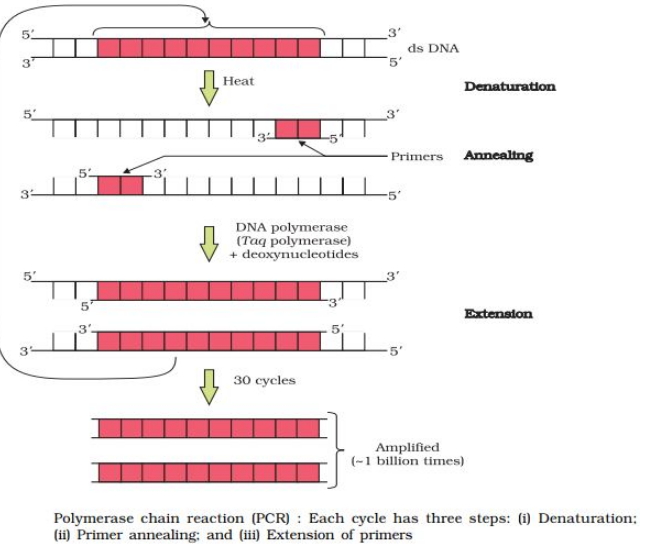
Identify and explain steps $A$,$B$,and $C$ in the $PCR$ diagram given below.
.jpg)
Solution
(N/A) $PCR$ stands for Polymerase Chain Reaction. It is a technique used to amplify a specific segment of $DNA$ in vitro. Each cycle of $PCR$ consists of three main steps:
$A$: Denaturation: The double-stranded $DNA$ is heated to a high temperature (about $94-98^{\circ}C$),which causes the two strands to separate into single-stranded $DNA$.
$B$: Annealing: The temperature is lowered (typically $50-65^{\circ}C$) to allow the two oligonucleotide primers to bind (anneal) to their complementary sequences on the single-stranded $DNA$ templates.
$C$: Extension: The temperature is adjusted (usually $72^{\circ}C$) to allow the thermostable $DNA$ polymerase (e.g.,$Taq$ polymerase) to synthesize a new $DNA$ strand by adding nucleotides to the primers,using the original $DNA$ as a template. This process is repeated for many cycles to achieve exponential amplification of the target $DNA$ segment.
$A$: Denaturation: The double-stranded $DNA$ is heated to a high temperature (about $94-98^{\circ}C$),which causes the two strands to separate into single-stranded $DNA$.
$B$: Annealing: The temperature is lowered (typically $50-65^{\circ}C$) to allow the two oligonucleotide primers to bind (anneal) to their complementary sequences on the single-stranded $DNA$ templates.
$C$: Extension: The temperature is adjusted (usually $72^{\circ}C$) to allow the thermostable $DNA$ polymerase (e.g.,$Taq$ polymerase) to synthesize a new $DNA$ strand by adding nucleotides to the primers,using the original $DNA$ as a template. This process is repeated for many cycles to achieve exponential amplification of the target $DNA$ segment.
0 likes
View Solution105
Medium
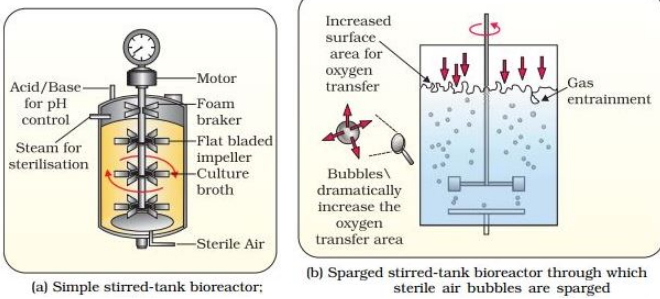
Illustrate the design of a bioreactor. Highlight the difference between a flask in your laboratory and a bioreactor which allows cells to grow in a continuous culture system.
Solution
(N/A) Small volume cultures cannot yield appreciable quantities of products. To produce in large quantities, the development of bioreactors, where large volumes ($100$ - $1000$ litres) of culture can be processed, was required. Thus, bioreactors can be thought of as vessels in which raw materials are biologically converted into specific products, individual enzymes, etc., using microbial, plant, animal or human cells. $A$ bioreactor provides the optimal conditions for achieving the desired product by providing optimum growth conditions (temperature, $pH$, substrate, salts, vitamins, oxygen).
| Flask | Bioreactor |
|---|---|
| $(1)$ Flask is used for small laboratory-scale testing of a culture. | $(1)$ Bioreactor is used for commercial-scale production. |
| $(2)$ The cells harbouring cloned genes of interest may be grown on a small scale in the laboratory. | $(2)$ The cells can also be multiplied in a continuous culture system wherein the used medium is drained out from one side while fresh medium is added from the other to maintain the cells in their physiologically most active log/exponential phase. This type of culturing method produces a larger biomass leading to higher yields of the desired protein. |
| $(3)$ Small volume cultures cannot yield appreciable quantities of products. | $(3)$ To produce in large quantities, the development of bioreactors, where large volumes ($100$ - $1000$ litres) of culture can be processed, was required. |
0 likes
View Solution106
Easy
For selection of recombinants,insertional inactivation of antibiotic marker has been superceded by insertional inactivation of a marker gene coding for a chromogenic substrate. Give reasons.
Solution
(D) Selection of recombinants due to inactivation of antibiotics is a laborious process as it requires: $(i)$ a vector with two antibiotic (ampicillin and tetracycline) resistance markers.
$(ii)$ preparation of two kinds of media plates,each containing one antibiotic.
Transformed cells are first plated on the antibiotic plate that has not been insertionally inactivated (e.g.,ampicillin) and incubated overnight for the growth of transformants. For the selection of recombinants,these transformants are replica-plated on the second antibiotic (tetracycline) plate,which has been inactivated due to the insertion of the foreign gene. Non-recombinants grow on both plates,while recombinants grow only on the ampicillin plate.
This entire exercise is laborious and time-consuming,requiring two overnight incubations. However,by using a marker gene that produces color in the presence of a chromogenic substrate (e.g.,$\beta$-galactosidase),we can distinguish between recombinants and non-recombinants on a single medium plate containing one antibiotic and the chromogenic compound after a single overnight incubation. Thus,using a chromogenic marker is more efficient.
$(ii)$ preparation of two kinds of media plates,each containing one antibiotic.
Transformed cells are first plated on the antibiotic plate that has not been insertionally inactivated (e.g.,ampicillin) and incubated overnight for the growth of transformants. For the selection of recombinants,these transformants are replica-plated on the second antibiotic (tetracycline) plate,which has been inactivated due to the insertion of the foreign gene. Non-recombinants grow on both plates,while recombinants grow only on the ampicillin plate.
This entire exercise is laborious and time-consuming,requiring two overnight incubations. However,by using a marker gene that produces color in the presence of a chromogenic substrate (e.g.,$\beta$-galactosidase),we can distinguish between recombinants and non-recombinants on a single medium plate containing one antibiotic and the chromogenic compound after a single overnight incubation. Thus,using a chromogenic marker is more efficient.
0 likes
View Solution107
Medium
Match the columns:
| Column-$I$ | Column-$II$ |
|---|---|
| $(a)$ Lysozyme | $(i)$ Fat |
| $(b)$ Cellulase | $(ii)$ Protein |
| $(c)$ Chitinase | $(iii)$ Bacteria |
| $(d)$ Lipase | $(iv)$ Fungi (Penicillium) |
| $(v)$ Plant (Mangifera indica) |
Solution
(A) The enzymes used in the isolation of genetic material are specific to the cell wall composition of the organism:
$1$. $(a)$ Lysozyme is used to break down the cell wall of $(iii)$ Bacteria.
$2$. $(b)$ Cellulase is used to break down the cell wall of $(v)$ Plant cells (e.g.,Mangifera indica).
$3$. $(c)$ Chitinase is used to break down the cell wall of $(iv)$ Fungi (e.g.,Penicillium).
$4$. $(d)$ Lipase is used to break down $(i)$ Fat.
Therefore,the correct matching is: $(a-iii, b-v, c-iv, d-i)$.
$1$. $(a)$ Lysozyme is used to break down the cell wall of $(iii)$ Bacteria.
$2$. $(b)$ Cellulase is used to break down the cell wall of $(v)$ Plant cells (e.g.,Mangifera indica).
$3$. $(c)$ Chitinase is used to break down the cell wall of $(iv)$ Fungi (e.g.,Penicillium).
$4$. $(d)$ Lipase is used to break down $(i)$ Fat.
Therefore,the correct matching is: $(a-iii, b-v, c-iv, d-i)$.
0 likes
View Solution108
Medium
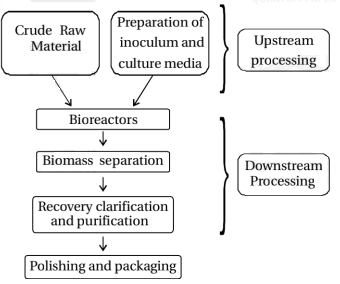
Taking examples under each category,discuss upstream and downstream processing.
Solution
(N/A) Upstream processing: Biotechnological processes can be divided into upstream and downstream processes. Upstream processing involves the preparation of biological agents (like cells or enzymes) and raw materials. It includes the selection of a suitable strain,optimization of culture conditions,and the preparation of inoculum and culture media. For example,in the production of penicillin,the selection of the high-yielding strain of $Penicillium$ $chrysogenum$ and the preparation of the fermentation medium are part of upstream processing.
Downstream processing: After the biosynthetic stage in the bioreactor,the product must undergo a series of processes before it is ready for marketing. These processes,collectively called downstream processing,include the separation of biomass,recovery,clarification,purification,and polishing of the product. For example,in the production of insulin,the recombinant protein must be separated from the host cell debris,purified using chromatography techniques,and formulated with suitable preservatives. Finally,it must undergo strict quality control testing and clinical trials before being packaged for use.
Downstream processing: After the biosynthetic stage in the bioreactor,the product must undergo a series of processes before it is ready for marketing. These processes,collectively called downstream processing,include the separation of biomass,recovery,clarification,purification,and polishing of the product. For example,in the production of insulin,the recombinant protein must be separated from the host cell debris,purified using chromatography techniques,and formulated with suitable preservatives. Finally,it must undergo strict quality control testing and clinical trials before being packaged for use.
0 likes
View Solution109
Easy
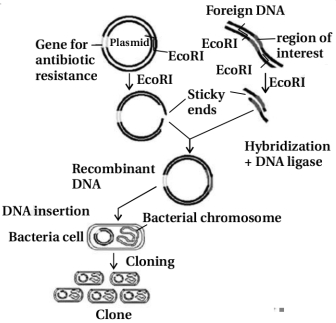
When a foreign $DNA$ is introduced into an organism,how is it maintained in the host and how is it transferred to the progeny of the organism?
Solution
(N/A) $1$. The foreign $DNA$ is ligated to a vector,such as a plasmid,which contains an origin of replication $(ori)$.
$2$. This recombinant $DNA$ is introduced into the host organism.
$3$. Because the plasmid has an $ori$ sequence,it replicates independently within the host cell,ensuring the maintenance of the foreign $DNA$ as the plasmid makes multiple copies of itself.
$4$. When the host cell undergoes division,the replicated plasmid $DNA$ (containing the foreign gene) is distributed into the daughter cells,thereby transferring the foreign $DNA$ to the progeny.
$2$. This recombinant $DNA$ is introduced into the host organism.
$3$. Because the plasmid has an $ori$ sequence,it replicates independently within the host cell,ensuring the maintenance of the foreign $DNA$ as the plasmid makes multiple copies of itself.
$4$. When the host cell undergoes division,the replicated plasmid $DNA$ (containing the foreign gene) is distributed into the daughter cells,thereby transferring the foreign $DNA$ to the progeny.
0 likes
View Solution110
Difficult
You have identified a useful gene in bacteria. Make a flow chart of the steps that you would follow to transfer this gene to a plant.
Solution
(N/A) After identifying a useful gene in bacteria,the following steps should be undertaken:
$(i)$ Isolation of the useful gene using Restriction Endonucleases.
$(ii)$ Transferring the gene to a suitable vector to create a recombinant $DNA$ molecule.
$(iii)$ Transfer of these recombinant $DNA$ molecules into the target plant cells.
$(iv)$ Screening of cells for successful transformation.
$(v)$ Selection of transformed cells.
$(vi)$ Regeneration of plants from the transformed cells to obtain transgenic plants.
$(i)$ Isolation of the useful gene using Restriction Endonucleases.
$(ii)$ Transferring the gene to a suitable vector to create a recombinant $DNA$ molecule.
$(iii)$ Transfer of these recombinant $DNA$ molecules into the target plant cells.
$(iv)$ Screening of cells for successful transformation.
$(v)$ Selection of transformed cells.
$(vi)$ Regeneration of plants from the transformed cells to obtain transgenic plants.
0 likes
View Solution111
EasyMCQ
In gel electrophoresis,separated $DNA$ fragments can be visualized with the help of:
A
Ethidium bromide in infrared radiation
B
Acetocarmine in bright blue light
C
Ethidium bromide in $UV$ radiation
D
Acetocarmine in $UV$ radiation
Solution
(C) In gel electrophoresis,the separated $DNA$ fragments cannot be seen directly in visible light. To visualize them,the gel is stained with a fluorescent dye called Ethidium bromide $(EtBr)$. When this stained gel is exposed to $UV$ radiation,the $DNA$ fragments appear as bright orange-colored bands.
0 likes
View Solution112
EasyMCQ
In gel electrophoresis,the separated $DNA$ fragments can be visualized by:
A
Bright blue light with acetocarmine
B
Ethidium bromide with $UV$ radiation
C
$UV$ radiation with acetocarmine
D
Infrared radiation with ethidium bromide
Solution
(B) In gel electrophoresis,$DNA$ fragments are separated based on their size. Since $DNA$ is negatively charged,it moves towards the anode. These separated $DNA$ fragments are not visible under normal light. To visualize them,the gel is stained with a fluorescent dye called Ethidium Bromide $(EtBr)$. When this stained gel is exposed to $UV$ radiation,the $DNA$ fragments appear as bright orange-colored bands.
0 likes
View Solution113
EasyMCQ
What are the full forms of $ELISA$ and $PCR$?
A
Enzyme Linked Immuno Sorbent Assay and Polymerase Chain Reaction
B
Enzyme Linked Immuno Sorbent Assay and Protein Chain Reaction
C
Enzyme Linked Immuno Synthesis Assay and Polymerase Chain Reaction
D
Enzyme Linked Immuno Sorbent Assay and Polymerase Cell Reaction
Solution
(A) The full form of $ELISA$ is Enzyme Linked Immuno Sorbent Assay.
The full form of $PCR$ is Polymerase Chain Reaction.
The full form of $PCR$ is Polymerase Chain Reaction.
0 likes
View Solution114
MediumMCQ
What is the effect of high temperature $(94^{\circ}C)$ on $DNA$?
A
$DNA$ becomes more coiled.
B
Both strands of $DNA$ separate.
C
$DNA$ breaks down into its monomers.
D
There is no effect on $DNA$.
Solution
(B) High temperature, such as $94^{\circ}C$, is used in the process of $PCR$ (Polymerase Chain Reaction) for denaturation.
At this temperature, the hydrogen bonds between the complementary nitrogenous bases of the $DNA$ double helix break.
As a result, the two strands of the $DNA$ molecule separate from each other, a process known as denaturation.
At this temperature, the hydrogen bonds between the complementary nitrogenous bases of the $DNA$ double helix break.
As a result, the two strands of the $DNA$ molecule separate from each other, a process known as denaturation.
0 likes
View Solution115
EasyMCQ
The $Western$ $Blot$ technique is used for which of the following?
A
$DNA$ analysis
B
Polysaccharide analysis
C
$RNA$ analysis
D
Protein analysis
Solution
(D) The $Western$ $Blot$ technique is a laboratory method used to detect specific protein molecules in a complex mixture of proteins extracted from cells or tissues.
$1$. $Southern$ $Blot$ is used for $DNA$ analysis.
$2$. $Northern$ $Blot$ is used for $RNA$ analysis.
$3$. $Western$ $Blot$ is used for protein analysis.
Therefore,the correct option is $D$.
$1$. $Southern$ $Blot$ is used for $DNA$ analysis.
$2$. $Northern$ $Blot$ is used for $RNA$ analysis.
$3$. $Western$ $Blot$ is used for protein analysis.
Therefore,the correct option is $D$.
0 likes
View Solution116
MediumMCQ
What is the process called when a foreign $DNA$ fragment replicates and multiplies automatically within a host organism?
A
Cloning
B
Mutation
C
Denaturation
D
Gene expression
Solution
(A) When a foreign $DNA$ fragment is linked with a vector $DNA$ (like a plasmid),it gains the ability to replicate within the host cell.
This process of creating multiple identical copies of the foreign $DNA$ fragment inside the host organism is known as cloning.
Cloning involves the insertion of the recombinant $DNA$ into the host,followed by the replication of the $DNA$ as the host cell divides.
This process of creating multiple identical copies of the foreign $DNA$ fragment inside the host organism is known as cloning.
Cloning involves the insertion of the recombinant $DNA$ into the host,followed by the replication of the $DNA$ as the host cell divides.
0 likes
View Solution117
MediumMCQ
Which enzyme is responsible for the replication of recombinant $DNA$ in the host?
A
$DNase$
B
$DNA$ polymerase
C
$DNA$ ligase
D
Lyases
Solution
(B) The replication of $DNA$ is a fundamental biological process catalyzed by the enzyme $DNA$ polymerase.
In the context of recombinant $DNA$ technology,once the recombinant $DNA$ molecule is introduced into the host cell,it utilizes the host's cellular machinery to replicate.
The enzyme $DNA$ polymerase is responsible for synthesizing a new strand of $DNA$ complementary to the template strand,thereby ensuring the replication of the recombinant $DNA$ within the host organism.
In the context of recombinant $DNA$ technology,once the recombinant $DNA$ molecule is introduced into the host cell,it utilizes the host's cellular machinery to replicate.
The enzyme $DNA$ polymerase is responsible for synthesizing a new strand of $DNA$ complementary to the template strand,thereby ensuring the replication of the recombinant $DNA$ within the host organism.
0 likes
View Solution118
MediumMCQ
How many basic steps are involved in the creation of a $GMO$?
A
One
B
Two
C
Three
D
Four
Solution
(C) The creation of a Genetically Modified Organism $(GMO)$ involves three basic steps:
$1$. Identification of $DNA$ with desirable genes.
$2$. Introduction of the identified $DNA$ into the host.
$3$. Maintenance of introduced $DNA$ in the host and transfer of the $DNA$ to its progeny.
$1$. Identification of $DNA$ with desirable genes.
$2$. Introduction of the identified $DNA$ into the host.
$3$. Maintenance of introduced $DNA$ in the host and transfer of the $DNA$ to its progeny.
0 likes
View Solution119
MediumMCQ
On what basis are $DNA$ fragments separated in agarose gel electrophoresis?
A
Size
B
Weight
C
Density
D
Sequence of nitrogenous bases
Solution
(A) Agarose gel electrophoresis is a technique used to separate $DNA$ fragments based on their size.
Since $DNA$ molecules are negatively charged due to the phosphate backbone,they move towards the anode $(+)$ when an electric field is applied.
The agarose gel acts as a molecular sieve.
Smaller $DNA$ fragments move faster through the pores of the gel matrix compared to larger fragments,resulting in their separation based on size.
Since $DNA$ molecules are negatively charged due to the phosphate backbone,they move towards the anode $(+)$ when an electric field is applied.
The agarose gel acts as a molecular sieve.
Smaller $DNA$ fragments move faster through the pores of the gel matrix compared to larger fragments,resulting in their separation based on size.
0 likes
View Solution120
MediumMCQ
After staining,the $DNA$ fragments can be seen on the gel by exposing them to.......... light,which appear as.......... colored bands.
A
$X$-rays,bright yellow
B
$UV$,bright orange
C
Gamma,bright green
D
$UV$,bright yellow
Solution
(B) The process of separating $DNA$ fragments using gel electrophoresis involves staining the $DNA$ with a dye called Ethidium Bromide $(EtBr)$.
When these $DNA$ fragments are exposed to $UV$ (Ultraviolet) radiation,the $EtBr$ intercalated between the $DNA$ base pairs fluoresces.
As a result,the $DNA$ fragments appear as bright orange-colored bands on the gel.
When these $DNA$ fragments are exposed to $UV$ (Ultraviolet) radiation,the $EtBr$ intercalated between the $DNA$ base pairs fluoresces.
As a result,the $DNA$ fragments appear as bright orange-colored bands on the gel.
0 likes
View Solution121
MediumMCQ
What is the process of cutting out the $DNA$ bands from the agarose gel and extracting them from the gel piece called?
A
Elution
B
Sedimentation
C
Blotting
D
Filtration
Solution
(A) The process of separating $DNA$ fragments from an agarose gel is known as gel electrophoresis. After the $DNA$ fragments are separated,they are visualized under $UV$ light. The desired $DNA$ band is then cut out from the agarose gel and extracted from the gel piece. This specific process of extracting the purified $DNA$ from the gel piece is known as $Elution$.
0 likes
View Solution122
MediumMCQ
What happens if a foreign $DNA$ fragment is inserted into the coding sequence of the $\beta$-galactosidase enzyme in a plasmid containing the coding sequence for the $\beta$-galactosidase enzyme?
A
Insertional activation
B
Insertional inactivation
C
$\beta$-galactosidase is produced
D
Both $A$ and $C$
Solution
(B) The insertion of a foreign $DNA$ fragment into the coding sequence of an enzyme,such as $\beta$-galactosidase,disrupts the gene's sequence. This process is known as insertional inactivation. Because the gene is interrupted,the functional $\beta$-galactosidase enzyme cannot be synthesized. This technique is commonly used in recombinant $DNA$ technology to screen for recombinant colonies,as non-recombinant colonies will produce the enzyme (turning blue in the presence of a chromogenic substrate),while recombinant colonies will not (appearing white).
0 likes
View Solution123
MediumMCQ
In the presence of a chromogenic substrate,what color colonies do recombinants and non-recombinants produce,respectively?
A
Blue colonies and yellow colonies
B
Colorless colonies and blue colonies
C
Yellow colonies and blue colonies
D
Blue colonies and colorless colonies
Solution
(B) The process of insertional inactivation is used to distinguish recombinants from non-recombinants.
When a foreign $DNA$ fragment is inserted into the $\beta$-galactosidase gene,the enzyme is inactivated.
Non-recombinant bacteria contain the functional $\beta$-galactosidase gene,which acts on the chromogenic substrate ($X$-gal) to produce blue-colored colonies.
Recombinant bacteria,where the gene is interrupted by the foreign $DNA$,cannot produce the functional enzyme and therefore produce white (colorless) colonies in the presence of the chromogenic substrate.
When a foreign $DNA$ fragment is inserted into the $\beta$-galactosidase gene,the enzyme is inactivated.
Non-recombinant bacteria contain the functional $\beta$-galactosidase gene,which acts on the chromogenic substrate ($X$-gal) to produce blue-colored colonies.
Recombinant bacteria,where the gene is interrupted by the foreign $DNA$,cannot produce the functional enzyme and therefore produce white (colorless) colonies in the presence of the chromogenic substrate.
0 likes
View Solution124
MediumMCQ
What treatment is given to make a bacterial cell competent to take up $DNA$?
A
Phosphate
B
Sulfur
C
Potassium
D
Calcium
Solution
(D) To make a bacterial cell competent to take up recombinant $DNA$, it is treated with a specific concentration of a divalent cation, such as $Calcium$ $(Ca^{2+})$.
This treatment increases the efficiency with which $DNA$ enters the bacterium through pores in its cell wall.
Following this, the cells are incubated with recombinant $DNA$ on ice, followed by placing them briefly at $42^{\circ}C$ (heat shock), and then putting them back on ice.
This enables the bacteria to take up the recombinant $DNA$.
This treatment increases the efficiency with which $DNA$ enters the bacterium through pores in its cell wall.
Following this, the cells are incubated with recombinant $DNA$ on ice, followed by placing them briefly at $42^{\circ}C$ (heat shock), and then putting them back on ice.
This enables the bacteria to take up the recombinant $DNA$.
0 likes
View Solution125
MediumMCQ
Which method is used to introduce $r-DNA$ directly into the nucleus of an animal cell?
A
Biolistics
B
Microinjection
C
Electroporation
D
Lipofection
Solution
(B) In the process of direct gene transfer into animal cells,$r-DNA$ is injected directly into the nucleus using a glass micropipette. This technique is known as $Microinjection$.
Biolistics (or gene gun) is primarily used for plant cells.
Electroporation involves creating temporary pores in the cell membrane using electrical pulses.
Lipofection uses liposomes to deliver $DNA$ into cells.
Biolistics (or gene gun) is primarily used for plant cells.
Electroporation involves creating temporary pores in the cell membrane using electrical pulses.
Lipofection uses liposomes to deliver $DNA$ into cells.
0 likes
View Solution126
MediumMCQ
Select the correct option to make a bacterial cell competent to take up $DNA$.
A
Ice $\rightarrow$ $42^{\circ}C$ $\rightarrow$ Ice
B
$52^{\circ}C$ $\rightarrow$ Ice $\rightarrow$ Ice
C
Ice $\rightarrow$ Ice $\rightarrow$ $52^{\circ}C$
D
$42^{\circ}C$ $\rightarrow$ Ice $\rightarrow$ Water
Solution
(A) To make bacterial cells competent to take up recombinant $DNA$,they are treated with a specific concentration of a divalent cation,such as calcium $(Ca^{2+})$.
This increases the efficiency with which $DNA$ enters the bacterium through pores in its cell wall.
Recombinant $DNA$ can then be forced into such cells by incubating the cells with recombinant $DNA$ on ice,followed by placing them briefly at $42^{\circ}C$ (heat shock),and then putting them back on ice.
This enables the bacteria to take up the recombinant $DNA$.
This increases the efficiency with which $DNA$ enters the bacterium through pores in its cell wall.
Recombinant $DNA$ can then be forced into such cells by incubating the cells with recombinant $DNA$ on ice,followed by placing them briefly at $42^{\circ}C$ (heat shock),and then putting them back on ice.
This enables the bacteria to take up the recombinant $DNA$.
0 likes
View Solution127
MediumMCQ
In which method are host cells bombarded with high-velocity micro-particles of gold or tungsten coated with $DNA$?
A
Micro-injection
B
Biolistics (Gene gun)
C
Electroporation
D
Heat shock treatment
Solution
(B) The method described is known as Biolistics or Gene gun method.
In this technique,cells are bombarded with high-velocity micro-particles of gold or tungsten coated with $DNA$.
This method is primarily used for the transformation of plant cells.
Micro-injection involves the direct injection of $DNA$ into the nucleus of an animal cell.
Electroporation involves the formation of temporary pores in the cell membrane using electrical pulses.
Heat shock treatment is used to make competent cells take up $DNA$ by subjecting them to specific temperature changes.
In this technique,cells are bombarded with high-velocity micro-particles of gold or tungsten coated with $DNA$.
This method is primarily used for the transformation of plant cells.
Micro-injection involves the direct injection of $DNA$ into the nucleus of an animal cell.
Electroporation involves the formation of temporary pores in the cell membrane using electrical pulses.
Heat shock treatment is used to make competent cells take up $DNA$ by subjecting them to specific temperature changes.
0 likes
View Solution128
MediumMCQ
Which of the following is $NOT$ a step in $r-DNA$ technology?
A
Isolation of $DNA$
B
Fragmentation of $DNA$ by $UV$ rays
C
Ligation of $DNA$ fragments with a vector using ligase
D
Insertion of recombinant $DNA$ into the host
Solution
(B) The steps involved in $r-DNA$ technology include:
$1$. Isolation of the genetic material $(DNA)$.
$2$. Cutting of $DNA$ at specific locations using restriction endonucleases.
$3$. Amplification of gene of interest using $PCR$.
$4$. Insertion of recombinant $DNA$ into the host cell/organism.
$5$. Obtaining the foreign gene product.
$DNA$ fragmentation is performed using restriction enzymes,not $UV$ rays. $UV$ rays are typically used for visualizing $DNA$ fragments after gel electrophoresis,not for cutting them.
$1$. Isolation of the genetic material $(DNA)$.
$2$. Cutting of $DNA$ at specific locations using restriction endonucleases.
$3$. Amplification of gene of interest using $PCR$.
$4$. Insertion of recombinant $DNA$ into the host cell/organism.
$5$. Obtaining the foreign gene product.
$DNA$ fragmentation is performed using restriction enzymes,not $UV$ rays. $UV$ rays are typically used for visualizing $DNA$ fragments after gel electrophoresis,not for cutting them.
0 likes
View Solution129
MediumMCQ
How can $RNA$ impurities be removed during the isolation of genetic material?
A
Protease
B
Cellulase
C
Ribonuclease
D
Chitinase
Solution
(C) During the isolation of $DNA$,the cell extract contains various macromolecules like proteins,$RNA$,polysaccharides,and lipids.
To obtain pure $DNA$,these impurities must be removed.
$RNA$ is removed by treating the mixture with the enzyme $Ribonuclease$ $(RNase)$,which specifically degrades $RNA$ molecules.
Proteins are removed by treatment with $Protease$,and other impurities are removed by appropriate treatments.
To obtain pure $DNA$,these impurities must be removed.
$RNA$ is removed by treating the mixture with the enzyme $Ribonuclease$ $(RNase)$,which specifically degrades $RNA$ molecules.
Proteins are removed by treatment with $Protease$,and other impurities are removed by appropriate treatments.
0 likes
View Solution130
MediumMCQ
Select the option that represents the correct sequence of steps in $r-DNA$ technology.
$(1)$ Insertion of $r-DNA$ into the host
$(2)$ Isolation of $DNA$
$(3)$ Ligation of $DNA$ fragment into the vector
$(4)$ Culturing the host cells in a medium at a large scale and extraction of the desired product
$(5)$ Isolation of the desired $DNA$ fragment
$(6)$ Fragmentation of $DNA$ by restriction endonucleases
$(1)$ Insertion of $r-DNA$ into the host
$(2)$ Isolation of $DNA$
$(3)$ Ligation of $DNA$ fragment into the vector
$(4)$ Culturing the host cells in a medium at a large scale and extraction of the desired product
$(5)$ Isolation of the desired $DNA$ fragment
$(6)$ Fragmentation of $DNA$ by restriction endonucleases
A
$2 \rightarrow 6 \rightarrow 3 \rightarrow 1 \rightarrow 5 \rightarrow 4$
B
$1 \rightarrow 3 \rightarrow 4 \rightarrow 6 \rightarrow 5 \rightarrow 2$
C
$2 \rightarrow 6 \rightarrow 5 \rightarrow 3 \rightarrow 1 \rightarrow 4$
D
$6 \rightarrow 1 \rightarrow 3 \rightarrow 4 \rightarrow 2 \rightarrow 5$
Solution
(C) The correct sequence of steps in recombinant $DNA$ $(r-DNA)$ technology is as follows:
$(1)$ Isolation of $DNA$ $(2)$
$(2)$ Fragmentation of $DNA$ by restriction endonucleases $(6)$
$(3)$ Isolation of the desired $DNA$ fragment $(5)$
$(4)$ Ligation of $DNA$ fragment into the vector $(3)$
$(5)$ Insertion of $r-DNA$ into the host $(1)$
$(6)$ Culturing the host cells in a medium at a large scale and extraction of the desired product $(4)$
Thus,the correct sequence is $2 \rightarrow 6 \rightarrow 5 \rightarrow 3 \rightarrow 1 \rightarrow 4$.
$(1)$ Isolation of $DNA$ $(2)$
$(2)$ Fragmentation of $DNA$ by restriction endonucleases $(6)$
$(3)$ Isolation of the desired $DNA$ fragment $(5)$
$(4)$ Ligation of $DNA$ fragment into the vector $(3)$
$(5)$ Insertion of $r-DNA$ into the host $(1)$
$(6)$ Culturing the host cells in a medium at a large scale and extraction of the desired product $(4)$
Thus,the correct sequence is $2 \rightarrow 6 \rightarrow 5 \rightarrow 3 \rightarrow 1 \rightarrow 4$.
0 likes
View Solution131
MediumMCQ
Which impurities are released along with $DNA$ when cells are broken down for $DNA$ isolation?
A
$RNA$
B
Proteins
C
Lipids
D
All of the above
Solution
(D) During the process of $DNA$ isolation,the cell wall and cell membrane are broken down using enzymes like lysozyme (for bacteria),cellulase (for plants),or chitinase (for fungi).
Once the cell is lysed,the $DNA$ is released into the solution along with other macromolecules present in the cell.
These impurities include $RNA$,proteins,lipids,and other polysaccharides.
To obtain pure $DNA$,these impurities are removed by treating the mixture with specific enzymes like ribonuclease (for $RNA$),protease (for proteins),and other purification steps.
Once the cell is lysed,the $DNA$ is released into the solution along with other macromolecules present in the cell.
These impurities include $RNA$,proteins,lipids,and other polysaccharides.
To obtain pure $DNA$,these impurities are removed by treating the mixture with specific enzymes like ribonuclease (for $RNA$),protease (for proteins),and other purification steps.
0 likes
View Solution132
MediumMCQ
Which enzyme is required to obtain $DNA$ in its pure form from a cell?
A
Ribonuclease
B
Lysozyme
C
Restriction endonuclease
D
Pectinase
Solution
(A) To obtain $DNA$ in its pure form,the cell must be broken open to release $DNA$ along with other macromolecules such as $RNA$,proteins,polysaccharides,and lipids.
$RNA$ can be removed by treatment with ribonuclease $(RNase)$,and proteins can be removed by treatment with protease.
Lysozyme is used to break the bacterial cell wall,while pectinase is used for plant cells.
Restriction endonucleases are used to cut $DNA$ at specific sites,not for purification.
Therefore,to ensure the $DNA$ is free from $RNA$ contamination,ribonuclease is the enzyme used.
$RNA$ can be removed by treatment with ribonuclease $(RNase)$,and proteins can be removed by treatment with protease.
Lysozyme is used to break the bacterial cell wall,while pectinase is used for plant cells.
Restriction endonucleases are used to cut $DNA$ at specific sites,not for purification.
Therefore,to ensure the $DNA$ is free from $RNA$ contamination,ribonuclease is the enzyme used.
0 likes
View Solution133
MediumMCQ
In the process of recombinant $DNA$ technology,proteins and lipids are removed from the medium by which enzymes,respectively?
A
Proteases and Lipases
B
Proteases and Lipases
C
Proteases and Carbohydrases
D
Lipases and Ribonucleases
Solution
(B) During the isolation of genetic material in recombinant $DNA$ technology,the cell is treated with enzymes to remove unwanted macromolecules.
Proteins are removed by the enzyme $Protease$.
Lipids are removed by the enzyme $Lipase$.
$RNA$ is removed by $Ribonuclease$.
Therefore,proteins and lipids are removed by $Protease$ and $Lipase$ respectively.
Proteins are removed by the enzyme $Protease$.
Lipids are removed by the enzyme $Lipase$.
$RNA$ is removed by $Ribonuclease$.
Therefore,proteins and lipids are removed by $Protease$ and $Lipase$ respectively.
0 likes
View Solution134
MediumMCQ
Which of the following is added to precipitate purified $DNA$?
A
Chilled ethanol
B
Chilled benzene
C
Hot nitric acid
D
Hot sulfuric acid
Solution
(A) In the process of recombinant $DNA$ technology,the isolation of genetic material is a crucial step.
After the $DNA$ is purified and separated from other macromolecules like $RNA$,proteins,and lipids,it is precipitated out of the solution.
This is achieved by adding chilled ethanol to the purified $DNA$ extract.
The $DNA$ appears as a collection of fine threads in the suspension,which can be removed by spooling.
After the $DNA$ is purified and separated from other macromolecules like $RNA$,proteins,and lipids,it is precipitated out of the solution.
This is achieved by adding chilled ethanol to the purified $DNA$ extract.
The $DNA$ appears as a collection of fine threads in the suspension,which can be removed by spooling.
0 likes
View Solution135
MediumMCQ
What is the charge on $DNA$ and towards which electrode does it migrate during gel electrophoresis?
A
Negative,towards cathode
B
Positive,towards cathode
C
Negative,towards anode
D
Positive,towards anode
Solution
(C) $DNA$ molecules are negatively charged due to the presence of phosphate groups in their sugar-phosphate backbone.
During gel electrophoresis,when an electric field is applied,these negatively charged $DNA$ fragments move towards the positively charged electrode,which is the anode.
Therefore,$DNA$ is negatively charged and migrates towards the anode.
During gel electrophoresis,when an electric field is applied,these negatively charged $DNA$ fragments move towards the positively charged electrode,which is the anode.
Therefore,$DNA$ is negatively charged and migrates towards the anode.
0 likes
View Solution136
MediumMCQ
The full form of $PCR$ is ...........
A
Polymerase Chain Reaction
B
Polymer Carbohydrate Reaction
C
Polynucleotide Changing Reaction
D
Polysaccharide Chance Reaction
Solution
(A) $PCR$ stands for Polymerase Chain Reaction.
It is a laboratory technique used to amplify specific $DNA$ sequences.
In this process, multiple copies of a specific $DNA$ segment are synthesized in vitro using $DNA$ polymerase enzyme, primers, and nucleotides.
It is a laboratory technique used to amplify specific $DNA$ sequences.
In this process, multiple copies of a specific $DNA$ segment are synthesized in vitro using $DNA$ polymerase enzyme, primers, and nucleotides.
0 likes
View Solution137
MediumMCQ
How many steps are there in one $PCR$ cycle?
A
One
B
Two
C
Three
D
Four
Solution
(C) $PCR$ (Polymerase Chain Reaction) cycle consists of three main steps:
$1$. Denaturation: The double-stranded $DNA$ is heated to separate it into two single strands.
$2$. Annealing: Primers are added to the single-stranded $DNA$ templates at a lower temperature.
$3$. Extension: $DNA$ polymerase synthesizes new $DNA$ strands by adding nucleotides to the primers.
Therefore,there are $3$ steps in one $PCR$ cycle.
$1$. Denaturation: The double-stranded $DNA$ is heated to separate it into two single strands.
$2$. Annealing: Primers are added to the single-stranded $DNA$ templates at a lower temperature.
$3$. Extension: $DNA$ polymerase synthesizes new $DNA$ strands by adding nucleotides to the primers.
Therefore,there are $3$ steps in one $PCR$ cycle.
0 likes
View Solution138
MediumMCQ
Select the correct sequence for $PCR$ (Polymerase Chain Reaction).
A
Annealing $\rightarrow$ Extension $\rightarrow$ Denaturation
B
Extension $\rightarrow$ Annealing $\rightarrow$ Denaturation
C
Denaturation $\rightarrow$ Annealing $\rightarrow$ Extension
D
Denaturation $\rightarrow$ Extension $\rightarrow$ Annealing
Solution
(C) $PCR$ (Polymerase Chain Reaction) involves three main steps in each cycle:
$1$. Denaturation: The double-stranded $DNA$ is heated to a high temperature (approx. $94-98^{\circ}C$) to separate the strands.
$2$. Annealing: The temperature is lowered (approx. $50-65^{\circ}C$) to allow primers to bind to the complementary sequences on the single-stranded $DNA$.
$3$. Extension: The temperature is adjusted (approx. $72^{\circ}C$) for the $Taq$ polymerase to synthesize the new $DNA$ strand by adding nucleotides.
Therefore,the correct sequence is Denaturation $\rightarrow$ Annealing $\rightarrow$ Extension.
$1$. Denaturation: The double-stranded $DNA$ is heated to a high temperature (approx. $94-98^{\circ}C$) to separate the strands.
$2$. Annealing: The temperature is lowered (approx. $50-65^{\circ}C$) to allow primers to bind to the complementary sequences on the single-stranded $DNA$.
$3$. Extension: The temperature is adjusted (approx. $72^{\circ}C$) for the $Taq$ polymerase to synthesize the new $DNA$ strand by adding nucleotides.
Therefore,the correct sequence is Denaturation $\rightarrow$ Annealing $\rightarrow$ Extension.
0 likes
View Solution139
MediumMCQ
Which method is used to amplify a desired gene in large numbers?
A
Centrifugation
B
Polymerase Chain Reaction
C
Gel Electrophoresis
D
Biolistics
Solution
(B) The $Polymerase$ $Chain$ $Reaction$ $(PCR)$ is a laboratory technique used to amplify a specific segment of $DNA$ into millions of copies.
In this process,multiple cycles of denaturation,annealing,and extension are performed to exponentially increase the number of copies of the target gene.
Therefore,$PCR$ is the standard method for gene amplification.
In this process,multiple cycles of denaturation,annealing,and extension are performed to exponentially increase the number of copies of the target gene.
Therefore,$PCR$ is the standard method for gene amplification.
0 likes
View Solution140
MediumMCQ
In which step of $PCR$ do the primers anneal to the $DNA$ template?
A
Denaturation
B
Extension
C
Annealing
D
All of the above
Solution
(C) The $PCR$ (Polymerase Chain Reaction) process consists of three main steps:
$1$. Denaturation: The double-stranded $DNA$ is heated to separate it into two single strands.
$2$. Annealing: Two sets of primers are added,which anneal (bind) to the complementary sequences on the $DNA$ template strands at a lower temperature.
$3$. Extension: The enzyme $DNA$ polymerase synthesizes the new $DNA$ strands by adding nucleotides to the primers.
Therefore,the step where primers bind to the $DNA$ template is called Annealing.
$1$. Denaturation: The double-stranded $DNA$ is heated to separate it into two single strands.
$2$. Annealing: Two sets of primers are added,which anneal (bind) to the complementary sequences on the $DNA$ template strands at a lower temperature.
$3$. Extension: The enzyme $DNA$ polymerase synthesizes the new $DNA$ strands by adding nucleotides to the primers.
Therefore,the step where primers bind to the $DNA$ template is called Annealing.
0 likes
View Solution141
MediumMCQ
During $PCR$,denaturation of $DNA$ is achieved by which of the following?
A
High temperature
B
Low temperature
C
Ethanol
D
$UV$ light
Solution
(A) The $PCR$ (Polymerase Chain Reaction) process consists of three main steps: denaturation,annealing,and extension.
$1$. Denaturation: The double-stranded $DNA$ template is heated to a high temperature (approximately $94-98^{\circ}C$). This high temperature breaks the hydrogen bonds between the complementary base pairs,resulting in the separation of the two strands of $DNA$.
$2$. Annealing: The temperature is lowered to allow primers to bind to the single-stranded $DNA$.
$3$. Extension: The temperature is adjusted for the $DNA$ polymerase to synthesize the new $DNA$ strand.
Therefore,denaturation is achieved by high temperature.
$1$. Denaturation: The double-stranded $DNA$ template is heated to a high temperature (approximately $94-98^{\circ}C$). This high temperature breaks the hydrogen bonds between the complementary base pairs,resulting in the separation of the two strands of $DNA$.
$2$. Annealing: The temperature is lowered to allow primers to bind to the single-stranded $DNA$.
$3$. Extension: The temperature is adjusted for the $DNA$ polymerase to synthesize the new $DNA$ strand.
Therefore,denaturation is achieved by high temperature.
0 likes
View Solution142
MediumMCQ
Which of the following is required for the amplification of a gene of interest by $PCR$?
A
Thermostable $DNA$ polymerase,deoxyribonucleotides
B
$RNA$ polymerase,template $DNA$,deoxyribonucleotides
C
Template $DNA$,$Taq$ polymerase,deoxyribonucleotides
D
Template $DNA$,$Taq$ polymerase,primers,deoxyribonucleotides
Solution
(D) The Polymerase Chain Reaction $(PCR)$ is a technique used to amplify a specific segment of $DNA$.
To perform $PCR$,the following components are essential:
$1$. Template $DNA$: The $DNA$ segment containing the gene of interest to be amplified.
$2$. Primers: Small chemically synthesized oligonucleotides that are complementary to the regions of the $DNA$ template.
$3$. $Taq$ polymerase: $A$ thermostable $DNA$ polymerase enzyme isolated from the bacterium $Thermus$ $aquaticus$,which remains active at high temperatures required for denaturation.
$4$. Deoxyribonucleotides (dNTPs): The building blocks required for the synthesis of new $DNA$ strands.
Therefore,option $D$ is the correct answer as it includes all the necessary components.
To perform $PCR$,the following components are essential:
$1$. Template $DNA$: The $DNA$ segment containing the gene of interest to be amplified.
$2$. Primers: Small chemically synthesized oligonucleotides that are complementary to the regions of the $DNA$ template.
$3$. $Taq$ polymerase: $A$ thermostable $DNA$ polymerase enzyme isolated from the bacterium $Thermus$ $aquaticus$,which remains active at high temperatures required for denaturation.
$4$. Deoxyribonucleotides (dNTPs): The building blocks required for the synthesis of new $DNA$ strands.
Therefore,option $D$ is the correct answer as it includes all the necessary components.
0 likes
View Solution143
MediumMCQ
If $r-DNA$ containing the $amp^R$ gene is transferred into $E. coli$ cells,what will the normal $E. coli$ cells be transformed into?
A
Ampicillin-sensitive cells
B
Ampicillin-producing cells
C
Ampicillin-resistant cells
D
Tetracycline-producing cells
Solution
(C) The $amp^R$ gene stands for the ampicillin-resistance gene.
When a recombinant $DNA$ $(r-DNA)$ molecule containing this gene is introduced into normal $E. coli$ cells,the cells acquire the ability to survive in the presence of the antibiotic ampicillin.
This process is known as transformation,and the resulting cells are referred to as ampicillin-resistant cells.
Therefore,the correct option is $C$.
When a recombinant $DNA$ $(r-DNA)$ molecule containing this gene is introduced into normal $E. coli$ cells,the cells acquire the ability to survive in the presence of the antibiotic ampicillin.
This process is known as transformation,and the resulting cells are referred to as ampicillin-resistant cells.
Therefore,the correct option is $C$.
0 likes
View Solution144
MediumMCQ
What is the ultimate objective of $r-DNA$ technology?
A
To obtain recombinant $DNA$
B
To create $r-DNA$
C
To isolate the desired gene
D
To produce the desired protein
Solution
(D) The ultimate objective of $r-DNA$ (recombinant $DNA$) technology is to produce a desired protein or product on a large scale. While the process involves isolating the gene,creating the $r-DNA$,and transforming it into a host,the final goal is the expression of the gene to obtain the useful protein or therapeutic product.
0 likes
View Solution145
MediumMCQ
What is required for the expression of a foreign gene?
A
High temperature
B
Low temperature
C
Optimal conditions
D
Humid conditions
Solution
(C) For the successful expression of a foreign gene in a host organism, the recombinant $DNA$ must be introduced into the host cell. Once inside, the host cell must be provided with $Optimal$ conditions such as appropriate temperature, $pH$, salt concentration, and nutrients in a bioreactor to allow the gene to transcribe and translate into the desired protein product.
0 likes
View Solution146
MediumMCQ
In a continuous culture system,cells can be maintained in which physiological phase?
A
Lag phase
B
Log phase
C
Stationary phase
D
None of the above
Solution
(B) In a continuous culture system,the culture medium is continuously added to the bioreactor,and the used medium is drained out from the other side. This process allows the cells to remain in the $Log$ phase (also known as the exponential phase) throughout the cultivation period. In this phase,the cells are metabolically most active and divide at a constant,maximum rate,which is ideal for the production of recombinant proteins.
0 likes
View Solution147
MediumMCQ
What is used for the large-scale production of products in biotechnology?
A
Flask
B
Bioreactor
C
$PCR$
D
Centrifuge
Solution
(B) In biotechnology,to produce products on a large scale,bioreactors are used.
Bioreactors are large vessels in which raw materials are biologically converted into specific products,individual enzymes,etc.,using microbial,plant,animal,or human cells.
$A$ bioreactor provides the optimal conditions for achieving the desired product by providing optimum growth conditions (temperature,$pH$,substrate,salts,vitamins,and oxygen).
Bioreactors are large vessels in which raw materials are biologically converted into specific products,individual enzymes,etc.,using microbial,plant,animal,or human cells.
$A$ bioreactor provides the optimal conditions for achieving the desired product by providing optimum growth conditions (temperature,$pH$,substrate,salts,vitamins,and oxygen).
0 likes
View Solution148
MediumMCQ
Which system is not present in a bioreactor?
A
Foam control system
B
Temperature control system
C
Carbon dioxide control system
D
Agitator system
Solution
(C) bioreactor is a vessel in which raw materials are biologically converted into specific products by microbes,plant/animal cells,or their enzymes.
Standard bioreactors are equipped with an agitator system (for mixing),an oxygen delivery system,a foam control system,a temperature control system,a pH control system,and sampling ports.
Carbon dioxide control is not a standard,dedicated control system in typical bioreactors,as $CO_2$ levels are generally managed through aeration and agitation processes rather than a specific $CO_2$ control unit.
Standard bioreactors are equipped with an agitator system (for mixing),an oxygen delivery system,a foam control system,a temperature control system,a pH control system,and sampling ports.
Carbon dioxide control is not a standard,dedicated control system in typical bioreactors,as $CO_2$ levels are generally managed through aeration and agitation processes rather than a specific $CO_2$ control unit.
0 likes
View Solution149
MediumMCQ
In a bioreactor,through which system can a small volume of culture be withdrawn periodically?
A
Oxygen delivery system
B
$pH$ control system
C
Sampling port
D
Agitator system
Solution
(C) bioreactor is a vessel in which raw materials are biologically converted into specific products by microbes,plant or animal cells,or their enzymes.
To maintain the culture in a metabolically active state,the bioreactor is equipped with various systems.
$A$ $sampling$ $port$ is a specific component of the bioreactor that allows the user to withdraw a small volume of the culture periodically for testing or analysis to monitor the growth and product formation.
To maintain the culture in a metabolically active state,the bioreactor is equipped with various systems.
$A$ $sampling$ $port$ is a specific component of the bioreactor that allows the user to withdraw a small volume of the culture periodically for testing or analysis to monitor the growth and product formation.
0 likes
View Solution150
MediumMCQ
What is downstream processing?
A
Separation of product
B
Purification of product
C
Decomposition of product
D
Both $A$ and $B$
Solution
(D) Downstream processing is a critical stage in biotechnology that occurs after the biosynthetic phase.
It involves the processes of separation and purification of the synthesized product.
These processes are essential to ensure that the final product is of high quality and free from contaminants.
Therefore,both separation and purification are integral parts of downstream processing.
It involves the processes of separation and purification of the synthesized product.
These processes are essential to ensure that the final product is of high quality and free from contaminants.
Therefore,both separation and purification are integral parts of downstream processing.
0 likes
View SolutionBiotechnology Principals and Process — Process of Recombinant DNA technology · Frequently Asked Questions
1Are these Biotechnology Principals and Process questions useful for JEE and NEET?
Yes. All questions in this section are mapped to JEE Main and NEET exam patterns. Previous year questions from JEE Main, NEET, GUJCET and state-level exams are included with full solutions.
2Can I switch to Hindi or Gujarati for these questions?
Yes. Use the language tabs in the hero section or the sidebar to view the same questions and solutions in English, Hindi or Gujarati.
3How do I generate a question paper from this subtopic?
Use the Vedclass Exam Paper Generator — select the chapter and subtopic, set difficulty, and generate Sets A, B, C, D automatically. First 3 chapters of every subject are free.
Vedclass Products
For Students
Vedclass Test Series
Mock tests in real JEE/NEET style with performance analysis. 5-day free trial.
Start Free TrialFor Teachers
Exam Paper Generator
Generate Set A/B/C/D papers from this chapter in 2 minutes. 3 chapters free.
Try FreeFor Institutes
Online Exam Module
Live online exams with unlimited students, 360° analytics & white-label branding.
See DemoFor Teachers & Institutes
Generate a Biotechnology Principals and Process Exam Paper in 2 Minutes
Select subtopic & difficulty — Sets A, B, C, D auto-generated with No Repeat logic.
First 3 chapters of every subject are free — no payment required.