
A English
Process of Recombinant DNA technology Questions in English
Class 12 Biology · Biotechnology Principals and Process · Process of Recombinant DNA technology
315+
Questions
English
Language
100%
With Solutions
Showing 50 of 315 questions in English
151
MediumMCQ
Identify the correct statement.
A
In most organisms,ribonucleic acid is the genetic material.
B
When cells are broken down,$RNA$,proteins,carbohydrates,and lipids are released along with $DNA$.
C
Micro-injection is used to inject $r-DNA$ into the nucleus of a bacterial cell.
D
Agarose is obtained from mosses.
Solution
(B) The correct statement is $B$.
$1$. In most organisms,$DNA$ is the genetic material,not $RNA$.
$2$. When cells are broken down using enzymes like lysozyme,cellulase,or chitinase,$RNA$,proteins,carbohydrates,and lipids are released along with $DNA$.
$3$. Micro-injection is a method used for animal cells,not for bacterial cells.
$4$. Agarose is extracted from seaweeds (like Gelidium and Gracilaria),not from mosses.
$1$. In most organisms,$DNA$ is the genetic material,not $RNA$.
$2$. When cells are broken down using enzymes like lysozyme,cellulase,or chitinase,$RNA$,proteins,carbohydrates,and lipids are released along with $DNA$.
$3$. Micro-injection is a method used for animal cells,not for bacterial cells.
$4$. Agarose is extracted from seaweeds (like Gelidium and Gracilaria),not from mosses.
0 likes
View Solution152
MediumMCQ
Select the correct statement.
A
When a gene encoding a protein is expressed in a heterologous host,the resulting protein is called a recombinant protein.
B
In a bioreactor,salts,vitamins,and carbon monoxide are provided for the growth of cells.
C
After the synthesis of products,they are immediately sent to the market for marketing.
D
Stirred-tank reactors are spherical in shape.
Solution
(A) $1$. When a gene encoding a protein is expressed in a heterologous host,the resulting protein is known as a recombinant protein. This is a correct statement.
$2$. In a bioreactor,optimal growth conditions (temperature,pH,substrate,salts,vitamins,oxygen,etc.) are provided. Carbon monoxide is toxic to cells and is not provided; instead,oxygen is supplied. Thus,option $B$ is incorrect.
$3$. After the synthesis of products,they undergo downstream processing (separation and purification) before being sent to the market. Thus,option $C$ is incorrect.
$4$. Stirred-tank reactors are usually cylindrical or have a curved base to facilitate the mixing of the reactor contents. They are not spherical. Thus,option $D$ is incorrect.
$2$. In a bioreactor,optimal growth conditions (temperature,pH,substrate,salts,vitamins,oxygen,etc.) are provided. Carbon monoxide is toxic to cells and is not provided; instead,oxygen is supplied. Thus,option $B$ is incorrect.
$3$. After the synthesis of products,they undergo downstream processing (separation and purification) before being sent to the market. Thus,option $C$ is incorrect.
$4$. Stirred-tank reactors are usually cylindrical or have a curved base to facilitate the mixing of the reactor contents. They are not spherical. Thus,option $D$ is incorrect.
0 likes
View Solution153
MediumMCQ
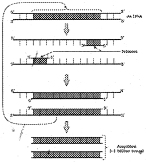
Identify the diagram given below.
A
Agarose gel electrophoresis
B
Polymerase chain reaction
C
Replication
D
Recombinant $DNA$ technology
Solution
(B) The provided diagram illustrates the steps of the Polymerase Chain Reaction $(PCR)$.
$PCR$ is a technique used to amplify a specific segment of $DNA$ in vitro.
The process involves three main steps:
$1$. Denaturation: The double-stranded $DNA$ is heated to separate it into two single strands.
$2$. Annealing: Primers bind to the complementary sequences on the single-stranded $DNA$ templates.
$3$. Extension: $DNA$ polymerase synthesizes new $DNA$ strands by adding nucleotides to the primers.
This cycle is repeated multiple times to produce millions of copies of the target $DNA$ sequence.
$PCR$ is a technique used to amplify a specific segment of $DNA$ in vitro.
The process involves three main steps:
$1$. Denaturation: The double-stranded $DNA$ is heated to separate it into two single strands.
$2$. Annealing: Primers bind to the complementary sequences on the single-stranded $DNA$ templates.
$3$. Extension: $DNA$ polymerase synthesizes new $DNA$ strands by adding nucleotides to the primers.
This cycle is repeated multiple times to produce millions of copies of the target $DNA$ sequence.
0 likes
View Solution154
MediumMCQ
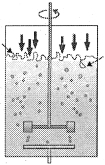
Identify the given figure.
A
Simple stirred-tank bioreactor
B
Sparged stirred-tank bioreactor
C
Cyclone column bioreactor
D
Centrifugation
Solution
(B) The given figure represents a sparged stirred-tank bioreactor.
In a sparged stirred-tank bioreactor,air is bubbled through the reactor from the bottom.
This process increases the surface area for oxygen transfer,which is essential for the growth of aerobic microorganisms.
The presence of a sparger (a device for introducing air bubbles) at the bottom distinguishes it from a simple stirred-tank bioreactor.
In a sparged stirred-tank bioreactor,air is bubbled through the reactor from the bottom.
This process increases the surface area for oxygen transfer,which is essential for the growth of aerobic microorganisms.
The presence of a sparger (a device for introducing air bubbles) at the bottom distinguishes it from a simple stirred-tank bioreactor.
0 likes
View Solution155
EasyMCQ
Who discovered $PCR$ (Polymerase Chain Reaction)?
A
Kary Mullis
B
James Watson
C
Alec Jeffreys
D
Paul Berg
Solution
(A) $PCR$ (Polymerase Chain Reaction) is a laboratory technique used to amplify $DNA$ sequences. It was developed by Kary Mullis in $1983$. For this significant contribution to molecular biology,he was awarded the Nobel Prize in Chemistry in $1993$.
0 likes
View Solution156
EasyMCQ
Select the appropriate option for $RNAi$.
A
Topoisomerase
B
Transferase
C
Dicer protein
D
Desmin protein
Solution
(C) $RNAi$ ($RNA$ interference) is a biological process in which $RNA$ molecules inhibit gene expression or translation,by neutralizing targeted mRNA molecules. In this process,the enzyme $Dicer$ (a type of RNase $III$ enzyme) plays a crucial role by cleaving long double-stranded $RNA$ (dsRNA) into short interfering $RNA$ (siRNA) fragments. Therefore,the Dicer protein is essential for the $RNAi$ mechanism.
0 likes
View Solution157
EasyMCQ
In a mixture,$DNA$ fragments are separated by
A
Polymerase chain reaction
B
Bioprocess engineering
C
Restriction digestion
D
Electrophoresis
Solution
(D) The correct answer is option $D$ as $DNA$ fragments are separated based on their size through a technique known as gel electrophoresis.
Polymerase chain reaction $(PCR)$ is used to amplify specific $DNA$ sequences.
Bioprocess engineering involves the maintenance of sterile conditions in large-scale chemical engineering processes to enable the growth of desired microbes or eukaryotic cells for the production of biotechnological products like antibiotics and vaccines.
Restriction digestion is the process of cutting $DNA$ molecules at specific sites using restriction enzymes.
Polymerase chain reaction $(PCR)$ is used to amplify specific $DNA$ sequences.
Bioprocess engineering involves the maintenance of sterile conditions in large-scale chemical engineering processes to enable the growth of desired microbes or eukaryotic cells for the production of biotechnological products like antibiotics and vaccines.
Restriction digestion is the process of cutting $DNA$ molecules at specific sites using restriction enzymes.
0 likes
View Solution158
EasyMCQ
Select the correct statement from the following.
A
$PCR$ is used for isolation and separation of gene of interest.
B
Gel electrophoresis is used for amplification of a $DNA$ segment.
C
The polymerase enzyme joins the gene of interest and the vector $DNA$.
D
Restriction enzyme digestions are performed by incubating purified $DNA$ molecules with the restriction enzymes under optimum conditions.
Solution
(D) $PCR$ (Polymerase Chain Reaction) is used for the amplification of a $DNA$ segment.
Gel electrophoresis is used for the separation of $DNA$ fragments based on their size.
$DNA$ ligase enzyme is responsible for joining the gene of interest with the vector $DNA$.
Restriction enzyme digestion involves incubating purified $DNA$ with specific restriction enzymes under optimal conditions (temperature,$pH$,etc.) to cut the $DNA$ at specific recognition sites. Therefore,option $D$ is the correct statement.
Gel electrophoresis is used for the separation of $DNA$ fragments based on their size.
$DNA$ ligase enzyme is responsible for joining the gene of interest with the vector $DNA$.
Restriction enzyme digestion involves incubating purified $DNA$ with specific restriction enzymes under optimal conditions (temperature,$pH$,etc.) to cut the $DNA$ at specific recognition sites. Therefore,option $D$ is the correct statement.
0 likes
View Solution159
EasyMCQ
Spooling is:
A
Collection of isolated $DNA$
B
Amplification of $DNA$
C
Cutting of separated $DNA$ bands from the agarose gel
D
Transfer of separated $DNA$ fragments to synthetic membranes
Solution
(A) Spooling is the process of collecting purified $DNA$ that precipitates out of a solution upon the addition of chilled ethanol. This $DNA$ appears as fine threads and is typically collected by winding it around a glass rod.
$A$. Collection of isolated $DNA$ is the correct definition of spooling.
$B$. Amplification of $DNA$ is performed using the $PCR$ ($Polymerase$ $Chain$ $Reaction$) technique.
$C$. Cutting of separated $DNA$ bands from the agarose gel is known as elution.
$D$. Transfer of separated $DNA$ fragments to synthetic membranes is known as blotting.
$A$. Collection of isolated $DNA$ is the correct definition of spooling.
$B$. Amplification of $DNA$ is performed using the $PCR$ ($Polymerase$ $Chain$ $Reaction$) technique.
$C$. Cutting of separated $DNA$ bands from the agarose gel is known as elution.
$D$. Transfer of separated $DNA$ fragments to synthetic membranes is known as blotting.
0 likes
View Solution160
MediumMCQ
If a recombinant $DNA$ bearing a gene for ampicillin resistance is transferred into $E. coli$ cells and the host cells are spread on agar plates containing ampicillin,then:
A
Both transformed and untransformed recipient cells will die
B
Both transformed and untransformed recipient cells will grow
C
Transformed recipient cells will grow and untransformed recipient cells will die
D
Transformed recipient cells will die and untransformed recipient cells will grow
Solution
(C) Transformation is the process of introducing foreign $DNA$ into a host cell.
If the introduced $DNA$ carries an ampicillin resistance gene,the cells that successfully take it up (transformed cells) will be able to survive and grow on agar medium containing ampicillin.
Cells that do not take up the $DNA$ (untransformed cells) lack this resistance and will die.
In this context,the ampicillin resistance gene acts as a selectable marker.
If the introduced $DNA$ carries an ampicillin resistance gene,the cells that successfully take it up (transformed cells) will be able to survive and grow on agar medium containing ampicillin.
Cells that do not take up the $DNA$ (untransformed cells) lack this resistance and will die.
In this context,the ampicillin resistance gene acts as a selectable marker.
0 likes
View Solution161
MediumMCQ
In Gene cloning:
A
Gene is isolated and inserted in same organism
B
Gene is isolated and inserted in different organism
C
Gene is isolated and inserted in plasmid of other organism
D
Gene is isolated and inserted in chromosomal $DNA$
Solution
(B) Gene cloning is a fundamental technique in recombinant $DNA$ technology. It involves the isolation of a specific gene of interest from an organism and its subsequent insertion into a different organism (often a host cell like $E. coli$) to produce multiple copies of that gene or its protein product. Therefore,the core principle is the transfer of genetic material between different organisms.
0 likes
View Solution162
DifficultMCQ
Which of the following cannot be used for direct gene transfer?
A
Biolistics (gene gun)
B
Microinjection
C
Electroporation
D
Agrobacterium tumefaciens
Solution
(D) Direct gene transfer (also known as vectorless gene transfer) involves the introduction of foreign $DNA$ into host cells without the use of a biological vector.
Biolistics (gene gun),microinjection,and electroporation are all recognized methods of direct gene transfer.
Agrobacterium tumefaciens is a soil bacterium that acts as a natural biological vector (cloning vector) to transfer $DNA$ into plant cells,making it an indirect method of gene transfer.
Biolistics (gene gun),microinjection,and electroporation are all recognized methods of direct gene transfer.
Agrobacterium tumefaciens is a soil bacterium that acts as a natural biological vector (cloning vector) to transfer $DNA$ into plant cells,making it an indirect method of gene transfer.
0 likes
View Solution163
EasyMCQ
The preparatory phase before fermentation is known as:
A
Upstream process
B
Downstream process
C
Inoculation
D
Filtration
Solution
(A) The preparatory phase before fermentation is called $Upstream$ $processing$.
This phase includes the preparation of the culture medium,sterilization,and the preparation of the microbial culture.
$Downstream$ $processing$ is the stage after fermentation,where the desired product is recovered,purified,and formulated.
This phase includes the preparation of the culture medium,sterilization,and the preparation of the microbial culture.
$Downstream$ $processing$ is the stage after fermentation,where the desired product is recovered,purified,and formulated.
0 likes
View Solution164
MediumMCQ
Proteins are removed by treatment with
A
Ribonuclease
B
Chitinase
C
Cellulase
D
Protease
Solution
(D) Proteins are biological macromolecules that can be degraded or removed by the action of specific enzymes known as proteases. Proteases catalyze the hydrolysis of peptide bonds in proteins,breaking them down into smaller peptides or amino acids. Other enzymes mentioned,such as ribonuclease,chitinase,and cellulase,are specific to $RNA$,chitin,and cellulose,respectively.
0 likes
View Solution165
MediumMCQ
Which of the following techniques is most commonly used to separate $DNA$ molecules by size?
A
Chromatography
B
$PCR$
C
$RFLP$
D
Gel electrophoresis
Solution
(D) $DNA$ molecules are negatively charged and can be separated based on their size by moving them through a gel matrix under an electric field.
This technique is known as gel electrophoresis.
Smaller $DNA$ fragments move faster through the pores of the agarose gel compared to larger fragments,allowing for effective separation based on molecular size.
This technique is known as gel electrophoresis.
Smaller $DNA$ fragments move faster through the pores of the agarose gel compared to larger fragments,allowing for effective separation based on molecular size.
0 likes
View Solution166
MediumMCQ
The Polymerase Chain Reaction $(PCR)$ is a reaction in which amplification of specific $DNA$ sequences is carried out in vitro. This statement is
A
True
B
False
C
Sometimes $(a)$ and sometimes $(b)$
D
Neither $(a)$ nor $(b)$
Solution
(A) The statement is True. The Polymerase Chain Reaction $(PCR)$ is a molecular biology technique used to amplify a single copy or a few copies of a specific segment of $DNA$ across several orders of magnitude,generating thousands to millions of copies of a particular $DNA$ sequence. This process is carried out in vitro,meaning it occurs outside of a living organism,typically in a test tube or a thermal cycler.
0 likes
View Solution167
MediumMCQ
In Southern blotting,which of the following is separated by gel electrophoresis?
A
$DNA$
B
$mRNA$
C
$tRNA$
D
$Protein$
Solution
(A) Southern blotting is a technique used for the detection of a specific $DNA$ sequence in $DNA$ samples.
In this process,$DNA$ fragments are first separated by gel electrophoresis based on their size.
After separation,the $DNA$ fragments are transferred from the gel to a membrane (nitrocellulose or nylon) and then hybridized with a labeled probe to detect the specific sequence.
Therefore,$DNA$ is the molecule separated by gel electrophoresis in Southern blotting.
In this process,$DNA$ fragments are first separated by gel electrophoresis based on their size.
After separation,the $DNA$ fragments are transferred from the gel to a membrane (nitrocellulose or nylon) and then hybridized with a labeled probe to detect the specific sequence.
Therefore,$DNA$ is the molecule separated by gel electrophoresis in Southern blotting.
0 likes
View Solution168
MediumMCQ
Which of the following method$(s)$ is used to introduce foreign $DNA$ into host cells?
A
Gene gun method
B
Gel electrophoresis
C
Elution
D
Extension
Solution
(A) The gene gun method,also known as biolistics,is a technique used to introduce foreign $DNA$ into host cells.
In this method,cells are bombarded with high-velocity micro-particles of gold or tungsten coated with $DNA$.
This method was first developed by Prof. Stanford and coworkers at Cornell University,$USA$ in $1987$.
In this method,cells are bombarded with high-velocity micro-particles of gold or tungsten coated with $DNA$.
This method was first developed by Prof. Stanford and coworkers at Cornell University,$USA$ in $1987$.
0 likes
View Solution169
MediumMCQ
Which of the statements are correct about bioreactors?
$I.$ It provides all the optimal conditions for achieving the desired product by providing optimal growth conditions like temperature, $pH$, substrate, salt, vitamin and oxygen.
$II.$ It is suited for large-scale production of microorganisms under aseptic conditions for a number of days.
$I.$ It provides all the optimal conditions for achieving the desired product by providing optimal growth conditions like temperature, $pH$, substrate, salt, vitamin and oxygen.
$II.$ It is suited for large-scale production of microorganisms under aseptic conditions for a number of days.
A
$Only \; I$
B
$Only \; II$
C
$I \; and \; II$
D
$None \; of \; the \; above$
Solution
(C) Bioreactors are vessels of large volumes $(100-1000 \; L)$ in which raw materials are biologically converted into specific products.
Statement $I$ is correct because bioreactors provide optimal growth conditions such as temperature, $pH$, substrate, salts, vitamins, and oxygen to achieve the desired product.
Statement $II$ is correct because bioreactors are specifically designed for the large-scale production of microorganisms or products under controlled, aseptic conditions over an extended period.
Therefore, both statements are correct.
Statement $I$ is correct because bioreactors provide optimal growth conditions such as temperature, $pH$, substrate, salts, vitamins, and oxygen to achieve the desired product.
Statement $II$ is correct because bioreactors are specifically designed for the large-scale production of microorganisms or products under controlled, aseptic conditions over an extended period.
Therefore, both statements are correct.
0 likes
View Solution170
MediumMCQ
Stirred-tank bioreactors have been designed for
A
Purification of the product
B
Addition of preservatives to the product
C
Availability of oxygen throughout the process
D
Ensuring anaerobic conditions in the culture vessel
Solution
(C) stirred-tank bioreactor is typically a cylindrical vessel designed to facilitate the thorough mixing of the culture medium.
The primary function of the stirrer is to ensure the uniform mixing of the contents and to maintain the availability of oxygen throughout the entire fermentation process.
This is crucial for the optimal growth of aerobic microorganisms and the production of desired recombinant proteins.
The primary function of the stirrer is to ensure the uniform mixing of the contents and to maintain the availability of oxygen throughout the entire fermentation process.
This is crucial for the optimal growth of aerobic microorganisms and the production of desired recombinant proteins.
0 likes
View Solution171
MediumMCQ
$PCR$ proceeds in three distinct steps governed by temperature. They are in order of:
A
Denaturation,synthesis (polymerization),annealing
B
Annealing,synthesis (polymerization),denaturation
C
Synthesis (polymerization),annealing,denaturation
D
Denaturation,annealing,synthesis (polymerization)
Solution
(D) single $PCR$ amplification cycle involves three basic steps:
$1$. Denaturation: The double-stranded $DNA$ is heated to a high temperature (approx. $94-95^{\circ}C$) to separate the two strands.
$2$. Annealing: The temperature is lowered (approx. $50-65^{\circ}C$) to allow the primers to bind to the complementary sequences on the single-stranded $DNA$ templates.
$3$. Synthesis (Extension/Polymerization): The temperature is adjusted (approx. $72^{\circ}C$) for the $Taq$ $DNA$ polymerase to extend the primers by adding nucleotides,resulting in the synthesis of new $DNA$ strands.
Therefore,the correct order is Denaturation,Annealing,and Synthesis (polymerization).
$1$. Denaturation: The double-stranded $DNA$ is heated to a high temperature (approx. $94-95^{\circ}C$) to separate the two strands.
$2$. Annealing: The temperature is lowered (approx. $50-65^{\circ}C$) to allow the primers to bind to the complementary sequences on the single-stranded $DNA$ templates.
$3$. Synthesis (Extension/Polymerization): The temperature is adjusted (approx. $72^{\circ}C$) for the $Taq$ $DNA$ polymerase to extend the primers by adding nucleotides,resulting in the synthesis of new $DNA$ strands.
Therefore,the correct order is Denaturation,Annealing,and Synthesis (polymerization).
0 likes
View Solution172
MediumMCQ
Stirred-tank bioreactors have advantages over shake flasks because they
A
Provide high temperature and $pH$
B
Provide better aeration and mixing properties
C
Do not allow the entry of $CO_{2}$
D
Are easy to operate
Solution
(B) stirred-tank bioreactor is more advantageous than shake flasks.
It features an agitator system to mix the contents thoroughly,an oxygen delivery system to ensure oxygen availability,a foam control system,a temperature control system,a $pH$ control system,and a sampling port to withdraw small volumes of the culture periodically.
It features an agitator system to mix the contents thoroughly,an oxygen delivery system to ensure oxygen availability,a foam control system,a temperature control system,a $pH$ control system,and a sampling port to withdraw small volumes of the culture periodically.
0 likes
View Solution173
MediumMCQ
$I.$ In the process of recombinant $DNA$ technology,after several treatments,the purified $DNA$ is precipitated by adding chilled ethanol.
$II.$ The bacterial,plant,or animal cell is broken down by enzymes to release $DNA$,along with $RNA$,proteins,polysaccharides,and lipids.
Choose the correct option for the above statements.
$II.$ The bacterial,plant,or animal cell is broken down by enzymes to release $DNA$,along with $RNA$,proteins,polysaccharides,and lipids.
Choose the correct option for the above statements.
A
$I$ is true,but $II$ is false.
B
$I$ is false,but $II$ is true.
C
$I$ and $II$ are true.
D
$I$ and $II$ are false.
Solution
(C) Both statements are correct.
$1$. In the process of isolation of $DNA$,the cell is first broken down by enzymes (like lysozyme for bacteria,cellulase for plants,and chitinase for fungi) to release $DNA$ along with other macromolecules like $RNA$,proteins,polysaccharides,and lipids.
$2$. After removing these contaminants through various treatments (e.g.,using proteases and ribonucleases),the purified $DNA$ is precipitated out by adding chilled ethanol,which appears as a collection of fine threads in the suspension.
$1$. In the process of isolation of $DNA$,the cell is first broken down by enzymes (like lysozyme for bacteria,cellulase for plants,and chitinase for fungi) to release $DNA$ along with other macromolecules like $RNA$,proteins,polysaccharides,and lipids.
$2$. After removing these contaminants through various treatments (e.g.,using proteases and ribonucleases),the purified $DNA$ is precipitated out by adding chilled ethanol,which appears as a collection of fine threads in the suspension.
0 likes
View Solution174
MediumMCQ
Significance of heat shock method in bacterial transformation is to facilitate
A
Binding of $DNA$ to the cell wall
B
Uptake of $DNA$ through membrane transport proteins
C
Uptake of $DNA$ through transient pores in the bacterial cell wall
D
Expression of antibiotic resistance gene
Solution
(C) The heat shock method is a technique used in genetic engineering to introduce recombinant $DNA$ into bacterial cells (like $E. coli$).
Bacteria are generally not capable of taking up foreign $DNA$ directly from their environment.
To make them 'competent',they are treated with a divalent cation (like $Ca^{2+}$),which increases the efficiency with which $DNA$ enters the bacterium through pores in its cell wall.
During the heat shock process,the cells are incubated with recombinant $DNA$ on ice,then placed briefly at $42^{\circ}C$ (heat shock),and finally put back on ice.
This sudden temperature change creates transient pores in the bacterial cell wall,allowing the recombinant $DNA$ to enter the cell.
Bacteria are generally not capable of taking up foreign $DNA$ directly from their environment.
To make them 'competent',they are treated with a divalent cation (like $Ca^{2+}$),which increases the efficiency with which $DNA$ enters the bacterium through pores in its cell wall.
During the heat shock process,the cells are incubated with recombinant $DNA$ on ice,then placed briefly at $42^{\circ}C$ (heat shock),and finally put back on ice.
This sudden temperature change creates transient pores in the bacterial cell wall,allowing the recombinant $DNA$ to enter the cell.
0 likes
View Solution175
MediumMCQ
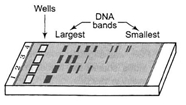
Having become an expert on gel electrophoresis,you are asked to examine a gel for a colleague. Where would you find the smallest segment of $DNA$?
A
Near the positive electrode,farthest away from the wells
B
Near the negative electrode,close to the wells
C
Near the top,near the negative pole
D
Near the middle they tend to slow-down after the first few minutes
Solution
(A) $DNA$ molecules are negatively charged due to the phosphate backbone.
In gel electrophoresis,$DNA$ fragments are loaded into wells near the negative electrode (cathode).
When an electric field is applied,the $DNA$ fragments migrate towards the positive electrode (anode).
The gel matrix acts as a molecular sieve,where smaller fragments move faster and travel further through the pores of the gel compared to larger fragments.
Therefore,the smallest $DNA$ segments are found farthest from the wells,near the positive electrode.
In gel electrophoresis,$DNA$ fragments are loaded into wells near the negative electrode (cathode).
When an electric field is applied,the $DNA$ fragments migrate towards the positive electrode (anode).
The gel matrix acts as a molecular sieve,where smaller fragments move faster and travel further through the pores of the gel compared to larger fragments.
Therefore,the smallest $DNA$ segments are found farthest from the wells,near the positive electrode.
0 likes
View Solution176
MediumMCQ
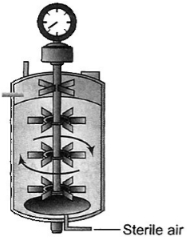
Identify the correct match for the given diagram.
A
Gene gun - Vectorless direct gene transfer
B
Electrophoresis - Differential migration of $DNA$ fragments
C
Bioreactor - Raw materials are biologically converted into specific products
D
Respirometer - Finding out rate of respiration
Solution
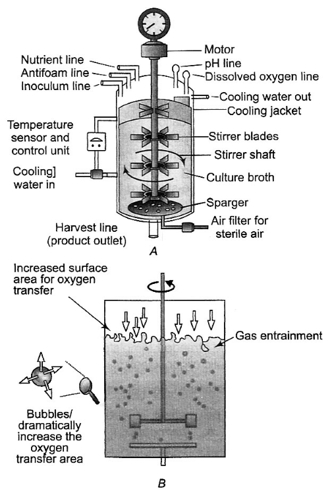
(C) The given diagram represents a sparged stirred-tank bioreactor.
Bioreactors are vessels in which raw materials are biologically converted into specific products by microbes,plant and animal cells,and/or their enzymes.
Small volume cultures cannot yield large quantities of products.
Large-scale production $(100-1000 \; L)$ of products is carried out in bioreactors.
$A$ bioreactor provides optimal conditions for obtaining the desired product by maintaining growth parameters such as temperature,$pH$,substrate,vitamins,oxygen,and salts.
The most commonly used bioreactors are of the stirring type,which include: $(i)$ Simple stirred-tank bioreactors and $(ii)$ Sparged stirred-tank bioreactors.
In the sparged stirred-tank bioreactor shown in the figure,sterile air bubbles are sparged to increase the surface area for oxygen transfer.
Bioreactors are vessels in which raw materials are biologically converted into specific products by microbes,plant and animal cells,and/or their enzymes.
Small volume cultures cannot yield large quantities of products.
Large-scale production $(100-1000 \; L)$ of products is carried out in bioreactors.
$A$ bioreactor provides optimal conditions for obtaining the desired product by maintaining growth parameters such as temperature,$pH$,substrate,vitamins,oxygen,and salts.
The most commonly used bioreactors are of the stirring type,which include: $(i)$ Simple stirred-tank bioreactors and $(ii)$ Sparged stirred-tank bioreactors.
In the sparged stirred-tank bioreactor shown in the figure,sterile air bubbles are sparged to increase the surface area for oxygen transfer.
0 likes
View Solution177
MediumMCQ
$DNA$ can be introduced into any cell by:
A
Injection
B
Being complexed with calcium salts
C
Being placed along with the cell into a gene gun
D
Gel electrophoresis
Solution
(C) The method of introducing $DNA$ into a cell is known as transformation or transfection.
Microinjection is a direct method where $DNA$ is injected directly into the nucleus of an animal cell.
Biolistics or gene gun method is a technique where cells are bombarded with high-velocity micro-particles of gold or tungsten coated with $DNA$.
This method is suitable for plants and can be used to introduce $DNA$ into almost any cell type,regardless of the species.
Therefore,$DNA$ can be introduced into any cell by being placed along with the cell into a gene gun.
Microinjection is a direct method where $DNA$ is injected directly into the nucleus of an animal cell.
Biolistics or gene gun method is a technique where cells are bombarded with high-velocity micro-particles of gold or tungsten coated with $DNA$.
This method is suitable for plants and can be used to introduce $DNA$ into almost any cell type,regardless of the species.
Therefore,$DNA$ can be introduced into any cell by being placed along with the cell into a gene gun.
0 likes
View Solution178
MediumMCQ
$RNA$ is removed by the treatment with
A
Ribonuclease
B
Protease
C
Chitinase
D
Cellulase
Solution
(A) In the process of recombinant $DNA$ technology,the isolation of genetic material involves the removal of unwanted macromolecules.
$RNA$ is a type of nucleic acid that can be removed from the mixture by treating it with the enzyme ribonuclease.
Protease is used to remove proteins,chitinase is used to break down chitin in fungal cell walls,and cellulase is used to break down cellulose in plant cell walls.
Therefore,the correct enzyme for removing $RNA$ is ribonuclease.
$RNA$ is a type of nucleic acid that can be removed from the mixture by treating it with the enzyme ribonuclease.
Protease is used to remove proteins,chitinase is used to break down chitin in fungal cell walls,and cellulase is used to break down cellulose in plant cell walls.
Therefore,the correct enzyme for removing $RNA$ is ribonuclease.
0 likes
View Solution179
MediumMCQ
The components of a bioreactor are:
$I.$ An agitator system
$II.$ An oxygen delivery system
$III.$ Foam control system
$IV.$ Temperature control system
$V.$ $pH$ control system
$VI.$ Sampling ports to withdraw cultures periodically
Choose the correct option.
$I.$ An agitator system
$II.$ An oxygen delivery system
$III.$ Foam control system
$IV.$ Temperature control system
$V.$ $pH$ control system
$VI.$ Sampling ports to withdraw cultures periodically
Choose the correct option.
A
$I, II, III, IV, V$
B
$II, IV, V, VI$
C
$I, II, III, IV, VI$
D
$All \; of \; these$
Solution
(D) bioreactor is a vessel in which raw materials are biologically converted into specific products using microbial,plant,animal,or human cells.
To ensure optimal growth and product formation,a bioreactor must provide the following essential components:
$1$. An agitator system: To ensure even mixing and oxygen availability.
$2$. An oxygen delivery system: To provide necessary aeration for aerobic organisms.
$3$. Foam control system: To manage foam production during fermentation.
$4$. Temperature control system: To maintain the optimal temperature for microbial activity.
$5$. $pH$ control system: To maintain the required $pH$ level for the culture.
$6$. Sampling ports: To withdraw small volumes of the culture periodically for testing and monitoring.
Therefore,all the listed components are essential parts of a standard bioreactor.
To ensure optimal growth and product formation,a bioreactor must provide the following essential components:
$1$. An agitator system: To ensure even mixing and oxygen availability.
$2$. An oxygen delivery system: To provide necessary aeration for aerobic organisms.
$3$. Foam control system: To manage foam production during fermentation.
$4$. Temperature control system: To maintain the optimal temperature for microbial activity.
$5$. $pH$ control system: To maintain the required $pH$ level for the culture.
$6$. Sampling ports: To withdraw small volumes of the culture periodically for testing and monitoring.
Therefore,all the listed components are essential parts of a standard bioreactor.
0 likes
View Solution180
EasyMCQ
An artificial process of infecting cells with naked viral $DNA$ is:
A
Translation
B
Transduction
C
Transfection
D
Transgenic
Solution
(C) The process of introducing naked viral $DNA$ into eukaryotic cells is known as $Transfection$.
$Transduction$ refers to the transfer of genetic material from one bacterium to another by a bacteriophage.
$Translation$ is the process of protein synthesis from $mRNA$.
$Transgenic$ refers to an organism that has had its genome altered by the introduction of an engineered gene.
$Transduction$ refers to the transfer of genetic material from one bacterium to another by a bacteriophage.
$Translation$ is the process of protein synthesis from $mRNA$.
$Transgenic$ refers to an organism that has had its genome altered by the introduction of an engineered gene.
0 likes
View Solution181
MediumMCQ
In gel electrophoresis,the separated $DNA$ fragments are visualized after staining the $DNA$ with $...A...$ followed by exposure to $...B...$. Here $A$ and $B$ refer to:
A
$(A)-B-galactosidase, (B)-Infrared radiation$
B
$(A)-Ethidium bromide, (B)-UV radiation$
C
$(A)-Ethidium nitrate, (B)-\gamma-rays$
D
$(A)-Ethidium chloride, (B)-Radiowave$
Solution
(B) In gel electrophoresis,the separated $DNA$ fragments are visualized after staining the $DNA$ with ethidium bromide $(EtBr)$.
Once stained,the gel is exposed to $UV$ radiation (ultraviolet light).
Under $UV$ light,the $DNA$ fragments appear as bright orange-colored bands due to the fluorescence of the ethidium bromide intercalated between the $DNA$ base pairs.
Once stained,the gel is exposed to $UV$ radiation (ultraviolet light).
Under $UV$ light,the $DNA$ fragments appear as bright orange-colored bands due to the fluorescence of the ethidium bromide intercalated between the $DNA$ base pairs.
0 likes
View Solution182
MediumMCQ
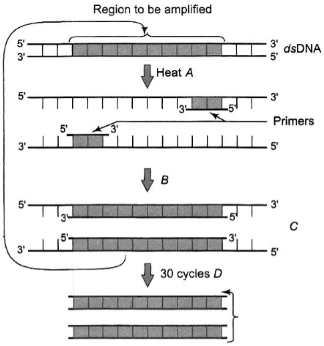
The diagram below refers to $PCR$. Identify the steps $A, B$ and $C$ and select the correct option.
A
$A-$Denaturation at $94-96^{\circ} C$,$B-$Annealing at $40-60^{\circ} C$,$C-$Extension through Taq polymerase at $72^{\circ} C$,$D-$Amplified
B
$A-$Annealing at $94-96^{\circ} C$,$B-$Denaturation at $40-60^{\circ} C$,$C-$Extension through Taq polymerase at $72^{\circ} C$,$D-$Amplified
C
$A-$Extension through Taq polymerase at $40-60^{\circ} C$,$B-$Amplified,$C-$Denaturation at $40-60^{\circ} C$,$D-$Annealing at $94-96^{\circ} C$
D
$A-$Annealing,$B-$Extension through Taq polymerase at $40-60^{\circ} C$,$C-$Denaturation at $94-96^{\circ} C$,$D-$Annealing at $40-60^{\circ} C$
Solution
(A) The $PCR$ (Polymerase Chain Reaction) process involves three major steps:
$(i)$ Denaturation $(A)$: The double-stranded $DNA$ is heated to $94-96^{\circ} C$ to separate it into single strands.
$(ii)$ Annealing $(B)$: The temperature is lowered to $40-60^{\circ} C$ to allow primers to bind to the complementary sequences on the single-stranded $DNA$ templates.
$(iii)$ Extension $(C)$: The temperature is raised to $72^{\circ} C$,allowing the thermostable Taq polymerase to synthesize new $DNA$ strands by adding nucleotides to the primers.
After $30$ cycles $(D)$,the target $DNA$ region is significantly amplified.
$(i)$ Denaturation $(A)$: The double-stranded $DNA$ is heated to $94-96^{\circ} C$ to separate it into single strands.
$(ii)$ Annealing $(B)$: The temperature is lowered to $40-60^{\circ} C$ to allow primers to bind to the complementary sequences on the single-stranded $DNA$ templates.
$(iii)$ Extension $(C)$: The temperature is raised to $72^{\circ} C$,allowing the thermostable Taq polymerase to synthesize new $DNA$ strands by adding nucleotides to the primers.
After $30$ cycles $(D)$,the target $DNA$ region is significantly amplified.
0 likes
View Solution183
EasyMCQ
$A$ number of bacteria with recombinant $DNA$ of the same type form:
A
Clone library
B
Gene library
C
Gene pool
D
Gene frequency
Solution
(A) When a single type of recombinant $DNA$ molecule is introduced into a host bacterium,the bacterium replicates to produce a population of identical cells. Each of these cells contains the same recombinant $DNA$ molecule. This collection of identical cells,all carrying the same genetic information,is referred to as a clone. Therefore,a group of bacteria containing the same recombinant $DNA$ is known as a clone.
0 likes
View Solution184
MediumMCQ
Following enzymes/chemical/technique are used in the process of gel electrophoresis:
$I.$ sample $DNA$ is cut into fragments
$II.$ restriction endonucleases
$III.$ agarose gel
$IV.$ ethidium bromide
$V.$ $UV$-radiation
$VI.$ elution
Mark the correct sequence of their use.
$I.$ sample $DNA$ is cut into fragments
$II.$ restriction endonucleases
$III.$ agarose gel
$IV.$ ethidium bromide
$V.$ $UV$-radiation
$VI.$ elution
Mark the correct sequence of their use.
A
$I, II, III, VI, V, IV$
B
$I, II, III, IV, V, VI$
C
$IV, V, VI, I, II, III$
D
$I, II, IV, V, VI, III$
Solution
(B) The process of gel electrophoresis involves the following steps in sequence:
$1$. First,the sample $DNA$ is cut into fragments using restriction endonucleases ($I$ and $II$).
$2$. These fragments are then separated based on their size by running them through an agarose gel $(III)$.
$3$. To visualize the separated $DNA$ fragments,the gel is stained with ethidium bromide $(IV)$.
$4$. The stained $DNA$ bands are then observed under $UV$-radiation $(V)$.
$5$. Finally,the desired $DNA$ bands are cut out from the agarose gel and extracted,a process known as elution $(VI)$.
Therefore,the correct sequence is $I, II, III, IV, V, VI$.
$1$. First,the sample $DNA$ is cut into fragments using restriction endonucleases ($I$ and $II$).
$2$. These fragments are then separated based on their size by running them through an agarose gel $(III)$.
$3$. To visualize the separated $DNA$ fragments,the gel is stained with ethidium bromide $(IV)$.
$4$. The stained $DNA$ bands are then observed under $UV$-radiation $(V)$.
$5$. Finally,the desired $DNA$ bands are cut out from the agarose gel and extracted,a process known as elution $(VI)$.
Therefore,the correct sequence is $I, II, III, IV, V, VI$.
0 likes
View Solution185
MediumMCQ
Which of the following should be chosen for best yield if one has to produce a recombinant protein or enzyme on a large scale,using microbial,plant,animal,or human cells?
A
Stirred-tank bioreactor
B
Electrophoresis
C
Laboratory flask of largest capacity
D
All of the above
Solution
(A) stirred-tank bioreactor is specifically designed for the large-scale production of recombinant proteins or enzymes.
It provides optimal conditions for growth,such as controlled $pH$,temperature,oxygen availability,and nutrient supply,while ensuring proper mixing and aeration.
Unlike laboratory flasks,which are limited in volume and lack precise control,bioreactors allow for the cultivation of large volumes of microbial,plant,animal,or human cells to achieve maximum yield.
It provides optimal conditions for growth,such as controlled $pH$,temperature,oxygen availability,and nutrient supply,while ensuring proper mixing and aeration.
Unlike laboratory flasks,which are limited in volume and lack precise control,bioreactors allow for the cultivation of large volumes of microbial,plant,animal,or human cells to achieve maximum yield.
0 likes
View Solution186
MediumMCQ
The steps involved in the Southern blot test are as follows:
$I.$ $X-ray$ film
$II.$ Electrophoresis
$III.$ Digestion with restriction enzyme
$IV.$ Ethidium bromide
$V.$ Radioactive probe
Choose the option having the correct sequential order of these events.
$I.$ $X-ray$ film
$II.$ Electrophoresis
$III.$ Digestion with restriction enzyme
$IV.$ Ethidium bromide
$V.$ Radioactive probe
Choose the option having the correct sequential order of these events.
A
$III, II, IV, V, I$
B
$III, IV, II, V, I$
C
$III, II, V, IV, I$
D
$II, IV, III, V, I$
Solution
(A) The correct sequence of steps in the Southern blotting technique is as follows:
$1$. Digestion of $DNA$ with restriction enzymes $(III)$
$2$. Separation of $DNA$ fragments by gel electrophoresis $(II)$
$3$. Staining with ethidium bromide to visualize $DNA$ under $UV$ light $(IV)$
$4$. Hybridization with a radioactive probe $(V)$
$5$. Detection using $X-ray$ film (autoradiography) $(I)$
Therefore,the correct order is $III, II, IV, V, I$.
$1$. Digestion of $DNA$ with restriction enzymes $(III)$
$2$. Separation of $DNA$ fragments by gel electrophoresis $(II)$
$3$. Staining with ethidium bromide to visualize $DNA$ under $UV$ light $(IV)$
$4$. Hybridization with a radioactive probe $(V)$
$5$. Detection using $X-ray$ film (autoradiography) $(I)$
Therefore,the correct order is $III, II, IV, V, I$.
0 likes
View Solution187
MediumMCQ
$I. ... A...$ is the ability of a cell to take up foreign $DNA$.
$II.$ The cell is treated with a specific concentration of a divalent cation such as $... B...$ to increase the pore size in the cell wall.
$III.$ In $...C...$ method,recombinant $DNA$ is directly injected into the nucleus of an animal cell.
The most appropriate option regarding $A, B$ and $C$ is:
$II.$ The cell is treated with a specific concentration of a divalent cation such as $... B...$ to increase the pore size in the cell wall.
$III.$ In $...C...$ method,recombinant $DNA$ is directly injected into the nucleus of an animal cell.
The most appropriate option regarding $A, B$ and $C$ is:
A
$A-$Competency,$B-$Calcium,$C-$gene gun method
B
$A-$Transformation,$B-$Sodium,$C-$microinjection method
C
$A-$Competency,$B-$Calcium,$C-$microinjection method
D
$A-$Transformation,$B-$Sodium,$C-$gene gun method
Solution
(C) represents Competency,which is the ability of a cell to take up foreign $DNA$ from its environment.
$B$ represents Calcium $(Ca^{2+})$,a divalent cation used to increase the efficiency of $DNA$ uptake by creating pores in the cell wall.
$C$ represents the microinjection method,a technique used in animal cells where recombinant $DNA$ is directly injected into the nucleus using a fine glass needle.
Therefore,the correct sequence is $A-$Competency,$B-$Calcium,$C-$microinjection method.
$B$ represents Calcium $(Ca^{2+})$,a divalent cation used to increase the efficiency of $DNA$ uptake by creating pores in the cell wall.
$C$ represents the microinjection method,a technique used in animal cells where recombinant $DNA$ is directly injected into the nucleus using a fine glass needle.
Therefore,the correct sequence is $A-$Competency,$B-$Calcium,$C-$microinjection method.
0 likes
View Solution188
MediumMCQ
The different basic steps of genetic engineering are given below randomly:
$I.$ Identification of $DNA$ with desirable genes
$II.$ Gene transfer
$III.$ Maintenance of $DNA$ in host and gene cloning
$IV.$ Introduction of $DNA$ into host to form recombinant $DNA$
Which of the following represents the correct sequence of steps?
$I.$ Identification of $DNA$ with desirable genes
$II.$ Gene transfer
$III.$ Maintenance of $DNA$ in host and gene cloning
$IV.$ Introduction of $DNA$ into host to form recombinant $DNA$
Which of the following represents the correct sequence of steps?
A
$I, II, III, IV$
B
$I, IV, III, II$
C
$III, IV, II, I$
D
$I, III, IV, II$
Solution
(B) The process of recombinant $DNA$ technology involves the following sequential steps:
$1.$ Identification of $DNA$ with desirable genes $(I)$.
$2.$ Introduction of $DNA$ into the host to form recombinant $DNA$ $(IV)$.
$3.$ Maintenance of $DNA$ in the host and gene cloning $(III)$.
$4.$ Gene transfer $(II)$.
Thus,the correct sequence is $I, IV, III, II$.
$1.$ Identification of $DNA$ with desirable genes $(I)$.
$2.$ Introduction of $DNA$ into the host to form recombinant $DNA$ $(IV)$.
$3.$ Maintenance of $DNA$ in the host and gene cloning $(III)$.
$4.$ Gene transfer $(II)$.
Thus,the correct sequence is $I, IV, III, II$.
0 likes
View Solution189
MediumMCQ
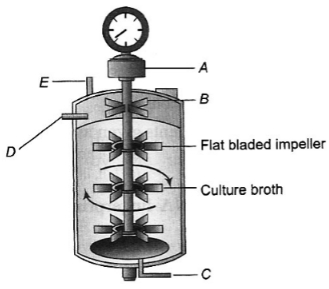
$A$ simple stirred-tank bioreactor is shown below. Identify $A, B, C, D$,and $E$.
A
$A$-Motor,$B$-Foam breaker,$C$-Sterile air,$D$-Steam for sterilization,$E$-Acid/Base for $pH$ control
B
$A$-Foam breaker,$B$-Sterile air,$C$-Steam for sterilization,$D$-Acid/Base for $pH$ control
C
$A$-Acid/Base for $pH$ control,$B$-Motor,$C$-Foam breaker,$D$-Sterile air,$E$-Steam for sterilization
D
$A$-Sterile air,$B$-Steam for sterilization,$C$-Foam breaker,$D$-Motor,$E$-Acid/Base for $pH$ control
Solution
(A) Based on the standard diagram of a simple stirred-tank bioreactor provided in the $NCERT$ textbook:
$A$ represents the Motor,which provides the power to rotate the impeller.
$B$ represents the Foam breaker,which is located at the top to reduce foam formation.
$C$ represents the inlet for Sterile air,which is supplied from the bottom.
$D$ represents the Steam for sterilization,which is used to maintain aseptic conditions.
$E$ represents the Acid/Base inlet for $pH$ control,used to maintain the optimal $pH$ for the culture.
Therefore,the correct identification is $A$-Motor,$B$-Foam breaker,$C$-Sterile air,$D$-Steam for sterilization,$E$-Acid/Base for $pH$ control.
$A$ represents the Motor,which provides the power to rotate the impeller.
$B$ represents the Foam breaker,which is located at the top to reduce foam formation.
$C$ represents the inlet for Sterile air,which is supplied from the bottom.
$D$ represents the Steam for sterilization,which is used to maintain aseptic conditions.
$E$ represents the Acid/Base inlet for $pH$ control,used to maintain the optimal $pH$ for the culture.
Therefore,the correct identification is $A$-Motor,$B$-Foam breaker,$C$-Sterile air,$D$-Steam for sterilization,$E$-Acid/Base for $pH$ control.
0 likes
View Solution190
MediumMCQ
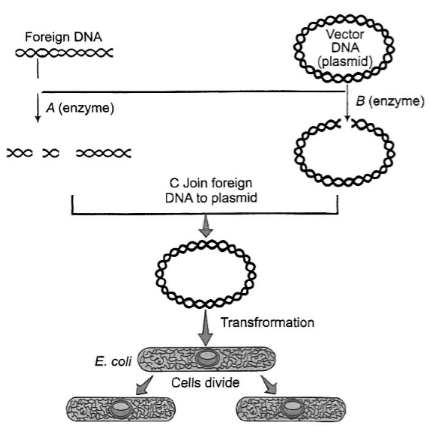
The flowchart given below represents the process of recombinant $DNA$ technology. Identify $A$,$B$,and $C$.
A
$A-$Restriction endonuclease,$B-$Restriction endonuclease,$C-RNA$ ligase
B
$A-$Restriction endonuclease,$B-$Restriction endonuclease,$C-DNA$ ligase
C
$A-$Restriction exonuclease,$B-$Restriction endonuclease,$C-DNA$ polymerase
D
$A-$Restriction endonuclease,$B-$Restriction endonuclease,$C-DNA$ polymerase
Solution
(B) In recombinant $DNA$ technology,the process involves the following steps:
$1$. $A$ and $B$ represent the enzymes used to cut the foreign $DNA$ and the vector $DNA$ (plasmid) at specific recognition sequences. These enzymes are known as Restriction endonucleases.
$2$. $C$ represents the enzyme used to join the cut foreign $DNA$ fragment with the vector $DNA$ (plasmid) to form recombinant $DNA$. This enzyme is known as $DNA$ ligase.
Therefore,$A$ is Restriction endonuclease,$B$ is Restriction endonuclease,and $C$ is $DNA$ ligase.
$1$. $A$ and $B$ represent the enzymes used to cut the foreign $DNA$ and the vector $DNA$ (plasmid) at specific recognition sequences. These enzymes are known as Restriction endonucleases.
$2$. $C$ represents the enzyme used to join the cut foreign $DNA$ fragment with the vector $DNA$ (plasmid) to form recombinant $DNA$. This enzyme is known as $DNA$ ligase.
Therefore,$A$ is Restriction endonuclease,$B$ is Restriction endonuclease,and $C$ is $DNA$ ligase.
0 likes
View Solution191
MediumMCQ
In the case of polymerase chain reaction $(PCR)$,what are the temperatures required for the following steps?
$A.$ Denaturation
$B.$ Annealing
$C.$ Extension
$A.$ Denaturation
$B.$ Annealing
$C.$ Extension
A
$A-94^{\circ}C, B-40^{\circ}C, C-72^{\circ}C$
B
$A-40^{\circ}C, B-72^{\circ}C, C-94^{\circ}C$
C
$A-72^{\circ}C, B-94^{\circ}C, C-40^{\circ}C$
D
$A-94^{\circ}C, B-72^{\circ}C, C-40^{\circ}C$
Solution
(A) The polymerase chain reaction $(PCR)$ consists of three main steps:
$1$. Denaturation: The double-stranded $DNA$ is heated to approximately $94^{\circ}C$ to separate the strands.
$2$. Annealing: Primers are allowed to anneal to the single-stranded $DNA$ templates at a lower temperature,typically between $40^{\circ}C$ and $60^{\circ}C$.
$3$. Extension: The $DNA$ polymerase enzyme synthesizes the new $DNA$ strand at an optimal temperature of $72^{\circ}C$.
Therefore,the correct sequence of temperatures is $A-94^{\circ}C, B-40^{\circ}C, C-72^{\circ}C$.
$1$. Denaturation: The double-stranded $DNA$ is heated to approximately $94^{\circ}C$ to separate the strands.
$2$. Annealing: Primers are allowed to anneal to the single-stranded $DNA$ templates at a lower temperature,typically between $40^{\circ}C$ and $60^{\circ}C$.
$3$. Extension: The $DNA$ polymerase enzyme synthesizes the new $DNA$ strand at an optimal temperature of $72^{\circ}C$.
Therefore,the correct sequence of temperatures is $A-94^{\circ}C, B-40^{\circ}C, C-72^{\circ}C$.
0 likes
View Solution192
MediumMCQ
Consider the following statements about $PCR$:
$I.$ Polymerase Chain Reaction $(PCR)$ is a technique of synthesizing multiple copies of the desired gene in vitro.
$II.$ This technique was developed by Kary Mullis in $1985$.
$III.$ $A$ single $PCR$ amplification cycle involves three basic steps: denaturation,annealing,and extension.
Which of the statements given above are correct?
$I.$ Polymerase Chain Reaction $(PCR)$ is a technique of synthesizing multiple copies of the desired gene in vitro.
$II.$ This technique was developed by Kary Mullis in $1985$.
$III.$ $A$ single $PCR$ amplification cycle involves three basic steps: denaturation,annealing,and extension.
Which of the statements given above are correct?
A
$I$ and $II$
B
$I$ and $III$
C
$II$ and $III$
D
$I, II$ and $III$
Solution
(D) The Polymerase Chain Reaction,or $PCR$,is a technique used to synthesize multiple copies of a specific gene or $DNA$ segment in vitro.
It was developed by Kary Mullis in $1985$,for which he was awarded the Nobel Prize in Chemistry in $1993$.
$A$ single $PCR$ amplification cycle consists of three fundamental steps:
$1.$ Denaturation: Heating the $DNA$ to separate the two strands.
$2.$ Annealing: Cooling the mixture to allow primers to bind to the target sequences.
$3.$ Extension: Using a thermostable $DNA$ polymerase to synthesize new $DNA$ strands.
Since all three statements are scientifically accurate,the correct option is $D$.
It was developed by Kary Mullis in $1985$,for which he was awarded the Nobel Prize in Chemistry in $1993$.
$A$ single $PCR$ amplification cycle consists of three fundamental steps:
$1.$ Denaturation: Heating the $DNA$ to separate the two strands.
$2.$ Annealing: Cooling the mixture to allow primers to bind to the target sequences.
$3.$ Extension: Using a thermostable $DNA$ polymerase to synthesize new $DNA$ strands.
Since all three statements are scientifically accurate,the correct option is $D$.
0 likes
View Solution193
MediumMCQ
Consider the following statements:
$I.$ In microinjection method,foreign $DNA$ is directly injected into the nucleus of an animal cell or plant cell by using microneedles or micropipettes.
$II.$ Microinjection method is used in oocytes,eggs,and embryos.
$III.$ Electroporation is the formation of temporary pores in the plasma membrane of a host cell by using lysozyme or calcium chloride.
$IV.$ In chemical-mediated gene transfer method,certain chemicals such as $CO_{2}$ help foreign $DNA$ to enter the host cell.
Which of the statements given above are correct?
$I.$ In microinjection method,foreign $DNA$ is directly injected into the nucleus of an animal cell or plant cell by using microneedles or micropipettes.
$II.$ Microinjection method is used in oocytes,eggs,and embryos.
$III.$ Electroporation is the formation of temporary pores in the plasma membrane of a host cell by using lysozyme or calcium chloride.
$IV.$ In chemical-mediated gene transfer method,certain chemicals such as $CO_{2}$ help foreign $DNA$ to enter the host cell.
Which of the statements given above are correct?
A
$I$ and $II$
B
$I, II$ and $III$
C
$II, III$ and $IV$
D
$I, II, III$ and $IV$
Solution
(A) Statement $I$ is correct: In the microinjection method,foreign $DNA$ is directly injected into the nucleus of an animal cell or plant cell using fine-tipped microneedles or micropipettes.
Statement $II$ is correct: Microinjection is commonly used for large cells such as oocytes,eggs,and early-stage embryos.
Statement $III$ is incorrect: Electroporation involves the formation of temporary pores in the plasma membrane of a host cell by using high-voltage electrical pulses,not by using lysozyme or calcium chloride.
Statement $IV$ is incorrect: Chemical-mediated gene transfer uses chemicals like Polyethylene Glycol $(PEG)$ or calcium phosphate to facilitate $DNA$ uptake,not $CO_{2}$.
Therefore,only statements $I$ and $II$ are correct.
Statement $II$ is correct: Microinjection is commonly used for large cells such as oocytes,eggs,and early-stage embryos.
Statement $III$ is incorrect: Electroporation involves the formation of temporary pores in the plasma membrane of a host cell by using high-voltage electrical pulses,not by using lysozyme or calcium chloride.
Statement $IV$ is incorrect: Chemical-mediated gene transfer uses chemicals like Polyethylene Glycol $(PEG)$ or calcium phosphate to facilitate $DNA$ uptake,not $CO_{2}$.
Therefore,only statements $I$ and $II$ are correct.
0 likes
View Solution194
MediumMCQ
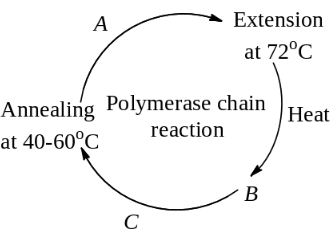
Study the following diagram of the Polymerase Chain Reaction $(PCR)$ and identify $A, B$ and $C$.
A
$A-$Taq polymerase,$B-$Denaturation at $94^{\circ} C, C-$Primer
B
$A-$Denaturation at $94^{\circ} C, B-$Taq polymerase,$C-$Primer
C
$A-$Primer,$B-$Denaturation at $94^{\circ} C, C-$Taq polymerase
D
$A-$Taq polymerase,$B-$Extension,$C-$Transformation
Solution
(A) The Polymerase Chain Reaction $(PCR)$ cycle consists of three main steps:
$1$. Denaturation: The double-stranded $DNA$ is heated to approximately $94^{\circ} C$ to separate the strands. This corresponds to label $B$.
$2$. Annealing: Primers are added to the single-stranded $DNA$ at a lower temperature $(40-60^{\circ} C)$. This corresponds to label $C$.
$3$. Extension: The enzyme Taq polymerase adds nucleotides to the primer,extending the $DNA$ strand at $72^{\circ} C$. This corresponds to label $A$.
Therefore,$A$ is Taq polymerase,$B$ is Denaturation at $94^{\circ} C$,and $C$ is Primer.
$1$. Denaturation: The double-stranded $DNA$ is heated to approximately $94^{\circ} C$ to separate the strands. This corresponds to label $B$.
$2$. Annealing: Primers are added to the single-stranded $DNA$ at a lower temperature $(40-60^{\circ} C)$. This corresponds to label $C$.
$3$. Extension: The enzyme Taq polymerase adds nucleotides to the primer,extending the $DNA$ strand at $72^{\circ} C$. This corresponds to label $A$.
Therefore,$A$ is Taq polymerase,$B$ is Denaturation at $94^{\circ} C$,and $C$ is Primer.
0 likes
View Solution195
MediumMCQ
Downstream processing includes:
$I.$ Separation of the product from the reactor
$II.$ Purification of the product
$III.$ Formulation of the product with suitable preservatives
$IV.$ Quality control testing and clinical trials in case of drugs
Which of the statements given above are correct?
$I.$ Separation of the product from the reactor
$II.$ Purification of the product
$III.$ Formulation of the product with suitable preservatives
$IV.$ Quality control testing and clinical trials in case of drugs
Which of the statements given above are correct?
A
$I, II \text{ and } III$
B
$I, II \text{ and } IV$
C
$II, III \text{ and } IV$
D
$I, II, III \text{ and } IV$
Solution
(D) Downstream processing refers to the series of processes that a product undergoes after its synthesis in a bioreactor before it is ready for marketing as a finished product.
These processes include:
$1.$ Separation of the product from the culture medium or reactor.
$2.$ Purification of the product to achieve the desired purity level.
$3.$ Formulation of the product by adding suitable preservatives to ensure stability.
$4.$ Quality control testing to ensure the product meets safety and efficacy standards.
$5.$ Clinical trials,which are mandatory for pharmaceutical products (drugs) to ensure safety and effectiveness in humans.
Since all the listed statements $(I, II, III, IV)$ are essential components of the downstream processing and post-production validation,the correct answer is $D$.
These processes include:
$1.$ Separation of the product from the culture medium or reactor.
$2.$ Purification of the product to achieve the desired purity level.
$3.$ Formulation of the product by adding suitable preservatives to ensure stability.
$4.$ Quality control testing to ensure the product meets safety and efficacy standards.
$5.$ Clinical trials,which are mandatory for pharmaceutical products (drugs) to ensure safety and effectiveness in humans.
Since all the listed statements $(I, II, III, IV)$ are essential components of the downstream processing and post-production validation,the correct answer is $D$.
0 likes
View Solution196
MediumMCQ
Which of the following steps are involved in the process of recombinant biotechnology? Arrange in correct order.
$I.$ Extraction of the desired gene product
$II.$ Amplification of the gene of interest
$III.$ Isolation of a desired $DNA$ fragment
$IV.$ Ligation of the $DNA$ fragment into a vector
$V.$ Insertion of recombinant $DNA$ into the host
Correct order is:
$I.$ Extraction of the desired gene product
$II.$ Amplification of the gene of interest
$III.$ Isolation of a desired $DNA$ fragment
$IV.$ Ligation of the $DNA$ fragment into a vector
$V.$ Insertion of recombinant $DNA$ into the host
Correct order is:
A
$I, II, III, IV, V$
B
$III, II, IV, V, I$
C
$II, IV, V, III, I$
D
$I, IV, V, III, II$
Solution
(B) The process of recombinant $DNA$ technology follows a specific sequence of steps:
$1.$ Isolation of the desired $DNA$ fragment $(III)$.
$2.$ Amplification of the gene of interest using $PCR$ $(II)$.
$3.$ Ligation of the $DNA$ fragment into a vector to form recombinant $DNA$ $(IV)$.
$4.$ Insertion of recombinant $DNA$ into the host organism $(V)$.
$5.$ Extraction of the desired gene product after expression $(I)$.
Therefore,the correct sequence is $III, II, IV, V, I$.
$1.$ Isolation of the desired $DNA$ fragment $(III)$.
$2.$ Amplification of the gene of interest using $PCR$ $(II)$.
$3.$ Ligation of the $DNA$ fragment into a vector to form recombinant $DNA$ $(IV)$.
$4.$ Insertion of recombinant $DNA$ into the host organism $(V)$.
$5.$ Extraction of the desired gene product after expression $(I)$.
Therefore,the correct sequence is $III, II, IV, V, I$.
0 likes
View Solution197
MediumMCQ
Which of the following is a difficulty in getting prokaryotic cells to express eukaryotic genes?
A
The signals that control gene expression are different and prokaryotic promoter regions must be added to the vector
B
The genetic code differs between the two because prokaryotes substitute the base uracil for thymine
C
Prokaryotic cells cannot transcribe introns because their genes do not have them
D
The ribosomes of prokaryotes are not large enough to handle long eukaryotic genes
Solution
(A) The primary difficulty in expressing eukaryotic genes in prokaryotic cells is that eukaryotic genes contain introns (non-coding sequences) that prokaryotes cannot process (splice out). Furthermore,the regulatory signals for gene expression,such as promoters and terminators,differ significantly between eukaryotes and prokaryotes. Therefore,to express a eukaryotic gene in a prokaryote,one must use complementary $DNA$ $(cDNA)$ which lacks introns and attach appropriate prokaryotic promoter sequences to the vector.
0 likes
View Solution198
MediumMCQ
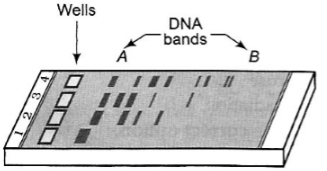
Study the given figure carefully and select the correct statements regarding this.
$I.$ It represents typical agarose gel electrophoresis showing differential migration of $DNA$ fragments.
$II.$ Lane $1$ contains undigested $DNA$ fragments.
$III.$ Lanes $2$ to $4$ contain digested $DNA$ fragments.
$IV.$ Smallest $DNA$ bands are present at $(A)$ position and largest $DNA$ bands are present at $(B)$ position.
$I.$ It represents typical agarose gel electrophoresis showing differential migration of $DNA$ fragments.
$II.$ Lane $1$ contains undigested $DNA$ fragments.
$III.$ Lanes $2$ to $4$ contain digested $DNA$ fragments.
$IV.$ Smallest $DNA$ bands are present at $(A)$ position and largest $DNA$ bands are present at $(B)$ position.
A
$I, II$ and $III$
B
$I, II$ and $IV$
C
$II$ and $III$
D
$III$ and $IV$
Solution
(A) In agarose gel electrophoresis,$DNA$ fragments separate according to their size through the agarose matrix.
Smaller $DNA$ fragments move faster and travel further away from the wells,while larger $DNA$ fragments move slower and remain closer to the wells.
Looking at the figure:
$I.$ The figure represents agarose gel electrophoresis,which is correct.
$II.$ Lane $1$ shows a single band near the well,indicating undigested $DNA$,which is correct.
$III.$ Lanes $2$ to $4$ show multiple bands,indicating digested $DNA$ fragments,which is correct.
$IV.$ Position $(A)$ is closer to the wells,meaning it contains larger $DNA$ fragments,while position $(B)$ is further from the wells,meaning it contains smaller $DNA$ fragments. Thus,statement $IV$ is incorrect.
Therefore,statements $I, II,$ and $III$ are correct.
Smaller $DNA$ fragments move faster and travel further away from the wells,while larger $DNA$ fragments move slower and remain closer to the wells.
Looking at the figure:
$I.$ The figure represents agarose gel electrophoresis,which is correct.
$II.$ Lane $1$ shows a single band near the well,indicating undigested $DNA$,which is correct.
$III.$ Lanes $2$ to $4$ show multiple bands,indicating digested $DNA$ fragments,which is correct.
$IV.$ Position $(A)$ is closer to the wells,meaning it contains larger $DNA$ fragments,while position $(B)$ is further from the wells,meaning it contains smaller $DNA$ fragments. Thus,statement $IV$ is incorrect.
Therefore,statements $I, II,$ and $III$ are correct.
0 likes
View Solution199
MediumMCQ
Which of the following statements is correct in the context of observing $DNA$ separated by agarose gel electrophoresis?
A
$DNA$ can be seen in visible light
B
$DNA$ can be seen without staining in visible light
C
Ethidium bromide stained $DNA$ can be seen in visible light
D
Ethidium bromide stained $DNA$ can be seen under exposure to $UV$ light
Solution
(D) Ethidium bromide is a molecule that intercalates between the stacked bases of the $DNA$ molecule.
Soaking a $DNA$-containing gel in an ethidium bromide solution allows the chemical to bind to the $DNA$.
When the gel is illuminated with $UV$ light (typically in the range of $260-300 \ nm$),the ethidium bromide fluoresces.
This allows the $DNA$ to be visualized on the gel as bright orange fluorescent bands.
Soaking a $DNA$-containing gel in an ethidium bromide solution allows the chemical to bind to the $DNA$.
When the gel is illuminated with $UV$ light (typically in the range of $260-300 \ nm$),the ethidium bromide fluoresces.
This allows the $DNA$ to be visualized on the gel as bright orange fluorescent bands.
0 likes
View Solution200
MediumMCQ
Significance of treating bacterial cells with calcium chloride before transformation is to facilitate
A
Binding of $DNA$ to the cell surface
B
Uptake of $DNA$ through membrane transport proteins
C
Uptake of $DNA$ by creating transient pores in the bacterial cell wall
D
Expression of antibiotic resistance gene
Solution
(C) Since $DNA$ is a hydrophilic molecule,it cannot pass through cell membranes.
In order to force bacteria to take up the plasmid,the bacterial cells must first be made 'competent' to take up $DNA$.
This is done by treating them with a specific concentration of a divalent cation,such as calcium $(Ca^{2+})$,which increases the efficiency with which $DNA$ enters the bacterium through pores in its cell wall.
Calcium chloride treatment helps in the binding of $DNA$ to the cell surface and facilitates its uptake by creating transient pores in the bacterial cell wall.
In order to force bacteria to take up the plasmid,the bacterial cells must first be made 'competent' to take up $DNA$.
This is done by treating them with a specific concentration of a divalent cation,such as calcium $(Ca^{2+})$,which increases the efficiency with which $DNA$ enters the bacterium through pores in its cell wall.
Calcium chloride treatment helps in the binding of $DNA$ to the cell surface and facilitates its uptake by creating transient pores in the bacterial cell wall.
0 likes
View SolutionBiotechnology Principals and Process — Process of Recombinant DNA technology · Frequently Asked Questions
1Are these Biotechnology Principals and Process questions useful for JEE and NEET?
Yes. All questions in this section are mapped to JEE Main and NEET exam patterns. Previous year questions from JEE Main, NEET, GUJCET and state-level exams are included with full solutions.
2Can I switch to Hindi or Gujarati for these questions?
Yes. Use the language tabs in the hero section or the sidebar to view the same questions and solutions in English, Hindi or Gujarati.
3How do I generate a question paper from this subtopic?
Use the Vedclass Exam Paper Generator — select the chapter and subtopic, set difficulty, and generate Sets A, B, C, D automatically. First 3 chapters of every subject are free.
Vedclass Products
For Students
Vedclass Test Series
Mock tests in real JEE/NEET style with performance analysis. 5-day free trial.
Start Free TrialFor Teachers
Exam Paper Generator
Generate Set A/B/C/D papers from this chapter in 2 minutes. 3 chapters free.
Try FreeFor Institutes
Online Exam Module
Live online exams with unlimited students, 360° analytics & white-label branding.
See DemoFor Teachers & Institutes
Generate a Biotechnology Principals and Process Exam Paper in 2 Minutes
Select subtopic & difficulty — Sets A, B, C, D auto-generated with No Repeat logic.
First 3 chapters of every subject are free — no payment required.