
A English
Process of Recombinant DNA technology Questions in English
Class 12 Biology · Biotechnology Principals and Process · Process of Recombinant DNA technology
315+
Questions
English
Language
100%
With Solutions
Showing 49 of 315 questions in English
51
MediumMCQ
$A$ bioreactor is
A
Hybridoma
B
Culture containing radioactive isotopes
C
Culture for synthesis of new chemicals
D
Fermentation tank
Solution
(D) bioreactor is a vessel in which raw materials are biologically converted into specific products,individual enzymes,etc.,using microbial,plant,animal,or human cells.
Bioreactors provide optimal conditions for achieving the desired product by providing optimum growth conditions such as temperature,$pH$,substrate,salts,vitamins,and oxygen.
They are essentially large-scale fermentation tanks used for the production of biotechnological products.
Bioreactors provide optimal conditions for achieving the desired product by providing optimum growth conditions such as temperature,$pH$,substrate,salts,vitamins,and oxygen.
They are essentially large-scale fermentation tanks used for the production of biotechnological products.
0 likes
View Solution52
MediumMCQ
It is used to detect $HIV$ in suspected $AIDS$ patient and detect mutations in genes in suspected cancer patient too.
A
$Widal\, test$
B
$PCR$
C
$ELISA$
D
$CT\, SCAN$
Solution
(B) $PCR$ (Polymerase Chain Reaction) is a powerful molecular diagnostic technique.
It is used to detect $HIV$ in suspected $AIDS$ patients by amplifying the viral $DNA$,even when the viral load is very low.
Additionally,$PCR$ is used to detect mutations in genes in suspected cancer patients,which helps in early diagnosis and personalized treatment.
$ELISA$ is primarily used for detecting antigens or antibodies,while $Widal$ test is for typhoid and $CT\, SCAN$ is an imaging technique.
It is used to detect $HIV$ in suspected $AIDS$ patients by amplifying the viral $DNA$,even when the viral load is very low.
Additionally,$PCR$ is used to detect mutations in genes in suspected cancer patients,which helps in early diagnosis and personalized treatment.
$ELISA$ is primarily used for detecting antigens or antibodies,while $Widal$ test is for typhoid and $CT\, SCAN$ is an imaging technique.
0 likes
View Solution53
MediumMCQ
Gel electrophoresis is used for:
A
Construction of recombinant $DNA$ by joining with cloning vectors
B
Isolation of $DNA$ molecules
C
Cutting of $DNA$ into smaller fragments
D
Separation of $DNA$ fragments according to their size
Solution
(D) Gel electrophoresis is a technique used to separate charged molecules like $DNA$,$RNA$,or proteins based on their size and charge.
In the context of $DNA$ technology,it is specifically used to separate $DNA$ fragments based on their size.
Under an electric field,$DNA$ fragments (which are negatively charged) move towards the anode through a matrix (usually agarose gel).
Smaller fragments move faster and travel further through the gel pores compared to larger fragments,allowing for effective separation.
In the context of $DNA$ technology,it is specifically used to separate $DNA$ fragments based on their size.
Under an electric field,$DNA$ fragments (which are negatively charged) move towards the anode through a matrix (usually agarose gel).
Smaller fragments move faster and travel further through the gel pores compared to larger fragments,allowing for effective separation.
0 likes
View Solution54
MediumMCQ
The $Polyethylene \ Glycol$ $(PEG)$ method is useful for which of the following?
A
Production of biodiesel
B
Production of seedless fruits
C
Energy production from sewage
D
Direct gene transfer without a vector
Solution
(D) The $Polyethylene \ Glycol$ $(PEG)$ method is a chemical-mediated transformation technique used in biotechnology.
It is primarily used for the direct transfer of genetic material $(DNA)$ into plant protoplasts without the need for a biological vector like $Agrobacterium$.
$PEG$ acts as a fusogenic agent that facilitates the uptake of $DNA$ by the protoplasts by altering the permeability of the cell membrane.
Therefore,it is a well-known method for vectorless gene transfer.
It is primarily used for the direct transfer of genetic material $(DNA)$ into plant protoplasts without the need for a biological vector like $Agrobacterium$.
$PEG$ acts as a fusogenic agent that facilitates the uptake of $DNA$ by the protoplasts by altering the permeability of the cell membrane.
Therefore,it is a well-known method for vectorless gene transfer.
0 likes
View Solution55
MediumMCQ
Stirred-tank bioreactors have been designed for:
A
Adding preservatives to the product
B
Purification of the product
C
Ensuring anaerobic conditions in the culture vessel
D
Availability of oxygen throughout the process
Solution
(D) Stirred-tank bioreactors are designed to provide optimal conditions for achieving the desired product by providing growth parameters like temperature,pH,substrate,salts,vitamins,and oxygen. The primary function of the stirring mechanism is to ensure proper mixing and oxygen availability throughout the bioreactor for the growing microbes.
0 likes
View Solution56
MediumMCQ
In the context of blue-white screening,non-recombinant bacterial colonies appear blue in contrast to white recombinant colonies because:
A
Inactivation of glycosidase enzyme in recombinant bacteria.
B
Non-recombinant bacteria contain beta-galactosidase.
C
Inactivation of alpha-galactosidase insertion in non-recombinant bacteria.
D
Inactivation of alpha-galactosidase insertion in recombinant bacteria.
Solution
(B) The blue-white screening method is based on the insertional inactivation of the $lacZ$ gene.
$1$. The $lacZ$ gene encodes the enzyme $\beta$-galactosidase.
$2$. In non-recombinant bacteria,the $lacZ$ gene is intact and functional,so the bacteria produce $\beta$-galactosidase. This enzyme reacts with the chromogenic substrate $X-gal$ to produce a blue color.
$3$. In recombinant bacteria,the foreign $DNA$ is inserted into the $lacZ$ gene,causing insertional inactivation. Consequently,no functional $\beta$-galactosidase is produced,and the colonies remain white.
$1$. The $lacZ$ gene encodes the enzyme $\beta$-galactosidase.
$2$. In non-recombinant bacteria,the $lacZ$ gene is intact and functional,so the bacteria produce $\beta$-galactosidase. This enzyme reacts with the chromogenic substrate $X-gal$ to produce a blue color.
$3$. In recombinant bacteria,the foreign $DNA$ is inserted into the $lacZ$ gene,causing insertional inactivation. Consequently,no functional $\beta$-galactosidase is produced,and the colonies remain white.
0 likes
View Solution57
MediumMCQ
In a chemical process,the $DNA$ fragments produced by restriction endonucleases can be separated by:
A
Restriction mapping
B
Centrifugation
C
Polymerase chain reaction
D
Electrophoresis
Solution
(D) Restriction endonucleases cut $DNA$ at specific recognition sequences,resulting in fragments of varying lengths.
These $DNA$ fragments are negatively charged due to the phosphate backbone.
Gel electrophoresis is the technique used to separate these $DNA$ fragments based on their size (molecular weight).
Under an electric field,the fragments move through a matrix (usually agarose gel) towards the anode (positive electrode).
Smaller fragments move faster and travel further through the gel pores compared to larger fragments,allowing for their separation.
These $DNA$ fragments are negatively charged due to the phosphate backbone.
Gel electrophoresis is the technique used to separate these $DNA$ fragments based on their size (molecular weight).
Under an electric field,the fragments move through a matrix (usually agarose gel) towards the anode (positive electrode).
Smaller fragments move faster and travel further through the gel pores compared to larger fragments,allowing for their separation.
0 likes
View Solution58
MediumMCQ
Which of the following is not used in the Southern hybridization technique for chromosomal $DNA$ analysis?
A
Electrophoresis
B
Blotting
C
Autoradiography
D
$PCR$
Solution
(D) Southern hybridization is a technique used for the detection of specific $DNA$ sequences in $DNA$ samples.
The steps involved in Southern hybridization are:
$1$. Digestion of $DNA$ with restriction endonucleases.
$2$. Separation of $DNA$ fragments by gel electrophoresis.
$3$. Transfer of separated $DNA$ fragments onto a nitrocellulose or nylon membrane (Blotting).
$4$. Hybridization with a labeled probe.
$5$. Detection of the hybridized probe using autoradiography.
$PCR$ (Polymerase Chain Reaction) is a separate technique used for the amplification of specific $DNA$ sequences and is not a step in the standard Southern hybridization procedure.
The steps involved in Southern hybridization are:
$1$. Digestion of $DNA$ with restriction endonucleases.
$2$. Separation of $DNA$ fragments by gel electrophoresis.
$3$. Transfer of separated $DNA$ fragments onto a nitrocellulose or nylon membrane (Blotting).
$4$. Hybridization with a labeled probe.
$5$. Detection of the hybridized probe using autoradiography.
$PCR$ (Polymerase Chain Reaction) is a separate technique used for the amplification of specific $DNA$ sequences and is not a step in the standard Southern hybridization procedure.
0 likes
View Solution59
MediumMCQ
Why are stirred-tank bioreactors specifically designed?
A
To ensure the availability of oxygen throughout the process.
B
To maintain anaerobic conditions in the culture vessel.
C
To maintain the purity of the product.
D
To add preservatives to the product.
Solution
(A) Stirred-tank bioreactors are cylindrical vessels designed to facilitate the mixing of the reactor contents.
They are equipped with an agitator system,an oxygen delivery system,a foam control system,a temperature control system,a pH control system,and sampling ports.
The primary purpose of the stirring mechanism is to ensure even mixing and,crucially,to provide optimal oxygen availability throughout the entire culture medium for the aerobic growth of microorganisms.
They are equipped with an agitator system,an oxygen delivery system,a foam control system,a temperature control system,a pH control system,and sampling ports.
The primary purpose of the stirring mechanism is to ensure even mixing and,crucially,to provide optimal oxygen availability throughout the entire culture medium for the aerobic growth of microorganisms.
0 likes
View Solution60
MediumMCQ
Which of the following processes is $NOT$ a part of the downstream processing?
A
Preservation
B
Expression
C
Separation
D
Purification
Solution
(B) Downstream processing refers to the stages of processing that occur after the biosynthesis of the product in a bioreactor.
It includes the following steps:
$1$. Separation of the product from the culture medium.
$2$. Purification of the product.
$3$. Formulation with suitable preservatives.
$4$. Quality control and clinical trials.
'Expression' is a part of the upstream processing,where the gene of interest is expressed in the host organism to produce the desired product. Therefore,it is not a part of downstream processing.
It includes the following steps:
$1$. Separation of the product from the culture medium.
$2$. Purification of the product.
$3$. Formulation with suitable preservatives.
$4$. Quality control and clinical trials.
'Expression' is a part of the upstream processing,where the gene of interest is expressed in the host organism to produce the desired product. Therefore,it is not a part of downstream processing.
0 likes
View Solution61
EasyMCQ
Separated $DNA$ fragments on an agarose gel can be visualized after staining with ....
A
Bromophenol blue
B
Acetocarmine
C
Aniline blue
D
Ethidium bromide
Solution
(D) The process of separating $DNA$ fragments based on their size is known as gel electrophoresis.
After the $DNA$ fragments are separated on an agarose gel,they cannot be seen directly under visible light.
To visualize the $DNA$ fragments,the gel is stained with a fluorescent dye called Ethidium bromide $(EtBr)$.
When the stained gel is exposed to $UV$ radiation,the $DNA$ fragments appear as bright orange-colored bands.
After the $DNA$ fragments are separated on an agarose gel,they cannot be seen directly under visible light.
To visualize the $DNA$ fragments,the gel is stained with a fluorescent dye called Ethidium bromide $(EtBr)$.
When the stained gel is exposed to $UV$ radiation,the $DNA$ fragments appear as bright orange-colored bands.
0 likes
View Solution62
MediumMCQ
What is the criterion for the movement of $DNA$ fragments on an agarose gel during gel electrophoresis?
A
Larger fragments move further.
B
Smaller fragments move further.
C
Positively charged fragments move to the far end.
D
Negatively charged fragments do not move.
Solution
(B) Gel electrophoresis is a technique used to separate $DNA$ fragments based on their size.
$DNA$ molecules are negatively charged due to the phosphate groups in their backbone.
When an electric field is applied,the $DNA$ fragments move towards the anode (positive electrode).
The agarose gel acts as a molecular sieve.
Smaller $DNA$ fragments can navigate through the pores of the gel matrix more easily and quickly than larger fragments.
Therefore,smaller fragments travel a greater distance from the well compared to larger fragments.
$DNA$ molecules are negatively charged due to the phosphate groups in their backbone.
When an electric field is applied,the $DNA$ fragments move towards the anode (positive electrode).
The agarose gel acts as a molecular sieve.
Smaller $DNA$ fragments can navigate through the pores of the gel matrix more easily and quickly than larger fragments.
Therefore,smaller fragments travel a greater distance from the well compared to larger fragments.
0 likes
View Solution63
MediumMCQ
The process of separation and purification of the expressed protein before marketing is called .........
A
Upstream processing
B
Downstream processing
C
Bioprocessing
D
Post-production processing
Solution
(B) In recombinant $DNA$ technology,the production of a desired protein involves two main stages:
$1$. Upstream processing: This involves the preparation of the desired gene,selection of a suitable vector,and the cultivation of the host cells in a bioreactor to produce the protein.
$2$. Downstream processing: This stage involves the separation and purification of the expressed protein from the culture medium before it is formulated for marketing.
Therefore,the process of separation and purification is known as downstream processing.
$1$. Upstream processing: This involves the preparation of the desired gene,selection of a suitable vector,and the cultivation of the host cells in a bioreactor to produce the protein.
$2$. Downstream processing: This stage involves the separation and purification of the expressed protein from the culture medium before it is formulated for marketing.
Therefore,the process of separation and purification is known as downstream processing.
0 likes
View Solution64
EasyMCQ
The entry of $t-DNA$ into plants is associated with which of the following?
A
To keep plant roots upright in water.
B
Infection of plants by $Agrobacterium$ $tumefaciens$.
C
Changing the $pH$ of the soil rather than heat shock to the plant.
D
Keeping the plant in cold conditions for a short time.
Solution
(B) The $t-DNA$ (transfer $DNA$) is a segment of $DNA$ found in the $Ti$ (tumor-inducing) plasmid of the bacterium $Agrobacterium$ $tumefaciens$.
When this bacterium infects a plant,it naturally transfers this $t-DNA$ into the host plant's genome.
This process is widely used in biotechnology to introduce foreign genes into plants for genetic modification.
When this bacterium infects a plant,it naturally transfers this $t-DNA$ into the host plant's genome.
This process is widely used in biotechnology to introduce foreign genes into plants for genetic modification.
0 likes
View Solution65
EasyMCQ
The correct order of steps in Polymerase Chain Reaction $(PCR)$ is
A
Denaturation,Annealing,Extension
B
Extension,Denaturation,Annealing
C
Denaturation,Extension,Annealing
D
Annealing,Extension,Denaturation
Solution
(A) The Polymerase Chain Reaction $(PCR)$ is a technique used to amplify a specific $DNA$ segment.
It consists of three main steps performed in a cyclic manner:
$1$. Denaturation: The double-stranded $DNA$ is heated to a high temperature (usually around $94-98^{\circ}C$) to separate the two strands.
$2$. Annealing: The temperature is lowered (usually $50-65^{\circ}C$) to allow the primers to bind to the complementary sequences on the single-stranded $DNA$ templates.
$3$. Extension: The temperature is adjusted (usually $72^{\circ}C$) for the $DNA$ polymerase enzyme to synthesize the new $DNA$ strand by adding nucleotides to the primers.
Therefore,the correct order is Denaturation,Annealing,and Extension.
It consists of three main steps performed in a cyclic manner:
$1$. Denaturation: The double-stranded $DNA$ is heated to a high temperature (usually around $94-98^{\circ}C$) to separate the two strands.
$2$. Annealing: The temperature is lowered (usually $50-65^{\circ}C$) to allow the primers to bind to the complementary sequences on the single-stranded $DNA$ templates.
$3$. Extension: The temperature is adjusted (usually $72^{\circ}C$) for the $DNA$ polymerase enzyme to synthesize the new $DNA$ strand by adding nucleotides to the primers.
Therefore,the correct order is Denaturation,Annealing,and Extension.
0 likes
View Solution66
MediumMCQ
Which one of the following equipments is essentially required for growing microbes on a large scale for the industrial production of enzymes?
A
$BOD$ incubator
B
Sludge digester
C
Industrial oven
D
Bioreactor
Solution
(D) For the industrial production of enzymes or other products on a large scale,microbes are grown in large vessels known as bioreactors.
Bioreactors provide optimal growth conditions such as temperature,$pH$,substrate,salts,vitamins,and oxygen to achieve the desired product.
$BOD$ incubators are used for laboratory-scale incubation,while sludge digesters are used in sewage treatment plants.
Therefore,the correct equipment for large-scale industrial production is the bioreactor.
Bioreactors provide optimal growth conditions such as temperature,$pH$,substrate,salts,vitamins,and oxygen to achieve the desired product.
$BOD$ incubators are used for laboratory-scale incubation,while sludge digesters are used in sewage treatment plants.
Therefore,the correct equipment for large-scale industrial production is the bioreactor.
0 likes
View Solution67
EasyMCQ
$DNA$ precipitation out of a mixture of biomolecules can be achieved by treatment with
A
Isopropanol
B
Chilled ethanol
C
Methanol at room temperature
D
Chilled chloroform
Solution
(B) In the process of recombinant $DNA$ technology,the isolation of genetic material $(DNA)$ involves several steps.
After the removal of other biomolecules like $RNA$,proteins,and lipids using specific enzymes,the purified $DNA$ remains in the aqueous phase.
To precipitate the $DNA$ out of this mixture,chilled ethanol is added.
This causes the $DNA$ to form a fine thread-like precipitate,which can be collected by spooling.
After the removal of other biomolecules like $RNA$,proteins,and lipids using specific enzymes,the purified $DNA$ remains in the aqueous phase.
To precipitate the $DNA$ out of this mixture,chilled ethanol is added.
This causes the $DNA$ to form a fine thread-like precipitate,which can be collected by spooling.
0 likes
View Solution68
MediumMCQ
Assertion : The uptake of $DNA$ during transformation is an active,energy-requiring process.
Reason : Transformation occurs in only those bacteria,which possess the enzymatic machinery involved in the active uptake and recombination.
Reason : Transformation occurs in only those bacteria,which possess the enzymatic machinery involved in the active uptake and recombination.
A
If both Assertion and Reason are correct and the Reason is a correct explanation of the Assertion.
B
If both Assertion and Reason are correct but Reason is not a correct explanation of the Assertion.
C
If the Assertion is correct but Reason is incorrect.
D
If both the Assertion and Reason are incorrect.
Solution
(A) Transformation is a process where a bacterium takes up naked $DNA$ from its environment. This process is not a passive diffusion of $DNA$ molecules through the cell wall and membrane.
It is an active,energy-requiring process that occurs only in specific bacteria that possess the necessary enzymatic machinery for active uptake and subsequent recombination of the $DNA$ into the host genome.
Even within a population of such bacteria,only 'competent' cells,which express specific competence factors,are capable of performing this uptake.
Therefore,both the Assertion and the Reason are correct,and the Reason provides the correct explanation for why the process is active.
It is an active,energy-requiring process that occurs only in specific bacteria that possess the necessary enzymatic machinery for active uptake and subsequent recombination of the $DNA$ into the host genome.
Even within a population of such bacteria,only 'competent' cells,which express specific competence factors,are capable of performing this uptake.
Therefore,both the Assertion and the Reason are correct,and the Reason provides the correct explanation for why the process is active.
0 likes
View Solution69
MediumMCQ
What is the first step in the Southern blot technique?
A
Denaturation of $DNA$ on the gel for hybridization with specific probe
B
Production of a group of genetically identical cells
C
Digestion of $DNA$ by restriction enzyme
D
Denaturation of $DNA$ from a nucleated cell such as the one from the scene of crime
Solution
(C) The Southern blot technique is a method used to detect specific $DNA$ sequences in a sample.
The process begins with the isolation of $DNA$ from the sample,followed by the digestion of the $DNA$ using restriction enzymes.
Restriction enzymes act as molecular scissors that cut the $DNA$ at specific recognition sites,resulting in $DNA$ fragments of varying lengths.
After digestion,these fragments are separated based on their size using gel electrophoresis.
The process begins with the isolation of $DNA$ from the sample,followed by the digestion of the $DNA$ using restriction enzymes.
Restriction enzymes act as molecular scissors that cut the $DNA$ at specific recognition sites,resulting in $DNA$ fragments of varying lengths.
After digestion,these fragments are separated based on their size using gel electrophoresis.
0 likes
View Solution70
MediumMCQ
After $4$ $PCR$ cycles,how many $DNA$ molecules are formed from one $DNA$ template molecule?
A
$4$
B
$32$
C
$16$
D
$8$
Solution
(C) In the polymerase chain reaction $(PCR)$,the number of $DNA$ molecules produced after $n$ cycles is given by the formula $2^n$,where $n$ is the number of cycles.
Given that the number of cycles $n = 4$,the number of $DNA$ molecules formed will be $2^4 = 2 \times 2 \times 2 \times 2 = 16$.
Given that the number of cycles $n = 4$,the number of $DNA$ molecules formed will be $2^4 = 2 \times 2 \times 2 \times 2 = 16$.
0 likes
View Solution71
MediumMCQ
Assertion : Insertion of recombinant $DNA$ within the coding sequence of $\beta -$ galactosidase results in colourless colonies.
Reason : Presence of insert results in inactivation of enzyme $\beta -$ galactosidase known as insertional inactivation.
Reason : Presence of insert results in inactivation of enzyme $\beta -$ galactosidase known as insertional inactivation.
A
If both Assertion and Reason are correct and the Reason is a correct explanation of the Assertion.
B
If both Assertion and Reason are correct but Reason is not a correct explanation of the Assertion.
C
If the Assertion is correct but Reason is incorrect.
D
If both the Assertion and Reason are incorrect.
Solution
(A) Alternative selectable markers have been developed to differentiate recombinants from non-recombinants based on their ability to produce color in the presence of a chromogenic substrate.
When a recombinant $DNA$ is inserted into the coding sequence of the enzyme $\beta -$ galactosidase,the gene becomes non-functional.
This process is known as insertional inactivation.
Consequently,the bacteria containing the recombinant plasmid cannot produce the functional $\beta -$ galactosidase enzyme.
As a result,they fail to produce color in the presence of a chromogenic substrate,leading to the formation of colorless colonies.
Non-recombinant bacteria,which do not have the insert,produce functional $\beta -$ galactosidase and form blue-colored colonies.
When a recombinant $DNA$ is inserted into the coding sequence of the enzyme $\beta -$ galactosidase,the gene becomes non-functional.
This process is known as insertional inactivation.
Consequently,the bacteria containing the recombinant plasmid cannot produce the functional $\beta -$ galactosidase enzyme.
As a result,they fail to produce color in the presence of a chromogenic substrate,leading to the formation of colorless colonies.
Non-recombinant bacteria,which do not have the insert,produce functional $\beta -$ galactosidase and form blue-colored colonies.
0 likes
View Solution72
MediumMCQ
Given below are four statements pertaining to the separation of $DNA$ fragments using gel electrophoresis. Identify the incorrect statements:
$(a)$ $DNA$ is a negatively charged molecule and so it is loaded on the gel towards the Anode terminal.
$(b)$ $DNA$ fragments travel along the surface of the gel,whose concentration does not affect the movement of $DNA$.
$(c)$ The smaller the size of the $DNA$ fragment,the larger is the distance it travels through it.
$(d)$ Pure $DNA$ can be visualized directly by exposing it to $UV$ radiation.
Choose the correct answer from the options given below:
$(a)$ $DNA$ is a negatively charged molecule and so it is loaded on the gel towards the Anode terminal.
$(b)$ $DNA$ fragments travel along the surface of the gel,whose concentration does not affect the movement of $DNA$.
$(c)$ The smaller the size of the $DNA$ fragment,the larger is the distance it travels through it.
$(d)$ Pure $DNA$ can be visualized directly by exposing it to $UV$ radiation.
Choose the correct answer from the options given below:
A
$(a), (c)$ and $(d)$
B
$(a), (b)$ and $(c)$
C
$(b), (c)$ and $(d)$
D
$(a), (b)$ and $(d)$
Solution
(D) Let's analyze each statement:
$(a)$ $DNA$ is negatively charged due to the phosphate backbone. In gel electrophoresis,it moves towards the positive electrode (Anode). Therefore,it is loaded at the cathode end,not the anode end. This statement is incorrect.
$(b)$ $DNA$ fragments move through the matrix of the gel,not just the surface. The concentration of the gel (sieve effect) significantly affects the movement of $DNA$ fragments. This statement is incorrect.
$(c)$ Smaller $DNA$ fragments move faster and travel a greater distance through the gel matrix compared to larger fragments. This statement is correct.
$(d)$ $DNA$ is colorless and cannot be seen under visible light. It must be stained with a dye like Ethidium Bromide and then exposed to $UV$ radiation to be visualized. Pure $DNA$ cannot be visualized directly. This statement is incorrect.
Since statements $(a), (b),$ and $(d)$ are incorrect,the correct option is $(d)$.
$(a)$ $DNA$ is negatively charged due to the phosphate backbone. In gel electrophoresis,it moves towards the positive electrode (Anode). Therefore,it is loaded at the cathode end,not the anode end. This statement is incorrect.
$(b)$ $DNA$ fragments move through the matrix of the gel,not just the surface. The concentration of the gel (sieve effect) significantly affects the movement of $DNA$ fragments. This statement is incorrect.
$(c)$ Smaller $DNA$ fragments move faster and travel a greater distance through the gel matrix compared to larger fragments. This statement is correct.
$(d)$ $DNA$ is colorless and cannot be seen under visible light. It must be stained with a dye like Ethidium Bromide and then exposed to $UV$ radiation to be visualized. Pure $DNA$ cannot be visualized directly. This statement is incorrect.
Since statements $(a), (b),$ and $(d)$ are incorrect,the correct option is $(d)$.
0 likes
View Solution73
Easy
What are bioreactors?
Solution
(N/A) Bioreactors are large vessels in which raw materials are biologically converted into specific products,individual enzymes,etc.,using microbial,plant,animal,or human cells.
They provide optimal growth conditions for achieving the desired product by providing optimum temperature,$pH$,substrate,salts,vitamins,and oxygen.
The most commonly used bioreactors are of the stirring type,known as stirred-tank bioreactors.
They provide optimal growth conditions for achieving the desired product by providing optimum temperature,$pH$,substrate,salts,vitamins,and oxygen.
The most commonly used bioreactors are of the stirring type,known as stirred-tank bioreactors.
0 likes
View Solution74
Medium
Besides better aeration and mixing properties,what other advantages do stirred tank bioreactors have over shake flasks?
Solution
(N/A) Shake flasks are used for growing and mixing the desired materials on a small scale in the laboratory. $A$ large-scale production of desired biotechnological products is done by using $bioreactors$. Besides better aeration and mixing properties,the bioreactors have the following advantages:
$(i)$ Small volumes of cultures can be periodically withdrawn from the bioreactor for sampling.
$(ii)$ They have a foam control system,a pH control system,and a temperature control system to regulate the environment during the process.
$(iii)$ They facilitate even mixing and oxygen availability throughout the bioreactor with the help of baffles.
$(i)$ Small volumes of cultures can be periodically withdrawn from the bioreactor for sampling.
$(ii)$ They have a foam control system,a pH control system,and a temperature control system to regulate the environment during the process.
$(iii)$ They facilitate even mixing and oxygen availability throughout the bioreactor with the help of baffles.
0 likes
View Solution75
Medium
Can you think and answer how a reporter enzyme can be used to monitor transformation of host cells by foreign $DNA$ in addition to a selectable marker?
Solution
(N/A) reporter enzyme is used to monitor the transformation of host cells by tracking the activity of its corresponding gene.
For example,the enzyme $\beta$-galactosidase $(LacZ)$ is used in blue-white screening.
When a foreign $DNA$ fragment is inserted into the $LacZ$ gene,the gene becomes inactivated (insertional inactivation).
Consequently,the transformed cells do not produce $\beta$-galactosidase and appear white in the presence of a chromogenic substrate.
In contrast,non-transformed cells or cells with non-recombinant plasmids produce the enzyme and appear blue.
For example,the enzyme $\beta$-galactosidase $(LacZ)$ is used in blue-white screening.
When a foreign $DNA$ fragment is inserted into the $LacZ$ gene,the gene becomes inactivated (insertional inactivation).
Consequently,the transformed cells do not produce $\beta$-galactosidase and appear white in the presence of a chromogenic substrate.
In contrast,non-transformed cells or cells with non-recombinant plasmids produce the enzyme and appear blue.
0 likes
View Solution76
Medium
Describe briefly the following:
$(a)$ Origin of replication
$(b)$ Bioreactors
$(c)$ Downstream processing
$(a)$ Origin of replication
$(b)$ Bioreactors
$(c)$ Downstream processing
Solution
(N/A) Origin of Replication: This is a specific sequence in the genome from where replication starts,and any piece of $DNA$ when linked to this sequence can be made to replicate within the host cells. This sequence is also responsible for controlling the copy number of the linked $DNA$. Thus,if one wants to recover many copies of the target $DNA$,it should be cloned in a vector whose origin supports a high copy number.
$(b)$ Bioreactor: Bioreactors are vessels in which raw materials are biologically converted into specific products by microbes,plant cells,animal cells,and/or their enzymes. The bioreactor provides optimum growth conditions (temperature,$pH$,substrate,salts,vitamins,oxygen) and facilitates the production of desired products. The most commonly used bioreactor is the stirred-tank type. $A$ stirred-tank bioreactor is usually a cylindrical vessel with a curved base to facilitate the mixing of contents. In a sparged stirred-tank bioreactor,sterile air bubbles are sparged. The stirrer facilitates mixing and oxygen availability throughout the bioreactor. It includes an agitator system,oxygen delivery system,foam control system,temperature control system,$pH$ control system,and sampling ports.
$(c)$ Downstream Processing: After the biosynthesis of the product,it is subjected to a series of processes collectively called downstream processing before it is marketed as a finished product. The two main processes are separation and purification. The product is then formulated with suitable preservatives. Such formulations must undergo clinical trials in the case of drugs.
$(b)$ Bioreactor: Bioreactors are vessels in which raw materials are biologically converted into specific products by microbes,plant cells,animal cells,and/or their enzymes. The bioreactor provides optimum growth conditions (temperature,$pH$,substrate,salts,vitamins,oxygen) and facilitates the production of desired products. The most commonly used bioreactor is the stirred-tank type. $A$ stirred-tank bioreactor is usually a cylindrical vessel with a curved base to facilitate the mixing of contents. In a sparged stirred-tank bioreactor,sterile air bubbles are sparged. The stirrer facilitates mixing and oxygen availability throughout the bioreactor. It includes an agitator system,oxygen delivery system,foam control system,temperature control system,$pH$ control system,and sampling ports.
$(c)$ Downstream Processing: After the biosynthesis of the product,it is subjected to a series of processes collectively called downstream processing before it is marketed as a finished product. The two main processes are separation and purification. The product is then formulated with suitable preservatives. Such formulations must undergo clinical trials in the case of drugs.
0 likes
View Solution77
Medium
Mention the main phases included in recombinant $DNA$ technology.
Solution
(N/A) The main phases included in recombinant $DNA$ technology are as follows:
$(i)$ Identification and isolation of $DNA$ with desirable genes.
$(ii)$ Insertion of the isolated $DNA$ into a suitable vector to form recombinant $DNA$.
$(iii)$ Introduction of recombinant $DNA$ into the host cell.
$(iv)$ Selection of transformed host cells and maintenance of recombinant $DNA$ in the host.
$(v)$ Expression of the foreign gene to obtain the desired product.
$(i)$ Identification and isolation of $DNA$ with desirable genes.
$(ii)$ Insertion of the isolated $DNA$ into a suitable vector to form recombinant $DNA$.
$(iii)$ Introduction of recombinant $DNA$ into the host cell.
$(iv)$ Selection of transformed host cells and maintenance of recombinant $DNA$ in the host.
$(v)$ Expression of the foreign gene to obtain the desired product.
0 likes
View Solution78
Easy
Explain the method for the separation and isolation of $DNA$ fragments.
Solution
(N/A) The cutting of $DNA$ by restriction endonucleases results in the fragments of $DNA$. These fragments can be separated by a technique known as $gel$ $electrophoresis$. Since $DNA$ fragments are negatively charged molecules,they can be separated by forcing them to move towards the anode under an electric field through a medium/matrix.
Nowadays,the most commonly used matrix is agarose,which is a natural polymer extracted from sea weeds. The $DNA$ fragments separate according to their size through the sieving effect provided by the agarose gel. Hence,the smaller the fragment size,the farther it moves. Look at the figure and guess at which end of the gel the sample was loaded.
Separated $DNA$ fragments can be visualized only after staining the $DNA$ with a compound known as ethidium bromide followed by exposure to $UV$ radiation (you cannot see pure $DNA$ fragments in the visible light and without staining).
Bright orange-colored bands of $DNA$ can be observed in an ethidium bromide-stained gel exposed to $UV$ light (see figure). The separated bands of $DNA$ are cut out from the agarose gel and extracted from the gel piece. This step is known as $elution$. The $DNA$ fragments purified in this way are used in constructing recombinant $DNA$ by joining them with cloning vectors.
Nowadays,the most commonly used matrix is agarose,which is a natural polymer extracted from sea weeds. The $DNA$ fragments separate according to their size through the sieving effect provided by the agarose gel. Hence,the smaller the fragment size,the farther it moves. Look at the figure and guess at which end of the gel the sample was loaded.
Separated $DNA$ fragments can be visualized only after staining the $DNA$ with a compound known as ethidium bromide followed by exposure to $UV$ radiation (you cannot see pure $DNA$ fragments in the visible light and without staining).
Bright orange-colored bands of $DNA$ can be observed in an ethidium bromide-stained gel exposed to $UV$ light (see figure). The separated bands of $DNA$ are cut out from the agarose gel and extracted from the gel piece. This step is known as $elution$. The $DNA$ fragments purified in this way are used in constructing recombinant $DNA$ by joining them with cloning vectors.
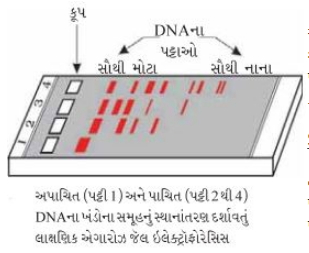
0 likes
View Solution79
Medium
Give the various methods to make bacteria a competent host.
Solution
(N/A) $DNA$ is a hydrophilic molecule,so it cannot pass through cell membranes. To force bacteria to take up plasmids,the bacterial cells must be made competent. This is achieved through the following methods:
$1$. Chemical Treatment: Bacterial cells are treated with a specific concentration of a divalent cation,such as calcium. This increases the efficiency of $DNA$ entry through pores in the cell wall.
$2$. Heat Shock Method: $r-DNA$ is forced into these cells by incubating them with recombinant $DNA$ on ice,followed by a brief heat shock at $42^{\circ} C$,and then placing them back on ice. This enables the bacteria to take up the recombinant $DNA$.
$3$. Micro-injection: Recombinant $DNA$ is directly injected into the nucleus of an animal cell.
$4$. Biolistics (Gene Gun): Cells are bombarded with high-velocity micro-particles of gold or tungsten coated with $DNA$.
$5$. Disarmed Pathogen Vectors: These vectors are allowed to infect cells,thereby transferring the recombinant $DNA$ into the host.
$6$. Electroporation: Cells are subjected to high-voltage electric pulses to make the cell membrane permeable for $DNA$ entry.
$7$. Lipofection: Recombinant $DNA$ is encapsulated in a lipid layer,allowing it to pass through the cell membrane.
$1$. Chemical Treatment: Bacterial cells are treated with a specific concentration of a divalent cation,such as calcium. This increases the efficiency of $DNA$ entry through pores in the cell wall.
$2$. Heat Shock Method: $r-DNA$ is forced into these cells by incubating them with recombinant $DNA$ on ice,followed by a brief heat shock at $42^{\circ} C$,and then placing them back on ice. This enables the bacteria to take up the recombinant $DNA$.
$3$. Micro-injection: Recombinant $DNA$ is directly injected into the nucleus of an animal cell.
$4$. Biolistics (Gene Gun): Cells are bombarded with high-velocity micro-particles of gold or tungsten coated with $DNA$.
$5$. Disarmed Pathogen Vectors: These vectors are allowed to infect cells,thereby transferring the recombinant $DNA$ into the host.
$6$. Electroporation: Cells are subjected to high-voltage electric pulses to make the cell membrane permeable for $DNA$ entry.
$7$. Lipofection: Recombinant $DNA$ is encapsulated in a lipid layer,allowing it to pass through the cell membrane.
0 likes
View Solution80
Medium
Which steps are included in recombinant $DNA$ technology mechanism?
Solution
(N/A) Recombinant $DNA$ technology involves several steps in a specific sequence:
$1$. Isolation of the genetic material $(DNA)$.
$2$. Fragmentation of $DNA$ by restriction endonucleases.
$3$. Isolation of a desired $DNA$ fragment.
$4$. Ligation of the $DNA$ fragment into a vector.
$5$. Transferring the recombinant $DNA$ into the host.
$6$. Culturing the host cells in a medium at a large scale.
$7$. Extraction of the desired product.
$1$. Isolation of the genetic material $(DNA)$.
$2$. Fragmentation of $DNA$ by restriction endonucleases.
$3$. Isolation of a desired $DNA$ fragment.
$4$. Ligation of the $DNA$ fragment into a vector.
$5$. Transferring the recombinant $DNA$ into the host.
$6$. Culturing the host cells in a medium at a large scale.
$7$. Extraction of the desired product.
0 likes
View Solution81
Medium
Describe the method for the isolation of genetic material,$DNA$.
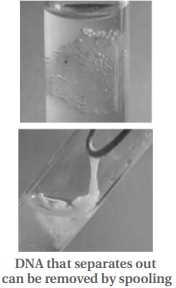
Solution
(N/A) Nucleic acid is the genetic material of all organisms without exception. In the majority of organisms,it is $DNA$.
To cut the $DNA$ with restriction enzymes,it needs to be in a pure form,free from other macromolecules.
Since $DNA$ is enclosed within membranes,we must break the cell open to release $DNA$ along with other macromolecules such as $RNA$,proteins,polysaccharides,and lipids.
This is achieved by treating the bacterial cells,plant,or animal tissue with specific enzymes: lysozyme for bacteria,cellulase for plant cells,and chitinase for fungus.
$RNA$ can be removed by treatment with ribonuclease,whereas proteins can be removed by treatment with protease.
Other molecules are removed by various treatments,and the purified $DNA$ ultimately precipitates out after the addition of chilled ethanol. This can be observed as a collection of fine threads in the suspension,which can be removed by spooling.
To cut the $DNA$ with restriction enzymes,it needs to be in a pure form,free from other macromolecules.
Since $DNA$ is enclosed within membranes,we must break the cell open to release $DNA$ along with other macromolecules such as $RNA$,proteins,polysaccharides,and lipids.
This is achieved by treating the bacterial cells,plant,or animal tissue with specific enzymes: lysozyme for bacteria,cellulase for plant cells,and chitinase for fungus.
$RNA$ can be removed by treatment with ribonuclease,whereas proteins can be removed by treatment with protease.
Other molecules are removed by various treatments,and the purified $DNA$ ultimately precipitates out after the addition of chilled ethanol. This can be observed as a collection of fine threads in the suspension,which can be removed by spooling.
0 likes
View Solution82
Medium
Explain how the synthesis of a gene of interest is performed using $PCR$.
Solution
(N/A) $PCR$ stands for $\text{Polymerase Chain Reaction}$. In this reaction,multiple copies of the gene (or $DNA$) of interest are synthesized in vitro using two sets of primers (small chemically synthesized oligonucleotides that are complementary to the regions of $DNA$) and the enzyme $DNA$ polymerase.
The enzyme extends the primers using the nucleotides provided in the reaction and the genomic $DNA$ as a template. If the process of replication of $DNA$ is repeated many times,the segment of $DNA$ can be amplified to approximately $1$ billion times.
Such repeated amplification is achieved by the use of a thermostable $DNA$ polymerase (isolated from a bacterium,$\text{Thermus aquaticus}$),which remains active during the high-temperature-induced denaturation of double-stranded $DNA$. The amplified fragment,if desired,can now be used to ligate with a vector for further cloning.
The enzyme extends the primers using the nucleotides provided in the reaction and the genomic $DNA$ as a template. If the process of replication of $DNA$ is repeated many times,the segment of $DNA$ can be amplified to approximately $1$ billion times.
Such repeated amplification is achieved by the use of a thermostable $DNA$ polymerase (isolated from a bacterium,$\text{Thermus aquaticus}$),which remains active during the high-temperature-induced denaturation of double-stranded $DNA$. The amplified fragment,if desired,can now be used to ligate with a vector for further cloning.
0 likes
View Solution83
Easy
Explain $PCR$ in short.
Solution
(N/A) $PCR$ stands for Polymerase Chain Reaction. In this reaction,multiple copies of the gene (or $DNA$) of interest are synthesized in vitro using two sets of primers (small chemically synthesized oligonucleotides that are complementary to the regions of $DNA$) and the enzyme $DNA$ polymerase.
The enzyme extends the primers using the nucleotides provided in the reaction and the genomic $DNA$ as a template. If the process of replication of $DNA$ is repeated many times,the segment of $DNA$ can be amplified to approximately $1$ billion times. Such repeated amplification is achieved by the use of a thermostable $DNA$ polymerase (isolated from a bacterium,Thermus aquaticus),which remains active during the high-temperature-induced denaturation of double-stranded $DNA$. The amplified fragment,if desired,can now be used to ligate with a vector for further cloning.
The enzyme extends the primers using the nucleotides provided in the reaction and the genomic $DNA$ as a template. If the process of replication of $DNA$ is repeated many times,the segment of $DNA$ can be amplified to approximately $1$ billion times. Such repeated amplification is achieved by the use of a thermostable $DNA$ polymerase (isolated from a bacterium,Thermus aquaticus),which remains active during the high-temperature-induced denaturation of double-stranded $DNA$. The amplified fragment,if desired,can now be used to ligate with a vector for further cloning.
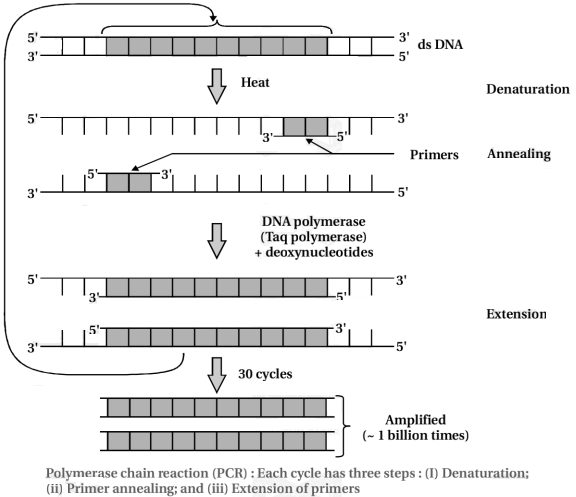
0 likes
View Solution84
Easy
Explain how recombinant $DNA$ is introduced into a host cell or a living organism.
Solution
(N/A) There are several methods for introducing ligated $DNA$ into recipient cells. Recipient cells,after being made competent,can take up $DNA$ present in their surroundings.
If a recombinant $DNA$ molecule carrying a gene for antibiotic resistance (e.g.,ampicillin resistance) is transferred into $E. coli$ cells,the host cells become transformed into ampicillin-resistant cells.
When these transformed cells are spread on agar plates containing ampicillin,only the transformants will grow,while untransformed recipient cells will die.
Because of the ampicillin resistance gene,it is possible to select the transformed cells in the presence of ampicillin. In this context,the ampicillin resistance gene is referred to as a selectable marker.
If a recombinant $DNA$ molecule carrying a gene for antibiotic resistance (e.g.,ampicillin resistance) is transferred into $E. coli$ cells,the host cells become transformed into ampicillin-resistant cells.
When these transformed cells are spread on agar plates containing ampicillin,only the transformants will grow,while untransformed recipient cells will die.
Because of the ampicillin resistance gene,it is possible to select the transformed cells in the presence of ampicillin. In this context,the ampicillin resistance gene is referred to as a selectable marker.
0 likes
View Solution85
MediumMCQ
How can a recombinant protein be obtained?
A
By expressing a foreign gene in a heterologous host.
B
By extracting $DNA$ from a host cell.
C
By using restriction enzymes only.
D
By cloning the entire genome of the host.
Solution
(A) When you insert a piece of alien $DNA$ into a cloning vector and transfer it into a bacterial,plant,or animal cell,the alien $DNA$ gets multiplied.
$\Rightarrow$ In almost all recombinant technologies,the ultimate aim is to produce a desirable protein. Hence,there is a need for the recombinant $DNA$ to be expressed.
The foreign gene gets expressed under appropriate conditions.
If any protein-encoding gene is expressed in a heterologous host,it is called a recombinant protein.
$\Rightarrow$ The cells harbouring cloned genes of interest may be grown on a small scale in the laboratory.
$\Rightarrow$ The cultures may be used for extracting the desired protein and then purifying it by using different separation techniques.
The cells can also be multiplied in a continuous culture system wherein the used medium is drained out from one side while fresh medium is added from the other to maintain the cells in their physiologically most active log/exponential phase. This type of culturing method produces a larger biomass,leading to higher yields of the desired protein.
$\Rightarrow$ In almost all recombinant technologies,the ultimate aim is to produce a desirable protein. Hence,there is a need for the recombinant $DNA$ to be expressed.
The foreign gene gets expressed under appropriate conditions.
If any protein-encoding gene is expressed in a heterologous host,it is called a recombinant protein.
$\Rightarrow$ The cells harbouring cloned genes of interest may be grown on a small scale in the laboratory.
$\Rightarrow$ The cultures may be used for extracting the desired protein and then purifying it by using different separation techniques.
The cells can also be multiplied in a continuous culture system wherein the used medium is drained out from one side while fresh medium is added from the other to maintain the cells in their physiologically most active log/exponential phase. This type of culturing method produces a larger biomass,leading to higher yields of the desired protein.
0 likes
View Solution86
Easy
Give information about bioreactors.
Solution
(N/A) Small volume cultures cannot yield appreciable quantities of products. To produce in large quantities,the development of bioreactors,where large volumes ($100$-$1000$ litres) of culture can be processed,was required.
Bioreactors can be thought of as vessels in which raw materials are biologically converted into specific products,individual enzymes,etc.,using microbial,plant,animal,or human cells.
$A$ bioreactor provides the optimal conditions for achieving the desired product by providing optimum growth conditions (temperature,$pH$,substrate,salts,vitamins,oxygen).
The most commonly used bioreactors are of the stirring type.
$A$ stirred-tank reactor is usually cylindrical or has a curved base to facilitate the mixing of the reactor contents.
The stirrer facilitates even mixing and oxygen availability throughout the bioreactor. Alternatively,air can be bubbled through the reactor.
The bioreactor has an agitator system,an oxygen delivery system,a foam control system,a temperature control system,a $pH$ control system,and sampling ports so that small volumes of the culture can be withdrawn periodically.
Bioreactors can be thought of as vessels in which raw materials are biologically converted into specific products,individual enzymes,etc.,using microbial,plant,animal,or human cells.
$A$ bioreactor provides the optimal conditions for achieving the desired product by providing optimum growth conditions (temperature,$pH$,substrate,salts,vitamins,oxygen).
The most commonly used bioreactors are of the stirring type.
$A$ stirred-tank reactor is usually cylindrical or has a curved base to facilitate the mixing of the reactor contents.
The stirrer facilitates even mixing and oxygen availability throughout the bioreactor. Alternatively,air can be bubbled through the reactor.
The bioreactor has an agitator system,an oxygen delivery system,a foam control system,a temperature control system,a $pH$ control system,and sampling ports so that small volumes of the culture can be withdrawn periodically.
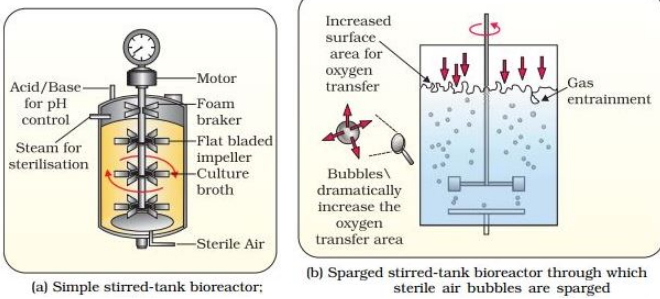
0 likes
View Solution87
Easy
Explain downstream processing.
Solution
(N/A) After the completion of the biosynthetic stage,the product must undergo a series of processes before it is ready for marketing as a finished product.
The processes include separation and purification,which are collectively referred to as downstream processing.
$\rightarrow$ The product must be formulated with suitable preservatives.
$\rightarrow$ Such formulations must undergo thorough clinical trials,as in the case of drugs.
Strict quality control testing for each product is also required.
The downstream processing and quality control testing vary from product to product.
The processes include separation and purification,which are collectively referred to as downstream processing.
$\rightarrow$ The product must be formulated with suitable preservatives.
$\rightarrow$ Such formulations must undergo thorough clinical trials,as in the case of drugs.
Strict quality control testing for each product is also required.
The downstream processing and quality control testing vary from product to product.
0 likes
View Solution88
EasyMCQ
Give scientific reasons: The products prepared by recombinant $DNA$ technology have to undergo downstream processing.
A
To increase the yield of the product.
B
To ensure the product is pure and safe for human use.
C
To reduce the cost of production.
D
To increase the shelf life of the product.
Solution
(B) Downstream processing is a crucial stage in recombinant $DNA$ technology that involves the separation and purification of the synthesized product.
$1$. Purification: The product must be isolated from the complex mixture of the bioreactor to ensure it is free from contaminants.
$2$. Quality Control: The product undergoes rigorous testing to ensure it meets safety and efficacy standards.
$3$. Formulation: The product is formulated with suitable preservatives and additives to make it stable and ready for clinical use.
$4$. Safety Assessment: Before being released for human welfare,the product is tested for potential side effects or toxicity to ensure it is safe for consumption or medical application.
$1$. Purification: The product must be isolated from the complex mixture of the bioreactor to ensure it is free from contaminants.
$2$. Quality Control: The product undergoes rigorous testing to ensure it meets safety and efficacy standards.
$3$. Formulation: The product is formulated with suitable preservatives and additives to make it stable and ready for clinical use.
$4$. Safety Assessment: Before being released for human welfare,the product is tested for potential side effects or toxicity to ensure it is safe for consumption or medical application.
0 likes
View Solution89
Medium
Provide definitions/explanations for: Cloning,Elution,and Insertional Inactivation.
Solution
(N/A) $1$. Cloning: The process of creating multiple copies of a specific segment of foreign $DNA$ by inserting it into a suitable vector and allowing it to replicate within a host organism.
$2$. Elution: The process of extracting the separated $DNA$ fragments from the agarose gel after gel electrophoresis. The specific $DNA$ band is cut out from the gel and the $DNA$ is purified from the gel piece.
$3$. Insertional Inactivation: $A$ method used to identify recombinant colonies. When a foreign gene is inserted into a selectable marker gene (e.g.,an antibiotic resistance gene) present in the plasmid,the marker gene becomes inactivated. This loss of function allows for the differentiation between recombinant and non-recombinant cells.
$2$. Elution: The process of extracting the separated $DNA$ fragments from the agarose gel after gel electrophoresis. The specific $DNA$ band is cut out from the gel and the $DNA$ is purified from the gel piece.
$3$. Insertional Inactivation: $A$ method used to identify recombinant colonies. When a foreign gene is inserted into a selectable marker gene (e.g.,an antibiotic resistance gene) present in the plasmid,the marker gene becomes inactivated. This loss of function allows for the differentiation between recombinant and non-recombinant cells.
0 likes
View Solution90
MediumMCQ
What does 'competent' refer to in competent cells used in transformation experiments?
A
Cells that are able to divide rapidly.
B
Cells that have been treated with $CaCl_2$ to take up foreign $DNA$.
C
Cells that have high resistance to antibiotics.
D
Cells that can survive in extreme temperatures.
Solution
(B) In transformation experiments,'competent' refers to the ability of bacterial cells to take up foreign $DNA$ from their surroundings.
Normally,$DNA$ is a hydrophilic molecule and cannot pass through cell membranes.
To facilitate this,bacterial cells are treated with a specific concentration of a divalent cation,such as $CaCl_2$,which increases the efficiency with which $DNA$ enters the bacterium through pores in its cell wall.
Normally,$DNA$ is a hydrophilic molecule and cannot pass through cell membranes.
To facilitate this,bacterial cells are treated with a specific concentration of a divalent cation,such as $CaCl_2$,which increases the efficiency with which $DNA$ enters the bacterium through pores in its cell wall.
0 likes
View Solution91
EasyMCQ
What is the significance of adding proteases at the time of isolation of genetic material $(DNA)$?
A
To break down cell wall components
B
To degrade proteins associated with $DNA$
C
To remove $RNA$ contaminants
D
To precipitate $DNA$ from the solution
Solution
(B) The role of proteases is to degrade the proteins present inside a cell from which $DNA$ is being isolated.
Proteins are often associated with $DNA$ (e.g.,histones) or present as cellular debris.
If these proteins are not removed,they can interfere with downstream processes such as the action of restriction endonucleases or $DNA$ ligases during recombinant $DNA$ technology.
Proteins are often associated with $DNA$ (e.g.,histones) or present as cellular debris.
If these proteins are not removed,they can interfere with downstream processes such as the action of restriction endonucleases or $DNA$ ligases during recombinant $DNA$ technology.
0 likes
View Solution92
MediumMCQ
While doing a $PCR$,the 'denaturation' step is missed. What will be its effect on the process?
A
The process will continue normally.
B
Primers will not anneal to the template $DNA$.
C
The $DNA$ polymerase will work faster.
D
The $DNA$ will be amplified exponentially.
Solution
(B) The $PCR$ process relies on the denaturation step to separate the double-stranded $DNA$ into single strands at high temperatures (around $94-98^{\circ}C$).
If the denaturation step is missed,the $DNA$ remains double-stranded.
Consequently,the primers cannot bind (anneal) to the complementary sequences on the template $DNA$.
As a result,the $DNA$ polymerase cannot initiate the extension process,and no amplification of the target $DNA$ sequence will occur.
If the denaturation step is missed,the $DNA$ remains double-stranded.
Consequently,the primers cannot bind (anneal) to the complementary sequences on the template $DNA$.
As a result,the $DNA$ polymerase cannot initiate the extension process,and no amplification of the target $DNA$ sequence will occur.
0 likes
View Solution93
MediumMCQ
What is meant by gene cloning?
A
The process of creating identical copies of a specific gene or $DNA$ fragment.
B
The process of synthesizing proteins from mRNA.
C
The process of sequencing the entire genome of an organism.
D
The process of transferring genes between different species.
Solution
(A) Gene cloning is a molecular biology technique used to produce multiple identical copies of a specific gene or $DNA$ fragment.
$1$. The process begins by isolating the gene of interest and ligating it into a suitable vector (such as a plasmid).
$2$. This creates a recombinant $DNA$ molecule.
$3$. The recombinant $DNA$ is then introduced into a host cell (usually a bacterium) through a process called transformation.
$4$. As the host cell divides,the recombinant $DNA$ is replicated along with the host's genome.
$5$. Eventually,a bacterial colony is formed where each cell contains multiple copies of the cloned gene.
$1$. The process begins by isolating the gene of interest and ligating it into a suitable vector (such as a plasmid).
$2$. This creates a recombinant $DNA$ molecule.
$3$. The recombinant $DNA$ is then introduced into a host cell (usually a bacterium) through a process called transformation.
$4$. As the host cell divides,the recombinant $DNA$ is replicated along with the host's genome.
$5$. Eventually,a bacterial colony is formed where each cell contains multiple copies of the cloned gene.
0 likes
View Solution94
Medium
Diagrammatically represent the experimental steps in cloning and expressing a human gene (e.g.,the gene for growth hormone) in a bacterium like $E. coli$.
Solution
(N/A) The process of cloning and expressing a human gene in $E. coli$ involves the following steps:
$1$. Isolation of the target gene: The human gene encoding for growth hormone is isolated using restriction enzymes.
$2$. Selection of a vector: $A$ suitable cloning vector,such as a plasmid,is chosen.
$3$. Construction of recombinant $DNA$: The human gene is inserted into the vector using $DNA$ ligase to form recombinant $DNA$.
$4$. Transformation: The recombinant $DNA$ is introduced into the host bacterium,$E. coli$.
$5$. Selection and Screening: Transformed bacteria are selected using antibiotic resistance markers.
$6$. Expression: The $E. coli$ cells are cultured under optimal conditions to express the human growth hormone protein.
$1$. Isolation of the target gene: The human gene encoding for growth hormone is isolated using restriction enzymes.
$2$. Selection of a vector: $A$ suitable cloning vector,such as a plasmid,is chosen.
$3$. Construction of recombinant $DNA$: The human gene is inserted into the vector using $DNA$ ligase to form recombinant $DNA$.
$4$. Transformation: The recombinant $DNA$ is introduced into the host bacterium,$E. coli$.
$5$. Selection and Screening: Transformed bacteria are selected using antibiotic resistance markers.
$6$. Expression: The $E. coli$ cells are cultured under optimal conditions to express the human growth hormone protein.
0 likes
View Solution95
Medium
Can a disease be detected before its symptoms appear? Explain the principle involved.
Solution
(N/A) Yes,a disease can be detected before its symptoms appear.
Normally,the presence of a pathogen (bacteria,viruses,etc.) is suspected only when it has produced disease symptoms. By this time,the concentration of the pathogen is already very high in the body.
However,a very low concentration of a bacteria or virus can be detected even when symptoms are not yet visible.
The principle involved is the amplification of their nucleic acid ($DNA$ or $RNA$) using $PCR$ (Polymerase Chain Reaction).
$PCR$ creates millions of copies of the specific $DNA$ sequence of the pathogen,making it detectable even if the initial sample contains only a few copies.
Normally,the presence of a pathogen (bacteria,viruses,etc.) is suspected only when it has produced disease symptoms. By this time,the concentration of the pathogen is already very high in the body.
However,a very low concentration of a bacteria or virus can be detected even when symptoms are not yet visible.
The principle involved is the amplification of their nucleic acid ($DNA$ or $RNA$) using $PCR$ (Polymerase Chain Reaction).
$PCR$ creates millions of copies of the specific $DNA$ sequence of the pathogen,making it detectable even if the initial sample contains only a few copies.
0 likes
View Solution96
Medium
$PCR$ is a useful tool for the early diagnosis of an infectious disease. Elaborate.
Solution
(N/A) $PCR$ (Polymerase Chain Reaction) is a highly sensitive technique that allows for the specific amplification of a target $DNA$ sequence from a very small amount of $DNA$ template. Because of this high sensitivity,it can detect the presence of pathogenic organisms in an infected patient at a very early stage of infection,even before the pathogen has multiplied to a large number in the host's body.
0 likes
View Solution97
Easy
Discuss briefly how a probe is used in molecular diagnostics.
Solution
(N/A) single-stranded $DNA$ or $RNA$,tagged with a radioactive molecule (probe),is allowed to hybridize to its complementary $DNA$ in a clone of cells,followed by detection using autoradiography.
The clone having the mutated gene will not appear on the photographic film because the probe will not have complementarity with the mutated gene.
The clone having the mutated gene will not appear on the photographic film because the probe will not have complementarity with the mutated gene.
0 likes
View Solution98
Medium
$A$ recombinant $DNA$ molecule was created by ligating a gene to a plasmid vector. By mistake,an exonuclease was added to the tube containing the recombinant $DNA$. How does this affect the next step in the experiment,i.e.,bacterial transformation?
Solution
(D) The experiment will not be affected because the recombinant $DNA$ molecule is a circular,closed structure with no free ends.
Exonucleases are enzymes that remove nucleotides specifically from the free ends of $DNA$ molecules.
Since the recombinant plasmid $DNA$ lacks free $3'$ or $5'$ ends,it will not act as a substrate for the exonuclease enzyme.
Therefore,the integrity of the recombinant $DNA$ remains intact,and the bacterial transformation process can proceed as planned.
Exonucleases are enzymes that remove nucleotides specifically from the free ends of $DNA$ molecules.
Since the recombinant plasmid $DNA$ lacks free $3'$ or $5'$ ends,it will not act as a substrate for the exonuclease enzyme.
Therefore,the integrity of the recombinant $DNA$ remains intact,and the bacterial transformation process can proceed as planned.
0 likes
View Solution99
EasyMCQ
How does one visualise $DNA$ on an agarose gel?
A
By using $X$-ray diffraction
B
By staining with Ethidium Bromide followed by exposure to $UV$ light
C
By staining with Coomassie blue followed by exposure to $UV$ light
D
By using infrared light
Solution
(B) compound called Ethidium Bromide $(EtBr)$ is used to stain $DNA$ molecules.
When the agarose gel is treated with $EtBr$ and subsequently exposed to Ultraviolet $(UV)$ light,the $DNA$ fragments emit an orange fluorescence.
This allows the visualization of $DNA$ bands on the gel.
When the agarose gel is treated with $EtBr$ and subsequently exposed to Ultraviolet $(UV)$ light,the $DNA$ fragments emit an orange fluorescence.
This allows the visualization of $DNA$ bands on the gel.
0 likes
View SolutionBiotechnology Principals and Process — Process of Recombinant DNA technology · Frequently Asked Questions
1Are these Biotechnology Principals and Process questions useful for JEE and NEET?
Yes. All questions in this section are mapped to JEE Main and NEET exam patterns. Previous year questions from JEE Main, NEET, GUJCET and state-level exams are included with full solutions.
2Can I switch to Hindi or Gujarati for these questions?
Yes. Use the language tabs in the hero section or the sidebar to view the same questions and solutions in English, Hindi or Gujarati.
3How do I generate a question paper from this subtopic?
Use the Vedclass Exam Paper Generator — select the chapter and subtopic, set difficulty, and generate Sets A, B, C, D automatically. First 3 chapters of every subject are free.
Vedclass Products
For Students
Vedclass Test Series
Mock tests in real JEE/NEET style with performance analysis. 5-day free trial.
Start Free TrialFor Teachers
Exam Paper Generator
Generate Set A/B/C/D papers from this chapter in 2 minutes. 3 chapters free.
Try FreeFor Institutes
Online Exam Module
Live online exams with unlimited students, 360° analytics & white-label branding.
See DemoFor Teachers & Institutes
Generate a Biotechnology Principals and Process Exam Paper in 2 Minutes
Select subtopic & difficulty — Sets A, B, C, D auto-generated with No Repeat logic.
First 3 chapters of every subject are free — no payment required.