
A English
Process of Recombinant DNA technology Questions in English
Class 12 Biology · Biotechnology Principals and Process · Process of Recombinant DNA technology
315+
Questions
English
Language
100%
With Solutions
Showing 50 of 315 questions in English
201
MediumMCQ
Which of the following steps is/are catalysed by $Taq$ polymerase in a $PCR$?
A
Denaturation of template $DNA$
B
Annealing of primers to template $DNA$
C
Extension of primer end on template $DNA$
D
All of these
Solution
(C) The $PCR$ process consists of three main steps: $1$. Denaturation,$2$. Annealing,and $3$. Extension.
$Taq$ polymerase is a thermostable $DNA$ polymerase enzyme.
It catalyzes the addition of nucleotides to the $3'$ end of the primers,which is known as the extension step.
Denaturation is caused by high temperature,and annealing involves the binding of primers to the template $DNA$.
$Taq$ polymerase is a thermostable $DNA$ polymerase enzyme.
It catalyzes the addition of nucleotides to the $3'$ end of the primers,which is known as the extension step.
Denaturation is caused by high temperature,and annealing involves the binding of primers to the template $DNA$.
0 likes
View Solution202
MediumMCQ
The method involving the entry of high-velocity gold microparticles coated with $DNA$ into plant cells is known as:
A
Protoplast fusion
B
Transfection
C
Biolistics
D
Magic bullet action
Solution
(C) The method described is known as Biolistics or the gene gun method.
In this technique,cells are bombarded with high-velocity microparticles of gold or tungsten coated with $DNA$.
Protoplast fusion involves the fusion of two or more protoplasts,either spontaneously or in the presence of fusion-inducing chemicals like polyethylene glycol $(PEG)$.
Transfection refers to the process of deliberately introducing naked or purified nucleic acids (like $DNA$) into eukaryotic cells.
In this technique,cells are bombarded with high-velocity microparticles of gold or tungsten coated with $DNA$.
Protoplast fusion involves the fusion of two or more protoplasts,either spontaneously or in the presence of fusion-inducing chemicals like polyethylene glycol $(PEG)$.
Transfection refers to the process of deliberately introducing naked or purified nucleic acids (like $DNA$) into eukaryotic cells.
0 likes
View Solution203
MediumMCQ
Pure $DNA$ precipitated by the addition of chilled ethanol can be removed from the solution by
A
$Elution$
B
$Gel \; electrophoresis$
C
$Spooling$
D
$PCR$
Solution
(C) $Spooling$ is a technique used to collect the precipitated $DNA$ by winding it onto a glass rod at the final stage of $DNA$ extraction.
$Elution$ refers to the process of extracting separated $DNA$ fragments from an agarose gel.
$Gel \; electrophoresis$ is a laboratory method used to separate and analyze macromolecules (like $DNA$,$RNA$,or proteins) based on their size using a gel matrix.
$PCR$ $(Polymerase \; Chain \; Reaction)$ is a technique used to amplify a specific segment of $DNA$.
$Elution$ refers to the process of extracting separated $DNA$ fragments from an agarose gel.
$Gel \; electrophoresis$ is a laboratory method used to separate and analyze macromolecules (like $DNA$,$RNA$,or proteins) based on their size using a gel matrix.
$PCR$ $(Polymerase \; Chain \; Reaction)$ is a technique used to amplify a specific segment of $DNA$.
0 likes
View Solution204
MediumMCQ
The optimum temperature for polymerisation in $PCR$ is $....$ while the enzyme responsible for the mentioned step can tolerate temperatures up to $....$. Select the correct option according to the blanks.
A
$95^{\circ}C, 60^{\circ}C$
B
$94^{\circ}C, 95^{\circ}C$
C
$72^{\circ}C, 95^{\circ}C$
D
$95^{\circ}C, 72^{\circ}C$
Solution
(C) In the Polymerase Chain Reaction $(PCR)$,the extension or polymerisation step is carried out by the enzyme $Taq$ $DNA$ polymerase.
The optimum temperature for the activity of $Taq$ $DNA$ polymerase is $72^{\circ}C$.
This enzyme is isolated from the thermophilic bacterium $Thermus$ $aquaticus$,which allows it to remain stable and active even at high temperatures,tolerating temperatures up to $95^{\circ}C$ (the denaturation temperature).
Therefore,the correct values are $72^{\circ}C$ for polymerisation and $95^{\circ}C$ for enzyme tolerance.
The optimum temperature for the activity of $Taq$ $DNA$ polymerase is $72^{\circ}C$.
This enzyme is isolated from the thermophilic bacterium $Thermus$ $aquaticus$,which allows it to remain stable and active even at high temperatures,tolerating temperatures up to $95^{\circ}C$ (the denaturation temperature).
Therefore,the correct values are $72^{\circ}C$ for polymerisation and $95^{\circ}C$ for enzyme tolerance.
0 likes
View Solution205
MediumMCQ
The stirrer in a stirred-tank bioreactor facilitates:
A
Oxygen delivery from outside to inside
B
Mixing and aeration
C
Temperature control
D
Foam control
Solution
(B) stirred-tank bioreactor is designed to provide optimal growth conditions for cells or microorganisms. The primary function of the stirrer (impeller) is to ensure uniform mixing of the culture medium and to facilitate aeration by dispersing air bubbles throughout the vessel. While bioreactors have separate systems for temperature control,foam control,and pH regulation,the stirrer specifically aids in the homogenization of the contents and the distribution of oxygen.
0 likes
View Solution206
MediumMCQ
Separation and purification by filtration,centrifugation of the desired compound produced in a bioreactor is a part of:
A
Downstream processing only
B
Scaling up and downstream processing
C
Upstream processing
D
Screening for recombinants and downstream processing
Solution
(A) The process of biotechnology is divided into two main stages: Upstream processing and Downstream processing.
$1$. Upstream processing involves the preparation of the biological agent,optimization of growth conditions,and the actual fermentation process in a bioreactor.
$2$. Downstream processing refers to the stage after the completion of the biosynthetic phase (fermentation). It involves the separation and purification of the desired product,followed by formulation and quality control testing.
Therefore,the separation and purification of the desired compound produced in a bioreactor is a part of downstream processing.
$1$. Upstream processing involves the preparation of the biological agent,optimization of growth conditions,and the actual fermentation process in a bioreactor.
$2$. Downstream processing refers to the stage after the completion of the biosynthetic phase (fermentation). It involves the separation and purification of the desired product,followed by formulation and quality control testing.
Therefore,the separation and purification of the desired compound produced in a bioreactor is a part of downstream processing.
0 likes
View Solution207
MediumMCQ
Which of the following is not a method of introducing alien $DNA$ into host cells?
A
Microinjection
B
Heat shock method
C
Being placed along with the cell into a gene gun
D
Gel electrophoresis
Solution
(D) Gel electrophoresis is a technique used for the separation and analysis of macromolecules (such as $DNA$,$RNA$,and proteins) and their fragments based on their size and charge using a gel medium. It is an analytical tool,not a method for introducing foreign $DNA$ into host cells. In contrast,microinjection,heat shock,and gene gun (biolistics) are established methods for the transformation of host cells with recombinant $DNA$.
0 likes
View Solution208
MediumMCQ
During the process of isolation of $DNA$,chilled ethanol is added to
A
Remove proteins such as histone
B
Precipitate $DNA$
C
Break open the cell to release $DNA$
D
Facilitate action of restriction enzymes
Solution
(B) In the process of $DNA$ isolation,the final step involves the addition of chilled ethanol to the purified $DNA$ solution.
Chilled ethanol is used because $DNA$ is insoluble in ethanol.
When chilled ethanol is added,$DNA$ precipitates out as fine threads in the suspension.
This process is known as spooling,which allows for the collection of the purified $DNA$.
Chilled ethanol is used because $DNA$ is insoluble in ethanol.
When chilled ethanol is added,$DNA$ precipitates out as fine threads in the suspension.
This process is known as spooling,which allows for the collection of the purified $DNA$.
0 likes
View Solution209
MediumMCQ
$PCR$ is used for:
A
Reverse transcribing $RNA$ into $DNA$
B
Digesting $DNA$
C
Amplifying $DNA$
D
Amplifying proteins and separating $DNA$
Solution
(C) $PCR$ stands for Polymerase Chain Reaction.
It is a technique used in molecular biology to amplify a single copy or a few copies of a segment of $DNA$ across several orders of magnitude,generating thousands to millions of copies of a particular $DNA$ sequence.
Therefore,$PCR$ is primarily used for the amplification of $DNA$.
It is a technique used in molecular biology to amplify a single copy or a few copies of a segment of $DNA$ across several orders of magnitude,generating thousands to millions of copies of a particular $DNA$ sequence.
Therefore,$PCR$ is primarily used for the amplification of $DNA$.
0 likes
View Solution210
EasyMCQ
The method in which recombinant $DNA$ is directly injected into the nucleus of an animal cell by using microneedles is called:
A
Gene gun method
B
Biolistic method
C
Microinjection method
D
Indirect method
Solution
(C) In the microinjection method,recombinant $DNA$ is directly injected into the nucleus of an animal cell using microneedles. This technique is commonly used for animal cells. In contrast,the gene gun or biolistic method involves bombarding cells with high-velocity microparticles of gold or tungsten coated with $DNA$.
0 likes
View Solution211
MediumMCQ
Which of the following represents an advantage of growing cells in continuous culture as compared to a shake flask?
A
Cells can be maintained at a constant physiological state
B
Most downstream and upstream processes are continuous in nature
C
Continuous reactors do not need to be shut down and cleaned regularly
D
All of these
Solution
(D) In a continuous culture system,the culture medium is added continuously from one side while the used medium containing cells is drained out from the other side.
This allows the cells to be maintained in their physiologically most active log/exponential phase,which is a significant advantage over shake flasks where cells eventually enter the stationary phase due to nutrient depletion and waste accumulation.
Additionally,continuous culture systems facilitate the integration of continuous upstream and downstream processes,and they allow for long-term operation without the need for frequent shutdowns for cleaning and re-inoculation.
This allows the cells to be maintained in their physiologically most active log/exponential phase,which is a significant advantage over shake flasks where cells eventually enter the stationary phase due to nutrient depletion and waste accumulation.
Additionally,continuous culture systems facilitate the integration of continuous upstream and downstream processes,and they allow for long-term operation without the need for frequent shutdowns for cleaning and re-inoculation.
0 likes
View Solution212
MediumMCQ
$A$ : Taq Polymerase is involved in $PCR$ technique.
$R$ : This enzyme remains active during the high temperature including denaturation of double stranded $DNA$.
$R$ : This enzyme remains active during the high temperature including denaturation of double stranded $DNA$.
A
Assertion and Reason both are correct and Reason is the correct explanation of Assertion.
B
Assertion and Reason both are correct but Reason is not the correct explanation of Assertion.
C
Assertion is correct,but Reason is incorrect.
D
Both Assertion and Reason are incorrect.
Solution
(A) The $PCR$ $(Polymerase Chain Reaction)$ technique requires a thermostable $DNA$ polymerase enzyme to synthesize new $DNA$ strands.
$Taq$ Polymerase is isolated from the bacterium $Thermus$ $aquaticus$.
This enzyme is thermostable,meaning it can withstand the high temperatures (around $94-95^{\circ}C$) required for the denaturation step of $PCR$ without getting denatured itself.
Therefore,both the Assertion and the Reason are correct,and the Reason provides the correct explanation for why $Taq$ Polymerase is used in $PCR$.
$Taq$ Polymerase is isolated from the bacterium $Thermus$ $aquaticus$.
This enzyme is thermostable,meaning it can withstand the high temperatures (around $94-95^{\circ}C$) required for the denaturation step of $PCR$ without getting denatured itself.
Therefore,both the Assertion and the Reason are correct,and the Reason provides the correct explanation for why $Taq$ Polymerase is used in $PCR$.
0 likes
View Solution213
MediumMCQ
$A$: To extract $RNA$ from tomato cells,it must first be treated with cellulase,protease,and then deoxyribonuclease.
$R$: Deoxyribonuclease will digest $DNA$ while $RNA$ will be intact.
$R$: Deoxyribonuclease will digest $DNA$ while $RNA$ will be intact.
A
Assertion and Reason both are correct and Reason is the correct explanation of Assertion.
B
Assertion and Reason both are correct but Reason is not the correct explanation of Assertion.
C
Assertion is correct,but Reason is incorrect.
D
Both Assertion and Reason are incorrect.
Solution
(A) $1$. Tomato cells have a cell wall made of cellulose,which must be broken down by cellulase to release the cellular contents.
$2$. Proteins associated with the genetic material must be removed using protease.
$3$. To isolate pure $RNA$,the $DNA$ present in the cell must be degraded. Deoxyribonuclease $(DNase)$ is an enzyme that specifically digests $DNA$ but does not affect $RNA$.
$4$. Therefore,treating the mixture with $DNase$ ensures that $DNA$ is removed,leaving $RNA$ intact for extraction.
$5$. Both the Assertion and the Reason are correct,and the Reason provides the correct explanation for why $DNase$ is used in the extraction process.
$2$. Proteins associated with the genetic material must be removed using protease.
$3$. To isolate pure $RNA$,the $DNA$ present in the cell must be degraded. Deoxyribonuclease $(DNase)$ is an enzyme that specifically digests $DNA$ but does not affect $RNA$.
$4$. Therefore,treating the mixture with $DNase$ ensures that $DNA$ is removed,leaving $RNA$ intact for extraction.
$5$. Both the Assertion and the Reason are correct,and the Reason provides the correct explanation for why $DNase$ is used in the extraction process.
0 likes
View Solution214
MediumMCQ
In which of the following methods is a probe allowed to hybridize to its complementary $DNA$ in a clone of cells?
A
Gene therapy
B
Recombinant $DNA$ technology
C
Polymerase chain reaction
D
Enzyme Linked Immuno-Sorbent Assay $(ELISA)$
Solution
(B) In recombinant $DNA$ technology,a probe is allowed to hybridize to its complementary $DNA$ in a clone of cells.
This technique is often used to identify clones containing a specific gene sequence.
The cells are then detected by autoradiography.
The cells with mutated genes will not be observed on the photographic film because the probe will not be complementary to the mutated gene sequence.
This technique is often used to identify clones containing a specific gene sequence.
The cells are then detected by autoradiography.
The cells with mutated genes will not be observed on the photographic film because the probe will not be complementary to the mutated gene sequence.
0 likes
View Solution215
MediumMCQ
Gene amplification using primers can be done by
A
Microinjection
B
$ELISA$
C
Polymerase chain reaction
D
Gene gun
Solution
(C) Gene amplification using primers can be done by polymerase chain reaction $(PCR)$.
In this reaction,multiple copies of the gene of interest are synthesized in vitro using two sets of primers and the enzyme $DNA$ polymerase.
Primers are small,chemically synthesized oligonucleotides that are complementary to the regions of $DNA$.
In this reaction,multiple copies of the gene of interest are synthesized in vitro using two sets of primers and the enzyme $DNA$ polymerase.
Primers are small,chemically synthesized oligonucleotides that are complementary to the regions of $DNA$.
0 likes
View Solution216
MediumMCQ
Production of a human protein in bacteria by genetic engineering is possible because
A
Bacterial cell can carry out the $RNA$ splicing reactions
B
The human chromosome can replicate in bacterial cell
C
The mechanism of gene regulation is identical in humans and bacteria
D
The genetic code is universal
Solution
(D) The production of human proteins in bacteria is possible due to the universality of the genetic code.
This means that the same codons specify the same amino acids in almost all living organisms,from bacteria to humans.
Therefore,when a human gene is inserted into a bacterial plasmid,the bacterial machinery can successfully transcribe and translate the human $DNA$ sequence into the corresponding functional human protein.
This means that the same codons specify the same amino acids in almost all living organisms,from bacteria to humans.
Therefore,when a human gene is inserted into a bacterial plasmid,the bacterial machinery can successfully transcribe and translate the human $DNA$ sequence into the corresponding functional human protein.
0 likes
View Solution217
MediumMCQ
Palaeontologists unearthed a human skull during excavation. $A$ small fragment of the scalp tissue was still attached to it. Only a little $DNA$ could be extracted from it. If the genes of the ancient man need to be analysed,the best way of getting a sufficient amount of $DNA$ from this extract is:
A
By hybridizing the $DNA$ with a $DNA$ probe
B
By subjecting the $DNA$ to polymerase chain reaction
C
By subjecting the $DNA$ to gel electrophoresis
D
By treating the $DNA$ with restriction endonucleases
Solution
(B) The Polymerase Chain Reaction $(PCR)$ is a laboratory technique used to amplify small segments of $DNA$.
It allows for the rapid production of millions to billions of copies of a specific $DNA$ sequence from a very small initial sample.
Since only a small amount of $DNA$ was extracted from the ancient skull,$PCR$ is the most effective method to generate sufficient quantities for genetic analysis.
It allows for the rapid production of millions to billions of copies of a specific $DNA$ sequence from a very small initial sample.
Since only a small amount of $DNA$ was extracted from the ancient skull,$PCR$ is the most effective method to generate sufficient quantities for genetic analysis.
0 likes
View Solution218
MediumMCQ
$A$ probe is used in which stage of genetic engineering?
A
Cleaving $DNA$
B
Recombining $DNA$
C
Cloning
D
Screening
Solution
(D) Molecular probes are labeled $DNA$ segments,$RNA$ segments,or antibodies.
They are used to detect specific sequences or pathogens by binding to their complementary structures.
In genetic engineering,probes are primarily used during the screening process to identify transformed cells or specific gene sequences among a library of clones.
They are used to detect specific sequences or pathogens by binding to their complementary structures.
In genetic engineering,probes are primarily used during the screening process to identify transformed cells or specific gene sequences among a library of clones.
0 likes
View Solution219
MediumMCQ
In the purification process of recombinant $DNA$ technology,what does the addition of chilled ethanol precipitate?
A
$RNA$
B
$DNA$
C
Histones
D
Polysaccharides
Solution
(B) In the process of recombinant $DNA$ technology,the isolation of genetic material involves the removal of unwanted cellular components like proteins,$RNA$,and polysaccharides using specific enzymes.
Once the purified $DNA$ is obtained in the solution,it is precipitated by adding chilled ethanol.
This process results in the appearance of $DNA$ as a collection of fine threads in the suspension,which can be removed by spooling.
Once the purified $DNA$ is obtained in the solution,it is precipitated by adding chilled ethanol.
This process results in the appearance of $DNA$ as a collection of fine threads in the suspension,which can be removed by spooling.
0 likes
View Solution220
MediumMCQ
When $DNA$ fragments stained with ethidium bromide are viewed under $UV$ radiation,how do they appear?
A
Yellow bands
B
Bright orange bands
C
Dark red bands
D
Bright blue bands
Solution
(B) In the process of gel electrophoresis,$DNA$ fragments are separated based on their size.
To visualize these $DNA$ fragments,the gel is stained with a fluorescent dye called ethidium bromide $(EtBr)$.
When this gel is exposed to ultraviolet $(UV)$ radiation,the $EtBr$ intercalates into the $DNA$ and fluoresces.
Consequently,the $DNA$ fragments appear as bright orange-colored bands under $UV$ light.
To visualize these $DNA$ fragments,the gel is stained with a fluorescent dye called ethidium bromide $(EtBr)$.
When this gel is exposed to ultraviolet $(UV)$ radiation,the $EtBr$ intercalates into the $DNA$ and fluoresces.
Consequently,the $DNA$ fragments appear as bright orange-colored bands under $UV$ light.
0 likes
View Solution221
EasyMCQ
Which of the following is the correct sequence of steps in the Polymerase Chain Reaction $(PCR)$?
A
Extension,Denaturation,Annealing
B
Denaturation,Extension,Annealing
C
Denaturation,Annealing,Extension
D
Annealing,Denaturation,Extension
Solution
(C) The Polymerase Chain Reaction $(PCR)$ is a technique used to amplify a specific segment of $DNA$. It involves three main steps that are repeated in cycles:
$1$. Denaturation: The double-stranded $DNA$ is heated to a high temperature (usually around $94-95^{\circ}C$) to separate the two strands.
$2$. Annealing: The temperature is lowered (usually $50-65^{\circ}C$) to allow the primers to bind to the complementary sequences on the single-stranded $DNA$ templates.
$3$. Extension: The temperature is adjusted (usually $72^{\circ}C$) for the $Taq$ $DNA$ polymerase enzyme to synthesize the new $DNA$ strand by adding nucleotides to the primers.
Therefore,the correct sequence is Denaturation,Annealing,and Extension.
$1$. Denaturation: The double-stranded $DNA$ is heated to a high temperature (usually around $94-95^{\circ}C$) to separate the two strands.
$2$. Annealing: The temperature is lowered (usually $50-65^{\circ}C$) to allow the primers to bind to the complementary sequences on the single-stranded $DNA$ templates.
$3$. Extension: The temperature is adjusted (usually $72^{\circ}C$) for the $Taq$ $DNA$ polymerase enzyme to synthesize the new $DNA$ strand by adding nucleotides to the primers.
Therefore,the correct sequence is Denaturation,Annealing,and Extension.
0 likes
View Solution222
MediumMCQ
Which of the following is $NOT$ an application of $PCR$ (Polymerase Chain Reaction)?
A
Molecular diagnosis
B
Purification of isolated proteins
C
Gene amplification
D
Detection of gene mutations
Solution
(B) $PCR$ (Polymerase Chain Reaction) is a technique used to amplify a specific segment of $DNA$ in vitro.
Its primary applications include:
$1$. $Gene$ $amplification$: Creating millions of copies of a specific $DNA$ sequence.
$2$. $Molecular$ $diagnosis$: Detecting pathogens (like viruses or bacteria) in patients even when their concentration is very low.
$3$. $Detection$ of $gene$ $mutations$: Identifying specific genetic variations or mutations associated with diseases.
$4$. $DNA$ $fingerprinting$ and $forensic$ $analysis$.
Purification of isolated proteins is a downstream processing technique, not an application of $PCR$.
Its primary applications include:
$1$. $Gene$ $amplification$: Creating millions of copies of a specific $DNA$ sequence.
$2$. $Molecular$ $diagnosis$: Detecting pathogens (like viruses or bacteria) in patients even when their concentration is very low.
$3$. $Detection$ of $gene$ $mutations$: Identifying specific genetic variations or mutations associated with diseases.
$4$. $DNA$ $fingerprinting$ and $forensic$ $analysis$.
Purification of isolated proteins is a downstream processing technique, not an application of $PCR$.
0 likes
View Solution223
MediumMCQ
Plasmid $pBR322$ has a $PstI$ restriction enzyme site within the gene $amp^R$ that confers ampicillin resistance. If this enzyme is used for inserting a gene for $\beta$-galactosidase production and the recombinant plasmid is inserted into an $E. coli$ strain:
A
it will not be able to confer ampicillin resistance to the host cell.
B
the transformed cells will have the ability to resist ampicillin as well as produce $\beta$-galactosidase.
C
it will lead to lysis of the host cell.
D
it will be able to produce a novel protein with dual ability.
Solution
(A) The plasmid $pBR322$ contains two antibiotic resistance genes: $amp^R$ (ampicillin resistance) and $tet^R$ (tetracycline resistance).
Insertion of a foreign $DNA$ fragment at the $PstI$ restriction site,which is located within the $amp^R$ gene,results in insertional inactivation of the $amp^R$ gene.
Due to this inactivation,the recombinant plasmid loses its ability to confer ampicillin resistance to the host $E. coli$ cell.
Therefore,the transformed cells will be sensitive to ampicillin but will be able to express the inserted gene for $\beta$-galactosidase.
Insertion of a foreign $DNA$ fragment at the $PstI$ restriction site,which is located within the $amp^R$ gene,results in insertional inactivation of the $amp^R$ gene.
Due to this inactivation,the recombinant plasmid loses its ability to confer ampicillin resistance to the host $E. coli$ cell.
Therefore,the transformed cells will be sensitive to ampicillin but will be able to express the inserted gene for $\beta$-galactosidase.
0 likes
View Solution224
MediumMCQ
During the process of gene amplification using $PCR$,if very high temperature is not maintained in the beginning,then which of the following steps of $PCR$ will be affected first?
A
Annealing
B
Extension
C
Denaturation
D
Ligation
Solution
(C) The $PCR$ (Polymerase Chain Reaction) process consists of three main steps: $1$. Denaturation,$2$. Annealing,and $3$. Extension.
In the first step,Denaturation,the double-stranded $DNA$ template is heated to a very high temperature (approximately $94-98^{\circ}C$) to separate the two strands by breaking the hydrogen bonds between the complementary base pairs.
If this high temperature is not maintained at the beginning,the $DNA$ strands will not separate,and the subsequent steps (Annealing and Extension) cannot occur.
Therefore,Denaturation is the first step that will be affected.
In the first step,Denaturation,the double-stranded $DNA$ template is heated to a very high temperature (approximately $94-98^{\circ}C$) to separate the two strands by breaking the hydrogen bonds between the complementary base pairs.
If this high temperature is not maintained at the beginning,the $DNA$ strands will not separate,and the subsequent steps (Annealing and Extension) cannot occur.
Therefore,Denaturation is the first step that will be affected.
0 likes
View Solution225
Medium
Give scientific reasons: Hepatitis $B$ and Bird flu $DNA$ vaccines are called Recombinant $DNA$ vaccines.
Solution
(N/A) Hepatitis $B$ and Bird flu $DNA$ vaccines are called Recombinant $DNA$ vaccines because they are produced using recombinant $DNA$ technology. These vaccines consist of a small circular $DNA$ molecule (plasmid) into which a specific gene segment from the pathogen (virus) has been inserted. When this plasmid is introduced into the host,the host cells express the specific protein encoded by the pathogen's gene,which triggers an immune response without causing the actual disease.
0 likes
View Solution226
MediumMCQ
Which one of the following statements is not true regarding the gel electrophoresis technique?
A
The separated $DNA$ fragments are stained by using ethidium bromide.
B
The presence of chromogenic substrate gives blue-coloured $DNA$ bands on the gel.
C
Bright orange-coloured bands of $DNA$ can be observed in the gel when exposed to $UV$ light.
D
The process of extraction of separated $DNA$ strands from the gel is called elution.
Solution
(B) In gel electrophoresis,$DNA$ fragments are separated based on their size through a sieving effect provided by the agarose gel.
To visualize the $DNA$,the gel is stained with ethidium bromide $(EtBr)$.
When the stained gel is exposed to $UV$ radiation,the $DNA$ fragments appear as bright orange-coloured bands.
Option $B$ is incorrect because chromogenic substrates are typically used in blue-white screening for recombinant colonies,not for visualizing $DNA$ bands in gel electrophoresis.
The extraction of $DNA$ bands from the agarose gel is indeed known as elution.
To visualize the $DNA$,the gel is stained with ethidium bromide $(EtBr)$.
When the stained gel is exposed to $UV$ radiation,the $DNA$ fragments appear as bright orange-coloured bands.
Option $B$ is incorrect because chromogenic substrates are typically used in blue-white screening for recombinant colonies,not for visualizing $DNA$ bands in gel electrophoresis.
The extraction of $DNA$ bands from the agarose gel is indeed known as elution.
0 likes
View Solution227
EasyMCQ
In this process,$DNA$ fragments are transferred from the gel to a synthetic membrane.
A
Electrophoresis
B
Blotting
C
$PCR$
D
Restriction digestion
Solution
(B) The process of transferring $DNA$ fragments from an agarose gel to a synthetic membrane (such as nitrocellulose or nylon) is known as blotting (specifically Southern blotting).
$1$. Electrophoresis is used to separate $DNA$ fragments based on their size.
$2$. $PCR$ (Polymerase Chain Reaction) is used for the amplification of $DNA$ segments.
$3$. Restriction digestion is the process of cutting $DNA$ molecules into smaller fragments using restriction enzymes.
Therefore,the correct process described is blotting.
$1$. Electrophoresis is used to separate $DNA$ fragments based on their size.
$2$. $PCR$ (Polymerase Chain Reaction) is used for the amplification of $DNA$ segments.
$3$. Restriction digestion is the process of cutting $DNA$ molecules into smaller fragments using restriction enzymes.
Therefore,the correct process described is blotting.
0 likes
View Solution228
MediumMCQ
In this technique,large quantities of biotechnological products such as antibiotics,vaccines,and enzymes are produced by maintaining and growing only the desired microbes/eukaryotic cells in a sterile environment.
A
$PCR$
B
Bioprocess engineering
C
Electrophoresis
D
Genetic engineering
Solution
(B) Bioprocess engineering is the technique that involves the maintenance of sterile conditions in chemical engineering processes to enable the growth of only the desired microbe or eukaryotic cell in large quantities for the manufacture of biotechnological products like antibiotics,vaccines,and enzymes.
0 likes
View Solution229
MediumMCQ
Which of the following steps is $NOT$ used in the creation of Genetically Modified Organisms ($GMO$s)?
A
Identification of $DNA$ with desirable genes
B
Hybridization between two parents with desirable traits
C
Introduction of the identified $DNA$ into the host
D
Maintenance of introduced $DNA$ in the host and transfer of the $DNA$ to its progeny
Solution
(B) The creation of Genetically Modified Organisms ($GMO$s) involves recombinant $DNA$ technology,which includes:
$1$. Identification of $DNA$ with desirable genes.
$2$. Introduction of the identified $DNA$ into the host.
$3$. Maintenance of introduced $DNA$ in the host and transfer of the $DNA$ to its progeny.
Hybridization between two parents with desirable traits is a traditional plant breeding method,not a step in the creation of $GMO$s via genetic engineering.
$1$. Identification of $DNA$ with desirable genes.
$2$. Introduction of the identified $DNA$ into the host.
$3$. Maintenance of introduced $DNA$ in the host and transfer of the $DNA$ to its progeny.
Hybridization between two parents with desirable traits is a traditional plant breeding method,not a step in the creation of $GMO$s via genetic engineering.
0 likes
View Solution230
MediumMCQ
$DNA$ fragments can be separated by using which of the following techniques?
A
Ligase
B
$DNA$ polymerase
C
Agarose gel electrophoresis
D
Helicase
Solution
(C) $DNA$ fragments are negatively charged molecules.
In the technique of agarose gel electrophoresis,$DNA$ fragments are separated based on their size through a sieving effect provided by the agarose gel matrix.
When an electric field is applied,the $DNA$ fragments move towards the anode (positive electrode).
The smaller fragments move faster and travel further through the gel compared to larger fragments.
In the technique of agarose gel electrophoresis,$DNA$ fragments are separated based on their size through a sieving effect provided by the agarose gel matrix.
When an electric field is applied,the $DNA$ fragments move towards the anode (positive electrode).
The smaller fragments move faster and travel further through the gel compared to larger fragments.
0 likes
View Solution231
MediumMCQ
When $DNA$ fragments are stained with ethidium bromide and viewed under $UV$ light,what color do they appear?
A
Red
B
White
C
Orange
D
Yellow
Solution
(C) Ethidium bromide $(EtBr)$ is a fluorescent dye used to visualize $DNA$ fragments in agarose gel electrophoresis.
When the gel is exposed to $UV$ light,the $EtBr$ molecules that have intercalated into the $DNA$ double helix absorb the $UV$ radiation and emit light in the orange-red spectrum.
Therefore,the $DNA$ bands appear as bright orange-colored bands under $UV$ light.
When the gel is exposed to $UV$ light,the $EtBr$ molecules that have intercalated into the $DNA$ double helix absorb the $UV$ radiation and emit light in the orange-red spectrum.
Therefore,the $DNA$ bands appear as bright orange-colored bands under $UV$ light.
0 likes
View Solution232
MediumMCQ
What is the process of elution?
A
Joining of $DNA$ fragments
B
Cutting of $DNA$ fragments
C
Staining of $DNA$ fragments
D
Extracting $DNA$ bands from the agarose gel
Solution
(D) Elution is a technique used in gel electrophoresis to recover $DNA$ fragments from an agarose gel.
After the $DNA$ fragments are separated by electrophoresis and visualized (usually by staining with ethidium bromide and exposure to $UV$ light),the specific $DNA$ bands of interest are cut out from the agarose gel.
These gel pieces containing the $DNA$ are then processed to extract and purify the $DNA$ fragments,a process known as elution.
After the $DNA$ fragments are separated by electrophoresis and visualized (usually by staining with ethidium bromide and exposure to $UV$ light),the specific $DNA$ bands of interest are cut out from the agarose gel.
These gel pieces containing the $DNA$ are then processed to extract and purify the $DNA$ fragments,a process known as elution.
0 likes
View Solution233
MediumMCQ
In which of the following wells was undigested $DNA$ loaded?
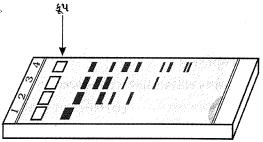
A
$1$
B
$2$
C
$3$
D
$4$
Solution
(A) In gel electrophoresis,$DNA$ fragments are separated based on their size. Undigested $DNA$ is a large,intact molecule that does not move far from the well because it is too large to pass through the pores of the agarose gel matrix efficiently. Looking at the gel image,the lane labeled $1$ shows a single,large band near the well,indicating that the $DNA$ was not cut by restriction enzymes. Lanes $2, 3,$ and $4$ show multiple smaller bands,indicating that the $DNA$ was digested into smaller fragments. Therefore,the undigested $DNA$ was loaded in well $1$.
0 likes
View Solution234
DifficultMCQ
In $pBR322$,foreign $DNA$ is inserted using the restriction enzyme $Cla\, I$. If this recombinant plasmid is introduced into bacteria,which of the following will occur regarding growth on antibiotic-containing media?
A
The bacteria will grow on ampicillin-containing medium but not on tetracycline-containing medium.
B
The bacteria will grow on tetracycline-containing medium but not on ampicillin-containing medium.
C
The bacteria will not grow on either ampicillin-containing or tetracycline-containing medium.
D
The bacteria will grow on both ampicillin-containing and tetracycline-containing medium.
Solution
(A) The plasmid $pBR322$ contains two antibiotic resistance genes: $amp^R$ (ampicillin resistance) and $tet^R$ (tetracycline resistance).
The restriction site for the enzyme $Cla\, I$ is located within the $tet^R$ gene.
When foreign $DNA$ is inserted at the $Cla\, I$ site,the $tet^R$ gene undergoes insertional inactivation,meaning it becomes non-functional.
Consequently,the bacteria containing this recombinant plasmid will lose their resistance to tetracycline.
However,the $amp^R$ gene remains intact and functional.
Therefore,the transformed bacteria will be able to grow on ampicillin-containing medium but will fail to grow on tetracycline-containing medium.
The restriction site for the enzyme $Cla\, I$ is located within the $tet^R$ gene.
When foreign $DNA$ is inserted at the $Cla\, I$ site,the $tet^R$ gene undergoes insertional inactivation,meaning it becomes non-functional.
Consequently,the bacteria containing this recombinant plasmid will lose their resistance to tetracycline.
However,the $amp^R$ gene remains intact and functional.
Therefore,the transformed bacteria will be able to grow on ampicillin-containing medium but will fail to grow on tetracycline-containing medium.
0 likes
View Solution235
MediumMCQ
To introduce recombinant $DNA$ into a host cell,it is first kept on ice,then placed at ........ temperature,and finally placed back on ice. (in $^{\circ} C$)
A
$90$
B
$30$
C
$42$
D
$70$
Solution
(C) The process of introducing recombinant $DNA$ into a host cell is known as transformation.
To facilitate the uptake of $DNA$ by the host cell (like $E. coli$),the cells are treated with a divalent cation such as calcium $(Ca^{2+})$.
This increases the efficiency with which $DNA$ enters the bacterium through pores in its cell wall.
Recombinant $DNA$ can then be forced into such cells by incubating the cells with recombinant $DNA$ on ice,followed by placing them briefly at $42^{\circ} C$ (heat shock),and then putting them back on ice.
This enables the bacteria to take up the recombinant $DNA$.
To facilitate the uptake of $DNA$ by the host cell (like $E. coli$),the cells are treated with a divalent cation such as calcium $(Ca^{2+})$.
This increases the efficiency with which $DNA$ enters the bacterium through pores in its cell wall.
Recombinant $DNA$ can then be forced into such cells by incubating the cells with recombinant $DNA$ on ice,followed by placing them briefly at $42^{\circ} C$ (heat shock),and then putting them back on ice.
This enables the bacteria to take up the recombinant $DNA$.
0 likes
View Solution236
EasyMCQ
In which method is recombinant $DNA$ directly injected into the nucleus of an animal cell?
A
Electroporation
B
Microinjection
C
Biolistics
D
Lipofection
Solution
(B) Microinjection is a technique used to introduce foreign $DNA$ directly into the nucleus of an animal cell using a fine glass micropipette. This method is commonly used in animal cells because they lack a cell wall,making it easier to penetrate the cell membrane and nuclear envelope.
0 likes
View Solution237
MediumMCQ
How can purified $DNA$ be precipitated from a solution after appropriate treatment?
A
By adding chilled ethanol
B
By adding chilled methanol
C
By centrifugation
D
Both $A$ and $C$
Solution
(A) In the process of recombinant $DNA$ technology,after the removal of other macromolecules like $RNA$,proteins,and lipids using specific enzymes,the purified $DNA$ is precipitated out by adding chilled ethanol. This process is known as spooling,where the $DNA$ appears as a collection of fine threads in the suspension.
0 likes
View Solution238
MediumMCQ
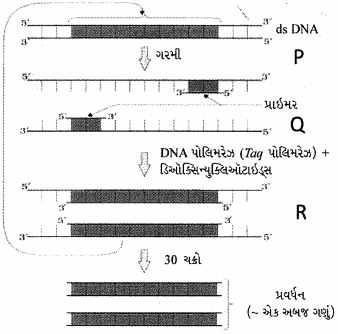
What are the temperatures required for the three steps of the Polymerase Chain Reaction $(PCR)$ shown below?
$P \quad \quad Q \quad \quad R$
$P \quad \quad Q \quad \quad R$
A
$95^{\circ}C \quad 72^{\circ}C \quad 56^{\circ}C$
B
$56^{\circ}C \quad 72^{\circ}C \quad 95^{\circ}C$
C
$72^{\circ}C \quad 56^{\circ}C \quad 95^{\circ}C$
D
$95^{\circ}C \quad 56^{\circ}C \quad 72^{\circ}C$
Solution
(D) The Polymerase Chain Reaction $(PCR)$ consists of three main steps:
$1$. Denaturation $(P)$: The double-stranded $DNA$ is heated to a high temperature of about $95^{\circ}C$ to separate the strands.
$2$. Annealing $(Q)$: The temperature is lowered to about $40-60^{\circ}C$ (typically $50-65^{\circ}C$,here $56^{\circ}C$) to allow the primers to bind to the template $DNA$.
$3$. Extension $(R)$: The temperature is raised to $72^{\circ}C$ to allow the $Taq$ $DNA$ polymerase to synthesize the new $DNA$ strand.
Therefore,the correct sequence of temperatures is $95^{\circ}C$ for $P$,$56^{\circ}C$ for $Q$,and $72^{\circ}C$ for $R$.
$1$. Denaturation $(P)$: The double-stranded $DNA$ is heated to a high temperature of about $95^{\circ}C$ to separate the strands.
$2$. Annealing $(Q)$: The temperature is lowered to about $40-60^{\circ}C$ (typically $50-65^{\circ}C$,here $56^{\circ}C$) to allow the primers to bind to the template $DNA$.
$3$. Extension $(R)$: The temperature is raised to $72^{\circ}C$ to allow the $Taq$ $DNA$ polymerase to synthesize the new $DNA$ strand.
Therefore,the correct sequence of temperatures is $95^{\circ}C$ for $P$,$56^{\circ}C$ for $Q$,and $72^{\circ}C$ for $R$.
0 likes
View Solution239
MediumMCQ
In the $PCR$ technique,how are the two strands of $DNA$ separated?
A
By high temperature
B
By helicase
C
By $Taq \, DNA$ polymerase
D
Both $A$ and $B$
Solution
(A) The $PCR$ (Polymerase Chain Reaction) technique consists of three main steps: denaturation,annealing,and extension.
In the denaturation step,the double-stranded $DNA$ is heated to a high temperature (approximately $94^{\circ}C - 96^{\circ}C$).
This high temperature breaks the hydrogen bonds between the complementary base pairs,causing the two strands of $DNA$ to separate.
Unlike in vivo replication,where helicase is used to unwind $DNA$,$PCR$ uses thermal denaturation to separate the strands.
In the denaturation step,the double-stranded $DNA$ is heated to a high temperature (approximately $94^{\circ}C - 96^{\circ}C$).
This high temperature breaks the hydrogen bonds between the complementary base pairs,causing the two strands of $DNA$ to separate.
Unlike in vivo replication,where helicase is used to unwind $DNA$,$PCR$ uses thermal denaturation to separate the strands.
0 likes
View Solution240
MediumMCQ
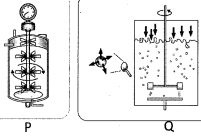
Identify the following bioreactors.
$P \quad\quad Q$
$P \quad\quad Q$
A
Sparged stirred-tank bioreactor $\quad$ Simple stirred-tank bioreactor
B
Simple stirred-tank bioreactor $\quad$ Sparged stirred-tank bioreactor
C
Simple stirred-tank bioreactor $\quad$ Combined stirred-tank bioreactor
D
Combined stirred-tank bioreactor $\quad$ Simple stirred-tank bioreactor
Solution
(B) In a simple stirred-tank bioreactor (represented by $P$),the stirrer facilitates even mixing and oxygen availability throughout the bioreactor.
In a sparged stirred-tank bioreactor (represented by $Q$),sterile air bubbles are sparged from the bottom,which increases the oxygen transfer surface area.
Therefore,$P$ is a simple stirred-tank bioreactor and $Q$ is a sparged stirred-tank bioreactor.
In a sparged stirred-tank bioreactor (represented by $Q$),sterile air bubbles are sparged from the bottom,which increases the oxygen transfer surface area.
Therefore,$P$ is a simple stirred-tank bioreactor and $Q$ is a sparged stirred-tank bioreactor.
0 likes
View Solution241
MediumMCQ
Which of the following is $NOT$ included in the downstream processing of recombinant $DNA$ technology?
A
Separation of products
B
Purification of products
C
Preservation of products with preservatives
D
Expression of the desired gene to produce the product
Solution
(D) Downstream processing in recombinant $DNA$ technology refers to the processes that occur after the product is synthesized in the bioreactor.
It primarily includes the separation,purification,quality control,and preservation of the products.
The expression of the desired gene to produce the product is a part of 'upstream processing',which occurs within the bioreactor.
Therefore,option $D$ is the correct answer.
It primarily includes the separation,purification,quality control,and preservation of the products.
The expression of the desired gene to produce the product is a part of 'upstream processing',which occurs within the bioreactor.
Therefore,option $D$ is the correct answer.
0 likes
View Solution242
DifficultMCQ
When a protein-encoding gene is expressed in a heterologous host, it is called a:
A
Transgenic protein
B
Heterologous protein
C
Recombinant protein
D
Exogenous protein
Solution
(C) When a protein-encoding gene is expressed in a heterologous host, the protein produced is referred to as a $Recombinant$ $protein$.
This is a fundamental principle of biotechnology where the gene of interest is inserted into a vector and then introduced into a host organism (like $E. coli$ or yeast) to produce the desired protein in large quantities.
This is a fundamental principle of biotechnology where the gene of interest is inserted into a vector and then introduced into a host organism (like $E. coli$ or yeast) to produce the desired protein in large quantities.
0 likes
View Solution243
DifficultMCQ
How many types of primers are required for the amplification of a gene in $PCR$?
A
$1$
B
$2$
C
$3$
D
$4$
Solution
(B) $PCR$ (Polymerase Chain Reaction) is a technique used to amplify a specific $DNA$ segment.
It requires two sets of small,chemically synthesized oligonucleotides that are complementary to the regions of the $DNA$ template.
These two primers are known as the forward primer and the reverse primer.
They bind to the $3'$ ends of the two strands of the denatured $DNA$,allowing the $DNA$ polymerase to extend the sequence.
Therefore,$2$ types of primers are required for the amplification process.
It requires two sets of small,chemically synthesized oligonucleotides that are complementary to the regions of the $DNA$ template.
These two primers are known as the forward primer and the reverse primer.
They bind to the $3'$ ends of the two strands of the denatured $DNA$,allowing the $DNA$ polymerase to extend the sequence.
Therefore,$2$ types of primers are required for the amplification process.
0 likes
View Solution244
EasyMCQ
Identify the correct sequence of steps in the Polymerase Chain Reaction $(PCR)$.
A
Extension $\rightarrow$ Denaturation $\rightarrow$ Annealing
B
Extension $\rightarrow$ Annealing $\rightarrow$ Denaturation
C
Denaturation $\rightarrow$ Annealing $\rightarrow$ Extension
D
Denaturation $\rightarrow$ Extension $\rightarrow$ Annealing
Solution
(C) The Polymerase Chain Reaction $(PCR)$ consists of three main steps performed in a cyclic manner:
$1$. Denaturation: The double-stranded $DNA$ is heated to a high temperature (approx. $94-98^{\circ}C$) to separate the strands.
$2$. Annealing: The temperature is lowered (approx. $50-65^{\circ}C$) to allow primers to bind to the complementary sequences on the single-stranded $DNA$ templates.
$3$. Extension: The temperature is adjusted (approx. $72^{\circ}C$) for the $DNA$ polymerase enzyme to synthesize the new $DNA$ strand by adding nucleotides.
Therefore,the correct sequence is Denaturation $\rightarrow$ Annealing $\rightarrow$ Extension.
$1$. Denaturation: The double-stranded $DNA$ is heated to a high temperature (approx. $94-98^{\circ}C$) to separate the strands.
$2$. Annealing: The temperature is lowered (approx. $50-65^{\circ}C$) to allow primers to bind to the complementary sequences on the single-stranded $DNA$ templates.
$3$. Extension: The temperature is adjusted (approx. $72^{\circ}C$) for the $DNA$ polymerase enzyme to synthesize the new $DNA$ strand by adding nucleotides.
Therefore,the correct sequence is Denaturation $\rightarrow$ Annealing $\rightarrow$ Extension.
0 likes
View Solution245
DifficultMCQ
What type of method is the $PCR$ technique?
A
In vitro
B
In vivo
C
Both
D
None of these
Solution
(A) $PCR$ stands for Polymerase Chain Reaction.
It is a laboratory technique used to amplify specific $DNA$ sequences.
Since this process occurs outside of a living organism (in a test tube or reaction vessel), it is classified as an $In vitro$ method.
Therefore, the correct option is $A$.
It is a laboratory technique used to amplify specific $DNA$ sequences.
Since this process occurs outside of a living organism (in a test tube or reaction vessel), it is classified as an $In vitro$ method.
Therefore, the correct option is $A$.
0 likes
View Solution246
DifficultMCQ
How many copies of a gene can be produced from $1$ gene through $30$ cycles of $PCR$?
A
One lakh
B
$1$ billion
C
One crore
D
$1$ thousand
Solution
(B) The Polymerase Chain Reaction $(PCR)$ is a technique used to amplify a specific $DNA$ segment. The number of $DNA$ copies produced after $n$ cycles is given by the formula $2^n$.
Given that the number of cycles $n = 30$, the total number of copies produced is $2^{30}$.
$2^{10} = 1,024$ (approximately $10^3$).
$2^{30} = (2^{10})^3 \approx (10^3)^3 = 10^9$.
Therefore, $2^{30}$ is approximately $1$ billion copies.
Given that the number of cycles $n = 30$, the total number of copies produced is $2^{30}$.
$2^{10} = 1,024$ (approximately $10^3$).
$2^{30} = (2^{10})^3 \approx (10^3)^3 = 10^9$.
Therefore, $2^{30}$ is approximately $1$ billion copies.
0 likes
View Solution247
MediumMCQ
Which process takes place in a bioreactor?
A
Downstream processing
B
Upstream processing
C
Both
D
None of these
Solution
(B) bioreactor is a vessel in which raw materials are biologically converted into specific products by microbes,plant and animal cells,or their enzymes.
In the context of biotechnology,the process of preparing the culture medium and inoculating it with the desired organism is known as upstream processing.
The bioreactor provides the optimal conditions (temperature,pH,substrate,salts,vitamins,oxygen) for the growth of the organism and the production of the desired product.
Therefore,the main production phase,which involves the growth of the organism and the synthesis of the product,occurs within the bioreactor,which is a part of the upstream processing.
Downstream processing refers to the separation and purification of the product after it has been synthesized in the bioreactor.
In the context of biotechnology,the process of preparing the culture medium and inoculating it with the desired organism is known as upstream processing.
The bioreactor provides the optimal conditions (temperature,pH,substrate,salts,vitamins,oxygen) for the growth of the organism and the production of the desired product.
Therefore,the main production phase,which involves the growth of the organism and the synthesis of the product,occurs within the bioreactor,which is a part of the upstream processing.
Downstream processing refers to the separation and purification of the product after it has been synthesized in the bioreactor.
0 likes
View Solution248
MediumMCQ
$mRNA$ silencing is known as .........
A
$RNA$ activation
B
$RNAi$
C
$RNA$ without initiation codon
D
$RNA$ without termination codon
Solution
(B) $mRNA$ silencing is a method of cellular defense in all eukaryotic organisms. This method involves the silencing of a specific $mRNA$ due to a complementary $dsRNA$ molecule that binds to and prevents translation of the $mRNA$. This process is known as $RNA$ interference or $RNAi$.
0 likes
View Solution249
MediumMCQ
$PCR$ (Polymerase Chain Reaction) is used for the diagnosis of which of the following diseases?
A
Detection of $HIV$ in suspected $AIDS$ patients
B
Detection of mutations in genes in suspected cancer patients
C
Detection of genetic disorders
D
All of the above
Solution
(D) $PCR$ (Polymerase Chain Reaction) is a powerful molecular diagnostic technique used to amplify specific $DNA$ sequences.
$1$. It is used to detect $HIV$ in suspected $AIDS$ patients even when the viral load is very low.
$2$. It is used to detect mutations in genes in suspected cancer patients,which helps in early diagnosis.
$3$. It is widely used to identify genetic disorders by analyzing specific $DNA$ segments.
Therefore,all the given options are correct applications of $PCR$ in molecular diagnostics.
$1$. It is used to detect $HIV$ in suspected $AIDS$ patients even when the viral load is very low.
$2$. It is used to detect mutations in genes in suspected cancer patients,which helps in early diagnosis.
$3$. It is widely used to identify genetic disorders by analyzing specific $DNA$ segments.
Therefore,all the given options are correct applications of $PCR$ in molecular diagnostics.
0 likes
View Solution250
EasyMCQ
Separation of $DNA$ fragments is done by a technique known as:
A
Polymerase Chain Reaction
B
Recombinant technology
C
Southern blotting
D
Gel electrophoresis
Solution
(D) The separation of $DNA$ fragments based on their size is achieved through a technique called $Gel$ $electrophoresis$.
In this process,$DNA$ fragments are separated by forcing them to move through a gel matrix (usually agarose) under an electric field.
Since $DNA$ molecules are negatively charged,they move towards the anode (positive electrode).
The smaller fragments move faster and travel further through the pores of the gel compared to larger fragments,allowing for effective separation.
In this process,$DNA$ fragments are separated by forcing them to move through a gel matrix (usually agarose) under an electric field.
Since $DNA$ molecules are negatively charged,they move towards the anode (positive electrode).
The smaller fragments move faster and travel further through the pores of the gel compared to larger fragments,allowing for effective separation.
0 likes
View SolutionBiotechnology Principals and Process — Process of Recombinant DNA technology · Frequently Asked Questions
1Are these Biotechnology Principals and Process questions useful for JEE and NEET?
Yes. All questions in this section are mapped to JEE Main and NEET exam patterns. Previous year questions from JEE Main, NEET, GUJCET and state-level exams are included with full solutions.
2Can I switch to Hindi or Gujarati for these questions?
Yes. Use the language tabs in the hero section or the sidebar to view the same questions and solutions in English, Hindi or Gujarati.
3How do I generate a question paper from this subtopic?
Use the Vedclass Exam Paper Generator — select the chapter and subtopic, set difficulty, and generate Sets A, B, C, D automatically. First 3 chapters of every subject are free.
Vedclass Products
For Students
Vedclass Test Series
Mock tests in real JEE/NEET style with performance analysis. 5-day free trial.
Start Free TrialFor Teachers
Exam Paper Generator
Generate Set A/B/C/D papers from this chapter in 2 minutes. 3 chapters free.
Try FreeFor Institutes
Online Exam Module
Live online exams with unlimited students, 360° analytics & white-label branding.
See DemoFor Teachers & Institutes
Generate a Biotechnology Principals and Process Exam Paper in 2 Minutes
Select subtopic & difficulty — Sets A, B, C, D auto-generated with No Repeat logic.
First 3 chapters of every subject are free — no payment required.