
A English
Principle of superposition of waves Questions in English
Class 11 Physics · Waves and Sound · Principle of superposition of waves
100+
Questions
English
Language
100%
With Solutions
Showing 50 of 100 questions in English
51
EasyMCQ
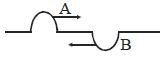
Two identical harmonic pulses travelling in opposite directions in a taut string approach each other. At the instant when they completely overlap,the total energy of the string will be
A
zero
B
partly kinetic and partly potential
C
purely kinetic
D
purely potential
Solution
(C) When two identical pulses with opposite phases (one crest and one trough) overlap,they undergo destructive interference.
At the instant of complete overlap,the net displacement of every point on the string becomes zero.
Since the potential energy of a string is proportional to the square of the displacement (or the square of the slope),the potential energy at this instant is zero.
However,the particles of the string are still moving with maximum transverse velocity at this instant due to the superposition of the velocities of the two pulses.
Therefore,the total energy of the string at this instant is entirely in the form of kinetic energy.
At the instant of complete overlap,the net displacement of every point on the string becomes zero.
Since the potential energy of a string is proportional to the square of the displacement (or the square of the slope),the potential energy at this instant is zero.
However,the particles of the string are still moving with maximum transverse velocity at this instant due to the superposition of the velocities of the two pulses.
Therefore,the total energy of the string at this instant is entirely in the form of kinetic energy.
0 likes
View Solution52
MediumMCQ
Two waves represented by $y_1 = 10 \sin(200\pi t)$ and $y_2 = 20 \sin(200\pi t + \pi/2)$ are superimposed at any point at a particular instant. The amplitude of the resultant wave is:
A
$20$
B
$30$
C
$10\sqrt{5}$
D
$10\sqrt{3}$
Solution
(C) The resultant amplitude $R$ of two waves with amplitudes $A_1$ and $A_2$ and a phase difference $\phi$ is given by the formula: $R = \sqrt{A_1^2 + A_2^2 + 2A_1A_2 \cos \phi}$.
Given $A_1 = 10$,$A_2 = 20$,and the phase difference $\phi = \pi/2$.
Substituting these values into the formula:
$R = \sqrt{10^2 + 20^2 + 2(10)(20) \cos(\pi/2)}$.
Since $\cos(\pi/2) = 0$,the expression simplifies to:
$R = \sqrt{100 + 400 + 0} = \sqrt{500}$.
$R = \sqrt{100 \times 5} = 10\sqrt{5}$.
Given $A_1 = 10$,$A_2 = 20$,and the phase difference $\phi = \pi/2$.
Substituting these values into the formula:
$R = \sqrt{10^2 + 20^2 + 2(10)(20) \cos(\pi/2)}$.
Since $\cos(\pi/2) = 0$,the expression simplifies to:
$R = \sqrt{100 + 400 + 0} = \sqrt{500}$.
$R = \sqrt{100 \times 5} = 10\sqrt{5}$.
0 likes
View Solution53
MediumMCQ
The displacement of an elastic wave is given by the function: $y = 3\, \sin\, \omega t + 4\, \cos\, \omega t$,where $y$ is in $cm$ and $t$ is in $s$. The resultant amplitude is ...... $cm$.
A
$3$
B
$4$
C
$5$
D
$7$
Solution
(C) The given equation is $y = 3\, \sin\, \omega t + 4\, \cos\, \omega t$.
This is of the form $y = A_1\, \sin\, \omega t + A_2\, \cos\, \omega t$,where $A_1 = 3\, cm$ and $A_2 = 4\, cm$.
The resultant amplitude $A$ is given by the formula $A = \sqrt{A_1^2 + A_2^2}$.
Substituting the values,we get $A = \sqrt{3^2 + 4^2} = \sqrt{9 + 16} = \sqrt{25} = 5\, cm$.
This is of the form $y = A_1\, \sin\, \omega t + A_2\, \cos\, \omega t$,where $A_1 = 3\, cm$ and $A_2 = 4\, cm$.
The resultant amplitude $A$ is given by the formula $A = \sqrt{A_1^2 + A_2^2}$.
Substituting the values,we get $A = \sqrt{3^2 + 4^2} = \sqrt{9 + 16} = \sqrt{25} = 5\, cm$.
0 likes
View Solution54
DifficultMCQ
Two waves represented by $y_1 = 10 \sin(2000 \pi t + 2x)$ and $y_2 = 10 \sin(2000 \pi t + 2x + \frac{\pi}{2})$ are superposed at any point at a particular instant. The resultant amplitude is ..... $unit$.
A
$10$
B
$20$
C
$14.1$
D
$0$
Solution
(C) The resultant amplitude $A$ of two waves with amplitudes $a_1$ and $a_2$ and a phase difference $\phi$ is given by the formula:
$A = \sqrt{a_1^2 + a_2^2 + 2 a_1 a_2 \cos \phi}$
Given the equations of the waves:
$y_1 = 10 \sin(2000 \pi t + 2x)$
$y_2 = 10 \sin(2000 \pi t + 2x + \frac{\pi}{2})$
Here,$a_1 = 10$,$a_2 = 10$,and the phase difference $\phi = \frac{\pi}{2} = 90^\circ$.
Substituting these values into the formula:
$A = \sqrt{10^2 + 10^2 + 2(10)(10) \cos(90^\circ)}$
Since $\cos(90^\circ) = 0$:
$A = \sqrt{100 + 100 + 0} = \sqrt{200} = 10\sqrt{2} \approx 14.14 \ unit$.
Thus,the resultant amplitude is approximately $14.1 \ unit$.
$A = \sqrt{a_1^2 + a_2^2 + 2 a_1 a_2 \cos \phi}$
Given the equations of the waves:
$y_1 = 10 \sin(2000 \pi t + 2x)$
$y_2 = 10 \sin(2000 \pi t + 2x + \frac{\pi}{2})$
Here,$a_1 = 10$,$a_2 = 10$,and the phase difference $\phi = \frac{\pi}{2} = 90^\circ$.
Substituting these values into the formula:
$A = \sqrt{10^2 + 10^2 + 2(10)(10) \cos(90^\circ)}$
Since $\cos(90^\circ) = 0$:
$A = \sqrt{100 + 100 + 0} = \sqrt{200} = 10\sqrt{2} \approx 14.14 \ unit$.
Thus,the resultant amplitude is approximately $14.1 \ unit$.
0 likes
View Solution55
DifficultMCQ
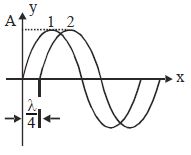
Two identical waves $1$ and $2$,each of intensity $I_0$,are superimposed. The resulting intensity is:
A
$I_0$
B
$2\sqrt{2} I_0$
C
$4 I_0$
D
$2 I_0$
Solution
(D) The phase difference $\Delta \phi$ is related to the path difference $\Delta x$ by the formula:
$\Delta \phi = \frac{2 \pi}{\lambda} \Delta x$
From the graph,the path difference between the two waves is $\Delta x = \frac{\lambda}{4}$.
Substituting this value:
$\Delta \phi = \frac{2 \pi}{\lambda} \times \frac{\lambda}{4} = \frac{\pi}{2}$
The resultant intensity $I$ of two waves with equal intensity $I_0$ and phase difference $\phi$ is given by:
$I = I_0 + I_0 + 2\sqrt{I_0 I_0} \cos \phi = 2I_0(1 + \cos \phi)$
Substituting $\phi = \frac{\pi}{2}$:
$I = 2I_0(1 + \cos \frac{\pi}{2})$
Since $\cos \frac{\pi}{2} = 0$,we get:
$I = 2I_0(1 + 0) = 2I_0$
$\Delta \phi = \frac{2 \pi}{\lambda} \Delta x$
From the graph,the path difference between the two waves is $\Delta x = \frac{\lambda}{4}$.
Substituting this value:
$\Delta \phi = \frac{2 \pi}{\lambda} \times \frac{\lambda}{4} = \frac{\pi}{2}$
The resultant intensity $I$ of two waves with equal intensity $I_0$ and phase difference $\phi$ is given by:
$I = I_0 + I_0 + 2\sqrt{I_0 I_0} \cos \phi = 2I_0(1 + \cos \phi)$
Substituting $\phi = \frac{\pi}{2}$:
$I = 2I_0(1 + \cos \frac{\pi}{2})$
Since $\cos \frac{\pi}{2} = 0$,we get:
$I = 2I_0(1 + 0) = 2I_0$
0 likes
View Solution56
MediumMCQ
Three harmonic waves having equal frequency $v$ and same intensity $I_{0}$,have phase angles $0, \frac{\pi}{4}$ and $-\frac{\pi}{4}$ respectively. When they are superimposed,the intensity of the resultant wave is close to
A
$5.8 I_{0}$
B
$0.2 I_{0}$
C
$I_{0}$
D
$3 I_{0}$
Solution
(A) Let the amplitude of each wave be $A$. Since intensity $I \propto A^2$,we have $I_0 = kA^2$,where $k$ is a constant.
The resultant wave equation is given by the sum of the three waves:
$y = A \sin(\omega t) + A \sin(\omega t - \frac{\pi}{4}) + A \sin(\omega t + \frac{\pi}{4})$
Using the trigonometric identity $\sin(x - y) + \sin(x + y) = 2 \sin x \cos y$:
$y = A \sin(\omega t) + A [2 \sin(\omega t) \cos(\frac{\pi}{4})]$
Since $\cos(\frac{\pi}{4}) = \frac{1}{\sqrt{2}}$:
$y = A \sin(\omega t) + A [2 \sin(\omega t) \cdot \frac{1}{\sqrt{2}}]$
$y = A \sin(\omega t) + \sqrt{2} A \sin(\omega t)$
$y = (1 + \sqrt{2}) A \sin(\omega t)$
The resultant amplitude $A_R = (1 + \sqrt{2}) A$.
The resultant intensity $I = k A_R^2 = k [(1 + \sqrt{2}) A]^2 = k A^2 (1 + \sqrt{2})^2$.
Since $I_0 = k A^2$:
$I = I_0 (1 + 2 + 2\sqrt{2}) = I_0 (3 + 2 \times 1.414) = I_0 (3 + 2.828) = 5.828 I_0$.
Thus,the resultant intensity is approximately $5.8 I_0$.
The resultant wave equation is given by the sum of the three waves:
$y = A \sin(\omega t) + A \sin(\omega t - \frac{\pi}{4}) + A \sin(\omega t + \frac{\pi}{4})$
Using the trigonometric identity $\sin(x - y) + \sin(x + y) = 2 \sin x \cos y$:
$y = A \sin(\omega t) + A [2 \sin(\omega t) \cos(\frac{\pi}{4})]$
Since $\cos(\frac{\pi}{4}) = \frac{1}{\sqrt{2}}$:
$y = A \sin(\omega t) + A [2 \sin(\omega t) \cdot \frac{1}{\sqrt{2}}]$
$y = A \sin(\omega t) + \sqrt{2} A \sin(\omega t)$
$y = (1 + \sqrt{2}) A \sin(\omega t)$
The resultant amplitude $A_R = (1 + \sqrt{2}) A$.
The resultant intensity $I = k A_R^2 = k [(1 + \sqrt{2}) A]^2 = k A^2 (1 + \sqrt{2})^2$.
Since $I_0 = k A^2$:
$I = I_0 (1 + 2 + 2\sqrt{2}) = I_0 (3 + 2 \times 1.414) = I_0 (3 + 2.828) = 5.828 I_0$.
Thus,the resultant intensity is approximately $5.8 I_0$.
0 likes
View Solution57
Medium
State the principle of superposition and explain it.
Solution
(N/A) Principle of Superposition: When a particle of a medium is simultaneously influenced by two or more waves,its net displacement is the vector sum of the displacements that would occur under the influence of each individual wave.
Explanation:
$1$. When two waves travel in opposite directions,they maintain their individual characteristics even after they pass through each other.
$2$. During the superposition,the medium particles exhibit a displacement pattern that is the algebraic sum of the individual wave displacements.
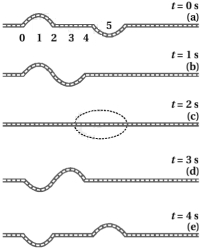
$3$. The provided figure illustrates the superposition of two equal and opposite wave pulses. At $t = 2 \ s$ (part $c$),the two pulses overlap such that their displacements cancel each other out,resulting in a net displacement of zero at that instant. After passing through each other,the pulses continue to move in their original directions,unchanged in shape or velocity.
Explanation:
$1$. When two waves travel in opposite directions,they maintain their individual characteristics even after they pass through each other.
$2$. During the superposition,the medium particles exhibit a displacement pattern that is the algebraic sum of the individual wave displacements.
$3$. The provided figure illustrates the superposition of two equal and opposite wave pulses. At $t = 2 \ s$ (part $c$),the two pulses overlap such that their displacements cancel each other out,resulting in a net displacement of zero at that instant. After passing through each other,the pulses continue to move in their original directions,unchanged in shape or velocity.
0 likes
View Solution58
Easy
Obtain the resultant wave of more than two wave functions by representing the superposition principle mathematically.
Solution
(N/A) Let $y_{1}(x, t)$ and $y_{2}(x, t)$ be the displacements that any element of the medium would experience if each wave travelled alone.
The displacement $y(x, t)$ of an element of the medium when the waves overlap is given by the superposition principle as:
$y(x, t) = y_{1}(x, t) + y_{2}(x, t) \quad \dots (1)$
If we have $n$ waves moving in the medium,the resultant waveform is the algebraic sum of the wave functions of the individual waves.
Let the individual wave functions be:
$y_{1} = f_{1}(x - vt)$
$y_{2} = f_{2}(x - vt)$
$y_{n} = f_{n}(x - vt)$
Then the resultant wave function $y$ is the sum of these individual functions:
$y = f_{1}(x - vt) + f_{2}(x - vt) + \dots + f_{n}(x - vt)$
Therefore,the resultant wave function can be expressed as:
$y = \sum_{i=1}^{n} f_{i}(x - vt)$
where $i = 1, 2, 3, \dots, n$.
The displacement $y(x, t)$ of an element of the medium when the waves overlap is given by the superposition principle as:
$y(x, t) = y_{1}(x, t) + y_{2}(x, t) \quad \dots (1)$
If we have $n$ waves moving in the medium,the resultant waveform is the algebraic sum of the wave functions of the individual waves.
Let the individual wave functions be:
$y_{1} = f_{1}(x - vt)$
$y_{2} = f_{2}(x - vt)$
$y_{n} = f_{n}(x - vt)$
Then the resultant wave function $y$ is the sum of these individual functions:
$y = f_{1}(x - vt) + f_{2}(x - vt) + \dots + f_{n}(x - vt)$
Therefore,the resultant wave function can be expressed as:
$y = \sum_{i=1}^{n} f_{i}(x - vt)$
where $i = 1, 2, 3, \dots, n$.
0 likes
View Solution59
Medium
Obtain the equation of resultant displacement of two progressive harmonic waves on a stretched string.
Solution
(N/A) Consider two progressive harmonic waves traveling along a stretched string with the same angular frequency $(\omega)$,angular wave number $(k)$,and amplitude $(a)$.
Let the two waves be represented as:
$y_{1}(x, t) = a \sin(kx - \omega t)$
$y_{2}(x, t) = a \sin(kx - \omega t + \phi)$
where $\phi$ is the constant phase difference between the two waves.
According to the principle of superposition,the resultant displacement $y(x, t)$ is the algebraic sum of the individual displacements:
$y(x, t) = y_{1}(x, t) + y_{2}(x, t)$
$y(x, t) = a \sin(kx - \omega t) + a \sin(kx - \omega t + \phi)$
Using the trigonometric identity $\sin C + \sin D = 2 \sin \left( \frac{C+D}{2} \right) \cos \left( \frac{C-D}{2} \right)$,where $C = kx - \omega t$ and $D = kx - \omega t + \phi$:
$y(x, t) = 2a \sin \left( \frac{kx - \omega t + kx - \omega t + \phi}{2} \right) \cos \left( \frac{kx - \omega t - (kx - \omega t + \phi)}{2} \right)$
$y(x, t) = 2a \sin \left( kx - \omega t + \frac{\phi}{2} \right) \cos \left( -\frac{\phi}{2} \right)$
Since $\cos(-\theta) = \cos(\theta)$:
$y(x, t) = [2a \cos(\frac{\phi}{2})] \sin(kx - \omega t + \frac{\phi}{2})$
This is the equation of the resultant progressive wave with an amplitude of $2a \cos(\frac{\phi}{2})$ and an initial phase of $\frac{\phi}{2}$.
Let the two waves be represented as:
$y_{1}(x, t) = a \sin(kx - \omega t)$
$y_{2}(x, t) = a \sin(kx - \omega t + \phi)$
where $\phi$ is the constant phase difference between the two waves.
According to the principle of superposition,the resultant displacement $y(x, t)$ is the algebraic sum of the individual displacements:
$y(x, t) = y_{1}(x, t) + y_{2}(x, t)$
$y(x, t) = a \sin(kx - \omega t) + a \sin(kx - \omega t + \phi)$
Using the trigonometric identity $\sin C + \sin D = 2 \sin \left( \frac{C+D}{2} \right) \cos \left( \frac{C-D}{2} \right)$,where $C = kx - \omega t$ and $D = kx - \omega t + \phi$:
$y(x, t) = 2a \sin \left( \frac{kx - \omega t + kx - \omega t + \phi}{2} \right) \cos \left( \frac{kx - \omega t - (kx - \omega t + \phi)}{2} \right)$
$y(x, t) = 2a \sin \left( kx - \omega t + \frac{\phi}{2} \right) \cos \left( -\frac{\phi}{2} \right)$
Since $\cos(-\theta) = \cos(\theta)$:
$y(x, t) = [2a \cos(\frac{\phi}{2})] \sin(kx - \omega t + \frac{\phi}{2})$
This is the equation of the resultant progressive wave with an amplitude of $2a \cos(\frac{\phi}{2})$ and an initial phase of $\frac{\phi}{2}$.
0 likes
View Solution60
Medium
Give noticeable points about the amplitude of resultant waves of two harmonic progressive waves on a stretched string.
Solution
(N/A) The amplitude of the resultant wave is a function of the phase difference $\phi$ between the two component waves.
The resultant amplitude $A$ is given by the formula: $A(\phi) = 2a \cos(\frac{\phi}{2})$,where $a$ is the amplitude of each individual wave.
$1$. When the two waves are in phase,the phase difference is $\phi = 0$. Substituting this into the formula,we get $A = 2a \cos(0) = 2a$. This is the maximum possible amplitude,known as constructive interference.
$2$. When the two waves are completely out of phase,the phase difference is $\phi = \pi$. Substituting this into the formula,we get $A = 2a \cos(\frac{\pi}{2}) = 0$. This results in zero amplitude,known as destructive interference.
$3$. For any other phase difference,the resultant amplitude $A$ will lie in the range $0 \leq A \leq 2a$.
The resultant amplitude $A$ is given by the formula: $A(\phi) = 2a \cos(\frac{\phi}{2})$,where $a$ is the amplitude of each individual wave.
$1$. When the two waves are in phase,the phase difference is $\phi = 0$. Substituting this into the formula,we get $A = 2a \cos(0) = 2a$. This is the maximum possible amplitude,known as constructive interference.
$2$. When the two waves are completely out of phase,the phase difference is $\phi = \pi$. Substituting this into the formula,we get $A = 2a \cos(\frac{\pi}{2}) = 0$. This results in zero amplitude,known as destructive interference.
$3$. For any other phase difference,the resultant amplitude $A$ will lie in the range $0 \leq A \leq 2a$.
0 likes
View Solution61
Difficult
What is interference? Define its types.
Solution
(N/A) The phenomenon of the superposition of two waves is called interference.
It has two types:
$(1)$ Constructive interference
$(2)$ Destructive interference
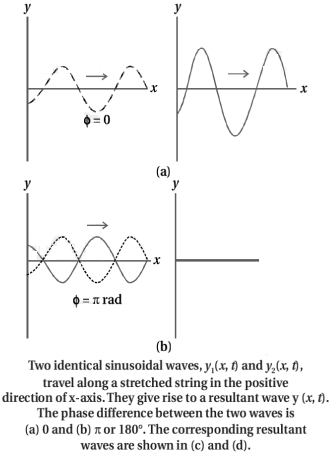
$(1)$ Constructive interference: When the crest of one wave is superposed on the crest of another wave,or the trough of one wave is superposed on the trough of another wave,the amplitudes add up for the resultant wave. This is called constructive interference.
$(2)$ Destructive interference: When the crest of one wave is superposed on the trough of another wave,or the trough of one wave is superposed on the crest of another wave,the amplitudes subtract for the resultant wave. This is called destructive interference.
It has two types:
$(1)$ Constructive interference
$(2)$ Destructive interference
$(1)$ Constructive interference: When the crest of one wave is superposed on the crest of another wave,or the trough of one wave is superposed on the trough of another wave,the amplitudes add up for the resultant wave. This is called constructive interference.
$(2)$ Destructive interference: When the crest of one wave is superposed on the trough of another wave,or the trough of one wave is superposed on the crest of another wave,the amplitudes subtract for the resultant wave. This is called destructive interference.
0 likes
View Solution62
Easy
State the principle of superposition of waves.
Solution
(N/A) The principle of superposition states that when two or more waves travel through a medium simultaneously,each wave acts independently of the others. The resultant displacement $y$ at any point and at any instant is the algebraic sum of the individual displacements $y_1, y_2, y_3, \dots$ produced by each wave at that point.
Mathematically,it is expressed as: $y = y_1 + y_2 + y_3 + \dots = \sum_{i=1}^{n} y_i$.
Mathematically,it is expressed as: $y = y_1 + y_2 + y_3 + \dots = \sum_{i=1}^{n} y_i$.
0 likes
View Solution63
Medium
Write the equation of displacement of the resultant wave for two superposed waves with an initial phase difference.
Solution
Let the two waves be represented by the equations:
$y_1 = A_1 \sin(\omega t)$
$y_2 = A_2 \sin(\omega t + \phi)$
where $A_1$ and $A_2$ are the amplitudes,$\omega$ is the angular frequency,$t$ is time,and $\phi$ is the initial phase difference.
According to the principle of superposition,the resultant displacement $y$ is the vector sum of the individual displacements:
$y = y_1 + y_2 = A_1 \sin(\omega t) + A_2 \sin(\omega t + \phi)$
Using the trigonometric identity $\sin(a + b) = \sin a \cos b + \cos a \sin b$:
$y = A_1 \sin(\omega t) + A_2 (\sin(\omega t) \cos \phi + \cos(\omega t) \sin \phi)$
$y = (A_1 + A_2 \cos \phi) \sin(\omega t) + (A_2 \sin \phi) \cos(\omega t)$
Let $A_1 + A_2 \cos \phi = R \cos \theta$ and $A_2 \sin \phi = R \sin \theta$,where $R$ is the resultant amplitude and $\theta$ is the phase constant.
Then,$y = R \cos \theta \sin(\omega t) + R \sin \theta \cos(\omega t) = R \sin(\omega t + \theta)$
where $R = \sqrt{A_1^2 + A_2^2 + 2A_1 A_2 \cos \phi}$ and $\tan \theta = \frac{A_2 \sin \phi}{A_1 + A_2 \cos \phi}$.
$y_1 = A_1 \sin(\omega t)$
$y_2 = A_2 \sin(\omega t + \phi)$
where $A_1$ and $A_2$ are the amplitudes,$\omega$ is the angular frequency,$t$ is time,and $\phi$ is the initial phase difference.
According to the principle of superposition,the resultant displacement $y$ is the vector sum of the individual displacements:
$y = y_1 + y_2 = A_1 \sin(\omega t) + A_2 \sin(\omega t + \phi)$
Using the trigonometric identity $\sin(a + b) = \sin a \cos b + \cos a \sin b$:
$y = A_1 \sin(\omega t) + A_2 (\sin(\omega t) \cos \phi + \cos(\omega t) \sin \phi)$
$y = (A_1 + A_2 \cos \phi) \sin(\omega t) + (A_2 \sin \phi) \cos(\omega t)$
Let $A_1 + A_2 \cos \phi = R \cos \theta$ and $A_2 \sin \phi = R \sin \theta$,where $R$ is the resultant amplitude and $\theta$ is the phase constant.
Then,$y = R \cos \theta \sin(\omega t) + R \sin \theta \cos(\omega t) = R \sin(\omega t + \theta)$
where $R = \sqrt{A_1^2 + A_2^2 + 2A_1 A_2 \cos \phi}$ and $\tan \theta = \frac{A_2 \sin \phi}{A_1 + A_2 \cos \phi}$.
0 likes
View Solution64
Medium
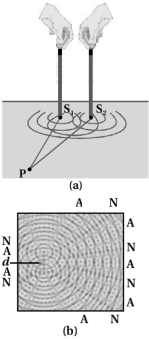
Explain the superposition principle for waves forming in calm water.
Solution
(N/A) The figure $(a)$ shows two needles oscillating with equal phase,representing two coherent sources. Consider two needles moving periodically up and down in an identical fashion in a trough of water as shown in the figure; they produce two water waves.
At any particular point,the phase difference between the displacements produced by each of the waves does not change with time,so both sources are called coherent sources.
Figure $(b)$ shows the position of crests (solid circles) and troughs (dashed circles) at a given instant of time.
Now consider a point $P$ as shown in figure $(a)$ for which $S_{1}P = S_{2}P$.
Since waves from $S_{1}$ and $S_{2}$ will take the same time to travel to point $P$,they arrive with the same phase.
The displacement produced by the source $S_{1}$ at point $P$ is given by $y_{1} = a \cos \omega t$,and the displacement produced by the source $S_{2}$ at point $P$ is given by $y_{2} = a \cos \omega t$,where $a$ is the amplitude.
According to the superposition principle,the resultant displacement at $P$ is:
$y = y_{1} + y_{2} = a \cos \omega t + a \cos \omega t$
$\therefore y = 2a \cos \omega t$
At any particular point,the phase difference between the displacements produced by each of the waves does not change with time,so both sources are called coherent sources.
Figure $(b)$ shows the position of crests (solid circles) and troughs (dashed circles) at a given instant of time.
Now consider a point $P$ as shown in figure $(a)$ for which $S_{1}P = S_{2}P$.
Since waves from $S_{1}$ and $S_{2}$ will take the same time to travel to point $P$,they arrive with the same phase.
The displacement produced by the source $S_{1}$ at point $P$ is given by $y_{1} = a \cos \omega t$,and the displacement produced by the source $S_{2}$ at point $P$ is given by $y_{2} = a \cos \omega t$,where $a$ is the amplitude.
According to the superposition principle,the resultant displacement at $P$ is:
$y = y_{1} + y_{2} = a \cos \omega t + a \cos \omega t$
$\therefore y = 2a \cos \omega t$
0 likes
View Solution65
DifficultMCQ
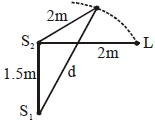
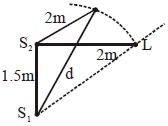
Two coherent sources of sound,$S_{1}$ and $S_{2}$,produce sound waves of the same wavelength,$\lambda = 1\, m$,in phase. $S_{1}$ and $S_{2}$ are placed $1.5\, m$ apart (see figure). $A$ listener,located at $L$,directly in front of $S_{2}$,finds that the intensity is at a minimum when he is $2\, m$ away from $S_{2}$. The listener moves away from $S_{1}$,keeping his distance from $S_{2}$ fixed. The adjacent maximum of intensity is observed when the listener is at a distance $d$ from $S_{1}$. Then,$d$ is $......\, m$.
A
$12$
B
$3$
C
$5$
D
$2$
Solution
(B) Let the position of the listener be $L$. Initially,the listener is at a distance $x = 2\, m$ from $S_{2}$.
The distance from $S_{1}$ is $S_{1}L = \sqrt{x^2 + (1.5)^2} = \sqrt{2^2 + 1.5^2} = \sqrt{4 + 2.25} = \sqrt{6.25} = 2.5\, m$.
The path difference is $\Delta x = S_{1}L - S_{2}L = 2.5 - 2 = 0.5\, m$.
Since $\lambda = 1\, m$,we have $\Delta x = \frac{\lambda}{2}$,which corresponds to a minimum (destructive interference).
When the listener moves away from $S_{1}$ while keeping the distance from $S_{2}$ fixed at $2\, m$,the path difference $\Delta x = S_{1}L - S_{2}L$ increases.
The next intensity maximum occurs when the path difference $\Delta x = n\lambda$. For the adjacent maximum,$n = 1$.
Thus,$\Delta x = 1\, m$.
Let $d$ be the distance from $S_{1}$ to the listener at this new position.
Then,$d - 2 = 1$,which gives $d = 3\, m$.
The distance from $S_{1}$ is $S_{1}L = \sqrt{x^2 + (1.5)^2} = \sqrt{2^2 + 1.5^2} = \sqrt{4 + 2.25} = \sqrt{6.25} = 2.5\, m$.
The path difference is $\Delta x = S_{1}L - S_{2}L = 2.5 - 2 = 0.5\, m$.
Since $\lambda = 1\, m$,we have $\Delta x = \frac{\lambda}{2}$,which corresponds to a minimum (destructive interference).
When the listener moves away from $S_{1}$ while keeping the distance from $S_{2}$ fixed at $2\, m$,the path difference $\Delta x = S_{1}L - S_{2}L$ increases.
The next intensity maximum occurs when the path difference $\Delta x = n\lambda$. For the adjacent maximum,$n = 1$.
Thus,$\Delta x = 1\, m$.
Let $d$ be the distance from $S_{1}$ to the listener at this new position.
Then,$d - 2 = 1$,which gives $d = 3\, m$.
0 likes
View Solution66
DifficultMCQ
Two waves are simultaneously passing through a string and their equations are:
${y}_{1} = {A}_{1} \sin {k}({x} - {vt}), {y}_{2} = {A}_{2} \sin {k}({x} - {vt} + {x}_{0}).$
Given amplitudes ${A}_{1} = 12 \, {mm}$ and ${A}_{2} = 5 \, {mm}$,${x}_{0} = 3.5 \, {cm}$,and wave number ${k} = 6.28 \, {cm}^{-1}$. The amplitude of the resulting wave will be $...... \, {mm}$.
${y}_{1} = {A}_{1} \sin {k}({x} - {vt}), {y}_{2} = {A}_{2} \sin {k}({x} - {vt} + {x}_{0}).$
Given amplitudes ${A}_{1} = 12 \, {mm}$ and ${A}_{2} = 5 \, {mm}$,${x}_{0} = 3.5 \, {cm}$,and wave number ${k} = 6.28 \, {cm}^{-1}$. The amplitude of the resulting wave will be $...... \, {mm}$.
A
$7$
B
$10$
C
$25$
D
$49$
Solution
(A) The given wave equations are ${y}_{1} = {A}_{1} \sin {k}({x} - {vt})$ and ${y}_{2} = {A}_{2} \sin {k}({x} - {vt} + {x}_{0})$.
The phase difference $\Delta \phi$ between the two waves is given by $\Delta \phi = {k} \cdot {x}_{0}$.
Given ${k} = 6.28 \, {cm}^{-1}$ and ${x}_{0} = 3.5 \, {cm}$.
Since $6.28 \approx 2\pi$,we have $\Delta \phi = 6.28 \times 3.5 = 2\pi \times 3.5 = 7\pi$.
The resultant amplitude ${A}_{R}$ is given by ${A}_{R} = \sqrt{{A}_{1}^{2} + {A}_{2}^{2} + 2{A}_{1}{A}_{2} \cos(\Delta \phi)}$.
Substituting the values: ${A}_{R} = \sqrt{12^{2} + 5^{2} + 2(12)(5) \cos(7\pi)}$.
Since $\cos(7\pi) = -1$,we get ${A}_{R} = \sqrt{144 + 25 - 120} = \sqrt{49} = 7 \, {mm}$.
The phase difference $\Delta \phi$ between the two waves is given by $\Delta \phi = {k} \cdot {x}_{0}$.
Given ${k} = 6.28 \, {cm}^{-1}$ and ${x}_{0} = 3.5 \, {cm}$.
Since $6.28 \approx 2\pi$,we have $\Delta \phi = 6.28 \times 3.5 = 2\pi \times 3.5 = 7\pi$.
The resultant amplitude ${A}_{R}$ is given by ${A}_{R} = \sqrt{{A}_{1}^{2} + {A}_{2}^{2} + 2{A}_{1}{A}_{2} \cos(\Delta \phi)}$.
Substituting the values: ${A}_{R} = \sqrt{12^{2} + 5^{2} + 2(12)(5) \cos(7\pi)}$.
Since $\cos(7\pi) = -1$,we get ${A}_{R} = \sqrt{144 + 25 - 120} = \sqrt{49} = 7 \, {mm}$.
0 likes
View Solution67
MediumMCQ
The equations of two waves are given by
$y_{1}=5 \sin 2 \pi(x-v t) \, cm$
$y_{2}=3 \sin 2 \pi(x-v t+1.5) \, cm$
These waves are simultaneously passing through a string. The amplitude of the resulting wave is.........$cm$.
$y_{1}=5 \sin 2 \pi(x-v t) \, cm$
$y_{2}=3 \sin 2 \pi(x-v t+1.5) \, cm$
These waves are simultaneously passing through a string. The amplitude of the resulting wave is.........$cm$.
A
$2$
B
$4$
C
$5.8$
D
$8$
Solution
(A) Given amplitudes are $A_{1} = 5 \, cm$ and $A_{2} = 3 \, cm$.
The phase difference $\Delta \phi$ between the two waves is determined by the difference in their arguments:
$\Delta \phi = 2 \pi (x - vt + 1.5) - 2 \pi (x - vt) = 2 \pi (1.5) = 3 \pi$.
The resultant amplitude $A_{net}$ is given by the formula:
$A_{net} = \sqrt{A_{1}^{2} + A_{2}^{2} + 2 A_{1} A_{2} \cos(\Delta \phi)}$.
Substituting the values:
$A_{net} = \sqrt{5^{2} + 3^{2} + 2(5)(3) \cos(3 \pi)}$.
Since $\cos(3 \pi) = -1$:
$A_{net} = \sqrt{25 + 9 + 30(-1)} = \sqrt{34 - 30} = \sqrt{4} = 2 \, cm$.
The phase difference $\Delta \phi$ between the two waves is determined by the difference in their arguments:
$\Delta \phi = 2 \pi (x - vt + 1.5) - 2 \pi (x - vt) = 2 \pi (1.5) = 3 \pi$.
The resultant amplitude $A_{net}$ is given by the formula:
$A_{net} = \sqrt{A_{1}^{2} + A_{2}^{2} + 2 A_{1} A_{2} \cos(\Delta \phi)}$.
Substituting the values:
$A_{net} = \sqrt{5^{2} + 3^{2} + 2(5)(3) \cos(3 \pi)}$.
Since $\cos(3 \pi) = -1$:
$A_{net} = \sqrt{25 + 9 + 30(-1)} = \sqrt{34 - 30} = \sqrt{4} = 2 \, cm$.
0 likes
View Solution68
MediumMCQ
Two waves executing simple harmonic motion travelling in the same direction with same amplitude and frequency are superimposed. The resultant amplitude is equal to the $\sqrt{3}$ times the amplitude of individual motions. The phase difference between the two motions is $.....(degree)$
A
$55$
B
$56$
C
$60$
D
$53$
Solution
(C) The resultant amplitude $A_R$ of two superimposing waves with individual amplitudes $A_1 = A_2 = A$ and phase difference $\phi$ is given by the formula:
$A_R = \sqrt{A_1^2 + A_2^2 + 2A_1A_2 \cos \phi}$
Given that $A_R = \sqrt{3}A$,we substitute the values:
$\sqrt{3}A = \sqrt{A^2 + A^2 + 2A^2 \cos \phi}$
Squaring both sides:
$3A^2 = 2A^2 + 2A^2 \cos \phi$
$3A^2 - 2A^2 = 2A^2 \cos \phi$
$A^2 = 2A^2 \cos \phi$
$\cos \phi = \frac{1}{2}$
Therefore,$\phi = 60^{\circ}$.
$A_R = \sqrt{A_1^2 + A_2^2 + 2A_1A_2 \cos \phi}$
Given that $A_R = \sqrt{3}A$,we substitute the values:
$\sqrt{3}A = \sqrt{A^2 + A^2 + 2A^2 \cos \phi}$
Squaring both sides:
$3A^2 = 2A^2 + 2A^2 \cos \phi$
$3A^2 - 2A^2 = 2A^2 \cos \phi$
$A^2 = 2A^2 \cos \phi$
$\cos \phi = \frac{1}{2}$
Therefore,$\phi = 60^{\circ}$.
0 likes
View Solution69
AdvancedMCQ
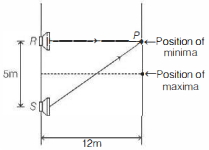
Two identical coherent sound sources $R$ and $S$ with frequency $f$ are $5 \,m$ apart. An observer standing equidistant from the sources at a perpendicular distance of $12 \,m$ from the line $RS$ hears maximum sound intensity. When the observer moves parallel to the line $RS$ to a position directly in front of one of the sources,the sound intensity is a minimum. $A$ possible value of $f$ is close to ............ $Hz$ (the speed of sound is $330 \,m/s$).
A
$495$
B
$275$
C
$660$
D
$330$
Solution
(A) For a minimum intensity at point $P$ (directly in front of source $R$),the path difference between the sound waves reaching $P$ from $S$ and $R$ must be an odd multiple of half the wavelength.
The path difference is given by $\Delta x = SP - RP$.
Given the geometry,$RP = 12 \,m$ and $RS = 5 \,m$. Thus,$SP = \sqrt{RP^2 + RS^2} = \sqrt{12^2 + 5^2} = \sqrt{144 + 25} = \sqrt{169} = 13 \,m$.
The path difference is $\Delta x = 13 \,m - 12 \,m = 1 \,m$.
For destructive interference (minima),$\Delta x = (2n + 1) \frac{\lambda}{2}$,where $n = 0, 1, 2, \dots$.
Substituting $\lambda = \frac{v}{f}$,we get $1 = (2n + 1) \frac{v}{2f}$,which implies $f = \frac{(2n + 1)v}{2}$.
Given $v = 330 \,m/s$,we have $f = \frac{(2n + 1) \times 330}{2} = (2n + 1) \times 165$.
For $n = 0$,$f = 165 \,Hz$.
For $n = 1$,$f = 3 \times 165 = 495 \,Hz$.
For $n = 2$,$f = 5 \times 165 = 825 \,Hz$.
Comparing with the given options,$495 \,Hz$ is a possible value.
The path difference is given by $\Delta x = SP - RP$.
Given the geometry,$RP = 12 \,m$ and $RS = 5 \,m$. Thus,$SP = \sqrt{RP^2 + RS^2} = \sqrt{12^2 + 5^2} = \sqrt{144 + 25} = \sqrt{169} = 13 \,m$.
The path difference is $\Delta x = 13 \,m - 12 \,m = 1 \,m$.
For destructive interference (minima),$\Delta x = (2n + 1) \frac{\lambda}{2}$,where $n = 0, 1, 2, \dots$.
Substituting $\lambda = \frac{v}{f}$,we get $1 = (2n + 1) \frac{v}{2f}$,which implies $f = \frac{(2n + 1)v}{2}$.
Given $v = 330 \,m/s$,we have $f = \frac{(2n + 1) \times 330}{2} = (2n + 1) \times 165$.
For $n = 0$,$f = 165 \,Hz$.
For $n = 1$,$f = 3 \times 165 = 495 \,Hz$.
For $n = 2$,$f = 5 \times 165 = 825 \,Hz$.
Comparing with the given options,$495 \,Hz$ is a possible value.
0 likes
View Solution70
DifficultMCQ
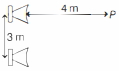
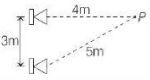
Two small identical speakers are connected in phase to the same source. The speakers are $3 \,m$ apart and at ear level. An observer stands at $P, 4 \,m$ in front of one speaker as shown. The sound she hears is least intense when the wavelength is $\lambda_1$ and most intense when the wavelength is $\lambda_2$. Then,the possible values of $\lambda_1$ and $\lambda_2$ are
A
$\lambda_1=1 \,m$ and $\lambda_2=2 \,m$
B
$\lambda_1=4 \,m$ and $\lambda_2=3 \,m$
C
$\lambda_1=2 \,m$ and $\lambda_2=1 \,m$
D
$\lambda_1=0.5 \,m$ and $\lambda_2=0.25 \,m$
Solution
(C) The distance from the first speaker to point $P$ is $d_1 = 4 \,m$. The distance from the second speaker to point $P$ is $d_2 = \sqrt{3^2 + 4^2} = 5 \,m$.
The path difference between the two sound waves at point $P$ is $\Delta L = d_2 - d_1 = 5 \,m - 4 \,m = 1 \,m$.
For the sound to be least intense (destructive interference),the path difference must be an odd multiple of half the wavelength:
$\Delta L = (2n + 1) \frac{\lambda_1}{2}$,where $n = 0, 1, 2, \dots$
For $n = 0$,$1 \,m = \frac{\lambda_1}{2} \Rightarrow \lambda_1 = 2 \,m$.
For the sound to be most intense (constructive interference),the path difference must be an integer multiple of the wavelength:
$\Delta L = n \lambda_2$,where $n = 1, 2, 3, \dots$
For $n = 1$,$1 \,m = \lambda_2 \Rightarrow \lambda_2 = 1 \,m$.
Thus,the possible values are $\lambda_1 = 2 \,m$ and $\lambda_2 = 1 \,m$. The correct option is $(c)$.
The path difference between the two sound waves at point $P$ is $\Delta L = d_2 - d_1 = 5 \,m - 4 \,m = 1 \,m$.
For the sound to be least intense (destructive interference),the path difference must be an odd multiple of half the wavelength:
$\Delta L = (2n + 1) \frac{\lambda_1}{2}$,where $n = 0, 1, 2, \dots$
For $n = 0$,$1 \,m = \frac{\lambda_1}{2} \Rightarrow \lambda_1 = 2 \,m$.
For the sound to be most intense (constructive interference),the path difference must be an integer multiple of the wavelength:
$\Delta L = n \lambda_2$,where $n = 1, 2, 3, \dots$
For $n = 1$,$1 \,m = \lambda_2 \Rightarrow \lambda_2 = 1 \,m$.
Thus,the possible values are $\lambda_1 = 2 \,m$ and $\lambda_2 = 1 \,m$. The correct option is $(c)$.
0 likes
View Solution71
MediumMCQ
Two waves of amplitudes $A_0$ and $x A_0$ pass through a region. If $x > 1$,the difference between the maximum and minimum resultant amplitude possible is
A
$(x+1) A_0$
B
$(x-1) A_0$
C
$2 x A_0$
D
$2 A_0$
Solution
(D) The amplitudes of the two waves are $A_1 = A_0$ and $A_2 = x A_0$.
The maximum resultant amplitude $(A_{max})$ occurs when the waves are in phase:
$A_{max} = A_1 + A_2 = A_0 + x A_0 = (x+1) A_0$.
The minimum resultant amplitude $(A_{min})$ occurs when the waves are out of phase. Given $x > 1$,$A_2 > A_1$,so:
$A_{min} = A_2 - A_1 = x A_0 - A_0 = (x-1) A_0$.
The difference between the maximum and minimum resultant amplitude is:
Difference $= A_{max} - A_{min} = (x+1) A_0 - (x-1) A_0$.
Difference $= (x + 1 - x + 1) A_0 = 2 A_0$.
The maximum resultant amplitude $(A_{max})$ occurs when the waves are in phase:
$A_{max} = A_1 + A_2 = A_0 + x A_0 = (x+1) A_0$.
The minimum resultant amplitude $(A_{min})$ occurs when the waves are out of phase. Given $x > 1$,$A_2 > A_1$,so:
$A_{min} = A_2 - A_1 = x A_0 - A_0 = (x-1) A_0$.
The difference between the maximum and minimum resultant amplitude is:
Difference $= A_{max} - A_{min} = (x+1) A_0 - (x-1) A_0$.
Difference $= (x + 1 - x + 1) A_0 = 2 A_0$.
0 likes
View Solution72
MediumMCQ
Two waves have equations $x_1 = a \sin(\omega t + \phi_1)$ and $x_2 = a \sin(\omega t + \phi_2)$. If in the resultant wave the frequency and amplitude remain equal to the amplitude of the superimposing waves,the phase difference between them is ........
A
$\frac{\pi}{6}$
B
$\frac{2\pi}{3}$
C
$\frac{\pi}{4}$
D
$\frac{\pi}{3}$
Solution
(B) The resultant wave is $x' = x_1 + x_2 = a[\sin(\omega t + \phi_1) + \sin(\omega t + \phi_2)]$.
Using the trigonometric identity $\sin A + \sin B = 2 \sin(\frac{A+B}{2}) \cos(\frac{A-B}{2})$,we get:
$x' = 2a \sin(\omega t + \frac{\phi_1 + \phi_2}{2}) \cos(\frac{\phi_1 - \phi_2}{2})$.
The amplitude of the resultant wave is $A_{res} = |2a \cos(\frac{\phi_1 - \phi_2}{2})|$.
Given that the resultant amplitude is equal to the amplitude of the individual waves $(a)$:
$|2a \cos(\frac{\phi_1 - \phi_2}{2})| = a$.
$\cos(\frac{\phi_1 - \phi_2}{2}) = \frac{1}{2}$.
Let $\Delta\phi = \phi_1 - \phi_2$. Then $\cos(\frac{\Delta\phi}{2}) = \frac{1}{2}$.
$\frac{\Delta\phi}{2} = \frac{\pi}{3}$.
$\Delta\phi = \frac{2\pi}{3}$.
Using the trigonometric identity $\sin A + \sin B = 2 \sin(\frac{A+B}{2}) \cos(\frac{A-B}{2})$,we get:
$x' = 2a \sin(\omega t + \frac{\phi_1 + \phi_2}{2}) \cos(\frac{\phi_1 - \phi_2}{2})$.
The amplitude of the resultant wave is $A_{res} = |2a \cos(\frac{\phi_1 - \phi_2}{2})|$.
Given that the resultant amplitude is equal to the amplitude of the individual waves $(a)$:
$|2a \cos(\frac{\phi_1 - \phi_2}{2})| = a$.
$\cos(\frac{\phi_1 - \phi_2}{2}) = \frac{1}{2}$.
Let $\Delta\phi = \phi_1 - \phi_2$. Then $\cos(\frac{\Delta\phi}{2}) = \frac{1}{2}$.
$\frac{\Delta\phi}{2} = \frac{\pi}{3}$.
$\Delta\phi = \frac{2\pi}{3}$.
0 likes
View Solution73
MediumMCQ
Two sinusoidal waves given below are superposed:
$y_1 = A \sin \left(kx - \omega t + \frac{\pi}{6}\right), \quad y_2 = A \sin \left(kx - \omega t - \frac{\pi}{6}\right)$
The equation of the resultant wave is:
$y_1 = A \sin \left(kx - \omega t + \frac{\pi}{6}\right), \quad y_2 = A \sin \left(kx - \omega t - \frac{\pi}{6}\right)$
The equation of the resultant wave is:
A
$y = \frac{A}{\sqrt{3}} \sin (kx - \omega t)$
B
$y = A \sqrt{3} \sin (kx - \omega t)$
C
$y = A \sqrt{3} \sin \left(kx - \omega t - \frac{\pi}{3}\right)$
D
$y = \frac{A}{\sqrt{3}} \sin \left(kx - \omega t - \frac{\pi}{3}\right)$
Solution
(B) The resultant wave is given by the principle of superposition: $y = y_1 + y_2$.
Substituting the given equations:
$y = A \sin \left(kx - \omega t + \frac{\pi}{6}\right) + A \sin \left(kx - \omega t - \frac{\pi}{6}\right)$.
Using the trigonometric identity $\sin C + \sin D = 2 \sin \left(\frac{C+D}{2}\right) \cos \left(\frac{C-D}{2}\right)$:
Let $C = kx - \omega t + \frac{\pi}{6}$ and $D = kx - \omega t - \frac{\pi}{6}$.
Then $\frac{C+D}{2} = kx - \omega t$ and $\frac{C-D}{2} = \frac{\pi}{6}$.
Therefore,$y = 2A \sin(kx - \omega t) \cos\left(\frac{\pi}{6}\right)$.
Since $\cos\left(\frac{\pi}{6}\right) = \frac{\sqrt{3}}{2}$,we get:
$y = 2A \sin(kx - \omega t) \cdot \frac{\sqrt{3}}{2} = A \sqrt{3} \sin(kx - \omega t)$.
Substituting the given equations:
$y = A \sin \left(kx - \omega t + \frac{\pi}{6}\right) + A \sin \left(kx - \omega t - \frac{\pi}{6}\right)$.
Using the trigonometric identity $\sin C + \sin D = 2 \sin \left(\frac{C+D}{2}\right) \cos \left(\frac{C-D}{2}\right)$:
Let $C = kx - \omega t + \frac{\pi}{6}$ and $D = kx - \omega t - \frac{\pi}{6}$.
Then $\frac{C+D}{2} = kx - \omega t$ and $\frac{C-D}{2} = \frac{\pi}{6}$.
Therefore,$y = 2A \sin(kx - \omega t) \cos\left(\frac{\pi}{6}\right)$.
Since $\cos\left(\frac{\pi}{6}\right) = \frac{\sqrt{3}}{2}$,we get:
$y = 2A \sin(kx - \omega t) \cdot \frac{\sqrt{3}}{2} = A \sqrt{3} \sin(kx - \omega t)$.
0 likes
View Solution74
EasyMCQ
Two sound waves of intensity $2 \, W/m^2$ and $3 \, W/m^2$ meet at a point to produce a resultant intensity $5 \, W/m^2$. The phase difference between the two waves is ......
A
$\pi$
B
$\frac{\pi}{4}$
C
$\frac{\pi}{2}$
D
$0$
Solution
(C) The resultant intensity $I$ of two interfering waves is given by the formula:
$I = I_1 + I_2 + 2\sqrt{I_1 I_2} \cos \phi$
Given $I_1 = 2 \, W/m^2$,$I_2 = 3 \, W/m^2$,and $I = 5 \, W/m^2$.
Substituting these values into the equation:
$5 = 2 + 3 + 2\sqrt{2 \times 3} \cos \phi$
$5 = 5 + 2\sqrt{6} \cos \phi$
$0 = 2\sqrt{6} \cos \phi$
Since $2\sqrt{6} \neq 0$,we must have $\cos \phi = 0$.
Therefore,the phase difference $\phi = \frac{\pi}{2}$.
$I = I_1 + I_2 + 2\sqrt{I_1 I_2} \cos \phi$
Given $I_1 = 2 \, W/m^2$,$I_2 = 3 \, W/m^2$,and $I = 5 \, W/m^2$.
Substituting these values into the equation:
$5 = 2 + 3 + 2\sqrt{2 \times 3} \cos \phi$
$5 = 5 + 2\sqrt{6} \cos \phi$
$0 = 2\sqrt{6} \cos \phi$
Since $2\sqrt{6} \neq 0$,we must have $\cos \phi = 0$.
Therefore,the phase difference $\phi = \frac{\pi}{2}$.
0 likes
View Solution75
MediumMCQ
Two simple harmonic waves having equal amplitudes of $8\,cm$ and equal frequency of $10\,Hz$ are moving along the same direction. The resultant amplitude is also $8\,cm$. The phase difference between the individual waves is $..................$ degree.
A
$120$
B
$121$
C
$122$
D
$123$
Solution
(A) The resultant amplitude $R$ of two waves with equal amplitude $A$ and phase difference $\Delta \phi$ is given by the formula: $R = 2A \cos \left(\frac{\Delta \phi}{2}\right)$.
Given $A = 8\,cm$ and $R = 8\,cm$.
Substituting the values: $8 = 2(8) \cos \left(\frac{\Delta \phi}{2}\right)$.
This simplifies to: $1 = 2 \cos \left(\frac{\Delta \phi}{2}\right)$,which means $\cos \left(\frac{\Delta \phi}{2}\right) = \frac{1}{2}$.
Since $\cos(60^{\circ}) = \frac{1}{2}$,we have $\frac{\Delta \phi}{2} = 60^{\circ}$.
Therefore,the phase difference $\Delta \phi = 120^{\circ}$.
Given $A = 8\,cm$ and $R = 8\,cm$.
Substituting the values: $8 = 2(8) \cos \left(\frac{\Delta \phi}{2}\right)$.
This simplifies to: $1 = 2 \cos \left(\frac{\Delta \phi}{2}\right)$,which means $\cos \left(\frac{\Delta \phi}{2}\right) = \frac{1}{2}$.
Since $\cos(60^{\circ}) = \frac{1}{2}$,we have $\frac{\Delta \phi}{2} = 60^{\circ}$.
Therefore,the phase difference $\Delta \phi = 120^{\circ}$.
1 likes
View Solution76
DifficultMCQ
The displacement equations of two interfering waves are given by
$y_1 = 10 \sin \left(\omega t + \frac{\pi}{3}\right) \text{ cm}$
$y_2 = 5[\sin (\omega t) + \sqrt{3} \cos \omega t] \text{ cm}$ respectively.
The amplitude of the resultant wave is $............. \text{ cm}$.
$y_1 = 10 \sin \left(\omega t + \frac{\pi}{3}\right) \text{ cm}$
$y_2 = 5[\sin (\omega t) + \sqrt{3} \cos \omega t] \text{ cm}$ respectively.
The amplitude of the resultant wave is $............. \text{ cm}$.
A
$18$
B
$17$
C
$20$
D
$16$
Solution
(C) Given the first wave equation: $y_1 = 10 \sin \left(\omega t + \frac{\pi}{3}\right)$.
For the second wave equation: $y_2 = 5[\sin (\omega t) + \sqrt{3} \cos \omega t]$.
Multiply and divide by $2$ inside the bracket: $y_2 = 5 \times 2 \left[\frac{1}{2} \sin (\omega t) + \frac{\sqrt{3}}{2} \cos (\omega t)\right]$.
Using the identity $\sin(A+B) = \sin A \cos B + \cos A \sin B$,we have $\sin(\omega t + \frac{\pi}{3}) = \sin(\omega t) \cos(\frac{\pi}{3}) + \cos(\omega t) \sin(\frac{\pi}{3}) = \frac{1}{2} \sin(\omega t) + \frac{\sqrt{3}}{2} \cos(\omega t)$.
Thus,$y_2 = 10 \sin \left(\omega t + \frac{\pi}{3}\right)$.
Since both waves have the same amplitude $A_1 = A_2 = 10 \text{ cm}$ and the same phase $\phi_1 = \phi_2 = \frac{\pi}{3}$,they are in phase.
The resultant amplitude $A_R$ for two waves in phase is $A_R = A_1 + A_2$.
$A_R = 10 + 10 = 20 \text{ cm}$.
For the second wave equation: $y_2 = 5[\sin (\omega t) + \sqrt{3} \cos \omega t]$.
Multiply and divide by $2$ inside the bracket: $y_2 = 5 \times 2 \left[\frac{1}{2} \sin (\omega t) + \frac{\sqrt{3}}{2} \cos (\omega t)\right]$.
Using the identity $\sin(A+B) = \sin A \cos B + \cos A \sin B$,we have $\sin(\omega t + \frac{\pi}{3}) = \sin(\omega t) \cos(\frac{\pi}{3}) + \cos(\omega t) \sin(\frac{\pi}{3}) = \frac{1}{2} \sin(\omega t) + \frac{\sqrt{3}}{2} \cos(\omega t)$.
Thus,$y_2 = 10 \sin \left(\omega t + \frac{\pi}{3}\right)$.
Since both waves have the same amplitude $A_1 = A_2 = 10 \text{ cm}$ and the same phase $\phi_1 = \phi_2 = \frac{\pi}{3}$,they are in phase.
The resultant amplitude $A_R$ for two waves in phase is $A_R = A_1 + A_2$.
$A_R = 10 + 10 = 20 \text{ cm}$.
0 likes
View Solution77
DifficultMCQ
When two progressive waves $y_1=4 \sin (2 x-6 t)$ and $y_2=3 \sin \left(2 x-6 t-\frac{\pi}{2}\right)$ are superimposed,the amplitude of the resultant wave is
A
$5$
B
$6$
C
$7$
D
$2$
Solution
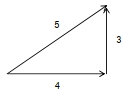
(A) The given equations of the two progressive waves are $y_1 = 4 \sin(2x - 6t)$ and $y_2 = 3 \sin(2x - 6t - \pi/2)$.
Comparing these with the standard form $y = A \sin(\omega t - kx + \phi)$,we get amplitudes $A_1 = 4$ and $A_2 = 3$.
The phase difference between the two waves is $\Delta\phi = \pi/2$.
The resultant amplitude $A$ of two superimposed waves is given by the formula $A = \sqrt{A_1^2 + A_2^2 + 2A_1A_2 \cos(\Delta\phi)}$.
Substituting the values,$A = \sqrt{4^2 + 3^2 + 2(4)(3) \cos(\pi/2)}$.
Since $\cos(\pi/2) = 0$,we have $A = \sqrt{16 + 9 + 0} = \sqrt{25} = 5$.
Comparing these with the standard form $y = A \sin(\omega t - kx + \phi)$,we get amplitudes $A_1 = 4$ and $A_2 = 3$.
The phase difference between the two waves is $\Delta\phi = \pi/2$.
The resultant amplitude $A$ of two superimposed waves is given by the formula $A = \sqrt{A_1^2 + A_2^2 + 2A_1A_2 \cos(\Delta\phi)}$.
Substituting the values,$A = \sqrt{4^2 + 3^2 + 2(4)(3) \cos(\pi/2)}$.
Since $\cos(\pi/2) = 0$,we have $A = \sqrt{16 + 9 + 0} = \sqrt{25} = 5$.
0 likes
View Solution78
MediumMCQ
Four harmonic waves of equal frequencies and equal intensities $I_0$ have phase angles $0, \pi / 3, 2 \pi / 3$ and $\pi$. When they are superposed,the intensity of the resulting wave is $nI_0$. The value of $n$ is
A
$1$
B
$2$
C
$3$
D
$4$
Solution
(C) The resultant amplitude $A_R$ of the superposition of waves with phase angles $\phi_1, \phi_2, \phi_3, \phi_4$ is given by the vector sum of individual amplitudes $A_0$ (where $I_0 = k A_0^2$).
Let the waves be represented as complex numbers: $z_1 = A_0 e^{i0} = A_0$,$z_2 = A_0 e^{i\pi/3}$,$z_3 = A_0 e^{i2\pi/3}$,and $z_4 = A_0 e^{i\pi} = -A_0$.
The sum is $S = A_0(1 + e^{i\pi/3} + e^{i2\pi/3} - 1) = A_0(e^{i\pi/3} + e^{i2\pi/3})$.
Using the identity $e^{i\theta} = \cos \theta + i \sin \theta$,we have $S = A_0 [(\cos \pi/3 + i \sin \pi/3) + (\cos 2\pi/3 + i \sin 2\pi/3)]$.
$S = A_0 [(1/2 + i\sqrt{3}/2) + (-1/2 + i\sqrt{3}/2)] = A_0 (i\sqrt{3})$.
The resultant intensity $I = |S|^2 = A_0^2 |i\sqrt{3}|^2 = I_0 (3) = 3I_0$.
Thus,$n = 3$.
Let the waves be represented as complex numbers: $z_1 = A_0 e^{i0} = A_0$,$z_2 = A_0 e^{i\pi/3}$,$z_3 = A_0 e^{i2\pi/3}$,and $z_4 = A_0 e^{i\pi} = -A_0$.
The sum is $S = A_0(1 + e^{i\pi/3} + e^{i2\pi/3} - 1) = A_0(e^{i\pi/3} + e^{i2\pi/3})$.
Using the identity $e^{i\theta} = \cos \theta + i \sin \theta$,we have $S = A_0 [(\cos \pi/3 + i \sin \pi/3) + (\cos 2\pi/3 + i \sin 2\pi/3)]$.
$S = A_0 [(1/2 + i\sqrt{3}/2) + (-1/2 + i\sqrt{3}/2)] = A_0 (i\sqrt{3})$.
The resultant intensity $I = |S|^2 = A_0^2 |i\sqrt{3}|^2 = I_0 (3) = 3I_0$.
Thus,$n = 3$.
0 likes
View Solution79
MediumMCQ
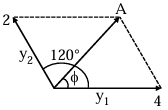
The amplitude and phase of a wave that is formed by the superposition of two harmonic travelling waves,$y_1(x, t) = 4 \sin(kx - \omega t)$ and $y_2(x, t) = 2 \sin(kx - \omega t + \frac{2\pi}{3})$,are (Take the angular frequency of initial waves same as $\omega$):
A
$[6, \frac{2\pi}{3}]$
B
$[6, \frac{\pi}{3}]$
C
$[\sqrt{3}, \frac{\pi}{6}]$
D
$[2\sqrt{3}, \frac{\pi}{6}]$
Solution
(D) The resultant wave is given by $y = y_1 + y_2 = A \sin(kx - \omega t + \phi)$.
Using the phasor addition method for two waves with amplitudes $A_1 = 4$ and $A_2 = 2$ and a phase difference $\Delta\phi = \frac{2\pi}{3} = 120^{\circ}$,the resultant amplitude $A$ is:
$A = \sqrt{A_1^2 + A_2^2 + 2A_1A_2 \cos(\Delta\phi)}$
$A = \sqrt{4^2 + 2^2 + 2(4)(2) \cos(120^{\circ})}$
$A = \sqrt{16 + 4 + 16(-0.5)} = \sqrt{20 - 8} = \sqrt{12} = 2\sqrt{3}$.
The phase angle $\phi$ of the resultant wave is given by:
$\tan \phi = \frac{A_2 \sin(\Delta\phi)}{A_1 + A_2 \cos(\Delta\phi)}$
$\tan \phi = \frac{2 \sin(120^{\circ})}{4 + 2 \cos(120^{\circ})} = \frac{2(\frac{\sqrt{3}}{2})}{4 + 2(-0.5)} = \frac{\sqrt{3}}{4 - 1} = \frac{\sqrt{3}}{3} = \frac{1}{\sqrt{3}}$.
Thus,$\phi = \frac{\pi}{6}$.
Using the phasor addition method for two waves with amplitudes $A_1 = 4$ and $A_2 = 2$ and a phase difference $\Delta\phi = \frac{2\pi}{3} = 120^{\circ}$,the resultant amplitude $A$ is:
$A = \sqrt{A_1^2 + A_2^2 + 2A_1A_2 \cos(\Delta\phi)}$
$A = \sqrt{4^2 + 2^2 + 2(4)(2) \cos(120^{\circ})}$
$A = \sqrt{16 + 4 + 16(-0.5)} = \sqrt{20 - 8} = \sqrt{12} = 2\sqrt{3}$.
The phase angle $\phi$ of the resultant wave is given by:
$\tan \phi = \frac{A_2 \sin(\Delta\phi)}{A_1 + A_2 \cos(\Delta\phi)}$
$\tan \phi = \frac{2 \sin(120^{\circ})}{4 + 2 \cos(120^{\circ})} = \frac{2(\frac{\sqrt{3}}{2})}{4 + 2(-0.5)} = \frac{\sqrt{3}}{4 - 1} = \frac{\sqrt{3}}{3} = \frac{1}{\sqrt{3}}$.
Thus,$\phi = \frac{\pi}{6}$.
0 likes
View Solution80
EasyMCQ
Two waves originating from $S_1$ and $S_2$,having zero initial phase difference and common wavelength $\lambda$,will show completely destructive interference at $P$,if $(S_1 P - S_2 P)$ is
A
$5 \lambda$
B
$0.75 \lambda$
C
$0.6 \lambda$
D
$5.5 \lambda$
Solution
(D) For completely destructive interference (minima),the path difference $\Delta x$ between the two waves must be an odd multiple of half the wavelength.
Mathematically,$\Delta x = (2n - 1) \frac{\lambda}{2}$,where $n = 1, 2, 3, \dots$
This can also be written as $\Delta x = 0.5 \lambda, 1.5 \lambda, 2.5 \lambda, 3.5 \lambda, 4.5 \lambda, 5.5 \lambda, \dots$
Comparing this with the given options,$5.5 \lambda$ corresponds to the case where $n = 6$ (i.e.,$\Delta x = (2 \times 6 - 1) \frac{\lambda}{2} = 11 \frac{\lambda}{2} = 5.5 \lambda$).
Therefore,the correct option is $5.5 \lambda$.
Mathematically,$\Delta x = (2n - 1) \frac{\lambda}{2}$,where $n = 1, 2, 3, \dots$
This can also be written as $\Delta x = 0.5 \lambda, 1.5 \lambda, 2.5 \lambda, 3.5 \lambda, 4.5 \lambda, 5.5 \lambda, \dots$
Comparing this with the given options,$5.5 \lambda$ corresponds to the case where $n = 6$ (i.e.,$\Delta x = (2 \times 6 - 1) \frac{\lambda}{2} = 11 \frac{\lambda}{2} = 5.5 \lambda$).
Therefore,the correct option is $5.5 \lambda$.
0 likes
View Solution81
DifficultMCQ
The equation of a simple harmonic progressive wave is given by $y = \frac{1}{\sqrt{a}} \sin \omega t \pm \frac{1}{\sqrt{b}} \cos \omega t$. The resultant amplitude of the wave is:
A
$\frac{a \pm b}{a b}$
B
$\frac{\sqrt{a} \pm \sqrt{b}}{a b}$
C
$\frac{\sqrt{a} \pm \sqrt{b}}{\sqrt{a b}}$
D
$\sqrt{\frac{a+b}{a b}}$
Solution
(D) The given equation is $y = \frac{1}{\sqrt{a}} \sin \omega t \pm \frac{1}{\sqrt{b}} \cos \omega t$.
We know that $\cos \omega t = \sin(\omega t + \frac{\pi}{2})$.
Substituting this,we get $y = \frac{1}{\sqrt{a}} \sin \omega t \pm \frac{1}{\sqrt{b}} \sin(\omega t + \frac{\pi}{2})$.
This represents the superposition of two simple harmonic motions with amplitudes $A_1 = \frac{1}{\sqrt{a}}$ and $A_2 = \frac{1}{\sqrt{b}}$,and a phase difference of $\phi = \frac{\pi}{2}$.
The resultant amplitude $A$ is given by $A = \sqrt{A_1^2 + A_2^2 + 2A_1 A_2 \cos \phi}$.
Since $\cos \frac{\pi}{2} = 0$,the formula simplifies to $A = \sqrt{A_1^2 + A_2^2}$.
Substituting the values,$A = \sqrt{(\frac{1}{\sqrt{a}})^2 + (\frac{1}{\sqrt{b}})^2} = \sqrt{\frac{1}{a} + \frac{1}{b}} = \sqrt{\frac{a+b}{ab}}$.
We know that $\cos \omega t = \sin(\omega t + \frac{\pi}{2})$.
Substituting this,we get $y = \frac{1}{\sqrt{a}} \sin \omega t \pm \frac{1}{\sqrt{b}} \sin(\omega t + \frac{\pi}{2})$.
This represents the superposition of two simple harmonic motions with amplitudes $A_1 = \frac{1}{\sqrt{a}}$ and $A_2 = \frac{1}{\sqrt{b}}$,and a phase difference of $\phi = \frac{\pi}{2}$.
The resultant amplitude $A$ is given by $A = \sqrt{A_1^2 + A_2^2 + 2A_1 A_2 \cos \phi}$.
Since $\cos \frac{\pi}{2} = 0$,the formula simplifies to $A = \sqrt{A_1^2 + A_2^2}$.
Substituting the values,$A = \sqrt{(\frac{1}{\sqrt{a}})^2 + (\frac{1}{\sqrt{b}})^2} = \sqrt{\frac{1}{a} + \frac{1}{b}} = \sqrt{\frac{a+b}{ab}}$.
0 likes
View Solution82
EasyMCQ
When two light waves each of amplitude $A$ and having a phase difference of $\frac{\pi}{2}$ are superimposed,the amplitude of the resultant wave is:
A
$\frac{A}{\sqrt{2}}$
B
$2A$
C
$\sqrt{2} A$
D
$\frac{A}{2}$
Solution
(C) The formula for the resultant amplitude $R$ of two superimposed waves is given by:
$R = \sqrt{A_1^2 + A_2^2 + 2 A_1 A_2 \cos \phi}$
Given that the amplitude of each wave is $A_1 = A_2 = A$ and the phase difference is $\phi = \frac{\pi}{2}$ (which is $90^{\circ}$).
Substituting these values into the formula:
$R = \sqrt{A^2 + A^2 + 2 A^2 \cos 90^{\circ}}$
Since $\cos 90^{\circ} = 0$,the expression simplifies to:
$R = \sqrt{A^2 + A^2 + 0} = \sqrt{2 A^2} = \sqrt{2} A$
$R = \sqrt{A_1^2 + A_2^2 + 2 A_1 A_2 \cos \phi}$
Given that the amplitude of each wave is $A_1 = A_2 = A$ and the phase difference is $\phi = \frac{\pi}{2}$ (which is $90^{\circ}$).
Substituting these values into the formula:
$R = \sqrt{A^2 + A^2 + 2 A^2 \cos 90^{\circ}}$
Since $\cos 90^{\circ} = 0$,the expression simplifies to:
$R = \sqrt{A^2 + A^2 + 0} = \sqrt{2 A^2} = \sqrt{2} A$
0 likes
View Solution83
MediumMCQ
When two sound waves having amplitude $3$ and $5$ units are superimposed,then the ratio of maximum to minimum intensity of the wave produced is:
A
$2:1$
B
$5:3$
C
$4:1$
D
$16:1$
Solution
(D) The intensity $I$ of a sound wave is proportional to the square of its amplitude $A$,i.e.,$I \propto A^2$.
Given amplitudes are $A_1 = 3$ and $A_2 = 5$.
The maximum amplitude is $A_{max} = A_1 + A_2 = 3 + 5 = 8$.
The minimum amplitude is $A_{min} = |A_1 - A_2| = |3 - 5| = 2$.
The ratio of maximum intensity to minimum intensity is given by:
$\frac{I_{max}}{I_{min}} = \left( \frac{A_{max}}{A_{min}} \right)^2$
$\frac{I_{max}}{I_{min}} = \left( \frac{8}{2} \right)^2 = (4)^2 = 16$.
Thus,the ratio is $16:1$.
Given amplitudes are $A_1 = 3$ and $A_2 = 5$.
The maximum amplitude is $A_{max} = A_1 + A_2 = 3 + 5 = 8$.
The minimum amplitude is $A_{min} = |A_1 - A_2| = |3 - 5| = 2$.
The ratio of maximum intensity to minimum intensity is given by:
$\frac{I_{max}}{I_{min}} = \left( \frac{A_{max}}{A_{min}} \right)^2$
$\frac{I_{max}}{I_{min}} = \left( \frac{8}{2} \right)^2 = (4)^2 = 16$.
Thus,the ratio is $16:1$.
0 likes
View Solution84
EasyMCQ
Two sound waves having the same amplitude '$A$' and angular frequency '$\omega$',but having a phase difference of '$\frac{\pi}{2}$' radians,are superimposed. What is the maximum amplitude of the resultant wave?
A
$\frac{A}{\sqrt{2}}$
B
$\frac{A}{2}$
C
$\sqrt{2} A$
D
$2 A$
Solution
(C) The resultant amplitude '$R$' of two waves with amplitudes '$A_1$' and '$A_2$' and a phase difference '$\phi$' is given by the formula: $R = \sqrt{A_1^2 + A_2^2 + 2A_1 A_2 \cos(\phi)}$.
Given: $A_1 = A$,$A_2 = A$,and $\phi = \frac{\pi}{2}$.
Substituting these values into the formula:
$R = \sqrt{A^2 + A^2 + 2(A)(A) \cos(\frac{\pi}{2})}$
Since $\cos(\frac{\pi}{2}) = 0$,the expression simplifies to:
$R = \sqrt{A^2 + A^2 + 0} = \sqrt{2A^2} = \sqrt{2} A$.
Therefore,the maximum amplitude of the resultant wave is $\sqrt{2} A$.
Given: $A_1 = A$,$A_2 = A$,and $\phi = \frac{\pi}{2}$.
Substituting these values into the formula:
$R = \sqrt{A^2 + A^2 + 2(A)(A) \cos(\frac{\pi}{2})}$
Since $\cos(\frac{\pi}{2}) = 0$,the expression simplifies to:
$R = \sqrt{A^2 + A^2 + 0} = \sqrt{2A^2} = \sqrt{2} A$.
Therefore,the maximum amplitude of the resultant wave is $\sqrt{2} A$.
0 likes
View Solution85
MediumMCQ
The equations of two waves are given as
$\begin{aligned}
& y_1=a \sin \left(\omega t+\phi_1\right) \\
& y_2=a \sin \left(\omega t+\phi_2\right)
\end{aligned}$
If the amplitude and time period of the resultant wave are the same as those of the individual waves,then $(\phi_1-\phi_2)$ is
$\begin{aligned}
& y_1=a \sin \left(\omega t+\phi_1\right) \\
& y_2=a \sin \left(\omega t+\phi_2\right)
\end{aligned}$
If the amplitude and time period of the resultant wave are the same as those of the individual waves,then $(\phi_1-\phi_2)$ is
A
$\cos ^{-1}\left(-\frac{1}{2}\right)$
B
$\cos ^{-1}\left(-\frac{1}{4}\right)$
C
$\cos ^{-1}\left(-\frac{1}{6}\right)$
D
$\cos ^{-1}\left(-\frac{1}{8}\right)$
Solution
(A) The resultant amplitude $A$ of two waves with amplitudes $a_1$ and $a_2$ and phase difference $\phi = \phi_1 - \phi_2$ is given by the formula:
$A^2 = a_1^2 + a_2^2 + 2a_1 a_2 \cos \phi$
Given that $a_1 = a_2 = a$ and the resultant amplitude $A = a$,we substitute these into the equation:
$a^2 = a^2 + a^2 + 2(a)(a) \cos \phi$
$a^2 = 2a^2 + 2a^2 \cos \phi$
Subtracting $2a^2$ from both sides:
$-a^2 = 2a^2 \cos \phi$
Dividing by $2a^2$:
$\cos \phi = -\frac{1}{2}$
Therefore,the phase difference is:
$\phi = \phi_1 - \phi_2 = \cos ^{-1}\left(-\frac{1}{2}\right)$
$A^2 = a_1^2 + a_2^2 + 2a_1 a_2 \cos \phi$
Given that $a_1 = a_2 = a$ and the resultant amplitude $A = a$,we substitute these into the equation:
$a^2 = a^2 + a^2 + 2(a)(a) \cos \phi$
$a^2 = 2a^2 + 2a^2 \cos \phi$
Subtracting $2a^2$ from both sides:
$-a^2 = 2a^2 \cos \phi$
Dividing by $2a^2$:
$\cos \phi = -\frac{1}{2}$
Therefore,the phase difference is:
$\phi = \phi_1 - \phi_2 = \cos ^{-1}\left(-\frac{1}{2}\right)$
0 likes
View Solution86
MediumMCQ
Two sound waves each of wavelength $\lambda$ and having the same amplitude $A$ from two sources $S_1$ and $S_2$ interfere at a point $P$. If the path difference $S_2P - S_1P = \lambda/3$,then the amplitude of the resultant wave at point $P$ will be $[\cos(120^{\circ}) = -0.5]$.
A
$A$
B
$2A$
C
$A/2$
D
$3A/2$
Solution
(A) The path difference is given as $\Delta x = \lambda/3$.
The phase difference $\phi$ is related to path difference by the formula $\phi = \frac{2\pi}{\lambda} \times \Delta x$.
Substituting the value,$\phi = \frac{2\pi}{\lambda} \times \frac{\lambda}{3} = \frac{2\pi}{3} = 120^{\circ}$.
The resultant amplitude $R$ of two waves with equal amplitude $A$ is given by $R = \sqrt{A^2 + A^2 + 2A^2 \cos \phi}$.
Substituting $\phi = 120^{\circ}$ and $\cos(120^{\circ}) = -0.5$:
$R = \sqrt{A^2 + A^2 + 2A^2(-0.5)}$
$R = \sqrt{2A^2 - A^2}$
$R = \sqrt{A^2} = A$.
The phase difference $\phi$ is related to path difference by the formula $\phi = \frac{2\pi}{\lambda} \times \Delta x$.
Substituting the value,$\phi = \frac{2\pi}{\lambda} \times \frac{\lambda}{3} = \frac{2\pi}{3} = 120^{\circ}$.
The resultant amplitude $R$ of two waves with equal amplitude $A$ is given by $R = \sqrt{A^2 + A^2 + 2A^2 \cos \phi}$.
Substituting $\phi = 120^{\circ}$ and $\cos(120^{\circ}) = -0.5$:
$R = \sqrt{A^2 + A^2 + 2A^2(-0.5)}$
$R = \sqrt{2A^2 - A^2}$
$R = \sqrt{A^2} = A$.
0 likes
View Solution87
EasyMCQ
Two waves are superimposed whose ratio of intensities is $9: 1$. The ratio of maximum and minimum intensity is
A
$9: 1$
B
$4: 1$
C
$3: 1$
D
$5: 3$
Solution
(B) Given,the ratio of intensities of two waves is $\frac{I_1}{I_2} = \frac{9}{1}$.
Since intensity $I \propto a^2$,where $a$ is the amplitude,we have:
$\frac{I_1}{I_2} = \left(\frac{a_1}{a_2}\right)^2 = \frac{9}{1}$
Taking the square root on both sides:
$\frac{a_1}{a_2} = \frac{3}{1} \Rightarrow a_1 = 3a_2$.
The ratio of maximum to minimum intensity is given by:
$\frac{I_{\max}}{I_{\min}} = \frac{(a_1 + a_2)^2}{(a_1 - a_2)^2}$
Substituting $a_1 = 3a_2$:
$\frac{I_{\max}}{I_{\min}} = \frac{(3a_2 + a_2)^2}{(3a_2 - a_2)^2} = \frac{(4a_2)^2}{(2a_2)^2} = \frac{16a_2^2}{4a_2^2} = \frac{4}{1}$.
Since intensity $I \propto a^2$,where $a$ is the amplitude,we have:
$\frac{I_1}{I_2} = \left(\frac{a_1}{a_2}\right)^2 = \frac{9}{1}$
Taking the square root on both sides:
$\frac{a_1}{a_2} = \frac{3}{1} \Rightarrow a_1 = 3a_2$.
The ratio of maximum to minimum intensity is given by:
$\frac{I_{\max}}{I_{\min}} = \frac{(a_1 + a_2)^2}{(a_1 - a_2)^2}$
Substituting $a_1 = 3a_2$:
$\frac{I_{\max}}{I_{\min}} = \frac{(3a_2 + a_2)^2}{(3a_2 - a_2)^2} = \frac{(4a_2)^2}{(2a_2)^2} = \frac{16a_2^2}{4a_2^2} = \frac{4}{1}$.
0 likes
View Solution88
MediumMCQ
Two waves with same amplitude and frequency superpose at a point. The ratio of resultant intensities when they arrive in phase to that when they arrive $90^{\circ}$ out of phase is $\left[\cos \frac{\pi}{2}=0\right]$
A
$1: 1$
B
$2: 1$
C
$4: 1$
D
$1: 2$
Solution
(B) Let the amplitude of each wave be $A$. The intensity $I$ is proportional to the square of the amplitude,so $I \propto A^2$. Let $I_0 = kA^2$ be the intensity of each wave.
Case $1$: When the waves arrive in phase,the phase difference $\phi = 0$. The resultant amplitude is $A_R = A + A = 2A$. The resultant intensity is $I_1 = k(2A)^2 = 4kA^2 = 4I_0$.
Case $2$: When the waves arrive $90^{\circ}$ ($\pi/2$ radians) out of phase,the resultant amplitude is $A_R = \sqrt{A^2 + A^2 + 2AA \cos(90^{\circ})} = \sqrt{2A^2} = A\sqrt{2}$. The resultant intensity is $I_2 = k(A\sqrt{2})^2 = 2kA^2 = 2I_0$.
The ratio of the resultant intensities is $\frac{I_1}{I_2} = \frac{4I_0}{2I_0} = \frac{2}{1}$.
Case $1$: When the waves arrive in phase,the phase difference $\phi = 0$. The resultant amplitude is $A_R = A + A = 2A$. The resultant intensity is $I_1 = k(2A)^2 = 4kA^2 = 4I_0$.
Case $2$: When the waves arrive $90^{\circ}$ ($\pi/2$ radians) out of phase,the resultant amplitude is $A_R = \sqrt{A^2 + A^2 + 2AA \cos(90^{\circ})} = \sqrt{2A^2} = A\sqrt{2}$. The resultant intensity is $I_2 = k(A\sqrt{2})^2 = 2kA^2 = 2I_0$.
The ratio of the resultant intensities is $\frac{I_1}{I_2} = \frac{4I_0}{2I_0} = \frac{2}{1}$.
0 likes
View Solution89
MediumMCQ
If two waves of the same frequency and amplitude on superposition produce a resultant disturbance of the same amplitude,the waves differ in phase by
A
$\pi$
B
Zero
C
$\pi /3$
D
$2\pi /3$
Solution
(D) Let the equations of the two waves be $y_1 = a \sin(\omega t - kx)$ and $y_2 = a \sin(\omega t - kx + \phi)$.
When they superpose,the resultant wave is $y = y_1 + y_2$.
Using the trigonometric identity $\sin A + \sin B = 2 \sin(\frac{A+B}{2}) \cos(\frac{A-B}{2})$,we get:
$y = 2a \cos(\frac{\phi}{2}) \sin(\omega t - kx + \frac{\phi}{2})$.
The resultant amplitude is $A_R = |2a \cos(\frac{\phi}{2})|$.
Given that the resultant amplitude is equal to the individual amplitude $a$,we have:
$a = |2a \cos(\frac{\phi}{2})| \implies \cos(\frac{\phi}{2}) = \pm \frac{1}{2}$.
Considering the magnitude,$\cos(\frac{\phi}{2}) = \frac{1}{2}$.
Since $\cos(\frac{\pi}{3}) = \frac{1}{2}$,we have $\frac{\phi}{2} = \frac{\pi}{3}$.
Therefore,the phase difference is $\phi = \frac{2\pi}{3}$.
When they superpose,the resultant wave is $y = y_1 + y_2$.
Using the trigonometric identity $\sin A + \sin B = 2 \sin(\frac{A+B}{2}) \cos(\frac{A-B}{2})$,we get:
$y = 2a \cos(\frac{\phi}{2}) \sin(\omega t - kx + \frac{\phi}{2})$.
The resultant amplitude is $A_R = |2a \cos(\frac{\phi}{2})|$.
Given that the resultant amplitude is equal to the individual amplitude $a$,we have:
$a = |2a \cos(\frac{\phi}{2})| \implies \cos(\frac{\phi}{2}) = \pm \frac{1}{2}$.
Considering the magnitude,$\cos(\frac{\phi}{2}) = \frac{1}{2}$.
Since $\cos(\frac{\pi}{3}) = \frac{1}{2}$,we have $\frac{\phi}{2} = \frac{\pi}{3}$.
Therefore,the phase difference is $\phi = \frac{2\pi}{3}$.
0 likes
View Solution90
MediumMCQ
The sources of sound $A$ and $B$ produce a wave of $350 Hz$ in the same phase. $A$ particle $P$ is vibrating under the influence of these two waves. If the amplitudes at $P$ produced by the two waves are $0.3 mm$ and $0.4 mm$,the resultant amplitude of the point $P$ will be,when $AP-BP=25 cm$ and the velocity of sound is $350 m s^{-1}$. (in $mm$)
A
$0.7$
B
$0.1$
C
$0.2$
D
$0.5$
Solution
(D) The resultant amplitude of waves at the point $P$ is given by the formula: $A = \sqrt{A_1^2 + A_2^2 + 2 A_1 A_2 \cos \phi}$,where $\phi$ is the phase difference,and $A_1$ and $A_2$ are the amplitudes of the sound waves.
First,we calculate the wavelength $\lambda$ of the sound wave: $\lambda = \frac{v}{f} = \frac{350 m s^{-1}}{350 Hz} = 1 m = 100 cm$.
The path difference is given as $\Delta x = AP - BP = 25 cm$.
The phase difference $\phi$ is calculated as: $\phi = \frac{2 \pi}{\lambda} \Delta x = \frac{2 \pi}{100 cm} \times 25 cm = \frac{\pi}{2}$.
Now,substitute the values into the resultant amplitude formula:
$A = \sqrt{0.3^2 + 0.4^2 + 2 \times 0.3 \times 0.4 \cos(\frac{\pi}{2})}$
Since $\cos(\frac{\pi}{2}) = 0$,the expression simplifies to:
$A = \sqrt{0.3^2 + 0.4^2} = \sqrt{0.09 + 0.16} = \sqrt{0.25} = 0.5 mm$.
First,we calculate the wavelength $\lambda$ of the sound wave: $\lambda = \frac{v}{f} = \frac{350 m s^{-1}}{350 Hz} = 1 m = 100 cm$.
The path difference is given as $\Delta x = AP - BP = 25 cm$.
The phase difference $\phi$ is calculated as: $\phi = \frac{2 \pi}{\lambda} \Delta x = \frac{2 \pi}{100 cm} \times 25 cm = \frac{\pi}{2}$.
Now,substitute the values into the resultant amplitude formula:
$A = \sqrt{0.3^2 + 0.4^2 + 2 \times 0.3 \times 0.4 \cos(\frac{\pi}{2})}$
Since $\cos(\frac{\pi}{2}) = 0$,the expression simplifies to:
$A = \sqrt{0.3^2 + 0.4^2} = \sqrt{0.09 + 0.16} = \sqrt{0.25} = 0.5 mm$.
0 likes
View Solution91
MediumMCQ
Two identical sinusoidal waves each of amplitude $10 \,mm$, with a phase difference of $90^{\circ}$ are travelling in the same direction in a string. The amplitude of the resultant wave is
A
$5 \,mm$
B
$10 \sqrt{2} \,mm$
C
$5 \sqrt{2} \,mm$
D
$20 \,mm$
Solution
(B) Given that, the amplitudes of the two waves are $a_1 = a_2 = 10 \,mm$.
The phase difference between the waves is $\phi = 90^{\circ}$.
The resultant amplitude $A$ of two interfering waves is given by the formula:
$A = \sqrt{a_1^2 + a_2^2 + 2 a_1 a_2 \cos \phi}$
Substituting the given values into the formula:
$A = \sqrt{(10)^2 + (10)^2 + 2(10)(10) \cos 90^{\circ}}$
Since $\cos 90^{\circ} = 0$, the expression simplifies to:
$A = \sqrt{100 + 100 + 0}$
$A = \sqrt{200}$
$A = 10 \sqrt{2} \,mm$
The phase difference between the waves is $\phi = 90^{\circ}$.
The resultant amplitude $A$ of two interfering waves is given by the formula:
$A = \sqrt{a_1^2 + a_2^2 + 2 a_1 a_2 \cos \phi}$
Substituting the given values into the formula:
$A = \sqrt{(10)^2 + (10)^2 + 2(10)(10) \cos 90^{\circ}}$
Since $\cos 90^{\circ} = 0$, the expression simplifies to:
$A = \sqrt{100 + 100 + 0}$
$A = \sqrt{200}$
$A = 10 \sqrt{2} \,mm$
0 likes
View Solution92
MediumMCQ
The amplitude of a wave,represented by the displacement equation $y = \frac{1}{\sqrt{a}} \sin \omega t \pm \frac{1}{\sqrt{b}} \cos \omega t$,will be:
A
$\frac{a+b}{a b}$
B
$\frac{\sqrt{a}+\sqrt{b}}{a b}$
C
$\frac{\sqrt{a} \pm \sqrt{b}}{a b}$
D
$\sqrt{\frac{a+b}{a b}}$
Solution
(D) The given displacement equation is $y = \frac{1}{\sqrt{a}} \sin \omega t \pm \frac{1}{\sqrt{b}} \cos \omega t$.
We can rewrite $\cos \omega t$ as $\sin(\omega t + \frac{\pi}{2})$.
Thus,$y = \frac{1}{\sqrt{a}} \sin \omega t \pm \frac{1}{\sqrt{b}} \sin(\omega t + \frac{\pi}{2})$.
This is a superposition of two simple harmonic motions with amplitudes $A_1 = \frac{1}{\sqrt{a}}$ and $A_2 = \frac{1}{\sqrt{b}}$,and a phase difference of $\phi = \frac{\pi}{2}$.
The resultant amplitude $A$ is given by $A = \sqrt{A_1^2 + A_2^2 + 2A_1A_2 \cos \phi}$.
Since $\cos(\frac{\pi}{2}) = 0$,the formula simplifies to $A = \sqrt{A_1^2 + A_2^2}$.
Substituting the values,$A = \sqrt{(\frac{1}{\sqrt{a}})^2 + (\frac{1}{\sqrt{b}})^2} = \sqrt{\frac{1}{a} + \frac{1}{b}}$.
Taking the common denominator,$A = \sqrt{\frac{a+b}{ab}}$.
We can rewrite $\cos \omega t$ as $\sin(\omega t + \frac{\pi}{2})$.
Thus,$y = \frac{1}{\sqrt{a}} \sin \omega t \pm \frac{1}{\sqrt{b}} \sin(\omega t + \frac{\pi}{2})$.
This is a superposition of two simple harmonic motions with amplitudes $A_1 = \frac{1}{\sqrt{a}}$ and $A_2 = \frac{1}{\sqrt{b}}$,and a phase difference of $\phi = \frac{\pi}{2}$.
The resultant amplitude $A$ is given by $A = \sqrt{A_1^2 + A_2^2 + 2A_1A_2 \cos \phi}$.
Since $\cos(\frac{\pi}{2}) = 0$,the formula simplifies to $A = \sqrt{A_1^2 + A_2^2}$.
Substituting the values,$A = \sqrt{(\frac{1}{\sqrt{a}})^2 + (\frac{1}{\sqrt{b}})^2} = \sqrt{\frac{1}{a} + \frac{1}{b}}$.
Taking the common denominator,$A = \sqrt{\frac{a+b}{ab}}$.
0 likes
View Solution93
EasyMCQ
Two waves of frequency $f$ and amplitude $a$ superimpose with each other. The total intensity is directly proportional to
A
$a$
B
$2 a$
C
$2 a^2$
D
$4 a^2$
Solution
(D) When two waves of same frequency $f$ and same amplitude $a$ superimpose,the resultant amplitude $A$ depends on the phase difference. Assuming constructive interference (maximum intensity),the resultant amplitude is $A = a + a = 2 a$.
Since the intensity $I$ of a wave is directly proportional to the square of its amplitude,we have $I \propto A^2$.
Substituting the value of $A$,we get $I \propto (2 a)^2 = 4 a^2$.
Thus,the total intensity is directly proportional to $4 a^2$.
Since the intensity $I$ of a wave is directly proportional to the square of its amplitude,we have $I \propto A^2$.
Substituting the value of $A$,we get $I \propto (2 a)^2 = 4 a^2$.
Thus,the total intensity is directly proportional to $4 a^2$.
0 likes
View Solution94
MediumMCQ
The amplitude of the wave resulting from the superposition of $3$ waves given by $x_1 = A \cos \omega t$,$x_2 = 2 A \sin \omega t$ and $x_3 = \sqrt{2} A \cos (\omega t + \frac{\pi}{4})$ is
A
$\sqrt{7} A$
B
$\sqrt{5} A$
C
$(3 + \sqrt{2}) A$
D
$\sqrt{2} A$
Solution
(B) The resultant displacement is given by $x = x_1 + x_2 + x_3$.
Substituting the given expressions:
$x = A \cos \omega t + 2 A \sin \omega t + \sqrt{2} A \cos (\omega t + \frac{\pi}{4})$.
Using the trigonometric identity $\cos (\alpha + \beta) = \cos \alpha \cos \beta - \sin \alpha \sin \beta$:
$x = A \cos \omega t + 2 A \sin \omega t + \sqrt{2} A (\cos \omega t \cos \frac{\pi}{4} - \sin \omega t \sin \frac{\pi}{4})$.
Since $\cos \frac{\pi}{4} = \sin \frac{\pi}{4} = \frac{1}{\sqrt{2}}$:
$x = A \cos \omega t + 2 A \sin \omega t + \sqrt{2} A (\frac{1}{\sqrt{2}} \cos \omega t - \frac{1}{\sqrt{2}} \sin \omega t)$.
$x = A \cos \omega t + 2 A \sin \omega t + A \cos \omega t - A \sin \omega t$.
$x = 2 A \cos \omega t + A \sin \omega t$.
The resultant amplitude $R$ for a displacement of the form $x = a \cos \omega t + b \sin \omega t$ is $R = \sqrt{a^2 + b^2}$.
Therefore,$R = \sqrt{(2 A)^2 + A^2} = \sqrt{4 A^2 + A^2} = \sqrt{5} A$.
Substituting the given expressions:
$x = A \cos \omega t + 2 A \sin \omega t + \sqrt{2} A \cos (\omega t + \frac{\pi}{4})$.
Using the trigonometric identity $\cos (\alpha + \beta) = \cos \alpha \cos \beta - \sin \alpha \sin \beta$:
$x = A \cos \omega t + 2 A \sin \omega t + \sqrt{2} A (\cos \omega t \cos \frac{\pi}{4} - \sin \omega t \sin \frac{\pi}{4})$.
Since $\cos \frac{\pi}{4} = \sin \frac{\pi}{4} = \frac{1}{\sqrt{2}}$:
$x = A \cos \omega t + 2 A \sin \omega t + \sqrt{2} A (\frac{1}{\sqrt{2}} \cos \omega t - \frac{1}{\sqrt{2}} \sin \omega t)$.
$x = A \cos \omega t + 2 A \sin \omega t + A \cos \omega t - A \sin \omega t$.
$x = 2 A \cos \omega t + A \sin \omega t$.
The resultant amplitude $R$ for a displacement of the form $x = a \cos \omega t + b \sin \omega t$ is $R = \sqrt{a^2 + b^2}$.
Therefore,$R = \sqrt{(2 A)^2 + A^2} = \sqrt{4 A^2 + A^2} = \sqrt{5} A$.
0 likes
View Solution95
MediumMCQ
Two sound waves each of intensity $I$ are superimposed. If the phase difference between the waves is $\frac{\pi}{2}$,then the intensity of the resultant wave is
A
$2 I$
B
$3 I$
C
$4 I$
D
$I$
Solution
(A) The resultant intensity $I_R$ of two waves with individual intensities $I_1$ and $I_2$ and a phase difference $\phi$ is given by the formula:
$I_R = I_1 + I_2 + 2\sqrt{I_1 I_2} \cos(\phi)$
Given that $I_1 = I_2 = I$ and $\phi = \frac{\pi}{2}$,we substitute these values into the formula:
$I_R = I + I + 2\sqrt{I \cdot I} \cos(\frac{\pi}{2})$
Since $\cos(\frac{\pi}{2}) = 0$,the expression simplifies to:
$I_R = 2I + 2I(0) = 2I$
Therefore,the resultant intensity is $2I$.
$I_R = I_1 + I_2 + 2\sqrt{I_1 I_2} \cos(\phi)$
Given that $I_1 = I_2 = I$ and $\phi = \frac{\pi}{2}$,we substitute these values into the formula:
$I_R = I + I + 2\sqrt{I \cdot I} \cos(\frac{\pi}{2})$
Since $\cos(\frac{\pi}{2}) = 0$,the expression simplifies to:
$I_R = 2I + 2I(0) = 2I$
Therefore,the resultant intensity is $2I$.
0 likes
View Solution96
EasyMCQ
Two waves of amplitudes $A_1$ and $A_2$ respectively are superimposed. The ratio between the maximum and minimum intensities of the resultant waves is $9 : 4$. The value of $A_2 / A_1$ is [Assume $A_1 > A_2$]
A
$0.66$
B
$0.20$
C
$0.75$
D
$0.44$
Solution
(B) The intensity $I$ of a wave is proportional to the square of its amplitude $A$,i.e.,$I \propto A^2$.
For two waves with amplitudes $A_1$ and $A_2$,the maximum intensity $I_{max}$ occurs at constructive interference,where $I_{max} \propto (A_1 + A_2)^2$.
The minimum intensity $I_{min}$ occurs at destructive interference,where $I_{min} \propto (A_1 - A_2)^2$.
Given the ratio of intensities $\frac{I_{max}}{I_{min}} = \frac{9}{4}$,we have:
$\frac{(A_1 + A_2)^2}{(A_1 - A_2)^2} = \frac{9}{4}$
Taking the square root on both sides:
$\frac{A_1 + A_2}{A_1 - A_2} = \frac{3}{2}$
Cross-multiplying gives:
$2(A_1 + A_2) = 3(A_1 - A_2)$
$2A_1 + 2A_2 = 3A_1 - 3A_2$
$5A_2 = A_1$
Therefore,the ratio $\frac{A_2}{A_1} = \frac{1}{5} = 0.2$.
For two waves with amplitudes $A_1$ and $A_2$,the maximum intensity $I_{max}$ occurs at constructive interference,where $I_{max} \propto (A_1 + A_2)^2$.
The minimum intensity $I_{min}$ occurs at destructive interference,where $I_{min} \propto (A_1 - A_2)^2$.
Given the ratio of intensities $\frac{I_{max}}{I_{min}} = \frac{9}{4}$,we have:
$\frac{(A_1 + A_2)^2}{(A_1 - A_2)^2} = \frac{9}{4}$
Taking the square root on both sides:
$\frac{A_1 + A_2}{A_1 - A_2} = \frac{3}{2}$
Cross-multiplying gives:
$2(A_1 + A_2) = 3(A_1 - A_2)$
$2A_1 + 2A_2 = 3A_1 - 3A_2$
$5A_2 = A_1$
Therefore,the ratio $\frac{A_2}{A_1} = \frac{1}{5} = 0.2$.
0 likes
View Solution97
EasyMCQ
Two identical sinusoidal waves are moving in the same direction along a stretched string and interfere with each other. The phase difference between them is $120^{\circ}$. The amplitudes of both the waves are the same. If the amplitude of the resultant wave due to interference is $2 \,mm$, the amplitude of each wave is:
A
$1 \,mm$
B
$2 \,mm$
C
$\sqrt{3} \,mm$
D
$2 \sqrt{3} \,mm$
Solution
(B) Given that the amplitude of each sinusoidal wave is the same.
Let $a_1 = a_2 = a$.
The phase difference is $\phi = 120^{\circ}$.
The resultant amplitude is $A = 2 \,mm$.
The formula for the resultant amplitude of two interfering waves is given by:
$A = \sqrt{a_1^2 + a_2^2 + 2 a_1 a_2 \cos \phi}$
Substituting the given values:
$2 = \sqrt{a^2 + a^2 + 2 a^2 \cos 120^{\circ}}$
Since $\cos 120^{\circ} = -\frac{1}{2}$, we have:
$2 = \sqrt{a^2 + a^2 + 2 a^2 (-0.5)}$
$2 = \sqrt{2a^2 - a^2}$
$2 = \sqrt{a^2}$
$2 = a$
Therefore, the amplitude of each wave is $2 \,mm$.
Let $a_1 = a_2 = a$.
The phase difference is $\phi = 120^{\circ}$.
The resultant amplitude is $A = 2 \,mm$.
The formula for the resultant amplitude of two interfering waves is given by:
$A = \sqrt{a_1^2 + a_2^2 + 2 a_1 a_2 \cos \phi}$
Substituting the given values:
$2 = \sqrt{a^2 + a^2 + 2 a^2 \cos 120^{\circ}}$
Since $\cos 120^{\circ} = -\frac{1}{2}$, we have:
$2 = \sqrt{a^2 + a^2 + 2 a^2 (-0.5)}$
$2 = \sqrt{2a^2 - a^2}$
$2 = \sqrt{a^2}$
$2 = a$
Therefore, the amplitude of each wave is $2 \,mm$.
0 likes
View Solution98
EasyMCQ
Two harmonic travelling waves are described by the equations $y_1 = a \sin (kx - \omega t)$ and $y_2 = a \sin (-kx + \omega t + \phi)$. The amplitude of the superposed wave is:
A
$2a \cos \frac{\phi}{2}$
B
$2a \sin \phi$
C
$2a \cos \phi$
D
$2a \sin \frac{\phi}{2}$
Solution
(A) Given equations are:
$y_1 = a \sin (kx - \omega t)$
$y_2 = a \sin (-(kx - \omega t) + \phi)$
Using the identity $\sin(-\theta) = -\sin(\theta)$,we can rewrite $y_2$ as:
$y_2 = -a \sin (kx - \omega t - \phi)$
Using $\sin(\theta - \phi) = \sin \theta \cos \phi - \cos \theta \sin \phi$,the superposition $y = y_1 + y_2$ is:
$y = a \sin(kx - \omega t) + a \sin(kx - \omega t + \phi)$
Using the sum-to-product formula $\sin A + \sin B = 2 \sin(\frac{A+B}{2}) \cos(\frac{A-B}{2})$:
$y = 2a \sin(\frac{kx - \omega t + kx - \omega t + \phi}{2}) \cos(\frac{kx - \omega t - (kx - \omega t + \phi)}{2})$
$y = 2a \sin(kx - \omega t + \frac{\phi}{2}) \cos(-\frac{\phi}{2})$
Since $\cos(-\theta) = \cos(\theta)$:
$y = [2a \cos(\frac{\phi}{2})] \sin(kx - \omega t + \frac{\phi}{2})$
The amplitude of the resultant wave is the coefficient of the sine term,which is $2a \cos(\frac{\phi}{2})$.
$y_1 = a \sin (kx - \omega t)$
$y_2 = a \sin (-(kx - \omega t) + \phi)$
Using the identity $\sin(-\theta) = -\sin(\theta)$,we can rewrite $y_2$ as:
$y_2 = -a \sin (kx - \omega t - \phi)$
Using $\sin(\theta - \phi) = \sin \theta \cos \phi - \cos \theta \sin \phi$,the superposition $y = y_1 + y_2$ is:
$y = a \sin(kx - \omega t) + a \sin(kx - \omega t + \phi)$
Using the sum-to-product formula $\sin A + \sin B = 2 \sin(\frac{A+B}{2}) \cos(\frac{A-B}{2})$:
$y = 2a \sin(\frac{kx - \omega t + kx - \omega t + \phi}{2}) \cos(\frac{kx - \omega t - (kx - \omega t + \phi)}{2})$
$y = 2a \sin(kx - \omega t + \frac{\phi}{2}) \cos(-\frac{\phi}{2})$
Since $\cos(-\theta) = \cos(\theta)$:
$y = [2a \cos(\frac{\phi}{2})] \sin(kx - \omega t + \frac{\phi}{2})$
The amplitude of the resultant wave is the coefficient of the sine term,which is $2a \cos(\frac{\phi}{2})$.
0 likes
View Solution99
EasyMCQ
Sound waves are passing through two routes—one in a straight path and the other along a semicircular path of radius $r$—and are again combined into one pipe and superposed as shown in the figure. If the velocity of sound waves in the pipe is $v$,then frequencies of resultant waves of maximum amplitude will be integral multiples of
A
$\frac{v}{r(\pi-2)}$
B
$\frac{v}{r(\pi-1)}$
C
$\frac{2v}{r(\pi-1)}$
D
$\frac{v}{r(\pi+1)}$
Solution
(A) The path length of the straight route is $2r$ (the diameter of the semicircle).
The path length of the semicircular route is $\pi r$.
The path difference $\Delta x$ between the two routes is $\Delta x = \pi r - 2r = r(\pi - 2)$.
For maximum amplitude (constructive interference),the path difference must be an integral multiple of the wavelength $\lambda$,so $\Delta x = n\lambda$,where $n = 1, 2, 3, \dots$.
Substituting the path difference,we get $r(\pi - 2) = n\lambda$.
Since the velocity of sound is $v = f\lambda$,we have $\lambda = \frac{v}{f}$.
Substituting this into the equation: $r(\pi - 2) = n \frac{v}{f}$.
Rearranging for frequency $f$: $f = n \left[ \frac{v}{r(\pi - 2)} \right]$.
Thus,the frequencies of the resultant waves of maximum amplitude are integral multiples of $\frac{v}{r(\pi - 2)}$.
The path length of the semicircular route is $\pi r$.
The path difference $\Delta x$ between the two routes is $\Delta x = \pi r - 2r = r(\pi - 2)$.
For maximum amplitude (constructive interference),the path difference must be an integral multiple of the wavelength $\lambda$,so $\Delta x = n\lambda$,where $n = 1, 2, 3, \dots$.
Substituting the path difference,we get $r(\pi - 2) = n\lambda$.
Since the velocity of sound is $v = f\lambda$,we have $\lambda = \frac{v}{f}$.
Substituting this into the equation: $r(\pi - 2) = n \frac{v}{f}$.
Rearranging for frequency $f$: $f = n \left[ \frac{v}{r(\pi - 2)} \right]$.
Thus,the frequencies of the resultant waves of maximum amplitude are integral multiples of $\frac{v}{r(\pi - 2)}$.
0 likes
View Solution100
MediumMCQ
Two loudspeakers ($L_1$ and $L_2$) are placed with a separation of $10 \ m$,as shown in the figure. Both speakers are fed with an audio input signal of the same frequency with constant volume. $A$ voice recorder,initially at point $A$,at equidistance to both loudspeakers,is moved by $25 \ m$ along the line $AB$ while monitoring the audio signal. The measured signal was found to undergo $10$ cycles of minima and maxima during the movement. The frequency of the input signal is . . . . . . $Hz$. (Speed of sound in air is $324 \ m/s$ and $\sqrt{5} = 2.23$)
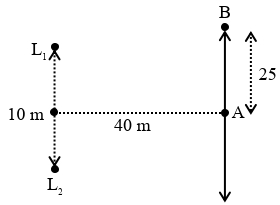
A
$300$
B
$600$
C
$450$
D
$150$
Solution
(B) Let the distance of point $A$ from the line joining the speakers be $D = 40 \ m$. The speakers $L_1$ and $L_2$ are separated by $10 \ m$,so their coordinates relative to the midpoint of the line joining them are $(0, 5)$ and $(0, -5)$. Point $A$ is at $(40, 0)$.
When the recorder moves to point $B$ at a distance of $25 \ m$ from $A$,its coordinates are $(40, 25)$.
The distances from the speakers to point $B$ are:
$L_1B = \sqrt{40^2 + (25-5)^2} = \sqrt{40^2 + 20^2} = \sqrt{1600 + 400} = \sqrt{2000} = 20\sqrt{5} \ m$.
Given $\sqrt{5} = 2.23$,$L_1B = 20 \times 2.23 = 44.6 \ m$.
$L_2B = \sqrt{40^2 + (25+5)^2} = \sqrt{40^2 + 30^2} = \sqrt{1600 + 900} = \sqrt{2500} = 50 \ m$.
The path difference at point $B$ is $\Delta x = L_2B - L_1B = 50 - 44.6 = 5.4 \ m$.
Since the recorder undergoes $10$ cycles of minima and maxima,point $B$ corresponds to the $10^{\text{th}}$ maxima,so $\Delta x = n\lambda$,where $n = 10$.
$5.4 = 10 \times \lambda \implies \lambda = 0.54 \ m$.
The frequency $f$ is given by $f = \frac{v}{\lambda} = \frac{324}{0.54} = 600 \ Hz$.
When the recorder moves to point $B$ at a distance of $25 \ m$ from $A$,its coordinates are $(40, 25)$.
The distances from the speakers to point $B$ are:
$L_1B = \sqrt{40^2 + (25-5)^2} = \sqrt{40^2 + 20^2} = \sqrt{1600 + 400} = \sqrt{2000} = 20\sqrt{5} \ m$.
Given $\sqrt{5} = 2.23$,$L_1B = 20 \times 2.23 = 44.6 \ m$.
$L_2B = \sqrt{40^2 + (25+5)^2} = \sqrt{40^2 + 30^2} = \sqrt{1600 + 900} = \sqrt{2500} = 50 \ m$.
The path difference at point $B$ is $\Delta x = L_2B - L_1B = 50 - 44.6 = 5.4 \ m$.
Since the recorder undergoes $10$ cycles of minima and maxima,point $B$ corresponds to the $10^{\text{th}}$ maxima,so $\Delta x = n\lambda$,where $n = 10$.
$5.4 = 10 \times \lambda \implies \lambda = 0.54 \ m$.
The frequency $f$ is given by $f = \frac{v}{\lambda} = \frac{324}{0.54} = 600 \ Hz$.
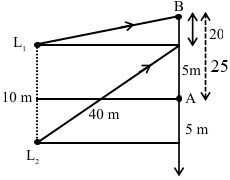
0 likes
View SolutionWaves and Sound — Principle of superposition of waves · Frequently Asked Questions
1Are these Waves and Sound questions useful for JEE and NEET?
Yes. All questions in this section are mapped to JEE Main and NEET exam patterns. Previous year questions from JEE Main, NEET, GUJCET and state-level exams are included with full solutions.
2Can I switch to Hindi or Gujarati for these questions?
Yes. Use the language tabs in the hero section or the sidebar to view the same questions and solutions in English, Hindi or Gujarati.
3How do I generate a question paper from this subtopic?
Use the Vedclass Exam Paper Generator — select the chapter and subtopic, set difficulty, and generate Sets A, B, C, D automatically. First 3 chapters of every subject are free.
Vedclass Products
For Students
Vedclass Test Series
Mock tests in real JEE/NEET style with performance analysis. 5-day free trial.
Start Free TrialFor Teachers
Exam Paper Generator
Generate Set A/B/C/D papers from this chapter in 2 minutes. 3 chapters free.
Try FreeFor Institutes
Online Exam Module
Live online exams with unlimited students, 360° analytics & white-label branding.
See DemoFor Teachers & Institutes
Generate a Waves and Sound Exam Paper in 2 Minutes
Select subtopic & difficulty — Sets A, B, C, D auto-generated with No Repeat logic.
First 3 chapters of every subject are free — no payment required.