
A English
Energy and Intensity of Waves Questions in English
Class 11 Physics · Waves and Sound · Energy and Intensity of Waves
57+
Questions
English
Language
100%
With Solutions
Showing 6 of 57 questions in English
51
DifficultMCQ
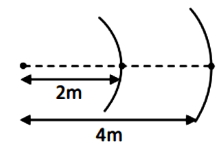
$A$ point source is emitting sound waves of intensity $16 \times 10^{-8} \text{ W m}^{-2}$ at a distance of $1 \text{ m}$ from the source. The difference in intensity (magnitude only) at two points located at distances of $2 \text{ m}$ and $4 \text{ m}$ from the source respectively will be . . . . . . $\times 10^{-8} \text{ W m}^{-2}$.
A
$3$
B
$2$
C
$1$
D
$5$
Solution
(A) For a point source,the intensity $I$ at a distance $r$ is given by the inverse square law: $I \propto \frac{1}{r^2}$.
Let $I_0$ be the intensity at $r_0 = 1 \text{ m}$,where $I_0 = 16 \times 10^{-8} \text{ W m}^{-2}$.
The intensity at distance $r$ is $I(r) = \frac{I_0 \cdot r_0^2}{r^2} = \frac{16 \times 10^{-8} \times (1)^2}{r^2} = \frac{16 \times 10^{-8}}{r^2} \text{ W m}^{-2}$.
At $r_1 = 2 \text{ m}$,the intensity is $I_1 = \frac{16 \times 10^{-8}}{2^2} = \frac{16 \times 10^{-8}}{4} = 4 \times 10^{-8} \text{ W m}^{-2}$.
At $r_2 = 4 \text{ m}$,the intensity is $I_2 = \frac{16 \times 10^{-8}}{4^2} = \frac{16 \times 10^{-8}}{16} = 1 \times 10^{-8} \text{ W m}^{-2}$.
The difference in intensity is $|I_1 - I_2| = |4 \times 10^{-8} - 1 \times 10^{-8}| = 3 \times 10^{-8} \text{ W m}^{-2}$.
Thus,the value is $3$.
Let $I_0$ be the intensity at $r_0 = 1 \text{ m}$,where $I_0 = 16 \times 10^{-8} \text{ W m}^{-2}$.
The intensity at distance $r$ is $I(r) = \frac{I_0 \cdot r_0^2}{r^2} = \frac{16 \times 10^{-8} \times (1)^2}{r^2} = \frac{16 \times 10^{-8}}{r^2} \text{ W m}^{-2}$.
At $r_1 = 2 \text{ m}$,the intensity is $I_1 = \frac{16 \times 10^{-8}}{2^2} = \frac{16 \times 10^{-8}}{4} = 4 \times 10^{-8} \text{ W m}^{-2}$.
At $r_2 = 4 \text{ m}$,the intensity is $I_2 = \frac{16 \times 10^{-8}}{4^2} = \frac{16 \times 10^{-8}}{16} = 1 \times 10^{-8} \text{ W m}^{-2}$.
The difference in intensity is $|I_1 - I_2| = |4 \times 10^{-8} - 1 \times 10^{-8}| = 3 \times 10^{-8} \text{ W m}^{-2}$.
Thus,the value is $3$.
0 likes
View Solution52
MediumMCQ
$A$ musical instrument $X$ produces sound waves of frequency $n$ and amplitude $A$. Another musical instrument $Y$ produces sound waves of frequency $\frac{n}{3}$. The waves produced by $X$ and $Y$ have equal energies. The amplitude of waves produced by $Y$ will be (in $A$)
A
$3$
B
$4$
C
$2$
D
$1$
Solution
(A) The energy of oscillations is given by the formula $E = \frac{1}{2} m \omega^2 A^2$.
Since $\omega = 2 \pi n$,we have $E \propto n^2 A^2$.
Given that the energies of the waves produced by $X$ and $Y$ are equal,we can write:
$n_X^2 A_X^2 = n_Y^2 A_Y^2$.
Substituting the given values $n_X = n$,$A_X = A$,and $n_Y = \frac{n}{3}$:
$n^2 A^2 = (\frac{n}{3})^2 A_Y^2$.
$n^2 A^2 = \frac{n^2}{9} A_Y^2$.
$A^2 = \frac{A_Y^2}{9}$.
$A_Y^2 = 9 A^2$.
Taking the square root on both sides,we get $A_Y = 3 A$.
Since $\omega = 2 \pi n$,we have $E \propto n^2 A^2$.
Given that the energies of the waves produced by $X$ and $Y$ are equal,we can write:
$n_X^2 A_X^2 = n_Y^2 A_Y^2$.
Substituting the given values $n_X = n$,$A_X = A$,and $n_Y = \frac{n}{3}$:
$n^2 A^2 = (\frac{n}{3})^2 A_Y^2$.
$n^2 A^2 = \frac{n^2}{9} A_Y^2$.
$A^2 = \frac{A_Y^2}{9}$.
$A_Y^2 = 9 A^2$.
Taking the square root on both sides,we get $A_Y = 3 A$.
0 likes
View Solution53
MediumMCQ
$A$ musical instrument $P$ produces sound waves of frequency $n$ and amplitude $A_P$. Another musical instrument $Q$ produces sound waves of frequency $\frac{n}{4}$. The waves produced by $P$ and $Q$ have equal energies. If the amplitude of waves produced by $P$ is $A_P$,the amplitude of waves produced by $Q$ will be: (in $A_P$)
A
$2$
B
$4$
C
$6$
D
$8$
Solution
(B) The energy $E$ of a sound wave is proportional to the square of its amplitude $A$ and the square of its frequency $n$. Mathematically,$E \propto A^2 n^2$.
Since the energies of the waves produced by $P$ and $Q$ are equal,we have $E_P = E_Q$.
This implies $A_P^2 n_P^2 = A_Q^2 n_Q^2$.
Given $n_P = n$ and $n_Q = \frac{n}{4}$,we substitute these values into the equation:
$A_P^2 n^2 = A_Q^2 (\frac{n}{4})^2$.
$A_P^2 n^2 = A_Q^2 (\frac{n^2}{16})$.
Dividing both sides by $n^2$,we get $A_P^2 = \frac{A_Q^2}{16}$.
$A_Q^2 = 16 A_P^2$.
Taking the square root of both sides,we get $A_Q = 4 A_P$.
Since the energies of the waves produced by $P$ and $Q$ are equal,we have $E_P = E_Q$.
This implies $A_P^2 n_P^2 = A_Q^2 n_Q^2$.
Given $n_P = n$ and $n_Q = \frac{n}{4}$,we substitute these values into the equation:
$A_P^2 n^2 = A_Q^2 (\frac{n}{4})^2$.
$A_P^2 n^2 = A_Q^2 (\frac{n^2}{16})$.
Dividing both sides by $n^2$,we get $A_P^2 = \frac{A_Q^2}{16}$.
$A_Q^2 = 16 A_P^2$.
Taking the square root of both sides,we get $A_Q = 4 A_P$.
0 likes
View Solution54
DifficultMCQ
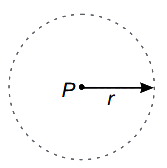
$A$ stationary point source of sound emits sound uniformly in all directions in a non-absorbing medium. Two points $P$ and $Q$ are at a distance of $4 \ m$ and $9 \ m$ respectively from the source. The ratio of amplitudes of the waves at $P$ and $Q$ is
A
$\frac{3}{2}$
B
$\frac{4}{9}$
C
$\frac{2}{3}$
D
$\frac{9}{4}$
Solution
(D) For a spherical wave emitted by a point source,the intensity $I$ at a distance $r$ is given by $I = \frac{P}{4 \pi r^2}$,where $P$ is the power of the source.
Since $I \propto A^2$,where $A$ is the amplitude,we have $A^2 \propto \frac{1}{r^2}$,which implies $A \propto \frac{1}{r}$.
Let $A_P$ and $A_Q$ be the amplitudes at distances $r_P = 4 \ m$ and $r_Q = 9 \ m$ respectively.
Then,the ratio of amplitudes is $\frac{A_P}{A_Q} = \frac{r_Q}{r_P}$.
Substituting the given values,$\frac{A_P}{A_Q} = \frac{9}{4}$.
Since $I \propto A^2$,where $A$ is the amplitude,we have $A^2 \propto \frac{1}{r^2}$,which implies $A \propto \frac{1}{r}$.
Let $A_P$ and $A_Q$ be the amplitudes at distances $r_P = 4 \ m$ and $r_Q = 9 \ m$ respectively.
Then,the ratio of amplitudes is $\frac{A_P}{A_Q} = \frac{r_Q}{r_P}$.
Substituting the given values,$\frac{A_P}{A_Q} = \frac{9}{4}$.
0 likes
View Solution55
DifficultMCQ
On getting reflected at a surface,the intensity of sound is found to be decreased by $20 \%$. If $A$ be the amplitude of the incident sound waves,then the amplitude of reflected sound waves is
A
$\frac{4}{5} A$
B
$\frac{2}{\sqrt{5}} A$
C
$\frac{\sqrt{2}}{5} A$
D
$\frac{1}{\sqrt{5}} A$
Solution
(B) The intensity $(I)$ of a sound wave is directly proportional to the square of its amplitude $(A)$.
$I \propto A^2$
Therefore,the ratio of intensities is related to the ratio of amplitudes as:
$\frac{I_{\text{reflected}}}{I_{\text{incident}}} = \left( \frac{A_{\text{reflected}}}{A_{\text{incident}}} \right)^2$
Given that the intensity decreases by $20 \%$,the reflected intensity is:
$I_{\text{reflected}} = I_{\text{incident}} - 0.20 I_{\text{incident}} = 0.8 I_{\text{incident}} = \frac{4}{5} I_{\text{incident}}$
Substituting this into the ratio equation:
$\frac{\frac{4}{5} I_{\text{incident}}}{I_{\text{incident}}} = \left( \frac{A_{\text{reflected}}}{A} \right)^2$
$\frac{4}{5} = \left( \frac{A_{\text{reflected}}}{A} \right)^2$
Taking the square root on both sides:
$A_{\text{reflected}} = \sqrt{\frac{4}{5}} A = \frac{2}{\sqrt{5}} A$
$I \propto A^2$
Therefore,the ratio of intensities is related to the ratio of amplitudes as:
$\frac{I_{\text{reflected}}}{I_{\text{incident}}} = \left( \frac{A_{\text{reflected}}}{A_{\text{incident}}} \right)^2$
Given that the intensity decreases by $20 \%$,the reflected intensity is:
$I_{\text{reflected}} = I_{\text{incident}} - 0.20 I_{\text{incident}} = 0.8 I_{\text{incident}} = \frac{4}{5} I_{\text{incident}}$
Substituting this into the ratio equation:
$\frac{\frac{4}{5} I_{\text{incident}}}{I_{\text{incident}}} = \left( \frac{A_{\text{reflected}}}{A} \right)^2$
$\frac{4}{5} = \left( \frac{A_{\text{reflected}}}{A} \right)^2$
Taking the square root on both sides:
$A_{\text{reflected}} = \sqrt{\frac{4}{5}} A = \frac{2}{\sqrt{5}} A$
0 likes
View Solution56
MediumMCQ
$A$ point source is kept at the center of a spherically enclosed detector. If the volume of the detector is increased by $8$ times,the intensity will
A
increase by $8$ times
B
increase by $64$ times
C
decrease by $8$ times
D
decrease by $4$ times
Solution
(D) The volume of a sphere is given by $V = \frac{4}{3} \pi R^3$,which implies $V \propto R^3$.
If the volume $V$ increases by $8$ times,then $R^3$ increases by $8$ times,so the radius $R$ increases by $2$ times $(R \rightarrow 2R)$.
The surface area of the sphere is $A = 4 \pi R^2$,which implies $A \propto R^2$.
Since $R$ increases by $2$ times,the area $A$ increases by $2^2 = 4$ times $(A \rightarrow 4A)$.
Intensity $I$ is defined as power per unit area,$I = \frac{P}{A}$.
Since the power $P$ of the point source remains constant,$I \propto \frac{1}{A}$.
Therefore,if the area $A$ increases by $4$ times,the intensity $I$ will decrease by $4$ times $(I \rightarrow \frac{I}{4})$.
If the volume $V$ increases by $8$ times,then $R^3$ increases by $8$ times,so the radius $R$ increases by $2$ times $(R \rightarrow 2R)$.
The surface area of the sphere is $A = 4 \pi R^2$,which implies $A \propto R^2$.
Since $R$ increases by $2$ times,the area $A$ increases by $2^2 = 4$ times $(A \rightarrow 4A)$.
Intensity $I$ is defined as power per unit area,$I = \frac{P}{A}$.
Since the power $P$ of the point source remains constant,$I \propto \frac{1}{A}$.
Therefore,if the area $A$ increases by $4$ times,the intensity $I$ will decrease by $4$ times $(I \rightarrow \frac{I}{4})$.
0 likes
View SolutionWaves and Sound — Energy and Intensity of Waves · Frequently Asked Questions
1Are these Waves and Sound questions useful for JEE and NEET?
Yes. All questions in this section are mapped to JEE Main and NEET exam patterns. Previous year questions from JEE Main, NEET, GUJCET and state-level exams are included with full solutions.
2Can I switch to Hindi or Gujarati for these questions?
Yes. Use the language tabs in the hero section or the sidebar to view the same questions and solutions in English, Hindi or Gujarati.
3How do I generate a question paper from this subtopic?
Use the Vedclass Exam Paper Generator — select the chapter and subtopic, set difficulty, and generate Sets A, B, C, D automatically. First 3 chapters of every subject are free.
Vedclass Products
For Students
Vedclass Test Series
Mock tests in real JEE/NEET style with performance analysis. 5-day free trial.
Start Free TrialFor Teachers
Exam Paper Generator
Generate Set A/B/C/D papers from this chapter in 2 minutes. 3 chapters free.
Try FreeFor Institutes
Online Exam Module
Live online exams with unlimited students, 360° analytics & white-label branding.
See DemoFor Teachers & Institutes
Generate a Waves and Sound Exam Paper in 2 Minutes
Select subtopic & difficulty — Sets A, B, C, D auto-generated with No Repeat logic.
First 3 chapters of every subject are free — no payment required.