
A English
Conservation of angular momentum (combined translation and rotational motion) Questions in English
Class 11 Physics · System of Particles and Rotational Motion · Conservation of angular momentum (combined translation and rotational motion)
213+
Questions
English
Language
100%
With Solutions
Showing 50 of 213 questions in English
151
Medium
$A$ man stands on a rotating platform with his arms stretched horizontally,holding a $5\; kg$ weight in each hand. The angular speed of the platform is $30$ revolutions per minute. The man then brings his arms close to his body,with the distance of each weight from the axis changing from $90\; cm$ to $20\; cm$. The moment of inertia of the man together with the platform may be taken to be constant and equal to $7.6\; kg\; m^2$.
$(a)$ What is his new angular speed? (Neglect friction.)
$(b)$ Is kinetic energy conserved in the process? If not,from where does the change come about?
$(a)$ What is his new angular speed? (Neglect friction.)
$(b)$ Is kinetic energy conserved in the process? If not,from where does the change come about?
Solution
(A) Initial moment of inertia of the man and platform system $I_{man+platform} = 7.6\; kg\; m^2$.
Initial moment of inertia of the weights $I_{w1} = 2 \times m r_1^2 = 2 \times 5 \times (0.9)^2 = 8.1\; kg\; m^2$.
Total initial moment of inertia $I_i = 7.6 + 8.1 = 15.7\; kg\; m^2$.
Initial angular speed $\omega_i = 30\; rev/min$.
Final moment of inertia of the weights $I_{w2} = 2 \times m r_2^2 = 2 \times 5 \times (0.2)^2 = 0.4\; kg\; m^2$.
Total final moment of inertia $I_f = 7.6 + 0.4 = 8.0\; kg\; m^2$.
By the law of conservation of angular momentum,$I_i \omega_i = I_f \omega_f$.
$\omega_f = \frac{I_i \omega_i}{I_f} = \frac{15.7 \times 30}{8.0} = 58.875\; rev/min \approx 58.88\; rev/min$.
$(b)$ Kinetic energy is not conserved. The final kinetic energy $K_f = \frac{1}{2} I_f \omega_f^2$ is greater than the initial kinetic energy $K_i = \frac{1}{2} I_i \omega_i^2$. The increase in kinetic energy is due to the work done by the man in pulling his arms inward against the centrifugal force.
Initial moment of inertia of the weights $I_{w1} = 2 \times m r_1^2 = 2 \times 5 \times (0.9)^2 = 8.1\; kg\; m^2$.
Total initial moment of inertia $I_i = 7.6 + 8.1 = 15.7\; kg\; m^2$.
Initial angular speed $\omega_i = 30\; rev/min$.
Final moment of inertia of the weights $I_{w2} = 2 \times m r_2^2 = 2 \times 5 \times (0.2)^2 = 0.4\; kg\; m^2$.
Total final moment of inertia $I_f = 7.6 + 0.4 = 8.0\; kg\; m^2$.
By the law of conservation of angular momentum,$I_i \omega_i = I_f \omega_f$.
$\omega_f = \frac{I_i \omega_i}{I_f} = \frac{15.7 \times 30}{8.0} = 58.875\; rev/min \approx 58.88\; rev/min$.
$(b)$ Kinetic energy is not conserved. The final kinetic energy $K_f = \frac{1}{2} I_f \omega_f^2$ is greater than the initial kinetic energy $K_i = \frac{1}{2} I_i \omega_i^2$. The increase in kinetic energy is due to the work done by the man in pulling his arms inward against the centrifugal force.
0 likes
View Solution152
DifficultMCQ
$A$ bullet of mass $10 \; g$ and speed $500 \; m/s$ is fired into a door and gets embedded exactly at the centre of the door. The door is $1.0 \; m$ wide and weighs $12 \; kg$. It is hinged at one end and rotates about a vertical axis practically without friction. Find the angular speed of the door just after the bullet embeds into it.
A
$0.625 \; rad/s$
B
$0.500 \; rad/s$
C
$1.250 \; rad/s$
D
$0.312 \; rad/s$
Solution
(A) Mass of the bullet,$m = 10 \; g = 0.01 \; kg$.
Velocity of the bullet,$v = 500 \; m/s$.
Width of the door,$L = 1.0 \; m$.
Mass of the door,$M = 12 \; kg$.
The bullet embeds at the centre,so the distance from the hinge is $r = L/2 = 0.5 \; m$.
Angular momentum of the bullet about the hinge: $L_{bullet} = mvr = 0.01 \times 500 \times 0.5 = 2.5 \; kg \cdot m^2/s$.
Moment of inertia of the door about the hinge: $I_{door} = \frac{1}{3}ML^2 = \frac{1}{3} \times 12 \times (1.0)^2 = 4 \; kg \cdot m^2$.
Moment of inertia of the bullet about the hinge: $I_{bullet} = mr^2 = 0.01 \times (0.5)^2 = 0.0025 \; kg \cdot m^2$.
Total moment of inertia $I = I_{door} + I_{bullet} = 4 + 0.0025 = 4.0025 \; kg \cdot m^2$.
By conservation of angular momentum,$L_{bullet} = I \omega$.
$\omega = \frac{2.5}{4.0025} \approx 0.6246 \; rad/s \approx 0.625 \; rad/s$.
Velocity of the bullet,$v = 500 \; m/s$.
Width of the door,$L = 1.0 \; m$.
Mass of the door,$M = 12 \; kg$.
The bullet embeds at the centre,so the distance from the hinge is $r = L/2 = 0.5 \; m$.
Angular momentum of the bullet about the hinge: $L_{bullet} = mvr = 0.01 \times 500 \times 0.5 = 2.5 \; kg \cdot m^2/s$.
Moment of inertia of the door about the hinge: $I_{door} = \frac{1}{3}ML^2 = \frac{1}{3} \times 12 \times (1.0)^2 = 4 \; kg \cdot m^2$.
Moment of inertia of the bullet about the hinge: $I_{bullet} = mr^2 = 0.01 \times (0.5)^2 = 0.0025 \; kg \cdot m^2$.
Total moment of inertia $I = I_{door} + I_{bullet} = 4 + 0.0025 = 4.0025 \; kg \cdot m^2$.
By conservation of angular momentum,$L_{bullet} = I \omega$.
$\omega = \frac{2.5}{4.0025} \approx 0.6246 \; rad/s \approx 0.625 \; rad/s$.
0 likes
View Solution153
Medium
Explain with illustration the pure translation and combination of translation and rotation motion of a rigid body.
Solution
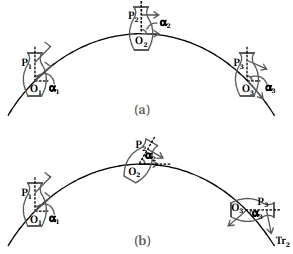
(N/A) The provided figure illustrates two different types of motion for the same rigid body.
Suppose $P$ is any point on the body and its center of mass is at $O$.
The trajectories of $O$ are the translational trajectories $Tr_{1}$ and $Tr_{2}$ of the body. The positions of $O$ and $P$ at three different instants of time are shown by $(O_{1}, O_{2}, O_{3})$ and $(P_{1}, P_{2}, P_{3})$ respectively in both figures.
In figure $(a)$,it is observed that the orientation of the body does not change as it moves. The line segment $OP$ maintains a constant angle with the horizontal direction at all positions.
$\therefore \alpha_{1} = \alpha_{2} = \alpha_{3}$
Such motion is defined as pure translation.
In pure translational motion,all particles of the rigid body,such as $O$ and $P$,have the same velocity at any given instant. In figure $(b)$,which represents a combination of translation and rotation,the velocities of $O$ and $P$ differ because the body rotates as it translates. Consequently,$\alpha_{1} \neq \alpha_{2} \neq \alpha_{3}$.
This type of motion is a combination of pure translation and rotation.
Another illustration of such motion is the rolling motion of a cylinder. When a cylinder rolls down a slope,its motion is a combination of rotation about its central axis and the translational motion of its center of mass.
If the motion of a rigid body is not about a fixed axis or is not stationary,it is either pure translation or a combination of translation and rotation.
If the motion of a body is constrained to be about a fixed axis or is pivoted,it is classified as rotational motion. Rotational motion can occur about a stationary axis or a variable axis.
Suppose $P$ is any point on the body and its center of mass is at $O$.
The trajectories of $O$ are the translational trajectories $Tr_{1}$ and $Tr_{2}$ of the body. The positions of $O$ and $P$ at three different instants of time are shown by $(O_{1}, O_{2}, O_{3})$ and $(P_{1}, P_{2}, P_{3})$ respectively in both figures.
In figure $(a)$,it is observed that the orientation of the body does not change as it moves. The line segment $OP$ maintains a constant angle with the horizontal direction at all positions.
$\therefore \alpha_{1} = \alpha_{2} = \alpha_{3}$
Such motion is defined as pure translation.
In pure translational motion,all particles of the rigid body,such as $O$ and $P$,have the same velocity at any given instant. In figure $(b)$,which represents a combination of translation and rotation,the velocities of $O$ and $P$ differ because the body rotates as it translates. Consequently,$\alpha_{1} \neq \alpha_{2} \neq \alpha_{3}$.
This type of motion is a combination of pure translation and rotation.
Another illustration of such motion is the rolling motion of a cylinder. When a cylinder rolls down a slope,its motion is a combination of rotation about its central axis and the translational motion of its center of mass.
If the motion of a rigid body is not about a fixed axis or is not stationary,it is either pure translation or a combination of translation and rotation.
If the motion of a body is constrained to be about a fixed axis or is pivoted,it is classified as rotational motion. Rotational motion can occur about a stationary axis or a variable axis.
0 likes
View Solution154
MediumMCQ
What is combined translation and rotation motion?
A
Motion where an object moves along a straight line only.
B
Motion where an object rotates about a fixed axis only.
C
Motion where an object undergoes both translational displacement and rotational motion simultaneously.
D
Motion where an object remains at rest.
Solution
(C) Combined translation and rotation motion occurs when a rigid body moves such that its center of mass undergoes translational motion while the body simultaneously rotates about an axis passing through its center of mass.
For example,a rolling wheel on a road exhibits both translational motion (the center of the wheel moves forward) and rotational motion (the wheel spins about its axle).
For example,a rolling wheel on a road exhibits both translational motion (the center of the wheel moves forward) and rotational motion (the wheel spins about its axle).
0 likes
View Solution155
Medium
State and explain the law of conservation of angular momentum.
Solution
(N/A) The time rate of change of the total angular momentum $\vec{L}$ of a system of particles about a point (taken as the origin of the frame of reference) is equal to the sum of the external torques $\vec{\tau}_{ext}$ acting on the system.
$\therefore \frac{d \vec{L}}{d t} = \vec{\tau}_{ext}$
If the resultant external torque on the system is zero, i.e., $\vec{\tau}_{ext} = 0$, then:
$\frac{d \vec{L}}{d t} = 0$
This implies that $\vec{L} = \text{constant}$.
Law of conservation of angular momentum: "If the resultant external torque on a system is zero, then its total angular momentum remains constant."
Here, $\vec{L} = \text{constant}$ is equivalent to three scalar equations:
$L_{x} = K_{1}, L_{y} = K_{2}, \text{ and } L_{z} = K_{3}$
Where $K_{1}, K_{2}, \text{ and } K_{3}$ are constants, and $L_{x}, L_{y}, \text{ and } L_{z}$ are the components of the total angular momentum $\vec{L}$ along the $X, Y, \text{ and } Z$ axes respectively. The total angular momentum is conserved means that each of these components is conserved.
$\therefore \frac{d \vec{L}}{d t} = \vec{\tau}_{ext}$
If the resultant external torque on the system is zero, i.e., $\vec{\tau}_{ext} = 0$, then:
$\frac{d \vec{L}}{d t} = 0$
This implies that $\vec{L} = \text{constant}$.
Law of conservation of angular momentum: "If the resultant external torque on a system is zero, then its total angular momentum remains constant."
Here, $\vec{L} = \text{constant}$ is equivalent to three scalar equations:
$L_{x} = K_{1}, L_{y} = K_{2}, \text{ and } L_{z} = K_{3}$
Where $K_{1}, K_{2}, \text{ and } K_{3}$ are constants, and $L_{x}, L_{y}, \text{ and } L_{z}$ are the components of the total angular momentum $\vec{L}$ along the $X, Y, \text{ and } Z$ axes respectively. The total angular momentum is conserved means that each of these components is conserved.
0 likes
View Solution156
Medium
State the law of conservation of angular momentum and explain it with the example of a girl sitting on a swivel chair.
Solution
(N/A) Law of Conservation of Angular Momentum: If the net external torque acting on a system is zero,the total angular momentum of the system remains constant.
Mathematical Derivation:
Angular momentum for rotational motion about a fixed axis is given by $\overrightarrow{L} = I \vec{\omega}$.
Differentiating with respect to time $t$ on both sides:
$\frac{d \overrightarrow{L}}{d t} = I \frac{d \vec{\omega}}{d t} = I \vec{\alpha} = \vec{\tau}$.
If the external torque $\vec{\tau} = 0$,then $\frac{d \overrightarrow{L}}{d t} = 0$,which implies $\overrightarrow{L} = \text{constant}$.
Illustration:
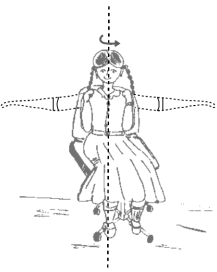
Consider a girl sitting on a rotating swivel chair with her arms outstretched. Her moment of inertia is $I_1$ and angular velocity is $\omega_1$. When she pulls her arms inward,her moment of inertia decreases to $I_2$ (where $I_2 < I_1$). Since the external torque is zero,the angular momentum is conserved: $I_1 \omega_1 = I_2 \omega_2$. Because $I_2 < I_1$,it follows that $\omega_2 > \omega_1$. Thus,the angular speed of the girl increases when she folds her arms.
Mathematical Derivation:
Angular momentum for rotational motion about a fixed axis is given by $\overrightarrow{L} = I \vec{\omega}$.
Differentiating with respect to time $t$ on both sides:
$\frac{d \overrightarrow{L}}{d t} = I \frac{d \vec{\omega}}{d t} = I \vec{\alpha} = \vec{\tau}$.
If the external torque $\vec{\tau} = 0$,then $\frac{d \overrightarrow{L}}{d t} = 0$,which implies $\overrightarrow{L} = \text{constant}$.
Illustration:
Consider a girl sitting on a rotating swivel chair with her arms outstretched. Her moment of inertia is $I_1$ and angular velocity is $\omega_1$. When she pulls her arms inward,her moment of inertia decreases to $I_2$ (where $I_2 < I_1$). Since the external torque is zero,the angular momentum is conserved: $I_1 \omega_1 = I_2 \omega_2$. Because $I_2 < I_1$,it follows that $\omega_2 > \omega_1$. Thus,the angular speed of the girl increases when she folds her arms.
1 likes
View Solution157
MediumMCQ
If the ice at the poles of the Earth melts and flows towards the equator, will the angular velocity of the Earth increase or decrease?
A
Increase
B
Decrease
C
Remain constant
D
Become zero
Solution
(B) According to the principle of conservation of angular momentum, $L = I\omega = \text{constant}$.
When ice at the poles melts and flows towards the equator, the mass distribution of the Earth shifts further away from the axis of rotation.
This increases the moment of inertia $(I)$ of the Earth.
Since $L$ is constant, if $I$ increases, the angular velocity $(\omega)$ must decrease to satisfy the equation $\omega = L/I$.
Therefore, the angular velocity of the Earth decreases.
When ice at the poles melts and flows towards the equator, the mass distribution of the Earth shifts further away from the axis of rotation.
This increases the moment of inertia $(I)$ of the Earth.
Since $L$ is constant, if $I$ increases, the angular velocity $(\omega)$ must decrease to satisfy the equation $\omega = L/I$.
Therefore, the angular velocity of the Earth decreases.
0 likes
View Solution158
Medium
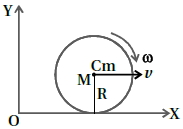
$A$ disc of mass $M$ and radius $R$ is moving with an angular velocity $\omega$ as shown in the figure. Find the angular momentum of the disc about the reference point $O$.
Solution
(N/A) The center of mass of the disc moves with a linear velocity $v = R\omega$ and rotates about its center of mass with angular velocity $\omega$.
The total angular momentum $L$ about point $O$ is the sum of the angular momentum due to the motion of the center of mass and the angular momentum due to rotation about the center of mass.
$L = L_{cm} + L_{rot}$
$L = (Mv)R + I_{cm}\omega$
Since $v = R\omega$ and $I_{cm} = \frac{1}{2}MR^2$,we have:
$L = M(R\omega)R + (\frac{1}{2}MR^2)\omega$
$L = MR^2\omega + \frac{1}{2}MR^2\omega$
$L = \frac{3}{2}MR^2\omega$
The total angular momentum $L$ about point $O$ is the sum of the angular momentum due to the motion of the center of mass and the angular momentum due to rotation about the center of mass.
$L = L_{cm} + L_{rot}$
$L = (Mv)R + I_{cm}\omega$
Since $v = R\omega$ and $I_{cm} = \frac{1}{2}MR^2$,we have:
$L = M(R\omega)R + (\frac{1}{2}MR^2)\omega$
$L = MR^2\omega + \frac{1}{2}MR^2\omega$
$L = \frac{3}{2}MR^2\omega$
0 likes
View Solution159
DifficultMCQ
Two uniform circular discs are rotating independently in the same direction around their common axis passing through their centres. The moment of inertia and angular velocity of the first disc are $0.1 \; kg \cdot m^{2}$ and $10 \; rad \cdot s^{-1}$ respectively,while those for the second one are $0.2 \; kg \cdot m^{2}$ and $5 \; rad \cdot s^{-1}$ respectively. At some instant,they get stuck together and start rotating as a single system about their common axis with some angular speed. The kinetic energy of the combined system is ........... $J$.
A
$3.33$
B
$0.67$
C
$1.67$
D
$6.67$
Solution
(D) Since the discs are rotating in the same direction,the total angular momentum is conserved.
Initial angular momentum $L_{i} = I_{1}\omega_{1} + I_{2}\omega_{2}$
$L_{i} = (0.1 \times 10) + (0.2 \times 5) = 1 + 1 = 2 \; kg \cdot m^{2} \cdot s^{-1}$
Final angular momentum $L_{f} = (I_{1} + I_{2})\omega_{f}$
$2 = (0.1 + 0.2) \omega_{f} = 0.3 \omega_{f}$
$\omega_{f} = \frac{2}{0.3} = \frac{20}{3} \; rad \cdot s^{-1}$
Final kinetic energy $K_{f} = \frac{1}{2}(I_{1} + I_{2})\omega_{f}^{2}$
$K_{f} = \frac{1}{2}(0.3) \left(\frac{20}{3}\right)^{2} = 0.15 \times \frac{400}{9} = \frac{15}{100} \times \frac{400}{9} = \frac{60}{9} = 6.67 \; J$.
Initial angular momentum $L_{i} = I_{1}\omega_{1} + I_{2}\omega_{2}$
$L_{i} = (0.1 \times 10) + (0.2 \times 5) = 1 + 1 = 2 \; kg \cdot m^{2} \cdot s^{-1}$
Final angular momentum $L_{f} = (I_{1} + I_{2})\omega_{f}$
$2 = (0.1 + 0.2) \omega_{f} = 0.3 \omega_{f}$
$\omega_{f} = \frac{2}{0.3} = \frac{20}{3} \; rad \cdot s^{-1}$
Final kinetic energy $K_{f} = \frac{1}{2}(I_{1} + I_{2})\omega_{f}^{2}$
$K_{f} = \frac{1}{2}(0.3) \left(\frac{20}{3}\right)^{2} = 0.15 \times \frac{400}{9} = \frac{15}{100} \times \frac{400}{9} = \frac{60}{9} = 6.67 \; J$.
0 likes
View Solution160
MediumMCQ
$A$ person of $80\, kg$ mass is standing on the rim of a circular platform of mass $200\, kg$ rotating about its axis at $5$ revolutions per minute $(rpm)$. The person now starts moving towards the centre of the platform. What will be the rotational speed (in $rpm$) of the platform when the person reaches its centre?
A
$7$
B
$20$
C
$15$
D
$9$
Solution
(D) Since there is no external torque acting on the system,the angular momentum is conserved: $L_i = L_f$.
Initial angular momentum $L_i = I_i \omega_i = (I_{\text{person}} + I_{\text{platform}}) \omega_i$.
$I_{\text{person}} = mR^2 = 80R^2$ and $I_{\text{platform}} = \frac{1}{2}MR^2 = \frac{1}{2} \times 200 \times R^2 = 100R^2$.
So,$L_i = (80R^2 + 100R^2) \omega_i = 180R^2 \omega_i$.
When the person reaches the centre,their distance from the axis becomes $0$,so $I_{\text{person}} = 0$.
Final angular momentum $L_f = (0 + 100R^2) \omega_f = 100R^2 \omega_f$.
Equating $L_i = L_f$: $180R^2 \omega_i = 100R^2 \omega_f$.
$180 \times 5 = 100 \times \omega_f$.
$\omega_f = \frac{900}{100} = 9\, rpm$.
Initial angular momentum $L_i = I_i \omega_i = (I_{\text{person}} + I_{\text{platform}}) \omega_i$.
$I_{\text{person}} = mR^2 = 80R^2$ and $I_{\text{platform}} = \frac{1}{2}MR^2 = \frac{1}{2} \times 200 \times R^2 = 100R^2$.
So,$L_i = (80R^2 + 100R^2) \omega_i = 180R^2 \omega_i$.
When the person reaches the centre,their distance from the axis becomes $0$,so $I_{\text{person}} = 0$.
Final angular momentum $L_f = (0 + 100R^2) \omega_f = 100R^2 \omega_f$.
Equating $L_i = L_f$: $180R^2 \omega_i = 100R^2 \omega_f$.
$180 \times 5 = 100 \times \omega_f$.
$\omega_f = \frac{900}{100} = 9\, rpm$.
0 likes
View Solution161
DifficultMCQ
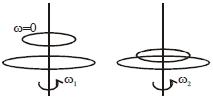
$A$ circular disc of mass $M$ and radius $R$ is rotating about its axis with angular speed $\omega_{1}$. If another stationary disc having radius $\frac{R}{2}$ and same mass $M$ is dropped co-axially onto the rotating disc,gradually both discs attain a constant angular speed $\omega_{2}$. The energy lost in the process is $p \%$ of the initial energy. The value of $p$ is:
A
$25$
B
$27$
C
$20$
D
$15$
Solution
(C) Let the moment of inertia of the bigger disc be $I = \frac{MR^{2}}{2}$.
The moment of inertia of the smaller disc is $I_{2} = \frac{M(R/2)^{2}}{2} = \frac{MR^{2}}{8} = \frac{I}{4}$.
By the principle of conservation of angular momentum,the initial angular momentum equals the final angular momentum:
$L_{i} = L_{f}$
$I\omega_{1} + I_{2}(0) = (I + I_{2})\omega_{2}$
$I\omega_{1} = (I + I/4)\omega_{2}$
$I\omega_{1} = \frac{5I}{4}\omega_{2} \Rightarrow \omega_{2} = \frac{4\omega_{1}}{5}$.
The initial kinetic energy is $K_{1} = \frac{1}{2}I\omega_{1}^{2}$.
The final kinetic energy is $K_{2} = \frac{1}{2}(I + I_{2})\omega_{2}^{2} = \frac{1}{2}(I + I/4)(\frac{4\omega_{1}}{5})^{2} = \frac{1}{2}(\frac{5I}{4})(\frac{16\omega_{1}^{2}}{25}) = \frac{1}{2}I\omega_{1}^{2}(\frac{4}{5})$.
The percentage of energy lost is $p\% = \frac{K_{1} - K_{2}}{K_{1}} \times 100\%$.
$p\% = \frac{K_{1} - \frac{4}{5}K_{1}}{K_{1}} \times 100\% = (1 - 0.8) \times 100\% = 20\%$.
Thus,the value of $p$ is $20$.
The moment of inertia of the smaller disc is $I_{2} = \frac{M(R/2)^{2}}{2} = \frac{MR^{2}}{8} = \frac{I}{4}$.
By the principle of conservation of angular momentum,the initial angular momentum equals the final angular momentum:
$L_{i} = L_{f}$
$I\omega_{1} + I_{2}(0) = (I + I_{2})\omega_{2}$
$I\omega_{1} = (I + I/4)\omega_{2}$
$I\omega_{1} = \frac{5I}{4}\omega_{2} \Rightarrow \omega_{2} = \frac{4\omega_{1}}{5}$.
The initial kinetic energy is $K_{1} = \frac{1}{2}I\omega_{1}^{2}$.
The final kinetic energy is $K_{2} = \frac{1}{2}(I + I_{2})\omega_{2}^{2} = \frac{1}{2}(I + I/4)(\frac{4\omega_{1}}{5})^{2} = \frac{1}{2}(\frac{5I}{4})(\frac{16\omega_{1}^{2}}{25}) = \frac{1}{2}I\omega_{1}^{2}(\frac{4}{5})$.
The percentage of energy lost is $p\% = \frac{K_{1} - K_{2}}{K_{1}} \times 100\%$.
$p\% = \frac{K_{1} - \frac{4}{5}K_{1}}{K_{1}} \times 100\% = (1 - 0.8) \times 100\% = 20\%$.
Thus,the value of $p$ is $20$.
0 likes
View Solution162
DifficultMCQ
$A$ thin rod of mass $0.9\, kg$ and length $1\, m$ is suspended,at rest,from one end so that it can freely oscillate in the vertical plane. $A$ particle of mass $0.1\, kg$ moving in a straight line with velocity $80\, m/s$ hits the rod at its bottom-most point and sticks to it. The angular speed (in $rad/s$) of the rod immediately after the collision will be

A
$30$
B
$28$
C
$20$
D
$25$
Solution
(C) Since the impulsive force acts at the pivot,the angular momentum about the pivot is conserved during the collision.
Initial angular momentum $L_i = m v L$.
Final angular momentum $L_f = I_{total} \omega$,where $I_{total} = I_{rod} + I_{particle} = \frac{M L^2}{3} + m L^2$.
Equating $L_i = L_f$:
$m v L = \left( \frac{M L^2}{3} + m L^2 \right) \omega$
Substituting the given values $(M = 0.9\, kg, m = 0.1\, kg, L = 1\, m, v = 80\, m/s)$:
$0.1 \times 80 \times 1 = \left( \frac{0.9 \times 1^2}{3} + 0.1 \times 1^2 \right) \omega$
$8 = (0.3 + 0.1) \omega$
$8 = 0.4 \omega$
$\omega = \frac{8}{0.4} = 20\, rad/s$.
Initial angular momentum $L_i = m v L$.
Final angular momentum $L_f = I_{total} \omega$,where $I_{total} = I_{rod} + I_{particle} = \frac{M L^2}{3} + m L^2$.
Equating $L_i = L_f$:
$m v L = \left( \frac{M L^2}{3} + m L^2 \right) \omega$
Substituting the given values $(M = 0.9\, kg, m = 0.1\, kg, L = 1\, m, v = 80\, m/s)$:
$0.1 \times 80 \times 1 = \left( \frac{0.9 \times 1^2}{3} + 0.1 \times 1^2 \right) \omega$
$8 = (0.3 + 0.1) \omega$
$8 = 0.4 \omega$
$\omega = \frac{8}{0.4} = 20\, rad/s$.
0 likes
View Solution163
DifficultMCQ
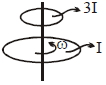
$A$ wheel is rotating freely with an angular speed $\omega$ on a shaft. The moment of inertia of the wheel is $I$ and the moment of inertia of the shaft is negligible. Another wheel of moment of inertia $3I$ initially at rest is suddenly coupled to the same shaft. The resultant fractional loss in the kinetic energy of the system is:
A
$0$
B
$\frac{1}{4}$
C
$\frac{3}{4}$
D
$\frac{5}{6}$
Solution
(C) According to the law of conservation of angular momentum:
$I\omega + 3I \times 0 = (I + 3I)\omega'$
$I\omega = 4I\omega'$
$\omega' = \frac{\omega}{4}$
Initial kinetic energy $(KE)_i = \frac{1}{2}I\omega^2$
Final kinetic energy $(KE)_f = \frac{1}{2}(I + 3I)(\omega')^2 = \frac{1}{2}(4I)\left(\frac{\omega}{4}\right)^2 = 2I \times \frac{\omega^2}{16} = \frac{I\omega^2}{8}$
Loss in kinetic energy $\Delta KE = (KE)_i - (KE)_f = \frac{1}{2}I\omega^2 - \frac{1}{8}I\omega^2 = \frac{3}{8}I\omega^2$
Fractional loss in kinetic energy = $\frac{\Delta KE}{(KE)_i} = \frac{\frac{3}{8}I\omega^2}{\frac{1}{2}I\omega^2} = \frac{3}{8} \times 2 = \frac{3}{4}$
$I\omega + 3I \times 0 = (I + 3I)\omega'$
$I\omega = 4I\omega'$
$\omega' = \frac{\omega}{4}$
Initial kinetic energy $(KE)_i = \frac{1}{2}I\omega^2$
Final kinetic energy $(KE)_f = \frac{1}{2}(I + 3I)(\omega')^2 = \frac{1}{2}(4I)\left(\frac{\omega}{4}\right)^2 = 2I \times \frac{\omega^2}{16} = \frac{I\omega^2}{8}$
Loss in kinetic energy $\Delta KE = (KE)_i - (KE)_f = \frac{1}{2}I\omega^2 - \frac{1}{8}I\omega^2 = \frac{3}{8}I\omega^2$
Fractional loss in kinetic energy = $\frac{\Delta KE}{(KE)_i} = \frac{\frac{3}{8}I\omega^2}{\frac{1}{2}I\omega^2} = \frac{3}{8} \times 2 = \frac{3}{4}$
0 likes
View Solution164
MediumMCQ
$A$ thin horizontal circular disc is rotating about a vertical axis passing through its centre. An insect is at rest at a point near the rim of the disc. The insect now moves along a diameter of the disc to reach its other end. During the journey of the insect,the angular speed of the disc
A
Continuously decreases
B
Continuously increases
C
First increases and then decreases
D
Remains unchanged
Solution
(C) The moment of inertia $(I)$ of the system consisting of the disc and the insect is given by $I = I_{disc} + I_{insect} = \frac{1}{2}MR^2 + mx^2$,where $M$ is the mass of the disc,$R$ is the radius of the disc,$m$ is the mass of the insect,and $x$ is the distance of the insect from the centre.
As the insect moves from the rim $(x = R)$ towards the centre $(x = 0)$,the distance $x$ decreases,so the moment of inertia $I$ decreases.
As the insect moves from the centre $(x = 0)$ towards the other end of the diameter $(x = R)$,the distance $x$ increases,so the moment of inertia $I$ increases.
According to the law of conservation of angular momentum,$L = I\omega = \text{constant}$. Since there are no external torques acting on the system,the angular momentum $L$ remains constant.
Therefore,$\omega = \frac{L}{I}$. When $I$ decreases,$\omega$ increases,and when $I$ increases,$\omega$ decreases.
Thus,the angular speed of the disc first increases and then decreases.
As the insect moves from the rim $(x = R)$ towards the centre $(x = 0)$,the distance $x$ decreases,so the moment of inertia $I$ decreases.
As the insect moves from the centre $(x = 0)$ towards the other end of the diameter $(x = R)$,the distance $x$ increases,so the moment of inertia $I$ increases.
According to the law of conservation of angular momentum,$L = I\omega = \text{constant}$. Since there are no external torques acting on the system,the angular momentum $L$ remains constant.
Therefore,$\omega = \frac{L}{I}$. When $I$ decreases,$\omega$ increases,and when $I$ increases,$\omega$ decreases.
Thus,the angular speed of the disc first increases and then decreases.
0 likes
View Solution165
DifficultMCQ
$A$ uniform disc of radius $R$ is placed on a smooth horizontal surface. $A$ particle of mass $m$ is moving with velocity $v$ on the surface and hits the disc at the periphery and sticks to it. The angular velocity of the system after the collision is:
A
$\frac{mv}{R(M+m)}$
B
$\frac{2mv}{R(M+2m)}$
C
$\frac{mv}{R(M+2m)}$
D
$\frac{2mv}{R(M+m)}$
Solution
(B) Let $M$ be the mass of the disc and $R$ be its radius.
When the particle of mass $m$ moving with velocity $v$ strikes the periphery of the disc,the angular momentum of the system about the centre of mass of the disc is conserved.
The initial angular momentum $L_i = mvr$.
The final moment of inertia of the system $I_f = I_{disc} + I_{particle} = \frac{1}{2}MR^2 + mR^2 = (\frac{M}{2} + m)R^2 = \frac{M+2m}{2}R^2$.
Using the conservation of angular momentum,$L_i = L_f$,we have $mvR = I_f \omega$.
$mvR = \frac{M+2m}{2}R^2 \omega$.
Solving for $\omega$,we get $\omega = \frac{2mvR}{(M+2m)R^2} = \frac{2mv}{R(M+2m)}$.
When the particle of mass $m$ moving with velocity $v$ strikes the periphery of the disc,the angular momentum of the system about the centre of mass of the disc is conserved.
The initial angular momentum $L_i = mvr$.
The final moment of inertia of the system $I_f = I_{disc} + I_{particle} = \frac{1}{2}MR^2 + mR^2 = (\frac{M}{2} + m)R^2 = \frac{M+2m}{2}R^2$.
Using the conservation of angular momentum,$L_i = L_f$,we have $mvR = I_f \omega$.
$mvR = \frac{M+2m}{2}R^2 \omega$.
Solving for $\omega$,we get $\omega = \frac{2mvR}{(M+2m)R^2} = \frac{2mv}{R(M+2m)}$.
0 likes
View Solution166
MediumMCQ
Initial angular velocity of a circular disc of mass $M$ is $\omega_{1}$. Then two small spheres of mass $m$ are attached gently to two diametrically opposite points on the edge of the disc. What is the final angular velocity of the disc?
A
$\left(\frac{M+m}{M}\right) \omega_{1}$
B
$\left(\frac{M+m}{m}\right) \omega_{1}$
C
$\left(\frac{M}{M+4 m}\right) \omega_{1}$
D
$\left(\frac{M}{M+2 m}\right) \omega_{1}$
Solution
(C) According to the principle of conservation of angular momentum,the initial angular momentum is equal to the final angular momentum because no external torque acts on the system.
The initial moment of inertia of the disc is $I_{1} = \frac{1}{2} M R^{2}$.
The final moment of inertia of the system,after attaching two spheres of mass $m$ at the edge (distance $R$ from the center),is $I_{2} = \frac{1}{2} M R^{2} + m R^{2} + m R^{2} = \frac{1}{2} M R^{2} + 2 m R^{2} = R^{2} (\frac{M}{2} + 2m) = \frac{1}{2} R^{2} (M + 4m)$.
Using $L_{initial} = L_{final}$:
$I_{1} \omega_{1} = I_{2} \omega_{2}$
$\frac{1}{2} M R^{2} \omega_{1} = \frac{1}{2} R^{2} (M + 4m) \omega_{2}$
Solving for $\omega_{2}$:
$\omega_{2} = \left(\frac{M}{M + 4m}\right) \omega_{1}$.
The initial moment of inertia of the disc is $I_{1} = \frac{1}{2} M R^{2}$.
The final moment of inertia of the system,after attaching two spheres of mass $m$ at the edge (distance $R$ from the center),is $I_{2} = \frac{1}{2} M R^{2} + m R^{2} + m R^{2} = \frac{1}{2} M R^{2} + 2 m R^{2} = R^{2} (\frac{M}{2} + 2m) = \frac{1}{2} R^{2} (M + 4m)$.
Using $L_{initial} = L_{final}$:
$I_{1} \omega_{1} = I_{2} \omega_{2}$
$\frac{1}{2} M R^{2} \omega_{1} = \frac{1}{2} R^{2} (M + 4m) \omega_{2}$
Solving for $\omega_{2}$:
$\omega_{2} = \left(\frac{M}{M + 4m}\right) \omega_{1}$.
0 likes
View Solution167
MediumMCQ
$A$ thin circular ring of mass $M$ and radius $R$ is rotating with a constant angular velocity $2 \; rad \; s^{-1}$ in a horizontal plane about an axis vertical to its plane and passing through the center of the ring. If two objects,each of mass $m$,are attached gently to the opposite ends of a diameter of the ring,the ring will then rotate with an angular velocity (in $rad \; s^{-1}$) of:
A
$\frac{M}{M+m}$
B
$\frac{M+2m}{2M}$
C
$\frac{2M}{M+2m}$
D
$\frac{2(M+2m)}{M}$
Solution
(C) The initial moment of inertia of the ring about the central vertical axis is $I = M R^2$.
The initial angular velocity is $\omega = 2 \; rad \; s^{-1}$.
Since no external torque acts on the system,the angular momentum is conserved: $L_i = L_f$.
Initial angular momentum $L_i = I \omega = (M R^2) \times 2 = 2 M R^2$.
When two objects of mass $m$ are attached to the opposite ends of a diameter,the new moment of inertia becomes $I' = M R^2 + m R^2 + m R^2 = (M + 2m) R^2$.
Let the new angular velocity be $\omega'$. By conservation of angular momentum:
$I \omega = I' \omega'$
$2 M R^2 = (M + 2m) R^2 \omega'$
$\omega' = \frac{2 M}{M + 2m} \; rad \; s^{-1}$.
The initial angular velocity is $\omega = 2 \; rad \; s^{-1}$.
Since no external torque acts on the system,the angular momentum is conserved: $L_i = L_f$.
Initial angular momentum $L_i = I \omega = (M R^2) \times 2 = 2 M R^2$.
When two objects of mass $m$ are attached to the opposite ends of a diameter,the new moment of inertia becomes $I' = M R^2 + m R^2 + m R^2 = (M + 2m) R^2$.
Let the new angular velocity be $\omega'$. By conservation of angular momentum:
$I \omega = I' \omega'$
$2 M R^2 = (M + 2m) R^2 \omega'$
$\omega' = \frac{2 M}{M + 2m} \; rad \; s^{-1}$.
0 likes
View Solution168
AdvancedMCQ
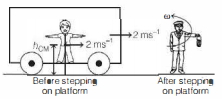
$A$ train is moving slowly at $2 \, m/s$ next to a railway platform. $A$ man,$1.5 \, m$ tall,alights from the train such that his feet are fixed on the ground. Taking him to be a rigid body,the instantaneous angular velocity (in $rad/s$) is
A
$1.5$
B
$2.0$
C
$2.5$
D
$3.0$
Solution
(B) When the man alights,his angular momentum about the point of contact on the platform is conserved.
By the principle of conservation of angular momentum:
$L_{\text{initial}} = L_{\text{final}}$
Initially,the man acts as a particle of mass $m$ moving with velocity $v$ at a height $h = l/2$ from the ground. So,$L_{\text{initial}} = m v (l/2)$.
After alighting,the man acts as a rigid rod of length $l$ rotating about one end fixed on the ground. The moment of inertia of a rod about one end is $I = \frac{m l^2}{3}$.
Thus,$m v (l/2) = I \omega$
$m v (l/2) = \left( \frac{m l^2}{3} \right) \omega$
Solving for $\omega$:
$\omega = \frac{3 v (l/2)}{l^2} = \frac{3 v}{2 l}$
Given $v = 2 \, m/s$ and $l = 1.5 \, m$:
$\omega = \frac{3 \times 2}{2 \times 1.5} = \frac{6}{3} = 2 \, rad/s$.
By the principle of conservation of angular momentum:
$L_{\text{initial}} = L_{\text{final}}$
Initially,the man acts as a particle of mass $m$ moving with velocity $v$ at a height $h = l/2$ from the ground. So,$L_{\text{initial}} = m v (l/2)$.
After alighting,the man acts as a rigid rod of length $l$ rotating about one end fixed on the ground. The moment of inertia of a rod about one end is $I = \frac{m l^2}{3}$.
Thus,$m v (l/2) = I \omega$
$m v (l/2) = \left( \frac{m l^2}{3} \right) \omega$
Solving for $\omega$:
$\omega = \frac{3 v (l/2)}{l^2} = \frac{3 v}{2 l}$
Given $v = 2 \, m/s$ and $l = 1.5 \, m$:
$\omega = \frac{3 \times 2}{2 \times 1.5} = \frac{6}{3} = 2 \, rad/s$.
0 likes
View Solution169
AdvancedMCQ
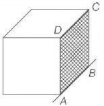
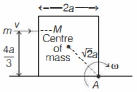
$A$ solid cube of wood of side $2a$ and mass $M$ is resting on a horizontal surface as shown in the figure. The cube is free to rotate about a fixed axis $AB$. $A$ bullet of mass $m$ $(m << M)$ and speed $v$ is shot horizontally at the face opposite to $ABCD$ at a height of $4a/3$ from the surface to impart the cube an angular speed $\omega$. It strikes the face and embeds in the cube. Then,$\omega$ is close to (Note: The moment of inertia of the cube about an axis perpendicular to the face and passing through the centre of mass is $2Ma^2/3$).
A
$Mv/ma$
B
$Mv/2ma$
C
$mv/Ma$
D
$mv/2Ma$
Solution
(D) Since there is no external torque on the system of the bullet and the block about the axis $AB$,the angular momentum about $AB$ remains conserved.
First,calculate the moment of inertia of the block about the axis $AB$ using the parallel axis theorem:
$I_{AB} = I_{CM} + Mh^2$
Given $I_{CM} = 2Ma^2/3$ and the distance $h$ from the centre of mass to the axis $AB$ is $\sqrt{a^2 + a^2} = \sqrt{2}a$.
$I_{AB} = \frac{2}{3}Ma^2 + M(\sqrt{2}a)^2 = \frac{2}{3}Ma^2 + 2Ma^2 = \frac{8}{3}Ma^2$.
Now,apply the conservation of angular momentum about the axis $AB$:
$L_{initial} = L_{final}$
$mvr = I_{AB}\omega$
where $r = 4a/3$ is the perpendicular distance of the bullet's path from the axis $AB$.
$m v (\frac{4a}{3}) = (\frac{8}{3}Ma^2) \omega$
Solving for $\omega$:
$\omega = \frac{mv(4a/3)}{8Ma^2/3} = \frac{4mva}{8Ma^2} = \frac{mv}{2Ma}$.
First,calculate the moment of inertia of the block about the axis $AB$ using the parallel axis theorem:
$I_{AB} = I_{CM} + Mh^2$
Given $I_{CM} = 2Ma^2/3$ and the distance $h$ from the centre of mass to the axis $AB$ is $\sqrt{a^2 + a^2} = \sqrt{2}a$.
$I_{AB} = \frac{2}{3}Ma^2 + M(\sqrt{2}a)^2 = \frac{2}{3}Ma^2 + 2Ma^2 = \frac{8}{3}Ma^2$.
Now,apply the conservation of angular momentum about the axis $AB$:
$L_{initial} = L_{final}$
$mvr = I_{AB}\omega$
where $r = 4a/3$ is the perpendicular distance of the bullet's path from the axis $AB$.
$m v (\frac{4a}{3}) = (\frac{8}{3}Ma^2) \omega$
Solving for $\omega$:
$\omega = \frac{mv(4a/3)}{8Ma^2/3} = \frac{4mva}{8Ma^2} = \frac{mv}{2Ma}$.
0 likes
View Solution170
DifficultMCQ
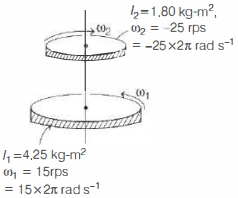
$A$ horizontal disc of moment of inertia $4.25 \,kg \cdot m^2$ with respect to its axis of symmetry is spinning counter-clockwise at $15 \,rps$ about its axis,as viewed from above. $A$ second disc of moment of inertia $1.80 \,kg \cdot m^2$ with respect to its axis of symmetry is spinning clockwise at $25 \,rps$ as viewed from above about the same axis and is dropped on top of the first disc. The two discs stick together and rotate as one about their axis of symmetry. The new angular velocity of the system as viewed from above is close to
A
$18 \,rps$ and clockwise
B
$18 \,rps$ and anti-clockwise
C
$3 \,rps$ and clockwise
D
$3 \,rps$ and anti-clockwise
Solution
(D) Since there is no external torque on the system of discs,the angular momentum of the system remains constant.
$I_1 \omega_1 + I_2 \omega_2 = (I_1 + I_2) \omega \quad ...(i)$
where $I_1$ and $I_2$ are the moments of inertia of the discs,and $\omega_1$ and $\omega_2$ are their angular speeds. $\omega$ is the angular speed of the combination of the discs.
Given:
$I_1 = 4.25 \,kg \cdot m^2, \omega_1 = 15 \,rps$ (counter-clockwise,taken as positive)
$I_2 = 1.80 \,kg \cdot m^2, \omega_2 = -25 \,rps$ (clockwise,taken as negative)
Substituting the values into Eq. $(i)$:
$I_1 \omega_1 + I_2 \omega_2 = (I_1 + I_2) \omega$
$(4.25 \times 15) + (1.80 \times -25) = (4.25 + 1.80) \omega$
$63.75 - 45 = 6.05 \omega$
$18.75 = 6.05 \omega$
$\omega = \frac{18.75}{6.05} \approx 3.099 \,rps$
Since the result is positive,the direction is counter-clockwise (anti-clockwise).
Thus,the new angular velocity is approximately $3 \,rps$ and anti-clockwise.
$I_1 \omega_1 + I_2 \omega_2 = (I_1 + I_2) \omega \quad ...(i)$
where $I_1$ and $I_2$ are the moments of inertia of the discs,and $\omega_1$ and $\omega_2$ are their angular speeds. $\omega$ is the angular speed of the combination of the discs.
Given:
$I_1 = 4.25 \,kg \cdot m^2, \omega_1 = 15 \,rps$ (counter-clockwise,taken as positive)
$I_2 = 1.80 \,kg \cdot m^2, \omega_2 = -25 \,rps$ (clockwise,taken as negative)
Substituting the values into Eq. $(i)$:
$I_1 \omega_1 + I_2 \omega_2 = (I_1 + I_2) \omega$
$(4.25 \times 15) + (1.80 \times -25) = (4.25 + 1.80) \omega$
$63.75 - 45 = 6.05 \omega$
$18.75 = 6.05 \omega$
$\omega = \frac{18.75}{6.05} \approx 3.099 \,rps$
Since the result is positive,the direction is counter-clockwise (anti-clockwise).
Thus,the new angular velocity is approximately $3 \,rps$ and anti-clockwise.
0 likes
View Solution171
EasyMCQ
When torque applied on a system is zero,which of the following will be constant?
A
Moment of inertia
B
Angular velocity
C
Kinetic energy
D
Angular momentum
Solution
(D) The correct answer is $D$.
According to the principle of conservation of angular momentum,the rate of change of angular momentum $L$ of a system is equal to the external torque $\tau$ applied to it,given by the equation $\tau = \frac{dL}{dt}$.
When the external torque applied on a system is zero $(\tau = 0)$,the rate of change of angular momentum is zero,which implies that $\frac{dL}{dt} = 0$.
This means that the angular momentum $L$ of the system remains constant over time. This is the rotational analogue of Newton's first law for linear motion,where the linear momentum remains constant if the net external force is zero.
According to the principle of conservation of angular momentum,the rate of change of angular momentum $L$ of a system is equal to the external torque $\tau$ applied to it,given by the equation $\tau = \frac{dL}{dt}$.
When the external torque applied on a system is zero $(\tau = 0)$,the rate of change of angular momentum is zero,which implies that $\frac{dL}{dt} = 0$.
This means that the angular momentum $L$ of the system remains constant over time. This is the rotational analogue of Newton's first law for linear motion,where the linear momentum remains constant if the net external force is zero.
0 likes
View Solution172
EasyMCQ
When a body is spinning on its axis in the absence of any external torque,choose the wrong statement.
A
$\vec{\omega}$ can be changed by keeping $\vec{L}$ constant.
B
$\vec{L}$ can be changed by keeping $\vec{\omega}$ constant.
C
$I$ can be changed by keeping $\vec{L}$ constant.
D
$I$ and $\vec{\omega}$ both can be changed by keeping $\vec{L}$ constant.
Solution
(B) The angular momentum $\vec{L}$ is given by $\vec{L} = I\vec{\omega}$.
According to the principle of conservation of angular momentum,if the external torque $\vec{\tau} = 0$,then $\frac{d\vec{L}}{dt} = 0$,which implies $\vec{L}$ remains constant.
Option $A$ is correct because if the moment of inertia $I$ changes,$\vec{\omega}$ must change to keep $\vec{L}$ constant.
Option $B$ is incorrect because if $\vec{L}$ is constant and $\vec{\omega}$ is kept constant,then $I$ must also remain constant. Thus,$\vec{L}$ cannot be changed if $\vec{\omega}$ and $I$ are constant.
Option $C$ is correct because $I$ can be changed (e.g.,by changing the distribution of mass),which will result in a change in $\vec{\omega}$ while $\vec{L}$ remains constant.
Option $D$ is correct because both $I$ and $\vec{\omega}$ can change simultaneously such that their product $I\vec{\omega}$ remains constant.
Therefore,the wrong statement is $B$.
According to the principle of conservation of angular momentum,if the external torque $\vec{\tau} = 0$,then $\frac{d\vec{L}}{dt} = 0$,which implies $\vec{L}$ remains constant.
Option $A$ is correct because if the moment of inertia $I$ changes,$\vec{\omega}$ must change to keep $\vec{L}$ constant.
Option $B$ is incorrect because if $\vec{L}$ is constant and $\vec{\omega}$ is kept constant,then $I$ must also remain constant. Thus,$\vec{L}$ cannot be changed if $\vec{\omega}$ and $I$ are constant.
Option $C$ is correct because $I$ can be changed (e.g.,by changing the distribution of mass),which will result in a change in $\vec{\omega}$ while $\vec{L}$ remains constant.
Option $D$ is correct because both $I$ and $\vec{\omega}$ can change simultaneously such that their product $I\vec{\omega}$ remains constant.
Therefore,the wrong statement is $B$.
0 likes
View Solution173
MediumMCQ
Different minerals are being mined from within the earth and multi-storeyed complexes are being constructed. Due to this activity,theoretically:
A
Angular speed of Earth would increase
B
Angular momentum would increase
C
Time period of Earth would decrease
D
Length of day would increase
Solution
(D) The Earth is an isolated system regarding its rotation,so its angular momentum $L = I\omega$ is conserved.
When minerals are mined from deep within the Earth and used to construct multi-storeyed buildings on the surface,the mass distribution of the Earth shifts outward from the axis of rotation.
This increases the moment of inertia $I$ of the Earth $(I = \sum mr^2)$.
Since the angular momentum $L$ remains constant,an increase in the moment of inertia $I$ must result in a decrease in the angular velocity $\omega$ (because $L = I\omega$ implies $\omega = L/I$).
Since the angular velocity $\omega$ is related to the time period $T$ by the formula $\omega = 2\pi/T$,a decrease in $\omega$ leads to an increase in the time period $T$.
Therefore,the length of the day increases.
When minerals are mined from deep within the Earth and used to construct multi-storeyed buildings on the surface,the mass distribution of the Earth shifts outward from the axis of rotation.
This increases the moment of inertia $I$ of the Earth $(I = \sum mr^2)$.
Since the angular momentum $L$ remains constant,an increase in the moment of inertia $I$ must result in a decrease in the angular velocity $\omega$ (because $L = I\omega$ implies $\omega = L/I$).
Since the angular velocity $\omega$ is related to the time period $T$ by the formula $\omega = 2\pi/T$,a decrease in $\omega$ leads to an increase in the time period $T$.
Therefore,the length of the day increases.
0 likes
View Solution174
DifficultMCQ
$A$ disc of mass $1 \, kg$ and radius $0.1 \, m$ is rotating with angular velocity $20 \, rad/s$. What is the angular velocity (in $rad/s$) if a mass of $0.5 \, kg$ is placed on the circumference of the disc?
A
$10$
B
$20$
C
$40$
D
$30$
Solution
(A) Initial angular velocity is $\omega_1 = 20 \, rad/s$.
Moment of inertia of the disc is $I_1 = \frac{1}{2} mr^2 = \frac{1 \times (0.1)^2}{2} = 0.005 \, kg \cdot m^2$.
When a mass $M = 0.5 \, kg$ is placed on the circumference,the new moment of inertia is $I_2 = I_1 + Mr^2 = 0.005 + 0.5 \times (0.1)^2 = 0.005 + 0.005 = 0.01 \, kg \cdot m^2$.
Since no external torque acts on the system,angular momentum is conserved: $I_1 \omega_1 = I_2 \omega_2$.
Substituting the values: $0.005 \times 20 = 0.01 \times \omega_2$.
$\omega_2 = \frac{0.1}{0.01} = 10 \, rad/s$.
Moment of inertia of the disc is $I_1 = \frac{1}{2} mr^2 = \frac{1 \times (0.1)^2}{2} = 0.005 \, kg \cdot m^2$.
When a mass $M = 0.5 \, kg$ is placed on the circumference,the new moment of inertia is $I_2 = I_1 + Mr^2 = 0.005 + 0.5 \times (0.1)^2 = 0.005 + 0.005 = 0.01 \, kg \cdot m^2$.
Since no external torque acts on the system,angular momentum is conserved: $I_1 \omega_1 = I_2 \omega_2$.
Substituting the values: $0.005 \times 20 = 0.01 \times \omega_2$.
$\omega_2 = \frac{0.1}{0.01} = 10 \, rad/s$.
0 likes
View Solution175
EasyMCQ
$A$ metre stick is pivoted about its centre. $A$ piece of wax of mass $20 \,g$ travelling horizontally and perpendicular to it at $5 \,m/s$ strikes and adheres to one end of the stick so that the stick starts to rotate in a horizontal circle. Given the moment of inertia of the stick and wax about the pivot is $0.02 \,kg \cdot m^2$,the initial angular velocity of the stick is ........... $rad/s$.
A
$1.58$
B
$2.24$
C
$2.50$
D
$5.00$
Solution
(C) According to the principle of conservation of angular momentum,the angular momentum of the wax about the pivot before the collision must be equal to the angular momentum of the system (stick + wax) after the collision.
The angular momentum of the wax before the collision is given by $L = mvr$,where $m = 20 \,g = 0.02 \,kg$,$v = 5 \,m/s$,and $r = 0.5 \,m$ (since the stick is a metre stick and it is pivoted at the centre,the distance from the centre to the end is $0.5 \,m$).
$L = 0.02 \times 5 \times 0.5 = 0.05 \,kg \cdot m^2/s$.
The angular momentum of the system after the collision is $L = I\omega$,where $I = 0.02 \,kg \cdot m^2$ is the moment of inertia of the stick and wax about the pivot.
Equating the two,we get $0.05 = 0.02 \times \omega$.
$\omega = \frac{0.05}{0.02} = 2.5 \,rad/s$.
The angular momentum of the wax before the collision is given by $L = mvr$,where $m = 20 \,g = 0.02 \,kg$,$v = 5 \,m/s$,and $r = 0.5 \,m$ (since the stick is a metre stick and it is pivoted at the centre,the distance from the centre to the end is $0.5 \,m$).
$L = 0.02 \times 5 \times 0.5 = 0.05 \,kg \cdot m^2/s$.
The angular momentum of the system after the collision is $L = I\omega$,where $I = 0.02 \,kg \cdot m^2$ is the moment of inertia of the stick and wax about the pivot.
Equating the two,we get $0.05 = 0.02 \times \omega$.
$\omega = \frac{0.05}{0.02} = 2.5 \,rad/s$.

1 likes
View Solution176
EasyMCQ
$A$ swimmer,while jumping into a river from a height,easily forms a loop in the air if:
A
He pulls his arms and legs in
B
He spreads his arms and legs
C
He keeps himself straight
D
None of these
Solution
(A) The correct answer is $A$.
According to the law of conservation of angular momentum,$L = I\omega$ remains constant in the absence of an external torque.
When the swimmer pulls his arms and legs in,the distribution of mass moves closer to the axis of rotation,which decreases the moment of inertia $(I)$.
Since $L = I\omega$ is constant,a decrease in $I$ must result in an increase in angular velocity $(\omega)$.
This increase in angular velocity allows the swimmer to rotate faster and easily form a loop in the air.
According to the law of conservation of angular momentum,$L = I\omega$ remains constant in the absence of an external torque.
When the swimmer pulls his arms and legs in,the distribution of mass moves closer to the axis of rotation,which decreases the moment of inertia $(I)$.
Since $L = I\omega$ is constant,a decrease in $I$ must result in an increase in angular velocity $(\omega)$.
This increase in angular velocity allows the swimmer to rotate faster and easily form a loop in the air.
0 likes
View Solution177
MediumMCQ
$A$ horizontal disc rotating freely about a vertical axis through its centre makes $90$ revolutions per minute. $A$ small piece of wax of mass $m$ falls vertically on the disc and sticks to it at a distance $r$ from the axis. If the number of revolutions per minute reduces to $60$,then the moment of inertia of the disc is .........
A
$m r^2$
B
$\frac{3}{2} m r^2$
C
$2 m r^2$
D
$3 m r^2$
Solution
(C) Let $I$ be the moment of inertia of the disc.
Initial angular velocity $\omega_1 = 90 \text{ rpm} = 90 \times \frac{2\pi}{60} = 3\pi \text{ rad/s}$.
Final angular velocity $\omega_2 = 60 \text{ rpm} = 60 \times \frac{2\pi}{60} = 2\pi \text{ rad/s}$.
Since no external torque acts on the system,angular momentum is conserved: $L_1 = L_2$.
$I \omega_1 = (I + mr^2) \omega_2$.
Substituting the values: $I(3\pi) = (I + mr^2)(2\pi)$.
$3I = 2I + 2mr^2$.
$I = 2mr^2$.
Initial angular velocity $\omega_1 = 90 \text{ rpm} = 90 \times \frac{2\pi}{60} = 3\pi \text{ rad/s}$.
Final angular velocity $\omega_2 = 60 \text{ rpm} = 60 \times \frac{2\pi}{60} = 2\pi \text{ rad/s}$.
Since no external torque acts on the system,angular momentum is conserved: $L_1 = L_2$.
$I \omega_1 = (I + mr^2) \omega_2$.
Substituting the values: $I(3\pi) = (I + mr^2)(2\pi)$.
$3I = 2I + 2mr^2$.
$I = 2mr^2$.
0 likes
View Solution178
EasyMCQ
$A$ hot solid sphere is rotating about a diameter at an angular velocity $\omega_0$. If it cools so that its radius reduces to $\frac{1}{\eta}$ of its original value,its angular velocity becomes .............
A
$\eta \omega_0$
B
$\frac{\omega_0}{\eta}$
C
$\frac{\omega_0}{\eta^2}$
D
$\eta^2 \omega_0$
Solution
(D) Since no external torque acts on the sphere,the angular momentum remains conserved.
The moment of inertia of a solid sphere about its diameter is given by $I = \frac{2}{5} m r^2$.
According to the law of conservation of angular momentum,$L_i = L_f$,which implies $I_i \omega_0 = I_f \omega'$.
Substituting the values,we get $\frac{2}{5} m r^2 \omega_0 = \frac{2}{5} m \left(\frac{r}{\eta}\right)^2 \omega'$.
Simplifying the equation: $r^2 \omega_0 = \frac{r^2}{\eta^2} \omega'$.
Solving for $\omega'$,we get $\omega' = \eta^2 \omega_0$.
The moment of inertia of a solid sphere about its diameter is given by $I = \frac{2}{5} m r^2$.
According to the law of conservation of angular momentum,$L_i = L_f$,which implies $I_i \omega_0 = I_f \omega'$.
Substituting the values,we get $\frac{2}{5} m r^2 \omega_0 = \frac{2}{5} m \left(\frac{r}{\eta}\right)^2 \omega'$.
Simplifying the equation: $r^2 \omega_0 = \frac{r^2}{\eta^2} \omega'$.
Solving for $\omega'$,we get $\omega' = \eta^2 \omega_0$.
0 likes
View Solution179
DifficultMCQ
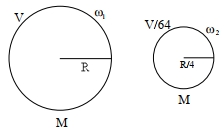
If the earth suddenly shrinks to $\frac{1}{64}$th of its original volume with its mass remaining the same,the period of rotation of earth becomes $\frac{24}{x} \text{ h}$. The value of $x$ is $.......$
A
$8$
B
$4$
C
$2$
D
$16$
Solution
(D) The volume of a sphere is given by $V = \frac{4}{3} \pi R^3$. If the volume becomes $\frac{1}{64}$ of the original volume,then $\frac{V'}{V} = \frac{1}{64} = \left(\frac{R'}{R}\right)^3$. Thus,$\frac{R'}{R} = \sqrt[3]{\frac{1}{64}} = \frac{1}{4}$,which means $R' = \frac{R}{4}$.
Since no external torque acts on the earth,its angular momentum $L = I\omega$ is conserved. The moment of inertia of a solid sphere is $I = \frac{2}{5}MR^2$.
Applying conservation of angular momentum: $I_1 \omega_1 = I_2 \omega_2$
$\frac{2}{5} M R^2 \omega_1 = \frac{2}{5} M (R')^2 \omega_2$
$R^2 \omega_1 = \left(\frac{R}{4}\right)^2 \omega_2$
$R^2 \omega_1 = \frac{R^2}{16} \omega_2$
$\omega_2 = 16 \omega_1$
Since $\omega = \frac{2\pi}{T}$,we have $\frac{2\pi}{T_2} = 16 \left(\frac{2\pi}{T_1}\right)$,which implies $T_2 = \frac{T_1}{16}$.
Given $T_1 = 24 \text{ h}$,we get $T_2 = \frac{24}{16} \text{ h}$.
Comparing this with $\frac{24}{x} \text{ h}$,we find $x = 16$.
Since no external torque acts on the earth,its angular momentum $L = I\omega$ is conserved. The moment of inertia of a solid sphere is $I = \frac{2}{5}MR^2$.
Applying conservation of angular momentum: $I_1 \omega_1 = I_2 \omega_2$
$\frac{2}{5} M R^2 \omega_1 = \frac{2}{5} M (R')^2 \omega_2$
$R^2 \omega_1 = \left(\frac{R}{4}\right)^2 \omega_2$
$R^2 \omega_1 = \frac{R^2}{16} \omega_2$
$\omega_2 = 16 \omega_1$
Since $\omega = \frac{2\pi}{T}$,we have $\frac{2\pi}{T_2} = 16 \left(\frac{2\pi}{T_1}\right)$,which implies $T_2 = \frac{T_1}{16}$.
Given $T_1 = 24 \text{ h}$,we get $T_2 = \frac{24}{16} \text{ h}$.
Comparing this with $\frac{24}{x} \text{ h}$,we find $x = 16$.
0 likes
View Solution180
MediumMCQ
$A$ circular plate is rotating in a horizontal plane about an axis passing through its center and perpendicular to the plate with an angular velocity $\omega$. $A$ person sits at the center holding two dumbbells. When he stretches out his hands,the moment of inertia of the system becomes triple. If $E$ is the initial kinetic energy of the system,then the final kinetic energy will be $\frac{E}{x}$. The value of $x$ is $....$
A
$3$
B
$6$
C
$9$
D
$12$
Solution
(A) The rotational kinetic energy is given by $K = \frac{L^2}{2I}$,where $L$ is the angular momentum and $I$ is the moment of inertia.
Since there are no external torques acting on the system,the angular momentum $L$ remains constant.
Therefore,the kinetic energy is inversely proportional to the moment of inertia: $K \propto \frac{1}{I}$.
Let $I_i$ and $K_i = E$ be the initial moment of inertia and initial kinetic energy,respectively.
Let $I_f$ and $K_f$ be the final moment of inertia and final kinetic energy,respectively.
Given that $I_f = 3I_i$,we have:
$\frac{K_f}{K_i} = \frac{I_i}{I_f} = \frac{I_i}{3I_i} = \frac{1}{3}$.
Thus,$K_f = \frac{K_i}{3} = \frac{E}{3}$.
Comparing this with $\frac{E}{x}$,we get $x = 3$.
Since there are no external torques acting on the system,the angular momentum $L$ remains constant.
Therefore,the kinetic energy is inversely proportional to the moment of inertia: $K \propto \frac{1}{I}$.
Let $I_i$ and $K_i = E$ be the initial moment of inertia and initial kinetic energy,respectively.
Let $I_f$ and $K_f$ be the final moment of inertia and final kinetic energy,respectively.
Given that $I_f = 3I_i$,we have:
$\frac{K_f}{K_i} = \frac{I_i}{I_f} = \frac{I_i}{3I_i} = \frac{1}{3}$.
Thus,$K_f = \frac{K_i}{3} = \frac{E}{3}$.
Comparing this with $\frac{E}{x}$,we get $x = 3$.
0 likes
View Solution181
DifficultMCQ
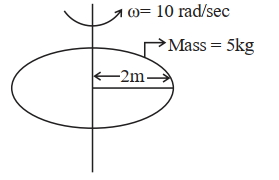
Consider a disc of mass $5 \,kg$ and radius $2 \,m$, rotating with an angular velocity of $10 \,rad/s$ about an axis perpendicular to the plane of rotation and passing through its center. An identical disc is placed gently over the rotating disc along the same axis. The energy dissipated so that both the discs continue to rotate together without slipping is . . . . . . $J$.
A
$349$
B
$248$
C
$78$
D
$250$
Solution
(D) The moment of inertia of the disc is $I = \frac{1}{2} M R^2 = \frac{1}{2} \times 5 \times (2)^2 = 10 \,kg \cdot m^2$.
The initial angular momentum is $L_i = I \omega_i = 10 \times 10 = 100 \,kg \cdot m^2/s$.
The initial kinetic energy is $E_i = \frac{1}{2} I \omega_i^2 = \frac{1}{2} \times 10 \times (10)^2 = 500 \,J$.
When an identical disc is placed on top, the final moment of inertia becomes $I_f = I + I = 2I = 20 \,kg \cdot m^2$.
By the conservation of angular momentum, $L_i = L_f$, so $100 = I_f \omega_f = 20 \omega_f$.
Thus, the final angular velocity is $\omega_f = \frac{100}{20} = 5 \,rad/s$.
The final kinetic energy is $E_f = \frac{1}{2} I_f \omega_f^2 = \frac{1}{2} \times 20 \times (5)^2 = 10 \times 25 = 250 \,J$.
The energy dissipated is $\Delta E = E_i - E_f = 500 \,J - 250 \,J = 250 \,J$.
The initial angular momentum is $L_i = I \omega_i = 10 \times 10 = 100 \,kg \cdot m^2/s$.
The initial kinetic energy is $E_i = \frac{1}{2} I \omega_i^2 = \frac{1}{2} \times 10 \times (10)^2 = 500 \,J$.
When an identical disc is placed on top, the final moment of inertia becomes $I_f = I + I = 2I = 20 \,kg \cdot m^2$.
By the conservation of angular momentum, $L_i = L_f$, so $100 = I_f \omega_f = 20 \omega_f$.
Thus, the final angular velocity is $\omega_f = \frac{100}{20} = 5 \,rad/s$.
The final kinetic energy is $E_f = \frac{1}{2} I_f \omega_f^2 = \frac{1}{2} \times 20 \times (5)^2 = 10 \times 25 = 250 \,J$.
The energy dissipated is $\Delta E = E_i - E_f = 500 \,J - 250 \,J = 250 \,J$.
0 likes
View Solution182
DifficultMCQ
If the radius of the earth is reduced to three-fourth of its present value without any change in its mass,then the duration of the day on earth will be . . . . . . hours $30$ minutes.
A
$13$
B
$15$
C
$20$
D
$25$
Solution
(A) By the law of conservation of angular momentum,the angular momentum $L = I\omega$ remains constant.
Since $I = \frac{2}{5}MR^2$ and $\omega = \frac{2\pi}{T}$,we have $I_1\omega_1 = I_2\omega_2$.
Substituting the values:
$\left(\frac{2}{5}MR^2\right) \frac{2\pi}{T_1} = \left(\frac{2}{5}M(\frac{3}{4}R)^2\right) \frac{2\pi}{T_2}$
$R^2 \cdot \frac{1}{T_1} = (\frac{3}{4}R)^2 \cdot \frac{1}{T_2}$
$\frac{1}{T_1} = \frac{9}{16} \cdot \frac{1}{T_2}$
$T_2 = \frac{9}{16} \cdot T_1$
Given $T_1 = 24$ hours:
$T_2 = \frac{9}{16} \times 24 = \frac{9 \times 3}{2} = \frac{27}{2} = 13.5$ hours.
Thus,the duration of the day will be $13$ hours $30$ minutes.
Since $I = \frac{2}{5}MR^2$ and $\omega = \frac{2\pi}{T}$,we have $I_1\omega_1 = I_2\omega_2$.
Substituting the values:
$\left(\frac{2}{5}MR^2\right) \frac{2\pi}{T_1} = \left(\frac{2}{5}M(\frac{3}{4}R)^2\right) \frac{2\pi}{T_2}$
$R^2 \cdot \frac{1}{T_1} = (\frac{3}{4}R)^2 \cdot \frac{1}{T_2}$
$\frac{1}{T_1} = \frac{9}{16} \cdot \frac{1}{T_2}$
$T_2 = \frac{9}{16} \cdot T_1$
Given $T_1 = 24$ hours:
$T_2 = \frac{9}{16} \times 24 = \frac{9 \times 3}{2} = \frac{27}{2} = 13.5$ hours.
Thus,the duration of the day will be $13$ hours $30$ minutes.
0 likes
View Solution183
DifficultMCQ
$A$ thin circular disc of mass $M$ and radius $R$ is rotating in a horizontal plane about an axis passing through its centre and perpendicular to its plane with angular velocity $\omega$. If another disc of same dimensions but of mass $M/2$ is placed gently on the first disc co-axially,then the new angular velocity of the system is:
A
$\frac{4}{5} \omega$
B
$\frac{5}{4} \omega$
C
$\frac{2}{3} \omega$
D
$\frac{3}{2} \omega$
Solution
(C) The initial moment of inertia of the first disc about the central axis is $I_1 = \frac{1}{2} MR^2$.
The initial angular momentum of the system is $L_i = I_1 \omega = \frac{1}{2} MR^2 \omega$.
When the second disc of mass $M/2$ and radius $R$ is placed co-axially,the new moment of inertia of the system becomes $I_2 = I_1 + I_{disc2} = \frac{1}{2} MR^2 + \frac{1}{2} (M/2) R^2 = \frac{1}{2} MR^2 + \frac{1}{4} MR^2 = \frac{3}{4} MR^2$.
According to the law of conservation of angular momentum,$L_i = L_f$,which implies $I_1 \omega = I_2 \omega_2$.
Substituting the values: $(\frac{1}{2} MR^2) \omega = (\frac{3}{4} MR^2) \omega_2$.
Solving for the new angular velocity $\omega_2$: $\omega_2 = \frac{1/2}{3/4} \omega = \frac{2}{3} \omega$.
The initial angular momentum of the system is $L_i = I_1 \omega = \frac{1}{2} MR^2 \omega$.
When the second disc of mass $M/2$ and radius $R$ is placed co-axially,the new moment of inertia of the system becomes $I_2 = I_1 + I_{disc2} = \frac{1}{2} MR^2 + \frac{1}{2} (M/2) R^2 = \frac{1}{2} MR^2 + \frac{1}{4} MR^2 = \frac{3}{4} MR^2$.
According to the law of conservation of angular momentum,$L_i = L_f$,which implies $I_1 \omega = I_2 \omega_2$.
Substituting the values: $(\frac{1}{2} MR^2) \omega = (\frac{3}{4} MR^2) \omega_2$.
Solving for the new angular velocity $\omega_2$: $\omega_2 = \frac{1/2}{3/4} \omega = \frac{2}{3} \omega$.
0 likes
View Solution184
DifficultMCQ
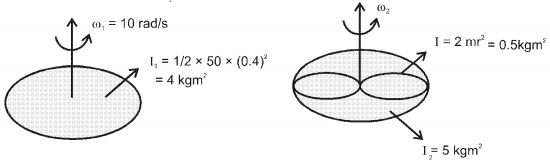
$A$ uniform circular disc of mass $50 \ kg$ and radius $0.4 \ m$ is rotating with an angular velocity of $10 \ rad \ s^{-1}$ about its own axis,which is vertical. Two uniform circular rings,each of mass $6.25 \ kg$ and radius $0.2 \ m$,are gently placed symmetrically on the disc in such a manner that they are touching each other along the axis of the disc and are horizontal. Assume that the friction is large enough such that the rings are at rest relative to the disc and the system rotates about the original axis. The new angular velocity (in $rad \ s^{-1}$) of the system is:
A
$8$
B
$7$
C
$6$
D
$5$
Solution
(A) The initial moment of inertia of the disc about its central axis is $I_1 = \frac{1}{2} M R^2 = \frac{1}{2} \times 50 \times (0.4)^2 = 4 \ kg \ m^2$.
The initial angular velocity is $\omega_1 = 10 \ rad \ s^{-1}$.
When two rings are placed on the disc,their moment of inertia about the axis of rotation must be calculated using the parallel axis theorem. For each ring of mass $m$ and radius $r$,the moment of inertia about its own central axis is $mr^2$. The distance of the center of each ring from the axis of rotation is $r = 0.2 \ m$. Thus,the moment of inertia of one ring about the disc's axis is $I_{ring} = mr^2 + mr^2 = 2mr^2 = 2 \times 6.25 \times (0.2)^2 = 0.5 \ kg \ m^2$.
The total moment of inertia of the system after placing two rings is $I_2 = I_{disc} + 2 \times I_{ring} = 4 + 2 \times 0.5 = 5 \ kg \ m^2$.
By the principle of conservation of angular momentum,$I_1 \omega_1 = I_2 \omega_2$.
Substituting the values: $4 \times 10 = 5 \times \omega_2$.
$\omega_2 = \frac{40}{5} = 8 \ rad \ s^{-1}$.
The initial angular velocity is $\omega_1 = 10 \ rad \ s^{-1}$.
When two rings are placed on the disc,their moment of inertia about the axis of rotation must be calculated using the parallel axis theorem. For each ring of mass $m$ and radius $r$,the moment of inertia about its own central axis is $mr^2$. The distance of the center of each ring from the axis of rotation is $r = 0.2 \ m$. Thus,the moment of inertia of one ring about the disc's axis is $I_{ring} = mr^2 + mr^2 = 2mr^2 = 2 \times 6.25 \times (0.2)^2 = 0.5 \ kg \ m^2$.
The total moment of inertia of the system after placing two rings is $I_2 = I_{disc} + 2 \times I_{ring} = 4 + 2 \times 0.5 = 5 \ kg \ m^2$.
By the principle of conservation of angular momentum,$I_1 \omega_1 = I_2 \omega_2$.
Substituting the values: $4 \times 10 = 5 \times \omega_2$.
$\omega_2 = \frac{40}{5} = 8 \ rad \ s^{-1}$.
0 likes
View Solution185
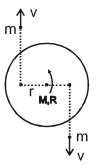
AdvancedMCQ
$A$ horizontal circular platform of radius $R = 0.5 \ m$ and mass $M = 0.45 \ kg$ is free to rotate about its axis. Two massless spring toy-guns,each carrying a steel ball of mass $m = 0.05 \ kg$,are attached to the platform at a distance $r = 0.25 \ m$ from the centre on its either sides along its diameter (see figure). Each gun simultaneously fires the balls horizontally and perpendicular to the diameter in opposite directions. After leaving the platform,the balls have a horizontal speed of $v = 9 \ m/s$ with respect to the ground. The rotational speed of the platform in $rad/s$ after the balls leave the platform is:
A
$1$
B
$2$
C
$3$
D
$4$
Solution
(D) The system (platform + two balls) is initially at rest,so the initial angular momentum is $L_i = 0$.
After the balls are fired,the platform rotates with an angular velocity $\omega$ in the direction opposite to the angular momentum imparted to the balls to conserve the total angular momentum.
The angular momentum of the two balls about the axis of rotation is $L_{balls} = 2 \times (mvr) = 2mvr$.
The angular momentum of the platform is $L_{platform} = I\omega = \left(\frac{MR^2}{2}\right)\omega$.
By the law of conservation of angular momentum,the total angular momentum remains zero:
$L_{balls} + L_{platform} = 0$
$2mvr + \left(\frac{MR^2}{2}\right)\omega = 0$
Taking the magnitude,we have:
$\omega = \frac{2mvr}{I} = \frac{2mvr}{\frac{MR^2}{2}} = \frac{4mvr}{MR^2}$
Substituting the given values:
$m = 0.05 \ kg = 5 \times 10^{-2} \ kg$
$M = 0.45 \ kg = 45 \times 10^{-2} \ kg$
$v = 9 \ m/s$
$r = 0.25 \ m = 1/4 \ m$
$R = 0.5 \ m = 1/2 \ m$
$\omega = \frac{4 \times (0.05) \times 9 \times 0.25}{0.45 \times (0.5)^2}$
$\omega = \frac{4 \times 0.05 \times 9 \times 0.25}{0.45 \times 0.25}$
$\omega = \frac{4 \times 0.05 \times 9}{0.45} = \frac{1.8}{0.45} = 4 \ rad/s$
After the balls are fired,the platform rotates with an angular velocity $\omega$ in the direction opposite to the angular momentum imparted to the balls to conserve the total angular momentum.
The angular momentum of the two balls about the axis of rotation is $L_{balls} = 2 \times (mvr) = 2mvr$.
The angular momentum of the platform is $L_{platform} = I\omega = \left(\frac{MR^2}{2}\right)\omega$.
By the law of conservation of angular momentum,the total angular momentum remains zero:
$L_{balls} + L_{platform} = 0$
$2mvr + \left(\frac{MR^2}{2}\right)\omega = 0$
Taking the magnitude,we have:
$\omega = \frac{2mvr}{I} = \frac{2mvr}{\frac{MR^2}{2}} = \frac{4mvr}{MR^2}$
Substituting the given values:
$m = 0.05 \ kg = 5 \times 10^{-2} \ kg$
$M = 0.45 \ kg = 45 \times 10^{-2} \ kg$
$v = 9 \ m/s$
$r = 0.25 \ m = 1/4 \ m$
$R = 0.5 \ m = 1/2 \ m$
$\omega = \frac{4 \times (0.05) \times 9 \times 0.25}{0.45 \times (0.5)^2}$
$\omega = \frac{4 \times 0.05 \times 9 \times 0.25}{0.45 \times 0.25}$
$\omega = \frac{4 \times 0.05 \times 9}{0.45} = \frac{1.8}{0.45} = 4 \ rad/s$
0 likes
View Solution186
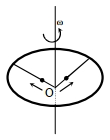
MediumMCQ
$A$ ring of mass $M$ and radius $R$ is rotating with angular speed $\omega$ about a fixed vertical axis passing through its centre $O$ with two point masses each of mass $\frac{M}{8}$ at rest at $O$. These masses can move radially outwards along two massless rods fixed on the ring as shown in the figure. At some instant,the angular speed of the system is $\frac{8}{9} \omega$ and one of the masses is at a distance of $\frac{3}{5} R$ from $O$. At this instant,the distance of the other mass from $O$ is
A
$\frac{2}{3} R$
B
$\frac{1}{3} R$
C
$\frac{3}{5} R$
D
$\frac{4}{5} R$
Solution
(D) The initial moment of inertia of the system is $I_i = I_{ring} + I_{masses} = MR^2 + 0 = MR^2$.
Initial angular momentum $L_i = I_i \omega = MR^2 \omega$.
At the given instant,the angular speed is $\omega' = \frac{8}{9} \omega$.
The moment of inertia of the system at this instant is $I_f = I_{ring} + I_{masses} = MR^2 + \frac{M}{8} r_1^2 + \frac{M}{8} r_2^2$,where $r_1 = \frac{3}{5} R$ and $r_2$ is the distance of the other mass.
Using the conservation of angular momentum,$L_i = L_f \Rightarrow I_i \omega = I_f \omega'$.
$MR^2 \omega = (MR^2 + \frac{M}{8} (\frac{3}{5} R)^2 + \frac{M}{8} r_2^2) \times \frac{8}{9} \omega$.
$MR^2 = (MR^2 + \frac{M}{8} \times \frac{9}{25} R^2 + \frac{M}{8} r_2^2) \times \frac{8}{9}$.
$\frac{9}{8} R^2 = R^2 + \frac{9}{200} R^2 + \frac{1}{8} r_2^2$.
$\frac{9}{8} R^2 - R^2 - \frac{9}{200} R^2 = \frac{1}{8} r_2^2$.
$\frac{225 - 200 - 9}{200} R^2 = \frac{1}{8} r_2^2$.
$\frac{16}{200} R^2 = \frac{1}{8} r_2^2$.
$r_2^2 = \frac{16 \times 8}{200} R^2 = \frac{128}{200} R^2 = \frac{16}{25} R^2$.
$r_2 = \frac{4}{5} R$.
Initial angular momentum $L_i = I_i \omega = MR^2 \omega$.
At the given instant,the angular speed is $\omega' = \frac{8}{9} \omega$.
The moment of inertia of the system at this instant is $I_f = I_{ring} + I_{masses} = MR^2 + \frac{M}{8} r_1^2 + \frac{M}{8} r_2^2$,where $r_1 = \frac{3}{5} R$ and $r_2$ is the distance of the other mass.
Using the conservation of angular momentum,$L_i = L_f \Rightarrow I_i \omega = I_f \omega'$.
$MR^2 \omega = (MR^2 + \frac{M}{8} (\frac{3}{5} R)^2 + \frac{M}{8} r_2^2) \times \frac{8}{9} \omega$.
$MR^2 = (MR^2 + \frac{M}{8} \times \frac{9}{25} R^2 + \frac{M}{8} r_2^2) \times \frac{8}{9}$.
$\frac{9}{8} R^2 = R^2 + \frac{9}{200} R^2 + \frac{1}{8} r_2^2$.
$\frac{9}{8} R^2 - R^2 - \frac{9}{200} R^2 = \frac{1}{8} r_2^2$.
$\frac{225 - 200 - 9}{200} R^2 = \frac{1}{8} r_2^2$.
$\frac{16}{200} R^2 = \frac{1}{8} r_2^2$.
$r_2^2 = \frac{16 \times 8}{200} R^2 = \frac{128}{200} R^2 = \frac{16}{25} R^2$.
$r_2 = \frac{4}{5} R$.
0 likes
View Solution187
DifficultMCQ
$A$ particle of mass $1 \ kg$ is subjected to a force which depends on the position as $\vec{F} = -k(x \hat{i} + y \hat{j}) \ N$ with $k = 1 \ kg \ s^{-2}$. At time $t = 0$,the particle's position is $\vec{r} = (\frac{1}{\sqrt{2}} \hat{i} + \sqrt{2} \hat{j}) \ m$ and its velocity is $\vec{v} = (-\sqrt{2} \hat{i} + \sqrt{2} \hat{j} + \frac{2}{\pi} \hat{k}) \ m \ s^{-1}$. Let $v_x$ and $v_y$ denote the $x$ and $y$ components of the particle's velocity,respectively. Ignore gravity. When $z = 0.5 \ m$,the value of $(x v_y - y v_x)$ is . . . . . $m^2 \ s^{-1}$.
A
$3$
B
$4$
C
$5$
D
$6$
Solution
(A) The force $\vec{F} = -k(x \hat{i} + y \hat{j})$ is a central force directed towards the $z$-axis. The torque $\vec{\tau} = \vec{r} \times \vec{F}$ about the origin is zero because the force vector is always in the $xy$-plane and the position vector $\vec{r}$ has components $(x, y, z)$. Specifically,$\vec{\tau} = (x \hat{i} + y \hat{j} + z \hat{k}) \times (-kx \hat{i} - ky \hat{j}) = -k(x \hat{i} + y \hat{j} + z \hat{k}) \times (x \hat{i} + y \hat{j}) = -k(z y \hat{i} - z x \hat{j} + 0 \hat{k})$. However,since the force is purely radial in the $xy$-plane,the angular momentum component $L_z = m(x v_y - y v_x)$ is conserved.
At $t=0$,$\vec{r}_0 = (\frac{1}{\sqrt{2}}, \sqrt{2}, 0)$ and $\vec{v}_0 = (-\sqrt{2}, \sqrt{2}, \frac{2}{\pi})$.
The $z$-component of angular momentum $L_z = m(x_0 v_{y0} - y_0 v_{x0}) = 1 \times [(\frac{1}{\sqrt{2}})(\sqrt{2}) - (\sqrt{2})(-\sqrt{2})] = 1 + 2 = 3 \ kg \ m^2 \ s^{-1}$.
Since $L_z$ is conserved,at any time,$x v_y - y v_x = 3 \ m^2 \ s^{-1}$.
At $t=0$,$\vec{r}_0 = (\frac{1}{\sqrt{2}}, \sqrt{2}, 0)$ and $\vec{v}_0 = (-\sqrt{2}, \sqrt{2}, \frac{2}{\pi})$.
The $z$-component of angular momentum $L_z = m(x_0 v_{y0} - y_0 v_{x0}) = 1 \times [(\frac{1}{\sqrt{2}})(\sqrt{2}) - (\sqrt{2})(-\sqrt{2})] = 1 + 2 = 3 \ kg \ m^2 \ s^{-1}$.
Since $L_z$ is conserved,at any time,$x v_y - y v_x = 3 \ m^2 \ s^{-1}$.
0 likes
View Solution188
DifficultMCQ
$A$ solid sphere with uniform density and radius $R$ is rotating initially with constant angular velocity $\omega_1$ about its diameter. After some time,it starts losing mass at a uniform rate,with no change in its shape. The angular velocity of the sphere when its radius becomes $R/2$ is $x\omega_1$. The value of $x$ is . . . . . . .
A
$16$
B
$32$
C
$4$
D
$8$
Solution
(B) The moment of inertia of a solid sphere is given by $I = \frac{2}{5}MR^2$.
Since the density $\rho$ is uniform,$M = \rho \cdot V = \rho \cdot \frac{4}{3}\pi R^3$.
Thus,$M \propto R^3$.
When the radius changes from $R$ to $R/2$,the mass changes from $M$ to $M' = M \cdot (1/2)^3 = M/8$.
Since there are no external torques acting on the sphere,the angular momentum is conserved: $L_1 = L_2$.
$I_1 \omega_1 = I_2 \omega_2$.
Substituting the values: $(\frac{2}{5}MR^2)\omega_1 = (\frac{2}{5}M'(R/2)^2)\omega_2$.
$(\frac{2}{5}MR^2)\omega_1 = (\frac{2}{5} \cdot \frac{M}{8} \cdot \frac{R^2}{4})\omega_2$.
$MR^2 \omega_1 = (\frac{M R^2}{32}) \omega_2$.
$\omega_2 = 32 \omega_1$.
Comparing this with $x\omega_1$,we get $x = 32$.
Since the density $\rho$ is uniform,$M = \rho \cdot V = \rho \cdot \frac{4}{3}\pi R^3$.
Thus,$M \propto R^3$.
When the radius changes from $R$ to $R/2$,the mass changes from $M$ to $M' = M \cdot (1/2)^3 = M/8$.
Since there are no external torques acting on the sphere,the angular momentum is conserved: $L_1 = L_2$.
$I_1 \omega_1 = I_2 \omega_2$.
Substituting the values: $(\frac{2}{5}MR^2)\omega_1 = (\frac{2}{5}M'(R/2)^2)\omega_2$.
$(\frac{2}{5}MR^2)\omega_1 = (\frac{2}{5} \cdot \frac{M}{8} \cdot \frac{R^2}{4})\omega_2$.
$MR^2 \omega_1 = (\frac{M R^2}{32}) \omega_2$.
$\omega_2 = 32 \omega_1$.
Comparing this with $x\omega_1$,we get $x = 32$.
0 likes
View Solution189
DifficultMCQ
The Sun rotates around its centre once in $27$ days. What will be the period of revolution if the Sun were to expand to twice its present radius without any external influence (in $days$)? Assume the Sun to be a sphere of uniform density.
A
$100$
B
$105$
C
$115$
D
$108$
Solution
(D) The angular momentum of the Sun is conserved because there is no external torque acting on it.
$L = I \omega = \text{constant}$
For a solid sphere of uniform density, the moment of inertia is $I = \frac{2}{5} M R^2$.
Since the mass $M$ remains constant, $I \propto R^2$.
Given the initial radius $R_1$ and final radius $R_2 = 2 R_1$, the new moment of inertia is $I_2 = \frac{2}{5} M (2 R_1)^2 = 4 \times (\frac{2}{5} M R_1^2) = 4 I_1$.
Using the conservation of angular momentum: $I_1 \omega_1 = I_2 \omega_2$.
Substituting the values: $I_1 \omega_1 = (4 I_1) \omega_2$, which gives $\omega_2 = \frac{\omega_1}{4}$.
Since the angular velocity $\omega = \frac{2 \pi}{T}$, we have $\frac{2 \pi}{T_2} = \frac{1}{4} \times \frac{2 \pi}{T_1}$.
This simplifies to $T_2 = 4 T_1$.
Given $T_1 = 27$ days, the new period is $T_2 = 4 \times 27 = 108$ days.
$L = I \omega = \text{constant}$
For a solid sphere of uniform density, the moment of inertia is $I = \frac{2}{5} M R^2$.
Since the mass $M$ remains constant, $I \propto R^2$.
Given the initial radius $R_1$ and final radius $R_2 = 2 R_1$, the new moment of inertia is $I_2 = \frac{2}{5} M (2 R_1)^2 = 4 \times (\frac{2}{5} M R_1^2) = 4 I_1$.
Using the conservation of angular momentum: $I_1 \omega_1 = I_2 \omega_2$.
Substituting the values: $I_1 \omega_1 = (4 I_1) \omega_2$, which gives $\omega_2 = \frac{\omega_1}{4}$.
Since the angular velocity $\omega = \frac{2 \pi}{T}$, we have $\frac{2 \pi}{T_2} = \frac{1}{4} \times \frac{2 \pi}{T_1}$.
This simplifies to $T_2 = 4 T_1$.
Given $T_1 = 27$ days, the new period is $T_2 = 4 \times 27 = 108$ days.
0 likes
View Solution190
DifficultMCQ
$A$ thin and circular disc of mass $M$ and radius $R$ is rotating in a horizontal plane about its geometrical axis with an angular velocity $\omega$. If another disc of same dimensions but of mass $M/4$ is placed gently on the first disc coaxially,then the new angular velocity of the system is:
A
$5/4 \omega$
B
$2/3 \omega$
C
$4/5 \omega$
D
$3/2 \omega$
Solution
(C) The moment of inertia of the first disc about its geometrical axis is $I_1 = \frac{1}{2}MR^2$.
Since no external torque acts on the system,the angular momentum is conserved: $L_i = L_f$.
$I_1 \omega = (I_1 + I_2) \omega_2$,where $I_2$ is the moment of inertia of the second disc.
$I_2 = \frac{1}{2} \left(\frac{M}{4}\right) R^2 = \frac{1}{4} I_1$.
Substituting $I_2$ in the conservation equation:
$I_1 \omega = (I_1 + \frac{1}{4} I_1) \omega_2$
$I_1 \omega = \frac{5}{4} I_1 \omega_2$
$\omega_2 = \frac{4}{5} \omega$.
Since no external torque acts on the system,the angular momentum is conserved: $L_i = L_f$.
$I_1 \omega = (I_1 + I_2) \omega_2$,where $I_2$ is the moment of inertia of the second disc.
$I_2 = \frac{1}{2} \left(\frac{M}{4}\right) R^2 = \frac{1}{4} I_1$.
Substituting $I_2$ in the conservation equation:
$I_1 \omega = (I_1 + \frac{1}{4} I_1) \omega_2$
$I_1 \omega = \frac{5}{4} I_1 \omega_2$
$\omega_2 = \frac{4}{5} \omega$.
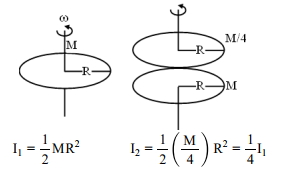
0 likes
View Solution191
MediumMCQ
Assertion $:-$ When no external torque is applied and moment of inertia of a rotating body changes,then its angular momentum remains conserved,but its kinetic energy changes.
Reason $:-$ Angular momentum does not depend upon moment of inertia of the body.
Reason $:-$ Angular momentum does not depend upon moment of inertia of the body.
A
$(A)$ is correct but $(R)$ is not correct
B
Both $(A)$ and $(R)$ are correct but $(R)$ is not the correct explanation of $(A)$
C
$(A)$ is incorrect but $(R)$ is correct
D
Both $(A)$ and $(R)$ are correct and $(R)$ is the correct explanation of $(A)$
Solution
(A) The Assertion is true because,in the absence of an external torque,the angular momentum $L = I\omega$ remains constant. If the moment of inertia $I$ changes,the angular velocity $\omega$ must change to keep $L$ constant.
However,the rotational kinetic energy $K = \frac{L^2}{2I}$ depends on $I$. Since $L$ is constant,if $I$ changes,$K$ must change.
The Reason is false because angular momentum $L$ is defined as $L = I\omega$,which directly depends on the moment of inertia $I$ of the body.
Thus,$(A)$ is correct but $(R)$ is incorrect.
However,the rotational kinetic energy $K = \frac{L^2}{2I}$ depends on $I$. Since $L$ is constant,if $I$ changes,$K$ must change.
The Reason is false because angular momentum $L$ is defined as $L = I\omega$,which directly depends on the moment of inertia $I$ of the body.
Thus,$(A)$ is correct but $(R)$ is incorrect.
0 likes
View Solution192
MediumMCQ
Given below are two statements: One is labelled as Assertion $(A)$ and the other is labelled as Reason $(R)$.
Assertion $(A)$ : In a conical pendulum,angular momentum about its vertical axis remains constant.
Reason $(R)$ : Net torque about the vertical axis of a conical pendulum is not zero.
In the light of the above statements,choose the most appropriate answer from the options given below:
Assertion $(A)$ : In a conical pendulum,angular momentum about its vertical axis remains constant.
Reason $(R)$ : Net torque about the vertical axis of a conical pendulum is not zero.
In the light of the above statements,choose the most appropriate answer from the options given below:
A
Both $(A)$ and $(R)$ are true and $(R)$ is the correct explanation of $(A)$.
B
Both $(A)$ and $(R)$ are true but $(R)$ is $\text{NOT}$ the correct explanation of $(A)$.
C
$(A)$ is true but $(R)$ is false.
D
$(A)$ is false but $(R)$ is true.
Solution
(C) In a conical pendulum,the bob moves in a horizontal circle at a constant speed. The forces acting on the bob are tension $(T)$ and weight $(mg)$.
The vertical axis passes through the point of suspension and the center of the circular path. The tension force passes through the point of suspension,and the weight acts vertically downwards. Both these forces pass through the vertical axis or are parallel to it,resulting in zero torque about the vertical axis.
Since the net torque $(\tau_{net} = 0)$ about the vertical axis is zero,the angular momentum $(L)$ about this axis is conserved (remains constant).
Therefore,Assertion $(A)$ is true,and Reason $(R)$ is false.
The vertical axis passes through the point of suspension and the center of the circular path. The tension force passes through the point of suspension,and the weight acts vertically downwards. Both these forces pass through the vertical axis or are parallel to it,resulting in zero torque about the vertical axis.
Since the net torque $(\tau_{net} = 0)$ about the vertical axis is zero,the angular momentum $(L)$ about this axis is conserved (remains constant).
Therefore,Assertion $(A)$ is true,and Reason $(R)$ is false.
0 likes
View Solution193
DifficultMCQ
$A$ circular platform of moment of inertia $100 \ kg\ m^2$ with a boy of mass $20 \ kg$ standing at the centre completes one rotation in $10 \ s$. If he walks $2 \ m$ away from the centre along the radius,then one rotation (with respect to the ground) will be completed in $.... \ s$.
A
$12$
B
$18$
C
$16$
D
$20$
Solution
(B) According to the principle of Conservation of Angular Momentum $(COAM)$,the angular momentum remains constant as no external torque acts on the system.
$L_1 = L_2$
$I_1 \omega_1 = I_2 \omega_2$
Initially,the boy is at the centre,so his moment of inertia is $0$. The total moment of inertia is $I_1 = 100 \ kg\ m^2$.
The initial angular velocity is $\omega_1 = \frac{2\pi}{T_1} = \frac{2\pi}{10} \ rad/s$.
When the boy moves $2 \ m$ away from the centre,his moment of inertia becomes $I_{boy} = mr^2 = 20 \times (2)^2 = 80 \ kg\ m^2$.
The new total moment of inertia is $I_2 = 100 + 80 = 180 \ kg\ m^2$.
Let the new time period be $T_2$,so $\omega_2 = \frac{2\pi}{T_2}$.
Substituting these into the $COAM$ equation:
$100 \times \frac{2\pi}{10} = 180 \times \frac{2\pi}{T_2}$
$10 = \frac{180}{T_2}$
$T_2 = \frac{180}{10} = 18 \ s$.
$L_1 = L_2$
$I_1 \omega_1 = I_2 \omega_2$
Initially,the boy is at the centre,so his moment of inertia is $0$. The total moment of inertia is $I_1 = 100 \ kg\ m^2$.
The initial angular velocity is $\omega_1 = \frac{2\pi}{T_1} = \frac{2\pi}{10} \ rad/s$.
When the boy moves $2 \ m$ away from the centre,his moment of inertia becomes $I_{boy} = mr^2 = 20 \times (2)^2 = 80 \ kg\ m^2$.
The new total moment of inertia is $I_2 = 100 + 80 = 180 \ kg\ m^2$.
Let the new time period be $T_2$,so $\omega_2 = \frac{2\pi}{T_2}$.
Substituting these into the $COAM$ equation:
$100 \times \frac{2\pi}{10} = 180 \times \frac{2\pi}{T_2}$
$10 = \frac{180}{T_2}$
$T_2 = \frac{180}{10} = 18 \ s$.

0 likes
View Solution194
EasyMCQ
$A$ thin circular ring of mass $M$ and radius $r$ is rotating about its axis with an angular speed $\omega$. Two particles each of mass $m$ are now attached at diametrically opposite points. The angular speed of the ring will become
A
$\frac{\omega M}{M+2m}$
B
$\frac{\omega M}{M+m}$
C
$\frac{\omega(M-2m)}{M}$
D
$\frac{\omega(M-2m)}{M+2m}$
Solution
(A) The initial moment of inertia of the ring about its axis is $I_i = Mr^2$.
The initial angular momentum is $L_i = I_i \omega = Mr^2 \omega$.
When two particles of mass $m$ are attached at diametrically opposite points at a distance $r$ from the axis,the new moment of inertia becomes $I_f = Mr^2 + mr^2 + mr^2 = (M+2m)r^2$.
Since there is no external torque acting on the system,the angular momentum is conserved,so $L_i = L_f$.
$Mr^2 \omega = (M+2m)r^2 \omega'$.
Solving for the new angular speed $\omega'$,we get $\omega' = \frac{Mr^2 \omega}{(M+2m)r^2} = \frac{\omega M}{M+2m}$.
The initial angular momentum is $L_i = I_i \omega = Mr^2 \omega$.
When two particles of mass $m$ are attached at diametrically opposite points at a distance $r$ from the axis,the new moment of inertia becomes $I_f = Mr^2 + mr^2 + mr^2 = (M+2m)r^2$.
Since there is no external torque acting on the system,the angular momentum is conserved,so $L_i = L_f$.
$Mr^2 \omega = (M+2m)r^2 \omega'$.
Solving for the new angular speed $\omega'$,we get $\omega' = \frac{Mr^2 \omega}{(M+2m)r^2} = \frac{\omega M}{M+2m}$.
0 likes
View Solution195
MediumMCQ
Two discs of moment of inertia $I_1$ and $I_2$ and angular speeds $\omega_1$ and $\omega_2$ are rotating along collinear axes passing through their centers of mass and perpendicular to their planes. If the two discs are made to rotate together along the same axis,what will be the rotational kinetic energy of the system?
A
$\frac{I_1 \omega_1+I_2 \omega_2}{2(I_1+I_2)^2}$
B
$\frac{(I_1 \omega_1-I_2 \omega_2)^2}{2(I_1+I_2)}$
C
$\frac{(I_1 \omega_1+I_2 \omega_2)^2}{2(I_1-I_2)}$
D
$\frac{(I_1 \omega_1+I_2 \omega_2)^2}{2(I_1+I_2)}$
Solution
(D) According to the principle of conservation of angular momentum,the total angular momentum of the system remains constant when the two discs are coupled.
Initial angular momentum $L_i = I_1 \omega_1 + I_2 \omega_2$.
When the discs rotate together,they form a single system with a combined moment of inertia $I = I_1 + I_2$ and a common angular velocity $\omega$.
The final angular momentum is $L_f = (I_1 + I_2) \omega$.
Equating $L_i = L_f$,we get $\omega = \frac{I_1 \omega_1 + I_2 \omega_2}{I_1 + I_2}$.
The rotational kinetic energy $K$ of the system is given by $K = \frac{1}{2} I \omega^2$.
Substituting the values of $I$ and $\omega$:
$K = \frac{1}{2} (I_1 + I_2) \left( \frac{I_1 \omega_1 + I_2 \omega_2}{I_1 + I_2} \right)^2$.
$K = \frac{(I_1 \omega_1 + I_2 \omega_2)^2}{2(I_1 + I_2)}$.
Initial angular momentum $L_i = I_1 \omega_1 + I_2 \omega_2$.
When the discs rotate together,they form a single system with a combined moment of inertia $I = I_1 + I_2$ and a common angular velocity $\omega$.
The final angular momentum is $L_f = (I_1 + I_2) \omega$.
Equating $L_i = L_f$,we get $\omega = \frac{I_1 \omega_1 + I_2 \omega_2}{I_1 + I_2}$.
The rotational kinetic energy $K$ of the system is given by $K = \frac{1}{2} I \omega^2$.
Substituting the values of $I$ and $\omega$:
$K = \frac{1}{2} (I_1 + I_2) \left( \frac{I_1 \omega_1 + I_2 \omega_2}{I_1 + I_2} \right)^2$.
$K = \frac{(I_1 \omega_1 + I_2 \omega_2)^2}{2(I_1 + I_2)}$.
0 likes
View Solution196
MediumMCQ
$A$ man standing on a turn-table is rotating at a certain angular frequency with his arms outstretched. He suddenly folds his arms. If his moment of inertia with folded arms is $75 \%$ of that with outstretched arms,then his rotational kinetic energy will
A
increase by $33.3 \%$
B
decrease by $33.3 \%$
C
increase by $25.0 \%$
D
decrease by $25.0 \%$
Solution
(A) Let the initial moment of inertia be $I_1$ and the final moment of inertia be $I_2 = 0.75 I_1 = \frac{3}{4} I_1$.
Since no external torque acts on the system,the angular momentum $L$ is conserved,so $L = I_1 \omega_1 = I_2 \omega_2$.
Thus,$\omega_2 = \frac{I_1}{I_2} \omega_1 = \frac{I_1}{0.75 I_1} \omega_1 = \frac{4}{3} \omega_1$.
The initial rotational kinetic energy is $K_1 = \frac{L^2}{2 I_1}$.
The final rotational kinetic energy is $K_2 = \frac{L^2}{2 I_2} = \frac{L^2}{2 (0.75 I_1)} = \frac{L^2}{1.5 I_1} = \frac{4}{3} K_1$.
The percentage increase in kinetic energy is $\frac{K_2 - K_1}{K_1} \times 100 = (\frac{4}{3} - 1) \times 100 = \frac{1}{3} \times 100 \approx 33.3 \%$.
Since no external torque acts on the system,the angular momentum $L$ is conserved,so $L = I_1 \omega_1 = I_2 \omega_2$.
Thus,$\omega_2 = \frac{I_1}{I_2} \omega_1 = \frac{I_1}{0.75 I_1} \omega_1 = \frac{4}{3} \omega_1$.
The initial rotational kinetic energy is $K_1 = \frac{L^2}{2 I_1}$.
The final rotational kinetic energy is $K_2 = \frac{L^2}{2 I_2} = \frac{L^2}{2 (0.75 I_1)} = \frac{L^2}{1.5 I_1} = \frac{4}{3} K_1$.
The percentage increase in kinetic energy is $\frac{K_2 - K_1}{K_1} \times 100 = (\frac{4}{3} - 1) \times 100 = \frac{1}{3} \times 100 \approx 33.3 \%$.
0 likes
View Solution197
DifficultMCQ
$A$ thin uniform circular disc of mass $M$ and radius $R$ is rotating with angular velocity $\omega$ in a horizontal plane about an axis passing through its centre and perpendicular to its plane. Another disc of the same radius but of mass $\frac{M}{3}$ is placed gently on the first disc co-axially. The new angular velocity will be:
A
$\frac{2}{3} \omega$
B
$\frac{3}{4} \omega$
C
$\frac{4}{3} \omega$
D
$\frac{5}{4} \omega$
Solution
(B) The angular momentum of the system is conserved because no external torque acts on the system.
Initial angular momentum $L_i = I_1 \omega_1$,where $I_1 = \frac{1}{2} M R^2$ and $\omega_1 = \omega$.
Final moment of inertia $I_2 = I_{\text{disc1}} + I_{\text{disc2}} = \frac{1}{2} M R^2 + \frac{1}{2} (\frac{M}{3}) R^2 = \frac{1}{2} R^2 (M + \frac{M}{3}) = \frac{1}{2} R^2 (\frac{4M}{3}) = \frac{2}{3} M R^2$.
By the law of conservation of angular momentum,$I_1 \omega_1 = I_2 \omega_2$.
Substituting the values: $(\frac{1}{2} M R^2) \omega = (\frac{2}{3} M R^2) \omega_2$.
Solving for $\omega_2$: $\omega_2 = \frac{1/2}{2/3} \omega = \frac{3}{4} \omega$.
Initial angular momentum $L_i = I_1 \omega_1$,where $I_1 = \frac{1}{2} M R^2$ and $\omega_1 = \omega$.
Final moment of inertia $I_2 = I_{\text{disc1}} + I_{\text{disc2}} = \frac{1}{2} M R^2 + \frac{1}{2} (\frac{M}{3}) R^2 = \frac{1}{2} R^2 (M + \frac{M}{3}) = \frac{1}{2} R^2 (\frac{4M}{3}) = \frac{2}{3} M R^2$.
By the law of conservation of angular momentum,$I_1 \omega_1 = I_2 \omega_2$.
Substituting the values: $(\frac{1}{2} M R^2) \omega = (\frac{2}{3} M R^2) \omega_2$.
Solving for $\omega_2$: $\omega_2 = \frac{1/2}{2/3} \omega = \frac{3}{4} \omega$.
0 likes
View Solution198
MediumMCQ
$A$ child is standing with folded hands at the centre of a platform rotating about its central axis. The kinetic energy of the system is $K$. The child now stretches his arms so that the moment of inertia of the system becomes double. The kinetic energy of the system now is
A
$\frac{K}{2}$
B
$2 K$
C
$4 K$
D
$\frac{K}{4}$
Solution
(A) The initial kinetic energy of the system is given by $K = \frac{1}{2} I \omega^2$,where $I$ is the initial moment of inertia and $\omega$ is the initial angular velocity.
According to the law of conservation of angular momentum,since no external torque acts on the system,the angular momentum $L$ remains constant: $L = I \omega = I^{\prime} \omega^{\prime}$.
Given that the new moment of inertia is $I^{\prime} = 2I$,we have $2I \omega^{\prime} = I \omega$,which implies $\omega^{\prime} = \frac{\omega}{2}$.
The new kinetic energy $K^{\prime}$ is given by $K^{\prime} = \frac{1}{2} I^{\prime} \omega^{\prime 2}$.
Substituting the values,$K^{\prime} = \frac{1}{2} (2I) \left( \frac{\omega}{2} \right)^2 = I \left( \frac{\omega^2}{4} \right) = \frac{1}{2} \left( \frac{1}{2} I \omega^2 \right) = \frac{K}{2}$.
According to the law of conservation of angular momentum,since no external torque acts on the system,the angular momentum $L$ remains constant: $L = I \omega = I^{\prime} \omega^{\prime}$.
Given that the new moment of inertia is $I^{\prime} = 2I$,we have $2I \omega^{\prime} = I \omega$,which implies $\omega^{\prime} = \frac{\omega}{2}$.
The new kinetic energy $K^{\prime}$ is given by $K^{\prime} = \frac{1}{2} I^{\prime} \omega^{\prime 2}$.
Substituting the values,$K^{\prime} = \frac{1}{2} (2I) \left( \frac{\omega}{2} \right)^2 = I \left( \frac{\omega^2}{4} \right) = \frac{1}{2} \left( \frac{1}{2} I \omega^2 \right) = \frac{K}{2}$.
0 likes
View Solution199
MediumMCQ
$A$ disc of moment of inertia $I_1$ is rotating in a horizontal plane about an axis passing through its center and perpendicular to its plane with a constant angular speed $\omega_1$. Another disc of moment of inertia $I_2$ having zero angular speed is placed coaxially on the rotating disc. Now,both the discs are rotating with a constant angular speed $\omega_2$. The energy lost by the initial rotating disc is
A
$\frac{1}{2}\left[\frac{I_1+I_2}{I_1 I_2}\right] \omega_1^2$
B
$\frac{1}{2}\left[\frac{I_1 I_2}{I_1-I_2}\right] \omega_1^2$
C
$\frac{1}{2}\left[\frac{I_1-I_2}{I_1 I_2}\right] \omega_1^2$
D
$\frac{1}{2}\left[\frac{I_1 I_2}{I_1+I_2}\right] \omega_1^2$
Solution
(D) According to the principle of conservation of angular momentum,since no external torque acts on the system,the initial angular momentum equals the final angular momentum:
$I_1 \omega_1 = (I_1 + I_2) \omega_2$
$\omega_2 = \frac{I_1 \omega_1}{I_1 + I_2}$
The initial rotational kinetic energy is $E_1 = \frac{1}{2} I_1 \omega_1^2$.
The final rotational kinetic energy is $E_2 = \frac{1}{2} (I_1 + I_2) \omega_2^2$.
Substituting $\omega_2$ into the expression for $E_2$:
$E_2 = \frac{1}{2} (I_1 + I_2) \left( \frac{I_1 \omega_1}{I_1 + I_2} \right)^2 = \frac{1}{2} \frac{I_1^2 \omega_1^2}{I_1 + I_2}$.
The energy lost is $\Delta E = E_1 - E_2 = \frac{1}{2} I_1 \omega_1^2 - \frac{1}{2} \frac{I_1^2 \omega_1^2}{I_1 + I_2}$.
$\Delta E = \frac{1}{2} I_1 \omega_1^2 \left( 1 - \frac{I_1}{I_1 + I_2} \right) = \frac{1}{2} I_1 \omega_1^2 \left( \frac{I_1 + I_2 - I_1}{I_1 + I_2} \right)$.
$\Delta E = \frac{1}{2} \left[ \frac{I_1 I_2}{I_1 + I_2} \right] \omega_1^2$.
$I_1 \omega_1 = (I_1 + I_2) \omega_2$
$\omega_2 = \frac{I_1 \omega_1}{I_1 + I_2}$
The initial rotational kinetic energy is $E_1 = \frac{1}{2} I_1 \omega_1^2$.
The final rotational kinetic energy is $E_2 = \frac{1}{2} (I_1 + I_2) \omega_2^2$.
Substituting $\omega_2$ into the expression for $E_2$:
$E_2 = \frac{1}{2} (I_1 + I_2) \left( \frac{I_1 \omega_1}{I_1 + I_2} \right)^2 = \frac{1}{2} \frac{I_1^2 \omega_1^2}{I_1 + I_2}$.
The energy lost is $\Delta E = E_1 - E_2 = \frac{1}{2} I_1 \omega_1^2 - \frac{1}{2} \frac{I_1^2 \omega_1^2}{I_1 + I_2}$.
$\Delta E = \frac{1}{2} I_1 \omega_1^2 \left( 1 - \frac{I_1}{I_1 + I_2} \right) = \frac{1}{2} I_1 \omega_1^2 \left( \frac{I_1 + I_2 - I_1}{I_1 + I_2} \right)$.
$\Delta E = \frac{1}{2} \left[ \frac{I_1 I_2}{I_1 + I_2} \right] \omega_1^2$.
0 likes
View Solution200
MediumMCQ
$A$ thin uniform circular disc of mass $M$ and radius $R$ is rotating with angular velocity $\omega$ in a horizontal plane about an axis passing through its centre and perpendicular to its plane. Another disc of the same radius but of mass $\frac{M}{2}$ is placed gently on the first disc co-axially. The new angular velocity will be
A
$\frac{2}{3} \omega$
B
$\frac{4}{5} \omega$
C
$\frac{5}{4} \omega$
D
$\frac{3}{2} \omega$
Solution
(A) The moment of inertia of the first disc about the central axis is $I_1 = \frac{1}{2} MR^2$.
Since no external torque acts on the system,the angular momentum is conserved: $L_i = L_f$.
Initially,$L_i = I_1 \omega = \frac{1}{2} MR^2 \omega$.
When the second disc of mass $\frac{M}{2}$ is placed on the first,the total moment of inertia becomes $I_2 = I_1 + I_{\text{disc2}} = \frac{1}{2} MR^2 + \frac{1}{2} (\frac{M}{2}) R^2 = \frac{1}{2} MR^2 + \frac{1}{4} MR^2 = \frac{3}{4} MR^2$.
Using conservation of angular momentum: $I_1 \omega = I_2 \omega_2$.
$\frac{1}{2} MR^2 \omega = \frac{3}{4} MR^2 \omega_2$.
Solving for $\omega_2$: $\omega_2 = (\frac{1}{2} \times \frac{4}{3}) \omega = \frac{2}{3} \omega$.
Since no external torque acts on the system,the angular momentum is conserved: $L_i = L_f$.
Initially,$L_i = I_1 \omega = \frac{1}{2} MR^2 \omega$.
When the second disc of mass $\frac{M}{2}$ is placed on the first,the total moment of inertia becomes $I_2 = I_1 + I_{\text{disc2}} = \frac{1}{2} MR^2 + \frac{1}{2} (\frac{M}{2}) R^2 = \frac{1}{2} MR^2 + \frac{1}{4} MR^2 = \frac{3}{4} MR^2$.
Using conservation of angular momentum: $I_1 \omega = I_2 \omega_2$.
$\frac{1}{2} MR^2 \omega = \frac{3}{4} MR^2 \omega_2$.
Solving for $\omega_2$: $\omega_2 = (\frac{1}{2} \times \frac{4}{3}) \omega = \frac{2}{3} \omega$.
0 likes
View SolutionSystem of Particles and Rotational Motion — Conservation of angular momentum (combined translation and rotational motion) · Frequently Asked Questions
1Are these System of Particles and Rotational Motion questions useful for JEE and NEET?
Yes. All questions in this section are mapped to JEE Main and NEET exam patterns. Previous year questions from JEE Main, NEET, GUJCET and state-level exams are included with full solutions.
2Can I switch to Hindi or Gujarati for these questions?
Yes. Use the language tabs in the hero section or the sidebar to view the same questions and solutions in English, Hindi or Gujarati.
3How do I generate a question paper from this subtopic?
Use the Vedclass Exam Paper Generator — select the chapter and subtopic, set difficulty, and generate Sets A, B, C, D automatically. First 3 chapters of every subject are free.
Vedclass Products
For Students
Vedclass Test Series
Mock tests in real JEE/NEET style with performance analysis. 5-day free trial.
Start Free TrialFor Teachers
Exam Paper Generator
Generate Set A/B/C/D papers from this chapter in 2 minutes. 3 chapters free.
Try FreeFor Institutes
Online Exam Module
Live online exams with unlimited students, 360° analytics & white-label branding.
See DemoFor Teachers & Institutes
Generate a System of Particles and Rotational Motion Exam Paper in 2 Minutes
Select subtopic & difficulty — Sets A, B, C, D auto-generated with No Repeat logic.
First 3 chapters of every subject are free — no payment required.