
A English
Conservation of angular momentum (combined translation and rotational motion) Questions in English
Class 11 Physics · System of Particles and Rotational Motion · Conservation of angular momentum (combined translation and rotational motion)
213+
Questions
English
Language
100%
With Solutions
Showing 49 of 213 questions in English
51
MediumMCQ
$A$ boy is standing at the center of a turntable holding two blocks in his hands. The rotational kinetic energy of the system about the axis passing through the center is $K$. When the boy extends his arms,the moment of inertia of the system about the axis of rotation doubles. What will be the new rotational kinetic energy of the system?
A
$K$
B
$\frac{K}{2}$
C
$2K$
D
$\frac{K}{4}$
Solution
(B) According to the law of conservation of angular momentum,$L = I\omega = \text{constant}$.
Therefore,$\omega \propto \frac{1}{I}$.
The rotational kinetic energy is given by $E_R = \frac{1}{2} I \omega^2$.
Substituting $\omega \propto \frac{1}{I}$,we get $E_R \propto I \times \left(\frac{1}{I}\right)^2 = \frac{1}{I}$.
Given that the initial moment of inertia is $I_1 = I$ and the final moment of inertia is $I_2 = 2I$.
Thus,$\frac{E_2}{E_1} = \frac{I_1}{I_2} = \frac{I}{2I} = \frac{1}{2}$.
Therefore,the new kinetic energy $E_2 = \frac{E_1}{2} = \frac{K}{2}$.
Therefore,$\omega \propto \frac{1}{I}$.
The rotational kinetic energy is given by $E_R = \frac{1}{2} I \omega^2$.
Substituting $\omega \propto \frac{1}{I}$,we get $E_R \propto I \times \left(\frac{1}{I}\right)^2 = \frac{1}{I}$.
Given that the initial moment of inertia is $I_1 = I$ and the final moment of inertia is $I_2 = 2I$.
Thus,$\frac{E_2}{E_1} = \frac{I_1}{I_2} = \frac{I}{2I} = \frac{1}{2}$.
Therefore,the new kinetic energy $E_2 = \frac{E_1}{2} = \frac{K}{2}$.
0 likes
View Solution52
DifficultMCQ
$A$ thin ring of mass $M$ and radius $R$ is rotating with an angular velocity $\omega$ about an axis passing through its center and perpendicular to its plane. If $4$ point masses each of mass $m$ are placed gently at the opposite ends of two mutually perpendicular diameters,what will be the new angular velocity of the system?
A
$\left( {\frac{M}{{M + 4m}}} \right)\omega $
B
$\left( {\frac{{M + 4m}}{M}} \right)\omega $
C
$\left( {\frac{{M - 4m}}{{M + 4m}}} \right)\omega $
D
$\left( {\frac{M}{{4m}}} \right)\omega $
Solution
(A) The initial moment of inertia of the ring is $I = MR^2$. The initial angular momentum is $L = I\omega = MR^2\omega$.
When $4$ point masses of mass $m$ are placed at the ends of two mutually perpendicular diameters,they are all at a distance $R$ from the axis of rotation.
The new moment of inertia of the system becomes $I' = MR^2 + 4(mR^2) = (M + 4m)R^2$.
Since there is no external torque acting on the system,the angular momentum remains conserved $(L_{initial} = L_{final})$.
$MR^2\omega = (M + 4m)R^2\omega'$
Dividing both sides by $R^2$,we get $M\omega = (M + 4m)\omega'$.
Therefore,the new angular velocity is $\omega' = \left( \frac{M}{M + 4m} \right)\omega$.
When $4$ point masses of mass $m$ are placed at the ends of two mutually perpendicular diameters,they are all at a distance $R$ from the axis of rotation.
The new moment of inertia of the system becomes $I' = MR^2 + 4(mR^2) = (M + 4m)R^2$.
Since there is no external torque acting on the system,the angular momentum remains conserved $(L_{initial} = L_{final})$.
$MR^2\omega = (M + 4m)R^2\omega'$
Dividing both sides by $R^2$,we get $M\omega = (M + 4m)\omega'$.
Therefore,the new angular velocity is $\omega' = \left( \frac{M}{M + 4m} \right)\omega$.
0 likes
View Solution53
MediumMCQ
Due to the melting of ice at the poles of the Earth,the moment of inertia of the Earth ....,the angular velocity ....,and the duration of the day becomes ....
A
Increases,Decreases,Longer
B
Decreases,Decreases,Longer
C
Increases,Increases,Shorter
D
Decreases,Increases,Shorter
Solution
(A) When ice at the poles melts and flows towards the equator,the mass distribution shifts further away from the axis of rotation.
Since the moment of inertia $I = \sum mr^2$,as mass moves away from the axis,the moment of inertia $I$ increases.
According to the law of conservation of angular momentum,$L = I\omega = \text{constant}$.
If $I$ increases,the angular velocity $\omega$ must decrease.
Since the time period $T = \frac{2\pi}{\omega}$,a decrease in $\omega$ leads to an increase in the duration of the day $T$ (the day becomes longer).
Since the moment of inertia $I = \sum mr^2$,as mass moves away from the axis,the moment of inertia $I$ increases.
According to the law of conservation of angular momentum,$L = I\omega = \text{constant}$.
If $I$ increases,the angular velocity $\omega$ must decrease.
Since the time period $T = \frac{2\pi}{\omega}$,a decrease in $\omega$ leads to an increase in the duration of the day $T$ (the day becomes longer).
0 likes
View Solution54
DifficultMCQ
$A$ rotating table has an angular velocity $\omega$ and a moment of inertia $I_1$. $A$ man of mass $m$ stands at the center of the table. If the man walks a distance $r$ along the radius of the table,what will be his final angular velocity?
A
$\frac{I_1}{I_1\omega + mr^2}$
B
$\frac{I_1\omega}{I_1 + mr^2}$
C
$\frac{I_1\omega}{I_1 + mr}$
D
$\frac{I_1\omega}{I_1 - mr^2}$
Solution
(B) According to the law of conservation of angular momentum,since no external torque acts on the system,the initial angular momentum is equal to the final angular momentum.
Initial angular momentum $L_i = I_1 \omega$.
When the man moves to a distance $r$ from the center,the new moment of inertia of the system becomes $I_2 = I_1 + mr^2$.
Let the final angular velocity be $\omega_2$.
Final angular momentum $L_f = (I_1 + mr^2) \omega_2$.
Equating $L_i = L_f$:
$I_1 \omega = (I_1 + mr^2) \omega_2$.
Therefore,the final angular velocity is $\omega_2 = \frac{I_1 \omega}{I_1 + mr^2}$.
Initial angular momentum $L_i = I_1 \omega$.
When the man moves to a distance $r$ from the center,the new moment of inertia of the system becomes $I_2 = I_1 + mr^2$.
Let the final angular velocity be $\omega_2$.
Final angular momentum $L_f = (I_1 + mr^2) \omega_2$.
Equating $L_i = L_f$:
$I_1 \omega = (I_1 + mr^2) \omega_2$.
Therefore,the final angular velocity is $\omega_2 = \frac{I_1 \omega}{I_1 + mr^2}$.
0 likes
View Solution55
MediumMCQ
The position vector of a particle is given by $\vec{r} = 2\hat{i} - 6\hat{j} - 12\hat{k}$ units. $A$ force $\vec{F} = p\hat{i} + 3\hat{j} + 6\hat{k}$ units acts on it. For what value of $p$ is the angular momentum conserved?
A
$-1$
B
$1$
C
$-2$
D
$2$
Solution
(A) Angular momentum is conserved when the net torque acting on the particle is zero,i.e.,$\vec{\tau} = \vec{r} \times \vec{F} = 0$.
Calculating the cross product:
$\vec{\tau} = \begin{vmatrix} \hat{i} & \hat{j} & \hat{k} \\ 2 & -6 & -12 \\ p & 3 & 6 \end{vmatrix}$
$\vec{\tau} = \hat{i}(-36 - (-36)) - \hat{j}(12 - (-12p)) + \hat{k}(6 - (-6p))$
$\vec{\tau} = \hat{i}(0) - \hat{j}(12 + 12p) + \hat{k}(6 + 6p)$
For angular momentum to be conserved,$\vec{\tau} = 0$,which implies:
$12 + 12p = 0$ and $6 + 6p = 0$
Solving $12 + 12p = 0$,we get $12p = -12$,so $p = -1$.
Similarly,$6 + 6p = 0$ also gives $p = -1$.
Calculating the cross product:
$\vec{\tau} = \begin{vmatrix} \hat{i} & \hat{j} & \hat{k} \\ 2 & -6 & -12 \\ p & 3 & 6 \end{vmatrix}$
$\vec{\tau} = \hat{i}(-36 - (-36)) - \hat{j}(12 - (-12p)) + \hat{k}(6 - (-6p))$
$\vec{\tau} = \hat{i}(0) - \hat{j}(12 + 12p) + \hat{k}(6 + 6p)$
For angular momentum to be conserved,$\vec{\tau} = 0$,which implies:
$12 + 12p = 0$ and $6 + 6p = 0$
Solving $12 + 12p = 0$,we get $12p = -12$,so $p = -1$.
Similarly,$6 + 6p = 0$ also gives $p = -1$.
0 likes
View Solution56
MediumMCQ
$A$ rotating table completes one revolution in $10 \ s$. Its moment of inertia is $100 \ kg \cdot m^2$. $A$ man of mass $50 \ kg$ stands at the center of the rotating table. If the man moves $2 \ m$ away from the center,what will be the angular velocity of the table in $rad/s$?
A
$\frac{2\pi}{30}$
B
$\frac{20\pi}{30}$
C
$\frac{2\pi}{3}$
D
$2\pi$
Solution
(A) Initial angular velocity $\omega_1 = \frac{2\pi}{T} = \frac{2\pi}{10} = \frac{\pi}{5} \ rad/s$.
Initial moment of inertia $I_1 = I_{table} + I_{man} = 100 + 50(0)^2 = 100 \ kg \cdot m^2$.
Final moment of inertia $I_2 = I_{table} + I_{man} = 100 + 50(2)^2 = 100 + 200 = 300 \ kg \cdot m^2$.
By the law of conservation of angular momentum,$L_1 = L_2 \Rightarrow I_1 \omega_1 = I_2 \omega_2$.
$100 \times \frac{\pi}{5} = 300 \times \omega_2$.
$20\pi = 300 \omega_2$.
$\omega_2 = \frac{20\pi}{300} = \frac{\pi}{15} \ rad/s$.
Initial moment of inertia $I_1 = I_{table} + I_{man} = 100 + 50(0)^2 = 100 \ kg \cdot m^2$.
Final moment of inertia $I_2 = I_{table} + I_{man} = 100 + 50(2)^2 = 100 + 200 = 300 \ kg \cdot m^2$.
By the law of conservation of angular momentum,$L_1 = L_2 \Rightarrow I_1 \omega_1 = I_2 \omega_2$.
$100 \times \frac{\pi}{5} = 300 \times \omega_2$.
$20\pi = 300 \omega_2$.
$\omega_2 = \frac{20\pi}{300} = \frac{\pi}{15} \ rad/s$.
0 likes
View Solution57
MediumMCQ
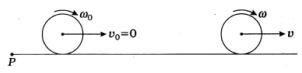
$A$ ring of mass $m$ and radius $r$ is placed on a rough surface with an initial angular velocity $\omega_0$. The initial velocity of the center of the ring is zero. What will be the velocity of its center when the ring stops slipping?
A
$r\omega_0$
B
$\frac{r\omega_0}{4}$
C
$\frac{r\omega_0}{3}$
D
$\frac{r\omega_0}{2}$
Solution
(D) Initially,the velocity of the center of mass of the ring is $v_0 = 0$ and the initial angular velocity is $\omega_0$.
When the ring stops slipping,let the velocity of the center of mass be $v$ and the angular velocity be $\omega$.
Since the ring is rolling without slipping,the condition $v = r\omega$ must be satisfied.
By the principle of conservation of angular momentum about a point $P$ on the surface:
$L_i = L_f$
$I_{cm}\omega_0 + mvr_0 = I_{cm}\omega + mvr$
Since $I_{cm} = mr^2$ for a ring:
$mr^2\omega_0 + 0 = mr^2\omega + mvr$
$mr^2\omega_0 = mr^2(\frac{v}{r}) + mvr$
$mr^2\omega_0 = mrv + mvr$
$mr^2\omega_0 = 2mvr$
$v = \frac{r\omega_0}{2}$
When the ring stops slipping,let the velocity of the center of mass be $v$ and the angular velocity be $\omega$.
Since the ring is rolling without slipping,the condition $v = r\omega$ must be satisfied.
By the principle of conservation of angular momentum about a point $P$ on the surface:
$L_i = L_f$
$I_{cm}\omega_0 + mvr_0 = I_{cm}\omega + mvr$
Since $I_{cm} = mr^2$ for a ring:
$mr^2\omega_0 + 0 = mr^2\omega + mvr$
$mr^2\omega_0 = mr^2(\frac{v}{r}) + mvr$
$mr^2\omega_0 = mrv + mvr$
$mr^2\omega_0 = 2mvr$
$v = \frac{r\omega_0}{2}$
0 likes
View Solution58
DifficultMCQ
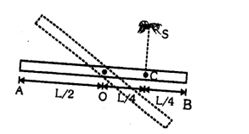
$A$ uniform rod $AB$ of length $L$ and mass $M$ is pivoted at its center $O$ such that it can rotate freely in a vertical plane. The rod is initially in a horizontal position. $A$ particle $S$ of the same mass $M$ falls vertically with velocity $v$ and strikes the rod at point $C$. $C$ is the midpoint between $O$ and $B$. Find the angular velocity of the rod immediately after the particle strikes it.
A
$\frac{8v}{5L}$
B
$\frac{2v}{3L}$
C
$\frac{12v}{7L}$
D
$\frac{9v}{7L}$
Solution
(C) Since there are no external torques about the pivot point $O$ during the collision,the angular momentum of the system is conserved.
Initial angular momentum of the particle about $O$ is $L_i = Mv \times r$,where $r = OC = L/4$.
So,$L_i = Mv(L/4)$.
After the collision,the particle sticks to the rod (assuming an inelastic collision),and the system rotates with angular velocity $\omega$.
The total moment of inertia $I$ of the system about $O$ is the sum of the moment of inertia of the rod and the particle.
$I = I_{rod} + I_{particle} = \frac{ML^2}{12} + M(L/4)^2 = \frac{ML^2}{12} + \frac{ML^2}{16} = \frac{4ML^2 + 3ML^2}{48} = \frac{7ML^2}{48}$.
Applying conservation of angular momentum: $L_i = I\omega$.
$Mv(L/4) = (7ML^2/48) \omega$.
Solving for $\omega$: $\omega = \frac{MvL}{4} \times \frac{48}{7ML^2} = \frac{12v}{7L}$.
Initial angular momentum of the particle about $O$ is $L_i = Mv \times r$,where $r = OC = L/4$.
So,$L_i = Mv(L/4)$.
After the collision,the particle sticks to the rod (assuming an inelastic collision),and the system rotates with angular velocity $\omega$.
The total moment of inertia $I$ of the system about $O$ is the sum of the moment of inertia of the rod and the particle.
$I = I_{rod} + I_{particle} = \frac{ML^2}{12} + M(L/4)^2 = \frac{ML^2}{12} + \frac{ML^2}{16} = \frac{4ML^2 + 3ML^2}{48} = \frac{7ML^2}{48}$.
Applying conservation of angular momentum: $L_i = I\omega$.
$Mv(L/4) = (7ML^2/48) \omega$.
Solving for $\omega$: $\omega = \frac{MvL}{4} \times \frac{48}{7ML^2} = \frac{12v}{7L}$.
0 likes
View Solution59
DifficultMCQ
If the volume of the Earth suddenly shrinks to $1/64$ of its present volume without any change in its mass,then the duration of the day on Earth will be ..... hours.
A
$1.5$
B
$3$
C
$6$
D
$12$
Solution
(A) Let the initial volume be $V_1$ and the final volume be $V_2 = \frac{1}{64} V_1$.
Since $V = \frac{4}{3} \pi R^3$,we have $\frac{R_2^3}{R_1^3} = \frac{V_2}{V_1} = \frac{1}{64}$.
Taking the cube root,we get $\frac{R_2}{R_1} = \frac{1}{4}$,which implies $R_2 = \frac{R_1}{4}$.
Since there is no external torque acting on the Earth,the angular momentum $L = I\omega$ is conserved.
$I_1 \omega_1 = I_2 \omega_2 \implies I_1 \left( \frac{2\pi}{T_1} \right) = I_2 \left( \frac{2\pi}{T_2} \right)$.
Since the Earth is a solid sphere,$I = \frac{2}{5}MR^2$.
Substituting this,we get $\left( \frac{2}{5} M R_1^2 \right) \frac{1}{T_1} = \left( \frac{2}{5} M R_2^2 \right) \frac{1}{T_2}$.
$T_2 = T_1 \left( \frac{R_2}{R_1} \right)^2$.
Given $T_1 = 24 \text{ hours}$ and $\frac{R_2}{R_1} = \frac{1}{4}$,we have $T_2 = 24 \times \left( \frac{1}{4} \right)^2 = 24 \times \frac{1}{16} = 1.5 \text{ hours}$.
Since $V = \frac{4}{3} \pi R^3$,we have $\frac{R_2^3}{R_1^3} = \frac{V_2}{V_1} = \frac{1}{64}$.
Taking the cube root,we get $\frac{R_2}{R_1} = \frac{1}{4}$,which implies $R_2 = \frac{R_1}{4}$.
Since there is no external torque acting on the Earth,the angular momentum $L = I\omega$ is conserved.
$I_1 \omega_1 = I_2 \omega_2 \implies I_1 \left( \frac{2\pi}{T_1} \right) = I_2 \left( \frac{2\pi}{T_2} \right)$.
Since the Earth is a solid sphere,$I = \frac{2}{5}MR^2$.
Substituting this,we get $\left( \frac{2}{5} M R_1^2 \right) \frac{1}{T_1} = \left( \frac{2}{5} M R_2^2 \right) \frac{1}{T_2}$.
$T_2 = T_1 \left( \frac{R_2}{R_1} \right)^2$.
Given $T_1 = 24 \text{ hours}$ and $\frac{R_2}{R_1} = \frac{1}{4}$,we have $T_2 = 24 \times \left( \frac{1}{4} \right)^2 = 24 \times \frac{1}{16} = 1.5 \text{ hours}$.
0 likes
View Solution60
DifficultMCQ
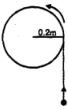
$A$ solid cylinder of mass $2 \ kg$ and radius $0.2 \ m$ is rotating with an angular velocity of $3 \ rad/s$. $A$ particle of mass $0.5 \ kg$ moving with a velocity of $5 \ m/s$ strikes its periphery tangentially and sticks to it. Find the angular velocity of the system after the collision in $rad/s$.
A
$8.3$
B
$9.7$
C
$10.3$
D
$11.8$
Solution
(C) According to the principle of conservation of angular momentum:
$L_{initial} = L_{final}$
$I\omega + mvR = (I + mR^2)\omega'$
Where $I$ is the moment of inertia of the solid cylinder,$I = \frac{1}{2}MR^2$.
$I = \frac{1}{2} \times 2 \times (0.2)^2 = 0.04 \ kg \cdot m^2$.
Initial angular momentum $L_i = I\omega + mvR = (0.04 \times 3) + (0.5 \times 5 \times 0.2) = 0.12 + 0.5 = 0.62 \ kg \cdot m^2/s$.
Final moment of inertia $I_f = I + mR^2 = 0.04 + (0.5 \times (0.2)^2) = 0.04 + 0.02 = 0.06 \ kg \cdot m^2$.
Using $L_i = I_f \omega'$:
$0.62 = 0.06 \times \omega'$
$\omega' = \frac{0.62}{0.06} = \frac{62}{6} \approx 10.33 \ rad/s$.
Thus,the angular velocity is $10.3 \ rad/s$.
$L_{initial} = L_{final}$
$I\omega + mvR = (I + mR^2)\omega'$
Where $I$ is the moment of inertia of the solid cylinder,$I = \frac{1}{2}MR^2$.
$I = \frac{1}{2} \times 2 \times (0.2)^2 = 0.04 \ kg \cdot m^2$.
Initial angular momentum $L_i = I\omega + mvR = (0.04 \times 3) + (0.5 \times 5 \times 0.2) = 0.12 + 0.5 = 0.62 \ kg \cdot m^2/s$.
Final moment of inertia $I_f = I + mR^2 = 0.04 + (0.5 \times (0.2)^2) = 0.04 + 0.02 = 0.06 \ kg \cdot m^2$.
Using $L_i = I_f \omega'$:
$0.62 = 0.06 \times \omega'$
$\omega' = \frac{0.62}{0.06} = \frac{62}{6} \approx 10.33 \ rad/s$.
Thus,the angular velocity is $10.3 \ rad/s$.
0 likes
View Solution61
DifficultMCQ
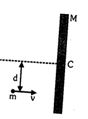
$A$ rod of length $L$ and mass $M$ is free to move on a frictionless surface. $A$ ball of mass $m$ moving with speed $v$ strikes the rod as shown in the figure. What should be the mass of the ball so that it remains at rest after the collision?
A
$\frac{ML^2}{(L^2 + 12d^2)}$
B
$\frac{ML}{(L^2 + 12d)}$
C
$\frac{ML}{(L^2 - 12d^2)}$
D
$\frac{ML^2}{(L - 12d)}$
Solution
(A) Let $V$ be the velocity of the center of mass of the rod after the collision. By conservation of linear momentum:
$mv = MV \implies V = \frac{mv}{M}$
By conservation of angular momentum about the center of mass of the rod:
$mvd = I\omega \implies \omega = \frac{mvd}{I}$,where $I = \frac{ML^2}{12}$
Assuming the collision is elastic,by conservation of kinetic energy:
$\frac{1}{2}mv^2 = \frac{1}{2}MV^2 + \frac{1}{2}I\omega^2$
Substituting $V$ and $\omega$:
$mv^2 = M(\frac{mv}{M})^2 + I(\frac{mvd}{I})^2$
$mv^2 = \frac{m^2v^2}{M} + \frac{m^2v^2d^2}{I}$
Dividing by $mv^2$:
$1 = \frac{m}{M} + \frac{md^2}{I} = \frac{m}{M} + \frac{md^2}{ML^2/12} = \frac{m}{M}(1 + \frac{12d^2}{L^2})$
$1 = \frac{m}{M}(\frac{L^2 + 12d^2}{L^2})$
$m = \frac{ML^2}{L^2 + 12d^2}$
$mv = MV \implies V = \frac{mv}{M}$
By conservation of angular momentum about the center of mass of the rod:
$mvd = I\omega \implies \omega = \frac{mvd}{I}$,where $I = \frac{ML^2}{12}$
Assuming the collision is elastic,by conservation of kinetic energy:
$\frac{1}{2}mv^2 = \frac{1}{2}MV^2 + \frac{1}{2}I\omega^2$
Substituting $V$ and $\omega$:
$mv^2 = M(\frac{mv}{M})^2 + I(\frac{mvd}{I})^2$
$mv^2 = \frac{m^2v^2}{M} + \frac{m^2v^2d^2}{I}$
Dividing by $mv^2$:
$1 = \frac{m}{M} + \frac{md^2}{I} = \frac{m}{M} + \frac{md^2}{ML^2/12} = \frac{m}{M}(1 + \frac{12d^2}{L^2})$
$1 = \frac{m}{M}(\frac{L^2 + 12d^2}{L^2})$
$m = \frac{ML^2}{L^2 + 12d^2}$
0 likes
View Solution62
MediumMCQ
$A$ rigid body of mass $2 \ kg$ is moving in a circular path of radius $0.8 \ m$ with an angular velocity of $44 \ rad \ s^{-1}$. If the radius of the circular path becomes $1 \ m$,the new angular velocity of the body will be ........ $rad \ s^{-1}$.
A
$28.16$
B
$35.16$
C
$19.28$
D
$8.12$
Solution
(A) The angular momentum of a particle moving in a circular path is given by $L = mr^2\omega$.
Since no external torque acts on the system,the angular momentum remains conserved $(L_1 = L_2)$.
For the initial state: $L_1 = mr_1^2\omega_1$.
For the final state: $L_2 = mr_2^2\omega_2$.
Equating the two: $mr_1^2\omega_1 = mr_2^2\omega_2$.
This simplifies to $\omega_2 = \omega_1 \left( \frac{r_1}{r_2} \right)^2$.
Given $r_1 = 0.8 \ m$,$r_2 = 1 \ m$,and $\omega_1 = 44 \ rad \ s^{-1}$.
Substituting the values: $\omega_2 = 44 \times \left( \frac{0.8}{1} \right)^2 = 44 \times 0.64$.
$\omega_2 = 28.16 \ rad \ s^{-1}$.
Since no external torque acts on the system,the angular momentum remains conserved $(L_1 = L_2)$.
For the initial state: $L_1 = mr_1^2\omega_1$.
For the final state: $L_2 = mr_2^2\omega_2$.
Equating the two: $mr_1^2\omega_1 = mr_2^2\omega_2$.
This simplifies to $\omega_2 = \omega_1 \left( \frac{r_1}{r_2} \right)^2$.
Given $r_1 = 0.8 \ m$,$r_2 = 1 \ m$,and $\omega_1 = 44 \ rad \ s^{-1}$.
Substituting the values: $\omega_2 = 44 \times \left( \frac{0.8}{1} \right)^2 = 44 \times 0.64$.
$\omega_2 = 28.16 \ rad \ s^{-1}$.
0 likes
View Solution63
DifficultMCQ
$A$ thin circular ring of mass $M$ and radius $R$ is rotating in a horizontal plane about an axis vertical to its plane with a constant angular velocity $\omega$. If two objects each of mass $m$ are attached gently to the opposite ends of a diameter of the ring,the ring will then rotate with an angular velocity:
A
$\frac{\omega (M - 2m)}{M + 2m}$
B
$\frac{\omega M}{M + 2m}$
C
$\frac{\omega M}{M + m}$
D
$\frac{\omega (M + 2m)}{M}$
Solution
(B) The initial moment of inertia of the ring about the vertical axis passing through its center is $I = M R^2$.
The initial angular momentum of the ring is $L = I \omega = M R^2 \omega$.
When two objects each of mass $m$ are attached to the opposite ends of a diameter,the new moment of inertia $I'$ becomes:
$I' = I + 2(m R^2) = M R^2 + 2m R^2 = (M + 2m) R^2$.
Since no external torque acts on the system,the angular momentum is conserved,so $L' = L$.
$(M + 2m) R^2 \omega' = M R^2 \omega$.
Solving for the new angular velocity $\omega'$:
$\omega' = \frac{M \omega}{M + 2m}$.
The initial angular momentum of the ring is $L = I \omega = M R^2 \omega$.
When two objects each of mass $m$ are attached to the opposite ends of a diameter,the new moment of inertia $I'$ becomes:
$I' = I + 2(m R^2) = M R^2 + 2m R^2 = (M + 2m) R^2$.
Since no external torque acts on the system,the angular momentum is conserved,so $L' = L$.
$(M + 2m) R^2 \omega' = M R^2 \omega$.
Solving for the new angular velocity $\omega'$:
$\omega' = \frac{M \omega}{M + 2m}$.
0 likes
View Solution64
DifficultMCQ
$A$ circular disc of moment of inertia $I_t$ is rotating in a horizontal plane about its symmetry axis with a constant angular speed $\omega_i$. Another disc of moment of inertia $I_b$ is dropped coaxially onto the rotating disc. Initially,the second disc has zero angular speed. Eventually,both the discs rotate with a constant angular speed $\omega_f$. The energy lost by the initially rotating disc to friction is:
A
$\frac{1}{2} \frac{I_b^2}{(I_t + I_b)} \omega_i^2$
B
$\frac{1}{2} \frac{I_t^2}{(I_t + I_b)} \omega_i^2$
C
$\frac{1}{2} \frac{(I_b - I_t)}{(I_t + I_b)} \omega_i^2$
D
$\frac{1}{2} \frac{I_b I_t}{(I_t + I_b)} \omega_i^2$
Solution
(D) According to the law of conservation of angular momentum,the initial angular momentum equals the final angular momentum: $I_t \omega_i = (I_t + I_b) \omega_f$.
Thus,the final angular speed is $\omega_f = \frac{I_t \omega_i}{I_t + I_b}$.
The initial kinetic energy is $K_i = \frac{1}{2} I_t \omega_i^2$.
The final kinetic energy is $K_f = \frac{1}{2} (I_t + I_b) \omega_f^2 = \frac{1}{2} (I_t + I_b) \left( \frac{I_t \omega_i}{I_t + I_b} \right)^2 = \frac{1}{2} \frac{I_t^2 \omega_i^2}{I_t + I_b}$.
The energy lost is $\Delta E = K_i - K_f = \frac{1}{2} I_t \omega_i^2 - \frac{1}{2} \frac{I_t^2 \omega_i^2}{I_t + I_b}$.
Simplifying this expression: $\Delta E = \frac{1}{2} I_t \omega_i^2 \left( 1 - \frac{I_t}{I_t + I_b} \right) = \frac{1}{2} I_t \omega_i^2 \left( \frac{I_t + I_b - I_t}{I_t + I_b} \right) = \frac{1}{2} \frac{I_t I_b}{I_t + I_b} \omega_i^2$.
Thus,the final angular speed is $\omega_f = \frac{I_t \omega_i}{I_t + I_b}$.
The initial kinetic energy is $K_i = \frac{1}{2} I_t \omega_i^2$.
The final kinetic energy is $K_f = \frac{1}{2} (I_t + I_b) \omega_f^2 = \frac{1}{2} (I_t + I_b) \left( \frac{I_t \omega_i}{I_t + I_b} \right)^2 = \frac{1}{2} \frac{I_t^2 \omega_i^2}{I_t + I_b}$.
The energy lost is $\Delta E = K_i - K_f = \frac{1}{2} I_t \omega_i^2 - \frac{1}{2} \frac{I_t^2 \omega_i^2}{I_t + I_b}$.
Simplifying this expression: $\Delta E = \frac{1}{2} I_t \omega_i^2 \left( 1 - \frac{I_t}{I_t + I_b} \right) = \frac{1}{2} I_t \omega_i^2 \left( \frac{I_t + I_b - I_t}{I_t + I_b} \right) = \frac{1}{2} \frac{I_t I_b}{I_t + I_b} \omega_i^2$.
0 likes
View Solution65
MediumMCQ
$A$ circular platform is mounted on a frictionless vertical axle. Its radius $R = 2\, m$ and its moment of inertia about the axle is $200\, kg\, m^2$. It is initially at rest. $A$ $50\, kg$ man stands on the edge of the platform and begins to walk along the edge at the speed of $1\, m/s$ relative to the ground. Time taken by the man to complete one revolution is
A
$\pi \, s$
B
$\frac{3\pi}{2} \, s$
C
$2\pi \, s$
D
$\frac{\pi}{2} \, s$
Solution
(C) Since the system is initially at rest,the initial angular momentum $L_i = 0$.
According to the principle of conservation of angular momentum,the final angular momentum $L_f$ must also be $0$.
Let $\omega$ be the angular velocity of the platform. The angular momentum of the man is $L_m = m v R$ and the angular momentum of the platform is $L_p = I \omega$.
Since the total angular momentum is zero,the man and the platform move in opposite directions: $m v R - I \omega = 0$.
$\omega = \frac{m v R}{I} = \frac{50 \times 1 \times 2}{200} = 0.5 \, rad/s$.
The angular velocity of the man relative to the ground is $\omega_m = \frac{v}{R} = \frac{1}{2} = 0.5 \, rad/s$.
The angular velocity of the man relative to the platform is $\omega_r = \omega_m + \omega = 0.5 + 0.5 = 1 \, rad/s$.
The time taken to complete one revolution is $T = \frac{2\pi}{\omega_r} = \frac{2\pi}{1} = 2\pi \, s$.
According to the principle of conservation of angular momentum,the final angular momentum $L_f$ must also be $0$.
Let $\omega$ be the angular velocity of the platform. The angular momentum of the man is $L_m = m v R$ and the angular momentum of the platform is $L_p = I \omega$.
Since the total angular momentum is zero,the man and the platform move in opposite directions: $m v R - I \omega = 0$.
$\omega = \frac{m v R}{I} = \frac{50 \times 1 \times 2}{200} = 0.5 \, rad/s$.
The angular velocity of the man relative to the ground is $\omega_m = \frac{v}{R} = \frac{1}{2} = 0.5 \, rad/s$.
The angular velocity of the man relative to the platform is $\omega_r = \omega_m + \omega = 0.5 + 0.5 = 1 \, rad/s$.
The time taken to complete one revolution is $T = \frac{2\pi}{\omega_r} = \frac{2\pi}{1} = 2\pi \, s$.
0 likes
View Solution66
MediumMCQ
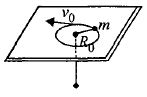
$A$ mass $m$ moves in a circle on a smooth horizontal plane with velocity $v_0$ at a radius $R_0$. The mass is attached to a string which passes through a smooth hole in the plane as shown. The tension in the string is increased gradually and finally $m$ moves in a circle of radius $\frac{R_0}{2}$. The final value of the kinetic energy is
A
$mv_0^2$
B
$\frac{1}{4}mv_0^2$
C
$2mv_0^2$
D
$\frac{1}{2}mv_0^2$
Solution
(C) Since the tension force acts towards the center of the circle,the torque about the center is zero. Therefore,the angular momentum of the mass $m$ is conserved.
Initial angular momentum $L_i = m v_0 R_0$.
Final angular momentum $L_f = m v R$,where $R = \frac{R_0}{2}$.
By conservation of angular momentum,$L_i = L_f$:
$m v_0 R_0 = m v \left( \frac{R_0}{2} \right)$
$v = 2 v_0$.
The initial kinetic energy is $K_i = \frac{1}{2} m v_0^2$.
The final kinetic energy is $K_f = \frac{1}{2} m v^2 = \frac{1}{2} m (2 v_0)^2 = \frac{1}{2} m (4 v_0^2) = 2 m v_0^2$.
Initial angular momentum $L_i = m v_0 R_0$.
Final angular momentum $L_f = m v R$,where $R = \frac{R_0}{2}$.
By conservation of angular momentum,$L_i = L_f$:
$m v_0 R_0 = m v \left( \frac{R_0}{2} \right)$
$v = 2 v_0$.
The initial kinetic energy is $K_i = \frac{1}{2} m v_0^2$.
The final kinetic energy is $K_f = \frac{1}{2} m v^2 = \frac{1}{2} m (2 v_0)^2 = \frac{1}{2} m (4 v_0^2) = 2 m v_0^2$.
0 likes
View Solution67
MediumMCQ
$A$ force $\overrightarrow{F} = \alpha \hat{i} + 3\hat{j} + 6\hat{k}$ is acting at a point $\overrightarrow{R} = 2\hat{i} - 6\hat{j} - 12\hat{k}$. The value of $\alpha$ for which angular momentum about the origin is conserved is
A
$1$
B
$-1$
C
$2$
D
$0$
Solution
(B) For the conservation of angular momentum about the origin,the net torque $\overrightarrow{\tau}$ acting on the particle must be zero.
By definition,$\overrightarrow{\tau} = \overrightarrow{R} \times \overrightarrow{F}$.
Given $\overrightarrow{R} = 2\hat{i} - 6\hat{j} - 12\hat{k}$ and $\overrightarrow{F} = \alpha \hat{i} + 3\hat{j} + 6\hat{k}$.
Calculating the cross product:
$\overrightarrow{\tau} = \begin{vmatrix} \hat{i} & \hat{j} & \hat{k} \\ 2 & -6 & -12 \\ \alpha & 3 & 6 \end{vmatrix}$
$\overrightarrow{\tau} = \hat{i}(-36 - (-36)) - \hat{j}(12 - (-12\alpha)) + \hat{k}(6 - (-6\alpha))$
$\overrightarrow{\tau} = \hat{i}(0) - \hat{j}(12 + 12\alpha) + \hat{k}(6 + 6\alpha)$
For $\overrightarrow{\tau} = 0$,both the $\hat{j}$ and $\hat{k}$ components must be zero:
$12 + 12\alpha = 0 \implies \alpha = -1$
$6 + 6\alpha = 0 \implies \alpha = -1$
Thus,the value of $\alpha$ is $-1$.
By definition,$\overrightarrow{\tau} = \overrightarrow{R} \times \overrightarrow{F}$.
Given $\overrightarrow{R} = 2\hat{i} - 6\hat{j} - 12\hat{k}$ and $\overrightarrow{F} = \alpha \hat{i} + 3\hat{j} + 6\hat{k}$.
Calculating the cross product:
$\overrightarrow{\tau} = \begin{vmatrix} \hat{i} & \hat{j} & \hat{k} \\ 2 & -6 & -12 \\ \alpha & 3 & 6 \end{vmatrix}$
$\overrightarrow{\tau} = \hat{i}(-36 - (-36)) - \hat{j}(12 - (-12\alpha)) + \hat{k}(6 - (-6\alpha))$
$\overrightarrow{\tau} = \hat{i}(0) - \hat{j}(12 + 12\alpha) + \hat{k}(6 + 6\alpha)$
For $\overrightarrow{\tau} = 0$,both the $\hat{j}$ and $\hat{k}$ components must be zero:
$12 + 12\alpha = 0 \implies \alpha = -1$
$6 + 6\alpha = 0 \implies \alpha = -1$
Thus,the value of $\alpha$ is $-1$.
0 likes
View Solution68
MediumMCQ
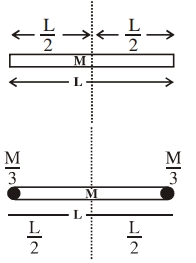
$A$ thin uniform rod of mass $M$ and length $L$ is rotating about a perpendicular axis passing through its centre with a constant angular velocity $\omega$. Two objects,each of mass $\frac{M}{3}$,are attached gently to the two ends of the rod. The rod will now rotate with an angular velocity of
A
$\frac{1}{7}\omega$
B
$\frac{1}{6}\omega$
C
$\frac{1}{2}\omega$
D
$\frac{1}{3}\omega$
Solution
(D) Initial moment of inertia of the rod about the axis passing through its centre is $I_1 = \frac{ML^2}{12}$.
Initial angular momentum $L_1 = I_1 \omega = \frac{ML^2}{12} \omega$.
When two objects of mass $\frac{M}{3}$ are attached to the ends,the new moment of inertia $I_2$ is:
$I_2 = I_{\text{rod}} + I_{\text{objects}} = \frac{ML^2}{12} + \left(\frac{M}{3}\right)\left(\frac{L}{2}\right)^2 + \left(\frac{M}{3}\right)\left(\frac{L}{2}\right)^2$
$I_2 = \frac{ML^2}{12} + \frac{ML^2}{12} + \frac{ML^2}{12} = \frac{3ML^2}{12} = \frac{ML^2}{4}$.
By the law of conservation of angular momentum,$L_1 = L_2$:
$\frac{ML^2}{12} \omega = \frac{ML^2}{4} \omega'$
$\omega' = \frac{4}{12} \omega = \frac{1}{3} \omega$.
Initial angular momentum $L_1 = I_1 \omega = \frac{ML^2}{12} \omega$.
When two objects of mass $\frac{M}{3}$ are attached to the ends,the new moment of inertia $I_2$ is:
$I_2 = I_{\text{rod}} + I_{\text{objects}} = \frac{ML^2}{12} + \left(\frac{M}{3}\right)\left(\frac{L}{2}\right)^2 + \left(\frac{M}{3}\right)\left(\frac{L}{2}\right)^2$
$I_2 = \frac{ML^2}{12} + \frac{ML^2}{12} + \frac{ML^2}{12} = \frac{3ML^2}{12} = \frac{ML^2}{4}$.
By the law of conservation of angular momentum,$L_1 = L_2$:
$\frac{ML^2}{12} \omega = \frac{ML^2}{4} \omega'$
$\omega' = \frac{4}{12} \omega = \frac{1}{3} \omega$.
0 likes
View Solution69
DifficultMCQ
Two discs of same moment of inertia $I$ are rotating about their central axes perpendicular to their planes with angular velocities $\omega_1$ and $\omega_2$. They are brought into contact face to face,such that their axes of rotation coincide. The expression for the loss of energy during this process is:
A
$I{\left( {{\omega _1} - {\omega _2}} \right)^2}$
B
$\frac{I}{8}{\left( {{\omega _1} - {\omega _2}} \right)^2}$
C
$\frac{I}{2}{\left( {{\omega _1} + {\omega _2}} \right)^2}$
D
$\frac{I}{4}{\left( {{\omega _1} - {\omega _2}} \right)^2}$
Solution
(D) Initial angular momentum $L_i = I\omega_1 + I\omega_2$.
Let $\omega$ be the final angular speed of the combined system.
Final angular momentum $L_f = (I + I)\omega = 2I\omega$.
According to the law of conservation of angular momentum,$L_i = L_f$:
$I\omega_1 + I\omega_2 = 2I\omega \implies \omega = \frac{\omega_1 + \omega_2}{2}$.
Initial rotational kinetic energy $E_i = \frac{1}{2}I\omega_1^2 + \frac{1}{2}I\omega_2^2 = \frac{1}{2}I(\omega_1^2 + \omega_2^2)$.
Final rotational kinetic energy $E_f = \frac{1}{2}(2I)\omega^2 = I \left( \frac{\omega_1 + \omega_2}{2} \right)^2 = \frac{I}{4}(\omega_1^2 + \omega_2^2 + 2\omega_1\omega_2)$.
Loss of energy $\Delta E = E_i - E_f = \frac{I}{2}(\omega_1^2 + \omega_2^2) - \frac{I}{4}(\omega_1^2 + \omega_2^2 + 2\omega_1\omega_2)$.
$\Delta E = \frac{I}{4} [2\omega_1^2 + 2\omega_2^2 - \omega_1^2 - \omega_2^2 - 2\omega_1\omega_2] = \frac{I}{4}(\omega_1^2 + \omega_2^2 - 2\omega_1\omega_2) = \frac{I}{4}(\omega_1 - \omega_2)^2$.
Let $\omega$ be the final angular speed of the combined system.
Final angular momentum $L_f = (I + I)\omega = 2I\omega$.
According to the law of conservation of angular momentum,$L_i = L_f$:
$I\omega_1 + I\omega_2 = 2I\omega \implies \omega = \frac{\omega_1 + \omega_2}{2}$.
Initial rotational kinetic energy $E_i = \frac{1}{2}I\omega_1^2 + \frac{1}{2}I\omega_2^2 = \frac{1}{2}I(\omega_1^2 + \omega_2^2)$.
Final rotational kinetic energy $E_f = \frac{1}{2}(2I)\omega^2 = I \left( \frac{\omega_1 + \omega_2}{2} \right)^2 = \frac{I}{4}(\omega_1^2 + \omega_2^2 + 2\omega_1\omega_2)$.
Loss of energy $\Delta E = E_i - E_f = \frac{I}{2}(\omega_1^2 + \omega_2^2) - \frac{I}{4}(\omega_1^2 + \omega_2^2 + 2\omega_1\omega_2)$.
$\Delta E = \frac{I}{4} [2\omega_1^2 + 2\omega_2^2 - \omega_1^2 - \omega_2^2 - 2\omega_1\omega_2] = \frac{I}{4}(\omega_1^2 + \omega_2^2 - 2\omega_1\omega_2) = \frac{I}{4}(\omega_1 - \omega_2)^2$.
0 likes
View Solution70
EasyMCQ
$A$ solid sphere is rotating freely about its symmetry axis in free space. The radius of the sphere is increased keeping its mass same. Which of the following physical quantities would remain constant for the sphere $?$
A
Angular velocity
B
Moment of inertia
C
Angular momentum
D
Rotational kinetic energy
Solution
(C) According to the principle of conservation of angular momentum,if the net external torque acting on a system is zero,the total angular momentum of the system remains constant.
In this case,the sphere is rotating freely in free space,meaning there is no external torque acting on it $({\tau_{ext}} = 0)$.
Since ${\tau_{ext}} = \frac{dL}{dt} = 0$,the angular momentum $(L)$ must remain constant.
When the radius of the sphere increases,its moment of inertia $(I = \frac{2}{5}MR^2)$ increases. Since $L = I\omega$ is constant,the angular velocity $(\omega)$ will decrease,and the rotational kinetic energy $(K = \frac{L^2}{2I})$ will also change. Therefore,only the angular momentum remains constant.
In this case,the sphere is rotating freely in free space,meaning there is no external torque acting on it $({\tau_{ext}} = 0)$.
Since ${\tau_{ext}} = \frac{dL}{dt} = 0$,the angular momentum $(L)$ must remain constant.
When the radius of the sphere increases,its moment of inertia $(I = \frac{2}{5}MR^2)$ increases. Since $L = I\omega$ is constant,the angular velocity $(\omega)$ will decrease,and the rotational kinetic energy $(K = \frac{L^2}{2I})$ will also change. Therefore,only the angular momentum remains constant.
1 likes
View Solution71
EasyMCQ
If no external torque acts on a system,which of the following remains constant in both magnitude and direction?
A
Force
B
Linear momentum
C
Angular momentum
D
Linear impulse
Solution
(C) According to the relation between torque and angular momentum,the rate of change of angular momentum is equal to the external torque applied to the system: $\tau = \frac{dL}{dt}$.
If the external torque $\tau = 0$,then $\frac{dL}{dt} = 0$.
This implies that the angular momentum $L$ remains constant in both magnitude and direction.
If the external torque $\tau = 0$,then $\frac{dL}{dt} = 0$.
This implies that the angular momentum $L$ remains constant in both magnitude and direction.
0 likes
View Solution72
EasyMCQ
If the torque applied on a particle is zero,then its angular momentum will be:
A
Constant in direction
B
Constant in magnitude
C
Both $(a)$ and $(b)$
D
None of the above
Solution
(C) The relationship between torque $\vec{\tau}$ and angular momentum $\vec{L}$ is given by $\vec{\tau} = \frac{d\vec{L}}{dt}$.
If the net torque $\vec{\tau} = 0$,then $\frac{d\vec{L}}{dt} = 0$.
This implies that $\vec{L}$ is a constant vector.
$A$ constant vector has both a constant magnitude and a constant direction.
Therefore,the angular momentum remains constant in both magnitude and direction.
If the net torque $\vec{\tau} = 0$,then $\frac{d\vec{L}}{dt} = 0$.
This implies that $\vec{L}$ is a constant vector.
$A$ constant vector has both a constant magnitude and a constant direction.
Therefore,the angular momentum remains constant in both magnitude and direction.
0 likes
View Solution73
MediumMCQ
$A$ mass of $2 \ kg$ is moving in a circular path of radius $0.8 \ m$ with an angular velocity of $44 \ rad/s$. If the radius of the path becomes $1 \ m$,the new angular velocity will be ........ $rad/s$.
A
$28.16$
B
$35.16$
C
$19.28$
D
$8.12$
Solution
(A) According to the law of conservation of angular momentum,$L = I\omega = mr^2\omega = \text{constant}$.
Since the mass $m$ remains constant,we have $r_1^2\omega_1 = r_2^2\omega_2$.
Given: $r_1 = 0.8 \ m$,$\omega_1 = 44 \ rad/s$,$r_2 = 1 \ m$.
Substituting the values: $(0.8)^2 \times 44 = (1)^2 \times \omega_2$.
$0.64 \times 44 = \omega_2$.
$\omega_2 = 28.16 \ rad/s$.
Since the mass $m$ remains constant,we have $r_1^2\omega_1 = r_2^2\omega_2$.
Given: $r_1 = 0.8 \ m$,$\omega_1 = 44 \ rad/s$,$r_2 = 1 \ m$.
Substituting the values: $(0.8)^2 \times 44 = (1)^2 \times \omega_2$.
$0.64 \times 44 = \omega_2$.
$\omega_2 = 28.16 \ rad/s$.
0 likes
View Solution74
EasyMCQ
The angular momentum of a system of particles is conserved:
A
If no external force acts on the system.
B
If no external torque acts on the system.
C
If no external impulse acts on the system.
D
If the axis of rotation remains the same.
Solution
(B) According to the principle of conservation of angular momentum,the angular momentum $\vec{L}$ of a system is conserved if the net external torque $\vec{\tau}_{ext}$ acting on the system is zero.
This is derived from the relation $\vec{\tau}_{ext} = \frac{d\vec{L}}{dt}$.
If $\vec{\tau}_{ext} = 0$,then $\frac{d\vec{L}}{dt} = 0$,which implies $\vec{L} = \text{constant}$.
Therefore,the correct condition is that no external torque acts on the system.
This is derived from the relation $\vec{\tau}_{ext} = \frac{d\vec{L}}{dt}$.
If $\vec{\tau}_{ext} = 0$,then $\frac{d\vec{L}}{dt} = 0$,which implies $\vec{L} = \text{constant}$.
Therefore,the correct condition is that no external torque acts on the system.
0 likes
View Solution75
DifficultMCQ
$A$ thin circular ring of mass $M$ and radius $R$ is rotating in a horizontal plane with angular velocity $\omega$ about an axis passing through its center and perpendicular to the plane. If another ring of the same size but mass $\frac{M}{4}$ is placed coaxially on the first ring,then the new angular velocity of the system is:
A
$\frac{5}{4}\omega$
B
$\frac{2}{3}\omega$
C
$\frac{4}{5}\omega$
D
$\frac{3}{2}\omega$
Solution
(C) According to the law of conservation of angular momentum,the initial angular momentum equals the final angular momentum.
$L_i = L_f$
$I_1 \omega_1 = I_2 \omega_2$
Here,the moment of inertia of the first ring about the central axis is $I_1 = MR^2$.
When the second ring is placed coaxially,the total moment of inertia becomes $I_2 = I_1 + I_{ring2} = MR^2 + (\frac{M}{4})R^2 = \frac{5}{4}MR^2$.
Substituting these into the conservation equation:
$MR^2 \omega = (\frac{5}{4}MR^2) \omega_2$
$\omega_2 = \frac{4}{5} \omega$.
$L_i = L_f$
$I_1 \omega_1 = I_2 \omega_2$
Here,the moment of inertia of the first ring about the central axis is $I_1 = MR^2$.
When the second ring is placed coaxially,the total moment of inertia becomes $I_2 = I_1 + I_{ring2} = MR^2 + (\frac{M}{4})R^2 = \frac{5}{4}MR^2$.
Substituting these into the conservation equation:
$MR^2 \omega = (\frac{5}{4}MR^2) \omega_2$
$\omega_2 = \frac{4}{5} \omega$.
0 likes
View Solution76
MediumMCQ
$A$ dancer on a smooth floor is spinning about a vertical axis at an angular velocity of $20 \ rad/s$ with her arms folded. When she stretches her arms out,the angular speed decreases to $10 \ rad/s$. If the initial moment of inertia of the dancer is $I$,what will be the new moment of inertia?
A
$2 I$
B
$3 I$
C
$I / 2$
D
$I / 3$
Solution
(A) Since there is no external torque acting on the dancer,the angular momentum of the system remains conserved.
According to the law of conservation of angular momentum: $L = I_1 \omega_1 = I_2 \omega_2$.
Given: Initial moment of inertia $I_1 = I$,initial angular velocity $\omega_1 = 20 \ rad/s$,and final angular velocity $\omega_2 = 10 \ rad/s$.
Substituting the values into the equation: $I \times 20 = I_2 \times 10$.
Solving for the new moment of inertia $I_2$: $I_2 = \frac{20}{10} I = 2I$.
According to the law of conservation of angular momentum: $L = I_1 \omega_1 = I_2 \omega_2$.
Given: Initial moment of inertia $I_1 = I$,initial angular velocity $\omega_1 = 20 \ rad/s$,and final angular velocity $\omega_2 = 10 \ rad/s$.
Substituting the values into the equation: $I \times 20 = I_2 \times 10$.
Solving for the new moment of inertia $I_2$: $I_2 = \frac{20}{10} I = 2I$.
0 likes
View Solution77
MediumMCQ
$A$ disc is rotating with an angular velocity $\omega$. $A$ child sits on it gently. Which of the following quantities will be conserved?
A
Kinetic energy
B
Potential energy
C
Linear momentum
D
Angular momentum
Solution
(D) When the child sits on the rotating disc,there is no external torque acting on the system (disc + child) about the axis of rotation. According to the law of conservation of angular momentum,if the net external torque $\tau_{ext} = 0$,then the angular momentum $L$ of the system remains constant. Therefore,the angular momentum is conserved.
0 likes
View Solution78
DifficultMCQ
The angular velocity of a body changes from $\omega_1$ to $\omega_2$ without the application of any external torque,but this change occurs due to a change in its moment of inertia. The ratio of the radii of gyration in the two cases will be:
A
$\sqrt{\omega_2} : \sqrt{\omega_1}$
B
$\sqrt{\omega_1} : \sqrt{\omega_2}$
C
$\omega_1 : \omega_2$
D
$\omega_2 : \omega_1$
Solution
(A) Since no external torque is applied,the angular momentum $L$ of the body remains conserved.
$L = I_1 \omega_1 = I_2 \omega_2$
We know that the moment of inertia $I = MK^2$,where $M$ is the mass and $K$ is the radius of gyration.
Substituting this into the conservation equation:
$M K_1^2 \omega_1 = M K_2^2 \omega_2$
$K_1^2 \omega_1 = K_2^2 \omega_2$
$\frac{K_1^2}{K_2^2} = \frac{\omega_2}{\omega_1}$
Taking the square root on both sides,we get the ratio of the radii of gyration:
$\frac{K_1}{K_2} = \sqrt{\frac{\omega_2}{\omega_1}}$
Thus,the ratio $K_1 : K_2 = \sqrt{\omega_2} : \sqrt{\omega_1}$.
$L = I_1 \omega_1 = I_2 \omega_2$
We know that the moment of inertia $I = MK^2$,where $M$ is the mass and $K$ is the radius of gyration.
Substituting this into the conservation equation:
$M K_1^2 \omega_1 = M K_2^2 \omega_2$
$K_1^2 \omega_1 = K_2^2 \omega_2$
$\frac{K_1^2}{K_2^2} = \frac{\omega_2}{\omega_1}$
Taking the square root on both sides,we get the ratio of the radii of gyration:
$\frac{K_1}{K_2} = \sqrt{\frac{\omega_2}{\omega_1}}$
Thus,the ratio $K_1 : K_2 = \sqrt{\omega_2} : \sqrt{\omega_1}$.
0 likes
View Solution79
EasyMCQ
Keeping the mass of the Earth constant, if its radius is halved, then what will be the duration of the day (in $\text{ hours}$)?
A
$6$
B
$12$
C
$18$
D
$24$
Solution
(A) According to the law of conservation of angular momentum, $L = I \omega = \text{constant}$.
Since the Earth is treated as a solid sphere, its moment of inertia is $I = \frac{2}{5}MR^2$.
Initially, $I_1 = \frac{2}{5}MR^2$ and the time period is $T_1 = 24 \text{ hours}$.
When the radius is halved, $R_2 = \frac{R}{2}$, the new moment of inertia is $I_2 = \frac{2}{5}M(\frac{R}{2})^2 = \frac{1}{4}I_1$.
Using $I_1 \omega_1 = I_2 \omega_2$, we have $I_1 (\frac{2\pi}{T_1}) = I_2 (\frac{2\pi}{T_2})$.
Substituting the values: $I_1 (\frac{2\pi}{24}) = (\frac{1}{4}I_1) (\frac{2\pi}{T_2})$.
This simplifies to $\frac{1}{24} = \frac{1}{4T_2}$, which gives $T_2 = \frac{24}{4} = 6 \text{ hours}$.
Since the Earth is treated as a solid sphere, its moment of inertia is $I = \frac{2}{5}MR^2$.
Initially, $I_1 = \frac{2}{5}MR^2$ and the time period is $T_1 = 24 \text{ hours}$.
When the radius is halved, $R_2 = \frac{R}{2}$, the new moment of inertia is $I_2 = \frac{2}{5}M(\frac{R}{2})^2 = \frac{1}{4}I_1$.
Using $I_1 \omega_1 = I_2 \omega_2$, we have $I_1 (\frac{2\pi}{T_1}) = I_2 (\frac{2\pi}{T_2})$.
Substituting the values: $I_1 (\frac{2\pi}{24}) = (\frac{1}{4}I_1) (\frac{2\pi}{T_2})$.
This simplifies to $\frac{1}{24} = \frac{1}{4T_2}$, which gives $T_2 = \frac{24}{4} = 6 \text{ hours}$.
0 likes
View Solution80
MediumMCQ
$A$ uniform disc of mass $M$ is rotating with a constant angular velocity $\omega$ about an axis passing through its center and perpendicular to its plane. Let its angular momentum be $L$. $A$ drop of molten plastic falls onto the disc and sticks to it. Which of the following remains constant?
A
$\omega$
B
Both $\omega$ and $L$
C
Only $L$
D
Neither $\omega$ nor $L$
Solution
(C) According to the principle of conservation of angular momentum,if no external torque acts on the system,the angular momentum $L$ remains constant.
Since the plastic drop sticks to the disc,the moment of inertia $I$ of the system increases.
As $L = I\omega$ and $L$ is constant,an increase in $I$ results in a decrease in the angular velocity $\omega$.
Therefore,only the angular momentum $L$ remains constant.
Since the plastic drop sticks to the disc,the moment of inertia $I$ of the system increases.
As $L = I\omega$ and $L$ is constant,an increase in $I$ results in a decrease in the angular velocity $\omega$.
Therefore,only the angular momentum $L$ remains constant.
0 likes
View Solution81
EasyMCQ
$A$ person is sitting on a rotating stool with their arms outstretched. Suddenly, they fold their arms inward.
A
Their angular velocity will decrease.
B
Their moment of inertia will decrease.
C
Their angular velocity will remain constant.
D
Their angular momentum will increase.
Solution
(B) According to the law of conservation of angular momentum, $L = I\omega = \text{constant}$.
When the person folds their arms inward, the distribution of mass moves closer to the axis of rotation, which decreases the moment of inertia $(I)$.
Since $L$ is constant, if $I$ decreases, the angular velocity $(\omega)$ must increase to compensate.
Therefore, the moment of inertia decreases, and the angular velocity increases.
When the person folds their arms inward, the distribution of mass moves closer to the axis of rotation, which decreases the moment of inertia $(I)$.
Since $L$ is constant, if $I$ decreases, the angular velocity $(\omega)$ must increase to compensate.
Therefore, the moment of inertia decreases, and the angular velocity increases.
0 likes
View Solution82
DifficultMCQ
Two discs with moments of inertia $I_1$ and $I_2$ and angular speeds $\omega_1$ and $\omega_2$ are rotating about collinear axes passing through their centers of mass and perpendicular to their planes. If they are joined together to rotate about the same axis,the rotational kinetic energy of the system will be:
A
$\frac{I_1\omega_1 + I_2\omega_2}{2(I_1 + I_2)}$
B
$\frac{(I_1 + I_2)(\omega_1 + \omega_2)^2}{2}$
C
$\frac{(I_1\omega_1 + I_2\omega_2)^2}{2(I_1 + I_2)}$
D
None of the above
Solution
(C) According to the principle of conservation of angular momentum,the total angular momentum before joining equals the total angular momentum after joining.
$I_1\omega_1 + I_2\omega_2 = (I_1 + I_2)\omega$
where $\omega$ is the common angular velocity of the system.
Thus,the common angular velocity is $\omega = \frac{I_1\omega_1 + I_2\omega_2}{I_1 + I_2}$.
The rotational kinetic energy of the system is given by $K = \frac{1}{2} I_{total} \omega^2$.
Substituting the values,$K = \frac{1}{2} (I_1 + I_2) \left( \frac{I_1\omega_1 + I_2\omega_2}{I_1 + I_2} \right)^2$.
Simplifying this,we get $K = \frac{(I_1\omega_1 + I_2\omega_2)^2}{2(I_1 + I_2)}$.
$I_1\omega_1 + I_2\omega_2 = (I_1 + I_2)\omega$
where $\omega$ is the common angular velocity of the system.
Thus,the common angular velocity is $\omega = \frac{I_1\omega_1 + I_2\omega_2}{I_1 + I_2}$.
The rotational kinetic energy of the system is given by $K = \frac{1}{2} I_{total} \omega^2$.
Substituting the values,$K = \frac{1}{2} (I_1 + I_2) \left( \frac{I_1\omega_1 + I_2\omega_2}{I_1 + I_2} \right)^2$.
Simplifying this,we get $K = \frac{(I_1\omega_1 + I_2\omega_2)^2}{2(I_1 + I_2)}$.
0 likes
View Solution83
EasyMCQ
According to the principle of conservation of angular momentum, angular momentum:
A
is always conserved
B
is the product of velocity and moment of inertia
C
is conserved if the applied torque is constant
D
none of the above
Solution
(D) The principle of conservation of angular momentum states that the angular momentum of a system remains constant if the net external torque acting on the system is zero.
Mathematically, if $\tau_{ext} = 0$, then $\frac{dL}{dt} = 0$, which implies $L = \text{constant}$.
Option $A$ is incorrect because it is only conserved in the absence of external torque.
Option $B$ is incorrect as angular momentum is the product of moment of inertia and angular velocity $(L = I\omega)$.
Option $C$ is incorrect because it requires the torque to be zero, not just constant.
Therefore, the correct answer is $D$.
Mathematically, if $\tau_{ext} = 0$, then $\frac{dL}{dt} = 0$, which implies $L = \text{constant}$.
Option $A$ is incorrect because it is only conserved in the absence of external torque.
Option $B$ is incorrect as angular momentum is the product of moment of inertia and angular velocity $(L = I\omega)$.
Option $C$ is incorrect because it requires the torque to be zero, not just constant.
Therefore, the correct answer is $D$.
0 likes
View Solution84
EasyMCQ
$A$ person is rotating on a rotating table with their arms held down. Suddenly,they spread their arms out. What happens to their angular momentum?
A
It will be zero.
B
It will increase.
C
It will decrease.
D
It will remain unchanged.
Solution
(D) According to the law of conservation of angular momentum,if no external torque acts on the system,the angular momentum $(L)$ remains constant.
$L = I \omega$,where $I$ is the moment of inertia and $\omega$ is the angular velocity.
When the person spreads their arms,the moment of inertia $(I)$ increases because the mass is distributed further from the axis of rotation.
To keep the angular momentum $(L)$ constant,the angular velocity $(\omega)$ decreases.
Therefore,the angular momentum remains unchanged.
$L = I \omega$,where $I$ is the moment of inertia and $\omega$ is the angular velocity.
When the person spreads their arms,the moment of inertia $(I)$ increases because the mass is distributed further from the axis of rotation.
To keep the angular momentum $(L)$ constant,the angular velocity $(\omega)$ decreases.
Therefore,the angular momentum remains unchanged.
0 likes
View Solution85
EasyMCQ
If the radius of the Earth shrinks to half of its current value, the duration of the day will decrease by how many hours?
A
$18$
B
$22$
C
$2.5$
D
$12$
Solution
(A) According to the law of conservation of angular momentum, $L = I\omega = \text{constant}$.
Since the Earth is a sphere, its moment of inertia is $I = \frac{2}{5}MR^2$.
Thus, $I \propto R^2$.
Since $L = I\omega = I \cdot \frac{2\pi}{T}$, we have $I_1 \cdot \frac{1}{T_1} = I_2 \cdot \frac{1}{T_2}$, which implies $T \propto I \propto R^2$.
If the radius $R$ becomes $R' = \frac{R}{2}$, then the new time period $T'$ is $T' = T \cdot (\frac{R'}{R})^2 = T \cdot (\frac{1}{2})^2 = \frac{T}{4}$.
Given the current duration of a day $T = 24 \text{ hours}$, the new duration is $T' = \frac{24}{4} = 6 \text{ hours}$.
The decrease in the duration of the day is $\Delta T = T - T' = 24 - 6 = 18 \text{ hours}$.
Since the Earth is a sphere, its moment of inertia is $I = \frac{2}{5}MR^2$.
Thus, $I \propto R^2$.
Since $L = I\omega = I \cdot \frac{2\pi}{T}$, we have $I_1 \cdot \frac{1}{T_1} = I_2 \cdot \frac{1}{T_2}$, which implies $T \propto I \propto R^2$.
If the radius $R$ becomes $R' = \frac{R}{2}$, then the new time period $T'$ is $T' = T \cdot (\frac{R'}{R})^2 = T \cdot (\frac{1}{2})^2 = \frac{T}{4}$.
Given the current duration of a day $T = 24 \text{ hours}$, the new duration is $T' = \frac{24}{4} = 6 \text{ hours}$.
The decrease in the duration of the day is $\Delta T = T - T' = 24 - 6 = 18 \text{ hours}$.
0 likes
View Solution86
EasyMCQ
If the radius of a rotating disc is suddenly halved while its mass remains the same,its angular velocity will become:
A
Four times
B
Double
C
Half
D
Unchanged
Solution
(A) The angular momentum $L$ of a rotating disc is given by $L = I\omega$,where $I = \frac{1}{2}MR^2$ is the moment of inertia.
Since no external torque is applied,the angular momentum remains conserved,i.e.,$L = \text{constant}$.
Therefore,$I_1\omega_1 = I_2\omega_2$.
Substituting the expression for moment of inertia: $(\frac{1}{2}MR_1^2)\omega_1 = (\frac{1}{2}MR_2^2)\omega_2$.
Given $R_2 = \frac{R_1}{2}$,we have $R_1^2\omega_1 = (\frac{R_1}{2})^2\omega_2$.
$R_1^2\omega_1 = \frac{R_1^2}{4}\omega_2$.
Solving for $\omega_2$,we get $\omega_2 = 4\omega_1$.
Thus,the angular velocity becomes four times the original value.
Since no external torque is applied,the angular momentum remains conserved,i.e.,$L = \text{constant}$.
Therefore,$I_1\omega_1 = I_2\omega_2$.
Substituting the expression for moment of inertia: $(\frac{1}{2}MR_1^2)\omega_1 = (\frac{1}{2}MR_2^2)\omega_2$.
Given $R_2 = \frac{R_1}{2}$,we have $R_1^2\omega_1 = (\frac{R_1}{2})^2\omega_2$.
$R_1^2\omega_1 = \frac{R_1^2}{4}\omega_2$.
Solving for $\omega_2$,we get $\omega_2 = 4\omega_1$.
Thus,the angular velocity becomes four times the original value.
0 likes
View Solution87
MediumMCQ
An ice block is placed at the center of a circular table. The system is rotated about the axis of the table with an angular velocity $\omega$. If the ice starts melting without evaporation,the rotational speed of the system will:
A
become zero
B
remain constant at the same value of $\omega$
C
become greater than $\omega$
D
become less than $\omega$
Solution
(D) According to the law of conservation of angular momentum,$L = I\omega = \text{constant}$.
When the ice melts,the water spreads out over the surface of the table,increasing the distance of the mass from the axis of rotation.
This increase in the distribution of mass leads to an increase in the moment of inertia $(I)$ of the system.
Since $L$ remains constant and $I$ increases,the angular velocity $\omega$ must decrease to satisfy the equation $\omega = L/I$.
Therefore,the rotational speed of the system will become less than $\omega$.
When the ice melts,the water spreads out over the surface of the table,increasing the distance of the mass from the axis of rotation.
This increase in the distribution of mass leads to an increase in the moment of inertia $(I)$ of the system.
Since $L$ remains constant and $I$ increases,the angular velocity $\omega$ must decrease to satisfy the equation $\omega = L/I$.
Therefore,the rotational speed of the system will become less than $\omega$.
0 likes
View Solution88
MediumMCQ
$A$ boy stands at the center of a horizontal platform with $2 \ kg$ masses in each hand,held close to his body. The platform rotates about a vertical axis passing through its center at a speed of $2 \ rev/s$. The moment of inertia of the system is $1 \ kg \cdot m^2$. When the boy extends his arms fully with the masses,the moment of inertia becomes $2 \ kg \cdot m^2$. In the second state,the kinetic energy of the system compared to the first state will be:
A
remain unchanged
B
decrease
C
increase
D
remain uncertain
Solution
(B) The rotational kinetic energy $E$ is given by the formula $E = \frac{L^2}{2I}$,where $L$ is the angular momentum and $I$ is the moment of inertia.
Since there are no external torques acting on the system,the angular momentum $L$ remains constant.
From the relation $E \propto \frac{1}{I}$,it is clear that if the moment of inertia $I$ increases,the kinetic energy $E$ must decrease.
In the first state,$I_1 = 1 \ kg \cdot m^2$. In the second state,$I_2 = 2 \ kg \cdot m^2$.
Since $I_2 > I_1$,the kinetic energy in the second state will be less than in the first state.
Since there are no external torques acting on the system,the angular momentum $L$ remains constant.
From the relation $E \propto \frac{1}{I}$,it is clear that if the moment of inertia $I$ increases,the kinetic energy $E$ must decrease.
In the first state,$I_1 = 1 \ kg \cdot m^2$. In the second state,$I_2 = 2 \ kg \cdot m^2$.
Since $I_2 > I_1$,the kinetic energy in the second state will be less than in the first state.
0 likes
View Solution89
EasyMCQ
$A$ person standing on a rotating table holds weights in their outstretched hands and is rotating. They suddenly pull their hands in close to their body. Which statement is true?
A
Linear momentum is conserved.
B
Kinetic energy increases.
C
Angular momentum increases.
D
Angular velocity increases.
Solution
(D) According to the principle of conservation of angular momentum, $L = I\omega = \text{constant}$ when no external torque acts on the system.
When the person pulls their hands in, the moment of inertia $(I)$ of the system decreases because the mass distribution moves closer to the axis of rotation.
Since $L$ remains constant, if $I$ decreases, the angular velocity $(\omega)$ must increase to compensate.
Therefore, the correct statement is that the angular velocity increases.
When the person pulls their hands in, the moment of inertia $(I)$ of the system decreases because the mass distribution moves closer to the axis of rotation.
Since $L$ remains constant, if $I$ decreases, the angular velocity $(\omega)$ must increase to compensate.
Therefore, the correct statement is that the angular velocity increases.
0 likes
View Solution90
EasyMCQ
When a person dancing on ice pulls their arms inward,they start spinning faster. This is due to:
A
Increase in both energy and angular momentum
B
Decrease in friction on the skates
C
Constant angular momentum and increase in kinetic energy
D
Increase in energy and decrease in angular momentum
Solution
(C) According to the principle of conservation of angular momentum,if no external torque acts on a system,the angular momentum $(L = I\omega)$ remains constant.
When the person pulls their arms inward,the moment of inertia $(I)$ decreases.
Since $L = I\omega$ is constant,if $I$ decreases,the angular velocity $(\omega)$ must increase,causing the person to spin faster.
The rotational kinetic energy is given by $K = \frac{L^2}{2I}$. Since $L$ is constant and $I$ decreases,the kinetic energy $(K)$ increases.
When the person pulls their arms inward,the moment of inertia $(I)$ decreases.
Since $L = I\omega$ is constant,if $I$ decreases,the angular velocity $(\omega)$ must increase,causing the person to spin faster.
The rotational kinetic energy is given by $K = \frac{L^2}{2I}$. Since $L$ is constant and $I$ decreases,the kinetic energy $(K)$ increases.
0 likes
View Solution91
EasyMCQ
$A$ person is rotating on a rotating table with an angular speed of $\omega$. He holds two identical masses in his outstretched hands. Without moving his hands,he simply drops the masses. How will his angular velocity change?
A
It will be less than $\omega$
B
It will be greater than $\omega$
C
It will remain equal to $\omega$
D
Whether it is less than,greater than,or equal to $\omega$ depends on the amount of mass
Solution
(B) According to the principle of conservation of angular momentum,$L = I\omega = \text{constant}$.
When the person drops the masses,the moment of inertia $(I)$ of the system decreases because the mass is removed from the system at a certain distance from the axis of rotation.
Since $L = I\omega$ remains constant,if $I$ decreases,the angular velocity $\omega$ must increase to compensate.
Therefore,the new angular velocity will be greater than the initial angular velocity $\omega$.
When the person drops the masses,the moment of inertia $(I)$ of the system decreases because the mass is removed from the system at a certain distance from the axis of rotation.
Since $L = I\omega$ remains constant,if $I$ decreases,the angular velocity $\omega$ must increase to compensate.
Therefore,the new angular velocity will be greater than the initial angular velocity $\omega$.
0 likes
View Solution92
EasyMCQ
An object of mass $m$ is tied to a thin string,which is passed through a hollow tube. The tube is held in one hand and the string in the other. The object is rotated in a circle of radius $R$ with a velocity $v$. If the string is pulled downwards to decrease the radius,which of the following quantities remains conserved?
A
Angular momentum
B
Linear momentum
C
Kinetic energy
D
None of the above
Solution
(A) When the string is pulled downwards,the force applied by the hand acts along the radius of the circular path (towards the center).
Since the force is radial,the torque $\vec{\tau} = \vec{r} \times \vec{F}$ about the center of the circle is zero because the angle between the position vector $\vec{r}$ and the force $\vec{F}$ is $180^{\circ}$ (or $0^{\circ}$ depending on the reference).
According to the principle of conservation of angular momentum,if the net external torque acting on a system is zero,the angular momentum $L = mvr$ remains conserved.
Therefore,the angular momentum of the object remains constant.
Since the force is radial,the torque $\vec{\tau} = \vec{r} \times \vec{F}$ about the center of the circle is zero because the angle between the position vector $\vec{r}$ and the force $\vec{F}$ is $180^{\circ}$ (or $0^{\circ}$ depending on the reference).
According to the principle of conservation of angular momentum,if the net external torque acting on a system is zero,the angular momentum $L = mvr$ remains conserved.
Therefore,the angular momentum of the object remains constant.
0 likes
View Solution93
EasyMCQ
$A$ swimmer can easily perform somersaults in the air while jumping from a height if he:
A
pulls his hands and legs inward
B
spreads his hands and legs outward
C
keeps his body straight
D
none of the above
Solution
(A) By pulling his hands and legs inward,the swimmer decreases his moment of inertia $(I)$.
According to the principle of conservation of angular momentum,$L = I\omega$ remains constant.
Since $I$ decreases,the angular velocity $(\omega)$ increases,which allows the swimmer to perform somersaults more easily.
According to the principle of conservation of angular momentum,$L = I\omega$ remains constant.
Since $I$ decreases,the angular velocity $(\omega)$ increases,which allows the swimmer to perform somersaults more easily.
0 likes
View Solution94
MediumMCQ
$A$ round disc of moment of inertia $I_{2}$ about its axis perpendicular to its plane and passing through its centre is placed over another disc of moment of inertia $I_{1}$ rotating with an angular velocity $\omega$ about the same axis. The final angular velocity of the combination of discs is
A
$ \frac{I_{2}\omega}{I_{1} + I_{2}} $
B
$ \omega $
C
$ \frac{I_{1}\omega}{I_{1} + I_{2}} $
D
$ \frac{(I_{1} + I_{2})\omega}{I_{1}} $
Solution
(C) According to the principle of conservation of angular momentum,since no external torque acts on the system of two discs,the total angular momentum remains constant.
Initial angular momentum of the system: $L_{i} = I_{1}\omega + I_{2}(0) = I_{1}\omega$.
Final angular momentum of the system after the discs are combined: $L_{f} = (I_{1} + I_{2})\omega_{f}$,where $\omega_{f}$ is the final angular velocity.
Equating initial and final angular momentum: $I_{1}\omega = (I_{1} + I_{2})\omega_{f}$.
Solving for the final angular velocity: $\omega_{f} = \frac{I_{1}\omega}{I_{1} + I_{2}}$.
Initial angular momentum of the system: $L_{i} = I_{1}\omega + I_{2}(0) = I_{1}\omega$.
Final angular momentum of the system after the discs are combined: $L_{f} = (I_{1} + I_{2})\omega_{f}$,where $\omega_{f}$ is the final angular velocity.
Equating initial and final angular momentum: $I_{1}\omega = (I_{1} + I_{2})\omega_{f}$.
Solving for the final angular velocity: $\omega_{f} = \frac{I_{1}\omega}{I_{1} + I_{2}}$.
0 likes
View Solution95
MediumMCQ
$A$ solid sphere is rotating in free space. If the radius of the sphere is increased while keeping its mass constant,which of the following quantities will remain unaffected?
A
Moment of inertia
B
Angular momentum
C
Angular velocity
D
Rotational kinetic energy
Solution
(B) According to the law of conservation of angular momentum,if no external torque acts on a system,the total angular momentum remains constant. Since the sphere is rotating in free space,there is no external torque acting on it. Therefore,the angular momentum will remain unaffected even if the radius is changed.
0 likes
View Solution96
EasyMCQ
If the value of torque is zero,then
A
Angular momentum is conserved
B
Linear momentum is conserved
C
Energy is conserved
D
Angular momentum is not conserved
Solution
(A) The relationship between torque $\vec{\tau}$ and angular momentum $\vec{L}$ is given by the equation: $\vec{\tau} = \frac{d\vec{L}}{dt}$.
If the external torque $\vec{\tau} = 0$,then $\frac{d\vec{L}}{dt} = 0$.
This implies that $\vec{L} = \text{constant}$.
Therefore,the angular momentum of the system remains conserved.
If the external torque $\vec{\tau} = 0$,then $\frac{d\vec{L}}{dt} = 0$.
This implies that $\vec{L} = \text{constant}$.
Therefore,the angular momentum of the system remains conserved.
0 likes
View Solution97
EasyMCQ
Before diving into a swimming pool, a swimmer curls their body, because this
A
decreases their moment of inertia
B
decreases their angular velocity
C
increases their moment of inertia
D
increases their linear velocity
Solution
(A) According to the principle of conservation of angular momentum, $L = I\omega = \text{constant}$.
When a swimmer curls their body, they bring their mass closer to the axis of rotation.
This action significantly decreases their moment of inertia $(I)$.
Since $L$ remains constant, a decrease in $I$ must result in an increase in angular velocity $(\omega)$, which allows the swimmer to perform somersaults more effectively.
Therefore, the correct option is $A$.
When a swimmer curls their body, they bring their mass closer to the axis of rotation.
This action significantly decreases their moment of inertia $(I)$.
Since $L$ remains constant, a decrease in $I$ must result in an increase in angular velocity $(\omega)$, which allows the swimmer to perform somersaults more effectively.
Therefore, the correct option is $A$.
0 likes
View Solution98
EasyMCQ
The angular momentum of a system of particles is not conserved:
A
When a net external force acts on the system.
B
When a net external torque acts on the system.
C
When a net external impulse acts on the system.
D
None of the above.
Solution
(B) The rate of change of angular momentum of a system is equal to the net external torque acting on it,given by the equation $\vec{\tau}_{ext} = \frac{d\vec{L}}{dt}$.
If the net external torque $\vec{\tau}_{ext} = 0$,then $\frac{d\vec{L}}{dt} = 0$,which implies that the angular momentum $\vec{L}$ is constant (conserved).
Therefore,if a net external torque acts on the system,the angular momentum is not conserved.
Thus,the correct option is $B$.
If the net external torque $\vec{\tau}_{ext} = 0$,then $\frac{d\vec{L}}{dt} = 0$,which implies that the angular momentum $\vec{L}$ is constant (conserved).
Therefore,if a net external torque acts on the system,the angular momentum is not conserved.
Thus,the correct option is $B$.
0 likes
View Solution99
EasyMCQ
$A$ person is standing at the edge of a circular plate that is rotating with a constant angular speed about an axis passing through its center and perpendicular to its plane. If the person starts walking along the radius towards the axis, the angular velocity of the system will:
A
decrease
B
remain constant
C
increase
D
the given information is incomplete
Solution
(C) According to the law of conservation of angular momentum, $L = I\omega = \text{constant}$.
As the person moves from the edge towards the center of the rotating plate, the distance of the person from the axis of rotation decreases.
This results in a decrease in the moment of inertia $(I)$ of the system $(I = \sum mr^2)$.
Since the angular momentum $(L)$ remains conserved and $I$ decreases, the angular velocity $(\omega = L/I)$ must increase to keep $L$ constant.
As the person moves from the edge towards the center of the rotating plate, the distance of the person from the axis of rotation decreases.
This results in a decrease in the moment of inertia $(I)$ of the system $(I = \sum mr^2)$.
Since the angular momentum $(L)$ remains conserved and $I$ decreases, the angular velocity $(\omega = L/I)$ must increase to keep $L$ constant.
0 likes
View SolutionSystem of Particles and Rotational Motion — Conservation of angular momentum (combined translation and rotational motion) · Frequently Asked Questions
1Are these System of Particles and Rotational Motion questions useful for JEE and NEET?
Yes. All questions in this section are mapped to JEE Main and NEET exam patterns. Previous year questions from JEE Main, NEET, GUJCET and state-level exams are included with full solutions.
2Can I switch to Hindi or Gujarati for these questions?
Yes. Use the language tabs in the hero section or the sidebar to view the same questions and solutions in English, Hindi or Gujarati.
3How do I generate a question paper from this subtopic?
Use the Vedclass Exam Paper Generator — select the chapter and subtopic, set difficulty, and generate Sets A, B, C, D automatically. First 3 chapters of every subject are free.
Vedclass Products
For Students
Vedclass Test Series
Mock tests in real JEE/NEET style with performance analysis. 5-day free trial.
Start Free TrialFor Teachers
Exam Paper Generator
Generate Set A/B/C/D papers from this chapter in 2 minutes. 3 chapters free.
Try FreeFor Institutes
Online Exam Module
Live online exams with unlimited students, 360° analytics & white-label branding.
See DemoFor Teachers & Institutes
Generate a System of Particles and Rotational Motion Exam Paper in 2 Minutes
Select subtopic & difficulty — Sets A, B, C, D auto-generated with No Repeat logic.
First 3 chapters of every subject are free — no payment required.