
A English
Conservation of angular momentum (combined translation and rotational motion) Questions in English
Class 11 Physics · System of Particles and Rotational Motion · Conservation of angular momentum (combined translation and rotational motion)
213+
Questions
English
Language
100%
With Solutions
Showing 13 of 213 questions in English
201
MediumMCQ
$A$ uniform rod of mass $M$ and length $L$ is suspended from a rigid support. $A$ small bullet of mass $m$ hits the rod with velocity $v$ and gets embedded into the rod. The angular velocity of the system just after impact is
A
$\frac{3 M v}{(M+m) L}$
B
$\frac{3 M v}{(M+3 m) L}$
C
$\frac{3 m v}{(M+3 m) L}$
D
$\frac{3 m v}{(M+m) L}$
Solution
(C) Before impact,the bullet is moving with velocity $v$. The initial angular momentum of the system about the hinge point $O$ is $J = m v L$.
After the bullet gets embedded in the rod,suppose the system attains angular velocity $\omega$. The moment of inertia of the bullet-rod system about the axis through $O$ is:
$I = I_{\text{bullet}} + I_{\text{rod}} = m L^2 + \frac{1}{3} M L^2 = \left( \frac{M + 3m}{3} \right) L^2$.
By the principle of conservation of angular momentum,the initial angular momentum equals the final angular momentum:
$J = J' \implies m v L = I \omega$
$m v L = \left( \frac{M + 3m}{3} \right) L^2 \omega$
Solving for $\omega$:
$\omega = \frac{3 m v}{(M + 3m) L}$.
After the bullet gets embedded in the rod,suppose the system attains angular velocity $\omega$. The moment of inertia of the bullet-rod system about the axis through $O$ is:
$I = I_{\text{bullet}} + I_{\text{rod}} = m L^2 + \frac{1}{3} M L^2 = \left( \frac{M + 3m}{3} \right) L^2$.
By the principle of conservation of angular momentum,the initial angular momentum equals the final angular momentum:
$J = J' \implies m v L = I \omega$
$m v L = \left( \frac{M + 3m}{3} \right) L^2 \omega$
Solving for $\omega$:
$\omega = \frac{3 m v}{(M + 3m) L}$.

0 likes
View Solution202
MediumMCQ
$A$ thin circular ring of mass $M$ and radius $R$ is rotating about a transverse axis passing through its centre with constant angular velocity $\omega$. Two objects each of mass $m$ are attached gently to the opposite ends of a diameter of the ring. What is the new angular velocity?
A
$\frac{M \omega}{M+2 m}$
B
$\frac{M \omega}{M+m}$
C
$\frac{(M+2 m) \omega}{M}$
D
$\frac{(M-2 m) \omega}{M+2 m}$
Solution
(A) The initial moment of inertia of the ring about the transverse axis is $I = M R^2$. The initial angular momentum is $L_i = I \omega = M R^2 \omega$.
When two objects of mass $m$ are attached to the opposite ends of a diameter,the new moment of inertia becomes $I' = M R^2 + m R^2 + m R^2 = (M + 2m) R^2$.
Since no external torque acts on the system,the angular momentum is conserved,so $L_i = L_f$.
$M R^2 \omega = (M + 2m) R^2 \omega'$
$\omega' = \frac{M R^2 \omega}{(M + 2m) R^2} = \frac{M \omega}{M + 2m}$.
When two objects of mass $m$ are attached to the opposite ends of a diameter,the new moment of inertia becomes $I' = M R^2 + m R^2 + m R^2 = (M + 2m) R^2$.
Since no external torque acts on the system,the angular momentum is conserved,so $L_i = L_f$.
$M R^2 \omega = (M + 2m) R^2 \omega'$
$\omega' = \frac{M R^2 \omega}{(M + 2m) R^2} = \frac{M \omega}{M + 2m}$.
0 likes
View Solution203
MediumMCQ
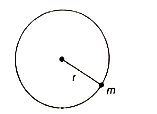
$A$ mass is whirled in a circular path with constant angular velocity and its linear velocity is $v$. If the string is now halved keeping the angular momentum same,the linear velocity is
A
$2v$
B
$\frac{v}{2}$
C
$v$
D
$v \sqrt{2}$
Solution
(A) Initial linear velocity $= v$
Initial radius $= r$
Angular momentum $L = mvr$
When the string is halved,the new radius $r' = \frac{r}{2}$.
Since the angular momentum $L$ remains constant:
$mvr = mv'r'$
$mvr = mv' \left(\frac{r}{2}\right)$
$v = \frac{v'}{2}$
$v' = 2v$
Therefore,the new linear velocity is $2v$.
Initial radius $= r$
Angular momentum $L = mvr$
When the string is halved,the new radius $r' = \frac{r}{2}$.
Since the angular momentum $L$ remains constant:
$mvr = mv'r'$
$mvr = mv' \left(\frac{r}{2}\right)$
$v = \frac{v'}{2}$
$v' = 2v$
Therefore,the new linear velocity is $2v$.
0 likes
View Solution204
DifficultMCQ
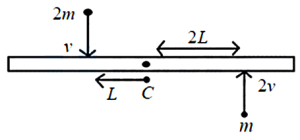
$A$ uniform rod of length $6L$ and mass $8m$ is pivoted at its centre $C$. Two masses $m$ and $2m$ with speeds $2v$ and $v$ respectively,as shown in the figure,strike the rod and stick to it. Initially,the rod is at rest. If it rotates with angular velocity $\omega$ due to the impact,then $\omega$ will be:
A
$\frac{v}{5L}$
B
$\text{Zero}$
C
$\frac{8v}{6L}$
D
$\frac{11v}{3L}$
Solution
(A) Since there is no external torque about the pivot $C$,the angular momentum of the system is conserved.
Initial angular momentum $L_i = (2m)(v)(L) + (m)(2v)(2L) = 2mvL + 4mvL = 6mvL$.
Final moment of inertia $I_f = I_{\text{rod}} + I_{2m} + I_{m} = \frac{(8m)(6L)^2}{12} + (2m)(L)^2 + (m)(2L)^2$.
$I_f = \frac{8m \cdot 36L^2}{12} + 2mL^2 + 4mL^2 = 24mL^2 + 2mL^2 + 4mL^2 = 30mL^2$.
Using $L_i = I_f \omega$:
$6mvL = (30mL^2) \omega$.
$\omega = \frac{6mvL}{30mL^2} = \frac{v}{5L}$.
Initial angular momentum $L_i = (2m)(v)(L) + (m)(2v)(2L) = 2mvL + 4mvL = 6mvL$.
Final moment of inertia $I_f = I_{\text{rod}} + I_{2m} + I_{m} = \frac{(8m)(6L)^2}{12} + (2m)(L)^2 + (m)(2L)^2$.
$I_f = \frac{8m \cdot 36L^2}{12} + 2mL^2 + 4mL^2 = 24mL^2 + 2mL^2 + 4mL^2 = 30mL^2$.
Using $L_i = I_f \omega$:
$6mvL = (30mL^2) \omega$.
$\omega = \frac{6mvL}{30mL^2} = \frac{v}{5L}$.
0 likes
View Solution205
MediumMCQ
If the Earth shrinks to $1/8$ of its original volume, while maintaining the same mass, then the duration of the day will be (in $hrs$)
A
$8$
B
$48$
C
$6$
D
$72$
Solution
(C) The volume of a sphere is given by $V = \frac{4}{3} \pi R^3$. Since the mass remains constant, $V \propto R^3$.
If the new volume $V_2 = \frac{1}{8} V_1$, then $\frac{V_2}{V_1} = \frac{R_2^3}{R_1^3} = \frac{1}{8}$.
Taking the cube root, we get $\frac{R_2}{R_1} = \frac{1}{2}$, so $R_2 = \frac{1}{2} R_1$.
By the law of conservation of angular momentum, $L = I \omega = \text{constant}$.
Since $I = \frac{2}{5} M R^2$ and $\omega = \frac{2 \pi}{T}$, we have $I_1 \omega_1 = I_2 \omega_2$.
Substituting the values, $\frac{2}{5} M R_1^2 \cdot \frac{2 \pi}{T_1} = \frac{2}{5} M R_2^2 \cdot \frac{2 \pi}{T_2}$.
This simplifies to $\frac{R_1^2}{T_1} = \frac{R_2^2}{T_2}$, which gives $T_2 = T_1 \left( \frac{R_2}{R_1} \right)^2$.
Given $T_1 = 24$ hours, $T_2 = 24 \cdot (1/2)^2 = 24 \cdot (1/4) = 6$ hours.
If the new volume $V_2 = \frac{1}{8} V_1$, then $\frac{V_2}{V_1} = \frac{R_2^3}{R_1^3} = \frac{1}{8}$.
Taking the cube root, we get $\frac{R_2}{R_1} = \frac{1}{2}$, so $R_2 = \frac{1}{2} R_1$.
By the law of conservation of angular momentum, $L = I \omega = \text{constant}$.
Since $I = \frac{2}{5} M R^2$ and $\omega = \frac{2 \pi}{T}$, we have $I_1 \omega_1 = I_2 \omega_2$.
Substituting the values, $\frac{2}{5} M R_1^2 \cdot \frac{2 \pi}{T_1} = \frac{2}{5} M R_2^2 \cdot \frac{2 \pi}{T_2}$.
This simplifies to $\frac{R_1^2}{T_1} = \frac{R_2^2}{T_2}$, which gives $T_2 = T_1 \left( \frac{R_2}{R_1} \right)^2$.
Given $T_1 = 24$ hours, $T_2 = 24 \cdot (1/2)^2 = 24 \cdot (1/4) = 6$ hours.
0 likes
View Solution206
MediumMCQ
Due to global warming, if the ice in the polar region melts and some of this water flows to the equatorial region, then
A
Angular momentum of the earth increases and duration of day increases
B
Angular momentum of the earth decreases and duration of day decreases
C
Angular momentum of the earth is constant and duration of day decreases
D
Angular momentum of the earth is constant and duration of day increases
Solution
(D) The earth is an isolated system with respect to external torques, so its angular momentum $L = I\omega$ remains constant.
When ice at the poles melts and water flows to the equator, the mass distribution of the earth changes such that more mass is concentrated further from the axis of rotation.
This increases the moment of inertia $I$ of the earth $(I = \sum mr^2)$.
Since $L = I\omega$ is constant, an increase in $I$ must result in a decrease in angular velocity $\omega$.
As $\omega = 2\pi / T$, where $T$ is the duration of the day, a decrease in $\omega$ leads to an increase in the duration of the day $T$.
When ice at the poles melts and water flows to the equator, the mass distribution of the earth changes such that more mass is concentrated further from the axis of rotation.
This increases the moment of inertia $I$ of the earth $(I = \sum mr^2)$.
Since $L = I\omega$ is constant, an increase in $I$ must result in a decrease in angular velocity $\omega$.
As $\omega = 2\pi / T$, where $T$ is the duration of the day, a decrease in $\omega$ leads to an increase in the duration of the day $T$.
0 likes
View Solution207
EasyMCQ
The spinning of the Diwali cracker 'ground chakkar' involves the concept of
A
Conservation of mechanical energy
B
Conservation of linear momentum
C
Conservation of angular momentum
D
Conservation of charge
Solution
(C) The spinning of the 'ground chakkar' is a rotational motion where no external torque acts on the system to change its state of rotation.
According to Newton's second law for rotation,the torque $\tau$ is equal to the rate of change of angular momentum $L$,given by $\tau = \frac{dL}{dt}$.
Since there is no external torque acting on the 'ground chakkar' $(\tau = 0)$,the rate of change of angular momentum is zero,which implies $\frac{dL}{dt} = 0$.
Therefore,the angular momentum $L$ remains constant.
This phenomenon is based on the law of conservation of angular momentum.
According to Newton's second law for rotation,the torque $\tau$ is equal to the rate of change of angular momentum $L$,given by $\tau = \frac{dL}{dt}$.
Since there is no external torque acting on the 'ground chakkar' $(\tau = 0)$,the rate of change of angular momentum is zero,which implies $\frac{dL}{dt} = 0$.
Therefore,the angular momentum $L$ remains constant.
This phenomenon is based on the law of conservation of angular momentum.
0 likes
View Solution208
EasyMCQ
$A$ uniform disc of mass $100 \ kg$ and radius $2 \ m$ is rotating at $1 \ rad/s$ about a perpendicular axis passing through its centre. $A$ boy of mass $60 \ kg$ standing at the centre of the disc suddenly jumps to a point which is $1 \ m$ from the centre of the disc. The final angular velocity of the boy (in $rad/s$) is
A
$0.77$
B
$0.5$
C
$41$
D
$2$
Solution
(A) Since there is no external torque acting on the system,the angular momentum of the system is conserved.
$L_i = L_f$
$I_i \omega_i = I_f \omega_f$
Initially,the boy is at the center,so his moment of inertia is zero. The moment of inertia of the disc is $I_{\text{disc}} = \frac{1}{2} M R^2$.
$I_i = \frac{1}{2} \times 100 \times 2^2 = 200 \ kg \cdot m^2$.
Finally,the boy is at a distance $r = 1 \ m$ from the center. His moment of inertia is $I_{\text{boy}} = m r^2 = 60 \times 1^2 = 60 \ kg \cdot m^2$.
The final moment of inertia of the system is $I_f = I_{\text{disc}} + I_{\text{boy}} = 200 + 60 = 260 \ kg \cdot m^2$.
Using conservation of angular momentum:
$200 \times 1 = 260 \times \omega_f$
$\omega_f = \frac{200}{260} = \frac{20}{26} \approx 0.77 \ rad/s$.
$L_i = L_f$
$I_i \omega_i = I_f \omega_f$
Initially,the boy is at the center,so his moment of inertia is zero. The moment of inertia of the disc is $I_{\text{disc}} = \frac{1}{2} M R^2$.
$I_i = \frac{1}{2} \times 100 \times 2^2 = 200 \ kg \cdot m^2$.
Finally,the boy is at a distance $r = 1 \ m$ from the center. His moment of inertia is $I_{\text{boy}} = m r^2 = 60 \times 1^2 = 60 \ kg \cdot m^2$.
The final moment of inertia of the system is $I_f = I_{\text{disc}} + I_{\text{boy}} = 200 + 60 = 260 \ kg \cdot m^2$.
Using conservation of angular momentum:
$200 \times 1 = 260 \times \omega_f$
$\omega_f = \frac{200}{260} = \frac{20}{26} \approx 0.77 \ rad/s$.
0 likes
View Solution209
DifficultMCQ
$A$ thin uniform circular disc of mass $M$ and radius $R$ is rotating in a horizontal plane about an axis passing through its centre and perpendicular to its plane with an angular velocity $\omega$. Another disc of the same thickness and radius but of mass $\frac{1}{8} M$ is placed gently on the first disc coaxially. The angular velocity of the system is now
A
$\frac{8}{9} \omega$
B
$\frac{5}{9} \omega$
C
$\frac{1}{3} \omega$
D
$\frac{2}{9} \omega$
Solution
(A) Given: Mass of the first disc $m_1 = M$,radius $r_1 = R$,and initial angular velocity $\omega_1 = \omega$.
The moment of inertia of the first disc is $I_1 = \frac{1}{2} M R^2$.
The second disc has mass $m_2 = \frac{1}{8} M$ and radius $r_2 = R$.
The moment of inertia of the second disc is $I_2 = \frac{1}{2} (\frac{1}{8} M) R^2 = \frac{1}{16} M R^2$.
When the second disc is placed on the first,the total moment of inertia of the system becomes $I_{total} = I_1 + I_2 = \frac{1}{2} M R^2 + \frac{1}{16} M R^2 = \frac{8+1}{16} M R^2 = \frac{9}{16} M R^2$.
By the principle of conservation of angular momentum,$L_{initial} = L_{final}$.
$I_1 \omega = I_{total} \omega_{final}$
$\frac{1}{2} M R^2 \omega = \frac{9}{16} M R^2 \omega_{final}$
$\frac{1}{2} \omega = \frac{9}{16} \omega_{final}$
$\omega_{final} = \frac{16}{18} \omega = \frac{8}{9} \omega$.
The moment of inertia of the first disc is $I_1 = \frac{1}{2} M R^2$.
The second disc has mass $m_2 = \frac{1}{8} M$ and radius $r_2 = R$.
The moment of inertia of the second disc is $I_2 = \frac{1}{2} (\frac{1}{8} M) R^2 = \frac{1}{16} M R^2$.
When the second disc is placed on the first,the total moment of inertia of the system becomes $I_{total} = I_1 + I_2 = \frac{1}{2} M R^2 + \frac{1}{16} M R^2 = \frac{8+1}{16} M R^2 = \frac{9}{16} M R^2$.
By the principle of conservation of angular momentum,$L_{initial} = L_{final}$.
$I_1 \omega = I_{total} \omega_{final}$
$\frac{1}{2} M R^2 \omega = \frac{9}{16} M R^2 \omega_{final}$
$\frac{1}{2} \omega = \frac{9}{16} \omega_{final}$
$\omega_{final} = \frac{16}{18} \omega = \frac{8}{9} \omega$.
0 likes
View Solution210
DifficultMCQ
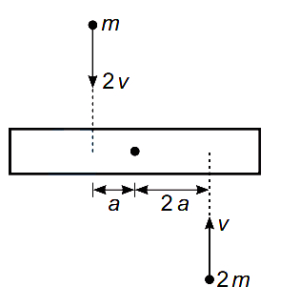
$A$ uniform rod of length $8 a$ and mass $6 m$ lies on a smooth horizontal surface. Two point masses $m$ and $2 m$ moving in the same plane with speed $2 v$ and $v$ respectively strike the rod perpendicularly at distances $a$ and $2 a$ from the mid point of the rod in the opposite directions and stick to the rod. The angular velocity of the system immediately after the collision is:
A
$\frac{6 v}{32 a}$
B
$\frac{6 v}{33 a}$
C
$\frac{6 v}{40 a}$
D
$\frac{6 v}{41 a}$
Solution
(D) Applying the principle of conservation of angular momentum about the center of mass (midpoint $O$) of the rod:
Initial angular momentum $L_i = m(2v)(a) + (2m)(v)(2a) = 2mav + 4mav = 6mav$.
Final angular momentum $L_f = I_{total} \omega$,where $I_{total}$ is the moment of inertia of the system about the center of mass after the particles stick to the rod.
$I_{total} = I_{rod} + I_{m} + I_{2m} = \frac{(6m)(8a)^2}{12} + m(a)^2 + (2m)(2a)^2$.
$I_{total} = \frac{6m(64a^2)}{12} + ma^2 + 8ma^2 = 32ma^2 + ma^2 + 8ma^2 = 41ma^2$.
Equating $L_i = L_f$:
$6mav = (41ma^2) \omega$.
Therefore,$\omega = \frac{6mav}{41ma^2} = \frac{6v}{41a}$.
Initial angular momentum $L_i = m(2v)(a) + (2m)(v)(2a) = 2mav + 4mav = 6mav$.
Final angular momentum $L_f = I_{total} \omega$,where $I_{total}$ is the moment of inertia of the system about the center of mass after the particles stick to the rod.
$I_{total} = I_{rod} + I_{m} + I_{2m} = \frac{(6m)(8a)^2}{12} + m(a)^2 + (2m)(2a)^2$.
$I_{total} = \frac{6m(64a^2)}{12} + ma^2 + 8ma^2 = 32ma^2 + ma^2 + 8ma^2 = 41ma^2$.
Equating $L_i = L_f$:
$6mav = (41ma^2) \omega$.
Therefore,$\omega = \frac{6mav}{41ma^2} = \frac{6v}{41a}$.
0 likes
View Solution211
EasyMCQ
If the radius of the earth becomes $x$ times its present value,the new period of rotation in hours is (in $x^2$)
A
$6$
B
$12$
C
$24$
D
$48$
Solution
(C) The angular momentum of the Earth remains conserved because no external torque acts on it.
$L = I \omega$
Since $I = \frac{2}{5} MR^2$ and $\omega = \frac{2 \pi}{T}$,we have:
$I_1 \omega_1 = I_2 \omega_2$
$\frac{2}{5} MR^2 \times \frac{2 \pi}{T_1} = \frac{2}{5} M(xR)^2 \times \frac{2 \pi}{T_2}$
Canceling common terms:
$\frac{R^2}{T_1} = \frac{x^2 R^2}{T_2}$
$T_2 = T_1 x^2$
Given the present period of rotation $T_1 = 24 \text{ hours}$,the new period is:
$T_2 = 24 x^2 \text{ hours}$.
$L = I \omega$
Since $I = \frac{2}{5} MR^2$ and $\omega = \frac{2 \pi}{T}$,we have:
$I_1 \omega_1 = I_2 \omega_2$
$\frac{2}{5} MR^2 \times \frac{2 \pi}{T_1} = \frac{2}{5} M(xR)^2 \times \frac{2 \pi}{T_2}$
Canceling common terms:
$\frac{R^2}{T_1} = \frac{x^2 R^2}{T_2}$
$T_2 = T_1 x^2$
Given the present period of rotation $T_1 = 24 \text{ hours}$,the new period is:
$T_2 = 24 x^2 \text{ hours}$.
0 likes
View Solution212
MediumMCQ
$A$ mouse of mass $m$ jumps on the outside edge of a rotating ceiling fan of moment of inertia $I$ and radius $R$. The fractional loss of angular velocity of the fan as a result is
A
$\frac{m R^2}{I+m R^2}$
B
$\frac{I}{I+m R^2}$
C
$\frac{I-m R^2}{I}$
D
$\frac{I-m R^2}{I+m R^2}$
Solution
(A) According to the principle of conservation of angular momentum,since no external torque acts on the system,the initial angular momentum equals the final angular momentum.
Initial angular momentum $L_i = I \omega_0$,where $\omega_0$ is the initial angular velocity.
When the mouse of mass $m$ lands on the edge at radius $R$,the new moment of inertia of the system becomes $I' = I + m R^2$.
Let the new angular velocity be $\omega$. Then,$L_f = (I + m R^2) \omega$.
Equating $L_i = L_f$,we get $I \omega_0 = (I + m R^2) \omega$.
Thus,$\omega = \frac{I \omega_0}{I + m R^2}$.
The fractional loss of angular velocity is given by $\frac{\omega_0 - \omega}{\omega_0} = 1 - \frac{\omega}{\omega_0}$.
Substituting the value of $\omega$,we get $1 - \frac{I}{I + m R^2} = \frac{I + m R^2 - I}{I + m R^2} = \frac{m R^2}{I + m R^2}$.
Initial angular momentum $L_i = I \omega_0$,where $\omega_0$ is the initial angular velocity.
When the mouse of mass $m$ lands on the edge at radius $R$,the new moment of inertia of the system becomes $I' = I + m R^2$.
Let the new angular velocity be $\omega$. Then,$L_f = (I + m R^2) \omega$.
Equating $L_i = L_f$,we get $I \omega_0 = (I + m R^2) \omega$.
Thus,$\omega = \frac{I \omega_0}{I + m R^2}$.
The fractional loss of angular velocity is given by $\frac{\omega_0 - \omega}{\omega_0} = 1 - \frac{\omega}{\omega_0}$.
Substituting the value of $\omega$,we get $1 - \frac{I}{I + m R^2} = \frac{I + m R^2 - I}{I + m R^2} = \frac{m R^2}{I + m R^2}$.
0 likes
View Solution213
DifficultMCQ
If the Earth were to suddenly contract to $\frac{1}{n}$ th of its present radius without any change in its mass,the duration of the new day will be nearly
A
$24 / n \text{ hr}$.
B
$24 n \text{ hr}$.
C
$24 / n^2 \text{ hr}$.
D
$24 n^2 \text{ hr}$.
Solution
(C) According to the law of conservation of angular momentum,since no external torque acts on the Earth,the angular momentum remains constant: $L_1 = L_2$.
Since $L = I\omega$,we have $I_1 \omega_1 = I_2 \omega_2$.
The moment of inertia of a solid sphere is $I = \frac{2}{5}MR^2$.
Let $R_1 = R$ and $R_2 = \frac{R}{n}$.
Substituting these into the equation: $\frac{2}{5}MR^2 \left(\frac{2\pi}{T_1}\right) = \frac{2}{5}M\left(\frac{R}{n}\right)^2 \left(\frac{2\pi}{T_2}\right)$.
Simplifying the equation: $R^2 \left(\frac{1}{T_1}\right) = \frac{R^2}{n^2} \left(\frac{1}{T_2}\right)$.
Therefore,$T_2 = \frac{T_1}{n^2}$.
Given the initial duration of the day $T_1 = 24 \text{ hr}$,the new duration is $T_2 = \frac{24}{n^2} \text{ hr}$.
Since $L = I\omega$,we have $I_1 \omega_1 = I_2 \omega_2$.
The moment of inertia of a solid sphere is $I = \frac{2}{5}MR^2$.
Let $R_1 = R$ and $R_2 = \frac{R}{n}$.
Substituting these into the equation: $\frac{2}{5}MR^2 \left(\frac{2\pi}{T_1}\right) = \frac{2}{5}M\left(\frac{R}{n}\right)^2 \left(\frac{2\pi}{T_2}\right)$.
Simplifying the equation: $R^2 \left(\frac{1}{T_1}\right) = \frac{R^2}{n^2} \left(\frac{1}{T_2}\right)$.
Therefore,$T_2 = \frac{T_1}{n^2}$.
Given the initial duration of the day $T_1 = 24 \text{ hr}$,the new duration is $T_2 = \frac{24}{n^2} \text{ hr}$.
0 likes
View SolutionSystem of Particles and Rotational Motion — Conservation of angular momentum (combined translation and rotational motion) · Frequently Asked Questions
1Are these System of Particles and Rotational Motion questions useful for JEE and NEET?
Yes. All questions in this section are mapped to JEE Main and NEET exam patterns. Previous year questions from JEE Main, NEET, GUJCET and state-level exams are included with full solutions.
2Can I switch to Hindi or Gujarati for these questions?
Yes. Use the language tabs in the hero section or the sidebar to view the same questions and solutions in English, Hindi or Gujarati.
3How do I generate a question paper from this subtopic?
Use the Vedclass Exam Paper Generator — select the chapter and subtopic, set difficulty, and generate Sets A, B, C, D automatically. First 3 chapters of every subject are free.
Vedclass Products
For Students
Vedclass Test Series
Mock tests in real JEE/NEET style with performance analysis. 5-day free trial.
Start Free TrialFor Teachers
Exam Paper Generator
Generate Set A/B/C/D papers from this chapter in 2 minutes. 3 chapters free.
Try FreeFor Institutes
Online Exam Module
Live online exams with unlimited students, 360° analytics & white-label branding.
See DemoFor Teachers & Institutes
Generate a System of Particles and Rotational Motion Exam Paper in 2 Minutes
Select subtopic & difficulty — Sets A, B, C, D auto-generated with No Repeat logic.
First 3 chapters of every subject are free — no payment required.