
A English
SHM of Spring Mass System Questions in English
Class 11 Physics · Oscillations · SHM of Spring Mass System
334+
Questions
English
Language
100%
With Solutions
Showing 50 of 334 questions in English
151
MediumMCQ
$A$ mass on a spring oscillates up and down. As the mass moves downward from its highest point to its equilibrium point:
A
The net force is downward,the net work done on the mass is positive and the mass speeds up.
B
The net force is upward,the net work done on the mass is negative and the mass slows down.
C
The net force is downward,the net work done on the mass is positive and the mass speeds up.
D
The net force is upward,the net work done on the mass is negative and the mass speeds up.
Solution
(C) $1$. At the highest point of oscillation,the spring is stretched to its maximum extent. As the mass moves downward toward the equilibrium position,the restoring force (spring force) acts in the upward direction,but the net force (gravity minus spring force) is directed downward.
$2$. Since the net force is in the same direction as the displacement (downward),the work done by the net force is positive $(W = F \cdot d > 0)$.
$3$. According to the work-energy theorem,positive work done on an object increases its kinetic energy,meaning the mass speeds up as it approaches the equilibrium position.
$2$. Since the net force is in the same direction as the displacement (downward),the work done by the net force is positive $(W = F \cdot d > 0)$.
$3$. According to the work-energy theorem,positive work done on an object increases its kinetic energy,meaning the mass speeds up as it approaches the equilibrium position.
0 likes
View Solution152
MediumMCQ
Two particles $A$ and $B$ of equal masses are suspended from two massless springs of spring constants $k_1$ and $k_2$,respectively. If the maximum velocities during oscillations are equal,the ratio of amplitudes of $A$ and $B$ is
A
$\sqrt{k_1/k_2}$
B
$k_1/k_2$
C
$\sqrt{k_2/k_1}$
D
$k_2/k_1$
Solution
(C) The maximum velocity of a particle in simple harmonic motion is given by $V_{\max} = \omega A$,where $\omega$ is the angular frequency and $A$ is the amplitude.
Given that the masses $M$ are equal,the angular frequencies are $\omega_1 = \sqrt{k_1/M}$ and $\omega_2 = \sqrt{k_2/M}$.
Since the maximum velocities are equal,we have $V_{\max, 1} = V_{\max, 2}$,which implies $\omega_1 A_1 = \omega_2 A_2$.
Therefore,the ratio of the amplitudes is $\frac{A_1}{A_2} = \frac{\omega_2}{\omega_1}$.
Substituting the expressions for $\omega_1$ and $\omega_2$,we get $\frac{A_1}{A_2} = \frac{\sqrt{k_2/M}}{\sqrt{k_1/M}} = \sqrt{\frac{k_2}{k_1}}$.
Given that the masses $M$ are equal,the angular frequencies are $\omega_1 = \sqrt{k_1/M}$ and $\omega_2 = \sqrt{k_2/M}$.
Since the maximum velocities are equal,we have $V_{\max, 1} = V_{\max, 2}$,which implies $\omega_1 A_1 = \omega_2 A_2$.
Therefore,the ratio of the amplitudes is $\frac{A_1}{A_2} = \frac{\omega_2}{\omega_1}$.
Substituting the expressions for $\omega_1$ and $\omega_2$,we get $\frac{A_1}{A_2} = \frac{\sqrt{k_2/M}}{\sqrt{k_1/M}} = \sqrt{\frac{k_2}{k_1}}$.
0 likes
View Solution153
MediumMCQ
If $A$ is the area of cross-section of a spring,$L$ is its length,$E$ is the Young's modulus of the material of the spring,then the time period and force constant of the spring will be respectively:
A
$T = 2\pi \sqrt {\frac{{EA}}{{ML}}} ,k = \frac{L}{{EA}}$
B
$T = \frac{1}{{2\pi }}\sqrt {\frac{{EA}}{{ML}}} ,k = \frac{A}{{EL}}$
C
$T = \frac{1}{{2\pi }}\sqrt {\frac{{EL}}{{MA}}} ,k = \sqrt {\frac{{EA}}{L}}$
D
$T = 2\pi \sqrt {\frac{{ML}}{{EA}}} ,k = \frac{{EA}}{L}$
Solution
(D) According to the definition of Young's modulus $(E)$:
$E = \frac{F L}{A \Delta L}$
where $F$ is the force,$L$ is the original length,$A$ is the cross-sectional area,and $\Delta L$ is the extension.
Rearranging for force $(F)$:
$F = \left( \frac{EA}{L} \right) \Delta L$ --- $(1)$
According to Hooke's law,the restoring force is given by:
$F = k \Delta L$ --- $(2)$
Comparing equations $(1)$ and $(2)$,we get the force constant $(k)$:
$k = \frac{EA}{L}$
The time period $(T)$ of a spring-mass system is given by:
$T = 2\pi \sqrt{\frac{M}{k}}$
Substituting the value of $k$:
$T = 2\pi \sqrt{\frac{M}{EA/L}} = 2\pi \sqrt{\frac{ML}{EA}}$
Thus,the time period is $2\pi \sqrt{\frac{ML}{EA}}$ and the force constant is $\frac{EA}{L}$.
$E = \frac{F L}{A \Delta L}$
where $F$ is the force,$L$ is the original length,$A$ is the cross-sectional area,and $\Delta L$ is the extension.
Rearranging for force $(F)$:
$F = \left( \frac{EA}{L} \right) \Delta L$ --- $(1)$
According to Hooke's law,the restoring force is given by:
$F = k \Delta L$ --- $(2)$
Comparing equations $(1)$ and $(2)$,we get the force constant $(k)$:
$k = \frac{EA}{L}$
The time period $(T)$ of a spring-mass system is given by:
$T = 2\pi \sqrt{\frac{M}{k}}$
Substituting the value of $k$:
$T = 2\pi \sqrt{\frac{M}{EA/L}} = 2\pi \sqrt{\frac{ML}{EA}}$
Thus,the time period is $2\pi \sqrt{\frac{ML}{EA}}$ and the force constant is $\frac{EA}{L}$.
0 likes
View Solution154
DifficultMCQ
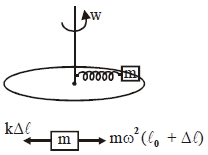
$A$ spring-mass system (mass $m$,spring constant $k$,and natural length $\ell_{0}$) rests in equilibrium on a horizontal disc. The free end of the spring is fixed at the center of the disc. If the disc,together with the spring-mass system,rotates about its axis with an angular velocity $\omega$ (where $k >> m \omega^{2}$),the relative change in the length of the spring is best given by which option?
A
$\frac{2 m \omega^{2}}{k}$
B
$\frac{m \omega^{2}}{3 k}$
C
$\sqrt{\frac{2}{3}}\left(\frac{m \omega^{2}}{k}\right)$
D
$\frac{m \omega^{2}}{k}$
Solution
(D) Let $\Delta \ell$ be the extension in the spring due to the rotation of the disc.
The total length of the spring becomes $r = \ell_{0} + \Delta \ell$.
The centripetal force required for the circular motion of the mass $m$ is provided by the spring force.
Thus,$k \Delta \ell = m \omega^{2} r = m \omega^{2} (\ell_{0} + \Delta \ell)$.
Rearranging the equation: $k \Delta \ell - m \omega^{2} \Delta \ell = m \omega^{2} \ell_{0}$.
$\Delta \ell (k - m \omega^{2}) = m \omega^{2} \ell_{0}$.
$\Delta \ell = \frac{m \omega^{2} \ell_{0}}{k - m \omega^{2}}$.
Since it is given that $k >> m \omega^{2}$,we can approximate $k - m \omega^{2} \approx k$.
Therefore,$\Delta \ell \approx \frac{m \omega^{2} \ell_{0}}{k}$.
The relative change in length is $\frac{\Delta \ell}{\ell_{0}} = \frac{m \omega^{2}}{k}$.
The total length of the spring becomes $r = \ell_{0} + \Delta \ell$.
The centripetal force required for the circular motion of the mass $m$ is provided by the spring force.
Thus,$k \Delta \ell = m \omega^{2} r = m \omega^{2} (\ell_{0} + \Delta \ell)$.
Rearranging the equation: $k \Delta \ell - m \omega^{2} \Delta \ell = m \omega^{2} \ell_{0}$.
$\Delta \ell (k - m \omega^{2}) = m \omega^{2} \ell_{0}$.
$\Delta \ell = \frac{m \omega^{2} \ell_{0}}{k - m \omega^{2}}$.
Since it is given that $k >> m \omega^{2}$,we can approximate $k - m \omega^{2} \approx k$.
Therefore,$\Delta \ell \approx \frac{m \omega^{2} \ell_{0}}{k}$.
The relative change in length is $\frac{\Delta \ell}{\ell_{0}} = \frac{m \omega^{2}}{k}$.
1 likes
View Solution155
Easy
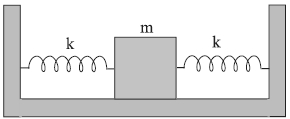
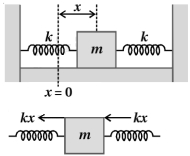
Two identical springs of spring constant $k$ are attached to a block of mass $m$ and to fixed supports as shown in the figure. Show that when the mass is displaced from its equilibrium position on either side,it executes simple harmonic motion. Find the period of oscillations.
Solution
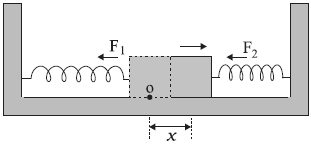
(N/A) Let the mass be displaced by a small distance $x$ to the right side of the equilibrium position,as shown in the figure. Under this situation,the spring on the left side gets elongated by a length equal to $x$ and that on the right side gets compressed by the same length.
The forces acting on the mass are then:
$F_{1} = -k x$ (force exerted by the spring on the left side,trying to pull the mass towards the mean position)
$F_{2} = -k x$ (force exerted by the spring on the right side,trying to push the mass towards the mean position)
The net force,$F$,acting on the mass is then given by:
$F = F_{1} + F_{2} = -k x - k x = -2 k x$
Since the net force $F$ is proportional to the displacement $x$ and is directed towards the mean position $(F \propto -x)$,the motion executed by the mass is simple harmonic.
Comparing this with the standard equation of simple harmonic motion $F = -K_{eff} x$,we get the effective spring constant $K_{eff} = 2 k$.
The time period of oscillations is given by:
$T = 2 \pi \sqrt{\frac{m}{K_{eff}}} = 2 \pi \sqrt{\frac{m}{2 k}}$
The forces acting on the mass are then:
$F_{1} = -k x$ (force exerted by the spring on the left side,trying to pull the mass towards the mean position)
$F_{2} = -k x$ (force exerted by the spring on the right side,trying to push the mass towards the mean position)
The net force,$F$,acting on the mass is then given by:
$F = F_{1} + F_{2} = -k x - k x = -2 k x$
Since the net force $F$ is proportional to the displacement $x$ and is directed towards the mean position $(F \propto -x)$,the motion executed by the mass is simple harmonic.
Comparing this with the standard equation of simple harmonic motion $F = -K_{eff} x$,we get the effective spring constant $K_{eff} = 2 k$.
The time period of oscillations is given by:
$T = 2 \pi \sqrt{\frac{m}{K_{eff}}} = 2 \pi \sqrt{\frac{m}{2 k}}$
0 likes
View Solution156
Medium
$A$ block of mass $1 \; kg$ is fastened to a spring with a spring constant of $50 \; N m^{-1}$. The block is pulled to a distance $x = 10 \; cm$ from its equilibrium position at $x = 0$ on a frictionless surface and released from rest at $t = 0$. Calculate the kinetic,potential,and total energies of the block when it is $5 \; cm$ away from the mean position.
Solution
(N/A) The block executes $SHM$. The angular frequency is given by $\omega = \sqrt{\frac{k}{m}} = \sqrt{\frac{50}{1}} = 7.07 \; rad \; s^{-1}$.
Given amplitude $A = 0.1 \; m$ and displacement $x = 0.05 \; m$.
The potential energy $(P.E.)$ at $x = 0.05 \; m$ is:
$P.E. = \frac{1}{2} k x^2 = \frac{1}{2} \times 50 \times (0.05)^2 = 25 \times 0.0025 = 0.0625 \; J$.
The total energy $(E)$ of the system is constant and equal to the potential energy at maximum displacement $(x = A)$:
$E = \frac{1}{2} k A^2 = \frac{1}{2} \times 50 \times (0.1)^2 = 25 \times 0.01 = 0.25 \; J$.
The kinetic energy $(K.E.)$ at $x = 0.05 \; m$ is:
$K.E. = E - P.E. = 0.25 - 0.0625 = 0.1875 \; J \approx 0.19 \; J$.
Given amplitude $A = 0.1 \; m$ and displacement $x = 0.05 \; m$.
The potential energy $(P.E.)$ at $x = 0.05 \; m$ is:
$P.E. = \frac{1}{2} k x^2 = \frac{1}{2} \times 50 \times (0.05)^2 = 25 \times 0.0025 = 0.0625 \; J$.
The total energy $(E)$ of the system is constant and equal to the potential energy at maximum displacement $(x = A)$:
$E = \frac{1}{2} k A^2 = \frac{1}{2} \times 50 \times (0.1)^2 = 25 \times 0.01 = 0.25 \; J$.
The kinetic energy $(K.E.)$ at $x = 0.05 \; m$ is:
$K.E. = E - P.E. = 0.25 - 0.0625 = 0.1875 \; J \approx 0.19 \; J$.
0 likes
View Solution157
Medium
$A$ $5\; kg$ collar is attached to a spring of spring constant $500\; N m^{-1}$. It slides without friction over a horizontal rod. The collar is displaced from its equilibrium position by $10.0\; cm$ and released. Calculate
$(a)$ the period of oscillation.
$(b)$ the maximum speed and
$(c)$ maximum acceleration of the collar.
$(a)$ the period of oscillation.
$(b)$ the maximum speed and
$(c)$ maximum acceleration of the collar.
Solution
(N/A) The period of oscillation is given by $T = 2 \pi \sqrt{\frac{m}{k}}$.
Substituting the values,$T = 2 \pi \sqrt{\frac{5.0\; kg}{500\; N m^{-1}}} = 2 \pi \sqrt{0.01} = 2 \pi \times 0.1 = 0.2 \pi \; s \approx 0.63\; s$.
$(b)$ The maximum speed is given by $v_{max} = A \omega$,where $\omega = \sqrt{\frac{k}{m}}$.
$v_{max} = 0.1\; m \times \sqrt{\frac{500\; N m^{-1}}{5\; kg}} = 0.1 \times \sqrt{100} = 0.1 \times 10 = 1.0\; m s^{-1}$.
$(c)$ The maximum acceleration is given by $a_{max} = \omega^2 A$.
$a_{max} = \left(\frac{k}{m}\right) A = \left(\frac{500\; N m^{-1}}{5\; kg}\right) \times 0.1\; m = 100 \times 0.1 = 10\; m s^{-2}$.
Substituting the values,$T = 2 \pi \sqrt{\frac{5.0\; kg}{500\; N m^{-1}}} = 2 \pi \sqrt{0.01} = 2 \pi \times 0.1 = 0.2 \pi \; s \approx 0.63\; s$.
$(b)$ The maximum speed is given by $v_{max} = A \omega$,where $\omega = \sqrt{\frac{k}{m}}$.
$v_{max} = 0.1\; m \times \sqrt{\frac{500\; N m^{-1}}{5\; kg}} = 0.1 \times \sqrt{100} = 0.1 \times 10 = 1.0\; m s^{-1}$.
$(c)$ The maximum acceleration is given by $a_{max} = \omega^2 A$.
$a_{max} = \left(\frac{k}{m}\right) A = \left(\frac{500\; N m^{-1}}{5\; kg}\right) \times 0.1\; m = 100 \times 0.1 = 10\; m s^{-2}$.
0 likes
View Solution158
MediumMCQ
$A$ spring balance has a scale that reads from $0$ to $50\; kg$. The length of the scale is $20\; cm$. $A$ body suspended from this balance,when displaced and released,oscillates with a period of $0.6\; s$. What is the weight of the body in $N$?
A
$349$
B
$219$
C
$251$
D
$289$
Solution
(B) The maximum mass the scale can read is $M = 50\; kg$.
The maximum displacement of the spring is equal to the length of the scale,$l = 20\; cm = 0.2\; m$.
The spring constant $k$ is given by $k = \frac{F}{l} = \frac{Mg}{l}$.
Using $g = 9.8\; m/s^2$,we get $k = \frac{50 \times 9.8}{0.2} = 2450\; N/m$.
The time period of oscillation for a mass $m$ is $T = 2\pi \sqrt{\frac{m}{k}}$.
Given $T = 0.6\; s$,we solve for $m$: $m = k \left( \frac{T}{2\pi} \right)^2 = 2450 \times \left( \frac{0.6}{2 \times 3.14} \right)^2 \approx 22.36\; kg$.
The weight of the body is $W = mg = 22.36 \times 9.8 \approx 219.1\; N$.
Thus,the weight of the body is approximately $219\; N$.
The maximum displacement of the spring is equal to the length of the scale,$l = 20\; cm = 0.2\; m$.
The spring constant $k$ is given by $k = \frac{F}{l} = \frac{Mg}{l}$.
Using $g = 9.8\; m/s^2$,we get $k = \frac{50 \times 9.8}{0.2} = 2450\; N/m$.
The time period of oscillation for a mass $m$ is $T = 2\pi \sqrt{\frac{m}{k}}$.
Given $T = 0.6\; s$,we solve for $m$: $m = k \left( \frac{T}{2\pi} \right)^2 = 2450 \times \left( \frac{0.6}{2 \times 3.14} \right)^2 \approx 22.36\; kg$.
The weight of the body is $W = mg = 22.36 \times 9.8 \approx 219.1\; N$.
Thus,the weight of the body is approximately $219\; N$.
0 likes
View Solution159
Medium
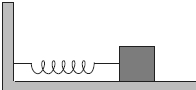
$A$ spring with a spring constant $1200 \; N m^{-1}$ is mounted on a horizontal table as shown in the figure. $A$ mass of $3 \; kg$ is attached to the free end of the spring. The mass is then pulled sideways to a distance of $2.0 \; cm$ and released. Determine:
$(i)$ the frequency of oscillations,
$(ii)$ maximum acceleration of the mass,and
$(iii)$ the maximum speed of the mass.
$(i)$ the frequency of oscillations,
$(ii)$ maximum acceleration of the mass,and
$(iii)$ the maximum speed of the mass.
Solution
(N/A) Given:
Spring constant,$k = 1200 \; N m^{-1}$
Mass,$m = 3 \; kg$
Amplitude (displacement),$A = 2.0 \; cm = 0.02 \; m$
$(i)$ Frequency of oscillation $(v)$:
The frequency is given by $v = \frac{1}{2 \pi} \sqrt{\frac{k}{m}}$
$v = \frac{1}{2 \times 3.14} \sqrt{\frac{1200}{3}} = \frac{1}{6.28} \sqrt{400} = \frac{20}{6.28} \approx 3.18 \; Hz$
$(ii)$ Maximum acceleration $(a_{max})$:
The maximum acceleration is given by $a_{max} = \omega^2 A$,where $\omega = \sqrt{\frac{k}{m}}$
$a_{max} = \frac{k}{m} A = \frac{1200}{3} \times 0.02 = 400 \times 0.02 = 8.0 \; m s^{-2}$
$(iii)$ Maximum speed $(v_{max})$:
The maximum speed is given by $v_{max} = A \omega$
$v_{max} = A \sqrt{\frac{k}{m}} = 0.02 \times \sqrt{\frac{1200}{3}} = 0.02 \times 20 = 0.4 \; m s^{-1}$
Spring constant,$k = 1200 \; N m^{-1}$
Mass,$m = 3 \; kg$
Amplitude (displacement),$A = 2.0 \; cm = 0.02 \; m$
$(i)$ Frequency of oscillation $(v)$:
The frequency is given by $v = \frac{1}{2 \pi} \sqrt{\frac{k}{m}}$
$v = \frac{1}{2 \times 3.14} \sqrt{\frac{1200}{3}} = \frac{1}{6.28} \sqrt{400} = \frac{20}{6.28} \approx 3.18 \; Hz$
$(ii)$ Maximum acceleration $(a_{max})$:
The maximum acceleration is given by $a_{max} = \omega^2 A$,where $\omega = \sqrt{\frac{k}{m}}$
$a_{max} = \frac{k}{m} A = \frac{1200}{3} \times 0.02 = 400 \times 0.02 = 8.0 \; m s^{-2}$
$(iii)$ Maximum speed $(v_{max})$:
The maximum speed is given by $v_{max} = A \omega$
$v_{max} = A \sqrt{\frac{k}{m}} = 0.02 \times \sqrt{\frac{1200}{3}} = 0.02 \times 20 = 0.4 \; m s^{-1}$
0 likes
View Solution160
Medium
$A$ spring with a spring constant $1200 \; N m^{-1}$ is mounted on a horizontal table as shown in the figure. $A$ mass of $3 \; kg$ is attached to the free end of the spring. The mass is then pulled sideways to a distance of $2.0 \; cm$ and released. Let us take the position of the mass when the spring is unstretched as $x = 0$,and the direction from left to right as the positive direction of the $x$-axis. Give $x$ as a function of time $t$ for the oscillating mass if at the moment we start the stopwatch $(t = 0)$,the mass is:
$(a)$ at the mean position,
$(b)$ at the maximum stretched position,and
$(c)$ at the maximum compressed position.
In what way do these functions for $SHM$ differ from each other: in frequency,in amplitude,or in the initial phase?
$(a)$ at the mean position,
$(b)$ at the maximum stretched position,and
$(c)$ at the maximum compressed position.
In what way do these functions for $SHM$ differ from each other: in frequency,in amplitude,or in the initial phase?
Solution
(N/A) The functions have the same frequency and amplitude,but different initial phases.
Amplitude of oscillation,$A = 2.0 \; cm = 0.02 \; m$.
Force constant of the spring,$k = 1200 \; N m^{-1}$.
Mass,$m = 3 \; kg$.
Angular frequency of oscillation,$\omega = \sqrt{\frac{k}{m}} = \sqrt{\frac{1200}{3}} = \sqrt{400} = 20 \; rad s^{-1}$.
$(a)$ When the mass is at the mean position at $t = 0$,the initial phase is $0$. The displacement is $x = A \sin(\omega t) = 0.02 \sin(20t)$.
$(b)$ At the maximum stretched position (extreme right),the initial phase is $\frac{\pi}{2}$. The displacement is $x = A \sin(\omega t + \frac{\pi}{2}) = A \cos(\omega t) = 0.02 \cos(20t)$.
$(c)$ At the maximum compressed position (extreme left),the initial phase is $\frac{3\pi}{2}$ (or $-\frac{\pi}{2}$). The displacement is $x = A \sin(\omega t + \frac{3\pi}{2}) = -A \cos(\omega t) = -0.02 \cos(20t)$.
These functions for $SHM$ differ from each other only in their initial phases.
Amplitude of oscillation,$A = 2.0 \; cm = 0.02 \; m$.
Force constant of the spring,$k = 1200 \; N m^{-1}$.
Mass,$m = 3 \; kg$.
Angular frequency of oscillation,$\omega = \sqrt{\frac{k}{m}} = \sqrt{\frac{1200}{3}} = \sqrt{400} = 20 \; rad s^{-1}$.
$(a)$ When the mass is at the mean position at $t = 0$,the initial phase is $0$. The displacement is $x = A \sin(\omega t) = 0.02 \sin(20t)$.
$(b)$ At the maximum stretched position (extreme right),the initial phase is $\frac{\pi}{2}$. The displacement is $x = A \sin(\omega t + \frac{\pi}{2}) = A \cos(\omega t) = 0.02 \cos(20t)$.
$(c)$ At the maximum compressed position (extreme left),the initial phase is $\frac{3\pi}{2}$ (or $-\frac{\pi}{2}$). The displacement is $x = A \sin(\omega t + \frac{3\pi}{2}) = -A \cos(\omega t) = -0.02 \cos(20t)$.
These functions for $SHM$ differ from each other only in their initial phases.
0 likes
View Solution161
Medium
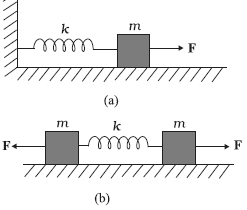
Figure $(a)$ shows a spring of force constant $k$ clamped rigidly at one end and a mass $m$ attached to its free end. $A$ force $F$ applied at the free end stretches the spring. Figure $(b)$ shows the same spring with both ends free and attached to a mass $m$ at either end. Each end of the spring in Figure $(b)$ is stretched by the same force $F$.
$(a)$ What is the maximum extension of the spring in the two cases?
$(b)$ If the mass in Figure $(a)$ and the two masses in Figure $(b)$ are released,what is the period of oscillation in each case?
$(a)$ What is the maximum extension of the spring in the two cases?
$(b)$ If the mass in Figure $(a)$ and the two masses in Figure $(b)$ are released,what is the period of oscillation in each case?
Solution
(N/A) For the one-block system (Figure $(a)$):
When a force $F$ is applied to the free end,the extension $l$ is given by $F = kl$,so $l = F/k$.
The equation of motion is $m(d^2x/dt^2) = -kx$. This is simple harmonic motion with angular frequency $\omega = \sqrt{k/m}$.
The time period is $T = 2\pi/\omega = 2\pi\sqrt{m/k}$.
For the two-block system (Figure $(b)$):
Each end is pulled by force $F$. The spring is stretched by $l$ such that the tension in the spring is $F$. Thus,$F = kl$,which gives $l = F/k$. The extension is the same in both cases.
For the oscillation,consider the center of mass of the spring. Each mass $m$ moves relative to the center of mass. The effective spring constant for each half of the spring is $k' = 2k$. The equation of motion for one mass is $m(d^2x/dt^2) = -2kx$.
This gives $\omega = \sqrt{2k/m}$.
The time period is $T = 2\pi/\omega = 2\pi\sqrt{m/(2k)}$.
When a force $F$ is applied to the free end,the extension $l$ is given by $F = kl$,so $l = F/k$.
The equation of motion is $m(d^2x/dt^2) = -kx$. This is simple harmonic motion with angular frequency $\omega = \sqrt{k/m}$.
The time period is $T = 2\pi/\omega = 2\pi\sqrt{m/k}$.
For the two-block system (Figure $(b)$):
Each end is pulled by force $F$. The spring is stretched by $l$ such that the tension in the spring is $F$. Thus,$F = kl$,which gives $l = F/k$. The extension is the same in both cases.
For the oscillation,consider the center of mass of the spring. Each mass $m$ moves relative to the center of mass. The effective spring constant for each half of the spring is $k' = 2k$. The equation of motion for one mass is $m(d^2x/dt^2) = -2kx$.
This gives $\omega = \sqrt{2k/m}$.
The time period is $T = 2\pi/\omega = 2\pi\sqrt{m/(2k)}$.
0 likes
View Solution162
Medium
$A$ mass attached to a spring is free to oscillate,with angular velocity $\omega$,in a horizontal plane without friction or damping. It is pulled to a distance $x_{0}$ and pushed towards the centre with a velocity $v_{0}$ at time $t=0$. Determine the amplitude of the resulting oscillations in terms of the parameters $\omega, x_{0}$ and $v_{0}$. [Hint: Start with the equation $x=A \cos (\omega t+\theta)$ and note that the initial velocity is negative.]
Solution
(A) The displacement equation for an oscillating mass is given by:
$x = A \cos (\omega t + \theta)$
Velocity is the derivative of displacement with respect to time:
$v = \frac{dx}{dt} = -A \omega \sin (\omega t + \theta)$
At $t = 0$,the displacement is $x = x_{0}$ and the velocity is $v = -v_{0}$ (since it is pushed towards the centre):
$x_{0} = A \cos \theta \quad \dots(i)$
$-v_{0} = -A \omega \sin \theta \implies A \sin \theta = \frac{v_{0}}{\omega} \quad \dots(ii)$
Squaring and adding equations $(i)$ and $(ii)$:
$A^2 \cos^2 \theta + A^2 \sin^2 \theta = x_{0}^2 + \left(\frac{v_{0}}{\omega}\right)^2$
$A^2 (\cos^2 \theta + \sin^2 \theta) = x_{0}^2 + \frac{v_{0}^2}{\omega^2}$
$A^2 = x_{0}^2 + \frac{v_{0}^2}{\omega^2}$
Therefore,the amplitude $A$ is:
$A = \sqrt{x_{0}^2 + \left(\frac{v_{0}}{\omega}\right)^2}$
$x = A \cos (\omega t + \theta)$
Velocity is the derivative of displacement with respect to time:
$v = \frac{dx}{dt} = -A \omega \sin (\omega t + \theta)$
At $t = 0$,the displacement is $x = x_{0}$ and the velocity is $v = -v_{0}$ (since it is pushed towards the centre):
$x_{0} = A \cos \theta \quad \dots(i)$
$-v_{0} = -A \omega \sin \theta \implies A \sin \theta = \frac{v_{0}}{\omega} \quad \dots(ii)$
Squaring and adding equations $(i)$ and $(ii)$:
$A^2 \cos^2 \theta + A^2 \sin^2 \theta = x_{0}^2 + \left(\frac{v_{0}}{\omega}\right)^2$
$A^2 (\cos^2 \theta + \sin^2 \theta) = x_{0}^2 + \frac{v_{0}^2}{\omega^2}$
$A^2 = x_{0}^2 + \frac{v_{0}^2}{\omega^2}$
Therefore,the amplitude $A$ is:
$A = \sqrt{x_{0}^2 + \left(\frac{v_{0}}{\omega}\right)^2}$
0 likes
View Solution163
Difficult
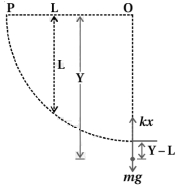
$A$ stone of mass $m$ is tied to an elastic string of negligible mass and spring constant $k$. The unstretched length of the string is $L$. The other end of the string is fixed to a nail at a point $P$. Initially,the stone is held at the same level as point $P$ and is dropped vertically.
$(a)$ Find the distance $y$ from the top when the mass comes to rest for an instant,for the first time.
$(b)$ What is the maximum velocity attained by the stone in this drop?
$(c)$ What shall be the nature of the motion after the stone has reached its lowest point?
$(a)$ Find the distance $y$ from the top when the mass comes to rest for an instant,for the first time.
$(b)$ What is the maximum velocity attained by the stone in this drop?
$(c)$ What shall be the nature of the motion after the stone has reached its lowest point?
Solution
(N/A) Consider the diagram,the stone is dropped from point $P$.
$(a)$ The stone is in free fall up to length $L$. After that,the elasticity of the string exerts a restoring force. Suppose the stone is at rest at an instantaneous distance $y$ from $P$.
By the law of conservation of energy,the loss in gravitational potential energy of the stone equals the gain in elastic potential energy of the string:
$mgy = \frac{1}{2}k(y - L)^2$
$mgy = \frac{1}{2}k(y^2 - 2yL + L^2)$
$2mgy = ky^2 - 2kyL + kL^2$
$ky^2 - 2(mg + kL)y + kL^2 = 0$
Using the quadratic formula $y = \frac{-b \pm \sqrt{b^2 - 4ac}}{2a}$:
$y = \frac{2(mg + kL) \pm \sqrt{4(mg + kL)^2 - 4k^2L^2}}{2k}$
$y = \frac{(mg + kL) + \sqrt{m^2g^2 + 2mgkL + k^2L^2 - k^2L^2}}{k}$
$y = L + \frac{mg + \sqrt{m^2g^2 + 2mgkL}}{k}$
$(b)$ The maximum velocity occurs when the acceleration is zero,i.e.,when the tension equals the weight: $k(y_{eq} - L) = mg$,so $y_{eq} = L + \frac{mg}{k}$.
Using energy conservation between the start and the equilibrium position:
$mgy_{eq} = \frac{1}{2}mv_{max}^2 + \frac{1}{2}k(y_{eq} - L)^2$
$mg(L + \frac{mg}{k}) = \frac{1}{2}mv_{max}^2 + \frac{1}{2}k(\frac{mg}{k})^2$
$mgL + \frac{m^2g^2}{k} = \frac{1}{2}mv_{max}^2 + \frac{m^2g^2}{2k}$
$v_{max} = \sqrt{2gL + \frac{m^2g^2}{mk}} = \sqrt{2gL + \frac{mg^2}{k}}$.
$(c)$ After reaching the lowest point,the stone will perform Simple Harmonic Motion $(SHM)$ about the equilibrium position $y_{eq} = L + \frac{mg}{k}$.
$(a)$ The stone is in free fall up to length $L$. After that,the elasticity of the string exerts a restoring force. Suppose the stone is at rest at an instantaneous distance $y$ from $P$.
By the law of conservation of energy,the loss in gravitational potential energy of the stone equals the gain in elastic potential energy of the string:
$mgy = \frac{1}{2}k(y - L)^2$
$mgy = \frac{1}{2}k(y^2 - 2yL + L^2)$
$2mgy = ky^2 - 2kyL + kL^2$
$ky^2 - 2(mg + kL)y + kL^2 = 0$
Using the quadratic formula $y = \frac{-b \pm \sqrt{b^2 - 4ac}}{2a}$:
$y = \frac{2(mg + kL) \pm \sqrt{4(mg + kL)^2 - 4k^2L^2}}{2k}$
$y = \frac{(mg + kL) + \sqrt{m^2g^2 + 2mgkL + k^2L^2 - k^2L^2}}{k}$
$y = L + \frac{mg + \sqrt{m^2g^2 + 2mgkL}}{k}$
$(b)$ The maximum velocity occurs when the acceleration is zero,i.e.,when the tension equals the weight: $k(y_{eq} - L) = mg$,so $y_{eq} = L + \frac{mg}{k}$.
Using energy conservation between the start and the equilibrium position:
$mgy_{eq} = \frac{1}{2}mv_{max}^2 + \frac{1}{2}k(y_{eq} - L)^2$
$mg(L + \frac{mg}{k}) = \frac{1}{2}mv_{max}^2 + \frac{1}{2}k(\frac{mg}{k})^2$
$mgL + \frac{m^2g^2}{k} = \frac{1}{2}mv_{max}^2 + \frac{m^2g^2}{2k}$
$v_{max} = \sqrt{2gL + \frac{m^2g^2}{mk}} = \sqrt{2gL + \frac{mg^2}{k}}$.
$(c)$ After reaching the lowest point,the stone will perform Simple Harmonic Motion $(SHM)$ about the equilibrium position $y_{eq} = L + \frac{mg}{k}$.
0 likes
View Solution164
EasyMCQ
Write the formula for the time period $(T)$ of a particle executing Simple Harmonic Motion $(SHM)$.
A
$T = 2\pi \sqrt{\frac{m}{k}}$
B
$T = 2\pi \sqrt{\frac{k}{m}}$
C
$T = \frac{1}{2\pi} \sqrt{\frac{m}{k}}$
D
$T = 2\pi \sqrt{\frac{m}{g}}$
Solution
(A) For a particle of mass $m$ executing $SHM$ under a restoring force $F = -kx$,the equation of motion is $m \frac{d^2x}{dt^2} = -kx$.
This can be rewritten as $\frac{d^2x}{dt^2} + \frac{k}{m}x = 0$.
Comparing this with the standard $SHM$ equation $\frac{d^2x}{dt^2} + \omega^2x = 0$,we get $\omega^2 = \frac{k}{m}$,which implies $\omega = \sqrt{\frac{k}{m}}$.
The time period $T$ is given by $T = \frac{2\pi}{\omega}$.
Substituting the value of $\omega$,we get $T = 2\pi \sqrt{\frac{m}{k}}$.
This can be rewritten as $\frac{d^2x}{dt^2} + \frac{k}{m}x = 0$.
Comparing this with the standard $SHM$ equation $\frac{d^2x}{dt^2} + \omega^2x = 0$,we get $\omega^2 = \frac{k}{m}$,which implies $\omega = \sqrt{\frac{k}{m}}$.
The time period $T$ is given by $T = \frac{2\pi}{\omega}$.
Substituting the value of $\omega$,we get $T = 2\pi \sqrt{\frac{m}{k}}$.
0 likes
View Solution165
Medium
Show that the oscillations due to a spring are simple harmonic oscillations and obtain the expression for the period of oscillation.
Solution
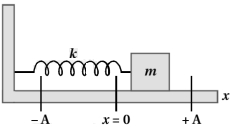
(N/A) Consider a block of mass $m$ attached to a spring,which is fixed to a rigid wall. The block is placed on a frictionless horizontal surface.
If the block is pulled to one side and released,it executes a to-and-fro motion about a mean position.
Let $x=0$ indicate the position of the center of the block when the spring is in equilibrium. The positions $-A$ and $+A$ indicate the maximum displacements to the left and the right of the mean position.
According to Hooke's law,when a spring is deformed,it is subject to a restoring force,the magnitude of which is proportional to the deformation or displacement and acts in the opposite direction.
At any time $t$,if the displacement of the block from its mean position is $x$,the restoring force $F$ acting on the block is:
$F(x) = -kx$ $(1)$
where $k$ is the spring constant.
According to Newton's second law,$F = ma = m \frac{d^2x}{dt^2}$.
Equating the two,$m \frac{d^2x}{dt^2} = -kx$,which gives $\frac{d^2x}{dt^2} + \frac{k}{m}x = 0$.
This is the differential equation for simple harmonic motion $(SHM)$ with $\omega^2 = \frac{k}{m}$.
The period of oscillation $T$ is given by $T = \frac{2\pi}{\omega} = 2\pi \sqrt{\frac{m}{k}}$.
If the block is pulled to one side and released,it executes a to-and-fro motion about a mean position.
Let $x=0$ indicate the position of the center of the block when the spring is in equilibrium. The positions $-A$ and $+A$ indicate the maximum displacements to the left and the right of the mean position.
According to Hooke's law,when a spring is deformed,it is subject to a restoring force,the magnitude of which is proportional to the deformation or displacement and acts in the opposite direction.
At any time $t$,if the displacement of the block from its mean position is $x$,the restoring force $F$ acting on the block is:
$F(x) = -kx$ $(1)$
where $k$ is the spring constant.
According to Newton's second law,$F = ma = m \frac{d^2x}{dt^2}$.
Equating the two,$m \frac{d^2x}{dt^2} = -kx$,which gives $\frac{d^2x}{dt^2} + \frac{k}{m}x = 0$.
This is the differential equation for simple harmonic motion $(SHM)$ with $\omega^2 = \frac{k}{m}$.
The period of oscillation $T$ is given by $T = \frac{2\pi}{\omega} = 2\pi \sqrt{\frac{m}{k}}$.
0 likes
View Solution166
Easy
Write the expression for the restoring force produced in a spring when a body attached to its end is pulled down by a small displacement $x$.
Solution
(N/A) When a body of mass $m$ is attached to a spring of spring constant $k$ and is pulled down by a small displacement $x$ from its equilibrium position,the spring exerts a restoring force $F$ that acts in the direction opposite to the displacement.
According to Hooke's Law,the magnitude of the restoring force is directly proportional to the displacement $x$.
Mathematically,the restoring force is given by $F = -kx$,where the negative sign indicates that the force is directed towards the equilibrium position,opposing the displacement.
According to Hooke's Law,the magnitude of the restoring force is directly proportional to the displacement $x$.
Mathematically,the restoring force is given by $F = -kx$,where the negative sign indicates that the force is directed towards the equilibrium position,opposing the displacement.
0 likes
View Solution167
MediumMCQ
Which type of spring has fast oscillations: stiff or soft?
A
Stiff spring
B
Soft spring
C
Both have the same frequency
D
Depends on the mass attached
Solution
(A) The frequency of oscillation for a spring-mass system is given by the formula $f = \frac{1}{2\pi} \sqrt{\frac{k}{m}}$,where $k$ is the spring constant and $m$ is the mass attached.
From this relation,we can see that the frequency $f$ is directly proportional to the square root of the spring constant $k$ $(f \propto \sqrt{k})$.
$A$ stiff spring has a higher spring constant $k$ compared to a soft spring.
Therefore,a stiff spring will result in a higher frequency of oscillation,meaning it will oscillate faster.
From this relation,we can see that the frequency $f$ is directly proportional to the square root of the spring constant $k$ $(f \propto \sqrt{k})$.
$A$ stiff spring has a higher spring constant $k$ compared to a soft spring.
Therefore,a stiff spring will result in a higher frequency of oscillation,meaning it will oscillate faster.
0 likes
View Solution168
EasyMCQ
How does the period of oscillation depend on the mass of the block attached to the end of a spring?
A
The period is independent of the mass.
B
The period is directly proportional to the mass.
C
The period is directly proportional to the square root of the mass.
D
The period is inversely proportional to the square root of the mass.
Solution
(C) The period of oscillation $T$ for a spring-mass system is given by the formula $T = 2\pi \sqrt{\frac{m}{k}}$, where $m$ is the mass of the block and $k$ is the spring constant.
From this formula, it is clear that $T \propto \sqrt{m}$.
Therefore, the period of oscillation is directly proportional to the square root of the mass of the block attached to the spring.
From this formula, it is clear that $T \propto \sqrt{m}$.
Therefore, the period of oscillation is directly proportional to the square root of the mass of the block attached to the spring.
0 likes
View Solution169
Easy
Define the torsional constant for a spring.
Solution
(N/A) The torsional constant (also known as the restoring torque constant) of a spring or a suspension wire is defined as the restoring torque per unit angular twist.
If a torque $\tau$ is applied to a spring,resulting in an angular twist of $\theta$,the restoring torque is given by $\tau = k\theta$,where $k$ is the torsional constant.
Therefore,$k = \frac{\tau}{\theta}$.
The $SI$ unit of the torsional constant is $\text{N} \cdot \text{m/rad}$ (Newton-meter per radian).
If a torque $\tau$ is applied to a spring,resulting in an angular twist of $\theta$,the restoring torque is given by $\tau = k\theta$,where $k$ is the torsional constant.
Therefore,$k = \frac{\tau}{\theta}$.
The $SI$ unit of the torsional constant is $\text{N} \cdot \text{m/rad}$ (Newton-meter per radian).
0 likes
View Solution170
EasyMCQ
$A$ spring-mass system is oscillating horizontally. What will be the effect on the time period if the spring is made to oscillate vertically?
A
The time period will increase.
B
The time period will decrease.
C
The time period will remain the same.
D
The time period will become zero.
Solution
(C) The time period $T$ of a spring-mass system is given by the formula $T = 2\pi \sqrt{\frac{m}{k}}$, where $m$ is the mass and $k$ is the spring constant.
In a horizontal oscillation, the restoring force is $F = -kx$.
In a vertical oscillation, the gravitational force acts on the mass, but it only shifts the equilibrium position of the spring by an amount $\Delta x = \frac{mg}{k}$.
Since the spring constant $k$ and the mass $m$ remain unchanged, the time period $T$ remains independent of the orientation of the spring.
Therefore, the time period will remain the same in both cases.
In a horizontal oscillation, the restoring force is $F = -kx$.
In a vertical oscillation, the gravitational force acts on the mass, but it only shifts the equilibrium position of the spring by an amount $\Delta x = \frac{mg}{k}$.
Since the spring constant $k$ and the mass $m$ remain unchanged, the time period $T$ remains independent of the orientation of the spring.
Therefore, the time period will remain the same in both cases.
0 likes
View Solution171
MediumMCQ
What is the condition for a body suspended at the end of a spring to undergo simple harmonic oscillation?
A
The spring must be massless and obey Hooke's Law.
B
The oscillation must occur in the absence of any resistive forces like friction or air drag.
C
The amplitude of oscillation must be small.
D
All of the above.
Solution
(D) For a body suspended at the end of a spring to exhibit simple harmonic motion $(SHM)$,the following conditions must be met:
$1$. The spring must be ideal,meaning it is massless and perfectly elastic,obeying Hooke's Law $(F = -kx)$ within the elastic limit.
$2$. The oscillation must occur in the absence of any dissipative or resistive forces,such as air resistance or internal friction,which would otherwise lead to damped oscillations.
$3$. The displacement from the equilibrium position must be small enough to ensure the restoring force remains strictly proportional to the displacement.
$1$. The spring must be ideal,meaning it is massless and perfectly elastic,obeying Hooke's Law $(F = -kx)$ within the elastic limit.
$2$. The oscillation must occur in the absence of any dissipative or resistive forces,such as air resistance or internal friction,which would otherwise lead to damped oscillations.
$3$. The displacement from the equilibrium position must be small enough to ensure the restoring force remains strictly proportional to the displacement.
0 likes
View Solution172
EasyMCQ
If a vertical mass-spring system is taken to the moon,what will happen to its time period?
A
It will increase.
B
It will decrease.
C
It will remain the same.
D
It will become zero.
Solution
(C) The time period of a mass-spring system is given by the formula $T = 2 \pi \sqrt{\frac{m}{k}}$.
Here,$m$ is the mass attached to the spring and $k$ is the spring constant.
Since the time period $T$ depends only on the mass $m$ and the spring constant $k$,it is independent of the acceleration due to gravity $g$.
Therefore,when the system is taken to the moon,the time period remains unchanged.
Here,$m$ is the mass attached to the spring and $k$ is the spring constant.
Since the time period $T$ depends only on the mass $m$ and the spring constant $k$,it is independent of the acceleration due to gravity $g$.
Therefore,when the system is taken to the moon,the time period remains unchanged.
0 likes
View Solution173
MediumMCQ
The frequency of oscillation of a mass $m$ suspended by a spring is $v$. If the mass is reduced to one-fourth,what will be the new frequency of oscillation?
A
$v/2$
B
$v/4$
C
$2v$
D
$4v$
Solution
(C) The frequency of oscillation $v$ of a mass $m$ suspended by a spring with force constant $k$ is given by the formula:
$v = \frac{1}{2 \pi} \sqrt{\frac{k}{m}}$
From this relation,we can see that the frequency is inversely proportional to the square root of the mass:
$v \propto \frac{1}{\sqrt{m}}$
Let the initial mass be $m_1 = m$ and the initial frequency be $v_1 = v$. The new mass is $m_2 = \frac{m}{4}$.
Using the proportionality $v \propto \frac{1}{\sqrt{m}}$,we can write:
$\frac{v_2}{v_1} = \sqrt{\frac{m_1}{m_2}}$
Substituting the values:
$\frac{v_2}{v} = \sqrt{\frac{m}{m/4}} = \sqrt{4} = 2$
Therefore,the new frequency is $v_2 = 2v$.
$v = \frac{1}{2 \pi} \sqrt{\frac{k}{m}}$
From this relation,we can see that the frequency is inversely proportional to the square root of the mass:
$v \propto \frac{1}{\sqrt{m}}$
Let the initial mass be $m_1 = m$ and the initial frequency be $v_1 = v$. The new mass is $m_2 = \frac{m}{4}$.
Using the proportionality $v \propto \frac{1}{\sqrt{m}}$,we can write:
$\frac{v_2}{v_1} = \sqrt{\frac{m_1}{m_2}}$
Substituting the values:
$\frac{v_2}{v} = \sqrt{\frac{m}{m/4}} = \sqrt{4} = 2$
Therefore,the new frequency is $v_2 = 2v$.
0 likes
View Solution174
EasyMCQ
When a body of mass $m$ is suspended from a spiral spring,the spring stretches by a distance of $20\, cm$. If the spring is further stretched by a small distance and released,what is the period of oscillation (in $, s$)?
A
$0.89$
B
$0.90$
C
$0.95$
D
$1.00$
Solution
(B) For a mass-spring system,the period of oscillation is given by $T = 2\pi \sqrt{\frac{m}{k}}$.
Given that the extension $x = 20\, cm = 0.2\, m$ is caused by the weight $mg$,we have $mg = kx$,which implies $\frac{m}{k} = \frac{x}{g}$.
Substituting $x = 0.2\, m$ and $g = 9.8\, m/s^2$:
$T = 2\pi \sqrt{\frac{0.2}{9.8}} = 2\pi \sqrt{\frac{1}{49}}$.
$T = 2\pi \times \frac{1}{7} = \frac{2 \times 3.14}{7} \approx 0.897\, s$.
Rounding to two decimal places,$T \approx 0.90\, s$.
Given that the extension $x = 20\, cm = 0.2\, m$ is caused by the weight $mg$,we have $mg = kx$,which implies $\frac{m}{k} = \frac{x}{g}$.
Substituting $x = 0.2\, m$ and $g = 9.8\, m/s^2$:
$T = 2\pi \sqrt{\frac{0.2}{9.8}} = 2\pi \sqrt{\frac{1}{49}}$.
$T = 2\pi \times \frac{1}{7} = \frac{2 \times 3.14}{7} \approx 0.897\, s$.
Rounding to two decimal places,$T \approx 0.90\, s$.
0 likes
View Solution175
Medium
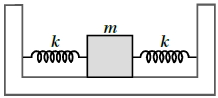
Two identical springs of spring constant $k$ are attached to a block of mass $m$ and to fixed supports as shown in the figure. When the mass is displaced from the equilibrium position by a distance $x$ towards the right,find the restoring force.
Solution
(N/A) According to the figure,the block is displaced to the right side by a distance $x$.
The right spring gets compressed by $x$,developing a restoring force $kx$ towards the left on the block.
The left spring is stretched by an amount $x$,developing a restoring force $kx$ towards the left on the block.
Hence,the total restoring force $F$ towards the left on the block is:
$F = kx + kx$
$\therefore F = 2kx$
The right spring gets compressed by $x$,developing a restoring force $kx$ towards the left on the block.
The left spring is stretched by an amount $x$,developing a restoring force $kx$ towards the left on the block.
Hence,the total restoring force $F$ towards the left on the block is:
$F = kx + kx$
$\therefore F = 2kx$
0 likes
View Solution176
Difficult
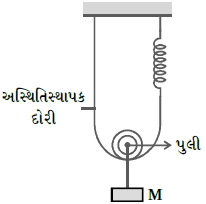
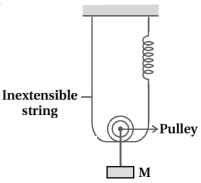
Find the time period of mass $M$ when displaced from its equilibrium position and then released for the system shown in the figure.
Solution
(N/A) Let the spring constant be $k$. When the mass $M$ is displaced downwards by a distance $x$,the pulley moves down by $x$. Since the string is inextensible and passes over the pulley,both sides of the string attached to the pulley must move down by $x$. This causes the spring to stretch by an additional $2x$.
The change in the spring force is $\Delta F = k(2x) = 2kx$.
Since the string is connected to the pulley on both sides,the restoring force $F_{rest}$ acting on the mass $M$ is the sum of the tension changes on both sides of the pulley. Each side of the string experiences a tension change of $\Delta T = k(2x) = 2kx$.
Therefore,the total restoring force is $F_{rest} = 2 \times \Delta T = 2 \times (2kx) = 4kx$.
Comparing this with the standard $SHM$ restoring force equation $F = -k_{eff}x$,we get the effective spring constant $k_{eff} = 4k$.
The time period $T$ of the system is given by $T = 2\pi \sqrt{\frac{M}{k_{eff}}} = 2\pi \sqrt{\frac{M}{4k}} = \pi \sqrt{\frac{M}{k}}$.
The change in the spring force is $\Delta F = k(2x) = 2kx$.
Since the string is connected to the pulley on both sides,the restoring force $F_{rest}$ acting on the mass $M$ is the sum of the tension changes on both sides of the pulley. Each side of the string experiences a tension change of $\Delta T = k(2x) = 2kx$.
Therefore,the total restoring force is $F_{rest} = 2 \times \Delta T = 2 \times (2kx) = 4kx$.
Comparing this with the standard $SHM$ restoring force equation $F = -k_{eff}x$,we get the effective spring constant $k_{eff} = 4k$.
The time period $T$ of the system is given by $T = 2\pi \sqrt{\frac{M}{k_{eff}}} = 2\pi \sqrt{\frac{M}{4k}} = \pi \sqrt{\frac{M}{k}}$.
0 likes
View Solution177
Medium
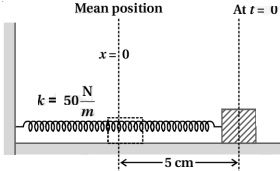
$A$ mass of $2 \, kg$ is attached to a spring with a spring constant of $50 \, N/m$. The block is pulled to a distance of $5 \, cm$ from its equilibrium position at $x = 0$ on a horizontal frictionless surface and released from rest at $t = 0$. Write the expression for its displacement at any time $t$.
Solution
(N/A) The spring-block system executes simple harmonic motion $(SHM)$ with an amplitude $A = 5 \, cm$ from the mean position.
Given:
Spring constant $k = 50 \, N/m$
Amplitude $A = 5 \, cm = 0.05 \, m$
Mass $m = 2 \, kg$
The angular frequency $\omega$ is given by:
$\omega = \sqrt{\frac{k}{m}} = \sqrt{\frac{50}{2}} = \sqrt{25} = 5 \, rad/s$
The general equation for displacement in $SHM$ is:
$x(t) = A \sin(\omega t + \phi)$
At $t = 0$,the block is at its maximum displacement $x = A$ (since it is pulled to $5 \, cm$ and released from rest).
$x(0) = A \sin(\phi) = A$
$\sin(\phi) = 1 \implies \phi = \frac{\pi}{2} \, rad$
Substituting the values into the general equation:
$x(t) = 5 \sin(5t + \frac{\pi}{2})$
Since $\sin(\theta + \frac{\pi}{2}) = \cos(\theta)$,
$x(t) = 5 \cos(5t)$
where $x$ is in $cm$ and $t$ is in seconds.
Given:
Spring constant $k = 50 \, N/m$
Amplitude $A = 5 \, cm = 0.05 \, m$
Mass $m = 2 \, kg$
The angular frequency $\omega$ is given by:
$\omega = \sqrt{\frac{k}{m}} = \sqrt{\frac{50}{2}} = \sqrt{25} = 5 \, rad/s$
The general equation for displacement in $SHM$ is:
$x(t) = A \sin(\omega t + \phi)$
At $t = 0$,the block is at its maximum displacement $x = A$ (since it is pulled to $5 \, cm$ and released from rest).
$x(0) = A \sin(\phi) = A$
$\sin(\phi) = 1 \implies \phi = \frac{\pi}{2} \, rad$
Substituting the values into the general equation:
$x(t) = 5 \sin(5t + \frac{\pi}{2})$
Since $\sin(\theta + \frac{\pi}{2}) = \cos(\theta)$,
$x(t) = 5 \cos(5t)$
where $x$ is in $cm$ and $t$ is in seconds.
0 likes
View Solution178
Difficult
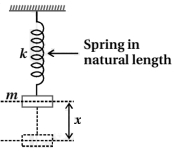
$A$ body of mass $m$ is attached to one end of a massless spring which is suspended vertically from a fixed point. The mass is held in hand,so that the spring is neither stretched nor compressed. Suddenly,the support of the hand is removed. The lowest position attained by the mass during oscillation is $4 \, cm$ below the point where it was held in hand.
$(a)$ What is the amplitude of oscillation?
$(b)$ Find the frequency of oscillation.
$(a)$ What is the amplitude of oscillation?
$(b)$ Find the frequency of oscillation.
Solution
(N/A) Let the spring constant be $k$. When the hand is removed,the mass $m$ starts oscillating. The lowest point reached is $x_{max} = 4 \, cm = 0.04 \, m$. At this point,the velocity is zero,so by the work-energy theorem,the loss in gravitational potential energy equals the gain in elastic potential energy:
$mgx_{max} = \frac{1}{2} k x_{max}^2$
$mg = \frac{1}{2} k x_{max} \implies x_{max} = \frac{2mg}{k}$.
The equilibrium position (mean position) is at $x_{eq} = \frac{mg}{k}$.
The amplitude $A$ is the distance from the mean position to the extreme position:
$A = x_{max} - x_{eq} = \frac{2mg}{k} - \frac{mg}{k} = \frac{mg}{k}$.
Since $x_{max} = 4 \, cm$,then $\frac{2mg}{k} = 4 \, cm$,which means $\frac{mg}{k} = 2 \, cm$.
Thus,the amplitude $A = 2 \, cm = 0.02 \, m$.
$(b)$ The frequency of oscillation $f$ is given by $f = \frac{1}{2\pi} \sqrt{\frac{k}{m}}$.
From $\frac{mg}{k} = 0.02 \, m$,we have $\frac{k}{m} = \frac{g}{0.02} = \frac{9.8}{0.02} = 490 \, s^{-2}$.
$f = \frac{1}{2\pi} \sqrt{490} \approx \frac{22.136}{6.28} \approx 3.52 \, Hz$.
$mgx_{max} = \frac{1}{2} k x_{max}^2$
$mg = \frac{1}{2} k x_{max} \implies x_{max} = \frac{2mg}{k}$.
The equilibrium position (mean position) is at $x_{eq} = \frac{mg}{k}$.
The amplitude $A$ is the distance from the mean position to the extreme position:
$A = x_{max} - x_{eq} = \frac{2mg}{k} - \frac{mg}{k} = \frac{mg}{k}$.
Since $x_{max} = 4 \, cm$,then $\frac{2mg}{k} = 4 \, cm$,which means $\frac{mg}{k} = 2 \, cm$.
Thus,the amplitude $A = 2 \, cm = 0.02 \, m$.
$(b)$ The frequency of oscillation $f$ is given by $f = \frac{1}{2\pi} \sqrt{\frac{k}{m}}$.
From $\frac{mg}{k} = 0.02 \, m$,we have $\frac{k}{m} = \frac{g}{0.02} = \frac{9.8}{0.02} = 490 \, s^{-2}$.
$f = \frac{1}{2\pi} \sqrt{490} \approx \frac{22.136}{6.28} \approx 3.52 \, Hz$.
0 likes
View Solution179
MediumMCQ
$A$ block of mass $m$ attached to a massless spring is performing oscillatory motion of amplitude $A$ on a frictionless horizontal plane. If half of the mass of the block breaks off when it is passing through its equilibrium point,the amplitude of oscillation for the remaining system becomes $fA$. The value of $f$ is
A
$1/2$
B
$1/\sqrt{2}$
C
$1$
D
$\sqrt{2}$
Solution
(B) At the equilibrium position,the velocity of the block is maximum,given by $V_0 = \omega_0 A = \sqrt{\frac{k}{m}} A$.
When half the mass breaks off at the equilibrium position,the velocity of the remaining mass $m/2$ remains the same as $V_0$ because there is no impulsive force acting on the system in the horizontal direction.
Let the new amplitude be $A'$. The new angular frequency is $\omega' = \sqrt{\frac{k}{m/2}} = \sqrt{\frac{2k}{m}} = \sqrt{2} \omega_0$.
Since the velocity at the equilibrium position is $V_0 = \omega' A'$,we have:
$\omega_0 A = \omega' A'$
$\omega_0 A = (\sqrt{2} \omega_0) A'$
$A' = \frac{A}{\sqrt{2}}$.
Thus,$f = \frac{1}{\sqrt{2}}$.
When half the mass breaks off at the equilibrium position,the velocity of the remaining mass $m/2$ remains the same as $V_0$ because there is no impulsive force acting on the system in the horizontal direction.
Let the new amplitude be $A'$. The new angular frequency is $\omega' = \sqrt{\frac{k}{m/2}} = \sqrt{\frac{2k}{m}} = \sqrt{2} \omega_0$.
Since the velocity at the equilibrium position is $V_0 = \omega' A'$,we have:
$\omega_0 A = \omega' A'$
$\omega_0 A = (\sqrt{2} \omega_0) A'$
$A' = \frac{A}{\sqrt{2}}$.
Thus,$f = \frac{1}{\sqrt{2}}$.
0 likes
View Solution180
DifficultMCQ
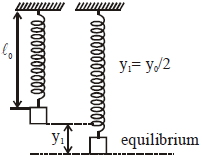
When a particle of mass $m$ is attached to a vertical spring of spring constant $k$ and released,its motion is described by $y(t) = y_{0} \sin^{2} \omega t$,where $y$ is measured from the lower end of the unstretched spring. Then $\omega$ is
A
$\sqrt{\frac{g}{y_{0}}}$
B
$\sqrt{\frac{g}{2y_{0}}}$
C
$\frac{1}{2} \sqrt{\frac{g}{y_{0}}}$
D
$\sqrt{\frac{2g}{y_{0}}}$
Solution
(B) The given equation of motion is $y = y_{0} \sin^{2} \omega t$.
Using the trigonometric identity $\sin^{2} \theta = \frac{1 - \cos 2\theta}{2}$,we can rewrite the equation as:
$y = \frac{y_{0}}{2} (1 - \cos 2\omega t)$
$y - \frac{y_{0}}{2} = -\frac{y_{0}}{2} \cos 2\omega t$
This represents simple harmonic motion about the equilibrium position $y_{eq} = \frac{y_{0}}{2}$ with an amplitude $A = \frac{y_{0}}{2}$.
For a vertical spring-mass system,the equilibrium position is at a distance $y_{eq} = \frac{mg}{k}$ from the unstretched position.
Therefore,$\frac{y_{0}}{2} = \frac{mg}{k}$,which implies $\frac{k}{m} = \frac{2g}{y_{0}}$.
The angular frequency of the oscillation is given by $\Omega = \sqrt{\frac{k}{m}}$.
From the equation $y = \frac{y_{0}}{2} - \frac{y_{0}}{2} \cos 2\omega t$,the angular frequency of the motion is $2\omega$.
Thus,$2\omega = \sqrt{\frac{k}{m}} = \sqrt{\frac{2g}{y_{0}}}$.
Solving for $\omega$,we get $\omega = \frac{1}{2} \sqrt{\frac{2g}{y_{0}}} = \sqrt{\frac{2g}{4y_{0}}} = \sqrt{\frac{g}{2y_{0}}}$.
Using the trigonometric identity $\sin^{2} \theta = \frac{1 - \cos 2\theta}{2}$,we can rewrite the equation as:
$y = \frac{y_{0}}{2} (1 - \cos 2\omega t)$
$y - \frac{y_{0}}{2} = -\frac{y_{0}}{2} \cos 2\omega t$
This represents simple harmonic motion about the equilibrium position $y_{eq} = \frac{y_{0}}{2}$ with an amplitude $A = \frac{y_{0}}{2}$.
For a vertical spring-mass system,the equilibrium position is at a distance $y_{eq} = \frac{mg}{k}$ from the unstretched position.
Therefore,$\frac{y_{0}}{2} = \frac{mg}{k}$,which implies $\frac{k}{m} = \frac{2g}{y_{0}}$.
The angular frequency of the oscillation is given by $\Omega = \sqrt{\frac{k}{m}}$.
From the equation $y = \frac{y_{0}}{2} - \frac{y_{0}}{2} \cos 2\omega t$,the angular frequency of the motion is $2\omega$.
Thus,$2\omega = \sqrt{\frac{k}{m}} = \sqrt{\frac{2g}{y_{0}}}$.
Solving for $\omega$,we get $\omega = \frac{1}{2} \sqrt{\frac{2g}{y_{0}}} = \sqrt{\frac{2g}{4y_{0}}} = \sqrt{\frac{g}{2y_{0}}}$.
0 likes
View Solution181
DifficultMCQ
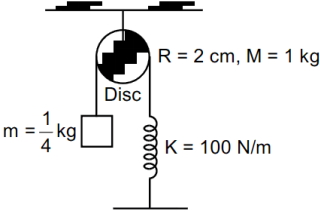
For the system given below,find the angular frequency of oscillation.
A
$\frac{10}{\sqrt{3}}$
B
$10 \sqrt{3}$
C
$\frac{20}{\sqrt{3}}$
D
$20 \sqrt{3}$
Solution
(C) The system consists of a block of mass $m = 1/4 \text{ kg}$ attached to a string passing over a disc of mass $M = 1 \text{ kg}$ and radius $R$,with the other end of the string attached to a spring of constant $K = 100 \text{ N/m}$.
Let $x$ be the displacement of the block. The velocity of the block is $v = \dot{x}$. The angular velocity of the disc is $\omega_d = v/R$. The extension in the spring is $x$,so the spring force is $Kx$.
The total energy $E$ of the system is given by:
$E = \frac{1}{2} Kx^2 + \frac{1}{2} mv^2 + \frac{1}{2} I \omega_d^2 = \text{constant}$
For a disc,the moment of inertia is $I = \frac{1}{2} MR^2$. Substituting this and $\omega_d = v/R$:
$E = \frac{1}{2} Kx^2 + \frac{1}{2} mv^2 + \frac{1}{2} (\frac{1}{2} MR^2) (\frac{v}{R})^2 = \frac{1}{2} Kx^2 + \frac{1}{2} mv^2 + \frac{1}{4} Mv^2$
$E = \frac{1}{2} Kx^2 + \frac{1}{2} (m + \frac{M}{2}) v^2$
Differentiating with respect to time $t$:
$\frac{dE}{dt} = Kx \dot{x} + (m + \frac{M}{2}) v \dot{v} = 0$
Since $\dot{x} = v$ and $\dot{v} = a$:
$Kxv + (m + \frac{M}{2}) va = 0$
$a = -\frac{K}{m + M/2} x$
Comparing with $a = -\omega^2 x$,the angular frequency is:
$\omega = \sqrt{\frac{K}{m + M/2}}$
Substituting the given values $K = 100 \text{ N/m}$,$m = 0.25 \text{ kg}$,$M = 1 \text{ kg}$:
$\omega = \sqrt{\frac{100}{0.25 + 1/2}} = \sqrt{\frac{100}{0.75}} = \sqrt{\frac{100}{3/4}} = \sqrt{\frac{400}{3}} = \frac{20}{\sqrt{3}} \text{ rad/s}$.
Let $x$ be the displacement of the block. The velocity of the block is $v = \dot{x}$. The angular velocity of the disc is $\omega_d = v/R$. The extension in the spring is $x$,so the spring force is $Kx$.
The total energy $E$ of the system is given by:
$E = \frac{1}{2} Kx^2 + \frac{1}{2} mv^2 + \frac{1}{2} I \omega_d^2 = \text{constant}$
For a disc,the moment of inertia is $I = \frac{1}{2} MR^2$. Substituting this and $\omega_d = v/R$:
$E = \frac{1}{2} Kx^2 + \frac{1}{2} mv^2 + \frac{1}{2} (\frac{1}{2} MR^2) (\frac{v}{R})^2 = \frac{1}{2} Kx^2 + \frac{1}{2} mv^2 + \frac{1}{4} Mv^2$
$E = \frac{1}{2} Kx^2 + \frac{1}{2} (m + \frac{M}{2}) v^2$
Differentiating with respect to time $t$:
$\frac{dE}{dt} = Kx \dot{x} + (m + \frac{M}{2}) v \dot{v} = 0$
Since $\dot{x} = v$ and $\dot{v} = a$:
$Kxv + (m + \frac{M}{2}) va = 0$
$a = -\frac{K}{m + M/2} x$
Comparing with $a = -\omega^2 x$,the angular frequency is:
$\omega = \sqrt{\frac{K}{m + M/2}}$
Substituting the given values $K = 100 \text{ N/m}$,$m = 0.25 \text{ kg}$,$M = 1 \text{ kg}$:
$\omega = \sqrt{\frac{100}{0.25 + 1/2}} = \sqrt{\frac{100}{0.75}} = \sqrt{\frac{100}{3/4}} = \sqrt{\frac{400}{3}} = \frac{20}{\sqrt{3}} \text{ rad/s}$.
0 likes
View Solution182
DifficultMCQ
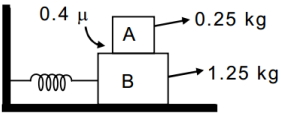
Find the maximum amplitude (in $cm$) of the $SHM$ such that block $A$ will not slip on block $B$. Given: spring constant $K = 100 \ N/m$,mass of block $A$ $m_A = 0.25 \ kg$,mass of block $B$ $m_B = 1.25 \ kg$,and coefficient of friction between $A$ and $B$ is $\mu = 0.4$. Take $g = 10 \ m/s^2$.
A
$2$
B
$4$
C
$6$
D
$8$
Solution
(C) For block $A$ not to slip on block $B$,the maximum pseudo force acting on $A$ must be less than or equal to the maximum static friction force.
The total mass of the system is $M = m_A + m_B = 0.25 + 1.25 = 1.5 \ kg$.
The angular frequency of the $SHM$ is $\omega = \sqrt{\frac{K}{M}} = \sqrt{\frac{100}{1.5}} = \sqrt{\frac{200}{3}} \ rad/s$.
The maximum acceleration of the system is $a_{max} = \omega^2 A$.
The condition for no slipping is $m_A a_{max} \leq \mu m_A g$,which simplifies to $a_{max} \leq \mu g$.
Substituting $a_{max} = \omega^2 A$,we get $\omega^2 A \leq \mu g$.
$A \leq \frac{\mu g}{\omega^2} = \frac{0.4 \times 10}{100 / 1.5} = \frac{4}{100 / 1.5} = \frac{4 \times 1.5}{100} = \frac{6}{100} \ m$.
Converting to $cm$,$A = 6 \ cm$.
The total mass of the system is $M = m_A + m_B = 0.25 + 1.25 = 1.5 \ kg$.
The angular frequency of the $SHM$ is $\omega = \sqrt{\frac{K}{M}} = \sqrt{\frac{100}{1.5}} = \sqrt{\frac{200}{3}} \ rad/s$.
The maximum acceleration of the system is $a_{max} = \omega^2 A$.
The condition for no slipping is $m_A a_{max} \leq \mu m_A g$,which simplifies to $a_{max} \leq \mu g$.
Substituting $a_{max} = \omega^2 A$,we get $\omega^2 A \leq \mu g$.
$A \leq \frac{\mu g}{\omega^2} = \frac{0.4 \times 10}{100 / 1.5} = \frac{4}{100 / 1.5} = \frac{4 \times 1.5}{100} = \frac{6}{100} \ m$.
Converting to $cm$,$A = 6 \ cm$.
0 likes
View Solution183
DifficultMCQ
Two springs of force constants $300 \, N/m$ (Spring $A$) and $400 \, N/m$ (Spring $B$) are joined together in series. The combination is compressed by $8.75 \, cm$. The ratio of energy stored in $A$ and $B$ is $E_A / E_B$. Then $E_A / E_B$ is equal to:
A
$4/3$
B
$16/9$
C
$3/4$
D
$9/16$
Solution
(A) In a series combination of springs,the restoring force $F$ acting on each spring is the same.
The energy stored in a spring is given by $E = \frac{F^2}{2k}$.
Since the force $F$ is constant for both springs in series,the ratio of energy stored is inversely proportional to their force constants:
$\frac{E_A}{E_B} = \frac{\frac{F^2}{2k_A}}{\frac{F^2}{2k_B}} = \frac{k_B}{k_A}$.
Given $k_A = 300 \, N/m$ and $k_B = 400 \, N/m$.
Therefore,$\frac{E_A}{E_B} = \frac{400}{300} = \frac{4}{3}$.
The energy stored in a spring is given by $E = \frac{F^2}{2k}$.
Since the force $F$ is constant for both springs in series,the ratio of energy stored is inversely proportional to their force constants:
$\frac{E_A}{E_B} = \frac{\frac{F^2}{2k_A}}{\frac{F^2}{2k_B}} = \frac{k_B}{k_A}$.
Given $k_A = 300 \, N/m$ and $k_B = 400 \, N/m$.
Therefore,$\frac{E_A}{E_B} = \frac{400}{300} = \frac{4}{3}$.
0 likes
View Solution184
DifficultMCQ
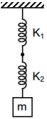
The time period of oscillation for the given combination will be:
A
$2 \pi \sqrt{\frac{m(K_{1}+K_{2})}{K_{1}K_{2}}}$
B
$2 \pi \sqrt{\frac{m}{K_{1}+K_{2}}}$
C
$2 \pi \sqrt{\frac{mK_{1}K_{2}}{K_{1}+K_{2}}}$
D
$2 \pi \sqrt{\frac{mK_{1}}{K_{2}}}$
Solution
(A) In the given figure,the two springs with spring constants $K_{1}$ and $K_{2}$ are connected in series.
The equivalent spring constant $K_{eq}$ for springs in series is given by the formula:
$\frac{1}{K_{eq}} = \frac{1}{K_{1}} + \frac{1}{K_{2}}$
Solving for $K_{eq}$:
$K_{eq} = \frac{K_{1}K_{2}}{K_{1}+K_{2}}$
The time period $T$ of oscillation for a mass $m$ attached to a spring system is given by:
$T = 2 \pi \sqrt{\frac{m}{K_{eq}}}$
Substituting the value of $K_{eq}$:
$T = 2 \pi \sqrt{\frac{m}{\left(\frac{K_{1}K_{2}}{K_{1}+K_{2}}\right)}}$
$T = 2 \pi \sqrt{\frac{m(K_{1}+K_{2})}{K_{1}K_{2}}}$
The equivalent spring constant $K_{eq}$ for springs in series is given by the formula:
$\frac{1}{K_{eq}} = \frac{1}{K_{1}} + \frac{1}{K_{2}}$
Solving for $K_{eq}$:
$K_{eq} = \frac{K_{1}K_{2}}{K_{1}+K_{2}}$
The time period $T$ of oscillation for a mass $m$ attached to a spring system is given by:
$T = 2 \pi \sqrt{\frac{m}{K_{eq}}}$
Substituting the value of $K_{eq}$:
$T = 2 \pi \sqrt{\frac{m}{\left(\frac{K_{1}K_{2}}{K_{1}+K_{2}}\right)}}$
$T = 2 \pi \sqrt{\frac{m(K_{1}+K_{2})}{K_{1}K_{2}}}$
0 likes
View Solution185
MediumMCQ
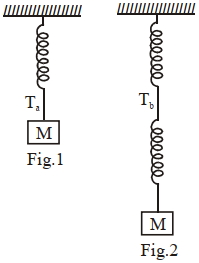
Consider two identical springs each of spring constant $k$ and negligible mass compared to the mass $M$ as shown. Fig. $1$ shows one of them and Fig. $2$ shows their series combination. The ratio of the time period of oscillation of the two $SHM$ is $\frac{T_b}{T_a} = \sqrt{x}$,where the value of $x$ is (Round off to the Nearest Integer).
A
$3$
B
$2$
C
$6$
D
$4$
Solution
(B) For Fig. $1$,the time period of oscillation for a single spring-mass system is given by:
$T_a = 2\pi \sqrt{\frac{M}{k}}$
For Fig. $2$,the two springs are connected in series. The equivalent spring constant $k_{eq}$ for two springs in series is given by:
$\frac{1}{k_{eq}} = \frac{1}{k} + \frac{1}{k} = \frac{2}{k} \Rightarrow k_{eq} = \frac{k}{2}$
The time period of oscillation for the series combination is:
$T_b = 2\pi \sqrt{\frac{M}{k_{eq}}} = 2\pi \sqrt{\frac{M}{k/2}} = 2\pi \sqrt{\frac{2M}{k}}$
Now,find the ratio $\frac{T_b}{T_a}$:
$\frac{T_b}{T_a} = \frac{2\pi \sqrt{\frac{2M}{k}}}{2\pi \sqrt{\frac{M}{k}}} = \sqrt{\frac{2M/k}{M/k}} = \sqrt{2}$
Given $\frac{T_b}{T_a} = \sqrt{x}$,we have $\sqrt{x} = \sqrt{2}$,which implies $x = 2$.
$T_a = 2\pi \sqrt{\frac{M}{k}}$
For Fig. $2$,the two springs are connected in series. The equivalent spring constant $k_{eq}$ for two springs in series is given by:
$\frac{1}{k_{eq}} = \frac{1}{k} + \frac{1}{k} = \frac{2}{k} \Rightarrow k_{eq} = \frac{k}{2}$
The time period of oscillation for the series combination is:
$T_b = 2\pi \sqrt{\frac{M}{k_{eq}}} = 2\pi \sqrt{\frac{M}{k/2}} = 2\pi \sqrt{\frac{2M}{k}}$
Now,find the ratio $\frac{T_b}{T_a}$:
$\frac{T_b}{T_a} = \frac{2\pi \sqrt{\frac{2M}{k}}}{2\pi \sqrt{\frac{M}{k}}} = \sqrt{\frac{2M/k}{M/k}} = \sqrt{2}$
Given $\frac{T_b}{T_a} = \sqrt{x}$,we have $\sqrt{x} = \sqrt{2}$,which implies $x = 2$.
0 likes
View Solution186
MediumMCQ
Two particles $A$ and $B$ of equal masses are suspended from two massless springs of spring constants $K_{1}$ and $K_{2}$ respectively. If the maximum velocities during oscillations are equal,the ratio of the amplitude of $A$ and $B$ is
A
$\frac{K_{2}}{K_{1}}$
B
$\frac{K_{1}}{K_{2}}$
C
$\sqrt{\frac{K_{1}}{K_{2}}}$
D
$\sqrt{\frac{K_{2}}{K_{1}}}$
Solution
(D) The maximum velocity of a particle in simple harmonic motion is given by $v_{max} = A\omega$,where $A$ is the amplitude and $\omega$ is the angular frequency.
For a spring-mass system,the angular frequency is $\omega = \sqrt{\frac{k}{m}}$.
Given that the maximum velocities of particles $A$ and $B$ are equal,we have $v_{max, A} = v_{max, B}$.
Therefore,$A_{1}\omega_{1} = A_{2}\omega_{2}$.
Substituting the expression for angular frequency: $A_{1}\sqrt{\frac{K_{1}}{m}} = A_{2}\sqrt{\frac{K_{2}}{m}}$.
Since the masses $m$ are equal,they cancel out: $A_{1}\sqrt{K_{1}} = A_{2}\sqrt{K_{2}}$.
Rearranging to find the ratio of amplitudes $\frac{A_{1}}{A_{2}}$,we get $\frac{A_{1}}{A_{2}} = \sqrt{\frac{K_{2}}{K_{1}}}$.
Thus,the ratio of the amplitude of $A$ to $B$ is $\sqrt{\frac{K_{2}}{K_{1}}}$.
For a spring-mass system,the angular frequency is $\omega = \sqrt{\frac{k}{m}}$.
Given that the maximum velocities of particles $A$ and $B$ are equal,we have $v_{max, A} = v_{max, B}$.
Therefore,$A_{1}\omega_{1} = A_{2}\omega_{2}$.
Substituting the expression for angular frequency: $A_{1}\sqrt{\frac{K_{1}}{m}} = A_{2}\sqrt{\frac{K_{2}}{m}}$.
Since the masses $m$ are equal,they cancel out: $A_{1}\sqrt{K_{1}} = A_{2}\sqrt{K_{2}}$.
Rearranging to find the ratio of amplitudes $\frac{A_{1}}{A_{2}}$,we get $\frac{A_{1}}{A_{2}} = \sqrt{\frac{K_{2}}{K_{1}}}$.
Thus,the ratio of the amplitude of $A$ to $B$ is $\sqrt{\frac{K_{2}}{K_{1}}}$.
0 likes
View Solution187
MediumMCQ
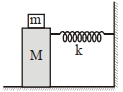
In the given figure,a mass $M$ is attached to a horizontal spring which is fixed on one side to a rigid support. The spring constant of the spring is $k$. The mass oscillates on a frictionless surface with time period $T$ and amplitude $A$. When the mass is at its maximum displacement (extreme position),another mass $m$ is gently placed upon it. The new amplitude of oscillation will be
A
$A \sqrt{\frac{M-m}{M}}$
B
$A \sqrt{\frac{M}{M+m}}$
C
$A \sqrt{\frac{M+m}{M}}$
D
$A \sqrt{\frac{M}{M-m}}$
Solution
(B) When the mass $M$ is at the extreme position,its velocity is zero. Therefore,the kinetic energy of the system is zero.
When the mass $m$ is gently placed on $M$ at the extreme position,the total energy of the system remains conserved.
The total energy of the system before placing the mass $m$ is $E = \frac{1}{2} k A^2$.
After placing the mass $m$,the new mass of the system becomes $(M + m)$. The spring constant $k$ remains the same.
Since the mass is placed at the extreme position,the displacement is still $A$. Thus,the potential energy remains $\frac{1}{2} k A^2$.
However,the new amplitude $A^{\prime}$ is determined by the new equilibrium position. Since the spring is horizontal and there is no friction,the equilibrium position does not change.
Thus,the new amplitude $A^{\prime}$ remains $A$ if placed at the extreme position.
However,if the question implies the mass is placed at the equilibrium position (where velocity is maximum),then momentum is conserved:
$M v_{max} = (M + m) v^{\prime}_{max}$
$M (A \omega) = (M + m) (A^{\prime} \omega^{\prime})$
$M A \sqrt{\frac{k}{M}} = (M + m) A^{\prime} \sqrt{\frac{k}{M+m}}$
$A \sqrt{M k} = A^{\prime} \sqrt{(M + m) k}$
$A^{\prime} = A \sqrt{\frac{M}{M+m}}$
When the mass $m$ is gently placed on $M$ at the extreme position,the total energy of the system remains conserved.
The total energy of the system before placing the mass $m$ is $E = \frac{1}{2} k A^2$.
After placing the mass $m$,the new mass of the system becomes $(M + m)$. The spring constant $k$ remains the same.
Since the mass is placed at the extreme position,the displacement is still $A$. Thus,the potential energy remains $\frac{1}{2} k A^2$.
However,the new amplitude $A^{\prime}$ is determined by the new equilibrium position. Since the spring is horizontal and there is no friction,the equilibrium position does not change.
Thus,the new amplitude $A^{\prime}$ remains $A$ if placed at the extreme position.
However,if the question implies the mass is placed at the equilibrium position (where velocity is maximum),then momentum is conserved:
$M v_{max} = (M + m) v^{\prime}_{max}$
$M (A \omega) = (M + m) (A^{\prime} \omega^{\prime})$
$M A \sqrt{\frac{k}{M}} = (M + m) A^{\prime} \sqrt{\frac{k}{M+m}}$
$A \sqrt{M k} = A^{\prime} \sqrt{(M + m) k}$
$A^{\prime} = A \sqrt{\frac{M}{M+m}}$
0 likes
View Solution188
MediumMCQ
If two similar springs each of spring constant $K$ are joined in series,the new spring constant and time period would be changed by a factor of:
A
$1/2, \sqrt{2}$
B
$1/4, \sqrt{2}$
C
$1/4, 2\sqrt{2}$
D
$1/2, 2\sqrt{2}$
Solution
(A) When two springs with spring constant $K$ are connected in series,the equivalent spring constant $K_{eq}$ is given by the formula: $\frac{1}{K_{eq}} = \frac{1}{K} + \frac{1}{K} = \frac{2}{K}$.
Therefore,$K_{eq} = \frac{K}{2}$. The new spring constant is changed by a factor of $1/2$.
The time period of a spring-mass system is given by $T = 2\pi \sqrt{\frac{M}{K}}$.
The new time period $T'$ with $K' = K/2$ is $T' = 2\pi \sqrt{\frac{M}{K/2}} = 2\pi \sqrt{\frac{2M}{K}} = \sqrt{2} \times (2\pi \sqrt{\frac{M}{K}}) = \sqrt{2}T$.
Thus,the time period changes by a factor of $\sqrt{2}$.
Therefore,$K_{eq} = \frac{K}{2}$. The new spring constant is changed by a factor of $1/2$.
The time period of a spring-mass system is given by $T = 2\pi \sqrt{\frac{M}{K}}$.
The new time period $T'$ with $K' = K/2$ is $T' = 2\pi \sqrt{\frac{M}{K/2}} = 2\pi \sqrt{\frac{2M}{K}} = \sqrt{2} \times (2\pi \sqrt{\frac{M}{K}}) = \sqrt{2}T$.
Thus,the time period changes by a factor of $\sqrt{2}$.
0 likes
View Solution189
DifficultMCQ
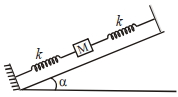
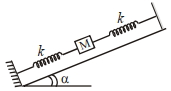
In the given figure,a body of mass $M$ is held between two massless springs on a smooth inclined plane. The free ends of the springs are attached to firm supports. If each spring has a spring constant $k,$ the frequency of oscillation of the given body is:
A
$\frac{1}{2 \pi} \sqrt{\frac{k}{2M}}$
B
$\frac{1}{2 \pi} \sqrt{\frac{2k}{Mg \sin \alpha}}$
C
$\frac{1}{2 \pi} \sqrt{\frac{2k}{M}}$
D
$\frac{1}{2 \pi} \sqrt{\frac{k}{Mg \sin \alpha}}$
Solution
(C) When the body of mass $M$ is displaced along the inclined plane,both springs are either compressed or stretched simultaneously.
Since the springs are connected in parallel with respect to the displacement of the mass,the effective spring constant $K_{eq}$ is given by:
$K_{eq} = k_1 + k_2 = k + k = 2k$.
The time period $T$ of oscillation for a spring-mass system is given by:
$T = 2 \pi \sqrt{\frac{M}{K_{eq}}} = 2 \pi \sqrt{\frac{M}{2k}}$.
The frequency of oscillation $f$ is the reciprocal of the time period:
$f = \frac{1}{T} = \frac{1}{2 \pi} \sqrt{\frac{2k}{M}}$.
Since the springs are connected in parallel with respect to the displacement of the mass,the effective spring constant $K_{eq}$ is given by:
$K_{eq} = k_1 + k_2 = k + k = 2k$.
The time period $T$ of oscillation for a spring-mass system is given by:
$T = 2 \pi \sqrt{\frac{M}{K_{eq}}} = 2 \pi \sqrt{\frac{M}{2k}}$.
The frequency of oscillation $f$ is the reciprocal of the time period:
$f = \frac{1}{T} = \frac{1}{2 \pi} \sqrt{\frac{2k}{M}}$.
0 likes
View Solution190
MediumMCQ
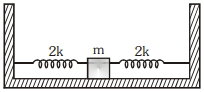
Two identical springs of spring constant $2k$ are attached to a block of mass $m$ and to fixed supports (see figure). When the mass is displaced from the equilibrium position on either side,it executes simple harmonic motion. The time period of oscillations of this system is ...... .
A
$2 \pi \sqrt{\frac{m}{k}}$
B
$\pi \sqrt{\frac{m}{2k}}$
C
$2 \pi \sqrt{\frac{m}{2k}}$
D
$\pi \sqrt{\frac{m}{k}}$
Solution
(D) When a block of mass $m$ is connected to two springs of spring constant $k_1$ and $k_2$ in parallel,the effective spring constant is $k_{eq} = k_1 + k_2$.
In this problem,both springs have a spring constant of $2k$.
Therefore,the equivalent spring constant is $k_{eq} = 2k + 2k = 4k$.
The time period $T$ of a simple harmonic oscillator is given by the formula $T = 2\pi \sqrt{\frac{m}{k_{eq}}}$.
Substituting the value of $k_{eq}$,we get $T = 2\pi \sqrt{\frac{m}{4k}}$.
Simplifying this,$T = 2\pi \frac{1}{2} \sqrt{\frac{m}{k}} = \pi \sqrt{\frac{m}{k}}$.
In this problem,both springs have a spring constant of $2k$.
Therefore,the equivalent spring constant is $k_{eq} = 2k + 2k = 4k$.
The time period $T$ of a simple harmonic oscillator is given by the formula $T = 2\pi \sqrt{\frac{m}{k_{eq}}}$.
Substituting the value of $k_{eq}$,we get $T = 2\pi \sqrt{\frac{m}{4k}}$.
Simplifying this,$T = 2\pi \frac{1}{2} \sqrt{\frac{m}{k}} = \pi \sqrt{\frac{m}{k}}$.
1 likes
View Solution191
DifficultMCQ
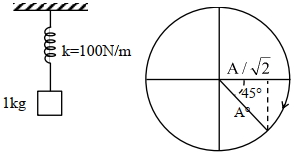
$A$ particle of mass $1 \, \text{kg}$ is hanging from a spring of force constant $100 \, \text{N/m}$. The mass is pulled slightly downward and released so that it executes free simple harmonic motion with time period $T$. The time when the kinetic energy and potential energy of the system will become equal is $\frac{T}{x}$. The value of $x$ is ..... .
A
$5$
B
$6$
C
$8$
D
$7$
Solution
(C) For a particle in simple harmonic motion,the total energy $E$ is the sum of kinetic energy $(KE)$ and potential energy $(PE)$.
$E = KE + PE$
Given that $KE = PE$,we have $E = 2 \cdot PE$ or $E = 2 \cdot KE$.
The potential energy at displacement $y$ is $PE = \frac{1}{2} k y^2$,and the total energy is $E = \frac{1}{2} k A^2$,where $A$ is the amplitude.
Setting $KE = PE$ implies $PE = \frac{1}{2} E$,so $\frac{1}{2} k y^2 = \frac{1}{2} (\frac{1}{2} k A^2)$.
This simplifies to $y^2 = \frac{A^2}{2}$,or $y = \frac{A}{\sqrt{2}}$.
Using the equation of motion $y = A \sin(\omega t)$,we get $\frac{A}{\sqrt{2}} = A \sin(\omega t)$,which means $\sin(\omega t) = \frac{1}{\sqrt{2}}$.
Thus,$\omega t = \frac{\pi}{4}$.
Since $\omega = \frac{2\pi}{T}$,we have $(\frac{2\pi}{T}) t = \frac{\pi}{4}$.
Solving for $t$,we get $t = \frac{T}{8}$.
Comparing this with $\frac{T}{x}$,we find $x = 8$.
$E = KE + PE$
Given that $KE = PE$,we have $E = 2 \cdot PE$ or $E = 2 \cdot KE$.
The potential energy at displacement $y$ is $PE = \frac{1}{2} k y^2$,and the total energy is $E = \frac{1}{2} k A^2$,where $A$ is the amplitude.
Setting $KE = PE$ implies $PE = \frac{1}{2} E$,so $\frac{1}{2} k y^2 = \frac{1}{2} (\frac{1}{2} k A^2)$.
This simplifies to $y^2 = \frac{A^2}{2}$,or $y = \frac{A}{\sqrt{2}}$.
Using the equation of motion $y = A \sin(\omega t)$,we get $\frac{A}{\sqrt{2}} = A \sin(\omega t)$,which means $\sin(\omega t) = \frac{1}{\sqrt{2}}$.
Thus,$\omega t = \frac{\pi}{4}$.
Since $\omega = \frac{2\pi}{T}$,we have $(\frac{2\pi}{T}) t = \frac{\pi}{4}$.
Solving for $t$,we get $t = \frac{T}{8}$.
Comparing this with $\frac{T}{x}$,we find $x = 8$.
0 likes
View Solution192
MediumMCQ
$A$ spring is stretched by $5 \,\,cm$ by a force of $10 \,\,N$. The time period of the oscillations when a mass of $2 \,\,kg$ is suspended by it is: (in $s$)
A
$0.0628$
B
$6.28$
C
$3.14$
D
$0.628$
Solution
(D) According to Hooke's Law, $F = Kx$, where $F$ is the force, $K$ is the spring constant, and $x$ is the displacement.
Given $F = 10 \,\,N$ and $x = 5 \,\,cm = 0.05 \,\,m$.
$10 = K \times 0.05 \implies K = \frac{10}{0.05} = 200 \,\,N/m$.
The time period $T$ of a spring-mass system is given by $T = 2 \pi \sqrt{\frac{m}{K}}$.
Substituting $m = 2 \,\,kg$ and $K = 200 \,\,N/m$:
$T = 2 \pi \sqrt{\frac{2}{200}} = 2 \pi \sqrt{\frac{1}{100}} = 2 \pi \times \frac{1}{10} = \frac{2 \times 3.14}{10} = 0.628 \,\,s$.
Given $F = 10 \,\,N$ and $x = 5 \,\,cm = 0.05 \,\,m$.
$10 = K \times 0.05 \implies K = \frac{10}{0.05} = 200 \,\,N/m$.
The time period $T$ of a spring-mass system is given by $T = 2 \pi \sqrt{\frac{m}{K}}$.
Substituting $m = 2 \,\,kg$ and $K = 200 \,\,N/m$:
$T = 2 \pi \sqrt{\frac{2}{200}} = 2 \pi \sqrt{\frac{1}{100}} = 2 \pi \times \frac{1}{10} = \frac{2 \times 3.14}{10} = 0.628 \,\,s$.
0 likes
View Solution193
DifficultMCQ
The motion of a mass on a spring,with spring constant $K$ is as shown in the figure. The equation of motion is given by $x(t) = A \sin \omega t + B \cos \omega t$ with $\omega = \sqrt{\frac{K}{m}}$. Suppose that at time $t = 0$,the position of the mass is $x(0)$ and velocity is $v(0)$,then its displacement can also be represented as $x(t) = C \cos (\omega t - \phi)$,where $C$ and $\phi$ are:
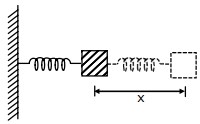
A
$C = \sqrt{\frac{2 v(0)^2}{\omega^2} + x(0)^2}, \phi = \tan^{-1} \left( \frac{x(0) \omega}{2 v(0)} \right)$
B
$C = \sqrt{\frac{v(0)^2}{\omega^2} + x(0)^2}, \phi = \tan^{-1} \left( \frac{x(0) \omega}{v(0)} \right)$
C
$C = \sqrt{\frac{2 v(0)^2}{\omega^2} + x(0)^2}, \phi = \tan^{-1} \left( \frac{v(0)}{x(0) \omega} \right)$
D
$C = \sqrt{\frac{v(0)^2}{\omega^2} + x(0)^2}, \phi = \tan^{-1} \left( \frac{v(0)}{x(0) \omega} \right)$
Solution
(D) Given the equation of motion: $x(t) = A \sin \omega t + B \cos \omega t$.
At $t = 0$,$x(0) = A \sin(0) + B \cos(0) = B$. So,$B = x(0)$.
The velocity is $v(t) = \frac{dx}{dt} = A \omega \cos \omega t - B \omega \sin \omega t$.
At $t = 0$,$v(0) = A \omega \cos(0) - B \omega \sin(0) = A \omega$. So,$A = \frac{v(0)}{\omega}$.
We want to express $x(t) = A \sin \omega t + B \cos \omega t$ in the form $x(t) = C \cos(\omega t - \phi) = C \cos \omega t \cos \phi + C \sin \omega t \sin \phi$.
Comparing the coefficients of $\sin \omega t$ and $\cos \omega t$:
$A = C \sin \phi$ and $B = C \cos \phi$.
Squaring and adding: $A^2 + B^2 = C^2 (\sin^2 \phi + \cos^2 \phi) = C^2$.
Thus,$C = \sqrt{A^2 + B^2} = \sqrt{\left( \frac{v(0)}{\omega} \right)^2 + x(0)^2} = \sqrt{\frac{v(0)^2}{\omega^2} + x(0)^2}$.
Dividing the coefficients: $\frac{A}{B} = \frac{C \sin \phi}{C \cos \phi} = \tan \phi$.
Therefore,$\tan \phi = \frac{A}{B} = \frac{v(0) / \omega}{x(0)} = \frac{v(0)}{x(0) \omega}$,which implies $\phi = \tan^{-1} \left( \frac{v(0)}{x(0) \omega} \right)$.
At $t = 0$,$x(0) = A \sin(0) + B \cos(0) = B$. So,$B = x(0)$.
The velocity is $v(t) = \frac{dx}{dt} = A \omega \cos \omega t - B \omega \sin \omega t$.
At $t = 0$,$v(0) = A \omega \cos(0) - B \omega \sin(0) = A \omega$. So,$A = \frac{v(0)}{\omega}$.
We want to express $x(t) = A \sin \omega t + B \cos \omega t$ in the form $x(t) = C \cos(\omega t - \phi) = C \cos \omega t \cos \phi + C \sin \omega t \sin \phi$.
Comparing the coefficients of $\sin \omega t$ and $\cos \omega t$:
$A = C \sin \phi$ and $B = C \cos \phi$.
Squaring and adding: $A^2 + B^2 = C^2 (\sin^2 \phi + \cos^2 \phi) = C^2$.
Thus,$C = \sqrt{A^2 + B^2} = \sqrt{\left( \frac{v(0)}{\omega} \right)^2 + x(0)^2} = \sqrt{\frac{v(0)^2}{\omega^2} + x(0)^2}$.
Dividing the coefficients: $\frac{A}{B} = \frac{C \sin \phi}{C \cos \phi} = \tan \phi$.
Therefore,$\tan \phi = \frac{A}{B} = \frac{v(0) / \omega}{x(0)} = \frac{v(0)}{x(0) \omega}$,which implies $\phi = \tan^{-1} \left( \frac{v(0)}{x(0) \omega} \right)$.
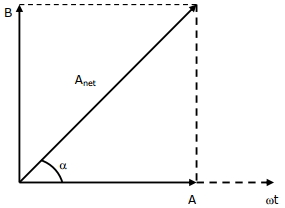
0 likes
View Solution194
DifficultMCQ
In the provided figure,two bodies $A$ and $B$ of masses $200 \, g$ and $800 \, g$ are attached to a system of springs. The springs are kept in a stretched position when the system is released. The horizontal surface is assumed to be frictionless. The angular frequency will be $..... \, rad/s$ when $k = 20 \, N/m$.

A
$100$
B
$20$
C
$10$
D
$30$
Solution
(C) The angular frequency $\omega$ of a two-body spring-mass system is given by $\omega = \sqrt{\frac{k_{\text{eq}}}{\mu}}$,where $k_{\text{eq}}$ is the equivalent spring constant and $\mu$ is the reduced mass.
$1$. Calculate the equivalent spring constant $k_{\text{eq}}$:
The springs are connected in series. Therefore,$k_{\text{eq}} = \frac{k_1 k_2}{k_1 + k_2}$.
Given $k_1 = k$ and $k_2 = 4k$,we have:
$k_{\text{eq}} = \frac{k \times 4k}{k + 4k} = \frac{4k^2}{5k} = \frac{4k}{5}$.
Substituting $k = 20 \, N/m$:
$k_{\text{eq}} = \frac{4 \times 20}{5} = 16 \, N/m$.
$2$. Calculate the reduced mass $\mu$:
$\mu = \frac{m_1 m_2}{m_1 + m_2}$.
Given $m_1 = 200 \, g = 0.2 \, kg$ and $m_2 = 800 \, g = 0.8 \, kg$:
$\mu = \frac{0.2 \times 0.8}{0.2 + 0.8} = \frac{0.16}{1.0} = 0.16 \, kg$.
$3$. Calculate the angular frequency $\omega$:
$\omega = \sqrt{\frac{16}{0.16}} = \sqrt{100} = 10 \, rad/s$.
$1$. Calculate the equivalent spring constant $k_{\text{eq}}$:
The springs are connected in series. Therefore,$k_{\text{eq}} = \frac{k_1 k_2}{k_1 + k_2}$.
Given $k_1 = k$ and $k_2 = 4k$,we have:
$k_{\text{eq}} = \frac{k \times 4k}{k + 4k} = \frac{4k^2}{5k} = \frac{4k}{5}$.
Substituting $k = 20 \, N/m$:
$k_{\text{eq}} = \frac{4 \times 20}{5} = 16 \, N/m$.
$2$. Calculate the reduced mass $\mu$:
$\mu = \frac{m_1 m_2}{m_1 + m_2}$.
Given $m_1 = 200 \, g = 0.2 \, kg$ and $m_2 = 800 \, g = 0.8 \, kg$:
$\mu = \frac{0.2 \times 0.8}{0.2 + 0.8} = \frac{0.16}{1.0} = 0.16 \, kg$.
$3$. Calculate the angular frequency $\omega$:
$\omega = \sqrt{\frac{16}{0.16}} = \sqrt{100} = 10 \, rad/s$.
0 likes
View Solution195
MediumMCQ
Two massless springs with spring constants $2k$ and $9k$ carry $50\,g$ and $100\,g$ masses at their free ends. These two masses oscillate vertically such that their maximum velocities are equal. Then,the ratio of their respective amplitudes will be
A
$1: 2$
B
$3: 2$
C
$3: 1$
D
$2: 3$
Solution
(B) The maximum velocity of a simple harmonic oscillator is given by $V_{\max} = \omega A$,where $\omega = \sqrt{\frac{k}{m}}$ is the angular frequency and $A$ is the amplitude.
Given $V_{\max,1} = V_{\max,2}$,we have $\omega_1 A_1 = \omega_2 A_2$,which implies $\frac{A_1}{A_2} = \frac{\omega_2}{\omega_1}$.
Substituting $\omega = \sqrt{\frac{k}{m}}$,we get $\frac{A_1}{A_2} = \sqrt{\frac{k_2}{m_2}} \times \sqrt{\frac{m_1}{k_1}} = \sqrt{\frac{k_2}{k_1} \times \frac{m_1}{m_2}}$.
Given $k_1 = 2k$,$k_2 = 9k$,$m_1 = 50\,g$,and $m_2 = 100\,g$.
Thus,$\frac{A_1}{A_2} = \sqrt{\frac{9k}{2k} \times \frac{50}{100}} = \sqrt{\frac{9}{2} \times \frac{1}{2}} = \sqrt{\frac{9}{4}} = \frac{3}{2}$.
Given $V_{\max,1} = V_{\max,2}$,we have $\omega_1 A_1 = \omega_2 A_2$,which implies $\frac{A_1}{A_2} = \frac{\omega_2}{\omega_1}$.
Substituting $\omega = \sqrt{\frac{k}{m}}$,we get $\frac{A_1}{A_2} = \sqrt{\frac{k_2}{m_2}} \times \sqrt{\frac{m_1}{k_1}} = \sqrt{\frac{k_2}{k_1} \times \frac{m_1}{m_2}}$.
Given $k_1 = 2k$,$k_2 = 9k$,$m_1 = 50\,g$,and $m_2 = 100\,g$.
Thus,$\frac{A_1}{A_2} = \sqrt{\frac{9k}{2k} \times \frac{50}{100}} = \sqrt{\frac{9}{2} \times \frac{1}{2}} = \sqrt{\frac{9}{4}} = \frac{3}{2}$.
0 likes
View Solution196
MediumMCQ
In figure $(A)$,mass '$2m$' is fixed on mass '$m$' which is attached to two springs of spring constant $k$. In figure $(B)$,mass '$m$' is attached to two springs of spring constant '$k$' and '$2k$'. If mass '$m$' in $(A)$ and $(B)$ are displaced by distance '$x$' horizontally and then released,then the time periods $T_{1}$ and $T_{2}$ corresponding to $(A)$ and $(B)$ respectively follow the relation.
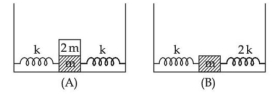
A
$\frac{T_{1}}{T_{2}}=\frac{3}{\sqrt{2}}$
B
$\frac{T_{1}}{T_{2}}=\sqrt{\frac{3}{2}}$
C
$\frac{T_{1}}{T_{2}}=\sqrt{\frac{2}{3}}$
D
$\frac{T_{1}}{T_{2}}=\frac{\sqrt{2}}{3}$
Solution
(A) For figure $(A)$,the total mass is $M = m + 2m = 3m$. The two springs of constant $k$ are in parallel,so the effective spring constant is $k_{eff} = k + k = 2k$.
The time period is $T_{1} = 2\pi \sqrt{\frac{M}{k_{eff}}} = 2\pi \sqrt{\frac{3m}{2k}}$.
For figure $(B)$,the mass is $m$. The two springs of constants $k$ and $2k$ are in parallel,so the effective spring constant is $k_{eff} = k + 2k = 3k$.
The time period is $T_{2} = 2\pi \sqrt{\frac{m}{3k}}$.
Taking the ratio,we get:
$\frac{T_{1}}{T_{2}} = \frac{2\pi \sqrt{\frac{3m}{2k}}}{2\pi \sqrt{\frac{m}{3k}}} = \sqrt{\frac{3m}{2k} \cdot \frac{3k}{m}} = \sqrt{\frac{9}{2}} = \frac{3}{\sqrt{2}}$.
The time period is $T_{1} = 2\pi \sqrt{\frac{M}{k_{eff}}} = 2\pi \sqrt{\frac{3m}{2k}}$.
For figure $(B)$,the mass is $m$. The two springs of constants $k$ and $2k$ are in parallel,so the effective spring constant is $k_{eff} = k + 2k = 3k$.
The time period is $T_{2} = 2\pi \sqrt{\frac{m}{3k}}$.
Taking the ratio,we get:
$\frac{T_{1}}{T_{2}} = \frac{2\pi \sqrt{\frac{3m}{2k}}}{2\pi \sqrt{\frac{m}{3k}}} = \sqrt{\frac{3m}{2k} \cdot \frac{3k}{m}} = \sqrt{\frac{9}{2}} = \frac{3}{\sqrt{2}}$.
0 likes
View Solution197
MediumMCQ
As per the given figures,two springs of spring constants $K$ and $2K$ are connected to a mass $m$. If the period of oscillation in figure $(a)$ is $3 \text{ s}$,then the period of oscillation in figure $(b)$ will be $\sqrt{x} \text{ s}$. The value of $x$ is $.........$
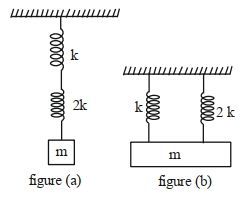
A
$20$
B
$1$
C
$22$
D
$2$
Solution
(D) For figure $(a)$,the springs are in series. The equivalent spring constant $K_{eq}$ is given by:
$K_{eq} = \frac{K \times 2K}{K + 2K} = \frac{2K}{3}$
The period of oscillation $T$ is:
$T = 2\pi \sqrt{\frac{m}{K_{eq}}} = 2\pi \sqrt{\frac{m}{2K/3}} = 2\pi \sqrt{\frac{3m}{2K}} = 3 \text{ s}$
For figure $(b)$,the springs are in parallel. The equivalent spring constant $K'_{eq}$ is:
$K'_{eq} = K + 2K = 3K$
The period of oscillation $T'$ is:
$T' = 2\pi \sqrt{\frac{m}{3K}}$
Dividing $T'$ by $T$:
$\frac{T'}{T} = \frac{2\pi \sqrt{\frac{m}{3K}}}{2\pi \sqrt{\frac{3m}{2K}}} = \sqrt{\frac{m}{3K} \times \frac{2K}{3m}} = \sqrt{\frac{2}{9}} = \frac{\sqrt{2}}{3}$
Given $T = 3 \text{ s}$,we have:
$T' = 3 \times \frac{\sqrt{2}}{3} = \sqrt{2} \text{ s}$
Comparing $T' = \sqrt{x} \text{ s}$ with $T' = \sqrt{2} \text{ s}$,we get $x = 2$.
$K_{eq} = \frac{K \times 2K}{K + 2K} = \frac{2K}{3}$
The period of oscillation $T$ is:
$T = 2\pi \sqrt{\frac{m}{K_{eq}}} = 2\pi \sqrt{\frac{m}{2K/3}} = 2\pi \sqrt{\frac{3m}{2K}} = 3 \text{ s}$
For figure $(b)$,the springs are in parallel. The equivalent spring constant $K'_{eq}$ is:
$K'_{eq} = K + 2K = 3K$
The period of oscillation $T'$ is:
$T' = 2\pi \sqrt{\frac{m}{3K}}$
Dividing $T'$ by $T$:
$\frac{T'}{T} = \frac{2\pi \sqrt{\frac{m}{3K}}}{2\pi \sqrt{\frac{3m}{2K}}} = \sqrt{\frac{m}{3K} \times \frac{2K}{3m}} = \sqrt{\frac{2}{9}} = \frac{\sqrt{2}}{3}$
Given $T = 3 \text{ s}$,we have:
$T' = 3 \times \frac{\sqrt{2}}{3} = \sqrt{2} \text{ s}$
Comparing $T' = \sqrt{x} \text{ s}$ with $T' = \sqrt{2} \text{ s}$,we get $x = 2$.
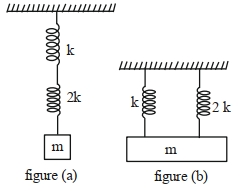
0 likes
View Solution198
DifficultMCQ
$A$ mass $0.9 \, kg$,attached to a horizontal spring,executes $SHM$ with an amplitude $A_{1}$. When this mass passes through its mean position,a smaller mass of $124 \, g$ is placed over it and both masses move together with amplitude $A_{2}$. If the ratio $\frac{A_{1}}{A_{2}}$ is $\frac{\alpha}{\alpha-1}$,then the value of $\alpha$ will be $......$
A
$18$
B
$8$
C
$16$
D
$32$
Solution
(C) The total energy of the $SHM$ is given by $E = \frac{1}{2} k A^2$. At the mean position,the potential energy is zero,so the total energy is purely kinetic: $E = \frac{p^2}{2m}$,where $p$ is the momentum.
Since the mass is added at the mean position,the velocity $v$ changes,but the momentum $p$ is conserved during the instantaneous placement of the mass.
Initial mass $m_1 = 0.9 \, kg = 900 \, g$. Final mass $m_2 = 900 \, g + 124 \, g = 1024 \, g$.
Since $E = \frac{1}{2} k A^2 = \frac{p^2}{2m}$,we have $A \propto \frac{1}{\sqrt{m}}$ for a constant momentum $p$.
Therefore,$\frac{A_1}{A_2} = \sqrt{\frac{m_2}{m_1}} = \sqrt{\frac{1024}{900}} = \frac{32}{30} = \frac{16}{15}$.
Given $\frac{A_1}{A_2} = \frac{\alpha}{\alpha-1} = \frac{16}{16-1}$.
Comparing the terms,we get $\alpha = 16$.
Since the mass is added at the mean position,the velocity $v$ changes,but the momentum $p$ is conserved during the instantaneous placement of the mass.
Initial mass $m_1 = 0.9 \, kg = 900 \, g$. Final mass $m_2 = 900 \, g + 124 \, g = 1024 \, g$.
Since $E = \frac{1}{2} k A^2 = \frac{p^2}{2m}$,we have $A \propto \frac{1}{\sqrt{m}}$ for a constant momentum $p$.
Therefore,$\frac{A_1}{A_2} = \sqrt{\frac{m_2}{m_1}} = \sqrt{\frac{1024}{900}} = \frac{32}{30} = \frac{16}{15}$.
Given $\frac{A_1}{A_2} = \frac{\alpha}{\alpha-1} = \frac{16}{16-1}$.
Comparing the terms,we get $\alpha = 16$.
0 likes
View Solution199
DifficultMCQ
The potential energy of a particle of mass $4 \, kg$ in motion along the $x$-axis is given by $U = 4(1 - \cos 4x) \, J$. The time period of the particle for small oscillations $(\sin \theta \simeq \theta)$ is $\left(\frac{\pi}{K}\right) \, s$. The value of $K$ is .......
A
$2$
B
$3$
C
$4$
D
$5$
Solution
(A) The potential energy is given by $U = 4(1 - \cos 4x)$.
For a conservative force,$F = -\frac{dU}{dx}$.
$F = -\frac{d}{dx} [4(1 - \cos 4x)] = -4(0 - (-\sin 4x) \cdot 4) = -16 \sin 4x$.
For small oscillations,$\sin \theta \approx \theta$,so $\sin 4x \approx 4x$.
Thus,$F \approx -16(4x) = -64x$.
Comparing this with the $SHM$ force equation $F = -m\omega^2 x$,we have $m\omega^2 = 64$.
Given mass $m = 4 \, kg$,we get $4 \cdot \omega^2 = 64$,which implies $\omega^2 = 16$,so $\omega = 4 \, rad/s$.
The time period $T = \frac{2\pi}{\omega} = \frac{2\pi}{4} = \frac{\pi}{2} \, s$.
Comparing this with $\frac{\pi}{K}$,we find $K = 2$.
For a conservative force,$F = -\frac{dU}{dx}$.
$F = -\frac{d}{dx} [4(1 - \cos 4x)] = -4(0 - (-\sin 4x) \cdot 4) = -16 \sin 4x$.
For small oscillations,$\sin \theta \approx \theta$,so $\sin 4x \approx 4x$.
Thus,$F \approx -16(4x) = -64x$.
Comparing this with the $SHM$ force equation $F = -m\omega^2 x$,we have $m\omega^2 = 64$.
Given mass $m = 4 \, kg$,we get $4 \cdot \omega^2 = 64$,which implies $\omega^2 = 16$,so $\omega = 4 \, rad/s$.
The time period $T = \frac{2\pi}{\omega} = \frac{2\pi}{4} = \frac{\pi}{2} \, s$.
Comparing this with $\frac{\pi}{K}$,we find $K = 2$.
1 likes
View Solution200
DifficultMCQ
Two masses $m_1$ and $m_2$ connected by a spring of spring constant $k$ rest on a frictionless surface. If the masses are pulled apart and let go,the time period of oscillation is
A
$T=2 \pi \sqrt{\frac{1}{k}\left(\frac{m_1 m_2}{m_1+m_2}\right)}$
B
$T=2 \pi \sqrt{k\left(\frac{m_1+m_2}{m_1 m_2}\right)}$
C
$T=2 \pi \sqrt{\frac{m_1}{k}}$
D
$T=2 \pi \sqrt{\frac{m_2}{k}}$
Solution
(A) The correct option is $A$.
Let the displacements of masses $m_1$ and $m_2$ from their equilibrium positions be $x_1$ and $x_2$,respectively.
The total elongation of the spring is $x = x_1 + x_2$.
The restoring force on each mass is $F = -kx$.
Applying Newton's second law to each mass:
$m_1 \frac{d^2 x_1}{dt^2} = -kx$
$m_2 \frac{d^2 x_2}{dt^2} = -kx$
From these,we have:
$\frac{d^2 x_1}{dt^2} = -\frac{k}{m_1} x$
$\frac{d^2 x_2}{dt^2} = -\frac{k}{m_2} x$
Since $x = x_1 + x_2$,the relative acceleration is:
$\frac{d^2 x}{dt^2} = \frac{d^2 x_1}{dt^2} + \frac{d^2 x_2}{dt^2} = -k \left( \frac{1}{m_1} + \frac{1}{m_2} \right) x = -k \left( \frac{m_1 + m_2}{m_1 m_2} \right) x$
This is the equation of simple harmonic motion $\frac{d^2 x}{dt^2} = -\omega^2 x$,where $\omega^2 = k \left( \frac{m_1 + m_2}{m_1 m_2} \right) = \frac{k}{\mu}$,where $\mu = \frac{m_1 m_2}{m_1 + m_2}$ is the reduced mass.
The time period $T$ is given by:
$T = \frac{2\pi}{\omega} = 2\pi \sqrt{\frac{\mu}{k}} = 2\pi \sqrt{\frac{m_1 m_2}{k(m_1 + m_2)}}$
Let the displacements of masses $m_1$ and $m_2$ from their equilibrium positions be $x_1$ and $x_2$,respectively.
The total elongation of the spring is $x = x_1 + x_2$.
The restoring force on each mass is $F = -kx$.
Applying Newton's second law to each mass:
$m_1 \frac{d^2 x_1}{dt^2} = -kx$
$m_2 \frac{d^2 x_2}{dt^2} = -kx$
From these,we have:
$\frac{d^2 x_1}{dt^2} = -\frac{k}{m_1} x$
$\frac{d^2 x_2}{dt^2} = -\frac{k}{m_2} x$
Since $x = x_1 + x_2$,the relative acceleration is:
$\frac{d^2 x}{dt^2} = \frac{d^2 x_1}{dt^2} + \frac{d^2 x_2}{dt^2} = -k \left( \frac{1}{m_1} + \frac{1}{m_2} \right) x = -k \left( \frac{m_1 + m_2}{m_1 m_2} \right) x$
This is the equation of simple harmonic motion $\frac{d^2 x}{dt^2} = -\omega^2 x$,where $\omega^2 = k \left( \frac{m_1 + m_2}{m_1 m_2} \right) = \frac{k}{\mu}$,where $\mu = \frac{m_1 m_2}{m_1 + m_2}$ is the reduced mass.
The time period $T$ is given by:
$T = \frac{2\pi}{\omega} = 2\pi \sqrt{\frac{\mu}{k}} = 2\pi \sqrt{\frac{m_1 m_2}{k(m_1 + m_2)}}$
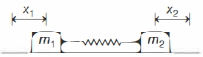
0 likes
View SolutionOscillations — SHM of Spring Mass System · Frequently Asked Questions
1Are these Oscillations questions useful for JEE and NEET?
Yes. All questions in this section are mapped to JEE Main and NEET exam patterns. Previous year questions from JEE Main, NEET, GUJCET and state-level exams are included with full solutions.
2Can I switch to Hindi or Gujarati for these questions?
Yes. Use the language tabs in the hero section or the sidebar to view the same questions and solutions in English, Hindi or Gujarati.
3How do I generate a question paper from this subtopic?
Use the Vedclass Exam Paper Generator — select the chapter and subtopic, set difficulty, and generate Sets A, B, C, D automatically. First 3 chapters of every subject are free.
Vedclass Products
For Students
Vedclass Test Series
Mock tests in real JEE/NEET style with performance analysis. 5-day free trial.
Start Free TrialFor Teachers
Exam Paper Generator
Generate Set A/B/C/D papers from this chapter in 2 minutes. 3 chapters free.
Try FreeFor Institutes
Online Exam Module
Live online exams with unlimited students, 360° analytics & white-label branding.
See DemoFor Teachers & Institutes
Generate a Oscillations Exam Paper in 2 Minutes
Select subtopic & difficulty — Sets A, B, C, D auto-generated with No Repeat logic.
First 3 chapters of every subject are free — no payment required.