
A English
Energy of Simple Harmonic Motion Questions in English
Class 11 Physics · Oscillations · Energy of Simple Harmonic Motion
224+
Questions
English
Language
100%
With Solutions
Showing 49 of 224 questions in English
1
EasyMCQ
The total energy of a particle executing $S.H.M.$ is proportional to
A
Displacement from equilibrium position
B
Frequency of oscillation
C
Velocity in equilibrium position
D
Square of amplitude of motion
Solution
(D) The total energy $E$ of a particle executing $S.H.M.$ is given by the formula:
$E = \frac{1}{2} m \omega^2 A^2$
Where $m$ is the mass of the particle,$\omega$ is the angular frequency,and $A$ is the amplitude of the motion.
From this expression,it is clear that the total energy $E$ is directly proportional to the square of the amplitude $A^2$.
Therefore,the correct option is $(d)$.
$E = \frac{1}{2} m \omega^2 A^2$
Where $m$ is the mass of the particle,$\omega$ is the angular frequency,and $A$ is the amplitude of the motion.
From this expression,it is clear that the total energy $E$ is directly proportional to the square of the amplitude $A^2$.
Therefore,the correct option is $(d)$.
0 likes
View Solution2
EasyMCQ
$A$ particle executes simple harmonic motion along a straight line with an amplitude $A$. The potential energy is maximum when the displacement is
A
$ \pm A$
B
Zero
C
$ \pm \frac{A}{2}$
D
$ \pm \frac{A}{\sqrt{2}}$
Solution
(A) The potential energy $(P.E.)$ of a particle executing simple harmonic motion is given by the formula: $P.E. = \frac{1}{2}m\omega^2x^2$,where $m$ is the mass,$\omega$ is the angular frequency,and $x$ is the displacement.
From the formula,it is clear that the potential energy is directly proportional to the square of the displacement $(x^2)$.
Therefore,the potential energy will be maximum when the displacement $x$ is at its maximum value.
Since the amplitude of the motion is $A$,the maximum displacement is $x = \pm A$.
Thus,the potential energy is maximum at $x = \pm A$.
From the formula,it is clear that the potential energy is directly proportional to the square of the displacement $(x^2)$.
Therefore,the potential energy will be maximum when the displacement $x$ is at its maximum value.
Since the amplitude of the motion is $A$,the maximum displacement is $x = \pm A$.
Thus,the potential energy is maximum at $x = \pm A$.
0 likes
View Solution3
MediumMCQ
$A$ particle is vibrating in a simple harmonic motion with an amplitude of $4\, cm$. At what displacement from the equilibrium position is its energy half potential and half kinetic?
A
$1\, cm$
B
$\sqrt{2}\, cm$
C
$3\, cm$
D
$2\sqrt{2}\, cm$
Solution
(D) The total energy $E$ of a particle in simple harmonic motion is the sum of its kinetic energy $(K.E.)$ and potential energy $(P.E.)$.
Given that at displacement $x$,the kinetic energy is equal to the potential energy,i.e.,$K.E. = P.E.$
We know that $P.E. = \frac{1}{2}m\omega^2x^2$ and $K.E. = \frac{1}{2}m\omega^2(a^2 - x^2)$,where $a$ is the amplitude.
Setting $K.E. = P.E.$:
$\frac{1}{2}m\omega^2(a^2 - x^2) = \frac{1}{2}m\omega^2x^2$
$a^2 - x^2 = x^2$
$2x^2 = a^2$
$x^2 = \frac{a^2}{2}$
$x = \frac{a}{\sqrt{2}}$
Given $a = 4\, cm$,we have:
$x = \frac{4}{\sqrt{2}} = 2\sqrt{2}\, cm$.
Thus,the correct option is $D$.
Given that at displacement $x$,the kinetic energy is equal to the potential energy,i.e.,$K.E. = P.E.$
We know that $P.E. = \frac{1}{2}m\omega^2x^2$ and $K.E. = \frac{1}{2}m\omega^2(a^2 - x^2)$,where $a$ is the amplitude.
Setting $K.E. = P.E.$:
$\frac{1}{2}m\omega^2(a^2 - x^2) = \frac{1}{2}m\omega^2x^2$
$a^2 - x^2 = x^2$
$2x^2 = a^2$
$x^2 = \frac{a^2}{2}$
$x = \frac{a}{\sqrt{2}}$
Given $a = 4\, cm$,we have:
$x = \frac{4}{\sqrt{2}} = 2\sqrt{2}\, cm$.
Thus,the correct option is $D$.
0 likes
View Solution4
EasyMCQ
For a particle executing simple harmonic motion,the kinetic energy $K$ is given by $K = K_0 \cos^2 \omega t$. The maximum value of potential energy is
A
$K_0$
B
Zero
C
$\frac{K_0}{2}$
D
Not obtainable
Solution
(A) In a simple harmonic motion $(SHM)$,the total mechanical energy $E$ remains constant.
Total energy $E = K + U$,where $K$ is kinetic energy and $U$ is potential energy.
The kinetic energy is given as $K = K_0 \cos^2 \omega t$.
The maximum value of kinetic energy $K_{\max}$ occurs when $\cos^2 \omega t = 1$,so $K_{\max} = K_0$.
At the extreme positions of $SHM$,the kinetic energy is zero,and the potential energy is at its maximum.
Since the total energy $E$ is equal to the maximum kinetic energy,$E = K_{\max} = K_0$.
At the extreme position,$K = 0$,therefore $U_{\max} = E = K_0$.
Thus,the maximum value of potential energy is $K_0$.
Total energy $E = K + U$,where $K$ is kinetic energy and $U$ is potential energy.
The kinetic energy is given as $K = K_0 \cos^2 \omega t$.
The maximum value of kinetic energy $K_{\max}$ occurs when $\cos^2 \omega t = 1$,so $K_{\max} = K_0$.
At the extreme positions of $SHM$,the kinetic energy is zero,and the potential energy is at its maximum.
Since the total energy $E$ is equal to the maximum kinetic energy,$E = K_{\max} = K_0$.
At the extreme position,$K = 0$,therefore $U_{\max} = E = K_0$.
Thus,the maximum value of potential energy is $K_0$.
0 likes
View Solution5
EasyMCQ
The potential energy of a particle with displacement $X$ is $U(X)$. The motion is simple harmonic,when ($K$ is a positive constant)
A
$U = \frac{1}{2}KX^2$
B
$U = KX^2$
C
$U = K$
D
$U = KX$
Solution
(A) For a particle to undergo simple harmonic motion $(SHM)$,the restoring force must be proportional to the displacement and directed towards the equilibrium position,given by $F = -KX$,where $K$ is the force constant.
The potential energy $U(X)$ is related to the force by the relation $F = -\frac{dU}{dX}$.
Integrating this expression,we get $U(X) = -\int F dX = -\int (-KX) dX = \int KX dX$.
Thus,$U(X) = \frac{1}{2}KX^2 + C$. Setting the potential energy at the equilibrium position $(X=0)$ to zero,we get $C = 0$.
Therefore,the potential energy for simple harmonic motion is $U = \frac{1}{2}KX^2$.
The potential energy $U(X)$ is related to the force by the relation $F = -\frac{dU}{dX}$.
Integrating this expression,we get $U(X) = -\int F dX = -\int (-KX) dX = \int KX dX$.
Thus,$U(X) = \frac{1}{2}KX^2 + C$. Setting the potential energy at the equilibrium position $(X=0)$ to zero,we get $C = 0$.
Therefore,the potential energy for simple harmonic motion is $U = \frac{1}{2}KX^2$.
0 likes
View Solution6
MediumMCQ
The kinetic energy and potential energy of a particle executing simple harmonic motion will be equal,when displacement (amplitude = $a$) is
A
$\frac{a}{2}$
B
$a\sqrt{2}$
C
$\frac{a}{\sqrt{2}}$
D
$\frac{a\sqrt{2}}{3}$
Solution
(C) Let the displacement of the particle be $y$ and the amplitude be $a$. The potential energy $(U)$ and kinetic energy $(K)$ of a particle in simple harmonic motion are given by:
$U = \frac{1}{2} m \omega^2 y^2$
$K = \frac{1}{2} m \omega^2 (a^2 - y^2)$
According to the problem,$U = K$:
$\frac{1}{2} m \omega^2 y^2 = \frac{1}{2} m \omega^2 (a^2 - y^2)$
$y^2 = a^2 - y^2$
$2y^2 = a^2$
$y^2 = \frac{a^2}{2}$
$y = \frac{a}{\sqrt{2}}$
$U = \frac{1}{2} m \omega^2 y^2$
$K = \frac{1}{2} m \omega^2 (a^2 - y^2)$
According to the problem,$U = K$:
$\frac{1}{2} m \omega^2 y^2 = \frac{1}{2} m \omega^2 (a^2 - y^2)$
$y^2 = a^2 - y^2$
$2y^2 = a^2$
$y^2 = \frac{a^2}{2}$
$y = \frac{a}{\sqrt{2}}$
0 likes
View Solution7
MediumMCQ
The total energy of a body executing $S.H.M.$ is $E$. Then the kinetic energy when the displacement is half of the amplitude,is
A
$\frac{E}{2}$
B
$\frac{E}{4}$
C
$\frac{3E}{4}$
D
$\frac{\sqrt{3}}{4}E$
Solution
(C) The total energy of a body executing $S.H.M.$ is given by $E = \frac{1}{2} k a^2$,where $a$ is the amplitude.
The potential energy at a displacement $y$ is given by $U = \frac{1}{2} k y^2$.
The kinetic energy $K$ is given by $K = E - U = \frac{1}{2} k a^2 - \frac{1}{2} k y^2 = \frac{1}{2} k (a^2 - y^2)$.
Given that the displacement $y = \frac{a}{2}$,we substitute this into the kinetic energy formula:
$K = \frac{1}{2} k (a^2 - (\frac{a}{2})^2)$
$K = \frac{1}{2} k (a^2 - \frac{a^2}{4})$
$K = \frac{1}{2} k (\frac{3a^2}{4})$
$K = \frac{3}{4} (\frac{1}{2} k a^2)$
Since $E = \frac{1}{2} k a^2$,we get $K = \frac{3E}{4}$.
The potential energy at a displacement $y$ is given by $U = \frac{1}{2} k y^2$.
The kinetic energy $K$ is given by $K = E - U = \frac{1}{2} k a^2 - \frac{1}{2} k y^2 = \frac{1}{2} k (a^2 - y^2)$.
Given that the displacement $y = \frac{a}{2}$,we substitute this into the kinetic energy formula:
$K = \frac{1}{2} k (a^2 - (\frac{a}{2})^2)$
$K = \frac{1}{2} k (a^2 - \frac{a^2}{4})$
$K = \frac{1}{2} k (\frac{3a^2}{4})$
$K = \frac{3}{4} (\frac{1}{2} k a^2)$
Since $E = \frac{1}{2} k a^2$,we get $K = \frac{3E}{4}$.
0 likes
View Solution8
MediumMCQ
The potential energy of a particle executing $S.H.M.$ is $2.5 \ J$,when its displacement is half of its amplitude. The total energy of the particle is .... $J$.
A
$18$
B
$10$
C
$12$
D
$2.5$
Solution
(B) The potential energy $U$ of a particle in $S.H.M.$ is given by $U = \frac{1}{2} m \omega^2 y^2$.
The total energy $E$ of the particle is given by $E = \frac{1}{2} m \omega^2 a^2$,where $a$ is the amplitude.
The ratio of potential energy to total energy is $\frac{U}{E} = \frac{y^2}{a^2}$.
Given that the displacement $y = \frac{a}{2}$,we substitute this into the ratio:
$\frac{2.5}{E} = \frac{(a/2)^2}{a^2} = \frac{a^2/4}{a^2} = \frac{1}{4}$.
Therefore,$E = 2.5 \times 4 = 10 \ J$.
The total energy $E$ of the particle is given by $E = \frac{1}{2} m \omega^2 a^2$,where $a$ is the amplitude.
The ratio of potential energy to total energy is $\frac{U}{E} = \frac{y^2}{a^2}$.
Given that the displacement $y = \frac{a}{2}$,we substitute this into the ratio:
$\frac{2.5}{E} = \frac{(a/2)^2}{a^2} = \frac{a^2/4}{a^2} = \frac{1}{4}$.
Therefore,$E = 2.5 \times 4 = 10 \ J$.
0 likes
View Solution9
MediumMCQ
When the potential energy of a particle executing simple harmonic motion is one-fourth of its maximum value during the oscillation,the displacement of the particle from the equilibrium position in terms of its amplitude $a$ is
A
$a/4$
B
$a/3$
C
$a/2$
D
$2a/3$
Solution
(C) The potential energy $U$ of a particle executing simple harmonic motion at a displacement $y$ is given by $U = \frac{1}{2}m\omega^2 y^2$.
The maximum potential energy $U_{\max}$ occurs at the amplitude $a$,given by $U_{\max} = \frac{1}{2}m\omega^2 a^2$.
According to the problem,the potential energy is one-fourth of its maximum value:
$U = \frac{1}{4} U_{\max}$
Substituting the expressions for $U$ and $U_{\max}$:
$\frac{1}{2}m\omega^2 y^2 = \frac{1}{4} (\frac{1}{2}m\omega^2 a^2)$
Canceling the common terms $\frac{1}{2}m\omega^2$ from both sides:
$y^2 = \frac{1}{4} a^2$
Taking the square root of both sides:
$y = \frac{a}{2}$
The maximum potential energy $U_{\max}$ occurs at the amplitude $a$,given by $U_{\max} = \frac{1}{2}m\omega^2 a^2$.
According to the problem,the potential energy is one-fourth of its maximum value:
$U = \frac{1}{4} U_{\max}$
Substituting the expressions for $U$ and $U_{\max}$:
$\frac{1}{2}m\omega^2 y^2 = \frac{1}{4} (\frac{1}{2}m\omega^2 a^2)$
Canceling the common terms $\frac{1}{2}m\omega^2$ from both sides:
$y^2 = \frac{1}{4} a^2$
Taking the square root of both sides:
$y = \frac{a}{2}$
0 likes
View Solution10
EasyMCQ
$A$ particle of mass $10 \, g$ is describing $S.H.M.$ along a straight line with a period of $2 \, s$ and an amplitude of $10 \, cm$. Its kinetic energy when it is at $5 \, cm$ from its equilibrium position is
A
$37.5 \pi^2 \, ergs$
B
$3.75 \pi^2 \, ergs$
C
$375 \pi^2 \, ergs$
D
$0.375 \pi^2 \, ergs$
Solution
(C) The kinetic energy $K$ of a particle performing $S.H.M.$ is given by the formula: $K = \frac{1}{2} m \omega^2 (a^2 - y^2)$.
Given: mass $m = 10 \, g$,period $T = 2 \, s$,amplitude $a = 10 \, cm$,and displacement $y = 5 \, cm$.
The angular frequency $\omega = \frac{2\pi}{T} = \frac{2\pi}{2} = \pi \, rad/s$.
Substituting the values into the formula:
$K = \frac{1}{2} \times 10 \times (\pi)^2 \times (10^2 - 5^2)$
$K = 5 \times \pi^2 \times (100 - 25)$
$K = 5 \times \pi^2 \times 75$
$K = 375 \pi^2 \, ergs$.
Given: mass $m = 10 \, g$,period $T = 2 \, s$,amplitude $a = 10 \, cm$,and displacement $y = 5 \, cm$.
The angular frequency $\omega = \frac{2\pi}{T} = \frac{2\pi}{2} = \pi \, rad/s$.
Substituting the values into the formula:
$K = \frac{1}{2} \times 10 \times (\pi)^2 \times (10^2 - 5^2)$
$K = 5 \times \pi^2 \times (100 - 25)$
$K = 5 \times \pi^2 \times 75$
$K = 375 \pi^2 \, ergs$.
0 likes
View Solution11
EasyMCQ
When the displacement is half the amplitude,the ratio of potential energy to the total energy is
A
$0.5$
B
$0.25$
C
$1$
D
$0.13$
Solution
(B) The potential energy $U$ of a simple harmonic oscillator is given by $U = \frac{1}{2}m\omega^2y^2$,where $y$ is the displacement.
The total energy $E$ of the oscillator is given by $E = \frac{1}{2}m\omega^2a^2$,where $a$ is the amplitude.
The ratio of potential energy to total energy is $\frac{U}{E} = \frac{\frac{1}{2}m\omega^2y^2}{\frac{1}{2}m\omega^2a^2} = \frac{y^2}{a^2}$.
Given that the displacement $y = \frac{a}{2}$,we substitute this into the ratio:
$\frac{U}{E} = \frac{(\frac{a}{2})^2}{a^2} = \frac{\frac{a^2}{4}}{a^2} = \frac{1}{4} = 0.25$.
The total energy $E$ of the oscillator is given by $E = \frac{1}{2}m\omega^2a^2$,where $a$ is the amplitude.
The ratio of potential energy to total energy is $\frac{U}{E} = \frac{\frac{1}{2}m\omega^2y^2}{\frac{1}{2}m\omega^2a^2} = \frac{y^2}{a^2}$.
Given that the displacement $y = \frac{a}{2}$,we substitute this into the ratio:
$\frac{U}{E} = \frac{(\frac{a}{2})^2}{a^2} = \frac{\frac{a^2}{4}}{a^2} = \frac{1}{4} = 0.25$.
0 likes
View Solution12
EasyMCQ
The $P.E.$ of a particle executing $SHM$ at a distance $x$ from its equilibrium position is
A
$\frac{1}{2}m{\omega ^2}{x^2}$
B
$\frac{1}{2}m{\omega ^2}{a^2}$
C
$\frac{1}{2}m{\omega ^2}({a^2} - {x^2})$
D
Zero
Solution
(A) The potential energy $(PE)$ of a particle executing simple harmonic motion $(SHM)$ is defined as the work done against the restoring force to displace the particle from its equilibrium position.
The restoring force is given by $F = -kx$,where $k$ is the force constant.
The potential energy is calculated by integrating the work done: $PE = \int_{0}^{x} F dx = \int_{0}^{x} kx dx = \frac{1}{2}kx^2$.
We know that the angular frequency $\omega$ is related to the force constant $k$ and mass $m$ by the relation $\omega^2 = \frac{k}{m}$,which implies $k = m\omega^2$.
Substituting this value of $k$ into the expression for potential energy,we get:
$PE = \frac{1}{2}m\omega^2x^2$.
The restoring force is given by $F = -kx$,where $k$ is the force constant.
The potential energy is calculated by integrating the work done: $PE = \int_{0}^{x} F dx = \int_{0}^{x} kx dx = \frac{1}{2}kx^2$.
We know that the angular frequency $\omega$ is related to the force constant $k$ and mass $m$ by the relation $\omega^2 = \frac{k}{m}$,which implies $k = m\omega^2$.
Substituting this value of $k$ into the expression for potential energy,we get:
$PE = \frac{1}{2}m\omega^2x^2$.
0 likes
View Solution13
EasyMCQ
$A$ vertical mass-spring system executes simple harmonic oscillations with a period of $2\, s$. $A$ quantity of this system which exhibits simple harmonic variation with a period of $1\, s$ is
A
Velocity
B
Potential energy
C
Phase difference between acceleration and displacement
D
Difference between kinetic energy and potential energy
Solution
(B) In a simple harmonic motion $(SHM)$ with time period $T$,the displacement is given by $x = A \sin(\omega t)$.
The velocity is $v = \frac{dx}{dt} = A\omega \cos(\omega t)$,which has the same time period $T = 2\, s$.
The potential energy is $U = \frac{1}{2} k x^2 = \frac{1}{2} k A^2 \sin^2(\omega t) = \frac{1}{4} k A^2 (1 - \cos(2\omega t))$.
The kinetic energy is $K = \frac{1}{2} m v^2 = \frac{1}{2} m A^2 \omega^2 \cos^2(\omega t) = \frac{1}{4} m A^2 \omega^2 (1 + \cos(2\omega t))$.
Both potential energy and kinetic energy vary with an angular frequency of $2\omega$,which corresponds to a time period of $T' = \frac{T}{2} = \frac{2\, s}{2} = 1\, s$.
Therefore,the potential energy exhibits simple harmonic variation with a period of $1\, s$.
The velocity is $v = \frac{dx}{dt} = A\omega \cos(\omega t)$,which has the same time period $T = 2\, s$.
The potential energy is $U = \frac{1}{2} k x^2 = \frac{1}{2} k A^2 \sin^2(\omega t) = \frac{1}{4} k A^2 (1 - \cos(2\omega t))$.
The kinetic energy is $K = \frac{1}{2} m v^2 = \frac{1}{2} m A^2 \omega^2 \cos^2(\omega t) = \frac{1}{4} m A^2 \omega^2 (1 + \cos(2\omega t))$.
Both potential energy and kinetic energy vary with an angular frequency of $2\omega$,which corresponds to a time period of $T' = \frac{T}{2} = \frac{2\, s}{2} = 1\, s$.
Therefore,the potential energy exhibits simple harmonic variation with a period of $1\, s$.
0 likes
View Solution14
EasyMCQ
For any $S.H.M.$,the amplitude is $6\, cm$. If the instantaneous potential energy is half the total energy,then the distance of the particle from its mean position is .... $cm$.
A
$3$
B
$4.2$
C
$5.8$
D
$6$
Solution
(B) The potential energy $U$ of a particle in $S.H.M.$ at displacement $y$ is given by $U = \frac{1}{2} m \omega^2 y^2$.
The total energy $E$ of the particle is given by $E = \frac{1}{2} m \omega^2 a^2$,where $a$ is the amplitude.
According to the problem,the instantaneous potential energy is half the total energy,so $U = \frac{1}{2} E$.
Substituting the expressions,we get $\frac{1}{2} m \omega^2 y^2 = \frac{1}{2} (\frac{1}{2} m \omega^2 a^2)$.
Simplifying this,we get $y^2 = \frac{a^2}{2}$,which implies $y = \frac{a}{\sqrt{2}}$.
Given $a = 6\, cm$,we have $y = \frac{6}{\sqrt{2}} = 3 \times \sqrt{2} \approx 3 \times 1.414 = 4.242\, cm$.
Rounding to the nearest provided option,the distance is $4.2\, cm$.
The total energy $E$ of the particle is given by $E = \frac{1}{2} m \omega^2 a^2$,where $a$ is the amplitude.
According to the problem,the instantaneous potential energy is half the total energy,so $U = \frac{1}{2} E$.
Substituting the expressions,we get $\frac{1}{2} m \omega^2 y^2 = \frac{1}{2} (\frac{1}{2} m \omega^2 a^2)$.
Simplifying this,we get $y^2 = \frac{a^2}{2}$,which implies $y = \frac{a}{\sqrt{2}}$.
Given $a = 6\, cm$,we have $y = \frac{6}{\sqrt{2}} = 3 \times \sqrt{2} \approx 3 \times 1.414 = 4.242\, cm$.
Rounding to the nearest provided option,the distance is $4.2\, cm$.
0 likes
View Solution15
EasyMCQ
$A$ body of mass $1\,kg$ is executing simple harmonic motion. Its displacement $y$ (in $cm$) at $t$ seconds is given by $y = 6\sin(100t + \pi/4)$. Its maximum kinetic energy is ..... $J$.
A
$6$
B
$18$
C
$24$
D
$36$
Solution
(B) Given mass $m = 1\,kg$.
The displacement equation is $y = 6\sin(100t + \pi/4)$.
Comparing this with the standard $SHM$ equation $y = A\sin(\omega t + \phi)$,we get:
Amplitude $A = 6\,cm = 6 \times 10^{-2}\,m$.
Angular frequency $\omega = 100\,rad/s$.
The maximum kinetic energy $(K_{\max})$ in $SHM$ is given by the formula:
$K_{\max} = \frac{1}{2}m\omega^2A^2$.
Substituting the values:
$K_{\max} = \frac{1}{2} \times 1 \times (100)^2 \times (6 \times 10^{-2})^2$.
$K_{\max} = \frac{1}{2} \times 10000 \times 36 \times 10^{-4}$.
$K_{\max} = \frac{1}{2} \times 10000 \times 0.0036$.
$K_{\max} = 0.5 \times 36 = 18\,J$.
The displacement equation is $y = 6\sin(100t + \pi/4)$.
Comparing this with the standard $SHM$ equation $y = A\sin(\omega t + \phi)$,we get:
Amplitude $A = 6\,cm = 6 \times 10^{-2}\,m$.
Angular frequency $\omega = 100\,rad/s$.
The maximum kinetic energy $(K_{\max})$ in $SHM$ is given by the formula:
$K_{\max} = \frac{1}{2}m\omega^2A^2$.
Substituting the values:
$K_{\max} = \frac{1}{2} \times 1 \times (100)^2 \times (6 \times 10^{-2})^2$.
$K_{\max} = \frac{1}{2} \times 10000 \times 36 \times 10^{-4}$.
$K_{\max} = \frac{1}{2} \times 10000 \times 0.0036$.
$K_{\max} = 0.5 \times 36 = 18\,J$.
0 likes
View Solution16
MediumMCQ
The frequency at which kinetic energy changes into potential energy in a simple harmonic motion ($S$.$H$.$M$.) with frequency $f$ is:
A
$f/2$
B
$f$
C
$2f$
D
$4f$
Solution
(C) In $S.H.M.$,the displacement is given by $x = A \sin(\omega t)$.
The kinetic energy is $K.E. = \frac{1}{2} m \omega^2 A^2 \cos^2(\omega t) = \frac{1}{4} m \omega^2 A^2 (1 + \cos(2\omega t))$.
The potential energy is $P.E. = \frac{1}{2} k x^2 = \frac{1}{2} k A^2 \sin^2(\omega t) = \frac{1}{4} k A^2 (1 - \cos(2\omega t))$.
Both kinetic and potential energies oscillate with an angular frequency of $2\omega$.
Since the frequency $f = \frac{\omega}{2\pi}$,the frequency of energy oscillation is $f' = \frac{2\omega}{2\pi} = 2f$.
Therefore,the frequency at which kinetic energy changes into potential energy is $2f$.
The kinetic energy is $K.E. = \frac{1}{2} m \omega^2 A^2 \cos^2(\omega t) = \frac{1}{4} m \omega^2 A^2 (1 + \cos(2\omega t))$.
The potential energy is $P.E. = \frac{1}{2} k x^2 = \frac{1}{2} k A^2 \sin^2(\omega t) = \frac{1}{4} k A^2 (1 - \cos(2\omega t))$.
Both kinetic and potential energies oscillate with an angular frequency of $2\omega$.
Since the frequency $f = \frac{\omega}{2\pi}$,the frequency of energy oscillation is $f' = \frac{2\omega}{2\pi} = 2f$.
Therefore,the frequency at which kinetic energy changes into potential energy is $2f$.
0 likes
View Solution17
EasyMCQ
The total energy of a particle performing $S.H.M.$ depends on:
A
$K, x$
B
$K, a$
C
$K, a, x$
D
$K, a, m$
Solution
(B) The total energy $E$ of a particle performing Simple Harmonic Motion $(S.H.M.)$ is given by the formula:
$E = \frac{1}{2} K a^2$
Where:
$K$ is the force constant (or spring constant),
$a$ is the amplitude of the oscillation.
Since the total energy is the sum of kinetic and potential energy at any point,it remains constant throughout the motion and is independent of the instantaneous displacement $x$.
Therefore,the total energy depends only on the force constant $K$ and the amplitude $a$.
$E = \frac{1}{2} K a^2$
Where:
$K$ is the force constant (or spring constant),
$a$ is the amplitude of the oscillation.
Since the total energy is the sum of kinetic and potential energy at any point,it remains constant throughout the motion and is independent of the instantaneous displacement $x$.
Therefore,the total energy depends only on the force constant $K$ and the amplitude $a$.
0 likes
View Solution18
MediumMCQ
The total energy of a particle executing $S.H.M.$ is $80 \, J$. What is the potential energy when the particle is at a distance of $\frac{3}{4}$ of amplitude from the mean position?
A
$60$
B
$10$
C
$40$
D
$45$
Solution
(D) The total energy $E$ of a particle in $S.H.M.$ is given by $E = \frac{1}{2} m \omega^2 a^2 = 80 \, J$,where $a$ is the amplitude.
The potential energy $U$ at a displacement $y$ is given by $U = \frac{1}{2} m \omega^2 y^2$.
Taking the ratio of potential energy to total energy:
$\frac{U}{E} = \frac{\frac{1}{2} m \omega^2 y^2}{\frac{1}{2} m \omega^2 a^2} = \frac{y^2}{a^2}$.
Given that the particle is at a distance $y = \frac{3}{4} a$ from the mean position:
$\frac{U}{80} = \frac{(\frac{3}{4} a)^2}{a^2} = \frac{9}{16}$.
Solving for $U$:
$U = 80 \times \frac{9}{16} = 5 \times 9 = 45 \, J$.
The potential energy $U$ at a displacement $y$ is given by $U = \frac{1}{2} m \omega^2 y^2$.
Taking the ratio of potential energy to total energy:
$\frac{U}{E} = \frac{\frac{1}{2} m \omega^2 y^2}{\frac{1}{2} m \omega^2 a^2} = \frac{y^2}{a^2}$.
Given that the particle is at a distance $y = \frac{3}{4} a$ from the mean position:
$\frac{U}{80} = \frac{(\frac{3}{4} a)^2}{a^2} = \frac{9}{16}$.
Solving for $U$:
$U = 80 \times \frac{9}{16} = 5 \times 9 = 45 \, J$.
0 likes
View Solution19
MediumMCQ
In a simple harmonic oscillator,at the mean position:
A
Kinetic energy is minimum,potential energy is maximum
B
Both kinetic and potential energies are maximum
C
Kinetic energy is maximum,potential energy is minimum
D
Both kinetic and potential energies are minimum
Solution
(C) The kinetic energy $(K.E.)$ and potential energy $(U)$ of a simple harmonic oscillator are given by:
$K.E. = \frac{1}{2} k(A^2 - x^2)$
$U = \frac{1}{2} k x^2$
At the mean position,the displacement $x = 0$.
Substituting $x = 0$ into the equations:
$K.E. = \frac{1}{2} k A^2$ (which is the maximum value)
$U = \frac{1}{2} k (0)^2 = 0$ (which is the minimum value)
Therefore,at the mean position,kinetic energy is maximum and potential energy is minimum.
$K.E. = \frac{1}{2} k(A^2 - x^2)$
$U = \frac{1}{2} k x^2$
At the mean position,the displacement $x = 0$.
Substituting $x = 0$ into the equations:
$K.E. = \frac{1}{2} k A^2$ (which is the maximum value)
$U = \frac{1}{2} k (0)^2 = 0$ (which is the minimum value)
Therefore,at the mean position,kinetic energy is maximum and potential energy is minimum.
0 likes
View Solution20
EasyMCQ
The displacement between the position of maximum potential energy and the position of maximum kinetic energy for a particle executing $S.H.M.$ is
A
$0$
B
$+a$
C
$\pm a$
D
$\pm \frac{a}{2}$
Solution
(C) In $S.H.M.$,the potential energy $U$ is given by $U = \frac{1}{2} k y^2$,where $y$ is the displacement.
Maximum potential energy occurs at the extreme positions,where $y = \pm a$.
Kinetic energy $K$ is given by $K = \frac{1}{2} k (a^2 - y^2)$.
Maximum kinetic energy occurs at the mean position,where $y = 0$.
The displacement between the position of maximum potential energy $(y = \pm a)$ and the position of maximum kinetic energy $(y = 0)$ is $| \pm a - 0 | = a$.
Maximum potential energy occurs at the extreme positions,where $y = \pm a$.
Kinetic energy $K$ is given by $K = \frac{1}{2} k (a^2 - y^2)$.
Maximum kinetic energy occurs at the mean position,where $y = 0$.
The displacement between the position of maximum potential energy $(y = \pm a)$ and the position of maximum kinetic energy $(y = 0)$ is $| \pm a - 0 | = a$.
0 likes
View Solution21
MediumMCQ
The potential energy of a simple harmonic oscillator when the particle is half way to its end point is (where $E$ is the total energy)
A
$\frac{1}{8}E$
B
$\frac{1}{4}E$
C
$\frac{1}{2}E$
D
$\frac{2}{3}E$
Solution
(B) The potential energy $U$ of a simple harmonic oscillator at a displacement $y$ is given by $U = \frac{1}{2}m\omega^2y^2$.
The total energy $E$ of the oscillator is given by $E = \frac{1}{2}m\omega^2a^2$,where $a$ is the amplitude.
The ratio of potential energy to total energy is $\frac{U}{E} = \frac{\frac{1}{2}m\omega^2y^2}{\frac{1}{2}m\omega^2a^2} = \frac{y^2}{a^2}$.
Given that the particle is half way to its end point,the displacement is $y = \frac{a}{2}$.
Substituting this value into the ratio,we get $\frac{U}{E} = \frac{(\frac{a}{2})^2}{a^2} = \frac{a^2/4}{a^2} = \frac{1}{4}$.
Therefore,$U = \frac{1}{4}E$.
The total energy $E$ of the oscillator is given by $E = \frac{1}{2}m\omega^2a^2$,where $a$ is the amplitude.
The ratio of potential energy to total energy is $\frac{U}{E} = \frac{\frac{1}{2}m\omega^2y^2}{\frac{1}{2}m\omega^2a^2} = \frac{y^2}{a^2}$.
Given that the particle is half way to its end point,the displacement is $y = \frac{a}{2}$.
Substituting this value into the ratio,we get $\frac{U}{E} = \frac{(\frac{a}{2})^2}{a^2} = \frac{a^2/4}{a^2} = \frac{1}{4}$.
Therefore,$U = \frac{1}{4}E$.
0 likes
View Solution22
EasyMCQ
$A$ body executes simple harmonic motion. The potential energy $(P.E.)$,the kinetic energy $(K.E.)$ and total energy $(T.E.)$ are measured as a function of displacement $x$. Which of the following statements is true?
A
$P.E.$ is maximum when $x = 0$
B
$K.E.$ is maximum when $x = 0$
C
$T.E.$ is zero when $x = 0$
D
$K.E.$ is maximum when $x$ is maximum
Solution
(B) In $S.H.M.$,the potential energy is given by $U = \frac{1}{2} k x^2$ and kinetic energy is given by $K = \frac{1}{2} k (A^2 - x^2)$.
At the mean position,$x = 0$. Substituting this into the expressions:
$U = \frac{1}{2} k (0)^2 = 0$ (Minimum potential energy).
$K = \frac{1}{2} k (A^2 - 0^2) = \frac{1}{2} k A^2$ (Maximum kinetic energy).
The total energy $E = U + K = \frac{1}{2} k A^2$,which remains constant throughout the motion.
Therefore,the kinetic energy is maximum at the mean position $(x = 0)$.
At the mean position,$x = 0$. Substituting this into the expressions:
$U = \frac{1}{2} k (0)^2 = 0$ (Minimum potential energy).
$K = \frac{1}{2} k (A^2 - 0^2) = \frac{1}{2} k A^2$ (Maximum kinetic energy).
The total energy $E = U + K = \frac{1}{2} k A^2$,which remains constant throughout the motion.
Therefore,the kinetic energy is maximum at the mean position $(x = 0)$.
1 likes
View Solution23
EasyMCQ
If $< E >$ and $< U >$ denote the average kinetic and the average potential energies respectively of a mass describing a simple harmonic motion,over one period,then the correct relation is:
A
$< E >=< U >$
B
$< E >=2 < U >$
C
$< E >=-2 < U >$
D
$< E >=- < U >$
Solution
(A) For a particle executing simple harmonic motion $(SHM)$ with amplitude $a$ and angular frequency $\omega$,the instantaneous kinetic energy is $E = \frac{1}{2}m\omega^2(a^2 - x^2)$ and potential energy is $U = \frac{1}{2}m\omega^2x^2$.
Over one complete period $T$,the average kinetic energy is given by $< E > = \frac{1}{T} \int_{0}^{T} \frac{1}{2}m\omega^2(a^2 - a^2 \sin^2(\omega t)) dt = \frac{1}{4}m\omega^2a^2$.
Similarly,the average potential energy is given by $< U > = \frac{1}{T} \int_{0}^{T} \frac{1}{2}m\omega^2(a^2 \sin^2(\omega t)) dt = \frac{1}{4}m\omega^2a^2$.
Therefore,the correct relation is $< E > = < U >$.
Over one complete period $T$,the average kinetic energy is given by $< E > = \frac{1}{T} \int_{0}^{T} \frac{1}{2}m\omega^2(a^2 - a^2 \sin^2(\omega t)) dt = \frac{1}{4}m\omega^2a^2$.
Similarly,the average potential energy is given by $< U > = \frac{1}{T} \int_{0}^{T} \frac{1}{2}m\omega^2(a^2 \sin^2(\omega t)) dt = \frac{1}{4}m\omega^2a^2$.
Therefore,the correct relation is $< E > = < U >$.
0 likes
View Solution24
EasyMCQ
The total energy of a particle,executing simple harmonic motion is
A
$ \propto x $
B
$ \propto x^2 $
C
Independent of $ x $
D
$ \propto x^{1/2} $
Solution
(C) The total energy $(E)$ of a particle executing simple harmonic motion $(SHM)$ is given by the sum of its kinetic energy $(K)$ and potential energy $(U)$.
$E = K + U = \frac{1}{2}m\omega^2(a^2 - x^2) + \frac{1}{2}m\omega^2x^2$
$E = \frac{1}{2}m\omega^2a^2$
Since $m$ (mass),$\omega$ (angular frequency),and $a$ (amplitude) are constants for a given $SHM$,the total energy is constant and independent of the displacement $x$.
$E = K + U = \frac{1}{2}m\omega^2(a^2 - x^2) + \frac{1}{2}m\omega^2x^2$
$E = \frac{1}{2}m\omega^2a^2$
Since $m$ (mass),$\omega$ (angular frequency),and $a$ (amplitude) are constants for a given $SHM$,the total energy is constant and independent of the displacement $x$.
0 likes
View Solution25
EasyMCQ
Consider the following statements. The total energy of a particle executing simple harmonic motion depends on its:
$(1)$ Amplitude $(2)$ Period $(3)$ Displacement
Of these statements:
$(1)$ Amplitude $(2)$ Period $(3)$ Displacement
Of these statements:
A
$(1)$ and $(2)$ are correct
B
$(2)$ and $(3)$ are correct
C
$(1)$ and $(3)$ are correct
D
$(1), (2)$ and $(3)$ are correct
Solution
(A) The total energy $E$ of a particle executing simple harmonic motion $(SHM)$ is given by the formula:
$E = \frac{1}{2} m \omega^2 A^2$
where $m$ is the mass of the particle,$\omega$ is the angular frequency,and $A$ is the amplitude.
Since $\omega = \frac{2\pi}{T}$,where $T$ is the period,we can substitute this into the energy equation:
$E = \frac{1}{2} m \left( \frac{2\pi}{T} \right)^2 A^2 = \frac{2 \pi^2 m A^2}{T^2}$
From this expression,it is clear that the total energy $E$ depends on the amplitude $A$ and the period $T$.
The total energy in $SHM$ is constant at all points in time and does not depend on the instantaneous displacement $x$.
Therefore,statements $(1)$ and $(2)$ are correct.
$E = \frac{1}{2} m \omega^2 A^2$
where $m$ is the mass of the particle,$\omega$ is the angular frequency,and $A$ is the amplitude.
Since $\omega = \frac{2\pi}{T}$,where $T$ is the period,we can substitute this into the energy equation:
$E = \frac{1}{2} m \left( \frac{2\pi}{T} \right)^2 A^2 = \frac{2 \pi^2 m A^2}{T^2}$
From this expression,it is clear that the total energy $E$ depends on the amplitude $A$ and the period $T$.
The total energy in $SHM$ is constant at all points in time and does not depend on the instantaneous displacement $x$.
Therefore,statements $(1)$ and $(2)$ are correct.
0 likes
View Solution26
MediumMCQ
$A$ particle starts simple harmonic motion from the mean position. Its amplitude is $a$ and total energy is $E$. At one instant,its kinetic energy is $3E/4$. Its displacement at that instant is:
A
$y = a$
B
$y = a/2$
C
$y = a\sqrt{3}/2$
D
$y = a/\sqrt{2}$
Solution
(B) The total energy $E$ of a particle in simple harmonic motion is given by $E = \frac{1}{2} m \omega^2 a^2$.
The kinetic energy $K$ at a displacement $y$ is given by $K = \frac{1}{2} m \omega^2 (a^2 - y^2)$.
Taking the ratio of kinetic energy to total energy:
$\frac{K}{E} = \frac{\frac{1}{2} m \omega^2 (a^2 - y^2)}{\frac{1}{2} m \omega^2 a^2} = \frac{a^2 - y^2}{a^2} = 1 - \frac{y^2}{a^2}$.
Given that $K = 3E/4$,we have:
$\frac{3E/4}{E} = 1 - \frac{y^2}{a^2}$.
$\frac{3}{4} = 1 - \frac{y^2}{a^2}$.
$\frac{y^2}{a^2} = 1 - \frac{3}{4} = \frac{1}{4}$.
Taking the square root of both sides,we get $y = a/2$.
The kinetic energy $K$ at a displacement $y$ is given by $K = \frac{1}{2} m \omega^2 (a^2 - y^2)$.
Taking the ratio of kinetic energy to total energy:
$\frac{K}{E} = \frac{\frac{1}{2} m \omega^2 (a^2 - y^2)}{\frac{1}{2} m \omega^2 a^2} = \frac{a^2 - y^2}{a^2} = 1 - \frac{y^2}{a^2}$.
Given that $K = 3E/4$,we have:
$\frac{3E/4}{E} = 1 - \frac{y^2}{a^2}$.
$\frac{3}{4} = 1 - \frac{y^2}{a^2}$.
$\frac{y^2}{a^2} = 1 - \frac{3}{4} = \frac{1}{4}$.
Taking the square root of both sides,we get $y = a/2$.
0 likes
View Solution27
EasyMCQ
$A$ particle executes simple harmonic motion with a frequency $f$. The frequency with which its kinetic energy oscillates is
A
$f/2$
B
$f$
C
$2f$
D
$4f$
Solution
(C) The displacement of a particle in simple harmonic motion is given by $x = a \sin(\omega t)$.
The velocity is $v = \frac{dx}{dt} = a\omega \cos(\omega t)$.
The kinetic energy $K$ is given by $K = \frac{1}{2}mv^2 = \frac{1}{2}m(a\omega \cos(\omega t))^2$.
Using the trigonometric identity $\cos^2 \theta = \frac{1 + \cos(2\theta)}{2}$,we get:
$K = \frac{1}{2}m a^2 \omega^2 \cos^2(\omega t) = \frac{1}{4}m a^2 \omega^2 (1 + \cos(2\omega t))$.
The term $\cos(2\omega t)$ indicates that the kinetic energy oscillates with an angular frequency of $2\omega$.
Since $\omega = 2\pi f$,the frequency of oscillation of kinetic energy is $2f$.
The velocity is $v = \frac{dx}{dt} = a\omega \cos(\omega t)$.
The kinetic energy $K$ is given by $K = \frac{1}{2}mv^2 = \frac{1}{2}m(a\omega \cos(\omega t))^2$.
Using the trigonometric identity $\cos^2 \theta = \frac{1 + \cos(2\theta)}{2}$,we get:
$K = \frac{1}{2}m a^2 \omega^2 \cos^2(\omega t) = \frac{1}{4}m a^2 \omega^2 (1 + \cos(2\omega t))$.
The term $\cos(2\omega t)$ indicates that the kinetic energy oscillates with an angular frequency of $2\omega$.
Since $\omega = 2\pi f$,the frequency of oscillation of kinetic energy is $2f$.
0 likes
View Solution28
EasyMCQ
The amplitude of a particle executing $SHM$ is made three-fourth keeping its time period constant. Its total energy will be
A
$\frac{E}{2}$
B
$\frac{3}{4}E$
C
$\frac{9}{16}E$
D
None of these
Solution
(C) The total energy $E$ of a particle executing $SHM$ is given by the formula $E = \frac{1}{2}m{\omega ^2}{A^2}$,where $m$ is the mass,$\omega$ is the angular frequency,and $A$ is the amplitude.
Since the time period $T$ is kept constant,the angular frequency $\omega = \frac{2\pi}{T}$ also remains constant.
Therefore,the total energy is directly proportional to the square of the amplitude: $E \propto A^2$.
Let the initial amplitude be $A$ and the initial energy be $E$. The new amplitude is $A' = \frac{3}{4}A$.
The new energy $E'$ is given by $\frac{E'}{E} = \left( \frac{A'}{A} \right)^2$.
Substituting the value of $A'$,we get $\frac{E'}{E} = \left( \frac{\frac{3}{4}A}{A} \right)^2 = \left( \frac{3}{4} \right)^2 = \frac{9}{16}$.
Thus,the new energy is $E' = \frac{9}{16}E$.
Since the time period $T$ is kept constant,the angular frequency $\omega = \frac{2\pi}{T}$ also remains constant.
Therefore,the total energy is directly proportional to the square of the amplitude: $E \propto A^2$.
Let the initial amplitude be $A$ and the initial energy be $E$. The new amplitude is $A' = \frac{3}{4}A$.
The new energy $E'$ is given by $\frac{E'}{E} = \left( \frac{A'}{A} \right)^2$.
Substituting the value of $A'$,we get $\frac{E'}{E} = \left( \frac{\frac{3}{4}A}{A} \right)^2 = \left( \frac{3}{4} \right)^2 = \frac{9}{16}$.
Thus,the new energy is $E' = \frac{9}{16}E$.
0 likes
View Solution29
EasyMCQ
$A$ particle of mass $m$ is hanging vertically by an ideal spring of force constant $K$. If the mass is made to oscillate vertically,its total energy is
A
Maximum at extreme position
B
Maximum at mean position
C
Minimum at mean position
D
Same at all position
Solution
(D) In simple harmonic motion,the energy oscillates between kinetic energy and potential energy.
However,the total mechanical energy,which is the sum of kinetic energy and potential energy,remains constant throughout the motion.
Therefore,the total energy of the particle is the same at all positions.
However,the total mechanical energy,which is the sum of kinetic energy and potential energy,remains constant throughout the motion.
Therefore,the total energy of the particle is the same at all positions.
0 likes
View Solution30
MediumMCQ
$A$ linear harmonic oscillator of force constant $2 \times 10^6 \, N/m$ and amplitude $0.01 \, m$ has a total mechanical energy of $160 \, J$. Its
A
Maximum potential energy is $100 \, J$
B
Maximum $K$.$E$. is $100 \, J$
C
Maximum $P$.$E$. is $160 \, J$
D
Both $(b)$ and $(c)$
Solution
(D) The total mechanical energy of the oscillator is given as $E = 160 \, J$.
For a linear harmonic oscillator,the energy associated with the harmonic oscillation (the kinetic energy part) is given by $E_{osc} = \frac{1}{2} k A^2$.
Substituting the given values: $E_{osc} = \frac{1}{2} \times (2 \times 10^6) \times (0.01)^2 = 10^6 \times 10^{-4} = 100 \, J$.
This $100 \, J$ represents the maximum kinetic energy $(K_{max})$ of the oscillator.
Since the total energy is $160 \, J$ and the oscillatory part is $100 \, J$,there must be an additional constant potential energy $U_0 = 160 - 100 = 60 \, J$.
The potential energy varies as $U(x) = U_0 + \frac{1}{2} k x^2$.
The maximum potential energy occurs at the extreme positions $(x = \pm A)$,which is $U_{max} = U_0 + \frac{1}{2} k A^2 = 60 + 100 = 160 \, J$.
Thus,both statements $(b)$ and $(c)$ are correct.
For a linear harmonic oscillator,the energy associated with the harmonic oscillation (the kinetic energy part) is given by $E_{osc} = \frac{1}{2} k A^2$.
Substituting the given values: $E_{osc} = \frac{1}{2} \times (2 \times 10^6) \times (0.01)^2 = 10^6 \times 10^{-4} = 100 \, J$.
This $100 \, J$ represents the maximum kinetic energy $(K_{max})$ of the oscillator.
Since the total energy is $160 \, J$ and the oscillatory part is $100 \, J$,there must be an additional constant potential energy $U_0 = 160 - 100 = 60 \, J$.
The potential energy varies as $U(x) = U_0 + \frac{1}{2} k x^2$.
The maximum potential energy occurs at the extreme positions $(x = \pm A)$,which is $U_{max} = U_0 + \frac{1}{2} k A^2 = 60 + 100 = 160 \, J$.
Thus,both statements $(b)$ and $(c)$ are correct.
0 likes
View Solution31
MediumMCQ
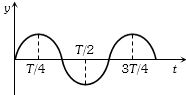
The graph shows the variation of displacement of a particle executing $S$.$H$.$M$. with time. We infer from this graph that
A
The force is zero at time $3T/4$
B
The velocity is maximum at time $T/2$
C
The acceleration is maximum at time $T$
D
The $P$.$E$. is equal to total energy at time $T/2$
Solution
(D) From the graph,at time $t = T/2$,the displacement $y$ is at its negative extreme position $(-A)$.
At the extreme position,the velocity of the particle is zero $(v = 0)$.
The total energy $(E)$ of a particle in $S$.$H$.$M$. is the sum of kinetic energy $(K.E.)$ and potential energy $(P.E.)$,given by $E = K.E. + P.E.$
Since $K.E. = \frac{1}{2}mv^2$,at $v = 0$,$K.E. = 0$.
Therefore,at the extreme position,$E = P.E.$
Thus,the potential energy is equal to the total energy at time $T/2$.
At the extreme position,the velocity of the particle is zero $(v = 0)$.
The total energy $(E)$ of a particle in $S$.$H$.$M$. is the sum of kinetic energy $(K.E.)$ and potential energy $(P.E.)$,given by $E = K.E. + P.E.$
Since $K.E. = \frac{1}{2}mv^2$,at $v = 0$,$K.E. = 0$.
Therefore,at the extreme position,$E = P.E.$
Thus,the potential energy is equal to the total energy at time $T/2$.
0 likes
View Solution32
MediumMCQ
As a body performs $S.H.M.$,its potential energy $U$ varies with time $t$ as indicated in:
A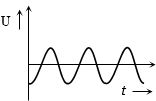
B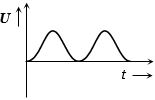
C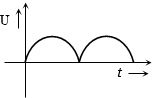
D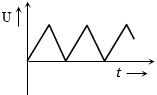
Solution
(B) The potential energy $U$ of a particle performing $S.H.M.$ is given by $U = \frac{1}{2} k x^2$,where $x = A \sin(\omega t + \phi)$.
Substituting $x$,we get $U = \frac{1}{2} k A^2 \sin^2(\omega t + \phi) = \frac{1}{4} k A^2 (1 - \cos(2\omega t + 2\phi))$.
This expression shows that $U$ is always non-negative $(U \ge 0)$ and varies sinusoidally with a frequency double that of the displacement $(2\omega)$.
Looking at the options,graph $B$ represents a function that is always non-negative and has a frequency double that of the standard sine wave,starting from zero at $t=0$ (assuming $\phi = 0$).
Therefore,graph $B$ correctly represents the variation of potential energy with time.
Substituting $x$,we get $U = \frac{1}{2} k A^2 \sin^2(\omega t + \phi) = \frac{1}{4} k A^2 (1 - \cos(2\omega t + 2\phi))$.
This expression shows that $U$ is always non-negative $(U \ge 0)$ and varies sinusoidally with a frequency double that of the displacement $(2\omega)$.
Looking at the options,graph $B$ represents a function that is always non-negative and has a frequency double that of the standard sine wave,starting from zero at $t=0$ (assuming $\phi = 0$).
Therefore,graph $B$ correctly represents the variation of potential energy with time.
0 likes
View Solution33
MediumMCQ
$A$ particle of mass $m$ oscillates with simple harmonic motion between points $x_1$ and $x_2$,the equilibrium position being $O$. Its potential energy is plotted. It will be as given below in the graph:
A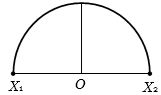
B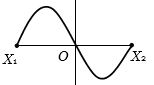
C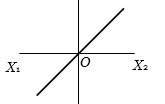
D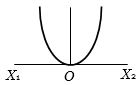
Solution
(D) The potential energy $(PE)$ of a particle performing simple harmonic motion $(SHM)$ is given by the expression:
$PE = \frac{1}{2} m \omega^2 x^2$
where $m$ is the mass,$\omega$ is the angular frequency,and $x$ is the displacement from the equilibrium position $O$.
This equation shows that the potential energy varies parabolically with displacement $x$.
At the mean position $(x = 0)$,the potential energy is zero.
At the extreme positions ($x = x_1$ and $x = x_2$),the potential energy is maximum.
Therefore,the graph of potential energy versus displacement is a parabola opening upwards with its vertex at the origin $O$,which corresponds to graph $D$.
$PE = \frac{1}{2} m \omega^2 x^2$
where $m$ is the mass,$\omega$ is the angular frequency,and $x$ is the displacement from the equilibrium position $O$.
This equation shows that the potential energy varies parabolically with displacement $x$.
At the mean position $(x = 0)$,the potential energy is zero.
At the extreme positions ($x = x_1$ and $x = x_2$),the potential energy is maximum.
Therefore,the graph of potential energy versus displacement is a parabola opening upwards with its vertex at the origin $O$,which corresponds to graph $D$.
0 likes
View Solution34
MediumMCQ
For a particle executing $S.H.M.$,the displacement $x$ is given by $x = A \cos \omega t$. Identify the graphs which represent the variation of potential energy $(P.E.)$ as a function of time $t$ and displacement $x$.
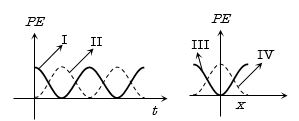
A
$I, III$
B
$II, IV$
C
$II, III$
D
$I, IV$
Solution
(A) The potential energy $(P.E.)$ of a particle in $S.H.M.$ is given by $U = \frac{1}{2} k x^2$.
Substituting $x = A \cos \omega t$,we get $U = \frac{1}{2} k A^2 \cos^2 \omega t = \frac{1}{2} k A^2 \left( \frac{1 + \cos 2 \omega t}{2} \right)$.
At $t = 0$,$x = A$,so $U$ is maximum. Graph $I$ shows $P.E.$ vs $t$ starting from a maximum value at $t = 0$,which matches the equation $U \propto \cos^2 \omega t$.
As a function of displacement $x$,$U = \frac{1}{2} k x^2$,which is a parabola opening upwards with its minimum at $x = 0$. Graph $III$ represents this parabolic variation of $P.E.$ with respect to $x$.
Thus,graphs $I$ and $III$ are correct.
Substituting $x = A \cos \omega t$,we get $U = \frac{1}{2} k A^2 \cos^2 \omega t = \frac{1}{2} k A^2 \left( \frac{1 + \cos 2 \omega t}{2} \right)$.
At $t = 0$,$x = A$,so $U$ is maximum. Graph $I$ shows $P.E.$ vs $t$ starting from a maximum value at $t = 0$,which matches the equation $U \propto \cos^2 \omega t$.
As a function of displacement $x$,$U = \frac{1}{2} k x^2$,which is a parabola opening upwards with its minimum at $x = 0$. Graph $III$ represents this parabolic variation of $P.E.$ with respect to $x$.
Thus,graphs $I$ and $III$ are correct.
0 likes
View Solution35
MediumMCQ
The acceleration $A$ and time $t$ of a body in $S.H.M.$ is given by the curve shown below. Then the corresponding graph between kinetic energy $(K.E.)$ and time $t$ is correctly represented by:
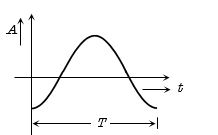
A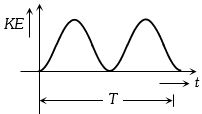
B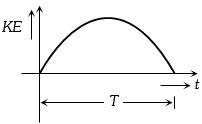
C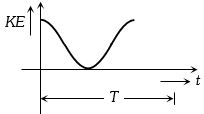
D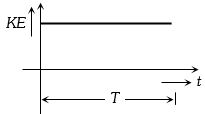
Solution
(A) In $S.H.M.$,the acceleration $A$ is given by $A = -\omega^2 x$. The given graph shows $A$ starting from a negative maximum value at $t = 0$. This implies the displacement $x$ is at a positive maximum (extreme position) at $t = 0$.
At the extreme position,the velocity $v$ of the particle is zero,and therefore the kinetic energy $(K.E. = \frac{1}{2}mv^2)$ is zero.
As the particle moves towards the mean position,its speed increases,reaching a maximum at the mean position,where acceleration is zero. Thus,$K.E.$ becomes maximum when acceleration is zero.
Since the acceleration completes one full cycle in time $T$,the kinetic energy,which depends on $v^2$,completes two cycles in the same time $T$. The graph starting from zero at $t = 0$,reaching a maximum,and returning to zero at $t = T/2$ corresponds to the behavior of $K.E.$ in $S.H.M.$ This is correctly represented by the graph in option $A$.
At the extreme position,the velocity $v$ of the particle is zero,and therefore the kinetic energy $(K.E. = \frac{1}{2}mv^2)$ is zero.
As the particle moves towards the mean position,its speed increases,reaching a maximum at the mean position,where acceleration is zero. Thus,$K.E.$ becomes maximum when acceleration is zero.
Since the acceleration completes one full cycle in time $T$,the kinetic energy,which depends on $v^2$,completes two cycles in the same time $T$. The graph starting from zero at $t = 0$,reaching a maximum,and returning to zero at $t = T/2$ corresponds to the behavior of $K.E.$ in $S.H.M.$ This is correctly represented by the graph in option $A$.
0 likes
View Solution36
MediumMCQ
$A$ body performs $S.H.M.$ Its kinetic energy $K$ varies with time $t$ as indicated by which graph?
A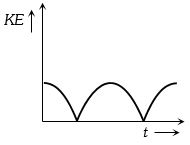
B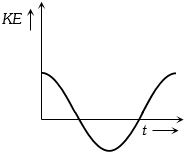
C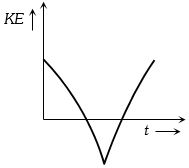
D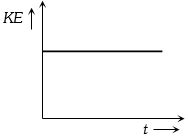
Solution
(A) For a body performing $S.H.M.$,the displacement is given by $x = A \sin(\omega t + \phi)$.
The velocity is $v = \frac{dx}{dt} = A\omega \cos(\omega t + \phi)$.
The kinetic energy $K$ is given by $K = \frac{1}{2}mv^2 = \frac{1}{2}m A^2 \omega^2 \cos^2(\omega t + \phi)$.
Using the identity $\cos^2 \theta = \frac{1 + \cos(2\theta)}{2}$,we get $K = \frac{1}{4}m A^2 \omega^2 [1 + \cos(2\omega t + 2\phi)]$.
This shows that the kinetic energy $K$ varies with time $t$ with a frequency double that of the $S.H.M.$ and is always non-negative $(K \ge 0)$.
Graph $A$ shows a periodic variation where $K$ is always non-negative,which matches the derived expression.
The velocity is $v = \frac{dx}{dt} = A\omega \cos(\omega t + \phi)$.
The kinetic energy $K$ is given by $K = \frac{1}{2}mv^2 = \frac{1}{2}m A^2 \omega^2 \cos^2(\omega t + \phi)$.
Using the identity $\cos^2 \theta = \frac{1 + \cos(2\theta)}{2}$,we get $K = \frac{1}{4}m A^2 \omega^2 [1 + \cos(2\omega t + 2\phi)]$.
This shows that the kinetic energy $K$ varies with time $t$ with a frequency double that of the $S.H.M.$ and is always non-negative $(K \ge 0)$.
Graph $A$ shows a periodic variation where $K$ is always non-negative,which matches the derived expression.
0 likes
View Solution37
EasyMCQ
When a longitudinal wave propagates through a medium,the particles of the medium execute simple harmonic oscillations about their mean positions. These oscillations of a particle are characterised by an invariant
A
Kinetic energy
B
Potential energy
C
Sum of kinetic energy and potential energy
D
Difference between kinetic energy and potential energy
Solution
(C) In a simple harmonic motion $(SHM)$,the kinetic energy $(K)$ and potential energy $(U)$ of a particle vary with time as it oscillates about its mean position.
However,the total mechanical energy $(E = K + U)$ of the particle remains constant throughout the motion,provided there is no external dissipative force (like friction or damping).
Therefore,the sum of kinetic energy and potential energy is an invariant quantity for a particle executing simple harmonic oscillations.
However,the total mechanical energy $(E = K + U)$ of the particle remains constant throughout the motion,provided there is no external dissipative force (like friction or damping).
Therefore,the sum of kinetic energy and potential energy is an invariant quantity for a particle executing simple harmonic oscillations.
0 likes
View Solution38
MediumMCQ
If the frequency of a simple harmonic motion is $f$,what is the frequency of its kinetic energy?
A
$f/2$
B
$f$
C
$2f$
D
$4f$
Solution
(C) The displacement of a particle in simple harmonic motion is given by $x = A \sin(\omega t)$.
The velocity is $v = \frac{dx}{dt} = A \omega \cos(\omega t)$.
The kinetic energy $K$ is given by $K = \frac{1}{2}mv^2 = \frac{1}{2}m(A \omega \cos(\omega t))^2 = \frac{1}{2}mA^2 \omega^2 \cos^2(\omega t)$.
Using the trigonometric identity $\cos^2(\theta) = \frac{1 + \cos(2\theta)}{2}$,we get:
$K = \frac{1}{2}mA^2 \omega^2 \left( \frac{1 + \cos(2\omega t)}{2} \right) = \frac{1}{4}mA^2 \omega^2 (1 + \cos(2\omega t))$.
The frequency of the kinetic energy is determined by the term $\cos(2\omega t)$.
Since the angular frequency of the kinetic energy is $2\omega$,the frequency $f'$ is given by $f' = \frac{2\omega}{2\pi} = 2 \left( \frac{\omega}{2\pi} \right) = 2f$.
The velocity is $v = \frac{dx}{dt} = A \omega \cos(\omega t)$.
The kinetic energy $K$ is given by $K = \frac{1}{2}mv^2 = \frac{1}{2}m(A \omega \cos(\omega t))^2 = \frac{1}{2}mA^2 \omega^2 \cos^2(\omega t)$.
Using the trigonometric identity $\cos^2(\theta) = \frac{1 + \cos(2\theta)}{2}$,we get:
$K = \frac{1}{2}mA^2 \omega^2 \left( \frac{1 + \cos(2\omega t)}{2} \right) = \frac{1}{4}mA^2 \omega^2 (1 + \cos(2\omega t))$.
The frequency of the kinetic energy is determined by the term $\cos(2\omega t)$.
Since the angular frequency of the kinetic energy is $2\omega$,the frequency $f'$ is given by $f' = \frac{2\omega}{2\pi} = 2 \left( \frac{\omega}{2\pi} \right) = 2f$.
0 likes
View Solution39
MediumMCQ
$A$ particle of mass $10 \ g$ performs simple harmonic motion with an amplitude of $10 \ cm$ and a time period of $2 \ s$. What is its kinetic energy at a displacement of $5 \ cm$?
A
$37.5 \pi^2 \ erg$
B
$3.75 \pi^2 \ erg$
C
$375 \pi^2 \ erg$
D
$0.375 \pi^2 \ erg$
Solution
(C) Given: Mass $m = 10 \ g$,Amplitude $a = 10 \ cm$,Time period $T = 2 \ s$,Displacement $y = 5 \ cm$.
Angular frequency $\omega = \frac{2\pi}{T} = \frac{2\pi}{2} = \pi \ rad/s$.
The kinetic energy $K$ of a particle in simple harmonic motion is given by $K = \frac{1}{2} m \omega^2 (a^2 - y^2)$.
Substituting the values: $K = \frac{1}{2} \times 10 \times (\pi)^2 \times (10^2 - 5^2)$.
$K = 5 \times \pi^2 \times (100 - 25)$.
$K = 5 \times \pi^2 \times 75$.
$K = 375 \pi^2 \ erg$.
Angular frequency $\omega = \frac{2\pi}{T} = \frac{2\pi}{2} = \pi \ rad/s$.
The kinetic energy $K$ of a particle in simple harmonic motion is given by $K = \frac{1}{2} m \omega^2 (a^2 - y^2)$.
Substituting the values: $K = \frac{1}{2} \times 10 \times (\pi)^2 \times (10^2 - 5^2)$.
$K = 5 \times \pi^2 \times (100 - 25)$.
$K = 5 \times \pi^2 \times 75$.
$K = 375 \pi^2 \ erg$.
0 likes
View Solution40
MediumMCQ
The total energy of a simple harmonic oscillator is $E$. What is its kinetic energy at half the amplitude?
A
$E/2$
B
$E/4$
C
$3E/4$
D
$\sqrt{3}E/4$
Solution
(C) The total energy of a simple harmonic oscillator is given by $E = \frac{1}{2}m\omega^2 a^2$,where $a$ is the amplitude.
The kinetic energy $K$ at any displacement $y$ is given by $K = \frac{1}{2}m\omega^2(a^2 - y^2)$.
Given that the displacement is half the amplitude,$y = a/2$.
Substituting this into the kinetic energy formula:
$K = \frac{1}{2}m\omega^2(a^2 - (a/2)^2)$
$K = \frac{1}{2}m\omega^2(a^2 - a^2/4)$
$K = \frac{1}{2}m\omega^2(3a^2/4)$
$K = \frac{3}{4}(\frac{1}{2}m\omega^2 a^2)$
Since $E = \frac{1}{2}m\omega^2 a^2$,we get:
$K = \frac{3}{4}E$.
The kinetic energy $K$ at any displacement $y$ is given by $K = \frac{1}{2}m\omega^2(a^2 - y^2)$.
Given that the displacement is half the amplitude,$y = a/2$.
Substituting this into the kinetic energy formula:
$K = \frac{1}{2}m\omega^2(a^2 - (a/2)^2)$
$K = \frac{1}{2}m\omega^2(a^2 - a^2/4)$
$K = \frac{1}{2}m\omega^2(3a^2/4)$
$K = \frac{3}{4}(\frac{1}{2}m\omega^2 a^2)$
Since $E = \frac{1}{2}m\omega^2 a^2$,we get:
$K = \frac{3}{4}E$.
0 likes
View Solution41
MediumMCQ
At what position in simple harmonic motion are the kinetic energy and potential energy equal?
A
$a/2$
B
$a\sqrt{2}$
C
$a/\sqrt{2}$
D
$\frac{a\sqrt{2}}{3}$
Solution
(C) The kinetic energy $(K)$ of a particle in simple harmonic motion is given by $K = \frac{1}{2}m\omega^2(a^2 - y^2)$.
The potential energy $(U)$ is given by $U = \frac{1}{2}m\omega^2y^2$.
Given that the kinetic energy equals the potential energy $(K = U)$:
$\frac{1}{2}m\omega^2(a^2 - y^2) = \frac{1}{2}m\omega^2y^2$
Canceling the common terms $\frac{1}{2}m\omega^2$ from both sides:
$a^2 - y^2 = y^2$
$a^2 = 2y^2$
$y^2 = \frac{a^2}{2}$
$y = \pm \frac{a}{\sqrt{2}}$
Therefore,the kinetic and potential energies are equal at the position $y = a/\sqrt{2}$.
The potential energy $(U)$ is given by $U = \frac{1}{2}m\omega^2y^2$.
Given that the kinetic energy equals the potential energy $(K = U)$:
$\frac{1}{2}m\omega^2(a^2 - y^2) = \frac{1}{2}m\omega^2y^2$
Canceling the common terms $\frac{1}{2}m\omega^2$ from both sides:
$a^2 - y^2 = y^2$
$a^2 = 2y^2$
$y^2 = \frac{a^2}{2}$
$y = \pm \frac{a}{\sqrt{2}}$
Therefore,the kinetic and potential energies are equal at the position $y = a/\sqrt{2}$.
0 likes
View Solution42
MediumMCQ
$A$ particle executing simple harmonic motion has a kinetic energy $K = K_0 \cos^2(\omega t)$. The maximum values of the potential energy and the total energy are respectively:
A
$K_0, K_0$
B
$K_0, 2K_0$
C
$K_0/2, K_0$
D
$0, 2K_0$
Solution
(A) The kinetic energy of a particle in simple harmonic motion is given by $K = K_0 \cos^2(\omega t)$.
Since the maximum value of $\cos^2(\omega t)$ is $1$,the maximum kinetic energy is $K_{max} = K_0$.
In simple harmonic motion,the total energy $E$ remains constant and is equal to the maximum kinetic energy or the maximum potential energy.
Thus,$E = K_{max} = K_0$.
Since the total energy $E = K + U$,where $U$ is the potential energy,we have $U = E - K = K_0 - K_0 \cos^2(\omega t) = K_0 \sin^2(\omega t)$.
The maximum value of potential energy is $U_{max} = K_0$.
Therefore,the maximum potential energy is $K_0$ and the total energy is $K_0$.
Since the maximum value of $\cos^2(\omega t)$ is $1$,the maximum kinetic energy is $K_{max} = K_0$.
In simple harmonic motion,the total energy $E$ remains constant and is equal to the maximum kinetic energy or the maximum potential energy.
Thus,$E = K_{max} = K_0$.
Since the total energy $E = K + U$,where $U$ is the potential energy,we have $U = E - K = K_0 - K_0 \cos^2(\omega t) = K_0 \sin^2(\omega t)$.
The maximum value of potential energy is $U_{max} = K_0$.
Therefore,the maximum potential energy is $K_0$ and the total energy is $K_0$.
0 likes
View Solution43
MediumMCQ
The kinetic energy and the potential energy of a particle executing $S.H.M.$ are equal. The ratio of its displacement and amplitude will be
A
$1/\sqrt{2}$
B
$\sqrt{3}/2$
C
$1/2$
D
$\sqrt{2}$
Solution
(A) For a particle executing $S.H.M.$,the kinetic energy $(K.E.)$ is given by $K.E. = \frac{1}{2}m\omega^2(a^2 - x^2)$ and the potential energy $(P.E.)$ is given by $P.E. = \frac{1}{2}m\omega^2x^2$,where $a$ is the amplitude and $x$ is the displacement.
Given that $K.E. = P.E.$
$\frac{1}{2}m\omega^2(a^2 - x^2) = \frac{1}{2}m\omega^2x^2$
$a^2 - x^2 = x^2$
$a^2 = 2x^2$
$x^2/a^2 = 1/2$
$x/a = 1/\sqrt{2}$
Therefore,the ratio of displacement to amplitude is $1/\sqrt{2}$.
Given that $K.E. = P.E.$
$\frac{1}{2}m\omega^2(a^2 - x^2) = \frac{1}{2}m\omega^2x^2$
$a^2 - x^2 = x^2$
$a^2 = 2x^2$
$x^2/a^2 = 1/2$
$x/a = 1/\sqrt{2}$
Therefore,the ratio of displacement to amplitude is $1/\sqrt{2}$.
0 likes
View Solution44
DifficultMCQ
The potential energy of a simple harmonic oscillator of mass $2\, kg$ in its mean position is $5\, J.$ If its total energy is $9\, J$ and its amplitude is $0.01\, m,$ its time period would be
A
$\pi / 10\, s$
B
$\pi / 20\, s$
C
$\pi / 50\, s$
D
$\pi / 100\, s$
Solution
(D) The kinetic energy at the mean position is given by the difference between the total energy and the potential energy at the mean position.
$K.E._{\text{mean}} = E_{\text{total}} - P.E._{\text{mean}} = 9\, J - 5\, J = 4\, J$.
At the mean position,the potential energy is $5\, J$ and the kinetic energy is maximum,so $K.E._{\text{max}} = \frac{1}{2} m v_{\text{max}}^2 = 4\, J$.
Given $m = 2\, kg$,we have $\frac{1}{2} \times 2 \times v_{\text{max}}^2 = 4$,which implies $v_{\text{max}}^2 = 4$,so $v_{\text{max}} = 2\, m/s$.
We know that $v_{\text{max}} = A \omega$,where $A$ is the amplitude and $\omega$ is the angular frequency.
$A \omega = 2\, m/s$.
Since $\omega = \frac{2\pi}{T}$,we have $A \times \frac{2\pi}{T} = 2$.
Substituting $A = 0.01\, m$,we get $0.01 \times \frac{2\pi}{T} = 2$.
$T = \frac{0.01 \times 2\pi}{2} = 0.01\pi = \frac{\pi}{100}\, s$.
$K.E._{\text{mean}} = E_{\text{total}} - P.E._{\text{mean}} = 9\, J - 5\, J = 4\, J$.
At the mean position,the potential energy is $5\, J$ and the kinetic energy is maximum,so $K.E._{\text{max}} = \frac{1}{2} m v_{\text{max}}^2 = 4\, J$.
Given $m = 2\, kg$,we have $\frac{1}{2} \times 2 \times v_{\text{max}}^2 = 4$,which implies $v_{\text{max}}^2 = 4$,so $v_{\text{max}} = 2\, m/s$.
We know that $v_{\text{max}} = A \omega$,where $A$ is the amplitude and $\omega$ is the angular frequency.
$A \omega = 2\, m/s$.
Since $\omega = \frac{2\pi}{T}$,we have $A \times \frac{2\pi}{T} = 2$.
Substituting $A = 0.01\, m$,we get $0.01 \times \frac{2\pi}{T} = 2$.
$T = \frac{0.01 \times 2\pi}{2} = 0.01\pi = \frac{\pi}{100}\, s$.
0 likes
View Solution45
DifficultMCQ
$A$ body performs simple harmonic oscillations along the straight line $ABCDE$ with $C$ as the midpoint of $AE.$ Its kinetic energies at $B$ and $D$ are each one-fourth of its maximum value. If $AE = 2R,$ the distance between $B$ and $D$ is

A
$\frac{\sqrt{3} R}{2}$
B
$\frac{R}{\sqrt{2}}$
C
$\sqrt{3} R$
D
$\sqrt{2} R$
Solution
(C) The total energy of a body in simple harmonic motion is $E = \frac{1}{2} k A^2,$ where $A$ is the amplitude.
Given that $AE = 2R$ and $C$ is the midpoint,the amplitude $A = R$.
The kinetic energy at any position $x$ is given by $K = \frac{1}{2} k (A^2 - x^2)$.
According to the problem,at $B$ and $D$,the kinetic energy is one-fourth of the maximum value:
$\frac{1}{2} k (A^2 - x^2) = \frac{1}{4} (\frac{1}{2} k A^2)$
$A^2 - x^2 = \frac{1}{4} A^2$
$x^2 = \frac{3}{4} A^2$
$x = \pm \frac{\sqrt{3}}{2} A$
Since $A = R$,the positions of $B$ and $D$ are $x = \pm \frac{\sqrt{3}}{2} R$.
The distance between $B$ and $D$ is $|x_D - x_B| = |\frac{\sqrt{3}}{2} R - (-\frac{\sqrt{3}}{2} R)| = \sqrt{3} R$.
Given that $AE = 2R$ and $C$ is the midpoint,the amplitude $A = R$.
The kinetic energy at any position $x$ is given by $K = \frac{1}{2} k (A^2 - x^2)$.
According to the problem,at $B$ and $D$,the kinetic energy is one-fourth of the maximum value:
$\frac{1}{2} k (A^2 - x^2) = \frac{1}{4} (\frac{1}{2} k A^2)$
$A^2 - x^2 = \frac{1}{4} A^2$
$x^2 = \frac{3}{4} A^2$
$x = \pm \frac{\sqrt{3}}{2} A$
Since $A = R$,the positions of $B$ and $D$ are $x = \pm \frac{\sqrt{3}}{2} R$.
The distance between $B$ and $D$ is $|x_D - x_B| = |\frac{\sqrt{3}}{2} R - (-\frac{\sqrt{3}}{2} R)| = \sqrt{3} R$.
0 likes
View Solution46
MediumMCQ
The graphs in the figure show that a quantity $y$ varies with displacement $d$ in a system undergoing simple harmonic motion. Which graph best represents the relationship obtained when $y$ is the total energy of the system?

A
$I$
B
$II$
C
$III$
D
$IV$
Solution
(A) In a system undergoing simple harmonic motion $(SHM)$,the total energy $(E)$ is given by the sum of kinetic energy and potential energy.
$E = K + U = \frac{1}{2} k A^2$,where $k$ is the force constant and $A$ is the amplitude.
Since the total energy is independent of the displacement $d$ at any instant,it remains constant throughout the motion.
Graph $I$ represents a constant value of $y$ for all values of $d$ within the range of motion.
Therefore,graph $I$ best represents the relationship.
$E = K + U = \frac{1}{2} k A^2$,where $k$ is the force constant and $A$ is the amplitude.
Since the total energy is independent of the displacement $d$ at any instant,it remains constant throughout the motion.
Graph $I$ represents a constant value of $y$ for all values of $d$ within the range of motion.
Therefore,graph $I$ best represents the relationship.
0 likes
View Solution47
AdvancedMCQ
$A$ particle starts oscillating simple harmonically from its equilibrium position. The ratio of kinetic energy and potential energy of the particle at time $t = T/12$ is: ($T =$ time period)
A
$2 : 1$
B
$3 : 1$
C
$4 : 1$
D
$1 : 4$
Solution
(B) Since the particle starts from the equilibrium position,the displacement is given by $x = a \sin(\omega t)$.
At $t = T/12$,the displacement is $x = a \sin(\frac{2\pi}{T} \times \frac{T}{12}) = a \sin(\frac{\pi}{6}) = \frac{a}{2}$.
The kinetic energy $(K.E.)$ is given by $\frac{1}{2}k(a^2 - x^2)$ and the potential energy $(P.E.)$ is given by $\frac{1}{2}kx^2$.
The ratio of kinetic energy to potential energy is $\frac{K.E.}{P.E.} = \frac{a^2 - x^2}{x^2}$.
Substituting $x = \frac{a}{2}$,we get $\frac{K.E.}{P.E.} = \frac{a^2 - (a/2)^2}{(a/2)^2} = \frac{a^2 - a^2/4}{a^2/4} = \frac{3a^2/4}{a^2/4} = \frac{3}{1}$.
At $t = T/12$,the displacement is $x = a \sin(\frac{2\pi}{T} \times \frac{T}{12}) = a \sin(\frac{\pi}{6}) = \frac{a}{2}$.
The kinetic energy $(K.E.)$ is given by $\frac{1}{2}k(a^2 - x^2)$ and the potential energy $(P.E.)$ is given by $\frac{1}{2}kx^2$.
The ratio of kinetic energy to potential energy is $\frac{K.E.}{P.E.} = \frac{a^2 - x^2}{x^2}$.
Substituting $x = \frac{a}{2}$,we get $\frac{K.E.}{P.E.} = \frac{a^2 - (a/2)^2}{(a/2)^2} = \frac{a^2 - a^2/4}{a^2/4} = \frac{3a^2/4}{a^2/4} = \frac{3}{1}$.
0 likes
View Solution48
MediumMCQ
$A$ spring-mass system performs $S.H.M.$ If the mass is doubled keeping the amplitude same,then the total energy of $S.H.M.$ will become:
A
double
B
half
C
unchanged
D
$4$ times
Solution
(C) The total energy $(E)$ of a spring-mass system performing $S.H.M.$ is given by the formula $E = \frac{1}{2} k A^{2}$,where $k$ is the spring constant and $A$ is the amplitude of oscillation.
In this expression,the total energy depends only on the spring constant $(k)$ and the amplitude $(A)$.
It is independent of the mass $(m)$ of the object attached to the spring.
Since the amplitude $(A)$ is kept constant and the spring constant $(k)$ remains the same,the total energy of the $S.H.M.$ will remain unchanged even if the mass is doubled.
In this expression,the total energy depends only on the spring constant $(k)$ and the amplitude $(A)$.
It is independent of the mass $(m)$ of the object attached to the spring.
Since the amplitude $(A)$ is kept constant and the spring constant $(k)$ remains the same,the total energy of the $S.H.M.$ will remain unchanged even if the mass is doubled.
0 likes
View Solution49
MediumMCQ
$A$ particle of mass $m$ performs $SHM$ along a straight line with frequency $f$ and amplitude $A.$
A
The average kinetic energy of the particle is zero.
B
The average potential energy is $m \pi^2 f^2 A^2.$
C
The frequency of oscillation of kinetic energy is $2f.$
D
$(B)$ and $(C)$ both
Solution
(D) For a particle in $SHM$,the displacement is $x = A \sin(\omega t)$,where $\omega = 2\pi f$.
The velocity is $v = \frac{dx}{dt} = A\omega \cos(\omega t)$.
The kinetic energy is $K = \frac{1}{2}mv^2 = \frac{1}{2}m A^2 \omega^2 \cos^2(\omega t) = \frac{1}{2}m A^2 (4\pi^2 f^2) \cos^2(\omega t) = 2m\pi^2 f^2 A^2 \cos^2(\omega t)$.
Using the identity $\cos^2(\theta) = \frac{1 + \cos(2\theta)}{2}$,we get $K = m\pi^2 f^2 A^2 (1 + \cos(2\omega t))$.
The average value of $\cos(2\omega t)$ over a cycle is $0$,so the average kinetic energy is $\langle K \rangle = m\pi^2 f^2 A^2$.
Similarly,the average potential energy $\langle U \rangle$ is also $m\pi^2 f^2 A^2$.
The kinetic energy expression contains the term $\cos(2\omega t)$,which indicates that the frequency of oscillation of kinetic energy is $2\omega / 2\pi = 2f$.
Thus,both statements $(B)$ and $(C)$ are correct.
The velocity is $v = \frac{dx}{dt} = A\omega \cos(\omega t)$.
The kinetic energy is $K = \frac{1}{2}mv^2 = \frac{1}{2}m A^2 \omega^2 \cos^2(\omega t) = \frac{1}{2}m A^2 (4\pi^2 f^2) \cos^2(\omega t) = 2m\pi^2 f^2 A^2 \cos^2(\omega t)$.
Using the identity $\cos^2(\theta) = \frac{1 + \cos(2\theta)}{2}$,we get $K = m\pi^2 f^2 A^2 (1 + \cos(2\omega t))$.
The average value of $\cos(2\omega t)$ over a cycle is $0$,so the average kinetic energy is $\langle K \rangle = m\pi^2 f^2 A^2$.
Similarly,the average potential energy $\langle U \rangle$ is also $m\pi^2 f^2 A^2$.
The kinetic energy expression contains the term $\cos(2\omega t)$,which indicates that the frequency of oscillation of kinetic energy is $2\omega / 2\pi = 2f$.
Thus,both statements $(B)$ and $(C)$ are correct.
0 likes
View SolutionOscillations — Energy of Simple Harmonic Motion · Frequently Asked Questions
1Are these Oscillations questions useful for JEE and NEET?
Yes. All questions in this section are mapped to JEE Main and NEET exam patterns. Previous year questions from JEE Main, NEET, GUJCET and state-level exams are included with full solutions.
2Can I switch to Hindi or Gujarati for these questions?
Yes. Use the language tabs in the hero section or the sidebar to view the same questions and solutions in English, Hindi or Gujarati.
3How do I generate a question paper from this subtopic?
Use the Vedclass Exam Paper Generator — select the chapter and subtopic, set difficulty, and generate Sets A, B, C, D automatically. First 3 chapters of every subject are free.
Vedclass Products
For Students
Vedclass Test Series
Mock tests in real JEE/NEET style with performance analysis. 5-day free trial.
Start Free TrialFor Teachers
Exam Paper Generator
Generate Set A/B/C/D papers from this chapter in 2 minutes. 3 chapters free.
Try FreeFor Institutes
Online Exam Module
Live online exams with unlimited students, 360° analytics & white-label branding.
See DemoFor Teachers & Institutes
Generate a Oscillations Exam Paper in 2 Minutes
Select subtopic & difficulty — Sets A, B, C, D auto-generated with No Repeat logic.
First 3 chapters of every subject are free — no payment required.