
A English
SHM of Spring Mass System Questions in English
Class 11 Physics · Oscillations · SHM of Spring Mass System
334+
Questions
English
Language
100%
With Solutions
Showing 49 of 334 questions in English
51
MediumMCQ
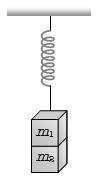
Two masses $m_1$ and $m_2$ are suspended together by a massless spring of constant $K$. When the masses are in equilibrium,$m_1$ is removed without disturbing the system. The amplitude of oscillations is
A
$\frac{m_1 g}{K}$
B
$\frac{m_2 g}{K}$
C
$\frac{(m_1 + m_2)g}{K}$
D
$\frac{(m_1 - m_2)g}{K}$
Solution
(A) Initially,the spring supports both masses $m_1$ and $m_2$. The total extension $x_1$ in the spring at equilibrium is given by Hooke's Law: $(m_1 + m_2)g = K x_1$,which implies $x_1 = \frac{(m_1 + m_2)g}{K}$.
When $m_1$ is removed,the new equilibrium position for the remaining mass $m_2$ is at an extension $x_2$ given by: $m_2 g = K x_2$,which implies $x_2 = \frac{m_2 g}{K}$.
The system starts oscillating about this new equilibrium position. At the moment $m_1$ is removed,the spring is still stretched by $x_1$,but the new equilibrium position is $x_2$. The amplitude of oscillation $A$ is the difference between the initial extension and the new equilibrium extension:
$A = x_1 - x_2 = \frac{(m_1 + m_2)g}{K} - \frac{m_2 g}{K} = \frac{m_1 g}{K}$.
When $m_1$ is removed,the new equilibrium position for the remaining mass $m_2$ is at an extension $x_2$ given by: $m_2 g = K x_2$,which implies $x_2 = \frac{m_2 g}{K}$.
The system starts oscillating about this new equilibrium position. At the moment $m_1$ is removed,the spring is still stretched by $x_1$,but the new equilibrium position is $x_2$. The amplitude of oscillation $A$ is the difference between the initial extension and the new equilibrium extension:
$A = x_1 - x_2 = \frac{(m_1 + m_2)g}{K} - \frac{m_2 g}{K} = \frac{m_1 g}{K}$.
0 likes
View Solution52
MediumMCQ
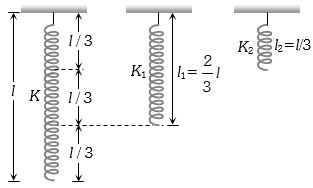
$A$ spring of force constant $k$ is cut into two pieces such that one piece is double the length of the other. Then the long piece will have a force constant of
A
$(2/3)k$
B
$(3/2)k$
C
$3k$
D
$6k$
Solution
(B) The force constant $k$ of a spring is inversely proportional to its length $l$, i.e., $k \propto 1/l$ or $kl = \text{constant}$.
Let the total length of the spring be $l$ and its force constant be $k$.
The spring is cut into two pieces such that one piece is double the length of the other. Let the lengths of the two pieces be $l_1$ and $l_2$.
Given $l_1 = 2l_2$ and $l_1 + l_2 = l$.
Substituting $l_1$, we get $2l_2 + l_2 = l \Rightarrow 3l_2 = l \Rightarrow l_2 = l/3$.
Then $l_1 = 2l/3$.
For the long piece of length $l_1 = 2l/3$, let the new force constant be $k_1$.
Using $k_1 l_1 = kl$, we have $k_1 (2l/3) = kl$.
$k_1 = k / (2/3) = (3/2)k$.
Let the total length of the spring be $l$ and its force constant be $k$.
The spring is cut into two pieces such that one piece is double the length of the other. Let the lengths of the two pieces be $l_1$ and $l_2$.
Given $l_1 = 2l_2$ and $l_1 + l_2 = l$.
Substituting $l_1$, we get $2l_2 + l_2 = l \Rightarrow 3l_2 = l \Rightarrow l_2 = l/3$.
Then $l_1 = 2l/3$.
For the long piece of length $l_1 = 2l/3$, let the new force constant be $k_1$.
Using $k_1 l_1 = kl$, we have $k_1 (2l/3) = kl$.
$k_1 = k / (2/3) = (3/2)k$.
0 likes
View Solution53
DifficultMCQ
One end of a long metallic wire of length $L$ is tied to the ceiling. The other end is tied to a massless spring of spring constant $K$. $A$ mass $m$ hangs freely from the free end of the spring. The area of cross-section and Young's modulus of the wire are $A$ and $Y$ respectively. If the mass is slightly pulled down and released,it will oscillate with a time period $T$ equal to
A
$2\pi \sqrt{\frac{m}{K}}$
B
$2\pi \sqrt{\frac{(YA + KL)m}{YAK}}$
C
$2\pi \frac{mYA}{KL}$
D
$2\pi \frac{mL}{YA}$
Solution
(B) The wire acts as a spring with a force constant $k_1$. From the definition of Young's modulus $Y = \frac{F/A}{\Delta L/L}$,we get $k_1 = \frac{F}{\Delta L} = \frac{YA}{L}$.
The spring constant of the given spring is $k_2 = K$.
Since the wire and the spring are in series,the equivalent spring constant $k_{eq}$ is given by $\frac{1}{k_{eq}} = \frac{1}{k_1} + \frac{1}{k_2}$.
$\frac{1}{k_{eq}} = \frac{L}{YA} + \frac{1}{K} = \frac{KL + YA}{YAK}$.
Therefore,$k_{eq} = \frac{YAK}{YA + KL}$.
The time period of oscillation is $T = 2\pi \sqrt{\frac{m}{k_{eq}}} = 2\pi \sqrt{\frac{m(YA + KL)}{YAK}}$.
The spring constant of the given spring is $k_2 = K$.
Since the wire and the spring are in series,the equivalent spring constant $k_{eq}$ is given by $\frac{1}{k_{eq}} = \frac{1}{k_1} + \frac{1}{k_2}$.
$\frac{1}{k_{eq}} = \frac{L}{YA} + \frac{1}{K} = \frac{KL + YA}{YAK}$.
Therefore,$k_{eq} = \frac{YAK}{YA + KL}$.
The time period of oscillation is $T = 2\pi \sqrt{\frac{m}{k_{eq}}} = 2\pi \sqrt{\frac{m(YA + KL)}{YAK}}$.
0 likes
View Solution54
MediumMCQ
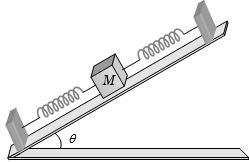
On a smooth inclined plane,a body of mass $M$ is attached between two springs. The other ends of the springs are fixed to firm supports. If each spring has a force constant $K$,the period of oscillation of the body (assuming the springs are massless) is
A
$2\pi \sqrt{\frac{M}{2K}}$
B
$2\pi \sqrt{\frac{2M}{K}}$
C
$2\pi \frac{Mg \sin \theta}{2K}$
D
$2\pi \sqrt{\frac{2Mg}{K}}$
Solution
(A) When the body of mass $M$ is displaced by a small distance $x$ along the inclined plane,both springs are deformed. One spring is compressed by $x$ and the other is stretched by $x$.
The restoring force exerted by each spring is $F = -Kx$.
Since both springs act in the same direction to restore the equilibrium position,the total restoring force is $F_{net} = -Kx - Kx = -2Kx$.
The effective spring constant of the system is $K_{eff} = 2K$.
The period of oscillation $T$ for a spring-mass system is given by $T = 2\pi \sqrt{\frac{M}{K_{eff}}}$.
Substituting $K_{eff} = 2K$,we get $T = 2\pi \sqrt{\frac{M}{2K}}$.
The inclination of the plane does not affect the period of oscillation because it only changes the equilibrium position of the mass,not the restoring force constant.
The restoring force exerted by each spring is $F = -Kx$.
Since both springs act in the same direction to restore the equilibrium position,the total restoring force is $F_{net} = -Kx - Kx = -2Kx$.
The effective spring constant of the system is $K_{eff} = 2K$.
The period of oscillation $T$ for a spring-mass system is given by $T = 2\pi \sqrt{\frac{M}{K_{eff}}}$.
Substituting $K_{eff} = 2K$,we get $T = 2\pi \sqrt{\frac{M}{2K}}$.
The inclination of the plane does not affect the period of oscillation because it only changes the equilibrium position of the mass,not the restoring force constant.
0 likes
View Solution55
MediumMCQ
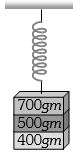
Three masses $700 \, g, 500 \, g$,and $400 \, g$ are suspended at the end of a spring as shown and are in equilibrium. When the $700 \, g$ mass is removed,the system oscillates with a period of $3 \, s$. When the $500 \, g$ mass is also removed,it will oscillate with a period of ...... $s$.
A
$1$
B
$2$
C
$3$
D
$\sqrt{\frac{12}{5}}$
Solution
(B) The period of oscillation for a spring-mass system is given by $T = 2\pi \sqrt{\frac{m}{k}}$,where $m$ is the oscillating mass and $k$ is the spring constant.
Case $1$: When the $700 \, g$ mass is removed,the remaining mass is $m_1 = 500 \, g + 400 \, g = 900 \, g$. The period is $T_1 = 3 \, s$.
$3 = 2\pi \sqrt{\frac{900}{k}} \quad \dots (i)$
Case $2$: When the $500 \, g$ mass is also removed,the remaining mass is $m_2 = 400 \, g$. Let the new period be $T_2$.
$T_2 = 2\pi \sqrt{\frac{400}{k}} \quad \dots (ii)$
Dividing equation $(i)$ by equation $(ii)$:
$\frac{3}{T_2} = \frac{2\pi \sqrt{\frac{900}{k}}}{2\pi \sqrt{\frac{400}{k}}} = \sqrt{\frac{900}{400}} = \sqrt{\frac{9}{4}} = \frac{3}{2}$
Therefore,$T_2 = 2 \, s$.
Case $1$: When the $700 \, g$ mass is removed,the remaining mass is $m_1 = 500 \, g + 400 \, g = 900 \, g$. The period is $T_1 = 3 \, s$.
$3 = 2\pi \sqrt{\frac{900}{k}} \quad \dots (i)$
Case $2$: When the $500 \, g$ mass is also removed,the remaining mass is $m_2 = 400 \, g$. Let the new period be $T_2$.
$T_2 = 2\pi \sqrt{\frac{400}{k}} \quad \dots (ii)$
Dividing equation $(i)$ by equation $(ii)$:
$\frac{3}{T_2} = \frac{2\pi \sqrt{\frac{900}{k}}}{2\pi \sqrt{\frac{400}{k}}} = \sqrt{\frac{900}{400}} = \sqrt{\frac{9}{4}} = \frac{3}{2}$
Therefore,$T_2 = 2 \, s$.
0 likes
View Solution56
DifficultMCQ
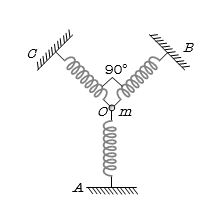
$A$ particle of mass $m$ is attached to three identical springs $A, B$ and $C$ each of force constant $k$ as shown in the figure. If the particle of mass $m$ is pushed slightly against the spring $A$ and released,then the time period of oscillations is
A
$2\pi \sqrt{\frac{2m}{k}}$
B
$2\pi \sqrt{\frac{m}{2k}}$
C
$2\pi \sqrt{\frac{m}{k}}$
D
$2\pi \sqrt{\frac{m}{3k}}$
Solution
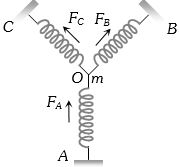
(B) When the particle of mass $m$ at $O$ is pushed by a small displacement $y$ in the direction of spring $A$,spring $A$ is compressed by $y$. Springs $B$ and $C$ are stretched by an amount $y' = y \cos 45^\circ$.
The total restoring force on the mass $m$ along the direction $OA$ is:
$F_{net} = F_A + F_B \cos 45^\circ + F_C \cos 45^\circ$
$F_{net} = ky + (ky') \cos 45^\circ + (ky') \cos 45^\circ$
$F_{net} = ky + 2k(y \cos 45^\circ) \cos 45^\circ$
$F_{net} = ky + 2ky \cos^2 45^\circ = ky + 2ky(1/2) = ky + ky = 2ky$
Comparing this with $F_{net} = k_{eff} y$,we get $k_{eff} = 2k$.
The time period of oscillation is given by $T = 2\pi \sqrt{\frac{m}{k_{eff}}}$.
Substituting $k_{eff} = 2k$,we get $T = 2\pi \sqrt{\frac{m}{2k}}$.
The total restoring force on the mass $m$ along the direction $OA$ is:
$F_{net} = F_A + F_B \cos 45^\circ + F_C \cos 45^\circ$
$F_{net} = ky + (ky') \cos 45^\circ + (ky') \cos 45^\circ$
$F_{net} = ky + 2k(y \cos 45^\circ) \cos 45^\circ$
$F_{net} = ky + 2ky \cos^2 45^\circ = ky + 2ky(1/2) = ky + ky = 2ky$
Comparing this with $F_{net} = k_{eff} y$,we get $k_{eff} = 2k$.
The time period of oscillation is given by $T = 2\pi \sqrt{\frac{m}{k_{eff}}}$.
Substituting $k_{eff} = 2k$,we get $T = 2\pi \sqrt{\frac{m}{2k}}$.
0 likes
View Solution57
MediumMCQ
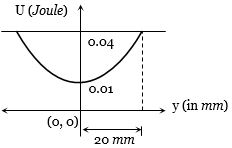
The variation of potential energy of a harmonic oscillator is as shown in the figure. The spring constant is
A
$1 \times 10^2 \text{ N/m}$
B
$150 \text{ N/m}$
C
$0.667 \times 10^2 \text{ N/m}$
D
$3 \times 10^2 \text{ N/m}$
Solution
(B) From the given graph,the potential energy $U$ varies with displacement $y$. The potential energy of a harmonic oscillator is given by $U(y) = U_0 + \frac{1}{2}ky^2$,where $U_0$ is the minimum potential energy at the equilibrium position $(y=0)$.
From the graph,the minimum potential energy at $y=0$ is $U_0 = 0.01 \text{ J}$.
The maximum potential energy at the extreme position $y = 20 \text{ mm} = 0.02 \text{ m}$ is $U_{max} = 0.04 \text{ J}$.
Therefore,the change in potential energy from equilibrium to the extreme position is $\Delta U = U_{max} - U_0 = 0.04 \text{ J} - 0.01 \text{ J} = 0.03 \text{ J}$.
This change in potential energy is equal to the elastic potential energy stored in the spring,which is $\frac{1}{2}kA^2$,where $A$ is the amplitude.
$0.03 = \frac{1}{2} \times k \times (0.02)^2$
$0.03 = \frac{1}{2} \times k \times 0.0004$
$0.03 = k \times 0.0002$
$k = \frac{0.03}{0.0002} = \frac{300}{2} = 150 \text{ N/m}$.
From the graph,the minimum potential energy at $y=0$ is $U_0 = 0.01 \text{ J}$.
The maximum potential energy at the extreme position $y = 20 \text{ mm} = 0.02 \text{ m}$ is $U_{max} = 0.04 \text{ J}$.
Therefore,the change in potential energy from equilibrium to the extreme position is $\Delta U = U_{max} - U_0 = 0.04 \text{ J} - 0.01 \text{ J} = 0.03 \text{ J}$.
This change in potential energy is equal to the elastic potential energy stored in the spring,which is $\frac{1}{2}kA^2$,where $A$ is the amplitude.
$0.03 = \frac{1}{2} \times k \times (0.02)^2$
$0.03 = \frac{1}{2} \times k \times 0.0004$
$0.03 = k \times 0.0002$
$k = \frac{0.03}{0.0002} = \frac{300}{2} = 150 \text{ N/m}$.
0 likes
View Solution58
DifficultMCQ
$A$ block of mass $M = 5 \ kg$ is suspended from one end of a spring. The spring extends by $l = 0.1 \ m$ due to the mass of the block. The block is given an upward velocity of $v = 2 \ m/s$. What is the maximum height $h$ (in $m$) reached by the block? $(g = 10 \ m/s^2)$
A
$0.3$
B
$0.2$
C
$0.1$
D
$0.4$
Solution
(B) Initially,the spring is in equilibrium: $k l = Mg \Rightarrow k = \frac{5 \times 10}{0.1} = 500 \ N/m$.
Let $h$ be the maximum height reached by the block from the equilibrium position.
Using the law of conservation of energy,the total energy at the equilibrium position equals the total energy at the maximum height:
$\frac{1}{2} M v^2 + \frac{1}{2} k l^2 = Mgh + \frac{1}{2} k (h - l)^2$.
Substituting the values:
$\frac{1}{2} \times 5 \times (2)^2 + \frac{1}{2} \times 500 \times (0.1)^2 = 5 \times 10 \times h + \frac{1}{2} \times 500 \times (h - 0.1)^2$.
$10 + 2.5 = 50h + 250(h^2 - 0.2h + 0.01)$.
$12.5 = 50h + 250h^2 - 50h + 2.5$.
$10 = 250h^2$.
$h^2 = \frac{10}{250} = \frac{1}{25}$.
$h = 0.2 \ m$.
Let $h$ be the maximum height reached by the block from the equilibrium position.
Using the law of conservation of energy,the total energy at the equilibrium position equals the total energy at the maximum height:
$\frac{1}{2} M v^2 + \frac{1}{2} k l^2 = Mgh + \frac{1}{2} k (h - l)^2$.
Substituting the values:
$\frac{1}{2} \times 5 \times (2)^2 + \frac{1}{2} \times 500 \times (0.1)^2 = 5 \times 10 \times h + \frac{1}{2} \times 500 \times (h - 0.1)^2$.
$10 + 2.5 = 50h + 250(h^2 - 0.2h + 0.01)$.
$12.5 = 50h + 250h^2 - 50h + 2.5$.
$10 = 250h^2$.
$h^2 = \frac{10}{250} = \frac{1}{25}$.
$h = 0.2 \ m$.
0 likes
View Solution59
DifficultMCQ
$A$ wire of length $L$,cross-sectional area $A$,and Young's modulus $Y$ is suspended,and a spring of force constant $k$ is attached to its lower end. If a mass $m$ is suspended from the spring and set into oscillations,what will be the time period of the system?
A
$2\pi \sqrt{\frac{m}{k}}$
B
$2\pi \sqrt{\frac{mYA}{kL}}$
C
$2\pi \sqrt{\frac{mk}{YA}}$
D
$2\pi \sqrt{\frac{m(kL + YA)}{kYA}}$
Solution
(D) The wire acts as a spring with an effective spring constant $k_1 = \frac{YA}{L}$.
The spring with force constant $k_2 = k$ is connected in series with the wire.
The equivalent spring constant $k_{eq}$ for two springs in series is given by $\frac{1}{k_{eq}} = \frac{1}{k_1} + \frac{1}{k_2}$.
Substituting the values: $\frac{1}{k_{eq}} = \frac{L}{YA} + \frac{1}{k} = \frac{kL + YA}{kYA}$.
Therefore,$k_{eq} = \frac{kYA}{kL + YA}$.
The time period $T$ of the mass-spring system is $T = 2\pi \sqrt{\frac{m}{k_{eq}}}$.
Substituting $k_{eq}$: $T = 2\pi \sqrt{\frac{m(kL + YA)}{kYA}}$.
The spring with force constant $k_2 = k$ is connected in series with the wire.
The equivalent spring constant $k_{eq}$ for two springs in series is given by $\frac{1}{k_{eq}} = \frac{1}{k_1} + \frac{1}{k_2}$.
Substituting the values: $\frac{1}{k_{eq}} = \frac{L}{YA} + \frac{1}{k} = \frac{kL + YA}{kYA}$.
Therefore,$k_{eq} = \frac{kYA}{kL + YA}$.
The time period $T$ of the mass-spring system is $T = 2\pi \sqrt{\frac{m}{k_{eq}}}$.
Substituting $k_{eq}$: $T = 2\pi \sqrt{\frac{m(kL + YA)}{kYA}}$.
0 likes
View Solution60
EasyMCQ
Two springs with force constants $k_1$ and $k_2$ have the same mass attached to their ends. Both objects have the same maximum velocity. What is the ratio of their amplitudes?
A
$k_1/k_2$
B
$\sqrt{k_1/k_2}$
C
$k_2/k_1$
D
$\sqrt{k_2/k_1}$
Solution
(D) The maximum velocity of an object in simple harmonic motion is given by $v_{max} = A\omega$,where $A$ is the amplitude and $\omega$ is the angular frequency.
For a spring-mass system,the angular frequency is $\omega = \sqrt{k/m}$.
Given that the maximum velocities are equal: $A_1\omega_1 = A_2\omega_2$.
Substituting the expression for $\omega$: $A_1\sqrt{\frac{k_1}{m}} = A_2\sqrt{\frac{k_2}{m}}$.
Since the masses $m$ are the same,we can simplify the equation:
$A_1\sqrt{k_1} = A_2\sqrt{k_2}$.
Therefore,the ratio of the amplitudes is $\frac{A_1}{A_2} = \sqrt{\frac{k_2}{k_1}}$.
For a spring-mass system,the angular frequency is $\omega = \sqrt{k/m}$.
Given that the maximum velocities are equal: $A_1\omega_1 = A_2\omega_2$.
Substituting the expression for $\omega$: $A_1\sqrt{\frac{k_1}{m}} = A_2\sqrt{\frac{k_2}{m}}$.
Since the masses $m$ are the same,we can simplify the equation:
$A_1\sqrt{k_1} = A_2\sqrt{k_2}$.
Therefore,the ratio of the amplitudes is $\frac{A_1}{A_2} = \sqrt{\frac{k_2}{k_1}}$.
0 likes
View Solution61
DifficultMCQ
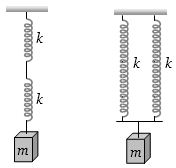
What is the ratio of the frequencies for the two given systems?
A
$2:1$
B
$1:1$
C
$1:2$
D
$4:1$
Solution
(C) For the first system (series combination),the effective spring constant is $k_{eff1} = \frac{k \cdot k}{k + k} = \frac{k}{2}$.
The frequency is $n_1 = \frac{1}{2\pi} \sqrt{\frac{k_{eff1}}{m}} = \frac{1}{2\pi} \sqrt{\frac{k}{2m}}$.
For the second system (parallel combination),the effective spring constant is $k_{eff2} = k + k = 2k$.
The frequency is $n_2 = \frac{1}{2\pi} \sqrt{\frac{k_{eff2}}{m}} = \frac{1}{2\pi} \sqrt{\frac{2k}{m}}$.
The ratio of the frequencies is $\frac{n_1}{n_2} = \frac{\sqrt{k/2m}}{\sqrt{2k/m}} = \sqrt{\frac{k}{2m} \cdot \frac{m}{2k}} = \sqrt{\frac{1}{4}} = \frac{1}{2}$.
Thus,the ratio is $1:2$.
The frequency is $n_1 = \frac{1}{2\pi} \sqrt{\frac{k_{eff1}}{m}} = \frac{1}{2\pi} \sqrt{\frac{k}{2m}}$.
For the second system (parallel combination),the effective spring constant is $k_{eff2} = k + k = 2k$.
The frequency is $n_2 = \frac{1}{2\pi} \sqrt{\frac{k_{eff2}}{m}} = \frac{1}{2\pi} \sqrt{\frac{2k}{m}}$.
The ratio of the frequencies is $\frac{n_1}{n_2} = \frac{\sqrt{k/2m}}{\sqrt{2k/m}} = \sqrt{\frac{k}{2m} \cdot \frac{m}{2k}} = \sqrt{\frac{1}{4}} = \frac{1}{2}$.
Thus,the ratio is $1:2$.
0 likes
View Solution62
DifficultMCQ
$A$ mass of $200 \text{ g}$ is suspended from a spring with a force constant of $80 \text{ N/m}$. What is the time period of the oscillation in seconds?
A
$0.31$
B
$0.15$
C
$0.05$
D
$0.02$
Solution
(A) Given: Mass $m = 200 \text{ g} = 0.2 \text{ kg}$,Force constant $k = 80 \text{ N/m}$.
The formula for the time period of a spring-mass system is $T = 2\pi \sqrt{\frac{m}{k}}$.
Substituting the values: $T = 2\pi \sqrt{\frac{0.2}{80}}$.
$T = 2\pi \sqrt{\frac{1}{400}} = 2\pi \times \frac{1}{20} = \frac{\pi}{10}$.
Using $\pi \approx 3.14$,we get $T = \frac{3.14}{10} = 0.314 \text{ s}$.
Rounding to two decimal places,$T \approx 0.31 \text{ s}$.
The formula for the time period of a spring-mass system is $T = 2\pi \sqrt{\frac{m}{k}}$.
Substituting the values: $T = 2\pi \sqrt{\frac{0.2}{80}}$.
$T = 2\pi \sqrt{\frac{1}{400}} = 2\pi \times \frac{1}{20} = \frac{\pi}{10}$.
Using $\pi \approx 3.14$,we get $T = \frac{3.14}{10} = 0.314 \text{ s}$.
Rounding to two decimal places,$T \approx 0.31 \text{ s}$.
0 likes
View Solution63
EasyMCQ
$A$ spring of length $l$ and force constant $k$ is attached to a mass $m$ and oscillates with frequency $f_1$. If the spring is cut into two equal parts and one part is attached to the same mass $m$ to oscillate,its frequency becomes $f_2$. Find the relation between $f_1$ and $f_2$.
A
$f_1 = \sqrt{2} f_2$
B
$f_1 = f_2$
C
$f_1 = 2 f_2$
D
$f_2 = \sqrt{2} f_1$
Solution
(D) The frequency of a spring-mass system is given by $f = \frac{1}{2\pi} \sqrt{\frac{k}{m}}$.
Since $m$ is constant,$f \propto \sqrt{k}$.
When a spring of length $l$ and force constant $k$ is cut into two equal parts,the force constant of each part becomes $k' = 2k$.
Let $f_1$ be the initial frequency: $f_1 \propto \sqrt{k}$.
Let $f_2$ be the new frequency: $f_2 \propto \sqrt{2k}$.
Taking the ratio: $\frac{f_2}{f_1} = \sqrt{\frac{2k}{k}} = \sqrt{2}$.
Therefore,$f_2 = \sqrt{2} f_1$.
Since $m$ is constant,$f \propto \sqrt{k}$.
When a spring of length $l$ and force constant $k$ is cut into two equal parts,the force constant of each part becomes $k' = 2k$.
Let $f_1$ be the initial frequency: $f_1 \propto \sqrt{k}$.
Let $f_2$ be the new frequency: $f_2 \propto \sqrt{2k}$.
Taking the ratio: $\frac{f_2}{f_1} = \sqrt{\frac{2k}{k}} = \sqrt{2}$.
Therefore,$f_2 = \sqrt{2} f_1$.
0 likes
View Solution64
MediumMCQ
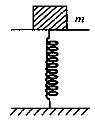
$A$ mass of $2.0\, kg$ is placed on a flat pan attached to a vertical spring fixed on the ground as shown in the figure. The mass of the spring and the pan is negligible. When pressed slightly and released,the mass executes simple harmonic motion. The spring constant is $200\, N/m$. What should be the minimum amplitude of the motion so that the mass gets detached from the pan? (Take $g = 10\, m/s^2$)
A
$10\, cm$
B
Any value less than $12\, cm$
C
$4\, cm$
D
$8\, cm$
Solution
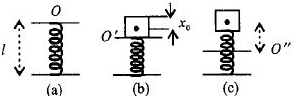
(A) The spring has a natural length $l$. When mass $m$ is placed on it,the spring compresses by $x_0$ to reach the equilibrium position $O'$.
At equilibrium,the spring force balances the weight of the mass: $k x_0 = m g$.
$x_0 = \frac{m g}{k} = \frac{2.0 \times 10}{200} = 0.10\, m = 10\, cm$.
When the mass oscillates with amplitude $A$,the maximum upward acceleration of the mass is $a_{max} = A \omega^2$,where $\omega^2 = \frac{k}{m}$.
The mass will detach from the pan when the downward acceleration of the mass exceeds the acceleration due to gravity $g$ at the highest point of its motion,or equivalently,when the normal force becomes zero.
The condition for the mass to lose contact with the pan is $A \omega^2 \ge g$.
Substituting $\omega^2 = \frac{k}{m}$,we get $A (\frac{k}{m}) \ge g$.
$A \ge \frac{m g}{k} = x_0$.
Therefore,the minimum amplitude required for the mass to detach is $A = 10\, cm$.
At equilibrium,the spring force balances the weight of the mass: $k x_0 = m g$.
$x_0 = \frac{m g}{k} = \frac{2.0 \times 10}{200} = 0.10\, m = 10\, cm$.
When the mass oscillates with amplitude $A$,the maximum upward acceleration of the mass is $a_{max} = A \omega^2$,where $\omega^2 = \frac{k}{m}$.
The mass will detach from the pan when the downward acceleration of the mass exceeds the acceleration due to gravity $g$ at the highest point of its motion,or equivalently,when the normal force becomes zero.
The condition for the mass to lose contact with the pan is $A \omega^2 \ge g$.
Substituting $\omega^2 = \frac{k}{m}$,we get $A (\frac{k}{m}) \ge g$.
$A \ge \frac{m g}{k} = x_0$.
Therefore,the minimum amplitude required for the mass to detach is $A = 10\, cm$.
0 likes
View Solution65
MediumMCQ
The period of oscillation of a mass $M$ suspended from a spring of negligible mass is $T$. If along with it another mass $M$ is also suspended,the period of oscillation will now be
A
$T$
B
$\frac{T}{\sqrt{2}}$
C
$2T$
D
$\sqrt{2}T$
Solution
(D) mass $M$ is suspended from a massless spring of spring constant $k$ as shown in figure $(a)$.
The time period of oscillation is given by:
$T = 2 \pi \sqrt{\frac{M}{k}}$ $(i)$
When another mass $M$ is also suspended with it,the total mass becomes $M + M = 2M$,as shown in figure $(b)$.
The new time period of oscillation $T^{\prime}$ is:
$T^{\prime} = 2 \pi \sqrt{\frac{2M}{k}}$
$T^{\prime} = \sqrt{2} \left( 2 \pi \sqrt{\frac{M}{k}} \right)$
Using equation $(i)$,we get:
$T^{\prime} = \sqrt{2} T$
The time period of oscillation is given by:
$T = 2 \pi \sqrt{\frac{M}{k}}$ $(i)$
When another mass $M$ is also suspended with it,the total mass becomes $M + M = 2M$,as shown in figure $(b)$.
The new time period of oscillation $T^{\prime}$ is:
$T^{\prime} = 2 \pi \sqrt{\frac{2M}{k}}$
$T^{\prime} = \sqrt{2} \left( 2 \pi \sqrt{\frac{M}{k}} \right)$
Using equation $(i)$,we get:
$T^{\prime} = \sqrt{2} T$

0 likes
View Solution66
MediumMCQ
$A$ body of mass $m$ is attached to the lower end of a spring whose upper end is fixed. The mass of the spring is negligible. When the mass $m$ is pulled down slightly and released,it oscillates with a time period of $3 \ s$. When the mass $m$ is increased by $1 \ kg$,the time period of oscillation becomes $5 \ s$. What is the value of $m$ in $kg$?
A
$\frac{16}{9}$
B
$\frac{9}{16}$
C
$\frac{3}{4}$
D
$\frac{4}{3}$
Solution
(B) The time period of a spring-block system is given by $T = 2 \pi \sqrt{\frac{m}{k}}$.
For a given spring,$T \propto \sqrt{m}$.
Therefore,$\frac{T_{1}}{T_{2}} = \sqrt{\frac{m_{1}}{m_{2}}}$.
Here,$T_{1} = 3 \ s$,$m_{1} = m$,$T_{2} = 5 \ s$,and $m_{2} = m + 1$.
Substituting the values: $\frac{3}{5} = \sqrt{\frac{m}{m+1}}$.
Squaring both sides: $\frac{9}{25} = \frac{m}{m+1}$.
Cross-multiplying: $9(m + 1) = 25m \Rightarrow 9m + 9 = 25m$.
$16m = 9 \Rightarrow m = \frac{9}{16} \ kg$.
For a given spring,$T \propto \sqrt{m}$.
Therefore,$\frac{T_{1}}{T_{2}} = \sqrt{\frac{m_{1}}{m_{2}}}$.
Here,$T_{1} = 3 \ s$,$m_{1} = m$,$T_{2} = 5 \ s$,and $m_{2} = m + 1$.
Substituting the values: $\frac{3}{5} = \sqrt{\frac{m}{m+1}}$.
Squaring both sides: $\frac{9}{25} = \frac{m}{m+1}$.
Cross-multiplying: $9(m + 1) = 25m \Rightarrow 9m + 9 = 25m$.
$16m = 9 \Rightarrow m = \frac{9}{16} \ kg$.
0 likes
View Solution67
MediumMCQ
$A$ force of $6.4 \, N$ stretches a vertical spring by $0.1 \, m$. The mass that must be suspended from the spring so that it oscillates with a period of $\left( \frac{\pi}{4} \right) \, s$ is ... $kg$.
A
$\frac{\pi}{4}$
B
$1$
C
$\frac{1}{\pi}$
D
$10$
Solution
(B) The force constant $k$ of the spring is determined by Hooke's Law: $F = kx$.
Given $F = 6.4 \, N$ and $x = 0.1 \, m$,we have $6.4 = k(0.1)$,which gives $k = 64 \, N/m$.
The time period $T$ of a spring-mass system is given by $T = 2\pi \sqrt{\frac{m}{k}}$.
Substituting the given values: $\frac{\pi}{4} = 2\pi \sqrt{\frac{m}{64}}$.
Dividing both sides by $\pi$: $\frac{1}{4} = 2 \sqrt{\frac{m}{64}}$.
Dividing by $2$: $\frac{1}{8} = \sqrt{\frac{m}{64}}$.
Squaring both sides: $\frac{1}{64} = \frac{m}{64}$.
Therefore,$m = 1 \, kg$.
Given $F = 6.4 \, N$ and $x = 0.1 \, m$,we have $6.4 = k(0.1)$,which gives $k = 64 \, N/m$.
The time period $T$ of a spring-mass system is given by $T = 2\pi \sqrt{\frac{m}{k}}$.
Substituting the given values: $\frac{\pi}{4} = 2\pi \sqrt{\frac{m}{64}}$.
Dividing both sides by $\pi$: $\frac{1}{4} = 2 \sqrt{\frac{m}{64}}$.
Dividing by $2$: $\frac{1}{8} = \sqrt{\frac{m}{64}}$.
Squaring both sides: $\frac{1}{64} = \frac{m}{64}$.
Therefore,$m = 1 \, kg$.
0 likes
View Solution68
AdvancedMCQ
$A$ sphere of mass $m$ is attached to the lower end of a light vertical spring with force constant $k$. The upper end of the spring is fixed. The sphere is released from rest at the natural (unstretched) length of the spring and comes to rest again after falling through a distance $x$.
A
The upward acceleration of the sphere at the lowest point is equal to $g$.
B
$x = 2 mg/k$
C
The acceleration of the sphere is zero at the position where it has fallen through a distance $x/2$.
D
All of the above
Solution
(D) According to the law of conservation of energy,the initial velocity is $0$ and the final velocity is $0$.
$mgx - \frac{1}{2} kx^2 = 0$
$x = \frac{2mg}{k}$.
When the sphere falls through a distance $x/2$,the extension in the spring is $x/2$.
The spring force is $F_s = k(x/2) = k \cdot \frac{2mg}{2k} = mg$.
Since the spring force and the gravitational force are equal in magnitude and opposite in direction,the net force is $0$,which means the acceleration $a = 0$ at the position $x/2$.
At the lowest point $(x)$,the net force is $F_{net} = kx - mg = k(\frac{2mg}{k}) - mg = mg$.
Thus,$ma = mg \Rightarrow a = g$ (upwards).
Therefore,all statements are correct.
$mgx - \frac{1}{2} kx^2 = 0$
$x = \frac{2mg}{k}$.
When the sphere falls through a distance $x/2$,the extension in the spring is $x/2$.
The spring force is $F_s = k(x/2) = k \cdot \frac{2mg}{2k} = mg$.
Since the spring force and the gravitational force are equal in magnitude and opposite in direction,the net force is $0$,which means the acceleration $a = 0$ at the position $x/2$.
At the lowest point $(x)$,the net force is $F_{net} = kx - mg = k(\frac{2mg}{k}) - mg = mg$.
Thus,$ma = mg \Rightarrow a = g$ (upwards).
Therefore,all statements are correct.
0 likes
View Solution69
MediumMCQ
Find the ratio of time periods of two identical springs if they are first joined in series and then in parallel and a mass $m$ is suspended from them.
A
$4$
B
$2$
C
$1$
D
$3$
Solution
(B) For two identical springs with spring constant $k$,when joined in series,the equivalent spring constant $k_{eq}$ is given by $\frac{1}{k_{eq}} = \frac{1}{k} + \frac{1}{k} = \frac{2}{k}$,so $k_{eq} = \frac{k}{2}$.
The time period in series is $T_{1} = 2 \pi \sqrt{\frac{m}{k_{eq}}} = 2 \pi \sqrt{\frac{2m}{k}}$.
When joined in parallel,the equivalent spring constant $k'$ is $k' = k + k = 2k$.
The time period in parallel is $T_{2} = 2 \pi \sqrt{\frac{m}{k'}} = 2 \pi \sqrt{\frac{m}{2k}}$.
The ratio of the time periods is $\frac{T_{1}}{T_{2}} = \frac{2 \pi \sqrt{\frac{2m}{k}}}{2 \pi \sqrt{\frac{m}{2k}}} = \sqrt{\frac{2m}{k} \cdot \frac{2k}{m}} = \sqrt{4} = 2$.
The time period in series is $T_{1} = 2 \pi \sqrt{\frac{m}{k_{eq}}} = 2 \pi \sqrt{\frac{2m}{k}}$.
When joined in parallel,the equivalent spring constant $k'$ is $k' = k + k = 2k$.
The time period in parallel is $T_{2} = 2 \pi \sqrt{\frac{m}{k'}} = 2 \pi \sqrt{\frac{m}{2k}}$.
The ratio of the time periods is $\frac{T_{1}}{T_{2}} = \frac{2 \pi \sqrt{\frac{2m}{k}}}{2 \pi \sqrt{\frac{m}{2k}}} = \sqrt{\frac{2m}{k} \cdot \frac{2k}{m}} = \sqrt{4} = 2$.
0 likes
View Solution70
MediumMCQ
Two bodies $P$ and $Q$ of equal mass are suspended from two separate massless springs of force constants $k_1$ and $k_2$ respectively. If the maximum velocities of them are equal during their motion,the ratio of the amplitude of $P$ to $Q$ is:
A
$\frac{k_1}{k_2}$
B
$\sqrt{\frac{k_2}{k_1}}$
C
$\frac{k_2}{k_1}$
D
$\sqrt{\frac{k_1}{k_2}}$
Solution
(B) The maximum velocity of a body in simple harmonic motion is given by $v_{max} = \omega A$,where $\omega = \sqrt{\frac{k}{m}}$ is the angular frequency and $A$ is the amplitude.
Given that the masses are equal $(m_P = m_Q = m)$ and their maximum velocities are equal $(v_P = v_Q)$,
we have $\omega_1 A_1 = \omega_2 A_2$,where $A_1$ and $A_2$ are the amplitudes of $P$ and $Q$ respectively.
Substituting the expression for angular frequency: $\sqrt{\frac{k_1}{m}} A_1 = \sqrt{\frac{k_2}{m}} A_2$.
Rearranging to find the ratio of amplitudes $\frac{A_1}{A_2}$:
$\frac{A_1}{A_2} = \frac{\sqrt{\frac{k_2}{m}}}{\sqrt{\frac{k_1}{m}}} = \sqrt{\frac{k_2}{k_1}}$.
Given that the masses are equal $(m_P = m_Q = m)$ and their maximum velocities are equal $(v_P = v_Q)$,
we have $\omega_1 A_1 = \omega_2 A_2$,where $A_1$ and $A_2$ are the amplitudes of $P$ and $Q$ respectively.
Substituting the expression for angular frequency: $\sqrt{\frac{k_1}{m}} A_1 = \sqrt{\frac{k_2}{m}} A_2$.
Rearranging to find the ratio of amplitudes $\frac{A_1}{A_2}$:
$\frac{A_1}{A_2} = \frac{\sqrt{\frac{k_2}{m}}}{\sqrt{\frac{k_1}{m}}} = \sqrt{\frac{k_2}{k_1}}$.
0 likes
View Solution71
MediumMCQ
$A$ heavy brass sphere is hung from a light spring and is set in vertical small oscillations with a period $T$. The sphere is now immersed in a non-viscous liquid with a density $1/10$th the density of the sphere. If the system is now set in vertical $S.H.M.$,its period will be
A
$(9/10)T$
B
$(9/10)^{1/2}T$
C
$(10/9)^{1/2}T$
D
$T$
Solution
(B) The period of a spring-mass system is given by $T = 2\pi \sqrt{\frac{m}{k}}$.
When the sphere is immersed in a liquid,it experiences an upward buoyant force $F_B = V\rho_L g$,where $V$ is the volume of the sphere and $\rho_L$ is the density of the liquid.
The effective weight of the sphere becomes $W_{eff} = mg - F_B = V\rho_S g - V\rho_L g = Vg(\rho_S - \rho_L)$,where $\rho_S$ is the density of the sphere.
Since $\rho_L = \frac{1}{10}\rho_S$,the effective weight is $W_{eff} = Vg(\rho_S - \frac{1}{10}\rho_S) = Vg(\frac{9}{10}\rho_S) = \frac{9}{10}mg$.
This is equivalent to a system with an effective mass $m' = \frac{9}{10}m$.
The new period $T'$ is $T' = 2\pi \sqrt{\frac{m'}{k}} = 2\pi \sqrt{\frac{9m}{10k}} = \sqrt{\frac{9}{10}} T = \sqrt{\frac{9}{10}} T$.
When the sphere is immersed in a liquid,it experiences an upward buoyant force $F_B = V\rho_L g$,where $V$ is the volume of the sphere and $\rho_L$ is the density of the liquid.
The effective weight of the sphere becomes $W_{eff} = mg - F_B = V\rho_S g - V\rho_L g = Vg(\rho_S - \rho_L)$,where $\rho_S$ is the density of the sphere.
Since $\rho_L = \frac{1}{10}\rho_S$,the effective weight is $W_{eff} = Vg(\rho_S - \frac{1}{10}\rho_S) = Vg(\frac{9}{10}\rho_S) = \frac{9}{10}mg$.
This is equivalent to a system with an effective mass $m' = \frac{9}{10}m$.
The new period $T'$ is $T' = 2\pi \sqrt{\frac{m'}{k}} = 2\pi \sqrt{\frac{9m}{10k}} = \sqrt{\frac{9}{10}} T = \sqrt{\frac{9}{10}} T$.
0 likes
View Solution72
MediumMCQ
$A$ mass at the end of a spring executes harmonic motion about an equilibrium position with an amplitude $A$. Its speed as it passes through the equilibrium position is $V$. If extended $2A$ and released,the speed of the mass passing through the equilibrium position will be
A
$2V$
B
$4V$
C
$\frac{V}{2}$
D
$\frac{V}{4}$
Solution
(A) For a mass-spring system executing simple harmonic motion,the maximum speed $V$ at the equilibrium position is given by the formula $V = A \omega$,where $A$ is the amplitude and $\omega$ is the angular frequency.
Since the angular frequency $\omega = \sqrt{\frac{k}{m}}$ depends only on the spring constant $k$ and the mass $m$,it remains constant regardless of the amplitude.
Given the initial amplitude is $A$,the initial speed is $V = A \omega$.
When the amplitude is increased to $A' = 2A$,the new maximum speed $V'$ at the equilibrium position becomes $V' = A' \omega = (2A) \omega = 2(A \omega) = 2V$.
Therefore,the speed of the mass passing through the equilibrium position will be $2V$.
Since the angular frequency $\omega = \sqrt{\frac{k}{m}}$ depends only on the spring constant $k$ and the mass $m$,it remains constant regardless of the amplitude.
Given the initial amplitude is $A$,the initial speed is $V = A \omega$.
When the amplitude is increased to $A' = 2A$,the new maximum speed $V'$ at the equilibrium position becomes $V' = A' \omega = (2A) \omega = 2(A \omega) = 2V$.
Therefore,the speed of the mass passing through the equilibrium position will be $2V$.
0 likes
View Solution73
DifficultMCQ
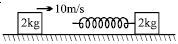
$A$ $2\, kg$ block moving with $10\, m/s$ strikes a spring of constant $\pi^2\, N/m$ attached to a $2\, kg$ block at rest kept on a smooth floor. The time for which the moving block remains in contact with the spring will be ... $\sec$.
A
$\sqrt{2}$
B
$\frac{1}{\sqrt{2}}$
C
$1$
D
$\frac{1}{2}$
Solution
(C) The moving block $m_1$ stays in contact with the spring during the compression phase,which corresponds to half the time period of the oscillation of the equivalent system.
The time period $T$ of the spring-mass system is given by $T = 2\pi \sqrt{\frac{\mu}{k}}$,where $\mu$ is the reduced mass.
Here,$m_1 = 2\, kg$,$m_2 = 2\, kg$,and $k = \pi^2\, N/m$.
The reduced mass $\mu = \frac{m_1 m_2}{m_1 + m_2} = \frac{2 \times 2}{2 + 2} = 1\, kg$.
Substituting the values,$T = 2\pi \sqrt{\frac{1}{\pi^2}} = 2\pi \times \frac{1}{\pi} = 2\, \sec$.
The time for which the moving block remains in contact with the spring is $t = \frac{T}{2} = \frac{2}{2} = 1\, \sec$.
The time period $T$ of the spring-mass system is given by $T = 2\pi \sqrt{\frac{\mu}{k}}$,where $\mu$ is the reduced mass.
Here,$m_1 = 2\, kg$,$m_2 = 2\, kg$,and $k = \pi^2\, N/m$.
The reduced mass $\mu = \frac{m_1 m_2}{m_1 + m_2} = \frac{2 \times 2}{2 + 2} = 1\, kg$.
Substituting the values,$T = 2\pi \sqrt{\frac{1}{\pi^2}} = 2\pi \times \frac{1}{\pi} = 2\, \sec$.
The time for which the moving block remains in contact with the spring is $t = \frac{T}{2} = \frac{2}{2} = 1\, \sec$.
0 likes
View Solution74
AdvancedMCQ
The potential energy of a particle of mass $0.1\,kg,$ moving along the $x-$axis,is given by $U = 5x(x-4)\,J,$ where $x$ is in metres. It can be concluded that
A
the period of oscillation of the particle is $\pi /5 \,s.$
B
the speed of the particle is maximum at $x = 2 \,m.$
C
the particle executes simple harmonic motion.
D
all of the above.
Solution
(D) The force acting on the particle is given by $F = -\frac{dU}{dx}.$
Given $U = 5x(x-4) = 5x^2 - 20x.$
$F = -\frac{d}{dx}(5x^2 - 20x) = -(10x - 20) = -10(x - 2).$
Since $F = -k(x - x_0)$ where $x_0 = 2\,m,$ the particle executes simple harmonic motion about the equilibrium position $x = 2\,m.$
At the equilibrium position $(x = 2\,m)$,the force is zero,which implies the acceleration is zero and the speed of the particle is maximum.
Comparing $F = -10(x - 2)$ with the standard $SHM$ equation $F = -k(x - x_0),$ we get the force constant $k = 10\,N/m.$
The time period $T$ is given by $T = 2\pi \sqrt{\frac{m}{k}}.$
Substituting $m = 0.1\,kg$ and $k = 10\,N/m,$
$T = 2\pi \sqrt{\frac{0.1}{10}} = 2\pi \sqrt{0.01} = 2\pi(0.1) = 0.2\pi = \frac{\pi}{5}\,s.$
Since all statements are correct,the correct option is $D$.
Given $U = 5x(x-4) = 5x^2 - 20x.$
$F = -\frac{d}{dx}(5x^2 - 20x) = -(10x - 20) = -10(x - 2).$
Since $F = -k(x - x_0)$ where $x_0 = 2\,m,$ the particle executes simple harmonic motion about the equilibrium position $x = 2\,m.$
At the equilibrium position $(x = 2\,m)$,the force is zero,which implies the acceleration is zero and the speed of the particle is maximum.
Comparing $F = -10(x - 2)$ with the standard $SHM$ equation $F = -k(x - x_0),$ we get the force constant $k = 10\,N/m.$
The time period $T$ is given by $T = 2\pi \sqrt{\frac{m}{k}}.$
Substituting $m = 0.1\,kg$ and $k = 10\,N/m,$
$T = 2\pi \sqrt{\frac{0.1}{10}} = 2\pi \sqrt{0.01} = 2\pi(0.1) = 0.2\pi = \frac{\pi}{5}\,s.$
Since all statements are correct,the correct option is $D$.
0 likes
View Solution75
AdvancedMCQ
$A$ mass of $0.2\,kg$ is attached to the lower end of a massless spring of force-constant $200\,N/m,$ the upper end of which is fixed to a rigid support. Which of the following statements is/are true?
A
In equilibrium,the spring will be stretched by $1\,cm.$
B
If the mass is raised till the spring is in an unstretched state and then released,it will go down by $2\,cm$ before moving upwards.
C
The frequency of oscillation will be nearly $5\,Hz.$
D
All of the above.
Solution
(D) $1$. Equilibrium stretching: At equilibrium,the weight of the mass is balanced by the spring force. $mg = kx \implies 0.2 \times 10 = 200 \times x \implies x = 0.01\,m = 1\,cm.$ Thus,statement $A$ is true.
$2$. Motion from unstretched state: When the mass is raised to the unstretched position and released,the amplitude of oscillation $A$ is equal to the equilibrium extension $x = 1\,cm.$ The mass will oscillate between the unstretched position $(0\,cm)$ and the lowest point $(2A = 2\,cm)$. Thus,it will go down by $2\,cm$ before moving upwards. Statement $B$ is true.
$3$. Frequency of oscillation: The frequency $f$ is given by $f = \frac{1}{2\pi} \sqrt{\frac{k}{m}} = \frac{1}{2\pi} \sqrt{\frac{200}{0.2}} = \frac{1}{2\pi} \sqrt{1000} \approx \frac{31.62}{6.28} \approx 5.03\,Hz.$ This is nearly $5\,Hz.$ Statement $C$ is true.
Since all statements are true,the correct option is $D$.
$2$. Motion from unstretched state: When the mass is raised to the unstretched position and released,the amplitude of oscillation $A$ is equal to the equilibrium extension $x = 1\,cm.$ The mass will oscillate between the unstretched position $(0\,cm)$ and the lowest point $(2A = 2\,cm)$. Thus,it will go down by $2\,cm$ before moving upwards. Statement $B$ is true.
$3$. Frequency of oscillation: The frequency $f$ is given by $f = \frac{1}{2\pi} \sqrt{\frac{k}{m}} = \frac{1}{2\pi} \sqrt{\frac{200}{0.2}} = \frac{1}{2\pi} \sqrt{1000} \approx \frac{31.62}{6.28} \approx 5.03\,Hz.$ This is nearly $5\,Hz.$ Statement $C$ is true.
Since all statements are true,the correct option is $D$.
0 likes
View Solution76
DifficultMCQ
The angular frequency of a spring-block system is $\omega_0$. This system is suspended from the ceiling of an elevator moving downwards with a constant speed $v_0$. The block is at rest relative to the elevator. The lift is suddenly stopped. Assuming the downward direction as positive,choose the wrong statement:
A
The amplitude of the block is $\frac{v_0}{\omega_0}$.
B
The initial phase of the block is $\pi$.
C
The equation of motion for the block is $x(t) = \frac{v_0}{\omega_0} \sin(\omega_0 t)$.
D
The maximum speed of the block is $v_0$.
Solution
(B) $1$. When the elevator is moving downwards at a constant speed $v_0$,the block is at rest relative to the elevator. When the elevator stops suddenly,the block continues to move downwards with an initial velocity $v_0$ relative to the ground.
$2$. The equilibrium position of the spring-block system remains unchanged because the gravitational force and spring force are balanced. The block now has an initial velocity $v_0$ at the equilibrium position.
$3$. The amplitude $A$ is given by $v_{max} = A\omega_0$,so $A = \frac{v_0}{\omega_0}$. Thus,option $A$ is correct.
$4$. Since the block starts from the equilibrium position moving in the positive (downward) direction,the equation of motion is $x(t) = A \sin(\omega_0 t) = \frac{v_0}{\omega_0} \sin(\omega_0 t)$. Thus,option $C$ is correct.
$5$. The maximum speed in $SHM$ is $v_{max} = A\omega_0 = \frac{v_0}{\omega_0} \cdot \omega_0 = v_0$. Thus,option $D$ is correct.
$6$. The initial phase $\phi$ for $x(t) = A \sin(\omega_0 t + \phi)$ is $0$ because at $t=0$,$x=0$ and $v > 0$. Therefore,the statement that the initial phase is $\pi$ is incorrect.
$2$. The equilibrium position of the spring-block system remains unchanged because the gravitational force and spring force are balanced. The block now has an initial velocity $v_0$ at the equilibrium position.
$3$. The amplitude $A$ is given by $v_{max} = A\omega_0$,so $A = \frac{v_0}{\omega_0}$. Thus,option $A$ is correct.
$4$. Since the block starts from the equilibrium position moving in the positive (downward) direction,the equation of motion is $x(t) = A \sin(\omega_0 t) = \frac{v_0}{\omega_0} \sin(\omega_0 t)$. Thus,option $C$ is correct.
$5$. The maximum speed in $SHM$ is $v_{max} = A\omega_0 = \frac{v_0}{\omega_0} \cdot \omega_0 = v_0$. Thus,option $D$ is correct.
$6$. The initial phase $\phi$ for $x(t) = A \sin(\omega_0 t + \phi)$ is $0$ because at $t=0$,$x=0$ and $v > 0$. Therefore,the statement that the initial phase is $\pi$ is incorrect.
0 likes
View Solution77
AdvancedMCQ
$A$ cylindrical block of density $\rho$ is partially immersed in a liquid of density $3\rho$. The plane surface of the block remains parallel to the surface of the liquid. The height of the block is $60\, cm$. The block performs $SHM$ when displaced from its mean position. [Use $g = 9.8\, m/s^2$]
A
the maximum amplitude is $20\, cm$
B
the maximum amplitude is $40\, cm$
C
the time period will be $2\pi/7$ seconds.
D
$(A)$ and $(C)$ both
Solution
(D) When the cylindrical block is in equilibrium,the buoyant force equals the weight of the block:
$F_B = mg \Rightarrow (3\rho) A y g = \rho A h g$,where $y$ is the submerged depth and $h = 60\, cm$.
$3y = h \Rightarrow y = h/3 = 60/3 = 20\, cm$.
Since the block cannot be displaced upwards by more than its submerged depth without leaving the liquid,the maximum amplitude is $20\, cm$.
For a small displacement $x$ from equilibrium,the restoring force is $F = -(\text{change in buoyant force}) = -(A \cdot 3\rho \cdot g) x$.
The effective spring constant is $k = 3A\rho g$.
The mass of the block is $m = \rho A h$.
The time period $T$ is given by $T = 2\pi \sqrt{m/k} = 2\pi \sqrt{(\rho A h) / (3A\rho g)} = 2\pi \sqrt{h / (3g)}$.
Substituting $h = 0.6\, m$ and $g = 9.8\, m/s^2$:
$T = 2\pi \sqrt{0.6 / (3 \times 9.8)} = 2\pi \sqrt{0.6 / 29.4} = 2\pi \sqrt{1/49} = 2\pi/7\, s$.
$F_B = mg \Rightarrow (3\rho) A y g = \rho A h g$,where $y$ is the submerged depth and $h = 60\, cm$.
$3y = h \Rightarrow y = h/3 = 60/3 = 20\, cm$.
Since the block cannot be displaced upwards by more than its submerged depth without leaving the liquid,the maximum amplitude is $20\, cm$.
For a small displacement $x$ from equilibrium,the restoring force is $F = -(\text{change in buoyant force}) = -(A \cdot 3\rho \cdot g) x$.
The effective spring constant is $k = 3A\rho g$.
The mass of the block is $m = \rho A h$.
The time period $T$ is given by $T = 2\pi \sqrt{m/k} = 2\pi \sqrt{(\rho A h) / (3A\rho g)} = 2\pi \sqrt{h / (3g)}$.
Substituting $h = 0.6\, m$ and $g = 9.8\, m/s^2$:
$T = 2\pi \sqrt{0.6 / (3 \times 9.8)} = 2\pi \sqrt{0.6 / 29.4} = 2\pi \sqrt{1/49} = 2\pi/7\, s$.
0 likes
View Solution78
DifficultMCQ
$A$ coin is placed on a horizontal platform. The platform performs vertical simple harmonic motion with an angular frequency $\omega$. The amplitude of oscillation is gradually increased. At what condition will the coin first lose contact with the platform?
A
At the mean position of the platform.
B
For an amplitude of $g/\omega^2$.
C
For an amplitude of $g^2/\omega^2$.
D
At the highest position of the platform.
Solution
(D) The coin will lose contact with the platform when the downward acceleration of the platform exceeds the acceleration due to gravity $g$.
In simple harmonic motion,the acceleration is given by $a = -\omega^2 y$.
The maximum downward acceleration occurs at the highest point of the oscillation,where the displacement $y = A$ (amplitude).
Thus,the downward acceleration is $a = \omega^2 A$.
The coin loses contact when the downward acceleration of the platform is greater than or equal to $g$.
$\omega^2 A \geq g$
$A \geq \frac{g}{\omega^2}$
Therefore,the coin first loses contact at the highest point when the amplitude reaches $A = \frac{g}{\omega^2}$.
In simple harmonic motion,the acceleration is given by $a = -\omega^2 y$.
The maximum downward acceleration occurs at the highest point of the oscillation,where the displacement $y = A$ (amplitude).
Thus,the downward acceleration is $a = \omega^2 A$.
The coin loses contact when the downward acceleration of the platform is greater than or equal to $g$.
$\omega^2 A \geq g$
$A \geq \frac{g}{\omega^2}$
Therefore,the coin first loses contact at the highest point when the amplitude reaches $A = \frac{g}{\omega^2}$.
0 likes
View Solution79
MediumMCQ
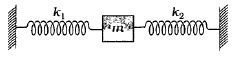
Two springs,of force constants $k_1$ and $k_2$ are connected to a mass $m$ as shown. The frequency of oscillation of the mass is $f$. If both $k_1$ and $k_2$ are made four times their original values,the frequency of oscillation becomes
A
$2f$
B
$f/2$
C
$f/4$
D
$4f$
Solution
(A) The two springs are connected in parallel to the mass $m$.
The effective spring constant $k_{eff}$ is given by $k_{eff} = k_1 + k_2$.
The frequency of oscillation is $f = \frac{1}{2\pi} \sqrt{\frac{k_1 + k_2}{m}}$ ... $(i)$
When both $k_1$ and $k_2$ are made four times their original values,the new spring constants are $k_1' = 4k_1$ and $k_2' = 4k_2$.
The new effective spring constant is $k_{eff}' = 4k_1 + 4k_2 = 4(k_1 + k_2)$.
The new frequency of oscillation $f'$ is given by $f' = \frac{1}{2\pi} \sqrt{\frac{k_{eff}'}{m}} = \frac{1}{2\pi} \sqrt{\frac{4(k_1 + k_2)}{m}}$.
$f' = 2 \times \left( \frac{1}{2\pi} \sqrt{\frac{k_1 + k_2}{m}} \right) = 2f$.
The effective spring constant $k_{eff}$ is given by $k_{eff} = k_1 + k_2$.
The frequency of oscillation is $f = \frac{1}{2\pi} \sqrt{\frac{k_1 + k_2}{m}}$ ... $(i)$
When both $k_1$ and $k_2$ are made four times their original values,the new spring constants are $k_1' = 4k_1$ and $k_2' = 4k_2$.
The new effective spring constant is $k_{eff}' = 4k_1 + 4k_2 = 4(k_1 + k_2)$.
The new frequency of oscillation $f'$ is given by $f' = \frac{1}{2\pi} \sqrt{\frac{k_{eff}'}{m}} = \frac{1}{2\pi} \sqrt{\frac{4(k_1 + k_2)}{m}}$.
$f' = 2 \times \left( \frac{1}{2\pi} \sqrt{\frac{k_1 + k_2}{m}} \right) = 2f$.
0 likes
View Solution80
DifficultMCQ
$A$ mass $M$,attached to a horizontal spring,executes $S.H.M.$ with amplitude $A_1$. When the mass $M$ passes through its mean position,a smaller mass $m$ is placed over it and both of them move together with amplitude $A_2$. The ratio of $\frac{A_1}{A_2}$ is
A
$\frac{M}{M + m}$
B
$\frac{M + m}{M}$
C
$\left( \frac{M}{M + m} \right)^{\frac{1}{2}}$
D
$\left( \frac{M + m}{M} \right)^{\frac{1}{2}}$
Solution
(D) At the mean position,the potential energy is zero and the kinetic energy is maximum. Since no external horizontal force acts on the system during the placement of mass $m$,linear momentum is conserved.
Let $v_1$ be the velocity of mass $M$ at the mean position,and $v_2$ be the velocity of the combined mass $(M+m)$ immediately after placing $m$.
Conservation of momentum: $M v_1 = (M + m) v_2$.
The maximum velocity in $S.H.M.$ is given by $v_{max} = A \omega = A \sqrt{\frac{k}{m_{eff}}}$.
For the first case: $v_1 = A_1 \sqrt{\frac{k}{M}}$.
For the second case: $v_2 = A_2 \sqrt{\frac{k}{M+m}}$.
Substituting these into the momentum equation:
$M \left( A_1 \sqrt{\frac{k}{M}} \right) = (M + m) \left( A_2 \sqrt{\frac{k}{M+m}} \right)$.
$A_1 \sqrt{M k} = A_2 \sqrt{(M+m) k}$.
$A_1 \sqrt{M} = A_2 \sqrt{M+m}$.
Therefore,$\frac{A_1}{A_2} = \sqrt{\frac{M+m}{M}} = \left( \frac{M+m}{M} \right)^{\frac{1}{2}}$.
Let $v_1$ be the velocity of mass $M$ at the mean position,and $v_2$ be the velocity of the combined mass $(M+m)$ immediately after placing $m$.
Conservation of momentum: $M v_1 = (M + m) v_2$.
The maximum velocity in $S.H.M.$ is given by $v_{max} = A \omega = A \sqrt{\frac{k}{m_{eff}}}$.
For the first case: $v_1 = A_1 \sqrt{\frac{k}{M}}$.
For the second case: $v_2 = A_2 \sqrt{\frac{k}{M+m}}$.
Substituting these into the momentum equation:
$M \left( A_1 \sqrt{\frac{k}{M}} \right) = (M + m) \left( A_2 \sqrt{\frac{k}{M+m}} \right)$.
$A_1 \sqrt{M k} = A_2 \sqrt{(M+m) k}$.
$A_1 \sqrt{M} = A_2 \sqrt{M+m}$.
Therefore,$\frac{A_1}{A_2} = \sqrt{\frac{M+m}{M}} = \left( \frac{M+m}{M} \right)^{\frac{1}{2}}$.
0 likes
View Solution81
MediumMCQ
$A$ silver atom in a solid oscillates in simple harmonic motion in a specific direction with a frequency of $10^{12} \ s^{-1}$. What is the force constant of the bonds connecting one atom to the others? (Molar mass of silver $= 108 \ g/mol$ and Avogadro number $= 6.02 \times 10^{23} \ mol^{-1}$)
A
$7.1$
B
$2.2$
C
$5.5$
D
$6.4$
Solution
(A) The frequency of an atom in $SHM$ is given by the formula: $f = \frac{1}{2\pi} \sqrt{\frac{k}{m}}$,where $k$ is the force constant and $m$ is the mass of one silver atom.
The mass of one silver atom is calculated as: $m = \frac{\text{Molar mass}}{\text{Avogadro number}} = \frac{108 \times 10^{-3} \ kg/mol}{6.02 \times 10^{23} \ mol^{-1}} \approx 1.794 \times 10^{-25} \ kg$.
Given $f = 10^{12} \ s^{-1}$,we rearrange the formula to solve for $k$: $k = m(2\pi f)^2$.
Substituting the values: $k = (1.794 \times 10^{-25}) \times (2 \times 3.1416 \times 10^{12})^2$.
$k = (1.794 \times 10^{-25}) \times (39.478 \times 10^{24}) \approx 7.08 \ N/m$.
Rounding to one decimal place,we get $k = 7.1 \ N/m$.
The mass of one silver atom is calculated as: $m = \frac{\text{Molar mass}}{\text{Avogadro number}} = \frac{108 \times 10^{-3} \ kg/mol}{6.02 \times 10^{23} \ mol^{-1}} \approx 1.794 \times 10^{-25} \ kg$.
Given $f = 10^{12} \ s^{-1}$,we rearrange the formula to solve for $k$: $k = m(2\pi f)^2$.
Substituting the values: $k = (1.794 \times 10^{-25}) \times (2 \times 3.1416 \times 10^{12})^2$.
$k = (1.794 \times 10^{-25}) \times (39.478 \times 10^{24}) \approx 7.08 \ N/m$.
Rounding to one decimal place,we get $k = 7.1 \ N/m$.
0 likes
View Solution82
MediumMCQ
$A$ plank with a small block on top of it is undergoing vertical $SHM$. Its period is $2 \ s$. The minimum amplitude at which the block will separate from the plank is:
A
$\frac{10}{\pi^2} \ m$
B
$\frac{\pi^2}{10} \ m$
C
$\frac{20}{\pi^2} \ m$
D
$\frac{\pi}{10} \ m$
Solution
(A) For the block to separate from the plank,the downward acceleration of the plank must exceed the acceleration due to gravity $g$.
At the point of separation,the downward acceleration of the $SHM$ is equal to $g$.
The maximum acceleration of an $SHM$ is given by $a_{max} = A \omega^2$.
Setting $a_{max} = g$,we get $A \omega^2 = g$.
Given the time period $T = 2 \ s$,the angular frequency is $\omega = \frac{2 \pi}{T} = \frac{2 \pi}{2} = \pi \ rad/s$.
Substituting the values,we have $A (\pi)^2 = g$.
Taking $g = 10 \ m/s^2$,we get $A \pi^2 = 10$.
Therefore,the minimum amplitude is $A = \frac{10}{\pi^2} \ m$.
At the point of separation,the downward acceleration of the $SHM$ is equal to $g$.
The maximum acceleration of an $SHM$ is given by $a_{max} = A \omega^2$.
Setting $a_{max} = g$,we get $A \omega^2 = g$.
Given the time period $T = 2 \ s$,the angular frequency is $\omega = \frac{2 \pi}{T} = \frac{2 \pi}{2} = \pi \ rad/s$.
Substituting the values,we have $A (\pi)^2 = g$.
Taking $g = 10 \ m/s^2$,we get $A \pi^2 = 10$.
Therefore,the minimum amplitude is $A = \frac{10}{\pi^2} \ m$.
0 likes
View Solution83
DifficultMCQ
Two small bodies of mass $2 \, kg$ each are attached to each other using a thread of length $10 \, cm$,and hang on a spring whose force constant is $200 \, N/m$,as shown in the figure. We burn the thread. What is the distance between the two bodies when the top body first arrives at its highest position? (Take $\pi^2 = 10$)
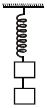
A
$60 \, cm$
B
$70 \, cm$
C
$80 \, cm$
D
None of these
Solution
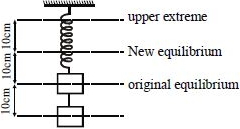
(B) $1$. Initial state: The total mass is $M = 2 + 2 = 4 \, kg$. The spring extension at equilibrium is $x_0 = \frac{Mg}{k} = \frac{4 \times 10}{200} = 0.2 \, m = 20 \, cm$.
$2$. After burning the thread: The lower mass falls freely. The upper mass oscillates about a new equilibrium position. The new equilibrium position is $x_{new} = \frac{mg}{k} = \frac{2 \times 10}{200} = 0.1 \, m = 10 \, cm$ below the natural length of the spring.
$3$. The amplitude of oscillation for the upper mass is $A = x_0 - x_{new} = 20 \, cm - 10 \, cm = 10 \, cm$.
$4$. The upper mass starts from the original equilibrium position ($20 \, cm$ below natural length) and moves to its highest position (upper extreme),which is $10 \, cm$ above the new equilibrium position ($10 \, cm$ below natural length). Thus,it travels $10 \, cm$ to reach the new equilibrium and another $10 \, cm$ to reach the upper extreme.
$5$. Time taken to reach the upper extreme is $t = \frac{T}{2} = \frac{1}{2} \times 2\pi \sqrt{\frac{m}{k}} = \pi \sqrt{\frac{2}{200}} = \frac{\pi}{10} \, s$.
$6$. In this time,the lower body falls a distance $h = \frac{1}{2}gt^2 = \frac{1}{2} \times 10 \times (\frac{\pi}{10})^2 = 5 \times \frac{10}{100} = 0.5 \, m = 50 \, cm$.
$7$. The upper body is at $10 \, cm$ below the natural length. The lower body is at $20 \, cm$ (original equilibrium) $+ 10 \, cm$ (thread length) $+ 50 \, cm$ (free fall) $= 80 \, cm$ below the natural length.
$8$. The distance between them is $80 \, cm - 10 \, cm = 70 \, cm$.
$2$. After burning the thread: The lower mass falls freely. The upper mass oscillates about a new equilibrium position. The new equilibrium position is $x_{new} = \frac{mg}{k} = \frac{2 \times 10}{200} = 0.1 \, m = 10 \, cm$ below the natural length of the spring.
$3$. The amplitude of oscillation for the upper mass is $A = x_0 - x_{new} = 20 \, cm - 10 \, cm = 10 \, cm$.
$4$. The upper mass starts from the original equilibrium position ($20 \, cm$ below natural length) and moves to its highest position (upper extreme),which is $10 \, cm$ above the new equilibrium position ($10 \, cm$ below natural length). Thus,it travels $10 \, cm$ to reach the new equilibrium and another $10 \, cm$ to reach the upper extreme.
$5$. Time taken to reach the upper extreme is $t = \frac{T}{2} = \frac{1}{2} \times 2\pi \sqrt{\frac{m}{k}} = \pi \sqrt{\frac{2}{200}} = \frac{\pi}{10} \, s$.
$6$. In this time,the lower body falls a distance $h = \frac{1}{2}gt^2 = \frac{1}{2} \times 10 \times (\frac{\pi}{10})^2 = 5 \times \frac{10}{100} = 0.5 \, m = 50 \, cm$.
$7$. The upper body is at $10 \, cm$ below the natural length. The lower body is at $20 \, cm$ (original equilibrium) $+ 10 \, cm$ (thread length) $+ 50 \, cm$ (free fall) $= 80 \, cm$ below the natural length.
$8$. The distance between them is $80 \, cm - 10 \, cm = 70 \, cm$.
0 likes
View Solution84
DifficultMCQ
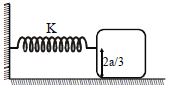
Find the maximum amplitude for safe $SHM$ (the block does not topple during $SHM$) of a cubical block of side $a$ on a smooth horizontal floor as shown in the figure (the spring is massless). The spring is attached at a height of $2a/3$ from the floor.
A
$\frac{mg}{3K}$
B
$\frac{3mg}{K}$
C
$\frac{2mg}{3K}$
D
None
Solution
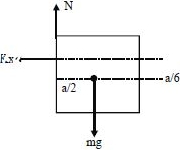
(D) For the block not to topple,the torque about the edge of the block must be zero at the point of impending toppling.
Let the spring force be $F = Kx$. The height of the spring attachment is $h = 2a/3$.
The center of mass is at height $a/2$ from the floor.
The torque due to the spring force about the bottom edge is $\tau_s = F \cdot h = (Kx) \cdot (2a/3)$.
The torque due to gravity about the same edge is $\tau_g = mg \cdot (a/2)$.
Equating the torques for the limit of toppling: $(Kx) \cdot (2a/3) = mg \cdot (a/2)$.
Solving for $x$: $x = \frac{mg \cdot a/2}{K \cdot 2a/3} = \frac{mg}{2K} \cdot \frac{3}{2} = \frac{3mg}{4K}$.
Since this option is not listed,the correct answer is None.
Let the spring force be $F = Kx$. The height of the spring attachment is $h = 2a/3$.
The center of mass is at height $a/2$ from the floor.
The torque due to the spring force about the bottom edge is $\tau_s = F \cdot h = (Kx) \cdot (2a/3)$.
The torque due to gravity about the same edge is $\tau_g = mg \cdot (a/2)$.
Equating the torques for the limit of toppling: $(Kx) \cdot (2a/3) = mg \cdot (a/2)$.
Solving for $x$: $x = \frac{mg \cdot a/2}{K \cdot 2a/3} = \frac{mg}{2K} \cdot \frac{3}{2} = \frac{3mg}{4K}$.
Since this option is not listed,the correct answer is None.
0 likes
View Solution85
MediumMCQ
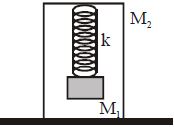
$A$ block of mass $M_1$ is hung by a light spring of force constant $k$ from the top bar of a reverse $U$-frame of mass $M_2$ resting on the floor. The block is pulled down from its equilibrium position by a distance $x$ and then released. Find the minimum value of $x$ such that the reverse $U$-frame will leave the floor momentarily.
A
$x = (M_1 + M_2)g/k$
B
$x = (2M_1 + M_2)g/k$
C
$x = (M_1 + 2M_2)g/k$
D
$x = M_1g/k$
Solution
(A) At equilibrium,the spring is stretched by $x_e = M_1g/k$.
When the block is pulled down by a distance $x$ from the equilibrium position and released,it performs simple harmonic motion with amplitude $x$.
The maximum upward force exerted by the spring on the frame occurs when the block is at its highest point (at a distance $x$ above the equilibrium position).
At this highest point,the spring is compressed by $(x - x_e)$.
The upward force exerted by the spring on the frame is $F_{up} = k(x - x_e)$.
For the frame to leave the floor,the upward force must exceed the weight of the frame $M_2g$.
Thus,$k(x - x_e) = M_2g$.
Substituting $x_e = M_1g/k$,we get $k(x - M_1g/k) = M_2g$.
$kx - M_1g = M_2g$.
$kx = (M_1 + M_2)g$.
$x = (M_1 + M_2)g/k$.
When the block is pulled down by a distance $x$ from the equilibrium position and released,it performs simple harmonic motion with amplitude $x$.
The maximum upward force exerted by the spring on the frame occurs when the block is at its highest point (at a distance $x$ above the equilibrium position).
At this highest point,the spring is compressed by $(x - x_e)$.
The upward force exerted by the spring on the frame is $F_{up} = k(x - x_e)$.
For the frame to leave the floor,the upward force must exceed the weight of the frame $M_2g$.
Thus,$k(x - x_e) = M_2g$.
Substituting $x_e = M_1g/k$,we get $k(x - M_1g/k) = M_2g$.
$kx - M_1g = M_2g$.
$kx = (M_1 + M_2)g$.
$x = (M_1 + M_2)g/k$.
0 likes
View Solution86
MediumMCQ
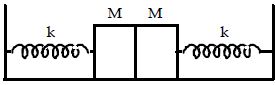
An assembly of identical spring-mass systems is placed on a smooth horizontal surface as shown. Initially,the springs are relaxed. The left mass is displaced to the left while the right mass is displaced to the right and released. The resulting collision is elastic. The time period of the oscillations of the system is:
A
$2\pi \sqrt {\frac{{2M}}{k}} $
B
$2\pi \sqrt {\frac{M}{{2k}}} $
C
$2\pi \sqrt {\frac{M}{k}} $
D
$\pi \sqrt {\frac{M}{k}} $
Solution
(C) Each mass is attached to a spring of constant $k$ and has mass $M$. When displaced and released,each mass performs simple harmonic motion $(SHM)$ independently until they collide.
The time period for a single spring-mass system is $T = 2\pi \sqrt{\frac{M}{k}}$.
Since the collision is elastic and the masses are identical,they exchange velocities upon collision. Effectively,each mass completes half of its oscillation cycle before colliding with the other,and then reverses its motion.
The total time period of the system's oscillation is the sum of the time taken for half an oscillation of the left mass and half an oscillation of the right mass.
$T_{total} = \frac{T}{2} + \frac{T}{2} = T = 2\pi \sqrt{\frac{M}{k}}$.
The time period for a single spring-mass system is $T = 2\pi \sqrt{\frac{M}{k}}$.
Since the collision is elastic and the masses are identical,they exchange velocities upon collision. Effectively,each mass completes half of its oscillation cycle before colliding with the other,and then reverses its motion.
The total time period of the system's oscillation is the sum of the time taken for half an oscillation of the left mass and half an oscillation of the right mass.
$T_{total} = \frac{T}{2} + \frac{T}{2} = T = 2\pi \sqrt{\frac{M}{k}}$.
0 likes
View Solution87
AdvancedMCQ
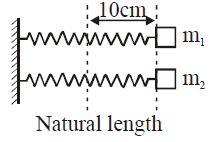
The drawing shows a top view of a frictionless horizontal surface,where there are two identical springs with particles of mass $m_1$ and $m_2$ attached to them. Each spring has a spring constant of $1200 \ N/m$. The particles are pulled to the right and then released from the positions shown in the drawing. How much time passes before the particles are again side by side for the first time if $m_1 = 3.0 \ kg$ and $m_2 = 27 \ kg$?
A
$\frac{\pi}{40} \ s$
B
$\frac{\pi}{20} \ s$
C
$\frac{3\pi}{40} \ s$
D
$\frac{\pi}{10} \ s$
Solution
(C) The angular frequencies of the two oscillators are:
$\omega_1 = \sqrt{\frac{k}{m_1}} = \sqrt{\frac{1200}{3.0}} = 20 \ rad/s$
$\omega_2 = \sqrt{\frac{k}{m_2}} = \sqrt{\frac{1200}{27}} = \sqrt{\frac{400}{9}} = \frac{20}{3} \ rad/s$
Both particles are released from the same initial displacement $A = 10 \ cm$. Their positions as a function of time are $x_1(t) = A \cos(\omega_1 t)$ and $x_2(t) = A \cos(\omega_2 t)$.
They are side by side when $x_1(t) = x_2(t)$,which implies $\cos(20t) = \cos(\frac{20}{3}t)$.
This occurs when $20t = 2n\pi \pm \frac{20}{3}t$. For the first time after $t=0$,we take the negative sign:
$20t = 2\pi - \frac{20}{3}t$
$(20 + \frac{20}{3})t = 2\pi$
$(\frac{60+20}{3})t = 2\pi$
$\frac{80}{3}t = 2\pi$
$t = \frac{6\pi}{80} = \frac{3\pi}{40} \ s$.
$\omega_1 = \sqrt{\frac{k}{m_1}} = \sqrt{\frac{1200}{3.0}} = 20 \ rad/s$
$\omega_2 = \sqrt{\frac{k}{m_2}} = \sqrt{\frac{1200}{27}} = \sqrt{\frac{400}{9}} = \frac{20}{3} \ rad/s$
Both particles are released from the same initial displacement $A = 10 \ cm$. Their positions as a function of time are $x_1(t) = A \cos(\omega_1 t)$ and $x_2(t) = A \cos(\omega_2 t)$.
They are side by side when $x_1(t) = x_2(t)$,which implies $\cos(20t) = \cos(\frac{20}{3}t)$.
This occurs when $20t = 2n\pi \pm \frac{20}{3}t$. For the first time after $t=0$,we take the negative sign:
$20t = 2\pi - \frac{20}{3}t$
$(20 + \frac{20}{3})t = 2\pi$
$(\frac{60+20}{3})t = 2\pi$
$\frac{80}{3}t = 2\pi$
$t = \frac{6\pi}{80} = \frac{3\pi}{40} \ s$.
0 likes
View Solution88
DifficultMCQ
The potential energy of a particle of mass $m$ situated in a unidimensional potential field varies as $U(x) = U_0(1 - \cos ax)$,where $U_0$ and $a$ are constants. The time period of small oscillations of the particle about the mean position is
A
$2\pi \sqrt{\frac{m}{a^2 U_0}}$
B
$2\pi \sqrt{\frac{am}{U_0}}$
C
$2\pi \sqrt{\frac{m}{a U_0}}$
D
$2\pi \sqrt{\frac{a^2 m}{U_0}}$
Solution
(A) Given the potential energy $U(x) = U_0(1 - \cos ax)$.
For small oscillations,we can approximate $\cos ax \approx 1 - \frac{(ax)^2}{2}$.
Thus,$U(x) \approx U_0(1 - (1 - \frac{a^2 x^2}{2})) = \frac{1}{2} U_0 a^2 x^2$.
Comparing this with the potential energy of a simple harmonic oscillator $U = \frac{1}{2} k x^2$,we identify the effective spring constant $k = U_0 a^2$.
The angular frequency of oscillation is $\omega_0 = \sqrt{\frac{k}{m}} = \sqrt{\frac{U_0 a^2}{m}} = a \sqrt{\frac{U_0}{m}}$.
The time period $T$ is given by $T = \frac{2\pi}{\omega_0} = \frac{2\pi}{a} \sqrt{\frac{m}{U_0}} = 2\pi \sqrt{\frac{m}{a^2 U_0}}$.
For small oscillations,we can approximate $\cos ax \approx 1 - \frac{(ax)^2}{2}$.
Thus,$U(x) \approx U_0(1 - (1 - \frac{a^2 x^2}{2})) = \frac{1}{2} U_0 a^2 x^2$.
Comparing this with the potential energy of a simple harmonic oscillator $U = \frac{1}{2} k x^2$,we identify the effective spring constant $k = U_0 a^2$.
The angular frequency of oscillation is $\omega_0 = \sqrt{\frac{k}{m}} = \sqrt{\frac{U_0 a^2}{m}} = a \sqrt{\frac{U_0}{m}}$.
The time period $T$ is given by $T = \frac{2\pi}{\omega_0} = \frac{2\pi}{a} \sqrt{\frac{m}{U_0}} = 2\pi \sqrt{\frac{m}{a^2 U_0}}$.
0 likes
View Solution89
MediumMCQ
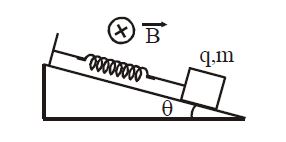
$A$ small block of mass $m$,having charge $q$,is placed on a frictionless inclined plane making an angle $\theta$ with the horizontal. There exists a uniform magnetic field $B$ parallel to the inclined plane but perpendicular to the length of the spring. If $m$ is slightly pulled on the inclined plane in the downward direction and released,the time period of oscillation will be (assume that the block does not leave contact with the plane):
A
$2\pi \sqrt{\frac{m}{k}}$
B
$2\pi \sqrt{\frac{2m}{k}}$
C
$2\pi \sqrt{\frac{qB}{k}}$
D
$2\pi \sqrt{\frac{qB}{2k}}$
Solution
(A) The magnetic force acting on the moving charge $q$ is given by $\vec{F}_m = q(\vec{v} \times \vec{B})$.
Given that the magnetic field $\vec{B}$ is parallel to the inclined plane and the velocity $\vec{v}$ of the block is also along the inclined plane,the magnetic force will be perpendicular to the inclined plane.
Since the magnetic force acts perpendicular to the plane of motion,it does not affect the restoring force of the spring,which acts along the inclined plane.
The equation of motion for the block along the inclined plane is $m \frac{d^2x}{dt^2} = -kx$,where $x$ is the displacement from the equilibrium position.
This is the standard equation for simple harmonic motion with angular frequency $\omega = \sqrt{\frac{k}{m}}$.
The time period of oscillation is $T = \frac{2\pi}{\omega} = 2\pi \sqrt{\frac{m}{k}}$.
Thus,the magnetic field has no effect on the time period of oscillation.
Given that the magnetic field $\vec{B}$ is parallel to the inclined plane and the velocity $\vec{v}$ of the block is also along the inclined plane,the magnetic force will be perpendicular to the inclined plane.
Since the magnetic force acts perpendicular to the plane of motion,it does not affect the restoring force of the spring,which acts along the inclined plane.
The equation of motion for the block along the inclined plane is $m \frac{d^2x}{dt^2} = -kx$,where $x$ is the displacement from the equilibrium position.
This is the standard equation for simple harmonic motion with angular frequency $\omega = \sqrt{\frac{k}{m}}$.
The time period of oscillation is $T = \frac{2\pi}{\omega} = 2\pi \sqrt{\frac{m}{k}}$.
Thus,the magnetic field has no effect on the time period of oscillation.
0 likes
View Solution90
MediumMCQ
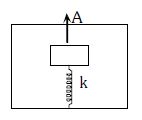
Inside a lift, a spring (force constant $k = 1000 \ N/m$) and a block $(mass = 1 \ kg)$ are both in a state of rest. Now, the lift suddenly starts moving upwards with an acceleration $a = g$. Find the maximum total compression in the spring in centimeters. $(g = 10 \ m/s^2)$
A
$1$
B
$3$
C
$5$
D
$2$
Solution
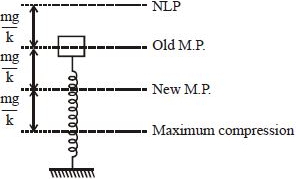
(B) Initially, the spring is compressed by $x_0 = \frac{mg}{k}$ due to the weight of the block.
When the lift accelerates upwards with $a = g$, the effective acceleration due to gravity becomes $g_{eff} = g + a = 2g$.
The new equilibrium position (mean position) of the block in the frame of the lift is at a compression $x_{eq} = \frac{mg_{eff}}{k} = \frac{m(2g)}{k} = \frac{2mg}{k}$.
The block starts from the initial position $x_0 = \frac{mg}{k}$ and moves to the new equilibrium position $x_{eq} = \frac{2mg}{k}$.
Since the block starts from rest at $x_0$, the new equilibrium position is the mean position of the oscillation, and the initial position is an extreme position.
The amplitude of oscillation is $A = x_{eq} - x_0 = \frac{2mg}{k} - \frac{mg}{k} = \frac{mg}{k}$.
The maximum compression occurs at the other extreme position, which is at a distance $A$ below the new equilibrium position.
Therefore, $x_{max} = x_{eq} + A = \frac{2mg}{k} + \frac{mg}{k} = \frac{3mg}{k}$.
Substituting the values: $m = 1 \ kg$, $g = 10 \ m/s^2$, $k = 1000 \ N/m$.
$x_{max} = \frac{3 \times 1 \times 10}{1000} = \frac{30}{1000} \ m = 0.03 \ m = 3 \ cm$.
When the lift accelerates upwards with $a = g$, the effective acceleration due to gravity becomes $g_{eff} = g + a = 2g$.
The new equilibrium position (mean position) of the block in the frame of the lift is at a compression $x_{eq} = \frac{mg_{eff}}{k} = \frac{m(2g)}{k} = \frac{2mg}{k}$.
The block starts from the initial position $x_0 = \frac{mg}{k}$ and moves to the new equilibrium position $x_{eq} = \frac{2mg}{k}$.
Since the block starts from rest at $x_0$, the new equilibrium position is the mean position of the oscillation, and the initial position is an extreme position.
The amplitude of oscillation is $A = x_{eq} - x_0 = \frac{2mg}{k} - \frac{mg}{k} = \frac{mg}{k}$.
The maximum compression occurs at the other extreme position, which is at a distance $A$ below the new equilibrium position.
Therefore, $x_{max} = x_{eq} + A = \frac{2mg}{k} + \frac{mg}{k} = \frac{3mg}{k}$.
Substituting the values: $m = 1 \ kg$, $g = 10 \ m/s^2$, $k = 1000 \ N/m$.
$x_{max} = \frac{3 \times 1 \times 10}{1000} = \frac{30}{1000} \ m = 0.03 \ m = 3 \ cm$.
0 likes
View Solution91
DifficultMCQ
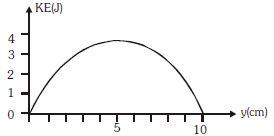
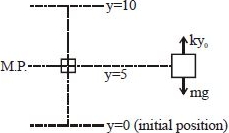
$A$ mass on a vertical spring begins its motion at rest at $y = 0 \ cm$. It reaches a maximum height of $y = 10 \ cm$. The two forces acting on the mass are gravity and the spring force. The graph of its kinetic energy $(KE)$ versus position is given below. Net force on the mass varies with $y$ as
A
$F = 4y - 20$
B
$F = 20 - 4y$
C
$F = \frac{8}{25}(y - 5)$
D
$F = \frac{8}{25}(5 - y)$
Solution
(D) The motion is Simple Harmonic Motion $(SHM)$ between $y = 0 \ cm$ and $y = 10 \ cm$. The mean position is at $y = 5 \ cm$.
The amplitude of the oscillation is $A = 5 \ cm = 0.05 \ m$.
From the graph,the maximum kinetic energy is $KE_{max} = 4 \ J$ at the mean position $(y = 5 \ cm)$.
The formula for maximum kinetic energy in $SHM$ is $KE_{max} = \frac{1}{2} k A^2$,where $k = m\omega^2$.
Substituting the values: $4 = \frac{1}{2} k (0.05)^2$.
$4 = \frac{1}{2} k (0.0025) \implies k = \frac{8}{0.0025} = 3200 \ N/m$.
The net force in $SHM$ is given by $F = -k(y - y_{mean})$,where $y_{mean} = 5 \ cm = 0.05 \ m$.
$F = -3200(y - 0.05) = -3200y + 160$.
However,looking at the options provided in terms of $cm$,we use $k_{eff} = \frac{2 KE_{max}}{A^2} = \frac{2 \times 4}{5^2} = \frac{8}{25} \ N/cm$.
Thus,the net force is $F = -\frac{8}{25}(y - 5) = \frac{8}{25}(5 - y)$.
The amplitude of the oscillation is $A = 5 \ cm = 0.05 \ m$.
From the graph,the maximum kinetic energy is $KE_{max} = 4 \ J$ at the mean position $(y = 5 \ cm)$.
The formula for maximum kinetic energy in $SHM$ is $KE_{max} = \frac{1}{2} k A^2$,where $k = m\omega^2$.
Substituting the values: $4 = \frac{1}{2} k (0.05)^2$.
$4 = \frac{1}{2} k (0.0025) \implies k = \frac{8}{0.0025} = 3200 \ N/m$.
The net force in $SHM$ is given by $F = -k(y - y_{mean})$,where $y_{mean} = 5 \ cm = 0.05 \ m$.
$F = -3200(y - 0.05) = -3200y + 160$.
However,looking at the options provided in terms of $cm$,we use $k_{eff} = \frac{2 KE_{max}}{A^2} = \frac{2 \times 4}{5^2} = \frac{8}{25} \ N/cm$.
Thus,the net force is $F = -\frac{8}{25}(y - 5) = \frac{8}{25}(5 - y)$.
0 likes
View Solution92
AdvancedMCQ
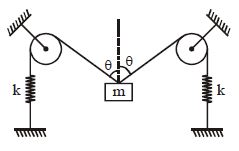
In the situation as shown in the figure,the time period of vertical oscillation of the block for small displacements will be:
A
$2\pi \cos \theta \sqrt {\frac{m}{{2k}}} $
B
$2\pi \sec \theta \sqrt {\frac{m}{{2k}}} $
C
$2\pi \sin \theta \sqrt {\frac{m}{{2k}}} $
D
$2\pi \csc \theta \sqrt {\frac{m}{{2k}}} $
Solution
(B) Let the block be displaced through a small distance $x$ in the downward direction.
Due to this displacement,the string attached to the block stretches,causing an elongation $x_1$ in each spring.
From the geometry of the setup,the relationship between the downward displacement $x$ and the elongation $x_1$ is given by $x_1 = x \cos \theta$.
The restoring force $F$ acting on the block due to both springs is $F = 2(k x_1) \cos \theta$.
Substituting $x_1 = x \cos \theta$ into the force equation,we get $F = 2k(x \cos \theta) \cos \theta = (2k \cos^2 \theta) x$.
Comparing this with the standard restoring force equation $F = k_{eff} x$,the effective spring constant is $k_{eff} = 2k \cos^2 \theta$.
The time period $T$ of oscillation is given by $T = 2\pi \sqrt{\frac{m}{k_{eff}}}$.
Substituting $k_{eff}$,we get $T = 2\pi \sqrt{\frac{m}{2k \cos^2 \theta}} = 2\pi \sec \theta \sqrt{\frac{m}{2k}}$.
Due to this displacement,the string attached to the block stretches,causing an elongation $x_1$ in each spring.
From the geometry of the setup,the relationship between the downward displacement $x$ and the elongation $x_1$ is given by $x_1 = x \cos \theta$.
The restoring force $F$ acting on the block due to both springs is $F = 2(k x_1) \cos \theta$.
Substituting $x_1 = x \cos \theta$ into the force equation,we get $F = 2k(x \cos \theta) \cos \theta = (2k \cos^2 \theta) x$.
Comparing this with the standard restoring force equation $F = k_{eff} x$,the effective spring constant is $k_{eff} = 2k \cos^2 \theta$.
The time period $T$ of oscillation is given by $T = 2\pi \sqrt{\frac{m}{k_{eff}}}$.
Substituting $k_{eff}$,we get $T = 2\pi \sqrt{\frac{m}{2k \cos^2 \theta}} = 2\pi \sec \theta \sqrt{\frac{m}{2k}}$.
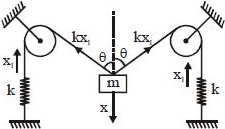
0 likes
View Solution93
DifficultMCQ
$A$ solid cylinder of mass $m$ and volume $V$ is suspended from the ceiling by a spring of spring constant $k$. It has a cross-sectional area $A$. It is submerged in a liquid of density $\rho$ up to half its length. If a small block of mass $M_0$ is kept at the center of the top, the amplitude of small oscillation will be:
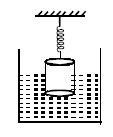
A
$\frac{M_0 g}{k + A\rho g}$
B
$\frac{M_0 g}{k + V\rho g}$
C
$\frac{(M_0 + m)g}{k + A\rho g}$
D
$\frac{M_0 g}{k}$
Solution
(A) Let the cylinder have length $L$. The volume $V = AL$. When the cylinder is submerged up to half its length, the buoyant force is $F_B = (A \cdot L/2) \rho g = (V/2) \rho g$.
At equilibrium, the spring force $k x_0 = (m + M_0)g - F_B$, where $x_0$ is the initial extension.
When the cylinder is displaced by a small distance $x$ downwards, the additional buoyant force is $F_{B}' = A x \rho g$.
The net restoring force is $F_{net} = -kx - A x \rho g = -(k + A \rho g)x$.
This is the equation of simple harmonic motion with an effective spring constant $k_{eff} = k + A \rho g$.
The amplitude of oscillation $A_{osc}$ is given by the displacement from the new equilibrium position. When the mass $M_0$ is added, the equilibrium position shifts by $\Delta x = \frac{M_0 g}{k_{eff}}$.
Thus, the amplitude of oscillation is $A_{osc} = \frac{M_0 g}{k + A \rho g}$.
At equilibrium, the spring force $k x_0 = (m + M_0)g - F_B$, where $x_0$ is the initial extension.
When the cylinder is displaced by a small distance $x$ downwards, the additional buoyant force is $F_{B}' = A x \rho g$.
The net restoring force is $F_{net} = -kx - A x \rho g = -(k + A \rho g)x$.
This is the equation of simple harmonic motion with an effective spring constant $k_{eff} = k + A \rho g$.
The amplitude of oscillation $A_{osc}$ is given by the displacement from the new equilibrium position. When the mass $M_0$ is added, the equilibrium position shifts by $\Delta x = \frac{M_0 g}{k_{eff}}$.
Thus, the amplitude of oscillation is $A_{osc} = \frac{M_0 g}{k + A \rho g}$.
0 likes
View Solution94
MediumMCQ
$A$ force of $6.4 \ N$ stretches a vertical spring by $0.1 \ m$. The mass that must be suspended from the spring so that it oscillates with a time period of $\pi/4 \ s$ is .... $kg$.
A
$0.25$
B
$0.5$
C
$1$
D
$10$
Solution
(C) First,calculate the spring constant $K$ using Hooke's Law,$F = Kx$.
Given $F = 6.4 \ N$ and $x = 0.1 \ m$,we have $K = \frac{F}{x} = \frac{6.4}{0.1} = 64 \ N/m$.
The time period $T$ of a spring-mass system is given by $T = 2\pi \sqrt{\frac{m}{K}}$.
Given $T = \frac{\pi}{4} \ s$,we substitute the values into the formula:
$\frac{\pi}{4} = 2\pi \sqrt{\frac{m}{64}}$.
Dividing both sides by $\pi$,we get $\frac{1}{4} = 2 \sqrt{\frac{m}{64}}$.
$\frac{1}{8} = \sqrt{\frac{m}{64}}$.
Squaring both sides,$\frac{1}{64} = \frac{m}{64}$.
Therefore,$m = 1 \ kg$.
Given $F = 6.4 \ N$ and $x = 0.1 \ m$,we have $K = \frac{F}{x} = \frac{6.4}{0.1} = 64 \ N/m$.
The time period $T$ of a spring-mass system is given by $T = 2\pi \sqrt{\frac{m}{K}}$.
Given $T = \frac{\pi}{4} \ s$,we substitute the values into the formula:
$\frac{\pi}{4} = 2\pi \sqrt{\frac{m}{64}}$.
Dividing both sides by $\pi$,we get $\frac{1}{4} = 2 \sqrt{\frac{m}{64}}$.
$\frac{1}{8} = \sqrt{\frac{m}{64}}$.
Squaring both sides,$\frac{1}{64} = \frac{m}{64}$.
Therefore,$m = 1 \ kg$.
0 likes
View Solution95
MediumMCQ
$A$ mass hangs from a spring and oscillates vertically. The top end of the spring is attached to the top of a box,and the box is placed on a scale,as shown in the figure. The reading on the scale is largest when the mass is
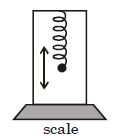
A
At its maximum height
B
At its minimum height
C
At the midpoint of its motion
D
All points give the same reading.
Solution
(B) Let $M$ be the mass of the box and $m$ be the mass of the oscillating object. The scale measures the normal force $N$ exerted by the box on the scale.
For the whole system (box + spring + mass),the forces acting are the weight $(M+m)g$ downwards and the normal force $N$ upwards.
From Newton's second law for the mass $m$,the force exerted by the spring on the mass is $F_s = m(g + a)$,where $a$ is the acceleration of the mass (upward is positive).
By Newton's third law,the mass exerts an equal and opposite force $F_s$ on the spring,which is transmitted to the box.
Thus,the total normal force $N$ on the scale is $N = Mg + F_s = Mg + m(g + a) = (M+m)g + ma$.
The scale reading is largest when the acceleration $a$ is at its maximum positive value (upward).
In simple harmonic motion,the acceleration is directed towards the equilibrium position. At the minimum height (lowest point),the restoring force is upward and maximum,so the acceleration $a$ is at its maximum positive value.
Therefore,the scale reading is largest when the mass is at its minimum height.
For the whole system (box + spring + mass),the forces acting are the weight $(M+m)g$ downwards and the normal force $N$ upwards.
From Newton's second law for the mass $m$,the force exerted by the spring on the mass is $F_s = m(g + a)$,where $a$ is the acceleration of the mass (upward is positive).
By Newton's third law,the mass exerts an equal and opposite force $F_s$ on the spring,which is transmitted to the box.
Thus,the total normal force $N$ on the scale is $N = Mg + F_s = Mg + m(g + a) = (M+m)g + ma$.
The scale reading is largest when the acceleration $a$ is at its maximum positive value (upward).
In simple harmonic motion,the acceleration is directed towards the equilibrium position. At the minimum height (lowest point),the restoring force is upward and maximum,so the acceleration $a$ is at its maximum positive value.
Therefore,the scale reading is largest when the mass is at its minimum height.
0 likes
View Solution96
DifficultMCQ
The force-deformation equation for a nonlinear spring fixed at one end is $F = 4x^{1/2}$,where $F$ is the force (expressed in newtons) applied at the other end and $x$ is the deformation expressed in meters.
A
This spring-mass system executes $SHM$.
B
The deformation $x_0$ if a $100 \ g$ block is suspended from the spring and is at rest is $0.625 \ m$.
C
Assuming that the slope of the force-deformation curve at the point corresponding to the deformation $x_0$ can be used as an equivalent spring constant,then the frequency of vibration of the block is $\frac{4\sqrt{5}}{2\pi}$.
D
None of these
Solution
(C) Given $F = 4x^{1/2}$ and mass $m = 100 \ g = 0.1 \ kg$.
At equilibrium,the force exerted by the spring balances the weight of the block:
$mg = 4x_0^{1/2}$
$(0.1 \ kg)(10 \ m/s^2) = 4x_0^{1/2}$
$1 = 4x_0^{1/2}$
$x_0^{1/2} = 0.25$
$x_0 = (0.25)^2 = 0.0625 \ m$.
Now,find the equivalent spring constant $k_e$ by taking the derivative of $F$ with respect to $x$ at $x = x_0$:
$k_e = \left(\frac{dF}{dx}\right)_{x=x_0} = \frac{d}{dx}(4x^{1/2}) = 4 \cdot \frac{1}{2}x^{-1/2} = \frac{2}{\sqrt{x_0}}$.
Substituting $x_0 = 0.0625$:
$k_e = \frac{2}{\sqrt{0.0625}} = \frac{2}{0.25} = 8 \ N/m$.
The frequency of vibration $f_n$ is given by:
$f_n = \frac{1}{2\pi} \sqrt{\frac{k_e}{m}} = \frac{1}{2\pi} \sqrt{\frac{8}{0.1}} = \frac{1}{2\pi} \sqrt{80} = \frac{4\sqrt{5}}{2\pi} \ Hz$.
Thus,statement $C$ is correct.
At equilibrium,the force exerted by the spring balances the weight of the block:
$mg = 4x_0^{1/2}$
$(0.1 \ kg)(10 \ m/s^2) = 4x_0^{1/2}$
$1 = 4x_0^{1/2}$
$x_0^{1/2} = 0.25$
$x_0 = (0.25)^2 = 0.0625 \ m$.
Now,find the equivalent spring constant $k_e$ by taking the derivative of $F$ with respect to $x$ at $x = x_0$:
$k_e = \left(\frac{dF}{dx}\right)_{x=x_0} = \frac{d}{dx}(4x^{1/2}) = 4 \cdot \frac{1}{2}x^{-1/2} = \frac{2}{\sqrt{x_0}}$.
Substituting $x_0 = 0.0625$:
$k_e = \frac{2}{\sqrt{0.0625}} = \frac{2}{0.25} = 8 \ N/m$.
The frequency of vibration $f_n$ is given by:
$f_n = \frac{1}{2\pi} \sqrt{\frac{k_e}{m}} = \frac{1}{2\pi} \sqrt{\frac{8}{0.1}} = \frac{1}{2\pi} \sqrt{80} = \frac{4\sqrt{5}}{2\pi} \ Hz$.
Thus,statement $C$ is correct.
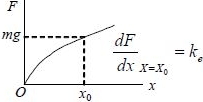
0 likes
View Solution97
DifficultMCQ
$A$ bar of mass $m$ is suspended horizontally on two vertical springs of spring constant $k$ and $3k$. The bar bounces up and down while remaining horizontal. Find the time period of oscillation of the bar (Neglect mass of springs and friction everywhere).
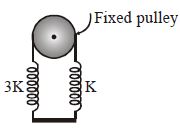
A
$2\pi \sqrt {\frac{m}{k}} $
B
$2\pi \sqrt {\frac{m}{{3k}}} $
C
$\pi \sqrt {\frac{{2m}}{{3k}}} $
D
$2\pi \sqrt {\frac{{m}}{{4k}}} $
Solution
(D) Let the bar be displaced downwards by a distance $x$. Since the bar remains horizontal,both springs stretch by the same amount $x$.
The restoring force in the first spring is $F_1 = kx$ and in the second spring is $F_2 = 3kx$.
The total restoring force is $F = F_1 + F_2 = kx + 3kx = 4kx$.
Comparing this with $F = k_{eq}x$,we get the equivalent spring constant $k_{eq} = 4k$.
The time period of oscillation is given by $T = 2\pi \sqrt{\frac{m}{k_{eq}}}$.
Substituting $k_{eq} = 4k$,we get $T = 2\pi \sqrt{\frac{m}{4k}}$.
The restoring force in the first spring is $F_1 = kx$ and in the second spring is $F_2 = 3kx$.
The total restoring force is $F = F_1 + F_2 = kx + 3kx = 4kx$.
Comparing this with $F = k_{eq}x$,we get the equivalent spring constant $k_{eq} = 4k$.
The time period of oscillation is given by $T = 2\pi \sqrt{\frac{m}{k_{eq}}}$.
Substituting $k_{eq} = 4k$,we get $T = 2\pi \sqrt{\frac{m}{4k}}$.
0 likes
View Solution98
AdvancedMCQ
Assuming all pulleys,springs,and strings are massless. Consider all surfaces smooth. Choose the correct statement$(s)$.
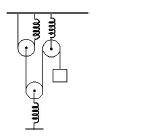
A
The angular frequency for small oscillation of the system is $\sqrt{\frac{K}{3m}}$.
B
The angular frequency for small oscillation of the system is $\sqrt{\frac{4K}{33m}}$.
C
The elastic potential energy of the system at equilibrium is $\frac{33m^2g^2}{4K}$.
D
The elastic potential energy of the system at equilibrium is $\frac{3m^2g^2}{2K}$.
Solution
(B) Let the tension in the string be $T$. From the force balance on the block,the tension $T = mg$.
For the pulleys and springs,let the extensions in the three springs be $x_1, x_2, x_3$ respectively. The effective spring constant $K_{eff}$ is determined by the relation $x = F/K_{eff}$,where $x$ is the displacement of the block.
Using the constraint relation for the pulleys,the displacement of the block $x$ is related to the extensions as $x = \frac{x_1}{2} + 2x_2 + 2x_3$.
Given the tension $T$ in the string,the forces on the springs are $F_1 = T/2$,$F_2 = 2T$,and $F_3 = 2T$.
Thus,$x_1 = \frac{T}{2K}$,$x_2 = \frac{2T}{K}$,and $x_3 = \frac{2T}{K}$.
Substituting these into the constraint equation: $x = \frac{T}{4K} + \frac{4T}{K} + \frac{4T}{K} = \frac{T + 16T + 16T}{4K} = \frac{33T}{4K}$.
Since $T = mg$,$x = \frac{33mg}{4K}$. The effective spring constant is $K_{eff} = \frac{mg}{x} = \frac{4K}{33}$.
The angular frequency $\omega = \sqrt{\frac{K_{eff}}{m}} = \sqrt{\frac{4K}{33m}}$.
The elastic potential energy at equilibrium is $U = \frac{1}{2} K_1 x_1^2 + \frac{1}{2} K_2 x_2^2 + \frac{1}{2} K_3 x_3^2 = \frac{1}{2} K (\frac{mg}{2K})^2 + \frac{1}{2} K (\frac{2mg}{K})^2 + \frac{1}{2} K (\frac{2mg}{K})^2 = \frac{m^2g^2}{8K} + \frac{2m^2g^2}{K} + \frac{2m^2g^2}{K} = \frac{m^2g^2 + 16m^2g^2 + 16m^2g^2}{8K} = \frac{33m^2g^2}{8K}$.
For the pulleys and springs,let the extensions in the three springs be $x_1, x_2, x_3$ respectively. The effective spring constant $K_{eff}$ is determined by the relation $x = F/K_{eff}$,where $x$ is the displacement of the block.
Using the constraint relation for the pulleys,the displacement of the block $x$ is related to the extensions as $x = \frac{x_1}{2} + 2x_2 + 2x_3$.
Given the tension $T$ in the string,the forces on the springs are $F_1 = T/2$,$F_2 = 2T$,and $F_3 = 2T$.
Thus,$x_1 = \frac{T}{2K}$,$x_2 = \frac{2T}{K}$,and $x_3 = \frac{2T}{K}$.
Substituting these into the constraint equation: $x = \frac{T}{4K} + \frac{4T}{K} + \frac{4T}{K} = \frac{T + 16T + 16T}{4K} = \frac{33T}{4K}$.
Since $T = mg$,$x = \frac{33mg}{4K}$. The effective spring constant is $K_{eff} = \frac{mg}{x} = \frac{4K}{33}$.
The angular frequency $\omega = \sqrt{\frac{K_{eff}}{m}} = \sqrt{\frac{4K}{33m}}$.
The elastic potential energy at equilibrium is $U = \frac{1}{2} K_1 x_1^2 + \frac{1}{2} K_2 x_2^2 + \frac{1}{2} K_3 x_3^2 = \frac{1}{2} K (\frac{mg}{2K})^2 + \frac{1}{2} K (\frac{2mg}{K})^2 + \frac{1}{2} K (\frac{2mg}{K})^2 = \frac{m^2g^2}{8K} + \frac{2m^2g^2}{K} + \frac{2m^2g^2}{K} = \frac{m^2g^2 + 16m^2g^2 + 16m^2g^2}{8K} = \frac{33m^2g^2}{8K}$.
0 likes
View Solution99
DifficultMCQ
$A$ spring-mass system vibrates such that the mass travels on a surface with a coefficient of friction $\mu$. The mass is released after compressing the spring by a distance $a$ and it travels up to a distance $b$ after its equilibrium position. Then,while traveling from $x = -a$ to $x = b$,the reduction in its amplitude will be:
A
$\frac{\mu mg}{K}$
B
$\frac{2 \mu mg}{K}$
C
$\frac{\mu g}{K}$
D
$\frac{K}{\mu mg}$
Solution
(B) According to the Work-Energy Theorem,the total work done on the system is equal to the change in kinetic energy.
$W_{total} = \Delta KE$
Since the mass starts from rest at $x = -a$ and stops momentarily at $x = b$,the change in kinetic energy is $\Delta KE = 0 - 0 = 0$.
The work done by the spring force is $W_s = \int_{-a}^{b} -Kx \, dx = -K \left[ \frac{x^2}{2} \right]_{-a}^{b} = -\frac{K}{2}(b^2 - a^2) = \frac{K}{2}(a^2 - b^2)$.
The work done by friction is $W_f = -\mu mg(a + b)$ because the total distance traveled is $(a + b)$ and friction acts opposite to the displacement.
Setting $W_{total} = W_s + W_f = 0$:
$\frac{K}{2}(a^2 - b^2) - \mu mg(a + b) = 0$
$\frac{K}{2}(a - b)(a + b) = \mu mg(a + b)$
Since $a + b \neq 0$,we can divide both sides by $(a + b)$:
$\frac{K}{2}(a - b) = \mu mg$
$(a - b) = \frac{2 \mu mg}{K}$
Thus,the reduction in amplitude is $\frac{2 \mu mg}{K}$.
$W_{total} = \Delta KE$
Since the mass starts from rest at $x = -a$ and stops momentarily at $x = b$,the change in kinetic energy is $\Delta KE = 0 - 0 = 0$.
The work done by the spring force is $W_s = \int_{-a}^{b} -Kx \, dx = -K \left[ \frac{x^2}{2} \right]_{-a}^{b} = -\frac{K}{2}(b^2 - a^2) = \frac{K}{2}(a^2 - b^2)$.
The work done by friction is $W_f = -\mu mg(a + b)$ because the total distance traveled is $(a + b)$ and friction acts opposite to the displacement.
Setting $W_{total} = W_s + W_f = 0$:
$\frac{K}{2}(a^2 - b^2) - \mu mg(a + b) = 0$
$\frac{K}{2}(a - b)(a + b) = \mu mg(a + b)$
Since $a + b \neq 0$,we can divide both sides by $(a + b)$:
$\frac{K}{2}(a - b) = \mu mg$
$(a - b) = \frac{2 \mu mg}{K}$
Thus,the reduction in amplitude is $\frac{2 \mu mg}{K}$.
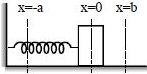
0 likes
View SolutionOscillations — SHM of Spring Mass System · Frequently Asked Questions
1Are these Oscillations questions useful for JEE and NEET?
Yes. All questions in this section are mapped to JEE Main and NEET exam patterns. Previous year questions from JEE Main, NEET, GUJCET and state-level exams are included with full solutions.
2Can I switch to Hindi or Gujarati for these questions?
Yes. Use the language tabs in the hero section or the sidebar to view the same questions and solutions in English, Hindi or Gujarati.
3How do I generate a question paper from this subtopic?
Use the Vedclass Exam Paper Generator — select the chapter and subtopic, set difficulty, and generate Sets A, B, C, D automatically. First 3 chapters of every subject are free.
Vedclass Products
For Students
Vedclass Test Series
Mock tests in real JEE/NEET style with performance analysis. 5-day free trial.
Start Free TrialFor Teachers
Exam Paper Generator
Generate Set A/B/C/D papers from this chapter in 2 minutes. 3 chapters free.
Try FreeFor Institutes
Online Exam Module
Live online exams with unlimited students, 360° analytics & white-label branding.
See DemoFor Teachers & Institutes
Generate a Oscillations Exam Paper in 2 Minutes
Select subtopic & difficulty — Sets A, B, C, D auto-generated with No Repeat logic.
First 3 chapters of every subject are free — no payment required.