
A English
SHM of Spring Mass System Questions in English
Class 11 Physics · Oscillations · SHM of Spring Mass System
334+
Questions
English
Language
100%
With Solutions
Showing 50 of 334 questions in English
101
DifficultMCQ
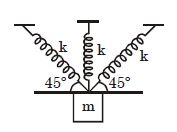
Initially,the system is in equilibrium. The time period of $SHM$ of the block in the vertical direction is
A
$2\pi \sqrt {\frac{m}{{3k}}} $
B
$2\pi \sqrt {\frac{m}{{2k}}} $
C
$2\pi \sqrt {\frac{m}{k}} $
D
$2\pi \sqrt {\frac{{2m}}{k}} $
Solution
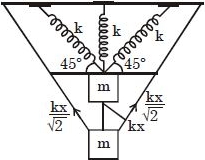
(B) When the block is displaced vertically downwards by a small distance $x$,the central spring is stretched by $x$,providing a restoring force $F_1 = kx$ upwards.
Each of the two side springs,which are at an angle of $45^{\circ}$ to the horizontal,will also be stretched by an amount $\Delta l = x \sin 45^{\circ} = \frac{x}{\sqrt{2}}$.
The restoring force in each side spring is $F_s = k \Delta l = \frac{kx}{\sqrt{2}}$.
The vertical component of the force from each side spring is $F_v = F_s \sin 45^{\circ} = \left( \frac{kx}{\sqrt{2}} \right) \left( \frac{1}{\sqrt{2}} \right) = \frac{kx}{2}$.
The total restoring force $F_{net}$ acting on the block is the sum of the forces from all three springs:
$F_{net} = F_1 + 2 \times F_v = kx + 2 \times \left( \frac{kx}{2} \right) = kx + kx = 2kx$.
Since $F_{net} = ma$,we have $ma = 2kx$,which gives $a = \left( \frac{2k}{m} \right) x$.
Comparing this with the standard $SHM$ equation $a = \omega^2 x$,we get $\omega^2 = \frac{2k}{m}$,so $\omega = \sqrt{\frac{2k}{m}}$.
The time period $T$ is given by $T = \frac{2\pi}{\omega} = 2\pi \sqrt{\frac{m}{2k}}$.
Each of the two side springs,which are at an angle of $45^{\circ}$ to the horizontal,will also be stretched by an amount $\Delta l = x \sin 45^{\circ} = \frac{x}{\sqrt{2}}$.
The restoring force in each side spring is $F_s = k \Delta l = \frac{kx}{\sqrt{2}}$.
The vertical component of the force from each side spring is $F_v = F_s \sin 45^{\circ} = \left( \frac{kx}{\sqrt{2}} \right) \left( \frac{1}{\sqrt{2}} \right) = \frac{kx}{2}$.
The total restoring force $F_{net}$ acting on the block is the sum of the forces from all three springs:
$F_{net} = F_1 + 2 \times F_v = kx + 2 \times \left( \frac{kx}{2} \right) = kx + kx = 2kx$.
Since $F_{net} = ma$,we have $ma = 2kx$,which gives $a = \left( \frac{2k}{m} \right) x$.
Comparing this with the standard $SHM$ equation $a = \omega^2 x$,we get $\omega^2 = \frac{2k}{m}$,so $\omega = \sqrt{\frac{2k}{m}}$.
The time period $T$ is given by $T = \frac{2\pi}{\omega} = 2\pi \sqrt{\frac{m}{2k}}$.
0 likes
View Solution102
EasyMCQ
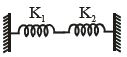
The effective spring constant of the two-spring system as shown in the figure will be:
A
$K_1 + K_2$
B
$K_1K_2 / (K_1 + K_2)$
C
$K_1 - K_2$
D
$K_1K_2 / (K_1 - K_2)$
Solution
(B) In the given figure,the two springs are connected in series between two rigid supports. When a force is applied to the junction,the total displacement $x$ is the sum of individual displacements $x_1$ and $x_2$ of the two springs.
$x = x_1 + x_2$
Since the springs are in series,the force $F$ acting on each spring is the same.
$F = K_1x_1 = K_2x_2 = K_{eff}x$
Therefore,$x_1 = F / K_1$ and $x_2 = F / K_2$.
Substituting these into the displacement equation:
$F / K_{eff} = F / K_1 + F / K_2$
$1 / K_{eff} = 1 / K_1 + 1 / K_2$
$1 / K_{eff} = (K_1 + K_2) / (K_1K_2)$
$K_{eff} = (K_1K_2) / (K_1 + K_2)$
$x = x_1 + x_2$
Since the springs are in series,the force $F$ acting on each spring is the same.
$F = K_1x_1 = K_2x_2 = K_{eff}x$
Therefore,$x_1 = F / K_1$ and $x_2 = F / K_2$.
Substituting these into the displacement equation:
$F / K_{eff} = F / K_1 + F / K_2$
$1 / K_{eff} = 1 / K_1 + 1 / K_2$
$1 / K_{eff} = (K_1 + K_2) / (K_1K_2)$
$K_{eff} = (K_1K_2) / (K_1 + K_2)$
0 likes
View Solution103
MediumMCQ
$A$ flat horizontal board moves up and down in $SHM$ with an amplitude $\alpha$. What is the shortest permissible time period of the vibration such that an object placed on the board does not lose contact with the board?
A
$2\pi \sqrt {\frac{g}{\alpha }} $
B
$2\pi \sqrt {\frac{\alpha}{g }} $
C
$2\pi \sqrt {g \times \alpha } $
D
$\frac{1}{{2\pi }}\sqrt {\frac{g}{\alpha }} $
Solution
(B) For an object placed on a board moving in $SHM$ not to lose contact,the maximum downward acceleration of the board must not exceed the acceleration due to gravity $g$.
The maximum acceleration of the board in $SHM$ is given by $a_{max} = \alpha \omega^2$.
To maintain contact,the condition is $a_{max} \le g$,which implies $\alpha \omega^2 \le g$.
For the shortest time period $T$,we consider the limiting case where $\alpha \omega^2 = g$.
Substituting $\omega = \frac{2\pi}{T}$,we get $\alpha (\frac{2\pi}{T})^2 = g$.
Rearranging for $T$,we get $\frac{4\pi^2 \alpha}{T^2} = g$,which simplifies to $T^2 = \frac{4\pi^2 \alpha}{g}$.
Taking the square root on both sides,we find $T = 2\pi \sqrt{\frac{\alpha}{g}}$.
The maximum acceleration of the board in $SHM$ is given by $a_{max} = \alpha \omega^2$.
To maintain contact,the condition is $a_{max} \le g$,which implies $\alpha \omega^2 \le g$.
For the shortest time period $T$,we consider the limiting case where $\alpha \omega^2 = g$.
Substituting $\omega = \frac{2\pi}{T}$,we get $\alpha (\frac{2\pi}{T})^2 = g$.
Rearranging for $T$,we get $\frac{4\pi^2 \alpha}{T^2} = g$,which simplifies to $T^2 = \frac{4\pi^2 \alpha}{g}$.
Taking the square root on both sides,we find $T = 2\pi \sqrt{\frac{\alpha}{g}}$.
0 likes
View Solution104
MediumMCQ
Let $T_1$ and $T_2$ be the time periods of two springs $A$ and $B$ when a mass $m$ is suspended from them separately. Now both the springs are connected in parallel and the same mass $m$ is suspended with them. If $T$ is the new time period in this position,then:
A
$T = T_1 + T_2$
B
$T = \frac{T_1 T_2}{T_1 + T_2}$
C
$T^2 = T_1^2 + T_2^2$
D
$\frac{1}{T^2} = \frac{1}{T_1^2} + \frac{1}{T_2^2}$
Solution
(D) The time period of a spring-mass system is given by $T = 2\pi \sqrt{\frac{m}{k}}$.
For spring $A$,$T_1 = 2\pi \sqrt{\frac{m}{k_1}} \implies k_1 = \frac{4\pi^2 m}{T_1^2}$.
For spring $B$,$T_2 = 2\pi \sqrt{\frac{m}{k_2}} \implies k_2 = \frac{4\pi^2 m}{T_2^2}$.
When connected in parallel,the effective spring constant is $k = k_1 + k_2$.
The new time period $T$ is given by $T = 2\pi \sqrt{\frac{m}{k}} \implies k = \frac{4\pi^2 m}{T^2}$.
Substituting the expressions for $k, k_1,$ and $k_2$ into the parallel combination formula:
$\frac{4\pi^2 m}{T^2} = \frac{4\pi^2 m}{T_1^2} + \frac{4\pi^2 m}{T_2^2}$.
Dividing both sides by $4\pi^2 m$,we get $\frac{1}{T^2} = \frac{1}{T_1^2} + \frac{1}{T_2^2}$.
For spring $A$,$T_1 = 2\pi \sqrt{\frac{m}{k_1}} \implies k_1 = \frac{4\pi^2 m}{T_1^2}$.
For spring $B$,$T_2 = 2\pi \sqrt{\frac{m}{k_2}} \implies k_2 = \frac{4\pi^2 m}{T_2^2}$.
When connected in parallel,the effective spring constant is $k = k_1 + k_2$.
The new time period $T$ is given by $T = 2\pi \sqrt{\frac{m}{k}} \implies k = \frac{4\pi^2 m}{T^2}$.
Substituting the expressions for $k, k_1,$ and $k_2$ into the parallel combination formula:
$\frac{4\pi^2 m}{T^2} = \frac{4\pi^2 m}{T_1^2} + \frac{4\pi^2 m}{T_2^2}$.
Dividing both sides by $4\pi^2 m$,we get $\frac{1}{T^2} = \frac{1}{T_1^2} + \frac{1}{T_2^2}$.
0 likes
View Solution105
DifficultMCQ
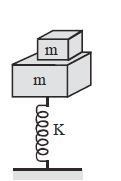
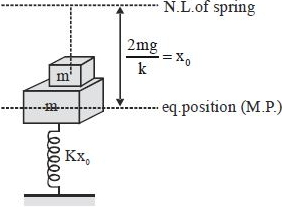
$A$ block of mass $m$ is at rest on another block of the same mass as shown in the figure. The lower block is attached to a spring. What is the maximum amplitude of motion such that both blocks remain in contact?
A
$\frac{mg}{2k}$
B
$\frac{mg}{k}$
C
$\frac{2mg}{k}$
D
$\frac{3mg}{2k}$
Solution
(C) Let the total mass of the system be $M = 2m$. The equilibrium position is where the spring force balances the weight of both blocks: $k x_{eq} = 2mg$,so $x_{eq} = \frac{2mg}{k}$.
For the blocks to remain in contact,the normal force $N$ between them must be greater than or equal to zero. For the upper block of mass $m$,the equation of motion is $mg - N = ma$,where $a$ is the downward acceleration. Thus,$N = m(g - a)$.
For the blocks to remain in contact,we require $N \ge 0$,which implies $a \le g$. The maximum downward acceleration of the system in simple harmonic motion is $a_{max} = \omega^2 A$,where $\omega = \sqrt{\frac{k}{2m}}$.
At the highest point of the oscillation,the acceleration is directed downwards with magnitude $\omega^2 A$. The condition $a \le g$ must hold at this point. However,the blocks will lose contact if the acceleration exceeds $g$. The limiting case is $a = g$,which occurs when the spring force is zero (at the natural length of the spring).
At the equilibrium position,the spring is compressed by $x_{eq} = \frac{2mg}{k}$. If the amplitude $A$ is equal to $x_{eq}$,the block reaches the natural length of the spring at the highest point. Thus,the maximum amplitude is $A = \frac{2mg}{k}$.
For the blocks to remain in contact,the normal force $N$ between them must be greater than or equal to zero. For the upper block of mass $m$,the equation of motion is $mg - N = ma$,where $a$ is the downward acceleration. Thus,$N = m(g - a)$.
For the blocks to remain in contact,we require $N \ge 0$,which implies $a \le g$. The maximum downward acceleration of the system in simple harmonic motion is $a_{max} = \omega^2 A$,where $\omega = \sqrt{\frac{k}{2m}}$.
At the highest point of the oscillation,the acceleration is directed downwards with magnitude $\omega^2 A$. The condition $a \le g$ must hold at this point. However,the blocks will lose contact if the acceleration exceeds $g$. The limiting case is $a = g$,which occurs when the spring force is zero (at the natural length of the spring).
At the equilibrium position,the spring is compressed by $x_{eq} = \frac{2mg}{k}$. If the amplitude $A$ is equal to $x_{eq}$,the block reaches the natural length of the spring at the highest point. Thus,the maximum amplitude is $A = \frac{2mg}{k}$.
0 likes
View Solution106
MediumMCQ
$A$ body of mass $5\; kg$ hangs from a spring and oscillates with a time period of $2\pi\; s$. If the body is removed,the length of the spring will decrease by:
A
$g/k\; m$
B
$g\; m$
C
$k/g\; m$
D
$2\pi\; m$
Solution
(B) Given mass $(m) = 5\; kg$ and time period $(T) = 2\pi\; s$.
The formula for the time period of a spring-mass system is $T = 2\pi \sqrt{\frac{m}{k}}$.
Substituting the values: $2\pi = 2\pi \sqrt{\frac{5}{k}}$.
Squaring both sides: $1 = \frac{5}{k}$,which gives the spring constant $k = 5\; N/m$.
When the body is hanging,the spring is stretched by an extension $x$ due to the weight $mg$. According to Hooke's Law,$mg = kx$.
Therefore,the decrease in length $x = \frac{mg}{k}$.
Substituting $m = 5\; kg$ and $k = 5\; N/m$: $x = \frac{5g}{5} = g\; m$.
The formula for the time period of a spring-mass system is $T = 2\pi \sqrt{\frac{m}{k}}$.
Substituting the values: $2\pi = 2\pi \sqrt{\frac{5}{k}}$.
Squaring both sides: $1 = \frac{5}{k}$,which gives the spring constant $k = 5\; N/m$.
When the body is hanging,the spring is stretched by an extension $x$ due to the weight $mg$. According to Hooke's Law,$mg = kx$.
Therefore,the decrease in length $x = \frac{mg}{k}$.
Substituting $m = 5\; kg$ and $k = 5\; N/m$: $x = \frac{5g}{5} = g\; m$.
0 likes
View Solution107
DifficultMCQ
$A$ block of mass $m$ is suspended separately by two different springs having time periods $t_1$ and $t_2$. If the same mass is connected to a parallel combination of both springs,then its time period will be
A
$\frac{t_1 t_2}{t_1 + t_2}$
B
$\frac{t_1 t_2}{\sqrt{t_1^2 + t_2^2}}$
C
$\sqrt{\frac{t_1 t_2}{t_1 + t_2}}$
D
$t_1 + t_2$
Solution
(B) The time period of a spring-mass system is given by $t = 2\pi \sqrt{\frac{m}{k}}$.
Squaring both sides,we get $t^2 = 4\pi^2 \frac{m}{k}$,which implies $k = \frac{4\pi^2 m}{t^2}$.
For the two springs individually,the spring constants are $k_1 = \frac{4\pi^2 m}{t_1^2}$ and $k_2 = \frac{4\pi^2 m}{t_2^2}$.
When the springs are connected in parallel,the effective spring constant is $k_{eq} = k_1 + k_2$.
The new time period $t$ is given by $t = 2\pi \sqrt{\frac{m}{k_{eq}}} = 2\pi \sqrt{\frac{m}{k_1 + k_2}}$.
Substituting the values of $k_1$ and $k_2$:
$t = 2\pi \sqrt{\frac{m}{\frac{4\pi^2 m}{t_1^2} + \frac{4\pi^2 m}{t_2^2}}} = 2\pi \sqrt{\frac{m}{4\pi^2 m (\frac{1}{t_1^2} + \frac{1}{t_2^2})}}$.
$t = \frac{1}{\sqrt{\frac{1}{t_1^2} + \frac{1}{t_2^2}}} = \frac{1}{\sqrt{\frac{t_2^2 + t_1^2}{t_1^2 t_2^2}}} = \frac{t_1 t_2}{\sqrt{t_1^2 + t_2^2}}$.
Squaring both sides,we get $t^2 = 4\pi^2 \frac{m}{k}$,which implies $k = \frac{4\pi^2 m}{t^2}$.
For the two springs individually,the spring constants are $k_1 = \frac{4\pi^2 m}{t_1^2}$ and $k_2 = \frac{4\pi^2 m}{t_2^2}$.
When the springs are connected in parallel,the effective spring constant is $k_{eq} = k_1 + k_2$.
The new time period $t$ is given by $t = 2\pi \sqrt{\frac{m}{k_{eq}}} = 2\pi \sqrt{\frac{m}{k_1 + k_2}}$.
Substituting the values of $k_1$ and $k_2$:
$t = 2\pi \sqrt{\frac{m}{\frac{4\pi^2 m}{t_1^2} + \frac{4\pi^2 m}{t_2^2}}} = 2\pi \sqrt{\frac{m}{4\pi^2 m (\frac{1}{t_1^2} + \frac{1}{t_2^2})}}$.
$t = \frac{1}{\sqrt{\frac{1}{t_1^2} + \frac{1}{t_2^2}}} = \frac{1}{\sqrt{\frac{t_2^2 + t_1^2}{t_1^2 t_2^2}}} = \frac{t_1 t_2}{\sqrt{t_1^2 + t_2^2}}$.
0 likes
View Solution108
MediumMCQ
The total mechanical energy of a spring-mass system in simple harmonic motion is $E = \frac{1}{2}m\omega^2 A^2$. Suppose the oscillating particle is replaced by another particle of double the mass while the amplitude $A$ remains the same. The new mechanical energy will:
A
become $2E$
B
become $E/2$
C
become $\sqrt{2}E$
D
remain same
Solution
(D) The total mechanical energy of a spring-mass system is given by $E = \frac{1}{2}kA^2$,where $k$ is the spring constant and $A$ is the amplitude.
We know that for a spring-mass system,the angular frequency is $\omega = \sqrt{\frac{k}{m}}$,which implies $k = m\omega^2$.
Substituting $k = m\omega^2$ into the energy equation,we get $E = \frac{1}{2}(m\omega^2)A^2$.
When the mass $m$ is replaced by $2m$,the spring constant $k$ of the spring remains unchanged because the spring itself is not replaced.
Since the total mechanical energy $E = \frac{1}{2}kA^2$ depends only on the spring constant $k$ and the amplitude $A$,and both $k$ and $A$ remain constant,the total mechanical energy $E$ remains the same.
We know that for a spring-mass system,the angular frequency is $\omega = \sqrt{\frac{k}{m}}$,which implies $k = m\omega^2$.
Substituting $k = m\omega^2$ into the energy equation,we get $E = \frac{1}{2}(m\omega^2)A^2$.
When the mass $m$ is replaced by $2m$,the spring constant $k$ of the spring remains unchanged because the spring itself is not replaced.
Since the total mechanical energy $E = \frac{1}{2}kA^2$ depends only on the spring constant $k$ and the amplitude $A$,and both $k$ and $A$ remain constant,the total mechanical energy $E$ remains the same.
0 likes
View Solution109
MediumMCQ
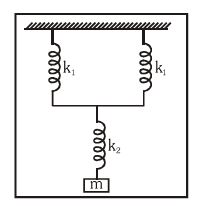
The total spring constant of the system as shown in the figure will be
A
$ \frac{k_1}{2} + k_2 $
B
$ \left[ \frac{1}{2k_1} + \frac{1}{k_2} \right]^{-1} $
C
$ \frac{1}{2k_1} + \frac{1}{k_2} $
D
$ \left[ \frac{2}{k_1} + \frac{1}{k_2} \right]^{-1} $
Solution
(B) $1$. In the given figure,the two springs with spring constant $k_1$ are connected in parallel. The equivalent spring constant of these two springs is $k_p = k_1 + k_1 = 2k_1$.
$2$. This equivalent spring $k_p$ is then connected in series with the spring having spring constant $k_2$.
$3$. For two springs connected in series,the equivalent spring constant $k_{eq}$ is given by $\frac{1}{k_{eq}} = \frac{1}{k_p} + \frac{1}{k_2}$.
$4$. Substituting $k_p = 2k_1$,we get $\frac{1}{k_{eq}} = \frac{1}{2k_1} + \frac{1}{k_2}$.
$5$. Therefore,$k_{eq} = \left[ \frac{1}{2k_1} + \frac{1}{k_2} \right]^{-1}$.
$2$. This equivalent spring $k_p$ is then connected in series with the spring having spring constant $k_2$.
$3$. For two springs connected in series,the equivalent spring constant $k_{eq}$ is given by $\frac{1}{k_{eq}} = \frac{1}{k_p} + \frac{1}{k_2}$.
$4$. Substituting $k_p = 2k_1$,we get $\frac{1}{k_{eq}} = \frac{1}{2k_1} + \frac{1}{k_2}$.
$5$. Therefore,$k_{eq} = \left[ \frac{1}{2k_1} + \frac{1}{k_2} \right]^{-1}$.
0 likes
View Solution110
MediumMCQ
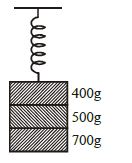
$A$ system consisting of three masses attached to a spring is in equilibrium. When the $700\,g$ mass is removed,the system oscillates with a period of $3\,s$. When the $500\,g$ mass is also removed,what will be the new time period of the system? (in $\text{seconds}$)
A
$1$
B
$2$
C
$3$
D
$\sqrt{\frac{12}{5}}$
Solution
(B) The time period of a spring-mass system is given by $T = 2\pi \sqrt{\frac{m}{k}}$,which implies $T \propto \sqrt{m}$.
Initially,the total mass is $M_1 = 400\,g + 500\,g + 700\,g = 1600\,g$. However,the problem states that after removing the $700\,g$ mass,the period is $3\,s$.
Let the remaining mass be $m_1 = 400\,g + 500\,g = 900\,g$. So,$T_1 = 3\,s$ for $m_1 = 900\,g$.
When the $500\,g$ mass is also removed,the new mass is $m_2 = 400\,g$.
Using the relation $\frac{T_2}{T_1} = \sqrt{\frac{m_2}{m_1}}$:
$\frac{T_2}{3} = \sqrt{\frac{400}{900}}$
$\frac{T_2}{3} = \sqrt{\frac{4}{9}} = \frac{2}{3}$
$T_2 = 2\,s$.
Initially,the total mass is $M_1 = 400\,g + 500\,g + 700\,g = 1600\,g$. However,the problem states that after removing the $700\,g$ mass,the period is $3\,s$.
Let the remaining mass be $m_1 = 400\,g + 500\,g = 900\,g$. So,$T_1 = 3\,s$ for $m_1 = 900\,g$.
When the $500\,g$ mass is also removed,the new mass is $m_2 = 400\,g$.
Using the relation $\frac{T_2}{T_1} = \sqrt{\frac{m_2}{m_1}}$:
$\frac{T_2}{3} = \sqrt{\frac{400}{900}}$
$\frac{T_2}{3} = \sqrt{\frac{4}{9}} = \frac{2}{3}$
$T_2 = 2\,s$.
0 likes
View Solution111
DifficultMCQ
$A$ body at the end of a spring executes $S.H.M.$ with a period $t_1$,while the corresponding period for another spring is $t_2$. If the period of oscillation with the two springs in series is $T$,then
A
$T = t_1 + t_2$
B
$T^2 = t_1^2 + t_2^2$
C
$\frac{1}{T} = \frac{1}{t_1} + \frac{1}{t_2}$
D
$\frac{1}{T^2} = \frac{1}{t_1^2} + \frac{1}{t_2^2}$
Solution
(B) The period of oscillation for a spring-mass system is given by $T = 2\pi \sqrt{\frac{M}{k}}$.
For the first spring,$t_1 = 2\pi \sqrt{\frac{M}{k_1}} \implies t_1^2 = 4\pi^2 \frac{M}{k_1} \implies k_1 = \frac{4\pi^2 M}{t_1^2}$.
For the second spring,$t_2 = 2\pi \sqrt{\frac{M}{k_2}} \implies t_2^2 = 4\pi^2 \frac{M}{k_2} \implies k_2 = \frac{4\pi^2 M}{t_2^2}$.
When two springs are connected in series,the effective spring constant $k_{eq}$ is given by $\frac{1}{k_{eq}} = \frac{1}{k_1} + \frac{1}{k_2} = \frac{k_1 + k_2}{k_1 k_2}$,so $k_{eq} = \frac{k_1 k_2}{k_1 + k_2}$.
The period of oscillation for the series combination is $T = 2\pi \sqrt{\frac{M}{k_{eq}}}$.
Squaring both sides,$T^2 = 4\pi^2 \frac{M}{k_{eq}} = 4\pi^2 M \left( \frac{k_1 + k_2}{k_1 k_2} \right) = 4\pi^2 M \left( \frac{1}{k_2} + \frac{1}{k_1} \right)$.
Substituting the expressions for $k_1$ and $k_2$,we get $T^2 = 4\pi^2 M \left( \frac{t_2^2}{4\pi^2 M} + \frac{t_1^2}{4\pi^2 M} \right) = t_1^2 + t_2^2$.
For the first spring,$t_1 = 2\pi \sqrt{\frac{M}{k_1}} \implies t_1^2 = 4\pi^2 \frac{M}{k_1} \implies k_1 = \frac{4\pi^2 M}{t_1^2}$.
For the second spring,$t_2 = 2\pi \sqrt{\frac{M}{k_2}} \implies t_2^2 = 4\pi^2 \frac{M}{k_2} \implies k_2 = \frac{4\pi^2 M}{t_2^2}$.
When two springs are connected in series,the effective spring constant $k_{eq}$ is given by $\frac{1}{k_{eq}} = \frac{1}{k_1} + \frac{1}{k_2} = \frac{k_1 + k_2}{k_1 k_2}$,so $k_{eq} = \frac{k_1 k_2}{k_1 + k_2}$.
The period of oscillation for the series combination is $T = 2\pi \sqrt{\frac{M}{k_{eq}}}$.
Squaring both sides,$T^2 = 4\pi^2 \frac{M}{k_{eq}} = 4\pi^2 M \left( \frac{k_1 + k_2}{k_1 k_2} \right) = 4\pi^2 M \left( \frac{1}{k_2} + \frac{1}{k_1} \right)$.
Substituting the expressions for $k_1$ and $k_2$,we get $T^2 = 4\pi^2 M \left( \frac{t_2^2}{4\pi^2 M} + \frac{t_1^2}{4\pi^2 M} \right) = t_1^2 + t_2^2$.
0 likes
View Solution112
MediumMCQ
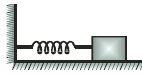
$A$ spring with a spring constant of $1200\, Nm^{-1}$ is mounted on a smooth frictionless surface and attached to a block of mass $3\, kg$. The block is pulled $2\, cm$ to the right and released. The angular frequency of oscillation is .... $rad/s$.
A
$5$
B
$30$
C
$10$
D
$20$
Solution
(D) The angular frequency $\omega$ of a spring-mass system is given by the formula:
$\omega = \sqrt{\frac{K}{m}}$
Where $K$ is the spring constant and $m$ is the mass of the block.
Given:
$K = 1200\, Nm^{-1}$
$m = 3\, kg$
Substituting the values into the formula:
$\omega = \sqrt{\frac{1200}{3}}$
$\omega = \sqrt{400}$
$\omega = 20\, rad/s$
Thus,the angular frequency of oscillation is $20\, rad/s$.
$\omega = \sqrt{\frac{K}{m}}$
Where $K$ is the spring constant and $m$ is the mass of the block.
Given:
$K = 1200\, Nm^{-1}$
$m = 3\, kg$
Substituting the values into the formula:
$\omega = \sqrt{\frac{1200}{3}}$
$\omega = \sqrt{400}$
$\omega = 20\, rad/s$
Thus,the angular frequency of oscillation is $20\, rad/s$.
0 likes
View Solution113
DifficultMCQ
Two bodies $A$ and $B$ of equal masses are suspended from two separate springs of force constants $k_1$ and $k_2$ respectively. If the two bodies oscillate such that their maximum velocities are equal,the ratio of the amplitudes of oscillation of $A$ and $B$ will be
A
$\frac{k_1}{k_2}$
B
$\sqrt{\frac{k_1}{k_2}}$
C
$\frac{k_2}{k_1}$
D
$\sqrt{\frac{k_2}{k_1}}$
Solution
(D) The maximum velocity of an object in simple harmonic motion is given by $v_{max} = A \omega$,where $A$ is the amplitude and $\omega$ is the angular frequency.
Given that the masses are equal $(m_1 = m_2 = m)$,the angular frequencies are $\omega_1 = \sqrt{\frac{k_1}{m}}$ and $\omega_2 = \sqrt{\frac{k_2}{m}}$.
Since the maximum velocities are equal,we have $A_1 \omega_1 = A_2 \omega_2$.
Rearranging for the ratio of amplitudes,we get $\frac{A_1}{A_2} = \frac{\omega_2}{\omega_1}$.
Substituting the expressions for $\omega_1$ and $\omega_2$,we get $\frac{A_1}{A_2} = \frac{\sqrt{k_2/m}}{\sqrt{k_1/m}} = \sqrt{\frac{k_2}{k_1}}$.
Thus,the ratio of the amplitudes is $\sqrt{\frac{k_2}{k_1}}$.
Given that the masses are equal $(m_1 = m_2 = m)$,the angular frequencies are $\omega_1 = \sqrt{\frac{k_1}{m}}$ and $\omega_2 = \sqrt{\frac{k_2}{m}}$.
Since the maximum velocities are equal,we have $A_1 \omega_1 = A_2 \omega_2$.
Rearranging for the ratio of amplitudes,we get $\frac{A_1}{A_2} = \frac{\omega_2}{\omega_1}$.
Substituting the expressions for $\omega_1$ and $\omega_2$,we get $\frac{A_1}{A_2} = \frac{\sqrt{k_2/m}}{\sqrt{k_1/m}} = \sqrt{\frac{k_2}{k_1}}$.
Thus,the ratio of the amplitudes is $\sqrt{\frac{k_2}{k_1}}$.
0 likes
View Solution114
EasyMCQ
When a mass $m$ is hung from the lower end of a spring of negligible mass,an extension $x$ is produced in the spring. The time period of oscillation is
A
$T = 2\pi \sqrt {\frac{x}{g}}$
B
$T = 2\pi \sqrt {\frac{gx}{m}}$
C
$T = 2\pi \sqrt {\frac{m}{k}}$
D
$T = 2\pi \sqrt {\frac{2x}{g}}$
Solution
(A) When a mass $m$ is hung from a spring,the restoring force $F = kx$ balances the gravitational force $mg$. Thus,$kx = mg$,which implies $k = \frac{mg}{x}$.
The time period of oscillation for a spring-mass system is given by $T = 2\pi \sqrt{\frac{m}{k}}$.
Substituting the value of $k = \frac{mg}{x}$ into the formula,we get $T = 2\pi \sqrt{\frac{m}{mg/x}}$.
Simplifying this,we obtain $T = 2\pi \sqrt{\frac{x}{g}}$.
The time period of oscillation for a spring-mass system is given by $T = 2\pi \sqrt{\frac{m}{k}}$.
Substituting the value of $k = \frac{mg}{x}$ into the formula,we get $T = 2\pi \sqrt{\frac{m}{mg/x}}$.
Simplifying this,we obtain $T = 2\pi \sqrt{\frac{x}{g}}$.
0 likes
View Solution115
DifficultMCQ
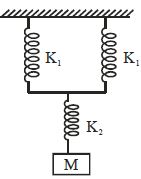
The equivalent spring constant of the system as shown in the figure will be:
A
$\frac{K_1 + 2K_2}{3}$
B
$\frac{2K_1K_2}{2K_1 + K_2}$
C
$\frac{2K_1 + K_2}{2K_1K_2}$
D
$\frac{K_1K_2}{K_1 + 2K_2}$
Solution
(B) In the given figure,the two springs with spring constant $K_1$ are connected in parallel.
The equivalent spring constant of these two springs in parallel is $K_p = K_1 + K_1 = 2K_1$.
Now,this equivalent spring $K_p$ is connected in series with the spring having spring constant $K_2$.
The equivalent spring constant $K_{eq}$ for two springs in series is given by $\frac{1}{K_{eq}} = \frac{1}{K_p} + \frac{1}{K_2}$.
Substituting $K_p = 2K_1$,we get $\frac{1}{K_{eq}} = \frac{1}{2K_1} + \frac{1}{K_2} = \frac{K_2 + 2K_1}{2K_1K_2}$.
Therefore,$K_{eq} = \frac{2K_1K_2}{2K_1 + K_2}$.
The equivalent spring constant of these two springs in parallel is $K_p = K_1 + K_1 = 2K_1$.
Now,this equivalent spring $K_p$ is connected in series with the spring having spring constant $K_2$.
The equivalent spring constant $K_{eq}$ for two springs in series is given by $\frac{1}{K_{eq}} = \frac{1}{K_p} + \frac{1}{K_2}$.
Substituting $K_p = 2K_1$,we get $\frac{1}{K_{eq}} = \frac{1}{2K_1} + \frac{1}{K_2} = \frac{K_2 + 2K_1}{2K_1K_2}$.
Therefore,$K_{eq} = \frac{2K_1K_2}{2K_1 + K_2}$.
0 likes
View Solution116
DifficultMCQ
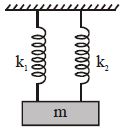
$A$ mass $m$ is suspended separately by two springs of spring constants $k_1$ and $k_2$. The time periods of oscillations in the two cases are $T_1$ and $T_2$ respectively. If the same mass $m$ is suspended by connecting the two springs in parallel (as shown in the figure),then the time period of the oscillation is $T$. The correct relation is:
A
$T^2 = T_1^2 + T_2^2$
B
$T^{-2} = T_1^{-2} + T_2^{-2}$
C
$T^{-1} = T_1^{-1} + T_2^{-1}$
D
$T = T_1 + T_2$
Solution
(B) For a spring-mass system,the time period is given by $T = 2\pi \sqrt{\frac{m}{k}}$.
In the first case,for spring $k_1$,the time period is $T_1 = 2\pi \sqrt{\frac{m}{k_1}}$. Squaring both sides,we get $T_1^2 = 4\pi^2 \frac{m}{k_1}$,which implies $\frac{1}{T_1^2} = \frac{k_1}{4\pi^2 m}$.
In the second case,for spring $k_2$,the time period is $T_2 = 2\pi \sqrt{\frac{m}{k_2}}$. Squaring both sides,we get $T_2^2 = 4\pi^2 \frac{m}{k_2}$,which implies $\frac{1}{T_2^2} = \frac{k_2}{4\pi^2 m}$.
When the two springs are connected in parallel,the effective spring constant is $k_{eff} = k_1 + k_2$. The time period $T$ is given by $T = 2\pi \sqrt{\frac{m}{k_1 + k_2}}$.
Squaring both sides,we get $T^2 = 4\pi^2 \frac{m}{k_1 + k_2}$,which implies $\frac{1}{T^2} = \frac{k_1 + k_2}{4\pi^2 m}$.
Substituting the expressions for $\frac{k_1}{4\pi^2 m}$ and $\frac{k_2}{4\pi^2 m}$,we get $\frac{1}{T^2} = \frac{1}{T_1^2} + \frac{1}{T_2^2}$.
This can be written as $T^{-2} = T_1^{-2} + T_2^{-2}$.
In the first case,for spring $k_1$,the time period is $T_1 = 2\pi \sqrt{\frac{m}{k_1}}$. Squaring both sides,we get $T_1^2 = 4\pi^2 \frac{m}{k_1}$,which implies $\frac{1}{T_1^2} = \frac{k_1}{4\pi^2 m}$.
In the second case,for spring $k_2$,the time period is $T_2 = 2\pi \sqrt{\frac{m}{k_2}}$. Squaring both sides,we get $T_2^2 = 4\pi^2 \frac{m}{k_2}$,which implies $\frac{1}{T_2^2} = \frac{k_2}{4\pi^2 m}$.
When the two springs are connected in parallel,the effective spring constant is $k_{eff} = k_1 + k_2$. The time period $T$ is given by $T = 2\pi \sqrt{\frac{m}{k_1 + k_2}}$.
Squaring both sides,we get $T^2 = 4\pi^2 \frac{m}{k_1 + k_2}$,which implies $\frac{1}{T^2} = \frac{k_1 + k_2}{4\pi^2 m}$.
Substituting the expressions for $\frac{k_1}{4\pi^2 m}$ and $\frac{k_2}{4\pi^2 m}$,we get $\frac{1}{T^2} = \frac{1}{T_1^2} + \frac{1}{T_2^2}$.
This can be written as $T^{-2} = T_1^{-2} + T_2^{-2}$.
0 likes
View Solution117
DifficultMCQ
When a block of mass $m$ is suspended separately by two different springs having time periods $t_1$ and $t_2$,respectively. If the same mass is connected to the series combination of both springs,then its time period is given by:
A
$t_1 + t_2$
B
$t_1^2 + t_2^2$
C
$\sqrt{t_1^2 + t_2^2}$
D
$\frac{1}{\sqrt{t_1^2 + t_2^2}}$
Solution
(C) The time period of a spring-mass system is given by $T = 2 \pi \sqrt{\frac{m}{k}}$.
For the two springs individually,we have $t_1 = 2 \pi \sqrt{\frac{m}{k_1}}$ and $t_2 = 2 \pi \sqrt{\frac{m}{k_2}}$.
Squaring both sides,we get $t_1^2 = 4 \pi^2 \frac{m}{k_1}$ and $t_2^2 = 4 \pi^2 \frac{m}{k_2}$,which implies $\frac{1}{k_1} = \frac{t_1^2}{4 \pi^2 m}$ and $\frac{1}{k_2} = \frac{t_2^2}{4 \pi^2 m}$.
For a series combination of springs,the equivalent spring constant $k_{eq}$ is given by $\frac{1}{k_{eq}} = \frac{1}{k_1} + \frac{1}{k_2}$.
The time period $t$ for the series combination is $t = 2 \pi \sqrt{\frac{m}{k_{eq}}}$,so $t^2 = 4 \pi^2 \frac{m}{k_{eq}}$.
Substituting the expression for $\frac{1}{k_{eq}}$,we get $t^2 = 4 \pi^2 m \left( \frac{1}{k_1} + \frac{1}{k_2} \right) = 4 \pi^2 m \left( \frac{t_1^2}{4 \pi^2 m} + \frac{t_2^2}{4 \pi^2 m} \right) = t_1^2 + t_2^2$.
Therefore,$t = \sqrt{t_1^2 + t_2^2}$.
For the two springs individually,we have $t_1 = 2 \pi \sqrt{\frac{m}{k_1}}$ and $t_2 = 2 \pi \sqrt{\frac{m}{k_2}}$.
Squaring both sides,we get $t_1^2 = 4 \pi^2 \frac{m}{k_1}$ and $t_2^2 = 4 \pi^2 \frac{m}{k_2}$,which implies $\frac{1}{k_1} = \frac{t_1^2}{4 \pi^2 m}$ and $\frac{1}{k_2} = \frac{t_2^2}{4 \pi^2 m}$.
For a series combination of springs,the equivalent spring constant $k_{eq}$ is given by $\frac{1}{k_{eq}} = \frac{1}{k_1} + \frac{1}{k_2}$.
The time period $t$ for the series combination is $t = 2 \pi \sqrt{\frac{m}{k_{eq}}}$,so $t^2 = 4 \pi^2 \frac{m}{k_{eq}}$.
Substituting the expression for $\frac{1}{k_{eq}}$,we get $t^2 = 4 \pi^2 m \left( \frac{1}{k_1} + \frac{1}{k_2} \right) = 4 \pi^2 m \left( \frac{t_1^2}{4 \pi^2 m} + \frac{t_2^2}{4 \pi^2 m} \right) = t_1^2 + t_2^2$.
Therefore,$t = \sqrt{t_1^2 + t_2^2}$.
0 likes
View Solution118
DifficultMCQ
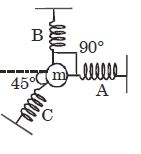
$A$ particle of mass $m$ is attached to $3$ springs $A$,$B$ and $C$ of equal force constant $K$ as shown in the figure. If the particle is pushed slightly along the line of spring $C$ and released,find the period of oscillation.
A
$2\pi \sqrt {\frac{m}{{2k}}} $
B
$2\pi \sqrt {\frac{{2m}}{k}} $
C
$2\pi \sqrt {\frac{m}{{4k}}} $
D
$2\pi \sqrt {\frac{m}{k}} $
Solution
(A) Let the particle be displaced by a small distance $x$ along the direction of spring $C$.
The displacement $x$ can be resolved into components along the axes of the three springs.
Spring $C$ undergoes a compression of $x$.
Spring $A$ and $B$ are at $45^{\circ}$ and $90^{\circ}$ respectively to the direction of displacement.
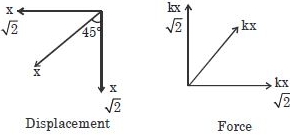
The components of displacement along springs $A$ and $B$ are $x \cos(45^{\circ}) = \frac{x}{\sqrt{2}}$ and $x \cos(45^{\circ}) = \frac{x}{\sqrt{2}}$ respectively.
The restoring forces are $F_C = Kx$,$F_A = K \frac{x}{\sqrt{2}}$,and $F_B = K \frac{x}{\sqrt{2}}$.
The total restoring force $F_{net}$ along the direction of displacement is the sum of the components of these forces along that direction:
$F_{net} = F_C + F_A \cos(45^{\circ}) + F_B \cos(45^{\circ}) = Kx + (K \frac{x}{\sqrt{2}}) \frac{1}{\sqrt{2}} + (K \frac{x}{\sqrt{2}}) \frac{1}{\sqrt{2}} = Kx + \frac{Kx}{2} + \frac{Kx}{2} = 2Kx$.
Comparing this with $F = k_{eff} x$,we get $k_{eff} = 2K$.
The time period is $T = 2\pi \sqrt{\frac{m}{k_{eff}}} = 2\pi \sqrt{\frac{m}{2K}}$.
The displacement $x$ can be resolved into components along the axes of the three springs.
Spring $C$ undergoes a compression of $x$.
Spring $A$ and $B$ are at $45^{\circ}$ and $90^{\circ}$ respectively to the direction of displacement.
The components of displacement along springs $A$ and $B$ are $x \cos(45^{\circ}) = \frac{x}{\sqrt{2}}$ and $x \cos(45^{\circ}) = \frac{x}{\sqrt{2}}$ respectively.
The restoring forces are $F_C = Kx$,$F_A = K \frac{x}{\sqrt{2}}$,and $F_B = K \frac{x}{\sqrt{2}}$.
The total restoring force $F_{net}$ along the direction of displacement is the sum of the components of these forces along that direction:
$F_{net} = F_C + F_A \cos(45^{\circ}) + F_B \cos(45^{\circ}) = Kx + (K \frac{x}{\sqrt{2}}) \frac{1}{\sqrt{2}} + (K \frac{x}{\sqrt{2}}) \frac{1}{\sqrt{2}} = Kx + \frac{Kx}{2} + \frac{Kx}{2} = 2Kx$.
Comparing this with $F = k_{eff} x$,we get $k_{eff} = 2K$.
The time period is $T = 2\pi \sqrt{\frac{m}{k_{eff}}} = 2\pi \sqrt{\frac{m}{2K}}$.
0 likes
View Solution119
DifficultMCQ
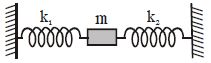
Two springs,of force constants $k_1$ and $k_2$,are connected to a mass $m$ as shown. The frequency of oscillation of the mass is $f$. If both $k_1$ and $k_2$ are made four times their original values,the frequency of oscillation becomes
A
$2f$
B
$\frac{f}{2}$
C
$\frac{f}{4}$
D
$4f$
Solution
(A) In the given figure,the mass $m$ is connected between two springs. When the mass is displaced,one spring is compressed while the other is stretched. This configuration is equivalent to a parallel combination of springs.
The effective spring constant $k_{eff}$ for springs in parallel is given by:
$k_{eff} = k_1 + k_2$
The frequency of oscillation $f$ is given by:
$f = \frac{1}{2\pi} \sqrt{\frac{k_{eff}}{m}} = \frac{1}{2\pi} \sqrt{\frac{k_1 + k_2}{m}} \quad ...(1)$
If both $k_1$ and $k_2$ are made four times their original values,the new spring constants are $k_1' = 4k_1$ and $k_2' = 4k_2$. The new effective spring constant $k_{eff}'$ is:
$k_{eff}' = 4k_1 + 4k_2 = 4(k_1 + k_2)$
The new frequency $f'$ is:
$f' = \frac{1}{2\pi} \sqrt{\frac{k_{eff}'}{m}} = \frac{1}{2\pi} \sqrt{\frac{4(k_1 + k_2)}{m}}$
$f' = 2 \times \left( \frac{1}{2\pi} \sqrt{\frac{k_1 + k_2}{m}} \right)$
$f' = 2f$
The effective spring constant $k_{eff}$ for springs in parallel is given by:
$k_{eff} = k_1 + k_2$
The frequency of oscillation $f$ is given by:
$f = \frac{1}{2\pi} \sqrt{\frac{k_{eff}}{m}} = \frac{1}{2\pi} \sqrt{\frac{k_1 + k_2}{m}} \quad ...(1)$
If both $k_1$ and $k_2$ are made four times their original values,the new spring constants are $k_1' = 4k_1$ and $k_2' = 4k_2$. The new effective spring constant $k_{eff}'$ is:
$k_{eff}' = 4k_1 + 4k_2 = 4(k_1 + k_2)$
The new frequency $f'$ is:
$f' = \frac{1}{2\pi} \sqrt{\frac{k_{eff}'}{m}} = \frac{1}{2\pi} \sqrt{\frac{4(k_1 + k_2)}{m}}$
$f' = 2 \times \left( \frac{1}{2\pi} \sqrt{\frac{k_1 + k_2}{m}} \right)$
$f' = 2f$
0 likes
View Solution120
MediumMCQ
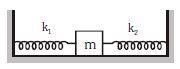
$A$ block of mass $m$ is attached to two springs of spring constants $k_1$ and $k_2$ as shown in the figure. The block is displaced by $x$ towards the right and released. The velocity of the block when it is at $x/2$ will be
A
$\sqrt{\frac{(k_1 + k_2)x^2}{2m}}$
B
$\sqrt{\frac{3(k_1 + k_2)x^2}{4m}}$
C
$\sqrt{\frac{(k_1 + k_2)x^2}{m}}$
D
$\sqrt{\frac{(k_1 + k_2)x^2}{4m}}$
Solution
(B) The effective spring constant $k_{eff}$ for two springs in parallel is $k_{eff} = k_1 + k_2$.
Using the principle of conservation of energy,the total mechanical energy at the extreme position $(x)$ is equal to the total mechanical energy at position $x/2$.
At the extreme position $(x)$,the velocity is zero,so the total energy is purely potential: $E = \frac{1}{2} k_{eff} x^2 = \frac{1}{2} (k_1 + k_2) x^2$.
At position $x/2$,the total energy is the sum of potential and kinetic energy: $E = \frac{1}{2} k_{eff} (x/2)^2 + \frac{1}{2} m v^2$.
Equating the energies: $\frac{1}{2} (k_1 + k_2) x^2 = \frac{1}{2} (k_1 + k_2) (x/2)^2 + \frac{1}{2} m v^2$.
$(k_1 + k_2) x^2 = (k_1 + k_2) \frac{x^2}{4} + m v^2$.
$m v^2 = (k_1 + k_2) x^2 - \frac{(k_1 + k_2) x^2}{4} = \frac{3}{4} (k_1 + k_2) x^2$.
$v^2 = \frac{3(k_1 + k_2) x^2}{4m}$.
$v = \sqrt{\frac{3(k_1 + k_2) x^2}{4m}}$.
Using the principle of conservation of energy,the total mechanical energy at the extreme position $(x)$ is equal to the total mechanical energy at position $x/2$.
At the extreme position $(x)$,the velocity is zero,so the total energy is purely potential: $E = \frac{1}{2} k_{eff} x^2 = \frac{1}{2} (k_1 + k_2) x^2$.
At position $x/2$,the total energy is the sum of potential and kinetic energy: $E = \frac{1}{2} k_{eff} (x/2)^2 + \frac{1}{2} m v^2$.
Equating the energies: $\frac{1}{2} (k_1 + k_2) x^2 = \frac{1}{2} (k_1 + k_2) (x/2)^2 + \frac{1}{2} m v^2$.
$(k_1 + k_2) x^2 = (k_1 + k_2) \frac{x^2}{4} + m v^2$.
$m v^2 = (k_1 + k_2) x^2 - \frac{(k_1 + k_2) x^2}{4} = \frac{3}{4} (k_1 + k_2) x^2$.
$v^2 = \frac{3(k_1 + k_2) x^2}{4m}$.
$v = \sqrt{\frac{3(k_1 + k_2) x^2}{4m}}$.
0 likes
View Solution121
AdvancedMCQ
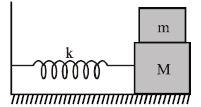
In the given arrangement,the spring constant $k$ has a value of $2\,N\,m^{-1}$,mass $M = 3\,kg$,and mass $m = 1\,kg$. Mass $M$ is in contact with a smooth surface. The coefficient of friction between the two blocks is $0.1$. The time period of $SHM$ executed by the system is
A
$\pi \sqrt{6}$
B
$\pi \sqrt{2}$
C
$2\sqrt{2}\pi$
D
$2\pi$
Solution
(C) In this system,both blocks $M$ and $m$ move together as a single unit because the friction between them is sufficient to prevent relative motion for small oscillations.
Since the surface is smooth,the total mass of the oscillating system is $M_{total} = M + m = 3\,kg + 1\,kg = 4\,kg$.
The spring constant is $k = 2\,N\,m^{-1}$.
The time period $T$ of a spring-mass system is given by the formula $T = 2\pi \sqrt{\frac{M_{total}}{k}}$.
Substituting the values,we get $T = 2\pi \sqrt{\frac{4}{2}} = 2\pi \sqrt{2}$.
Thus,the time period of the $SHM$ executed by the system is $2\sqrt{2}\pi\,s$.
Since the surface is smooth,the total mass of the oscillating system is $M_{total} = M + m = 3\,kg + 1\,kg = 4\,kg$.
The spring constant is $k = 2\,N\,m^{-1}$.
The time period $T$ of a spring-mass system is given by the formula $T = 2\pi \sqrt{\frac{M_{total}}{k}}$.
Substituting the values,we get $T = 2\pi \sqrt{\frac{4}{2}} = 2\pi \sqrt{2}$.
Thus,the time period of the $SHM$ executed by the system is $2\sqrt{2}\pi\,s$.
0 likes
View Solution122
DifficultMCQ
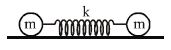
Two identical particles each of mass $m$ are interconnected by a light spring of stiffness $k$. The time period for small oscillations is equal to:
A
$2\pi \sqrt {\frac{m}{k}} $
B
$\pi \sqrt {\frac{m}{k}} $
C
$2\pi \sqrt {\frac{m}{{2k}}} $
D
$\pi \sqrt {\frac{{2m}}{k}} $
Solution
(D) The reduced mass of the system is given by:
$\mu = \frac{m_1 m_2}{m_1 + m_2} = \frac{m \cdot m}{m + m} = \frac{m^2}{2m} = \frac{m}{2}$
The given system of two particles connected by a spring is equivalent to a single particle of mass $\mu$ connected to a fixed wall by a spring of stiffness $k$.
The time period of oscillation for this equivalent system is:
$T = 2\pi \sqrt{\frac{\mu}{k}}$
Substituting the value of $\mu = \frac{m}{2}$:
$T = 2\pi \sqrt{\frac{m/2}{k}} = 2\pi \sqrt{\frac{m}{2k}} = 2\pi \frac{1}{\sqrt{2}} \sqrt{\frac{m}{k}} = \sqrt{2} \cdot \sqrt{2} \pi \sqrt{\frac{m}{2k}} = \pi \sqrt{\frac{4m}{2k}} = \pi \sqrt{\frac{2m}{k}}$
Thus,the correct option is $D$.
$\mu = \frac{m_1 m_2}{m_1 + m_2} = \frac{m \cdot m}{m + m} = \frac{m^2}{2m} = \frac{m}{2}$
The given system of two particles connected by a spring is equivalent to a single particle of mass $\mu$ connected to a fixed wall by a spring of stiffness $k$.
The time period of oscillation for this equivalent system is:
$T = 2\pi \sqrt{\frac{\mu}{k}}$
Substituting the value of $\mu = \frac{m}{2}$:
$T = 2\pi \sqrt{\frac{m/2}{k}} = 2\pi \sqrt{\frac{m}{2k}} = 2\pi \frac{1}{\sqrt{2}} \sqrt{\frac{m}{k}} = \sqrt{2} \cdot \sqrt{2} \pi \sqrt{\frac{m}{2k}} = \pi \sqrt{\frac{4m}{2k}} = \pi \sqrt{\frac{2m}{k}}$
Thus,the correct option is $D$.
0 likes
View Solution123
MediumMCQ
$A$ block of mass $m$ rests on a platform. The platform is given up and down $SHM$ with an amplitude $d$. What is the maximum frequency so that the block never leaves the platform?
A
$\sqrt{g/d}$
B
$\frac{1}{2\pi}\sqrt{g/d}$
C
$\frac{1}{2\pi}(g/d)$
D
$2\pi\sqrt{d/g}$
Solution
(B) For the block to remain in contact with the platform,the downward acceleration of the platform must not exceed the acceleration due to gravity $g$.
The maximum downward acceleration of a platform undergoing $SHM$ is given by $a_{max} = \omega^2 d$,where $\omega$ is the angular frequency and $d$ is the amplitude.
To ensure the block does not leave the platform,we set $a_{max} \le g$,which implies $\omega^2 d = g$.
Solving for $\omega$,we get $\omega = \sqrt{g/d}$.
Since angular frequency $\omega = 2\pi f$,where $f$ is the frequency,we have $2\pi f = \sqrt{g/d}$.
Therefore,the maximum frequency is $f = \frac{1}{2\pi}\sqrt{\frac{g}{d}}$.
The maximum downward acceleration of a platform undergoing $SHM$ is given by $a_{max} = \omega^2 d$,where $\omega$ is the angular frequency and $d$ is the amplitude.
To ensure the block does not leave the platform,we set $a_{max} \le g$,which implies $\omega^2 d = g$.
Solving for $\omega$,we get $\omega = \sqrt{g/d}$.
Since angular frequency $\omega = 2\pi f$,where $f$ is the frequency,we have $2\pi f = \sqrt{g/d}$.
Therefore,the maximum frequency is $f = \frac{1}{2\pi}\sqrt{\frac{g}{d}}$.
0 likes
View Solution124
DifficultMCQ
$A$ body of mass $M$ and charge $q$ is connected to a spring of spring constant $k$. It is oscillating along the $x-$ direction about its equilibrium position,taken to be at $x = 0$,with an amplitude $A$. An electric field $E$ is applied along the $x-$ direction. Which of the following statements is correct?
A
The total energy of the system is $\frac{1}{2} M \omega^2 A^2 + \frac{1}{2} \frac{q^2 E^2}{k}$
B
The new equilibrium position is at a distance: $\frac{2qE}{k}$ from $x = 0$
C
The new equilibrium position is at a distance: $\frac{qE}{2k}$ from $x = 0$
D
The total energy of the system is $\frac{1}{2} M \omega^2 A^2 - \frac{1}{2} \frac{q^2 E^2}{k}$
Solution
(A) The equilibrium position shifts to a point where the net force is zero.
At the new equilibrium position $x_{eq}$,the spring force balances the electric force:
$k x_{eq} = qE \Rightarrow x_{eq} = \frac{qE}{k}$
The total energy of the system is the sum of the vibrational energy and the potential energy at the new equilibrium position:
$E_{total} = \frac{1}{2} M \omega^2 A^2 + \frac{1}{2} k x_{eq}^2$
Substituting $x_{eq} = \frac{qE}{k}$ into the equation:
$E_{total} = \frac{1}{2} M \omega^2 A^2 + \frac{1}{2} k \left( \frac{qE}{k} \right)^2$
$E_{total} = \frac{1}{2} M \omega^2 A^2 + \frac{1}{2} \frac{q^2 E^2}{k}$
Thus,option $A$ is correct.
At the new equilibrium position $x_{eq}$,the spring force balances the electric force:
$k x_{eq} = qE \Rightarrow x_{eq} = \frac{qE}{k}$
The total energy of the system is the sum of the vibrational energy and the potential energy at the new equilibrium position:
$E_{total} = \frac{1}{2} M \omega^2 A^2 + \frac{1}{2} k x_{eq}^2$
Substituting $x_{eq} = \frac{qE}{k}$ into the equation:
$E_{total} = \frac{1}{2} M \omega^2 A^2 + \frac{1}{2} k \left( \frac{qE}{k} \right)^2$
$E_{total} = \frac{1}{2} M \omega^2 A^2 + \frac{1}{2} \frac{q^2 E^2}{k}$
Thus,option $A$ is correct.
0 likes
View Solution125
MediumMCQ
$A$ $1 \, kg$ block attached to a spring vibrates with a frequency of $1 \, Hz$ on a frictionless horizontal table. Two springs identical to the original spring are attached in parallel to an $8 \, kg$ block placed on the same table. The frequency of vibration of the $8 \, kg$ block is ..... $Hz$.
A
$0.25$
B
$0.35$
C
$0.5$
D
$2$
Solution
(C) The frequency of a spring-mass system is given by $f = \frac{1}{2 \pi} \sqrt{\frac{k}{m}}$.
For the first case: $1 = \frac{1}{2 \pi} \sqrt{\frac{k}{1}}$,which implies $k = 4 \pi^2 \, N/m$.
In the second case,two identical springs are connected in parallel,so the equivalent spring constant is $k_{eq} = k + k = 2k = 2(4 \pi^2) = 8 \pi^2 \, N/m$.
The new mass is $M = 8 \, kg$.
The new frequency $f'$ is given by:
$f' = \frac{1}{2 \pi} \sqrt{\frac{k_{eq}}{M}} = \frac{1}{2 \pi} \sqrt{\frac{8 \pi^2}{8}} = \frac{1}{2 \pi} \sqrt{\pi^2} = \frac{\pi}{2 \pi} = 0.5 \, Hz$.
For the first case: $1 = \frac{1}{2 \pi} \sqrt{\frac{k}{1}}$,which implies $k = 4 \pi^2 \, N/m$.
In the second case,two identical springs are connected in parallel,so the equivalent spring constant is $k_{eq} = k + k = 2k = 2(4 \pi^2) = 8 \pi^2 \, N/m$.
The new mass is $M = 8 \, kg$.
The new frequency $f'$ is given by:
$f' = \frac{1}{2 \pi} \sqrt{\frac{k_{eq}}{M}} = \frac{1}{2 \pi} \sqrt{\frac{8 \pi^2}{8}} = \frac{1}{2 \pi} \sqrt{\pi^2} = \frac{\pi}{2 \pi} = 0.5 \, Hz$.
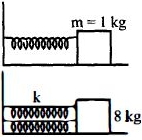
0 likes
View Solution126
DifficultMCQ
Two bodies of masses $1\, kg$ and $4\, kg$ are connected to a vertical spring,as shown in the figure. The smaller mass executes simple harmonic motion of angular frequency $25\, rad/s$,and amplitude $1.6\, cm$ while the bigger mass remains stationary on the ground. The maximum force exerted by the system on the floor is ..... $N$ (take $g = 10\, m/s^2$).
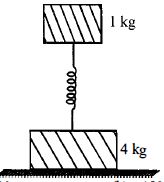
A
$20$
B
$10$
C
$60$
D
$40$
Solution
(C) Mass of the bigger body $M = 4\, kg$.
Mass of the smaller body $m = 1\, kg$.
The smaller mass $(m = 1\, kg)$ executes simple harmonic motion ($S$.$H$.$M$.) with angular frequency $\omega = 25\, rad/s$ and amplitude $A = 1.6\, cm = 1.6 \times 10^{-2}\, m$.
Since $\omega = \sqrt{\frac{K}{m}}$,we have $K = m\omega^2 = 1 \times (25)^2 = 625\, N/m$.
The force exerted by the system on the floor is the sum of the weight of the bigger body,the weight of the smaller body,and the spring force.
The normal force $N$ exerted by the floor on the system is $N = Mg + mg + F_{spring}$.
The spring force $F_{spring}$ varies as the smaller mass oscillates. The maximum force exerted on the floor occurs when the spring is at its maximum extension.
The maximum spring force is $F_{max} = KA = 625 \times 1.6 \times 10^{-2} = 10\, N$.
Thus,the maximum force exerted on the floor is $F_{total} = Mg + mg + F_{max} = (4 \times 10) + (1 \times 10) + 10 = 40 + 10 + 10 = 60\, N$.
Mass of the smaller body $m = 1\, kg$.
The smaller mass $(m = 1\, kg)$ executes simple harmonic motion ($S$.$H$.$M$.) with angular frequency $\omega = 25\, rad/s$ and amplitude $A = 1.6\, cm = 1.6 \times 10^{-2}\, m$.
Since $\omega = \sqrt{\frac{K}{m}}$,we have $K = m\omega^2 = 1 \times (25)^2 = 625\, N/m$.
The force exerted by the system on the floor is the sum of the weight of the bigger body,the weight of the smaller body,and the spring force.
The normal force $N$ exerted by the floor on the system is $N = Mg + mg + F_{spring}$.
The spring force $F_{spring}$ varies as the smaller mass oscillates. The maximum force exerted on the floor occurs when the spring is at its maximum extension.
The maximum spring force is $F_{max} = KA = 625 \times 1.6 \times 10^{-2} = 10\, N$.
Thus,the maximum force exerted on the floor is $F_{total} = Mg + mg + F_{max} = (4 \times 10) + (1 \times 10) + 10 = 40 + 10 + 10 = 60\, N$.
0 likes
View Solution127
DifficultMCQ
$A$ spring of unstretched length $l$ has a mass $m$ with one end fixed to a rigid support. Assuming the spring to be made of a uniform wire,the kinetic energy possessed by it if its free end is pulled with uniform velocity $v$ is
A
$\frac{1}{2} mv^2$
B
$mv^2$
C
$\frac{1}{3} mv^2$
D
$\frac{1}{6} mv^2$
Solution
(D) We can find the effective kinetic energy of the spring by integrating the kinetic energy of all its infinitesimal mass elements.
Let $L$ be the length of the spring. Consider an element of length $dy$ at a distance $y$ from the fixed end.
The mass of this element is $dm = (m/L) dy$.
The velocity $u$ of this element is proportional to its distance $y$ from the fixed end: $u = (y/L)v$.
The kinetic energy $dT$ of this element is $dT = \frac{1}{2} (dm) u^2 = \frac{1}{2} (m/L) dy (yv/L)^2$.
Integrating from $y = 0$ to $y = L$:
$T = \int_{0}^{L} \frac{1}{2} \frac{m}{L} \frac{v^2}{L^2} y^2 dy$
$T = \frac{mv^2}{2L^3} \int_{0}^{L} y^2 dy$
$T = \frac{mv^2}{2L^3} [y^3/3]_{0}^{L} = \frac{mv^2}{2L^3} (L^3/3) = \frac{1}{6} mv^2$.
Let $L$ be the length of the spring. Consider an element of length $dy$ at a distance $y$ from the fixed end.
The mass of this element is $dm = (m/L) dy$.
The velocity $u$ of this element is proportional to its distance $y$ from the fixed end: $u = (y/L)v$.
The kinetic energy $dT$ of this element is $dT = \frac{1}{2} (dm) u^2 = \frac{1}{2} (m/L) dy (yv/L)^2$.
Integrating from $y = 0$ to $y = L$:
$T = \int_{0}^{L} \frac{1}{2} \frac{m}{L} \frac{v^2}{L^2} y^2 dy$
$T = \frac{mv^2}{2L^3} \int_{0}^{L} y^2 dy$
$T = \frac{mv^2}{2L^3} [y^3/3]_{0}^{L} = \frac{mv^2}{2L^3} (L^3/3) = \frac{1}{6} mv^2$.
0 likes
View Solution128
DifficultMCQ
Two springs of force constants $300 \, N/m$ (Spring $A$) and $400 \, N/m$ (Spring $B$) are joined together in series. The combination is compressed by $8.75 \, cm$. The ratio of energy stored in $A$ and $B$ is $\frac{E_A}{E_B}$. Then $\frac{E_A}{E_B}$ is equal to
A
$\frac{4}{3}$
B
$\frac{16}{9}$
C
$\frac{3}{4}$
D
$\frac{9}{16}$
Solution
(A) When two springs are connected in series and compressed by a force $F$,the force $F$ acting on each spring is the same.
Energy stored in a spring is given by $E = \frac{F^2}{2k}$.
Since the force $F$ is the same for both springs in series,the ratio of energies is $\frac{E_A}{E_B} = \frac{\frac{F^2}{2k_A}}{\frac{F^2}{2k_B}} = \frac{k_B}{k_A}$.
Given $k_A = 300 \, N/m$ and $k_B = 400 \, N/m$.
Therefore,$\frac{E_A}{E_B} = \frac{400}{300} = \frac{4}{3}$.
Energy stored in a spring is given by $E = \frac{F^2}{2k}$.
Since the force $F$ is the same for both springs in series,the ratio of energies is $\frac{E_A}{E_B} = \frac{\frac{F^2}{2k_A}}{\frac{F^2}{2k_B}} = \frac{k_B}{k_A}$.
Given $k_A = 300 \, N/m$ and $k_B = 400 \, N/m$.
Therefore,$\frac{E_A}{E_B} = \frac{400}{300} = \frac{4}{3}$.
0 likes
View Solution129
MediumMCQ
$A$ mass $m = 1.0\,kg$ is placed on a flat pan attached to a vertical spring fixed on the ground. The mass of the spring and the pan is negligible. When pressed slightly and released,the mass executes simple harmonic motion. The spring constant is $k = 500\,N/m$. What is the amplitude $A$ of the motion,so that the mass $m$ tends to get detached from the pan? (Take $g = 10\,m/s^2$).
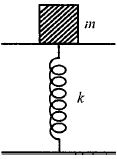
A
$A < 2.0\,cm$
B
$A = 2.0\,cm$
C
$A > 2.0\,cm$
D
$A = 1.5\,cm$
Solution
(C) For the mass $m$ to just detach from the pan,the normal force $N$ between the mass and the pan must become zero at the highest point of the oscillation.
At the highest point,the acceleration of the mass is directed downwards and is equal to $a = \omega^2 A$.
The equation of motion for the mass at the highest point is $mg - N = ma$.
Setting $N = 0$ for the condition of detachment,we get $mg = m\omega^2 A$,which simplifies to $g = \omega^2 A$.
Since $\omega^2 = k/m$,we have $g = (k/m) A$.
Substituting the given values: $10 = (500 / 1.0) \times A$.
$A = 10 / 500 = 0.02\,m = 2.0\,cm$.
Therefore,the mass will tend to detach if the amplitude $A$ is greater than or equal to $2.0\,cm$.
At the highest point,the acceleration of the mass is directed downwards and is equal to $a = \omega^2 A$.
The equation of motion for the mass at the highest point is $mg - N = ma$.
Setting $N = 0$ for the condition of detachment,we get $mg = m\omega^2 A$,which simplifies to $g = \omega^2 A$.
Since $\omega^2 = k/m$,we have $g = (k/m) A$.
Substituting the given values: $10 = (500 / 1.0) \times A$.
$A = 10 / 500 = 0.02\,m = 2.0\,cm$.
Therefore,the mass will tend to detach if the amplitude $A$ is greater than or equal to $2.0\,cm$.
0 likes
View Solution130
DifficultMCQ
$A$ uniform cylinder of length $L$ and mass $M$ having cross-sectional area $A$ is suspended,with its length vertical,from a fixed point by a massless spring,such that it is half submerged in a liquid of density $\sigma$ at equilibrium position. When the cylinder is given a downward push and released,it starts oscillating vertically with a small amplitude. The time period $T$ of the oscillations of the cylinder will be
A
Smaller than $2\pi \left[ \frac{M}{k + A\sigma g} \right]^{1/2}$
B
$2\pi \sqrt{\frac{M}{k}}$
C
Larger than $2\pi \left[ \frac{M}{k + A\sigma g} \right]^{1/2}$
D
$2\pi \left[ \frac{M}{k + A\sigma g} \right]^{1/2}$
Solution
(D) Let $x$ be the downward displacement of the cylinder from its equilibrium position.
When the cylinder is displaced by $x$,the additional buoyant force acting upwards is $F_b = A \sigma g x$.
The spring force acting upwards is $F_s = kx$.
The net restoring force is $F_{net} = -(k + A \sigma g)x$.
Comparing this with the standard $SHM$ equation $F = -m \omega^2 x$,we get $m \omega^2 = k + A \sigma g$.
Thus,the angular frequency is $\omega = \sqrt{\frac{k + A \sigma g}{M}}$.
The time period is $T = \frac{2\pi}{\omega} = 2\pi \sqrt{\frac{M}{k + A \sigma g}}$.
Since the cylinder is only half-submerged,the buoyant force is constant as long as it remains partially submerged. The derived formula is exact for small oscillations.
When the cylinder is displaced by $x$,the additional buoyant force acting upwards is $F_b = A \sigma g x$.
The spring force acting upwards is $F_s = kx$.
The net restoring force is $F_{net} = -(k + A \sigma g)x$.
Comparing this with the standard $SHM$ equation $F = -m \omega^2 x$,we get $m \omega^2 = k + A \sigma g$.
Thus,the angular frequency is $\omega = \sqrt{\frac{k + A \sigma g}{M}}$.
The time period is $T = \frac{2\pi}{\omega} = 2\pi \sqrt{\frac{M}{k + A \sigma g}}$.
Since the cylinder is only half-submerged,the buoyant force is constant as long as it remains partially submerged. The derived formula is exact for small oscillations.
0 likes
View Solution131
MediumMCQ
Springs of spring constants $K, 2K, 4K, 8K, \dots$ are connected in series. $A$ mass of $40 \, g$ is attached to the lower end of the last spring and the system is allowed to vibrate. What is the time period of oscillation in seconds? (Given $K = 2 \, N/cm$)
A
$0.13$
B
$0.3$
C
$0.43$
D
$0.21$
Solution
(A) The equivalent spring constant $K_{eq}$ for springs in series is given by $\frac{1}{K_{eq}} = \frac{1}{K_1} + \frac{1}{K_2} + \frac{1}{K_3} + \dots$
Substituting the given values: $\frac{1}{K_{eq}} = \frac{1}{K} + \frac{1}{2K} + \frac{1}{4K} + \frac{1}{8K} + \dots$
Factoring out $\frac{1}{K}$: $\frac{1}{K_{eq}} = \frac{1}{K} [1 + \frac{1}{2} + \frac{1}{4} + \frac{1}{8} + \dots]$
The term in the bracket is an infinite geometric progression with first term $a = 1$ and common ratio $r = 1/2$. The sum is $S = \frac{a}{1-r} = \frac{1}{1 - 1/2} = 2$.
Thus,$\frac{1}{K_{eq}} = \frac{1}{K} \times 2 = \frac{2}{K}$,which implies $K_{eq} = \frac{K}{2}$.
Given $K = 2 \, N/cm = 200 \, N/m$,so $K_{eq} = \frac{200}{2} = 100 \, N/m$.
The mass $m = 40 \, g = 0.04 \, kg$.
The time period $T = 2 \pi \sqrt{\frac{m}{K_{eq}}} = 2 \pi \sqrt{\frac{0.04}{100}} = 2 \pi \sqrt{0.0004} = 2 \pi \times 0.02 = 0.04 \pi \approx 0.04 \times 3.14 = 0.1256 \approx 0.13 \, s$.
Substituting the given values: $\frac{1}{K_{eq}} = \frac{1}{K} + \frac{1}{2K} + \frac{1}{4K} + \frac{1}{8K} + \dots$
Factoring out $\frac{1}{K}$: $\frac{1}{K_{eq}} = \frac{1}{K} [1 + \frac{1}{2} + \frac{1}{4} + \frac{1}{8} + \dots]$
The term in the bracket is an infinite geometric progression with first term $a = 1$ and common ratio $r = 1/2$. The sum is $S = \frac{a}{1-r} = \frac{1}{1 - 1/2} = 2$.
Thus,$\frac{1}{K_{eq}} = \frac{1}{K} \times 2 = \frac{2}{K}$,which implies $K_{eq} = \frac{K}{2}$.
Given $K = 2 \, N/cm = 200 \, N/m$,so $K_{eq} = \frac{200}{2} = 100 \, N/m$.
The mass $m = 40 \, g = 0.04 \, kg$.
The time period $T = 2 \pi \sqrt{\frac{m}{K_{eq}}} = 2 \pi \sqrt{\frac{0.04}{100}} = 2 \pi \sqrt{0.0004} = 2 \pi \times 0.02 = 0.04 \pi \approx 0.04 \times 3.14 = 0.1256 \approx 0.13 \, s$.
0 likes
View Solution132
DifficultMCQ
One end of a spring of force constant $k$ is fixed to a vertical wall and the other to a block of mass $m$ resting on a smooth horizontal surface. There is another wall at a distance $x_0$ from the block. The spring is then compressed by $2x_0$ and released. The time taken to strike the wall is
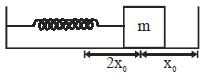
A
$\frac{1}{6}\pi \sqrt{\frac{k}{m}}$
B
$\sqrt{\frac{k}{m}}$
C
$\frac{2\pi}{3}\sqrt{\frac{m}{k}}$
D
$\frac{\pi}{4}\sqrt{\frac{k}{m}}$
Solution
(C) The block is released from a compression of $A = 2x_0$. The motion is simple harmonic with time period $T = 2\pi \sqrt{\frac{m}{k}}$.
The block starts from the extreme position $(x = -A = -2x_0)$ and moves towards the equilibrium position $(x = 0)$.
The time taken to reach the equilibrium position from the extreme position is $t_1 = \frac{T}{4}$.
After reaching the equilibrium position,the block continues to move towards the other wall,which is at a distance $x_0$ from the equilibrium position.
The displacement $x$ as a function of time is given by $x(t) = A \sin(\omega t)$,where $\omega = \sqrt{\frac{k}{m}}$.
To reach $x = x_0$ from $x = 0$,we have $x_0 = (2x_0) \sin(\omega t_2)$,which gives $\sin(\omega t_2) = \frac{1}{2}$.
Thus,$\omega t_2 = \frac{\pi}{6}$,so $t_2 = \frac{\pi}{6\omega} = \frac{\pi}{6} \sqrt{\frac{m}{k}} = \frac{T}{12}$.
The total time taken to strike the wall is $t = t_1 + t_2 = \frac{T}{4} + \frac{T}{12} = \frac{3T + T}{12} = \frac{4T}{12} = \frac{T}{3}$.
Substituting $T = 2\pi \sqrt{\frac{m}{k}}$,we get $t = \frac{1}{3} (2\pi \sqrt{\frac{m}{k}}) = \frac{2\pi}{3} \sqrt{\frac{m}{k}}$.
The block starts from the extreme position $(x = -A = -2x_0)$ and moves towards the equilibrium position $(x = 0)$.
The time taken to reach the equilibrium position from the extreme position is $t_1 = \frac{T}{4}$.
After reaching the equilibrium position,the block continues to move towards the other wall,which is at a distance $x_0$ from the equilibrium position.
The displacement $x$ as a function of time is given by $x(t) = A \sin(\omega t)$,where $\omega = \sqrt{\frac{k}{m}}$.
To reach $x = x_0$ from $x = 0$,we have $x_0 = (2x_0) \sin(\omega t_2)$,which gives $\sin(\omega t_2) = \frac{1}{2}$.
Thus,$\omega t_2 = \frac{\pi}{6}$,so $t_2 = \frac{\pi}{6\omega} = \frac{\pi}{6} \sqrt{\frac{m}{k}} = \frac{T}{12}$.
The total time taken to strike the wall is $t = t_1 + t_2 = \frac{T}{4} + \frac{T}{12} = \frac{3T + T}{12} = \frac{4T}{12} = \frac{T}{3}$.
Substituting $T = 2\pi \sqrt{\frac{m}{k}}$,we get $t = \frac{1}{3} (2\pi \sqrt{\frac{m}{k}}) = \frac{2\pi}{3} \sqrt{\frac{m}{k}}$.
0 likes
View Solution133
MediumMCQ
The springs in the figure are identical,but the length of the spring in $A$ is three times that in $B$. The ratio of the time periods $T_A/T_B$ is:
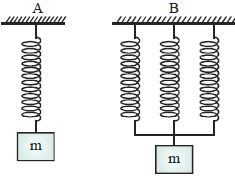
A
$\sqrt{3}$
B
$0.33$
C
$3$
D
$1/\sqrt{3}$
Solution
(C) The spring constant $k$ is inversely proportional to the length $\ell$ of the spring,i.e.,$k \propto 1/\ell$.
Let the length of the spring in figure $B$ be $\ell$. Then the length of the spring in figure $A$ is $3\ell$.
Let the spring constant of the spring in figure $B$ be $k_B = k$. Then the spring constant of the spring in figure $A$ is $k_A = k/3$.
In figure $A$,the equivalent spring constant is $K_A = k/3$.
In figure $B$,there are three identical springs in parallel,each with spring constant $k$. Thus,the equivalent spring constant is $K_B = k + k + k = 3k$.
The time period of a spring-mass system is given by $T = 2\pi \sqrt{M/K}$.
Therefore,the ratio of the time periods is:
$\frac{T_A}{T_B} = \sqrt{\frac{K_B}{K_A}} = \sqrt{\frac{3k}{k/3}} = \sqrt{9} = 3$.
Let the length of the spring in figure $B$ be $\ell$. Then the length of the spring in figure $A$ is $3\ell$.
Let the spring constant of the spring in figure $B$ be $k_B = k$. Then the spring constant of the spring in figure $A$ is $k_A = k/3$.
In figure $A$,the equivalent spring constant is $K_A = k/3$.
In figure $B$,there are three identical springs in parallel,each with spring constant $k$. Thus,the equivalent spring constant is $K_B = k + k + k = 3k$.
The time period of a spring-mass system is given by $T = 2\pi \sqrt{M/K}$.
Therefore,the ratio of the time periods is:
$\frac{T_A}{T_B} = \sqrt{\frac{K_B}{K_A}} = \sqrt{\frac{3k}{k/3}} = \sqrt{9} = 3$.
0 likes
View Solution134
DifficultMCQ
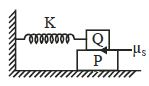
$A$ block $P$ of mass $m$ is placed on a smooth horizontal surface. $A$ block $Q$ of same mass is placed over the block $P$ and the coefficient of static friction between them is $\mu_S$. $A$ spring of spring constant $K$ is attached to block $Q$. The blocks are displaced together to a distance $A$ and released. The upper block oscillates without slipping over the lower block. The maximum frictional force between the blocks is
A
$0$
B
$K$
C
$\frac{KA}{2}$
D
$\mu_S mg$
Solution
(C) The system consists of two blocks of mass $m$ each,moving together as a single unit. The total mass of the system is $M = m + m = 2m$.
The angular frequency of the oscillation is given by $\omega = \sqrt{\frac{K}{M}} = \sqrt{\frac{K}{2m}}$.
The maximum acceleration of the system is $a_{max} = \omega^2 A = \left(\frac{K}{2m}\right) A = \frac{KA}{2m}$.
The frictional force $f$ provides the necessary acceleration to the lower block $P$. Since block $P$ has mass $m$,the force required to accelerate it is $f = m \cdot a_{max}$.
Substituting the value of $a_{max}$,we get $f = m \cdot \left(\frac{KA}{2m}\right) = \frac{KA}{2}$.
Thus,the maximum frictional force between the blocks is $\frac{KA}{2}$.
The angular frequency of the oscillation is given by $\omega = \sqrt{\frac{K}{M}} = \sqrt{\frac{K}{2m}}$.
The maximum acceleration of the system is $a_{max} = \omega^2 A = \left(\frac{K}{2m}\right) A = \frac{KA}{2m}$.
The frictional force $f$ provides the necessary acceleration to the lower block $P$. Since block $P$ has mass $m$,the force required to accelerate it is $f = m \cdot a_{max}$.
Substituting the value of $a_{max}$,we get $f = m \cdot \left(\frac{KA}{2m}\right) = \frac{KA}{2}$.
Thus,the maximum frictional force between the blocks is $\frac{KA}{2}$.
0 likes
View Solution135
DifficultMCQ
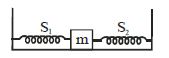
When a mass $m$ is connected individually with two springs $S_1$ and $S_2$,the oscillation frequencies are $n_1$ and $n_2$. If the mass $m$ is attached to the springs as shown in the figure,the oscillation frequency would be
A
$n_1 + n_2$
B
$\sqrt{n_1^2 + n_2^2}$
C
$\left( \frac{1}{n_1} + \frac{1}{n_2} \right)^{-1}$
D
$\sqrt{n_1^2 - n_2^2}$
Solution
(B) The frequency of oscillation for a mass $m$ connected to a spring of constant $K$ is given by $n = \frac{1}{2\pi} \sqrt{\frac{K}{m}}$.
For springs $S_1$ and $S_2$ with spring constants $K_1$ and $K_2$ respectively,we have:
$n_1 = \frac{1}{2\pi} \sqrt{\frac{K_1}{m}} \implies n_1^2 = \frac{1}{4\pi^2} \frac{K_1}{m} \implies K_1 = 4\pi^2 m n_1^2$
$n_2 = \frac{1}{2\pi} \sqrt{\frac{K_2}{m}} \implies n_2^2 = \frac{1}{4\pi^2} \frac{K_2}{m} \implies K_2 = 4\pi^2 m n_2^2$
In the given figure,the mass $m$ is connected to two springs in parallel. The effective spring constant $K_{eff}$ is $K_1 + K_2$.
The new frequency $n_{eff}$ is given by:
$n_{eff} = \frac{1}{2\pi} \sqrt{\frac{K_{eff}}{m}} = \frac{1}{2\pi} \sqrt{\frac{K_1 + K_2}{m}}$
Substituting the values of $K_1$ and $K_2$:
$n_{eff} = \frac{1}{2\pi} \sqrt{\frac{4\pi^2 m n_1^2 + 4\pi^2 m n_2^2}{m}} = \frac{1}{2\pi} \sqrt{4\pi^2 (n_1^2 + n_2^2)} = \sqrt{n_1^2 + n_2^2}$
For springs $S_1$ and $S_2$ with spring constants $K_1$ and $K_2$ respectively,we have:
$n_1 = \frac{1}{2\pi} \sqrt{\frac{K_1}{m}} \implies n_1^2 = \frac{1}{4\pi^2} \frac{K_1}{m} \implies K_1 = 4\pi^2 m n_1^2$
$n_2 = \frac{1}{2\pi} \sqrt{\frac{K_2}{m}} \implies n_2^2 = \frac{1}{4\pi^2} \frac{K_2}{m} \implies K_2 = 4\pi^2 m n_2^2$
In the given figure,the mass $m$ is connected to two springs in parallel. The effective spring constant $K_{eff}$ is $K_1 + K_2$.
The new frequency $n_{eff}$ is given by:
$n_{eff} = \frac{1}{2\pi} \sqrt{\frac{K_{eff}}{m}} = \frac{1}{2\pi} \sqrt{\frac{K_1 + K_2}{m}}$
Substituting the values of $K_1$ and $K_2$:
$n_{eff} = \frac{1}{2\pi} \sqrt{\frac{4\pi^2 m n_1^2 + 4\pi^2 m n_2^2}{m}} = \frac{1}{2\pi} \sqrt{4\pi^2 (n_1^2 + n_2^2)} = \sqrt{n_1^2 + n_2^2}$
0 likes
View Solution136
DifficultMCQ
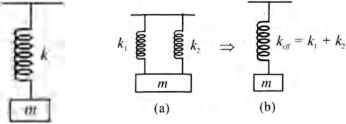
$A$ mass $m$ is suspended separately by two different springs,and the time periods are $t_1$ and $t_2$ respectively. If it is connected by both springs in parallel as shown in the figure,then the time period is $t_0$. The correct relation is:

A
${t_0}^2 = {t_1}^2 + {t_2}^2$
B
${t_0}^{-2} = {t_1}^{-2} + {t_2}^{-2}$
C
${t_0}^{-1} = {t_1}^{-1} + {t_2}^{-1}$
D
${t_0} = {t_1} + {t_2}$
Solution
(B) The time period of a mass $m$ suspended by a spring of constant $k$ is given by $t = 2 \pi \sqrt{m/k}$.
For the first spring with constant $k_1$,the time period is $t_1 = 2 \pi \sqrt{m/k_1}$,which implies $k_1 = 4 \pi^2 m / t_1^2$.
For the second spring with constant $k_2$,the time period is $t_2 = 2 \pi \sqrt{m/k_2}$,which implies $k_2 = 4 \pi^2 m / t_2^2$.
When the two springs are connected in parallel,the effective spring constant is $k_{eff} = k_1 + k_2$.
The time period of the system is $t_0 = 2 \pi \sqrt{m/k_{eff}} = 2 \pi \sqrt{m/(k_1 + k_2)}$.
Squaring both sides,we get $t_0^2 = 4 \pi^2 m / (k_1 + k_2)$,so $1/t_0^2 = (k_1 + k_2) / (4 \pi^2 m)$.
Substituting the expressions for $k_1$ and $k_2$:
$1/t_0^2 = (4 \pi^2 m / t_1^2 + 4 \pi^2 m / t_2^2) / (4 \pi^2 m) = 1/t_1^2 + 1/t_2^2$.
Thus,${t_0}^{-2} = {t_1}^{-2} + {t_2}^{-2}$.
For the first spring with constant $k_1$,the time period is $t_1 = 2 \pi \sqrt{m/k_1}$,which implies $k_1 = 4 \pi^2 m / t_1^2$.
For the second spring with constant $k_2$,the time period is $t_2 = 2 \pi \sqrt{m/k_2}$,which implies $k_2 = 4 \pi^2 m / t_2^2$.
When the two springs are connected in parallel,the effective spring constant is $k_{eff} = k_1 + k_2$.
The time period of the system is $t_0 = 2 \pi \sqrt{m/k_{eff}} = 2 \pi \sqrt{m/(k_1 + k_2)}$.
Squaring both sides,we get $t_0^2 = 4 \pi^2 m / (k_1 + k_2)$,so $1/t_0^2 = (k_1 + k_2) / (4 \pi^2 m)$.
Substituting the expressions for $k_1$ and $k_2$:
$1/t_0^2 = (4 \pi^2 m / t_1^2 + 4 \pi^2 m / t_2^2) / (4 \pi^2 m) = 1/t_1^2 + 1/t_2^2$.
Thus,${t_0}^{-2} = {t_1}^{-2} + {t_2}^{-2}$.
0 likes
View Solution137
MediumMCQ
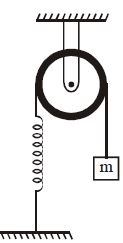
$A$ mass $m = 8\,kg$ is attached to a spring as shown in the figure and held in position so that the spring remains unstretched. The spring constant is $k = 200\,N/m$. The mass $m$ is then released and begins to undergo small oscillations. The maximum velocity of the mass will be ..... $m/s$ $(g = 10\,m/s^2)$.
A
$1$
B
$2$
C
$4$
D
$5$
Solution
(B) The system consists of a mass $m$ attached to a spring via a pulley. When the mass is released from the position where the spring is unstretched,the equilibrium position is reached when the spring force equals the gravitational force.
At equilibrium,$k x_{eq} = mg$,so the equilibrium extension is $x_{eq} = \frac{mg}{k} = \frac{8 \times 10}{200} = 0.4\,m$.
The amplitude of oscillation $A$ is equal to the initial extension from the equilibrium position,which is $A = x_{eq} = 0.4\,m$.
The angular frequency of the oscillation is $\omega = \sqrt{\frac{k}{m}} = \sqrt{\frac{200}{8}} = \sqrt{25} = 5\,rad/s$.
The maximum velocity $v_{max}$ is given by $v_{max} = \omega A$.
Substituting the values,$v_{max} = 5 \times 0.4 = 2\,m/s$.
At equilibrium,$k x_{eq} = mg$,so the equilibrium extension is $x_{eq} = \frac{mg}{k} = \frac{8 \times 10}{200} = 0.4\,m$.
The amplitude of oscillation $A$ is equal to the initial extension from the equilibrium position,which is $A = x_{eq} = 0.4\,m$.
The angular frequency of the oscillation is $\omega = \sqrt{\frac{k}{m}} = \sqrt{\frac{200}{8}} = \sqrt{25} = 5\,rad/s$.
The maximum velocity $v_{max}$ is given by $v_{max} = \omega A$.
Substituting the values,$v_{max} = 5 \times 0.4 = 2\,m/s$.
0 likes
View Solution138
MediumMCQ
$A$ $5\, kg$ collar is attached to a spring of spring constant $500\, N/m$. It slides without friction over a horizontal rod. The collar is displaced from its equilibrium position by $10\, cm$ and released. The time period of oscillation is
A
$\frac{\pi}{5}\,s$
B
$\frac{\pi}{2}\,s$
C
$\pi\,s$
D
$2\pi\,s$
Solution
(A) The time period $T$ of a spring-mass system is given by the formula: $T = 2\pi \sqrt{\frac{m}{K}}$.
Given values are mass $m = 5\, kg$ and spring constant $K = 500\, N/m$.
Substituting these values into the formula:
$T = 2\pi \sqrt{\frac{5}{500}}$
$T = 2\pi \sqrt{\frac{1}{100}}$
$T = 2\pi \times \frac{1}{10}$
$T = \frac{2\pi}{10} = \frac{\pi}{5}\,s$.
Therefore,the correct option is $A$.
Given values are mass $m = 5\, kg$ and spring constant $K = 500\, N/m$.
Substituting these values into the formula:
$T = 2\pi \sqrt{\frac{5}{500}}$
$T = 2\pi \sqrt{\frac{1}{100}}$
$T = 2\pi \times \frac{1}{10}$
$T = \frac{2\pi}{10} = \frac{\pi}{5}\,s$.
Therefore,the correct option is $A$.
0 likes
View Solution139
DifficultMCQ
$A$ mass $M$ is suspended from a light spring. An additional mass $m$ added displaces the spring further by a distance $x$. Now the combined mass will oscillate on the spring with period
A
$T = 2\pi \sqrt {\left( {\frac{{mg}}{{x\left( {M + m} \right)}}} \right)} $
B
$T = 2\pi \sqrt {\left( {\frac{{\left( {M + m} \right)x}}{{mg}}} \right)} $
C
$T = \frac{\pi }{2}\sqrt {\left( {\frac{{mg}}{x}} \right)\left( {M + m} \right)} $
D
$T = 2\pi \sqrt {\left( {\frac{{\left( {M + m} \right)}}{{mgx}}} \right)} $
Solution
(B) When an additional mass $m$ is added,the spring extends by a distance $x$. According to Hooke's Law,the restoring force is equal to the weight of the added mass:
$mg = Kx$
where $K$ is the spring constant.
From this,we can find the spring constant:
$K = \frac{mg}{x}$
Now,the total mass oscillating on the spring is $(M + m)$. The time period $T$ of a mass-spring system is given by the formula:
$T = 2\pi \sqrt{\frac{\text{Total Mass}}{K}}$
Substituting the values of total mass and $K$:
$T = 2\pi \sqrt{\frac{(M + m)}{\frac{mg}{x}}}$
$T = 2\pi \sqrt{\frac{(M + m)x}{mg}}$
$mg = Kx$
where $K$ is the spring constant.
From this,we can find the spring constant:
$K = \frac{mg}{x}$
Now,the total mass oscillating on the spring is $(M + m)$. The time period $T$ of a mass-spring system is given by the formula:
$T = 2\pi \sqrt{\frac{\text{Total Mass}}{K}}$
Substituting the values of total mass and $K$:
$T = 2\pi \sqrt{\frac{(M + m)}{\frac{mg}{x}}}$
$T = 2\pi \sqrt{\frac{(M + m)x}{mg}}$
0 likes
View Solution140
DifficultMCQ
$A$ mass $m$ attached to a spring oscillates with a period of $3\,s$. If the mass is increased by $1\,kg$,the period increases by $1\,s$. The initial mass $m$ is
A
$\frac{7}{9}\,kg$
B
$\frac{9}{7}\,kg$
C
$\frac{14}{7}\,kg$
D
$\frac{18}{7}\,kg$
Solution
(B) The time period of a spring-mass system is given by $T = 2\pi \sqrt{\frac{m}{k}}$.
Since $2\pi$ and $k$ are constant,$T \propto \sqrt{m}$.
Therefore,$\frac{T_1}{T_2} = \sqrt{\frac{m_1}{m_2}}$.
Given $T_1 = 3\,s$ and $m_1 = m$.
When mass is increased by $1\,kg$,$m_2 = m + 1$ and $T_2 = 3 + 1 = 4\,s$.
Substituting these values: $\frac{3}{4} = \sqrt{\frac{m}{m + 1}}$.
Squaring both sides: $\frac{9}{16} = \frac{m}{m + 1}$.
Cross-multiplying: $9(m + 1) = 16m$.
$9m + 9 = 16m$.
$7m = 9$.
$m = \frac{9}{7}\,kg$.
Since $2\pi$ and $k$ are constant,$T \propto \sqrt{m}$.
Therefore,$\frac{T_1}{T_2} = \sqrt{\frac{m_1}{m_2}}$.
Given $T_1 = 3\,s$ and $m_1 = m$.
When mass is increased by $1\,kg$,$m_2 = m + 1$ and $T_2 = 3 + 1 = 4\,s$.
Substituting these values: $\frac{3}{4} = \sqrt{\frac{m}{m + 1}}$.
Squaring both sides: $\frac{9}{16} = \frac{m}{m + 1}$.
Cross-multiplying: $9(m + 1) = 16m$.
$9m + 9 = 16m$.
$7m = 9$.
$m = \frac{9}{7}\,kg$.
0 likes
View Solution141
DifficultMCQ
The vertical extension in a light spring by a weight of $1\, kg$ suspended from the wire is $9.8\, cm$. What is the period of oscillation?
A
$20\pi \,s$
B
$2\pi \,s$
C
$\frac{2\pi}{10}\,s$
D
$10\pi \,s$
Solution
(C) The period of oscillation $T$ for a spring-mass system is given by the formula $T = 2\pi \sqrt{\frac{m}{k}}$.
Given that the extension $x_0 = 9.8\, cm = 9.8 \times 10^{-2}\, m$ is caused by a mass $m = 1\, kg$,we use the equilibrium condition $mg = kx_0$,which implies $\frac{m}{k} = \frac{x_0}{g}$.
Substituting this into the time period formula,we get $T = 2\pi \sqrt{\frac{x_0}{g}}$.
Using $g = 9.8\, m/s^2$,we have $T = 2\pi \sqrt{\frac{9.8 \times 10^{-2}}{9.8}} = 2\pi \sqrt{10^{-2}} = 2\pi \times 0.1 = \frac{2\pi}{10}\, s$.
Given that the extension $x_0 = 9.8\, cm = 9.8 \times 10^{-2}\, m$ is caused by a mass $m = 1\, kg$,we use the equilibrium condition $mg = kx_0$,which implies $\frac{m}{k} = \frac{x_0}{g}$.
Substituting this into the time period formula,we get $T = 2\pi \sqrt{\frac{x_0}{g}}$.
Using $g = 9.8\, m/s^2$,we have $T = 2\pi \sqrt{\frac{9.8 \times 10^{-2}}{9.8}} = 2\pi \sqrt{10^{-2}} = 2\pi \times 0.1 = \frac{2\pi}{10}\, s$.
0 likes
View Solution142
MediumMCQ
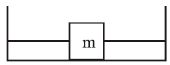
$A$ block of mass $m$ has two similar rubber ribbons attached to it as shown in the figure. The force constant of each rubber ribbon is $K$ and the surface is frictionless. The block is displaced from the mean position by $x$ and released. At the mean position,the ribbons are undeformed. The vibration period is
A
$2\pi \sqrt {\frac{{m(2k)}}{{{k^2}}}} $
B
$\frac{1}{{2\pi }}\sqrt {\frac{{m(2k)}}{{{k^2}}}} $
C
$2\pi \sqrt {\frac{m}{k}} $
D
$2\pi \sqrt {\frac{m}{k+k}} $
Solution
(C) When the block is displaced by a distance $x$ from the mean position,one of the rubber ribbons gets stretched by $x$,while the other ribbon becomes slack and does not exert any force,because rubber ribbons cannot be compressed like springs.
The restoring force acting on the block is $F = Kx$.
Using Newton's second law,$ma = Kx$,which gives the acceleration $a = \frac{Kx}{m}$.
Comparing this with the standard equation for simple harmonic motion $a = \omega^2 x$,we get $\omega^2 = \frac{K}{m}$,or $\omega = \sqrt{\frac{K}{m}}$.
The time period $T$ of vibration is given by $T = \frac{2\pi}{\omega}$.
Substituting the value of $\omega$,we get $T = 2\pi \sqrt{\frac{m}{K}}$.
The restoring force acting on the block is $F = Kx$.
Using Newton's second law,$ma = Kx$,which gives the acceleration $a = \frac{Kx}{m}$.
Comparing this with the standard equation for simple harmonic motion $a = \omega^2 x$,we get $\omega^2 = \frac{K}{m}$,or $\omega = \sqrt{\frac{K}{m}}$.
The time period $T$ of vibration is given by $T = \frac{2\pi}{\omega}$.
Substituting the value of $\omega$,we get $T = 2\pi \sqrt{\frac{m}{K}}$.
0 likes
View Solution143
MediumMCQ
Two objects $A$ and $B$ of equal mass are suspended from two springs of spring constants $k_A$ and $k_B$. If the objects oscillate vertically in such a manner that their maximum kinetic energies are equal,then the ratio of amplitudes of $A$ and $B$ is
A
$\frac{k_B}{k_A}$
B
$\sqrt{\frac{k_B}{k_A}}$
C
$\frac{k_A}{k_B}$
D
$\sqrt{\frac{k_A}{k_B}}$
Solution
(B) The maximum kinetic energy $(KE_{max})$ of an object undergoing simple harmonic motion is given by the formula $KE_{max} = \frac{1}{2} k A^2$,where $k$ is the spring constant and $A$ is the amplitude.
Given that the maximum kinetic energies of objects $A$ and $B$ are equal,we have:
$\frac{1}{2} k_A A_A^2 = \frac{1}{2} k_B A_B^2$
Rearranging the terms to find the ratio of amplitudes $\frac{A_A}{A_B}$:
$\frac{A_A^2}{A_B^2} = \frac{k_B}{k_A}$
Taking the square root on both sides,we get:
$\frac{A_A}{A_B} = \sqrt{\frac{k_B}{k_A}}$
Given that the maximum kinetic energies of objects $A$ and $B$ are equal,we have:
$\frac{1}{2} k_A A_A^2 = \frac{1}{2} k_B A_B^2$
Rearranging the terms to find the ratio of amplitudes $\frac{A_A}{A_B}$:
$\frac{A_A^2}{A_B^2} = \frac{k_B}{k_A}$
Taking the square root on both sides,we get:
$\frac{A_A}{A_B} = \sqrt{\frac{k_B}{k_A}}$
0 likes
View Solution144
MediumMCQ
Two springs of force constant $K$ and $2K$ are connected in series to a mass $M$ as shown in the figure. The frequency of oscillation of the mass is
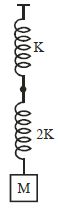
A
$\frac{3K}{M}$
B
$\pi \sqrt{\frac{6M}{K}}$
C
$\frac{1}{2\pi} \sqrt{\frac{3K}{M}}$
D
$\frac{1}{\pi} \sqrt{\frac{K}{6M}}$
Solution
(D) The two springs are connected in series. For springs in series,the equivalent force constant $K_{eq}$ is given by:
$\frac{1}{K_{eq}} = \frac{1}{K_1} + \frac{1}{K_2}$
Given $K_1 = K$ and $K_2 = 2K$,we have:
$\frac{1}{K_{eq}} = \frac{1}{K} + \frac{1}{2K} = \frac{2+1}{2K} = \frac{3}{2K}$
Therefore,$K_{eq} = \frac{2K}{3}$.
The frequency of oscillation $f$ for a spring-mass system is given by:
$f = \frac{1}{2\pi} \sqrt{\frac{K_{eq}}{M}}$
Substituting the value of $K_{eq}$:
$f = \frac{1}{2\pi} \sqrt{\frac{2K/3}{M}} = \frac{1}{2\pi} \sqrt{\frac{2K}{3M}}$
Wait,re-evaluating the calculation: $f = \frac{1}{2\pi} \sqrt{\frac{2K}{3M}}$. Let's check the options. Option $D$ is $\frac{1}{\pi} \sqrt{\frac{K}{6M}}$.
Note that $\frac{1}{2\pi} \sqrt{\frac{2K}{3M}} = \frac{1}{\pi} \sqrt{\frac{2K}{4 \cdot 3M}} = \frac{1}{\pi} \sqrt{\frac{2K}{12M}} = \frac{1}{\pi} \sqrt{\frac{K}{6M}}$.
Thus,option $D$ is correct.
$\frac{1}{K_{eq}} = \frac{1}{K_1} + \frac{1}{K_2}$
Given $K_1 = K$ and $K_2 = 2K$,we have:
$\frac{1}{K_{eq}} = \frac{1}{K} + \frac{1}{2K} = \frac{2+1}{2K} = \frac{3}{2K}$
Therefore,$K_{eq} = \frac{2K}{3}$.
The frequency of oscillation $f$ for a spring-mass system is given by:
$f = \frac{1}{2\pi} \sqrt{\frac{K_{eq}}{M}}$
Substituting the value of $K_{eq}$:
$f = \frac{1}{2\pi} \sqrt{\frac{2K/3}{M}} = \frac{1}{2\pi} \sqrt{\frac{2K}{3M}}$
Wait,re-evaluating the calculation: $f = \frac{1}{2\pi} \sqrt{\frac{2K}{3M}}$. Let's check the options. Option $D$ is $\frac{1}{\pi} \sqrt{\frac{K}{6M}}$.
Note that $\frac{1}{2\pi} \sqrt{\frac{2K}{3M}} = \frac{1}{\pi} \sqrt{\frac{2K}{4 \cdot 3M}} = \frac{1}{\pi} \sqrt{\frac{2K}{12M}} = \frac{1}{\pi} \sqrt{\frac{K}{6M}}$.
Thus,option $D$ is correct.
0 likes
View Solution145
DifficultMCQ
$A$ particle of mass $200\,g$ executes a simple harmonic motion. The restoring force is provided by a spring of spring constant $80\,N/m$. The time period is .... $\sec$
A
$0.2$
B
$0.1$
C
$0.31$
D
$0.51$
Solution
(C) The time period $T$ of a particle executing simple harmonic motion attached to a spring is given by the formula:
$T = 2\pi \sqrt{\frac{m}{k}}$
Given:
Mass $m = 200\,g = 0.2\,kg$
Spring constant $k = 80\,N/m$
Substituting the values into the formula:
$T = 2\pi \sqrt{\frac{0.2}{80}}$
$T = 2\pi \sqrt{\frac{1}{400}}$
$T = 2\pi \times \frac{1}{20}$
$T = \frac{\pi}{10}$
Using $\pi \approx 3.14159$:
$T \approx 0.314\,s$
Rounding to two decimal places,we get $T = 0.31\,s$.
$T = 2\pi \sqrt{\frac{m}{k}}$
Given:
Mass $m = 200\,g = 0.2\,kg$
Spring constant $k = 80\,N/m$
Substituting the values into the formula:
$T = 2\pi \sqrt{\frac{0.2}{80}}$
$T = 2\pi \sqrt{\frac{1}{400}}$
$T = 2\pi \times \frac{1}{20}$
$T = \frac{\pi}{10}$
Using $\pi \approx 3.14159$:
$T \approx 0.314\,s$
Rounding to two decimal places,we get $T = 0.31\,s$.
0 likes
View Solution146
DifficultMCQ
In the following questions,match Column-$I$ with Column-$II$ and choose the correct options.
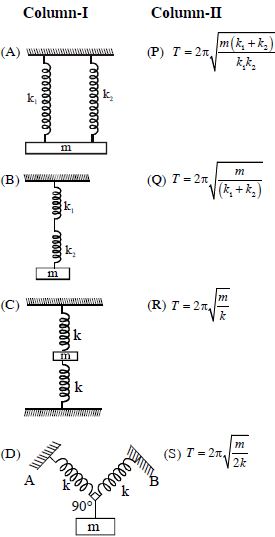
A
$A-P, B-Q, C-R, D-S$
B
$A-Q, B-P, C-R, D-S$
C
$A-Q, B-P, C-S, D-R$
D
$A-P, B-Q, C-S, D-R$
Solution
(C) For a spring-mass system,the time period is given by $T = 2\pi \sqrt{\frac{m}{K}}$,where $K$ is the effective spring constant.
In figure $(A)$,the springs are in parallel,so the effective spring constant is $K = k_1 + k_2$. Thus,$T = 2\pi \sqrt{\frac{m}{k_1 + k_2}}$. This matches $(Q)$.
In figure $(B)$,the springs are in series,so $\frac{1}{K} = \frac{1}{k_1} + \frac{1}{k_2}$,which gives $K = \frac{k_1 k_2}{k_1 + k_2}$. Thus,$T = 2\pi \sqrt{\frac{m(k_1 + k_2)}{k_1 k_2}}$. This matches $(P)$.
In figure $(C)$,the mass is between two springs. When the mass moves by $x$,one spring is compressed by $x$ and the other is stretched by $x$. The restoring force is $F = -(k+k)x = -2kx$. Thus,$K = 2k$,and $T = 2\pi \sqrt{\frac{m}{2k}}$. This matches $(S)$.
In figure $(D)$,the springs are at $45^{\circ}$ to the vertical. If the mass is pulled down by $y$,each spring stretches by $y' = y \cos 45^{\circ}$. The restoring force component along the vertical is $F = -2(ky') \cos 45^{\circ} = -2k(y \cos 45^{\circ}) \cos 45^{\circ} = -2ky(1/2) = -ky$. Thus,$K = k$,and $T = 2\pi \sqrt{\frac{m}{k}}$. This matches $(R)$.
Therefore,the correct matching is $A-Q, B-P, C-S, D-R$.
In figure $(A)$,the springs are in parallel,so the effective spring constant is $K = k_1 + k_2$. Thus,$T = 2\pi \sqrt{\frac{m}{k_1 + k_2}}$. This matches $(Q)$.
In figure $(B)$,the springs are in series,so $\frac{1}{K} = \frac{1}{k_1} + \frac{1}{k_2}$,which gives $K = \frac{k_1 k_2}{k_1 + k_2}$. Thus,$T = 2\pi \sqrt{\frac{m(k_1 + k_2)}{k_1 k_2}}$. This matches $(P)$.
In figure $(C)$,the mass is between two springs. When the mass moves by $x$,one spring is compressed by $x$ and the other is stretched by $x$. The restoring force is $F = -(k+k)x = -2kx$. Thus,$K = 2k$,and $T = 2\pi \sqrt{\frac{m}{2k}}$. This matches $(S)$.
In figure $(D)$,the springs are at $45^{\circ}$ to the vertical. If the mass is pulled down by $y$,each spring stretches by $y' = y \cos 45^{\circ}$. The restoring force component along the vertical is $F = -2(ky') \cos 45^{\circ} = -2k(y \cos 45^{\circ}) \cos 45^{\circ} = -2ky(1/2) = -ky$. Thus,$K = k$,and $T = 2\pi \sqrt{\frac{m}{k}}$. This matches $(R)$.
Therefore,the correct matching is $A-Q, B-P, C-S, D-R$.
0 likes
View Solution147
DifficultMCQ
Five identical springs are used in the following three configurations. The time periods of vertical oscillations in configurations $(i)$,$(ii)$ and $(iii)$ are in the ratio
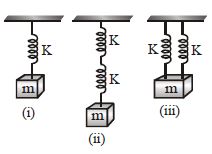
A
$1 : \sqrt{2} : \frac{1}{\sqrt{2}}$
B
$2 : \sqrt{2} : \frac{1}{\sqrt{2}}$
C
$\frac{1}{\sqrt{2}} : 2 : 1$
D
$2 : \frac{1}{\sqrt{2}} : 1$
Solution
(A) The time period of a spring-mass system is given by $T = 2\pi \sqrt{\frac{m}{k_{eq}}}$,where $k_{eq}$ is the equivalent spring constant.
For configuration $(i)$: $A$ single spring is used,so $k_{eq,1} = k$. The time period is $T_1 = 2\pi \sqrt{\frac{m}{k}}$.
For configuration $(ii)$: Two springs are connected in series. The equivalent spring constant is $\frac{1}{k_{eq,2}} = \frac{1}{k} + \frac{1}{k} = \frac{2}{k}$,so $k_{eq,2} = \frac{k}{2}$. The time period is $T_2 = 2\pi \sqrt{\frac{m}{k/2}} = 2\pi \sqrt{\frac{2m}{k}} = \sqrt{2} T_1$.
For configuration $(iii)$: Two springs are connected in parallel. The equivalent spring constant is $k_{eq,3} = k + k = 2k$. The time period is $T_3 = 2\pi \sqrt{\frac{m}{2k}} = \frac{1}{\sqrt{2}} T_1$.
Therefore,the ratio of the time periods is $T_1 : T_2 : T_3 = 1 : \sqrt{2} : \frac{1}{\sqrt{2}}$.
For configuration $(i)$: $A$ single spring is used,so $k_{eq,1} = k$. The time period is $T_1 = 2\pi \sqrt{\frac{m}{k}}$.
For configuration $(ii)$: Two springs are connected in series. The equivalent spring constant is $\frac{1}{k_{eq,2}} = \frac{1}{k} + \frac{1}{k} = \frac{2}{k}$,so $k_{eq,2} = \frac{k}{2}$. The time period is $T_2 = 2\pi \sqrt{\frac{m}{k/2}} = 2\pi \sqrt{\frac{2m}{k}} = \sqrt{2} T_1$.
For configuration $(iii)$: Two springs are connected in parallel. The equivalent spring constant is $k_{eq,3} = k + k = 2k$. The time period is $T_3 = 2\pi \sqrt{\frac{m}{2k}} = \frac{1}{\sqrt{2}} T_1$.
Therefore,the ratio of the time periods is $T_1 : T_2 : T_3 = 1 : \sqrt{2} : \frac{1}{\sqrt{2}}$.
0 likes
View Solution148
MediumMCQ
Two masses $m_1$ and $m_2$ are suspended together by a massless spring of constant $k$. When the masses are in equilibrium,$m_1$ is removed without disturbing the system; the amplitude of vibration is
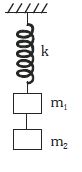
A
$m_1g / k$
B
$m_2g / k$
C
$\frac{(m_1 + m_2)g}{k}$
D
$\frac{(m_2 - m_1)g}{k}$
Solution
(A) Initially,the spring is stretched by the total mass $(m_1 + m_2)$. The equilibrium extension $x_0$ is given by $k x_0 = (m_1 + m_2)g$,so $x_0 = \frac{(m_1 + m_2)g}{k}$.
When $m_1$ is removed,the new equilibrium position for the remaining mass $m_2$ is $x_{new} = \frac{m_2g}{k}$.
The system starts oscillating about this new equilibrium position. The amplitude of vibration $A$ is the difference between the initial position and the new equilibrium position:
$A = x_0 - x_{new} = \frac{(m_1 + m_2)g}{k} - \frac{m_2g}{k} = \frac{m_1g}{k}$.
When $m_1$ is removed,the new equilibrium position for the remaining mass $m_2$ is $x_{new} = \frac{m_2g}{k}$.
The system starts oscillating about this new equilibrium position. The amplitude of vibration $A$ is the difference between the initial position and the new equilibrium position:
$A = x_0 - x_{new} = \frac{(m_1 + m_2)g}{k} - \frac{m_2g}{k} = \frac{m_1g}{k}$.
0 likes
View Solution149
DifficultMCQ
$A$ block $A$ of mass $1\, kg$ is connected to two identical springs of spring constant $800\, N/m$ and is placed on a smooth horizontal surface as shown in the figure. Initially,the springs are relaxed. Now,the block $A$ is slightly displaced to the left and released. The time period of oscillation of the system is
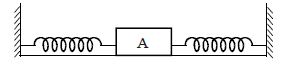
A
$\frac{\pi}{20}\,s$
B
$\frac{\pi}{5\sqrt{2}}\,s$
C
$\frac{\pi}{10\sqrt{2}}\,s$
D
$\frac{\pi}{10}\,s$
Solution
(A) When the block $A$ is displaced by a small distance $x$ to the left,the left spring is compressed by $x$ and the right spring is stretched by $x$.
Both springs exert a restoring force towards the equilibrium position.
The total restoring force is $F = -k x - k x = -2k x$.
Comparing this with the standard equation for simple harmonic motion $F = -k_{eff} x$,we get the effective spring constant $k_{eff} = 2k$.
Given $m = 1\, kg$ and $k = 800\, N/m$,the effective spring constant is $k_{eff} = 2 \times 800 = 1600\, N/m$.
The time period $T$ of the oscillation is given by $T = 2\pi \sqrt{\frac{m}{k_{eff}}}$.
Substituting the values,$T = 2\pi \sqrt{\frac{1}{1600}} = 2\pi \times \frac{1}{40} = \frac{\pi}{20}\,s$.
Both springs exert a restoring force towards the equilibrium position.
The total restoring force is $F = -k x - k x = -2k x$.
Comparing this with the standard equation for simple harmonic motion $F = -k_{eff} x$,we get the effective spring constant $k_{eff} = 2k$.
Given $m = 1\, kg$ and $k = 800\, N/m$,the effective spring constant is $k_{eff} = 2 \times 800 = 1600\, N/m$.
The time period $T$ of the oscillation is given by $T = 2\pi \sqrt{\frac{m}{k_{eff}}}$.
Substituting the values,$T = 2\pi \sqrt{\frac{1}{1600}} = 2\pi \times \frac{1}{40} = \frac{\pi}{20}\,s$.
0 likes
View Solution150
DifficultMCQ
One end of a long metallic wire of length $L$,area of cross-section $A$,and Young's modulus $Y$ is tied to the ceiling. The other end is tied to a massless spring of force constant $K$. $A$ mass $m$ hangs freely from the free end of the spring. It is slightly pulled down and released. Its time period is given by
A
$2\pi \sqrt{\frac{m}{K}}$
B
$2\pi \sqrt{\frac{mYA}{KL}}$
C
$2\pi \sqrt{\frac{mK}{YA}}$
D
$2\pi \sqrt{\frac{m(KL + YA)}{KYA}}$
Solution
(D) The metallic wire acts as a spring with an effective spring constant $k_w = \frac{YA}{L}$.
The wire and the spring are connected in series.
The equivalent spring constant $k_{eq}$ for two springs in series is given by $\frac{1}{k_{eq}} = \frac{1}{k_w} + \frac{1}{K}$.
Substituting $k_w$,we get $\frac{1}{k_{eq}} = \frac{L}{YA} + \frac{1}{K} = \frac{KL + YA}{KYA}$.
Thus,$k_{eq} = \frac{KYA}{KL + YA}$.
The time period $T$ of a mass-spring system is $T = 2\pi \sqrt{\frac{m}{k_{eq}}}$.
Substituting $k_{eq}$,we get $T = 2\pi \sqrt{\frac{m(KL + YA)}{KYA}}$.
The wire and the spring are connected in series.
The equivalent spring constant $k_{eq}$ for two springs in series is given by $\frac{1}{k_{eq}} = \frac{1}{k_w} + \frac{1}{K}$.
Substituting $k_w$,we get $\frac{1}{k_{eq}} = \frac{L}{YA} + \frac{1}{K} = \frac{KL + YA}{KYA}$.
Thus,$k_{eq} = \frac{KYA}{KL + YA}$.
The time period $T$ of a mass-spring system is $T = 2\pi \sqrt{\frac{m}{k_{eq}}}$.
Substituting $k_{eq}$,we get $T = 2\pi \sqrt{\frac{m(KL + YA)}{KYA}}$.
0 likes
View SolutionOscillations — SHM of Spring Mass System · Frequently Asked Questions
1Are these Oscillations questions useful for JEE and NEET?
Yes. All questions in this section are mapped to JEE Main and NEET exam patterns. Previous year questions from JEE Main, NEET, GUJCET and state-level exams are included with full solutions.
2Can I switch to Hindi or Gujarati for these questions?
Yes. Use the language tabs in the hero section or the sidebar to view the same questions and solutions in English, Hindi or Gujarati.
3How do I generate a question paper from this subtopic?
Use the Vedclass Exam Paper Generator — select the chapter and subtopic, set difficulty, and generate Sets A, B, C, D automatically. First 3 chapters of every subject are free.
Vedclass Products
For Students
Vedclass Test Series
Mock tests in real JEE/NEET style with performance analysis. 5-day free trial.
Start Free TrialFor Teachers
Exam Paper Generator
Generate Set A/B/C/D papers from this chapter in 2 minutes. 3 chapters free.
Try FreeFor Institutes
Online Exam Module
Live online exams with unlimited students, 360° analytics & white-label branding.
See DemoFor Teachers & Institutes
Generate a Oscillations Exam Paper in 2 Minutes
Select subtopic & difficulty — Sets A, B, C, D auto-generated with No Repeat logic.
First 3 chapters of every subject are free — no payment required.