
A English
Periodic, Oscillatory motion and its characteristics and types of SHM and Equation of SHM Questions in English
Class 11 Physics · Oscillations · Periodic, Oscillatory motion and its characteristics and types of SHM and Equation of SHM
239+
Questions
English
Language
100%
With Solutions
Showing 48 of 239 questions in English
1
DifficultMCQ
$A$ particle free to move along the $x$-axis has potential energy given by $U(x) = k[1 - \exp(-x^2)]$ for $-\infty \le x \le +\infty$,where $k$ is a positive constant of appropriate dimensions. Then:
A
At points away from the origin,the particle is in unstable equilibrium
B
For any finite non-zero value of $x$,there is a force directed away from the origin
C
If its total mechanical energy is $k/2$,it has its minimum kinetic energy at the origin
D
For small displacements from $x = 0$,the motion is simple harmonic
Solution
(D) The potential energy of the particle is given by $U(x) = k(1 - e^{-x^2})$.
The force acting on the particle is $F = -\frac{dU}{dx}$.
$F = -\frac{d}{dx} [k(1 - e^{-x^2})] = -k[0 - e^{-x^2} \cdot (-2x)] = -2kxe^{-x^2}$.
For small displacements from the origin $(x \approx 0)$,we can use the Taylor expansion $e^{-x^2} \approx 1 - x^2 + \dots \approx 1$.
Thus,$F \approx -2kx$.
Since $F \propto -x$,the restoring force is proportional to the displacement,which is the condition for simple harmonic motion $(SHM)$.
The force acting on the particle is $F = -\frac{dU}{dx}$.
$F = -\frac{d}{dx} [k(1 - e^{-x^2})] = -k[0 - e^{-x^2} \cdot (-2x)] = -2kxe^{-x^2}$.
For small displacements from the origin $(x \approx 0)$,we can use the Taylor expansion $e^{-x^2} \approx 1 - x^2 + \dots \approx 1$.
Thus,$F \approx -2kx$.
Since $F \propto -x$,the restoring force is proportional to the displacement,which is the condition for simple harmonic motion $(SHM)$.
0 likes
View Solution2
MediumMCQ
$A$ particle of mass $m$ is under the influence of a force $F$ which varies with the displacement $x$ according to the relation $F = -kx + F_0$,where $k$ and $F_0$ are constants. The particle,when disturbed,will oscillate:
A
about $x = 0$ with $\omega \neq \sqrt{k/m}$
B
about $x = 0$ with $\omega = \sqrt{k/m}$
C
about $x = F_0/k$ with $\omega = \sqrt{k/m}$
D
about $x = F_0/k$ with $\omega \neq \sqrt{k/m}$
Solution
(C) The condition for the mean position in simple harmonic motion is that the net restoring force must be zero.
Given the force equation: $F = -kx + F_0$.
At the mean position,$F = 0$,so $0 = -kx + F_0$,which gives $x = F_0/k$.
To find the angular frequency $\omega$,we rewrite the force equation in terms of the displacement from the mean position $x' = x - F_0/k$. Then $x = x' + F_0/k$.
Substituting this into the force equation: $F = -k(x' + F_0/k) + F_0 = -kx' - F_0 + F_0 = -kx'$.
Comparing this with the standard $SHM$ equation $F = -m\omega^2 x'$,we get $m\omega^2 = k$,which implies $\omega = \sqrt{k/m}$.
Therefore,the particle oscillates about $x = F_0/k$ with an angular frequency $\omega = \sqrt{k/m}$.
Given the force equation: $F = -kx + F_0$.
At the mean position,$F = 0$,so $0 = -kx + F_0$,which gives $x = F_0/k$.
To find the angular frequency $\omega$,we rewrite the force equation in terms of the displacement from the mean position $x' = x - F_0/k$. Then $x = x' + F_0/k$.
Substituting this into the force equation: $F = -k(x' + F_0/k) + F_0 = -kx' - F_0 + F_0 = -kx'$.
Comparing this with the standard $SHM$ equation $F = -m\omega^2 x'$,we get $m\omega^2 = k$,which implies $\omega = \sqrt{k/m}$.
Therefore,the particle oscillates about $x = F_0/k$ with an angular frequency $\omega = \sqrt{k/m}$.
0 likes
View Solution3
EasyMCQ
Two equations of two $S.H.M.$ are $y = a\sin(\omega t - \alpha)$ and $y = b\cos(\omega t - \alpha)$. The phase difference between the two is .... $^\circ$.
A
$0$
B
$\alpha$
C
$90$
D
$180$
Solution
(C) The first equation is $y_1 = a\sin(\omega t - \alpha)$.
Using the trigonometric identity $\sin(\theta) = \cos(\theta - 90^\circ)$,we can rewrite this as:
$y_1 = a\cos(\omega t - \alpha - 90^\circ)$.
The second equation is $y_2 = b\cos(\omega t - \alpha)$.
Comparing the arguments of the cosine functions,the phase of the first equation is $\phi_1 = \omega t - \alpha - 90^\circ$ and the phase of the second equation is $\phi_2 = \omega t - \alpha$.
The phase difference is $\Delta\phi = |\phi_2 - \phi_1| = |(\omega t - \alpha) - (\omega t - \alpha - 90^\circ)| = 90^\circ$.
Using the trigonometric identity $\sin(\theta) = \cos(\theta - 90^\circ)$,we can rewrite this as:
$y_1 = a\cos(\omega t - \alpha - 90^\circ)$.
The second equation is $y_2 = b\cos(\omega t - \alpha)$.
Comparing the arguments of the cosine functions,the phase of the first equation is $\phi_1 = \omega t - \alpha - 90^\circ$ and the phase of the second equation is $\phi_2 = \omega t - \alpha$.
The phase difference is $\Delta\phi = |\phi_2 - \phi_1| = |(\omega t - \alpha) - (\omega t - \alpha - 90^\circ)| = 90^\circ$.
0 likes
View Solution4
MediumMCQ
$A$ particle is oscillating according to the equation $X = 7 \cos(0.5 \pi t)$,where $t$ is in seconds. The particle moves from the position of equilibrium to maximum displacement in time ..... $s$.
A
$4$
B
$2$
C
$1$
D
$0.5$
Solution
(C) The given equation of motion is $X = 7 \cos(0.5 \pi t)$.
Comparing this with the standard $SHM$ equation $X = A \cos(\omega t)$,we get the angular frequency $\omega = 0.5 \pi \ rad/s$.
The time period $T$ is given by $T = \frac{2 \pi}{\omega} = \frac{2 \pi}{0.5 \pi} = 4 \ s$.
The time taken by a particle to move from the equilibrium position (mean position) to the maximum displacement (extreme position) is one-fourth of the time period.
Therefore,$t = \frac{T}{4} = \frac{4}{4} = 1 \ s$.
Comparing this with the standard $SHM$ equation $X = A \cos(\omega t)$,we get the angular frequency $\omega = 0.5 \pi \ rad/s$.
The time period $T$ is given by $T = \frac{2 \pi}{\omega} = \frac{2 \pi}{0.5 \pi} = 4 \ s$.
The time taken by a particle to move from the equilibrium position (mean position) to the maximum displacement (extreme position) is one-fourth of the time period.
Therefore,$t = \frac{T}{4} = \frac{4}{4} = 1 \ s$.
0 likes
View Solution5
EasyMCQ
Which of the following expressions represent simple harmonic motion?
A
$x = A\sin (\omega t + \delta)$
B
$x = B\cos (\omega t + \phi)$
C
$x = A\sin \omega t \cos \omega t$
D
All of the above
Solution
(D) simple harmonic motion $(SHM)$ is defined by an equation of the form $x(t) = A\sin(\omega t + \phi)$ or $x(t) = A\cos(\omega t + \phi)$.
Option $A$ is $x = A\sin(\omega t + \delta)$,which is a standard $SHM$ equation.
Option $B$ is $x = B\cos(\omega t + \phi)$,which is also a standard $SHM$ equation.
Option $C$ is $x = A\sin \omega t \cos \omega t$. Using the trigonometric identity $\sin(2\theta) = 2\sin\theta \cos\theta$,we can rewrite this as $x = \frac{A}{2}\sin(2\omega t)$. This represents an $SHM$ with amplitude $\frac{A}{2}$ and angular frequency $2\omega$.
Since all three expressions represent simple harmonic motion,the correct answer is $D$.
Option $A$ is $x = A\sin(\omega t + \delta)$,which is a standard $SHM$ equation.
Option $B$ is $x = B\cos(\omega t + \phi)$,which is also a standard $SHM$ equation.
Option $C$ is $x = A\sin \omega t \cos \omega t$. Using the trigonometric identity $\sin(2\theta) = 2\sin\theta \cos\theta$,we can rewrite this as $x = \frac{A}{2}\sin(2\omega t)$. This represents an $SHM$ with amplitude $\frac{A}{2}$ and angular frequency $2\omega$.
Since all three expressions represent simple harmonic motion,the correct answer is $D$.
0 likes
View Solution6
EasyMCQ
$A$ particle is moving with constant angular velocity along the circumference of a circle. Which of the following statements is true?
A
The particle so moving executes $S$.$H$.$M$.
B
The projection of the particle on any one of the diameters executes $S$.$H$.$M$.
C
The projection of the particle on any of the diameters executes $S$.$H$.$M$.
D
None of the above
Solution
(C) Consider a particle moving with a constant angular velocity $\omega$ along the circumference of a circle of radius $r$.
The position of the particle at any time $t$ can be represented by the angle $\theta = \omega t + \phi$.
The projection of the particle on the $x$-axis (a diameter) is given by $x = r \cos(\omega t + \phi)$.
This equation represents the displacement of a particle executing Simple Harmonic Motion ($S$.$H$.$M$.) with amplitude $r$ and angular frequency $\omega$.
Since the projection on any diameter follows this sinusoidal form,the projection of uniform circular motion on any diameter is $S$.$H$.$M$.
The position of the particle at any time $t$ can be represented by the angle $\theta = \omega t + \phi$.
The projection of the particle on the $x$-axis (a diameter) is given by $x = r \cos(\omega t + \phi)$.
This equation represents the displacement of a particle executing Simple Harmonic Motion ($S$.$H$.$M$.) with amplitude $r$ and angular frequency $\omega$.
Since the projection on any diameter follows this sinusoidal form,the projection of uniform circular motion on any diameter is $S$.$H$.$M$.
0 likes
View Solution7
EasyMCQ
$A$ simple harmonic motion is represented by $F(t) = 10\sin(20t + 0.5)$. The amplitude of the $S.H.M.$ is $a = $ ....
A
$30$
B
$20$
C
$10$
D
$5$
Solution
(C) The general equation for simple harmonic motion is given by $x(t) = A\sin(\omega t + \phi)$,where $A$ is the amplitude,$\omega$ is the angular frequency,and $\phi$ is the phase constant.
Comparing the given equation $F(t) = 10\sin(20t + 0.5)$ with the standard form $x(t) = A\sin(\omega t + \phi)$:
We can identify that the coefficient of the sine function represents the amplitude $A$.
Therefore,$A = 10$.
The correct option is $C$.
Comparing the given equation $F(t) = 10\sin(20t + 0.5)$ with the standard form $x(t) = A\sin(\omega t + \phi)$:
We can identify that the coefficient of the sine function represents the amplitude $A$.
Therefore,$A = 10$.
The correct option is $C$.
0 likes
View Solution8
EasyMCQ
Which of the following equations does not represent a simple harmonic motion?
A
$y = a \sin \omega t$
B
$y = a \cos \omega t$
C
$y = a \sin \omega t + b \cos \omega t$
D
$y = a \tan \omega t$
Solution
(D) The standard differential equation for Simple Harmonic Motion $(S.H.M.)$ is given by $\frac{d^2y}{dt^2} = -\omega^2 y$.
For $y = a \sin \omega t$,$\frac{d^2y}{dt^2} = -a \omega^2 \sin \omega t = -\omega^2 y$. This satisfies the condition.
For $y = a \cos \omega t$,$\frac{d^2y}{dt^2} = -a \omega^2 \cos \omega t = -\omega^2 y$. This satisfies the condition.
For $y = a \sin \omega t + b \cos \omega t$,this is a linear combination of two $S.H.M.$ functions with the same frequency,which also results in an $S.H.M.$
For $y = a \tan \omega t$,the function is not bounded (it goes to infinity at $\omega t = \pi/2$),and it does not satisfy the differential equation $\frac{d^2y}{dt^2} = -\omega^2 y$. Therefore,it does not represent $S.H.M.$
For $y = a \sin \omega t$,$\frac{d^2y}{dt^2} = -a \omega^2 \sin \omega t = -\omega^2 y$. This satisfies the condition.
For $y = a \cos \omega t$,$\frac{d^2y}{dt^2} = -a \omega^2 \cos \omega t = -\omega^2 y$. This satisfies the condition.
For $y = a \sin \omega t + b \cos \omega t$,this is a linear combination of two $S.H.M.$ functions with the same frequency,which also results in an $S.H.M.$
For $y = a \tan \omega t$,the function is not bounded (it goes to infinity at $\omega t = \pi/2$),and it does not satisfy the differential equation $\frac{d^2y}{dt^2} = -\omega^2 y$. Therefore,it does not represent $S.H.M.$
0 likes
View Solution9
EasyMCQ
$A$ particle executing simple harmonic motion along the $Y$-axis has its motion described by the equation $y = A \sin(\omega t) + B$. The amplitude of the simple harmonic motion is
A
$A$
B
$B$
C
$A + B$
D
$\sqrt{A + B}$
Solution
(A) The general equation for simple harmonic motion along the $Y$-axis is given by $y = y_0 + A' \sin(\omega t + \phi)$,where $y_0$ is the mean position,$A'$ is the amplitude,and $\phi$ is the phase constant.
Comparing the given equation $y = A \sin(\omega t) + B$ with the general form,we identify the mean position as $B$ and the amplitude as $A$.
The amplitude represents the maximum displacement of the particle from its mean position.
Thus,the amplitude of the simple harmonic motion is $A$.
Comparing the given equation $y = A \sin(\omega t) + B$ with the general form,we identify the mean position as $B$ and the amplitude as $A$.
The amplitude represents the maximum displacement of the particle from its mean position.
Thus,the amplitude of the simple harmonic motion is $A$.
0 likes
View Solution10
EasyMCQ
Which one of the following is a simple harmonic motion?
A
Wave moving through a string fixed at both ends
B
Earth spinning about its own axis
C
Ball bouncing between two rigid vertical walls
D
Particle moving in a circle with uniform speed
Solution
(A) Simple harmonic motion $(SHM)$ is a type of periodic motion where the restoring force is directly proportional to the displacement and acts in the direction opposite to that of displacement.
In a string fixed at both ends,the standing waves formed are a superposition of two traveling waves,and the particles of the string execute simple harmonic motion about their mean positions.
Therefore,the motion of particles in a string fixed at both ends is an example of simple harmonic motion.
In a string fixed at both ends,the standing waves formed are a superposition of two traveling waves,and the particles of the string execute simple harmonic motion about their mean positions.
Therefore,the motion of particles in a string fixed at both ends is an example of simple harmonic motion.
0 likes
View Solution11
EasyMCQ
Two particles are executing Simple Harmonic Motion ($S$.$H$.$M$.). The equations of their motion are $y_1 = 10 \sin \left( \omega t + \frac{\pi}{4} \right)$ and $y_2 = 25 \sin \left( \omega t + \frac{\sqrt{3} \pi}{4} \right)$. What is the ratio of their amplitudes?
A
$1:1$
B
$2:5$
C
$1:2$
D
None of these
Solution
(B) The general equation for Simple Harmonic Motion is given by $y = A \sin(\omega t + \phi)$,where $A$ is the amplitude of the motion.
Comparing the given equations:
$y_1 = 10 \sin \left( \omega t + \frac{\pi}{4} \right)$ gives amplitude $A_1 = 10$.
$y_2 = 25 \sin \left( \omega t + \frac{\sqrt{3} \pi}{4} \right)$ gives amplitude $A_2 = 25$.
The ratio of their amplitudes is $\frac{A_1}{A_2} = \frac{10}{25} = \frac{2}{5}$.
Therefore,the ratio is $2:5$.
Comparing the given equations:
$y_1 = 10 \sin \left( \omega t + \frac{\pi}{4} \right)$ gives amplitude $A_1 = 10$.
$y_2 = 25 \sin \left( \omega t + \frac{\sqrt{3} \pi}{4} \right)$ gives amplitude $A_2 = 25$.
The ratio of their amplitudes is $\frac{A_1}{A_2} = \frac{10}{25} = \frac{2}{5}$.
Therefore,the ratio is $2:5$.
0 likes
View Solution12
EasyMCQ
$A$ system exhibiting $S.H.M.$ must possess
A
Inertia only
B
Elasticity as well as inertia
C
Elasticity,inertia and an external force
D
Elasticity only
Solution
(B) For a system to exhibit $S.H.M.$ (Simple Harmonic Motion),it must satisfy two fundamental conditions:
$1$. Elasticity: The system must have a restoring force that acts to bring the object back to its equilibrium position when displaced.
$2$. Inertia: The system must have mass (inertia) so that it can overshoot the equilibrium position due to its momentum.
Therefore,a system exhibiting $S.H.M.$ must possess both elasticity and inertia.
$1$. Elasticity: The system must have a restoring force that acts to bring the object back to its equilibrium position when displaced.
$2$. Inertia: The system must have mass (inertia) so that it can overshoot the equilibrium position due to its momentum.
Therefore,a system exhibiting $S.H.M.$ must possess both elasticity and inertia.
0 likes
View Solution13
EasyMCQ
If the displacement of a particle executing $SHM$ is given by $y = 0.30 \sin(220t + 0.64)$ in meters,then the frequency and maximum velocity of the particle are:
A
$35 \, Hz$,$66 \, m/s$
B
$45 \, Hz$,$66 \, m/s$
C
$58 \, Hz$,$113 \, m/s$
D
$35 \, Hz$,$132 \, m/s$
Solution
(A) The given equation for displacement is $y = A \sin(\omega t + \phi)$,where $A = 0.30 \, m$ and $\omega = 220 \, rad/s$.
$1$. Frequency $(n)$: The frequency is given by $n = \frac{\omega}{2\pi}$.
$n = \frac{220}{2 \times 3.14159} \approx 35.01 \, Hz \approx 35 \, Hz$.
$2$. Maximum velocity $(v_{\max})$: The maximum velocity is given by $v_{\max} = \omega A$.
$v_{\max} = 220 \times 0.30 = 66 \, m/s$.
Thus,the frequency is $35 \, Hz$ and the maximum velocity is $66 \, m/s$.
$1$. Frequency $(n)$: The frequency is given by $n = \frac{\omega}{2\pi}$.
$n = \frac{220}{2 \times 3.14159} \approx 35.01 \, Hz \approx 35 \, Hz$.
$2$. Maximum velocity $(v_{\max})$: The maximum velocity is given by $v_{\max} = \omega A$.
$v_{\max} = 220 \times 0.30 = 66 \, m/s$.
Thus,the frequency is $35 \, Hz$ and the maximum velocity is $66 \, m/s$.
0 likes
View Solution14
MediumMCQ
The displacement equation of a particle is $x = 3\sin 2t + 4\cos 2t$. The amplitude and maximum velocity will be respectively:
A
$5, 10$
B
$3, 2$
C
$4, 2$
D
$3, 4$
Solution
(A) The given displacement equation is $x = 3\sin 2t + 4\cos 2t$.
This is in the form $x = A_1\sin \omega t + A_2\cos \omega t$,where $A_1 = 3$,$A_2 = 4$,and $\omega = 2$.
The resultant amplitude $A$ is given by $A = \sqrt{A_1^2 + A_2^2}$.
$A = \sqrt{3^2 + 4^2} = \sqrt{9 + 16} = \sqrt{25} = 5$.
The maximum velocity $v_{\max}$ is given by $v_{\max} = A\omega$.
$v_{\max} = 5 \times 2 = 10$.
Thus,the amplitude is $5$ and the maximum velocity is $10$.
This is in the form $x = A_1\sin \omega t + A_2\cos \omega t$,where $A_1 = 3$,$A_2 = 4$,and $\omega = 2$.
The resultant amplitude $A$ is given by $A = \sqrt{A_1^2 + A_2^2}$.
$A = \sqrt{3^2 + 4^2} = \sqrt{9 + 16} = \sqrt{25} = 5$.
The maximum velocity $v_{\max}$ is given by $v_{\max} = A\omega$.
$v_{\max} = 5 \times 2 = 10$.
Thus,the amplitude is $5$ and the maximum velocity is $10$.
0 likes
View Solution15
EasyMCQ
Which of the following is a necessary and sufficient condition for $S.H.M.$?
A
Constant period
B
Constant acceleration
C
Proportionality between acceleration and displacement from equilibrium position
D
Proportionality between restoring force and displacement from equilibrium position
Solution
(D) The defining characteristic of $Simple \ Harmonic \ Motion$ $(S.H.M.)$ is that the restoring force $F$ acting on the particle is directly proportional to its displacement $x$ from the equilibrium position and is directed towards the equilibrium position.
Mathematically,this is expressed as $F = -kx$,where $k$ is the force constant.
Since $F = ma$,this implies $a = -(k/m)x$,which means acceleration is also proportional to displacement.
However,the fundamental physical condition that defines the motion is the linear restoring force,making option $(d)$ the necessary and sufficient condition.
Mathematically,this is expressed as $F = -kx$,where $k$ is the force constant.
Since $F = ma$,this implies $a = -(k/m)x$,which means acceleration is also proportional to displacement.
However,the fundamental physical condition that defines the motion is the linear restoring force,making option $(d)$ the necessary and sufficient condition.
0 likes
View Solution16
EasyMCQ
$A$ body is moving in a room with a velocity of $20 \ m/s$ perpendicular to the two walls separated by $5 \ m$. There is no friction and the collisions with the walls are elastic. The motion of the body is
A
Not periodic
B
Periodic but not simple harmonic
C
Periodic and simple harmonic
D
Periodic with variable time period
Solution
(B) The body moves with a constant velocity of $20 \ m/s$ between two walls separated by a distance of $5 \ m$.
Since the collisions are elastic and there is no friction,the body reverses its direction after every collision without any loss of kinetic energy.
The time taken to travel from one wall to the other is $t = \frac{d}{v} = \frac{5 \ m}{20 \ m/s} = 0.25 \ s$.
The body returns to its starting position after a total time of $T = 2 \times 0.25 \ s = 0.5 \ s$.
Since the motion repeats itself at regular intervals of $0.5 \ s$,the motion is periodic.
However,for simple harmonic motion $(SHM)$,the acceleration must be proportional to the displacement $(a \propto -x)$. In this case,the velocity is constant between collisions,meaning the acceleration is zero except at the moment of impact. Therefore,it is not $SHM$.
Since the collisions are elastic and there is no friction,the body reverses its direction after every collision without any loss of kinetic energy.
The time taken to travel from one wall to the other is $t = \frac{d}{v} = \frac{5 \ m}{20 \ m/s} = 0.25 \ s$.
The body returns to its starting position after a total time of $T = 2 \times 0.25 \ s = 0.5 \ s$.
Since the motion repeats itself at regular intervals of $0.5 \ s$,the motion is periodic.
However,for simple harmonic motion $(SHM)$,the acceleration must be proportional to the displacement $(a \propto -x)$. In this case,the velocity is constant between collisions,meaning the acceleration is zero except at the moment of impact. Therefore,it is not $SHM$.
0 likes
View Solution17
EasyMCQ
$A$ particle moves such that its acceleration $a$ is given by $a = -bx$,where $x$ is the displacement from the equilibrium position and $b$ is a constant. The period of oscillation is
A
$2\pi \sqrt{b}$
B
$\frac{2\pi}{\sqrt{b}}$
C
$\frac{2\pi}{b}$
D
$2\sqrt{\frac{\pi}{b}}$
Solution
(B) The acceleration of the particle is given by $a = -bx$.
Comparing this with the standard equation for Simple Harmonic Motion $(SHM)$,$a = -\omega^2 x$,we get $\omega^2 = b$.
Therefore,the angular frequency is $\omega = \sqrt{b}$.
The time period $T$ of oscillation is given by the formula $T = \frac{2\pi}{\omega}$.
Substituting the value of $\omega$,we get $T = \frac{2\pi}{\sqrt{b}}$.
Comparing this with the standard equation for Simple Harmonic Motion $(SHM)$,$a = -\omega^2 x$,we get $\omega^2 = b$.
Therefore,the angular frequency is $\omega = \sqrt{b}$.
The time period $T$ of oscillation is given by the formula $T = \frac{2\pi}{\omega}$.
Substituting the value of $\omega$,we get $T = \frac{2\pi}{\sqrt{b}}$.
0 likes
View Solution18
EasyMCQ
The equation of motion of a particle is $\frac{d^2y}{dt^2} + Ky = 0$,where $K$ is a positive constant. The time period of the motion is given by
A
$\frac{2\pi}{K}$
B
$2\pi K$
C
$\frac{2\pi}{\sqrt{K}}$
D
$2\pi \sqrt{K}$
Solution
(C) The given equation of motion is $\frac{d^2y}{dt^2} + Ky = 0$.
Comparing this with the standard equation of Simple Harmonic Motion $(SHM)$,which is $\frac{d^2y}{dt^2} + \omega^2 y = 0$,we get $\omega^2 = K$.
Therefore,the angular frequency is $\omega = \sqrt{K}$.
We know that the time period $T$ is related to the angular frequency $\omega$ by the formula $T = \frac{2\pi}{\omega}$.
Substituting the value of $\omega$,we get $T = \frac{2\pi}{\sqrt{K}}$.
Comparing this with the standard equation of Simple Harmonic Motion $(SHM)$,which is $\frac{d^2y}{dt^2} + \omega^2 y = 0$,we get $\omega^2 = K$.
Therefore,the angular frequency is $\omega = \sqrt{K}$.
We know that the time period $T$ is related to the angular frequency $\omega$ by the formula $T = \frac{2\pi}{\omega}$.
Substituting the value of $\omega$,we get $T = \frac{2\pi}{\sqrt{K}}$.
0 likes
View Solution19
EasyMCQ
The motion of a particle executing $S.H.M.$ is given by $x = 0.01 \sin 100\pi (t + 0.05)$,where $x$ is in metres and $t$ is in seconds. The time period is ..... $sec$.
A
$0.01$
B
$0.02$
C
$0.1$
D
$0.2$
Solution
(B) The general equation for $S.H.M.$ is given by $x = A \sin(\omega t + \phi)$.
Comparing the given equation $x = 0.01 \sin(100\pi t + 5\pi)$ with the general equation,we find the angular frequency $\omega = 100\pi \ rad/s$.
The time period $T$ is related to the angular frequency by the formula $T = \frac{2\pi}{\omega}$.
Substituting the value of $\omega$:
$T = \frac{2\pi}{100\pi} = \frac{2}{100} = 0.02 \ sec$.
Therefore,the time period is $0.02 \ sec$.
Comparing the given equation $x = 0.01 \sin(100\pi t + 5\pi)$ with the general equation,we find the angular frequency $\omega = 100\pi \ rad/s$.
The time period $T$ is related to the angular frequency by the formula $T = \frac{2\pi}{\omega}$.
Substituting the value of $\omega$:
$T = \frac{2\pi}{100\pi} = \frac{2}{100} = 0.02 \ sec$.
Therefore,the time period is $0.02 \ sec$.
0 likes
View Solution20
EasyMCQ
What is constant in $S.H.M.$?
A
Restoring force
B
Kinetic energy
C
Potential energy
D
Periodic time
Solution
(D) In $S.H.M.$ (Simple Harmonic Motion),the restoring force is proportional to the displacement $(F = -kx)$,so it varies with position.
Kinetic energy $(K = \frac{1}{2}mv^2)$ and potential energy $(U = \frac{1}{2}kx^2)$ change continuously as the particle moves.
The total mechanical energy $(E = K + U)$ remains constant.
However,the periodic time $(T = 2\pi\sqrt{\frac{m}{k}})$ depends only on the mass of the particle and the force constant,both of which are intrinsic properties of the system.
Therefore,the periodic time is the quantity that remains constant for a given $S.H.M.$ system.
Kinetic energy $(K = \frac{1}{2}mv^2)$ and potential energy $(U = \frac{1}{2}kx^2)$ change continuously as the particle moves.
The total mechanical energy $(E = K + U)$ remains constant.
However,the periodic time $(T = 2\pi\sqrt{\frac{m}{k}})$ depends only on the mass of the particle and the force constant,both of which are intrinsic properties of the system.
Therefore,the periodic time is the quantity that remains constant for a given $S.H.M.$ system.
0 likes
View Solution21
EasyMCQ
The equation of a simple harmonic motion is $X = 0.34 \cos(3000t + 0.74)$,where $X$ and $t$ are in $mm$ and $sec$ respectively. The frequency of the motion is:
A
$3000$
B
$3000 / 2\pi$
C
$0.74 / 2\pi$
D
$3000 / \pi$
Solution
(B) The general equation for simple harmonic motion is given by $X = A \cos(\omega t + \phi)$.
Comparing this with the given equation $X = 0.34 \cos(3000t + 0.74)$,we find the angular frequency $\omega = 3000 \ rad/s$.
The relationship between frequency $n$ (or $f$) and angular frequency $\omega$ is given by $\omega = 2\pi n$.
Therefore,the frequency $n = \frac{\omega}{2\pi} = \frac{3000}{2\pi} \ Hz$.
Comparing this with the given equation $X = 0.34 \cos(3000t + 0.74)$,we find the angular frequency $\omega = 3000 \ rad/s$.
The relationship between frequency $n$ (or $f$) and angular frequency $\omega$ is given by $\omega = 2\pi n$.
Therefore,the frequency $n = \frac{\omega}{2\pi} = \frac{3000}{2\pi} \ Hz$.
0 likes
View Solution22
EasyMCQ
Mark the wrong statement.
A
All $S.H.M.$s have a fixed time period.
B
All motions having the same time period are $S.H.M.$
C
In $S.H.M.$,total energy is proportional to the square of the amplitude.
D
Phase constant of $S.H.M.$ depends upon initial conditions.
Solution
(B) For $S.H.M.$,the force on the particle is given by $F = -kx$.
Since $F = ma$,we have $ma = -kx$,which implies $a = -(k/m)x$.
Comparing this with the standard $S.H.M.$ equation $a = -\omega^2 x$,we get $\omega^2 = k/m$,which is a constant.
Since the angular frequency $\omega$ is constant,the time period $T = 2\pi/\omega$ is also constant. Thus,statement $A$ is correct.
Not all periodic motions are $S.H.M.$ For example,uniform circular motion has a fixed time period but is not $S.H.M.$ because the force is not proportional to displacement. Thus,statement $B$ is incorrect.
The total energy of $S.H.M.$ is given by $E = (1/2)kA^2$,which shows that energy is directly proportional to the square of the amplitude $(A^2)$. Thus,statement $C$ is correct.
The displacement equation is $x = A \sin(\omega t + \phi)$,where $\phi$ is the phase constant. The value of $\phi$ is determined by the initial position and velocity of the particle at $t = 0$. Thus,statement $D$ is correct.
Therefore,the wrong statement is $B$.
Since $F = ma$,we have $ma = -kx$,which implies $a = -(k/m)x$.
Comparing this with the standard $S.H.M.$ equation $a = -\omega^2 x$,we get $\omega^2 = k/m$,which is a constant.
Since the angular frequency $\omega$ is constant,the time period $T = 2\pi/\omega$ is also constant. Thus,statement $A$ is correct.
Not all periodic motions are $S.H.M.$ For example,uniform circular motion has a fixed time period but is not $S.H.M.$ because the force is not proportional to displacement. Thus,statement $B$ is incorrect.
The total energy of $S.H.M.$ is given by $E = (1/2)kA^2$,which shows that energy is directly proportional to the square of the amplitude $(A^2)$. Thus,statement $C$ is correct.
The displacement equation is $x = A \sin(\omega t + \phi)$,where $\phi$ is the phase constant. The value of $\phi$ is determined by the initial position and velocity of the particle at $t = 0$. Thus,statement $D$ is correct.
Therefore,the wrong statement is $B$.
0 likes
View Solution23
EasyMCQ
The displacement $x$ (in metre) of a particle in simple harmonic motion is related to time $t$ (in seconds) as $x = 0.01 \cos \left( \pi t + \frac{\pi}{4} \right)$. The frequency of the motion will be
A
$0.5 \, Hz$
B
$1.0 \, Hz$
C
$\frac{\pi}{2} \, Hz$
D
$\pi \, Hz$
Solution
(A) The standard equation for simple harmonic motion is given by $x = a \cos(\omega t + \phi)$.
Comparing the given equation $x = 0.01 \cos \left( \pi t + \frac{\pi}{4} \right)$ with the standard equation,we identify the angular frequency $\omega = \pi \, rad/s$.
The relationship between angular frequency $\omega$ and frequency $n$ is $\omega = 2\pi n$.
Substituting the value of $\omega$,we get $\pi = 2\pi n$.
Solving for $n$,we find $n = \frac{\pi}{2\pi} = 0.5 \, Hz$.
Comparing the given equation $x = 0.01 \cos \left( \pi t + \frac{\pi}{4} \right)$ with the standard equation,we identify the angular frequency $\omega = \pi \, rad/s$.
The relationship between angular frequency $\omega$ and frequency $n$ is $\omega = 2\pi n$.
Substituting the value of $\omega$,we get $\pi = 2\pi n$.
Solving for $n$,we find $n = \frac{\pi}{2\pi} = 0.5 \, Hz$.
0 likes
View Solution24
EasyMCQ
$A$ simple harmonic wave having an amplitude $a$ and time period $T$ is represented by the equation $y = 5 \sin \pi (t + 4) \ m$. Then the value of amplitude $(a)$ in $(m)$ and time period $(T)$ in seconds are:
A
$a = 10, T = 2$
B
$a = 5, T = 1$
C
$a = 10, T = 1$
D
$a = 5, T = 2$
Solution
(D) The given equation is $y = 5 \sin \pi (t + 4) = 5 \sin (\pi t + 4\pi)$.
Comparing this with the standard simple harmonic motion equation $y = a \sin (\omega t + \phi)$ or $y = a \sin (\frac{2\pi}{T} t + \phi)$:
The amplitude $a$ is the coefficient of the sine function,so $a = 5 \ m$.
The angular frequency $\omega$ is the coefficient of $t$,so $\omega = \pi \ rad/s$.
Since $\omega = \frac{2\pi}{T}$,we have $\pi = \frac{2\pi}{T}$.
Solving for $T$,we get $T = 2 \ s$.
Comparing this with the standard simple harmonic motion equation $y = a \sin (\omega t + \phi)$ or $y = a \sin (\frac{2\pi}{T} t + \phi)$:
The amplitude $a$ is the coefficient of the sine function,so $a = 5 \ m$.
The angular frequency $\omega$ is the coefficient of $t$,so $\omega = \pi \ rad/s$.
Since $\omega = \frac{2\pi}{T}$,we have $\pi = \frac{2\pi}{T}$.
Solving for $T$,we get $T = 2 \ s$.
0 likes
View Solution25
EasyMCQ
$A$ particle executing simple harmonic motion of amplitude $5\, cm$ has a maximum speed of $31.4\, cm/s$. The frequency of its oscillation is ..... $Hz$.
A
$3$
B
$2$
C
$4$
D
$1$
Solution
(D) The maximum speed of a particle in simple harmonic motion is given by the formula $v_{\max} = a\omega$,where $a$ is the amplitude and $\omega$ is the angular frequency.
We know that $\omega = 2\pi n$,where $n$ is the frequency of oscillation.
Substituting the given values: $a = 5\, cm = 0.05\, m$ and $v_{\max} = 31.4\, cm/s = 0.314\, m/s$.
$v_{\max} = a \times 2\pi n$
$0.314 = 0.05 \times 2 \times 3.14 \times n$
$0.314 = 0.314 \times n$
$n = 1\, Hz$.
We know that $\omega = 2\pi n$,where $n$ is the frequency of oscillation.
Substituting the given values: $a = 5\, cm = 0.05\, m$ and $v_{\max} = 31.4\, cm/s = 0.314\, m/s$.
$v_{\max} = a \times 2\pi n$
$0.314 = 0.05 \times 2 \times 3.14 \times n$
$0.314 = 0.314 \times n$
$n = 1\, Hz$.
0 likes
View Solution26
EasyMCQ
The displacement $x$ (in metres) of a particle performing simple harmonic motion is related to time $t$ (in seconds) as $x = 0.05 \cos \left( 4 \pi t + \frac{\pi}{4} \right)$. The frequency of the motion will be ..... $Hz$.
A
$0.5$
B
$1$
C
$1.5$
D
$2$
Solution
(D) The general equation for simple harmonic motion is given by $x = A \cos(\omega t + \phi)$.
Comparing the given equation $x = 0.05 \cos \left( 4 \pi t + \frac{\pi}{4} \right)$ with the general equation,we find the angular frequency $\omega = 4 \pi \ rad/s$.
The relationship between angular frequency $\omega$ and frequency $n$ is $\omega = 2 \pi n$.
Substituting the value of $\omega$:
$4 \pi = 2 \pi n$
$n = \frac{4 \pi}{2 \pi} = 2 \ Hz$.
Therefore,the frequency of the motion is $2 \ Hz$.
Comparing the given equation $x = 0.05 \cos \left( 4 \pi t + \frac{\pi}{4} \right)$ with the general equation,we find the angular frequency $\omega = 4 \pi \ rad/s$.
The relationship between angular frequency $\omega$ and frequency $n$ is $\omega = 2 \pi n$.
Substituting the value of $\omega$:
$4 \pi = 2 \pi n$
$n = \frac{4 \pi}{2 \pi} = 2 \ Hz$.
Therefore,the frequency of the motion is $2 \ Hz$.
0 likes
View Solution27
MediumMCQ
$A$ mass $m = 100 \, g$ is attached at the end of a light spring which oscillates on a frictionless horizontal table with an amplitude equal to $0.16 \, m$ and a time period equal to $2 \, s$. Initially,the mass is released from rest at $t = 0$ and displacement $x = -0.16 \, m$. The expression for the displacement of the mass at any time $t$ is:
A
$x = 0.16 \cos (\pi t)$
B
$x = -0.16 \cos (\pi t)$
C
$x = 0.16 \sin (\pi t + \pi)$
D
$x = -0.16 \sin (\pi t + \pi)$
Solution
(B) The general equation for simple harmonic motion is $x(t) = A \cos(\omega t + \phi)$.
Given amplitude $A = 0.16 \, m$ and time period $T = 2 \, s$.
The angular frequency is $\omega = \frac{2\pi}{T} = \frac{2\pi}{2} = \pi \, rad/s$.
At $t = 0$,the displacement $x = -0.16 \, m$.
Substituting these values into the equation: $-0.16 = 0.16 \cos(\pi \cdot 0 + \phi) \implies \cos(\phi) = -1 \implies \phi = \pi$.
Thus,the displacement equation is $x = 0.16 \cos(\pi t + \pi)$.
Using the trigonometric identity $\cos(\theta + \pi) = -\cos(\theta)$,we get $x = -0.16 \cos(\pi t)$.
Given amplitude $A = 0.16 \, m$ and time period $T = 2 \, s$.
The angular frequency is $\omega = \frac{2\pi}{T} = \frac{2\pi}{2} = \pi \, rad/s$.
At $t = 0$,the displacement $x = -0.16 \, m$.
Substituting these values into the equation: $-0.16 = 0.16 \cos(\pi \cdot 0 + \phi) \implies \cos(\phi) = -1 \implies \phi = \pi$.
Thus,the displacement equation is $x = 0.16 \cos(\pi t + \pi)$.
Using the trigonometric identity $\cos(\theta + \pi) = -\cos(\theta)$,we get $x = -0.16 \cos(\pi t)$.
0 likes
View Solution28
EasyMCQ
If the displacement equation of a particle is represented by $y = A\sin PT + B\cos PT$,the particle executes
A
$A$ uniform circular motion
B
$A$ uniform elliptical motion
C
$A$ $S$.$H$.$M$.
D
$A$ rectilinear motion
Solution
(C) Given equation: $y = A\sin PT + B\cos PT$
Let $A = r\cos \theta$ and $B = r\sin \theta$,where $r = \sqrt{A^2 + B^2}$ and $\tan \theta = B/A$.
Substituting these into the equation,we get:
$y = r\cos \theta \sin PT + r\sin \theta \cos PT$
Using the trigonometric identity $\sin(x + y) = \sin x \cos y + \cos x \sin y$,we have:
$y = r\sin(PT + \theta)$
This is the standard form of the equation for Simple Harmonic Motion $(SHM)$,where $r$ is the amplitude,$P$ is the angular frequency,and $\theta$ is the phase constant.
Let $A = r\cos \theta$ and $B = r\sin \theta$,where $r = \sqrt{A^2 + B^2}$ and $\tan \theta = B/A$.
Substituting these into the equation,we get:
$y = r\cos \theta \sin PT + r\sin \theta \cos PT$
Using the trigonometric identity $\sin(x + y) = \sin x \cos y + \cos x \sin y$,we have:
$y = r\sin(PT + \theta)$
This is the standard form of the equation for Simple Harmonic Motion $(SHM)$,where $r$ is the amplitude,$P$ is the angular frequency,and $\theta$ is the phase constant.
0 likes
View Solution29
EasyMCQ
The motion of a particle varies with time according to the relation $y = a(\sin \omega \,t + \cos \omega \,t)$,then
A
The motion is oscillatory but not $S.H.M.$
B
The motion is $S.H.M.$ with amplitude $a$
C
The motion is $S.H.M.$ with amplitude $a\sqrt{2}$
D
The motion is $S.H.M.$ with amplitude $2a$
Solution
(C) Given the equation of motion: $y = a(\sin \omega \,t + \cos \omega \,t)$.
We can rewrite this by multiplying and dividing by $\sqrt{2}$:
$y = a\sqrt{2} \left( \frac{1}{\sqrt{2}} \sin \omega \,t + \frac{1}{\sqrt{2}} \cos \omega \,t \right)$.
Using the trigonometric identity $\sin(A+B) = \sin A \cos B + \cos A \sin B$,where $\sin 45^\circ = \frac{1}{\sqrt{2}}$ and $\cos 45^\circ = \frac{1}{\sqrt{2}}$:
$y = a\sqrt{2} (\sin \omega \,t \cos 45^\circ + \cos \omega \,t \sin 45^\circ)$.
$y = a\sqrt{2} \sin(\omega \,t + 45^\circ)$.
This is the standard equation of Simple Harmonic Motion $(S.H.M.)$,which is $y = A \sin(\omega \,t + \phi)$,where the amplitude $A = a\sqrt{2}$.
We can rewrite this by multiplying and dividing by $\sqrt{2}$:
$y = a\sqrt{2} \left( \frac{1}{\sqrt{2}} \sin \omega \,t + \frac{1}{\sqrt{2}} \cos \omega \,t \right)$.
Using the trigonometric identity $\sin(A+B) = \sin A \cos B + \cos A \sin B$,where $\sin 45^\circ = \frac{1}{\sqrt{2}}$ and $\cos 45^\circ = \frac{1}{\sqrt{2}}$:
$y = a\sqrt{2} (\sin \omega \,t \cos 45^\circ + \cos \omega \,t \sin 45^\circ)$.
$y = a\sqrt{2} \sin(\omega \,t + 45^\circ)$.
This is the standard equation of Simple Harmonic Motion $(S.H.M.)$,which is $y = A \sin(\omega \,t + \phi)$,where the amplitude $A = a\sqrt{2}$.
0 likes
View Solution30
MediumMCQ
$A$ $S.H.M.$ is represented by $x = 5\sqrt{2} (\sin 2\pi t + \cos 2\pi t).$ The amplitude of the $S.H.M.$ is .... $cm$.
A
$10$
B
$20$
C
$5\sqrt{2}$
D
$50$
Solution
(A) Given equation: $x = 5\sqrt{2} (\sin 2\pi t + \cos 2\pi t)$.
We can rewrite this as: $x = 5\sqrt{2} \sin 2\pi t + 5\sqrt{2} \cos 2\pi t$.
Using the identity $A \sin \omega t + B \cos \omega t = R \sin(\omega t + \phi)$,where $R = \sqrt{A^2 + B^2}$.
Here,$A = 5\sqrt{2}$ and $B = 5\sqrt{2}$.
Resultant amplitude $R = \sqrt{(5\sqrt{2})^2 + (5\sqrt{2})^2}$.
$R = \sqrt{(25 \times 2) + (25 \times 2)} = \sqrt{50 + 50} = \sqrt{100} = 10 \, cm$.
We can rewrite this as: $x = 5\sqrt{2} \sin 2\pi t + 5\sqrt{2} \cos 2\pi t$.
Using the identity $A \sin \omega t + B \cos \omega t = R \sin(\omega t + \phi)$,where $R = \sqrt{A^2 + B^2}$.
Here,$A = 5\sqrt{2}$ and $B = 5\sqrt{2}$.
Resultant amplitude $R = \sqrt{(5\sqrt{2})^2 + (5\sqrt{2})^2}$.
$R = \sqrt{(25 \times 2) + (25 \times 2)} = \sqrt{50 + 50} = \sqrt{100} = 10 \, cm$.
0 likes
View Solution31
MediumMCQ
The function $\sin^2(\omega t)$ represents:
A
$A$ simple harmonic motion with a period $2\pi /\omega $
B
$A$ simple harmonic motion with a period $\pi /\omega $
C
$A$ periodic but not simple harmonic motion with a period $2\pi /\omega $
D
$A$ periodic but not simple harmonic motion with a period $\pi /\omega $
Solution
(D) Given function is $y = \sin^2(\omega t)$.
Using the trigonometric identity $\sin^2 \theta = \frac{1 - \cos(2\theta)}{2}$,we can rewrite the function as:
$y = \frac{1}{2} - \frac{1}{2}\cos(2\omega t)$.
The period $T$ of a function $\cos(kt)$ is given by $T = \frac{2\pi}{k}$.
Here,$k = 2\omega$,so the period is $T = \frac{2\pi}{2\omega} = \frac{\pi}{\omega}$.
Simple Harmonic Motion $(S.H.M.)$ must satisfy the differential equation $\frac{d^2y}{dt^2} = -\Omega^2 y$. The given function represents a constant offset plus a cosine term,which does not satisfy the condition for $S.H.M.$ because the equilibrium position is shifted and it is not a pure sinusoidal oscillation about the origin. Therefore,it is a periodic motion but not $S.H.M.$
Using the trigonometric identity $\sin^2 \theta = \frac{1 - \cos(2\theta)}{2}$,we can rewrite the function as:
$y = \frac{1}{2} - \frac{1}{2}\cos(2\omega t)$.
The period $T$ of a function $\cos(kt)$ is given by $T = \frac{2\pi}{k}$.
Here,$k = 2\omega$,so the period is $T = \frac{2\pi}{2\omega} = \frac{\pi}{\omega}$.
Simple Harmonic Motion $(S.H.M.)$ must satisfy the differential equation $\frac{d^2y}{dt^2} = -\Omega^2 y$. The given function represents a constant offset plus a cosine term,which does not satisfy the condition for $S.H.M.$ because the equilibrium position is shifted and it is not a pure sinusoidal oscillation about the origin. Therefore,it is a periodic motion but not $S.H.M.$
0 likes
View Solution32
MediumMCQ
Which of the following functions represents a simple harmonic oscillation?
A
$\sin \omega t - \cos \omega t$
B
$\sin^2 \omega t$
C
$\sin \omega t + \sin 2\omega t$
D
$\sin \omega t - \sin 2\omega t$
Solution
(A) function represents simple harmonic motion $(S.H.M.)$ if it satisfies the differential equation $\frac{d^2x}{dt^2} + \omega^2 x = 0$.
Option $A$: $x = \sin \omega t - \cos \omega t$. This can be written as $x = \sqrt{2} [\frac{1}{\sqrt{2}} \sin \omega t - \frac{1}{\sqrt{2}} \cos \omega t] = \sqrt{2} \sin(\omega t - \frac{\pi}{4})$. This is a standard $S.H.M.$ equation.
Option $B$: $x = \sin^2 \omega t = \frac{1 - \cos 2\omega t}{2}$. This represents motion with a constant shift and frequency $2\omega$,which is not simple harmonic.
Options $C$ and $D$: These are superpositions of two different frequencies ($\omega$ and $2\omega$),which result in periodic motion but not simple harmonic motion.
Therefore,the correct option is $A$.
Option $A$: $x = \sin \omega t - \cos \omega t$. This can be written as $x = \sqrt{2} [\frac{1}{\sqrt{2}} \sin \omega t - \frac{1}{\sqrt{2}} \cos \omega t] = \sqrt{2} \sin(\omega t - \frac{\pi}{4})$. This is a standard $S.H.M.$ equation.
Option $B$: $x = \sin^2 \omega t = \frac{1 - \cos 2\omega t}{2}$. This represents motion with a constant shift and frequency $2\omega$,which is not simple harmonic.
Options $C$ and $D$: These are superpositions of two different frequencies ($\omega$ and $2\omega$),which result in periodic motion but not simple harmonic motion.
Therefore,the correct option is $A$.
0 likes
View Solution33
EasyMCQ
For a simple harmonic motion given by $x = 0.01 \sin 100\pi (t + 0.05)$,what is the time period in $\text{sec}$?
A
$0.01$
B
$0.02$
C
$0.1$
D
$0.2$
Solution
(B) The standard equation for simple harmonic motion is given by $x = A \sin(\omega t + \phi)$.
Comparing the given equation $x = 0.01 \sin(100\pi t + 5\pi)$ with the standard equation,we identify the angular frequency $\omega = 100\pi \text{ rad/s}$.
The time period $T$ is related to the angular frequency by the formula $T = \frac{2\pi}{\omega}$.
Substituting the value of $\omega$,we get $T = \frac{2\pi}{100\pi} = \frac{2}{100} = 0.02 \text{ sec}$.
Therefore,the time period of the oscillation is $0.02 \text{ sec}$.
Comparing the given equation $x = 0.01 \sin(100\pi t + 5\pi)$ with the standard equation,we identify the angular frequency $\omega = 100\pi \text{ rad/s}$.
The time period $T$ is related to the angular frequency by the formula $T = \frac{2\pi}{\omega}$.
Substituting the value of $\omega$,we get $T = \frac{2\pi}{100\pi} = \frac{2}{100} = 0.02 \text{ sec}$.
Therefore,the time period of the oscillation is $0.02 \text{ sec}$.
0 likes
View Solution34
MediumMCQ
For a simple harmonic motion represented by the equation $y = 0.30 \sin (220 \, t + 0.64) \ m$,what are the frequency and maximum velocity,respectively?
A
$35 \, Hz, \, 66 \, m/s$
B
$45 \, Hz, \, 66 \, m/s$
C
$58 \, Hz, \, 113 \, m/s$
D
$35 \, Hz, \, 132 \, m/s$
Solution
(A) The standard equation for simple harmonic motion is given by $y = a \sin (\omega t + \phi)$.
Comparing this with the given equation $y = 0.30 \sin (220 \, t + 0.64)$,we get amplitude $a = 0.30 \, m$ and angular frequency $\omega = 220 \, rad/s$.
The frequency $n$ is calculated as $n = \frac{\omega}{2\pi} = \frac{220}{2 \times 3.14159} \approx 35.01 \, Hz \approx 35 \, Hz$.
The maximum velocity $v_{max}$ is given by $v_{max} = a \omega$.
Substituting the values,$v_{max} = 0.30 \times 220 = 66 \, m/s$.
Thus,the frequency is $35 \, Hz$ and the maximum velocity is $66 \, m/s$.
Comparing this with the given equation $y = 0.30 \sin (220 \, t + 0.64)$,we get amplitude $a = 0.30 \, m$ and angular frequency $\omega = 220 \, rad/s$.
The frequency $n$ is calculated as $n = \frac{\omega}{2\pi} = \frac{220}{2 \times 3.14159} \approx 35.01 \, Hz \approx 35 \, Hz$.
The maximum velocity $v_{max}$ is given by $v_{max} = a \omega$.
Substituting the values,$v_{max} = 0.30 \times 220 = 66 \, m/s$.
Thus,the frequency is $35 \, Hz$ and the maximum velocity is $66 \, m/s$.
0 likes
View Solution35
EasyMCQ
In simple harmonic motion,the acceleration of a particle is given by $a = -bx$. What is the time period of the motion?
A
$2\pi \sqrt{b}$
B
$\frac{2\pi}{\sqrt{b}}$
C
$\frac{2\pi}{b}$
D
$2\sqrt{\frac{\pi}{b}}$
Solution
(B) The standard equation for acceleration in simple harmonic motion is $a = -\omega^2 x$.
Comparing this with the given equation $a = -bx$,we get $\omega^2 = b$.
Therefore,the angular frequency is $\omega = \sqrt{b}$.
The time period $T$ is given by the formula $T = \frac{2\pi}{\omega}$.
Substituting the value of $\omega$,we get $T = \frac{2\pi}{\sqrt{b}}$.
Comparing this with the given equation $a = -bx$,we get $\omega^2 = b$.
Therefore,the angular frequency is $\omega = \sqrt{b}$.
The time period $T$ is given by the formula $T = \frac{2\pi}{\omega}$.
Substituting the value of $\omega$,we get $T = \frac{2\pi}{\sqrt{b}}$.
0 likes
View Solution36
MediumMCQ
The differential equation of a simple harmonic motion is given by $\frac{d^2y}{dt^2} + ky = 0$. What is the time period?
A
$\frac{2\pi}{k}$
B
$2\pi k$
C
$\frac{2\pi}{\sqrt{k}}$
D
$2\pi \sqrt{k}$
Solution
(C) The standard differential equation for simple harmonic motion is $\frac{d^2y}{dt^2} + \omega^2 y = 0$.
Comparing this with the given equation $\frac{d^2y}{dt^2} + ky = 0$,we get $\omega^2 = k$,which implies $\omega = \sqrt{k}$.
The time period $T$ is given by the formula $T = \frac{2\pi}{\omega}$.
Substituting the value of $\omega$,we get $T = \frac{2\pi}{\sqrt{k}}$.
Comparing this with the given equation $\frac{d^2y}{dt^2} + ky = 0$,we get $\omega^2 = k$,which implies $\omega = \sqrt{k}$.
The time period $T$ is given by the formula $T = \frac{2\pi}{\omega}$.
Substituting the value of $\omega$,we get $T = \frac{2\pi}{\sqrt{k}}$.
0 likes
View Solution37
MediumMCQ
If the displacement of a particle is given by $x = 3 \sin (5\pi t) + 4 \cos (5\pi t) \text{ cm}$,what is the amplitude of the particle?
A
$3$
B
$4$
C
$5$
D
$7$
Solution
(C) The given equation is of the form $x = a \sin(\omega t) + b \cos(\omega t)$.
This can be rewritten as $x = A \sin(\omega t + \phi)$,where the amplitude $A$ is given by $A = \sqrt{a^2 + b^2}$.
Comparing the given equation $x = 3 \sin(5\pi t) + 4 \cos(5\pi t)$ with the standard form,we have $a = 3$ and $b = 4$.
Therefore,the amplitude $A = \sqrt{3^2 + 4^2} = \sqrt{9 + 16} = \sqrt{25} = 5 \text{ cm}$.
Thus,the amplitude of the particle is $5 \text{ cm}$.
This can be rewritten as $x = A \sin(\omega t + \phi)$,where the amplitude $A$ is given by $A = \sqrt{a^2 + b^2}$.
Comparing the given equation $x = 3 \sin(5\pi t) + 4 \cos(5\pi t)$ with the standard form,we have $a = 3$ and $b = 4$.
Therefore,the amplitude $A = \sqrt{3^2 + 4^2} = \sqrt{9 + 16} = \sqrt{25} = 5 \text{ cm}$.
Thus,the amplitude of the particle is $5 \text{ cm}$.
0 likes
View Solution38
MediumMCQ
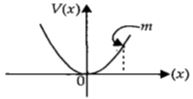
$A$ particle of mass $m$ is released from rest and follows a parabolic path as shown. Assuming that the displacement of the mass from the origin is small,which graph correctly depicts the position of the particle as a function of time $?$
A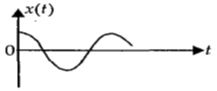
B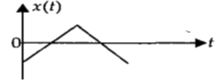
C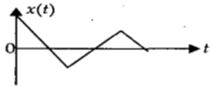
D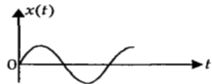
Solution
(A) The potential energy $V(x)$ is given by a parabolic curve,which implies $V(x) = \frac{1}{2}kx^2$.
This represents a simple harmonic oscillator where the restoring force is $F = -\frac{dV}{dx} = -kx$.
Since the particle is released from rest at some positive displacement $x = A$ at $t = 0$,its motion is described by the equation $x(t) = A \cos(\omega t)$.
At $t = 0$,$x = A$,which is the positive extreme position.
As time increases,the particle moves towards the mean position $(x = 0)$ and then to the negative extreme position $(x = -A)$.
This behavior is represented by a cosine graph starting from a positive maximum value at $t = 0$.
This represents a simple harmonic oscillator where the restoring force is $F = -\frac{dV}{dx} = -kx$.
Since the particle is released from rest at some positive displacement $x = A$ at $t = 0$,its motion is described by the equation $x(t) = A \cos(\omega t)$.
At $t = 0$,$x = A$,which is the positive extreme position.
As time increases,the particle moves towards the mean position $(x = 0)$ and then to the negative extreme position $(x = -A)$.
This behavior is represented by a cosine graph starting from a positive maximum value at $t = 0$.
0 likes
View Solution39
EasyMCQ
Which one of the following equations of motion represents simple harmonic motion? (Where $k, k_0, k_1$ and $a$ are all positive constants)
A
$Acceleration = k(x)$
B
$Acceleration = k(x+a)$
C
$Acceleration = -k(x+a)$
D
$Acceleration = -k(x^2)$
Solution
(C) The defining condition for Simple Harmonic Motion $(S.H.M.)$ is that the acceleration $(a)$ is directly proportional to the negative of the displacement $(x)$ from the mean position.
Mathematically,this is expressed as $a = -\omega^2 x$,where $\omega$ is the angular frequency.
In option $(C)$,the equation is $a = -k(x+a)$. If we define a new coordinate $x' = x+a$,then the equation becomes $a = -k x'$.
This represents an $S.H.M.$ about the equilibrium position $x = -a$.
Since the acceleration is proportional to the displacement from the mean position and directed towards it,option $(C)$ correctly represents $S.H.M.$
Mathematically,this is expressed as $a = -\omega^2 x$,where $\omega$ is the angular frequency.
In option $(C)$,the equation is $a = -k(x+a)$. If we define a new coordinate $x' = x+a$,then the equation becomes $a = -k x'$.
This represents an $S.H.M.$ about the equilibrium position $x = -a$.
Since the acceleration is proportional to the displacement from the mean position and directed towards it,option $(C)$ correctly represents $S.H.M.$
0 likes
View Solution40
MediumMCQ
The displacement of a particle along the $x$-axis is given by $x = a \sin^2 \omega t$. The motion of the particle corresponds to:
A
simple harmonic motion of frequency $\frac{\omega}{\pi}$
B
simple harmonic motion of frequency $\frac{3\omega}{2\pi}$
C
non-simple harmonic motion
D
simple harmonic motion of frequency $\frac{\omega}{2\pi}$
Solution
(A) The given displacement is $x = a \sin^2 \omega t$.
Using the trigonometric identity $\sin^2 \theta = \frac{1 - \cos 2\theta}{2}$,we can rewrite the equation as:
$x = a \left( \frac{1 - \cos 2\omega t}{2} \right) = \frac{a}{2} - \frac{a}{2} \cos 2\omega t$.
This equation represents a periodic motion about the mean position $x = \frac{a}{2}$.
For a motion to be Simple Harmonic Motion $(SHM)$,the acceleration must be proportional to the negative of the displacement from the mean position,i.e.,$a_{acc} \propto -(x - x_{mean})$.
Here,the displacement is $x - \frac{a}{2} = -\frac{a}{2} \cos 2\omega t$.
The velocity is $v = \frac{dx}{dt} = \frac{d}{dt} (\frac{a}{2} - \frac{a}{2} \cos 2\omega t) = a\omega \sin 2\omega t$.
The acceleration is $a_{acc} = \frac{dv}{dt} = 2a\omega^2 \cos 2\omega t$.
Substituting the expression for displacement,we get $a_{acc} = -4\omega^2 (x - \frac{a}{2})$.
Since the acceleration is proportional to the negative of the displacement from the mean position,the motion is $SHM$.
The angular frequency of this $SHM$ is $\omega' = 2\omega$.
The frequency $f$ is given by $f = \frac{\omega'}{2\pi} = \frac{2\omega}{2\pi} = \frac{\omega}{\pi}$.
Using the trigonometric identity $\sin^2 \theta = \frac{1 - \cos 2\theta}{2}$,we can rewrite the equation as:
$x = a \left( \frac{1 - \cos 2\omega t}{2} \right) = \frac{a}{2} - \frac{a}{2} \cos 2\omega t$.
This equation represents a periodic motion about the mean position $x = \frac{a}{2}$.
For a motion to be Simple Harmonic Motion $(SHM)$,the acceleration must be proportional to the negative of the displacement from the mean position,i.e.,$a_{acc} \propto -(x - x_{mean})$.
Here,the displacement is $x - \frac{a}{2} = -\frac{a}{2} \cos 2\omega t$.
The velocity is $v = \frac{dx}{dt} = \frac{d}{dt} (\frac{a}{2} - \frac{a}{2} \cos 2\omega t) = a\omega \sin 2\omega t$.
The acceleration is $a_{acc} = \frac{dv}{dt} = 2a\omega^2 \cos 2\omega t$.
Substituting the expression for displacement,we get $a_{acc} = -4\omega^2 (x - \frac{a}{2})$.
Since the acceleration is proportional to the negative of the displacement from the mean position,the motion is $SHM$.
The angular frequency of this $SHM$ is $\omega' = 2\omega$.
The frequency $f$ is given by $f = \frac{\omega'}{2\pi} = \frac{2\omega}{2\pi} = \frac{\omega}{\pi}$.
0 likes
View Solution41
MediumMCQ
Out of the following functions representing the motion of a particle,which represent $SHM$?
$(A)\; y = \sin \omega t - \cos \omega t$
$(B)\; y = \sin^3 \omega t$
$(C)\; y = 5 \cos \left( \frac{3\pi}{4} - 3\omega t \right)$
$(D)\; y = 1 + \omega t + \omega^2 t^2$
$(A)\; y = \sin \omega t - \cos \omega t$
$(B)\; y = \sin^3 \omega t$
$(C)\; y = 5 \cos \left( \frac{3\pi}{4} - 3\omega t \right)$
$(D)\; y = 1 + \omega t + \omega^2 t^2$
A
only $(A)$
B
only $(D)$ does not represent $SHM$
C
only $(A)$ and $(C)$
D
only $(A)$ and $(B)$
Solution
(C) function represents $SHM$ if it can be expressed in the form $y = A \sin(\omega t + \phi)$ or $y = A \cos(\omega t + \phi)$.
For $(A): y = \sin \omega t - \cos \omega t = \sqrt{2} \left[ \frac{1}{\sqrt{2}} \sin \omega t - \frac{1}{\sqrt{2}} \cos \omega t \right] = \sqrt{2} \sin \left( \omega t - \frac{\pi}{4} \right)$. This is a $SHM$.
For $(B): y = \sin^3 \omega t = \frac{1}{4} [3 \sin \omega t - \sin 3 \omega t]$. This is a superposition of two $SHMs$ with different frequencies,so it is periodic but not $SHM$.
For $(C): y = 5 \cos \left( \frac{3\pi}{4} - 3\omega t \right) = 5 \cos \left( 3\omega t - \frac{3\pi}{4} \right)$. This is a $SHM$ with angular frequency $3\omega$.
For $(D): y = 1 + \omega t + \omega^2 t^2$. This is a quadratic function of time,representing non-periodic motion.
Thus,both $(A)$ and $(C)$ represent $SHM$.
For $(A): y = \sin \omega t - \cos \omega t = \sqrt{2} \left[ \frac{1}{\sqrt{2}} \sin \omega t - \frac{1}{\sqrt{2}} \cos \omega t \right] = \sqrt{2} \sin \left( \omega t - \frac{\pi}{4} \right)$. This is a $SHM$.
For $(B): y = \sin^3 \omega t = \frac{1}{4} [3 \sin \omega t - \sin 3 \omega t]$. This is a superposition of two $SHMs$ with different frequencies,so it is periodic but not $SHM$.
For $(C): y = 5 \cos \left( \frac{3\pi}{4} - 3\omega t \right) = 5 \cos \left( 3\omega t - \frac{3\pi}{4} \right)$. This is a $SHM$ with angular frequency $3\omega$.
For $(D): y = 1 + \omega t + \omega^2 t^2$. This is a quadratic function of time,representing non-periodic motion.
Thus,both $(A)$ and $(C)$ represent $SHM$.
0 likes
View Solution42
MediumMCQ
Equations $y_1 = A \sin \omega t$ and $y_2 = \frac{A}{2} \sin \omega t + \frac{A}{2} \cos \omega t$ represent $S.H.M.$ The ratio of the amplitudes of the two motions is
A
$1$
B
$2$
C
$0.5$
D
$\sqrt{2}$
Solution
(D) The amplitude of the first motion is $A_1 = A$.
The second equation is $y_2 = \frac{A}{2} \sin \omega t + \frac{A}{2} \cos \omega t$.
We can rewrite this by multiplying and dividing by $\sqrt{2}$:
$y_2 = \frac{A}{\sqrt{2}} \left( \frac{1}{\sqrt{2}} \sin \omega t + \frac{1}{\sqrt{2}} \cos \omega t \right)$
Using the identity $\sin(a+b) = \sin a \cos b + \cos a \sin b$,where $\cos 45^\circ = \sin 45^\circ = \frac{1}{\sqrt{2}}$:
$y_2 = \frac{A}{\sqrt{2}} \sin(\omega t + 45^\circ)$.
Thus,the amplitude of the second motion is $A_2 = \frac{A}{\sqrt{2}}$.
The ratio of the amplitudes is $\frac{A_1}{A_2} = \frac{A}{A/\sqrt{2}} = \sqrt{2}$.
The second equation is $y_2 = \frac{A}{2} \sin \omega t + \frac{A}{2} \cos \omega t$.
We can rewrite this by multiplying and dividing by $\sqrt{2}$:
$y_2 = \frac{A}{\sqrt{2}} \left( \frac{1}{\sqrt{2}} \sin \omega t + \frac{1}{\sqrt{2}} \cos \omega t \right)$
Using the identity $\sin(a+b) = \sin a \cos b + \cos a \sin b$,where $\cos 45^\circ = \sin 45^\circ = \frac{1}{\sqrt{2}}$:
$y_2 = \frac{A}{\sqrt{2}} \sin(\omega t + 45^\circ)$.
Thus,the amplitude of the second motion is $A_2 = \frac{A}{\sqrt{2}}$.
The ratio of the amplitudes is $\frac{A_1}{A_2} = \frac{A}{A/\sqrt{2}} = \sqrt{2}$.
0 likes
View Solution43
MediumMCQ
$A$ simple harmonic motion having an amplitude $A$ and time period $T$ is represented by the equation: $y = 5 \sin \pi (t + 4) \ m$. Then the values of $A$ (in $m$) and $T$ (in $sec$) are:
A
$A = 5; T = 2$
B
$A = 10; T = 1$
C
$A = 5; T = 1$
D
$A = 10; T = 2$
Solution
(A) The standard equation for simple harmonic motion is given by $y = A \sin(\omega t + \phi)$,where $\omega = \frac{2\pi}{T}$.
Given equation: $y = 5 \sin(\pi t + 4\pi)$.
Comparing this with the standard form $y = A \sin(\omega t + \phi)$:
The amplitude $A = 5 \ m$.
The angular frequency $\omega = \pi \ rad/s$.
Since $\omega = \frac{2\pi}{T}$,we have $\pi = \frac{2\pi}{T}$.
Solving for $T$,we get $T = \frac{2\pi}{\pi} = 2 \ s$.
Therefore,$A = 5$ and $T = 2$.
Given equation: $y = 5 \sin(\pi t + 4\pi)$.
Comparing this with the standard form $y = A \sin(\omega t + \phi)$:
The amplitude $A = 5 \ m$.
The angular frequency $\omega = \pi \ rad/s$.
Since $\omega = \frac{2\pi}{T}$,we have $\pi = \frac{2\pi}{T}$.
Solving for $T$,we get $T = \frac{2\pi}{\pi} = 2 \ s$.
Therefore,$A = 5$ and $T = 2$.
0 likes
View Solution44
MediumMCQ
The angular frequency of motion whose equation is $4\frac{d^2y}{dt^2} + 9y = 0$ is ($y =$ displacement and $t =$ time).
A
$2.25$
B
$0.44$
C
$1.5$
D
$0.67$
Solution
(C) The given equation is $4 \frac{d^{2} y}{d t^{2}}+9 y=0$.
Rearranging the equation,we get $\frac{d^{2} y}{d t^{2}} = -\frac{9}{4} y$.
Comparing this with the standard Simple Harmonic Motion $(SHM)$ equation $\frac{d^{2} y}{dt^{2}} = -\omega^{2} y$,where $\omega$ is the angular frequency:
$\omega^{2} = \frac{9}{4}$.
Taking the square root of both sides,we get $\omega = \sqrt{\frac{9}{4}} = \frac{3}{2} = 1.5 \text{ rad/s}$.
Rearranging the equation,we get $\frac{d^{2} y}{d t^{2}} = -\frac{9}{4} y$.
Comparing this with the standard Simple Harmonic Motion $(SHM)$ equation $\frac{d^{2} y}{dt^{2}} = -\omega^{2} y$,where $\omega$ is the angular frequency:
$\omega^{2} = \frac{9}{4}$.
Taking the square root of both sides,we get $\omega = \sqrt{\frac{9}{4}} = \frac{3}{2} = 1.5 \text{ rad/s}$.
0 likes
View Solution45
AdvancedMCQ
$A$ particle performs $SHM$ with a period $T$ and amplitude $a.$ The mean velocity of the particle over the time interval during which it travels a distance $a/2$ from the extreme position is
A
$a/T$
B
$2a/T$
C
$3a/T$
D
$a/2T$
Solution
(C) The equation for the displacement of a particle in $SHM$ starting from the extreme position is $x = a \cos(\omega t).$
To travel a distance of $a/2$ from the extreme position $(x = a)$,the particle reaches the position $x = a - a/2 = a/2.$
Substituting this into the equation: $a/2 = a \cos(\omega t) \Rightarrow \cos(\omega t) = 1/2.$
Since $\cos(\pi/3) = 1/2,$ we have $\omega t = \pi/3.$
Substituting $\omega = 2\pi/T,$ we get $(2\pi/T)t = \pi/3 \Rightarrow t = T/6.$
The mean velocity is defined as the total displacement divided by the total time interval: $v_{av} = \frac{\text{displacement}}{\text{time}} = \frac{a/2}{T/6} = \frac{3a}{T}.$
To travel a distance of $a/2$ from the extreme position $(x = a)$,the particle reaches the position $x = a - a/2 = a/2.$
Substituting this into the equation: $a/2 = a \cos(\omega t) \Rightarrow \cos(\omega t) = 1/2.$
Since $\cos(\pi/3) = 1/2,$ we have $\omega t = \pi/3.$
Substituting $\omega = 2\pi/T,$ we get $(2\pi/T)t = \pi/3 \Rightarrow t = T/6.$
The mean velocity is defined as the total displacement divided by the total time interval: $v_{av} = \frac{\text{displacement}}{\text{time}} = \frac{a/2}{T/6} = \frac{3a}{T}.$
0 likes
View Solution46
MediumMCQ
The graphs in the figure show that a quantity $y$ varies with displacement $d$ in a system undergoing simple harmonic motion. Which graph best represents the relationship obtained when $y$ is the time?

A
$I$
B
$II$
C
$III$
D
$IV$
Solution
(D) In simple harmonic motion $(SHM)$,the displacement $d$ as a function of time $t$ is given by $d = A \sin(\omega t + \phi)$.
To find the relationship where $y$ is time $(t)$ and $d$ is displacement,we rearrange the equation: $t = \frac{1}{\omega} \arcsin(\frac{d}{A}) - \frac{\phi}{\omega}$.
This equation implies that for a single value of displacement $d$,there are multiple values of time $t$ as the particle oscillates back and forth.
Graph $IV$ shows a relationship where for a given displacement $d$ (within the range $-A$ to $+A$),there are multiple values of $y$ (time),which correctly represents the periodic nature of $SHM$ when time is plotted on the vertical axis.
To find the relationship where $y$ is time $(t)$ and $d$ is displacement,we rearrange the equation: $t = \frac{1}{\omega} \arcsin(\frac{d}{A}) - \frac{\phi}{\omega}$.
This equation implies that for a single value of displacement $d$,there are multiple values of time $t$ as the particle oscillates back and forth.
Graph $IV$ shows a relationship where for a given displacement $d$ (within the range $-A$ to $+A$),there are multiple values of $y$ (time),which correctly represents the periodic nature of $SHM$ when time is plotted on the vertical axis.
0 likes
View Solution47
MediumMCQ
$A$ stone is swinging in a horizontal circle $0.8 \, m$ in diameter at $30 \, rev/min$. $A$ distant horizontal light beam causes a shadow of the stone to be formed on a nearly vertical wall. The amplitude and period of the simple harmonic motion for the shadow of the stone are:
A
$0.4 \, m, 4 \, s$
B
$0.2 \, m, 2 \, s$
C
$0.4 \, m, 2 \, s$
D
$0.8 \, m, 2 \, s$
Solution
(C) The diameter of the horizontal circle is $d = 0.8 \, m$. The amplitude $A$ of the simple harmonic motion $(SHM)$ is the radius of this circle.
$A = \frac{d}{2} = \frac{0.8 \, m}{2} = 0.4 \, m$.
The frequency of revolution is $f = 30 \, rev/min = \frac{30}{60} \, rev/s = 0.5 \, Hz$.
The period $T$ of the $SHM$ is the same as the time taken for one complete revolution.
$T = \frac{1}{f} = \frac{1}{0.5} = 2 \, s$.
Alternatively,using angular velocity $\omega = \frac{2 \pi \times 30}{60} = \pi \, rad/s$.
Since $\omega = \frac{2 \pi}{T}$,we have $\pi = \frac{2 \pi}{T}$,which gives $T = 2 \, s$.
$A = \frac{d}{2} = \frac{0.8 \, m}{2} = 0.4 \, m$.
The frequency of revolution is $f = 30 \, rev/min = \frac{30}{60} \, rev/s = 0.5 \, Hz$.
The period $T$ of the $SHM$ is the same as the time taken for one complete revolution.
$T = \frac{1}{f} = \frac{1}{0.5} = 2 \, s$.
Alternatively,using angular velocity $\omega = \frac{2 \pi \times 30}{60} = \pi \, rad/s$.
Since $\omega = \frac{2 \pi}{T}$,we have $\pi = \frac{2 \pi}{T}$,which gives $T = 2 \, s$.
0 likes
View Solution48
AdvancedMCQ
Speed $v$ of a particle moving along a straight line,when it is at a distance $x$ from a fixed point on the line is given by $v^2 = 108 - 9x^2$ (all quantities in $S.I.$ units). Then:
A
The motion is uniformly accelerated along the straight line.
B
The magnitude of the acceleration at a distance $3 \, m$ from the fixed point is $27 \, m/s^2$.
C
The motion is simple harmonic about $x = 0 \, m$.
D
The maximum displacement from the fixed point is $4 \, m$.
Solution
(B) Given the equation $v^2 = 108 - 9x^2$.
Differentiating with respect to $t$:
$2v \frac{dv}{dt} = -18x \frac{dx}{dt}$
Since $v = \frac{dx}{dt}$,we have $2v a = -18xv$,which simplifies to $a = -9x$.
This is the characteristic equation of Simple Harmonic Motion $(a = -\omega^2 x)$,where $\omega^2 = 9$,so $\omega = 3 \, rad/s$.
At $x = 3 \, m$,the magnitude of acceleration is $|a| = |-9(3)| = 27 \, m/s^2$. Thus,option $B$ is correct.
The motion is simple harmonic about $x = 0$ (the equilibrium position).
Maximum displacement (amplitude $A$) occurs when $v = 0$:
$0 = 108 - 9x^2 \implies x^2 = 12 \implies x = \sqrt{12} \, m \approx 3.46 \, m$. Thus,option $D$ is incorrect.
Differentiating with respect to $t$:
$2v \frac{dv}{dt} = -18x \frac{dx}{dt}$
Since $v = \frac{dx}{dt}$,we have $2v a = -18xv$,which simplifies to $a = -9x$.
This is the characteristic equation of Simple Harmonic Motion $(a = -\omega^2 x)$,where $\omega^2 = 9$,so $\omega = 3 \, rad/s$.
At $x = 3 \, m$,the magnitude of acceleration is $|a| = |-9(3)| = 27 \, m/s^2$. Thus,option $B$ is correct.
The motion is simple harmonic about $x = 0$ (the equilibrium position).
Maximum displacement (amplitude $A$) occurs when $v = 0$:
$0 = 108 - 9x^2 \implies x^2 = 12 \implies x = \sqrt{12} \, m \approx 3.46 \, m$. Thus,option $D$ is incorrect.
0 likes
View SolutionOscillations — Periodic, Oscillatory motion and its characteristics and types of SHM and Equation of SHM · Frequently Asked Questions
1Are these Oscillations questions useful for JEE and NEET?
Yes. All questions in this section are mapped to JEE Main and NEET exam patterns. Previous year questions from JEE Main, NEET, GUJCET and state-level exams are included with full solutions.
2Can I switch to Hindi or Gujarati for these questions?
Yes. Use the language tabs in the hero section or the sidebar to view the same questions and solutions in English, Hindi or Gujarati.
3How do I generate a question paper from this subtopic?
Use the Vedclass Exam Paper Generator — select the chapter and subtopic, set difficulty, and generate Sets A, B, C, D automatically. First 3 chapters of every subject are free.
Vedclass Products
For Students
Vedclass Test Series
Mock tests in real JEE/NEET style with performance analysis. 5-day free trial.
Start Free TrialFor Teachers
Exam Paper Generator
Generate Set A/B/C/D papers from this chapter in 2 minutes. 3 chapters free.
Try FreeFor Institutes
Online Exam Module
Live online exams with unlimited students, 360° analytics & white-label branding.
See DemoFor Teachers & Institutes
Generate a Oscillations Exam Paper in 2 Minutes
Select subtopic & difficulty — Sets A, B, C, D auto-generated with No Repeat logic.
First 3 chapters of every subject are free — no payment required.