
A English
Acceleration and Force of Simple Harmonic Motion Questions in English
Class 11 Physics · Oscillations · Acceleration and Force of Simple Harmonic Motion
108+
Questions
English
Language
100%
With Solutions
Showing 48 of 108 questions in English
1
MediumMCQ
$A$ particle of mass $0.3 \, kg$ is subjected to a force $F = -kx$ with $k = 15 \, N/m$. What will be its initial acceleration if it is released from a point $20 \, cm$ away from the origin? (in $m/s^2$)
A
$5$
B
$10$
C
$3$
D
$15$
Solution
(B) Given: Mass $m = 0.3 \, kg$,force constant $k = 15 \, N/m$,and displacement $x = 20 \, cm = 0.2 \, m$.
According to Hooke's Law,the magnitude of the force is $F = kx$.
Substituting the values: $F = 15 \times 0.2 = 3 \, N$.
Using Newton's Second Law,$F = ma$,the acceleration $a$ is given by $a = \frac{F}{m}$.
Substituting the values: $a = \frac{3}{0.3} = 10 \, m/s^2$.
Therefore,the initial acceleration is $10 \, m/s^2$.
According to Hooke's Law,the magnitude of the force is $F = kx$.
Substituting the values: $F = 15 \times 0.2 = 3 \, N$.
Using Newton's Second Law,$F = ma$,the acceleration $a$ is given by $a = \frac{F}{m}$.
Substituting the values: $a = \frac{3}{0.3} = 10 \, m/s^2$.
Therefore,the initial acceleration is $10 \, m/s^2$.
0 likes
View Solution2
EasyMCQ
$A$ particle is executing simple harmonic motion with an amplitude of $0.1 \, m$. At a certain instant when its displacement is $0.02 \, m$,its acceleration is $0.5 \, m/s^2$. The maximum velocity of the particle is (in $m/s$):
A
$0.01$
B
$0.05$
C
$0.5$
D
$0.25$
Solution
(C) The acceleration $a$ of a particle in simple harmonic motion is given by $a = \omega^2 y$,where $\omega$ is the angular frequency and $y$ is the displacement.
Given $a = 0.5 \, m/s^2$ and $y = 0.02 \, m$.
$\omega^2 = \frac{a}{y} = \frac{0.5}{0.02} = 25$.
$\omega = \sqrt{25} = 5 \, rad/s$.
The maximum velocity $v_{\max}$ is given by $v_{\max} = A\omega$,where $A$ is the amplitude.
Given $A = 0.1 \, m$.
$v_{\max} = 0.1 \times 5 = 0.5 \, m/s$.
Given $a = 0.5 \, m/s^2$ and $y = 0.02 \, m$.
$\omega^2 = \frac{a}{y} = \frac{0.5}{0.02} = 25$.
$\omega = \sqrt{25} = 5 \, rad/s$.
The maximum velocity $v_{\max}$ is given by $v_{\max} = A\omega$,where $A$ is the amplitude.
Given $A = 0.1 \, m$.
$v_{\max} = 0.1 \times 5 = 0.5 \, m/s$.
0 likes
View Solution3
EasyMCQ
The acceleration of a particle in $S.H.M.$ is
A
Always zero
B
Always constant
C
Maximum at the extreme position
D
Maximum at the equilibrium position
Solution
(C) The acceleration $a$ of a particle executing $S.H.M.$ is given by the formula $a = -{\omega ^2}x$,where $\omega$ is the angular frequency and $x$ is the displacement from the equilibrium position.
At the equilibrium position,$x = 0$,so the acceleration is zero.
At the extreme positions,the displacement $x$ is equal to the amplitude $A$ (i.e.,$x = \pm A$).
Therefore,the magnitude of acceleration is $|a| = {\omega ^2}A$,which is the maximum value.
Thus,the acceleration is maximum at the extreme position.
At the equilibrium position,$x = 0$,so the acceleration is zero.
At the extreme positions,the displacement $x$ is equal to the amplitude $A$ (i.e.,$x = \pm A$).
Therefore,the magnitude of acceleration is $|a| = {\omega ^2}A$,which is the maximum value.
Thus,the acceleration is maximum at the extreme position.
0 likes
View Solution4
EasyMCQ
The displacement of a particle moving in $S.H.M.$ at any instant is given by $y = a \sin \omega t$. The acceleration after time $t = \frac{T}{4}$ is (where $T$ is the time period).
A
$a \omega$
B
$-a \omega$
C
$a \omega^2$
D
$-a \omega^2$
Solution
(D) The displacement of the particle is given by $y = a \sin \omega t$.
The velocity $v$ is the derivative of displacement with respect to time: $v = \frac{dy}{dt} = a \omega \cos \omega t$.
The acceleration $A$ is the derivative of velocity with respect to time: $A = \frac{dv}{dt} = -a \omega^2 \sin \omega t$.
Given $t = \frac{T}{4}$ and knowing $\omega = \frac{2\pi}{T}$,we have $\omega t = \frac{2\pi}{T} \times \frac{T}{4} = \frac{\pi}{2}$.
Substituting this into the acceleration equation: $A = -a \omega^2 \sin(\frac{\pi}{2}) = -a \omega^2 (1) = -a \omega^2$.
Thus,the correct option is $D$.
The velocity $v$ is the derivative of displacement with respect to time: $v = \frac{dy}{dt} = a \omega \cos \omega t$.
The acceleration $A$ is the derivative of velocity with respect to time: $A = \frac{dv}{dt} = -a \omega^2 \sin \omega t$.
Given $t = \frac{T}{4}$ and knowing $\omega = \frac{2\pi}{T}$,we have $\omega t = \frac{2\pi}{T} \times \frac{T}{4} = \frac{\pi}{2}$.
Substituting this into the acceleration equation: $A = -a \omega^2 \sin(\frac{\pi}{2}) = -a \omega^2 (1) = -a \omega^2$.
Thus,the correct option is $D$.
0 likes
View Solution5
MediumMCQ
The amplitude of a particle executing $S.H.M.$ with a frequency of $60 \, Hz$ is $0.01 \, m$. The maximum value of the acceleration of the particle is
A
$144\pi^2 \, m/s^2$
B
$144 \, m/s^2$
C
$\frac{144}{\pi^2} \, m/s^2$
D
$288\pi^2 \, m/s^2$
Solution
(A) The maximum acceleration $a_{max}$ of a particle executing $S.H.M.$ is given by the formula $a_{max} = A\omega^2$.
Here,$A = 0.01 \, m$ is the amplitude and $n = 60 \, Hz$ is the frequency.
Since $\omega = 2\pi n$,we have $\omega^2 = 4\pi^2 n^2$.
Substituting the values: $a_{max} = 0.01 \times 4\pi^2 \times (60)^2$.
$a_{max} = 0.01 \times 4\pi^2 \times 3600$.
$a_{max} = 144\pi^2 \, m/s^2$.
Here,$A = 0.01 \, m$ is the amplitude and $n = 60 \, Hz$ is the frequency.
Since $\omega = 2\pi n$,we have $\omega^2 = 4\pi^2 n^2$.
Substituting the values: $a_{max} = 0.01 \times 4\pi^2 \times (60)^2$.
$a_{max} = 0.01 \times 4\pi^2 \times 3600$.
$a_{max} = 144\pi^2 \, m/s^2$.
0 likes
View Solution6
MediumMCQ
$A$ small body of mass $0.10 \, kg$ is executing $S.H.M.$ of amplitude $1.0 \, m$ and period $0.20 \, s$. The maximum force acting on it is .... $N$.
A
$98.596$
B
$985.96$
C
$100.2$
D
$76.23$
Solution
(A) The maximum force in $S.H.M.$ is given by $F_{\max} = m \cdot a_{\max}$,where $a_{\max} = A \omega^2$.
Given: mass $m = 0.10 \, kg$,amplitude $A = 1.0 \, m$,and period $T = 0.20 \, s$.
The angular frequency $\omega$ is given by $\omega = \frac{2\pi}{T} = \frac{2\pi}{0.20} = 10\pi \, rad/s$.
The maximum acceleration is $a_{\max} = A \omega^2 = 1.0 \times (10\pi)^2 = 100\pi^2 \, m/s^2$.
The maximum force is $F_{\max} = m \cdot a_{\max} = 0.10 \times 100\pi^2 = 10\pi^2 \, N$.
Using $\pi^2 \approx 9.8596$,we get $F_{\max} = 10 \times 9.8596 = 98.596 \, N$.
Given: mass $m = 0.10 \, kg$,amplitude $A = 1.0 \, m$,and period $T = 0.20 \, s$.
The angular frequency $\omega$ is given by $\omega = \frac{2\pi}{T} = \frac{2\pi}{0.20} = 10\pi \, rad/s$.
The maximum acceleration is $a_{\max} = A \omega^2 = 1.0 \times (10\pi)^2 = 100\pi^2 \, m/s^2$.
The maximum force is $F_{\max} = m \cdot a_{\max} = 0.10 \times 100\pi^2 = 10\pi^2 \, N$.
Using $\pi^2 \approx 9.8596$,we get $F_{\max} = 10 \times 9.8596 = 98.596 \, N$.
0 likes
View Solution7
EasyMCQ
For a particle executing simple harmonic motion,which of the following statements is not correct?
A
The total energy of the particle always remains the same.
B
The restoring force is always directed towards a fixed point.
C
The restoring force is maximum at the extreme positions.
D
The acceleration of the particle is maximum at the equilibrium position.
Solution
(D) In simple harmonic motion $(SHM)$,the acceleration $a$ is given by $a = -\omega^2 x$,where $\omega$ is the angular frequency and $x$ is the displacement from the equilibrium position.
At the equilibrium position,$x = 0$,so the acceleration $a = 0$,which is the minimum value.
At the extreme positions,$x = \pm A$ (where $A$ is the amplitude),so the acceleration $a = \mp \omega^2 A$,which is the maximum value.
Therefore,the statement that the acceleration is maximum at the equilibrium position is incorrect.
The correct option is $D$.
At the equilibrium position,$x = 0$,so the acceleration $a = 0$,which is the minimum value.
At the extreme positions,$x = \pm A$ (where $A$ is the amplitude),so the acceleration $a = \mp \omega^2 A$,which is the maximum value.
Therefore,the statement that the acceleration is maximum at the equilibrium position is incorrect.
The correct option is $D$.
0 likes
View Solution8
MediumMCQ
$A$ particle of mass $10 \text{ g}$ is executing simple harmonic motion with an amplitude of $0.5 \text{ m}$ and a periodic time of $(\pi / 5) \text{ s}$. The maximum value of the force acting on the particle is ... $N$.
A
$25$
B
$5$
C
$2.5$
D
$0.5$
Solution
(D) The mass of the particle is $m = 10 \text{ g} = 0.01 \text{ kg}$.
The amplitude is $A = 0.5 \text{ m}$.
The time period is $T = \pi / 5 \text{ s}$.
The angular frequency is $\omega = 2\pi / T = 2\pi / (\pi / 5) = 10 \text{ rad/s}$.
The maximum force acting on a particle in simple harmonic motion is given by $F_{\text{max}} = m \omega^2 A$.
Substituting the values: $F_{\text{max}} = 0.01 \times (10)^2 \times 0.5$.
$F_{\text{max}} = 0.01 \times 100 \times 0.5 = 1 \times 0.5 = 0.5 \text{ N}$.
The amplitude is $A = 0.5 \text{ m}$.
The time period is $T = \pi / 5 \text{ s}$.
The angular frequency is $\omega = 2\pi / T = 2\pi / (\pi / 5) = 10 \text{ rad/s}$.
The maximum force acting on a particle in simple harmonic motion is given by $F_{\text{max}} = m \omega^2 A$.
Substituting the values: $F_{\text{max}} = 0.01 \times (10)^2 \times 0.5$.
$F_{\text{max}} = 0.01 \times 100 \times 0.5 = 1 \times 0.5 = 0.5 \text{ N}$.
0 likes
View Solution9
EasyMCQ
The displacement of an oscillating particle varies with time $t$ (in seconds) according to the equation $y (cm) = \sin \left[ \frac{\pi}{2} \left( \frac{t}{2} + \frac{1}{3} \right) \right]$. The maximum acceleration of the particle is approximately ..... $cm/s^2$.
A
$5.21$
B
$3.62$
C
$1.81$
D
$0.62$
Solution
(D) The given equation for displacement is $y = \sin \left( \frac{\pi t}{4} + \frac{\pi}{6} \right)$.
Comparing this with the standard $SHM$ equation $y = A \sin(\omega t + \phi)$,we get amplitude $A = 1 \ cm$ and angular frequency $\omega = \frac{\pi}{4} \ rad/s$.
The acceleration $a$ of a particle in $SHM$ is given by $a = -\omega^2 y$.
The maximum acceleration is given by $a_{\max} = \omega^2 A$.
Substituting the values: $a_{\max} = \left( \frac{\pi}{4} \right)^2 \times 1 = \frac{\pi^2}{16}$.
Using $\pi^2 \approx 9.869$,we get $a_{\max} = \frac{9.869}{16} \approx 0.6168 \ cm/s^2$.
Rounding to two decimal places,we get $a_{\max} \approx 0.62 \ cm/s^2$.
Comparing this with the standard $SHM$ equation $y = A \sin(\omega t + \phi)$,we get amplitude $A = 1 \ cm$ and angular frequency $\omega = \frac{\pi}{4} \ rad/s$.
The acceleration $a$ of a particle in $SHM$ is given by $a = -\omega^2 y$.
The maximum acceleration is given by $a_{\max} = \omega^2 A$.
Substituting the values: $a_{\max} = \left( \frac{\pi}{4} \right)^2 \times 1 = \frac{\pi^2}{16}$.
Using $\pi^2 \approx 9.869$,we get $a_{\max} = \frac{9.869}{16} \approx 0.6168 \ cm/s^2$.
Rounding to two decimal places,we get $a_{\max} \approx 0.62 \ cm/s^2$.
0 likes
View Solution10
EasyMCQ
$A$ particle moving along the $X$-axis executes simple harmonic motion. The force acting on it is given by: (Where $A$ and $K$ are positive constants)
A
$-AKx$
B
$A \cos(Kx)$
C
$A \exp(-Kx)$
D
$AKx$
Solution
(A) For a particle executing Simple Harmonic Motion $(S.H.M.)$,the restoring force is directly proportional to the negative of the displacement from the mean position.
Mathematically,this is expressed as $F = -kx$,where $k$ is the force constant.
Given that $A$ and $K$ are positive constants,the force equation for this specific motion is $F = -AKx$.
Therefore,the correct option is $A$.
Mathematically,this is expressed as $F = -kx$,where $k$ is the force constant.
Given that $A$ and $K$ are positive constants,the force equation for this specific motion is $F = -AKx$.
Therefore,the correct option is $A$.
0 likes
View Solution11
EasyMCQ
$A$ particle executes harmonic motion with an angular velocity and maximum acceleration of $3.5\, rad/s$ and $7.5\, m/s^2$ respectively. The amplitude of oscillation is .... $m$
A
$0.28$
B
$0.36$
C
$0.53$
D
$0.61$
Solution
(D) The maximum acceleration $(a_{\max})$ of a particle executing simple harmonic motion is given by the formula: $a_{\max} = A\omega^2$,where $A$ is the amplitude and $\omega$ is the angular velocity.
Given:
Angular velocity $\omega = 3.5\, rad/s$
Maximum acceleration $a_{\max} = 7.5\, m/s^2$
Rearranging the formula to solve for amplitude $A$:
$A = \frac{a_{\max}}{\omega^2}$
Substituting the given values:
$A = \frac{7.5}{(3.5)^2} = \frac{7.5}{12.25} \approx 0.61\, m$
Therefore,the amplitude of oscillation is $0.61\, m$.
Given:
Angular velocity $\omega = 3.5\, rad/s$
Maximum acceleration $a_{\max} = 7.5\, m/s^2$
Rearranging the formula to solve for amplitude $A$:
$A = \frac{a_{\max}}{\omega^2}$
Substituting the given values:
$A = \frac{7.5}{(3.5)^2} = \frac{7.5}{12.25} \approx 0.61\, m$
Therefore,the amplitude of oscillation is $0.61\, m$.
0 likes
View Solution12
EasyMCQ
$A$ $0.10\, kg$ block oscillates back and forth along a horizontal surface. Its displacement from the origin is given by: $x = (10\,cm)\cos [(10\,rad/s)\,t + \pi /2\,rad]$. What is the maximum acceleration experienced by the block?
A
$10\, m/s^2$
B
$10\pi\, m/s^2$
C
$5\pi\, m/s^2$
D
$3.33\pi\, m/s^2$
Solution
(A) The displacement equation is given by $x = A \cos(\omega t + \phi)$,where $A = 10\, cm = 0.10\, m$ and $\omega = 10\, rad/s$.
The acceleration $a$ of a particle in simple harmonic motion is given by $a = -\omega^2 x$.
The maximum acceleration $a_{\max}$ is given by the formula $a_{\max} = \omega^2 A$.
Substituting the given values: $a_{\max} = (10\, rad/s)^2 \times (0.10\, m) = 100 \times 0.10 = 10\, m/s^2$.
Therefore,the maximum acceleration experienced by the block is $10\, m/s^2$.
The acceleration $a$ of a particle in simple harmonic motion is given by $a = -\omega^2 x$.
The maximum acceleration $a_{\max}$ is given by the formula $a_{\max} = \omega^2 A$.
Substituting the given values: $a_{\max} = (10\, rad/s)^2 \times (0.10\, m) = 100 \times 0.10 = 10\, m/s^2$.
Therefore,the maximum acceleration experienced by the block is $10\, m/s^2$.
0 likes
View Solution13
EasyMCQ
In $S.H.M.$,maximum acceleration is at
A
Amplitude
B
Equilibrium
C
Acceleration is constant
D
None of these
Solution
(A) The acceleration of a particle in $S.H.M.$ is given by $a = -{\omega ^2}x$,where $x$ is the displacement from the equilibrium position.
Maximum acceleration occurs when the displacement $x$ is maximum,which is equal to the amplitude $A$.
Therefore,$|a_{\max}| = {\omega ^2}A$.
This occurs at the extreme positions,i.e.,at the amplitude.
Maximum acceleration occurs when the displacement $x$ is maximum,which is equal to the amplitude $A$.
Therefore,$|a_{\max}| = {\omega ^2}A$.
This occurs at the extreme positions,i.e.,at the amplitude.
0 likes
View Solution14
EasyMCQ
$A$ particle is executing simple harmonic motion with an amplitude of $0.02 \ m$ and frequency $50 \ Hz$. The maximum acceleration of the particle is
A
$100 \ m/s^2$
B
$100 \pi^2 \ m/s^2$
C
$500 \pi^2 \ m/s^2$
D
$200 \pi^2 \ m/s^2$
Solution
(D) The maximum acceleration $(a_{\max})$ of a particle executing simple harmonic motion is given by the formula: $a_{\max} = \omega^2 A$,where $\omega = 2\pi f$.
Given: Amplitude $(A)$ = $0.02 \ m$,Frequency $(f)$ = $50 \ Hz$.
First,calculate the angular frequency: $\omega = 2 \times \pi \times 50 = 100\pi \ rad/s$.
Now,calculate the maximum acceleration: $a_{\max} = (100\pi)^2 \times 0.02$.
$a_{\max} = 10000 \pi^2 \times 0.02 = 200 \pi^2 \ m/s^2$.
Given: Amplitude $(A)$ = $0.02 \ m$,Frequency $(f)$ = $50 \ Hz$.
First,calculate the angular frequency: $\omega = 2 \times \pi \times 50 = 100\pi \ rad/s$.
Now,calculate the maximum acceleration: $a_{\max} = (100\pi)^2 \times 0.02$.
$a_{\max} = 10000 \pi^2 \times 0.02 = 200 \pi^2 \ m/s^2$.
0 likes
View Solution15
EasyMCQ
Acceleration of a particle,executing $SHM$,at its mean position is
A
Infinity
B
Varies
C
Maximum
D
Zero
Solution
(D) The displacement of a particle executing $SHM$ is given by $x = A \sin(\omega t + \phi)$.
The velocity is $v = \frac{dx}{dt} = A\omega \cos(\omega t + \phi)$.
The acceleration is $a = \frac{dv}{dt} = -A\omega^2 \sin(\omega t + \phi) = -\omega^2 x$.
At the mean position,the displacement $x = 0$.
Substituting $x = 0$ into the acceleration formula,we get $a = -\omega^2(0) = 0$.
Therefore,the acceleration of a particle executing $SHM$ at its mean position is zero.
The velocity is $v = \frac{dx}{dt} = A\omega \cos(\omega t + \phi)$.
The acceleration is $a = \frac{dv}{dt} = -A\omega^2 \sin(\omega t + \phi) = -\omega^2 x$.
At the mean position,the displacement $x = 0$.
Substituting $x = 0$ into the acceleration formula,we get $a = -\omega^2(0) = 0$.
Therefore,the acceleration of a particle executing $SHM$ at its mean position is zero.
0 likes
View Solution16
EasyMCQ
Which one of the following statements is true for the speed $v$ and the acceleration $a$ of a particle executing simple harmonic motion?
A
When $v$ is maximum,$a$ is maximum.
B
Value of $a$ is zero,whatever may be the value of $v$.
C
When $v$ is zero,$a$ is zero.
D
When $v$ is maximum,$a$ is zero.
Solution
(D) In simple harmonic motion $(S.H.M.)$,the displacement is given by $y = A \sin(\omega t + \phi)$.
The velocity is $v = \frac{dy}{dt} = A\omega \cos(\omega t + \phi)$.
The acceleration is $a = \frac{dv}{dt} = -A\omega^2 \sin(\omega t + \phi) = -\omega^2 y$.
At the mean position $(y = 0)$,the speed $v$ is maximum $(v_{max} = A\omega)$ and the acceleration $a$ is zero $(a = -\omega^2(0) = 0)$.
At the extreme positions $(y = \pm A)$,the speed $v$ is zero and the acceleration $a$ is maximum $(a_{max} = \pm \omega^2 A)$.
Therefore,when $v$ is maximum,$a$ is zero.
The velocity is $v = \frac{dy}{dt} = A\omega \cos(\omega t + \phi)$.
The acceleration is $a = \frac{dv}{dt} = -A\omega^2 \sin(\omega t + \phi) = -\omega^2 y$.
At the mean position $(y = 0)$,the speed $v$ is maximum $(v_{max} = A\omega)$ and the acceleration $a$ is zero $(a = -\omega^2(0) = 0)$.
At the extreme positions $(y = \pm A)$,the speed $v$ is zero and the acceleration $a$ is maximum $(a_{max} = \pm \omega^2 A)$.
Therefore,when $v$ is maximum,$a$ is zero.
0 likes
View Solution17
EasyMCQ
What is the maximum acceleration of a particle performing $SHM$ given by the equation $y = 2\sin \left( {\frac{{\pi t}}{2} + \phi } \right)$,where $y$ is in $cm$?
A
$\frac{\pi }{2} \text{ cm/s}^2$
B
$\frac{{{\pi ^2}}}{2} \text{ cm/s}^2$
C
$\frac{\pi }{4} \text{ cm/s}^2$
D
$\frac{{{\pi ^2}}}{4} \text{ cm/s}^2$
Solution
(B) Comparing the given equation $y = 2\sin \left( {\frac{{\pi t}}{2} + \phi } \right)$ with the standard $SHM$ equation $y = A\sin (\omega t + \phi )$:
We get the amplitude $A = 2 \text{ cm}$ and angular frequency $\omega = \frac{\pi }{2} \text{ rad/s}$.
The maximum acceleration $a_{max}$ is given by the formula $a_{max} = \omega^2 A$.
Substituting the values: $a_{max} = \left( \frac{\pi }{2} \right)^2 \times 2 = \frac{\pi^2}{4} \times 2 = \frac{\pi^2}{2} \text{ cm/s}^2$.
We get the amplitude $A = 2 \text{ cm}$ and angular frequency $\omega = \frac{\pi }{2} \text{ rad/s}$.
The maximum acceleration $a_{max}$ is given by the formula $a_{max} = \omega^2 A$.
Substituting the values: $a_{max} = \left( \frac{\pi }{2} \right)^2 \times 2 = \frac{\pi^2}{4} \times 2 = \frac{\pi^2}{2} \text{ cm/s}^2$.
0 likes
View Solution18
EasyMCQ
In simple harmonic motion,the ratio of acceleration of the particle to its displacement at any time is a measure of
A
Spring constant
B
Angular frequency
C
(Angular frequency)$^2$
D
Restoring force
Solution
(C) The acceleration $a$ of a particle executing simple harmonic motion is given by the equation $a = -{\omega}^2 x$,where ${\omega}$ is the angular frequency and $x$ is the displacement.
Taking the magnitude of the ratio of acceleration to displacement,we get:
$|a/x| = |-{\omega}^2 x / x| = {\omega}^2$.
Therefore,the ratio of the acceleration to the displacement is equal to the square of the angular frequency.
Taking the magnitude of the ratio of acceleration to displacement,we get:
$|a/x| = |-{\omega}^2 x / x| = {\omega}^2$.
Therefore,the ratio of the acceleration to the displacement is equal to the square of the angular frequency.
0 likes
View Solution19
EasyMCQ
The acceleration of a particle performing $S.H.M.$ at a distance of $3\;cm$ from the mean position is $12\;cm/s^2$. Its time period is ..... $s$.
A
$0.5$
B
$1$
C
$2$
D
$3.14$
Solution
(D) For a particle performing $S.H.M.$,the acceleration $a$ is given by $a = -\omega^2 x$,where $x$ is the displacement from the mean position and $\omega$ is the angular frequency.
Given: Displacement $x = 3\;cm$ and acceleration $a = 12\;cm/s^2$.
Taking the magnitude: $12 = \omega^2 \times 3$.
$\omega^2 = \frac{12}{3} = 4$.
$\omega = 2\;rad/s$.
The time period $T$ is given by $T = \frac{2\pi}{\omega}$.
$T = \frac{2\pi}{2} = \pi\;s$.
Using $\pi \approx 3.14$,we get $T = 3.14\;s$.
Given: Displacement $x = 3\;cm$ and acceleration $a = 12\;cm/s^2$.
Taking the magnitude: $12 = \omega^2 \times 3$.
$\omega^2 = \frac{12}{3} = 4$.
$\omega = 2\;rad/s$.
The time period $T$ is given by $T = \frac{2\pi}{\omega}$.
$T = \frac{2\pi}{2} = \pi\;s$.
Using $\pi \approx 3.14$,we get $T = 3.14\;s$.
0 likes
View Solution20
EasyMCQ
If a simple harmonic oscillator has a displacement of $0.02\, m$ and an acceleration equal to $2.0\, m\, s^{-2}$ at any time,the angular frequency of the oscillator is equal to .... $rad\, s^{-1}$.
A
$10$
B
$0.1$
C
$100$
D
$1$
Solution
(A) For a simple harmonic oscillator,the magnitude of acceleration $a$ is given by the relation $a = \omega^2 x$,where $\omega$ is the angular frequency and $x$ is the displacement.
Given: $x = 0.02\, m$ and $a = 2.0\, m\, s^{-2}$.
Rearranging the formula for angular frequency: $\omega = \sqrt{\frac{a}{x}}$.
Substituting the values: $\omega = \sqrt{\frac{2.0}{0.02}} = \sqrt{\frac{200}{2}} = \sqrt{100}$.
Therefore,$\omega = 10\, rad\, s^{-1}$.
Given: $x = 0.02\, m$ and $a = 2.0\, m\, s^{-2}$.
Rearranging the formula for angular frequency: $\omega = \sqrt{\frac{a}{x}}$.
Substituting the values: $\omega = \sqrt{\frac{2.0}{0.02}} = \sqrt{\frac{200}{2}} = \sqrt{100}$.
Therefore,$\omega = 10\, rad\, s^{-1}$.
0 likes
View Solution21
MediumMCQ
The displacement of a particle varies with time as $x = 12 \sin \omega t - 16 \sin^3 \omega t$ (in $cm$). If its motion is $S.H.M.$,then its maximum acceleration is
A
$12 \omega^2$
B
$36 \omega^2$
C
$144 \omega^2$
D
$\sqrt{192} \omega^2$
Solution
(B) Given the displacement equation: $x = 12 \sin \omega t - 16 \sin^3 \omega t$.
Using the trigonometric identity $\sin 3\theta = 3 \sin \theta - 4 \sin^3 \theta$,we can rewrite the expression as:
$x = 4(3 \sin \omega t - 4 \sin^3 \omega t) = 4 \sin(3 \omega t)$.
This represents a $S.H.M.$ with amplitude $A = 4 \ cm$ and angular frequency $\omega' = 3 \omega$.
The acceleration $a$ in $S.H.M.$ is given by $a = -\omega'^2 x$.
The maximum acceleration is $a_{\max} = \omega'^2 A$.
Substituting the values: $a_{\max} = (3 \omega)^2 \times 4 = 9 \omega^2 \times 4 = 36 \omega^2 \ cm/s^2$.
Using the trigonometric identity $\sin 3\theta = 3 \sin \theta - 4 \sin^3 \theta$,we can rewrite the expression as:
$x = 4(3 \sin \omega t - 4 \sin^3 \omega t) = 4 \sin(3 \omega t)$.
This represents a $S.H.M.$ with amplitude $A = 4 \ cm$ and angular frequency $\omega' = 3 \omega$.
The acceleration $a$ in $S.H.M.$ is given by $a = -\omega'^2 x$.
The maximum acceleration is $a_{\max} = \omega'^2 A$.
Substituting the values: $a_{\max} = (3 \omega)^2 \times 4 = 9 \omega^2 \times 4 = 36 \omega^2 \ cm/s^2$.
0 likes
View Solution22
MediumMCQ
$A$ particle is executing $S.H.M.$ Then the graph of acceleration as a function of displacement is
A
$A$ straight line
B
$A$ circle
C
An ellipse
D
$A$ hyperbola
Solution
(A) For a particle executing $S.H.M.$,the acceleration $a$ is given by the equation $a = -\omega^2 x$,where $\omega$ is the angular frequency and $x$ is the displacement.
This equation is of the form $y = mx$,which represents a straight line passing through the origin.
Here,the slope of the line is $m = -\omega^2$,which is negative.
Therefore,the graph of acceleration versus displacement is a straight line with a negative slope.
This equation is of the form $y = mx$,which represents a straight line passing through the origin.
Here,the slope of the line is $m = -\omega^2$,which is negative.
Therefore,the graph of acceleration versus displacement is a straight line with a negative slope.
0 likes
View Solution23
EasyMCQ
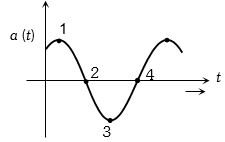
The acceleration $a$ of a particle undergoing $S.H.M.$ is shown in the figure. Which of the labelled points corresponds to the particle being at $-x_{max}$?
A
$4$
B
$3$
C
$2$
D
$1$
Solution
(D) The acceleration of a particle in $S.H.M.$ is given by the relation $a = -\omega^2 x$,where $\omega$ is the angular frequency and $x$ is the displacement.
For the particle to be at $-x_{max}$,we substitute $x = -x_{max}$ into the equation:
$a = -\omega^2 (-x_{max}) = +\omega^2 x_{max}$.
This shows that at $x = -x_{max}$,the acceleration $a$ must be at its maximum positive value.
Looking at the provided graph,point $1$ corresponds to the maximum positive value of acceleration.
Therefore,point $1$ corresponds to the particle being at $-x_{max}$.
For the particle to be at $-x_{max}$,we substitute $x = -x_{max}$ into the equation:
$a = -\omega^2 (-x_{max}) = +\omega^2 x_{max}$.
This shows that at $x = -x_{max}$,the acceleration $a$ must be at its maximum positive value.
Looking at the provided graph,point $1$ corresponds to the maximum positive value of acceleration.
Therefore,point $1$ corresponds to the particle being at $-x_{max}$.
0 likes
View Solution24
EasyMCQ
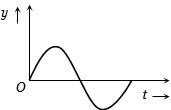
The displacement-time graph of a particle executing $S.H.M.$ is as shown in the figure. The corresponding force-time graph of the particle is:
A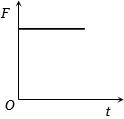
B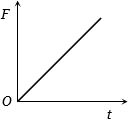
C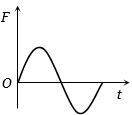
D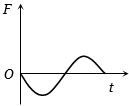
Solution
(D) For a particle executing $S.H.M.$,the displacement $y$ is given by $y = A \sin(\omega t)$.
Acceleration $a = \frac{d^2y}{dt^2} = -A\omega^2 \sin(\omega t) = -\omega^2 y$.
According to Newton's second law,the restoring force $F$ is given by $F = ma = -m\omega^2 y$.
Substituting the expression for $y$,we get $F = -m\omega^2 A \sin(\omega t)$.
This shows that the force $F$ is also a sinusoidal function of time but with a phase difference of $\pi$ radians relative to the displacement $y$.
Therefore,if the displacement graph is a positive sine wave starting from the origin,the force-time graph must be an inverted (negative) sine wave starting from the origin,which corresponds to option $D$.
Acceleration $a = \frac{d^2y}{dt^2} = -A\omega^2 \sin(\omega t) = -\omega^2 y$.
According to Newton's second law,the restoring force $F$ is given by $F = ma = -m\omega^2 y$.
Substituting the expression for $y$,we get $F = -m\omega^2 A \sin(\omega t)$.
This shows that the force $F$ is also a sinusoidal function of time but with a phase difference of $\pi$ radians relative to the displacement $y$.
Therefore,if the displacement graph is a positive sine wave starting from the origin,the force-time graph must be an inverted (negative) sine wave starting from the origin,which corresponds to option $D$.
0 likes
View Solution25
EasyMCQ
The variation of the acceleration $a$ of a particle executing $S.H.M.$ with displacement $x$ is as shown in the figure. Which of the following graphs correctly represents this relationship?
A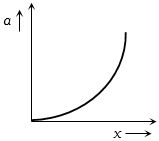
B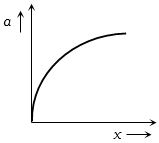
C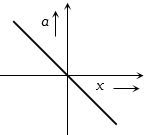
D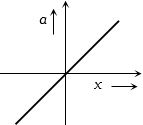
Solution
(C) In Simple Harmonic Motion $(S.H.M.)$,the acceleration $a$ of a particle is directly proportional to the negative of its displacement $x$ from the mean position.
This relationship is given by the equation: $a = -\omega^2 x$,where $\omega$ is the angular frequency.
This equation is of the form $y = mx$,which represents a straight line passing through the origin.
Since the slope $m = -\omega^2$ is negative,the graph must be a straight line passing through the origin with a negative slope.
Therefore,the correct graph is the one shown in option $C$.
This relationship is given by the equation: $a = -\omega^2 x$,where $\omega$ is the angular frequency.
This equation is of the form $y = mx$,which represents a straight line passing through the origin.
Since the slope $m = -\omega^2$ is negative,the graph must be a straight line passing through the origin with a negative slope.
Therefore,the correct graph is the one shown in option $C$.
0 likes
View Solution26
EasyMCQ
$A$ particle of mass $10 \, g$ performs simple harmonic motion with an amplitude of $0.5 \, m$ and an angular frequency of $10 \, rad/s$. What is the maximum force acting on it in $N$?
A
$25$
B
$5$
C
$2.5$
D
$0.5$
Solution
(D) The mass of the particle is $m = 10 \, g = 10 \times 10^{-3} \, kg = 0.01 \, kg$.
The amplitude is $A = 0.5 \, m$.
The angular frequency is $\omega = 10 \, rad/s$.
The maximum force $F_{max}$ in simple harmonic motion is given by the formula $F_{max} = m \omega^2 A$.
Substituting the values: $F_{max} = 0.01 \times (10)^2 \times 0.5$.
$F_{max} = 0.01 \times 100 \times 0.5$.
$F_{max} = 1 \times 0.5 = 0.5 \, N$.
The amplitude is $A = 0.5 \, m$.
The angular frequency is $\omega = 10 \, rad/s$.
The maximum force $F_{max}$ in simple harmonic motion is given by the formula $F_{max} = m \omega^2 A$.
Substituting the values: $F_{max} = 0.01 \times (10)^2 \times 0.5$.
$F_{max} = 0.01 \times 100 \times 0.5$.
$F_{max} = 1 \times 0.5 = 0.5 \, N$.
0 likes
View Solution27
DifficultMCQ
If the acceleration of a particle at a distance of $3 \ cm$ from the equilibrium position is $12 \ cm/sec^2$,what is the time period of the simple harmonic motion in seconds?
A
$0.5$
B
$1$
C
$2$
D
$3.14$
Solution
(D) The acceleration $a$ of a particle in simple harmonic motion is given by $a = \omega^2 y$,where $\omega$ is the angular frequency and $y$ is the displacement from the equilibrium position.
Given $a = 12 \ cm/sec^2$ and $y = 3 \ cm$.
Substituting these values: $12 = \omega^2 \times 3$.
$\omega^2 = \frac{12}{3} = 4$.
$\omega = 2 \ rad/sec$.
The time period $T$ is given by $T = \frac{2\pi}{\omega}$.
$T = \frac{2\pi}{2} = \pi \approx 3.14 \ sec$.
Given $a = 12 \ cm/sec^2$ and $y = 3 \ cm$.
Substituting these values: $12 = \omega^2 \times 3$.
$\omega^2 = \frac{12}{3} = 4$.
$\omega = 2 \ rad/sec$.
The time period $T$ is given by $T = \frac{2\pi}{\omega}$.
$T = \frac{2\pi}{2} = \pi \approx 3.14 \ sec$.
0 likes
View Solution28
DifficultMCQ
For a particle executing simple harmonic motion given by $y(cm) = \sin \frac{\pi}{2} \left( \frac{t}{2} + \frac{1}{3} \right)$,what is the maximum acceleration in $cm/sec^2$?
A
$5.21$
B
$3.62$
C
$1.81$
D
$0.62$
Solution
(D) The given equation is $y = \sin \left( \frac{\pi t}{4} + \frac{\pi}{6} \right)$.
Comparing this with the standard $SHM$ equation $y = A \sin(\omega t + \phi)$:
The amplitude $A = 1 \ cm$ and the angular frequency $\omega = \frac{\pi}{4} \ rad/sec$.
The maximum acceleration $a_{max}$ is given by the formula $a_{max} = \omega^2 A$.
Substituting the values: $a_{max} = \left( \frac{\pi}{4} \right)^2 \times 1$.
$a_{max} = \frac{\pi^2}{16} \approx \frac{9.8696}{16} \approx 0.6168 \ cm/sec^2$.
Rounding to two decimal places,we get $0.62 \ cm/sec^2$.
Comparing this with the standard $SHM$ equation $y = A \sin(\omega t + \phi)$:
The amplitude $A = 1 \ cm$ and the angular frequency $\omega = \frac{\pi}{4} \ rad/sec$.
The maximum acceleration $a_{max}$ is given by the formula $a_{max} = \omega^2 A$.
Substituting the values: $a_{max} = \left( \frac{\pi}{4} \right)^2 \times 1$.
$a_{max} = \frac{\pi^2}{16} \approx \frac{9.8696}{16} \approx 0.6168 \ cm/sec^2$.
Rounding to two decimal places,we get $0.62 \ cm/sec^2$.
0 likes
View Solution29
EasyMCQ
The phase difference between the instantaneous velocity and acceleration of a particle executing simple harmonic motion is
A
$\pi$
B
$2\pi$
C
$0.5\pi$
D
$0$
Solution
(C) Let the displacement of a particle executing simple harmonic motion be $y = A \sin(\omega t)$.
The instantaneous velocity $v$ is given by the derivative of displacement with respect to time:
$v = \frac{dy}{dt} = A\omega \cos(\omega t) = A\omega \sin(\omega t + \frac{\pi}{2})$.
The instantaneous acceleration $a$ is given by the derivative of velocity with respect to time:
$a = \frac{dv}{dt} = -A\omega^2 \sin(\omega t) = A\omega^2 \sin(\omega t + \pi)$.
The phase of velocity is $(\omega t + \frac{\pi}{2})$ and the phase of acceleration is $(\omega t + \pi)$.
The phase difference between acceleration and velocity is $(\omega t + \pi) - (\omega t + \frac{\pi}{2}) = \frac{\pi}{2}$ or $0.5\pi$.
The instantaneous velocity $v$ is given by the derivative of displacement with respect to time:
$v = \frac{dy}{dt} = A\omega \cos(\omega t) = A\omega \sin(\omega t + \frac{\pi}{2})$.
The instantaneous acceleration $a$ is given by the derivative of velocity with respect to time:
$a = \frac{dv}{dt} = -A\omega^2 \sin(\omega t) = A\omega^2 \sin(\omega t + \pi)$.
The phase of velocity is $(\omega t + \frac{\pi}{2})$ and the phase of acceleration is $(\omega t + \pi)$.
The phase difference between acceleration and velocity is $(\omega t + \pi) - (\omega t + \frac{\pi}{2}) = \frac{\pi}{2}$ or $0.5\pi$.
0 likes
View Solution30
EasyMCQ
Two simple harmonic motions of angular frequency $100 \, rad \, s^{-1}$ and $1000 \, rad \, s^{-1}$ have the same displacement amplitude. The ratio of their maximum acceleration is
A
$1:10^3$
B
$1:10^4$
C
$1:10$
D
$1:10^2$
Solution
(D) The angular frequencies are given as $\omega_{1} = 100 \, rad \, s^{-1}$ and $\omega_{2} = 1000 \, rad \, s^{-1}$.
Let the common displacement amplitude be $A$.
The maximum acceleration $a_{max}$ for a simple harmonic motion is given by the formula $a_{max} = \omega^2 A$.
For the first motion,$a_{max1} = \omega_{1}^2 A = (100)^2 A$.
For the second motion,$a_{max2} = \omega_{2}^2 A = (1000)^2 A$.
The ratio of their maximum accelerations is $\frac{a_{max1}}{a_{max2}} = \frac{\omega_{1}^2 A}{\omega_{2}^2 A} = \frac{\omega_{1}^2}{\omega_{2}^2}$.
Substituting the values,we get $\frac{a_{max1}}{a_{max2}} = \frac{(100)^2}{(1000)^2} = \frac{10000}{1000000} = \frac{1}{100}$.
Thus,the ratio is $1:10^2$.
Let the common displacement amplitude be $A$.
The maximum acceleration $a_{max}$ for a simple harmonic motion is given by the formula $a_{max} = \omega^2 A$.
For the first motion,$a_{max1} = \omega_{1}^2 A = (100)^2 A$.
For the second motion,$a_{max2} = \omega_{2}^2 A = (1000)^2 A$.
The ratio of their maximum accelerations is $\frac{a_{max1}}{a_{max2}} = \frac{\omega_{1}^2 A}{\omega_{2}^2 A} = \frac{\omega_{1}^2}{\omega_{2}^2}$.
Substituting the values,we get $\frac{a_{max1}}{a_{max2}} = \frac{(100)^2}{(1000)^2} = \frac{10000}{1000000} = \frac{1}{100}$.
Thus,the ratio is $1:10^2$.
0 likes
View Solution31
MediumMCQ
The oscillation of a body on a smooth horizontal surface is represented by the equation $x = A \cos \omega t$,where $x$ is the displacement at time $t$ and $\omega$ is the angular frequency of oscillation. Which one of the following graphs correctly shows the variation of acceleration $a$ with time $t$?
A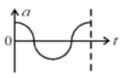
B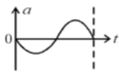
C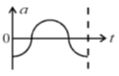
D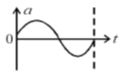
Solution
(C) Given the displacement equation: $x = A \cos \omega t$.
The velocity $v$ is the first derivative of displacement with respect to time:
$v = \frac{dx}{dt} = \frac{d}{dt}(A \cos \omega t) = -A \omega \sin \omega t$.
The acceleration $a$ is the derivative of velocity with respect to time:
$a = \frac{dv}{dt} = \frac{d}{dt}(-A \omega \sin \omega t) = -A \omega^2 \cos \omega t$.
Comparing this with the original displacement equation $x = A \cos \omega t$,we see that $a = -\omega^2 x$. At $t = 0$,$x = A$,so $a = -A \omega^2$. This means the acceleration starts at a negative maximum value and follows a negative cosine curve. Graph $C$ represents this variation correctly.
The velocity $v$ is the first derivative of displacement with respect to time:
$v = \frac{dx}{dt} = \frac{d}{dt}(A \cos \omega t) = -A \omega \sin \omega t$.
The acceleration $a$ is the derivative of velocity with respect to time:
$a = \frac{dv}{dt} = \frac{d}{dt}(-A \omega \sin \omega t) = -A \omega^2 \cos \omega t$.
Comparing this with the original displacement equation $x = A \cos \omega t$,we see that $a = -\omega^2 x$. At $t = 0$,$x = A$,so $a = -A \omega^2$. This means the acceleration starts at a negative maximum value and follows a negative cosine curve. Graph $C$ represents this variation correctly.
0 likes
View Solution32
MediumMCQ
The maximum acceleration of a particle in $SHM$ is made two times keeping the maximum speed constant. This is possible when:
A
amplitude of oscillation is doubled while frequency remains constant
B
amplitude is doubled while frequency is halved
C
frequency is doubled while amplitude is halved
D
frequency is doubled while amplitude remains constant
Solution
(C) The maximum acceleration is given by $a_{\max} = A\omega^2$ and the maximum speed is given by $v_{\max} = A\omega$.
Let the initial amplitude be $A_1$ and angular frequency be $\omega_1$. Then $v_{\max} = A_1\omega_1$ and $a_{\max} = A_1\omega_1^2$.
If the new amplitude is $A_2$ and new angular frequency is $\omega_2$,we are given that $v_{\max}$ remains constant,so $A_1\omega_1 = A_2\omega_2$.
We are also given that the new maximum acceleration is twice the original,so $A_2\omega_2^2 = 2(A_1\omega_1^2)$.
Dividing the second equation by the first: $\frac{A_2\omega_2^2}{A_1\omega_1} = \frac{2A_1\omega_1^2}{A_1\omega_1} \implies \frac{\omega_2}{\omega_1} = 2$,which means $\omega_2 = 2\omega_1$ (frequency is doubled).
Substituting $\omega_2 = 2\omega_1$ into $A_1\omega_1 = A_2\omega_2$,we get $A_1\omega_1 = A_2(2\omega_1) \implies A_2 = \frac{A_1}{2}$ (amplitude is halved).
Therefore,the frequency is doubled and the amplitude is halved.
Let the initial amplitude be $A_1$ and angular frequency be $\omega_1$. Then $v_{\max} = A_1\omega_1$ and $a_{\max} = A_1\omega_1^2$.
If the new amplitude is $A_2$ and new angular frequency is $\omega_2$,we are given that $v_{\max}$ remains constant,so $A_1\omega_1 = A_2\omega_2$.
We are also given that the new maximum acceleration is twice the original,so $A_2\omega_2^2 = 2(A_1\omega_1^2)$.
Dividing the second equation by the first: $\frac{A_2\omega_2^2}{A_1\omega_1} = \frac{2A_1\omega_1^2}{A_1\omega_1} \implies \frac{\omega_2}{\omega_1} = 2$,which means $\omega_2 = 2\omega_1$ (frequency is doubled).
Substituting $\omega_2 = 2\omega_1$ into $A_1\omega_1 = A_2\omega_2$,we get $A_1\omega_1 = A_2(2\omega_1) \implies A_2 = \frac{A_1}{2}$ (amplitude is halved).
Therefore,the frequency is doubled and the amplitude is halved.
0 likes
View Solution33
MediumMCQ
The graphs in the figure show that a quantity $y$ varies with displacement $d$ in a system undergoing simple harmonic motion. Which graph best represents the relationship obtained when $y$ is the unbalanced force acting on the system?

A
$I$
B
$II$
C
$III$
D
$IV$
Solution
(NONE) In simple harmonic motion $(SHM)$,the restoring force (or unbalanced force) $F$ acting on a particle is given by the equation $F = -kd$,where $k$ is the force constant and $d$ is the displacement from the equilibrium position.
This equation $F = -kd$ represents a linear relationship between the force $F$ and the displacement $d$,where the force is directly proportional to the displacement but acts in the opposite direction.
Graphically,this is a straight line passing through the origin with a negative slope.
None of the provided graphs $(I, II, III, IV)$ depict a straight line passing through the origin with a negative slope. Therefore,the question as presented is technically flawed because the correct graph for force versus displacement is not among the options.
This equation $F = -kd$ represents a linear relationship between the force $F$ and the displacement $d$,where the force is directly proportional to the displacement but acts in the opposite direction.
Graphically,this is a straight line passing through the origin with a negative slope.
None of the provided graphs $(I, II, III, IV)$ depict a straight line passing through the origin with a negative slope. Therefore,the question as presented is technically flawed because the correct graph for force versus displacement is not among the options.
0 likes
View Solution34
DifficultMCQ
$A$ particle executes $SHM$ on a straight line path. The amplitude of oscillation is $2 \, cm$. When the displacement of the particle from the mean position is $1 \, cm$,the numerical value of the magnitude of acceleration is equal to the numerical value of the magnitude of velocity. The frequency of $SHM$ (in $s^{-1}$) is:
A
$2\pi \sqrt{3}$
B
$\frac{2\pi}{\sqrt{3}}$
C
$\frac{\sqrt{3}}{2\pi}$
D
$\frac{1}{2\pi \sqrt{3}}$
Solution
(C) Given that the magnitude of velocity $|v|$ is equal to the magnitude of acceleration $|a|$.
For $SHM$,velocity is $v = \omega \sqrt{A^2 - x^2}$ and acceleration is $a = -\omega^2 x$.
Equating the magnitudes: $|v| = |a| \Rightarrow \omega \sqrt{A^2 - x^2} = \omega^2 x$.
Dividing both sides by $\omega$ (assuming $\omega \neq 0$): $\sqrt{A^2 - x^2} = \omega x$.
Solving for angular frequency $\omega$: $\omega = \frac{\sqrt{A^2 - x^2}}{x}$.
Given $A = 2 \, cm$ and $x = 1 \, cm$,we have $\omega = \frac{\sqrt{2^2 - 1^2}}{1} = \sqrt{3} \, rad/s$.
Since $\omega = 2 \pi f$,the frequency $f = \frac{\omega}{2 \pi} = \frac{\sqrt{3}}{2 \pi} \, s^{-1}$.
For $SHM$,velocity is $v = \omega \sqrt{A^2 - x^2}$ and acceleration is $a = -\omega^2 x$.
Equating the magnitudes: $|v| = |a| \Rightarrow \omega \sqrt{A^2 - x^2} = \omega^2 x$.
Dividing both sides by $\omega$ (assuming $\omega \neq 0$): $\sqrt{A^2 - x^2} = \omega x$.
Solving for angular frequency $\omega$: $\omega = \frac{\sqrt{A^2 - x^2}}{x}$.
Given $A = 2 \, cm$ and $x = 1 \, cm$,we have $\omega = \frac{\sqrt{2^2 - 1^2}}{1} = \sqrt{3} \, rad/s$.
Since $\omega = 2 \pi f$,the frequency $f = \frac{\omega}{2 \pi} = \frac{\sqrt{3}}{2 \pi} \, s^{-1}$.
0 likes
View Solution35
MediumMCQ
In $SHM$,the acceleration versus displacement (from mean position) graph:
A
is always a straight line passing through the origin with a negative slope.
B
is always a straight line passing through the origin with a positive slope.
C
is a straight line not necessarily passing through the origin.
D
none of the above.
Solution
(A) The acceleration $a$ of a particle in $SHM$ is given by the equation $a = -\omega^{2}x$,where $\omega$ is the angular frequency and $x$ is the displacement from the mean position.
Comparing this with the equation of a straight line $y = mx + c$,we see that $y = a$,$m = -\omega^{2}$,$x = x$,and $c = 0$.
Since the intercept $c$ is $0$,the graph is a straight line passing through the origin.
Since $\omega^{2}$ is always positive,the slope $m = -\omega^{2}$ is always negative.
Therefore,the graph is a straight line passing through the origin with a negative slope.
Comparing this with the equation of a straight line $y = mx + c$,we see that $y = a$,$m = -\omega^{2}$,$x = x$,and $c = 0$.
Since the intercept $c$ is $0$,the graph is a straight line passing through the origin.
Since $\omega^{2}$ is always positive,the slope $m = -\omega^{2}$ is always negative.
Therefore,the graph is a straight line passing through the origin with a negative slope.
0 likes
View Solution36
MediumMCQ
$A$ point mass oscillates along the $x$-axis according to the law $x=x_0 \cos(\omega t - \frac{\pi}{4})$. If the acceleration of the particle is written as $a=A \cos(\omega t + \delta)$,then:
A
$A=x_0 \omega^2, \delta = \frac{3\pi}{4}$
B
$A=x_0, \delta = -\frac{\pi}{4}$
C
$A=x_0 \omega^2, \delta = \frac{\pi}{4}$
D
$A=x_0 \omega^2, \delta = -\frac{\pi}{4}$
Solution
(A) Given the displacement equation: $x = x_0 \cos(\omega t - \frac{\pi}{4})$.
Velocity $v = \frac{dx}{dt} = -x_0 \omega \sin(\omega t - \frac{\pi}{4})$.
Acceleration $a = \frac{dv}{dt} = -x_0 \omega^2 \cos(\omega t - \frac{\pi}{4})$.
Using the trigonometric identity $\cos(\theta + \pi) = -\cos(\theta)$,we can rewrite the acceleration as:
$a = x_0 \omega^2 \cos(\omega t - \frac{\pi}{4} + \pi) = x_0 \omega^2 \cos(\omega t + \frac{3\pi}{4})$.
Comparing this with the given form $a = A \cos(\omega t + \delta)$,we find:
$A = x_0 \omega^2$ and $\delta = \frac{3\pi}{4}$.
Velocity $v = \frac{dx}{dt} = -x_0 \omega \sin(\omega t - \frac{\pi}{4})$.
Acceleration $a = \frac{dv}{dt} = -x_0 \omega^2 \cos(\omega t - \frac{\pi}{4})$.
Using the trigonometric identity $\cos(\theta + \pi) = -\cos(\theta)$,we can rewrite the acceleration as:
$a = x_0 \omega^2 \cos(\omega t - \frac{\pi}{4} + \pi) = x_0 \omega^2 \cos(\omega t + \frac{3\pi}{4})$.
Comparing this with the given form $a = A \cos(\omega t + \delta)$,we find:
$A = x_0 \omega^2$ and $\delta = \frac{3\pi}{4}$.
0 likes
View Solution37
MediumMCQ
If $x, v$ and $a$ denote the displacement,the velocity and the acceleration of a particle executing simple harmonic motion of time period $T$,then,which of the following does not change with time?
A
$a^2T^2 + 4\pi^2v^2$
B
$\frac{aT}{x}$
C
$aT + 2\pi f$
D
$\frac{aT}{v}$
Solution
(B) For a particle executing Simple Harmonic Motion $(SHM)$,the displacement is given by $x = A \sin(\omega t + \phi)$.
The velocity is $v = \frac{dx}{dt} = A\omega \cos(\omega t + \phi)$.
The acceleration is $a = \frac{dv}{dt} = -A\omega^2 \sin(\omega t + \phi) = -\omega^2 x$.
From the acceleration equation,we have $\frac{a}{x} = -\omega^2$.
Since $\omega = \frac{2\pi}{T}$,we have $\omega^2 = \frac{4\pi^2}{T^2}$.
Substituting this into the ratio,we get $\frac{a}{x} = -\frac{4\pi^2}{T^2}$.
Rearranging this,we get $\frac{aT^2}{x} = -4\pi^2$,which is a constant.
However,looking at the options provided,we evaluate $\frac{a}{x} = -\omega^2$. Since $\omega$ and $T$ are constants for a given $SHM$,the ratio $\frac{a}{x}$ is constant. Thus,$\frac{aT}{x}$ is also a constant because $T$ is constant.
The velocity is $v = \frac{dx}{dt} = A\omega \cos(\omega t + \phi)$.
The acceleration is $a = \frac{dv}{dt} = -A\omega^2 \sin(\omega t + \phi) = -\omega^2 x$.
From the acceleration equation,we have $\frac{a}{x} = -\omega^2$.
Since $\omega = \frac{2\pi}{T}$,we have $\omega^2 = \frac{4\pi^2}{T^2}$.
Substituting this into the ratio,we get $\frac{a}{x} = -\frac{4\pi^2}{T^2}$.
Rearranging this,we get $\frac{aT^2}{x} = -4\pi^2$,which is a constant.
However,looking at the options provided,we evaluate $\frac{a}{x} = -\omega^2$. Since $\omega$ and $T$ are constants for a given $SHM$,the ratio $\frac{a}{x}$ is constant. Thus,$\frac{aT}{x}$ is also a constant because $T$ is constant.
1 likes
View Solution38
DifficultMCQ
Values of the acceleration $A$ of a particle moving in simple harmonic motion as a function of its displacement $x$ are given in the table below:
The period of the motion is:
| $A \ (mm \ s^{-2})$ | $16$ | $8$ | $0$ | $-8$ | $-16$ |
| $x \ (mm)$ | $-4$ | $-2$ | $0$ | $2$ | $4$ |
The period of the motion is:
A
$\frac{1}{\pi} \ s$
B
$\frac{2}{\pi} \ s$
C
$\frac{\pi}{2} \ s$
D
$\pi \ s$
Solution
(D) For a particle in simple harmonic motion, the acceleration $A$ is given by $A = -\omega^2 x$, where $\omega$ is the angular frequency.
Taking the magnitude, we have $|A| = \omega^2 |x|$, which implies $\omega^2 = \frac{|A|}{|x|}$.
Using the values from the table (e.g., $|A| = 16 \ mm \ s^{-2}$ and $|x| = 4 \ mm$):
$\omega^2 = \frac{16 \ mm \ s^{-2}}{4 \ mm} = 4 \ s^{-2}$.
Therefore, $\omega = \sqrt{4} = 2 \ rad \ s^{-1}$.
The time period $T$ is related to the angular frequency by the formula $T = \frac{2\pi}{\omega}$.
Substituting the value of $\omega$:
$T = \frac{2\pi}{2} = \pi \ s$.
Taking the magnitude, we have $|A| = \omega^2 |x|$, which implies $\omega^2 = \frac{|A|}{|x|}$.
Using the values from the table (e.g., $|A| = 16 \ mm \ s^{-2}$ and $|x| = 4 \ mm$):
$\omega^2 = \frac{16 \ mm \ s^{-2}}{4 \ mm} = 4 \ s^{-2}$.
Therefore, $\omega = \sqrt{4} = 2 \ rad \ s^{-1}$.
The time period $T$ is related to the angular frequency by the formula $T = \frac{2\pi}{\omega}$.
Substituting the value of $\omega$:
$T = \frac{2\pi}{2} = \pi \ s$.
0 likes
View Solution39
EasyMCQ
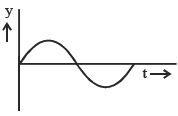
The displacement versus time graph of $SHM$ is shown. Which of the following is its acceleration versus time graph?
A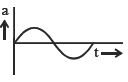
B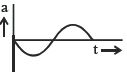
C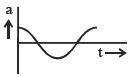
D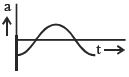
Solution
(B) The displacement $y$ of a particle in $SHM$ is given by $y = A \sin(\omega t)$,where $A$ is the amplitude and $\omega$ is the angular frequency.
Acceleration $a$ is the second derivative of displacement with respect to time:
$a = \frac{d^2y}{dt^2} = \frac{d}{dt}(A \omega \cos(\omega t)) = -A \omega^2 \sin(\omega t)$.
Comparing the equations,$a = -\omega^2 y$.
This means the acceleration graph is an inverted version of the displacement graph,scaled by a factor of $\omega^2$.
Since the displacement graph starts at $0$ and goes positive,the acceleration graph must start at $0$ and go negative.
Looking at the options,option $B$ shows a graph that starts at $0$ and goes negative,which matches the derived equation $a = -A \omega^2 \sin(\omega t)$.
Acceleration $a$ is the second derivative of displacement with respect to time:
$a = \frac{d^2y}{dt^2} = \frac{d}{dt}(A \omega \cos(\omega t)) = -A \omega^2 \sin(\omega t)$.
Comparing the equations,$a = -\omega^2 y$.
This means the acceleration graph is an inverted version of the displacement graph,scaled by a factor of $\omega^2$.
Since the displacement graph starts at $0$ and goes positive,the acceleration graph must start at $0$ and go negative.
Looking at the options,option $B$ shows a graph that starts at $0$ and goes negative,which matches the derived equation $a = -A \omega^2 \sin(\omega t)$.
0 likes
View Solution40
MediumMCQ
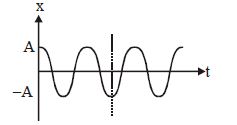
This is the position-time graph of a mass on a spring. What can you say about the velocity and force at the instant indicated by the dashed line? (Positive direction is to the right.)
A
Velocity is zero,force is to the right
B
Velocity is positive,force is to the right
C
Velocity is negative,force is to the right
D
Velocity is zero,force is to the left
Solution
(A) At the instant indicated by the dashed line,the particle is at its negative extreme position $(x = -A)$.
At the extreme position,the velocity of the particle is zero $(v = 0)$.
The restoring force in a spring is given by $F = -kx$. Since the particle is at $x = -A$,the force is $F = -k(-A) = +kA$.
$A$ positive force indicates that the force is directed towards the positive direction (to the right).
Therefore,the velocity is zero and the force is to the right.
At the extreme position,the velocity of the particle is zero $(v = 0)$.
The restoring force in a spring is given by $F = -kx$. Since the particle is at $x = -A$,the force is $F = -k(-A) = +kA$.
$A$ positive force indicates that the force is directed towards the positive direction (to the right).
Therefore,the velocity is zero and the force is to the right.

0 likes
View Solution41
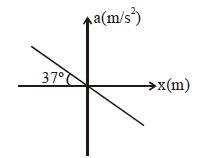
MediumMCQ
The acceleration-displacement graph of a particle executing $SHM$ is shown in the figure. The time period of the simple harmonic motion is:
A
$\frac{4\pi}{\sqrt{3}} \, s$
B
$\frac{2\pi}{\sqrt{3}} \, s$
C
The given graph does not represent $SHM$
D
Information is insufficient
Solution
(A) For a particle executing $SHM$,the acceleration $a$ is given by $a = -\omega^{2}x$.
The slope of the acceleration-displacement graph is $m = \frac{a}{x} = -\omega^{2}$.
From the given graph,the angle made by the line with the negative $x$-axis is $37^{\circ}$. The slope of the line is $\tan(180^{\circ} - 37^{\circ}) = -\tan 37^{\circ} = -\frac{3}{4}$.
Equating the slopes: $-\omega^{2} = -\frac{3}{4} \Rightarrow \omega^{2} = \frac{3}{4}$.
Since $\omega = \frac{2\pi}{T}$,we have $\omega^{2} = \frac{4\pi^{2}}{T^{2}} = \frac{3}{4}$.
Solving for $T$: $T^{2} = \frac{16\pi^{2}}{3} \Rightarrow T = \frac{4\pi}{\sqrt{3}} \, s$.
The slope of the acceleration-displacement graph is $m = \frac{a}{x} = -\omega^{2}$.
From the given graph,the angle made by the line with the negative $x$-axis is $37^{\circ}$. The slope of the line is $\tan(180^{\circ} - 37^{\circ}) = -\tan 37^{\circ} = -\frac{3}{4}$.
Equating the slopes: $-\omega^{2} = -\frac{3}{4} \Rightarrow \omega^{2} = \frac{3}{4}$.
Since $\omega = \frac{2\pi}{T}$,we have $\omega^{2} = \frac{4\pi^{2}}{T^{2}} = \frac{3}{4}$.
Solving for $T$: $T^{2} = \frac{16\pi^{2}}{3} \Rightarrow T = \frac{4\pi}{\sqrt{3}} \, s$.
0 likes
View Solution42
DifficultMCQ
The ratio of maximum acceleration to maximum velocity in a simple harmonic motion is $10\,s^{-1}$. At $t = 0$,the displacement is $5\,m$. What is the maximum acceleration? The initial phase is $\frac{\pi}{4}$.
A
$500\,m/s^2$
B
$500\sqrt{2}\,m/s^2$
C
$750\,m/s^2$
D
$750\sqrt{2}\,m/s^2$
Solution
(B) Maximum velocity in $SHM$ is given by $v_{\max} = a\omega$.
Maximum acceleration in $SHM$ is given by $A_{\max} = a\omega^2$,where $a$ is the amplitude and $\omega$ is the angular frequency.
Given the ratio $\frac{A_{\max}}{v_{\max}} = 10$,we have $\frac{a\omega^2}{a\omega} = 10$,which implies $\omega = 10\,s^{-1}$.
The displacement equation is $x = a \sin(\omega t + \phi)$.
At $t = 0$,$x = 5\,m$ and $\phi = \frac{\pi}{4}$.
Substituting these values: $5 = a \sin(\frac{\pi}{4}) = a \cdot \frac{1}{\sqrt{2}}$.
Thus,the amplitude $a = 5\sqrt{2}\,m$.
The maximum acceleration is $A_{\max} = a\omega^2 = (5\sqrt{2}) \cdot (10)^2 = 5\sqrt{2} \cdot 100 = 500\sqrt{2}\,m/s^2$.
Maximum acceleration in $SHM$ is given by $A_{\max} = a\omega^2$,where $a$ is the amplitude and $\omega$ is the angular frequency.
Given the ratio $\frac{A_{\max}}{v_{\max}} = 10$,we have $\frac{a\omega^2}{a\omega} = 10$,which implies $\omega = 10\,s^{-1}$.
The displacement equation is $x = a \sin(\omega t + \phi)$.
At $t = 0$,$x = 5\,m$ and $\phi = \frac{\pi}{4}$.
Substituting these values: $5 = a \sin(\frac{\pi}{4}) = a \cdot \frac{1}{\sqrt{2}}$.
Thus,the amplitude $a = 5\sqrt{2}\,m$.
The maximum acceleration is $A_{\max} = a\omega^2 = (5\sqrt{2}) \cdot (10)^2 = 5\sqrt{2} \cdot 100 = 500\sqrt{2}\,m/s^2$.
0 likes
View Solution43
DifficultMCQ
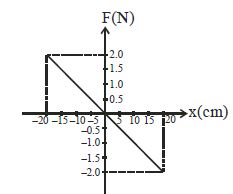
The figure shows the variation of force acting on a particle of mass $400\, g$ executing simple harmonic motion. The frequency of oscillation of the particle is
A
$4\, s^{-1}$
B
$\left( \frac{5}{2\pi} \right)\, s^{-1}$
C
$\left( \frac{1}{8\pi} \right)\, s^{-1}$
D
$\left( \frac{1}{2\pi} \right)\, s^{-1}$
Solution
(B) For a particle executing simple harmonic motion,the force is given by $F = -kx$,where $k$ is the force constant.
From the graph,at $x = 20\, cm = 0.2\, m$,the force $F = -2.0\, N$.
Thus,the magnitude of the force constant is $k = \frac{|F|}{|x|} = \frac{2.0\, N}{0.2\, m} = 10\, N/m$.
The mass of the particle is $m = 400\, g = 0.4\, kg$.
The frequency of oscillation $f$ is given by the formula $f = \frac{1}{2\pi} \sqrt{\frac{k}{m}}$.
Substituting the values,we get $f = \frac{1}{2\pi} \sqrt{\frac{10}{0.4}} = \frac{1}{2\pi} \sqrt{25} = \frac{5}{2\pi}\, s^{-1}$.
From the graph,at $x = 20\, cm = 0.2\, m$,the force $F = -2.0\, N$.
Thus,the magnitude of the force constant is $k = \frac{|F|}{|x|} = \frac{2.0\, N}{0.2\, m} = 10\, N/m$.
The mass of the particle is $m = 400\, g = 0.4\, kg$.
The frequency of oscillation $f$ is given by the formula $f = \frac{1}{2\pi} \sqrt{\frac{k}{m}}$.
Substituting the values,we get $f = \frac{1}{2\pi} \sqrt{\frac{10}{0.4}} = \frac{1}{2\pi} \sqrt{25} = \frac{5}{2\pi}\, s^{-1}$.
0 likes
View Solution44
MediumMCQ
$A$ particle is executing a simple harmonic motion. Its maximum acceleration is $\alpha$ and maximum velocity is $\beta$. Then its frequency of vibration will be
A
$\frac{\alpha}{2\pi\beta}$
B
$\frac{\alpha^2}{\beta^2}$
C
$\frac{\beta}{\alpha}$
D
$\frac{\alpha}{\beta^2}$
Solution
(A) For a particle in simple harmonic motion,the maximum acceleration is given by $a_{\max} = \omega^2 A = \alpha$ $...(1)$
The maximum velocity is given by $v_{\max} = \omega A = \beta$ $...(2)$
Dividing equation $(1)$ by equation $(2)$,we get:
$\frac{\omega^2 A}{\omega A} = \frac{\alpha}{\beta}$
$\omega = \frac{\alpha}{\beta}$
Since angular frequency $\omega = 2\pi f$,where $f$ is the frequency of vibration:
$2\pi f = \frac{\alpha}{\beta}$
$f = \frac{\alpha}{2\pi\beta}$
The maximum velocity is given by $v_{\max} = \omega A = \beta$ $...(2)$
Dividing equation $(1)$ by equation $(2)$,we get:
$\frac{\omega^2 A}{\omega A} = \frac{\alpha}{\beta}$
$\omega = \frac{\alpha}{\beta}$
Since angular frequency $\omega = 2\pi f$,where $f$ is the frequency of vibration:
$2\pi f = \frac{\alpha}{\beta}$
$f = \frac{\alpha}{2\pi\beta}$
0 likes
View Solution45
EasyMCQ
Which of the following quantities is always negative in a $SHM$?
A
$\vec F \cdot \vec a$
B
$\vec a \cdot \vec r$
C
$\vec v \cdot \vec r$
D
$\vec v \cdot \vec F$
Solution
(B) In $SHM$,the acceleration $\vec a$ is given by $\vec a = -\omega^2 \vec r$,where $\vec r$ is the displacement vector from the equilibrium position.
Taking the dot product of $\vec a$ and $\vec r$:
$\vec a \cdot \vec r = (-\omega^2 \vec r) \cdot \vec r = -\omega^2 |\vec r|^2$.
Since $\omega^2$ is always positive and $|\vec r|^2$ is always non-negative,the product $\vec a \cdot \vec r$ is always negative (except at the equilibrium position where it is zero).
Therefore,the correct option is $B$.
Taking the dot product of $\vec a$ and $\vec r$:
$\vec a \cdot \vec r = (-\omega^2 \vec r) \cdot \vec r = -\omega^2 |\vec r|^2$.
Since $\omega^2$ is always positive and $|\vec r|^2$ is always non-negative,the product $\vec a \cdot \vec r$ is always negative (except at the equilibrium position where it is zero).
Therefore,the correct option is $B$.
0 likes
View Solution46
DifficultMCQ
$A$ point mass oscillates along the $x$-axis according to the law $x = x_0 \cos(\omega t + \pi/4)$. If the acceleration of the particle is written as $a = A \cos(\omega t + \delta)$,then:
A
$A = x_0 \omega^2, \delta = 3\pi/4$
B
$A = x_0, \delta = -\pi/4$
C
$A = x_0 \omega^2, \delta = \pi/4$
D
$A = x_0 \omega^2, \delta = -\pi/4$
Solution
(A) Given the displacement equation: $x = x_0 \cos(\omega t + \pi/4)$.
The velocity $v$ is the derivative of displacement with respect to time: $v = \frac{dx}{dt} = -x_0 \omega \sin(\omega t + \pi/4)$.
The acceleration $a$ is the derivative of velocity with respect to time: $a = \frac{dv}{dt} = -x_0 \omega^2 \cos(\omega t + \pi/4)$.
Using the trigonometric identity $-\cos(\theta) = \cos(\theta + \pi)$,we can rewrite the acceleration as:
$a = x_0 \omega^2 \cos(\omega t + \pi/4 + \pi) = x_0 \omega^2 \cos(\omega t + 5\pi/4)$.
Since $\cos(\theta)$ has a period of $2\pi$,$\cos(\omega t + 5\pi/4)$ is equivalent to $\cos(\omega t + 5\pi/4 - 2\pi) = \cos(\omega t - 3\pi/4)$.
Comparing $a = x_0 \omega^2 \cos(\omega t - 3\pi/4)$ with $a = A \cos(\omega t + \delta)$,we get $A = x_0 \omega^2$ and $\delta = -3\pi/4$ or $5\pi/4$.
Note: Checking the provided options,the correct phase shift corresponds to $3\pi/4$ if the initial phase was $-\pi/4$. Given the input equation $x = x_0 \cos(\omega t + \pi/4)$,the acceleration is $a = -x_0 \omega^2 \cos(\omega t + \pi/4) = x_0 \omega^2 \cos(\omega t + \pi/4 + \pi) = x_0 \omega^2 \cos(\omega t + 5\pi/4)$. This is equivalent to $x_0 \omega^2 \cos(\omega t - 3\pi/4)$. If the question intended $x = x_0 \cos(\omega t - \pi/4)$,then $a = x_0 \omega^2 \cos(\omega t - \pi/4 + \pi) = x_0 \omega^2 \cos(\omega t + 3\pi/4)$. Thus,$A = x_0 \omega^2$ and $\delta = 3\pi/4$.
The velocity $v$ is the derivative of displacement with respect to time: $v = \frac{dx}{dt} = -x_0 \omega \sin(\omega t + \pi/4)$.
The acceleration $a$ is the derivative of velocity with respect to time: $a = \frac{dv}{dt} = -x_0 \omega^2 \cos(\omega t + \pi/4)$.
Using the trigonometric identity $-\cos(\theta) = \cos(\theta + \pi)$,we can rewrite the acceleration as:
$a = x_0 \omega^2 \cos(\omega t + \pi/4 + \pi) = x_0 \omega^2 \cos(\omega t + 5\pi/4)$.
Since $\cos(\theta)$ has a period of $2\pi$,$\cos(\omega t + 5\pi/4)$ is equivalent to $\cos(\omega t + 5\pi/4 - 2\pi) = \cos(\omega t - 3\pi/4)$.
Comparing $a = x_0 \omega^2 \cos(\omega t - 3\pi/4)$ with $a = A \cos(\omega t + \delta)$,we get $A = x_0 \omega^2$ and $\delta = -3\pi/4$ or $5\pi/4$.
Note: Checking the provided options,the correct phase shift corresponds to $3\pi/4$ if the initial phase was $-\pi/4$. Given the input equation $x = x_0 \cos(\omega t + \pi/4)$,the acceleration is $a = -x_0 \omega^2 \cos(\omega t + \pi/4) = x_0 \omega^2 \cos(\omega t + \pi/4 + \pi) = x_0 \omega^2 \cos(\omega t + 5\pi/4)$. This is equivalent to $x_0 \omega^2 \cos(\omega t - 3\pi/4)$. If the question intended $x = x_0 \cos(\omega t - \pi/4)$,then $a = x_0 \omega^2 \cos(\omega t - \pi/4 + \pi) = x_0 \omega^2 \cos(\omega t + 3\pi/4)$. Thus,$A = x_0 \omega^2$ and $\delta = 3\pi/4$.
0 likes
View Solution47
MediumMCQ
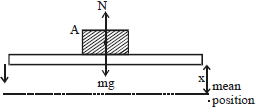
$A$ coin is placed on a horizontal platform which undergoes vertical simple harmonic motion of angular frequency $\omega$. The amplitude of oscillation is gradually increased. The coin will leave contact with the platform for the first time
A
at the mean position of the platform
B
for an amplitude of $\frac{g}{\omega^2}$
C
for an amplitude of $\frac{g^2}{\omega^2}$
D
at the highest position of the platform
Solution
(B) Let $m$ be the mass of the coin and $N$ be the normal reaction force exerted by the platform on the coin.
The equation of motion for the coin in the vertical direction is given by:
$mg - N = m a$
where $a$ is the acceleration of the platform. For simple harmonic motion,the acceleration is $a = -\omega^2 x$,where $x$ is the displacement from the mean position.
Substituting this into the equation of motion:
$mg - N = m(-\omega^2 x)$
$N = m(g + \omega^2 x)$
However,when the platform moves upwards,the acceleration is directed downwards,so $a = -\omega^2 x$ (where $x$ is positive upwards). When the platform is at the highest point,$x = A$ (amplitude),and the acceleration is $a = -\omega^2 A$.
The equation becomes $mg - N = m(-\omega^2 A)$,which implies $N = m(g + \omega^2 A)$. This does not lead to $N=0$.
When the platform moves downwards,the acceleration is directed upwards. At the highest point of the oscillation,the platform's acceleration is directed downwards. The coin loses contact when the normal force $N$ becomes zero.
This happens when the downward acceleration of the platform exceeds the acceleration due to gravity $g$.
The maximum downward acceleration is $\omega^2 A$. Thus,the coin leaves contact when $\omega^2 A \ge g$,or $A \ge \frac{g}{\omega^2}$.
Therefore,the coin will leave contact for the first time when the amplitude reaches $\frac{g}{\omega^2}$ at the highest position of the platform.
The equation of motion for the coin in the vertical direction is given by:
$mg - N = m a$
where $a$ is the acceleration of the platform. For simple harmonic motion,the acceleration is $a = -\omega^2 x$,where $x$ is the displacement from the mean position.
Substituting this into the equation of motion:
$mg - N = m(-\omega^2 x)$
$N = m(g + \omega^2 x)$
However,when the platform moves upwards,the acceleration is directed downwards,so $a = -\omega^2 x$ (where $x$ is positive upwards). When the platform is at the highest point,$x = A$ (amplitude),and the acceleration is $a = -\omega^2 A$.
The equation becomes $mg - N = m(-\omega^2 A)$,which implies $N = m(g + \omega^2 A)$. This does not lead to $N=0$.
When the platform moves downwards,the acceleration is directed upwards. At the highest point of the oscillation,the platform's acceleration is directed downwards. The coin loses contact when the normal force $N$ becomes zero.
This happens when the downward acceleration of the platform exceeds the acceleration due to gravity $g$.
The maximum downward acceleration is $\omega^2 A$. Thus,the coin leaves contact when $\omega^2 A \ge g$,or $A \ge \frac{g}{\omega^2}$.
Therefore,the coin will leave contact for the first time when the amplitude reaches $\frac{g}{\omega^2}$ at the highest position of the platform.
0 likes
View Solution48
MediumMCQ
For a particle performing $S.H.M.$ given by the equation $y = 2 \sin \left( \frac{\pi t}{2} + \phi \right) \, (cm)$,what is the maximum acceleration of the particle?
A
$\frac{\pi}{2} \, cm/s^2$
B
$\frac{\pi^2}{2} \, cm/s^2$
C
$\frac{\pi^2}{4} \, cm/s^2$
D
$\frac{\pi}{4} \, cm/s^2$
Solution
(B) The given equation for $S.H.M.$ is $y = A \sin(\omega t + \phi)$,where $A = 2 \, cm$ and $\omega = \frac{\pi}{2} \, rad/s$.
The velocity $v$ is given by $\frac{dy}{dt} = A\omega \cos(\omega t + \phi)$.
The acceleration $a$ is given by $\frac{d^2y}{dt^2} = -A\omega^2 \sin(\omega t + \phi)$.
The maximum acceleration $a_{max}$ is given by $|A\omega^2|$.
Substituting the values: $a_{max} = 2 \times \left( \frac{\pi}{2} \right)^2 = 2 \times \frac{\pi^2}{4} = \frac{\pi^2}{2} \, cm/s^2$.
The velocity $v$ is given by $\frac{dy}{dt} = A\omega \cos(\omega t + \phi)$.
The acceleration $a$ is given by $\frac{d^2y}{dt^2} = -A\omega^2 \sin(\omega t + \phi)$.
The maximum acceleration $a_{max}$ is given by $|A\omega^2|$.
Substituting the values: $a_{max} = 2 \times \left( \frac{\pi}{2} \right)^2 = 2 \times \frac{\pi^2}{4} = \frac{\pi^2}{2} \, cm/s^2$.
0 likes
View SolutionOscillations — Acceleration and Force of Simple Harmonic Motion · Frequently Asked Questions
1Are these Oscillations questions useful for JEE and NEET?
Yes. All questions in this section are mapped to JEE Main and NEET exam patterns. Previous year questions from JEE Main, NEET, GUJCET and state-level exams are included with full solutions.
2Can I switch to Hindi or Gujarati for these questions?
Yes. Use the language tabs in the hero section or the sidebar to view the same questions and solutions in English, Hindi or Gujarati.
3How do I generate a question paper from this subtopic?
Use the Vedclass Exam Paper Generator — select the chapter and subtopic, set difficulty, and generate Sets A, B, C, D automatically. First 3 chapters of every subject are free.
Vedclass Products
For Students
Vedclass Test Series
Mock tests in real JEE/NEET style with performance analysis. 5-day free trial.
Start Free TrialFor Teachers
Exam Paper Generator
Generate Set A/B/C/D papers from this chapter in 2 minutes. 3 chapters free.
Try FreeFor Institutes
Online Exam Module
Live online exams with unlimited students, 360° analytics & white-label branding.
See DemoFor Teachers & Institutes
Generate a Oscillations Exam Paper in 2 Minutes
Select subtopic & difficulty — Sets A, B, C, D auto-generated with No Repeat logic.
First 3 chapters of every subject are free — no payment required.