
A English
SHM of Spring Mass System Questions in English
Class 11 Physics · Oscillations · SHM of Spring Mass System
334+
Questions
English
Language
100%
With Solutions
Showing 47 of 334 questions in English
251
MediumMCQ
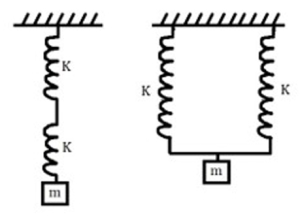
Two identical springs of constant $k$ are connected in series and then in parallel. $A$ mass $m$ is suspended from them,the ratio of their frequencies of vertical oscillations will be
A
$2:1$
B
$1:1$
C
$4:1$
D
$1:2$
Solution
(D) For two identical springs of constant $k$ connected in series,the equivalent spring constant is $k_s = \frac{k \cdot k}{k + k} = \frac{k}{2}$.
The frequency of oscillation in series is $f_s = \frac{1}{2\pi} \sqrt{\frac{k_s}{m}} = \frac{1}{2\pi} \sqrt{\frac{k}{2m}}$.
For two identical springs of constant $k$ connected in parallel,the equivalent spring constant is $k_p = k + k = 2k$.
The frequency of oscillation in parallel is $f_p = \frac{1}{2\pi} \sqrt{\frac{k_p}{m}} = \frac{1}{2\pi} \sqrt{\frac{2k}{m}}$.
The ratio of their frequencies is $\frac{f_s}{f_p} = \frac{\frac{1}{2\pi} \sqrt{\frac{k}{2m}}}{\frac{1}{2\pi} \sqrt{\frac{2k}{m}}} = \sqrt{\frac{k}{2m} \cdot \frac{m}{2k}} = \sqrt{\frac{1}{4}} = \frac{1}{2}$.
Thus,the ratio is $1:2$.
The frequency of oscillation in series is $f_s = \frac{1}{2\pi} \sqrt{\frac{k_s}{m}} = \frac{1}{2\pi} \sqrt{\frac{k}{2m}}$.
For two identical springs of constant $k$ connected in parallel,the equivalent spring constant is $k_p = k + k = 2k$.
The frequency of oscillation in parallel is $f_p = \frac{1}{2\pi} \sqrt{\frac{k_p}{m}} = \frac{1}{2\pi} \sqrt{\frac{2k}{m}}$.
The ratio of their frequencies is $\frac{f_s}{f_p} = \frac{\frac{1}{2\pi} \sqrt{\frac{k}{2m}}}{\frac{1}{2\pi} \sqrt{\frac{2k}{m}}} = \sqrt{\frac{k}{2m} \cdot \frac{m}{2k}} = \sqrt{\frac{1}{4}} = \frac{1}{2}$.
Thus,the ratio is $1:2$.
0 likes
View Solution252
MediumMCQ
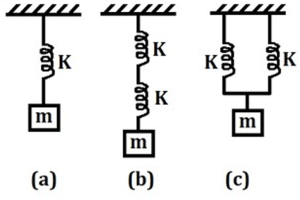
All the springs in figures $(a)$,$(b)$,and $(c)$ are identical,each having a force constant $K$. $A$ mass $m$ is attached to each system. If $T_a, T_b$,and $T_c$ are the time periods of oscillations of the three systems in figures $(a)$,$(b)$,and $(c)$ respectively,then:
A
$T_{a}=\sqrt{2} \,T_{b}$
B
$T_{a}=\frac{T_{c}}{\sqrt{2}}$
C
$T_{b}=2 \,T_{a}$
D
$T_{b}=2 \,T_{c}$
Solution
(D) The time period of a spring-mass system is given by $T = 2\pi \sqrt{\frac{m}{K_{eq}}}$.
For figure $(a)$: The effective spring constant is $K_{eq,a} = K$. Thus,$T_a = 2\pi \sqrt{\frac{m}{K}}$.
For figure $(b)$: The two springs are in series. The effective spring constant is $\frac{1}{K_{eq,b}} = \frac{1}{K} + \frac{1}{K} = \frac{2}{K}$,so $K_{eq,b} = \frac{K}{2}$. Thus,$T_b = 2\pi \sqrt{\frac{m}{K/2}} = 2\pi \sqrt{\frac{2m}{K}} = \sqrt{2} T_a$.
For figure $(c)$: The two springs are in parallel. The effective spring constant is $K_{eq,c} = K + K = 2K$. Thus,$T_c = 2\pi \sqrt{\frac{m}{2K}} = \frac{1}{\sqrt{2}} (2\pi \sqrt{\frac{m}{K}}) = \frac{T_a}{\sqrt{2}}$.
Comparing the results: $T_a = \sqrt{2} T_c$,which can be written as $T_a = \frac{T_c}{1/\sqrt{2}}$ or $T_c = \frac{T_a}{\sqrt{2}}$.
Looking at the options,$T_a = \frac{T_c}{1/\sqrt{2}}$ is not directly listed,but $T_a = \frac{T_c}{\sqrt{2}}$ is option $(b)$. Let's re-verify: $T_c = T_a / \sqrt{2} \implies T_a = \sqrt{2} T_c$. Wait,$T_a = T_c / (1/\sqrt{2}) = \sqrt{2} T_c$. Option $(b)$ states $T_a = \frac{T_c}{\sqrt{2}}$,which is $T_c = \sqrt{2} T_a$. This is incorrect. Let's check $T_b = \sqrt{2} T_a$. Option $(a)$ is $T_a = \sqrt{2} T_b$,which is incorrect. Let's re-evaluate: $T_b = \sqrt{2} T_a$ and $T_c = T_a / \sqrt{2}$. Therefore,$T_b = 2 T_c$. This matches option $(d)$.
For figure $(a)$: The effective spring constant is $K_{eq,a} = K$. Thus,$T_a = 2\pi \sqrt{\frac{m}{K}}$.
For figure $(b)$: The two springs are in series. The effective spring constant is $\frac{1}{K_{eq,b}} = \frac{1}{K} + \frac{1}{K} = \frac{2}{K}$,so $K_{eq,b} = \frac{K}{2}$. Thus,$T_b = 2\pi \sqrt{\frac{m}{K/2}} = 2\pi \sqrt{\frac{2m}{K}} = \sqrt{2} T_a$.
For figure $(c)$: The two springs are in parallel. The effective spring constant is $K_{eq,c} = K + K = 2K$. Thus,$T_c = 2\pi \sqrt{\frac{m}{2K}} = \frac{1}{\sqrt{2}} (2\pi \sqrt{\frac{m}{K}}) = \frac{T_a}{\sqrt{2}}$.
Comparing the results: $T_a = \sqrt{2} T_c$,which can be written as $T_a = \frac{T_c}{1/\sqrt{2}}$ or $T_c = \frac{T_a}{\sqrt{2}}$.
Looking at the options,$T_a = \frac{T_c}{1/\sqrt{2}}$ is not directly listed,but $T_a = \frac{T_c}{\sqrt{2}}$ is option $(b)$. Let's re-verify: $T_c = T_a / \sqrt{2} \implies T_a = \sqrt{2} T_c$. Wait,$T_a = T_c / (1/\sqrt{2}) = \sqrt{2} T_c$. Option $(b)$ states $T_a = \frac{T_c}{\sqrt{2}}$,which is $T_c = \sqrt{2} T_a$. This is incorrect. Let's check $T_b = \sqrt{2} T_a$. Option $(a)$ is $T_a = \sqrt{2} T_b$,which is incorrect. Let's re-evaluate: $T_b = \sqrt{2} T_a$ and $T_c = T_a / \sqrt{2}$. Therefore,$T_b = 2 T_c$. This matches option $(d)$.
0 likes
View Solution253
EasyMCQ
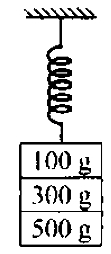
Three masses $500 \ g$,$300 \ g$,and $100 \ g$ are suspended at the end of a spring as shown in the figure and are in equilibrium. When the $500 \ g$ mass is removed,the system oscillates with a period of $2 \ s$. When the $300 \ g$ mass is also removed,it will oscillate with a period of (in $s$)
A
$1$
B
$1.5$
C
$2$
D
$2.5$
Solution
(A) When the $500 \ g$ mass is removed,the remaining mass is $m = (100 + 300) \ g = 400 \ g = 0.4 \ kg$.
The time period of oscillation is given by $T = 2 \pi \sqrt{\frac{m}{k}}$.
Given $T = 2 \ s$,we have $2 = 2 \pi \sqrt{\frac{0.4}{k}}$,which implies $\frac{2 \pi}{\sqrt{k}} = \frac{2}{\sqrt{0.4}} \quad \dots (i)$.
When the $300 \ g$ mass is also removed,the remaining mass is $m' = 100 \ g = 0.1 \ kg$.
The new time period $T'$ is $T' = 2 \pi \sqrt{\frac{0.1}{k}}$.
Substituting the value from equation $(i)$,we get $T' = \left( \frac{2 \pi}{\sqrt{k}} \right) \sqrt{0.1} = \left( \frac{2}{\sqrt{0.4}} \right) \sqrt{0.1} = 2 \sqrt{\frac{0.1}{0.4}} = 2 \sqrt{\frac{1}{4}} = 2 \times \frac{1}{2} = 1 \ s$.
The time period of oscillation is given by $T = 2 \pi \sqrt{\frac{m}{k}}$.
Given $T = 2 \ s$,we have $2 = 2 \pi \sqrt{\frac{0.4}{k}}$,which implies $\frac{2 \pi}{\sqrt{k}} = \frac{2}{\sqrt{0.4}} \quad \dots (i)$.
When the $300 \ g$ mass is also removed,the remaining mass is $m' = 100 \ g = 0.1 \ kg$.
The new time period $T'$ is $T' = 2 \pi \sqrt{\frac{0.1}{k}}$.
Substituting the value from equation $(i)$,we get $T' = \left( \frac{2 \pi}{\sqrt{k}} \right) \sqrt{0.1} = \left( \frac{2}{\sqrt{0.4}} \right) \sqrt{0.1} = 2 \sqrt{\frac{0.1}{0.4}} = 2 \sqrt{\frac{1}{4}} = 2 \times \frac{1}{2} = 1 \ s$.
0 likes
View Solution254
MediumMCQ
$A$ spring has a certain mass suspended from it and its period of vertical oscillations is $T_1$. The spring is now cut into two equal halves and the same mass is suspended from one of the halves. The period of vertical oscillations is now $T_2$. The ratio of $T_2 / T_1$ is
A
$1: 2$
B
$1: \sqrt{2}$
C
$\sqrt{2}: 1$
D
$2: 1$
Solution
(B) The time period of a spring-mass system is given by $T = 2\pi \sqrt{\frac{m}{k}}$,where $m$ is the mass and $k$ is the spring constant.
From this,we see that $T \propto \frac{1}{\sqrt{k}}$.
Therefore,the ratio is $\frac{T_2}{T_1} = \sqrt{\frac{k_1}{k_2}}$.
When a spring of constant $k$ is cut into two equal halves,the spring constant of each half becomes $k' = 2k$.
In the first case,the spring constant is $k_1 = k$.
In the second case,the mass is suspended from one half,so the new spring constant is $k_2 = 2k$.
Substituting these values into the ratio formula:
$\frac{T_2}{T_1} = \sqrt{\frac{k}{2k}} = \sqrt{\frac{1}{2}} = \frac{1}{\sqrt{2}}$.
From this,we see that $T \propto \frac{1}{\sqrt{k}}$.
Therefore,the ratio is $\frac{T_2}{T_1} = \sqrt{\frac{k_1}{k_2}}$.
When a spring of constant $k$ is cut into two equal halves,the spring constant of each half becomes $k' = 2k$.
In the first case,the spring constant is $k_1 = k$.
In the second case,the mass is suspended from one half,so the new spring constant is $k_2 = 2k$.
Substituting these values into the ratio formula:
$\frac{T_2}{T_1} = \sqrt{\frac{k}{2k}} = \sqrt{\frac{1}{2}} = \frac{1}{\sqrt{2}}$.
0 likes
View Solution255
MediumMCQ
$A$ mass '$m$' attached to a spring oscillates with a period of $3 \ s$. If the mass is increased by $0.6 \ kg$,the period increases by $3 \ s$. The initial mass '$m$' is equal to (in $kg$)
A
$0.1$
B
$0.2$
C
$0.3$
D
$0.4$
Solution
(B) The time period of a mass-spring system is given by $T = 2 \pi \sqrt{\frac{m}{k}}$.
For the initial mass $m$,the period $T_1 = 3 \ s$:
$3 = 2 \pi \sqrt{\frac{m}{k}} \implies \frac{9}{4 \pi^2} = \frac{m}{k} \implies k = \frac{4 \pi^2 m}{9} \quad \dots (i)$
When the mass is increased by $0.6 \ kg$,the new mass is $m' = m + 0.6$ and the new period $T_2 = 3 + 3 = 6 \ s$:
$6 = 2 \pi \sqrt{\frac{m + 0.6}{k}} \implies 3 = \pi \sqrt{\frac{m + 0.6}{k}} \implies 9 = \pi^2 \frac{m + 0.6}{k} \implies \frac{9}{\pi^2} = \frac{m + 0.6}{k} \quad \dots (ii)$
Dividing equation $(ii)$ by equation $(i)$:
$\frac{9 / \pi^2}{9 / 4 \pi^2} = \frac{(m + 0.6) / k}{m / k}$
$4 = \frac{m + 0.6}{m}$
$4m = m + 0.6$
$3m = 0.6$
$m = 0.2 \ kg$.
For the initial mass $m$,the period $T_1 = 3 \ s$:
$3 = 2 \pi \sqrt{\frac{m}{k}} \implies \frac{9}{4 \pi^2} = \frac{m}{k} \implies k = \frac{4 \pi^2 m}{9} \quad \dots (i)$
When the mass is increased by $0.6 \ kg$,the new mass is $m' = m + 0.6$ and the new period $T_2 = 3 + 3 = 6 \ s$:
$6 = 2 \pi \sqrt{\frac{m + 0.6}{k}} \implies 3 = \pi \sqrt{\frac{m + 0.6}{k}} \implies 9 = \pi^2 \frac{m + 0.6}{k} \implies \frac{9}{\pi^2} = \frac{m + 0.6}{k} \quad \dots (ii)$
Dividing equation $(ii)$ by equation $(i)$:
$\frac{9 / \pi^2}{9 / 4 \pi^2} = \frac{(m + 0.6) / k}{m / k}$
$4 = \frac{m + 0.6}{m}$
$4m = m + 0.6$
$3m = 0.6$
$m = 0.2 \ kg$.
0 likes
View Solution256
MediumMCQ
$A$ body of mass $64 \ g$ is made to oscillate turn by turn on two different springs $A$ and $B$. Spring $A$ and $B$ have force constants $4 \ N/m$ and $16 \ N/m$ respectively. If $T_{1}$ and $T_{2}$ are the periods of oscillation of springs $A$ and $B$ respectively,then $\frac{T_{1}+T_{2}}{T_{1}-T_{2}}$ will be:
A
$3: 1$
B
$1: 3$
C
$1: 2$
D
$2: 1$
Solution
(A) The time period of a spring-mass system is given by $T = 2 \pi \sqrt{\frac{m}{k}}$.
For spring $A$,$T_{1} = 2 \pi \sqrt{\frac{m}{k_{1}}}$.
For spring $B$,$T_{2} = 2 \pi \sqrt{\frac{m}{k_{2}}}$.
Taking the ratio: $\frac{T_{1}}{T_{2}} = \sqrt{\frac{k_{2}}{k_{1}}} = \sqrt{\frac{16}{4}} = \sqrt{4} = 2$.
So,$T_{1} = 2T_{2}$.
Now,substitute this into the expression $\frac{T_{1}+T_{2}}{T_{1}-T_{2}}$:
$\frac{2T_{2} + T_{2}}{2T_{2} - T_{2}} = \frac{3T_{2}}{T_{2}} = 3$.
This can be written as the ratio $3:1$.
For spring $A$,$T_{1} = 2 \pi \sqrt{\frac{m}{k_{1}}}$.
For spring $B$,$T_{2} = 2 \pi \sqrt{\frac{m}{k_{2}}}$.
Taking the ratio: $\frac{T_{1}}{T_{2}} = \sqrt{\frac{k_{2}}{k_{1}}} = \sqrt{\frac{16}{4}} = \sqrt{4} = 2$.
So,$T_{1} = 2T_{2}$.
Now,substitute this into the expression $\frac{T_{1}+T_{2}}{T_{1}-T_{2}}$:
$\frac{2T_{2} + T_{2}}{2T_{2} - T_{2}} = \frac{3T_{2}}{T_{2}} = 3$.
This can be written as the ratio $3:1$.
0 likes
View Solution257
EasyMCQ
Two bodies $A$ and $B$ of equal mass are suspended from two separate massless springs of spring constants $K_1$ and $K_2$ respectively. The two bodies oscillate vertically such that their maximum velocities are equal. The ratio of the amplitude of $B$ to that of $A$ is
A
$\frac{K_1}{K_2}$
B
$\frac{K_2}{K_1}$
C
$\sqrt{\frac{K_1}{K_2}}$
D
$\sqrt{\frac{K_2}{K_1}}$
Solution
(C) For a body of mass $m$ oscillating with amplitude $A$ and angular frequency $\omega$,the maximum velocity is given by $v_{max} = A\omega$.
Given that the masses are equal $(m_A = m_B = m)$ and the maximum velocities are equal $(v_{max,A} = v_{max,B})$,we have $A_1 \omega_1 = A_2 \omega_2$.
Since $\omega = \sqrt{\frac{K}{m}}$,we have $A_1 \sqrt{\frac{K_1}{m}} = A_2 \sqrt{\frac{K_2}{m}}$.
Squaring both sides,we get $A_1^2 \frac{K_1}{m} = A_2^2 \frac{K_2}{m}$.
Simplifying,$A_1^2 K_1 = A_2^2 K_2$.
Therefore,the ratio of the amplitude of $B$ $(A_2)$ to that of $A$ $(A_1)$ is $\frac{A_2}{A_1} = \sqrt{\frac{K_1}{K_2}}$.
Given that the masses are equal $(m_A = m_B = m)$ and the maximum velocities are equal $(v_{max,A} = v_{max,B})$,we have $A_1 \omega_1 = A_2 \omega_2$.
Since $\omega = \sqrt{\frac{K}{m}}$,we have $A_1 \sqrt{\frac{K_1}{m}} = A_2 \sqrt{\frac{K_2}{m}}$.
Squaring both sides,we get $A_1^2 \frac{K_1}{m} = A_2^2 \frac{K_2}{m}$.
Simplifying,$A_1^2 K_1 = A_2^2 K_2$.
Therefore,the ratio of the amplitude of $B$ $(A_2)$ to that of $A$ $(A_1)$ is $\frac{A_2}{A_1} = \sqrt{\frac{K_1}{K_2}}$.
0 likes
View Solution258
MediumMCQ
$A$ mass suspended from a vertical spring performs $S.H.M.$ with a period of $T = 0.1 \ s$. The spring is unstretched at the highest point of its motion. What is the maximum speed of the mass? (Take gravitational acceleration $g = 10 \ m/s^2$)
A
$\frac{1}{2 \pi} \ m/s$
B
$\frac{1}{\pi} \ m/s$
C
$\frac{2}{\pi} \ m/s$
D
$\pi \ m/s$
Solution
(A) In a vertical spring-mass system,the equilibrium position is where the spring is stretched by an extension $x_0 = \frac{mg}{k}$.
The period of oscillation is $T = 2 \pi \sqrt{\frac{m}{k}}$,which implies $\frac{k}{m} = \omega^2 = \left(\frac{2 \pi}{T}\right)^2$.
Given $T = 0.1 \ s$,we have $\omega = \frac{2 \pi}{0.1} = 20 \pi \ rad/s$.
The extension at equilibrium is $x_0 = \frac{g}{\omega^2} = \frac{10}{(20 \pi)^2} = \frac{10}{400 \pi^2} = \frac{1}{40 \pi^2} \ m$.
Since the spring is unstretched at the highest point,the amplitude $A$ of the oscillation is equal to the equilibrium extension $x_0$,so $A = x_0 = \frac{1}{40 \pi^2} \ m$.
The maximum speed $v_{max}$ in $S.H.M.$ is given by $v_{max} = A \omega$.
Substituting the values: $v_{max} = \left(\frac{1}{40 \pi^2}\right) \times (20 \pi) = \frac{20 \pi}{40 \pi^2} = \frac{1}{2 \pi} \ m/s$.
The period of oscillation is $T = 2 \pi \sqrt{\frac{m}{k}}$,which implies $\frac{k}{m} = \omega^2 = \left(\frac{2 \pi}{T}\right)^2$.
Given $T = 0.1 \ s$,we have $\omega = \frac{2 \pi}{0.1} = 20 \pi \ rad/s$.
The extension at equilibrium is $x_0 = \frac{g}{\omega^2} = \frac{10}{(20 \pi)^2} = \frac{10}{400 \pi^2} = \frac{1}{40 \pi^2} \ m$.
Since the spring is unstretched at the highest point,the amplitude $A$ of the oscillation is equal to the equilibrium extension $x_0$,so $A = x_0 = \frac{1}{40 \pi^2} \ m$.
The maximum speed $v_{max}$ in $S.H.M.$ is given by $v_{max} = A \omega$.
Substituting the values: $v_{max} = \left(\frac{1}{40 \pi^2}\right) \times (20 \pi) = \frac{20 \pi}{40 \pi^2} = \frac{1}{2 \pi} \ m/s$.
0 likes
View Solution259
DifficultMCQ
Frequency of a particle performing $S.H.M.$ is $10 \ Hz$. The particle is suspended from a vertical spring. At the highest point of its oscillation,the spring is unstretched. The maximum speed of the particle is $(g = 10 \ m/s^2)$.
A
$\frac{1}{\pi} \ m/s$
B
$\frac{1}{2 \pi} \ m/s$
C
$\frac{1}{4 \pi} \ m/s$
D
$2 \pi \ m/s$
Solution
(B) The frequency of oscillation is $n = 10 \ Hz$. The angular frequency is $\omega = 2 \pi n = 20 \pi \ rad/s$.
For a vertical spring-mass system,the equilibrium position is at a distance $x_0 = \frac{mg}{k}$ below the unstretched position.
Since the spring is unstretched at the highest point,the amplitude $A$ of the oscillation is equal to the displacement of the equilibrium position from the unstretched position,so $A = x_0 = \frac{mg}{k}$.
We know that $\omega^2 = \frac{k}{m}$,so $k = m \omega^2$.
Substituting $k$ into the expression for $A$: $A = \frac{mg}{m \omega^2} = \frac{g}{\omega^2}$.
The maximum speed is $v_{\max} = \omega A = \omega \left( \frac{g}{\omega^2} \right) = \frac{g}{\omega}$.
Substituting the values: $v_{\max} = \frac{10}{20 \pi} = \frac{1}{2 \pi} \ m/s$.
For a vertical spring-mass system,the equilibrium position is at a distance $x_0 = \frac{mg}{k}$ below the unstretched position.
Since the spring is unstretched at the highest point,the amplitude $A$ of the oscillation is equal to the displacement of the equilibrium position from the unstretched position,so $A = x_0 = \frac{mg}{k}$.
We know that $\omega^2 = \frac{k}{m}$,so $k = m \omega^2$.
Substituting $k$ into the expression for $A$: $A = \frac{mg}{m \omega^2} = \frac{g}{\omega^2}$.
The maximum speed is $v_{\max} = \omega A = \omega \left( \frac{g}{\omega^2} \right) = \frac{g}{\omega}$.
Substituting the values: $v_{\max} = \frac{10}{20 \pi} = \frac{1}{2 \pi} \ m/s$.
0 likes
View Solution260
MediumMCQ
$A$ block of mass $M$ rests on a piston executing $S.H.M.$ with a period of $1 \,s$. The amplitude of oscillations, such that the mass is separated from the piston, is (acceleration due to gravity, $g=10 \,m/s^2$, $\pi^2=10$)
A
$0.25 \,m$
B
$0.5 \,m$
C
$1 \,m$
D
$\infty$
Solution
(A) For a particle executing $S.H.M.$, the acceleration is given by $a = \omega^2 x$. The maximum acceleration is $a_{max} = \omega^2 A$.
For the block to separate from the piston, the downward acceleration of the piston must exceed the acceleration due to gravity, $g$.
Thus, the condition for separation is $a_{max} \geq g$.
Given the period $T = 1 \,s$, we calculate the angular frequency $\omega = \frac{2\pi}{T} = 2\pi \,rad/s$.
Substituting the condition $a_{max} = g$:
$\omega^2 A = g$
$(2\pi)^2 A = 10$
$4\pi^2 A = 10$
Given $\pi^2 = 10$, we have $4(10) A = 10$.
$40 A = 10$
$A = \frac{10}{40} = 0.25 \,m$.
For the block to separate from the piston, the downward acceleration of the piston must exceed the acceleration due to gravity, $g$.
Thus, the condition for separation is $a_{max} \geq g$.
Given the period $T = 1 \,s$, we calculate the angular frequency $\omega = \frac{2\pi}{T} = 2\pi \,rad/s$.
Substituting the condition $a_{max} = g$:
$\omega^2 A = g$
$(2\pi)^2 A = 10$
$4\pi^2 A = 10$
Given $\pi^2 = 10$, we have $4(10) A = 10$.
$40 A = 10$
$A = \frac{10}{40} = 0.25 \,m$.
0 likes
View Solution261
EasyMCQ
$A$ particle is suspended from a vertical spring which is executing $S.H.M.$ of frequency $5 \ Hz$. The spring is unstretched at the highest point of oscillation. What is the maximum speed of the particle? (Take $g = 10 \ m/s^2$)
A
$\frac{1}{\pi} \ m/s$
B
$\frac{1}{4 \pi} \ m/s$
C
$\frac{1}{2 \pi} \ m/s$
D
$\pi \ m/s$
Solution
(A) For a particle in $S.H.M.$ suspended from a vertical spring,the equilibrium position is where the spring force balances the gravitational force,i.e.,$kx = mg$.
At the highest point of oscillation,the spring is unstretched,meaning the extension $x = 0$.
Since the equilibrium position is at a distance $A$ (amplitude) below the highest point,the extension at equilibrium is $x = A$.
Therefore,$kA = mg$,which gives the amplitude $A = \frac{mg}{k} = \frac{g}{\omega^2}$.
Given frequency $f = 5 \ Hz$,the angular frequency is $\omega = 2 \pi f = 2 \pi \times 5 = 10 \pi \ rad/s$.
Substituting the values,$A = \frac{10}{(10 \pi)^2} = \frac{10}{100 \pi^2} = \frac{1}{10 \pi^2} \ m$.
The maximum speed is $V_{\max} = A \omega$.
$V_{\max} = \left( \frac{1}{10 \pi^2} \right) \times (10 \pi) = \frac{1}{\pi} \ m/s$.
At the highest point of oscillation,the spring is unstretched,meaning the extension $x = 0$.
Since the equilibrium position is at a distance $A$ (amplitude) below the highest point,the extension at equilibrium is $x = A$.
Therefore,$kA = mg$,which gives the amplitude $A = \frac{mg}{k} = \frac{g}{\omega^2}$.
Given frequency $f = 5 \ Hz$,the angular frequency is $\omega = 2 \pi f = 2 \pi \times 5 = 10 \pi \ rad/s$.
Substituting the values,$A = \frac{10}{(10 \pi)^2} = \frac{10}{100 \pi^2} = \frac{1}{10 \pi^2} \ m$.
The maximum speed is $V_{\max} = A \omega$.
$V_{\max} = \left( \frac{1}{10 \pi^2} \right) \times (10 \pi) = \frac{1}{\pi} \ m/s$.
0 likes
View Solution262
DifficultMCQ
$A$ horizontal spring executes $S.H.M.$ with amplitude $A_{1}$,when mass $m_{1}$ is attached to it. When it passes through the mean position,another mass $m_{2}$ is placed on it. Both masses move together with amplitude $A_{2}$. Therefore,the ratio $A_{2}: A_{1}$ is:
A
$\left[\frac{m_{1}}{m_{1}+m_{2}}\right]^{1 / 2}$
B
$\left[\frac{m_{1}+m_{2}}{m_{1}}\right]^{1 / 2}$
C
$\left[\frac{m_{1}}{m_{1}+m_{2}}\right]$
D
$\left[\frac{m_{1}+m_{2}}{m_{1}}\right]$
Solution
(A) When mass $m_{1}$ is attached to the spring,the total energy of the $S.H.M.$ is $E = \frac{1}{2} k A_{1}^{2}$.
At the mean position,the velocity $v_{1}$ of the mass $m_{1}$ is maximum,given by $v_{1} = \omega_{1} A_{1} = \sqrt{\frac{k}{m_{1}}} A_{1}$.
When mass $m_{2}$ is placed on $m_{1}$ at the mean position,the momentum of the system is conserved because there is no external horizontal force.
Initial momentum $p_{i} = m_{1} v_{1}$.
Final momentum $p_{f} = (m_{1} + m_{2}) v_{2}$,where $v_{2}$ is the new velocity at the mean position.
Since $p_{i} = p_{f}$,we have $m_{1} v_{1} = (m_{1} + m_{2}) v_{2}$.
$v_{2} = \frac{m_{1}}{m_{1} + m_{2}} v_{1}$.
The new angular frequency is $\omega_{2} = \sqrt{\frac{k}{m_{1} + m_{2}}}$.
Since $v_{2} = \omega_{2} A_{2}$,we have $A_{2} = \frac{v_{2}}{\omega_{2}} = \frac{m_{1} v_{1}}{(m_{1} + m_{2})} \sqrt{\frac{m_{1} + m_{2}}{k}}$.
Substituting $v_{1} = \sqrt{\frac{k}{m_{1}}} A_{1}$,we get $A_{2} = \frac{m_{1}}{(m_{1} + m_{2})} \sqrt{\frac{k}{m_{1}}} A_{1} \sqrt{\frac{m_{1} + m_{2}}{k}} = A_{1} \sqrt{\frac{m_{1}}{m_{1} + m_{2}}}$.
Therefore,$\frac{A_{2}}{A_{1}} = \left[\frac{m_{1}}{m_{1} + m_{2}}\right]^{1/2}$.
At the mean position,the velocity $v_{1}$ of the mass $m_{1}$ is maximum,given by $v_{1} = \omega_{1} A_{1} = \sqrt{\frac{k}{m_{1}}} A_{1}$.
When mass $m_{2}$ is placed on $m_{1}$ at the mean position,the momentum of the system is conserved because there is no external horizontal force.
Initial momentum $p_{i} = m_{1} v_{1}$.
Final momentum $p_{f} = (m_{1} + m_{2}) v_{2}$,where $v_{2}$ is the new velocity at the mean position.
Since $p_{i} = p_{f}$,we have $m_{1} v_{1} = (m_{1} + m_{2}) v_{2}$.
$v_{2} = \frac{m_{1}}{m_{1} + m_{2}} v_{1}$.
The new angular frequency is $\omega_{2} = \sqrt{\frac{k}{m_{1} + m_{2}}}$.
Since $v_{2} = \omega_{2} A_{2}$,we have $A_{2} = \frac{v_{2}}{\omega_{2}} = \frac{m_{1} v_{1}}{(m_{1} + m_{2})} \sqrt{\frac{m_{1} + m_{2}}{k}}$.
Substituting $v_{1} = \sqrt{\frac{k}{m_{1}}} A_{1}$,we get $A_{2} = \frac{m_{1}}{(m_{1} + m_{2})} \sqrt{\frac{k}{m_{1}}} A_{1} \sqrt{\frac{m_{1} + m_{2}}{k}} = A_{1} \sqrt{\frac{m_{1}}{m_{1} + m_{2}}}$.
Therefore,$\frac{A_{2}}{A_{1}} = \left[\frac{m_{1}}{m_{1} + m_{2}}\right]^{1/2}$.
0 likes
View Solution263
MediumMCQ
$A$ mass is suspended from a vertical spring which is executing $S.H.M.$ of frequency $5 Hz$. The spring is unstretched at the highest point of oscillation. The maximum speed of the mass is [acceleration due to gravity $g=10 m s^{-2}$].
A
$2 \pi m s^{-1}$
B
$\pi m s^{-1}$
C
$\frac{1}{2 \pi} m s^{-1}$
D
$\frac{1}{\pi} m s^{-1}$
Solution
(D) The frequency of $S.H.M.$ is given by $n = 5 Hz$. The angular frequency is $\omega = 2 \pi n = 2 \pi \times 5 = 10 \pi rad s^{-1}$.
At the highest point of oscillation,the spring is unstretched,meaning the extension $x = 0$. In $S.H.M.$,the equilibrium position is where the spring force balances gravity,$k x_0 = mg$,where $x_0$ is the static extension.
The amplitude $A$ of the oscillation is equal to this static extension $x_0$,because the particle reaches the unstretched position $(x=0)$ at the top of its path. Thus,$A = x_0 = \frac{mg}{k}$.
We know that $\omega^2 = \frac{k}{m}$,so $k = m \omega^2 = m(10 \pi)^2 = 100 \pi^2 m$.
Substituting $k$ into the amplitude equation: $A = \frac{mg}{100 \pi^2 m} = \frac{g}{100 \pi^2} = \frac{10}{100 \pi^2} = \frac{1}{10 \pi} m$.
The maximum speed is $V_{max} = \omega A = (10 \pi) \times (\frac{1}{10 \pi}) = 1 m s^{-1}$.
Wait,re-evaluating the calculation: $V_{max} = \omega A = (10 \pi) \times \frac{g}{\omega^2} = \frac{g}{\omega} = \frac{10}{10 \pi} = \frac{1}{\pi} m s^{-1}$.
At the highest point of oscillation,the spring is unstretched,meaning the extension $x = 0$. In $S.H.M.$,the equilibrium position is where the spring force balances gravity,$k x_0 = mg$,where $x_0$ is the static extension.
The amplitude $A$ of the oscillation is equal to this static extension $x_0$,because the particle reaches the unstretched position $(x=0)$ at the top of its path. Thus,$A = x_0 = \frac{mg}{k}$.
We know that $\omega^2 = \frac{k}{m}$,so $k = m \omega^2 = m(10 \pi)^2 = 100 \pi^2 m$.
Substituting $k$ into the amplitude equation: $A = \frac{mg}{100 \pi^2 m} = \frac{g}{100 \pi^2} = \frac{10}{100 \pi^2} = \frac{1}{10 \pi} m$.
The maximum speed is $V_{max} = \omega A = (10 \pi) \times (\frac{1}{10 \pi}) = 1 m s^{-1}$.
Wait,re-evaluating the calculation: $V_{max} = \omega A = (10 \pi) \times \frac{g}{\omega^2} = \frac{g}{\omega} = \frac{10}{10 \pi} = \frac{1}{\pi} m s^{-1}$.
0 likes
View Solution264
MediumMCQ
$A$ mass $m_1$ connected to a horizontal spring performs $S.H.M.$ with amplitude $A$. While mass $m_1$ is passing through the mean position,another mass $m_2$ is placed on it so that both the masses move together with amplitude $A_1$. The ratio of $\frac{A_1}{A}$ is:
A
$\left[\frac{m_1}{m_1 + m_2}\right]^{\frac{1}{2}}$
B
$\left[\frac{m_1 + m_2}{m_1}\right]^{\frac{1}{2}}$
C
$\left[\frac{m_2}{m_1 + m_2}\right]^{\frac{1}{2}}$
D
$\left[\frac{m_1 + m_2}{m_2}\right]^{\frac{1}{2}}$
Solution
(A) At the mean position,the potential energy is zero and the kinetic energy is maximum. The velocity $v$ of mass $m_1$ at the mean position is $v = A\omega = A\sqrt{\frac{k}{m_1}}$.
When mass $m_2$ is placed on $m_1$,the momentum is conserved because the spring force is zero at the mean position. Let $v'$ be the new velocity:
$m_1 v = (m_1 + m_2) v'$
$v' = \frac{m_1 v}{m_1 + m_2} = \frac{m_1 A \sqrt{k/m_1}}{m_1 + m_2} = A \sqrt{\frac{k m_1}{(m_1 + m_2)^2}}$.
The new energy of the system is $E' = \frac{1}{2} k A_1^2 = \frac{1}{2} (m_1 + m_2) (v')^2$.
Substituting $v'$:
$\frac{1}{2} k A_1^2 = \frac{1}{2} (m_1 + m_2) \left( A^2 \frac{k m_1}{(m_1 + m_2)^2} \right)$.
$A_1^2 = A^2 \frac{m_1}{m_1 + m_2}$.
Therefore,$\frac{A_1}{A} = \sqrt{\frac{m_1}{m_1 + m_2}}$.
When mass $m_2$ is placed on $m_1$,the momentum is conserved because the spring force is zero at the mean position. Let $v'$ be the new velocity:
$m_1 v = (m_1 + m_2) v'$
$v' = \frac{m_1 v}{m_1 + m_2} = \frac{m_1 A \sqrt{k/m_1}}{m_1 + m_2} = A \sqrt{\frac{k m_1}{(m_1 + m_2)^2}}$.
The new energy of the system is $E' = \frac{1}{2} k A_1^2 = \frac{1}{2} (m_1 + m_2) (v')^2$.
Substituting $v'$:
$\frac{1}{2} k A_1^2 = \frac{1}{2} (m_1 + m_2) \left( A^2 \frac{k m_1}{(m_1 + m_2)^2} \right)$.
$A_1^2 = A^2 \frac{m_1}{m_1 + m_2}$.
Therefore,$\frac{A_1}{A} = \sqrt{\frac{m_1}{m_1 + m_2}}$.
0 likes
View Solution265
MediumMCQ
$A$ vertical spring oscillates with a period of $6 \ s$ when a mass $m$ is suspended from it. When the mass is at rest,the spring is stretched through a distance of (Take acceleration due to gravity $g = \pi^2 = 10 \ m/s^2$): (in $m$)
A
$10$
B
$3$
C
$6$
D
$9$
Solution
(D) The time period of a vertical spring-mass system is given by $T = 2\pi \sqrt{\frac{m}{k}}$.
Given $T = 6 \ s$,we have $6 = 2\pi \sqrt{\frac{m}{k}}$,which simplifies to $3 = \pi \sqrt{\frac{m}{k}}$.
Squaring both sides,we get $9 = \pi^2 \frac{m}{k}$.
Since $g = \pi^2$,we can write $9 = g \frac{m}{k}$,or $\frac{m}{k} = \frac{9}{g}$.
When the mass is at rest,the spring is stretched by a distance $x$ such that the spring force equals the gravitational force: $kx = mg$.
Therefore,the extension $x = \frac{mg}{k} = m \cdot \frac{g}{k}$.
Substituting $\frac{m}{k} = \frac{9}{g}$,we get $x = \frac{g}{k} \cdot m = \frac{9}{g} \cdot g = 9 \ m$.
Given $T = 6 \ s$,we have $6 = 2\pi \sqrt{\frac{m}{k}}$,which simplifies to $3 = \pi \sqrt{\frac{m}{k}}$.
Squaring both sides,we get $9 = \pi^2 \frac{m}{k}$.
Since $g = \pi^2$,we can write $9 = g \frac{m}{k}$,or $\frac{m}{k} = \frac{9}{g}$.
When the mass is at rest,the spring is stretched by a distance $x$ such that the spring force equals the gravitational force: $kx = mg$.
Therefore,the extension $x = \frac{mg}{k} = m \cdot \frac{g}{k}$.
Substituting $\frac{m}{k} = \frac{9}{g}$,we get $x = \frac{g}{k} \cdot m = \frac{9}{g} \cdot g = 9 \ m$.
0 likes
View Solution266
MediumMCQ
$A$ mass $x \ g$ is suspended from a light spring. It is pulled in a downward direction and released so that the mass performs $S.H.M.$ of period $T$. If the mass is increased by $Y \ g$,the period becomes $4T/3$. The ratio of $Y/x$ is:
A
$7:9$
B
$5:4$
C
$3:2$
D
$8:7$
Solution
(A) The time period of a mass $m$ attached to a spring of force constant $k$ is given by $T = 2\pi \sqrt{m/k}$.
For the initial mass $x$,the period is $T = 2\pi \sqrt{x/k}$.
When the mass is increased by $Y \ g$,the new mass is $(x + Y)$ and the new period is $T' = 4T/3$.
Thus,$T' = 2\pi \sqrt{(x + Y)/k} = 4T/3$.
Substituting $T$ from the first equation: $2\pi \sqrt{(x + Y)/k} = (4/3) \cdot 2\pi \sqrt{x/k}$.
Squaring both sides: $(x + Y)/k = (16/9) \cdot (x/k)$.
Canceling $k$ from both sides: $x + Y = (16/9)x$.
Rearranging to find $Y$: $Y = (16/9)x - x = (7/9)x$.
Therefore,the ratio $Y/x = 7/9$.
For the initial mass $x$,the period is $T = 2\pi \sqrt{x/k}$.
When the mass is increased by $Y \ g$,the new mass is $(x + Y)$ and the new period is $T' = 4T/3$.
Thus,$T' = 2\pi \sqrt{(x + Y)/k} = 4T/3$.
Substituting $T$ from the first equation: $2\pi \sqrt{(x + Y)/k} = (4/3) \cdot 2\pi \sqrt{x/k}$.
Squaring both sides: $(x + Y)/k = (16/9) \cdot (x/k)$.
Canceling $k$ from both sides: $x + Y = (16/9)x$.
Rearranging to find $Y$: $Y = (16/9)x - x = (7/9)x$.
Therefore,the ratio $Y/x = 7/9$.
0 likes
View Solution267
MediumMCQ
$A$ mass $m$ is suspended from a spring of negligible mass. The spring is pulled a little and then released,so that the mass executes $S.H.M.$ with a time period $T$. If the mass is increased by $m_0$,the time period becomes $\frac{5T}{4}$. The ratio $\frac{m_0}{m}$ is
A
$\frac{3}{4}$
B
$\frac{4}{3}$
C
$\frac{9}{16}$
D
$\frac{16}{9}$
Solution
(C) The time period of a mass $m$ attached to a spring of spring constant $k$ is given by $T = 2\pi \sqrt{\frac{m}{k}}$.
For the initial mass $m$,$T = 2\pi \sqrt{\frac{m}{k}}$.
When the mass is increased by $m_0$,the new mass is $m' = m + m_0$. The new time period $T'$ is given as $\frac{5T}{4}$.
So,$T' = 2\pi \sqrt{\frac{m + m_0}{k}} = \frac{5}{4} T$.
Substituting the expression for $T$: $2\pi \sqrt{\frac{m + m_0}{k}} = \frac{5}{4} \times 2\pi \sqrt{\frac{m}{k}}$.
Squaring both sides: $\frac{m + m_0}{k} = \frac{25}{16} \frac{m}{k}$.
Canceling $k$ from both sides: $m + m_0 = \frac{25}{16} m$.
Rearranging for $m_0$: $m_0 = \frac{25}{16} m - m = \frac{9}{16} m$.
Therefore,the ratio $\frac{m_0}{m} = \frac{9}{16}$.
For the initial mass $m$,$T = 2\pi \sqrt{\frac{m}{k}}$.
When the mass is increased by $m_0$,the new mass is $m' = m + m_0$. The new time period $T'$ is given as $\frac{5T}{4}$.
So,$T' = 2\pi \sqrt{\frac{m + m_0}{k}} = \frac{5}{4} T$.
Substituting the expression for $T$: $2\pi \sqrt{\frac{m + m_0}{k}} = \frac{5}{4} \times 2\pi \sqrt{\frac{m}{k}}$.
Squaring both sides: $\frac{m + m_0}{k} = \frac{25}{16} \frac{m}{k}$.
Canceling $k$ from both sides: $m + m_0 = \frac{25}{16} m$.
Rearranging for $m_0$: $m_0 = \frac{25}{16} m - m = \frac{9}{16} m$.
Therefore,the ratio $\frac{m_0}{m} = \frac{9}{16}$.
0 likes
View Solution268
DifficultMCQ
$A$ spring has a certain mass suspended from it and its period for vertical oscillations is $T_1$. The spring is now cut into two equal halves and the same mass is suspended from one of the halves. The period of vertical oscillations is now $T_2$. The ratio $T_1 / T_2$ is
A
$2$
B
$\sqrt{2}$
C
$1/\sqrt{2}$
D
$1/2$
Solution
(B) The time period of a spring-mass system is given by $T = 2\pi \sqrt{m/k}$.
For the initial spring with constant $k$,the period is $T_1 = 2\pi \sqrt{m/k}$.
When a spring of length $l$ and spring constant $k$ is cut into two equal halves,the spring constant of each half becomes $k' = 2k$ because $k \propto 1/l$.
For the new system with the same mass $m$ and new spring constant $k' = 2k$,the period is $T_2 = 2\pi \sqrt{m/(2k)}$.
Taking the ratio: $T_1 / T_2 = \frac{2\pi \sqrt{m/k}}{2\pi \sqrt{m/(2k)}} = \sqrt{\frac{m/k}{m/(2k)}} = \sqrt{2}$.
Thus,the ratio $T_1 / T_2 = \sqrt{2}$.
For the initial spring with constant $k$,the period is $T_1 = 2\pi \sqrt{m/k}$.
When a spring of length $l$ and spring constant $k$ is cut into two equal halves,the spring constant of each half becomes $k' = 2k$ because $k \propto 1/l$.
For the new system with the same mass $m$ and new spring constant $k' = 2k$,the period is $T_2 = 2\pi \sqrt{m/(2k)}$.
Taking the ratio: $T_1 / T_2 = \frac{2\pi \sqrt{m/k}}{2\pi \sqrt{m/(2k)}} = \sqrt{\frac{m/k}{m/(2k)}} = \sqrt{2}$.
Thus,the ratio $T_1 / T_2 = \sqrt{2}$.
0 likes
View Solution269
DifficultMCQ
The upper end of the spring is fixed and a mass $m$ is attached to its lower end. When the mass is slightly pulled down and released,it oscillates with a time period of $3 \text{ s}$. If the mass $m$ is increased by $1 \text{ kg}$,the time period becomes $5 \text{ s}$. The value of $m$ is (mass of the spring is negligible).
A
$\frac{3}{8} \text{ kg}$
B
$\frac{5}{9} \text{ kg}$
C
$\frac{8}{13} \text{ kg}$
D
$\frac{9}{16} \text{ kg}$
Solution
(D) The formula for the time period of a spring-mass system is $T = 2 \pi \sqrt{\frac{m}{k}}$.
For the initial mass $m$,the time period is $T = 3 \text{ s}$,so $3 = 2 \pi \sqrt{\frac{m}{k}}$.
For the increased mass $m+1$,the time period is $T' = 5 \text{ s}$,so $5 = 2 \pi \sqrt{\frac{m+1}{k}}$.
Taking the ratio of the two equations:
$\frac{T}{T'} = \frac{2 \pi \sqrt{\frac{m}{k}}}{2 \pi \sqrt{\frac{m+1}{k}}} = \sqrt{\frac{m}{m+1}}$.
Substituting the given values:
$\frac{3}{5} = \sqrt{\frac{m}{m+1}}$.
Squaring both sides:
$\frac{9}{25} = \frac{m}{m+1}$.
Cross-multiplying gives:
$9(m+1) = 25m \implies 9m + 9 = 25m$.
$16m = 9 \implies m = \frac{9}{16} \text{ kg}$.
For the initial mass $m$,the time period is $T = 3 \text{ s}$,so $3 = 2 \pi \sqrt{\frac{m}{k}}$.
For the increased mass $m+1$,the time period is $T' = 5 \text{ s}$,so $5 = 2 \pi \sqrt{\frac{m+1}{k}}$.
Taking the ratio of the two equations:
$\frac{T}{T'} = \frac{2 \pi \sqrt{\frac{m}{k}}}{2 \pi \sqrt{\frac{m+1}{k}}} = \sqrt{\frac{m}{m+1}}$.
Substituting the given values:
$\frac{3}{5} = \sqrt{\frac{m}{m+1}}$.
Squaring both sides:
$\frac{9}{25} = \frac{m}{m+1}$.
Cross-multiplying gives:
$9(m+1) = 25m \implies 9m + 9 = 25m$.
$16m = 9 \implies m = \frac{9}{16} \text{ kg}$.
0 likes
View Solution270
MediumMCQ
$A$ mass '$m_1$' is suspended from a spring of negligible mass. The spring is pulled slightly in the downward direction and released; the mass performs $S.H.M.$ with a period '$T_1$'. If the mass is increased by '$m_2$',the time period becomes '$T_2$'. The ratio $\frac{m_2}{m_1}$ is
A
$\frac{T_1^2+T_2^2}{T_1^2}$
B
$\frac{T_1-T_2}{T_1}$
C
$\frac{T_2^2-T_1^2}{T_1^2}$
D
$\frac{T_1^2-T_2^2}{T_1^2}$
Solution
(C) The time period of a mass-spring system is given by $T = 2\pi \sqrt{\frac{m}{k}}$.
For the initial mass $m_1$,the time period is $T_1 = 2\pi \sqrt{\frac{m_1}{k}}$.
For the new mass $(m_1 + m_2)$,the time period is $T_2 = 2\pi \sqrt{\frac{m_1 + m_2}{k}}$.
Dividing the two equations: $\frac{T_2}{T_1} = \sqrt{\frac{m_1 + m_2}{m_1}}$.
Squaring both sides: $\frac{T_2^2}{T_1^2} = \frac{m_1 + m_2}{m_1} = 1 + \frac{m_2}{m_1}$.
Rearranging to find the ratio: $\frac{m_2}{m_1} = \frac{T_2^2}{T_1^2} - 1 = \frac{T_2^2 - T_1^2}{T_1^2}$.
For the initial mass $m_1$,the time period is $T_1 = 2\pi \sqrt{\frac{m_1}{k}}$.
For the new mass $(m_1 + m_2)$,the time period is $T_2 = 2\pi \sqrt{\frac{m_1 + m_2}{k}}$.
Dividing the two equations: $\frac{T_2}{T_1} = \sqrt{\frac{m_1 + m_2}{m_1}}$.
Squaring both sides: $\frac{T_2^2}{T_1^2} = \frac{m_1 + m_2}{m_1} = 1 + \frac{m_2}{m_1}$.
Rearranging to find the ratio: $\frac{m_2}{m_1} = \frac{T_2^2}{T_1^2} - 1 = \frac{T_2^2 - T_1^2}{T_1^2}$.
0 likes
View Solution271
MediumMCQ
$A$ particle connected to the end of a spring executes $S$.$H$.$M$. with period $T_1$. While the corresponding period for another spring is $T_2$. If the period of oscillation with two springs in series is $T$,then
A
$T=\sqrt{T_1^2+T_2^2}$
B
$T=\sqrt{T_2^2-T_1^2}$
C
$T=T_1+T_2$
D
$T=T_1-T_2$
Solution
(A) The time period of a particle of mass $m$ attached to a spring of constant $k$ is given by $T = 2\pi \sqrt{\frac{m}{k}}$.
For the first spring,$T_1 = 2\pi \sqrt{\frac{m}{k_1}}$,so $T_1^2 = 4\pi^2 \frac{m}{k_1}$.
For the second spring,$T_2 = 2\pi \sqrt{\frac{m}{k_2}}$,so $T_2^2 = 4\pi^2 \frac{m}{k_2}$.
When two springs are connected in series,the effective spring constant $k$ is given by $\frac{1}{k} = \frac{1}{k_1} + \frac{1}{k_2}$.
The time period $T$ for the series combination is $T = 2\pi \sqrt{\frac{m}{k}}$.
Squaring both sides,$T^2 = 4\pi^2 \frac{m}{k} = 4\pi^2 m \left( \frac{1}{k_1} + \frac{1}{k_2} \right)$.
Substituting the expressions for $T_1^2$ and $T_2^2$,we get $T^2 = 4\pi^2 \frac{m}{k_1} + 4\pi^2 \frac{m}{k_2} = T_1^2 + T_2^2$.
Therefore,$T = \sqrt{T_1^2 + T_2^2}$.
For the first spring,$T_1 = 2\pi \sqrt{\frac{m}{k_1}}$,so $T_1^2 = 4\pi^2 \frac{m}{k_1}$.
For the second spring,$T_2 = 2\pi \sqrt{\frac{m}{k_2}}$,so $T_2^2 = 4\pi^2 \frac{m}{k_2}$.
When two springs are connected in series,the effective spring constant $k$ is given by $\frac{1}{k} = \frac{1}{k_1} + \frac{1}{k_2}$.
The time period $T$ for the series combination is $T = 2\pi \sqrt{\frac{m}{k}}$.
Squaring both sides,$T^2 = 4\pi^2 \frac{m}{k} = 4\pi^2 m \left( \frac{1}{k_1} + \frac{1}{k_2} \right)$.
Substituting the expressions for $T_1^2$ and $T_2^2$,we get $T^2 = 4\pi^2 \frac{m}{k_1} + 4\pi^2 \frac{m}{k_2} = T_1^2 + T_2^2$.
Therefore,$T = \sqrt{T_1^2 + T_2^2}$.
0 likes
View Solution272
EasyMCQ
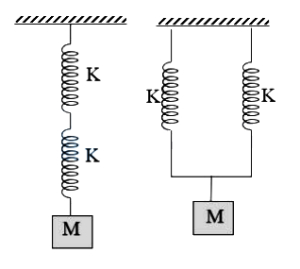
Two identical springs of constant $K$ are connected in series and parallel as shown in the figure. $A$ mass $M$ is suspended from them. The ratio of their frequencies in series to parallel combination will be
A
$1$:$2$
B
$1$:$4$
C
$4$:$1$
D
$1: \sqrt{2}$
Solution
(A) In the series combination,the effective spring constant $k_s$ is given by:
$k_s = \frac{K \cdot K}{K + K} = \frac{K}{2}$
In the parallel combination,the effective spring constant $k_p$ is given by:
$k_p = K + K = 2K$
The frequency of oscillation for a mass-spring system is $f = \frac{1}{2\pi} \sqrt{\frac{k}{M}}$.
For the series combination,the frequency $f_s$ is:
$f_s = \frac{1}{2\pi} \sqrt{\frac{K/2}{M}} = \frac{1}{2\pi} \sqrt{\frac{K}{2M}}$
For the parallel combination,the frequency $f_p$ is:
$f_p = \frac{1}{2\pi} \sqrt{\frac{2K}{M}}$
The ratio of the frequencies in series to parallel combination is:
$\frac{f_s}{f_p} = \frac{\frac{1}{2\pi} \sqrt{\frac{K}{2M}}}{\frac{1}{2\pi} \sqrt{\frac{2K}{M}}} = \sqrt{\frac{K}{2M} \cdot \frac{M}{2K}} = \sqrt{\frac{1}{4}} = \frac{1}{2}$
Thus,the ratio is $1:2$.
$k_s = \frac{K \cdot K}{K + K} = \frac{K}{2}$
In the parallel combination,the effective spring constant $k_p$ is given by:
$k_p = K + K = 2K$
The frequency of oscillation for a mass-spring system is $f = \frac{1}{2\pi} \sqrt{\frac{k}{M}}$.
For the series combination,the frequency $f_s$ is:
$f_s = \frac{1}{2\pi} \sqrt{\frac{K/2}{M}} = \frac{1}{2\pi} \sqrt{\frac{K}{2M}}$
For the parallel combination,the frequency $f_p$ is:
$f_p = \frac{1}{2\pi} \sqrt{\frac{2K}{M}}$
The ratio of the frequencies in series to parallel combination is:
$\frac{f_s}{f_p} = \frac{\frac{1}{2\pi} \sqrt{\frac{K}{2M}}}{\frac{1}{2\pi} \sqrt{\frac{2K}{M}}} = \sqrt{\frac{K}{2M} \cdot \frac{M}{2K}} = \sqrt{\frac{1}{4}} = \frac{1}{2}$
Thus,the ratio is $1:2$.
0 likes
View Solution273
DifficultMCQ
$A$ body executes $SHM$ under the action of force $F_1$ with time period $T_1$. If the force is changed to $F_2$,it executes $SHM$ with time period $T_2$. If both the forces $F_1$ and $F_2$ act simultaneously in the same direction on the body,its time period is:
A
$\frac{\sqrt{T_1^2-T_2^2}}{T_1 T_2}$
B
$\frac{T_1 T_2}{\sqrt{T_1^2-T_2^2}}$
C
$\frac{\sqrt{T_1^2+T_2^2}}{T_1 T_2}$
D
$\frac{T_1 T_2}{\sqrt{T_1^2+T_2^2}}$
Solution
(D) For a body of mass $m$ executing $SHM$,the force is $F = kx$,where $k$ is the force constant. The time period is given by $T = 2\pi \sqrt{\frac{m}{k}}$,which implies $k = \frac{4\pi^2 m}{T^2}$.
For force $F_1$,$k_1 = \frac{4\pi^2 m}{T_1^2}$.
For force $F_2$,$k_2 = \frac{4\pi^2 m}{T_2^2}$.
When both forces act simultaneously in the same direction,the effective force constant is $k_{eff} = k_1 + k_2$.
The new time period $T$ is given by $T = 2\pi \sqrt{\frac{m}{k_1 + k_2}}$.
Squaring both sides,$T^2 = \frac{4\pi^2 m}{k_1 + k_2}$.
Taking the reciprocal,$\frac{1}{T^2} = \frac{k_1 + k_2}{4\pi^2 m} = \frac{k_1}{4\pi^2 m} + \frac{k_2}{4\pi^2 m}$.
Substituting the expressions for $k_1$ and $k_2$,we get $\frac{1}{T^2} = \frac{1}{T_1^2} + \frac{1}{T_2^2} = \frac{T_1^2 + T_2^2}{T_1^2 T_2^2}$.
Therefore,$T = \frac{T_1 T_2}{\sqrt{T_1^2 + T_2^2}}$.
For force $F_1$,$k_1 = \frac{4\pi^2 m}{T_1^2}$.
For force $F_2$,$k_2 = \frac{4\pi^2 m}{T_2^2}$.
When both forces act simultaneously in the same direction,the effective force constant is $k_{eff} = k_1 + k_2$.
The new time period $T$ is given by $T = 2\pi \sqrt{\frac{m}{k_1 + k_2}}$.
Squaring both sides,$T^2 = \frac{4\pi^2 m}{k_1 + k_2}$.
Taking the reciprocal,$\frac{1}{T^2} = \frac{k_1 + k_2}{4\pi^2 m} = \frac{k_1}{4\pi^2 m} + \frac{k_2}{4\pi^2 m}$.
Substituting the expressions for $k_1$ and $k_2$,we get $\frac{1}{T^2} = \frac{1}{T_1^2} + \frac{1}{T_2^2} = \frac{T_1^2 + T_2^2}{T_1^2 T_2^2}$.
Therefore,$T = \frac{T_1 T_2}{\sqrt{T_1^2 + T_2^2}}$.
0 likes
View Solution274
EasyMCQ
$A$ mass $M$ is suspended from a spring of negligible mass. The spring is pulled a little and then released so that the mass executes $S.H.M.$ of period $T$. If the mass is increased by $m$,the time period becomes $\frac{5T}{3}$. What is the ratio $\left(\frac{M}{m}\right)$?
A
$\frac{25}{9}$
B
$\frac{16}{9}$
C
$\frac{9}{25}$
D
$\frac{9}{16}$
Solution
(D) The time period of a mass-spring system is given by $T = 2\pi \sqrt{\frac{M}{k}}$.
When the mass is increased by $m$,the new time period $T'$ is given as $T' = \frac{5T}{3}$.
Thus,$\frac{5T}{3} = 2\pi \sqrt{\frac{M+m}{k}}$.
Substituting $T = 2\pi \sqrt{\frac{M}{k}}$ into the equation:
$\frac{5}{3} \times 2\pi \sqrt{\frac{M}{k}} = 2\pi \sqrt{\frac{M+m}{k}}$.
Squaring both sides:
$\frac{25}{9} \times \frac{M}{k} = \frac{M+m}{k}$.
$\frac{25}{9}M = M + m$.
Dividing by $M$:
$\frac{25}{9} = 1 + \frac{m}{M}$.
$\frac{m}{M} = \frac{25}{9} - 1 = \frac{16}{9}$.
Therefore,the ratio $\frac{M}{m} = \frac{9}{16}$.
When the mass is increased by $m$,the new time period $T'$ is given as $T' = \frac{5T}{3}$.
Thus,$\frac{5T}{3} = 2\pi \sqrt{\frac{M+m}{k}}$.
Substituting $T = 2\pi \sqrt{\frac{M}{k}}$ into the equation:
$\frac{5}{3} \times 2\pi \sqrt{\frac{M}{k}} = 2\pi \sqrt{\frac{M+m}{k}}$.
Squaring both sides:
$\frac{25}{9} \times \frac{M}{k} = \frac{M+m}{k}$.
$\frac{25}{9}M = M + m$.
Dividing by $M$:
$\frac{25}{9} = 1 + \frac{m}{M}$.
$\frac{m}{M} = \frac{25}{9} - 1 = \frac{16}{9}$.
Therefore,the ratio $\frac{M}{m} = \frac{9}{16}$.
0 likes
View Solution275
MediumMCQ
$A$ small mass $m$ is suspended at the end of a wire having negligible mass,length $L$,and cross-sectional area $A$. The frequency of oscillation for the $S.H.M.$ along the vertical line is ($Y =$ Young's modulus of the wire).
A
$\frac{1}{2 \pi}\left(\frac{YA}{mL}\right)^{\frac{1}{2}}$
B
$\frac{2 \pi YA}{mL}$
C
$\frac{YA}{2 \pi m L}$
D
$2 \pi\left(\frac{YA}{mL}\right)^{\frac{1}{2}}$
Solution
(A) When a mass $m$ is suspended from a wire,the wire acts like a spring with a spring constant $k$.
From Hooke's Law,the tension $T$ in the wire for an extension $x$ is given by $T = \frac{YA}{L} x$.
Comparing this with the spring force equation $F = kx$,we find the effective spring constant $k = \frac{YA}{L}$.
The frequency of oscillation $f$ for a mass-spring system is given by $f = \frac{1}{2 \pi} \sqrt{\frac{k}{m}}$.
Substituting the value of $k$,we get $f = \frac{1}{2 \pi} \sqrt{\frac{YA}{mL}}$.
From Hooke's Law,the tension $T$ in the wire for an extension $x$ is given by $T = \frac{YA}{L} x$.
Comparing this with the spring force equation $F = kx$,we find the effective spring constant $k = \frac{YA}{L}$.
The frequency of oscillation $f$ for a mass-spring system is given by $f = \frac{1}{2 \pi} \sqrt{\frac{k}{m}}$.
Substituting the value of $k$,we get $f = \frac{1}{2 \pi} \sqrt{\frac{YA}{mL}}$.
0 likes
View Solution276
EasyMCQ
$A$ block of mass $m$ attached to one end of a vertical spring produces an extension $x$. If the block is pulled and released,the periodic time of oscillation is:
A
$2\pi\sqrt{\frac{2x}{g}}$
B
$2\pi\sqrt{\frac{x}{g}}$
C
$2\pi\sqrt{\frac{x}{2g}}$
D
$2\pi\sqrt{\frac{x}{4g}}$
Solution
(B) At equilibrium,the gravitational force is balanced by the spring force: $mg = kx$.
From this,the spring constant is $k = \frac{mg}{x}$.
The angular frequency of a mass-spring system is given by $\omega = \sqrt{\frac{k}{m}}$.
The time period $T$ is given by $T = \frac{2\pi}{\omega} = 2\pi\sqrt{\frac{m}{k}}$.
Substituting the value of $k$ from the equilibrium condition: $T = 2\pi\sqrt{\frac{m}{(mg/x)}} = 2\pi\sqrt{\frac{mx}{mg}}$.
Simplifying the expression,we get $T = 2\pi\sqrt{\frac{x}{g}}$.
From this,the spring constant is $k = \frac{mg}{x}$.
The angular frequency of a mass-spring system is given by $\omega = \sqrt{\frac{k}{m}}$.
The time period $T$ is given by $T = \frac{2\pi}{\omega} = 2\pi\sqrt{\frac{m}{k}}$.
Substituting the value of $k$ from the equilibrium condition: $T = 2\pi\sqrt{\frac{m}{(mg/x)}} = 2\pi\sqrt{\frac{mx}{mg}}$.
Simplifying the expression,we get $T = 2\pi\sqrt{\frac{x}{g}}$.
0 likes
View Solution277
EasyMCQ
$A$ $10 \,kg$ metal block is attached to a spring of spring constant $1000 \,N \,m^{-1}$. The block is displaced from the equilibrium position by $10 \,cm$ and released. The maximum acceleration of the block is: (in $\,m/s^2$)
A
$10$
B
$100$
C
$200$
D
$0.1$
Solution
(A) Given: mass $m = 10 \,kg$, spring constant $k = 1000 \,N/m$, and amplitude $A = 10 \,cm = 0.1 \,m$.
In simple harmonic motion, the restoring force is $F = -kx$.
The maximum force occurs at maximum displacement (amplitude), so $F_{max} = kA$.
Using Newton's second law, $F_{max} = m a_{max}$.
Therefore, $m a_{max} = kA$.
$a_{max} = \frac{kA}{m} = \frac{1000 \,N/m \times 0.1 \,m}{10 \,kg} = \frac{100}{10} = 10 \,m/s^2$.
The maximum acceleration of the block is $10 \,m/s^2$.
In simple harmonic motion, the restoring force is $F = -kx$.
The maximum force occurs at maximum displacement (amplitude), so $F_{max} = kA$.
Using Newton's second law, $F_{max} = m a_{max}$.
Therefore, $m a_{max} = kA$.
$a_{max} = \frac{kA}{m} = \frac{1000 \,N/m \times 0.1 \,m}{10 \,kg} = \frac{100}{10} = 10 \,m/s^2$.
The maximum acceleration of the block is $10 \,m/s^2$.
0 likes
View Solution278
DifficultMCQ
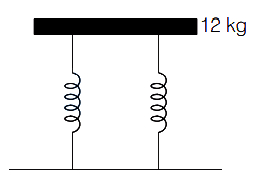
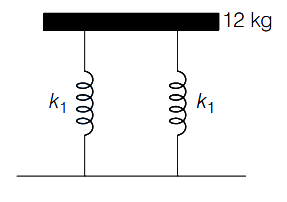
$A$ tray of mass $12 \,kg$ is supported by two identical springs as shown in the figure. When the tray is pressed down slightly and then released, it executes $SHM$ with a time period of $1.5 \,s$. The spring constant of each spring is
A
$50 \,Nm^{-1}$
B
$0$
C
$105 \,Nm^{-1}$
D
$\infty$
Solution
(C) Mass of the tray, $m = 12 \,kg$.
Time period, $T = 1.5 \,s$.
Let $k$ be the spring constant of each spring.
Since the springs are connected in parallel, the effective spring constant is $k_{\text{net}} = k + k = 2k$.
The time period of a mass-spring system is given by $T = 2\pi \sqrt{\frac{m}{k_{\text{net}}}}$.
Substituting the values, we get $1.5 = 2\pi \sqrt{\frac{12}{2k}}$.
$1.5 = 2\pi \sqrt{\frac{6}{k}}$.
Squaring both sides, we have $(1.5)^2 = (2\pi)^2 \cdot \frac{6}{k}$.
$2.25 = 4\pi^2 \cdot \frac{6}{k}$.
$k = \frac{24\pi^2}{2.25} \approx \frac{24 \times 9.87}{2.25} \approx 105.28 \,Nm^{-1}$.
Thus, the spring constant of each spring is approximately $105 \,Nm^{-1}$.
Time period, $T = 1.5 \,s$.
Let $k$ be the spring constant of each spring.
Since the springs are connected in parallel, the effective spring constant is $k_{\text{net}} = k + k = 2k$.
The time period of a mass-spring system is given by $T = 2\pi \sqrt{\frac{m}{k_{\text{net}}}}$.
Substituting the values, we get $1.5 = 2\pi \sqrt{\frac{12}{2k}}$.
$1.5 = 2\pi \sqrt{\frac{6}{k}}$.
Squaring both sides, we have $(1.5)^2 = (2\pi)^2 \cdot \frac{6}{k}$.
$2.25 = 4\pi^2 \cdot \frac{6}{k}$.
$k = \frac{24\pi^2}{2.25} \approx \frac{24 \times 9.87}{2.25} \approx 105.28 \,Nm^{-1}$.
Thus, the spring constant of each spring is approximately $105 \,Nm^{-1}$.
0 likes
View Solution279
MediumMCQ
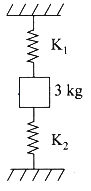
$A$ $3 \ kg$ block is connected as shown in the figure. The spring constants of the two springs $K_1$ and $K_2$ are $50 \ Nm^{-1}$ and $150 \ Nm^{-1}$ respectively. The block is released from rest with the springs unstretched. The acceleration of the block in its lowest position is $(g=10 \ ms^{-2})$. (in $ms^{-2}$)
A
$10$
B
$12$
C
$8$
D
$8.8$
Solution
(A) Given: $m = 3 \ kg$,$K_1 = 50 \ Nm^{-1}$,$K_2 = 150 \ Nm^{-1}$,$g = 10 \ ms^{-2}$.
Since the block is connected between two springs in parallel,the equivalent spring constant is $K_{eq} = K_1 + K_2 = 50 + 150 = 200 \ Nm^{-1}$.
The equilibrium position is where the spring force balances the weight: $K_{eq} x_0 = mg \implies x_0 = \frac{mg}{K_{eq}} = \frac{3 \times 10}{200} = 0.15 \ m$.
The block is released from the unstretched position,so the amplitude of oscillation is $A = x_0 = 0.15 \ m$.
At the lowest position,the block is at a displacement $x = A$ below the equilibrium position.
The net force at the lowest position is $F_{net} = K_{eq} A - mg = K_{eq} (\frac{mg}{K_{eq}}) - mg = 0$ (at equilibrium). Wait,let's re-evaluate.
At the lowest position,the spring is stretched by $x = 2A = 2 \times 0.15 = 0.3 \ m$.
The net force is $F_{net} = K_{eq} x - mg = 200(0.3) - 3(10) = 60 - 30 = 30 \ N$.
The acceleration is $a = \frac{F_{net}}{m} = \frac{30}{3} = 10 \ ms^{-2}$.
Since the block is connected between two springs in parallel,the equivalent spring constant is $K_{eq} = K_1 + K_2 = 50 + 150 = 200 \ Nm^{-1}$.
The equilibrium position is where the spring force balances the weight: $K_{eq} x_0 = mg \implies x_0 = \frac{mg}{K_{eq}} = \frac{3 \times 10}{200} = 0.15 \ m$.
The block is released from the unstretched position,so the amplitude of oscillation is $A = x_0 = 0.15 \ m$.
At the lowest position,the block is at a displacement $x = A$ below the equilibrium position.
The net force at the lowest position is $F_{net} = K_{eq} A - mg = K_{eq} (\frac{mg}{K_{eq}}) - mg = 0$ (at equilibrium). Wait,let's re-evaluate.
At the lowest position,the spring is stretched by $x = 2A = 2 \times 0.15 = 0.3 \ m$.
The net force is $F_{net} = K_{eq} x - mg = 200(0.3) - 3(10) = 60 - 30 = 30 \ N$.
The acceleration is $a = \frac{F_{net}}{m} = \frac{30}{3} = 10 \ ms^{-2}$.
0 likes
View Solution280
DifficultMCQ
$A$ heavy brass sphere is hung from a spring and it executes vertical vibrations with period $T$. The sphere is now immersed in a non-viscous liquid with a density $(1/10)^{\text{th}}$ that of brass. When set into vertical vibrations with the sphere remaining inside the liquid all the time,the time period will be
A
$\sqrt{\frac{9}{10}} T$
B
$\sqrt{\frac{10}{9}} T$
C
$\frac{9}{10} T$
D
Unchanged
Solution
(D) The time period of a spring-mass system is given by $T = 2\pi \sqrt{\frac{m}{k}}$,where $m$ is the mass of the object and $k$ is the spring constant.
When the sphere is immersed in a non-viscous liquid,it experiences a buoyant force. However,the buoyant force is a constant force (like gravity) and does not change the effective spring constant $k$ or the inertial mass $m$ of the system.
Since the liquid is non-viscous,there is no damping force (drag) acting on the sphere.
Therefore,the effective mass and the spring constant remain unchanged,and the time period of oscillation remains $T = 2\pi \sqrt{\frac{m}{k}}$.
Thus,the time period remains unchanged.
When the sphere is immersed in a non-viscous liquid,it experiences a buoyant force. However,the buoyant force is a constant force (like gravity) and does not change the effective spring constant $k$ or the inertial mass $m$ of the system.
Since the liquid is non-viscous,there is no damping force (drag) acting on the sphere.
Therefore,the effective mass and the spring constant remain unchanged,and the time period of oscillation remains $T = 2\pi \sqrt{\frac{m}{k}}$.
Thus,the time period remains unchanged.
0 likes
View Solution281
MediumMCQ
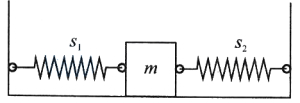
When a mass '$m$' is connected individually to the springs with spring constants $s_1$ and $s_2$,the oscillation frequencies are $v_1$ and $v_2$. If the same mass is attached to the two springs as shown in the figure,the oscillation frequency would be
A
$v_1+v_2$
B
$\sqrt{v_1^2+v_2^2}$
C
$\left(\frac{1}{v_1}+\frac{1}{v_2}\right)^{-1}$
D
$\sqrt{v_1^2-v_2^2}$
Solution
(B) The frequency of oscillation for a mass $m$ attached to a spring with constant $k$ is given by $v = \frac{1}{2\pi} \sqrt{\frac{k}{m}}$.
For springs $s_1$ and $s_2$,we have $v_1 = \frac{1}{2\pi} \sqrt{\frac{s_1}{m}}$ and $v_2 = \frac{1}{2\pi} \sqrt{\frac{s_2}{m}}$.
Squaring these,we get $v_1^2 = \frac{1}{4\pi^2} \frac{s_1}{m}$ and $v_2^2 = \frac{1}{4\pi^2} \frac{s_2}{m}$.
In the given figure,the springs are in parallel configuration,so the equivalent spring constant is $s_{eq} = s_1 + s_2$.
The new frequency $v$ is given by $v = \frac{1}{2\pi} \sqrt{\frac{s_{eq}}{m}} = \frac{1}{2\pi} \sqrt{\frac{s_1 + s_2}{m}}$.
Substituting $s_1 = 4\pi^2 m v_1^2$ and $s_2 = 4\pi^2 m v_2^2$,we get:
$v = \frac{1}{2\pi} \sqrt{\frac{4\pi^2 m v_1^2 + 4\pi^2 m v_2^2}{m}} = \sqrt{v_1^2 + v_2^2}$.
For springs $s_1$ and $s_2$,we have $v_1 = \frac{1}{2\pi} \sqrt{\frac{s_1}{m}}$ and $v_2 = \frac{1}{2\pi} \sqrt{\frac{s_2}{m}}$.
Squaring these,we get $v_1^2 = \frac{1}{4\pi^2} \frac{s_1}{m}$ and $v_2^2 = \frac{1}{4\pi^2} \frac{s_2}{m}$.
In the given figure,the springs are in parallel configuration,so the equivalent spring constant is $s_{eq} = s_1 + s_2$.
The new frequency $v$ is given by $v = \frac{1}{2\pi} \sqrt{\frac{s_{eq}}{m}} = \frac{1}{2\pi} \sqrt{\frac{s_1 + s_2}{m}}$.
Substituting $s_1 = 4\pi^2 m v_1^2$ and $s_2 = 4\pi^2 m v_2^2$,we get:
$v = \frac{1}{2\pi} \sqrt{\frac{4\pi^2 m v_1^2 + 4\pi^2 m v_2^2}{m}} = \sqrt{v_1^2 + v_2^2}$.
0 likes
View Solution282
EasyMCQ
The angular frequency of a block of mass $0.1 \ kg$ oscillating with the help of a spring of force constant $2.5 \ Nm^{-1}$ is
A
$0.2 \ rad \ s^{-1}$
B
$5 \ rad \ s^{-1}$
C
$10 \ rad \ s^{-1}$
D
$2 \ rad \ s^{-1}$
Solution
(B) The angular frequency $\omega$ of a block of mass $m$ attached to a spring of force constant $k$ is given by the formula: $\omega = \sqrt{\frac{k}{m}}$.
Given values are $m = 0.1 \ kg$ and $k = 2.5 \ Nm^{-1}$.
Substituting these values into the formula:
$\omega = \sqrt{\frac{2.5}{0.1}}$
$\omega = \sqrt{25}$
$\omega = 5 \ rad \ s^{-1}$.
Therefore,the correct option is $B$.
Given values are $m = 0.1 \ kg$ and $k = 2.5 \ Nm^{-1}$.
Substituting these values into the formula:
$\omega = \sqrt{\frac{2.5}{0.1}}$
$\omega = \sqrt{25}$
$\omega = 5 \ rad \ s^{-1}$.
Therefore,the correct option is $B$.
0 likes
View Solution283
MediumMCQ
$A$ body of mass $1 \,kg$ is attached to the lower end of a vertically suspended spring of force constant $600 \,N \,m^{-1}$. If another body of mass $0.5 \,kg$ moving vertically upward hits the suspended body with a velocity $3 \,m \,s^{-1}$ and gets embedded in it, then the frequency of the oscillation is
A
$\frac{5}{\pi} \,Hz$
B
$\frac{10}{\pi} \,Hz$
C
$\frac{\pi}{5} \,Hz$
D
$\pi \,Hz$
Solution
(B) The initial mass attached to the spring is $m_1 = 1 \,kg$. The mass hitting it is $m_2 = 0.5 \,kg$.
After the collision, the two bodies move together as a single system with a total mass $M = m_1 + m_2 = 1 + 0.5 = 1.5 \,kg$.
The force constant of the spring is $k = 600 \,N \,m^{-1}$.
The angular frequency of the oscillation for a spring-mass system is given by $\omega = \sqrt{\frac{k}{M}}$.
Substituting the values: $\omega = \sqrt{\frac{600}{1.5}} = \sqrt{400} = 20 \,rad \,s^{-1}$.
The frequency of oscillation $f$ is related to angular frequency by $f = \frac{\omega}{2\pi}$.
Therefore, $f = \frac{20}{2\pi} = \frac{10}{\pi} \,Hz$.
After the collision, the two bodies move together as a single system with a total mass $M = m_1 + m_2 = 1 + 0.5 = 1.5 \,kg$.
The force constant of the spring is $k = 600 \,N \,m^{-1}$.
The angular frequency of the oscillation for a spring-mass system is given by $\omega = \sqrt{\frac{k}{M}}$.
Substituting the values: $\omega = \sqrt{\frac{600}{1.5}} = \sqrt{400} = 20 \,rad \,s^{-1}$.
The frequency of oscillation $f$ is related to angular frequency by $f = \frac{\omega}{2\pi}$.
Therefore, $f = \frac{20}{2\pi} = \frac{10}{\pi} \,Hz$.
0 likes
View Solution284
MediumMCQ
When the mass attached to a spring is increased from $4 \ kg$ to $9 \ kg$,the time period of oscillation increases by $0.2 \pi \ s$. Then the spring constant of the spring is (in $N \ m^{-1}$)
A
$80$
B
$200$
C
$50$
D
$100$
Solution
(D) The time period of a spring-mass system is given by $T = 2\pi \sqrt{\frac{m}{k}}$.
For mass $m_1 = 4 \ kg$,the time period is $T_1 = 2\pi \sqrt{\frac{4}{k}} = 2\pi \cdot \frac{2}{\sqrt{k}} = \frac{4\pi}{\sqrt{k}}$.
For mass $m_2 = 9 \ kg$,the time period is $T_2 = 2\pi \sqrt{\frac{9}{k}} = 2\pi \cdot \frac{3}{\sqrt{k}} = \frac{6\pi}{\sqrt{k}}$.
Given that the time period increases by $0.2\pi \ s$,we have $T_2 - T_1 = 0.2\pi$.
Substituting the expressions for $T_1$ and $T_2$: $\frac{6\pi}{\sqrt{k}} - \frac{4\pi}{\sqrt{k}} = 0.2\pi$.
$\frac{2\pi}{\sqrt{k}} = 0.2\pi$.
Dividing both sides by $\pi$: $\frac{2}{\sqrt{k}} = 0.2$.
$\sqrt{k} = \frac{2}{0.2} = 10$.
Squaring both sides,we get $k = 100 \ N \ m^{-1}$.
For mass $m_1 = 4 \ kg$,the time period is $T_1 = 2\pi \sqrt{\frac{4}{k}} = 2\pi \cdot \frac{2}{\sqrt{k}} = \frac{4\pi}{\sqrt{k}}$.
For mass $m_2 = 9 \ kg$,the time period is $T_2 = 2\pi \sqrt{\frac{9}{k}} = 2\pi \cdot \frac{3}{\sqrt{k}} = \frac{6\pi}{\sqrt{k}}$.
Given that the time period increases by $0.2\pi \ s$,we have $T_2 - T_1 = 0.2\pi$.
Substituting the expressions for $T_1$ and $T_2$: $\frac{6\pi}{\sqrt{k}} - \frac{4\pi}{\sqrt{k}} = 0.2\pi$.
$\frac{2\pi}{\sqrt{k}} = 0.2\pi$.
Dividing both sides by $\pi$: $\frac{2}{\sqrt{k}} = 0.2$.
$\sqrt{k} = \frac{2}{0.2} = 10$.
Squaring both sides,we get $k = 100 \ N \ m^{-1}$.
0 likes
View Solution285
EasyMCQ
$A$ body of mass $4 \ kg$ attached to a spring of force constant $64 \ N \ m^{-1}$ executes simple harmonic motion on a frictionless horizontal surface. The time period of oscillation is
A
$\frac{\pi}{3} \ s$
B
$\frac{\pi}{2} \ s$
C
$\pi \ s$
D
$\frac{3 \pi}{2} \ s$
Solution
(B) The time period $T$ of a body of mass $m$ attached to a spring of force constant $k$ executing simple harmonic motion is given by the formula:
$T = 2\pi \sqrt{\frac{m}{k}}$
Given:
Mass $m = 4 \ kg$
Force constant $k = 64 \ N \ m^{-1}$
Substituting the values into the formula:
$T = 2\pi \sqrt{\frac{4}{64}}$
$T = 2\pi \sqrt{\frac{1}{16}}$
$T = 2\pi \times \frac{1}{4}$
$T = \frac{\pi}{2} \ s$
Therefore,the correct option is $B$.
$T = 2\pi \sqrt{\frac{m}{k}}$
Given:
Mass $m = 4 \ kg$
Force constant $k = 64 \ N \ m^{-1}$
Substituting the values into the formula:
$T = 2\pi \sqrt{\frac{4}{64}}$
$T = 2\pi \sqrt{\frac{1}{16}}$
$T = 2\pi \times \frac{1}{4}$
$T = \frac{\pi}{2} \ s$
Therefore,the correct option is $B$.
0 likes
View Solution286
MediumMCQ
$A$ spring is stretched by $0.2 \ m$ when a mass of $0.5 \ kg$ is suspended to it. The time period of the spring when the $0.5 \ kg$ mass is replaced with a mass of $0.25 \ kg$ is (Acceleration due to gravity $= 10 \ m \ s^{-2}$) (in $s$)
A
$0.628$
B
$6.28$
C
$62.8$
D
$0.0628$
Solution
(A) Given: Mass $m_1 = 0.5 \ kg$,extension $x = 0.2 \ m$,$g = 10 \ m \ s^{-2}$.
From Hooke's Law,$mg = kx$,so the spring constant $k = \frac{mg}{x} = \frac{0.5 \times 10}{0.2} = \frac{5}{0.2} = 25 \ N/m$.
The time period of a spring-mass system is given by $T = 2\pi \sqrt{\frac{m}{k}}$.
When the mass is replaced by $m_2 = 0.25 \ kg$,the new time period is $T = 2\pi \sqrt{\frac{0.25}{25}} = 2\pi \sqrt{0.01} = 2\pi \times 0.1 = 0.2\pi \ s$.
Using $\pi \approx 3.14$,$T = 0.2 \times 3.14 = 0.628 \ s$.
From Hooke's Law,$mg = kx$,so the spring constant $k = \frac{mg}{x} = \frac{0.5 \times 10}{0.2} = \frac{5}{0.2} = 25 \ N/m$.
The time period of a spring-mass system is given by $T = 2\pi \sqrt{\frac{m}{k}}$.
When the mass is replaced by $m_2 = 0.25 \ kg$,the new time period is $T = 2\pi \sqrt{\frac{0.25}{25}} = 2\pi \sqrt{0.01} = 2\pi \times 0.1 = 0.2\pi \ s$.
Using $\pi \approx 3.14$,$T = 0.2 \times 3.14 = 0.628 \ s$.
0 likes
View Solution287
MediumMCQ
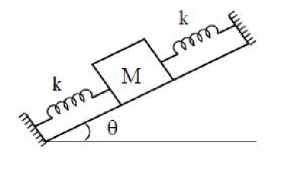
On a smooth inclined plane,a block of mass $M$ is fixed to two rigid supports using two springs,as shown in the figure. If each spring has spring constant $k$,then the period of oscillation of the block is (Neglect the masses of the springs)
A
$2 \pi\left(\frac{M}{2 k}\right)^{1 / 2}$
B
$2 \pi\left(\frac{2 M}{k}\right)^{1 / 2}$
C
$2 \pi\left(\frac{Mg \sin \theta}{2 k}\right)^{1 / 2}$
D
$2 \pi\left(\frac{2 Mg}{k}\right)^{1 / 2}$
Solution
(A) When the block of mass $M$ is displaced by a small distance $x$ along the inclined plane,one spring gets compressed by $x$ and the other gets stretched by $x$.
The restoring force exerted by each spring is $F = -kx$.
Since both springs act in the same direction to restore the equilibrium position,the total restoring force is $F_{net} = -kx - kx = -2kx$.
The equation of motion for the block is $M a = -2kx$,which can be written as $M \frac{d^2x}{dt^2} + 2kx = 0$.
This is the standard form of the simple harmonic motion equation $\frac{d^2x}{dt^2} + \omega^2 x = 0$,where $\omega^2 = \frac{2k}{M}$.
The angular frequency is $\omega = \sqrt{\frac{2k}{M}}$.
The time period of oscillation is $T = \frac{2\pi}{\omega} = 2\pi \sqrt{\frac{M}{2k}}$.
Thus,the correct option is $A$.
The restoring force exerted by each spring is $F = -kx$.
Since both springs act in the same direction to restore the equilibrium position,the total restoring force is $F_{net} = -kx - kx = -2kx$.
The equation of motion for the block is $M a = -2kx$,which can be written as $M \frac{d^2x}{dt^2} + 2kx = 0$.
This is the standard form of the simple harmonic motion equation $\frac{d^2x}{dt^2} + \omega^2 x = 0$,where $\omega^2 = \frac{2k}{M}$.
The angular frequency is $\omega = \sqrt{\frac{2k}{M}}$.
The time period of oscillation is $T = \frac{2\pi}{\omega} = 2\pi \sqrt{\frac{M}{2k}}$.
Thus,the correct option is $A$.
0 likes
View Solution288
MediumMCQ
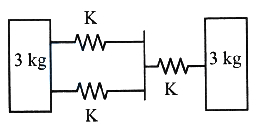
In a spring-block system as shown in the figure,if the spring constant $K = 9 \pi^2 \ Nm^{-1}$,then the time period of oscillation is (in $s$)
A
$1$
B
$3.14$
C
$1.414$
D
$0.5$
Solution
(C) The two springs on the left are in parallel,so their equivalent spring constant is $K_p = K + K = 2K$.
This combination is in series with the third spring of constant $K$. The equivalent spring constant $K_{eq}$ is given by:
$\frac{1}{K_{eq}} = \frac{1}{2K} + \frac{1}{K} = \frac{1+2}{2K} = \frac{3}{2K}$
$K_{eq} = \frac{2K}{3} = \frac{2 \times 9 \pi^2}{3} = 6 \pi^2 \ Nm^{-1}$.
The mass of the block is $m = 3 \ kg$.
The time period of oscillation is $T = 2 \pi \sqrt{\frac{m}{K_{eq}}}$.
Substituting the values: $T = 2 \pi \sqrt{\frac{3}{6 \pi^2}} = 2 \pi \sqrt{\frac{1}{2 \pi^2}} = 2 \pi \times \frac{1}{\pi \sqrt{2}} = \frac{2}{\sqrt{2}} = \sqrt{2} \ s$.
$T = 1.414 \ s$.
This combination is in series with the third spring of constant $K$. The equivalent spring constant $K_{eq}$ is given by:
$\frac{1}{K_{eq}} = \frac{1}{2K} + \frac{1}{K} = \frac{1+2}{2K} = \frac{3}{2K}$
$K_{eq} = \frac{2K}{3} = \frac{2 \times 9 \pi^2}{3} = 6 \pi^2 \ Nm^{-1}$.
The mass of the block is $m = 3 \ kg$.
The time period of oscillation is $T = 2 \pi \sqrt{\frac{m}{K_{eq}}}$.
Substituting the values: $T = 2 \pi \sqrt{\frac{3}{6 \pi^2}} = 2 \pi \sqrt{\frac{1}{2 \pi^2}} = 2 \pi \times \frac{1}{\pi \sqrt{2}} = \frac{2}{\sqrt{2}} = \sqrt{2} \ s$.
$T = 1.414 \ s$.
0 likes
View Solution289
MediumMCQ
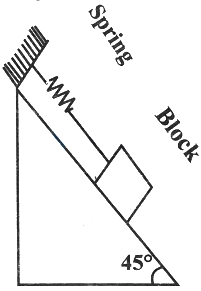
As shown in the figure, a block of weight $20 \,N$ is connected to the top of a smooth inclined plane by a massless spring of constant $8 \pi^2 \,Nm^{-1}$. If the block is pulled slightly from its mean position and released, the period of oscillations is (Acceleration due to gravity $= 10 \,ms^{-2}$) (in $\,s$)
A
$4$
B
$3$
C
$2$
D
$1$
Solution
(D) The weight of the block is $W = mg = 20 \,N$. Given $g = 10 \,ms^{-2}$, the mass of the block is $m = \frac{20}{10} = 2 \,kg$.
For a block-spring system on a smooth inclined plane, the component of gravity along the plane only shifts the equilibrium position and does not affect the frequency or period of oscillation.
The angular frequency of the oscillation is given by $\omega = \sqrt{\frac{K}{m}}$, where $K = 8 \pi^2 \,Nm^{-1}$ is the spring constant.
$\omega = \sqrt{\frac{8 \pi^2}{2}} = \sqrt{4 \pi^2} = 2 \pi \,rad/s$.
The period of oscillation $T$ is given by $T = \frac{2 \pi}{\omega}$.
Substituting the value of $\omega$, we get $T = \frac{2 \pi}{2 \pi} = 1 \,s$.
Therefore, the period of oscillations is $1 \,s$.
For a block-spring system on a smooth inclined plane, the component of gravity along the plane only shifts the equilibrium position and does not affect the frequency or period of oscillation.
The angular frequency of the oscillation is given by $\omega = \sqrt{\frac{K}{m}}$, where $K = 8 \pi^2 \,Nm^{-1}$ is the spring constant.
$\omega = \sqrt{\frac{8 \pi^2}{2}} = \sqrt{4 \pi^2} = 2 \pi \,rad/s$.
The period of oscillation $T$ is given by $T = \frac{2 \pi}{\omega}$.
Substituting the value of $\omega$, we get $T = \frac{2 \pi}{2 \pi} = 1 \,s$.
Therefore, the period of oscillations is $1 \,s$.
0 likes
View Solution290
MediumMCQ
When a body of mass $8 \,kg$ is attached to a spring balance, the reading of the balance is $20 \,cm$. Instead of $8 \,kg$, if another body of mass $M$ is suspended from the spring balance and is made to oscillate vertically, the time period of oscillation is $\frac{\pi}{5} \,s$, then the value of $M$ is (Acceleration due to gravity $= 10 \,m/s^2$) (in $\,kg$)
A
$4$
B
$6$
C
$8$
D
$9$
Solution
(A) Given mass $m = 8 \,kg$ and extension $x = 20 \,cm = 0.2 \,m$.
Using Hooke's Law, $mg = kx$, we find the spring constant $k = \frac{mg}{x} = \frac{8 \times 10}{0.2} = 400 \,N/m$.
For a mass $M$ oscillating on a spring, the time period $T$ is given by $T = 2\pi \sqrt{\frac{M}{k}}$.
Given $T = \frac{\pi}{5} \,s$, we have $\frac{\pi}{5} = 2\pi \sqrt{\frac{M}{400}}$.
Dividing both sides by $\pi$, we get $\frac{1}{5} = 2 \sqrt{\frac{M}{400}} = 2 \frac{\sqrt{M}}{20} = \frac{\sqrt{M}}{10}$.
Thus, $\sqrt{M} = \frac{10}{5} = 2$.
Squaring both sides, $M = 4 \,kg$.
Using Hooke's Law, $mg = kx$, we find the spring constant $k = \frac{mg}{x} = \frac{8 \times 10}{0.2} = 400 \,N/m$.
For a mass $M$ oscillating on a spring, the time period $T$ is given by $T = 2\pi \sqrt{\frac{M}{k}}$.
Given $T = \frac{\pi}{5} \,s$, we have $\frac{\pi}{5} = 2\pi \sqrt{\frac{M}{400}}$.
Dividing both sides by $\pi$, we get $\frac{1}{5} = 2 \sqrt{\frac{M}{400}} = 2 \frac{\sqrt{M}}{20} = \frac{\sqrt{M}}{10}$.
Thus, $\sqrt{M} = \frac{10}{5} = 2$.
Squaring both sides, $M = 4 \,kg$.
0 likes
View Solution291
MediumMCQ
$A$ block of mass $M$ hangs from a spring and oscillates vertically with an angular frequency $\omega$. If the block is removed from the spring,when it is in equilibrium position,the spring shortens by
A
$\frac{g}{\omega}$
B
$\sqrt{\frac{g}{\omega}}$
C
$\frac{g}{\omega^2}$
D
$\sqrt{\frac{g}{\omega^2}}$
Solution
(C) When a block of mass $M$ hangs from a spring in equilibrium,the downward gravitational force is balanced by the upward spring force.
$Mg = kx$,where $k$ is the spring constant and $x$ is the extension in the spring.
Therefore,the extension $x = \frac{Mg}{k}$.
We know that the angular frequency of a spring-mass system is given by $\omega = \sqrt{\frac{k}{M}}$.
Squaring both sides,we get $\omega^2 = \frac{k}{M}$,which implies $k = M\omega^2$.
Substituting the value of $k$ into the expression for $x$:
$x = \frac{Mg}{M\omega^2} = \frac{g}{\omega^2}$.
Thus,when the block is removed,the spring shortens by $\frac{g}{\omega^2}$.
$Mg = kx$,where $k$ is the spring constant and $x$ is the extension in the spring.
Therefore,the extension $x = \frac{Mg}{k}$.
We know that the angular frequency of a spring-mass system is given by $\omega = \sqrt{\frac{k}{M}}$.
Squaring both sides,we get $\omega^2 = \frac{k}{M}$,which implies $k = M\omega^2$.
Substituting the value of $k$ into the expression for $x$:
$x = \frac{Mg}{M\omega^2} = \frac{g}{\omega^2}$.
Thus,when the block is removed,the spring shortens by $\frac{g}{\omega^2}$.
0 likes
View Solution292
EasyMCQ
An object of mass $2 \,kg$ is attached to a spring with spring constant $8 \,N/m$. If the object is executing simple harmonic motion, then the number of cycles it completes in $66 \,s$ is
A
$21$
B
$16$
C
$28$
D
$12$
Solution
(A) The time period $T$ of a spring-mass system is given by the formula:
$T = 2 \pi \sqrt{\frac{m}{k}}$
Given, mass $m = 2 \,kg$ and spring constant $k = 8 \,N/m$.
Substituting these values into the formula:
$T = 2 \pi \sqrt{\frac{2}{8}} = 2 \pi \sqrt{\frac{1}{4}} = 2 \pi \times \frac{1}{2} = \pi \,s$.
The number of cycles $n$ completed in time $t = 66 \,s$ is given by:
$n = \frac{t}{T} = \frac{66}{\pi}$.
Taking $\pi \approx \frac{22}{7}$, we get:
$n = \frac{66}{22/7} = \frac{66 \times 7}{22} = 3 \times 7 = 21$.
Thus, the object completes $21$ oscillations in the given time.
$T = 2 \pi \sqrt{\frac{m}{k}}$
Given, mass $m = 2 \,kg$ and spring constant $k = 8 \,N/m$.
Substituting these values into the formula:
$T = 2 \pi \sqrt{\frac{2}{8}} = 2 \pi \sqrt{\frac{1}{4}} = 2 \pi \times \frac{1}{2} = \pi \,s$.
The number of cycles $n$ completed in time $t = 66 \,s$ is given by:
$n = \frac{t}{T} = \frac{66}{\pi}$.
Taking $\pi \approx \frac{22}{7}$, we get:
$n = \frac{66}{22/7} = \frac{66 \times 7}{22} = 3 \times 7 = 21$.
Thus, the object completes $21$ oscillations in the given time.
0 likes
View Solution293
MediumMCQ
$A$ spring is stretched by $0.40 \ m$ when a mass of $0.6 \ kg$ is suspended from it. The period of oscillations of the spring loaded by $255 \ g$ and put to oscillations is close to $(g = 10 \ m \ s^{-2})$. (in $s$)
A
$1.1$
B
$48.6$
C
$0.82$
D
$4.86$
Solution
(C) Using Hooke's law for the spring,$F = kx$.
When a mass of $0.6 \ kg$ is suspended,the spring force balances the weight of the mass,so $F = mg$.
Thus,$k = \frac{mg}{x} = \frac{0.6 \times 10}{0.40} = 15 \ N \ m^{-1}$.
The time period $T$ for a mass $m' = 255 \ g = 0.255 \ kg$ is given by $T = 2\pi \sqrt{\frac{m'}{k}}$.
Substituting the values: $T = 2 \times 3.14 \times \sqrt{\frac{0.255}{15}} = 2 \times 3.14 \times \sqrt{0.017} \approx 6.28 \times 0.13038 \approx 0.8188 \ s$.
Rounding to two decimal places,$T \approx 0.82 \ s$.
When a mass of $0.6 \ kg$ is suspended,the spring force balances the weight of the mass,so $F = mg$.
Thus,$k = \frac{mg}{x} = \frac{0.6 \times 10}{0.40} = 15 \ N \ m^{-1}$.
The time period $T$ for a mass $m' = 255 \ g = 0.255 \ kg$ is given by $T = 2\pi \sqrt{\frac{m'}{k}}$.
Substituting the values: $T = 2 \times 3.14 \times \sqrt{\frac{0.255}{15}} = 2 \times 3.14 \times \sqrt{0.017} \approx 6.28 \times 0.13038 \approx 0.8188 \ s$.
Rounding to two decimal places,$T \approx 0.82 \ s$.
0 likes
View Solution294
MediumMCQ
The scale of a spring balance which can measure from $0$ to $15 \ kg$ is $0.25 \ m$ long. If a body suspended from this balance oscillates with a time period $\frac{2 \pi}{5} \ s$,neglecting the mass of the spring,find the mass of the body suspended. (in $kg$)
A
$24$
B
$1$
C
$20$
D
$7$
Solution
(A) The spring constant $k$ of the spring is calculated using Hooke's Law,$F = kx$. Given $F = 15 \ kg \times 10 \ m/s^2 = 150 \ N$ and $x = 0.25 \ m$,we have $k = \frac{150}{0.25} = 600 \ N/m$.
The time period $T$ of a spring-mass system is given by $T = 2 \pi \sqrt{\frac{m}{k}}$.
Substituting the given values,$\frac{2 \pi}{5} = 2 \pi \sqrt{\frac{m}{600}}$.
Dividing both sides by $2 \pi$,we get $\frac{1}{5} = \sqrt{\frac{m}{600}}$.
Squaring both sides,$\frac{1}{25} = \frac{m}{600}$.
Solving for $m$,$m = \frac{600}{25} = 24 \ kg$.
The time period $T$ of a spring-mass system is given by $T = 2 \pi \sqrt{\frac{m}{k}}$.
Substituting the given values,$\frac{2 \pi}{5} = 2 \pi \sqrt{\frac{m}{600}}$.
Dividing both sides by $2 \pi$,we get $\frac{1}{5} = \sqrt{\frac{m}{600}}$.
Squaring both sides,$\frac{1}{25} = \frac{m}{600}$.
Solving for $m$,$m = \frac{600}{25} = 24 \ kg$.
0 likes
View Solution295
MediumMCQ
$A$ block of mass $1 \ kg$ is fastened to a spring of spring constant $100 \ N \ m^{-1}$. The block is pulled to a distance $x = 10 \ cm$ from its equilibrium position $(x = 0 \ cm)$ on a frictionless surface,from rest at $t = 0$. The kinetic energy and the potential energy of the block when it is $5 \ cm$ away from the mean position are:
A
$0.375 \ J, 0.125 \ J$
B
$0.125 \ J, 0.375 \ J$
C
$0.125 \ J, 0.125 \ J$
D
$0.375 \ J, 0.375 \ J$
Solution
(A) Given: Mass $m = 1 \ kg$,spring constant $k = 100 \ N \ m^{-1}$,amplitude $A = 10 \ cm = 0.1 \ m$,displacement $x = 5 \ cm = 0.05 \ m$.
Angular frequency $\omega = \sqrt{\frac{k}{m}} = \sqrt{\frac{100}{1}} = 10 \ rad \ s^{-1}$.
Velocity at displacement $x$ is given by $v = \omega \sqrt{A^2 - x^2} = 10 \sqrt{0.1^2 - 0.05^2} = 10 \sqrt{0.01 - 0.0025} = 10 \sqrt{0.0075} = 10 \times 0.0866 = 0.866 \ m \ s^{-1}$.
Kinetic energy $K.E. = \frac{1}{2} m v^2 = \frac{1}{2} \times 1 \times (0.866)^2 = 0.5 \times 0.75 = 0.375 \ J$.
Potential energy $P.E. = \frac{1}{2} k x^2 = \frac{1}{2} \times 100 \times (0.05)^2 = 50 \times 0.0025 = 0.125 \ J$.
Angular frequency $\omega = \sqrt{\frac{k}{m}} = \sqrt{\frac{100}{1}} = 10 \ rad \ s^{-1}$.
Velocity at displacement $x$ is given by $v = \omega \sqrt{A^2 - x^2} = 10 \sqrt{0.1^2 - 0.05^2} = 10 \sqrt{0.01 - 0.0025} = 10 \sqrt{0.0075} = 10 \times 0.0866 = 0.866 \ m \ s^{-1}$.
Kinetic energy $K.E. = \frac{1}{2} m v^2 = \frac{1}{2} \times 1 \times (0.866)^2 = 0.5 \times 0.75 = 0.375 \ J$.
Potential energy $P.E. = \frac{1}{2} k x^2 = \frac{1}{2} \times 100 \times (0.05)^2 = 50 \times 0.0025 = 0.125 \ J$.
0 likes
View Solution296
MediumMCQ
$A$ body of mass $4.9 \, kg$ hangs from a spring and oscillates with a period $0.5 \, s$. On the removal of the body, the spring is shortened by (take $g=10 \, m/s^2, \pi^2=10$)
A
$6.3 \, m$
B
$0.63 \, m$
C
$6.25 \, cm$
D
$63 \, cm$
Solution
(C) Given that, mass of body $m = 4.9 \, kg$.
Time period of oscillation of the spring $T = 0.5 \, s$.
Acceleration due to gravity $g = 10 \, m/s^2$ and $\pi^2 = 10$.
The time period of a spring-mass system is given by $T = 2\pi \sqrt{\frac{m}{k}}$.
Squaring both sides, we get $T^2 = 4\pi^2 \frac{m}{k}$.
Rearranging for the ratio $\frac{m}{k}$, we have $\frac{m}{k} = \frac{T^2}{4\pi^2}$.
Substituting the values, $\frac{m}{k} = \frac{(0.5)^2}{4 \times 10} = \frac{0.25}{40} = 0.00625 \, kg/N$.
When the mass is removed, the spring shortens by an amount $x$ equal to the extension produced by the mass in equilibrium.
From Hooke's Law at equilibrium, $kx = mg$, which implies $x = \frac{m}{k} g$.
Substituting the values, $x = 0.00625 \times 10 = 0.0625 \, m$.
Converting to centimeters, $x = 0.0625 \times 100 = 6.25 \, cm$.
Thus, the spring is shortened by $6.25 \, cm$.
Time period of oscillation of the spring $T = 0.5 \, s$.
Acceleration due to gravity $g = 10 \, m/s^2$ and $\pi^2 = 10$.
The time period of a spring-mass system is given by $T = 2\pi \sqrt{\frac{m}{k}}$.
Squaring both sides, we get $T^2 = 4\pi^2 \frac{m}{k}$.
Rearranging for the ratio $\frac{m}{k}$, we have $\frac{m}{k} = \frac{T^2}{4\pi^2}$.
Substituting the values, $\frac{m}{k} = \frac{(0.5)^2}{4 \times 10} = \frac{0.25}{40} = 0.00625 \, kg/N$.
When the mass is removed, the spring shortens by an amount $x$ equal to the extension produced by the mass in equilibrium.
From Hooke's Law at equilibrium, $kx = mg$, which implies $x = \frac{m}{k} g$.
Substituting the values, $x = 0.00625 \times 10 = 0.0625 \, m$.
Converting to centimeters, $x = 0.0625 \times 100 = 6.25 \, cm$.
Thus, the spring is shortened by $6.25 \, cm$.
0 likes
View Solution297
DifficultMCQ
One end of a spring of force constant $k$ is fixed to a vertical wall and the other to a block of mass $m$ resting on a smooth horizontal surface. There is another wall at a distance $x_0$ from the block. The spring is then compressed by $2 x_0$ and released. The time taken by the block to strike the other wall is
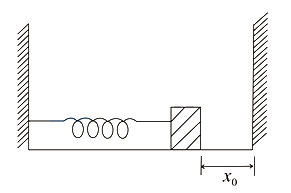
A
$\frac{1}{6} \pi \sqrt{\frac{m}{k}}$
B
$\sqrt{\frac{m}{k}}$
C
$\frac{2 \pi}{3} \sqrt{\frac{m}{k}}$
D
$\frac{\pi}{4} \sqrt{\frac{m}{k}}$
Solution
(C) Given:
Maximum compression (Amplitude $A$) $= 2 x_0$
Distance of the block from the other wall $= x_0$
Mass of the block $= m$
Since the block is released from the extreme position,its displacement $x(t)$ as a function of time can be represented as:
$x(t) = A \cos(\omega t)$
where $\omega = \sqrt{\frac{k}{m}}$ is the angular frequency.
Taking the equilibrium position as $x = 0$,the block is initially at $x = -2 x_0$ (compressed position). When it moves towards the other wall,it passes through the equilibrium position and hits the wall at $x = +x_0$.
Substituting $x = x_0$ and $A = 2 x_0$ into the equation:
$x_0 = 2 x_0 \cos(\omega t)$
$\cos(\omega t) = \frac{1}{2}$
Since $\cos(\frac{\pi}{3}) = \frac{1}{2}$,we have:
$\omega t = \frac{\pi}{3}$
$t = \frac{\pi}{3 \omega} = \frac{\pi}{3} \sqrt{\frac{m}{k}}$
Wait,let's re-evaluate the motion. The block starts at $x = -2 x_0$ and moves to $x = +x_0$. The time taken to go from $x = -2 x_0$ to $x = 0$ is $T/4$. The time taken to go from $x = 0$ to $x = x_0$ is found by $\sin(\omega t) = \frac{x_0}{2 x_0} = \frac{1}{2}$,so $\omega t = \frac{\pi}{6}$,which means $t = \frac{\pi}{6 \omega}$.
Total time $t = \frac{T}{4} + \frac{\pi}{6 \omega} = \frac{\pi}{2 \omega} + \frac{\pi}{6 \omega} = \frac{4 \pi}{6 \omega} = \frac{2 \pi}{3 \omega} = \frac{2 \pi}{3} \sqrt{\frac{m}{k}}$.
Maximum compression (Amplitude $A$) $= 2 x_0$
Distance of the block from the other wall $= x_0$
Mass of the block $= m$
Since the block is released from the extreme position,its displacement $x(t)$ as a function of time can be represented as:
$x(t) = A \cos(\omega t)$
where $\omega = \sqrt{\frac{k}{m}}$ is the angular frequency.
Taking the equilibrium position as $x = 0$,the block is initially at $x = -2 x_0$ (compressed position). When it moves towards the other wall,it passes through the equilibrium position and hits the wall at $x = +x_0$.
Substituting $x = x_0$ and $A = 2 x_0$ into the equation:
$x_0 = 2 x_0 \cos(\omega t)$
$\cos(\omega t) = \frac{1}{2}$
Since $\cos(\frac{\pi}{3}) = \frac{1}{2}$,we have:
$\omega t = \frac{\pi}{3}$
$t = \frac{\pi}{3 \omega} = \frac{\pi}{3} \sqrt{\frac{m}{k}}$
Wait,let's re-evaluate the motion. The block starts at $x = -2 x_0$ and moves to $x = +x_0$. The time taken to go from $x = -2 x_0$ to $x = 0$ is $T/4$. The time taken to go from $x = 0$ to $x = x_0$ is found by $\sin(\omega t) = \frac{x_0}{2 x_0} = \frac{1}{2}$,so $\omega t = \frac{\pi}{6}$,which means $t = \frac{\pi}{6 \omega}$.
Total time $t = \frac{T}{4} + \frac{\pi}{6 \omega} = \frac{\pi}{2 \omega} + \frac{\pi}{6 \omega} = \frac{4 \pi}{6 \omega} = \frac{2 \pi}{3 \omega} = \frac{2 \pi}{3} \sqrt{\frac{m}{k}}$.
0 likes
View SolutionOscillations — SHM of Spring Mass System · Frequently Asked Questions
1Are these Oscillations questions useful for JEE and NEET?
Yes. All questions in this section are mapped to JEE Main and NEET exam patterns. Previous year questions from JEE Main, NEET, GUJCET and state-level exams are included with full solutions.
2Can I switch to Hindi or Gujarati for these questions?
Yes. Use the language tabs in the hero section or the sidebar to view the same questions and solutions in English, Hindi or Gujarati.
3How do I generate a question paper from this subtopic?
Use the Vedclass Exam Paper Generator — select the chapter and subtopic, set difficulty, and generate Sets A, B, C, D automatically. First 3 chapters of every subject are free.
Vedclass Products
For Students
Vedclass Test Series
Mock tests in real JEE/NEET style with performance analysis. 5-day free trial.
Start Free TrialFor Teachers
Exam Paper Generator
Generate Set A/B/C/D papers from this chapter in 2 minutes. 3 chapters free.
Try FreeFor Institutes
Online Exam Module
Live online exams with unlimited students, 360° analytics & white-label branding.
See DemoFor Teachers & Institutes
Generate a Oscillations Exam Paper in 2 Minutes
Select subtopic & difficulty — Sets A, B, C, D auto-generated with No Repeat logic.
First 3 chapters of every subject are free — no payment required.