
A English
Different types of oscillations (Free, Damped, Forced Oscillation and Resonance) Questions in English
Class 11 Physics · Oscillations · Different types of oscillations (Free, Damped, Forced Oscillation and Resonance)
88+
Questions
English
Language
100%
With Solutions
Showing 50 of 88 questions in English
1
EasyMCQ
In the case of a forced vibration,the resonance curve becomes very sharp when the
A
Restoring force is small
B
Applied periodic force is small
C
Quality factor is small
D
Damping force is small
Solution
(D) In forced oscillations,the amplitude of vibration at resonance is given by $A = \frac{F_0}{\sqrt{m^2(\omega^2 - \omega_0^2)^2 + b^2\omega^2}}$,where $b$ is the damping constant.
When the damping force is small (i.e.,$b$ is small),the denominator becomes very small at resonance (where $\omega \approx \omega_0$),leading to a very large amplitude.
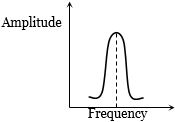
Furthermore,the sharpness of the resonance curve is inversely proportional to the damping. $A$ smaller damping force results in a narrower and taller resonance peak,making the resonance curve sharper.
When the damping force is small (i.e.,$b$ is small),the denominator becomes very small at resonance (where $\omega \approx \omega_0$),leading to a very large amplitude.
Furthermore,the sharpness of the resonance curve is inversely proportional to the damping. $A$ smaller damping force results in a narrower and taller resonance peak,making the resonance curve sharper.
0 likes
View Solution2
MediumMCQ
The amplitude of a wave is represented by $A = \frac{c}{a + b - c}$. Resonance will occur when:
A
$b = -c/2$
B
$b = 0$ and $a = c$
C
$b = -a/2$
D
None of these
Solution
(B) Resonance occurs when the amplitude of the oscillation becomes infinite $(A \to \infty)$.
Given the expression for amplitude: $A = \frac{c}{a + b - c}$.
For $A$ to be infinite,the denominator must be zero:
$a + b - c = 0$.
If we set $b = 0$,the condition becomes $a - c = 0$,which implies $a = c$.
Therefore,resonance occurs when $b = 0$ and $a = c$.
Given the expression for amplitude: $A = \frac{c}{a + b - c}$.
For $A$ to be infinite,the denominator must be zero:
$a + b - c = 0$.
If we set $b = 0$,the condition becomes $a - c = 0$,which implies $a = c$.
Therefore,resonance occurs when $b = 0$ and $a = c$.
0 likes
View Solution3
MediumMCQ
$A$ particle with a restoring force proportional to displacement and a resisting force proportional to velocity is subjected to a driving force $F \sin \omega t$. If the amplitude of the particle is maximum for $\omega = \omega_1$ and the energy of the particle is maximum for $\omega = \omega_2$,then (where $\omega_0$ is the natural frequency of oscillation of the particle):
A
$\omega_1 = \omega_0$ and $\omega_2 \neq \omega_0$
B
$\omega_1 \neq \omega_0$ and $\omega_2 = \omega_0$
C
$\omega_1 = \omega_0$ and $\omega_2 = \omega_0$
D
$\omega_1 \neq \omega_0$ and $\omega_2 \neq \omega_0$
Solution
(B) For a damped driven oscillator,the amplitude $A$ is given by $A = \frac{F/m}{\sqrt{(\omega_0^2 - \omega^2)^2 + (b\omega/m)^2}}$.
Amplitude is maximum when the denominator is minimum,which occurs at $\omega_1 = \sqrt{\omega_0^2 - 2(b/2m)^2}$. Thus,$\omega_1 \neq \omega_0$.
The energy of the oscillator is proportional to the square of the amplitude and is also related to the power absorbed. The energy of the particle is maximum at the velocity resonance frequency,which occurs when $\omega_2 = \omega_0$.
Therefore,the correct relationship is $\omega_1 \neq \omega_0$ and $\omega_2 = \omega_0$.
Amplitude is maximum when the denominator is minimum,which occurs at $\omega_1 = \sqrt{\omega_0^2 - 2(b/2m)^2}$. Thus,$\omega_1 \neq \omega_0$.
The energy of the oscillator is proportional to the square of the amplitude and is also related to the power absorbed. The energy of the particle is maximum at the velocity resonance frequency,which occurs when $\omega_2 = \omega_0$.
Therefore,the correct relationship is $\omega_1 \neq \omega_0$ and $\omega_2 = \omega_0$.
1 likes
View Solution4
EasyMCQ
$A$ simple pendulum is set into vibrations. The bob of the pendulum comes to rest after some time due to
A
Air friction
B
Moment of inertia
C
Weight of the bob
D
Combination of all the above
Solution
(A) simple pendulum oscillating in a real-world environment experiences resistive forces,primarily air resistance (or air friction).
These resistive forces act in the direction opposite to the velocity of the bob.
This causes the mechanical energy of the system to dissipate as heat,leading to damped oscillations.
As the amplitude of the oscillation gradually decreases over time,the pendulum eventually comes to rest.
These resistive forces act in the direction opposite to the velocity of the bob.
This causes the mechanical energy of the system to dissipate as heat,leading to damped oscillations.
As the amplitude of the oscillation gradually decreases over time,the pendulum eventually comes to rest.
0 likes
View Solution5
EasyMCQ
$A$ simple pendulum oscillates in air with time period $T$ and amplitude $A$. As the time passes,
A
$T$ and $A$ both decrease
B
$T$ increases and $A$ is constant
C
$T$ increases and $A$ decreases
D
$T$ decreases and $A$ is constant
Solution
(C) simple pendulum oscillating in air experiences air resistance (damping force).
The damping force acts opposite to the direction of motion,which causes the energy of the oscillator to dissipate over time.
As a result,the amplitude $A$ of the oscillation gradually decreases.
For a damped harmonic oscillator,the time period $T'$ is given by $T' = \frac{2\pi}{\sqrt{\omega_0^2 - b^2/4m^2}}$,where $b$ is the damping constant. As damping occurs,the effective frequency decreases,which means the time period $T$ increases.
Therefore,as time passes,$T$ increases and $A$ decreases.
The damping force acts opposite to the direction of motion,which causes the energy of the oscillator to dissipate over time.
As a result,the amplitude $A$ of the oscillation gradually decreases.
For a damped harmonic oscillator,the time period $T'$ is given by $T' = \frac{2\pi}{\sqrt{\omega_0^2 - b^2/4m^2}}$,where $b$ is the damping constant. As damping occurs,the effective frequency decreases,which means the time period $T$ increases.
Therefore,as time passes,$T$ increases and $A$ decreases.
0 likes
View Solution6
MediumMCQ
The amplitude of vibration of a particle is given by $a_m = \frac{a_0}{a\omega^2 - b\omega + c}$,where $a_0, a, b,$ and $c$ are positive constants. The condition for a single resonant frequency is:
A
$b^2 = 4ac$
B
$b^2 > 4ac$
C
$b^2 = 5ac$
D
$b^2 = 7ac$
Solution
(A) For resonance,the amplitude $a_m$ must be maximum.
This occurs when the denominator $f(\omega) = a\omega^2 - b\omega + c$ is at its minimum value.
For a single resonant frequency,the quadratic equation $a\omega^2 - b\omega + c = 0$ must have exactly one real root for $\omega$.
This happens when the discriminant $D = b^2 - 4ac$ is equal to zero.
Therefore,the condition for a single resonant frequency is $b^2 = 4ac$.
This occurs when the denominator $f(\omega) = a\omega^2 - b\omega + c$ is at its minimum value.
For a single resonant frequency,the quadratic equation $a\omega^2 - b\omega + c = 0$ must have exactly one real root for $\omega$.
This happens when the discriminant $D = b^2 - 4ac$ is equal to zero.
Therefore,the condition for a single resonant frequency is $b^2 = 4ac$.
0 likes
View Solution7
MediumMCQ
$A$ particle of mass $m$ is attached to a spring (of spring constant $k$) and has a natural angular frequency $\omega_0$. An external force $F(t)$ proportional to $\cos \omega t$ (where $\omega \neq \omega_0$) is applied to the oscillator. The displacement of the oscillator will be proportional to:
A
$\frac{m}{\omega_0^2 - \omega^2}$
B
$\frac{1}{m(\omega_0^2 - \omega^2)}$
C
$\frac{1}{m(\omega_0^2 + \omega^2)}$
D
$\frac{m}{\omega_0^2 + \omega^2}$
Solution
(B) For a forced oscillator,the equation of motion is given by $m \frac{d^2x}{dt^2} + kx = F_0 \cos \omega t$.
Substituting $x = x_0 \cos \omega t$,we get $-m \omega^2 x_0 + k x_0 = F_0$.
Since the natural angular frequency is $\omega_0 = \sqrt{k/m}$,we have $k = m \omega_0^2$.
Substituting this,we get $m x_0 (\omega_0^2 - \omega^2) = F_0$.
Thus,the amplitude $x_0 = \frac{F_0}{m(\omega_0^2 - \omega^2)}$.
Therefore,the displacement $x$ is proportional to $\frac{1}{m(\omega_0^2 - \omega^2)}$.
Substituting $x = x_0 \cos \omega t$,we get $-m \omega^2 x_0 + k x_0 = F_0$.
Since the natural angular frequency is $\omega_0 = \sqrt{k/m}$,we have $k = m \omega_0^2$.
Substituting this,we get $m x_0 (\omega_0^2 - \omega^2) = F_0$.
Thus,the amplitude $x_0 = \frac{F_0}{m(\omega_0^2 - \omega^2)}$.
Therefore,the displacement $x$ is proportional to $\frac{1}{m(\omega_0^2 - \omega^2)}$.
0 likes
View Solution8
MediumMCQ
The amplitude of a damped oscillator becomes half in $1 \text{ minute}$. The amplitude after $3 \text{ minutes}$ will be $\frac{1}{X}$ times the original,where $X$ is
A
$2 \times 3$
B
$2^3$
C
$3^2$
D
$3 \times 2^2$
Solution
(B) The amplitude of a damped oscillator is given by the equation $A = A_0 e^{-\lambda t}$,where $A_0$ is the initial amplitude,$\lambda$ is the damping constant,and $t$ is time.
Given that at $t = 1 \text{ min}$,the amplitude becomes half:
$\frac{A_0}{2} = A_0 e^{-\lambda(1)}$
$\frac{1}{2} = e^{-\lambda} \Rightarrow e^{\lambda} = 2$.
Now,for $t = 3 \text{ min}$,the amplitude $A$ is:
$A = A_0 e^{-\lambda(3)} = A_0 (e^{-\lambda})^3 = A_0 \left(\frac{1}{e^{\lambda}}\right)^3$
Substituting $e^{\lambda} = 2$:
$A = A_0 \left(\frac{1}{2}\right)^3 = \frac{A_0}{2^3}$.
Comparing this to $\frac{A_0}{X}$,we get $X = 2^3$.
Given that at $t = 1 \text{ min}$,the amplitude becomes half:
$\frac{A_0}{2} = A_0 e^{-\lambda(1)}$
$\frac{1}{2} = e^{-\lambda} \Rightarrow e^{\lambda} = 2$.
Now,for $t = 3 \text{ min}$,the amplitude $A$ is:
$A = A_0 e^{-\lambda(3)} = A_0 (e^{-\lambda})^3 = A_0 \left(\frac{1}{e^{\lambda}}\right)^3$
Substituting $e^{\lambda} = 2$:
$A = A_0 \left(\frac{1}{2}\right)^3 = \frac{A_0}{2^3}$.
Comparing this to $\frac{A_0}{X}$,we get $X = 2^3$.
0 likes
View Solution9
DifficultMCQ
If a simple pendulum has significant amplitude (up to a factor of $1/e$ of original) only in the period between $t = 0 \ s$ to $t = \tau \ s$,then $\tau$ may be called the average life of the pendulum. When the spherical bob of the pendulum suffers a retardation (due to viscous drag) proportional to its velocity with $b$ as the constant of proportionality,the average life time of the pendulum is (assuming damping is small) in seconds:
A
$2/b$
B
$0.693/b$
C
$b$
D
$1/b$
Solution
(A) The equation of motion for a damped pendulum is given by $I \alpha = -mg \ell \theta - b' v \ell$,where $b'$ is the damping constant. For a spherical bob,the drag force is $F_d = -bv$. The angular displacement follows the form $\theta(t) = \theta_0 e^{-(b/2m)t} \sin(\omega t + \phi)$.
Given the amplitude decays as $A(t) = \theta_0 e^{-(b/2m)t}$,we define the average life $\tau$ as the time when the amplitude becomes $1/e$ of the initial amplitude $\theta_0$.
Thus,$\theta_0/e = \theta_0 e^{-(b/2m)\tau}$.
Comparing the exponents,we get $1 = (b/2m)\tau$.
Assuming the proportionality constant $b$ in the question refers to the damping factor per unit mass (often denoted as $b/m$),the average life is $\tau = 2/b$.
Given the amplitude decays as $A(t) = \theta_0 e^{-(b/2m)t}$,we define the average life $\tau$ as the time when the amplitude becomes $1/e$ of the initial amplitude $\theta_0$.
Thus,$\theta_0/e = \theta_0 e^{-(b/2m)\tau}$.
Comparing the exponents,we get $1 = (b/2m)\tau$.
Assuming the proportionality constant $b$ in the question refers to the damping factor per unit mass (often denoted as $b/m$),the average life is $\tau = 2/b$.
0 likes
View Solution10
MediumMCQ
The amplitude of a damped oscillator decreases to $0.9$ times its original magnitude in $5 \ s$. In another $10 \ s$ it will decrease to $\alpha$ times its original magnitude,where $\alpha$ equals
A
$0.6$
B
$0.7$
C
$0.81$
D
$0.729$
Solution
(D) The amplitude of a damped oscillator is given by $A(t) = A_0 e^{-bt/2m}$.
Given that at $t = 5 \ s$,$A = 0.9 A_0$. Substituting this into the equation:
$0.9 A_0 = A_0 e^{-b(5)/2m} \implies e^{-5b/2m} = 0.9$.
We need to find the amplitude after another $10 \ s$,which means at total time $t = 5 + 10 = 15 \ s$.
$A(15) = A_0 e^{-b(15)/2m} = A_0 (e^{-5b/2m})^3$.
Substituting the value $e^{-5b/2m} = 0.9$:
$A(15) = A_0 (0.9)^3 = A_0 (0.729)$.
Thus,$\alpha = 0.729$.
Given that at $t = 5 \ s$,$A = 0.9 A_0$. Substituting this into the equation:
$0.9 A_0 = A_0 e^{-b(5)/2m} \implies e^{-5b/2m} = 0.9$.
We need to find the amplitude after another $10 \ s$,which means at total time $t = 5 + 10 = 15 \ s$.
$A(15) = A_0 e^{-b(15)/2m} = A_0 (e^{-5b/2m})^3$.
Substituting the value $e^{-5b/2m} = 0.9$:
$A(15) = A_0 (0.9)^3 = A_0 (0.729)$.
Thus,$\alpha = 0.729$.
0 likes
View Solution11
AdvancedMCQ
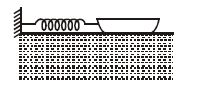
$A$ steady force of $120 \ N$ is required to push a boat of mass $700 \ kg$ through water at a constant speed of $1 \ m/s$. If the boat is fastened by a spring and held at $2 \ m$ from the equilibrium position by a force of $450 \ N$,find the angular frequency of damped $SHM$ in $rad/s$.
A
$0.56$
B
$0.21$
C
$1.35$
D
Motion is overdamped
Solution
(A) $1$. Calculate the damping constant $b$: Since the force $F = bv$,we have $b = F/v = 120/1 = 120 \ kg/s$.
$2$. Calculate the damping parameter $r$: $r = b / (2m) = 120 / (2 \times 700) = 120 / 1400 = 6/70 \approx 0.0857 \ s^{-1}$.
$3$. Calculate the spring constant $k$: From $F = kx$,we have $k = 450 / 2 = 225 \ N/m$.
$4$. Calculate the natural angular frequency $\omega_0$: $\omega_0 = \sqrt{k/m} = \sqrt{225/700} = \sqrt{9/28} \approx 0.5669 \ rad/s$.
$5$. Calculate the angular frequency of damped $SHM$ $\omega'$: $\omega' = \sqrt{\omega_0^2 - r^2} = \sqrt{225/700 - (6/70)^2} = \sqrt{22500/70000 - 36/4900} = \sqrt{225/700 - 36/4900} = \sqrt{(1575 - 36)/4900} = \sqrt{1539}/70 \approx 39.23 / 70 \approx 0.56 \ rad/s$.
$2$. Calculate the damping parameter $r$: $r = b / (2m) = 120 / (2 \times 700) = 120 / 1400 = 6/70 \approx 0.0857 \ s^{-1}$.
$3$. Calculate the spring constant $k$: From $F = kx$,we have $k = 450 / 2 = 225 \ N/m$.
$4$. Calculate the natural angular frequency $\omega_0$: $\omega_0 = \sqrt{k/m} = \sqrt{225/700} = \sqrt{9/28} \approx 0.5669 \ rad/s$.
$5$. Calculate the angular frequency of damped $SHM$ $\omega'$: $\omega' = \sqrt{\omega_0^2 - r^2} = \sqrt{225/700 - (6/70)^2} = \sqrt{22500/70000 - 36/4900} = \sqrt{225/700 - 36/4900} = \sqrt{(1575 - 36)/4900} = \sqrt{1539}/70 \approx 39.23 / 70 \approx 0.56 \ rad/s$.
0 likes
View Solution12
DifficultMCQ
The amplitude of a damped harmonic oscillator becomes half in $3 \ s$ and will become $1/x$ of the initial amplitude in the next $6 \ s$,where $x$ is:
A
$2 \times 3$
B
$2^2$
C
$2^3$
D
$3 \times 2^2$
Solution
(C) The amplitude of a damped harmonic oscillator is given by $A(t) = A_0 e^{-bt}$.
Given that the amplitude becomes half in $3 \ s$:
$A(3) = A_0 e^{-3b} = \frac{A_0}{2}$
$e^{-3b} = \frac{1}{2} \quad \dots (i)$
In the next $6 \ s$,the total time elapsed is $3 \ s + 6 \ s = 9 \ s$. The amplitude at $t = 9 \ s$ is:
$A(9) = A_0 e^{-9b} = A_0 (e^{-3b})^3$
Substituting equation $(i)$ into the expression:
$A(9) = A_0 \left(\frac{1}{2}\right)^3 = A_0 \left(\frac{1}{8}\right)$
Since the amplitude becomes $1/x$ of the initial amplitude,we have $1/x = 1/8$,which means $x = 8 = 2^3$.
Therefore,the correct option is $C$.
Given that the amplitude becomes half in $3 \ s$:
$A(3) = A_0 e^{-3b} = \frac{A_0}{2}$
$e^{-3b} = \frac{1}{2} \quad \dots (i)$
In the next $6 \ s$,the total time elapsed is $3 \ s + 6 \ s = 9 \ s$. The amplitude at $t = 9 \ s$ is:
$A(9) = A_0 e^{-9b} = A_0 (e^{-3b})^3$
Substituting equation $(i)$ into the expression:
$A(9) = A_0 \left(\frac{1}{2}\right)^3 = A_0 \left(\frac{1}{8}\right)$
Since the amplitude becomes $1/x$ of the initial amplitude,we have $1/x = 1/8$,which means $x = 8 = 2^3$.
Therefore,the correct option is $C$.
0 likes
View Solution13
EasyMCQ
Which of the diagrams shown in the figure represents the variation of the total mechanical energy of a pendulum oscillating in water as a function of time?
A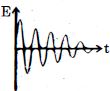
B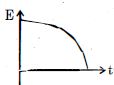
C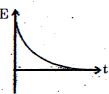
D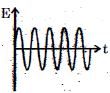
Solution
(C) When a pendulum oscillates in a medium like water,it experiences a damping force due to the viscosity of the medium. This damping force causes the amplitude of oscillation to decrease exponentially over time. The total mechanical energy $E$ of a damped harmonic oscillator is proportional to the square of its amplitude $A$. Since the amplitude $A$ decays exponentially as $A(t) = A_0 e^{-\gamma t}$,the total mechanical energy $E$ also decays exponentially with time according to the relation $E(t) = E_0 e^{-2\gamma t}$. This exponential decay is represented by a curve that starts at a maximum value and approaches zero asymptotically as time increases. Among the given options,diagram $C$ correctly depicts this exponential decay of energy over time.
0 likes
View Solution14
MediumMCQ
$A$ $3 \ kg$ sphere dropped through air has a terminal speed of $25 \ m/s$. (Assume that the drag force is $F_d = -bv$). Now suppose the sphere is attached to a spring of force constant $k = 300 \ N/m$,and that it oscillates with an initial amplitude of $20 \ cm$. What is the angular frequency of its damped $SHM$? ..... $rad/s$
A
$9.996$
B
$9.998$
C
$10$
D
$10.01$
Solution
(B) At terminal velocity,the drag force equals the gravitational force: $mg = bv_{t}$.
Given $m = 3 \ kg$,$v_{t} = 25 \ m/s$,and taking $g = 10 \ m/s^2$,we have $3 \times 10 = b \times 25$,which gives $b = \frac{30}{25} = 1.2 \ kg/s$.
The damping constant $\gamma = \frac{b}{2m} = \frac{1.2}{2 \times 3} = 0.2 \ s^{-1}$.
The angular frequency of damped $SHM$ is given by $\omega' = \sqrt{\omega_0^2 - \gamma^2}$,where $\omega_0 = \sqrt{\frac{k}{m}}$.
$\omega_0 = \sqrt{\frac{300}{3}} = \sqrt{100} = 10 \ rad/s$.
$\omega' = \sqrt{10^2 - (0.2)^2} = \sqrt{100 - 0.04} = \sqrt{99.96}$.
Using the binomial approximation $\sqrt{x^2 - a} \approx x - \frac{a}{2x}$ for small $a$,we get $\omega' \approx 10 - \frac{0.04}{20} = 10 - 0.002 = 9.998 \ rad/s$.
Given $m = 3 \ kg$,$v_{t} = 25 \ m/s$,and taking $g = 10 \ m/s^2$,we have $3 \times 10 = b \times 25$,which gives $b = \frac{30}{25} = 1.2 \ kg/s$.
The damping constant $\gamma = \frac{b}{2m} = \frac{1.2}{2 \times 3} = 0.2 \ s^{-1}$.
The angular frequency of damped $SHM$ is given by $\omega' = \sqrt{\omega_0^2 - \gamma^2}$,where $\omega_0 = \sqrt{\frac{k}{m}}$.
$\omega_0 = \sqrt{\frac{300}{3}} = \sqrt{100} = 10 \ rad/s$.
$\omega' = \sqrt{10^2 - (0.2)^2} = \sqrt{100 - 0.04} = \sqrt{99.96}$.
Using the binomial approximation $\sqrt{x^2 - a} \approx x - \frac{a}{2x}$ for small $a$,we get $\omega' \approx 10 - \frac{0.04}{20} = 10 - 0.002 = 9.998 \ rad/s$.
0 likes
View Solution15
MediumMCQ
Two damped spring-mass oscillating systems have identical spring constants and decay times. However,system $A$'s mass $m_A$ is twice system $B$'s mass $m_B$. How do their damping constants,$b$,compare?
A
$b_A = 4b_B$
B
$b_A = 2b_B$
C
$b_A = b_B$
D
$b_A = \frac{1}{2}b_B$
Solution
(B) The amplitude of a damped oscillator decays with a time constant $\tau = \frac{2m}{b}$.
Given that both systems have identical decay times,$\tau_A = \tau_B$.
This implies $\frac{2m_A}{b_A} = \frac{2m_B}{b_B}$.
Since $m_A = 2m_B$,we substitute this to get $\frac{2(2m_B)}{b_A} = \frac{2m_B}{b_B}$.
Simplifying this equation,we get $b_A = 2b_B$.
Given that both systems have identical decay times,$\tau_A = \tau_B$.
This implies $\frac{2m_A}{b_A} = \frac{2m_B}{b_B}$.
Since $m_A = 2m_B$,we substitute this to get $\frac{2(2m_B)}{b_A} = \frac{2m_B}{b_B}$.
Simplifying this equation,we get $b_A = 2b_B$.
0 likes
View Solution16
MediumMCQ
Which of the diagrams shown in the figure represents the variation of total mechanical energy of a pendulum oscillating in water as a function of time?
A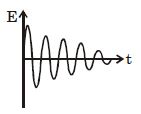
B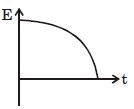
C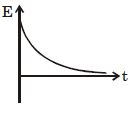
D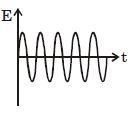
Solution
(C) When a pendulum oscillates in a medium like water,it experiences a resistive force (damping force) proportional to its velocity. This leads to damped oscillations. The total mechanical energy $E$ of a damped oscillator at any time $t$ is given by the expression: $E = E_0 e^{-\gamma t}$,where $E_0$ is the initial energy and $\gamma$ is the damping constant. This equation represents an exponential decay of energy with time. Among the given options,the graph that shows an exponential decrease in energy $E$ as time $t$ increases is represented by graph $C$.
0 likes
View Solution17
MediumMCQ
$A$ spring-mass system executes damped harmonic oscillations given by the equation $y = A e^{-\frac{bt}{2m}} \sin(\omega' t + \phi)$,where the symbols have their usual meanings. If a $2 \ kg$ mass $(m)$ is attached to a spring of force constant $(K) = 1250 \ N/m$,the period of the oscillation is $(\pi / 12) \ s$. The damping constant $b$ has the value ..... $kg/s$.
A
$9.8$
B
$2.8$
C
$98$
D
$28$
Solution
(D) The angular frequency of damped oscillations is given by $\omega' = \sqrt{\frac{K}{m} - \frac{b^2}{4m^2}}$.
Given $T = \frac{\pi}{12} \ s$,the angular frequency is $\omega' = \frac{2\pi}{T} = \frac{2\pi}{\pi/12} = 24 \ rad/s$.
Substitute the values $K = 1250 \ N/m$,$m = 2 \ kg$,and $\omega' = 24 \ rad/s$ into the equation:
$24 = \sqrt{\frac{1250}{2} - \frac{b^2}{4(2^2)}}$
$24 = \sqrt{625 - \frac{b^2}{16}}$
Squaring both sides:
$576 = 625 - \frac{b^2}{16}$
$\frac{b^2}{16} = 625 - 576 = 49$
$b^2 = 49 \times 16 = 784$
$b = \sqrt{784} = 28 \ kg/s$.
Given $T = \frac{\pi}{12} \ s$,the angular frequency is $\omega' = \frac{2\pi}{T} = \frac{2\pi}{\pi/12} = 24 \ rad/s$.
Substitute the values $K = 1250 \ N/m$,$m = 2 \ kg$,and $\omega' = 24 \ rad/s$ into the equation:
$24 = \sqrt{\frac{1250}{2} - \frac{b^2}{4(2^2)}}$
$24 = \sqrt{625 - \frac{b^2}{16}}$
Squaring both sides:
$576 = 625 - \frac{b^2}{16}$
$\frac{b^2}{16} = 625 - 576 = 49$
$b^2 = 49 \times 16 = 784$
$b = \sqrt{784} = 28 \ kg/s$.
0 likes
View Solution18
MediumMCQ
When an oscillator completes $100$ oscillations,its amplitude is reduced to $\frac{1}{3}$ of its initial value. What will be its amplitude after it completes $200$ oscillations?
A
$\frac{1}{8}$
B
$\frac{1}{9}$
C
$\frac{2}{3}$
D
$\frac{1}{6}$
Solution
(B) In damped oscillations,the amplitude decays exponentially with time,given by $a = a_0 e^{-bt}$,where $b$ is the damping constant and $t$ is the time.
Let $T$ be the time period of one oscillation. After $n$ oscillations,the time elapsed is $t = nT$.
Initially,after $100$ oscillations,the amplitude is $a = \frac{a_0}{3}$.
So,$\frac{a_0}{3} = a_0 e^{-b(100T)}$,which implies $e^{-100bT} = \frac{1}{3}$.
After $200$ oscillations,the time elapsed is $t = 200T$.
The amplitude $a'$ will be $a' = a_0 e^{-b(200T)}$.
This can be written as $a' = a_0 (e^{-100bT})^2$.
Substituting the value from the first step: $a' = a_0 (\frac{1}{3})^2 = \frac{a_0}{9}$.
Thus,the amplitude becomes $\frac{1}{9}$ of the initial value.
Let $T$ be the time period of one oscillation. After $n$ oscillations,the time elapsed is $t = nT$.
Initially,after $100$ oscillations,the amplitude is $a = \frac{a_0}{3}$.
So,$\frac{a_0}{3} = a_0 e^{-b(100T)}$,which implies $e^{-100bT} = \frac{1}{3}$.
After $200$ oscillations,the time elapsed is $t = 200T$.
The amplitude $a'$ will be $a' = a_0 e^{-b(200T)}$.
This can be written as $a' = a_0 (e^{-100bT})^2$.
Substituting the value from the first step: $a' = a_0 (\frac{1}{3})^2 = \frac{a_0}{9}$.
Thus,the amplitude becomes $\frac{1}{9}$ of the initial value.
0 likes
View Solution19
DifficultMCQ
$A$ block of mass $0.1\, kg$ is connected to an elastic spring of spring constant $640\, Nm^{-1}$ and oscillates in a damping medium of damping constant $10^{-2}\, kg\,s^{-1}$. The system dissipates its energy gradually. The time taken for its mechanical energy of vibration to drop to half of its initial value is closest to ..... $s$.
A
$2$
B
$3.5$
C
$5$
D
$7$
Solution
(D) For a damped harmonic oscillator,the mechanical energy $E$ at time $t$ is given by $E(t) = E_0 e^{-bt/m}$,where $b$ is the damping constant and $m$ is the mass of the block.
We are given that the energy drops to half of its initial value,so $E(t) = E_0 / 2$.
Substituting this into the equation: $E_0 / 2 = E_0 e^{-bt/m}$.
This simplifies to $1/2 = e^{-bt/m}$,or $2 = e^{bt/m}$.
Taking the natural logarithm on both sides: $\ln(2) = bt/m$.
Solving for $t$: $t = (m/b) \ln(2)$.
Given $m = 0.1\, kg$ and $b = 10^{-2}\, kg\,s^{-1}$,we have $m/b = 0.1 / 10^{-2} = 10\, s$.
Thus,$t = 10 \times \ln(2) \approx 10 \times 0.693 = 6.93\, s$.
Rounding to the nearest provided option,the value is closest to $7\, s$.
We are given that the energy drops to half of its initial value,so $E(t) = E_0 / 2$.
Substituting this into the equation: $E_0 / 2 = E_0 e^{-bt/m}$.
This simplifies to $1/2 = e^{-bt/m}$,or $2 = e^{bt/m}$.
Taking the natural logarithm on both sides: $\ln(2) = bt/m$.
Solving for $t$: $t = (m/b) \ln(2)$.
Given $m = 0.1\, kg$ and $b = 10^{-2}\, kg\,s^{-1}$,we have $m/b = 0.1 / 10^{-2} = 10\, s$.
Thus,$t = 10 \times \ln(2) \approx 10 \times 0.693 = 6.93\, s$.
Rounding to the nearest provided option,the value is closest to $7\, s$.
0 likes
View Solution20
DifficultMCQ
$A$ simple harmonic oscillator of angular frequency $\omega = 2 \, rad \, s^{-1}$ is acted upon by an external force $F = \sin(t) \, N$. If the oscillator is at rest in its equilibrium position at $t = 0$,its position at later times is proportional to
A
$\sin(t) + \frac{1}{2} \cos(2t)$
B
$\cos(t) - \frac{1}{2} \sin(2t)$
C
$\sin(t) - \frac{1}{2} \sin(2t)$
D
$\sin(t) + \frac{1}{2} \sin(2t)$
Solution
(C) The equation of motion for a forced harmonic oscillator is given by $m \frac{d^2x}{dt^2} + m \omega^2 x = F(t)$.
Given $\omega = 2 \, rad \, s^{-1}$ and $F(t) = \sin(t)$,we have $\frac{d^2x}{dt^2} + 4x = \frac{1}{m} \sin(t)$.
Assuming $m = 1$ for proportionality,the particular solution is of the form $x_p = A \sin(t)$.
Substituting into the differential equation: $-A \sin(t) + 4A \sin(t) = \sin(t) \Rightarrow 3A = 1 \Rightarrow A = 1/3$.
However,considering the initial conditions $x(0) = 0$ and $v(0) = 0$,the general solution is $x(t) = c_1 \cos(2t) + c_2 \sin(2t) + \frac{1}{3} \sin(t)$.
Applying $x(0) = 0 \Rightarrow c_1 = 0$.
Applying $v(0) = 0 \Rightarrow v(t) = 2c_2 \cos(2t) + \frac{1}{3} \cos(t) \Rightarrow 2c_2 + 1/3 = 0 \Rightarrow c_2 = -1/6$.
Thus,$x(t) = \frac{1}{3} \sin(t) - \frac{1}{6} \sin(2t) = \frac{1}{3} (\sin(t) - \frac{1}{2} \sin(2t))$.
Therefore,the position is proportional to $\sin(t) - \frac{1}{2} \sin(2t)$.
Given $\omega = 2 \, rad \, s^{-1}$ and $F(t) = \sin(t)$,we have $\frac{d^2x}{dt^2} + 4x = \frac{1}{m} \sin(t)$.
Assuming $m = 1$ for proportionality,the particular solution is of the form $x_p = A \sin(t)$.
Substituting into the differential equation: $-A \sin(t) + 4A \sin(t) = \sin(t) \Rightarrow 3A = 1 \Rightarrow A = 1/3$.
However,considering the initial conditions $x(0) = 0$ and $v(0) = 0$,the general solution is $x(t) = c_1 \cos(2t) + c_2 \sin(2t) + \frac{1}{3} \sin(t)$.
Applying $x(0) = 0 \Rightarrow c_1 = 0$.
Applying $v(0) = 0 \Rightarrow v(t) = 2c_2 \cos(2t) + \frac{1}{3} \cos(t) \Rightarrow 2c_2 + 1/3 = 0 \Rightarrow c_2 = -1/6$.
Thus,$x(t) = \frac{1}{3} \sin(t) - \frac{1}{6} \sin(2t) = \frac{1}{3} (\sin(t) - \frac{1}{2} \sin(2t))$.
Therefore,the position is proportional to $\sin(t) - \frac{1}{2} \sin(2t)$.
0 likes
View Solution21
MediumMCQ
$A$ pendulum with a time period of $1\, s$ is losing energy due to damping. At a certain time,its energy is $45\, J$. If after completing $15$ oscillations,its energy has become $15\, J$,its damping constant (in $s^{-1}$) is:
A
$\frac{1}{2}$
B
$\frac{1}{30} \ln 3$
C
$2$
D
$\frac{1}{15} \ln 3$
Solution
(D) The energy of a damped oscillator at time $t$ is given by $E(t) = E_0 e^{-\gamma t}$,where $\gamma = \frac{b}{m}$ is the damping constant.
Given,initial energy $E_0 = 45\, J$ and final energy $E = 15\, J$.
The time taken for $15$ oscillations with a time period $T = 1\, s$ is $t = 15 \times T = 15 \times 1 = 15\, s$.
Substituting the values into the equation: $15 = 45 e^{-\gamma (15)}$.
Dividing by $45$: $\frac{1}{3} = e^{-15\gamma}$.
Taking the natural logarithm on both sides: $\ln(1/3) = -15\gamma$.
$-\ln 3 = -15\gamma$.
Therefore,$\gamma = \frac{1}{15} \ln 3\, s^{-1}$.
Given,initial energy $E_0 = 45\, J$ and final energy $E = 15\, J$.
The time taken for $15$ oscillations with a time period $T = 1\, s$ is $t = 15 \times T = 15 \times 1 = 15\, s$.
Substituting the values into the equation: $15 = 45 e^{-\gamma (15)}$.
Dividing by $45$: $\frac{1}{3} = e^{-15\gamma}$.
Taking the natural logarithm on both sides: $\ln(1/3) = -15\gamma$.
$-\ln 3 = -15\gamma$.
Therefore,$\gamma = \frac{1}{15} \ln 3\, s^{-1}$.
0 likes
View Solution22
MediumMCQ
The amplitude of a simple pendulum,oscillating in air with a small spherical bob,decreases from $10 \ cm$ to $8 \ cm$ in $40 \ s$. Assuming that Stokes' law is valid,and the ratio of the coefficient of viscosity of air to that of carbon dioxide is $1.3$. The time in which the amplitude of this pendulum will reduce from $10 \ cm$ to $5 \ cm$ in carbon dioxide will be close to ..... $s$ $(\ln 5 = 1.601, \ln 2 = 0.693)$
A
$231$
B
$208$
C
$161$
D
$142$
Solution
(C) The amplitude of a damped oscillator is given by $A(t) = A_0 e^{-(b/2m)t}$,where $b$ is the damping constant. According to Stokes' law,$b = 6\pi \eta r$,where $\eta$ is the coefficient of viscosity.
For air: $8 = 10 e^{-(b_{air}/2m) \cdot 40} \implies 0.8 = e^{-(b_{air}/2m) \cdot 40}$.
Taking natural log: $\ln(0.8) = -(b_{air}/2m) \cdot 40 \implies \ln(4/5) = -(b_{air}/2m) \cdot 40 \implies \ln(5/4) = (b_{air}/2m) \cdot 40$.
So,$(b_{air}/2m) = \frac{\ln(1.25)}{40} = \frac{0.223}{40} = 0.005575 \ s^{-1}$.
Given $\frac{\eta_{air}}{\eta_{CO_2}} = 1.3$,then $b_{CO_2} = \frac{b_{air}}{1.3}$.
Thus,$(b_{CO_2}/2m) = \frac{b_{air}}{1.3 \cdot 2m} = \frac{0.005575}{1.3} \approx 0.004288 \ s^{-1}$.
For $CO_2$: $5 = 10 e^{-(b_{CO_2}/2m) \cdot t} \implies 0.5 = e^{-(0.004288)t}$.
Taking natural log: $\ln(0.5) = -0.004288 \cdot t \implies -0.693 = -0.004288 \cdot t$.
$t = \frac{0.693}{0.004288} \approx 161.6 \ s$.
Therefore,the time is close to $161 \ s$.
For air: $8 = 10 e^{-(b_{air}/2m) \cdot 40} \implies 0.8 = e^{-(b_{air}/2m) \cdot 40}$.
Taking natural log: $\ln(0.8) = -(b_{air}/2m) \cdot 40 \implies \ln(4/5) = -(b_{air}/2m) \cdot 40 \implies \ln(5/4) = (b_{air}/2m) \cdot 40$.
So,$(b_{air}/2m) = \frac{\ln(1.25)}{40} = \frac{0.223}{40} = 0.005575 \ s^{-1}$.
Given $\frac{\eta_{air}}{\eta_{CO_2}} = 1.3$,then $b_{CO_2} = \frac{b_{air}}{1.3}$.
Thus,$(b_{CO_2}/2m) = \frac{b_{air}}{1.3 \cdot 2m} = \frac{0.005575}{1.3} \approx 0.004288 \ s^{-1}$.
For $CO_2$: $5 = 10 e^{-(b_{CO_2}/2m) \cdot t} \implies 0.5 = e^{-(0.004288)t}$.
Taking natural log: $\ln(0.5) = -0.004288 \cdot t \implies -0.693 = -0.004288 \cdot t$.
$t = \frac{0.693}{0.004288} \approx 161.6 \ s$.
Therefore,the time is close to $161 \ s$.
0 likes
View Solution23
MediumMCQ
The angular frequency of the damped oscillator is given by $\omega = \sqrt{\frac{k}{m} - \frac{r^2}{4m^2}}$,where $k$ is the spring constant,$m$ is the mass of the oscillator,and $r$ is the damping constant. If the ratio $\frac{r^2}{mk}$ is $8\%$,the change in time period compared to the undamped oscillator is approximately as follows:
A
increases by $1\%$
B
increases by $8\%$
C
decreases by $1\%$
D
decreases by $8\%$
Solution
(A) The angular frequency of an undamped oscillator is $\omega_0 = \sqrt{\frac{k}{m}}$.
The angular frequency of a damped oscillator is $\omega = \sqrt{\frac{k}{m} - \frac{r^2}{4m^2}} = \omega_0 \sqrt{1 - \frac{r^2}{4mk}}$.
Using the binomial approximation $(1-x)^n \approx 1-nx$ for small $x$,we get $\omega \approx \omega_0 (1 - \frac{r^2}{8mk})$.
The time period $T = \frac{2\pi}{\omega}$,so $T \approx T_0 (1 - \frac{r^2}{8mk})^{-1} \approx T_0 (1 + \frac{r^2}{8mk})$.
The fractional change in time period is $\frac{\Delta T}{T_0} = \frac{T - T_0}{T_0} = \frac{r^2}{8mk}$.
Given $\frac{r^2}{mk} = 8\% = 0.08$,we have $\frac{\Delta T}{T_0} = \frac{0.08}{8} = 0.01 = 1\%$.
Since the value is positive,the time period increases by $1\%$.
The angular frequency of a damped oscillator is $\omega = \sqrt{\frac{k}{m} - \frac{r^2}{4m^2}} = \omega_0 \sqrt{1 - \frac{r^2}{4mk}}$.
Using the binomial approximation $(1-x)^n \approx 1-nx$ for small $x$,we get $\omega \approx \omega_0 (1 - \frac{r^2}{8mk})$.
The time period $T = \frac{2\pi}{\omega}$,so $T \approx T_0 (1 - \frac{r^2}{8mk})^{-1} \approx T_0 (1 + \frac{r^2}{8mk})$.
The fractional change in time period is $\frac{\Delta T}{T_0} = \frac{T - T_0}{T_0} = \frac{r^2}{8mk}$.
Given $\frac{r^2}{mk} = 8\% = 0.08$,we have $\frac{\Delta T}{T_0} = \frac{0.08}{8} = 0.01 = 1\%$.
Since the value is positive,the time period increases by $1\%$.
0 likes
View Solution24
DifficultMCQ
$A$ damped harmonic oscillator has a frequency of $5$ oscillations per second. The amplitude drops to half its value for every $10$ oscillations. The time it will take to drop to $\frac{1}{1000}$ of the original amplitude is close to .... $s$
A
$10$
B
$100$
C
$50$
D
$20$
Solution
(D) The amplitude of a damped harmonic oscillator is given by $A(t) = A_0 e^{-\gamma t}$.
Given frequency $f = 5 \text{ Hz}$,the time period of one oscillation is $T = \frac{1}{f} = 0.2 \text{ s}$.
For $10$ oscillations,the time taken is $t_{10} = 10 \times 0.2 = 2 \text{ s}$.
At $t = 2 \text{ s}$,the amplitude becomes half,so $A(2) = \frac{A_0}{2}$.
Substituting this into the equation: $\frac{A_0}{2} = A_0 e^{-\gamma(2)} \implies 2 = e^{2\gamma} \implies \gamma = \frac{\ln 2}{2}$.
We need to find the time $t$ when $A(t) = \frac{A_0}{1000}$.
$\frac{A_0}{1000} = A_0 e^{-\gamma t} \implies 1000 = e^{\gamma t} \implies \ln(1000) = \gamma t$.
$3 \ln(10) = \left(\frac{\ln 2}{2}\right) t$.
$t = \frac{6 \ln(10)}{\ln 2} \approx \frac{6 \times 2.303}{0.693} \approx 19.94 \text{ s}$.
Thus,$t \approx 20 \text{ s}$.
Given frequency $f = 5 \text{ Hz}$,the time period of one oscillation is $T = \frac{1}{f} = 0.2 \text{ s}$.
For $10$ oscillations,the time taken is $t_{10} = 10 \times 0.2 = 2 \text{ s}$.
At $t = 2 \text{ s}$,the amplitude becomes half,so $A(2) = \frac{A_0}{2}$.
Substituting this into the equation: $\frac{A_0}{2} = A_0 e^{-\gamma(2)} \implies 2 = e^{2\gamma} \implies \gamma = \frac{\ln 2}{2}$.
We need to find the time $t$ when $A(t) = \frac{A_0}{1000}$.
$\frac{A_0}{1000} = A_0 e^{-\gamma t} \implies 1000 = e^{\gamma t} \implies \ln(1000) = \gamma t$.
$3 \ln(10) = \left(\frac{\ln 2}{2}\right) t$.
$t = \frac{6 \ln(10)}{\ln 2} \approx \frac{6 \times 2.303}{0.693} \approx 19.94 \text{ s}$.
Thus,$t \approx 20 \text{ s}$.
0 likes
View Solution25
MediumMCQ
The displacement of a damped harmonic oscillator is given by $x(t) = e^{-0.1t} \cos(10\pi t + \varphi)$. The time taken for its amplitude of vibration to drop to half of its initial value is close to .... $s$
A
$13$
B
$27$
C
$4$
D
$7$
Solution
(D) The displacement of a damped harmonic oscillator is given by $x(t) = A(t) \cos(\omega t + \varphi)$,where $A(t) = A_0 e^{-bt/2m}$.
Comparing this with the given equation $x(t) = e^{-0.1t} \cos(10\pi t + \varphi)$,we identify the amplitude as $A(t) = A_0 e^{-0.1t}$,where $A_0 = 1$.
We need to find the time $t$ when the amplitude $A(t)$ becomes half of its initial value $A_0$.
Set $A(t) = \frac{A_0}{2}$,which gives $A_0 e^{-0.1t} = \frac{A_0}{2}$.
Dividing both sides by $A_0$,we get $e^{-0.1t} = \frac{1}{2}$,or $e^{0.1t} = 2$.
Taking the natural logarithm on both sides: $0.1t = \ln(2)$.
Using the value $\ln(2) \approx 0.693$,we get $0.1t = 0.693$.
Therefore,$t = \frac{0.693}{0.1} = 6.93 \, s$.
Rounding to the nearest integer,we get $t \approx 7 \, s$.
Comparing this with the given equation $x(t) = e^{-0.1t} \cos(10\pi t + \varphi)$,we identify the amplitude as $A(t) = A_0 e^{-0.1t}$,where $A_0 = 1$.
We need to find the time $t$ when the amplitude $A(t)$ becomes half of its initial value $A_0$.
Set $A(t) = \frac{A_0}{2}$,which gives $A_0 e^{-0.1t} = \frac{A_0}{2}$.
Dividing both sides by $A_0$,we get $e^{-0.1t} = \frac{1}{2}$,or $e^{0.1t} = 2$.
Taking the natural logarithm on both sides: $0.1t = \ln(2)$.
Using the value $\ln(2) \approx 0.693$,we get $0.1t = 0.693$.
Therefore,$t = \frac{0.693}{0.1} = 6.93 \, s$.
Rounding to the nearest integer,we get $t \approx 7 \, s$.
0 likes
View Solution26
EasyMCQ
The value of maximum possible amplitude in the case of forced oscillations when the driving frequency is close to the natural frequency is:
A
$\frac{F_0}{m(\omega^2 - \omega_d^2)}$
B
$\frac{F_0}{\omega_d b}$
C
$\frac{F_0}{m\omega^2}$
D
None
Solution
(B) For a forced oscillator,the amplitude $A$ is given by the formula: $A = \frac{F_0}{\sqrt{m^2(\omega^2 - \omega_d^2)^2 + (b\omega_d)^2}}$,where $F_0$ is the driving force amplitude,$m$ is the mass,$\omega$ is the natural frequency,$\omega_d$ is the driving frequency,and $b$ is the damping constant.
When the driving frequency $\omega_d$ is close to the natural frequency $\omega$,the term $(\omega^2 - \omega_d^2)$ becomes very small,approaching zero.
In this condition,the amplitude is dominated by the damping term: $A \approx \frac{F_0}{\sqrt{(b\omega_d)^2}} = \frac{F_0}{b\omega_d}$.
Thus,the maximum possible amplitude is $\frac{F_0}{b\omega_d}$.
When the driving frequency $\omega_d$ is close to the natural frequency $\omega$,the term $(\omega^2 - \omega_d^2)$ becomes very small,approaching zero.
In this condition,the amplitude is dominated by the damping term: $A \approx \frac{F_0}{\sqrt{(b\omega_d)^2}} = \frac{F_0}{b\omega_d}$.
Thus,the maximum possible amplitude is $\frac{F_0}{b\omega_d}$.
0 likes
View Solution27
MediumMCQ
$A$ block of mass $200 \, g$ is executing $SHM$ under the influence of a spring with spring constant $K = 90 \, N \, m^{-1}$ and a damping constant $b = 40 \, g \, s^{-1}$. The time elapsed for its amplitude to drop to half of its initial value is ...... $s$ (Given $\ln \frac{1}{2} = -0.693$).
A
$7$
B
$9$
C
$4$
D
$11$
Solution
(A) The amplitude of a damped harmonic oscillator at time $t$ is given by $A(t) = A_0 e^{-\left(\frac{b}{2m}\right)t}$.
Given: $m = 200 \, g = 0.2 \, kg$,$b = 40 \, g \, s^{-1} = 0.04 \, kg \, s^{-1}$.
We want to find $t$ when $A(t) = \frac{A_0}{2}$.
Substituting the values: $\frac{A_0}{2} = A_0 e^{-\left(\frac{0.04}{2 \times 0.2}\right)t}$.
$\frac{1}{2} = e^{-\left(\frac{0.04}{0.4}\right)t} = e^{-0.1t}$.
Taking the natural logarithm on both sides: $\ln(0.5) = -0.1t$.
$-0.693 = -0.1t$.
$t = \frac{0.693}{0.1} = 6.93 \, s \approx 7 \, s$.
Given: $m = 200 \, g = 0.2 \, kg$,$b = 40 \, g \, s^{-1} = 0.04 \, kg \, s^{-1}$.
We want to find $t$ when $A(t) = \frac{A_0}{2}$.
Substituting the values: $\frac{A_0}{2} = A_0 e^{-\left(\frac{0.04}{2 \times 0.2}\right)t}$.
$\frac{1}{2} = e^{-\left(\frac{0.04}{0.4}\right)t} = e^{-0.1t}$.
Taking the natural logarithm on both sides: $\ln(0.5) = -0.1t$.
$-0.693 = -0.1t$.
$t = \frac{0.693}{0.1} = 6.93 \, s \approx 7 \, s$.
0 likes
View Solution28
MediumMCQ
The amplitude of a damped oscillator becomes one third in $2 \, s$. If its amplitude after $6 \, s$ is $1/n$ times the original amplitude,then the value of $n$ is
A
$3^2$
B
$3\sqrt{2}$
C
$3\sqrt{3}$
D
$3^3$
Solution
(D) The amplitude of a damped oscillator at time $t$ is given by $A(t) = A_0 e^{-\frac{bt}{2m}}$.
Given that at $t = 2 \, s$,the amplitude becomes $1/3$ of the original amplitude $A_0$:
$\frac{A_0}{3} = A_0 e^{-\frac{b(2)}{2m}}$
$\frac{1}{3} = e^{-\frac{b}{m}}$
Now,we need to find the amplitude at $t = 6 \, s$:
$A(6) = A_0 e^{-\frac{b(6)}{2m}} = A_0 (e^{-\frac{b}{m}})^3$
Substituting the value $e^{-\frac{b}{m}} = 1/3$:
$A(6) = A_0 \left(\frac{1}{3}\right)^3 = \frac{A_0}{27}$
Given that $A(6) = \frac{A_0}{n}$,we have:
$\frac{A_0}{n} = \frac{A_0}{27}$
$n = 27 = 3^3$.
Given that at $t = 2 \, s$,the amplitude becomes $1/3$ of the original amplitude $A_0$:
$\frac{A_0}{3} = A_0 e^{-\frac{b(2)}{2m}}$
$\frac{1}{3} = e^{-\frac{b}{m}}$
Now,we need to find the amplitude at $t = 6 \, s$:
$A(6) = A_0 e^{-\frac{b(6)}{2m}} = A_0 (e^{-\frac{b}{m}})^3$
Substituting the value $e^{-\frac{b}{m}} = 1/3$:
$A(6) = A_0 \left(\frac{1}{3}\right)^3 = \frac{A_0}{27}$
Given that $A(6) = \frac{A_0}{n}$,we have:
$\frac{A_0}{n} = \frac{A_0}{27}$
$n = 27 = 3^3$.
0 likes
View Solution29
MediumMCQ
In forced oscillation of a particle,the amplitude is maximum for a frequency $\omega_{1}$ of the driving force,while the energy is maximum for a frequency $\omega_{2}$ of the driving force. Then:
A
$\omega_{1} = \omega_{2}$
B
$\omega_{1} > \omega_{2}$
C
$\omega_{1} < \omega_{2}$ when damping is small and $\omega_{1} > \omega_{2}$ when damping is large
D
$\omega_{1} < \omega_{2}$
Solution
(D) For a damped forced oscillator,the amplitude $A$ is given by $A = \frac{F_0}{\sqrt{m^2(\omega_0^2 - \omega^2)^2 + b^2\omega^2}}$.
The amplitude is maximum when the denominator is minimum,which occurs at $\omega_1 = \sqrt{\omega_0^2 - 2\gamma^2}$,where $\gamma = \frac{b}{2m}$.
The energy of the oscillator is proportional to the square of the amplitude $(E \propto A^2)$.
The energy is maximum when the amplitude is maximum,which occurs at $\omega_2 = \omega_0$ (the natural frequency) in the context of power absorption,or specifically,the resonance frequency for energy is $\omega_2 = \omega_0$.
Comparing the two,since $\omega_1 = \sqrt{\omega_0^2 - 2\gamma^2}$,it is clear that $\omega_1 < \omega_0$.
Therefore,$\omega_1 < \omega_2$.
The amplitude is maximum when the denominator is minimum,which occurs at $\omega_1 = \sqrt{\omega_0^2 - 2\gamma^2}$,where $\gamma = \frac{b}{2m}$.
The energy of the oscillator is proportional to the square of the amplitude $(E \propto A^2)$.
The energy is maximum when the amplitude is maximum,which occurs at $\omega_2 = \omega_0$ (the natural frequency) in the context of power absorption,or specifically,the resonance frequency for energy is $\omega_2 = \omega_0$.
Comparing the two,since $\omega_1 = \sqrt{\omega_0^2 - 2\gamma^2}$,it is clear that $\omega_1 < \omega_0$.
Therefore,$\omega_1 < \omega_2$.
0 likes
View Solution30
EasyMCQ
Resonance is an example of
A
tuning fork
B
forced vibration
C
free vibration
D
damped vibration
Solution
(B) Resonance occurs when an external periodic force is applied to a system such that the frequency of the external force matches the natural frequency of the system.
Since resonance involves an external driving force causing the system to vibrate at a specific frequency,it is a special case of forced vibration.
Therefore,resonance is an example of forced vibration.
Since resonance involves an external driving force causing the system to vibrate at a specific frequency,it is a special case of forced vibration.
Therefore,resonance is an example of forced vibration.
0 likes
View Solution31
EasyMCQ
$Assertion :$ The amplitude of an oscillating pendulum decreases gradually with time.
$Reason :$ The frequency of the pendulum decreases with time.
$Reason :$ The frequency of the pendulum decreases with time.
A
If both Assertion and Reason are correct and the Reason is a correct explanation of the Assertion.
B
If both Assertion and Reason are correct but Reason is not a correct explanation of the Assertion.
C
If the Assertion is correct but Reason is incorrect.
D
If both the Assertion and Reason are incorrect.
Solution
(C) The amplitude of an oscillating pendulum decreases with time due to air resistance (damping). This is known as damped oscillation.
However,the frequency of an oscillating pendulum depends on its length $L$ and acceleration due to gravity $g$,given by the formula $f = \frac{1}{2\pi} \sqrt{\frac{g}{L}}$.
Since $g$ and $L$ remain constant during the motion,the frequency of the pendulum remains constant over time.
Therefore,the Assertion is correct,but the Reason is incorrect.
However,the frequency of an oscillating pendulum depends on its length $L$ and acceleration due to gravity $g$,given by the formula $f = \frac{1}{2\pi} \sqrt{\frac{g}{L}}$.
Since $g$ and $L$ remain constant during the motion,the frequency of the pendulum remains constant over time.
Therefore,the Assertion is correct,but the Reason is incorrect.
0 likes
View Solution32
MediumMCQ
$Assertion :$ Resonance is a special case of forced vibration in which the natural frequency of vibration of the body is the same as the impressed frequency of external periodic force and the amplitude of forced vibration is maximum.
$Reason :$ The amplitude of forced vibrations of a body increases with an increase in the frequency of the externally impressed periodic force.
$Reason :$ The amplitude of forced vibrations of a body increases with an increase in the frequency of the externally impressed periodic force.
A
If both Assertion and Reason are correct and the Reason is a correct explanation of the Assertion.
B
If both Assertion and Reason are correct but Reason is not a correct explanation of the Assertion.
C
If the Assertion is correct but Reason is incorrect.
D
If both the Assertion and Reason are incorrect.
Solution
(C) The $Assertion$ is correct. Resonance occurs when the driving frequency $(\omega)$ equals the natural frequency $(\omega_{0})$ of the system,resulting in maximum amplitude.
The $Reason$ is incorrect. The amplitude of forced vibrations does not simply increase with the frequency of the external force. Instead,the amplitude follows a resonance curve; it increases as the driving frequency approaches the natural frequency and decreases as it moves away from it.
The amplitude of oscillation for a forced,damped oscillator is given by:
$A = \frac{F_{0} / m}{\sqrt{(\omega^{2} - \omega_{0}^{2})^{2} + (b \omega / m)^{2}}}$
where $b$ is the damping constant and $\omega_{0} = \sqrt{k / m}$ is the natural frequency. As $\omega$ approaches $\omega_{0}$,the denominator decreases,causing the amplitude $A$ to reach its maximum value.
The $Reason$ is incorrect. The amplitude of forced vibrations does not simply increase with the frequency of the external force. Instead,the amplitude follows a resonance curve; it increases as the driving frequency approaches the natural frequency and decreases as it moves away from it.
The amplitude of oscillation for a forced,damped oscillator is given by:
$A = \frac{F_{0} / m}{\sqrt{(\omega^{2} - \omega_{0}^{2})^{2} + (b \omega / m)^{2}}}$
where $b$ is the damping constant and $\omega_{0} = \sqrt{k / m}$ is the natural frequency. As $\omega$ approaches $\omega_{0}$,the denominator decreases,causing the amplitude $A$ to reach its maximum value.
0 likes
View Solution33
Difficult
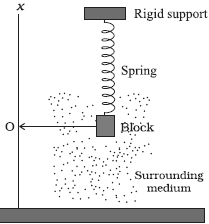
For the damped oscillator shown in the figure,the mass $m$ of the block is $200 \; g$,$k = 90 \; N m^{-1}$,and the damping constant $b$ is $40 \; g s^{-1}$. Calculate:
$(a)$ the period of oscillation,
$(b)$ the time taken for its amplitude of vibrations to drop to half of its initial value,and
$(c)$ the time taken for its mechanical energy to drop to half its initial value.
$(a)$ the period of oscillation,
$(b)$ the time taken for its amplitude of vibrations to drop to half of its initial value,and
$(c)$ the time taken for its mechanical energy to drop to half its initial value.
Solution
(N/A) Given: $m = 200 \; g = 0.2 \; kg$,$k = 90 \; N m^{-1}$,$b = 40 \; g s^{-1} = 0.04 \; kg s^{-1}$.
We check the condition for light damping: $\sqrt{km} = \sqrt{90 \times 0.2} = \sqrt{18} \approx 4.243 \; kg s^{-1}$.
Since $b \ll \sqrt{km}$,the period of oscillation $T$ is given by:
$T = 2\pi \sqrt{\frac{m}{k}} = 2\pi \sqrt{\frac{0.2}{90}} = 2\pi \sqrt{\frac{1}{450}} = \frac{2\pi}{21.21} \approx 0.296 \; s \approx 0.3 \; s$.
$(b)$ The amplitude $A(t)$ decays as $A(t) = A_0 e^{-bt/2m}$. For $A(t) = A_0/2$:
$\frac{1}{2} = e^{-bt/2m} \implies \ln(2) = \frac{bt}{2m} \implies t = \frac{2m \ln(2)}{b}$.
$t = \frac{2 \times 0.2 \times 0.693}{0.04} = \frac{0.2772}{0.04} = 6.93 \; s$.
$(c)$ The mechanical energy $E(t)$ decays as $E(t) = E_0 e^{-bt/m}$. For $E(t) = E_0/2$:
$\frac{1}{2} = e^{-bt/m} \implies \ln(2) = \frac{bt}{m} \implies t = \frac{m \ln(2)}{b}$.
$t = \frac{0.2 \times 0.693}{0.04} = \frac{0.1386}{0.04} = 3.465 \; s \approx 3.46 \; s$.
We check the condition for light damping: $\sqrt{km} = \sqrt{90 \times 0.2} = \sqrt{18} \approx 4.243 \; kg s^{-1}$.
Since $b \ll \sqrt{km}$,the period of oscillation $T$ is given by:
$T = 2\pi \sqrt{\frac{m}{k}} = 2\pi \sqrt{\frac{0.2}{90}} = 2\pi \sqrt{\frac{1}{450}} = \frac{2\pi}{21.21} \approx 0.296 \; s \approx 0.3 \; s$.
$(b)$ The amplitude $A(t)$ decays as $A(t) = A_0 e^{-bt/2m}$. For $A(t) = A_0/2$:
$\frac{1}{2} = e^{-bt/2m} \implies \ln(2) = \frac{bt}{2m} \implies t = \frac{2m \ln(2)}{b}$.
$t = \frac{2 \times 0.2 \times 0.693}{0.04} = \frac{0.2772}{0.04} = 6.93 \; s$.
$(c)$ The mechanical energy $E(t)$ decays as $E(t) = E_0 e^{-bt/m}$. For $E(t) = E_0/2$:
$\frac{1}{2} = e^{-bt/m} \implies \ln(2) = \frac{bt}{m} \implies t = \frac{m \ln(2)}{b}$.
$t = \frac{0.2 \times 0.693}{0.04} = \frac{0.1386}{0.04} = 3.465 \; s \approx 3.46 \; s$.
0 likes
View Solution34
Medium
You are riding in an automobile of mass $3000\; kg$. Assuming that you are examining the oscillation characteristics of its suspension system. The suspension sags $15\; cm$ when the entire automobile is placed on it. Also,the amplitude of oscillation decreases by $50 \%$ during one complete oscillation. Estimate the values of
$(a)$ the spring constant $k$ and
$(b)$ the damping constant $b$ for the spring and shock absorber system of one wheel,assuming that each wheel supports $750 \;kg$.
$(a)$ the spring constant $k$ and
$(b)$ the damping constant $b$ for the spring and shock absorber system of one wheel,assuming that each wheel supports $750 \;kg$.
Solution
(A) Mass of the automobile,$m = 3000 \; kg$.
Displacement in the suspension system,$x = 15 \; cm = 0.15 \; m$.
There are $4$ springs in parallel to support the mass of the automobile.
The equation for the restoring force is $F = 4kx = mg$.
Thus,the spring constant $k$ for one wheel is $k = \frac{mg}{4x} = \frac{3000 \times 9.8}{4 \times 0.15} = 49000 \; N/m = 4.9 \times 10^4 \; N/m$.
For one wheel,mass $M = 750 \; kg$.
The time period of oscillation is $T = 2\pi \sqrt{\frac{M}{k}} = 2\pi \sqrt{\frac{750}{49000}} \approx 0.778 \; s$.
The amplitude of oscillation decreases by $50\%$,so $A = A_0 e^{-bt/2M} = 0.5 A_0$.
Taking natural log,$\ln(2) = \frac{bt}{2M}$.
$b = \frac{2M \ln(2)}{T} = \frac{2 \times 750 \times 0.693}{0.778} \approx 1336.5 \; kg/s$.
Displacement in the suspension system,$x = 15 \; cm = 0.15 \; m$.
There are $4$ springs in parallel to support the mass of the automobile.
The equation for the restoring force is $F = 4kx = mg$.
Thus,the spring constant $k$ for one wheel is $k = \frac{mg}{4x} = \frac{3000 \times 9.8}{4 \times 0.15} = 49000 \; N/m = 4.9 \times 10^4 \; N/m$.
For one wheel,mass $M = 750 \; kg$.
The time period of oscillation is $T = 2\pi \sqrt{\frac{M}{k}} = 2\pi \sqrt{\frac{750}{49000}} \approx 0.778 \; s$.
The amplitude of oscillation decreases by $50\%$,so $A = A_0 e^{-bt/2M} = 0.5 A_0$.
Taking natural log,$\ln(2) = \frac{bt}{2M}$.
$b = \frac{2M \ln(2)}{T} = \frac{2 \times 750 \times 0.693}{0.778} \approx 1336.5 \; kg/s$.
0 likes
View Solution35
Medium
Why is absolutely pure simple harmonic motion not possible?
Solution
(N/A) Absolutely pure simple harmonic motion $(SHM)$ is not possible in reality because it requires the absence of all dissipative forces,such as friction,air resistance,and viscosity.
In any physical system,these dissipative forces are always present,which cause the energy of the oscillating system to dissipate over time.
This leads to damping,where the amplitude of the oscillation gradually decreases,eventually bringing the system to rest.
Therefore,$SHM$ is an idealization,while real-world systems exhibit damped harmonic motion.
In any physical system,these dissipative forces are always present,which cause the energy of the oscillating system to dissipate over time.
This leads to damping,where the amplitude of the oscillation gradually decreases,eventually bringing the system to rest.
Therefore,$SHM$ is an idealization,while real-world systems exhibit damped harmonic motion.
0 likes
View Solution36
Medium
What is pure simple harmonic oscillation? Why is it not $100 \%$ possible in practice?
Solution
(N/A) Pure simple harmonic oscillation is defined as the motion of a mechanical system where no resistive or internal frictional forces act on the system during its oscillation.
Such an oscillation is an ideal situation. In practice,it is impossible to achieve because any mechanical system oscillates within a medium (like air or liquid),which inevitably introduces resistive forces such as air drag or fluid viscosity. Additionally,internal friction within the components of the system always exists. These forces cause energy dissipation,leading to damping of the oscillations. Therefore,pure simple harmonic motion cannot be executed in reality.
Such an oscillation is an ideal situation. In practice,it is impossible to achieve because any mechanical system oscillates within a medium (like air or liquid),which inevitably introduces resistive forces such as air drag or fluid viscosity. Additionally,internal friction within the components of the system always exists. These forces cause energy dissipation,leading to damping of the oscillations. Therefore,pure simple harmonic motion cannot be executed in reality.
0 likes
View Solution37
Difficult
What are damped oscillations? Discuss them using the illustration of a spring.
Solution
(N/A) Damped oscillations: Oscillations in which the amplitude of the oscillator decreases with time are known as damped oscillations.
The motion of a simple pendulum swinging in air eventually dies out because air drag and friction at the support oppose the motion.
The mechanical energy of the oscillating system is dissipated as heat due to these resistive forces,causing the mechanical energy to decrease. According to the relation $E = \frac{1}{2} k A^2$,the amplitude $A$ gradually decreases.
Illustration with a spring:
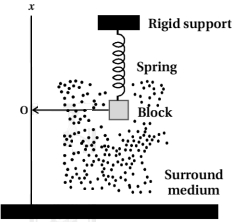
Consider a block of mass $m$ connected to an elastic spring of spring constant $k$,oscillating vertically as shown in the figure. If the block is pushed down and released,it oscillates in a vertical plane with an angular frequency $\omega = \sqrt{\frac{k}{m}}$.
In practice,the surrounding medium (e.g.,air) exerts a damping force on the block,causing the mechanical energy of the block-spring system to decrease. This energy loss appears as heat in the surrounding medium and the block. The damping force depends on the nature of the medium; if the block is immersed in a liquid,the damping is much greater and energy dissipation is faster. The damping force is generally proportional to the velocity of the block.
The motion of a simple pendulum swinging in air eventually dies out because air drag and friction at the support oppose the motion.
The mechanical energy of the oscillating system is dissipated as heat due to these resistive forces,causing the mechanical energy to decrease. According to the relation $E = \frac{1}{2} k A^2$,the amplitude $A$ gradually decreases.
Illustration with a spring:
Consider a block of mass $m$ connected to an elastic spring of spring constant $k$,oscillating vertically as shown in the figure. If the block is pushed down and released,it oscillates in a vertical plane with an angular frequency $\omega = \sqrt{\frac{k}{m}}$.
In practice,the surrounding medium (e.g.,air) exerts a damping force on the block,causing the mechanical energy of the block-spring system to decrease. This energy loss appears as heat in the surrounding medium and the block. The damping force depends on the nature of the medium; if the block is immersed in a liquid,the damping is much greater and energy dissipation is faster. The damping force is generally proportional to the velocity of the block.
0 likes
View Solution38
Medium
Derive the differential equation for damped oscillations and write its solution.
Solution
(N/A) The resistive force acting on an oscillator in a fluid medium depends upon the velocity of the oscillator.
In practice,for not very large velocities,the resistive force is directly proportional to the velocity of the oscillator.
$\therefore F_{d} \propto -v$
$\therefore F_{d} = -bv$ ... $(1)$
Where $b$ is a positive constant called the damping coefficient.
It depends on the characteristics of the medium (like viscosity) and the size and shape of the block.
The unit of the damping coefficient is $N \cdot s/m$ and its dimensional formula is $[M^1 L^0 T^{-1}]$.
When the oscillator has a displacement $x$ from the mean position,the restoring force $(F_{s})$ is $F_{s} = -kx$ ... $(2)$
Thus,the total force acting on the mass at any time $t$ is:
$F = F_{s} + F_{d}$
$\therefore F = -kx - bv$ ... $(3)$
If $a(t)$ is the acceleration of the mass at time $t$,then by Newton's second law of motion,$F = ma(t)$.
Substituting into equation $(3)$:
$m \frac{d^2x}{dt^2} = -kx - b \frac{dx}{dt}$
$\therefore m \frac{d^2x}{dt^2} + b \frac{dx}{dt} + kx = 0$ ... $(4)$
This is the differential equation for damped oscillations.
The solution of equation $(4)$ is:
$x(t) = A e^{-\frac{bt}{2m}} \cos(\omega' t + \phi)$ ... $(5)$
Where $A e^{-\frac{bt}{2m}}$ is the time-dependent amplitude and $\omega' = \sqrt{\frac{k}{m} - \frac{b^2}{4m^2}}$ is the angular frequency of the damped oscillator.
In practice,for not very large velocities,the resistive force is directly proportional to the velocity of the oscillator.
$\therefore F_{d} \propto -v$
$\therefore F_{d} = -bv$ ... $(1)$
Where $b$ is a positive constant called the damping coefficient.
It depends on the characteristics of the medium (like viscosity) and the size and shape of the block.
The unit of the damping coefficient is $N \cdot s/m$ and its dimensional formula is $[M^1 L^0 T^{-1}]$.
When the oscillator has a displacement $x$ from the mean position,the restoring force $(F_{s})$ is $F_{s} = -kx$ ... $(2)$
Thus,the total force acting on the mass at any time $t$ is:
$F = F_{s} + F_{d}$
$\therefore F = -kx - bv$ ... $(3)$
If $a(t)$ is the acceleration of the mass at time $t$,then by Newton's second law of motion,$F = ma(t)$.
Substituting into equation $(3)$:
$m \frac{d^2x}{dt^2} = -kx - b \frac{dx}{dt}$
$\therefore m \frac{d^2x}{dt^2} + b \frac{dx}{dt} + kx = 0$ ... $(4)$
This is the differential equation for damped oscillations.
The solution of equation $(4)$ is:
$x(t) = A e^{-\frac{bt}{2m}} \cos(\omega' t + \phi)$ ... $(5)$
Where $A e^{-\frac{bt}{2m}}$ is the time-dependent amplitude and $\omega' = \sqrt{\frac{k}{m} - \frac{b^2}{4m^2}}$ is the angular frequency of the damped oscillator.
0 likes
View Solution39
Difficult
Write the expression for the mechanical energy of a damped oscillator.
Solution
(N/A) The mechanical energy of a simple harmonic oscillator $(SHO)$ is given by $E = \frac{1}{2} k A^{2}$.
For a damped oscillator,the amplitude at time $t$ is given by $A(t) = A e^{-\frac{b t}{2 m}}$.
Substituting this amplitude into the energy expression,the mechanical energy $E(t)$ of the damped oscillator at time $t$ is:
$E(t) = \frac{1}{2} k \left(A e^{-\frac{b t}{2 m}}\right)^{2} = \frac{1}{2} k A^{2} e^{-\frac{b t}{m}}$.
Thus,the mechanical energy is not constant but decreases exponentially with time.
This equation is valid for small damping where $b \ll \sqrt{k m}$,implying that the dimensionless ratio $\frac{b}{\sqrt{k m}} \ll 1$.
If $b = 0$,the expression reduces to the energy of an undamped oscillator,$E = \frac{1}{2} k A^{2}$.
For a damped oscillator,the amplitude at time $t$ is given by $A(t) = A e^{-\frac{b t}{2 m}}$.
Substituting this amplitude into the energy expression,the mechanical energy $E(t)$ of the damped oscillator at time $t$ is:
$E(t) = \frac{1}{2} k \left(A e^{-\frac{b t}{2 m}}\right)^{2} = \frac{1}{2} k A^{2} e^{-\frac{b t}{m}}$.
Thus,the mechanical energy is not constant but decreases exponentially with time.
This equation is valid for small damping where $b \ll \sqrt{k m}$,implying that the dimensionless ratio $\frac{b}{\sqrt{k m}} \ll 1$.
If $b = 0$,the expression reduces to the energy of an undamped oscillator,$E = \frac{1}{2} k A^{2}$.
0 likes
View Solution40
Easy
What are damped oscillations?
Solution
(N/A) Damped oscillations are oscillations in which the amplitude of the oscillating system decreases over time due to the presence of dissipative forces,such as friction or air resistance.
In an ideal system,an oscillator would continue to vibrate indefinitely with constant amplitude. However,in real-world systems,energy is lost to the surroundings as heat or sound.
The equation of motion for a damped harmonic oscillator is given by $m \frac{d^2x}{dt^2} + b \frac{dx}{dt} + kx = 0$,where $m$ is the mass,$b$ is the damping constant,and $k$ is the spring constant.
As a result of these dissipative forces,the mechanical energy of the system gradually decreases,leading to the eventual cessation of motion.
In an ideal system,an oscillator would continue to vibrate indefinitely with constant amplitude. However,in real-world systems,energy is lost to the surroundings as heat or sound.
The equation of motion for a damped harmonic oscillator is given by $m \frac{d^2x}{dt^2} + b \frac{dx}{dt} + kx = 0$,where $m$ is the mass,$b$ is the damping constant,and $k$ is the spring constant.
As a result of these dissipative forces,the mechanical energy of the system gradually decreases,leading to the eventual cessation of motion.
0 likes
View Solution41
EasyMCQ
If velocity is not large,then on which factor does the damping force on an oscillator in a medium depend?
A
Velocity
B
Square of velocity
C
Cube of velocity
D
Independent of velocity
Solution
(A) For an oscillator moving in a medium with a small velocity,the damping force $F_d$ is proportional to the velocity $v$ of the oscillator.
Mathematically,this is expressed as $F_d = -bv$,where $b$ is the damping constant.
Therefore,the damping force depends linearly on the velocity of the oscillator.
Mathematically,this is expressed as $F_d = -bv$,where $b$ is the damping constant.
Therefore,the damping force depends linearly on the velocity of the oscillator.
0 likes
View Solution42
Medium
Write the equation of angular frequency and amplitude for damped oscillation.
Solution
(N/A) For a damped harmonic oscillator,the equation of motion is given by $m \frac{d^2x}{dt^2} + b \frac{dx}{dt} + kx = 0$.
The amplitude of a damped oscillation decreases exponentially with time and is given by $A(t) = A_0 e^{-bt/2m}$,where $A_0$ is the initial amplitude,$b$ is the damping constant,$m$ is the mass,and $t$ is time.
The angular frequency of the damped oscillation is given by $\omega' = \sqrt{\frac{k}{m} - \left(\frac{b}{2m}\right)^2}$,where $k$ is the spring constant.
The amplitude of a damped oscillation decreases exponentially with time and is given by $A(t) = A_0 e^{-bt/2m}$,where $A_0$ is the initial amplitude,$b$ is the damping constant,$m$ is the mass,and $t$ is time.
The angular frequency of the damped oscillation is given by $\omega' = \sqrt{\frac{k}{m} - \left(\frac{b}{2m}\right)^2}$,where $k$ is the spring constant.
0 likes
View Solution43
EasyMCQ
If a damped oscillator is very heavily damped,what is its frequency?
A
Zero
B
Infinite
C
Same as natural frequency
D
Depends on the mass
Solution
(A) For a damped harmonic oscillator,the angular frequency of oscillation is given by $\omega' = \sqrt{\omega_0^2 - (b/2m)^2}$,where $\omega_0$ is the natural frequency,$b$ is the damping constant,and $m$ is the mass.
When the damping is very heavy (overdamped),the term $(b/2m)^2$ becomes greater than or equal to $\omega_0^2$.
In the case of heavy damping,the system does not oscillate at all; it returns to the equilibrium position without crossing it.
Therefore,the frequency of oscillation becomes zero.
When the damping is very heavy (overdamped),the term $(b/2m)^2$ becomes greater than or equal to $\omega_0^2$.
In the case of heavy damping,the system does not oscillate at all; it returns to the equilibrium position without crossing it.
Therefore,the frequency of oscillation becomes zero.
0 likes
View Solution44
EasyMCQ
What is the amplitude of a damped oscillator if time becomes $t = 2m$?
A
$A = A_0 e^{-bt/2m}$
B
$A = A_0 e^{-bt/m}$
C
$A = A_0 e^{-2bt/m}$
D
$A = A_0 e^{-bt/4m}$
Solution
(A) For a damped harmonic oscillator,the amplitude $A$ at any time $t$ is given by the equation $A(t) = A_0 e^{-bt/2m}$,where $A_0$ is the initial amplitude,$b$ is the damping constant,$m$ is the mass of the oscillator,and $t$ is the time elapsed.
Given the time $t = 2m$,we substitute this value into the standard damping equation.
$A = A_0 e^{-b(2m)/2m}$
Simplifying the exponent,the $2m$ terms cancel out:
$A = A_0 e^{-b}$
However,looking at the provided options,the question asks for the general form where $t$ is replaced by $2m$ in the exponent. The standard formula is $A = A_0 e^{-bt/2m}$. Substituting $t = 2m$ into the expression $bt/2m$ yields $b(2m)/2m = b$. Thus,the amplitude is $A_0 e^{-b}$. Since the options represent the functional form,option $A$ is the correct representation of the damped amplitude formula.
Given the time $t = 2m$,we substitute this value into the standard damping equation.
$A = A_0 e^{-b(2m)/2m}$
Simplifying the exponent,the $2m$ terms cancel out:
$A = A_0 e^{-b}$
However,looking at the provided options,the question asks for the general form where $t$ is replaced by $2m$ in the exponent. The standard formula is $A = A_0 e^{-bt/2m}$. Substituting $t = 2m$ into the expression $bt/2m$ yields $b(2m)/2m = b$. Thus,the amplitude is $A_0 e^{-b}$. Since the options represent the functional form,option $A$ is the correct representation of the damped amplitude formula.
0 likes
View Solution45
Medium
Define: Natural oscillations,free oscillations,and forced oscillations.
Solution
(N/A) Natural Oscillation: When an oscillator is slightly disturbed from its equilibrium position and released,it starts oscillating. The oscillations performed by it in the absence of any type of resistive force are known as natural oscillations.
The angular frequency of natural oscillation is $\omega_{0}$ and the frequency is $f_{0}$.
Free Oscillation: When a system is displaced from its equilibrium position and released,it oscillates with its natural frequency. These oscillations are known as free oscillations.
The angular frequency of free oscillation is $\omega$.
Forced (driven) Oscillations: The oscillations executed by a system under the influence of an external periodic force are called forced oscillations.
The angular frequency of forced oscillation is called $\omega_{d}$,which is the angular frequency of the external force.
In practice,oscillations always occur in some medium; hence,some type of damping force is always acting on the system,and eventually,the oscillations die out with time. To sustain the oscillations,an external periodic force is required.
Example: When a child on a garden swing periodically presses their feet against the ground.
The angular frequency of natural oscillation is $\omega_{0}$ and the frequency is $f_{0}$.
Free Oscillation: When a system is displaced from its equilibrium position and released,it oscillates with its natural frequency. These oscillations are known as free oscillations.
The angular frequency of free oscillation is $\omega$.
Forced (driven) Oscillations: The oscillations executed by a system under the influence of an external periodic force are called forced oscillations.
The angular frequency of forced oscillation is called $\omega_{d}$,which is the angular frequency of the external force.
In practice,oscillations always occur in some medium; hence,some type of damping force is always acting on the system,and eventually,the oscillations die out with time. To sustain the oscillations,an external periodic force is required.
Example: When a child on a garden swing periodically presses their feet against the ground.
0 likes
View Solution46
Medium
Obtain the differential equation of forced oscillation.
Solution
(N/A) To sustain oscillations in a system,an external periodic force is applied,given by:
$F(t) = F_{0} \cos \omega_{d} t$
where $F_{0}$ is the amplitude and $\omega_{d}$ is the angular frequency of the driving force.
Three forces act on the oscillator:
$(1)$ Restoring force: $F_{r} = -k x(t)$
$(2)$ Resistive (damping) force: $F_{s} = -b v(t) = -b \frac{dx}{dt}$
$(3)$ External periodic force: $F_{d} = F_{0} \cos \omega_{d} t$
According to Newton's second law of motion,the net force is $F_{net} = ma(t) = m \frac{d^{2}x}{dt^{2}}$.
Thus,$m \frac{d^{2}x}{dt^{2}} = F_{r} + F_{s} + F_{d}$
$m \frac{d^{2}x}{dt^{2}} = -kx - b \frac{dx}{dt} + F_{0} \cos \omega_{d} t$
Rearranging the terms,we get the differential equation of forced oscillation:
$m \frac{d^{2}x}{dt^{2}} + b \frac{dx}{dt} + kx = F_{0} \cos \omega_{d} t$
Dividing by mass $m$,we obtain:
$\frac{d^{2}x}{dt^{2}} + \frac{b}{m} \frac{dx}{dt} + \frac{k}{m} x = \frac{F_{0}}{m} \cos \omega_{d} t$
$F(t) = F_{0} \cos \omega_{d} t$
where $F_{0}$ is the amplitude and $\omega_{d}$ is the angular frequency of the driving force.
Three forces act on the oscillator:
$(1)$ Restoring force: $F_{r} = -k x(t)$
$(2)$ Resistive (damping) force: $F_{s} = -b v(t) = -b \frac{dx}{dt}$
$(3)$ External periodic force: $F_{d} = F_{0} \cos \omega_{d} t$
According to Newton's second law of motion,the net force is $F_{net} = ma(t) = m \frac{d^{2}x}{dt^{2}}$.
Thus,$m \frac{d^{2}x}{dt^{2}} = F_{r} + F_{s} + F_{d}$
$m \frac{d^{2}x}{dt^{2}} = -kx - b \frac{dx}{dt} + F_{0} \cos \omega_{d} t$
Rearranging the terms,we get the differential equation of forced oscillation:
$m \frac{d^{2}x}{dt^{2}} + b \frac{dx}{dt} + kx = F_{0} \cos \omega_{d} t$
Dividing by mass $m$,we obtain:
$\frac{d^{2}x}{dt^{2}} + \frac{b}{m} \frac{dx}{dt} + \frac{k}{m} x = \frac{F_{0}}{m} \cos \omega_{d} t$
0 likes
View Solution47
Medium
Explain the behaviour of the oscillator when the driving frequency is far from the natural frequency in small damped oscillations.
Solution
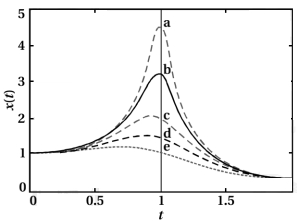
(N/A) For small damping,the amplitude $A$ of a forced oscillator is given by $A = \frac{F_0}{\sqrt{m^2(\omega^2 - \omega_d^2)^2 + (\omega_d b)^2}}$.
When the driving frequency $\omega_d$ is far from the natural frequency $\omega$,such that $\omega_d b << m|\omega^2 - \omega_d^2|$,the term $(\omega_d b)^2$ can be neglected in the denominator.
Thus,the amplitude simplifies to $A \approx \frac{F_0}{m|\omega^2 - \omega_d^2|}$.
In this regime,the amplitude is primarily determined by the stiffness and inertia of the system rather than the damping constant $b$. As $\omega_d$ moves further away from $\omega$,the amplitude decreases significantly.
When $\omega_d = \omega$,the amplitude is limited only by the damping term,$A = \frac{F_0}{\omega_d b}$. If $b = 0$,the amplitude becomes infinite at resonance. As damping $b$ increases,the peak amplitude decreases and shifts slightly.
When the driving frequency $\omega_d$ is far from the natural frequency $\omega$,such that $\omega_d b << m|\omega^2 - \omega_d^2|$,the term $(\omega_d b)^2$ can be neglected in the denominator.
Thus,the amplitude simplifies to $A \approx \frac{F_0}{m|\omega^2 - \omega_d^2|}$.
In this regime,the amplitude is primarily determined by the stiffness and inertia of the system rather than the damping constant $b$. As $\omega_d$ moves further away from $\omega$,the amplitude decreases significantly.
When $\omega_d = \omega$,the amplitude is limited only by the damping term,$A = \frac{F_0}{\omega_d b}$. If $b = 0$,the amplitude becomes infinite at resonance. As damping $b$ increases,the peak amplitude decreases and shifts slightly.
0 likes
View Solution48
Easy
Explain the behaviour of the oscillator when the driving frequency is close to the natural frequency in small damped oscillation and define resonance.
Solution
(N/A) The amplitude $A$ of a forced oscillator is given by the expression:
$A = \frac{F_{0}}{\left[m^{2}(\omega_{0}^{2} - \omega^{2})^{2} + (\omega b)^{2}\right]^{1/2}}$
where $F_{0}$ is the driving force amplitude,$m$ is the mass,$\omega_{0}$ is the natural frequency,$\omega$ is the driving frequency,and $b$ is the damping constant.
When the driving frequency $\omega$ is very close to the natural frequency $\omega_{0}$,the term $m^{2}(\omega_{0}^{2} - \omega^{2})^{2}$ becomes very small compared to $(\omega b)^{2}$.
In this condition,the amplitude is approximately $A \approx \frac{F_{0}}{\omega b}$.
Since the damping constant $b$ is non-zero,the amplitude remains finite and does not reach infinity.
Resonance: The phenomenon where the amplitude of oscillation increases significantly when the driving frequency of an external force is close to the natural frequency of the oscillator is called resonance.
$A = \frac{F_{0}}{\left[m^{2}(\omega_{0}^{2} - \omega^{2})^{2} + (\omega b)^{2}\right]^{1/2}}$
where $F_{0}$ is the driving force amplitude,$m$ is the mass,$\omega_{0}$ is the natural frequency,$\omega$ is the driving frequency,and $b$ is the damping constant.
When the driving frequency $\omega$ is very close to the natural frequency $\omega_{0}$,the term $m^{2}(\omega_{0}^{2} - \omega^{2})^{2}$ becomes very small compared to $(\omega b)^{2}$.
In this condition,the amplitude is approximately $A \approx \frac{F_{0}}{\omega b}$.
Since the damping constant $b$ is non-zero,the amplitude remains finite and does not reach infinity.
Resonance: The phenomenon where the amplitude of oscillation increases significantly when the driving frequency of an external force is close to the natural frequency of the oscillator is called resonance.
0 likes
View Solution49
Easy
To understand resonance,describe the experiment of oscillations of five pendulums.
Solution
(N/A) Consider a set of five simple pendulums of assorted lengths suspended from a common horizontal rope,as shown in the figure.
Pendulums-$1$ and $4$ have the same lengths,while the others have different lengths. Let us set pendulum-$1$ into motion. The energy from this pendulum is transferred to the other pendulums through the connecting rope,causing them to start oscillating.
Pendulums-$2$,$3$,and $5$ initially start oscillating with their own natural frequencies and different amplitudes,but this motion is gradually damped and not sustained. Their frequencies of oscillation gradually change,and ultimately,they oscillate with the frequency of pendulum-$1$ (the driving frequency),but with different amplitudes.
Pendulum-$4$ behaves differently from the others. Since it has the same length as pendulum-$1$,it has the same natural frequency. It oscillates with the same frequency as pendulum-$1$,and its amplitude gradually increases,becoming very large. This is the phenomenon of resonance.
In general,a system may have several natural frequencies,for example,vibrating strings,air columns,etc.
Pendulums-$1$ and $4$ have the same lengths,while the others have different lengths. Let us set pendulum-$1$ into motion. The energy from this pendulum is transferred to the other pendulums through the connecting rope,causing them to start oscillating.
Pendulums-$2$,$3$,and $5$ initially start oscillating with their own natural frequencies and different amplitudes,but this motion is gradually damped and not sustained. Their frequencies of oscillation gradually change,and ultimately,they oscillate with the frequency of pendulum-$1$ (the driving frequency),but with different amplitudes.
Pendulum-$4$ behaves differently from the others. Since it has the same length as pendulum-$1$,it has the same natural frequency. It oscillates with the same frequency as pendulum-$1$,and its amplitude gradually increases,becoming very large. This is the phenomenon of resonance.
In general,a system may have several natural frequencies,for example,vibrating strings,air columns,etc.
0 likes
View Solution50
Easy
Write the practical examples of resonance.
Solution
(N/A) Resonance occurs when the frequency of an external periodic force matches the natural frequency of a system,leading to a significant increase in the amplitude of oscillations.
Examples of Resonance:
$(1)$ Soldiers marching on a suspended bridge are advised to break their step. If the frequency of their marching matches the natural frequency of the bridge,resonance occurs,causing the amplitude of the bridge's vibrations to increase drastically,which can lead to the collapse of the bridge.
$(2)$ During the design of bridges,engineers ensure that the natural frequency of the bridge does not match the frequency of external forces caused by wind gusts. If these frequencies coincide,the resulting resonance can cause structural failure.
$(3)$ During an earthquake,buildings of different heights respond differently to seismic waves. Medium-height structures are often more susceptible to damage because their natural frequencies are closer to the frequencies of seismic waves,leading to resonance,whereas low-rise and high-rise structures have natural frequencies that are significantly different from the seismic wave frequencies.
Examples of Resonance:
$(1)$ Soldiers marching on a suspended bridge are advised to break their step. If the frequency of their marching matches the natural frequency of the bridge,resonance occurs,causing the amplitude of the bridge's vibrations to increase drastically,which can lead to the collapse of the bridge.
$(2)$ During the design of bridges,engineers ensure that the natural frequency of the bridge does not match the frequency of external forces caused by wind gusts. If these frequencies coincide,the resulting resonance can cause structural failure.
$(3)$ During an earthquake,buildings of different heights respond differently to seismic waves. Medium-height structures are often more susceptible to damage because their natural frequencies are closer to the frequencies of seismic waves,leading to resonance,whereas low-rise and high-rise structures have natural frequencies that are significantly different from the seismic wave frequencies.
0 likes
View SolutionOscillations — Different types of oscillations (Free, Damped, Forced Oscillation and Resonance) · Frequently Asked Questions
1Are these Oscillations questions useful for JEE and NEET?
Yes. All questions in this section are mapped to JEE Main and NEET exam patterns. Previous year questions from JEE Main, NEET, GUJCET and state-level exams are included with full solutions.
2Can I switch to Hindi or Gujarati for these questions?
Yes. Use the language tabs in the hero section or the sidebar to view the same questions and solutions in English, Hindi or Gujarati.
3How do I generate a question paper from this subtopic?
Use the Vedclass Exam Paper Generator — select the chapter and subtopic, set difficulty, and generate Sets A, B, C, D automatically. First 3 chapters of every subject are free.
Vedclass Products
For Students
Vedclass Test Series
Mock tests in real JEE/NEET style with performance analysis. 5-day free trial.
Start Free TrialFor Teachers
Exam Paper Generator
Generate Set A/B/C/D papers from this chapter in 2 minutes. 3 chapters free.
Try FreeFor Institutes
Online Exam Module
Live online exams with unlimited students, 360° analytics & white-label branding.
See DemoFor Teachers & Institutes
Generate a Oscillations Exam Paper in 2 Minutes
Select subtopic & difficulty — Sets A, B, C, D auto-generated with No Repeat logic.
First 3 chapters of every subject are free — no payment required.