
A English
Superposition of S.H.M. Questions in English
Class 11 Physics · Oscillations · Superposition of S.H.M.
57+
Questions
English
Language
100%
With Solutions
Showing 49 of 57 questions in English
1
MediumMCQ
Two simple harmonic motions are represented by the equations ${y_1} = 0.1 \sin(100\pi t + \frac{\pi}{3})$ and ${y_2} = 0.1 \cos(\pi t)$. The phase difference of the velocity of particle $1$ with respect to the velocity of particle $2$ is
A
$\frac{-\pi}{3}$
B
$\frac{\pi}{6}$
C
$\frac{-\pi}{6}$
D
$\frac{\pi}{3}$
Solution
(C) The velocity of the first particle is given by the derivative of its displacement: ${v_1} = \frac{d{y_1}}{dt} = 0.1 \times 100\pi \cos(100\pi t + \frac{\pi}{3}) = 10\pi \cos(100\pi t + \frac{\pi}{3})$.
The velocity of the second particle is given by the derivative of its displacement: ${v_2} = \frac{d{y_2}}{dt} = -0.1\pi \sin(\pi t) = 0.1\pi \cos(\pi t + \frac{\pi}{2})$.
The phase of the velocity of the first particle is ${\phi_1} = 100\pi t + \frac{\pi}{3}$,and the phase of the velocity of the second particle is ${\phi_2} = \pi t + \frac{\pi}{2}$.
However,the question asks for the phase difference between the two velocities. Since the frequencies are different ($100\pi$ vs $\pi$),the phase difference is time-dependent. Assuming the question implies the difference in initial phases at $t=0$:
$\Delta \phi = \phi_1(0) - \phi_2(0) = \frac{\pi}{3} - \frac{\pi}{2} = \frac{2\pi - 3\pi}{6} = -\frac{\pi}{6}$.
The velocity of the second particle is given by the derivative of its displacement: ${v_2} = \frac{d{y_2}}{dt} = -0.1\pi \sin(\pi t) = 0.1\pi \cos(\pi t + \frac{\pi}{2})$.
The phase of the velocity of the first particle is ${\phi_1} = 100\pi t + \frac{\pi}{3}$,and the phase of the velocity of the second particle is ${\phi_2} = \pi t + \frac{\pi}{2}$.
However,the question asks for the phase difference between the two velocities. Since the frequencies are different ($100\pi$ vs $\pi$),the phase difference is time-dependent. Assuming the question implies the difference in initial phases at $t=0$:
$\Delta \phi = \phi_1(0) - \phi_2(0) = \frac{\pi}{3} - \frac{\pi}{2} = \frac{2\pi - 3\pi}{6} = -\frac{\pi}{6}$.
0 likes
View Solution2
MediumMCQ
The $S.H.M.$ of a particle is given by the equation $y = 3\sin \omega t + 4\cos \omega t$. The amplitude is
A
$7$
B
$1$
C
$5$
D
$12$
Solution
(C) The given equation is $y = 3\sin \omega t + 4\cos \omega t$.
This is of the form $y = A_1\sin \omega t + A_2\cos \omega t$,where $A_1 = 3$ and $A_2 = 4$.
The resultant amplitude $A$ for a combination of two $S.H.M.s$ with a phase difference of $\pi/2$ is given by $A = \sqrt{A_1^2 + A_2^2}$.
Substituting the values,we get $A = \sqrt{3^2 + 4^2} = \sqrt{9 + 16} = \sqrt{25} = 5$.
Therefore,the amplitude is $5$.
This is of the form $y = A_1\sin \omega t + A_2\cos \omega t$,where $A_1 = 3$ and $A_2 = 4$.
The resultant amplitude $A$ for a combination of two $S.H.M.s$ with a phase difference of $\pi/2$ is given by $A = \sqrt{A_1^2 + A_2^2}$.
Substituting the values,we get $A = \sqrt{3^2 + 4^2} = \sqrt{9 + 16} = \sqrt{25} = 5$.
Therefore,the amplitude is $5$.
0 likes
View Solution3
MediumMCQ
The resultant of two rectangular simple harmonic motions of the same frequency and unequal amplitudes but differing in phase by $\frac{\pi}{2}$ is
A
Simple harmonic
B
Circular
C
Elliptical
D
Parabolic
Solution
(C) Let the two rectangular simple harmonic motions be represented as:
$y_1 = a_1 \sin(\omega t)$ ... $(i)$
$y_2 = a_2 \sin(\omega t + \frac{\pi}{2})$ ... (ii)
From equation $(i)$,we have $\sin(\omega t) = \frac{y_1}{a_1}$.
From equation (ii),using the identity $\sin(\theta + \frac{\pi}{2}) = \cos(\theta)$,we get $y_2 = a_2 \cos(\omega t)$,which implies $\cos(\omega t) = \frac{y_2}{a_2}$.
Squaring and adding both equations:
$\sin^2(\omega t) + \cos^2(\omega t) = \left(\frac{y_1}{a_1}\right)^2 + \left(\frac{y_2}{a_2}\right)^2$
Since $\sin^2(\theta) + \cos^2(\theta) = 1$,we get:
$\frac{y_1^2}{a_1^2} + \frac{y_2^2}{a_2^2} = 1$
This is the standard equation of an ellipse. Therefore,the resultant motion is elliptical.
$y_1 = a_1 \sin(\omega t)$ ... $(i)$
$y_2 = a_2 \sin(\omega t + \frac{\pi}{2})$ ... (ii)
From equation $(i)$,we have $\sin(\omega t) = \frac{y_1}{a_1}$.
From equation (ii),using the identity $\sin(\theta + \frac{\pi}{2}) = \cos(\theta)$,we get $y_2 = a_2 \cos(\omega t)$,which implies $\cos(\omega t) = \frac{y_2}{a_2}$.
Squaring and adding both equations:
$\sin^2(\omega t) + \cos^2(\omega t) = \left(\frac{y_1}{a_1}\right)^2 + \left(\frac{y_2}{a_2}\right)^2$
Since $\sin^2(\theta) + \cos^2(\theta) = 1$,we get:
$\frac{y_1^2}{a_1^2} + \frac{y_2^2}{a_2^2} = 1$
This is the standard equation of an ellipse. Therefore,the resultant motion is elliptical.
0 likes
View Solution4
MediumMCQ
The composition of two simple harmonic motions of equal periods at right angles to each other and with a phase difference of $\pi$ results in the displacement of the particle along
A
Straight line
B
Circle
C
Ellipse
D
Figure of eight
Solution
(A) Let the two simple harmonic motions (SHMs) be represented as:
$x = a_1 \sin(\omega t)$
$y = a_2 \sin(\omega t + \pi)$
Since $\sin(\omega t + \pi) = -\sin(\omega t)$,we have:
$y = -a_2 \sin(\omega t)$
From the first equation,$\sin(\omega t) = \frac{x}{a_1}$.
Substituting this into the second equation:
$y = -a_2 \left(\frac{x}{a_1}\right)$
$y = -\left(\frac{a_2}{a_1}\right)x$
This is the equation of a straight line passing through the origin with a negative slope. Thus,the particle moves along a straight line.
$x = a_1 \sin(\omega t)$
$y = a_2 \sin(\omega t + \pi)$
Since $\sin(\omega t + \pi) = -\sin(\omega t)$,we have:
$y = -a_2 \sin(\omega t)$
From the first equation,$\sin(\omega t) = \frac{x}{a_1}$.
Substituting this into the second equation:
$y = -a_2 \left(\frac{x}{a_1}\right)$
$y = -\left(\frac{a_2}{a_1}\right)x$
This is the equation of a straight line passing through the origin with a negative slope. Thus,the particle moves along a straight line.
0 likes
View Solution5
MediumMCQ
Two mutually perpendicular simple harmonic vibrations have the same amplitude,frequency,and phase. When they superimpose,the resultant form of vibration will be:
A
$A$ circle
B
An ellipse
C
$A$ straight line
D
$A$ parabola
Solution
(C) Let the two mutually perpendicular simple harmonic motions be represented as:
$x = A \sin(\omega t)$
$y = A \sin(\omega t + \phi)$
Given that the amplitude $A$ is the same,frequency $\omega$ is the same,and phase difference $\phi = 0$.
Substituting $\phi = 0$ into the equation for $y$,we get:
$y = A \sin(\omega t)$
Comparing the two equations,we find:
$x = y$
This is the equation of a straight line passing through the origin with a slope of $1$.
$x = A \sin(\omega t)$
$y = A \sin(\omega t + \phi)$
Given that the amplitude $A$ is the same,frequency $\omega$ is the same,and phase difference $\phi = 0$.
Substituting $\phi = 0$ into the equation for $y$,we get:
$y = A \sin(\omega t)$
Comparing the two equations,we find:
$x = y$
This is the equation of a straight line passing through the origin with a slope of $1$.
0 likes
View Solution6
EasyMCQ
The displacement of a particle varies according to the relation $x = 4(\cos \pi t + \sin \pi t)$. The amplitude of the particle is
A
$8$
B
$-4$
C
$4$
D
$4\sqrt{2}$
Solution
(D) The given displacement equation is $x = 4\cos(\pi t) + 4\sin(\pi t)$.
This is in the form of the superposition of two simple harmonic motions: $x = A_1\sin(\omega t) + A_2\cos(\omega t)$.
The resultant amplitude $A$ is given by the formula $A = \sqrt{A_1^2 + A_2^2}$.
Here,$A_1 = 4$ and $A_2 = 4$.
Therefore,$A = \sqrt{4^2 + 4^2} = \sqrt{16 + 16} = \sqrt{32} = 4\sqrt{2}$.
This is in the form of the superposition of two simple harmonic motions: $x = A_1\sin(\omega t) + A_2\cos(\omega t)$.
The resultant amplitude $A$ is given by the formula $A = \sqrt{A_1^2 + A_2^2}$.
Here,$A_1 = 4$ and $A_2 = 4$.
Therefore,$A = \sqrt{4^2 + 4^2} = \sqrt{16 + 16} = \sqrt{32} = 4\sqrt{2}$.
0 likes
View Solution7
DifficultMCQ
The displacement $y$ of a particle executing periodic motion is given by $y = 4\cos^2(t/2)\sin(1000t)$. This expression may be considered to be a result of the superposition of $..........$ independent harmonic motions.
A
$2$
B
$3$
C
$4$
D
$5$
Solution
(B) Given the displacement equation: $y = 4\cos^2(t/2)\sin(1000t)$.
Using the trigonometric identity $2\cos^2(\theta) = 1 + \cos(2\theta)$,we can rewrite the expression as:
$y = 2(2\cos^2(t/2))\sin(1000t) = 2(1 + \cos(t))\sin(1000t)$.
Expanding this,we get:
$y = 2\sin(1000t) + 2\cos(t)\sin(1000t)$.
Using the product-to-sum identity $2\sin(A)\cos(B) = \sin(A+B) + \sin(A-B)$,where $A = 1000t$ and $B = t$:
$y = 2\sin(1000t) + \sin(1000t + t) + \sin(1000t - t)$.
$y = 2\sin(1000t) + \sin(1001t) + \sin(999t)$.
This expression is the sum of $3$ independent simple harmonic motions ($S$.$H$.$M$.).
Therefore,the correct option is $B$.
Using the trigonometric identity $2\cos^2(\theta) = 1 + \cos(2\theta)$,we can rewrite the expression as:
$y = 2(2\cos^2(t/2))\sin(1000t) = 2(1 + \cos(t))\sin(1000t)$.
Expanding this,we get:
$y = 2\sin(1000t) + 2\cos(t)\sin(1000t)$.
Using the product-to-sum identity $2\sin(A)\cos(B) = \sin(A+B) + \sin(A-B)$,where $A = 1000t$ and $B = t$:
$y = 2\sin(1000t) + \sin(1000t + t) + \sin(1000t - t)$.
$y = 2\sin(1000t) + \sin(1001t) + \sin(999t)$.
This expression is the sum of $3$ independent simple harmonic motions ($S$.$H$.$M$.).
Therefore,the correct option is $B$.
0 likes
View Solution8
DifficultMCQ
Three simple harmonic motions in the same direction having the same amplitude $a$ and same period are superposed. If each differs in phase from the next by $45^\circ$,then:
A
The resultant amplitude is $(1 + \sqrt{2})a$
B
The phase of the resultant motion relative to the first is $90^\circ$
C
The energy associated with the resulting motion is $(3 + 2\sqrt{2})$ times the energy associated with any single motion
D
Both $(a)$ and $(c)$
Solution
(D) Let the three simple harmonic motions be represented by:
$y_1 = a \sin(\omega t - 45^\circ)$
$y_2 = a \sin(\omega t)$
$y_3 = a \sin(\omega t + 45^\circ)$
On superimposing,the resultant $SHM$ is $y = y_1 + y_2 + y_3$
$y = a[\sin(\omega t - 45^\circ) + \sin(\omega t) + \sin(\omega t + 45^\circ)]$
Using the identity $\sin(A-B) + \sin(A+B) = 2\sin A \cos B$:
$y = a[2\sin(\omega t)\cos(45^\circ) + \sin(\omega t)]$
Since $\cos(45^\circ) = \frac{1}{\sqrt{2}}$:
$y = a[2\sin(\omega t) \cdot \frac{1}{\sqrt{2}} + \sin(\omega t)]$
$y = a[\sqrt{2}\sin(\omega t) + \sin(\omega t)] = a(1 + \sqrt{2})\sin(\omega t)$
The resultant amplitude is $A = (1 + \sqrt{2})a$.
Energy $E$ in $SHM$ is proportional to the square of the amplitude $(E \propto A^2)$:
$\frac{E_{\text{resultant}}}{E_{\text{single}}} = \left(\frac{A}{a}\right)^2 = (1 + \sqrt{2})^2 = 1 + 2 + 2\sqrt{2} = (3 + 2\sqrt{2})$
Thus,$E_{\text{resultant}} = (3 + 2\sqrt{2})E_{\text{single}}$.
$y_1 = a \sin(\omega t - 45^\circ)$
$y_2 = a \sin(\omega t)$
$y_3 = a \sin(\omega t + 45^\circ)$
On superimposing,the resultant $SHM$ is $y = y_1 + y_2 + y_3$
$y = a[\sin(\omega t - 45^\circ) + \sin(\omega t) + \sin(\omega t + 45^\circ)]$
Using the identity $\sin(A-B) + \sin(A+B) = 2\sin A \cos B$:
$y = a[2\sin(\omega t)\cos(45^\circ) + \sin(\omega t)]$
Since $\cos(45^\circ) = \frac{1}{\sqrt{2}}$:
$y = a[2\sin(\omega t) \cdot \frac{1}{\sqrt{2}} + \sin(\omega t)]$
$y = a[\sqrt{2}\sin(\omega t) + \sin(\omega t)] = a(1 + \sqrt{2})\sin(\omega t)$
The resultant amplitude is $A = (1 + \sqrt{2})a$.
Energy $E$ in $SHM$ is proportional to the square of the amplitude $(E \propto A^2)$:
$\frac{E_{\text{resultant}}}{E_{\text{single}}} = \left(\frac{A}{a}\right)^2 = (1 + \sqrt{2})^2 = 1 + 2 + 2\sqrt{2} = (3 + 2\sqrt{2})$
Thus,$E_{\text{resultant}} = (3 + 2\sqrt{2})E_{\text{single}}$.
0 likes
View Solution9
EasyMCQ
The displacement of a particle is given by $x = 3\sin(5\pi t) + 4\cos(5\pi t)$. The amplitude of the particle is
A
$3$
B
$4$
C
$5$
D
$7$
Solution
(C) The given equation is $x = 3\sin(5\pi t) + 4\cos(5\pi t)$.
This is a superposition of two simple harmonic motions with amplitudes $a_1 = 3$ and $a_2 = 4$ and a phase difference of $\phi = \frac{\pi}{2}$ (since $\cos(\theta) = \sin(\theta + \frac{\pi}{2})$).
The resultant amplitude $A$ is given by the formula $A = \sqrt{a_1^2 + a_2^2 + 2a_1a_2\cos(\phi)}$.
Substituting the values,we get $A = \sqrt{3^2 + 4^2 + 2(3)(4)\cos(\frac{\pi}{2})}$.
Since $\cos(\frac{\pi}{2}) = 0$,the expression simplifies to $A = \sqrt{3^2 + 4^2} = \sqrt{9 + 16} = \sqrt{25} = 5$.
This is a superposition of two simple harmonic motions with amplitudes $a_1 = 3$ and $a_2 = 4$ and a phase difference of $\phi = \frac{\pi}{2}$ (since $\cos(\theta) = \sin(\theta + \frac{\pi}{2})$).
The resultant amplitude $A$ is given by the formula $A = \sqrt{a_1^2 + a_2^2 + 2a_1a_2\cos(\phi)}$.
Substituting the values,we get $A = \sqrt{3^2 + 4^2 + 2(3)(4)\cos(\frac{\pi}{2})}$.
Since $\cos(\frac{\pi}{2}) = 0$,the expression simplifies to $A = \sqrt{3^2 + 4^2} = \sqrt{9 + 16} = \sqrt{25} = 5$.
0 likes
View Solution10
MediumMCQ
The equations of two waves acting in perpendicular directions are given as $x=a \cos (\omega t+\delta)$ and $y=a \cos (\omega t+\alpha)$,where $\delta=\alpha+\frac{\pi}{2}$. The resultant wave represents:
A
a circle $(c.w)$
B
a circle $(a.c.w)$
C
an ellipse $(c.w)$
D
an ellipse $(a.c.w)$
Solution
(A) Given equations are $x=a \cos (\omega t+\delta)$ and $y=a \cos (\omega t+\alpha)$.
Substituting $\delta=\alpha+\frac{\pi}{2}$ into the equation for $x$:
$x=a \cos (\omega t+\alpha+\frac{\pi}{2}) = -a \sin (\omega t+\alpha)$.
Now,squaring and adding both equations:
$x^2+y^2 = (-a \sin (\omega t+\alpha))^2 + (a \cos (\omega t+\alpha))^2 = a^2 (\sin^2 (\omega t+\alpha) + \cos^2 (\omega t+\alpha)) = a^2$.
This is the equation of a circle with radius $a$.
To determine the direction,at $t=0$,$x = -a \sin \alpha$ and $y = a \cos \alpha$. As $t$ increases,the point moves in the clockwise $(c.w)$ direction.
Substituting $\delta=\alpha+\frac{\pi}{2}$ into the equation for $x$:
$x=a \cos (\omega t+\alpha+\frac{\pi}{2}) = -a \sin (\omega t+\alpha)$.
Now,squaring and adding both equations:
$x^2+y^2 = (-a \sin (\omega t+\alpha))^2 + (a \cos (\omega t+\alpha))^2 = a^2 (\sin^2 (\omega t+\alpha) + \cos^2 (\omega t+\alpha)) = a^2$.
This is the equation of a circle with radius $a$.
To determine the direction,at $t=0$,$x = -a \sin \alpha$ and $y = a \cos \alpha$. As $t$ increases,the point moves in the clockwise $(c.w)$ direction.
0 likes
View Solution11
MediumMCQ
When two displacements represented by $y_1 = a \sin(\omega t)$ and $y_2 = b \cos(\omega t)$ are superimposed,the motion is
A
not a simple harmonic
B
simple harmonic with amplitude $\frac{a}{b}$
C
simple harmonic with amplitude $\sqrt{a^2 + b^2}$
D
simple harmonic with amplitude $\frac{a + b}{2}$
Solution
(C) Given the two displacements:
$y_1 = a \sin(\omega t)$
$y_2 = b \cos(\omega t) = b \sin(\omega t + \frac{\pi}{2})$
The resultant displacement $y = y_1 + y_2$ is given by:
$y = a \sin(\omega t) + b \cos(\omega t)$
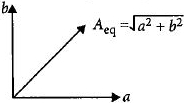
To find the amplitude,we can write this in the form $y = A \sin(\omega t + \phi)$,where the resultant amplitude $A$ is:
$A = \sqrt{a^2 + b^2 + 2ab \cos(\frac{\pi}{2})}$
Since $\cos(\frac{\pi}{2}) = 0$,the amplitude is:
$A = \sqrt{a^2 + b^2}$
Thus,the resultant motion is simple harmonic with an amplitude of $\sqrt{a^2 + b^2}$.
$y_1 = a \sin(\omega t)$
$y_2 = b \cos(\omega t) = b \sin(\omega t + \frac{\pi}{2})$
The resultant displacement $y = y_1 + y_2$ is given by:
$y = a \sin(\omega t) + b \cos(\omega t)$
To find the amplitude,we can write this in the form $y = A \sin(\omega t + \phi)$,where the resultant amplitude $A$ is:
$A = \sqrt{a^2 + b^2 + 2ab \cos(\frac{\pi}{2})}$
Since $\cos(\frac{\pi}{2}) = 0$,the amplitude is:
$A = \sqrt{a^2 + b^2}$
Thus,the resultant motion is simple harmonic with an amplitude of $\sqrt{a^2 + b^2}$.
0 likes
View Solution12
AdvancedMCQ
Two particles execute $SHM$ of same amplitude of $20 \, cm$ with same period along the same line about the same equilibrium position. The maximum distance between the two is $20 \, cm$. Their phase difference in radians is
A
$\frac{2\pi}{3}$
B
$\frac{\pi}{2}$
C
$\frac{2\pi}{3}$
D
$\frac{\pi}{3}$
Solution
(D) Let the displacements of the two particles be $x_1 = A \sin(\omega t)$ and $x_2 = A \sin(\omega t + \phi)$,where $A = 20 \, cm$.
The distance between the particles is $d = |x_2 - x_1| = |A \sin(\omega t + \phi) - A \sin(\omega t)|$.
Using the trigonometric identity $\sin C - \sin D = 2 \cos(\frac{C+D}{2}) \sin(\frac{C-D}{2})$,we get:
$d = |2A \cos(\omega t + \frac{\phi}{2}) \sin(\frac{\phi}{2})|$.
The maximum distance occurs when the cosine term is $1$,so $d_{max} = 2A \sin(\frac{\phi}{2})$.
Given $d_{max} = 20 \, cm$ and $A = 20 \, cm$,we have:
$20 = 2(20) \sin(\frac{\phi}{2})$
$\sin(\frac{\phi}{2}) = \frac{1}{2}$.
Therefore,$\frac{\phi}{2} = \frac{\pi}{6}$,which gives $\phi = \frac{\pi}{3}$ radians.
The distance between the particles is $d = |x_2 - x_1| = |A \sin(\omega t + \phi) - A \sin(\omega t)|$.
Using the trigonometric identity $\sin C - \sin D = 2 \cos(\frac{C+D}{2}) \sin(\frac{C-D}{2})$,we get:
$d = |2A \cos(\omega t + \frac{\phi}{2}) \sin(\frac{\phi}{2})|$.
The maximum distance occurs when the cosine term is $1$,so $d_{max} = 2A \sin(\frac{\phi}{2})$.
Given $d_{max} = 20 \, cm$ and $A = 20 \, cm$,we have:
$20 = 2(20) \sin(\frac{\phi}{2})$
$\sin(\frac{\phi}{2}) = \frac{1}{2}$.
Therefore,$\frac{\phi}{2} = \frac{\pi}{6}$,which gives $\phi = \frac{\pi}{3}$ radians.
0 likes
View Solution13
AdvancedMCQ
$A$ particle is subjected to two mutually perpendicular simple harmonic motions such that its $x$ and $y$ coordinates are given by:
$x = 2 \sin \omega t$
$y = 2 \sin \left( \omega t + \frac{\pi}{4} \right)$
The path of the particle will be:
$x = 2 \sin \omega t$
$y = 2 \sin \left( \omega t + \frac{\pi}{4} \right)$
The path of the particle will be:
A
an ellipse
B
a straight line
C
a parabola
D
a circle
Solution
(A) Given the equations of motion:
$x = 2 \sin \omega t \implies \sin \omega t = \frac{x}{2}$
$y = 2 \sin \left( \omega t + \frac{\pi}{4} \right) = 2 \left( \sin \omega t \cos \frac{\pi}{4} + \cos \omega t \sin \frac{\pi}{4} \right)$
Since $\sin \omega t = \frac{x}{2}$,then $\cos \omega t = \sqrt{1 - \sin^2 \omega t} = \sqrt{1 - \frac{x^2}{4}} = \frac{\sqrt{4 - x^2}}{2}$.
Substituting these into the expression for $y$:
$y = 2 \left( \frac{x}{2} \cdot \frac{1}{\sqrt{2}} + \frac{\sqrt{4 - x^2}}{2} \cdot \frac{1}{\sqrt{2}} \right)$
$y = \frac{x}{\sqrt{2}} + \frac{\sqrt{4 - x^2}}{\sqrt{2}}$
$\sqrt{2} y - x = \sqrt{4 - x^2}$
Squaring both sides:
$(\sqrt{2} y - x)^2 = 4 - x^2$
$2y^2 + x^2 - 2\sqrt{2} xy = 4 - x^2$
$2x^2 + 2y^2 - 2\sqrt{2} xy = 4$
$x^2 + y^2 - \sqrt{2} xy = 2$
This is the general equation of an ellipse ($Ax^2 + Bxy + Cy^2 = F$ where $B^2 - 4AC < 0$).
$x = 2 \sin \omega t \implies \sin \omega t = \frac{x}{2}$
$y = 2 \sin \left( \omega t + \frac{\pi}{4} \right) = 2 \left( \sin \omega t \cos \frac{\pi}{4} + \cos \omega t \sin \frac{\pi}{4} \right)$
Since $\sin \omega t = \frac{x}{2}$,then $\cos \omega t = \sqrt{1 - \sin^2 \omega t} = \sqrt{1 - \frac{x^2}{4}} = \frac{\sqrt{4 - x^2}}{2}$.
Substituting these into the expression for $y$:
$y = 2 \left( \frac{x}{2} \cdot \frac{1}{\sqrt{2}} + \frac{\sqrt{4 - x^2}}{2} \cdot \frac{1}{\sqrt{2}} \right)$
$y = \frac{x}{\sqrt{2}} + \frac{\sqrt{4 - x^2}}{\sqrt{2}}$
$\sqrt{2} y - x = \sqrt{4 - x^2}$
Squaring both sides:
$(\sqrt{2} y - x)^2 = 4 - x^2$
$2y^2 + x^2 - 2\sqrt{2} xy = 4 - x^2$
$2x^2 + 2y^2 - 2\sqrt{2} xy = 4$
$x^2 + y^2 - \sqrt{2} xy = 2$
This is the general equation of an ellipse ($Ax^2 + Bxy + Cy^2 = F$ where $B^2 - 4AC < 0$).
0 likes
View Solution14
AdvancedMCQ
The amplitude of the vibrating particle due to the superposition of two $SHMs$,$y_1 = \sin \left( \omega t + \frac{\pi}{3} \right)$ and $y_2 = \sin \omega t$ is:
A
$1$
B
$\sqrt{2}$
C
$\sqrt{3}$
D
$2$
Solution
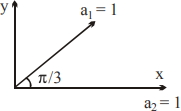
(C) The resultant amplitude $A$ of two $SHMs$ with amplitudes $A_1$ and $A_2$ and a phase difference $\phi$ is given by $A = \sqrt{A_1^2 + A_2^2 + 2A_1A_2 \cos \phi}$.
Here,$A_1 = 1$,$A_2 = 1$,and the phase difference $\phi = \frac{\pi}{3}$.
Substituting these values into the formula:
$A = \sqrt{1^2 + 1^2 + 2(1)(1) \cos \left( \frac{\pi}{3} \right)}$
$A = \sqrt{1 + 1 + 2 \times \frac{1}{2}}$
$A = \sqrt{2 + 1} = \sqrt{3}$.
Here,$A_1 = 1$,$A_2 = 1$,and the phase difference $\phi = \frac{\pi}{3}$.
Substituting these values into the formula:
$A = \sqrt{1^2 + 1^2 + 2(1)(1) \cos \left( \frac{\pi}{3} \right)}$
$A = \sqrt{1 + 1 + 2 \times \frac{1}{2}}$
$A = \sqrt{2 + 1} = \sqrt{3}$.
0 likes
View Solution15
AdvancedMCQ
Two simple harmonic motions $y_1 = A \sin \omega t$ and $y_2 = A \cos \omega t$ are superimposed on a particle of mass $m.$ The total mechanical energy of the particle is:
A
$1/2 m \omega^2 A^2$
B
$m \omega^2 A^2$
C
$1/4 m \omega^2 A^2$
D
zero
Solution
(B) The two $SHM$s $y_1$ and $y_2$ are superimposed to give a new $SHM$ as $y.$
$y = y_1 + y_2$
$y = A \sin(\omega t) + A \cos(\omega t)$
Multiply and divide by $\sqrt{2}$:
$y = \sqrt{2} A \left[ \frac{1}{\sqrt{2}} \sin(\omega t) + \frac{1}{\sqrt{2}} \cos(\omega t) \right]$
Using $\sin(\omega t + \pi/4) = \sin(\omega t) \cos(\pi/4) + \cos(\omega t) \sin(\pi/4)$:
$y = \sqrt{2} A \sin(\omega t + \pi/4)$
This is a new $SHM$ with amplitude $B = \sqrt{2} A.$
The total mechanical energy of an $SHM$ is given by $T.E. = 1/2 m \omega^2 B^2.$
Substituting $B = \sqrt{2} A$:
$T.E. = 1/2 m \omega^2 (\sqrt{2} A)^2$
$T.E. = 1/2 m \omega^2 (2 A^2)$
$T.E. = m \omega^2 A^2$
$y = y_1 + y_2$
$y = A \sin(\omega t) + A \cos(\omega t)$
Multiply and divide by $\sqrt{2}$:
$y = \sqrt{2} A \left[ \frac{1}{\sqrt{2}} \sin(\omega t) + \frac{1}{\sqrt{2}} \cos(\omega t) \right]$
Using $\sin(\omega t + \pi/4) = \sin(\omega t) \cos(\pi/4) + \cos(\omega t) \sin(\pi/4)$:
$y = \sqrt{2} A \sin(\omega t + \pi/4)$
This is a new $SHM$ with amplitude $B = \sqrt{2} A.$
The total mechanical energy of an $SHM$ is given by $T.E. = 1/2 m \omega^2 B^2.$
Substituting $B = \sqrt{2} A$:
$T.E. = 1/2 m \omega^2 (\sqrt{2} A)^2$
$T.E. = 1/2 m \omega^2 (2 A^2)$
$T.E. = m \omega^2 A^2$
0 likes
View Solution16
DifficultMCQ
Two particles are executing simple harmonic motion of the same amplitude $A$ and frequency $\omega$ along the $x$-axis. Their mean positions are separated by a distance $X_0$ $(X_0 > A)$. If the maximum separation between them is $(X_0 + A)$,the phase difference between their motions is:
A
$\frac{\pi}{2}$
B
$\frac{\pi}{4}$
C
$\frac{\pi}{6}$
D
$\frac{\pi}{3}$
Solution
(D) Let the positions of the two particles be $x_1$ and $x_2$ relative to their respective mean positions.
$x_1 = A \sin(\omega t + \phi_1)$
$x_2 = A \sin(\omega t + \phi_2)$
The absolute positions are $X_1 = x_1$ and $X_2 = X_0 + x_2$.
The separation between them is $S = X_2 - X_1 = X_0 + x_2 - x_1$.
$S = X_0 + A[\sin(\omega t + \phi_2) - \sin(\omega t + \phi_1)]$.
Using the identity $\sin C - \sin D = 2 \cos(\frac{C+D}{2}) \sin(\frac{C-D}{2})$:
$S = X_0 + 2A \cos(\omega t + \frac{\phi_1 + \phi_2}{2}) \sin(\frac{\phi_2 - \phi_1}{2})$.
The maximum separation is $S_{max} = X_0 + |2A \sin(\frac{\phi_2 - \phi_1}{2})|$.
Given $S_{max} = X_0 + A$,we have $|2A \sin(\frac{\Delta\phi}{2})| = A$,where $\Delta\phi = \phi_2 - \phi_1$.
$\sin(\frac{\Delta\phi}{2}) = \frac{1}{2}$.
$\frac{\Delta\phi}{2} = \frac{\pi}{6} \implies \Delta\phi = \frac{\pi}{3}$.
$x_1 = A \sin(\omega t + \phi_1)$
$x_2 = A \sin(\omega t + \phi_2)$
The absolute positions are $X_1 = x_1$ and $X_2 = X_0 + x_2$.
The separation between them is $S = X_2 - X_1 = X_0 + x_2 - x_1$.
$S = X_0 + A[\sin(\omega t + \phi_2) - \sin(\omega t + \phi_1)]$.
Using the identity $\sin C - \sin D = 2 \cos(\frac{C+D}{2}) \sin(\frac{C-D}{2})$:
$S = X_0 + 2A \cos(\omega t + \frac{\phi_1 + \phi_2}{2}) \sin(\frac{\phi_2 - \phi_1}{2})$.
The maximum separation is $S_{max} = X_0 + |2A \sin(\frac{\phi_2 - \phi_1}{2})|$.
Given $S_{max} = X_0 + A$,we have $|2A \sin(\frac{\Delta\phi}{2})| = A$,where $\Delta\phi = \phi_2 - \phi_1$.
$\sin(\frac{\Delta\phi}{2}) = \frac{1}{2}$.
$\frac{\Delta\phi}{2} = \frac{\pi}{6} \implies \Delta\phi = \frac{\pi}{3}$.
0 likes
View Solution17
MediumMCQ
Two particles are executing $SHM$ of the same amplitude $A$ and frequency $\omega$ along the $x$-axis. Their mean positions are separated by $X_0$ (where $X_0 > A$). If the maximum separation between them is $X_0 + 2A$,then the phase difference between their motion is:
A
$\frac{\pi}{2}$
B
$\pi$
C
$\frac{\pi}{3}$
D
$\frac{\pi}{4}$
Solution
(B) Let the positions of the two particles be $x_1(t) = X_1 + A \sin(\omega t + \phi_1)$ and $x_2(t) = X_2 + A \sin(\omega t + \phi_2)$.
Given the mean positions are separated by $X_0$,we have $X_2 - X_1 = X_0$.
The separation between the particles is $\Delta x = x_2 - x_1 = X_0 + A[\sin(\omega t + \phi_2) - \sin(\omega t + \phi_1)]$.
Using the trigonometric identity $\sin C - \sin D = 2 \sin(\frac{C-D}{2}) \cos(\frac{C+D}{2})$,the maximum value of the term $A[\sin(\omega t + \phi_2) - \sin(\omega t + \phi_1)]$ is $2A \sin(\frac{\phi_2 - \phi_1}{2})$.
We are given that the maximum separation is $X_0 + 2A$.
Therefore,$2A \sin(\frac{\Delta \phi}{2}) = 2A$,which implies $\sin(\frac{\Delta \phi}{2}) = 1$.
This gives $\frac{\Delta \phi}{2} = \frac{\pi}{2}$,so $\Delta \phi = \pi$.
Given the mean positions are separated by $X_0$,we have $X_2 - X_1 = X_0$.
The separation between the particles is $\Delta x = x_2 - x_1 = X_0 + A[\sin(\omega t + \phi_2) - \sin(\omega t + \phi_1)]$.
Using the trigonometric identity $\sin C - \sin D = 2 \sin(\frac{C-D}{2}) \cos(\frac{C+D}{2})$,the maximum value of the term $A[\sin(\omega t + \phi_2) - \sin(\omega t + \phi_1)]$ is $2A \sin(\frac{\phi_2 - \phi_1}{2})$.
We are given that the maximum separation is $X_0 + 2A$.
Therefore,$2A \sin(\frac{\Delta \phi}{2}) = 2A$,which implies $\sin(\frac{\Delta \phi}{2}) = 1$.
This gives $\frac{\Delta \phi}{2} = \frac{\pi}{2}$,so $\Delta \phi = \pi$.
0 likes
View Solution18
MediumMCQ
The resultant of two rectangular simple harmonic motions of the same frequency and equal amplitudes but differing in phase by $\frac{\pi}{2}$ is
A
straight line
B
Circular
C
Elliptical
D
None of these
Solution
(B) Let the two rectangular simple harmonic motions be represented as:
$x = a \sin(\omega t)$
$y = a \sin(\omega t + \frac{\pi}{2})$
Since $\sin(\omega t + \frac{\pi}{2}) = \cos(\omega t)$,we have:
$y = a \cos(\omega t)$
Squaring and adding both equations:
$x^2 + y^2 = a^2 \sin^2(\omega t) + a^2 \cos^2(\omega t)$
$x^2 + y^2 = a^2 (\sin^2(\omega t) + \cos^2(\omega t))$
$x^2 + y^2 = a^2$
This is the equation of a circle with radius $a$ centered at the origin. Therefore,the resultant motion is circular.
$x = a \sin(\omega t)$
$y = a \sin(\omega t + \frac{\pi}{2})$
Since $\sin(\omega t + \frac{\pi}{2}) = \cos(\omega t)$,we have:
$y = a \cos(\omega t)$
Squaring and adding both equations:
$x^2 + y^2 = a^2 \sin^2(\omega t) + a^2 \cos^2(\omega t)$
$x^2 + y^2 = a^2 (\sin^2(\omega t) + \cos^2(\omega t))$
$x^2 + y^2 = a^2$
This is the equation of a circle with radius $a$ centered at the origin. Therefore,the resultant motion is circular.
0 likes
View Solution19
MediumMCQ
Two $SHM$ are represented by equations,$y_1 = 6\cos \left( {6\pi t + \frac{\pi }{6}} \right)$ and $y_2 = 3\left( {\sqrt 3 \sin 3\pi t + \cos 3\pi t} \right)$. Which of the following statements is true?
A
The ratio of their amplitudes is $1$.
B
The ratio of their time periods is $1$.
C
The ratio of their maximum velocities is $1$.
D
The ratio of their maximum accelerations is $1$.
Solution
(A) Given equations are:
$y_1 = 6 \cos \left( 6 \pi t + \frac{\pi}{6} \right)$
$y_2 = 3 \left( \sqrt{3} \sin 3 \pi t + \cos 3 \pi t \right)$
For $y_1$,the amplitude $A_1 = 6$.
For $y_2$,we can rewrite it as:
$y_2 = 6 \left( \frac{\sqrt{3}}{2} \sin 3 \pi t + \frac{1}{2} \cos 3 \pi t \right)$
Using the identity $\sin(A+B) = \sin A \cos B + \cos A \sin B$,we set $\cos \phi = \frac{\sqrt{3}}{2}$ and $\sin \phi = \frac{1}{2}$,which gives $\phi = \frac{\pi}{6}$.
$y_2 = 6 \sin \left( 3 \pi t + \frac{\pi}{6} \right)$
Thus,the amplitude $A_2 = 6$.
The ratio of their amplitudes is $\frac{A_1}{A_2} = \frac{6}{6} = 1$.
Therefore,option $A$ is the correct answer.
$y_1 = 6 \cos \left( 6 \pi t + \frac{\pi}{6} \right)$
$y_2 = 3 \left( \sqrt{3} \sin 3 \pi t + \cos 3 \pi t \right)$
For $y_1$,the amplitude $A_1 = 6$.
For $y_2$,we can rewrite it as:
$y_2 = 6 \left( \frac{\sqrt{3}}{2} \sin 3 \pi t + \frac{1}{2} \cos 3 \pi t \right)$
Using the identity $\sin(A+B) = \sin A \cos B + \cos A \sin B$,we set $\cos \phi = \frac{\sqrt{3}}{2}$ and $\sin \phi = \frac{1}{2}$,which gives $\phi = \frac{\pi}{6}$.
$y_2 = 6 \sin \left( 3 \pi t + \frac{\pi}{6} \right)$
Thus,the amplitude $A_2 = 6$.
The ratio of their amplitudes is $\frac{A_1}{A_2} = \frac{6}{6} = 1$.
Therefore,option $A$ is the correct answer.
0 likes
View Solution20
EasyMCQ
Two particles are executing simple harmonic motion of the same amplitude $A$ and frequency $\omega$ along the $x$-axis. Their mean positions are separated by a distance $X_0$ $(X_0 > A)$. If the maximum separation between them is $(X_0 + A)$,the phase difference between their motions is:
A
$\frac{\pi}{6}$
B
$\frac{\pi}{2}$
C
$\frac{\pi}{3}$
D
$\pi$
Solution
(C) Let the positions of the two particles be $x_1(t) = A \sin(\omega t + \phi_1)$ and $x_2(t) = X_0 + A \sin(\omega t + \phi_2)$.
The separation between them is $\Delta x = x_2 - x_1 = X_0 + A \sin(\omega t + \phi_2) - A \sin(\omega t + \phi_1)$.
Using the trigonometric identity $\sin C - \sin D = 2 \sin(\frac{C-D}{2}) \cos(\frac{C+D}{2})$,we get $\Delta x = X_0 + 2A \sin(\frac{\phi_2 - \phi_1}{2}) \cos(\omega t + \frac{\phi_1 + \phi_2}{2})$.
The maximum separation is given as $X_0 + A$. Therefore,the amplitude of the oscillating part must be $A$.
Thus,$2A \sin(\frac{\Delta \phi}{2}) = A$,where $\Delta \phi = \phi_2 - \phi_1$.
$\sin(\frac{\Delta \phi}{2}) = \frac{1}{2}$.
$\frac{\Delta \phi}{2} = \frac{\pi}{6}$,which implies $\Delta \phi = \frac{\pi}{3}$.
The separation between them is $\Delta x = x_2 - x_1 = X_0 + A \sin(\omega t + \phi_2) - A \sin(\omega t + \phi_1)$.
Using the trigonometric identity $\sin C - \sin D = 2 \sin(\frac{C-D}{2}) \cos(\frac{C+D}{2})$,we get $\Delta x = X_0 + 2A \sin(\frac{\phi_2 - \phi_1}{2}) \cos(\omega t + \frac{\phi_1 + \phi_2}{2})$.
The maximum separation is given as $X_0 + A$. Therefore,the amplitude of the oscillating part must be $A$.
Thus,$2A \sin(\frac{\Delta \phi}{2}) = A$,where $\Delta \phi = \phi_2 - \phi_1$.
$\sin(\frac{\Delta \phi}{2}) = \frac{1}{2}$.
$\frac{\Delta \phi}{2} = \frac{\pi}{6}$,which implies $\Delta \phi = \frac{\pi}{3}$.
0 likes
View Solution21
DifficultMCQ
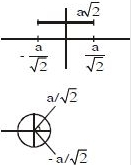
Two particles $p$ and $q$ perform $SHM$ with the same amplitude $a$ and the same frequency $f$ along a straight line. The maximum distance between the two particles is $a\sqrt{2}$. The initial phase difference between the particles is:
A
Zero
B
$\frac{\pi}{2}$
C
$\frac{\pi}{6}$
D
$\frac{\pi}{3}$
Solution
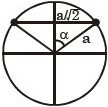
(B) Let the displacements of the two particles be $x_1 = a \sin(\omega t + \phi_1)$ and $x_2 = a \sin(\omega t + \phi_2)$.
The distance between them is $d = |x_1 - x_2| = |a \sin(\omega t + \phi_1) - a \sin(\omega t + \phi_2)|$.
Using the formula $\sin C - \sin D = 2 \sin(\frac{C-D}{2}) \cos(\frac{C+D}{2})$,we get $d = |2a \sin(\frac{\phi_1 - \phi_2}{2}) \cos(\omega t + \frac{\phi_1 + \phi_2}{2})|$.
The maximum distance occurs when the cosine term is $1$,so $d_{max} = |2a \sin(\frac{\Delta \phi}{2})|$,where $\Delta \phi = \phi_1 - \phi_2$ is the phase difference.
Given $d_{max} = a\sqrt{2}$,we have $a\sqrt{2} = 2a \sin(\frac{\Delta \phi}{2})$.
$\sin(\frac{\Delta \phi}{2}) = \frac{\sqrt{2}}{2} = \frac{1}{\sqrt{2}}$.
$\frac{\Delta \phi}{2} = 45^{\circ} = \frac{\pi}{4}$ radians.
Therefore,$\Delta \phi = 2 \times \frac{\pi}{4} = \frac{\pi}{2}$ radians.
The distance between them is $d = |x_1 - x_2| = |a \sin(\omega t + \phi_1) - a \sin(\omega t + \phi_2)|$.
Using the formula $\sin C - \sin D = 2 \sin(\frac{C-D}{2}) \cos(\frac{C+D}{2})$,we get $d = |2a \sin(\frac{\phi_1 - \phi_2}{2}) \cos(\omega t + \frac{\phi_1 + \phi_2}{2})|$.
The maximum distance occurs when the cosine term is $1$,so $d_{max} = |2a \sin(\frac{\Delta \phi}{2})|$,where $\Delta \phi = \phi_1 - \phi_2$ is the phase difference.
Given $d_{max} = a\sqrt{2}$,we have $a\sqrt{2} = 2a \sin(\frac{\Delta \phi}{2})$.
$\sin(\frac{\Delta \phi}{2}) = \frac{\sqrt{2}}{2} = \frac{1}{\sqrt{2}}$.
$\frac{\Delta \phi}{2} = 45^{\circ} = \frac{\pi}{4}$ radians.
Therefore,$\Delta \phi = 2 \times \frac{\pi}{4} = \frac{\pi}{2}$ radians.
0 likes
View Solution22
MediumMCQ
Three simple harmonic motions of equal amplitudes $A$ and equal time periods in the same direction combine. The phase of the second motion is $60^{\circ}$ ahead of the first and the phase of the third motion is $60^{\circ}$ ahead of the second. Find the amplitude of the resultant motion.
A
$A$
B
$2\,A$
C
$3\,A$
D
$4\,A$
Solution
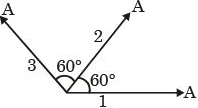
(B) Let the three SHMs be represented by phasors of magnitude $A$ at angles $0^{\circ}$,$60^{\circ}$,and $120^{\circ}$ with respect to the first motion.
The resultant amplitude $A_{\text{net}}$ is given by the vector sum of these three phasors:
$A_{\text{net}} = \sqrt{(A + A\cos 60^{\circ} + A\cos 120^{\circ})^2 + (0 + A\sin 60^{\circ} + A\sin 120^{\circ})^2}$
$A_{\text{net}} = \sqrt{(A + A/2 - A/2)^2 + (0 + A\sqrt{3}/2 + A\sqrt{3}/2)^2}$
$A_{\text{net}} = \sqrt{A^2 + (A\sqrt{3})^2} = \sqrt{A^2 + 3A^2} = \sqrt{4A^2} = 2A$
Alternatively,using the phasor diagram,the resultant of the first and third phasors (which are at $120^{\circ}$ to each other) is a vector of magnitude $A$ directed along the same line as the second phasor. Adding this to the second phasor gives $A + A = 2A$.
The resultant amplitude $A_{\text{net}}$ is given by the vector sum of these three phasors:
$A_{\text{net}} = \sqrt{(A + A\cos 60^{\circ} + A\cos 120^{\circ})^2 + (0 + A\sin 60^{\circ} + A\sin 120^{\circ})^2}$
$A_{\text{net}} = \sqrt{(A + A/2 - A/2)^2 + (0 + A\sqrt{3}/2 + A\sqrt{3}/2)^2}$
$A_{\text{net}} = \sqrt{A^2 + (A\sqrt{3})^2} = \sqrt{A^2 + 3A^2} = \sqrt{4A^2} = 2A$
Alternatively,using the phasor diagram,the resultant of the first and third phasors (which are at $120^{\circ}$ to each other) is a vector of magnitude $A$ directed along the same line as the second phasor. Adding this to the second phasor gives $A + A = 2A$.
0 likes
View Solution23
DifficultMCQ
Two particles $P$ and $Q$ perform $SHM$ with the same amplitude $a$ and frequency $v$ along the same straight line. The maximum distance between the two particles is $a \sqrt{2}$. The initial phase difference between the particles is:
A
zero
B
$\frac{\pi}{2}$
C
$\frac{\pi}{6}$
D
$\frac{\pi}{3}$
Solution
(B) Let the displacements of the two particles be $x_1 = a \sin(\omega t + \phi_1)$ and $x_2 = a \sin(\omega t + \phi_2)$.
The distance between them is $d = |x_1 - x_2| = |a \sin(\omega t + \phi_1) - a \sin(\omega t + \phi_2)|$.
Using the formula $\sin A - \sin B = 2 \sin(\frac{A-B}{2}) \cos(\frac{A+B}{2})$,we get $d = |2a \sin(\frac{\phi_1 - \phi_2}{2}) \cos(\omega t + \frac{\phi_1 + \phi_2}{2})|$.
The maximum distance occurs when $\cos(\omega t + \frac{\phi_1 + \phi_2}{2}) = 1$,so $d_{max} = |2a \sin(\frac{\Delta \phi}{2})|$.
Given $d_{max} = a \sqrt{2}$,we have $2a \sin(\frac{\Delta \phi}{2}) = a \sqrt{2}$.
$\sin(\frac{\Delta \phi}{2}) = \frac{\sqrt{2}}{2} = \frac{1}{\sqrt{2}}$.
$\frac{\Delta \phi}{2} = \frac{\pi}{4}$,which gives $\Delta \phi = \frac{\pi}{2}$.
The distance between them is $d = |x_1 - x_2| = |a \sin(\omega t + \phi_1) - a \sin(\omega t + \phi_2)|$.
Using the formula $\sin A - \sin B = 2 \sin(\frac{A-B}{2}) \cos(\frac{A+B}{2})$,we get $d = |2a \sin(\frac{\phi_1 - \phi_2}{2}) \cos(\omega t + \frac{\phi_1 + \phi_2}{2})|$.
The maximum distance occurs when $\cos(\omega t + \frac{\phi_1 + \phi_2}{2}) = 1$,so $d_{max} = |2a \sin(\frac{\Delta \phi}{2})|$.
Given $d_{max} = a \sqrt{2}$,we have $2a \sin(\frac{\Delta \phi}{2}) = a \sqrt{2}$.
$\sin(\frac{\Delta \phi}{2}) = \frac{\sqrt{2}}{2} = \frac{1}{\sqrt{2}}$.
$\frac{\Delta \phi}{2} = \frac{\pi}{4}$,which gives $\Delta \phi = \frac{\pi}{2}$.
0 likes
View Solution24
EasyMCQ
The equation of $SHM$ is given as:
$x = 3 \sin(20\pi t) + 4 \cos(20\pi t)$,
where $x$ is in $cm$ and $t$ is in $seconds$. The amplitude is ..... $cm$.
$x = 3 \sin(20\pi t) + 4 \cos(20\pi t)$,
where $x$ is in $cm$ and $t$ is in $seconds$. The amplitude is ..... $cm$.
A
$7$
B
$4$
C
$5$
D
$3$
Solution
(C) The given equation is $x = 3 \sin(20\pi t) + 4 \cos(20\pi t)$.
Any equation of the form $x = a \sin(\omega t) + b \cos(\omega t)$ can be rewritten as $x = A \sin(\omega t + \phi)$,where the amplitude $A$ is given by $A = \sqrt{a^2 + b^2}$.
Comparing the given equation with $x = a \sin(\omega t) + b \cos(\omega t)$,we identify $a = 3$ and $b = 4$.
Therefore,the amplitude $A = \sqrt{3^2 + 4^2}$.
$A = \sqrt{9 + 16} = \sqrt{25} = 5 \ cm$.
Thus,the amplitude of the oscillation is $5 \ cm$.
Any equation of the form $x = a \sin(\omega t) + b \cos(\omega t)$ can be rewritten as $x = A \sin(\omega t + \phi)$,where the amplitude $A$ is given by $A = \sqrt{a^2 + b^2}$.
Comparing the given equation with $x = a \sin(\omega t) + b \cos(\omega t)$,we identify $a = 3$ and $b = 4$.
Therefore,the amplitude $A = \sqrt{3^2 + 4^2}$.
$A = \sqrt{9 + 16} = \sqrt{25} = 5 \ cm$.
Thus,the amplitude of the oscillation is $5 \ cm$.
0 likes
View Solution25
MediumMCQ
Four simple harmonic vibrations:
$y_1 = 8 \cos(\omega t)$;
$y_2 = 4 \cos(\omega t + \frac{\pi}{2})$;
$y_3 = 2 \cos(\omega t + \pi)$;
$y_4 = 1 \cos(\omega t + \frac{3\pi}{2})$,
are superposed on each other. The resulting amplitude and phase are respectively:
$y_1 = 8 \cos(\omega t)$;
$y_2 = 4 \cos(\omega t + \frac{\pi}{2})$;
$y_3 = 2 \cos(\omega t + \pi)$;
$y_4 = 1 \cos(\omega t + \frac{3\pi}{2})$,
are superposed on each other. The resulting amplitude and phase are respectively:
A
$\sqrt{45}$ and $\tan^{-1}(1/2)$
B
$\sqrt{45}$ and $\tan^{-1}(1/3)$
C
$\sqrt{75}$ and $\tan^{-1}(1/2)$
D
$\sqrt{75}$ and $\tan^{-1}(1/3)$
Solution
(A) Represent the vibrations as phasors:
$y_1 = 8 \cos(\omega t) \implies \vec{A}_1 = 8\hat{i}$
$y_2 = 4 \cos(\omega t + \frac{\pi}{2}) = -4 \sin(\omega t) \implies \vec{A}_2 = 4\hat{j}$
$y_3 = 2 \cos(\omega t + \pi) = -2 \cos(\omega t) \implies \vec{A}_3 = -2\hat{i}$
$y_4 = 1 \cos(\omega t + \frac{3\pi}{2}) = 1 \sin(\omega t) \implies \vec{A}_4 = -1\hat{j}$
The resultant vector $\vec{A} = \vec{A}_1 + \vec{A}_2 + \vec{A}_3 + \vec{A}_4 = (8-2)\hat{i} + (4-1)\hat{j} = 6\hat{i} + 3\hat{j}$.
Amplitude $A = \sqrt{6^2 + 3^2} = \sqrt{36 + 9} = \sqrt{45}$.
Phase $\phi = \tan^{-1}(\frac{A_y}{A_x}) = \tan^{-1}(\frac{3}{6}) = \tan^{-1}(1/2)$.
$y_1 = 8 \cos(\omega t) \implies \vec{A}_1 = 8\hat{i}$
$y_2 = 4 \cos(\omega t + \frac{\pi}{2}) = -4 \sin(\omega t) \implies \vec{A}_2 = 4\hat{j}$
$y_3 = 2 \cos(\omega t + \pi) = -2 \cos(\omega t) \implies \vec{A}_3 = -2\hat{i}$
$y_4 = 1 \cos(\omega t + \frac{3\pi}{2}) = 1 \sin(\omega t) \implies \vec{A}_4 = -1\hat{j}$
The resultant vector $\vec{A} = \vec{A}_1 + \vec{A}_2 + \vec{A}_3 + \vec{A}_4 = (8-2)\hat{i} + (4-1)\hat{j} = 6\hat{i} + 3\hat{j}$.
Amplitude $A = \sqrt{6^2 + 3^2} = \sqrt{36 + 9} = \sqrt{45}$.
Phase $\phi = \tan^{-1}(\frac{A_y}{A_x}) = \tan^{-1}(\frac{3}{6}) = \tan^{-1}(1/2)$.
0 likes
View Solution26
DifficultMCQ
Two simple harmonic motions,as shown,are at right angles. They are combined to form Lissajous figures.
$x(t) = A \sin(at + \delta)$
$y(t) = B \sin(bt)$
Identify the correct match below.
$x(t) = A \sin(at + \delta)$
$y(t) = B \sin(bt)$
Identify the correct match below.
A
Parameters: $A = B$,$a = 2b$,$\delta = \frac{\pi}{2}$; Curve: Circle
B
Parameters: $A = B$,$a = b$,$\delta = \frac{\pi}{2}$; Curve: Line
C
Parameters: $A \neq B$,$a = b$,$\delta = \frac{\pi}{2}$; Curve: Ellipse
D
Parameters: $A \neq B$,$a = b$,$\delta = 0$; Curve: Parabola
Solution
(C) The general equation for the superposition of two perpendicular simple harmonic motions is given by:
$\frac{x^2}{A^2} + \frac{y^2}{B^2} - \frac{2xy}{AB} \cos \delta = \sin^2 \delta$
For option $C$: Given $a = b$ and $\delta = \frac{\pi}{2}$,the equation becomes:
$\frac{x^2}{A^2} + \frac{y^2}{B^2} - \frac{2xy}{AB} \cos(\frac{\pi}{2}) = \sin^2(\frac{\pi}{2})$
$\frac{x^2}{A^2} + \frac{y^2}{B^2} = 1$
Since $A \neq B$,this is the standard equation of an ellipse.
Therefore,option $C$ is the correct match.
$\frac{x^2}{A^2} + \frac{y^2}{B^2} - \frac{2xy}{AB} \cos \delta = \sin^2 \delta$
For option $C$: Given $a = b$ and $\delta = \frac{\pi}{2}$,the equation becomes:
$\frac{x^2}{A^2} + \frac{y^2}{B^2} - \frac{2xy}{AB} \cos(\frac{\pi}{2}) = \sin^2(\frac{\pi}{2})$
$\frac{x^2}{A^2} + \frac{y^2}{B^2} = 1$
Since $A \neq B$,this is the standard equation of an ellipse.
Therefore,option $C$ is the correct match.
0 likes
View Solution27
DifficultMCQ
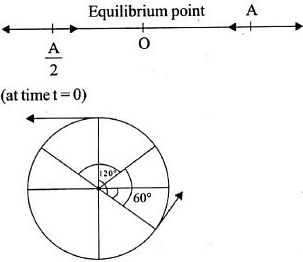
Two particles are performing simple harmonic motion in a straight line about the same equilibrium point. The amplitude and time period for both particles are same and equal to $A$ and $T$,respectively. At time $t=0$,one particle has displacement $A$ while the other one has displacement $\frac{-A}{2}$ and they are moving towards each other. If they cross each other at time $t$,then $t$ is
A
$\frac{5T}{6}$
B
$\frac{T}{3}$
C
$\frac{T}{4}$
D
$\frac{T}{6}$
Solution
(D) Let the reference circle have radius $A$. The angular frequency is $\omega = \frac{2\pi}{T}$.
At $t=0$,the first particle is at $x = A$,which corresponds to a phase angle $\phi_1 = 0$ on the reference circle.
The second particle is at $x = -A/2$ and moving towards the equilibrium point (positive direction). This corresponds to a phase angle $\phi_2 = \pi + \frac{\pi}{3} = \frac{4\pi}{3}$ or simply looking at the geometry,the angle between them is $120^{\circ}$ or $\frac{2\pi}{3}$ radians.
They move towards each other,meaning the relative angular velocity is $\omega$. The angle they need to cover to meet is $\theta = \frac{2\pi}{3} - \frac{\pi}{2} = \frac{\pi}{6}$ is incorrect based on the diagram provided.
From the diagram,the particle at $A$ moves towards the center (angle $\pi/2$ to cover) and the particle at $-A/2$ moves towards the center (angle $\pi/6$ to cover). The total angle to cover to meet at the equilibrium point is not the goal,but rather the intersection point.
Using the reference circle: Particle $1$ starts at $0$ rad,Particle $2$ starts at $240^{\circ}$ ($4\pi/3$ rad). They meet when their projections on the x-axis are equal. The time taken is $t = \frac{\Delta \phi}{\omega} = \frac{\pi/3}{2\pi/T} = \frac{T}{6}$.
At $t=0$,the first particle is at $x = A$,which corresponds to a phase angle $\phi_1 = 0$ on the reference circle.
The second particle is at $x = -A/2$ and moving towards the equilibrium point (positive direction). This corresponds to a phase angle $\phi_2 = \pi + \frac{\pi}{3} = \frac{4\pi}{3}$ or simply looking at the geometry,the angle between them is $120^{\circ}$ or $\frac{2\pi}{3}$ radians.
They move towards each other,meaning the relative angular velocity is $\omega$. The angle they need to cover to meet is $\theta = \frac{2\pi}{3} - \frac{\pi}{2} = \frac{\pi}{6}$ is incorrect based on the diagram provided.
From the diagram,the particle at $A$ moves towards the center (angle $\pi/2$ to cover) and the particle at $-A/2$ moves towards the center (angle $\pi/6$ to cover). The total angle to cover to meet at the equilibrium point is not the goal,but rather the intersection point.
Using the reference circle: Particle $1$ starts at $0$ rad,Particle $2$ starts at $240^{\circ}$ ($4\pi/3$ rad). They meet when their projections on the x-axis are equal. The time taken is $t = \frac{\Delta \phi}{\omega} = \frac{\pi/3}{2\pi/T} = \frac{T}{6}$.
0 likes
View Solution28
DifficultMCQ
$A$ particle which is simultaneously subjected to two perpendicular simple harmonic motions represented by $x = a_1 \cos \omega t$ and $y = a_2 \cos 2 \omega t$ traces a curve given by:
A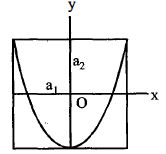
B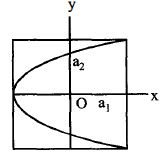
C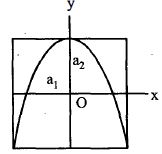
D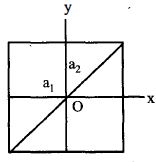
Solution
(A) Given the two perpendicular $S.H.Ms$:
$x = a_1 \cos \omega t \implies \cos \omega t = \frac{x}{a_1} \quad ...(1)$
$y = a_2 \cos 2 \omega t \quad ...(2)$
Using the trigonometric identity $\cos 2 \theta = 2 \cos^2 \theta - 1$,we substitute equation $(1)$ into equation $(2)$:
$y = a_2 (2 \cos^2 \omega t - 1)$
$y = a_2 \left( 2 \left( \frac{x}{a_1} \right)^2 - 1 \right)$
$y = \frac{2 a_2}{a_1^2} x^2 - a_2$
This is the equation of a parabola opening upwards with its vertex at $(0, -a_2)$. This corresponds to the curve shown in image $822-$a914.
$x = a_1 \cos \omega t \implies \cos \omega t = \frac{x}{a_1} \quad ...(1)$
$y = a_2 \cos 2 \omega t \quad ...(2)$
Using the trigonometric identity $\cos 2 \theta = 2 \cos^2 \theta - 1$,we substitute equation $(1)$ into equation $(2)$:
$y = a_2 (2 \cos^2 \omega t - 1)$
$y = a_2 \left( 2 \left( \frac{x}{a_1} \right)^2 - 1 \right)$
$y = \frac{2 a_2}{a_1^2} x^2 - a_2$
This is the equation of a parabola opening upwards with its vertex at $(0, -a_2)$. This corresponds to the curve shown in image $822-$a914.
0 likes
View Solution29
MediumMCQ
$A$ vibratory motion is represented by $x = 2A \cos \omega t + A \cos \left( \omega t + \frac{\pi}{2} \right) + A \cos ( \omega t + \pi ) + \frac{A}{2} \cos \left( \omega t + \frac{3\pi}{2} \right)$. The resultant amplitude of the motion is
A
$\frac{9A}{2}$
B
$\frac{\sqrt{5}A}{2}$
C
$\frac{5A}{2}$
D
$2A$
Solution
(B) Given the equation: $x = 2A \cos \omega t + A \cos \left( \omega t + \frac{\pi}{2} \right) + A \cos ( \omega t + \pi ) + \frac{A}{2} \cos \left( \omega t + \frac{3\pi}{2} \right)$.
Using trigonometric identities: $\cos ( \omega t + \frac{\pi}{2} ) = -\sin \omega t$,$\cos ( \omega t + \pi ) = -\cos \omega t$,and $\cos ( \omega t + \frac{3\pi}{2} ) = \sin \omega t$.
Substituting these into the equation:
$x = 2A \cos \omega t - A \sin \omega t - A \cos \omega t + \frac{A}{2} \sin \omega t$.
Simplifying the terms:
$x = (2A - A) \cos \omega t + (\frac{A}{2} - A) \sin \omega t = A \cos \omega t - \frac{A}{2} \sin \omega t$.
The resultant amplitude $A_R$ for a motion of the form $x = a \cos \omega t + b \sin \omega t$ is given by $A_R = \sqrt{a^2 + b^2}$.
Here,$a = A$ and $b = -\frac{A}{2}$.
$A_R = \sqrt{A^2 + (-\frac{A}{2})^2} = \sqrt{A^2 + \frac{A^2}{4}} = \sqrt{\frac{5A^2}{4}} = \frac{\sqrt{5}A}{2}$.
Using trigonometric identities: $\cos ( \omega t + \frac{\pi}{2} ) = -\sin \omega t$,$\cos ( \omega t + \pi ) = -\cos \omega t$,and $\cos ( \omega t + \frac{3\pi}{2} ) = \sin \omega t$.
Substituting these into the equation:
$x = 2A \cos \omega t - A \sin \omega t - A \cos \omega t + \frac{A}{2} \sin \omega t$.
Simplifying the terms:
$x = (2A - A) \cos \omega t + (\frac{A}{2} - A) \sin \omega t = A \cos \omega t - \frac{A}{2} \sin \omega t$.
The resultant amplitude $A_R$ for a motion of the form $x = a \cos \omega t + b \sin \omega t$ is given by $A_R = \sqrt{a^2 + b^2}$.
Here,$a = A$ and $b = -\frac{A}{2}$.
$A_R = \sqrt{A^2 + (-\frac{A}{2})^2} = \sqrt{A^2 + \frac{A^2}{4}} = \sqrt{\frac{5A^2}{4}} = \frac{\sqrt{5}A}{2}$.
0 likes
View Solution30
MediumMCQ
Two particles undergo $SHM$ along parallel lines with the same time period $(T)$ and equal amplitudes $(A)$. At a particular instant,one particle is at its extreme position while the other is at its mean position. They move in the same direction. They will cross each other after a further time:
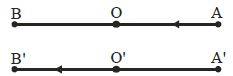
A
$T/8$
B
$3T/8$
C
$T/6$
D
$4T/3$
Solution
(B) Let the displacement of the first particle be $x_1 = A \cos(\omega t)$. At $t=0$,it is at the extreme position $x_1 = A$.
Let the displacement of the second particle be $x_2 = A \sin(\omega t)$. At $t=0$,it is at the mean position $x_2 = 0$ and moving in the positive direction.
For the particles to cross each other,their displacements must be equal: $x_1 = x_2$.
$A \cos(\omega t) = A \sin(\omega t)$
$\tan(\omega t) = 1$
$\omega t = \frac{\pi}{4}$
Since $\omega = \frac{2\pi}{T}$,we have:
$\frac{2\pi}{T} \cdot t = \frac{\pi}{4}$
$t = \frac{T}{8}$
However,considering the initial conditions and the direction of motion,the particles cross when $x_1 = x_2$. Given the phase difference,the first time they cross is at $t = \frac{3T}{8}$.
Let the displacement of the second particle be $x_2 = A \sin(\omega t)$. At $t=0$,it is at the mean position $x_2 = 0$ and moving in the positive direction.
For the particles to cross each other,their displacements must be equal: $x_1 = x_2$.
$A \cos(\omega t) = A \sin(\omega t)$
$\tan(\omega t) = 1$
$\omega t = \frac{\pi}{4}$
Since $\omega = \frac{2\pi}{T}$,we have:
$\frac{2\pi}{T} \cdot t = \frac{\pi}{4}$
$t = \frac{T}{8}$
However,considering the initial conditions and the direction of motion,the particles cross when $x_1 = x_2$. Given the phase difference,the first time they cross is at $t = \frac{3T}{8}$.
0 likes
View Solution31
MediumMCQ
On the superposition of two harmonic oscillations represented by $x_1 = a \sin(\omega t + \phi_1)$ and $x_2 = a \sin(\omega t + \phi_2)$,a resulting oscillation with the same time period and amplitude is obtained. The value of $\phi_1 - \phi_2$ is .... $^o$
A
$120$
B
$90$
C
$60$
D
$15$
Solution
(A) The resultant amplitude $A$ of two superposed harmonic oscillations with amplitudes $a_1$ and $a_2$ is given by $A = \sqrt{a_1^2 + a_2^2 + 2a_1 a_2 \cos(\phi_1 - \phi_2)}$.
Given that $a_1 = a_2 = a$ and the resultant amplitude is also $a$,we have:
$a = \sqrt{a^2 + a^2 + 2a^2 \cos(\phi_1 - \phi_2)}$
Squaring both sides:
$a^2 = 2a^2 + 2a^2 \cos(\phi_1 - \phi_2)$
Dividing by $a^2$:
$1 = 2 + 2 \cos(\phi_1 - \phi_2)$
$2 \cos(\phi_1 - \phi_2) = -1$
$\cos(\phi_1 - \phi_2) = -1/2$
Therefore,$\phi_1 - \phi_2 = \cos^{-1}(-1/2) = 120^o$.
Given that $a_1 = a_2 = a$ and the resultant amplitude is also $a$,we have:
$a = \sqrt{a^2 + a^2 + 2a^2 \cos(\phi_1 - \phi_2)}$
Squaring both sides:
$a^2 = 2a^2 + 2a^2 \cos(\phi_1 - \phi_2)$
Dividing by $a^2$:
$1 = 2 + 2 \cos(\phi_1 - \phi_2)$
$2 \cos(\phi_1 - \phi_2) = -1$
$\cos(\phi_1 - \phi_2) = -1/2$
Therefore,$\phi_1 - \phi_2 = \cos^{-1}(-1/2) = 120^o$.
0 likes
View Solution32
DifficultMCQ
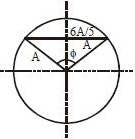
Two particles are oscillating in $SHM$ along two very close parallel paths such that they have the same mean position. The equations of $SHM$ for the two particles are $x_1 = A \sin \omega t$ and $x_2 = A \sin(\omega t + \phi)$ respectively. If the maximum distance between them is $\frac{6A}{5}$,then $\phi$ is equal to ..... $^o$.
A
$60$
B
$37$
C
$74$
D
$90$
Solution
(C) The distance between the two particles at any time $t$ is given by $d = |x_2 - x_1| = |A \sin(\omega t + \phi) - A \sin \omega t|$.
Using the trigonometric identity $\sin C - \sin D = 2 \sin(\frac{C-D}{2}) \cos(\frac{C+D}{2})$,we get:
$d = |2A \sin(\frac{\phi}{2}) \cos(\omega t + \frac{\phi}{2})|$.
The maximum distance occurs when the magnitude of the cosine term is $1$,so $d_{max} = 2A \sin(\frac{\phi}{2})$.
Given $d_{max} = \frac{6A}{5}$,we have $2A \sin(\frac{\phi}{2}) = \frac{6A}{5}$.
$\sin(\frac{\phi}{2}) = \frac{3}{5}$.
Since $\sin(37^{\circ}) \approx 0.6 = \frac{3}{5}$,we have $\frac{\phi}{2} = 37^{\circ}$.
Therefore,$\phi = 74^{\circ}$.
Using the trigonometric identity $\sin C - \sin D = 2 \sin(\frac{C-D}{2}) \cos(\frac{C+D}{2})$,we get:
$d = |2A \sin(\frac{\phi}{2}) \cos(\omega t + \frac{\phi}{2})|$.
The maximum distance occurs when the magnitude of the cosine term is $1$,so $d_{max} = 2A \sin(\frac{\phi}{2})$.
Given $d_{max} = \frac{6A}{5}$,we have $2A \sin(\frac{\phi}{2}) = \frac{6A}{5}$.
$\sin(\frac{\phi}{2}) = \frac{3}{5}$.
Since $\sin(37^{\circ}) \approx 0.6 = \frac{3}{5}$,we have $\frac{\phi}{2} = 37^{\circ}$.
Therefore,$\phi = 74^{\circ}$.
0 likes
View Solution33
AdvancedMCQ
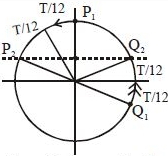
Two particles are executing $SHM$ in a straight line. The amplitude $A$ and time period $T$ of both particles are equal. At time $t = 0$,one particle is at displacement $x_1 = +A$ and the other is at $x_2 = -A/2$,and they are approaching each other. The time after which they will cross each other is:
A
$T/3$
B
$T/4$
C
$5T/6$
D
$T/6$
Solution
(D) Let the displacement of the particles be $x_1 = A \cos(\omega t)$ and $x_2 = A \cos(\omega t + \phi)$.
At $t = 0$,$x_1 = A \cos(0) = A$.
For the second particle,$x_2 = A \cos(\phi) = -A/2$,which gives $\phi = 2\pi/3$ or $4\pi/3$. Since they are approaching each other,the second particle must be moving towards the equilibrium position,so we choose $\phi = 2\pi/3$.
The particles cross when $x_1 = x_2$,so $A \cos(\omega t) = A \cos(\omega t + 2\pi/3)$.
This implies $\omega t = -(\omega t + 2\pi/3) + 2n\pi$. For the first crossing,$2\omega t = 2\pi/3$,so $\omega t = \pi/3$.
Since $\omega = 2\pi/T$,we have $(2\pi/T)t = \pi/3$,which gives $t = T/6$.
At $t = 0$,$x_1 = A \cos(0) = A$.
For the second particle,$x_2 = A \cos(\phi) = -A/2$,which gives $\phi = 2\pi/3$ or $4\pi/3$. Since they are approaching each other,the second particle must be moving towards the equilibrium position,so we choose $\phi = 2\pi/3$.
The particles cross when $x_1 = x_2$,so $A \cos(\omega t) = A \cos(\omega t + 2\pi/3)$.
This implies $\omega t = -(\omega t + 2\pi/3) + 2n\pi$. For the first crossing,$2\omega t = 2\pi/3$,so $\omega t = \pi/3$.
Since $\omega = 2\pi/T$,we have $(2\pi/T)t = \pi/3$,which gives $t = T/6$.
0 likes
View Solution34
Medium
The displacement of an elastic wave is given by the function $y = 3 \sin \omega t + 4 \cos \omega t$,where $y$ is in $cm$ and $t$ is in $s$. Calculate the resultant amplitude. Also,find the initial phase (epoch).
Solution
(A) The given equation is $y = 3 \sin \omega t + 4 \cos \omega t$ ... $(1)$
$A$ standard harmonic wave equation is given by $y = a \sin (\omega t + \phi)$.
Expanding this,we get $y = a \sin \omega t \cos \phi + a \cos \omega t \sin \phi$ ... $(2)$
Comparing equations $(1)$ and $(2)$,we have:
$a \cos \phi = 3$ ... $(3)$
$a \sin \phi = 4$ ... $(4)$
Squaring and adding equations $(3)$ and $(4)$:
$a^2 \cos^2 \phi + a^2 \sin^2 \phi = 3^2 + 4^2$
$a^2 (\cos^2 \phi + \sin^2 \phi) = 9 + 16$
$a^2 = 25$
$a = 5 \ cm$ (Resultant amplitude).
To find the initial phase $\phi$,divide equation $(4)$ by equation $(3)$:
$\frac{a \sin \phi}{a \cos \phi} = \frac{4}{3}$
$\tan \phi = \frac{4}{3}$
$\phi = \tan^{-1} (\frac{4}{3}) \approx 53.13^\circ$.
$A$ standard harmonic wave equation is given by $y = a \sin (\omega t + \phi)$.
Expanding this,we get $y = a \sin \omega t \cos \phi + a \cos \omega t \sin \phi$ ... $(2)$
Comparing equations $(1)$ and $(2)$,we have:
$a \cos \phi = 3$ ... $(3)$
$a \sin \phi = 4$ ... $(4)$
Squaring and adding equations $(3)$ and $(4)$:
$a^2 \cos^2 \phi + a^2 \sin^2 \phi = 3^2 + 4^2$
$a^2 (\cos^2 \phi + \sin^2 \phi) = 9 + 16$
$a^2 = 25$
$a = 5 \ cm$ (Resultant amplitude).
To find the initial phase $\phi$,divide equation $(4)$ by equation $(3)$:
$\frac{a \sin \phi}{a \cos \phi} = \frac{4}{3}$
$\tan \phi = \frac{4}{3}$
$\phi = \tan^{-1} (\frac{4}{3}) \approx 53.13^\circ$.
0 likes
View Solution35
Medium
$A$ particle executes two types of $SHM$. $x_1 = A_1 \sin \omega t$ and $x_2 = A_2 \sin [\omega t + \frac{\pi}{3}]$.
$(a)$ Find the displacement at time $t = 0$.
$(b)$ Find the maximum speed of the particle.
$(c)$ Find the maximum acceleration of the particle.
$(a)$ Find the displacement at time $t = 0$.
$(b)$ Find the maximum speed of the particle.
$(c)$ Find the maximum acceleration of the particle.
Solution
(N/A) The resultant displacement $x = x_1 + x_2$. At $t = 0$,$x_1 = A_1 \sin(0) = 0$ and $x_2 = A_2 \sin(\frac{\pi}{3}) = A_2 \frac{\sqrt{3}}{2}$. Thus,the displacement is $x = \frac{\sqrt{3}}{2} A_2$.
$(b)$ The resultant amplitude $A$ is given by $A = \sqrt{A_1^2 + A_2^2 + 2 A_1 A_2 \cos(\frac{\pi}{3})}$. Since $\cos(\frac{\pi}{3}) = 0.5$,$A = \sqrt{A_1^2 + A_2^2 + A_1 A_2}$. The maximum speed is $v_{\max} = A \omega = \omega \sqrt{A_1^2 + A_2^2 + A_1 A_2}$.
$(c)$ The maximum acceleration is $a_{\max} = A \omega^2 = \omega^2 \sqrt{A_1^2 + A_2^2 + A_1 A_2}$.
$(b)$ The resultant amplitude $A$ is given by $A = \sqrt{A_1^2 + A_2^2 + 2 A_1 A_2 \cos(\frac{\pi}{3})}$. Since $\cos(\frac{\pi}{3}) = 0.5$,$A = \sqrt{A_1^2 + A_2^2 + A_1 A_2}$. The maximum speed is $v_{\max} = A \omega = \omega \sqrt{A_1^2 + A_2^2 + A_1 A_2}$.
$(c)$ The maximum acceleration is $a_{\max} = A \omega^2 = \omega^2 \sqrt{A_1^2 + A_2^2 + A_1 A_2}$.
0 likes
View Solution36
MediumMCQ
Two simple harmonic motions are represented by the equations $x_{1}=5 \sin \left(2 \pi t+\frac{\pi}{4}\right)$ and $x_{2}=5 \sqrt{2}(\sin 2 \pi t+\cos 2 \pi t)$. The ratio of the amplitude of $x_{1}$ and $x_{2}$ is
A
$1:1$
B
$1: \sqrt{2}$
C
$1: 2$
D
$1: 2 \sqrt{2}$
Solution
(C) The first equation is $x_{1}=5 \sin \left(2 \pi t+\frac{\pi}{4}\right)$. The amplitude $A_{1}$ is $5$.
The second equation is $x_{2}=5 \sqrt{2}(\sin 2 \pi t+\cos 2 \pi t)$.
We can rewrite this as $x_{2}=5 \sqrt{2} \cdot \sqrt{2} \left(\frac{1}{\sqrt{2}} \sin 2 \pi t+\frac{1}{\sqrt{2}} \cos 2 \pi t\right)$.
$x_{2}=10 \sin \left(2 \pi t+\frac{\pi}{4}\right)$.
The amplitude $A_{2}$ is $10$.
The ratio of the amplitudes is $\frac{A_{1}}{A_{2}} = \frac{5}{10} = 1:2$.
The second equation is $x_{2}=5 \sqrt{2}(\sin 2 \pi t+\cos 2 \pi t)$.
We can rewrite this as $x_{2}=5 \sqrt{2} \cdot \sqrt{2} \left(\frac{1}{\sqrt{2}} \sin 2 \pi t+\frac{1}{\sqrt{2}} \cos 2 \pi t\right)$.
$x_{2}=10 \sin \left(2 \pi t+\frac{\pi}{4}\right)$.
The amplitude $A_{2}$ is $10$.
The ratio of the amplitudes is $\frac{A_{1}}{A_{2}} = \frac{5}{10} = 1:2$.
0 likes
View Solution37
MediumMCQ
Two simple harmonic motions are represented by the equations $x_{1} = 5 \sin(2 \pi t + \frac{\pi}{4})$ and $x_{2} = 5 \sqrt{2}(\sin 2 \pi t + \cos 2 \pi t)$. The amplitude of the second motion is ....... times the amplitude of the first motion.
A
$8$
B
$2$
C
$10$
D
$5$
Solution
(B) The first equation is $x_{1} = 5 \sin(2 \pi t + \frac{\pi}{4})$. The amplitude $A_{1} = 5$.
The second equation is $x_{2} = 5 \sqrt{2}(\sin 2 \pi t + \cos 2 \pi t)$.
To find the amplitude,we rewrite the expression inside the parentheses by multiplying and dividing by $\sqrt{2}$:
$x_{2} = 5 \sqrt{2} \cdot \sqrt{2} \left( \frac{1}{\sqrt{2}} \sin 2 \pi t + \frac{1}{\sqrt{2}} \cos 2 \pi t \right)$
$x_{2} = 10 \left( \sin 2 \pi t \cos \frac{\pi}{4} + \cos 2 \pi t \sin \frac{\pi}{4} \right)$
Using the identity $\sin(A + B) = \sin A \cos B + \cos A \sin B$,we get:
$x_{2} = 10 \sin(2 \pi t + \frac{\pi}{4})$.
The amplitude $A_{2} = 10$.
Therefore,the ratio of the amplitudes is $\frac{A_{2}}{A_{1}} = \frac{10}{5} = 2$.
The second equation is $x_{2} = 5 \sqrt{2}(\sin 2 \pi t + \cos 2 \pi t)$.
To find the amplitude,we rewrite the expression inside the parentheses by multiplying and dividing by $\sqrt{2}$:
$x_{2} = 5 \sqrt{2} \cdot \sqrt{2} \left( \frac{1}{\sqrt{2}} \sin 2 \pi t + \frac{1}{\sqrt{2}} \cos 2 \pi t \right)$
$x_{2} = 10 \left( \sin 2 \pi t \cos \frac{\pi}{4} + \cos 2 \pi t \sin \frac{\pi}{4} \right)$
Using the identity $\sin(A + B) = \sin A \cos B + \cos A \sin B$,we get:
$x_{2} = 10 \sin(2 \pi t + \frac{\pi}{4})$.
The amplitude $A_{2} = 10$.
Therefore,the ratio of the amplitudes is $\frac{A_{2}}{A_{1}} = \frac{10}{5} = 2$.
0 likes
View Solution38
MediumMCQ
Two simple harmonic motions are represented by the equations $y_{1} = 10 \sin(3 \pi t + \frac{\pi}{3})$ and $y_{2} = 5(\sin 3 \pi t + \sqrt{3} \cos 3 \pi t)$. The ratio of the amplitude of $y_{1}$ to $y_{2}$ is $x : 1$. The value of $x$ is ...... .
A
$2$
B
$1$
C
$3$
D
$4$
Solution
(B) For the first equation: $y_{1} = 10 \sin(3 \pi t + \frac{\pi}{3})$.
Comparing this with the standard form $y = A \sin(\omega t + \phi)$,the amplitude $A_{1} = 10$.
For the second equation: $y_{2} = 5(\sin 3 \pi t + \sqrt{3} \cos 3 \pi t)$.
We can rewrite this by multiplying and dividing by $2$: $y_{2} = 5 \times 2 \left( \frac{1}{2} \sin 3 \pi t + \frac{\sqrt{3}}{2} \cos 3 \pi t \right)$.
Using the trigonometric identity $\sin(A + B) = \sin A \cos B + \cos A \sin B$,where $\cos(\frac{\pi}{3}) = \frac{1}{2}$ and $\sin(\frac{\pi}{3}) = \frac{\sqrt{3}}{2}$,we get:
$y_{2} = 10(\sin 3 \pi t \cos \frac{\pi}{3} + \cos 3 \pi t \sin \frac{\pi}{3}) = 10 \sin(3 \pi t + \frac{\pi}{3})$.
Thus,the amplitude $A_{2} = 10$.
The ratio of the amplitudes is $\frac{A_{1}}{A_{2}} = \frac{10}{10} = 1$.
Therefore,$x = 1$.
Comparing this with the standard form $y = A \sin(\omega t + \phi)$,the amplitude $A_{1} = 10$.
For the second equation: $y_{2} = 5(\sin 3 \pi t + \sqrt{3} \cos 3 \pi t)$.
We can rewrite this by multiplying and dividing by $2$: $y_{2} = 5 \times 2 \left( \frac{1}{2} \sin 3 \pi t + \frac{\sqrt{3}}{2} \cos 3 \pi t \right)$.
Using the trigonometric identity $\sin(A + B) = \sin A \cos B + \cos A \sin B$,where $\cos(\frac{\pi}{3}) = \frac{1}{2}$ and $\sin(\frac{\pi}{3}) = \frac{\sqrt{3}}{2}$,we get:
$y_{2} = 10(\sin 3 \pi t \cos \frac{\pi}{3} + \cos 3 \pi t \sin \frac{\pi}{3}) = 10 \sin(3 \pi t + \frac{\pi}{3})$.
Thus,the amplitude $A_{2} = 10$.
The ratio of the amplitudes is $\frac{A_{1}}{A_{2}} = \frac{10}{10} = 1$.
Therefore,$x = 1$.
0 likes
View Solution39
MediumMCQ
Two particles are executing $S.H.M.$ with the same amplitude of $20 \, cm$ and the same period along the same line about the same equilibrium position. The maximum distance between the two is $20 \, cm$. Their phase difference in radians is equal to
A
$\frac{\pi}{3}$
B
$\frac{\pi}{2}$
C
$\frac{2 \pi}{3}$
D
$\frac{4 \pi}{5}$
Solution
(A) Let the displacements of the two particles be $x_1 = A \sin(\omega t + \phi_1)$ and $x_2 = A \sin(\omega t + \phi_2)$,where $A = 20 \, cm$.
The distance between them is $d = |x_1 - x_2| = |A \sin(\omega t + \phi_1) - A \sin(\omega t + \phi_2)|$.
Using the trigonometric identity $\sin C - \sin D = 2 \sin(\frac{C-D}{2}) \cos(\frac{C+D}{2})$,we get:
$d = |2A \sin(\frac{\phi_1 - \phi_2}{2}) \cos(\omega t + \frac{\phi_1 + \phi_2}{2})|$.
The maximum distance occurs when the cosine term is $1$:
$d_{max} = |2A \sin(\frac{\Delta \phi}{2})|$,where $\Delta \phi = \phi_1 - \phi_2$.
Given $d_{max} = 20 \, cm$ and $A = 20 \, cm$:
$20 = 2 \times 20 \sin(\frac{\Delta \phi}{2})$
$1 = 2 \sin(\frac{\Delta \phi}{2})$
$\sin(\frac{\Delta \phi}{2}) = \frac{1}{2}$.
Therefore,$\frac{\Delta \phi}{2} = \frac{\pi}{6}$,which gives $\Delta \phi = \frac{\pi}{3}$ radians.
The distance between them is $d = |x_1 - x_2| = |A \sin(\omega t + \phi_1) - A \sin(\omega t + \phi_2)|$.
Using the trigonometric identity $\sin C - \sin D = 2 \sin(\frac{C-D}{2}) \cos(\frac{C+D}{2})$,we get:
$d = |2A \sin(\frac{\phi_1 - \phi_2}{2}) \cos(\omega t + \frac{\phi_1 + \phi_2}{2})|$.
The maximum distance occurs when the cosine term is $1$:
$d_{max} = |2A \sin(\frac{\Delta \phi}{2})|$,where $\Delta \phi = \phi_1 - \phi_2$.
Given $d_{max} = 20 \, cm$ and $A = 20 \, cm$:
$20 = 2 \times 20 \sin(\frac{\Delta \phi}{2})$
$1 = 2 \sin(\frac{\Delta \phi}{2})$
$\sin(\frac{\Delta \phi}{2}) = \frac{1}{2}$.
Therefore,$\frac{\Delta \phi}{2} = \frac{\pi}{6}$,which gives $\Delta \phi = \frac{\pi}{3}$ radians.
0 likes
View Solution40
DifficultMCQ
Two particles $P$ and $Q$ describe $S.H.M.$ of same amplitude $a$,same frequency $f$ along the same straight line. The maximum distance between the two particles is $a\sqrt{2}$. The initial phase difference between the particles is:
A
$0$
B
$\pi / 2$
C
$\pi / 6$
D
$\pi / 3$
Solution
(B) Let the displacements of the two particles be $x_1 = a \sin(\omega t + \phi_1)$ and $x_2 = a \sin(\omega t + \phi_2)$.
The distance between the particles is $|x_1 - x_2| = |a \sin(\omega t + \phi_1) - a \sin(\omega t + \phi_2)|$.
Using the trigonometric identity $\sin C - \sin D = 2 \sin(\frac{C-D}{2}) \cos(\frac{C+D}{2})$,we get:
$|x_1 - x_2| = |2a \sin(\frac{\phi_1 - \phi_2}{2}) \cos(\omega t + \frac{\phi_1 + \phi_2}{2})|$.
The maximum value of this distance is $|2a \sin(\frac{\phi_1 - \phi_2}{2})|$.
Given that the maximum distance is $a\sqrt{2}$,we have:
$|2a \sin(\frac{\phi_1 - \phi_2}{2})| = a\sqrt{2}$.
$|\sin(\frac{\phi_1 - \phi_2}{2})| = \frac{\sqrt{2}}{2} = \frac{1}{\sqrt{2}}$.
Therefore,$\frac{\phi_1 - \phi_2}{2} = \frac{\pi}{4}$,which gives the phase difference $\Delta\phi = \phi_1 - \phi_2 = \frac{\pi}{2}$.
The distance between the particles is $|x_1 - x_2| = |a \sin(\omega t + \phi_1) - a \sin(\omega t + \phi_2)|$.
Using the trigonometric identity $\sin C - \sin D = 2 \sin(\frac{C-D}{2}) \cos(\frac{C+D}{2})$,we get:
$|x_1 - x_2| = |2a \sin(\frac{\phi_1 - \phi_2}{2}) \cos(\omega t + \frac{\phi_1 + \phi_2}{2})|$.
The maximum value of this distance is $|2a \sin(\frac{\phi_1 - \phi_2}{2})|$.
Given that the maximum distance is $a\sqrt{2}$,we have:
$|2a \sin(\frac{\phi_1 - \phi_2}{2})| = a\sqrt{2}$.
$|\sin(\frac{\phi_1 - \phi_2}{2})| = \frac{\sqrt{2}}{2} = \frac{1}{\sqrt{2}}$.
Therefore,$\frac{\phi_1 - \phi_2}{2} = \frac{\pi}{4}$,which gives the phase difference $\Delta\phi = \phi_1 - \phi_2 = \frac{\pi}{2}$.
0 likes
View Solution41
EasyMCQ
For a periodic motion represented by the equation $Y = \sin \omega t + \cos \omega t$,the amplitude of the motion is:
A
$0.5$
B
$\sqrt{2}$
C
$9$
D
$6$
Solution
(B) The given equation is $Y = \sin \omega t + \cos \omega t$.
We can rewrite $\cos \omega t$ as $\sin(\omega t + \frac{\pi}{2})$.
So,$Y = \sin \omega t + \sin(\omega t + \frac{\pi}{2})$.
This represents the superposition of two simple harmonic motions with amplitudes $A_1 = 1$ and $A_2 = 1$,and a phase difference $\Delta \phi = \frac{\pi}{2}$.
The resultant amplitude $A_{\text{net}}$ is given by the formula $A_{\text{net}} = \sqrt{A_1^2 + A_2^2 + 2 A_1 A_2 \cos(\Delta \phi)}$.
Substituting the values: $A_{\text{net}} = \sqrt{1^2 + 1^2 + 2(1)(1) \cos(\frac{\pi}{2})}$.
Since $\cos(\frac{\pi}{2}) = 0$,we get $A_{\text{net}} = \sqrt{1 + 1} = \sqrt{2}$.
We can rewrite $\cos \omega t$ as $\sin(\omega t + \frac{\pi}{2})$.
So,$Y = \sin \omega t + \sin(\omega t + \frac{\pi}{2})$.
This represents the superposition of two simple harmonic motions with amplitudes $A_1 = 1$ and $A_2 = 1$,and a phase difference $\Delta \phi = \frac{\pi}{2}$.
The resultant amplitude $A_{\text{net}}$ is given by the formula $A_{\text{net}} = \sqrt{A_1^2 + A_2^2 + 2 A_1 A_2 \cos(\Delta \phi)}$.
Substituting the values: $A_{\text{net}} = \sqrt{1^2 + 1^2 + 2(1)(1) \cos(\frac{\pi}{2})}$.
Since $\cos(\frac{\pi}{2}) = 0$,we get $A_{\text{net}} = \sqrt{1 + 1} = \sqrt{2}$.
0 likes
View Solution42
DifficultMCQ
$A$ point mass is subjected to two simultaneous sinusoidal displacements in $x$-direction,$x_1(t) = A \sin \omega t$ and $x_2(t) = A \sin \left(\omega t + \frac{2 \pi}{3}\right)$. Adding a third sinusoidal displacement $x_3(t) = B \sin (\omega t + \phi)$ brings the mass to a complete rest. The values of $B$ and $\phi$ are
A
$\sqrt{2} A, \frac{3 \pi}{4}$
B
$A, \frac{4 \pi}{3}$
C
$\sqrt{3} A, \frac{5 \pi}{6}$
D
$A, \frac{\pi}{3}$
Solution
(B) The resultant of the first two displacements is given by $x_1 + x_2 = A \sin \omega t + A \sin \left(\omega t + \frac{2 \pi}{3}\right)$.
Using the trigonometric identity $\sin C + \sin D = 2 \sin \left(\frac{C+D}{2}\right) \cos \left(\frac{C-D}{2}\right)$,we get:
$x_1 + x_2 = 2A \sin \left(\omega t + \frac{\pi}{3}\right) \cos \left(-\frac{\pi}{3}\right) = 2A \sin \left(\omega t + \frac{\pi}{3}\right) \cdot \frac{1}{2} = A \sin \left(\omega t + \frac{\pi}{3}\right)$.
For the mass to be at complete rest,the sum of all displacements must be zero: $x_1 + x_2 + x_3 = 0$.
Therefore,$x_3 = -(x_1 + x_2) = -A \sin \left(\omega t + \frac{\pi}{3}\right)$.
Using the identity $-\sin \theta = \sin (\theta + \pi)$,we get:
$x_3 = A \sin \left(\omega t + \frac{\pi}{3} + \pi\right) = A \sin \left(\omega t + \frac{4 \pi}{3}\right)$.
Comparing this with $x_3(t) = B \sin (\omega t + \phi)$,we find $B = A$ and $\phi = \frac{4 \pi}{3}$.
Using the trigonometric identity $\sin C + \sin D = 2 \sin \left(\frac{C+D}{2}\right) \cos \left(\frac{C-D}{2}\right)$,we get:
$x_1 + x_2 = 2A \sin \left(\omega t + \frac{\pi}{3}\right) \cos \left(-\frac{\pi}{3}\right) = 2A \sin \left(\omega t + \frac{\pi}{3}\right) \cdot \frac{1}{2} = A \sin \left(\omega t + \frac{\pi}{3}\right)$.
For the mass to be at complete rest,the sum of all displacements must be zero: $x_1 + x_2 + x_3 = 0$.
Therefore,$x_3 = -(x_1 + x_2) = -A \sin \left(\omega t + \frac{\pi}{3}\right)$.
Using the identity $-\sin \theta = \sin (\theta + \pi)$,we get:
$x_3 = A \sin \left(\omega t + \frac{\pi}{3} + \pi\right) = A \sin \left(\omega t + \frac{4 \pi}{3}\right)$.
Comparing this with $x_3(t) = B \sin (\omega t + \phi)$,we find $B = A$ and $\phi = \frac{4 \pi}{3}$.
0 likes
View Solution43
DifficultMCQ
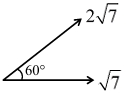
$A$ particle is subjected to two simple harmonic motions as:
$x_1 = \sqrt{7} \sin(5t) \ cm$
and $x_2 = 2\sqrt{7} \sin(5t + \frac{\pi}{3}) \ cm$
where $x$ is displacement and $t$ is time in seconds.
The maximum acceleration of the particle is $x \times 10^{-2} \ ms^{-2}$. The value of $x$ is
$x_1 = \sqrt{7} \sin(5t) \ cm$
and $x_2 = 2\sqrt{7} \sin(5t + \frac{\pi}{3}) \ cm$
where $x$ is displacement and $t$ is time in seconds.
The maximum acceleration of the particle is $x \times 10^{-2} \ ms^{-2}$. The value of $x$ is
A
$175$
B
$25\sqrt{7}$
C
$5\sqrt{7}$
D
$125$
Solution
(A) The two simple harmonic motions are given by:
$x_1 = A_1 \sin(\omega t) = \sqrt{7} \sin(5t)$
$x_2 = A_2 \sin(\omega t + \phi) = 2\sqrt{7} \sin(5t + \frac{\pi}{3})$
Here,$A_1 = \sqrt{7} \ cm$,$A_2 = 2\sqrt{7} \ cm$,$\omega = 5 \ rad/s$,and $\phi = \frac{\pi}{3} = 60^\circ$.
The resultant amplitude $A$ is given by the formula:
$A = \sqrt{A_1^2 + A_2^2 + 2A_1A_2 \cos\phi}$
$A = \sqrt{(\sqrt{7})^2 + (2\sqrt{7})^2 + 2(\sqrt{7})(2\sqrt{7}) \cos(60^\circ)}$
$A = \sqrt{7 + 28 + 2(14)(0.5)} = \sqrt{35 + 14} = \sqrt{49} = 7 \ cm = 0.07 \ m$.
The maximum acceleration $a_{\max}$ is given by:
$a_{\max} = A\omega^2$
$a_{\max} = 0.07 \times (5)^2 = 0.07 \times 25 = 1.75 \ ms^{-2}$.
We are given $a_{\max} = x \times 10^{-2} \ ms^{-2}$.
$1.75 = x \times 10^{-2} \implies x = 175$.
$x_1 = A_1 \sin(\omega t) = \sqrt{7} \sin(5t)$
$x_2 = A_2 \sin(\omega t + \phi) = 2\sqrt{7} \sin(5t + \frac{\pi}{3})$
Here,$A_1 = \sqrt{7} \ cm$,$A_2 = 2\sqrt{7} \ cm$,$\omega = 5 \ rad/s$,and $\phi = \frac{\pi}{3} = 60^\circ$.
The resultant amplitude $A$ is given by the formula:
$A = \sqrt{A_1^2 + A_2^2 + 2A_1A_2 \cos\phi}$
$A = \sqrt{(\sqrt{7})^2 + (2\sqrt{7})^2 + 2(\sqrt{7})(2\sqrt{7}) \cos(60^\circ)}$
$A = \sqrt{7 + 28 + 2(14)(0.5)} = \sqrt{35 + 14} = \sqrt{49} = 7 \ cm = 0.07 \ m$.
The maximum acceleration $a_{\max}$ is given by:
$a_{\max} = A\omega^2$
$a_{\max} = 0.07 \times (5)^2 = 0.07 \times 25 = 1.75 \ ms^{-2}$.
We are given $a_{\max} = x \times 10^{-2} \ ms^{-2}$.
$1.75 = x \times 10^{-2} \implies x = 175$.
0 likes
View Solution44
MediumMCQ
$A$ body of mass '$m$' performs linear $S$.$H$.$M$. given by the equation $x = P \sin \omega t + Q \sin \left(\omega t + \frac{\pi}{2}\right)$. The total energy of the particle at any instant is
A
$\frac{1}{2} m \omega^2 PQ$
B
$\frac{1}{2} \frac{m \omega^2}{P^2 Q^2}$
C
$\frac{1}{2} m \omega^2 (P^2 + Q^2)$
D
$\frac{1}{2} m^2 P^2 Q^2$
Solution
(C) The given equation is $x = P \sin \omega t + Q \sin \left(\omega t + \frac{\pi}{2}\right)$.
Since $\sin \left(\omega t + \frac{\pi}{2}\right) = \cos \omega t$,the equation becomes $x = P \sin \omega t + Q \cos \omega t$.
This represents the superposition of two simple harmonic motions with amplitudes $P$ and $Q$ that have a phase difference of $\frac{\pi}{2}$.
The resultant amplitude $R$ is given by $R = \sqrt{P^2 + Q^2}$.
The total energy $E$ of a particle performing $S$.$H$.$M$. is given by $E = \frac{1}{2} m \omega^2 R^2$.
Substituting the value of $R^2 = P^2 + Q^2$,we get $E = \frac{1}{2} m \omega^2 (P^2 + Q^2)$.
Since $\sin \left(\omega t + \frac{\pi}{2}\right) = \cos \omega t$,the equation becomes $x = P \sin \omega t + Q \cos \omega t$.
This represents the superposition of two simple harmonic motions with amplitudes $P$ and $Q$ that have a phase difference of $\frac{\pi}{2}$.
The resultant amplitude $R$ is given by $R = \sqrt{P^2 + Q^2}$.
The total energy $E$ of a particle performing $S$.$H$.$M$. is given by $E = \frac{1}{2} m \omega^2 R^2$.
Substituting the value of $R^2 = P^2 + Q^2$,we get $E = \frac{1}{2} m \omega^2 (P^2 + Q^2)$.
0 likes
View Solution45
MediumMCQ
Two simple harmonic motions are represented as $y_1 = 10 \sin \omega t$ and $y_2 = 10 \sin \omega t + 5 \cos \omega t$. The ratio of the amplitudes of $y_1$ and $y_2$ is
A
$1 : \sqrt{2}$
B
$1 : 4$
C
$1 : 1$
D
$2 : \sqrt{5}$
Solution
(D) Given,$y_1 = 10 \sin \omega t$ and $y_2 = 10 \sin \omega t + 5 \cos \omega t$.
For $y_1$,the amplitude $A_1 = 10$.
For $y_2$,the expression is of the form $A \sin \omega t + B \cos \omega t$,where the resultant amplitude $A_2 = \sqrt{A^2 + B^2}$.
Here,$A = 10$ and $B = 5$,so $A_2 = \sqrt{10^2 + 5^2} = \sqrt{100 + 25} = \sqrt{125} = 5\sqrt{5}$.
The ratio of the amplitudes is $\frac{A_1}{A_2} = \frac{10}{5\sqrt{5}} = \frac{2}{\sqrt{5}}$.
Thus,the ratio is $2 : \sqrt{5}$.
For $y_1$,the amplitude $A_1 = 10$.
For $y_2$,the expression is of the form $A \sin \omega t + B \cos \omega t$,where the resultant amplitude $A_2 = \sqrt{A^2 + B^2}$.
Here,$A = 10$ and $B = 5$,so $A_2 = \sqrt{10^2 + 5^2} = \sqrt{100 + 25} = \sqrt{125} = 5\sqrt{5}$.
The ratio of the amplitudes is $\frac{A_1}{A_2} = \frac{10}{5\sqrt{5}} = \frac{2}{\sqrt{5}}$.
Thus,the ratio is $2 : \sqrt{5}$.
0 likes
View Solution46
MediumMCQ
Two particles $P$ and $Q$ perform $S.H.M.$ of same amplitude $a$ and frequency along the same straight line. At a particular instant,the maximum distance between the two particles is $\sqrt{2} a$. The initial phase difference between them is
A
$\frac{\pi}{6}$
B
$\frac{\pi}{2}$
C
zero
D
$\frac{\pi}{3}$
Solution
(B) Let the displacements of particles $P$ and $Q$ be $x_1 = a \sin(\omega t + \phi_1)$ and $x_2 = a \sin(\omega t + \phi_2)$.
The distance between them is $d = |x_1 - x_2| = |a \sin(\omega t + \phi_1) - a \sin(\omega t + \phi_2)|$.
Using the formula $\sin C - \sin D = 2 \sin(\frac{C-D}{2}) \cos(\frac{C+D}{2})$,we get $d = |2a \sin(\frac{\phi_1 - \phi_2}{2}) \cos(\omega t + \frac{\phi_1 + \phi_2}{2})|$.
The maximum distance occurs when $|\cos(\omega t + \frac{\phi_1 + \phi_2}{2})| = 1$,so $d_{max} = |2a \sin(\frac{\Delta \phi}{2})|$,where $\Delta \phi = \phi_1 - \phi_2$.
Given $d_{max} = \sqrt{2} a$,we have $\sqrt{2} a = 2a \sin(\frac{\Delta \phi}{2})$.
$\sin(\frac{\Delta \phi}{2}) = \frac{\sqrt{2}}{2} = \frac{1}{\sqrt{2}}$.
$\frac{\Delta \phi}{2} = \frac{\pi}{4}$,which gives $\Delta \phi = \frac{\pi}{2}$.
The distance between them is $d = |x_1 - x_2| = |a \sin(\omega t + \phi_1) - a \sin(\omega t + \phi_2)|$.
Using the formula $\sin C - \sin D = 2 \sin(\frac{C-D}{2}) \cos(\frac{C+D}{2})$,we get $d = |2a \sin(\frac{\phi_1 - \phi_2}{2}) \cos(\omega t + \frac{\phi_1 + \phi_2}{2})|$.
The maximum distance occurs when $|\cos(\omega t + \frac{\phi_1 + \phi_2}{2})| = 1$,so $d_{max} = |2a \sin(\frac{\Delta \phi}{2})|$,where $\Delta \phi = \phi_1 - \phi_2$.
Given $d_{max} = \sqrt{2} a$,we have $\sqrt{2} a = 2a \sin(\frac{\Delta \phi}{2})$.
$\sin(\frac{\Delta \phi}{2}) = \frac{\sqrt{2}}{2} = \frac{1}{\sqrt{2}}$.
$\frac{\Delta \phi}{2} = \frac{\pi}{4}$,which gives $\Delta \phi = \frac{\pi}{2}$.
0 likes
View Solution47
DifficultMCQ
Consider two SHMs along the same straight line $x_1=A_1 \sin \left(\omega t+\phi_1\right)$ and $x_2=A_2 \sin \left(\omega t+\phi_2\right)$,where $A_1$ and $A_2$ are their amplitudes and $\phi_1$ and $\phi_2$ are their initial phase angles. If $R$ is the resultant amplitude,match the conditions in Column-$I$ with the resultant amplitudes in Column-$II$:
| Column-$I$ | Column-$II$ |
| $A$. $A_1=A_2=A, \delta=0$ | $I$. $A_1+A_2$ |
| $B$. $A_1 \neq A_2, \delta=0$ | $II$. $0$ |
| $C$. $A_1=A_2=A, \delta=90^{\circ}$ | $III$. $2A$ |
| $D$. $A_1=A_2=A, \delta=180^{\circ}$ | $IV$. $A\sqrt{2}$ |
A
$A-IV, B-III, C-II, D-I$
B
$A-III, B-I, C-IV, D-II$
C
$A-I, B-III, C-II, D-IV$
D
$A-III, B-IV, C-I, D-II$
Solution
(B) The resultant amplitude $R$ of two SHMs with phase difference $\delta$ is given by $R=\sqrt{A_1^2+A_2^2+2 A_1 A_2 \cos \delta}$.
$A$. For $A_1=A_2=A$ and $\delta=0^{\circ}$:
$R=\sqrt{A^2+A^2+2A^2 \cos 0^{\circ}} = \sqrt{4A^2} = 2A$. Thus,$A-III$.
$B$. For $A_1 \neq A_2$ and $\delta=0^{\circ}$:
$R=\sqrt{A_1^2+A_2^2+2A_1 A_2 \cos 0^{\circ}} = \sqrt{(A_1+A_2)^2} = A_1+A_2$. Thus,$B-I$.
$C$. For $A_1=A_2=A$ and $\delta=90^{\circ}$:
$R=\sqrt{A^2+A^2+2A^2 \cos 90^{\circ}} = \sqrt{2A^2} = A\sqrt{2}$. Thus,$C-IV$.
$D$. For $A_1=A_2=A$ and $\delta=180^{\circ}$:
$R=\sqrt{A^2+A^2+2A^2 \cos 180^{\circ}} = \sqrt{2A^2-2A^2} = 0$. Thus,$D-II$.
$A$. For $A_1=A_2=A$ and $\delta=0^{\circ}$:
$R=\sqrt{A^2+A^2+2A^2 \cos 0^{\circ}} = \sqrt{4A^2} = 2A$. Thus,$A-III$.
$B$. For $A_1 \neq A_2$ and $\delta=0^{\circ}$:
$R=\sqrt{A_1^2+A_2^2+2A_1 A_2 \cos 0^{\circ}} = \sqrt{(A_1+A_2)^2} = A_1+A_2$. Thus,$B-I$.
$C$. For $A_1=A_2=A$ and $\delta=90^{\circ}$:
$R=\sqrt{A^2+A^2+2A^2 \cos 90^{\circ}} = \sqrt{2A^2} = A\sqrt{2}$. Thus,$C-IV$.
$D$. For $A_1=A_2=A$ and $\delta=180^{\circ}$:
$R=\sqrt{A^2+A^2+2A^2 \cos 180^{\circ}} = \sqrt{2A^2-2A^2} = 0$. Thus,$D-II$.
0 likes
View Solution48
MediumMCQ
If the displacement $y$ (in $cm$) of a particle executing simple harmonic motion is given by the equation $y = 5 \sin(3 \pi t) + 5 \sqrt{3} \cos(3 \pi t)$,then the amplitude of the particle is
A
$5 \ cm$
B
$5 \sqrt{3} \ cm$
C
$5(1 + \sqrt{3}) \ cm$
D
$10 \ cm$
Solution
(D) The given equation for displacement is $y = 5 \sin(3 \pi t) + 5 \sqrt{3} \cos(3 \pi t)$.
This is of the form $y = A_1 \sin(\omega t) + A_2 \cos(\omega t)$,where $A_1 = 5$ and $A_2 = 5 \sqrt{3}$.
The resultant amplitude $A$ is given by $A = \sqrt{A_1^2 + A_2^2}$.
Substituting the values,we get $A = \sqrt{5^2 + (5 \sqrt{3})^2}$.
$A = \sqrt{25 + (25 \times 3)} = \sqrt{25 + 75} = \sqrt{100}$.
$A = 10 \ cm$.
This is of the form $y = A_1 \sin(\omega t) + A_2 \cos(\omega t)$,where $A_1 = 5$ and $A_2 = 5 \sqrt{3}$.
The resultant amplitude $A$ is given by $A = \sqrt{A_1^2 + A_2^2}$.
Substituting the values,we get $A = \sqrt{5^2 + (5 \sqrt{3})^2}$.
$A = \sqrt{25 + (25 \times 3)} = \sqrt{25 + 75} = \sqrt{100}$.
$A = 10 \ cm$.
0 likes
View Solution49
EasyMCQ
Two simple harmonic motions are represented by $y_1 = 5[\sin 2 \pi t + \sqrt{3} \cos 2 \pi t]$ and $y_2 = 5 \sin [2 \pi t + \frac{\pi}{4}]$. The ratio of their amplitudes is
A
$1: 1$
B
$2: 1$
C
$1: 3$
D
$\sqrt{3}: 1$
Solution
(B) The first equation is $y_1 = 5[\sin 2 \pi t + \sqrt{3} \cos 2 \pi t]$.
To find the amplitude $A_1$,we rewrite the expression in the form $A_1 \sin(2 \pi t + \phi)$.
Multiply and divide by $2$: $y_1 = 5 \times 2 [\frac{1}{2} \sin 2 \pi t + \frac{\sqrt{3}}{2} \cos 2 \pi t] = 10 [\sin 2 \pi t \cos \frac{\pi}{3} + \cos 2 \pi t \sin \frac{\pi}{3}] = 10 \sin(2 \pi t + \frac{\pi}{3})$.
Thus,the amplitude $A_1 = 10$.
The second equation is $y_2 = 5 \sin [2 \pi t + \frac{\pi}{4}]$.
Comparing this with $y_2 = A_2 \sin(2 \pi t + \phi_2)$,we get the amplitude $A_2 = 5$.
The ratio of their amplitudes is $\frac{A_1}{A_2} = \frac{10}{5} = 2: 1$.
To find the amplitude $A_1$,we rewrite the expression in the form $A_1 \sin(2 \pi t + \phi)$.
Multiply and divide by $2$: $y_1 = 5 \times 2 [\frac{1}{2} \sin 2 \pi t + \frac{\sqrt{3}}{2} \cos 2 \pi t] = 10 [\sin 2 \pi t \cos \frac{\pi}{3} + \cos 2 \pi t \sin \frac{\pi}{3}] = 10 \sin(2 \pi t + \frac{\pi}{3})$.
Thus,the amplitude $A_1 = 10$.
The second equation is $y_2 = 5 \sin [2 \pi t + \frac{\pi}{4}]$.
Comparing this with $y_2 = A_2 \sin(2 \pi t + \phi_2)$,we get the amplitude $A_2 = 5$.
The ratio of their amplitudes is $\frac{A_1}{A_2} = \frac{10}{5} = 2: 1$.
0 likes
View SolutionOscillations — Superposition of S.H.M. · Frequently Asked Questions
1Are these Oscillations questions useful for JEE and NEET?
Yes. All questions in this section are mapped to JEE Main and NEET exam patterns. Previous year questions from JEE Main, NEET, GUJCET and state-level exams are included with full solutions.
2Can I switch to Hindi or Gujarati for these questions?
Yes. Use the language tabs in the hero section or the sidebar to view the same questions and solutions in English, Hindi or Gujarati.
3How do I generate a question paper from this subtopic?
Use the Vedclass Exam Paper Generator — select the chapter and subtopic, set difficulty, and generate Sets A, B, C, D automatically. First 3 chapters of every subject are free.
Vedclass Products
For Students
Vedclass Test Series
Mock tests in real JEE/NEET style with performance analysis. 5-day free trial.
Start Free TrialFor Teachers
Exam Paper Generator
Generate Set A/B/C/D papers from this chapter in 2 minutes. 3 chapters free.
Try FreeFor Institutes
Online Exam Module
Live online exams with unlimited students, 360° analytics & white-label branding.
See DemoFor Teachers & Institutes
Generate a Oscillations Exam Paper in 2 Minutes
Select subtopic & difficulty — Sets A, B, C, D auto-generated with No Repeat logic.
First 3 chapters of every subject are free — no payment required.