
A English
SHM of Simple Pendulum Questions in English
Class 11 Physics · Oscillations · SHM of Simple Pendulum
331+
Questions
English
Language
100%
With Solutions
Showing 49 of 331 questions in English
201
MediumMCQ
The time period of a simple pendulum in a stationary lift is $T$. If the lift accelerates with $\frac{g}{6}$ vertically upwards,then the new time period will be:
(where $g =$ acceleration due to gravity)
(where $g =$ acceleration due to gravity)
A
$\sqrt{\frac{6}{5}} T$
B
$\sqrt{\frac{5}{6}} T$
C
$\sqrt{\frac{6}{7}} T$
D
$\sqrt{\frac{7}{6}} T$
Solution
(C) The time period of a simple pendulum is given by $T = 2 \pi \sqrt{\frac{\ell}{g_{\text{eff}}}}$.
$(a)$ When the lift is stationary $(a = 0)$,the effective acceleration is $g_{\text{eff}} = g$. Thus,$T = 2 \pi \sqrt{\frac{\ell}{g}}$.
$(b)$ When the lift accelerates upwards with $a = \frac{g}{6}$,the effective acceleration becomes $g_{\text{eff}} = g + a = g + \frac{g}{6} = \frac{7g}{6}$.
The new time period $T^{\prime}$ is given by:
$T^{\prime} = 2 \pi \sqrt{\frac{\ell}{g_{\text{eff}}}} = 2 \pi \sqrt{\frac{\ell}{7g/6}} = 2 \pi \sqrt{\frac{6\ell}{7g}}$.
Comparing this with the original time period $T$,we get:
$T^{\prime} = \sqrt{\frac{6}{7}} \left( 2 \pi \sqrt{\frac{\ell}{g}} \right) = \sqrt{\frac{6}{7}} T$.
$(a)$ When the lift is stationary $(a = 0)$,the effective acceleration is $g_{\text{eff}} = g$. Thus,$T = 2 \pi \sqrt{\frac{\ell}{g}}$.
$(b)$ When the lift accelerates upwards with $a = \frac{g}{6}$,the effective acceleration becomes $g_{\text{eff}} = g + a = g + \frac{g}{6} = \frac{7g}{6}$.
The new time period $T^{\prime}$ is given by:
$T^{\prime} = 2 \pi \sqrt{\frac{\ell}{g_{\text{eff}}}} = 2 \pi \sqrt{\frac{\ell}{7g/6}} = 2 \pi \sqrt{\frac{6\ell}{7g}}$.
Comparing this with the original time period $T$,we get:
$T^{\prime} = \sqrt{\frac{6}{7}} \left( 2 \pi \sqrt{\frac{\ell}{g}} \right) = \sqrt{\frac{6}{7}} T$.

0 likes
View Solution202
MediumMCQ
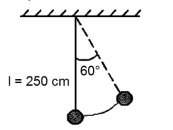
$A$ pendulum is suspended by a string of length $250\,cm$. The mass of the bob of the pendulum is $200\,g$. The bob is pulled aside until the string is at $60^{\circ}$ with the vertical,as shown in the figure. After releasing the bob,the maximum velocity attained by the bob will be . . . . . . $m/s$. (if $g = 10\,m/s^2$)
A
$5$
B
$1$
C
$2$
D
$7$
Solution
(A) The maximum velocity of the pendulum bob is attained at its lowest position due to the conservation of mechanical energy.
Let the length of the string be $\ell = 250\,cm = 2.5\,m$.
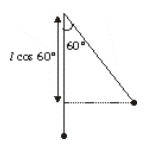
The vertical height $h$ through which the bob falls is given by:
$h = \ell - \ell \cos 60^{\circ} = \ell(1 - \cos 60^{\circ})$
$h = 2.5 \times (1 - 0.5) = 2.5 \times 0.5 = 1.25\,m$
Using the conservation of energy,the potential energy at the highest point is converted into kinetic energy at the lowest point:
$mgh = \frac{1}{2}mv_{\max}^2$
$v_{\max} = \sqrt{2gh}$
$v_{\max} = \sqrt{2 \times 10 \times 1.25} = \sqrt{25} = 5\,m/s$
Let the length of the string be $\ell = 250\,cm = 2.5\,m$.
The vertical height $h$ through which the bob falls is given by:
$h = \ell - \ell \cos 60^{\circ} = \ell(1 - \cos 60^{\circ})$
$h = 2.5 \times (1 - 0.5) = 2.5 \times 0.5 = 1.25\,m$
Using the conservation of energy,the potential energy at the highest point is converted into kinetic energy at the lowest point:
$mgh = \frac{1}{2}mv_{\max}^2$
$v_{\max} = \sqrt{2gh}$
$v_{\max} = \sqrt{2 \times 10 \times 1.25} = \sqrt{25} = 5\,m/s$
0 likes
View Solution203
MediumMCQ
The motion of a simple pendulum executing $S.H.M.$ is represented by the following equation:
$Y = A \sin (\pi t + \phi)$,where time is measured in $seconds$.
The length of the pendulum is .............$cm$.
$Y = A \sin (\pi t + \phi)$,where time is measured in $seconds$.
The length of the pendulum is .............$cm$.
A
$97.23$
B
$25.3$
C
$99.4$
D
$406.1$
Solution
(C) The standard equation for $S.H.M.$ is $Y = A \sin(\omega t + \phi)$.
Comparing this with the given equation $Y = A \sin(\pi t + \phi)$,we get the angular frequency $\omega = \pi \, rad/s$.
For a simple pendulum,the angular frequency is given by $\omega = \sqrt{\frac{g}{\ell}}$.
Squaring both sides,we get $\omega^2 = \frac{g}{\ell}$,which implies $\ell = \frac{g}{\omega^2}$.
Using the value of acceleration due to gravity $g = 980 \, cm/s^2$ and $\omega = \pi \, rad/s$:
$\ell = \frac{980}{\pi^2} \approx \frac{980}{9.8696} \approx 99.3 \, cm$.
Rounding to the nearest option,we get $\ell \approx 99.4 \, cm$.
Comparing this with the given equation $Y = A \sin(\pi t + \phi)$,we get the angular frequency $\omega = \pi \, rad/s$.
For a simple pendulum,the angular frequency is given by $\omega = \sqrt{\frac{g}{\ell}}$.
Squaring both sides,we get $\omega^2 = \frac{g}{\ell}$,which implies $\ell = \frac{g}{\omega^2}$.
Using the value of acceleration due to gravity $g = 980 \, cm/s^2$ and $\omega = \pi \, rad/s$:
$\ell = \frac{980}{\pi^2} \approx \frac{980}{9.8696} \approx 99.3 \, cm$.
Rounding to the nearest option,we get $\ell \approx 99.4 \, cm$.
0 likes
View Solution204
MediumMCQ
The metallic bob of a simple pendulum has a relative density of $5$. The time period of this pendulum is $10 \, s$. If the metallic bob is immersed in water,then the new time period becomes $5 \sqrt{x} \, s$. The value of $x$ will be.
A
$4$
B
$5$
C
$3$
D
$0$
Solution
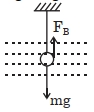
(B) The effective acceleration due to gravity $g'$ when the bob is immersed in water is given by:
$g' = g - \frac{F_B}{m} = g - \frac{\rho_w V g}{\rho_b V} = g \left(1 - \frac{\rho_w}{\rho_b}\right)$
Given relative density of the bob $\rho_b / \rho_w = 5$,so $\rho_w / \rho_b = 1/5$.
$g' = g \left(1 - \frac{1}{5}\right) = g \left(\frac{4}{5}\right) = 0.8g$
The time period of a simple pendulum is $T = 2\pi \sqrt{\frac{L}{g}}$.
Therefore,the new time period $T'$ is:
$T' = 2\pi \sqrt{\frac{L}{g'}} = 2\pi \sqrt{\frac{L}{0.8g}} = T \sqrt{\frac{1}{0.8}} = T \sqrt{\frac{5}{4}}$
Given $T = 10 \, s$,we have:
$T' = 10 \sqrt{\frac{5}{4}} = 10 \frac{\sqrt{5}}{2} = 5 \sqrt{5} \, s$
Comparing this with $5 \sqrt{x} \, s$,we get $x = 5$.
$g' = g - \frac{F_B}{m} = g - \frac{\rho_w V g}{\rho_b V} = g \left(1 - \frac{\rho_w}{\rho_b}\right)$
Given relative density of the bob $\rho_b / \rho_w = 5$,so $\rho_w / \rho_b = 1/5$.
$g' = g \left(1 - \frac{1}{5}\right) = g \left(\frac{4}{5}\right) = 0.8g$
The time period of a simple pendulum is $T = 2\pi \sqrt{\frac{L}{g}}$.
Therefore,the new time period $T'$ is:
$T' = 2\pi \sqrt{\frac{L}{g'}} = 2\pi \sqrt{\frac{L}{0.8g}} = T \sqrt{\frac{1}{0.8}} = T \sqrt{\frac{5}{4}}$
Given $T = 10 \, s$,we have:
$T' = 10 \sqrt{\frac{5}{4}} = 10 \frac{\sqrt{5}}{2} = 5 \sqrt{5} \, s$
Comparing this with $5 \sqrt{x} \, s$,we get $x = 5$.
0 likes
View Solution205
DifficultMCQ
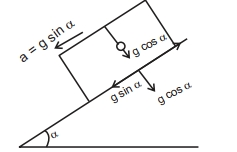
The time period of oscillation of a simple pendulum of length $L$ suspended from the roof of a vehicle,which moves without friction down an inclined plane of inclination $\alpha$,is given by:
A
$2 \pi \sqrt{L / (g \cos \alpha)}$
B
$2 \pi \sqrt{L / (g \sin \alpha)}$
C
$2 \pi \sqrt{L / g}$
D
$2 \pi \sqrt{L / (g \tan \alpha)}$
Solution
(A) When a vehicle moves down a frictionless inclined plane of inclination $\alpha$,its acceleration is $a = g \sin \alpha$ directed down the plane.
To find the effective acceleration due to gravity $(g_{eff})$ inside the vehicle,we consider the pseudo-force acting on the pendulum bob.
The effective acceleration is the vector sum of the acceleration due to gravity $(g)$ and the negative of the vehicle's acceleration $(-a)$.
$g_{eff} = \vec{g} - \vec{a}$.
Resolving these into components perpendicular to the inclined plane,we find $g_{eff} = g \cos \alpha$.
The time period of a simple pendulum is given by $T = 2 \pi \sqrt{L / g_{eff}}$.
Substituting $g_{eff} = g \cos \alpha$,we get $T = 2 \pi \sqrt{\frac{L}{g \cos \alpha}}$.
To find the effective acceleration due to gravity $(g_{eff})$ inside the vehicle,we consider the pseudo-force acting on the pendulum bob.
The effective acceleration is the vector sum of the acceleration due to gravity $(g)$ and the negative of the vehicle's acceleration $(-a)$.
$g_{eff} = \vec{g} - \vec{a}$.
Resolving these into components perpendicular to the inclined plane,we find $g_{eff} = g \cos \alpha$.
The time period of a simple pendulum is given by $T = 2 \pi \sqrt{L / g_{eff}}$.
Substituting $g_{eff} = g \cos \alpha$,we get $T = 2 \pi \sqrt{\frac{L}{g \cos \alpha}}$.
0 likes
View Solution206
AdvancedMCQ
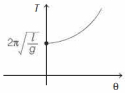
Which of the following plots represents schematically the dependence of the time period of a pendulum,if measured and plotted as a function of the amplitude of its oscillations? (Note: amplitude need not be small)
A
B
C
D
Solution
(A) The time period $T$ of a simple pendulum for large amplitudes is given by the relation:
$T = 2\pi \sqrt{\frac{l}{g}} \left( 1 + \frac{\theta_{0}^{2}}{16} \right)$
where $\theta_{0}$ is the angular amplitude from the mean position.
As the amplitude $\theta_{0}$ increases,the time period $T$ also increases.
The relationship between $T$ and $\theta_{0}$ is parabolic,meaning $T$ increases with $\theta_{0}$ in a non-linear,upward-curving fashion.
Therefore,the correct plot is the one showing $T$ increasing with $\theta_{0}$,which corresponds to Plot $A$.
$T = 2\pi \sqrt{\frac{l}{g}} \left( 1 + \frac{\theta_{0}^{2}}{16} \right)$
where $\theta_{0}$ is the angular amplitude from the mean position.
As the amplitude $\theta_{0}$ increases,the time period $T$ also increases.
The relationship between $T$ and $\theta_{0}$ is parabolic,meaning $T$ increases with $\theta_{0}$ in a non-linear,upward-curving fashion.
Therefore,the correct plot is the one showing $T$ increasing with $\theta_{0}$,which corresponds to Plot $A$.
0 likes
View Solution207
AdvancedMCQ
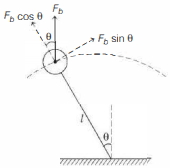
$A$ light balloon filled with helium of density $\rho_{He}$ is tied to a long light string of length $l$ and the string is attached to the ground. If the balloon is displaced slightly in the horizontal direction from the equilibrium and released,then:
A
the balloon undergoes simple harmonic motion with period $2 \pi \sqrt{\left(\frac{\rho_{air}}{\rho_{air}-\rho_{He}}\right) \frac{l}{g}}$
B
the balloon undergoes simple harmonic motion with period $2 \pi \sqrt{\left(\frac{\rho_{air}-\rho_{He}}{\rho_{air}}\right) \frac{l}{g}}$
C
the balloon undergoes simple harmonic motion with period $2 \pi \sqrt{\left(\frac{\rho_{He}}{\rho_{air}-\rho_{He}}\right) \frac{l}{g}}$
D
the balloon undergoes conical oscillations with period $2 \pi \sqrt{\left(\frac{\rho_{air}+\rho_{He}}{\rho_{air}-\rho_{He}}\right) \frac{l}{g}}$
Solution
(C) When the balloon is slightly displaced horizontally,the horizontal component of the buoyant force produces a torque about the end of the string attached to the ground. This torque produces sideways oscillations of the balloon.
The restoring torque is given by:
$\tau_1 = F_b \sin \theta \times l = V(\rho_{air} - \rho_{He})g l \sin \theta$
For small angular displacements,$\sin \theta \approx \theta$,so:
$\tau_1 = V(\rho_{air} - \rho_{He})g l \theta$
The inertial torque on the balloon is:
$\tau_2 = I \alpha = (m l^2) \alpha = (V \rho_{He}) l^2 \alpha$
Equating the torques (considering the restoring nature):
$V \rho_{He} l^2 \alpha = -V(\rho_{air} - \rho_{He}) g l \theta$
$\alpha = -\left(\frac{\rho_{air} - \rho_{He}}{\rho_{He}}\right) \frac{g}{l} \theta$
Comparing with the standard $SHM$ equation $\alpha = -\omega^2 \theta$,we get:
$\omega^2 = \left(\frac{\rho_{air} - \rho_{He}}{\rho_{He}}\right) \frac{g}{l}$
The time period $T$ is:
$T = \frac{2 \pi}{\omega} = 2 \pi \sqrt{\left(\frac{\rho_{He}}{\rho_{air} - \rho_{He}}\right) \frac{l}{g}}$
The restoring torque is given by:
$\tau_1 = F_b \sin \theta \times l = V(\rho_{air} - \rho_{He})g l \sin \theta$
For small angular displacements,$\sin \theta \approx \theta$,so:
$\tau_1 = V(\rho_{air} - \rho_{He})g l \theta$
The inertial torque on the balloon is:
$\tau_2 = I \alpha = (m l^2) \alpha = (V \rho_{He}) l^2 \alpha$
Equating the torques (considering the restoring nature):
$V \rho_{He} l^2 \alpha = -V(\rho_{air} - \rho_{He}) g l \theta$
$\alpha = -\left(\frac{\rho_{air} - \rho_{He}}{\rho_{He}}\right) \frac{g}{l} \theta$
Comparing with the standard $SHM$ equation $\alpha = -\omega^2 \theta$,we get:
$\omega^2 = \left(\frac{\rho_{air} - \rho_{He}}{\rho_{He}}\right) \frac{g}{l}$
The time period $T$ is:
$T = \frac{2 \pi}{\omega} = 2 \pi \sqrt{\left(\frac{\rho_{He}}{\rho_{air} - \rho_{He}}\right) \frac{l}{g}}$
0 likes
View Solution208
AdvancedMCQ
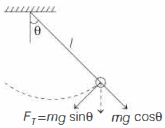
$A$ simple pendulum of length $l$ is made to oscillate with an amplitude of $45^{\circ}$. The acceleration due to gravity is $g$. Let $T_0 = 2 \pi \sqrt{l / g}$. The time period of oscillation of this pendulum will be
A
$T_0$ irrespective of the amplitude
B
slightly less than $T_0$
C
slightly more than $T_0$
D
dependent on whether it swings in a plane aligned with the north-south or east-west directions
Solution
(C) For a simple pendulum,the equation of motion is given by $\frac{d^2 \theta}{dt^2} + \frac{g}{l} \sin \theta = 0$.
For small oscillations,$\sin \theta \approx \theta$,which leads to the simple harmonic motion period $T_0 = 2 \pi \sqrt{\frac{l}{g}}$.
However,for larger amplitudes (like $45^{\circ}$),we use the expansion $\sin \theta \approx \theta - \frac{\theta^3}{6}$.
The time period $T$ for a pendulum with amplitude $\theta_0$ is given by the formula $T = T_0 \left( 1 + \frac{\theta_0^2}{16} + \dots \right)$ (where $\theta_0$ is in radians).
Since $\theta_0 = 45^{\circ} = \frac{\pi}{4} \text{ radians}$,the term $\frac{\theta_0^2}{16}$ is positive.
Therefore,the time period $T$ will be slightly more than $T_0$.
For small oscillations,$\sin \theta \approx \theta$,which leads to the simple harmonic motion period $T_0 = 2 \pi \sqrt{\frac{l}{g}}$.
However,for larger amplitudes (like $45^{\circ}$),we use the expansion $\sin \theta \approx \theta - \frac{\theta^3}{6}$.
The time period $T$ for a pendulum with amplitude $\theta_0$ is given by the formula $T = T_0 \left( 1 + \frac{\theta_0^2}{16} + \dots \right)$ (where $\theta_0$ is in radians).
Since $\theta_0 = 45^{\circ} = \frac{\pi}{4} \text{ radians}$,the term $\frac{\theta_0^2}{16}$ is positive.
Therefore,the time period $T$ will be slightly more than $T_0$.
0 likes
View Solution209
DifficultMCQ
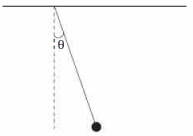
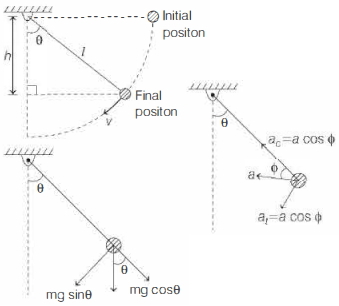
$A$ simple pendulum is released from rest at the horizontally stretched position. When the string makes an angle $\theta$ with the vertical,the angle $\phi$ which the acceleration vector of the bob makes with the string is given by
A
$\phi=0$
B
$\phi=\tan ^{-1}\left(\frac{\tan \theta}{2}\right)$
C
$\phi=\tan ^{-1}(2 \tan \theta)$
D
$\phi=\frac{\pi}{2}$
Solution
(B) Let $v$ be the velocity of the bob at position $\theta$ after being released from the horizontal position.
From the law of conservation of energy,the potential energy lost equals the kinetic energy gained:
$mgh = \frac{1}{2}mv^2$
Since the height $h$ dropped from the horizontal is $l \cos \theta$,we have:
$mg(l \cos \theta) = \frac{1}{2}mv^2$
$\Rightarrow \frac{v^2}{l} = 2g \cos \theta$
The radial (centripetal) acceleration is $a_c = \frac{v^2}{l} = 2g \cos \theta$.
The tangential acceleration is due to the component of gravity perpendicular to the string:
$a_t = g \sin \theta$.
If the total acceleration vector $\vec{a}$ makes an angle $\phi$ with the string (which is the direction of the radial acceleration),then:
$\tan \phi = \frac{a_t}{a_c}$
Substituting the expressions for $a_t$ and $a_c$:
$\tan \phi = \frac{g \sin \theta}{2g \cos \theta} = \frac{\tan \theta}{2}$
Therefore,$\phi = \tan^{-1}\left(\frac{\tan \theta}{2}\right)$.
From the law of conservation of energy,the potential energy lost equals the kinetic energy gained:
$mgh = \frac{1}{2}mv^2$
Since the height $h$ dropped from the horizontal is $l \cos \theta$,we have:
$mg(l \cos \theta) = \frac{1}{2}mv^2$
$\Rightarrow \frac{v^2}{l} = 2g \cos \theta$
The radial (centripetal) acceleration is $a_c = \frac{v^2}{l} = 2g \cos \theta$.
The tangential acceleration is due to the component of gravity perpendicular to the string:
$a_t = g \sin \theta$.
If the total acceleration vector $\vec{a}$ makes an angle $\phi$ with the string (which is the direction of the radial acceleration),then:
$\tan \phi = \frac{a_t}{a_c}$
Substituting the expressions for $a_t$ and $a_c$:
$\tan \phi = \frac{g \sin \theta}{2g \cos \theta} = \frac{\tan \theta}{2}$
Therefore,$\phi = \tan^{-1}\left(\frac{\tan \theta}{2}\right)$.
0 likes
View Solution210
MediumMCQ
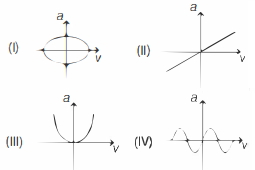
If the speed $v$ of the bob in a simple pendulum is plotted against the tangential acceleration $a$,the correct graph will be represented by
A
$I$
B
$II$
C
$III$
D
$IV$
Solution
(A) For a simple pendulum undergoing simple harmonic motion,the displacement $x$ is given by $x = A \sin(\omega t)$.
The velocity is $v = \frac{dx}{dt} = A\omega \cos(\omega t)$.
The tangential acceleration is $a = \frac{dv}{dt} = -A\omega^2 \sin(\omega t)$.
From these equations,we have:
$\frac{v}{A\omega} = \cos(\omega t)$ and $\frac{a}{-A\omega^2} = \sin(\omega t)$.
Using the identity $\sin^2(\theta) + \cos^2(\theta) = 1$,we get:
$\left(\frac{v}{A\omega}\right)^2 + \left(\frac{a}{-A\omega^2}\right)^2 = 1$
$\frac{v^2}{A^2\omega^2} + \frac{a^2}{A^2\omega^4} = 1$
This is the equation of an ellipse in the $v-a$ plane,where $v$ is on the horizontal axis and $a$ is on the vertical axis. Thus,the correct graph is $I$.
The velocity is $v = \frac{dx}{dt} = A\omega \cos(\omega t)$.
The tangential acceleration is $a = \frac{dv}{dt} = -A\omega^2 \sin(\omega t)$.
From these equations,we have:
$\frac{v}{A\omega} = \cos(\omega t)$ and $\frac{a}{-A\omega^2} = \sin(\omega t)$.
Using the identity $\sin^2(\theta) + \cos^2(\theta) = 1$,we get:
$\left(\frac{v}{A\omega}\right)^2 + \left(\frac{a}{-A\omega^2}\right)^2 = 1$
$\frac{v^2}{A^2\omega^2} + \frac{a^2}{A^2\omega^4} = 1$
This is the equation of an ellipse in the $v-a$ plane,where $v$ is on the horizontal axis and $a$ is on the vertical axis. Thus,the correct graph is $I$.
0 likes
View Solution211
AdvancedMCQ
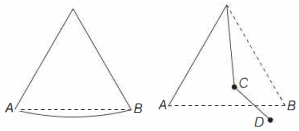
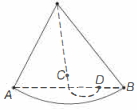
$A$ simple pendulum oscillates freely between points $A$ and $B$. We now put a peg (nail) at the point $C$ as shown in the figure. As the pendulum moves from $A$ to the right,the string will bend at $C$ and the pendulum will go to its extreme point $D$. Ignoring friction,the point $D$
A
will lie on the line $A B$
B
will lie above the line $A B$
C
will lie below the line $A B$
D
will coincide with $B$
Solution
(A) The correct option is $A$.
In a simple pendulum,the total mechanical energy is conserved in the absence of friction. The total energy of the pendulum at its extreme positions is purely potential energy,given by $U = mgh$,where $h$ is the vertical height of the bob from the lowest point of the oscillation.
Since the pendulum starts from point $A$ with zero initial velocity,its total energy is $E = mgh_A$. At the other extreme point $D$,the velocity is again zero,so its total energy is $E = mgh_D$.
By the law of conservation of energy,$mgh_A = mgh_D$,which implies $h_A = h_D$. Since $A$ and $B$ lie on the same horizontal line,$h_A = h_B$. Therefore,$h_D = h_B$,which means the extreme point $D$ must lie on the same horizontal line $A B$.
In a simple pendulum,the total mechanical energy is conserved in the absence of friction. The total energy of the pendulum at its extreme positions is purely potential energy,given by $U = mgh$,where $h$ is the vertical height of the bob from the lowest point of the oscillation.
Since the pendulum starts from point $A$ with zero initial velocity,its total energy is $E = mgh_A$. At the other extreme point $D$,the velocity is again zero,so its total energy is $E = mgh_D$.
By the law of conservation of energy,$mgh_A = mgh_D$,which implies $h_A = h_D$. Since $A$ and $B$ lie on the same horizontal line,$h_A = h_B$. Therefore,$h_D = h_B$,which means the extreme point $D$ must lie on the same horizontal line $A B$.
0 likes
View Solution212
DifficultMCQ
$A$ hollow pendulum bob filled with water has a small hole at the bottom through which water escapes at a constant rate. Which of the following statements describes the variation of the time period $T$ of the pendulum as the water flows out?
A
$T$ decreases first and then increases
B
$T$ increases first and then decreases
C
$T$ increases throughout
D
$T$ does not change
Solution
(B) The time period $T$ of a simple pendulum is given by the formula $T = 2\pi \sqrt{\frac{l_{eff}}{g}}$,where $l_{eff}$ is the effective length of the pendulum.
$l_{eff}$ is the distance between the point of suspension and the center of mass of the bob.
Initially,when the bob is full of water,the center of mass is at the geometric center of the bob.
As water flows out,the center of mass of the system (bob + remaining water) shifts downwards,which increases the effective length $l_{eff}$. Consequently,the time period $T$ increases.
As the water level continues to drop and the bob becomes empty,the center of mass eventually rises back to the geometric center of the bob.
Since the effective length $l_{eff}$ decreases during this second phase,the time period $T$ decreases.
Therefore,the time period $T$ first increases and then decreases.
$l_{eff}$ is the distance between the point of suspension and the center of mass of the bob.
Initially,when the bob is full of water,the center of mass is at the geometric center of the bob.
As water flows out,the center of mass of the system (bob + remaining water) shifts downwards,which increases the effective length $l_{eff}$. Consequently,the time period $T$ increases.
As the water level continues to drop and the bob becomes empty,the center of mass eventually rises back to the geometric center of the bob.
Since the effective length $l_{eff}$ decreases during this second phase,the time period $T$ decreases.
Therefore,the time period $T$ first increases and then decreases.
0 likes
View Solution213
Difficult
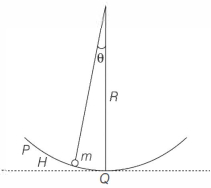
$A$ block of mass $m$ is sliding on a fixed frictionless concave surface of radius $R$. It is released from rest at point $P$ which is at a height of $H \ll R$ from the lowest point $Q$.
$(a)$ What is the potential energy as a function of $\theta$,taking the lowest point $Q$ as the reference level for potential energy?
$(b)$ What is the kinetic energy as a function of $\theta$?
$(c)$ What is the time taken for the particle to reach from point $P$ to the lowest point $Q$?
$(d)$ How much force is exerted by the block on the concave surface at the point $Q$?
$(a)$ What is the potential energy as a function of $\theta$,taking the lowest point $Q$ as the reference level for potential energy?
$(b)$ What is the kinetic energy as a function of $\theta$?
$(c)$ What is the time taken for the particle to reach from point $P$ to the lowest point $Q$?
$(d)$ How much force is exerted by the block on the concave surface at the point $Q$?
Solution
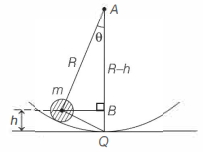
(D) The mass $m$ is at height $H$ from point $Q$,where potential energy is taken as zero. From the geometry of the figure,if at some angle $\theta$,the height of mass $m$ above the lowest point $Q$ is $h$,then from $\triangle ABC$,$\cos \theta = \frac{R-h}{R} \Rightarrow h = R(1 - \cos \theta)$. Hence,the potential energy $U(\theta)$ is $U(\theta) = mgh = mgR(1 - \cos \theta)$.
$(b)$ Kinetic energy $K(\theta)$ at position $\theta$ is the loss of potential energy from the initial position $P$ to position $\theta$. Thus,$K(\theta) = mgH - U(\theta) = mgH - mgR(1 - \cos \theta) = mg(H - R(1 - \cos \theta))$.
$(c)$ For $H \ll R$,the motion is simple harmonic with time period $T = 2\pi \sqrt{\frac{R}{g}}$. The time taken to travel from $P$ to $Q$ is one-fourth of this time period. Thus,$t = \frac{T}{4} = \frac{2\pi}{4} \sqrt{\frac{R}{g}} = \frac{\pi}{2} \sqrt{\frac{R}{g}}$.
$(d)$ From energy conservation at the lowest point $Q$,if $m$ has velocity $v$,then $\frac{1}{2}mv^2 = mgH \Rightarrow mv^2 = 2mgH$. The centripetal force is $F_c = \frac{mv^2}{R} = \frac{2mgH}{R}$. The normal reaction $N$ at $Q$ satisfies $N - mg = \frac{mv^2}{R} \Rightarrow N = mg + \frac{2mgH}{R} = mg(1 + \frac{2H}{R})$. This is the force exerted by the block on the surface.
$(b)$ Kinetic energy $K(\theta)$ at position $\theta$ is the loss of potential energy from the initial position $P$ to position $\theta$. Thus,$K(\theta) = mgH - U(\theta) = mgH - mgR(1 - \cos \theta) = mg(H - R(1 - \cos \theta))$.
$(c)$ For $H \ll R$,the motion is simple harmonic with time period $T = 2\pi \sqrt{\frac{R}{g}}$. The time taken to travel from $P$ to $Q$ is one-fourth of this time period. Thus,$t = \frac{T}{4} = \frac{2\pi}{4} \sqrt{\frac{R}{g}} = \frac{\pi}{2} \sqrt{\frac{R}{g}}$.
$(d)$ From energy conservation at the lowest point $Q$,if $m$ has velocity $v$,then $\frac{1}{2}mv^2 = mgH \Rightarrow mv^2 = 2mgH$. The centripetal force is $F_c = \frac{mv^2}{R} = \frac{2mgH}{R}$. The normal reaction $N$ at $Q$ satisfies $N - mg = \frac{mv^2}{R} \Rightarrow N = mg + \frac{2mgH}{R} = mg(1 + \frac{2H}{R})$. This is the force exerted by the block on the surface.
0 likes
View Solution214
MediumMCQ
$A$ simple pendulum with a bob of mass $m$ and length $x$ is held in position at an angle $\theta_1$ and then at an angle $\theta_2$ with the vertical. When released from these positions,the speeds with which it passes the lowest position are $v_1$ and $v_2$ respectively. Then,the ratio $\frac{v_1}{v_2}$ is .............
A
$\frac{1-\cos \theta_1}{1-\cos \theta_2}$
B
$\sqrt{\frac{1-\cos \theta_1}{1-\cos \theta_2}}$
C
$\sqrt{\frac{2 g x(1-\cos \theta_1)}{1-\cos \theta_2}}$
D
$\sqrt{\frac{1-\cos \theta_1}{2 g x(1-\cos \theta_2)}}$
Solution
(B) By the principle of conservation of mechanical energy,the potential energy at the initial position equals the kinetic energy at the lowest position.
$m g x(1-\cos \theta) = \frac{1}{2} m v^2$
$v^2 = 2 g x(1-\cos \theta)$
$v = \sqrt{2 g x(1-\cos \theta)}$
For the first position at angle $\theta_1$,$v_1 = \sqrt{2 g x(1-\cos \theta_1)}$.
For the second position at angle $\theta_2$,$v_2 = \sqrt{2 g x(1-\cos \theta_2)}$.
Taking the ratio of the two speeds:
$\frac{v_1}{v_2} = \frac{\sqrt{2 g x(1-\cos \theta_1)}}{\sqrt{2 g x(1-\cos \theta_2)}}$
$\frac{v_1}{v_2} = \sqrt{\frac{1-\cos \theta_1}{1-\cos \theta_2}}$
$m g x(1-\cos \theta) = \frac{1}{2} m v^2$
$v^2 = 2 g x(1-\cos \theta)$
$v = \sqrt{2 g x(1-\cos \theta)}$
For the first position at angle $\theta_1$,$v_1 = \sqrt{2 g x(1-\cos \theta_1)}$.
For the second position at angle $\theta_2$,$v_2 = \sqrt{2 g x(1-\cos \theta_2)}$.
Taking the ratio of the two speeds:
$\frac{v_1}{v_2} = \frac{\sqrt{2 g x(1-\cos \theta_1)}}{\sqrt{2 g x(1-\cos \theta_2)}}$
$\frac{v_1}{v_2} = \sqrt{\frac{1-\cos \theta_1}{1-\cos \theta_2}}$
1 likes
View Solution215
EasyMCQ
$A$ simple pendulum suspended from the ceiling of a stationary lift has period $T_0$. When the lift descends at steady speed,the period is $T_1$,and when it descends with constant downward acceleration,the period is $T_2$. Which one of the following is true?
A
$T_0 = T_1 = T_2$
B
$T_0 = T_1 < T_2$
C
$T_0 = T_1 > T_2$
D
$T_0 < T_1 < T_2$
Solution
(B) The time period of a simple pendulum is given by $T = 2\pi \sqrt{\frac{l}{g_{\text{eff}}}}$,where $g_{\text{eff}}$ is the effective acceleration due to gravity.
$1$. For a stationary lift,$g_{\text{eff}} = g$,so $T_0 = 2\pi \sqrt{\frac{l}{g}}$.
$2$. When the lift descends at a steady speed,the acceleration is zero. Thus,$g_{\text{eff}} = g$,and the period $T_1 = 2\pi \sqrt{\frac{l}{g}}$. Therefore,$T_0 = T_1$.
$3$. When the lift descends with a constant downward acceleration $a$,a pseudo force $ma$ acts upwards on the pendulum bob. The effective acceleration becomes $g_{\text{eff}} = g - a$. Since $g - a < g$,the new time period $T_2 = 2\pi \sqrt{\frac{l}{g - a}}$ will be greater than $T_0$ and $T_1$.
Thus,$T_0 = T_1 < T_2$.
$1$. For a stationary lift,$g_{\text{eff}} = g$,so $T_0 = 2\pi \sqrt{\frac{l}{g}}$.
$2$. When the lift descends at a steady speed,the acceleration is zero. Thus,$g_{\text{eff}} = g$,and the period $T_1 = 2\pi \sqrt{\frac{l}{g}}$. Therefore,$T_0 = T_1$.
$3$. When the lift descends with a constant downward acceleration $a$,a pseudo force $ma$ acts upwards on the pendulum bob. The effective acceleration becomes $g_{\text{eff}} = g - a$. Since $g - a < g$,the new time period $T_2 = 2\pi \sqrt{\frac{l}{g - a}}$ will be greater than $T_0$ and $T_1$.
Thus,$T_0 = T_1 < T_2$.
0 likes
View Solution216
EasyMCQ
If a second's pendulum is moved to a planet where the acceleration due to gravity is $4$ times that on Earth,the length of the second's pendulum on the planet should be made .......... times to keep the time period constant.
A
$2$
B
$4$
C
$8$
D
$16$
Solution
(B) The time period of a simple pendulum is given by the formula $T = 2\pi \sqrt{\frac{l}{g}}$.
For a second's pendulum,the time period $T$ is constant $(T = 2 \text{ s})$.
From the formula,we have $T^2 \propto \frac{l}{g}$,which implies $l \propto g$ for a constant $T$.
If the acceleration due to gravity $g'$ on the new planet is $4$ times the acceleration due to gravity $g$ on Earth $(g' = 4g)$,then to keep the time period $T$ constant,the new length $l'$ must satisfy the ratio $\frac{l'}{l} = \frac{g'}{g}$.
Substituting the values,we get $\frac{l'}{l} = \frac{4g}{g} = 4$.
Therefore,the length of the pendulum must be made $4$ times its original length.
For a second's pendulum,the time period $T$ is constant $(T = 2 \text{ s})$.
From the formula,we have $T^2 \propto \frac{l}{g}$,which implies $l \propto g$ for a constant $T$.
If the acceleration due to gravity $g'$ on the new planet is $4$ times the acceleration due to gravity $g$ on Earth $(g' = 4g)$,then to keep the time period $T$ constant,the new length $l'$ must satisfy the ratio $\frac{l'}{l} = \frac{g'}{g}$.
Substituting the values,we get $\frac{l'}{l} = \frac{4g}{g} = 4$.
Therefore,the length of the pendulum must be made $4$ times its original length.
0 likes
View Solution217
MediumMCQ
$A$ simple pendulum with a metallic bob has a time period $T$. The bob is now immersed in a non-viscous liquid and oscillated. If the density of the liquid is $1/4$ that of the metal,the time period of the same pendulum will be ...........
A
$\frac{T}{\sqrt{3}}$
B
$\frac{2T}{\sqrt{3}}$
C
$\frac{4}{3}T$
D
$\frac{2}{3}T$
Solution
(B) The time period of a simple pendulum is given by $T = 2\pi \sqrt{\frac{l}{g}}$.
When the bob is immersed in a liquid,it experiences an upward buoyant force (upthrust).
Let $\rho$ be the density of the metal and $\sigma$ be the density of the liquid. Given $\sigma = \frac{\rho}{4}$.
The effective acceleration due to gravity $g_{\text{eff}}$ is given by $g_{\text{eff}} = g(1 - \frac{\sigma}{\rho})$.
Substituting $\sigma = \frac{\rho}{4}$,we get $g_{\text{eff}} = g(1 - \frac{1}{4}) = \frac{3}{4}g$.
The new time period $T'$ is $T' = 2\pi \sqrt{\frac{l}{g_{\text{eff}}}} = 2\pi \sqrt{\frac{l}{\frac{3}{4}g}} = 2\pi \sqrt{\frac{4l}{3g}}$.
This simplifies to $T' = \sqrt{\frac{4}{3}} \times (2\pi \sqrt{\frac{l}{g}}) = \frac{2}{\sqrt{3}}T$.
When the bob is immersed in a liquid,it experiences an upward buoyant force (upthrust).
Let $\rho$ be the density of the metal and $\sigma$ be the density of the liquid. Given $\sigma = \frac{\rho}{4}$.
The effective acceleration due to gravity $g_{\text{eff}}$ is given by $g_{\text{eff}} = g(1 - \frac{\sigma}{\rho})$.
Substituting $\sigma = \frac{\rho}{4}$,we get $g_{\text{eff}} = g(1 - \frac{1}{4}) = \frac{3}{4}g$.
The new time period $T'$ is $T' = 2\pi \sqrt{\frac{l}{g_{\text{eff}}}} = 2\pi \sqrt{\frac{l}{\frac{3}{4}g}} = 2\pi \sqrt{\frac{4l}{3g}}$.
This simplifies to $T' = \sqrt{\frac{4}{3}} \times (2\pi \sqrt{\frac{l}{g}}) = \frac{2}{\sqrt{3}}T$.
0 likes
View Solution218
DifficultMCQ
Two pendulums of length $1.21 \,m$ and $1.0 \,m$ start vibrating. At some instant,the two are in the mean position in the same phase. After how many vibrations of the longer pendulum will the two be in phase again?
A
$10$
B
$11$
C
$20$
D
$21$
Solution
(A) The time period of a simple pendulum is given by $T = 2 \pi \sqrt{\frac{L}{g}}$.
For the first pendulum of length $L_1 = 1.21 \,m$,the time period is $T_1 = 2 \pi \sqrt{\frac{1.21}{g}} = 1.1 \times 2 \pi \sqrt{\frac{1}{g}}$.
For the second pendulum of length $L_2 = 1.0 \,m$,the time period is $T_2 = 2 \pi \sqrt{\frac{1.0}{g}}$.
Thus,$T_1 = 1.1 T_2 = \frac{11}{10} T_2$,which implies $10 T_1 = 11 T_2$.
Let $n_1$ be the number of vibrations of the longer pendulum and $n_2$ be the number of vibrations of the shorter pendulum when they are in phase again.
The condition for being in phase is $n_1 T_1 = n_2 T_2$.
Substituting $T_1 = \frac{11}{10} T_2$,we get $n_1 (\frac{11}{10} T_2) = n_2 T_2$,which simplifies to $11 n_1 = 10 n_2$.
For the smallest integer values,$n_1 = 10$ and $n_2 = 11$.
Therefore,the two pendulums will be in phase again after $10$ vibrations of the longer pendulum.
For the first pendulum of length $L_1 = 1.21 \,m$,the time period is $T_1 = 2 \pi \sqrt{\frac{1.21}{g}} = 1.1 \times 2 \pi \sqrt{\frac{1}{g}}$.
For the second pendulum of length $L_2 = 1.0 \,m$,the time period is $T_2 = 2 \pi \sqrt{\frac{1.0}{g}}$.
Thus,$T_1 = 1.1 T_2 = \frac{11}{10} T_2$,which implies $10 T_1 = 11 T_2$.
Let $n_1$ be the number of vibrations of the longer pendulum and $n_2$ be the number of vibrations of the shorter pendulum when they are in phase again.
The condition for being in phase is $n_1 T_1 = n_2 T_2$.
Substituting $T_1 = \frac{11}{10} T_2$,we get $n_1 (\frac{11}{10} T_2) = n_2 T_2$,which simplifies to $11 n_1 = 10 n_2$.
For the smallest integer values,$n_1 = 10$ and $n_2 = 11$.
Therefore,the two pendulums will be in phase again after $10$ vibrations of the longer pendulum.
0 likes
View Solution219
MediumMCQ
The time period of oscillations of a simple pendulum is $1$ minute. If its length is increased by $44 \%$,then its new time period of oscillation will be ......... $s$.
A
$96$
B
$58$
C
$82$
D
$72$
Solution
(D) The time period of a simple pendulum is given by $T = 2\pi \sqrt{\frac{l}{g}}$.
Initially,$T_1 = 60 \, s$ and length is $l_1$.
When the length is increased by $44 \%$,the new length $l_2 = l_1 + 0.44 l_1 = 1.44 l_1$.
The new time period $T_2$ is given by $T_2 = 2\pi \sqrt{\frac{l_2}{g}}$.
Taking the ratio: $\frac{T_2}{T_1} = \sqrt{\frac{l_2}{l_1}} = \sqrt{1.44} = 1.2$.
Therefore,$T_2 = 1.2 \times T_1 = 1.2 \times 60 \, s = 72 \, s$.
Initially,$T_1 = 60 \, s$ and length is $l_1$.
When the length is increased by $44 \%$,the new length $l_2 = l_1 + 0.44 l_1 = 1.44 l_1$.
The new time period $T_2$ is given by $T_2 = 2\pi \sqrt{\frac{l_2}{g}}$.
Taking the ratio: $\frac{T_2}{T_1} = \sqrt{\frac{l_2}{l_1}} = \sqrt{1.44} = 1.2$.
Therefore,$T_2 = 1.2 \times T_1 = 1.2 \times 60 \, s = 72 \, s$.
0 likes
View Solution220
MediumMCQ
If the length of a clock pendulum increases by $0.2 \%$ due to atmospheric temperature rise,then the loss in time of the clock per day is ........... $s$.
A
$86.4$
B
$43.2$
C
$72.5$
D
$32.5$
Solution
(A) The time period of a simple pendulum is given by $T = 2\pi \sqrt{\frac{L}{g}}$.
Taking the natural logarithm and differentiating,we get $\frac{\Delta T}{T} = \frac{1}{2} \frac{\Delta L}{L}$.
Given that the length increases by $0.2 \%$,so $\frac{\Delta L}{L} = 0.002$.
Therefore,the fractional change in time period is $\frac{\Delta T}{T} = \frac{1}{2} \times 0.002 = 0.001$.
The time lost per day is $\Delta T = \left( \frac{\Delta T}{T} \right) \times t$,where $t = 24 \times 3600 \, s = 86400 \, s$.
Substituting the values,$\Delta T = 0.001 \times 86400 = 86.4 \, s$.
Taking the natural logarithm and differentiating,we get $\frac{\Delta T}{T} = \frac{1}{2} \frac{\Delta L}{L}$.
Given that the length increases by $0.2 \%$,so $\frac{\Delta L}{L} = 0.002$.
Therefore,the fractional change in time period is $\frac{\Delta T}{T} = \frac{1}{2} \times 0.002 = 0.001$.
The time lost per day is $\Delta T = \left( \frac{\Delta T}{T} \right) \times t$,where $t = 24 \times 3600 \, s = 86400 \, s$.
Substituting the values,$\Delta T = 0.001 \times 86400 = 86.4 \, s$.
0 likes
View Solution221
MediumMCQ
$A$ simple pendulum with an iron bob has a time period $T$. The bob is now immersed in a non-viscous liquid and oscillated. If the density of the liquid is $\frac{1}{12}$th that of iron,then the new time period will be:
A
$T \sqrt{\frac{8}{7}}$
B
$T \sqrt{\frac{12}{13}}$
C
$T \sqrt{\frac{12}{11}}$
D
$T \sqrt{\frac{6}{5}}$
Solution
(C) The time period of a simple pendulum is given by $T = 2\pi \sqrt{\frac{l}{g}}$.
When the bob is immersed in a liquid,it experiences an upward buoyant force (upthrust).
The effective acceleration due to gravity $g_{\text{eff}}$ is given by $g_{\text{eff}} = g(1 - \frac{\rho_L}{\rho_S})$,where $\rho_L$ is the density of the liquid and $\rho_S$ is the density of the solid (iron).
Given $\rho_L = \frac{1}{12} \rho_S$,we have $\frac{\rho_L}{\rho_S} = \frac{1}{12}$.
Thus,$g_{\text{eff}} = g(1 - \frac{1}{12}) = g(\frac{11}{12})$.
The new time period $T'$ is $T' = 2\pi \sqrt{\frac{l}{g_{\text{eff}}}} = 2\pi \sqrt{\frac{l}{g(\frac{11}{12})}}$.
$T' = T \sqrt{\frac{12}{11}}$.
When the bob is immersed in a liquid,it experiences an upward buoyant force (upthrust).
The effective acceleration due to gravity $g_{\text{eff}}$ is given by $g_{\text{eff}} = g(1 - \frac{\rho_L}{\rho_S})$,where $\rho_L$ is the density of the liquid and $\rho_S$ is the density of the solid (iron).
Given $\rho_L = \frac{1}{12} \rho_S$,we have $\frac{\rho_L}{\rho_S} = \frac{1}{12}$.
Thus,$g_{\text{eff}} = g(1 - \frac{1}{12}) = g(\frac{11}{12})$.
The new time period $T'$ is $T' = 2\pi \sqrt{\frac{l}{g_{\text{eff}}}} = 2\pi \sqrt{\frac{l}{g(\frac{11}{12})}}$.
$T' = T \sqrt{\frac{12}{11}}$.
0 likes
View Solution222
EasyMCQ
$A$ positively charged pendulum is oscillating in a uniform electric field pointing upwards. How does its time period compare to the time period when it oscillates without an electric field?
A
Is less
B
Is more
C
Remains unchanged
D
Starts fluctuating
Solution
(B) The time period of a simple pendulum is given by $T = 2\pi \sqrt{\frac{L}{g_{eff}}}$.
When a positively charged pendulum is placed in an upward electric field $E$, an electric force $F_e = qE$ acts on the bob in the upward direction.
The effective acceleration due to gravity becomes $g_{eff} = g - \frac{qE}{m}$.
Since $g_{eff} < g$, the denominator in the time period formula decreases.
Therefore, the time period $T$ increases compared to the case without an electric field.
When a positively charged pendulum is placed in an upward electric field $E$, an electric force $F_e = qE$ acts on the bob in the upward direction.
The effective acceleration due to gravity becomes $g_{eff} = g - \frac{qE}{m}$.
Since $g_{eff} < g$, the denominator in the time period formula decreases.
Therefore, the time period $T$ increases compared to the case without an electric field.
0 likes
View Solution223
EasyMCQ
$A$ simple pendulum has a time period $t$. Its time period in a lift which is moving upwards with an acceleration of $3 \ m/s^2$ is:
A
$t \sqrt{\frac{9.8}{12.8}}$
B
$t \sqrt{\frac{12.8}{9.8}}$
C
$t \sqrt{\frac{9.8}{6.8}}$
D
$t \sqrt{\frac{6.8}{9.8}}$
Solution
(A) The time period of a simple pendulum is given by $T = 2\pi \sqrt{\frac{l}{g_{eff}}}$.
Initially,the effective acceleration due to gravity is $g = 9.8 \ m/s^2$,so $t = 2\pi \sqrt{\frac{l}{9.8}}$.
When the lift moves upwards with an acceleration $a = 3 \ m/s^2$,the effective acceleration becomes $g' = g + a = 9.8 + 3 = 12.8 \ m/s^2$.
The new time period $t'$ is $t' = 2\pi \sqrt{\frac{l}{12.8}}$.
Dividing the two equations: $\frac{t'}{t} = \frac{2\pi \sqrt{l/12.8}}{2\pi \sqrt{l/9.8}} = \sqrt{\frac{9.8}{12.8}}$.
Therefore,$t' = t \sqrt{\frac{9.8}{12.8}}$.
Initially,the effective acceleration due to gravity is $g = 9.8 \ m/s^2$,so $t = 2\pi \sqrt{\frac{l}{9.8}}$.
When the lift moves upwards with an acceleration $a = 3 \ m/s^2$,the effective acceleration becomes $g' = g + a = 9.8 + 3 = 12.8 \ m/s^2$.
The new time period $t'$ is $t' = 2\pi \sqrt{\frac{l}{12.8}}$.
Dividing the two equations: $\frac{t'}{t} = \frac{2\pi \sqrt{l/12.8}}{2\pi \sqrt{l/9.8}} = \sqrt{\frac{9.8}{12.8}}$.
Therefore,$t' = t \sqrt{\frac{9.8}{12.8}}$.
0 likes
View Solution224
DifficultMCQ
The angular amplitude of a simple pendulum is $\theta_0$. The maximum tension in its string will be
A
$mg (1-\theta_0)$
B
$mg (1+\theta_0)$
C
$mg (1-\theta_0^2)$
D
$mg (1+\theta_0^2)$
Solution
(D) The maximum tension in the string of a simple pendulum occurs at the lowest point of its oscillation.
At the lowest point,the tension $T$ is given by $T = mg + \frac{mv^2}{l}$,where $v$ is the velocity at the lowest point.
Using the principle of conservation of energy,the potential energy at the maximum angular displacement $\theta_0$ is converted into kinetic energy at the lowest point:
$mgl(1 - \cos \theta_0) = \frac{1}{2}mv^2$
$v^2 = 2gl(1 - \cos \theta_0)$
Substituting $v^2$ into the tension equation:
$T_{\max} = mg + \frac{m(2gl(1 - \cos \theta_0))}{l}$
$T_{\max} = mg + 2mg(1 - \cos \theta_0)$
For small angles,we use the approximation $\cos \theta_0 \approx 1 - \frac{\theta_0^2}{2}$:
$T_{\max} = mg + 2mg(1 - (1 - \frac{\theta_0^2}{2}))$
$T_{\max} = mg + 2mg(\frac{\theta_0^2}{2})$
$T_{\max} = mg(1 + \theta_0^2)$
At the lowest point,the tension $T$ is given by $T = mg + \frac{mv^2}{l}$,where $v$ is the velocity at the lowest point.
Using the principle of conservation of energy,the potential energy at the maximum angular displacement $\theta_0$ is converted into kinetic energy at the lowest point:
$mgl(1 - \cos \theta_0) = \frac{1}{2}mv^2$
$v^2 = 2gl(1 - \cos \theta_0)$
Substituting $v^2$ into the tension equation:
$T_{\max} = mg + \frac{m(2gl(1 - \cos \theta_0))}{l}$
$T_{\max} = mg + 2mg(1 - \cos \theta_0)$
For small angles,we use the approximation $\cos \theta_0 \approx 1 - \frac{\theta_0^2}{2}$:
$T_{\max} = mg + 2mg(1 - (1 - \frac{\theta_0^2}{2}))$
$T_{\max} = mg + 2mg(\frac{\theta_0^2}{2})$
$T_{\max} = mg(1 + \theta_0^2)$
0 likes
View Solution225
EasyMCQ
The time period of a simple pendulum,on a satellite orbiting the Earth,is
A
$1 / \pi$
B
zero
C
$\pi$
D
infinity
Solution
(D) The time period $T$ of a simple pendulum is given by the formula $T = 2\pi \sqrt{\frac{l}{g_{eff}}}$,where $l$ is the length of the pendulum and $g_{eff}$ is the effective acceleration due to gravity.
Inside an artificial satellite orbiting the Earth,the satellite and everything inside it are in a state of weightlessness,which means the effective acceleration due to gravity $g_{eff}$ is $0$.
Substituting $g_{eff} = 0$ into the formula,we get $T = 2\pi \sqrt{\frac{l}{0}}$,which implies $T \rightarrow \infty$.
Therefore,the time period of the pendulum is infinity.
Inside an artificial satellite orbiting the Earth,the satellite and everything inside it are in a state of weightlessness,which means the effective acceleration due to gravity $g_{eff}$ is $0$.
Substituting $g_{eff} = 0$ into the formula,we get $T = 2\pi \sqrt{\frac{l}{0}}$,which implies $T \rightarrow \infty$.
Therefore,the time period of the pendulum is infinity.
0 likes
View Solution226
EasyMCQ
Choose the correct length $(L)$ versus square of time period $(T^2)$ graph for a simple pendulum executing simple harmonic motion.
A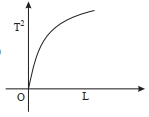
B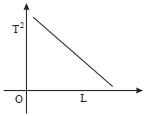
C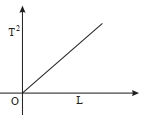
D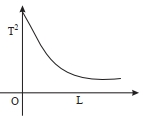
Solution
(C) The time period $(T)$ of a simple pendulum is given by the formula:
$T = 2\pi \sqrt{\frac{L}{g}}$
Squaring both sides,we get:
$T^2 = \frac{4\pi^2}{g} \times L$
This equation is of the form $y = mx$,where $y = T^2$,$x = L$,and the slope $m = \frac{4\pi^2}{g}$.
Since $m$ is a positive constant,the graph of $T^2$ versus $L$ is a straight line passing through the origin.
Therefore,the correct graph is represented by option $(C)$.
$T = 2\pi \sqrt{\frac{L}{g}}$
Squaring both sides,we get:
$T^2 = \frac{4\pi^2}{g} \times L$
This equation is of the form $y = mx$,where $y = T^2$,$x = L$,and the slope $m = \frac{4\pi^2}{g}$.
Since $m$ is a positive constant,the graph of $T^2$ versus $L$ is a straight line passing through the origin.
Therefore,the correct graph is represented by option $(C)$.
0 likes
View Solution227
DifficultMCQ
$A$ simple pendulum with length $100\,cm$ and bob of mass $250\,g$ is executing $S$.$H$.$M$. of amplitude $10\,cm$. The maximum tension in the string is found to be $\frac{x}{40}\,N$. The value of $x$ is $..........$.
A
$98$
B
$97$
C
$99$
D
$100$
Solution
(C) The maximum tension in a simple pendulum occurs at the mean position,given by $T_{max} = mg + \frac{mv^2}{l}$.
Using the conservation of energy,the kinetic energy at the mean position equals the potential energy at the extreme position: $\frac{1}{2}mv^2 = mgl(1 - \cos \theta_0)$,where $\sin \theta_0 = \frac{A}{l} = \frac{10}{100} = 0.1$.
Thus,$\frac{mv^2}{l} = 2mg(1 - \cos \theta_0)$.
Substituting this into the tension formula: $T_{max} = mg + 2mg(1 - \cos \theta_0) = mg(3 - 2\cos \theta_0)$.
Since $\cos \theta_0 = \sqrt{1 - \sin^2 \theta_0} = \sqrt{1 - (0.1)^2} = \sqrt{0.99} \approx 1 - \frac{0.01}{2} = 0.995$.
$T_{max} = 0.25 \times 9.8 \times (3 - 2 \times 0.995) = 2.45 \times (3 - 1.99) = 2.45 \times 1.01 = 2.4745$.
Given $T_{max} = \frac{x}{40}$,we have $x = 40 \times 2.4745 = 98.98 \approx 99$.
Using the conservation of energy,the kinetic energy at the mean position equals the potential energy at the extreme position: $\frac{1}{2}mv^2 = mgl(1 - \cos \theta_0)$,where $\sin \theta_0 = \frac{A}{l} = \frac{10}{100} = 0.1$.
Thus,$\frac{mv^2}{l} = 2mg(1 - \cos \theta_0)$.
Substituting this into the tension formula: $T_{max} = mg + 2mg(1 - \cos \theta_0) = mg(3 - 2\cos \theta_0)$.
Since $\cos \theta_0 = \sqrt{1 - \sin^2 \theta_0} = \sqrt{1 - (0.1)^2} = \sqrt{0.99} \approx 1 - \frac{0.01}{2} = 0.995$.
$T_{max} = 0.25 \times 9.8 \times (3 - 2 \times 0.995) = 2.45 \times (3 - 1.99) = 2.45 \times 1.01 = 2.4745$.
Given $T_{max} = \frac{x}{40}$,we have $x = 40 \times 2.4745 = 98.98 \approx 99$.
0 likes
View Solution228
DifficultMCQ
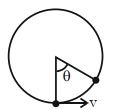
$A$ ball suspended by a thread swings in a vertical plane so that its magnitude of acceleration in the extreme position and lowest position are equal. The angle $(\theta)$ of thread deflection in the extreme position will be :
A
$\tan ^{-1}(\sqrt{2})$
B
$2 \tan ^{-1}\left(\frac{1}{2}\right)$
C
$\tan ^{-1}\left(\frac{1}{2}\right)$
D
$2 \tan ^{-1}\left(\frac{1}{\sqrt{5}}\right)$
Solution
(B) At the lowest position,the velocity is $v$. The acceleration is purely centripetal,given by $a_{low} = \frac{v^2}{\ell}$.
At the extreme position,the velocity is zero. The acceleration is purely tangential,given by $a_{ext} = g \sin \theta$.
By conservation of energy between the lowest point and the extreme point:
$\frac{1}{2} mv^2 = mg \ell(1 - \cos \theta) \Rightarrow \frac{v^2}{\ell} = 2g(1 - \cos \theta)$.
Given that the magnitudes of acceleration are equal:
$a_{low} = a_{ext} \Rightarrow \frac{v^2}{\ell} = g \sin \theta$.
Substituting the expression for $\frac{v^2}{\ell}$:
$2g(1 - \cos \theta) = g \sin \theta \Rightarrow 2(1 - \cos \theta) = \sin \theta$.
Using half-angle identities $1 - \cos \theta = 2 \sin^2(\theta/2)$ and $\sin \theta = 2 \sin(\theta/2) \cos(\theta/2)$:
$2(2 \sin^2(\theta/2)) = 2 \sin(\theta/2) \cos(\theta/2)$.
Dividing by $2 \sin(\theta/2)$ (assuming $\theta \neq 0$):
$2 \sin(\theta/2) = \cos(\theta/2) \Rightarrow \tan(\theta/2) = \frac{1}{2}$.
Therefore,$\theta = 2 \tan^{-1}\left(\frac{1}{2}\right)$.
At the extreme position,the velocity is zero. The acceleration is purely tangential,given by $a_{ext} = g \sin \theta$.
By conservation of energy between the lowest point and the extreme point:
$\frac{1}{2} mv^2 = mg \ell(1 - \cos \theta) \Rightarrow \frac{v^2}{\ell} = 2g(1 - \cos \theta)$.
Given that the magnitudes of acceleration are equal:
$a_{low} = a_{ext} \Rightarrow \frac{v^2}{\ell} = g \sin \theta$.
Substituting the expression for $\frac{v^2}{\ell}$:
$2g(1 - \cos \theta) = g \sin \theta \Rightarrow 2(1 - \cos \theta) = \sin \theta$.
Using half-angle identities $1 - \cos \theta = 2 \sin^2(\theta/2)$ and $\sin \theta = 2 \sin(\theta/2) \cos(\theta/2)$:
$2(2 \sin^2(\theta/2)) = 2 \sin(\theta/2) \cos(\theta/2)$.
Dividing by $2 \sin(\theta/2)$ (assuming $\theta \neq 0$):
$2 \sin(\theta/2) = \cos(\theta/2) \Rightarrow \tan(\theta/2) = \frac{1}{2}$.
Therefore,$\theta = 2 \tan^{-1}\left(\frac{1}{2}\right)$.
1 likes
View Solution229
DifficultMCQ
If $R$ is the radius of the earth and the acceleration due to gravity on the surface of the earth is $g = \pi^2 \ m/s^2$,then the length of the second's pendulum at a height $h = 2R$ from the surface of the earth will be:
A
$\frac{2}{9} \ m$
B
$\frac{1}{9} \ m$
C
$\frac{4}{9} \ m$
D
$\frac{8}{9} \ m$
Solution
(B) The acceleration due to gravity at a height $h$ is given by $g' = g \left( \frac{R}{R+h} \right)^2$.
Given $h = 2R$,we have $g' = g \left( \frac{R}{R+2R} \right)^2 = g \left( \frac{R}{3R} \right)^2 = \frac{g}{9}$.
The time period of a simple pendulum is $T = 2\pi \sqrt{\frac{\ell}{g'}}$.
For a second's pendulum,$T = 2 \ s$.
Substituting the values: $2 = 2\pi \sqrt{\frac{\ell}{g/9}} = 2\pi \sqrt{\frac{9\ell}{g}}$.
Dividing by $2$: $1 = \pi \sqrt{\frac{9\ell}{g}}$.
Squaring both sides: $1 = \pi^2 \left( \frac{9\ell}{g} \right)$.
Given $g = \pi^2 \ m/s^2$,we substitute this into the equation: $1 = \pi^2 \left( \frac{9\ell}{\pi^2} \right) = 9\ell$.
Therefore,$\ell = \frac{1}{9} \ m$.
Given $h = 2R$,we have $g' = g \left( \frac{R}{R+2R} \right)^2 = g \left( \frac{R}{3R} \right)^2 = \frac{g}{9}$.
The time period of a simple pendulum is $T = 2\pi \sqrt{\frac{\ell}{g'}}$.
For a second's pendulum,$T = 2 \ s$.
Substituting the values: $2 = 2\pi \sqrt{\frac{\ell}{g/9}} = 2\pi \sqrt{\frac{9\ell}{g}}$.
Dividing by $2$: $1 = \pi \sqrt{\frac{9\ell}{g}}$.
Squaring both sides: $1 = \pi^2 \left( \frac{9\ell}{g} \right)$.
Given $g = \pi^2 \ m/s^2$,we substitute this into the equation: $1 = \pi^2 \left( \frac{9\ell}{\pi^2} \right) = 9\ell$.
Therefore,$\ell = \frac{1}{9} \ m$.
0 likes
View Solution230
MediumMCQ
If the mass of the bob in a simple pendulum is increased to thrice its original mass and its length is made half its original length,then the new time period of oscillation is $\frac{x}{2}$ times its original time period. Then the value of $x$ is
A
$\sqrt{2}$
B
$2 \sqrt{3}$
C
$4$
D
$\sqrt{3}$
Solution
(A) The time period of a simple pendulum is given by $T = 2 \pi \sqrt{\frac{\ell}{g}}$,where $\ell$ is the length of the pendulum and $g$ is the acceleration due to gravity. The time period is independent of the mass of the bob.
Given that the new length $\ell^{\prime} = \frac{\ell}{2}$.
The new time period $T^{\prime} = 2 \pi \sqrt{\frac{\ell^{\prime}}{g}} = 2 \pi \sqrt{\frac{\ell}{2g}} = \frac{1}{\sqrt{2}} \left( 2 \pi \sqrt{\frac{\ell}{g}} \right) = \frac{1}{\sqrt{2}} T$.
According to the problem,$T^{\prime} = \frac{x}{2} T$.
Therefore,$\frac{x}{2} = \frac{1}{\sqrt{2}}$.
$x = \frac{2}{\sqrt{2}} = \sqrt{2}$.
Given that the new length $\ell^{\prime} = \frac{\ell}{2}$.
The new time period $T^{\prime} = 2 \pi \sqrt{\frac{\ell^{\prime}}{g}} = 2 \pi \sqrt{\frac{\ell}{2g}} = \frac{1}{\sqrt{2}} \left( 2 \pi \sqrt{\frac{\ell}{g}} \right) = \frac{1}{\sqrt{2}} T$.
According to the problem,$T^{\prime} = \frac{x}{2} T$.
Therefore,$\frac{x}{2} = \frac{1}{\sqrt{2}}$.
$x = \frac{2}{\sqrt{2}} = \sqrt{2}$.
0 likes
View Solution231
MediumMCQ
Two simple pendulums having lengths $l_1$ and $l_2$ with negligible string mass undergo angular displacements $\theta_1$ and $\theta_2$ from their mean positions,respectively. If the angular accelerations of both pendulums are same,then which expression is correct?
A
$\theta_1 l_2^2 = \theta_2 l_1^2$
B
$\theta_1 l_1 = \theta_2 l_2$
C
$\theta_1 l_1^2 = \theta_2 l_2^2$
D
$\theta_1 l_2 = \theta_2 l_1$
Solution
(D) For a simple pendulum,the angular acceleration $\alpha$ is given by the equation $\alpha = -\omega^2 \theta$,where $\omega^2 = \frac{g}{l}$.
Since the angular accelerations are equal in magnitude,we have $|\alpha_1| = |\alpha_2|$.
Substituting the expression for $\alpha$,we get $\frac{g}{l_1} \theta_1 = \frac{g}{l_2} \theta_2$.
Canceling the acceleration due to gravity $g$ from both sides,we obtain $\frac{\theta_1}{l_1} = \frac{\theta_2}{l_2}$.
Rearranging the terms,we get $\theta_1 l_2 = \theta_2 l_1$.
Since the angular accelerations are equal in magnitude,we have $|\alpha_1| = |\alpha_2|$.
Substituting the expression for $\alpha$,we get $\frac{g}{l_1} \theta_1 = \frac{g}{l_2} \theta_2$.
Canceling the acceleration due to gravity $g$ from both sides,we obtain $\frac{\theta_1}{l_1} = \frac{\theta_2}{l_2}$.
Rearranging the terms,we get $\theta_1 l_2 = \theta_2 l_1$.
0 likes
View Solution232
MediumMCQ
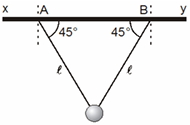
Two light strings,each of length $\ell$,are fixed at points $A$ and $B$ on a fixed horizontal rod $xy$. $A$ small bob is tied by both strings and is in equilibrium,the strings are making an angle of $45^{\circ}$ with the rod. If the bob is slightly displaced normal to the plane of the strings and released,then the period of the resulting small oscillation will be:
A
$2 \pi \sqrt{\frac{2 \sqrt{2} \ell}{g}}$
B
$2 \pi \sqrt{\frac{\sqrt{2} \ell}{g}}$
C
$2 \pi \sqrt{\frac{\ell}{g}}$
D
$2 \pi \sqrt{\frac{\ell}{\sqrt{2} g}}$
Solution
(D) Let the distance between points $A$ and $B$ be $d$. The vertical distance of the bob from the rod is $h = \ell \sin 45^{\circ} = \frac{\ell}{\sqrt{2}}$.
When the bob is displaced by a small angle $\theta$ normal to the plane of the strings,the effective length of the pendulum is the perpendicular distance from the rod to the bob,which is $h = \frac{\ell}{\sqrt{2}}$.
The restoring force for small oscillations is provided by the component of gravity,and the motion is equivalent to a simple pendulum of length $L_{eff} = h = \frac{\ell}{\sqrt{2}}$.
The time period $T$ is given by $T = 2 \pi \sqrt{\frac{L_{eff}}{g}}$.
Substituting $L_{eff} = \frac{\ell}{\sqrt{2}}$,we get $T = 2 \pi \sqrt{\frac{\ell}{\sqrt{2} g}}$.
When the bob is displaced by a small angle $\theta$ normal to the plane of the strings,the effective length of the pendulum is the perpendicular distance from the rod to the bob,which is $h = \frac{\ell}{\sqrt{2}}$.
The restoring force for small oscillations is provided by the component of gravity,and the motion is equivalent to a simple pendulum of length $L_{eff} = h = \frac{\ell}{\sqrt{2}}$.
The time period $T$ is given by $T = 2 \pi \sqrt{\frac{L_{eff}}{g}}$.
Substituting $L_{eff} = \frac{\ell}{\sqrt{2}}$,we get $T = 2 \pi \sqrt{\frac{\ell}{\sqrt{2} g}}$.
0 likes
View Solution233
MediumMCQ
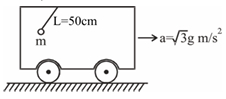
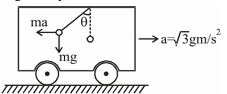
$A$ $50 \ cm$ long simple pendulum is suspended from the roof of a cart accelerating in the horizontal direction with constant acceleration $\sqrt{3} \ g \ m/s^2$. The time period of small oscillations of the pendulum about its equilibrium position is $.... \ s$ $\left(g=\pi^2 \ m/s^2\right):-$
A
$1$
B
$2$
C
$1.53$
D
$1.68$
Solution
(A) With respect to the cart,the equilibrium position of the pendulum is shifted due to the pseudo force acting on the bob. The effective acceleration $g_{\text{eff}}$ acting on the pendulum is the vector sum of the acceleration due to gravity $g$ and the pseudo acceleration $a = \sqrt{3}g$ in the opposite direction of the cart's motion.
$g_{\text{eff}} = \sqrt{g^2 + a^2} = \sqrt{g^2 + (\sqrt{3}g)^2} = \sqrt{g^2 + 3g^2} = \sqrt{4g^2} = 2g$.
Given $g = \pi^2 \ m/s^2$,we have $g_{\text{eff}} = 2\pi^2 \ m/s^2$.
The time period $T$ of a simple pendulum is given by $T = 2\pi \sqrt{\frac{L}{g_{\text{eff}}}}$.
Substituting $L = 50 \ cm = 0.5 \ m$ and $g_{\text{eff}} = 2\pi^2 \ m/s^2$:
$T = 2\pi \sqrt{\frac{0.5}{2\pi^2}} = 2\pi \sqrt{\frac{0.5}{2} \cdot \frac{1}{\pi^2}} = 2\pi \cdot \frac{1}{\pi} \sqrt{0.25} = 2 \cdot 0.5 = 1.0 \ s$.
$g_{\text{eff}} = \sqrt{g^2 + a^2} = \sqrt{g^2 + (\sqrt{3}g)^2} = \sqrt{g^2 + 3g^2} = \sqrt{4g^2} = 2g$.
Given $g = \pi^2 \ m/s^2$,we have $g_{\text{eff}} = 2\pi^2 \ m/s^2$.
The time period $T$ of a simple pendulum is given by $T = 2\pi \sqrt{\frac{L}{g_{\text{eff}}}}$.
Substituting $L = 50 \ cm = 0.5 \ m$ and $g_{\text{eff}} = 2\pi^2 \ m/s^2$:
$T = 2\pi \sqrt{\frac{0.5}{2\pi^2}} = 2\pi \sqrt{\frac{0.5}{2} \cdot \frac{1}{\pi^2}} = 2\pi \cdot \frac{1}{\pi} \sqrt{0.25} = 2 \cdot 0.5 = 1.0 \ s$.
0 likes
View Solution234
DifficultMCQ
The length of the seconds pendulum is $1 \,m$ on Earth. If the mass and diameter of a planet are $1.5$ times that of the Earth, the length of the seconds pendulum on the planet will be nearly (in $\,m$)
A
$0.67$
B
$0.45$
C
$0.60$
D
$0.76$
Solution
(A) The time period of a seconds pendulum is $T = 2 \,s$. The formula for the time period is $T = 2 \pi \sqrt{\frac{\ell}{g}}$.
Since $T$ is constant $(2 \,s)$, we have $\ell \propto g$, which implies $\frac{\ell'}{\ell} = \frac{g'}{g}$.
The acceleration due to gravity is given by $g = \frac{GM}{R^2}$.
For the planet, $M' = 1.5M$ and $R' = 1.5R$.
Thus, $g' = \frac{G(1.5M)}{(1.5R)^2} = \frac{1.5}{2.25} \frac{GM}{R^2} = \frac{1}{1.5} g$.
Substituting this into the length ratio: $\ell' = \ell \times \frac{g'}{g} = 1 \,m \times \frac{1}{1.5} = \frac{1}{1.5} \,m \approx 0.67 \,m$.
Since $T$ is constant $(2 \,s)$, we have $\ell \propto g$, which implies $\frac{\ell'}{\ell} = \frac{g'}{g}$.
The acceleration due to gravity is given by $g = \frac{GM}{R^2}$.
For the planet, $M' = 1.5M$ and $R' = 1.5R$.
Thus, $g' = \frac{G(1.5M)}{(1.5R)^2} = \frac{1.5}{2.25} \frac{GM}{R^2} = \frac{1}{1.5} g$.
Substituting this into the length ratio: $\ell' = \ell \times \frac{g'}{g} = 1 \,m \times \frac{1}{1.5} = \frac{1}{1.5} \,m \approx 0.67 \,m$.
0 likes
View Solution235
MediumMCQ
$A$ seconds pendulum is placed in a space laboratory orbiting round the Earth at a height $3R$ from the Earth's surface. The time period of the pendulum will be ($R =$ radius of Earth).
A
zero
B
$\frac{2}{3} \text{ s}$
C
$4 \text{ s}$
D
infinite
Solution
(D) seconds pendulum is a pendulum whose time period is $2 \text{ s}$.
In a space laboratory orbiting the Earth,the laboratory and everything inside it are in a state of weightlessness.
This means the effective acceleration due to gravity $(g_{\text{eff}})$ inside the laboratory is $0$.
The formula for the time period of a simple pendulum is $T = 2\pi \sqrt{\frac{l}{g_{\text{eff}}}}$.
Substituting $g_{\text{eff}} = 0$ into the formula,we get $T = 2\pi \sqrt{\frac{l}{0}} = \infty$.
Therefore,the time period of the pendulum will be infinite.
In a space laboratory orbiting the Earth,the laboratory and everything inside it are in a state of weightlessness.
This means the effective acceleration due to gravity $(g_{\text{eff}})$ inside the laboratory is $0$.
The formula for the time period of a simple pendulum is $T = 2\pi \sqrt{\frac{l}{g_{\text{eff}}}}$.
Substituting $g_{\text{eff}} = 0$ into the formula,we get $T = 2\pi \sqrt{\frac{l}{0}} = \infty$.
Therefore,the time period of the pendulum will be infinite.
0 likes
View Solution236
MediumMCQ
$A$ bob of a simple pendulum of mass $m$ is displaced through $90^{\circ}$ from the mean position and released. When the bob is at the lowest position,the tension in the string is:
A
$4mg$
B
$2mg$
C
$mg$
D
$3mg$
Solution
(D) Let the length of the pendulum be $r$. When the bob is displaced by $90^{\circ}$ from the mean position,its height relative to the lowest point is $r$.
By the law of conservation of energy,the potential energy at the highest point is converted into kinetic energy at the lowest point:
$PE_{top} = KE_{bottom}$
$mgr = \frac{1}{2}mv^2$
$mv^2 = 2mgr$
At the lowest position,the forces acting on the bob are the tension $T$ (upwards) and weight $mg$ (downwards). The net force provides the necessary centripetal force:
$T - mg = \frac{mv^2}{r}$
$T = mg + \frac{mv^2}{r}$
Substituting $mv^2 = 2mgr$ into the equation:
$T = mg + \frac{2mgr}{r} = mg + 2mg = 3mg$.
By the law of conservation of energy,the potential energy at the highest point is converted into kinetic energy at the lowest point:
$PE_{top} = KE_{bottom}$
$mgr = \frac{1}{2}mv^2$
$mv^2 = 2mgr$
At the lowest position,the forces acting on the bob are the tension $T$ (upwards) and weight $mg$ (downwards). The net force provides the necessary centripetal force:
$T - mg = \frac{mv^2}{r}$
$T = mg + \frac{mv^2}{r}$
Substituting $mv^2 = 2mgr$ into the equation:
$T = mg + \frac{2mgr}{r} = mg + 2mg = 3mg$.
0 likes
View Solution237
MediumMCQ
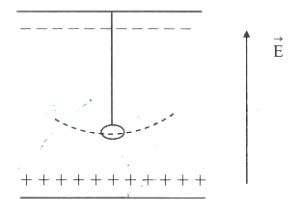
The bob of a simple pendulum of length $L$ has a mass $m$ and charge $q$. The pendulum is suspended between the plates of a charged parallel plate capacitor. The direction of the electric field is shown in the figure. The period of oscillations of the simple pendulum is (acceleration due to gravity $g > qE/m$):
A
$2 \pi \sqrt{\frac{L}{g}}$
B
$2 \pi \left[ \frac{L}{\frac{qE}{m} - g} \right]^{\frac{1}{2}}$
C
$2 \pi \left[ \frac{L}{g - \frac{qE}{m}} \right]^{\frac{1}{2}}$
D
$2 \pi \left[ \frac{L}{g + \frac{qE}{m}} \right]^{\frac{1}{2}}$
Solution
(C) The electric force acting on the bob is $F_{\text{electric}} = qE$,which acts in the upward direction as per the figure.
The effective weight of the bob is given by $mg_{\text{eff}} = mg - F_{\text{electric}}$.
Therefore,the effective acceleration due to gravity is $g_{\text{eff}} = g - \frac{qE}{m}$.
The time period of a simple pendulum is given by $T = 2 \pi \sqrt{\frac{L}{g_{\text{eff}}}}$.
Substituting the value of $g_{\text{eff}}$,we get $T = 2 \pi \sqrt{\frac{L}{g - \frac{qE}{m}}} = 2 \pi \left[ \frac{L}{g - \frac{qE}{m}} \right]^{\frac{1}{2}}$.
The effective weight of the bob is given by $mg_{\text{eff}} = mg - F_{\text{electric}}$.
Therefore,the effective acceleration due to gravity is $g_{\text{eff}} = g - \frac{qE}{m}$.
The time period of a simple pendulum is given by $T = 2 \pi \sqrt{\frac{L}{g_{\text{eff}}}}$.
Substituting the value of $g_{\text{eff}}$,we get $T = 2 \pi \sqrt{\frac{L}{g - \frac{qE}{m}}} = 2 \pi \left[ \frac{L}{g - \frac{qE}{m}} \right]^{\frac{1}{2}}$.
0 likes
View Solution238
MediumMCQ
The time period of a simple pendulum inside a stationary lift is $\sqrt{3} \ s$. When the lift moves upwards with an acceleration $g/3$,the new time period will be ($g=$ acceleration due to gravity).
A
$1.5 \ s$
B
$2 \ s$
C
$\sqrt{3} \ s$
D
$3 \ s$
Solution
(A) The time period of a simple pendulum is given by $T = 2\pi \sqrt{\frac{L}{g_{eff}}}$.
For a stationary lift,$g_{eff} = g$,so $T_1 = 2\pi \sqrt{\frac{L}{g}} = \sqrt{3} \ s$.
When the lift moves upwards with an acceleration $a = g/3$,the effective acceleration is $g_{eff} = g + a = g + g/3 = 4g/3$.
The new time period $T_2$ is given by $T_2 = 2\pi \sqrt{\frac{L}{4g/3}} = 2\pi \sqrt{\frac{3L}{4g}} = \sqrt{\frac{3}{4}} \times (2\pi \sqrt{\frac{L}{g}})$.
Substituting $T_1 = \sqrt{3} \ s$,we get $T_2 = \frac{\sqrt{3}}{2} \times \sqrt{3} = \frac{3}{2} = 1.5 \ s$.
For a stationary lift,$g_{eff} = g$,so $T_1 = 2\pi \sqrt{\frac{L}{g}} = \sqrt{3} \ s$.
When the lift moves upwards with an acceleration $a = g/3$,the effective acceleration is $g_{eff} = g + a = g + g/3 = 4g/3$.
The new time period $T_2$ is given by $T_2 = 2\pi \sqrt{\frac{L}{4g/3}} = 2\pi \sqrt{\frac{3L}{4g}} = \sqrt{\frac{3}{4}} \times (2\pi \sqrt{\frac{L}{g}})$.
Substituting $T_1 = \sqrt{3} \ s$,we get $T_2 = \frac{\sqrt{3}}{2} \times \sqrt{3} = \frac{3}{2} = 1.5 \ s$.
0 likes
View Solution239
MediumMCQ
$A$ simple pendulum has a time period $T_1$. The point of suspension is now moved upward according to the equation $y = kt^2$,where $k = 1 \ m/s^2$. If the new time period is $T_2$,then the ratio $\frac{T_1^2}{T_2^2}$ will be (take $g = 10 \ m/s^2$):
A
$\frac{2}{3}$
B
$\frac{5}{6}$
C
$\frac{6}{5}$
D
$\frac{3}{2}$
Solution
(C) The time period of a simple pendulum is given by $T = 2\pi \sqrt{\frac{L}{g_{eff}}}$.
Initially,the point of suspension is at rest,so $g_{eff} = g = 10 \ m/s^2$. Thus,$T_1 = 2\pi \sqrt{\frac{L}{g}}$.
When the point of suspension moves upward with an acceleration $a$,the effective acceleration is $g_{eff} = g + a$.
Given the displacement $y = kt^2$,the acceleration $a$ is the second derivative of displacement with respect to time: $a = \frac{d^2y}{dt^2} = \frac{d^2}{dt^2}(kt^2) = 2k$.
Given $k = 1 \ m/s^2$,we have $a = 2(1) = 2 \ m/s^2$.
Therefore,$g_{eff} = g + a = 10 + 2 = 12 \ m/s^2$.
The new time period is $T_2 = 2\pi \sqrt{\frac{L}{g_{eff}}} = 2\pi \sqrt{\frac{L}{12}}$.
Now,the ratio $\frac{T_1^2}{T_2^2} = \frac{4\pi^2 (L/g)}{4\pi^2 (L/g_{eff})} = \frac{g_{eff}}{g} = \frac{12}{10} = \frac{6}{5}$.
Initially,the point of suspension is at rest,so $g_{eff} = g = 10 \ m/s^2$. Thus,$T_1 = 2\pi \sqrt{\frac{L}{g}}$.
When the point of suspension moves upward with an acceleration $a$,the effective acceleration is $g_{eff} = g + a$.
Given the displacement $y = kt^2$,the acceleration $a$ is the second derivative of displacement with respect to time: $a = \frac{d^2y}{dt^2} = \frac{d^2}{dt^2}(kt^2) = 2k$.
Given $k = 1 \ m/s^2$,we have $a = 2(1) = 2 \ m/s^2$.
Therefore,$g_{eff} = g + a = 10 + 2 = 12 \ m/s^2$.
The new time period is $T_2 = 2\pi \sqrt{\frac{L}{g_{eff}}} = 2\pi \sqrt{\frac{L}{12}}$.
Now,the ratio $\frac{T_1^2}{T_2^2} = \frac{4\pi^2 (L/g)}{4\pi^2 (L/g_{eff})} = \frac{g_{eff}}{g} = \frac{12}{10} = \frac{6}{5}$.
0 likes
View Solution240
EasyMCQ
The length of the simple pendulum is made $3$ times the original length. If $T$ is its original time period,then the new time period will be:
A
$3 T$
B
$\sqrt{3} T$
C
$\frac{T}{\sqrt{3}}$
D
$\frac{T}{3}$
Solution
(B) The time period $T$ of a simple pendulum is given by the formula: $T = 2\pi \sqrt{\frac{L}{g}}$,where $L$ is the length of the pendulum and $g$ is the acceleration due to gravity.
From this formula,we can see that $T \propto \sqrt{L}$.
Let the original length be $L_1 = L$ and the original time period be $T_1 = T$.
The new length is $L_2 = 3L$.
Let the new time period be $T_2$.
Using the proportionality $T \propto \sqrt{L}$,we have: $\frac{T_2}{T_1} = \sqrt{\frac{L_2}{L_1}}$.
Substituting the values: $\frac{T_2}{T} = \sqrt{\frac{3L}{L}} = \sqrt{3}$.
Therefore,$T_2 = \sqrt{3} T$.
From this formula,we can see that $T \propto \sqrt{L}$.
Let the original length be $L_1 = L$ and the original time period be $T_1 = T$.
The new length is $L_2 = 3L$.
Let the new time period be $T_2$.
Using the proportionality $T \propto \sqrt{L}$,we have: $\frac{T_2}{T_1} = \sqrt{\frac{L_2}{L_1}}$.
Substituting the values: $\frac{T_2}{T} = \sqrt{\frac{3L}{L}} = \sqrt{3}$.
Therefore,$T_2 = \sqrt{3} T$.
0 likes
View Solution241
EasyMCQ
$A$ small sphere oscillates simple harmonically in a watch glass whose radius of curvature is $1.6 \ m$. The period of oscillation of the sphere is (acceleration due to gravity $g = 10 \ m/s^2$) (in $\pi \ s$)
A
$0.2$
B
$0.4$
C
$0.6$
D
$0.8$
Solution
(D) small sphere oscillating in a watch glass acts as a simple pendulum.
The effective length $L$ of this equivalent pendulum is equal to the radius of curvature $R$ of the watch glass.
Given,$R = 1.6 \ m$ and $g = 10 \ m/s^2$.
The formula for the time period $T$ of a simple pendulum is $T = 2\pi \sqrt{\frac{L}{g}}$.
Substituting the values,we get $T = 2\pi \sqrt{\frac{1.6}{10}}$.
$T = 2\pi \sqrt{0.16}$.
$T = 2\pi \times 0.4$.
$T = 0.8\pi \ s$.
The effective length $L$ of this equivalent pendulum is equal to the radius of curvature $R$ of the watch glass.
Given,$R = 1.6 \ m$ and $g = 10 \ m/s^2$.
The formula for the time period $T$ of a simple pendulum is $T = 2\pi \sqrt{\frac{L}{g}}$.
Substituting the values,we get $T = 2\pi \sqrt{\frac{1.6}{10}}$.
$T = 2\pi \sqrt{0.16}$.
$T = 2\pi \times 0.4$.
$T = 0.8\pi \ s$.
0 likes
View Solution242
MediumMCQ
$A$ simple pendulum is suspended from the ceiling of a lift. When the lift is at rest,its period is $T$. With what acceleration $a$ should the lift be accelerated upward in order to reduce the period to $\frac{T}{2}$? (Take $g$ as the acceleration due to gravity.)
A
$2g$
B
$3g$
C
$4g$
D
$g$
Solution
(B) The time period of a simple pendulum is given by $T = 2\pi \sqrt{\frac{L}{g_{eff}}}$.
When the lift is at rest,$g_{eff} = g$,so $T = 2\pi \sqrt{\frac{L}{g}}$.
When the lift accelerates upward with acceleration $a$,the effective gravity becomes $g_{eff} = g + a$.
The new time period is $T' = 2\pi \sqrt{\frac{L}{g+a}}$.
Given that $T' = \frac{T}{2}$,we have $\frac{T}{2} = 2\pi \sqrt{\frac{L}{g+a}}$.
Substituting $T = 2\pi \sqrt{\frac{L}{g}}$,we get $\frac{1}{2} \left( 2\pi \sqrt{\frac{L}{g}} \right) = 2\pi \sqrt{\frac{L}{g+a}}$.
Squaring both sides: $\frac{1}{4} \left( \frac{L}{g} \right) = \frac{L}{g+a}$.
This simplifies to $g + a = 4g$,which gives $a = 3g$.
When the lift is at rest,$g_{eff} = g$,so $T = 2\pi \sqrt{\frac{L}{g}}$.
When the lift accelerates upward with acceleration $a$,the effective gravity becomes $g_{eff} = g + a$.
The new time period is $T' = 2\pi \sqrt{\frac{L}{g+a}}$.
Given that $T' = \frac{T}{2}$,we have $\frac{T}{2} = 2\pi \sqrt{\frac{L}{g+a}}$.
Substituting $T = 2\pi \sqrt{\frac{L}{g}}$,we get $\frac{1}{2} \left( 2\pi \sqrt{\frac{L}{g}} \right) = 2\pi \sqrt{\frac{L}{g+a}}$.
Squaring both sides: $\frac{1}{4} \left( \frac{L}{g} \right) = \frac{L}{g+a}$.
This simplifies to $g + a = 4g$,which gives $a = 3g$.
0 likes
View Solution243
MediumMCQ
Let $l_1$ be the length of a simple pendulum. Its length changes to $l_2$ to increase the periodic time by $20 \%$. The ratio $\frac{l_2}{l_1}$ is:
A
$1.22$
B
$1.33$
C
$1.44$
D
$1.55$
Solution
(C) The time period of a simple pendulum is given by $T = 2\pi \sqrt{\frac{l}{g}}$.
Since $T \propto \sqrt{l}$,we have $\frac{T_2}{T_1} = \sqrt{\frac{l_2}{l_1}}$.
Given that the periodic time increases by $20 \%$,the new time period $T_2$ is $T_2 = T_1 + 0.20 T_1 = 1.2 T_1$.
Therefore,$\frac{T_2}{T_1} = 1.2$.
Squaring both sides,we get $\left(\frac{T_2}{T_1}\right)^2 = \frac{l_2}{l_1}$.
Substituting the values,$\frac{l_2}{l_1} = (1.2)^2 = 1.44$.
Since $T \propto \sqrt{l}$,we have $\frac{T_2}{T_1} = \sqrt{\frac{l_2}{l_1}}$.
Given that the periodic time increases by $20 \%$,the new time period $T_2$ is $T_2 = T_1 + 0.20 T_1 = 1.2 T_1$.
Therefore,$\frac{T_2}{T_1} = 1.2$.
Squaring both sides,we get $\left(\frac{T_2}{T_1}\right)^2 = \frac{l_2}{l_1}$.
Substituting the values,$\frac{l_2}{l_1} = (1.2)^2 = 1.44$.
0 likes
View Solution244
MediumMCQ
There is a second's pendulum on the surface of the Earth. It is taken to the surface of a planet whose mass and radius are twice that of the Earth. The period of oscillation of the second's pendulum on the planet will be:
A
$2 \sqrt{2} \ s$
B
$2 \ s$
C
$\frac{1}{\sqrt{2}} \ s$
D
$\frac{1}{2} \ s$
Solution
(A) The acceleration due to gravity is given by $g = \frac{GM}{R^2}$.
Given for the planet: $M_p = 2M_e$ and $R_p = 2R_e$.
Thus,the ratio of gravity on Earth to the planet is:
$\frac{g_e}{g_p} = \frac{M_e}{M_p} \times \left(\frac{R_p}{R_e}\right)^2 = \frac{M_e}{2M_e} \times \left(\frac{2R_e}{R_e}\right)^2 = \frac{1}{2} \times 4 = 2$.
So,$g_p = \frac{g_e}{2}$.
The time period of a pendulum is $T = 2\pi \sqrt{\frac{L}{g}}$,which implies $T \propto \frac{1}{\sqrt{g}}$.
Therefore,$\frac{T_p}{T_e} = \sqrt{\frac{g_e}{g_p}} = \sqrt{2}$.
Since the time period of a second's pendulum on Earth is $T_e = 2 \ s$,we have:
$T_p = T_e \times \sqrt{2} = 2\sqrt{2} \ s$.
Given for the planet: $M_p = 2M_e$ and $R_p = 2R_e$.
Thus,the ratio of gravity on Earth to the planet is:
$\frac{g_e}{g_p} = \frac{M_e}{M_p} \times \left(\frac{R_p}{R_e}\right)^2 = \frac{M_e}{2M_e} \times \left(\frac{2R_e}{R_e}\right)^2 = \frac{1}{2} \times 4 = 2$.
So,$g_p = \frac{g_e}{2}$.
The time period of a pendulum is $T = 2\pi \sqrt{\frac{L}{g}}$,which implies $T \propto \frac{1}{\sqrt{g}}$.
Therefore,$\frac{T_p}{T_e} = \sqrt{\frac{g_e}{g_p}} = \sqrt{2}$.
Since the time period of a second's pendulum on Earth is $T_e = 2 \ s$,we have:
$T_p = T_e \times \sqrt{2} = 2\sqrt{2} \ s$.
0 likes
View Solution245
MediumMCQ
In a stationary lift,the time period of a simple pendulum is $T$. If the lift starts accelerating downwards with an acceleration of $\frac{g}{4}$,then the new time period of the pendulum will be:
A
$\frac{\sqrt{3}}{2} T$
B
$\frac{2}{\sqrt{3}} T$
C
$\frac{3}{4} T$
D
$\frac{4}{3} T$
Solution
(B) The time period of a simple pendulum is given by $T = 2 \pi \sqrt{\frac{L}{g}}$.
When the lift accelerates downwards with an acceleration $a = \frac{g}{4}$,the effective acceleration due to gravity $g_{\text{eff}}$ becomes $g - a$.
$g_{\text{eff}} = g - \frac{g}{4} = \frac{3g}{4}$.
The new time period $T_1$ is given by $T_1 = 2 \pi \sqrt{\frac{L}{g_{\text{eff}}}} = 2 \pi \sqrt{\frac{L}{\frac{3g}{4}}}$.
$T_1 = 2 \pi \sqrt{\frac{4L}{3g}} = 2 \pi \sqrt{\frac{L}{g}} \times \sqrt{\frac{4}{3}}$.
Since $T = 2 \pi \sqrt{\frac{L}{g}}$,we have $T_1 = T \times \frac{2}{\sqrt{3}} = \frac{2}{\sqrt{3}} T$.
When the lift accelerates downwards with an acceleration $a = \frac{g}{4}$,the effective acceleration due to gravity $g_{\text{eff}}$ becomes $g - a$.
$g_{\text{eff}} = g - \frac{g}{4} = \frac{3g}{4}$.
The new time period $T_1$ is given by $T_1 = 2 \pi \sqrt{\frac{L}{g_{\text{eff}}}} = 2 \pi \sqrt{\frac{L}{\frac{3g}{4}}}$.
$T_1 = 2 \pi \sqrt{\frac{4L}{3g}} = 2 \pi \sqrt{\frac{L}{g}} \times \sqrt{\frac{4}{3}}$.
Since $T = 2 \pi \sqrt{\frac{L}{g}}$,we have $T_1 = T \times \frac{2}{\sqrt{3}} = \frac{2}{\sqrt{3}} T$.
0 likes
View Solution246
DifficultMCQ
$A$ simple pendulum has a time period $T$ in air. Its time period when it is completely immersed in a liquid of density one-eighth the density of the material of the bob is:
A
$\sqrt{\frac{7}{8}} T$
B
$\sqrt{\frac{5}{8}} T$
C
$\sqrt{\frac{3}{8}} T$
D
$\sqrt{\frac{8}{7}} T$
Solution
(D) The time period of a simple pendulum is given by $T = 2\pi \sqrt{\frac{l}{g}}$.
This implies $T \propto \frac{1}{\sqrt{g}}$.
When the bob is immersed in a liquid,the effective acceleration due to gravity $g'$ changes due to the buoyant force.
The effective weight $W' = V \rho g - V \sigma g$,where $\rho$ is the density of the bob and $\sigma$ is the density of the liquid.
Given $\sigma = \frac{\rho}{8}$,the effective acceleration $g'$ is:
$g' = g \left(1 - \frac{\sigma}{\rho}\right) = g \left(1 - \frac{1}{8}\right) = g \left(\frac{7}{8}\right)$.
The new time period $T'$ is given by:
$T' = 2\pi \sqrt{\frac{l}{g'}} = 2\pi \sqrt{\frac{l}{g(7/8)}} = \sqrt{\frac{8}{7}} \left(2\pi \sqrt{\frac{l}{g}}\right) = \sqrt{\frac{8}{7}} T$.
This implies $T \propto \frac{1}{\sqrt{g}}$.
When the bob is immersed in a liquid,the effective acceleration due to gravity $g'$ changes due to the buoyant force.
The effective weight $W' = V \rho g - V \sigma g$,where $\rho$ is the density of the bob and $\sigma$ is the density of the liquid.
Given $\sigma = \frac{\rho}{8}$,the effective acceleration $g'$ is:
$g' = g \left(1 - \frac{\sigma}{\rho}\right) = g \left(1 - \frac{1}{8}\right) = g \left(\frac{7}{8}\right)$.
The new time period $T'$ is given by:
$T' = 2\pi \sqrt{\frac{l}{g'}} = 2\pi \sqrt{\frac{l}{g(7/8)}} = \sqrt{\frac{8}{7}} \left(2\pi \sqrt{\frac{l}{g}}\right) = \sqrt{\frac{8}{7}} T$.
0 likes
View Solution247
DifficultMCQ
The bob of a simple pendulum of length $L$ is released from a position of small angular displacement $\theta$. Its linear displacement at time $t$ is ($g =$ acceleration due to gravity).
A
$L \theta \cos \left[\sqrt{\frac{g}{L}} \cdot t\right]$
B
$L \theta \sin \left[2 \pi \sqrt{\frac{g}{L}} \cdot t\right]$
C
$L \theta \cos \left[2 \pi \sqrt{\frac{g}{L}} \cdot t\right]$
D
$L \theta \sin \left[\sqrt{\frac{g}{L}} \cdot t\right]$
Solution
(A) For a simple pendulum with small angular displacement $\theta$,the angular position $\theta(t)$ at time $t$ is given by the equation of Simple Harmonic Motion $(SHM)$: $\theta(t) = \theta_0 \cos(\omega t)$.
Here,the initial angular displacement is $\theta$,so $\theta(t) = \theta \cos(\omega t)$.
The angular frequency $\omega$ of a simple pendulum is given by $\omega = \sqrt{\frac{g}{L}}$.
Therefore,the angular displacement at time $t$ is $\theta(t) = \theta \cos\left(\sqrt{\frac{g}{L}} \cdot t\right)$.
The linear displacement $s$ of the bob along the arc is given by the product of the length of the pendulum and the angular displacement: $s = L \cdot \theta(t)$.
Substituting the expression for $\theta(t)$,we get $s = L \theta \cos\left(\sqrt{\frac{g}{L}} \cdot t\right)$.
Here,the initial angular displacement is $\theta$,so $\theta(t) = \theta \cos(\omega t)$.
The angular frequency $\omega$ of a simple pendulum is given by $\omega = \sqrt{\frac{g}{L}}$.
Therefore,the angular displacement at time $t$ is $\theta(t) = \theta \cos\left(\sqrt{\frac{g}{L}} \cdot t\right)$.
The linear displacement $s$ of the bob along the arc is given by the product of the length of the pendulum and the angular displacement: $s = L \cdot \theta(t)$.
Substituting the expression for $\theta(t)$,we get $s = L \theta \cos\left(\sqrt{\frac{g}{L}} \cdot t\right)$.
0 likes
View Solution248
EasyMCQ
The ratio of frequencies of two oscillating pendulums are $3: 2$. Their lengths are in the ratio:
A
$2: 3$
B
$9: 4$
C
$3: 2$
D
$4: 9$
Solution
(D) The frequency of a simple pendulum is given by the formula: $n = \frac{1}{2 \pi} \sqrt{\frac{g}{L}}$.
From this relation,we can see that the frequency $n$ is inversely proportional to the square root of the length $L$,i.e.,$n \propto \frac{1}{\sqrt{L}}$.
Therefore,the ratio of the frequencies is given by: $\frac{n_1}{n_2} = \sqrt{\frac{L_2}{L_1}}$.
Given the ratio of frequencies $\frac{n_1}{n_2} = \frac{3}{2}$,we square both sides to find the ratio of lengths:
$(\frac{n_1}{n_2})^2 = \frac{L_2}{L_1} \Rightarrow (\frac{3}{2})^2 = \frac{L_2}{L_1} \Rightarrow \frac{9}{4} = \frac{L_2}{L_1}$.
Thus,the ratio of the lengths $L_1 : L_2$ is $4 : 9$.
From this relation,we can see that the frequency $n$ is inversely proportional to the square root of the length $L$,i.e.,$n \propto \frac{1}{\sqrt{L}}$.
Therefore,the ratio of the frequencies is given by: $\frac{n_1}{n_2} = \sqrt{\frac{L_2}{L_1}}$.
Given the ratio of frequencies $\frac{n_1}{n_2} = \frac{3}{2}$,we square both sides to find the ratio of lengths:
$(\frac{n_1}{n_2})^2 = \frac{L_2}{L_1} \Rightarrow (\frac{3}{2})^2 = \frac{L_2}{L_1} \Rightarrow \frac{9}{4} = \frac{L_2}{L_1}$.
Thus,the ratio of the lengths $L_1 : L_2$ is $4 : 9$.
0 likes
View Solution249
EasyMCQ
In $S.H.M.$,a simple pendulum oscillates with frequency $f$. If the length of the pendulum is increased by three times its original length,then the frequency of oscillation of the pendulum will be
A
$4 f$
B
$2 f$
C
$f / 2$
D
$f / \sqrt{3}$
Solution
(C) The frequency of a simple pendulum is given by $f = \frac{1}{2\pi} \sqrt{\frac{g}{l}}$,which implies $f \propto \frac{1}{\sqrt{l}}$.
Let the original length be $l_1 = l$ and the original frequency be $f_1 = f$.
The length is increased by three times its original length,so the new length $l_2 = l + 3l = 4l$.
Using the relation $\frac{f_2}{f_1} = \sqrt{\frac{l_1}{l_2}}$,we get $\frac{f_2}{f} = \sqrt{\frac{l}{4l}} = \sqrt{\frac{1}{4}} = \frac{1}{2}$.
Therefore,the new frequency is $f_2 = \frac{f}{2}$.
Let the original length be $l_1 = l$ and the original frequency be $f_1 = f$.
The length is increased by three times its original length,so the new length $l_2 = l + 3l = 4l$.
Using the relation $\frac{f_2}{f_1} = \sqrt{\frac{l_1}{l_2}}$,we get $\frac{f_2}{f} = \sqrt{\frac{l}{4l}} = \sqrt{\frac{1}{4}} = \frac{1}{2}$.
Therefore,the new frequency is $f_2 = \frac{f}{2}$.
0 likes
View SolutionOscillations — SHM of Simple Pendulum · Frequently Asked Questions
1Are these Oscillations questions useful for JEE and NEET?
Yes. All questions in this section are mapped to JEE Main and NEET exam patterns. Previous year questions from JEE Main, NEET, GUJCET and state-level exams are included with full solutions.
2Can I switch to Hindi or Gujarati for these questions?
Yes. Use the language tabs in the hero section or the sidebar to view the same questions and solutions in English, Hindi or Gujarati.
3How do I generate a question paper from this subtopic?
Use the Vedclass Exam Paper Generator — select the chapter and subtopic, set difficulty, and generate Sets A, B, C, D automatically. First 3 chapters of every subject are free.
Vedclass Products
For Students
Vedclass Test Series
Mock tests in real JEE/NEET style with performance analysis. 5-day free trial.
Start Free TrialFor Teachers
Exam Paper Generator
Generate Set A/B/C/D papers from this chapter in 2 minutes. 3 chapters free.
Try FreeFor Institutes
Online Exam Module
Live online exams with unlimited students, 360° analytics & white-label branding.
See DemoFor Teachers & Institutes
Generate a Oscillations Exam Paper in 2 Minutes
Select subtopic & difficulty — Sets A, B, C, D auto-generated with No Repeat logic.
First 3 chapters of every subject are free — no payment required.