
A English
SHM of Simple Pendulum Questions in English
Class 11 Physics · Oscillations · SHM of Simple Pendulum
331+
Questions
English
Language
100%
With Solutions
Showing 29 of 331 questions in English
301
EasyMCQ
$A$ simple pendulum is vibrating in an evacuated chamber. It will oscillate with
A
constant amplitude
B
decreasing amplitude
C
increasing amplitude
D
amplitude,the variation of which cannot be predicted
Solution
(A) In an evacuated chamber,there is no air resistance or drag force acting on the bob of the simple pendulum.
Since the only force acting on the bob is gravity (which is a conservative force),there is no mechanism to dissipate the mechanical energy of the system.
According to the law of conservation of energy,the total mechanical energy remains constant.
Therefore,the amplitude of the oscillation remains constant over time.
Since the only force acting on the bob is gravity (which is a conservative force),there is no mechanism to dissipate the mechanical energy of the system.
According to the law of conservation of energy,the total mechanical energy remains constant.
Therefore,the amplitude of the oscillation remains constant over time.
0 likes
View Solution302
MediumMCQ
$A$ simple pendulum,suspended from the ceiling of a lift,has a period of oscillation $T$,when the lift is at rest. If the lift starts moving upwards with an acceleration $a = 3g$,then the new period will be
A
$2 T$
B
$4 T$
C
$\frac{T}{3}$
D
$\frac{T}{2}$
Solution
(D) The time period of a simple pendulum is given by $T = 2 \pi \sqrt{\frac{l}{g_{eff}}}$.
When the lift is at rest,the effective acceleration due to gravity is $g_{eff} = g$.
So,$T = 2 \pi \sqrt{\frac{l}{g}}$ ...$(i)$
When the lift moves upwards with an acceleration $a = 3g$,the effective acceleration due to gravity becomes $g_{eff} = g + a = g + 3g = 4g$.
The new time period $T^{\prime}$ is given by $T^{\prime} = 2 \pi \sqrt{\frac{l}{4g}}$.
$T^{\prime} = \frac{1}{2} \times 2 \pi \sqrt{\frac{l}{g}}$.
Substituting the value from Eq. $(i)$,we get $T^{\prime} = \frac{T}{2}$.
When the lift is at rest,the effective acceleration due to gravity is $g_{eff} = g$.
So,$T = 2 \pi \sqrt{\frac{l}{g}}$ ...$(i)$
When the lift moves upwards with an acceleration $a = 3g$,the effective acceleration due to gravity becomes $g_{eff} = g + a = g + 3g = 4g$.
The new time period $T^{\prime}$ is given by $T^{\prime} = 2 \pi \sqrt{\frac{l}{4g}}$.
$T^{\prime} = \frac{1}{2} \times 2 \pi \sqrt{\frac{l}{g}}$.
Substituting the value from Eq. $(i)$,we get $T^{\prime} = \frac{T}{2}$.
0 likes
View Solution303
MediumMCQ
The time period of a simple pendulum of length $L$ is $T_1$. The time period of a uniform rod of the same length $L$ suspended from one end and oscillating in a vertical plane is $T_2$. The amplitude of oscillation is small in both cases. Then the ratio $\frac{T_1}{T_2}$ is:
A
$\sqrt{\frac{2}{3}}$
B
$\sqrt{\frac{3}{2}}$
C
$\sqrt{\frac{4}{3}}$
D
$1$
Solution
(B) For a simple pendulum of length $L$,the time period is given by $T_1 = 2 \pi \sqrt{\frac{L}{g}}$.
For a uniform rod of length $L$ suspended from one end,the moment of inertia about the pivot is $I = \frac{1}{3} mL^2$. The distance of the center of mass from the pivot is $r_{cm} = \frac{L}{2}$.
The time period of a physical pendulum is $T = 2 \pi \sqrt{\frac{I}{mg r_{cm}}}$.
Substituting the values for the rod: $T_2 = 2 \pi \sqrt{\frac{\frac{1}{3} mL^2}{mg (L/2)}} = 2 \pi \sqrt{\frac{2L}{3g}}$.
Now,calculating the ratio $\frac{T_1}{T_2} = \frac{2 \pi \sqrt{L/g}}{2 \pi \sqrt{2L/3g}} = \sqrt{\frac{L/g}{2L/3g}} = \sqrt{\frac{3}{2}}$.
For a uniform rod of length $L$ suspended from one end,the moment of inertia about the pivot is $I = \frac{1}{3} mL^2$. The distance of the center of mass from the pivot is $r_{cm} = \frac{L}{2}$.
The time period of a physical pendulum is $T = 2 \pi \sqrt{\frac{I}{mg r_{cm}}}$.
Substituting the values for the rod: $T_2 = 2 \pi \sqrt{\frac{\frac{1}{3} mL^2}{mg (L/2)}} = 2 \pi \sqrt{\frac{2L}{3g}}$.
Now,calculating the ratio $\frac{T_1}{T_2} = \frac{2 \pi \sqrt{L/g}}{2 \pi \sqrt{2L/3g}} = \sqrt{\frac{L/g}{2L/3g}} = \sqrt{\frac{3}{2}}$.
0 likes
View Solution304
MediumMCQ
The amplitude of a simple pendulum is $10 \ cm$. When the pendulum is at a displacement of $4 \ cm$ from the mean position,the ratio of kinetic and potential energies at that point is
A
$5.25$
B
$2.5$
C
$4.5$
D
$7.5$
Solution
(A) The kinetic energy $(KE)$ of a simple harmonic oscillator is given by $KE = \frac{1}{2} m \omega^2 (A^2 - x^2)$.
The potential energy $(PE)$ is given by $PE = \frac{1}{2} m \omega^2 x^2$.
Here,$A = 10 \ cm$ and $x = 4 \ cm$.
The ratio of kinetic energy to potential energy is $\frac{KE}{PE} = \frac{\frac{1}{2} m \omega^2 (A^2 - x^2)}{\frac{1}{2} m \omega^2 x^2} = \frac{A^2 - x^2}{x^2}$.
Substituting the values: $\frac{KE}{PE} = \frac{10^2 - 4^2}{4^2} = \frac{100 - 16}{16} = \frac{84}{16}$.
Calculating the result: $\frac{84}{16} = 5.25$.
The potential energy $(PE)$ is given by $PE = \frac{1}{2} m \omega^2 x^2$.
Here,$A = 10 \ cm$ and $x = 4 \ cm$.
The ratio of kinetic energy to potential energy is $\frac{KE}{PE} = \frac{\frac{1}{2} m \omega^2 (A^2 - x^2)}{\frac{1}{2} m \omega^2 x^2} = \frac{A^2 - x^2}{x^2}$.
Substituting the values: $\frac{KE}{PE} = \frac{10^2 - 4^2}{4^2} = \frac{100 - 16}{16} = \frac{84}{16}$.
Calculating the result: $\frac{84}{16} = 5.25$.
0 likes
View Solution305
EasyMCQ
In the case of a simple pendulum executing $SHM$,at $t=0$,the bob is not at the mean position. The graph drawn between the tension $(T)$ in the string and time $(t)$ is:
A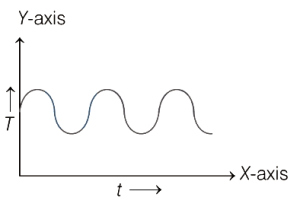
B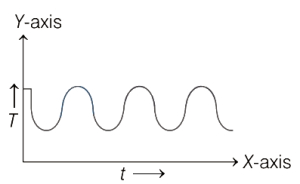
C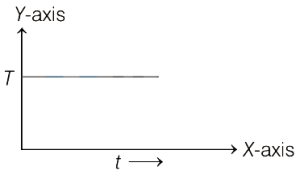
D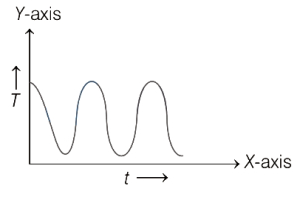
Solution
(A) For a simple pendulum,the tension $(T)$ in the string is given by $T = mg \cos \theta + \frac{mv^2}{l}$.
For small oscillations,$\theta$ is small,so $\cos \theta \approx 1 - \frac{\theta^2}{2}$.
The velocity $v$ is related to the angular displacement $\theta$ by $v = l \frac{d\theta}{dt}$.
Since the pendulum executes $SHM$,$\theta = \theta_0 \sin(\omega t + \phi)$.
Substituting these,we find that $T$ varies with time as $T \propto \cos(2\omega t + 2\phi)$.
The frequency of the tension variation is twice the frequency of the pendulum's oscillation.
Since the bob is not at the mean position at $t=0$,the phase $\phi \neq 0$,and the tension will not be at its maximum or minimum value at $t=0$. Graph $(a)$ represents a periodic variation of tension with time,which is consistent with the physical behavior of a pendulum.
For small oscillations,$\theta$ is small,so $\cos \theta \approx 1 - \frac{\theta^2}{2}$.
The velocity $v$ is related to the angular displacement $\theta$ by $v = l \frac{d\theta}{dt}$.
Since the pendulum executes $SHM$,$\theta = \theta_0 \sin(\omega t + \phi)$.
Substituting these,we find that $T$ varies with time as $T \propto \cos(2\omega t + 2\phi)$.
The frequency of the tension variation is twice the frequency of the pendulum's oscillation.
Since the bob is not at the mean position at $t=0$,the phase $\phi \neq 0$,and the tension will not be at its maximum or minimum value at $t=0$. Graph $(a)$ represents a periodic variation of tension with time,which is consistent with the physical behavior of a pendulum.
0 likes
View Solution306
MediumMCQ
The time period of a simple pendulum in air is $T$. If the pendulum is immersed in water and executes $SHM$,its time period is $t$. The value of $\frac{T}{t}$ is [density of the bob is $\frac{5000}{3} \ kg \ m^{-3}$ and density of water is $1000 \ kg \ m^{-3}$].
A
$\frac{2}{5}$
B
$\sqrt{\frac{2}{5}}$
C
$\frac{5}{2}$
D
$\sqrt{\frac{5}{2}}$
Solution
(B) The time period of a simple pendulum in air is given by $T = 2\pi \sqrt{\frac{l}{g}}$.
When the pendulum is immersed in a liquid of density $\rho$ and the bob has a density $\sigma$,the effective acceleration due to gravity $g'$ is given by $g' = g(1 - \frac{\rho}{\sigma})$.
Here,$\rho = 1000 \ kg \ m^{-3}$ and $\sigma = \frac{5000}{3} \ kg \ m^{-3}$.
Thus,$g' = g(1 - \frac{1000}{5000/3}) = g(1 - \frac{3000}{5000}) = g(1 - \frac{3}{5}) = g(\frac{2}{5})$.
The time period in water is $t = 2\pi \sqrt{\frac{l}{g'}} = 2\pi \sqrt{\frac{l}{g(2/5)}} = \sqrt{\frac{5}{2}} \cdot 2\pi \sqrt{\frac{l}{g}} = \sqrt{\frac{5}{2}} T$.
Therefore,$\frac{T}{t} = \sqrt{\frac{2}{5}}$.
When the pendulum is immersed in a liquid of density $\rho$ and the bob has a density $\sigma$,the effective acceleration due to gravity $g'$ is given by $g' = g(1 - \frac{\rho}{\sigma})$.
Here,$\rho = 1000 \ kg \ m^{-3}$ and $\sigma = \frac{5000}{3} \ kg \ m^{-3}$.
Thus,$g' = g(1 - \frac{1000}{5000/3}) = g(1 - \frac{3000}{5000}) = g(1 - \frac{3}{5}) = g(\frac{2}{5})$.
The time period in water is $t = 2\pi \sqrt{\frac{l}{g'}} = 2\pi \sqrt{\frac{l}{g(2/5)}} = \sqrt{\frac{5}{2}} \cdot 2\pi \sqrt{\frac{l}{g}} = \sqrt{\frac{5}{2}} T$.
Therefore,$\frac{T}{t} = \sqrt{\frac{2}{5}}$.
0 likes
View Solution307
MediumMCQ
$A$ hydrometer executes simple harmonic motion when it is pushed down vertically in a liquid of density $\rho$. If the mass of the hydrometer is $m$ and the radius of the hydrometer tube is $r$,then the time period of oscillation is
A
$T = 2 \pi \sqrt{\frac{m}{\pi r^2 \rho g}}$
B
$T = 2 \pi \sqrt{\frac{\pi r^2 \rho g}{m}}$
C
$T = \frac{1}{2 \pi} \sqrt{\frac{m}{\pi r^2 \rho g}}$
D
$T = \frac{1}{2 \pi} \sqrt{\frac{\pi r^2 \rho g}{m}}$
Solution
(A) When the hydrometer is floating in equilibrium,its weight is balanced by the buoyant force.
When it is pushed down by a small distance $x$,the additional buoyant force acts as the restoring force.
The additional volume submerged is $V = \pi r^2 x$.
The additional buoyant force is $F = \rho V g = \rho (\pi r^2 x) g$.
Since this force acts in the direction opposite to the displacement,the restoring force is $F_{restoring} = -\rho \pi r^2 g x$.
Using Newton's second law,$m a = -\rho \pi r^2 g x$,which gives $a = -(\frac{\rho \pi r^2 g}{m}) x$.
Comparing this with the standard $SHM$ equation $a = -\omega^2 x$,we get $\omega^2 = \frac{\rho \pi r^2 g}{m}$.
The time period $T$ is given by $T = \frac{2 \pi}{\omega} = 2 \pi \sqrt{\frac{m}{\rho \pi r^2 g}}$.
When it is pushed down by a small distance $x$,the additional buoyant force acts as the restoring force.
The additional volume submerged is $V = \pi r^2 x$.
The additional buoyant force is $F = \rho V g = \rho (\pi r^2 x) g$.
Since this force acts in the direction opposite to the displacement,the restoring force is $F_{restoring} = -\rho \pi r^2 g x$.
Using Newton's second law,$m a = -\rho \pi r^2 g x$,which gives $a = -(\frac{\rho \pi r^2 g}{m}) x$.
Comparing this with the standard $SHM$ equation $a = -\omega^2 x$,we get $\omega^2 = \frac{\rho \pi r^2 g}{m}$.
The time period $T$ is given by $T = \frac{2 \pi}{\omega} = 2 \pi \sqrt{\frac{m}{\rho \pi r^2 g}}$.
0 likes
View Solution308
MediumMCQ
The bob of a simple pendulum is a spherical hollow ball filled with water. $A$ plugged hole near the bottom of the oscillating bob gets suddenly unplugged. During observation,till water is coming out,the time period of oscillation would:
A
remain unchanged
B
increase towards a saturation value
C
first increase and then decrease to the original value.
D
first decrease and then increase to the original value.
Solution
(C) The time period of a simple pendulum is given by $T = 2 \pi \sqrt{\frac{l}{g}}$,where $l$ is the effective length of the pendulum measured from the point of suspension to the center of mass of the bob.
Initially,the center of mass of the water-filled sphere is at its geometric center.
As water drains out from the hole at the bottom,the center of mass of the system shifts downwards. This increases the effective length $l$,causing the time period $T$ to increase.
As the water level continues to drop,the center of mass reaches its lowest point and then begins to rise back towards the geometric center of the sphere as the bob becomes empty.
Once the water is completely drained,the center of mass returns to the geometric center of the hollow sphere,restoring the original effective length $l$ and thus the original time period $T$.
Initially,the center of mass of the water-filled sphere is at its geometric center.
As water drains out from the hole at the bottom,the center of mass of the system shifts downwards. This increases the effective length $l$,causing the time period $T$ to increase.
As the water level continues to drop,the center of mass reaches its lowest point and then begins to rise back towards the geometric center of the sphere as the bob becomes empty.
Once the water is completely drained,the center of mass returns to the geometric center of the hollow sphere,restoring the original effective length $l$ and thus the original time period $T$.
0 likes
View Solution309
DifficultMCQ
$A$ simple pendulum is placed inside a lift, which is moving with a uniform acceleration. If the time periods of the pendulum while the lift is moving upwards and downwards are in the ratio $1: 2$, then the acceleration of the lift is (Acceleration due to gravity, $g=10 \,ms^{-2}$) (in $\,ms^{-2}$)
A
$6$
B
$0$
C
$3$
D
$2$
Solution
(A) Let $T_1$ be the time period when the lift moves upwards with acceleration $a$, and $T_2$ be the time period when the lift moves downwards with the same acceleration $a$.
The effective acceleration due to gravity when moving upwards is $g' = g + a$, and when moving downwards is $g'' = g - a$.
The time periods are given by:
$T_1 = 2\pi \sqrt{\frac{l}{g+a}}$ $(i)$
$T_2 = 2\pi \sqrt{\frac{l}{g-a}}$ $(ii)$
Given the ratio $T_1 : T_2 = 1 : 2$, we have:
$\frac{T_1}{T_2} = \sqrt{\frac{g-a}{g+a}} = \frac{1}{2}$
Squaring both sides:
$\frac{g-a}{g+a} = \frac{1}{4}$
$4(g - a) = g + a$
$4g - 4a = g + a$
$3g = 5a$
$a = \frac{3g}{5} = \frac{3 \times 10}{5} = 6 \,ms^{-2}$
The effective acceleration due to gravity when moving upwards is $g' = g + a$, and when moving downwards is $g'' = g - a$.
The time periods are given by:
$T_1 = 2\pi \sqrt{\frac{l}{g+a}}$ $(i)$
$T_2 = 2\pi \sqrt{\frac{l}{g-a}}$ $(ii)$
Given the ratio $T_1 : T_2 = 1 : 2$, we have:
$\frac{T_1}{T_2} = \sqrt{\frac{g-a}{g+a}} = \frac{1}{2}$
Squaring both sides:
$\frac{g-a}{g+a} = \frac{1}{4}$
$4(g - a) = g + a$
$4g - 4a = g + a$
$3g = 5a$
$a = \frac{3g}{5} = \frac{3 \times 10}{5} = 6 \,ms^{-2}$

0 likes
View Solution310
MediumMCQ
The bob of a simple pendulum of length $200 \ cm$ is released from a horizontal position. If $10 \%$ of its initial energy is lost due to air resistance,then the speed of the bob at the mean position is (Acceleration due to gravity $= 10 \ m \ s^{-2}$) (in $m \ s^{-1}$)
A
$6$
B
$3$
C
$12$
D
$2$
Solution
(A) The initial potential energy of the bob at the horizontal position is $PE_i = mgh$,where $h = L = 200 \ cm = 2 \ m$.
So,$PE_i = m \times 10 \times 2 = 20mg$.
When the bob reaches the mean position,its potential energy is converted into kinetic energy.
Given that $10 \%$ of the initial energy is lost,the remaining energy is $90 \%$ of the initial potential energy.
$KE_f = 0.9 \times PE_i = 0.9 \times 20mg = 18mg$.
At the mean position,$KE_f = \frac{1}{2}mv^2$.
Equating the two: $\frac{1}{2}mv^2 = 18mg$.
$v^2 = 36g = 36 \times 10 = 360$.
$v = \sqrt{360} \approx 18.97 \ m \ s^{-1}$.
Wait,re-evaluating: $PE_i = mgL$. $KE_f = 0.9 \times mgL = \frac{1}{2}mv^2$.
$v^2 = 1.8 \times g \times L = 1.8 \times 10 \times 2 = 36$.
$v = 6 \ m \ s^{-1}$.
So,$PE_i = m \times 10 \times 2 = 20mg$.
When the bob reaches the mean position,its potential energy is converted into kinetic energy.
Given that $10 \%$ of the initial energy is lost,the remaining energy is $90 \%$ of the initial potential energy.
$KE_f = 0.9 \times PE_i = 0.9 \times 20mg = 18mg$.
At the mean position,$KE_f = \frac{1}{2}mv^2$.
Equating the two: $\frac{1}{2}mv^2 = 18mg$.
$v^2 = 36g = 36 \times 10 = 360$.
$v = \sqrt{360} \approx 18.97 \ m \ s^{-1}$.
Wait,re-evaluating: $PE_i = mgL$. $KE_f = 0.9 \times mgL = \frac{1}{2}mv^2$.
$v^2 = 1.8 \times g \times L = 1.8 \times 10 \times 2 = 36$.
$v = 6 \ m \ s^{-1}$.
0 likes
View Solution311
MediumMCQ
If a body dropped freely from a height of $20 \,m$ reaches the surface of a planet with a velocity of $31.4 \,ms^{-1}$, then the length of a simple pendulum that ticks seconds on the planet is (in $\,m$)
A
$1$
B
$0.625$
C
$2.5$
D
$2$
Solution
(C) Given: $h = 20 \,m$, $v = 31.4 \,ms^{-1}$.
Using the equation of motion $v^2 = u^2 + 2gh$ where $u = 0$:
$v^2 = 2gh$
$g = \frac{v^2}{2h} = \frac{31.4 \times 31.4}{2 \times 20} = \frac{985.96}{40} \approx 24.649 \,ms^{-2}$.
Note that $31.4 \approx 10\pi$, so $g = \frac{(10\pi)^2}{40} = \frac{100\pi^2}{40} = 2.5\pi^2 \,ms^{-2}$.
$A$ seconds pendulum has a time period $T = 2 \,s$.
The formula for the time period of a simple pendulum is $T = 2\pi \sqrt{\frac{l}{g}}$.
Squaring both sides: $T^2 = 4\pi^2 \frac{l}{g} \Rightarrow l = \frac{T^2 g}{4\pi^2}$.
Substituting $T = 2 \,s$ and $g = 2.5\pi^2 \,ms^{-2}$:
$l = \frac{2^2 \times 2.5\pi^2}{4\pi^2} = \frac{4 \times 2.5\pi^2}{4\pi^2} = 2.5 \,m$.
Using the equation of motion $v^2 = u^2 + 2gh$ where $u = 0$:
$v^2 = 2gh$
$g = \frac{v^2}{2h} = \frac{31.4 \times 31.4}{2 \times 20} = \frac{985.96}{40} \approx 24.649 \,ms^{-2}$.
Note that $31.4 \approx 10\pi$, so $g = \frac{(10\pi)^2}{40} = \frac{100\pi^2}{40} = 2.5\pi^2 \,ms^{-2}$.
$A$ seconds pendulum has a time period $T = 2 \,s$.
The formula for the time period of a simple pendulum is $T = 2\pi \sqrt{\frac{l}{g}}$.
Squaring both sides: $T^2 = 4\pi^2 \frac{l}{g} \Rightarrow l = \frac{T^2 g}{4\pi^2}$.
Substituting $T = 2 \,s$ and $g = 2.5\pi^2 \,ms^{-2}$:
$l = \frac{2^2 \times 2.5\pi^2}{4\pi^2} = \frac{4 \times 2.5\pi^2}{4\pi^2} = 2.5 \,m$.
0 likes
View Solution312
MediumMCQ
$A$ pendulum has a time period $T$ in air. When it is made to oscillate in water,its time period is $\sqrt{2} T$. Then the relative density of the material of the bob of the pendulum is (neglect damping).
A
$\sqrt{2}$
B
$2$
C
$2 \sqrt{2}$
D
$3$
Solution
(B) The time period of a simple pendulum in air is given by $T = 2 \pi \sqrt{\frac{L}{g}}$.
When the pendulum oscillates in a liquid of density $\sigma$,the effective acceleration due to gravity $g'$ is given by $g' = g \left(1 - \frac{\sigma}{\rho}\right)$,where $\rho$ is the density of the bob.
The time period in water is $T' = 2 \pi \sqrt{\frac{L}{g'}}$.
Given $T' = \sqrt{2} T$,we have $\sqrt{2} = \frac{T'}{T} = \sqrt{\frac{g}{g'}} = \sqrt{\frac{g}{g(1 - \sigma/\rho)}} = \frac{1}{\sqrt{1 - \sigma/\rho}}$.
Squaring both sides,$2 = \frac{1}{1 - \sigma/\rho}$,which implies $1 - \frac{\sigma}{\rho} = \frac{1}{2}$.
Thus,$\frac{\sigma}{\rho} = \frac{1}{2}$.
Since the density of water $\sigma = 1 \text{ g/cm}^3$,the relative density of the bob is $\rho = 2$.
When the pendulum oscillates in a liquid of density $\sigma$,the effective acceleration due to gravity $g'$ is given by $g' = g \left(1 - \frac{\sigma}{\rho}\right)$,where $\rho$ is the density of the bob.
The time period in water is $T' = 2 \pi \sqrt{\frac{L}{g'}}$.
Given $T' = \sqrt{2} T$,we have $\sqrt{2} = \frac{T'}{T} = \sqrt{\frac{g}{g'}} = \sqrt{\frac{g}{g(1 - \sigma/\rho)}} = \frac{1}{\sqrt{1 - \sigma/\rho}}$.
Squaring both sides,$2 = \frac{1}{1 - \sigma/\rho}$,which implies $1 - \frac{\sigma}{\rho} = \frac{1}{2}$.
Thus,$\frac{\sigma}{\rho} = \frac{1}{2}$.
Since the density of water $\sigma = 1 \text{ g/cm}^3$,the relative density of the bob is $\rho = 2$.
0 likes
View Solution313
MediumMCQ
$A$ simple pendulum of length $1 \ m$ and having a bob of mass $100 \ g$ is suspended in a car,moving on a circular track of radius $100 \ m$ with uniform speed $10 \ m/s$. If the pendulum makes small oscillations in a radial direction about its equilibrium position,then its time period is given by $T = 2\pi / \alpha^{1/4}$. The value of $\alpha$ is (Take $g = 10 \ m/s^2$)
A
$11$
B
$110$
C
$101$
D
$1100$
Solution
(C) The bob of the simple pendulum experiences both the acceleration due to gravity $(g)$ and the centripetal acceleration $(a_c = v^2/R)$ due to the circular motion of the car.
These two accelerations are perpendicular to each other.
The effective acceleration $(g')$ acting on the bob is given by $g' = \sqrt{g^2 + a_c^2} = \sqrt{g^2 + (v^2/R)^2} = \sqrt{g^2 + v^4/R^2}$.
The time period of a simple pendulum is $T = 2\pi \sqrt{L/g'}$.
Substituting the values: $T = 2\pi \sqrt{L / \sqrt{g^2 + v^4/R^2}} = 2\pi \sqrt{1 / (g^2 + v^4/R^2)^{1/2}} = 2\pi / (g^2 + v^4/R^2)^{1/4}$.
Comparing this with $T = 2\pi / \alpha^{1/4}$,we get $\alpha = g^2 + v^4/R^2$.
Given $g = 10 \ m/s^2$,$v = 10 \ m/s$,and $R = 100 \ m$:
$\alpha = (10)^2 + (10)^4 / (100)^2 = 100 + 10000 / 10000 = 100 + 1 = 101$.
These two accelerations are perpendicular to each other.
The effective acceleration $(g')$ acting on the bob is given by $g' = \sqrt{g^2 + a_c^2} = \sqrt{g^2 + (v^2/R)^2} = \sqrt{g^2 + v^4/R^2}$.
The time period of a simple pendulum is $T = 2\pi \sqrt{L/g'}$.
Substituting the values: $T = 2\pi \sqrt{L / \sqrt{g^2 + v^4/R^2}} = 2\pi \sqrt{1 / (g^2 + v^4/R^2)^{1/2}} = 2\pi / (g^2 + v^4/R^2)^{1/4}$.
Comparing this with $T = 2\pi / \alpha^{1/4}$,we get $\alpha = g^2 + v^4/R^2$.
Given $g = 10 \ m/s^2$,$v = 10 \ m/s$,and $R = 100 \ m$:
$\alpha = (10)^2 + (10)^4 / (100)^2 = 100 + 10000 / 10000 = 100 + 1 = 101$.
0 likes
View Solution314
EasyMCQ
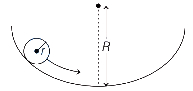
$A$ small sphere of radius $r$ is placed on a concave surface of radius of curvature $R$ a little away from the center. When the sphere is released,it oscillates. Assuming the oscillation to be simple harmonic motion and $r << R$,then the time period is
A
$2 \pi \sqrt{\frac{R}{g}}$
B
$2 \pi \sqrt{\frac{3 R}{2 g}}$
C
$2 \pi \sqrt{\frac{2 R}{3 g}}$
D
$2 \pi \sqrt{\frac{R}{2 g}}$
Solution
(A) When a small sphere of radius $r$ rolls without slipping on a concave surface of radius $R$,the effective radius of the path of the center of mass is $(R - r)$.
The torque about the point of contact is $\tau = -mg(R-r)\sin\theta \approx -mg(R-r)\theta$.
The moment of inertia of the sphere about the point of contact is $I = I_{cm} + mr^2 = \frac{2}{5}mr^2 + mr^2 = \frac{7}{5}mr^2$.
The equation of motion is $\tau = I\alpha$,so $-mg(R-r)\theta = \frac{7}{5}mr^2 \frac{d^2\theta}{dt^2}$.
This gives $\frac{d^2\theta}{dt^2} = -\frac{5g(R-r)}{7r^2}\theta$.
However,if the sphere is assumed to slide without friction,the motion is equivalent to a simple pendulum of length $l = (R-r)$.
Given $r << R$,the effective length $l \approx R$.
The time period is $T = 2\pi \sqrt{\frac{l}{g}} = 2\pi \sqrt{\frac{R}{g}}$.
The torque about the point of contact is $\tau = -mg(R-r)\sin\theta \approx -mg(R-r)\theta$.
The moment of inertia of the sphere about the point of contact is $I = I_{cm} + mr^2 = \frac{2}{5}mr^2 + mr^2 = \frac{7}{5}mr^2$.
The equation of motion is $\tau = I\alpha$,so $-mg(R-r)\theta = \frac{7}{5}mr^2 \frac{d^2\theta}{dt^2}$.
This gives $\frac{d^2\theta}{dt^2} = -\frac{5g(R-r)}{7r^2}\theta$.
However,if the sphere is assumed to slide without friction,the motion is equivalent to a simple pendulum of length $l = (R-r)$.
Given $r << R$,the effective length $l \approx R$.
The time period is $T = 2\pi \sqrt{\frac{l}{g}} = 2\pi \sqrt{\frac{R}{g}}$.
0 likes
View Solution315
EasyMCQ
$A$ simple pendulum of length $1 \,m$ is freely suspended from the ceiling of an elevator. The time period of small oscillations as the elevator moves up with an acceleration of $2 \,m/s^2$ is (use $g=10 \,m/s^2$).
A
$\frac{\pi}{\sqrt{5}} \,s$
B
$\sqrt{\frac{2}{5}} \pi \,s$
C
$\frac{\pi}{\sqrt{2}} \,s$
D
$\frac{\pi}{\sqrt{3}} \,s$
Solution
(D) Given: Length of simple pendulum $L = 1 \,m$,acceleration of elevator $a = 2 \,m/s^2$,and acceleration due to gravity $g = 10 \,m/s^2$.
When an elevator moves upward with an acceleration $a$,the effective acceleration due to gravity $g_{eff}$ is given by $g_{eff} = g + a$.
Substituting the values,$g_{eff} = 10 + 2 = 12 \,m/s^2$.
The time period $T$ of a simple pendulum is given by $T = 2\pi \sqrt{\frac{L}{g_{eff}}}$.
Substituting the values,$T = 2\pi \sqrt{\frac{1}{12}} = 2\pi \frac{1}{\sqrt{4 \times 3}} = 2\pi \frac{1}{2\sqrt{3}} = \frac{\pi}{\sqrt{3}} \,s$.
When an elevator moves upward with an acceleration $a$,the effective acceleration due to gravity $g_{eff}$ is given by $g_{eff} = g + a$.
Substituting the values,$g_{eff} = 10 + 2 = 12 \,m/s^2$.
The time period $T$ of a simple pendulum is given by $T = 2\pi \sqrt{\frac{L}{g_{eff}}}$.
Substituting the values,$T = 2\pi \sqrt{\frac{1}{12}} = 2\pi \frac{1}{\sqrt{4 \times 3}} = 2\pi \frac{1}{2\sqrt{3}} = \frac{\pi}{\sqrt{3}} \,s$.
0 likes
View Solution316
MediumMCQ
The time period of a simple pendulum is $T$. When the length is increased by $10 \ cm$,its period is $T_1$. When the length is decreased by $10 \ cm$,its period is $T_2$. Then,the relation between $T, T_1$,and $T_2$ is
A
$\frac{2}{T^2}=\frac{1}{T_1^2}+\frac{1}{T_2^2}$
B
$\frac{2}{T^2}=\frac{1}{T_1^2}-\frac{1}{T_2^2}$
C
$2 T^2=T_1^2+T_2^2$
D
$2 T^2=T_1^2-T_2^2$
Solution
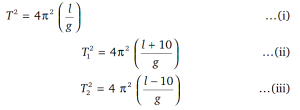
(C) The time period of a simple pendulum is given by $T = 2 \pi \sqrt{\frac{l}{g}}$,so $T^2 = 4 \pi^2 \left(\frac{l}{g}\right) \quad ...(i)$
When the length is increased by $10 \ cm$,the new time period $T_1$ is given by $T_1^2 = 4 \pi^2 \left(\frac{l+10}{g}\right) \quad ...(ii)$
When the length is decreased by $10 \ cm$,the new time period $T_2$ is given by $T_2^2 = 4 \pi^2 \left(\frac{l-10}{g}\right) \quad ...(iii)$
Adding equations $(ii)$ and $(iii)$,we get:
$T_1^2 + T_2^2 = 4 \pi^2 \left(\frac{l+10}{g}\right) + 4 \pi^2 \left(\frac{l-10}{g}\right)$
$T_1^2 + T_2^2 = \frac{4 \pi^2}{g} (l + 10 + l - 10)$
$T_1^2 + T_2^2 = \frac{4 \pi^2}{g} (2l)$
$T_1^2 + T_2^2 = 2 \left(4 \pi^2 \frac{l}{g}\right)$
Substituting equation $(i)$ into this,we get:
$T_1^2 + T_2^2 = 2 T^2$
When the length is increased by $10 \ cm$,the new time period $T_1$ is given by $T_1^2 = 4 \pi^2 \left(\frac{l+10}{g}\right) \quad ...(ii)$
When the length is decreased by $10 \ cm$,the new time period $T_2$ is given by $T_2^2 = 4 \pi^2 \left(\frac{l-10}{g}\right) \quad ...(iii)$
Adding equations $(ii)$ and $(iii)$,we get:
$T_1^2 + T_2^2 = 4 \pi^2 \left(\frac{l+10}{g}\right) + 4 \pi^2 \left(\frac{l-10}{g}\right)$
$T_1^2 + T_2^2 = \frac{4 \pi^2}{g} (l + 10 + l - 10)$
$T_1^2 + T_2^2 = \frac{4 \pi^2}{g} (2l)$
$T_1^2 + T_2^2 = 2 \left(4 \pi^2 \frac{l}{g}\right)$
Substituting equation $(i)$ into this,we get:
$T_1^2 + T_2^2 = 2 T^2$
0 likes
View Solution317
MediumMCQ
At a given place,to increase the number of oscillations made by a simple pendulum in one minute from $72$ to $90$,the length of the pendulum is to be decreased by (in $\%$)
A
$64$
B
$36$
C
$50$
D
$56$
Solution
(B) The time period of a simple pendulum is given by $T = 2\pi \sqrt{\frac{L}{g}}$.
The frequency $f$ (number of oscillations per unit time) is $f = \frac{1}{T} = \frac{1}{2\pi} \sqrt{\frac{g}{L}}$.
Since $g$ is constant at a given place,$f \propto \frac{1}{\sqrt{L}}$,which implies $L \propto \frac{1}{f^2}$.
Let the initial frequency be $f_1 = 72 \text{ oscillations/min}$ and the final frequency be $f_2 = 90 \text{ oscillations/min}$.
Then,$\frac{L_2}{L_1} = \left( \frac{f_1}{f_2} \right)^2 = \left( \frac{72}{90} \right)^2 = \left( \frac{4}{5} \right)^2 = \frac{16}{25} = 0.64$.
This means the new length $L_2$ is $64 \%$ of the original length $L_1$.
The decrease in length is $\Delta L = L_1 - L_2 = L_1 - 0.64 L_1 = 0.36 L_1$.
Therefore,the percentage decrease is $36 \%$.
The frequency $f$ (number of oscillations per unit time) is $f = \frac{1}{T} = \frac{1}{2\pi} \sqrt{\frac{g}{L}}$.
Since $g$ is constant at a given place,$f \propto \frac{1}{\sqrt{L}}$,which implies $L \propto \frac{1}{f^2}$.
Let the initial frequency be $f_1 = 72 \text{ oscillations/min}$ and the final frequency be $f_2 = 90 \text{ oscillations/min}$.
Then,$\frac{L_2}{L_1} = \left( \frac{f_1}{f_2} \right)^2 = \left( \frac{72}{90} \right)^2 = \left( \frac{4}{5} \right)^2 = \frac{16}{25} = 0.64$.
This means the new length $L_2$ is $64 \%$ of the original length $L_1$.
The decrease in length is $\Delta L = L_1 - L_2 = L_1 - 0.64 L_1 = 0.36 L_1$.
Therefore,the percentage decrease is $36 \%$.
0 likes
View Solution318
EasyMCQ
$A$ simple pendulum consists of a small sphere of mass $m$ suspended by a thread of length $l$. The sphere carries a positive charge $q$. The pendulum is allowed to do small oscillations in a uniform electric field $E$ with direction vertically upwards. The time period of oscillation is
A
$2 \pi \sqrt{\frac{l}{g}}$
B
$2 \pi \sqrt{\frac{m l}{q E}}$
C
$2 \pi \sqrt{\frac{l}{g-\frac{q E}{m}}}$
D
$2 \pi \sqrt{\frac{l}{g+\frac{q E}{m}}}$
Solution
(C) The forces acting on the sphere are the gravitational force $mg$ (downwards) and the electric force $qE$ (upwards,since the field is vertically upwards and charge is positive).
The net downward force $F$ is given by $F = mg - qE$.
We can write this as $F = m(g - \frac{qE}{m})$.
Thus,the effective acceleration due to gravity $g'$ is $g' = g - \frac{qE}{m}$.
The time period $T$ of a simple pendulum is given by $T = 2\pi \sqrt{\frac{l}{g'}}$.
Substituting the value of $g'$,we get $T = 2\pi \sqrt{\frac{l}{g - \frac{qE}{m}}}$.
The net downward force $F$ is given by $F = mg - qE$.
We can write this as $F = m(g - \frac{qE}{m})$.
Thus,the effective acceleration due to gravity $g'$ is $g' = g - \frac{qE}{m}$.
The time period $T$ of a simple pendulum is given by $T = 2\pi \sqrt{\frac{l}{g'}}$.
Substituting the value of $g'$,we get $T = 2\pi \sqrt{\frac{l}{g - \frac{qE}{m}}}$.
0 likes
View Solution319
MediumMCQ
$A$ uniform rod of length $1.8 \,m$ suspended by an end is made to undergo small oscillations. Find the length of the simple pendulum having the mass and time period equal to that of the rod. (in $\,m$)
A
$3.6$
B
$1.2$
C
$2.4$
D
$4.2$
Solution
(B) Given, length of the rod, $l = 1.8 \,m$.
The time period of oscillation of a uniform rod of length $l$ pivoted at one end is given by $T = 2 \pi \sqrt{\frac{I}{mgR}}$, where $I$ is the moment of inertia about the pivot and $R$ is the distance from the pivot to the center of mass.
For a rod pivoted at one end, $I = \frac{ml^2}{3}$ and $R = \frac{l}{2}$.
Substituting these values into the formula:
$T = 2 \pi \sqrt{\frac{ml^2/3}{mg(l/2)}} = 2 \pi \sqrt{\frac{2l}{3g}} = 2 \pi \sqrt{\frac{2 \times 1.8}{3g}} = 2 \pi \sqrt{\frac{1.2}{g}}$.
The time period of a simple pendulum of length $l'$ is $T' = 2 \pi \sqrt{\frac{l'}{g}}$.
Since $T = T'$, we have $2 \pi \sqrt{\frac{l'}{g}} = 2 \pi \sqrt{\frac{1.2}{g}}$.
Squaring both sides, we get $l' = 1.2 \,m$.
The time period of oscillation of a uniform rod of length $l$ pivoted at one end is given by $T = 2 \pi \sqrt{\frac{I}{mgR}}$, where $I$ is the moment of inertia about the pivot and $R$ is the distance from the pivot to the center of mass.
For a rod pivoted at one end, $I = \frac{ml^2}{3}$ and $R = \frac{l}{2}$.
Substituting these values into the formula:
$T = 2 \pi \sqrt{\frac{ml^2/3}{mg(l/2)}} = 2 \pi \sqrt{\frac{2l}{3g}} = 2 \pi \sqrt{\frac{2 \times 1.8}{3g}} = 2 \pi \sqrt{\frac{1.2}{g}}$.
The time period of a simple pendulum of length $l'$ is $T' = 2 \pi \sqrt{\frac{l'}{g}}$.
Since $T = T'$, we have $2 \pi \sqrt{\frac{l'}{g}} = 2 \pi \sqrt{\frac{1.2}{g}}$.
Squaring both sides, we get $l' = 1.2 \,m$.
0 likes
View Solution320
MediumMCQ
The bob of a simple pendulum is hanging vertically down from a fixed identical bob by means of a string of length $l$. If both bobs are charged with a charge $q$ each,what is the time period of the pendulum? (Ignore the radii of the bobs.)
A
$2 \pi \sqrt{\frac{l}{g+\frac{q^2}{l^2 m}}}$
B
$2 \pi \sqrt{\frac{l}{g-\frac{q^2}{l^2 m}}}$
C
$2 \pi \sqrt{\frac{l}{g}}$
D
$2 \pi \sqrt{\frac{l}{g-\frac{q^2}{l}}}$
Solution
(C) The bob of the simple pendulum is hanging vertically below a fixed bob. Both bobs carry an identical charge $q$.
Since the bobs are aligned vertically,the electrostatic force of repulsion acts along the line joining the two bobs,which is the same line as the string.
This electrostatic force acts in the upward direction on the moving bob,opposing the gravitational force (weight $mg$).
However,for a simple pendulum,the restoring force is provided by the component of gravity perpendicular to the string,which is $mg \sin \theta$.
The electrostatic force acts along the string and does not have a component perpendicular to the string.
Therefore,the electrostatic force does not affect the restoring force or the motion of the pendulum.
Thus,the time period of the pendulum remains unchanged: $T = 2 \pi \sqrt{\frac{l}{g}}$.
Since the bobs are aligned vertically,the electrostatic force of repulsion acts along the line joining the two bobs,which is the same line as the string.
This electrostatic force acts in the upward direction on the moving bob,opposing the gravitational force (weight $mg$).
However,for a simple pendulum,the restoring force is provided by the component of gravity perpendicular to the string,which is $mg \sin \theta$.
The electrostatic force acts along the string and does not have a component perpendicular to the string.
Therefore,the electrostatic force does not affect the restoring force or the motion of the pendulum.
Thus,the time period of the pendulum remains unchanged: $T = 2 \pi \sqrt{\frac{l}{g}}$.
0 likes
View Solution321
MediumMCQ
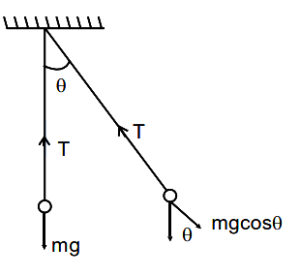
$A$ simple pendulum,consisting of a small ball of mass $m$ attached to a massless string hanging vertically from the ceiling,is oscillating with an amplitude such that $T_{\max } = 2 T_{\min }$,where $T_{\max }$ and $T_{\min }$ are the maximum and minimum tension in the string respectively. The value of maximum tension $T_{\max }$ in the string is
A
$\frac{3 mg}{2}$
B
$mg$
C
$\frac{3 mg}{4}$
D
$3 mg$
Solution
(A) Let $l$ be the length of the string. At the extreme position,the velocity is zero,so the tension is $T_{\min } = mg \cos \theta$,where $\theta$ is the maximum angular displacement.
At the lowest point (mean position),the tension is maximum,given by $T_{\max } = mg + \frac{mv^2}{l}$.
By the law of conservation of energy between the extreme position and the mean position: $\frac{1}{2} mv^2 = mgl(1 - \cos \theta)$,which implies $v^2 = 2gl(1 - \cos \theta)$.
Substituting $v^2$ into the expression for $T_{\max }$: $T_{\max } = mg + \frac{m(2gl(1 - \cos \theta))}{l} = mg + 2mg(1 - \cos \theta) = mg(1 + 2 - 2 \cos \theta) = mg(3 - 2 \cos \theta)$.
Given $T_{\max } = 2 T_{\min }$,we have $mg(3 - 2 \cos \theta) = 2(mg \cos \theta)$.
$3 - 2 \cos \theta = 2 \cos \theta \implies 4 \cos \theta = 3 \implies \cos \theta = \frac{3}{4}$.
Substituting $\cos \theta = \frac{3}{4}$ into the expression for $T_{\max }$: $T_{\max } = 2mg \cos \theta = 2mg \left(\frac{3}{4}\right) = \frac{3mg}{2}$.
At the lowest point (mean position),the tension is maximum,given by $T_{\max } = mg + \frac{mv^2}{l}$.
By the law of conservation of energy between the extreme position and the mean position: $\frac{1}{2} mv^2 = mgl(1 - \cos \theta)$,which implies $v^2 = 2gl(1 - \cos \theta)$.
Substituting $v^2$ into the expression for $T_{\max }$: $T_{\max } = mg + \frac{m(2gl(1 - \cos \theta))}{l} = mg + 2mg(1 - \cos \theta) = mg(1 + 2 - 2 \cos \theta) = mg(3 - 2 \cos \theta)$.
Given $T_{\max } = 2 T_{\min }$,we have $mg(3 - 2 \cos \theta) = 2(mg \cos \theta)$.
$3 - 2 \cos \theta = 2 \cos \theta \implies 4 \cos \theta = 3 \implies \cos \theta = \frac{3}{4}$.
Substituting $\cos \theta = \frac{3}{4}$ into the expression for $T_{\max }$: $T_{\max } = 2mg \cos \theta = 2mg \left(\frac{3}{4}\right) = \frac{3mg}{2}$.
0 likes
View Solution322
DifficultMCQ
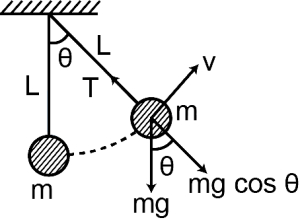
$A$ simple pendulum of length $L$ swings in a vertical plane. The tension in the string when it makes an angle $\theta$ with the vertical and the bob of mass $m$ moves with a speed $v$ is (where $g$ is the gravitational acceleration):
A
$m v^{2} / L$
B
$m g \cos \theta + m v^{2} / L$
C
$m g \cos \theta - m v^{2} / L$
D
$m g \cos \theta$
Solution
(B) For a bob of mass $m$ moving in a vertical circular path of radius $L$ with speed $v$,the forces acting on the bob along the radial direction are the tension $T$ (towards the center) and the component of weight $mg \cos \theta$ (away from the center).
The net centripetal force required for circular motion is provided by the resultant of these radial forces:
$T - mg \cos \theta = \frac{mv^2}{L}$
Rearranging the equation to solve for the tension $T$:
$T = \frac{mv^2}{L} + mg \cos \theta$
The net centripetal force required for circular motion is provided by the resultant of these radial forces:
$T - mg \cos \theta = \frac{mv^2}{L}$
Rearranging the equation to solve for the tension $T$:
$T = \frac{mv^2}{L} + mg \cos \theta$
0 likes
View Solution323
MediumMCQ
$A$ simple pendulum is taken to a place where its distance from the Earth's surface is equal to the radius of the Earth. Calculate the time period of small oscillations if the length of the string is $4.0 \ m$. (Take $g = \pi^2 \ m/s^2$ at the surface of the Earth.) (in $s$)
A
$4$
B
$6$
C
$8$
D
$2$
Solution
(C) The time period of a simple pendulum is given by $T = 2\pi \sqrt{\frac{\ell}{g'}}$.
At a height $h = R$ (where $R$ is the radius of the Earth),the acceleration due to gravity $g'$ is given by $g' = g \left( \frac{R}{R+h} \right)^2 = g \left( \frac{R}{R+R} \right)^2 = \frac{g}{4}$.
Given $g = \pi^2 \ m/s^2$ at the surface,the effective gravity at height $h$ is $g' = \frac{\pi^2}{4} \ m/s^2$.
Substituting the values $\ell = 4.0 \ m$ and $g' = \frac{\pi^2}{4} \ m/s^2$ into the time period formula:
$T = 2\pi \sqrt{\frac{4}{\pi^2 / 4}} = 2\pi \sqrt{\frac{16}{\pi^2}} = 2\pi \times \frac{4}{\pi} = 8 \ s$.
At a height $h = R$ (where $R$ is the radius of the Earth),the acceleration due to gravity $g'$ is given by $g' = g \left( \frac{R}{R+h} \right)^2 = g \left( \frac{R}{R+R} \right)^2 = \frac{g}{4}$.
Given $g = \pi^2 \ m/s^2$ at the surface,the effective gravity at height $h$ is $g' = \frac{\pi^2}{4} \ m/s^2$.
Substituting the values $\ell = 4.0 \ m$ and $g' = \frac{\pi^2}{4} \ m/s^2$ into the time period formula:
$T = 2\pi \sqrt{\frac{4}{\pi^2 / 4}} = 2\pi \sqrt{\frac{16}{\pi^2}} = 2\pi \times \frac{4}{\pi} = 8 \ s$.
0 likes
View Solution324
DifficultMCQ
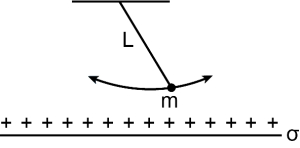
The bob of a pendulum of mass $m$,suspended by an inextensible string of length $L$ as shown in the figure,carries a small charge $q$. An infinite horizontal plane conductor with uniform surface charge density $\sigma$ is placed below it. What will be the time period of the pendulum for small amplitude oscillations?
A
$2 \pi \sqrt{\frac{L}{g-\frac{q \sigma}{\varepsilon_{0} m}}}$
B
$2 \pi \sqrt{\frac{L}{g+\frac{q \sigma}{\varepsilon_{0} m}}}$
C
$2 \pi \sqrt{\frac{L}{g-\frac{q \sigma}{2 \varepsilon_{0} m}}}$
D
$2 \pi \sqrt{\frac{L}{g+\frac{q \sigma}{2 \varepsilon_{0} m}}}$
Solution
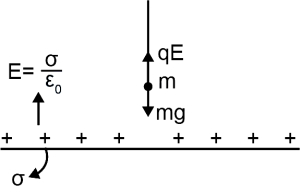
(C) The electric field $E$ produced by an infinite plane sheet of charge with surface charge density $\sigma$ is given by $E = \frac{\sigma}{2 \varepsilon_{0}}$.
Since the bob carries a charge $q$,it experiences an upward electrostatic force $F_e = qE = \frac{q \sigma}{2 \varepsilon_{0}}$.
The effective acceleration due to gravity $g_{\text{eff}}$ acting on the bob is given by $m g_{\text{eff}} = mg - F_e = mg - \frac{q \sigma}{2 \varepsilon_{0}}$.
Thus,$g_{\text{eff}} = g - \frac{q \sigma}{2 \varepsilon_{0} m}$.
The time period $T$ of a simple pendulum is given by $T = 2 \pi \sqrt{\frac{L}{g_{\text{eff}}}}$.
Substituting the value of $g_{\text{eff}}$,we get $T = 2 \pi \sqrt{\frac{L}{g - \frac{q \sigma}{2 \varepsilon_{0} m}}}$.
Since the bob carries a charge $q$,it experiences an upward electrostatic force $F_e = qE = \frac{q \sigma}{2 \varepsilon_{0}}$.
The effective acceleration due to gravity $g_{\text{eff}}$ acting on the bob is given by $m g_{\text{eff}} = mg - F_e = mg - \frac{q \sigma}{2 \varepsilon_{0}}$.
Thus,$g_{\text{eff}} = g - \frac{q \sigma}{2 \varepsilon_{0} m}$.
The time period $T$ of a simple pendulum is given by $T = 2 \pi \sqrt{\frac{L}{g_{\text{eff}}}}$.
Substituting the value of $g_{\text{eff}}$,we get $T = 2 \pi \sqrt{\frac{L}{g - \frac{q \sigma}{2 \varepsilon_{0} m}}}$.
0 likes
View Solution325
MediumMCQ
The bob of a swinging seconds pendulum (one whose time period is $2 \,s$) has a small speed $v_{0}$ at its lowest point. Its height from this lowest point $2.25 \,s$ after passing through it is given by
A
$\frac{v_{0}^{2}}{2 \,g}$
B
$\frac{v_{0}^{2}}{g}$
C
$\frac{v_{0}^{2}}{4 g}$
D
$\frac{9 v_{0}^{2}}{4 g}$
Solution
(C) The time period of the pendulum is $T = 2 \,s$. The angular frequency is $\omega = \frac{2 \pi}{T} = \pi \,rad/s$.
At the lowest point,the displacement is $x = 0$,so the equation of motion is $x(t) = A \sin(\omega t)$,where $A$ is the amplitude.
The velocity at any time $t$ is $v(t) = \frac{dx}{dt} = A \omega \cos(\omega t)$.
At $t = 0$,$v(0) = v_{0} = A \omega$,so $A = \frac{v_{0}}{\omega}$.
We need the height $h$ at $t = 2.25 \,s$. Since $T = 2 \,s$,$t = 2.25 \,s = T + 0.25 \,s = T + \frac{T}{8}$.
At $t = \frac{T}{8} = 0.25 \,s$,the velocity is $v = v_{0} \cos(\omega \cdot \frac{T}{8}) = v_{0} \cos(\frac{2 \pi}{T} \cdot \frac{T}{8}) = v_{0} \cos(\frac{\pi}{4}) = \frac{v_{0}}{\sqrt{2}}$.
Using the principle of conservation of mechanical energy: $\frac{1}{2} m v_{0}^{2} = \frac{1}{2} m v^{2} + mgh$.
Substituting $v = \frac{v_{0}}{\sqrt{2}}$,we get $\frac{1}{2} v_{0}^{2} = \frac{1}{2} (\frac{v_{0}}{\sqrt{2}})^{2} + gh$.
$\frac{1}{2} v_{0}^{2} = \frac{1}{4} v_{0}^{2} + gh$.
$gh = \frac{1}{4} v_{0}^{2} \implies h = \frac{v_{0}^{2}}{4g}$.
At the lowest point,the displacement is $x = 0$,so the equation of motion is $x(t) = A \sin(\omega t)$,where $A$ is the amplitude.
The velocity at any time $t$ is $v(t) = \frac{dx}{dt} = A \omega \cos(\omega t)$.
At $t = 0$,$v(0) = v_{0} = A \omega$,so $A = \frac{v_{0}}{\omega}$.
We need the height $h$ at $t = 2.25 \,s$. Since $T = 2 \,s$,$t = 2.25 \,s = T + 0.25 \,s = T + \frac{T}{8}$.
At $t = \frac{T}{8} = 0.25 \,s$,the velocity is $v = v_{0} \cos(\omega \cdot \frac{T}{8}) = v_{0} \cos(\frac{2 \pi}{T} \cdot \frac{T}{8}) = v_{0} \cos(\frac{\pi}{4}) = \frac{v_{0}}{\sqrt{2}}$.
Using the principle of conservation of mechanical energy: $\frac{1}{2} m v_{0}^{2} = \frac{1}{2} m v^{2} + mgh$.
Substituting $v = \frac{v_{0}}{\sqrt{2}}$,we get $\frac{1}{2} v_{0}^{2} = \frac{1}{2} (\frac{v_{0}}{\sqrt{2}})^{2} + gh$.
$\frac{1}{2} v_{0}^{2} = \frac{1}{4} v_{0}^{2} + gh$.
$gh = \frac{1}{4} v_{0}^{2} \implies h = \frac{v_{0}^{2}}{4g}$.
0 likes
View Solution326
MediumMCQ
Using a simple pendulum experiment,$g$ is determined by measuring its time period $T$. Which of the following plots represents the correct relation between the pendulum length $L$ and time period $T$?
A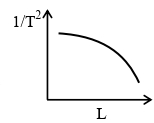
B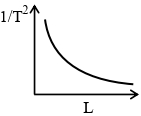
C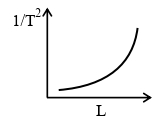
D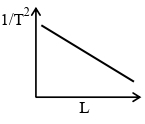
Solution
(B) The time period $T$ of a simple pendulum is given by the formula: $T = 2\pi \sqrt{\frac{L}{g}}$.
Squaring both sides,we get: $T^2 = \frac{4\pi^2 L}{g}$.
Taking the reciprocal of both sides,we get: $\frac{1}{T^2} = \frac{g}{4\pi^2 L}$.
This equation is of the form $y = \frac{k}{x}$,where $y = \frac{1}{T^2}$,$x = L$,and $k = \frac{g}{4\pi^2}$ is a constant.
This represents a rectangular hyperbola,which corresponds to the plot shown in option $B$.
Squaring both sides,we get: $T^2 = \frac{4\pi^2 L}{g}$.
Taking the reciprocal of both sides,we get: $\frac{1}{T^2} = \frac{g}{4\pi^2 L}$.
This equation is of the form $y = \frac{k}{x}$,where $y = \frac{1}{T^2}$,$x = L$,and $k = \frac{g}{4\pi^2}$ is a constant.
This represents a rectangular hyperbola,which corresponds to the plot shown in option $B$.
0 likes
View Solution327
EasyMCQ
$A$ simple pendulum of string length $30 \ cm$ performs $20$ oscillations in $10 \ s$. The length of the string required for the pendulum to perform $40$ oscillations in the same time duration is . . . . . . $cm$. [Assume that the mass of the pendulum remains same.]
A
$120$
B
$0.75$
C
$7.5$
D
$15$
Solution
(C) The time period $T$ of a simple pendulum is given by $T = 2\pi \sqrt{\frac{\ell}{g}}$,which implies $T \propto \sqrt{\ell}$.
Given that the time duration $t$ is constant,the number of oscillations $n$ is inversely proportional to the time period $T$ $(n = \frac{t}{T})$.
Therefore,$n \propto \frac{1}{\sqrt{\ell}}$,which means $n^2 \propto \frac{1}{\ell}$ or $\ell \propto \frac{1}{n^2}$.
Initially,$n_1 = 20$ and $\ell_1 = 30 \ cm$.
Finally,$n_2 = 40$.
Using the ratio: $\frac{\ell_2}{\ell_1} = \left( \frac{n_1}{n_2} \right)^2$.
$\ell_2 = 30 \times \left( \frac{20}{40} \right)^2 = 30 \times \left( \frac{1}{2} \right)^2 = 30 \times \frac{1}{4} = 7.5 \ cm$.
Given that the time duration $t$ is constant,the number of oscillations $n$ is inversely proportional to the time period $T$ $(n = \frac{t}{T})$.
Therefore,$n \propto \frac{1}{\sqrt{\ell}}$,which means $n^2 \propto \frac{1}{\ell}$ or $\ell \propto \frac{1}{n^2}$.
Initially,$n_1 = 20$ and $\ell_1 = 30 \ cm$.
Finally,$n_2 = 40$.
Using the ratio: $\frac{\ell_2}{\ell_1} = \left( \frac{n_1}{n_2} \right)^2$.
$\ell_2 = 30 \times \left( \frac{20}{40} \right)^2 = 30 \times \left( \frac{1}{2} \right)^2 = 30 \times \frac{1}{4} = 7.5 \ cm$.
0 likes
View Solution328
DifficultMCQ
The sum of kinetic energy and potential energy of a simple pendulum bob is $0.02 \text{ J}$. The speed of the simple pendulum bob at the equilibrium position is approximately: (Consider mass of the bob = $20 \text{ g}$) (in $\text{ m/s}$)
A
$2.0$
B
$0.2$
C
$14.1$
D
$1.41$
Solution
(D) The total mechanical energy $E$ of a simple pendulum is the sum of its kinetic energy and potential energy,which remains constant throughout the motion.
Given total energy $E = 0.02 \text{ J}$.
At the equilibrium position (mean position),the potential energy of the bob is zero,so the total energy is entirely in the form of kinetic energy.
Therefore,$E = K.E_{max} = \frac{1}{2} m v_{max}^2$.
Given mass $m = 20 \text{ g} = 0.02 \text{ kg}$.
Substituting the values into the equation:
$0.02 = \frac{1}{2} \times 0.02 \times v_{max}^2$
$1 = \frac{1}{2} v_{max}^2$
$v_{max}^2 = 2$
$v_{max} = \sqrt{2} \approx 1.414 \text{ m/s}$.
Thus,the speed at the equilibrium position is approximately $1.41 \text{ m/s}$.
Given total energy $E = 0.02 \text{ J}$.
At the equilibrium position (mean position),the potential energy of the bob is zero,so the total energy is entirely in the form of kinetic energy.
Therefore,$E = K.E_{max} = \frac{1}{2} m v_{max}^2$.
Given mass $m = 20 \text{ g} = 0.02 \text{ kg}$.
Substituting the values into the equation:
$0.02 = \frac{1}{2} \times 0.02 \times v_{max}^2$
$1 = \frac{1}{2} v_{max}^2$
$v_{max}^2 = 2$
$v_{max} = \sqrt{2} \approx 1.414 \text{ m/s}$.
Thus,the speed at the equilibrium position is approximately $1.41 \text{ m/s}$.
0 likes
View Solution329
DifficultMCQ
Savitha, a $XI$ standard student, while conducting an experiment to determine the effective length of a simple pendulum $L$, notes down the data of time taken to complete $30$ oscillations as $60 \text{ s}$ and hence calculates the length of the simple pendulum as: (Take $\pi^2 = 9.8$, and $g = 9.8 \text{ m/s}^2$) (in $\text{ m}$)
A
$0.75$
B
$1$
C
$1.5$
D
$2$
Solution
(B) The time period $T$ of a simple pendulum is given by the formula $T = 2\pi \sqrt{\frac{L}{g}}$.
Given that the time taken for $30$ oscillations is $60 \text{ s}$, the time period $T$ is calculated as $T = \frac{60}{30} = 2 \text{ s}$.
Substituting the values into the formula: $2 = 2\pi \sqrt{\frac{L}{9.8}}$.
Squaring both sides of the equation, we get $4 = 4\pi^2 \frac{L}{9.8}$.
Given $\pi^2 = 9.8$, we substitute this into the equation: $4 = 4 \times 9.8 \times \frac{L}{9.8}$.
Simplifying the expression, we get $4 = 4L$, which gives $L = 1 \text{ m}$.
Therefore, the correct option is $B$.
Given that the time taken for $30$ oscillations is $60 \text{ s}$, the time period $T$ is calculated as $T = \frac{60}{30} = 2 \text{ s}$.
Substituting the values into the formula: $2 = 2\pi \sqrt{\frac{L}{9.8}}$.
Squaring both sides of the equation, we get $4 = 4\pi^2 \frac{L}{9.8}$.
Given $\pi^2 = 9.8$, we substitute this into the equation: $4 = 4 \times 9.8 \times \frac{L}{9.8}$.
Simplifying the expression, we get $4 = 4L$, which gives $L = 1 \text{ m}$.
Therefore, the correct option is $B$.
0 likes
View SolutionOscillations — SHM of Simple Pendulum · Frequently Asked Questions
1Are these Oscillations questions useful for JEE and NEET?
Yes. All questions in this section are mapped to JEE Main and NEET exam patterns. Previous year questions from JEE Main, NEET, GUJCET and state-level exams are included with full solutions.
2Can I switch to Hindi or Gujarati for these questions?
Yes. Use the language tabs in the hero section or the sidebar to view the same questions and solutions in English, Hindi or Gujarati.
3How do I generate a question paper from this subtopic?
Use the Vedclass Exam Paper Generator — select the chapter and subtopic, set difficulty, and generate Sets A, B, C, D automatically. First 3 chapters of every subject are free.
Vedclass Products
For Students
Vedclass Test Series
Mock tests in real JEE/NEET style with performance analysis. 5-day free trial.
Start Free TrialFor Teachers
Exam Paper Generator
Generate Set A/B/C/D papers from this chapter in 2 minutes. 3 chapters free.
Try FreeFor Institutes
Online Exam Module
Live online exams with unlimited students, 360° analytics & white-label branding.
See DemoFor Teachers & Institutes
Generate a Oscillations Exam Paper in 2 Minutes
Select subtopic & difficulty — Sets A, B, C, D auto-generated with No Repeat logic.
First 3 chapters of every subject are free — no payment required.