
A English
SHM of Simple Pendulum Questions in English
Class 11 Physics · Oscillations · SHM of Simple Pendulum
331+
Questions
English
Language
100%
With Solutions
Showing 49 of 331 questions in English
251
EasyMCQ
$A$ pendulum clock is running slow. To correct its time,we should
A
reduce the amplitude of oscillation.
B
increase the length of the pendulum.
C
reduce the length of the pendulum.
D
reduce the mass of the bob.
Solution
(C) The time period $T$ of a simple pendulum is given by the formula:
$T = 2 \pi \sqrt{\frac{L}{g}}$
From this relation,we can see that $T \propto \sqrt{L}$.
If a pendulum clock is running slow,it means the time period $T$ is greater than the required value.
To correct the time,we need to decrease the time period $T$.
Since $T$ is directly proportional to the square root of the length $L$,decreasing the length $L$ will decrease the time period $T$.
Therefore,we should reduce the length of the pendulum.
$T = 2 \pi \sqrt{\frac{L}{g}}$
From this relation,we can see that $T \propto \sqrt{L}$.
If a pendulum clock is running slow,it means the time period $T$ is greater than the required value.
To correct the time,we need to decrease the time period $T$.
Since $T$ is directly proportional to the square root of the length $L$,decreasing the length $L$ will decrease the time period $T$.
Therefore,we should reduce the length of the pendulum.
0 likes
View Solution252
EasyMCQ
The force constant of an oscillating simple pendulum is
A
Independent of mass of the bob as well as length of the pendulum
B
Inversely proportional to mass of the bob and length of the pendulum
C
Directly proportional to the mass of the bob
D
Directly proportional to length of the bob
Solution
(C) For a simple pendulum,the restoring torque is given by $\tau = -mgL \sin \theta$.
For small oscillations,$\sin \theta \approx \theta$,so $\tau \approx -mgL \theta$.
The angular acceleration is $\alpha = \frac{\tau}{I} = \frac{-mgL \theta}{mL^2} = -\frac{g}{L} \theta$.
Comparing this with the $SHM$ equation $\alpha = -\omega^2 \theta$,we get $\omega^2 = \frac{g}{L}$.
The force constant $k$ for an oscillating system is defined as $k = m \omega^2$.
Substituting $\omega^2$,we get $k = m \left(\frac{g}{L}\right)$.
Thus,the force constant $k$ is directly proportional to the mass of the bob $m$ and inversely proportional to the length $L$ of the pendulum.
Among the given options,the most appropriate relationship is that it is directly proportional to the mass of the bob.
For small oscillations,$\sin \theta \approx \theta$,so $\tau \approx -mgL \theta$.
The angular acceleration is $\alpha = \frac{\tau}{I} = \frac{-mgL \theta}{mL^2} = -\frac{g}{L} \theta$.
Comparing this with the $SHM$ equation $\alpha = -\omega^2 \theta$,we get $\omega^2 = \frac{g}{L}$.
The force constant $k$ for an oscillating system is defined as $k = m \omega^2$.
Substituting $\omega^2$,we get $k = m \left(\frac{g}{L}\right)$.
Thus,the force constant $k$ is directly proportional to the mass of the bob $m$ and inversely proportional to the length $L$ of the pendulum.
Among the given options,the most appropriate relationship is that it is directly proportional to the mass of the bob.
0 likes
View Solution253
MediumMCQ
$A$ simple pendulum of length $L$ is suspended from the roof of a trolley. The trolley moves in a horizontal direction with an acceleration $a$. What would be the period of oscillation of the simple pendulum? [$g$ is the acceleration due to gravity]
A
$2 \pi \sqrt{L}(a^{2}+g^{2})^{-\frac{1}{4}}$
B
$2 \pi \sqrt{L}(a^{2}+g^{2})^{-\frac{1}{2}}$
C
$2 \pi \sqrt{\frac{L}{g+a}}$
D
$2 \pi \sqrt{\frac{L}{g-a}}$
Solution
(A) The period of a simple pendulum is given by $T = 2 \pi \sqrt{\frac{L}{g_{eff}}}$,where $g_{eff}$ is the effective acceleration due to gravity.
When the trolley moves horizontally with acceleration $a$,the effective acceleration $g_{eff}$ is the vector sum of the gravitational acceleration $g$ (acting downwards) and the pseudo-acceleration $a$ (acting horizontally in the opposite direction).
Since these two accelerations are at right angles to each other,the magnitude of the effective acceleration is $g_{eff} = \sqrt{g^2 + a^2} = (a^2 + g^2)^{\frac{1}{2}}$.
Substituting this into the formula for the time period:
$T = 2 \pi \sqrt{\frac{L}{(a^2 + g^2)^{\frac{1}{2}}}} = 2 \pi \sqrt{L} \cdot (a^2 + g^2)^{-\frac{1}{4}}$.
When the trolley moves horizontally with acceleration $a$,the effective acceleration $g_{eff}$ is the vector sum of the gravitational acceleration $g$ (acting downwards) and the pseudo-acceleration $a$ (acting horizontally in the opposite direction).
Since these two accelerations are at right angles to each other,the magnitude of the effective acceleration is $g_{eff} = \sqrt{g^2 + a^2} = (a^2 + g^2)^{\frac{1}{2}}$.
Substituting this into the formula for the time period:
$T = 2 \pi \sqrt{\frac{L}{(a^2 + g^2)^{\frac{1}{2}}}} = 2 \pi \sqrt{L} \cdot (a^2 + g^2)^{-\frac{1}{4}}$.
0 likes
View Solution254
MediumMCQ
The length of the seconds pendulum is decreased by $0.3 \ cm$ when it is shifted from place $A$ to place $B$. If the acceleration due to gravity at place $A$ is $981 \ cm/s^2$,the acceleration due to gravity at place $B$ is $($ Take $\pi^2 = 10$ $)$ (in $cm/s^2$)
A
$975$
B
$978$
C
$984$
D
$981$
Solution
(B) For a seconds pendulum,the time period $T = 2 \ s$.
The formula for the time period is $T = 2 \pi \sqrt{\frac{l}{g}}$.
Substituting $T = 2$,we get $2 = 2 \pi \sqrt{\frac{l}{g}}$,which simplifies to $1 = \pi \sqrt{\frac{l}{g}}$.
Squaring both sides,we get $1 = \pi^2 \frac{l}{g}$,so $l = \frac{g}{\pi^2}$.
At place $A$,$g_A = 981 \ cm/s^2$ and $\pi^2 = 10$,so $l_A = \frac{981}{10} = 98.1 \ cm$.
At place $B$,the length is decreased by $0.3 \ cm$,so $l_B = 98.1 - 0.3 = 97.8 \ cm$.
Since it is still a seconds pendulum,$T = 2 \ s$ at place $B$ as well.
Using $T = 2 \pi \sqrt{\frac{l_B}{g_B}}$,we have $1 = \pi^2 \frac{l_B}{g_B}$.
Therefore,$g_B = \pi^2 \times l_B = 10 \times 97.8 = 978 \ cm/s^2$.
The formula for the time period is $T = 2 \pi \sqrt{\frac{l}{g}}$.
Substituting $T = 2$,we get $2 = 2 \pi \sqrt{\frac{l}{g}}$,which simplifies to $1 = \pi \sqrt{\frac{l}{g}}$.
Squaring both sides,we get $1 = \pi^2 \frac{l}{g}$,so $l = \frac{g}{\pi^2}$.
At place $A$,$g_A = 981 \ cm/s^2$ and $\pi^2 = 10$,so $l_A = \frac{981}{10} = 98.1 \ cm$.
At place $B$,the length is decreased by $0.3 \ cm$,so $l_B = 98.1 - 0.3 = 97.8 \ cm$.
Since it is still a seconds pendulum,$T = 2 \ s$ at place $B$ as well.
Using $T = 2 \pi \sqrt{\frac{l_B}{g_B}}$,we have $1 = \pi^2 \frac{l_B}{g_B}$.
Therefore,$g_B = \pi^2 \times l_B = 10 \times 97.8 = 978 \ cm/s^2$.
0 likes
View Solution255
MediumMCQ
The length of a seconds pendulum is $1 \,m$ on the earth. If the mass and diameter of a planet are double that of the earth, then the length of the seconds pendulum on the planet will be: (in $\,m$)
A
$0.2$
B
$0.4$
C
$0.3$
D
$0.5$
Solution
(D) The time period of a simple pendulum is given by $T = 2\pi \sqrt{\frac{\ell}{g}}$.
For a seconds pendulum, the time period $T = 2 \,s$ on both the earth and the planet.
Thus, $T_e = T_p = 2 \,s$.
This implies $\frac{\ell_e}{g_e} = \frac{\ell_p}{g_p}$, so $\ell_p = \ell_e \left( \frac{g_p}{g_e} \right)$.
The acceleration due to gravity is $g = \frac{GM}{R^2}$.
Given $M_p = 2M_e$ and $R_p = 2R_e$ (since diameter is double, radius is also double).
Therefore, $g_p = \frac{G(2M_e)}{(2R_e)^2} = \frac{2GM_e}{4R_e^2} = \frac{1}{2} g_e$.
Substituting this into the length equation: $\ell_p = 1 \,m \times \left( \frac{g_e/2}{g_e} \right) = 1 \times 0.5 = 0.5 \,m$.
For a seconds pendulum, the time period $T = 2 \,s$ on both the earth and the planet.
Thus, $T_e = T_p = 2 \,s$.
This implies $\frac{\ell_e}{g_e} = \frac{\ell_p}{g_p}$, so $\ell_p = \ell_e \left( \frac{g_p}{g_e} \right)$.
The acceleration due to gravity is $g = \frac{GM}{R^2}$.
Given $M_p = 2M_e$ and $R_p = 2R_e$ (since diameter is double, radius is also double).
Therefore, $g_p = \frac{G(2M_e)}{(2R_e)^2} = \frac{2GM_e}{4R_e^2} = \frac{1}{2} g_e$.
Substituting this into the length equation: $\ell_p = 1 \,m \times \left( \frac{g_e/2}{g_e} \right) = 1 \times 0.5 = 0.5 \,m$.
0 likes
View Solution256
MediumMCQ
The linear displacement $x$ of the bob of a simple pendulum from its mean position varies as $x = a \sin \left(\frac{\pi}{\sqrt{2}} t\right)$,where $a$ is its amplitude expressed in meters and $t$ is in seconds. The length of the simple pendulum is (Take $g = \pi^{2} \ m/s^{2}$): (in $m$)
A
$1.5$
B
$3.0$
C
$2.0$
D
$2.5$
Solution
(C) The given equation for displacement is $x = a \sin \left(\frac{\pi}{\sqrt{2}} t\right)$.
Comparing this with the standard $SHM$ equation $x = a \sin(\omega t)$,we get the angular frequency $\omega = \frac{\pi}{\sqrt{2}} \ rad/s$.
The time period $T$ is given by $T = \frac{2\pi}{\omega} = \frac{2\pi}{\pi/\sqrt{2}} = 2\sqrt{2} \ s$.
The formula for the time period of a simple pendulum is $T = 2\pi \sqrt{\frac{\ell}{g}}$.
Squaring both sides,we get $T^{2} = 4\pi^{2} \frac{\ell}{g}$.
Substituting $T = 2\sqrt{2}$ and $g = \pi^{2}$,we have $(2\sqrt{2})^{2} = 4\pi^{2} \frac{\ell}{\pi^{2}}$.
$8 = 4\ell$.
Therefore,$\ell = 2 \ m$.
Comparing this with the standard $SHM$ equation $x = a \sin(\omega t)$,we get the angular frequency $\omega = \frac{\pi}{\sqrt{2}} \ rad/s$.
The time period $T$ is given by $T = \frac{2\pi}{\omega} = \frac{2\pi}{\pi/\sqrt{2}} = 2\sqrt{2} \ s$.
The formula for the time period of a simple pendulum is $T = 2\pi \sqrt{\frac{\ell}{g}}$.
Squaring both sides,we get $T^{2} = 4\pi^{2} \frac{\ell}{g}$.
Substituting $T = 2\sqrt{2}$ and $g = \pi^{2}$,we have $(2\sqrt{2})^{2} = 4\pi^{2} \frac{\ell}{\pi^{2}}$.
$8 = 4\ell$.
Therefore,$\ell = 2 \ m$.
0 likes
View Solution257
EasyMCQ
The time period of a simple pendulum will be doubled if we
A
increase the length two times.
B
decrease the length two times.
C
decrease the length four times.
D
increase the length four times.
Solution
(D) The time period $T$ of a simple pendulum is given by the formula $T = 2\pi \sqrt{\frac{L}{g}}$, where $L$ is the length of the pendulum and $g$ is the acceleration due to gravity.
From this relation, we can see that $T \propto \sqrt{L}$.
If we want to double the time period, let the new time period be $T' = 2T$.
Then, $2T = 2\pi \sqrt{\frac{L'}{g}}$.
Dividing the new equation by the original equation: $\frac{2T}{T} = \frac{2\pi \sqrt{L'/g}}{2\pi \sqrt{L/g}}$.
This simplifies to $2 = \sqrt{\frac{L'}{L}}$.
Squaring both sides, we get $4 = \frac{L'}{L}$, which implies $L' = 4L$.
Therefore, the length must be increased four times to double the time period.
From this relation, we can see that $T \propto \sqrt{L}$.
If we want to double the time period, let the new time period be $T' = 2T$.
Then, $2T = 2\pi \sqrt{\frac{L'}{g}}$.
Dividing the new equation by the original equation: $\frac{2T}{T} = \frac{2\pi \sqrt{L'/g}}{2\pi \sqrt{L/g}}$.
This simplifies to $2 = \sqrt{\frac{L'}{L}}$.
Squaring both sides, we get $4 = \frac{L'}{L}$, which implies $L' = 4L$.
Therefore, the length must be increased four times to double the time period.
0 likes
View Solution258
DifficultMCQ
$A$ simple pendulum of length ' $\ell$ ' has a bob of mass 'm'. It executes $S$.$H$.$M$. of small amplitude '$A$'. The maximum tension in the string is ($g=$ acceleration due to gravity).
A
$2mg$
B
$mg$
C
$mg\left(\frac{A}{\ell}+1\right)$
D
$mg\left(\frac{A^{2}}{\ell^{2}}+1\right)$
Solution
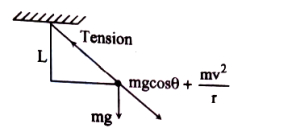
(D) For a simple pendulum executing $S$.$H$.$M$. with small amplitude $A$,the tension $T$ in the string at any angle $\theta$ is given by $T = mg \cos \theta + \frac{mv^2}{\ell}$.
At the mean position,the velocity $v$ is maximum,and $\theta = 0$,so $\cos \theta = 1$. Thus,the maximum tension is $T_{\max} = mg + \frac{mv_{\max}^2}{\ell}$.
In $S$.$H$.$M$.,the velocity is given by $v = A\omega \cos(\omega t)$,where $\omega = \sqrt{\frac{g}{\ell}}$.
The maximum velocity is $v_{\max} = A\omega = A\sqrt{\frac{g}{\ell}}$.
Therefore,$v_{\max}^2 = A^2 \frac{g}{\ell}$.
Substituting this into the expression for $T_{\max}$:
$T_{\max} = mg + \frac{m}{\ell} \left( A^2 \frac{g}{\ell} \right) = mg + mg \frac{A^2}{\ell^2} = mg \left( 1 + \frac{A^2}{\ell^2} \right)$.
At the mean position,the velocity $v$ is maximum,and $\theta = 0$,so $\cos \theta = 1$. Thus,the maximum tension is $T_{\max} = mg + \frac{mv_{\max}^2}{\ell}$.
In $S$.$H$.$M$.,the velocity is given by $v = A\omega \cos(\omega t)$,where $\omega = \sqrt{\frac{g}{\ell}}$.
The maximum velocity is $v_{\max} = A\omega = A\sqrt{\frac{g}{\ell}}$.
Therefore,$v_{\max}^2 = A^2 \frac{g}{\ell}$.
Substituting this into the expression for $T_{\max}$:
$T_{\max} = mg + \frac{m}{\ell} \left( A^2 \frac{g}{\ell} \right) = mg + mg \frac{A^2}{\ell^2} = mg \left( 1 + \frac{A^2}{\ell^2} \right)$.
0 likes
View Solution259
MediumMCQ
$A$ bob of a simple pendulum has mass $m$ and is oscillating with an amplitude $a$. If the length of the pendulum is $L$,then the maximum tension in the string is (given $\cos 0^{\circ}=1, g=$ acceleration due to gravity):
A
$mg\left[1+\left(\frac{a}{L}\right)^{2}\right]$
B
$mg\left[1-\left(\frac{a}{L}\right)^{2}\right]$
C
$mg\left[1+\left(\frac{L}{a}\right)^{2}\right]$
D
$mg\left[1-\left(\frac{L}{a}\right)^{2}\right]$
Solution
(A) The tension in the string is maximum when the bob passes through the mean position.
At the mean position,the forces acting on the bob are the tension $T$ upwards and weight $mg$ downwards. The net centripetal force is provided by the difference between tension and weight:
$T_{\max} - mg = \frac{mV^{2}}{L} \implies T_{\max} = mg + \frac{mV^{2}}{L} \dots (1)$
In Simple Harmonic Motion $(SHM)$,the velocity at the mean position is given by $V = a\omega$.
For a simple pendulum,the angular frequency is $\omega = \sqrt{\frac{g}{L}}$.
Thus,$V = a\sqrt{\frac{g}{L}}$,which implies $V^{2} = a^{2}\frac{g}{L}$.
Substituting this value of $V^{2}$ into $Eq. (1)$:
$T_{\max} = mg + \frac{m}{L} \left(a^{2}\frac{g}{L}\right) = mg + \frac{mga^{2}}{L^{2}} = mg \left[1 + \left(\frac{a}{L}\right)^{2}\right]$.
At the mean position,the forces acting on the bob are the tension $T$ upwards and weight $mg$ downwards. The net centripetal force is provided by the difference between tension and weight:
$T_{\max} - mg = \frac{mV^{2}}{L} \implies T_{\max} = mg + \frac{mV^{2}}{L} \dots (1)$
In Simple Harmonic Motion $(SHM)$,the velocity at the mean position is given by $V = a\omega$.
For a simple pendulum,the angular frequency is $\omega = \sqrt{\frac{g}{L}}$.
Thus,$V = a\sqrt{\frac{g}{L}}$,which implies $V^{2} = a^{2}\frac{g}{L}$.
Substituting this value of $V^{2}$ into $Eq. (1)$:
$T_{\max} = mg + \frac{m}{L} \left(a^{2}\frac{g}{L}\right) = mg + \frac{mga^{2}}{L^{2}} = mg \left[1 + \left(\frac{a}{L}\right)^{2}\right]$.
0 likes
View Solution260
MediumMCQ
If the length of the oscillating simple pendulum is made $\frac{1}{3}$ times the original, keeping the amplitude the same, then the increase in its total energy at a place will be: (in $times$)
A
$3$
B
$2$
C
$9$
D
$5$
Solution
(A) The total energy $E$ of a simple pendulum is given by the formula $E = \frac{1}{2} m \omega^2 A^2$, where $m$ is the mass, $\omega$ is the angular frequency, and $A$ is the amplitude.
Since $\omega = \sqrt{\frac{g}{l}}$, the energy expression becomes $E = \frac{1}{2} m (\frac{g}{l}) A^2 = \frac{mgA^2}{2l}$.
Given that the amplitude $A$ remains constant and the length $l$ is changed to $l' = \frac{l}{3}$, the new energy $E'$ is $E' = \frac{mgA^2}{2(l/3)} = 3 \times \frac{mgA^2}{2l} = 3E$.
Therefore, the total energy becomes $3$ times the original energy.
Since $\omega = \sqrt{\frac{g}{l}}$, the energy expression becomes $E = \frac{1}{2} m (\frac{g}{l}) A^2 = \frac{mgA^2}{2l}$.
Given that the amplitude $A$ remains constant and the length $l$ is changed to $l' = \frac{l}{3}$, the new energy $E'$ is $E' = \frac{mgA^2}{2(l/3)} = 3 \times \frac{mgA^2}{2l} = 3E$.
Therefore, the total energy becomes $3$ times the original energy.
0 likes
View Solution261
MediumMCQ
Two simple pendulums have first $(A)$ bob of mass $M_1$ and length $L_1$,second $(B)$ of mass $M_2$ and length $L_2$. Given $M_1 = M_2$ and $L_1 = 2 L_2$. If their total energies are the same,then which of the following statements is correct?
A
Amplitude of $B$ is greater than amplitude of $A$.
B
Amplitude of $B$ is smaller than amplitude of $A$.
C
Amplitude of both will be same.
D
Amplitude of $B$ is twice that of $A$.
Solution
(B) The total energy $E$ of a simple pendulum performing simple harmonic motion is given by $E = \frac{1}{2} m \omega^2 A^2$,where $m$ is the mass,$\omega$ is the angular frequency,and $A$ is the amplitude.
For a simple pendulum,the angular frequency is $\omega = \sqrt{\frac{g}{L}}$,so $\omega^2 = \frac{g}{L}$.
Substituting this into the energy equation: $E = \frac{1}{2} m \left(\frac{g}{L}\right) A^2$.
Given $E_A = E_B$,$M_1 = M_2 = M$,and $L_1 = 2 L_2$:
$\frac{1}{2} M \left(\frac{g}{L_1}\right) A_A^2 = \frac{1}{2} M \left(\frac{g}{L_2}\right) A_B^2$.
Simplifying,we get $\frac{A_A^2}{L_1} = \frac{A_B^2}{L_2}$.
Substituting $L_1 = 2 L_2$: $\frac{A_A^2}{2 L_2} = \frac{A_B^2}{L_2}$.
This leads to $A_A^2 = 2 A_B^2$,or $A_A = \sqrt{2} A_B$.
Therefore,$A_B = \frac{A_A}{\sqrt{2}}$,which means the amplitude of $B$ is smaller than the amplitude of $A$.
For a simple pendulum,the angular frequency is $\omega = \sqrt{\frac{g}{L}}$,so $\omega^2 = \frac{g}{L}$.
Substituting this into the energy equation: $E = \frac{1}{2} m \left(\frac{g}{L}\right) A^2$.
Given $E_A = E_B$,$M_1 = M_2 = M$,and $L_1 = 2 L_2$:
$\frac{1}{2} M \left(\frac{g}{L_1}\right) A_A^2 = \frac{1}{2} M \left(\frac{g}{L_2}\right) A_B^2$.
Simplifying,we get $\frac{A_A^2}{L_1} = \frac{A_B^2}{L_2}$.
Substituting $L_1 = 2 L_2$: $\frac{A_A^2}{2 L_2} = \frac{A_B^2}{L_2}$.
This leads to $A_A^2 = 2 A_B^2$,or $A_A = \sqrt{2} A_B$.
Therefore,$A_B = \frac{A_A}{\sqrt{2}}$,which means the amplitude of $B$ is smaller than the amplitude of $A$.
0 likes
View Solution262
MediumMCQ
At a place,the length of the oscillating simple pendulum is made $\frac{1}{4}$ times keeping the amplitude the same. Then,the total energy will be:
A
$2$ times
B
$4$ times
C
$8$ times
D
Remains the same
Solution
(B) The total energy $(E)$ of a simple pendulum performing simple harmonic motion is given by the formula $E = \frac{1}{2} m \omega^2 A^2$,where $m$ is the mass,$\omega$ is the angular frequency,and $A$ is the amplitude.
For a simple pendulum,the angular frequency is $\omega = \sqrt{\frac{g}{l}}$,where $g$ is the acceleration due to gravity and $l$ is the length of the pendulum.
Substituting $\omega^2 = \frac{g}{l}$ into the energy equation,we get $E = \frac{1}{2} m (\frac{g}{l}) A^2$.
Since the mass $(m)$,acceleration due to gravity $(g)$,and amplitude $(A)$ remain constant,the total energy is inversely proportional to the length of the pendulum: $E \propto \frac{1}{l}$.
If the new length $l' = \frac{l}{4}$,then the new energy $E'$ is $E' \propto \frac{1}{l/4} = 4 \times (\frac{1}{l}) = 4E$.
Therefore,the total energy becomes $4$ times the initial energy.
For a simple pendulum,the angular frequency is $\omega = \sqrt{\frac{g}{l}}$,where $g$ is the acceleration due to gravity and $l$ is the length of the pendulum.
Substituting $\omega^2 = \frac{g}{l}$ into the energy equation,we get $E = \frac{1}{2} m (\frac{g}{l}) A^2$.
Since the mass $(m)$,acceleration due to gravity $(g)$,and amplitude $(A)$ remain constant,the total energy is inversely proportional to the length of the pendulum: $E \propto \frac{1}{l}$.
If the new length $l' = \frac{l}{4}$,then the new energy $E'$ is $E' \propto \frac{1}{l/4} = 4 \times (\frac{1}{l}) = 4E$.
Therefore,the total energy becomes $4$ times the initial energy.
0 likes
View Solution263
EasyMCQ
$A$ simple pendulum of length $L$ has mass $M$ and it oscillates freely with amplitude $A$. At the extreme position,its potential energy is:
A
$\frac{MgA^2}{L}$
B
$\frac{2MgA^2}{L}$
C
$\frac{MgA}{2L}$
D
$\frac{MgA^2}{2L}$
Solution
(D) For a simple harmonic oscillator,the potential energy $PE$ at displacement $x$ is given by $PE = \frac{1}{2} k x^2$,where $k$ is the force constant.
At the extreme position,the displacement $x = A$,so $PE = \frac{1}{2} k A^2$.
For a simple pendulum,the restoring force is $F = -\frac{Mg}{L} x$,so the force constant $k = \frac{Mg}{L}$.
Substituting the value of $k$ into the potential energy formula:
$PE = \frac{1}{2} \left( \frac{Mg}{L} \right) A^2$.
$PE = \frac{MgA^2}{2L}$.
At the extreme position,the displacement $x = A$,so $PE = \frac{1}{2} k A^2$.
For a simple pendulum,the restoring force is $F = -\frac{Mg}{L} x$,so the force constant $k = \frac{Mg}{L}$.
Substituting the value of $k$ into the potential energy formula:
$PE = \frac{1}{2} \left( \frac{Mg}{L} \right) A^2$.
$PE = \frac{MgA^2}{2L}$.
0 likes
View Solution264
EasyMCQ
$A$ simple pendulum of length $L$ has mass $m$ and it oscillates freely with amplitude $A$. At the extreme position,its potential energy is ($g =$ acceleration due to gravity).
A
$\frac{mgA}{2L}$
B
$\frac{mgA^2}{L}$
C
$\frac{mgA}{L}$
D
$\frac{mgA^2}{2L}$
Solution
(D) The potential energy $(P.E.)$ of a simple harmonic oscillator at its extreme position is given by the formula:
$P.E. = \frac{1}{2} m \omega^2 A^2$
For a simple pendulum,the angular frequency $\omega$ is given by $\omega = \sqrt{\frac{g}{L}}$.
Substituting this value into the potential energy equation:
$P.E. = \frac{1}{2} m \left(\sqrt{\frac{g}{L}}\right)^2 A^2$
$P.E. = \frac{1}{2} m \left(\frac{g}{L}\right) A^2$
$P.E. = \frac{mgA^2}{2L}$
$P.E. = \frac{1}{2} m \omega^2 A^2$
For a simple pendulum,the angular frequency $\omega$ is given by $\omega = \sqrt{\frac{g}{L}}$.
Substituting this value into the potential energy equation:
$P.E. = \frac{1}{2} m \left(\sqrt{\frac{g}{L}}\right)^2 A^2$
$P.E. = \frac{1}{2} m \left(\frac{g}{L}\right) A^2$
$P.E. = \frac{mgA^2}{2L}$
0 likes
View Solution265
EasyMCQ
$A$ child is sitting on a swing which performs $S.H.M$. It has minimum and maximum heights from the ground of $0.75 \,m$ and $2 \,m$ respectively. Its maximum speed will be $\left[g=10 \,m/s^2\right]$
A
$\sqrt{1.25} \,m/s$
B
$\sqrt{12.5} \,m/s$
C
$5 \,m/s$
D
$25 \,m/s$
Solution
(C) The swing performs $S.H.M$ between the minimum height $(h_{min} = 0.75 \,m)$ and the maximum height $(h_{max} = 2 \,m)$.
At the highest point,the potential energy is maximum,and at the lowest point,this potential energy is converted into kinetic energy.
The effective vertical displacement (amplitude height) is $h = h_{max} - h_{min} = 2 \,m - 0.75 \,m = 1.25 \,m$.
Using the principle of conservation of energy:
$\frac{1}{2} mv^2 = mgh$
$v^2 = 2gh$
$v^2 = 2 \times 10 \,m/s^2 \times 1.25 \,m$
$v^2 = 25 \,m^2/s^2$
$v = 5 \,m/s$.
At the highest point,the potential energy is maximum,and at the lowest point,this potential energy is converted into kinetic energy.
The effective vertical displacement (amplitude height) is $h = h_{max} - h_{min} = 2 \,m - 0.75 \,m = 1.25 \,m$.
Using the principle of conservation of energy:
$\frac{1}{2} mv^2 = mgh$
$v^2 = 2gh$
$v^2 = 2 \times 10 \,m/s^2 \times 1.25 \,m$
$v^2 = 25 \,m^2/s^2$
$v = 5 \,m/s$.
0 likes
View Solution266
EasyMCQ
$A$ simple pendulum of length $L$ has mass $m$ and it oscillates freely with amplitude $A$. At the extreme position,its potential energy is (where $g$ is the acceleration due to gravity):
A
$\frac{m g A^{2}}{2 L}$
B
$\frac{m g A^{2}}{L}$
C
$\frac{m g A}{L}$
D
$\frac{m g A}{2 L}$
Solution
(A) For a simple pendulum undergoing small oscillations,the restoring force is $F = -\frac{mg}{L} x$.
The potential energy $PE$ of a simple harmonic oscillator is given by $PE = \frac{1}{2} k x^{2}$.
Comparing the restoring force $F = -kx$ with $F = -\frac{mg}{L} x$,we get the spring constant $k = \frac{mg}{L}$.
At the extreme position,the displacement $x$ is equal to the amplitude $A$.
Substituting these values into the potential energy formula: $PE = \frac{1}{2} \left( \frac{mg}{L} \right) A^{2} = \frac{mgA^{2}}{2L}$.
The potential energy $PE$ of a simple harmonic oscillator is given by $PE = \frac{1}{2} k x^{2}$.
Comparing the restoring force $F = -kx$ with $F = -\frac{mg}{L} x$,we get the spring constant $k = \frac{mg}{L}$.
At the extreme position,the displacement $x$ is equal to the amplitude $A$.
Substituting these values into the potential energy formula: $PE = \frac{1}{2} \left( \frac{mg}{L} \right) A^{2} = \frac{mgA^{2}}{2L}$.
0 likes
View Solution267
EasyMCQ
If the length of an oscillating simple pendulum is made $\frac{1}{3}$ times at a place while keeping the amplitude the same,then its total energy $(E)$ will be: (in $E$)
A
$6$
B
$4$
C
$2$
D
$3$
Solution
(D) The time period of a simple pendulum is given by $T = 2 \pi \sqrt{\frac{\ell}{g}}$.
Since $\omega = \frac{2 \pi}{T}$,we have $\omega = \sqrt{\frac{g}{\ell}}$,which implies $\omega \propto \frac{1}{\sqrt{\ell}}$.
Given the new length $\ell_2 = \frac{\ell_1}{3}$,the new angular frequency $\omega_2$ is related to the initial frequency $\omega_1$ by $\frac{\omega_2}{\omega_1} = \sqrt{\frac{\ell_1}{\ell_2}} = \sqrt{\frac{\ell_1}{\ell_1/3}} = \sqrt{3}$.
The total energy of a simple harmonic oscillator is given by $E = \frac{1}{2} m \omega^2 A^2$.
Since the mass $(m)$ and amplitude $(A)$ remain constant,$E \propto \omega^2$.
Therefore,$\frac{E_2}{E_1} = \left( \frac{\omega_2}{\omega_1} \right)^2 = (\sqrt{3})^2 = 3$.
Thus,the new total energy is $E_2 = 3 E_1$.
Since $\omega = \frac{2 \pi}{T}$,we have $\omega = \sqrt{\frac{g}{\ell}}$,which implies $\omega \propto \frac{1}{\sqrt{\ell}}$.
Given the new length $\ell_2 = \frac{\ell_1}{3}$,the new angular frequency $\omega_2$ is related to the initial frequency $\omega_1$ by $\frac{\omega_2}{\omega_1} = \sqrt{\frac{\ell_1}{\ell_2}} = \sqrt{\frac{\ell_1}{\ell_1/3}} = \sqrt{3}$.
The total energy of a simple harmonic oscillator is given by $E = \frac{1}{2} m \omega^2 A^2$.
Since the mass $(m)$ and amplitude $(A)$ remain constant,$E \propto \omega^2$.
Therefore,$\frac{E_2}{E_1} = \left( \frac{\omega_2}{\omega_1} \right)^2 = (\sqrt{3})^2 = 3$.
Thus,the new total energy is $E_2 = 3 E_1$.
0 likes
View Solution268
MediumMCQ
$A$ simple pendulum of length '$l$' and a bob of mass '$m$' is executing $S$.$H$.$M$. of small amplitude '$A$'. The maximum tension in the string will be ($g=$ acceleration due to gravity).
A
$2 mg$
B
$mg\left[1+\left(\frac{A}{l}\right)^2\right]$
C
$mg\left[1+\left(\frac{A}{l}\right)\right]^2$
D
$mg\left[1+\left(\frac{A}{l}\right)\right]$
Solution
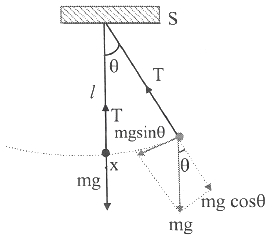
(B) The tension $T$ in the string of a simple pendulum at any angle $\theta$ is given by the radial force balance equation:
$T = mg \cos \theta + \frac{mv^2}{l}$
For small oscillations,$\cos \theta \approx 1$ and the velocity $v$ is maximum at the mean position $(\theta = 0)$.
Thus,the maximum tension $T_{\max}$ occurs at the mean position:
$T_{\max} = mg + \frac{mv_{\max}^2}{l}$
For a simple pendulum,the angular frequency is $\omega = \sqrt{\frac{g}{l}}$.
The maximum velocity in $S$.$H$.$M$. is $v_{\max} = A\omega$.
Substituting $v_{\max}$ into the tension equation:
$T_{\max} = mg + \frac{m(A\omega)^2}{l}$
$T_{\max} = mg + \frac{m A^2 \omega^2}{l}$
Since $\omega^2 = \frac{g}{l}$,we get:
$T_{\max} = mg + \frac{m A^2 (g/l)}{l}$
$T_{\max} = mg + \frac{m A^2 g}{l^2}$
$T_{\max} = mg \left[1 + \left(\frac{A}{l}\right)^2\right]$
$T = mg \cos \theta + \frac{mv^2}{l}$
For small oscillations,$\cos \theta \approx 1$ and the velocity $v$ is maximum at the mean position $(\theta = 0)$.
Thus,the maximum tension $T_{\max}$ occurs at the mean position:
$T_{\max} = mg + \frac{mv_{\max}^2}{l}$
For a simple pendulum,the angular frequency is $\omega = \sqrt{\frac{g}{l}}$.
The maximum velocity in $S$.$H$.$M$. is $v_{\max} = A\omega$.
Substituting $v_{\max}$ into the tension equation:
$T_{\max} = mg + \frac{m(A\omega)^2}{l}$
$T_{\max} = mg + \frac{m A^2 \omega^2}{l}$
Since $\omega^2 = \frac{g}{l}$,we get:
$T_{\max} = mg + \frac{m A^2 (g/l)}{l}$
$T_{\max} = mg + \frac{m A^2 g}{l^2}$
$T_{\max} = mg \left[1 + \left(\frac{A}{l}\right)^2\right]$
0 likes
View Solution269
EasyMCQ
The path length of oscillation of a simple pendulum of length $1 \,m$ is $16 \,cm$. Its maximum velocity is (Take $g = \pi^2 \,m/s^2$).
A
$2 \pi \,cm/s$
B
$8 \pi \,cm/s$
C
$4 \pi \,cm/s$
D
$16 \pi \,cm/s$
Solution
(B) The path length of oscillation is the total distance between the two extreme positions, which is equal to $2a$, where $a$ is the amplitude.
Given, $2a = 16 \,cm$, so the amplitude $a = 8 \,cm$.
The length of the pendulum is $l = 1 \,m$.
The angular frequency of a simple pendulum is given by $\omega = \sqrt{\frac{g}{l}}$.
Substituting $g = \pi^2 \,m/s^2$ and $l = 1 \,m$, we get $\omega = \sqrt{\frac{\pi^2}{1}} = \pi \,rad/s$.
The maximum velocity $v_{max}$ in simple harmonic motion is given by $v_{max} = a\omega$.
Substituting the values, $v_{max} = 8 \,cm \times \pi \,rad/s = 8\pi \,cm/s$.
Given, $2a = 16 \,cm$, so the amplitude $a = 8 \,cm$.
The length of the pendulum is $l = 1 \,m$.
The angular frequency of a simple pendulum is given by $\omega = \sqrt{\frac{g}{l}}$.
Substituting $g = \pi^2 \,m/s^2$ and $l = 1 \,m$, we get $\omega = \sqrt{\frac{\pi^2}{1}} = \pi \,rad/s$.
The maximum velocity $v_{max}$ in simple harmonic motion is given by $v_{max} = a\omega$.
Substituting the values, $v_{max} = 8 \,cm \times \pi \,rad/s = 8\pi \,cm/s$.
0 likes
View Solution270
EasyMCQ
$A$ pendulum has a length of $0.4 \ m$ and a maximum speed of $4 \ m/s$. When the string makes an angle of $30^{\circ}$ with the horizontal,its speed will be: $\left[\sin \frac{\pi}{6} = \cos \frac{\pi}{3} = 0.5 \text{ and } g = 10 \ m/s^{2}\right]$
A
$2 \sqrt{2} \ m/s$
B
$\sqrt{3} \ m/s$
C
$2 \sqrt{5} \ m/s$
D
$2 \sqrt{3} \ m/s$
Solution
(D) Given: Length $L = 0.4 \ m$,maximum speed $v_{max} = 4 \ m/s$ at the lowest point.
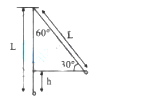
When the string makes an angle of $30^{\circ}$ with the horizontal,it makes an angle of $\theta = 60^{\circ}$ with the vertical.
The height $h$ of the pendulum bob above the lowest point is given by $h = L - L \cos \theta = L(1 - \cos 60^{\circ})$.
$h = 0.4(1 - 0.5) = 0.4 \times 0.5 = 0.2 \ m$.
Using the law of conservation of energy between the lowest point and the point at angle $\theta$:
$\frac{1}{2} m v_{max}^{2} = \frac{1}{2} m v^{2} + mgh$
$v^{2} = v_{max}^{2} - 2gh$
$v^{2} = (4)^{2} - 2 \times 10 \times 0.2$
$v^{2} = 16 - 4 = 12$
$v = \sqrt{12} = 2 \sqrt{3} \ m/s$.
When the string makes an angle of $30^{\circ}$ with the horizontal,it makes an angle of $\theta = 60^{\circ}$ with the vertical.
The height $h$ of the pendulum bob above the lowest point is given by $h = L - L \cos \theta = L(1 - \cos 60^{\circ})$.
$h = 0.4(1 - 0.5) = 0.4 \times 0.5 = 0.2 \ m$.
Using the law of conservation of energy between the lowest point and the point at angle $\theta$:
$\frac{1}{2} m v_{max}^{2} = \frac{1}{2} m v^{2} + mgh$
$v^{2} = v_{max}^{2} - 2gh$
$v^{2} = (4)^{2} - 2 \times 10 \times 0.2$
$v^{2} = 16 - 4 = 12$
$v = \sqrt{12} = 2 \sqrt{3} \ m/s$.
0 likes
View Solution271
MediumMCQ
$A$ coin is placed on a horizontal plate. The plate performs $S.H.M.$ vertically with an angular frequency $\omega$. The amplitude $A$ of oscillations is gradually increased. The coin will lose contact with the plate for the first time when the amplitude is ($g =$ acceleration due to gravity).
A
$\frac{g}{\omega^{2}}$
B
zero
C
$\frac{\omega^{2}}{g}$
D
$\frac{A}{2}$
Solution
(A) The coin rests on the plate and moves with it. The acceleration of the plate in $S.H.M.$ is given by $a = \omega^{2} x$,where $x$ is the displacement from the mean position.
As the plate moves downward,its acceleration is directed upwards. As the plate moves upward,its acceleration is directed downwards.
The coin loses contact with the plate when the downward acceleration of the plate exceeds the acceleration due to gravity $(g)$.
At the topmost point of the oscillation,the downward acceleration is maximum,given by $a_{max} = \omega^{2} A$.
For the coin to lose contact,the condition is $a_{max} \geq g$.
Therefore,the minimum amplitude at which contact is lost is $A = \frac{g}{\omega^{2}}$.
As the plate moves downward,its acceleration is directed upwards. As the plate moves upward,its acceleration is directed downwards.
The coin loses contact with the plate when the downward acceleration of the plate exceeds the acceleration due to gravity $(g)$.
At the topmost point of the oscillation,the downward acceleration is maximum,given by $a_{max} = \omega^{2} A$.
For the coin to lose contact,the condition is $a_{max} \geq g$.
Therefore,the minimum amplitude at which contact is lost is $A = \frac{g}{\omega^{2}}$.
0 likes
View Solution272
MediumMCQ
$A$ simple pendulum of length $L$ has mass $M$ and it oscillates freely with amplitude $A$. At the extreme position,its potential energy is $(g =$ acceleration due to gravity$)$
A
$\frac{M g A^2}{2 L}$
B
$\frac{M g A}{2 L}$
C
$\frac{M g A^2}{L}$
D
$\frac{2 M g A^2}{L}$
Solution
(A) The potential energy of a simple harmonic oscillator is given by the formula $U = \frac{1}{2} k A^2$,where $k$ is the force constant and $A$ is the amplitude.
For a simple pendulum,the restoring force is $F = -Mg \sin \theta \approx -Mg \theta$ for small angles.
Since $\theta = \frac{x}{L}$,the force is $F = -\frac{Mg}{L} x$.
Comparing this with $F = -kx$,we get the force constant $k = \frac{Mg}{L}$.
Substituting $k$ into the potential energy formula: $U = \frac{1}{2} (\frac{Mg}{L}) A^2 = \frac{MgA^2}{2L}$.
For a simple pendulum,the restoring force is $F = -Mg \sin \theta \approx -Mg \theta$ for small angles.
Since $\theta = \frac{x}{L}$,the force is $F = -\frac{Mg}{L} x$.
Comparing this with $F = -kx$,we get the force constant $k = \frac{Mg}{L}$.
Substituting $k$ into the potential energy formula: $U = \frac{1}{2} (\frac{Mg}{L}) A^2 = \frac{MgA^2}{2L}$.
0 likes
View Solution273
EasyMCQ
The ratio of the frequencies of two simple pendulums is $4: 3$ at the same place. The ratio of their respective lengths is
A
$3: 4$
B
$4: 3$
C
$9: 16$
D
$16: 9$
Solution
(C) The frequency $f$ of a simple pendulum is given by the formula $f = \frac{1}{2\pi} \sqrt{\frac{g}{L}}$,where $g$ is the acceleration due to gravity and $L$ is the length of the pendulum.
Since the pendulums are at the same place,$g$ is constant.
Therefore,$f \propto \frac{1}{\sqrt{L}}$,which implies $f^2 \propto \frac{1}{L}$ or $L \propto \frac{1}{f^2}$.
Given the ratio of frequencies $f_1 : f_2 = 4 : 3$,we have $\frac{f_1}{f_2} = \frac{4}{3}$.
The ratio of their lengths is $\frac{L_1}{L_2} = \frac{f_2^2}{f_1^2} = \left( \frac{f_2}{f_1} \right)^2$.
Substituting the values,$\frac{L_1}{L_2} = \left( \frac{3}{4} \right)^2 = \frac{9}{16}$.
Thus,the ratio of their lengths is $9: 16$.
Since the pendulums are at the same place,$g$ is constant.
Therefore,$f \propto \frac{1}{\sqrt{L}}$,which implies $f^2 \propto \frac{1}{L}$ or $L \propto \frac{1}{f^2}$.
Given the ratio of frequencies $f_1 : f_2 = 4 : 3$,we have $\frac{f_1}{f_2} = \frac{4}{3}$.
The ratio of their lengths is $\frac{L_1}{L_2} = \frac{f_2^2}{f_1^2} = \left( \frac{f_2}{f_1} \right)^2$.
Substituting the values,$\frac{L_1}{L_2} = \left( \frac{3}{4} \right)^2 = \frac{9}{16}$.
Thus,the ratio of their lengths is $9: 16$.
0 likes
View Solution274
EasyMCQ
Choose the correct answer. When the point of suspension of a pendulum is moved vertically upward with an acceleration '$a$',its period of oscillation:
A
decreases
B
increases
C
remains same
D
sometimes increases and sometimes decreases
Solution
(A) The time period of a simple pendulum is given by the formula $T = 2 \pi \sqrt{\frac{l}{g_{eff}}}$,where $l$ is the length of the pendulum and $g_{eff}$ is the effective acceleration due to gravity.
When the point of suspension moves vertically upward with an acceleration '$a$',the effective acceleration due to gravity becomes $g_{eff} = g + a$.
Substituting this into the formula,we get $T' = 2 \pi \sqrt{\frac{l}{g + a}}$.
Since $g + a > g$,the denominator increases,which causes the time period $T'$ to decrease compared to the original time period $T$.
When the point of suspension moves vertically upward with an acceleration '$a$',the effective acceleration due to gravity becomes $g_{eff} = g + a$.
Substituting this into the formula,we get $T' = 2 \pi \sqrt{\frac{l}{g + a}}$.
Since $g + a > g$,the denominator increases,which causes the time period $T'$ to decrease compared to the original time period $T$.
0 likes
View Solution275
EasyMCQ
The period of a simple pendulum gets doubled when
A
its length is doubled.
B
its length is made four times.
C
its length is made half.
D
the mass of the bob is doubled.
Solution
(B) We know that the time period $T$ of a simple pendulum is given by the formula:
$T = 2 \pi \sqrt{\frac{l}{g}}$
From this relation,we can see that $T \propto \sqrt{l}$.
Let the initial time period be $T_1$ with length $l_1$,and the final time period be $T_2$ with length $l_2$.
We want the period to be doubled,so $T_2 = 2 T_1$.
Using the ratio:
$\frac{T_2}{T_1} = \sqrt{\frac{l_2}{l_1}}$
Substituting $T_2 = 2 T_1$:
$2 = \sqrt{\frac{l_2}{l_1}}$
Squaring both sides:
$4 = \frac{l_2}{l_1} \Rightarrow l_2 = 4 l_1$
Therefore,the period of a simple pendulum is doubled when its length is made four times the original length.
$T = 2 \pi \sqrt{\frac{l}{g}}$
From this relation,we can see that $T \propto \sqrt{l}$.
Let the initial time period be $T_1$ with length $l_1$,and the final time period be $T_2$ with length $l_2$.
We want the period to be doubled,so $T_2 = 2 T_1$.
Using the ratio:
$\frac{T_2}{T_1} = \sqrt{\frac{l_2}{l_1}}$
Substituting $T_2 = 2 T_1$:
$2 = \sqrt{\frac{l_2}{l_1}}$
Squaring both sides:
$4 = \frac{l_2}{l_1} \Rightarrow l_2 = 4 l_1$
Therefore,the period of a simple pendulum is doubled when its length is made four times the original length.
0 likes
View Solution276
MediumMCQ
$A$ simple pendulum of length $l_1$ has time period $T_1$. Another simple pendulum of length $l_2$ $(l_1 > l_2)$ has time period $T_2$. Then the time period of the pendulum of length $(l_1 - l_2)$ will be
A
$T_1 - T_2$
B
$\sqrt{\frac{T_1}{T_2}}$
C
$\sqrt{T_1^2 - T_2^2}$
D
$\sqrt{\frac{T_2}{T_1}}$
Solution
(C) For a simple pendulum,the time period is given by $T = 2 \pi \sqrt{\frac{l}{g}}$.
Thus,$T_1 = 2 \pi \sqrt{\frac{l_1}{g}}$ and $T_2 = 2 \pi \sqrt{\frac{l_2}{g}}$.
Squaring both sides,we get $T_1^2 = 4 \pi^2 \frac{l_1}{g}$ and $T_2^2 = 4 \pi^2 \frac{l_2}{g}$.
From these,we can express the lengths as $l_1 = \frac{T_1^2 g}{4 \pi^2}$ and $l_2 = \frac{T_2^2 g}{4 \pi^2}$.
Now,for a pendulum of length $(l_1 - l_2)$,the time period $T$ is given by $T = 2 \pi \sqrt{\frac{l_1 - l_2}{g}}$.
Substituting the expressions for $l_1$ and $l_2$:
$T = 2 \pi \sqrt{\frac{1}{g} \left( \frac{T_1^2 g}{4 \pi^2} - \frac{T_2^2 g}{4 \pi^2} \right)}$.
$T = 2 \pi \sqrt{\frac{g}{g \cdot 4 \pi^2} (T_1^2 - T_2^2)}$.
$T = 2 \pi \sqrt{\frac{1}{4 \pi^2} (T_1^2 - T_2^2)}$.
$T = 2 \pi \cdot \frac{1}{2 \pi} \sqrt{T_1^2 - T_2^2}$.
$T = \sqrt{T_1^2 - T_2^2}$.
Thus,$T_1 = 2 \pi \sqrt{\frac{l_1}{g}}$ and $T_2 = 2 \pi \sqrt{\frac{l_2}{g}}$.
Squaring both sides,we get $T_1^2 = 4 \pi^2 \frac{l_1}{g}$ and $T_2^2 = 4 \pi^2 \frac{l_2}{g}$.
From these,we can express the lengths as $l_1 = \frac{T_1^2 g}{4 \pi^2}$ and $l_2 = \frac{T_2^2 g}{4 \pi^2}$.
Now,for a pendulum of length $(l_1 - l_2)$,the time period $T$ is given by $T = 2 \pi \sqrt{\frac{l_1 - l_2}{g}}$.
Substituting the expressions for $l_1$ and $l_2$:
$T = 2 \pi \sqrt{\frac{1}{g} \left( \frac{T_1^2 g}{4 \pi^2} - \frac{T_2^2 g}{4 \pi^2} \right)}$.
$T = 2 \pi \sqrt{\frac{g}{g \cdot 4 \pi^2} (T_1^2 - T_2^2)}$.
$T = 2 \pi \sqrt{\frac{1}{4 \pi^2} (T_1^2 - T_2^2)}$.
$T = 2 \pi \cdot \frac{1}{2 \pi} \sqrt{T_1^2 - T_2^2}$.
$T = \sqrt{T_1^2 - T_2^2}$.
0 likes
View Solution277
EasyMCQ
$A$ simple pendulum of length $l$ has a brass bob attached at its lower end. Its period is $T$. $A$ steel bob of the same size,having density $x$ times that of brass,replaces the brass bob. Its length is then changed such that the period becomes $2T$. What is the new length?
A
$4/x$
B
$4l/x$
C
$4l$
D
$2l$
Solution
(C) The time period of a simple pendulum is given by the formula $T = 2\pi \sqrt{\frac{l}{g}}$.
From this formula,we can see that the time period $T$ is directly proportional to the square root of the length $l$,i.e.,$T \propto \sqrt{l}$.
The time period of a simple pendulum is independent of the mass,size,or density of the bob.
Let the initial length be $l_1 = l$ and the initial time period be $T_1 = T$.
Let the new length be $l_2$ and the new time period be $T_2 = 2T$.
Using the proportionality $T \propto \sqrt{l}$,we have $\frac{T_2}{T_1} = \sqrt{\frac{l_2}{l_1}}$.
Substituting the given values: $\frac{2T}{T} = \sqrt{\frac{l_2}{l}}$.
$2 = \sqrt{\frac{l_2}{l}}$.
Squaring both sides,we get $4 = \frac{l_2}{l}$.
Therefore,the new length $l_2 = 4l$.
From this formula,we can see that the time period $T$ is directly proportional to the square root of the length $l$,i.e.,$T \propto \sqrt{l}$.
The time period of a simple pendulum is independent of the mass,size,or density of the bob.
Let the initial length be $l_1 = l$ and the initial time period be $T_1 = T$.
Let the new length be $l_2$ and the new time period be $T_2 = 2T$.
Using the proportionality $T \propto \sqrt{l}$,we have $\frac{T_2}{T_1} = \sqrt{\frac{l_2}{l_1}}$.
Substituting the given values: $\frac{2T}{T} = \sqrt{\frac{l_2}{l}}$.
$2 = \sqrt{\frac{l_2}{l}}$.
Squaring both sides,we get $4 = \frac{l_2}{l}$.
Therefore,the new length $l_2 = 4l$.
0 likes
View Solution278
DifficultMCQ
$A$ piece of wood has length,breadth and height,'$a$','$b$' and '$c$' respectively. Its relative density is '$d$'. It is floating in water such that the side '$a$' is vertical. It is pushed down a little and released. The time period of $S.H.M.$ executed by it is ($g=$ acceleration due to gravity).
A
$2 \pi \sqrt{\frac{a b c}{g}}$
B
$2 \pi \sqrt{\frac{b c}{d g}}$
C
$2 \pi \sqrt{\frac{g}{d a}}$
D
$2 \pi \sqrt{\frac{ad}{g}}$
Solution
(D) The time period of $S.H.M.$ for small vertical oscillations of a floating body is given by $T = 2 \pi \sqrt{\frac{h'}{g}}$,where $h'$ is the depth of the object submerged in the liquid.
For a floating body,the weight of the object equals the weight of the displaced liquid.
Let $V$ be the volume of the wood,$V = a \times b \times c$.
Mass of wood $= V \times d \times \rho_w = (abc) \times d \times \rho_w$ (where $\rho_w$ is the density of water).
Volume of displaced water $V_{disp} = b \times c \times h'$.
Weight of displaced water $= (bc h') \times \rho_w \times g$.
Equating the two: $(abc) \times d \times \rho_w \times g = (bc h') \times \rho_w \times g$.
Solving for $h'$,we get $h' = ad$.
Substituting this into the time period formula: $T = 2 \pi \sqrt{\frac{ad}{g}}$.
For a floating body,the weight of the object equals the weight of the displaced liquid.
Let $V$ be the volume of the wood,$V = a \times b \times c$.
Mass of wood $= V \times d \times \rho_w = (abc) \times d \times \rho_w$ (where $\rho_w$ is the density of water).
Volume of displaced water $V_{disp} = b \times c \times h'$.
Weight of displaced water $= (bc h') \times \rho_w \times g$.
Equating the two: $(abc) \times d \times \rho_w \times g = (bc h') \times \rho_w \times g$.
Solving for $h'$,we get $h' = ad$.
Substituting this into the time period formula: $T = 2 \pi \sqrt{\frac{ad}{g}}$.
0 likes
View Solution279
EasyMCQ
$A$ rubber ball filled with water,having a small hole,is used as the bob of a simple pendulum. The time period of such a pendulum
A
is a constant
B
decreases with time
C
increases with time
D
first increases and then decreases,finally having the same value as at the beginning
Solution
(D) The time period of a simple pendulum is given by $T = 2\pi \sqrt{\frac{L}{g}}$,where $L$ is the distance between the point of suspension and the center of gravity $(CG)$ of the bob.
Initially,the $CG$ of the water-filled ball is at its geometric center.
As water flows out through the small hole,the $CG$ of the remaining water shifts downwards,which increases the effective length $L$ of the pendulum,causing the time period $T$ to increase.
As the ball becomes nearly empty,the $CG$ starts moving back up towards the geometric center of the ball.
Consequently,the effective length $L$ decreases and returns to its original value.
Therefore,the time period first increases and then decreases,finally returning to its initial value.
Initially,the $CG$ of the water-filled ball is at its geometric center.
As water flows out through the small hole,the $CG$ of the remaining water shifts downwards,which increases the effective length $L$ of the pendulum,causing the time period $T$ to increase.
As the ball becomes nearly empty,the $CG$ starts moving back up towards the geometric center of the ball.
Consequently,the effective length $L$ decreases and returns to its original value.
Therefore,the time period first increases and then decreases,finally returning to its initial value.
0 likes
View Solution280
MediumMCQ
The time period of a simple pendulum inside a stationary lift is $T$. When the lift starts accelerating upwards with an acceleration of $\frac{g}{3}$,the time period of the pendulum will be
A
$\frac{\sqrt{5}}{2} T$
B
$\frac{\sqrt{3}}{2} T$
C
$\frac{2 T}{\sqrt{3}}$
D
$\frac{2 T}{\sqrt{5}}$
Solution
(B) The time period of a simple pendulum is given by $T = 2 \pi \sqrt{\frac{l}{g_{eff}}}$.
In a stationary lift,the effective acceleration is $g_{eff} = g$,so $T = 2 \pi \sqrt{\frac{l}{g}}$.
When the lift accelerates upwards with an acceleration $a = \frac{g}{3}$,the effective acceleration experienced by the pendulum is $g_{eff} = g + a$.
Substituting the value of $a$,we get $g_{eff} = g + \frac{g}{3} = \frac{4g}{3}$.
The new time period $T^{\prime}$ is given by $T^{\prime} = 2 \pi \sqrt{\frac{l}{g_{eff}}} = 2 \pi \sqrt{\frac{l}{4g/3}}$.
Simplifying this,$T^{\prime} = 2 \pi \sqrt{\frac{3l}{4g}} = \frac{\sqrt{3}}{2} \left( 2 \pi \sqrt{\frac{l}{g}} \right)$.
Since $T = 2 \pi \sqrt{\frac{l}{g}}$,we have $T^{\prime} = \frac{\sqrt{3}}{2} T$.
In a stationary lift,the effective acceleration is $g_{eff} = g$,so $T = 2 \pi \sqrt{\frac{l}{g}}$.
When the lift accelerates upwards with an acceleration $a = \frac{g}{3}$,the effective acceleration experienced by the pendulum is $g_{eff} = g + a$.
Substituting the value of $a$,we get $g_{eff} = g + \frac{g}{3} = \frac{4g}{3}$.
The new time period $T^{\prime}$ is given by $T^{\prime} = 2 \pi \sqrt{\frac{l}{g_{eff}}} = 2 \pi \sqrt{\frac{l}{4g/3}}$.
Simplifying this,$T^{\prime} = 2 \pi \sqrt{\frac{3l}{4g}} = \frac{\sqrt{3}}{2} \left( 2 \pi \sqrt{\frac{l}{g}} \right)$.
Since $T = 2 \pi \sqrt{\frac{l}{g}}$,we have $T^{\prime} = \frac{\sqrt{3}}{2} T$.
0 likes
View Solution281
EasyMCQ
$A$ pendulum clock is running fast. To correct its time,we should
A
reduce the mass of the bob
B
reduce the amplitude of oscillation
C
increase the length of the pendulum
D
reduce the length of the pendulum
Solution
(C) The time period $T$ of a simple pendulum is given by the formula:
$T = 2\pi \sqrt{\frac{\ell}{g}}$
From this relation,we can see that $T \propto \sqrt{\ell}$.
If a clock is running fast,it means its time period $T$ is too small (it completes oscillations too quickly).
To correct the time,we need to increase the time period $T$.
Since $T$ is directly proportional to the square root of the length $\ell$,increasing the length $\ell$ will increase the time period $T$.
The time period is independent of the mass of the bob and the amplitude of oscillation (for small angles).
$T = 2\pi \sqrt{\frac{\ell}{g}}$
From this relation,we can see that $T \propto \sqrt{\ell}$.
If a clock is running fast,it means its time period $T$ is too small (it completes oscillations too quickly).
To correct the time,we need to increase the time period $T$.
Since $T$ is directly proportional to the square root of the length $\ell$,increasing the length $\ell$ will increase the time period $T$.
The time period is independent of the mass of the bob and the amplitude of oscillation (for small angles).
0 likes
View Solution282
EasyMCQ
The ratio of frequencies of oscillations of two simple pendulums is $3: 4$,then their lengths are in the ratio
A
$16: 9$
B
$9: 16$
C
$\sqrt{3}: \sqrt{4}$
D
$\sqrt{4}: \sqrt{3}$
Solution
(A) The frequency $f$ of a simple pendulum is given by the formula $f = \frac{1}{2 \pi} \sqrt{\frac{g}{\ell}}$.
From this,we can see that $f \propto \frac{1}{\sqrt{\ell}}$,which implies $\frac{f_1}{f_2} = \sqrt{\frac{\ell_2}{\ell_1}}$.
Given the ratio of frequencies $\frac{f_1}{f_2} = \frac{3}{4}$,we substitute this into the equation:
$\frac{3}{4} = \sqrt{\frac{\ell_2}{\ell_1}}$.
Squaring both sides,we get $\frac{9}{16} = \frac{\ell_2}{\ell_1}$.
Therefore,the ratio of their lengths is $\frac{\ell_1}{\ell_2} = \frac{16}{9}$.
From this,we can see that $f \propto \frac{1}{\sqrt{\ell}}$,which implies $\frac{f_1}{f_2} = \sqrt{\frac{\ell_2}{\ell_1}}$.
Given the ratio of frequencies $\frac{f_1}{f_2} = \frac{3}{4}$,we substitute this into the equation:
$\frac{3}{4} = \sqrt{\frac{\ell_2}{\ell_1}}$.
Squaring both sides,we get $\frac{9}{16} = \frac{\ell_2}{\ell_1}$.
Therefore,the ratio of their lengths is $\frac{\ell_1}{\ell_2} = \frac{16}{9}$.
0 likes
View Solution283
MediumMCQ
$A$ pendulum performs $S.H.M.$ with period $\sqrt{3} \ s$ in a stationary lift. If the lift moves up with acceleration $\frac{g}{3}$,the period of the pendulum is $[g=$ acceleration due to gravity $]$. (in $s$)
A
$2.00$
B
$1.5$
C
$2.5$
D
$1.75$
Solution
(B) The time period of a simple pendulum in a stationary lift is given by $T = 2\pi \sqrt{\frac{\ell}{g}} = \sqrt{3} \ s$.
When the lift moves upward with an acceleration $a = \frac{g}{3}$,the effective acceleration due to gravity becomes $g_{eff} = g + a = g + \frac{g}{3} = \frac{4g}{3}$.
The new time period $T^{\prime}$ is given by $T^{\prime} = 2\pi \sqrt{\frac{\ell}{g_{eff}}} = 2\pi \sqrt{\frac{\ell}{4g/3}}$.
Dividing $T^{\prime}$ by $T$,we get $\frac{T^{\prime}}{T} = \sqrt{\frac{g}{4g/3}} = \sqrt{\frac{3}{4}} = \frac{\sqrt{3}}{2}$.
Substituting the value of $T = \sqrt{3} \ s$,we get $T^{\prime} = \sqrt{3} \times \frac{\sqrt{3}}{2} = \frac{3}{2} = 1.5 \ s$.
When the lift moves upward with an acceleration $a = \frac{g}{3}$,the effective acceleration due to gravity becomes $g_{eff} = g + a = g + \frac{g}{3} = \frac{4g}{3}$.
The new time period $T^{\prime}$ is given by $T^{\prime} = 2\pi \sqrt{\frac{\ell}{g_{eff}}} = 2\pi \sqrt{\frac{\ell}{4g/3}}$.
Dividing $T^{\prime}$ by $T$,we get $\frac{T^{\prime}}{T} = \sqrt{\frac{g}{4g/3}} = \sqrt{\frac{3}{4}} = \frac{\sqrt{3}}{2}$.
Substituting the value of $T = \sqrt{3} \ s$,we get $T^{\prime} = \sqrt{3} \times \frac{\sqrt{3}}{2} = \frac{3}{2} = 1.5 \ s$.
0 likes
View Solution284
MediumMCQ
$A$ person measures a time period of a simple pendulum inside a stationary lift and finds it to be $T$. If the lift starts accelerating upwards with an acceleration $\left(\frac{g}{3}\right)$,the time period of the pendulum will be
A
$\frac{T}{\sqrt{3}}$
B
$\frac{\sqrt{3} T}{2}$
C
$\sqrt{3} T$
D
$\frac{T}{3}$
Solution
(B) The time period of a simple pendulum in a stationary lift is given by $T = 2\pi \sqrt{\frac{l}{g}}$,where $l$ is the length of the string and $g$ is the acceleration due to gravity.
When the lift accelerates upwards with an acceleration $a = \frac{g}{3}$,the effective acceleration due to gravity becomes $g_{eff} = g + a = g + \frac{g}{3} = \frac{4g}{3}$.
The new time period $T'$ is given by $T' = 2\pi \sqrt{\frac{l}{g_{eff}}} = 2\pi \sqrt{\frac{l}{4g/3}} = 2\pi \sqrt{\frac{3l}{4g}}$.
This can be rewritten as $T' = \frac{\sqrt{3}}{2} \times 2\pi \sqrt{\frac{l}{g}}$.
Substituting $T = 2\pi \sqrt{\frac{l}{g}}$,we get $T' = \frac{\sqrt{3}}{2} T$.
When the lift accelerates upwards with an acceleration $a = \frac{g}{3}$,the effective acceleration due to gravity becomes $g_{eff} = g + a = g + \frac{g}{3} = \frac{4g}{3}$.
The new time period $T'$ is given by $T' = 2\pi \sqrt{\frac{l}{g_{eff}}} = 2\pi \sqrt{\frac{l}{4g/3}} = 2\pi \sqrt{\frac{3l}{4g}}$.
This can be rewritten as $T' = \frac{\sqrt{3}}{2} \times 2\pi \sqrt{\frac{l}{g}}$.
Substituting $T = 2\pi \sqrt{\frac{l}{g}}$,we get $T' = \frac{\sqrt{3}}{2} T$.
0 likes
View Solution285
MediumMCQ
The bob of a simple pendulum performs $SHM$ with period $T$ in air and with period $T_1$ in water. The relation between $T$ and $T_1$ is (neglect friction due to water,density of the material of the bob is $\frac{9}{8} \times 10^3 \ kg/m^3$,density of water is $1 \ g/cc$):
A
$T_1 = 3T$
B
$T_1 = 2T$
C
$T_1 = T$
D
$T_1 = \frac{T}{2}$
Solution
(A) The time period of a simple pendulum is given by $T = 2\pi \sqrt{\frac{l}{g_{eff}}}$.
In air,the effective acceleration due to gravity is $g_{eff} = g$.
In water,the bob experiences an upward buoyant force. The effective acceleration is $g_{eff}' = g(1 - \frac{\rho}{\sigma})$,where $\rho$ is the density of water $(10^3 \ kg/m^3)$ and $\sigma$ is the density of the bob $(\frac{9}{8} \times 10^3 \ kg/m^3)$.
$g_{eff}' = g(1 - \frac{10^3}{\frac{9}{8} \times 10^3}) = g(1 - \frac{8}{9}) = g(\frac{1}{9})$.
Now,the time period in water is $T_1 = 2\pi \sqrt{\frac{l}{g_{eff}'}} = 2\pi \sqrt{\frac{l}{g/9}} = 2\pi \sqrt{\frac{9l}{g}}$.
$T_1 = 3 \times (2\pi \sqrt{\frac{l}{g}}) = 3T$.
In air,the effective acceleration due to gravity is $g_{eff} = g$.
In water,the bob experiences an upward buoyant force. The effective acceleration is $g_{eff}' = g(1 - \frac{\rho}{\sigma})$,where $\rho$ is the density of water $(10^3 \ kg/m^3)$ and $\sigma$ is the density of the bob $(\frac{9}{8} \times 10^3 \ kg/m^3)$.
$g_{eff}' = g(1 - \frac{10^3}{\frac{9}{8} \times 10^3}) = g(1 - \frac{8}{9}) = g(\frac{1}{9})$.
Now,the time period in water is $T_1 = 2\pi \sqrt{\frac{l}{g_{eff}'}} = 2\pi \sqrt{\frac{l}{g/9}} = 2\pi \sqrt{\frac{9l}{g}}$.
$T_1 = 3 \times (2\pi \sqrt{\frac{l}{g}}) = 3T$.
0 likes
View Solution286
EasyMCQ
$A$ hollow sphere is filled with water through a small hole in it. It is then hung by a long thread and made to oscillate. As the water slowly flows out of the hole at the bottom,the period of oscillation will
A
continuously decrease
B
continuously increase
C
first decrease then increase
D
first increase then decrease
Solution
(D) The time period of a simple pendulum is given by $T = 2 \pi \sqrt{L/g}$,where $L$ is the distance between the point of suspension and the center of mass $(CM)$ of the system.
Initially,the $CM$ of the water-filled sphere is at the geometric center of the sphere.
As water flows out from the bottom hole,the $CM$ of the remaining water shifts downwards,which increases the effective length $L$ of the pendulum,causing the time period $T$ to increase.
As the sphere becomes nearly empty,the $CM$ of the remaining water shifts back upwards towards the center of the sphere.
This causes the effective length $L$ to decrease,which in turn causes the time period $T$ to decrease.
Therefore,the period of oscillation first increases and then decreases.
Initially,the $CM$ of the water-filled sphere is at the geometric center of the sphere.
As water flows out from the bottom hole,the $CM$ of the remaining water shifts downwards,which increases the effective length $L$ of the pendulum,causing the time period $T$ to increase.
As the sphere becomes nearly empty,the $CM$ of the remaining water shifts back upwards towards the center of the sphere.
This causes the effective length $L$ to decrease,which in turn causes the time period $T$ to decrease.
Therefore,the period of oscillation first increases and then decreases.
0 likes
View Solution287
EasyMCQ
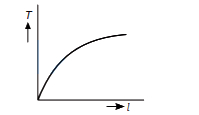
The graph between the time period $(T)$ and the length $(l)$ of a simple pendulum is
A
straight line
B
curve
C
ellipse
D
parabola
Solution
(D) The time period of a simple pendulum is given by the formula:
$T = 2 \pi \sqrt{\frac{l}{g}}$
Here,$l$ is the length of the pendulum and $g$ is the acceleration due to gravity.
Squaring both sides of the equation,we get:
$T^2 = \frac{4 \pi^2 l}{g}$
This can be written as:
$T^2 = k \cdot l$,where $k = \frac{4 \pi^2}{g}$ is a constant.
This equation is of the form $y^2 = 4ax$,which represents a parabola.
Therefore,the graph between the time period $T$ and the length $l$ is a part of a parabola.
$T = 2 \pi \sqrt{\frac{l}{g}}$
Here,$l$ is the length of the pendulum and $g$ is the acceleration due to gravity.
Squaring both sides of the equation,we get:
$T^2 = \frac{4 \pi^2 l}{g}$
This can be written as:
$T^2 = k \cdot l$,where $k = \frac{4 \pi^2}{g}$ is a constant.
This equation is of the form $y^2 = 4ax$,which represents a parabola.
Therefore,the graph between the time period $T$ and the length $l$ is a part of a parabola.
0 likes
View Solution288
DifficultMCQ
$A$ simple pendulum of length $2 \ m$ is given a horizontal push through an angular displacement of $60^{\circ}$. If the mass of the bob is $200 \ g$,the angular velocity of the bob will be (Take acceleration due to gravity $g = 10 \ m/s^2$).
A
$2 \sqrt{2} \ rad/s$
B
$3 \sqrt{2} \ rad/s$
C
$2 \sqrt{2.5} \ rad/s$
D
$3 \sqrt{2.5} \ rad/s$
Solution
(C) Given: Length of pendulum $l = 2 \ m$,angular displacement $\theta = 60^{\circ}$,mass $m = 200 \ g = 0.2 \ kg$,acceleration due to gravity $g = 10 \ m/s^2$.
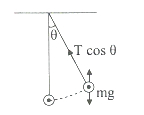
When the pendulum bob moves in a horizontal circle,the radius of the circular path is $r = l \sin \theta$.
For the bob to move in a horizontal circle,the forces acting on it are tension $T$ and weight $mg$.
The vertical component of tension balances the weight: $T \cos \theta = mg$ ... $(i)$
The horizontal component of tension provides the necessary centripetal force: $T \sin \theta = m r \omega^2 = m (l \sin \theta) \omega^2$ ... (ii)
Dividing equation (ii) by equation $(i)$:
$\frac{T \sin \theta}{T \cos \theta} = \frac{m l \sin \theta \omega^2}{mg}$
$\tan \theta = \frac{l \omega^2 \sin \theta}{g}$
Since $\tan \theta = \frac{\sin \theta}{\cos \theta}$,we get:
$\frac{1}{\cos \theta} = \frac{l \omega^2}{g}$
$\omega^2 = \frac{g}{l \cos \theta}$
Substituting the values: $\omega^2 = \frac{10}{2 \times \cos 60^{\circ}} = \frac{10}{2 \times 0.5} = \frac{10}{1} = 10$
$\omega = \sqrt{10} = \sqrt{4 \times 2.5} = 2 \sqrt{2.5} \ rad/s$.
When the pendulum bob moves in a horizontal circle,the radius of the circular path is $r = l \sin \theta$.
For the bob to move in a horizontal circle,the forces acting on it are tension $T$ and weight $mg$.
The vertical component of tension balances the weight: $T \cos \theta = mg$ ... $(i)$
The horizontal component of tension provides the necessary centripetal force: $T \sin \theta = m r \omega^2 = m (l \sin \theta) \omega^2$ ... (ii)
Dividing equation (ii) by equation $(i)$:
$\frac{T \sin \theta}{T \cos \theta} = \frac{m l \sin \theta \omega^2}{mg}$
$\tan \theta = \frac{l \omega^2 \sin \theta}{g}$
Since $\tan \theta = \frac{\sin \theta}{\cos \theta}$,we get:
$\frac{1}{\cos \theta} = \frac{l \omega^2}{g}$
$\omega^2 = \frac{g}{l \cos \theta}$
Substituting the values: $\omega^2 = \frac{10}{2 \times \cos 60^{\circ}} = \frac{10}{2 \times 0.5} = \frac{10}{1} = 10$
$\omega = \sqrt{10} = \sqrt{4 \times 2.5} = 2 \sqrt{2.5} \ rad/s$.
0 likes
View Solution289
DifficultMCQ
$A$ simple pendulum oscillates with an angular amplitude $\theta$. If the maximum tension in the string is $4$ times the minimum tension,then the value of $\theta$ is
A
$\cos ^{-1}(0.75)$
B
$\cos ^{-1}(0.5)$
C
$\sin ^{-1}(0.5)$
D
$\sin ^{-1}(0.75)$
Solution
(B) Let $m$ be the mass of the bob and $l$ be the length of the string. The tension in the string at any angle $\phi$ is given by $T = mg \cos \phi + \frac{mv^2}{l}$.
At the extreme position,$\phi = \theta$ and $v = 0$,so the minimum tension is $T_{min} = mg \cos \theta$.
At the lowest point,$\phi = 0$. Using conservation of energy,$mg(l - l \cos \theta) = \frac{1}{2}mv^2$,so $mv^2 = 2mgl(1 - \cos \theta)$.
The maximum tension is $T_{max} = mg + \frac{mv^2}{l} = mg + 2mg(1 - \cos \theta) = mg(3 - 2 \cos \theta)$.
Given $T_{max} = 4 T_{min}$,we have $mg(3 - 2 \cos \theta) = 4mg \cos \theta$.
$3 - 2 \cos \theta = 4 \cos \theta \implies 6 \cos \theta = 3 \implies \cos \theta = 0.5$.
Therefore,$\theta = \cos^{-1}(0.5)$.
At the extreme position,$\phi = \theta$ and $v = 0$,so the minimum tension is $T_{min} = mg \cos \theta$.
At the lowest point,$\phi = 0$. Using conservation of energy,$mg(l - l \cos \theta) = \frac{1}{2}mv^2$,so $mv^2 = 2mgl(1 - \cos \theta)$.
The maximum tension is $T_{max} = mg + \frac{mv^2}{l} = mg + 2mg(1 - \cos \theta) = mg(3 - 2 \cos \theta)$.
Given $T_{max} = 4 T_{min}$,we have $mg(3 - 2 \cos \theta) = 4mg \cos \theta$.
$3 - 2 \cos \theta = 4 \cos \theta \implies 6 \cos \theta = 3 \implies \cos \theta = 0.5$.
Therefore,$\theta = \cos^{-1}(0.5)$.
0 likes
View Solution290
EasyMCQ
$A$ pendulum oscillates simple harmonically if and only if:
$I$. The size of the bob of the pendulum is negligible in comparison with the length of the pendulum.
$II$. The angular amplitude is less than $10^{\circ}$.
Choose the correct option.
$I$. The size of the bob of the pendulum is negligible in comparison with the length of the pendulum.
$II$. The angular amplitude is less than $10^{\circ}$.
Choose the correct option.
A
Both $I$ and $II$
B
Only $I$
C
Only $II$
D
None of these
Solution
(A) simple pendulum,in practice,consists of a heavy but small-sized metallic bob suspended by a light,inextensible,and flexible string.
It oscillates simple harmonically if and only if:
$(I)$ The size of the bob is negligible compared to the length of the string of the pendulum,which allows us to treat the bob as a point mass.
$(II)$ The angular amplitude (the angle between the vertical mean position and the string at the extreme point) is small,typically less than $10^{\circ}$,so that the approximation $\sin \theta \approx \theta$ holds true.
Thus,both statements are correct.
It oscillates simple harmonically if and only if:
$(I)$ The size of the bob is negligible compared to the length of the string of the pendulum,which allows us to treat the bob as a point mass.
$(II)$ The angular amplitude (the angle between the vertical mean position and the string at the extreme point) is small,typically less than $10^{\circ}$,so that the approximation $\sin \theta \approx \theta$ holds true.
Thus,both statements are correct.
0 likes
View Solution291
MediumMCQ
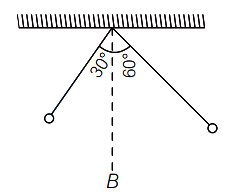
From a fixed support,two small identical spheres are suspended by means of strings of length $1 \,m$ each. They are pulled aside as shown and then released. $B$ is the mean position. Then the two spheres collide
A
at $B$ after $0.25 \,s$
B
at $B$ after $0.5 \,s$
C
on the right side of $B$ after some time
D
on the right side of $B$ when the strings are inclined at $15^{\circ}$ with $B$
Solution
(B) The time period of a simple pendulum is given by $T = 2 \pi \sqrt{\frac{l}{g}}$.
Given $l = 1 \,m$ and taking $g = 10 \,m/s^2$ (or $\pi^2 \approx 10$),we have $T = 2 \pi \sqrt{\frac{1}{10}} \approx 2 \,s$.
For a simple pendulum,the time taken to travel from the extreme position to the mean position $(B)$ is $\frac{T}{4}$.
Since both spheres are released from their respective extreme positions,they will both reach the mean position $B$ at time $t = \frac{T}{4} = \frac{2}{4} = 0.5 \,s$.
Therefore,the two spheres will collide at the mean position $B$ after $0.5 \,s$.
Given $l = 1 \,m$ and taking $g = 10 \,m/s^2$ (or $\pi^2 \approx 10$),we have $T = 2 \pi \sqrt{\frac{1}{10}} \approx 2 \,s$.
For a simple pendulum,the time taken to travel from the extreme position to the mean position $(B)$ is $\frac{T}{4}$.
Since both spheres are released from their respective extreme positions,they will both reach the mean position $B$ at time $t = \frac{T}{4} = \frac{2}{4} = 0.5 \,s$.
Therefore,the two spheres will collide at the mean position $B$ after $0.5 \,s$.
0 likes
View Solution292
DifficultMCQ
$A$ simple pendulum is suspended from the ceiling of a lift. When the lift is at rest,its time period is $T$. With what acceleration should the lift be accelerated upwards in order to reduce its period to $T/2$ (in $g$)? ($g$ is acceleration due to gravity).
A
$2$
B
$3$
C
$4$
D
$6$
Solution
(B) The time period of a simple pendulum at rest is given by $T = 2\pi \sqrt{\frac{l}{g}}$.
When the lift accelerates upwards with an acceleration $a$,the effective acceleration due to gravity becomes $g_{eff} = g + a$.
The new time period is $T' = 2\pi \sqrt{\frac{l}{g+a}}$.
Given that $T' = T/2$,we have $\frac{T}{2} = 2\pi \sqrt{\frac{l}{g+a}}$.
Dividing the expression for $T'$ by $T$,we get $\frac{1}{2} = \sqrt{\frac{g}{g+a}}$.
Squaring both sides,$\frac{1}{4} = \frac{g}{g+a}$.
This implies $g + a = 4g$,so $a = 3g$.
When the lift accelerates upwards with an acceleration $a$,the effective acceleration due to gravity becomes $g_{eff} = g + a$.
The new time period is $T' = 2\pi \sqrt{\frac{l}{g+a}}$.
Given that $T' = T/2$,we have $\frac{T}{2} = 2\pi \sqrt{\frac{l}{g+a}}$.
Dividing the expression for $T'$ by $T$,we get $\frac{1}{2} = \sqrt{\frac{g}{g+a}}$.
Squaring both sides,$\frac{1}{4} = \frac{g}{g+a}$.
This implies $g + a = 4g$,so $a = 3g$.
0 likes
View Solution293
EasyMCQ
Two simple pendulums $A$ and $B$ are made to oscillate simultaneously. It is found that $A$ completes $10$ oscillations in $20 \ s$ and $B$ completes $8$ oscillations in $10 \ s$. The ratio of the lengths of $A$ and $B$ is
A
$8/5$
B
$64/25$
C
$5/4$
D
$25/64$
Solution
(B) The time period of a simple pendulum is given by $T = 2\pi \sqrt{\frac{l}{g}}$,where $l$ is the length of the pendulum and $g$ is the acceleration due to gravity.
For pendulum $A$: It completes $10$ oscillations in $20 \ s$.
Therefore,the time period $T_A = \frac{20}{10} = 2 \ s$.
$2\pi \sqrt{\frac{l_A}{g}} = 2 \quad (1)$
For pendulum $B$: It completes $8$ oscillations in $10 \ s$.
Therefore,the time period $T_B = \frac{10}{8} = \frac{5}{4} \ s$.
$2\pi \sqrt{\frac{l_B}{g}} = \frac{5}{4} \quad (2)$
Dividing equation $(1)$ by equation $(2)$:
$\frac{2\pi \sqrt{l_A/g}}{2\pi \sqrt{l_B/g}} = \frac{2}{5/4}$
$\sqrt{\frac{l_A}{l_B}} = \frac{2 \times 4}{5} = \frac{8}{5}$
Squaring both sides:
$\frac{l_A}{l_B} = \left(\frac{8}{5}\right)^2 = \frac{64}{25}$
For pendulum $A$: It completes $10$ oscillations in $20 \ s$.
Therefore,the time period $T_A = \frac{20}{10} = 2 \ s$.
$2\pi \sqrt{\frac{l_A}{g}} = 2 \quad (1)$
For pendulum $B$: It completes $8$ oscillations in $10 \ s$.
Therefore,the time period $T_B = \frac{10}{8} = \frac{5}{4} \ s$.
$2\pi \sqrt{\frac{l_B}{g}} = \frac{5}{4} \quad (2)$
Dividing equation $(1)$ by equation $(2)$:
$\frac{2\pi \sqrt{l_A/g}}{2\pi \sqrt{l_B/g}} = \frac{2}{5/4}$
$\sqrt{\frac{l_A}{l_B}} = \frac{2 \times 4}{5} = \frac{8}{5}$
Squaring both sides:
$\frac{l_A}{l_B} = \left(\frac{8}{5}\right)^2 = \frac{64}{25}$
0 likes
View Solution294
MediumMCQ
$A$ simple pendulum with a bob of mass $40 \ g$ and charge $+2 \ \mu C$ makes $20$ oscillations in $44 \ s$. $A$ vertical electric field of magnitude $4.2 \times 10^4 \ NC^{-1}$ pointing downward is applied. The time taken by the pendulum to make $15$ oscillations in the electric field is (acceleration due to gravity $= 10 \ ms^{-2}$) (in $s$)
A
$30$
B
$60$
C
$90$
D
$15$
Solution
(A) Given: Mass $m = 40 \ g = 0.04 \ kg$,charge $q = 2 \times 10^{-6} \ C$,$g = 10 \ ms^{-2}$,electric field $E = 4.2 \times 10^4 \ NC^{-1}$.
First,calculate the acceleration due to the electric field:
$a = \frac{qE}{m} = \frac{2 \times 10^{-6} \times 4.2 \times 10^4}{0.04} = \frac{0.084}{0.04} = 2.1 \ ms^{-2}$.
Since the electric field is downward and the charge is positive,the force is downward,so the effective acceleration $g_e = g + a = 10 + 2.1 = 12.1 \ ms^{-2}$.
The time period of a simple pendulum is $T = 2\pi \sqrt{\frac{l}{g}}$.
In the absence of the field,$T = \frac{44}{20} = 2.2 \ s$.
Thus,$2.2 = 2\pi \sqrt{\frac{l}{10}} \Rightarrow \sqrt{l} = \frac{2.2 \sqrt{10}}{2\pi}$.
In the presence of the field,$T' = 2\pi \sqrt{\frac{l}{12.1}} = 2\pi \frac{\sqrt{l}}{\sqrt{12.1}}$.
Substituting $\sqrt{l}$,we get $T' = 2\pi \left( \frac{2.2 \sqrt{10}}{2\pi \sqrt{12.1}} \right) = 2.2 \sqrt{\frac{10}{12.1}} = 2.2 \times \frac{\sqrt{10}}{1.1 \sqrt{10}} = 2.2 \times \frac{1}{1.1} = 2 \ s$.
The time taken for $15$ oscillations is $t = 15 \times T' = 15 \times 2 = 30 \ s$.
First,calculate the acceleration due to the electric field:
$a = \frac{qE}{m} = \frac{2 \times 10^{-6} \times 4.2 \times 10^4}{0.04} = \frac{0.084}{0.04} = 2.1 \ ms^{-2}$.
Since the electric field is downward and the charge is positive,the force is downward,so the effective acceleration $g_e = g + a = 10 + 2.1 = 12.1 \ ms^{-2}$.
The time period of a simple pendulum is $T = 2\pi \sqrt{\frac{l}{g}}$.
In the absence of the field,$T = \frac{44}{20} = 2.2 \ s$.
Thus,$2.2 = 2\pi \sqrt{\frac{l}{10}} \Rightarrow \sqrt{l} = \frac{2.2 \sqrt{10}}{2\pi}$.
In the presence of the field,$T' = 2\pi \sqrt{\frac{l}{12.1}} = 2\pi \frac{\sqrt{l}}{\sqrt{12.1}}$.
Substituting $\sqrt{l}$,we get $T' = 2\pi \left( \frac{2.2 \sqrt{10}}{2\pi \sqrt{12.1}} \right) = 2.2 \sqrt{\frac{10}{12.1}} = 2.2 \times \frac{\sqrt{10}}{1.1 \sqrt{10}} = 2.2 \times \frac{1}{1.1} = 2 \ s$.
The time taken for $15$ oscillations is $t = 15 \times T' = 15 \times 2 = 30 \ s$.
0 likes
View Solution295
DifficultMCQ
$A$ string of a pendulum of length $l$ is displaced through $90^{\circ}$ from its vertical and released. Then,the minimum strength of the string needed to withstand the tension as the pendulum passes through its mean position is
A
$m g$
B
$3 m g$
C
$5 m g$
D
$6 m g$
Solution
(B) Let the mass of the pendulum bob be $m$ and the length of the string be $l$. The center of mass of the string is at $l/2$ from the pivot.
When the pendulum is displaced by $90^{\circ}$ and released,the change in potential energy is converted into kinetic energy.
Using the law of conservation of energy: $m g (l/2) = (1/2) m v^2$.
This gives $v^2 = g l$.
At the mean position,the tension $T$ in the string must balance the weight $m g$ and provide the necessary centripetal force $F_c = m v^2 / r$,where $r = l/2$ is the distance of the center of mass from the pivot.
Therefore,$T = m g + (m v^2) / (l/2)$.
Substituting $v^2 = g l$ into the equation:
$T = m g + (2 m / l) \cdot (g l) = m g + 2 m g = 3 m g$.
Thus,the minimum strength of the string must be $3 m g$.
When the pendulum is displaced by $90^{\circ}$ and released,the change in potential energy is converted into kinetic energy.
Using the law of conservation of energy: $m g (l/2) = (1/2) m v^2$.
This gives $v^2 = g l$.
At the mean position,the tension $T$ in the string must balance the weight $m g$ and provide the necessary centripetal force $F_c = m v^2 / r$,where $r = l/2$ is the distance of the center of mass from the pivot.
Therefore,$T = m g + (m v^2) / (l/2)$.
Substituting $v^2 = g l$ into the equation:
$T = m g + (2 m / l) \cdot (g l) = m g + 2 m g = 3 m g$.
Thus,the minimum strength of the string must be $3 m g$.
0 likes
View Solution296
DifficultMCQ
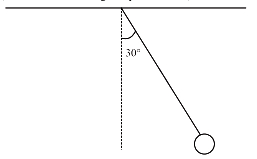
An object of mass $3 \,kg$ is tied by a string of negligible mass to a ceiling and held such that the string is taut. The object is released suddenly such that the string remains taut. Its acceleration when released is (acceleration due to gravity $= 10 \,ms^{-2}$) (in $\,ms^{-2}$)
A
$3.5$
B
$4.9$
C
$7.5$
D
$5.0$
Solution
(D) When the object is released from rest, its velocity is zero. Therefore, the centripetal acceleration $(a_c = v^2/r)$ is zero.
The forces acting on the object are its weight $(mg)$ acting vertically downwards and the tension $(T)$ in the string acting along the string.
We resolve the weight $(mg)$ into two components: one along the string $(mg \cos 30^{\circ})$ and one perpendicular to the string $(mg \sin 30^{\circ})$.
Since the string remains taut and the object starts from rest, the net force along the string must be zero to satisfy the condition of no radial motion at the instant of release $(T - mg \cos 30^{\circ} = 0)$.
The net force acting on the object is the component perpendicular to the string, which is $F_{net} = mg \sin 30^{\circ}$.
Using Newton's second law, $F_{net} = ma$, we get:
$ma = mg \sin 30^{\circ}$
$a = g \sin 30^{\circ}$
Given $g = 10 \,ms^{-2}$ and $\sin 30^{\circ} = 0.5$:
$a = 10 \times 0.5 = 5.0 \,ms^{-2}$.
The forces acting on the object are its weight $(mg)$ acting vertically downwards and the tension $(T)$ in the string acting along the string.
We resolve the weight $(mg)$ into two components: one along the string $(mg \cos 30^{\circ})$ and one perpendicular to the string $(mg \sin 30^{\circ})$.
Since the string remains taut and the object starts from rest, the net force along the string must be zero to satisfy the condition of no radial motion at the instant of release $(T - mg \cos 30^{\circ} = 0)$.
The net force acting on the object is the component perpendicular to the string, which is $F_{net} = mg \sin 30^{\circ}$.
Using Newton's second law, $F_{net} = ma$, we get:
$ma = mg \sin 30^{\circ}$
$a = g \sin 30^{\circ}$
Given $g = 10 \,ms^{-2}$ and $\sin 30^{\circ} = 0.5$:
$a = 10 \times 0.5 = 5.0 \,ms^{-2}$.
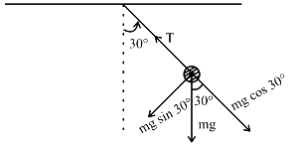
0 likes
View Solution297
MediumMCQ
The time period of a simple pendulum is $4 \ s$ at a place on the Earth where the acceleration due to gravity is $\pi^2 \ ms^{-2}$. The length of the pendulum in meters is:
A
$4$
B
$2$
C
$\pi$
D
$\frac{\pi}{2}$
Solution
(A) The formula for the time period $T$ of a simple pendulum is given by $T = 2\pi \sqrt{\frac{\ell}{g}}$.
Given: $T = 4 \ s$ and $g = \pi^2 \ ms^{-2}$.
Substituting these values into the formula:
$4 = 2\pi \sqrt{\frac{\ell}{\pi^2}}$
Squaring both sides:
$16 = 4\pi^2 \cdot \frac{\ell}{\pi^2}$
$16 = 4\ell$
$\ell = \frac{16}{4} = 4 \ m$.
Therefore,the length of the pendulum is $4 \ m$.
Given: $T = 4 \ s$ and $g = \pi^2 \ ms^{-2}$.
Substituting these values into the formula:
$4 = 2\pi \sqrt{\frac{\ell}{\pi^2}}$
Squaring both sides:
$16 = 4\pi^2 \cdot \frac{\ell}{\pi^2}$
$16 = 4\ell$
$\ell = \frac{16}{4} = 4 \ m$.
Therefore,the length of the pendulum is $4 \ m$.
0 likes
View Solution298
EasyMCQ
$A$ pendulum is oscillating at a frequency of $8 \,Hz$. Suddenly, the string of the pendulum is clamped at its midpoint. What is the new frequency of oscillations (in $\,Hz$)?
A
$16$
B
$13.8$
C
$11.28$
D
$5.7$
Solution
(C) The frequency of a simple pendulum is given by the formula:
$f = \frac{1}{2 \pi} \sqrt{\frac{g}{\ell}}$
From this formula, we can see that the frequency is inversely proportional to the square root of the length of the pendulum:
$f \propto \frac{1}{\sqrt{\ell}}$
Let the initial length be $\ell_1 = \ell$ and the initial frequency be $f_1 = 8 \,Hz$.
When the string is clamped at its midpoint, the new length becomes $\ell_2 = \frac{\ell}{2}$.
Now, we can find the ratio of the new frequency $f_2$ to the initial frequency $f_1$:
$\frac{f_2}{f_1} = \sqrt{\frac{\ell_1}{\ell_2}} = \sqrt{\frac{\ell}{\ell / 2}} = \sqrt{2}$
Therefore, the new frequency $f_2$ is:
$f_2 = \sqrt{2} \times f_1 = \sqrt{2} \times 8 \,Hz \approx 1.414 \times 8 \,Hz = 11.312 \,Hz$.
Rounding to the nearest provided option, we get $11.28 \,Hz$.
$f = \frac{1}{2 \pi} \sqrt{\frac{g}{\ell}}$
From this formula, we can see that the frequency is inversely proportional to the square root of the length of the pendulum:
$f \propto \frac{1}{\sqrt{\ell}}$
Let the initial length be $\ell_1 = \ell$ and the initial frequency be $f_1 = 8 \,Hz$.
When the string is clamped at its midpoint, the new length becomes $\ell_2 = \frac{\ell}{2}$.
Now, we can find the ratio of the new frequency $f_2$ to the initial frequency $f_1$:
$\frac{f_2}{f_1} = \sqrt{\frac{\ell_1}{\ell_2}} = \sqrt{\frac{\ell}{\ell / 2}} = \sqrt{2}$
Therefore, the new frequency $f_2$ is:
$f_2 = \sqrt{2} \times f_1 = \sqrt{2} \times 8 \,Hz \approx 1.414 \times 8 \,Hz = 11.312 \,Hz$.
Rounding to the nearest provided option, we get $11.28 \,Hz$.
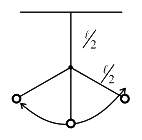
0 likes
View Solution299
EasyMCQ
What is the number of degrees of freedom for an oscillating simple pendulum?
A
One
B
Two
C
Three
D
More than three
Solution
(A) simple pendulum consists of a point mass (bob) suspended by a massless,inextensible string.
For a simple pendulum oscillating in a plane,the position of the bob is uniquely determined by a single coordinate,which is the angle $\theta$ that the string makes with the vertical.
Therefore,the number of degrees of freedom for an oscillating simple pendulum is $1$.
For a simple pendulum oscillating in a plane,the position of the bob is uniquely determined by a single coordinate,which is the angle $\theta$ that the string makes with the vertical.
Therefore,the number of degrees of freedom for an oscillating simple pendulum is $1$.
0 likes
View SolutionOscillations — SHM of Simple Pendulum · Frequently Asked Questions
1Are these Oscillations questions useful for JEE and NEET?
Yes. All questions in this section are mapped to JEE Main and NEET exam patterns. Previous year questions from JEE Main, NEET, GUJCET and state-level exams are included with full solutions.
2Can I switch to Hindi or Gujarati for these questions?
Yes. Use the language tabs in the hero section or the sidebar to view the same questions and solutions in English, Hindi or Gujarati.
3How do I generate a question paper from this subtopic?
Use the Vedclass Exam Paper Generator — select the chapter and subtopic, set difficulty, and generate Sets A, B, C, D automatically. First 3 chapters of every subject are free.
Vedclass Products
For Students
Vedclass Test Series
Mock tests in real JEE/NEET style with performance analysis. 5-day free trial.
Start Free TrialFor Teachers
Exam Paper Generator
Generate Set A/B/C/D papers from this chapter in 2 minutes. 3 chapters free.
Try FreeFor Institutes
Online Exam Module
Live online exams with unlimited students, 360° analytics & white-label branding.
See DemoFor Teachers & Institutes
Generate a Oscillations Exam Paper in 2 Minutes
Select subtopic & difficulty — Sets A, B, C, D auto-generated with No Repeat logic.
First 3 chapters of every subject are free — no payment required.