
A English
SHM of Simple Pendulum Questions in English
Class 11 Physics · Oscillations · SHM of Simple Pendulum
331+
Questions
English
Language
100%
With Solutions
Showing 50 of 331 questions in English
151
MediumMCQ
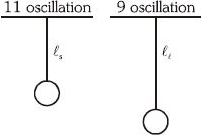
Two pendulums begin to swing simultaneously. The first pendulum makes $11$ full oscillations when the other makes $9$. The ratio of the lengths of the two pendulums is
A
$11/9$
B
$9/11$
C
$81/121$
D
$121/81$
Solution
(C) Let $T_1$ and $T_2$ be the time periods of the two pendulums,and $\ell_1$ and $\ell_2$ be their lengths.
The time period of a simple pendulum is given by $T = 2\pi \sqrt{\frac{\ell}{g}}$.
Given that in the same time $t$,the first pendulum makes $n_1 = 11$ oscillations and the second makes $n_2 = 9$ oscillations.
Thus,$t = n_1 T_1 = n_2 T_2$.
$11 \times 2\pi \sqrt{\frac{\ell_1}{g}} = 9 \times 2\pi \sqrt{\frac{\ell_2}{g}}$.
Squaring both sides,we get $121 \times \frac{\ell_1}{g} = 81 \times \frac{\ell_2}{g}$.
Therefore,$\frac{\ell_1}{\ell_2} = \frac{81}{121}$.
The time period of a simple pendulum is given by $T = 2\pi \sqrt{\frac{\ell}{g}}$.
Given that in the same time $t$,the first pendulum makes $n_1 = 11$ oscillations and the second makes $n_2 = 9$ oscillations.
Thus,$t = n_1 T_1 = n_2 T_2$.
$11 \times 2\pi \sqrt{\frac{\ell_1}{g}} = 9 \times 2\pi \sqrt{\frac{\ell_2}{g}}$.
Squaring both sides,we get $121 \times \frac{\ell_1}{g} = 81 \times \frac{\ell_2}{g}$.
Therefore,$\frac{\ell_1}{\ell_2} = \frac{81}{121}$.
0 likes
View Solution152
MediumMCQ
$A$ heavy small-sized sphere is suspended by a string of length $l$. The sphere rotates uniformly in a horizontal circle with the string making an angle $\theta$ with the vertical. Then the time period of this conical pendulum is
A
$t = 2\pi \sqrt {\frac{l}{g}} $
B
$t = 2\pi \sqrt {\frac{l \sin \theta}{g}} $
C
$t = 2\pi \sqrt {\frac{l \cos \theta}{g}} $
D
$t = 2\pi \sqrt {\frac{l}{g \cos \theta}} $
Solution
(C) The radius of the circular path in the horizontal plane is $r = l \sin \theta$.
The forces acting on the bob are:
$(i)$ $T$,the tension in the string.
$(ii)$ $Mg$,the weight of the bob acting downwards.
Resolving the tension $T$ into vertical and horizontal components:
Vertical component: $T \cos \theta = Mg$ --- $(1)$
Horizontal component (centripetal force): $T \sin \theta = Mr \omega^2 = M(l \sin \theta) \omega^2$ --- $(2)$
Dividing equation $(2)$ by equation $(1)$:
$\frac{T \sin \theta}{T \cos \theta} = \frac{M(l \sin \theta) \omega^2}{Mg}$
$\tan \theta = \frac{l \sin \theta \cdot \omega^2}{g}$
$\frac{\sin \theta}{\cos \theta} = \frac{l \sin \theta \cdot \omega^2}{g}$
$\frac{1}{\cos \theta} = \frac{l \omega^2}{g}$
$\omega^2 = \frac{g}{l \cos \theta}$
$\omega = \sqrt{\frac{g}{l \cos \theta}}$
The time period $t$ is given by $t = \frac{2 \pi}{\omega}$.
Substituting the value of $\omega$:
$t = 2 \pi \sqrt{\frac{l \cos \theta}{g}}$
The forces acting on the bob are:
$(i)$ $T$,the tension in the string.
$(ii)$ $Mg$,the weight of the bob acting downwards.
Resolving the tension $T$ into vertical and horizontal components:
Vertical component: $T \cos \theta = Mg$ --- $(1)$
Horizontal component (centripetal force): $T \sin \theta = Mr \omega^2 = M(l \sin \theta) \omega^2$ --- $(2)$
Dividing equation $(2)$ by equation $(1)$:
$\frac{T \sin \theta}{T \cos \theta} = \frac{M(l \sin \theta) \omega^2}{Mg}$
$\tan \theta = \frac{l \sin \theta \cdot \omega^2}{g}$
$\frac{\sin \theta}{\cos \theta} = \frac{l \sin \theta \cdot \omega^2}{g}$
$\frac{1}{\cos \theta} = \frac{l \omega^2}{g}$
$\omega^2 = \frac{g}{l \cos \theta}$
$\omega = \sqrt{\frac{g}{l \cos \theta}}$
The time period $t$ is given by $t = \frac{2 \pi}{\omega}$.
Substituting the value of $\omega$:
$t = 2 \pi \sqrt{\frac{l \cos \theta}{g}}$
0 likes
View Solution153
MediumMCQ
The length of a simple pendulum is increased by $44\%$. The percentage increase in its time period will be ..... $\%$
A
$44$
B
$22$
C
$20$
D
$11$
Solution
(C) The time period of a simple pendulum is given by $T = 2\pi \sqrt{\frac{L}{g}}$.
This implies $T \propto \sqrt{L}$.
Let the initial length be $L_1 = L$ and the initial time period be $T_1 = T$.
The new length is $L_2 = L + 0.44L = 1.44L$.
The new time period $T_2$ is given by $\frac{T_2}{T_1} = \sqrt{\frac{L_2}{L_1}}$.
Substituting the values,$\frac{T_2}{T} = \sqrt{\frac{1.44L}{L}} = \sqrt{1.44} = 1.2$.
Thus,$T_2 = 1.2T$.
The change in time period is $\Delta T = T_2 - T_1 = 1.2T - T = 0.2T$.
The percentage increase is $\frac{\Delta T}{T_1} \times 100 = \frac{0.2T}{T} \times 100 = 20\%$.
This implies $T \propto \sqrt{L}$.
Let the initial length be $L_1 = L$ and the initial time period be $T_1 = T$.
The new length is $L_2 = L + 0.44L = 1.44L$.
The new time period $T_2$ is given by $\frac{T_2}{T_1} = \sqrt{\frac{L_2}{L_1}}$.
Substituting the values,$\frac{T_2}{T} = \sqrt{\frac{1.44L}{L}} = \sqrt{1.44} = 1.2$.
Thus,$T_2 = 1.2T$.
The change in time period is $\Delta T = T_2 - T_1 = 1.2T - T = 0.2T$.
The percentage increase is $\frac{\Delta T}{T_1} \times 100 = \frac{0.2T}{T} \times 100 = 20\%$.
0 likes
View Solution154
MediumMCQ
Two masses $M_{A}$ and $M_{B}$ are hung from two strings of length $l_{A}$ and $l_{B}$ respectively. They are executing $SHM$ with frequency relation $f_{A}=2 f_{B}$,then the relation is:
A
$l_{A}=4 l_{B},$ does not depend on mass
B
$l_{A}=\frac{l_{B}}{4},$ does not depend on mass
C
$l_A=2 l_B$ and $M_A=2M_B$
D
$l_{A}=\frac{l_{B}}{2}$ and $M_{A}=\frac{M_{B}}{2}$
Solution
(B) The frequency of a simple pendulum is given by $f = \frac{1}{2 \pi} \sqrt{\frac{g}{l}}$.
Given the frequency relation $f_{A}=2 f_{B}$.
Substituting the formula for frequency:
$\frac{1}{2 \pi} \sqrt{\frac{g}{l_{A}}} = 2 \times \frac{1}{2 \pi} \sqrt{\frac{g}{l_{B}}}$
Squaring both sides:
$\frac{g}{l_{A}} = 4 \times \frac{g}{l_{B}}$
$\frac{1}{l_{A}} = \frac{4}{l_{B}}$
Therefore,$l_{A} = \frac{l_{B}}{4}$.
Since the frequency of a simple pendulum depends only on the length $l$ and acceleration due to gravity $g$,it does not depend on the mass $M$ of the bob.
Given the frequency relation $f_{A}=2 f_{B}$.
Substituting the formula for frequency:
$\frac{1}{2 \pi} \sqrt{\frac{g}{l_{A}}} = 2 \times \frac{1}{2 \pi} \sqrt{\frac{g}{l_{B}}}$
Squaring both sides:
$\frac{g}{l_{A}} = 4 \times \frac{g}{l_{B}}$
$\frac{1}{l_{A}} = \frac{4}{l_{B}}$
Therefore,$l_{A} = \frac{l_{B}}{4}$.
Since the frequency of a simple pendulum depends only on the length $l$ and acceleration due to gravity $g$,it does not depend on the mass $M$ of the bob.
0 likes
View Solution155
DifficultMCQ
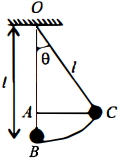
The bob of a simple pendulum having length $l$ is displaced from the mean position to an angular position $\theta$ with respect to the vertical. If it is released,then the velocity of the bob at the equilibrium position is:
A
$\sqrt{2 g l(1-\cos \theta)}$
B
$\sqrt{2 g l(1+\cos \theta)}$
C
$\sqrt{2 g l(1+\sin \theta)}$
D
$\sqrt{2 g l(1-\sin \theta)}$
Solution
(A) Let $O$ be the point of suspension and $B$ be the equilibrium position. The bob is displaced to point $C$ at an angle $\theta$ with the vertical.
In $\triangle OAC$,the vertical distance $OA = l \cos \theta$.
The vertical height $h$ through which the bob falls from $C$ to $B$ is $h = OB - OA = l - l \cos \theta = l(1 - \cos \theta)$.
By the law of conservation of energy,the potential energy lost equals the kinetic energy gained at the equilibrium position $B$:
$mgh = \frac{1}{2}mv^2$
$v^2 = 2gh$
Substituting $h = l(1 - \cos \theta)$:
$v^2 = 2gl(1 - \cos \theta)$
$v = \sqrt{2gl(1 - \cos \theta)}$
In $\triangle OAC$,the vertical distance $OA = l \cos \theta$.
The vertical height $h$ through which the bob falls from $C$ to $B$ is $h = OB - OA = l - l \cos \theta = l(1 - \cos \theta)$.
By the law of conservation of energy,the potential energy lost equals the kinetic energy gained at the equilibrium position $B$:
$mgh = \frac{1}{2}mv^2$
$v^2 = 2gh$
Substituting $h = l(1 - \cos \theta)$:
$v^2 = 2gl(1 - \cos \theta)$
$v = \sqrt{2gl(1 - \cos \theta)}$
0 likes
View Solution156
EasyMCQ
$A$ pendulum suspended from the ceiling of a train oscillates with a time period $2 \ s$,when the train is accelerating at $10 \ m/s^2$. What will be its time period when the train retards at $10 \ m/s^2$?
A
$2 \ s$
B
$2\sqrt{2} \ s$
C
$2/\sqrt{2} \ s$
D
None of the above
Solution
(A) The time period of a simple pendulum is given by $T = 2\pi \sqrt{\frac{L}{g_{eff}}}$,where $g_{eff}$ is the effective acceleration due to gravity.
When the train accelerates with $a = 10 \ m/s^2$,the effective gravity is $g_{eff} = \sqrt{g^2 + a^2}$.
When the train retards with $a = 10 \ m/s^2$,the effective gravity is $g'_{eff} = \sqrt{g^2 + (-a)^2} = \sqrt{g^2 + a^2}$.
Since the magnitude of the effective acceleration $g_{eff}$ remains the same in both cases,the time period $T$ remains unchanged.
Therefore,the time period remains $2 \ s$.
When the train accelerates with $a = 10 \ m/s^2$,the effective gravity is $g_{eff} = \sqrt{g^2 + a^2}$.
When the train retards with $a = 10 \ m/s^2$,the effective gravity is $g'_{eff} = \sqrt{g^2 + (-a)^2} = \sqrt{g^2 + a^2}$.
Since the magnitude of the effective acceleration $g_{eff}$ remains the same in both cases,the time period $T$ remains unchanged.
Therefore,the time period remains $2 \ s$.
0 likes
View Solution157
MediumMCQ
$A$ pendulum clock is placed inside an elevator. Under what condition does it show the correct time?
A
Shows correct time always.
B
Shows correct time when descending with constant acceleration.
C
Shows correct time when descending with constant speed.
D
Cannot show correct time when the elevator moves.
Solution
(C) The time period of a simple pendulum is given by $T = 2\pi \sqrt{\frac{L}{g_{eff}}}$,where $g_{eff}$ is the effective acceleration due to gravity.
When an elevator moves with constant velocity (constant speed in a straight line),its acceleration is zero.
In this case,the effective acceleration $g_{eff} = g$,which is the same as when the elevator is at rest.
Therefore,the time period $T$ remains unchanged,and the clock shows the correct time.
If the elevator accelerates,$g_{eff}$ changes $(g_{eff} = g \pm a)$,causing the clock to gain or lose time.
When an elevator moves with constant velocity (constant speed in a straight line),its acceleration is zero.
In this case,the effective acceleration $g_{eff} = g$,which is the same as when the elevator is at rest.
Therefore,the time period $T$ remains unchanged,and the clock shows the correct time.
If the elevator accelerates,$g_{eff}$ changes $(g_{eff} = g \pm a)$,causing the clock to gain or lose time.
0 likes
View Solution158
DifficultMCQ
The period of small oscillation of a simple pendulum is $T$. The ratio of the density of the liquid to the density of the material of the bob is $\rho$ (where $\rho < 1$). When the bob is immersed in the liquid,the new time period of small oscillation will be:
A
$T$
B
$T(1 - \rho)$
C
$\frac{T}{\sqrt{1 - \rho}}$
D
$T\sqrt{1 - \rho}$
Solution
(C) The time period of a simple pendulum in air is given by $T = 2\pi \sqrt{\frac{l}{g}}$.
When the bob is immersed in a liquid,it experiences an upward buoyant force $F_{up} = V \sigma g$,where $V$ is the volume of the bob and $\sigma$ is the density of the liquid.
The effective weight of the bob becomes $mg' = mg - F_{up} = V \rho_0 g - V \sigma g$,where $\rho_0$ is the density of the bob material.
Thus,the effective acceleration due to gravity $g'$ is $g' = g \left(1 - \frac{\sigma}{\rho_0}\right)$.
Given the ratio $\rho = \frac{\sigma}{\rho_0}$,we have $g' = g(1 - \rho)$.
The new time period $T'$ is $T' = 2\pi \sqrt{\frac{l}{g'}} = 2\pi \sqrt{\frac{l}{g(1 - \rho)}}$.
Comparing this with the original time period $T$,we get $T' = \frac{T}{\sqrt{1 - \rho}}$.
When the bob is immersed in a liquid,it experiences an upward buoyant force $F_{up} = V \sigma g$,where $V$ is the volume of the bob and $\sigma$ is the density of the liquid.
The effective weight of the bob becomes $mg' = mg - F_{up} = V \rho_0 g - V \sigma g$,where $\rho_0$ is the density of the bob material.
Thus,the effective acceleration due to gravity $g'$ is $g' = g \left(1 - \frac{\sigma}{\rho_0}\right)$.
Given the ratio $\rho = \frac{\sigma}{\rho_0}$,we have $g' = g(1 - \rho)$.
The new time period $T'$ is $T' = 2\pi \sqrt{\frac{l}{g'}} = 2\pi \sqrt{\frac{l}{g(1 - \rho)}}$.
Comparing this with the original time period $T$,we get $T' = \frac{T}{\sqrt{1 - \rho}}$.
0 likes
View Solution159
MediumMCQ
The angular velocity and the amplitude of a simple pendulum are $\omega$ and $A$ respectively. At a displacement $x$ from the mean position,its kinetic energy is $T$ and potential energy is $V$. Then the ratio $\frac{V}{T}$ is
A
$\frac{x^2}{A^2 - x^2}$
B
$\frac{A^2 - x^2}{x^2}$
C
$\frac{x^2 \omega^2}{A^2 - x^2}$
D
$\frac{A^2 - x^2}{x^2 \omega^2}$
Solution
(A) For a simple harmonic oscillator,the potential energy $V$ at displacement $x$ is given by $V = \frac{1}{2} k x^2$,where $k = m \omega^2$.
The kinetic energy $T$ at displacement $x$ is given by $T = \frac{1}{2} k (A^2 - x^2)$.
Taking the ratio $\frac{V}{T}$:
$\frac{V}{T} = \frac{\frac{1}{2} k x^2}{\frac{1}{2} k (A^2 - x^2)}$
$\frac{V}{T} = \frac{x^2}{A^2 - x^2}$
The kinetic energy $T$ at displacement $x$ is given by $T = \frac{1}{2} k (A^2 - x^2)$.
Taking the ratio $\frac{V}{T}$:
$\frac{V}{T} = \frac{\frac{1}{2} k x^2}{\frac{1}{2} k (A^2 - x^2)}$
$\frac{V}{T} = \frac{x^2}{A^2 - x^2}$
0 likes
View Solution160
MediumMCQ
The average speed of the bob of a simple pendulum oscillating with a small amplitude $A$ and time period $T$ is
A
$4A/T$
B
$2\pi A/T$
C
$4\pi A/T$
D
$2A/T$
Solution
(A) The displacement of the bob in simple harmonic motion is given by $x = A \sin(\frac{2\pi}{T}t)$.
In one complete oscillation (time $T$),the bob travels from the mean position to the extreme position $A$,back to the mean position,to the other extreme position $-A$,and returns to the mean position.
The total distance covered in one time period $T$ is $A + A + A + A = 4A$.
The average speed is defined as the total distance divided by the total time.
Average speed $= \frac{\text{Total distance}}{\text{Total time}} = \frac{4A}{T}$.
In one complete oscillation (time $T$),the bob travels from the mean position to the extreme position $A$,back to the mean position,to the other extreme position $-A$,and returns to the mean position.
The total distance covered in one time period $T$ is $A + A + A + A = 4A$.
The average speed is defined as the total distance divided by the total time.
Average speed $= \frac{\text{Total distance}}{\text{Total time}} = \frac{4A}{T}$.
0 likes
View Solution161
MediumMCQ
$A$ pendulum is swinging in an elevator. Its period will be greatest when the elevator is
A
moving upwards at constant speed
B
moving downwards
C
moving downwards at constant speed
D
accelerating downwards
Solution
(D) The time period of a simple pendulum is given by the formula $T = 2 \pi \sqrt{\frac{l}{g_{eff}}}$,where $g_{eff}$ is the effective acceleration due to gravity.
When an elevator accelerates downwards with an acceleration $a$,the effective acceleration becomes $g_{eff} = (g - a)$.
Since $T \propto \frac{1}{\sqrt{g_{eff}}}$,as $g_{eff}$ decreases,the time period $T$ increases.
Among the given options,when the elevator is accelerating downwards,$g_{eff}$ is minimized (assuming $a < g$),resulting in the greatest time period.
When an elevator accelerates downwards with an acceleration $a$,the effective acceleration becomes $g_{eff} = (g - a)$.
Since $T \propto \frac{1}{\sqrt{g_{eff}}}$,as $g_{eff}$ decreases,the time period $T$ increases.
Among the given options,when the elevator is accelerating downwards,$g_{eff}$ is minimized (assuming $a < g$),resulting in the greatest time period.
0 likes
View Solution162
EasyMCQ
The time period of a seconds pendulum is $2\, s$. The spherical bob,which is empty from inside,has a mass of $50\, g$. This is now replaced by another solid bob of the same radius but with a mass of $100\, g$. The new time period will be ..... $s$.
A
$2$
B
$8$
C
$4$
D
$1$
Solution
(A) The time period of a simple pendulum is given by the formula $T = 2\pi \sqrt{\frac{L}{g}}$.
Here,$L$ is the effective length of the pendulum and $g$ is the acceleration due to gravity.
As observed from the formula,the time period $T$ is independent of the mass of the bob.
Since the length of the pendulum and the acceleration due to gravity remain unchanged,the time period will remain the same regardless of the change in mass.
Therefore,the new time period is $2\, s$.
Here,$L$ is the effective length of the pendulum and $g$ is the acceleration due to gravity.
As observed from the formula,the time period $T$ is independent of the mass of the bob.
Since the length of the pendulum and the acceleration due to gravity remain unchanged,the time period will remain the same regardless of the change in mass.
Therefore,the new time period is $2\, s$.
1 likes
View Solution163
MediumMCQ
$A$ child swinging on a swing in a sitting position stands up. What will happen to the time period of the swing?
A
increase
B
decrease
C
remains same
D
increases if the child is tall and decreases if the child is short
Solution
(B) The time period of a simple pendulum is given by the formula $T = 2\pi \sqrt{\frac{l_{eff}}{g}}$.
When the child is sitting,the center of mass of the system is at a certain distance from the point of suspension.
When the child stands up,the center of mass shifts upwards,which effectively decreases the length of the pendulum $(l_{eff})$.
Since $T \propto \sqrt{l_{eff}}$,a decrease in $l_{eff}$ results in a decrease in the time period $T$.
When the child is sitting,the center of mass of the system is at a certain distance from the point of suspension.
When the child stands up,the center of mass shifts upwards,which effectively decreases the length of the pendulum $(l_{eff})$.
Since $T \propto \sqrt{l_{eff}}$,a decrease in $l_{eff}$ results in a decrease in the time period $T$.
0 likes
View Solution164
MediumMCQ
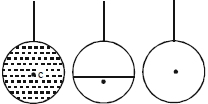
The bob of a simple pendulum is a spherical hollow ball filled with water. $A$ plugged hole near the bottom of the oscillating bob gets suddenly unplugged. During observation,till water is coming out,the time period of oscillation would
A
first decrease and then increase to the original value
B
first increase and then decrease to the original value
C
increase towards a saturation value
D
remain unchanged
Solution
(B) The time period of a simple pendulum is given by $T = 2\pi \sqrt{\frac{L_{eff}}{g}}$,where $L_{eff}$ is the distance between the point of suspension and the center of mass of the bob.
Initially,the center of mass of the water-filled sphere is at its geometric center.
As water starts leaking out from the bottom,the center of mass of the remaining water shifts downwards. This increases the effective length $L_{eff}$ of the pendulum.
Since $T \propto \sqrt{L_{eff}}$,the time period $T$ increases as the center of mass moves down.
When the water is completely drained,the center of mass returns to the geometric center of the sphere,so the effective length returns to its original value,and the time period decreases back to its original value.
Therefore,the time period first increases and then decreases to the original value.
Initially,the center of mass of the water-filled sphere is at its geometric center.
As water starts leaking out from the bottom,the center of mass of the remaining water shifts downwards. This increases the effective length $L_{eff}$ of the pendulum.
Since $T \propto \sqrt{L_{eff}}$,the time period $T$ increases as the center of mass moves down.
When the water is completely drained,the center of mass returns to the geometric center of the sphere,so the effective length returns to its original value,and the time period decreases back to its original value.
Therefore,the time period first increases and then decreases to the original value.
0 likes
View Solution165
EasyMCQ
$Assertion:$ The time period of a simple pendulum on a satellite orbiting the Earth is infinity.
$Reason:$ The time period of a simple pendulum is inversely proportional to $\sqrt{g}$.
$Reason:$ The time period of a simple pendulum is inversely proportional to $\sqrt{g}$.
A
If both Assertion and Reason are correct and the Reason is a correct explanation of the Assertion.
B
If both Assertion and Reason are correct but Reason is not a correct explanation of the Assertion.
C
If the Assertion is correct but Reason is incorrect.
D
If both the Assertion and Reason are incorrect.
Solution
(A) The time period of a simple pendulum is given by the formula $T = 2\pi \sqrt{\frac{l}{g_{eff}}}$,where $g_{eff}$ is the effective acceleration due to gravity.
Inside an orbiting satellite,the body is in a state of weightlessness,which means the effective acceleration due to gravity $g_{eff} = 0$.
Substituting $g_{eff} = 0$ into the formula,we get $T = 2\pi \sqrt{\frac{l}{0}} = \infty$.
Thus,the Assertion is correct.
The Reason states that the time period is inversely proportional to $\sqrt{g}$,which is mathematically correct based on the formula $T \propto \frac{1}{\sqrt{g}}$.
Since the infinite time period is a direct consequence of $g_{eff} = 0$ in the formula,the Reason correctly explains the Assertion.
Inside an orbiting satellite,the body is in a state of weightlessness,which means the effective acceleration due to gravity $g_{eff} = 0$.
Substituting $g_{eff} = 0$ into the formula,we get $T = 2\pi \sqrt{\frac{l}{0}} = \infty$.
Thus,the Assertion is correct.
The Reason states that the time period is inversely proportional to $\sqrt{g}$,which is mathematically correct based on the formula $T \propto \frac{1}{\sqrt{g}}$.
Since the infinite time period is a direct consequence of $g_{eff} = 0$ in the formula,the Reason correctly explains the Assertion.
0 likes
View Solution166
MediumMCQ
$A$ mass falls from a height $h$ and its time of fall $t$ is recorded in terms of time period $T$ of a simple pendulum. On the surface of the Earth,it is found that $t = 2T$. The entire setup is taken to the surface of another planet whose mass is half that of the Earth and radius is the same. The same experiment is repeated and corresponding times are noted as $t'$ and $T'$.
A
$t' = \sqrt{2} T'$
B
$t' > 2 T'$
C
$t' < 2 T'$
D
$t' = 2 T'$
Solution
(D) The time of fall $t$ for an object falling from height $h$ is given by $t = \sqrt{\frac{2h}{g}}$. Thus,$t \propto \frac{1}{\sqrt{g}}$.
The time period $T$ of a simple pendulum is given by $T = 2\pi \sqrt{\frac{l}{g}}$. Thus,$T \propto \frac{1}{\sqrt{g}}$.
Taking the ratio,we get $\frac{t}{T} = \frac{k_1 / \sqrt{g}}{k_2 / \sqrt{g}} = \text{constant}$.
Since the ratio $\frac{t}{T}$ is independent of the acceleration due to gravity $g$,the relationship remains the same on any planet.
Given that on Earth $t = 2T$,it follows that on the other planet $t' = 2T'$.
The time period $T$ of a simple pendulum is given by $T = 2\pi \sqrt{\frac{l}{g}}$. Thus,$T \propto \frac{1}{\sqrt{g}}$.
Taking the ratio,we get $\frac{t}{T} = \frac{k_1 / \sqrt{g}}{k_2 / \sqrt{g}} = \text{constant}$.
Since the ratio $\frac{t}{T}$ is independent of the acceleration due to gravity $g$,the relationship remains the same on any planet.
Given that on Earth $t = 2T$,it follows that on the other planet $t' = 2T'$.
0 likes
View Solution167
MediumMCQ
What is the length of a simple pendulum,which ticks seconds (in $m$)?
A
$0.5$
B
$1$
C
$1.5$
D
$2$
Solution
(B) The time period of a simple pendulum is given by the formula:
$T = 2 \pi \sqrt{\frac{L}{g}}$
Rearranging the formula to solve for the length $L$:
$L = \frac{g T^{2}}{4 \pi^{2}}$
$A$ seconds pendulum is defined as a pendulum that has a time period of $T = 2 \, s$ (one second for each tick).
Given $g = 9.8 \, m/s^{2}$ and $T = 2 \, s$:
$L = \frac{9.8 \times (2)^{2}}{4 \times (3.14)^{2}}$
Since $\pi^{2} \approx 9.8$,we have:
$L = \frac{9.8 \times 4}{4 \times 9.8} = 1 \, m$
Thus,the length of the seconds pendulum is $1 \, m$.
$T = 2 \pi \sqrt{\frac{L}{g}}$
Rearranging the formula to solve for the length $L$:
$L = \frac{g T^{2}}{4 \pi^{2}}$
$A$ seconds pendulum is defined as a pendulum that has a time period of $T = 2 \, s$ (one second for each tick).
Given $g = 9.8 \, m/s^{2}$ and $T = 2 \, s$:
$L = \frac{9.8 \times (2)^{2}}{4 \times (3.14)^{2}}$
Since $\pi^{2} \approx 9.8$,we have:
$L = \frac{9.8 \times 4}{4 \times 9.8} = 1 \, m$
Thus,the length of the seconds pendulum is $1 \, m$.
0 likes
View Solution168
MediumMCQ
The acceleration due to gravity on the surface of the moon is $1.7 \; m s^{-2}$. What is the time period of a simple pendulum on the surface of the moon if its time period (in $s$) on the surface of the earth is $3.5 \; s$? ($g$ on the surface of the earth is $9.8 \; m s^{-2}$)
A
$8.4$
B
$4.6$
C
$10.6$
D
$6.2$
Solution
(A) The time period of a simple pendulum is given by $T = 2 \pi \sqrt{\frac{l}{g}}$.
For the earth: $T_e = 2 \pi \sqrt{\frac{l}{g_e}} = 3.5 \; s$,where $g_e = 9.8 \; m s^{-2}$.
For the moon: $T_m = 2 \pi \sqrt{\frac{l}{g_m}}$,where $g_m = 1.7 \; m s^{-2}$.
Taking the ratio: $\frac{T_m}{T_e} = \sqrt{\frac{g_e}{g_m}}$.
$T_m = T_e \times \sqrt{\frac{g_e}{g_m}} = 3.5 \times \sqrt{\frac{9.8}{1.7}}$.
$T_m = 3.5 \times \sqrt{5.7647} \approx 3.5 \times 2.4 = 8.4 \; s$.
Thus,the time period on the moon is $8.4 \; s$.
For the earth: $T_e = 2 \pi \sqrt{\frac{l}{g_e}} = 3.5 \; s$,where $g_e = 9.8 \; m s^{-2}$.
For the moon: $T_m = 2 \pi \sqrt{\frac{l}{g_m}}$,where $g_m = 1.7 \; m s^{-2}$.
Taking the ratio: $\frac{T_m}{T_e} = \sqrt{\frac{g_e}{g_m}}$.
$T_m = T_e \times \sqrt{\frac{g_e}{g_m}} = 3.5 \times \sqrt{\frac{9.8}{1.7}}$.
$T_m = 3.5 \times \sqrt{5.7647} \approx 3.5 \times 2.4 = 8.4 \; s$.
Thus,the time period on the moon is $8.4 \; s$.
0 likes
View Solution169
Medium
Answer the following questions:
$(a)$ The time period of a particle in $SHM$ depends on the force constant $k$ and mass $m$ of the particle: $T=2 \pi \sqrt{\frac{m}{k}}$. $A$ simple pendulum executes $SHM$ approximately. Why then is the time period of a pendulum independent of the mass of the pendulum?
$(b)$ The motion of a simple pendulum is approximately simple harmonic for small angle oscillations. For larger angles of oscillation,a more involved analysis shows that $T$ is greater than $2 \pi \sqrt{\frac{l}{g}}$. Think of a qualitative argument to appreciate this result.
$(c)$ $A$ man with a wristwatch on his hand falls from the top of a tower. Does the watch give correct time during the free fall?
$(d)$ What is the frequency of oscillation of a simple pendulum mounted in a cabin that is freely falling under gravity?
$(a)$ The time period of a particle in $SHM$ depends on the force constant $k$ and mass $m$ of the particle: $T=2 \pi \sqrt{\frac{m}{k}}$. $A$ simple pendulum executes $SHM$ approximately. Why then is the time period of a pendulum independent of the mass of the pendulum?
$(b)$ The motion of a simple pendulum is approximately simple harmonic for small angle oscillations. For larger angles of oscillation,a more involved analysis shows that $T$ is greater than $2 \pi \sqrt{\frac{l}{g}}$. Think of a qualitative argument to appreciate this result.
$(c)$ $A$ man with a wristwatch on his hand falls from the top of a tower. Does the watch give correct time during the free fall?
$(d)$ What is the frequency of oscillation of a simple pendulum mounted in a cabin that is freely falling under gravity?
Solution
(N/A) For a simple pendulum,the restoring force is $F = -mg \sin \theta$. For small angles,$\sin \theta \approx \theta$,so $F \approx -mg \theta = -mg (x/l) = -(mg/l)x$. Comparing this with $F = -kx$,we get $k = mg/l$. Substituting this into $T = 2 \pi \sqrt{m/k}$,we get $T = 2 \pi \sqrt{m / (mg/l)} = 2 \pi \sqrt{l/g}$. Thus,$T$ is independent of mass $m$.
$(b)$ For larger angles,$\sin \theta < \theta$. The restoring force $F = -mg \sin \theta$ is smaller than the linear approximation $F = -mg \theta$. $A$ smaller restoring force leads to a slower motion and a longer time period $T$.
$(c)$ Yes. $A$ wristwatch works on the principle of spring-driven mechanical oscillations or quartz crystal vibrations,which are independent of the acceleration due to gravity $g$. Thus,it gives the correct time during free fall.
$(d)$ In a freely falling cabin,the effective acceleration due to gravity $g_{eff} = g - a = g - g = 0$. The time period $T = 2 \pi \sqrt{l/g_{eff}} = \infty$. Therefore,the frequency $f = 1/T = 0$.
$(b)$ For larger angles,$\sin \theta < \theta$. The restoring force $F = -mg \sin \theta$ is smaller than the linear approximation $F = -mg \theta$. $A$ smaller restoring force leads to a slower motion and a longer time period $T$.
$(c)$ Yes. $A$ wristwatch works on the principle of spring-driven mechanical oscillations or quartz crystal vibrations,which are independent of the acceleration due to gravity $g$. Thus,it gives the correct time during free fall.
$(d)$ In a freely falling cabin,the effective acceleration due to gravity $g_{eff} = g - a = g - g = 0$. The time period $T = 2 \pi \sqrt{l/g_{eff}} = \infty$. Therefore,the frequency $f = 1/T = 0$.
0 likes
View Solution170
Medium
$A$ simple pendulum of length $l$ and having a bob of mass $M$ is suspended in a car. The car is moving on a circular track of radius $R$ with a uniform speed $v$. If the pendulum makes small oscillations in a radial direction about its equilibrium position,what will be its time period?
Solution
(N/A) The bob of the simple pendulum experiences two accelerations: the acceleration due to gravity $(g)$ acting vertically downwards and the centripetal acceleration $(a_c = v^2/R)$ acting horizontally towards the center of the circular track.
The effective acceleration $(a_{\text{eff}})$ is the vector sum of these two perpendicular accelerations:
$a_{\text{eff}} = \sqrt{g^2 + a_c^2} = \sqrt{g^2 + (v^2/R)^2}$
The time period $(T)$ of a simple pendulum is given by the formula:
$T = 2\pi \sqrt{\frac{l}{a_{\text{eff}}}}$
Substituting the value of $a_{\text{eff}}$:
$T = 2\pi \sqrt{\frac{l}{\sqrt{g^2 + (v^2/R)^2}}}$
The effective acceleration $(a_{\text{eff}})$ is the vector sum of these two perpendicular accelerations:
$a_{\text{eff}} = \sqrt{g^2 + a_c^2} = \sqrt{g^2 + (v^2/R)^2}$
The time period $(T)$ of a simple pendulum is given by the formula:
$T = 2\pi \sqrt{\frac{l}{a_{\text{eff}}}}$
Substituting the value of $a_{\text{eff}}$:
$T = 2\pi \sqrt{\frac{l}{\sqrt{g^2 + (v^2/R)^2}}}$
0 likes
View Solution171
Medium
$A$ cylindrical piece of cork of density $\rho$, base area $A$, and height $h$ floats in a liquid of density $\rho_{l}$. The cork is depressed slightly and then released. Show that the cork oscillates up and down simple harmonically with a period $T=2 \pi \sqrt{\frac{h \rho}{\rho_{l} g}}$. (Ignore damping due to viscosity of the liquid).
Solution
(N/A) Base area of the cork $= A$
Height of the cork $= h$
Density of the liquid $= \rho_{l}$
Density of the cork $= \rho$
In equilibrium, the weight of the cork equals the weight of the liquid displaced by the floating cork.
Let the cork be depressed slightly by a distance $x$. As a result, an additional volume of liquid is displaced, creating an extra upward buoyant force (up-thrust) which acts as the restoring force.
Restoring force $F = -(\text{Weight of extra liquid displaced})$
$F = -(A \cdot x \cdot \rho_{l} \cdot g)$
According to the simple harmonic motion force law, $F = -kx$, where $k$ is the force constant.
Comparing the two expressions, $k = A \rho_{l} g$.
The time period of oscillation is given by $T = 2 \pi \sqrt{\frac{m}{k}}$, where $m$ is the mass of the cork.
Mass of the cork $m = \text{Volume} \times \text{Density} = (A \cdot h) \cdot \rho$.
Substituting $m$ and $k$ into the time period formula:
$T = 2 \pi \sqrt{\frac{A h \rho}{A \rho_{l} g}} = 2 \pi \sqrt{\frac{h \rho}{\rho_{l} g}}$.
Height of the cork $= h$
Density of the liquid $= \rho_{l}$
Density of the cork $= \rho$
In equilibrium, the weight of the cork equals the weight of the liquid displaced by the floating cork.
Let the cork be depressed slightly by a distance $x$. As a result, an additional volume of liquid is displaced, creating an extra upward buoyant force (up-thrust) which acts as the restoring force.
Restoring force $F = -(\text{Weight of extra liquid displaced})$
$F = -(A \cdot x \cdot \rho_{l} \cdot g)$
According to the simple harmonic motion force law, $F = -kx$, where $k$ is the force constant.
Comparing the two expressions, $k = A \rho_{l} g$.
The time period of oscillation is given by $T = 2 \pi \sqrt{\frac{m}{k}}$, where $m$ is the mass of the cork.
Mass of the cork $m = \text{Volume} \times \text{Density} = (A \cdot h) \cdot \rho$.
Substituting $m$ and $k$ into the time period formula:
$T = 2 \pi \sqrt{\frac{A h \rho}{A \rho_{l} g}} = 2 \pi \sqrt{\frac{h \rho}{\rho_{l} g}}$.
0 likes
View Solution172
Difficult
What is a simple pendulum? Deduce an expression for the time period of a simple pendulum.
Solution
(N/A) Simple pendulum: $A$ system consisting of a small,heavy body (bob) suspended by a light,inextensible,and flexible string from a fixed (rigid) support is called a simple pendulum.
The entire mass of the simple pendulum is considered to be concentrated at the center of gravity of the suspended bob.
The distance from the point of suspension to the center of mass of the bob is called the length of the pendulum $(L)$.
Derivation of the expression for the time period $(T)$:
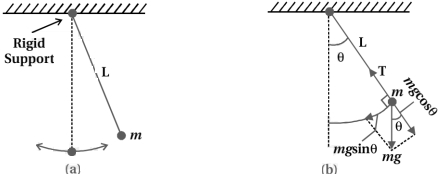
Consider a simple pendulum with a small bob of mass $m$ tied to an inextensible,massless string of length $L$.
The other end of the string is fixed to a support. Let $\theta$ be the angle made by the string with the vertical.
Two forces act on the bob:
$(1)$ Tension $T$ along the string.
$(2)$ Gravitational force $mg$ acting vertically downwards.
The force $mg$ can be resolved into two components:
$(1)$ Radial component: $mg \cos \theta$ (along the string).
$(2)$ Tangential component: $mg \sin \theta$ (perpendicular to the string).
The restoring force is $F = -mg \sin \theta$. For small oscillations,$\sin \theta \approx \theta$ (in radians).
So,$F = -mg \theta = -mg (x/L)$,where $x$ is the displacement.
Comparing with $F = -kx$,we get $k = mg/L$.
The time period is $T = 2\pi \sqrt{m/k} = 2\pi \sqrt{m / (mg/L)} = 2\pi \sqrt{L/g}$.
The entire mass of the simple pendulum is considered to be concentrated at the center of gravity of the suspended bob.
The distance from the point of suspension to the center of mass of the bob is called the length of the pendulum $(L)$.
Derivation of the expression for the time period $(T)$:
Consider a simple pendulum with a small bob of mass $m$ tied to an inextensible,massless string of length $L$.
The other end of the string is fixed to a support. Let $\theta$ be the angle made by the string with the vertical.
Two forces act on the bob:
$(1)$ Tension $T$ along the string.
$(2)$ Gravitational force $mg$ acting vertically downwards.
The force $mg$ can be resolved into two components:
$(1)$ Radial component: $mg \cos \theta$ (along the string).
$(2)$ Tangential component: $mg \sin \theta$ (perpendicular to the string).
The restoring force is $F = -mg \sin \theta$. For small oscillations,$\sin \theta \approx \theta$ (in radians).
So,$F = -mg \theta = -mg (x/L)$,where $x$ is the displacement.
Comparing with $F = -kx$,we get $k = mg/L$.
The time period is $T = 2\pi \sqrt{m/k} = 2\pi \sqrt{m / (mg/L)} = 2\pi \sqrt{L/g}$.
0 likes
View Solution173
Medium
Define a simple pendulum and the length of the pendulum.
Solution
(N/A) simple pendulum is defined as an idealized system consisting of a heavy point mass (called a bob) suspended from a rigid support by a massless,inextensible,and perfectly flexible string.
When the bob is displaced from its equilibrium position and released,it undergoes periodic motion.
The length of the pendulum,denoted by $L$,is defined as the distance from the point of suspension to the center of gravity of the bob.
When the bob is displaced from its equilibrium position and released,it undergoes periodic motion.
The length of the pendulum,denoted by $L$,is defined as the distance from the point of suspension to the center of gravity of the bob.
0 likes
View Solution174
Medium
''Motion of a simple pendulum from the mean position for small displacement is a simple harmonic motion'' - Explain this statement.
Solution
(N/A) simple pendulum consists of a bob of mass $m$ suspended by a light string of length $l$. When the pendulum is displaced by a small angle $\theta$ from the mean position,the restoring force is provided by the tangential component of gravity.
$1$. The restoring force is given by $F = -mg \sin \theta$.
$2$. For small angles,$\sin \theta \approx \theta$ (in radians),where $\theta = \frac{x}{l}$ ($x$ is the linear displacement).
$3$. Substituting this,we get $F = -mg \left( \frac{x}{l} \right) = -\left( \frac{mg}{l} \right) x$.
$4$. Since $m, g,$ and $l$ are constants,the restoring force $F$ is directly proportional to the negative displacement $x$,i.e.,$F \propto -x$.
$5$. This is the defining condition for Simple Harmonic Motion $(SHM)$. Thus,the motion is simple harmonic with an angular frequency $\omega = \sqrt{\frac{g}{l}}$.
$1$. The restoring force is given by $F = -mg \sin \theta$.
$2$. For small angles,$\sin \theta \approx \theta$ (in radians),where $\theta = \frac{x}{l}$ ($x$ is the linear displacement).
$3$. Substituting this,we get $F = -mg \left( \frac{x}{l} \right) = -\left( \frac{mg}{l} \right) x$.
$4$. Since $m, g,$ and $l$ are constants,the restoring force $F$ is directly proportional to the negative displacement $x$,i.e.,$F \propto -x$.
$5$. This is the defining condition for Simple Harmonic Motion $(SHM)$. Thus,the motion is simple harmonic with an angular frequency $\omega = \sqrt{\frac{g}{l}}$.
0 likes
View Solution175
Medium
State the laws of a simple pendulum.
Solution
(N/A) The laws of a simple pendulum are as follows:
$1$. Law of Isochronism: For small amplitudes,the period of oscillation $(T)$ of a simple pendulum is independent of its amplitude.
$2$. Law of Length: The period of oscillation $(T)$ is directly proportional to the square root of its effective length $(l)$,i.e.,$T \propto \sqrt{l}$.
$3$. Law of Acceleration due to Gravity: The period of oscillation $(T)$ is inversely proportional to the square root of the acceleration due to gravity $(g)$,i.e.,$T \propto 1/\sqrt{g}$.
$4$. Law of Mass: The period of oscillation $(T)$ is independent of the mass,shape,and material of the bob,provided the length remains constant.
$1$. Law of Isochronism: For small amplitudes,the period of oscillation $(T)$ of a simple pendulum is independent of its amplitude.
$2$. Law of Length: The period of oscillation $(T)$ is directly proportional to the square root of its effective length $(l)$,i.e.,$T \propto \sqrt{l}$.
$3$. Law of Acceleration due to Gravity: The period of oscillation $(T)$ is inversely proportional to the square root of the acceleration due to gravity $(g)$,i.e.,$T \propto 1/\sqrt{g}$.
$4$. Law of Mass: The period of oscillation $(T)$ is independent of the mass,shape,and material of the bob,provided the length remains constant.
0 likes
View Solution176
MediumMCQ
At what position is the speed of a simple pendulum maximum?
A
At the extreme position
B
At the mean position
C
At the midpoint between mean and extreme position
D
At the point of suspension
Solution
(B) In a simple pendulum,the total mechanical energy is conserved.
At the mean position,the potential energy is minimum (taken as $0$),and the kinetic energy is maximum.
Since kinetic energy $K = \frac{1}{2}mv^2$,the speed $v$ is maximum when the kinetic energy is maximum.
Therefore,the speed of the pendulum is maximum at the mean position.
At the mean position,the potential energy is minimum (taken as $0$),and the kinetic energy is maximum.
Since kinetic energy $K = \frac{1}{2}mv^2$,the speed $v$ is maximum when the kinetic energy is maximum.
Therefore,the speed of the pendulum is maximum at the mean position.
0 likes
View Solution177
MediumMCQ
Is the oscillation of a simple pendulum at the centre of the earth possible?
A
Yes
B
No
C
Depends on the length of the pendulum
D
Depends on the mass of the bob
Solution
(B) No,the oscillation of a simple pendulum at the centre of the earth is not possible.
The time period of a simple pendulum is given by the formula $T = 2 \pi \sqrt{\frac{l}{g}}$.
At the centre of the earth,the acceleration due to gravity $g$ is $0$.
Substituting $g = 0$ into the formula,we get $T = 2 \pi \sqrt{\frac{l}{0}}$,which results in $T = \infty$ (infinite).
Since the time period is infinite,the pendulum does not complete any oscillation.
The time period of a simple pendulum is given by the formula $T = 2 \pi \sqrt{\frac{l}{g}}$.
At the centre of the earth,the acceleration due to gravity $g$ is $0$.
Substituting $g = 0$ into the formula,we get $T = 2 \pi \sqrt{\frac{l}{0}}$,which results in $T = \infty$ (infinite).
Since the time period is infinite,the pendulum does not complete any oscillation.
0 likes
View Solution178
Easy
If two persons sit on a swing instead of one,why does the time period not change?
Solution
(N/A) The time period of a simple pendulum (which models a swing) is given by the formula $T = 2 \pi \sqrt{\frac{l}{g}}$.
In this formula,$l$ represents the effective length of the swing (the distance from the point of suspension to the center of mass of the system) and $g$ is the acceleration due to gravity.
Since the mass of the person$(s)$ does not appear in the formula for the time period,the time period is independent of the mass of the person sitting on the swing.
Therefore,adding another person does not change the time period,provided the effective length $l$ remains constant.
In this formula,$l$ represents the effective length of the swing (the distance from the point of suspension to the center of mass of the system) and $g$ is the acceleration due to gravity.
Since the mass of the person$(s)$ does not appear in the formula for the time period,the time period is independent of the mass of the person sitting on the swing.
Therefore,adding another person does not change the time period,provided the effective length $l$ remains constant.
0 likes
View Solution179
EasyMCQ
If the mass of a bob of a pendulum is increased by $9$ times, the period of the pendulum will?
A
Increase by $9$ times
B
Decrease by $3$ times
C
Remain unchanged
D
Increase by $3$ times
Solution
(C) The time period $T$ of a simple pendulum is given by the formula $T = 2\pi \sqrt{\frac{L}{g}}$, where $L$ is the length of the pendulum and $g$ is the acceleration due to gravity.
From this formula, it is evident that the time period $T$ depends only on the length of the pendulum and the acceleration due to gravity at that location.
The time period is independent of the mass of the bob.
Therefore, if the mass of the bob is increased by $9$ times, the period of the pendulum will remain unchanged.
From this formula, it is evident that the time period $T$ depends only on the length of the pendulum and the acceleration due to gravity at that location.
The time period is independent of the mass of the bob.
Therefore, if the mass of the bob is increased by $9$ times, the period of the pendulum will remain unchanged.
0 likes
View Solution180
MediumMCQ
If the length of a seconds pendulum becomes $\frac{1}{3}$ of its original length,what will be its new periodic time?
A
$\frac{2}{\sqrt{3}} \ s$
B
$\frac{\sqrt{3}}{2} \ s$
C
$2\sqrt{3} \ s$
D
$\frac{1}{3} \ s$
Solution
(A) The time period of a seconds pendulum is $T_{1} = 2 \ s$.
The formula for the time period of a simple pendulum is $T = 2\pi \sqrt{\frac{l}{g}}$.
Since $2\pi$ and $g$ are constants,we have the relation $T \propto \sqrt{l}$.
Given that the new length $l_{2} = \frac{l_{1}}{3}$,we can write the ratio:
$\frac{T_{2}}{T_{1}} = \sqrt{\frac{l_{2}}{l_{1}}} = \sqrt{\frac{l_{1}/3}{l_{1}}} = \sqrt{\frac{1}{3}} = \frac{1}{\sqrt{3}}$.
Therefore,the new time period is $T_{2} = \frac{T_{1}}{\sqrt{3}} = \frac{2}{\sqrt{3}} \ s$.
The formula for the time period of a simple pendulum is $T = 2\pi \sqrt{\frac{l}{g}}$.
Since $2\pi$ and $g$ are constants,we have the relation $T \propto \sqrt{l}$.
Given that the new length $l_{2} = \frac{l_{1}}{3}$,we can write the ratio:
$\frac{T_{2}}{T_{1}} = \sqrt{\frac{l_{2}}{l_{1}}} = \sqrt{\frac{l_{1}/3}{l_{1}}} = \sqrt{\frac{1}{3}} = \frac{1}{\sqrt{3}}$.
Therefore,the new time period is $T_{2} = \frac{T_{1}}{\sqrt{3}} = \frac{2}{\sqrt{3}} \ s$.
0 likes
View Solution181
MediumMCQ
When a pendulum clock is running fast,what should be done to adjust it to the true time?
A
Increase the length of the pendulum
B
Decrease the length of the pendulum
C
Increase the mass of the bob
D
Decrease the mass of the bob
Solution
(A) The time period of a simple pendulum is given by $T = 2\pi \sqrt{\frac{L}{g}}$.
If the clock is running fast,it means the time period $T$ is smaller than required,causing it to complete more oscillations in a given time.
To adjust the clock to the true time,we need to increase the time period $T$.
Since $T \propto \sqrt{L}$,increasing the length $L$ of the pendulum will increase the time period $T$,thereby slowing down the clock to the correct time.
If the clock is running fast,it means the time period $T$ is smaller than required,causing it to complete more oscillations in a given time.
To adjust the clock to the true time,we need to increase the time period $T$.
Since $T \propto \sqrt{L}$,increasing the length $L$ of the pendulum will increase the time period $T$,thereby slowing down the clock to the correct time.
0 likes
View Solution182
EasyMCQ
$A$ girl is swinging on a swing in the sitting position. What will be the effect on the time period of the swing if she stands up?
A
Increases
B
Decreases
C
Remains the same
D
Becomes zero
Solution
(B) The time period of a simple pendulum is given by the formula $T = 2 \pi \sqrt{\frac{l}{g}}$,where $l$ is the effective length of the pendulum (distance from the point of suspension to the centre of gravity of the system).
When the girl is sitting,the centre of gravity is at a certain distance from the point of suspension.
When she stands up,the centre of gravity of the system shifts upwards,closer to the point of suspension.
This results in a decrease in the effective length $l$ of the pendulum.
Since $T \propto \sqrt{l}$,a decrease in $l$ leads to a decrease in the time period $T$.
When the girl is sitting,the centre of gravity is at a certain distance from the point of suspension.
When she stands up,the centre of gravity of the system shifts upwards,closer to the point of suspension.
This results in a decrease in the effective length $l$ of the pendulum.
Since $T \propto \sqrt{l}$,a decrease in $l$ leads to a decrease in the time period $T$.
0 likes
View Solution183
Easy
Two simple pendulums of equal length cross each other at the mean position. What is their phase difference?
Solution
(C) When two pendulums of equal length cross each other at the mean position,they are moving in opposite directions.
If one pendulum is at the mean position moving towards the right,its displacement is $x = A \sin(\omega t)$,which implies it is at phase $\phi_1 = 0$ or $\pi$.
If the other pendulum is crossing the same mean position moving towards the left,its motion is represented by $x = A \sin(\omega t + \pi)$.
The phase difference between the two motions is $\Delta \phi = \pi - 0 = \pi \text{ rad}$ or $180^{\circ}$.
If one pendulum is at the mean position moving towards the right,its displacement is $x = A \sin(\omega t)$,which implies it is at phase $\phi_1 = 0$ or $\pi$.
If the other pendulum is crossing the same mean position moving towards the left,its motion is represented by $x = A \sin(\omega t + \pi)$.
The phase difference between the two motions is $\Delta \phi = \pi - 0 = \pi \text{ rad}$ or $180^{\circ}$.
0 likes
View Solution184
Easy
Can a simple pendulum clock be used in an artificial satellite? Why?
Solution
(N/A) No,a simple pendulum clock cannot be used in an artificial satellite. The time period of a simple pendulum is given by $T = 2\pi \sqrt{\frac{l}{g_{eff}}}$. In an artificial satellite,objects experience a state of weightlessness,which means the effective acceleration due to gravity $(g_{eff})$ is $0$. As $g_{eff} \to 0$,the time period $T \to \infty$. This implies that the pendulum will not oscillate,and the clock will stop working.
0 likes
View Solution185
EasyMCQ
At which position in the string of a simple pendulum is the tension maximum?
A
At the extreme position
B
At the mean position
C
At an angle of $45^{\circ}$ from the vertical
D
The tension is constant throughout the motion
Solution
(B) The tension $T$ in the string of a simple pendulum at an angle $\theta$ with the vertical is given by $T = mg \cos \theta + \frac{mv^2}{l}$.
At the mean position,$\theta = 0^{\circ}$,so $\cos \theta = 1$ (maximum value).
Also,the velocity $v$ is maximum at the mean position.
Since both terms $mg \cos \theta$ and $\frac{mv^2}{l}$ are at their maximum values at the mean position,the total tension $T$ is maximum at the mean position.
At the mean position,$\theta = 0^{\circ}$,so $\cos \theta = 1$ (maximum value).
Also,the velocity $v$ is maximum at the mean position.
Since both terms $mg \cos \theta$ and $\frac{mv^2}{l}$ are at their maximum values at the mean position,the total tension $T$ is maximum at the mean position.
0 likes
View Solution186
EasyMCQ
What happens to the time period of a simple pendulum when it is taken to the moon's surface from the earth's surface?
A
It increases.
B
It decreases.
C
It remains the same.
D
It becomes zero.
Solution
(A) The time period $T$ of a simple pendulum is given by the formula $T = 2\pi \sqrt{\frac{l}{g}}$,where $l$ is the length of the pendulum and $g$ is the acceleration due to gravity.
Since the acceleration due to gravity on the Moon $(g_m)$ is approximately $1/6$th of the acceleration due to gravity on Earth $(g_e)$,we have $g_m < g_e$.
According to the relation $T \propto \frac{1}{\sqrt{g}}$,as the value of $g$ decreases,the time period $T$ increases.
Therefore,when a simple pendulum is taken from the Earth's surface to the Moon's surface,its time period increases.
Since the acceleration due to gravity on the Moon $(g_m)$ is approximately $1/6$th of the acceleration due to gravity on Earth $(g_e)$,we have $g_m < g_e$.
According to the relation $T \propto \frac{1}{\sqrt{g}}$,as the value of $g$ decreases,the time period $T$ increases.
Therefore,when a simple pendulum is taken from the Earth's surface to the Moon's surface,its time period increases.
0 likes
View Solution187
Medium
In the following table, the relation of the graph in column-$I$ and the shape of the graph in column-$II$ is shown. Match them appropriately.
| Column-$I$ | Column-$II$ |
| $(a)$ $T^2 \to l$ | $(i)$ Linear |
| $(b)$ $T^2 \to g$ | $(ii)$ Parabolic |
| $(c)$ $T \to l$ | $(iii)$ Hyperbolic |
Solution
(A) The time period of a simple pendulum is given by $T = 2\pi \sqrt{\frac{l}{g}}$.
$(a)$ For $T^2 \to l$: Squaring both sides, $T^2 = \frac{4\pi^2}{g} l$. Since $T^2 \propto l$, the graph is a straight line passing through the origin. Thus, $(a-i)$.
$(b)$ For $T^2 \to g$: From $T^2 = \frac{4\pi^2 l}{g}$, we have $T^2 \propto \frac{1}{g}$. This represents a rectangular hyperbola. Thus, $(b-iii)$.
$(c)$ For $T \to l$: From $T = 2\pi \sqrt{\frac{l}{g}}$, we have $T \propto \sqrt{l}$. This represents a parabolic curve. Thus, $(c-ii)$.
Therefore, the correct matching is $(a-i, b-iii, c-ii)$.
$(a)$ For $T^2 \to l$: Squaring both sides, $T^2 = \frac{4\pi^2}{g} l$. Since $T^2 \propto l$, the graph is a straight line passing through the origin. Thus, $(a-i)$.
$(b)$ For $T^2 \to g$: From $T^2 = \frac{4\pi^2 l}{g}$, we have $T^2 \propto \frac{1}{g}$. This represents a rectangular hyperbola. Thus, $(b-iii)$.
$(c)$ For $T \to l$: From $T = 2\pi \sqrt{\frac{l}{g}}$, we have $T \propto \sqrt{l}$. This represents a parabolic curve. Thus, $(c-ii)$.
Therefore, the correct matching is $(a-i, b-iii, c-ii)$.
0 likes
View Solution188
EasyMCQ
When will the motion of a simple pendulum be simple harmonic?
A
When the amplitude is large
B
When the angular displacement is very small
C
When the length of the pendulum is very large
D
When the mass of the bob is very large
Solution
(B) The restoring force on a simple pendulum is given by $F = -mg \sin \theta$.
For small angular displacements,$\sin \theta \approx \theta$ (in radians).
Thus,the restoring force becomes $F \approx -mg \theta$.
Since $\theta = x/l$,we have $F \approx -(mg/l)x$.
This shows that the restoring force is directly proportional to the displacement $x$ and directed towards the equilibrium position,which is the condition for simple harmonic motion.
For small angular displacements,$\sin \theta \approx \theta$ (in radians).
Thus,the restoring force becomes $F \approx -mg \theta$.
Since $\theta = x/l$,we have $F \approx -(mg/l)x$.
This shows that the restoring force is directly proportional to the displacement $x$ and directed towards the equilibrium position,which is the condition for simple harmonic motion.
0 likes
View Solution189
MediumMCQ
The length of a second's pendulum on the surface of the earth is $1 \ m$. What will be the length of a second's pendulum on the moon?
A
$1/6 \ m$
B
$1/36 \ m$
C
$6 \ m$
D
$1/12 \ m$
Solution
(A) The time period of a simple pendulum is given by $T = 2\pi \sqrt{\frac{l}{g}}$.
Since $T$ is constant $(2 \ s)$ for a second's pendulum on both the earth and the moon,we have $T \propto \sqrt{\frac{l}{g}}$.
Therefore,$\frac{T_m}{T_e} = \sqrt{\frac{l_m}{g_m} \cdot \frac{g_e}{l_e}}$.
Given $T_e = T_m = 2 \ s$,we get $1 = \sqrt{\frac{l_m}{l_e} \cdot \frac{g_e}{g_m}}$.
Squaring both sides,$1 = \frac{l_m}{l_e} \cdot \frac{g_e}{g_m}$.
We know that $g_m = \frac{g_e}{6}$,so $\frac{g_e}{g_m} = 6$.
Given $l_e = 1 \ m$,substituting these values gives $1 = \frac{l_m}{1} \cdot 6$.
Thus,$l_m = \frac{1}{6} \ m$.
Since $T$ is constant $(2 \ s)$ for a second's pendulum on both the earth and the moon,we have $T \propto \sqrt{\frac{l}{g}}$.
Therefore,$\frac{T_m}{T_e} = \sqrt{\frac{l_m}{g_m} \cdot \frac{g_e}{l_e}}$.
Given $T_e = T_m = 2 \ s$,we get $1 = \sqrt{\frac{l_m}{l_e} \cdot \frac{g_e}{g_m}}$.
Squaring both sides,$1 = \frac{l_m}{l_e} \cdot \frac{g_e}{g_m}$.
We know that $g_m = \frac{g_e}{6}$,so $\frac{g_e}{g_m} = 6$.
Given $l_e = 1 \ m$,substituting these values gives $1 = \frac{l_m}{1} \cdot 6$.
Thus,$l_m = \frac{1}{6} \ m$.
0 likes
View Solution190
Difficult
$A$ simple pendulum of time period $1\,s$ and length $l$ is hung from a fixed support at $O$. The bob is at a distance $H$ vertically above $A$ on the ground. The amplitude is $\theta_0$. The string snaps at $\theta = \frac{\theta_0}{2}$. Find the time taken by the bob to hit the ground and the distance from $A$ where the bob hits the ground. Assume $\theta_0$ to be small,so that $\sin \theta_0 \approx \theta_0$ and $\cos \theta_0 \approx 1$.
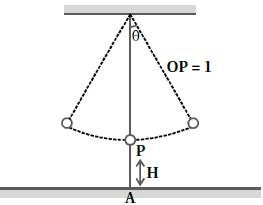
Solution
(N/A) The angular frequency is $\omega = \frac{2\pi}{T} = 2\pi \text{ rad/s}$.
At $t=0$,the bob is at $\theta = \theta_0$. The angular position is $\theta(t) = \theta_0 \cos(\omega t)$.
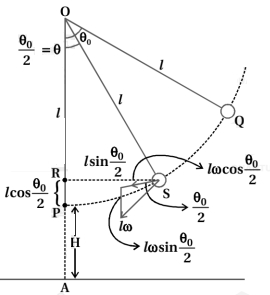
At the moment the string snaps,$\theta = \frac{\theta_0}{2}$,so $\frac{\theta_0}{2} = \theta_0 \cos(2\pi t_1) \implies \cos(2\pi t_1) = \frac{1}{2} \implies 2\pi t_1 = \frac{\pi}{3} \implies t_1 = \frac{1}{6} \text{ s}$.
The velocity components at this instant are $v_x = l\omega \sin(\frac{\theta_0}{2})$ (horizontal) and $v_y = l\omega \cos(\frac{\theta_0}{2})$ (downward).
Since $\theta_0$ is small,$v_x \approx l\omega(\frac{\theta_0}{2})$ and $v_y \approx l\omega$.
The height of the bob from the ground at this instant is $h = H + l(1 - \cos(\frac{\theta_0}{2})) \approx H + l(1 - 1) = H$.
The vertical motion is $h = v_y t + \frac{1}{2}gt^2$,so $H = (l\omega)t + \frac{1}{2}gt^2$.
Solving for $t$ gives the time to hit the ground. The horizontal distance from $A$ is $x = l \sin(\frac{\theta_0}{2}) + v_x t = l(\frac{\theta_0}{2}) + (l\omega \frac{\theta_0}{2})t$.
At $t=0$,the bob is at $\theta = \theta_0$. The angular position is $\theta(t) = \theta_0 \cos(\omega t)$.
At the moment the string snaps,$\theta = \frac{\theta_0}{2}$,so $\frac{\theta_0}{2} = \theta_0 \cos(2\pi t_1) \implies \cos(2\pi t_1) = \frac{1}{2} \implies 2\pi t_1 = \frac{\pi}{3} \implies t_1 = \frac{1}{6} \text{ s}$.
The velocity components at this instant are $v_x = l\omega \sin(\frac{\theta_0}{2})$ (horizontal) and $v_y = l\omega \cos(\frac{\theta_0}{2})$ (downward).
Since $\theta_0$ is small,$v_x \approx l\omega(\frac{\theta_0}{2})$ and $v_y \approx l\omega$.
The height of the bob from the ground at this instant is $h = H + l(1 - \cos(\frac{\theta_0}{2})) \approx H + l(1 - 1) = H$.
The vertical motion is $h = v_y t + \frac{1}{2}gt^2$,so $H = (l\omega)t + \frac{1}{2}gt^2$.
Solving for $t$ gives the time to hit the ground. The horizontal distance from $A$ is $x = l \sin(\frac{\theta_0}{2}) + v_x t = l(\frac{\theta_0}{2}) + (l\omega \frac{\theta_0}{2})t$.
0 likes
View Solution191
EasyMCQ
What is the frequency of oscillation of a pendulum suspended in a freely falling lift?
A
Zero
B
Infinite
C
Same as that on the surface of the Earth
D
Depends on the mass of the bob
Solution
(A) The time period of a simple pendulum is given by $T = 2\pi \sqrt{\frac{l}{g_{eff}}}$.
In a freely falling lift,the effective acceleration due to gravity $g_{eff}$ is $g - a$. Since the lift is in free fall,$a = g$,therefore $g_{eff} = g - g = 0$.
Substituting this into the time period formula,we get $T = 2\pi \sqrt{\frac{l}{0}} = \infty$.
The frequency of oscillation $f$ is the reciprocal of the time period,$f = \frac{1}{T}$.
Therefore,$f = \frac{1}{\infty} = 0 \text{ Hz}$.
In a freely falling lift,the effective acceleration due to gravity $g_{eff}$ is $g - a$. Since the lift is in free fall,$a = g$,therefore $g_{eff} = g - g = 0$.
Substituting this into the time period formula,we get $T = 2\pi \sqrt{\frac{l}{0}} = \infty$.
The frequency of oscillation $f$ is the reciprocal of the time period,$f = \frac{1}{T}$.
Therefore,$f = \frac{1}{\infty} = 0 \text{ Hz}$.
0 likes
View Solution192
MediumMCQ
Time period of a simple pendulum is $T$ inside a lift when the lift is stationary. If the lift moves upwards with an acceleration $g / 2$,the time period of the pendulum will be
A
$\sqrt{3} T$
B
$\frac{T}{\sqrt{3}}$
C
$\sqrt{\frac{3}{2}} T$
D
$\sqrt{\frac{2}{3}} T$
Solution
(D) When the lift is stationary,the time period of the simple pendulum is given by $T = 2 \pi \sqrt{\frac{L}{g}}$.
When the lift moves upwards with an acceleration $a = g/2$,a pseudo force acts downwards on the pendulum bob.
The effective acceleration due to gravity becomes $g_{eff} = g + a = g + \frac{g}{2} = \frac{3g}{2}$.
The new time period $T'$ is given by $T' = 2 \pi \sqrt{\frac{L}{g_{eff}}}$.
Substituting $g_{eff} = \frac{3g}{2}$,we get $T' = 2 \pi \sqrt{\frac{L}{3g/2}} = 2 \pi \sqrt{\frac{2L}{3g}}$.
Comparing this with the original time period $T$,we have $T' = \sqrt{\frac{2}{3}} \times (2 \pi \sqrt{\frac{L}{g}}) = \sqrt{\frac{2}{3}} T$.
When the lift moves upwards with an acceleration $a = g/2$,a pseudo force acts downwards on the pendulum bob.
The effective acceleration due to gravity becomes $g_{eff} = g + a = g + \frac{g}{2} = \frac{3g}{2}$.
The new time period $T'$ is given by $T' = 2 \pi \sqrt{\frac{L}{g_{eff}}}$.
Substituting $g_{eff} = \frac{3g}{2}$,we get $T' = 2 \pi \sqrt{\frac{L}{3g/2}} = 2 \pi \sqrt{\frac{2L}{3g}}$.
Comparing this with the original time period $T$,we have $T' = \sqrt{\frac{2}{3}} \times (2 \pi \sqrt{\frac{L}{g}}) = \sqrt{\frac{2}{3}} T$.
0 likes
View Solution193
MediumMCQ
If the time period of a $2 \ m$ long simple pendulum is $2 \ s$,the acceleration due to gravity at the place where the pendulum is executing $S.H.M.$ is
A
$\pi^{2} \ m/s^{2}$
B
$9.8 \ m/s^{2}$
C
$2 \pi^{2} \ m/s^{2}$
D
$16 \ m/s^{2}$
Solution
(C) The formula for the time period $T$ of a simple pendulum is given by $T = 2 \pi \sqrt{\frac{l}{g}}$.
Given: Length $l = 2 \ m$ and time period $T = 2 \ s$.
Substituting the values into the formula:
$2 = 2 \pi \sqrt{\frac{2}{g}}$
Dividing both sides by $2$:
$1 = \pi \sqrt{\frac{2}{g}}$
Squaring both sides:
$1 = \pi^{2} \left(\frac{2}{g}\right)$
Rearranging for $g$:
$g = 2 \pi^{2} \ m/s^{2}$.
Given: Length $l = 2 \ m$ and time period $T = 2 \ s$.
Substituting the values into the formula:
$2 = 2 \pi \sqrt{\frac{2}{g}}$
Dividing both sides by $2$:
$1 = \pi \sqrt{\frac{2}{g}}$
Squaring both sides:
$1 = \pi^{2} \left(\frac{2}{g}\right)$
Rearranging for $g$:
$g = 2 \pi^{2} \ m/s^{2}$.
0 likes
View Solution194
MediumMCQ
Given below are two statements:
Statement $I :$ $A$ second's pendulum has a time period of $1$ second.
Statement $II :$ It takes precisely one second to move between the two extreme positions.
In the light of the above statements,choose the correct answer from the options given below:
Statement $I :$ $A$ second's pendulum has a time period of $1$ second.
Statement $II :$ It takes precisely one second to move between the two extreme positions.
In the light of the above statements,choose the correct answer from the options given below:
A
Both Statement $I$ and Statement $II$ are false.
B
Statement $I$ is false but Statement $II$ is true.
C
Statement $I$ is true but Statement $II$ is false.
D
Both Statement $I$ and Statement $II$ are true.
Solution
(B) second's pendulum is defined as a pendulum whose time period of oscillation is $2 \, s$.
Therefore,Statement $I$ is false.
The time taken to move from one extreme position to the other extreme position is equal to half of the time period $(T/2)$.
Since $T = 2 \, s$,the time taken is $2 \, s / 2 = 1 \, s$.
Therefore,Statement $II$ is true.
Therefore,Statement $I$ is false.
The time taken to move from one extreme position to the other extreme position is equal to half of the time period $(T/2)$.
Since $T = 2 \, s$,the time taken is $2 \, s / 2 = 1 \, s$.
Therefore,Statement $II$ is true.
0 likes
View Solution195
DifficultMCQ
The time period of a simple pendulum is $T$. The time taken to complete $5/8$ oscillations starting from the mean position is $\frac{\alpha}{\beta} T$. The value of $\alpha$ is ..... .
A
$5$
B
$3$
C
$7$
D
$6$
Solution
(A) Starting from the mean position,the particle moves to the extreme position ($1/4$ oscillation),back to the mean position ($1/2$ oscillation),and then to the other side.
$5/8$ of an oscillation is equivalent to $1/2 + 1/8$ of an oscillation.
In terms of phase,$1/2$ oscillation corresponds to a phase change of $\pi$ radians.
The remaining $1/8$ oscillation corresponds to a phase change of $\frac{1}{8} \times 2\pi = \frac{\pi}{4}$ radians.
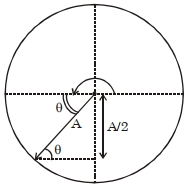
However,the question asks for the time taken to reach the position corresponding to $5/8$ of the cycle. Using the reference circle method,the displacement $y = A \sin(\omega t)$.
For $5/8$ of the cycle,the phase angle $\phi = \frac{5}{8} \times 2\pi = \frac{5\pi}{4}$.
Since the particle starts from the mean position,we consider the phase relative to the mean position.
The time $t$ is given by $\omega t = \phi$,where $\omega = \frac{2\pi}{T}$.
Thus,$t = \frac{\phi}{\omega} = \frac{5\pi/4}{2\pi/T} = \frac{5}{8} T$.
Wait,checking the provided solution logic: The particle reaches the extreme at $T/4$,returns to mean at $T/2$. To complete $5/8$,it travels an additional $1/8$ of the cycle from the mean position in the negative direction. The displacement is $y = A \sin(\omega t)$. At $t = 5T/8$,$y = A \sin(2\pi/T \times 5T/8) = A \sin(5\pi/4) = -A/\sqrt{2}$.
If the question implies the time to reach the displacement corresponding to $5/8$ of the cycle,then $\alpha = 5$.
$5/8$ of an oscillation is equivalent to $1/2 + 1/8$ of an oscillation.
In terms of phase,$1/2$ oscillation corresponds to a phase change of $\pi$ radians.
The remaining $1/8$ oscillation corresponds to a phase change of $\frac{1}{8} \times 2\pi = \frac{\pi}{4}$ radians.
However,the question asks for the time taken to reach the position corresponding to $5/8$ of the cycle. Using the reference circle method,the displacement $y = A \sin(\omega t)$.
For $5/8$ of the cycle,the phase angle $\phi = \frac{5}{8} \times 2\pi = \frac{5\pi}{4}$.
Since the particle starts from the mean position,we consider the phase relative to the mean position.
The time $t$ is given by $\omega t = \phi$,where $\omega = \frac{2\pi}{T}$.
Thus,$t = \frac{\phi}{\omega} = \frac{5\pi/4}{2\pi/T} = \frac{5}{8} T$.
Wait,checking the provided solution logic: The particle reaches the extreme at $T/4$,returns to mean at $T/2$. To complete $5/8$,it travels an additional $1/8$ of the cycle from the mean position in the negative direction. The displacement is $y = A \sin(\omega t)$. At $t = 5T/8$,$y = A \sin(2\pi/T \times 5T/8) = A \sin(5\pi/4) = -A/\sqrt{2}$.
If the question implies the time to reach the displacement corresponding to $5/8$ of the cycle,then $\alpha = 5$.
0 likes
View Solution196
DifficultMCQ
If the length of the pendulum in a pendulum clock increases by $0.1\, \%$,then the error in time per day is: (in $s$)
A
$86.4$
B
$4.32$
C
$43.2$
D
$8.64$
Solution
(C) The time period of a simple pendulum is given by $T = 2\pi \sqrt{\frac{\ell}{g}}$.
Taking the logarithmic derivative,we get $\frac{\Delta T}{T} = \frac{1}{2} \frac{\Delta \ell}{\ell}$.
Given that the length increases by $0.1\, \%$,so $\frac{\Delta \ell}{\ell} = \frac{0.1}{100} = 10^{-3}$.
The error in time per day $(\Delta T)$ is calculated as $\Delta T = \frac{1}{2} \times \left( \frac{\Delta \ell}{\ell} \right) \times T_{total}$,where $T_{total} = 24 \times 3600 \, s$.
Substituting the values: $\Delta T = \frac{1}{2} \times 10^{-3} \times 86400 = 43.2 \, s$.
Taking the logarithmic derivative,we get $\frac{\Delta T}{T} = \frac{1}{2} \frac{\Delta \ell}{\ell}$.
Given that the length increases by $0.1\, \%$,so $\frac{\Delta \ell}{\ell} = \frac{0.1}{100} = 10^{-3}$.
The error in time per day $(\Delta T)$ is calculated as $\Delta T = \frac{1}{2} \times \left( \frac{\Delta \ell}{\ell} \right) \times T_{total}$,where $T_{total} = 24 \times 3600 \, s$.
Substituting the values: $\Delta T = \frac{1}{2} \times 10^{-3} \times 86400 = 43.2 \, s$.
0 likes
View Solution197
DifficultMCQ
$A$ bob of mass $m$ suspended by a thread of length $l$ undergoes simple harmonic oscillations with time period $T$. If the bob is immersed in a liquid that has density $1/4$ times that of the bob and the length of the thread is increased by $1/3$ of the original length,then the time period of the simple harmonic oscillations will be :-
A
$T$
B
$\frac{3}{2} T$
C
$\frac{3}{4} T$
D
$\frac{4}{3} T$
Solution
(D) The time period of a simple pendulum is given by $T = 2 \pi \sqrt{\frac{l}{g}}$.
When the bob is immersed in a liquid,the effective acceleration due to gravity $g_{\text{eff}}$ changes due to the buoyant force.
$m g_{\text{eff}} = m g - F_B$,where $F_B$ is the buoyant force.
$F_B = V \sigma g$,where $V$ is the volume of the bob and $\sigma$ is the density of the liquid.
Given $\sigma = \frac{\rho}{4}$,where $\rho$ is the density of the bob,we have $F_B = V \frac{\rho}{4} g = \frac{m g}{4}$.
Thus,$m g_{\text{eff}} = m g - \frac{m g}{4} = \frac{3 m g}{4}$,which implies $g_{\text{eff}} = \frac{3 g}{4}$.
The new length of the thread is $l_1 = l + \frac{l}{3} = \frac{4l}{3}$.
The new time period $T_1$ is given by $T_1 = 2 \pi \sqrt{\frac{l_1}{g_{\text{eff}}}} = 2 \pi \sqrt{\frac{4l/3}{3g/4}} = 2 \pi \sqrt{\frac{16l}{9g}} = \frac{4}{3} \left( 2 \pi \sqrt{\frac{l}{g}} \right)$.
Therefore,$T_1 = \frac{4}{3} T$.
When the bob is immersed in a liquid,the effective acceleration due to gravity $g_{\text{eff}}$ changes due to the buoyant force.
$m g_{\text{eff}} = m g - F_B$,where $F_B$ is the buoyant force.
$F_B = V \sigma g$,where $V$ is the volume of the bob and $\sigma$ is the density of the liquid.
Given $\sigma = \frac{\rho}{4}$,where $\rho$ is the density of the bob,we have $F_B = V \frac{\rho}{4} g = \frac{m g}{4}$.
Thus,$m g_{\text{eff}} = m g - \frac{m g}{4} = \frac{3 m g}{4}$,which implies $g_{\text{eff}} = \frac{3 g}{4}$.
The new length of the thread is $l_1 = l + \frac{l}{3} = \frac{4l}{3}$.
The new time period $T_1$ is given by $T_1 = 2 \pi \sqrt{\frac{l_1}{g_{\text{eff}}}} = 2 \pi \sqrt{\frac{4l/3}{3g/4}} = 2 \pi \sqrt{\frac{16l}{9g}} = \frac{4}{3} \left( 2 \pi \sqrt{\frac{l}{g}} \right)$.
Therefore,$T_1 = \frac{4}{3} T$.
0 likes
View Solution198
EasyMCQ
$T_{0}$ is the time period of a simple pendulum at a place. If the length of the pendulum is reduced to $\frac{1}{16}$ times its initial value,the modified time period will be:
A
$8 \pi T_{0}$
B
$4 T_{0}$
C
$T_{0}$
D
$\frac{1}{4} T_{0}$
Solution
(D) The time period of a simple pendulum is given by the formula $T = 2 \pi \sqrt{\frac{\ell}{g}}$.
Initially,the time period is $T_{0} = 2 \pi \sqrt{\frac{\ell}{g}}$.
When the length is reduced to $\ell' = \frac{\ell}{16}$,the new time period $T'$ becomes:
$T' = 2 \pi \sqrt{\frac{\ell'}{g}} = 2 \pi \sqrt{\frac{\ell / 16}{g}}$.
$T' = \frac{1}{\sqrt{16}} \times (2 \pi \sqrt{\frac{\ell}{g}})$.
$T' = \frac{1}{4} T_{0}$.
Initially,the time period is $T_{0} = 2 \pi \sqrt{\frac{\ell}{g}}$.
When the length is reduced to $\ell' = \frac{\ell}{16}$,the new time period $T'$ becomes:
$T' = 2 \pi \sqrt{\frac{\ell'}{g}} = 2 \pi \sqrt{\frac{\ell / 16}{g}}$.
$T' = \frac{1}{\sqrt{16}} \times (2 \pi \sqrt{\frac{\ell}{g}})$.
$T' = \frac{1}{4} T_{0}$.
0 likes
View Solution199
MediumMCQ
Frequency $f$ of a simple pendulum depends on its length $\ell$ and acceleration $g$ due to gravity according to the following equation $f = \frac{1}{2 \pi} \sqrt{\frac{g}{\ell}}$. $A$ graph between which of the following quantities is a straight line?
A
$f$ on the ordinate and $\ell$ on the abscissa
B
$f$ on the ordinate and $\sqrt{\ell}$ on the abscissa
C
$f^2$ on the ordinate and $\ell$ on the abscissa
D
$f^2$ on the ordinate and $1/\ell$ on the abscissa
Solution
(D) Given the equation for the frequency of a simple pendulum: $f = \frac{1}{2 \pi} \sqrt{\frac{g}{\ell}}$.
Squaring both sides,we get: $f^2 = \frac{1}{4 \pi^2} \cdot \frac{g}{\ell}$.
This can be rewritten as: $f^2 = \left( \frac{g}{4 \pi^2} \right) \cdot \left( \frac{1}{\ell} \right)$.
Comparing this with the equation of a straight line $y = mx + c$,where $y = f^2$,$x = 1/\ell$,$m = \frac{g}{4 \pi^2}$,and $c = 0$.
Since the equation represents a linear relationship between $f^2$ and $1/\ell$,the graph between $f^2$ (on the ordinate) and $1/\ell$ (on the abscissa) will be a straight line passing through the origin.
Squaring both sides,we get: $f^2 = \frac{1}{4 \pi^2} \cdot \frac{g}{\ell}$.
This can be rewritten as: $f^2 = \left( \frac{g}{4 \pi^2} \right) \cdot \left( \frac{1}{\ell} \right)$.
Comparing this with the equation of a straight line $y = mx + c$,where $y = f^2$,$x = 1/\ell$,$m = \frac{g}{4 \pi^2}$,and $c = 0$.
Since the equation represents a linear relationship between $f^2$ and $1/\ell$,the graph between $f^2$ (on the ordinate) and $1/\ell$ (on the abscissa) will be a straight line passing through the origin.
0 likes
View Solution200
MediumMCQ
Two pendulums of length $121 \ cm$ and $100 \ cm$ start vibrating in phase. At some instant,the two are at their mean position in the same phase. The minimum number of vibrations of the shorter pendulum after which the two are again in phase at the mean position is:
A
$9$
B
$10$
C
$8$
D
$11$
Solution
(D) The time period of a simple pendulum is given by $T = 2 \pi \sqrt{\frac{L}{g}}$.
Let $L_1 = 121 \ cm = 1.21 \ m$ and $L_2 = 100 \ cm = 1.0 \ m$.
Let $n_1$ be the number of oscillations of the longer pendulum and $n_2$ be the number of oscillations of the shorter pendulum.
For them to be in phase at the mean position again,the total time must be equal: $n_1 T_1 = n_2 T_2$.
$n_1 (2 \pi \sqrt{\frac{1.21}{g}}) = n_2 (2 \pi \sqrt{\frac{1.0}{g}})$.
$n_1 (1.1) = n_2 (1.0)$.
$1.1 n_1 = n_2$,which implies $\frac{n_2}{n_1} = \frac{1.1}{1} = \frac{11}{10}$.
Since $n_2$ and $n_1$ must be integers,the minimum number of vibrations for the shorter pendulum $(n_2)$ is $11$ and for the longer pendulum $(n_1)$ is $10$.
Let $L_1 = 121 \ cm = 1.21 \ m$ and $L_2 = 100 \ cm = 1.0 \ m$.
Let $n_1$ be the number of oscillations of the longer pendulum and $n_2$ be the number of oscillations of the shorter pendulum.
For them to be in phase at the mean position again,the total time must be equal: $n_1 T_1 = n_2 T_2$.
$n_1 (2 \pi \sqrt{\frac{1.21}{g}}) = n_2 (2 \pi \sqrt{\frac{1.0}{g}})$.
$n_1 (1.1) = n_2 (1.0)$.
$1.1 n_1 = n_2$,which implies $\frac{n_2}{n_1} = \frac{1.1}{1} = \frac{11}{10}$.
Since $n_2$ and $n_1$ must be integers,the minimum number of vibrations for the shorter pendulum $(n_2)$ is $11$ and for the longer pendulum $(n_1)$ is $10$.
0 likes
View SolutionOscillations — SHM of Simple Pendulum · Frequently Asked Questions
1Are these Oscillations questions useful for JEE and NEET?
Yes. All questions in this section are mapped to JEE Main and NEET exam patterns. Previous year questions from JEE Main, NEET, GUJCET and state-level exams are included with full solutions.
2Can I switch to Hindi or Gujarati for these questions?
Yes. Use the language tabs in the hero section or the sidebar to view the same questions and solutions in English, Hindi or Gujarati.
3How do I generate a question paper from this subtopic?
Use the Vedclass Exam Paper Generator — select the chapter and subtopic, set difficulty, and generate Sets A, B, C, D automatically. First 3 chapters of every subject are free.
Vedclass Products
For Students
Vedclass Test Series
Mock tests in real JEE/NEET style with performance analysis. 5-day free trial.
Start Free TrialFor Teachers
Exam Paper Generator
Generate Set A/B/C/D papers from this chapter in 2 minutes. 3 chapters free.
Try FreeFor Institutes
Online Exam Module
Live online exams with unlimited students, 360° analytics & white-label branding.
See DemoFor Teachers & Institutes
Generate a Oscillations Exam Paper in 2 Minutes
Select subtopic & difficulty — Sets A, B, C, D auto-generated with No Repeat logic.
First 3 chapters of every subject are free — no payment required.