
A English
Energy of Simple Harmonic Motion Questions in English
Class 11 Physics · Oscillations · Energy of Simple Harmonic Motion
224+
Questions
English
Language
100%
With Solutions
Showing 50 of 224 questions in English
101
MediumMCQ
What is the displacement of a body in $SHM$ when the potential energy becomes three times its kinetic energy?
A
$x = \pm \frac{\sqrt{3}}{2} A$
B
$x = \pm \frac{1}{2} A$
C
$x = \pm \frac{\sqrt{3}}{4} A$
D
$x = \pm \frac{1}{\sqrt{2}} A$
Solution
(A) Let $U$ be the potential energy and $K$ be the kinetic energy of a body in $SHM$.
Given that $U = 3K$.
The potential energy in $SHM$ is given by $U = \frac{1}{2} k x^2$ and kinetic energy is $K = \frac{1}{2} k (A^2 - x^2)$,where $A$ is the amplitude and $x$ is the displacement.
Substituting these into the given condition:
$\frac{1}{2} k x^2 = 3 \times \frac{1}{2} k (A^2 - x^2)$
$x^2 = 3(A^2 - x^2)$
$x^2 = 3A^2 - 3x^2$
$4x^2 = 3A^2$
$x^2 = \frac{3}{4} A^2$
$x = \pm \frac{\sqrt{3}}{2} A$
Given that $U = 3K$.
The potential energy in $SHM$ is given by $U = \frac{1}{2} k x^2$ and kinetic energy is $K = \frac{1}{2} k (A^2 - x^2)$,where $A$ is the amplitude and $x$ is the displacement.
Substituting these into the given condition:
$\frac{1}{2} k x^2 = 3 \times \frac{1}{2} k (A^2 - x^2)$
$x^2 = 3(A^2 - x^2)$
$x^2 = 3A^2 - 3x^2$
$4x^2 = 3A^2$
$x^2 = \frac{3}{4} A^2$
$x = \pm \frac{\sqrt{3}}{2} A$
0 likes
View Solution102
EasyMCQ
$A$ body of mass $m$ is executing $SHM$ with amplitude $a$. When its displacement $x = 1$ unit,the force is $b$. What will be its maximum kinetic energy?
A
$\frac{1}{2} b a^2$
B
$\frac{1}{2} b a$
C
$b a^2$
D
$b a$
Solution
(A) The restoring force in $SHM$ is given by $F = kx$,where $k$ is the force constant.
Given that at displacement $x = 1$ unit,the force $F = b$.
Substituting these values,we get $b = k(1)$,which implies $k = b$.
The maximum kinetic energy $(KE_{max})$ of a body executing $SHM$ is given by the formula $KE_{max} = \frac{1}{2} k a^2$,where $a$ is the amplitude.
Substituting $k = b$ into the formula,we get $KE_{max} = \frac{1}{2} b a^2$.
Given that at displacement $x = 1$ unit,the force $F = b$.
Substituting these values,we get $b = k(1)$,which implies $k = b$.
The maximum kinetic energy $(KE_{max})$ of a body executing $SHM$ is given by the formula $KE_{max} = \frac{1}{2} k a^2$,where $a$ is the amplitude.
Substituting $k = b$ into the formula,we get $KE_{max} = \frac{1}{2} b a^2$.
0 likes
View Solution103
MediumMCQ
The maximum restoring force of a body executing $SHM$ is $\alpha$ and the total energy is $\beta$. Obtain its amplitude in terms of $\beta$ and $\alpha$.
A
$A = \frac{2\beta}{\alpha}$
B
$A = \frac{\beta}{\alpha}$
C
$A = \frac{\beta}{2\alpha}$
D
$A = \frac{2\alpha}{\beta}$
Solution
(A) The maximum restoring force $F$ for a body executing $SHM$ is given by $F = kA$,where $k$ is the force constant and $A$ is the amplitude.
Given,$\alpha = kA$ --- $(1)$
The total energy $E$ of a body executing $SHM$ is given by $E = \frac{1}{2}kA^2$.
Given,$\beta = \frac{1}{2}kA^2$ --- $(2)$
Dividing equation $(2)$ by equation $(1)$:
$\frac{\beta}{\alpha} = \frac{\frac{1}{2}kA^2}{kA}$
$\frac{\beta}{\alpha} = \frac{A}{2}$
Therefore,the amplitude $A$ is:
$A = \frac{2\beta}{\alpha}$
Given,$\alpha = kA$ --- $(1)$
The total energy $E$ of a body executing $SHM$ is given by $E = \frac{1}{2}kA^2$.
Given,$\beta = \frac{1}{2}kA^2$ --- $(2)$
Dividing equation $(2)$ by equation $(1)$:
$\frac{\beta}{\alpha} = \frac{\frac{1}{2}kA^2}{kA}$
$\frac{\beta}{\alpha} = \frac{A}{2}$
Therefore,the amplitude $A$ is:
$A = \frac{2\beta}{\alpha}$
0 likes
View Solution104
Easy
If the amplitude of a body executing $SHM$ is doubled,what will be its energy?
Solution
(C) The energy of a body executing $SHM$ is given by the formula $E = \frac{1}{2} k A^2$,where $k$ is the force constant and $A$ is the amplitude.
Since $E \propto A^2$,if the amplitude $A$ is doubled $(A' = 2A)$,the new energy $E'$ becomes:
$E' = \frac{1}{2} k (2A)^2 = 4 \times (\frac{1}{2} k A^2) = 4E$.
Therefore,the energy becomes four times the original energy.
Since $E \propto A^2$,if the amplitude $A$ is doubled $(A' = 2A)$,the new energy $E'$ becomes:
$E' = \frac{1}{2} k (2A)^2 = 4 \times (\frac{1}{2} k A^2) = 4E$.
Therefore,the energy becomes four times the original energy.
0 likes
View Solution105
MediumMCQ
Amplitude of a $SHO$ is $\sqrt{5} \ cm$. At what displacement from the mean position the ratio of kinetic energy to potential energy is $4$ (in $cm$)?
A
$1$
B
$2$
C
$3$
D
$4$
Solution
(A) Given,amplitude $A = \sqrt{5} \ cm$.
Let the displacement be $x$.
The kinetic energy $K = \frac{1}{2} k(A^2 - x^2)$ and potential energy $U = \frac{1}{2} k x^2$.
Given the ratio $\frac{K}{U} = 4$.
Substituting the expressions,we get $\frac{\frac{1}{2} k(A^2 - x^2)}{\frac{1}{2} k x^2} = 4$.
$\frac{A^2 - x^2}{x^2} = 4$.
$A^2 - x^2 = 4x^2$.
$A^2 = 5x^2$.
$x^2 = \frac{A^2}{5}$.
Since $A = \sqrt{5} \ cm$,$A^2 = 5 \ cm^2$.
$x^2 = \frac{5}{5} = 1 \ cm^2$.
Therefore,$x = \pm 1 \ cm$.
Let the displacement be $x$.
The kinetic energy $K = \frac{1}{2} k(A^2 - x^2)$ and potential energy $U = \frac{1}{2} k x^2$.
Given the ratio $\frac{K}{U} = 4$.
Substituting the expressions,we get $\frac{\frac{1}{2} k(A^2 - x^2)}{\frac{1}{2} k x^2} = 4$.
$\frac{A^2 - x^2}{x^2} = 4$.
$A^2 - x^2 = 4x^2$.
$A^2 = 5x^2$.
$x^2 = \frac{A^2}{5}$.
Since $A = \sqrt{5} \ cm$,$A^2 = 5 \ cm^2$.
$x^2 = \frac{5}{5} = 1 \ cm^2$.
Therefore,$x = \pm 1 \ cm$.
0 likes
View Solution106
Easy
In the following table, the displacement of a $Simple \text{ } Harmonic \text{ } Oscillator \text{ } (SHO)$ is shown in column-$I$ and the kinetic energy is shown in column-$II$. Match them appropriately.
| Column-$I$ | Column-$II$ |
| $(a)$ $y = \frac{A}{\sqrt{2}}$ | $(i)$ $K = \frac{3E}{4}$ |
| $(b)$ $y = \frac{\sqrt{3}A}{2}$ | $(ii)$ $K = \frac{E}{4}$ |
| $(iii)$ $K = \frac{E}{2}$ |
Solution
(A) The total energy of a $Simple \text{ } Harmonic \text{ } Oscillator$ is $E = \frac{1}{2}kA^2$.
The potential energy at displacement $y$ is $U = \frac{1}{2}ky^2$.
The kinetic energy is $K = E - U = \frac{1}{2}k(A^2 - y^2)$.
For $(a)$ $y = \frac{A}{\sqrt{2}}$:
$K = \frac{1}{2}k(A^2 - \frac{A^2}{2}) = \frac{1}{2}k(\frac{A^2}{2}) = \frac{1}{2}(\frac{1}{2}kA^2) = \frac{E}{2}$. Thus, $(a) - (iii)$.
For $(b)$ $y = \frac{\sqrt{3}A}{2}$:
$K = \frac{1}{2}k(A^2 - \frac{3A^2}{4}) = \frac{1}{2}k(\frac{A^2}{4}) = \frac{1}{4}(\frac{1}{2}kA^2) = \frac{E}{4}$. Thus, $(b) - (ii)$.
Therefore, the correct matching is $(a-iii, b-ii)$.
The potential energy at displacement $y$ is $U = \frac{1}{2}ky^2$.
The kinetic energy is $K = E - U = \frac{1}{2}k(A^2 - y^2)$.
For $(a)$ $y = \frac{A}{\sqrt{2}}$:
$K = \frac{1}{2}k(A^2 - \frac{A^2}{2}) = \frac{1}{2}k(\frac{A^2}{2}) = \frac{1}{2}(\frac{1}{2}kA^2) = \frac{E}{2}$. Thus, $(a) - (iii)$.
For $(b)$ $y = \frac{\sqrt{3}A}{2}$:
$K = \frac{1}{2}k(A^2 - \frac{3A^2}{4}) = \frac{1}{2}k(\frac{A^2}{4}) = \frac{1}{4}(\frac{1}{2}kA^2) = \frac{E}{4}$. Thus, $(b) - (ii)$.
Therefore, the correct matching is $(a-iii, b-ii)$.
0 likes
View Solution107
Easy
$A$ body is performing $SHO$ with a total energy of $100\,J$. In the table below, column-$I$ shows the kinetic energy $(K)$ at a specific time, and column-$II$ shows the potential energy $(U)$ at that same time. Match them appropriately.
| Column-$I$ | Column-$II$ |
| $(a)$ $K = 10\,J$ | $(i)$ $U = 40\,J$ |
| $(b)$ $K = 60\,J$ | $(ii)$ $U = 90\,J$ |
| $(iii)$ $U = 50\,J$ |
Solution
$(A)$ For a body performing $SHO$, the total energy $(E)$ is the sum of kinetic energy $(K)$ and potential energy $(U)$:
$E = K + U$
Given $E = 100\,J$.
For $(a)$, $K = 10\,J$:
$U = E - K = 100\,J - 10\,J = 90\,J$.
This matches $(ii)$.
For $(b)$, $K = 60\,J$:
$U = E - K = 100\,J - 60\,J = 40\,J$.
This matches $(i)$.
Therefore, the correct matching is $(a-ii, b-i)$.
$E = K + U$
Given $E = 100\,J$.
For $(a)$, $K = 10\,J$:
$U = E - K = 100\,J - 10\,J = 90\,J$.
This matches $(ii)$.
For $(b)$, $K = 60\,J$:
$U = E - K = 100\,J - 60\,J = 40\,J$.
This matches $(i)$.
Therefore, the correct matching is $(a-ii, b-i)$.
0 likes
View Solution108
MediumMCQ
Draw a graph to show the variation of $PE$,$KE$ and total energy of a simple harmonic oscillator with displacement.
A
Parabolic $PE$ and $KE$ curves with constant total energy line.
B
Linear $PE$ and $KE$ curves with constant total energy line.
C
Sinusoidal $PE$ and $KE$ curves with constant total energy line.
D
Constant $PE$ and $KE$ with linear total energy line.
Solution
(A) For a simple harmonic oscillator,the potential energy $(PE)$ is given by $U = \frac{1}{2} k x^2$,where $x$ is the displacement. This represents a parabola opening upwards starting from the origin.
The kinetic energy $(KE)$ is given by $K = \frac{1}{2} k (A^2 - x^2)$,where $A$ is the amplitude. This represents an inverted parabola.
The total energy $(E)$ is the sum of $PE$ and $KE$,which is $E = U + K = \frac{1}{2} k A^2$. This is constant regardless of displacement $x$.
On a graph with displacement $x$ on the x-axis and energy on the y-axis:
$1$. The $PE$ curve is a parabola $U = \frac{1}{2} k x^2$.
$2$. The $KE$ curve is an inverted parabola $K = \frac{1}{2} k (A^2 - x^2)$.
$3$. The total energy $E$ is a horizontal straight line at $y = \frac{1}{2} k A^2$.
The kinetic energy $(KE)$ is given by $K = \frac{1}{2} k (A^2 - x^2)$,where $A$ is the amplitude. This represents an inverted parabola.
The total energy $(E)$ is the sum of $PE$ and $KE$,which is $E = U + K = \frac{1}{2} k A^2$. This is constant regardless of displacement $x$.
On a graph with displacement $x$ on the x-axis and energy on the y-axis:
$1$. The $PE$ curve is a parabola $U = \frac{1}{2} k x^2$.
$2$. The $KE$ curve is an inverted parabola $K = \frac{1}{2} k (A^2 - x^2)$.
$3$. The total energy $E$ is a horizontal straight line at $y = \frac{1}{2} k A^2$.
0 likes
View Solution109
MediumMCQ
Find the displacement of a simple harmonic oscillator at which its $PE$ is half of the maximum energy of the oscillator.
A
$x = \pm A/2$
B
$x = \pm A/\sqrt{2}$
C
$x = \pm A/\sqrt{3}$
D
$x = \pm A$
Solution
(B) Let the amplitude of the oscillator be $A$ and the displacement at time $t$ be $x$.
The total energy $E$ of the simple harmonic oscillator is given by $E = \frac{1}{2} k A^{2}$.
The potential energy $U$ at displacement $x$ is given by $U = \frac{1}{2} k x^{2}$.
According to the problem,the potential energy is half of the maximum energy,so $U = \frac{1}{2} E$.
Substituting the expressions for $U$ and $E$,we get $\frac{1}{2} k x^{2} = \frac{1}{2} (\frac{1}{2} k A^{2})$.
Simplifying the equation,we get $x^{2} = \frac{A^{2}}{2}$.
Taking the square root on both sides,we find $x = \pm \frac{A}{\sqrt{2}}$.
The $\pm$ sign indicates that the oscillator can be at this displacement on either side of the mean position.
The total energy $E$ of the simple harmonic oscillator is given by $E = \frac{1}{2} k A^{2}$.
The potential energy $U$ at displacement $x$ is given by $U = \frac{1}{2} k x^{2}$.
According to the problem,the potential energy is half of the maximum energy,so $U = \frac{1}{2} E$.
Substituting the expressions for $U$ and $E$,we get $\frac{1}{2} k x^{2} = \frac{1}{2} (\frac{1}{2} k A^{2})$.
Simplifying the equation,we get $x^{2} = \frac{A^{2}}{2}$.
Taking the square root on both sides,we find $x = \pm \frac{A}{\sqrt{2}}$.
The $\pm$ sign indicates that the oscillator can be at this displacement on either side of the mean position.
0 likes
View Solution110
MediumMCQ
For what value of displacement the kinetic energy and potential energy of a simple harmonic oscillation become equal?
A
$x=0$
B
$x=\pm A$
C
$x=\pm \frac{A}{\sqrt{2}}$
D
$x=\frac{A}{2}$
Solution
(C) The kinetic energy $(KE)$ of a simple harmonic oscillator is given by $KE = \frac{1}{2} m \omega^{2}(A^{2} - x^{2})$.
The potential energy $(PE)$ is given by $PE = \frac{1}{2} m \omega^{2} x^{2}$.
Setting $KE = PE$:
$\frac{1}{2} m \omega^{2}(A^{2} - x^{2}) = \frac{1}{2} m \omega^{2} x^{2}$.
Canceling the common terms $\frac{1}{2} m \omega^{2}$ from both sides:
$A^{2} - x^{2} = x^{2}$.
Rearranging the terms:
$2x^{2} = A^{2}$.
Solving for $x$:
$x^{2} = \frac{A^{2}}{2}$.
Therefore,$x = \pm \frac{A}{\sqrt{2}}$.
The potential energy $(PE)$ is given by $PE = \frac{1}{2} m \omega^{2} x^{2}$.
Setting $KE = PE$:
$\frac{1}{2} m \omega^{2}(A^{2} - x^{2}) = \frac{1}{2} m \omega^{2} x^{2}$.
Canceling the common terms $\frac{1}{2} m \omega^{2}$ from both sides:
$A^{2} - x^{2} = x^{2}$.
Rearranging the terms:
$2x^{2} = A^{2}$.
Solving for $x$:
$x^{2} = \frac{A^{2}}{2}$.
Therefore,$x = \pm \frac{A}{\sqrt{2}}$.
0 likes
View Solution111
MediumMCQ
The variation of displacement with time of a particle executing free simple harmonic motion is shown in the figure. The potential energy $U(x)$ versus time $t$ plot of the particle is correctly shown in figure:
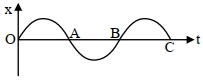
A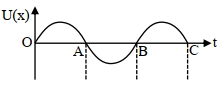
B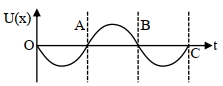
C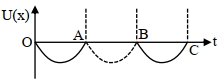
D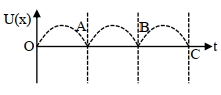
Solution
(D) The displacement of a particle in simple harmonic motion is given by $x(t) = A \sin(\omega t)$.
The potential energy $U$ is given by $U = \frac{1}{2} k x^2 = \frac{1}{2} k A^2 \sin^2(\omega t)$.
Using the trigonometric identity $\sin^2(\theta) = \frac{1 - \cos(2\theta)}{2}$,we get $U = \frac{1}{4} k A^2 (1 - \cos(2\omega t))$.
This shows that the potential energy $U$ is always non-negative and varies with a frequency double that of the displacement.
At $t = 0$,$x = 0$,so $U = 0$.
At the extreme positions,$x = \pm A$,so $U$ is maximum.
Looking at the options,figure $D$ represents a graph where $U$ is zero at $t = 0$,reaches a maximum at the extreme positions,and has a frequency twice that of the displacement graph. Thus,figure $D$ is the correct representation.
The potential energy $U$ is given by $U = \frac{1}{2} k x^2 = \frac{1}{2} k A^2 \sin^2(\omega t)$.
Using the trigonometric identity $\sin^2(\theta) = \frac{1 - \cos(2\theta)}{2}$,we get $U = \frac{1}{4} k A^2 (1 - \cos(2\omega t))$.
This shows that the potential energy $U$ is always non-negative and varies with a frequency double that of the displacement.
At $t = 0$,$x = 0$,so $U = 0$.
At the extreme positions,$x = \pm A$,so $U$ is maximum.
Looking at the options,figure $D$ represents a graph where $U$ is zero at $t = 0$,reaches a maximum at the extreme positions,and has a frequency twice that of the displacement graph. Thus,figure $D$ is the correct representation.
0 likes
View Solution112
MediumMCQ
For a body executing $S.H.M. :$
$(a)$ Potential energy is always equal to its $K.E.$
$(b)$ Average potential and kinetic energy over any given time interval are always equal.
$(c)$ Sum of the kinetic and potential energy at any point of time is constant.
$(d)$ Average $K.E.$ in one time period is equal to average potential energy in one time period.
Choose the most appropriate option from the options given below:
$(a)$ Potential energy is always equal to its $K.E.$
$(b)$ Average potential and kinetic energy over any given time interval are always equal.
$(c)$ Sum of the kinetic and potential energy at any point of time is constant.
$(d)$ Average $K.E.$ in one time period is equal to average potential energy in one time period.
Choose the most appropriate option from the options given below:
A
$(c)$ and $(d)$
B
only $(c)$
C
$(b)$ and $(c)$
D
only $(b)$
Solution
(A) In $S.H.M.$,the total mechanical energy $(E = K.E. + P.E.)$ remains constant at any point in time,which validates statement $(c)$.
The average kinetic energy over one complete time period $T$ is given by $\langle K.E. \rangle = \frac{1}{T} \int_{0}^{T} \frac{1}{2} k A^2 \cos^2(\omega t + \phi) dt = \frac{1}{4} k A^2$.
The average potential energy over one complete time period $T$ is given by $\langle P.E. \rangle = \frac{1}{T} \int_{0}^{T} \frac{1}{2} k A^2 \sin^2(\omega t + \phi) dt = \frac{1}{4} k A^2$.
Since $\langle K.E. \rangle = \langle P.E. \rangle$ over one time period,statement $(d)$ is correct.
Statement $(b)$ is incorrect because the average energies are only equal over a full time period or half-integer multiples thereof,not over 'any' given time interval.
Therefore,statements $(c)$ and $(d)$ are correct.
The average kinetic energy over one complete time period $T$ is given by $\langle K.E. \rangle = \frac{1}{T} \int_{0}^{T} \frac{1}{2} k A^2 \cos^2(\omega t + \phi) dt = \frac{1}{4} k A^2$.
The average potential energy over one complete time period $T$ is given by $\langle P.E. \rangle = \frac{1}{T} \int_{0}^{T} \frac{1}{2} k A^2 \sin^2(\omega t + \phi) dt = \frac{1}{4} k A^2$.
Since $\langle K.E. \rangle = \langle P.E. \rangle$ over one time period,statement $(d)$ is correct.
Statement $(b)$ is incorrect because the average energies are only equal over a full time period or half-integer multiples thereof,not over 'any' given time interval.
Therefore,statements $(c)$ and $(d)$ are correct.
0 likes
View Solution113
MediumMCQ
$A$ body is executing simple harmonic motion with frequency $n$,the frequency of its potential energy is:
A
$n$
B
$3n$
C
$2n$
D
$4n$
Solution
(C) The displacement equation for a simple harmonic motion $(SHM)$ with frequency $n$ is given by:
$x = A \sin(\omega t) = A \sin(2 \pi n t)$
The potential energy $(U)$ of the body is given by:
$U = \frac{1}{2} k x^2 = \frac{1}{2} k A^2 \sin^2(2 \pi n t)$
Using the trigonometric identity $\sin^2 \theta = \frac{1 - \cos(2 \theta)}{2}$,we get:
$U = \frac{1}{2} k A^2 \left[ \frac{1 - \cos(2 \cdot 2 \pi n t)}{2} \right] = \frac{1}{4} k A^2 [1 - \cos(4 \pi n t)]$
The frequency of the potential energy is the coefficient of $2 \pi t$ in the cosine term,which is $2n$.
$x = A \sin(\omega t) = A \sin(2 \pi n t)$
The potential energy $(U)$ of the body is given by:
$U = \frac{1}{2} k x^2 = \frac{1}{2} k A^2 \sin^2(2 \pi n t)$
Using the trigonometric identity $\sin^2 \theta = \frac{1 - \cos(2 \theta)}{2}$,we get:
$U = \frac{1}{2} k A^2 \left[ \frac{1 - \cos(2 \cdot 2 \pi n t)}{2} \right] = \frac{1}{4} k A^2 [1 - \cos(4 \pi n t)]$
The frequency of the potential energy is the coefficient of $2 \pi t$ in the cosine term,which is $2n$.
0 likes
View Solution114
MediumMCQ
In a simple harmonic oscillation,what fraction of total mechanical energy is in the form of kinetic energy,when the particle is midway between mean and extreme position?
A
$1/4$
B
$1/3$
C
$3/4$
D
$1/2$
Solution
(C) The total mechanical energy $E$ of a particle in simple harmonic motion is given by $E = \frac{1}{2} m \omega^{2} A^{2}$.
At any position $x$,the kinetic energy $K$ is given by $K = \frac{1}{2} m \omega^{2} (A^{2} - x^{2})$.
The particle is midway between the mean position $(x = 0)$ and the extreme position $(x = A)$,so $x = \frac{A}{2}$.
Substituting $x = \frac{A}{2}$ into the kinetic energy formula:
$K = \frac{1}{2} m \omega^{2} (A^{2} - (\frac{A}{2})^{2})$
$K = \frac{1}{2} m \omega^{2} (A^{2} - \frac{A^{2}}{4})$
$K = \frac{1}{2} m \omega^{2} (\frac{3A^{2}}{4})$
$K = \frac{3}{4} (\frac{1}{2} m \omega^{2} A^{2})$
Since $E = \frac{1}{2} m \omega^{2} A^{2}$,we have $K = \frac{3}{4} E$.
Thus,the fraction of total mechanical energy in the form of kinetic energy is $3/4$.
At any position $x$,the kinetic energy $K$ is given by $K = \frac{1}{2} m \omega^{2} (A^{2} - x^{2})$.
The particle is midway between the mean position $(x = 0)$ and the extreme position $(x = A)$,so $x = \frac{A}{2}$.
Substituting $x = \frac{A}{2}$ into the kinetic energy formula:
$K = \frac{1}{2} m \omega^{2} (A^{2} - (\frac{A}{2})^{2})$
$K = \frac{1}{2} m \omega^{2} (A^{2} - \frac{A^{2}}{4})$
$K = \frac{1}{2} m \omega^{2} (\frac{3A^{2}}{4})$
$K = \frac{3}{4} (\frac{1}{2} m \omega^{2} A^{2})$
Since $E = \frac{1}{2} m \omega^{2} A^{2}$,we have $K = \frac{3}{4} E$.
Thus,the fraction of total mechanical energy in the form of kinetic energy is $3/4$.
0 likes
View Solution115
DifficultMCQ
$A$ particle starts executing simple harmonic motion $(SHM)$ of amplitude $a$ and total energy $E$. At any instant,its kinetic energy is $\frac{3E}{4}$. Then its displacement $y$ is given by:
A
$y=\frac{a}{\sqrt{2}}$
B
$y=a$
C
$y=\frac{a}{2}$
D
$y=\frac{a\sqrt{3}}{2}$
Solution
(C) The total energy of a particle in $SHM$ is given by $E = \frac{1}{2} m \omega^2 a^2$.
The kinetic energy $(K)$ of the particle at displacement $y$ is given by $K = \frac{1}{2} m \omega^2 (a^2 - y^2)$.
Given that $K = \frac{3E}{4}$,we substitute the expressions for $K$ and $E$:
$\frac{1}{2} m \omega^2 (a^2 - y^2) = \frac{3}{4} \left( \frac{1}{2} m \omega^2 a^2 \right)$.
Canceling the common terms $\frac{1}{2} m \omega^2$ from both sides,we get:
$a^2 - y^2 = \frac{3}{4} a^2$.
Rearranging the terms to solve for $y^2$:
$y^2 = a^2 - \frac{3}{4} a^2 = \frac{1}{4} a^2$.
Taking the square root of both sides,we find:
$y = \frac{a}{2}$.
The kinetic energy $(K)$ of the particle at displacement $y$ is given by $K = \frac{1}{2} m \omega^2 (a^2 - y^2)$.
Given that $K = \frac{3E}{4}$,we substitute the expressions for $K$ and $E$:
$\frac{1}{2} m \omega^2 (a^2 - y^2) = \frac{3}{4} \left( \frac{1}{2} m \omega^2 a^2 \right)$.
Canceling the common terms $\frac{1}{2} m \omega^2$ from both sides,we get:
$a^2 - y^2 = \frac{3}{4} a^2$.
Rearranging the terms to solve for $y^2$:
$y^2 = a^2 - \frac{3}{4} a^2 = \frac{1}{4} a^2$.
Taking the square root of both sides,we find:
$y = \frac{a}{2}$.
0 likes
View Solution116
MediumMCQ
An object of mass $0.5\, \text{kg}$ is executing simple harmonic motion. Its amplitude is $5\, \text{cm}$ and time period $T$ is $0.2\, \text{s}$. What will be the potential energy of the object at an instant $t = \frac{T}{4}\, \text{s}$ starting from the mean position? Assume that the initial phase of the oscillation is zero. (In $\text{J}$)
A
$1.2$
B
$0.625$
C
$6.2$
D
$620$
Solution
(B) Given: Mass $m = 0.5\, \text{kg}$,Amplitude $A = 5\, \text{cm} = 0.05\, \text{m}$,Time period $T = 0.2\, \text{s}$.
First,calculate the force constant $k$ using the formula $T = 2\pi \sqrt{\frac{m}{k}}$:
$0.2 = 2\pi \sqrt{\frac{0.5}{k}}$
$0.1 = \pi \sqrt{\frac{0.5}{k}}$
$0.01 = \pi^2 \left(\frac{0.5}{k}\right)$
$k = \frac{0.5 \pi^2}{0.01} = 50 \pi^2 \approx 50 \times 9.87 = 493.5\, \text{N/m}$.
Next,find the displacement $x$ at $t = \frac{T}{4}$ starting from the mean position $(\phi = 0)$:
$x = A \sin(\omega t) = A \sin\left(\frac{2\pi}{T} \cdot \frac{T}{4}\right) = A \sin\left(\frac{\pi}{2}\right) = A = 0.05\, \text{m}$.
Now,calculate the potential energy $PE$:
$PE = \frac{1}{2} k x^2 = \frac{1}{2} \times (50 \pi^2) \times (0.05)^2$
$PE = 25 \pi^2 \times 0.0025 = 0.0625 \pi^2 \approx 0.0625 \times 9.87 \approx 0.617\, \text{J}$.
Rounding to the nearest provided option,we get $0.625\, \text{J}$.
First,calculate the force constant $k$ using the formula $T = 2\pi \sqrt{\frac{m}{k}}$:
$0.2 = 2\pi \sqrt{\frac{0.5}{k}}$
$0.1 = \pi \sqrt{\frac{0.5}{k}}$
$0.01 = \pi^2 \left(\frac{0.5}{k}\right)$
$k = \frac{0.5 \pi^2}{0.01} = 50 \pi^2 \approx 50 \times 9.87 = 493.5\, \text{N/m}$.
Next,find the displacement $x$ at $t = \frac{T}{4}$ starting from the mean position $(\phi = 0)$:
$x = A \sin(\omega t) = A \sin\left(\frac{2\pi}{T} \cdot \frac{T}{4}\right) = A \sin\left(\frac{\pi}{2}\right) = A = 0.05\, \text{m}$.
Now,calculate the potential energy $PE$:
$PE = \frac{1}{2} k x^2 = \frac{1}{2} \times (50 \pi^2) \times (0.05)^2$
$PE = 25 \pi^2 \times 0.0025 = 0.0625 \pi^2 \approx 0.0625 \times 9.87 \approx 0.617\, \text{J}$.
Rounding to the nearest provided option,we get $0.625\, \text{J}$.
0 likes
View Solution117
DifficultMCQ
$A$ body is performing simple harmonic motion with an amplitude of $10 \, cm$. The velocity of the body is tripled by an air jet when it is at $5 \, cm$ from its mean position. The new amplitude of vibration is $\sqrt{x} \, cm$. The value of $x$ is . . . . . . .
A
$900$
B
$800$
C
$100$
D
$700$
Solution
(D) Initial amplitude $A = 10 \, cm$. The total energy of the $SHM$ is $E = \frac{1}{2} k A^2$.
At position $x = 5 \, cm$,the velocity $v$ is given by $v = \omega \sqrt{A^2 - x^2} = \omega \sqrt{10^2 - 5^2} = \omega \sqrt{75}$.
Since $\omega^2 = \frac{k}{m}$,we have $v = \sqrt{\frac{k}{m}} \sqrt{75}$.
When the velocity is tripled,the new velocity $v' = 3v = 3 \sqrt{\frac{75k}{m}}$.
The potential energy at $x = 5 \, cm$ remains unchanged: $U = \frac{1}{2} k (5)^2 = 12.5 k$.
The new total energy $E'$ is the sum of the potential energy at $x=5$ and the new kinetic energy $K'$:
$E' = \frac{1}{2} k (5)^2 + \frac{1}{2} m (3v)^2 = 12.5 k + \frac{1}{2} m \left( 9 \cdot \frac{75k}{m} \right) = 12.5 k + 337.5 k = 350 k$.
Since $E' = \frac{1}{2} k A'^2$,we have $\frac{1}{2} k A'^2 = 350 k \implies A'^2 = 700$.
Thus,$A' = \sqrt{700} \, cm$,which implies $x = 700$.
At position $x = 5 \, cm$,the velocity $v$ is given by $v = \omega \sqrt{A^2 - x^2} = \omega \sqrt{10^2 - 5^2} = \omega \sqrt{75}$.
Since $\omega^2 = \frac{k}{m}$,we have $v = \sqrt{\frac{k}{m}} \sqrt{75}$.
When the velocity is tripled,the new velocity $v' = 3v = 3 \sqrt{\frac{75k}{m}}$.
The potential energy at $x = 5 \, cm$ remains unchanged: $U = \frac{1}{2} k (5)^2 = 12.5 k$.
The new total energy $E'$ is the sum of the potential energy at $x=5$ and the new kinetic energy $K'$:
$E' = \frac{1}{2} k (5)^2 + \frac{1}{2} m (3v)^2 = 12.5 k + \frac{1}{2} m \left( 9 \cdot \frac{75k}{m} \right) = 12.5 k + 337.5 k = 350 k$.
Since $E' = \frac{1}{2} k A'^2$,we have $\frac{1}{2} k A'^2 = 350 k \implies A'^2 = 700$.
Thus,$A' = \sqrt{700} \, cm$,which implies $x = 700$.
0 likes
View Solution118
EasyMCQ
$A$ particle is executing $S.H.M.$ with time period $T^{\prime}$. If the time period of its total mechanical energy is $T$,then $\frac{T^{\prime}}{T}$ is ........
A
$2$
B
$\frac{1}{2}$
C
Infinite
D
Zero
Solution
(D) The total mechanical energy of a particle executing $S.H.M.$ is given by $E = \frac{1}{2} k A^2$,where $k$ is the force constant and $A$ is the amplitude.
Since $k$ and $A$ are constants for a given $S.H.M.$,the total mechanical energy $E$ remains constant with respect to time.
$A$ constant value does not oscillate,meaning its time period is infinite $(T = \infty)$.
However,the question asks for the ratio $\frac{T^{\prime}}{T}$ where $T^{\prime}$ is the period of $S.H.M.$ and $T$ is the period of the total mechanical energy.
Since the total mechanical energy is constant,its frequency is $0$,which implies its time period $T$ is infinite.
Therefore,$\frac{T^{\prime}}{T} = \frac{T^{\prime}}{\infty} = 0$.
Since $k$ and $A$ are constants for a given $S.H.M.$,the total mechanical energy $E$ remains constant with respect to time.
$A$ constant value does not oscillate,meaning its time period is infinite $(T = \infty)$.
However,the question asks for the ratio $\frac{T^{\prime}}{T}$ where $T^{\prime}$ is the period of $S.H.M.$ and $T$ is the period of the total mechanical energy.
Since the total mechanical energy is constant,its frequency is $0$,which implies its time period $T$ is infinite.
Therefore,$\frac{T^{\prime}}{T} = \frac{T^{\prime}}{\infty} = 0$.
0 likes
View Solution119
EasyMCQ
If a particle is executing simple harmonic motion with time period $T$,then the time period of its total mechanical energy is ...........
A
Zero
B
$T/2$
C
$2T$
D
Infinite
Solution
(D) In an undamped simple harmonic motion $(S.H.M.)$,the total mechanical energy is given by $E = \frac{1}{2} k A^2$,where $k$ is the force constant and $A$ is the amplitude.
Since $k$ and $A$ are constants for a given $S.H.M.$,the total mechanical energy $E$ remains constant with respect to time.
$A$ constant value does not oscillate,meaning its frequency of oscillation is $0$.
Since the time period $T'$ is the reciprocal of frequency $(T' = 1/f)$,for $f = 0$,the time period $T'$ is infinite.
Therefore,the correct option is $D$.
Since $k$ and $A$ are constants for a given $S.H.M.$,the total mechanical energy $E$ remains constant with respect to time.
$A$ constant value does not oscillate,meaning its frequency of oscillation is $0$.
Since the time period $T'$ is the reciprocal of frequency $(T' = 1/f)$,for $f = 0$,the time period $T'$ is infinite.
Therefore,the correct option is $D$.
0 likes
View Solution120
MediumMCQ
$A$ particle is performing $S.H.M.$ with energy of vibration $90 \,J$ and amplitude $6 \,cm$. When the particle reaches a distance of $4 \,cm$ from the mean position,it is stopped for a moment and then released. The new energy of vibration will be ........... $J$.
A
$40$
B
$50$
C
$90$
D
$60$
Solution
(A) The total energy of a particle performing $S.H.M.$ is given by $E = \frac{1}{2} k A^2$,where $k = m \omega^2$.
Given $E_1 = 90 \,J$ and $A_1 = 6 \,cm = 0.06 \,m$.
$90 = \frac{1}{2} k (0.06)^2 \implies k = \frac{180}{0.0036} = 50000 \,N/m$.
When the particle is at $x = 4 \,cm = 0.04 \,m$,it is stopped. At this point,its velocity becomes zero,so the new amplitude $A_2$ of the motion becomes the displacement at that instant,i.e.,$A_2 = 4 \,cm = 0.04 \,m$.
The new energy of vibration $E_2$ is given by $E_2 = \frac{1}{2} k A_2^2$.
$E_2 = \frac{1}{2} \times 50000 \times (0.04)^2$.
$E_2 = 25000 \times 0.0016 = 40 \,J$.
Given $E_1 = 90 \,J$ and $A_1 = 6 \,cm = 0.06 \,m$.
$90 = \frac{1}{2} k (0.06)^2 \implies k = \frac{180}{0.0036} = 50000 \,N/m$.
When the particle is at $x = 4 \,cm = 0.04 \,m$,it is stopped. At this point,its velocity becomes zero,so the new amplitude $A_2$ of the motion becomes the displacement at that instant,i.e.,$A_2 = 4 \,cm = 0.04 \,m$.
The new energy of vibration $E_2$ is given by $E_2 = \frac{1}{2} k A_2^2$.
$E_2 = \frac{1}{2} \times 50000 \times (0.04)^2$.
$E_2 = 25000 \times 0.0016 = 40 \,J$.
0 likes
View Solution121
MediumMCQ
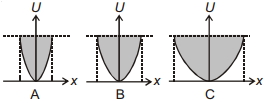
The variations of potential energy $(U)$ with position $x$ for three simple harmonic oscillators $A, B$ and $C$ are shown in the figure. The oscillators have the same mass. The time period of oscillation is greatest for
A
$A$
B
$B$
C
$C$
D
Same for all
Solution
(C) The potential energy of a simple harmonic oscillator is given by $U = \frac{1}{2} k x^2$,where $k$ is the force constant.
For a given potential energy $U$,the displacement $x$ is given by $x = \sqrt{\frac{2U}{k}}$,which implies $x \propto \frac{1}{\sqrt{k}}$.
The time period of oscillation is $T = 2 \pi \sqrt{\frac{m}{k}}$.
Since the mass $m$ is the same for all oscillators,we have $T \propto \frac{1}{\sqrt{k}}$.
Comparing the two relations,we get $T \propto x$ for a constant value of $U$.
From the figure,the maximum displacement (amplitude) $x$ is greatest for oscillator $C$.
Therefore,the time period of oscillation is greatest for $C$.
For a given potential energy $U$,the displacement $x$ is given by $x = \sqrt{\frac{2U}{k}}$,which implies $x \propto \frac{1}{\sqrt{k}}$.
The time period of oscillation is $T = 2 \pi \sqrt{\frac{m}{k}}$.
Since the mass $m$ is the same for all oscillators,we have $T \propto \frac{1}{\sqrt{k}}$.
Comparing the two relations,we get $T \propto x$ for a constant value of $U$.
From the figure,the maximum displacement (amplitude) $x$ is greatest for oscillator $C$.
Therefore,the time period of oscillation is greatest for $C$.
0 likes
View Solution122
MediumMCQ
If a particle repeats its motion after a fixed time interval of $8 \,s$,then after how much time will its maximum value of $PE$ be attained after attaining its minimum value?
A
$2$
B
$4$
C
$8$
D
$1$
Solution
(A) The time period of the oscillation is given as $T = 8 \,s$.
In a simple harmonic motion,the potential energy $(PE)$ is given by $U = \frac{1}{2} k x^2$.
The potential energy is minimum $(U_{min} = 0)$ at the mean position $(x = 0)$.
The potential energy is maximum $(U_{max} = \frac{1}{2} k A^2)$ at the extreme positions $(x = \pm A)$.
The particle moves from the mean position $(x = 0)$ to an extreme position $(x = A)$ in a time interval of $\Delta t = \frac{T}{4}$.
Substituting the given value of $T = 8 \,s$:
$\Delta t = \frac{8 \,s}{4} = 2 \,s$.
Therefore,the maximum value of $PE$ is attained $2 \,s$ after attaining its minimum value.
In a simple harmonic motion,the potential energy $(PE)$ is given by $U = \frac{1}{2} k x^2$.
The potential energy is minimum $(U_{min} = 0)$ at the mean position $(x = 0)$.
The potential energy is maximum $(U_{max} = \frac{1}{2} k A^2)$ at the extreme positions $(x = \pm A)$.
The particle moves from the mean position $(x = 0)$ to an extreme position $(x = A)$ in a time interval of $\Delta t = \frac{T}{4}$.
Substituting the given value of $T = 8 \,s$:
$\Delta t = \frac{8 \,s}{4} = 2 \,s$.
Therefore,the maximum value of $PE$ is attained $2 \,s$ after attaining its minimum value.
0 likes
View Solution123
EasyMCQ
$A$ particle is executing $S.H.M.$ with total mechanical energy $90 \,J$ and amplitude $6 \,cm$. If its energy is somehow decreased to $40 \,J$,then its amplitude will become ........ $cm$.
A
$2$
B
$4$
C
$\frac{8}{3}$
D
$\frac{4}{3}$
Solution
(B) The total mechanical energy $E$ of a particle executing $S.H.M.$ is given by the formula $E = \frac{1}{2} k A^2$,where $k$ is the force constant and $A$ is the amplitude.
Since $k = m \omega^2$ is constant for a given system,the energy is directly proportional to the square of the amplitude: $E \propto A^2$.
Given $E_1 = 90 \,J$ and $A_1 = 6 \,cm$.
When the energy is changed to $E_2 = 40 \,J$,let the new amplitude be $A_2$.
Using the ratio: $\frac{E_1}{E_2} = \frac{A_1^2}{A_2^2}$.
Substituting the values: $\frac{90}{40} = \frac{6^2}{A_2^2}$.
$\frac{9}{4} = \frac{36}{A_2^2}$.
$A_2^2 = \frac{36 \times 4}{9} = 4 \times 4 = 16$.
$A_2 = \sqrt{16} = 4 \,cm$.
Since $k = m \omega^2$ is constant for a given system,the energy is directly proportional to the square of the amplitude: $E \propto A^2$.
Given $E_1 = 90 \,J$ and $A_1 = 6 \,cm$.
When the energy is changed to $E_2 = 40 \,J$,let the new amplitude be $A_2$.
Using the ratio: $\frac{E_1}{E_2} = \frac{A_1^2}{A_2^2}$.
Substituting the values: $\frac{90}{40} = \frac{6^2}{A_2^2}$.
$\frac{9}{4} = \frac{36}{A_2^2}$.
$A_2^2 = \frac{36 \times 4}{9} = 4 \times 4 = 16$.
$A_2 = \sqrt{16} = 4 \,cm$.
0 likes
View Solution124
DifficultMCQ
$A$ linear harmonic oscillator of force constant $6 \times 10^5 \, N/m$ and amplitude $4 \, cm$ has a total energy of $600 \, J$. Select the correct statement.
A
Maximum potential energy is $600 \, J$
B
Maximum kinetic energy is $480 \, J$
C
Minimum potential energy is $120 \, J$
D
All of these
Solution
(D) Given:
Force constant $k = 6 \times 10^5 \, N/m$
Amplitude $A = 4 \, cm = 4 \times 10^{-2} \, m$
Total energy $E = 600 \, J$
In a linear harmonic oscillator,the maximum potential energy is equal to the total energy of the system when the displacement is at its maximum (at the extreme positions).
$U_{max} = \frac{1}{2} k A^2 = \frac{1}{2} \times (6 \times 10^5) \times (4 \times 10^{-2})^2 = 3 \times 10^5 \times 16 \times 10^{-4} = 480 \, J$.
Since the total energy $E = 600 \, J$ and the maximum potential energy (at amplitude) is $480 \, J$,this implies that the potential energy at the equilibrium position (minimum potential energy) is $E - U_{max} = 600 \, J - 480 \, J = 120 \, J$.
Also,the maximum kinetic energy $K_{max}$ is equal to the total energy $E$ minus the minimum potential energy $U_{min}$.
$K_{max} = E - U_{min} = 600 \, J - 120 \, J = 480 \, J$.
Since all statements $A$,$B$,and $C$ are correct,the correct option is $D$.
Force constant $k = 6 \times 10^5 \, N/m$
Amplitude $A = 4 \, cm = 4 \times 10^{-2} \, m$
Total energy $E = 600 \, J$
In a linear harmonic oscillator,the maximum potential energy is equal to the total energy of the system when the displacement is at its maximum (at the extreme positions).
$U_{max} = \frac{1}{2} k A^2 = \frac{1}{2} \times (6 \times 10^5) \times (4 \times 10^{-2})^2 = 3 \times 10^5 \times 16 \times 10^{-4} = 480 \, J$.
Since the total energy $E = 600 \, J$ and the maximum potential energy (at amplitude) is $480 \, J$,this implies that the potential energy at the equilibrium position (minimum potential energy) is $E - U_{max} = 600 \, J - 480 \, J = 120 \, J$.
Also,the maximum kinetic energy $K_{max}$ is equal to the total energy $E$ minus the minimum potential energy $U_{min}$.
$K_{max} = E - U_{min} = 600 \, J - 120 \, J = 480 \, J$.
Since all statements $A$,$B$,and $C$ are correct,the correct option is $D$.
0 likes
View Solution125
MediumMCQ
$A$ simple pendulum of mass $m$ executes $S.H.M.$ with total energy $E$. If at an instant it is at one of the extreme positions,then its linear momentum after a phase shift of $\frac{\pi}{3} \, rad$ will be
A
$\sqrt{2 m E}$
B
$\sqrt{\frac{3 m E}{2}}$
C
$2 \sqrt{m E}$
D
$\sqrt{\frac{2 m E}{3}}$
Solution
(B) The total energy of a simple harmonic oscillator is $E = \frac{1}{2} k A^2$,where $A$ is the amplitude.
At the extreme position,the phase $\phi = 0$ (or $\pi$). Let the displacement be $x = A \cos(\omega t)$.
After a phase shift of $\theta = \frac{\pi}{3}$,the displacement becomes $x = A \cos(\frac{\pi}{3}) = \frac{A}{2}$.
The potential energy at this position is $U = \frac{1}{2} k x^2 = \frac{1}{2} k (\frac{A}{2})^2 = \frac{1}{4} (\frac{1}{2} k A^2) = \frac{E}{4}$.
The kinetic energy $K$ at this position is $K = E - U = E - \frac{E}{4} = \frac{3E}{4}$.
Since kinetic energy $K = \frac{p^2}{2m}$,we have $\frac{p^2}{2m} = \frac{3E}{4}$.
Solving for momentum $p$,we get $p^2 = \frac{6mE}{4} = \frac{3mE}{2}$.
Therefore,$p = \sqrt{\frac{3mE}{2}}$.
At the extreme position,the phase $\phi = 0$ (or $\pi$). Let the displacement be $x = A \cos(\omega t)$.
After a phase shift of $\theta = \frac{\pi}{3}$,the displacement becomes $x = A \cos(\frac{\pi}{3}) = \frac{A}{2}$.
The potential energy at this position is $U = \frac{1}{2} k x^2 = \frac{1}{2} k (\frac{A}{2})^2 = \frac{1}{4} (\frac{1}{2} k A^2) = \frac{E}{4}$.
The kinetic energy $K$ at this position is $K = E - U = E - \frac{E}{4} = \frac{3E}{4}$.
Since kinetic energy $K = \frac{p^2}{2m}$,we have $\frac{p^2}{2m} = \frac{3E}{4}$.
Solving for momentum $p$,we get $p^2 = \frac{6mE}{4} = \frac{3mE}{2}$.
Therefore,$p = \sqrt{\frac{3mE}{2}}$.
0 likes
View Solution126
EasyMCQ
The potential energy of a particle $(U_x)$ executing $S.H.M.$ is given by
A
$U_x = \frac{1}{2} k (x - a)^2$
B
$U_x = k_1 x + k_2 x^2 + k_3 x^3$
C
$U_x = A e^{-b x}$
D
$U_x = \text{constant}$
Solution
(A) The potential energy $(U)$ of a particle executing $S.H.M.$ with displacement $y$ from the mean position is given by the formula:
$U = \frac{1}{2} m \omega^2 y^2 = \frac{1}{2} k y^2$
where $k = m \omega^2$ is the force constant.
If the displacement $y$ is expressed as $(x - a)$, where $x$ is the position and $a$ is the mean position, the potential energy becomes:
$U_x = \frac{1}{2} k (x - a)^2$
Thus, option $A$ represents the potential energy of a particle in $S.H.M.$ relative to a shifted equilibrium position $a$.
$U = \frac{1}{2} m \omega^2 y^2 = \frac{1}{2} k y^2$
where $k = m \omega^2$ is the force constant.
If the displacement $y$ is expressed as $(x - a)$, where $x$ is the position and $a$ is the mean position, the potential energy becomes:
$U_x = \frac{1}{2} k (x - a)^2$
Thus, option $A$ represents the potential energy of a particle in $S.H.M.$ relative to a shifted equilibrium position $a$.
0 likes
View Solution127
DifficultMCQ
The general displacement of a simple harmonic oscillator is $x = A \sin \omega t$. Let $T$ be its time period. The slope of its potential energy $(U)$ - time $(t)$ curve will be maximum when $t = \frac{T}{\beta}$. The value of $\beta$ is $.........$
A
$9$
B
$7$
C
$6$
D
$8$
Solution
(D) The displacement is given by $x = A \sin \omega t$.
The potential energy $U$ is given by $U = \frac{1}{2} k x^2 = \frac{1}{2} k A^2 \sin^2 \omega t$.
The slope of the potential energy-time curve is $\frac{dU}{dt}$.
$\frac{dU}{dt} = \frac{d}{dt} (\frac{1}{2} k A^2 \sin^2 \omega t) = \frac{1}{2} k A^2 (2 \sin \omega t \cos \omega t) \cdot \omega = \frac{1}{2} k A^2 \omega \sin(2 \omega t)$.
For the slope to be maximum,$\sin(2 \omega t)$ must be maximum,i.e.,$\sin(2 \omega t) = 1$.
This occurs when $2 \omega t = \frac{\pi}{2}$.
Substituting $\omega = \frac{2 \pi}{T}$,we get $2 (\frac{2 \pi}{T}) t = \frac{\pi}{2}$.
$\frac{4 \pi t}{T} = \frac{\pi}{2} \implies t = \frac{T}{8}$.
Comparing this with $t = \frac{T}{\beta}$,we get $\beta = 8$.
The potential energy $U$ is given by $U = \frac{1}{2} k x^2 = \frac{1}{2} k A^2 \sin^2 \omega t$.
The slope of the potential energy-time curve is $\frac{dU}{dt}$.
$\frac{dU}{dt} = \frac{d}{dt} (\frac{1}{2} k A^2 \sin^2 \omega t) = \frac{1}{2} k A^2 (2 \sin \omega t \cos \omega t) \cdot \omega = \frac{1}{2} k A^2 \omega \sin(2 \omega t)$.
For the slope to be maximum,$\sin(2 \omega t)$ must be maximum,i.e.,$\sin(2 \omega t) = 1$.
This occurs when $2 \omega t = \frac{\pi}{2}$.
Substituting $\omega = \frac{2 \pi}{T}$,we get $2 (\frac{2 \pi}{T}) t = \frac{\pi}{2}$.
$\frac{4 \pi t}{T} = \frac{\pi}{2} \implies t = \frac{T}{8}$.
Comparing this with $t = \frac{T}{\beta}$,we get $\beta = 8$.
0 likes
View Solution128
EasyMCQ
The maximum potential energy of a block executing simple harmonic motion is $25 \ J$. $A$ is the amplitude of oscillation. At $x = A / 2$,the kinetic energy of the block is $...............$ (in $J$)
A
$37.5$
B
$9.75$
C
$18.75$
D
$12.5$
Solution
(C) The total energy of a particle in simple harmonic motion is equal to its maximum potential energy,which is given by $E = \frac{1}{2} k A^2 = 25 \ J$.
The potential energy at any displacement $x$ is given by $U = \frac{1}{2} k x^2$.
At $x = A / 2$,the potential energy is $U = \frac{1}{2} k (A / 2)^2 = \frac{1}{4} (\frac{1}{2} k A^2) = \frac{1}{4} \times 25 \ J = 6.25 \ J$.
The kinetic energy $K$ at any position is given by $K = E - U$.
Substituting the values,$K = 25 \ J - 6.25 \ J = 18.75 \ J$.
The potential energy at any displacement $x$ is given by $U = \frac{1}{2} k x^2$.
At $x = A / 2$,the potential energy is $U = \frac{1}{2} k (A / 2)^2 = \frac{1}{4} (\frac{1}{2} k A^2) = \frac{1}{4} \times 25 \ J = 6.25 \ J$.
The kinetic energy $K$ at any position is given by $K = E - U$.
Substituting the values,$K = 25 \ J - 6.25 \ J = 18.75 \ J$.
0 likes
View Solution129
MediumMCQ
The amplitude of a particle executing $SHM$ is $3\,cm$. The displacement at which its kinetic energy will be $25\%$ more than the potential energy is: $.............cm$.
A
$4$
B
$2$
C
$5$
D
$3$
Solution
(B) Given that the kinetic energy $(KE)$ is $25\%$ more than the potential energy $(PE)$:
$KE = PE + 0.25 PE = 1.25 PE = \frac{5}{4} PE$
We know the expressions for kinetic and potential energy in $SHM$ are:
$KE = \frac{1}{2} m \omega^2 (A^2 - x^2)$
$PE = \frac{1}{2} m \omega^2 x^2$
Substituting these into the given condition:
$\frac{1}{2} m \omega^2 (A^2 - x^2) = \frac{5}{4} \left( \frac{1}{2} m \omega^2 x^2 \right)$
Canceling the common terms $\frac{1}{2} m \omega^2$ from both sides:
$A^2 - x^2 = \frac{5}{4} x^2$
$A^2 = x^2 + \frac{5}{4} x^2 = \frac{9}{4} x^2$
Taking the square root of both sides:
$x = \frac{2}{3} A$
Given the amplitude $A = 3\,cm$:
$x = \frac{2}{3} \times 3\,cm = 2\,cm$
Thus,the displacement is $2\,cm$.
$KE = PE + 0.25 PE = 1.25 PE = \frac{5}{4} PE$
We know the expressions for kinetic and potential energy in $SHM$ are:
$KE = \frac{1}{2} m \omega^2 (A^2 - x^2)$
$PE = \frac{1}{2} m \omega^2 x^2$
Substituting these into the given condition:
$\frac{1}{2} m \omega^2 (A^2 - x^2) = \frac{5}{4} \left( \frac{1}{2} m \omega^2 x^2 \right)$
Canceling the common terms $\frac{1}{2} m \omega^2$ from both sides:
$A^2 - x^2 = \frac{5}{4} x^2$
$A^2 = x^2 + \frac{5}{4} x^2 = \frac{9}{4} x^2$
Taking the square root of both sides:
$x = \frac{2}{3} A$
Given the amplitude $A = 3\,cm$:
$x = \frac{2}{3} \times 3\,cm = 2\,cm$
Thus,the displacement is $2\,cm$.
1 likes
View Solution130
MediumMCQ
The variation of kinetic energy $(KE)$ of a particle executing simple harmonic motion with the displacement $(x)$ starting from mean position to extreme position $(A)$ is given by
A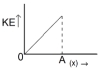
B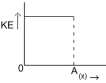
C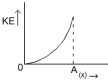
D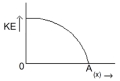
Solution
(D) For a particle executing simple harmonic motion $(SHM)$,the kinetic energy $(KE)$ as a function of displacement $(x)$ is given by the formula:
$KE = \frac{1}{2} m \omega^2 (A^2 - x^2)$
where $m$ is the mass of the particle,$\omega$ is the angular frequency,and $A$ is the amplitude.
$1$. At the mean position $(x = 0)$,the kinetic energy is maximum: $KE_{max} = \frac{1}{2} m \omega^2 A^2$.
$2$. At the extreme position ($x = A$ or $x = -A$),the kinetic energy is zero: $KE = 0$.
$3$. The equation $KE = \frac{1}{2} m \omega^2 A^2 - \frac{1}{2} m \omega^2 x^2$ represents a downward-opening parabola with respect to $x$.
Comparing this with the given options,the graph that shows maximum $KE$ at $x = 0$ and zero $KE$ at $x = A$ with a parabolic shape is represented by option $(D)$.
$KE = \frac{1}{2} m \omega^2 (A^2 - x^2)$
where $m$ is the mass of the particle,$\omega$ is the angular frequency,and $A$ is the amplitude.
$1$. At the mean position $(x = 0)$,the kinetic energy is maximum: $KE_{max} = \frac{1}{2} m \omega^2 A^2$.
$2$. At the extreme position ($x = A$ or $x = -A$),the kinetic energy is zero: $KE = 0$.
$3$. The equation $KE = \frac{1}{2} m \omega^2 A^2 - \frac{1}{2} m \omega^2 x^2$ represents a downward-opening parabola with respect to $x$.
Comparing this with the given options,the graph that shows maximum $KE$ at $x = 0$ and zero $KE$ at $x = A$ with a parabolic shape is represented by option $(D)$.
0 likes
View Solution131
MediumMCQ
$A$ particle is executing Simple Harmonic Motion $(SHM)$. The ratio of potential energy and kinetic energy of the particle when its displacement is half of its amplitude will be
A
$1: 1$
B
$2: 1$
C
$1: 4$
D
$1: 3$
Solution
(D) The potential energy $(P.E.)$ of a particle in $SHM$ at displacement $x$ is given by $P.E. = \frac{1}{2} kx^2$.
The kinetic energy $(K.E.)$ of the particle at displacement $x$ is given by $K.E. = \frac{1}{2} k(A^2 - x^2)$,where $A$ is the amplitude.
Given that the displacement $x = \frac{A}{2}$.
Substituting $x$ into the potential energy formula: $P.E. = \frac{1}{2} k(\frac{A}{2})^2 = \frac{1}{2} k(\frac{A^2}{4}) = \frac{1}{8} kA^2$.
Substituting $x$ into the kinetic energy formula: $K.E. = \frac{1}{2} k(A^2 - (\frac{A}{2})^2) = \frac{1}{2} k(A^2 - \frac{A^2}{4}) = \frac{1}{2} k(\frac{3A^2}{4}) = \frac{3}{8} kA^2$.
The ratio of potential energy to kinetic energy is $\frac{P.E.}{K.E.} = \frac{\frac{1}{8} kA^2}{\frac{3}{8} kA^2} = \frac{1}{3}$.
The kinetic energy $(K.E.)$ of the particle at displacement $x$ is given by $K.E. = \frac{1}{2} k(A^2 - x^2)$,where $A$ is the amplitude.
Given that the displacement $x = \frac{A}{2}$.
Substituting $x$ into the potential energy formula: $P.E. = \frac{1}{2} k(\frac{A}{2})^2 = \frac{1}{2} k(\frac{A^2}{4}) = \frac{1}{8} kA^2$.
Substituting $x$ into the kinetic energy formula: $K.E. = \frac{1}{2} k(A^2 - (\frac{A}{2})^2) = \frac{1}{2} k(A^2 - \frac{A^2}{4}) = \frac{1}{2} k(\frac{3A^2}{4}) = \frac{3}{8} kA^2$.
The ratio of potential energy to kinetic energy is $\frac{P.E.}{K.E.} = \frac{\frac{1}{8} kA^2}{\frac{3}{8} kA^2} = \frac{1}{3}$.
0 likes
View Solution132
MediumMCQ
Which graph represents the difference between total energy and potential energy of a particle executing $SHM$ versus its distance from the mean position?
A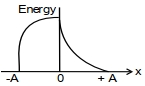
B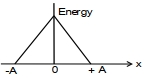
C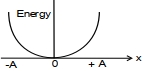
D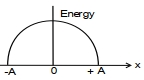
Solution
(D) The total energy $(TE)$ of a particle executing $SHM$ is constant,given by $TE = \frac{1}{2} m \omega^2 A^2$.
The potential energy $(PE)$ at a displacement $x$ from the mean position is given by $PE = \frac{1}{2} m \omega^2 x^2$.
The difference between total energy and potential energy is the kinetic energy $(KE)$:
$KE = TE - PE$
$KE = \frac{1}{2} m \omega^2 A^2 - \frac{1}{2} m \omega^2 x^2$
$KE = \frac{1}{2} m \omega^2 (A^2 - x^2)$
This equation represents a downward-opening parabola with its vertex at $x = 0$ and roots at $x = \pm A$. This matches the shape shown in graph $D$.
The potential energy $(PE)$ at a displacement $x$ from the mean position is given by $PE = \frac{1}{2} m \omega^2 x^2$.
The difference between total energy and potential energy is the kinetic energy $(KE)$:
$KE = TE - PE$
$KE = \frac{1}{2} m \omega^2 A^2 - \frac{1}{2} m \omega^2 x^2$
$KE = \frac{1}{2} m \omega^2 (A^2 - x^2)$
This equation represents a downward-opening parabola with its vertex at $x = 0$ and roots at $x = \pm A$. This matches the shape shown in graph $D$.
0 likes
View Solution133
DifficultMCQ
At a given point of time,the displacement of a simple harmonic oscillator is given by $y = A \cos(30^{\circ})$. If the amplitude is $40 \, cm$ and the kinetic energy at that time is $200 \, J$,the value of the force constant is $1.0 \times 10^{x} \, Nm^{-1}$. The value of $x$ is ......
A
$3$
B
$2$
C
$4$
D
$1$
Solution
(C) The displacement is given as $y = A \cos(30^{\circ})$.
Given amplitude $A = 40 \, cm = 0.4 \, m$.
At the given time,the displacement $y = 40 \cos(30^{\circ}) = 40 \times \frac{\sqrt{3}}{2} = 20\sqrt{3} \, cm = 0.2\sqrt{3} \, m$.
The kinetic energy of a simple harmonic oscillator is given by $K.E. = \frac{1}{2} k(A^2 - y^2)$.
Substituting the given values: $200 = \frac{1}{2} k((0.4)^2 - (0.2\sqrt{3})^2)$.
$200 = \frac{1}{2} k(0.16 - 0.12)$.
$200 = \frac{1}{2} k(0.04)$.
$200 = k(0.02)$.
$k = \frac{200}{0.02} = 10000 = 1.0 \times 10^4 \, Nm^{-1}$.
Comparing this with $1.0 \times 10^x \, Nm^{-1}$,we get $x = 4$.
Given amplitude $A = 40 \, cm = 0.4 \, m$.
At the given time,the displacement $y = 40 \cos(30^{\circ}) = 40 \times \frac{\sqrt{3}}{2} = 20\sqrt{3} \, cm = 0.2\sqrt{3} \, m$.
The kinetic energy of a simple harmonic oscillator is given by $K.E. = \frac{1}{2} k(A^2 - y^2)$.
Substituting the given values: $200 = \frac{1}{2} k((0.4)^2 - (0.2\sqrt{3})^2)$.
$200 = \frac{1}{2} k(0.16 - 0.12)$.
$200 = \frac{1}{2} k(0.04)$.
$200 = k(0.02)$.
$k = \frac{200}{0.02} = 10000 = 1.0 \times 10^4 \, Nm^{-1}$.
Comparing this with $1.0 \times 10^x \, Nm^{-1}$,we get $x = 4$.
0 likes
View Solution134
MediumMCQ
$A$ particle executes $SHM$ of amplitude $A$. The distance from the mean position when its kinetic energy becomes equal to its potential energy is:
A
$\sqrt{2} A$
B
$2 A$
C
$\frac{1}{\sqrt{2}} A$
D
$\frac{1}{2} A$
Solution
(C) The kinetic energy $(KE)$ of a particle in $SHM$ at a distance $x$ from the mean position is given by $KE = \frac{1}{2} m \omega^2 (A^2 - x^2)$.
The potential energy $(PE)$ of the particle at the same position is given by $PE = \frac{1}{2} m \omega^2 x^2$.
According to the problem,$KE = PE$:
$\frac{1}{2} m \omega^2 (A^2 - x^2) = \frac{1}{2} m \omega^2 x^2$.
Canceling the common terms $\frac{1}{2} m \omega^2$ from both sides,we get:
$A^2 - x^2 = x^2$.
Rearranging the terms,we get $A^2 = 2x^2$.
Solving for $x$,we find $x^2 = \frac{A^2}{2}$,which implies $x = \pm \frac{A}{\sqrt{2}}$.
The potential energy $(PE)$ of the particle at the same position is given by $PE = \frac{1}{2} m \omega^2 x^2$.
According to the problem,$KE = PE$:
$\frac{1}{2} m \omega^2 (A^2 - x^2) = \frac{1}{2} m \omega^2 x^2$.
Canceling the common terms $\frac{1}{2} m \omega^2$ from both sides,we get:
$A^2 - x^2 = x^2$.
Rearranging the terms,we get $A^2 = 2x^2$.
Solving for $x$,we find $x^2 = \frac{A^2}{2}$,which implies $x = \pm \frac{A}{\sqrt{2}}$.
0 likes
View Solution135
DifficultMCQ
When the displacement of a simple harmonic oscillator is one third of its amplitude,the ratio of total energy to the kinetic energy is $\frac{x}{8}$,where $x=$ . . . . . . .
A
$1$
B
$12$
C
$15$
D
$9$
Solution
(D) The total energy $E$ of a simple harmonic oscillator is given by $E = \frac{1}{2} k A^2$,where $k$ is the force constant and $A$ is the amplitude.
The potential energy $U$ at a displacement $y = \frac{A}{3}$ is given by $U = \frac{1}{2} k y^2 = \frac{1}{2} k (\frac{A}{3})^2 = \frac{1}{2} k \frac{A^2}{9} = \frac{E}{9}$.
The kinetic energy $KE$ is the difference between total energy and potential energy: $KE = E - U = E - \frac{E}{9} = \frac{8E}{9}$.
The ratio of total energy to kinetic energy is $\frac{E}{KE} = \frac{E}{\frac{8E}{9}} = \frac{9}{8}$.
Comparing this to the given ratio $\frac{x}{8}$,we find $x = 9$.
The potential energy $U$ at a displacement $y = \frac{A}{3}$ is given by $U = \frac{1}{2} k y^2 = \frac{1}{2} k (\frac{A}{3})^2 = \frac{1}{2} k \frac{A^2}{9} = \frac{E}{9}$.
The kinetic energy $KE$ is the difference between total energy and potential energy: $KE = E - U = E - \frac{E}{9} = \frac{8E}{9}$.
The ratio of total energy to kinetic energy is $\frac{E}{KE} = \frac{E}{\frac{8E}{9}} = \frac{9}{8}$.
Comparing this to the given ratio $\frac{x}{8}$,we find $x = 9$.
0 likes
View Solution136
DifficultMCQ
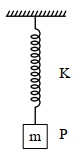
In simple harmonic motion,the total mechanical energy of a given system is $E$. If the mass of the oscillating particle $P$ is doubled,then the new energy of the system for the same amplitude is
A
$\frac{E}{\sqrt{2}}$
B
$E$
C
$E \sqrt{2}$
D
$2 E$
Solution
(B) The total mechanical energy $(T.E.)$ of a simple harmonic oscillator is given by the formula:
$T.E. = \frac{1}{2} k A^2$
where $k$ is the force constant of the spring and $A$ is the amplitude of oscillation.
From the formula,it is clear that the total energy depends only on the force constant $k$ and the amplitude $A$.
It does not depend on the mass $m$ of the oscillating particle.
Since the amplitude $A$ remains the same and the force constant $k$ (which depends on the spring properties) remains unchanged,the total energy of the system will remain $E$.
Therefore,the correct option is $B$.
$T.E. = \frac{1}{2} k A^2$
where $k$ is the force constant of the spring and $A$ is the amplitude of oscillation.
From the formula,it is clear that the total energy depends only on the force constant $k$ and the amplitude $A$.
It does not depend on the mass $m$ of the oscillating particle.
Since the amplitude $A$ remains the same and the force constant $k$ (which depends on the spring properties) remains unchanged,the total energy of the system will remain $E$.
Therefore,the correct option is $B$.
0 likes
View Solution137
DifficultMCQ
An object of mass $0.2 \,kg$ executes simple harmonic motion along the $x$-axis with a frequency of $(\frac{25}{\pi}) \,Hz$. At the position $x=0.04 \,m$, the object has a kinetic energy of $0.5 \,J$ and a potential energy of $0.4 \,J$. The amplitude of oscillation is ............ $cm$.
A
$3$
B
$5$
C
$6$
D
$7$
Solution
(C) The total energy $(E)$ of an object in simple harmonic motion is the sum of its kinetic energy $(K.E.)$ and potential energy $(P.E.)$.
$E = K.E. + P.E. = 0.5 \,J + 0.4 \,J = 0.9 \,J$.
The total energy is also given by the formula $E = \frac{1}{2} m \omega^2 A^2$, where $m$ is the mass, $\omega$ is the angular frequency, and $A$ is the amplitude.
The angular frequency $\omega = 2 \pi f = 2 \pi \times (\frac{25}{\pi}) = 50 \,rad/s$.
Substituting the values: $0.9 = \frac{1}{2} \times 0.2 \times (50)^2 \times A^2$.
$0.9 = 0.1 \times 2500 \times A^2$.
$0.9 = 250 \times A^2$.
$A^2 = \frac{0.9}{250} = 0.0036 \,m^2$.
$A = \sqrt{0.0036} = 0.06 \,m$.
Converting to centimeters: $A = 0.06 \times 100 = 6 \,cm$.
$E = K.E. + P.E. = 0.5 \,J + 0.4 \,J = 0.9 \,J$.
The total energy is also given by the formula $E = \frac{1}{2} m \omega^2 A^2$, where $m$ is the mass, $\omega$ is the angular frequency, and $A$ is the amplitude.
The angular frequency $\omega = 2 \pi f = 2 \pi \times (\frac{25}{\pi}) = 50 \,rad/s$.
Substituting the values: $0.9 = \frac{1}{2} \times 0.2 \times (50)^2 \times A^2$.
$0.9 = 0.1 \times 2500 \times A^2$.
$0.9 = 250 \times A^2$.
$A^2 = \frac{0.9}{250} = 0.0036 \,m^2$.
$A = \sqrt{0.0036} = 0.06 \,m$.
Converting to centimeters: $A = 0.06 \times 100 = 6 \,cm$.
0 likes
View Solution138
MediumMCQ
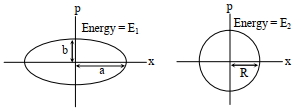
Two independent harmonic oscillators of equal mass are oscillating about the origin with angular frequencies $\omega_1$ and $\omega_2$ and have total energies $E_1$ and $E_2$,respectively. The variations of their momenta $p$ with positions $x$ are shown in the figures. If $\frac{a}{b}= n^2$ and $\frac{a}{R}= n$,then the correct equation$(s)$ is(are):
$(A) E_1 \omega_1 = E_2 \omega_2$
$(B) \frac{\omega_2}{\omega_1} = n^2$
$(C) \omega_1 \omega_2 = n^2$
$(D) \frac{E_1}{\omega_1} = \frac{E_2}{\omega_2}$
$(A) E_1 \omega_1 = E_2 \omega_2$
$(B) \frac{\omega_2}{\omega_1} = n^2$
$(C) \omega_1 \omega_2 = n^2$
$(D) \frac{E_1}{\omega_1} = \frac{E_2}{\omega_2}$
A
$(B, D)$
B
$(B, C)$
C
$(A, C)$
D
$(A, D)$
Solution
(A) For a simple harmonic oscillator,the equation of the trajectory in the phase space $(p-x)$ is given by $\frac{p^2}{2mE} + \frac{x^2}{2E/m\omega^2} = 1$,which represents an ellipse $\frac{p^2}{b^2} + \frac{x^2}{a^2} = 1$,where $a$ is the amplitude and $b$ is the maximum momentum $p_{max} = m\omega a$.
For the first oscillator:
$E_1 = \frac{1}{2} m \omega_1^2 a^2$ and $b = m \omega_1 a$. Thus,$\frac{a}{b} = \frac{1}{m \omega_1}$.
For the second oscillator:
$E_2 = \frac{1}{2} m \omega_2^2 R^2$ and the trajectory is a circle,so $p_{max} = x_{max} \Rightarrow m \omega_2 R = R \Rightarrow m \omega_2 = 1$.
Substituting $m \omega_2 = 1$ into the expression for $\frac{a}{b}$:
$\frac{a}{b} = \frac{1}{m \omega_1} = \frac{\omega_2}{\omega_1} = n^2$ (Option $B$ is correct).
Also,$E = \frac{1}{2} m \omega^2 A^2$. For the first oscillator,$E_1 = \frac{1}{2} m \omega_1^2 a^2$. For the second,$E_2 = \frac{1}{2} m \omega_2^2 R^2$. Since $m \omega_2 = 1$,$E_2 = \frac{1}{2} \omega_2 R^2$.
Given $\frac{a}{R} = n$,then $a = nR$.
From $\frac{a}{b} = n^2$,$b = \frac{a}{n^2} = \frac{nR}{n^2} = \frac{R}{n}$.
Since $b = m \omega_1 a$,$\frac{R}{n} = m \omega_1 (nR) \Rightarrow m \omega_1 = \frac{1}{n^2}$.
Now,$\frac{E_1}{\omega_1} = \frac{\frac{1}{2} m \omega_1^2 a^2}{\omega_1} = \frac{1}{2} m \omega_1 a^2 = \frac{1}{2} (\frac{1}{n^2}) (nR)^2 = \frac{1}{2} R^2$.
And $\frac{E_2}{\omega_2} = \frac{\frac{1}{2} m \omega_2^2 R^2}{\omega_2} = \frac{1}{2} m \omega_2 R^2 = \frac{1}{2} (1) R^2 = \frac{1}{2} R^2$.
Thus,$\frac{E_1}{\omega_1} = \frac{E_2}{\omega_2}$ (Option $D$ is correct).
For the first oscillator:
$E_1 = \frac{1}{2} m \omega_1^2 a^2$ and $b = m \omega_1 a$. Thus,$\frac{a}{b} = \frac{1}{m \omega_1}$.
For the second oscillator:
$E_2 = \frac{1}{2} m \omega_2^2 R^2$ and the trajectory is a circle,so $p_{max} = x_{max} \Rightarrow m \omega_2 R = R \Rightarrow m \omega_2 = 1$.
Substituting $m \omega_2 = 1$ into the expression for $\frac{a}{b}$:
$\frac{a}{b} = \frac{1}{m \omega_1} = \frac{\omega_2}{\omega_1} = n^2$ (Option $B$ is correct).
Also,$E = \frac{1}{2} m \omega^2 A^2$. For the first oscillator,$E_1 = \frac{1}{2} m \omega_1^2 a^2$. For the second,$E_2 = \frac{1}{2} m \omega_2^2 R^2$. Since $m \omega_2 = 1$,$E_2 = \frac{1}{2} \omega_2 R^2$.
Given $\frac{a}{R} = n$,then $a = nR$.
From $\frac{a}{b} = n^2$,$b = \frac{a}{n^2} = \frac{nR}{n^2} = \frac{R}{n}$.
Since $b = m \omega_1 a$,$\frac{R}{n} = m \omega_1 (nR) \Rightarrow m \omega_1 = \frac{1}{n^2}$.
Now,$\frac{E_1}{\omega_1} = \frac{\frac{1}{2} m \omega_1^2 a^2}{\omega_1} = \frac{1}{2} m \omega_1 a^2 = \frac{1}{2} (\frac{1}{n^2}) (nR)^2 = \frac{1}{2} R^2$.
And $\frac{E_2}{\omega_2} = \frac{\frac{1}{2} m \omega_2^2 R^2}{\omega_2} = \frac{1}{2} m \omega_2 R^2 = \frac{1}{2} (1) R^2 = \frac{1}{2} R^2$.
Thus,$\frac{E_1}{\omega_1} = \frac{E_2}{\omega_2}$ (Option $D$ is correct).
0 likes
View Solution139
DifficultMCQ
$A$ particle oscillates along the $x$-axis according to the law,$x(t) = x_0 \sin^2\left(\frac{t}{2}\right)$,where $x_0 = 1 \text{ m}$. The kinetic energy $(K)$ of the particle as a function of $x$ is correctly represented by the graph.
A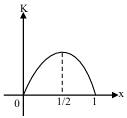
B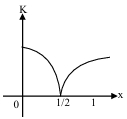
C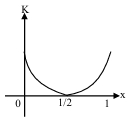
D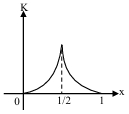
Solution
(A) Given $x(t) = x_0 \sin^2\left(\frac{t}{2}\right)$.
Using the trigonometric identity $\sin^2\theta = \frac{1 - \cos(2\theta)}{2}$,we get:
$x(t) = x_0 \left(\frac{1 - \cos t}{2}\right) = \frac{x_0}{2} - \frac{x_0}{2} \cos t$.
Since $x_0 = 1 \text{ m}$,$x(t) = \frac{1}{2} - \frac{1}{2} \cos t$.
This represents simple harmonic motion about the mean position $x = \frac{1}{2} \text{ m}$ with amplitude $A = \frac{1}{2} \text{ m}$.
The velocity is $v = \frac{dx}{dt} = \frac{1}{2} \sin t$.
The kinetic energy $K = \frac{1}{2} m v^2 = \frac{1}{2} m \left(\frac{1}{4} \sin^2 t\right) = \frac{m}{8} \sin^2 t$.
From $x - \frac{1}{2} = -\frac{1}{2} \cos t$,we have $\cos^2 t = 4(x - \frac{1}{2})^2$.
Since $\sin^2 t = 1 - \cos^2 t$,we get $K = \frac{m}{8} [1 - 4(x - \frac{1}{2})^2]$.
This is the equation of a downward parabola with respect to $x$,which is zero at $x = 0$ and $x = 1$,and maximum at $x = \frac{1}{2}$. Thus,graph $(A)$ is correct.
Using the trigonometric identity $\sin^2\theta = \frac{1 - \cos(2\theta)}{2}$,we get:
$x(t) = x_0 \left(\frac{1 - \cos t}{2}\right) = \frac{x_0}{2} - \frac{x_0}{2} \cos t$.
Since $x_0 = 1 \text{ m}$,$x(t) = \frac{1}{2} - \frac{1}{2} \cos t$.
This represents simple harmonic motion about the mean position $x = \frac{1}{2} \text{ m}$ with amplitude $A = \frac{1}{2} \text{ m}$.
The velocity is $v = \frac{dx}{dt} = \frac{1}{2} \sin t$.
The kinetic energy $K = \frac{1}{2} m v^2 = \frac{1}{2} m \left(\frac{1}{4} \sin^2 t\right) = \frac{m}{8} \sin^2 t$.
From $x - \frac{1}{2} = -\frac{1}{2} \cos t$,we have $\cos^2 t = 4(x - \frac{1}{2})^2$.
Since $\sin^2 t = 1 - \cos^2 t$,we get $K = \frac{m}{8} [1 - 4(x - \frac{1}{2})^2]$.
This is the equation of a downward parabola with respect to $x$,which is zero at $x = 0$ and $x = 1$,and maximum at $x = \frac{1}{2}$. Thus,graph $(A)$ is correct.
0 likes
View Solution140
MediumMCQ
$A$ particle starts its oscillation from the equilibrium position with time period $T$. Find the ratio of kinetic energy to potential energy of the particle at time $t = \frac{T}{6}$.
A
$3:1$
B
$1:3$
C
$2:3$
D
$4:3$
Solution
(B) The displacement of a particle starting from the equilibrium position is given by $x = A \sin(\omega t)$.
Given $t = \frac{T}{6}$ and $\omega = \frac{2\pi}{T}$,we have $x = A \sin(\frac{2\pi}{T} \cdot \frac{T}{6}) = A \sin(\frac{\pi}{3}) = A \frac{\sqrt{3}}{2}$.
The kinetic energy $(KE)$ is given by $KE = \frac{1}{2}k(A^2 - x^2) = \frac{1}{2}k(A^2 - \frac{3A^2}{4}) = \frac{1}{2}k(\frac{A^2}{4})$.
The potential energy $(PE)$ is given by $PE = \frac{1}{2}kx^2 = \frac{1}{2}k(\frac{3A^2}{4})$.
Therefore,the ratio $\frac{KE}{PE} = \frac{\frac{1}{2}k(A^2/4)}{\frac{1}{2}k(3A^2/4)} = \frac{1}{3}$.
Given $t = \frac{T}{6}$ and $\omega = \frac{2\pi}{T}$,we have $x = A \sin(\frac{2\pi}{T} \cdot \frac{T}{6}) = A \sin(\frac{\pi}{3}) = A \frac{\sqrt{3}}{2}$.
The kinetic energy $(KE)$ is given by $KE = \frac{1}{2}k(A^2 - x^2) = \frac{1}{2}k(A^2 - \frac{3A^2}{4}) = \frac{1}{2}k(\frac{A^2}{4})$.
The potential energy $(PE)$ is given by $PE = \frac{1}{2}kx^2 = \frac{1}{2}k(\frac{3A^2}{4})$.
Therefore,the ratio $\frac{KE}{PE} = \frac{\frac{1}{2}k(A^2/4)}{\frac{1}{2}k(3A^2/4)} = \frac{1}{3}$.
0 likes
View Solution141
DifficultMCQ
$A$ linear harmonic oscillator has a total mechanical energy of $300 \ J$. If its potential energy at the mean position is $100 \ J$,find its kinetic energy at $x = +\frac{A}{\sqrt{2}}$. (in $J$)
A
$100$
B
$200$
C
$300$
D
$400$
Solution
(A) The total mechanical energy $(TE)$ is given by $TE = U_0 + \frac{1}{2} k A^2 = 300 \ J$,where $U_0$ is the potential energy at the mean position.
Given $U_0 = 100 \ J$,we have $\frac{1}{2} k A^2 = 300 - 100 = 200 \ J$.
The kinetic energy $(KE)$ of a harmonic oscillator is given by $KE = \frac{1}{2} k(A^2 - x^2)$.
At $x = \frac{A}{\sqrt{2}}$,the kinetic energy is $KE = \frac{1}{2} k(A^2 - (\frac{A}{\sqrt{2}})^2) = \frac{1}{2} k(A^2 - \frac{A^2}{2}) = \frac{1}{2} k(\frac{A^2}{2}) = \frac{1}{4} k A^2$.
Since $\frac{1}{2} k A^2 = 200 \ J$,then $\frac{1}{4} k A^2 = \frac{1}{2} \times (\frac{1}{2} k A^2) = \frac{1}{2} \times 200 = 100 \ J$.
Given $U_0 = 100 \ J$,we have $\frac{1}{2} k A^2 = 300 - 100 = 200 \ J$.
The kinetic energy $(KE)$ of a harmonic oscillator is given by $KE = \frac{1}{2} k(A^2 - x^2)$.
At $x = \frac{A}{\sqrt{2}}$,the kinetic energy is $KE = \frac{1}{2} k(A^2 - (\frac{A}{\sqrt{2}})^2) = \frac{1}{2} k(A^2 - \frac{A^2}{2}) = \frac{1}{2} k(\frac{A^2}{2}) = \frac{1}{4} k A^2$.
Since $\frac{1}{2} k A^2 = 200 \ J$,then $\frac{1}{4} k A^2 = \frac{1}{2} \times (\frac{1}{2} k A^2) = \frac{1}{2} \times 200 = 100 \ J$.
0 likes
View Solution142
MediumMCQ
Starting from the origin,a particle oscillates simple harmonically with a time period of $2 \ s$. After what time will its kinetic energy be $75 \%$ of the total energy?
A
$\frac{1}{4} \ s$
B
$\frac{1}{3} \ s$
C
$\frac{1}{12} \ s$
D
$\frac{1}{6} \ s$
Solution
(D) The total energy of a particle performing $S.H.M.$ is given by $E = \frac{1}{2} m \omega^2 A^2$.
Since the particle starts from the origin ($x=0$ at $t=0$),its displacement is $x = A \sin(\omega t)$.
The velocity is $v = \frac{dx}{dt} = A \omega \cos(\omega t)$.
The kinetic energy is $K = \frac{1}{2} m v^2 = \frac{1}{2} m A^2 \omega^2 \cos^2(\omega t)$.
Given that $K = 75\% \ E = \frac{3}{4} E$,we have:
$\frac{1}{2} m A^2 \omega^2 \cos^2(\omega t) = \frac{3}{4} (\frac{1}{2} m A^2 \omega^2)$.
$\cos^2(\omega t) = \frac{3}{4} \Rightarrow \cos(\omega t) = \frac{\sqrt{3}}{2}$.
Since $\cos(\frac{\pi}{6}) = \frac{\sqrt{3}}{2}$,we have $\omega t = \frac{\pi}{6}$.
Substituting $\omega = \frac{2 \pi}{T}$,we get $(\frac{2 \pi}{T}) t = \frac{\pi}{6}$.
$t = \frac{T}{12}$.
Given $T = 2 \ s$,$t = \frac{2}{12} = \frac{1}{6} \ s$.
Since the particle starts from the origin ($x=0$ at $t=0$),its displacement is $x = A \sin(\omega t)$.
The velocity is $v = \frac{dx}{dt} = A \omega \cos(\omega t)$.
The kinetic energy is $K = \frac{1}{2} m v^2 = \frac{1}{2} m A^2 \omega^2 \cos^2(\omega t)$.
Given that $K = 75\% \ E = \frac{3}{4} E$,we have:
$\frac{1}{2} m A^2 \omega^2 \cos^2(\omega t) = \frac{3}{4} (\frac{1}{2} m A^2 \omega^2)$.
$\cos^2(\omega t) = \frac{3}{4} \Rightarrow \cos(\omega t) = \frac{\sqrt{3}}{2}$.
Since $\cos(\frac{\pi}{6}) = \frac{\sqrt{3}}{2}$,we have $\omega t = \frac{\pi}{6}$.
Substituting $\omega = \frac{2 \pi}{T}$,we get $(\frac{2 \pi}{T}) t = \frac{\pi}{6}$.
$t = \frac{T}{12}$.
Given $T = 2 \ s$,$t = \frac{2}{12} = \frac{1}{6} \ s$.
0 likes
View Solution143
EasyMCQ
In $SHM$,the restoring force is $F = -kx$,where $k$ is the force constant,$x$ is the displacement,and $A$ is the amplitude of motion. Then,the total energy depends upon:
A
$k, A$ and $M$
B
$k, x, M$
C
$k, A$
D
$k, x$
Solution
(C) In Simple Harmonic Motion $(SHM)$,the total energy $(E)$ is the sum of potential energy $(U)$ and kinetic energy $(K)$.
$E = U + K$
$E = \frac{1}{2} k x^2 + \frac{1}{2} m v^2$
Using the relations $v = \omega \sqrt{A^2 - x^2}$ and $k = m \omega^2$,we get:
$E = \frac{1}{2} k x^2 + \frac{1}{2} m (\omega^2 (A^2 - x^2))$
$E = \frac{1}{2} k x^2 + \frac{1}{2} k (A^2 - x^2)$
$E = \frac{1}{2} k x^2 + \frac{1}{2} k A^2 - \frac{1}{2} k x^2$
$E = \frac{1}{2} k A^2$
Thus,the total energy depends only on the force constant $(k)$ and the amplitude $(A)$.
$E = U + K$
$E = \frac{1}{2} k x^2 + \frac{1}{2} m v^2$
Using the relations $v = \omega \sqrt{A^2 - x^2}$ and $k = m \omega^2$,we get:
$E = \frac{1}{2} k x^2 + \frac{1}{2} m (\omega^2 (A^2 - x^2))$
$E = \frac{1}{2} k x^2 + \frac{1}{2} k (A^2 - x^2)$
$E = \frac{1}{2} k x^2 + \frac{1}{2} k A^2 - \frac{1}{2} k x^2$
$E = \frac{1}{2} k A^2$
Thus,the total energy depends only on the force constant $(k)$ and the amplitude $(A)$.
0 likes
View Solution144
MediumMCQ
$A$ bob of a simple pendulum of mass $m$ performs $SHM$ with amplitude $A$ and period $T$. The kinetic energy of the pendulum at displacement $x = \frac{A}{2}$ will be:
A
$\frac{2 m \pi^2 A}{3 T^2}$
B
$\frac{3 m \pi^2 A}{2 T}$
C
$\frac{2 m \pi A^2}{3 T}$
D
$\frac{3 m \pi^2 A^2}{2 T^2}$
Solution
(D) The kinetic energy $(K.E.)$ of a particle performing $SHM$ is given by:
$K.E. = \frac{1}{2} m \omega^2 (A^2 - x^2)$
Given $x = \frac{A}{2}$,substitute this into the equation:
$K.E. = \frac{1}{2} m \omega^2 (A^2 - (\frac{A}{2})^2)$
$K.E. = \frac{1}{2} m \omega^2 (A^2 - \frac{A^2}{4}) = \frac{1}{2} m \omega^2 (\frac{3 A^2}{4}) = \frac{3}{8} m \omega^2 A^2$
Since the angular frequency $\omega = \frac{2 \pi}{T}$,substitute this value:
$K.E. = \frac{3}{8} m (\frac{2 \pi}{T})^2 A^2$
$K.E. = \frac{3}{8} m (\frac{4 \pi^2}{T^2}) A^2$
$K.E. = \frac{3 m \pi^2 A^2}{2 T^2}$
$K.E. = \frac{1}{2} m \omega^2 (A^2 - x^2)$
Given $x = \frac{A}{2}$,substitute this into the equation:
$K.E. = \frac{1}{2} m \omega^2 (A^2 - (\frac{A}{2})^2)$
$K.E. = \frac{1}{2} m \omega^2 (A^2 - \frac{A^2}{4}) = \frac{1}{2} m \omega^2 (\frac{3 A^2}{4}) = \frac{3}{8} m \omega^2 A^2$
Since the angular frequency $\omega = \frac{2 \pi}{T}$,substitute this value:
$K.E. = \frac{3}{8} m (\frac{2 \pi}{T})^2 A^2$
$K.E. = \frac{3}{8} m (\frac{4 \pi^2}{T^2}) A^2$
$K.E. = \frac{3 m \pi^2 A^2}{2 T^2}$
0 likes
View Solution145
MediumMCQ
For a particle performing $S.H.M.$,the total energy is '$n$' times the kinetic energy,when the displacement of a particle from the mean position is $\frac{\sqrt{3}}{2} A$,where $A$ is the amplitude of $S.H.M.$ The value of '$n$' is
A
$2$
B
$3$
C
$4$
D
$6$
Solution
(C) The total energy $(E)$ of a particle performing $S.H.M.$ is given by $E = \frac{1}{2} k A^2$.
The kinetic energy $(K)$ at a displacement $x$ is given by $K = \frac{1}{2} k (A^2 - x^2)$.
Given that the displacement $x = \frac{\sqrt{3}}{2} A$.
Substituting the value of $x$ into the kinetic energy formula:
$K = \frac{1}{2} k (A^2 - (\frac{\sqrt{3}}{2} A)^2) = \frac{1}{2} k (A^2 - \frac{3}{4} A^2) = \frac{1}{2} k (\frac{1}{4} A^2) = \frac{1}{8} k A^2$.
According to the problem,$E = n \times K$.
Substituting the expressions for $E$ and $K$:
$\frac{1}{2} k A^2 = n \times (\frac{1}{8} k A^2)$.
Dividing both sides by $\frac{1}{2} k A^2$:
$1 = n \times \frac{1}{4}$.
Therefore,$n = 4$.
The kinetic energy $(K)$ at a displacement $x$ is given by $K = \frac{1}{2} k (A^2 - x^2)$.
Given that the displacement $x = \frac{\sqrt{3}}{2} A$.
Substituting the value of $x$ into the kinetic energy formula:
$K = \frac{1}{2} k (A^2 - (\frac{\sqrt{3}}{2} A)^2) = \frac{1}{2} k (A^2 - \frac{3}{4} A^2) = \frac{1}{2} k (\frac{1}{4} A^2) = \frac{1}{8} k A^2$.
According to the problem,$E = n \times K$.
Substituting the expressions for $E$ and $K$:
$\frac{1}{2} k A^2 = n \times (\frac{1}{8} k A^2)$.
Dividing both sides by $\frac{1}{2} k A^2$:
$1 = n \times \frac{1}{4}$.
Therefore,$n = 4$.
0 likes
View Solution146
MediumMCQ
$A$ particle is executing linear $S.H.M.$ starting from the mean position. The ratio of the kinetic energy to the potential energy of the particle at a point of half the amplitude is (in $: 1$)
A
$2$
B
$3$
C
$4$
D
$8$
Solution
(B) The displacement of the particle is given by $x = A \sin(\omega t)$.
At half the amplitude,the displacement is $x = A/2$.
The potential energy $(U)$ of a particle in $S.H.M.$ is given by $U = \frac{1}{2} k x^2$.
Substituting $x = A/2$,we get $U = \frac{1}{2} k (A/2)^2 = \frac{1}{8} k A^2$.
The total energy $(E)$ of the particle is $E = \frac{1}{2} k A^2$.
The kinetic energy $(K)$ is given by $K = E - U = \frac{1}{2} k A^2 - \frac{1}{8} k A^2 = \frac{3}{8} k A^2$.
Now,the ratio of kinetic energy to potential energy is $K/U = (\frac{3}{8} k A^2) / (\frac{1}{8} k A^2) = 3/1$.
Therefore,the ratio is $3: 1$.
At half the amplitude,the displacement is $x = A/2$.
The potential energy $(U)$ of a particle in $S.H.M.$ is given by $U = \frac{1}{2} k x^2$.
Substituting $x = A/2$,we get $U = \frac{1}{2} k (A/2)^2 = \frac{1}{8} k A^2$.
The total energy $(E)$ of the particle is $E = \frac{1}{2} k A^2$.
The kinetic energy $(K)$ is given by $K = E - U = \frac{1}{2} k A^2 - \frac{1}{8} k A^2 = \frac{3}{8} k A^2$.
Now,the ratio of kinetic energy to potential energy is $K/U = (\frac{3}{8} k A^2) / (\frac{1}{8} k A^2) = 3/1$.
Therefore,the ratio is $3: 1$.
0 likes
View Solution147
MediumMCQ
$A$ particle is executing $S.H.M.$ of amplitude $A$. When the potential energy of the particle is half of its maximum value during the oscillation,its displacement from the equilibrium position is
A
$\pm \frac{A}{4}$
B
$\pm \frac{A}{2}$
C
$\pm \frac{A}{\sqrt{3}}$
D
$\pm \frac{A}{\sqrt{2}}$
Solution
(D) The potential energy $(U)$ of a particle executing $S.H.M.$ at a displacement $x$ is given by $U = \frac{1}{2} k x^2$,where $k$ is the force constant.
The maximum potential energy $(U_{max})$ occurs at the extreme positions where $x = \pm A$,so $U_{max} = \frac{1}{2} k A^2$.
According to the problem,the potential energy is half of its maximum value: $U = \frac{1}{2} U_{max}$.
Substituting the expressions: $\frac{1}{2} k x^2 = \frac{1}{2} (\frac{1}{2} k A^2)$.
Simplifying the equation: $x^2 = \frac{1}{2} A^2$.
Taking the square root on both sides: $x = \pm \frac{A}{\sqrt{2}}$.
Thus,the displacement is $\pm \frac{A}{\sqrt{2}}$.
The maximum potential energy $(U_{max})$ occurs at the extreme positions where $x = \pm A$,so $U_{max} = \frac{1}{2} k A^2$.
According to the problem,the potential energy is half of its maximum value: $U = \frac{1}{2} U_{max}$.
Substituting the expressions: $\frac{1}{2} k x^2 = \frac{1}{2} (\frac{1}{2} k A^2)$.
Simplifying the equation: $x^2 = \frac{1}{2} A^2$.
Taking the square root on both sides: $x = \pm \frac{A}{\sqrt{2}}$.
Thus,the displacement is $\pm \frac{A}{\sqrt{2}}$.
0 likes
View Solution148
MediumMCQ
$A$ particle starts oscillating simple harmonically from its mean position with time period $T$. At time $t = T/6$,the ratio of the potential energy to kinetic energy of the particle is $\left[\sin 30^{\circ} = \cos 60^{\circ} = 0.5, \cos 30^{\circ} = \sin 60^{\circ} = \sqrt{3}/2\right]$
A
$1: 2$
B
$1: 3$
C
$2: 1$
D
$3: 1$
Solution
(D) The displacement of a particle starting from the mean position is given by $x = A \sin(\omega t)$,where $A$ is the amplitude and $\omega = 2\pi/T$ is the angular frequency.
At $t = T/6$,the displacement is $x = A \sin((2\pi/T) \cdot (T/6)) = A \sin(\pi/3) = A \sqrt{3}/2$.
The potential energy $U$ is given by $U = \frac{1}{2} k x^2 = \frac{1}{2} k (A \sqrt{3}/2)^2 = \frac{3}{8} k A^2$.
The total energy $E$ is given by $E = \frac{1}{2} k A^2$.
The kinetic energy $K$ is $K = E - U = \frac{1}{2} k A^2 - \frac{3}{8} k A^2 = \frac{1}{8} k A^2$.
The ratio of potential energy to kinetic energy is $U/K = (3/8 k A^2) / (1/8 k A^2) = 3/1$.
Thus,the ratio is $3: 1$.
At $t = T/6$,the displacement is $x = A \sin((2\pi/T) \cdot (T/6)) = A \sin(\pi/3) = A \sqrt{3}/2$.
The potential energy $U$ is given by $U = \frac{1}{2} k x^2 = \frac{1}{2} k (A \sqrt{3}/2)^2 = \frac{3}{8} k A^2$.
The total energy $E$ is given by $E = \frac{1}{2} k A^2$.
The kinetic energy $K$ is $K = E - U = \frac{1}{2} k A^2 - \frac{3}{8} k A^2 = \frac{1}{8} k A^2$.
The ratio of potential energy to kinetic energy is $U/K = (3/8 k A^2) / (1/8 k A^2) = 3/1$.
Thus,the ratio is $3: 1$.
0 likes
View Solution149
MediumMCQ
For a body performing simple harmonic motion,its potential energy is $E_x$ at displacement $x$ and $E_y$ at displacement $y$ from the mean position. The potential energy $E_0$ at displacement $(x+y)$ is
A
$\sqrt{E_x^2+E_y^2}$
B
$\sqrt{E_x-E_y}$
C
$E_x+E_y$
D
$E_x+E_y+2 \sqrt{E_x E_y}$
Solution
(D) The potential energy of a body in simple harmonic motion at displacement $x$ is given by $E_x = \frac{1}{2} kx^2$.
From this,we can write $x = \sqrt{\frac{2 E_x}{k}}$.
Similarly,the potential energy at displacement $y$ is $E_y = \frac{1}{2} ky^2$,which gives $y = \sqrt{\frac{2 E_y}{k}}$.
The potential energy $E_0$ at displacement $(x+y)$ is given by $E_0 = \frac{1}{2} k(x+y)^2$.
Expanding this expression,we get $E_0 = \frac{1}{2} k(x^2 + y^2 + 2xy)$.
Substituting the values of $x^2$,$y^2$,and $xy$:
$E_0 = \frac{1}{2} k \left( \frac{2 E_x}{k} + \frac{2 E_y}{k} + 2 \sqrt{\frac{2 E_x}{k}} \sqrt{\frac{2 E_y}{k}} \right)$.
$E_0 = \frac{1}{2} k \left( \frac{2 E_x}{k} + \frac{2 E_y}{k} + \frac{4 \sqrt{E_x E_y}}{k} \right)$.
$E_0 = E_x + E_y + 2 \sqrt{E_x E_y}$.
From this,we can write $x = \sqrt{\frac{2 E_x}{k}}$.
Similarly,the potential energy at displacement $y$ is $E_y = \frac{1}{2} ky^2$,which gives $y = \sqrt{\frac{2 E_y}{k}}$.
The potential energy $E_0$ at displacement $(x+y)$ is given by $E_0 = \frac{1}{2} k(x+y)^2$.
Expanding this expression,we get $E_0 = \frac{1}{2} k(x^2 + y^2 + 2xy)$.
Substituting the values of $x^2$,$y^2$,and $xy$:
$E_0 = \frac{1}{2} k \left( \frac{2 E_x}{k} + \frac{2 E_y}{k} + 2 \sqrt{\frac{2 E_x}{k}} \sqrt{\frac{2 E_y}{k}} \right)$.
$E_0 = \frac{1}{2} k \left( \frac{2 E_x}{k} + \frac{2 E_y}{k} + \frac{4 \sqrt{E_x E_y}}{k} \right)$.
$E_0 = E_x + E_y + 2 \sqrt{E_x E_y}$.
0 likes
View Solution150
DifficultMCQ
$A$ particle starts oscillating simple harmonically from its equilibrium position with time period $T$. What is the ratio of potential energy to kinetic energy of the particle at time $t = \frac{T}{12}$? (Given: $\sin(\frac{\pi}{6}) = \frac{1}{2}$)
A
$1: 3$
B
$3: 1$
C
$1: 2$
D
$2: 1$
Solution
(A) For a particle in simple harmonic motion $(SHM)$ starting from the equilibrium position,the displacement is given by $x = A \sin(\omega t)$.
Given $t = \frac{T}{12}$ and $\omega = \frac{2\pi}{T}$,the displacement is $x = A \sin(\frac{2\pi}{T} \cdot \frac{T}{12}) = A \sin(\frac{\pi}{6}) = \frac{A}{2}$.
The potential energy ($P$.$E$.) is given by $U = \frac{1}{2} k x^2 = \frac{1}{2} m \omega^2 x^2$.
Substituting $x = \frac{A}{2}$,we get $U = \frac{1}{2} m \omega^2 (\frac{A^2}{4}) = \frac{1}{8} m \omega^2 A^2$.
The kinetic energy ($K$.$E$.) is given by $K = \frac{1}{2} m \omega^2 (A^2 - x^2)$.
Substituting $x = \frac{A}{2}$,we get $K = \frac{1}{2} m \omega^2 (A^2 - \frac{A^2}{4}) = \frac{1}{2} m \omega^2 (\frac{3A^2}{4}) = \frac{3}{8} m \omega^2 A^2$.
The ratio of potential energy to kinetic energy is $\frac{U}{K} = \frac{\frac{1}{8} m \omega^2 A^2}{\frac{3}{8} m \omega^2 A^2} = \frac{1}{3}$.
Given $t = \frac{T}{12}$ and $\omega = \frac{2\pi}{T}$,the displacement is $x = A \sin(\frac{2\pi}{T} \cdot \frac{T}{12}) = A \sin(\frac{\pi}{6}) = \frac{A}{2}$.
The potential energy ($P$.$E$.) is given by $U = \frac{1}{2} k x^2 = \frac{1}{2} m \omega^2 x^2$.
Substituting $x = \frac{A}{2}$,we get $U = \frac{1}{2} m \omega^2 (\frac{A^2}{4}) = \frac{1}{8} m \omega^2 A^2$.
The kinetic energy ($K$.$E$.) is given by $K = \frac{1}{2} m \omega^2 (A^2 - x^2)$.
Substituting $x = \frac{A}{2}$,we get $K = \frac{1}{2} m \omega^2 (A^2 - \frac{A^2}{4}) = \frac{1}{2} m \omega^2 (\frac{3A^2}{4}) = \frac{3}{8} m \omega^2 A^2$.
The ratio of potential energy to kinetic energy is $\frac{U}{K} = \frac{\frac{1}{8} m \omega^2 A^2}{\frac{3}{8} m \omega^2 A^2} = \frac{1}{3}$.
0 likes
View SolutionOscillations — Energy of Simple Harmonic Motion · Frequently Asked Questions
1Are these Oscillations questions useful for JEE and NEET?
Yes. All questions in this section are mapped to JEE Main and NEET exam patterns. Previous year questions from JEE Main, NEET, GUJCET and state-level exams are included with full solutions.
2Can I switch to Hindi or Gujarati for these questions?
Yes. Use the language tabs in the hero section or the sidebar to view the same questions and solutions in English, Hindi or Gujarati.
3How do I generate a question paper from this subtopic?
Use the Vedclass Exam Paper Generator — select the chapter and subtopic, set difficulty, and generate Sets A, B, C, D automatically. First 3 chapters of every subject are free.
Vedclass Products
For Students
Vedclass Test Series
Mock tests in real JEE/NEET style with performance analysis. 5-day free trial.
Start Free TrialFor Teachers
Exam Paper Generator
Generate Set A/B/C/D papers from this chapter in 2 minutes. 3 chapters free.
Try FreeFor Institutes
Online Exam Module
Live online exams with unlimited students, 360° analytics & white-label branding.
See DemoFor Teachers & Institutes
Generate a Oscillations Exam Paper in 2 Minutes
Select subtopic & difficulty — Sets A, B, C, D auto-generated with No Repeat logic.
First 3 chapters of every subject are free — no payment required.