
A English
Energy of Simple Harmonic Motion Questions in English
Class 11 Physics · Oscillations · Energy of Simple Harmonic Motion
224+
Questions
English
Language
100%
With Solutions
Showing 49 of 224 questions in English
151
MediumMCQ
Starting from the mean position,a body oscillates simple harmonically with a period $T$. After what time will its kinetic energy be $75 \%$ of the total energy? $(\sin 30^{\circ} = 0.5)$
A
$\frac{T}{8}$
B
$\frac{T}{12}$
C
$\frac{T}{16}$
D
$\frac{T}{24}$
Solution
(B) The kinetic energy $(KE)$ of a particle in simple harmonic motion is given by $KE = \frac{1}{2} k A^2 \cos^2(\omega t)$,where $A$ is the amplitude and $\omega$ is the angular frequency.
Given that the body starts from the mean position,the displacement is $x = A \sin(\omega t)$,and the velocity is $v = A \omega \cos(\omega t)$.
The total energy $(TE)$ is $\frac{1}{2} k A^2$.
We are given $KE = 75 \% \text{ of } TE = \frac{3}{4} TE$.
So,$\frac{1}{2} k (A \cos(\omega t))^2 = \frac{3}{4} (\frac{1}{2} k A^2)$.
$\cos^2(\omega t) = \frac{3}{4}$.
$\cos(\omega t) = \frac{\sqrt{3}}{2}$.
Since $\cos(30^{\circ}) = \frac{\sqrt{3}}{2}$,we have $\omega t = 30^{\circ} = \frac{\pi}{6} \text{ radians}$.
Substituting $\omega = \frac{2\pi}{T}$,we get $\frac{2\pi}{T} t = \frac{\pi}{6}$.
Solving for $t$,we get $t = \frac{T}{12}$.
Given that the body starts from the mean position,the displacement is $x = A \sin(\omega t)$,and the velocity is $v = A \omega \cos(\omega t)$.
The total energy $(TE)$ is $\frac{1}{2} k A^2$.
We are given $KE = 75 \% \text{ of } TE = \frac{3}{4} TE$.
So,$\frac{1}{2} k (A \cos(\omega t))^2 = \frac{3}{4} (\frac{1}{2} k A^2)$.
$\cos^2(\omega t) = \frac{3}{4}$.
$\cos(\omega t) = \frac{\sqrt{3}}{2}$.
Since $\cos(30^{\circ}) = \frac{\sqrt{3}}{2}$,we have $\omega t = 30^{\circ} = \frac{\pi}{6} \text{ radians}$.
Substituting $\omega = \frac{2\pi}{T}$,we get $\frac{2\pi}{T} t = \frac{\pi}{6}$.
Solving for $t$,we get $t = \frac{T}{12}$.
0 likes
View Solution152
MediumMCQ
The kinetic energy of a particle,executing simple harmonic motion is $16 \ J$ when it is in the mean position. If the amplitude of motion is $25 \ cm$ and the mass of the particle is $5.12 \ kg$,the period of oscillation is
A
$\frac{\pi}{5} \ s$
B
$2 \pi \ s$
C
$20 \pi \ s$
D
$5 \pi \ s$
Solution
(A) Given: Kinetic Energy $(K.E.)$ at mean position $= 16 \ J$,Amplitude $(A)$ $= 25 \ cm = 0.25 \ m$,Mass $(m)$ $= 5.12 \ kg$.
The kinetic energy at the mean position is equal to the total energy $(E)$ of the particle in simple harmonic motion.
The formula for total energy is $E = \frac{1}{2} m \omega^2 A^2$.
Substituting the values: $16 = \frac{1}{2} \times 5.12 \times \omega^2 \times (0.25)^2$.
Solving for $\omega^2$: $\omega^2 = \frac{16 \times 2}{5.12 \times 0.0625} = \frac{32}{0.32} = 100$.
Therefore,$\omega = \sqrt{100} = 10 \ rad/s$.
The period of oscillation $(T)$ is given by $T = \frac{2 \pi}{\omega}$.
Substituting $\omega$: $T = \frac{2 \pi}{10} = \frac{\pi}{5} \ s$.
The kinetic energy at the mean position is equal to the total energy $(E)$ of the particle in simple harmonic motion.
The formula for total energy is $E = \frac{1}{2} m \omega^2 A^2$.
Substituting the values: $16 = \frac{1}{2} \times 5.12 \times \omega^2 \times (0.25)^2$.
Solving for $\omega^2$: $\omega^2 = \frac{16 \times 2}{5.12 \times 0.0625} = \frac{32}{0.32} = 100$.
Therefore,$\omega = \sqrt{100} = 10 \ rad/s$.
The period of oscillation $(T)$ is given by $T = \frac{2 \pi}{\omega}$.
Substituting $\omega$: $T = \frac{2 \pi}{10} = \frac{\pi}{5} \ s$.
0 likes
View Solution153
MediumMCQ
$A$ particle is vibrating in $S.H.M.$ with an amplitude of $4 \,cm$. At what displacement from the equilibrium position is its energy half potential and half kinetic?
A
$1 \,cm$
B
$\sqrt{2} \,cm$
C
$2 \,cm$
D
$2 \sqrt{2} \,cm$
Solution
(D) The kinetic energy $(K.E.)$ of a particle in $S.H.M.$ is given by $K.E. = \frac{1}{2} m \omega^2 (A^2 - x^2)$.
The potential energy $(P.E.)$ is given by $P.E. = \frac{1}{2} m \omega^2 x^2$.
Given that the energy is half potential and half kinetic, we have $K.E. = P.E.$
Substituting the expressions: $\frac{1}{2} m \omega^2 (A^2 - x^2) = \frac{1}{2} m \omega^2 x^2$.
Simplifying this, we get $A^2 - x^2 = x^2$, which implies $A^2 = 2x^2$.
Therefore, $x = \frac{A}{\sqrt{2}}$.
Given the amplitude $A = 4 \,cm$, we find $x = \frac{4}{\sqrt{2}} = 2\sqrt{2} \,cm$.
The potential energy $(P.E.)$ is given by $P.E. = \frac{1}{2} m \omega^2 x^2$.
Given that the energy is half potential and half kinetic, we have $K.E. = P.E.$
Substituting the expressions: $\frac{1}{2} m \omega^2 (A^2 - x^2) = \frac{1}{2} m \omega^2 x^2$.
Simplifying this, we get $A^2 - x^2 = x^2$, which implies $A^2 = 2x^2$.
Therefore, $x = \frac{A}{\sqrt{2}}$.
Given the amplitude $A = 4 \,cm$, we find $x = \frac{4}{\sqrt{2}} = 2\sqrt{2} \,cm$.
0 likes
View Solution154
MediumMCQ
The amplitude of a particle executing $S.H.M.$ is $3 \,cm$. The displacement at which its kinetic energy will be $25 \%$ more than the potential energy is (in $\,cm$)
A
$1$
B
$2$
C
$3$
D
$4$
Solution
(B) Given: $K.E. = P.E. + 25\% \text{ of } P.E.$
$K.E. = P.E. + 0.25 P.E. = 1.25 P.E. = \frac{5}{4} P.E.$
We know that for $S.H.M.$,$K.E. = \frac{1}{2} m \omega^2 (A^2 - x^2)$ and $P.E. = \frac{1}{2} m \omega^2 x^2$.
Substituting these into the given condition:
$\frac{1}{2} m \omega^2 (A^2 - x^2) = \frac{5}{4} (\frac{1}{2} m \omega^2 x^2)$
$A^2 - x^2 = \frac{5}{4} x^2$
$A^2 = x^2 + \frac{5}{4} x^2 = \frac{9}{4} x^2$
Taking the square root on both sides: $A = \frac{3}{2} x$.
Given $A = 3 \,cm$,we have $3 = \frac{3}{2} x$.
Therefore,$x = 2 \,cm$.
$K.E. = P.E. + 0.25 P.E. = 1.25 P.E. = \frac{5}{4} P.E.$
We know that for $S.H.M.$,$K.E. = \frac{1}{2} m \omega^2 (A^2 - x^2)$ and $P.E. = \frac{1}{2} m \omega^2 x^2$.
Substituting these into the given condition:
$\frac{1}{2} m \omega^2 (A^2 - x^2) = \frac{5}{4} (\frac{1}{2} m \omega^2 x^2)$
$A^2 - x^2 = \frac{5}{4} x^2$
$A^2 = x^2 + \frac{5}{4} x^2 = \frac{9}{4} x^2$
Taking the square root on both sides: $A = \frac{3}{2} x$.
Given $A = 3 \,cm$,we have $3 = \frac{3}{2} x$.
Therefore,$x = 2 \,cm$.
0 likes
View Solution155
MediumMCQ
$A$ body is executing a linear $S.H.M.$ Its potential energies at the displacements $x$ and $y$ are $E_1$ and $E_2$ respectively. Its potential energy at displacement $(x+y)$ will be
A
$E_1+E_2$
B
$(\sqrt{E_1}+\sqrt{E_2})^2$
C
$E_1-E_2$
D
$(\sqrt{E_2}-\sqrt{E_1})^2$
Solution
(B) We know that the potential energy $E_P$ of a body in $S.H.M.$ is given by $E_P = \frac{1}{2} Kx^2$,where $K$ is the force constant.
For displacement $x$,$E_1 = \frac{1}{2} Kx^2 \Rightarrow x = \sqrt{\frac{2E_1}{K}}$.
For displacement $y$,$E_2 = \frac{1}{2} Ky^2 \Rightarrow y = \sqrt{\frac{2E_2}{K}}$.
The potential energy $E$ at displacement $(x+y)$ is given by $E = \frac{1}{2} K(x+y)^2$.
Substituting the values of $x$ and $y$:
$E = \frac{1}{2} K \left( \sqrt{\frac{2E_1}{K}} + \sqrt{\frac{2E_2}{K}} \right)^2$
$E = \frac{1}{2} K \left( \sqrt{\frac{2}{K}} \right)^2 (\sqrt{E_1} + \sqrt{E_2})^2$
$E = \frac{1}{2} K \cdot \frac{2}{K} (\sqrt{E_1} + \sqrt{E_2})^2$
$E = (\sqrt{E_1} + \sqrt{E_2})^2$.
For displacement $x$,$E_1 = \frac{1}{2} Kx^2 \Rightarrow x = \sqrt{\frac{2E_1}{K}}$.
For displacement $y$,$E_2 = \frac{1}{2} Ky^2 \Rightarrow y = \sqrt{\frac{2E_2}{K}}$.
The potential energy $E$ at displacement $(x+y)$ is given by $E = \frac{1}{2} K(x+y)^2$.
Substituting the values of $x$ and $y$:
$E = \frac{1}{2} K \left( \sqrt{\frac{2E_1}{K}} + \sqrt{\frac{2E_2}{K}} \right)^2$
$E = \frac{1}{2} K \left( \sqrt{\frac{2}{K}} \right)^2 (\sqrt{E_1} + \sqrt{E_2})^2$
$E = \frac{1}{2} K \cdot \frac{2}{K} (\sqrt{E_1} + \sqrt{E_2})^2$
$E = (\sqrt{E_1} + \sqrt{E_2})^2$.
0 likes
View Solution156
MediumMCQ
$A$ particle starts from the mean position and performs $S.H.M.$ with a period of $4 \ s$. At what time is its kinetic energy $50 \%$ of its total energy (in $s$)?
A
$0.1$
B
$0.2$
C
$0.4$
D
$0.5$
Solution
(D) The total energy $(T.E.)$ of a particle in $S.H.M.$ is $T.E. = \frac{1}{2} kA^2$.
The kinetic energy $(K.E.)$ is given by $K.E. = \frac{1}{2} k(A^2 - x^2)$.
Given that $K.E. = 50 \%$ of $T.E.$,which means $K.E. = \frac{1}{2} T.E.$
Substituting the expressions:
$\frac{1}{2} k(A^2 - x^2) = \frac{1}{2} (\frac{1}{2} kA^2)$
$A^2 - x^2 = \frac{1}{2} A^2$
$x^2 = \frac{A^2}{2} \implies x = \frac{A}{\sqrt{2}}$
The displacement equation for a particle starting from the mean position is $x = A \sin(\frac{2\pi t}{T})$.
Substituting $x = \frac{A}{\sqrt{2}}$ and $T = 4 \ s$:
$\frac{A}{\sqrt{2}} = A \sin(\frac{2\pi t}{4})$
$\frac{1}{\sqrt{2}} = \sin(\frac{\pi t}{2})$
$\frac{\pi t}{2} = \frac{\pi}{4}$
$t = 0.5 \ s$.
The kinetic energy $(K.E.)$ is given by $K.E. = \frac{1}{2} k(A^2 - x^2)$.
Given that $K.E. = 50 \%$ of $T.E.$,which means $K.E. = \frac{1}{2} T.E.$
Substituting the expressions:
$\frac{1}{2} k(A^2 - x^2) = \frac{1}{2} (\frac{1}{2} kA^2)$
$A^2 - x^2 = \frac{1}{2} A^2$
$x^2 = \frac{A^2}{2} \implies x = \frac{A}{\sqrt{2}}$
The displacement equation for a particle starting from the mean position is $x = A \sin(\frac{2\pi t}{T})$.
Substituting $x = \frac{A}{\sqrt{2}}$ and $T = 4 \ s$:
$\frac{A}{\sqrt{2}} = A \sin(\frac{2\pi t}{4})$
$\frac{1}{\sqrt{2}} = \sin(\frac{\pi t}{2})$
$\frac{\pi t}{2} = \frac{\pi}{4}$
$t = 0.5 \ s$.
0 likes
View Solution157
DifficultMCQ
$A$ body is executing $S$.$H$.$M$. Its potential energy is '$P_1$' and '$P_2$' at displacements '$x$' and '$y$' respectively. The potential energy at displacement $(x+y)$ is
A
$\sqrt{P_1}-\sqrt{P_2}=\sqrt{P}$
B
$P_1+P_2=P$
C
$P_1-P_2=P$
D
$\sqrt{P_1}+\sqrt{P_2}=\sqrt{P}$
Solution
(D) The potential energy $P$ of a body executing $S$.$H$.$M$. at displacement $x$ is given by $P = \frac{1}{2} k x^2$,where $k = m \omega^2$.
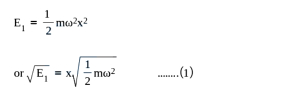
Given,$P_1 = \frac{1}{2} k x^2 \implies \sqrt{P_1} = x \sqrt{\frac{k}{2}}$ ---$(1)$
And $P_2 = \frac{1}{2} k y^2 \implies \sqrt{P_2} = y \sqrt{\frac{k}{2}}$ ---$(2)$
Let the potential energy at displacement $(x+y)$ be $P$. Then,
$P = \frac{1}{2} k (x+y)^2$
Taking the square root of both sides:
$\sqrt{P} = (x+y) \sqrt{\frac{k}{2}}$
$\sqrt{P} = x \sqrt{\frac{k}{2}} + y \sqrt{\frac{k}{2}}$
Substituting equations $(1)$ and $(2)$ into this expression:
$\sqrt{P} = \sqrt{P_1} + \sqrt{P_2}$
Given,$P_1 = \frac{1}{2} k x^2 \implies \sqrt{P_1} = x \sqrt{\frac{k}{2}}$ ---$(1)$
And $P_2 = \frac{1}{2} k y^2 \implies \sqrt{P_2} = y \sqrt{\frac{k}{2}}$ ---$(2)$
Let the potential energy at displacement $(x+y)$ be $P$. Then,
$P = \frac{1}{2} k (x+y)^2$
Taking the square root of both sides:
$\sqrt{P} = (x+y) \sqrt{\frac{k}{2}}$
$\sqrt{P} = x \sqrt{\frac{k}{2}} + y \sqrt{\frac{k}{2}}$
Substituting equations $(1)$ and $(2)$ into this expression:
$\sqrt{P} = \sqrt{P_1} + \sqrt{P_2}$
0 likes
View Solution158
MediumMCQ
The total energy of a body executing simple harmonic motion is $E$. When the displacement is half of the amplitude,the kinetic energy is:
A
$\frac{E}{4}$
B
$\frac{3 E}{4}$
C
$\frac{\sqrt{3} E}{4}$
D
$\frac{E}{2}$
Solution
(B) The total energy $E$ of a body executing simple harmonic motion $(SHM)$ is given by $E = \frac{1}{2} m \omega^2 a^2$,where $a$ is the amplitude.
At any displacement $y$,the potential energy $U$ is given by $U = \frac{1}{2} m \omega^2 y^2$.
The kinetic energy $K$ is the difference between total energy and potential energy: $K = E - U$.
Substituting the expressions,$K = \frac{1}{2} m \omega^2 a^2 - \frac{1}{2} m \omega^2 y^2 = \frac{1}{2} m \omega^2 (a^2 - y^2)$.
Given that the displacement $y = \frac{a}{2}$,we substitute this into the kinetic energy formula:
$K = \frac{1}{2} m \omega^2 (a^2 - (\frac{a}{2})^2) = \frac{1}{2} m \omega^2 (a^2 - \frac{a^2}{4}) = \frac{1}{2} m \omega^2 (\frac{3a^2}{4})$.
Since $E = \frac{1}{2} m \omega^2 a^2$,we can write $K = \frac{3}{4} (\frac{1}{2} m \omega^2 a^2) = \frac{3E}{4}$.
At any displacement $y$,the potential energy $U$ is given by $U = \frac{1}{2} m \omega^2 y^2$.
The kinetic energy $K$ is the difference between total energy and potential energy: $K = E - U$.
Substituting the expressions,$K = \frac{1}{2} m \omega^2 a^2 - \frac{1}{2} m \omega^2 y^2 = \frac{1}{2} m \omega^2 (a^2 - y^2)$.
Given that the displacement $y = \frac{a}{2}$,we substitute this into the kinetic energy formula:
$K = \frac{1}{2} m \omega^2 (a^2 - (\frac{a}{2})^2) = \frac{1}{2} m \omega^2 (a^2 - \frac{a^2}{4}) = \frac{1}{2} m \omega^2 (\frac{3a^2}{4})$.
Since $E = \frac{1}{2} m \omega^2 a^2$,we can write $K = \frac{3}{4} (\frac{1}{2} m \omega^2 a^2) = \frac{3E}{4}$.
0 likes
View Solution159
MediumMCQ
$A$ particle starts oscillating simple harmonically from its mean position with time period $T$. At time $t=\frac{T}{12}$,the ratio of the potential energy to kinetic energy of the particle is $\left(\sin 30^{\circ}=\cos 60^{\circ}=0.5, \cos 30^{\circ}=\sin 60^{\circ}=\frac{\sqrt{3}}{2}\right)$
A
$1: 3$
B
$2: 1$
C
$3: 1$
D
$1: 2$
Solution
(A) The displacement of a particle performing $SHM$ starting from the mean position is given by $x = A \sin(\omega t)$,where $\omega = \frac{2\pi}{T}$.
At $t = \frac{T}{12}$,the displacement is $x = A \sin\left(\frac{2\pi}{T} \cdot \frac{T}{12}\right) = A \sin\left(\frac{\pi}{6}\right) = \frac{A}{2}$.
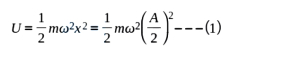
The potential energy $U$ is given by $U = \frac{1}{2}m\omega^2x^2 = \frac{1}{2}m\omega^2\left(\frac{A}{2}\right)^2 = \frac{1}{8}m\omega^2A^2$.
The kinetic energy $K$ is given by $K = \frac{1}{2}m\omega^2(A^2 - x^2) = \frac{1}{2}m\omega^2\left(A^2 - \frac{A^2}{4}\right) = \frac{1}{2}m\omega^2\left(\frac{3A^2}{4}\right) = \frac{3}{8}m\omega^2A^2$.
The ratio of potential energy to kinetic energy is $\frac{U}{K} = \frac{\frac{1}{8}m\omega^2A^2}{\frac{3}{8}m\omega^2A^2} = \frac{1}{3}$.
Thus,the ratio is $1: 3$.
At $t = \frac{T}{12}$,the displacement is $x = A \sin\left(\frac{2\pi}{T} \cdot \frac{T}{12}\right) = A \sin\left(\frac{\pi}{6}\right) = \frac{A}{2}$.
The potential energy $U$ is given by $U = \frac{1}{2}m\omega^2x^2 = \frac{1}{2}m\omega^2\left(\frac{A}{2}\right)^2 = \frac{1}{8}m\omega^2A^2$.
The kinetic energy $K$ is given by $K = \frac{1}{2}m\omega^2(A^2 - x^2) = \frac{1}{2}m\omega^2\left(A^2 - \frac{A^2}{4}\right) = \frac{1}{2}m\omega^2\left(\frac{3A^2}{4}\right) = \frac{3}{8}m\omega^2A^2$.
The ratio of potential energy to kinetic energy is $\frac{U}{K} = \frac{\frac{1}{8}m\omega^2A^2}{\frac{3}{8}m\omega^2A^2} = \frac{1}{3}$.
Thus,the ratio is $1: 3$.
0 likes
View Solution160
EasyMCQ
$A$ body is performing $S.H.M.$ of amplitude $A$. The displacement of the body from a point where kinetic energy is maximum to a point where potential energy is maximum,is
A
zero
B
$\pm A$
C
$\pm \frac{A}{2}$
D
$\pm \frac{A}{4}$
Solution
(B) Kinetic energy is maximum at the mean position $(x = 0)$.
Potential energy is maximum at the extreme positions ($x = +A$ or $x = -A$).
The displacement of the body from the mean position to an extreme position is the amplitude $A$.
Therefore,the displacement is $\pm A$.
Potential energy is maximum at the extreme positions ($x = +A$ or $x = -A$).
The displacement of the body from the mean position to an extreme position is the amplitude $A$.
Therefore,the displacement is $\pm A$.
0 likes
View Solution161
MediumMCQ
An object executes $SHM$ along the $x$-axis with an amplitude of $0.06 \,m$. At a certain distance '$x$' metres from the mean position,it has a kinetic energy of $10 \,J$ and a potential energy of $8 \,J$. The distance '$x$' will be: (in $\,m$)
A
$0.08$
B
$0.02$
C
$0.04$
D
$0.06$
Solution
(C) Given: Amplitude $A = 0.06 \,m$,Kinetic Energy $K.E. = 10 \,J$,Potential Energy $P.E. = 8 \,J$.
Total Energy $T.E. = K.E. + P.E. = 10 \,J + 8 \,J = 18 \,J$.
The formula for Potential Energy is $P.E. = \frac{1}{2} kx^2$ and Total Energy is $T.E. = \frac{1}{2} kA^2$.
Taking the ratio: $\frac{P.E.}{T.E.} = \frac{\frac{1}{2} kx^2}{\frac{1}{2} kA^2} = \frac{x^2}{A^2}$.
Substituting the values: $\frac{8}{18} = \frac{x^2}{(0.06)^2}$.
$\frac{4}{9} = \frac{x^2}{(0.06)^2}$.
Taking the square root on both sides: $\frac{2}{3} = \frac{x}{0.06}$.
$x = \frac{2}{3} \times 0.06 = 2 \times 0.02 = 0.04 \,m$.
Total Energy $T.E. = K.E. + P.E. = 10 \,J + 8 \,J = 18 \,J$.
The formula for Potential Energy is $P.E. = \frac{1}{2} kx^2$ and Total Energy is $T.E. = \frac{1}{2} kA^2$.
Taking the ratio: $\frac{P.E.}{T.E.} = \frac{\frac{1}{2} kx^2}{\frac{1}{2} kA^2} = \frac{x^2}{A^2}$.
Substituting the values: $\frac{8}{18} = \frac{x^2}{(0.06)^2}$.
$\frac{4}{9} = \frac{x^2}{(0.06)^2}$.
Taking the square root on both sides: $\frac{2}{3} = \frac{x}{0.06}$.
$x = \frac{2}{3} \times 0.06 = 2 \times 0.02 = 0.04 \,m$.
0 likes
View Solution162
EasyMCQ
$A$ body performs linear simple harmonic motion of amplitude $A$. At what displacement from the mean position is the potential energy of the body one-fourth of its total energy?
A
$\frac{A}{3}$
B
$\frac{A}{2}$
C
$\frac{3A}{4}$
D
$\frac{A}{4}$
Solution
(B) The total energy $(E)$ of a body in simple harmonic motion is given by $E = \frac{1}{2} kA^2$,where $k$ is the force constant and $A$ is the amplitude.
The potential energy $(U)$ at a displacement $x$ from the mean position is given by $U = \frac{1}{2} kx^2$.
According to the problem,the potential energy is one-fourth of the total energy:
$U = \frac{1}{4} E$
Substituting the expressions for $U$ and $E$:
$\frac{1}{2} kx^2 = \frac{1}{4} (\frac{1}{2} kA^2)$
Canceling $\frac{1}{2} k$ from both sides:
$x^2 = \frac{A^2}{4}$
Taking the square root of both sides:
$x = \pm \frac{A}{2}$
Thus,at a displacement of $\frac{A}{2}$ from the mean position,the potential energy is one-fourth of the total energy.
The potential energy $(U)$ at a displacement $x$ from the mean position is given by $U = \frac{1}{2} kx^2$.
According to the problem,the potential energy is one-fourth of the total energy:
$U = \frac{1}{4} E$
Substituting the expressions for $U$ and $E$:
$\frac{1}{2} kx^2 = \frac{1}{4} (\frac{1}{2} kA^2)$
Canceling $\frac{1}{2} k$ from both sides:
$x^2 = \frac{A^2}{4}$
Taking the square root of both sides:
$x = \pm \frac{A}{2}$
Thus,at a displacement of $\frac{A}{2}$ from the mean position,the potential energy is one-fourth of the total energy.
0 likes
View Solution163
EasyMCQ
$A$ particle performs $S.H.M.$ Its potential energies are $U_{1}$ and $U_{2}$ at displacements $x_{1}$ and $x_{2}$ respectively. At displacement $(x_{1} + x_{2})$,its potential energy $U$ is:
A
$\sqrt{U} = \sqrt{U_{1}} + \sqrt{U_{2}}$
B
$\sqrt{U} = (\sqrt{U_{1}} + \sqrt{U_{2}})^{2}$
C
$\sqrt{U} = \sqrt{U_{1}} - \sqrt{U_{2}}$
D
$\sqrt{U} = (\sqrt{U_{1}} - \sqrt{U_{2}})^{2}$
Solution
(A) The potential energy of a particle in $S.H.M.$ is given by $U = \frac{1}{2} k x^{2}$,where $k$ is the force constant.
Given $U_{1} = \frac{1}{2} k x_{1}^{2}$,we have $\sqrt{U_{1}} = \sqrt{\frac{1}{2} k} |x_{1}|$.
Given $U_{2} = \frac{1}{2} k x_{2}^{2}$,we have $\sqrt{U_{2}} = \sqrt{\frac{1}{2} k} |x_{2}|$.
At displacement $x = x_{1} + x_{2}$,the potential energy $U$ is $U = \frac{1}{2} k (x_{1} + x_{2})^{2}$.
Taking the square root,$\sqrt{U} = \sqrt{\frac{1}{2} k} |x_{1} + x_{2}|$.
Using the triangle inequality or assuming $x_{1}, x_{2}$ have the same sign,$\sqrt{U} = \sqrt{\frac{1}{2} k} |x_{1}| + \sqrt{\frac{1}{2} k} |x_{2}| = \sqrt{U_{1}} + \sqrt{U_{2}}$.
Thus,$\sqrt{U} = \sqrt{U_{1}} + \sqrt{U_{2}}$.
Given $U_{1} = \frac{1}{2} k x_{1}^{2}$,we have $\sqrt{U_{1}} = \sqrt{\frac{1}{2} k} |x_{1}|$.
Given $U_{2} = \frac{1}{2} k x_{2}^{2}$,we have $\sqrt{U_{2}} = \sqrt{\frac{1}{2} k} |x_{2}|$.
At displacement $x = x_{1} + x_{2}$,the potential energy $U$ is $U = \frac{1}{2} k (x_{1} + x_{2})^{2}$.
Taking the square root,$\sqrt{U} = \sqrt{\frac{1}{2} k} |x_{1} + x_{2}|$.
Using the triangle inequality or assuming $x_{1}, x_{2}$ have the same sign,$\sqrt{U} = \sqrt{\frac{1}{2} k} |x_{1}| + \sqrt{\frac{1}{2} k} |x_{2}| = \sqrt{U_{1}} + \sqrt{U_{2}}$.
Thus,$\sqrt{U} = \sqrt{U_{1}} + \sqrt{U_{2}}$.
0 likes
View Solution164
MediumMCQ
$A$ particle of mass $m$ is executing simple harmonic motion about its mean position. If $A$ is the amplitude and $T$ is the period of $S$.$H$.$M$.,then the total energy of the particle is
A
$\frac{4 \pi^{2} m A^{2}}{T^{2}}$
B
$\frac{8 \pi^{2} m A^{2}}{T^{2}}$
C
$\frac{2 \pi^{2} m A^{2}}{T^{2}}$
D
$\frac{\pi^{2} m A^{2}}{T^{2}}$
Solution
(C) The total energy $(E)$ of a particle executing simple harmonic motion is given by the sum of its potential energy and kinetic energy.
The formula for total energy is $E = \frac{1}{2} k A^{2}$,where $k$ is the force constant.
We know that the angular frequency $\omega = \frac{2 \pi}{T}$.
Also,the force constant $k = m \omega^{2}$.
Substituting the value of $\omega$ into the expression for $k$,we get $k = m \left( \frac{2 \pi}{T} \right)^{2} = \frac{4 \pi^{2} m}{T^{2}}$.
Now,substitute $k$ into the total energy formula: $E = \frac{1}{2} \left( \frac{4 \pi^{2} m}{T^{2}} \right) A^{2}$.
Simplifying this,we get $E = \frac{2 \pi^{2} m A^{2}}{T^{2}}$.
The formula for total energy is $E = \frac{1}{2} k A^{2}$,where $k$ is the force constant.
We know that the angular frequency $\omega = \frac{2 \pi}{T}$.
Also,the force constant $k = m \omega^{2}$.
Substituting the value of $\omega$ into the expression for $k$,we get $k = m \left( \frac{2 \pi}{T} \right)^{2} = \frac{4 \pi^{2} m}{T^{2}}$.
Now,substitute $k$ into the total energy formula: $E = \frac{1}{2} \left( \frac{4 \pi^{2} m}{T^{2}} \right) A^{2}$.
Simplifying this,we get $E = \frac{2 \pi^{2} m A^{2}}{T^{2}}$.
0 likes
View Solution165
EasyMCQ
For a particle performing $S.H.M.$,when displacement is $x$,the potential energy and restoring force acting on it are denoted by $E$ and $F$ respectively. The relation between $x, E$ and $F$ is
A
$\frac{E}{F}+x=0$
B
$\frac{2E}{F}+x=0$
C
$\frac{E}{F}-x=0$
D
$\frac{2E}{F}-x=0$
Solution
(B) Given: Displacement $= x$,Potential Energy $(P.E.) = E$,Restoring Force $= F$.
For a particle in $S.H.M.$,the restoring force is given by $F = -kx$,where $k$ is the force constant.
The potential energy is given by $E = \frac{1}{2}kx^2$.
From the force equation,we have $k = -\frac{F}{x}$.
Substituting this value of $k$ into the potential energy equation:
$E = \frac{1}{2} \left(-\frac{F}{x}\right) x^2$
$E = -\frac{1}{2} Fx$
Multiplying by $2$:
$2E = -Fx$
Rearranging the terms:
$2E + Fx = 0$
Dividing by $F$:
$\frac{2E}{F} + x = 0$.
For a particle in $S.H.M.$,the restoring force is given by $F = -kx$,where $k$ is the force constant.
The potential energy is given by $E = \frac{1}{2}kx^2$.
From the force equation,we have $k = -\frac{F}{x}$.
Substituting this value of $k$ into the potential energy equation:
$E = \frac{1}{2} \left(-\frac{F}{x}\right) x^2$
$E = -\frac{1}{2} Fx$
Multiplying by $2$:
$2E = -Fx$
Rearranging the terms:
$2E + Fx = 0$
Dividing by $F$:
$\frac{2E}{F} + x = 0$.
0 likes
View Solution166
MediumMCQ
$A$ body performing simple harmonic motion has potential energy $P_{1}$ at displacement $x_{1}$. Its potential energy is $P_{2}$ at displacement $x_{2}$. The potential energy $P$ at displacement $(x_{1}+x_{2})$ is
A
$P_{1}+P_{2}$
B
$\sqrt{P_{1} P_{2}}$
C
$\sqrt{P_{1}^{2}+P_{2}^{2}}$
D
$P_{1}+P_{2}+2 \sqrt{P_{1} P_{2}}$
Solution
(D) The potential energy of a body in simple harmonic motion is given by $P = \frac{1}{2} k x^2$,where $k$ is the force constant.
Given $P_{1} = \frac{1}{2} k x_{1}^2$ and $P_{2} = \frac{1}{2} k x_{2}^2$.
We need to find the potential energy $P$ at displacement $(x_{1} + x_{2})$:
$P = \frac{1}{2} k (x_{1} + x_{2})^2$
$P = \frac{1}{2} k (x_{1}^2 + x_{2}^2 + 2 x_{1} x_{2})$
$P = \frac{1}{2} k x_{1}^2 + \frac{1}{2} k x_{2}^2 + 2 \left( \sqrt{\frac{1}{2} k x_{1}^2} \right) \left( \sqrt{\frac{1}{2} k x_{2}^2} \right)$
$P = P_{1} + P_{2} + 2 \sqrt{P_{1} P_{2}}$.
Given $P_{1} = \frac{1}{2} k x_{1}^2$ and $P_{2} = \frac{1}{2} k x_{2}^2$.
We need to find the potential energy $P$ at displacement $(x_{1} + x_{2})$:
$P = \frac{1}{2} k (x_{1} + x_{2})^2$
$P = \frac{1}{2} k (x_{1}^2 + x_{2}^2 + 2 x_{1} x_{2})$
$P = \frac{1}{2} k x_{1}^2 + \frac{1}{2} k x_{2}^2 + 2 \left( \sqrt{\frac{1}{2} k x_{1}^2} \right) \left( \sqrt{\frac{1}{2} k x_{2}^2} \right)$
$P = P_{1} + P_{2} + 2 \sqrt{P_{1} P_{2}}$.
0 likes
View Solution167
EasyMCQ
$A$ particle starts from the mean position and performs $S.H.M.$ with a period of $6 \ s$. At what time is its kinetic energy $50 \%$ of its total energy (in $s$)? $\left(\cos 45^{\circ} = \frac{1}{\sqrt{2}}\right)$
A
$0.75$
B
$1$
C
$0.25$
D
$0.50$
Solution
(A) Given,period $T = 6 \ s$. The kinetic energy $(K.E.)$ is given by $K.E. = \frac{1}{2} m \omega^2 (A^2 - x^2)$ and total energy $(T.E.)$ is $T.E. = \frac{1}{2} m \omega^2 A^2$.
We are given that $K.E. = 50\% \text{ of } T.E.$,so $K.E. = \frac{1}{2} T.E.$.
Substituting the expressions: $\frac{1}{2} m \omega^2 (A^2 - x^2) = \frac{1}{2} (\frac{1}{2} m \omega^2 A^2)$.
This simplifies to $A^2 - x^2 = \frac{A^2}{2}$,which gives $x^2 = \frac{A^2}{2}$ or $x = \frac{A}{\sqrt{2}}$.
Since the particle starts from the mean position,the displacement equation is $x = A \sin(\omega t)$.
Substituting $x = \frac{A}{\sqrt{2}}$,we get $\frac{A}{\sqrt{2}} = A \sin(\frac{2\pi}{T} t)$.
$\frac{1}{\sqrt{2}} = \sin(\frac{2\pi}{6} t) = \sin(\frac{\pi}{3} t)$.
Since $\sin(45^{\circ}) = \frac{1}{\sqrt{2}}$,we have $\frac{\pi}{4} = \frac{\pi}{3} t$.
Solving for $t$: $t = \frac{3}{4} = 0.75 \ s$.
We are given that $K.E. = 50\% \text{ of } T.E.$,so $K.E. = \frac{1}{2} T.E.$.
Substituting the expressions: $\frac{1}{2} m \omega^2 (A^2 - x^2) = \frac{1}{2} (\frac{1}{2} m \omega^2 A^2)$.
This simplifies to $A^2 - x^2 = \frac{A^2}{2}$,which gives $x^2 = \frac{A^2}{2}$ or $x = \frac{A}{\sqrt{2}}$.
Since the particle starts from the mean position,the displacement equation is $x = A \sin(\omega t)$.
Substituting $x = \frac{A}{\sqrt{2}}$,we get $\frac{A}{\sqrt{2}} = A \sin(\frac{2\pi}{T} t)$.
$\frac{1}{\sqrt{2}} = \sin(\frac{2\pi}{6} t) = \sin(\frac{\pi}{3} t)$.
Since $\sin(45^{\circ}) = \frac{1}{\sqrt{2}}$,we have $\frac{\pi}{4} = \frac{\pi}{3} t$.
Solving for $t$: $t = \frac{3}{4} = 0.75 \ s$.
0 likes
View Solution168
MediumMCQ
The total energy of a simple harmonic oscillator is proportional to
A
Square of the amplitude
B
Square root of displacement
C
Amplitude
D
Frequency
Solution
(A) The total energy $E$ of a simple harmonic oscillator is given by the formula:
$E = \frac{1}{2} m \omega^2 A^2$
Where:
$m$ is the mass of the body performing simple harmonic motion $(SHM)$,
$\omega$ is the angular frequency,
$A$ is the amplitude of the oscillation.
From the formula,it is clear that the total energy $E$ is directly proportional to the square of the amplitude $(A^2)$.
Therefore,$E \propto A^2$.
$E = \frac{1}{2} m \omega^2 A^2$
Where:
$m$ is the mass of the body performing simple harmonic motion $(SHM)$,
$\omega$ is the angular frequency,
$A$ is the amplitude of the oscillation.
From the formula,it is clear that the total energy $E$ is directly proportional to the square of the amplitude $(A^2)$.
Therefore,$E \propto A^2$.
0 likes
View Solution169
EasyMCQ
The quantity which does not vary periodically for a particle performing $S.H.M.$ is
A
acceleration
B
total energy
C
displacement
D
velocity
Solution
(B) The total energy of a particle performing $S.H.M.$ is given by the formula $E = \frac{1}{2} k A^2$,where $k$ is the force constant and $A$ is the amplitude.
Since both $k$ and $A$ are constants for a given $S.H.M.$,the total energy $E$ remains constant over time.
Therefore,the total energy does not vary periodically,unlike displacement,velocity,and acceleration,which oscillate with time.
Since both $k$ and $A$ are constants for a given $S.H.M.$,the total energy $E$ remains constant over time.
Therefore,the total energy does not vary periodically,unlike displacement,velocity,and acceleration,which oscillate with time.
0 likes
View Solution170
MediumMCQ
$U$ is the potential energy $(PE)$ of an oscillating particle and $F$ is the force acting on it at a given instant. Which of the following is true?
A
$\frac{U}{F}+x=0$
B
$\frac{2 U}{F}+x=0$
C
$\frac{F}{U}+x=0$
D
$\frac{F}{2 U}+x=0$
Solution
(B) The potential energy of an oscillating particle (Simple Harmonic Motion) is given by $U = \frac{1}{2} k x^{2}$.
We know that the restoring force acting on the particle is $F = -k x$.
From the potential energy equation,we can write:
$2 U = k x^{2}$
Substitute $k = -\frac{F}{x}$ into the equation:
$2 U = -\left( \frac{F}{x} \right) x^{2}$
$2 U = -F x$
Rearranging the terms,we get:
$\frac{2 U}{F} = -x$
Therefore:
$\frac{2 U}{F} + x = 0$
We know that the restoring force acting on the particle is $F = -k x$.
From the potential energy equation,we can write:
$2 U = k x^{2}$
Substitute $k = -\frac{F}{x}$ into the equation:
$2 U = -\left( \frac{F}{x} \right) x^{2}$
$2 U = -F x$
Rearranging the terms,we get:
$\frac{2 U}{F} = -x$
Therefore:
$\frac{2 U}{F} + x = 0$
0 likes
View Solution171
MediumMCQ
What is the ratio of the kinetic energy at the mean position to the potential energy at $y = A / 2$ for a particle performing $SHM$ (in $: 1$)?
A
$2$
B
$4$
C
$8$
D
$1$
Solution
(B) The kinetic energy $K$ of a particle performing $SHM$ is given by $K = \frac{1}{2} m \omega^{2} (A^{2} - y^{2})$.
At the mean position,the displacement $y = 0$.
Therefore,the kinetic energy at the mean position is $K_{mean} = \frac{1}{2} m \omega^{2} A^{2}$.
The potential energy $U$ is given by $U = \frac{1}{2} m \omega^{2} y^{2}$.
At $y = A / 2$,the potential energy is $U = \frac{1}{2} m \omega^{2} (A / 2)^{2} = \frac{1}{2} m \omega^{2} (A^{2} / 4) = \frac{1}{8} m \omega^{2} A^{2}$.
Taking the ratio of kinetic energy at the mean position to the potential energy at $y = A / 2$:
$\frac{K_{mean}}{U} = \frac{\frac{1}{2} m \omega^{2} A^{2}}{\frac{1}{8} m \omega^{2} A^{2}} = \frac{1/2}{1/8} = \frac{8}{2} = 4$.
Thus,the ratio is $4: 1$.
At the mean position,the displacement $y = 0$.
Therefore,the kinetic energy at the mean position is $K_{mean} = \frac{1}{2} m \omega^{2} A^{2}$.
The potential energy $U$ is given by $U = \frac{1}{2} m \omega^{2} y^{2}$.
At $y = A / 2$,the potential energy is $U = \frac{1}{2} m \omega^{2} (A / 2)^{2} = \frac{1}{2} m \omega^{2} (A^{2} / 4) = \frac{1}{8} m \omega^{2} A^{2}$.
Taking the ratio of kinetic energy at the mean position to the potential energy at $y = A / 2$:
$\frac{K_{mean}}{U} = \frac{\frac{1}{2} m \omega^{2} A^{2}}{\frac{1}{8} m \omega^{2} A^{2}} = \frac{1/2}{1/8} = \frac{8}{2} = 4$.
Thus,the ratio is $4: 1$.
0 likes
View Solution172
MediumMCQ
The potential energy of a simple harmonic oscillator,when the particle is halfway to its endpoint,is
A
$\frac{1}{4} E$
B
$\frac{1}{2} E$
C
$\frac{2}{3} E$
D
$\frac{1}{8} E$
Solution
(A) The potential energy $U$ of a simple harmonic oscillator at a displacement $y$ is given by $U = \frac{1}{2} m \omega^2 y^2$.
The total energy $E$ of the oscillator is given by $E = \frac{1}{2} m \omega^2 A^2$,where $A$ is the amplitude.
When the particle is halfway to its endpoint,the displacement $y$ is half of the amplitude,i.e.,$y = \frac{A}{2}$.
Substituting this value into the potential energy formula:
$U = \frac{1}{2} m \omega^2 (\frac{A}{2})^2$
$U = \frac{1}{2} m \omega^2 (\frac{A^2}{4})$
$U = \frac{1}{4} (\frac{1}{2} m \omega^2 A^2)$
Since $E = \frac{1}{2} m \omega^2 A^2$,we get:
$U = \frac{1}{4} E$.
The total energy $E$ of the oscillator is given by $E = \frac{1}{2} m \omega^2 A^2$,where $A$ is the amplitude.
When the particle is halfway to its endpoint,the displacement $y$ is half of the amplitude,i.e.,$y = \frac{A}{2}$.
Substituting this value into the potential energy formula:
$U = \frac{1}{2} m \omega^2 (\frac{A}{2})^2$
$U = \frac{1}{2} m \omega^2 (\frac{A^2}{4})$
$U = \frac{1}{4} (\frac{1}{2} m \omega^2 A^2)$
Since $E = \frac{1}{2} m \omega^2 A^2$,we get:
$U = \frac{1}{4} E$.
0 likes
View Solution173
MediumMCQ
An object of mass $0.2 \ kg$ executes simple harmonic oscillations along the $X$-axis with a frequency of $(\frac{25}{\pi}) \ Hz$. At the position $x=0.04 \ m$,the object has kinetic energy $1 \ J$ and potential energy $0.6 \ J$. The amplitude of oscillation is (in $m$)
A
$0.06$
B
$0.6$
C
$0.08$
D
$0.8$
Solution
(C) The total mechanical energy $E$ of a particle in simple harmonic motion is the sum of its kinetic energy $K$ and potential energy $U$ at any position $x$.
$E = K + U = 1 \ J + 0.6 \ J = 1.6 \ J$.
The potential energy of a particle in $SHM$ is given by $U = \frac{1}{2} k x^2$,where $k$ is the force constant.
We know that $k = m \omega^2$,where $\omega = 2 \pi f$.
Given $f = \frac{25}{\pi} \ Hz$,so $\omega = 2 \pi (\frac{25}{\pi}) = 50 \ rad/s$.
Thus,$k = 0.2 \times (50)^2 = 0.2 \times 2500 = 500 \ N/m$.
Alternatively,we can use the total energy formula $E = \frac{1}{2} k A^2$,where $A$ is the amplitude.
$1.6 = \frac{1}{2} \times 500 \times A^2$.
$1.6 = 250 \times A^2$.
$A^2 = \frac{1.6}{250} = \frac{16}{2500} = 0.0064$.
$A = \sqrt{0.0064} = 0.08 \ m$.
$E = K + U = 1 \ J + 0.6 \ J = 1.6 \ J$.
The potential energy of a particle in $SHM$ is given by $U = \frac{1}{2} k x^2$,where $k$ is the force constant.
We know that $k = m \omega^2$,where $\omega = 2 \pi f$.
Given $f = \frac{25}{\pi} \ Hz$,so $\omega = 2 \pi (\frac{25}{\pi}) = 50 \ rad/s$.
Thus,$k = 0.2 \times (50)^2 = 0.2 \times 2500 = 500 \ N/m$.
Alternatively,we can use the total energy formula $E = \frac{1}{2} k A^2$,where $A$ is the amplitude.
$1.6 = \frac{1}{2} \times 500 \times A^2$.
$1.6 = 250 \times A^2$.
$A^2 = \frac{1.6}{250} = \frac{16}{2500} = 0.0064$.
$A = \sqrt{0.0064} = 0.08 \ m$.
0 likes
View Solution174
MediumMCQ
In $S.H.M.$,the displacement of a particle at an instant is $Y = A \cos 30^{\circ}$,where $A = 40 \ cm$ and kinetic energy is $200 \ J$. If the force constant is $1 \times 10^{x} \ N/m$,then $x$ will be $(\cos 30^{\circ} = \sqrt{3}/2)$.
A
$4$
B
$3$
C
$2$
D
$1$
Solution
(A) Given: Displacement $Y = A \cos 30^{\circ} = 40 \times \frac{\sqrt{3}}{2} = 20\sqrt{3} \ cm = 0.2\sqrt{3} \ m$.
Amplitude $A = 40 \ cm = 0.4 \ m$.
Kinetic Energy $K.E. = \frac{1}{2} k(A^2 - Y^2)$.
Substituting the values: $200 = \frac{1}{2} k((0.4)^2 - (0.2\sqrt{3})^2)$.
$200 = \frac{1}{2} k(0.16 - 0.12)$.
$200 = \frac{1}{2} k(0.04)$.
$200 = k(0.02)$.
$k = \frac{200}{0.02} = 10000 \ N/m = 1 \times 10^4 \ N/m$.
Comparing with $1 \times 10^x \ N/m$,we get $x = 4$.
Amplitude $A = 40 \ cm = 0.4 \ m$.
Kinetic Energy $K.E. = \frac{1}{2} k(A^2 - Y^2)$.
Substituting the values: $200 = \frac{1}{2} k((0.4)^2 - (0.2\sqrt{3})^2)$.
$200 = \frac{1}{2} k(0.16 - 0.12)$.
$200 = \frac{1}{2} k(0.04)$.
$200 = k(0.02)$.
$k = \frac{200}{0.02} = 10000 \ N/m = 1 \times 10^4 \ N/m$.
Comparing with $1 \times 10^x \ N/m$,we get $x = 4$.
0 likes
View Solution175
DifficultMCQ
For a particle executing $S.H.M.$,its potential energy is $8$ times its kinetic energy at a certain displacement $x$ from the mean position. If $A$ is the amplitude of $S.H.M.$,the value of $x$ is:
A
$\frac{A \sqrt{2}}{3}$
B
$A \sqrt{3}$
C
$\frac{2 \sqrt{2} A}{3}$
D
$\frac{A}{\sqrt{2}}$
Solution
(C) Potential energy is given by $U = \frac{1}{2} m \omega^2 x^2$ and kinetic energy is given by $K = \frac{1}{2} m \omega^2 (A^2 - x^2)$.
Given that the potential energy is $8$ times the kinetic energy at displacement $x$:
$U = 8K$
Substituting the expressions:
$\frac{1}{2} m \omega^2 x^2 = 8 \times \frac{1}{2} m \omega^2 (A^2 - x^2)$
$x^2 = 8(A^2 - x^2)$
$x^2 = 8A^2 - 8x^2$
$9x^2 = 8A^2$
$x^2 = \frac{8A^2}{9}$
Taking the square root on both sides:
$x = \frac{\sqrt{8} A}{3} = \frac{2\sqrt{2} A}{3}$
Given that the potential energy is $8$ times the kinetic energy at displacement $x$:
$U = 8K$
Substituting the expressions:
$\frac{1}{2} m \omega^2 x^2 = 8 \times \frac{1}{2} m \omega^2 (A^2 - x^2)$
$x^2 = 8(A^2 - x^2)$
$x^2 = 8A^2 - 8x^2$
$9x^2 = 8A^2$
$x^2 = \frac{8A^2}{9}$
Taking the square root on both sides:
$x = \frac{\sqrt{8} A}{3} = \frac{2\sqrt{2} A}{3}$
0 likes
View Solution176
DifficultMCQ
$A$ particle starts oscillating simple harmonically from its equilibrium position with time period $T$. At time $t = \frac{T}{12}$,the ratio of its kinetic energy to potential energy is $\left[\sin \frac{\pi}{3} = \cos \frac{\pi}{6} = \frac{\sqrt{3}}{2}, \sin \frac{\pi}{6} = \cos \frac{\pi}{3} = \frac{1}{2}\right]$.
A
$1: 4$
B
$3: 1$
C
$2: 1$
D
$4: 1$
Solution
(B) The displacement of a particle starting from the equilibrium position is given by $x = a \sin(\omega t)$.
Given $t = \frac{T}{12}$ and $\omega = \frac{2\pi}{T}$,the displacement is $x = a \sin\left(\frac{2\pi}{T} \cdot \frac{T}{12}\right) = a \sin\left(\frac{\pi}{6}\right) = \frac{a}{2}$.
The kinetic energy $(K.E.)$ is given by $\frac{1}{2}k(a^2 - x^2)$ and the potential energy $(P.E.)$ is given by $\frac{1}{2}kx^2$.
The ratio of kinetic energy to potential energy is $\frac{K.E.}{P.E.} = \frac{a^2 - x^2}{x^2}$.
Substituting $x = \frac{a}{2}$,we get $\frac{K.E.}{P.E.} = \frac{a^2 - (a/2)^2}{(a/2)^2} = \frac{a^2 - a^2/4}{a^2/4} = \frac{3a^2/4}{a^2/4} = \frac{3}{1}$.
Thus,the ratio is $3: 1$.
Given $t = \frac{T}{12}$ and $\omega = \frac{2\pi}{T}$,the displacement is $x = a \sin\left(\frac{2\pi}{T} \cdot \frac{T}{12}\right) = a \sin\left(\frac{\pi}{6}\right) = \frac{a}{2}$.
The kinetic energy $(K.E.)$ is given by $\frac{1}{2}k(a^2 - x^2)$ and the potential energy $(P.E.)$ is given by $\frac{1}{2}kx^2$.
The ratio of kinetic energy to potential energy is $\frac{K.E.}{P.E.} = \frac{a^2 - x^2}{x^2}$.
Substituting $x = \frac{a}{2}$,we get $\frac{K.E.}{P.E.} = \frac{a^2 - (a/2)^2}{(a/2)^2} = \frac{a^2 - a^2/4}{a^2/4} = \frac{3a^2/4}{a^2/4} = \frac{3}{1}$.
Thus,the ratio is $3: 1$.
0 likes
View Solution177
MediumMCQ
If the amplitude of linear $S.H.M.$ is decreased,then:
A
its period and total energy will increase
B
its period will increase,and total energy will decrease
C
its period and total energy will decrease
D
its period will not change but total energy will decrease
Solution
(D) The period $T$ of a simple harmonic motion is given by $T = 2\pi \sqrt{\frac{m}{k}}$,which shows that the period is independent of the amplitude $A$.
Therefore,the period will not change.
The total energy $E$ of a particle in $S.H.M.$ is given by $E = \frac{1}{2} m \omega^2 A^2$.
Since $E \propto A^2$,if the amplitude $A$ is decreased,the total energy $E$ will also decrease.
Thus,the period remains constant while the total energy decreases.
Therefore,the period will not change.
The total energy $E$ of a particle in $S.H.M.$ is given by $E = \frac{1}{2} m \omega^2 A^2$.
Since $E \propto A^2$,if the amplitude $A$ is decreased,the total energy $E$ will also decrease.
Thus,the period remains constant while the total energy decreases.
0 likes
View Solution178
DifficultMCQ
$A$ mass $0.4 \,kg$ performs $S.H.M.$ with a frequency $\frac{16}{\pi} \,Hz$. At a certain displacement, it has kinetic energy $2 \,J$ and potential energy $1.2 \,J$. The amplitude of oscillation is (in $m$)
A
$0.15$
B
$0.125$
C
$0.075$
D
$0.1$
Solution
(B) Given: $m = 0.4 \,kg$, $f = \frac{16}{\pi} \,Hz$, $K.E. = 2 \,J$, $P.E. = 1.2 \,J$.
Angular frequency $\omega = 2 \pi f = 2 \pi \times \frac{16}{\pi} = 32 \,rad/s$.
Total energy $T.E. = K.E. + P.E. = 2 + 1.2 = 3.2 \,J$.
The formula for total energy in $S.H.M.$ is $T.E. = \frac{1}{2} m \omega^2 A^2$.
Substituting the values: $3.2 = \frac{1}{2} \times 0.4 \times (32)^2 \times A^2$.
$3.2 = 0.2 \times 1024 \times A^2$.
$3.2 = 204.8 \times A^2$.
$A^2 = \frac{3.2}{204.8} = \frac{32}{2048} = \frac{1}{64}$.
$A = \sqrt{\frac{1}{64}} = 0.125 \,m$.
Angular frequency $\omega = 2 \pi f = 2 \pi \times \frac{16}{\pi} = 32 \,rad/s$.
Total energy $T.E. = K.E. + P.E. = 2 + 1.2 = 3.2 \,J$.
The formula for total energy in $S.H.M.$ is $T.E. = \frac{1}{2} m \omega^2 A^2$.
Substituting the values: $3.2 = \frac{1}{2} \times 0.4 \times (32)^2 \times A^2$.
$3.2 = 0.2 \times 1024 \times A^2$.
$3.2 = 204.8 \times A^2$.
$A^2 = \frac{3.2}{204.8} = \frac{32}{2048} = \frac{1}{64}$.
$A = \sqrt{\frac{1}{64}} = 0.125 \,m$.
0 likes
View Solution179
MediumMCQ
$A$ particle performs $S.H.M.$ from the mean position. Its amplitude is $A$ and total energy is $E$. At a particular instant,its kinetic energy is $\frac{3E}{4}$. The displacement of the particle at that instant is:
A
$A$
B
$\frac{A}{8}$
C
$\frac{A}{4}$
D
$\frac{A}{2}$
Solution
(D) The total energy of a particle in $S.H.M.$ is given by $E = \frac{1}{2} m \omega^2 A^2$.
At any displacement $x$,the potential energy is $U = \frac{1}{2} m \omega^2 x^2$.
The kinetic energy is $K = E - U = \frac{1}{2} m \omega^2 (A^2 - x^2)$.
Given that $K = \frac{3E}{4}$,the potential energy $U$ must be $E - \frac{3E}{4} = \frac{E}{4}$.
Substituting the expressions for $U$ and $E$:
$\frac{1}{2} m \omega^2 x^2 = \frac{1}{4} (\frac{1}{2} m \omega^2 A^2)$.
Simplifying,we get $x^2 = \frac{A^2}{4}$.
Taking the square root,$x = \frac{A}{2}$.
At any displacement $x$,the potential energy is $U = \frac{1}{2} m \omega^2 x^2$.
The kinetic energy is $K = E - U = \frac{1}{2} m \omega^2 (A^2 - x^2)$.
Given that $K = \frac{3E}{4}$,the potential energy $U$ must be $E - \frac{3E}{4} = \frac{E}{4}$.
Substituting the expressions for $U$ and $E$:
$\frac{1}{2} m \omega^2 x^2 = \frac{1}{4} (\frac{1}{2} m \omega^2 A^2)$.
Simplifying,we get $x^2 = \frac{A^2}{4}$.
Taking the square root,$x = \frac{A}{2}$.
0 likes
View Solution180
MediumMCQ
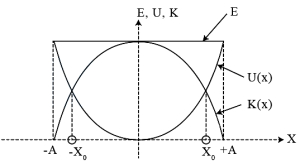
The variations of kinetic energy $K(x)$,potential energy $U(x)$,and total energy $E$ as a function of displacement $x$ of a particle in $SHM$ are as shown in the figure. The value of $|x_0|$ is
A
$2A$
B
$\frac{A}{\sqrt{2}}$
C
$\sqrt{2}A$
D
$\frac{A}{2}$
Solution
(B) In $SHM$,the kinetic energy $K(x)$ and potential energy $U(x)$ are given by:
$K(x) = \frac{1}{2}m\omega^2(A^2 - x^2)$
$U(x) = \frac{1}{2}m\omega^2x^2$
At the point $x = x_0$,the kinetic energy and potential energy are equal,i.e.,$K(x_0) = U(x_0)$.
$\frac{1}{2}m\omega^2(A^2 - x_0^2) = \frac{1}{2}m\omega^2x_0^2$
$A^2 - x_0^2 = x_0^2$
$A^2 = 2x_0^2$
$x_0^2 = \frac{A^2}{2}$
$|x_0| = \frac{A}{\sqrt{2}}$
$K(x) = \frac{1}{2}m\omega^2(A^2 - x^2)$
$U(x) = \frac{1}{2}m\omega^2x^2$
At the point $x = x_0$,the kinetic energy and potential energy are equal,i.e.,$K(x_0) = U(x_0)$.
$\frac{1}{2}m\omega^2(A^2 - x_0^2) = \frac{1}{2}m\omega^2x_0^2$
$A^2 - x_0^2 = x_0^2$
$A^2 = 2x_0^2$
$x_0^2 = \frac{A^2}{2}$
$|x_0| = \frac{A}{\sqrt{2}}$
0 likes
View Solution181
EasyMCQ
The ratio of kinetic energy to the potential energy of a particle executing $SHM$ at a distance equal to half its amplitude,the distance being measured from its equilibrium position,is:
A
$3:1$
B
$4:1$
C
$1:3$
D
$8:1$
Solution
(A) The kinetic energy $(KE)$ of a particle executing $SHM$ is given by:
$KE = \frac{1}{2} m \omega^{2} (A^{2} - y^{2})$
Given the distance $y = \frac{A}{2}$,where $A$ is the amplitude:
$KE = \frac{1}{2} m \omega^{2} (A^{2} - (\frac{A}{2})^{2}) = \frac{1}{2} m \omega^{2} (A^{2} - \frac{A^{2}}{4}) = \frac{1}{2} m \omega^{2} (\frac{3A^{2}}{4})$
The potential energy $(PE)$ of a particle executing $SHM$ is given by:
$PE = \frac{1}{2} m \omega^{2} y^{2}$
Substituting $y = \frac{A}{2}$:
$PE = \frac{1}{2} m \omega^{2} (\frac{A}{2})^{2} = \frac{1}{2} m \omega^{2} (\frac{A^{2}}{4})$
The ratio of kinetic energy to potential energy is:
$\frac{KE}{PE} = \frac{\frac{1}{2} m \omega^{2} (\frac{3A^{2}}{4})}{\frac{1}{2} m \omega^{2} (\frac{A^{2}}{4})} = \frac{3/4}{1/4} = 3$
Therefore,the ratio is $3:1$.
$KE = \frac{1}{2} m \omega^{2} (A^{2} - y^{2})$
Given the distance $y = \frac{A}{2}$,where $A$ is the amplitude:
$KE = \frac{1}{2} m \omega^{2} (A^{2} - (\frac{A}{2})^{2}) = \frac{1}{2} m \omega^{2} (A^{2} - \frac{A^{2}}{4}) = \frac{1}{2} m \omega^{2} (\frac{3A^{2}}{4})$
The potential energy $(PE)$ of a particle executing $SHM$ is given by:
$PE = \frac{1}{2} m \omega^{2} y^{2}$
Substituting $y = \frac{A}{2}$:
$PE = \frac{1}{2} m \omega^{2} (\frac{A}{2})^{2} = \frac{1}{2} m \omega^{2} (\frac{A^{2}}{4})$
The ratio of kinetic energy to potential energy is:
$\frac{KE}{PE} = \frac{\frac{1}{2} m \omega^{2} (\frac{3A^{2}}{4})}{\frac{1}{2} m \omega^{2} (\frac{A^{2}}{4})} = \frac{3/4}{1/4} = 3$
Therefore,the ratio is $3:1$.
0 likes
View Solution182
MediumMCQ
For a particle executing simple harmonic motion,the ratio of kinetic and potential energies at a point where displacement is one half of the amplitude is
A
$3: 1$
B
$1: 3$
C
$2: 1$
D
$1: 2$
Solution
(A) The potential energy $(U)$ of a particle in simple harmonic motion at displacement $x$ is given by $U = \frac{1}{2} k x^2$,where $k$ is the force constant.
Given that the displacement $x = \frac{A}{2}$,where $A$ is the amplitude,the potential energy is $U = \frac{1}{2} k (\frac{A}{2})^2 = \frac{1}{8} k A^2$.
The total energy $(E)$ of the particle is $E = \frac{1}{2} k A^2$.
The kinetic energy $(K)$ is given by $K = E - U = \frac{1}{2} k A^2 - \frac{1}{8} k A^2 = \frac{3}{8} k A^2$.
The ratio of kinetic energy to potential energy is $\frac{K}{U} = \frac{\frac{3}{8} k A^2}{\frac{1}{8} k A^2} = \frac{3}{1}$.
Thus,the ratio is $3: 1$.
Given that the displacement $x = \frac{A}{2}$,where $A$ is the amplitude,the potential energy is $U = \frac{1}{2} k (\frac{A}{2})^2 = \frac{1}{8} k A^2$.
The total energy $(E)$ of the particle is $E = \frac{1}{2} k A^2$.
The kinetic energy $(K)$ is given by $K = E - U = \frac{1}{2} k A^2 - \frac{1}{8} k A^2 = \frac{3}{8} k A^2$.
The ratio of kinetic energy to potential energy is $\frac{K}{U} = \frac{\frac{3}{8} k A^2}{\frac{1}{8} k A^2} = \frac{3}{1}$.
Thus,the ratio is $3: 1$.
0 likes
View Solution183
EasyMCQ
$A$ particle is executing simple harmonic motion with a time period of $3 \,s$. At a position where the displacement of the particle is $60 \%$ of its amplitude, the ratio of the kinetic and potential energies of the particle is
A
$5: 3$
B
$16: 9$
C
$4: 3$
D
$25: 9$
Solution
(B) Given: Time period $T = 3 \,s$, Displacement $x = 0.6 \,A$ (where $A$ is the amplitude).
The kinetic energy $(K.E.)$ of a particle in simple harmonic motion is given by $K.E. = \frac{1}{2} m \omega^2 (A^2 - x^2)$.
The potential energy $(P.E.)$ of the particle is given by $P.E. = \frac{1}{2} m \omega^2 x^2$.
The ratio of kinetic energy to potential energy is $\frac{K.E.}{P.E.} = \frac{\frac{1}{2} m \omega^2 (A^2 - x^2)}{\frac{1}{2} m \omega^2 x^2} = \frac{A^2 - x^2}{x^2} = \left(\frac{A}{x}\right)^2 - 1$.
Substituting $x = 0.6 \,A = \frac{6}{10} \,A = \frac{3}{5} \,A$, we get $\frac{A}{x} = \frac{5}{3}$.
Therefore, the ratio is $\left(\frac{5}{3}\right)^2 - 1 = \frac{25}{9} - 1 = \frac{25 - 9}{9} = \frac{16}{9}$.
The kinetic energy $(K.E.)$ of a particle in simple harmonic motion is given by $K.E. = \frac{1}{2} m \omega^2 (A^2 - x^2)$.
The potential energy $(P.E.)$ of the particle is given by $P.E. = \frac{1}{2} m \omega^2 x^2$.
The ratio of kinetic energy to potential energy is $\frac{K.E.}{P.E.} = \frac{\frac{1}{2} m \omega^2 (A^2 - x^2)}{\frac{1}{2} m \omega^2 x^2} = \frac{A^2 - x^2}{x^2} = \left(\frac{A}{x}\right)^2 - 1$.
Substituting $x = 0.6 \,A = \frac{6}{10} \,A = \frac{3}{5} \,A$, we get $\frac{A}{x} = \frac{5}{3}$.
Therefore, the ratio is $\left(\frac{5}{3}\right)^2 - 1 = \frac{25}{9} - 1 = \frac{25 - 9}{9} = \frac{16}{9}$.
0 likes
View Solution184
MediumMCQ
The mass of a particle is $1 \ kg$ and it is moving along the $x$-axis. The period of its oscillation is $\frac{\pi}{2} \ s$. Its potential energy at a displacement of $0.2 \ m$ is (in $J$)
A
$0.24$
B
$0.48$
C
$0.32$
D
$0.16$
Solution
(C) Given: Mass $m = 1 \ kg$,Period $T = \frac{\pi}{2} \ s$,Displacement $x = 0.2 \ m$.
Angular frequency $\omega = \frac{2\pi}{T} = \frac{2\pi}{\pi/2} = 4 \ rad/s$.
Potential energy $U$ of a simple harmonic oscillator is given by $U = \frac{1}{2} kx^2$.
Since $k = m\omega^2$,we have $U = \frac{1}{2} m\omega^2 x^2$.
Substituting the values: $U = \frac{1}{2} \times 1 \times (4)^2 \times (0.2)^2$.
$U = \frac{1}{2} \times 16 \times 0.04 = 8 \times 0.04 = 0.32 \ J$.
Angular frequency $\omega = \frac{2\pi}{T} = \frac{2\pi}{\pi/2} = 4 \ rad/s$.
Potential energy $U$ of a simple harmonic oscillator is given by $U = \frac{1}{2} kx^2$.
Since $k = m\omega^2$,we have $U = \frac{1}{2} m\omega^2 x^2$.
Substituting the values: $U = \frac{1}{2} \times 1 \times (4)^2 \times (0.2)^2$.
$U = \frac{1}{2} \times 16 \times 0.04 = 8 \times 0.04 = 0.32 \ J$.
0 likes
View Solution185
MediumMCQ
$A$ body is executing simple harmonic motion. At a displacement $x$,its potential energy is $E_1$ and at a displacement $y$,its potential energy is $E_2$. The potential energy $E$ at a displacement $(x+y)$ is
A
$\sqrt{E}=\sqrt{E_1}-\sqrt{E_2}$
B
$\sqrt{E}=\sqrt{E_1}+\sqrt{E_2}$
C
$E=E_1-E_2$
D
$E=E_1+E_2$
Solution
(B) For a body executing $SHM$,the potential energy $U$ at displacement $d$ is given by $U = \frac{1}{2} k d^2$.
Given:
$E_1 = \frac{1}{2} k x^2 \implies x = \sqrt{\frac{2 E_1}{k}}$
$E_2 = \frac{1}{2} k y^2 \implies y = \sqrt{\frac{2 E_2}{k}}$
The potential energy $E$ at displacement $(x+y)$ is:
$E = \frac{1}{2} k (x+y)^2$
$E = \frac{1}{2} k (x^2 + y^2 + 2xy)$
$E = \frac{1}{2} k x^2 + \frac{1}{2} k y^2 + 2 \left( \frac{1}{2} k x y \right)$
$E = E_1 + E_2 + 2 \sqrt{\left( \frac{1}{2} k x^2 \right) \left( \frac{1}{2} k y^2 \right)}$
$E = E_1 + E_2 + 2 \sqrt{E_1 E_2}$
$E = (\sqrt{E_1} + \sqrt{E_2})^2$
Taking the square root on both sides:
$\sqrt{E} = \sqrt{E_1} + \sqrt{E_2}$
Given:
$E_1 = \frac{1}{2} k x^2 \implies x = \sqrt{\frac{2 E_1}{k}}$
$E_2 = \frac{1}{2} k y^2 \implies y = \sqrt{\frac{2 E_2}{k}}$
The potential energy $E$ at displacement $(x+y)$ is:
$E = \frac{1}{2} k (x+y)^2$
$E = \frac{1}{2} k (x^2 + y^2 + 2xy)$
$E = \frac{1}{2} k x^2 + \frac{1}{2} k y^2 + 2 \left( \frac{1}{2} k x y \right)$
$E = E_1 + E_2 + 2 \sqrt{\left( \frac{1}{2} k x^2 \right) \left( \frac{1}{2} k y^2 \right)}$
$E = E_1 + E_2 + 2 \sqrt{E_1 E_2}$
$E = (\sqrt{E_1} + \sqrt{E_2})^2$
Taking the square root on both sides:
$\sqrt{E} = \sqrt{E_1} + \sqrt{E_2}$
0 likes
View Solution186
EasyMCQ
The displacement of a particle of mass $2 \text{ g}$ executing simple harmonic motion is $x = 8 \cos \left(50 t + \frac{\pi}{12}\right) \text{ m}$,where $t$ is time in seconds. The maximum kinetic energy of the particle is (in $\text{ J}$)
A
$160$
B
$80$
C
$40$
D
$20$
Solution
(A) Given mass $m = 2 \text{ g} = 2 \times 10^{-3} \text{ kg}$.
The displacement equation is $x = 8 \cos \left(50 t + \frac{\pi}{12}\right) \text{ m}$.
Comparing this with the standard $SHM$ equation $x = A \cos(\omega t + \phi)$,we get amplitude $A = 8 \text{ m}$ and angular frequency $\omega = 50 \text{ rad/s}$.
The maximum velocity of the particle is $v_{\max} = A \omega = 8 \times 50 = 400 \text{ m/s}$.
The maximum kinetic energy is given by $(K.E.)_{\max} = \frac{1}{2} m v_{\max}^2$.
Substituting the values: $(K.E.)_{\max} = \frac{1}{2} \times (2 \times 10^{-3} \text{ kg}) \times (400 \text{ m/s})^2$.
$(K.E.)_{\max} = 10^{-3} \times 160000 = 160 \text{ J}$.
The displacement equation is $x = 8 \cos \left(50 t + \frac{\pi}{12}\right) \text{ m}$.
Comparing this with the standard $SHM$ equation $x = A \cos(\omega t + \phi)$,we get amplitude $A = 8 \text{ m}$ and angular frequency $\omega = 50 \text{ rad/s}$.
The maximum velocity of the particle is $v_{\max} = A \omega = 8 \times 50 = 400 \text{ m/s}$.
The maximum kinetic energy is given by $(K.E.)_{\max} = \frac{1}{2} m v_{\max}^2$.
Substituting the values: $(K.E.)_{\max} = \frac{1}{2} \times (2 \times 10^{-3} \text{ kg}) \times (400 \text{ m/s})^2$.
$(K.E.)_{\max} = 10^{-3} \times 160000 = 160 \text{ J}$.
0 likes
View Solution187
EasyMCQ
An object of mass $3 \,kg$ is executing simple harmonic motion with an amplitude $\frac{2}{\pi} \,m$. If the kinetic energy of the object when it crosses the mean position is $6 \,J$, the time period of oscillation of the object is (in $\,s$)
A
$1$
B
$2$
C
$3$
D
$4$
Solution
(B) Given: Mass $m = 3 \,kg$, Amplitude $A = \frac{2}{\pi} \,m$, Kinetic energy at mean position $K_{max} = 6 \,J$.
At the mean position, the kinetic energy is equal to the total energy of the simple harmonic oscillator: $K_{max} = \frac{1}{2} m \omega^2 A^2 = 6 \,J$.
Substituting $\omega = \frac{2\pi}{T}$, we get: $\frac{1}{2} m (\frac{2\pi}{T})^2 A^2 = 6$.
$\frac{1}{2} \times 3 \times \frac{4\pi^2}{T^2} \times (\frac{2}{\pi})^2 = 6$.
$\frac{1}{2} \times 3 \times \frac{4\pi^2}{T^2} \times \frac{4}{\pi^2} = 6$.
$6 \times \frac{4}{T^2} = 6$.
$T^2 = 4$, which gives $T = 2 \,s$.
At the mean position, the kinetic energy is equal to the total energy of the simple harmonic oscillator: $K_{max} = \frac{1}{2} m \omega^2 A^2 = 6 \,J$.
Substituting $\omega = \frac{2\pi}{T}$, we get: $\frac{1}{2} m (\frac{2\pi}{T})^2 A^2 = 6$.
$\frac{1}{2} \times 3 \times \frac{4\pi^2}{T^2} \times (\frac{2}{\pi})^2 = 6$.
$\frac{1}{2} \times 3 \times \frac{4\pi^2}{T^2} \times \frac{4}{\pi^2} = 6$.
$6 \times \frac{4}{T^2} = 6$.
$T^2 = 4$, which gives $T = 2 \,s$.
0 likes
View Solution188
MediumMCQ
The equation of motion of a particle executing simple harmonic motion is given by $x=3 \sin \left(6 t+\frac{\pi}{6}\right)$,where $x$ is in metres and $t$ is in seconds. The ratio of the potential and kinetic energies of the particle at time $t=0$ is
A
$1: 1$
B
$1: 4$
C
$1: 2$
D
$1: 3$
Solution
(D) The equation of motion is $x=3 \sin \left(6 t+\frac{\pi}{6}\right)$,where amplitude $A=3 \ m$.
At time $t=0$,the displacement is $x=3 \sin \left(\frac{\pi}{6}\right) = 3 \times \frac{1}{2} = 1.5 \ m$.
The potential energy $V$ is given by $V = \frac{1}{2} k x^2$.
The kinetic energy $K$ is given by $K = \frac{1}{2} k (A^2 - x^2)$.
The ratio of potential energy to kinetic energy is $\frac{V}{K} = \frac{\frac{1}{2} k x^2}{\frac{1}{2} k (A^2 - x^2)} = \frac{x^2}{A^2 - x^2}$.
Substituting the values $x=1.5$ and $A=3$:
$\frac{V}{K} = \frac{(1.5)^2}{3^2 - (1.5)^2} = \frac{2.25}{9 - 2.25} = \frac{2.25}{6.75} = \frac{1}{3}$.
Thus,the ratio is $1:3$.
At time $t=0$,the displacement is $x=3 \sin \left(\frac{\pi}{6}\right) = 3 \times \frac{1}{2} = 1.5 \ m$.
The potential energy $V$ is given by $V = \frac{1}{2} k x^2$.
The kinetic energy $K$ is given by $K = \frac{1}{2} k (A^2 - x^2)$.
The ratio of potential energy to kinetic energy is $\frac{V}{K} = \frac{\frac{1}{2} k x^2}{\frac{1}{2} k (A^2 - x^2)} = \frac{x^2}{A^2 - x^2}$.
Substituting the values $x=1.5$ and $A=3$:
$\frac{V}{K} = \frac{(1.5)^2}{3^2 - (1.5)^2} = \frac{2.25}{9 - 2.25} = \frac{2.25}{6.75} = \frac{1}{3}$.
Thus,the ratio is $1:3$.
0 likes
View Solution189
EasyMCQ
$A$ body is executing $S.H.M$. At a displacement $x$ its potential energy is $9 \ J$ and at a displacement $y$ its potential energy is $16 \ J$. The potential energy at displacement $(x+y)$ is (in $J$)
A
$25$
B
$5$
C
$49$
D
$7$
Solution
(C) The potential energy $U$ of a body executing $S.H.M.$ at displacement $x$ is given by $U = \frac{1}{2} k x^2$,where $k$ is the force constant.
Given:
$U_x = \frac{1}{2} k x^2 = 9 \ J$ --- $(1)$
$U_y = \frac{1}{2} k y^2 = 16 \ J$ --- $(2)$
We need to find the potential energy at displacement $(x+y)$,which is $U_{(x+y)} = \frac{1}{2} k (x+y)^2$.
Expanding this,we get:
$U_{(x+y)} = \frac{1}{2} k (x^2 + y^2 + 2xy) = \frac{1}{2} k x^2 + \frac{1}{2} k y^2 + 2 \left( \sqrt{\frac{1}{2} k x^2} \right) \left( \sqrt{\frac{1}{2} k y^2} \right)$.
Substituting the given values:
$U_{(x+y)} = 9 + 16 + 2 \times \sqrt{9} \times \sqrt{16}$
$U_{(x+y)} = 25 + 2 \times 3 \times 4$
$U_{(x+y)} = 25 + 24 = 49 \ J$.
Given:
$U_x = \frac{1}{2} k x^2 = 9 \ J$ --- $(1)$
$U_y = \frac{1}{2} k y^2 = 16 \ J$ --- $(2)$
We need to find the potential energy at displacement $(x+y)$,which is $U_{(x+y)} = \frac{1}{2} k (x+y)^2$.
Expanding this,we get:
$U_{(x+y)} = \frac{1}{2} k (x^2 + y^2 + 2xy) = \frac{1}{2} k x^2 + \frac{1}{2} k y^2 + 2 \left( \sqrt{\frac{1}{2} k x^2} \right) \left( \sqrt{\frac{1}{2} k y^2} \right)$.
Substituting the given values:
$U_{(x+y)} = 9 + 16 + 2 \times \sqrt{9} \times \sqrt{16}$
$U_{(x+y)} = 25 + 2 \times 3 \times 4$
$U_{(x+y)} = 25 + 24 = 49 \ J$.
0 likes
View Solution190
EasyMCQ
$A$ particle undergoing simple harmonic motion has an amplitude of $10 \ cm$. When the particle is at a displacement of $6 \ cm$ from the centre,then the ratio of its kinetic energy to potential energy is
A
$3: 2$
B
$9: 4$
C
$16: 9$
D
$4: 3$
Solution
(C) The amplitude of the particle performing $SHM$ is $A = 10 \ cm$.
The instantaneous displacement of the particle is $x = 6 \ cm$.
The kinetic energy $(K)$ of the particle is given by $K = \frac{1}{2} m \omega^2 (A^2 - x^2)$.
The potential energy $(U)$ of the particle is given by $U = \frac{1}{2} m \omega^2 x^2$.
The ratio of kinetic energy to potential energy is $\frac{K}{U} = \frac{\frac{1}{2} m \omega^2 (A^2 - x^2)}{\frac{1}{2} m \omega^2 x^2} = \frac{A^2 - x^2}{x^2}$.
Substituting the values,we get $\frac{K}{U} = \frac{10^2 - 6^2}{6^2} = \frac{100 - 36}{36} = \frac{64}{36}$.
Simplifying the fraction,$\frac{K}{U} = \frac{16}{9}$.
Thus,the ratio of kinetic energy to potential energy is $16: 9$.
The instantaneous displacement of the particle is $x = 6 \ cm$.
The kinetic energy $(K)$ of the particle is given by $K = \frac{1}{2} m \omega^2 (A^2 - x^2)$.
The potential energy $(U)$ of the particle is given by $U = \frac{1}{2} m \omega^2 x^2$.
The ratio of kinetic energy to potential energy is $\frac{K}{U} = \frac{\frac{1}{2} m \omega^2 (A^2 - x^2)}{\frac{1}{2} m \omega^2 x^2} = \frac{A^2 - x^2}{x^2}$.
Substituting the values,we get $\frac{K}{U} = \frac{10^2 - 6^2}{6^2} = \frac{100 - 36}{36} = \frac{64}{36}$.
Simplifying the fraction,$\frac{K}{U} = \frac{16}{9}$.
Thus,the ratio of kinetic energy to potential energy is $16: 9$.
0 likes
View Solution191
DifficultMCQ
Assertion $(A)$: In $S.H.M$,kinetic and potential energy become equal when the distance is $1/\sqrt{2}$ times its amplitude. Reason $(R)$: The potential energy of a particle executing $S.H.M$ is periodic with time period being maximum at the extreme displacement.
A
$A$ and $R$ are true. $R$ is the correct explanation of $A$.
B
$A$ and $R$ are true. $R$ is not the correct explanation of $A$.
C
$A$ is true,but $R$ is false.
D
$A$ is false,but $R$ is true.
Solution
(B) In $S.H.M$,the kinetic energy $(K.E)$ and potential energy $(P.E)$ are given by:
$K.E = \frac{1}{2} m \omega^2 (a^2 - y^2)$
$P.E = \frac{1}{2} m \omega^2 y^2$
where $a$ is the amplitude and $y$ is the displacement.
For $K.E = P.E$:
$\frac{1}{2} m \omega^2 (a^2 - y^2) = \frac{1}{2} m \omega^2 y^2$
$a^2 - y^2 = y^2$
$a^2 = 2y^2$
$y = \pm \frac{a}{\sqrt{2}}$
Thus,Assertion $(A)$ is true.
Regarding Reason $(R)$,the potential energy of a particle in $S.H.M$ is indeed periodic and reaches its maximum value at the extreme displacement $(y = \pm a)$. However,this statement does not explain why the kinetic and potential energies are equal at $y = a/\sqrt{2}$. Therefore,both are true,but $(R)$ is not the correct explanation of $(A)$.
$K.E = \frac{1}{2} m \omega^2 (a^2 - y^2)$
$P.E = \frac{1}{2} m \omega^2 y^2$
where $a$ is the amplitude and $y$ is the displacement.
For $K.E = P.E$:
$\frac{1}{2} m \omega^2 (a^2 - y^2) = \frac{1}{2} m \omega^2 y^2$
$a^2 - y^2 = y^2$
$a^2 = 2y^2$
$y = \pm \frac{a}{\sqrt{2}}$
Thus,Assertion $(A)$ is true.
Regarding Reason $(R)$,the potential energy of a particle in $S.H.M$ is indeed periodic and reaches its maximum value at the extreme displacement $(y = \pm a)$. However,this statement does not explain why the kinetic and potential energies are equal at $y = a/\sqrt{2}$. Therefore,both are true,but $(R)$ is not the correct explanation of $(A)$.
0 likes
View Solution192
EasyMCQ
$A$ particle executing simple harmonic motion along a straight line with an amplitude $A$,attains maximum potential energy when its displacement from the mean position equals
A
$0$
B
$\pm \frac{A}{\sqrt{2}}$
C
$\pm A$
D
$\pm \frac{A}{2}$
Solution
(C) The potential energy $U$ of a particle executing simple harmonic motion is given by $U = \frac{1}{2} k x^2$,where $k$ is the force constant and $x$ is the displacement from the mean position.
For the potential energy to be maximum,the displacement $x$ must be at its maximum value.
In simple harmonic motion,the maximum displacement from the mean position is equal to the amplitude $A$.
Therefore,the potential energy is maximum at the extreme positions,which are $x = \pm A$.
For the potential energy to be maximum,the displacement $x$ must be at its maximum value.
In simple harmonic motion,the maximum displacement from the mean position is equal to the amplitude $A$.
Therefore,the potential energy is maximum at the extreme positions,which are $x = \pm A$.
0 likes
View Solution193
EasyMCQ
The displacement of a simple harmonic motion of amplitude $6 \text{ cm}$ when its kinetic energy is equal to its potential energy is:
A
$2 \sqrt{2} \text{ cm}$
B
$2 \text{ cm}$
C
$3 \sqrt{2} \text{ cm}$
D
$\frac{3}{\sqrt{2}} \text{ cm}$
Solution
(C) Given,amplitude of oscillation,$a = 6 \text{ cm}$.
Let the displacement be $x \text{ cm}$.
When the kinetic energy $(K)$ is equal to the potential energy $(U)$,we have $K = U$.
The kinetic energy of a simple harmonic oscillator is given by $K = \frac{1}{2} m \omega^2 (a^2 - x^2)$.
The potential energy is given by $U = \frac{1}{2} m \omega^2 x^2$.
Equating the two:
$\frac{1}{2} m \omega^2 (a^2 - x^2) = \frac{1}{2} m \omega^2 x^2$
$a^2 - x^2 = x^2$
$2x^2 = a^2$
$x^2 = \frac{a^2}{2}$
$x = \frac{a}{\sqrt{2}}$
Substituting $a = 6 \text{ cm}$:
$x = \frac{6}{\sqrt{2}} = 3 \sqrt{2} \text{ cm}$.
Let the displacement be $x \text{ cm}$.
When the kinetic energy $(K)$ is equal to the potential energy $(U)$,we have $K = U$.
The kinetic energy of a simple harmonic oscillator is given by $K = \frac{1}{2} m \omega^2 (a^2 - x^2)$.
The potential energy is given by $U = \frac{1}{2} m \omega^2 x^2$.
Equating the two:
$\frac{1}{2} m \omega^2 (a^2 - x^2) = \frac{1}{2} m \omega^2 x^2$
$a^2 - x^2 = x^2$
$2x^2 = a^2$
$x^2 = \frac{a^2}{2}$
$x = \frac{a}{\sqrt{2}}$
Substituting $a = 6 \text{ cm}$:
$x = \frac{6}{\sqrt{2}} = 3 \sqrt{2} \text{ cm}$.
0 likes
View Solution194
EasyMCQ
$A$ body executes simple harmonic motion with an amplitude $A$. At what displacement,from the mean position,is the potential energy of the body one fourth of its total energy?
A
$A/4$
B
$A/2$
C
$3A/4$
D
$3A$
Solution
(B) The potential energy $(U)$ of a body in simple harmonic motion at displacement $y$ is given by $U = \frac{1}{2} m \omega^2 y^2$.
The total energy $(E)$ of the body is $E = \frac{1}{2} m \omega^2 A^2$.
According to the problem,the potential energy is one-fourth of the total energy:
$U = \frac{1}{4} E$
Substituting the expressions for $U$ and $E$:
$\frac{1}{2} m \omega^2 y^2 = \frac{1}{4} \left( \frac{1}{2} m \omega^2 A^2 \right)$
Canceling the common terms $\frac{1}{2} m \omega^2$ from both sides:
$y^2 = \frac{A^2}{4}$
Taking the square root of both sides:
$y = \pm \frac{A}{2}$
Thus,at a displacement of $A/2$ from the mean position,the potential energy is one-fourth of the total energy.
The total energy $(E)$ of the body is $E = \frac{1}{2} m \omega^2 A^2$.
According to the problem,the potential energy is one-fourth of the total energy:
$U = \frac{1}{4} E$
Substituting the expressions for $U$ and $E$:
$\frac{1}{2} m \omega^2 y^2 = \frac{1}{4} \left( \frac{1}{2} m \omega^2 A^2 \right)$
Canceling the common terms $\frac{1}{2} m \omega^2$ from both sides:
$y^2 = \frac{A^2}{4}$
Taking the square root of both sides:
$y = \pm \frac{A}{2}$
Thus,at a displacement of $A/2$ from the mean position,the potential energy is one-fourth of the total energy.
0 likes
View Solution195
EasyMCQ
The kinetic energy,$K$ of a body performing simple harmonic motion varies with time $t$,is indicated in graph
A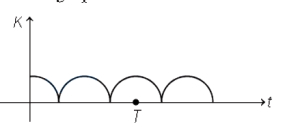
B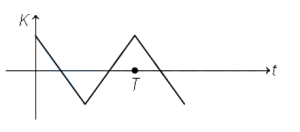
C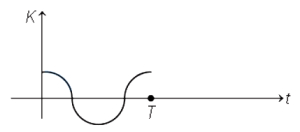
D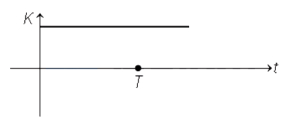
Solution
(A) The kinetic energy $K$ of a body performing simple harmonic motion is given by the formula:
$K = \frac{1}{2} m v^2$
where $v$ is the velocity of the body.
If the displacement is $y = a \sin \omega t$,then the velocity is:
$v = \frac{dy}{dt} = a \omega \cos \omega t$
Substituting this into the kinetic energy expression:
$K = \frac{1}{2} m (a \omega \cos \omega t)^2 = \frac{1}{2} m a^2 \omega^2 \cos^2 \omega t$
Using the trigonometric identity $\cos^2 \theta = \frac{1 + \cos 2\theta}{2}$,we get:
$K = \frac{1}{2} m a^2 \omega^2 \left( \frac{1 + \cos 2\omega t}{2} \right) = \frac{1}{4} m a^2 \omega^2 (1 + \cos 2\omega t)$
This expression shows that the kinetic energy $K$ is always non-negative and varies with a frequency double that of the simple harmonic motion (i.e.,frequency $2\omega$). The graph in option $A$ correctly represents this periodic variation,where $K$ oscillates between $0$ and a maximum value with a period of $T/2$.
$K = \frac{1}{2} m v^2$
where $v$ is the velocity of the body.
If the displacement is $y = a \sin \omega t$,then the velocity is:
$v = \frac{dy}{dt} = a \omega \cos \omega t$
Substituting this into the kinetic energy expression:
$K = \frac{1}{2} m (a \omega \cos \omega t)^2 = \frac{1}{2} m a^2 \omega^2 \cos^2 \omega t$
Using the trigonometric identity $\cos^2 \theta = \frac{1 + \cos 2\theta}{2}$,we get:
$K = \frac{1}{2} m a^2 \omega^2 \left( \frac{1 + \cos 2\omega t}{2} \right) = \frac{1}{4} m a^2 \omega^2 (1 + \cos 2\omega t)$
This expression shows that the kinetic energy $K$ is always non-negative and varies with a frequency double that of the simple harmonic motion (i.e.,frequency $2\omega$). The graph in option $A$ correctly represents this periodic variation,where $K$ oscillates between $0$ and a maximum value with a period of $T/2$.
0 likes
View Solution196
EasyMCQ
The potential energy of a simple harmonic oscillator of mass $2 \,kg$ at its mean position is $5 \,J$. If its total energy is $9 \,J$ and amplitude is $1 \,cm$, then its time period is
A
$\frac{\pi}{100} \,s$
B
$\frac{\pi}{50} \,s$
C
$\frac{\pi}{20} \,s$
D
$\frac{\pi}{10} \,s$
Solution
(A) Given: Total energy $E = 9 \,J$, Potential energy at mean position $U_{mean} = 5 \,J$, Mass $m = 2 \,kg$, Amplitude $A = 1 \,cm = 10^{-2} \,m$.
The total energy of an $SHM$ is the sum of kinetic and potential energy. At the mean position, the potential energy is $U_{mean} = 5 \,J$.
Therefore, the maximum kinetic energy $K_{max}$ at the mean position is $K_{max} = E - U_{mean} = 9 \,J - 5 \,J = 4 \,J$.
In $SHM$, the maximum kinetic energy is equal to the maximum potential energy at the extreme position, which is given by $\frac{1}{2} k A^2$.
So, $\frac{1}{2} k A^2 = 4 \,J$.
Substituting $A = 10^{-2} \,m$:
$\frac{1}{2} k (10^{-2})^2 = 4 \implies \frac{1}{2} k (10^{-4}) = 4 \implies k = 8 \times 10^4 \,N/m$.
The time period $T$ is given by $T = 2 \pi \sqrt{\frac{m}{k}}$.
Substituting the values:
$T = 2 \pi \sqrt{\frac{2}{8 \times 10^4}} = 2 \pi \sqrt{\frac{1}{4 \times 10^4}} = 2 \pi \times \frac{1}{2 \times 10^2} = \frac{\pi}{100} \,s$.
The total energy of an $SHM$ is the sum of kinetic and potential energy. At the mean position, the potential energy is $U_{mean} = 5 \,J$.
Therefore, the maximum kinetic energy $K_{max}$ at the mean position is $K_{max} = E - U_{mean} = 9 \,J - 5 \,J = 4 \,J$.
In $SHM$, the maximum kinetic energy is equal to the maximum potential energy at the extreme position, which is given by $\frac{1}{2} k A^2$.
So, $\frac{1}{2} k A^2 = 4 \,J$.
Substituting $A = 10^{-2} \,m$:
$\frac{1}{2} k (10^{-2})^2 = 4 \implies \frac{1}{2} k (10^{-4}) = 4 \implies k = 8 \times 10^4 \,N/m$.
The time period $T$ is given by $T = 2 \pi \sqrt{\frac{m}{k}}$.
Substituting the values:
$T = 2 \pi \sqrt{\frac{2}{8 \times 10^4}} = 2 \pi \sqrt{\frac{1}{4 \times 10^4}} = 2 \pi \times \frac{1}{2 \times 10^2} = \frac{\pi}{100} \,s$.
0 likes
View Solution197
EasyMCQ
The displacement of a particle of mass $2 \,g$ executing $SHM$ is given by $y=5 \sin \left(4 t+\frac{\pi}{3}\right)$. Here,$y$ is in metres and $t$ is in seconds. The kinetic energy of the particle,when $t=\frac{T}{4}$ is (in $\,J$)
A
$0.4$
B
$0.5$
C
$3$
D
$0.3$
Solution
(D) Given,$y=5 \sin \left(4 t+\frac{\pi}{3}\right)$.
Comparing with $y=A \sin (\omega t+\phi)$,we get angular frequency $\omega = 4 \,rad/s$.
The mass of the particle is $m = 2 \,g = 2 \times 10^{-3} \,kg$.
The velocity of the particle is $v = \frac{dy}{dt} = 5 \times 4 \cos \left(4 t+\frac{\pi}{3}\right) = 20 \cos \left(4 t+\frac{\pi}{3}\right) \,m/s$.
At $t = \frac{T}{4}$,where $T = \frac{2\pi}{\omega} = \frac{2\pi}{4} = \frac{\pi}{2} \,s$,we have $t = \frac{\pi}{8} \,s$.
Substituting $t = \frac{\pi}{8}$ in the velocity equation:
$v = 20 \cos \left(4 \times \frac{\pi}{8} + \frac{\pi}{3}\right) = 20 \cos \left(\frac{\pi}{2} + \frac{\pi}{3}\right) = 20 \cos \left(\frac{5\pi}{6}\right)$.
Since $\cos(150^{\circ}) = -\frac{\sqrt{3}}{2}$,we get $v = 20 \times \left(-\frac{\sqrt{3}}{2}\right) = -10\sqrt{3} \,m/s$.
The kinetic energy $K = \frac{1}{2} mv^2 = \frac{1}{2} \times (2 \times 10^{-3}) \times (-10\sqrt{3})^2$.
$K = 10^{-3} \times 100 \times 3 = 300 \times 10^{-3} = 0.3 \,J$.
Comparing with $y=A \sin (\omega t+\phi)$,we get angular frequency $\omega = 4 \,rad/s$.
The mass of the particle is $m = 2 \,g = 2 \times 10^{-3} \,kg$.
The velocity of the particle is $v = \frac{dy}{dt} = 5 \times 4 \cos \left(4 t+\frac{\pi}{3}\right) = 20 \cos \left(4 t+\frac{\pi}{3}\right) \,m/s$.
At $t = \frac{T}{4}$,where $T = \frac{2\pi}{\omega} = \frac{2\pi}{4} = \frac{\pi}{2} \,s$,we have $t = \frac{\pi}{8} \,s$.
Substituting $t = \frac{\pi}{8}$ in the velocity equation:
$v = 20 \cos \left(4 \times \frac{\pi}{8} + \frac{\pi}{3}\right) = 20 \cos \left(\frac{\pi}{2} + \frac{\pi}{3}\right) = 20 \cos \left(\frac{5\pi}{6}\right)$.
Since $\cos(150^{\circ}) = -\frac{\sqrt{3}}{2}$,we get $v = 20 \times \left(-\frac{\sqrt{3}}{2}\right) = -10\sqrt{3} \,m/s$.
The kinetic energy $K = \frac{1}{2} mv^2 = \frac{1}{2} \times (2 \times 10^{-3}) \times (-10\sqrt{3})^2$.
$K = 10^{-3} \times 100 \times 3 = 300 \times 10^{-3} = 0.3 \,J$.
0 likes
View Solution198
EasyMCQ
$A$ particle starting from mean position executes simple harmonic motion with a period $8 \ s$. The minimum time in which its potential energy becomes half of the total energy is . . . . . . . (in $s$)
A
$8$
B
$4$
C
$1$
D
$0.5$
Solution
(C) The potential energy $(U)$ of a particle in simple harmonic motion is given by $U = \frac{1}{2} k x^2$,where $x = A \sin(\omega t)$.
The total energy $(E)$ is given by $E = \frac{1}{2} k A^2$.
We are given that $U = \frac{1}{2} E$.
Substituting the expressions,we get $\frac{1}{2} k (A \sin(\omega t))^2 = \frac{1}{2} (\frac{1}{2} k A^2)$.
This simplifies to $\sin^2(\omega t) = \frac{1}{2}$,which means $\sin(\omega t) = \frac{1}{\sqrt{2}}$.
Thus,$\omega t = \frac{\pi}{4}$.
Given the period $T = 8 \ s$,the angular frequency is $\omega = \frac{2\pi}{T} = \frac{2\pi}{8} = \frac{\pi}{4} \ rad/s$.
Substituting $\omega$ into the equation: $(\frac{\pi}{4}) t = \frac{\pi}{4}$.
Therefore,$t = 1 \ s$.
The total energy $(E)$ is given by $E = \frac{1}{2} k A^2$.
We are given that $U = \frac{1}{2} E$.
Substituting the expressions,we get $\frac{1}{2} k (A \sin(\omega t))^2 = \frac{1}{2} (\frac{1}{2} k A^2)$.
This simplifies to $\sin^2(\omega t) = \frac{1}{2}$,which means $\sin(\omega t) = \frac{1}{\sqrt{2}}$.
Thus,$\omega t = \frac{\pi}{4}$.
Given the period $T = 8 \ s$,the angular frequency is $\omega = \frac{2\pi}{T} = \frac{2\pi}{8} = \frac{\pi}{4} \ rad/s$.
Substituting $\omega$ into the equation: $(\frac{\pi}{4}) t = \frac{\pi}{4}$.
Therefore,$t = 1 \ s$.
0 likes
View Solution199
MediumMCQ
The kinetic energy of a particle executing simple harmonic motion at a displacement of $3 \ cm$ from the mean position is $4 \ mJ$. If the amplitude of the particle is $5 \ cm$,then the maximum force acting on the particle is (in $N$)
A
$0.25$
B
$0.50$
C
$0.75$
D
$1.25$
Solution
(A) The kinetic energy $(K)$ of a particle in simple harmonic motion is given by $K = \frac{1}{2} k(A^2 - x^2)$,where $k$ is the force constant,$A$ is the amplitude,and $x$ is the displacement.
Given: $x = 3 \ cm = 0.03 \ m$,$A = 5 \ cm = 0.05 \ m$,and $K = 4 \ mJ = 4 \times 10^{-3} \ J$.
Substituting the values: $4 \times 10^{-3} = \frac{1}{2} k((0.05)^2 - (0.03)^2)$.
$4 \times 10^{-3} = \frac{1}{2} k(0.0025 - 0.0009) = \frac{1}{2} k(0.0016) = 0.0008 k$.
$k = \frac{4 \times 10^{-3}}{8 \times 10^{-4}} = 5 \ N/m$.
The maximum force acting on the particle is $F_{max} = kA$.
$F_{max} = 5 \times 0.05 = 0.25 \ N$.
Given: $x = 3 \ cm = 0.03 \ m$,$A = 5 \ cm = 0.05 \ m$,and $K = 4 \ mJ = 4 \times 10^{-3} \ J$.
Substituting the values: $4 \times 10^{-3} = \frac{1}{2} k((0.05)^2 - (0.03)^2)$.
$4 \times 10^{-3} = \frac{1}{2} k(0.0025 - 0.0009) = \frac{1}{2} k(0.0016) = 0.0008 k$.
$k = \frac{4 \times 10^{-3}}{8 \times 10^{-4}} = 5 \ N/m$.
The maximum force acting on the particle is $F_{max} = kA$.
$F_{max} = 5 \times 0.05 = 0.25 \ N$.
0 likes
View SolutionOscillations — Energy of Simple Harmonic Motion · Frequently Asked Questions
1Are these Oscillations questions useful for JEE and NEET?
Yes. All questions in this section are mapped to JEE Main and NEET exam patterns. Previous year questions from JEE Main, NEET, GUJCET and state-level exams are included with full solutions.
2Can I switch to Hindi or Gujarati for these questions?
Yes. Use the language tabs in the hero section or the sidebar to view the same questions and solutions in English, Hindi or Gujarati.
3How do I generate a question paper from this subtopic?
Use the Vedclass Exam Paper Generator — select the chapter and subtopic, set difficulty, and generate Sets A, B, C, D automatically. First 3 chapters of every subject are free.
Vedclass Products
For Students
Vedclass Test Series
Mock tests in real JEE/NEET style with performance analysis. 5-day free trial.
Start Free TrialFor Teachers
Exam Paper Generator
Generate Set A/B/C/D papers from this chapter in 2 minutes. 3 chapters free.
Try FreeFor Institutes
Online Exam Module
Live online exams with unlimited students, 360° analytics & white-label branding.
See DemoFor Teachers & Institutes
Generate a Oscillations Exam Paper in 2 Minutes
Select subtopic & difficulty — Sets A, B, C, D auto-generated with No Repeat logic.
First 3 chapters of every subject are free — no payment required.