
A English
Energy of Simple Harmonic Motion Questions in English
Class 11 Physics · Oscillations · Energy of Simple Harmonic Motion
224+
Questions
English
Language
100%
With Solutions
Showing 48 of 224 questions in English
51
DifficultMCQ
$A$ linear harmonic oscillator of force constant $2 \times 10^6 \, N/m$ and amplitude $0.01 \, m$ has a total mechanical energy of $160 \, J$. Its
A
maximum potential energy is $100 \, J$
B
maximum kinetic energy is $100 \, J$
C
maximum potential energy is $160 \, J$
D
$(B)$ and $(C)$ both
Solution
(D) Given:
Amplitude $A = 0.01 \, m = 10^{-2} \, m$
Force constant $k = 2 \times 10^6 \, N/m$
Total mechanical energy $E_T = 160 \, J$
The maximum kinetic energy $(K.E.)_{\max}$ of a linear harmonic oscillator is given by:
$(K.E.)_{\max} = \frac{1}{2} k A^2$
$(K.E.)_{\max} = \frac{1}{2} \times (2 \times 10^6) \times (10^{-2})^2$
$(K.E.)_{\max} = 10^6 \times 10^{-4} = 100 \, J$
In a linear harmonic oscillator,the total mechanical energy $E_T$ is equal to the maximum potential energy $(P.E.)_{\max}$ (when kinetic energy is zero at extreme positions) and also equal to the maximum kinetic energy $(K.E.)_{\max}$ (when potential energy is zero at the mean position,assuming $P.E. = 0$ at the mean position).
However,here $E_T = 160 \, J$ and $(K.E.)_{\max} = 100 \, J$. This implies that the potential energy at the mean position is not zero.
Since $E_T = (K.E.)_{\max} + (P.E.)_{\min}$,we have $160 = 100 + (P.E.)_{\min}$,so $(P.E.)_{\min} = 60 \, J$.
The maximum potential energy $(P.E.)_{\max}$ occurs at the extreme positions where kinetic energy is zero,so $(P.E.)_{\max} = E_T = 160 \, J$.
Thus,both statements $(B)$ and $(C)$ are correct.
Amplitude $A = 0.01 \, m = 10^{-2} \, m$
Force constant $k = 2 \times 10^6 \, N/m$
Total mechanical energy $E_T = 160 \, J$
The maximum kinetic energy $(K.E.)_{\max}$ of a linear harmonic oscillator is given by:
$(K.E.)_{\max} = \frac{1}{2} k A^2$
$(K.E.)_{\max} = \frac{1}{2} \times (2 \times 10^6) \times (10^{-2})^2$
$(K.E.)_{\max} = 10^6 \times 10^{-4} = 100 \, J$
In a linear harmonic oscillator,the total mechanical energy $E_T$ is equal to the maximum potential energy $(P.E.)_{\max}$ (when kinetic energy is zero at extreme positions) and also equal to the maximum kinetic energy $(K.E.)_{\max}$ (when potential energy is zero at the mean position,assuming $P.E. = 0$ at the mean position).
However,here $E_T = 160 \, J$ and $(K.E.)_{\max} = 100 \, J$. This implies that the potential energy at the mean position is not zero.
Since $E_T = (K.E.)_{\max} + (P.E.)_{\min}$,we have $160 = 100 + (P.E.)_{\min}$,so $(P.E.)_{\min} = 60 \, J$.
The maximum potential energy $(P.E.)_{\max}$ occurs at the extreme positions where kinetic energy is zero,so $(P.E.)_{\max} = E_T = 160 \, J$.
Thus,both statements $(B)$ and $(C)$ are correct.
0 likes
View Solution52
DifficultMCQ
Starting from the origin,a body oscillates simple harmonically with a period of $2 \ s$. After what time will its kinetic energy be $75\%$ of the total energy?
A
$\frac{1}{12} \ s$
B
$\frac{1}{6} \ s$
C
$\frac{1}{4} \ s$
D
$\frac{1}{3} \ s$
Solution
(B) The displacement of a body starting from the origin in $SHM$ is given by $x = A \sin(\omega t)$.
Velocity is $v = \frac{dx}{dt} = A \omega \cos(\omega t)$.
Kinetic Energy $(K.E.)$ is given by $K.E. = \frac{1}{2} m v^2 = \frac{1}{2} m A^2 \omega^2 \cos^2(\omega t)$.
Total Energy $(T.E.)$ is given by $T.E. = \frac{1}{2} m A^2 \omega^2$.
Given that $K.E. = 75\% \text{ of } T.E. = 0.75 \ T.E.$
Substituting the expressions: $\frac{1}{2} m A^2 \omega^2 \cos^2(\omega t) = 0.75 \times \frac{1}{2} m A^2 \omega^2$.
$\cos^2(\omega t) = 0.75 = \frac{3}{4}$.
Taking the square root,$\cos(\omega t) = \frac{\sqrt{3}}{2}$.
This implies $\omega t = \frac{\pi}{6}$.
Since $\omega = \frac{2\pi}{T}$ and $T = 2 \ s$,we have $\omega = \frac{2\pi}{2} = \pi \ rad/s$.
Substituting $\omega$: $\pi t = \frac{\pi}{6}$.
Therefore,$t = \frac{1}{6} \ s$.
Velocity is $v = \frac{dx}{dt} = A \omega \cos(\omega t)$.
Kinetic Energy $(K.E.)$ is given by $K.E. = \frac{1}{2} m v^2 = \frac{1}{2} m A^2 \omega^2 \cos^2(\omega t)$.
Total Energy $(T.E.)$ is given by $T.E. = \frac{1}{2} m A^2 \omega^2$.
Given that $K.E. = 75\% \text{ of } T.E. = 0.75 \ T.E.$
Substituting the expressions: $\frac{1}{2} m A^2 \omega^2 \cos^2(\omega t) = 0.75 \times \frac{1}{2} m A^2 \omega^2$.
$\cos^2(\omega t) = 0.75 = \frac{3}{4}$.
Taking the square root,$\cos(\omega t) = \frac{\sqrt{3}}{2}$.
This implies $\omega t = \frac{\pi}{6}$.
Since $\omega = \frac{2\pi}{T}$ and $T = 2 \ s$,we have $\omega = \frac{2\pi}{2} = \pi \ rad/s$.
Substituting $\omega$: $\pi t = \frac{\pi}{6}$.
Therefore,$t = \frac{1}{6} \ s$.
0 likes
View Solution53
DifficultMCQ
$A$ particle of mass $m$ executes simple harmonic motion with amplitude $a$ and frequency $v$. The average kinetic energy during its motion from the position of equilibrium to the end is
A
$2\pi^2 m a^2 v^2$
B
$\pi^2 m a^2 v^2$
C
$\frac{1}{4} m a^2 v^2$
D
$4\pi^2 m a^2 v^2$
Solution
(B) The instantaneous kinetic energy $K$ of a particle executing $S.H.M.$ is given by $K = \frac{1}{2} m v_{inst}^2 = \frac{1}{2} m \omega^2 a^2 \cos^2(\omega t + \phi)$.
At the equilibrium position,the displacement is $x = 0$,so $x = a \sin(\omega t)$,which implies $\omega t = 0$. At the extreme position,$x = a$,so $\omega t = \pi/2$.
The average kinetic energy over an interval is defined as $\langle K \rangle = \frac{1}{T'} \int_0^{T'} K dt$,where $T'$ is the time taken to move from equilibrium to the extreme position $(T' = T/4 = 1/(4v))$.
$\langle K \rangle = \frac{1}{T/4} \int_0^{T/4} \frac{1}{2} m \omega^2 a^2 \cos^2(\omega t) dt$
Using $\cos^2 \theta = \frac{1 + \cos 2\theta}{2}$:
$\langle K \rangle = \frac{4}{T} \cdot \frac{1}{2} m \omega^2 a^2 \int_0^{T/4} \frac{1 + \cos(2\omega t)}{2} dt$
$\langle K \rangle = \frac{m \omega^2 a^2}{T} [t + \frac{\sin(2\omega t)}{2\omega}]_0^{T/4}$
Since $\omega = 2\pi v$ and $T = 1/v$,at $t = T/4$,$2\omega t = 2(2\pi v)(1/4v) = \pi$.
$\langle K \rangle = \frac{m \omega^2 a^2}{T} [T/4 + 0 - 0] = \frac{m \omega^2 a^2}{4} = \frac{m (2\pi v)^2 a^2}{4} = \pi^2 m a^2 v^2$.
At the equilibrium position,the displacement is $x = 0$,so $x = a \sin(\omega t)$,which implies $\omega t = 0$. At the extreme position,$x = a$,so $\omega t = \pi/2$.
The average kinetic energy over an interval is defined as $\langle K \rangle = \frac{1}{T'} \int_0^{T'} K dt$,where $T'$ is the time taken to move from equilibrium to the extreme position $(T' = T/4 = 1/(4v))$.
$\langle K \rangle = \frac{1}{T/4} \int_0^{T/4} \frac{1}{2} m \omega^2 a^2 \cos^2(\omega t) dt$
Using $\cos^2 \theta = \frac{1 + \cos 2\theta}{2}$:
$\langle K \rangle = \frac{4}{T} \cdot \frac{1}{2} m \omega^2 a^2 \int_0^{T/4} \frac{1 + \cos(2\omega t)}{2} dt$
$\langle K \rangle = \frac{m \omega^2 a^2}{T} [t + \frac{\sin(2\omega t)}{2\omega}]_0^{T/4}$
Since $\omega = 2\pi v$ and $T = 1/v$,at $t = T/4$,$2\omega t = 2(2\pi v)(1/4v) = \pi$.
$\langle K \rangle = \frac{m \omega^2 a^2}{T} [T/4 + 0 - 0] = \frac{m \omega^2 a^2}{4} = \frac{m (2\pi v)^2 a^2}{4} = \pi^2 m a^2 v^2$.
0 likes
View Solution54
MediumMCQ
For a simple pendulum,a graph is plotted between its kinetic energy $(KE)$ and potential energy $(PE)$ against its displacement $d$. Which one of the following represents these correctly? (graphs are schematic and not drawn to scale)
A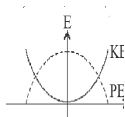
B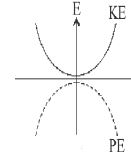
C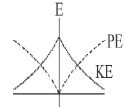
D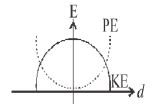
Solution
(D) For a simple harmonic oscillator,the potential energy $(PE)$ is given by $PE = \frac{1}{2} k d^2$,where $k$ is the force constant and $d$ is the displacement. This represents a parabola opening upwards with its vertex at the origin $(0,0)$.
The kinetic energy $(KE)$ is given by $KE = \frac{1}{2} k (A^2 - d^2)$,where $A$ is the amplitude. This represents a downward-opening parabola with its maximum value at the mean position $(d=0)$ and zero at the extreme positions $(d = \pm A)$.
Comparing these with the given options,the graph that shows $PE$ as an upward-opening parabola starting from the origin and $KE$ as a downward-opening parabola with its maximum at the origin is represented by the graph in option $D$.
The kinetic energy $(KE)$ is given by $KE = \frac{1}{2} k (A^2 - d^2)$,where $A$ is the amplitude. This represents a downward-opening parabola with its maximum value at the mean position $(d=0)$ and zero at the extreme positions $(d = \pm A)$.
Comparing these with the given options,the graph that shows $PE$ as an upward-opening parabola starting from the origin and $KE$ as a downward-opening parabola with its maximum at the origin is represented by the graph in option $D$.
0 likes
View Solution55
MediumMCQ
$A$ particle is executing simple harmonic motion with a time period $T$. At time $t = 0$,it is at its position of equilibrium. The kinetic energy-time graph of the particle will look like:
A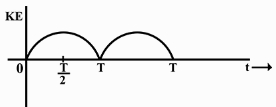
B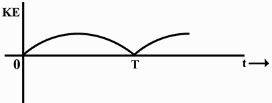
C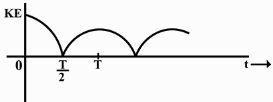
D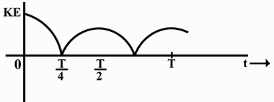
Solution
(D) For a particle executing $SHM$,the displacement is given by $y = A \sin(\omega t)$.
The velocity is $v = \frac{dy}{dt} = A \omega \cos(\omega t)$.
The kinetic energy $(KE)$ is given by:
$KE = \frac{1}{2} m v^2 = \frac{1}{2} m (A \omega \cos(\omega t))^2 = \frac{1}{2} m \omega^2 A^2 \cos^2(\omega t)$.
Using the identity $\cos^2(\theta) = \frac{1 + \cos(2\theta)}{2}$,we get:
$KE = \frac{1}{4} m \omega^2 A^2 (1 + \cos(2\omega t))$.
At $t = 0$,$KE = \frac{1}{2} m \omega^2 A^2$,which is the maximum value.
At $t = \frac{T}{4}$,$\omega t = \frac{\pi}{2}$,so $KE = 0$.
At $t = \frac{T}{2}$,$\omega t = \pi$,so $KE = \frac{1}{2} m \omega^2 A^2$ (maximum).
The kinetic energy oscillates with a frequency double that of the displacement,and it starts from a maximum value at $t = 0$ and becomes zero at $t = \frac{T}{4}$.
The velocity is $v = \frac{dy}{dt} = A \omega \cos(\omega t)$.
The kinetic energy $(KE)$ is given by:
$KE = \frac{1}{2} m v^2 = \frac{1}{2} m (A \omega \cos(\omega t))^2 = \frac{1}{2} m \omega^2 A^2 \cos^2(\omega t)$.
Using the identity $\cos^2(\theta) = \frac{1 + \cos(2\theta)}{2}$,we get:
$KE = \frac{1}{4} m \omega^2 A^2 (1 + \cos(2\omega t))$.
At $t = 0$,$KE = \frac{1}{2} m \omega^2 A^2$,which is the maximum value.
At $t = \frac{T}{4}$,$\omega t = \frac{\pi}{2}$,so $KE = 0$.
At $t = \frac{T}{2}$,$\omega t = \pi$,so $KE = \frac{1}{2} m \omega^2 A^2$ (maximum).
The kinetic energy oscillates with a frequency double that of the displacement,and it starts from a maximum value at $t = 0$ and becomes zero at $t = \frac{T}{4}$.
0 likes
View Solution56
DifficultMCQ
For the minimum time period condition,find the average potential energy between $t = 0$ to $t = 0.05 \ s$ (take $g = 10 \ m/s^2$).
A
$0.025$
B
$0.1$
C
$0.08$
D
$0.06$
Solution
(A) The condition for the block not to lose contact is $a_{max} \leq g$.
$\omega^2 A \leq g$
$\omega \leq \sqrt{\frac{g}{A}}$
For the minimum time period $T$,we take $\omega = \sqrt{\frac{g}{A}}$.
$T = 2\pi \sqrt{\frac{A}{g}}$
Given $A = 1 \ cm = 0.01 \ m$ and $g = 10 \ m/s^2$:
$T = 2\pi \sqrt{\frac{0.01}{10}} = 2\pi \sqrt{0.001} \approx 2 \times 3.14 \times 0.0316 \approx 0.2 \ s$.
The time interval $t = 0$ to $t = 0.05 \ s$ corresponds to $t = 0$ to $t = T/4$.
The average potential energy $\langle U \rangle$ over one-fourth of the time period is given by:
$\langle U \rangle = \frac{1}{T/4} \int_{0}^{T/4} \frac{1}{2} m \omega^2 x^2 \ dt$
Since $x = A \sin(\omega t)$,$U = \frac{1}{2} k A^2 \sin^2(\omega t)$.
$\langle U \rangle = \frac{4}{T} \int_{0}^{T/4} \frac{1}{2} m \omega^2 A^2 \sin^2(\omega t) \ dt = \frac{2 m \omega^2 A^2}{T} \int_{0}^{T/4} \sin^2(\omega t) \ dt$
Using $\sin^2(\theta) = \frac{1 - \cos(2\theta)}{2}$:
$\langle U \rangle = \frac{m \omega^2 A^2}{T} \int_{0}^{T/4} (1 - \cos(2\omega t)) \ dt = \frac{m \omega^2 A^2}{T} [t - \frac{\sin(2\omega t)}{2\omega}]_{0}^{T/4}$
Since $\omega = \frac{2\pi}{T}$,at $t = T/4$,$2\omega t = \pi$:
$\langle U \rangle = \frac{m \omega^2 A^2}{T} [T/4 - 0] = \frac{1}{4} m \omega^2 A^2 = \frac{1}{4} k A^2$
Substituting $m = 1 \ kg$ (assumed),$\omega^2 = g/A = 10/0.01 = 1000 \ rad^2/s^2$:
$\langle U \rangle = \frac{1}{4} \times 1 \times 1000 \times (0.01)^2 = \frac{1}{4} \times 1000 \times 0.0001 = 0.025 \ J$.
$\omega^2 A \leq g$
$\omega \leq \sqrt{\frac{g}{A}}$
For the minimum time period $T$,we take $\omega = \sqrt{\frac{g}{A}}$.
$T = 2\pi \sqrt{\frac{A}{g}}$
Given $A = 1 \ cm = 0.01 \ m$ and $g = 10 \ m/s^2$:
$T = 2\pi \sqrt{\frac{0.01}{10}} = 2\pi \sqrt{0.001} \approx 2 \times 3.14 \times 0.0316 \approx 0.2 \ s$.
The time interval $t = 0$ to $t = 0.05 \ s$ corresponds to $t = 0$ to $t = T/4$.
The average potential energy $\langle U \rangle$ over one-fourth of the time period is given by:
$\langle U \rangle = \frac{1}{T/4} \int_{0}^{T/4} \frac{1}{2} m \omega^2 x^2 \ dt$
Since $x = A \sin(\omega t)$,$U = \frac{1}{2} k A^2 \sin^2(\omega t)$.
$\langle U \rangle = \frac{4}{T} \int_{0}^{T/4} \frac{1}{2} m \omega^2 A^2 \sin^2(\omega t) \ dt = \frac{2 m \omega^2 A^2}{T} \int_{0}^{T/4} \sin^2(\omega t) \ dt$
Using $\sin^2(\theta) = \frac{1 - \cos(2\theta)}{2}$:
$\langle U \rangle = \frac{m \omega^2 A^2}{T} \int_{0}^{T/4} (1 - \cos(2\omega t)) \ dt = \frac{m \omega^2 A^2}{T} [t - \frac{\sin(2\omega t)}{2\omega}]_{0}^{T/4}$
Since $\omega = \frac{2\pi}{T}$,at $t = T/4$,$2\omega t = \pi$:
$\langle U \rangle = \frac{m \omega^2 A^2}{T} [T/4 - 0] = \frac{1}{4} m \omega^2 A^2 = \frac{1}{4} k A^2$
Substituting $m = 1 \ kg$ (assumed),$\omega^2 = g/A = 10/0.01 = 1000 \ rad^2/s^2$:
$\langle U \rangle = \frac{1}{4} \times 1 \times 1000 \times (0.01)^2 = \frac{1}{4} \times 1000 \times 0.0001 = 0.025 \ J$.

0 likes
View Solution57
MediumMCQ
The average kinetic energy in one time period of a $SHM$ is :-
A
$\frac{1}{2} m \omega^2 A^2$
B
$m \omega^2 A^2$
C
$\frac{1}{4} m \omega^2 A^2$
D
Zero
Solution
(C) The displacement of a particle in $SHM$ is given by $x = A \sin(\omega t)$.
The velocity is $v = \frac{dx}{dt} = A \omega \cos(\omega t)$.
The kinetic energy $(KE)$ is given by $KE = \frac{1}{2} m v^2 = \frac{1}{2} m A^2 \omega^2 \cos^2(\omega t)$.
The average kinetic energy over one time period $T$ is given by $\langle KE \rangle = \frac{1}{T} \int_0^T KE \, dt$.
Substituting the expression for $KE$: $\langle KE \rangle = \frac{1}{T} \int_0^T \frac{1}{2} m A^2 \omega^2 \cos^2(\omega t) \, dt$.
Using the identity $\cos^2(\omega t) = \frac{1 + \cos(2\omega t)}{2}$,the integral becomes:
$\langle KE \rangle = \frac{m A^2 \omega^2}{2T} \int_0^T \frac{1 + \cos(2\omega t)}{2} \, dt$.
Since the integral of $\cos(2\omega t)$ over a full period $T$ is $0$,we get:
$\langle KE \rangle = \frac{m A^2 \omega^2}{4T} \int_0^T 1 \, dt = \frac{m A^2 \omega^2}{4T} \times T = \frac{1}{4} m \omega^2 A^2$.
The velocity is $v = \frac{dx}{dt} = A \omega \cos(\omega t)$.
The kinetic energy $(KE)$ is given by $KE = \frac{1}{2} m v^2 = \frac{1}{2} m A^2 \omega^2 \cos^2(\omega t)$.
The average kinetic energy over one time period $T$ is given by $\langle KE \rangle = \frac{1}{T} \int_0^T KE \, dt$.
Substituting the expression for $KE$: $\langle KE \rangle = \frac{1}{T} \int_0^T \frac{1}{2} m A^2 \omega^2 \cos^2(\omega t) \, dt$.
Using the identity $\cos^2(\omega t) = \frac{1 + \cos(2\omega t)}{2}$,the integral becomes:
$\langle KE \rangle = \frac{m A^2 \omega^2}{2T} \int_0^T \frac{1 + \cos(2\omega t)}{2} \, dt$.
Since the integral of $\cos(2\omega t)$ over a full period $T$ is $0$,we get:
$\langle KE \rangle = \frac{m A^2 \omega^2}{4T} \int_0^T 1 \, dt = \frac{m A^2 \omega^2}{4T} \times T = \frac{1}{4} m \omega^2 A^2$.
0 likes
View Solution58
MediumMCQ
The kinetic energy of a particle executing simple harmonic motion in a straight line is $pv^2$ and the potential energy is $qx^2$,where $v$ is the speed at a distance $x$ from the mean position. Its time period is given by the expression:
A
$2\pi \sqrt{\frac{q}{p}}$
B
$2\pi \sqrt{\frac{p}{q}}$
C
$2\pi \sqrt{\frac{q}{p+q}}$
D
$2\pi \sqrt{\frac{p}{p+q}}$
Solution
(B) For a particle in simple harmonic motion,the kinetic energy is $KE = \frac{1}{2}mv^2$ and the potential energy is $PE = \frac{1}{2}kx^2$.
Given $KE = pv^2$,we have $\frac{1}{2}m = p$,so $m = 2p$.
Given $PE = qx^2$,we have $\frac{1}{2}k = q$,so $k = 2q$.
The time period $T$ of a simple harmonic oscillator is given by $T = 2\pi \sqrt{\frac{m}{k}}$.
Substituting the values of $m$ and $k$,we get $T = 2\pi \sqrt{\frac{2p}{2q}} = 2\pi \sqrt{\frac{p}{q}}$.
Given $KE = pv^2$,we have $\frac{1}{2}m = p$,so $m = 2p$.
Given $PE = qx^2$,we have $\frac{1}{2}k = q$,so $k = 2q$.
The time period $T$ of a simple harmonic oscillator is given by $T = 2\pi \sqrt{\frac{m}{k}}$.
Substituting the values of $m$ and $k$,we get $T = 2\pi \sqrt{\frac{2p}{2q}} = 2\pi \sqrt{\frac{p}{q}}$.
0 likes
View Solution59
MediumMCQ
$A$ particle performs $S.H.M.$ of amplitude $A$ with angular frequency $\omega$ along a straight line. When it is at a distance $\frac{\sqrt{3}}{2}A$ from the mean position,its kinetic energy is increased by an amount $\frac{1}{2}m\omega^2A^2$ due to an impulsive force. What is its new amplitude?
A
$\frac{\sqrt{5}}{2}A$
B
$\frac{\sqrt{3}}{2}A$
C
$\sqrt{2}A$
D
$\sqrt{5}A$
Solution
(C) The total energy of the particle in $S.H.M.$ is $E = \frac{1}{2}m\omega^2A^2$.
At position $x = \frac{\sqrt{3}}{2}A$,the potential energy is $U = \frac{1}{2}m\omega^2x^2 = \frac{1}{2}m\omega^2(\frac{3}{4}A^2) = \frac{3}{8}m\omega^2A^2$.
The initial kinetic energy at this position is $K = E - U = \frac{1}{2}m\omega^2A^2 - \frac{3}{8}m\omega^2A^2 = \frac{1}{8}m\omega^2A^2$.
An impulsive force increases the kinetic energy by $\Delta K = \frac{1}{2}m\omega^2A^2$.
The new kinetic energy at this position is $K' = K + \Delta K = \frac{1}{8}m\omega^2A^2 + \frac{4}{8}m\omega^2A^2 = \frac{5}{8}m\omega^2A^2$.
The potential energy $U$ remains unchanged as the position $x$ is the same.
The new total energy $E'$ is $E' = K' + U = \frac{5}{8}m\omega^2A^2 + \frac{3}{8}m\omega^2A^2 = m\omega^2A^2$.
Since $E' = \frac{1}{2}m\omega^2(A')^2$,we have $\frac{1}{2}m\omega^2(A')^2 = m\omega^2A^2$.
Therefore,$(A')^2 = 2A^2$,which gives $A' = \sqrt{2}A$.
At position $x = \frac{\sqrt{3}}{2}A$,the potential energy is $U = \frac{1}{2}m\omega^2x^2 = \frac{1}{2}m\omega^2(\frac{3}{4}A^2) = \frac{3}{8}m\omega^2A^2$.
The initial kinetic energy at this position is $K = E - U = \frac{1}{2}m\omega^2A^2 - \frac{3}{8}m\omega^2A^2 = \frac{1}{8}m\omega^2A^2$.
An impulsive force increases the kinetic energy by $\Delta K = \frac{1}{2}m\omega^2A^2$.
The new kinetic energy at this position is $K' = K + \Delta K = \frac{1}{8}m\omega^2A^2 + \frac{4}{8}m\omega^2A^2 = \frac{5}{8}m\omega^2A^2$.
The potential energy $U$ remains unchanged as the position $x$ is the same.
The new total energy $E'$ is $E' = K' + U = \frac{5}{8}m\omega^2A^2 + \frac{3}{8}m\omega^2A^2 = m\omega^2A^2$.
Since $E' = \frac{1}{2}m\omega^2(A')^2$,we have $\frac{1}{2}m\omega^2(A')^2 = m\omega^2A^2$.
Therefore,$(A')^2 = 2A^2$,which gives $A' = \sqrt{2}A$.
0 likes
View Solution60
DifficultMCQ
An object of mass $0.2 \ kg$ executes simple harmonic motion along the $X-$ axis with a frequency of $\frac{25}{\pi} \ Hz$. At the position $x = 0.04 \ m$,the object has a kinetic energy of $0.5 \ J$ and a potential energy of $0.4 \ J$. The amplitude of oscillation in meters is equal to:
A
$0.05$
B
$0.06$
C
$0.01$
D
None of these
Solution
(B) The total mechanical energy $E$ of a simple harmonic oscillator is the sum of its kinetic energy $K$ and potential energy $U$ at any position $x$.
$E = K + U = 0.5 \ J + 0.4 \ J = 0.9 \ J$.
The formula for the total energy of an oscillator is $E = \frac{1}{2} m \omega^2 A^2$,where $m$ is the mass,$\omega$ is the angular frequency,and $A$ is the amplitude.
Given frequency $f = \frac{25}{\pi} \ Hz$,the angular frequency $\omega = 2 \pi f = 2 \pi \left( \frac{25}{\pi} \right) = 50 \ rad/s$.
Substituting the values into the energy equation:
$0.9 = \frac{1}{2} \times 0.2 \times (50)^2 \times A^2$
$0.9 = 0.1 \times 2500 \times A^2$
$0.9 = 250 \times A^2$
$A^2 = \frac{0.9}{250} = 0.0036$
$A = \sqrt{0.0036} = 0.06 \ m$.
$E = K + U = 0.5 \ J + 0.4 \ J = 0.9 \ J$.
The formula for the total energy of an oscillator is $E = \frac{1}{2} m \omega^2 A^2$,where $m$ is the mass,$\omega$ is the angular frequency,and $A$ is the amplitude.
Given frequency $f = \frac{25}{\pi} \ Hz$,the angular frequency $\omega = 2 \pi f = 2 \pi \left( \frac{25}{\pi} \right) = 50 \ rad/s$.
Substituting the values into the energy equation:
$0.9 = \frac{1}{2} \times 0.2 \times (50)^2 \times A^2$
$0.9 = 0.1 \times 2500 \times A^2$
$0.9 = 250 \times A^2$
$A^2 = \frac{0.9}{250} = 0.0036$
$A = \sqrt{0.0036} = 0.06 \ m$.
0 likes
View Solution61
MediumMCQ
$A$ particle executing a simple harmonic motion of period $2 \ s$. When it is at its extreme displacement from its mean position,it receives an additional energy equal to what it had in its mean position. Due to this,in its subsequent motion,
A
its amplitude will change and become equal to $\sqrt{2}$ times its previous amplitude
B
its periodic time will become doubled $i.e.$ $4 \ s$
C
its potential energy will be decreased
D
it will continue to execute simple harmonic motion of the same amplitude and period as before receiving the additional energy.
Solution
(A) Let the initial amplitude be $A$. The total energy of the particle in simple harmonic motion is $E = \frac{1}{2} k A^2$.
At the mean position,the potential energy is $0$ and the kinetic energy is $E$. Thus,the additional energy received is $E$.
At the extreme position,the initial energy is $E$ (all potential). After receiving the additional energy $E$,the new total energy becomes $E' = E + E = 2E$.
Since $E = \frac{1}{2} k A^2$,we have $E' = \frac{1}{2} k (A')^2 = 2 \times (\frac{1}{2} k A^2)$.
This implies $(A')^2 = 2A^2$,so the new amplitude $A' = \sqrt{2} A$.
The period of simple harmonic motion depends only on the mass and the force constant $(T = 2\pi \sqrt{m/k})$,so it remains unchanged.
At the mean position,the potential energy is $0$ and the kinetic energy is $E$. Thus,the additional energy received is $E$.
At the extreme position,the initial energy is $E$ (all potential). After receiving the additional energy $E$,the new total energy becomes $E' = E + E = 2E$.
Since $E = \frac{1}{2} k A^2$,we have $E' = \frac{1}{2} k (A')^2 = 2 \times (\frac{1}{2} k A^2)$.
This implies $(A')^2 = 2A^2$,so the new amplitude $A' = \sqrt{2} A$.
The period of simple harmonic motion depends only on the mass and the force constant $(T = 2\pi \sqrt{m/k})$,so it remains unchanged.
0 likes
View Solution62
MediumMCQ
$A$ linear harmonic oscillator of force constant $2 \times 10^6\, N/m$ and amplitude $0.01\, m$ has a total mechanical energy of $160\, J$. Which of the following statements is correct?
A
Maximum potential energy is $100\, J$
B
Maximum $K.E.$ is $100\, J$
C
Maximum $K.E.$ is $160\, J$
D
Minimum $P.E.$ is zero
Solution
(D) The total mechanical energy $E$ of a linear harmonic oscillator is given by $E = \frac{1}{2} k A^2$.
Given,force constant $k = 2 \times 10^6\, N/m$ and amplitude $A = 0.01\, m$.
Calculating the potential energy at maximum displacement (which equals the total energy of the oscillator):
$U_{\max} = \frac{1}{2} k A^2 = \frac{1}{2} \times (2 \times 10^6) \times (0.01)^2$
$U_{\max} = 10^6 \times 0.0001 = 100\, J$.
Since the total mechanical energy is $160\, J$ and the maximum potential energy is $100\, J$,this implies the oscillator is not a simple harmonic oscillator starting from the equilibrium position with zero potential energy,or there is an additional constant potential energy term. However,in standard $SHM$,$U_{\min} = 0$. Given the options,the statement 'Minimum $P.E.$ is zero' is a fundamental property of an ideal linear harmonic oscillator.
Given,force constant $k = 2 \times 10^6\, N/m$ and amplitude $A = 0.01\, m$.
Calculating the potential energy at maximum displacement (which equals the total energy of the oscillator):
$U_{\max} = \frac{1}{2} k A^2 = \frac{1}{2} \times (2 \times 10^6) \times (0.01)^2$
$U_{\max} = 10^6 \times 0.0001 = 100\, J$.
Since the total mechanical energy is $160\, J$ and the maximum potential energy is $100\, J$,this implies the oscillator is not a simple harmonic oscillator starting from the equilibrium position with zero potential energy,or there is an additional constant potential energy term. However,in standard $SHM$,$U_{\min} = 0$. Given the options,the statement 'Minimum $P.E.$ is zero' is a fundamental property of an ideal linear harmonic oscillator.
0 likes
View Solution63
MediumMCQ
For a particle executing $S.H.M.$,the potential energy $V$ versus displacement $x$ graph is given. The value of the restoring force constant is ..... $N/m$.
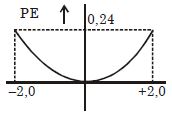
A
$12$
B
$24$
C
$6$
D
$48$
Solution
(A) The potential energy $U$ of a particle in $S.H.M.$ is given by the formula $U = \frac{1}{2} k x^2$,where $k$ is the restoring force constant and $x$ is the displacement.
From the given graph,at the extreme position $x = 2 \ m$,the potential energy is $U = 24 \ J$.
Substituting these values into the formula:
$24 = \frac{1}{2} \times k \times (2)^2$
$24 = \frac{1}{2} \times k \times 4$
$24 = 2k$
$k = \frac{24}{2} = 12 \ N/m$.
Therefore,the value of the restoring force constant is $12 \ N/m$.
From the given graph,at the extreme position $x = 2 \ m$,the potential energy is $U = 24 \ J$.
Substituting these values into the formula:
$24 = \frac{1}{2} \times k \times (2)^2$
$24 = \frac{1}{2} \times k \times 4$
$24 = 2k$
$k = \frac{24}{2} = 12 \ N/m$.
Therefore,the value of the restoring force constant is $12 \ N/m$.
0 likes
View Solution64
DifficultMCQ
$A$ linear harmonic oscillator of force constant $2 \times 10^6\,N/m$ and amplitude $0.01\,m$ has a total mechanical energy of $160\,J$. Which of the following statements is correct?
A
Maximum potential energy is $160\,J$
B
Maximum potential energy is $100\,J$
C
Minimum potential energy is zero
D
Minimum potential energy is $100\,J$
Solution
(A) The total mechanical energy $(TE)$ of a linear harmonic oscillator is given by $TE = PE_{max} = \frac{1}{2} k A^2 + C_0$,where $C_0$ is the constant potential energy offset.
Given $k = 2 \times 10^6\,N/m$,$A = 0.01\,m$,and $TE = 160\,J$.
The potential energy at the extreme position $(x = A)$ is the maximum potential energy,which is equal to the total mechanical energy.
$PE_{max} = \frac{1}{2} k A^2 + C_0 = 160\,J$.
Calculating the elastic potential energy component: $\frac{1}{2} k A^2 = \frac{1}{2} \times (2 \times 10^6) \times (0.01)^2 = 10^6 \times 10^{-4} = 100\,J$.
Since $TE = 160\,J$,we have $100\,J + C_0 = 160\,J$,which gives $C_0 = 60\,J$.
The minimum potential energy occurs at the equilibrium position $(x = 0)$,where $PE_{min} = \frac{1}{2} k(0)^2 + C_0 = C_0 = 60\,J$.
The maximum potential energy occurs at the extreme positions $(x = \pm A)$,where $PE_{max} = \frac{1}{2} k A^2 + C_0 = 100\,J + 60\,J = 160\,J$.
Thus,the maximum potential energy is $160\,J$.
Given $k = 2 \times 10^6\,N/m$,$A = 0.01\,m$,and $TE = 160\,J$.
The potential energy at the extreme position $(x = A)$ is the maximum potential energy,which is equal to the total mechanical energy.
$PE_{max} = \frac{1}{2} k A^2 + C_0 = 160\,J$.
Calculating the elastic potential energy component: $\frac{1}{2} k A^2 = \frac{1}{2} \times (2 \times 10^6) \times (0.01)^2 = 10^6 \times 10^{-4} = 100\,J$.
Since $TE = 160\,J$,we have $100\,J + C_0 = 160\,J$,which gives $C_0 = 60\,J$.
The minimum potential energy occurs at the equilibrium position $(x = 0)$,where $PE_{min} = \frac{1}{2} k(0)^2 + C_0 = C_0 = 60\,J$.
The maximum potential energy occurs at the extreme positions $(x = \pm A)$,where $PE_{max} = \frac{1}{2} k A^2 + C_0 = 100\,J + 60\,J = 160\,J$.
Thus,the maximum potential energy is $160\,J$.
0 likes
View Solution65
MediumMCQ
The $K.E.$ and $P.E.$ of a particle executing $SHM$ with amplitude $A$ will be equal when its displacement is
A
$A \sqrt{2}$
B
$A/2$
C
$A/\sqrt{2}$
D
$A\sqrt{2/3}$
Solution
(C) For a particle executing $SHM$,the kinetic energy $(KE)$ at displacement $y$ is given by $KE = \frac{1}{2} m \omega^{2} (A^{2} - y^{2})$.
The potential energy $(PE)$ at displacement $y$ is given by $PE = \frac{1}{2} m \omega^{2} y^{2}$.
Given that $KE = PE$,we equate the two expressions:
$\frac{1}{2} m \omega^{2} (A^{2} - y^{2}) = \frac{1}{2} m \omega^{2} y^{2}$.
Canceling the common terms $\frac{1}{2} m \omega^{2}$ from both sides,we get:
$A^{2} - y^{2} = y^{2}$.
Rearranging the terms:
$A^{2} = 2y^{2}$.
Solving for $y$:
$y^{2} = \frac{A^{2}}{2} \Rightarrow y = \frac{A}{\sqrt{2}}$.
The potential energy $(PE)$ at displacement $y$ is given by $PE = \frac{1}{2} m \omega^{2} y^{2}$.
Given that $KE = PE$,we equate the two expressions:
$\frac{1}{2} m \omega^{2} (A^{2} - y^{2}) = \frac{1}{2} m \omega^{2} y^{2}$.
Canceling the common terms $\frac{1}{2} m \omega^{2}$ from both sides,we get:
$A^{2} - y^{2} = y^{2}$.
Rearranging the terms:
$A^{2} = 2y^{2}$.
Solving for $y$:
$y^{2} = \frac{A^{2}}{2} \Rightarrow y = \frac{A}{\sqrt{2}}$.
0 likes
View Solution66
MediumMCQ
The total mechanical energy of a particle executing simple harmonic motion is $E$. When the displacement is half the amplitude,its kinetic energy will be
A
$\frac{3}{4}E$
B
$E$
C
$\frac{E}{2}$
D
$\frac{E}{4}$
Solution
(A) The total mechanical energy of a particle in simple harmonic motion is given by $E = \frac{1}{2} k A^2$,where $k$ is the force constant and $A$ is the amplitude.
The kinetic energy $(K.E.)$ at any displacement $x$ is given by $K.E. = \frac{1}{2} k (A^2 - x^2)$.
Given that the displacement $x = \frac{A}{2}$,we substitute this into the kinetic energy formula:
$K.E. = \frac{1}{2} k \left( A^2 - (\frac{A}{2})^2 \right)$
$K.E. = \frac{1}{2} k \left( A^2 - \frac{A^2}{4} \right)$
$K.E. = \frac{1}{2} k \left( \frac{3A^2}{4} \right)$
$K.E. = \frac{3}{4} \left( \frac{1}{2} k A^2 \right)$
Since $E = \frac{1}{2} k A^2$,we have $K.E. = \frac{3}{4} E$.
The kinetic energy $(K.E.)$ at any displacement $x$ is given by $K.E. = \frac{1}{2} k (A^2 - x^2)$.
Given that the displacement $x = \frac{A}{2}$,we substitute this into the kinetic energy formula:
$K.E. = \frac{1}{2} k \left( A^2 - (\frac{A}{2})^2 \right)$
$K.E. = \frac{1}{2} k \left( A^2 - \frac{A^2}{4} \right)$
$K.E. = \frac{1}{2} k \left( \frac{3A^2}{4} \right)$
$K.E. = \frac{3}{4} \left( \frac{1}{2} k A^2 \right)$
Since $E = \frac{1}{2} k A^2$,we have $K.E. = \frac{3}{4} E$.
0 likes
View Solution67
DifficultMCQ
$A$ body is executing simple harmonic motion. At a displacement $x$,its potential energy is $E_1$ and at a displacement $y$,its potential energy is $E_2$. The potential energy $E$ at a displacement $(x + y)$ is
A
$E_1 + E_2$
B
$\sqrt{E_1^2 + E_2^2}$
C
$E_1 + E_2 + 2\sqrt{E_1 E_2}$
D
$\sqrt{E_1 + E_2}$
Solution
(C) The potential energy $U$ of a body executing simple harmonic motion at displacement $x$ is given by $U = \frac{1}{2} kx^2$.
Given:
$E_1 = \frac{1}{2} kx^2$ --- $(i)$
$E_2 = \frac{1}{2} ky^2$ --- $(ii)$
We need to find the potential energy $E$ at displacement $(x + y)$:
$E = \frac{1}{2} k(x + y)^2$
$E = \frac{1}{2} k(x^2 + y^2 + 2xy)$
$E = \frac{1}{2} kx^2 + \frac{1}{2} ky^2 + kxy$
Substituting values from $(i)$ and $(ii)$:
$E = E_1 + E_2 + kxy$
Since $\sqrt{E_1} = \sqrt{\frac{1}{2} k} x$ and $\sqrt{E_2} = \sqrt{\frac{1}{2} k} y$,we have:
$2\sqrt{E_1 E_2} = 2 \sqrt{\frac{1}{2} k x^2 \cdot \frac{1}{2} k y^2} = 2 \cdot \frac{1}{2} kxy = kxy$
Therefore,$E = E_1 + E_2 + 2\sqrt{E_1 E_2}$.
Given:
$E_1 = \frac{1}{2} kx^2$ --- $(i)$
$E_2 = \frac{1}{2} ky^2$ --- $(ii)$
We need to find the potential energy $E$ at displacement $(x + y)$:
$E = \frac{1}{2} k(x + y)^2$
$E = \frac{1}{2} k(x^2 + y^2 + 2xy)$
$E = \frac{1}{2} kx^2 + \frac{1}{2} ky^2 + kxy$
Substituting values from $(i)$ and $(ii)$:
$E = E_1 + E_2 + kxy$
Since $\sqrt{E_1} = \sqrt{\frac{1}{2} k} x$ and $\sqrt{E_2} = \sqrt{\frac{1}{2} k} y$,we have:
$2\sqrt{E_1 E_2} = 2 \sqrt{\frac{1}{2} k x^2 \cdot \frac{1}{2} k y^2} = 2 \cdot \frac{1}{2} kxy = kxy$
Therefore,$E = E_1 + E_2 + 2\sqrt{E_1 E_2}$.
0 likes
View Solution68
MediumMCQ
The potential energy of a simple harmonic oscillator at the mean position is $2\,J$. If its mean kinetic energy $(K.E.)$ is $4\,J$,its total energy will be .... $J$
A
$7$
B
$8$
C
$10$
D
$11$
Solution
(C) The total energy $(E)$ of a simple harmonic oscillator is given by the sum of its potential energy $(U)$ and kinetic energy $(K)$.
At the mean position,the potential energy is given as $U_{0} = 2\,J$.
The total energy is $E = U_{0} + K_{max} = U_{0} + \frac{1}{2}kA^2$.
The mean kinetic energy over a cycle is given by $\langle K \rangle = \frac{1}{4}kA^2 = 4\,J$.
Therefore,the maximum kinetic energy is $K_{max} = \frac{1}{2}kA^2 = 2 \times \langle K \rangle = 2 \times 4\,J = 8\,J$.
The total energy is $E = U_{0} + K_{max} = 2\,J + 8\,J = 10\,J$.
At the mean position,the potential energy is given as $U_{0} = 2\,J$.
The total energy is $E = U_{0} + K_{max} = U_{0} + \frac{1}{2}kA^2$.
The mean kinetic energy over a cycle is given by $\langle K \rangle = \frac{1}{4}kA^2 = 4\,J$.
Therefore,the maximum kinetic energy is $K_{max} = \frac{1}{2}kA^2 = 2 \times \langle K \rangle = 2 \times 4\,J = 8\,J$.
The total energy is $E = U_{0} + K_{max} = 2\,J + 8\,J = 10\,J$.
0 likes
View Solution69
EasyMCQ
The total mechanical energy of a particle in $SHM$ is
A
Always constant
B
Depend on time
C
$\frac{1}{2} K A^2 \cos^2(\omega t + \phi)$
D
$\frac{1}{2} m A^2 \cos^2(\omega t + \phi)$
Solution
(A) In $SHM$,the total mechanical energy $E$ is the sum of kinetic energy $K.E.$ and potential energy $P.E.$.
$E = K.E. + P.E. = \frac{1}{2} m v^2 + \frac{1}{2} k x^2$.
Substituting $x = A \sin(\omega t + \phi)$ and $v = A \omega \cos(\omega t + \phi)$,we get $E = \frac{1}{2} m A^2 \omega^2 \cos^2(\omega t + \phi) + \frac{1}{2} k A^2 \sin^2(\omega t + \phi)$.
Since $k = m \omega^2$,the expression simplifies to $E = \frac{1}{2} k A^2 (\cos^2(\omega t + \phi) + \sin^2(\omega t + \phi))$.
Using the identity $\sin^2 \theta + \cos^2 \theta = 1$,we get $E = \frac{1}{2} k A^2$.
Since $k$ (force constant) and $A$ (amplitude) are constants,the total mechanical energy remains constant throughout the motion.
$E = K.E. + P.E. = \frac{1}{2} m v^2 + \frac{1}{2} k x^2$.
Substituting $x = A \sin(\omega t + \phi)$ and $v = A \omega \cos(\omega t + \phi)$,we get $E = \frac{1}{2} m A^2 \omega^2 \cos^2(\omega t + \phi) + \frac{1}{2} k A^2 \sin^2(\omega t + \phi)$.
Since $k = m \omega^2$,the expression simplifies to $E = \frac{1}{2} k A^2 (\cos^2(\omega t + \phi) + \sin^2(\omega t + \phi))$.
Using the identity $\sin^2 \theta + \cos^2 \theta = 1$,we get $E = \frac{1}{2} k A^2$.
Since $k$ (force constant) and $A$ (amplitude) are constants,the total mechanical energy remains constant throughout the motion.
0 likes
View Solution70
MediumMCQ
$A$ particle of mass $m$ oscillates with simple harmonic motion between points $X_1$ and $X_2$,the equilibrium position being $O$. Its potential energy will be as shown in the following graph:
A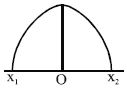
B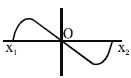
C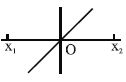
D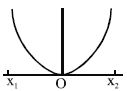
Solution
(D) The potential energy $(PE)$ of a particle of mass $m$ executing simple harmonic motion is given by the formula $PE = \frac{1}{2} m \omega^2 y^2$,where $y$ is the displacement from the equilibrium position $O$.
At the equilibrium position $O$,the displacement $y = 0$,so the potential energy $PE = 0$.
At the extreme points $X_1$ and $X_2$,the displacement $y$ is equal to the amplitude $A$ (i.e.,$y = \pm A$).
Thus,the potential energy at both extreme points is $PE = \frac{1}{2} m \omega^2 A^2$,which is the maximum value.
The relationship $PE \propto y^2$ represents a parabola opening upwards,with its vertex at the origin $(0,0)$.
Therefore,the graph of potential energy versus displacement is a parabola,which corresponds to the graph shown in option $D$.
At the equilibrium position $O$,the displacement $y = 0$,so the potential energy $PE = 0$.
At the extreme points $X_1$ and $X_2$,the displacement $y$ is equal to the amplitude $A$ (i.e.,$y = \pm A$).
Thus,the potential energy at both extreme points is $PE = \frac{1}{2} m \omega^2 A^2$,which is the maximum value.
The relationship $PE \propto y^2$ represents a parabola opening upwards,with its vertex at the origin $(0,0)$.
Therefore,the graph of potential energy versus displacement is a parabola,which corresponds to the graph shown in option $D$.
0 likes
View Solution71
MediumMCQ
$A$ particle is vibrating simple harmonically with an amplitude $a$. The displacement of the particle when its energy is half kinetic and half potential is
A
$\frac{a}{2}$
B
$\frac{a}{\sqrt{2}}$
C
$\frac{a}{4}$
D
zero
Solution
(B) The total energy $E$ of a particle in simple harmonic motion is the sum of its kinetic energy $K$ and potential energy $U$.
Given that the kinetic energy is equal to the potential energy,$K = U$.
Since the total energy $E = K + U$,we have $E = 2U$ or $E = 2K$.
The potential energy at displacement $y$ is given by $U = \frac{1}{2} m \omega^2 y^2$.
The total energy is given by $E = \frac{1}{2} m \omega^2 a^2$.
Setting $U = \frac{1}{2} E$,we get:
$\frac{1}{2} m \omega^2 y^2 = \frac{1}{2} (\frac{1}{2} m \omega^2 a^2)$
$y^2 = \frac{a^2}{2}$
$y = \frac{a}{\sqrt{2}}$
Given that the kinetic energy is equal to the potential energy,$K = U$.
Since the total energy $E = K + U$,we have $E = 2U$ or $E = 2K$.
The potential energy at displacement $y$ is given by $U = \frac{1}{2} m \omega^2 y^2$.
The total energy is given by $E = \frac{1}{2} m \omega^2 a^2$.
Setting $U = \frac{1}{2} E$,we get:
$\frac{1}{2} m \omega^2 y^2 = \frac{1}{2} (\frac{1}{2} m \omega^2 a^2)$
$y^2 = \frac{a^2}{2}$
$y = \frac{a}{\sqrt{2}}$
0 likes
View Solution72
MediumMCQ
$A$ particle is executing simple harmonic motion $(SHM)$ of amplitude $A$ along the $x$-axis about $x = 0$. When its potential energy $(PE)$ equals kinetic energy $(KE)$,the position of the particle will be
A
$\frac{A}{2}$
B
$\frac{A}{2\sqrt{2}}$
C
$\frac{A}{\sqrt{2}}$
D
$A$
Solution
(C) The potential energy $(PE)$ of a particle in $SHM$ is given by $PE = \frac{1}{2} m \omega^2 x^2$.
The kinetic energy $(KE)$ of a particle in $SHM$ is given by $KE = \frac{1}{2} m \omega^2 (A^2 - x^2)$.
Given that $PE = KE$,we have:
$\frac{1}{2} m \omega^2 x^2 = \frac{1}{2} m \omega^2 (A^2 - x^2)$
$x^2 = A^2 - x^2$
$2x^2 = A^2$
$x^2 = \frac{A^2}{2}$
$x = \pm \frac{A}{\sqrt{2}}$
Thus,the position of the particle is $\frac{A}{\sqrt{2}}$.
The kinetic energy $(KE)$ of a particle in $SHM$ is given by $KE = \frac{1}{2} m \omega^2 (A^2 - x^2)$.
Given that $PE = KE$,we have:
$\frac{1}{2} m \omega^2 x^2 = \frac{1}{2} m \omega^2 (A^2 - x^2)$
$x^2 = A^2 - x^2$
$2x^2 = A^2$
$x^2 = \frac{A^2}{2}$
$x = \pm \frac{A}{\sqrt{2}}$
Thus,the position of the particle is $\frac{A}{\sqrt{2}}$.
0 likes
View Solution73
MediumMCQ
$A$ particle undergoing simple harmonic motion has time-dependent displacement given by $x(t) = A \sin \left( \frac{\pi t}{90} \right)$. The ratio of kinetic energy to potential energy of the particle at $t = 210 \ s$ will be:
A
$1/9$
B
$1$
C
$2$
D
$1/3$
Solution
(D) The displacement is given by $x(t) = A \sin(\omega t)$,where $\omega = \frac{\pi}{90} \ rad/s$.
The velocity is $v(t) = \frac{dx}{dt} = A \omega \cos(\omega t)$.
Kinetic energy $K = \frac{1}{2} m v^2 = \frac{1}{2} m A^2 \omega^2 \cos^2(\omega t)$.
Potential energy $U = \frac{1}{2} m \omega^2 x^2 = \frac{1}{2} m \omega^2 A^2 \sin^2(\omega t)$.
The ratio of kinetic energy to potential energy is $\frac{K}{U} = \frac{\cos^2(\omega t)}{\sin^2(\omega t)} = \cot^2(\omega t)$.
At $t = 210 \ s$,the phase is $\omega t = \frac{\pi}{90} \times 210 = \frac{21\pi}{9} = \frac{7\pi}{3} = 2\pi + \frac{\pi}{3}$.
Therefore,$\frac{K}{U} = \cot^2\left( 2\pi + \frac{\pi}{3} \right) = \cot^2\left( \frac{\pi}{3} \right) = \left( \frac{1}{\sqrt{3}} \right)^2 = \frac{1}{3}$.
The velocity is $v(t) = \frac{dx}{dt} = A \omega \cos(\omega t)$.
Kinetic energy $K = \frac{1}{2} m v^2 = \frac{1}{2} m A^2 \omega^2 \cos^2(\omega t)$.
Potential energy $U = \frac{1}{2} m \omega^2 x^2 = \frac{1}{2} m \omega^2 A^2 \sin^2(\omega t)$.
The ratio of kinetic energy to potential energy is $\frac{K}{U} = \frac{\cos^2(\omega t)}{\sin^2(\omega t)} = \cot^2(\omega t)$.
At $t = 210 \ s$,the phase is $\omega t = \frac{\pi}{90} \times 210 = \frac{21\pi}{9} = \frac{7\pi}{3} = 2\pi + \frac{\pi}{3}$.
Therefore,$\frac{K}{U} = \cot^2\left( 2\pi + \frac{\pi}{3} \right) = \cot^2\left( \frac{\pi}{3} \right) = \left( \frac{1}{\sqrt{3}} \right)^2 = \frac{1}{3}$.
0 likes
View Solution74
MediumMCQ
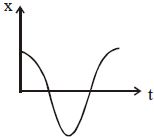
The displacement-time graph of a particle executing $SHM$ is as shown in the figure. The corresponding graph between potential energy $(PE)$ and time is:
A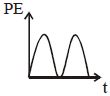
B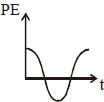
C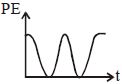
D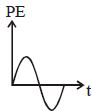
Solution
(C) The displacement of a particle in $SHM$ is given by $x(t) = A \cos(\omega t + \phi)$. From the figure,at $t = 0$,$x$ is at its maximum positive value,so $x(t) = A \cos(\omega t)$.
The potential energy $(PE)$ of a particle in $SHM$ is given by $PE = \frac{1}{2} k x^2$.
Substituting $x(t) = A \cos(\omega t)$ into the $PE$ equation:
$PE = \frac{1}{2} k (A \cos(\omega t))^2 = \frac{1}{2} k A^2 \cos^2(\omega t)$.
Using the trigonometric identity $\cos^2(\theta) = \frac{1 + \cos(2\theta)}{2}$:
$PE = \frac{1}{2} k A^2 \left( \frac{1 + \cos(2\omega t)}{2} \right) = \frac{1}{4} k A^2 (1 + \cos(2\omega t))$.
At $t = 0$,$PE = \frac{1}{2} k A^2$,which is the maximum value.
As $t$ increases,$\cos(2\omega t)$ decreases,so $PE$ decreases to $0$ when $2\omega t = \pi/2$ (or $t = \pi/4\omega$),and then increases back to the maximum value when $2\omega t = \pi$ (or $t = \pi/2\omega$).
This behavior matches the graph in option $C$.
The potential energy $(PE)$ of a particle in $SHM$ is given by $PE = \frac{1}{2} k x^2$.
Substituting $x(t) = A \cos(\omega t)$ into the $PE$ equation:
$PE = \frac{1}{2} k (A \cos(\omega t))^2 = \frac{1}{2} k A^2 \cos^2(\omega t)$.
Using the trigonometric identity $\cos^2(\theta) = \frac{1 + \cos(2\theta)}{2}$:
$PE = \frac{1}{2} k A^2 \left( \frac{1 + \cos(2\omega t)}{2} \right) = \frac{1}{4} k A^2 (1 + \cos(2\omega t))$.
At $t = 0$,$PE = \frac{1}{2} k A^2$,which is the maximum value.
As $t$ increases,$\cos(2\omega t)$ decreases,so $PE$ decreases to $0$ when $2\omega t = \pi/2$ (or $t = \pi/4\omega$),and then increases back to the maximum value when $2\omega t = \pi$ (or $t = \pi/2\omega$).
This behavior matches the graph in option $C$.
0 likes
View Solution75
MediumMCQ
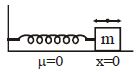
$A$ block is executing $SHM.$ Let the time period of variation of velocity be $T_1$ and time period of variation of kinetic energy be $T_2.$ The relation between $T_1$ and $T_2$ is
A
$T_1=T_2$
B
$T_1=2T_2$
C
$T_1=T_2/2$
D
None of the above
Solution
(B) Let the displacement of the block in $SHM$ be $x = A \sin(\omega t).$
The velocity of the block is $v = \frac{dx}{dt} = A\omega \cos(\omega t).$
The time period of velocity is the time taken for the velocity to repeat its value, which is $T_1 = \frac{2\pi}{\omega} = T.$
The kinetic energy of the block is $K = \frac{1}{2}mv^2 = \frac{1}{2}m(A\omega \cos(\omega t))^2 = \frac{1}{2}mA^2\omega^2 \cos^2(\omega t).$
Using the identity $\cos^2(\theta) = \frac{1 + \cos(2\theta)}{2},$ we get $K = \frac{1}{4}mA^2\omega^2 (1 + \cos(2\omega t)).$
The kinetic energy varies with a frequency of $2\omega.$ Therefore, the time period of variation of kinetic energy is $T_2 = \frac{2\pi}{2\omega} = \frac{\pi}{\omega} = \frac{T}{2}.$
Thus, $T_1 = 2T_2.$
The velocity of the block is $v = \frac{dx}{dt} = A\omega \cos(\omega t).$
The time period of velocity is the time taken for the velocity to repeat its value, which is $T_1 = \frac{2\pi}{\omega} = T.$
The kinetic energy of the block is $K = \frac{1}{2}mv^2 = \frac{1}{2}m(A\omega \cos(\omega t))^2 = \frac{1}{2}mA^2\omega^2 \cos^2(\omega t).$
Using the identity $\cos^2(\theta) = \frac{1 + \cos(2\theta)}{2},$ we get $K = \frac{1}{4}mA^2\omega^2 (1 + \cos(2\omega t)).$
The kinetic energy varies with a frequency of $2\omega.$ Therefore, the time period of variation of kinetic energy is $T_2 = \frac{2\pi}{2\omega} = \frac{\pi}{\omega} = \frac{T}{2}.$
Thus, $T_1 = 2T_2.$
0 likes
View Solution76
MediumMCQ
For a simple pendulum,a graph is plotted between its kinetic energy $(KE)$ and potential energy $(PE)$ against its displacement $d.$ Which one of the following represents these correctly? (graphs are schematic and not drawn to scale)
A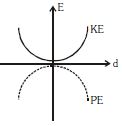
B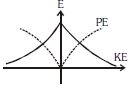
C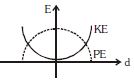
D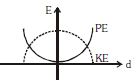
Solution
(C) For a simple harmonic oscillator,the displacement $d$ is given by $d = A \sin(\omega t + \phi).$
The potential energy $(PE)$ is given by $PE = \frac{1}{2} k d^2,$ which represents a parabola opening upwards with its vertex at the origin $(0,0).$
The kinetic energy $(KE)$ is given by $KE = E - PE = \frac{1}{2} k A^2 - \frac{1}{2} k d^2,$ where $E$ is the total energy. This represents an inverted parabola (a parabola opening downwards) with its maximum value at $d = 0$ and zero value at $d = \pm A.$
Comparing these with the given options,the graph in option $C$ correctly shows $KE$ as an inverted parabola and $PE$ as a parabola opening upwards.
The potential energy $(PE)$ is given by $PE = \frac{1}{2} k d^2,$ which represents a parabola opening upwards with its vertex at the origin $(0,0).$
The kinetic energy $(KE)$ is given by $KE = E - PE = \frac{1}{2} k A^2 - \frac{1}{2} k d^2,$ where $E$ is the total energy. This represents an inverted parabola (a parabola opening downwards) with its maximum value at $d = 0$ and zero value at $d = \pm A.$
Comparing these with the given options,the graph in option $C$ correctly shows $KE$ as an inverted parabola and $PE$ as a parabola opening upwards.
0 likes
View Solution77
DifficultMCQ
Starting from the mean position,a body oscillates simple harmonically with a period of $2\,s$. After what time will its kinetic energy be $75\%$ of the total energy?
A
$\frac{1}{6}\,s$
B
$\frac{1}{4}\,s$
C
$\frac{1}{3}\,s$
D
$\frac{1}{12}\,s$
Solution
(A) The total energy $E$ of a simple harmonic oscillator is given by $E = \frac{1}{2} m \omega^2 A^2$.
The kinetic energy $KE$ at any time $t$ is given by $KE = E \cos^2(\omega t)$ (since the body starts from the mean position,the displacement $x = A \sin(\omega t)$,so velocity $v = A \omega \cos(\omega t)$).
Given that $KE = 75\% \text{ of } E$,we have:
$KE = \frac{75}{100} E = \frac{3}{4} E$.
Substituting the expression for $KE$:
$E \cos^2(\omega t) = \frac{3}{4} E$
$\cos^2(\omega t) = \frac{3}{4}$
$\cos(\omega t) = \frac{\sqrt{3}}{2}$.
We know that $\cos(\frac{\pi}{6}) = \frac{\sqrt{3}}{2}$,so $\omega t = \frac{\pi}{6}$.
Given the period $T = 2\,s$,the angular frequency $\omega = \frac{2\pi}{T} = \frac{2\pi}{2} = \pi \text{ rad/s}$.
Substituting $\omega$ into the equation:
$\pi t = \frac{\pi}{6}$
$t = \frac{1}{6}\,s$.
The kinetic energy $KE$ at any time $t$ is given by $KE = E \cos^2(\omega t)$ (since the body starts from the mean position,the displacement $x = A \sin(\omega t)$,so velocity $v = A \omega \cos(\omega t)$).
Given that $KE = 75\% \text{ of } E$,we have:
$KE = \frac{75}{100} E = \frac{3}{4} E$.
Substituting the expression for $KE$:
$E \cos^2(\omega t) = \frac{3}{4} E$
$\cos^2(\omega t) = \frac{3}{4}$
$\cos(\omega t) = \frac{\sqrt{3}}{2}$.
We know that $\cos(\frac{\pi}{6}) = \frac{\sqrt{3}}{2}$,so $\omega t = \frac{\pi}{6}$.
Given the period $T = 2\,s$,the angular frequency $\omega = \frac{2\pi}{T} = \frac{2\pi}{2} = \pi \text{ rad/s}$.
Substituting $\omega$ into the equation:
$\pi t = \frac{\pi}{6}$
$t = \frac{1}{6}\,s$.
0 likes
View Solution78
MediumMCQ
$A$ particle is executing $SHM$ with an amplitude $A$. What is the displacement of the particle when its potential energy is half of its total energy?
A
$\frac{A}{\sqrt{2}}$
B
$\frac{A}{2}$
C
$\frac{A}{4}$
D
$\frac{A}{3}$
Solution
(A) The total energy $(E)$ of a particle executing $SHM$ is given by $E = \frac{1}{2} kA^2$,where $k$ is the force constant and $A$ is the amplitude.
The potential energy $(U)$ at a displacement $x$ is given by $U = \frac{1}{2} kx^2$.
According to the problem,the potential energy is half of the total energy:
$U = \frac{1}{2} E$
Substituting the expressions for $U$ and $E$:
$\frac{1}{2} kx^2 = \frac{1}{2} \left( \frac{1}{2} kA^2 \right)$
Canceling $\frac{1}{2} k$ from both sides:
$x^2 = \frac{1}{2} A^2$
Taking the square root of both sides:
$x = \frac{A}{\sqrt{2}}$
The potential energy $(U)$ at a displacement $x$ is given by $U = \frac{1}{2} kx^2$.
According to the problem,the potential energy is half of the total energy:
$U = \frac{1}{2} E$
Substituting the expressions for $U$ and $E$:
$\frac{1}{2} kx^2 = \frac{1}{2} \left( \frac{1}{2} kA^2 \right)$
Canceling $\frac{1}{2} k$ from both sides:
$x^2 = \frac{1}{2} A^2$
Taking the square root of both sides:
$x = \frac{A}{\sqrt{2}}$
0 likes
View Solution79
MediumMCQ
$A$ loaded vertical spring executes $S.H.M.$ with a time period of $4\; sec$. The difference between the kinetic energy and potential energy of this system varies with a period of ........ $sec$.
A
$2$
B
$1$
C
$8$
D
$4$
Solution
(A) For a particle executing $S.H.M.$ with time period $T$,the kinetic energy $(K)$ and potential energy $(U)$ are given by:
$K = \frac{1}{2} k A^2 \cos^2(\omega t)$
$U = \frac{1}{2} k A^2 \sin^2(\omega t)$
The difference between kinetic and potential energy is:
$K - U = \frac{1}{2} k A^2 (\cos^2(\omega t) - \sin^2(\omega t)) = \frac{1}{2} k A^2 \cos(2\omega t)$
Since the angular frequency of the difference is $2\omega$,the new time period $T'$ is given by:
$T' = \frac{2\pi}{2\omega} = \frac{T}{2}$
Given $T = 4\; sec$,we have $T' = \frac{4}{2} = 2\; sec$.
$K = \frac{1}{2} k A^2 \cos^2(\omega t)$
$U = \frac{1}{2} k A^2 \sin^2(\omega t)$
The difference between kinetic and potential energy is:
$K - U = \frac{1}{2} k A^2 (\cos^2(\omega t) - \sin^2(\omega t)) = \frac{1}{2} k A^2 \cos(2\omega t)$
Since the angular frequency of the difference is $2\omega$,the new time period $T'$ is given by:
$T' = \frac{2\pi}{2\omega} = \frac{T}{2}$
Given $T = 4\; sec$,we have $T' = \frac{4}{2} = 2\; sec$.
0 likes
View Solution80
DifficultMCQ
$A$ body is executing simple harmonic motion. At a displacement $x$,its potential energy is $E_1$ and at a displacement $y$,its potential energy is $E_2$. The potential energy $E$ at a displacement $(x + y)$ is
A
$E_1 + E_2$
B
$\sqrt{E_1^2 + E_2^2}$
C
$\sqrt{E_1 E_2}$
D
$E_1 + E_2 + 2\sqrt{E_1 E_2}$
Solution
(D) The potential energy of a body executing simple harmonic motion at displacement $x$ is given by $U = \frac{1}{2} kx^2$,where $k$ is the force constant.
Given $E_1 = \frac{1}{2} kx^2$ and $E_2 = \frac{1}{2} ky^2$.
We need to find the potential energy $E$ at displacement $(x + y)$:
$E = \frac{1}{2} k(x + y)^2$
$E = \frac{1}{2} k(x^2 + y^2 + 2xy)$
$E = \frac{1}{2} kx^2 + \frac{1}{2} ky^2 + 2 \cdot \frac{1}{2} kxy$
Since $E_1 = \frac{1}{2} kx^2$ and $E_2 = \frac{1}{2} ky^2$,we have $x = \sqrt{\frac{2E_1}{k}}$ and $y = \sqrt{\frac{2E_2}{k}}$.
Substituting these into the expression for $E$:
$E = E_1 + E_2 + 2 \cdot \frac{1}{2} k \left( \sqrt{\frac{2E_1}{k}} \right) \left( \sqrt{\frac{2E_2}{k}} \right)$
$E = E_1 + E_2 + k \left( \frac{2}{k} \sqrt{E_1 E_2} \right)$
$E = E_1 + E_2 + 2\sqrt{E_1 E_2}$
Given $E_1 = \frac{1}{2} kx^2$ and $E_2 = \frac{1}{2} ky^2$.
We need to find the potential energy $E$ at displacement $(x + y)$:
$E = \frac{1}{2} k(x + y)^2$
$E = \frac{1}{2} k(x^2 + y^2 + 2xy)$
$E = \frac{1}{2} kx^2 + \frac{1}{2} ky^2 + 2 \cdot \frac{1}{2} kxy$
Since $E_1 = \frac{1}{2} kx^2$ and $E_2 = \frac{1}{2} ky^2$,we have $x = \sqrt{\frac{2E_1}{k}}$ and $y = \sqrt{\frac{2E_2}{k}}$.
Substituting these into the expression for $E$:
$E = E_1 + E_2 + 2 \cdot \frac{1}{2} k \left( \sqrt{\frac{2E_1}{k}} \right) \left( \sqrt{\frac{2E_2}{k}} \right)$
$E = E_1 + E_2 + k \left( \frac{2}{k} \sqrt{E_1 E_2} \right)$
$E = E_1 + E_2 + 2\sqrt{E_1 E_2}$
0 likes
View Solution81
MediumMCQ
In a simple harmonic motion,when the displacement is one-half the amplitude,what fraction of the total energy is kinetic?
A
$1/2$
B
$3/4$
C
$0$
D
$1/4$
Solution
(B) The total energy $(E)$ of a particle in simple harmonic motion is given by $E = \frac{1}{2} m \omega^2 a^2$,where $a$ is the amplitude.
The kinetic energy $(K)$ at any displacement $(x)$ is given by $K = \frac{1}{2} m \omega^2 (a^2 - x^2)$.
Given that the displacement $x = \frac{a}{2}$,we substitute this into the kinetic energy formula:
$K = \frac{1}{2} m \omega^2 (a^2 - (\frac{a}{2})^2)$
$K = \frac{1}{2} m \omega^2 (a^2 - \frac{a^2}{4})$
$K = \frac{1}{2} m \omega^2 (\frac{3a^2}{4})$
$K = \frac{3}{4} (\frac{1}{2} m \omega^2 a^2)$
Since $E = \frac{1}{2} m \omega^2 a^2$,we have $K = \frac{3}{4} E$.
Therefore,the fraction of the total energy that is kinetic is $3/4$.
The kinetic energy $(K)$ at any displacement $(x)$ is given by $K = \frac{1}{2} m \omega^2 (a^2 - x^2)$.
Given that the displacement $x = \frac{a}{2}$,we substitute this into the kinetic energy formula:
$K = \frac{1}{2} m \omega^2 (a^2 - (\frac{a}{2})^2)$
$K = \frac{1}{2} m \omega^2 (a^2 - \frac{a^2}{4})$
$K = \frac{1}{2} m \omega^2 (\frac{3a^2}{4})$
$K = \frac{3}{4} (\frac{1}{2} m \omega^2 a^2)$
Since $E = \frac{1}{2} m \omega^2 a^2$,we have $K = \frac{3}{4} E$.
Therefore,the fraction of the total energy that is kinetic is $3/4$.
0 likes
View Solution82
DifficultMCQ
The kinetic energy of $SHM$ is $1/n$ times its potential energy. If the amplitude of the $SHM$ is $A$,what is the displacement of the particle?
A
$nA$
B
$\sqrt{\frac{n+1}{n}} A$
C
$\sqrt{\frac{n}{n+1}} A$
D
$\frac{A}{n}$
Solution
(C) The kinetic energy $(K)$ and potential energy $(U)$ of a particle in $SHM$ at displacement $x$ are given by:
$K = \frac{1}{2} m \omega^2 (A^2 - x^2)$
$U = \frac{1}{2} m \omega^2 x^2$
Given that $K = \frac{1}{n} U$,we substitute the expressions:
$\frac{1}{2} m \omega^2 (A^2 - x^2) = \frac{1}{n} (\frac{1}{2} m \omega^2 x^2)$
$A^2 - x^2 = \frac{x^2}{n}$
$A^2 = x^2 + \frac{x^2}{n} = x^2 (1 + \frac{1}{n})$
$A^2 = x^2 (\frac{n+1}{n})$
$x^2 = A^2 (\frac{n}{n+1})$
$x = \sqrt{\frac{n}{n+1}} A$
$K = \frac{1}{2} m \omega^2 (A^2 - x^2)$
$U = \frac{1}{2} m \omega^2 x^2$
Given that $K = \frac{1}{n} U$,we substitute the expressions:
$\frac{1}{2} m \omega^2 (A^2 - x^2) = \frac{1}{n} (\frac{1}{2} m \omega^2 x^2)$
$A^2 - x^2 = \frac{x^2}{n}$
$A^2 = x^2 + \frac{x^2}{n} = x^2 (1 + \frac{1}{n})$
$A^2 = x^2 (\frac{n+1}{n})$
$x^2 = A^2 (\frac{n}{n+1})$
$x = \sqrt{\frac{n}{n+1}} A$
0 likes
View Solution83
DifficultMCQ
Starting from the origin,a body oscillates simple harmonically with a time period of $2 \ s$. After what time will its kinetic energy be $75 \%$ of the total energy?
A
$1/3 \ s$
B
$1/12 \ s$
C
$1/6 \ s$
D
$1/4 \ s$
Solution
(C) The total energy $(TE)$ of a simple harmonic oscillator is constant and is given by $TE = \frac{1}{2} k A^2$,where $k$ is the force constant and $A$ is the amplitude.
Given that the kinetic energy $(KE)$ is $75 \%$ of the total energy $(TE)$,we have $KE = 0.75 \ TE$.
Since $TE = KE + PE$,the potential energy $(PE)$ must be $PE = TE - KE = TE - 0.75 \ TE = 0.25 \ TE$.
Substituting the expressions for $PE$ and $TE$: $\frac{1}{2} k x^2 = 0.25 \times (\frac{1}{2} k A^2)$.
This simplifies to $x^2 = 0.25 \ A^2$,which gives $x = \pm \frac{A}{2}$.
For a body starting from the origin ($x=0$ at $t=0$),the displacement is given by $x = A \sin(\omega t)$,where $\omega = \frac{2\pi}{T}$.
Setting $x = \frac{A}{2}$,we get $\frac{A}{2} = A \sin(\omega t) \Rightarrow \sin(\omega t) = \frac{1}{2}$.
This implies $\omega t = \frac{\pi}{6}$.
Substituting $\omega = \frac{2\pi}{T}$,we get $(\frac{2\pi}{T}) t = \frac{\pi}{6}$.
Given $T = 2 \ s$,we have $(\frac{2\pi}{2}) t = \frac{\pi}{6} \Rightarrow \pi t = \frac{\pi}{6} \Rightarrow t = \frac{1}{6} \ s$.
Given that the kinetic energy $(KE)$ is $75 \%$ of the total energy $(TE)$,we have $KE = 0.75 \ TE$.
Since $TE = KE + PE$,the potential energy $(PE)$ must be $PE = TE - KE = TE - 0.75 \ TE = 0.25 \ TE$.
Substituting the expressions for $PE$ and $TE$: $\frac{1}{2} k x^2 = 0.25 \times (\frac{1}{2} k A^2)$.
This simplifies to $x^2 = 0.25 \ A^2$,which gives $x = \pm \frac{A}{2}$.
For a body starting from the origin ($x=0$ at $t=0$),the displacement is given by $x = A \sin(\omega t)$,where $\omega = \frac{2\pi}{T}$.
Setting $x = \frac{A}{2}$,we get $\frac{A}{2} = A \sin(\omega t) \Rightarrow \sin(\omega t) = \frac{1}{2}$.
This implies $\omega t = \frac{\pi}{6}$.
Substituting $\omega = \frac{2\pi}{T}$,we get $(\frac{2\pi}{T}) t = \frac{\pi}{6}$.
Given $T = 2 \ s$,we have $(\frac{2\pi}{2}) t = \frac{\pi}{6} \Rightarrow \pi t = \frac{\pi}{6} \Rightarrow t = \frac{1}{6} \ s$.
0 likes
View Solution84
Medium
The potential energy function for a particle executing linear simple harmonic motion is given by $V(x) = k x^{2} / 2$,where $k$ is the force constant of the oscillator. For $k = 0.5 \; N m^{-1}$,the graph of $V(x)$ versus $x$ is shown in the figure. Show that a particle of total energy $1 \; J$ moving under this potential must 'turn back' when it reaches $x = \pm 2 \; m$.
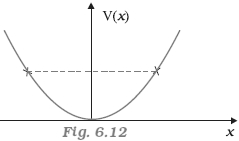
Solution
(N/A) Total energy of the particle,$E = 1 \; J$.
Force constant,$k = 0.5 \; N m^{-1}$.
According to the law of conservation of mechanical energy,the total energy $E$ is the sum of kinetic energy $K$ and potential energy $V(x)$:
$E = K + V(x)$
$E = K + \frac{1}{2} k x^{2}$
At the turning points,the particle momentarily comes to rest,meaning its velocity is zero,and consequently,its kinetic energy $K$ is zero.
Therefore,at the turning points,the total energy is entirely potential energy:
$E = V(x)$
$1 = \frac{1}{2} k x^{2}$
Substituting the given values:
$1 = \frac{1}{2} \times 0.5 \times x^{2}$
$1 = 0.25 \times x^{2}$
$x^{2} = \frac{1}{0.25} = 4$
$x = \pm 2 \; m$.
Thus,the particle must 'turn back' when it reaches $x = \pm 2 \; m$.
Force constant,$k = 0.5 \; N m^{-1}$.
According to the law of conservation of mechanical energy,the total energy $E$ is the sum of kinetic energy $K$ and potential energy $V(x)$:
$E = K + V(x)$
$E = K + \frac{1}{2} k x^{2}$
At the turning points,the particle momentarily comes to rest,meaning its velocity is zero,and consequently,its kinetic energy $K$ is zero.
Therefore,at the turning points,the total energy is entirely potential energy:
$E = V(x)$
$1 = \frac{1}{2} k x^{2}$
Substituting the given values:
$1 = \frac{1}{2} \times 0.5 \times x^{2}$
$1 = 0.25 \times x^{2}$
$x^{2} = \frac{1}{0.25} = 4$
$x = \pm 2 \; m$.
Thus,the particle must 'turn back' when it reaches $x = \pm 2 \; m$.
0 likes
View Solution85
Difficult
Show that for a particle in linear $SHM$,the average kinetic energy over a period of oscillation equals the average potential energy over the same period.
Solution
(N/A) The displacement of a particle executing $SHM$ at an instant $t$ is given by $x = A \sin \omega t$,where $A$ is the amplitude and $\omega$ is the angular frequency.
The velocity of the particle is $v = \frac{dx}{dt} = A \omega \cos \omega t$.
The kinetic energy is $E_k = \frac{1}{2} M v^2 = \frac{1}{2} M A^2 \omega^2 \cos^2 \omega t$.
The potential energy is $E_p = \frac{1}{2} k x^2 = \frac{1}{2} M \omega^2 A^2 \sin^2 \omega t$.
The average kinetic energy over a period $T$ is $\langle E_k \rangle = \frac{1}{T} \int_0^T E_k dt = \frac{1}{T} \int_0^T \frac{1}{2} M A^2 \omega^2 \cos^2 \omega t dt$.
Using $\cos^2 \omega t = \frac{1 + \cos 2 \omega t}{2}$,we get $\langle E_k \rangle = \frac{M A^2 \omega^2}{2T} \int_0^T \frac{1 + \cos 2 \omega t}{2} dt = \frac{M A^2 \omega^2}{4T} [t + \frac{\sin 2 \omega t}{2 \omega}]_0^T = \frac{1}{4} M A^2 \omega^2 \dots (i)$.
The average potential energy over a period $T$ is $\langle E_p \rangle = \frac{1}{T} \int_0^T E_p dt = \frac{1}{T} \int_0^T \frac{1}{2} M \omega^2 A^2 \sin^2 \omega t dt$.
Using $\sin^2 \omega t = \frac{1 - \cos 2 \omega t}{2}$,we get $\langle E_p \rangle = \frac{M \omega^2 A^2}{2T} \int_0^T \frac{1 - \cos 2 \omega t}{2} dt = \frac{M \omega^2 A^2}{4T} [t - \frac{\sin 2 \omega t}{2 \omega}]_0^T = \frac{1}{4} M A^2 \omega^2 \dots (ii)$.
Comparing $(i)$ and $(ii)$,we see that $\langle E_k \rangle = \langle E_p \rangle$.
The velocity of the particle is $v = \frac{dx}{dt} = A \omega \cos \omega t$.
The kinetic energy is $E_k = \frac{1}{2} M v^2 = \frac{1}{2} M A^2 \omega^2 \cos^2 \omega t$.
The potential energy is $E_p = \frac{1}{2} k x^2 = \frac{1}{2} M \omega^2 A^2 \sin^2 \omega t$.
The average kinetic energy over a period $T$ is $\langle E_k \rangle = \frac{1}{T} \int_0^T E_k dt = \frac{1}{T} \int_0^T \frac{1}{2} M A^2 \omega^2 \cos^2 \omega t dt$.
Using $\cos^2 \omega t = \frac{1 + \cos 2 \omega t}{2}$,we get $\langle E_k \rangle = \frac{M A^2 \omega^2}{2T} \int_0^T \frac{1 + \cos 2 \omega t}{2} dt = \frac{M A^2 \omega^2}{4T} [t + \frac{\sin 2 \omega t}{2 \omega}]_0^T = \frac{1}{4} M A^2 \omega^2 \dots (i)$.
The average potential energy over a period $T$ is $\langle E_p \rangle = \frac{1}{T} \int_0^T E_p dt = \frac{1}{T} \int_0^T \frac{1}{2} M \omega^2 A^2 \sin^2 \omega t dt$.
Using $\sin^2 \omega t = \frac{1 - \cos 2 \omega t}{2}$,we get $\langle E_p \rangle = \frac{M \omega^2 A^2}{2T} \int_0^T \frac{1 - \cos 2 \omega t}{2} dt = \frac{M \omega^2 A^2}{4T} [t - \frac{\sin 2 \omega t}{2 \omega}]_0^T = \frac{1}{4} M A^2 \omega^2 \dots (ii)$.
Comparing $(i)$ and $(ii)$,we see that $\langle E_k \rangle = \langle E_p \rangle$.
0 likes
View Solution86
Medium
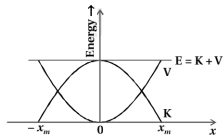
Draw plots of mechanical energy,potential energy,and kinetic energy versus displacement for different positions of a block attached to a spring.
Solution
(N/A) For a block attached to a spring,the total mechanical energy $E$ is constant and is given by $E = \frac{1}{2} k x_{m}^{2}$,where $k$ is the spring constant and $x_{m}$ is the amplitude.
The potential energy $V(x)$ at any displacement $x$ is given by $V(x) = \frac{1}{2} k x^{2}$.
The kinetic energy $K(x)$ at any displacement $x$ is given by $K(x) = E - V(x) = \frac{1}{2} k (x_{m}^{2} - x^{2})$.
At the equilibrium position $(x = 0)$,the potential energy is zero and the kinetic energy is maximum,$K_{max} = \frac{1}{2} k x_{m}^{2}$.
At the extreme positions $(x = \pm x_{m})$,the kinetic energy is zero and the potential energy is maximum,$V_{max} = \frac{1}{2} k x_{m}^{2}$.
The potential energy $V(x)$ at any displacement $x$ is given by $V(x) = \frac{1}{2} k x^{2}$.
The kinetic energy $K(x)$ at any displacement $x$ is given by $K(x) = E - V(x) = \frac{1}{2} k (x_{m}^{2} - x^{2})$.
At the equilibrium position $(x = 0)$,the potential energy is zero and the kinetic energy is maximum,$K_{max} = \frac{1}{2} k x_{m}^{2}$.
At the extreme positions $(x = \pm x_{m})$,the kinetic energy is zero and the potential energy is maximum,$V_{max} = \frac{1}{2} k x_{m}^{2}$.
| Displacement $(x)$ | Kinetic Energy $(K)$ | Potential Energy $(V)$ | Total Energy $(E)$ |
|---|---|---|---|
| $x_{m}$ | $0$ | $\frac{1}{2} k x_{m}^{2}$ | $\frac{1}{2} k x_{m}^{2}$ |
| $0$ | $\frac{1}{2} k x_{m}^{2}$ | $0$ | $\frac{1}{2} k x_{m}^{2}$ |
| $-x_{m}$ | $0$ | $\frac{1}{2} k x_{m}^{2}$ | $\frac{1}{2} k x_{m}^{2}$ |
0 likes
View Solution87
MediumMCQ
Vibrational motion possesses which type of energy?
A
Only kinetic energy
B
Only potential energy
C
Both kinetic and potential energy
D
Neither kinetic nor potential energy
Solution
(C) Vibrational motion is a periodic motion where a particle oscillates about its mean position.
During this motion,the particle possesses kinetic energy due to its velocity and potential energy due to its displacement from the mean position.
Therefore,vibrational motion involves a continuous exchange between kinetic energy and potential energy,meaning it possesses both types of energy.
During this motion,the particle possesses kinetic energy due to its velocity and potential energy due to its displacement from the mean position.
Therefore,vibrational motion involves a continuous exchange between kinetic energy and potential energy,meaning it possesses both types of energy.
0 likes
View Solution88
Medium
Obtain the expressions for kinetic energy,potential energy,and total energy in simple harmonic motion.
Solution
(N/A) For a particle in simple harmonic motion $(SHM)$,the displacement is given by $x = A \cos(\omega t + \phi)$.
$1$. Kinetic Energy $(K)$:
The velocity is $v = \frac{dx}{dt} = -A\omega \sin(\omega t + \phi)$.
$K = \frac{1}{2}mv^2 = \frac{1}{2}m(-A\omega \sin(\omega t + \phi))^2 = \frac{1}{2}m\omega^2 A^2 \sin^2(\omega t + \phi)$.
Since $k = m\omega^2$,$K = \frac{1}{2}kA^2 \sin^2(\omega t + \phi)$.
$2$. Potential Energy $(U)$:
The restoring force is $F = -kx$. The work done against this force to displace the particle by $dx$ is $dU = -F dx = kx dx$.
Integrating from $0$ to $x$,$U = \int_0^x kx dx = \frac{1}{2}kx^2$.
Substituting $x = A \cos(\omega t + \phi)$,$U = \frac{1}{2}kA^2 \cos^2(\omega t + \phi)$.
$3$. Total Energy $(E)$:
$E = K + U = \frac{1}{2}kA^2 \sin^2(\omega t + \phi) + \frac{1}{2}kA^2 \cos^2(\omega t + \phi)$.
$E = \frac{1}{2}kA^2 (\sin^2(\omega t + \phi) + \cos^2(\omega t + \phi)) = \frac{1}{2}kA^2$.
$1$. Kinetic Energy $(K)$:
The velocity is $v = \frac{dx}{dt} = -A\omega \sin(\omega t + \phi)$.
$K = \frac{1}{2}mv^2 = \frac{1}{2}m(-A\omega \sin(\omega t + \phi))^2 = \frac{1}{2}m\omega^2 A^2 \sin^2(\omega t + \phi)$.
Since $k = m\omega^2$,$K = \frac{1}{2}kA^2 \sin^2(\omega t + \phi)$.
$2$. Potential Energy $(U)$:
The restoring force is $F = -kx$. The work done against this force to displace the particle by $dx$ is $dU = -F dx = kx dx$.
Integrating from $0$ to $x$,$U = \int_0^x kx dx = \frac{1}{2}kx^2$.
Substituting $x = A \cos(\omega t + \phi)$,$U = \frac{1}{2}kA^2 \cos^2(\omega t + \phi)$.
$3$. Total Energy $(E)$:
$E = K + U = \frac{1}{2}kA^2 \sin^2(\omega t + \phi) + \frac{1}{2}kA^2 \cos^2(\omega t + \phi)$.
$E = \frac{1}{2}kA^2 (\sin^2(\omega t + \phi) + \cos^2(\omega t + \phi)) = \frac{1}{2}kA^2$.
0 likes
View Solution89
Difficult
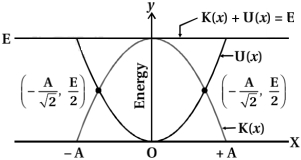
Explain and draw the graphs of kinetic energy,potential energy,and mechanical energy versus displacement for $SHM$.
Solution
(N/A) For a particle executing $SHM$,the kinetic energy $K(x)$,potential energy $U(x)$,and total mechanical energy $E$ as a function of displacement $x$ are given by:
Kinetic energy: $K(x) = \frac{1}{2} k(A^2 - x^2)$
Potential energy: $U(x) = \frac{1}{2} k x^2$
Mechanical energy: $E = K(x) + U(x) = \frac{1}{2} k A^2$
Where $k$ is the force constant and $A$ is the amplitude.
The graph shows that potential energy is a parabola opening upwards,kinetic energy is a downward-opening parabola,and mechanical energy is a constant horizontal line.
Kinetic energy: $K(x) = \frac{1}{2} k(A^2 - x^2)$
Potential energy: $U(x) = \frac{1}{2} k x^2$
Mechanical energy: $E = K(x) + U(x) = \frac{1}{2} k A^2$
Where $k$ is the force constant and $A$ is the amplitude.
| Displacement $(x)$ | Kinetic Energy $(K)$ | Potential Energy $(U)$ | Mechanical Energy $(E)$ |
|---|---|---|---|
| $0$ | $\frac{1}{2} k A^2$ | $0$ | $\frac{1}{2} k A^2$ |
| $\pm A/2$ | $\frac{3}{8} k A^2$ | $\frac{1}{8} k A^2$ | $\frac{1}{2} k A^2$ |
| $\pm A/\sqrt{2}$ | $\frac{1}{4} k A^2$ | $\frac{1}{4} k A^2$ | $\frac{1}{2} k A^2$ |
| $\pm A$ | $0$ | $\frac{1}{2} k A^2$ | $\frac{1}{2} k A^2$ |
The graph shows that potential energy is a parabola opening upwards,kinetic energy is a downward-opening parabola,and mechanical energy is a constant horizontal line.
0 likes
View Solution90
Medium
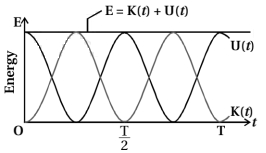
Explain and draw the graphs of kinetic energy, potential energy, and mechanical energy as a function of time for a particle in Simple Harmonic Motion $(SHM)$.
Solution
(N/A) For a particle in $SHM$, the displacement is given by $x(t) = A \sin(\omega t + \phi)$.
The kinetic energy $K(t)$ is given by:
$K(t) = \frac{1}{2} m v^2 = \frac{1}{2} k A^2 \cos^2(\omega t + \phi)$
The potential energy $U(t)$ is given by:
$U(t) = \frac{1}{2} k x^2 = \frac{1}{2} k A^2 \sin^2(\omega t + \phi)$
The total mechanical energy $E$ is:
$E = K(t) + U(t) = \frac{1}{2} k A^2 (\cos^2(\omega t + \phi) + \sin^2(\omega t + \phi)) = \frac{1}{2} k A^2$
Since $\sin^2 \theta + \cos^2 \theta = 1$, the total mechanical energy $E$ remains constant over time.
The kinetic energy $K(t)$ is given by:
$K(t) = \frac{1}{2} m v^2 = \frac{1}{2} k A^2 \cos^2(\omega t + \phi)$
The potential energy $U(t)$ is given by:
$U(t) = \frac{1}{2} k x^2 = \frac{1}{2} k A^2 \sin^2(\omega t + \phi)$
The total mechanical energy $E$ is:
$E = K(t) + U(t) = \frac{1}{2} k A^2 (\cos^2(\omega t + \phi) + \sin^2(\omega t + \phi)) = \frac{1}{2} k A^2$
Since $\sin^2 \theta + \cos^2 \theta = 1$, the total mechanical energy $E$ remains constant over time.
| Time $(t)$ | Kinetic Energy $(K)$ | Potential Energy $(U)$ | Total Energy $(E)$ |
| $0$ | $\frac{1}{2} k A^2$ | $0$ | $\frac{1}{2} k A^2$ |
| $T/4$ | $0$ | $\frac{1}{2} k A^2$ | $\frac{1}{2} k A^2$ |
| $T/2$ | $\frac{1}{2} k A^2$ | $0$ | $\frac{1}{2} k A^2$ |
| $3T/4$ | $0$ | $\frac{1}{2} k A^2$ | $\frac{1}{2} k A^2$ |
| $T$ | $\frac{1}{2} k A^2$ | $0$ | $\frac{1}{2} k A^2$ |
0 likes
View Solution91
Medium
Write the expression of kinetic energy and potential energy of $SHM$ particle $(i)$ as a function of displacement $(ii)$ as a function of time.
Solution
(N/A) For a particle of mass $m$ performing $SHM$ with angular frequency $\omega$ and amplitude $A$:
$(i)$ As a function of displacement $x$:
Potential Energy $(U)$: $U = \frac{1}{2} m \omega^2 x^2$
Kinetic Energy $(K)$: $K = \frac{1}{2} m \omega^2 (A^2 - x^2)$
$(ii)$ As a function of time $t$ (assuming $x = A \sin(\omega t + \phi)$):
Potential Energy $(U)$: $U = \frac{1}{2} m \omega^2 A^2 \sin^2(\omega t + \phi)$
Kinetic Energy $(K)$: $K = \frac{1}{2} m \omega^2 A^2 \cos^2(\omega t + \phi)$
$(i)$ As a function of displacement $x$:
Potential Energy $(U)$: $U = \frac{1}{2} m \omega^2 x^2$
Kinetic Energy $(K)$: $K = \frac{1}{2} m \omega^2 (A^2 - x^2)$
$(ii)$ As a function of time $t$ (assuming $x = A \sin(\omega t + \phi)$):
Potential Energy $(U)$: $U = \frac{1}{2} m \omega^2 A^2 \sin^2(\omega t + \phi)$
Kinetic Energy $(K)$: $K = \frac{1}{2} m \omega^2 A^2 \cos^2(\omega t + \phi)$
0 likes
View Solution92
MediumMCQ
On what factors does the mechanical energy of a simple harmonic oscillator depend,and on what factors does it not depend?
A
Depends on amplitude and force constant; does not depend on time or position.
B
Depends on time and position; does not depend on amplitude.
C
Depends on mass and velocity; does not depend on amplitude.
D
Depends on acceleration; does not depend on mass.
Solution
(A) The total mechanical energy $E$ of a simple harmonic oscillator is given by the formula $E = \frac{1}{2} k A^2$,where $k$ is the force constant and $A$ is the amplitude of oscillation.
$1$. The mechanical energy depends on the amplitude $(A)$ and the force constant $(k)$ (or mass $m$ and angular frequency $\omega$,since $k = m \omega^2$).
$2$. The mechanical energy does not depend on the instantaneous position $(x)$ or the instantaneous time $(t)$ of the oscillator,as it remains constant throughout the motion.
$1$. The mechanical energy depends on the amplitude $(A)$ and the force constant $(k)$ (or mass $m$ and angular frequency $\omega$,since $k = m \omega^2$).
$2$. The mechanical energy does not depend on the instantaneous position $(x)$ or the instantaneous time $(t)$ of the oscillator,as it remains constant throughout the motion.
0 likes
View Solution93
MediumMCQ
Write the coordinates of the points of intersection of the graph of kinetic energy $(K)$ and potential energy $(U)$ for a simple harmonic oscillator.
A
$x = \pm \frac{A}{\sqrt{2}}, K = U = \frac{1}{4}kA^2$
B
$x = \pm \frac{A}{2}, K = U = \frac{1}{2}kA^2$
C
$x = \pm A, K = U = 0$
D
$x = 0, K = U = \frac{1}{2}kA^2$
Solution
(A) For a simple harmonic oscillator,the potential energy is given by $U = \frac{1}{2}kx^2$ and the kinetic energy is given by $K = \frac{1}{2}k(A^2 - x^2)$,where $A$ is the amplitude and $k$ is the force constant.
At the point of intersection,$K = U$.
Therefore,$\frac{1}{2}kx^2 = \frac{1}{2}k(A^2 - x^2)$.
Canceling $\frac{1}{2}k$ from both sides,we get $x^2 = A^2 - x^2$.
$2x^2 = A^2$,which implies $x^2 = \frac{A^2}{2}$.
Thus,$x = \pm \frac{A}{\sqrt{2}}$.
Substituting $x^2 = \frac{A^2}{2}$ into the expression for potential energy,we get $U = \frac{1}{2}k(\frac{A^2}{2}) = \frac{1}{4}kA^2$.
Since $K = U$,the kinetic energy is also $\frac{1}{4}kA^2$.
Thus,the coordinates of the points of intersection are $(x, E) = (\pm \frac{A}{\sqrt{2}}, \frac{1}{4}kA^2)$.
At the point of intersection,$K = U$.
Therefore,$\frac{1}{2}kx^2 = \frac{1}{2}k(A^2 - x^2)$.
Canceling $\frac{1}{2}k$ from both sides,we get $x^2 = A^2 - x^2$.
$2x^2 = A^2$,which implies $x^2 = \frac{A^2}{2}$.
Thus,$x = \pm \frac{A}{\sqrt{2}}$.
Substituting $x^2 = \frac{A^2}{2}$ into the expression for potential energy,we get $U = \frac{1}{2}k(\frac{A^2}{2}) = \frac{1}{4}kA^2$.
Since $K = U$,the kinetic energy is also $\frac{1}{4}kA^2$.
Thus,the coordinates of the points of intersection are $(x, E) = (\pm \frac{A}{\sqrt{2}}, \frac{1}{4}kA^2)$.
0 likes
View Solution94
Medium
If $T$ is the period of $SHM$,then write the period of kinetic and potential energy.
Solution
(T/2) In $SHM$,the displacement is given by $x = A \sin(\omega t)$.
The kinetic energy is $K = \frac{1}{2} k A^2 \cos^2(\omega t) = \frac{1}{4} k A^2 (1 + \cos(2\omega t))$.
The potential energy is $U = \frac{1}{2} k A^2 \sin^2(\omega t) = \frac{1}{4} k A^2 (1 - \cos(2\omega t))$.
Both kinetic and potential energy expressions depend on $\cos(2\omega t)$,which has an angular frequency of $2\omega$.
The period of $SHM$ is $T = \frac{2\pi}{\omega}$.
The period of kinetic and potential energy is $T' = \frac{2\pi}{2\omega} = \frac{T}{2}$.
The kinetic energy is $K = \frac{1}{2} k A^2 \cos^2(\omega t) = \frac{1}{4} k A^2 (1 + \cos(2\omega t))$.
The potential energy is $U = \frac{1}{2} k A^2 \sin^2(\omega t) = \frac{1}{4} k A^2 (1 - \cos(2\omega t))$.
Both kinetic and potential energy expressions depend on $\cos(2\omega t)$,which has an angular frequency of $2\omega$.
The period of $SHM$ is $T = \frac{2\pi}{\omega}$.
The period of kinetic and potential energy is $T' = \frac{2\pi}{2\omega} = \frac{T}{2}$.
0 likes
View Solution95
EasyMCQ
The total energy of a particle executing $SHM$ at an amplitude of $4 \, cm$ is $20 \, J$. What will be its total energy at a displacement of $x = 2 \, cm$ (in $J$)?
A
$10$
B
$20$
C
$5$
D
$15$
Solution
(B) The total mechanical energy of a particle executing $SHM$ is given by the formula $E = \frac{1}{2} k A^2$,where $k$ is the force constant and $A$ is the amplitude.
Since the total energy $E$ depends only on the force constant $k$ and the amplitude $A$,it remains constant throughout the motion.
Therefore,the total energy does not depend on the instantaneous displacement $x$.
Given that the total energy at amplitude $A = 4 \, cm$ is $20 \, J$,the total energy at any other displacement $x$ (within the range $-A$ to $A$) will also be $20 \, J$.
Since the total energy $E$ depends only on the force constant $k$ and the amplitude $A$,it remains constant throughout the motion.
Therefore,the total energy does not depend on the instantaneous displacement $x$.
Given that the total energy at amplitude $A = 4 \, cm$ is $20 \, J$,the total energy at any other displacement $x$ (within the range $-A$ to $A$) will also be $20 \, J$.
0 likes
View Solution96
EasyMCQ
At which point (place) does a particle executing $SHM$ have maximum kinetic energy and maximum potential energy?
A
Maximum kinetic energy at mean position,maximum potential energy at extreme position.
B
Maximum kinetic energy at extreme position,maximum potential energy at mean position.
C
Maximum kinetic energy and potential energy both at mean position.
D
Maximum kinetic energy and potential energy both at extreme position.
Solution
(A) In $SHM$,the total mechanical energy is conserved.
At the equilibrium point (mean position),the displacement $x = 0$. Since kinetic energy $K = \frac{1}{2} k(A^2 - x^2)$,it is maximum at $x = 0$.
At the extreme positions,the displacement $x = \pm A$. Since potential energy $U = \frac{1}{2} kx^2$,it is maximum at $x = \pm A$.
At the equilibrium point (mean position),the displacement $x = 0$. Since kinetic energy $K = \frac{1}{2} k(A^2 - x^2)$,it is maximum at $x = 0$.
At the extreme positions,the displacement $x = \pm A$. Since potential energy $U = \frac{1}{2} kx^2$,it is maximum at $x = \pm A$.
0 likes
View Solution97
MediumMCQ
The amplitude of an $SHM$ particle is $4 \, cm$. At what distance from the mean position will the potential energy and kinetic energy be equal?
A
$2 \, cm$
B
$2\sqrt{2} \, cm$
C
$4 \, cm$
D
$\sqrt{2} \, cm$
Solution
(B) Let the potential energy be $U$ and kinetic energy be $K$. We are given that $U = K$.
The potential energy of a particle in $SHM$ at a distance $x$ from the mean position is $U = \frac{1}{2} k x^2$.
The kinetic energy of the particle at distance $x$ is $K = \frac{1}{2} k (A^2 - x^2)$,where $A$ is the amplitude.
Setting $U = K$,we get:
$\frac{1}{2} k x^2 = \frac{1}{2} k (A^2 - x^2)$
Canceling $\frac{1}{2} k$ from both sides:
$x^2 = A^2 - x^2$
$2x^2 = A^2$
$x^2 = \frac{A^2}{2}$
$x = \pm \frac{A}{\sqrt{2}}$
Given $A = 4 \, cm$,we have:
$x = \pm \frac{4}{\sqrt{2}} = \pm 2\sqrt{2} \, cm$.
Thus,the potential energy and kinetic energy are equal at a distance of $2\sqrt{2} \, cm$ from the mean position.
The potential energy of a particle in $SHM$ at a distance $x$ from the mean position is $U = \frac{1}{2} k x^2$.
The kinetic energy of the particle at distance $x$ is $K = \frac{1}{2} k (A^2 - x^2)$,where $A$ is the amplitude.
Setting $U = K$,we get:
$\frac{1}{2} k x^2 = \frac{1}{2} k (A^2 - x^2)$
Canceling $\frac{1}{2} k$ from both sides:
$x^2 = A^2 - x^2$
$2x^2 = A^2$
$x^2 = \frac{A^2}{2}$
$x = \pm \frac{A}{\sqrt{2}}$
Given $A = 4 \, cm$,we have:
$x = \pm \frac{4}{\sqrt{2}} = \pm 2\sqrt{2} \, cm$.
Thus,the potential energy and kinetic energy are equal at a distance of $2\sqrt{2} \, cm$ from the mean position.
0 likes
View Solution98
MediumMCQ
Write the maximum velocity of a $SHM$ oscillator in terms of mechanical energy $E$ and mass of oscillator $m$.
A
$v_{\max} = \sqrt{\frac{E}{m}}$
B
$v_{\max} = \sqrt{\frac{2E}{m}}$
C
$v_{\max} = \sqrt{\frac{E}{2m}}$
D
$v_{\max} = \sqrt{\frac{E}{m^2}}$
Solution
(B) The total mechanical energy $E$ of a $SHM$ oscillator is given by $E = \frac{1}{2} k A^2$,where $k$ is the force constant and $A$ is the amplitude.
Since $k = m \omega^2$,we can write $E = \frac{1}{2} m \omega^2 A^2$.
We know that the maximum velocity $v_{\max}$ of a $SHM$ oscillator is given by $v_{\max} = \omega A$.
Substituting this into the energy equation: $E = \frac{1}{2} m (\omega A)^2 = \frac{1}{2} m v_{\max}^2$.
Rearranging for $v_{\max}$,we get $v_{\max}^2 = \frac{2E}{m}$.
Therefore,$v_{\max} = \sqrt{\frac{2E}{m}}$.
Since $k = m \omega^2$,we can write $E = \frac{1}{2} m \omega^2 A^2$.
We know that the maximum velocity $v_{\max}$ of a $SHM$ oscillator is given by $v_{\max} = \omega A$.
Substituting this into the energy equation: $E = \frac{1}{2} m (\omega A)^2 = \frac{1}{2} m v_{\max}^2$.
Rearranging for $v_{\max}$,we get $v_{\max}^2 = \frac{2E}{m}$.
Therefore,$v_{\max} = \sqrt{\frac{2E}{m}}$.
0 likes
View SolutionOscillations — Energy of Simple Harmonic Motion · Frequently Asked Questions
1Are these Oscillations questions useful for JEE and NEET?
Yes. All questions in this section are mapped to JEE Main and NEET exam patterns. Previous year questions from JEE Main, NEET, GUJCET and state-level exams are included with full solutions.
2Can I switch to Hindi or Gujarati for these questions?
Yes. Use the language tabs in the hero section or the sidebar to view the same questions and solutions in English, Hindi or Gujarati.
3How do I generate a question paper from this subtopic?
Use the Vedclass Exam Paper Generator — select the chapter and subtopic, set difficulty, and generate Sets A, B, C, D automatically. First 3 chapters of every subject are free.
Vedclass Products
For Students
Vedclass Test Series
Mock tests in real JEE/NEET style with performance analysis. 5-day free trial.
Start Free TrialFor Teachers
Exam Paper Generator
Generate Set A/B/C/D papers from this chapter in 2 minutes. 3 chapters free.
Try FreeFor Institutes
Online Exam Module
Live online exams with unlimited students, 360° analytics & white-label branding.
See DemoFor Teachers & Institutes
Generate a Oscillations Exam Paper in 2 Minutes
Select subtopic & difficulty — Sets A, B, C, D auto-generated with No Repeat logic.
First 3 chapters of every subject are free — no payment required.