
A English
Energy of Simple Harmonic Motion Questions in English
Class 11 Physics · Oscillations · Energy of Simple Harmonic Motion
224+
Questions
English
Language
100%
With Solutions
Showing 21 of 224 questions in English
201
MediumMCQ
$A$ particle is executing simple harmonic motion starting from its mean position. If the time period of the particle is $1.5 \ s$,then the minimum time at which the ratio of the kinetic and total energies of the particle becomes $3: 4$ is
A
$\frac{1}{4} \ s$
B
$\frac{1}{12} \ s$
C
$\frac{1}{8} \ s$
D
$\frac{1}{6} \ s$
Solution
(C) The displacement of a particle in simple harmonic motion starting from the mean position is given by $x = A \sin(\omega t)$.
The velocity of the particle is $v = \frac{dx}{dt} = A\omega \cos(\omega t)$.
The kinetic energy $(K)$ is $K = \frac{1}{2}mv^2 = \frac{1}{2}m A^2 \omega^2 \cos^2(\omega t)$.
The total energy $(E)$ is $E = \frac{1}{2}m A^2 \omega^2$.
The ratio of kinetic energy to total energy is $\frac{K}{E} = \cos^2(\omega t)$.
Given $\frac{K}{E} = \frac{3}{4}$,so $\cos^2(\omega t) = \frac{3}{4}$,which implies $\cos(\omega t) = \frac{\sqrt{3}}{2}$.
This means $\omega t = \frac{\pi}{6}$.
Given the time period $T = 1.5 \ s$,we have $\omega = \frac{2\pi}{T} = \frac{2\pi}{1.5} = \frac{4\pi}{3} \ rad/s$.
Substituting $\omega$ into the equation: $(\frac{4\pi}{3}) t = \frac{\pi}{6}$.
Solving for $t$: $t = \frac{\pi}{6} \times \frac{3}{4\pi} = \frac{3}{24} = \frac{1}{8} \ s$.
The velocity of the particle is $v = \frac{dx}{dt} = A\omega \cos(\omega t)$.
The kinetic energy $(K)$ is $K = \frac{1}{2}mv^2 = \frac{1}{2}m A^2 \omega^2 \cos^2(\omega t)$.
The total energy $(E)$ is $E = \frac{1}{2}m A^2 \omega^2$.
The ratio of kinetic energy to total energy is $\frac{K}{E} = \cos^2(\omega t)$.
Given $\frac{K}{E} = \frac{3}{4}$,so $\cos^2(\omega t) = \frac{3}{4}$,which implies $\cos(\omega t) = \frac{\sqrt{3}}{2}$.
This means $\omega t = \frac{\pi}{6}$.
Given the time period $T = 1.5 \ s$,we have $\omega = \frac{2\pi}{T} = \frac{2\pi}{1.5} = \frac{4\pi}{3} \ rad/s$.
Substituting $\omega$ into the equation: $(\frac{4\pi}{3}) t = \frac{\pi}{6}$.
Solving for $t$: $t = \frac{\pi}{6} \times \frac{3}{4\pi} = \frac{3}{24} = \frac{1}{8} \ s$.
0 likes
View Solution202
MediumMCQ
$A$ particle is executing simple harmonic motion with amplitude $A$. The ratio of the kinetic energies of the particle when it is at displacements of $\frac{A}{4}$ and $\frac{A}{2}$ from the mean position is
A
$4: 1$
B
$2: 1$
C
$5: 4$
D
$9: 16$
Solution
(C) The kinetic energy $K$ of a particle executing simple harmonic motion at a displacement $x$ is given by $K = \frac{1}{2} k (A^2 - x^2)$,where $k$ is the force constant and $A$ is the amplitude.
At displacement $x_1 = \frac{A}{4}$,the kinetic energy is $K_1 = \frac{1}{2} k (A^2 - (\frac{A}{4})^2) = \frac{1}{2} k (A^2 - \frac{A^2}{16}) = \frac{1}{2} k (\frac{15A^2}{16})$.
At displacement $x_2 = \frac{A}{2}$,the kinetic energy is $K_2 = \frac{1}{2} k (A^2 - (\frac{A}{2})^2) = \frac{1}{2} k (A^2 - \frac{A^2}{4}) = \frac{1}{2} k (\frac{3A^2}{4}) = \frac{1}{2} k (\frac{12A^2}{16})$.
The ratio of the kinetic energies is $\frac{K_1}{K_2} = \frac{\frac{15A^2}{16}}{\frac{12A^2}{16}} = \frac{15}{12} = \frac{5}{4}$.
At displacement $x_1 = \frac{A}{4}$,the kinetic energy is $K_1 = \frac{1}{2} k (A^2 - (\frac{A}{4})^2) = \frac{1}{2} k (A^2 - \frac{A^2}{16}) = \frac{1}{2} k (\frac{15A^2}{16})$.
At displacement $x_2 = \frac{A}{2}$,the kinetic energy is $K_2 = \frac{1}{2} k (A^2 - (\frac{A}{2})^2) = \frac{1}{2} k (A^2 - \frac{A^2}{4}) = \frac{1}{2} k (\frac{3A^2}{4}) = \frac{1}{2} k (\frac{12A^2}{16})$.
The ratio of the kinetic energies is $\frac{K_1}{K_2} = \frac{\frac{15A^2}{16}}{\frac{12A^2}{16}} = \frac{15}{12} = \frac{5}{4}$.
0 likes
View Solution203
EasyMCQ
Position of a $3 \ kg$ mass moving along the $X$-axis is given by $x = 0.3 \cos (\omega t) \ m$. If $K(t)$ denotes the kinetic energy at time $t$,then the value of $\frac{K\left(\frac{\pi}{6 \omega}\right)}{K\left(\frac{\pi}{3 \omega}\right)}$ is
A
$1 / 3$
B
$1 / 2$
C
$\sqrt{3} / 2$
D
$\sqrt{3}$
Solution
(A) Given,position of particle of mass $m = 3 \ kg$ is $x = 0.3 \cos (\omega t)$.
Velocity of particle,$v = \frac{dx}{dt} = \frac{d}{dt} (0.3 \cos \omega t) = -0.3 \omega \sin (\omega t)$.
Kinetic energy $K(t) = \frac{1}{2} m v^2 = \frac{1}{2} m (-0.3 \omega \sin \omega t)^2 = \frac{1}{2} m (0.09 \omega^2 \sin^2 \omega t)$.
At $t_1 = \frac{\pi}{6 \omega}$,$K\left(\frac{\pi}{6 \omega}\right) = \frac{1}{2} m (0.09 \omega^2 \sin^2 \frac{\pi}{6}) = \frac{1}{2} m (0.09 \omega^2) \left(\frac{1}{2}\right)^2 = \frac{1}{2} m (0.09 \omega^2) \left(\frac{1}{4}\right)$.
At $t_2 = \frac{\pi}{3 \omega}$,$K\left(\frac{\pi}{3 \omega}\right) = \frac{1}{2} m (0.09 \omega^2 \sin^2 \frac{\pi}{3}) = \frac{1}{2} m (0.09 \omega^2) \left(\frac{\sqrt{3}}{2}\right)^2 = \frac{1}{2} m (0.09 \omega^2) \left(\frac{3}{4}\right)$.
Taking the ratio: $\frac{K\left(\frac{\pi}{6 \omega}\right)}{K\left(\frac{\pi}{3 \omega}\right)} = \frac{1/4}{3/4} = \frac{1}{3}$.
Velocity of particle,$v = \frac{dx}{dt} = \frac{d}{dt} (0.3 \cos \omega t) = -0.3 \omega \sin (\omega t)$.
Kinetic energy $K(t) = \frac{1}{2} m v^2 = \frac{1}{2} m (-0.3 \omega \sin \omega t)^2 = \frac{1}{2} m (0.09 \omega^2 \sin^2 \omega t)$.
At $t_1 = \frac{\pi}{6 \omega}$,$K\left(\frac{\pi}{6 \omega}\right) = \frac{1}{2} m (0.09 \omega^2 \sin^2 \frac{\pi}{6}) = \frac{1}{2} m (0.09 \omega^2) \left(\frac{1}{2}\right)^2 = \frac{1}{2} m (0.09 \omega^2) \left(\frac{1}{4}\right)$.
At $t_2 = \frac{\pi}{3 \omega}$,$K\left(\frac{\pi}{3 \omega}\right) = \frac{1}{2} m (0.09 \omega^2 \sin^2 \frac{\pi}{3}) = \frac{1}{2} m (0.09 \omega^2) \left(\frac{\sqrt{3}}{2}\right)^2 = \frac{1}{2} m (0.09 \omega^2) \left(\frac{3}{4}\right)$.
Taking the ratio: $\frac{K\left(\frac{\pi}{6 \omega}\right)}{K\left(\frac{\pi}{3 \omega}\right)} = \frac{1/4}{3/4} = \frac{1}{3}$.
0 likes
View Solution204
MediumMCQ
$A$ body of mass $1 \ kg$ is executing simple harmonic motion $(SHM)$. Its displacement $y$ (in $cm$) at time $t$ is given by $y = 6 \sin (100 t + \pi/4) \ cm$. Its maximum kinetic energy is (in $J$)
A
$1.8$
B
$18$
C
$180$
D
$0.18$
Solution
(B) Given: Mass $m = 1 \ kg$,displacement $y = 6 \sin (100 t + \pi/4) \ cm$.
Comparing with the general equation $y = A \sin (\omega t + \phi)$,we get amplitude $A = 6 \ cm = 0.06 \ m$ and angular frequency $\omega = 100 \ rad/s$.
The maximum kinetic energy $(K_{max})$ of a particle in $SHM$ is given by the formula $K_{max} = \frac{1}{2} m \omega^2 A^2$.
Substituting the values: $K_{max} = \frac{1}{2} \times 1 \times (100)^2 \times (0.06)^2$.
$K_{max} = \frac{1}{2} \times 10000 \times 0.0036$.
$K_{max} = 5000 \times 0.0036 = 18 \ J$.
Comparing with the general equation $y = A \sin (\omega t + \phi)$,we get amplitude $A = 6 \ cm = 0.06 \ m$ and angular frequency $\omega = 100 \ rad/s$.
The maximum kinetic energy $(K_{max})$ of a particle in $SHM$ is given by the formula $K_{max} = \frac{1}{2} m \omega^2 A^2$.
Substituting the values: $K_{max} = \frac{1}{2} \times 1 \times (100)^2 \times (0.06)^2$.
$K_{max} = \frac{1}{2} \times 10000 \times 0.0036$.
$K_{max} = 5000 \times 0.0036 = 18 \ J$.
0 likes
View Solution205
EasyMCQ
The displacement of a particle in simple harmonic motion $(SHM)$ is given by $y = \sqrt{3 \pi} \sin \left(\frac{100}{\pi} t + \frac{\pi}{4}\right)$. What will be the displacement of the particle from the mean position when its kinetic energy is eight times that of its potential energy?
A
$\sqrt{\frac{\pi}{3}}$
B
$\sqrt{\frac{3 \pi}{2}}$
C
$\sqrt{\pi}$
D
$\sqrt{3 \pi}$
Solution
(A) The kinetic energy $(K.E.)$ and potential energy $(P.E.)$ in $SHM$ are given by:
$K.E. = \frac{1}{2} m \omega^2 (A^2 - y^2)$
$P.E. = \frac{1}{2} m \omega^2 y^2$
Given that $K.E. = 8 \times P.E.$
Substituting the expressions:
$\frac{1}{2} m \omega^2 (A^2 - y^2) = 8 \times \frac{1}{2} m \omega^2 y^2$
$A^2 - y^2 = 8 y^2$
$A^2 = 9 y^2$
$y = \pm \frac{A}{3}$
From the given equation $y = \sqrt{3 \pi} \sin \left(\frac{100}{\pi} t + \frac{\pi}{4}\right)$,the amplitude $A = \sqrt{3 \pi}$.
Therefore,the displacement $y = \frac{\sqrt{3 \pi}}{3} = \frac{\sqrt{3} \sqrt{\pi}}{\sqrt{3} \sqrt{3}} = \sqrt{\frac{\pi}{3}}$.
$K.E. = \frac{1}{2} m \omega^2 (A^2 - y^2)$
$P.E. = \frac{1}{2} m \omega^2 y^2$
Given that $K.E. = 8 \times P.E.$
Substituting the expressions:
$\frac{1}{2} m \omega^2 (A^2 - y^2) = 8 \times \frac{1}{2} m \omega^2 y^2$
$A^2 - y^2 = 8 y^2$
$A^2 = 9 y^2$
$y = \pm \frac{A}{3}$
From the given equation $y = \sqrt{3 \pi} \sin \left(\frac{100}{\pi} t + \frac{\pi}{4}\right)$,the amplitude $A = \sqrt{3 \pi}$.
Therefore,the displacement $y = \frac{\sqrt{3 \pi}}{3} = \frac{\sqrt{3} \sqrt{\pi}}{\sqrt{3} \sqrt{3}} = \sqrt{\frac{\pi}{3}}$.
0 likes
View Solution206
EasyMCQ
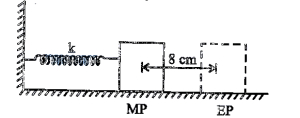
$A$ block kept on a frictionless horizontal surface is connected to one end of a horizontal spring of constant $100 \text{ Nm}^{-1}$ whose other end is fixed to a rigid vertical wall. Initially, the block is at its equilibrium position. The block is pulled to a distance of $8 \text{ cm}$ and released. The kinetic energy of the block when it is at a distance of $3 \text{ cm}$ from the mean position is (in $\text{ J}$)
A
$0.65$
B
$0.325$
C
$0.275$
D
$0.55$
Solution
(C) For a spring-block system undergoing simple harmonic motion, the total mechanical energy is conserved.
The total energy $E$ is given by $E = \frac{1}{2} k A^2$, where $k = 100 \text{ Nm}^{-1}$ and amplitude $A = 8 \text{ cm} = 0.08 \text{ m}$.
The potential energy at displacement $x$ is $U = \frac{1}{2} k x^2$, where $x = 3 \text{ cm} = 0.03 \text{ m}$.
The kinetic energy $K$ at displacement $x$ is given by $K = E - U = \frac{1}{2} k (A^2 - x^2)$.
Substituting the values:
$K = \frac{1}{2} \times 100 \times ((0.08)^2 - (0.03)^2)$
$K = 50 \times (0.0064 - 0.0009)$
$K = 50 \times 0.0055$
$K = 0.275 \text{ J}$
The total energy $E$ is given by $E = \frac{1}{2} k A^2$, where $k = 100 \text{ Nm}^{-1}$ and amplitude $A = 8 \text{ cm} = 0.08 \text{ m}$.
The potential energy at displacement $x$ is $U = \frac{1}{2} k x^2$, where $x = 3 \text{ cm} = 0.03 \text{ m}$.
The kinetic energy $K$ at displacement $x$ is given by $K = E - U = \frac{1}{2} k (A^2 - x^2)$.
Substituting the values:
$K = \frac{1}{2} \times 100 \times ((0.08)^2 - (0.03)^2)$
$K = 50 \times (0.0064 - 0.0009)$
$K = 50 \times 0.0055$
$K = 0.275 \text{ J}$
0 likes
View Solution207
MediumMCQ
The average energy possessed by an oscillator at a temperature $300 \ K$ is (Boltzmann constant $= 1.38 \times 10^{-23} \ J K^{-1}$).
A
$2.14 \times 10^{-2} \ J$
B
$2.07 \times 10^{-21} \ J$
C
$4.14 \times 10^{-21} \ J$
D
None of these
Solution
(C) The average energy $E$ of a one-dimensional harmonic oscillator in thermal equilibrium at temperature $T$ is given by the equipartition theorem as $E = k_B T$.
However,for a quantum harmonic oscillator,the average energy is given by $E = \frac{h\nu}{e^{h\nu/k_B T} - 1} + \frac{1}{2}h\nu$.
In the classical limit where $k_B T \gg h\nu$,the average energy is $E = k_B T$.
Assuming the question refers to the classical average energy per degree of freedom for a simple harmonic oscillator (which involves both kinetic and potential energy),the total average energy is $E = k_B T$.
Given $k_B = 1.38 \times 10^{-23} \ J K^{-1}$ and $T = 300 \ K$:
$E = (1.38 \times 10^{-23}) \times 300 = 4.14 \times 10^{-21} \ J$.
However,for a quantum harmonic oscillator,the average energy is given by $E = \frac{h\nu}{e^{h\nu/k_B T} - 1} + \frac{1}{2}h\nu$.
In the classical limit where $k_B T \gg h\nu$,the average energy is $E = k_B T$.
Assuming the question refers to the classical average energy per degree of freedom for a simple harmonic oscillator (which involves both kinetic and potential energy),the total average energy is $E = k_B T$.
Given $k_B = 1.38 \times 10^{-23} \ J K^{-1}$ and $T = 300 \ K$:
$E = (1.38 \times 10^{-23}) \times 300 = 4.14 \times 10^{-21} \ J$.
0 likes
View Solution208
DifficultMCQ
$A$ body starting at $t=0$ from the origin oscillates simple harmonically with a period of $4 \ s$. After what time will its kinetic energy be $75 \%$ of its total energy?
A
$\frac{1}{2} \ s$
B
$\frac{1}{3} \ s$
C
$\frac{1}{4} \ s$
D
$1 \ s$
Solution
(B) The kinetic energy $(KE)$ of a simple harmonic oscillator is given by $KE = \frac{1}{2} m \omega^2 (A^2 - x^2)$ and the total energy $(TE)$ is $TE = \frac{1}{2} m \omega^2 A^2$.
Given that $KE = 75\% \text{ of } TE$,we have:
$KE = \frac{3}{4} TE$
$\frac{1}{2} m \omega^2 (A^2 - x^2) = \frac{3}{4} (\frac{1}{2} m \omega^2 A^2)$
$A^2 - x^2 = \frac{3}{4} A^2$
$x^2 = A^2 - \frac{3}{4} A^2 = \frac{1}{4} A^2$
$x = \pm \frac{A}{2}$
For a particle starting from the mean position ($x=0$ at $t=0$),the displacement is given by $x = A \sin(\omega t)$.
Setting $x = \frac{A}{2}$,we get $\frac{A}{2} = A \sin(\omega t) \Rightarrow \sin(\omega t) = \frac{1}{2}$.
This implies $\omega t = \frac{\pi}{6}$.
Since $\omega = \frac{2\pi}{T}$,we have $\frac{2\pi}{T} t = \frac{\pi}{6}$.
$t = \frac{T}{12}$.
Given $T = 4 \ s$,$t = \frac{4}{12} = \frac{1}{3} \ s$.
Given that $KE = 75\% \text{ of } TE$,we have:
$KE = \frac{3}{4} TE$
$\frac{1}{2} m \omega^2 (A^2 - x^2) = \frac{3}{4} (\frac{1}{2} m \omega^2 A^2)$
$A^2 - x^2 = \frac{3}{4} A^2$
$x^2 = A^2 - \frac{3}{4} A^2 = \frac{1}{4} A^2$
$x = \pm \frac{A}{2}$
For a particle starting from the mean position ($x=0$ at $t=0$),the displacement is given by $x = A \sin(\omega t)$.
Setting $x = \frac{A}{2}$,we get $\frac{A}{2} = A \sin(\omega t) \Rightarrow \sin(\omega t) = \frac{1}{2}$.
This implies $\omega t = \frac{\pi}{6}$.
Since $\omega = \frac{2\pi}{T}$,we have $\frac{2\pi}{T} t = \frac{\pi}{6}$.
$t = \frac{T}{12}$.
Given $T = 4 \ s$,$t = \frac{4}{12} = \frac{1}{3} \ s$.
0 likes
View Solution209
DifficultMCQ
Consider a simple harmonic motion $(SHM)$. Let $K$ and $U$ be kinetic energy and potential energy when the displacement in $SHM$ is one-half $\left(\frac{1}{2}\right)$ the amplitude. Which of the following statements is correct?
A
$\frac{K}{U}=1$
B
$\frac{K}{U}=\frac{1}{2}$
C
$\frac{K}{U}=\frac{4}{3}$
D
$\frac{K}{U}=3$
Solution
(D) The potential energy $U$ of a body performing $SHM$ is given by $U = \frac{1}{2} k x^2$,where $x$ is the displacement from the mean position.
Given that the displacement $x = \frac{a}{2}$,where $a$ is the amplitude:
$U = \frac{1}{2} k \left(\frac{a}{2}\right)^2 = \frac{1}{2} k \frac{a^2}{4} = \frac{1}{8} k a^2$ ... $(i)$
The kinetic energy $K$ of the body is given by $K = \frac{1}{2} k (a^2 - x^2)$.
Substituting $x = \frac{a}{2}$:
$K = \frac{1}{2} k \left(a^2 - \frac{a^2}{4}\right) = \frac{1}{2} k \left(\frac{3 a^2}{4}\right) = \frac{3}{8} k a^2$ ... (ii)
Taking the ratio of kinetic energy to potential energy:
$\frac{K}{U} = \frac{\frac{3}{8} k a^2}{\frac{1}{8} k a^2} = 3$.
Given that the displacement $x = \frac{a}{2}$,where $a$ is the amplitude:
$U = \frac{1}{2} k \left(\frac{a}{2}\right)^2 = \frac{1}{2} k \frac{a^2}{4} = \frac{1}{8} k a^2$ ... $(i)$
The kinetic energy $K$ of the body is given by $K = \frac{1}{2} k (a^2 - x^2)$.
Substituting $x = \frac{a}{2}$:
$K = \frac{1}{2} k \left(a^2 - \frac{a^2}{4}\right) = \frac{1}{2} k \left(\frac{3 a^2}{4}\right) = \frac{3}{8} k a^2$ ... (ii)
Taking the ratio of kinetic energy to potential energy:
$\frac{K}{U} = \frac{\frac{3}{8} k a^2}{\frac{1}{8} k a^2} = 3$.
0 likes
View Solution210
EasyMCQ
$A$ particle of mass $4 \,kg$ is executing $SHM$. Its displacement is given by the equation $y=8 \cos [100 t+\pi / 4] \,cm$. Its maximum kinetic energy is (in $\,J$)
A
$128$
B
$64$
C
$16$
D
$32$
Solution
(A) The equation of motion for the particle is given by $y = 8 \cos [100 t + \pi / 4] \,cm$.
Comparing this with the standard $SHM$ equation $y = a \cos(\omega t + \phi)$, we get:
Amplitude $a = 8 \,cm = 8 \times 10^{-2} \,m$
Angular frequency $\omega = 100 \,rad/s$
Mass $m = 4 \,kg$
The maximum kinetic energy $(K_{max})$ in $SHM$ is given by the formula:
$K_{max} = \frac{1}{2} m \omega^2 a^2$
Substituting the values:
$K_{max} = \frac{1}{2} \times 4 \times (100)^2 \times (8 \times 10^{-2})^2$
$K_{max} = 2 \times 10000 \times 64 \times 10^{-4}$
$K_{max} = 2 \times 10000 \times 0.0064$
$K_{max} = 128 \,J$
Comparing this with the standard $SHM$ equation $y = a \cos(\omega t + \phi)$, we get:
Amplitude $a = 8 \,cm = 8 \times 10^{-2} \,m$
Angular frequency $\omega = 100 \,rad/s$
Mass $m = 4 \,kg$
The maximum kinetic energy $(K_{max})$ in $SHM$ is given by the formula:
$K_{max} = \frac{1}{2} m \omega^2 a^2$
Substituting the values:
$K_{max} = \frac{1}{2} \times 4 \times (100)^2 \times (8 \times 10^{-2})^2$
$K_{max} = 2 \times 10000 \times 64 \times 10^{-4}$
$K_{max} = 2 \times 10000 \times 0.0064$
$K_{max} = 128 \,J$
0 likes
View Solution211
DifficultMCQ
The ratio between kinetic and potential energies of a body executing simple harmonic motion,when it is at a distance of $\frac{1}{N}$ of its amplitude from the mean position is
A
$N^2+1$
B
$\frac{1}{N^2}$
C
$N^2$
D
$N^2-1$
Solution
(D) Let the amplitude of the simple harmonic motion be $a$. The displacement of the body from the mean position is $x = \frac{a}{N}$.
The kinetic energy $(KE)$ of the body is given by:
$KE = \frac{1}{2} m \omega^2 (a^2 - x^2) = \frac{1}{2} m \omega^2 \left(a^2 - \frac{a^2}{N^2}\right) = \frac{1}{2} m \omega^2 a^2 \left(1 - \frac{1}{N^2}\right) = \frac{1}{2} m \omega^2 a^2 \left(\frac{N^2 - 1}{N^2}\right) \quad (i)$
The potential energy $(PE)$ of the body is given by:
$PE = \frac{1}{2} m \omega^2 x^2 = \frac{1}{2} m \omega^2 \left(\frac{a}{N}\right)^2 = \frac{1}{2} m \omega^2 \frac{a^2}{N^2} \quad (ii)$
Taking the ratio of $KE$ to $PE$:
$\frac{KE}{PE} = \frac{\frac{1}{2} m \omega^2 a^2 \left(\frac{N^2 - 1}{N^2}\right)}{\frac{1}{2} m \omega^2 \frac{a^2}{N^2}} = \frac{N^2 - 1}{1} = N^2 - 1$
The kinetic energy $(KE)$ of the body is given by:
$KE = \frac{1}{2} m \omega^2 (a^2 - x^2) = \frac{1}{2} m \omega^2 \left(a^2 - \frac{a^2}{N^2}\right) = \frac{1}{2} m \omega^2 a^2 \left(1 - \frac{1}{N^2}\right) = \frac{1}{2} m \omega^2 a^2 \left(\frac{N^2 - 1}{N^2}\right) \quad (i)$
The potential energy $(PE)$ of the body is given by:
$PE = \frac{1}{2} m \omega^2 x^2 = \frac{1}{2} m \omega^2 \left(\frac{a}{N}\right)^2 = \frac{1}{2} m \omega^2 \frac{a^2}{N^2} \quad (ii)$
Taking the ratio of $KE$ to $PE$:
$\frac{KE}{PE} = \frac{\frac{1}{2} m \omega^2 a^2 \left(\frac{N^2 - 1}{N^2}\right)}{\frac{1}{2} m \omega^2 \frac{a^2}{N^2}} = \frac{N^2 - 1}{1} = N^2 - 1$
0 likes
View Solution212
MediumMCQ
The displacements of two particles of same mass executing $SHM$ are represented by the equations $x_1=4 \sin \left(10 t+\frac{\pi}{6}\right)$ and $x_2=5 \cos (\omega t)$. The value of $\omega$ for which the energies of both the particles remain same is (in $\text{ unit}$)
A
$16$
B
$6$
C
$4$
D
$8$
Solution
(D) The energy of a particle executing $SHM$ is given by $E = \frac{1}{2} m \omega^2 A^2$, where $m$ is the mass, $\omega$ is the angular frequency, and $A$ is the amplitude.
For the first particle, $x_1 = 4 \sin (10t + \frac{\pi}{6})$, the amplitude $A_1 = 4$ and angular frequency $\omega_1 = 10$.
The energy is $E_1 = \frac{1}{2} m (10)^2 (4)^2 = \frac{1}{2} m (100)(16) = 800m$.
For the second particle, $x_2 = 5 \cos (\omega t)$, the amplitude $A_2 = 5$ and angular frequency is $\omega$.
The energy is $E_2 = \frac{1}{2} m \omega^2 (5)^2 = \frac{25}{2} m \omega^2$.
Given that the energies are equal, $E_1 = E_2$.
$800m = \frac{25}{2} m \omega^2$.
$1600 = 25 \omega^2$.
$\omega^2 = \frac{1600}{25} = 64$.
$\omega = 8 \text{ unit}$.
For the first particle, $x_1 = 4 \sin (10t + \frac{\pi}{6})$, the amplitude $A_1 = 4$ and angular frequency $\omega_1 = 10$.
The energy is $E_1 = \frac{1}{2} m (10)^2 (4)^2 = \frac{1}{2} m (100)(16) = 800m$.
For the second particle, $x_2 = 5 \cos (\omega t)$, the amplitude $A_2 = 5$ and angular frequency is $\omega$.
The energy is $E_2 = \frac{1}{2} m \omega^2 (5)^2 = \frac{25}{2} m \omega^2$.
Given that the energies are equal, $E_1 = E_2$.
$800m = \frac{25}{2} m \omega^2$.
$1600 = 25 \omega^2$.
$\omega^2 = \frac{1600}{25} = 64$.
$\omega = 8 \text{ unit}$.
0 likes
View Solution213
DifficultMCQ
The displacement of a particle executing $SHM$ is given by $y = 5 \sin \left(4t + \frac{\pi}{3}\right)$. If $T$ is the time period and the mass of the particle is $2 \text{ g}$, the kinetic energy of the particle when $t = \frac{T}{4}$ is given by (in $\text{ J}$)
A
$0.4$
B
$0.5$
C
$3$
D
$0.3$
Solution
(D) The displacement of the particle executing $SHM$ is $y = 5 \sin \left(4t + \frac{\pi}{3}\right)$.
The velocity of the particle is given by $v = \frac{dy}{dt} = \frac{d}{dt} \left[5 \sin \left(4t + \frac{\pi}{3}\right)\right] = 5 \times 4 \cos \left(4t + \frac{\pi}{3}\right) = 20 \cos \left(4t + \frac{\pi}{3}\right)$.
Comparing the given equation with the standard $SHM$ equation $y = a \sin(\omega t + \phi)$, we get $\omega = 4 \text{ rad/s}$.
Since $\omega = \frac{2\pi}{T}$, we have $T = \frac{2\pi}{\omega} = \frac{2\pi}{4} = \frac{\pi}{2} \text{ s}$.
At $t = \frac{T}{4} = \frac{1}{4} \times \frac{\pi}{2} = \frac{\pi}{8} \text{ s}$, the velocity is:
$v = 20 \cos \left(4 \times \frac{\pi}{8} + \frac{\pi}{3}\right) = 20 \cos \left(\frac{\pi}{2} + \frac{\pi}{3}\right) = -20 \sin \left(\frac{\pi}{3}\right) = -20 \times \frac{\sqrt{3}}{2} = -10\sqrt{3} \text{ m/s}$.
The kinetic energy is $KE = \frac{1}{2}mv^2$.
Given $m = 2 \text{ g} = 2 \times 10^{-3} \text{ kg}$.
$KE = \frac{1}{2} \times (2 \times 10^{-3}) \times (-10\sqrt{3})^2 = 10^{-3} \times (100 \times 3) = 300 \times 10^{-3} = 0.3 \text{ J}$.
The velocity of the particle is given by $v = \frac{dy}{dt} = \frac{d}{dt} \left[5 \sin \left(4t + \frac{\pi}{3}\right)\right] = 5 \times 4 \cos \left(4t + \frac{\pi}{3}\right) = 20 \cos \left(4t + \frac{\pi}{3}\right)$.
Comparing the given equation with the standard $SHM$ equation $y = a \sin(\omega t + \phi)$, we get $\omega = 4 \text{ rad/s}$.
Since $\omega = \frac{2\pi}{T}$, we have $T = \frac{2\pi}{\omega} = \frac{2\pi}{4} = \frac{\pi}{2} \text{ s}$.
At $t = \frac{T}{4} = \frac{1}{4} \times \frac{\pi}{2} = \frac{\pi}{8} \text{ s}$, the velocity is:
$v = 20 \cos \left(4 \times \frac{\pi}{8} + \frac{\pi}{3}\right) = 20 \cos \left(\frac{\pi}{2} + \frac{\pi}{3}\right) = -20 \sin \left(\frac{\pi}{3}\right) = -20 \times \frac{\sqrt{3}}{2} = -10\sqrt{3} \text{ m/s}$.
The kinetic energy is $KE = \frac{1}{2}mv^2$.
Given $m = 2 \text{ g} = 2 \times 10^{-3} \text{ kg}$.
$KE = \frac{1}{2} \times (2 \times 10^{-3}) \times (-10\sqrt{3})^2 = 10^{-3} \times (100 \times 3) = 300 \times 10^{-3} = 0.3 \text{ J}$.
0 likes
View Solution214
MediumMCQ
The amplitude of a particle executing simple harmonic motion is $6 \ cm$. The distance of the point from the mean position at which the ratio of the potential and kinetic energies of the particle becomes $4:5$ is (in $cm$)
A
$6$
B
$4$
C
$3$
D
$2$
Solution
(B) Let the amplitude be $A = 6 \ cm$ and the displacement from the mean position be $x$.
The potential energy $(U)$ of a particle in simple harmonic motion is given by $U = \frac{1}{2} k x^2$.
The kinetic energy $(K)$ of the particle is given by $K = \frac{1}{2} k (A^2 - x^2)$.
Given the ratio of potential energy to kinetic energy is $U/K = 4/5$.
Substituting the expressions,we get $\frac{\frac{1}{2} k x^2}{\frac{1}{2} k (A^2 - x^2)} = \frac{4}{5}$.
This simplifies to $\frac{x^2}{A^2 - x^2} = \frac{4}{5}$.
Cross-multiplying gives $5x^2 = 4(A^2 - x^2) = 4A^2 - 4x^2$.
Rearranging terms,$9x^2 = 4A^2$,which implies $x^2 = \frac{4}{9} A^2$.
Taking the square root,$x = \frac{2}{3} A$.
Given $A = 6 \ cm$,we find $x = \frac{2}{3} \times 6 \ cm = 4 \ cm$.
The potential energy $(U)$ of a particle in simple harmonic motion is given by $U = \frac{1}{2} k x^2$.
The kinetic energy $(K)$ of the particle is given by $K = \frac{1}{2} k (A^2 - x^2)$.
Given the ratio of potential energy to kinetic energy is $U/K = 4/5$.
Substituting the expressions,we get $\frac{\frac{1}{2} k x^2}{\frac{1}{2} k (A^2 - x^2)} = \frac{4}{5}$.
This simplifies to $\frac{x^2}{A^2 - x^2} = \frac{4}{5}$.
Cross-multiplying gives $5x^2 = 4(A^2 - x^2) = 4A^2 - 4x^2$.
Rearranging terms,$9x^2 = 4A^2$,which implies $x^2 = \frac{4}{9} A^2$.
Taking the square root,$x = \frac{2}{3} A$.
Given $A = 6 \ cm$,we find $x = \frac{2}{3} \times 6 \ cm = 4 \ cm$.
0 likes
View Solution215
DifficultMCQ
For a particle executing simple harmonic motion,the kinetic energy of the particle at a distance of $4 \,cm$ from the mean position is $\frac{1}{3}$ of the maximum kinetic energy. The amplitude of the motion is
A
$2\sqrt{6} \,cm$
B
$\frac{2}{\sqrt{6}} \,cm$
C
$\sqrt{2} \,cm$
D
$\frac{6}{\sqrt{2}} \,cm$
Solution
(A) The kinetic energy $K$ of a particle in simple harmonic motion at a displacement $x$ is given by $K = \frac{1}{2} k(A^2 - x^2)$,where $A$ is the amplitude.
Maximum kinetic energy $K_{max} = \frac{1}{2} kA^2$.
Given that at $x = 4 \,cm$,$K = \frac{1}{3} K_{max}$.
Substituting the expressions: $\frac{1}{2} k(A^2 - 4^2) = \frac{1}{3} (\frac{1}{2} kA^2)$.
Dividing both sides by $\frac{1}{2} k$: $A^2 - 16 = \frac{A^2}{3}$.
Rearranging the terms: $A^2 - \frac{A^2}{3} = 16$.
$\frac{2A^2}{3} = 16$.
$A^2 = \frac{16 \times 3}{2} = 24$.
$A = \sqrt{24} = 2\sqrt{6} \,cm$.
Maximum kinetic energy $K_{max} = \frac{1}{2} kA^2$.
Given that at $x = 4 \,cm$,$K = \frac{1}{3} K_{max}$.
Substituting the expressions: $\frac{1}{2} k(A^2 - 4^2) = \frac{1}{3} (\frac{1}{2} kA^2)$.
Dividing both sides by $\frac{1}{2} k$: $A^2 - 16 = \frac{A^2}{3}$.
Rearranging the terms: $A^2 - \frac{A^2}{3} = 16$.
$\frac{2A^2}{3} = 16$.
$A^2 = \frac{16 \times 3}{2} = 24$.
$A = \sqrt{24} = 2\sqrt{6} \,cm$.
0 likes
View Solution216
MediumMCQ
$A$ block is in simple harmonic motion $(S.H.M)$ at the end of a spring with position given by $x = 5 \cos \left(\omega t + \frac{\pi}{4}\right)$. If the total mechanical energy is $100 \ J$,then the potential energy at time $t = 0$ is: (in $J$)
A
$20$
B
$80$
C
$75$
D
$50$
Solution
(D) The equation for position in $S.H.M$ is given by $x(t) = A \cos(\omega t + \phi)$,where $A = 5$ is the amplitude.
The total mechanical energy $E$ of an $S.H.M$ system is given by $E = \frac{1}{2} k A^2 = 100 \ J$.
The potential energy $U$ at any time $t$ is given by $U = \frac{1}{2} k x^2$.
At $t = 0$,the position is $x(0) = 5 \cos\left(0 + \frac{\pi}{4}\right) = 5 \cos\left(\frac{\pi}{4}\right) = 5 \times \frac{1}{\sqrt{2}}$.
Substituting $x(0)$ into the potential energy formula:
$U(0) = \frac{1}{2} k \left(5 \times \frac{1}{\sqrt{2}}\right)^2 = \frac{1}{2} k \left(\frac{25}{2}\right) = \frac{1}{4} k (25)$.
Since $E = \frac{1}{2} k A^2 = \frac{1}{2} k (5)^2 = \frac{25}{2} k = 100 \ J$,we find $k = \frac{200}{25} = 8 \ J/m^2$.
Substituting $k = 8$ into the expression for $U(0)$:
$U(0) = \frac{1}{4} \times 8 \times 25 = 2 \times 25 = 50 \ J$.
The total mechanical energy $E$ of an $S.H.M$ system is given by $E = \frac{1}{2} k A^2 = 100 \ J$.
The potential energy $U$ at any time $t$ is given by $U = \frac{1}{2} k x^2$.
At $t = 0$,the position is $x(0) = 5 \cos\left(0 + \frac{\pi}{4}\right) = 5 \cos\left(\frac{\pi}{4}\right) = 5 \times \frac{1}{\sqrt{2}}$.
Substituting $x(0)$ into the potential energy formula:
$U(0) = \frac{1}{2} k \left(5 \times \frac{1}{\sqrt{2}}\right)^2 = \frac{1}{2} k \left(\frac{25}{2}\right) = \frac{1}{4} k (25)$.
Since $E = \frac{1}{2} k A^2 = \frac{1}{2} k (5)^2 = \frac{25}{2} k = 100 \ J$,we find $k = \frac{200}{25} = 8 \ J/m^2$.
Substituting $k = 8$ into the expression for $U(0)$:
$U(0) = \frac{1}{4} \times 8 \times 25 = 2 \times 25 = 50 \ J$.
0 likes
View Solution217
MediumMCQ
The position of a particle executing simple harmonic motion is given by $x(t) = 2 \cos \left(\frac{\pi}{15} t - \frac{\pi}{2}\right)$,where $x$ is in centimetre and $t$ is in seconds. The time period of the kinetic energy of the particle in seconds is
A
$\pi$
B
$\frac{\pi}{15}$
C
$15$
D
$30$
Solution
(C) The given equation for position in $SHM$ is $x(t) = 2 \cos \left(\frac{\pi}{15} t - \frac{\pi}{2}\right)$.
Comparing this with the standard equation $x(t) = A \cos(\omega t + \phi)$,we get the angular frequency $\omega = \frac{\pi}{15} \text{ rad/s}$.
The time period of the $SHM$ is given by $T = \frac{2\pi}{\omega} = \frac{2\pi}{\pi/15} = 30 \text{ s}$.
The kinetic energy of a particle in $SHM$ is given by $KE = \frac{1}{2} m v^2 = \frac{1}{2} m \omega^2 A^2 \sin^2(\omega t + \phi)$.
Using the identity $\sin^2 \theta = \frac{1 - \cos(2\theta)}{2}$,the kinetic energy varies with a frequency of $2\omega$.
Therefore,the time period of the kinetic energy is $T_{KE} = \frac{T}{2} = \frac{30}{2} = 15 \text{ s}$.
Comparing this with the standard equation $x(t) = A \cos(\omega t + \phi)$,we get the angular frequency $\omega = \frac{\pi}{15} \text{ rad/s}$.
The time period of the $SHM$ is given by $T = \frac{2\pi}{\omega} = \frac{2\pi}{\pi/15} = 30 \text{ s}$.
The kinetic energy of a particle in $SHM$ is given by $KE = \frac{1}{2} m v^2 = \frac{1}{2} m \omega^2 A^2 \sin^2(\omega t + \phi)$.
Using the identity $\sin^2 \theta = \frac{1 - \cos(2\theta)}{2}$,the kinetic energy varies with a frequency of $2\omega$.
Therefore,the time period of the kinetic energy is $T_{KE} = \frac{T}{2} = \frac{30}{2} = 15 \text{ s}$.
0 likes
View Solution218
EasyMCQ
$A$ particle is executing linear simple harmonic motion of amplitude $A$. At what displacement is the energy of the particle half potential and half kinetic?
A
$\frac{A}{4}$
B
$\frac{A}{2}$
C
$\frac{A}{\sqrt{2}}$
D
$\frac{A}{\sqrt{3}}$
Solution
(C) The total energy $E$ of a particle in simple harmonic motion is given by $E = \frac{1}{2} m \omega^2 A^2$.
Potential energy $U$ at displacement $x$ is given by $U = \frac{1}{2} m \omega^2 x^2$.
According to the problem,the potential energy is half of the total energy,so $U = \frac{E}{2}$.
Substituting the expressions,we get $\frac{1}{2} m \omega^2 x^2 = \frac{1}{2} \left( \frac{1}{2} m \omega^2 A^2 \right)$.
Simplifying the equation,we get $x^2 = \frac{A^2}{2}$.
Taking the square root on both sides,we find $x = \pm \frac{A}{\sqrt{2}}$.
Potential energy $U$ at displacement $x$ is given by $U = \frac{1}{2} m \omega^2 x^2$.
According to the problem,the potential energy is half of the total energy,so $U = \frac{E}{2}$.
Substituting the expressions,we get $\frac{1}{2} m \omega^2 x^2 = \frac{1}{2} \left( \frac{1}{2} m \omega^2 A^2 \right)$.
Simplifying the equation,we get $x^2 = \frac{A^2}{2}$.
Taking the square root on both sides,we find $x = \pm \frac{A}{\sqrt{2}}$.
0 likes
View Solution219
MediumMCQ
When a particle executing $SHM$ oscillates with a frequency $v$, then the kinetic energy of the particle
A
changes periodically with a frequency of $v$
B
changes periodically with a frequency of $2v$
C
changes periodically with a frequency of $v/2$
D
remains constant
Solution
$(B)$ The displacement of a particle executing $SHM$ is given by $y = a \sin(\omega t)$.
The velocity of the particle is $u = \frac{dy}{dt} = a\omega \cos(\omega t)$.
The kinetic energy $K$ is given by $K = \frac{1}{2}mu^2 = \frac{1}{2}m(a\omega \cos(\omega t))^2 = \frac{1}{2}m\omega^2 a^2 \cos^2(\omega t)$.
Using the trigonometric identity $\cos^2(\theta) = \frac{1 + \cos(2\theta)}{2}$, we get $K = \frac{1}{4}m\omega^2 a^2 (1 + \cos(2\omega t))$.
Since the frequency of the $SHM$ is $v = \frac{\omega}{2\pi}$, the frequency of the kinetic energy oscillation is determined by the term $\cos(2\omega t)$, which is $v' = \frac{2\omega}{2\pi} = 2v$.
Therefore, the kinetic energy changes periodically with a frequency of $2v$.
The velocity of the particle is $u = \frac{dy}{dt} = a\omega \cos(\omega t)$.
The kinetic energy $K$ is given by $K = \frac{1}{2}mu^2 = \frac{1}{2}m(a\omega \cos(\omega t))^2 = \frac{1}{2}m\omega^2 a^2 \cos^2(\omega t)$.
Using the trigonometric identity $\cos^2(\theta) = \frac{1 + \cos(2\theta)}{2}$, we get $K = \frac{1}{4}m\omega^2 a^2 (1 + \cos(2\omega t))$.
Since the frequency of the $SHM$ is $v = \frac{\omega}{2\pi}$, the frequency of the kinetic energy oscillation is determined by the term $\cos(2\omega t)$, which is $v' = \frac{2\omega}{2\pi} = 2v$.
Therefore, the kinetic energy changes periodically with a frequency of $2v$.
0 likes
View Solution220
MediumMCQ
The displacement of a particle,executing simple harmonic motion with time period $T$,is expressed as $x(t) = A \sin \omega t$,where $A$ is the amplitude. The maximum value of potential energy of this oscillator is found at $t = T / (2 \beta)$. The value of $\beta$ is . . . . . . .
A
$1$
B
$2$
C
$4$
D
$8$
Solution
(B) The potential energy of a simple harmonic oscillator is given by $U = \frac{1}{2} k x^2 = \frac{1}{2} k A^2 \sin^2(\omega t)$.
Potential energy is maximum when $\sin^2(\omega t) = 1$,which occurs at the extreme positions.
For a particle starting from the mean position ($x=0$ at $t=0$),it reaches the first extreme position $(x=A)$ at time $t = T/4$.
Given that the maximum potential energy occurs at $t = T / (2 \beta)$,we equate the two expressions:
$T / (2 \beta) = T / 4$.
By comparing the denominators,we get $2 \beta = 4$,which implies $\beta = 2$.
Potential energy is maximum when $\sin^2(\omega t) = 1$,which occurs at the extreme positions.
For a particle starting from the mean position ($x=0$ at $t=0$),it reaches the first extreme position $(x=A)$ at time $t = T/4$.
Given that the maximum potential energy occurs at $t = T / (2 \beta)$,we equate the two expressions:
$T / (2 \beta) = T / 4$.
By comparing the denominators,we get $2 \beta = 4$,which implies $\beta = 2$.
0 likes
View Solution221
MediumMCQ
For a simple pendulum,having time period $T$,the variation of kinetic energy $(K.E)$ with time $(t)$ is represented by:
A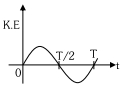
B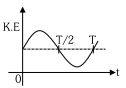
C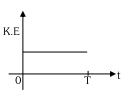
D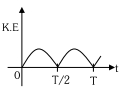
Solution
(D) The kinetic energy $(K.E)$ of a simple pendulum is given by $K.E = \frac{1}{2} m v^2$.
The velocity $v$ of a simple pendulum performing simple harmonic motion $(SHM)$ is $v = A\omega \cos(\omega t + \phi)$.
Thus,$K.E = \frac{1}{2} m A^2 \omega^2 \cos^2(\omega t + \phi)$.
Since $K.E \propto \cos^2(\omega t)$,the graph is a periodic function with a frequency double that of the pendulum's motion,meaning it completes two cycles in the time the pendulum completes one cycle $(T)$.
At the mean position $(t=0)$,the velocity is maximum,so kinetic energy is maximum. The graph that shows maximum kinetic energy at $t=0$ and completes two cycles in time $T$ is Graph $D$.
The velocity $v$ of a simple pendulum performing simple harmonic motion $(SHM)$ is $v = A\omega \cos(\omega t + \phi)$.
Thus,$K.E = \frac{1}{2} m A^2 \omega^2 \cos^2(\omega t + \phi)$.
Since $K.E \propto \cos^2(\omega t)$,the graph is a periodic function with a frequency double that of the pendulum's motion,meaning it completes two cycles in the time the pendulum completes one cycle $(T)$.
At the mean position $(t=0)$,the velocity is maximum,so kinetic energy is maximum. The graph that shows maximum kinetic energy at $t=0$ and completes two cycles in time $T$ is Graph $D$.
0 likes
View SolutionOscillations — Energy of Simple Harmonic Motion · Frequently Asked Questions
1Are these Oscillations questions useful for JEE and NEET?
Yes. All questions in this section are mapped to JEE Main and NEET exam patterns. Previous year questions from JEE Main, NEET, GUJCET and state-level exams are included with full solutions.
2Can I switch to Hindi or Gujarati for these questions?
Yes. Use the language tabs in the hero section or the sidebar to view the same questions and solutions in English, Hindi or Gujarati.
3How do I generate a question paper from this subtopic?
Use the Vedclass Exam Paper Generator — select the chapter and subtopic, set difficulty, and generate Sets A, B, C, D automatically. First 3 chapters of every subject are free.
Vedclass Products
For Students
Vedclass Test Series
Mock tests in real JEE/NEET style with performance analysis. 5-day free trial.
Start Free TrialFor Teachers
Exam Paper Generator
Generate Set A/B/C/D papers from this chapter in 2 minutes. 3 chapters free.
Try FreeFor Institutes
Online Exam Module
Live online exams with unlimited students, 360° analytics & white-label branding.
See DemoFor Teachers & Institutes
Generate a Oscillations Exam Paper in 2 Minutes
Select subtopic & difficulty — Sets A, B, C, D auto-generated with No Repeat logic.
First 3 chapters of every subject are free — no payment required.