
A English
Third Law of Motion and Momentum and Impulse Questions in English
Class 11 Physics · Newton's Laws of Motion and Friction · Third Law of Motion and Momentum and Impulse
208+
Questions
English
Language
100%
With Solutions
Showing 8 of 208 questions in English
201
EasyMCQ
$A$ body whose momentum is constant must have constant
A
acceleration
B
force
C
velocity
D
mass
Solution
(C) The momentum $p$ of a body of mass $m$ moving with velocity $v$ is defined as $p = mv$.
Since the mass $m$ of a body is a constant scalar quantity,if the momentum $p$ is constant,then the velocity $v$ must also be constant.
Therefore,for a body with constant momentum,its velocity remains constant.
Since the mass $m$ of a body is a constant scalar quantity,if the momentum $p$ is constant,then the velocity $v$ must also be constant.
Therefore,for a body with constant momentum,its velocity remains constant.
0 likes
View Solution202
EasyMCQ
Force is the mutual interaction between the bodies according to:
A
Newton's first law of motion
B
Newton's second law of motion
C
Newton's third law of motion
D
Newton's law of gravitation
Solution
(C) Newton's third law of motion states that for every action,there is an equal and opposite reaction. This law describes force as a mutual interaction between two bodies,where one body exerts a force on another,and the second body simultaneously exerts an equal and opposite force on the first.
0 likes
View Solution203
MediumMCQ
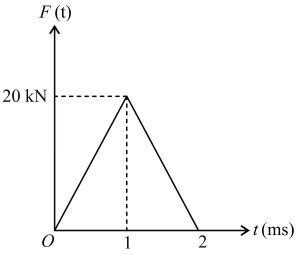
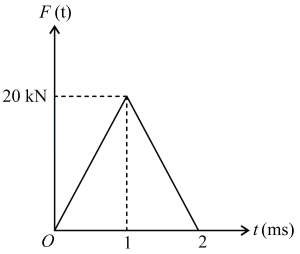
$A$ time-varying force acts on a ball of mass $100 \ g$ for $2 \ ms$. The force versus time curve is shown below. If the initial speed of the ball is $10 \ m \ s^{-1}$,then the speed of the ball after $2 \ ms$ is: (in $m \ s^{-1}$)
A
$410$
B
$210$
C
$200$
D
$400$
Solution
(B) The impulse imparted to the ball is equal to the area under the $F-t$ graph.
Impulse = Area of the triangle = $\frac{1}{2} \times \text{base} \times \text{height}$
Impulse = $\frac{1}{2} \times (2 \times 10^{-3} \ s) \times (20 \times 10^3 \ N)$
Impulse = $20 \ N \ s = 20 \ kg \ m \ s^{-1}$
According to the impulse-momentum theorem,impulse is equal to the change in momentum $(\Delta p)$:
$\Delta p = m v - m u = \text{Impulse}$
Given: mass $m = 100 \ g = 0.1 \ kg$,initial velocity $u = 10 \ m \ s^{-1}$.
$0.1 \times v - 0.1 \times 10 = 20$
$0.1 \times v - 1 = 20$
$0.1 \times v = 21$
$v = \frac{21}{0.1} = 210 \ m \ s^{-1}$
Impulse = Area of the triangle = $\frac{1}{2} \times \text{base} \times \text{height}$
Impulse = $\frac{1}{2} \times (2 \times 10^{-3} \ s) \times (20 \times 10^3 \ N)$
Impulse = $20 \ N \ s = 20 \ kg \ m \ s^{-1}$
According to the impulse-momentum theorem,impulse is equal to the change in momentum $(\Delta p)$:
$\Delta p = m v - m u = \text{Impulse}$
Given: mass $m = 100 \ g = 0.1 \ kg$,initial velocity $u = 10 \ m \ s^{-1}$.
$0.1 \times v - 0.1 \times 10 = 20$
$0.1 \times v - 1 = 20$
$0.1 \times v = 21$
$v = \frac{21}{0.1} = 210 \ m \ s^{-1}$
0 likes
View Solution204
EasyMCQ
When a bullet is fired from a rifle, its momentum becomes $20 \,kg \cdot m/s$. If the velocity of the bullet is $1000 \,m/s$, then what is its mass?
A
$30 \,g$
B
$5 \,kg$
C
$20 \,g$
D
$500 \,g$
Solution
(C) Given:
Momentum of the bullet $(p)$ $= 20 \,kg \cdot m/s$
Velocity of the bullet $(v)$ $= 1000 \,m/s$
We know that the formula for momentum is $p = m \times v$, where $m$ is the mass of the object.
Rearranging the formula to solve for mass: $m = \frac{p}{v}$.
Substituting the given values: $m = \frac{20}{1000} \,kg$.
$m = 0.02 \,kg$.
To convert the mass into grams, multiply by $1000$: $m = 0.02 \times 1000 \,g = 20 \,g$.
Therefore, the mass of the bullet is $20 \,g$.
Momentum of the bullet $(p)$ $= 20 \,kg \cdot m/s$
Velocity of the bullet $(v)$ $= 1000 \,m/s$
We know that the formula for momentum is $p = m \times v$, where $m$ is the mass of the object.
Rearranging the formula to solve for mass: $m = \frac{p}{v}$.
Substituting the given values: $m = \frac{20}{1000} \,kg$.
$m = 0.02 \,kg$.
To convert the mass into grams, multiply by $1000$: $m = 0.02 \times 1000 \,g = 20 \,g$.
Therefore, the mass of the bullet is $20 \,g$.
0 likes
View Solution205
EasyMCQ
$A$ machine gun can fire $200$ bullets $\min^{-1}$. If $35 \ g$ bullets are fired at a speed of $750 \ m \ s^{-1}$,the average force exerted by the gun on the bullets is, (in $N$)
A
$87.5$
B
$26.2$
C
$78.9$
D
$110.3$
Solution
(A) The average force $F$ exerted by the gun on the bullets is given by the rate of change of momentum: $F = \frac{\Delta p}{\Delta t} = n \times m \times v$,where $n$ is the number of bullets fired per second,$m$ is the mass of each bullet,and $v$ is the velocity of the bullet.
Given:
Number of bullets per minute $= 200$,so $n = \frac{200}{60} \ s^{-1}$.
Mass of each bullet $m = 35 \ g = 0.035 \ kg$.
Velocity $v = 750 \ m \ s^{-1}$.
Substituting the values:
$F = \left(\frac{200}{60}\right) \times 0.035 \times 750$
$F = \left(\frac{20}{6}\right) \times 35 \times 0.75$
$F = \frac{10}{3} \times 35 \times 0.75 = 10 \times 35 \times 0.25 = 87.5 \ N$.
Given:
Number of bullets per minute $= 200$,so $n = \frac{200}{60} \ s^{-1}$.
Mass of each bullet $m = 35 \ g = 0.035 \ kg$.
Velocity $v = 750 \ m \ s^{-1}$.
Substituting the values:
$F = \left(\frac{200}{60}\right) \times 0.035 \times 750$
$F = \left(\frac{20}{6}\right) \times 35 \times 0.75$
$F = \frac{10}{3} \times 35 \times 0.75 = 10 \times 35 \times 0.25 = 87.5 \ N$.
0 likes
View Solution206
MediumMCQ
$A$ ball of mass $0.2 \ kg$ moving with a speed of $20 \ m s^{-1}$ is brought to rest in $0.1 \ s$. The average force applied to the ball is (in $N$)
A
$20$
B
$30$
C
$40$
D
$60$
Solution
(C) Given: Mass $m = 0.2 \ kg$,initial velocity $u = 20 \ m s^{-1}$,final velocity $v = 0 \ m s^{-1}$,and time $t = 0.1 \ s$.
Using the impulse-momentum theorem or Newton's second law,the average force $F$ is given by the rate of change of momentum:
$F = \frac{\Delta p}{\Delta t} = \frac{m(v - u)}{t}$
Substituting the values:
$F = \frac{0.2 \times (0 - 20)}{0.1}$
$F = \frac{0.2 \times (-20)}{0.1}$
$F = \frac{-4}{0.1} = -40 \ N$
The magnitude of the average force applied to the ball is $40 \ N$.
Using the impulse-momentum theorem or Newton's second law,the average force $F$ is given by the rate of change of momentum:
$F = \frac{\Delta p}{\Delta t} = \frac{m(v - u)}{t}$
Substituting the values:
$F = \frac{0.2 \times (0 - 20)}{0.1}$
$F = \frac{0.2 \times (-20)}{0.1}$
$F = \frac{-4}{0.1} = -40 \ N$
The magnitude of the average force applied to the ball is $40 \ N$.
0 likes
View Solution207
MediumMCQ
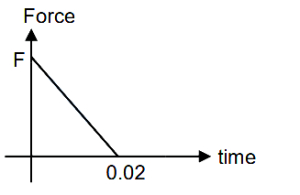
$A$ golf ball of mass $50 \text{ g}$ placed on a tee is struck by a golf club. The speed of the golf ball as it leaves the tee is $100 \text{ m/s}$, and the time of contact with the ball is $0.02 \text{ s}$. If the force decreases to zero linearly with time, then the force at the beginning of the contact is (in $\text{ N}$)
A
$100$
B
$200$
C
$250$
D
$500$
Solution
(D) The impulse imparted to the ball is equal to the change in its linear momentum.
Impulse $= \int F \, dt = \text{Area under the } F-t \text{ graph}$.
Given that the force decreases linearly from $F$ to $0$ in time $t = 0.02 \text{ s}$, the area is a triangle with base $0.02 \text{ s}$ and height $F$.
$\text{Area} = \frac{1}{2} \times \text{base} \times \text{height} = \frac{1}{2} \times 0.02 \times F = 0.01F$.
The change in momentum is $\Delta p = m(v_f - v_i) = \frac{50}{1000} \text{ kg} \times (100 \text{ m/s} - 0) = 0.05 \times 100 = 5 \text{ kg m/s}$.
Equating impulse and change in momentum: $0.01F = 5$.
$F = \frac{5}{0.01} = 500 \text{ N}$.
Impulse $= \int F \, dt = \text{Area under the } F-t \text{ graph}$.
Given that the force decreases linearly from $F$ to $0$ in time $t = 0.02 \text{ s}$, the area is a triangle with base $0.02 \text{ s}$ and height $F$.
$\text{Area} = \frac{1}{2} \times \text{base} \times \text{height} = \frac{1}{2} \times 0.02 \times F = 0.01F$.
The change in momentum is $\Delta p = m(v_f - v_i) = \frac{50}{1000} \text{ kg} \times (100 \text{ m/s} - 0) = 0.05 \times 100 = 5 \text{ kg m/s}$.
Equating impulse and change in momentum: $0.01F = 5$.
$F = \frac{5}{0.01} = 500 \text{ N}$.
0 likes
View Solution208
MediumMCQ
$A$ cricket ball of mass $0.25 \,kg$ with speed $10 \,m/s$ collides with a bat and returns with the same speed within $0.01 \,s$. The force exerted on the bat is: (in $\,N$)
A
$25$
B
$50$
C
$250$
D
$500$
Solution
(D) Given: Mass $m = 0.25 \,kg$, initial velocity $u = 10 \,m/s$, final velocity $v = -10 \,m/s$ (since it returns in the opposite direction), and time interval $\Delta t = 0.01 \,s$.
Change in momentum $\Delta P = m(v - u) = 0.25 \times (-10 - 10) = 0.25 \times (-20) = -5 \,kg \cdot m/s$.
The magnitude of change in momentum is $|\Delta P| = 5 \,kg \cdot m/s$.
The force exerted on the ball by the bat is $F = \frac{\Delta P}{\Delta t} = \frac{5}{0.01} = 500 \,N$.
According to Newton's third law, the force exerted on the bat by the ball is equal in magnitude, which is $500 \,N$.
Change in momentum $\Delta P = m(v - u) = 0.25 \times (-10 - 10) = 0.25 \times (-20) = -5 \,kg \cdot m/s$.
The magnitude of change in momentum is $|\Delta P| = 5 \,kg \cdot m/s$.
The force exerted on the ball by the bat is $F = \frac{\Delta P}{\Delta t} = \frac{5}{0.01} = 500 \,N$.
According to Newton's third law, the force exerted on the bat by the ball is equal in magnitude, which is $500 \,N$.
0 likes
View SolutionNewton's Laws of Motion and Friction — Third Law of Motion and Momentum and Impulse · Frequently Asked Questions
1Are these Newton's Laws of Motion and Friction questions useful for JEE and NEET?
Yes. All questions in this section are mapped to JEE Main and NEET exam patterns. Previous year questions from JEE Main, NEET, GUJCET and state-level exams are included with full solutions.
2Can I switch to Hindi or Gujarati for these questions?
Yes. Use the language tabs in the hero section or the sidebar to view the same questions and solutions in English, Hindi or Gujarati.
3How do I generate a question paper from this subtopic?
Use the Vedclass Exam Paper Generator — select the chapter and subtopic, set difficulty, and generate Sets A, B, C, D automatically. First 3 chapters of every subject are free.
Vedclass Products
For Students
Vedclass Test Series
Mock tests in real JEE/NEET style with performance analysis. 5-day free trial.
Start Free TrialFor Teachers
Exam Paper Generator
Generate Set A/B/C/D papers from this chapter in 2 minutes. 3 chapters free.
Try FreeFor Institutes
Online Exam Module
Live online exams with unlimited students, 360° analytics & white-label branding.
See DemoFor Teachers & Institutes
Generate a Newton's Laws of Motion and Friction Exam Paper in 2 Minutes
Select subtopic & difficulty — Sets A, B, C, D auto-generated with No Repeat logic.
First 3 chapters of every subject are free — no payment required.