
A English
Spring Force Questions in English
Class 11 Physics · Newton's Laws of Motion and Friction · Spring Force
86+
Questions
English
Language
100%
With Solutions
Showing 50 of 86 questions in English
1
MediumMCQ
The tension in the spring is ............ $N$.

A
$0$
B
$2.5$
C
$5$
D
$10$
Solution
(C) When a spring is pulled from both ends by forces of equal magnitude $F$,the tension in the spring is equal to the magnitude of the applied force $F$.
In this case,both ends of the spring are pulled by a force of $5 \, N$.
Therefore,the tension in the spring is $5 \, N$.
In this case,both ends of the spring are pulled by a force of $5 \, N$.
Therefore,the tension in the spring is $5 \, N$.
0 likes
View Solution2
EasyMCQ
Two springs of spring constants $1500 \ N/m$ and $3000 \ N/m$ respectively are stretched with the same force. They will have potential energy in the ratio
A
$4:1$
B
$1:4$
C
$2:1$
D
$1:2$
Solution
(C) The potential energy $U$ stored in a spring is given by the formula $U = \frac{F^2}{2k}$,where $F$ is the applied force and $k$ is the spring constant.
Since both springs are stretched with the same force $F$,the potential energy is inversely proportional to the spring constant: $U \propto \frac{1}{k}$.
Therefore,the ratio of the potential energies is $\frac{U_1}{U_2} = \frac{k_2}{k_1}$.
Given $k_1 = 1500 \ N/m$ and $k_2 = 3000 \ N/m$,we have:
$\frac{U_1}{U_2} = \frac{3000}{1500} = \frac{2}{1}$.
Thus,the ratio is $2:1$.
Since both springs are stretched with the same force $F$,the potential energy is inversely proportional to the spring constant: $U \propto \frac{1}{k}$.
Therefore,the ratio of the potential energies is $\frac{U_1}{U_2} = \frac{k_2}{k_1}$.
Given $k_1 = 1500 \ N/m$ and $k_2 = 3000 \ N/m$,we have:
$\frac{U_1}{U_2} = \frac{3000}{1500} = \frac{2}{1}$.
Thus,the ratio is $2:1$.
0 likes
View Solution3
MediumMCQ
When a $1.0\,kg$ mass hangs attached to a spring of length $50\,cm$,the spring stretches by $2\,cm$. The mass is pulled down until the length of the spring becomes $60\,cm$. What is the amount of elastic energy stored in the spring in this condition,if $g = 10\,m/s^2$? (in $Joule$)
A
$1.5$
B
$2$
C
$2.5$
D
$3$
Solution
(C) First,calculate the force constant $(k)$ of the spring using Hooke's Law: $F = kx$,where $F = mg$.
Given: $m = 1.0\,kg$,$g = 10\,m/s^2$,and extension $x = 2\,cm = 0.02\,m$.
$k = \frac{mg}{x} = \frac{1.0 \times 10}{0.02} = 500\,N/m$.
Next,determine the total extension of the spring when its length becomes $60\,cm$. The original length is $50\,cm$,so the total extension $x_{total} = 60\,cm - 50\,cm = 10\,cm = 0.1\,m$.
The elastic potential energy $(U)$ stored in the spring is given by $U = \frac{1}{2}kx^2$.
$U = \frac{1}{2} \times 500 \times (0.1)^2 = 250 \times 0.01 = 2.5\,J$.
Given: $m = 1.0\,kg$,$g = 10\,m/s^2$,and extension $x = 2\,cm = 0.02\,m$.
$k = \frac{mg}{x} = \frac{1.0 \times 10}{0.02} = 500\,N/m$.
Next,determine the total extension of the spring when its length becomes $60\,cm$. The original length is $50\,cm$,so the total extension $x_{total} = 60\,cm - 50\,cm = 10\,cm = 0.1\,m$.
The elastic potential energy $(U)$ stored in the spring is given by $U = \frac{1}{2}kx^2$.
$U = \frac{1}{2} \times 500 \times (0.1)^2 = 250 \times 0.01 = 2.5\,J$.
0 likes
View Solution4
EasyMCQ
Natural length of a spring is $60\, cm$,and its spring constant is $4000\, N/m$. $A$ mass of $20\, kg$ is hung from it. The extension produced in the spring is,.......$cm$ (Take $g = 9.8\, m/s^2$)
A
$4.9$
B
$0.49$
C
$9.4$
D
$0.94$
Solution
(A) According to Hooke's Law,the restoring force in a spring is given by $F = kx$,where $k$ is the spring constant and $x$ is the extension.
When a mass $m$ is hung from the spring,the force exerted is equal to the weight of the mass,$F = mg$.
Equating the two,we get $mg = kx$.
Therefore,the extension $x = \frac{mg}{k}$.
Given $m = 20\, kg$,$g = 9.8\, m/s^2$,and $k = 4000\, N/m$.
Substituting the values: $x = \frac{20 \times 9.8}{4000} = \frac{196}{4000} = 0.049\, m$.
To convert the extension into centimeters,multiply by $100$: $x = 0.049 \times 100 = 4.9\, cm$.
When a mass $m$ is hung from the spring,the force exerted is equal to the weight of the mass,$F = mg$.
Equating the two,we get $mg = kx$.
Therefore,the extension $x = \frac{mg}{k}$.
Given $m = 20\, kg$,$g = 9.8\, m/s^2$,and $k = 4000\, N/m$.
Substituting the values: $x = \frac{20 \times 9.8}{4000} = \frac{196}{4000} = 0.049\, m$.
To convert the extension into centimeters,multiply by $100$: $x = 0.049 \times 100 = 4.9\, cm$.
0 likes
View Solution5
EasyMCQ
The spring extends by $x$ on loading,then the energy stored by the spring is: (if $T$ is the tension in the spring and $k$ is the spring constant)
A
$\frac{T^2}{2k}$
B
$\frac{T^2}{2k^2}$
C
$\frac{2k}{T^2}$
D
$\frac{2T^2}{k}$
Solution
(A) The potential energy $U$ stored in a spring is given by the formula $U = \frac{1}{2}kx^2$.
According to Hooke's Law,the tension $T$ in the spring is related to the extension $x$ by the equation $T = kx$.
From this,we can express the extension as $x = \frac{T}{k}$.
Substituting this value of $x$ into the energy formula:
$U = \frac{1}{2}k \left( \frac{T}{k} \right)^2$
$U = \frac{1}{2}k \left( \frac{T^2}{k^2} \right)$
$U = \frac{T^2}{2k}$.
Therefore,the correct option is $A$.
According to Hooke's Law,the tension $T$ in the spring is related to the extension $x$ by the equation $T = kx$.
From this,we can express the extension as $x = \frac{T}{k}$.
Substituting this value of $x$ into the energy formula:
$U = \frac{1}{2}k \left( \frac{T}{k} \right)^2$
$U = \frac{1}{2}k \left( \frac{T^2}{k^2} \right)$
$U = \frac{T^2}{2k}$.
Therefore,the correct option is $A$.
0 likes
View Solution6
EasyMCQ
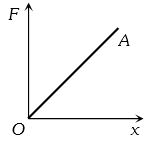
The force required to stretch a spring varies with the distance as shown in the figure. If the experiment is performed with the above spring of half length,the line $OA$ will
A
Shift towards $F$-axis
B
Shift towards $X$-axis
C
Remain as it is
D
Become double in length
Solution
(A) The force $F$ required to stretch a spring by a distance $x$ is given by $F = kx$,where $k$ is the spring constant.
For a spring of length $L$,the spring constant $k$ is inversely proportional to its length,i.e.,$k \propto \frac{1}{L}$.
If the length of the spring is halved $(L' = L/2)$,the new spring constant $k'$ becomes $k' = k \cdot (L/L') = k \cdot (L / (L/2)) = 2k$.
The slope of the force-displacement graph is equal to the spring constant $k$. Since the new spring constant $k'$ is double the original value,the slope of the line $OA$ increases.
An increase in the slope of a line passing through the origin in an $F-x$ graph means the line shifts towards the $F$-axis.
Therefore,the correct option is $A$.
For a spring of length $L$,the spring constant $k$ is inversely proportional to its length,i.e.,$k \propto \frac{1}{L}$.
If the length of the spring is halved $(L' = L/2)$,the new spring constant $k'$ becomes $k' = k \cdot (L/L') = k \cdot (L / (L/2)) = 2k$.
The slope of the force-displacement graph is equal to the spring constant $k$. Since the new spring constant $k'$ is double the original value,the slope of the line $OA$ increases.
An increase in the slope of a line passing through the origin in an $F-x$ graph means the line shifts towards the $F$-axis.
Therefore,the correct option is $A$.
0 likes
View Solution7
EasyMCQ
If a spring is extended to length $l,$ then according to Hooke's law,
A
$F = kl$
B
$F = \frac{k}{l}$
C
$F = k^2l$
D
$F = \frac{k^2}{l}$
Solution
(A) According to Hooke's law,the restoring force $F$ in a spring is directly proportional to the extension $l$ produced in it.
Mathematically,$F \propto l$.
Removing the proportionality sign,we introduce a spring constant $k$:
$F = kl$,where $k$ is the spring constant.
Mathematically,$F \propto l$.
Removing the proportionality sign,we introduce a spring constant $k$:
$F = kl$,where $k$ is the spring constant.
0 likes
View Solution8
EasyMCQ
The length of a spring is $l$ and its force constant is $k$. When a weight $W$ is suspended from it,its length increases by $x$. If the spring is cut into two equal parts and put in parallel and the same weight $W$ is suspended from them,then the extension will be
A
$2x$
B
$x$
C
$\frac{x}{2}$
D
$\frac{x}{4}$
Solution
(D) The initial spring constant is $k$. When a spring of length $l$ is cut into two equal parts,the spring constant of each part becomes $k' = 2k$.
When these two parts are connected in parallel,the equivalent spring constant $K_{eq}$ is the sum of the individual constants:
$K_{eq} = k' + k' = 2k + 2k = 4k$.
According to Hooke's Law,$F = kx$. For the original spring,$W = kx$.
For the parallel combination,the same weight $W$ is applied,so $W = K_{eq} \times x'$,where $x'$ is the new extension.
Substituting the values: $kx = 4k \times x'$.
Solving for $x'$,we get $x' = \frac{kx}{4k} = \frac{x}{4}$.
When these two parts are connected in parallel,the equivalent spring constant $K_{eq}$ is the sum of the individual constants:
$K_{eq} = k' + k' = 2k + 2k = 4k$.
According to Hooke's Law,$F = kx$. For the original spring,$W = kx$.
For the parallel combination,the same weight $W$ is applied,so $W = K_{eq} \times x'$,where $x'$ is the new extension.
Substituting the values: $kx = 4k \times x'$.
Solving for $x'$,we get $x' = \frac{kx}{4k} = \frac{x}{4}$.
0 likes
View Solution9
EasyMCQ
$A$ uniform spring of force constant $k$ is cut into two pieces,the lengths of which are in the ratio $1 : 2$. The ratio of the force constants of the shorter and the longer pieces is
A
$1:3$
B
$1:2$
C
$2:3$
D
$2:1$
Solution
(D) The force constant $k$ of a spring is inversely proportional to its length $l$,i.e.,$k \propto \frac{1}{l}$.
Let the total length of the spring be $L$. The lengths of the two pieces are $l_1 = \frac{1}{3}L$ and $l_2 = \frac{2}{3}L$.
Let $k_1$ and $k_2$ be the force constants of the shorter and longer pieces,respectively.
Since $k_1 l_1 = k_2 l_2 = kL$,we have $\frac{k_1}{k_2} = \frac{l_2}{l_1}$.
Substituting the values,$\frac{k_1}{k_2} = \frac{2/3 L}{1/3 L} = \frac{2}{1}$.
Therefore,the ratio of the force constants is $2:1$.
Let the total length of the spring be $L$. The lengths of the two pieces are $l_1 = \frac{1}{3}L$ and $l_2 = \frac{2}{3}L$.
Let $k_1$ and $k_2$ be the force constants of the shorter and longer pieces,respectively.
Since $k_1 l_1 = k_2 l_2 = kL$,we have $\frac{k_1}{k_2} = \frac{l_2}{l_1}$.
Substituting the values,$\frac{k_1}{k_2} = \frac{2/3 L}{1/3 L} = \frac{2}{1}$.
Therefore,the ratio of the force constants is $2:1$.
0 likes
View Solution10
MediumMCQ
One-fourth length of a spring of force constant $K$ is cut away. The force constant of the remaining spring will be
A
$\frac{3}{4}K$
B
$\frac{4}{3}K$
C
$K$
D
$4K$
Solution
(B) The force constant $K$ of a spring is inversely proportional to its natural length $l$,i.e.,$K \propto \frac{1}{l}$ or $Kl = \text{constant}$.
When a spring of length $l$ is cut into two parts,the product of the force constant and the length of each part remains constant.
Initially,the spring has length $l$ and force constant $K$.
One-fourth of the length is cut away,so the remaining length of the spring is $l' = l - \frac{1}{4}l = \frac{3}{4}l$.
Let the new force constant be $K'$.
According to the relation $Kl = K'l'$,we have:
$K \cdot l = K' \cdot (\frac{3}{4}l)$
$K = K' \cdot \frac{3}{4}$
$K' = \frac{4}{3}K$.
When a spring of length $l$ is cut into two parts,the product of the force constant and the length of each part remains constant.
Initially,the spring has length $l$ and force constant $K$.
One-fourth of the length is cut away,so the remaining length of the spring is $l' = l - \frac{1}{4}l = \frac{3}{4}l$.
Let the new force constant be $K'$.
According to the relation $Kl = K'l'$,we have:
$K \cdot l = K' \cdot (\frac{3}{4}l)$
$K = K' \cdot \frac{3}{4}$
$K' = \frac{4}{3}K$.
0 likes
View Solution11
MediumMCQ
Infinite springs with force constants $k$,$2k$,$4k$,$8k$,... respectively are connected in series. The effective force constant of the system will be:
A
$2k$
B
$k$
C
$\frac{k}{2}$
D
$\frac{k}{4}$
Solution
(C) For springs connected in series,the effective force constant $k_{eff}$ is given by the formula: $\frac{1}{k_{eff}} = \frac{1}{k_1} + \frac{1}{k_2} + \frac{1}{k_3} + \dots$
Substituting the given values: $\frac{1}{k_{eff}} = \frac{1}{k} + \frac{1}{2k} + \frac{1}{4k} + \frac{1}{8k} + \dots$
Factor out $\frac{1}{k}$: $\frac{1}{k_{eff}} = \frac{1}{k} \left( 1 + \frac{1}{2} + \frac{1}{4} + \frac{1}{8} + \dots \right)$
The term in the bracket is an infinite geometric progression with first term $a = 1$ and common ratio $r = \frac{1}{2}$.
The sum $S$ of an infinite geometric progression is given by $S = \frac{a}{1 - r}$.
$S = \frac{1}{1 - 1/2} = \frac{1}{1/2} = 2$.
Therefore,$\frac{1}{k_{eff}} = \frac{1}{k} \times 2 = \frac{2}{k}$.
Thus,$k_{eff} = \frac{k}{2}$.
Substituting the given values: $\frac{1}{k_{eff}} = \frac{1}{k} + \frac{1}{2k} + \frac{1}{4k} + \frac{1}{8k} + \dots$
Factor out $\frac{1}{k}$: $\frac{1}{k_{eff}} = \frac{1}{k} \left( 1 + \frac{1}{2} + \frac{1}{4} + \frac{1}{8} + \dots \right)$
The term in the bracket is an infinite geometric progression with first term $a = 1$ and common ratio $r = \frac{1}{2}$.
The sum $S$ of an infinite geometric progression is given by $S = \frac{a}{1 - r}$.
$S = \frac{1}{1 - 1/2} = \frac{1}{1/2} = 2$.
Therefore,$\frac{1}{k_{eff}} = \frac{1}{k} \times 2 = \frac{2}{k}$.
Thus,$k_{eff} = \frac{k}{2}$.
0 likes
View Solution12
MediumMCQ
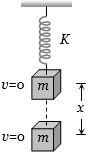
An ideal spring with spring-constant $K$ is hung from the ceiling and a block of mass $M$ is attached to its lower end. The mass is released with the spring initially unstretched. Then the maximum extension in the spring is
A
$4 Mg/K$
B
$2 Mg/K$
C
$Mg/K$
D
$Mg/2K$
Solution
(B) Let $x$ be the maximum extension of the spring.
Since the block starts from rest and momentarily comes to rest at the point of maximum extension,the change in kinetic energy is zero.
According to the work-energy theorem,the total work done by all forces is zero.
The forces acting on the block are gravity ($Mg$ downwards) and the spring force ($-Kx$ upwards).
Work done by gravity = $Mgx$
Work done by spring = $-\frac{1}{2}Kx^2$
Equating the total work to zero:
$Mgx - \frac{1}{2}Kx^2 = 0$
$Mgx = \frac{1}{2}Kx^2$
Since $x \neq 0$,we can divide by $x$:
$Mg = \frac{1}{2}Kx$
$x = \frac{2Mg}{K}$
Since the block starts from rest and momentarily comes to rest at the point of maximum extension,the change in kinetic energy is zero.
According to the work-energy theorem,the total work done by all forces is zero.
The forces acting on the block are gravity ($Mg$ downwards) and the spring force ($-Kx$ upwards).
Work done by gravity = $Mgx$
Work done by spring = $-\frac{1}{2}Kx^2$
Equating the total work to zero:
$Mgx - \frac{1}{2}Kx^2 = 0$
$Mgx = \frac{1}{2}Kx^2$
Since $x \neq 0$,we can divide by $x$:
$Mg = \frac{1}{2}Kx$
$x = \frac{2Mg}{K}$
0 likes
View Solution13
MediumMCQ
When a weight is applied to a spring,it stretches by an amount $x$. What is the energy stored in it? ($T$ is the tension force developed in the spring and $k$ is the spring constant.)
A
$\frac{T^2}{2k}$
B
$\frac{T^2}{2k^2}$
C
$\frac{2k}{T^2}$
D
$\frac{2T^2}{k}$
Solution
(A) The potential energy $U$ stored in a stretched spring is given by $U = \frac{1}{2} k x^2$.
According to Hooke's Law,the tension force $T$ in the spring is $T = kx$,which implies $x = \frac{T}{k}$.
Substituting the value of $x$ into the energy formula:
$U = \frac{1}{2} k \left( \frac{T}{k} \right)^2$
$U = \frac{1}{2} k \left( \frac{T^2}{k^2} \right)$
$U = \frac{T^2}{2k}$.
According to Hooke's Law,the tension force $T$ in the spring is $T = kx$,which implies $x = \frac{T}{k}$.
Substituting the value of $x$ into the energy formula:
$U = \frac{1}{2} k \left( \frac{T}{k} \right)^2$
$U = \frac{1}{2} k \left( \frac{T^2}{k^2} \right)$
$U = \frac{T^2}{2k}$.
0 likes
View Solution14
MediumMCQ
$A$ block of mass $m$ is released suddenly from the top of a spring with a spring constant $k$. $(i)$ What will be the maximum compression in the spring? $(ii)$ What will be the compression in the spring at the equilibrium position?
A
$2mg/k, mg/k$
B
$mg/k, mg/k$
C
$mg/k, 2mg/k$
D
$2mg/k, 2mg/k$
Solution
(A) Let $x_{max}$ be the maximum compression and $x_{eq}$ be the compression at equilibrium.
$(i)$ For maximum compression,the loss in gravitational potential energy of the block equals the gain in elastic potential energy of the spring:
$mgx_{max} = \frac{1}{2} k x_{max}^2$
$x_{max} = \frac{2mg}{k}$
$(ii)$ At the equilibrium position,the spring force balances the weight of the block:
$kx_{eq} = mg$
$x_{eq} = \frac{mg}{k}$
$(i)$ For maximum compression,the loss in gravitational potential energy of the block equals the gain in elastic potential energy of the spring:
$mgx_{max} = \frac{1}{2} k x_{max}^2$
$x_{max} = \frac{2mg}{k}$
$(ii)$ At the equilibrium position,the spring force balances the weight of the block:
$kx_{eq} = mg$
$x_{eq} = \frac{mg}{k}$
0 likes
View Solution15
MediumMCQ
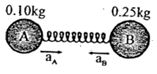
Two balls $A$ and $B$ of masses $100 \ gm$ and $250 \ gm$ are connected by a stretched massless spring and placed on a smooth table. When the balls are released simultaneously,the initial acceleration of ball $B$ is $10 \ cm/s^2$ towards the west. Find the magnitude and direction of the initial acceleration of ball $A$.
A
$25 \ cm/s^2$ towards the east
B
$25 \ cm/s^2$ towards the north
C
$25 \ cm/s^2$ towards the west
D
$25 \ cm/s^2$ towards the south
Solution
(A) Since the spring force is an internal force,the net external force on the system is zero.
Therefore,the acceleration of the center of mass is zero: $M_A \vec{a}_A + M_B \vec{a}_B = 0$.
Given: $M_A = 100 \ gm = 0.1 \ kg$,$M_B = 250 \ gm = 0.25 \ kg$.
Acceleration of ball $B$,$\vec{a}_B = 10 \ cm/s^2$ (West).
Using the equation: $\vec{a}_A = -\frac{M_B}{M_A} \vec{a}_B$.
$\vec{a}_A = -\frac{0.25 \ kg}{0.10 \ kg} \times (10 \ cm/s^2 \text{ West})$.
$\vec{a}_A = -2.5 \times (10 \ cm/s^2 \text{ West}) = -25 \ cm/s^2 \text{ West}$.
Since the negative sign indicates the opposite direction,$\vec{a}_A = 25 \ cm/s^2$ towards the east.
Therefore,the acceleration of the center of mass is zero: $M_A \vec{a}_A + M_B \vec{a}_B = 0$.
Given: $M_A = 100 \ gm = 0.1 \ kg$,$M_B = 250 \ gm = 0.25 \ kg$.
Acceleration of ball $B$,$\vec{a}_B = 10 \ cm/s^2$ (West).
Using the equation: $\vec{a}_A = -\frac{M_B}{M_A} \vec{a}_B$.
$\vec{a}_A = -\frac{0.25 \ kg}{0.10 \ kg} \times (10 \ cm/s^2 \text{ West})$.
$\vec{a}_A = -2.5 \times (10 \ cm/s^2 \text{ West}) = -25 \ cm/s^2 \text{ West}$.
Since the negative sign indicates the opposite direction,$\vec{a}_A = 25 \ cm/s^2$ towards the east.
0 likes
View Solution16
DifficultMCQ
When a body is suspended from a spring and released slowly,the extension in the spring is $x$. If the body is released suddenly,the extension in the spring is:
A
$x$
B
$2x$
C
$3x$
D
$x/2$
Solution
(B) When the body is released slowly,the spring reaches equilibrium where the spring force equals the gravitational force: $kx = mg$,which gives $x = \frac{mg}{k}$.
When the body is released suddenly,the potential energy lost by the body is stored as elastic potential energy in the spring at the maximum extension $y$. By the law of conservation of energy: $mgy = \frac{1}{2}ky^2$.
Solving for $y$: $y = \frac{2mg}{k}$.
Since $x = \frac{mg}{k}$,we substitute this into the equation for $y$ to get $y = 2x$.
When the body is released suddenly,the potential energy lost by the body is stored as elastic potential energy in the spring at the maximum extension $y$. By the law of conservation of energy: $mgy = \frac{1}{2}ky^2$.
Solving for $y$: $y = \frac{2mg}{k}$.
Since $x = \frac{mg}{k}$,we substitute this into the equation for $y$ to get $y = 2x$.
0 likes
View Solution17
MediumMCQ
$A$ spring with force constant $k$ is cut into two pieces. The length of one piece is twice the length of the other. What is the force constant of the larger piece?
A
$2/3k$
B
$3/2k$
C
$3k$
D
$6k$
Solution
(B) The force constant $k$ of a spring is inversely proportional to its length $l$, i.e., $k \propto 1/l$ or $kl = \text{constant}$.
Let the total length of the spring be $L$, so $kL = \text{constant}$.
Let the two pieces have lengths $l_1$ and $l_2$ such that $l_1 + l_2 = L$.
Given $l_1 = 2l_2$, therefore $L = 2l_2 + l_2 = 3l_2$.
For the larger piece (length $l_1 = 2l_2$), let the force constant be $k_1$.
Using $k_1 l_1 = kL$, we get $k_1 (2l_2) = k(3l_2)$.
Solving for $k_1$, we get $k_1 = \frac{3}{2}k$.
Let the total length of the spring be $L$, so $kL = \text{constant}$.
Let the two pieces have lengths $l_1$ and $l_2$ such that $l_1 + l_2 = L$.
Given $l_1 = 2l_2$, therefore $L = 2l_2 + l_2 = 3l_2$.
For the larger piece (length $l_1 = 2l_2$), let the force constant be $k_1$.
Using $k_1 l_1 = kL$, we get $k_1 (2l_2) = k(3l_2)$.
Solving for $k_1$, we get $k_1 = \frac{3}{2}k$.
0 likes
View Solution18
DifficultMCQ
$A$ spring of length $l$ has a force constant $k$. When a weight $W$ is attached to it,the extension produced is $x$. If the spring is cut into two equal parts and these parts are connected in parallel to support the same weight $W$,what will be the new extension?
A
$2x$
B
$x$
C
$x/2$
D
$x/4$
Solution
(D) For the original spring,the force constant is $k$ and the extension is $x = W/k$.
When a spring is cut into two equal parts,the force constant of each part becomes $k' = 2k$.
When these two parts are connected in parallel,the equivalent force constant $k_{eq}$ is given by $k_{eq} = k' + k' = 2k + 2k = 4k$.
The new extension $x'$ produced by the same weight $W$ is given by $x' = W / k_{eq}$.
Substituting $k_{eq} = 4k$,we get $x' = W / (4k)$.
Since $x = W/k$,we have $x' = x/4$.
When a spring is cut into two equal parts,the force constant of each part becomes $k' = 2k$.
When these two parts are connected in parallel,the equivalent force constant $k_{eq}$ is given by $k_{eq} = k' + k' = 2k + 2k = 4k$.
The new extension $x'$ produced by the same weight $W$ is given by $x' = W / k_{eq}$.
Substituting $k_{eq} = 4k$,we get $x' = W / (4k)$.
Since $x = W/k$,we have $x' = x/4$.
0 likes
View Solution19
MediumMCQ
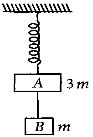
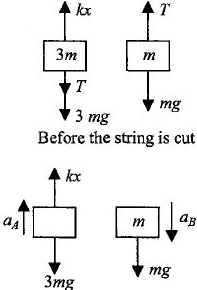
Two blocks $A$ and $B$ of masses $3\,m$ and $m$ respectively are connected by a massless and inextensible string. The whole system is suspended by a massless spring as shown in the figure. The magnitudes of acceleration of $A$ and $B$ immediately after the string is cut are respectively:
A
$g, g$
B
$\frac{g}{3}, \frac{g}{3}$
C
$\frac{g}{3}, g$
D
$g, \frac{g}{3}$
Solution
(C) Before the string is cut,the system is in equilibrium.
For block $B$: The tension $T$ in the string is equal to the weight of block $B$,so $T = mg$.
For block $A$: The spring force $kx$ balances the weight of both blocks $A$ and $B$ plus the tension $T$. However,looking at the free body diagram of $A$,$kx = T + 3mg = mg + 3mg = 4mg$.
Immediately after the string is cut,the tension $T$ becomes zero,but the spring force $kx$ remains $4mg$ because the spring does not change its length instantaneously.
For block $B$: The only force acting on it is gravity,so its acceleration is $a_B = g$ (downwards).
For block $A$: The net force is $F_{net} = kx - 3mg = 4mg - 3mg = mg$ (upwards).
Therefore,the acceleration of $A$ is $a_A = \frac{F_{net}}{3m} = \frac{mg}{3m} = \frac{g}{3}$ (upwards).
Thus,the accelerations of $A$ and $B$ are $\frac{g}{3}$ and $g$ respectively.
For block $B$: The tension $T$ in the string is equal to the weight of block $B$,so $T = mg$.
For block $A$: The spring force $kx$ balances the weight of both blocks $A$ and $B$ plus the tension $T$. However,looking at the free body diagram of $A$,$kx = T + 3mg = mg + 3mg = 4mg$.
Immediately after the string is cut,the tension $T$ becomes zero,but the spring force $kx$ remains $4mg$ because the spring does not change its length instantaneously.
For block $B$: The only force acting on it is gravity,so its acceleration is $a_B = g$ (downwards).
For block $A$: The net force is $F_{net} = kx - 3mg = 4mg - 3mg = mg$ (upwards).
Therefore,the acceleration of $A$ is $a_A = \frac{F_{net}}{3m} = \frac{mg}{3m} = \frac{g}{3}$ (upwards).
Thus,the accelerations of $A$ and $B$ are $\frac{g}{3}$ and $g$ respectively.
0 likes
View Solution20
EasyMCQ
$A$ block of mass $M$ is attached to the lower end of a vertical spring. The spring is hung from a ceiling and has a force constant $k$. The mass is released from rest with the spring initially unstretched. The maximum extension produced in the length of the spring will be
A
$2 Mg/k$
B
$4 Mg/k$
C
$Mg/2k$
D
$Mg/k$
Solution
(A) Let the maximum extension in the spring be $x$.
According to the law of conservation of energy,the loss in gravitational potential energy of the block is equal to the gain in elastic potential energy of the spring.
Loss in gravitational potential energy = $Mgx$.
Gain in elastic potential energy = $\frac{1}{2} k x^2$.
Equating the two: $Mgx = \frac{1}{2} k x^2$.
Solving for $x$ (where $x \neq 0$): $x = \frac{2Mg}{k}$.
According to the law of conservation of energy,the loss in gravitational potential energy of the block is equal to the gain in elastic potential energy of the spring.
Loss in gravitational potential energy = $Mgx$.
Gain in elastic potential energy = $\frac{1}{2} k x^2$.
Equating the two: $Mgx = \frac{1}{2} k x^2$.
Solving for $x$ (where $x \neq 0$): $x = \frac{2Mg}{k}$.
0 likes
View Solution21
DifficultMCQ
$A$ spring of force constant $k$ is cut into lengths of ratio $1:2:3$. They are connected in series and the new force constant is $k'$. Then they are connected in parallel and the force constant is $k''$. Then $k':k''$ is
A
$1:11$
B
$1:14$
C
$1:16$
D
$1:9$
Solution
(A) Let the original length of the spring be $L$. When the spring is cut into lengths in the ratio $1:2:3$,the lengths of the three segments are $l_1 = L/6$,$l_2 = 2L/6$,and $l_3 = 3L/6$.
Since the force constant $k$ is inversely proportional to the length $(k \propto 1/l)$,the new force constants are:
$k_1 = k(L/l_1) = 6k$
$k_2 = k(L/l_2) = 3k$
$k_3 = k(L/l_3) = 2k$
When connected in series,the equivalent force constant $k'$ is given by:
$1/k' = 1/k_1 + 1/k_2 + 1/k_3 = 1/(6k) + 1/(3k) + 1/(2k) = (1+2+3)/(6k) = 6/(6k) = 1/k$
Thus,$k' = k$.
When connected in parallel,the equivalent force constant $k''$ is given by:
$k'' = k_1 + k_2 + k_3 = 6k + 3k + 2k = 11k$.
Therefore,the ratio $k':k'' = k : 11k = 1:11$.
Since the force constant $k$ is inversely proportional to the length $(k \propto 1/l)$,the new force constants are:
$k_1 = k(L/l_1) = 6k$
$k_2 = k(L/l_2) = 3k$
$k_3 = k(L/l_3) = 2k$
When connected in series,the equivalent force constant $k'$ is given by:
$1/k' = 1/k_1 + 1/k_2 + 1/k_3 = 1/(6k) + 1/(3k) + 1/(2k) = (1+2+3)/(6k) = 6/(6k) = 1/k$
Thus,$k' = k$.
When connected in parallel,the equivalent force constant $k''$ is given by:
$k'' = k_1 + k_2 + k_3 = 6k + 3k + 2k = 11k$.
Therefore,the ratio $k':k'' = k : 11k = 1:11$.
0 likes
View Solution22
EasyMCQ
$A$ spring with $10$ coils has spring constant $k$. It is exactly cut into two halves,then each of these new springs will have a spring constant
A
$k/2$
B
$2k$
C
$3k/2$
D
$3k$
Solution
(B) The spring constant $k$ of a spring is inversely proportional to its length $l$,i.e.,$k \propto \frac{1}{l}$.
This is because the spring constant is given by $k = \frac{G J}{R^2 n d^3}$,where $n$ is the number of coils.
Since the number of coils $n$ is directly proportional to the length of the spring,we have $k \propto \frac{1}{n}$.
When the spring is cut into two equal halves,the number of coils in each new spring becomes $n' = \frac{n}{2} = \frac{10}{2} = 5$.
Therefore,the new spring constant $k'$ is given by $k' \times n' = k \times n$.
$k' \times \frac{n}{2} = k \times n$.
$k' = 2k$.
This is because the spring constant is given by $k = \frac{G J}{R^2 n d^3}$,where $n$ is the number of coils.
Since the number of coils $n$ is directly proportional to the length of the spring,we have $k \propto \frac{1}{n}$.
When the spring is cut into two equal halves,the number of coils in each new spring becomes $n' = \frac{n}{2} = \frac{10}{2} = 5$.
Therefore,the new spring constant $k'$ is given by $k' \times n' = k \times n$.
$k' \times \frac{n}{2} = k \times n$.
$k' = 2k$.
0 likes
View Solution23
MediumMCQ
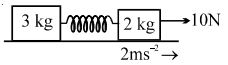
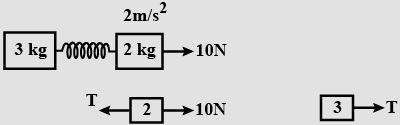
Find the acceleration of the $3 \text{ kg}$ mass when the acceleration of the $2 \text{ kg}$ mass is $2 \text{ ms}^{-2}$ as shown in the figure. (in $\text{ ms}^{-2}$)
A
$3$
B
$2$
C
$0.5$
D
$0$
Solution
(B) For the $2 \text{ kg}$ mass,the net force is given by:
$F_{\text{net}} = 10 - T = m_1 a_1$
Substituting the values $m_1 = 2 \text{ kg}$ and $a_1 = 2 \text{ ms}^{-2}$:
$10 - T = 2 \times 2 = 4 \text{ N}$
$T = 10 - 4 = 6 \text{ N}$
For the $3 \text{ kg}$ mass,the spring force $T$ is the only horizontal force acting on it:
$F_{\text{net}} = T = m_2 a_2$
Substituting the values $T = 6 \text{ N}$ and $m_2 = 3 \text{ kg}$:
$6 = 3 \times a_2$
$a_2 = \frac{6}{3} = 2 \text{ ms}^{-2}$
$F_{\text{net}} = 10 - T = m_1 a_1$
Substituting the values $m_1 = 2 \text{ kg}$ and $a_1 = 2 \text{ ms}^{-2}$:
$10 - T = 2 \times 2 = 4 \text{ N}$
$T = 10 - 4 = 6 \text{ N}$
For the $3 \text{ kg}$ mass,the spring force $T$ is the only horizontal force acting on it:
$F_{\text{net}} = T = m_2 a_2$
Substituting the values $T = 6 \text{ N}$ and $m_2 = 3 \text{ kg}$:
$6 = 3 \times a_2$
$a_2 = \frac{6}{3} = 2 \text{ ms}^{-2}$
0 likes
View Solution24
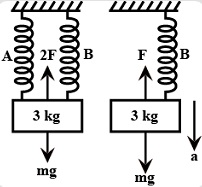
MediumMCQ
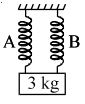
$A$ block of $3 \; kg$ is initially in equilibrium and is hanging by two identical springs $A$ and $B$ as shown in the figure. If spring $A$ is cut from the lower point at $t = 0$,find the acceleration of the block in $m/s^2$ at $t = 0$.
A
$5$
B
$10$
C
$15$
D
$0$
Solution
(A) Let the spring force due to each spring be $F$.
Initially,the block is in equilibrium:
$2F = mg$
$2F = 3 \times 10 = 30 \; N$
$F = 15 \; N$
At $t = 0$,when spring $A$ is cut,the force in spring $B$ does not change instantaneously.
Applying Newton's second law for the block at $t = 0$:
$mg - F = ma$
$30 - 15 = 3a$
$15 = 3a$
$a = 5 \; m/s^2$
Initially,the block is in equilibrium:
$2F = mg$
$2F = 3 \times 10 = 30 \; N$
$F = 15 \; N$
At $t = 0$,when spring $A$ is cut,the force in spring $B$ does not change instantaneously.
Applying Newton's second law for the block at $t = 0$:
$mg - F = ma$
$30 - 15 = 3a$
$15 = 3a$
$a = 5 \; m/s^2$
0 likes
View Solution25
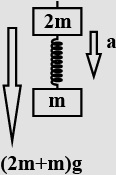
MediumMCQ
Two blocks are connected by a spring. The combination is suspended,at rest,from a string attached to the ceiling,as shown in the figure. The string breaks suddenly. Immediately after the string breaks,what is the initial downward acceleration of the upper block of mass $2m$?

A
$0$
B
$3g/2$
C
$g$
D
$2g$
Solution
(B) Let $a$ be the initial downward acceleration of the upper block of mass $2m$.
Before the string breaks,the system is in equilibrium.
For the lower block of mass $m$,the spring force $F_s = kx = mg$ (upward).
For the upper block of mass $2m$,the tension in the string $T = 2mg + F_s = 2mg + mg = 3mg$.
Immediately after the string breaks,the tension $T$ becomes $0$,but the spring force $F_s$ remains $mg$ (as the spring length cannot change instantaneously).
Now,the forces acting on the upper block of mass $2m$ are its weight $2mg$ (downward) and the spring force $F_s = mg$ (downward).
Applying Newton's second law for the upper block: $F_{net} = (2m)a$.
$2mg + F_s = (2m)a$.
$2mg + mg = (2m)a$.
$3mg = 2ma$.
Therefore,$a = 3g/2$.
Before the string breaks,the system is in equilibrium.
For the lower block of mass $m$,the spring force $F_s = kx = mg$ (upward).
For the upper block of mass $2m$,the tension in the string $T = 2mg + F_s = 2mg + mg = 3mg$.
Immediately after the string breaks,the tension $T$ becomes $0$,but the spring force $F_s$ remains $mg$ (as the spring length cannot change instantaneously).
Now,the forces acting on the upper block of mass $2m$ are its weight $2mg$ (downward) and the spring force $F_s = mg$ (downward).
Applying Newton's second law for the upper block: $F_{net} = (2m)a$.
$2mg + F_s = (2m)a$.
$2mg + mg = (2m)a$.
$3mg = 2ma$.
Therefore,$a = 3g/2$.
0 likes
View Solution26
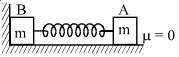
DifficultMCQ
The block $A$ is pushed towards the wall by a distance $x$ and released. The normal reaction $N$ by the vertical wall on the block $B$ versus the compression $x$ in the spring is given by:
A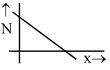
B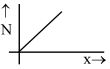
C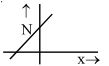
D
Solution
(B) Let the spring constant be $k$. When the block $A$ is pushed towards the wall by a distance $x$,the spring is compressed by $x$.
The spring force exerted on block $B$ is $F_s = kx$,directed towards the wall.
Since block $B$ is in equilibrium in the horizontal direction,the normal reaction $N$ from the wall must balance the spring force.
Therefore,$N = F_s = kx$.
This shows that the normal reaction $N$ is directly proportional to the compression $x$ $(N \propto x)$.
As $x$ increases,$N$ increases linearly starting from $N = 0$ when $x = 0$.
Thus,the graph is a straight line passing through the origin with a positive slope.
The spring force exerted on block $B$ is $F_s = kx$,directed towards the wall.
Since block $B$ is in equilibrium in the horizontal direction,the normal reaction $N$ from the wall must balance the spring force.
Therefore,$N = F_s = kx$.
This shows that the normal reaction $N$ is directly proportional to the compression $x$ $(N \propto x)$.
As $x$ increases,$N$ increases linearly starting from $N = 0$ when $x = 0$.
Thus,the graph is a straight line passing through the origin with a positive slope.
0 likes
View Solution27
AdvancedMCQ
$A$ light spring of length $20 \ cm$ and force constant $2 \ kg/cm$ is placed vertically on a table. $A$ small block of mass $1 \ kg$ falls on it. The height $h$ from the surface of the table at which the block will have the maximum velocity is ............... $cm$.
A
$20$
B
$15$
C
$10$
D
$5$
Solution
(B) The velocity of the block is maximum when its acceleration is zero.
At any compression $x$ of the spring,the forces acting on the block are the gravitational force $mg$ (downward) and the spring force $kx$ (upward).
The net force $F_{net} = mg - kx$.
For maximum velocity,the net force must be zero,so $mg - kx = 0$,which gives $x = mg/k$.
Given $m = 1 \ kg$,$g = 10 \ m/s^2$ (using $g = 10 \ m/s^2$ for standard calculation),and $k = 2 \ kg/cm = 200 \ N/m$.
Converting units: $k = 2 \ kg/cm = 200 \ N/m = 2 \ N/cm$.
Thus,$x = (1 \ kg \times 10 \ m/s^2) / (200 \ N/m) = 10/200 \ m = 0.05 \ m = 5 \ cm$.
The height $h$ from the table surface is the original length of the spring minus the compression $x$.
$h = L - x = 20 \ cm - 5 \ cm = 15 \ cm$.
At any compression $x$ of the spring,the forces acting on the block are the gravitational force $mg$ (downward) and the spring force $kx$ (upward).
The net force $F_{net} = mg - kx$.
For maximum velocity,the net force must be zero,so $mg - kx = 0$,which gives $x = mg/k$.
Given $m = 1 \ kg$,$g = 10 \ m/s^2$ (using $g = 10 \ m/s^2$ for standard calculation),and $k = 2 \ kg/cm = 200 \ N/m$.
Converting units: $k = 2 \ kg/cm = 200 \ N/m = 2 \ N/cm$.
Thus,$x = (1 \ kg \times 10 \ m/s^2) / (200 \ N/m) = 10/200 \ m = 0.05 \ m = 5 \ cm$.
The height $h$ from the table surface is the original length of the spring minus the compression $x$.
$h = L - x = 20 \ cm - 5 \ cm = 15 \ cm$.
0 likes
View Solution28
DifficultMCQ
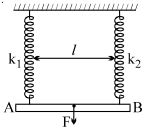
Two light vertical springs with equal natural lengths and spring constants $k_1$ and $k_2$ are separated by a distance $l$. Their upper ends are fixed to the ceiling and their lower ends to the ends $A$ and $B$ of a light horizontal rod $AB$. $A$ vertical downwards force $F$ is applied at point $C$ on the rod. $AB$ will remain horizontal in equilibrium if the distance $AC$ is
A
$\frac{l}{2}$
B
$\frac{l k_1}{k_2 + k_1}$
C
$\frac{l k_2}{k_1}$
D
$\frac{l k_2}{k_1 + k_2}$
Solution
(D) For the rod $AB$ to remain horizontal,the extension $x$ in both springs must be equal. Let the extension be $x$.
The forces exerted by the springs at ends $A$ and $B$ are $F_A = k_1 x$ and $F_B = k_2 x$ respectively.
For rotational equilibrium about point $C$,the sum of moments must be zero:
$\sum \tau_C = 0$
$(k_1 x) \cdot AC = (k_2 x) \cdot BC$
Canceling $x$ from both sides:
$k_1 \cdot AC = k_2 \cdot BC$
$\frac{AC}{BC} = \frac{k_2}{k_1} \dots (i)$
We know that $AC + BC = l$,so $BC = l - AC$. Substituting this into equation $(i)$:
$\frac{AC}{l - AC} = \frac{k_2}{k_1}$
$k_1 \cdot AC = k_2 (l - AC)$
$k_1 \cdot AC = k_2 l - k_2 \cdot AC$
$AC (k_1 + k_2) = k_2 l$
$AC = \frac{l k_2}{k_1 + k_2}$
The forces exerted by the springs at ends $A$ and $B$ are $F_A = k_1 x$ and $F_B = k_2 x$ respectively.
For rotational equilibrium about point $C$,the sum of moments must be zero:
$\sum \tau_C = 0$
$(k_1 x) \cdot AC = (k_2 x) \cdot BC$
Canceling $x$ from both sides:
$k_1 \cdot AC = k_2 \cdot BC$
$\frac{AC}{BC} = \frac{k_2}{k_1} \dots (i)$
We know that $AC + BC = l$,so $BC = l - AC$. Substituting this into equation $(i)$:
$\frac{AC}{l - AC} = \frac{k_2}{k_1}$
$k_1 \cdot AC = k_2 (l - AC)$
$k_1 \cdot AC = k_2 l - k_2 \cdot AC$
$AC (k_1 + k_2) = k_2 l$
$AC = \frac{l k_2}{k_1 + k_2}$
0 likes
View Solution29
MediumMCQ
If a spring of stiffness $k$ is cut into two parts $A$ and $B$ of length $l_{A}: l_{B}=2: 3$,then the stiffness of spring $A$ is given by
A
$\frac{5}{2} k$
B
$\frac{3}{5} k$
C
$\frac{2}{5} k$
D
$k$
Solution
(A) The stiffness $k$ of a spring is inversely proportional to its length $l$,i.e.,$k \propto \frac{1}{l}$.
Let the total length of the spring be $L = l_{A} + l_{B}$.
Given the ratio $l_{A} : l_{B} = 2 : 3$,we can write $l_{A} = \frac{2}{5}L$ and $l_{B} = \frac{3}{5}L$.
Since $k \cdot l = \text{constant}$,we have $k_{A} \cdot l_{A} = k \cdot L$.
Substituting $l_{A} = \frac{2}{5}L$ into the equation:
$k_{A} \cdot (\frac{2}{5}L) = k \cdot L$
$k_{A} = k \cdot \frac{L}{\frac{2}{5}L} = \frac{5}{2}k$.
Let the total length of the spring be $L = l_{A} + l_{B}$.
Given the ratio $l_{A} : l_{B} = 2 : 3$,we can write $l_{A} = \frac{2}{5}L$ and $l_{B} = \frac{3}{5}L$.
Since $k \cdot l = \text{constant}$,we have $k_{A} \cdot l_{A} = k \cdot L$.
Substituting $l_{A} = \frac{2}{5}L$ into the equation:
$k_{A} \cdot (\frac{2}{5}L) = k \cdot L$
$k_{A} = k \cdot \frac{L}{\frac{2}{5}L} = \frac{5}{2}k$.
0 likes
View Solution30
MediumMCQ
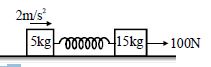
When the acceleration of the $5\ kg$ block is $2\ m/s^2$ as shown in the figure,what will be the acceleration of the $15\ kg$ block? (in $m/s^2$)
A
$2$
B
$5$
C
$6$
D
$\frac{20}{3}$
Solution
(C) For the $5\ kg$ block,the only horizontal force acting is the spring force $F_s = kx$. According to Newton's second law,$F_s = m_1 a_1$.
$F_s = 5\ kg \times 2\ m/s^2 = 10\ N$.
For the $15\ kg$ block,the forces acting are the applied force $F = 100\ N$ to the right and the spring force $F_s = 10\ N$ to the left.
According to Newton's second law,$F - F_s = m_2 a_2$.
$100\ N - 10\ N = 15\ kg \times a_2$.
$90\ N = 15\ kg \times a_2$.
$a_2 = \frac{90}{15} = 6\ m/s^2$.
$F_s = 5\ kg \times 2\ m/s^2 = 10\ N$.
For the $15\ kg$ block,the forces acting are the applied force $F = 100\ N$ to the right and the spring force $F_s = 10\ N$ to the left.
According to Newton's second law,$F - F_s = m_2 a_2$.
$100\ N - 10\ N = 15\ kg \times a_2$.
$90\ N = 15\ kg \times a_2$.
$a_2 = \frac{90}{15} = 6\ m/s^2$.
0 likes
View Solution31
MediumMCQ
$A$ block is attached to a spring as shown and very gradually lowered so that finally the spring expands by $d$. If the same block is attached to the spring and released suddenly,then the maximum expansion in the spring will be:

A
$d$
B
$2d$
C
$3d$
D
$4d$
Solution
(B) Case $1$: When the block is lowered very gradually,the acceleration is zero at all times. The spring force balances the weight of the block at equilibrium.
$mg = kd$
$\therefore d = \frac{mg}{k}$
Case $2$: When the block is released suddenly from the natural length of the spring,the block starts from rest and reaches its maximum expansion $x_{max}$ where its velocity again becomes zero.
Applying the Work-Energy Theorem between the initial position (natural length) and the final position (maximum extension):
$W_{gravity} + W_{spring} = \Delta K$
$mgx_{max} - \frac{1}{2}kx_{max}^2 = 0 - 0$
$mgx_{max} = \frac{1}{2}kx_{max}^2$
$x_{max} = \frac{2mg}{k}$
Since $d = \frac{mg}{k}$,we have $x_{max} = 2d$.
$mg = kd$
$\therefore d = \frac{mg}{k}$
Case $2$: When the block is released suddenly from the natural length of the spring,the block starts from rest and reaches its maximum expansion $x_{max}$ where its velocity again becomes zero.
Applying the Work-Energy Theorem between the initial position (natural length) and the final position (maximum extension):
$W_{gravity} + W_{spring} = \Delta K$
$mgx_{max} - \frac{1}{2}kx_{max}^2 = 0 - 0$
$mgx_{max} = \frac{1}{2}kx_{max}^2$
$x_{max} = \frac{2mg}{k}$
Since $d = \frac{mg}{k}$,we have $x_{max} = 2d$.
0 likes
View Solution32
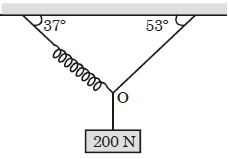
MediumMCQ
In the setup shown,a $200\, N$ block is supported in equilibrium with the help of strings and a spring. At point $O$,the strings are knotted. The extension in the spring is $4\, cm$. The force constant of the spring is closest to ............ $N/m$ $[g = 10\, m/s^2]$.
A
$30$
B
$2500$
C
$3000$
D
$4000$
Solution
(C) Let $T_1$ be the tension in the right string and $F_s$ be the spring force in the left string.
At point $O$,the forces are in equilibrium.
Resolving forces horizontally: $F_s \cos 37^\circ = T_1 \cos 53^\circ$.
Since $\cos 37^\circ = 4/5$ and $\cos 53^\circ = 3/5$,we have $F_s (4/5) = T_1 (3/5) \implies 4F_s = 3T_1 \implies T_1 = \frac{4}{3}F_s$.
Resolving forces vertically: $F_s \sin 37^\circ + T_1 \sin 53^\circ = 200$.
Substituting $T_1$: $F_s (3/5) + (\frac{4}{3}F_s) (4/5) = 200$.
$\frac{3}{5}F_s + \frac{16}{15}F_s = 200 \implies \frac{9+16}{15}F_s = 200 \implies \frac{25}{15}F_s = 200$.
$F_s = 200 \times \frac{15}{25} = 200 \times 0.6 = 120\, N$.
Using Hooke's Law $F_s = kx$,where $x = 4\, cm = 0.04\, m$.
$120 = k \times 0.04 \implies k = \frac{120}{0.04} = 3000\, N/m$.
At point $O$,the forces are in equilibrium.
Resolving forces horizontally: $F_s \cos 37^\circ = T_1 \cos 53^\circ$.
Since $\cos 37^\circ = 4/5$ and $\cos 53^\circ = 3/5$,we have $F_s (4/5) = T_1 (3/5) \implies 4F_s = 3T_1 \implies T_1 = \frac{4}{3}F_s$.
Resolving forces vertically: $F_s \sin 37^\circ + T_1 \sin 53^\circ = 200$.
Substituting $T_1$: $F_s (3/5) + (\frac{4}{3}F_s) (4/5) = 200$.
$\frac{3}{5}F_s + \frac{16}{15}F_s = 200 \implies \frac{9+16}{15}F_s = 200 \implies \frac{25}{15}F_s = 200$.
$F_s = 200 \times \frac{15}{25} = 200 \times 0.6 = 120\, N$.
Using Hooke's Law $F_s = kx$,where $x = 4\, cm = 0.04\, m$.
$120 = k \times 0.04 \implies k = \frac{120}{0.04} = 3000\, N/m$.
0 likes
View Solution33
EasyMCQ
The force constant of a spring is $K$. If half of the spring is cut off,what will be the force constant of the remaining spring?
A
$\frac{3}{4}K$
B
$\frac{K}{2}$
C
$2K$
D
$K$
Solution
(C) The force constant $K$ of a spring is inversely proportional to its length $\ell$,given by the relation $K \propto \frac{1}{\ell}$.
When the spring is cut into half,the new length becomes $\ell' = \frac{\ell}{2}$.
Let the new force constant be $K'$.
Using the proportionality,we have $\frac{K'}{K} = \frac{\ell}{\ell'} = \frac{\ell}{\ell / 2} = 2$.
Therefore,the new force constant is $K' = 2K$.
When the spring is cut into half,the new length becomes $\ell' = \frac{\ell}{2}$.
Let the new force constant be $K'$.
Using the proportionality,we have $\frac{K'}{K} = \frac{\ell}{\ell'} = \frac{\ell}{\ell / 2} = 2$.
Therefore,the new force constant is $K' = 2K$.
0 likes
View Solution34
MediumMCQ
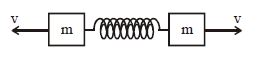
Two blocks each of mass $m$ are connected to a spring of spring constant $k.$ If both are given velocity $v$ in opposite directions,then the maximum elongation of the spring is
A
$\sqrt{\frac{mv^2}{k}}$
B
$\sqrt{\frac{2mv^2}{k}}$
C
$\sqrt{\frac{mv^2}{2k}}$
D
$2\sqrt{\frac{mv^2}{k}}$
Solution
(B) By the Law of Conservation of Mechanical Energy $(COME)$,the total initial mechanical energy is equal to the total final mechanical energy.
Initial kinetic energy of the system is $KE_i = \frac{1}{2}mv^2 + \frac{1}{2}mv^2 = mv^2$.
At the point of maximum elongation $x$,the relative velocity between the two blocks becomes zero,meaning both blocks move with the same velocity (which is zero in the center of mass frame).
Final potential energy of the spring is $PE_f = \frac{1}{2}kx^2$.
Applying conservation of energy: $KE_i = PE_f$.
$mv^2 = \frac{1}{2}kx^2$.
$x^2 = \frac{2mv^2}{k}$.
$x = \sqrt{\frac{2mv^2}{k}}$.
Initial kinetic energy of the system is $KE_i = \frac{1}{2}mv^2 + \frac{1}{2}mv^2 = mv^2$.
At the point of maximum elongation $x$,the relative velocity between the two blocks becomes zero,meaning both blocks move with the same velocity (which is zero in the center of mass frame).
Final potential energy of the spring is $PE_f = \frac{1}{2}kx^2$.
Applying conservation of energy: $KE_i = PE_f$.
$mv^2 = \frac{1}{2}kx^2$.
$x^2 = \frac{2mv^2}{k}$.
$x = \sqrt{\frac{2mv^2}{k}}$.
0 likes
View Solution35
MediumMCQ
Two masses of $1 \, kg$ and $2 \, kg$ respectively are connected by a massless spring as shown in the figure. $A$ force of $20 \, N$ acts on the $2 \, kg$ mass. At the instant when the $1 \, kg$ mass has an acceleration of $10 \, m/s^2$ towards the right,the acceleration of the $2 \, kg$ mass is ......... $m/s^2$.

A
$2$
B
$5$
C
$10$
D
$20$
Solution
(B) Let the acceleration of the $1 \, kg$ mass be $a_1 = 10 \, m/s^2$ (towards the right).
Let the acceleration of the $2 \, kg$ mass be $a_2$.
Applying Newton's second law for the system of two masses connected by a spring,the external force $F_{ext}$ acting on the system is equal to the sum of the products of mass and acceleration of each individual body:
$F_{ext} = m_1 a_1 + m_2 a_2$
Given $F_{ext} = 20 \, N$,$m_1 = 1 \, kg$,$m_2 = 2 \, kg$,and $a_1 = 10 \, m/s^2$:
$20 = (1 \times 10) + (2 \times a_2)$
$20 = 10 + 2 a_2$
$10 = 2 a_2$
$a_2 = 5 \, m/s^2$
Thus,the acceleration of the $2 \, kg$ mass is $5 \, m/s^2$.
Let the acceleration of the $2 \, kg$ mass be $a_2$.
Applying Newton's second law for the system of two masses connected by a spring,the external force $F_{ext}$ acting on the system is equal to the sum of the products of mass and acceleration of each individual body:
$F_{ext} = m_1 a_1 + m_2 a_2$
Given $F_{ext} = 20 \, N$,$m_1 = 1 \, kg$,$m_2 = 2 \, kg$,and $a_1 = 10 \, m/s^2$:
$20 = (1 \times 10) + (2 \times a_2)$
$20 = 10 + 2 a_2$
$10 = 2 a_2$
$a_2 = 5 \, m/s^2$
Thus,the acceleration of the $2 \, kg$ mass is $5 \, m/s^2$.
0 likes
View Solution36
DifficultMCQ
$A$ body of mass $m$ is tied to one end of a spring and whirled round in a horizontal plane with a constant angular velocity. The elongation in the spring is $1\, cm$. If the angular velocity is doubled,the elongation in the spring is $5\, cm$. The original length of the spring is ......... $cm$
A
$15$
B
$12$
C
$16$
D
$10$
Solution
(A) Let the original length of the spring be $l$ and the spring constant be $k$. When the body is whirled in a horizontal circle,the centripetal force is provided by the spring force $F = kx$,where $x$ is the elongation.
The radius of the circular path is $r = l + x$.
The centripetal force is $F = m r \omega^2 = m(l + x) \omega^2$.
Case $1$: Elongation $x_1 = 1\, cm$,angular velocity $\omega_1 = \omega$.
$k(1) = m(l + 1) \omega^2$ --- $(i)$
Case $2$: Elongation $x_2 = 5\, cm$,angular velocity $\omega_2 = 2\omega$.
$k(5) = m(l + 5) (2\omega)^2 = 4m(l + 5) \omega^2$ --- $(ii)$
Dividing equation $(ii)$ by equation $(i)$:
$\frac{5k}{k} = \frac{4m(l + 5) \omega^2}{m(l + 1) \omega^2}$
$5 = \frac{4(l + 5)}{l + 1}$
$5(l + 1) = 4(l + 5)$
$5l + 5 = 4l + 20$
$l = 15\, cm$.
The radius of the circular path is $r = l + x$.
The centripetal force is $F = m r \omega^2 = m(l + x) \omega^2$.
Case $1$: Elongation $x_1 = 1\, cm$,angular velocity $\omega_1 = \omega$.
$k(1) = m(l + 1) \omega^2$ --- $(i)$
Case $2$: Elongation $x_2 = 5\, cm$,angular velocity $\omega_2 = 2\omega$.
$k(5) = m(l + 5) (2\omega)^2 = 4m(l + 5) \omega^2$ --- $(ii)$
Dividing equation $(ii)$ by equation $(i)$:
$\frac{5k}{k} = \frac{4m(l + 5) \omega^2}{m(l + 1) \omega^2}$
$5 = \frac{4(l + 5)}{l + 1}$
$5(l + 1) = 4(l + 5)$
$5l + 5 = 4l + 20$
$l = 15\, cm$.
0 likes
View Solution37
MediumMCQ
$A$ spring whose unstretched length is $\ell$ has a force constant $k$. The spring is cut into two pieces of unstretched lengths $\ell_1$ and $\ell_2$ where $\ell_1 = n\ell_2$ and $n$ is an integer. The ratio $k_1/k_2$ of the corresponding force constants $k_1$ and $k_2$ will be:
A
$n$
B
$\frac{1}{n^2}$
C
$n^2$
D
$\frac{1}{n}$
Solution
(D) The force constant $k$ of a spring is inversely proportional to its unstretched length,i.e.,$k \propto \frac{1}{\ell}$,which implies $k\ell = C$ (a constant).
For the two pieces,we have $k_1 \ell_1 = C$ and $k_2 \ell_2 = C$.
Therefore,$k_1 \ell_1 = k_2 \ell_2$.
Rearranging for the ratio,we get $\frac{k_1}{k_2} = \frac{\ell_2}{\ell_1}$.
Given that $\ell_1 = n\ell_2$,we substitute this into the ratio:
$\frac{k_1}{k_2} = \frac{\ell_2}{n\ell_2} = \frac{1}{n}$.
For the two pieces,we have $k_1 \ell_1 = C$ and $k_2 \ell_2 = C$.
Therefore,$k_1 \ell_1 = k_2 \ell_2$.
Rearranging for the ratio,we get $\frac{k_1}{k_2} = \frac{\ell_2}{\ell_1}$.
Given that $\ell_1 = n\ell_2$,we substitute this into the ratio:
$\frac{k_1}{k_2} = \frac{\ell_2}{n\ell_2} = \frac{1}{n}$.
0 likes
View Solution38
MediumMCQ
Two springs $A$ and $B$ having spring constants $K_{A}$ and $K_{B}$ $(K_{A} = 2 K_{B})$ are stretched by applying forces of equal magnitude. If the energy stored in spring $A$ is $E_{A}$,then the energy stored in spring $B$ will be:
A
$2 E_{A}$
B
$E_{A}/4$
C
$E_{A}/2$
D
$4 E_{A}$
Solution
(A) The potential energy $E$ stored in a spring with spring constant $K$ when stretched by a force $F$ is given by the formula $E = \frac{F^2}{2K}$.
Since the applied force $F$ is the same for both springs,the energy stored is inversely proportional to the spring constant: $E \propto \frac{1}{K}$.
Therefore,the ratio of energies is $\frac{E_{A}}{E_{B}} = \frac{K_{B}}{K_{A}}$.
Given that $K_{A} = 2 K_{B}$,we have $\frac{K_{B}}{K_{A}} = \frac{1}{2}$.
Substituting this into the ratio,we get $\frac{E_{A}}{E_{B}} = \frac{1}{2}$.
Thus,$E_{B} = 2 E_{A}$.
Since the applied force $F$ is the same for both springs,the energy stored is inversely proportional to the spring constant: $E \propto \frac{1}{K}$.
Therefore,the ratio of energies is $\frac{E_{A}}{E_{B}} = \frac{K_{B}}{K_{A}}$.
Given that $K_{A} = 2 K_{B}$,we have $\frac{K_{B}}{K_{A}} = \frac{1}{2}$.
Substituting this into the ratio,we get $\frac{E_{A}}{E_{B}} = \frac{1}{2}$.
Thus,$E_{B} = 2 E_{A}$.
0 likes
View Solution39
MediumMCQ
$A$ spring of force constant $k$ is cut into two equal halves. The force constant of each half is
A
$k/\sqrt{2}$
B
$k/2$
C
$k$
D
$2k$
Solution
(D) The force constant $k$ of a spring is inversely proportional to its length $l$,given by the relation $k \propto 1/l$ or $kl = \text{constant}$.
When a spring of length $l$ and force constant $k$ is cut into two equal halves,the length of each new piece becomes $l' = l/2$.
Since $k'l' = kl$,we have $k'(l/2) = kl$.
Solving for $k'$,we get $k' = 2k$.
Therefore,the force constant of each half is $2k$.
When a spring of length $l$ and force constant $k$ is cut into two equal halves,the length of each new piece becomes $l' = l/2$.
Since $k'l' = kl$,we have $k'(l/2) = kl$.
Solving for $k'$,we get $k' = 2k$.
Therefore,the force constant of each half is $2k$.
0 likes
View Solution40
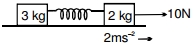
DifficultMCQ
Find the acceleration of $3\,kg$ mass when the acceleration of $2\,kg$ mass is $2\,ms^{-2}$ as shown in the figure.
A
$2\,ms^{-2}$
B
$3\,ms^{-2}$
C
$0.5\,ms^{-2}$
D
$0$
Solution
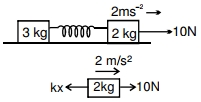
(A) For the $2\,kg$ mass,the forces acting are the applied force of $10\,N$ to the right and the spring force $F_s = kx$ to the left.
Applying Newton's second law for the $2\,kg$ mass:
$F_{net} = ma$
$10 - kx = 2 \times 2$
$10 - kx = 4$
$kx = 6\,N$
Now,for the $3\,kg$ mass,the only horizontal force acting on it is the spring force $kx$ pulling it to the right.
Applying Newton's second law for the $3\,kg$ mass:
$F_{net} = ma$
$kx = 3 \times a_{3kg}$
$6 = 3 \times a_{3kg}$
$a_{3kg} = \frac{6}{3} = 2\,ms^{-2}$
Applying Newton's second law for the $2\,kg$ mass:
$F_{net} = ma$
$10 - kx = 2 \times 2$
$10 - kx = 4$
$kx = 6\,N$
Now,for the $3\,kg$ mass,the only horizontal force acting on it is the spring force $kx$ pulling it to the right.
Applying Newton's second law for the $3\,kg$ mass:
$F_{net} = ma$
$kx = 3 \times a_{3kg}$
$6 = 3 \times a_{3kg}$
$a_{3kg} = \frac{6}{3} = 2\,ms^{-2}$
0 likes
View Solution41
MediumMCQ
$A$ spring of force constant $k$ is cut into three equal pieces. If these three pieces are connected in parallel,the force constant of the combination will be
A
$k/3$
B
$k/9$
C
$3k$
D
$9k$
Solution
(D) When a spring of force constant $k$ is cut into $n$ equal pieces,the force constant of each piece becomes $k' = nk$.
Here,the spring is cut into $3$ equal pieces,so the force constant of each piece is $k' = 3k$.
When these $3$ pieces are connected in parallel,the equivalent force constant $k_{eq}$ is the sum of the individual force constants:
$k_{eq} = k' + k' + k' = 3k' = 3(3k) = 9k$.
Here,the spring is cut into $3$ equal pieces,so the force constant of each piece is $k' = 3k$.
When these $3$ pieces are connected in parallel,the equivalent force constant $k_{eq}$ is the sum of the individual force constants:
$k_{eq} = k' + k' + k' = 3k' = 3(3k) = 9k$.
0 likes
View Solution42
MediumMCQ
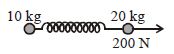
Two masses of $10\, kg$ and $20\, kg$ respectively are connected by a massless spring as shown in the figure. $A$ force of $200\, N$ acts on the $20\, kg$ mass. At the instant when the $10\, kg$ mass has an acceleration of $12\, m\, s^{-2}$,the acceleration of the $20\, kg$ mass is ...... $m\, s^{-2}$.
A
$2$
B
$4$
C
$10$
D
$20$
Solution
(B) Let $m_1 = 10\, kg$ and $m_2 = 20\, kg$. Let $f$ be the spring force acting on both masses.
For the $10\, kg$ mass,the equation of motion is: $f = m_1 a_1$,where $a_1 = 12\, m\, s^{-2}$.
Thus,$f = 10 \times 12 = 120\, N$.
For the $20\, kg$ mass,the external force $F = 200\, N$ acts in the direction of motion,and the spring force $f$ acts in the opposite direction.
The equation of motion is: $F - f = m_2 a_2$.
Substituting the values: $200 - 120 = 20 \times a_2$.
$80 = 20 \times a_2$.
$a_2 = \frac{80}{20} = 4\, m\, s^{-2}$.
For the $10\, kg$ mass,the equation of motion is: $f = m_1 a_1$,where $a_1 = 12\, m\, s^{-2}$.
Thus,$f = 10 \times 12 = 120\, N$.
For the $20\, kg$ mass,the external force $F = 200\, N$ acts in the direction of motion,and the spring force $f$ acts in the opposite direction.
The equation of motion is: $F - f = m_2 a_2$.
Substituting the values: $200 - 120 = 20 \times a_2$.
$80 = 20 \times a_2$.
$a_2 = \frac{80}{20} = 4\, m\, s^{-2}$.
0 likes
View Solution43
DifficultMCQ
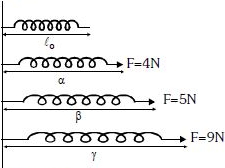
The length of a spring is $\alpha$ when a force of $4\,N$ is applied on it and the length is $\beta$ when $5\,N$ force is applied. Then the length of the spring when $9\,N$ force is applied is
A
$5\beta - 4\alpha$
B
$\beta - \alpha$
C
$5\alpha - 4\beta$
D
$9(\beta - \alpha)$
Solution
(A) Let the natural length of the spring be $\ell_{0}$ and the spring constant be $k$.
According to Hooke's Law,$F = k(\text{extension}) = k(\ell - \ell_{0})$.
For $F = 4\,N$,the length is $\alpha$: $4 = k(\alpha - \ell_{0}) \dots(i)$
For $F = 5\,N$,the length is $\beta$: $5 = k(\beta - \ell_{0}) \dots(ii)$
Subtracting $(i)$ from $(ii)$: $5 - 4 = k(\beta - \ell_{0}) - k(\alpha - \ell_{0}) \Rightarrow 1 = k(\beta - \alpha) \Rightarrow k = \frac{1}{\beta - \alpha}$.
Substitute $k$ into $(i)$: $4 = \frac{1}{\beta - \alpha}(\alpha - \ell_{0}) \Rightarrow 4(\beta - \alpha) = \alpha - \ell_{0} \Rightarrow \ell_{0} = \alpha - 4\beta + 4\alpha = 5\alpha - 4\beta$.
For $F = 9\,N$,let the length be $\gamma$: $9 = k(\gamma - \ell_{0}) \Rightarrow \gamma = \ell_{0} + \frac{9}{k}$.
Substituting $\ell_{0}$ and $k$: $\gamma = (5\alpha - 4\beta) + 9(\beta - \alpha) = 5\alpha - 4\beta + 9\beta - 9\alpha = 5\beta - 4\alpha$.
According to Hooke's Law,$F = k(\text{extension}) = k(\ell - \ell_{0})$.
For $F = 4\,N$,the length is $\alpha$: $4 = k(\alpha - \ell_{0}) \dots(i)$
For $F = 5\,N$,the length is $\beta$: $5 = k(\beta - \ell_{0}) \dots(ii)$
Subtracting $(i)$ from $(ii)$: $5 - 4 = k(\beta - \ell_{0}) - k(\alpha - \ell_{0}) \Rightarrow 1 = k(\beta - \alpha) \Rightarrow k = \frac{1}{\beta - \alpha}$.
Substitute $k$ into $(i)$: $4 = \frac{1}{\beta - \alpha}(\alpha - \ell_{0}) \Rightarrow 4(\beta - \alpha) = \alpha - \ell_{0} \Rightarrow \ell_{0} = \alpha - 4\beta + 4\alpha = 5\alpha - 4\beta$.
For $F = 9\,N$,let the length be $\gamma$: $9 = k(\gamma - \ell_{0}) \Rightarrow \gamma = \ell_{0} + \frac{9}{k}$.
Substituting $\ell_{0}$ and $k$: $\gamma = (5\alpha - 4\beta) + 9(\beta - \alpha) = 5\alpha - 4\beta + 9\beta - 9\alpha = 5\beta - 4\alpha$.
0 likes
View Solution44
MediumMCQ
$A$ body of mass $m$ is tied to one end of a spring and whirled round in a horizontal plane with a constant angular velocity. The elongation in the spring is $1 \, cm$. If the angular velocity is doubled,the elongation in the spring is $5 \, cm$. The original length of the spring is ............ $cm$.
A
$16$
B
$15$
C
$14$
D
$13$
Solution
(B) Let $l$ be the original length of the spring and $k$ be the spring constant.
When the body is whirled in a horizontal plane,the centripetal force is provided by the spring force.
For the first case,the angular velocity is $\omega$ and elongation $x_1 = 1 \, cm$:
$m \omega^2 (l + x_1) = k x_1$ --- $(1)$
For the second case,the angular velocity is $2\omega$ and elongation $x_2 = 5 \, cm$:
$m (2\omega)^2 (l + x_2) = k x_2$ --- $(2)$
Dividing equation $(2)$ by equation $(1)$:
$\frac{4 \omega^2 (l + x_2)}{\omega^2 (l + x_1)} = \frac{k x_2}{k x_1}$
$4 \frac{l + 5}{l + 1} = \frac{5}{1}$
$4(l + 5) = 5(l + 1)$
$4l + 20 = 5l + 5$
$l = 15 \, cm$.
Thus,the original length of the spring is $15 \, cm$.
When the body is whirled in a horizontal plane,the centripetal force is provided by the spring force.
For the first case,the angular velocity is $\omega$ and elongation $x_1 = 1 \, cm$:
$m \omega^2 (l + x_1) = k x_1$ --- $(1)$
For the second case,the angular velocity is $2\omega$ and elongation $x_2 = 5 \, cm$:
$m (2\omega)^2 (l + x_2) = k x_2$ --- $(2)$
Dividing equation $(2)$ by equation $(1)$:
$\frac{4 \omega^2 (l + x_2)}{\omega^2 (l + x_1)} = \frac{k x_2}{k x_1}$
$4 \frac{l + 5}{l + 1} = \frac{5}{1}$
$4(l + 5) = 5(l + 1)$
$4l + 20 = 5l + 5$
$l = 15 \, cm$.
Thus,the original length of the spring is $15 \, cm$.
0 likes
View Solution45
MediumMCQ
$A$ spring of force constant $k$ is cut into two pieces such that one piece is three times the length of the other. The longer piece will have a force constant of
A
$3k$
B
$\frac{3k}{4}$
C
$\frac{4k}{3}$
D
$9k$
Solution
(C) The force constant $k$ of a spring is inversely proportional to its length $l$,i.e.,$k \propto \frac{1}{l}$ or $kl = \text{constant}$.
Let the total length of the spring be $L$ and its force constant be $k$. The spring is cut into two pieces of lengths $l_1$ and $l_2$ such that $l_2 = 3l_1$.
The total length is $L = l_1 + l_2 = l_1 + 3l_1 = 4l_1$.
For the original spring,$kL = C$,where $C$ is a constant.
For the longer piece of length $l_2$,let the new force constant be $k_2$. Then $k_2 l_2 = C$.
Equating the two,$kL = k_2 l_2$.
Substituting the values,$k(4l_1) = k_2(3l_1)$.
Solving for $k_2$,we get $k_2 = \frac{4k}{3}$.
Let the total length of the spring be $L$ and its force constant be $k$. The spring is cut into two pieces of lengths $l_1$ and $l_2$ such that $l_2 = 3l_1$.
The total length is $L = l_1 + l_2 = l_1 + 3l_1 = 4l_1$.
For the original spring,$kL = C$,where $C$ is a constant.
For the longer piece of length $l_2$,let the new force constant be $k_2$. Then $k_2 l_2 = C$.
Equating the two,$kL = k_2 l_2$.
Substituting the values,$k(4l_1) = k_2(3l_1)$.
Solving for $k_2$,we get $k_2 = \frac{4k}{3}$.
0 likes
View Solution46
MediumMCQ
Two springs,$P$ and $Q$,of force constants $k_P$ and $k_Q$ (where $k_Q = k_P / 2$) are stretched by applying forces of equal magnitude. If the energy stored in $Q$ is $E$,then the energy stored in $P$ is:
A
$E$
B
$2E$
C
$E/2$
D
$E/4$
Solution
(C) The energy stored in a spring stretched by a force $F$ is given by $U = \frac{F^2}{2k}$.
Given that the forces applied to both springs are equal,let $F_P = F_Q = F$.
The energy stored in spring $P$ is $U_P = \frac{F^2}{2k_P}$.
The energy stored in spring $Q$ is $U_Q = \frac{F^2}{2k_Q} = E$.
Since $k_Q = \frac{k_P}{2}$,we have $k_P = 2k_Q$.
Substituting this into the expression for $U_P$:
$U_P = \frac{F^2}{2(2k_Q)} = \frac{1}{2} \left( \frac{F^2}{2k_Q} \right) = \frac{1}{2} E$.
Therefore,the energy stored in spring $P$ is $E/2$.
Given that the forces applied to both springs are equal,let $F_P = F_Q = F$.
The energy stored in spring $P$ is $U_P = \frac{F^2}{2k_P}$.
The energy stored in spring $Q$ is $U_Q = \frac{F^2}{2k_Q} = E$.
Since $k_Q = \frac{k_P}{2}$,we have $k_P = 2k_Q$.
Substituting this into the expression for $U_P$:
$U_P = \frac{F^2}{2(2k_Q)} = \frac{1}{2} \left( \frac{F^2}{2k_Q} \right) = \frac{1}{2} E$.
Therefore,the energy stored in spring $P$ is $E/2$.
0 likes
View Solution47
Medium
Give an example of a variable force. Write the formula for Hooke's law.
Solution
(N/A) $1$. Example of a variable force: The gravitational force between two objects as their distance changes,or the spring force $F = -kx$ where the force depends on the displacement $x$.
$2$. Formula for Hooke's law: $F = -kx$,where $F$ is the restoring force,$k$ is the spring constant,and $x$ is the displacement from the equilibrium position.
$2$. Formula for Hooke's law: $F = -kx$,where $F$ is the restoring force,$k$ is the spring constant,and $x$ is the displacement from the equilibrium position.
0 likes
View Solution48
Difficult
Define spring constant and write its unit.
Solution
(N/A) The spring constant,denoted by $k$,is a measure of the stiffness of a spring. It is defined as the restoring force per unit extension or compression of the spring.
According to Hooke's Law,the restoring force $F$ is given by $F = -kx$,where $x$ is the displacement from the equilibrium position.
Therefore,the spring constant is $k = |F/x|$.
The $SI$ unit of the spring constant is Newtons per meter,denoted as $N/m$.
According to Hooke's Law,the restoring force $F$ is given by $F = -kx$,where $x$ is the displacement from the equilibrium position.
Therefore,the spring constant is $k = |F/x|$.
The $SI$ unit of the spring constant is Newtons per meter,denoted as $N/m$.
0 likes
View Solution49
EasyMCQ
$A$ force of $20\,dyne$ applied to the end of a spring increases its length by $1\,mm$. What will be the force constant of the spring?
A
$200\,dyne/cm$
B
$20\,dyne/cm$
C
$2\,dyne/cm$
D
$2000\,dyne/cm$
Solution
(A) The force applied is $F = 20\,dyne$.
The extension in the spring is $\Delta l = 1\,mm = 0.1\,cm$.
The force constant $k$ is given by Hooke's Law: $F = k \Delta l$.
Therefore,$k = \frac{F}{\Delta l} = \frac{20\,dyne}{0.1\,cm} = 200\,dyne/cm$.
The extension in the spring is $\Delta l = 1\,mm = 0.1\,cm$.
The force constant $k$ is given by Hooke's Law: $F = k \Delta l$.
Therefore,$k = \frac{F}{\Delta l} = \frac{20\,dyne}{0.1\,cm} = 200\,dyne/cm$.
0 likes
View Solution50
EasyMCQ
Fill in the blank: The force constant of a spring is $0.5 \, Nm^{-1}$. The force necessary to increase the length of the spring by $10 \, cm$ will be .......... (in $, N$)
A
$0.05$
B
$0.5$
C
$5$
D
$50$
Solution
(A) The force required to stretch a spring is given by Hooke's Law: $F = k \Delta x$.
Given:
Force constant $k = 0.5 \, Nm^{-1}$.
Extension $\Delta x = 10 \, cm = 10 \times 10^{-2} \, m = 0.1 \, m$.
Substituting the values into the formula:
$F = 0.5 \times 0.1 = 0.05 \, N$.
Therefore,the force necessary is $0.05 \, N$.
Given:
Force constant $k = 0.5 \, Nm^{-1}$.
Extension $\Delta x = 10 \, cm = 10 \times 10^{-2} \, m = 0.1 \, m$.
Substituting the values into the formula:
$F = 0.5 \times 0.1 = 0.05 \, N$.
Therefore,the force necessary is $0.05 \, N$.
0 likes
View SolutionNewton's Laws of Motion and Friction — Spring Force · Frequently Asked Questions
1Are these Newton's Laws of Motion and Friction questions useful for JEE and NEET?
Yes. All questions in this section are mapped to JEE Main and NEET exam patterns. Previous year questions from JEE Main, NEET, GUJCET and state-level exams are included with full solutions.
2Can I switch to Hindi or Gujarati for these questions?
Yes. Use the language tabs in the hero section or the sidebar to view the same questions and solutions in English, Hindi or Gujarati.
3How do I generate a question paper from this subtopic?
Use the Vedclass Exam Paper Generator — select the chapter and subtopic, set difficulty, and generate Sets A, B, C, D automatically. First 3 chapters of every subject are free.
Vedclass Products
For Students
Vedclass Test Series
Mock tests in real JEE/NEET style with performance analysis. 5-day free trial.
Start Free TrialFor Teachers
Exam Paper Generator
Generate Set A/B/C/D papers from this chapter in 2 minutes. 3 chapters free.
Try FreeFor Institutes
Online Exam Module
Live online exams with unlimited students, 360° analytics & white-label branding.
See DemoFor Teachers & Institutes
Generate a Newton's Laws of Motion and Friction Exam Paper in 2 Minutes
Select subtopic & difficulty — Sets A, B, C, D auto-generated with No Repeat logic.
First 3 chapters of every subject are free — no payment required.