
A English
Motion of Satellites in Circular Orbits and Planets in Elliptical Orbits Questions in English
Class 11 Physics · Gravitation · Motion of Satellites in Circular Orbits and Planets in Elliptical Orbits
326+
Questions
English
Language
100%
With Solutions
Showing 50 of 326 questions in English
101
DifficultMCQ
$A$ satellite revolves in the geostationary orbit but in a direction east to west. The time interval between its successive passing above a point on the equator is ........ $hrs$.
A
$48$
B
$24$
C
$12$
D
never
Solution
(C) For a geostationary orbit,the orbital period is $T = 24 \text{ hrs}$. The angular velocity of the satellite is $\omega_{s} = \frac{2\pi}{T} = \frac{2\pi}{24} = \frac{\pi}{12} \text{ rad/hr}$.
Since the Earth rotates from west to east with angular velocity $\omega_{e} = \frac{2\pi}{24} = \frac{\pi}{12} \text{ rad/hr}$,and the satellite moves in the opposite direction (east to west),their relative angular velocity is $\omega_{r} = \omega_{e} + \omega_{s} = \frac{\pi}{12} + \frac{\pi}{12} = \frac{\pi}{6} \text{ rad/hr}$.
The time interval between successive passes over the same point on the equator is the relative time period $T_{r} = \frac{2\pi}{\omega_{r}} = \frac{2\pi}{\pi/6} = 12 \text{ hrs}$.
Since the Earth rotates from west to east with angular velocity $\omega_{e} = \frac{2\pi}{24} = \frac{\pi}{12} \text{ rad/hr}$,and the satellite moves in the opposite direction (east to west),their relative angular velocity is $\omega_{r} = \omega_{e} + \omega_{s} = \frac{\pi}{12} + \frac{\pi}{12} = \frac{\pi}{6} \text{ rad/hr}$.
The time interval between successive passes over the same point on the equator is the relative time period $T_{r} = \frac{2\pi}{\omega_{r}} = \frac{2\pi}{\pi/6} = 12 \text{ hrs}$.
0 likes
View Solution102
DifficultMCQ
$A$ satellite can be in a geostationary orbit around a planet at a distance $r$ from the centre of the planet. If the angular velocity of the planet about its axis doubles,a satellite can now be in a geostationary orbit around the planet if its distance from the centre of the planet is
A
$r/2$
B
$r/(2\sqrt{2})$
C
$r/(4^{1/3})$
D
$r/(2^{1/3})$
Solution
(C) For a geostationary orbit,the angular velocity of the satellite must be equal to the angular velocity of the planet,$\omega_s = \omega_p$.
From Kepler's third law,the orbital radius $r$ and angular velocity $\omega$ are related by $G M = \omega^2 r^3$,which implies $r^3 \propto \omega^{-2}$ or $r \propto \omega^{-2/3}$.
Let the initial angular velocity be $\omega$ and the new angular velocity be $\omega' = 2\omega$.
Let the initial radius be $r$ and the new radius be $r'$.
Then,$\frac{r'}{r} = \left( \frac{\omega'}{\omega} \right)^{-2/3} = (2)^{-2/3} = \frac{1}{(2^2)^{1/3}} = \frac{1}{4^{1/3}}$.
Therefore,$r' = \frac{r}{4^{1/3}}$.
From Kepler's third law,the orbital radius $r$ and angular velocity $\omega$ are related by $G M = \omega^2 r^3$,which implies $r^3 \propto \omega^{-2}$ or $r \propto \omega^{-2/3}$.
Let the initial angular velocity be $\omega$ and the new angular velocity be $\omega' = 2\omega$.
Let the initial radius be $r$ and the new radius be $r'$.
Then,$\frac{r'}{r} = \left( \frac{\omega'}{\omega} \right)^{-2/3} = (2)^{-2/3} = \frac{1}{(2^2)^{1/3}} = \frac{1}{4^{1/3}}$.
Therefore,$r' = \frac{r}{4^{1/3}}$.
0 likes
View Solution103
MediumMCQ
Two particles of equal mass $m$ go around a circle of radius $R$ under the action of their mutual gravitational attraction. The speed of each particle with respect to their centre of mass is
A
$\sqrt{\frac{Gm}{R}}$
B
$\sqrt{\frac{Gm}{4R}}$
C
$\sqrt{\frac{Gm}{3R}}$
D
$\sqrt{\frac{Gm}{2R}}$
Solution
(B) The two particles of mass $m$ are separated by a distance $d = 2R$ because they move in a circle of radius $R$ around their common centre of mass.
The gravitational force between them is $F_G = \frac{G m^2}{(2R)^2} = \frac{G m^2}{4R^2}$.
This gravitational force provides the necessary centripetal force for each particle to move in a circle of radius $R$. The centripetal force is $F_c = \frac{m v^2}{R}$.
Equating the two forces: $\frac{m v^2}{R} = \frac{G m^2}{4R^2}$.
Solving for $v$: $v^2 = \frac{G m^2}{4R^2} \cdot \frac{R}{m} = \frac{Gm}{4R}$.
Therefore,$v = \sqrt{\frac{Gm}{4R}}$.
The gravitational force between them is $F_G = \frac{G m^2}{(2R)^2} = \frac{G m^2}{4R^2}$.
This gravitational force provides the necessary centripetal force for each particle to move in a circle of radius $R$. The centripetal force is $F_c = \frac{m v^2}{R}$.
Equating the two forces: $\frac{m v^2}{R} = \frac{G m^2}{4R^2}$.
Solving for $v$: $v^2 = \frac{G m^2}{4R^2} \cdot \frac{R}{m} = \frac{Gm}{4R}$.
Therefore,$v = \sqrt{\frac{Gm}{4R}}$.
2 likes
View Solution104
MediumMCQ
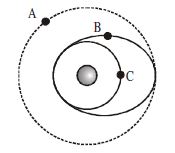
Three equal mass satellites $A, B,$ and $C$ are in coplanar orbits around a planet as shown in the figure. The magnitudes of the angular momenta of the satellites as measured about the planet are $L_A, L_B$,and $L_C$. Which of the following statements is correct?
A
$L_A > L_B > L_C$
B
$L_C > L_B > L_A$
C
$L_B > L_C > L_A$
D
$L_B > L_A > L_C$
Solution
(A) The angular momentum of a satellite in an elliptical orbit is given by $L = mvr \sin \theta$. For a satellite of mass $m$ in an orbit with semi-major axis $a$,the angular momentum is $L = m \sqrt{GMa(1-e^2)}$,where $M$ is the mass of the planet and $e$ is the eccentricity.
Alternatively,for a circular orbit,$L = m \sqrt{GMr}$. For an elliptical orbit,the angular momentum is proportional to the square root of the semi-major axis $a$,i.e.,$L \propto \sqrt{a}$.
From the figure,the semi-major axis $a_A$ of satellite $A$ is the largest,followed by the semi-major axis $a_B$ of satellite $B$,and the semi-major axis $a_C$ of satellite $C$ is the smallest.
Therefore,$a_A > a_B > a_C$.
Since $L \propto \sqrt{a}$,it follows that $L_A > L_B > L_C$.
Alternatively,for a circular orbit,$L = m \sqrt{GMr}$. For an elliptical orbit,the angular momentum is proportional to the square root of the semi-major axis $a$,i.e.,$L \propto \sqrt{a}$.
From the figure,the semi-major axis $a_A$ of satellite $A$ is the largest,followed by the semi-major axis $a_B$ of satellite $B$,and the semi-major axis $a_C$ of satellite $C$ is the smallest.
Therefore,$a_A > a_B > a_C$.
Since $L \propto \sqrt{a}$,it follows that $L_A > L_B > L_C$.
0 likes
View Solution105
DifficultMCQ
Two satellites are launched simultaneously into orbits of radius $R$ and $4R$. At an instant,the two satellites are on the same radial line. The time after which they have maximum separation is (mass of Earth = $M_e$). Assume the same sense of rotation.
A
$\frac{8\pi}{7}\sqrt{\frac{R^3}{GM_e}}$
B
$7\pi\sqrt{\frac{R^3}{GM_e}}$
C
$\frac{7\pi}{8}\sqrt{\frac{R^3}{GM_e}}$
D
$\pi\sqrt{\frac{R^3}{GM_e}}$
Solution
(A) The angular velocity of a satellite is given by $\omega = \sqrt{\frac{GM_e}{r^3}}$.
For the first satellite with radius $R$,$\omega_1 = \sqrt{\frac{GM_e}{R^3}}$.
For the second satellite with radius $4R$,$\omega_2 = \sqrt{\frac{GM_e}{(4R)^3}} = \sqrt{\frac{GM_e}{64R^3}} = \frac{1}{8}\sqrt{\frac{GM_e}{R^3}} = \frac{\omega_1}{8}$.
Since they start on the same radial line,they have maximum separation when the difference in their angular positions is $\pi$ radians.
Let $\theta_1 = \omega_1 t$ and $\theta_2 = \omega_2 t$. The condition for maximum separation is $\theta_1 - \theta_2 = \pi$.
Substituting the values: $(\omega_1 - \omega_2)t = \pi$.
$t = \frac{\pi}{\omega_1 - \omega_2} = \frac{\pi}{\omega_1 - \frac{\omega_1}{8}} = \frac{\pi}{\frac{7\omega_1}{8}} = \frac{8\pi}{7\omega_1}$.
Substituting $\omega_1 = \sqrt{\frac{GM_e}{R^3}}$,we get $t = \frac{8\pi}{7}\sqrt{\frac{R^3}{GM_e}}$.
For the first satellite with radius $R$,$\omega_1 = \sqrt{\frac{GM_e}{R^3}}$.
For the second satellite with radius $4R$,$\omega_2 = \sqrt{\frac{GM_e}{(4R)^3}} = \sqrt{\frac{GM_e}{64R^3}} = \frac{1}{8}\sqrt{\frac{GM_e}{R^3}} = \frac{\omega_1}{8}$.
Since they start on the same radial line,they have maximum separation when the difference in their angular positions is $\pi$ radians.
Let $\theta_1 = \omega_1 t$ and $\theta_2 = \omega_2 t$. The condition for maximum separation is $\theta_1 - \theta_2 = \pi$.
Substituting the values: $(\omega_1 - \omega_2)t = \pi$.
$t = \frac{\pi}{\omega_1 - \omega_2} = \frac{\pi}{\omega_1 - \frac{\omega_1}{8}} = \frac{\pi}{\frac{7\omega_1}{8}} = \frac{8\pi}{7\omega_1}$.
Substituting $\omega_1 = \sqrt{\frac{GM_e}{R^3}}$,we get $t = \frac{8\pi}{7}\sqrt{\frac{R^3}{GM_e}}$.
0 likes
View Solution106
MediumMCQ
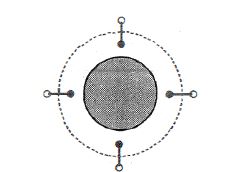
Two small,equal masses are attached by a light rod. This object orbits a planet; the length of the rod is smaller than the radius of the orbit,but not negligible. The rod rotates about its axis in such a way that it remains vertical with respect to the planet. Determine the state of the rod (tension or compression) and the stability of the equilibrium with respect to a small angular perturbation.
A
There is no force in the rod; the equilibrium is neutral with respect to a small perturbation in the angle of the rod.
B
The rod is in tension; the equilibrium is stable with respect to a small perturbation in the angle of the rod.
C
The rod is in compression; the equilibrium is stable with respect to a small perturbation in the angle of the rod.
D
The rod is in tension; the equilibrium is unstable with respect to a small perturbation in the angle of the rod.
Solution
(B) Consider two masses $m$ at distances $r_1 = R - l/2$ and $r_2 = R + l/2$ from the planet of mass $M$,where $R$ is the orbital radius of the center of mass and $l$ is the length of the rod.
For the rod to remain vertical,it must rotate with angular velocity $\omega = \sqrt{GM/R^3}$.
The gravitational force on the inner mass is $F_1 = GMm/(R - l/2)^2$ and on the outer mass is $F_2 = GMm/(R + l/2)^2$.
The required centripetal force for the inner mass is $m(R - l/2)\omega^2 = GMm(R - l/2)/R^3$ and for the outer mass is $m(R + l/2)\omega^2 = GMm(R + l/2)/R^3$.
The net force on the inner mass (directed towards the planet) is $F_1 - F_{c1} = GMm [1/(R - l/2)^2 - (R - l/2)/R^3] > 0$,meaning the inner mass wants to fall faster than the rod's rotation allows,pulling the rod inward.
The net force on the outer mass (directed away from the planet) is $F_{c2} - F_2 = GMm [(R + l/2)/R^3 - 1/(R + l/2)^2] > 0$,meaning the outer mass wants to fly away,pulling the rod outward.
Thus,the rod is in tension.
For stability,a small angular displacement $\theta$ creates a restoring torque due to the gravity gradient,which acts to return the rod to the vertical position. This is a classic gravity-gradient stabilization problem,and the vertical orientation is the stable equilibrium position.
For the rod to remain vertical,it must rotate with angular velocity $\omega = \sqrt{GM/R^3}$.
The gravitational force on the inner mass is $F_1 = GMm/(R - l/2)^2$ and on the outer mass is $F_2 = GMm/(R + l/2)^2$.
The required centripetal force for the inner mass is $m(R - l/2)\omega^2 = GMm(R - l/2)/R^3$ and for the outer mass is $m(R + l/2)\omega^2 = GMm(R + l/2)/R^3$.
The net force on the inner mass (directed towards the planet) is $F_1 - F_{c1} = GMm [1/(R - l/2)^2 - (R - l/2)/R^3] > 0$,meaning the inner mass wants to fall faster than the rod's rotation allows,pulling the rod inward.
The net force on the outer mass (directed away from the planet) is $F_{c2} - F_2 = GMm [(R + l/2)/R^3 - 1/(R + l/2)^2] > 0$,meaning the outer mass wants to fly away,pulling the rod outward.
Thus,the rod is in tension.
For stability,a small angular displacement $\theta$ creates a restoring torque due to the gravity gradient,which acts to return the rod to the vertical position. This is a classic gravity-gradient stabilization problem,and the vertical orientation is the stable equilibrium position.
0 likes
View Solution107
AdvancedMCQ
Two satellites are launched at a distance $R$ from a planet of negligible radius. Both satellites are launched in the tangential direction. The first satellite launches correctly at a speed $v_0$ and enters a circular orbit. The second satellite,however,is launched at a speed $\frac{1}{2}v_0$. What is the minimum distance between the second satellite and the planet over the course of its orbit?
A
$\frac{1}{2}R$
B
$\frac{1}{3}R$
C
$\frac{1}{4}R$
D
$\frac{1}{7}R$
Solution
(D) For a circular orbit at distance $R$,the orbital velocity is $v_0 = \sqrt{\frac{GM}{R}}$.
For the second satellite,the initial total energy $E$ is given by $E = KE + PE = \frac{1}{2}m(\frac{v_0}{2})^2 - \frac{GMm}{R}$.
Substituting $GM = v_0^2 R$,we get $E = \frac{1}{8}mv_0^2 - mv_0^2 = -\frac{7}{8}mv_0^2$.
By conservation of angular momentum at the launch point $(R)$ and the point of minimum distance $(R_1)$,where velocity is $v_1$: $m(\frac{v_0}{2})R = mv_1 R_1$,so $v_1 = \frac{v_0 R}{2 R_1}$.
By conservation of energy: $E = \frac{1}{2}mv_1^2 - \frac{GMm}{R_1}$.
$-\frac{7}{8}mv_0^2 = \frac{1}{2}m(\frac{v_0 R}{2 R_1})^2 - \frac{mv_0^2 R}{R_1}$.
Dividing by $mv_0^2$: $-\frac{7}{8} = \frac{R^2}{8 R_1^2} - \frac{R}{R_1}$.
Let $x = \frac{R}{R_1}$,then $-\frac{7}{8} = \frac{1}{8}x^2 - x$.
$x^2 - 8x + 7 = 0$.
$(x-7)(x-1) = 0$.
Since $R_1 < R$,$x = 7$,so $R_1 = \frac{R}{7}$.
For the second satellite,the initial total energy $E$ is given by $E = KE + PE = \frac{1}{2}m(\frac{v_0}{2})^2 - \frac{GMm}{R}$.
Substituting $GM = v_0^2 R$,we get $E = \frac{1}{8}mv_0^2 - mv_0^2 = -\frac{7}{8}mv_0^2$.
By conservation of angular momentum at the launch point $(R)$ and the point of minimum distance $(R_1)$,where velocity is $v_1$: $m(\frac{v_0}{2})R = mv_1 R_1$,so $v_1 = \frac{v_0 R}{2 R_1}$.
By conservation of energy: $E = \frac{1}{2}mv_1^2 - \frac{GMm}{R_1}$.
$-\frac{7}{8}mv_0^2 = \frac{1}{2}m(\frac{v_0 R}{2 R_1})^2 - \frac{mv_0^2 R}{R_1}$.
Dividing by $mv_0^2$: $-\frac{7}{8} = \frac{R^2}{8 R_1^2} - \frac{R}{R_1}$.
Let $x = \frac{R}{R_1}$,then $-\frac{7}{8} = \frac{1}{8}x^2 - x$.
$x^2 - 8x + 7 = 0$.
$(x-7)(x-1) = 0$.
Since $R_1 < R$,$x = 7$,so $R_1 = \frac{R}{7}$.
0 likes
View Solution108
DifficultMCQ
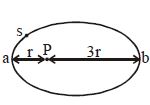
$A$ satellite $S$ moves around a planet $P$ in an elliptical orbit as shown in the figure. The ratio of the speed of the satellite at point $a$ to that at point $b$ is:
A
$1 : 9$
B
$1 : 3$
C
$1 : 1$
D
$3 : 1$
Solution
(D) According to the law of conservation of angular momentum,the angular momentum of the satellite remains constant at all points in its orbit.
$L_a = L_b$
$m v_a r_a = m v_b r_b$
Given from the figure,the distance of point $a$ from the planet $P$ is $r_a = r$ and the distance of point $b$ from the planet $P$ is $r_b = 3r$.
Substituting these values into the equation:
$m v_a r = m v_b (3r)$
$v_a = 3 v_b$
Therefore,the ratio of the speed at point $a$ to the speed at point $b$ is:
$\frac{v_a}{v_b} = \frac{3}{1} = 3 : 1$
$L_a = L_b$
$m v_a r_a = m v_b r_b$
Given from the figure,the distance of point $a$ from the planet $P$ is $r_a = r$ and the distance of point $b$ from the planet $P$ is $r_b = 3r$.
Substituting these values into the equation:
$m v_a r = m v_b (3r)$
$v_a = 3 v_b$
Therefore,the ratio of the speed at point $a$ to the speed at point $b$ is:
$\frac{v_a}{v_b} = \frac{3}{1} = 3 : 1$
0 likes
View Solution109
DifficultMCQ
On a hypothetical planet,a satellite can only revolve in quantized energy levels,i.e.,the magnitude of the energy of a satellite is an integer multiple of a fixed energy. If two successive orbits have radii $R$ and $\frac{3R}{2}$,what could be the maximum radius of the satellite (in $R$)?
A
$9$
B
$6$
C
$4$
D
$3$
Solution
(D) The magnitude of the gravitational potential energy of a satellite in an orbit of radius $r$ is given by $E = \frac{GMm}{2r}$.
According to the problem,the energy is quantized such that $E_n = n \cdot k$,where $n$ is an integer and $k$ is a constant energy.
For the first orbit with radius $R$,we have $\frac{GMm}{2R} = n \cdot k$.
For the next successive orbit with radius $\frac{3R}{2}$,the energy must be $(n-1) \cdot k$ (since energy magnitude decreases as radius increases),so $\frac{GMm}{2(3R/2)} = (n-1) \cdot k$,which simplifies to $\frac{GMm}{3R} = (n-1) \cdot k$.
Dividing the two equations: $\frac{GMm/2R}{GMm/3R} = \frac{n}{n-1} \Rightarrow \frac{3}{2} = \frac{n}{n-1}$.
Solving for $n$: $3n - 3 = 2n \Rightarrow n = 3$.
Substituting $n=3$ back into the first equation: $\frac{GMm}{2R} = 3k \Rightarrow k = \frac{GMm}{6R}$.
The maximum radius $R_{\text{max}}$ corresponds to the lowest energy level,which is $n=1$.
Thus,$\frac{GMm}{2R_{\text{max}}} = 1 \cdot k = \frac{GMm}{6R}$.
Solving for $R_{\text{max}}$ gives $R_{\text{max}} = 3R$.
According to the problem,the energy is quantized such that $E_n = n \cdot k$,where $n$ is an integer and $k$ is a constant energy.
For the first orbit with radius $R$,we have $\frac{GMm}{2R} = n \cdot k$.
For the next successive orbit with radius $\frac{3R}{2}$,the energy must be $(n-1) \cdot k$ (since energy magnitude decreases as radius increases),so $\frac{GMm}{2(3R/2)} = (n-1) \cdot k$,which simplifies to $\frac{GMm}{3R} = (n-1) \cdot k$.
Dividing the two equations: $\frac{GMm/2R}{GMm/3R} = \frac{n}{n-1} \Rightarrow \frac{3}{2} = \frac{n}{n-1}$.
Solving for $n$: $3n - 3 = 2n \Rightarrow n = 3$.
Substituting $n=3$ back into the first equation: $\frac{GMm}{2R} = 3k \Rightarrow k = \frac{GMm}{6R}$.
The maximum radius $R_{\text{max}}$ corresponds to the lowest energy level,which is $n=1$.
Thus,$\frac{GMm}{2R_{\text{max}}} = 1 \cdot k = \frac{GMm}{6R}$.
Solving for $R_{\text{max}}$ gives $R_{\text{max}} = 3R$.
0 likes
View Solution110
DifficultMCQ
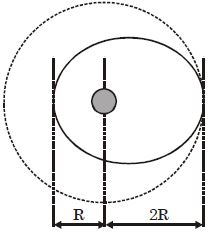
Spaceman Fred's spaceship (which has negligible mass) is in an elliptical orbit about Planet Bob. The minimum distance between the spaceship and the planet is $R$; the maximum distance between the spaceship and the planet is $2R$. At the point of maximum distance,Spaceman Fred is traveling at speed $v_0$. He then fires his thrusters so that he enters a circular orbit of radius $2R$. What is his new speed?
A
$\sqrt{3/2} \, v_0$
B
$\sqrt{5} \, v_0$
C
$\sqrt{3/56} \, v_0$
D
$\sqrt{2} \, v_0$
Solution
(A) For a circular orbit of radius $r = 2R$,the orbital speed $v$ is given by $v = \sqrt{\frac{GM}{2R}}$.
For the elliptical orbit,the semi-major axis $a$ is the average of the periapsis and apoapsis distances: $a = \frac{R + 2R}{2} = \frac{3R}{2}$.
Using the conservation of energy for the elliptical orbit at the apoapsis (distance $2R$): $\frac{1}{2}mv_0^2 - \frac{GMm}{2R} = -\frac{GMm}{2a} = -\frac{GMm}{3R}$.
Rearranging the energy equation: $\frac{1}{2}v_0^2 = \frac{GM}{2R} - \frac{GM}{3R} = \frac{GM}{6R}$.
Thus,$\frac{GM}{R} = 3v_0^2$.
Substituting this into the expression for the circular orbit speed: $v = \sqrt{\frac{GM}{2R}} = \sqrt{\frac{3v_0^2}{2}} = \sqrt{\frac{3}{2}} v_0$.
For the elliptical orbit,the semi-major axis $a$ is the average of the periapsis and apoapsis distances: $a = \frac{R + 2R}{2} = \frac{3R}{2}$.
Using the conservation of energy for the elliptical orbit at the apoapsis (distance $2R$): $\frac{1}{2}mv_0^2 - \frac{GMm}{2R} = -\frac{GMm}{2a} = -\frac{GMm}{3R}$.
Rearranging the energy equation: $\frac{1}{2}v_0^2 = \frac{GM}{2R} - \frac{GM}{3R} = \frac{GM}{6R}$.
Thus,$\frac{GM}{R} = 3v_0^2$.
Substituting this into the expression for the circular orbit speed: $v = \sqrt{\frac{GM}{2R}} = \sqrt{\frac{3v_0^2}{2}} = \sqrt{\frac{3}{2}} v_0$.
0 likes
View Solution111
DifficultMCQ
$A$ spherical asteroid having the same density as that of Earth is floating in free space. $A$ small pebble is revolving around the asteroid under the influence of gravity near the surface of the asteroid. What is the approximate time period of the pebble?
A
$24 \ h$
B
$365 \ \text{days}$
C
$10 \ \text{min}$
D
$1 \ \text{hr} \ 24 \ \text{min}$
Solution
(D) The time period $T$ of a satellite revolving near the surface of a spherical body is given by $T = 2\pi \sqrt{\frac{R^3}{GM}}$.
Since the mass $M$ of the asteroid can be expressed in terms of its density $\rho$ and radius $R$ as $M = \rho \times \frac{4}{3} \pi R^3$,we substitute this into the formula:
$T = 2\pi \sqrt{\frac{R^3}{G (\rho \cdot \frac{4}{3} \pi R^3)}} = 2\pi \sqrt{\frac{3}{4 \pi G \rho}} = \sqrt{\frac{3\pi}{G\rho}}$.
This shows that the time period depends only on the density $\rho$ of the body.
Since the asteroid has the same density as Earth,the time period of the pebble revolving near its surface is the same as the time period of a satellite revolving near the surface of the Earth.
This value is approximately $84 \ \text{min}$,which is equal to $1 \ \text{hr} \ 24 \ \text{min}$.
Since the mass $M$ of the asteroid can be expressed in terms of its density $\rho$ and radius $R$ as $M = \rho \times \frac{4}{3} \pi R^3$,we substitute this into the formula:
$T = 2\pi \sqrt{\frac{R^3}{G (\rho \cdot \frac{4}{3} \pi R^3)}} = 2\pi \sqrt{\frac{3}{4 \pi G \rho}} = \sqrt{\frac{3\pi}{G\rho}}$.
This shows that the time period depends only on the density $\rho$ of the body.
Since the asteroid has the same density as Earth,the time period of the pebble revolving near its surface is the same as the time period of a satellite revolving near the surface of the Earth.
This value is approximately $84 \ \text{min}$,which is equal to $1 \ \text{hr} \ 24 \ \text{min}$.
0 likes
View Solution112
MediumMCQ
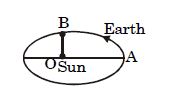
The Earth moves around the Sun in an elliptical orbit as shown in the figure. The ratio $OA/OB = x$. The ratio of the speed of the Earth at $B$ to that at $A$ is nearly
A
$\sqrt{x}$
B
$x$
C
$x\sqrt{x}$
D
$x^2$
Solution
(B) According to Kepler's second law,the angular momentum of the planet remains conserved as the gravitational force is a central force.
Applying the conservation of angular momentum at positions $A$ and $B$:
$L_A = L_B$
$m v_A r_A = m v_B r_B$
where $r_A = OA$ and $r_B = OB$.
Rearranging the terms to find the ratio of speeds:
$\frac{v_B}{v_A} = \frac{r_A}{r_B} = \frac{OA}{OB}$
Given that $\frac{OA}{OB} = x$,we get:
$\frac{v_B}{v_A} = x$
Applying the conservation of angular momentum at positions $A$ and $B$:
$L_A = L_B$
$m v_A r_A = m v_B r_B$
where $r_A = OA$ and $r_B = OB$.
Rearranging the terms to find the ratio of speeds:
$\frac{v_B}{v_A} = \frac{r_A}{r_B} = \frac{OA}{OB}$
Given that $\frac{OA}{OB} = x$,we get:
$\frac{v_B}{v_A} = x$
0 likes
View Solution113
DifficultMCQ
Imagine a light planet revolving around a very massive star in a circular orbit of radius $R$ with a period of revolution $T$. If the gravitational force of attraction between the planet and the star is proportional to $R^{-5/2}$,then,
A
$T^2 \propto R^2$
B
$T^2 \propto R^{7/2}$
C
$T^2 \propto R^{3/2}$
D
$T^2 \propto R^{3.75}$
Solution
(B) For a planet of mass $m$ revolving in a circular orbit of radius $R$ with angular velocity $\omega$,the centripetal force is provided by the gravitational force.
Given that the gravitational force $F \propto R^{-5/2}$,we can write $F = k R^{-5/2}$ for some constant $k$.
The centripetal force is given by $F = m R \omega^2$.
Equating the two,we have $m R \omega^2 \propto R^{-5/2}$.
Since $\omega = \frac{2\pi}{T}$,we substitute this into the equation: $m R (\frac{2\pi}{T})^2 \propto R^{-5/2}$.
This simplifies to $\frac{R}{T^2} \propto R^{-5/2}$.
Rearranging for $T^2$,we get $T^2 \propto R \cdot R^{5/2} = R^{1 + 5/2} = R^{7/2}$.
Thus,$T^2 \propto R^{7/2}$.
Given that the gravitational force $F \propto R^{-5/2}$,we can write $F = k R^{-5/2}$ for some constant $k$.
The centripetal force is given by $F = m R \omega^2$.
Equating the two,we have $m R \omega^2 \propto R^{-5/2}$.
Since $\omega = \frac{2\pi}{T}$,we substitute this into the equation: $m R (\frac{2\pi}{T})^2 \propto R^{-5/2}$.
This simplifies to $\frac{R}{T^2} \propto R^{-5/2}$.
Rearranging for $T^2$,we get $T^2 \propto R \cdot R^{5/2} = R^{1 + 5/2} = R^{7/2}$.
Thus,$T^2 \propto R^{7/2}$.
0 likes
View Solution114
DifficultMCQ
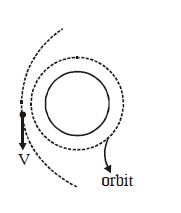
$A$ spaceship approaches the moon (mass $= M$,radius $= R$) along a parabolic path which is almost tangential to its surface. At the moment of maximum approach,the brake rocket is fired to convert the spaceship into a satellite of the moon. Find the change in speed.
A
$\sqrt {\frac{{GM}}{R}} \left( {\sqrt 2 - 1} \right)$
B
$\sqrt {\frac{{2GM}}{R}} $
C
$\sqrt {\frac{{GM}}{{R\sqrt 2 }}} $
D
None
Solution
(A) The speed of an object moving in a parabolic path at a distance $R$ from the center of a celestial body is equal to the escape velocity at that point.
$V_{p} = V_{e} = \sqrt{\frac{2GM}{R}}$
To convert the spaceship into a satellite in a circular orbit of radius $R$,its speed must be reduced to the orbital velocity $V_{0}$ at that distance.
$V_{0} = \sqrt{\frac{GM}{R}}$
The change in speed required is $\Delta V = V_{p} - V_{0}$.
Substituting the values,we get:
$\Delta V = \sqrt{\frac{2GM}{R}} - \sqrt{\frac{GM}{R}}$
$\Delta V = \sqrt{\frac{GM}{R}} (\sqrt{2} - 1)$
$V_{p} = V_{e} = \sqrt{\frac{2GM}{R}}$
To convert the spaceship into a satellite in a circular orbit of radius $R$,its speed must be reduced to the orbital velocity $V_{0}$ at that distance.
$V_{0} = \sqrt{\frac{GM}{R}}$
The change in speed required is $\Delta V = V_{p} - V_{0}$.
Substituting the values,we get:
$\Delta V = \sqrt{\frac{2GM}{R}} - \sqrt{\frac{GM}{R}}$
$\Delta V = \sqrt{\frac{GM}{R}} (\sqrt{2} - 1)$
0 likes
View Solution115
DifficultMCQ
If an artificial satellite is moving in a circular orbit around the earth with a speed equal to half the magnitude of the escape velocity from the earth,the height of the satellite above the surface of the earth is
A
$2R$
B
$\frac{R}{2}$
C
$R$
D
$\frac{R}{4}$
Solution
(C) The orbital velocity of a satellite at a height $h$ above the Earth's surface is given by $V_{0} = \sqrt{\frac{GM}{R+h}}$.
The escape velocity from the Earth's surface is given by $V_{e} = \sqrt{\frac{2GM}{R}}$.
According to the problem,the orbital speed is half the escape velocity: $V_{0} = \frac{V_{e}}{2}$.
Substituting the expressions: $\sqrt{\frac{GM}{R+h}} = \frac{1}{2} \sqrt{\frac{2GM}{R}}$.
Squaring both sides: $\frac{GM}{R+h} = \frac{1}{4} \times \frac{2GM}{R}$.
Simplifying the equation: $\frac{1}{R+h} = \frac{1}{2R}$.
Therefore,$R+h = 2R$,which gives $h = R$.
The escape velocity from the Earth's surface is given by $V_{e} = \sqrt{\frac{2GM}{R}}$.
According to the problem,the orbital speed is half the escape velocity: $V_{0} = \frac{V_{e}}{2}$.
Substituting the expressions: $\sqrt{\frac{GM}{R+h}} = \frac{1}{2} \sqrt{\frac{2GM}{R}}$.
Squaring both sides: $\frac{GM}{R+h} = \frac{1}{4} \times \frac{2GM}{R}$.
Simplifying the equation: $\frac{1}{R+h} = \frac{1}{2R}$.
Therefore,$R+h = 2R$,which gives $h = R$.
0 likes
View Solution116
DifficultMCQ
$A$ satellite is orbiting around the Earth with an areal speed $v_a$. At what height from the surface of the Earth is it rotating,if the radius of the Earth is $R$?
A
$\frac{4v_a^2}{gR^2} - R$
B
$\frac{2v_a^2}{gR^2} - R$
C
$\frac{v_a^2}{gR^2} - R$
D
$\frac{v_a^2}{2gR^2} - R$
Solution
(A) The areal speed $v_a$ is defined as the rate of change of area swept by the radius vector,given by $v_a = \frac{dA}{dt} = \frac{1}{2} r v$.
Squaring both sides,we get $v_a^2 = \frac{1}{4} r^2 v^2$.
For a satellite in a circular orbit,the orbital velocity is $v = \sqrt{\frac{GM}{r}}$. Since $g = \frac{GM}{R^2}$,we have $GM = gR^2$. Thus,$v^2 = \frac{gR^2}{r}$.
Substituting $v^2$ into the areal speed equation: $v_a^2 = \frac{1}{4} r^2 \left( \frac{gR^2}{r} \right) = \frac{1}{4} r g R^2$.
Solving for the orbital radius $r$: $r = \frac{4v_a^2}{gR^2}$.
The height $h$ from the surface of the Earth is $h = r - R$.
Therefore,$h = \frac{4v_a^2}{gR^2} - R$.
Squaring both sides,we get $v_a^2 = \frac{1}{4} r^2 v^2$.
For a satellite in a circular orbit,the orbital velocity is $v = \sqrt{\frac{GM}{r}}$. Since $g = \frac{GM}{R^2}$,we have $GM = gR^2$. Thus,$v^2 = \frac{gR^2}{r}$.
Substituting $v^2$ into the areal speed equation: $v_a^2 = \frac{1}{4} r^2 \left( \frac{gR^2}{r} \right) = \frac{1}{4} r g R^2$.
Solving for the orbital radius $r$: $r = \frac{4v_a^2}{gR^2}$.
The height $h$ from the surface of the Earth is $h = r - R$.
Therefore,$h = \frac{4v_a^2}{gR^2} - R$.
0 likes
View Solution117
MediumMCQ
$A$ planet is revolving around the sun in an elliptical orbit. Its closest distance from the sun is $r_{min}$,and the farthest distance from the sun is $r_{max}$. If the orbital angular velocity of the planet when it is nearest to the sun is $\omega$,then the orbital angular velocity at the point when it is at the farthest distance from the sun is:
A
$\sqrt{\frac{r_{min}}{r_{max}}} \omega$
B
$\sqrt{\frac{r_{max}}{r_{min}}} \omega$
C
$\frac{r_{max}^2}{r_{min}^2} \omega$
D
$\frac{r_{min}^2}{r_{max}^2} \omega$
Solution
(D) According to the law of conservation of angular momentum,the angular momentum $L$ of the planet remains constant throughout its orbit.
Angular momentum is given by $L = I\omega = mr^2\omega$.
At the closest point (perihelion),$L = m r_{min}^2 \omega$.
At the farthest point (aphelion),$L = m r_{max}^2 \omega'$,where $\omega'$ is the angular velocity at the farthest distance.
Equating the two,we get $m r_{min}^2 \omega = m r_{max}^2 \omega'$.
Solving for $\omega'$,we get $\omega' = \frac{r_{min}^2}{r_{max}^2} \omega$.
Angular momentum is given by $L = I\omega = mr^2\omega$.
At the closest point (perihelion),$L = m r_{min}^2 \omega$.
At the farthest point (aphelion),$L = m r_{max}^2 \omega'$,where $\omega'$ is the angular velocity at the farthest distance.
Equating the two,we get $m r_{min}^2 \omega = m r_{max}^2 \omega'$.
Solving for $\omega'$,we get $\omega' = \frac{r_{min}^2}{r_{max}^2} \omega$.
0 likes
View Solution118
DifficultMCQ
$A$ satellite is moving around the earth with speed $V$ in a circular orbit of radius $r$. If the orbital radius is decreased by $2\%$,the speed of the satellite will
A
Increase by $1\%$
B
Increase by $0.5\%$
C
Decrease by $1\%$
D
Decrease by $0.5\%$
Solution
(A) The orbital speed of a satellite is given by $v = \sqrt{\frac{GM}{r}}$.
This implies that $v \propto r^{-1/2}$.
Taking the logarithmic derivative,we get $\frac{\Delta v}{v} = -\frac{1}{2} \frac{\Delta r}{r}$.
Given that the radius is decreased by $2\%$,we have $\frac{\Delta r}{r} = -0.02$.
Substituting this value,$\frac{\Delta v}{v} = -\frac{1}{2} \times (-0.02) = 0.01$.
Therefore,the speed increases by $1\%$.
This implies that $v \propto r^{-1/2}$.
Taking the logarithmic derivative,we get $\frac{\Delta v}{v} = -\frac{1}{2} \frac{\Delta r}{r}$.
Given that the radius is decreased by $2\%$,we have $\frac{\Delta r}{r} = -0.02$.
Substituting this value,$\frac{\Delta v}{v} = -\frac{1}{2} \times (-0.02) = 0.01$.
Therefore,the speed increases by $1\%$.
0 likes
View Solution119
MediumMCQ
The orbital velocity of an artificial satellite in a circular orbit just above the earth's surface is $v$. For a satellite orbiting at an altitude of half the earth's radius above the surface,the orbital velocity is:
A
$\left( 3/2 \right)v$
B
$\sqrt{3/2} v$
C
$\sqrt{2/3} v$
D
$\left( 2/3 \right)v$
Solution
(C) The orbital velocity of a satellite at a distance $r$ from the center of the Earth is given by $v = \sqrt{\frac{GM}{r}}$.
For a satellite just above the Earth's surface,the orbital radius is $r_1 = R$,so $v = \sqrt{\frac{GM}{R}}$.
For a satellite at an altitude $h = R/2$ above the surface,the orbital radius is $r_2 = R + R/2 = \frac{3R}{2}$.
The new orbital velocity $v'$ is given by $v' = \sqrt{\frac{GM}{r_2}} = \sqrt{\frac{GM}{3R/2}} = \sqrt{\frac{2GM}{3R}}$.
Comparing the two velocities: $\frac{v'}{v} = \frac{\sqrt{\frac{2GM}{3R}}}{\sqrt{\frac{GM}{R}}} = \sqrt{\frac{2}{3}}$.
Therefore,$v' = \sqrt{2/3} v$.
For a satellite just above the Earth's surface,the orbital radius is $r_1 = R$,so $v = \sqrt{\frac{GM}{R}}$.
For a satellite at an altitude $h = R/2$ above the surface,the orbital radius is $r_2 = R + R/2 = \frac{3R}{2}$.
The new orbital velocity $v'$ is given by $v' = \sqrt{\frac{GM}{r_2}} = \sqrt{\frac{GM}{3R/2}} = \sqrt{\frac{2GM}{3R}}$.
Comparing the two velocities: $\frac{v'}{v} = \frac{\sqrt{\frac{2GM}{3R}}}{\sqrt{\frac{GM}{R}}} = \sqrt{\frac{2}{3}}$.
Therefore,$v' = \sqrt{2/3} v$.
0 likes
View Solution120
MediumMCQ
The time period of an artificial satellite in a circular orbit of radius $R$ is $2 \, days$ and its orbital velocity is $v_0$. If the time period of another satellite in a circular orbit is $16 \, days$,then:
A
its radius of orbit is $4 \, R$ and orbital velocity is $v_0$
B
its radius of orbit is $4 \, R$ and orbital velocity is $\frac{v_0}{2}$
C
its radius of orbit is $2 \, R$ and orbital velocity is $v_0$
D
its radius of orbit is $2 \, R$ and orbital velocity is $\frac{v_0}{2}$
Solution
(B) According to Kepler's third law of planetary motion,the square of the time period $T$ is proportional to the cube of the orbital radius $R$,i.e.,$T^2 \propto R^3$.
Given $T_1 = 2 \, days$,$R_1 = R$,$T_2 = 16 \, days$,and $R_2 = ?$.
Using the ratio: $\frac{T_2^2}{T_1^2} = \frac{R_2^3}{R_1^3} \Rightarrow \frac{16^2}{2^2} = \left(\frac{R_2}{R}\right)^3$.
$\frac{256}{4} = 64 = \left(\frac{R_2}{R}\right)^3$.
Taking the cube root on both sides: $\frac{R_2}{R} = 4$,so $R_2 = 4R$.
For orbital velocity $v = \sqrt{\frac{GM}{R}}$,we have $v \propto \frac{1}{\sqrt{R}}$.
Therefore,$\frac{v_2}{v_1} = \sqrt{\frac{R_1}{R_2}} = \sqrt{\frac{R}{4R}} = \sqrt{\frac{1}{4}} = \frac{1}{2}$.
Thus,$v_2 = \frac{v_1}{2} = \frac{v_0}{2}$.
Given $T_1 = 2 \, days$,$R_1 = R$,$T_2 = 16 \, days$,and $R_2 = ?$.
Using the ratio: $\frac{T_2^2}{T_1^2} = \frac{R_2^3}{R_1^3} \Rightarrow \frac{16^2}{2^2} = \left(\frac{R_2}{R}\right)^3$.
$\frac{256}{4} = 64 = \left(\frac{R_2}{R}\right)^3$.
Taking the cube root on both sides: $\frac{R_2}{R} = 4$,so $R_2 = 4R$.
For orbital velocity $v = \sqrt{\frac{GM}{R}}$,we have $v \propto \frac{1}{\sqrt{R}}$.
Therefore,$\frac{v_2}{v_1} = \sqrt{\frac{R_1}{R_2}} = \sqrt{\frac{R}{4R}} = \sqrt{\frac{1}{4}} = \frac{1}{2}$.
Thus,$v_2 = \frac{v_1}{2} = \frac{v_0}{2}$.
0 likes
View Solution121
MediumMCQ
$A$ satellite is orbiting the Earth in a circular orbit of radius $r.$ Which of the following statements is correct?
A
Kinetic energy varies as $r$
B
Angular momentum varies as $\frac{1}{\sqrt{r}}$
C
Linear momentum varies as $\frac{1}{r}$
D
Frequency of revolution varies as $\frac{1}{r^{3/2}}$
Solution
(D) For a satellite of mass $m$ orbiting the Earth of mass $M_e$ in a circular orbit of radius $r$,the gravitational force provides the necessary centripetal force:
$\frac{GM_e m}{r^2} = \frac{mv^2}{r} \Rightarrow v = \sqrt{\frac{GM_e}{r}}$
$1$. Kinetic Energy $(K.E.)$: $K.E. = \frac{1}{2}mv^2 = \frac{GM_e m}{2r}$. Thus,$K.E. \propto \frac{1}{r}$.
$2$. Angular Momentum $(L)$: $L = mvr = m \sqrt{\frac{GM_e}{r}} \cdot r = m\sqrt{GM_e r}$. Thus,$L \propto r^{1/2}$.
$3$. Linear Momentum $(P)$: $P = mv = m\sqrt{\frac{GM_e}{r}}$. Thus,$P \propto r^{-1/2}$.
$4$. Frequency of revolution $(f)$: According to Kepler's Third Law,$T^2 \propto r^3$,so $T \propto r^{3/2}$. Since $f = \frac{1}{T}$,we have $f \propto r^{-3/2}$ or $f \propto \frac{1}{r^{3/2}}$.
Therefore,option $D$ is correct.
$\frac{GM_e m}{r^2} = \frac{mv^2}{r} \Rightarrow v = \sqrt{\frac{GM_e}{r}}$
$1$. Kinetic Energy $(K.E.)$: $K.E. = \frac{1}{2}mv^2 = \frac{GM_e m}{2r}$. Thus,$K.E. \propto \frac{1}{r}$.
$2$. Angular Momentum $(L)$: $L = mvr = m \sqrt{\frac{GM_e}{r}} \cdot r = m\sqrt{GM_e r}$. Thus,$L \propto r^{1/2}$.
$3$. Linear Momentum $(P)$: $P = mv = m\sqrt{\frac{GM_e}{r}}$. Thus,$P \propto r^{-1/2}$.
$4$. Frequency of revolution $(f)$: According to Kepler's Third Law,$T^2 \propto r^3$,so $T \propto r^{3/2}$. Since $f = \frac{1}{T}$,we have $f \propto r^{-3/2}$ or $f \propto \frac{1}{r^{3/2}}$.
Therefore,option $D$ is correct.
0 likes
View Solution122
DifficultMCQ
The orbital angular momentum of a satellite revolving at a distance $r$ from the centre is $L$. If the distance is increased to $4r$,then the new angular momentum will be
A
$L$
B
$2L$
C
$L/2$
D
$4L$
Solution
(B) The orbital angular momentum $L$ of a satellite of mass $m$ revolving in a circular orbit of radius $r$ is given by $L = mvr$.
Since the orbital velocity $v = \sqrt{\frac{GM}{r}}$,we substitute this into the expression for $L$:
$L = m \sqrt{\frac{GM}{r}} \cdot r = m \sqrt{GMr}$.
This shows that $L \propto \sqrt{r}$.
Let the initial angular momentum be $L_1 = L$ at distance $r_1 = r$.
Let the new angular momentum be $L_2$ at distance $r_2 = 4r$.
Using the proportionality $L \propto \sqrt{r}$,we have:
$\frac{L_2}{L_1} = \sqrt{\frac{r_2}{r_1}} = \sqrt{\frac{4r}{r}} = \sqrt{4} = 2$.
Therefore,$L_2 = 2L_1 = 2L$.
Since the orbital velocity $v = \sqrt{\frac{GM}{r}}$,we substitute this into the expression for $L$:
$L = m \sqrt{\frac{GM}{r}} \cdot r = m \sqrt{GMr}$.
This shows that $L \propto \sqrt{r}$.
Let the initial angular momentum be $L_1 = L$ at distance $r_1 = r$.
Let the new angular momentum be $L_2$ at distance $r_2 = 4r$.
Using the proportionality $L \propto \sqrt{r}$,we have:
$\frac{L_2}{L_1} = \sqrt{\frac{r_2}{r_1}} = \sqrt{\frac{4r}{r}} = \sqrt{4} = 2$.
Therefore,$L_2 = 2L_1 = 2L$.
0 likes
View Solution123
MediumMCQ
Two point masses of mass $m_1 = fM$ and $m_2 = (1 - f)M$ $(f < 1)$ are in outer space (far from the gravitational influence of other objects) at a distance $R$ from each other. They move in circular orbits about their centre of mass with angular velocities $\omega_1$ for $m_1$ and $\omega_2$ for $m_2$. In that case:
A
$(1 - f)\omega_1 = f\omega_2$
B
$\omega_1 = \omega_2$ and independent of $f$
C
$f\omega_1 = (1 - f)\omega_2$
D
$\omega_1 = \omega_2$ and depend on $f$
Solution
(B) For two bodies revolving around their common centre of mass,the gravitational force provides the necessary centripetal force for both particles.
Since the particles must always remain on opposite sides of the centre of mass to maintain the equilibrium of the system,they must complete their circular orbits in the same time period $T$.
Angular velocity is defined as $\omega = \frac{2\pi}{T}$.
Since both particles have the same time period $T$,their angular velocities must be equal,i.e.,$\omega_1 = \omega_2$.
This angular velocity is determined by the gravitational interaction between the two masses and is independent of the specific fraction $f$ in the context of the orbital motion dynamics.
Since the particles must always remain on opposite sides of the centre of mass to maintain the equilibrium of the system,they must complete their circular orbits in the same time period $T$.
Angular velocity is defined as $\omega = \frac{2\pi}{T}$.
Since both particles have the same time period $T$,their angular velocities must be equal,i.e.,$\omega_1 = \omega_2$.
This angular velocity is determined by the gravitational interaction between the two masses and is independent of the specific fraction $f$ in the context of the orbital motion dynamics.
0 likes
View Solution124
MediumMCQ
$A$ satellite of mass $M$ is in a circular orbit of radius $R$ about the center of the Earth. $A$ meteorite of the same mass $M$,falling towards the Earth,collides with the satellite completely inelastically. The speeds of the satellite and the meteorite are the same,just before the collision. The subsequent motion of the combined body will be:
A
such that it escapes to infinity
B
in an elliptical orbit
C
in the same circular orbit of radius $R$
D
in a circular orbit of a different radius
Solution
(B) Let the satellite move with velocity $v$ in the tangential direction (say,along the $y$-axis) and the meteorite move with velocity $v$ towards the Earth (along the $x$-axis). After the perfectly inelastic collision,the combined mass $2M$ moves with a new velocity vector $\vec{V}$.
By conservation of linear momentum:
Along the $x$-axis: $Mv = (2M)v_x \Rightarrow v_x = v/2$.
Along the $y$-axis: $Mv = (2M)v_y \Rightarrow v_y = v/2$.
The magnitude of the new velocity is $V = \sqrt{v_x^2 + v_y^2} = \sqrt{(v/2)^2 + (v/2)^2} = v/\sqrt{2}$.
Since the satellite was in a circular orbit,its initial velocity was $v = \sqrt{GM/R}$. The new velocity $V = v/\sqrt{2} < v$. Also,the direction of the velocity is no longer purely tangential. $A$ change in both speed and direction at the same orbital radius $R$ results in an elliptical orbit.
By conservation of linear momentum:
Along the $x$-axis: $Mv = (2M)v_x \Rightarrow v_x = v/2$.
Along the $y$-axis: $Mv = (2M)v_y \Rightarrow v_y = v/2$.
The magnitude of the new velocity is $V = \sqrt{v_x^2 + v_y^2} = \sqrt{(v/2)^2 + (v/2)^2} = v/\sqrt{2}$.
Since the satellite was in a circular orbit,its initial velocity was $v = \sqrt{GM/R}$. The new velocity $V = v/\sqrt{2} < v$. Also,the direction of the velocity is no longer purely tangential. $A$ change in both speed and direction at the same orbital radius $R$ results in an elliptical orbit.

0 likes
View Solution125
MediumMCQ
Two satellites,$A$ and $B,$ have masses $m$ and $2m$ respectively. $A$ is in a circular orbit of radius $R,$ and $B$ is in a circular orbit of radius $2R$ around the earth. The ratio of their kinetic energies,$K.E._A / K.E._B ,$ is
A
$1/2$
B
$1$
C
$2$
D
$\sqrt{1/2}$
Solution
(B) The kinetic energy of a satellite of mass $m$ in a circular orbit of radius $r$ around the Earth of mass $M$ is given by $K.E. = \frac{GMm}{2r}$.
For satellite $A$: mass $= m$,radius $= R$. Therefore,$K.E._A = \frac{GMm}{2R}$.
For satellite $B$: mass $= 2m$,radius $= 2R$. Therefore,$K.E._B = \frac{GM(2m)}{2(2R)} = \frac{GMm}{2R}$.
Taking the ratio: $\frac{K.E._A}{K.E._B} = \frac{GMm/2R}{GMm/2R} = 1$.
For satellite $A$: mass $= m$,radius $= R$. Therefore,$K.E._A = \frac{GMm}{2R}$.
For satellite $B$: mass $= 2m$,radius $= 2R$. Therefore,$K.E._B = \frac{GM(2m)}{2(2R)} = \frac{GMm}{2R}$.
Taking the ratio: $\frac{K.E._A}{K.E._B} = \frac{GMm/2R}{GMm/2R} = 1$.
0 likes
View Solution126
DifficultMCQ
$A$ test particle is moving in a circular orbit in the gravitational field produced by a mass density $\rho(r) = \frac{K}{r^2}$. Identify the correct relation between the radius $R$ of the particle's orbit and its period $T$.
A
$T/R^2$ is a constant
B
$TR$ is constant
C
$T^2/R^3$ is a constant
D
$T/R$ is a constant
Solution
(D) The gravitational field $E$ at a distance $r$ is given by $E = \frac{GM(r)}{r^2}$,where $M(r)$ is the mass enclosed within radius $r$.
Given $\rho(r) = \frac{K}{r^2}$,the mass $M(r)$ is calculated as:
$M(r) = \int_0^r \rho(x) \cdot 4\pi x^2 dx = \int_0^r \frac{K}{x^2} \cdot 4\pi x^2 dx = \int_0^r 4\pi K dx = 4\pi Kr$.
Substituting $M(r)$ into the expression for the gravitational field:
$E = \frac{G(4\pi Kr)}{r^2} = \frac{4\pi GK}{r}$.
For a particle of mass $m$ in a circular orbit of radius $R$,the centripetal force is provided by the gravitational force:
$\frac{mV^2}{R} = mE = m \left( \frac{4\pi GK}{R} \right)$.
This simplifies to $V^2 = 4\pi GK$,which means the orbital speed $V$ is a constant.
The period $T$ of the orbit is given by $T = \frac{2\pi R}{V}$.
Since $V$ is constant,$T \propto R$,which implies $\frac{T}{R} = \text{constant}$.
Given $\rho(r) = \frac{K}{r^2}$,the mass $M(r)$ is calculated as:
$M(r) = \int_0^r \rho(x) \cdot 4\pi x^2 dx = \int_0^r \frac{K}{x^2} \cdot 4\pi x^2 dx = \int_0^r 4\pi K dx = 4\pi Kr$.
Substituting $M(r)$ into the expression for the gravitational field:
$E = \frac{G(4\pi Kr)}{r^2} = \frac{4\pi GK}{r}$.
For a particle of mass $m$ in a circular orbit of radius $R$,the centripetal force is provided by the gravitational force:
$\frac{mV^2}{R} = mE = m \left( \frac{4\pi GK}{R} \right)$.
This simplifies to $V^2 = 4\pi GK$,which means the orbital speed $V$ is a constant.
The period $T$ of the orbit is given by $T = \frac{2\pi R}{V}$.
Since $V$ is constant,$T \propto R$,which implies $\frac{T}{R} = \text{constant}$.
0 likes
View Solution127
DifficultMCQ
$A$ spaceship orbits around a planet at a height of $20 \, km$ from its surface. Assuming that only the gravitational field of the planet acts on the spaceship, what will be the number of complete revolutions made by the spaceship in $24 \, hours$ around the planet? [Given: Mass of planet $= 8 \times 10^{22} \, kg$, Radius of planet $= 2 \times 10^6 \, m$, Gravitational constant $G = 6.67 \times 10^{-11} \, N \cdot m^2/kg^2$]
A
$9$
B
$11$
C
$13$
D
$17$
Solution
(B) The orbital velocity $V$ of a satellite at a distance $r$ from the center of a planet is given by $\frac{mV^2}{r} = \frac{GMm}{r^2}$, which simplifies to $V = \sqrt{\frac{GM}{r}}$.
Here, $r = R + h = 2 \times 10^6 \, m + 20 \times 10^3 \, m = 2.02 \times 10^6 \, m$.
The time period $T_p$ of one revolution is $T_p = \frac{2\pi r}{V} = 2\pi \sqrt{\frac{r^3}{GM}}$.
The number of revolutions $n$ in time $T = 24 \, hours = 24 \times 3600 \, s$ is $n = \frac{T}{T_p} = \frac{T}{2\pi} \sqrt{\frac{GM}{r^3}}$.
Substituting the values: $n = \frac{24 \times 3600}{2 \times 3.14} \sqrt{\frac{6.67 \times 10^{-11} \times 8 \times 10^{22}}{(2.02 \times 10^6)^3}}$.
$n = \frac{86400}{6.28} \sqrt{\frac{53.36 \times 10^{11}}{8.2424 \times 10^{18}}} = 13758 \times \sqrt{6.47 \times 10^{-7}} = 13758 \times 8.04 \times 10^{-4} \approx 11.06$.
Thus, the number of complete revolutions is $11$.
Here, $r = R + h = 2 \times 10^6 \, m + 20 \times 10^3 \, m = 2.02 \times 10^6 \, m$.
The time period $T_p$ of one revolution is $T_p = \frac{2\pi r}{V} = 2\pi \sqrt{\frac{r^3}{GM}}$.
The number of revolutions $n$ in time $T = 24 \, hours = 24 \times 3600 \, s$ is $n = \frac{T}{T_p} = \frac{T}{2\pi} \sqrt{\frac{GM}{r^3}}$.
Substituting the values: $n = \frac{24 \times 3600}{2 \times 3.14} \sqrt{\frac{6.67 \times 10^{-11} \times 8 \times 10^{22}}{(2.02 \times 10^6)^3}}$.
$n = \frac{86400}{6.28} \sqrt{\frac{53.36 \times 10^{11}}{8.2424 \times 10^{18}}} = 13758 \times \sqrt{6.47 \times 10^{-7}} = 13758 \times 8.04 \times 10^{-4} \approx 11.06$.
Thus, the number of complete revolutions is $11$.
0 likes
View Solution128
DifficultMCQ
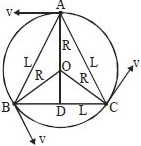
Three identical bodies of equal mass $M$ each are moving along a circle of radius $R$ under the action of their mutual gravitational attraction. The speed of each body is
A
$\sqrt {\frac{{GM}}{R}} $
B
$\sqrt {\frac{{GM}}{3R}} $
C
$\sqrt {\frac{{GM}}{{\sqrt 3 R}}} $
D
$\sqrt {\frac{{GM}}{{\sqrt 2 R}}} $
Solution
(C) Consider three bodies of mass $M$ placed at the vertices of an equilateral triangle inscribed in a circle of radius $R$. Let $L$ be the side length of the equilateral triangle.
The distance from the center $O$ to any vertex is $R$. In an equilateral triangle,the distance from the center to a vertex is related to the side length $L$ by $R = \frac{L}{\sqrt{3}}$,which implies $L = \sqrt{3}R$.
The gravitational force exerted on one body by the other two bodies is the vector sum of two forces,each of magnitude $F = \frac{GM^2}{L^2}$. The angle between these two forces is $60^{\circ}$.
The resultant gravitational force $F_{net}$ is given by:
$F_{net} = 2F \cos(30^{\circ}) = 2 \left( \frac{GM^2}{L^2} \right) \frac{\sqrt{3}}{2} = \frac{\sqrt{3}GM^2}{L^2}$.
This resultant force provides the necessary centripetal force for circular motion:
$\frac{Mv^2}{R} = \frac{\sqrt{3}GM^2}{L^2}$.
Substituting $L^2 = 3R^2$:
$\frac{Mv^2}{R} = \frac{\sqrt{3}GM^2}{3R^2} = \frac{GM^2}{\sqrt{3}R^2}$.
Solving for $v$:
$v^2 = \frac{GM}{\sqrt{3}R} \implies v = \sqrt{\frac{GM}{\sqrt{3}R}}$.
The distance from the center $O$ to any vertex is $R$. In an equilateral triangle,the distance from the center to a vertex is related to the side length $L$ by $R = \frac{L}{\sqrt{3}}$,which implies $L = \sqrt{3}R$.
The gravitational force exerted on one body by the other two bodies is the vector sum of two forces,each of magnitude $F = \frac{GM^2}{L^2}$. The angle between these two forces is $60^{\circ}$.
The resultant gravitational force $F_{net}$ is given by:
$F_{net} = 2F \cos(30^{\circ}) = 2 \left( \frac{GM^2}{L^2} \right) \frac{\sqrt{3}}{2} = \frac{\sqrt{3}GM^2}{L^2}$.
This resultant force provides the necessary centripetal force for circular motion:
$\frac{Mv^2}{R} = \frac{\sqrt{3}GM^2}{L^2}$.
Substituting $L^2 = 3R^2$:
$\frac{Mv^2}{R} = \frac{\sqrt{3}GM^2}{3R^2} = \frac{GM^2}{\sqrt{3}R^2}$.
Solving for $v$:
$v^2 = \frac{GM}{\sqrt{3}R} \implies v = \sqrt{\frac{GM}{\sqrt{3}R}}$.
0 likes
View Solution129
DifficultMCQ
Suppose the gravitational force varies inversely as the $n^{th}$ power of the distance. Then,the time period of a planet in circular orbit of radius $R$ around the sun will be proportional to
A
$R^n$
B
$R^{(n+1)/2}$
C
$R^{(n-1)/2}$
D
$R^{-n}$
Solution
(B) The gravitational force is given by $F = \frac{k}{R^n}$.
For a planet in a circular orbit,this force provides the necessary centripetal force: $\frac{mv^2}{R} = \frac{k}{R^n}$.
Solving for the orbital velocity $v$,we get $v^2 = \frac{k}{mR^{n-1}}$,which implies $v \propto R^{-(n-1)/2}$.
The time period $T$ of the orbit is given by $T = \frac{2\pi R}{v}$.
Substituting the expression for $v$,we get $T \propto \frac{R}{R^{-(n-1)/2}} = R^{1 + (n-1)/2} = R^{(2+n-1)/2} = R^{(n+1)/2}$.
Therefore,$T \propto R^{(n+1)/2}$.
For a planet in a circular orbit,this force provides the necessary centripetal force: $\frac{mv^2}{R} = \frac{k}{R^n}$.
Solving for the orbital velocity $v$,we get $v^2 = \frac{k}{mR^{n-1}}$,which implies $v \propto R^{-(n-1)/2}$.
The time period $T$ of the orbit is given by $T = \frac{2\pi R}{v}$.
Substituting the expression for $v$,we get $T \propto \frac{R}{R^{-(n-1)/2}} = R^{1 + (n-1)/2} = R^{(2+n-1)/2} = R^{(n+1)/2}$.
Therefore,$T \propto R^{(n+1)/2}$.
0 likes
View Solution130
DifficultMCQ
$A$ planet is revolving around the sun in an elliptical orbit. Its closest distance from the sun is $r_{min}$,and the farthest distance from the sun is $r_{max}$. If the orbital angular velocity of the planet when it is nearest to the sun is $\omega$,then the orbital angular velocity at the point when it is at the farthest distance from the sun is:
A
$\sqrt {\frac{{{r_{min}}}}{{{r_{\max }}}}} \,\omega $
B
$\sqrt {\frac{{{r_{\max }}}}{{{r_{\min }}}}} \,\omega $
C
$\frac{{{r^2}_{\max }}}{{{r^2}_{\min }}}\,\omega $
D
$\frac{{{r^2}_{min}}}{{{r^2}_{\max }}}\,\omega $
Solution
(D) According to the law of conservation of angular momentum,the angular momentum $L$ of the planet remains constant throughout its orbit.
The angular momentum is given by $L = I\omega = mr^2\omega$,where $m$ is the mass of the planet,$r$ is the distance from the sun,and $\omega$ is the angular velocity.
At the closest point (perihelion),$L = mr_{min}^2\omega$.
At the farthest point (aphelion),$L = mr_{max}^2\omega'$,where $\omega'$ is the angular velocity at the farthest distance.
Since angular momentum is conserved,$mr_{min}^2\omega = mr_{max}^2\omega'$.
Solving for $\omega'$,we get $\omega' = \frac{r_{min}^2}{r_{max}^2}\omega$.
The angular momentum is given by $L = I\omega = mr^2\omega$,where $m$ is the mass of the planet,$r$ is the distance from the sun,and $\omega$ is the angular velocity.
At the closest point (perihelion),$L = mr_{min}^2\omega$.
At the farthest point (aphelion),$L = mr_{max}^2\omega'$,where $\omega'$ is the angular velocity at the farthest distance.
Since angular momentum is conserved,$mr_{min}^2\omega = mr_{max}^2\omega'$.
Solving for $\omega'$,we get $\omega' = \frac{r_{min}^2}{r_{max}^2}\omega$.
0 likes
View Solution131
MediumMCQ
Which one of the following statements is correct?
A
The energy required to rocket an orbiting satellite out of earth's gravitational influence is more than the energy required to project a stationary object at the same height (as the satellite) out of earth's influence.
B
If the zero of potential energy is at infinity,the total energy of an orbiting satellite is negative of potential energy.
C
The first artificial satellite Sputnik $I$ was launched in the year $1950$.
D
The orbital speed of the $SYNCOMS$ (Synchronous communications satellite) is $3.07 \times 10^3 \ m \ s^{-1}$.
Solution
(D) $1$. For a satellite of mass $m$ at a distance $r$ from the center of the Earth,the total energy $E = -\frac{GMm}{2r}$. The energy required to escape is $E_{escape} = -E = \frac{GMm}{2r}$.
$2$. For a stationary object at the same height $r$,the potential energy is $U = -\frac{GMm}{r}$. The energy required to escape is $E'_{escape} = -U = \frac{GMm}{r}$.
$3$. Since $\frac{GMm}{r} > \frac{GMm}{2r}$,option $A$ is incorrect.
$4$. Total energy $E = K + U$. For a satellite,$K = -\frac{1}{2}U$. Thus,$E = -\frac{1}{2}U + U = \frac{1}{2}U$. Option $B$ is incorrect.
$5$. Sputnik $I$ was launched in $1957$,not $1950$. Option $C$ is incorrect.
$6$. The orbital speed of a geostationary satellite is $v = \sqrt{\frac{GM}{r}}$. For $r \approx 42200 \ km$,$v \approx 3.07 \times 10^3 \ m \ s^{-1}$. Option $D$ is correct.
$2$. For a stationary object at the same height $r$,the potential energy is $U = -\frac{GMm}{r}$. The energy required to escape is $E'_{escape} = -U = \frac{GMm}{r}$.
$3$. Since $\frac{GMm}{r} > \frac{GMm}{2r}$,option $A$ is incorrect.
$4$. Total energy $E = K + U$. For a satellite,$K = -\frac{1}{2}U$. Thus,$E = -\frac{1}{2}U + U = \frac{1}{2}U$. Option $B$ is incorrect.
$5$. Sputnik $I$ was launched in $1957$,not $1950$. Option $C$ is incorrect.
$6$. The orbital speed of a geostationary satellite is $v = \sqrt{\frac{GM}{r}}$. For $r \approx 42200 \ km$,$v \approx 3.07 \times 10^3 \ m \ s^{-1}$. Option $D$ is correct.
0 likes
View Solution132
MediumMCQ
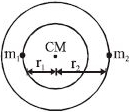
Two stars of masses $m_1$ and $m_2$ are parts of a binary star system. The radii of their orbits are $r_1$ and $r_2$ respectively,measured from the centre of mass of the system. The magnitude of the gravitational force that $m_1$ exerts on $m_2$ is
A
$\frac{G m_1 m_2}{(r_1 + r_2)^2}$
B
$\frac{G m_1}{(r_1 + r_2)^2}$
C
$\frac{G m_2}{(r_1 + r_2)^2}$
D
$\frac{G(m_1 + m_2)}{(r_1 + r_2)^2}$
Solution
(A) According to Newton's law of universal gravitation,the gravitational force $F$ between two point masses $m_1$ and $m_2$ separated by a distance $r$ is given by $F = \frac{G m_1 m_2}{r^2}$.
In a binary star system,the two stars revolve around their common centre of mass $(CM)$.
The distance between the two stars is the sum of their orbital radii from the centre of mass,which is $r = r_1 + r_2$.
Substituting this distance into the formula,we get the magnitude of the gravitational force as $F = \frac{G m_1 m_2}{(r_1 + r_2)^2}$.
In a binary star system,the two stars revolve around their common centre of mass $(CM)$.
The distance between the two stars is the sum of their orbital radii from the centre of mass,which is $r = r_1 + r_2$.
Substituting this distance into the formula,we get the magnitude of the gravitational force as $F = \frac{G m_1 m_2}{(r_1 + r_2)^2}$.
0 likes
View Solution133
MediumMCQ
The orbit of a geostationary satellite is circular. The time period of the satellite depends on $(i)$ mass of the satellite,$(ii)$ mass of the earth,$(iii)$ radius of the orbit,and $(iv)$ height of the satellite from the surface of the earth.
A
$(i)$ only
B
$(i)$ and $(ii)$
C
$(i), (ii)$ and $(iii)$
D
$(ii), (iii)$ and $(iv)$
Solution
(D) The gravitational force provides the necessary centripetal force for the circular orbit of the satellite: $\frac{GMm}{(R+h)^{2}} = m \omega^{2}(R+h)$.
Here,$G$ is the gravitational constant,$M$ is the mass of the Earth,$m$ is the mass of the satellite,$R$ is the radius of the Earth,and $h$ is the height of the satellite above the surface.
Simplifying for angular velocity $\omega$: $\omega = \sqrt{\frac{GM}{(R+h)^{3}}}$.
Since $\omega = \frac{2\pi}{T}$,the time period $T$ is given by $T = 2\pi \sqrt{\frac{(R+h)^{3}}{GM}}$.
The radius of the orbit is $r = R+h$.
Thus,$T = 2\pi \sqrt{\frac{r^{3}}{GM}}$.
From this expression,$T$ depends on the mass of the Earth $(M)$,the radius of the orbit $(r)$,and the height $(h)$ (since $r = R+h$). It does not depend on the mass of the satellite $(m)$.
Therefore,the correct factors are $(ii), (iii),$ and $(iv)$.
Here,$G$ is the gravitational constant,$M$ is the mass of the Earth,$m$ is the mass of the satellite,$R$ is the radius of the Earth,and $h$ is the height of the satellite above the surface.
Simplifying for angular velocity $\omega$: $\omega = \sqrt{\frac{GM}{(R+h)^{3}}}$.
Since $\omega = \frac{2\pi}{T}$,the time period $T$ is given by $T = 2\pi \sqrt{\frac{(R+h)^{3}}{GM}}$.
The radius of the orbit is $r = R+h$.
Thus,$T = 2\pi \sqrt{\frac{r^{3}}{GM}}$.
From this expression,$T$ depends on the mass of the Earth $(M)$,the radius of the orbit $(r)$,and the height $(h)$ (since $r = R+h$). It does not depend on the mass of the satellite $(m)$.
Therefore,the correct factors are $(ii), (iii),$ and $(iv)$.
0 likes
View Solution134
MediumMCQ
Which of the following statements is incorrect regarding a polar satellite?
A
$A$ polar satellite goes around the Earth's poles in a north-south direction.
B
Polar satellites are used to study the topography of the Moon,Venus,and Mars.
C
$A$ polar satellite is a high-altitude satellite.
D
The time period of a polar satellite is about $100 \, \text{minutes}$.
Solution
(C) Polar satellites are low-altitude satellites,typically orbiting at an altitude of $500 \, \text{km}$ to $800 \, \text{km}$ above the Earth's surface.
Therefore,the statement that a polar satellite is a high-altitude satellite is incorrect.
Option $(C)$ is the correct answer.
Therefore,the statement that a polar satellite is a high-altitude satellite is incorrect.
Option $(C)$ is the correct answer.
0 likes
View Solution135
MediumMCQ
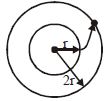
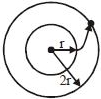
$A$ satellite is in a circular equatorial orbit of radius $r = 7000 \, km$ around the Earth. If it is transferred to a circular orbit of double the radius $(2r)$,then its angular momentum will:
A
Increase
B
Decrease
C
Remain unchanged
D
None of these
Solution
(A) The angular momentum $L$ of a satellite in a circular orbit of radius $r$ is given by $L = mvr$.
For a satellite in a circular orbit,the orbital velocity $v$ is given by $v = \sqrt{\frac{GM}{r}}$.
Substituting this into the expression for angular momentum,we get $L = m \sqrt{\frac{GM}{r}} \cdot r = m \sqrt{GMr}$.
When the radius is increased from $r$ to $r^{\prime} = 2r$,the new angular momentum $L^{\prime}$ becomes:
$L^{\prime} = m \sqrt{GM(2r)} = \sqrt{2} \cdot m \sqrt{GMr} = \sqrt{2} L$.
Since $\sqrt{2} > 1$,the angular momentum increases.
For a satellite in a circular orbit,the orbital velocity $v$ is given by $v = \sqrt{\frac{GM}{r}}$.
Substituting this into the expression for angular momentum,we get $L = m \sqrt{\frac{GM}{r}} \cdot r = m \sqrt{GMr}$.
When the radius is increased from $r$ to $r^{\prime} = 2r$,the new angular momentum $L^{\prime}$ becomes:
$L^{\prime} = m \sqrt{GM(2r)} = \sqrt{2} \cdot m \sqrt{GMr} = \sqrt{2} L$.
Since $\sqrt{2} > 1$,the angular momentum increases.
0 likes
View Solution136
DifficultMCQ
If due to air drag,the orbital radius of a satellite decreases from $R$ to $R - \Delta R$,where $\Delta R << R$,the expression for the change in orbital velocity $\Delta v$ is (mass of Earth is $M$):
A
$\frac{\Delta R}{2} \sqrt{\frac{GM}{R^3}}$
B
$\frac{-\Delta R}{2} \sqrt{\frac{GM}{R^3}}$
C
$\Delta R \sqrt{\frac{GM}{R^3}}$
D
$-\Delta R \sqrt{\frac{GM}{R^3}}$
Solution
(A) The orbital velocity of a satellite is given by $v = \sqrt{\frac{GM}{R}} = \sqrt{GM} \cdot R^{-1/2}$.
Differentiating both sides with respect to $R$,we get:
$\frac{dv}{dR} = \sqrt{GM} \cdot (-\frac{1}{2}) R^{-3/2} = -\frac{1}{2} \frac{\sqrt{GM}}{R \sqrt{R}} = -\frac{1}{2R} \sqrt{\frac{GM}{R}}$.
For small changes,$\Delta v \approx \frac{dv}{dR} \Delta R$.
Since the radius decreases by $\Delta R$,the change in radius is $-\Delta R$.
Therefore,$\Delta v = (-\frac{1}{2R} \sqrt{\frac{GM}{R}}) \cdot (-\Delta R) = \frac{\Delta R}{2R} \sqrt{\frac{GM}{R}} = \frac{\Delta R}{2} \sqrt{\frac{GM}{R^3}}$.
Thus,the change in orbital velocity is $\frac{\Delta R}{2} \sqrt{\frac{GM}{R^3}}$.
Differentiating both sides with respect to $R$,we get:
$\frac{dv}{dR} = \sqrt{GM} \cdot (-\frac{1}{2}) R^{-3/2} = -\frac{1}{2} \frac{\sqrt{GM}}{R \sqrt{R}} = -\frac{1}{2R} \sqrt{\frac{GM}{R}}$.
For small changes,$\Delta v \approx \frac{dv}{dR} \Delta R$.
Since the radius decreases by $\Delta R$,the change in radius is $-\Delta R$.
Therefore,$\Delta v = (-\frac{1}{2R} \sqrt{\frac{GM}{R}}) \cdot (-\Delta R) = \frac{\Delta R}{2R} \sqrt{\frac{GM}{R}} = \frac{\Delta R}{2} \sqrt{\frac{GM}{R^3}}$.
Thus,the change in orbital velocity is $\frac{\Delta R}{2} \sqrt{\frac{GM}{R^3}}$.
0 likes
View Solution137
DifficultMCQ
The orbital velocity of an artificial satellite in a circular orbit very close to the Earth is $v$. The velocity of a geostationary satellite orbiting in a circular orbit at an altitude of $3R$ from the Earth's surface will be
A
$\frac{v}{\sqrt{7}}$
B
$\frac{v}{\sqrt{6}}$
C
$\frac{v}{2}$
D
$\frac{v}{\sqrt{2}}$
Solution
(C) The orbital velocity of a satellite is given by $v_0 = \sqrt{\frac{GM}{r}}$,where $r$ is the distance from the center of the Earth.
This implies $v_0 \propto \frac{1}{\sqrt{r}}$.
For a satellite very close to the Earth's surface,the orbital radius is $r_1 \approx R$,and its velocity is $v_1 = v$.
For a satellite at an altitude of $3R$,the orbital radius is $r_2 = R + 3R = 4R$.
Using the ratio formula: $\frac{v_1}{v_2} = \sqrt{\frac{r_2}{r_1}}$.
Substituting the values: $\frac{v}{v_2} = \sqrt{\frac{4R}{R}} = \sqrt{4} = 2$.
Therefore,$v_2 = \frac{v}{2}$.
This implies $v_0 \propto \frac{1}{\sqrt{r}}$.
For a satellite very close to the Earth's surface,the orbital radius is $r_1 \approx R$,and its velocity is $v_1 = v$.
For a satellite at an altitude of $3R$,the orbital radius is $r_2 = R + 3R = 4R$.
Using the ratio formula: $\frac{v_1}{v_2} = \sqrt{\frac{r_2}{r_1}}$.
Substituting the values: $\frac{v}{v_2} = \sqrt{\frac{4R}{R}} = \sqrt{4} = 2$.
Therefore,$v_2 = \frac{v}{2}$.
0 likes
View Solution138
DifficultMCQ
$A$ geostationary satellite is orbiting the earth at a height of $5R$ above the surface of the earth,where $R$ is the radius of the earth. The time period of another satellite in hours at a height of $2R$ from the surface of the earth is:
A
$6 \sqrt{2}$
B
$\frac{6}{\sqrt{2}}$
C
$5$
D
$10$
Solution
(A) According to Kepler's Third Law,the time period $T$ of a satellite is related to its orbital radius $r$ by $T \propto r^{3/2}$.
Here,the orbital radius $r$ is the distance from the center of the earth,so $r = R_{earth} + h$.
For the geostationary satellite: $r_1 = R + 5R = 6R$. Its time period $T_1 = 24$ hours.
For the second satellite: $r_2 = R + 2R = 3R$.
Using the ratio: $\frac{T_1}{T_2} = \left( \frac{r_1}{r_2} \right)^{3/2}$.
Substituting the values: $\frac{24}{T_2} = \left( \frac{6R}{3R} \right)^{3/2} = (2)^{3/2} = 2\sqrt{2}$.
Therefore,$T_2 = \frac{24}{2\sqrt{2}} = \frac{12}{\sqrt{2}} = 6\sqrt{2}$ hours.
Here,the orbital radius $r$ is the distance from the center of the earth,so $r = R_{earth} + h$.
For the geostationary satellite: $r_1 = R + 5R = 6R$. Its time period $T_1 = 24$ hours.
For the second satellite: $r_2 = R + 2R = 3R$.
Using the ratio: $\frac{T_1}{T_2} = \left( \frac{r_1}{r_2} \right)^{3/2}$.
Substituting the values: $\frac{24}{T_2} = \left( \frac{6R}{3R} \right)^{3/2} = (2)^{3/2} = 2\sqrt{2}$.
Therefore,$T_2 = \frac{24}{2\sqrt{2}} = \frac{12}{\sqrt{2}} = 6\sqrt{2}$ hours.
0 likes
View Solution139
MediumMCQ
In the case of an orbiting satellite,if the radius of the orbit is decreased,then:
A
Its kinetic energy decreases
B
Its potential energy increases
C
Both $(A)$ and $(B)$ are correct
D
Both $(A)$ and $(B)$ are wrong
Solution
(D) For a satellite of mass $m$ orbiting a planet of mass $M$ at a distance $r$:
Kinetic Energy $(KE)$ = $\frac{GMm}{2r}$
Potential Energy $(PE)$ = $-\frac{GMm}{r}$
Total Energy $(E)$ = $-\frac{GMm}{2r}$
If the radius $r$ is decreased:
$1$. Since $KE = \frac{GMm}{2r}$,as $r$ decreases,$KE$ increases.
$2$. Since $PE = -\frac{GMm}{r}$,as $r$ decreases,the magnitude $\frac{GMm}{r}$ increases,making the negative value more negative. Thus,$PE$ decreases.
Therefore,both statements $(A)$ and $(B)$ are incorrect,making option $(D)$ the correct choice.
Kinetic Energy $(KE)$ = $\frac{GMm}{2r}$
Potential Energy $(PE)$ = $-\frac{GMm}{r}$
Total Energy $(E)$ = $-\frac{GMm}{2r}$
If the radius $r$ is decreased:
$1$. Since $KE = \frac{GMm}{2r}$,as $r$ decreases,$KE$ increases.
$2$. Since $PE = -\frac{GMm}{r}$,as $r$ decreases,the magnitude $\frac{GMm}{r}$ increases,making the negative value more negative. Thus,$PE$ decreases.
Therefore,both statements $(A)$ and $(B)$ are incorrect,making option $(D)$ the correct choice.
0 likes
View Solution140
MediumMCQ
$A$ satellite of mass $m$ revolves around the Earth of radius $R$ at a height $x$ from its surface. If $g$ is the acceleration due to gravity on the surface of the Earth,the orbital speed of the satellite is:
A
$gx$
B
${\left( {\frac{{gR}}{{R - x}}} \right)^{1/2}}$
C
${\left( {\frac{{gR^2}}{{R + x}}} \right)^{1/2}}$
D
${\left( {\frac{{gR}}{{R + x}}} \right)^{1/2}}$
Solution
(C) The orbital speed $v_0$ of a satellite at a distance $r = R + x$ from the center of the Earth is given by $v_0 = \sqrt{\frac{GM}{r}} = \sqrt{\frac{GM}{R + x}}$.
We know that the acceleration due to gravity on the surface of the Earth is $g = \frac{GM}{R^2}$,which implies $GM = gR^2$.
Substituting $GM = gR^2$ into the expression for $v_0$,we get:
$v_0 = \sqrt{\frac{gR^2}{R + x}} = \left( \frac{gR^2}{R + x} \right)^{1/2}$.
Thus,the correct option is $C$.
We know that the acceleration due to gravity on the surface of the Earth is $g = \frac{GM}{R^2}$,which implies $GM = gR^2$.
Substituting $GM = gR^2$ into the expression for $v_0$,we get:
$v_0 = \sqrt{\frac{gR^2}{R + x}} = \left( \frac{gR^2}{R + x} \right)^{1/2}$.
Thus,the correct option is $C$.
0 likes
View Solution141
MediumMCQ
If $r$ denotes the distance between the sun and the earth,then the angular momentum of the earth around the sun is proportional to
A
$r^{3/2}$
B
$r$
C
$\sqrt{r}$
D
$r^2$
Solution
(C) For a planet revolving around the sun in a circular orbit,the gravitational force provides the necessary centripetal force.
$\frac{GMm}{r^2} = \frac{mv^2}{r}$
Solving for the orbital velocity $v$:
$v = \sqrt{\frac{GM}{r}}$
The angular momentum $L$ is given by the formula $L = mvr$.
Substituting the expression for $v$:
$L = m \left( \sqrt{\frac{GM}{r}} \right) r$
$L = m \sqrt{GM} \sqrt{r}$
Since $m$,$G$,and $M$ are constants,we find that $L \propto \sqrt{r}$.
$\frac{GMm}{r^2} = \frac{mv^2}{r}$
Solving for the orbital velocity $v$:
$v = \sqrt{\frac{GM}{r}}$
The angular momentum $L$ is given by the formula $L = mvr$.
Substituting the expression for $v$:
$L = m \left( \sqrt{\frac{GM}{r}} \right) r$
$L = m \sqrt{GM} \sqrt{r}$
Since $m$,$G$,and $M$ are constants,we find that $L \propto \sqrt{r}$.
0 likes
View Solution142
EasyMCQ
$A$ body is dropped from a satellite in a parking orbit. Which of the following describes its behaviour correctly?
A
It will be stationary in space.
B
It will fall towards the earth.
C
It will rotate about the axis of the earth with a time period of $24$ hours.
D
It will rotate about the earth with a time period of $8$ hours.
Solution
(C) satellite in a parking orbit (geostationary orbit) moves with the same orbital velocity as the earth's rotation. When a body is dropped from such a satellite,it retains the same orbital velocity as the satellite at that instant. Therefore,the body will continue to move in the same orbit as the satellite. Consequently,it will appear stationary relative to a point on the earth's surface and will rotate about the earth's axis with a time period of $24$ hours.
0 likes
View Solution143
MediumMCQ
The period of a satellite,in a circular orbit near an equatorial plane,will not depend on
A
The mass of the planet
B
The radius of the planet
C
The mass of the satellite
D
All the above parameters
Solution
(C) The orbital period $T$ of a satellite revolving in a circular orbit at a distance $r$ from the center of a planet of mass $M$ is given by the formula $T = 2\pi \sqrt{\frac{r^3}{GM}}$.
From this expression,it is clear that the period $T$ depends on the mass of the planet $M$ and the orbital radius $r$.
The orbital radius $r$ is related to the radius of the planet $R$ and the height $h$ above the surface $(r = R + h)$.
Therefore,the period depends on the mass of the planet and the radius of the planet.
However,the mass of the satellite $m$ does not appear in the formula,meaning the period is independent of the mass of the satellite.
From this expression,it is clear that the period $T$ depends on the mass of the planet $M$ and the orbital radius $r$.
The orbital radius $r$ is related to the radius of the planet $R$ and the height $h$ above the surface $(r = R + h)$.
Therefore,the period depends on the mass of the planet and the radius of the planet.
However,the mass of the satellite $m$ does not appear in the formula,meaning the period is independent of the mass of the satellite.
0 likes
View Solution144
MediumMCQ
Two satellites of mass $50\,kg$ and $100\,kg$ revolve around the earth in circular orbits of radius $9\,R$ and $16\,R$ respectively,where $R$ is the radius of the earth. The ratio of the speeds of the two satellites will be:
A
$3/4$
B
$4/3$
C
$9/16$
D
$16/9$
Solution
(B) The orbital velocity $v_0$ of a satellite revolving around the earth at a distance $r$ from the center is given by the formula:
$v_0 = \sqrt{\frac{GM}{r}}$
From this expression,it is clear that the orbital velocity is inversely proportional to the square root of the orbital radius:
$v_0 \propto \frac{1}{\sqrt{r}}$
Given the radii of the two satellites are $r_1 = 9R$ and $r_2 = 16R$,the ratio of their speeds $v_1$ and $v_2$ is:
$\frac{v_1}{v_2} = \sqrt{\frac{r_2}{r_1}}$
Substituting the given values:
$\frac{v_1}{v_2} = \sqrt{\frac{16R}{9R}} = \sqrt{\frac{16}{9}} = \frac{4}{3}$
Therefore,the ratio of the speeds is $4/3$.
$v_0 = \sqrt{\frac{GM}{r}}$
From this expression,it is clear that the orbital velocity is inversely proportional to the square root of the orbital radius:
$v_0 \propto \frac{1}{\sqrt{r}}$
Given the radii of the two satellites are $r_1 = 9R$ and $r_2 = 16R$,the ratio of their speeds $v_1$ and $v_2$ is:
$\frac{v_1}{v_2} = \sqrt{\frac{r_2}{r_1}}$
Substituting the given values:
$\frac{v_1}{v_2} = \sqrt{\frac{16R}{9R}} = \sqrt{\frac{16}{9}} = \frac{4}{3}$
Therefore,the ratio of the speeds is $4/3$.
0 likes
View Solution145
MediumMCQ
$A$ satellite of mass $m$ revolves around the earth of radius $R$ at a height $x$ from its surface. If $g$ is the acceleration due to gravity on the surface of the earth,the orbital speed of the satellite is
A
$gx$
B
$\frac{gR}{R - x}$
C
$\frac{gR^2}{R + x}$
D
$\left( \frac{gR^2}{R + x} \right)^{1/2}$
Solution
(D) The gravitational force acting on the satellite provides the necessary centripetal force for its circular orbit.
Let $M_e$ be the mass of the earth. The gravitational force is $F_g = \frac{G M_e m}{(R + x)^2}$.
The centripetal force required is $F_c = \frac{m v_0^2}{R + x}$.
Equating these,we get $\frac{G M_e m}{(R + x)^2} = \frac{m v_0^2}{R + x}$,which simplifies to $v_0^2 = \frac{G M_e}{R + x}$.
We know that the acceleration due to gravity on the earth's surface is $g = \frac{G M_e}{R^2}$,which implies $G M_e = g R^2$.
Substituting this into the expression for $v_0^2$,we get $v_0^2 = \frac{g R^2}{R + x}$.
Therefore,the orbital speed is $v_0 = \sqrt{\frac{g R^2}{R + x}} = \left( \frac{g R^2}{R + x} \right)^{1/2}$.
Let $M_e$ be the mass of the earth. The gravitational force is $F_g = \frac{G M_e m}{(R + x)^2}$.
The centripetal force required is $F_c = \frac{m v_0^2}{R + x}$.
Equating these,we get $\frac{G M_e m}{(R + x)^2} = \frac{m v_0^2}{R + x}$,which simplifies to $v_0^2 = \frac{G M_e}{R + x}$.
We know that the acceleration due to gravity on the earth's surface is $g = \frac{G M_e}{R^2}$,which implies $G M_e = g R^2$.
Substituting this into the expression for $v_0^2$,we get $v_0^2 = \frac{g R^2}{R + x}$.
Therefore,the orbital speed is $v_0 = \sqrt{\frac{g R^2}{R + x}} = \left( \frac{g R^2}{R + x} \right)^{1/2}$.
0 likes
View Solution146
EasyMCQ
The motion of planets in the solar system is an example of the conservation of
A
mass
B
linear momentum
C
angular momentum
D
energy
Solution
(C) The gravitational force exerted by the Sun on a planet acts along the line joining the Sun and the planet.
This force is a central force,meaning its torque about the Sun is zero.
According to the principle of conservation of angular momentum,if the net external torque acting on a system is zero,the angular momentum of the system remains constant.
Therefore,the motion of planets in the solar system is an example of the conservation of angular momentum.
This force is a central force,meaning its torque about the Sun is zero.
According to the principle of conservation of angular momentum,if the net external torque acting on a system is zero,the angular momentum of the system remains constant.
Therefore,the motion of planets in the solar system is an example of the conservation of angular momentum.
0 likes
View Solution147
MediumMCQ
The height of a geostationary satellite is approximately ........ $km$.
A
$16000$
B
$22000$
C
$28000$
D
$36000$
Solution
(D) geostationary satellite orbits the Earth with a time period $T = 24 \, \text{hours} = 86400 \, \text{s}$.
Using the formula for the orbital radius $r$ of a satellite: $r = \left( \frac{G M T^2}{4 \pi^2} \right)^{1/3}$.
Given $GM = g R^2$,where $g = 9.8 \, \text{m/s}^2$ and $R = 6.4 \times 10^6 \, \text{m}$,the orbital radius $r$ is approximately $42200 \, \text{km}$.
The height $h$ above the Earth's surface is $h = r - R$.
$h = 42200 \, \text{km} - 6400 \, \text{km} = 35800 \, \text{km}$.
Rounding to the nearest standard value,the height is approximately $36000 \, \text{km}$.
Using the formula for the orbital radius $r$ of a satellite: $r = \left( \frac{G M T^2}{4 \pi^2} \right)^{1/3}$.
Given $GM = g R^2$,where $g = 9.8 \, \text{m/s}^2$ and $R = 6.4 \times 10^6 \, \text{m}$,the orbital radius $r$ is approximately $42200 \, \text{km}$.
The height $h$ above the Earth's surface is $h = r - R$.
$h = 42200 \, \text{km} - 6400 \, \text{km} = 35800 \, \text{km}$.
Rounding to the nearest standard value,the height is approximately $36000 \, \text{km}$.
0 likes
View Solution148
DifficultMCQ
$A$ geostationary satellite is orbiting the earth at a height of $6R$ from the earth's surface ($R$ is the earth's radius). What is the period of rotation of another satellite at a height of $2.5R$ from the earth's surface?
A
$6\sqrt{2} \text{ hours}$
B
$10 \text{ hours}$
C
$\frac{5\sqrt{5}}{\sqrt{3}} \text{ hours}$
D
None of the above
Solution
(A) According to Kepler's Third Law of planetary motion,the square of the time period $(T)$ is proportional to the cube of the orbital radius $(r)$: $T^2 \propto r^3$.
The orbital radius $r$ is the distance from the center of the Earth,given by $r = R + h$,where $h$ is the height above the surface.
For the geostationary satellite $(S_1)$: $h_1 = 6R$,so $r_1 = R + 6R = 7R$. The time period $T_1 = 24 \text{ hours}$.
For the second satellite $(S_2)$: $h_2 = 2.5R$,so $r_2 = R + 2.5R = 3.5R$.
Using the ratio: $\left(\frac{T_2}{T_1}\right)^2 = \left(\frac{r_2}{r_1}\right)^3$.
$\left(\frac{T_2}{24}\right)^2 = \left(\frac{3.5R}{7R}\right)^3 = \left(\frac{1}{2}\right)^3 = \frac{1}{8}$.
$\frac{T_2}{24} = \sqrt{\frac{1}{8}} = \frac{1}{2\sqrt{2}}$.
$T_2 = \frac{24}{2\sqrt{2}} = \frac{12}{\sqrt{2}} = 6\sqrt{2} \text{ hours}$.
The orbital radius $r$ is the distance from the center of the Earth,given by $r = R + h$,where $h$ is the height above the surface.
For the geostationary satellite $(S_1)$: $h_1 = 6R$,so $r_1 = R + 6R = 7R$. The time period $T_1 = 24 \text{ hours}$.
For the second satellite $(S_2)$: $h_2 = 2.5R$,so $r_2 = R + 2.5R = 3.5R$.
Using the ratio: $\left(\frac{T_2}{T_1}\right)^2 = \left(\frac{r_2}{r_1}\right)^3$.
$\left(\frac{T_2}{24}\right)^2 = \left(\frac{3.5R}{7R}\right)^3 = \left(\frac{1}{2}\right)^3 = \frac{1}{8}$.
$\frac{T_2}{24} = \sqrt{\frac{1}{8}} = \frac{1}{2\sqrt{2}}$.
$T_2 = \frac{24}{2\sqrt{2}} = \frac{12}{\sqrt{2}} = 6\sqrt{2} \text{ hours}$.
0 likes
View Solution149
EasyMCQ
$Assertion$ : An astronaut experiences weightlessness in a space satellite.
$Reason$ : When a body falls freely,it does not experience gravity.
$Reason$ : When a body falls freely,it does not experience gravity.
A
If both $Assertion$ and $Reason$ are correct and the $Reason$ is a correct explanation of the $Assertion$.
B
If both $Assertion$ and $Reason$ are correct but $Reason$ is not a correct explanation of the $Assertion$.
C
If the $Assertion$ is correct but $Reason$ is incorrect.
D
If both the $Assertion$ and $Reason$ are incorrect.
Solution
(C) The $Assertion$ is correct because an astronaut in a satellite is in a state of free fall towards the Earth,resulting in weightlessness.
The $Reason$ is incorrect because a body in free fall $DOES$ experience gravity (it is the gravitational force that causes the acceleration $g$). The sensation of weightlessness arises because the body and the satellite are falling together with the same acceleration $g$,making the normal force (apparent weight) zero.
Therefore,the correct option is $C$.
The $Reason$ is incorrect because a body in free fall $DOES$ experience gravity (it is the gravitational force that causes the acceleration $g$). The sensation of weightlessness arises because the body and the satellite are falling together with the same acceleration $g$,making the normal force (apparent weight) zero.
Therefore,the correct option is $C$.
0 likes
View Solution150
DifficultMCQ
$A$ satellite of mass $m$ is launched vertically upwards with an initial speed $u$ from the surface of the earth. After it reaches height $R$ ($R =$ radius of the earth), it ejects a rocket of mass $\frac{m}{10}$ so that subsequently the satellite moves in a circular orbit. The kinetic energy of the rocket is ($G$ is the gravitational constant, $M$ is the mass of the earth).
A
$\frac{m}{20}\left(u-\sqrt{\frac{2 GM}{3 R}}\right)^{2}$
B
$5 m\left(u^{2}-\frac{119}{200} \frac{GM}{R}\right)$
C
$\frac{3 m}{8}\left(u+\sqrt{\frac{5 G M}{6 R}}\right)^{2}$
D
$\frac{m}{20}\left(u^{2}+\frac{113}{200} \frac{G M}{R}\right)$
Solution
(B) $1$. Apply energy conservation from the surface to height $R$ (distance $2R$ from the center):
$\frac{1}{2}mu^2 - \frac{GMm}{R} = \frac{1}{2}mv^2 - \frac{GMm}{2R}$
$\frac{1}{2}v^2 = \frac{1}{2}u^2 - \frac{GM}{2R} \Rightarrow v = \sqrt{u^2 - \frac{GM}{R}}$
$2$. At height $R$, the satellite (mass $m$) ejects a rocket (mass $m/10$). The remaining satellite (mass $9m/10$) enters a circular orbit at distance $2R$. The orbital velocity is $v_o = \sqrt{\frac{GM}{2R}}$.
$3$. By conservation of linear momentum in the radial and tangential directions:
Radial: $\frac{m}{10} v_r = m v = m \sqrt{u^2 - \frac{GM}{R}} \Rightarrow v_r = 10 \sqrt{u^2 - \frac{GM}{R}}$
Tangential: $\frac{m}{10} v_T = \frac{9m}{10} v_o = \frac{9m}{10} \sqrt{\frac{GM}{2R}} \Rightarrow v_T = 9 \sqrt{\frac{GM}{2R}}$
$4$. Kinetic energy of the rocket $(K_r = \frac{1}{2} (m/10) (v_r^2 + v_T^2))$:
$K_r = \frac{m}{20} \left( 100(u^2 - \frac{GM}{R}) + 81(\frac{GM}{2R}) \right)$
$K_r = \frac{m}{20} \left( 100u^2 - 100\frac{GM}{R} + 40.5\frac{GM}{R} \right) = \frac{m}{20} \left( 100u^2 - 59.5\frac{GM}{R} \right)$
$K_r = 5m \left( u^2 - 0.595 \frac{GM}{R} \right) = 5m \left( u^2 - \frac{119}{200} \frac{GM}{R} \right)$.
$\frac{1}{2}mu^2 - \frac{GMm}{R} = \frac{1}{2}mv^2 - \frac{GMm}{2R}$
$\frac{1}{2}v^2 = \frac{1}{2}u^2 - \frac{GM}{2R} \Rightarrow v = \sqrt{u^2 - \frac{GM}{R}}$
$2$. At height $R$, the satellite (mass $m$) ejects a rocket (mass $m/10$). The remaining satellite (mass $9m/10$) enters a circular orbit at distance $2R$. The orbital velocity is $v_o = \sqrt{\frac{GM}{2R}}$.
$3$. By conservation of linear momentum in the radial and tangential directions:
Radial: $\frac{m}{10} v_r = m v = m \sqrt{u^2 - \frac{GM}{R}} \Rightarrow v_r = 10 \sqrt{u^2 - \frac{GM}{R}}$
Tangential: $\frac{m}{10} v_T = \frac{9m}{10} v_o = \frac{9m}{10} \sqrt{\frac{GM}{2R}} \Rightarrow v_T = 9 \sqrt{\frac{GM}{2R}}$
$4$. Kinetic energy of the rocket $(K_r = \frac{1}{2} (m/10) (v_r^2 + v_T^2))$:
$K_r = \frac{m}{20} \left( 100(u^2 - \frac{GM}{R}) + 81(\frac{GM}{2R}) \right)$
$K_r = \frac{m}{20} \left( 100u^2 - 100\frac{GM}{R} + 40.5\frac{GM}{R} \right) = \frac{m}{20} \left( 100u^2 - 59.5\frac{GM}{R} \right)$
$K_r = 5m \left( u^2 - 0.595 \frac{GM}{R} \right) = 5m \left( u^2 - \frac{119}{200} \frac{GM}{R} \right)$.
0 likes
View SolutionGravitation — Motion of Satellites in Circular Orbits and Planets in Elliptical Orbits · Frequently Asked Questions
1Are these Gravitation questions useful for JEE and NEET?
Yes. All questions in this section are mapped to JEE Main and NEET exam patterns. Previous year questions from JEE Main, NEET, GUJCET and state-level exams are included with full solutions.
2Can I switch to Hindi or Gujarati for these questions?
Yes. Use the language tabs in the hero section or the sidebar to view the same questions and solutions in English, Hindi or Gujarati.
3How do I generate a question paper from this subtopic?
Use the Vedclass Exam Paper Generator — select the chapter and subtopic, set difficulty, and generate Sets A, B, C, D automatically. First 3 chapters of every subject are free.
Vedclass Products
For Students
Vedclass Test Series
Mock tests in real JEE/NEET style with performance analysis. 5-day free trial.
Start Free TrialFor Teachers
Exam Paper Generator
Generate Set A/B/C/D papers from this chapter in 2 minutes. 3 chapters free.
Try FreeFor Institutes
Online Exam Module
Live online exams with unlimited students, 360° analytics & white-label branding.
See DemoFor Teachers & Institutes
Generate a Gravitation Exam Paper in 2 Minutes
Select subtopic & difficulty — Sets A, B, C, D auto-generated with No Repeat logic.
First 3 chapters of every subject are free — no payment required.