
A English
Motion of Satellites in Circular Orbits and Planets in Elliptical Orbits Questions in English
Class 11 Physics · Gravitation · Motion of Satellites in Circular Orbits and Planets in Elliptical Orbits
326+
Questions
English
Language
100%
With Solutions
Showing 50 of 326 questions in English
151
MediumMCQ
$A$ body $A$ of mass $m$ is moving in a circular orbit of radius $R$ about a planet. Another body $B$ of mass $\frac{m}{2}$ collides with $A$ with a velocity which is half $\left(\frac{\overrightarrow{v}}{2}\right)$ the instantaneous velocity $\overrightarrow{v}$ of $A$. The collision is completely inelastic. Then,the combined body
A
starts moving in an elliptical orbit around the planet
B
continues to move in a circular orbit
C
falls vertically downwards towards the planet
D
escapes from the planet's gravitational field
Solution
(A) Initially,the body of mass $m$ is moving in a circular orbit of radius $R$. So,it must be moving with orbital speed $v_{0} = \sqrt{\frac{GM}{R}}$.
After the collision,let the combined mass move with speed $v_{1}$.
Using the conservation of linear momentum:
$m v_{0} + \frac{m}{2} \left(\frac{v_{0}}{2}\right) = \left(m + \frac{m}{2}\right) v_{1}$
$m v_{0} + \frac{m v_{0}}{4} = \frac{3m}{2} v_{1}$
$\frac{5m v_{0}}{4} = \frac{3m}{2} v_{1}$
$v_{1} = \frac{5}{4} \times \frac{2}{3} v_{0} = \frac{5}{6} v_{0}$.
Since the speed after the collision $(v_{1} = \frac{5}{6} v_{0})$ is not equal to the orbital speed $(v_{0})$,the motion cannot be circular.
Since the velocity remains tangential,it cannot fall vertically towards the planet.
Also,the speed after the collision is less than the escape speed $(v_{e} = \sqrt{2} v_{0})$,so the body cannot escape the gravitational field.
Therefore,the combined body will move in an elliptical orbit around the planet.
After the collision,let the combined mass move with speed $v_{1}$.
Using the conservation of linear momentum:
$m v_{0} + \frac{m}{2} \left(\frac{v_{0}}{2}\right) = \left(m + \frac{m}{2}\right) v_{1}$
$m v_{0} + \frac{m v_{0}}{4} = \frac{3m}{2} v_{1}$
$\frac{5m v_{0}}{4} = \frac{3m}{2} v_{1}$
$v_{1} = \frac{5}{4} \times \frac{2}{3} v_{0} = \frac{5}{6} v_{0}$.
Since the speed after the collision $(v_{1} = \frac{5}{6} v_{0})$ is not equal to the orbital speed $(v_{0})$,the motion cannot be circular.
Since the velocity remains tangential,it cannot fall vertically towards the planet.
Also,the speed after the collision is less than the escape speed $(v_{e} = \sqrt{2} v_{0})$,so the body cannot escape the gravitational field.
Therefore,the combined body will move in an elliptical orbit around the planet.
0 likes
View Solution152
DifficultMCQ
Express the constant $k$ of $T^{2}=k(R_{E}+h)^{3}$ in days and kilometres. Given $k = 10^{-13} \; s^{2} \; m^{-3}$. The moon is at a distance of $3.84 \times 10^{5} \; km$ from the earth. Obtain its time period of revolution in days.
A
$18.2$
B
$54.6$
C
$27.3$
D
$13.65$
Solution
(C) Given $k = 10^{-13} \; s^{2} \; m^{-3}$.
To convert $k$ into $d^{2} \; km^{-3}$:
$1 \; s = \frac{1}{24 \times 60 \times 60} \; d = \frac{1}{86400} \; d$
$1 \; m = 10^{-3} \; km$
Substituting these values into $k$:
$k = 10^{-13} \times (\frac{1}{86400})^{2} \; d^{2} \times (10^{-3})^{-3} \; km^{-3}$
$k = 10^{-13} \times \frac{1}{7.465 \times 10^{9}} \times 10^{9} \; d^{2} \; km^{-3}$
$k \approx 1.33 \times 10^{-14} \; d^{2} \; km^{-3}$
Now,using $T^{2} = k(R_{E}+h)^{3}$ where $R_{E}+h = 3.84 \times 10^{5} \; km$:
$T^{2} = (1.33 \times 10^{-14}) \times (3.84 \times 10^{5})^{3}$
$T^{2} = (1.33 \times 10^{-14}) \times (56.623 \times 10^{15})$
$T^{2} \approx 753.08$
$T = \sqrt{753.08} \approx 27.4 \; d$.
The closest option is $27.3 \; d$.
To convert $k$ into $d^{2} \; km^{-3}$:
$1 \; s = \frac{1}{24 \times 60 \times 60} \; d = \frac{1}{86400} \; d$
$1 \; m = 10^{-3} \; km$
Substituting these values into $k$:
$k = 10^{-13} \times (\frac{1}{86400})^{2} \; d^{2} \times (10^{-3})^{-3} \; km^{-3}$
$k = 10^{-13} \times \frac{1}{7.465 \times 10^{9}} \times 10^{9} \; d^{2} \; km^{-3}$
$k \approx 1.33 \times 10^{-14} \; d^{2} \; km^{-3}$
Now,using $T^{2} = k(R_{E}+h)^{3}$ where $R_{E}+h = 3.84 \times 10^{5} \; km$:
$T^{2} = (1.33 \times 10^{-14}) \times (3.84 \times 10^{5})^{3}$
$T^{2} = (1.33 \times 10^{-14}) \times (56.623 \times 10^{15})$
$T^{2} \approx 753.08$
$T = \sqrt{753.08} \approx 27.4 \; d$.
The closest option is $27.3 \; d$.
0 likes
View Solution153
Medium
Let us assume that our galaxy consists of $2.5 \times 10^{11}$ stars, each of one solar mass. How long will a star at a distance of $50,000 \; ly$ from the galactic centre take to complete one revolution? Take the diameter of the Milky Way to be $10^{5} \; ly$.
Solution
(N/A) Mass of our galaxy, $M = 2.5 \times 10^{11} \times (2.0 \times 10^{30} \; kg) = 5 \times 10^{41} \; kg$.
Radius of the orbit, $r = 50,000 \; ly = 5 \times 10^{4} \times 9.46 \times 10^{15} \; m = 4.73 \times 10^{20} \; m$.
Using Kepler's Third Law for the time period $T$ of a star revolving around the galactic centre:
$T = \sqrt{\frac{4 \pi^{2} r^{3}}{G M}}$.
Substituting the values:
$T = \sqrt{\frac{4 \times (3.14)^{2} \times (4.73 \times 10^{20})^{3}}{6.67 \times 10^{-11} \times 5 \times 10^{41}}}$.
$T = \sqrt{\frac{39.48 \times 105.82 \times 10^{60}}{33.35 \times 10^{30}}} = \sqrt{125.27 \times 10^{30}} \approx 1.12 \times 10^{16} \; s$.
Converting seconds to years:
$T = \frac{1.12 \times 10^{16}}{365.25 \times 24 \times 3600} \approx 3.55 \times 10^{8} \; \text{years}$.
Radius of the orbit, $r = 50,000 \; ly = 5 \times 10^{4} \times 9.46 \times 10^{15} \; m = 4.73 \times 10^{20} \; m$.
Using Kepler's Third Law for the time period $T$ of a star revolving around the galactic centre:
$T = \sqrt{\frac{4 \pi^{2} r^{3}}{G M}}$.
Substituting the values:
$T = \sqrt{\frac{4 \times (3.14)^{2} \times (4.73 \times 10^{20})^{3}}{6.67 \times 10^{-11} \times 5 \times 10^{41}}}$.
$T = \sqrt{\frac{39.48 \times 105.82 \times 10^{60}}{33.35 \times 10^{30}}} = \sqrt{125.27 \times 10^{30}} \approx 1.12 \times 10^{16} \; s$.
Converting seconds to years:
$T = \frac{1.12 \times 10^{16}}{365.25 \times 24 \times 3600} \approx 3.55 \times 10^{8} \; \text{years}$.
0 likes
View Solution154
Medium
$A$ comet orbits the Sun in a highly elliptical orbit. Does the comet have a constant $(a)$ linear speed,$(b)$ angular speed,$(c)$ angular momentum,$(d)$ kinetic energy,$(e)$ potential energy,$(f)$ total energy throughout its orbit? Neglect any mass loss of the comet when it comes very close to the Sun.
Solution
(C, F) No. The linear speed changes as the distance from the Sun changes.
$(b)$ No. The angular speed changes according to Kepler's second law.
$(c)$ Yes. Since the gravitational force is a central force,the torque acting on the comet is zero,so angular momentum is conserved.
$(d)$ No. Kinetic energy changes as the linear speed changes.
$(e)$ No. Potential energy depends on the distance from the Sun,which varies in an elliptical orbit.
$(f)$ Yes. The total mechanical energy of the comet remains constant in the gravitational field of the Sun.
$(b)$ No. The angular speed changes according to Kepler's second law.
$(c)$ Yes. Since the gravitational force is a central force,the torque acting on the comet is zero,so angular momentum is conserved.
$(d)$ No. Kinetic energy changes as the linear speed changes.
$(e)$ No. Potential energy depends on the distance from the Sun,which varies in an elliptical orbit.
$(f)$ Yes. The total mechanical energy of the comet remains constant in the gravitational field of the Sun.
0 likes
View Solution155
Medium
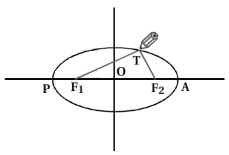
Describe the method for drawing an ellipse and explain the foci of an ellipse,midpoint,and semi-major axis.
Solution
(N/A) $1$. Select two points $F_{1}$ and $F_{2}$.
$2$. Fix the ends of a string at $F_{1}$ and $F_{2}$.
$3$. Using the tip of a pencil,stretch the string taut and draw a curve by moving the pencil while keeping the string taut throughout the motion.
$4$. The resulting closed curve is called an ellipse.
$5$. For any point $T$ on the ellipse,the sum of the distances from $F_{1}$ and $F_{2}$ is constant. The points $F_{1}$ and $F_{2}$ are called the foci.
$6$. Join the points $F_{1}$ and $F_{2}$ and extend the line to intersect the ellipse at points $P$ and $A$. The midpoint of the line segment $PA$ is the centre of the ellipse,denoted by $O$.
$7$. The length $PO = AO$ is called the semi-major axis of the ellipse.
$2$. Fix the ends of a string at $F_{1}$ and $F_{2}$.
$3$. Using the tip of a pencil,stretch the string taut and draw a curve by moving the pencil while keeping the string taut throughout the motion.
$4$. The resulting closed curve is called an ellipse.
$5$. For any point $T$ on the ellipse,the sum of the distances from $F_{1}$ and $F_{2}$ is constant. The points $F_{1}$ and $F_{2}$ are called the foci.
$6$. Join the points $F_{1}$ and $F_{2}$ and extend the line to intersect the ellipse at points $P$ and $A$. The midpoint of the line segment $PA$ is the centre of the ellipse,denoted by $O$.
$7$. The length $PO = AO$ is called the semi-major axis of the ellipse.
0 likes
View Solution156
MediumMCQ
$A$ $10\; kg$ satellite circles Earth once every $2\; hours$ in an orbit having a radius of $8000\; km$. Assuming that Bohr's angular momentum postulate applies to satellites just as it does to an electron in the hydrogen atom, find the quantum number of the orbit of the satellite.
A
$5.3 \times 10^{45}$
B
$6.1 \times 10^{42}$
C
$4.9 \times 10^{40}$
D
$7.1 \times 10^{48}$
Solution
(A) According to Bohr's postulate, the angular momentum $L$ is given by $m v_n r_n = n h / 2 \pi$.
Given: mass $m = 10\; kg$, radius $r_n = 8000\; km = 8 \times 10^6\; m$, and time period $T = 2\; hours = 7200\; s$.
The orbital velocity $v_n$ is given by $v_n = 2 \pi r_n / T$.
Substituting $v_n$ into the angular momentum equation: $m (2 \pi r_n / T) r_n = n h / 2 \pi$.
Rearranging for the quantum number $n$: $n = (2 \pi r_n)^2 \times m / (T \times h)$.
Substituting the values: $n = (2 \pi \times 8 \times 10^6)^2 \times 10 / (7200 \times 6.63 \times 10^{-34})$.
$n = (25.13 \times 10^6)^2 \times 10 / (4.77 \times 10^{-30})$.
$n = 6.315 \times 10^{14} \times 10 / 4.77 \times 10^{-30} \approx 5.3 \times 10^{45}$.
Given: mass $m = 10\; kg$, radius $r_n = 8000\; km = 8 \times 10^6\; m$, and time period $T = 2\; hours = 7200\; s$.
The orbital velocity $v_n$ is given by $v_n = 2 \pi r_n / T$.
Substituting $v_n$ into the angular momentum equation: $m (2 \pi r_n / T) r_n = n h / 2 \pi$.
Rearranging for the quantum number $n$: $n = (2 \pi r_n)^2 \times m / (T \times h)$.
Substituting the values: $n = (2 \pi \times 8 \times 10^6)^2 \times 10 / (7200 \times 6.63 \times 10^{-34})$.
$n = (25.13 \times 10^6)^2 \times 10 / (4.77 \times 10^{-30})$.
$n = 6.315 \times 10^{14} \times 10 / 4.77 \times 10^{-30} \approx 5.3 \times 10^{45}$.
0 likes
View Solution157
EasyMCQ
What is the work done by the earth's gravitational force in keeping the moon uniformly circulating around the earth?
A
Positive
B
Negative
C
Zero
D
Infinite
Solution
(C) The moon revolves around the earth in a nearly circular orbit.
In circular motion,the gravitational force exerted by the earth on the moon acts as the centripetal force,which is directed towards the center of the orbit (radially inward).
The displacement of the moon at any instant is along the tangent to the circular path.
The angle between the force (centripetal force) and the displacement is $90^{\circ}$.
The work done $W$ is given by the formula $W = F \cdot s \cdot \cos(\theta)$,where $\theta$ is the angle between force and displacement.
Since $\theta = 90^{\circ}$,$\cos(90^{\circ}) = 0$.
Therefore,$W = F \cdot s \cdot 0 = 0$.
Thus,the work done by the earth's gravitational force on the moon is zero.
In circular motion,the gravitational force exerted by the earth on the moon acts as the centripetal force,which is directed towards the center of the orbit (radially inward).
The displacement of the moon at any instant is along the tangent to the circular path.
The angle between the force (centripetal force) and the displacement is $90^{\circ}$.
The work done $W$ is given by the formula $W = F \cdot s \cdot \cos(\theta)$,where $\theta$ is the angle between force and displacement.
Since $\theta = 90^{\circ}$,$\cos(90^{\circ}) = 0$.
Therefore,$W = F \cdot s \cdot 0 = 0$.
Thus,the work done by the earth's gravitational force on the moon is zero.
0 likes
View Solution158
Medium
What is a satellite? Give its types and uses.
Solution
(N/A) body revolving around a planet in the direction of the planet's revolution is called a satellite.
The motion of a satellite is very similar to the motion of planets around the sun; hence,$Kepler's$ laws of planetary motion are equally applicable to them.
Their orbits around the earth are circular or elliptic.
There are two types of satellites:
$(i)$ Natural satellite: The moon is the natural satellite of the earth with a time period of approximately $27.3$ days. It is equal to the rotational period of the moon about its own axis. The planet Jupiter has many satellites.
$(ii)$ Artificial satellite: The first artificial satellite made by mankind was $Sputnik$,put into orbit around the earth by Russian scientists in $1957$. India ($19$ April $1975$) also successfully launched '$Aryabhatta$' and the '$INSAT$' series of satellites.
Satellites are used for scientific research,engineering,communication,weather forecasting,spying,military operations,geophysics,and meteorology.
The motion of a satellite is very similar to the motion of planets around the sun; hence,$Kepler's$ laws of planetary motion are equally applicable to them.
Their orbits around the earth are circular or elliptic.
There are two types of satellites:
$(i)$ Natural satellite: The moon is the natural satellite of the earth with a time period of approximately $27.3$ days. It is equal to the rotational period of the moon about its own axis. The planet Jupiter has many satellites.
$(ii)$ Artificial satellite: The first artificial satellite made by mankind was $Sputnik$,put into orbit around the earth by Russian scientists in $1957$. India ($19$ April $1975$) also successfully launched '$Aryabhatta$' and the '$INSAT$' series of satellites.
Satellites are used for scientific research,engineering,communication,weather forecasting,spying,military operations,geophysics,and meteorology.
0 likes
View Solution159
Easy
What is the orbital velocity of a satellite? Derive its equation.
Solution
(N/A) The velocity required by a satellite to revolve around the Earth in a given orbit is known as the orbital velocity of the satellite.
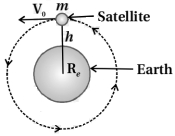
Consider a satellite of mass $m$ at a height $h$ from the surface of the Earth,revolving around the Earth as shown in the figure. Its distance from the center of the Earth is $r = R_E + h$. Let the orbital velocity of the satellite be $v_0$.
The gravitational force exerted on the satellite by the Earth is:
$F = \frac{G M_E m}{r^2}$
The necessary centripetal force for the circular motion of the satellite is provided by the Earth's gravitational force:
$F_c = \frac{m v_0^2}{r}$
Equating the centripetal force to the gravitational force:
$\frac{m v_0^2}{r} = \frac{G M_E m}{r^2}$
Simplifying the equation:
$v_0^2 = \frac{G M_E}{r}$
Substituting $r = R_E + h$:
$v_0 = \sqrt{\frac{G M_E}{R_E + h}}$
This equation indicates that as the height $h$ increases,the orbital velocity $v_0$ decreases.
Consider a satellite of mass $m$ at a height $h$ from the surface of the Earth,revolving around the Earth as shown in the figure. Its distance from the center of the Earth is $r = R_E + h$. Let the orbital velocity of the satellite be $v_0$.
The gravitational force exerted on the satellite by the Earth is:
$F = \frac{G M_E m}{r^2}$
The necessary centripetal force for the circular motion of the satellite is provided by the Earth's gravitational force:
$F_c = \frac{m v_0^2}{r}$
Equating the centripetal force to the gravitational force:
$\frac{m v_0^2}{r} = \frac{G M_E m}{r^2}$
Simplifying the equation:
$v_0^2 = \frac{G M_E}{r}$
Substituting $r = R_E + h$:
$v_0 = \sqrt{\frac{G M_E}{R_E + h}}$
This equation indicates that as the height $h$ increases,the orbital velocity $v_0$ decreases.
0 likes
View Solution160
Medium
Obtain an equation for the orbital time period of a satellite revolving around the Earth.
Solution
(N/A) The orbital period $(T)$ of a satellite is the time taken to complete one full revolution around the Earth.
The orbital velocity of a satellite at a height $h$ above the Earth's surface is given by:
$v_{0} = \sqrt{\frac{GM_{E}}{R_{E}+h}}$ ... $(1)$
The orbital velocity is also defined as the ratio of the circumference of the orbit to the time period:
$v_{0} = \frac{2\pi(R_{E}+h)}{T}$ ... $(2)$
Equating $(1)$ and $(2)$:
$\sqrt{\frac{GM_{E}}{R_{E}+h}} = \frac{2\pi(R_{E}+h)}{T}$
Rearranging for $T$:
$T = \frac{2\pi(R_{E}+h)}{\sqrt{\frac{GM_{E}}{R_{E}+h}}}$
$T = 2\pi \sqrt{\frac{(R_{E}+h)^{3}}{GM_{E}}}$ ... $(3)$
Squaring both sides:
$T^{2} = \frac{4\pi^{2}}{GM_{E}}(R_{E}+h)^{3}$ ... $(4)$
Using the relation $g = \frac{GM_{E}}{(R_{E}+h)^{2}}$,we can express the period in terms of acceleration due to gravity $g$ at height $h$:
$T = 2\pi \sqrt{\frac{R_{E}+h}{g}}$ ... $(5)$
From equation $(4)$,if we let $r = R_{E}+h$,then $T^{2} = Kr^{3}$,where $K = \frac{4\pi^{2}}{GM_{E}}$. This confirms Kepler's third law of planetary motion,$T^{2} \propto r^{3}$.
The orbital velocity of a satellite at a height $h$ above the Earth's surface is given by:
$v_{0} = \sqrt{\frac{GM_{E}}{R_{E}+h}}$ ... $(1)$
The orbital velocity is also defined as the ratio of the circumference of the orbit to the time period:
$v_{0} = \frac{2\pi(R_{E}+h)}{T}$ ... $(2)$
Equating $(1)$ and $(2)$:
$\sqrt{\frac{GM_{E}}{R_{E}+h}} = \frac{2\pi(R_{E}+h)}{T}$
Rearranging for $T$:
$T = \frac{2\pi(R_{E}+h)}{\sqrt{\frac{GM_{E}}{R_{E}+h}}}$
$T = 2\pi \sqrt{\frac{(R_{E}+h)^{3}}{GM_{E}}}$ ... $(3)$
Squaring both sides:
$T^{2} = \frac{4\pi^{2}}{GM_{E}}(R_{E}+h)^{3}$ ... $(4)$
Using the relation $g = \frac{GM_{E}}{(R_{E}+h)^{2}}$,we can express the period in terms of acceleration due to gravity $g$ at height $h$:
$T = 2\pi \sqrt{\frac{R_{E}+h}{g}}$ ... $(5)$
From equation $(4)$,if we let $r = R_{E}+h$,then $T^{2} = Kr^{3}$,where $K = \frac{4\pi^{2}}{GM_{E}}$. This confirms Kepler's third law of planetary motion,$T^{2} \propto r^{3}$.
0 likes
View Solution161
EasyMCQ
Which force is responsible for the necessary centripetal force of a satellite revolving around the Earth?
A
Gravitational force
B
Magnetic force
C
Electrostatic force
D
Frictional force
Solution
(A) satellite revolving around the Earth moves in a nearly circular orbit.
For any object to move in a circular path,a centripetal force is required.
In the case of a satellite,this centripetal force is provided by the gravitational force of attraction between the Earth and the satellite.
Mathematically,$F_c = F_g$,where $F_c = \frac{mv^2}{r}$ and $F_g = \frac{GMm}{r^2}$.
Therefore,the gravitational force is responsible for the necessary centripetal force.
For any object to move in a circular path,a centripetal force is required.
In the case of a satellite,this centripetal force is provided by the gravitational force of attraction between the Earth and the satellite.
Mathematically,$F_c = F_g$,where $F_c = \frac{mv^2}{r}$ and $F_g = \frac{GMm}{r^2}$.
Therefore,the gravitational force is responsible for the necessary centripetal force.
0 likes
View Solution162
Medium
Write the equation for the orbital velocity of a satellite revolving very close to the surface of the Earth.
Solution
(N/A) The orbital velocity $v_o$ of a satellite at a distance $r$ from the center of the Earth is given by $v_o = \sqrt{\frac{GM}{r}}$.
For a satellite revolving very close to the surface of the Earth,the distance $r$ is approximately equal to the radius of the Earth $R_e$ (i.e.,$r \approx R_e$).
Substituting $r = R_e$ into the formula,we get $v_o = \sqrt{\frac{GM}{R_e}}$.
Since the acceleration due to gravity $g$ at the surface of the Earth is given by $g = \frac{GM}{R_e^2}$,we can write $GM = gR_e^2$.
Substituting this into the orbital velocity equation,we get $v_o = \sqrt{\frac{gR_e^2}{R_e}} = \sqrt{gR_e}$.
For a satellite revolving very close to the surface of the Earth,the distance $r$ is approximately equal to the radius of the Earth $R_e$ (i.e.,$r \approx R_e$).
Substituting $r = R_e$ into the formula,we get $v_o = \sqrt{\frac{GM}{R_e}}$.
Since the acceleration due to gravity $g$ at the surface of the Earth is given by $g = \frac{GM}{R_e^2}$,we can write $GM = gR_e^2$.
Substituting this into the orbital velocity equation,we get $v_o = \sqrt{\frac{gR_e^2}{R_e}} = \sqrt{gR_e}$.
0 likes
View Solution163
Medium
Define the periodic time (orbital period) of a satellite.
Solution
(N/A) The periodic time $(T)$ of a satellite is defined as the total time taken by the satellite to complete one full revolution around the central body (such as a planet or star) in its orbit.
Mathematically,for a satellite at a distance $(r)$ from the center of a planet of mass $(M)$,the orbital period is given by:
$T = 2\pi \sqrt{\frac{r^3}{GM}}$
where:
$G$ is the universal gravitational constant,
$M$ is the mass of the central body,
$r$ is the orbital radius (distance from the center of the planet to the satellite).
Mathematically,for a satellite at a distance $(r)$ from the center of a planet of mass $(M)$,the orbital period is given by:
$T = 2\pi \sqrt{\frac{r^3}{GM}}$
where:
$G$ is the universal gravitational constant,
$M$ is the mass of the central body,
$r$ is the orbital radius (distance from the center of the planet to the satellite).
0 likes
View Solution164
Medium
Write the equation and value of the orbital periodic time of a satellite revolving very close to the surface of the Earth.
Solution
The orbital period $T$ of a satellite revolving at a distance $r$ from the center of the Earth is given by $T = 2\pi \sqrt{\frac{r^3}{GM}}$.
For a satellite revolving very close to the Earth's surface,$r \approx R_e$ (the radius of the Earth).
Substituting $GM = gR_e^2$,we get $T = 2\pi \sqrt{\frac{R_e^3}{gR_e^2}} = 2\pi \sqrt{\frac{R_e}{g}}$.
Using $R_e \approx 6.4 \times 10^6 \ m$ and $g \approx 9.8 \ m/s^2$,we calculate:
$T = 2 \times 3.14 \times \sqrt{\frac{6.4 \times 10^6}{9.8}} \approx 6.28 \times 808 \approx 5074 \ s$.
Converting to minutes,$T \approx 84.6 \ \text{minutes}$.
For a satellite revolving very close to the Earth's surface,$r \approx R_e$ (the radius of the Earth).
Substituting $GM = gR_e^2$,we get $T = 2\pi \sqrt{\frac{R_e^3}{gR_e^2}} = 2\pi \sqrt{\frac{R_e}{g}}$.
Using $R_e \approx 6.4 \times 10^6 \ m$ and $g \approx 9.8 \ m/s^2$,we calculate:
$T = 2 \times 3.14 \times \sqrt{\frac{6.4 \times 10^6}{9.8}} \approx 6.28 \times 808 \approx 5074 \ s$.
Converting to minutes,$T \approx 84.6 \ \text{minutes}$.
0 likes
View Solution165
Medium
What is a geostationary satellite? What is the orbital period of a geostationary satellite?
Solution
(N/A) geostationary satellite is an Earth satellite that has an orbital period of $24$ hours,which is equal to the rotational period of the Earth about its own axis. It appears stationary when viewed from the Earth and revolves around the Earth in the equatorial plane in the west-to-east direction.
To achieve this,the satellite is placed at a suitable height $(h)$ from the Earth's surface.
If a satellite of mass $m$ revolves at a distance $r = R_{E} + h$ from the center of the Earth,the height $h$ from the Earth's surface is given by the formula:
$h = \left( \frac{GM_{E} T^{2}}{4 \pi^{2}} \right)^{\frac{1}{3}} - R_{E}$
For a geostationary satellite,the orbital period $T = 24$ hours. Substituting this value,we get:
$h \approx 35,800 \text{ km}$
This type of satellite is widely used for telecommunication purposes.
To achieve this,the satellite is placed at a suitable height $(h)$ from the Earth's surface.
If a satellite of mass $m$ revolves at a distance $r = R_{E} + h$ from the center of the Earth,the height $h$ from the Earth's surface is given by the formula:
$h = \left( \frac{GM_{E} T^{2}}{4 \pi^{2}} \right)^{\frac{1}{3}} - R_{E}$
For a geostationary satellite,the orbital period $T = 24$ hours. Substituting this value,we get:
$h \approx 35,800 \text{ km}$
This type of satellite is widely used for telecommunication purposes.
0 likes
View Solution166
Easy
What are the conditions necessary for a satellite to appear stationary? What is the direction of rotation of a geostationary satellite?
Solution
(N/A) The conditions necessary for a satellite to appear stationary are:
$1)$ The satellite must be in a circular orbit in the equatorial plane of the Earth.
$2)$ Its orbital time period of revolution must be exactly $24$ hours.
$3)$ The satellite must revolve in the same direction as the Earth,i.e.,from west to east.
$4)$ It must be at a height of approximately $36,000 \ km$ above the Earth's equator.
The direction of rotation of a geostationary satellite is from west to east,which is the same as the rotation of the Earth about its axis.
$1)$ The satellite must be in a circular orbit in the equatorial plane of the Earth.
$2)$ Its orbital time period of revolution must be exactly $24$ hours.
$3)$ The satellite must revolve in the same direction as the Earth,i.e.,from west to east.
$4)$ It must be at a height of approximately $36,000 \ km$ above the Earth's equator.
The direction of rotation of a geostationary satellite is from west to east,which is the same as the rotation of the Earth about its axis.
0 likes
View Solution167
Medium
What is a polar satellite? What is the orbital period of a polar satellite?
Solution
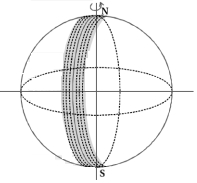
(N/A) polar satellite is a type of satellite that orbits the Earth in a north-south direction,passing over the poles,while the Earth rotates on its axis in an east-west direction.
These are low-altitude satellites,typically orbiting at a height of $h \approx 500$ to $800 \ km$ from the Earth's surface.
The orbital period of a polar satellite is approximately $100$ minutes,allowing it to cross any given latitude multiple times a day.
$A$ camera fixed on the satellite can view only small strips of the Earth in one orbit. Adjacent strips are viewed in subsequent orbits,effectively allowing the entire Earth to be scanned strip by strip throughout the day.
These satellites can observe polar and equatorial regions at close distances with high resolution.
Information gathered from such satellites is extremely useful for remote sensing,meteorology,and environmental studies of the Earth.
These are low-altitude satellites,typically orbiting at a height of $h \approx 500$ to $800 \ km$ from the Earth's surface.
The orbital period of a polar satellite is approximately $100$ minutes,allowing it to cross any given latitude multiple times a day.
$A$ camera fixed on the satellite can view only small strips of the Earth in one orbit. Adjacent strips are viewed in subsequent orbits,effectively allowing the entire Earth to be scanned strip by strip throughout the day.
These satellites can observe polar and equatorial regions at close distances with high resolution.
Information gathered from such satellites is extremely useful for remote sensing,meteorology,and environmental studies of the Earth.
0 likes
View Solution168
Difficult
At which height can a satellite be in a geostationary orbit? To remain geostationary,obtain the equation for its height from the surface of the Earth.
Solution
(N/A) geostationary satellite must have an orbital period $T$ equal to the Earth's rotation period,which is $T = 24 \text{ hours} = 86400 \text{ s}$.
From Kepler's third law,the square of the orbital period is proportional to the cube of the orbital radius $r$: $T^2 = \frac{4\pi^2 r^3}{GM}$.
Here,$r = R_e + h$,where $R_e$ is the Earth's radius and $h$ is the height above the surface.
Rearranging for $r$: $r = \left( \frac{GMT^2}{4\pi^2} \right)^{1/3}$.
Substituting $GM = gR_e^2$,we get $r = \left( \frac{gR_e^2 T^2}{4\pi^2} \right)^{1/3}$.
The height $h$ is given by $h = r - R_e = \left( \frac{GMT^2}{4\pi^2} \right)^{1/3} - R_e$.
Substituting standard values ($M \approx 5.97 \times 10^{24} \text{ kg}$,$G \approx 6.67 \times 10^{-11} \text{ Nm}^2/\text{kg}^2$),the calculated height $h$ is approximately $35,800 \text{ km}$ above the Earth's surface.
From Kepler's third law,the square of the orbital period is proportional to the cube of the orbital radius $r$: $T^2 = \frac{4\pi^2 r^3}{GM}$.
Here,$r = R_e + h$,where $R_e$ is the Earth's radius and $h$ is the height above the surface.
Rearranging for $r$: $r = \left( \frac{GMT^2}{4\pi^2} \right)^{1/3}$.
Substituting $GM = gR_e^2$,we get $r = \left( \frac{gR_e^2 T^2}{4\pi^2} \right)^{1/3}$.
The height $h$ is given by $h = r - R_e = \left( \frac{GMT^2}{4\pi^2} \right)^{1/3} - R_e$.
Substituting standard values ($M \approx 5.97 \times 10^{24} \text{ kg}$,$G \approx 6.67 \times 10^{-11} \text{ Nm}^2/\text{kg}^2$),the calculated height $h$ is approximately $35,800 \text{ km}$ above the Earth's surface.
0 likes
View Solution169
Medium
Give the uses of geostationary satellite and polar satellite.
Solution
(N/A) Geostationary satellites are used for:
$1$. Telecommunication: They act as relay stations for television,radio,and telephone signals.
$2$. Weather forecasting: They provide continuous monitoring of weather patterns over a specific region.
Polar satellites are used for:
$1$. Remote sensing: They are used for mapping,resource exploration,and monitoring environmental changes.
$2$. Surveillance: They are used for military reconnaissance and monitoring borders.
$3$. Scientific research: They help in studying the atmosphere and Earth's magnetic field.
$1$. Telecommunication: They act as relay stations for television,radio,and telephone signals.
$2$. Weather forecasting: They provide continuous monitoring of weather patterns over a specific region.
Polar satellites are used for:
$1$. Remote sensing: They are used for mapping,resource exploration,and monitoring environmental changes.
$2$. Surveillance: They are used for military reconnaissance and monitoring borders.
$3$. Scientific research: They help in studying the atmosphere and Earth's magnetic field.
0 likes
View Solution170
MediumMCQ
At which height from the surface of the Earth does a polar satellite revolve around the Earth?
A
$500 \text{ km} - 800 \text{ km}$
B
$35,780 \text{ km}$
C
$100 \text{ km} - 200 \text{ km}$
D
$10,000 \text{ km} - 20,000 \text{ km}$
Solution
$(A)$ Polar satellites are low-altitude satellites that orbit the Earth from pole to pole.
These satellites typically revolve around the Earth at a height of approximately $500 \text{ km}$ to $800 \text{ km}$ above the Earth's surface.
This low altitude allows them to capture high-resolution images of the Earth's surface for weather monitoring and surveillance.
Therefore, the correct option is $A$.
These satellites typically revolve around the Earth at a height of approximately $500 \text{ km}$ to $800 \text{ km}$ above the Earth's surface.
This low altitude allows them to capture high-resolution images of the Earth's surface for weather monitoring and surveillance.
Therefore, the correct option is $A$.
0 likes
View Solution171
MediumMCQ
Who decides the upward direction in an artificial satellite?
A
The Earth's gravitational pull
B
The direction of the satellite's velocity
C
The orientation of the satellite's internal reference frame
D
There is no defined upward direction in an artificial satellite
Solution
(D) In an artificial satellite orbiting the Earth,the satellite and everything inside it are in a state of free fall. Because the gravitational force provides the necessary centripetal acceleration for the orbit,there is no normal force acting on objects inside the satellite to define a 'weight' or an 'upward' direction. Consequently,there is no sensation of gravity,and no physical 'up' or 'down' exists relative to the satellite's frame of reference. Therefore,there is no defined upward direction.
0 likes
View Solution172
DifficultMCQ
Which fact is represented by the pictures of an astronaut floating in a satellite?
A
The astronaut is in a state of weightlessness.
B
The astronaut is in a state of high gravity.
C
The astronaut is in a state of zero mass.
D
The astronaut is in a state of vacuum.
Solution
(A) When an astronaut is inside an orbiting satellite,both the astronaut and the satellite are in a state of free fall towards the Earth due to gravity.
Since both have the same acceleration (the acceleration due to gravity at that altitude),the relative acceleration between them is zero.
This condition is known as weightlessness.
Therefore,the astronaut appears to be floating inside the satellite.
Since both have the same acceleration (the acceleration due to gravity at that altitude),the relative acceleration between them is zero.
This condition is known as weightlessness.
Therefore,the astronaut appears to be floating inside the satellite.
0 likes
View Solution173
DifficultMCQ
Even though the gravitational force of the Earth acts on the Moon towards its center,why does the Moon not fall onto the Earth?
A
The Moon is too far away.
B
The Earth's gravitational force provides the necessary centripetal force for the Moon's orbital motion.
C
The Moon has its own gravitational force that repels the Earth.
D
The Moon is moving in a vacuum where gravity does not work.
Solution
(B) The gravitational force exerted by the Earth on the Moon provides the necessary centripetal force for the Moon to maintain its circular orbit around the Earth.
Since this gravitational force acts perpendicular to the Moon's linear velocity,it only changes the direction of the Moon's motion,not its speed.
Therefore,the Moon continues to revolve in its orbit instead of falling onto the Earth.
Since this gravitational force acts perpendicular to the Moon's linear velocity,it only changes the direction of the Moon's motion,not its speed.
Therefore,the Moon continues to revolve in its orbit instead of falling onto the Earth.
0 likes
View Solution174
MediumMCQ
Does a satellite require fuel to orbit around the Earth?
A
Yes,it requires fuel to maintain its speed.
B
No,because the gravitational force of the Earth provides the necessary centripetal force for its orbit.
C
Yes,it requires fuel to overcome air resistance.
D
No,because the satellite is in a state of weightlessness.
Solution
(B) No,a satellite does not require fuel to orbit the Earth. The gravitational force exerted by the Earth on the satellite provides the necessary centripetal force required for its circular motion. Since this force is always perpendicular to the velocity of the satellite,no work is done by the gravitational force,and the satellite continues to orbit without the need for additional fuel.
0 likes
View Solution175
MediumMCQ
Does the orbital velocity of a planet depend on its mass?
A
Yes
B
No
C
Depends on the distance
D
Depends on the shape of the orbit
Solution
(B) No,the orbital velocity of a planet does not depend on its mass.
According to the formula for orbital velocity,$v_{0} = \sqrt{\frac{GM_{e}}{r}}$,where $G$ is the gravitational constant,$M_{e}$ is the mass of the central body (e.g.,the Sun),and $r$ is the orbital radius.
Since the mass of the orbiting planet does not appear in this expression,the orbital velocity is independent of the planet's mass.
According to the formula for orbital velocity,$v_{0} = \sqrt{\frac{GM_{e}}{r}}$,where $G$ is the gravitational constant,$M_{e}$ is the mass of the central body (e.g.,the Sun),and $r$ is the orbital radius.
Since the mass of the orbiting planet does not appear in this expression,the orbital velocity is independent of the planet's mass.
0 likes
View Solution176
MediumMCQ
What is the effect on the time period of a satellite orbiting around the Earth if its height decreases?
A
It increases
B
It decreases
C
It remains constant
D
It becomes zero
Solution
(B) The time period $T$ of a satellite is given by the formula $T = 2 \pi \sqrt{\frac{(R_e + h)^3}{GM_e}}$,where $R_e$ is the radius of the Earth,$h$ is the height of the satellite above the Earth's surface,$G$ is the gravitational constant,and $M_e$ is the mass of the Earth.
From the formula,it is clear that $T \propto (R_e + h)^{3/2}$.
As the height $h$ decreases,the term $(R_e + h)$ decreases.
Therefore,the time period $T$ of the satellite decreases.
From the formula,it is clear that $T \propto (R_e + h)^{3/2}$.
As the height $h$ decreases,the term $(R_e + h)$ decreases.
Therefore,the time period $T$ of the satellite decreases.
0 likes
View Solution177
EasyMCQ
Suppose an astronaut throws a spoon out of a spacecraft. Will the spoon fall to the Earth?
A
Yes,it will fall to the Earth due to gravity.
B
No,it will continue to orbit the Earth with the same orbital velocity as the spacecraft.
C
No,it will fly away into deep space.
D
Yes,it will burn up in the atmosphere.
Solution
(B) No,the spoon will not fall to the Earth.
Since the spoon was inside the spacecraft,it shares the same orbital velocity as the spacecraft.
When thrown out,it continues to move in the same orbit with the same velocity as the spacecraft.
Therefore,it will remain in orbit around the Earth alongside the spacecraft and will not fall to the surface.
Since the spoon was inside the spacecraft,it shares the same orbital velocity as the spacecraft.
When thrown out,it continues to move in the same orbit with the same velocity as the spacecraft.
Therefore,it will remain in orbit around the Earth alongside the spacecraft and will not fall to the surface.
0 likes
View Solution178
EasyMCQ
Why does a satellite not have an escape velocity?
A
Because it is in a closed orbit.
B
Because its energy is positive.
C
Because it is not a projectile.
D
Because it is moving with constant speed.
Solution
(A) satellite is defined as an object that revolves around a planet in a stable,closed orbit under the influence of gravitational force.
If a satellite were to attain the escape velocity,it would leave its orbit and move to infinity,thereby ceasing to be a satellite of that planet.
Therefore,by definition,a satellite in a stable orbit does not possess the escape velocity required to leave the gravitational influence of the central body.
If a satellite were to attain the escape velocity,it would leave its orbit and move to infinity,thereby ceasing to be a satellite of that planet.
Therefore,by definition,a satellite in a stable orbit does not possess the escape velocity required to leave the gravitational influence of the central body.
0 likes
View Solution179
MediumMCQ
What are the directions of rotation of a polar satellite and the Earth?
A
Polar satellite: North-South,Earth: West-East
B
Polar satellite: East-West,Earth: West-East
C
Polar satellite: North-South,Earth: East-West
D
Polar satellite: West-East,Earth: West-East
Solution
(A) polar satellite orbits the Earth in a North-South direction,passing over the poles as the Earth rotates underneath it.
The Earth rotates about its own axis from West to East.
The Earth rotates about its own axis from West to East.
0 likes
View Solution180
EasyMCQ
Why can the entire surface of the Earth be viewed with the help of a polar satellite?
A
Because it orbits in an equatorial plane.
B
Because it orbits in a north-south direction while the Earth rotates from west to east.
C
Because it is geostationary.
D
Because it remains at a fixed point above the Earth.
Solution
(B) polar satellite orbits the Earth in a north-south direction (passing over the poles).
Since the Earth rotates on its axis from west to east,the satellite covers a different strip of the Earth's surface with each orbit.
Over a period of time,the entire surface of the Earth is scanned by the satellite.
Since the Earth rotates on its axis from west to east,the satellite covers a different strip of the Earth's surface with each orbit.
Over a period of time,the entire surface of the Earth is scanned by the satellite.
0 likes
View Solution181
Easy
What are the orbital period of the Moon around the Earth and the rotational period of the Moon about its own axis?
Solution
(N/A) The orbital period of the Moon around the Earth is approximately $27.3$ days.
Similarly,the rotational period of the Moon about its own axis is also approximately $27.3$ days.
Because these two periods are equal,the same side of the Moon always faces the Earth.
Similarly,the rotational period of the Moon about its own axis is also approximately $27.3$ days.
Because these two periods are equal,the same side of the Moon always faces the Earth.
0 likes
View Solution182
Medium
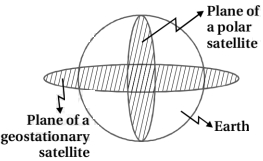
What is the angle between the equatorial plane and the orbital plane of $(a)$ a polar satellite? $(b)$ a geostationary satellite?
Solution
(N/A) The equatorial plane is the plane passing through the Earth's equator.
$(a)$ $A$ polar satellite orbits the Earth in a plane that passes through the North and South poles. Since this plane is perpendicular to the equatorial plane,the angle between them is $90^{\circ}$.
$(b)$ $A$ geostationary satellite orbits the Earth in the same plane as the Earth's equatorial plane to remain stationary relative to a point on the Earth's surface. Therefore,the angle between the orbital plane of a geostationary satellite and the equatorial plane is $0^{\circ}$.
$(a)$ $A$ polar satellite orbits the Earth in a plane that passes through the North and South poles. Since this plane is perpendicular to the equatorial plane,the angle between them is $90^{\circ}$.
$(b)$ $A$ geostationary satellite orbits the Earth in the same plane as the Earth's equatorial plane to remain stationary relative to a point on the Earth's surface. Therefore,the angle between the orbital plane of a geostationary satellite and the equatorial plane is $0^{\circ}$.
0 likes
View Solution183
Medium
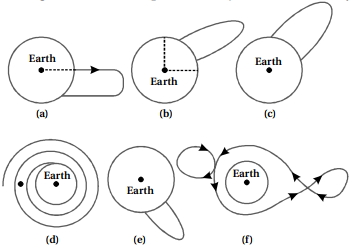
Shown are several curves [fig. $(a)$,$(b)$,$(c)$,$(d)$,$(e)$,$(f)$]. Explain with reason,which ones amongst them can be possible trajectories traced by a projectile (neglect air friction).
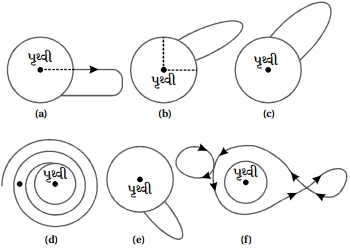
Solution
(C) According to Kepler's laws of planetary motion and Newton's law of gravitation,the trajectory of a particle moving under the influence of a central gravitational force (like that of the Earth) must be a conic section (ellipse,parabola,or hyperbola) with the center of the Earth as one of its foci.
$1$. Figure $(a)$ is not a conic section.
$2$. Figure $(b)$ does not have the Earth at a focus.
$3$. Figure $(c)$ shows an elliptical path with the Earth at one of its foci,which is a valid trajectory.
$4$. Figure $(d)$ is a spiral,which is not a conic section.
$5$. Figure $(e)$ does not have the Earth at a focus.
$6$. Figure $(f)$ is a complex path that does not represent a standard conic section.
Therefore,only figure $(c)$ represents a possible trajectory for a projectile.
$1$. Figure $(a)$ is not a conic section.
$2$. Figure $(b)$ does not have the Earth at a focus.
$3$. Figure $(c)$ shows an elliptical path with the Earth at one of its foci,which is a valid trajectory.
$4$. Figure $(d)$ is a spiral,which is not a conic section.
$5$. Figure $(e)$ does not have the Earth at a focus.
$6$. Figure $(f)$ is a complex path that does not represent a standard conic section.
Therefore,only figure $(c)$ represents a possible trajectory for a projectile.
0 likes
View Solution184
Medium
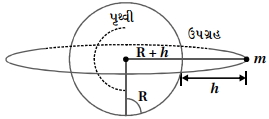
$A$ satellite is to be placed in an equatorial geostationary orbit around the Earth for communication.
$(a)$ Calculate the height of such a satellite.
$(b)$ Find out the minimum number of satellites that are needed to cover the entire Earth,so that at least one satellite is visible from any point on the equator.
Given: $M = 6 \times 10^{24} \ kg$,$R = 6400 \ km$,$T = 24 \ h$,$G = 6.67 \times 10^{-11} \ N \cdot m^2/kg^2$.
$(a)$ Calculate the height of such a satellite.
$(b)$ Find out the minimum number of satellites that are needed to cover the entire Earth,so that at least one satellite is visible from any point on the equator.
Given: $M = 6 \times 10^{24} \ kg$,$R = 6400 \ km$,$T = 24 \ h$,$G = 6.67 \times 10^{-11} \ N \cdot m^2/kg^2$.
Solution
(N/A) Given:
Mass of the Earth,$M = 6 \times 10^{24} \ kg$
Radius of the Earth,$R = 6400 \ km = 6.4 \times 10^6 \ m$
Time period,$T = 24 \ h = 24 \times 3600 \ s = 86400 \ s$
Gravitational constant,$G = 6.67 \times 10^{-11} \ N \cdot m^2/kg^2$
$(a)$ For a geostationary satellite,the orbital period $T$ is related to the orbital radius $r = R + h$ by Kepler's Third Law:
$T^2 = \frac{4 \pi^2 r^3}{GM}$
$r^3 = \frac{T^2 GM}{4 \pi^2}$
$r = \left( \frac{T^2 GM}{4 \pi^2} \right)^{1/3}$
Substituting the values:
$r = \left( \frac{(86400)^2 \times 6.67 \times 10^{-11} \times 6 \times 10^{24}}{4 \times (3.14)^2} \right)^{1/3} \approx 4.22 \times 10^7 \ m$
Height $h = r - R = 4.22 \times 10^7 \ m - 0.64 \times 10^7 \ m = 3.58 \times 10^7 \ m = 35800 \ km$.
$(b)$ To cover the entire equator,each satellite must cover an angular width of $120^\circ$ (or $2\pi/3$ radians) to ensure global coverage with three satellites. Thus,the minimum number of satellites required is $3$.
Mass of the Earth,$M = 6 \times 10^{24} \ kg$
Radius of the Earth,$R = 6400 \ km = 6.4 \times 10^6 \ m$
Time period,$T = 24 \ h = 24 \times 3600 \ s = 86400 \ s$
Gravitational constant,$G = 6.67 \times 10^{-11} \ N \cdot m^2/kg^2$
$(a)$ For a geostationary satellite,the orbital period $T$ is related to the orbital radius $r = R + h$ by Kepler's Third Law:
$T^2 = \frac{4 \pi^2 r^3}{GM}$
$r^3 = \frac{T^2 GM}{4 \pi^2}$
$r = \left( \frac{T^2 GM}{4 \pi^2} \right)^{1/3}$
Substituting the values:
$r = \left( \frac{(86400)^2 \times 6.67 \times 10^{-11} \times 6 \times 10^{24}}{4 \times (3.14)^2} \right)^{1/3} \approx 4.22 \times 10^7 \ m$
Height $h = r - R = 4.22 \times 10^7 \ m - 0.64 \times 10^7 \ m = 3.58 \times 10^7 \ m = 35800 \ km$.
$(b)$ To cover the entire equator,each satellite must cover an angular width of $120^\circ$ (or $2\pi/3$ radians) to ensure global coverage with three satellites. Thus,the minimum number of satellites required is $3$.
0 likes
View Solution185
Difficult
$A$ satellite is in an elliptic orbit around the Earth with an aphelion of $6R$ and a perihelion of $2R$,where $R = 6400 \, km$ is the radius of the Earth. Find the eccentricity of the orbit. Find the velocity of the satellite at apogee and perigee. What should be done if this satellite has to be transferred to a circular orbit of radius $6R$? $(G = 6.67 \times 10^{-11} \, SI \text{ units and } M = 6 \times 10^{24} \, kg)$
Solution
(A) Given: $r_p = 2R$ and $r_a = 6R$.
Using the properties of an ellipse: $r_a = a(1+e) = 6R$ and $r_p = a(1-e) = 2R$.
Dividing the two equations: $\frac{1+e}{1-e} = \frac{6R}{2R} = 3 \implies 1+e = 3 - 3e \implies 4e = 2 \implies e = 0.5$.
Using conservation of angular momentum: $m v_p r_p = m v_a r_a \implies v_a = v_p \frac{r_p}{r_a} = v_p \frac{2R}{6R} = \frac{v_p}{3}$.
Using conservation of energy: $\frac{1}{2} m v_p^2 - \frac{GMm}{r_p} = \frac{1}{2} m v_a^2 - \frac{GMm}{r_a}$.
Substituting $v_a = v_p/3$: $\frac{1}{2} v_p^2 (1 - 1/9) = GM (\frac{1}{2R} - \frac{1}{6R}) = GM (\frac{2}{6R}) = \frac{GM}{3R}$.
$\frac{4}{9} v_p^2 = \frac{GM}{3R} \implies v_p^2 = \frac{3GM}{4R} \implies v_p = \sqrt{\frac{3 \times 6.67 \times 10^{-11} \times 6 \times 10^{24}}{4 \times 6400 \times 10^3}} \approx 5.59 \, km/s$.
Then $v_a = v_p/3 \approx 1.86 \, km/s$.
To transfer to a circular orbit of radius $6R$,the satellite must be at apogee $(r=6R)$ and its velocity must be increased to the orbital velocity $v_c = \sqrt{\frac{GM}{6R}} \approx 2.64 \, km/s$.
Using the properties of an ellipse: $r_a = a(1+e) = 6R$ and $r_p = a(1-e) = 2R$.
Dividing the two equations: $\frac{1+e}{1-e} = \frac{6R}{2R} = 3 \implies 1+e = 3 - 3e \implies 4e = 2 \implies e = 0.5$.
Using conservation of angular momentum: $m v_p r_p = m v_a r_a \implies v_a = v_p \frac{r_p}{r_a} = v_p \frac{2R}{6R} = \frac{v_p}{3}$.
Using conservation of energy: $\frac{1}{2} m v_p^2 - \frac{GMm}{r_p} = \frac{1}{2} m v_a^2 - \frac{GMm}{r_a}$.
Substituting $v_a = v_p/3$: $\frac{1}{2} v_p^2 (1 - 1/9) = GM (\frac{1}{2R} - \frac{1}{6R}) = GM (\frac{2}{6R}) = \frac{GM}{3R}$.
$\frac{4}{9} v_p^2 = \frac{GM}{3R} \implies v_p^2 = \frac{3GM}{4R} \implies v_p = \sqrt{\frac{3 \times 6.67 \times 10^{-11} \times 6 \times 10^{24}}{4 \times 6400 \times 10^3}} \approx 5.59 \, km/s$.
Then $v_a = v_p/3 \approx 1.86 \, km/s$.
To transfer to a circular orbit of radius $6R$,the satellite must be at apogee $(r=6R)$ and its velocity must be increased to the orbital velocity $v_c = \sqrt{\frac{GM}{6R}} \approx 2.64 \, km/s$.
0 likes
View Solution186
EasyMCQ
Match the types of satellites in Column-$I$ with their applications in Column-$II$.
| Column-$I$ | Column-$II$ |
| $(1)$ Polar satellite | $(a)$ Telecommunication |
| $(2)$ Geostationary satellite | $(b)$ Spying |
| $(c)$ Weather forecasting |
A
$(1-b, c), (2-a)$
B
$(1-b), (2-c)$
C
$(1-a), (2-b)$
D
$(1-c), (2-a, b)$
Solution
(A) Polar satellites orbit the Earth from pole to pole,providing a global view of the surface,which makes them ideal for spying and weather monitoring $(1-b, c)$.
Geostationary satellites remain fixed relative to a point on Earth's surface,making them ideal for continuous telecommunication and broadcasting services $(2-a)$.
Therefore,the correct matching is $(1-b, c)$ and $(2-a)$.
Geostationary satellites remain fixed relative to a point on Earth's surface,making them ideal for continuous telecommunication and broadcasting services $(2-a)$.
Therefore,the correct matching is $(1-b, c)$ and $(2-a)$.
0 likes
View Solution187
DifficultMCQ
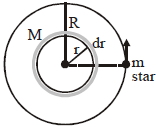
The mass density of a spherical galaxy varies as $\frac{K}{r}$ over a large distance $r$ from its centre. In that region,a small star is in a circular orbit of radius $R$. Then the period of revolution,$T$ depends on $R$ as
A
$T \propto R$
B
$T^2 \propto \frac{1}{R^3}$
C
$T^2 \propto R$
D
$T^2 \propto R^3$
Solution
(C) The mass of the galaxy within a radius $R$ is calculated by integrating the density $\rho(r) = \frac{K}{r}$ over the volume.
$dm = \rho(r) \cdot 4\pi r^2 dr = \left(\frac{K}{r}\right) \cdot 4\pi r^2 dr = 4\pi K r dr$
$M(R) = \int_{0}^{R} 4\pi K r dr = 4\pi K \left[ \frac{r^2}{2} \right]_{0}^{R} = 2\pi K R^2$
For a star of mass $m$ in a circular orbit of radius $R$,the gravitational force provides the necessary centripetal force:
$\frac{G M(R) m}{R^2} = \frac{m v^2}{R}$
Substituting $M(R) = 2\pi K R^2$:
$\frac{G (2\pi K R^2) m}{R^2} = \frac{m v^2}{R} \Rightarrow 2\pi G K m = \frac{m v^2}{R} \Rightarrow v^2 = 2\pi G K R$
$v = \sqrt{2\pi G K R}$
The time period $T$ is given by $T = \frac{2\pi R}{v}$.
$T = \frac{2\pi R}{\sqrt{2\pi G K R}} = \sqrt{\frac{4\pi^2 R^2}{2\pi G K R}} = \sqrt{\frac{2\pi R}{G K}} \propto \sqrt{R}$
Squaring both sides,we get $T^2 \propto R$.
$dm = \rho(r) \cdot 4\pi r^2 dr = \left(\frac{K}{r}\right) \cdot 4\pi r^2 dr = 4\pi K r dr$
$M(R) = \int_{0}^{R} 4\pi K r dr = 4\pi K \left[ \frac{r^2}{2} \right]_{0}^{R} = 2\pi K R^2$
For a star of mass $m$ in a circular orbit of radius $R$,the gravitational force provides the necessary centripetal force:
$\frac{G M(R) m}{R^2} = \frac{m v^2}{R}$
Substituting $M(R) = 2\pi K R^2$:
$\frac{G (2\pi K R^2) m}{R^2} = \frac{m v^2}{R} \Rightarrow 2\pi G K m = \frac{m v^2}{R} \Rightarrow v^2 = 2\pi G K R$
$v = \sqrt{2\pi G K R}$
The time period $T$ is given by $T = \frac{2\pi R}{v}$.
$T = \frac{2\pi R}{\sqrt{2\pi G K R}} = \sqrt{\frac{4\pi^2 R^2}{2\pi G K R}} = \sqrt{\frac{2\pi R}{G K}} \propto \sqrt{R}$
Squaring both sides,we get $T^2 \propto R$.
0 likes
View Solution188
DifficultMCQ
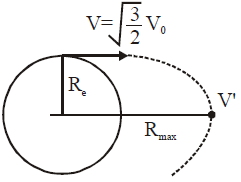
$A$ satellite is moving in a low nearly circular orbit around the earth. Its radius is roughly equal to that of the earth's radius $R_e$. By firing rockets attached to it,its speed is instantaneously increased in the direction of its motion so that it becomes $\sqrt{\frac{3}{2}}$ times larger. Due to this,the farthest distance from the centre of the earth that the satellite reaches is $R$. The value of $R$ is $....R_e$.
A
$4$
B
$3$
C
$2$
D
$2.5$
Solution
(B) The initial orbital speed of the satellite is $V_0 = \sqrt{\frac{GM}{R_e}}$.
After firing the rockets,the new speed is $V = \sqrt{\frac{3}{2}} V_0 = \sqrt{\frac{3GM}{2R_e}}$.
Using the conservation of angular momentum at the perigee $(R_e)$ and apogee $(R_{max} = R)$:
$L_{initial} = L_{final} \implies m V R_e = m V' R$
$V' = \frac{V R_e}{R} = \frac{R_e}{R} \sqrt{\frac{3GM}{2R_e}}$
Using the conservation of mechanical energy:
$-\frac{GMm}{R_e} + \frac{1}{2} m V^2 = -\frac{GMm}{R} + \frac{1}{2} m V'^2$
$-\frac{GM}{R_e} + \frac{1}{2} \left(\frac{3GM}{2R_e}\right) = -\frac{GM}{R} + \frac{1}{2} \left(\frac{R_e^2}{R^2} \cdot \frac{3GM}{2R_e}\right)$
$-\frac{1}{R_e} + \frac{3}{4R_e} = -\frac{1}{R} + \frac{3R_e}{4R^2}$
$-\frac{1}{4R_e} = \frac{-4R + 3R_e}{4R^2}$
$-R^2 = -4R R_e + 3R_e^2 \implies R^2 - 4R R_e + 3R_e^2 = 0$
$(R - 3R_e)(R - R_e) = 0$
Since $R > R_e$,we get $R = 3R_e$.
After firing the rockets,the new speed is $V = \sqrt{\frac{3}{2}} V_0 = \sqrt{\frac{3GM}{2R_e}}$.
Using the conservation of angular momentum at the perigee $(R_e)$ and apogee $(R_{max} = R)$:
$L_{initial} = L_{final} \implies m V R_e = m V' R$
$V' = \frac{V R_e}{R} = \frac{R_e}{R} \sqrt{\frac{3GM}{2R_e}}$
Using the conservation of mechanical energy:
$-\frac{GMm}{R_e} + \frac{1}{2} m V^2 = -\frac{GMm}{R} + \frac{1}{2} m V'^2$
$-\frac{GM}{R_e} + \frac{1}{2} \left(\frac{3GM}{2R_e}\right) = -\frac{GM}{R} + \frac{1}{2} \left(\frac{R_e^2}{R^2} \cdot \frac{3GM}{2R_e}\right)$
$-\frac{1}{R_e} + \frac{3}{4R_e} = -\frac{1}{R} + \frac{3R_e}{4R^2}$
$-\frac{1}{4R_e} = \frac{-4R + 3R_e}{4R^2}$
$-R^2 = -4R R_e + 3R_e^2 \implies R^2 - 4R R_e + 3R_e^2 = 0$
$(R - 3R_e)(R - R_e) = 0$
Since $R > R_e$,we get $R = 3R_e$.
1 likes
View Solution189
MediumMCQ
$A$ body is moving in a low circular orbit about a planet of mass $M$ and radius $R$. The radius of the orbit can be taken to be $R$ itself. Then the ratio of the speed of this body in the orbit to the escape velocity from the planet is
A
$1$
B
$2$
C
$\frac{1}{\sqrt{2}}$
D
$\sqrt{2}$
Solution
(C) The orbital speed of a body in a circular orbit at a distance $R$ from the center of a planet of mass $M$ is given by $V_{\text{orbit}} = \sqrt{\frac{GM}{R}}$.
The escape velocity from the surface of the planet is given by $V_{\text{escape}} = \sqrt{\frac{2GM}{R}}$.
Taking the ratio of the orbital speed to the escape velocity,we get:
$\frac{V_{\text{orbit}}}{V_{\text{escape}}} = \frac{\sqrt{\frac{GM}{R}}}{\sqrt{\frac{2GM}{R}}} = \frac{1}{\sqrt{2}}$.
The escape velocity from the surface of the planet is given by $V_{\text{escape}} = \sqrt{\frac{2GM}{R}}$.
Taking the ratio of the orbital speed to the escape velocity,we get:
$\frac{V_{\text{orbit}}}{V_{\text{escape}}} = \frac{\sqrt{\frac{GM}{R}}}{\sqrt{\frac{2GM}{R}}} = \frac{1}{\sqrt{2}}$.
0 likes
View Solution190
MediumMCQ
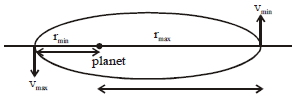
$A$ satellite is in an elliptical orbit around a planet $P.$ It is observed that the velocity of the satellite when it is farthest from the planet is $6$ times less than that when it is closest to the planet. The ratio of distances between the satellite and the planet at closest and farthest points is $......$
A
$1:6$
B
$3:4$
C
$1:3$
D
$1:2$
Solution
(A) According to the law of conservation of angular momentum,the angular momentum of the satellite remains constant throughout its orbit.
At the closest point (periapsis) and farthest point (apoapsis),the velocity vector is perpendicular to the position vector.
Therefore,$L = m r_{\min} V_{\max} = m r_{\max} V_{\min}$.
This simplifies to $r_{\min} V_{\max} = r_{\max} V_{\min} \quad \dots(i)$.
Given that the velocity at the farthest point is $6$ times less than the velocity at the closest point,we have $V_{\min} = \frac{V_{\max}}{6}$,or $\frac{V_{\min}}{V_{\max}} = \frac{1}{6}$.
Substituting this into equation $(i)$,we get $\frac{r_{\min}}{r_{\max}} = \frac{V_{\min}}{V_{\max}} = \frac{1}{6}$.
Thus,the ratio of the distances is $1:6$.
At the closest point (periapsis) and farthest point (apoapsis),the velocity vector is perpendicular to the position vector.
Therefore,$L = m r_{\min} V_{\max} = m r_{\max} V_{\min}$.
This simplifies to $r_{\min} V_{\max} = r_{\max} V_{\min} \quad \dots(i)$.
Given that the velocity at the farthest point is $6$ times less than the velocity at the closest point,we have $V_{\min} = \frac{V_{\max}}{6}$,or $\frac{V_{\min}}{V_{\max}} = \frac{1}{6}$.
Substituting this into equation $(i)$,we get $\frac{r_{\min}}{r_{\max}} = \frac{V_{\min}}{V_{\max}} = \frac{1}{6}$.
Thus,the ratio of the distances is $1:6$.
0 likes
View Solution191
MediumMCQ
Which of the following graphs represents the relationship between the orbital velocity $(v_o)$ of a satellite and its distance $(r)$ from the center of the Earth?
A
$v_o \propto r$
B
$v_o \propto 1/r$
C
$v_o \propto 1/\sqrt{r}$
D
$v_o \propto \sqrt{r}$
Solution
(C) The orbital velocity $(v_o)$ of a satellite orbiting the Earth at a distance $(r)$ from the center is given by the formula:
$v_o = \sqrt{\frac{GM}{r}}$
where $G$ is the gravitational constant and $M$ is the mass of the Earth.
From this expression, it is clear that $v_o$ is inversely proportional to the square root of the distance $r$:
$v_o \propto \frac{1}{\sqrt{r}}$
Therefore, the correct relationship is $v_o \propto 1/\sqrt{r}$.
$v_o = \sqrt{\frac{GM}{r}}$
where $G$ is the gravitational constant and $M$ is the mass of the Earth.
From this expression, it is clear that $v_o$ is inversely proportional to the square root of the distance $r$:
$v_o \propto \frac{1}{\sqrt{r}}$
Therefore, the correct relationship is $v_o \propto 1/\sqrt{r}$.
0 likes
View Solution192
DifficultMCQ
Two satellites $A$ and $B$ revolve around the same planet in coplanar circular orbits. Their periods of revolution are $1\, h$ and $8\, h$,respectively. The radius of the orbit of $A$ is $10^{4}\, km$. The speed of $B$ relative to $A$ when they are closest is (in $km/h$):
A
$3 \pi \times 10^{4}$
B
zero
C
$2 \pi \times 10^{4}$
D
$\pi \times 10^{4}$
Solution
(D) According to Kepler's third law of planetary motion,the square of the time period is proportional to the cube of the orbital radius: $\frac{T_{A}^{2}}{T_{B}^{2}} = \frac{r_{A}^{3}}{r_{B}^{3}}$.
Given $T_{A} = 1\, h$,$T_{B} = 8\, h$,and $r_{A} = 10^{4}\, km$.
Substituting the values: $\frac{1^{2}}{8^{2}} = \frac{(10^{4})^{3}}{r_{B}^{3}} \Rightarrow \frac{1}{64} = \frac{(10^{4})^{3}}{r_{B}^{3}}$.
Thus,$r_{B}^{3} = 64 \times (10^{4})^{3}$,which gives $r_{B} = 4 \times 10^{4}\, km$.
The orbital speed of a satellite is given by $v = \frac{2 \pi r}{T}$.
For satellite $A$: $v_{A} = \frac{2 \pi \times 10^{4}}{1} = 2 \pi \times 10^{4}\, km/h$.
For satellite $B$: $v_{B} = \frac{2 \pi \times 4 \times 10^{4}}{8} = \pi \times 10^{4}\, km/h$.
Since both satellites revolve in the same direction in coplanar orbits,their relative speed when they are closest is the difference of their orbital speeds: $v_{rel} = v_{A} - v_{B} = 2 \pi \times 10^{4} - \pi \times 10^{4} = \pi \times 10^{4}\, km/h$.
Given $T_{A} = 1\, h$,$T_{B} = 8\, h$,and $r_{A} = 10^{4}\, km$.
Substituting the values: $\frac{1^{2}}{8^{2}} = \frac{(10^{4})^{3}}{r_{B}^{3}} \Rightarrow \frac{1}{64} = \frac{(10^{4})^{3}}{r_{B}^{3}}$.
Thus,$r_{B}^{3} = 64 \times (10^{4})^{3}$,which gives $r_{B} = 4 \times 10^{4}\, km$.
The orbital speed of a satellite is given by $v = \frac{2 \pi r}{T}$.
For satellite $A$: $v_{A} = \frac{2 \pi \times 10^{4}}{1} = 2 \pi \times 10^{4}\, km/h$.
For satellite $B$: $v_{B} = \frac{2 \pi \times 4 \times 10^{4}}{8} = \pi \times 10^{4}\, km/h$.
Since both satellites revolve in the same direction in coplanar orbits,their relative speed when they are closest is the difference of their orbital speeds: $v_{rel} = v_{A} - v_{B} = 2 \pi \times 10^{4} - \pi \times 10^{4} = \pi \times 10^{4}\, km/h$.
0 likes
View Solution193
MediumMCQ
$A$ planet is revolving around the sun in a circular orbit with a radius $r$. The time period is $T$. If the force between the planet and the star is proportional to $r^{-3/2}$,then the square of the time period is proportional to
A
$r^{3/2}$
B
$r^{2}$
C
$r$
D
$r^{5/2}$
Solution
(D) The gravitational force provides the necessary centripetal force for circular motion.
Given,$F \propto r^{-3/2}$,so $F = \frac{k}{r^{3/2}}$ where $k$ is a constant.
The centripetal force is given by $F = m \omega^2 r = m \left(\frac{2\pi}{T}\right)^2 r = \frac{4\pi^2 m r}{T^2}$.
Equating the two expressions for force:
$\frac{k}{r^{3/2}} = \frac{4\pi^2 m r}{T^2}$.
Rearranging for $T^2$:
$T^2 = \frac{4\pi^2 m}{k} \cdot r \cdot r^{3/2} = \frac{4\pi^2 m}{k} \cdot r^{5/2}$.
Since $\frac{4\pi^2 m}{k}$ is a constant,we have $T^2 \propto r^{5/2}$.
Given,$F \propto r^{-3/2}$,so $F = \frac{k}{r^{3/2}}$ where $k$ is a constant.
The centripetal force is given by $F = m \omega^2 r = m \left(\frac{2\pi}{T}\right)^2 r = \frac{4\pi^2 m r}{T^2}$.
Equating the two expressions for force:
$\frac{k}{r^{3/2}} = \frac{4\pi^2 m r}{T^2}$.
Rearranging for $T^2$:
$T^2 = \frac{4\pi^2 m}{k} \cdot r \cdot r^{3/2} = \frac{4\pi^2 m}{k} \cdot r^{5/2}$.
Since $\frac{4\pi^2 m}{k}$ is a constant,we have $T^2 \propto r^{5/2}$.
0 likes
View Solution194
MediumMCQ
The maximum and minimum distances of a comet from the Sun are $1.6 \times 10^{12} \ m$ and $8.0 \times 10^{10} \ m$ respectively. If the speed of the comet at the nearest point is $6 \times 10^{4} \ m/s$,the speed at the farthest point is ......... $\times 10^{3} \ m/s$.
A
$1.5$
B
$6.0$
C
$3.0$
D
$4.5$
Solution
(C) According to the law of conservation of angular momentum,the angular momentum of the comet remains constant at all points in its orbit.
Let $r_1$ and $v_1$ be the distance and speed at the nearest point (perihelion),and $r_2$ and $v_2$ be the distance and speed at the farthest point (aphelion).
Given:
$r_1 = 8.0 \times 10^{10} \ m$
$v_1 = 6 \times 10^{4} \ m/s$
$r_2 = 1.6 \times 10^{12} \ m$
Using the conservation of angular momentum:
$m v_1 r_1 = m v_2 r_2$
$v_2 = \frac{v_1 r_1}{r_2}$
Substituting the values:
$v_2 = \frac{(6 \times 10^{4}) \times (8.0 \times 10^{10})}{1.6 \times 10^{12}}$
$v_2 = \frac{48 \times 10^{14}}{1.6 \times 10^{12}}$
$v_2 = 30 \times 10^{2} \ m/s = 3 \times 10^{3} \ m/s$
Thus,the speed at the farthest point is $3 \times 10^{3} \ m/s$.
Let $r_1$ and $v_1$ be the distance and speed at the nearest point (perihelion),and $r_2$ and $v_2$ be the distance and speed at the farthest point (aphelion).
Given:
$r_1 = 8.0 \times 10^{10} \ m$
$v_1 = 6 \times 10^{4} \ m/s$
$r_2 = 1.6 \times 10^{12} \ m$
Using the conservation of angular momentum:
$m v_1 r_1 = m v_2 r_2$
$v_2 = \frac{v_1 r_1}{r_2}$
Substituting the values:
$v_2 = \frac{(6 \times 10^{4}) \times (8.0 \times 10^{10})}{1.6 \times 10^{12}}$
$v_2 = \frac{48 \times 10^{14}}{1.6 \times 10^{12}}$
$v_2 = 30 \times 10^{2} \ m/s = 3 \times 10^{3} \ m/s$
Thus,the speed at the farthest point is $3 \times 10^{3} \ m/s$.
0 likes
View Solution195
MediumMCQ
$A$ geostationary satellite is orbiting around an arbitrary planet $P$ at a height of $11R$ above the surface of $P$,where $R$ is the radius of $P$. The time period of another satellite in hours at a height of $2R$ from the surface of $P$ is $........$. The planet $P$ has a rotation period of $24\, \text{hours}$.
A
$6\sqrt{2}$
B
$6/\sqrt{2}$
C
$3$
D
$5$
Solution
(C) According to Kepler's Third Law of Planetary Motion,the square of the time period $T$ is proportional to the cube of the orbital radius $r$ $(T^2 \propto r^3)$,which implies $T \propto r^{3/2}$.
The orbital radius $r$ is the sum of the planet's radius $R$ and the height $h$ above the surface $(r = R + h)$.
For the first satellite: $r_1 = R + 11R = 12R$ and $T_1 = 24\, \text{hours}$.
For the second satellite: $r_2 = R + 2R = 3R$.
Using the ratio: $\frac{T_1}{T_2} = \left(\frac{r_1}{r_2}\right)^{3/2}$.
Substituting the values: $\frac{24}{T_2} = \left(\frac{12R}{3R}\right)^{3/2} = (4)^{3/2} = (2^2)^{3/2} = 2^3 = 8$.
Therefore,$T_2 = \frac{24}{8} = 3\, \text{hours}$.
The orbital radius $r$ is the sum of the planet's radius $R$ and the height $h$ above the surface $(r = R + h)$.
For the first satellite: $r_1 = R + 11R = 12R$ and $T_1 = 24\, \text{hours}$.
For the second satellite: $r_2 = R + 2R = 3R$.
Using the ratio: $\frac{T_1}{T_2} = \left(\frac{r_1}{r_2}\right)^{3/2}$.
Substituting the values: $\frac{24}{T_2} = \left(\frac{12R}{3R}\right)^{3/2} = (4)^{3/2} = (2^2)^{3/2} = 2^3 = 8$.
Therefore,$T_2 = \frac{24}{8} = 3\, \text{hours}$.
0 likes
View Solution196
MediumMCQ
The angular momentum of a planet of mass $M$ moving around the sun in an elliptical orbit is $\overrightarrow{L}$. The magnitude of the areal velocity of the planet is:
A
$\frac{4L}{M}$
B
$\frac{L}{M}$
C
$\frac{2L}{M}$
D
$\frac{L}{2M}$
Solution
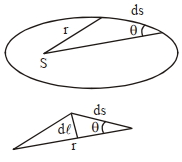
(D) Consider a small displacement $ds$ of the planet along its elliptical orbit in a small time interval $dt$.
The area $dA$ swept by the position vector $\vec{r}$ in this time is given by the area of a triangle with sides $r$ and $ds$:
$dA = \frac{1}{2} |\vec{r} \times d\vec{s}| = \frac{1}{2} r ds \sin \theta$
where $\theta$ is the angle between the position vector $\vec{r}$ and the displacement vector $d\vec{s}$.
The areal velocity is the rate of change of area with respect to time:
$\text{Areal velocity} = \frac{dA}{dt} = \frac{1}{2} r \sin \theta \frac{ds}{dt}$
Since the velocity of the planet is $v = \frac{ds}{dt}$,we have:
$\frac{dA}{dt} = \frac{1}{2} r v \sin \theta$
Multiplying and dividing by the mass $M$ of the planet:
$\frac{dA}{dt} = \frac{1}{2M} (M v r \sin \theta)$
Since the magnitude of angular momentum is $L = Mvr \sin \theta$,we get:
$\frac{dA}{dt} = \frac{L}{2M}$
The area $dA$ swept by the position vector $\vec{r}$ in this time is given by the area of a triangle with sides $r$ and $ds$:
$dA = \frac{1}{2} |\vec{r} \times d\vec{s}| = \frac{1}{2} r ds \sin \theta$
where $\theta$ is the angle between the position vector $\vec{r}$ and the displacement vector $d\vec{s}$.
The areal velocity is the rate of change of area with respect to time:
$\text{Areal velocity} = \frac{dA}{dt} = \frac{1}{2} r \sin \theta \frac{ds}{dt}$
Since the velocity of the planet is $v = \frac{ds}{dt}$,we have:
$\frac{dA}{dt} = \frac{1}{2} r v \sin \theta$
Multiplying and dividing by the mass $M$ of the planet:
$\frac{dA}{dt} = \frac{1}{2M} (M v r \sin \theta)$
Since the magnitude of angular momentum is $L = Mvr \sin \theta$,we get:
$\frac{dA}{dt} = \frac{L}{2M}$
0 likes
View Solution197
DifficultMCQ
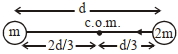
Two stars of masses $m$ and $2m$ at a distance $d$ rotate about their common centre of mass in free space. The period of revolution is
A
$\frac{1}{2 \pi} \sqrt{\frac{d^{3}}{3Gm}}$
B
$2 \pi \sqrt{\frac{d^{3}}{3Gm}}$
C
$\frac{1}{2 \pi} \sqrt{\frac{3Gm}{d^{3}}}$
D
$2 \pi \sqrt{\frac{3Gm}{d^{3}}}$
Solution
(B) The gravitational force between the two stars provides the necessary centripetal force for their circular motion about the common centre of mass (c.o.m.).
The distance of mass $m$ from the c.o.m. is $r_1 = \frac{2m}{m+2m} d = \frac{2d}{3}$.
The gravitational force is $F = \frac{G(m)(2m)}{d^2} = \frac{2Gm^2}{d^2}$.
For the star of mass $m$,the centripetal force is $F = m \omega^2 r_1 = m \omega^2 (\frac{2d}{3})$.
Equating the forces: $\frac{2Gm^2}{d^2} = m \omega^2 (\frac{2d}{3})$.
Simplifying: $\frac{Gm}{d^2} = \omega^2 \frac{d}{3} \implies \omega^2 = \frac{3Gm}{d^3}$.
Thus,$\omega = \sqrt{\frac{3Gm}{d^3}}$.
The period of revolution $T$ is given by $T = \frac{2\pi}{\omega} = 2\pi \sqrt{\frac{d^3}{3Gm}}$.
The distance of mass $m$ from the c.o.m. is $r_1 = \frac{2m}{m+2m} d = \frac{2d}{3}$.
The gravitational force is $F = \frac{G(m)(2m)}{d^2} = \frac{2Gm^2}{d^2}$.
For the star of mass $m$,the centripetal force is $F = m \omega^2 r_1 = m \omega^2 (\frac{2d}{3})$.
Equating the forces: $\frac{2Gm^2}{d^2} = m \omega^2 (\frac{2d}{3})$.
Simplifying: $\frac{Gm}{d^2} = \omega^2 \frac{d}{3} \implies \omega^2 = \frac{3Gm}{d^3}$.
Thus,$\omega = \sqrt{\frac{3Gm}{d^3}}$.
The period of revolution $T$ is given by $T = \frac{2\pi}{\omega} = 2\pi \sqrt{\frac{d^3}{3Gm}}$.
0 likes
View Solution198
MediumMCQ
Consider two satellites $S_{1}$ and $S_{2}$ with periods of revolution $1\, hr$ and $8\, hr$ respectively,revolving around a planet in circular orbits. The ratio of the angular velocity of satellite $S_{1}$ to the angular velocity of satellite $S_{2}$ is:
A
$2: 1$
B
$1: 4$
C
$8: 1$
D
$1: 8$
Solution
(C) The period of revolution $T$ is related to the angular velocity $\omega$ by the formula $T = \frac{2\pi}{\omega}$.
Given the periods $T_{1} = 1\, hr$ and $T_{2} = 8\, hr$.
The ratio of the periods is $\frac{T_{1}}{T_{2}} = \frac{1}{8}$.
Substituting the formula for $T$ in terms of $\omega$:
$\frac{2\pi / \omega_{1}}{2\pi / \omega_{2}} = \frac{1}{8}$.
This simplifies to $\frac{\omega_{2}}{\omega_{1}} = \frac{1}{8}$.
Therefore,the ratio of the angular velocity of $S_{1}$ to $S_{2}$ is $\frac{\omega_{1}}{\omega_{2}} = \frac{8}{1}$ or $8:1$.
Given the periods $T_{1} = 1\, hr$ and $T_{2} = 8\, hr$.
The ratio of the periods is $\frac{T_{1}}{T_{2}} = \frac{1}{8}$.
Substituting the formula for $T$ in terms of $\omega$:
$\frac{2\pi / \omega_{1}}{2\pi / \omega_{2}} = \frac{1}{8}$.
This simplifies to $\frac{\omega_{2}}{\omega_{1}} = \frac{1}{8}$.
Therefore,the ratio of the angular velocity of $S_{1}$ to $S_{2}$ is $\frac{\omega_{1}}{\omega_{2}} = \frac{8}{1}$ or $8:1$.
0 likes
View Solution199
DifficultMCQ
Two satellites $A$ and $B$ of masses $200 \, kg$ and $400 \, kg$ are revolving around the Earth at heights of $600 \, km$ and $1600 \, km$ respectively. If $T_{A}$ and $T_{B}$ are the time periods of $A$ and $B$ respectively,then find the value of $T_{B} - T_{A}$.
[Given: Radius of Earth $R = 6400 \, km$,Mass of Earth $M = 6 \times 10^{24} \, kg$,$G = 6.67 \times 10^{-11} \, Nm^{2}/kg^{2}$]
[Given: Radius of Earth $R = 6400 \, km$,Mass of Earth $M = 6 \times 10^{24} \, kg$,$G = 6.67 \times 10^{-11} \, Nm^{2}/kg^{2}$]

A
$1.33 \times 10^{3} \, s$
B
$3.33 \times 10^{2} \, s$
C
$4.24 \times 10^{3} \, s$
D
$4.24 \times 10^{2} \, s$
Solution
(A) The time period of a satellite at a height $h$ from the Earth's surface is given by $T = 2 \pi \sqrt{\frac{(R+h)^{3}}{GM}}$.
For satellite $A$: $h_{A} = 600 \, km = 0.6 \times 10^{6} \, m$,$R = 6.4 \times 10^{6} \, m$. Orbital radius $r_{A} = R + h_{A} = 7.0 \times 10^{6} \, m$.
$T_{A} = 2 \pi \sqrt{\frac{(7.0 \times 10^{6})^{3}}{6.67 \times 10^{-11} \times 6 \times 10^{24}}} \approx 5800 \, s$.
For satellite $B$: $h_{B} = 1600 \, km = 1.6 \times 10^{6} \, m$. Orbital radius $r_{B} = R + h_{B} = 8.0 \times 10^{6} \, m$.
$T_{B} = 2 \pi \sqrt{\frac{(8.0 \times 10^{6})^{3}}{6.67 \times 10^{-11} \times 6 \times 10^{24}}} \approx 7133 \, s$.
$T_{B} - T_{A} = 7133 - 5800 = 1333 \, s = 1.33 \times 10^{3} \, s$.
For satellite $A$: $h_{A} = 600 \, km = 0.6 \times 10^{6} \, m$,$R = 6.4 \times 10^{6} \, m$. Orbital radius $r_{A} = R + h_{A} = 7.0 \times 10^{6} \, m$.
$T_{A} = 2 \pi \sqrt{\frac{(7.0 \times 10^{6})^{3}}{6.67 \times 10^{-11} \times 6 \times 10^{24}}} \approx 5800 \, s$.
For satellite $B$: $h_{B} = 1600 \, km = 1.6 \times 10^{6} \, m$. Orbital radius $r_{B} = R + h_{B} = 8.0 \times 10^{6} \, m$.
$T_{B} = 2 \pi \sqrt{\frac{(8.0 \times 10^{6})^{3}}{6.67 \times 10^{-11} \times 6 \times 10^{24}}} \approx 7133 \, s$.
$T_{B} - T_{A} = 7133 - 5800 = 1333 \, s = 1.33 \times 10^{3} \, s$.
0 likes
View Solution200
DifficultMCQ
Two satellites revolve around a planet in coplanar circular orbits in an anticlockwise direction. Their periods of revolution are $1\, h$ and $8\, h$ respectively. The radius of the orbit of the nearer satellite is $2 \times 10^{3}\, km$. The angular speed of the farther satellite as observed from the nearer satellite at the instant when both the satellites are closest is $\frac{\pi}{x}\, rad\, h^{-1}$ where $x$ is ..... .
A
$3$
B
$30$
C
$0.3$
D
$4$
Solution
(A) Given:
$T_1 = 1\, h$,$T_2 = 8\, h$
$R_1 = 2 \times 10^3\, km$
Angular velocities are $\omega_1 = \frac{2\pi}{T_1} = 2\pi\, rad/h$ and $\omega_2 = \frac{2\pi}{T_2} = \frac{\pi}{4}\, rad/h$.
Using Kepler's third law,$\frac{R_2^3}{R_1^3} = \frac{T_2^2}{T_1^2} \Rightarrow \frac{R_2}{R_1} = (\frac{8}{1})^{2/3} = 4$.
So,$R_2 = 4 \times R_1 = 8 \times 10^3\, km$.
The linear velocities are $v_1 = \omega_1 R_1 = 2\pi \times 2 \times 10^3 = 4\pi \times 10^3\, km/h$ and $v_2 = \omega_2 R_2 = \frac{\pi}{4} \times 8 \times 10^3 = 2\pi \times 10^3\, km/h$.
When the satellites are closest,the relative angular velocity $\omega_{rel}$ as observed from the nearer satellite is given by $\omega_{rel} = \frac{v_1 - v_2}{R_2 - R_1}$.
$\omega_{rel} = \frac{4\pi \times 10^3 - 2\pi \times 10^3}{8 \times 10^3 - 2 \times 10^3} = \frac{2\pi \times 10^3}{6 \times 10^3} = \frac{\pi}{3}\, rad/h$.
Comparing this with $\frac{\pi}{x}$,we get $x = 3$.
$T_1 = 1\, h$,$T_2 = 8\, h$
$R_1 = 2 \times 10^3\, km$
Angular velocities are $\omega_1 = \frac{2\pi}{T_1} = 2\pi\, rad/h$ and $\omega_2 = \frac{2\pi}{T_2} = \frac{\pi}{4}\, rad/h$.
Using Kepler's third law,$\frac{R_2^3}{R_1^3} = \frac{T_2^2}{T_1^2} \Rightarrow \frac{R_2}{R_1} = (\frac{8}{1})^{2/3} = 4$.
So,$R_2 = 4 \times R_1 = 8 \times 10^3\, km$.
The linear velocities are $v_1 = \omega_1 R_1 = 2\pi \times 2 \times 10^3 = 4\pi \times 10^3\, km/h$ and $v_2 = \omega_2 R_2 = \frac{\pi}{4} \times 8 \times 10^3 = 2\pi \times 10^3\, km/h$.
When the satellites are closest,the relative angular velocity $\omega_{rel}$ as observed from the nearer satellite is given by $\omega_{rel} = \frac{v_1 - v_2}{R_2 - R_1}$.
$\omega_{rel} = \frac{4\pi \times 10^3 - 2\pi \times 10^3}{8 \times 10^3 - 2 \times 10^3} = \frac{2\pi \times 10^3}{6 \times 10^3} = \frac{\pi}{3}\, rad/h$.
Comparing this with $\frac{\pi}{x}$,we get $x = 3$.
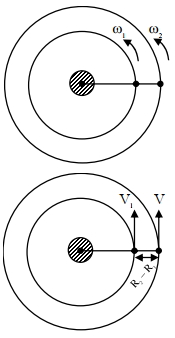
0 likes
View SolutionGravitation — Motion of Satellites in Circular Orbits and Planets in Elliptical Orbits · Frequently Asked Questions
1Are these Gravitation questions useful for JEE and NEET?
Yes. All questions in this section are mapped to JEE Main and NEET exam patterns. Previous year questions from JEE Main, NEET, GUJCET and state-level exams are included with full solutions.
2Can I switch to Hindi or Gujarati for these questions?
Yes. Use the language tabs in the hero section or the sidebar to view the same questions and solutions in English, Hindi or Gujarati.
3How do I generate a question paper from this subtopic?
Use the Vedclass Exam Paper Generator — select the chapter and subtopic, set difficulty, and generate Sets A, B, C, D automatically. First 3 chapters of every subject are free.
Vedclass Products
For Students
Vedclass Test Series
Mock tests in real JEE/NEET style with performance analysis. 5-day free trial.
Start Free TrialFor Teachers
Exam Paper Generator
Generate Set A/B/C/D papers from this chapter in 2 minutes. 3 chapters free.
Try FreeFor Institutes
Online Exam Module
Live online exams with unlimited students, 360° analytics & white-label branding.
See DemoFor Teachers & Institutes
Generate a Gravitation Exam Paper in 2 Minutes
Select subtopic & difficulty — Sets A, B, C, D auto-generated with No Repeat logic.
First 3 chapters of every subject are free — no payment required.