
A English
Motion of Satellites in Circular Orbits and Planets in Elliptical Orbits Questions in English
Class 11 Physics · Gravitation · Motion of Satellites in Circular Orbits and Planets in Elliptical Orbits
326+
Questions
English
Language
100%
With Solutions
Showing 50 of 326 questions in English
201
MediumMCQ
Consider a binary star system of star $A$ and star $B$ with masses $m_{A}$ and $m_{B}$ revolving in a circular orbit of radii $r_{A}$ and $r_{B}$,respectively. If $T_{A}$ and $T_{B}$ are the time periods of star $A$ and star $B$,respectively,then -
A
$T_{A} = T_{B}$
B
$T_{A} > T_{B}$ (if $m_{A} > m_{B}$)
C
$T_{A} > T_{B}$ (if $r_{A} > r_{B}$)
D
$\frac{T_{A}}{T_{B}} = \left(\frac{r_{A}}{r_{B}}\right)^{3/2}$
Solution
(A) In a binary star system,both stars revolve around their common center of mass.
For the system to remain stable,both stars must maintain the same angular velocity $\omega$ at all times.
Since the angular velocity $\omega$ is related to the time period $T$ by the formula $\omega = \frac{2\pi}{T}$,if $\omega_{A} = \omega_{B}$,then it follows that $T_{A} = T_{B}$.
Therefore,both stars complete one revolution in the same amount of time.
For the system to remain stable,both stars must maintain the same angular velocity $\omega$ at all times.
Since the angular velocity $\omega$ is related to the time period $T$ by the formula $\omega = \frac{2\pi}{T}$,if $\omega_{A} = \omega_{B}$,then it follows that $T_{A} = T_{B}$.
Therefore,both stars complete one revolution in the same amount of time.
0 likes
View Solution202
EasyMCQ
The minimum and maximum distances of a planet revolving around the Sun are $x_{1}$ and $x_{2}$. If the minimum speed of the planet on its trajectory is $v_{0}$,then its maximum speed will be:
A
$\frac{v_{0} x_{2}^{2}}{x_{1}^{2}}$
B
$\frac{v_{0} x_{1}^{2}}{x_{2}^{2}}$
C
$\frac{v_{0} x_{2}}{x_{1}}$
D
$\frac{v_{0} x_{1}}{x_{2}}$
Solution
(C) According to the law of conservation of angular momentum,the angular momentum of a planet revolving around the Sun remains constant at all points in its orbit.
$L = mvr \sin(\theta)$
At the perihelion (minimum distance $x_{1}$) and aphelion (maximum distance $x_{2}$),the velocity vector is perpendicular to the radius vector,so $\sin(\theta) = 1$.
Thus,$m v_{max} x_{1} = m v_{min} x_{2}$.
Given that the minimum speed is $v_{0}$ (which occurs at the maximum distance $x_{2}$),we have $v_{min} = v_{0}$.
Substituting these values into the conservation equation:
$v_{max} x_{1} = v_{0} x_{2}$
$v_{max} = \frac{v_{0} x_{2}}{x_{1}}$.
$L = mvr \sin(\theta)$
At the perihelion (minimum distance $x_{1}$) and aphelion (maximum distance $x_{2}$),the velocity vector is perpendicular to the radius vector,so $\sin(\theta) = 1$.
Thus,$m v_{max} x_{1} = m v_{min} x_{2}$.
Given that the minimum speed is $v_{0}$ (which occurs at the maximum distance $x_{2}$),we have $v_{min} = v_{0}$.
Substituting these values into the conservation equation:
$v_{max} x_{1} = v_{0} x_{2}$
$v_{max} = \frac{v_{0} x_{2}}{x_{1}}$.
0 likes
View Solution203
MediumMCQ
The planet Mars has two moons. If one of them has a period of $7\, \text{hours}, 30\, \text{minutes}$ and an orbital radius of $9.0 \times 10^{3}\, \text{km}$, find the mass of Mars. $\left\{\text{Given}: \frac{4 \pi^{2}}{G} = 6 \times 10^{11}\, \text{N}^{-1} \text{m}^{-2} \text{kg}^{2}\right\}$
A
$3.25 \times 10^{21}\, \text{kg}$
B
$5.96 \times 10^{19}\, \text{kg}$
C
$7.02 \times 10^{25}\, \text{kg}$
D
$6.00 \times 10^{23}\, \text{kg}$
Solution
(D) According to Kepler's third law of planetary motion, the square of the orbital period $T$ is proportional to the cube of the orbital radius $r$:
$T^{2} = \frac{4 \pi^{2}}{G M} \cdot r^{3}$
Rearranging the formula to solve for the mass of Mars $M$:
$M = \frac{4 \pi^{2}}{G} \cdot \frac{r^{3}}{T^{2}}$
Given values:
$T = 7\, \text{hours}, 30\, \text{minutes} = 7.5\, \text{hours} = 7.5 \times 3600\, \text{s} = 2.7 \times 10^{4}\, \text{s}$
$r = 9.0 \times 10^{3}\, \text{km} = 9.0 \times 10^{6}\, \text{m}$
$\frac{4 \pi^{2}}{G} = 6 \times 10^{11}\, \text{N}^{-1} \text{m}^{-2} \text{kg}^{2}$
Substituting these values into the equation:
$M = (6 \times 10^{11}) \cdot \frac{(9.0 \times 10^{6})^{3}}{(2.7 \times 10^{4})^{2}}$
$M = (6 \times 10^{11}) \cdot \frac{729 \times 10^{18}}{7.29 \times 10^{8}}$
$M = (6 \times 10^{11}) \cdot (100 \times 10^{10}) = 6 \times 10^{23}\, \text{kg}$
$T^{2} = \frac{4 \pi^{2}}{G M} \cdot r^{3}$
Rearranging the formula to solve for the mass of Mars $M$:
$M = \frac{4 \pi^{2}}{G} \cdot \frac{r^{3}}{T^{2}}$
Given values:
$T = 7\, \text{hours}, 30\, \text{minutes} = 7.5\, \text{hours} = 7.5 \times 3600\, \text{s} = 2.7 \times 10^{4}\, \text{s}$
$r = 9.0 \times 10^{3}\, \text{km} = 9.0 \times 10^{6}\, \text{m}$
$\frac{4 \pi^{2}}{G} = 6 \times 10^{11}\, \text{N}^{-1} \text{m}^{-2} \text{kg}^{2}$
Substituting these values into the equation:
$M = (6 \times 10^{11}) \cdot \frac{(9.0 \times 10^{6})^{3}}{(2.7 \times 10^{4})^{2}}$
$M = (6 \times 10^{11}) \cdot \frac{729 \times 10^{18}}{7.29 \times 10^{8}}$
$M = (6 \times 10^{11}) \cdot (100 \times 10^{10}) = 6 \times 10^{23}\, \text{kg}$
0 likes
View Solution204
MediumMCQ
Two satellites $S_{1}$ and $S_{2}$ are revolving in circular orbits around a planet with radii $R_{1} = 3200 \, km$ and $R_{2} = 800 \, km$ respectively. The ratio of the speed of satellite $S_{1}$ to the speed of satellite $S_{2}$ in their respective orbits is $\frac{1}{x}$,where $x =$
A
$2$
B
$4$
C
$8$
D
$16$
Solution
(A) The orbital speed $V$ of a satellite revolving around a planet of mass $M$ at a distance $r$ is given by the formula $V = \sqrt{\frac{GM}{r}}$.
Given the radii of the orbits are $R_{1} = 3200 \, km$ and $R_{2} = 800 \, km$.
The ratio of the speeds is $\frac{V_{1}}{V_{2}} = \frac{\sqrt{\frac{GM}{R_{1}}}}{\sqrt{\frac{GM}{R_{2}}}} = \sqrt{\frac{R_{2}}{R_{1}}}$.
Substituting the values: $\frac{V_{1}}{V_{2}} = \sqrt{\frac{800}{3200}} = \sqrt{\frac{1}{4}} = \frac{1}{2}$.
Comparing this with $\frac{1}{x}$,we get $x = 2$.
Given the radii of the orbits are $R_{1} = 3200 \, km$ and $R_{2} = 800 \, km$.
The ratio of the speeds is $\frac{V_{1}}{V_{2}} = \frac{\sqrt{\frac{GM}{R_{1}}}}{\sqrt{\frac{GM}{R_{2}}}} = \sqrt{\frac{R_{2}}{R_{1}}}$.
Substituting the values: $\frac{V_{1}}{V_{2}} = \sqrt{\frac{800}{3200}} = \sqrt{\frac{1}{4}} = \frac{1}{2}$.
Comparing this with $\frac{1}{x}$,we get $x = 2$.
0 likes
View Solution205
AdvancedMCQ
Two satellites $S_{1}$ and $S_{2}$ are revolving around a planet in the opposite sense in coplanar circular concentric orbits. At time $t=0$,the satellites are farthest apart. The periods of revolution of $S_{1}$ and $S_{2}$ are $3 \,h$ and $24 \,h$,respectively. The radius of the orbit of $S_{1}$ is $3 \times 10^{4} \,km$. Then,the orbital speed of $S_{2}$ as observed from
A
the planet is $4 \pi \times 10^{4} \,km \,h^{-1}$,when $S_{2}$ is closest from $S_{1}$
B
the planet is $2 \pi \times 10^{4} \,km \,h^{-1}$,when $S_{2}$ is farthest from $S_{1}$
C
$S_{1}$ is $\pi \times 10^{4} \,km \,h^{-1}$,when $S_{2}$ is closest from $S_{1}$
D
$S_{1}$ is $3 \pi \times 10^{4} \,km \,h^{-1}$,when $S_{2}$ is closest to $S_{1}$
Solution
(D) From Kepler's third law,we have $T^{2} \propto R^{3}$.
For satellites $S_{1}$ and $S_{2}$,we have $\left(\frac{T_{1}}{T_{2}}\right)^{2} = \left(\frac{R_{1}}{R_{2}}\right)^{3}$.
Given $T_{1} = 3 \,h$,$T_{2} = 24 \,h$,and $R_{1} = 3 \times 10^{4} \,km$.
The radius of the orbit of satellite $S_{2}$ is $R_{2} = R_{1} \left(\frac{T_{2}}{T_{1}}\right)^{2/3} = 3 \times 10^{4} \times \left(\frac{24}{3}\right)^{2/3} = 3 \times 10^{4} \times (8)^{2/3} = 3 \times 10^{4} \times 4 = 12 \times 10^{4} \,km$.
Since the satellites revolve in opposite senses,when they are closest to each other,their velocity vectors are in opposite directions relative to the planet,meaning their relative speed is the sum of their orbital speeds.
The orbital speeds are $v_{1} = \frac{2 \pi R_{1}}{T_{1}} = \frac{2 \pi \times 3 \times 10^{4}}{3} = 2 \pi \times 10^{4} \,km \,h^{-1}$ and $v_{2} = \frac{2 \pi R_{2}}{T_{2}} = \frac{2 \pi \times 12 \times 10^{4}}{24} = \pi \times 10^{4} \,km \,h^{-1}$.
The relative speed of $S_{2}$ as observed from $S_{1}$ is $v_{rel} = v_{1} + v_{2} = 2 \pi \times 10^{4} + \pi \times 10^{4} = 3 \pi \times 10^{4} \,km \,h^{-1}$.
For satellites $S_{1}$ and $S_{2}$,we have $\left(\frac{T_{1}}{T_{2}}\right)^{2} = \left(\frac{R_{1}}{R_{2}}\right)^{3}$.
Given $T_{1} = 3 \,h$,$T_{2} = 24 \,h$,and $R_{1} = 3 \times 10^{4} \,km$.
The radius of the orbit of satellite $S_{2}$ is $R_{2} = R_{1} \left(\frac{T_{2}}{T_{1}}\right)^{2/3} = 3 \times 10^{4} \times \left(\frac{24}{3}\right)^{2/3} = 3 \times 10^{4} \times (8)^{2/3} = 3 \times 10^{4} \times 4 = 12 \times 10^{4} \,km$.
Since the satellites revolve in opposite senses,when they are closest to each other,their velocity vectors are in opposite directions relative to the planet,meaning their relative speed is the sum of their orbital speeds.
The orbital speeds are $v_{1} = \frac{2 \pi R_{1}}{T_{1}} = \frac{2 \pi \times 3 \times 10^{4}}{3} = 2 \pi \times 10^{4} \,km \,h^{-1}$ and $v_{2} = \frac{2 \pi R_{2}}{T_{2}} = \frac{2 \pi \times 12 \times 10^{4}}{24} = \pi \times 10^{4} \,km \,h^{-1}$.
The relative speed of $S_{2}$ as observed from $S_{1}$ is $v_{rel} = v_{1} + v_{2} = 2 \pi \times 10^{4} + \pi \times 10^{4} = 3 \pi \times 10^{4} \,km \,h^{-1}$.
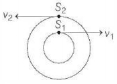
0 likes
View Solution206
AdvancedMCQ
$A$ body moves in a circular orbit of radius $R$ under the action of a central force. The potential due to the central force is given by $V(r) = kr$ ($k$ is a positive constant). The period of revolution of the body is proportional to:
A
$R^{1/2}$
B
$R^{-1/2}$
C
$R^{-3/2}$
D
$R^{-5/2}$
Solution
(A) The force on the particle is given by the negative gradient of the potential:
$F = -\frac{dV}{dr} = -\frac{d}{dr}(kr) = -k$.
Taking the magnitude of the force,we have $F = k$.
For circular motion,this force acts as the centripetal force:
$F = mR\omega^2 = k$.
Substituting $\omega = \frac{2\pi}{T}$,we get:
$mR\left(\frac{2\pi}{T}\right)^2 = k$.
$mR \cdot \frac{4\pi^2}{T^2} = k$.
Rearranging for $T^2$:
$T^2 = \frac{4\pi^2 m}{k} \cdot R$.
Since $\frac{4\pi^2 m}{k}$ is a constant,we have $T^2 \propto R$,which implies $T \propto R^{1/2}$.
$F = -\frac{dV}{dr} = -\frac{d}{dr}(kr) = -k$.
Taking the magnitude of the force,we have $F = k$.
For circular motion,this force acts as the centripetal force:
$F = mR\omega^2 = k$.
Substituting $\omega = \frac{2\pi}{T}$,we get:
$mR\left(\frac{2\pi}{T}\right)^2 = k$.
$mR \cdot \frac{4\pi^2}{T^2} = k$.
Rearranging for $T^2$:
$T^2 = \frac{4\pi^2 m}{k} \cdot R$.
Since $\frac{4\pi^2 m}{k}$ is a constant,we have $T^2 \propto R$,which implies $T \propto R^{1/2}$.
0 likes
View Solution207
DifficultMCQ
Two particles of identical mass are moving in circular orbits under a potential given by $V(r) = K r^{-n}$,where $K$ is a constant. If the radii of their orbits are $r_1$ and $r_2$ and their speeds are $v_1$ and $v_2$,respectively,then:
A
$v_1^2 r_1^n = v_2^2 r_2^n$
B
$v_1^2 r_1^{-n} = v_2^2 r_2^{-n}$
C
$v_1^2 r_1 = v_2^2 r_2$
D
$v_1^2 r_1^{2-n} = v_2^2 r_2^{2-n}$
Solution
(A) Given the potential $V(r) = K r^{-n}$.
The force $F$ acting on the particle is given by the negative gradient of the potential:
$F = -\frac{dV}{dr} = -\frac{d}{dr}(K r^{-n}) = -K(-n)r^{-n-1} = \frac{nK}{r^{n+1}}$.
For a particle of mass $m$ moving in a circular orbit of radius $r$ with speed $v$,the centripetal force is provided by this central force:
$\frac{mv^2}{r} = F = \frac{nK}{r^{n+1}}$.
Rearranging the terms to isolate the variables:
$v^2 = \frac{nK}{m} \cdot \frac{r}{r^{n+1}} = \frac{nK}{m} \cdot r^{-n}$.
Thus,$v^2 r^n = \frac{nK}{m}$.
Since $n$,$K$,and $m$ are constants for both particles,the product $v^2 r^n$ must be constant for any orbit under this potential.
Therefore,$v_1^2 r_1^n = v_2^2 r_2^n$.
The force $F$ acting on the particle is given by the negative gradient of the potential:
$F = -\frac{dV}{dr} = -\frac{d}{dr}(K r^{-n}) = -K(-n)r^{-n-1} = \frac{nK}{r^{n+1}}$.
For a particle of mass $m$ moving in a circular orbit of radius $r$ with speed $v$,the centripetal force is provided by this central force:
$\frac{mv^2}{r} = F = \frac{nK}{r^{n+1}}$.
Rearranging the terms to isolate the variables:
$v^2 = \frac{nK}{m} \cdot \frac{r}{r^{n+1}} = \frac{nK}{m} \cdot r^{-n}$.
Thus,$v^2 r^n = \frac{nK}{m}$.
Since $n$,$K$,and $m$ are constants for both particles,the product $v^2 r^n$ must be constant for any orbit under this potential.
Therefore,$v_1^2 r_1^n = v_2^2 r_2^n$.
0 likes
View Solution208
MediumMCQ
The International Space Station is maintained in a nearly circular orbit with a mean altitude of $330 \, km$ and a maximum of $410 \, km$. An astronaut is floating in the space station's cabin. The acceleration of the astronaut as measured from the Earth is:
A
zero
B
nearly zero and directed towards the Earth
C
nearly $g$ and directed along the line of travel of the station
D
nearly $g$ and directed towards the Earth
Solution
(D) The acceleration due to gravity at an altitude $h$ above the Earth's surface is given by the formula $g_h = \frac{GM}{(R+h)^2}$.
Given that the altitude $h$ is much smaller than the radius of the Earth $(h << R)$,the value of $g_h$ is approximately equal to the acceleration due to gravity at the Earth's surface,$g \approx 9.8 \, m/s^2$.
Since the astronaut is inside the orbiting space station,they are in a state of free fall. The gravitational force acting on the astronaut provides the necessary centripetal acceleration to keep them in orbit.
Therefore,the acceleration of the astronaut as measured from the Earth is nearly $g$ and is directed towards the center of the Earth.
Given that the altitude $h$ is much smaller than the radius of the Earth $(h << R)$,the value of $g_h$ is approximately equal to the acceleration due to gravity at the Earth's surface,$g \approx 9.8 \, m/s^2$.
Since the astronaut is inside the orbiting space station,they are in a state of free fall. The gravitational force acting on the astronaut provides the necessary centripetal acceleration to keep them in orbit.
Therefore,the acceleration of the astronaut as measured from the Earth is nearly $g$ and is directed towards the center of the Earth.
0 likes
View Solution209
MediumMCQ
$A$ planet of mass $m$ is moving around a star of mass $M$ and radius $R$ in a circular orbit of radius $r$. The star abruptly shrinks to half its radius without any loss of mass. What change will be there in the orbit of the planet?
A
The planet will escape from the star
B
The radius of the orbit will increase
C
The radius of the orbit will decrease
D
The radius of the orbit will not change
Solution
(D) The correct answer is $D$.
When a star shrinks without losing its mass,its gravitational acceleration on its surface increases,but there is no change in the gravitational force exerted by this star on a distant object like a planet.
The force of gravitational attraction of the star on the planet is given by:
$F = \frac{G M m}{r^2}$
where $M$ is the mass of the star,$m$ is the mass of the planet,and $r$ is the orbital radius of the planet.
Since the mass of the star $(M)$,the mass of the planet $(m)$,and the distance between them $(r)$ remain unchanged,the gravitational force $F$ remains constant.
Because the centripetal force required to maintain the circular orbit depends only on the mass of the star and the distance $r$,and neither of these has changed,there will be no change in the orbital radius of the planet.
When a star shrinks without losing its mass,its gravitational acceleration on its surface increases,but there is no change in the gravitational force exerted by this star on a distant object like a planet.
The force of gravitational attraction of the star on the planet is given by:
$F = \frac{G M m}{r^2}$
where $M$ is the mass of the star,$m$ is the mass of the planet,and $r$ is the orbital radius of the planet.
Since the mass of the star $(M)$,the mass of the planet $(m)$,and the distance between them $(r)$ remain unchanged,the gravitational force $F$ remains constant.
Because the centripetal force required to maintain the circular orbit depends only on the mass of the star and the distance $r$,and neither of these has changed,there will be no change in the orbital radius of the planet.
0 likes
View Solution210
AdvancedMCQ
The speed of a satellite in a circular orbit of radius $R_0$ around the earth is $v_0$. Another satellite is in an elliptic orbit around the earth. If the minimum and maximum speeds of the second satellite are $\alpha v_0$ and $\beta v_0$ respectively,then its time period is
A
$\frac{2 \pi R_0}{v_0}\left(\frac{\alpha^2+\beta^2}{2}\right)^{\frac{3}{2}}$
B
$\frac{2 \pi R_0}{v_0}\left(\frac{\alpha+\beta}{2}\right)^{\frac{3}{2}}$
C
$\frac{2 \pi R_0}{v_0}(\alpha \beta)^{\frac{3}{2}}$
D
$\frac{2 \pi R_0}{v_0}(\alpha \beta)^{-\frac{3}{2}}$
Solution
(D) For a circular orbit,$v_0 = \sqrt{\frac{GM}{R_0}}$,so $GM = v_0^2 R_0$.
By conservation of angular momentum at perigee and apogee,$r_1 v_{max} = r_2 v_{min}$,where $v_{max} = \beta v_0$ and $v_{min} = \alpha v_0$ (assuming $\beta > \alpha$). Thus,$r_1 \beta v_0 = r_2 \alpha v_0 \Rightarrow r_2 = \frac{\beta}{\alpha} r_1$.
By conservation of mechanical energy,$\frac{1}{2} m(\beta v_0)^2 - \frac{GMm}{r_1} = \frac{1}{2} m(\alpha v_0)^2 - \frac{GMm}{r_2}$.
Substituting $GM = v_0^2 R_0$ and $r_2 = \frac{\beta}{\alpha} r_1$,we solve for the semi-major axis $a = \frac{r_1 + r_2}{2}$.
From the energy equation,$\frac{1}{2} v_0^2 (\beta^2 - \alpha^2) = GM(\frac{1}{r_1} - \frac{1}{r_2}) = GM(\frac{r_2 - r_1}{r_1 r_2})$.
Substituting $GM = v_0^2 R_0$,we get $\frac{1}{2} (\beta^2 - \alpha^2) = \frac{R_0}{r_1 r_2} (r_2 - r_1)$.
Using $r_2 = \frac{\beta}{\alpha} r_1$,we find $r_1 = \frac{2 R_0 \alpha}{\beta(\alpha + \beta)}$ and $r_2 = \frac{2 R_0 \beta}{\alpha(\alpha + \beta)}$.
The semi-major axis $a = \frac{r_1 + r_2}{2} = R_0 \frac{\alpha^2 + \beta^2}{\alpha \beta (\alpha + \beta)}$.
Actually,using Kepler's Third Law $T^2 = \frac{4 \pi^2 a^3}{GM}$,and substituting the values,we get $T = \frac{2 \pi R_0}{v_0} (\alpha \beta)^{-\frac{3}{2}}$.
By conservation of angular momentum at perigee and apogee,$r_1 v_{max} = r_2 v_{min}$,where $v_{max} = \beta v_0$ and $v_{min} = \alpha v_0$ (assuming $\beta > \alpha$). Thus,$r_1 \beta v_0 = r_2 \alpha v_0 \Rightarrow r_2 = \frac{\beta}{\alpha} r_1$.
By conservation of mechanical energy,$\frac{1}{2} m(\beta v_0)^2 - \frac{GMm}{r_1} = \frac{1}{2} m(\alpha v_0)^2 - \frac{GMm}{r_2}$.
Substituting $GM = v_0^2 R_0$ and $r_2 = \frac{\beta}{\alpha} r_1$,we solve for the semi-major axis $a = \frac{r_1 + r_2}{2}$.
From the energy equation,$\frac{1}{2} v_0^2 (\beta^2 - \alpha^2) = GM(\frac{1}{r_1} - \frac{1}{r_2}) = GM(\frac{r_2 - r_1}{r_1 r_2})$.
Substituting $GM = v_0^2 R_0$,we get $\frac{1}{2} (\beta^2 - \alpha^2) = \frac{R_0}{r_1 r_2} (r_2 - r_1)$.
Using $r_2 = \frac{\beta}{\alpha} r_1$,we find $r_1 = \frac{2 R_0 \alpha}{\beta(\alpha + \beta)}$ and $r_2 = \frac{2 R_0 \beta}{\alpha(\alpha + \beta)}$.
The semi-major axis $a = \frac{r_1 + r_2}{2} = R_0 \frac{\alpha^2 + \beta^2}{\alpha \beta (\alpha + \beta)}$.
Actually,using Kepler's Third Law $T^2 = \frac{4 \pi^2 a^3}{GM}$,and substituting the values,we get $T = \frac{2 \pi R_0}{v_0} (\alpha \beta)^{-\frac{3}{2}}$.
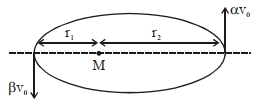
0 likes
View Solution211
MediumMCQ
An artificial satellite is moving around the Earth in a circular orbit with a speed equal to one-fourth the escape speed of a body from the surface of the Earth. The height of the satellite above the Earth's surface is ............ ($R$ is the radius of the Earth). (in $R$)
A
$3$
B
$5$
C
$7$
D
$8$
Solution
(C) The escape velocity from the surface of the Earth is given by $v_e = \sqrt{2gR}$.
The speed of the satellite in its orbit is given as $v_o = \frac{v_e}{4} = \frac{\sqrt{2gR}}{4}$.
For a satellite in a circular orbit at a distance $x$ from the center of the Earth,the centripetal force is provided by the gravitational force:
$\frac{GMm}{x^2} = \frac{mv_o^2}{x}$.
Substituting $v_o^2 = \frac{2gR}{16} = \frac{gR}{8}$ and $GM = gR^2$:
$\frac{gR^2}{x^2} = \frac{gR/8}{x}$.
Solving for $x$:
$x = \frac{gR^2}{gR/8} = 8R$.
The height $h$ of the satellite above the Earth's surface is $h = x - R = 8R - R = 7R$.
The speed of the satellite in its orbit is given as $v_o = \frac{v_e}{4} = \frac{\sqrt{2gR}}{4}$.
For a satellite in a circular orbit at a distance $x$ from the center of the Earth,the centripetal force is provided by the gravitational force:
$\frac{GMm}{x^2} = \frac{mv_o^2}{x}$.
Substituting $v_o^2 = \frac{2gR}{16} = \frac{gR}{8}$ and $GM = gR^2$:
$\frac{gR^2}{x^2} = \frac{gR/8}{x}$.
Solving for $x$:
$x = \frac{gR^2}{gR/8} = 8R$.
The height $h$ of the satellite above the Earth's surface is $h = x - R = 8R - R = 7R$.
0 likes
View Solution212
DifficultMCQ
Two satellites $A$ and $B$ go round the planet $P$ in circular orbits having radii $4 R$ and $R$ respectively. If the speed of the satellite $A$ is $3 v$,the speed of satellite $B$ will be ...........
A
$12 v$
B
$6 v$
C
$\frac{4 v}{3}$
D
$\frac{3 v}{2}$
Solution
(B) The orbital speed $v$ of a satellite in a circular orbit of radius $r$ is given by the formula $v = \sqrt{\frac{GM}{r}}$,where $G$ is the gravitational constant and $M$ is the mass of the planet.
This implies that $v \propto \frac{1}{\sqrt{r}}$.
Given for satellite $A$: radius $r_A = 4 R$ and speed $v_A = 3 v$.
Given for satellite $B$: radius $r_B = R$.
Using the proportionality $v_A \sqrt{r_A} = v_B \sqrt{r_B}$,we get:
$(3 v) \sqrt{4 R} = v_B \sqrt{R}$.
$(3 v) (2 \sqrt{R}) = v_B \sqrt{R}$.
$6 v \sqrt{R} = v_B \sqrt{R}$.
Therefore,$v_B = 6 v$.
This implies that $v \propto \frac{1}{\sqrt{r}}$.
Given for satellite $A$: radius $r_A = 4 R$ and speed $v_A = 3 v$.
Given for satellite $B$: radius $r_B = R$.
Using the proportionality $v_A \sqrt{r_A} = v_B \sqrt{r_B}$,we get:
$(3 v) \sqrt{4 R} = v_B \sqrt{R}$.
$(3 v) (2 \sqrt{R}) = v_B \sqrt{R}$.
$6 v \sqrt{R} = v_B \sqrt{R}$.
Therefore,$v_B = 6 v$.
0 likes
View Solution213
EasyMCQ
$A$ satellite is revolving around the Earth in a circular orbit at a uniform speed $v$. If the gravitational force suddenly disappears,the speed of the satellite will be ..............
A
Zero
B
$v$
C
$2v$
D
Infinity
Solution
(B) The satellite is revolving around the Earth at a constant speed $v$. The gravitational pull from the Earth provides the necessary centripetal force to keep the satellite in a circular orbit.
According to Newton's first law of motion,an object in motion will continue to move in a straight line at a constant velocity unless acted upon by an external force.
If the gravitational force suddenly disappears,there is no longer a centripetal force to change the direction of the satellite. Consequently,the satellite will continue to move in a straight line tangent to its original orbit with the same speed $v$.
Therefore,the correct option is $(b)$.
According to Newton's first law of motion,an object in motion will continue to move in a straight line at a constant velocity unless acted upon by an external force.
If the gravitational force suddenly disappears,there is no longer a centripetal force to change the direction of the satellite. Consequently,the satellite will continue to move in a straight line tangent to its original orbit with the same speed $v$.
Therefore,the correct option is $(b)$.
0 likes
View Solution214
MediumMCQ
$A$ satellite of mass $m$ is revolving close to the surface of a planet of density $d$ with time period $T$. The value of the universal gravitational constant $G$ in terms of $d$ and $T$ is given by:
A
$2 \pi^2 T \sqrt{d}$
B
$d T^2 \pi$
C
$\frac{1}{d^2 T \pi}$
D
$\frac{3 \pi}{d T^2}$
Solution
(D) The time period $T$ of a satellite revolving close to the surface of a planet of radius $R$ and mass $M$ is given by $T = 2 \pi \sqrt{\frac{R^3}{GM}}$.
Squaring both sides,we get $T^2 = \frac{4 \pi^2 R^3}{GM}$.
The mass of the planet is $M = \text{Volume} \times \text{Density} = \frac{4}{3} \pi R^3 d$.
Substituting the value of $M$ into the time period equation:
$T^2 = \frac{4 \pi^2 R^3}{G (\frac{4}{3} \pi R^3 d)}$.
Canceling $R^3$ and simplifying the expression:
$T^2 = \frac{4 \pi^2}{G \cdot \frac{4}{3} \pi d} = \frac{3 \pi}{G d}$.
Rearranging to solve for $G$:
$G = \frac{3 \pi}{d T^2}$.
Squaring both sides,we get $T^2 = \frac{4 \pi^2 R^3}{GM}$.
The mass of the planet is $M = \text{Volume} \times \text{Density} = \frac{4}{3} \pi R^3 d$.
Substituting the value of $M$ into the time period equation:
$T^2 = \frac{4 \pi^2 R^3}{G (\frac{4}{3} \pi R^3 d)}$.
Canceling $R^3$ and simplifying the expression:
$T^2 = \frac{4 \pi^2}{G \cdot \frac{4}{3} \pi d} = \frac{3 \pi}{G d}$.
Rearranging to solve for $G$:
$G = \frac{3 \pi}{d T^2}$.
0 likes
View Solution215
MediumMCQ
The orbital speed of a satellite revolving around a planet in a circular orbit is $v_0$. If its speed is increased by $10 \%$,then ..........
A
It will escape from its orbit
B
It will start rotating in an elliptical orbit
C
It will continue to move in the same orbit
D
It will move in a circular orbit of radius $20 \%$ more than the radius of the initial orbit
Solution
(B) The orbital speed of a satellite in a circular orbit is given by $v_0 = \sqrt{\frac{GM}{r}}$.
If the speed is increased by $10 \%$,the new speed becomes $v = 1.10 v_0$.
For a satellite to remain in a circular orbit,its speed must be exactly $v_0$. If the speed is increased such that $v_0 < v < v_e$ (where $v_e = \sqrt{2} v_0 \approx 1.414 v_0$ is the escape velocity),the satellite will no longer follow a circular path.
Instead,the satellite will follow an elliptical orbit with the planet at one of the foci.
Since $1.10 v_0 < 1.414 v_0$,the satellite does not escape but changes its trajectory to an elliptical one.
If the speed is increased by $10 \%$,the new speed becomes $v = 1.10 v_0$.
For a satellite to remain in a circular orbit,its speed must be exactly $v_0$. If the speed is increased such that $v_0 < v < v_e$ (where $v_e = \sqrt{2} v_0 \approx 1.414 v_0$ is the escape velocity),the satellite will no longer follow a circular path.
Instead,the satellite will follow an elliptical orbit with the planet at one of the foci.
Since $1.10 v_0 < 1.414 v_0$,the satellite does not escape but changes its trajectory to an elliptical one.
0 likes
View Solution216
MediumMCQ
If $L$ is the angular momentum of a satellite revolving around the Earth in a circular orbit of radius $r$ with speed $v$,then .........
A
$L \propto v$
B
$L \propto r$
C
$L \propto \sqrt{r}$
D
$L \propto \sqrt{v}$
Solution
(C) The angular momentum $L$ of a satellite of mass $m$ revolving in a circular orbit of radius $r$ with speed $v$ is given by $L = mvr$.
The orbital speed $v$ of a satellite is given by $v = \sqrt{\frac{GM}{r}}$,where $G$ is the gravitational constant and $M$ is the mass of the Earth.
Substituting the expression for $v$ into the angular momentum formula:
$L = m \left( \sqrt{\frac{GM}{r}} \right) r$
$L = m \sqrt{GM} \cdot \frac{r}{\sqrt{r}}$
$L = m \sqrt{GM} \cdot \sqrt{r}$
Since $m$,$G$,and $M$ are constants,we have $L \propto \sqrt{r}$.
The orbital speed $v$ of a satellite is given by $v = \sqrt{\frac{GM}{r}}$,where $G$ is the gravitational constant and $M$ is the mass of the Earth.
Substituting the expression for $v$ into the angular momentum formula:
$L = m \left( \sqrt{\frac{GM}{r}} \right) r$
$L = m \sqrt{GM} \cdot \frac{r}{\sqrt{r}}$
$L = m \sqrt{GM} \cdot \sqrt{r}$
Since $m$,$G$,and $M$ are constants,we have $L \propto \sqrt{r}$.
0 likes
View Solution217
EasyMCQ
An object is projected horizontally with speed $\frac{1}{2} \sqrt{\frac{GM}{R}}$ from a point at height $3R$ (where $R$ is the radius and $M$ is the mass of the Earth). The object will:
A
Fall back on the surface of the Earth by following a parabolic path
B
Fall back on the surface of the Earth by following a hyperbolic path
C
Start rotating around the Earth in a circular orbit
D
Escape from the gravitational field of the Earth
Solution
(C) At height $h = 3R$,the distance from the center of the Earth is $r = R + h = R + 3R = 4R$.
The orbital velocity $V_o$ required for a circular orbit at a distance $r$ from the center of the Earth is given by $V_o = \sqrt{\frac{GM}{r}}$.
Substituting $r = 4R$ into the formula,we get:
$V_o = \sqrt{\frac{GM}{4R}} = \frac{1}{2} \sqrt{\frac{GM}{R}}$.
Since the object is projected horizontally with exactly this speed,it will maintain a circular orbit at a distance of $4R$ from the center of the Earth.
Therefore,the correct option is $(c)$.
The orbital velocity $V_o$ required for a circular orbit at a distance $r$ from the center of the Earth is given by $V_o = \sqrt{\frac{GM}{r}}$.
Substituting $r = 4R$ into the formula,we get:
$V_o = \sqrt{\frac{GM}{4R}} = \frac{1}{2} \sqrt{\frac{GM}{R}}$.
Since the object is projected horizontally with exactly this speed,it will maintain a circular orbit at a distance of $4R$ from the center of the Earth.
Therefore,the correct option is $(c)$.
0 likes
View Solution218
EasyMCQ
The time period of polar satellites is about ..........
A
$24 \,hr$
B
$100 \,min$
C
$84.6 \,min$
D
$6 \,hr$
Solution
(B) The time period of polar satellites is approximately $100$ minutes.
Polar satellites are low-altitude satellites that orbit the Earth from pole to pole.
They typically orbit at an altitude of $500 \,km$ to $800 \,km$ above the Earth's surface.
Due to their low altitude,they have a much shorter orbital period compared to geostationary satellites.
Polar satellites are low-altitude satellites that orbit the Earth from pole to pole.
They typically orbit at an altitude of $500 \,km$ to $800 \,km$ above the Earth's surface.
Due to their low altitude,they have a much shorter orbital period compared to geostationary satellites.
0 likes
View Solution219
MediumMCQ
An artificial satellite revolves around a planet for which gravitational force $(F)$ varies with distance $r$ from its centre as $F \propto r^2$. If $v_0$ is its orbital speed,then
A
$v_0 \propto r^{-1/2}$
B
$v_0 \propto r^{3/2}$
C
$v_0 \propto r^{-3/2}$
D
$v_0 \propto r$
Solution
(B) The gravitational force $(F)$ provides the necessary centripetal force for the satellite to maintain its circular orbit.
The centripetal force is given by $F_c = \frac{m v_0^2}{r}$.
According to the problem,the gravitational force is $F \propto r^2$.
Equating the centripetal force to the gravitational force:
$\frac{m v_0^2}{r} \propto r^2$
Since mass $(m)$ is constant,we have:
$\frac{v_0^2}{r} \propto r^2$
$v_0^2 \propto r^3$
Taking the square root on both sides:
$v_0 \propto r^{3/2}$
The centripetal force is given by $F_c = \frac{m v_0^2}{r}$.
According to the problem,the gravitational force is $F \propto r^2$.
Equating the centripetal force to the gravitational force:
$\frac{m v_0^2}{r} \propto r^2$
Since mass $(m)$ is constant,we have:
$\frac{v_0^2}{r} \propto r^2$
$v_0^2 \propto r^3$
Taking the square root on both sides:
$v_0 \propto r^{3/2}$
0 likes
View Solution220
DifficultMCQ
The mean radius of Earth is $R$,and its angular speed on its axis is $\omega$. What will be the radius of orbit of a geostationary satellite?
A
$\left(\frac{R g}{\omega^2}\right)^{1/3}$
B
$\left(\frac{R^2 g}{\omega^2}\right)^{1/3}$
C
$\left(\frac{R^2 g}{\omega}\right)^{1/3}$
D
$\left(\frac{R^2 \omega^2}{g}\right)^{1/3}$
Solution
(B) For a geostationary satellite,the time period $T$ must be equal to the time period of Earth's rotation,which is $T = \frac{2\pi}{\omega}$.
The orbital period of a satellite at a distance $r$ from the center of the Earth is given by Kepler's Third Law: $T = 2\pi \sqrt{\frac{r^3}{GM}}$.
We know that the acceleration due to gravity at the Earth's surface is $g = \frac{GM}{R^2}$,which implies $GM = gR^2$.
Substituting $GM$ into the time period formula: $T = 2\pi \sqrt{\frac{r^3}{gR^2}} = \frac{2\pi r^{3/2}}{R\sqrt{g}}$.
Equating the two expressions for $T$: $\frac{2\pi}{\omega} = \frac{2\pi r^{3/2}}{R\sqrt{g}}$.
Simplifying the equation: $\frac{1}{\omega} = \frac{r^{3/2}}{R\sqrt{g}} \Rightarrow r^{3/2} = \frac{R\sqrt{g}}{\omega}$.
Squaring both sides: $r^3 = \frac{R^2 g}{\omega^2}$.
Therefore,the radius of the orbit is $r = \left(\frac{R^2 g}{\omega^2}\right)^{1/3}$.
The orbital period of a satellite at a distance $r$ from the center of the Earth is given by Kepler's Third Law: $T = 2\pi \sqrt{\frac{r^3}{GM}}$.
We know that the acceleration due to gravity at the Earth's surface is $g = \frac{GM}{R^2}$,which implies $GM = gR^2$.
Substituting $GM$ into the time period formula: $T = 2\pi \sqrt{\frac{r^3}{gR^2}} = \frac{2\pi r^{3/2}}{R\sqrt{g}}$.
Equating the two expressions for $T$: $\frac{2\pi}{\omega} = \frac{2\pi r^{3/2}}{R\sqrt{g}}$.
Simplifying the equation: $\frac{1}{\omega} = \frac{r^{3/2}}{R\sqrt{g}} \Rightarrow r^{3/2} = \frac{R\sqrt{g}}{\omega}$.
Squaring both sides: $r^3 = \frac{R^2 g}{\omega^2}$.
Therefore,the radius of the orbit is $r = \left(\frac{R^2 g}{\omega^2}\right)^{1/3}$.
0 likes
View Solution221
EasyMCQ
The relay satellite transmits the television signals continuously from one part of the world to another because its
A
Period is greater than the period of rotation of the earth
B
Period is less than the period of rotation of the earth
C
Period has no relation with the period of the earth about its axis
D
Period is equal to the period of rotation of the earth about its axis
Solution
(D) The correct option is $D$.
$A$ relay satellite,commonly known as a geostationary satellite,must remain fixed relative to a point on the Earth's surface to provide continuous signal transmission.
For this to occur,the orbital period of the satellite must be exactly equal to the period of rotation of the Earth about its axis,which is $24$ hours.
If the periods were not equal,the satellite would appear to move across the sky,making continuous communication impossible.
$A$ relay satellite,commonly known as a geostationary satellite,must remain fixed relative to a point on the Earth's surface to provide continuous signal transmission.
For this to occur,the orbital period of the satellite must be exactly equal to the period of rotation of the Earth about its axis,which is $24$ hours.
If the periods were not equal,the satellite would appear to move across the sky,making continuous communication impossible.
0 likes
View Solution222
MediumMCQ
The ratio of kinetic energy of a planet at perigee and apogee during its motion around the sun in an elliptical orbit of eccentricity $e$ is ..........
A
$1: e$
B
$\frac{1+e}{1-e}$
C
$\left(\frac{1+e}{1-e}\right)^2$
D
$\left(\frac{1-e}{1+e}\right)^2$
Solution
(C) The kinetic energy $(K.E.)$ of a planet is given by $K.E. = \frac{1}{2} m v^2$.
Let $v_P$ be the velocity at perigee and $v_A$ be the velocity at apogee.
By the law of conservation of angular momentum,the angular momentum at perigee $(L_P)$ is equal to the angular momentum at apogee $(L_A)$:
$m v_P r_P = m v_A r_A$
This implies:
$\frac{v_P}{v_A} = \frac{r_A}{r_P}$
For an elliptical orbit with semi-major axis $a$ and eccentricity $e$,the distance at perigee is $r_P = a(1-e)$ and the distance at apogee is $r_A = a(1+e)$.
Substituting these values:
$\frac{v_P}{v_A} = \frac{a(1+e)}{a(1-e)} = \frac{1+e}{1-e}$
The ratio of kinetic energies is:
$\frac{K.E._P}{K.E._A} = \frac{\frac{1}{2} m v_P^2}{\frac{1}{2} m v_A^2} = \left(\frac{v_P}{v_A}\right)^2 = \left(\frac{1+e}{1-e}\right)^2$
Let $v_P$ be the velocity at perigee and $v_A$ be the velocity at apogee.
By the law of conservation of angular momentum,the angular momentum at perigee $(L_P)$ is equal to the angular momentum at apogee $(L_A)$:
$m v_P r_P = m v_A r_A$
This implies:
$\frac{v_P}{v_A} = \frac{r_A}{r_P}$
For an elliptical orbit with semi-major axis $a$ and eccentricity $e$,the distance at perigee is $r_P = a(1-e)$ and the distance at apogee is $r_A = a(1+e)$.
Substituting these values:
$\frac{v_P}{v_A} = \frac{a(1+e)}{a(1-e)} = \frac{1+e}{1-e}$
The ratio of kinetic energies is:
$\frac{K.E._P}{K.E._A} = \frac{\frac{1}{2} m v_P^2}{\frac{1}{2} m v_A^2} = \left(\frac{v_P}{v_A}\right)^2 = \left(\frac{1+e}{1-e}\right)^2$
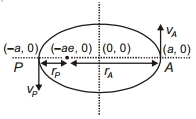
0 likes
View Solution223
EasyMCQ
Two satellites of equal mass are revolving around Earth in elliptical orbits of different semi-major axes. If their angular momenta about the Earth's center are in the ratio $3:4$,then the ratio of their areal velocities is ........
A
$3/4$
B
$2/3$
C
$1/3$
D
$4/3$
Solution
(A) The areal velocity of a satellite is given by the formula: $\frac{dA}{dt} = \frac{L}{2m}$,where $L$ is the angular momentum and $m$ is the mass of the satellite.
Since the masses of the two satellites are equal $(m_1 = m_2 = m)$,the ratio of their areal velocities is directly proportional to the ratio of their angular momenta.
$\frac{(dA/dt)_1}{(dA/dt)_2} = \frac{L_1 / 2m}{L_2 / 2m} = \frac{L_1}{L_2}$.
Given the ratio of angular momenta is $L_1 : L_2 = 3 : 4$,the ratio of their areal velocities is $3/4$.
Since the masses of the two satellites are equal $(m_1 = m_2 = m)$,the ratio of their areal velocities is directly proportional to the ratio of their angular momenta.
$\frac{(dA/dt)_1}{(dA/dt)_2} = \frac{L_1 / 2m}{L_2 / 2m} = \frac{L_1}{L_2}$.
Given the ratio of angular momenta is $L_1 : L_2 = 3 : 4$,the ratio of their areal velocities is $3/4$.
0 likes
View Solution224
MediumMCQ
Assertion $(A):$ An astronaut in an orbiting space station above the earth experiences weightlessness.
Reason $(R):$ An object moving around the earth under the influence of earth's gravitational force is in a state of 'free fall'.
Reason $(R):$ An object moving around the earth under the influence of earth's gravitational force is in a state of 'free fall'.
A
If both Assertion and Reason are true and Reason is the correct explanation of Assertion.
B
If both Assertion and Reason are true but Reason is not the correct explanation of Assertion.
C
If Assertion is true but Reason is false.
D
If both Assertion and Reason are false.
Solution
(A) The astronaut inside an orbiting space station is in a state of continuous free fall towards the Earth because the only force acting on them is gravity.
Since the space station and the astronaut are falling with the same acceleration (the acceleration due to gravity at that altitude),the normal force exerted by the floor on the astronaut is zero.
This condition is perceived as weightlessness.
Therefore,both Assertion $(A)$ and Reason $(R)$ are true,and Reason $(R)$ is the correct explanation of Assertion $(A)$.
Since the space station and the astronaut are falling with the same acceleration (the acceleration due to gravity at that altitude),the normal force exerted by the floor on the astronaut is zero.
This condition is perceived as weightlessness.
Therefore,both Assertion $(A)$ and Reason $(R)$ are true,and Reason $(R)$ is the correct explanation of Assertion $(A)$.
0 likes
View Solution225
MediumMCQ
Two particles of equal mass '$m$' move in a circle of radius '$r$' under the action of their mutual gravitational attraction. The speed of each particle will be:
A
$\sqrt{\frac{ Gm }{2 r }}$
B
$\sqrt{\frac{4 Gm }{ r }}$
C
$\sqrt{\frac{ Gm }{ r }}$
D
$\sqrt{\frac{ Gm }{4 r }}$
Solution
(D) The gravitational force between the two particles acts as the centripetal force required for circular motion.
The distance between the two particles is $2r$.
The gravitational force is $F = \frac{G \cdot m \cdot m}{(2r)^2} = \frac{Gm^2}{4r^2}$.
The centripetal force required for a particle of mass '$m$' moving in a circle of radius '$r$' with speed '$v$' is $F_c = \frac{mv^2}{r}$.
Equating the two forces: $\frac{Gm^2}{4r^2} = \frac{mv^2}{r}$.
Solving for '$v$': $v^2 = \frac{Gm^2}{4r^2} \cdot \frac{r}{m} = \frac{Gm}{4r}$.
Therefore,$v = \sqrt{\frac{Gm}{4r}}$.
The distance between the two particles is $2r$.
The gravitational force is $F = \frac{G \cdot m \cdot m}{(2r)^2} = \frac{Gm^2}{4r^2}$.
The centripetal force required for a particle of mass '$m$' moving in a circle of radius '$r$' with speed '$v$' is $F_c = \frac{mv^2}{r}$.
Equating the two forces: $\frac{Gm^2}{4r^2} = \frac{mv^2}{r}$.
Solving for '$v$': $v^2 = \frac{Gm^2}{4r^2} \cdot \frac{r}{m} = \frac{Gm}{4r}$.
Therefore,$v = \sqrt{\frac{Gm}{4r}}$.
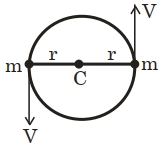
0 likes
View Solution226
MediumMCQ
The orbital angular momentum of a satellite is $L$,when it is revolving in a circular orbit at height $h$ from the earth's surface. If the distance of the satellite from the earth's centre is increased by eight times its initial value,then the new angular momentum will be $............\,L$.
A
$8$
B
$4$
C
$9$
D
$3$
Solution
(D) The orbital angular momentum $L$ of a satellite of mass $m$ revolving in a circular orbit of radius $r$ is given by $L = mvr$.
The orbital velocity $v$ is given by $v = \sqrt{\frac{GM_e}{r}}$,where $M_e$ is the mass of the earth.
Substituting $v$ in the expression for $L$:
$L = m \sqrt{\frac{GM_e}{r}} \cdot r = m \sqrt{GM_e} \cdot r^{1/2}$.
This shows that $L \propto r^{1/2}$.
Let the initial distance from the earth's centre be $r_1 = r$. The new distance from the earth's centre is increased by eight times its initial value,meaning the new distance $r_2 = r + 8r = 9r$.
Now,the ratio of the new angular momentum $L'$ to the initial angular momentum $L$ is:
$\frac{L'}{L} = \left( \frac{r_2}{r_1} \right)^{1/2} = \left( \frac{9r}{r} \right)^{1/2} = (9)^{1/2} = 3$.
Therefore,the new angular momentum $L' = 3L$.
The orbital velocity $v$ is given by $v = \sqrt{\frac{GM_e}{r}}$,where $M_e$ is the mass of the earth.
Substituting $v$ in the expression for $L$:
$L = m \sqrt{\frac{GM_e}{r}} \cdot r = m \sqrt{GM_e} \cdot r^{1/2}$.
This shows that $L \propto r^{1/2}$.
Let the initial distance from the earth's centre be $r_1 = r$. The new distance from the earth's centre is increased by eight times its initial value,meaning the new distance $r_2 = r + 8r = 9r$.
Now,the ratio of the new angular momentum $L'$ to the initial angular momentum $L$ is:
$\frac{L'}{L} = \left( \frac{r_2}{r_1} \right)^{1/2} = \left( \frac{9r}{r} \right)^{1/2} = (9)^{1/2} = 3$.
Therefore,the new angular momentum $L' = 3L$.
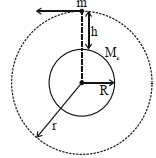
0 likes
View Solution227
MediumMCQ
Two satellites of masses $m$ and $3\,m$ revolve around the earth in circular orbits of radii $r$ and $3r$ respectively. The ratio of orbital speeds of the satellites respectively is:
A
$1: 1$
B
$3: 1$
C
$\sqrt{3}: 1$
D
$1: \sqrt{3}$
Solution
(C) The orbital speed $v$ of a satellite revolving around the Earth at a distance $r$ from the center is given by the formula:
$v = \sqrt{\frac{GM}{r}}$
where $G$ is the gravitational constant and $M$ is the mass of the Earth.
From the formula,we can see that the orbital speed is independent of the mass of the satellite and is inversely proportional to the square root of the orbital radius:
$v \propto \frac{1}{\sqrt{r}}$
Given:
Radius of the first satellite,$r_1 = r$
Radius of the second satellite,$r_2 = 3r$
The ratio of the orbital speeds $v_1$ and $v_2$ is:
$\frac{v_1}{v_2} = \sqrt{\frac{r_2}{r_1}}$
Substituting the values:
$\frac{v_1}{v_2} = \sqrt{\frac{3r}{r}} = \sqrt{3}$
Therefore,the ratio of the orbital speeds is $\sqrt{3}: 1$.
$v = \sqrt{\frac{GM}{r}}$
where $G$ is the gravitational constant and $M$ is the mass of the Earth.
From the formula,we can see that the orbital speed is independent of the mass of the satellite and is inversely proportional to the square root of the orbital radius:
$v \propto \frac{1}{\sqrt{r}}$
Given:
Radius of the first satellite,$r_1 = r$
Radius of the second satellite,$r_2 = 3r$
The ratio of the orbital speeds $v_1$ and $v_2$ is:
$\frac{v_1}{v_2} = \sqrt{\frac{r_2}{r_1}}$
Substituting the values:
$\frac{v_1}{v_2} = \sqrt{\frac{3r}{r}} = \sqrt{3}$
Therefore,the ratio of the orbital speeds is $\sqrt{3}: 1$.
0 likes
View Solution228
MediumMCQ
The time period of a satellite,revolving above earth's surface at a height equal to $R$ will be (Given $g = \pi^2 \ m/s^2$,$R =$ radius of earth).
A
$\sqrt{4 R}$
B
$\sqrt{8 R}$
C
$\sqrt{32 R}$
D
$\sqrt{2 R}$
Solution
(C) The orbital radius of the satellite is $r = R + h = R + R = 2R$.
The orbital velocity $v$ is given by $v = \sqrt{\frac{GM}{r}} = \sqrt{\frac{GM}{2R}}$.
Since $g = \frac{GM}{R^2}$,we have $GM = gR^2$. Substituting this into the velocity equation:
$v = \sqrt{\frac{gR^2}{2R}} = \sqrt{\frac{gR}{2}}$.
The time period $T$ is given by $T = \frac{2\pi r}{v}$.
Substituting $r = 2R$ and $v = \sqrt{\frac{gR}{2}}$:
$T = \frac{2\pi(2R)}{\sqrt{\frac{gR}{2}}} = \frac{4\pi R}{\sqrt{\frac{gR}{2}}} = 4\pi R \sqrt{\frac{2}{gR}} = 4\pi \sqrt{\frac{2R}{g}}$.
Given $g = \pi^2 \ m/s^2$,we substitute $\pi = \sqrt{g}$:
$T = 4\sqrt{g} \sqrt{\frac{2R}{g}} = 4\sqrt{2R} = \sqrt{16 \times 2R} = \sqrt{32R}$.
The orbital velocity $v$ is given by $v = \sqrt{\frac{GM}{r}} = \sqrt{\frac{GM}{2R}}$.
Since $g = \frac{GM}{R^2}$,we have $GM = gR^2$. Substituting this into the velocity equation:
$v = \sqrt{\frac{gR^2}{2R}} = \sqrt{\frac{gR}{2}}$.
The time period $T$ is given by $T = \frac{2\pi r}{v}$.
Substituting $r = 2R$ and $v = \sqrt{\frac{gR}{2}}$:
$T = \frac{2\pi(2R)}{\sqrt{\frac{gR}{2}}} = \frac{4\pi R}{\sqrt{\frac{gR}{2}}} = 4\pi R \sqrt{\frac{2}{gR}} = 4\pi \sqrt{\frac{2R}{g}}$.
Given $g = \pi^2 \ m/s^2$,we substitute $\pi = \sqrt{g}$:
$T = 4\sqrt{g} \sqrt{\frac{2R}{g}} = 4\sqrt{2R} = \sqrt{16 \times 2R} = \sqrt{32R}$.
0 likes
View Solution229
MediumMCQ
Two satellites $A$ and $B$ move around the Earth in the same orbit. The mass of $A$ is twice the mass of $B$. The quantity which is the same for the two satellites will be:
A
Potential energy
B
Total energy
C
Kinetic energy
D
Speed
Solution
(D) Let $M_p$ be the mass of the Earth,$m$ be the mass of the satellite,and $R$ be the orbital radius.
Potential energy $(U)$ $= -\frac{G M_p m}{R}$. Since $m_A = 2m_B$,$U_A \neq U_B$.
Kinetic energy $(K)$ $= \frac{G M_p m}{2R}$. Since $m_A = 2m_B$,$K_A \neq K_B$.
Total energy $(E)$ $= U + K = -\frac{G M_p m}{2R}$. Since $m_A = 2m_B$,$E_A \neq E_B$.
Orbital speed $(v)$ $= \sqrt{\frac{G M_p}{R}}$.
As seen from the formula,the orbital speed is independent of the mass of the satellite $(m)$. Therefore,both satellites will have the same speed.
Potential energy $(U)$ $= -\frac{G M_p m}{R}$. Since $m_A = 2m_B$,$U_A \neq U_B$.
Kinetic energy $(K)$ $= \frac{G M_p m}{2R}$. Since $m_A = 2m_B$,$K_A \neq K_B$.
Total energy $(E)$ $= U + K = -\frac{G M_p m}{2R}$. Since $m_A = 2m_B$,$E_A \neq E_B$.
Orbital speed $(v)$ $= \sqrt{\frac{G M_p}{R}}$.
As seen from the formula,the orbital speed is independent of the mass of the satellite $(m)$. Therefore,both satellites will have the same speed.
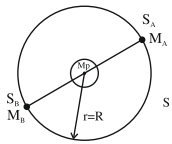
0 likes
View Solution230
MediumMCQ
$A$ satellite is orbiting just above the surface of the earth with period $T$. If $d$ is the density of the earth and $G$ is the universal constant of gravitation,the quantity $\frac{3 \pi}{G d}$ represents :
A
$T$
B
$T^2$
C
$T^3$
D
$T^4$
Solution
(B) The time period $T$ of a satellite orbiting just above the surface of the Earth is given by $T = 2 \pi \sqrt{\frac{R}{g}}$,where $R$ is the radius of the Earth and $g$ is the acceleration due to gravity.
We know that $g = \frac{GM}{R^2}$,where $M$ is the mass of the Earth.
The mass of the Earth can be expressed in terms of its density $d$ as $M = \frac{4}{3} \pi R^3 d$.
Substituting $M$ into the expression for $g$,we get $g = \frac{G (\frac{4}{3} \pi R^3 d)}{R^2} = \frac{4}{3} \pi G R d$.
Now,substitute $g$ back into the time period formula: $T = 2 \pi \sqrt{\frac{R}{\frac{4}{3} \pi G R d}} = 2 \pi \sqrt{\frac{3}{4 \pi G d}} = \sqrt{\frac{4 \pi^2 \cdot 3}{4 \pi G d}} = \sqrt{\frac{3 \pi}{G d}}$.
Squaring both sides,we get $T^2 = \frac{3 \pi}{G d}$.
We know that $g = \frac{GM}{R^2}$,where $M$ is the mass of the Earth.
The mass of the Earth can be expressed in terms of its density $d$ as $M = \frac{4}{3} \pi R^3 d$.
Substituting $M$ into the expression for $g$,we get $g = \frac{G (\frac{4}{3} \pi R^3 d)}{R^2} = \frac{4}{3} \pi G R d$.
Now,substitute $g$ back into the time period formula: $T = 2 \pi \sqrt{\frac{R}{\frac{4}{3} \pi G R d}} = 2 \pi \sqrt{\frac{3}{4 \pi G d}} = \sqrt{\frac{4 \pi^2 \cdot 3}{4 \pi G d}} = \sqrt{\frac{3 \pi}{G d}}$.
Squaring both sides,we get $T^2 = \frac{3 \pi}{G d}$.
4 likes
View Solution231
DifficultMCQ
$A$ light planet is revolving around a massive star in a circular orbit of radius $R$ with a period of revolution $T$. If the force of attraction between the planet and the star is proportional to $R^{-3/2}$,then choose the correct option:
A
$T^2 \propto R^{5/2}$
B
$T^2 \propto R^{7/2}$
C
$T^2 \propto R^{3/2}$
D
$T^2 \propto R^3$
Solution
(A) The gravitational force provides the necessary centripetal force for circular motion.
$F = \frac{k}{R^{3/2}} = m \omega^2 R$,where $k$ is a constant.
Rearranging for angular velocity $\omega$:
$\omega^2 = \frac{k}{m R^{5/2}} \implies \omega^2 \propto R^{-5/2}$.
Since the time period $T = \frac{2\pi}{\omega}$,we have $T^2 = \frac{4\pi^2}{\omega^2}$.
Substituting $\omega^2 \propto R^{-5/2}$:
$T^2 \propto \frac{1}{R^{-5/2}} \implies T^2 \propto R^{5/2}$.
$F = \frac{k}{R^{3/2}} = m \omega^2 R$,where $k$ is a constant.
Rearranging for angular velocity $\omega$:
$\omega^2 = \frac{k}{m R^{5/2}} \implies \omega^2 \propto R^{-5/2}$.
Since the time period $T = \frac{2\pi}{\omega}$,we have $T^2 = \frac{4\pi^2}{\omega^2}$.
Substituting $\omega^2 \propto R^{-5/2}$:
$T^2 \propto \frac{1}{R^{-5/2}} \implies T^2 \propto R^{5/2}$.
0 likes
View Solution232
DifficultMCQ
The correct formula for the height $h$ of a satellite from the Earth's surface is:
A
$\left(\frac{T^2 R^2 g}{4 \pi^2}\right)^{1 / 3}-R$
B
$\left(\frac{T^2 R^2 g}{4 \pi^2}\right)^{1 / 2}-R$
C
$\left(\frac{T^2 R^2}{4 \pi^2 g}\right)^{1 / 3}-R$
D
$\left(\frac{T^2 R^2}{4 \pi^2}\right)^{-1 / 3}+R$
Solution
(A) For a satellite of mass $m$ orbiting at a height $h$ above the Earth's surface,the gravitational force provides the necessary centripetal force:
$\frac{GMm}{(R+h)^2} = \frac{mv^2}{(R+h)}$
$\Rightarrow \frac{GM}{(R+h)} = v^2 \quad \dots(1)$
Since $v = (R+h)\omega = (R+h)\frac{2\pi}{T}$,we have $v^2 = (R+h)^2 \frac{4\pi^2}{T^2} \quad \dots(2)$
Also,the acceleration due to gravity at the Earth's surface is $g = \frac{GM}{R^2}$,so $GM = gR^2 \quad \dots(3)$
Substituting $(2)$ and $(3)$ into $(1)$:
$\frac{gR^2}{(R+h)} = (R+h)^2 \frac{4\pi^2}{T^2}$
$\Rightarrow (R+h)^3 = \frac{gR^2 T^2}{4\pi^2}$
$\Rightarrow R+h = \left(\frac{gR^2 T^2}{4\pi^2}\right)^{1/3}$
$\Rightarrow h = \left(\frac{T^2 R^2 g}{4\pi^2}\right)^{1/3} - R$
$\frac{GMm}{(R+h)^2} = \frac{mv^2}{(R+h)}$
$\Rightarrow \frac{GM}{(R+h)} = v^2 \quad \dots(1)$
Since $v = (R+h)\omega = (R+h)\frac{2\pi}{T}$,we have $v^2 = (R+h)^2 \frac{4\pi^2}{T^2} \quad \dots(2)$
Also,the acceleration due to gravity at the Earth's surface is $g = \frac{GM}{R^2}$,so $GM = gR^2 \quad \dots(3)$
Substituting $(2)$ and $(3)$ into $(1)$:
$\frac{gR^2}{(R+h)} = (R+h)^2 \frac{4\pi^2}{T^2}$
$\Rightarrow (R+h)^3 = \frac{gR^2 T^2}{4\pi^2}$
$\Rightarrow R+h = \left(\frac{gR^2 T^2}{4\pi^2}\right)^{1/3}$
$\Rightarrow h = \left(\frac{T^2 R^2 g}{4\pi^2}\right)^{1/3} - R$
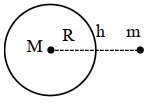
0 likes
View Solution233
DifficultMCQ
$A$ satellite revolving around a planet in a stationary orbit has a time period of $6 \text{ hours}$. The mass of the planet is one-fourth the mass of the Earth. What is the radius of the orbit of the satellite? (Given: Radius of the geostationary orbit for Earth is $4.2 \times 10^4 \text{ km}$)
A
$1.4 \times 10^4 \text{ km}$
B
$8.4 \times 10^4 \text{ km}$
C
$1.68 \times 10^5 \text{ km}$
D
$1.05 \times 10^4 \text{ km}$
Solution
(D) The time period of a satellite is given by $T = 2\pi \sqrt{\frac{r^3}{GM}}$.
From this,we have $T \propto \sqrt{\frac{r^3}{M}}$,which implies $\frac{T_1}{T_2} = \left(\frac{r_1}{r_2}\right)^{3/2} \left(\frac{M_2}{M_1}\right)^{1/2}$.
Here,$T_1 = 6 \text{ hours}$,$T_2 = 24 \text{ hours}$ (for Earth's geostationary orbit).
$M_1 = \frac{M_e}{4}$ and $M_2 = M_e$.
$r_2 = 4.2 \times 10^4 \text{ km}$.
Substituting the values: $\frac{6}{24} = \left(\frac{r_1}{4.2 \times 10^4}\right)^{3/2} \left(\frac{M_e}{M_e/4}\right)^{1/2}$.
$\frac{1}{4} = \left(\frac{r_1}{4.2 \times 10^4}\right)^{3/2} \times (4)^{1/2}$.
$\frac{1}{4} = \left(\frac{r_1}{4.2 \times 10^4}\right)^{3/2} \times 2$.
$\frac{1}{8} = \left(\frac{r_1}{4.2 \times 10^4}\right)^{3/2}$.
Taking the power of $2/3$ on both sides: $\left(\frac{1}{8}\right)^{2/3} = \frac{r_1}{4.2 \times 10^4}$.
$\frac{1}{4} = \frac{r_1}{4.2 \times 10^4}$.
$r_1 = \frac{4.2 \times 10^4}{4} = 1.05 \times 10^4 \text{ km}$.
From this,we have $T \propto \sqrt{\frac{r^3}{M}}$,which implies $\frac{T_1}{T_2} = \left(\frac{r_1}{r_2}\right)^{3/2} \left(\frac{M_2}{M_1}\right)^{1/2}$.
Here,$T_1 = 6 \text{ hours}$,$T_2 = 24 \text{ hours}$ (for Earth's geostationary orbit).
$M_1 = \frac{M_e}{4}$ and $M_2 = M_e$.
$r_2 = 4.2 \times 10^4 \text{ km}$.
Substituting the values: $\frac{6}{24} = \left(\frac{r_1}{4.2 \times 10^4}\right)^{3/2} \left(\frac{M_e}{M_e/4}\right)^{1/2}$.
$\frac{1}{4} = \left(\frac{r_1}{4.2 \times 10^4}\right)^{3/2} \times (4)^{1/2}$.
$\frac{1}{4} = \left(\frac{r_1}{4.2 \times 10^4}\right)^{3/2} \times 2$.
$\frac{1}{8} = \left(\frac{r_1}{4.2 \times 10^4}\right)^{3/2}$.
Taking the power of $2/3$ on both sides: $\left(\frac{1}{8}\right)^{2/3} = \frac{r_1}{4.2 \times 10^4}$.
$\frac{1}{4} = \frac{r_1}{4.2 \times 10^4}$.
$r_1 = \frac{4.2 \times 10^4}{4} = 1.05 \times 10^4 \text{ km}$.
0 likes
View Solution234
DifficultMCQ
Two satellites $A$ and $B$ go round a planet in circular orbits having radii $4 R$ and $R$ respectively. If the speed of $A$ is $3 v$,the speed of $B$ will be:
A
$\frac{4}{3} v$
B
$3 v$
C
$6 v$
D
$12 v$
Solution
(C) The orbital speed of a satellite at a distance $r$ from the center of a planet of mass $M$ is given by $v = \sqrt{\frac{GM}{r}}$.
Given the radii of the orbits are $R_A = 4R$ and $R_B = R$.
The ratio of the speeds is $\frac{v_A}{v_B} = \sqrt{\frac{R_B}{R_A}} = \sqrt{\frac{R}{4R}} = \sqrt{\frac{1}{4}} = \frac{1}{2}$.
Given $v_A = 3v$,we have $\frac{3v}{v_B} = \frac{1}{2}$.
Therefore,$v_B = 2 \times 3v = 6v$.
Given the radii of the orbits are $R_A = 4R$ and $R_B = R$.
The ratio of the speeds is $\frac{v_A}{v_B} = \sqrt{\frac{R_B}{R_A}} = \sqrt{\frac{R}{4R}} = \sqrt{\frac{1}{4}} = \frac{1}{2}$.
Given $v_A = 3v$,we have $\frac{3v}{v_B} = \frac{1}{2}$.
Therefore,$v_B = 2 \times 3v = 6v$.
0 likes
View Solution235
MediumMCQ
$STATEMENT-1$: An astronaut in an orbiting space station above the Earth experiences weightlessness.
$STATEMENT-2$: An object moving around the Earth under the influence of Earth's gravitational force is in a state of 'free-fall'.
$STATEMENT-2$: An object moving around the Earth under the influence of Earth's gravitational force is in a state of 'free-fall'.
A
$STATEMENT-1$ is True,$STATEMENT-2$ is True; $STATEMENT-2$ is a correct explanation for $STATEMENT-1$.
B
$STATEMENT-1$ is True,$STATEMENT-2$ is True; $STATEMENT-2$ is $NOT$ a correct explanation for $STATEMENT-1$.
C
$STATEMENT-1$ is True,$STATEMENT-2$ is False.
D
$STATEMENT-1$ is False,$STATEMENT-2$ is True.
Solution
(A) An astronaut in an orbiting space station is in a state of continuous free-fall towards the Earth due to gravity,which provides the necessary centripetal force for orbital motion.
Since the astronaut and the space station are falling with the same acceleration (the acceleration due to gravity at that altitude),there is no normal reaction force between them.
This absence of a normal reaction force is perceived as weightlessness.
Therefore,$STATEMENT-1$ is true.
An object moving around the Earth under the influence of only the Earth's gravitational force is indeed in a state of 'free-fall',as it is accelerating towards the center of the Earth.
Therefore,$STATEMENT-2$ is true.
Since the state of free-fall is the direct physical reason for the sensation of weightlessness experienced by the astronaut,$STATEMENT-2$ is the correct explanation for $STATEMENT-1$.
Since the astronaut and the space station are falling with the same acceleration (the acceleration due to gravity at that altitude),there is no normal reaction force between them.
This absence of a normal reaction force is perceived as weightlessness.
Therefore,$STATEMENT-1$ is true.
An object moving around the Earth under the influence of only the Earth's gravitational force is indeed in a state of 'free-fall',as it is accelerating towards the center of the Earth.
Therefore,$STATEMENT-2$ is true.
Since the state of free-fall is the direct physical reason for the sensation of weightlessness experienced by the astronaut,$STATEMENT-2$ is the correct explanation for $STATEMENT-1$.
0 likes
View Solution236
DifficultMCQ
$A$ planet of mass $M$ has two natural satellites with masses $m_1$ and $m_2$. The radii of their circular orbits are $R_1$ and $R_2$ respectively. Ignore the gravitational force between the satellites. Define $v_1, L_1, K_1$ and $T_1$ to be,respectively,the orbital speed,angular momentum,kinetic energy,and time period of revolution of satellite $1$; and $v_2, L_2, K_2$ and $T_2$ to be the corresponding quantities of satellite $2$. Given $m_1/m_2 = 2$ and $R_1/R_2 = 1/4$,match the ratios in List-$I$ to the numbers in List-$II$.
| List-$I$ | List-$II$ |
| $P. \frac{v_1}{v_2}$ | $1. \frac{1}{8}$ |
| $Q. \frac{L_1}{L_2}$ | $2. 1$ |
| $R. \frac{K_1}{K_2}$ | $3. 2$ |
| $S. \frac{T_1}{T_2}$ | $4. 8$ |
A
$P \rightarrow 4; Q \rightarrow 2; R \rightarrow 1; S \rightarrow 3$
B
$P \rightarrow 3; Q \rightarrow 2; R \rightarrow 4; S \rightarrow 1$
C
$P \rightarrow 2; Q \rightarrow 3; R \rightarrow 1; S \rightarrow 4$
D
$P \rightarrow 2; Q \rightarrow 3; R \rightarrow 4; S \rightarrow 1$
Solution
(B) Given: $\frac{m_1}{m_2} = 2$ and $\frac{R_1}{R_2} = \frac{1}{4}$.
$(P)$ For orbital speed $v = \sqrt{\frac{GM}{R}}$:
$\frac{v_1}{v_2} = \sqrt{\frac{R_2}{R_1}} = \sqrt{4} = 2$. Thus,$P \rightarrow 3$.
$(Q)$ For angular momentum $L = mvr = m\sqrt{GMR}$:
$\frac{L_1}{L_2} = \frac{m_1}{m_2} \sqrt{\frac{R_1}{R_2}} = 2 \times \sqrt{\frac{1}{4}} = 2 \times \frac{1}{2} = 1$. Thus,$Q \rightarrow 2$.
$(R)$ For kinetic energy $K = \frac{GMm}{2R}$:
$\frac{K_1}{K_2} = \frac{m_1}{m_2} \times \frac{R_2}{R_1} = 2 \times 4 = 8$. Thus,$R \rightarrow 4$.
$(S)$ For time period $T = 2\pi \sqrt{\frac{R^3}{GM}}$:
$\frac{T_1}{T_2} = \left(\frac{R_1}{R_2}\right)^{3/2} = \left(\frac{1}{4}\right)^{3/2} = \frac{1}{8}$. Thus,$S \rightarrow 1$.
Therefore,the correct matching is $P \rightarrow 3, Q \rightarrow 2, R \rightarrow 4, S \rightarrow 1$.
$(P)$ For orbital speed $v = \sqrt{\frac{GM}{R}}$:
$\frac{v_1}{v_2} = \sqrt{\frac{R_2}{R_1}} = \sqrt{4} = 2$. Thus,$P \rightarrow 3$.
$(Q)$ For angular momentum $L = mvr = m\sqrt{GMR}$:
$\frac{L_1}{L_2} = \frac{m_1}{m_2} \sqrt{\frac{R_1}{R_2}} = 2 \times \sqrt{\frac{1}{4}} = 2 \times \frac{1}{2} = 1$. Thus,$Q \rightarrow 2$.
$(R)$ For kinetic energy $K = \frac{GMm}{2R}$:
$\frac{K_1}{K_2} = \frac{m_1}{m_2} \times \frac{R_2}{R_1} = 2 \times 4 = 8$. Thus,$R \rightarrow 4$.
$(S)$ For time period $T = 2\pi \sqrt{\frac{R^3}{GM}}$:
$\frac{T_1}{T_2} = \left(\frac{R_1}{R_2}\right)^{3/2} = \left(\frac{1}{4}\right)^{3/2} = \frac{1}{8}$. Thus,$S \rightarrow 1$.
Therefore,the correct matching is $P \rightarrow 3, Q \rightarrow 2, R \rightarrow 4, S \rightarrow 1$.
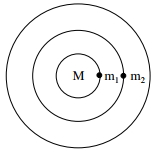
0 likes
View Solution237
MediumMCQ
The distance between two stars of masses $3 M_S$ and $6 M_S$ is $9 R$. Here $R$ is the mean distance between the centers of the Earth and the Sun,and $M_S$ is the mass of the Sun. The two stars orbit around their common center of mass in circular orbits with period $n T$,where $T$ is the period of Earth's revolution around the Sun. The value of $n$ is. . . . .
A
$4$
B
$5$
C
$8$
D
$9$
Solution
(D) For the Earth revolving around the Sun,the period $T$ is given by Kepler's Third Law: $T = 2 \pi \sqrt{\frac{R^3}{G M_S}}$.
For two stars of masses $m_1 = 3 M_S$ and $m_2 = 6 M_S$ separated by a distance $d = 9 R$,they orbit their common center of mass with a period $T'$ given by: $T' = 2 \pi \sqrt{\frac{d^3}{G(m_1 + m_2)}}$.
Substituting the given values: $T' = 2 \pi \sqrt{\frac{(9 R)^3}{G(3 M_S + 6 M_S)}} = 2 \pi \sqrt{\frac{729 R^3}{G(9 M_S)}} = 2 \pi \sqrt{\frac{81 R^3}{G M_S}} = 9 \times 2 \pi \sqrt{\frac{R^3}{G M_S}}$.
Since $T' = n T$,we have $n T = 9 T$,which implies $n = 9$.
For two stars of masses $m_1 = 3 M_S$ and $m_2 = 6 M_S$ separated by a distance $d = 9 R$,they orbit their common center of mass with a period $T'$ given by: $T' = 2 \pi \sqrt{\frac{d^3}{G(m_1 + m_2)}}$.
Substituting the given values: $T' = 2 \pi \sqrt{\frac{(9 R)^3}{G(3 M_S + 6 M_S)}} = 2 \pi \sqrt{\frac{729 R^3}{G(9 M_S)}} = 2 \pi \sqrt{\frac{81 R^3}{G M_S}} = 9 \times 2 \pi \sqrt{\frac{R^3}{G M_S}}$.
Since $T' = n T$,we have $n T = 9 T$,which implies $n = 9$.
0 likes
View Solution238
MediumMCQ
$A$ particle of mass $m$ is under the influence of the gravitational field of a body of mass $M (\gg m)$. The particle is moving in a circular orbit of radius $r_0$ with time period $T_0$ around the mass $M$. Then,the particle is subjected to an additional central force,corresponding to the potential energy $V_c(r) = m \alpha / r^3$,where $\alpha$ is a positive constant of suitable dimensions and $r$ is the distance from the center of the orbit. If the particle moves in the same circular orbit of radius $r_0$ in the combined gravitational potential due to $M$ and $V_c(r)$,but with a new time period $T_1$,then $(T_1^2 - T_0^2) / T_1^2$ is given by [ $G$ is the gravitational constant.]
A
$\frac{3 \alpha}{G M r_0^2}$
B
$\frac{\alpha}{2 G M r_0^2}$
C
$\frac{\alpha}{G M r_0^2}$
D
$\frac{2 \alpha}{G M r_0^2}$
Solution
(A) For the initial circular orbit,the gravitational force provides the centripetal force: $F_0 = \frac{GMm}{r_0^2} = m \omega_0^2 r_0$,where $\omega_0 = \frac{2\pi}{T_0}$.
Thus,$\omega_0^2 = \frac{GM}{r_0^3}$.
When the additional potential $V_c(r) = \frac{m \alpha}{r^3}$ is introduced,the additional force is $F_c = -\frac{dV_c}{dr} = -\frac{d}{dr} (m \alpha r^{-3}) = 3m \alpha r^{-4}$.
The total force acting on the particle is $F_{total} = \frac{GMm}{r_0^2} + \frac{3m \alpha}{r_0^4} = m \omega_1^2 r_0$,where $\omega_1 = \frac{2\pi}{T_1}$.
Dividing by $m r_0$,we get $\omega_1^2 = \frac{GM}{r_0^3} + \frac{3 \alpha}{r_0^5}$.
Since $\omega^2 = \frac{4\pi^2}{T^2}$,we have $\frac{4\pi^2}{T_1^2} = \frac{GM}{r_0^3} + \frac{3 \alpha}{r_0^5} = \frac{GM}{r_0^3} \left( 1 + \frac{3 \alpha}{G M r_0^2} \right)$.
Substituting $\frac{4\pi^2}{T_0^2} = \frac{GM}{r_0^3}$,we get $\frac{1}{T_1^2} = \frac{1}{T_0^2} \left( 1 + \frac{3 \alpha}{G M r_0^2} \right)$.
Rearranging,$\frac{T_0^2}{T_1^2} = 1 + \frac{3 \alpha}{G M r_0^2}$.
Then,$1 - \frac{T_0^2}{T_1^2} = -\frac{3 \alpha}{G M r_0^2}$,which implies $\frac{T_1^2 - T_0^2}{T_1^2} = \frac{3 \alpha}{G M r_0^2}$.
Thus,$\omega_0^2 = \frac{GM}{r_0^3}$.
When the additional potential $V_c(r) = \frac{m \alpha}{r^3}$ is introduced,the additional force is $F_c = -\frac{dV_c}{dr} = -\frac{d}{dr} (m \alpha r^{-3}) = 3m \alpha r^{-4}$.
The total force acting on the particle is $F_{total} = \frac{GMm}{r_0^2} + \frac{3m \alpha}{r_0^4} = m \omega_1^2 r_0$,where $\omega_1 = \frac{2\pi}{T_1}$.
Dividing by $m r_0$,we get $\omega_1^2 = \frac{GM}{r_0^3} + \frac{3 \alpha}{r_0^5}$.
Since $\omega^2 = \frac{4\pi^2}{T^2}$,we have $\frac{4\pi^2}{T_1^2} = \frac{GM}{r_0^3} + \frac{3 \alpha}{r_0^5} = \frac{GM}{r_0^3} \left( 1 + \frac{3 \alpha}{G M r_0^2} \right)$.
Substituting $\frac{4\pi^2}{T_0^2} = \frac{GM}{r_0^3}$,we get $\frac{1}{T_1^2} = \frac{1}{T_0^2} \left( 1 + \frac{3 \alpha}{G M r_0^2} \right)$.
Rearranging,$\frac{T_0^2}{T_1^2} = 1 + \frac{3 \alpha}{G M r_0^2}$.
Then,$1 - \frac{T_0^2}{T_1^2} = -\frac{3 \alpha}{G M r_0^2}$,which implies $\frac{T_1^2 - T_0^2}{T_1^2} = \frac{3 \alpha}{G M r_0^2}$.
0 likes
View Solution239
MediumMCQ
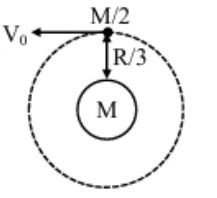
$A$ satellite of mass $\frac{M}{2}$ is revolving around the Earth in a circular orbit at a height of $\frac{R}{3}$ from the Earth's surface. The angular momentum of the satellite is $M \sqrt{\frac{GMR}{x}}$. The value of $x$ is . . . . . . ,where $M$ and $R$ are the mass and radius of the Earth,respectively. ($G$ is the gravitational constant)
A
$1$
B
$3$
C
$4$
D
$5$
Solution
(B) The orbital radius of the satellite is $r = R + h = R + \frac{R}{3} = \frac{4R}{3}$.
The orbital velocity $v_0$ is given by $v_0 = \sqrt{\frac{GM}{r}} = \sqrt{\frac{GM}{4R/3}} = \sqrt{\frac{3GM}{4R}}$.
The angular momentum $L$ of the satellite is given by $L = m v_0 r$,where $m = \frac{M}{2}$ is the mass of the satellite.
Substituting the values,we get:
$L = \left(\frac{M}{2}\right) \cdot \sqrt{\frac{3GM}{4R}} \cdot \left(\frac{4R}{3}\right)$
$L = \frac{M}{2} \cdot \sqrt{\frac{3GM}{4R}} \cdot \sqrt{\frac{16R^2}{9}}$
$L = \frac{M}{2} \cdot \sqrt{\frac{3GM}{4R} \cdot \frac{16R^2}{9}}$
$L = \frac{M}{2} \cdot \sqrt{\frac{4GMR}{3}}$
$L = M \cdot \sqrt{\frac{4GMR}{3 \cdot 4}} = M \sqrt{\frac{GMR}{3}}$.
Comparing this with the given expression $M \sqrt{\frac{GMR}{x}}$,we find $x = 3$.
The orbital velocity $v_0$ is given by $v_0 = \sqrt{\frac{GM}{r}} = \sqrt{\frac{GM}{4R/3}} = \sqrt{\frac{3GM}{4R}}$.
The angular momentum $L$ of the satellite is given by $L = m v_0 r$,where $m = \frac{M}{2}$ is the mass of the satellite.
Substituting the values,we get:
$L = \left(\frac{M}{2}\right) \cdot \sqrt{\frac{3GM}{4R}} \cdot \left(\frac{4R}{3}\right)$
$L = \frac{M}{2} \cdot \sqrt{\frac{3GM}{4R}} \cdot \sqrt{\frac{16R^2}{9}}$
$L = \frac{M}{2} \cdot \sqrt{\frac{3GM}{4R} \cdot \frac{16R^2}{9}}$
$L = \frac{M}{2} \cdot \sqrt{\frac{4GMR}{3}}$
$L = M \cdot \sqrt{\frac{4GMR}{3 \cdot 4}} = M \sqrt{\frac{GMR}{3}}$.
Comparing this with the given expression $M \sqrt{\frac{GMR}{x}}$,we find $x = 3$.
0 likes
View Solution240
DifficultMCQ
Two planets,$A$ and $B$,are orbiting a common star in circular orbits of radii $R_A$ and $R_B$,respectively,with $R_B = 2 R_A$. The planet $B$ is $4 \sqrt{2}$ times more massive than planet $A$. The ratio $\left(\frac{L_B}{L_A}\right)$ of angular momentum $(L_B)$ of planet $B$ to that of planet $A$ $(L_A)$ is closest to integer . . . . . . .
A
$6$
B
$5$
C
$2$
D
$8$
Solution
(D) The angular momentum $L$ of a planet of mass $m$ in a circular orbit of radius $R$ around a star of mass $M$ is given by $L = mvr$.
For a circular orbit,the orbital velocity is $v = \sqrt{\frac{GM}{R}}$.
Substituting this into the expression for angular momentum,we get $L = m \sqrt{\frac{GM}{R}} R = m \sqrt{GMR}$.
Given $R_B = 2 R_A$ and $m_B = 4 \sqrt{2} m_A$.
The ratio of angular momenta is $\frac{L_B}{L_A} = \frac{m_B \sqrt{GM R_B}}{m_A \sqrt{GM R_A}} = \frac{m_B}{m_A} \sqrt{\frac{R_B}{R_A}}$.
Substituting the given values: $\frac{L_B}{L_A} = (4 \sqrt{2}) \sqrt{\frac{2 R_A}{R_A}} = 4 \sqrt{2} \times \sqrt{2} = 4 \times 2 = 8$.
Thus,the ratio is $8$.
For a circular orbit,the orbital velocity is $v = \sqrt{\frac{GM}{R}}$.
Substituting this into the expression for angular momentum,we get $L = m \sqrt{\frac{GM}{R}} R = m \sqrt{GMR}$.
Given $R_B = 2 R_A$ and $m_B = 4 \sqrt{2} m_A$.
The ratio of angular momenta is $\frac{L_B}{L_A} = \frac{m_B \sqrt{GM R_B}}{m_A \sqrt{GM R_A}} = \frac{m_B}{m_A} \sqrt{\frac{R_B}{R_A}}$.
Substituting the given values: $\frac{L_B}{L_A} = (4 \sqrt{2}) \sqrt{\frac{2 R_A}{R_A}} = 4 \sqrt{2} \times \sqrt{2} = 4 \times 2 = 8$.
Thus,the ratio is $8$.
0 likes
View Solution241
MediumMCQ
$A$ satellite of mass $1000 \ kg$ is launched to revolve around the earth in an orbit at a height of $270 \ km$ from the earth's surface. Kinetic energy of the satellite in this orbit is . . . . . . $\times 10^{10} \ J$. (Mass of earth $= 6 \times 10^{24} \ kg$,Radius of earth $= 6.4 \times 10^6 \ m$,Gravitational constant $= 6.67 \times 10^{-11} \ Nm^2 \ kg^{-2}$)
A
$3$
B
$2$
C
$9$
D
$5$
Solution
(A) The kinetic energy $(KE)$ of a satellite in a circular orbit is given by the formula: $KE = \frac{GM_e m}{2r}$,where $r = R_E + h$.
Given: $M_e = 6 \times 10^{24} \ kg$,$m = 1000 \ kg$,$R_E = 6.4 \times 10^6 \ m$,$h = 270 \ km = 0.27 \times 10^6 \ m$,$G = 6.67 \times 10^{-11} \ Nm^2 \ kg^{-2}$.
Calculating $r$: $r = 6.4 \times 10^6 + 0.27 \times 10^6 = 6.67 \times 10^6 \ m$.
Substituting the values into the formula:
$KE = \frac{6.67 \times 10^{-11} \times 6 \times 10^{24} \times 1000}{2 \times 6.67 \times 10^6}$
$KE = \frac{6.67 \times 6 \times 10^{16}}{2 \times 6.67 \times 10^6} = 3 \times 10^{10} \ J$.
Thus,the kinetic energy is $3 \times 10^{10} \ J$.
Given: $M_e = 6 \times 10^{24} \ kg$,$m = 1000 \ kg$,$R_E = 6.4 \times 10^6 \ m$,$h = 270 \ km = 0.27 \times 10^6 \ m$,$G = 6.67 \times 10^{-11} \ Nm^2 \ kg^{-2}$.
Calculating $r$: $r = 6.4 \times 10^6 + 0.27 \times 10^6 = 6.67 \times 10^6 \ m$.
Substituting the values into the formula:
$KE = \frac{6.67 \times 10^{-11} \times 6 \times 10^{24} \times 1000}{2 \times 6.67 \times 10^6}$
$KE = \frac{6.67 \times 6 \times 10^{16}}{2 \times 6.67 \times 10^6} = 3 \times 10^{10} \ J$.
Thus,the kinetic energy is $3 \times 10^{10} \ J$.
0 likes
View Solution242
MediumMCQ
$A$ particle moves in a circular orbit of radius $r$ under a central attractive force $F = -\frac{k}{r^2}$,where $k$ is a constant. The time period of its motion shall be proportional to
A
$r^{2/3}$
B
$r^{3/2}$
C
$r^2$
D
$1/r$
Solution
(B) For a particle moving in a circular orbit,the centripetal force is provided by the central attractive force.
$F_c = \frac{k}{r^2} = m \omega^2 r$
Rearranging for angular velocity $\omega$:
$\omega^2 = \frac{k}{mr^3}$
$\omega = \sqrt{\frac{k}{m}} \cdot r^{-3/2}$
The time period $T$ is given by $T = \frac{2\pi}{\omega}$.
Substituting $\omega$:
$T = \frac{2\pi}{\sqrt{\frac{k}{m}} \cdot r^{-3/2}} = 2\pi \sqrt{\frac{m}{k}} \cdot r^{3/2}$
Thus,$T \propto r^{3/2}$.
$F_c = \frac{k}{r^2} = m \omega^2 r$
Rearranging for angular velocity $\omega$:
$\omega^2 = \frac{k}{mr^3}$
$\omega = \sqrt{\frac{k}{m}} \cdot r^{-3/2}$
The time period $T$ is given by $T = \frac{2\pi}{\omega}$.
Substituting $\omega$:
$T = \frac{2\pi}{\sqrt{\frac{k}{m}} \cdot r^{-3/2}} = 2\pi \sqrt{\frac{m}{k}} \cdot r^{3/2}$
Thus,$T \propto r^{3/2}$.
0 likes
View Solution243
MediumMCQ
Two satellites $A$ and $B$ of same mass are moving around a planet at an altitude of $3R$ and $5R$ respectively. Select the correct statement.
A
Ratio of total energy of $A$ and $B$ is $5 : 3$
B
Ratio of potential energy of $A$ and $B$ is $3 : 5$
C
Ratio of total energy of $A$ and $B$ is $3 : 2$
D
Ratio of kinetic energy of $A$ and $B$ is $2 : 3$
Solution
(C) The orbital radius $r$ is given by $r = R_{planet} + \text{altitude}$. Let the planet radius be $R_p$. However,usually in such problems,altitude is given from the surface. If altitude is $h$,then $r = R_p + h$. Assuming the given values $3R$ and $5R$ are the distances from the center of the planet ($r_A = 3R$ and $r_B = 5R$):
Potential Energy $U = -\frac{GMm}{r}$
Kinetic Energy $K = \frac{GMm}{2r}$
Total Energy $T = -\frac{GMm}{2r}$
For satellite $A$ at $r_A = 3R$: $T_A = -\frac{GMm}{6R}$
For satellite $B$ at $r_B = 5R$: $T_B = -\frac{GMm}{10R}$
Ratio $\frac{T_A}{T_B} = \frac{10R}{6R} = \frac{5}{3}$
Checking Kinetic Energy: $\frac{K_A}{K_B} = \frac{r_B}{r_A} = \frac{5R}{3R} = \frac{5}{3}$
Checking Potential Energy: $\frac{U_A}{U_B} = \frac{r_B}{r_A} = \frac{5R}{3R} = \frac{5}{3}$
Given the options provided and the standard interpretation,if $r_A = 4R$ and $r_B = 6R$ (altitude $3R$ and $5R$ from surface with planet radius $R$):
$r_A = 4R, r_B = 6R$
$\frac{T_A}{T_B} = \frac{r_B}{r_A} = \frac{6R}{4R} = \frac{3}{2}$.
Thus,option $C$ is correct.
Potential Energy $U = -\frac{GMm}{r}$
Kinetic Energy $K = \frac{GMm}{2r}$
Total Energy $T = -\frac{GMm}{2r}$
For satellite $A$ at $r_A = 3R$: $T_A = -\frac{GMm}{6R}$
For satellite $B$ at $r_B = 5R$: $T_B = -\frac{GMm}{10R}$
Ratio $\frac{T_A}{T_B} = \frac{10R}{6R} = \frac{5}{3}$
Checking Kinetic Energy: $\frac{K_A}{K_B} = \frac{r_B}{r_A} = \frac{5R}{3R} = \frac{5}{3}$
Checking Potential Energy: $\frac{U_A}{U_B} = \frac{r_B}{r_A} = \frac{5R}{3R} = \frac{5}{3}$
Given the options provided and the standard interpretation,if $r_A = 4R$ and $r_B = 6R$ (altitude $3R$ and $5R$ from surface with planet radius $R$):
$r_A = 4R, r_B = 6R$
$\frac{T_A}{T_B} = \frac{r_B}{r_A} = \frac{6R}{4R} = \frac{3}{2}$.
Thus,option $C$ is correct.
0 likes
View Solution244
MediumMCQ
$A$ satellite is orbiting the earth in a circular orbit of radius $r$. Which of the following is true?
A
Kinetic energy linearly varies as $r$
B
Angular momentum varies as $1/\sqrt{r}$
C
Linear momentum varies as $1/r$
D
Frequency of revolution varies as $1/r^{3/2}$
Solution
(D) The orbital velocity of a satellite is given by $v = \sqrt{\frac{GM}{r}}$,where $M$ is the mass of the Earth.
$1$. Kinetic Energy $(K)$: $K = \frac{1}{2}mv^2 = \frac{GMm}{2r}$. Thus,$K \propto \frac{1}{r}$.
$2$. Angular Momentum $(L)$: $L = mvr = m \sqrt{\frac{GM}{r}} \cdot r = m\sqrt{GMr}$. Thus,$L \propto \sqrt{r}$.
$3$. Linear Momentum $(p)$: $p = mv = m\sqrt{\frac{GM}{r}}$. Thus,$p \propto \frac{1}{\sqrt{r}}$.
$4$. Frequency of revolution $(n)$: The time period $T = \frac{2\pi r}{v} = 2\pi \sqrt{\frac{r^3}{GM}}$. The frequency $n = \frac{1}{T} = \frac{1}{2\pi} \sqrt{\frac{GM}{r^3}}$. Thus,$n \propto \frac{1}{r^{3/2}}$.
$1$. Kinetic Energy $(K)$: $K = \frac{1}{2}mv^2 = \frac{GMm}{2r}$. Thus,$K \propto \frac{1}{r}$.
$2$. Angular Momentum $(L)$: $L = mvr = m \sqrt{\frac{GM}{r}} \cdot r = m\sqrt{GMr}$. Thus,$L \propto \sqrt{r}$.
$3$. Linear Momentum $(p)$: $p = mv = m\sqrt{\frac{GM}{r}}$. Thus,$p \propto \frac{1}{\sqrt{r}}$.
$4$. Frequency of revolution $(n)$: The time period $T = \frac{2\pi r}{v} = 2\pi \sqrt{\frac{r^3}{GM}}$. The frequency $n = \frac{1}{T} = \frac{1}{2\pi} \sqrt{\frac{GM}{r^3}}$. Thus,$n \propto \frac{1}{r^{3/2}}$.
0 likes
View Solution245
MediumMCQ
The time period of an artificial satellite in a circular orbit of radius $R$ is $2$ days and its orbital velocity is $v_0$. If the time period of another satellite in a circular orbit is $16$ days,then :-
A
its radius of orbit is $4 R$ and orbital velocity is $v_0$
B
its radius of orbit is $4 R$ and orbital velocity is $\frac{v_0}{2}$
C
its radius of orbit is $2 R$ and orbital velocity is $v_0$
D
its radius of orbit is $2 R$ and orbital velocity is $\frac{v_0}{2}$
Solution
(B) According to Kepler's third law,$T^2 \propto R^3$.
Given $T_1 = 2 \text{ days}$,$R_1 = R$,$v_{01} = v_0$,and $T_2 = 16 \text{ days}$.
Using the ratio: $\frac{T_2}{T_1} = \left(\frac{R_2}{R_1}\right)^{3/2}$.
$\frac{16}{2} = \left(\frac{R_2}{R}\right)^{3/2} \implies 8 = \left(\frac{R_2}{R}\right)^{3/2}$.
Taking the power of $2/3$ on both sides: $8^{2/3} = \frac{R_2}{R} \implies 4 = \frac{R_2}{R} \implies R_2 = 4R$.
Orbital velocity is given by $v_0 = \sqrt{\frac{GM}{R}}$.
Therefore,$\frac{v_{02}}{v_{01}} = \sqrt{\frac{R_1}{R_2}} = \sqrt{\frac{R}{4R}} = \sqrt{\frac{1}{4}} = \frac{1}{2}$.
Thus,$v_{02} = \frac{v_0}{2}$.
Given $T_1 = 2 \text{ days}$,$R_1 = R$,$v_{01} = v_0$,and $T_2 = 16 \text{ days}$.
Using the ratio: $\frac{T_2}{T_1} = \left(\frac{R_2}{R_1}\right)^{3/2}$.
$\frac{16}{2} = \left(\frac{R_2}{R}\right)^{3/2} \implies 8 = \left(\frac{R_2}{R}\right)^{3/2}$.
Taking the power of $2/3$ on both sides: $8^{2/3} = \frac{R_2}{R} \implies 4 = \frac{R_2}{R} \implies R_2 = 4R$.
Orbital velocity is given by $v_0 = \sqrt{\frac{GM}{R}}$.
Therefore,$\frac{v_{02}}{v_{01}} = \sqrt{\frac{R_1}{R_2}} = \sqrt{\frac{R}{4R}} = \sqrt{\frac{1}{4}} = \frac{1}{2}$.
Thus,$v_{02} = \frac{v_0}{2}$.
0 likes
View Solution246
AdvancedMCQ
Consider a star of mass $m_2 \ kg$ revolving in a circular orbit around another star of mass $m_1 \ kg$ with $m_1 \gg m_2$. The heavier star slowly acquires mass from the lighter star at a constant rate of $\gamma \ kg/s$. In this transfer process,there is no other loss of mass. If the separation between the centers of the stars is $r$,then its relative rate of change $\frac{1}{r} \frac{dr}{dt} \ (\text{in } s^{-1})$ is given by:
A
$-\frac{3\gamma}{2m_2}$
B
$-\frac{2\gamma}{m_1}$
C
$-\frac{3\gamma}{2m_1}$
D
$-\frac{2\gamma}{m_2}$
Solution
(D) The gravitational force provides the centripetal force: $m_2 \omega^2 r = \frac{G m_1 m_2}{r^2}$.
This simplifies to $\omega = \sqrt{\frac{G m_1}{r^3}}$.
The angular momentum $L$ of the lighter star is $L = m_2 \omega r^2 = m_2 \sqrt{G m_1 r}$.
Since there are no external torques,$L$ is constant: $L^2 = m_2^2 G m_1 r = \text{constant}$.
Taking the natural logarithm on both sides: $2 \ln m_2 + \ln G + \ln m_1 + \ln r = \text{constant}$.
Differentiating with respect to time $t$: $2 \frac{1}{m_2} \frac{dm_2}{dt} + \frac{1}{m_1} \frac{dm_1}{dt} + \frac{1}{r} \frac{dr}{dt} = 0$.
Given $\frac{dm_2}{dt} = -\gamma$ and $\frac{dm_1}{dt} = \gamma$,we have: $2 \frac{(-\gamma)}{m_2} + \frac{\gamma}{m_1} + \frac{1}{r} \frac{dr}{dt} = 0$.
Since $m_1 \gg m_2$,the term $\frac{\gamma}{m_1}$ is negligible compared to $\frac{2\gamma}{m_2}$.
Thus,$\frac{1}{r} \frac{dr}{dt} = \frac{2\gamma}{m_2} - \frac{\gamma}{m_1} \approx \frac{2\gamma}{m_2}$.
Wait,checking the sign: $\frac{1}{r} \frac{dr}{dt} = \frac{2\gamma}{m_2} - \frac{\gamma}{m_1}$. As $m_2$ decreases,$r$ must increase to conserve angular momentum,so $\frac{dr}{dt} > 0$. The correct relative rate is $\frac{2\gamma}{m_2}$.
This simplifies to $\omega = \sqrt{\frac{G m_1}{r^3}}$.
The angular momentum $L$ of the lighter star is $L = m_2 \omega r^2 = m_2 \sqrt{G m_1 r}$.
Since there are no external torques,$L$ is constant: $L^2 = m_2^2 G m_1 r = \text{constant}$.
Taking the natural logarithm on both sides: $2 \ln m_2 + \ln G + \ln m_1 + \ln r = \text{constant}$.
Differentiating with respect to time $t$: $2 \frac{1}{m_2} \frac{dm_2}{dt} + \frac{1}{m_1} \frac{dm_1}{dt} + \frac{1}{r} \frac{dr}{dt} = 0$.
Given $\frac{dm_2}{dt} = -\gamma$ and $\frac{dm_1}{dt} = \gamma$,we have: $2 \frac{(-\gamma)}{m_2} + \frac{\gamma}{m_1} + \frac{1}{r} \frac{dr}{dt} = 0$.
Since $m_1 \gg m_2$,the term $\frac{\gamma}{m_1}$ is negligible compared to $\frac{2\gamma}{m_2}$.
Thus,$\frac{1}{r} \frac{dr}{dt} = \frac{2\gamma}{m_2} - \frac{\gamma}{m_1} \approx \frac{2\gamma}{m_2}$.
Wait,checking the sign: $\frac{1}{r} \frac{dr}{dt} = \frac{2\gamma}{m_2} - \frac{\gamma}{m_1}$. As $m_2$ decreases,$r$ must increase to conserve angular momentum,so $\frac{dr}{dt} > 0$. The correct relative rate is $\frac{2\gamma}{m_2}$.
0 likes
View Solution247
AdvancedMCQ
$A$ geostationary satellite above the equator is orbiting around the earth at a fixed distance $r_1$ from the center of the earth. $A$ second satellite is orbiting in the equatorial plane in the opposite direction to the earth's rotation,at a distance $r_2$ from the center of the earth,such that $r_1 = 1.21 r_2$. The time period of the second satellite as measured from the geostationary satellite is $\frac{24}{p}$ hours. The value of $p$ is $....$
A
$(6.36)$
B
$(4.53)$
C
$(3.33)$
D
$(2.33)$
Solution
(D) According to Kepler's third law,the time period $T$ of a satellite is related to its orbital radius $r$ by $T \propto r^{3/2}$.
For the geostationary satellite $(GSS)$ with radius $r_1$ and time period $T_1 = 24 \text{ hours}$,and the second satellite with radius $r_2$ and time period $T_2$,we have:
$\frac{T_2}{T_1} = \left(\frac{r_2}{r_1}\right)^{3/2} = \left(\frac{1}{1.21}\right)^{3/2} = \left(\frac{1}{1.1^2}\right)^{3/2} = \frac{1}{1.1^3} = \frac{1}{1.331} \approx \frac{1}{1.33} = \frac{3}{4}$.
Thus,$T_2 = \frac{3}{4} T_1 = \frac{3}{4} \times 24 = 18 \text{ hours}$.
The angular velocity of the $GSS$ is $\omega_1 = \frac{2\pi}{T_1}$ and the angular velocity of the second satellite is $\omega_2 = \frac{2\pi}{T_2}$.
Since the second satellite moves in the opposite direction,their relative angular velocity is $\omega_{rel} = \omega_1 + \omega_2$.
The time period $t_0$ as measured from the $GSS$ is $t_0 = \frac{2\pi}{\omega_1 + \omega_2} = \frac{2\pi}{\frac{2\pi}{T_1} + \frac{2\pi}{T_2}} = \frac{T_1 T_2}{T_1 + T_2}$.
Substituting the values: $t_0 = \frac{24 \times 18}{24 + 18} = \frac{432}{42} = \frac{72}{7} \text{ hours}$.
Given $t_0 = \frac{24}{p}$,we have $\frac{24}{p} = \frac{72}{7}$,which gives $p = \frac{24 \times 7}{72} = \frac{7}{3} \approx 2.33$.
For the geostationary satellite $(GSS)$ with radius $r_1$ and time period $T_1 = 24 \text{ hours}$,and the second satellite with radius $r_2$ and time period $T_2$,we have:
$\frac{T_2}{T_1} = \left(\frac{r_2}{r_1}\right)^{3/2} = \left(\frac{1}{1.21}\right)^{3/2} = \left(\frac{1}{1.1^2}\right)^{3/2} = \frac{1}{1.1^3} = \frac{1}{1.331} \approx \frac{1}{1.33} = \frac{3}{4}$.
Thus,$T_2 = \frac{3}{4} T_1 = \frac{3}{4} \times 24 = 18 \text{ hours}$.
The angular velocity of the $GSS$ is $\omega_1 = \frac{2\pi}{T_1}$ and the angular velocity of the second satellite is $\omega_2 = \frac{2\pi}{T_2}$.
Since the second satellite moves in the opposite direction,their relative angular velocity is $\omega_{rel} = \omega_1 + \omega_2$.
The time period $t_0$ as measured from the $GSS$ is $t_0 = \frac{2\pi}{\omega_1 + \omega_2} = \frac{2\pi}{\frac{2\pi}{T_1} + \frac{2\pi}{T_2}} = \frac{T_1 T_2}{T_1 + T_2}$.
Substituting the values: $t_0 = \frac{24 \times 18}{24 + 18} = \frac{432}{42} = \frac{72}{7} \text{ hours}$.
Given $t_0 = \frac{24}{p}$,we have $\frac{24}{p} = \frac{72}{7}$,which gives $p = \frac{24 \times 7}{72} = \frac{7}{3} \approx 2.33$.
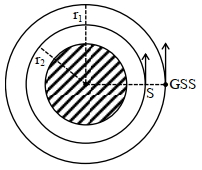
0 likes
View Solution248
EasyMCQ
$A$ satellite moves in a stable circular orbit around the Earth if (where $V_{H}$,$V_{c}$,and $V_{e}$ are the horizontal velocity,critical velocity,and escape velocity respectively):
A
$V_{H} < V_{c}$
B
$V_{H} = V_{e}$
C
$V_{H} = V_{c}$
D
$V_{H} > V_{e}$
Solution
(C) For a satellite to maintain a stable circular orbit around the Earth,the gravitational force must provide the necessary centripetal force.
This condition is satisfied when the horizontal velocity $(V_{H})$ of the satellite is exactly equal to the critical velocity $(V_{c})$,also known as the orbital velocity.
If $V_{H} < V_{c}$,the satellite will fall towards the Earth.
If $V_{H} > V_{c}$ but less than $V_{e}$,the orbit becomes elliptical.
If $V_{H} = V_{e}$,the satellite escapes the Earth's gravitational pull.
Therefore,the correct condition for a stable circular orbit is $V_{H} = V_{c}$.
This condition is satisfied when the horizontal velocity $(V_{H})$ of the satellite is exactly equal to the critical velocity $(V_{c})$,also known as the orbital velocity.
If $V_{H} < V_{c}$,the satellite will fall towards the Earth.
If $V_{H} > V_{c}$ but less than $V_{e}$,the orbit becomes elliptical.
If $V_{H} = V_{e}$,the satellite escapes the Earth's gravitational pull.
Therefore,the correct condition for a stable circular orbit is $V_{H} = V_{c}$.
0 likes
View Solution249
MediumMCQ
Consider a light planet revolving around a massive star in a circular orbit of radius $r$ with time period $T$. If the gravitational force of attraction between the planet and the star is proportional to $r^{-7/2}$,then $T^2$ is proportional to:
A
$r^{9/2}$
B
$r^{7/2}$
C
$r^{5/2}$
D
$r^{3/2}$
Solution
(A) For the planet to orbit around the star,the centripetal force must be provided by the gravitational force.
Let the gravitational force be $F_g \propto r^{-7/2}$.
The centripetal force required for circular motion is $F_c = m \omega^2 r$,where $\omega = \frac{2\pi}{T}$.
Equating the forces,we have $m \omega^2 r \propto r^{-7/2}$.
Since $m$ is constant,$\omega^2 r \propto r^{-7/2}$.
Dividing by $r$,we get $\omega^2 \propto r^{-9/2}$.
Substituting $\omega = \frac{2\pi}{T}$,we get $\left(\frac{2\pi}{T}\right)^2 \propto r^{-9/2}$.
This implies $\frac{1}{T^2} \propto r^{-9/2}$.
Therefore,$T^2 \propto r^{9/2}$.
Let the gravitational force be $F_g \propto r^{-7/2}$.
The centripetal force required for circular motion is $F_c = m \omega^2 r$,where $\omega = \frac{2\pi}{T}$.
Equating the forces,we have $m \omega^2 r \propto r^{-7/2}$.
Since $m$ is constant,$\omega^2 r \propto r^{-7/2}$.
Dividing by $r$,we get $\omega^2 \propto r^{-9/2}$.
Substituting $\omega = \frac{2\pi}{T}$,we get $\left(\frac{2\pi}{T}\right)^2 \propto r^{-9/2}$.
This implies $\frac{1}{T^2} \propto r^{-9/2}$.
Therefore,$T^2 \propto r^{9/2}$.
0 likes
View Solution250
MediumMCQ
The kinetic energy of a revolving satellite of mass $m$ at a height equal to thrice the radius of the Earth $R$ is:
A
$\frac{m g R}{8}$
B
$\frac{m g R}{16}$
C
$\frac{m g R}{2}$
D
$\frac{m g R}{4}$
Solution
(A) The kinetic energy $(K.E.)$ of a satellite revolving at a distance $r = R + h$ from the center of the Earth is given by $K.E. = \frac{G M m}{2r}$.
Given height $h = 3R$,the orbital radius is $r = R + 3R = 4R$.
Substituting the value of $r$ into the formula: $K.E. = \frac{G M m}{2(4R)} = \frac{G M m}{8R}$.
We know that the acceleration due to gravity at the Earth's surface is $g = \frac{G M}{R^2}$,which implies $G M = g R^2$.
Substituting $G M = g R^2$ into the kinetic energy expression: $K.E. = \frac{(g R^2) m}{8R} = \frac{m g R}{8}$.
Given height $h = 3R$,the orbital radius is $r = R + 3R = 4R$.
Substituting the value of $r$ into the formula: $K.E. = \frac{G M m}{2(4R)} = \frac{G M m}{8R}$.
We know that the acceleration due to gravity at the Earth's surface is $g = \frac{G M}{R^2}$,which implies $G M = g R^2$.
Substituting $G M = g R^2$ into the kinetic energy expression: $K.E. = \frac{(g R^2) m}{8R} = \frac{m g R}{8}$.
0 likes
View SolutionGravitation — Motion of Satellites in Circular Orbits and Planets in Elliptical Orbits · Frequently Asked Questions
1Are these Gravitation questions useful for JEE and NEET?
Yes. All questions in this section are mapped to JEE Main and NEET exam patterns. Previous year questions from JEE Main, NEET, GUJCET and state-level exams are included with full solutions.
2Can I switch to Hindi or Gujarati for these questions?
Yes. Use the language tabs in the hero section or the sidebar to view the same questions and solutions in English, Hindi or Gujarati.
3How do I generate a question paper from this subtopic?
Use the Vedclass Exam Paper Generator — select the chapter and subtopic, set difficulty, and generate Sets A, B, C, D automatically. First 3 chapters of every subject are free.
Vedclass Products
For Students
Vedclass Test Series
Mock tests in real JEE/NEET style with performance analysis. 5-day free trial.
Start Free TrialFor Teachers
Exam Paper Generator
Generate Set A/B/C/D papers from this chapter in 2 minutes. 3 chapters free.
Try FreeFor Institutes
Online Exam Module
Live online exams with unlimited students, 360° analytics & white-label branding.
See DemoFor Teachers & Institutes
Generate a Gravitation Exam Paper in 2 Minutes
Select subtopic & difficulty — Sets A, B, C, D auto-generated with No Repeat logic.
First 3 chapters of every subject are free — no payment required.