
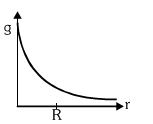
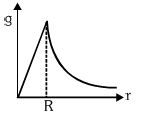
The dependence of acceleration due to gravity $g$ on the distance $r$ from the centre of the earth, assumed to be a sphere of radius $R$ of uniform density, is as shown in which of the following figures?
- A
- BGraph showing $g$ increasing linearly with $r$ for $r < R$ and decreasing as $1/r^2$ for $r > R$.
- C
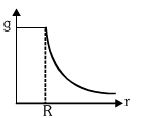
- D
Explore More
Similar Questions
The rotation of the Earth (of radius $R$) about its axis speeds up to a value such that a man at latitude angle $45^{\circ}$ feels weightlessness. The duration of a day in such a case is
DifficultAP EAMCET 2021
View SolutionObtain the general equation of gravitational force at a distance $r$ from the centre of the Earth and derive the equation for acceleration due to gravity on the surface of the Earth.
Medium
View SolutionThe depth at which acceleration due to gravity becomes $\frac{g}{n}$ is [ $R$ = radius of earth,$g$ = acceleration due to gravity,$n=$ integer].
If the mass and radius of a planet are double those of the Earth,what will be the acceleration due to gravity on this planet compared to the acceleration due to gravity on Earth?
Easy
View Solution$A$ uniform spherical planet (Radius $R$) has acceleration due to gravity at its surface $g$. Points $P$ and $Q$ located inside and outside the planet have acceleration due to gravity $g/4$. The maximum possible separation between $P$ and $Q$ is:
Vedclass Products
For Students
Vedclass Test Series
Mock tests in real JEE/NEET style with performance analysis. 5-day free trial.
Start Free TrialFor Teachers
Exam Paper Generator
Generate Set A/B/C/D exam papers from 7.5L+ questions in 2 minutes. 3 chapters free.
Try FreeFor Institutes
Online Exam Module
Live online exams with unlimited students, 360° analytics & white-label branding.
See Demo