
A English
Thermal Resistance and it's Combination Questions in English
Class 11 Physics · 10-2.Heat Transfer · Thermal Resistance and it's Combination
135+
Questions
English
Language
100%
With Solutions
Showing 50 of 135 questions in English
51
DifficultMCQ
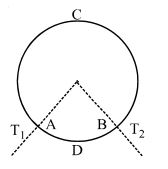
$A$ ring consisting of two parts $ADB$ and $ACB$ of same conductivity $k$ carries an amount of heat $H$. The $ADB$ part is now replaced with another metal keeping the temperatures $T_1$ and $T_2$ constant. The heat carried increases to $2H$. What should be the conductivity of the new $ADB$ part? Given $\frac{l_{ACB}}{l_{ADB}} = 3$.
A
$\frac{7}{3} k$
B
$2 k$
C
$\frac{5}{2} k$
D
$3 k$
Solution
(A) Let $l_1$ be the length of $ADB$ and $l_2$ be the length of $ACB$. Given $\frac{l_2}{l_1} = 3$,so $l_2 = 3l_1$. Let $A$ be the cross-sectional area.
Initially,both parts have conductivity $k$. The thermal resistances are $R_1 = \frac{l_1}{kA}$ and $R_2 = \frac{l_2}{kA} = \frac{3l_1}{kA} = 3R_1$.
The total heat flow $H$ is the sum of heat flows through parallel paths: $H = H_1 + H_2 = \frac{T_1 - T_2}{R_1} + \frac{T_1 - T_2}{R_2} = (T_1 - T_2) \left( \frac{kA}{l_1} + \frac{kA}{3l_1} \right) = (T_1 - T_2) \frac{4kA}{3l_1}$.
When $ADB$ is replaced by a metal of conductivity $k'$,the new heat flow is $H' = 2H = 2 \left( \frac{4kA(T_1 - T_2)}{3l_1} \right) = \frac{8kA(T_1 - T_2)}{3l_1}$.
The new heat flow is $H' = \frac{k'A(T_1 - T_2)}{l_1} + \frac{kA(T_1 - T_2)}{3l_1}$.
Equating the two expressions for $H'$:
$\frac{k'A(T_1 - T_2)}{l_1} + \frac{kA(T_1 - T_2)}{3l_1} = \frac{8kA(T_1 - T_2)}{3l_1}$.
Dividing by $\frac{A(T_1 - T_2)}{l_1}$: $k' + \frac{k}{3} = \frac{8k}{3}$.
$k' = \frac{8k}{3} - \frac{k}{3} = \frac{7k}{3}$.
Initially,both parts have conductivity $k$. The thermal resistances are $R_1 = \frac{l_1}{kA}$ and $R_2 = \frac{l_2}{kA} = \frac{3l_1}{kA} = 3R_1$.
The total heat flow $H$ is the sum of heat flows through parallel paths: $H = H_1 + H_2 = \frac{T_1 - T_2}{R_1} + \frac{T_1 - T_2}{R_2} = (T_1 - T_2) \left( \frac{kA}{l_1} + \frac{kA}{3l_1} \right) = (T_1 - T_2) \frac{4kA}{3l_1}$.
When $ADB$ is replaced by a metal of conductivity $k'$,the new heat flow is $H' = 2H = 2 \left( \frac{4kA(T_1 - T_2)}{3l_1} \right) = \frac{8kA(T_1 - T_2)}{3l_1}$.
The new heat flow is $H' = \frac{k'A(T_1 - T_2)}{l_1} + \frac{kA(T_1 - T_2)}{3l_1}$.
Equating the two expressions for $H'$:
$\frac{k'A(T_1 - T_2)}{l_1} + \frac{kA(T_1 - T_2)}{3l_1} = \frac{8kA(T_1 - T_2)}{3l_1}$.
Dividing by $\frac{A(T_1 - T_2)}{l_1}$: $k' + \frac{k}{3} = \frac{8k}{3}$.
$k' = \frac{8k}{3} - \frac{k}{3} = \frac{7k}{3}$.
0 likes
View Solution52
AdvancedMCQ
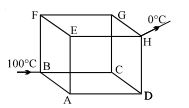
Twelve identical conducting rods form the edges of a uniform cube of side length $l$. In the steady state,the junctions $B$ and $H$ are maintained at $100^{\circ}C$ and $0^{\circ}C$ respectively. Find the temperature of the junction $A$ in $^{\circ}C$.
A
$80$
B
$60$
C
$40$
D
$70$
Solution
(B) Let $R$ be the thermal resistance of each rod. The total heat current $H_{total}$ flowing from $B$ to $H$ is given by $H_{total} = \frac{\Delta T}{R_{eq}}$.
For a cube with heat entering at one corner $(B)$ and leaving at the diagonally opposite corner $(H)$,the equivalent thermal resistance is $R_{eq} = \frac{5R}{6}$.
Thus,$H_{total} = \frac{100 - 0}{5R/6} = \frac{600}{5R} = \frac{120}{R}$.
At junction $B$,the heat current splits equally into three identical rods ($BA$,$BC$,$BF$). Therefore,the heat current through rod $BA$ is $H_{BA} = \frac{H_{total}}{3} = \frac{120/R}{3} = \frac{40}{R}$.
Using the heat flow formula for rod $BA$,$H_{BA} = \frac{T_B - T_A}{R}$,where $T_B = 100^{\circ}C$.
$\frac{40}{R} = \frac{100 - T_A}{R} \implies 40 = 100 - T_A \implies T_A = 60^{\circ}C$.
For a cube with heat entering at one corner $(B)$ and leaving at the diagonally opposite corner $(H)$,the equivalent thermal resistance is $R_{eq} = \frac{5R}{6}$.
Thus,$H_{total} = \frac{100 - 0}{5R/6} = \frac{600}{5R} = \frac{120}{R}$.
At junction $B$,the heat current splits equally into three identical rods ($BA$,$BC$,$BF$). Therefore,the heat current through rod $BA$ is $H_{BA} = \frac{H_{total}}{3} = \frac{120/R}{3} = \frac{40}{R}$.
Using the heat flow formula for rod $BA$,$H_{BA} = \frac{T_B - T_A}{R}$,where $T_B = 100^{\circ}C$.
$\frac{40}{R} = \frac{100 - T_A}{R} \implies 40 = 100 - T_A \implies T_A = 60^{\circ}C$.
0 likes
View Solution53
DifficultMCQ
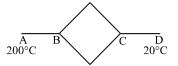
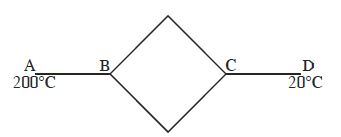
Four identical conducting rods are joined as shown in the figure. Points $A$ and $D$ are maintained at temperatures of $200^{\circ}C$ and $20^{\circ}C$ respectively. The temperature of junction $B$ will be ....... $^{\circ}C$.
A
$120$
B
$100$
C
$140$
D
$80$
Solution
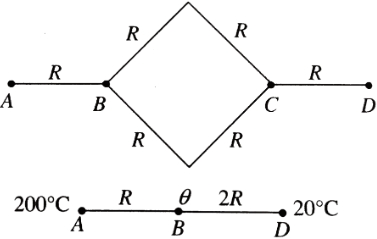
(C) Let the thermal resistance of each rod be $R$. The rods between $B$ and $C$ form two parallel paths,each consisting of two rods in series. The resistance of each path is $R + R = 2R$. The equivalent resistance of these two parallel paths is $R_{eq} = \frac{2R \times 2R}{2R + 2R} = R$.
Now,the system can be simplified as a series combination of three resistances: the rod $AB$ (resistance $R$),the parallel combination $BC$ (resistance $R$),and the rod $CD$ (resistance $R$).
The total resistance between $A$ and $D$ is $R_{total} = R + R + R = 3R$.
The heat current $H$ flowing through the system is $H = \frac{T_A - T_D}{R_{total}} = \frac{200 - 20}{3R} = \frac{180}{3R} = \frac{60}{R}$.
The temperature at junction $B$ can be found using the heat current through rod $AB$:
$H = \frac{T_A - T_B}{R} \implies \frac{60}{R} = \frac{200 - T_B}{R}$.
$60 = 200 - T_B \implies T_B = 200 - 60 = 140^{\circ}C$.
Now,the system can be simplified as a series combination of three resistances: the rod $AB$ (resistance $R$),the parallel combination $BC$ (resistance $R$),and the rod $CD$ (resistance $R$).
The total resistance between $A$ and $D$ is $R_{total} = R + R + R = 3R$.
The heat current $H$ flowing through the system is $H = \frac{T_A - T_D}{R_{total}} = \frac{200 - 20}{3R} = \frac{180}{3R} = \frac{60}{R}$.
The temperature at junction $B$ can be found using the heat current through rod $AB$:
$H = \frac{T_A - T_B}{R} \implies \frac{60}{R} = \frac{200 - T_B}{R}$.
$60 = 200 - T_B \implies T_B = 200 - 60 = 140^{\circ}C$.
0 likes
View Solution54
AdvancedMCQ
$A$ hollow sphere of inner radius $R$ and outer radius $2R$ is made of a material of thermal conductivity $K$. It is surrounded by another hollow sphere of inner radius $2R$ and outer radius $3R$ made of the same material of thermal conductivity $K$. The inside of the smaller sphere is maintained at $0^oC$ and the outside of the bigger sphere at $100^oC$. The system is in steady state. The temperature of the interface will be ........ $^oC$.
A
$50$
B
$70$
C
$75$
D
$45$
Solution
(C) The thermal resistance $R_{th}$ of a spherical shell of inner radius $r_1$,outer radius $r_2$,and thermal conductivity $K$ is given by $R_{th} = \frac{1}{4\pi K} \left( \frac{1}{r_1} - \frac{1}{r_2} \right)$.
For the inner sphere $(R_1 = R, R_2 = 2R)$: $R_{th1} = \frac{1}{4\pi K} \left( \frac{1}{R} - \frac{1}{2R} \right) = \frac{1}{4\pi K} \left( \frac{1}{2R} \right) = \frac{1}{8\pi KR}$.
For the outer sphere $(R_2 = 2R, R_3 = 3R)$: $R_{th2} = \frac{1}{4\pi K} \left( \frac{1}{2R} - \frac{1}{3R} \right) = \frac{1}{4\pi K} \left( \frac{1}{6R} \right) = \frac{1}{24\pi KR}$.
In steady state,the heat current $H$ is the same through both spheres: $H = \frac{T_{int} - 0}{R_{th1}} = \frac{100 - T_{int}}{R_{th2}}$.
Substituting the resistances: $\frac{T_{int}}{1/(8\pi KR)} = \frac{100 - T_{int}}{1/(24\pi KR)}$.
$8\pi KR \cdot T_{int} = 24\pi KR \cdot (100 - T_{int})$.
$T_{int} = 3(100 - T_{int}) \implies T_{int} = 300 - 3T_{int}$.
$4T_{int} = 300 \implies T_{int} = 75^oC$.
For the inner sphere $(R_1 = R, R_2 = 2R)$: $R_{th1} = \frac{1}{4\pi K} \left( \frac{1}{R} - \frac{1}{2R} \right) = \frac{1}{4\pi K} \left( \frac{1}{2R} \right) = \frac{1}{8\pi KR}$.
For the outer sphere $(R_2 = 2R, R_3 = 3R)$: $R_{th2} = \frac{1}{4\pi K} \left( \frac{1}{2R} - \frac{1}{3R} \right) = \frac{1}{4\pi K} \left( \frac{1}{6R} \right) = \frac{1}{24\pi KR}$.
In steady state,the heat current $H$ is the same through both spheres: $H = \frac{T_{int} - 0}{R_{th1}} = \frac{100 - T_{int}}{R_{th2}}$.
Substituting the resistances: $\frac{T_{int}}{1/(8\pi KR)} = \frac{100 - T_{int}}{1/(24\pi KR)}$.
$8\pi KR \cdot T_{int} = 24\pi KR \cdot (100 - T_{int})$.
$T_{int} = 3(100 - T_{int}) \implies T_{int} = 300 - 3T_{int}$.
$4T_{int} = 300 \implies T_{int} = 75^oC$.
0 likes
View Solution55
DifficultMCQ
Two rods $A$ and $B$ of different materials but same cross-section are joined as shown in the figure. The free end of $A$ is maintained at $100^{\circ}C$ and the free end of $B$ is maintained at $0^{\circ}C$. If $l_2 = 2l_1$,$K_1 = 2K_2$ and the rods are thermally insulated from the sides to prevent heat losses,then the temperature $\theta$ of the junction of the two rods is ........ $^{\circ}C$.
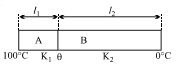
A
$80$
B
$60$
C
$40$
D
$20$
Solution
(A) In steady state,the rate of heat flow (heat current) through both rods must be the same.
Let $A$ be the cross-sectional area of the rods.
The thermal resistance $R$ of a rod is given by $R = \frac{l}{KA}$.
For rod $A$: $R_1 = \frac{l_1}{K_1 A}$.
For rod $B$: $R_2 = \frac{l_2}{K_2 A}$.
Given $l_2 = 2l_1$ and $K_1 = 2K_2$,we can write $K_2 = \frac{K_1}{2}$.
Substituting these into $R_2$: $R_2 = \frac{2l_1}{(K_1/2)A} = \frac{4l_1}{K_1 A} = 4R_1$.
Since the rods are in series,the heat current $H$ is the same:
$H = \frac{100 - \theta}{R_1} = \frac{\theta - 0}{R_2}$.
Substituting $R_2 = 4R_1$:
$\frac{100 - \theta}{R_1} = \frac{\theta}{4R_1}$.
$4(100 - \theta) = \theta$.
$400 - 4\theta = \theta$.
$5\theta = 400$.
$\theta = 80^{\circ}C$.
Let $A$ be the cross-sectional area of the rods.
The thermal resistance $R$ of a rod is given by $R = \frac{l}{KA}$.
For rod $A$: $R_1 = \frac{l_1}{K_1 A}$.
For rod $B$: $R_2 = \frac{l_2}{K_2 A}$.
Given $l_2 = 2l_1$ and $K_1 = 2K_2$,we can write $K_2 = \frac{K_1}{2}$.
Substituting these into $R_2$: $R_2 = \frac{2l_1}{(K_1/2)A} = \frac{4l_1}{K_1 A} = 4R_1$.
Since the rods are in series,the heat current $H$ is the same:
$H = \frac{100 - \theta}{R_1} = \frac{\theta - 0}{R_2}$.
Substituting $R_2 = 4R_1$:
$\frac{100 - \theta}{R_1} = \frac{\theta}{4R_1}$.
$4(100 - \theta) = \theta$.
$400 - 4\theta = \theta$.
$5\theta = 400$.
$\theta = 80^{\circ}C$.
0 likes
View Solution56
MediumMCQ
Two rods $A$ and $B$ of the same cross-sectional area $A$ and length $l$ are connected in series between a source $(T_1 = 100^{\circ}C)$ and a sink $(T_2 = 0^{\circ}C)$ as shown in the figure. The rods are laterally insulated. The thermal conductivities of rods $A$ and $B$ are $3K$ and $K$ respectively. The ratio of the thermal resistance of rod $A$ to that of rod $B$ is:
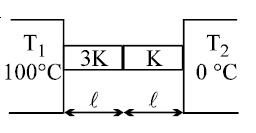
A
$\frac{R_A}{R_B} = \frac{1}{3}$
B
$\frac{R_A}{R_B} = 3$
C
$\frac{R_A}{R_B} = \frac{3}{4}$
D
$\frac{R_A}{R_B} = \frac{4}{3}$
Solution
(A) The thermal resistance $R$ of a rod is given by the formula $R = \frac{l}{k \cdot A}$,where $l$ is the length,$k$ is the thermal conductivity,and $A$ is the cross-sectional area.
For rod $A$ with thermal conductivity $3K$,length $l$,and area $A$:
$R_A = \frac{l}{(3K) \cdot A} = \frac{l}{3KA}$
For rod $B$ with thermal conductivity $K$,length $l$,and area $A$:
$R_B = \frac{l}{K \cdot A} = \frac{l}{KA}$
Now,calculating the ratio of the thermal resistances:
$\frac{R_A}{R_B} = \frac{\frac{l}{3KA}}{\frac{l}{KA}} = \frac{1}{3}$
Therefore,the ratio $\frac{R_A}{R_B} = \frac{1}{3}$.
For rod $A$ with thermal conductivity $3K$,length $l$,and area $A$:
$R_A = \frac{l}{(3K) \cdot A} = \frac{l}{3KA}$
For rod $B$ with thermal conductivity $K$,length $l$,and area $A$:
$R_B = \frac{l}{K \cdot A} = \frac{l}{KA}$
Now,calculating the ratio of the thermal resistances:
$\frac{R_A}{R_B} = \frac{\frac{l}{3KA}}{\frac{l}{KA}} = \frac{1}{3}$
Therefore,the ratio $\frac{R_A}{R_B} = \frac{1}{3}$.
0 likes
View Solution57
DifficultMCQ
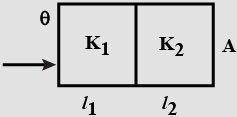
$A$ composite rod is made of three rods of equal length and cross-section as shown in the figure. The thermal conductivities of the materials of the rods are $K/2, 5K$ and $K$ respectively. The ends $A$ and $B$ are at constant temperatures. All heat entering the face $A$ goes out of the end $B$,with no loss of heat from the sides of the bar. The effective thermal conductivity of the bar is:

A
$15K/16$
B
$6K/13$
C
$5K/16$
D
$2K/13$
Solution
(A) For rods connected in series,the equivalent thermal resistance $R_{eq}$ is the sum of individual thermal resistances: $R_{eq} = R_1 + R_2 + R_3$.
Given that all rods have equal length $l$ and cross-sectional area $A$,the thermal resistance of a rod is $R = \frac{l}{KA}$.
Thus,the equivalent thermal resistance is:
$R_{eq} = \frac{l}{(K/2)A} + \frac{l}{(5K)A} + \frac{l}{KA} = \frac{l}{A} \left( \frac{2}{K} + \frac{1}{5K} + \frac{1}{K} \right)$.
Simplifying the expression inside the bracket:
$R_{eq} = \frac{l}{A} \left( \frac{10 + 1 + 5}{5K} \right) = \frac{l}{A} \left( \frac{16}{5K} \right) = \frac{16l}{5KA}$.
For the composite rod of total length $3l$,the equivalent thermal conductivity $K_{eq}$ is given by:
$R_{eq} = \frac{3l}{K_{eq}A} = \frac{16l}{5KA}$.
Solving for $K_{eq}$:
$K_{eq} = \frac{3 \times 5K}{16} = \frac{15K}{16}$.
Given that all rods have equal length $l$ and cross-sectional area $A$,the thermal resistance of a rod is $R = \frac{l}{KA}$.
Thus,the equivalent thermal resistance is:
$R_{eq} = \frac{l}{(K/2)A} + \frac{l}{(5K)A} + \frac{l}{KA} = \frac{l}{A} \left( \frac{2}{K} + \frac{1}{5K} + \frac{1}{K} \right)$.
Simplifying the expression inside the bracket:
$R_{eq} = \frac{l}{A} \left( \frac{10 + 1 + 5}{5K} \right) = \frac{l}{A} \left( \frac{16}{5K} \right) = \frac{16l}{5KA}$.
For the composite rod of total length $3l$,the equivalent thermal conductivity $K_{eq}$ is given by:
$R_{eq} = \frac{3l}{K_{eq}A} = \frac{16l}{5KA}$.
Solving for $K_{eq}$:
$K_{eq} = \frac{3 \times 5K}{16} = \frac{15K}{16}$.
0 likes
View Solution58
MediumMCQ
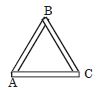
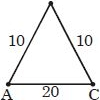
Three rods $AB, BC$ and $AC$ having thermal resistances of $10 \text{ units}, 10 \text{ units}$ and $20 \text{ units}$ respectively,are connected as shown in the figure. Ends $A$ and $C$ are maintained at constant temperatures of $100^{\circ}C$ and $0^{\circ}C$ respectively. The rate at which the heat is crossing junction $B$ is . . . . . . $units$.
A
$5$
B
$10$
C
$20$
D
$7.5$
Solution
(A) The thermal circuit can be analyzed by considering the thermal resistances. The rods $AB$ and $BC$ are in series with each other,and this combination is in parallel with rod $AC$.
Thermal resistance of the series branch ($AB$ and $BC$) is $R_1 = 10 + 10 = 20 \text{ units}$.
Thermal resistance of the parallel branch $(AC)$ is $R_2 = 20 \text{ units}$.
The equivalent thermal resistance $R_{eq}$ between points $A$ and $C$ is given by $\frac{1}{R_{eq}} = \frac{1}{R_1} + \frac{1}{R_2} = \frac{1}{20} + \frac{1}{20} = \frac{2}{20} = \frac{1}{10}$.
Thus,$R_{eq} = 10 \text{ units}$.
The total rate of heat flow from $A$ to $C$ is $\frac{dH}{dt} = \frac{\Delta T}{R_{eq}} = \frac{100 - 0}{10} = 10 \text{ units}$.
Since the branch $AB+BC$ has a resistance of $20 \text{ units}$ and the branch $AC$ has a resistance of $20 \text{ units}$,the total heat flow splits equally between the two branches.
Therefore,the rate of heat flow through the junction $B$ (which is part of the $AB+BC$ branch) is $\frac{10}{2} = 5 \text{ units}$.
Thermal resistance of the series branch ($AB$ and $BC$) is $R_1 = 10 + 10 = 20 \text{ units}$.
Thermal resistance of the parallel branch $(AC)$ is $R_2 = 20 \text{ units}$.
The equivalent thermal resistance $R_{eq}$ between points $A$ and $C$ is given by $\frac{1}{R_{eq}} = \frac{1}{R_1} + \frac{1}{R_2} = \frac{1}{20} + \frac{1}{20} = \frac{2}{20} = \frac{1}{10}$.
Thus,$R_{eq} = 10 \text{ units}$.
The total rate of heat flow from $A$ to $C$ is $\frac{dH}{dt} = \frac{\Delta T}{R_{eq}} = \frac{100 - 0}{10} = 10 \text{ units}$.
Since the branch $AB+BC$ has a resistance of $20 \text{ units}$ and the branch $AC$ has a resistance of $20 \text{ units}$,the total heat flow splits equally between the two branches.
Therefore,the rate of heat flow through the junction $B$ (which is part of the $AB+BC$ branch) is $\frac{10}{2} = 5 \text{ units}$.
0 likes
View Solution59
DifficultMCQ
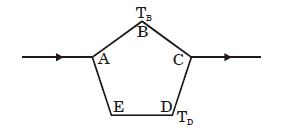
$ABCDE$ is a regular pentagon made of uniform wire. Heat enters at $A$ and leaves at $C$. $T_B$ and $T_D$ are the temperatures of points $B$ and $D$ respectively. Find the temperature $T_C$.
A
$\frac{3T_B + 2T_D}{5}$
B
$3T_D - 2T_B$
C
$3T_D + 2T_B$
D
Can have any value
Solution
(B) Let $R$ be the thermal resistance of each side of the pentagon.
The path $ABC$ consists of two sides in series,so its resistance is $R_1 = R + R = 2R$.
The path $AEDC$ consists of three sides in series,so its resistance is $R_2 = R + R + R = 3R$.
Let $H$ be the total heat current entering at $A$. The heat current divides into two parallel paths $ABC$ and $AEDC$ such that the temperature drop across both paths is the same $(T_A - T_C)$.
For path $ABC$,the heat current $H_1 = \frac{T_A - T_B}{R} = \frac{T_B - T_C}{R}$. Thus,$T_A - T_C = (T_A - T_B) + (T_B - T_C) = 2(T_B - T_C)$.
For path $AEDC$,the heat current $H_2 = \frac{T_A - T_E}{R} = \frac{T_E - T_D}{R} = \frac{T_D - T_C}{R}$. Thus,$T_A - T_C = (T_A - T_E) + (T_E - T_D) + (T_D - T_C) = 3(T_D - T_C)$.
Equating the temperature differences: $2(T_B - T_C) = 3(T_D - T_C)$.
$2T_B - 2T_C = 3T_D - 3T_C$.
$3T_C - 2T_C = 3T_D - 2T_B$.
$T_C = 3T_D - 2T_B$.
The path $ABC$ consists of two sides in series,so its resistance is $R_1 = R + R = 2R$.
The path $AEDC$ consists of three sides in series,so its resistance is $R_2 = R + R + R = 3R$.
Let $H$ be the total heat current entering at $A$. The heat current divides into two parallel paths $ABC$ and $AEDC$ such that the temperature drop across both paths is the same $(T_A - T_C)$.
For path $ABC$,the heat current $H_1 = \frac{T_A - T_B}{R} = \frac{T_B - T_C}{R}$. Thus,$T_A - T_C = (T_A - T_B) + (T_B - T_C) = 2(T_B - T_C)$.
For path $AEDC$,the heat current $H_2 = \frac{T_A - T_E}{R} = \frac{T_E - T_D}{R} = \frac{T_D - T_C}{R}$. Thus,$T_A - T_C = (T_A - T_E) + (T_E - T_D) + (T_D - T_C) = 3(T_D - T_C)$.
Equating the temperature differences: $2(T_B - T_C) = 3(T_D - T_C)$.
$2T_B - 2T_C = 3T_D - 3T_C$.
$3T_C - 2T_C = 3T_D - 2T_B$.
$T_C = 3T_D - 2T_B$.
0 likes
View Solution60
DifficultMCQ
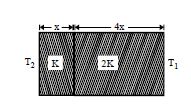
The temperatures of the two outer surfaces of a composite slab,consisting of two materials having coefficients of thermal conductivity $K$ and $2K$ and thickness $x$ and $4x$,respectively,are $T_2$ and $T_1$ $(T_2 > T_1)$. The rate of heat transfer through the slab in a steady state is $\left( \frac{A(T_2 - T_1)K}{x} \right)f$,where $f$ is equal to:
A
$1$
B
$0.5$
C
$0.67$
D
$0.33$
Solution
(D) Let the temperature of the common interface be $T$. In a steady state,the rate of heat flow $H$ is the same through both slabs.
The rate of heat flow is given by $H = \frac{KA \Delta T}{l}$.
For the first slab (conductivity $K$,thickness $x$): $H_1 = \frac{KA(T_2 - T)}{x}$.
For the second slab (conductivity $2K$,thickness $4x$): $H_2 = \frac{(2K)A(T - T_1)}{4x} = \frac{KA(T - T_1)}{2x}$.
Since $H_1 = H_2$:
$\frac{KA(T_2 - T)}{x} = \frac{KA(T - T_1)}{2x}$
$T_2 - T = \frac{T - T_1}{2}$
$2T_2 - 2T = T - T_1$
$3T = 2T_2 + T_1 \implies T = \frac{2T_2 + T_1}{3}$.
Substituting $T$ back into the expression for $H_1$:
$H = \frac{KA}{x} \left( T_2 - \frac{2T_2 + T_1}{3} \right)$
$H = \frac{KA}{x} \left( \frac{3T_2 - 2T_2 - T_1}{3} \right)$
$H = \frac{KA}{x} \left( \frac{T_2 - T_1}{3} \right) = \frac{1}{3} \left( \frac{KA(T_2 - T_1)}{x} \right)$.
Comparing this with the given expression $\left( \frac{A(T_2 - T_1)K}{x} \right)f$,we get $f = \frac{1}{3} \approx 0.33$.
The rate of heat flow is given by $H = \frac{KA \Delta T}{l}$.
For the first slab (conductivity $K$,thickness $x$): $H_1 = \frac{KA(T_2 - T)}{x}$.
For the second slab (conductivity $2K$,thickness $4x$): $H_2 = \frac{(2K)A(T - T_1)}{4x} = \frac{KA(T - T_1)}{2x}$.
Since $H_1 = H_2$:
$\frac{KA(T_2 - T)}{x} = \frac{KA(T - T_1)}{2x}$
$T_2 - T = \frac{T - T_1}{2}$
$2T_2 - 2T = T - T_1$
$3T = 2T_2 + T_1 \implies T = \frac{2T_2 + T_1}{3}$.
Substituting $T$ back into the expression for $H_1$:
$H = \frac{KA}{x} \left( T_2 - \frac{2T_2 + T_1}{3} \right)$
$H = \frac{KA}{x} \left( \frac{3T_2 - 2T_2 - T_1}{3} \right)$
$H = \frac{KA}{x} \left( \frac{T_2 - T_1}{3} \right) = \frac{1}{3} \left( \frac{KA(T_2 - T_1)}{x} \right)$.
Comparing this with the given expression $\left( \frac{A(T_2 - T_1)K}{x} \right)f$,we get $f = \frac{1}{3} \approx 0.33$.
0 likes
View Solution61
DifficultMCQ
Two identical conducting rods are first connected independently to two vessels,one containing water at $100^{\circ}C$ and the other containing ice at $0^{\circ}C$. In the second case,the rods are joined end to end and connected to the same vessels. Let $q_1$ and $q_2$ $g/s$ be the rate of melting of ice in the two cases respectively. The ratio $q_2/q_1$ is
A
$1/2$
B
$2/1$
C
$4/1$
D
$1/4$
Solution
(D) Let $K$ be the thermal conductivity,$A$ be the cross-sectional area,and $\ell$ be the length of each rod.
In the first case,the two rods are connected in parallel between the two reservoirs at $T_1 = 100^{\circ}C$ and $T_2 = 0^{\circ}C$.
The rate of heat flow is $\frac{dH}{dt_1} = \frac{KA(T_1-T_2)}{\ell} + \frac{KA(T_1-T_2)}{\ell} = \frac{2KA(T_1-T_2)}{\ell}$.
Since $q_1 \propto \frac{dH}{dt_1}$,we have $q_1 = \frac{2KA(T_1-T_2)}{L_f \ell}$,where $L_f$ is the latent heat of fusion.
In the second case,the rods are connected in series. The equivalent thermal resistance is $R_{eq} = \frac{\ell}{KA} + \frac{\ell}{KA} = \frac{2\ell}{KA}$.
The rate of heat flow is $\frac{dH}{dt_2} = \frac{T_1-T_2}{R_{eq}} = \frac{KA(T_1-T_2)}{2\ell}$.
Thus,$q_2 = \frac{KA(T_1-T_2)}{2 L_f \ell}$.
The ratio $q_2/q_1 = \frac{KA(T_1-T_2) / (2 L_f \ell)}{2KA(T_1-T_2) / (L_f \ell)} = \frac{1/2}{2} = \frac{1}{4}$.
In the first case,the two rods are connected in parallel between the two reservoirs at $T_1 = 100^{\circ}C$ and $T_2 = 0^{\circ}C$.
The rate of heat flow is $\frac{dH}{dt_1} = \frac{KA(T_1-T_2)}{\ell} + \frac{KA(T_1-T_2)}{\ell} = \frac{2KA(T_1-T_2)}{\ell}$.
Since $q_1 \propto \frac{dH}{dt_1}$,we have $q_1 = \frac{2KA(T_1-T_2)}{L_f \ell}$,where $L_f$ is the latent heat of fusion.
In the second case,the rods are connected in series. The equivalent thermal resistance is $R_{eq} = \frac{\ell}{KA} + \frac{\ell}{KA} = \frac{2\ell}{KA}$.
The rate of heat flow is $\frac{dH}{dt_2} = \frac{T_1-T_2}{R_{eq}} = \frac{KA(T_1-T_2)}{2\ell}$.
Thus,$q_2 = \frac{KA(T_1-T_2)}{2 L_f \ell}$.
The ratio $q_2/q_1 = \frac{KA(T_1-T_2) / (2 L_f \ell)}{2KA(T_1-T_2) / (L_f \ell)} = \frac{1/2}{2} = \frac{1}{4}$.
0 likes
View Solution62
AdvancedMCQ
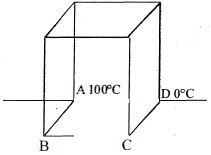
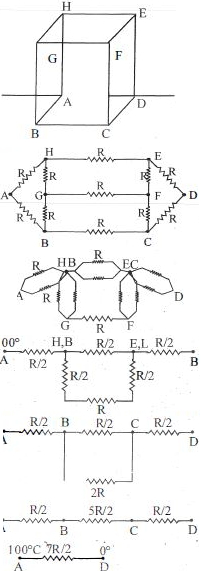
Find the temperature difference between $B$ and $C$. (All rods are identical)
A
$\frac{600}{13} \ ^\circ C$
B
$\frac{500}{7} \ ^\circ C$
C
$\frac{400}{13} \ ^\circ C$
D
$\frac{700}{6} \ ^\circ C$
Solution
(B) Let the thermal resistance of each rod be $R$.
The total temperature difference between $A$ and $D$ is $\Delta T = 100^\circ C - 0^\circ C = 100^\circ C$.
By symmetry,the points $B$ and $H$ are at the same potential (temperature),and points $C$ and $E$ are at the same potential. Similarly,$G$ and $F$ are at the same potential.
By simplifying the circuit of thermal resistances,we can combine the parallel branches. The equivalent thermal resistance between $A$ and $D$ is calculated as $\frac{7R}{6}$.
However,looking at the simplified circuit path from $A$ to $D$,the total resistance is $\frac{7R}{6}$. The temperature drop across the segment $BC$ can be calculated using the potential divider rule in the equivalent circuit.
The temperature difference across $BC$ is given by $\Delta T_{BC} = \left( \frac{R_{BC}}{R_{total}} \right) \times \Delta T_{AD}$.
Given the equivalent circuit,the resistance between $B$ and $C$ is $\frac{5R}{6}$ and the total resistance is $\frac{7R}{6}$.
Therefore,$\Delta T_{BC} = \left( \frac{5R/6}{7R/6} \right) \times 100^\circ C = \frac{5}{7} \times 100^\circ C = \frac{500}{7} \ ^\circ C$.
The total temperature difference between $A$ and $D$ is $\Delta T = 100^\circ C - 0^\circ C = 100^\circ C$.
By symmetry,the points $B$ and $H$ are at the same potential (temperature),and points $C$ and $E$ are at the same potential. Similarly,$G$ and $F$ are at the same potential.
By simplifying the circuit of thermal resistances,we can combine the parallel branches. The equivalent thermal resistance between $A$ and $D$ is calculated as $\frac{7R}{6}$.
However,looking at the simplified circuit path from $A$ to $D$,the total resistance is $\frac{7R}{6}$. The temperature drop across the segment $BC$ can be calculated using the potential divider rule in the equivalent circuit.
The temperature difference across $BC$ is given by $\Delta T_{BC} = \left( \frac{R_{BC}}{R_{total}} \right) \times \Delta T_{AD}$.
Given the equivalent circuit,the resistance between $B$ and $C$ is $\frac{5R}{6}$ and the total resistance is $\frac{7R}{6}$.
Therefore,$\Delta T_{BC} = \left( \frac{5R/6}{7R/6} \right) \times 100^\circ C = \frac{5}{7} \times 100^\circ C = \frac{500}{7} \ ^\circ C$.
0 likes
View Solution63
AdvancedMCQ
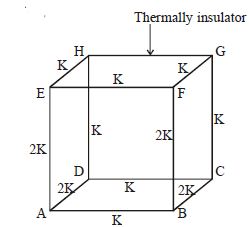
Find the effective thermal resistance between $A$ and $B$ of a cube made up of $12$ rods of the same dimensions,with the given thermal conductivities as shown in the figure. [ $l =$ length of rod,$a =$ cross-sectional area of rod ]
A
$\frac{l}{ka}$
B
$\frac{2l}{ka}$
C
$\frac{4l}{7ka}$
D
$\frac{l}{2ka}$
Solution
(D) Let the thermal resistance of a rod with conductivity $K$ be $R = \frac{l}{Ka}$.
Then,the resistance of a rod with conductivity $2K$ is $R' = \frac{l}{(2K)a} = \frac{R}{2}$.
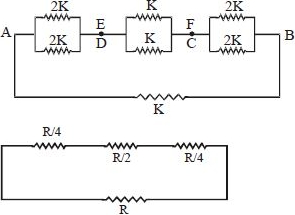
From the equivalent circuit diagram,the upper branch consists of three parts in series:
$1$. Two rods of $2K$ in parallel: $R_1 = \frac{(R/2)(R/2)}{(R/2) + (R/2)} = \frac{R/4}{1} = \frac{R}{4}$.
$2$. Two rods of $K$ in parallel: $R_2 = \frac{R \cdot R}{R + R} = \frac{R}{2}$.
$3$. Two rods of $2K$ in parallel: $R_3 = \frac{(R/2)(R/2)}{(R/2) + (R/2)} = \frac{R}{4}$.
The total resistance of the upper branch is $R_{upper} = R_1 + R_2 + R_3 = \frac{R}{4} + \frac{R}{2} + \frac{R}{4} = R$.
The lower branch is a single rod of conductivity $K$,so $R_{lower} = R$.
The effective resistance $R_{eq}$ between $A$ and $B$ is the parallel combination of the upper and lower branches:
$R_{eq} = \frac{R_{upper} \cdot R_{lower}}{R_{upper} + R_{lower}} = \frac{R \cdot R}{R + R} = \frac{R}{2}$.
Substituting $R = \frac{l}{Ka}$,we get $R_{eq} = \frac{1}{2} \left( \frac{l}{Ka} \right) = \frac{l}{2Ka}$.
Then,the resistance of a rod with conductivity $2K$ is $R' = \frac{l}{(2K)a} = \frac{R}{2}$.
From the equivalent circuit diagram,the upper branch consists of three parts in series:
$1$. Two rods of $2K$ in parallel: $R_1 = \frac{(R/2)(R/2)}{(R/2) + (R/2)} = \frac{R/4}{1} = \frac{R}{4}$.
$2$. Two rods of $K$ in parallel: $R_2 = \frac{R \cdot R}{R + R} = \frac{R}{2}$.
$3$. Two rods of $2K$ in parallel: $R_3 = \frac{(R/2)(R/2)}{(R/2) + (R/2)} = \frac{R}{4}$.
The total resistance of the upper branch is $R_{upper} = R_1 + R_2 + R_3 = \frac{R}{4} + \frac{R}{2} + \frac{R}{4} = R$.
The lower branch is a single rod of conductivity $K$,so $R_{lower} = R$.
The effective resistance $R_{eq}$ between $A$ and $B$ is the parallel combination of the upper and lower branches:
$R_{eq} = \frac{R_{upper} \cdot R_{lower}}{R_{upper} + R_{lower}} = \frac{R \cdot R}{R + R} = \frac{R}{2}$.
Substituting $R = \frac{l}{Ka}$,we get $R_{eq} = \frac{1}{2} \left( \frac{l}{Ka} \right) = \frac{l}{2Ka}$.
0 likes
View Solution64
MediumMCQ
In a composite rod,when two rods of different lengths $l_1$ and $l_2$ and of the same cross-sectional area are joined end to end,if $K$ is the effective coefficient of thermal conductivity,then the value of $(l_1 + l_2)/K$ is
A
$\frac{l_1}{K_1} + \frac{l_2}{K_2}$
B
$\frac{l_1}{K_2} + \frac{l_2}{K_1}$
C
$\frac{l_1}{K_1} - \frac{l_2}{K_2}$
D
$\frac{l_1}{K_2} - \frac{l_2}{K_1}$
Solution
(A) For a composite rod joined in series,the total thermal resistance $R_{eq}$ is the sum of individual thermal resistances.
Thermal resistance $R$ is given by $R = \frac{l}{KA}$,where $l$ is the length,$K$ is the thermal conductivity,and $A$ is the cross-sectional area.
For the two rods in series: $R_{eq} = R_1 + R_2$.
Substituting the expressions: $\frac{l_1 + l_2}{KA} = \frac{l_1}{K_1A} + \frac{l_2}{K_2A}$.
Since the cross-sectional area $A$ is the same for both rods,it cancels out from both sides.
Therefore,$\frac{l_1 + l_2}{K} = \frac{l_1}{K_1} + \frac{l_2}{K_2}$.
Thermal resistance $R$ is given by $R = \frac{l}{KA}$,where $l$ is the length,$K$ is the thermal conductivity,and $A$ is the cross-sectional area.
For the two rods in series: $R_{eq} = R_1 + R_2$.
Substituting the expressions: $\frac{l_1 + l_2}{KA} = \frac{l_1}{K_1A} + \frac{l_2}{K_2A}$.
Since the cross-sectional area $A$ is the same for both rods,it cancels out from both sides.
Therefore,$\frac{l_1 + l_2}{K} = \frac{l_1}{K_1} + \frac{l_2}{K_2}$.
0 likes
View Solution65
MediumMCQ
Four rods of identical cross-sectional area and made from the same metal form the sides of a square. The temperatures of two diagonally opposite points are $\theta$ and $\sqrt{2}\theta$ respectively in the steady state. Assuming that only heat conduction takes place,what will be the temperature difference between the other two points?
A
$(\sqrt{2}-1)\theta$
B
$\frac{\sqrt{2}+1}{2}\theta$
C
$\frac{\sqrt{2}-1}{\sqrt{2}}\theta$
D
$0$
Solution
(D) Let the square be $ABCD$ with vertices $A, B, C, D$ in order. Let the temperatures at $A$ and $C$ be $T_A = \sqrt{2}\theta$ and $T_C = \theta$. Let the temperatures at $B$ and $D$ be $T_B$ and $T_D$.
Since the rods are identical,the thermal resistance $R$ of each rod is the same. The heat flow is steady.
At node $B$,by Kirchhoff's law for heat current: $\frac{T_A - T_B}{R} + \frac{T_C - T_B}{R} = 0$,which implies $T_B = \frac{T_A + T_C}{2} = \frac{\sqrt{2}\theta + \theta}{2}$.
Similarly,at node $D$: $\frac{T_A - T_D}{R} + \frac{T_C - T_D}{R} = 0$,which implies $T_D = \frac{T_A + T_C}{2} = \frac{\sqrt{2}\theta + \theta}{2}$.
Since $T_B = T_D$,the temperature difference between the other two points $B$ and $D$ is $T_B - T_D = 0$.
Since the rods are identical,the thermal resistance $R$ of each rod is the same. The heat flow is steady.
At node $B$,by Kirchhoff's law for heat current: $\frac{T_A - T_B}{R} + \frac{T_C - T_B}{R} = 0$,which implies $T_B = \frac{T_A + T_C}{2} = \frac{\sqrt{2}\theta + \theta}{2}$.
Similarly,at node $D$: $\frac{T_A - T_D}{R} + \frac{T_C - T_D}{R} = 0$,which implies $T_D = \frac{T_A + T_C}{2} = \frac{\sqrt{2}\theta + \theta}{2}$.
Since $T_B = T_D$,the temperature difference between the other two points $B$ and $D$ is $T_B - T_D = 0$.
0 likes
View Solution66
MediumMCQ
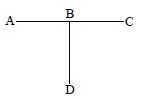
Three conducting rods of the same material and cross-section are shown in the figure. The temperatures at $A$, $D$, and $C$ are maintained at $20 ^oC$, $90 ^oC$, and $0 ^oC$ respectively. If there is no heat flow in $AB$, find the ratio of the lengths of $BD$ and $BC$.
A
$\frac{2}{7}$
B
$3.5$
C
$4.5$
D
$\frac{2}{9}$
Solution
(B) Let the temperature at junction $B$ be $T_B$. Since the rods are of the same material and cross-section, their thermal resistance $R$ is proportional to their length $L$ $(R = \frac{L}{kA})$.
Given that there is no heat flow in $AB$, the temperature at $B$ must be equal to the temperature at $A$. Therefore, $T_B = T_A = 20 ^oC$.
Since there is no heat flow in $AB$, all the heat flowing from $D$ to $B$ must flow from $B$ to $C$.
Thus, the rate of heat flow $H_{DB} = H_{BC}$.
Using the formula $H = \frac{\Delta T}{R}$, we have $\frac{T_D - T_B}{R_{BD}} = \frac{T_B - T_C}{R_{BC}}$.
Substituting the values: $\frac{90 - 20}{R_{BD}} = \frac{20 - 0}{R_{BC}}$.
$\frac{70}{R_{BD}} = \frac{20}{R_{BC}} \implies \frac{R_{BD}}{R_{BC}} = \frac{70}{20} = 3.5$.
Since $R \propto L$, the ratio of lengths $\frac{L_{BD}}{L_{BC}} = \frac{R_{BD}}{R_{BC}} = 3.5$.
Given that there is no heat flow in $AB$, the temperature at $B$ must be equal to the temperature at $A$. Therefore, $T_B = T_A = 20 ^oC$.
Since there is no heat flow in $AB$, all the heat flowing from $D$ to $B$ must flow from $B$ to $C$.
Thus, the rate of heat flow $H_{DB} = H_{BC}$.
Using the formula $H = \frac{\Delta T}{R}$, we have $\frac{T_D - T_B}{R_{BD}} = \frac{T_B - T_C}{R_{BC}}$.
Substituting the values: $\frac{90 - 20}{R_{BD}} = \frac{20 - 0}{R_{BC}}$.
$\frac{70}{R_{BD}} = \frac{20}{R_{BC}} \implies \frac{R_{BD}}{R_{BC}} = \frac{70}{20} = 3.5$.
Since $R \propto L$, the ratio of lengths $\frac{L_{BD}}{L_{BC}} = \frac{R_{BD}}{R_{BC}} = 3.5$.
0 likes
View Solution67
DifficultMCQ
$A$ wall is made of two layers of thickness $1\ cm$ and $4\ cm$ and thermal conductivities $K$ and $3K$ respectively. If the temperature difference across the wall is $50\ ^oC$,then the temperature difference across the thin layer will be
A
$\frac{120}{7}\ ^oC$
B
$\frac{150}{7}\ ^oC$
C
$\frac{180}{7}\ ^oC$
D
None
Solution
(B) The thermal resistance $R$ of a layer is given by $R = \frac{L}{KA}$,where $L$ is the thickness,$K$ is the thermal conductivity,and $A$ is the area.
For the first layer (thin layer): $R_1 = \frac{1}{K \cdot A}$.
For the second layer: $R_2 = \frac{4}{3K \cdot A}$.
Since the layers are in series,the heat current $H$ is the same through both layers. The temperature difference $\Delta T$ across a layer is given by $\Delta T = H \cdot R$.
Thus,the ratio of temperature differences is $\frac{\Delta T_1}{\Delta T_2} = \frac{R_1}{R_2} = \frac{1/K}{4/3K} = \frac{3}{4}$.
Given $\Delta T_1 + \Delta T_2 = 50\ ^oC$.
Substituting $\Delta T_2 = \frac{4}{3} \Delta T_1$ into the equation: $\Delta T_1 + \frac{4}{3} \Delta T_1 = 50$.
$\frac{7}{3} \Delta T_1 = 50 \implies \Delta T_1 = \frac{150}{7}\ ^oC$.
For the first layer (thin layer): $R_1 = \frac{1}{K \cdot A}$.
For the second layer: $R_2 = \frac{4}{3K \cdot A}$.
Since the layers are in series,the heat current $H$ is the same through both layers. The temperature difference $\Delta T$ across a layer is given by $\Delta T = H \cdot R$.
Thus,the ratio of temperature differences is $\frac{\Delta T_1}{\Delta T_2} = \frac{R_1}{R_2} = \frac{1/K}{4/3K} = \frac{3}{4}$.
Given $\Delta T_1 + \Delta T_2 = 50\ ^oC$.
Substituting $\Delta T_2 = \frac{4}{3} \Delta T_1$ into the equation: $\Delta T_1 + \frac{4}{3} \Delta T_1 = 50$.
$\frac{7}{3} \Delta T_1 = 50 \implies \Delta T_1 = \frac{150}{7}\ ^oC$.
0 likes
View Solution68
DifficultMCQ
Two rods of cross-sectional area $A$ and $2A$ and equal length having thermal conductivities $2K$ and $3K$ are joined in parallel. The equivalent thermal conductivity of their combination will be:
A
$\frac{5K}{3}$
B
$\frac{8K}{3}$
C
$\frac{11K}{3}$
D
$\frac{13K}{3}$
Solution
(B) For two rods joined in parallel,the equivalent thermal conductivity $K_{eq}$ is given by the formula:
$K_{eq} = \frac{K_1 A_1 + K_2 A_2}{A_1 + A_2}$
Given:
$A_1 = A, A_2 = 2A$
$K_1 = 2K, K_2 = 3K$
Substituting these values into the formula:
$K_{eq} = \frac{(2K)(A) + (3K)(2A)}{A + 2A}$
$K_{eq} = \frac{2KA + 6KA}{3A}$
$K_{eq} = \frac{8KA}{3A}$
$K_{eq} = \frac{8K}{3}$
$K_{eq} = \frac{K_1 A_1 + K_2 A_2}{A_1 + A_2}$
Given:
$A_1 = A, A_2 = 2A$
$K_1 = 2K, K_2 = 3K$
Substituting these values into the formula:
$K_{eq} = \frac{(2K)(A) + (3K)(2A)}{A + 2A}$
$K_{eq} = \frac{2KA + 6KA}{3A}$
$K_{eq} = \frac{8KA}{3A}$
$K_{eq} = \frac{8K}{3}$
0 likes
View Solution69
DifficultMCQ
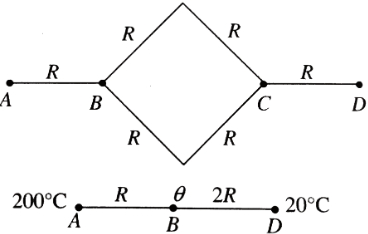
Six identical rods are arranged as shown in the figure. The temperature of the junction $B$ will be......... $^oC$
A
$\frac{240}{3}$
B
$240$
C
$140$
D
$\frac{140}{3}$
Solution
(C) Let the thermal resistance of each rod be $R$. The system consists of a rod $AB$ of resistance $R$,followed by a parallel combination of two branches between $B$ and $C$,each having a resistance of $2R$. The equivalent resistance of this parallel part is $R_{BC} = \frac{2R \times 2R}{2R + 2R} = R$. Finally,there is a rod $CD$ of resistance $R$.
Thus,the total circuit can be simplified to a series combination of three resistances: $R_{AB} = R$,$R_{BC} = R$,and $R_{CD} = R$. The total resistance is $3R$.
The heat current $H$ flowing through the system is $H = \frac{T_A - T_D}{3R} = \frac{200 - 20}{3R} = \frac{180}{3R} = \frac{60}{R}$.
Now,for junction $B$,the heat current flowing through $AB$ must equal the heat current flowing through the rest of the circuit ($BC$ and $CD$):
$H = \frac{T_A - T_B}{R} = \frac{60}{R}$
$200 - T_B = 60$
$T_B = 200 - 60 = 140^{\circ}C$.
Thus,the total circuit can be simplified to a series combination of three resistances: $R_{AB} = R$,$R_{BC} = R$,and $R_{CD} = R$. The total resistance is $3R$.
The heat current $H$ flowing through the system is $H = \frac{T_A - T_D}{3R} = \frac{200 - 20}{3R} = \frac{180}{3R} = \frac{60}{R}$.
Now,for junction $B$,the heat current flowing through $AB$ must equal the heat current flowing through the rest of the circuit ($BC$ and $CD$):
$H = \frac{T_A - T_B}{R} = \frac{60}{R}$
$200 - T_B = 60$
$T_B = 200 - 60 = 140^{\circ}C$.
0 likes
View Solution70
MediumMCQ
$A$ copper rod $2 \ m$ long has a circular cross-section of radius $1 \ cm$. One end is kept at $100^{\circ}C$ and the other at $0^{\circ}C$,and the surface is covered by non-conducting material to prevent heat losses through the surface. The thermal resistance of the bar in Kelvin per Watt is (Take thermal conductivity $K = 401 \ W/m-K$ of copper):- (in $.9$)
A
$12$
B
$13$
C
$14$
D
$15$
Solution
(D) The thermal resistance $R$ of a rod is given by the formula:
$R = \frac{l}{KA}$
where $l$ is the length of the rod,$K$ is the thermal conductivity,and $A$ is the cross-sectional area.
Given:
Length $l = 2 \ m$
Radius $r = 1 \ cm = 10^{-2} \ m$
Thermal conductivity $K = 401 \ W/m-K$
Cross-sectional area $A = \pi r^2 = 3.14 \times (10^{-2})^2 = 3.14 \times 10^{-4} \ m^2$
Substituting the values into the formula:
$R = \frac{2}{401 \times 3.14 \times 10^{-4}}$
$R = \frac{2}{0.125914} \approx 15.88 \ K/W$
Rounding to one decimal place,we get $R \approx 15.9 \ K/W$.
$R = \frac{l}{KA}$
where $l$ is the length of the rod,$K$ is the thermal conductivity,and $A$ is the cross-sectional area.
Given:
Length $l = 2 \ m$
Radius $r = 1 \ cm = 10^{-2} \ m$
Thermal conductivity $K = 401 \ W/m-K$
Cross-sectional area $A = \pi r^2 = 3.14 \times (10^{-2})^2 = 3.14 \times 10^{-4} \ m^2$
Substituting the values into the formula:
$R = \frac{2}{401 \times 3.14 \times 10^{-4}}$
$R = \frac{2}{0.125914} \approx 15.88 \ K/W$
Rounding to one decimal place,we get $R \approx 15.9 \ K/W$.
0 likes
View Solution71
DifficultMCQ
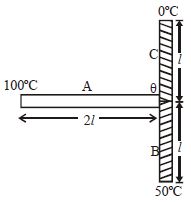
Three rods $A, B$ and $C$ of thermal conductivities $K, 2K$ and $4K$,cross-sectional areas $A, 2A$ and $2A$ and lengths $2l, l$ and $l$ respectively are connected as shown in the figure. If the ends of the rods are maintained at temperatures $100^{\circ}C, 50^{\circ}C$,and $0^{\circ}C$ respectively,then the temperature $\theta$ of the junction is ......... $^{\circ}C$
A
$\frac{300}{7}$
B
$20$
C
$\frac{200}{7}$
D
$\frac{200}{13}$
Solution
(B) Let $R_A, R_B$ and $R_C$ be the thermal resistances of rods $A, B$ and $C$ respectively. The thermal resistance is given by $R = \frac{l}{KA}$.
$R_A = \frac{2l}{KA}$
$R_B = \frac{l}{(2K)(2A)} = \frac{l}{4KA}$
$R_C = \frac{l}{(4K)(2A)} = \frac{l}{8KA}$
Let $\theta$ be the temperature of the junction. The thermal currents flowing towards the junction must sum to zero (Kirchhoff's junction law for heat flow):
$\frac{100 - \theta}{R_A} + \frac{50 - \theta}{R_B} + \frac{0 - \theta}{R_C} = 0$
Substituting the values of resistances:
$\frac{100 - \theta}{2l/KA} + \frac{50 - \theta}{l/4KA} + \frac{0 - \theta}{l/8KA} = 0$
$\frac{KA}{l} \left[ \frac{100 - \theta}{2} + 4(50 - \theta) - 8\theta \right] = 0$
$50 - 0.5\theta + 200 - 4\theta - 8\theta = 0$
$250 = 12.5\theta$
$\theta = \frac{250}{12.5} = 20^{\circ}C$
$R_A = \frac{2l}{KA}$
$R_B = \frac{l}{(2K)(2A)} = \frac{l}{4KA}$
$R_C = \frac{l}{(4K)(2A)} = \frac{l}{8KA}$
Let $\theta$ be the temperature of the junction. The thermal currents flowing towards the junction must sum to zero (Kirchhoff's junction law for heat flow):
$\frac{100 - \theta}{R_A} + \frac{50 - \theta}{R_B} + \frac{0 - \theta}{R_C} = 0$
Substituting the values of resistances:
$\frac{100 - \theta}{2l/KA} + \frac{50 - \theta}{l/4KA} + \frac{0 - \theta}{l/8KA} = 0$
$\frac{KA}{l} \left[ \frac{100 - \theta}{2} + 4(50 - \theta) - 8\theta \right] = 0$
$50 - 0.5\theta + 200 - 4\theta - 8\theta = 0$
$250 = 12.5\theta$
$\theta = \frac{250}{12.5} = 20^{\circ}C$
0 likes
View Solution72
MediumMCQ
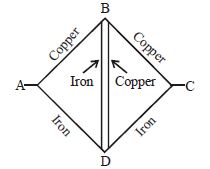
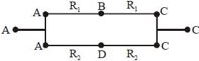
Six wires,each of cross-sectional area $A$ and length $l$,are combined as shown in the figure. The thermal conductivities of copper and iron are $K_1$ and $K_2$ respectively. The equivalent thermal resistance between points $A$ and $C$ is:
A
$\frac{l(K_1+K_2)}{K_1K_2A}$
B
$\frac{2l(K_1+K_2)}{K_1K_2A}$
C
$\frac{l}{(K_1+K_2)A}$
D
$\frac{2l}{(K_1+K_2)A}$
Solution
(D) Let $R_1$ and $R_2$ be the thermal resistances of the copper and iron wires respectively. Then,
$R_1 = \frac{l}{K_1 A}$ and $R_2 = \frac{l}{K_2 A}$.
From the figure,the arrangement is a Wheatstone bridge network. The arms $AB$ and $BC$ are copper (resistance $R_1$ each),and $AD$ and $DC$ are iron (resistance $R_2$ each). The central arm $BD$ consists of two wires (one iron and one copper) in parallel,but due to the symmetry of the bridge,the potential (temperature) at $B$ and $D$ is the same. Thus,no heat flows through the central arm $BD$,and it can be removed.
The circuit simplifies to two parallel branches: one branch with two copper wires in series $(R_1 + R_1 = 2R_1)$ and one branch with two iron wires in series $(R_2 + R_2 = 2R_2)$.
The equivalent thermal resistance $R_{eq}$ between $A$ and $C$ is given by:
$R_{eq} = \frac{(2R_1)(2R_2)}{2R_1 + 2R_2} = \frac{4R_1 R_2}{2(R_1 + R_2)} = \frac{2R_1 R_2}{R_1 + R_2}$.
Substituting the values of $R_1$ and $R_2$:
$R_{eq} = \frac{2 \left( \frac{l}{K_1 A} \right) \left( \frac{l}{K_2 A} \right)}{\frac{l}{K_1 A} + \frac{l}{K_2 A}} = \frac{2 \frac{l^2}{K_1 K_2 A^2}}{\frac{l(K_1 + K_2)}{K_1 K_2 A}} = \frac{2l}{A(K_1 + K_2)}$.
$R_1 = \frac{l}{K_1 A}$ and $R_2 = \frac{l}{K_2 A}$.
From the figure,the arrangement is a Wheatstone bridge network. The arms $AB$ and $BC$ are copper (resistance $R_1$ each),and $AD$ and $DC$ are iron (resistance $R_2$ each). The central arm $BD$ consists of two wires (one iron and one copper) in parallel,but due to the symmetry of the bridge,the potential (temperature) at $B$ and $D$ is the same. Thus,no heat flows through the central arm $BD$,and it can be removed.
The circuit simplifies to two parallel branches: one branch with two copper wires in series $(R_1 + R_1 = 2R_1)$ and one branch with two iron wires in series $(R_2 + R_2 = 2R_2)$.
The equivalent thermal resistance $R_{eq}$ between $A$ and $C$ is given by:
$R_{eq} = \frac{(2R_1)(2R_2)}{2R_1 + 2R_2} = \frac{4R_1 R_2}{2(R_1 + R_2)} = \frac{2R_1 R_2}{R_1 + R_2}$.
Substituting the values of $R_1$ and $R_2$:
$R_{eq} = \frac{2 \left( \frac{l}{K_1 A} \right) \left( \frac{l}{K_2 A} \right)}{\frac{l}{K_1 A} + \frac{l}{K_2 A}} = \frac{2 \frac{l^2}{K_1 K_2 A^2}}{\frac{l(K_1 + K_2)}{K_1 K_2 A}} = \frac{2l}{A(K_1 + K_2)}$.
0 likes
View Solution73
DifficultMCQ
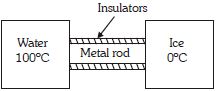
An insulated container is filled with ice at $0\,^{\circ}\text{C}$,and another container is filled with water that is continuously boiling at $100\,^{\circ}\text{C}$. In a series of experiments,the containers are connected by various thick metal rods that pass through the walls of the container as shown in the figure.
In experiment $I$: a copper rod is used and all ice melts in $20$ minutes.
In experiment $II$: a steel rod of identical dimensions is used and all ice melts in $80$ minutes.
In experiment $III$: both the rods are used in series and all ice melts in $t_{10}$ minutes.
In experiment $IV$: both rods are used in parallel and all ice melts in $t_{20}$ minutes.
In experiment $I$: a copper rod is used and all ice melts in $20$ minutes.
In experiment $II$: a steel rod of identical dimensions is used and all ice melts in $80$ minutes.
In experiment $III$: both the rods are used in series and all ice melts in $t_{10}$ minutes.
In experiment $IV$: both rods are used in parallel and all ice melts in $t_{20}$ minutes.
A
The value of $t_{10}$ is $100$ minutes
B
The value of $t_{10}$ is $50$ minutes
C
The value of $t_{20}$ is $32$ minutes
D
The value of $t_{20}$ is $8$ minutes
Solution
(A) Let $Q$ be the heat required to melt the ice. The rate of heat flow $P$ is given by $P = \frac{Q}{t}$.
For experiment $I$: $P_1 = \frac{Q}{t_1} = \frac{Q}{20}$.
For experiment $II$: $P_2 = \frac{Q}{t_2} = \frac{Q}{80}$.
In experiment $III$ (series): The equivalent thermal resistance $R_{eq} = R_1 + R_2$. Since $P = \frac{\Delta T}{R}$,we have $\frac{1}{P_{eq}} = \frac{1}{P_1} + \frac{1}{P_2}$.
$\frac{t_{10}}{Q} = \frac{t_1}{Q} + \frac{t_2}{Q} \Rightarrow t_{10} = t_1 + t_2 = 20 + 80 = 100 \text{ minutes}$.
In experiment $IV$ (parallel): The equivalent thermal resistance is $\frac{1}{R_{eq}} = \frac{1}{R_1} + \frac{1}{R_2}$,which implies $P_{eq} = P_1 + P_2$.
$\frac{Q}{t_{20}} = \frac{Q}{t_1} + \frac{Q}{t_2} \Rightarrow \frac{1}{t_{20}} = \frac{1}{20} + \frac{1}{80} = \frac{4+1}{80} = \frac{5}{80} = \frac{1}{16}$.
Thus,$t_{20} = 16 \text{ minutes}$.
Comparing with the options,the correct statement is that $t_{10} = 100 \text{ minutes}$.
For experiment $I$: $P_1 = \frac{Q}{t_1} = \frac{Q}{20}$.
For experiment $II$: $P_2 = \frac{Q}{t_2} = \frac{Q}{80}$.
In experiment $III$ (series): The equivalent thermal resistance $R_{eq} = R_1 + R_2$. Since $P = \frac{\Delta T}{R}$,we have $\frac{1}{P_{eq}} = \frac{1}{P_1} + \frac{1}{P_2}$.
$\frac{t_{10}}{Q} = \frac{t_1}{Q} + \frac{t_2}{Q} \Rightarrow t_{10} = t_1 + t_2 = 20 + 80 = 100 \text{ minutes}$.
In experiment $IV$ (parallel): The equivalent thermal resistance is $\frac{1}{R_{eq}} = \frac{1}{R_1} + \frac{1}{R_2}$,which implies $P_{eq} = P_1 + P_2$.
$\frac{Q}{t_{20}} = \frac{Q}{t_1} + \frac{Q}{t_2} \Rightarrow \frac{1}{t_{20}} = \frac{1}{20} + \frac{1}{80} = \frac{4+1}{80} = \frac{5}{80} = \frac{1}{16}$.
Thus,$t_{20} = 16 \text{ minutes}$.
Comparing with the options,the correct statement is that $t_{10} = 100 \text{ minutes}$.
0 likes
View Solution74
DifficultMCQ
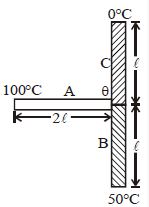
Three rods $A, B,$ and $C$ of thermal conductivities $K, 2K$ and $4K$,cross-sectional areas $A, 2A$ and $2A$ and lengths $2l, l$ and $l$ respectively are connected as shown in the figure. If the ends of the rods are maintained at temperatures $100\,^oC$,$50\,^oC$,and $0\,^oC$ respectively,then the temperature $\theta$ of the junction is
A
$\frac{300}{7}\,^oC$
B
$\frac{300}{13}\,^oC$
C
$\frac{200}{7}\,^oC$
D
$\frac{200}{13}\,^oC$
Solution
(D) The thermal resistance $R$ of a rod is given by $R = \frac{l}{KA}$.
For rod $A$: $R_A = \frac{2l}{K \cdot A} = \frac{2l}{KA}$.
For rod $B$: $R_B = \frac{l}{(2K) \cdot (2A)} = \frac{l}{4KA}$.
For rod $C$: $R_C = \frac{l}{(4K) \cdot (2A)} = \frac{l}{8KA}$.
Let the junction temperature be $\theta$. According to the principle of conservation of energy (Kirchhoff's junction law for heat flow),the sum of heat currents at the junction must be zero: $\frac{100 - \theta}{R_A} + \frac{50 - \theta}{R_B} + \frac{0 - \theta}{R_C} = 0$.
Substituting the values of resistances:
$\frac{100 - \theta}{2l/KA} + \frac{50 - \theta}{l/4KA} + \frac{0 - \theta}{l/8KA} = 0$.
Multiplying by $\frac{l}{KA}$:
$\frac{100 - \theta}{2} + 4(50 - \theta) + 8(0 - \theta) = 0$.
$50 - 0.5\theta + 200 - 4\theta - 8\theta = 0$.
$250 = 12.5\theta$.
$\theta = \frac{250}{12.5} = 20\,^oC$.
Wait,let's re-evaluate the calculation: $50 - 0.5\theta + 200 - 4\theta - 8\theta = 250 - 12.5\theta = 0 \implies \theta = 20\,^oC$. Checking the options,it seems there might be a typo in the provided options or the setup. Let's re-check the heat flow: $\frac{100-\theta}{R_A} = \frac{\theta-50}{R_B} + \frac{\theta-0}{R_C}$.
$\frac{100-\theta}{2} = 4(\theta-50) + 8(\theta-0)$.
$50 - 0.5\theta = 4\theta - 200 + 8\theta$.
$250 = 12.5\theta \implies \theta = 20\,^oC$. Given the options,if we assume the heat flows from $100$ and $50$ towards the junction and then to $0$,the calculation holds. If the question implies a different configuration,the result might vary. Based on standard interpretation,$\theta = 20\,^oC$ is the result.
For rod $A$: $R_A = \frac{2l}{K \cdot A} = \frac{2l}{KA}$.
For rod $B$: $R_B = \frac{l}{(2K) \cdot (2A)} = \frac{l}{4KA}$.
For rod $C$: $R_C = \frac{l}{(4K) \cdot (2A)} = \frac{l}{8KA}$.
Let the junction temperature be $\theta$. According to the principle of conservation of energy (Kirchhoff's junction law for heat flow),the sum of heat currents at the junction must be zero: $\frac{100 - \theta}{R_A} + \frac{50 - \theta}{R_B} + \frac{0 - \theta}{R_C} = 0$.
Substituting the values of resistances:
$\frac{100 - \theta}{2l/KA} + \frac{50 - \theta}{l/4KA} + \frac{0 - \theta}{l/8KA} = 0$.
Multiplying by $\frac{l}{KA}$:
$\frac{100 - \theta}{2} + 4(50 - \theta) + 8(0 - \theta) = 0$.
$50 - 0.5\theta + 200 - 4\theta - 8\theta = 0$.
$250 = 12.5\theta$.
$\theta = \frac{250}{12.5} = 20\,^oC$.
Wait,let's re-evaluate the calculation: $50 - 0.5\theta + 200 - 4\theta - 8\theta = 250 - 12.5\theta = 0 \implies \theta = 20\,^oC$. Checking the options,it seems there might be a typo in the provided options or the setup. Let's re-check the heat flow: $\frac{100-\theta}{R_A} = \frac{\theta-50}{R_B} + \frac{\theta-0}{R_C}$.
$\frac{100-\theta}{2} = 4(\theta-50) + 8(\theta-0)$.
$50 - 0.5\theta = 4\theta - 200 + 8\theta$.
$250 = 12.5\theta \implies \theta = 20\,^oC$. Given the options,if we assume the heat flows from $100$ and $50$ towards the junction and then to $0$,the calculation holds. If the question implies a different configuration,the result might vary. Based on standard interpretation,$\theta = 20\,^oC$ is the result.
0 likes
View Solution75
MediumMCQ
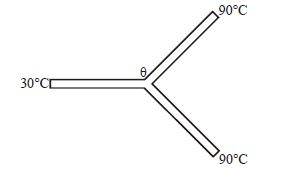
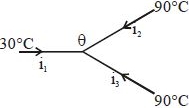
Three identical rods have been joined at a junction to make a $Y$-shaped structure. If two free ends are maintained at $90\,^{\circ}C$ and the third end is at $30\,^{\circ}C$,what is the junction temperature $\theta$ in $^{\circ}C$?
A
$40$
B
$50$
C
$60$
D
$70$
Solution
(D) The thermal resistance of each rod is given by $R = \frac{L}{KA}$. Since the rods are identical,the thermal resistance $R$ is the same for all three rods.
Using Kirchhoff's law for heat current at the junction,the sum of heat currents entering the junction must be zero:
$i_1 + i_2 + i_3 = 0$
Here,$i_1$ is the heat current from the $30\,^{\circ}C$ end,and $i_2, i_3$ are the heat currents from the two $90\,^{\circ}C$ ends.
$\frac{30 - \theta}{R} + \frac{90 - \theta}{R} + \frac{90 - \theta}{R} = 0$
Multiplying by $R$:
$(30 - \theta) + (90 - \theta) + (90 - \theta) = 0$
$30 + 90 + 90 - 3\theta = 0$
$210 = 3\theta$
$\theta = 70\,^{\circ}C$
Using Kirchhoff's law for heat current at the junction,the sum of heat currents entering the junction must be zero:
$i_1 + i_2 + i_3 = 0$
Here,$i_1$ is the heat current from the $30\,^{\circ}C$ end,and $i_2, i_3$ are the heat currents from the two $90\,^{\circ}C$ ends.
$\frac{30 - \theta}{R} + \frac{90 - \theta}{R} + \frac{90 - \theta}{R} = 0$
Multiplying by $R$:
$(30 - \theta) + (90 - \theta) + (90 - \theta) = 0$
$30 + 90 + 90 - 3\theta = 0$
$210 = 3\theta$
$\theta = 70\,^{\circ}C$
0 likes
View Solution76
EasyMCQ
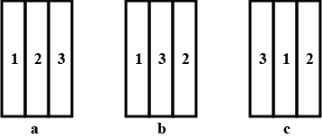
The figure shows three different arrangements of materials $1, 2$,and $3$ to form a wall. The thermal conductivities are $k_1 > k_2 > k_3$. The left side of the wall is $20\,^{\circ}\text{C}$ higher than the right side. The temperature difference $\Delta T$ across material $1$ has the following relation in the three cases:
A
$\Delta T_a > \Delta T_b > \Delta T_c$
B
$\Delta T_a = \Delta T_b = \Delta T_c$
C
$\Delta T_a = \Delta T_b > \Delta T_c$
D
$\Delta T_a = \Delta T_b < \Delta T_c$
Solution
(B) In all three cases,the materials are arranged in series between the same two temperatures.
Since the total thermal resistance $R_{eq} = R_1 + R_2 + R_3$ is the same for all three arrangements (as the sum of resistances is independent of the order in series),the total heat current $H = \frac{\Delta T_{total}}{R_{eq}}$ is also the same for all three cases.
For any individual material layer,the heat current is given by $H = \frac{\Delta T_{layer}}{R_{layer}}$.
Since $H$ is constant and the resistance $R_1$ of material $1$ is constant in all three cases,the temperature difference across material $1$ is $\Delta T_1 = H \times R_1$.
Therefore,$\Delta T_a = \Delta T_b = \Delta T_c$.
Since the total thermal resistance $R_{eq} = R_1 + R_2 + R_3$ is the same for all three arrangements (as the sum of resistances is independent of the order in series),the total heat current $H = \frac{\Delta T_{total}}{R_{eq}}$ is also the same for all three cases.
For any individual material layer,the heat current is given by $H = \frac{\Delta T_{layer}}{R_{layer}}$.
Since $H$ is constant and the resistance $R_1$ of material $1$ is constant in all three cases,the temperature difference across material $1$ is $\Delta T_1 = H \times R_1$.
Therefore,$\Delta T_a = \Delta T_b = \Delta T_c$.
0 likes
View Solution77
DifficultMCQ
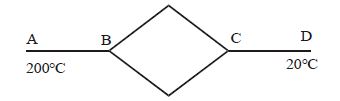
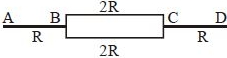
Six identical conducting rods are joined as shown. The ends $A$ and $D$ are maintained at $200\,^{\circ}C$ and $20\,^{\circ}C$ respectively. No heat is lost to the surroundings. The temperature of the junction $C$ will be ........ $^{\circ}C$.
A
$60$
B
$80$
C
$100$
D
$120$
Solution
(B) Let the thermal resistance of each rod be $R$. The circuit can be analyzed as a series-parallel combination of thermal resistances.
$1$. The section between $B$ and $C$ consists of two parallel branches,each containing two rods in series. The resistance of each branch is $R + R = 2R$. The equivalent resistance of the parallel combination between $B$ and $C$ is $R_{BC} = (2R \times 2R) / (2R + 2R) = R$.
$2$. The total thermal resistance of the circuit is $R_{total} = R_{AB} + R_{BC} + R_{CD} = R + R + R = 3R$.
$3$. The total temperature difference is $\Delta T = 200^{\circ}C - 20^{\circ}C = 180^{\circ}C$.
$4$. The heat current $H$ flowing through the circuit is $H = \Delta T / R_{total} = 180 / 3R = 60/R$.
$5$. The temperature drop across $AB$ is $\Delta T_{AB} = H \times R = (60/R) \times R = 60^{\circ}C$. Thus,$T_B = 200^{\circ}C - 60^{\circ}C = 140^{\circ}C$.
$6$. The temperature drop across $BC$ is $\Delta T_{BC} = H \times R_{BC} = (60/R) \times R = 60^{\circ}C$. Thus,$T_C = T_B - 60^{\circ}C = 140^{\circ}C - 60^{\circ}C = 80^{\circ}C$.
$1$. The section between $B$ and $C$ consists of two parallel branches,each containing two rods in series. The resistance of each branch is $R + R = 2R$. The equivalent resistance of the parallel combination between $B$ and $C$ is $R_{BC} = (2R \times 2R) / (2R + 2R) = R$.
$2$. The total thermal resistance of the circuit is $R_{total} = R_{AB} + R_{BC} + R_{CD} = R + R + R = 3R$.
$3$. The total temperature difference is $\Delta T = 200^{\circ}C - 20^{\circ}C = 180^{\circ}C$.
$4$. The heat current $H$ flowing through the circuit is $H = \Delta T / R_{total} = 180 / 3R = 60/R$.
$5$. The temperature drop across $AB$ is $\Delta T_{AB} = H \times R = (60/R) \times R = 60^{\circ}C$. Thus,$T_B = 200^{\circ}C - 60^{\circ}C = 140^{\circ}C$.
$6$. The temperature drop across $BC$ is $\Delta T_{BC} = H \times R_{BC} = (60/R) \times R = 60^{\circ}C$. Thus,$T_C = T_B - 60^{\circ}C = 140^{\circ}C - 60^{\circ}C = 80^{\circ}C$.
0 likes
View Solution78
MediumMCQ
Two rods of same material have same length and area. The heat $\Delta Q$ flows through them for $12 \, \text{minutes}$ when they are joined in series. If now both the rods are joined in parallel,then the same amount of heat $\Delta Q$ will flow in ........ $\text{minutes}$.
A
$24$
B
$3$
C
$12$
D
$6$
Solution
(B) The heat flow is given by $\Delta Q = \frac{\Delta T}{R_{eq}} t$,where $R_{eq}$ is the equivalent thermal resistance.
For two identical rods of resistance $R$,when joined in series,the equivalent resistance is $R_{s} = R + R = 2R$.
When joined in parallel,the equivalent resistance is $R_{p} = \frac{R \times R}{R + R} = \frac{R}{2}$.
Given that the heat $\Delta Q$ is the same in both cases and the temperature difference $\Delta T$ is constant:
$\Delta Q = \frac{\Delta T}{2R} \times 12 = \frac{\Delta T}{R/2} \times t$
Simplifying the equation:
$\frac{12}{2R} = \frac{t}{R/2}$
$\frac{6}{R} = \frac{2t}{R}$
$2t = 6$
$t = 3 \, \text{minutes}$.
For two identical rods of resistance $R$,when joined in series,the equivalent resistance is $R_{s} = R + R = 2R$.
When joined in parallel,the equivalent resistance is $R_{p} = \frac{R \times R}{R + R} = \frac{R}{2}$.
Given that the heat $\Delta Q$ is the same in both cases and the temperature difference $\Delta T$ is constant:
$\Delta Q = \frac{\Delta T}{2R} \times 12 = \frac{\Delta T}{R/2} \times t$
Simplifying the equation:
$\frac{12}{2R} = \frac{t}{R/2}$
$\frac{6}{R} = \frac{2t}{R}$
$2t = 6$
$t = 3 \, \text{minutes}$.
0 likes
View Solution79
MediumMCQ
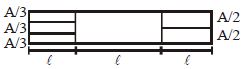
For the shown figure,calculate the equivalent thermal resistance if the bricks are made of the same material of thermal conductivity $K$.
A
$\frac{l}{{KA}}$
B
$\frac{3l}{{KA}}$
C
$\frac{l}{{3KA}}$
D
$\frac{6l}{{KA}}$
Solution
(B) The thermal resistance of a material is given by $R = \frac{l}{KA}$,where $l$ is the length,$A$ is the area,and $K$ is the thermal conductivity.
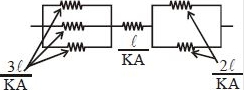
$1$. For the first section (left): There are three parallel bricks each of length $l$ and area $A/3$. The resistance of each brick is $R_1 = \frac{l}{K(A/3)} = \frac{3l}{KA}$. Since they are in parallel,the equivalent resistance $R_{eq1}$ is $\frac{1}{R_{eq1}} = \frac{1}{R_1} + \frac{1}{R_1} + \frac{1}{R_1} = \frac{3}{R_1} = \frac{3}{3l/KA} = \frac{KA}{l}$. Thus,$R_{eq1} = \frac{l}{KA}$.
$2$. For the middle section: There is a single brick of length $l$ and area $A$. The resistance is $R_{eq2} = \frac{l}{KA}$.
$3$. For the third section (right): There are two parallel bricks each of length $l$ and area $A/2$. The resistance of each brick is $R_3 = \frac{l}{K(A/2)} = \frac{2l}{KA}$. Since they are in parallel,the equivalent resistance $R_{eq3}$ is $\frac{1}{R_{eq3}} = \frac{1}{R_3} + \frac{1}{R_3} = \frac{2}{R_3} = \frac{2}{2l/KA} = \frac{KA}{l}$. Thus,$R_{eq3} = \frac{l}{KA}$.
$4$. Since these three sections are in series,the total equivalent thermal resistance is $R_{total} = R_{eq1} + R_{eq2} + R_{eq3} = \frac{l}{KA} + \frac{l}{KA} + \frac{l}{KA} = \frac{3l}{KA}$.
$1$. For the first section (left): There are three parallel bricks each of length $l$ and area $A/3$. The resistance of each brick is $R_1 = \frac{l}{K(A/3)} = \frac{3l}{KA}$. Since they are in parallel,the equivalent resistance $R_{eq1}$ is $\frac{1}{R_{eq1}} = \frac{1}{R_1} + \frac{1}{R_1} + \frac{1}{R_1} = \frac{3}{R_1} = \frac{3}{3l/KA} = \frac{KA}{l}$. Thus,$R_{eq1} = \frac{l}{KA}$.
$2$. For the middle section: There is a single brick of length $l$ and area $A$. The resistance is $R_{eq2} = \frac{l}{KA}$.
$3$. For the third section (right): There are two parallel bricks each of length $l$ and area $A/2$. The resistance of each brick is $R_3 = \frac{l}{K(A/2)} = \frac{2l}{KA}$. Since they are in parallel,the equivalent resistance $R_{eq3}$ is $\frac{1}{R_{eq3}} = \frac{1}{R_3} + \frac{1}{R_3} = \frac{2}{R_3} = \frac{2}{2l/KA} = \frac{KA}{l}$. Thus,$R_{eq3} = \frac{l}{KA}$.
$4$. Since these three sections are in series,the total equivalent thermal resistance is $R_{total} = R_{eq1} + R_{eq2} + R_{eq3} = \frac{l}{KA} + \frac{l}{KA} + \frac{l}{KA} = \frac{3l}{KA}$.
0 likes
View Solution80
MediumMCQ
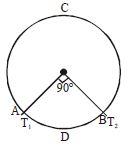
For the figure shown,when arcs $ACD$ and $ADB$ are made of the same material,the total heat current carried between $A$ and $B$ is $H$. If $ADB$ is replaced with another material,the total heat current becomes $2H$. If the temperatures at $A$ and $B$ are fixed at $T_1$ and $T_2$,what is the ratio of the new thermal conductivity to the old thermal conductivity of the arc $ADB$?
A
$\frac{7}{3}$
B
$2$
C
$\frac{5}{2}$
D
$3$
Solution
(A) Let $R_1$ be the thermal resistance of arc $ADB$ and $R_2$ be the thermal resistance of arc $ACD$. The angle subtended by $ADB$ at the center is $90^\circ$ (or $\pi/2$ radians),and the angle subtended by $ACD$ is $270^\circ$ (or $3\pi/2$ radians).
Since the length of an arc is $L = r\theta$,the length of $ADB$ is $L_1 = r(\pi/2)$ and the length of $ACD$ is $L_2 = r(3\pi/2) = 3L_1$.
Thermal resistance $R = \frac{L}{KA}$. Assuming same cross-sectional area $A$ and same initial conductivity $K$:
$R_1 = \frac{L_1}{KA}$ and $R_2 = \frac{3L_1}{KA} = 3R_1$.
The arcs are in parallel between $A$ and $B$,so the total heat current $H = \frac{\Delta T}{R_{eq}} = \Delta T \left(\frac{1}{R_1} + \frac{1}{R_2}\right) = \Delta T \left(\frac{1}{R_1} + \frac{1}{3R_1}\right) = \frac{4\Delta T}{3R_1}$.
When $ADB$ is replaced with material of conductivity $K'$,the new resistance is $R_1' = \frac{L_1}{K'A} = R_1 \frac{K}{K'}$.
The new heat current is $2H = \Delta T \left(\frac{1}{R_1'} + \frac{1}{R_2}\right) = \Delta T \left(\frac{K'}{R_1 K} + \frac{1}{3R_1}\right)$.
Substituting $H = \frac{4\Delta T}{3R_1}$,we get $2 \left(\frac{4\Delta T}{3R_1}\right) = \Delta T \left(\frac{K'}{R_1 K} + \frac{1}{3R_1}\right)$.
$\frac{8}{3R_1} = \frac{3K' + K}{3KR_1} \implies 8K = 3K' + K \implies 3K' = 7K \implies \frac{K'}{K} = \frac{7}{3}$.
Since the length of an arc is $L = r\theta$,the length of $ADB$ is $L_1 = r(\pi/2)$ and the length of $ACD$ is $L_2 = r(3\pi/2) = 3L_1$.
Thermal resistance $R = \frac{L}{KA}$. Assuming same cross-sectional area $A$ and same initial conductivity $K$:
$R_1 = \frac{L_1}{KA}$ and $R_2 = \frac{3L_1}{KA} = 3R_1$.
The arcs are in parallel between $A$ and $B$,so the total heat current $H = \frac{\Delta T}{R_{eq}} = \Delta T \left(\frac{1}{R_1} + \frac{1}{R_2}\right) = \Delta T \left(\frac{1}{R_1} + \frac{1}{3R_1}\right) = \frac{4\Delta T}{3R_1}$.
When $ADB$ is replaced with material of conductivity $K'$,the new resistance is $R_1' = \frac{L_1}{K'A} = R_1 \frac{K}{K'}$.
The new heat current is $2H = \Delta T \left(\frac{1}{R_1'} + \frac{1}{R_2}\right) = \Delta T \left(\frac{K'}{R_1 K} + \frac{1}{3R_1}\right)$.
Substituting $H = \frac{4\Delta T}{3R_1}$,we get $2 \left(\frac{4\Delta T}{3R_1}\right) = \Delta T \left(\frac{K'}{R_1 K} + \frac{1}{3R_1}\right)$.
$\frac{8}{3R_1} = \frac{3K' + K}{3KR_1} \implies 8K = 3K' + K \implies 3K' = 7K \implies \frac{K'}{K} = \frac{7}{3}$.
0 likes
View Solution81
DifficultMCQ
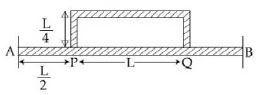
$A$ temperature difference of $120\,^oC$ is maintained between the two ends of a uniform rod $AB$ of length $2L$. Another bent rod $PQ$,of the same cross-section as $AB$ and length $\frac{3L}{2}$,is connected across $AB$ as shown in the figure. In the steady state,the temperature difference between $P$ and $Q$ will be close to .......... $^oC$.
A
$45$
B
$75$
C
$60$
D
$35$
Solution
(A) Let $R_0$ be the thermal resistance of a rod of length $L$. The resistance of segment $AP$ (length $L/2$) is $R_0/2$,segment $PQ$ (length $L$) is $R_0$,and segment $QB$ (length $L/2$) is $R_0/2$. The bent rod $PQ$ has a total length of $3L/2$ (two vertical segments of $L/4$ and one horizontal segment of $L$). Its resistance is $R_{bent} = R_0/4 + R_0 + R_0/4 = 1.5R_0$. The segment $PQ$ of the main rod has resistance $R_0$. These two are in parallel,so their equivalent resistance $R_p = \frac{R_0 \times 1.5R_0}{R_0 + 1.5R_0} = \frac{1.5}{2.5}R_0 = 0.6R_0$. The total resistance of the circuit is $R_{eq} = R_{AP} + R_p + R_{QB} = 0.5R_0 + 0.6R_0 + 0.5R_0 = 1.6R_0$. The temperature drop across $PQ$ is $\Delta T_{PQ} = \Delta T_{total} \times \frac{R_p}{R_{eq}} = 120 \times \frac{0.6R_0}{1.6R_0} = 120 \times \frac{6}{16} = 120 \times 0.375 = 45\,^oC$.
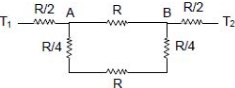
0 likes
View Solution82
MediumMCQ
$A$ cylinder of radius $R$ is surrounded by a cylindrical shell of inner radius $R$ and outer radius $2R$. The thermal conductivity of the material of the inner cylinder is $K_1$ and that of the outer cylinder is $K_2$. Assuming no loss of heat,the effective thermal conductivity of the system for heat flowing along the length of the cylinder is
A
$\frac{K_1 + K_2}{2}$
B
$K_1 + K_2$
C
$\frac{2K_1 + 3K_2}{5}$
D
$\frac{K_1 + 3K_2}{4}$
Solution
(D) When heat flows along the length of the cylinders,the two cylinders act as parallel conductors of heat.
For parallel combination,the equivalent thermal conductance is the sum of individual thermal conductances.
The thermal conductance is given by $C = \frac{KA}{L}$,where $K$ is thermal conductivity,$A$ is the cross-sectional area,and $L$ is the length.
For the inner cylinder,area $A_1 = \pi R^2$.
For the outer cylindrical shell,area $A_2 = \pi (2R)^2 - \pi R^2 = 3\pi R^2$.
The total area of the system is $A = A_1 + A_2 = 4\pi R^2$.
Equating the total conductance to the sum of individual conductances:
$\frac{K_{eff} A}{L} = \frac{K_1 A_1}{L} + \frac{K_2 A_2}{L}$
$K_{eff} (4\pi R^2) = K_1 (\pi R^2) + K_2 (3\pi R^2)$
$4 K_{eff} = K_1 + 3 K_2$
$K_{eff} = \frac{K_1 + 3 K_2}{4}$
For parallel combination,the equivalent thermal conductance is the sum of individual thermal conductances.
The thermal conductance is given by $C = \frac{KA}{L}$,where $K$ is thermal conductivity,$A$ is the cross-sectional area,and $L$ is the length.
For the inner cylinder,area $A_1 = \pi R^2$.
For the outer cylindrical shell,area $A_2 = \pi (2R)^2 - \pi R^2 = 3\pi R^2$.
The total area of the system is $A = A_1 + A_2 = 4\pi R^2$.
Equating the total conductance to the sum of individual conductances:
$\frac{K_{eff} A}{L} = \frac{K_1 A_1}{L} + \frac{K_2 A_2}{L}$
$K_{eff} (4\pi R^2) = K_1 (\pi R^2) + K_2 (3\pi R^2)$
$4 K_{eff} = K_1 + 3 K_2$
$K_{eff} = \frac{K_1 + 3 K_2}{4}$
0 likes
View Solution83
MediumMCQ
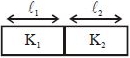
In a composite rod,two rods of different lengths and the same cross-sectional area are joined end to end. If $K$ is the equivalent coefficient of thermal conductivity of the composite rod,then $\left( \frac{\ell_1 + \ell_2}{K} \right)$ is equal to:
A
$\frac{\ell_1}{K_1} - \frac{\ell_2}{K_2}$
B
$\frac{\ell_1}{K_2} - \frac{\ell_2}{K_1}$
C
$\frac{\ell_1}{K_1} + \frac{\ell_2}{K_2}$
D
$\frac{\ell_1}{K_2} + \frac{\ell_2}{K_1}$
Solution
(C) For rods connected in series,the equivalent thermal resistance $R_{eq}$ is the sum of individual thermal resistances: $R_{eq} = R_1 + R_2$.
The formula for thermal resistance is $R = \frac{\ell}{KA}$,where $\ell$ is length,$K$ is thermal conductivity,and $A$ is the cross-sectional area.
Substituting this into the series equation:
$\frac{\ell_1 + \ell_2}{K A} = \frac{\ell_1}{K_1 A} + \frac{\ell_2}{K_2 A}$
Since the cross-sectional area $A$ is the same for both rods,we can cancel $A$ from both sides:
$\frac{\ell_1 + \ell_2}{K} = \frac{\ell_1}{K_1} + \frac{\ell_2}{K_2}$
The formula for thermal resistance is $R = \frac{\ell}{KA}$,where $\ell$ is length,$K$ is thermal conductivity,and $A$ is the cross-sectional area.
Substituting this into the series equation:
$\frac{\ell_1 + \ell_2}{K A} = \frac{\ell_1}{K_1 A} + \frac{\ell_2}{K_2 A}$
Since the cross-sectional area $A$ is the same for both rods,we can cancel $A$ from both sides:
$\frac{\ell_1 + \ell_2}{K} = \frac{\ell_1}{K_1} + \frac{\ell_2}{K_2}$
0 likes
View Solution84
MediumMCQ
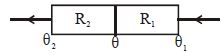
Consider two insulating sheets with thermal resistances $R_1$ and $R_2$ as shown in the figure. The temperature $\theta$ at the junction is:
A
$\frac{{\theta _1}{\theta _2}{R_1}{R_2}}{{({R_1} + {R_2})({\theta _1} + {\theta _2})}}$
B
$\frac{{\theta _1}{R_1} + {\theta _2}{R_2}}{{{R_1} + {R_2}}}$
C
$\frac{{({\theta _1} + {\theta _2})\left( {{R_1}{R_2}} \right)}}{{R_1^2 + R_2^2}}$
D
$\frac{{\theta _1}{R_2} + {\theta _2}{R_1}}{{{R_1} + {R_2}}}$
Solution
(D) In a steady state,the rate of heat flow through the two sheets connected in series must be the same.
Let $H$ be the rate of heat flow.
$H = \frac{\Delta T_1}{R_1} = \frac{\Delta T_2}{R_2}$
Substituting the temperature values:
$\frac{\theta_1 - \theta}{R_1} = \frac{\theta - \theta_2}{R_2}$
Cross-multiplying to solve for $\theta$:
$(\theta_1 - \theta)R_2 = (\theta - \theta_2)R_1$
$\theta_1 R_2 - \theta R_2 = \theta R_1 - \theta_2 R_1$
$\theta_1 R_2 + \theta_2 R_1 = \theta (R_1 + R_2)$
Therefore,the junction temperature is:
$\theta = \frac{\theta_1 R_2 + \theta_2 R_1}{R_1 + R_2}$
Let $H$ be the rate of heat flow.
$H = \frac{\Delta T_1}{R_1} = \frac{\Delta T_2}{R_2}$
Substituting the temperature values:
$\frac{\theta_1 - \theta}{R_1} = \frac{\theta - \theta_2}{R_2}$
Cross-multiplying to solve for $\theta$:
$(\theta_1 - \theta)R_2 = (\theta - \theta_2)R_1$
$\theta_1 R_2 - \theta R_2 = \theta R_1 - \theta_2 R_1$
$\theta_1 R_2 + \theta_2 R_1 = \theta (R_1 + R_2)$
Therefore,the junction temperature is:
$\theta = \frac{\theta_1 R_2 + \theta_2 R_1}{R_1 + R_2}$
0 likes
View Solution85
DifficultMCQ
$A$ wall has two layers $A$ and $B,$ each made of different material. Both the layers have the same thickness. The thermal conductivity for $A$ is twice that of $B$ and under steady condition,the temperature difference across the wall is $36\,^{\circ}C.$ The temperature difference across the layer $A$ is....... $^{\circ}C$
A
$6$
B
$12$
C
$24$
D
$18$
Solution
(B) Given that the thermal conductivity $K_A = 2 K_B$.
Since both layers have the same thickness $d$ and cross-sectional area $A$,the thermal resistance $R = \frac{d}{KA}$.
Therefore,$R_A = \frac{d}{K_A A} = \frac{d}{2 K_B A} = \frac{R_B}{2}$.
Let $R_A = R$,then $R_B = 2R$.
In a steady state,the heat current $H$ is the same through both layers connected in series.
The total temperature difference $\Delta T = 36\,^{\circ}C$.
$H = \frac{\Delta T}{R_{total}} = \frac{36}{R_A + R_B} = \frac{36}{R + 2R} = \frac{36}{3R} = \frac{12}{R}$.
The temperature difference across layer $A$ is $\Delta T_A = H \times R_A = \frac{12}{R} \times R = 12\,^{\circ}C$.
Since both layers have the same thickness $d$ and cross-sectional area $A$,the thermal resistance $R = \frac{d}{KA}$.
Therefore,$R_A = \frac{d}{K_A A} = \frac{d}{2 K_B A} = \frac{R_B}{2}$.
Let $R_A = R$,then $R_B = 2R$.
In a steady state,the heat current $H$ is the same through both layers connected in series.
The total temperature difference $\Delta T = 36\,^{\circ}C$.
$H = \frac{\Delta T}{R_{total}} = \frac{36}{R_A + R_B} = \frac{36}{R + 2R} = \frac{36}{3R} = \frac{12}{R}$.
The temperature difference across layer $A$ is $\Delta T_A = H \times R_A = \frac{12}{R} \times R = 12\,^{\circ}C$.

0 likes
View Solution86
DifficultMCQ
Two rods of same length and material transfer a given amount of heat in $12 \, s$ when they are joined end to end. But when they are joined lengthwise (parallel),they will transfer the same amount of heat under the same conditions in .......... $s$.
A
$24$
B
$3$
C
$1.5$
D
$48$
Solution
(B) Let the length of each rod be $l$,area of cross-section be $A$,and thermal conductivity be $K$. The heat transferred is $Q$ and the temperature difference is $\Delta \theta$.
Case $1$: When joined end to end (series),the total length is $2l$ and the area is $A$. The equivalent thermal resistance is $R_{eq} = R_1 + R_2 = \frac{l}{KA} + \frac{l}{KA} = \frac{2l}{KA}$.
The heat flow is $Q = \frac{\Delta \theta}{R_{eq}} \times t_1 = \frac{\Delta \theta \cdot KA}{2l} \times 12 = \frac{6 KA \Delta \theta}{l} \dots (i)$.
Case $2$: When joined lengthwise (parallel),the length is $l$ and the total area is $2A$. The equivalent thermal resistance is $\frac{1}{R_{eq}} = \frac{1}{R_1} + \frac{1}{R_2} = \frac{KA}{l} + \frac{KA}{l} = \frac{2KA}{l}$,so $R_{eq} = \frac{l}{2KA}$.
The heat flow is $Q = \frac{\Delta \theta}{R_{eq}} \times t_2 = \frac{\Delta \theta \cdot 2KA}{l} \times t_2 \dots (ii)$.
Equating $(i)$ and $(ii)$:
$\frac{6 KA \Delta \theta}{l} = \frac{2 KA \Delta \theta}{l} \times t_2$
$6 = 2 t_2 \implies t_2 = 3 \, s$.
Case $1$: When joined end to end (series),the total length is $2l$ and the area is $A$. The equivalent thermal resistance is $R_{eq} = R_1 + R_2 = \frac{l}{KA} + \frac{l}{KA} = \frac{2l}{KA}$.
The heat flow is $Q = \frac{\Delta \theta}{R_{eq}} \times t_1 = \frac{\Delta \theta \cdot KA}{2l} \times 12 = \frac{6 KA \Delta \theta}{l} \dots (i)$.
Case $2$: When joined lengthwise (parallel),the length is $l$ and the total area is $2A$. The equivalent thermal resistance is $\frac{1}{R_{eq}} = \frac{1}{R_1} + \frac{1}{R_2} = \frac{KA}{l} + \frac{KA}{l} = \frac{2KA}{l}$,so $R_{eq} = \frac{l}{2KA}$.
The heat flow is $Q = \frac{\Delta \theta}{R_{eq}} \times t_2 = \frac{\Delta \theta \cdot 2KA}{l} \times t_2 \dots (ii)$.
Equating $(i)$ and $(ii)$:
$\frac{6 KA \Delta \theta}{l} = \frac{2 KA \Delta \theta}{l} \times t_2$
$6 = 2 t_2 \implies t_2 = 3 \, s$.
0 likes
View Solution87
DifficultMCQ
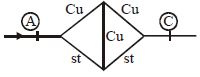
Five wires each of cross-sectional area $A$ and length $l$ are combined as shown. The thermal conductivity of copper and steel are $k_1$ and $k_2$ respectively. The equivalent thermal resistance between $A$ and $C$ is
A
$\frac{l}{(k_1 + k_2)A}$
B
$\frac{2l}{(k_1 + k_2)A}$
C
$\frac{l(k_1 + k_2)}{k_1 k_2 A}$
D
$\frac{l k_1 k_2}{k_1^2 + k_2^2}$
Solution
(B) The given circuit is a Wheatstone bridge. Since the bridge is balanced (the ratio of resistances in the arms is equal),no heat flows through the central wire.
The circuit simplifies to two parallel branches:
$1$. The upper branch consists of two copper wires in series,each of length $l$. The total resistance is $R_1 = \frac{l}{k_1 A} + \frac{l}{k_1 A} = \frac{2l}{k_1 A}$.
$2$. The lower branch consists of two steel wires in series,each of length $l$. The total resistance is $R_2 = \frac{l}{k_2 A} + \frac{l}{k_2 A} = \frac{2l}{k_2 A}$.
Since these two branches are in parallel,the equivalent thermal resistance $R_{eq}$ is given by:
$\frac{1}{R_{eq}} = \frac{1}{R_1} + \frac{1}{R_2} = \frac{k_1 A}{2l} + \frac{k_2 A}{2l} = \frac{(k_1 + k_2)A}{2l}$.
Therefore,$R_{eq} = \frac{2l}{(k_1 + k_2)A}$.
The circuit simplifies to two parallel branches:
$1$. The upper branch consists of two copper wires in series,each of length $l$. The total resistance is $R_1 = \frac{l}{k_1 A} + \frac{l}{k_1 A} = \frac{2l}{k_1 A}$.
$2$. The lower branch consists of two steel wires in series,each of length $l$. The total resistance is $R_2 = \frac{l}{k_2 A} + \frac{l}{k_2 A} = \frac{2l}{k_2 A}$.
Since these two branches are in parallel,the equivalent thermal resistance $R_{eq}$ is given by:
$\frac{1}{R_{eq}} = \frac{1}{R_1} + \frac{1}{R_2} = \frac{k_1 A}{2l} + \frac{k_2 A}{2l} = \frac{(k_1 + k_2)A}{2l}$.
Therefore,$R_{eq} = \frac{2l}{(k_1 + k_2)A}$.

0 likes
View Solution88
DifficultMCQ
Two plates of the same thickness with coefficients of thermal conductivities $K_1$ and $K_2$ and cross-sectional areas $A_1$ and $A_2$ are connected as shown. Find the effective coefficient of thermal conductivity $K_{eq}$.
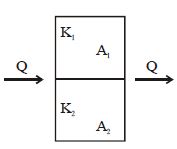
A
$K_1A_1 + K_2A_2$
B
$\frac{K_1A_1 + K_2A_2}{A_1 + A_2}$
C
$\frac{K_1A_2 + K_2A_1}{A_1 + A_2}$
D
$\frac{K_1A_1}{K_2A_2}$
Solution
(B) The two plates are connected in parallel,so the thermal resistances $R_1$ and $R_2$ are in parallel.
For parallel combination,the equivalent thermal resistance $R_{eq}$ is given by:
$\frac{1}{R_{eq}} = \frac{1}{R_1} + \frac{1}{R_2}$
We know that thermal resistance $R = \frac{\ell}{KA}$,where $\ell$ is the thickness.
Substituting the values:
$\frac{K_{eq}(A_1 + A_2)}{\ell} = \frac{K_1 A_1}{\ell} + \frac{K_2 A_2}{\ell}$
Since the thickness $\ell$ is the same for both plates,it cancels out:
$K_{eq}(A_1 + A_2) = K_1 A_1 + K_2 A_2$
$K_{eq} = \frac{K_1 A_1 + K_2 A_2}{A_1 + A_2}$
For parallel combination,the equivalent thermal resistance $R_{eq}$ is given by:
$\frac{1}{R_{eq}} = \frac{1}{R_1} + \frac{1}{R_2}$
We know that thermal resistance $R = \frac{\ell}{KA}$,where $\ell$ is the thickness.
Substituting the values:
$\frac{K_{eq}(A_1 + A_2)}{\ell} = \frac{K_1 A_1}{\ell} + \frac{K_2 A_2}{\ell}$
Since the thickness $\ell$ is the same for both plates,it cancels out:
$K_{eq}(A_1 + A_2) = K_1 A_1 + K_2 A_2$
$K_{eq} = \frac{K_1 A_1 + K_2 A_2}{A_1 + A_2}$
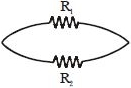
0 likes
View Solution89
MediumMCQ
In a composite rod,when two rods of different lengths and of the same area are joined end to end,then if $K$ is the effective coefficient of thermal conductivity,$\frac{{\ell _1} + {\ell _2}}{K}$ is equal to
A
$\frac{{\ell _1}}{{{K_1}}} - \frac{{\ell _2}}{{{K_2}}}$
B
$\frac{{\ell _1}}{{{K_2}}} - \frac{{\ell _2}}{{{K_1}}}$
C
$\frac{{\ell _1}}{{{K_1}}} + \frac{{\ell _2}}{{{K_2}}}$
D
$\frac{{\ell _1}}{{{K_2}}} + \frac{{\ell _2}}{{{K_1}}}$
Solution
(C) For rods joined in series,the equivalent thermal resistance $R_{eq}$ is the sum of individual thermal resistances: $R_{eq} = R_1 + R_2$.
The thermal resistance of a rod is given by $R = \frac{\ell}{KA}$,where $\ell$ is the length,$K$ is the thermal conductivity,and $A$ is the cross-sectional area.
Substituting this into the series combination formula:
$\frac{\ell_1 + \ell_2}{KA} = \frac{\ell_1}{K_1 A} + \frac{\ell_2}{K_2 A}$
Since the cross-sectional area $A$ is the same for both rods,we can cancel $A$ from both sides:
$\frac{\ell_1 + \ell_2}{K} = \frac{\ell_1}{K_1} + \frac{\ell_2}{K_2}$
The thermal resistance of a rod is given by $R = \frac{\ell}{KA}$,where $\ell$ is the length,$K$ is the thermal conductivity,and $A$ is the cross-sectional area.
Substituting this into the series combination formula:
$\frac{\ell_1 + \ell_2}{KA} = \frac{\ell_1}{K_1 A} + \frac{\ell_2}{K_2 A}$
Since the cross-sectional area $A$ is the same for both rods,we can cancel $A$ from both sides:
$\frac{\ell_1 + \ell_2}{K} = \frac{\ell_1}{K_1} + \frac{\ell_2}{K_2}$
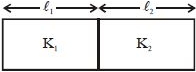
0 likes
View Solution90
DifficultMCQ
Two rods having the same cross-sectional area are used to connect two reservoirs at temperatures $100\,^{\circ}C$ and $0\,^{\circ}C$ as shown. The temperature of the junction is $70\,^{\circ}C$. If the rods are now interchanged,the temperature of the junction will be ......... $^{\circ}C$.
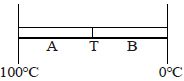
A
$70$
B
$30$
C
$50$
D
$40$
Solution
(B) Let $R_1$ and $R_2$ be the thermal resistances of the two rods. The rate of heat flow through the rods in series is given by:
$\frac{100 - 0}{R_1 + R_2} = \frac{100 - 70}{R_1} = \frac{70 - 0}{R_2}$
From this,we get:
$\frac{100}{R_1 + R_2} = \frac{30}{R_1} = \frac{70}{R_2}$
From $\frac{30}{R_1} = \frac{70}{R_2}$,we find $R_2 = \frac{7}{3} R_1$.
Substituting this into $\frac{100}{R_1 + R_2} = \frac{30}{R_1}$:
$\frac{100}{R_1 + \frac{7}{3}R_1} = \frac{30}{R_1} \Rightarrow \frac{100}{\frac{10}{3}R_1} = \frac{30}{R_1} \Rightarrow 30 = 30$ (consistent).
When the rods are interchanged,the new junction temperature $T$ satisfies:
$\frac{100 - T}{R_2} = \frac{T - 0}{R_1}$
$\frac{100 - T}{R_2} = \frac{T}{R_1} \Rightarrow \frac{100 - T}{T} = \frac{R_2}{R_1} = \frac{7}{3}$
$3(100 - T) = 7T \Rightarrow 300 - 3T = 7T \Rightarrow 10T = 300 \Rightarrow T = 30\,^{\circ}C$.
$\frac{100 - 0}{R_1 + R_2} = \frac{100 - 70}{R_1} = \frac{70 - 0}{R_2}$
From this,we get:
$\frac{100}{R_1 + R_2} = \frac{30}{R_1} = \frac{70}{R_2}$
From $\frac{30}{R_1} = \frac{70}{R_2}$,we find $R_2 = \frac{7}{3} R_1$.
Substituting this into $\frac{100}{R_1 + R_2} = \frac{30}{R_1}$:
$\frac{100}{R_1 + \frac{7}{3}R_1} = \frac{30}{R_1} \Rightarrow \frac{100}{\frac{10}{3}R_1} = \frac{30}{R_1} \Rightarrow 30 = 30$ (consistent).
When the rods are interchanged,the new junction temperature $T$ satisfies:
$\frac{100 - T}{R_2} = \frac{T - 0}{R_1}$
$\frac{100 - T}{R_2} = \frac{T}{R_1} \Rightarrow \frac{100 - T}{T} = \frac{R_2}{R_1} = \frac{7}{3}$
$3(100 - T) = 7T \Rightarrow 300 - 3T = 7T \Rightarrow 10T = 300 \Rightarrow T = 30\,^{\circ}C$.
0 likes
View Solution91
MediumMCQ
Two identical square rods of metal are welded end to end as shown in figure $(a)$. Assume that $10 \, cal$ of heat flows through the rods in $2 \, min$. Now the rods are welded as shown in figure $(b)$. The time it would take for $10 \, cal$ to flow through the rods now,is ........ $\min$.
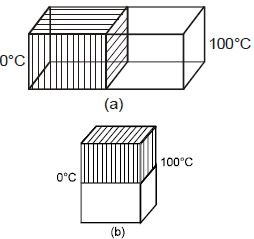
A
$0.75$
B
$0.5$
C
$1.5$
D
$1$
Solution
(B) Let the thermal resistance of each rod be $R$.
In figure $(a)$,the rods are in series,so the equivalent thermal resistance is $R_{eq1} = R + R = 2R$.
The rate of heat flow is $\frac{Q_1}{t_1} = \frac{\Delta T}{R_{eq1}} = \frac{100 - 0}{2R} = \frac{50}{R}$.
Given $Q_1 = 10 \, cal$ and $t_1 = 2 \, min$,we have $\frac{10}{2} = \frac{50}{R}$,which gives $R = 10 \, K/cal \cdot min$.
In figure $(b)$,the rods are in parallel,so the equivalent thermal resistance is $R_{eq2} = \frac{R \cdot R}{R + R} = \frac{R}{2}$.
The rate of heat flow is $\frac{Q_2}{t_2} = \frac{\Delta T}{R_{eq2}} = \frac{100 - 0}{R/2} = \frac{200}{R}$.
For the same amount of heat $Q_2 = 10 \, cal$,we have $\frac{10}{t_2} = \frac{200}{R}$.
Substituting $R = 10$,we get $\frac{10}{t_2} = \frac{200}{10} = 20$.
Thus,$t_2 = \frac{10}{20} = 0.5 \, min$.
In figure $(a)$,the rods are in series,so the equivalent thermal resistance is $R_{eq1} = R + R = 2R$.
The rate of heat flow is $\frac{Q_1}{t_1} = \frac{\Delta T}{R_{eq1}} = \frac{100 - 0}{2R} = \frac{50}{R}$.
Given $Q_1 = 10 \, cal$ and $t_1 = 2 \, min$,we have $\frac{10}{2} = \frac{50}{R}$,which gives $R = 10 \, K/cal \cdot min$.
In figure $(b)$,the rods are in parallel,so the equivalent thermal resistance is $R_{eq2} = \frac{R \cdot R}{R + R} = \frac{R}{2}$.
The rate of heat flow is $\frac{Q_2}{t_2} = \frac{\Delta T}{R_{eq2}} = \frac{100 - 0}{R/2} = \frac{200}{R}$.
For the same amount of heat $Q_2 = 10 \, cal$,we have $\frac{10}{t_2} = \frac{200}{R}$.
Substituting $R = 10$,we get $\frac{10}{t_2} = \frac{200}{10} = 20$.
Thus,$t_2 = \frac{10}{20} = 0.5 \, min$.
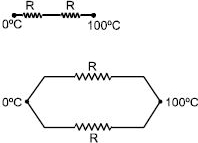
0 likes
View Solution92
DifficultMCQ
Two rods of the same length and material transfer a given amount of heat in $12 \, s$ when they are joined in parallel. But when they are joined in series,then they will transfer the same amount of heat under the same conditions in ........ $s$.
A
$24$
B
$3$
C
$1.5$
D
$48$
Solution
(D) Let the length of each rod be $l$,area of cross-section be $A$,and thermal conductivity be $k$. The rate of heat flow is given by $H = \frac{kA \Delta T}{l}$.
Case $1$: When joined in parallel,the effective area is $2A$ and effective length is $l$. The rate of heat flow is $H_p = \frac{k(2A) \Delta T}{l} = \frac{2kA \Delta T}{l}$.
Given $H_p = \frac{Q}{12}$,so $\frac{Q}{12} = \frac{2kA \Delta T}{l} \implies Q = \frac{24kA \Delta T}{l}$.
Case $2$: When joined in series,the effective length is $2l$ and effective area is $A$. The rate of heat flow is $H_s = \frac{kA \Delta T}{2l}$.
Given $H_s = \frac{Q}{t}$,so $\frac{Q}{t} = \frac{kA \Delta T}{2l} \implies t = \frac{Q \cdot 2l}{kA \Delta T}$.
Substituting $Q$ from Case $1$ into Case $2$:
$t = \frac{(24kA \Delta T / l) \cdot 2l}{kA \Delta T} = 24 \times 2 = 48 \, s$.
Case $1$: When joined in parallel,the effective area is $2A$ and effective length is $l$. The rate of heat flow is $H_p = \frac{k(2A) \Delta T}{l} = \frac{2kA \Delta T}{l}$.
Given $H_p = \frac{Q}{12}$,so $\frac{Q}{12} = \frac{2kA \Delta T}{l} \implies Q = \frac{24kA \Delta T}{l}$.
Case $2$: When joined in series,the effective length is $2l$ and effective area is $A$. The rate of heat flow is $H_s = \frac{kA \Delta T}{2l}$.
Given $H_s = \frac{Q}{t}$,so $\frac{Q}{t} = \frac{kA \Delta T}{2l} \implies t = \frac{Q \cdot 2l}{kA \Delta T}$.
Substituting $Q$ from Case $1$ into Case $2$:
$t = \frac{(24kA \Delta T / l) \cdot 2l}{kA \Delta T} = 24 \times 2 = 48 \, s$.
0 likes
View Solution93
MediumMCQ
Assertion: The equivalent thermal conductivity of two plates of the same thickness in contact is less than the smaller value of thermal conductivity.
Reason: For two plates of equal thickness in contact,the equivalent thermal conductivity is given by: $\frac{2}{K} = \frac{1}{K_1} + \frac{1}{K_2}$
Reason: For two plates of equal thickness in contact,the equivalent thermal conductivity is given by: $\frac{2}{K} = \frac{1}{K_1} + \frac{1}{K_2}$
A
If both Assertion and Reason are correct and the Reason is a correct explanation of the Assertion.
B
If both Assertion and Reason are correct but Reason is not a correct explanation of the Assertion.
C
If the Assertion is correct but Reason is incorrect.
D
If both the Assertion and Reason are incorrect.
Solution
(C) For two plates of equal thickness $d$ and thermal conductivities $K_1$ and $K_2$ placed in series,the total thermal resistance is $R_{eq} = R_1 + R_2$.
Since $R = \frac{d}{KA}$,we have $\frac{2d}{K_{eq}A} = \frac{d}{K_1A} + \frac{d}{K_2A}$.
Simplifying this,we get $\frac{2}{K_{eq}} = \frac{1}{K_1} + \frac{1}{K_2}$,which implies $K_{eq} = \frac{2K_1K_2}{K_1 + K_2}$.
This is the harmonic mean of $K_1$ and $K_2$. The harmonic mean of two numbers is always less than the larger number and greater than the smaller number,but specifically,the equivalent conductivity $K_{eq}$ satisfies $K_{min} < K_{eq} < K_{max}$.
Wait,let's re-evaluate: If $K_1 = 10$ and $K_2 = 2$,then $K_{eq} = \frac{2(10)(2)}{10+2} = \frac{40}{12} \approx 3.33$.
Here $3.33 > 2$ (the smaller value). Thus,the Assertion is incorrect.
Since $R = \frac{d}{KA}$,we have $\frac{2d}{K_{eq}A} = \frac{d}{K_1A} + \frac{d}{K_2A}$.
Simplifying this,we get $\frac{2}{K_{eq}} = \frac{1}{K_1} + \frac{1}{K_2}$,which implies $K_{eq} = \frac{2K_1K_2}{K_1 + K_2}$.
This is the harmonic mean of $K_1$ and $K_2$. The harmonic mean of two numbers is always less than the larger number and greater than the smaller number,but specifically,the equivalent conductivity $K_{eq}$ satisfies $K_{min} < K_{eq} < K_{max}$.
Wait,let's re-evaluate: If $K_1 = 10$ and $K_2 = 2$,then $K_{eq} = \frac{2(10)(2)}{10+2} = \frac{40}{12} \approx 3.33$.
Here $3.33 > 2$ (the smaller value). Thus,the Assertion is incorrect.
0 likes
View Solution94
Medium
An iron bar $(L_{1}=0.1 \; m, A_{1}=0.02 \; m^{2}, K_{1}=79 \; W m^{-1} K^{-1})$ and a brass bar $(L_{2}=0.1 \; m, A_{2}=0.02 \; m^{2}, K_{2}=109 \; W m^{-1} K^{-1})$ are soldered end to end as shown in the figure. The free ends of the iron bar and brass bar are maintained at $373 \; K$ and $273 \; K$ respectively. Obtain expressions for and hence compute:
$(i)$ the temperature of the junction of the two bars,
$(ii)$ the equivalent thermal conductivity of the compound bar,and
$(iii)$ the heat current through the compound bar.
$(i)$ the temperature of the junction of the two bars,
$(ii)$ the equivalent thermal conductivity of the compound bar,and
$(iii)$ the heat current through the compound bar.
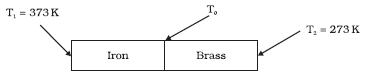
Solution
(N/A) Given: $L_{1}=L_{2}=L=0.1 \; m$,$A_{1}=A_{2}=A=0.02 \; m^{2}$,$K_{1}=79 \; W m^{-1} K^{-1}$,$K_{2}=109 \; W m^{-1} K^{-1}$,$T_{1}=373 \; K$,$T_{2}=273 \; K$.
Under steady-state conditions,the heat current $(H_{1})$ through the iron bar is equal to the heat current $(H_{2})$ through the brass bar.
$H = H_{1} = H_{2} = \frac{K_{1} A (T_{1}-T_{0})}{L} = \frac{K_{2} A (T_{0}-T_{2})}{L}$
$(i)$ Junction temperature $T_{0}$:
$K_{1}(T_{1}-T_{0}) = K_{2}(T_{0}-T_{2})$
$T_{0} = \frac{K_{1} T_{1} + K_{2} T_{2}}{K_{1} + K_{2}} = \frac{(79 \times 373) + (109 \times 273)}{79 + 109} = \frac{29467 + 29757}{188} = \frac{59224}{188} \approx 315 \; K$.
$(ii)$ Equivalent thermal conductivity $K'$:
For series combination,$\frac{2L}{K'} = \frac{L}{K_{1}} + \frac{L}{K_{2}} \implies \frac{2}{K'} = \frac{1}{K_{1}} + \frac{1}{K_{2}} = \frac{K_{1}+K_{2}}{K_{1} K_{2}}$
$K' = \frac{2 K_{1} K_{2}}{K_{1}+K_{2}} = \frac{2 \times 79 \times 109}{79 + 109} = \frac{17222}{188} \approx 91.6 \; W m^{-1} K^{-1}$.
$(iii)$ Heat current $H$:
$H = \frac{K' A (T_{1}-T_{2})}{2L} = \frac{91.6 \times 0.02 \times (373 - 273)}{2 \times 0.1} = \frac{91.6 \times 0.02 \times 100}{0.2} = \frac{183.2}{0.2} = 916 \; W$.
Under steady-state conditions,the heat current $(H_{1})$ through the iron bar is equal to the heat current $(H_{2})$ through the brass bar.
$H = H_{1} = H_{2} = \frac{K_{1} A (T_{1}-T_{0})}{L} = \frac{K_{2} A (T_{0}-T_{2})}{L}$
$(i)$ Junction temperature $T_{0}$:
$K_{1}(T_{1}-T_{0}) = K_{2}(T_{0}-T_{2})$
$T_{0} = \frac{K_{1} T_{1} + K_{2} T_{2}}{K_{1} + K_{2}} = \frac{(79 \times 373) + (109 \times 273)}{79 + 109} = \frac{29467 + 29757}{188} = \frac{59224}{188} \approx 315 \; K$.
$(ii)$ Equivalent thermal conductivity $K'$:
For series combination,$\frac{2L}{K'} = \frac{L}{K_{1}} + \frac{L}{K_{2}} \implies \frac{2}{K'} = \frac{1}{K_{1}} + \frac{1}{K_{2}} = \frac{K_{1}+K_{2}}{K_{1} K_{2}}$
$K' = \frac{2 K_{1} K_{2}}{K_{1}+K_{2}} = \frac{2 \times 79 \times 109}{79 + 109} = \frac{17222}{188} \approx 91.6 \; W m^{-1} K^{-1}$.
$(iii)$ Heat current $H$:
$H = \frac{K' A (T_{1}-T_{2})}{2L} = \frac{91.6 \times 0.02 \times (373 - 273)}{2 \times 0.1} = \frac{91.6 \times 0.02 \times 100}{0.2} = \frac{183.2}{0.2} = 916 \; W$.
0 likes
View Solution95
Medium
Why do people prefer to give a layer of sand or foam insulation on ceilings made of concrete?
Solution
(N/A) The thermal conductivity of concrete,although much smaller than that of metals,is still not low enough to provide effective thermal insulation. By adding a layer of sand or foam,which are poor conductors of heat (insulators),the overall thermal resistance of the ceiling increases. This significantly reduces the rate of heat transfer from the outside environment into the room,thereby keeping the room cooler during hot weather.
0 likes
View Solution96
MediumMCQ
Two identical metal wires of thermal conductivities $K_{1}$ and $K_{2}$ respectively are connected in series. The effective thermal conductivity of the combination is
A
$\frac{2 K_{1} K_{2}}{K_{1}+ K_{2}}$
B
$\frac{K_{1}+ K_{2}}{2 K_{1} K_{2}}$
C
$\frac{K_{1}+ K_{2}}{K_{1} K_{2}}$
D
$\frac{K_{1} K_{2}}{K_{1}+ K_{2}}$
Solution
(A) For two wires connected in series,the thermal resistance $R$ is given by $R = \frac{l}{KA}$,where $l$ is the length,$K$ is the thermal conductivity,and $A$ is the cross-sectional area.
Since the wires are identical,they have the same length $l$ and cross-sectional area $A$.
The total thermal resistance $R_{eff}$ of the series combination is the sum of individual resistances:
$R_{eff} = R_{1} + R_{2} = \frac{l}{K_{1}A} + \frac{l}{K_{2}A}$
For the equivalent wire of length $2l$ and thermal conductivity $K_{eq}$,the resistance is:
$R_{eff} = \frac{2l}{K_{eq}A}$
Equating the two expressions for $R_{eff}$:
$\frac{2l}{K_{eq}A} = \frac{l}{K_{1}A} + \frac{l}{K_{2}A}$
$\frac{2}{K_{eq}} = \frac{1}{K_{1}} + \frac{1}{K_{2}} = \frac{K_{1} + K_{2}}{K_{1}K_{2}}$
$K_{eq} = \frac{2K_{1}K_{2}}{K_{1} + K_{2}}$
Since the wires are identical,they have the same length $l$ and cross-sectional area $A$.
The total thermal resistance $R_{eff}$ of the series combination is the sum of individual resistances:
$R_{eff} = R_{1} + R_{2} = \frac{l}{K_{1}A} + \frac{l}{K_{2}A}$
For the equivalent wire of length $2l$ and thermal conductivity $K_{eq}$,the resistance is:
$R_{eff} = \frac{2l}{K_{eq}A}$
Equating the two expressions for $R_{eff}$:
$\frac{2l}{K_{eq}A} = \frac{l}{K_{1}A} + \frac{l}{K_{2}A}$
$\frac{2}{K_{eq}} = \frac{1}{K_{1}} + \frac{1}{K_{2}} = \frac{K_{1} + K_{2}}{K_{1}K_{2}}$
$K_{eq} = \frac{2K_{1}K_{2}}{K_{1} + K_{2}}$
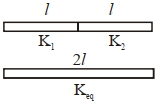
0 likes
View Solution97
MediumMCQ
The temperature $\theta$ at the junction of two insulating sheets,having thermal resistances $R_{1}$ and $R_{2}$ as well as top and bottom temperatures $\theta_{1}$ and $\theta_{2}$ (as shown in figure) is given by
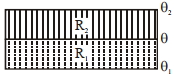
A
$\frac{\theta_{1} R_{1}+\theta_{2} R_{2}}{R_{1}+R_{2}}$
B
$\frac{\theta_{1} R_{2}-\theta_{2} R_{1}}{R_{2}-R_{1}}$
C
$\frac{\theta_{1} R_{2}+\theta_{2} R_{1}}{R_{1}+R_{2}}$
D
$\frac{\theta_{2} R_{1}+\theta_{1} R_{2}}{R_{1}+R_{2}}$
Solution
(C) Since the two insulating sheets are in series,the rate of heat flow $(H)$ through both sheets must be the same in the steady state.
The rate of heat flow is given by $H = \frac{\Delta \theta}{R}$.
For the first sheet (bottom),the heat flow is $H = \frac{\theta - \theta_{1}}{R_{1}}$.
For the second sheet (top),the heat flow is $H = \frac{\theta_{2} - \theta}{R_{2}}$.
Equating the two rates:
$\frac{\theta - \theta_{1}}{R_{1}} = \frac{\theta_{2} - \theta}{R_{2}}$
$R_{2}(\theta - \theta_{1}) = R_{1}(\theta_{2} - \theta)$
$R_{2}\theta - R_{2}\theta_{1} = R_{1}\theta_{2} - R_{1}\theta$
$R_{2}\theta + R_{1}\theta = R_{1}\theta_{2} + R_{2}\theta_{1}$
$\theta(R_{1} + R_{2}) = R_{1}\theta_{2} + R_{2}\theta_{1}$
$\theta = \frac{R_{1}\theta_{2} + R_{2}\theta_{1}}{R_{1} + R_{2}}$
Thus,the correct option is $C$.
The rate of heat flow is given by $H = \frac{\Delta \theta}{R}$.
For the first sheet (bottom),the heat flow is $H = \frac{\theta - \theta_{1}}{R_{1}}$.
For the second sheet (top),the heat flow is $H = \frac{\theta_{2} - \theta}{R_{2}}$.
Equating the two rates:
$\frac{\theta - \theta_{1}}{R_{1}} = \frac{\theta_{2} - \theta}{R_{2}}$
$R_{2}(\theta - \theta_{1}) = R_{1}(\theta_{2} - \theta)$
$R_{2}\theta - R_{2}\theta_{1} = R_{1}\theta_{2} - R_{1}\theta$
$R_{2}\theta + R_{1}\theta = R_{1}\theta_{2} + R_{2}\theta_{1}$
$\theta(R_{1} + R_{2}) = R_{1}\theta_{2} + R_{2}\theta_{1}$
$\theta = \frac{R_{1}\theta_{2} + R_{2}\theta_{1}}{R_{1} + R_{2}}$
Thus,the correct option is $C$.
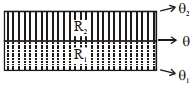
0 likes
View Solution98
DifficultMCQ
$A$ rod $CD$ of thermal resistance $10.0 \; K/W$ is joined at the middle of an identical rod $AB$ as shown in the figure. The ends $A$,$B$,and $D$ are maintained at $200^{\circ}C$,$100^{\circ}C$,and $125^{\circ}C$ respectively. The heat current in $CD$ is $P$ watt. The value of $P$ is ... .
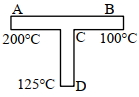
A
$2$
B
$3$
C
$1$
D
$4$
Solution
(A) Since the rods are identical,the thermal resistance of each rod is $R_{AB} = R_{CD} = 10 \; K/W$.
$C$ is the midpoint of $AB$,so the thermal resistance of each half is $R_{AC} = R_{CB} = 5 \; K/W$.
Let the temperature at the junction $C$ be $T$.
Applying the junction rule for heat current (sum of heat currents entering = sum of heat currents leaving):
$\frac{200 - T}{5} = \frac{T - 125}{10} + \frac{T - 100}{5}$
Multiplying the entire equation by $10$:
$2(200 - T) = (T - 125) + 2(T - 100)$
$400 - 2T = T - 125 + 2T - 200$
$400 - 2T = 3T - 325$
$5T = 725$
$T = 145^{\circ}C$
The heat current $P$ in rod $CD$ is given by:
$P = \frac{T - 125}{R_{CD}} = \frac{145 - 125}{10} = \frac{20}{10} = 2 \; W$.
Thus,the value of $P$ is $2$.
$C$ is the midpoint of $AB$,so the thermal resistance of each half is $R_{AC} = R_{CB} = 5 \; K/W$.
Let the temperature at the junction $C$ be $T$.
Applying the junction rule for heat current (sum of heat currents entering = sum of heat currents leaving):
$\frac{200 - T}{5} = \frac{T - 125}{10} + \frac{T - 100}{5}$
Multiplying the entire equation by $10$:
$2(200 - T) = (T - 125) + 2(T - 100)$
$400 - 2T = T - 125 + 2T - 200$
$400 - 2T = 3T - 325$
$5T = 725$
$T = 145^{\circ}C$
The heat current $P$ in rod $CD$ is given by:
$P = \frac{T - 125}{R_{CD}} = \frac{145 - 125}{10} = \frac{20}{10} = 2 \; W$.
Thus,the value of $P$ is $2$.
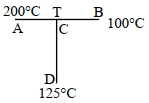
0 likes
View Solution99
DifficultMCQ
As per the given figure,two plates $A$ and $B$ of thermal conductivity $K$ and $2K$ are joined together to form a compound plate. The thickness of the plates are $4.0 \,cm$ and $2.5 \,cm$ respectively,and the area of cross-section is $120 \,cm^{2}$ for each plate. If the equivalent thermal conductivity of the compound plate is $\left(1+\frac{5}{\alpha}\right) K$,then the value of $\alpha$ will be . . . . . .
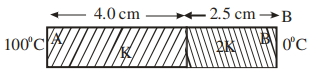
A
$20$
B
$21$
C
$23$
D
$22$
Solution
(B) The rate of heat flow is given by $\frac{\Delta Q}{\Delta t} = \left(\frac{1}{R}\right) \Delta T$,where $R$ is the thermal resistance.
For a plate of thickness $L$,thermal conductivity $K$,and area $A$,the thermal resistance is $R = \frac{L}{KA}$.
For plate $A$: $R_{1} = \frac{L_{1}}{K_{1}A} = \frac{4.0}{K(120)}$.
For plate $B$: $R_{2} = \frac{L_{2}}{K_{2}A} = \frac{2.5}{(2K)(120)}$.
Since the plates are in series,the equivalent thermal resistance is $R_{\text{eq}} = R_{1} + R_{2}$.
The equivalent thermal conductivity $K_{\text{eq}}$ for a compound plate of total thickness $L_{\text{eq}} = L_{1} + L_{2}$ and area $A$ is given by $\frac{L_{\text{eq}}}{K_{\text{eq}}A} = \frac{L_{1}}{K_{1}A} + \frac{L_{2}}{K_{2}A}$.
Substituting the values: $\frac{4.0 + 2.5}{K_{\text{eq}}(120)} = \frac{4.0}{K(120)} + \frac{2.5}{2K(120)}$.
$\frac{6.5}{K_{\text{eq}}} = \frac{4}{K} + \frac{1.25}{K} = \frac{5.25}{K} = \frac{21/4}{K} = \frac{21}{4K}$.
Therefore,$K_{\text{eq}} = \frac{6.5 \times 4K}{21} = \frac{26}{21}K = \left(1 + \frac{5}{21}\right)K$.
Comparing this with $\left(1 + \frac{5}{\alpha}\right)K$,we get $\alpha = 21$.
For a plate of thickness $L$,thermal conductivity $K$,and area $A$,the thermal resistance is $R = \frac{L}{KA}$.
For plate $A$: $R_{1} = \frac{L_{1}}{K_{1}A} = \frac{4.0}{K(120)}$.
For plate $B$: $R_{2} = \frac{L_{2}}{K_{2}A} = \frac{2.5}{(2K)(120)}$.
Since the plates are in series,the equivalent thermal resistance is $R_{\text{eq}} = R_{1} + R_{2}$.
The equivalent thermal conductivity $K_{\text{eq}}$ for a compound plate of total thickness $L_{\text{eq}} = L_{1} + L_{2}$ and area $A$ is given by $\frac{L_{\text{eq}}}{K_{\text{eq}}A} = \frac{L_{1}}{K_{1}A} + \frac{L_{2}}{K_{2}A}$.
Substituting the values: $\frac{4.0 + 2.5}{K_{\text{eq}}(120)} = \frac{4.0}{K(120)} + \frac{2.5}{2K(120)}$.
$\frac{6.5}{K_{\text{eq}}} = \frac{4}{K} + \frac{1.25}{K} = \frac{5.25}{K} = \frac{21/4}{K} = \frac{21}{4K}$.
Therefore,$K_{\text{eq}} = \frac{6.5 \times 4K}{21} = \frac{26}{21}K = \left(1 + \frac{5}{21}\right)K$.
Comparing this with $\left(1 + \frac{5}{\alpha}\right)K$,we get $\alpha = 21$.
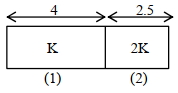
0 likes
View Solution100
MediumMCQ
$A$ metallic prong consists of $4$ rods made of the same material,with the same cross-sections and the same lengths as shown below. The three forked ends are kept at $100^{\circ} C$ and the handle end is at $0^{\circ} C$. The temperature of the junction is ............. $^{\circ} C$.
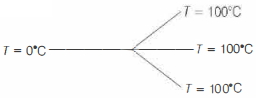
A
$25$
B
$50$
C
$60$
D
$75$
Solution
(D) Let the junction temperature be $T^{\circ} C$.
Since the rods are made of the same material,have the same cross-sectional area $A$,and the same length $l$,their thermal resistance $R = \frac{l}{kA}$ is the same for all rods.
According to the principle of steady-state heat flow,the total heat inflow through the three forked rods must equal the heat outflow through the fourth rod (the handle).
Heat inflow from three rods = $3 \times \frac{kA}{l}(100 - T)$
Heat outflow through the fourth rod = $\frac{kA}{l}(T - 0)$
Equating the two:
$3 \frac{kA}{l}(100 - T) = \frac{kA}{l}(T - 0)$
$3(100 - T) = T$
$300 - 3T = T$
$4T = 300$
$T = 75^{\circ} C$
Since the rods are made of the same material,have the same cross-sectional area $A$,and the same length $l$,their thermal resistance $R = \frac{l}{kA}$ is the same for all rods.
According to the principle of steady-state heat flow,the total heat inflow through the three forked rods must equal the heat outflow through the fourth rod (the handle).
Heat inflow from three rods = $3 \times \frac{kA}{l}(100 - T)$
Heat outflow through the fourth rod = $\frac{kA}{l}(T - 0)$
Equating the two:
$3 \frac{kA}{l}(100 - T) = \frac{kA}{l}(T - 0)$
$3(100 - T) = T$
$300 - 3T = T$
$4T = 300$
$T = 75^{\circ} C$
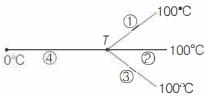
0 likes
View Solution10-2.Heat Transfer — Thermal Resistance and it's Combination · Frequently Asked Questions
1Are these 10-2.Heat Transfer questions useful for JEE and NEET?
Yes. All questions in this section are mapped to JEE Main and NEET exam patterns. Previous year questions from JEE Main, NEET, GUJCET and state-level exams are included with full solutions.
2Can I switch to Hindi or Gujarati for these questions?
Yes. Use the language tabs in the hero section or the sidebar to view the same questions and solutions in English, Hindi or Gujarati.
3How do I generate a question paper from this subtopic?
Use the Vedclass Exam Paper Generator — select the chapter and subtopic, set difficulty, and generate Sets A, B, C, D automatically. First 3 chapters of every subject are free.
Vedclass Products
For Students
Vedclass Test Series
Mock tests in real JEE/NEET style with performance analysis. 5-day free trial.
Start Free TrialFor Teachers
Exam Paper Generator
Generate Set A/B/C/D papers from this chapter in 2 minutes. 3 chapters free.
Try FreeFor Institutes
Online Exam Module
Live online exams with unlimited students, 360° analytics & white-label branding.
See DemoFor Teachers & Institutes
Generate a 10-2.Heat Transfer Exam Paper in 2 Minutes
Select subtopic & difficulty — Sets A, B, C, D auto-generated with No Repeat logic.
First 3 chapters of every subject are free — no payment required.